
The king is back. Sebastien Loeb will return to the World Rally Championship in 2018 with Citroen.
The 43-year-old Frenchman will compete on just three rallies – Mexico, Spain and Corsica – supporting Citroen’s lead driver Kris Meeke, who will compete on all 13 rounds, while Craig Breen will drive on the 10 events Loeb misses and team sponsor Sheikh Khalid Al-Qassimi will also compete on selected rounds.
Loeb is the most successful driver in the history of the WRC with 78 wins, 116 podiums and nine straight titles, remaining unbeaten from 2004 to his retirement from full-time competition at the end of 2012. He last competed at the 2015 Rally Monte Carlo, an event he led before crashing out on stage eight.
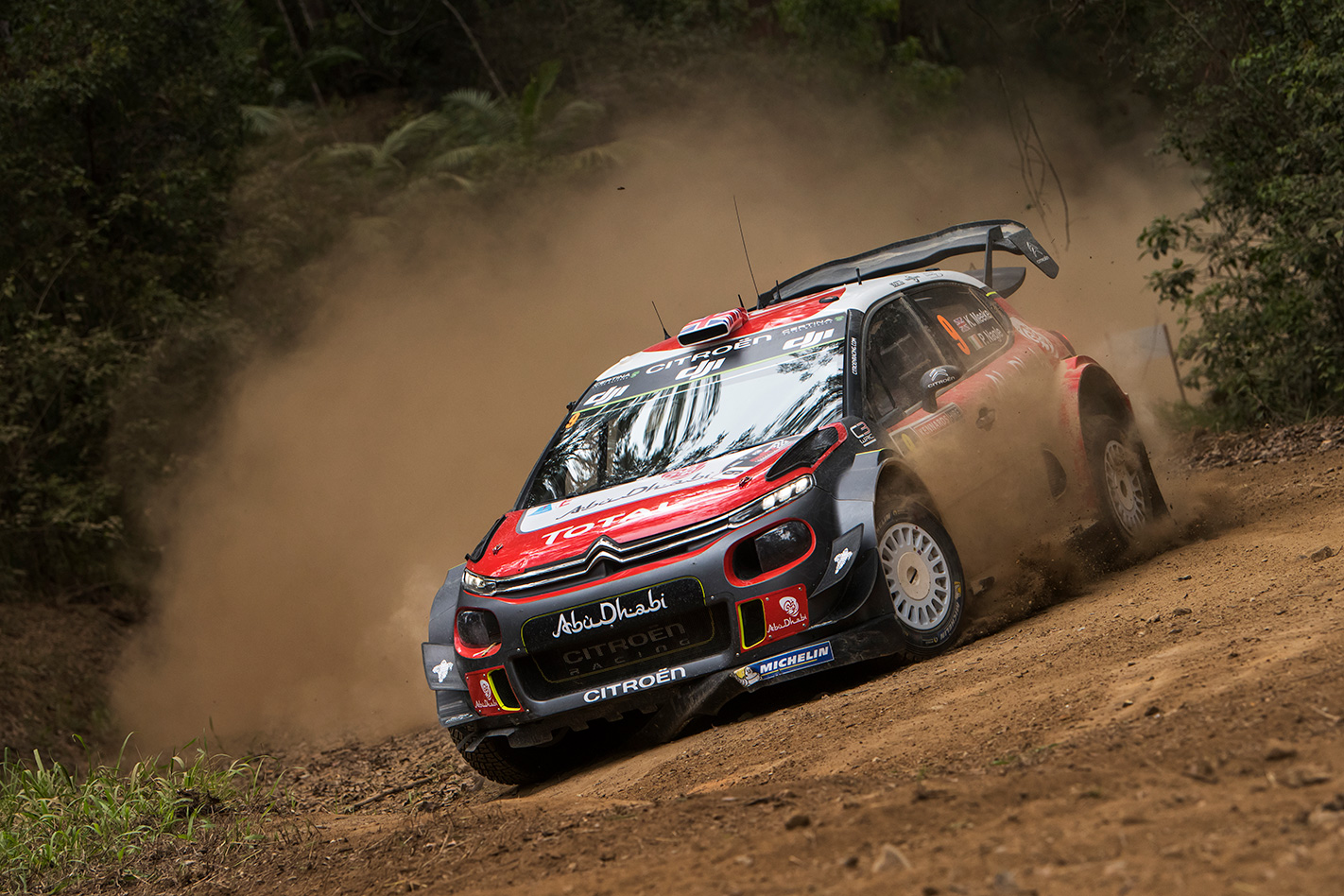
Loeb has stated recently that no discipline he has sampled since has delivered the same excitement as rallying: “The feeling you get in rally is one of the most thrilling feelings I’ve ever experience, and I was excited about driving one of these new WRCs in a race. I don’t have any expectations, I just want to enjoy myself.”
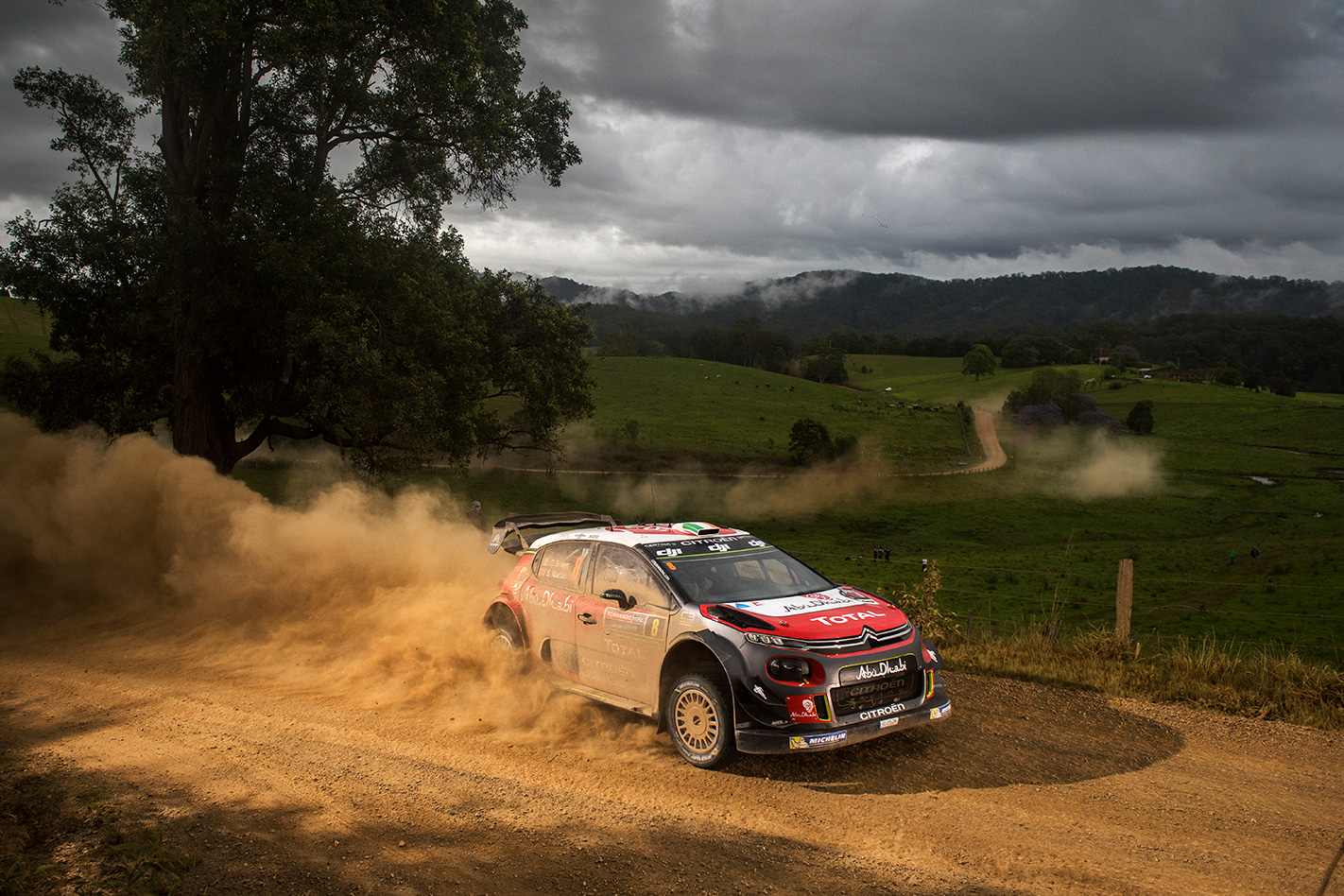
The 2018 WRC season begins in Monte Carlo on January 25.
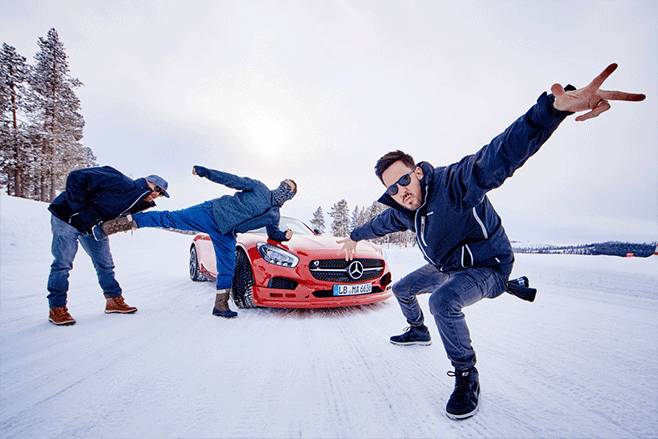
MERCEDES-AMG has enlisted the expertise of its “Partners in Performance” Linkin Park to help craft the way its vehicles will sound as electrification proliferates the range.
The relationship was forged between Mercedes’ purveyors of performance and the Californian rock band in the build-up to AMG’s 50th anniversary celebrations, but the group has also been called on for its take on how the electric car of the future should sound.
Speaking to Wheels in Los Angeles, Mercedes-AMG CEO Tobias Moers said the company was working with a number of experts in various industries, including Linkin Park to ensure the sound of an AMG still appeals to its customers even after electrified vehicles join the range.
“You know Linkin Park?” he asked. “I started to talk with these guys about what is their interpretation of electrified sound.
“We’ve had a cooperation with Linkin Park for years. We’re really close.”
Quite how the band will influence a high-performance vehicle’s sound remains to be heard, but the band’s input will be a small part of a much larger project involving other audio and aural authorities, said Moers.
“We started off years ago. We established a team doing artificial sound and we worked together with games specialists, we worked together with film artists doing sound for films.
“We sell emotions and sound is really a crucial part of emotion so what we do is work on artificial sounds because you have to.”
The company and its dedicated EV sound team is yet to finalise whether an electrified AMG will have an augmented sound in a similar manner to some existing combustion powered cars, or whether an altogether new sound that celebrates an electric drivetrain will be the solution.
What is known is that hybrid AMG cars will be a reality, with the mighty Project One paving the way and wearing the company’s EQ badges on its flanks – the brand to be carried by all electrified Mercedes models into the future.
While Mercedes-Benz models are already pioneering PHEV technology, the first AMG versions will not appear until “Mid-20s (2020) or maybe a little before that”, said Moers.
The process of introducing an electric AMG will be gradual, starting with technologies such as the 48-volt electric supercharger recently revealed by Benz for its all-new in-line six-cylinder petrol engine, but after that, more serious hybrid powertrains will follow.
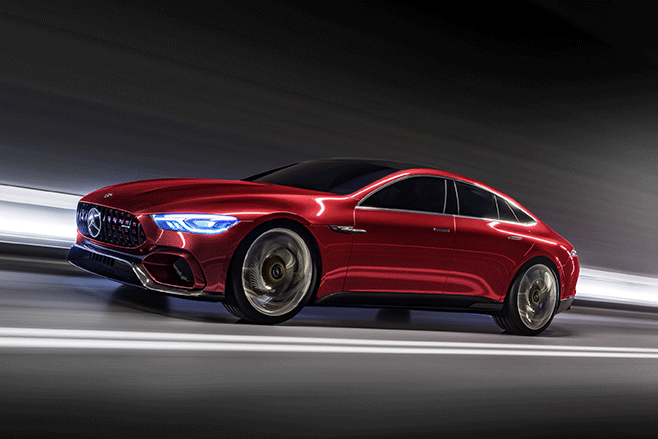
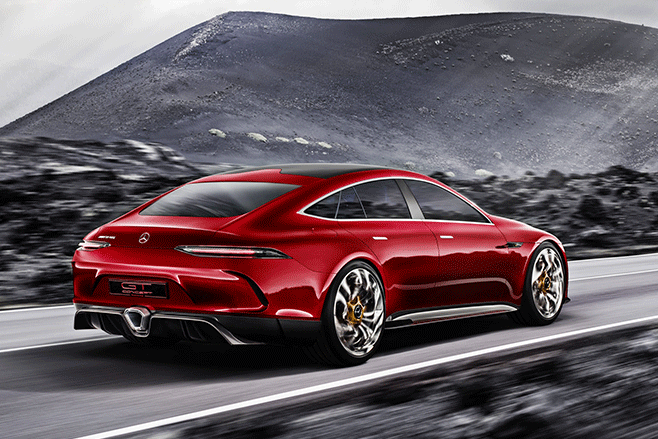
Moers explained that the four-door AMG GT Concept that rolled out in Geneva earlier this year was the best insight as to how an electrified production model would work.
“What you have seen in Geneva and the GT concept with rear-axle hybrid system, is more or less our understanding of how we are going to electrify powertrains in performance cars”.
That car packed a whopping 600kW with a combination of V8 turbo power and electric drive which bodes well for the performance of future AMG cars, even if we are going to have keep guessing what it will sound like for now.
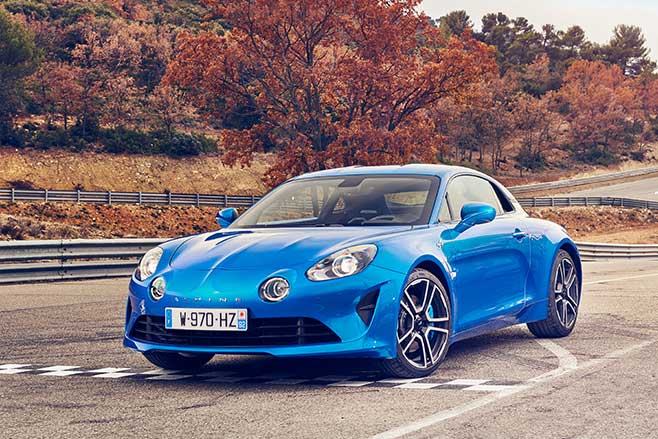
The 2018 Alpine A110 is a fast little car that offers a pure, back-to-basics handling philosophy that channels the Mazda MX-5 but with proper power.
It’s also handles a little bit like a Renault-designed Lotus which is not surprising given its development driver Rudy Thomann worked in Lotus’s ride and handling department during the inception of the original Elise.
But what the new French mid-engine coupe has that the Lotus hasn’t is a surprising level of refinement, including a roomy and comfortable if still simple interior.
We’ve just driven the new Alpine A110 in France, a car that heralds the return of the legendary French sports car brand after a 23-year hiatus, the new car finally getting unleashed on the road after five years in gestation.
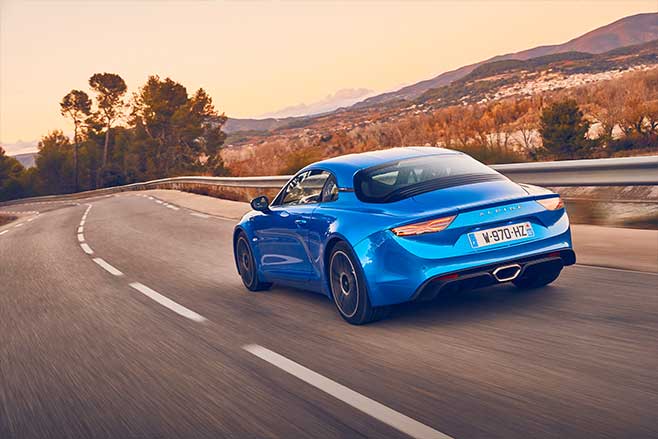
As one of the primary development KPIs, getting the A110’s weight to a target of 1000-1100kg was an immense engineering challenge necessitating a chassis and body made almost entirely from aluminium (96 per cent), a lot of it bonded with special high-strength glue to save further weight from welds and rivets — part of a ‘gram-strategy’-esque approach that is noticeable all over the car.
With the Premiere Edition coming in at 1103kg the Alpine team — compromised mostly of Renault Sport engineers best known for their scintillating hot hatches — achieved their set-out goal.
It also meant 185kW/320Nm from the 1.8-litre turbocharged inline-4, sourced from within the Renault empire (sharing its fundamentals with the Espace engine; and also slated for the upcoming new Megane RS) was more than enough for potent straight-line performance, the A110’s 168kW/tonne the same power-to-weight as a VFII SS Commodore.
With launch control the new A110 will hit 100km/h in a claimed 4.5sec and complete the quarter mile in 12.7sec. The base PDK Porsche 718 Cayman does 0-100km/h in a (admittedly conservatively claimed) 4.7sec.
The A110’s fairly blistering acceleration is despite the lack of a traditional limited slip differential, left off the car to save weight and cost, the Alpine instead distributing torque across the rear axle by individually braking any single-spinning wheels.
The car’s acceleration also benefits a lot from the new seven-speed EDC twin-clutch automatic, a unit shared again with the Espace (but not the upcoming new Megane RS, which will have a different and beefier EDC) but overhauled for sports car use with bespoke ratios and significantly quickened shift speeds. The shift paddles for manual mode are fixed on the steering column, rather than the steering wheel.
Excruciatingly for some would-be owners, the new A110 is not available with a manual gearbox, Alpine bosses claiming there was not enough budget to develop two transmission options to the desired standard, putting their entire focus into the auto instead given its better sales potential.
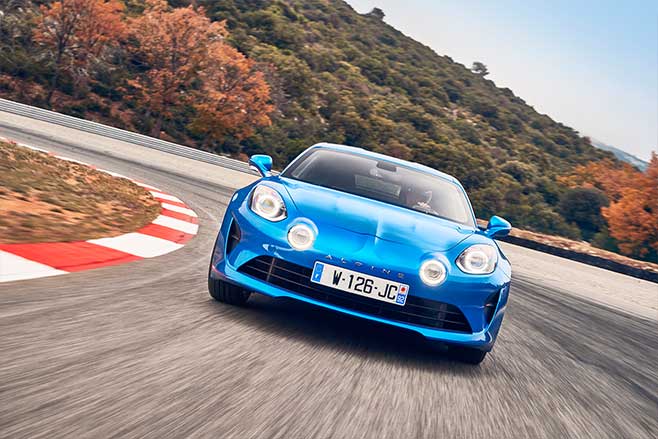
Flick from Normal to Sport to Track mode using the steering-wheel-mounted red toggle button and the A110’s personality becomes noticeably more aggressive and even a tiny bit feral, the bi-modal exhaust opening to reveal a loud and raucous note nearing the 6650rpm redline that reminds us — strangely despite being half the engine — of a Ricardo V8-powered McLaren in its upper revs.
With a proud turbocharged personality there is very noticeably an engine behind you and nothing much in front of you, including the bonnet which disappears below the bottom of the windscreen. You sit low and back in the Alpine, your bum not quite on the road but with the door sills at shoulder height and the dashboard rising up to envelope you in classic sports car style, with a fantastic (and therefore very unFrench) driving position and even more fantastic fixed-back lightweight Sabelt bucket seats — attractive, supportive and generously padded, a real highlight of the car.
Despite the low and set-back driving position, forward and side visibility is excellent; rear visibility is the bare minimum. Sadly there is no engine to peer over in the rear vision mirror through the narrow rear window, just a carpeted panel.
Under full throttle the Alpine squats politely on its rear axle as it angrily unleashes its power, traction strong in a straight line and the EDC swiftly snatching new gears with a loud brap, the engine transitioning from a Clio RS-like intake grumble at low rpm to a baby supercar-esque bark at higher rpm. This is a loud car from the outside, with also plenty of burbles on the exhaust overrun. That all said, the sounds the Alpine makes are more fun and exciting than emotional. A turbocharged four-cylinder will always struggle with that.
For anybody who‘s experienced a supercar the Alpine is not scary quick but plenty exciting as it pushes you back into the seat. You would absolutely describe it as fast, with enough grunt to make it a car not to be reckoned with lightly.
With relatively soft spring rates the A110 feels deliciously light on its suspension, a unique feeling only found in a few new cars, all of them weighing around the 1000kg mark, the MX-5 being one of them.
This feeling of lightness combined with the eager power, and good lateral grip, makes for one very delightfully fun car to drive fast, the suspension also breathing with the road and getting better the faster you go, something we’ve only ever felt on sports cars many times the Alpine’s price.
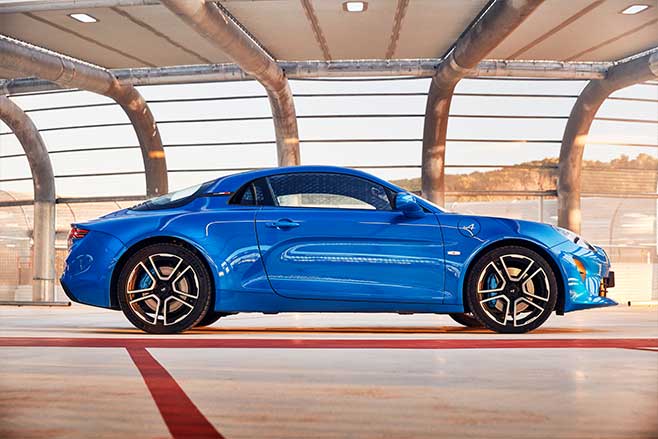
With suspension on the soft side, the Alpine likes a smooth driver. The nose dips visibly as you transition from full throttle to full braking, the body moving through big curves during hard cornering — extra exciting to push the limits of the excellent Michelin Pilot Sport 4 tyres, but also easy to upset the A110 if you’re not smooth enough. The Alpine with classic mid-engine dynamics seems to revel in being grabbed by its scruff and ordered around, but any aggression still must be smooth.
There will be some people who don’t like the extra body movement of the soft suspension and crave less of it, particularly on track. But while it would be possible to fit a firmer set-up and possibly a grippier tyre, to do so with the same amount of suspension genius as the current set-up would be extremely difficult.
With its short wheelbase, fast and precise steering, responsive EDC (which will let you grab two lower gears in quick and crisp succession) and sweetly stacked gear ratios, the Alpine loves a tight and twisty back road, the turbocharged engine supplying flexible low-down torque, the ESC in Track mode also lenient enough to permit a quarter-turn corrective lock on the throttle out of first and second gear corners. If you are smooth, this is an easy and fun car to drive fast, even on faster flowing roads where you can short-shift and surf the turbocharged torque as the engine hisses under boost right behind your head. It is a mega little thing.
Also the EPAS steering which, while precise and good enough, is nothing special. Throttle response can also be doughy and dulled owing presumably to the inescapable physics of a turbo needing to spool (boost is 1.1 bar or 16psi). We’re probably picking on the Alpine a bit at this point but they rob the driver of connection which in a sports car you can never have too much of.
This car would also be improved by a proper limited slip differential. The open diff and computer braking works well but you can’t simulate the lovely feeling of a proper limited slip differential. It would be the subtle ingredient that improves the recipe.
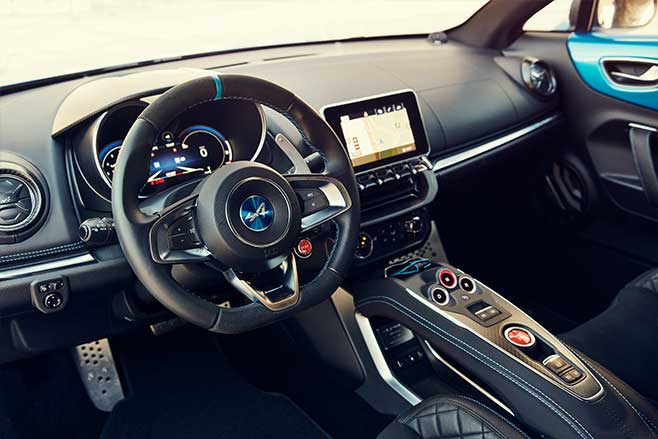
Aside from luggage space, with a shallow front boot and cute little rear boot both with no chance of dealing with a golf bag (96L and 100L respectively), the interior is where the owner is asked to make the biggest concessions for the Alpine’s cause. While surprisingly roomy for two large adults, cramped in no way, it is a simple, minimalist, almost functional space to be, a bit of an office. And a part of the car Renault clearly used to save some cost on the project.
Despite how it looks in the nice press photos, for build and material quality the Alpine interior has nothing on the Germans. That all said, it’s still a nice place to be with its aforementioned rockstar seats, two large TFT screens including instruments, and general refinement including low noise and good around-town ride. This is a more comfortable car than you expect. And if you read enough into Alpine’s history, the slightly budget interior is kind of ‘on brand’.
Quite aside from the lack a manual gearbox which there’s no point moping over, it’s really the interior that costs the Alpine the most marks.
You could also make a case that with its many Renault parts the A110 occasionally feels a little built to a price point in a big car company kind of way, but then you remember its no-compromise aluminium body and chassis. It’s one thing to wonder about the Alpine’s specialness, but there’s no questioning it’s uniqueness. Nor the fact that the way it drives is an achievement.
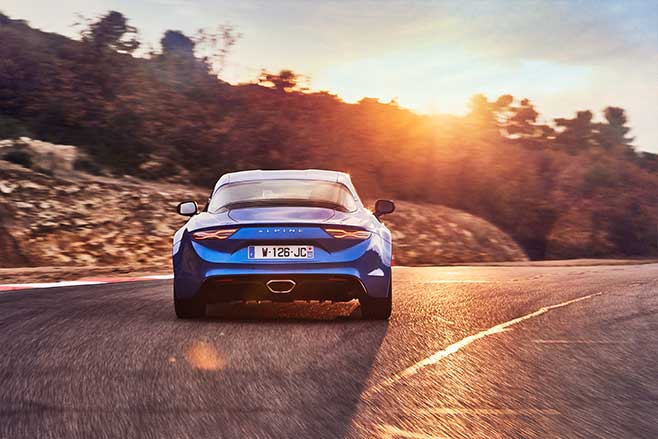
The Alpine A110 arrives in Australia in June 2018, cost to be confirmed but between $90K-$100K.
4.5 out of 5
ALPINE A110 SPECIFICATIONS
Engine: 1798cc inline-4, DOHC, 16v, turbocharged Drivetrain: rear-wheel drive, 7-speed twin-clutch automatic, open differential Power: 185kW at 6000rpm Torque: 320Nm at 2000-5000rpm Weight: 1103kg (Premiere Edition) 0-100km/h: 4.5sec (claimed) 0-400m: 12.7sec (claimed) 0-1000m: 23.2sec (claimed) Top speed: 250km/h (limited) Price: $95,000 (TBC) On-sale in Australia: June 2018
Note on fuel consumption: Alpine claims a combined consumption of 6.1L/100km. We saw 11L/100km on the onboard computer over about 150km of driving, a lot of it pushing the car hard.
Here’s a list of last-minute Christmas gift ideas for the petrolhead, or maybe something for you to treat yourself with.
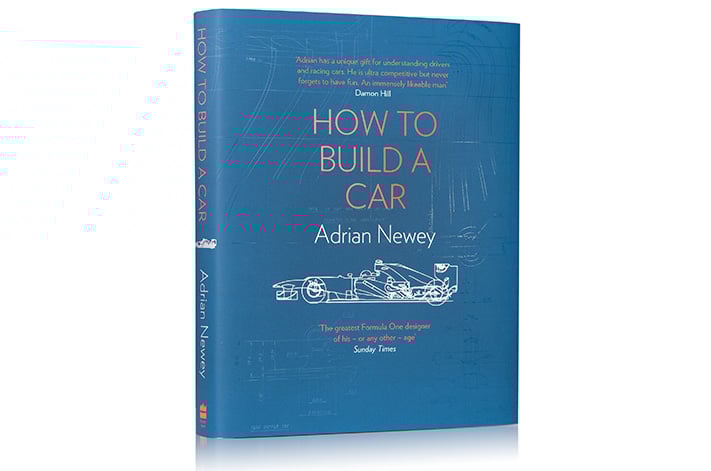
How to Build a Car – Adrian Newey – $39.99
There are few things more disappointing than waking up and realising Santa has not delivered the Red Bull RB9 Formula 1 car you politely requested in this year’s Christmas list, but if this is a reality for you, perhaps you could have a crack at building your own?
Adrian Newey’s How to Build a Car looks back at the 35-year career of an automotive genius; the cars he created, the drivers he worked with and the victories he helped secure.
Okay, it’s not actually a step-by-step guide how to build a race car but an autobiography of one of the greatest vehicle engineers to walk the earth, but the captivating drawings, historic images and the story of one man’s indelible mark on F1 will hopefully help you forget you don’t own your own V8-powered F1 single-seater.
If you insist on building your own car this festive season but don’t possess the engineering aptitude of Newey, the good people at Lego might be able to help.
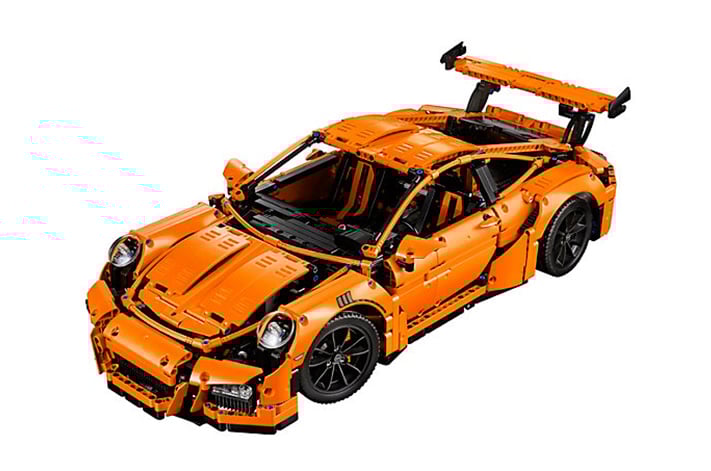
While the kids hastily throw together their relatively simple introductory sets, you can be busy constructing the enormous 2700-piece model of one of Porsche’s most potent sportscars.
The kit is one of the most expensive ever offered by the iconic brick brand, but the set does include an instruction manual that doubles as a coffee table book when you are done snapping blocks together, and several unique bricks designed to make the GT3 project possible.
It can be frustrating when you are trying to drop present hints but the family just aren’t catching your drift, but here’s a drift sure to catch everyone’s attention.
Ranging from a simple thrill ride or introductory experience, to a full drift masterclass, Drift School Australia offers a range of experiences based at Sydney’s Dragway and a fleet of cars consisting of what many regard to be the best machines for the art of drifting.
Some experiences are also offered in Victoria, but if Melbourne and Sydney aren’t your neck of the woods, there are plenty of racing, off-roading and driver-training courses offered all over Australia by a wide range of organisations for every petrol head and budget.

Do you honestly think Santa can get around the world in a single evening using reindeer power alone? Of course, not. To make every delivery in time, the slightly creepy bearded man uses a convertible.
Blend in to the hideously dressed this festive season with this automotive take on the traditional ugly Christmas jumper.

For the cost of one boozy night out, or a tank of fuel, you could be kept in the Australian automotive loop for the next 13 months and be in with a chance to win $10,000 of hard Aussie currency.
Wheels is Australia’s biggest and oldest car mag and no Christmas is complete without a copy to drool over and dream for another year.
A TEASER video of the 2018 Hyundai Veloster N has introduced us to something we’ve never heard before in the quirky coupe – an engine and exhaust soundtrack that will leave you itching to jump behind the wheel.
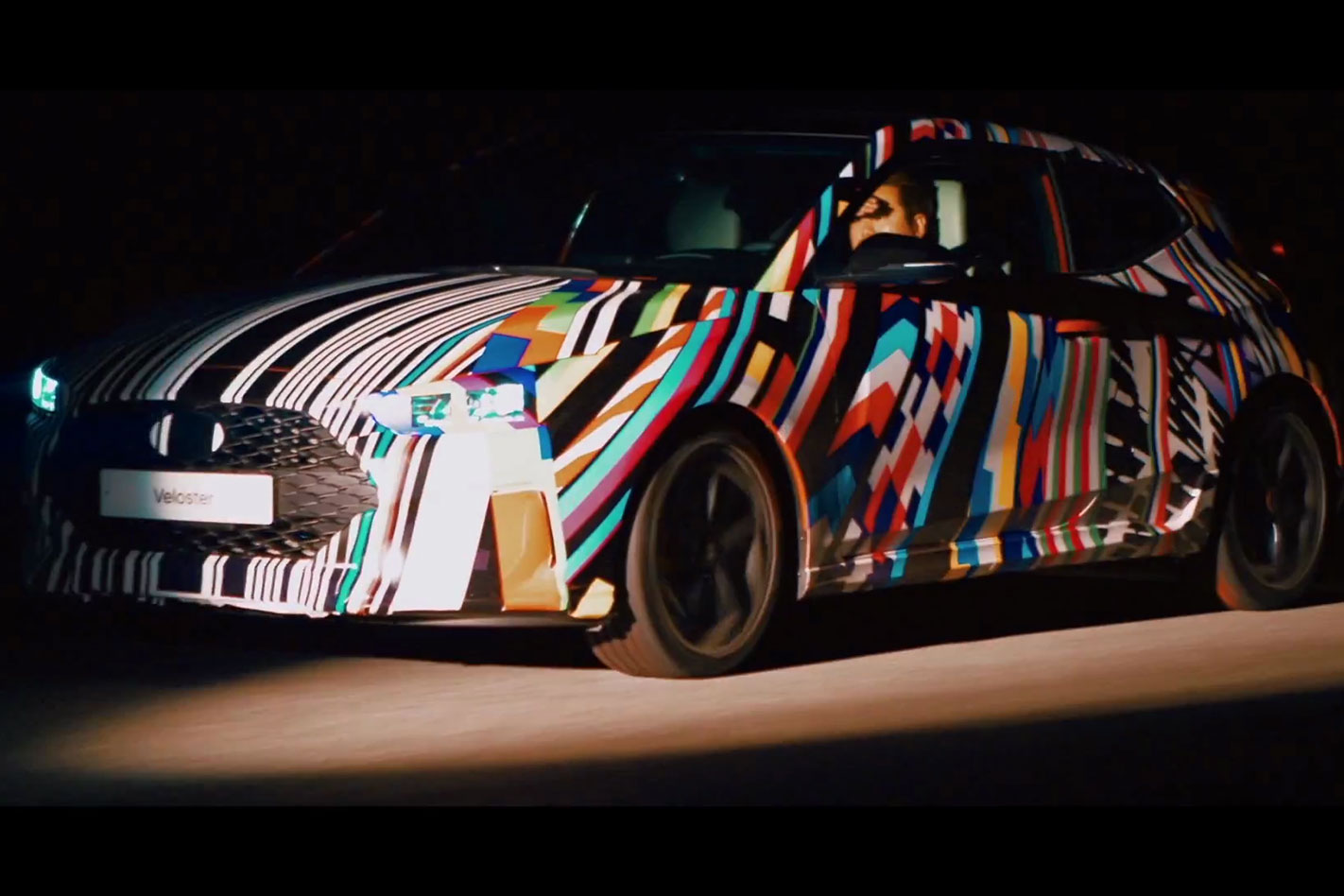
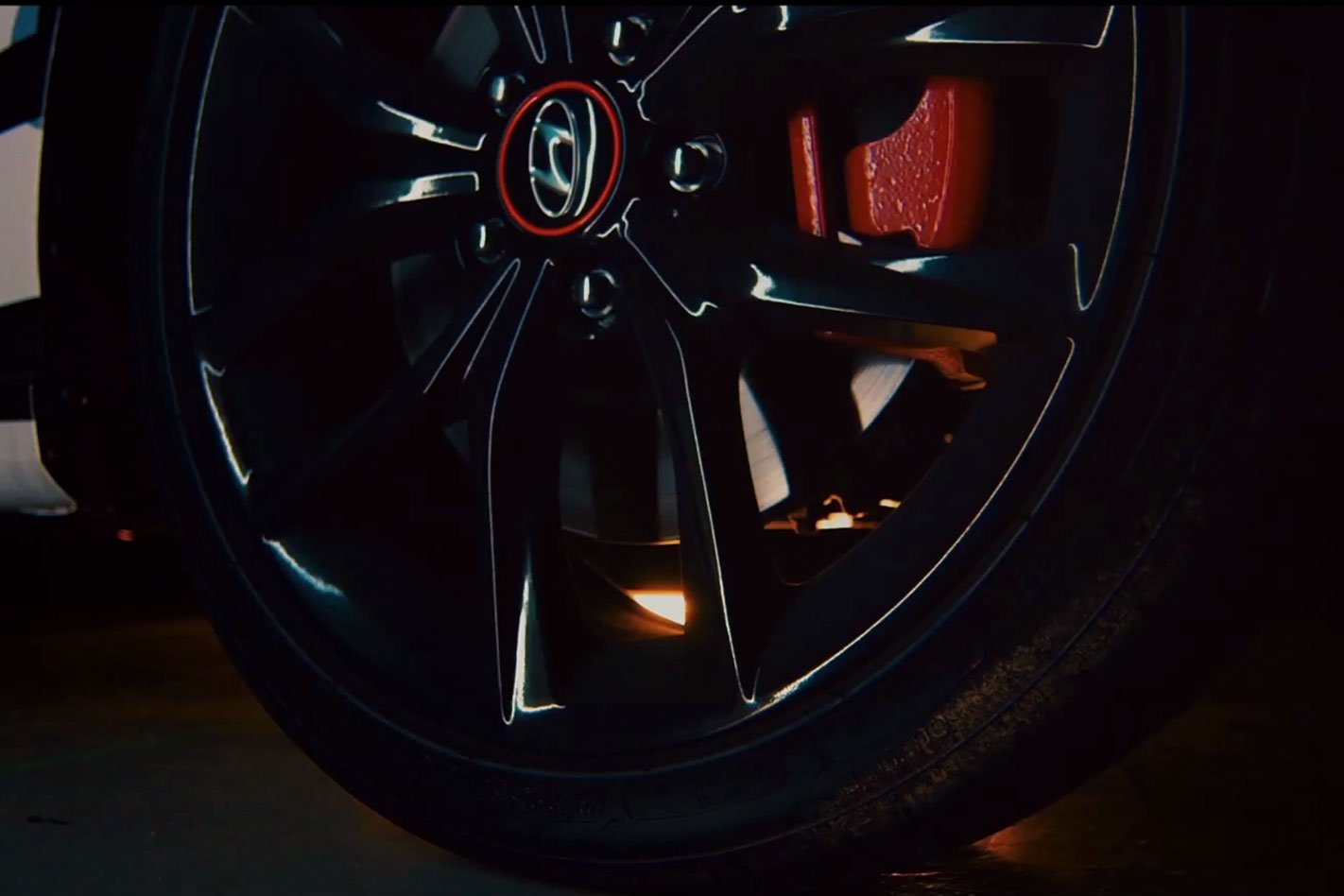
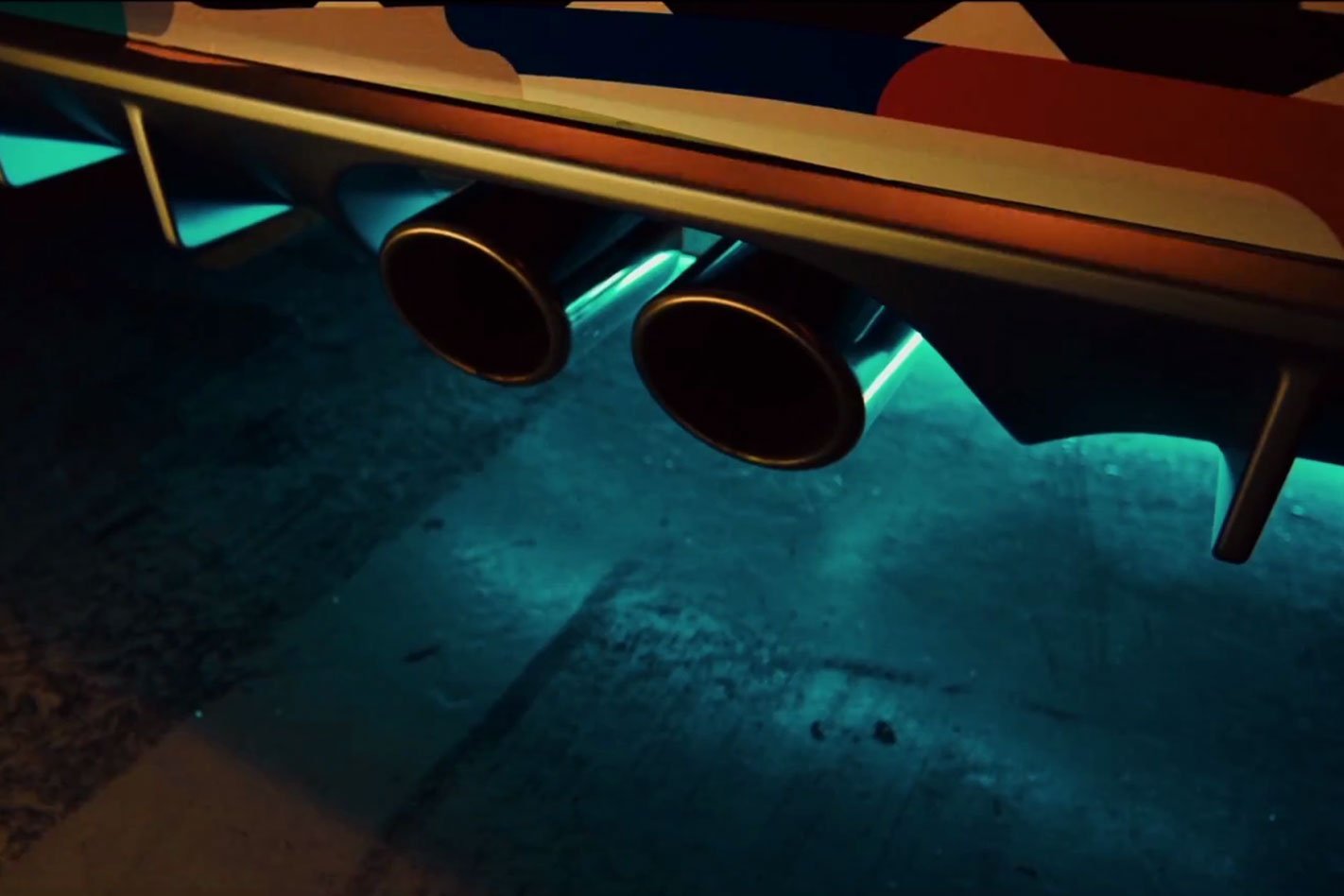
A local suspension tune will also be high on the priority list, which means we could be seeing the coupe-esque hatch Down Under in the near future, so keep your eyes peeled.
In the meantime, sit back, crank the volume and just listen to that engine rev out. And take delight in the idea that we can finally get excited about the idea of owning a Hyundai.
NOT every car company executive is a petrolhead.
Oh, plenty like cars, some you’d even call enthusiasts, but bona-fide car nuts aren’t common.
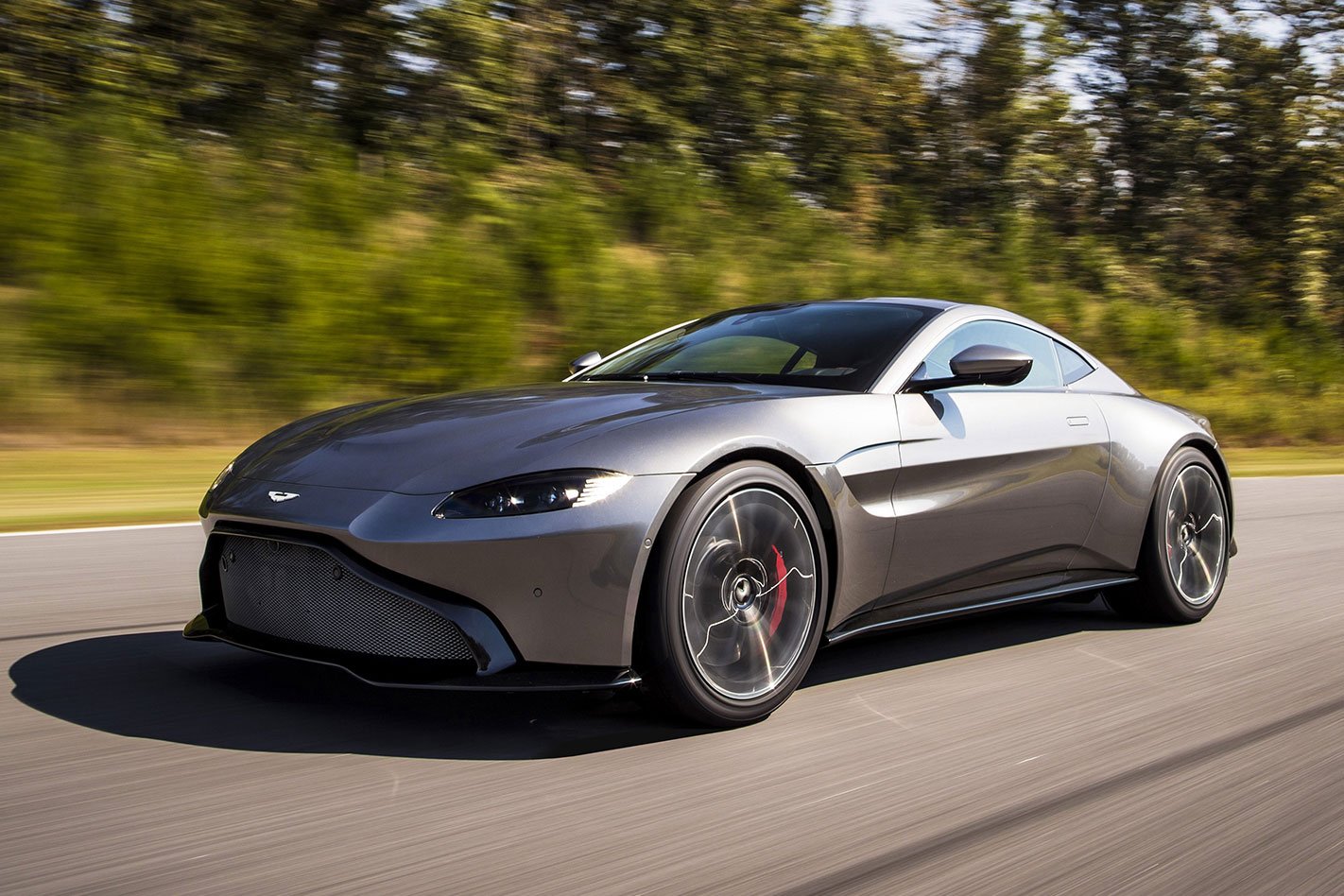
This isn’t the end of the world; you don’t need to love cars to run a car company well any more than you need to love surgery to ably run a hospital. However, like most jobs, those with an abiding passion for the product tend to be more successful. Aston Martin CEO Andy Palmer is definitely one such person. He races as often as his globe-trotting schedule allows, has a 1980 Vantage that’s been expertly restored by Aston’s Heritage division and, as a Fellow of the Institution of Mechanical Engineers, has a fundamental understanding of how the machines his company builds work. But he’s also a good businessman.
Taking the helm at Aston Martin may have been a dream job, but it must also have been a daunting one – the company had only been profitable in two of its 104 years and the majority of its range was well past pension age. Palmer went to work, creating a range of ultra-exclusive variants for the super-rich to keep the coffers ticking over while formulating Aston’s ‘Second Century Plan’, the first fruits of which was the DB11.
It wasn’t intentional, but a lot of our recent articles and features have been a tribute to the work of dyed-in-the-wool car nuts like Palmer. People like Andreas Preuninger, the father of the 911 GT2 RS; the late Geoff Polites, who green-lit the XR6 Turbo program; and Ferdinand Piech, who was largely responsible for Audi’s five-cylinder engine and quattro system. It’s engineering-first execs like these who will, hopefully, ensure EVs like the Porsche Mission E continue to entertain drivers for decades to come.
What stands out?
The Toyota 86 is an affordable rear-wheel drive sports coupe, with stylish looks and superb steering and handling. Toyota developed the 86 with Subaru, which sells a very similar car as the BRZ.
What might bug me?
How bumpy roads have got since you bought your 86. The ride is sports-car firm, and if you are used to a more utilitarian hatchback or sedan you will notice that.If you option the no-cost spare wheel, how much space it takes up in the boot. (But that is because it is a full-sized spare, which could be handy if you get a flat when out of town.)Paying more for fuel: The 86 requires expensive premium 98 petrol.
What body styles are there?
Two-door coupe. (It’s a two-plus-two, which means there are two very cramped rear seats.)The Toyota 86 drives its rear wheels, and it is classed as a sports car, lower priced.
What features does every Toyota 86 have?
Air-conditioning, cruise control, satellite navigation and a reversing camera.An AM/FM radio and CD audio system with a 6.1-inch colour touchscreen display. Bluetooth hands-free operation for phone calls and audio streaming.An information display that presents data such as average fuel consumption.Height and reach adjustment for the leather-clad steering wheel, which carries buttons for operating the sound system, the information display and your phone. Height adjustment for the driver’s seat.Bright and extremely long-lived LED headlights, and LED daytime running lights (which make the car more visible).Wheels made from an alloy of aluminium, and a tyre repair kit. A full-size alloy spare is available as a no-cost option.A limited-slip differential, which inhibits wheelspin, improving handling and acceleration on low-grip road surfaces (and enhancing control when you’re drifting the car – on a racetrack, for example).Hill-start assist. This helps you take off on uphill slopes, by controlling the brakes automatically.Electronic stability control, which can help you avoid or control a slide. From late November 2016, stability control on the 86 has let you select an effective and subtle Track mode, which lets very good drivers enjoy some oversteer while retaining a safety net.Seven airbags. (For the placement of airbags, and more on Toyota 86 safety systems, please open the Safety section below.)Every Toyota 86 carries a three-year, 100,000 kilometre warranty.
Which engine uses least fuel, and why wouldn’t I choose it?
Two engines are available in a Toyota 86, both 2.0-litre horizontally opposed petrol four-cylinders.While in use they feel very similar, the engine driving manual-transmission cars (only) was revised in several small ways about December 2016 and is marginally more powerful, when revved hard, than the engine in automatic cars.On the official test, the 86 uses a lot less fuel in auto form than as a manual, consuming 7.1 litres/100km (city and country combined).The main reason you would not choose an 86 auto is that you want to control this very engaging car as precisely as possible, taking absolute command of gear selection with a manual shift.In manual form, the 86 uses 8.4 litres/100km on the official test. In the real world it won’t use much more, however: expect to average about 9.0 litres/100km.One reason the manual 86 uses more fuel than the auto is that it has more closely spaced gear ratios and shorter overall gearing – giving you easier access to the engine’s best power, but spinning it a bit harder.The engine in any 86 differs from most four-cylinder engines in that it lies flat across the engine bay rather than standing up vertically. This places the weight of the engine lower in the car, which is one reason why it steers so responsively. The design also helps the engine run very smoothly. (Porsche four-cylinders use a similar layout.)Auto and manual cars each have six ratios.
What key features do I get if I spend more?
The least costly Toyota 86, the GT, comes with manually controlled air-conditioning, cloth-covered seats, 16-inch wheels, and the features in any 86. A manual gearbox is standard, with the auto an extra-cost option.You can pay more for an 86 GTS, which brings you satellite navigation, keyless entry and start (you can unlock and start the car with your key kept safely in a pocket or bag), and dual-zone climate control (which lets you set different temperatures for each side of the cabin). You also get leather and Alcantara seats, with heaters, and your headlights switch on by themselves when it’s dark.Wheels on the GTS are an inch bigger, at 17 inches, and are fitted with slightly wider, lower profile tyres. The GTS also has slightly more powerful brakes (bigger discs, with ventilation at the rear as well as the front). And the boot-lid carries a small spoiler.An 86 Limited Edition that went on sale about June 2017 had more effective brakes again, from specialist Brembo, and suspension dampers from another specialist component firm, Sachs. Other features matched the GTS.These features became a permanently available in December 2017, as a performance pack, which also includes red interior trim highlights, and black-finish for the 17-inch alloy wheels, door mirrors and rear spoiler. The Toyota 86 with the performance pack added is referred to the GTS+ in the Cars Covered by this Review menu, which is just below the main picture at the top of the page.
Does any upgrade have a down side?
Taking the no-cost option of a full-size spare wheel and tyre rather than the standard tyre-repair kit eats into boot volume. The hollow in the floor of the boot is not deep enough to house the whole spare, leaving it sticking up into the boot space with a moulded rubber cargo mat on top. As a result, the boot floor is not flat.Premium paint colours come at an extra cost of about $450. Seven colours are available, including one, Moon Slate, that’s exclusive to the GTS+. Only one of them – Ignition Red – is standard at no extra cost.
How comfortable is the Toyota 86?
In keeping with its positioning as a sporty car, the Toyota 86 has quite firm suspension. However, overall comfort is good.The suspension was retuned for the facelift of December 2016, but the car rides much the same as before.Getting into the 86 is not quite as easy as it would be for a similar sized non-sporty car, because the seating position is a bit lower.The front seats offer excellent side-support for cornering, and the major and minor controls are well sited. The steering column adjusts for tilt and reach, which lets you get the driving position just right.The interior is well built, if not especially luxurious. Some of the plastics are hard, but the quality of the seat trim is good and the steering wheel and gear lever are nicely designed and finished. The instruments and centre touchscreen are attractively presented.The Toyota 86 is reasonably quiet inside, with low levels of noise and vibration from the suspension and engine. The lower profile tyres worn by the GTS version make it less comfortable than the GT, but there isn’t much in it.Because of the low seating position, forward vision is not as commanding as it is in a less sporty small car. As well, vision over the driver’s shoulders and to the rear is restricted due to the small side-rear and rear windows. The reversing camera helps address the parking difficulty this presents.
What about safety in a Toyota 86?
Every Toyota 86 has anti-lock brakes, a sophisticated stability control system, seven airbags, LED daytime running lamps, and a reversing camera. Its safety package emphasises your control of the car, your visibility to other drivers, and your protection in a crash.Two airbags are placed directly in front of the driver and front passenger; airbags alongside each front occupant protect at pelvis and chest level from side impacts; curtain airbags on each side protect front and rear occupants at head level from side impacts; and a seventh airbag protects the driver’s knees.You don’t see as far ahead in an 86 as you would in a normal passenger car, and vision to the rear is restricted, both of which present a small impediment to both occupant and pedestrian safety.The 86 GTS brings you auto-on headlights, which make you visible more reliably in low light.The Toyota 86 does not offer autonomous emergency braking, or other sensory active safety aids.The Australasian New Car Assessment Program (ANCAP) awarded the Toyota 86 its maximum five stars for safety, in April 2013.
I like driving – will I enjoy this car?
Whether you’re a serious car enthusiast, or are simply attracted to the stylish look and appealing price of the Toyota 86, you will enjoy driving it very much.The sense of precision and agility the steering imparts, and the level of feedback it gives the driver, is the greatest strength in the 86. Anyone can enjoy this, whether they’re driving to the shops or on a twisting country road.The 86 feels about as good to steer as sports coupes that are far more expensive, such as the Porsche Cayman.The rear-wheel drive 86 handles corners brilliantly. It turns in enthusiastically and responds to small changes in accelerator and brake pedal inputs, which makes for an involving driving experience. This kind of responsiveness is rare in a modern car.Skilled drivers will love how controllably you can gently drift the rear tyres of the 86, which is great fun. Revised suspension tuning for a facelift of December 2016 appears to have improved it further in this respect.“The new car feels more progressive in the way it loses grip,” Associate Editor Scott Newman reported in Motor magazine. “We’re not talking wild, smoking slides here – the 86 needs commitment, momentum and a racetrack to do those – rather a few degrees of oversteer from apex to corner exit.”The bigger wheels and tyres on the GTS make it a slightly sharper handler and give it more grip than the GT has.The ventilated rear discs on the GTS (in place of the GT’s solid discs) bring very slightly improved braking power and consistency.The high level of handling ability in the 86 may make it feel a bit underpowered for particularly keen drivers. The 2.0-litre engine produces about 150kW, which is quite a lot for the weight of the car, but it feels soft in the mid-range. The flat-four is at its most responsive at high engine speeds – above about 5500rpm, where it also sounds much sportier. (Powertrain revisions for the manual facelifted cars made little difference to the seat-of-the-pants experience, Newman opined.)Toyota says that historically, nearly 60 per cent of buyers have ordered the manual transmission in this car. But for those inclined to choose an automatic, the auto in the 86 is a good one. And you can control it from paddles on the steering wheel.
How is life in the rear seats?
Head and leg room are very limited for rear passengers in an 86. The back seat is intended only for short trips, or small children.Nonetheless, many other sports cars – for example, the Mazda MX-5 and Nissan 370Z – do not have a back seat at all.
How is it for carrying stuff?
The Toyota 86 has a small boot with quite a small opening. Toyota quotes luggage capacity as 223 litres. That is about as much as a light hatchback, but without its ease of loading. And because the 86 isn’t a hatchback, you cannot expand its cargo area into a van-like space by folding the rear seat flat.The 86’s rear seatback folds in one piece, rather than the split/fold arrangement of most cars. With the seatback folded, you can fit four spare wheels with tyres in the back. That could be handy for the kind of 86 buyer who might take their car to the racing circuit on the weekend.
Where does Toyota make the 86?
The Toyota 86 is manufactured in Japan.
What might I miss that similar cars have?
Perhaps a folding roof, so that you can enjoy top-down motoring in your sports car. The Mazda MX-5 offers this, for example – in both soft-top and hard-top versions. The MX-5 matches the rear-wheel-drive layout of the 86, and offers a similar level of driver involvement – and a more comfortable ride.Perhaps some extra mid-range grunt from a turbocharged engine, which is available in the Fiat Abarth 124 Spider. The Spider, a soft-top convertible, is based on the MX-5. It is built at the same factory by Mazda, but uses a Fiat-supplied 1.4 turbo four-cylinder.Rear-facing sensory safety aids, which help you keep track of other vehicles behind. A blind-spot monitor and a rear cross-traffic alert are available on the Mazda MX-5 and the 124 Spider.You might also consider a sporty front-drive coupe, such as the Hyundai Veloster.
Are there plans to update the Toyota 86 soon?
The 86 was designed as a modern-day version of the classic Toyota AE86 from the 1980s, which was a hit with car enthusiasts. It went on sale in 2012 and was updated in 2014.About December 2016 the 86 received a mid-life restyle that also brought retuned suspension, and in manual cars shorter gearing and a bit more power.In December 2017 Toyota added a factory approved performance package which included improved Brembo brakes, Sachs dampers and 17-inch alloy wheels.We may see a second-generation Toyota 86 about 2020, which will likely include an electrified powertrain.
I like this car, but I can’t choose which version. Can you help?
Each version of the 86 is attractively priced, but we like the GTS. Many of its extras are very nice things to have.
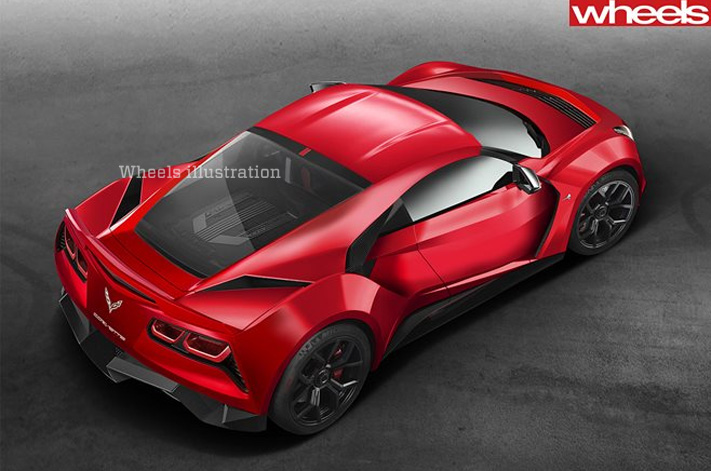
IT’S the worst kept secret in the automotive world and Chevrolet is remaining staunch about any details of its imminent Corvette, but if the C8 has its engine in the front then we will eat our hats and a number of other accessories.
CAD drawings leaked last week appear to be indisputable evidence that the new-generation of the world’s longest continuously produced sportscar will have its engine mid-mounted, but the big news will be in Holden showrooms.
Regardless of where the Corvette’s oily bits are bolted, the iconic high-performance model will be coming to Australia. Chevrolet’s Corvette will be the halo rear-drive V8 sportscar Holden has been speaking of since petrolheads began lamenting the passing of the same drivetrain recipe that died with the locally made Commodore.
Despite the car maker’s persistent silence, Australian muscle-car fans have much to look forward to.
The leaked images of the C8’s engine, gearbox and subframe are the most recent morsels to emerge from GM’s information blackout and confirm that at least one engine appears to be naturally aspirated.
The enigmatic donk is likely to be either an updated version of the LT1 6.2-litre engine of the current C7 Corvette, but a number of other engines are reportedly in the works, all of which would add some serious zing to the ‘Vette.
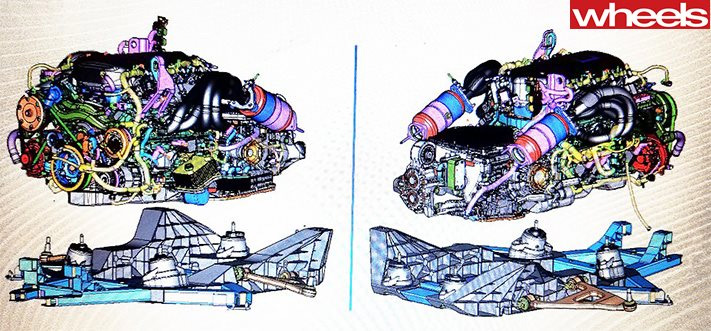
A separate image leaked with the CAD drawings and entitled Gen6 LT7 appears to add fuel to that theory with what appears to be a turbocharger partly obscured by other components – though the device could be a high-flow liquid pump to deliver coolant or other vital fluids.
The mysterious engine is adorned with multiple ancillaries some of which are identifiable and others not. No oil reservoir/de-foaming tank is shown but it’s possible one of the pulleys drives a dry-sump lubrication scavenge pump. A low-profile oil pan is conducive of the theory.
If the engine is a significant rethink on previous LT1 designs, a flat-plane crank is another possibility, as a rival to Ford’s Voodoo engine that powers the Shelby Mustang GT350 specials. That would add a dimension of sound that the Corvette has not bellowed in its 60 years.
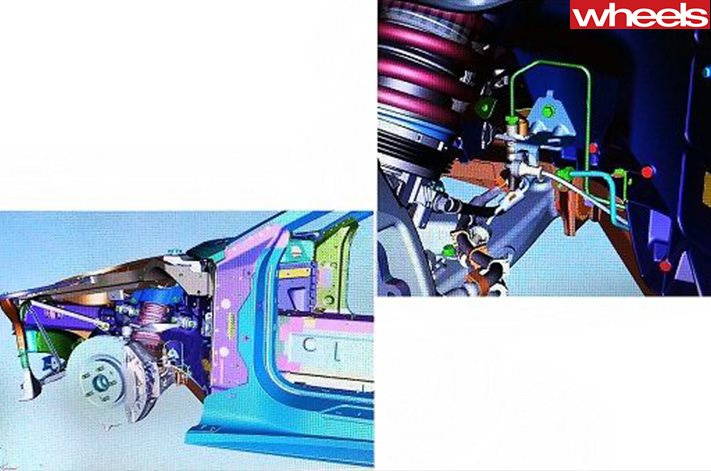
The image does not conclusively reveal if the Corvette will be manual, auto or perhaps offered as both, but Wheels understands the transmission will be sequential unit manufactured by Tremec.
Suspicions that Chevrolet may be toying with the idea of a mid-engined model were raised when the car maker was seen testing a prototype that borrowed Australia’s own VE Commodore ute as the basis. Instead of a concrete mixer and a Kelpie, Chevrolet had loaded up the tray with a V8 and plumbed it into the rear wheels.
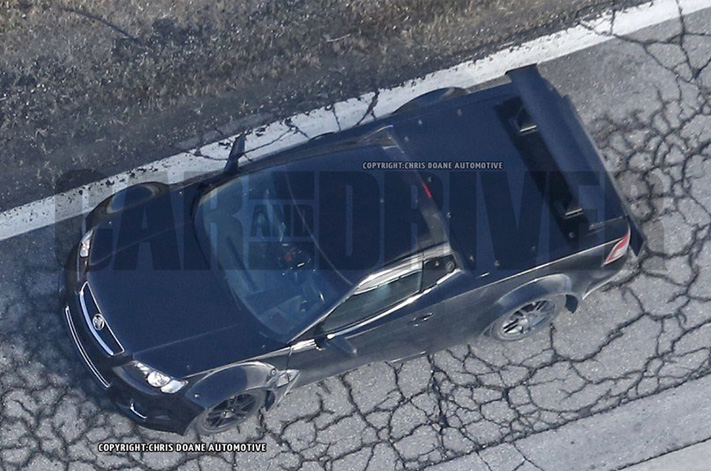
The Corvette’s platform has also been engineered to accommodate electrified drivetrains, although there’s no obvious evidence in the CAD drawings. Expect that development further down the line following the more traditional combustion options.
As for local pricing when the Corvette makes its Down Under debut, Holden is being as coy on local information as GM is about the model’s existence, but the C8 is touted to walk out of showrooms following about US$100,000 changing hands, which equates to about A$200,000 by the time you add import costs.
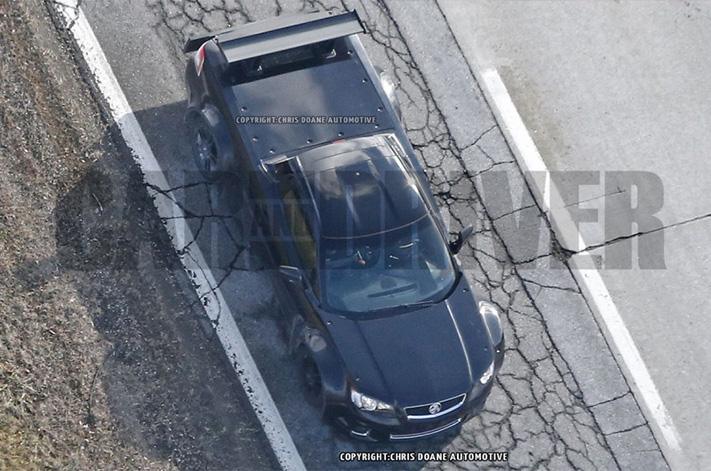
Until the Camaro arrives, Ford has Holden over a sportscar barrel with its strong-selling Mustang, but it’s hard to imagine how the Blue Oval will counter this massive mid-engined punch when the Corvette arrives, likely in 2019.
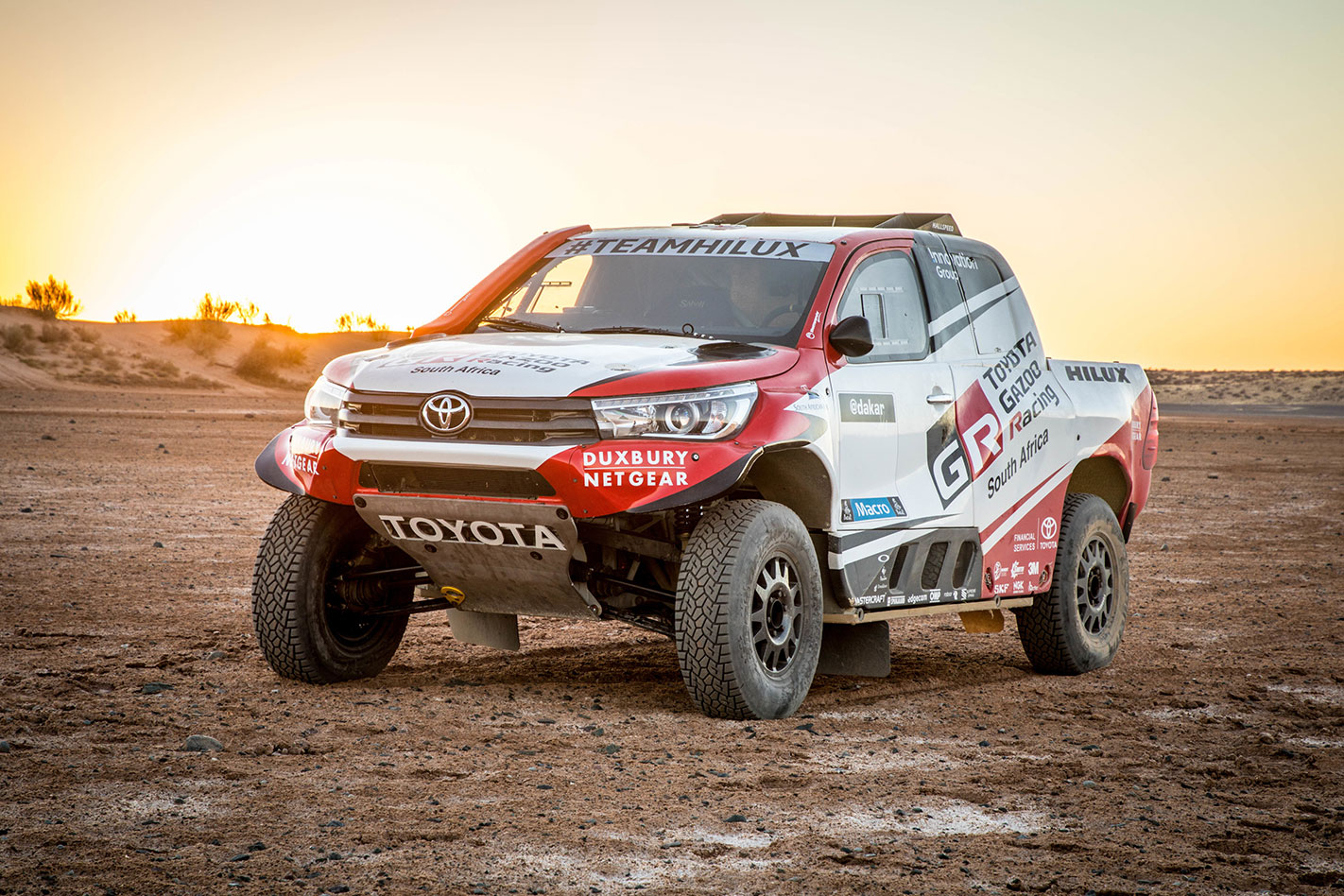
Toyota GAZOO Racing South Africa has revealed its new contenders for the 40th running of the Dakar rally, held next year in South America.
Beginning January 6th, contenders will begin the journey from Lima, Peru, to Cordoba, Argentina via Bolivia.
In three Toyota Hilux Dakar utes, driver and co-drivers will travel 14 stages totalling 5000km, plus another 4000km of travel between stages.
In 2018, the Hiluxes will be lighter than those of this year, and its naturally aspirated V8 engine is now mid-mounted. The 2018 restrictions also allow for a larger 38mm air restrictor.
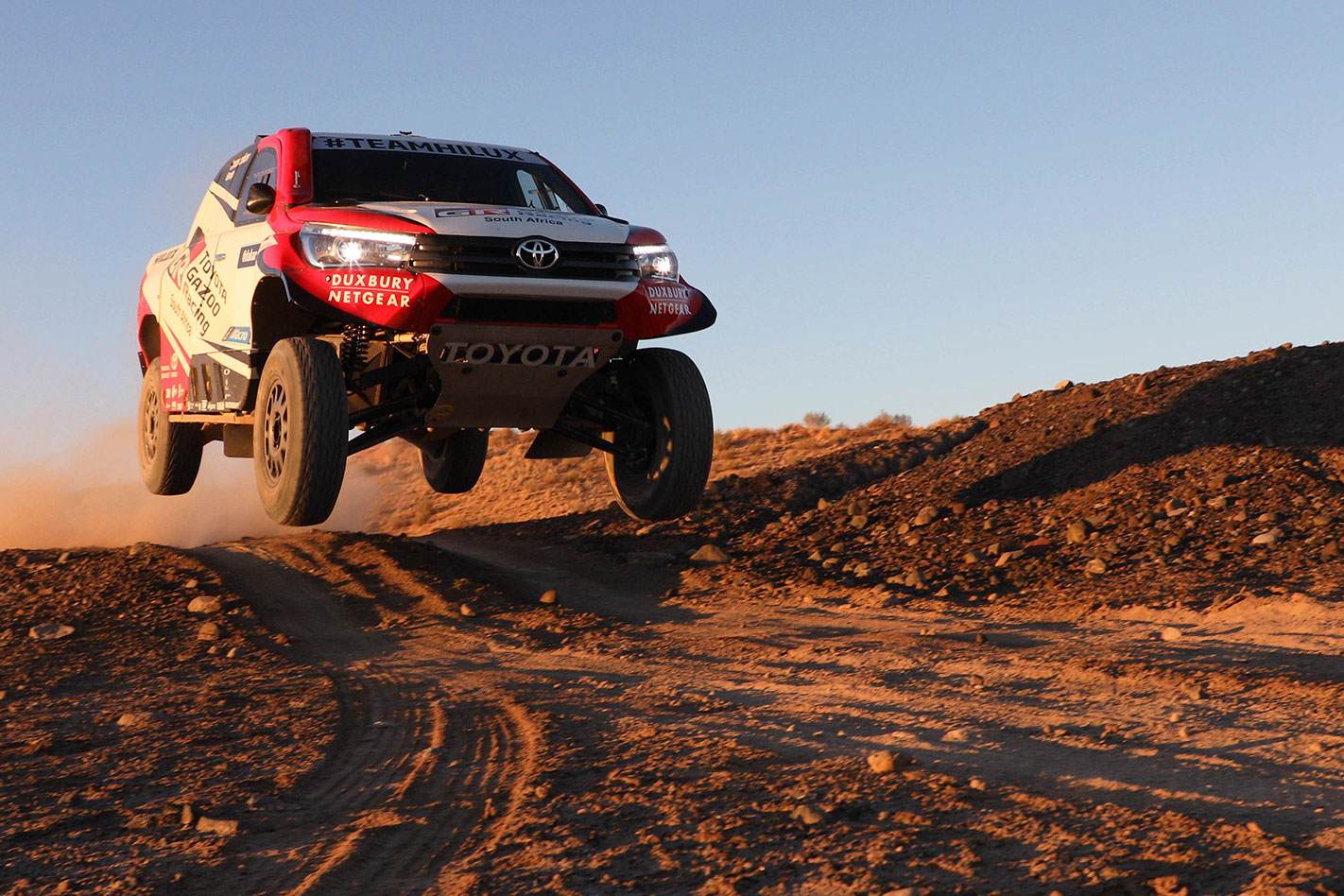
Team principal Glyn Hall says more power and a lighter vehicle will help it combat the soft surfaces in the rally’s opening stages.
“We decided to radically alter the layout and geometry of the car, incorporating everything we’ve learned over the past five years,” Hall says.
“You can never be over confident in a race as tough as the Dakar, but at the same time we feel we’re onto a winning recipe here.
“If the rule changes better balance the performance of the petrol-powered cars and the turbo-diesels, I have every reason to believe we’re in with a shot.”
545 entrants are listed to compete across five categories – Bike, Quad, Car, Side-by-side, and Truck.
The rally kicks off on January 6th.
Honda’s Odyssey people mover has a received a facelift which brings some external and interior design tweaks, improved refinement and the ‘Honda Sensing’ driver assistance package as standard in the range-topping VTi-L.
The entry-level VTi (below) variant’s face has been tweaked to look more like the VTi-L. with the addition of a longer grille, sculptured bumper and new front fog lights with chrome surrounds.
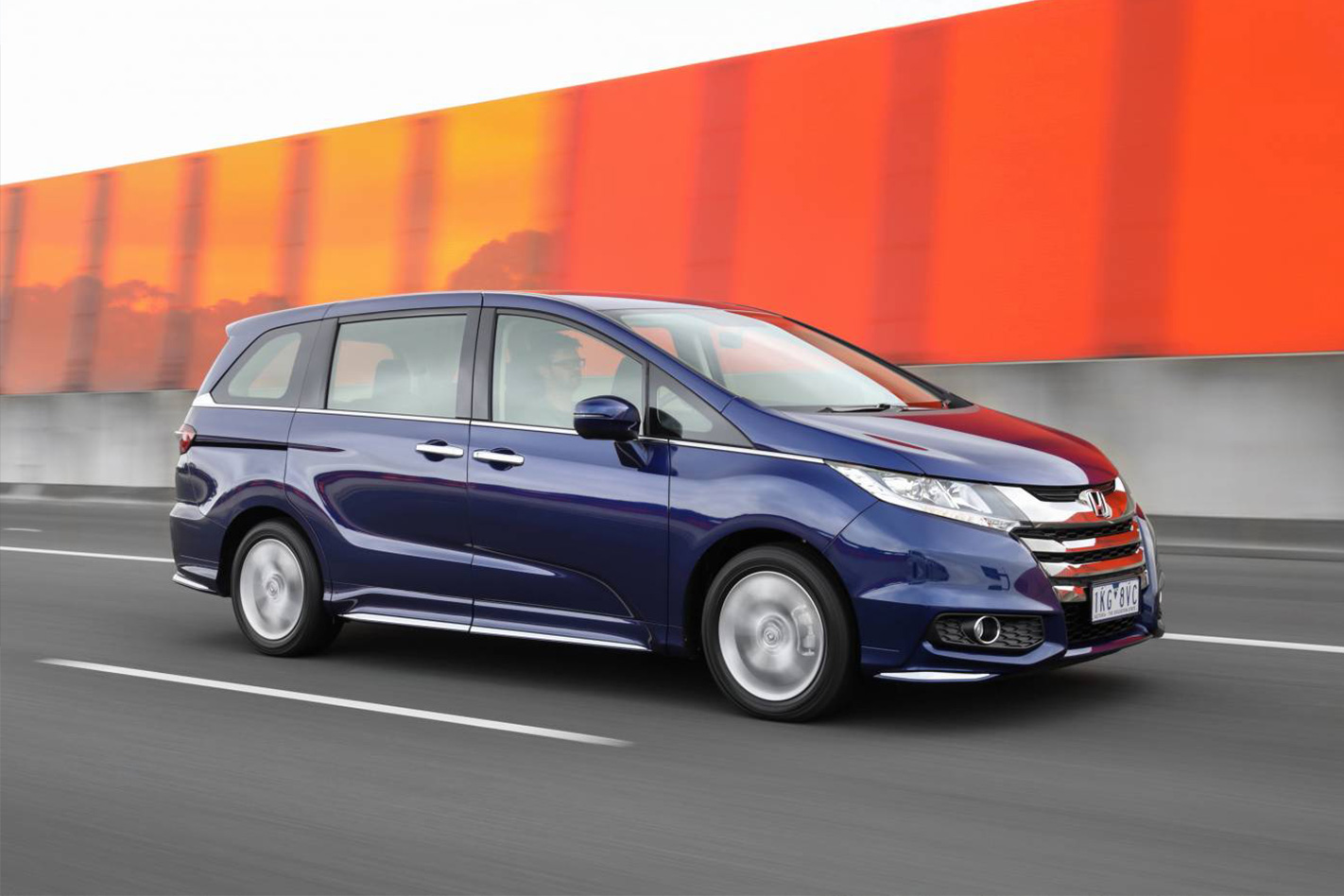
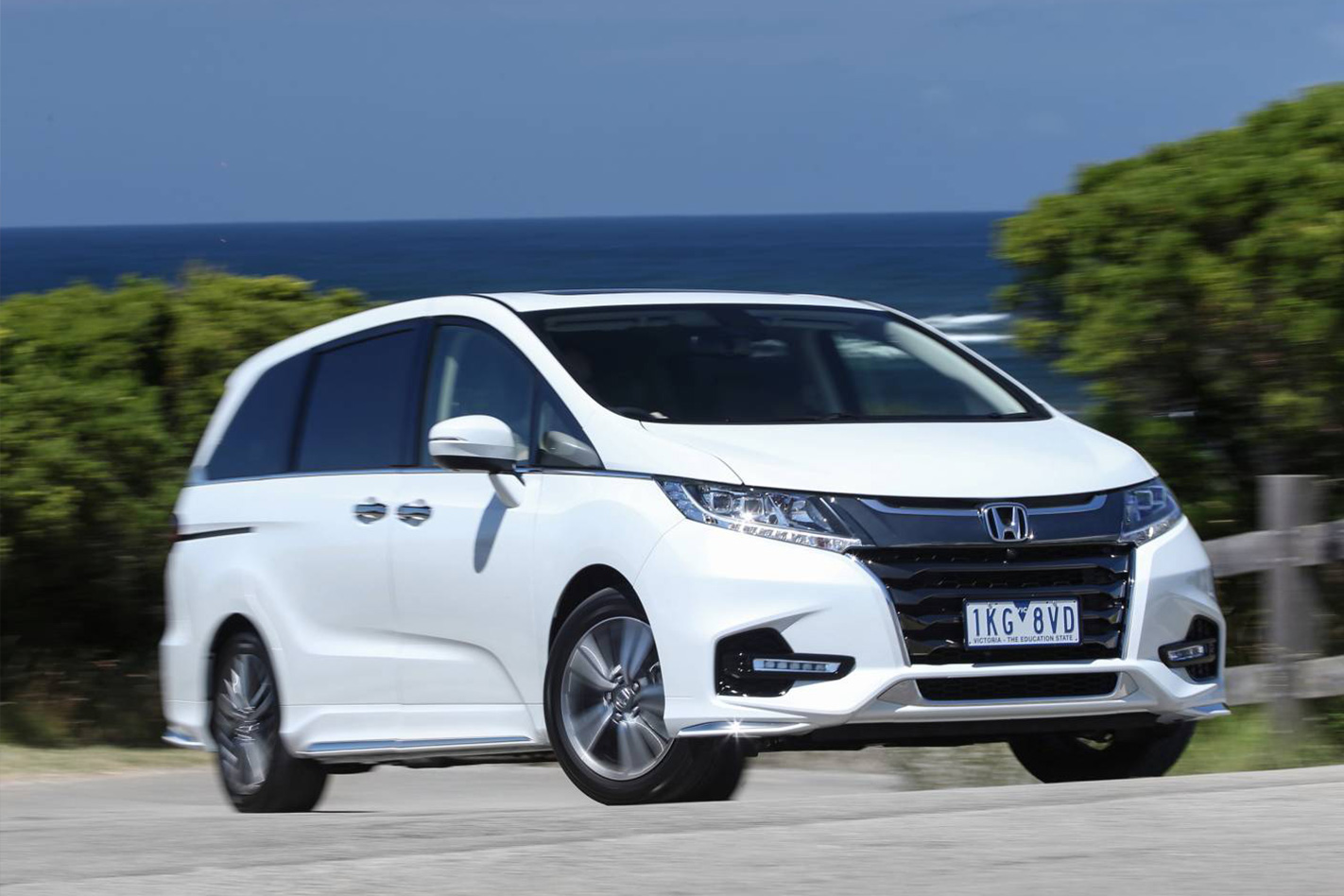
The VTi-L also gets a new look, which includes enhanced aerodynamic bumper shaping, LED fog lights and a dark chrome finish on the upper and lower grilles and door handles. New design two-tone 17-inch alloy wheels and revisions to the rear fascia, badge and tailgate also set the 2018 VTi-L apart from its predecessor.
Inside, the VTi-L’s second row captain’s chairs are now fitted with more luxurious headrests and additional seat-mounted storage compartments, while up front sees new instrument panel and door trims, new engine start/stop button, and auto-folding electric door mirrors.
The Honda Sensing package brings a range of active safety features to the VTi-L including:
- Adaptive Cruise Control
- Forward Collision Warning
- Collision Mitigation Braking System
- Lane Departure Warning
- Road Departure Mitigation System
- Lane Keeping Assist System
The changes accompany a small price rise for the 2018 model year, with the VTi now retailing for $37,990, up $380, while the VTi-L goes up $1100 to $47,590.
The Honda Odyssey has long been one of Australia’s most popular people movers, with Honda claiming it outsells rivals such as Kia Carnival and Tarago in private sales, where it accounts for 35 percent of the market.
The 2018 Honda Odyssey is now available at Honda dealers and comes with a five-year unlimited kilometre warranty
2018 Honda Odyssey pricing
- Odyssey VTi – $37,990
- Odyssey VTi-L – $47,590
