
WHILE steroid-pumped, mid-engined power-heroes battle it out at the Nurburgring for the heavyweight title and fastest production car lap, a lesser known welterweight war is raging in the front-wheel-drive production arena.
They might not have large-capacity V-configuration engines, carbonfibre construction and rear- or four-wheel drive systems of the supercar contenders, but the fastest front-drivers have been putting in sub-eight-minute laps for the last three years.
With the arrival of the new Honda Civic Type R, the title has, once again, fallen to the Japanese small hatchback. Here’s how the top-five Nurburgring front-drive champs stack up.
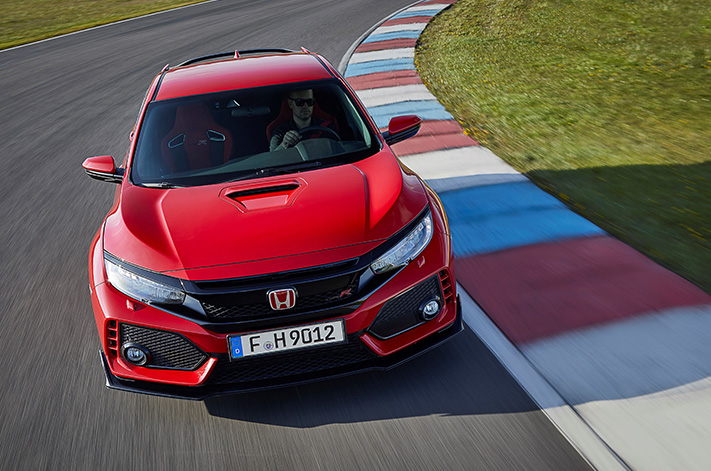
2017 Honda Civic Type R – 7:43.8
The current king of the hill is still trying to get the stink of champagne out of its racing suit having only just set the new lap record in April. Under its bonnet, a 2.0-litre VTEC turbo four-cylinder petrol produces 235kW and 400Nm sending grunt to the track via a six-speed manual gearbox.
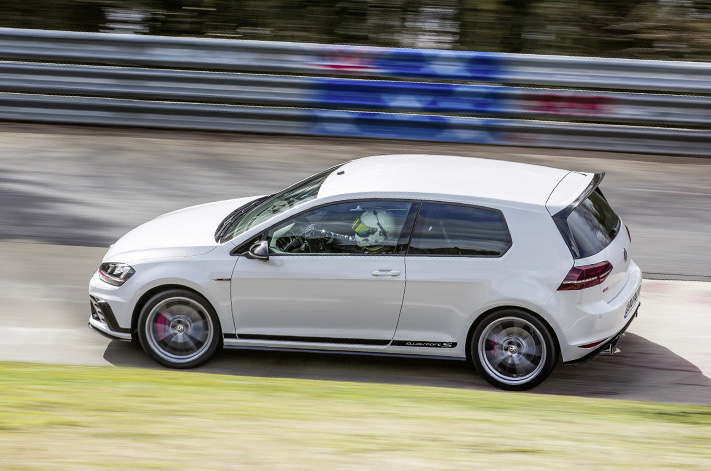
2016 Volkswagen Golf GTI Clubsport S – 7:47.19 This niche Golf variant tests the ragged fringes of what constitutes a ‘production’ car with a grenade of a tuned 2.0-litre turbo petrol engine that pumps out 228kW and 400Nm for a zero to 100km/h dash in 5.9 seconds and a 266km/h top speed.
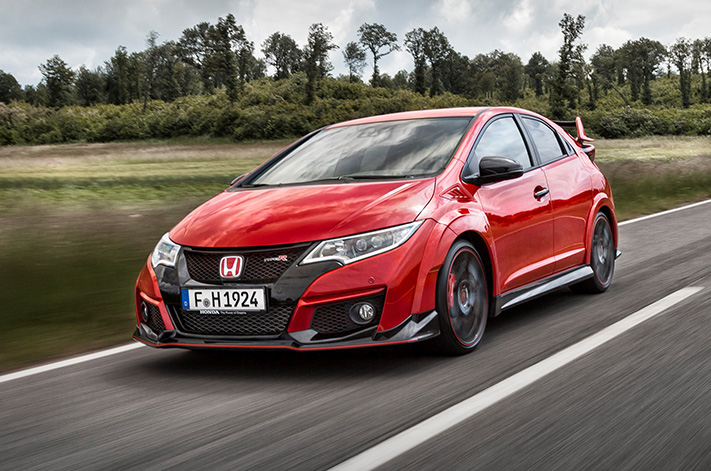
2015 Honda Civic Type R – 7:50.63 Honda’s recently reclaimed title will be all the sweeter as it snatches the bragging rights back after losing this record set in the 2015 Civic Type R. That car used a similar recipe of 2.0-litre turbo four coupled with a manual gearbox with a paltry 228kW but the same 400Nm as the new version.
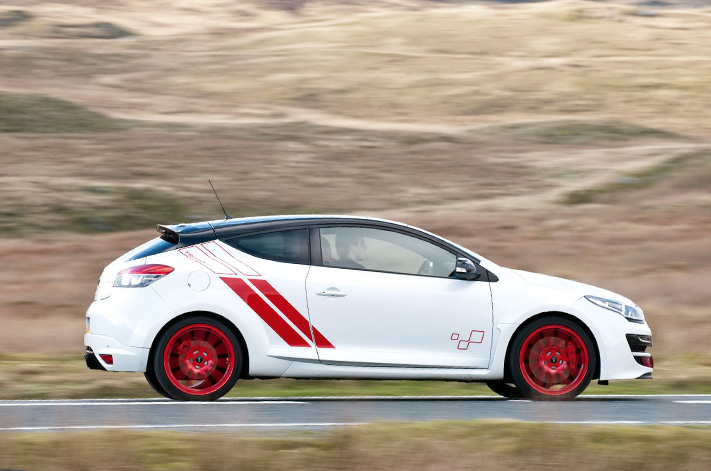
2014 Renault Megane RS 275 Trophy R – 7:54.36 Back before the Honda and Volkswagen battle raged, Renault was the Ring wraith with its Megane RS. Its most recent record was set by the most potent version to date, the RS 275 Trophy R, which also used a turbo 2.0-litre.
2014 SEAT Leon Cupra 280 – 7:58.4 Australian motorists may not immediately recognise the SEAT Leon, but some will be familiar with the underpinnings of the Cupra 280, which are shared with the 2014 Volkswagen Golf R and Audi S3.
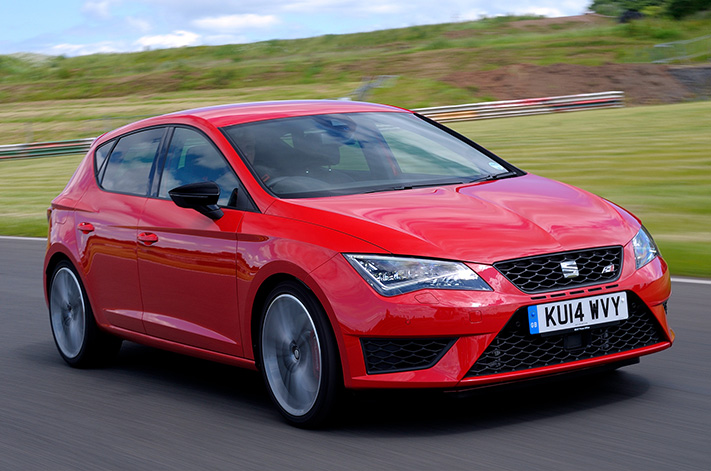
As if that wasn’t enough, it came back a year later with a big boot attached and set a new wagon record of 7:58.12.
With many of the hottest hatches now turning to all-paw transmissions to cope with power outputs that flirt with 300kW, what will be next to conquer the Honda’s dominance?
THE locally made Holden Commodore isn’t the only Australian icon about to disappear, with the carmaker now believed to be shedding one in 10 of its dealerships nationally.
The axe is believed to have fallen on about 30 dealerships spread across regional and urban locations.
Most of the 269 Holden dealers throughout Australia have contracts with the carmaker that roll over on December 31, meaning those affected will have about six months to find a way to remain viable by either picking up another brand, servicing rival brands’ cars or relying more heavily on used car sales.
In its heyday in the 1960s, Holden’s dealerships were scattered throughout Australia and helped elevate the car maker to account for one in every two new cars sold here. Today, the brand accounts for seven out of every 100 sales. Beyond the end of the year, Holden says it will still have Australia’s second largest dealer network, behind Toyota’s more than 270.
Ford is believed to be the only other mainstream brand to have also reduced its dealer network nationally, culling a small number over several years in the lead-up to quitting manufacturing in October last year. A number of other leading brands who responded to inquiries from Wheels said they had not reduced dealership headcounts.In a statement issued to Wheels, Holden confirmed it had made a review of its “dealer network footprint” in the lead-up to the October 20 deadline for local manufacturing.“Taking into account a number of factors, the difficult decision has been reached that the size of the dealer network must be reduced,“ it said in a statement.Holden customer and dealer operations executive director Peter Jamieson said the decision was critical to the company’s transformation, helping to ensure a “sustainable and successful future” for the network.“This decision has not be made lightly, as with any decision that impacts the hard-working men and women at Holden and in the network,” he said.“This will be a challenging period for those dealers impacted and their staff. Just as throughout the wind-down of our manufacturing operations, we are trying to put our people first and help them wherever we can.“We are supporting our dealers and their teams in a number of ways including redeployment, retraining and support services.”Speak to the dealers, though, and it’s a different story. One who will be hit hard is Kyogle, NSW-based O&H Holden. It has been part of the Kyogle community for 30 years, where it sponsors the local soccer and netball teams and employs 14 locals.Dealer principal Tim Hoffman, a second-generation Holden dealer, said he’d been told this week at a meeting with his zone manager and Holden’s dealer network development manager that his franchise would not be renewed – even though it has a 30 percent market share and had won an Australia-wide award two years running for beating its sales targets.“Basically they stated that this is our decision, it’s final, we’ve done a footprint study and you don’t fall in the footprint,” Hoffman said. “They said it was a national decision. Reading between the lines I realised that there was more than just me involved in it.“They wouldn’t give me any detail at all into how it was decided or why we don’t fall into the footprint. And that was basically it.”Hoffman said Holden had even contacted him to say that once the contract expires, the car maker would send someone to take down $30,000 worth of signage. He will also lose the right to service Holden-badged cars under its capped-price servicing scheme – any cars he sells between now and the day the signs come down, he’s unlikely to see again when service time rolls around. Holden will also buy back any unsold new cars, parts and specialist tools.“Until December 31 we can trade as per normal, if normal is the right description for it, but from that point on we’ll have no affiliation with Holden at all.”He said the only support Holden had offered him to help his business was a two-hour consultation with an adviser to help his dealership adjust to life without the Red Lion. He and his staff will have access to other support services offered by the car maker.Hoffman fears that as community anger grows over the decision to pull out of Kyogle, Holden will fall harder as buyers who would have come to his dealership drive 40km to Lismore, where the next closest Holden dealership is based, and go straight to a rival carmaker’s showroom.“I want to leave the opportunity open to look at other franchises, but I think that’s going to be very hard being a town of 3500 people.”
The light car segment used to be the bargain basement class packaged primarily for younger people who supposedly didn’t care too much about equipment levels and driveability.
But with infotainment, active safety and drivetrain tech becoming more mainstream, it’s now possible to get an affordable light car that’s well-equipped, pleasant to drive and safe.
Mazda was one of the first to provide this, with the current generation Mazda 2 that satisfies on many fronts with great handling and performance plus recently-introduced automatic emergency braking.
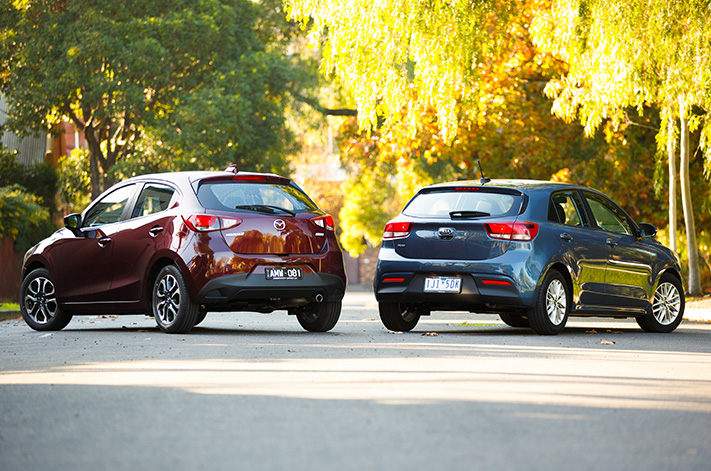
Kia has also brought maturity to the segment with its fourth Rio that features European-inspired looks, improved ride and handling, higher interior trim levels and a modern infotainment package.
It holds its own against the pack, but we decided to see how stacks up against the Mazda 2 which is held up as the class benchmark.
For this head to head we chose the mid-level and arguably best value Kia Rio variant, the Si [$21,490] with additional equipment over the entry-level Rio S including cruise control, satellite navigation, DAB+ digital radio, LED daytime running lights and 15-inch alloy wheels.
In the blue corner, the similarly priced 2017 Mazda 2 Genki hatch [$22,690] with six-speed auto – while this is $1200 more than the Kia it’s a fair comparison spec-wise when you consider the Genki with six-speed manual retails at $20,690. It’s similarly appointed to the Rio Si with extras including a head-up display, automatic city braking, blind-spot monitoring, rear-cross traffic alert and a more powerful 1.5-litre engine.
Mazda 2
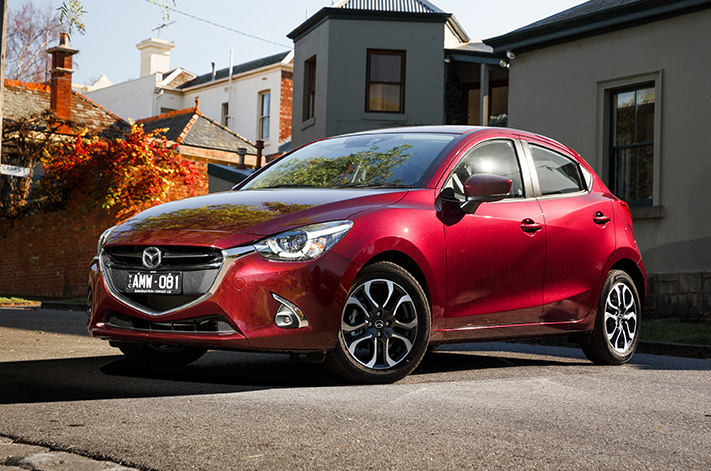
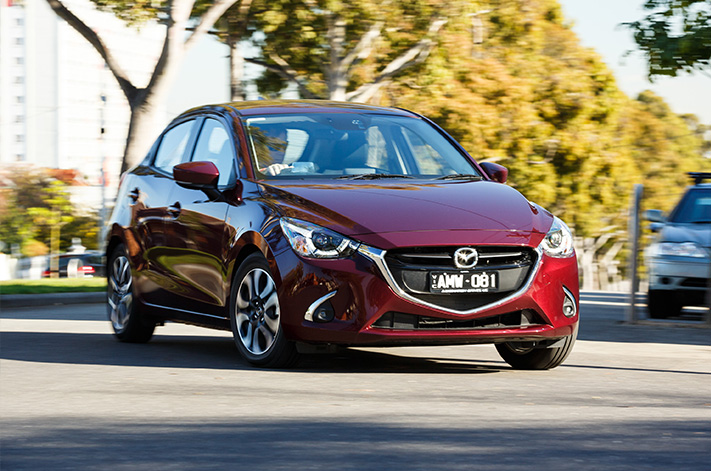
The third-generation Mazda 2 hatch arrived in 2014 with a mid-life update this year adding more technology but only minor aesthetic tweaks.
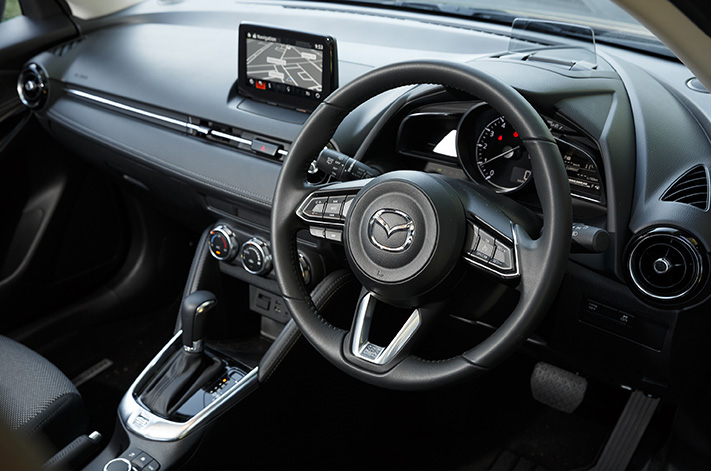
Inside you’ll find a clutter free interior that uses materials well to give it a premium feel, such as the fabric covering the hard plastic door inserts and stitched faux leather along the dashboard and metal finish/look trim.
The Mazda 2’s interior echoes the rest of the range with a floating infotainment screen with rotary controller on the centre console. Infotainment functions are intuitive, though Mazda IS yet to get on the Apple Carplay or Android Auto bandwagon and our test car would only pick up ABC channels on digital radio.
The front seats are comfortable with good lateral support and allow for a low driving position unlike other light cars such as the Toyota Yaris that feel like you’re sitting on a barstool.
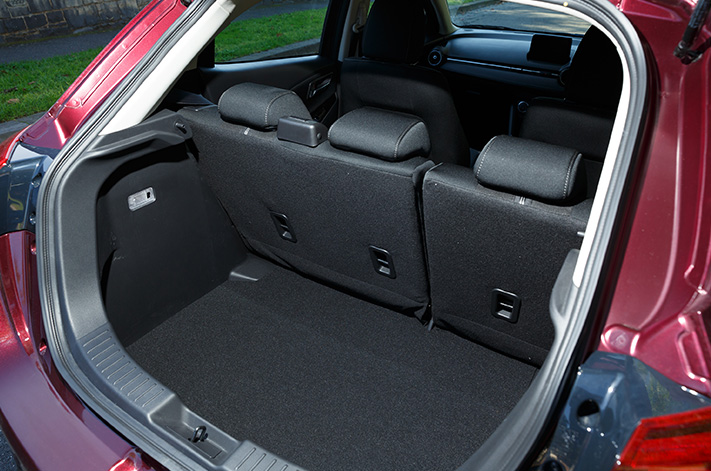
Where the Mazda 2 loses points is passenger and cargo practicality, starting with the back seats. They’ll easily seat two adults though the bottom cushion is quite short meaning a lack of under thigh support. Leg room is also pretty tight with knees touching the front seat, but headroom is good. While there’s a map pocket behind the front passenger seat, the rear doors have no bins or cup holders.
The high, upward-leading window line limits a child’s view, though forward vision is pretty good.
At 250 litres, boot space is also tight especially when compared to the cavernous Rio and the tight rear opening seems to be more about function than form. If you want more space it’s worth looking at the Mazda 2 sedan which has a 440-litre boot, however it’s not available in Genki spec.
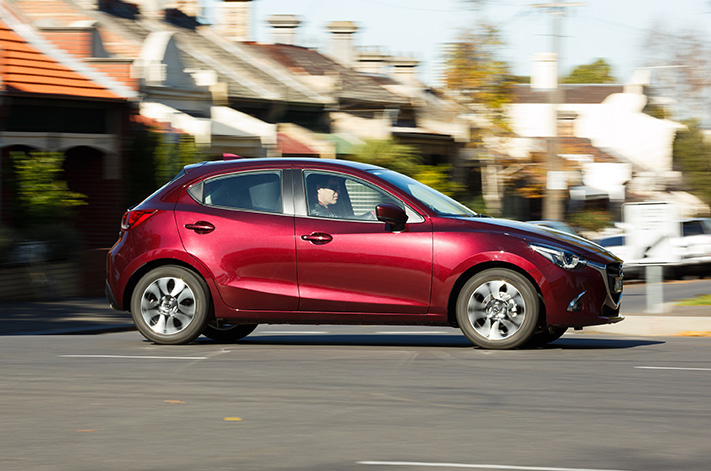
The Mazda gains points when you press the push button start and select drive. The SKYACTIVE-G 1.5 direct injection engine is responsive with the automatic transmission that provides smooth transitions though the gears. Flick the Sports mode switch and there’s more pep and torque at low speed for some extra zip.
Fuel economy during our test drive was 7.2L/100km on suburban and country roads and mostly in Sport mode.
The ride can be a little stiff on rougher roads though this could partly due to the 16-inch alloy wheels. But the dampers absorb bumps well with little bounce back.
Steering is well weighted and direct. The April 2017 facelift added G-Vectoring Control which adjusts engine torque to steering action so the front wheels comply with your request while load is transferred to the rear wheels so they duly follow. This works well in slippery conditions and drivers will generally be unaware if and when the electronic stability control [ESC] steps in to correct direction.
Vibration through the car is well controlled and refinement has improved compared to older Mazda 2 models.
The recent facelift also brought advanced driver assist functions including automatic city braking, which uses an infrared sensor to sense an object in front and applies the brakes at speeds up to 30km/h to prevent a collision. Other active safety tech includes blind spot monitoring and rear cross traffic alert.
Mazda 2 punches above its weight in terms of equipment and driveability that make up for its practical shortcomings.
Kia Rio
The previous generation Rio was introduced in 2011 and was the Korean carmaker’s most popular model thanks to attractive looks and a relatively roomy cabin, but it was cheap and cheerful inside.
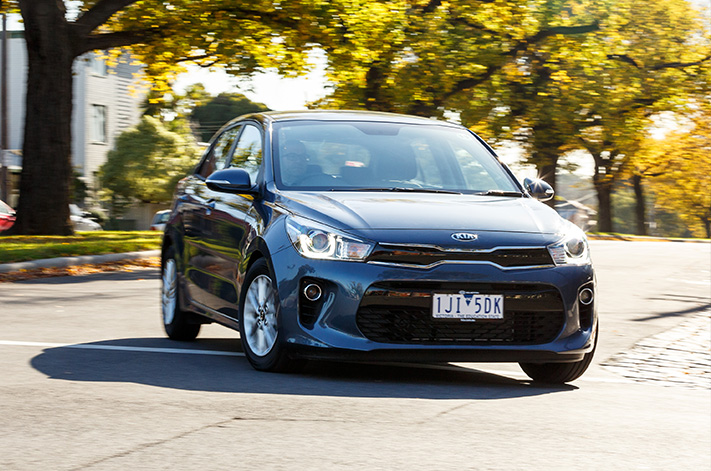
The Korean carmaker employed its European and Californian design studios to give its all-new Rio hatch a fresh, more advanced look. It is slightly bigger than the model it replaces thanks to a 10 millimetre longer wheelbase. This means more room inside, while cabin improvements and new technology impart an upmarket feel and bring a sense of maturity to Kia’s light segment entrant.
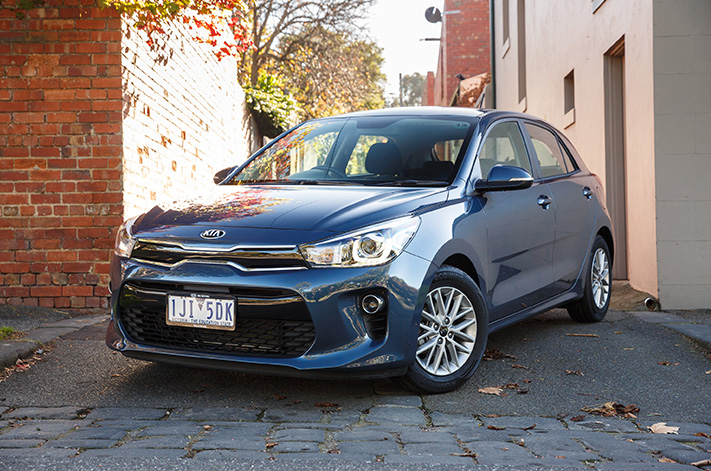
The interior is understated but elegant, with a 7-inch floating infotainment screen and none of the visual clutter of the previous model.
Piano black surfaces add to the premium look and the illuminated gauge cluster is bright and detailed without being complicated. That said the top of the dashboard and door trims are still a tribute to cheap plastics and undermine some of the finer detail elsewhere.
The infotainment system has Apple CarPlay and Android Auto connectivity with intuitive menus and the touchscreen is easy to operate when in motion. The DAB+ digital radio interface is one of the better ones in terms of finding channels and storing favourites. The sat-nav is easy to set, and can warn you about approaching fixed speed/red light cameras.
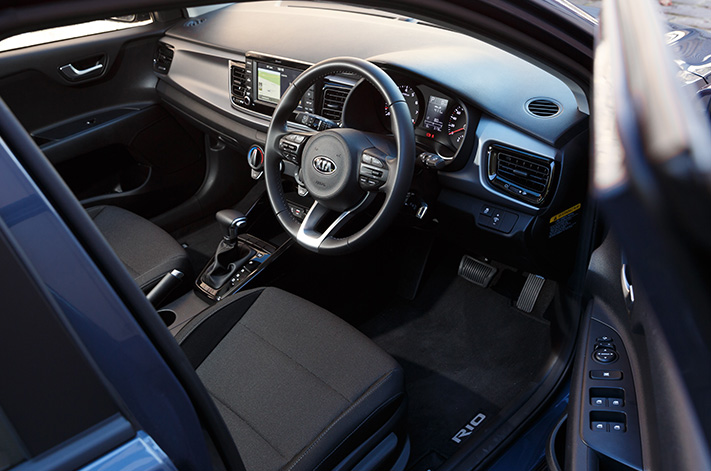
Like the Mazda the driving position is comfortable but doesn’t have quite as much lateral support. Interior storage is excellent for a car this size and includes a centre console bin with padded lid that acts as an armrest, cup holders in the centre and all four doors, sunglass holder above the mirror, and a generous space in front of the gear knob to leave a phone and keys.
The Rio’s emphasis on practicality is also evident in the rear seats, which have their own USB port, a tray to place small items and a map pocket behind the front passenger seat.
The back seat itself easily sits two adults with good head room and a little more legroom than the Mazda despite wider base that provides better under thigh and lower back support. The straight window line means better side vision for kids.
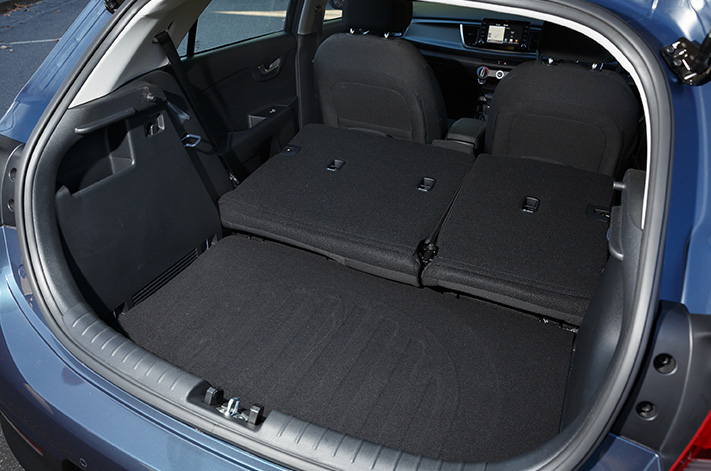
Boot space is up 37 litres compared to the old model to a substantial 325 litres. This triples to 980 litres with the 60-40 split rear seats folded down and the wide hatch opening helps make loading cargo easier.
Handling has also been improved, with Kia’s Australian engineering team tuning the suspension to suit local conditions. It complies well even on choppy dirt roads and the ride is firm without being hard, though it can be a little spongy on bigger bumps. There is a bit of disconnect between the front and rear particularly on gravelly bends, which made the ESC work hard to ensure the rear wheels followed the front.
Steering also feels nicely weighted though there’s a little bit of play when driving in a straight line, necessitating minute corrections to stay in control.
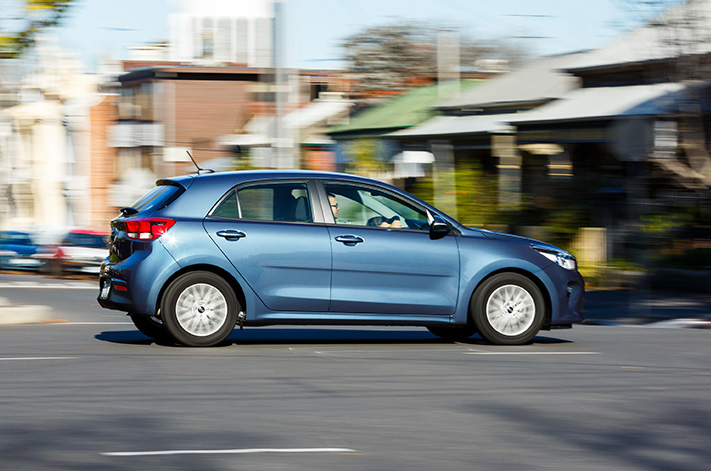
Road and engine noise is also reasonably low and generally on a par with the Mazda, though you do get a bit more wind noise through the doors seals than the Mazda as well as a higher din from under the bonnet at high revs.
All the effort that went into improving the Rio’s design has been partly undone by Kia’s decision to carry over the weaker of two powertrains from the previous range with a 1.4-litre four-cylinder petrol engine coupled with a four-speed automatic transmission. It’s OK around town, but putting the foot down results in plenty of noise but little motivation.
During our testing fuel economy was 7.2L/100Kms, which isn’t bad considering there’s no fifth gear to bring revs down.
The other notable omission is the lack of an advanced driver assistance pack, including automatic city braking.
That said, the 2017 Kia Rio succeeds in providing a good, value-packed and practical car that’s a pleasant to drive and comes with a seven-year warranty.
Verdict: Mazda 2
Kia is still an aspiring brand and has worked hard to make the Rio a more sophisticated and capable car with well executed design changes.
But Kia also took the easy route to attract people to showrooms by upping the size and spruiking practicality without doing the hard work such as improving performance and active safety, unlike Mazda which has managed this without compromising affordability.
The $1200 price difference between the two cars we tested can be justified by the quality of their drivetrains alone, yet the Mazda also comes with considerable extras and you’ll enjoy driving it a lot more.
SKODA should know in a few months whether the hottest Octavia RS to carve corners on Australian roads will become a more permanent member of its showroom.
The tipping point? Whether or not the Octavia RS245 will come fitted with a DSG dual-clutch automatic gearbox to complement the manual version, giving Skoda the all-important volume it needs to make the hottest liftback and wagon viable in the long term.
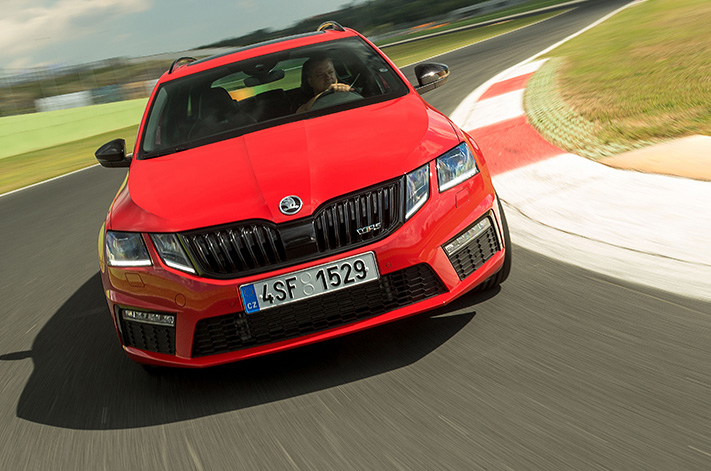
Skoda Australia spokesman Paul Pottinger said the Czech carmaker would likely know in “a couple of months” if a seven-speed DSG option would be available. If it does, it’s likely to see a Frankfurt motor show global debut in September, followed by an arrival here in November. If it doesn’t, the RS245 will become a limited-edition special.
“If it has that [a DSG gearbox], it would be a mitigating part of it being a permanent member of the line-up,” Pottinger said. “But there remains a core of RS buyers who like to shift gears for themselves.”
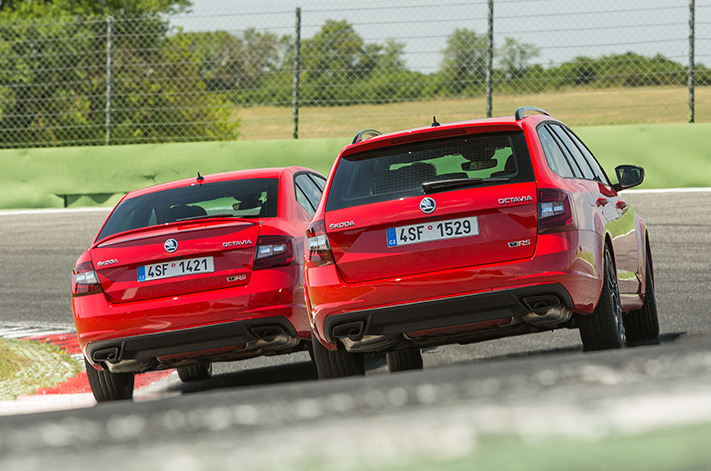
The hot Octavia, revealed at March’s Geneva motor show fitted with a six-speed manual gearbox, includes tweaks to its turbocharged 2.0-litre petrol engine, including the turbo, oil pump, injectors, manifold, timing chain, fuel pump and pistons.
All up, the RS245 – a distant booted cousin to the Volkswagen Golf GTI – will send 180kW/370Nm to the front wheels via the same electronically controlled mechanical limited slip differential that was fitted to the GTI 40th anniversary limited edition.
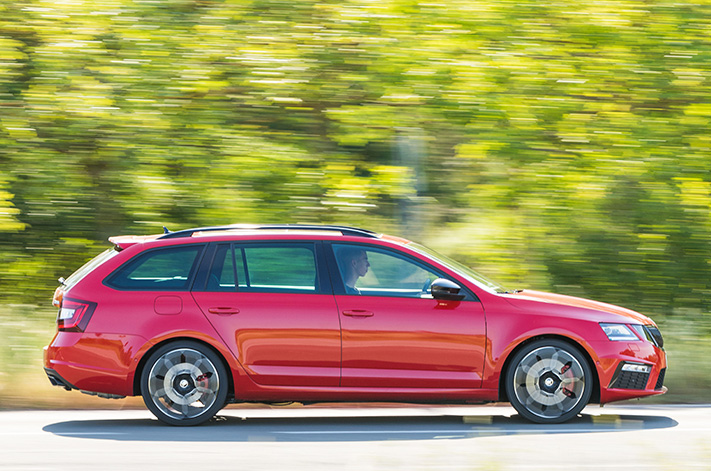
Combined, it’s enough to accelerate the RS245 hatchback from 0-100km/h in 6.6 seconds, with the booted version arriving 0.1secs later. Top speed is limited to 250km/h.
The automatic dual-clutch is an important ask for Skoda Australia. Take-up of the manual gearbox on RS-badged models has traditionally been high, but with a DSG-equipped, RS-badged Octavia wagon historically being one of the most popular Skoda-badged models, the availability of an auto is something of a deal-breaker.
“It puts us in a unique position worldwide,” Pottinger said.
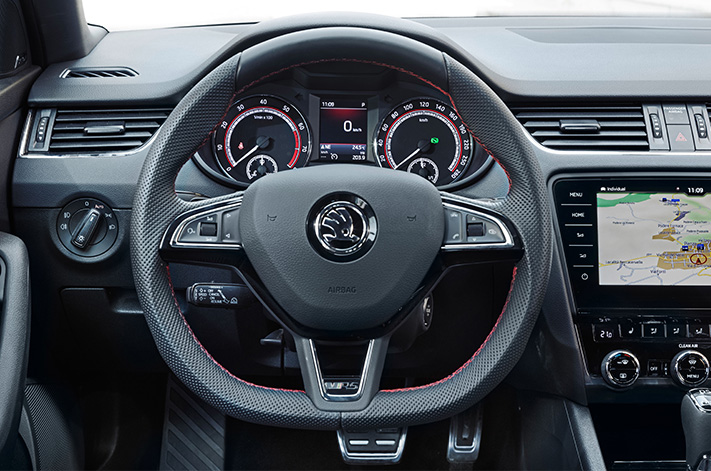
Just like its Volkswagen hatch-based sibling, Skoda’s RS models have about a 15 percent take-up of buyers placing a manual gearbox ahead of the paddle-shift auto.
Skoda’s Octavia range is due for a subtle makeover in about September this year, featuring a makeover of the car’s multimedia unit to include a wireless hotspot, and a tweak to the range’s driver assistance systems that should also be available in the RS245.
This is not the most powerful E36 M3, but it’s the one we’d want to own.
With 400 built it’s also not the rarest E36, all the particularly hard-to-find ones are pretty much race cars.
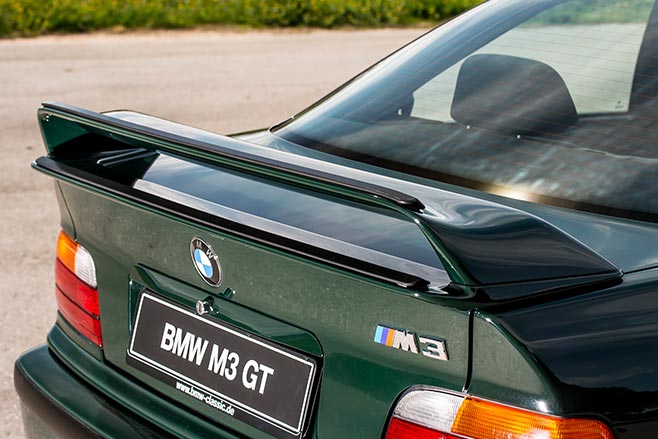
The M3 GT of the mid-‘90s is still just as cool as its quicker company, as it was a homologation special for the FIA GT Series and the American IMSA GT Series.
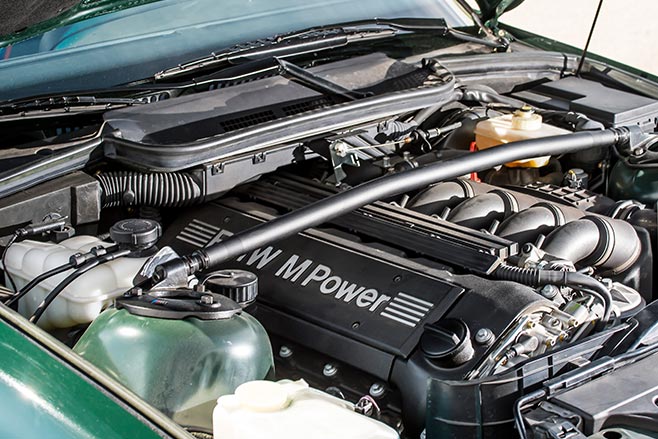
A BMW Motorsport dual-pickup oil pan and duocentric oil pumps, as well as upgraded VANOS software brought the standard for the engine up a little over the regular M3 donk.
A “BMW Motorsport International” emblem also appears on the exterior door mouldings, sills, and the panel over the glovebox.
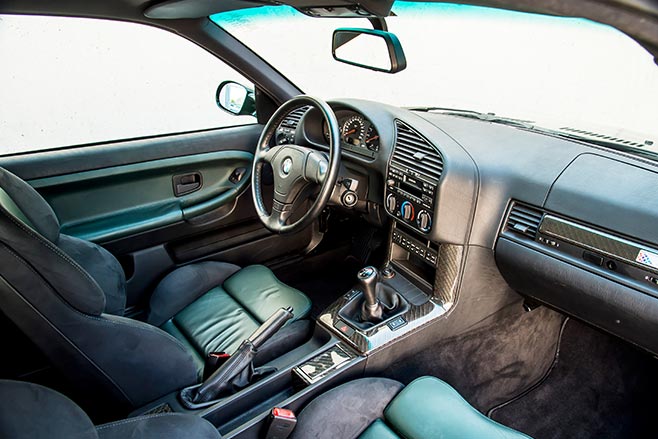
They also scored headlights which were adjustable from inside the car.
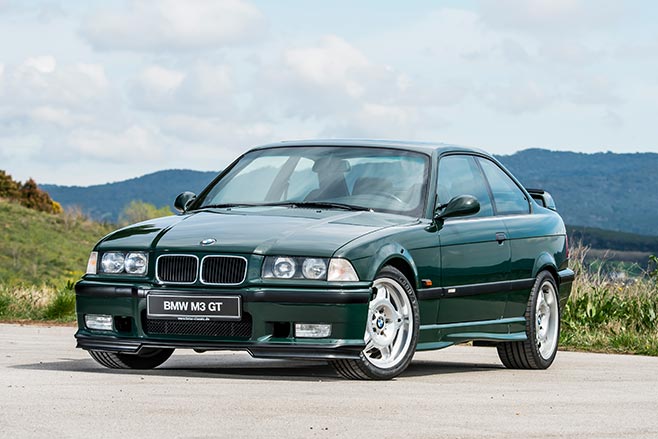
This is the E36 M3 you could track on the weekend and drive to the office in on Monday.
Question: Cheryl [asked on March 3,2017]
I like the height of an SUV, but I drive two hours each day to and from work on hilly and windy roads as well as around the city centre. Which SUV will give me driving enjoyment combined with good safety and features? I want an AWD that has the ability to power up and get me past tourists and is fun to drive. Mainly just two people so room and cargo space is not such an issue. I’d also like heated seats and hopefully heated steering wheel.
Budget: $50,000
Answer: Nathan
G’day Cheryl. Two recent arrivals in the small-to-mid SUV $50K market include the Audi Q2 and the new-generation Mini Countryman. However, AWD is only available in the top-spec turbo-diesel versions of each, and in the Mini’s case, will likely be $55K on-road.
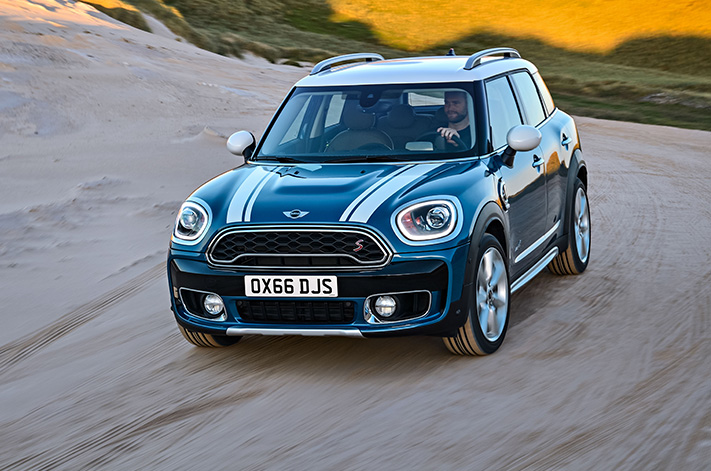
That said, the Countryman Cooper SD All4 (to give its full title), with an eight-speed automatic transmission and a fairly comprehensive level of standard equipment, may be the most amusing, and most appropriately sized AWD wagon you can get for 50 grand.
It offers plenty of room in a neatly sized package, a slightly higher driving position than a regular hatch, and truly entertaining handling. The diesel is also a strong engine [sourced from BMW] and with eight ratios, could never be caught short of a gear!
The Q2 2.0TDI quattro ($47,400 RRP, not including on-road costs, compared to $51,500 for the Countryman SD) isn’t quite as entertaining to drive as the Countryman in corners, but it’s slightly more affordable and arguably more tasteful design-wise [if you prefer sober over deliberately playful]. However it, too, will cost just over $50K once you put it on-road (or add any options, of which there are many!)
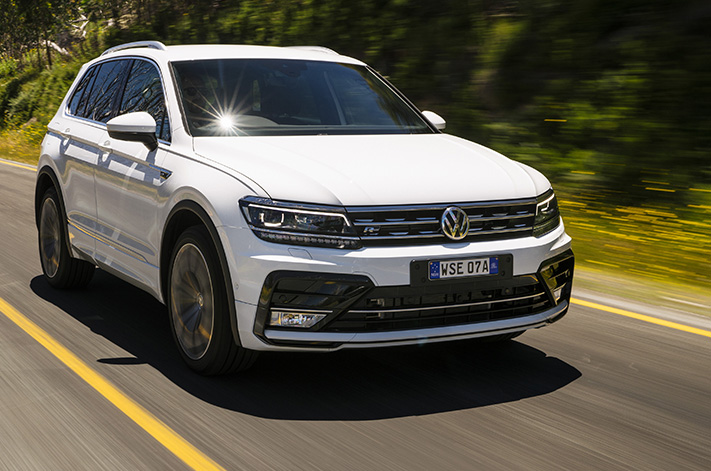
If neither of those premium-brand offerings fit the bill, or are a bit too far north price-wise, then perhaps an upper-spec medium SUV could suit. They’re larger SUVs than the Q2 and Countryman, but our pick for best to drive.
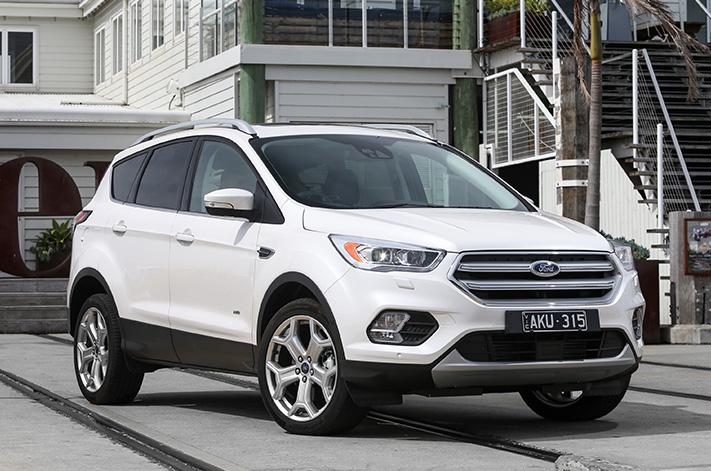
Strong performers include the Volkswagen Tiguan 162TSI (starting at $48,490 RRP) or the Ford Escape Titanium 2.0-litre turbo-petrol ($44,990 RRP). The Tiguan is the classier of the two, both outside and in, but the Escape steers, handles and rides exceptionally well for its type, and it has loads of grunt.
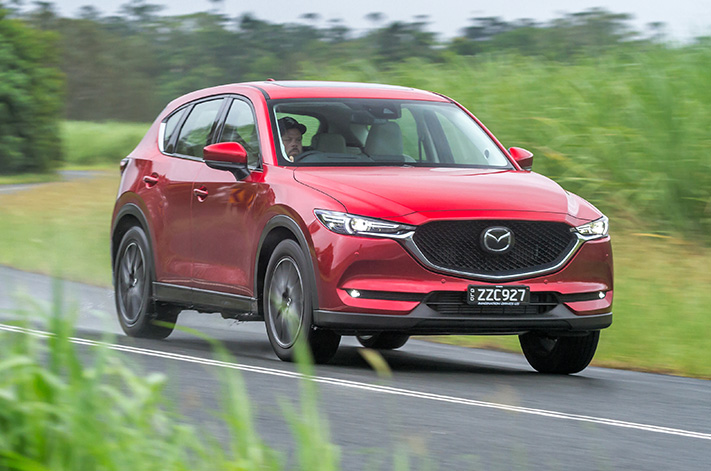
You could also look at the new-generation Mazda CX-5 Grand Touring turbo-diesel [it offers much more oomph than the 2.5-litre petrol], which recently launched in Australia.
My colleagues have driven it and reckon it’s in the running for best-in-class honours for all-round ability. And it has Mazda’s reliability and resale reputation going for it.
BMW rounds out its 5 Series offerings with a plug-in hybrid executive saloon that costs no more than the fossil fuel-burning alternative to buy.
TELL ME ABOUT THIS CAR
The idea of a petrol-electric hybrid version of BMW’s large-size corporate express isn’t new. Four years ago, the BMW ActiveHybrid 5 arrived in Australia boasting a turbocharged 3.0-litre six-cylinder petrol engine hooked up to a mild hybrid system. It could drive for about three kilometres on battery power alone, and used about 6.2 litres per 100 kilometres of fuel.
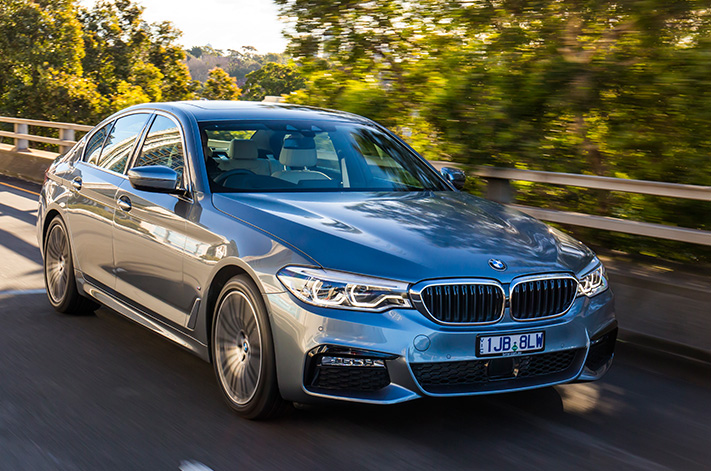
Since then, a new 5 Series has arrived in town heralding some of the latest cutting-edge technology that will one day trickle down to the cheapest BMW-badged cars. It has added a rechargeable battery to the mix, a 43 kilometre range and uses almost a third of the fuel of the car it replaces.
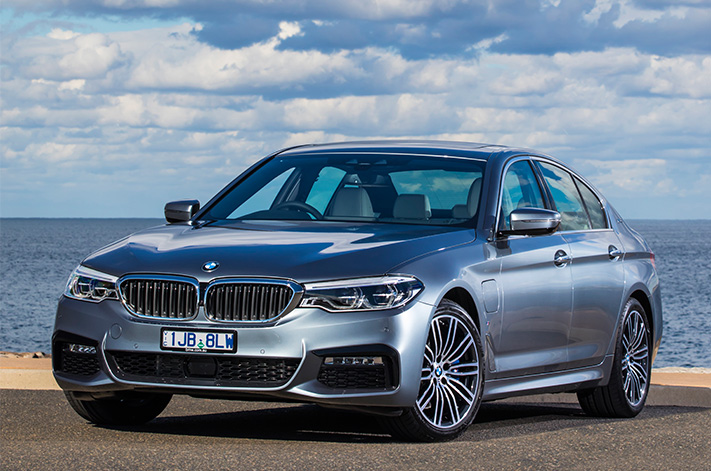
Most compelling of all, though, is that instead of charging a premium for the smart fuel-saving tech, BMW has set the price of the 530e iPerformance, as the new plug-in Bimmer is known, at exactly the same as the petrol-engined 530i version – $108,900.
STRENGTHS
- Good fuel economy on test. The BMW 530e iPerformance is officially rated at 2.3L/100km, and on test we recorded a 5.2L/100km.
- Okay, so at $108,900 the plug-in hybrid 5 Series is expensive. But you get all that hybrid tech for free compared with the petrol-engined equivalent.
- You can drive on electricity alone if you want. That’s a huge advantage if your commute each workday is around 40 kilometres – you’ll virtually never have to use fuel.
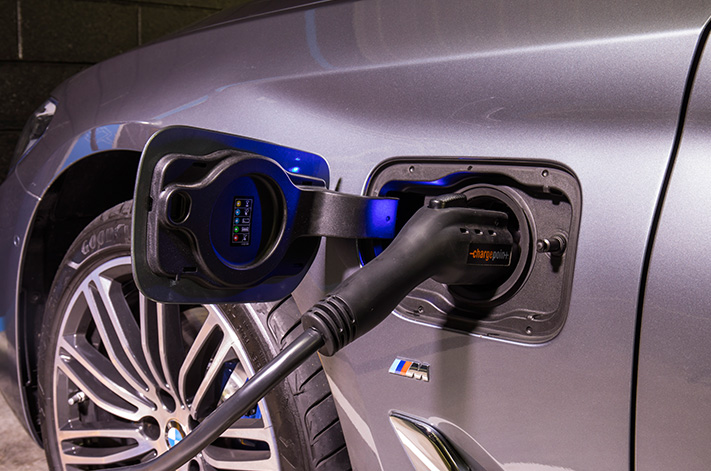
- If you do drive more than 40 kilometres a day, you only burn fuel when you run out of stored electricity.
- Buying a plug-in hybrid that can drive in full electric mode future-proofs you if ever the government decides to add a congestion zone to a city, but with a free ride for zero-emissions cars (like London does).
- The hybrid system is set up to scab as much energy as it can out of braking, and convert it to electricity. The 530e’s clever electronics makes it less heavy on the brakes as a result, so you save in terms of brake wear.
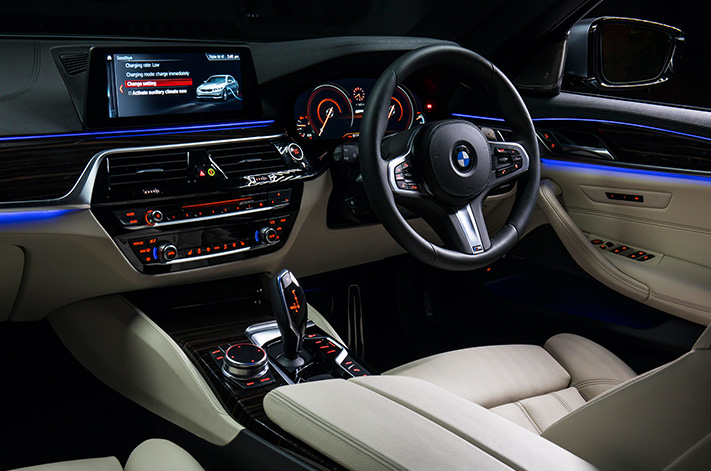
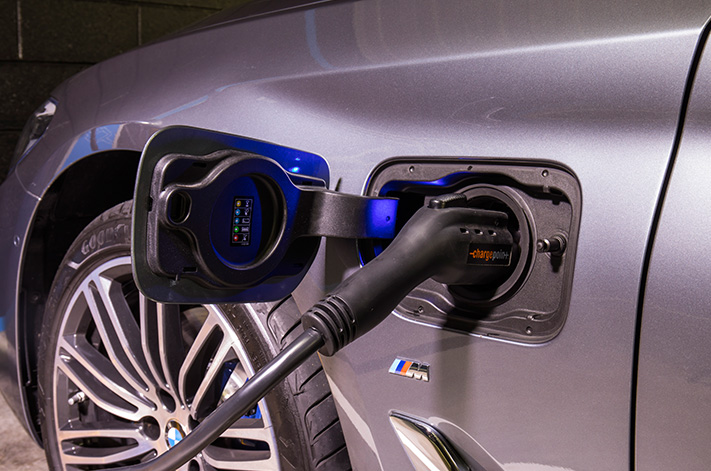
- The plug-in BMW comes with a recharging cord as standard. It means anywhere there’s a power point, you can charge the batteries.
- Buy the BMW and you get a tag that also gives you free faster recharging at a number of public stations.
- It’s cheaper than the Benz-badged equivalent, the Mercedes-Benz E330e. You’re paying more than $20,000 to get into one of those, but it uses only 0.1L/100km less fuel than the BMW. Then again, the Benz is more powerful.
WEAKNESSES
- You’re buying a car that uses significantly less in fuel than a Toyota Prius, the poster car for environmental driving, yet you still have to pay almost $8000 in luxury car tax.
- The iPerformance badge is misleading. The combination of the petrol engine and electric motor has more torque than the petrol equivalent, but the only time you notice it is from a standing start.
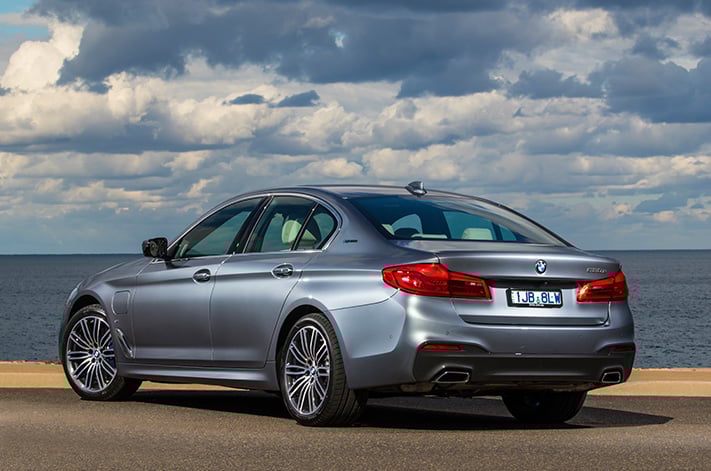
- The car is heavy, and feels it at times. The hybrid bits add 230kg in weight – almost a quarter of a tonne – so some of what makes the petrol-engined 530i feel so good to drive, such as its lightness over the front wheels, is lost.
- Real-world all-electric range will vary depending on how you drive the car. Drive hard, with the heater on high, lights ablaze, and the windscreen wipers at full speed and you’ll deplete the batteries a lot faster. Drive like nana on a mild day and with the aircon on low and you’ll go far.
- You lose boot space. The hybrid system’s battery pack is made up of 96 individual cells strung together, and it sits under the boot floor. The fuel tank has also moved partially under the boot floor, too, eating into space.
- Speaking of the fuel tank, it has shrunk from 68 to just 46 litres. If you’re on a long road trip with no recharging available, that’s a lot of fuel stops.
ANY RIVALS I SHOULD CONSIDER?
We’ve already mentioned the Mercedes-Benz E330e, a plug-in hybrid E-Class that’s more expensive, more powerful and just as fuel efficient, but won’t go within cooee of the 530e when it comes to electric-only range.
Lexus sells the equivalently-priced GS450h, but its V6-based petrol-electric hybrid system is tuned towards performance. The penalty for that is instead of running on the smell of an oily rag like the Benz and the Bimmer, it drinks fuel like a small European hatchback. Oh, and it doesn’t have a plug to top up the batteries, so all the recharging comes via your right foot.
BMW has tried rolling out a hybrid-engined version of its 5 Series executive express before.
Called the BMW ActiveHybrid 5, it had an all-electric range of about three kilometres, with its appeal running about as far as its battery-powered range.
But a new large-size flagship deserves some new fuel-saving hybrid tech. And here it is.
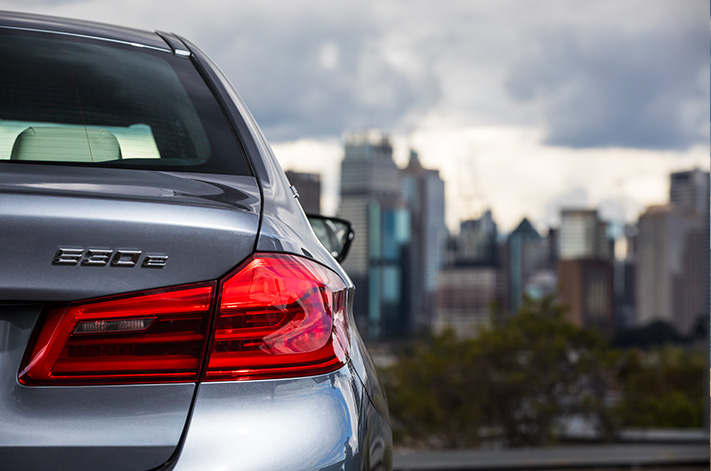
WHAT IS IT It’s the BMW 530e iPerformance, basically a petrol-engined 530i large sedan with plug-in hybrid bits plumbed in.
MAIN RIVALS There’s the more expensive, more powerful and poofteenth-heavier-on-fuel Mercedes-Benz E350e that won’t go quite as far on pure electric power alone. Or the equivalently priced Lexus LS450h F Sport that’s more about performance than frugality.
THE WHEELS VERDICT Kudos to BMW for encouraging buyers to try its plug-in hybrid tech for the same price as the 5 Series’ conventionally engined saloon. But while your hip pocket will be happier, it doesn’t quite deliver on the driver’s car demands that the BMW badge carries.
MINUS: Extra weight dulls handling; hybrid packaging robs boot space; doesn’t improve the 5 Series breed
THE WHEELS REVIEW A FIFTH member of BMW’s growing suite of iPerformance – read ‘plug-in hybrid’ – models has joined the Bavarian car maker’s showroom. This time, though, it wears the clothes of the G30-based 5 Series.
The 530e iPerformance is priced the same as the 530i and carries the same spec level, meaning buyers who want to take the plug-in plunge but don’t want to pay extra for it can do so without any of the hip-pocket hits the technology normally attracts.
The electrics also push weight distribution from the 530i’s 51:49 split to a more rear-biased 48:52.
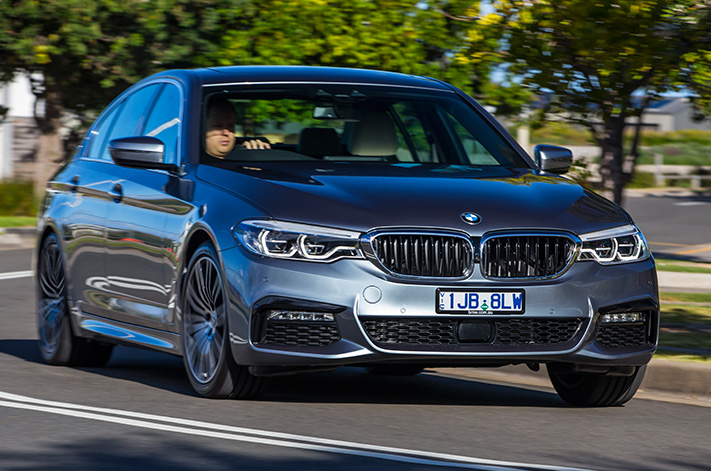
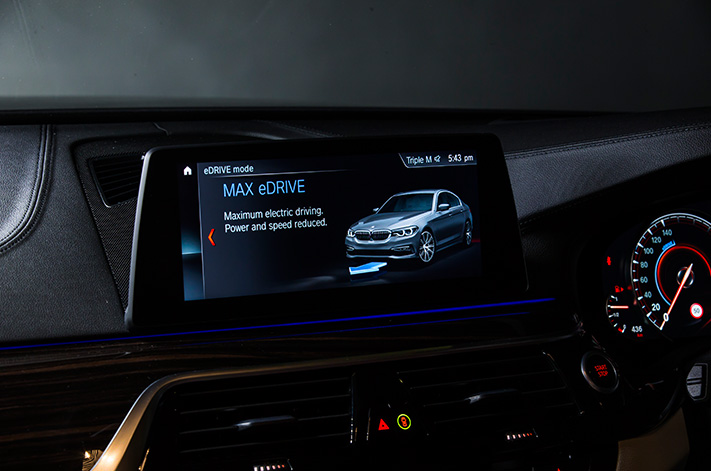
Flicking the console-mounted toggle to switch the 530e into its automatic hybrid mode will allow it to shut down the 135kW/290Nm 2.0-litre petrol engine and tap the batteries exclusively at speeds of up to 90km/h, which can be stretched to 140km/h by nudging the switch into ‘Max’ mode. Another ‘Control’ mode will force the 530e to preserve anywhere between 30 to 100 percent of charge to use later. At speeds below 30km/h the 530e will hum to warn pedestrians it is nearby.
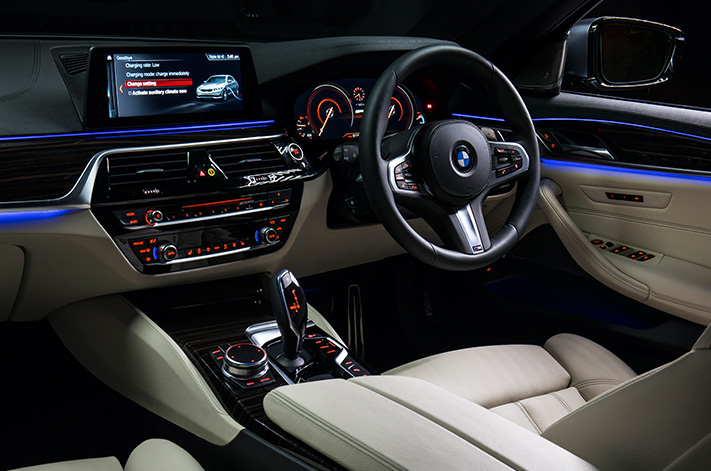
But a brief drive hints that all the 530e’s extra weight detracts from the regular 5 Series’ dynamic repertoire. You don’t so much notice the pork while stepping off the line, as the hybrid punch disguises it well, but more when braking and cornering where the centre of gravity shifts more harshly, or accelerating at speed where there’s a lot of noise but not as much mojo.
The tech beneath the 530e may add a green halo to the 5 Series, but for traditional BMW dynamic traits shop elsewhere in the range.
SPECS Model: BMW 530e iPerformance Engine: 1998cc 4-cyl, dohc, 16v, turbo + electric Max power: 185kW @ 5000-5600rpm Max torque: 420Nm @ 1350-4250rpm Transmission: 8-speed automatic Weight: 1770kg 0-100km/h: 6.2sec (claimed) Fuel use: 2.3L/100km Price: $108,900 On sale: Now
%MCEPASTEBIN%
HOLDEN has confirmed the racing version of the 2018 NG Commodore will have a V8 engine under its bonnet next year.
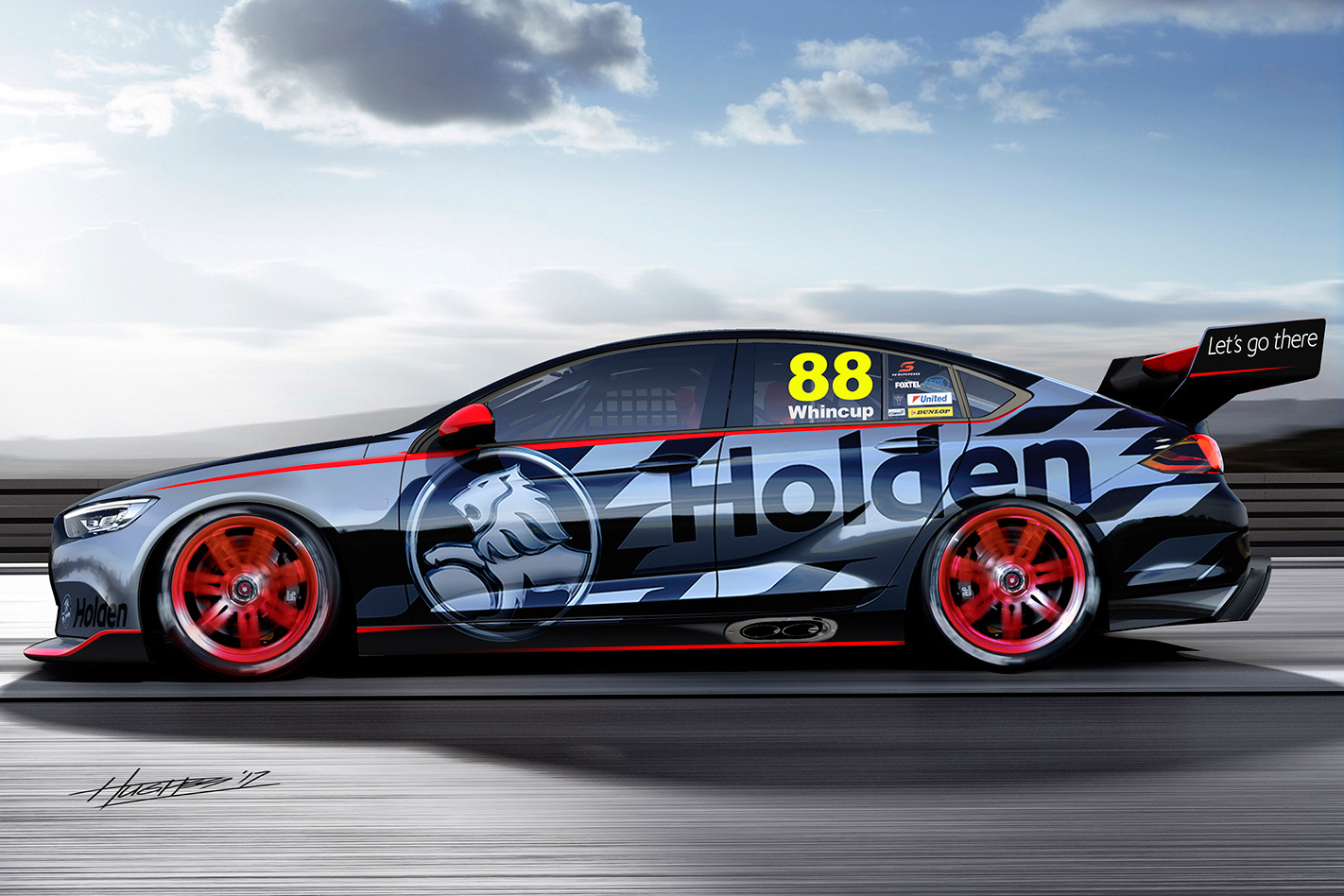
The first official renderings of the Supercars-spec Commodore have been revealed, with Holden confirming the proven bent-eight package will be recycled for the 2018 championship – even though the series’ new Gen2 rulebook now allows greater diversity in powertrain selection.
Triple Eight Race Engineering, which currently fields the two factory-backed Red Bull Holden Racing Team VF Commodores in the Supercars championship, is working on developing a twin-turbo V6 engine.
The package is being developed in conjunction with the General Motors Performance and Racing Center, in Pontiac, Michigan, before a full-time debut in 2019.
The factory team will “seek approval from Supercars to run a V6-powered Commodore as a wild card entry at selected rounds next season,” according to a Holden statement.
Following its debut, all Holden teams in the Supercars championship will be able to lease the twin-turbo engine from 2019.
“Our sport prides itself on Supercars being the closest competition in the world, and the phased introduction of the next-generation Commodore will ensure that is maintained,” Triple Eight Race Engineering team principal, Roland Dane said.
If Triple Eight is successful in fielding a wildcard entry, it will be the first time a non-V8 powered car has competed in Supercars since 1993, when it was known as the Australian Touring Car Championship.
The images of the 2018 Commodore in Supercars trim are the work of GM Design Australia Exterior Design Manager Peter Hughes.
Although striking, the concept images are unlikely to be a fully accurate representation of the final homologated product, with the car’s aero package likely to undergo changes before it hits a racetrack.
The 2018 Commodore racer is expected to undergo Supercars Aero Validation in the fourth quarter of 2017. As for the road car that will roll into showrooms after Holden shutters its Elizabeth assembly plant? Sadly, a V8 flagship – or even a turbo six – isn’t part of the product plan.
WHAT IS IT? The Lexus LC500 is a 2+2 sports coupe that draws inspiration from the LFA supercar as the brand’s new halo vehicle. It is available in Australia in two guises; a V8 petrol and a V6 petrol/electric hybrid. Both cost $190,000.
WHY ARE WE TESTING IT? Beneath its concept car styling the LC500 is the first Lexus to ride on an all-new platform, called GA-L, which will also underpin the next-gen Lexus LS. It promises to offer significantly improved dynamics and will form the foundation of other new Lexus models for some time to come.
MAIN RIVALS Lexus says the BMW 6 Series and Mercedes-Benz SL-Class are its targets, but the LC is likely to be cross-shopped by potential Jaguar F-Type and even entry-level Porsche 911 Carrera buyers.
THE WHEELS VERDICT The best sporty Lexus since the LFA. The LC500 is a cohesive and engaging mixture of design intrigue and driver appeal that makes a compelling alternative to more obvious grand tourer choices.
PLUS: V8 soundtrack and power delivery, much-improved steering, cohesiveness MINUS: Comfort mode not soft enough, hybrid drivetrain lacks sparkle and performance
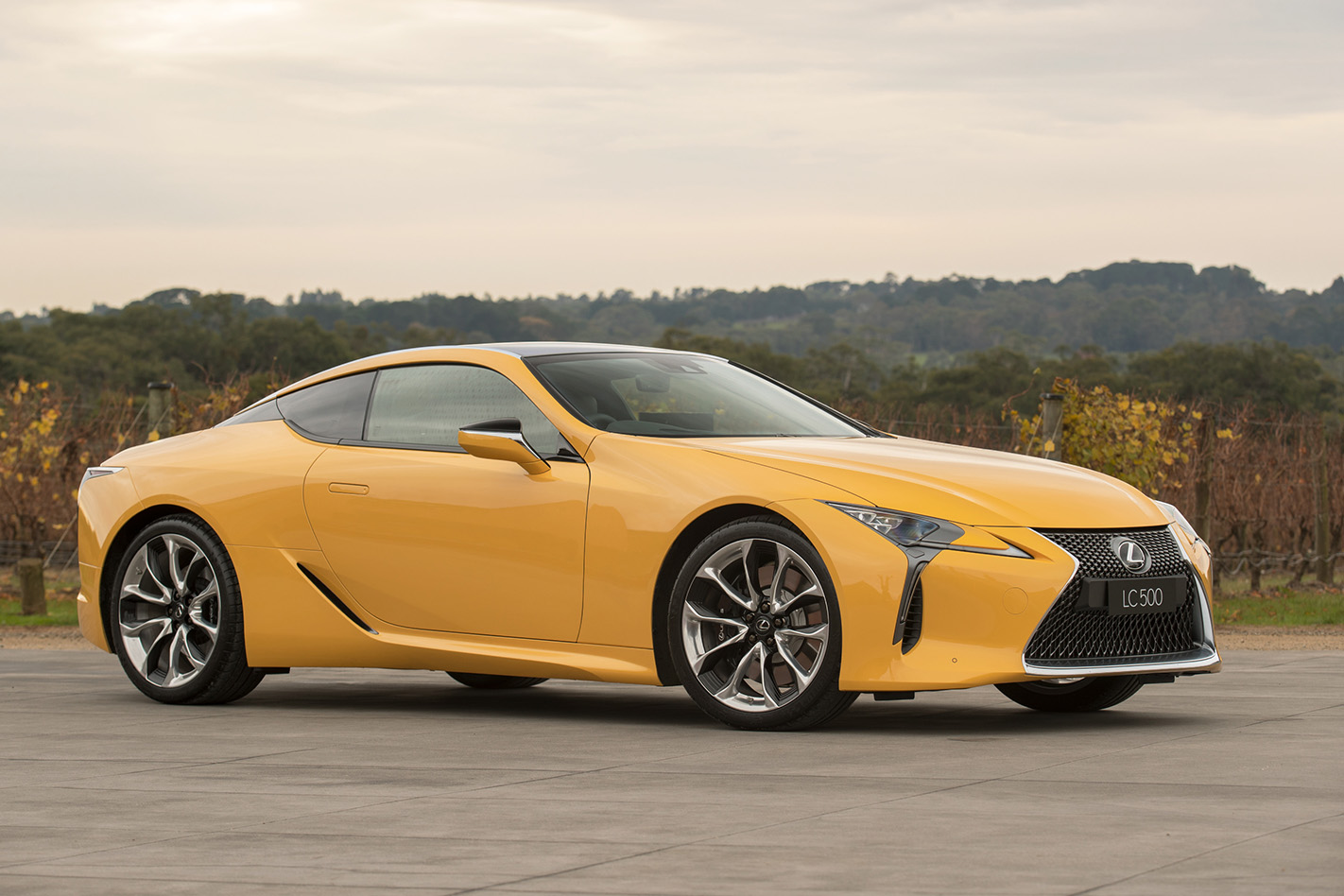
THE WHEELS REVIEW Five years ago Lexus did something new. It showed the world a brave two-door coupe with no intention to build it – a concept in the truest sense – a move never pulled by Lexus before.
It was dubbed the LF-LC Concept, and was the handiwork of Toyota’s design studio in California. Its reveal at the 2012 Detroit motor show came at an important moment in the brand’s story; the inimitable LFA supercar was still in dealerships, the right people were taking notice, and there was a mood that suggested Lexus might finally shake the last of its reputation for being a bit anodyne and dreary.
The LF-LC was an overnight success. Demand for a production version of the concept was so strong that Lexus transferred the program to its tech centre in Aichi, Japan and gave a team of engineers the problematic task of turning a design studio’s pipedream into reality.
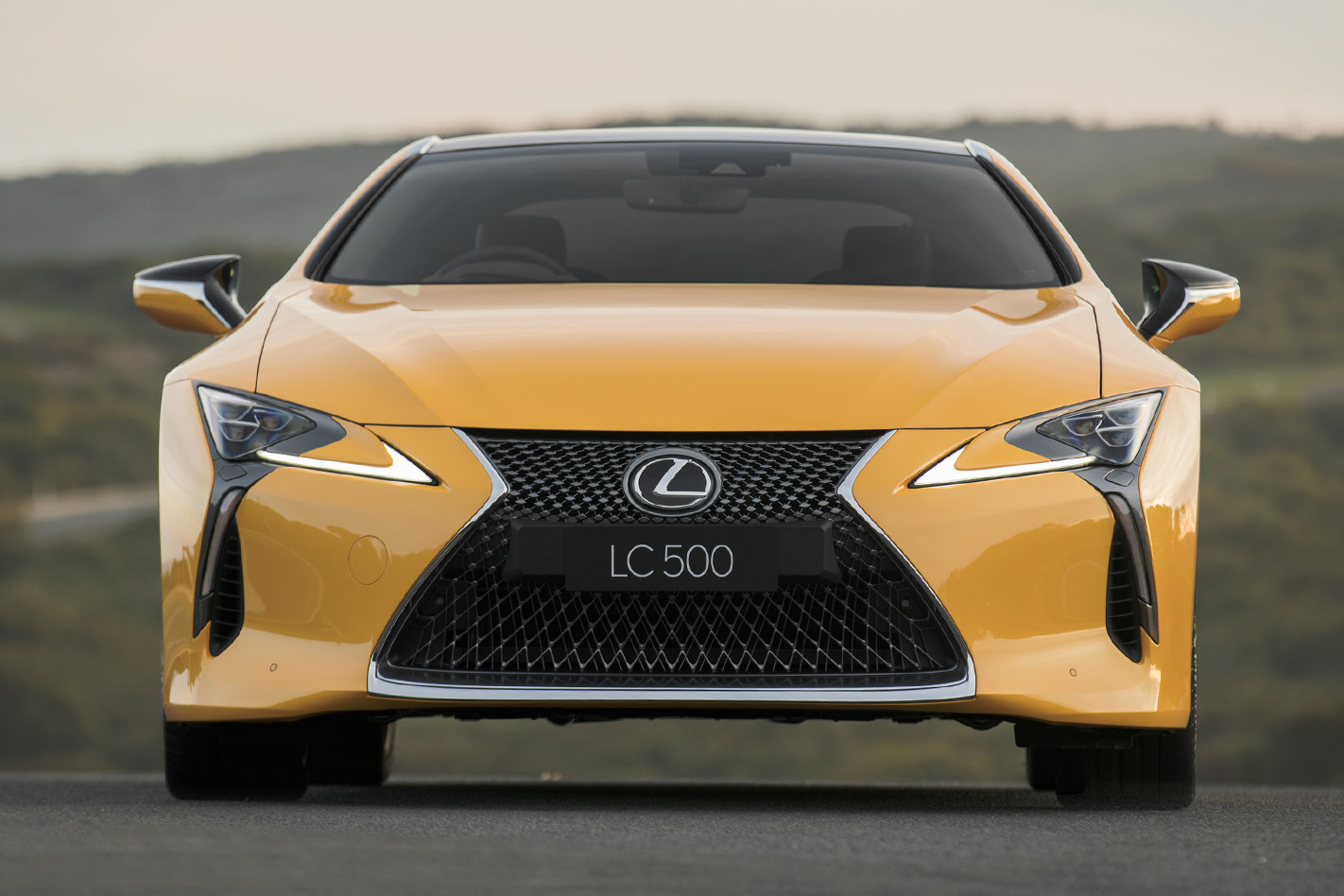
Now, the LC500 is finally here and almost nothing about its exaggerated styling was changed during its lengthy gestation period. The 2+2 is as striking as it was back then, verging on spaceship-like next to humdrum traffic.
Beneath its deliciously detailed bodywork lies the all-new GA-L platform that will form the basis of the next-gen Lexus LS sedan as well. It boasts myriad high-tech advances, lightweight construction methods and greater rigidity than anything to come before it – including the carbonfibre LFA.
Two versions of the car are offered in Australia priced identically at $190,000, which feels a bit expensive for the LC500h hybrid. Its combined output of 264kW from a 3.5-litre V6 and electric motor isn’t enough to pull off the performance-focused brief in this instance. It’s also let down by an unusual ‘multi stage’ gearbox that links a conventional four-speed auto and a CVT to simulate 10 unique ratios. It slurs and whines, and is ill-fitting for such a polished and pricey vehicle.
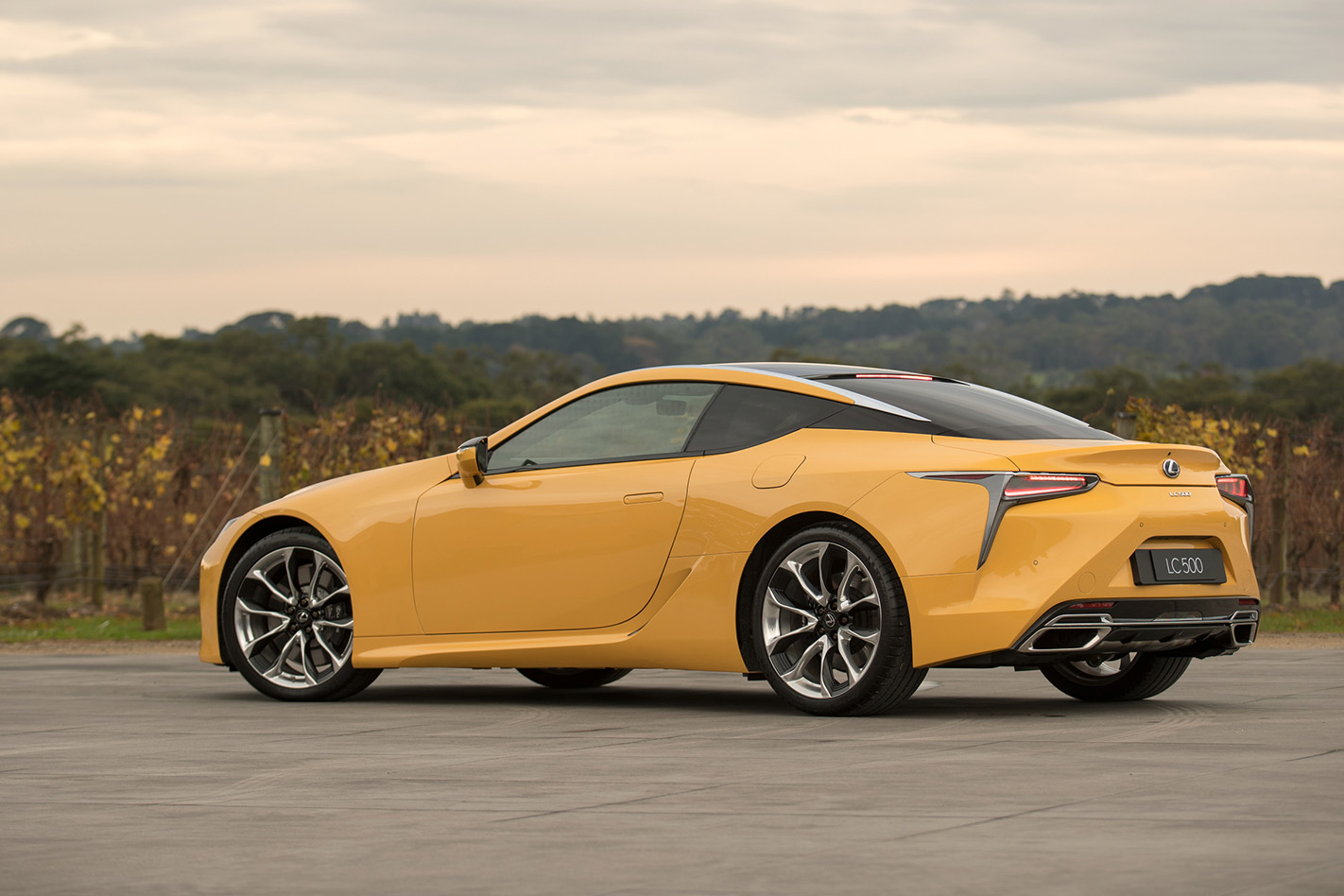
The pick of the pair is the regular LC500, powered by a familiar 5.0-litre naturally aspirated V8 similar to that found in the GS F and RC F, though with revised heads and an extra 10Nm for outputs of 351kW and 540Nm. It couples to an impressive new 10-speed automatic transmission, with short gearing making the bent-eight feel livelier than ever. It’s a brilliant ‘box; quick up and down, smooth and decisive.
Above 4000rpm the V8 flourishes with an addictively deep and throaty howl building to a 7100rpm peak with exhaust cracks on upshift. Its relatively moderate power is delivered in a paced manner, such that managing the throttle as you might with an over-torqued turbo engine is unnecessary. Simply stand on it and let it go. Are kilowatts really king? Maybe, but the objective here was optimal dynamics through a focus on emotional value rather than specs, and in isolation it’s really rather good.
Chassis poise is remarkable given the LC500’s 1970kg kerb weight. Its centre of gravity sits as close as possible to the driver’s hip point, making it easy to control that mass when threading along a narrow road. Even on a racetrack it never feels like that much weight is shifting around. Strong brakes with good pedal feel, and a high grip threshold give nothing away. It’s easy to place for something so big – 55mm wider and 75mm longer than RC F – and only restrictive electronics hamper the experience when having a go.
Guiding a much-improved front axle is the smallest wheel in the Lexus range (365mm). Steering is progressive and more direct with less dead-zone around centre than in the GS F and RC F. LC500 engineers freely admit to benchmarking the steering against the Porsche 911, and though it doesn’t quite reach that upper echelon it’s a step forward for Lexus.
An optional Enhancement Pack adds four-wheel-steering that can feel overly pointy on the road and takes getting used to, though the tighter low-speed manoeuvrability is a plus. At higher speeds the system adds stability, but the car is capable enough and has a more natural feel without it.
Oddly, there’s not a great deal of difference in ride quality between Comfort and Sport. The LC500 was a bit fidgety and choppy and found it difficult to carry speed along cratered roads on our short test. Huge, 21-inch run-flat Michelins with stiff sidewalls at each corner probably don’t help. A little more compliance in the adaptive dampers when softened off completely would get the LC500 closer to the ultra-polished grand tourer tone that its interior suggests.
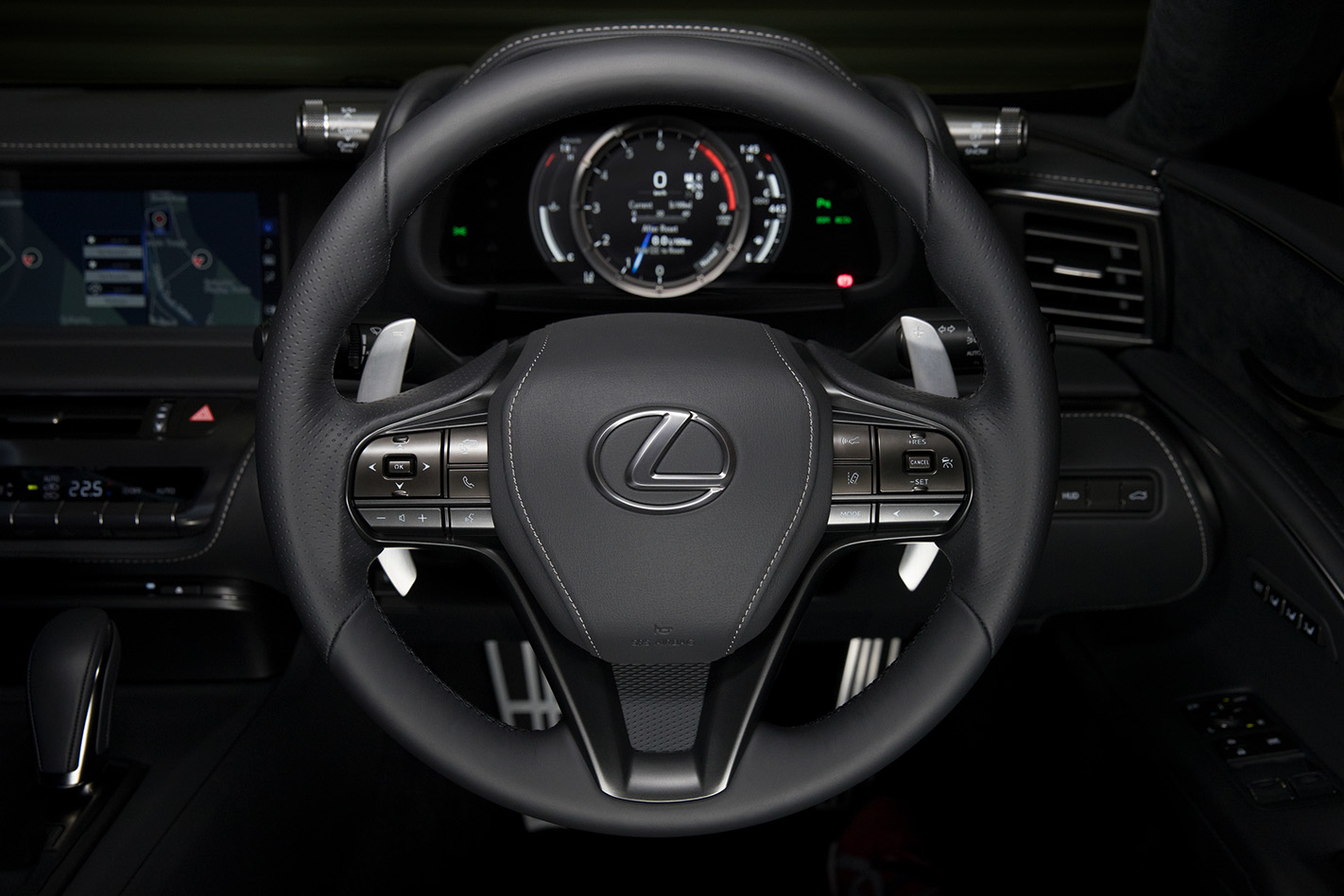
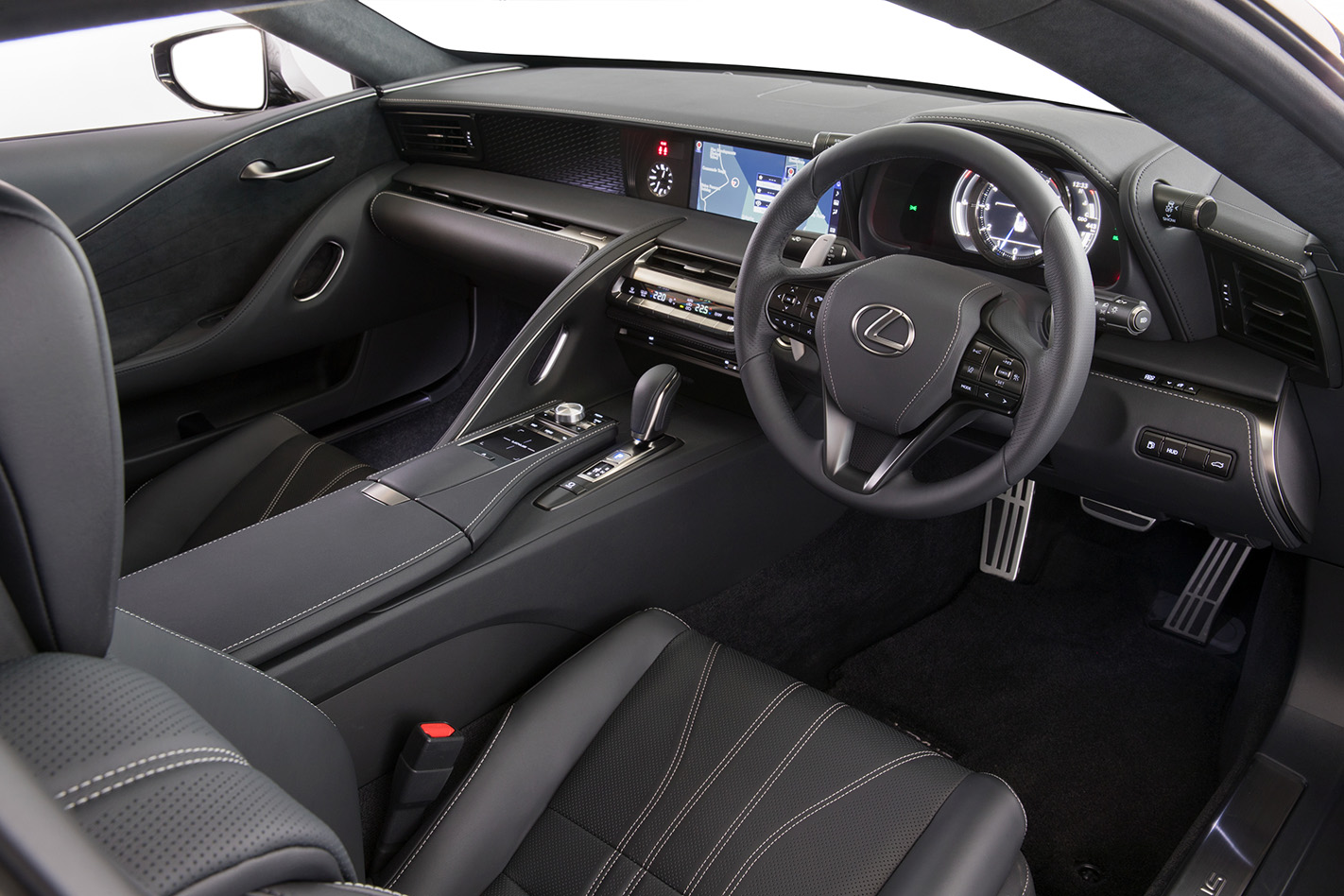
It would be easy to get lost in the details of the LC500’s cabin, like its floating door handles and magnesium alloy paddle shifters, or the seemingly infinite shapes and embellishments on every surface. Attention to detail is as expected, though the luxurious design does feel weirdly dated in some ways. There are buttons strewn about the place and the awkward ‘Shrek’s ears’ controls for drive mode selection and traction control poking out from the instrument binnacle aren’t to everybody’s taste.
The same digital dashboard used in the LFA features here, its single, movable dial resembling a watch face and continuing the supercar connection started with the exterior. Updates to the Lexus infotainment system and improvements to the haptic touchpad have made the LC500 easier to live with. Its heated and ventilated electric seats are supremely comfortable, and the cabin is well-isolated from wind noise even if some tyre roar does cut through.
The LC500 is a daring bit of work, and easily the most cohesive sporty Lexus since the LFA. It encourages and rewards enthusiastic driving, and is much more than simply a design statement. There’s a bit of LFA magic in the LC500, and though it’s not perfect it’s an intriguing and justifiable alternative to the obvious grand tourer options.
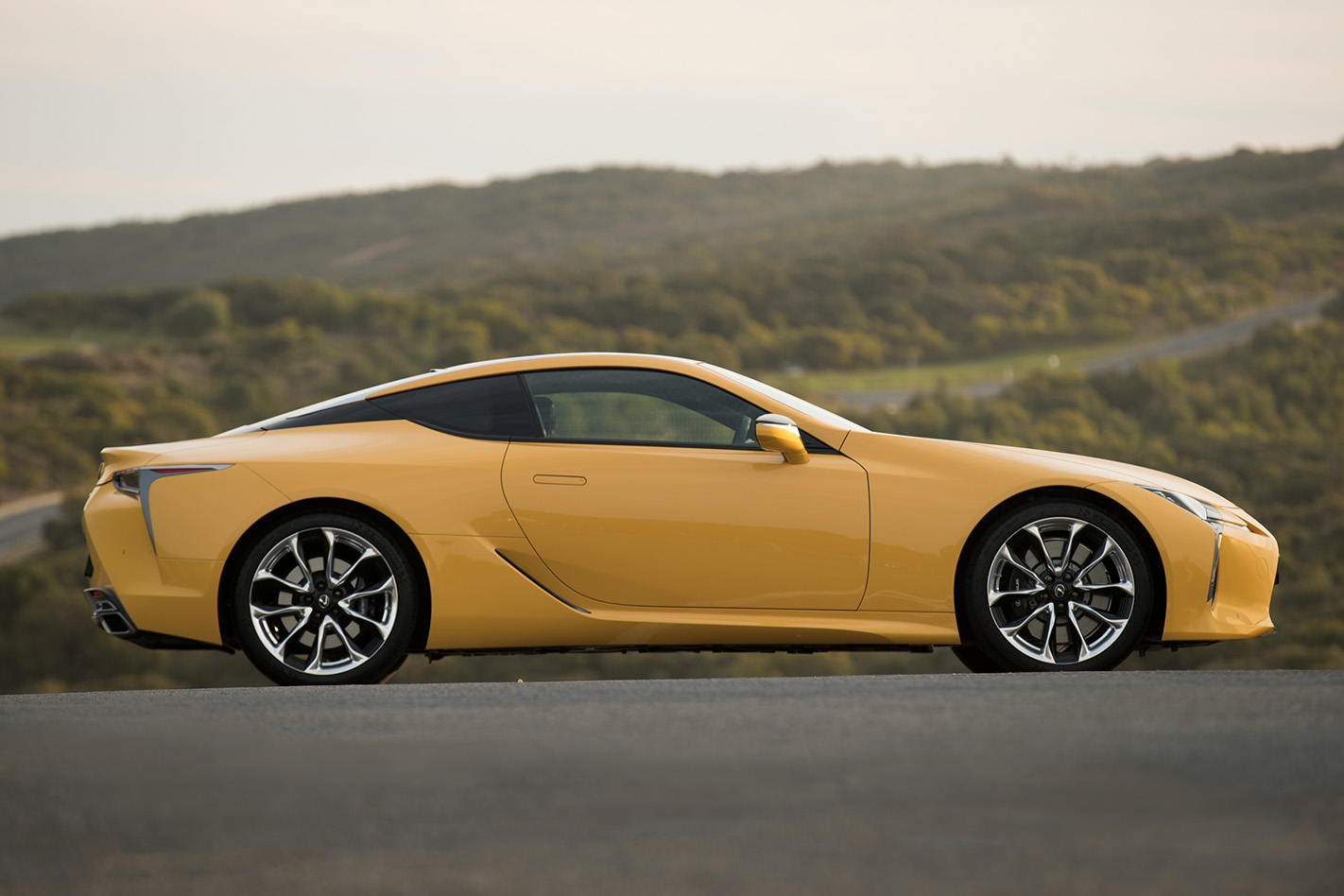
SPECS Model: Lexus LC500 Engine: 4969cc V8, dohc, 32v Max power: 351kW @ 7100rpm Max torque: 540Nm @ 4800rpm Transmission: 10-speed automatic Weight: 1970kg 0-100km/h: 4.7sec (claimed) Fuel economy: 11.6L/100km Price: $190,000 On sale: Now
