
Snapshot
- First-ever All-Electric JCW and All-Electric JCW Aceman set to be introduced to Australia in first quarter of 2025
- Both variants will include styling and performance enhancements
- All-Electric JCW capable of up to 371km of driving range and JCW Aceman 355km (WLTP)
- Priced at $63,990* for All-Electric JCW and $65,990* for All-Electric JCW Aceman
MINI Australia has announced all-electric versions of its high-performance John Cooper Works models will arrive in Australia in the first quarter of 2025.
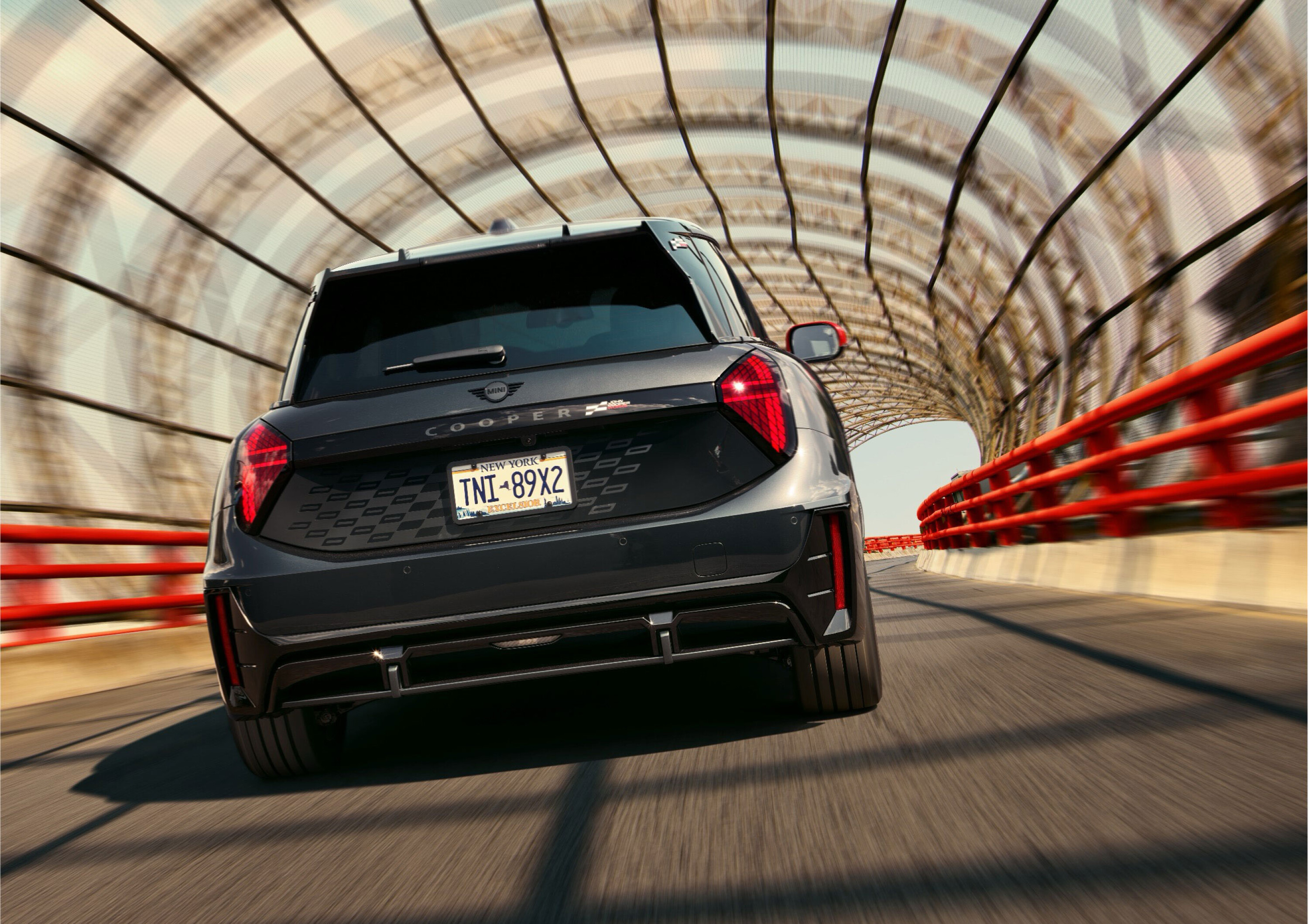
The All-Electric John Cooper Works and All-Electric JCW Aceman variants, which debuted at the 2024 Paris Motor Show earlier in 2024, each feature a more aerodynamic design to match output from the electric motor.
Each front-wheel-drive vehicle achieves a maximum output of 190kW and 350Nm, the Works three-door covering 0 to 100km/h in 5.9 seconds, while the Works Aceman notches 6.4 seconds. Both models have a top speed of 200km/h. Driving range is cited at a WLTP-rated 371km for the Works variant and up to 355km for the JCW Aceman.
1
The back story to these small but powerful Minis goes back more than six decades when John Cooper set about developing a sportier version of the classic Mini. His cars went onto claim rally and race victories before being realised as a commercial option for consumers.
The new fully electric models call on an additional 20kW of electric power when activating ‘go-kart mode’ via a steering wheel paddle to boost acceleration. Suspension and braking systems are optimised to enhance the agile, road-gripping go-kart experience. Aerodynamically optimised wheel designs are available exclusively for the all-electric MINI John Cooper Works in 18-inch and in 19-inch size for the MINI John Cooper Works Aceman.
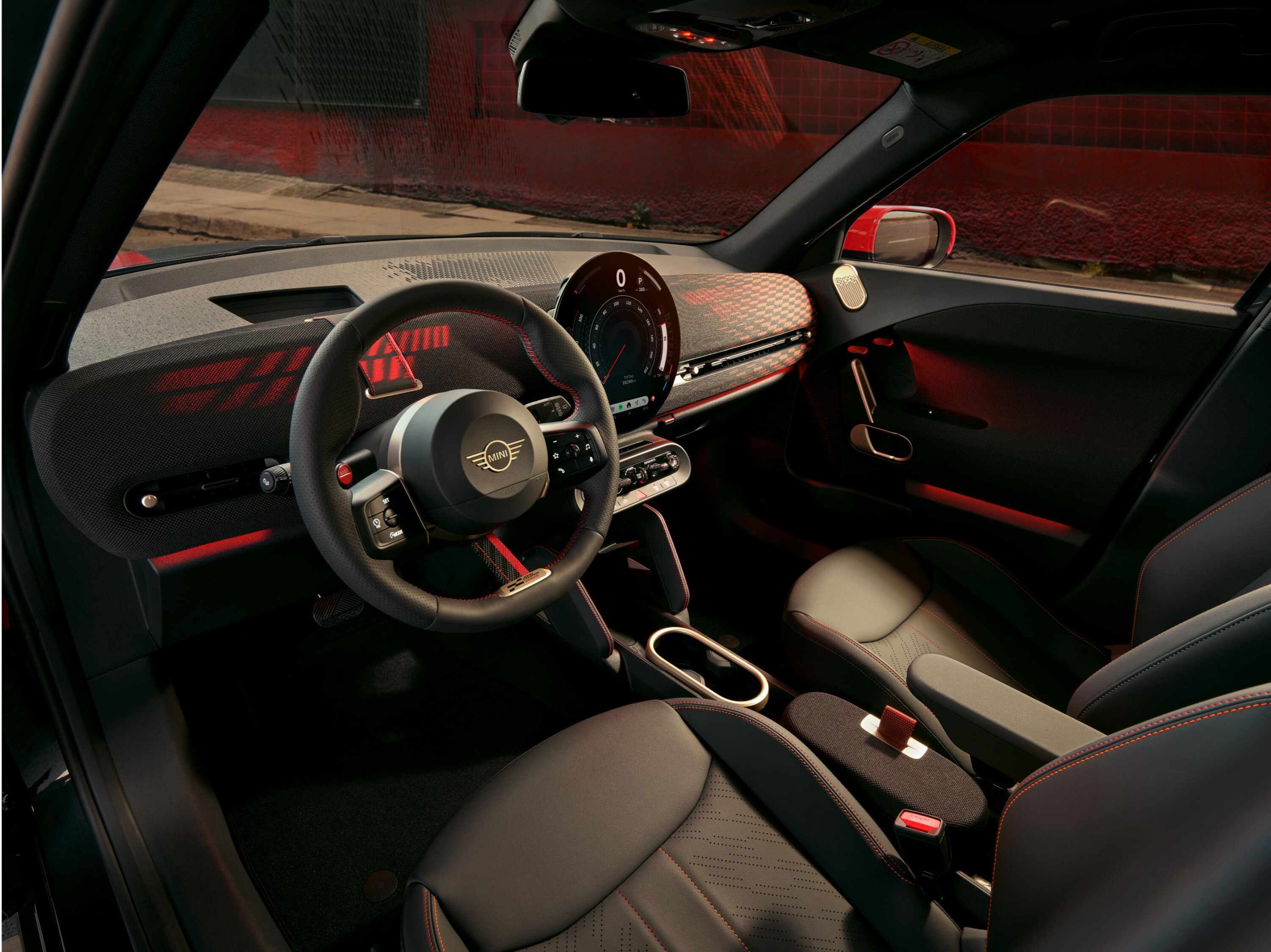
The design language of both variants is suitably racy, the red, white and black John Cooper Works logo reminiscent of a chequered flag, while a black and red pattern adorns the knitted surface of the dashboard.
1
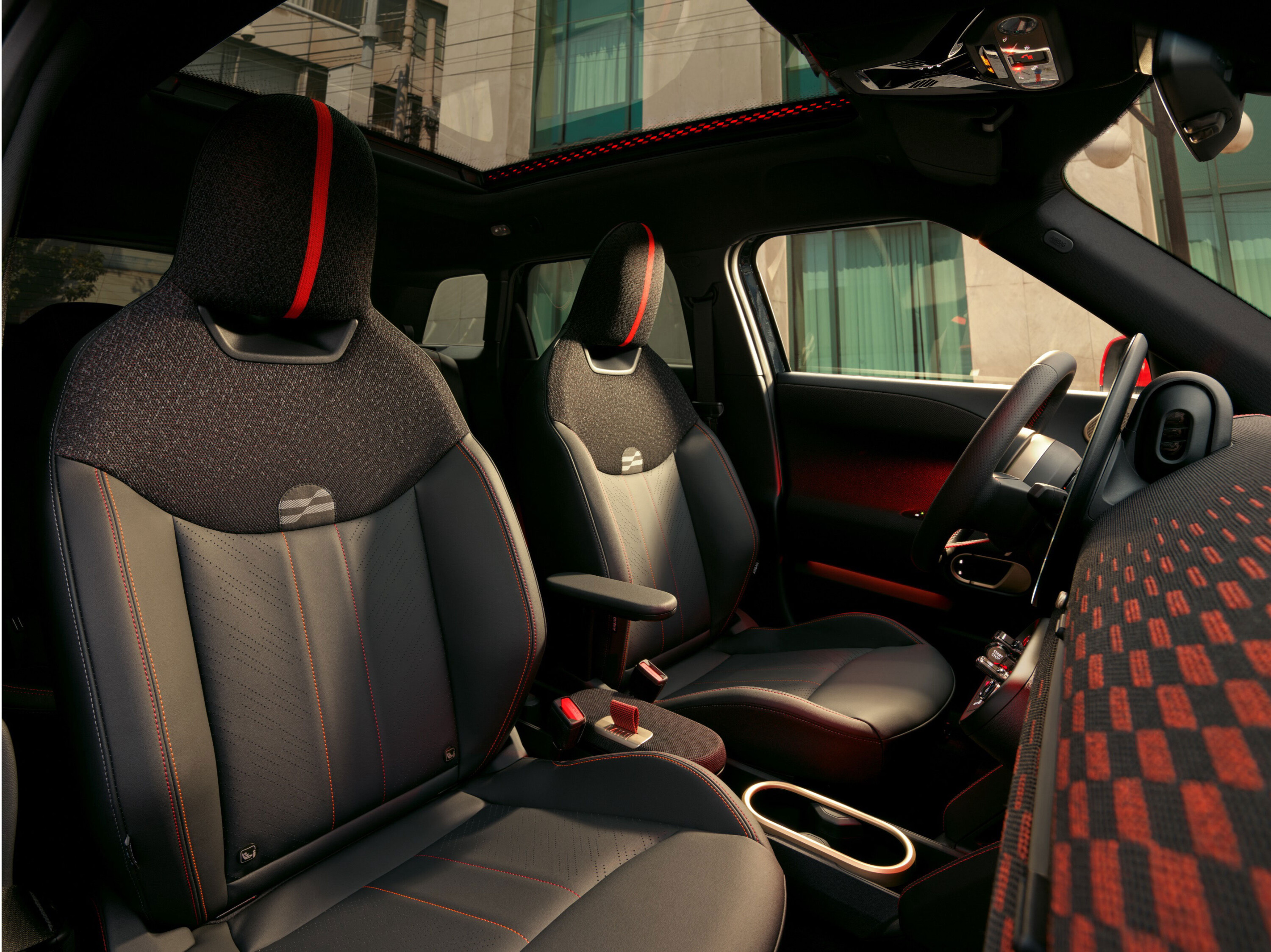
The JCW driver and front passenger seats are upholstered in black vegan leather with multicoloured knitted fabric at the shoulders and red accent stitching.
Tech upgrades include a high-resolution OLED display where driver and front passenger can access air conditioning, media, phone and navigation settings. Drive assistance tech includes automatic speed and distance control for more convenient city driving.
“We are thrilled to introduce these new additions to our line-up, bringing together the renowned road feel and engagement of John Cooper Works MINI models with the instantaneous power delivery and response of our fully electric offerings for maximum driving fun,” said Alexander Brockhoff, General Manager, MINI Australia & New Zealand.
Potential customers can configure their MINI John Cooper Works at: https://www.mini.com.au/configurator/type/jcw.
| All-Electric MINI John Cooper Works Aceman | |
|---|---|
| Price: $65,990* MRLP | |
| Adaptive Cruise Control | Sun Protection Glazing |
| Parking Assistant Plus with Surround View | Active Seat Functions for Driver |
| Steering and Lane Control Assistant | Electric Seat Adjustment with Memory for Front Seats |
| Harman/Kardon Premium Sound System, 10 speakers | John Cooper Works Seats |
| MINI Augmented Reality Navigation | Headliner Anthracite |
| Seat Heating for Front Seats | John Cooper Works Exterior Styling with Red Highlights |
| Panorama Glass Roof | John Cooper Works Interior Styling |
1
| All-Electric MINI John Cooper Works | |
|---|---|
| Price: $63,990* MRLP | |
| Adaptive Cruise Control | Sun Protection Glazing |
| Parking Assistant Plus with Surround View | Active Seat Functions for Driver |
| Steering and Lane Control Assistant | Electric Seat Adjustment with Memory for Front Seats |
| Harman/Kardon Premium Sound System, 10 speakers | John Cooper Works Seats |
| MINI Augmented Reality Navigation | Headliner Anthracite |
| Seat Heating for Front Seats | John Cooper Works Exterior Styling with Red Highlights |
| Panorama Glass Roof | John Cooper Works Interior Styling |
MORE
Everything Mini
Keeping track of all the new cars arriving in Australia is a job in its own right, but our New Car Calendar is here to help. Regularly updated, it’s your go-to guide for upcoming releases.
If you’re specifically interested in small cars, this dedicated calendar article is here to keep you informed without leaving you distracted by other options. Our new cars hub will also help you to find out more about the latest models touching down in Australia.
Australia’s new small cars of 2024 and 2025: Hatchbacks and sedans
JUMP AHEAD
- Audi A3
- BMW 1 Series
- BMW 2 Series Gran Coupe
- Cupra Born VZ
- Cupra Leon facelift
- Honda Civic
- Hyundai i30 Sedan Hybrid facelift
- Hyundai i30 hatch facelift
- MG3
- Mini Cooper hatch
- Peugeot E-208
- Peugeot E-308
- Skoda Fabia
- Skoda Scala (update)
- Subaru WRX
- Suzuki Swift
- Toyota Yaris
- VW Golf facelift
- VW ID.3 (electric)
LATER
- Kia K4 (2025)
- Renault 5 E-Tech (?)
Same but different…
? Looking for a small SUV instead?
Now read on for all the news on incoming small cars!
Audi A3 & S3 facelift
Audi revealed pricing and specifications in December for its updated A3 and S3 models, ahead of an early 2025 launch.
The line-up again includes Sportback and sedan options, with the A3 priced from $54,800 and the S3 starting at $78,800 (before on-road costs). Notable updates include revised styling, a tech-laden interior and more standard features, with the S3 also promising improved performance and handling.
The A3 is powered by a 1.5-litre turbocharged petrol engine paired with 48-volt mild hybrid technology, producing 110kW and 250Nm. Standard equipment includes Matrix LED headlights with customisable light signatures, a 12.3-inch virtual cockpit, and a five-star ANCAP safety rating. The S line package adds sporty design elements, while the colour palette expands to include District Green, Ascari Blue, and Progressive Red.
The S3 features a 2.0-litre turbocharged engine producing 245kW and 420Nm, with power delivered to all four wheels via Audi’s quattro system and a new torque splitter for improved cornering dynamics. It claims a 0-100km/h time of 4.7 seconds and offers features like adaptive dampers, an optional Akrapovič exhaust, and fine Nappa leather upholstery. Deliveries for the updated range will begin in early 2025.
BMW 1 Series
BMW Australia launched the updated 2025 1 Series in December, with the 118 priced from $56,500 and the M135 xDrive from $82,500 before on-road costs.
Both models feature refreshed styling, updated tech, and new powertrains.
The 118 offers a 115kW/230Nm 1.5-litre turbo three-cylinder engine, while the M135 xDrive boasts a 233kW/400Nm 2.0-litre turbo four-cylinder with all-wheel drive.
BMW 2 Series Gran Coupe
The 2025 BMW 2 Series Gran Coupe, announced for Australia in October, is set to arrive in Q1 2025.
The refreshed line-up includes the entry-level 218, priced at $58,800, and the performance-focused M235 xDrive, starting at $85,500 (both before on-road costs). This update introduces new styling, increased standard equipment, and improved dynamics.
The 218 is powered by a 115kW/230Nm 1.5-litre turbo three-cylinder engine with front-wheel drive, while the M235 xDrive boasts a 233kW/400Nm 2.0-litre turbo four-cylinder engine and all-wheel drive, delivering a 0-100km/h sprint in 4.9 seconds. Both feature a seven-speed dual-clutch transmission and adaptive suspension.
New standard features include BMW’s Curved Display with Operating System 9, 5G eSIM, adaptive cruise control, and matrix LED headlights. The M235 xDrive adds 19-inch wheels, a Harman/Kardon sound system, and advanced driver aids, continuing its role as the flagship model.
Cupra Born VZ
1
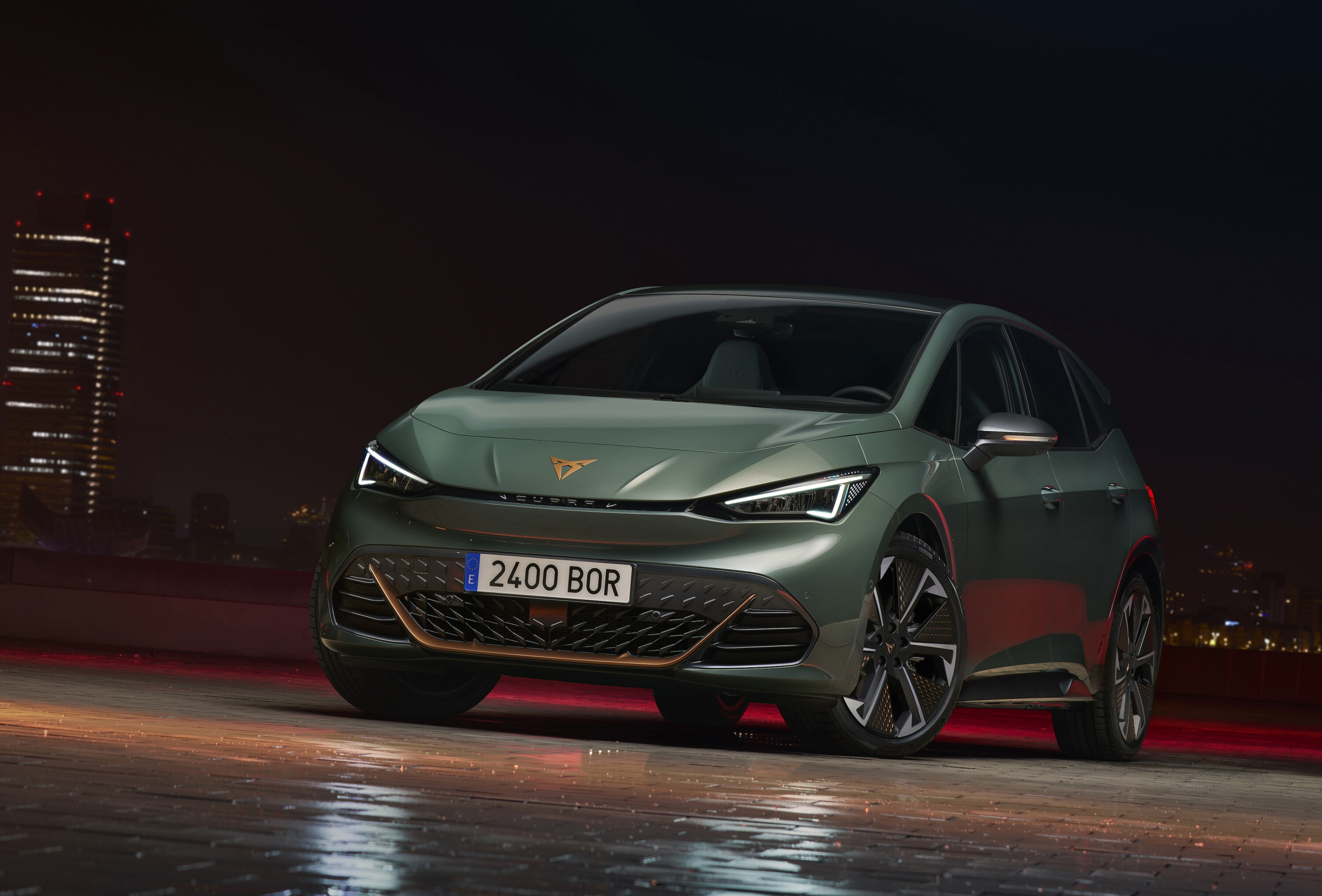
Cupra Australia has confirmed the Born VZ electric hatchback is set to launch in the first half of 2025, likely sometime in the second quarter.
This high-performance variant features a single-motor rear-wheel-drive powertrain delivering 240kW and 545Nm, enabling a 0-100 km/h acceleration in 5.7 seconds and a top speed of 200 km/h.
The Born VZ is equipped with a 79kWh battery pack, slightly larger than the standard model’s 77kWh, and incorporates a Dynamic Chassis Control (DCC) Sport setup with revised dampers, anti-roll bars, and rear springs. Exterior enhancements include wider tyres and 20-inch alloy wheels, available in forged or with 3D copper inserts, along with new colour options such as Midnight Black and Dark Forest green.
Pricing details have yet to be announced, but the Born VZ is expected to be positioned above the current model, which is priced at $59,990 before on-road costs.
Cupra Leon hatch & Sportstourer
The Cupra Leon Sportstourer will arrive in Australia in mid-2025 to coincide with a mid-life facelift for the hot hatch and wagon.
Details at the linked story above.
Honda Civic
The updated 2025 Honda Civic has launched in Australia, starting at $49,990 drive-away.
Now exclusively offered as a hybrid (apart from the Type R), the regular Civic line-up includes two variants: the e:HEV L and e:HEV LX.
Both are powered by a 2.0L direct injection engine paired with two electric motors, delivering 135kW and 315Nm.
Key updates include a redesigned front bumper, 18-inch alloy wheels, and enhanced in-car technology with Google built-in for navigation, live traffic updates, and apps. Honda Sensing is standard across the range, providing advanced driver assistance and safety features.
Hyundai i30 hatch facelift
Hyundai’s 2025 i30 hatch range was detailed in August, with the new line-up consisting exclusively of sporty N Line MHEV and performance hero N trims.
Now sourced from the Czech Republic, the i30 hatch range starts at $36,000 plus on-road costs for the N Line, featuring a 1.5-litre turbocharged four-cylinder engine paired with a seven-speed dual-clutch automatic. The powertrain delivers 117kW and 235Nm, supported by 48-volt mild-hybrid technology for improved efficiency.
Styling updates include a refreshed grille, new headlights, sportier side skirts, 18-inch alloys, and interior upgrades like a 10.25-inch digital display and USB-C ports. The N Line Premium adds Bluelink connectivity, a panoramic sunroof, heated and ventilated sport seats, and advanced safety features like Highway Driving Assist. Prices for the Premium start at $41,000 plus on-road costs, with European production impacting costs.
The updated i30 N hot hatch remains in the line-up, again powered by a 209kW 2.0-litre turbocharged engine and offered with manual or dual-clutch automatic transmissions. It’s priced from $50,000 before on-road costs.
Hyundai i30 Sedan Hybrid facelift
The wildly styled Hyundai i30 sedan was treated to revised front-end treatment and exterior tweaks as part of a mid-life update in 2023 and will see a hybrid powertrain taken from the Kona SUV join the line-up in 2024.
Available across entry-level i30, Elite and Premium trim levels, the hybrid pairs a 1.32kWh battery and 22kW electric motor with the i30’s 1.6-litre turbo petrol engine and six-speed dual-clutch automatic for a claimed combined fuel economy figure of 2.8L/100km.
The base i30 hybrid also gains multi-link rear suspension, dual-zone air-conditioning that the entry-level petrol version misses out on.
MG3
The 2024 MG3 launched in June, featuring significant changes in its size, equipment, and technology – including MG’s first regular hybrid drivetrain.
The new model is available in two trim levels: Excite and Essence. The Excite starts at $24,990 plus on-road costs, while the Essence is priced from $26,990 plus on-road costs.
The MG3 offers a 1.5-litre petrol engine producing 82kW and 150Nm, paired with a continuously variable transmission (CVT). There’s also a 1.5-litre hybrid option delivering a combined 137kW and 300Nm, utilising a six-speed dual-clutch automatic transmission.
The 2024 MG3 boasts a more spacious interior, advanced infotainment systems, and improved safety features, including autonomous emergency braking and lane-keeping assistance.
Mini Cooper hatch – Q3
The 2024 MINI Cooper three-door hardtop range is on sale now, offering a mix of petrol and electric powertrains across four variants.
Petrol options include the Cooper C with a 115kW/230Nm three-cylinder engine and the sportier Cooper S, boasting a 150kW/300Nm four-cylinder engine. Claimed fuel consumption ranges from 5.9L/100km to 6.1L/100km, with prices starting at $41,990 before on-road costs.
Electric variants include the Cooper E and Cooper SE, priced from $53,990 and $58,990 respectively, with a claimed range of up to 400km. Both feature 18-inch alloy wheels, advanced driver aids, and heated sports seats. This launch marks the final petrol-powered MINI range before transitioning fully to electric drivetrains.
Peugeot E-208
The Peugeot E-208 electric hatch, originally due here this year, is now a TBC, with only a ‘sometime in 2025’ line offered.
MORE
Everything Peugeot
Peugeot E-308
In November, Peugeot announced the all-electric E-308 hatchback for Australia, with an initial allocation of 14 units available for pre-order. This limited release serves as a preview ahead of a broader launch planned for 2025.
The E-308 is powered by a 115kW electric motor and a 54kWh battery, offering a WLTP range of up to 400km. It supports DC fast charging, enabling a 20-80% charge in approximately 25 minutes. The vehicle features regenerative braking to enhance energy efficiency.
Skoda Fabia Select
Skoda expanded its Fabia line-up in August with the introduction of a new entry-level Select variant, priced at $31,900 drive-away.
Joining the flagship Monte Carlo Edition 150, which starts at $38,990 drive-away, the Select aims to make the Fabia more accessible for buyers after a two-year absence of a budget-friendly option.
The Fabia Select features a 1.0-litre turbocharged four-cylinder engine delivering 85kW/200Nm, paired with a seven-speed dual-clutch automatic transmission driving the front wheels.
Skoda Scala – April 2024
Skoda launched 2025 Scala hatchback for Australia in September, available in two new variants: the Select, priced from $32,490 drive-away, and the sportier Monte Carlo, starting at $43,990 drive-away.
The Scala Select is powered by an 85kW/200Nm 1.0-litre three-cylinder turbo petrol engine, while the Monte Carlo steps up with a 110kW/250Nm 1.5-litre four-cylinder turbo petrol unit.
Both feature a seven-speed dual-clutch transmission and claimed fuel economy figures of 5.4L/100km and 5.6L/100km, respectively. Performance differs, with the Select claiming 0-100km/h in 10.1 seconds, compared to 8.2 seconds for the Monte Carlo.
Standard equipment on the Select includes 17-inch alloys, advanced driver assistance systems, and keyless entry, while the Monte Carlo adds 18-inch alloys, adaptive cruise control, sports chassis control, and heated front seats.
MORE
Everything Skoda
Subaru WRX
Along with a general model-year update, Subaru Australia launched the WRX Club Spec in April, priced at $52,590 before on-road costs.
The Club Spec sedan features a six-speed manual transmission, Recaro front seats, Brembo brakes, 19-inch matte grey alloy wheels, and a distinctive STI-style rear spoiler.
The wider 2024 WRX range gains upgrades across the board, including active safety features like autonomous emergency braking and lane-keep assist for manual sedan variants. Wireless Apple CarPlay and Android Auto are now standard, with all wagon variants receiving a 10-speaker Harman Kardon audio system.
The WRX line-up starts at $47,490 for the manual sedan, with prices increasing slightly for 2024. The range-topping WRX Sportswagon tS is priced at $59,790. All variants are now available to order in Australia.
Suzuki Swift
Suzuki Australia announced pricing for the new 2024 Swift in April, with the range starting at $24,490 drive-away for the Swift Hybrid manual.
The line-up now includes three mild-hybrid variants, topping out with the flagship Swift Hybrid GLX at $29,490 drive-away.
All variants are powered by a 1.2-litre mild-hybrid three-cylinder petrol engine producing 61kW/112Nm, with assistance from a 2.3kW/60Nm integrated starter-generator. Transmission options include a five-speed manual or a CVT automatic, with Suzuki claiming fuel consumption of 3.8L/100km for the manual and 4.0L/100km for the automatic.
Standard features include a 9.0-inch touchscreen with wireless Apple CarPlay, LED headlights, and keyless entry. Higher trims add 16-inch alloy wheels, heated front seats, and safety tech like blind-spot monitoring.
The Swift’s safety credentials have taken a hit, however, with ANCAP awarding the 2024 model a one-star rating.
MORE
Everything Suzuki
Toyota Yaris update
Toyota launched the refreshed 2024 Yaris in April, reintroducing a more affordable hybrid option with the Ascent Sport hybrid, priced from $28,500 before on-road costs.
This marks the return of a sub-$30,000 model after the recent shift to a hybrid-only line-up and the discontinuation of petrol variants.
Pricing for SX and ZR variants has risen by up to $1770, while the Yaris Ascent Sport hybrid offers a more cost-conscious entry point to the range. Full details at the story linked above.
VW Golf facelift
Volkswagen unveiled the facelifted 2025 Golf in January, at least a full year out from its Australian debut.
The updated Mk8.5 Golf introduces sharper LED headlights, revised bumpers, new alloy wheels, and an upgraded interior featuring a larger 12.9-inch touchscreen with improved infotainment and physical steering wheel controls.
The Golf GTI receives a power boost, with its 2.0-litre turbo-petrol engine now producing 195kW. Globally, the GTI drops its manual transmission option, remaining automatic-only.
Production for the Australian market begins in late 2024, marking this facelifted Golf as the final combustion-engine model before the all-electric Mk9 arrives around 2028.
VW ID.3 (electric) – Unclear
The ID.3 was expected to debut Volkswagen’s ‘ID’ electric sub-brand in Australia with a sub-$60k starting price, but its future is now unclear.
A local launch sometime before the end of 2024 was on the cards, but now appears unlikely as the brand turns its focus to bigger models like the ID.4, ID.5 and Buzz.
MORE
SUV Buyers Guide
The Not So Distant Future…
Kia K4 (2025)
Kia unveiled its new Cerato-replacing K4 sedan and hatch in March, but a local debut isn’t expected to occur until 2025.
That launch event will likely occur in sync with the Australian Open, where main sponsor Kia likes to show off its latest models. Learn more about the K4 in our linked stories above.
Renault 5 E-Tech EV (who knows?)
Renault unveiled its very retrotastic 5 E-Tech EV in early March – but, while its external Australian distributor is keen to have it, the carmaker has yet to confirm if we’ll get it.
Read more about the very cool little electric hatch at the linked story above. Want it in Australia? Let your Renault dealer know.
MORE
Everything Renault
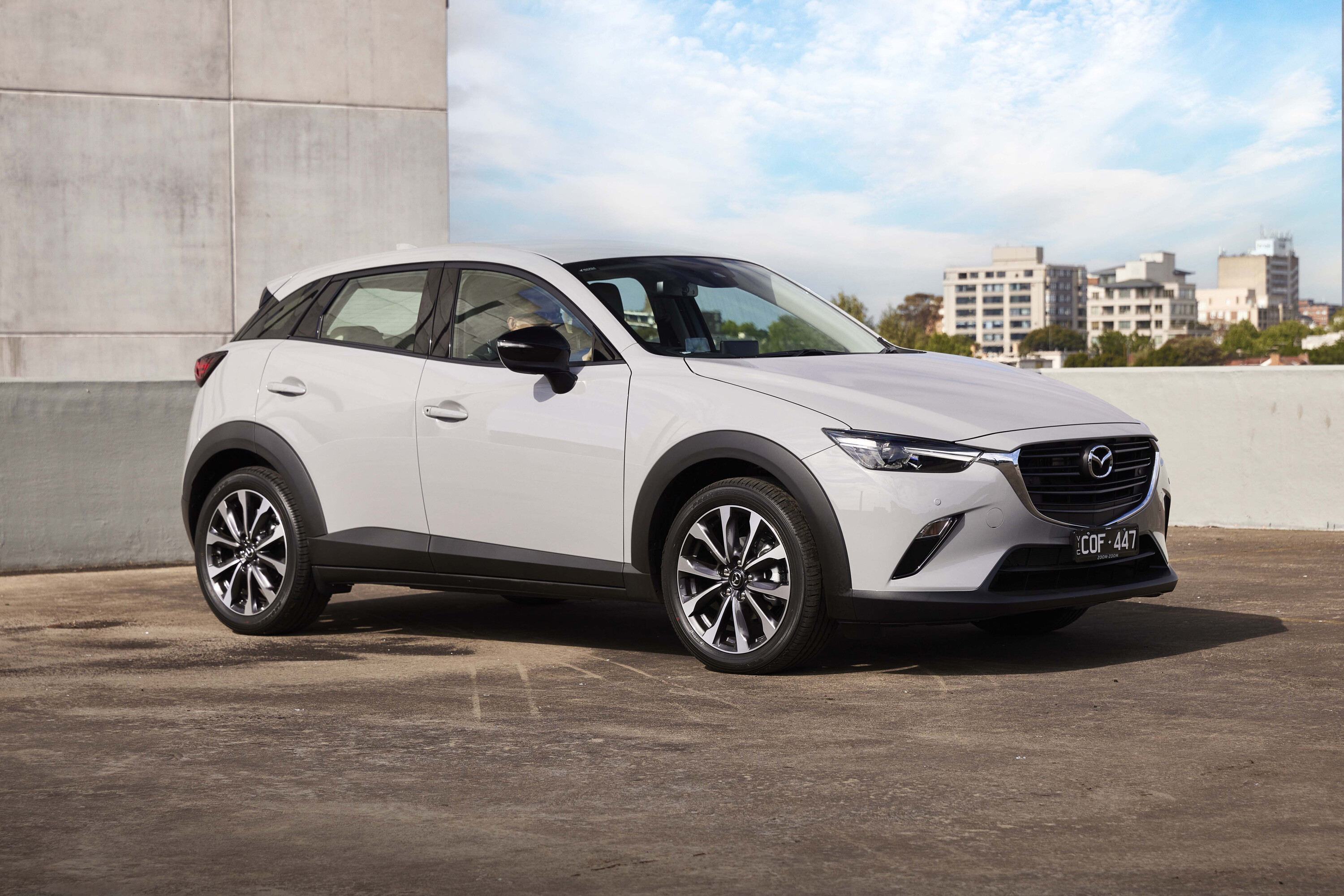
Mazda aims to refresh the appeal of the smallest cars in its Australian portfolio with a round of updates for both the Mazda2 hatch and the CX-3 light SUV.
The base grades of both will receive advanced i-Activsense safety technologies, while modest styling tweaks aim to give these affordable models a fresher look.
Despite being introduced in 2015 and facelifted in 2018, almost ten years after its initial introduction, the CX-3 remains a favourite with Aussie buyers due to sensible pricing, strong quality and effervescent handling.
32
The 2025 range won’t be quite so affordable, as the previous entry point, the Sport grade has been ditched, the range now opening with the Pure trim which now gets 18-inch gun metal machined alloy wheels, Mazda Radar Cruise Control (MRCC) and Smart Brake Support (SBS) in additional to its existing autonomous emergency braking technology suite.
Above that, the Evolve grade also gets this safety suite, as well as fog lamps and advanced keyless entry. The aesthetic benefits from 18-inch black machined alloy wheels while the cabin sees black leatherette seat trim, extending to the console and doors.
There’s been a reshuffle at the top of the range too, with the GT SP replacing the Touring SP model grade, adding 18-inch black alloys and a 7-speaker Bose stereo. The flagship Akari also debuts new 18-inch bright finish alloys.
MORE
Everything Mazda
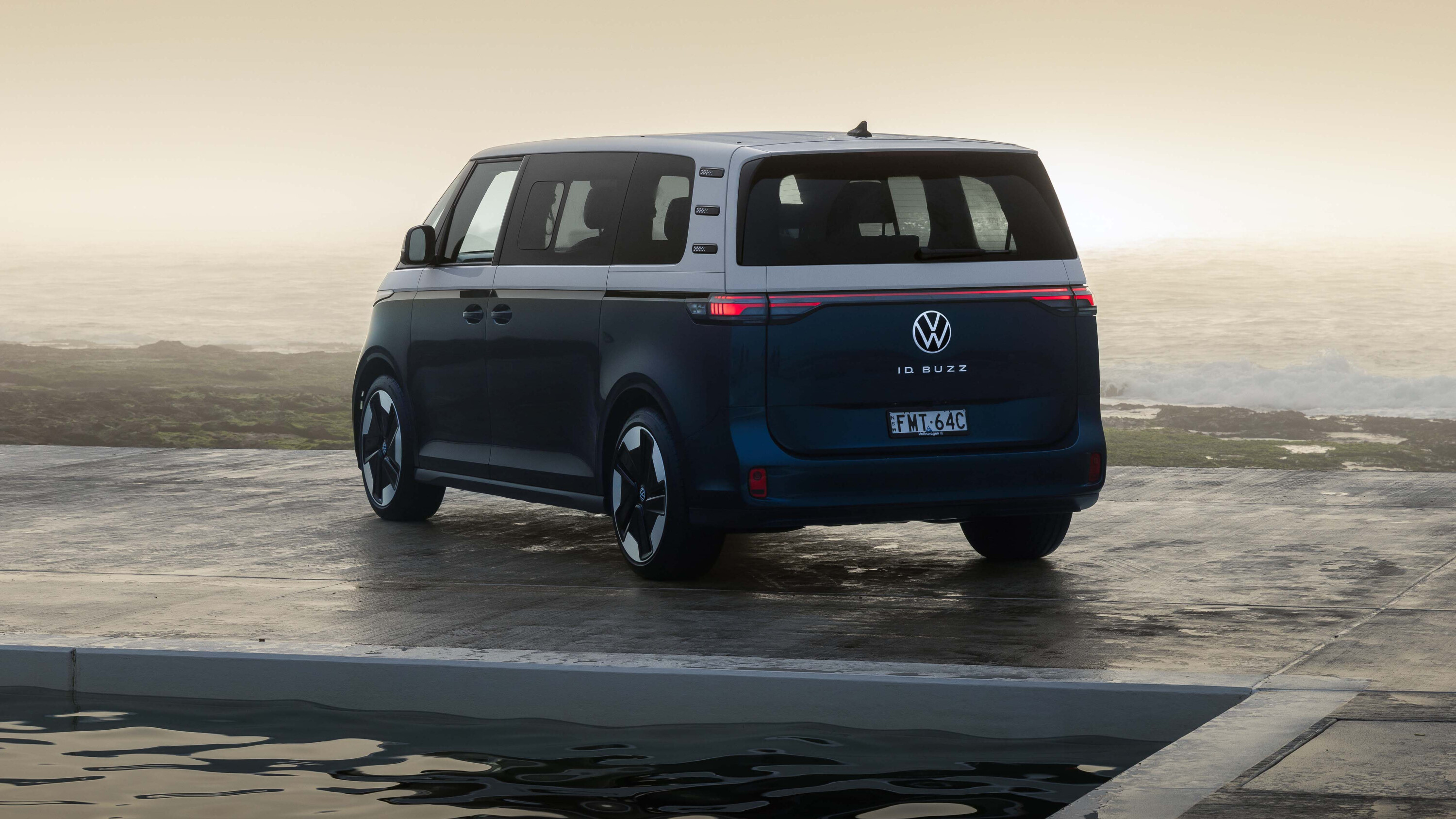
We don’t tend to think of Volkswagen as a late entrant to the EV market, having established itself with cars such as the id.3 in Europe from 2020, but Australia is a very different market to the homeland, and we’ve skipped on the first wave of Vee-Dub’s EV products.
That also included the ID. Buzz, launched in Europe in 2022, but which only now makes its way Down Under.
Why the wait? The prime reason is that VW had bigger fish to fry, prioritising those markets that had rapidly looming internal combustion engine cut-off dates before it started casting the net wider.
While Aussie buyers have missed out on plug-in Volkswagens to date, the good news is that the ID. Buzz that’s coming here, and almost concurrently to the US, is the revised and updated version, delivering a refreshed interior and a step-change in the amount of torque under your right clog. Has it been worth the wait? Let’s take a closer look.
1
JUMP AHEAD
- How much is it, and what do you get?
- How do rivals compare on value?
- Interior comfort, space and storage
- What is it like to drive?
- How much energy does it use?
- How safe is it?
- Warranty and running costs
- VERDICT
- Specifications
How much is it, and what do you get?
There’s a two-phased intro for the ID. Buzz in Australia. The first vehicles to arrive, and the ones we’ve been testing, are the Pro trim level. These are rear drive models offered in either short or long wheelbase guises with five and seven seats respectively.
The range opens at $87,990 for the five-seat SWB version, with the seven-seat LWB Pro pitched at $91,290, barely squeaking under the 2025 Luxury Car Tax threshold for fuel-efficient vehicles of $91,387. Bear that number in mind if you’re getting a bit excitable with the options list or looking to lease with Fringe Benefits Tax implications in mind.
In quarter two of 2025, Australia will start to receive shipments of the all-wheel drive ID. Buzz GTX, the flagship dual motor model, which will carry a $109,990 sticker price. We’ll report on that one as soon as we get our hands on it.
1
Commercial operators will probably be drawn to the ID. Buzz Cargo commercial vehicle, which we’ll also deal with separately.
Straight off the bat, paying an additional three grand and change for the longer wheelbase model seems like money well spent. It’s got another 350mm grafted between its axles, and this means that not only the second but the third row also has ample room for adult-sized adults; a genuine rarity amongst most vehicles that bill themselves as seven seaters.
In addition to that, the LWB models also lever in a few additional lithium-ion battery cells, which lifts the total battery output from the 84kWh gross (79kWh net) of the SWB model to a healthier 91kWh gross (86kWh net). Do the maths and that’s a nine percent increase in net battery size for less than a four percent uptick in vehicle price, notwithstanding the practicality benefits.
1
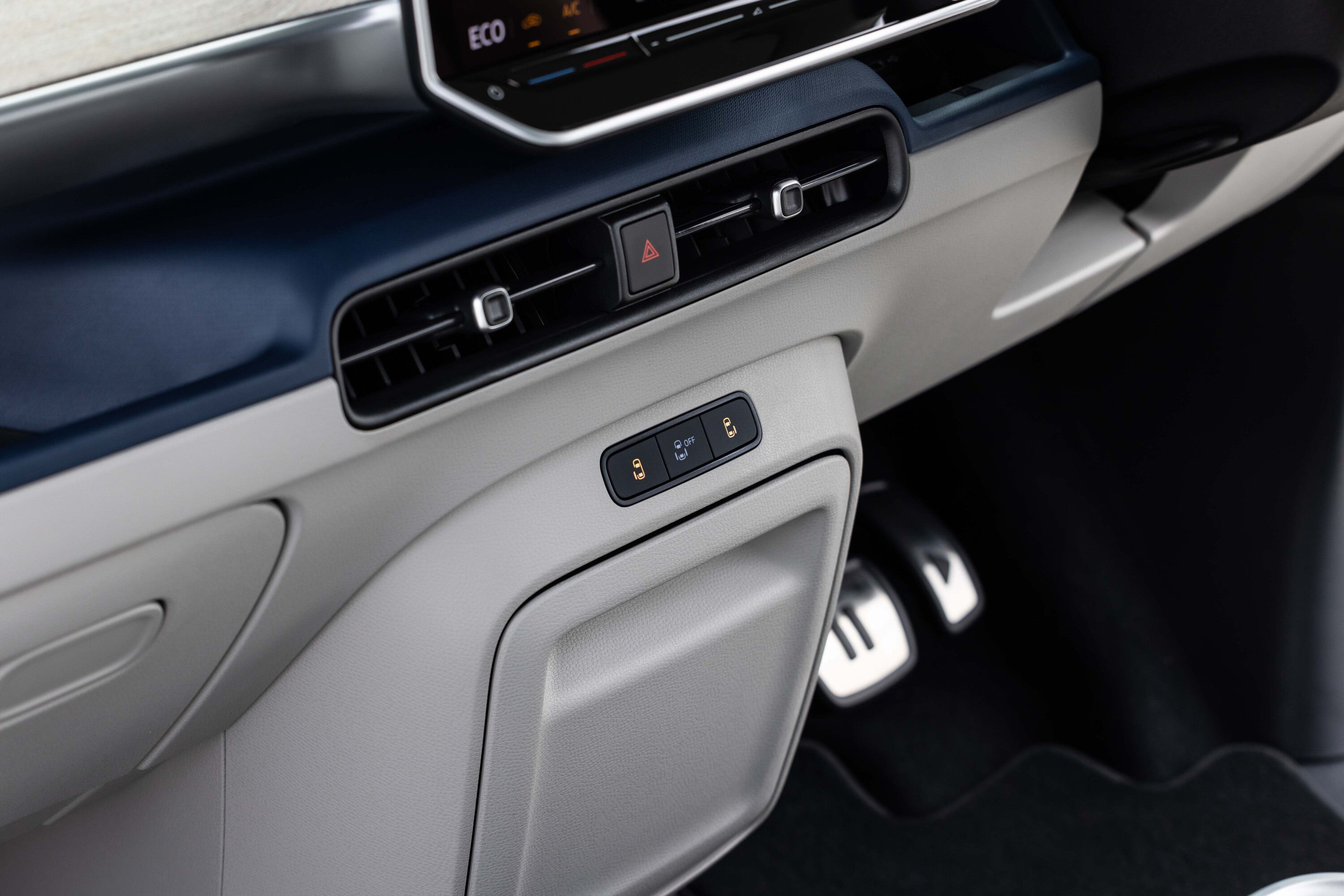
The Pro trim comes fairly well equipped too. It runs on 19-inch alloy wheels and features sliding doors on both sides of the vehicle.
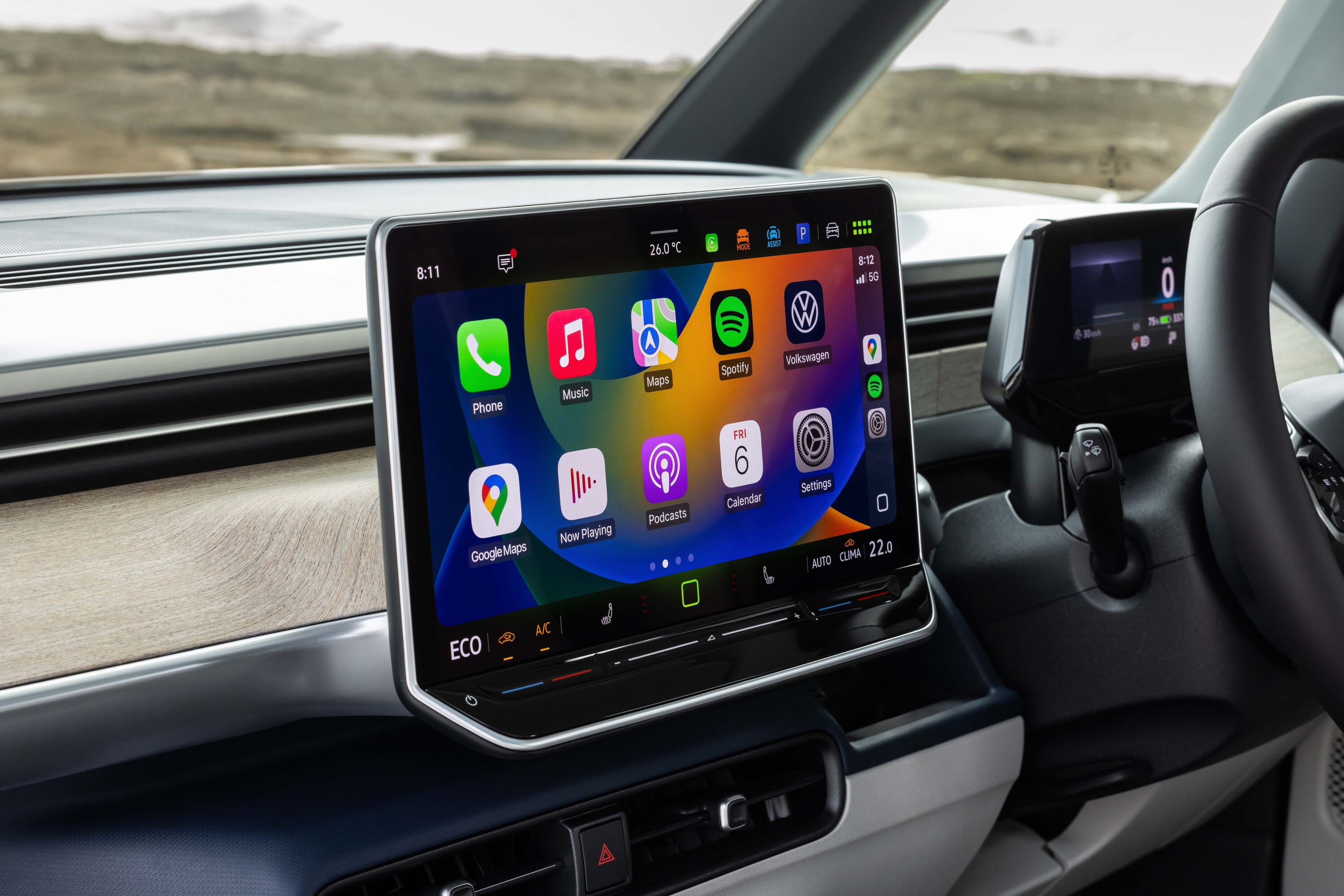
Tri-zone smart climate control, 10-colour ambient lighting, a cloth interior, 7 USB-C ports, a 9-speaker stereo and rear privacy glass are standard refinements. While we were testing only wired Apple CarPlay and Android Auto was offered, although Volkswagen assures us that an over the air update will arrive for wireless phone mirroring in 2025. Yes, there’s also the support of a wireless charging pad so that you don’t have to plug your handset in anyway.
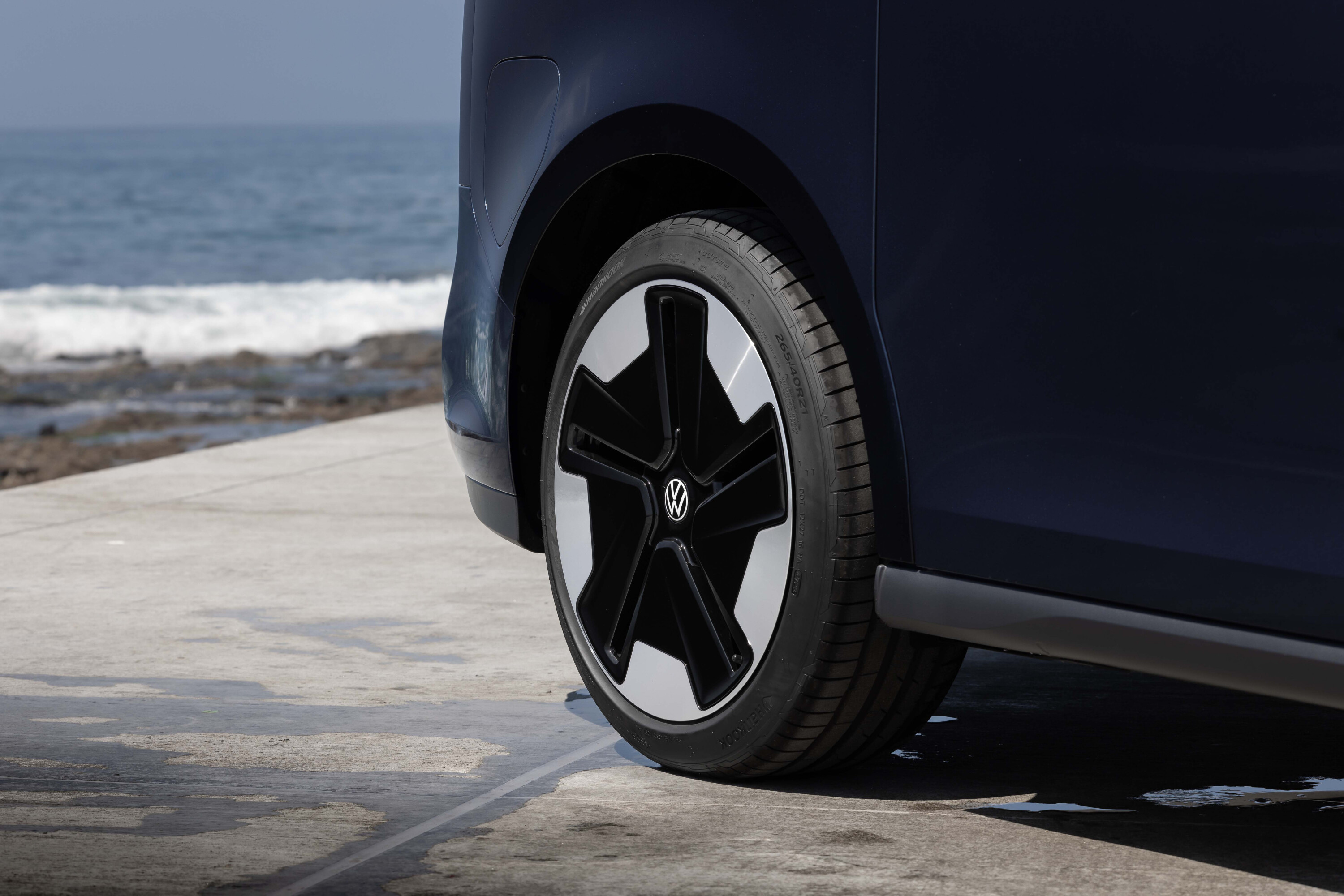
There’s the option of 21-inch wheels at $1900 which introduce a noticeable level of bump and thump into the cabin, and the eye-catching two-tone paint is a fairly eye-watering $4090. In fact Candy White is the only standard paint colour. As soon as you start ticking metallic or pearlescent colours, you’re adding $1890 to the bill.
There are a series of options packs, detailed below:
| Infotainment Package plus ($2200) adds: |
|---|
| Harman Kardon stereo |
| Head-up display |
1
| Interior Style Package ($6470) adds: | |
|---|---|
| Seaquel fabric (10% recycled ocean plastics, 90% recycled PET bottles) | Heated front seats |
| Luggage area load platform and net partition | Heated outboard second-row seats |
| Rear privacy glass | |
| Premium Interior Style Package ($6970) adds: | |
|---|---|
| ArtVelours upholstery (71% recycled materials) | Heated front seats |
| Luggage area load platform and net partition | Heated outboard second-row seats |
| Rear privacy glass | |
While it’s not cheap, the ID. Buzz builds on an iconic line of Volkswagen minibuses which, to a certain extent, have conditioned buyers to premium pricing.
1
How do rivals compare on value?
Rivals? You tell us. If you absolutely want to maximise every last centimetre of interior space and every litre of boot capacity, chances are you’re not the target market for the ID. Buzz.
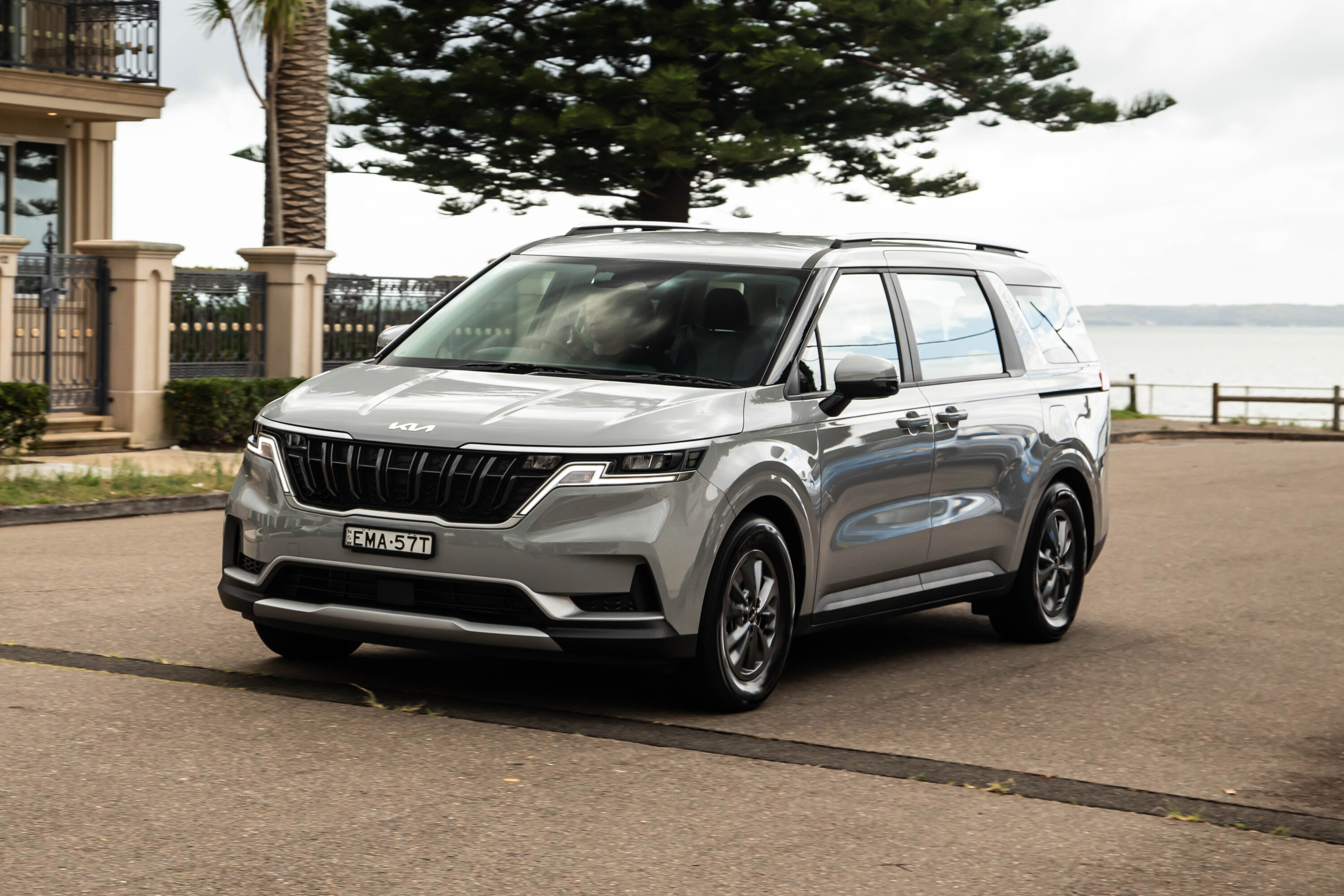
You might well be in the airport transfer or maxi-taxi business and there are already a whole host of ICE options that cater to this market very well. A Kia Carnival or a Hyundai Staria both offer more space and arguably better thought-through detailing for carrying a stack of passengers, but for many potential Buzz customers, that’s missing the point.
The ID. Buzz is a vibe. It’s a claim that many manufacturers would like to make, and occasionally do, but in this case it’s absolutely true. Many buyers will be reasonably price insensitive and will place a value on its design equity, enjoying the fact that such a stylish and endearing vehicle is also endowed with a practical side.
1
Interior comfort, space and storage
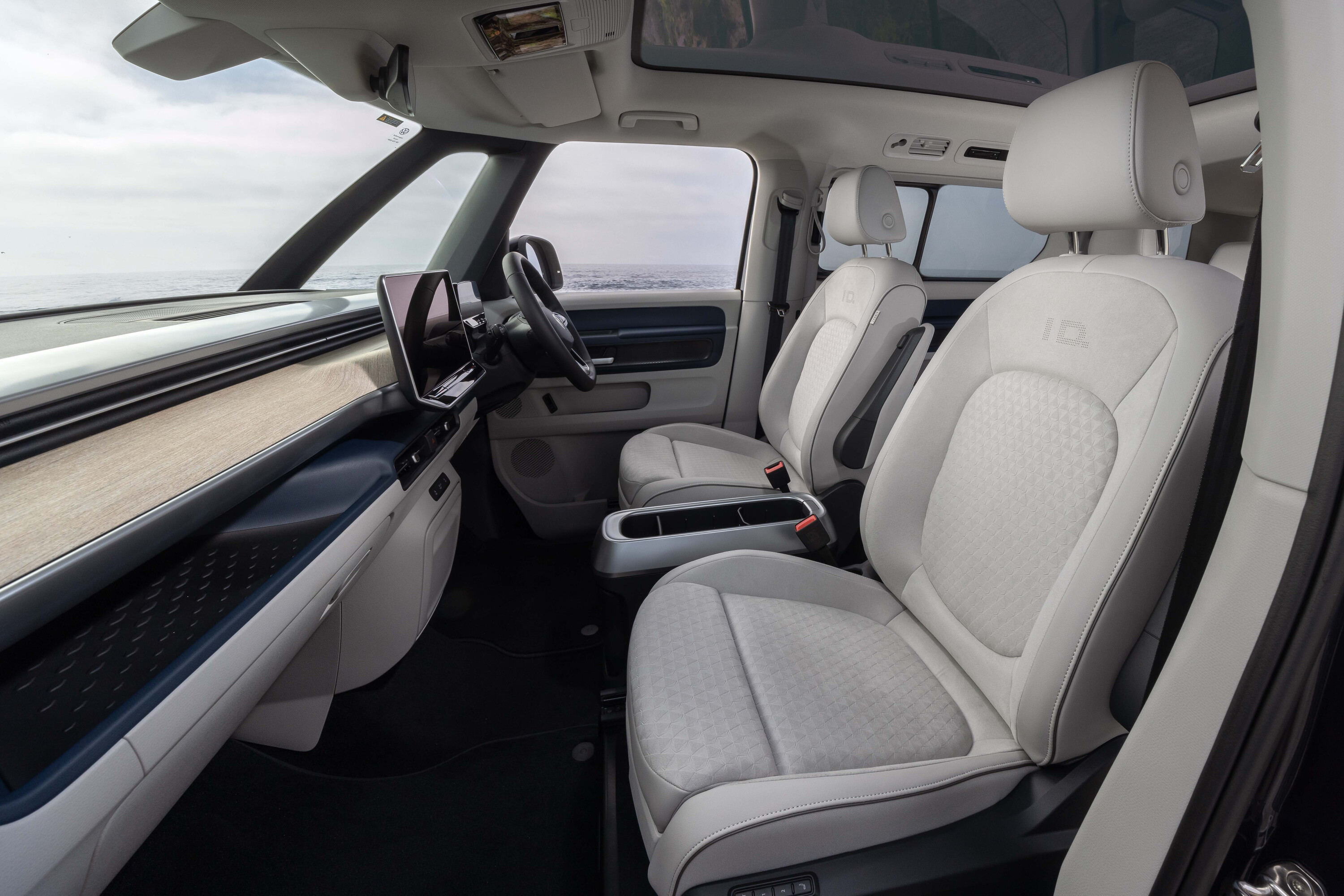
Volkswagen could have easily compromised the ID. Buzz by trying to squeeze seven seats into the SWB body. Fortunately it hasn’t.
As a result, but the five and seven seaters offer stacks of leg and headroom in every seating position. It’s a genuine revelation if you’re sick of passengers complaining about being seated in the non-favoured seats.
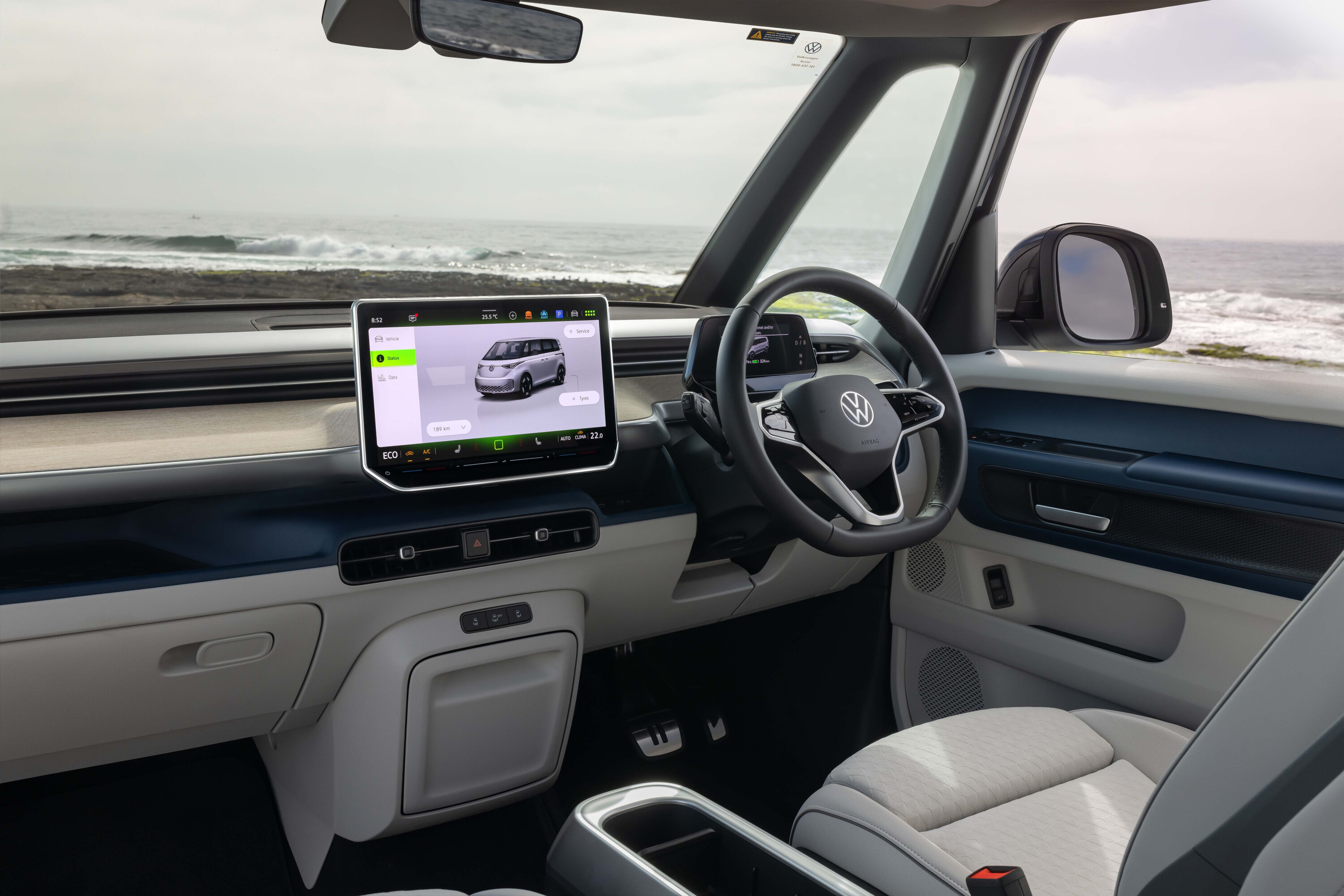
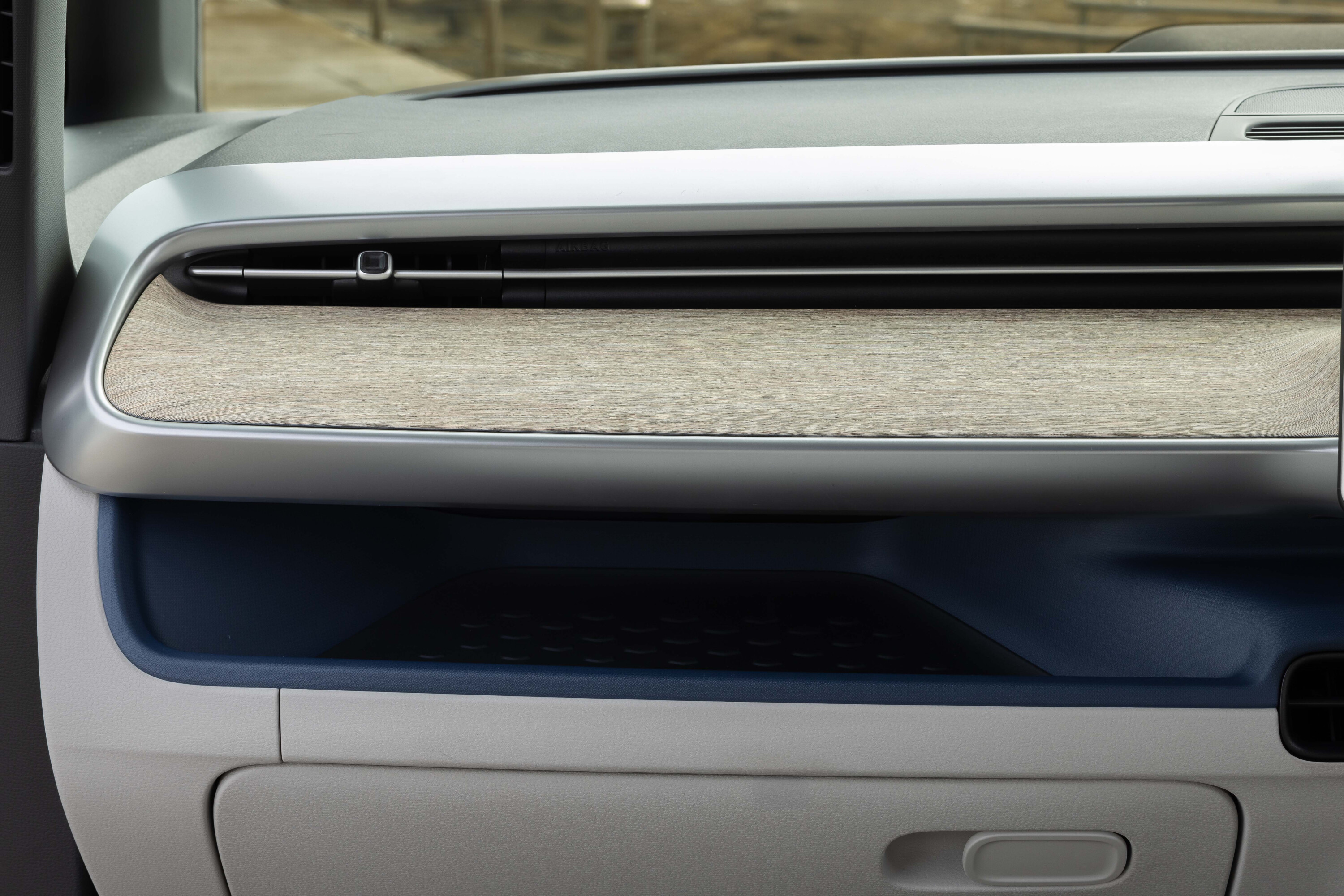
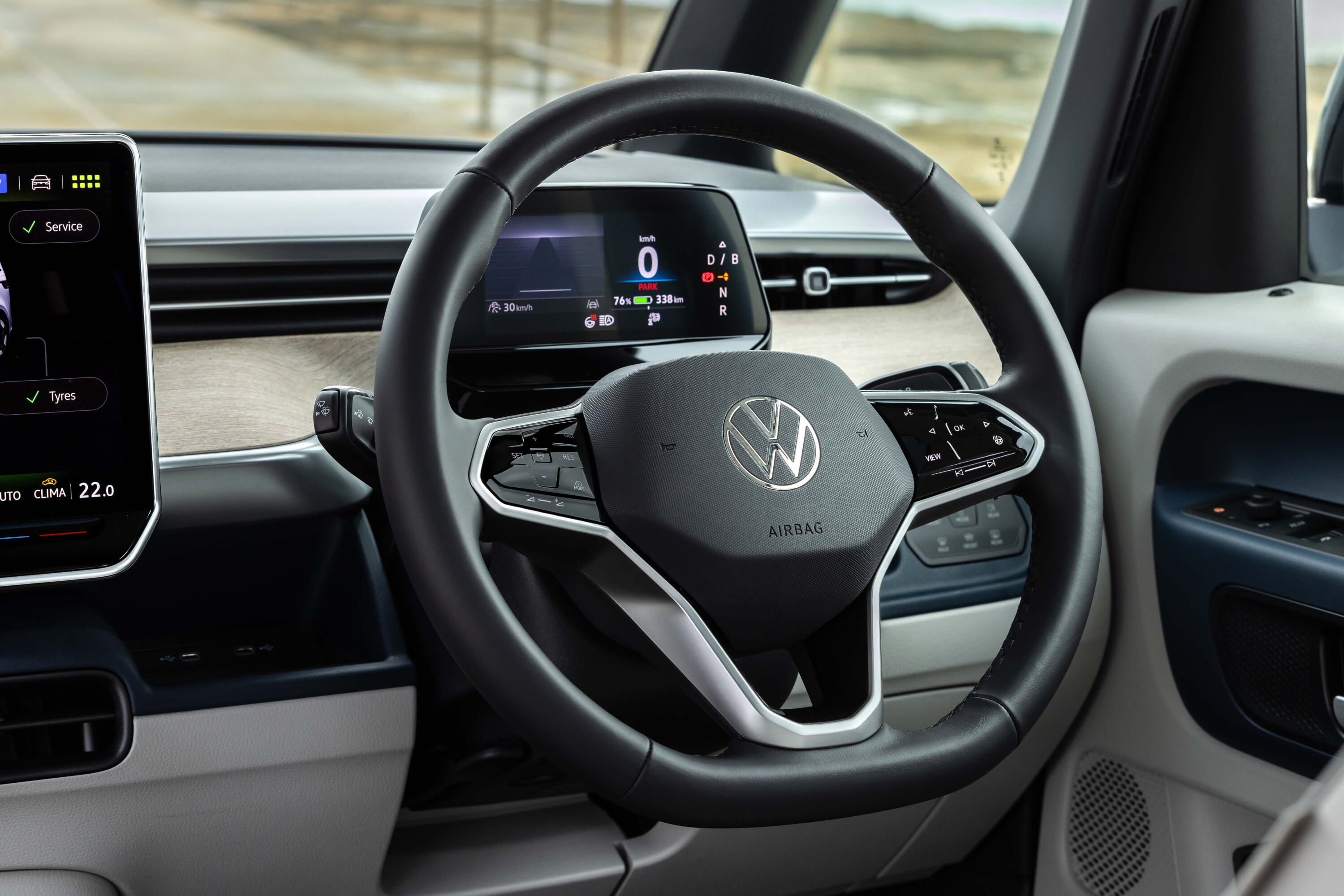
The dash layout is interesting, with a small and somewhat busy ‘pod’ binnacle in front of the driver and a large 12.9-inch screen in the centre. The ambience is luxe, even if some of the Scandi-cool ash wood effect of our test vehicle’s dash is revealed to be a fairly thin, hard plastic strip.
1
Yes, there are a few of the loathed haptic controls on the dash and the steering wheel, but they worked reasonably well.
Fear not, you’re not going to have to rub at them as if you’re willing a workshy genie to appear. The main screen’s user interface isn’t great, but would doubtless improve with familiarity. An ‘Ask IDA’ command, also activated by pressing what you would expect to be a central home key also takes you to an overview screen.
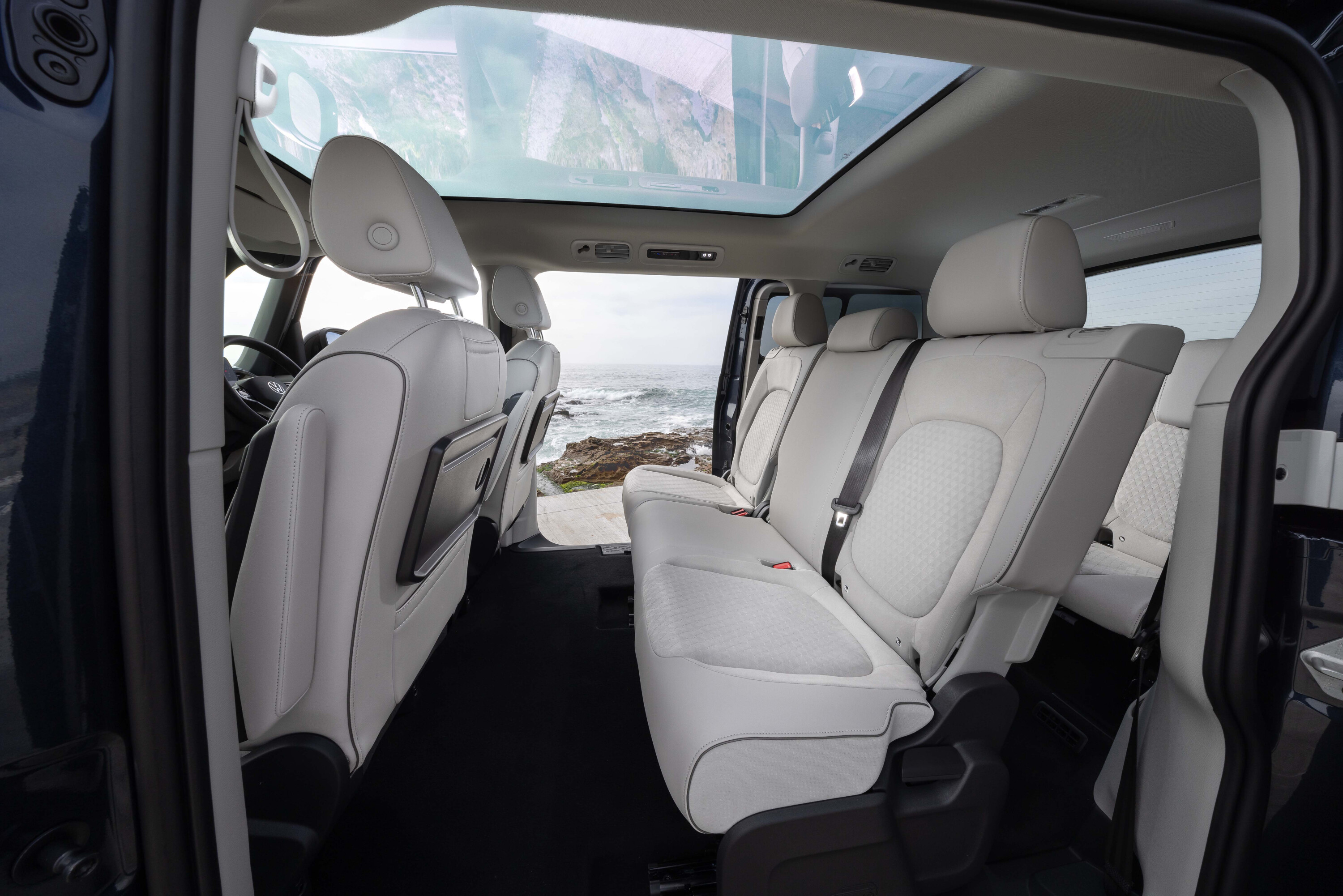
Your view from the driver’s seat is commanding. The hip height in this vehicle is reassuringly elevated, but even taller drivers will have no issues with headroom, even with the optional glass pano roof fitted. This, by the way, has no blinds, but features a sandwiched PDLC film which can switch the roof from transparent to a milky semi-opacity at the touch of a button.
1
The huge quarterlight windows and the yawning distance to the windscreen base mark this as something decidedly different in form factor to your garden-variety SUV.
The mirrors are surprisingly small. I’d have liked bigger door mirrors, but otherwise visibility is very good, with a low hipline helping you to remain confident about manoeuvring and parking what, in LWB guise, is quite a sizeable vehicle. At 4962mm long, it’s longer than a big SUV like a Mercedes-Benz GLE. In other words, you might want to measure the amount of available real estate in your garage before you sign up for the seven-seater.
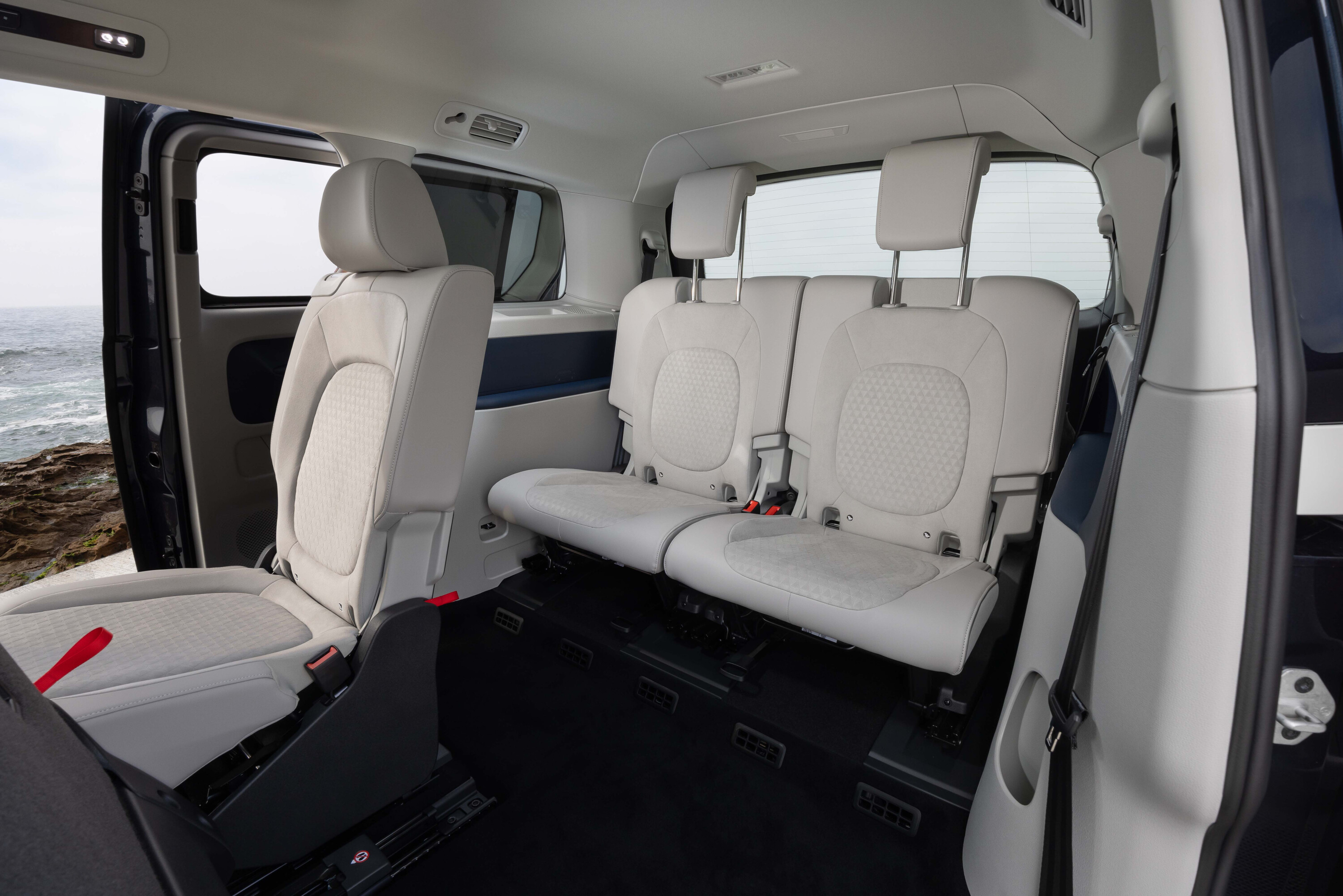
As well as plenty of space once ensconced, the access to the third row is very good, with the second seat tumbling forward and leaving a generous aperture to clamber through.
1
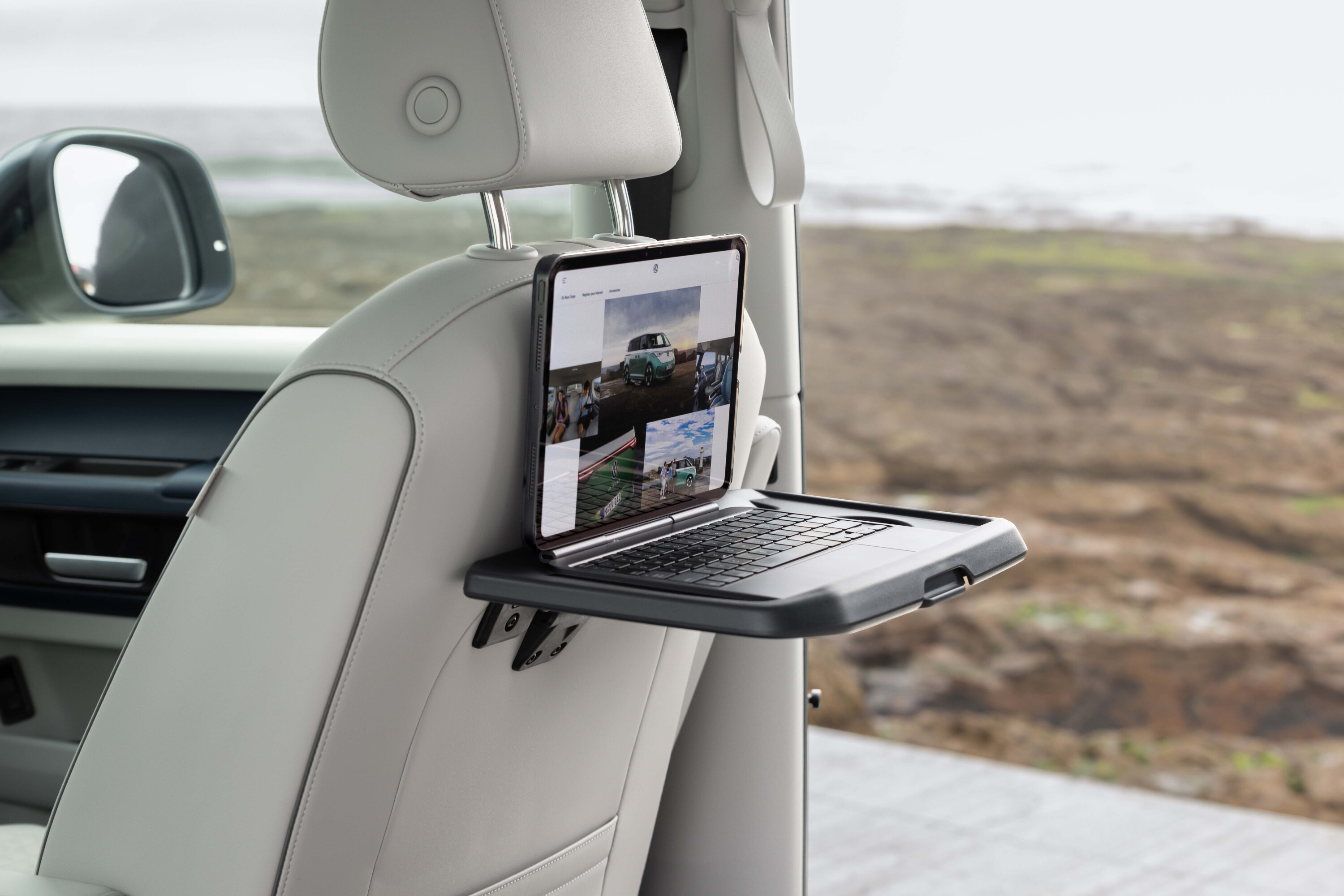
A rather secreted-away fabric pull tab even allows the third row to recline by up to 16 degrees, improving comfort in the process. There are sliding side windows to vent the second row and seat-back tables.
Volkswagen seems quite proud of its ID. Buzz Box, a plastic edifice located between the front seats which features open and closed compartments including a five-litre drawer as well as cup holders and a bottle opener. It’s removable and attaches to the vehicle floor with locking latches and folding eyes.
Arcane car reference incoming, but the Opel Signum from 2003 featured something broadly similar in the back seats called the Travel Assistant. That was a source of more rattles and squeaks than the rest of the car put together.
2
Thankfully the Buzz Box doesn’t live up to its name in that regard, but it’s questionable how often it’d be hauled off onto the beach for a picnic.
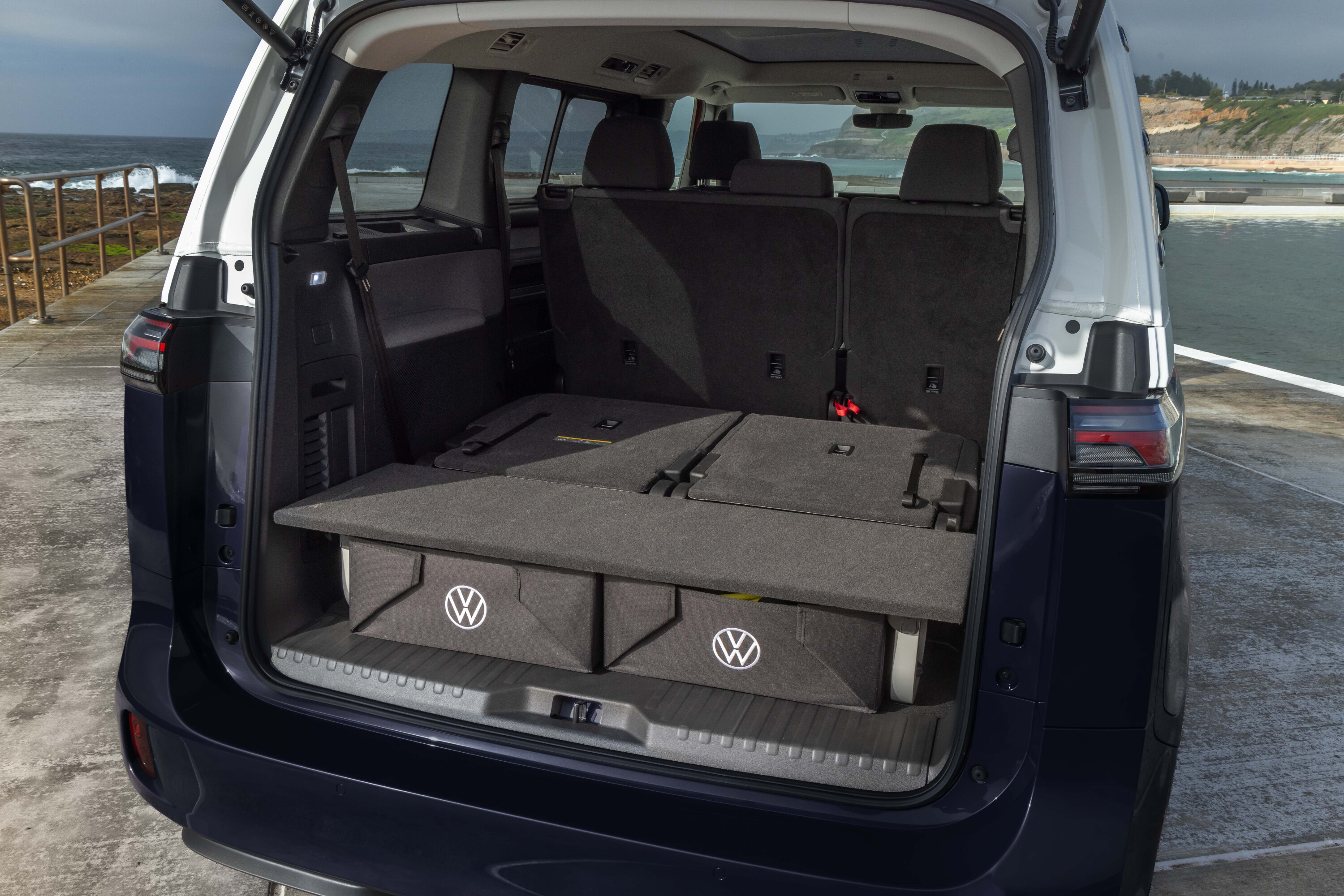
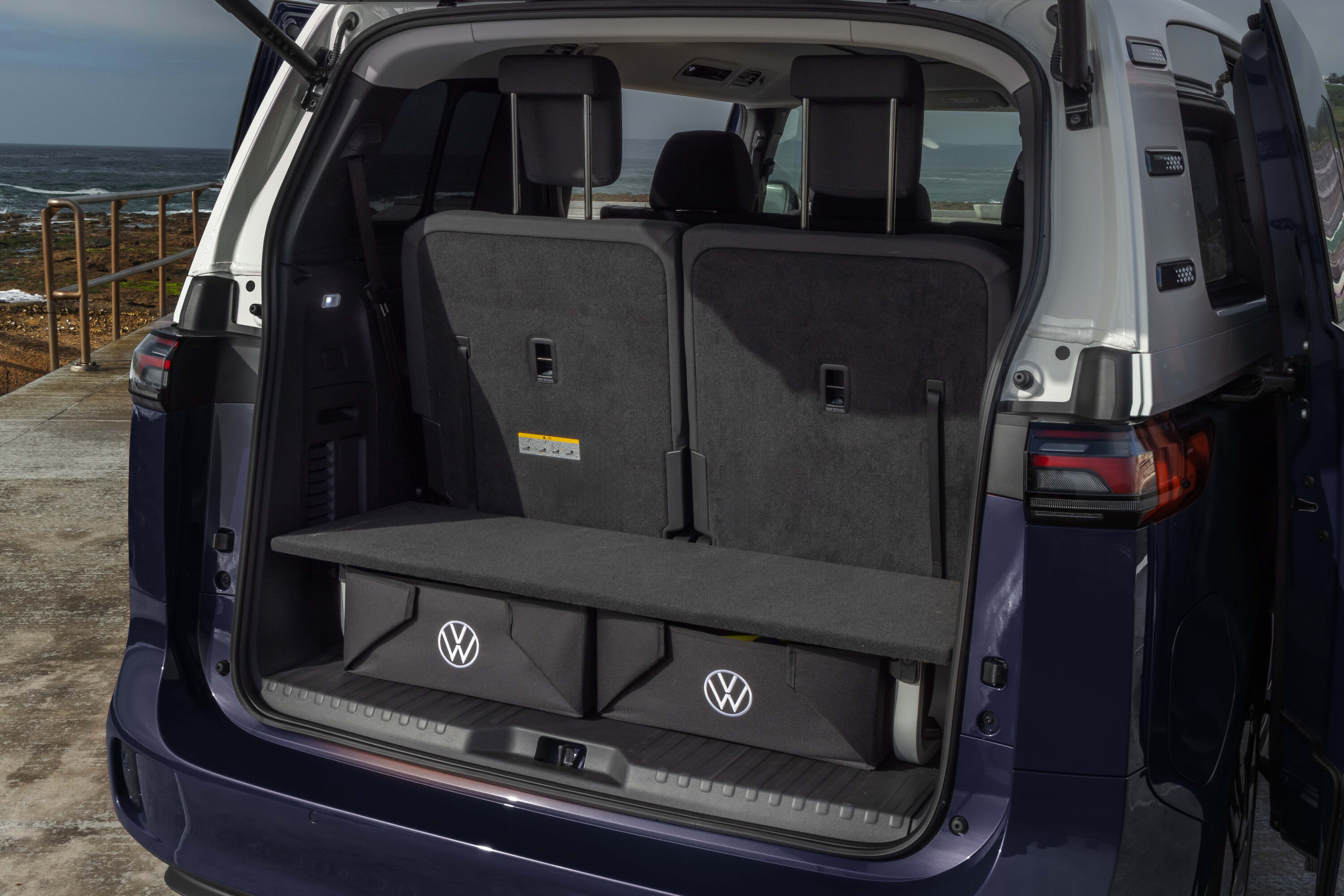
The tailgate of the ID.Buzz is a powered system and the standard floor has a length of 1121mm to the rear seats in the SWB. In the seven seater, you get 1340mm to the second row, but a mere 306mm when the rear seats are used.
The third row is removable, but even a vehicle of this size doesn’t entirely solve the issue of carrying a big family and their gear. Should you wish, you can option a Multi-flex board that raises the boot floor but allows for two storage boxes that slide beneath, keeping valuables out of sight. One thing you won’t find is a spare wheel and tyre set.
1
What is it like to drive?
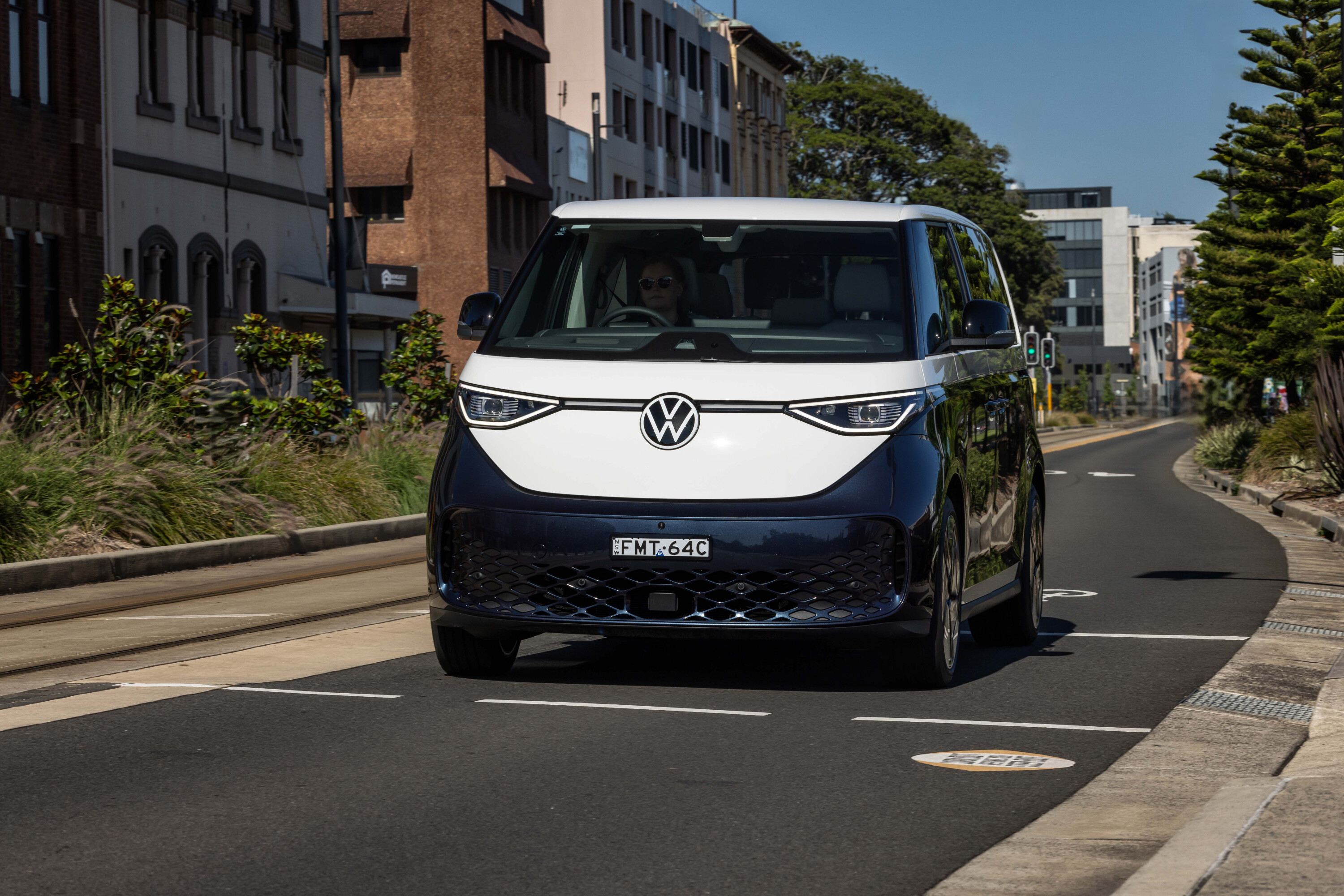
The Volkswagen ID. Buzz is unexceptional to drive. While that might sound like a slightly sniffy pejorative, in this case it’s anything but.
It feels pleasantly calibrated in all of its key dynamics and controls, with nothing standing out as a dominating characteristic. And that is exactly how it should drive.
The 210kW power output doesn’t translate to unruly or corrupted acceleration off the line. The steering is light but accurate, the brake pedal expertly finessed to blend re-gen with friction braking, performing the handover to the front discs and rear drums when retardation hits 0.25g.
1
It’s clear that a lot of time and effort has been spent on smoothing the rough edges from the ID. Buzz’s dynamics and there’s a lot to be said for a vehicle that’s undemanding and which won’t spring any unwanted surprises on you.
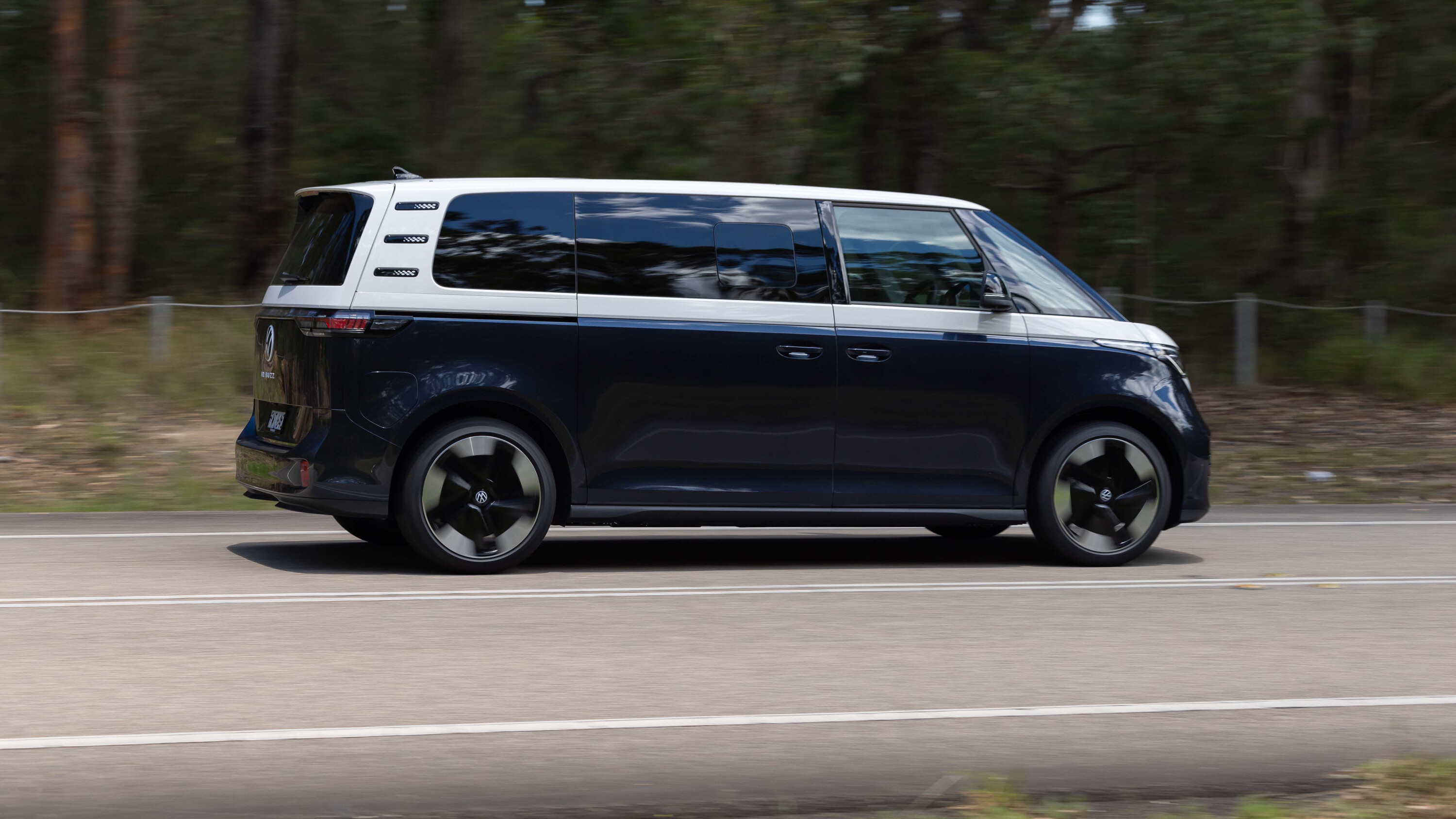
The drive route took us on some fairly scratchy roads around the Hunter Valley and, from the front seats, ride quality was more than acceptable. Firmish but not harsh. There’s no option for adaptive suspension, so generous tyre sidewall is your friend if you value a plusher ride.
As you move further back in the vehicle, you begin to notice a little more vertical movement which is perhaps surprising, as you’re moving from sitting over a strut suspension to a more sophisticated multi-link in the rear.
1
The steering takes 3.42 turns to go from lock to lock and the turning circle of the long wheelbase model is a relatively spry 11.4 metres.
Because the steering rack is mounted ahead of the centreline of the front wheels, there’s a reassuring stability to the base setup of the electrically assisted steering.
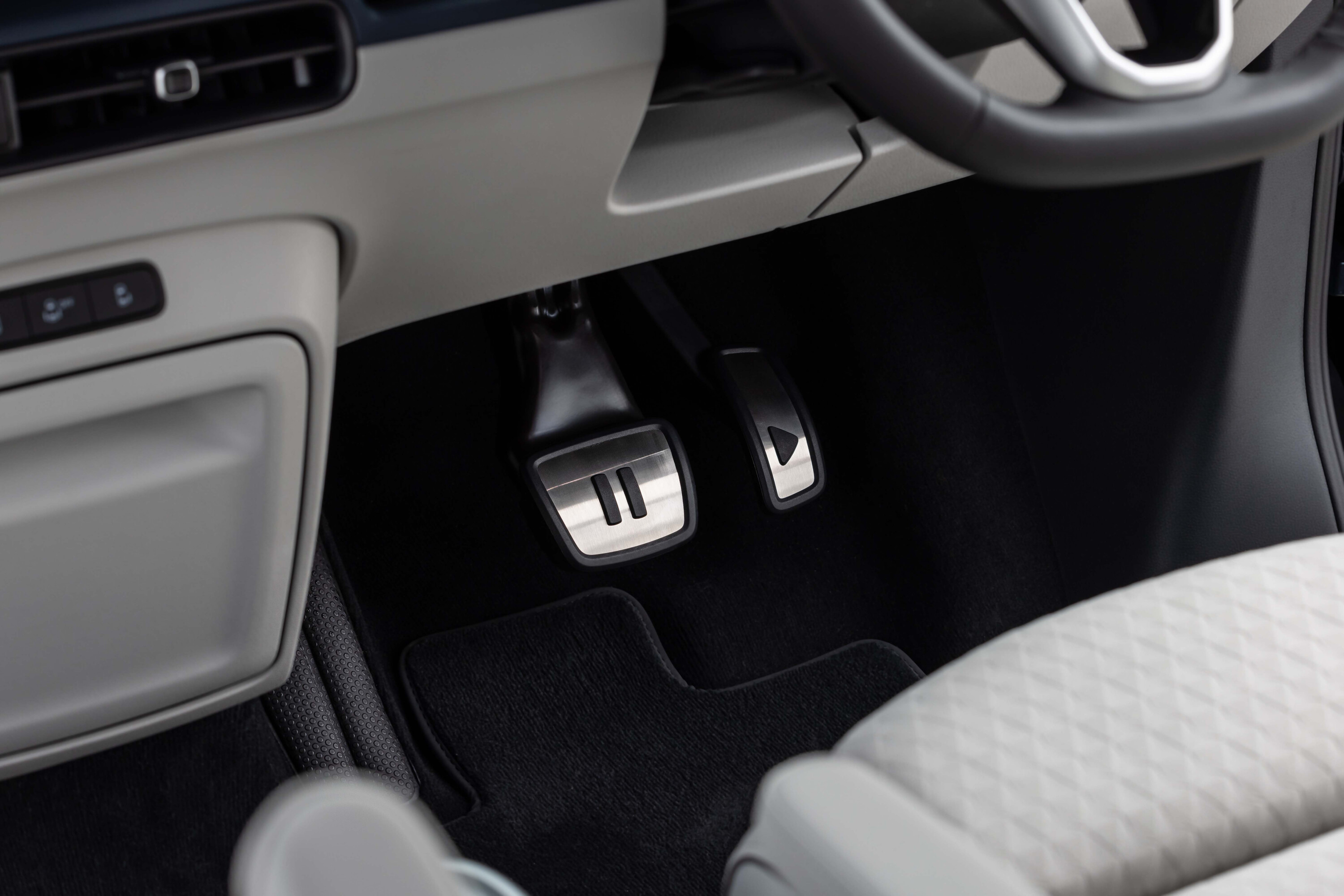
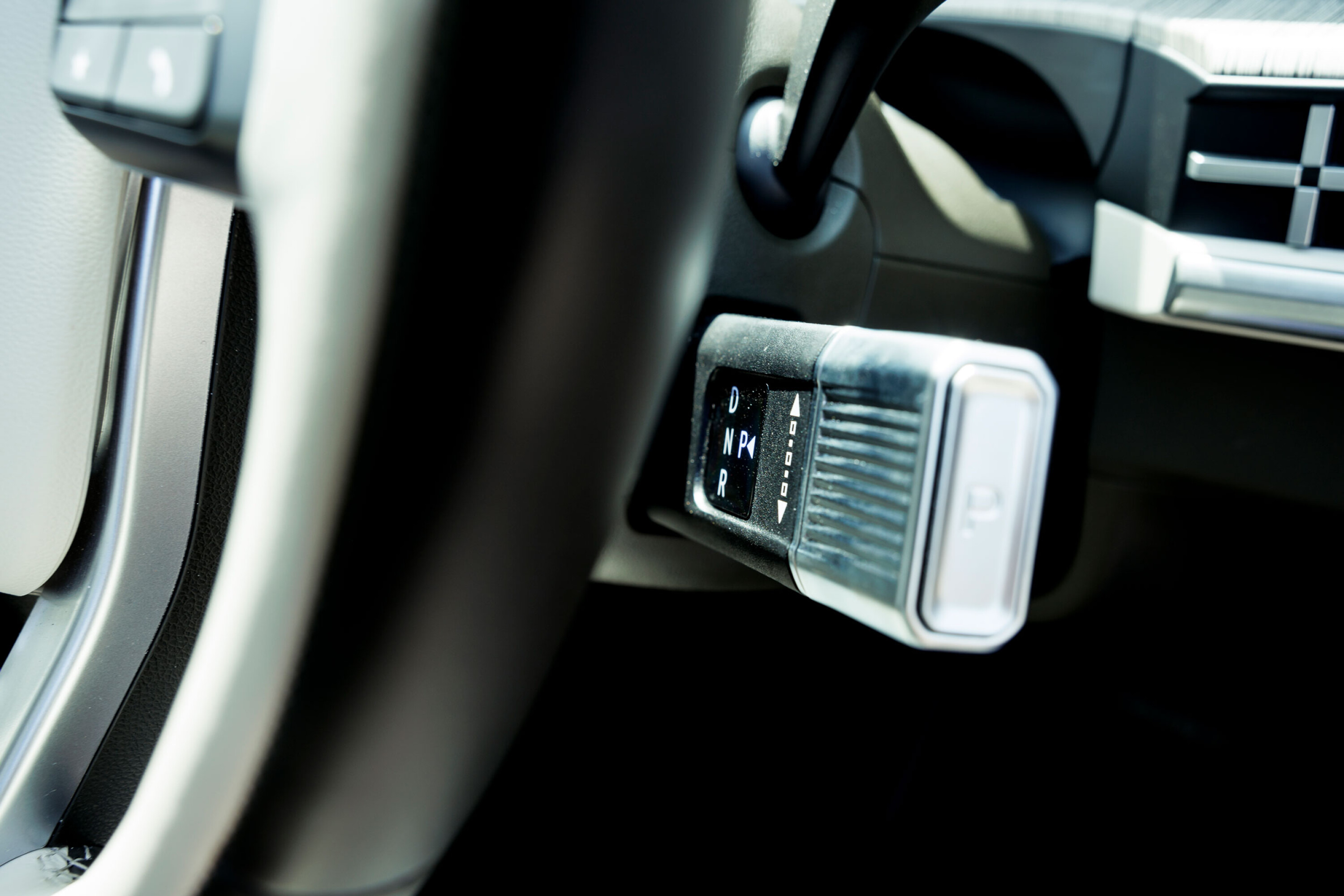
The gear selector is a stubby column-mounted wand that you twist and press to select gears. As well as a self-explanatory ‘D’ mode, there’s also a ‘B’ setting. In ‘D’, the ID. Buzz will coast when the driver lifts off the throttle, but energy recuperation will begin when the brake pedal is pressed.
Engage ‘B’ (brake) mode on the fly and the ID. Buzz will re-gen on lift off up to a retardation limit of 0.13g. It’s not a true ‘one pedal’ driving solution, but it’s been designed as a solution that won’t alienate those drivers migrating to the Buzz from an ICE vehicle.
1
Acceleration is crisp rather than concussive, the SWB getting to 100km/h in 7.6 seconds and the heavier LWB car in 7.9 seconds.
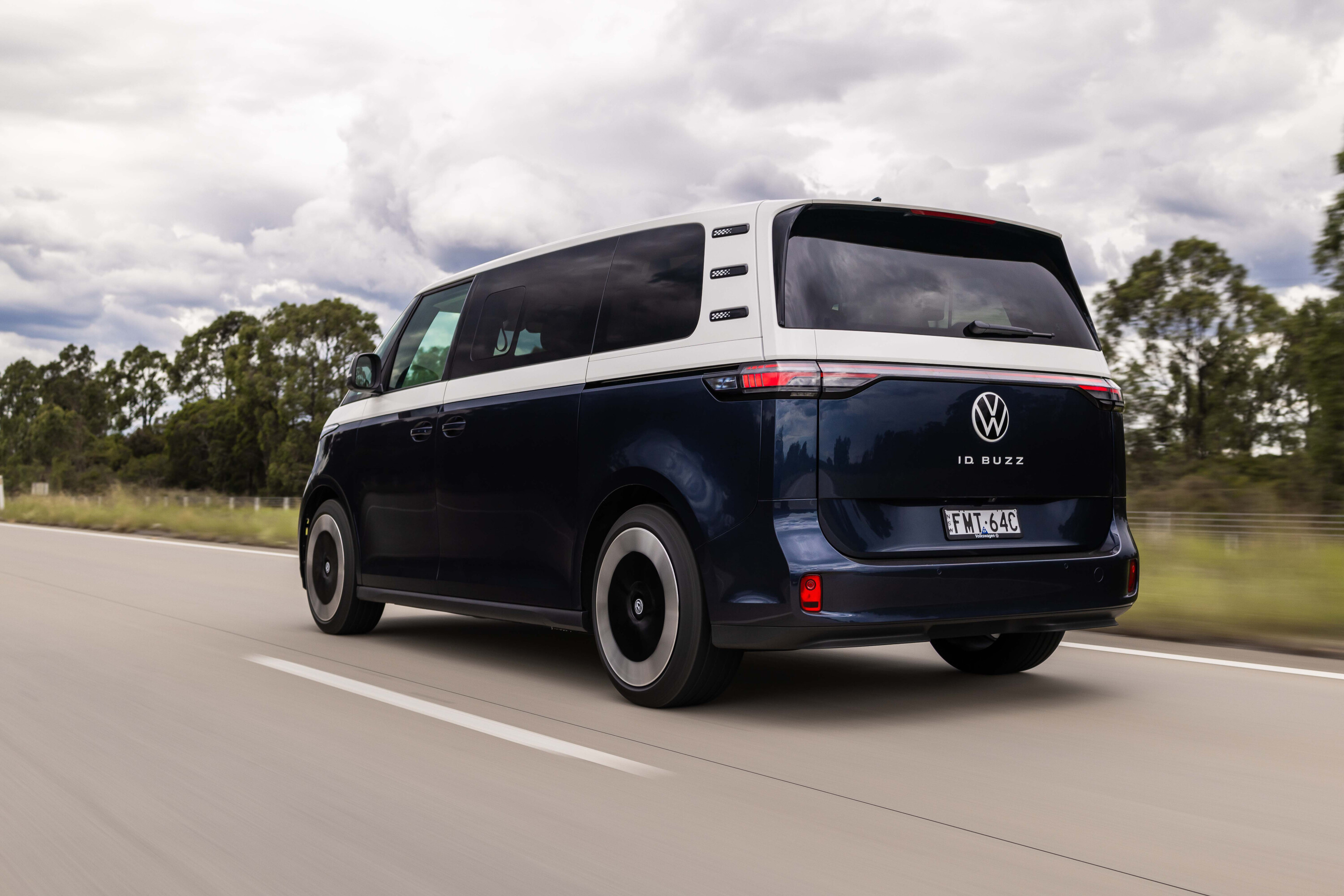
Top speed is rated at 160km/h, so while the Buzz is never going to be an autobahn stormer, it’s got plenty in reserve for an Aussie freeway schlep.Torque off the line is notably good, which takes the stress out of accelerating out onto roundabouts or away from junctions. Even when loaded, there’s plenty of torque on tap and this is a huge improvement over the original ID. Buzz, lifting that peak (and instant) torque from a so-so 310Nm to a far healthier 560Nm figure.
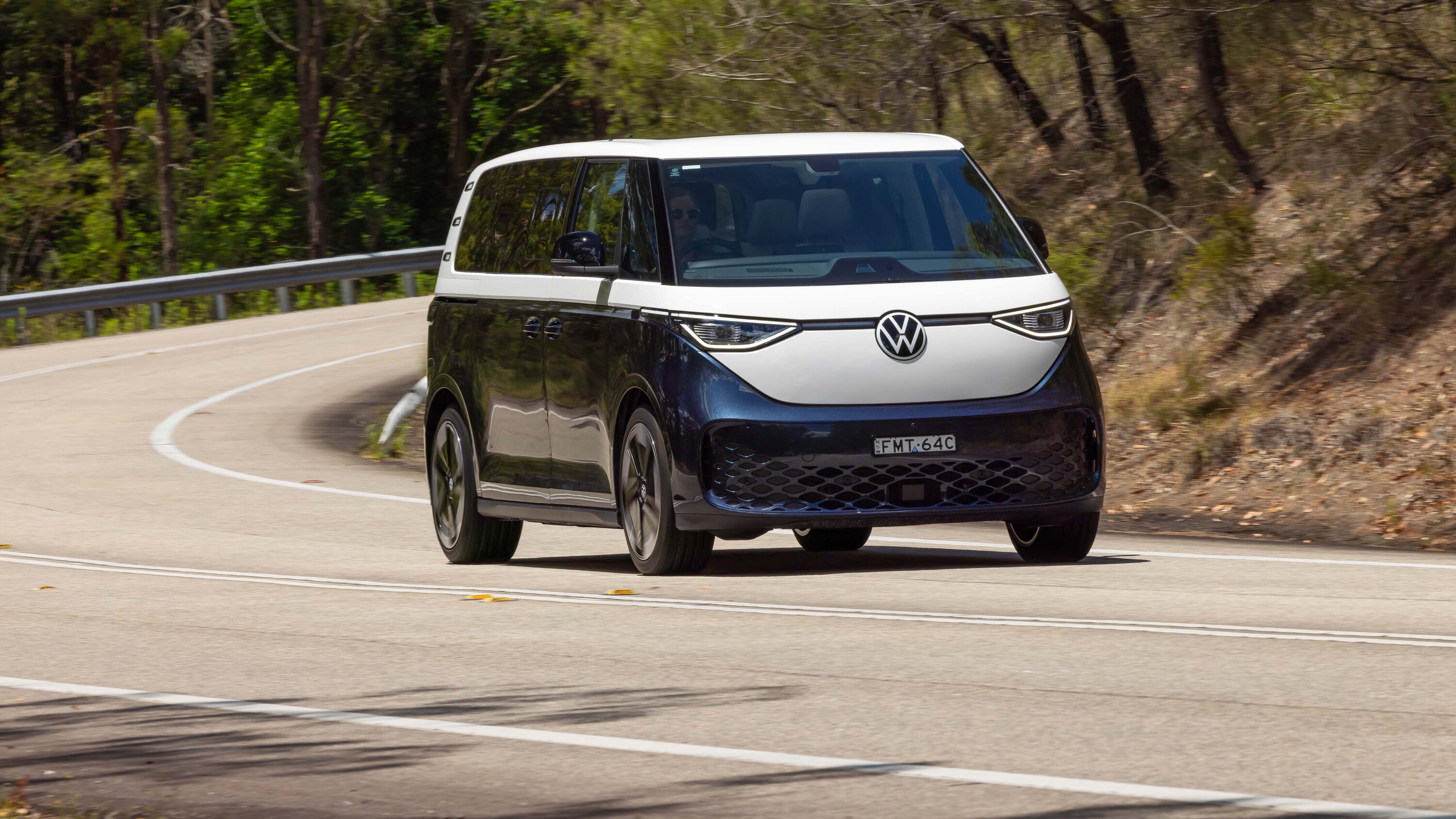
The Pro trim comes with Eco, Comfort, Sport and Individual drive modes, controlling variables such as steering weighting, throttle response and electric motor response.
1
A sharp throttle and lighter steering seemed to be suit the ID. Buzz best, so the Individual mode may well be a good pick there.
Body roll is well controlled, thanks to the low centre of gravity and the low-rolling resistance Continental EcoContact 6Q tyres (235/35 R19) were admirably quiet. Only determinedly inappropriate driving would push the front end into modest understeer, so the handling setup is safe and extremely well judged.
We had a few issues with one of the seven-seater test cars. The wired Android Auto connection fell over repeatedly and then flat refused to allow reconnection. A spurious tyre pressure warning also illuminated and the adaptive cruise also seemed to scrub off 10-15km/h very frequently for no apparent reason on arrow-straight, lightly trafficked freeways.
3
How much energy does it use?
Driving range is rated at 422km for the SWB and 452km for the bigger-batteried LWB variant.
In mixed use driving in the LWB, we saw typical energy usage of around 20kWh/100km, which would translate to a range of around 395km, which isn’t too far off the claim. Is that enough? That very much depends on your expectation. If you’re planning to use your ID. Buzz to drive around Australia, you might wish for a it to be leggier between recharges. This, however, adds weight, complexity, cost and a whole host of other compromises.
We did find that, as with virtually all EVs, battery usage is poorest on a highway run. The LWB version was typically seeing around 23kWh/100km, so that would translate to 343km of range. A freeway radius of 172km (return) before recharging is something to bear in mind.
1
In more mixed use, that energy consumption figure dropped sharply, and with a few more opportunities to engage re-gen, we could see that the Buzz could indeed attain those WLTP numbers.
When it comes to recharging, you won’t get the lightning fast charging speeds you might have come to expect from some South Korean cars. Plug one into the juiciest 350kW charger you can find and it’ll still peak at around 185kW, which translates a 5-80% state of charge in 30 minutes. If you’ve got a wallbox at home, expect to go from zero to 100 percent in a worst-case scenario 7h30m.
If you haven’t got a wallbox and just plug into a normal electrical socket, you’ll have to twiddle your thumbs for nearly 23 hours. Both Mode 2 (home) and Mode 3 (public) charging cables are supplied with the vehicle. The charging port is on the rear of the vehicle at the driver’s side and, yes, it is still accessible if the sliding door is open.
1
How safe is it?
The ID.Buzz carries a five-star EuroNCAP score, so it’s doubtful you’ll have too much in the way of safety concerns. It comes with a long list of safety gear including:
| 2025 Volkswagen ID.Buzz Pro LWB safety features | |
|---|---|
| Driver alert, fatigue detection | Park distance control front and rear |
| Multi collision brake | Adaptive Cruise Control |
| ESC with ABD, AR, EDS | Lane change assist |
| Front Assist City emergency brake assist | Lane keeping assist |
| Emergency Assist | Speed limiter |
| Emergency steering aid | Swerve support with turn assist (front) |
| Coming and leaving headlight function | Area view rear view camera |
| Advanced High Beam Control | Rear traffic alert |
| Dynamic cornering lights | Side protection |
| Tyre pressure monitoring | Auto hold function |
It would have been nice to have some sort of speed limit recognition, but that’s hardly a deal breaker. Volkswagen also offers a function called Travel Assist with swarm data, effectively an enhanced adaptive cruise that not only adapts to your preferred vehicle positioning in the lane but also pick up the speed limits from mapping data, offering an adaptive cornering function as a result.
Interestingly, it has been calibrated for the SWB car at the time of writing but not for the LWB version.
1
Warranty and running costs
Like the rest of the Volkswagen range, the ID. Buzz is supplied with a five-year unlimited kilometre warranty.
The battery is guaranteed for eight years and the modular nature of the battery means that cell modules can be removed and replaced if necessary without incurring the huge cost of an entire battery pack.
On the subject of ownership, to coincide with its first EV launch in Australia, the Volkswagen Group is rolling out a new program called ON EV, covering not only Volkswagen cars and light commercials, but Audi, Skoda, and Cupra too.
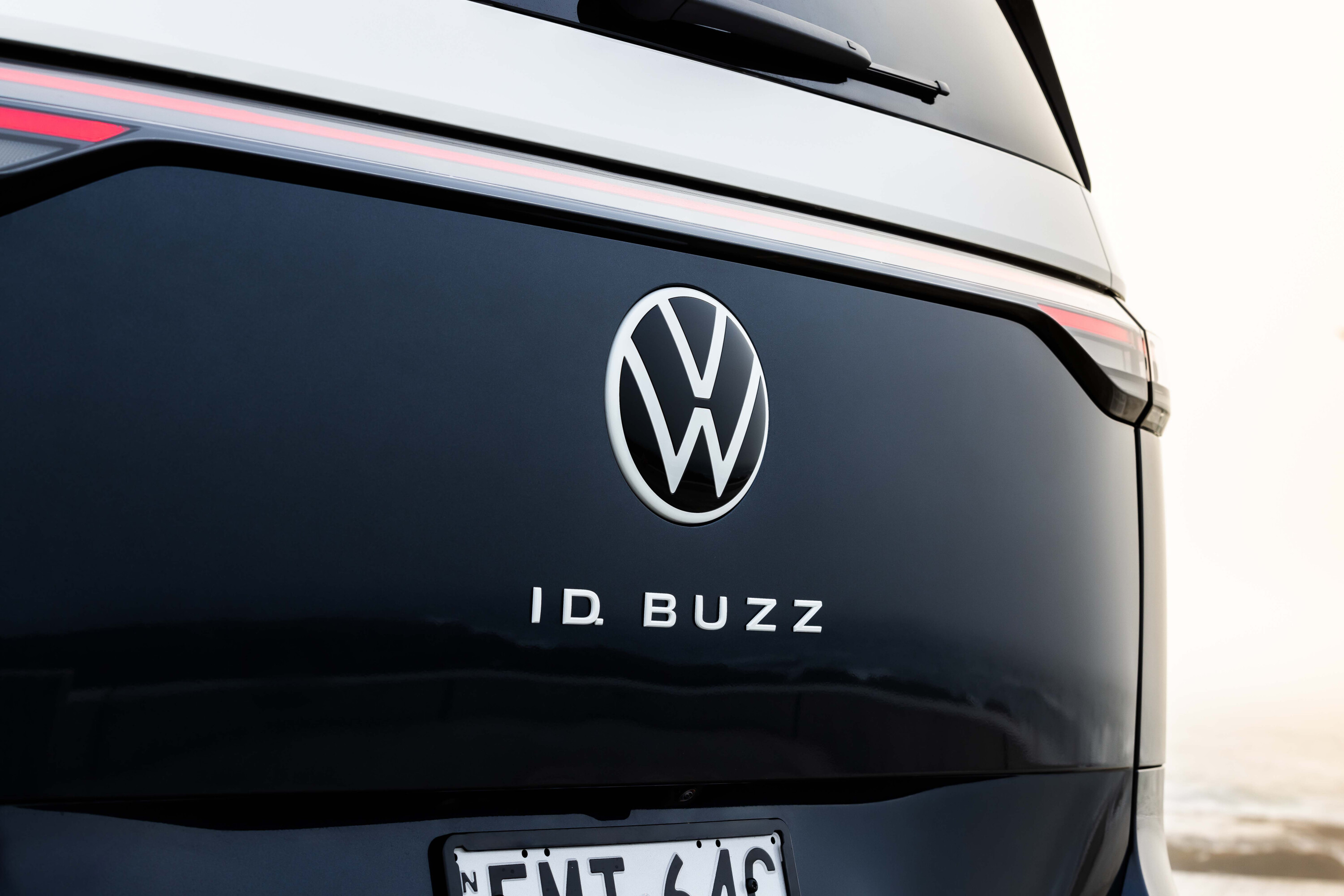
1
The company talked to its buyers in order to gain a comprehensive picture of what was stopping them buying an electric car and has aimed to solve those issues with ON EV.
It has partnered with AMPOL to offer discounted public charging, it offers a deal with Europcar for extended ‘try before you buy’ arrangements such as a month with a Cupra Born, and it has worked with its financial services team to not only bundle the cost of home chargers and installation into one single payment finance deals but also to develop more flexible novated lease arrangements that will especially help smaller businesses.
An upfront Guaranteed Future Value also aims to take a lot of the anxiety away from EV residuals.
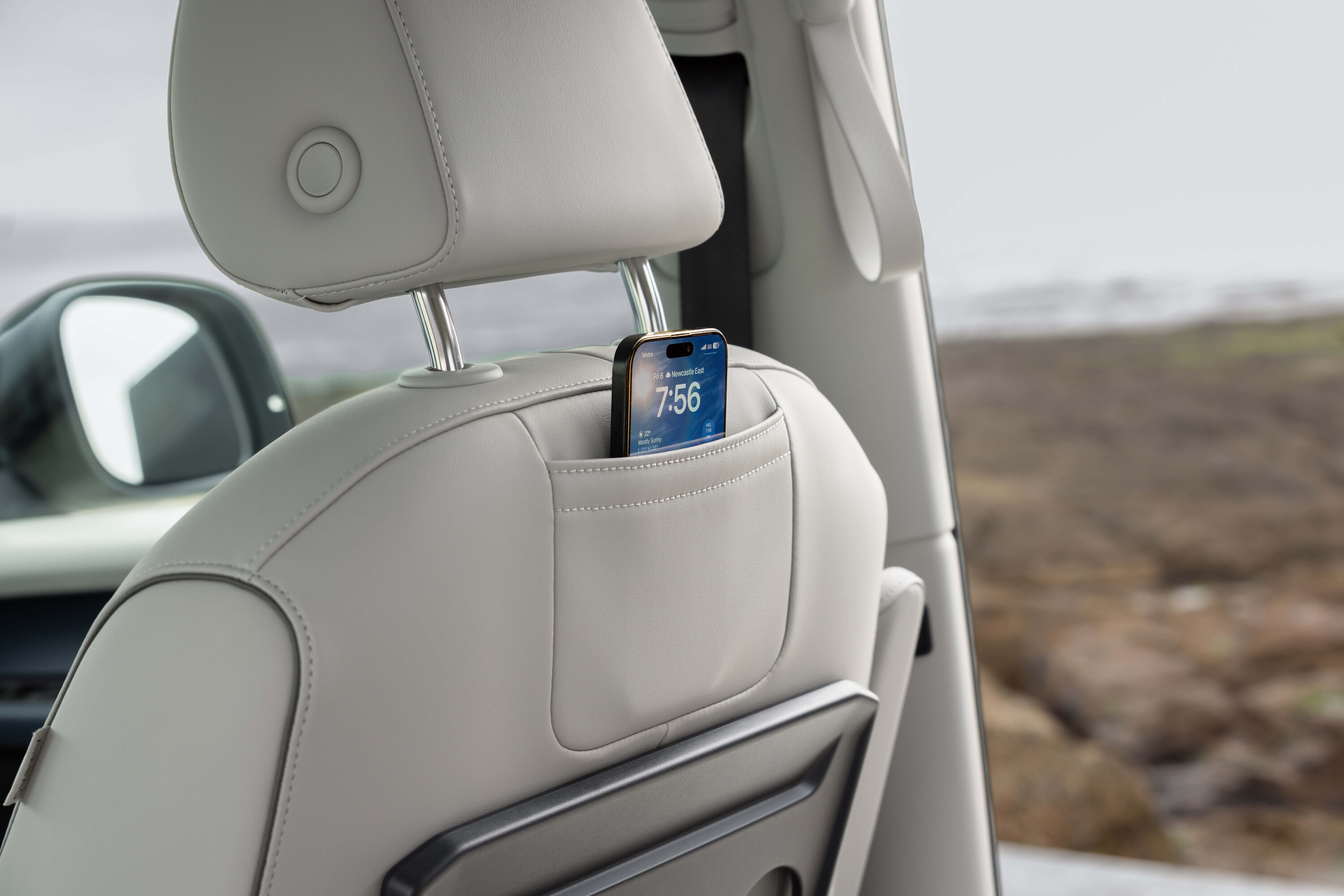
1
Buyers also get a five-year subscription to the GoConnect App where they can remotely monitor the status of the car, the battery health, locate the vehicle, communicate with the workshop, monitor any vehicle warnings and see recent trips.
The servicing schedule and pricing is as follows:
| Service event | Time/distance | Price |
|---|---|---|
| 1st service | 24 months/30,000km | $670 |
| 2nd service | 48 months/60,000km | $670 |
| 3rd service | 72 months/90,000km | $670 |
| 4th service | 96 months/120,000km | $670 |
| 5th service | 120 months/150,000km | $670 |
Alternatively, services can be bundles into discrete care plans, which tends to work out cheaper if you have a clearer view of how long you’ll keep the ID. Buzz for. A six year/three service deal is $1450, an eight year/four service plan is $1850 and 10 years and five services works out at $2250.
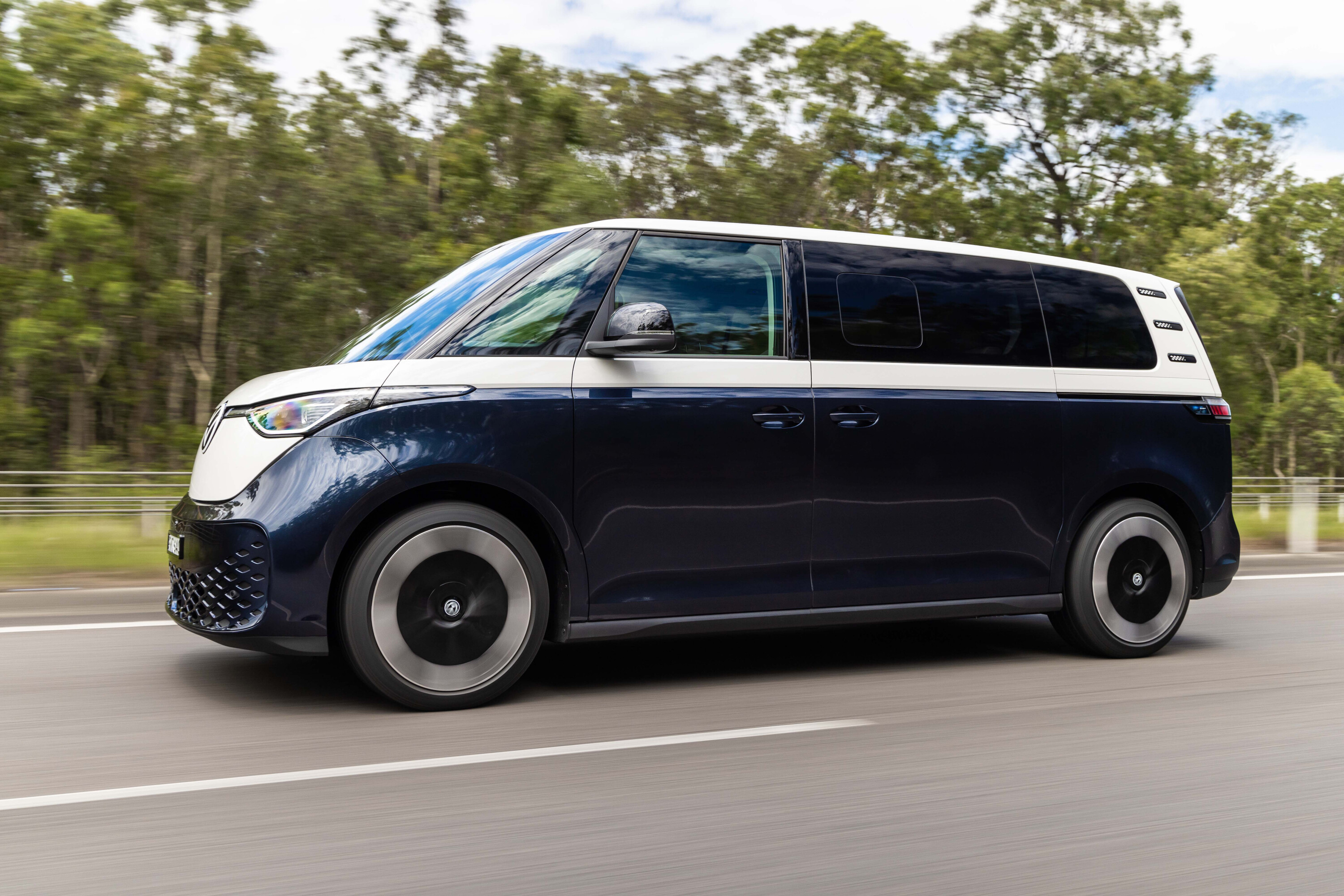
1
VERDICT
Volkswagen claims to have over 7000 registrations of interest here in Australia for the ID. Buzz and that doesn’t surprise us one bit.
If those are converted to orders, it would make this the second biggest-selling product for the Australian arm after the Amarok ute. So you can see why it’s quite a big deal for them.
Fortunately, the vehicle appears to live up to the pre-launch hype. It’s hugely endearing, more than adequately practical, drives pleasantly enough and has that rare quality for an electric vehicle: character.
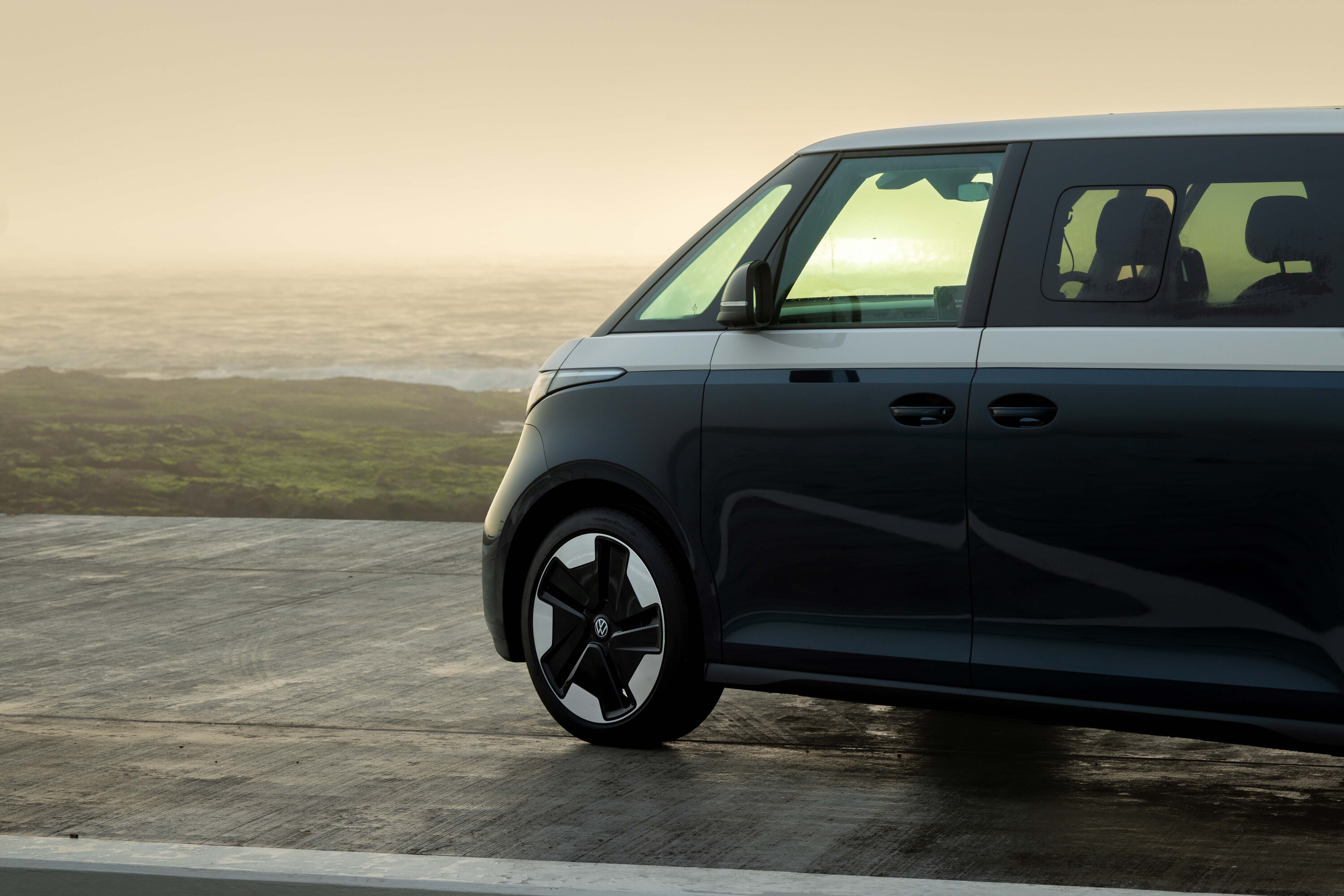
1
This will serve to elevate the ID. Buzz to a polished lifestyle accessory.
The ID. Buzz isn’t perfect. The ride can be choppy on the larger 21-inch wheels, there are still issues with the infotainment system and some may hanker for longer real-world range if they want to turn their hand to hitting the open roads of Australia. We encountered some electronic gremlins with our test vehicle too.
Although Volkswagen claim that it’s cheaper than many were expecting, forking out what’ll likely be nigh-on six figures with a typical option spend might be beyond some family buyers wearing the current cost of living travails.
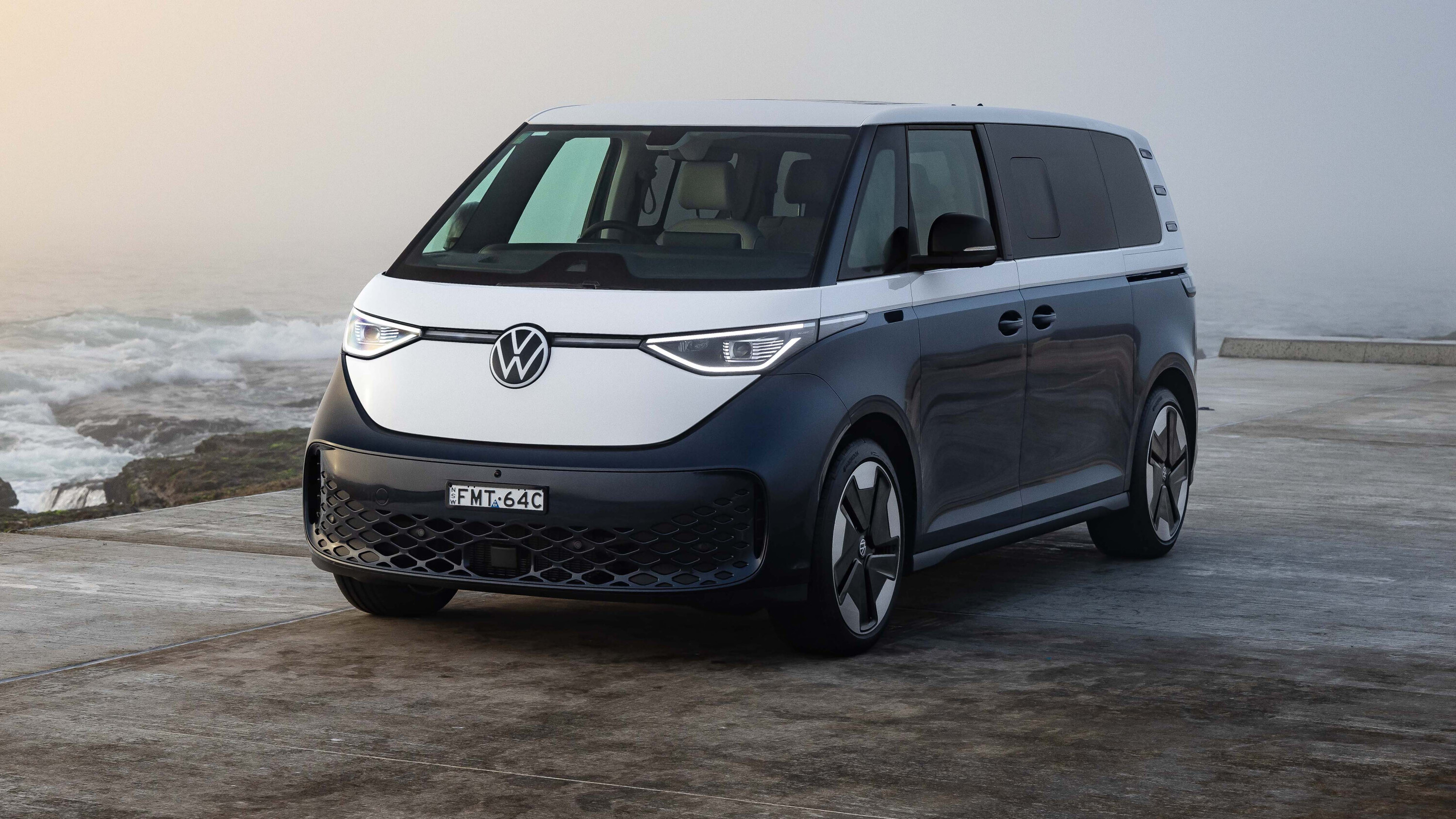
In all likelihood, this will serve to elevate the ID. Buzz to a polished lifestyle accessory. An ID. Buzz would probably stand out like a sore thumb among the scatter of battered and sun-wrecked Subarus and Toyotas at gnarly surf spots like Bells Beach or Wreck Bay but would fit right in at Balmain or Brunswick.
1
And there’s nothing wrong with that. Why wouldn’t gentrification happen to vehicle model lines as well as neighbourhoods?
It deserves success. Volkswagen Australia should be applauded for throwing the kitchen sink at making buying an EV as painless as possible and it appears to have learned a number of lessons from the European mothership’s first tranche of electric products that sucked up huge investment but didn’t hit the spot with consumers.
The company is older and wiser. And, if public interest while driving the ID. Buzz is anything to go by, once again able to paint a smile on peoples’ faces. It’s hard to put a value on that.
MORE
Electric Cars
| 2025 Volkswagen ID.Buzz Pro LWB specifications | |
|---|---|
| Drive | Single rear mounted electric motor |
| Battery | 91kWh (86kWh net) lithium-ion |
| Transmission | Single-speed reduction |
| Max power | 210kW |
| Max torque | 560Nm |
| Weight | 2795kg |
| Range | 452km |
| 0-100km/h | 7.9 sec |
| Price | $91,290 |
| On sale | Now |
The latest in Maserati’s growing line of powerhouse heroes will make its way to Australia in 2025, with the track-focused GT2 Stradale opening at $699,000.
Snapshot
- New halo variant packs 471kW V6, hits 100km/h in 2.8s
- Track-focused aero package adds 155kg more downforce
- Priced from $699,000, first deliveries late 2025
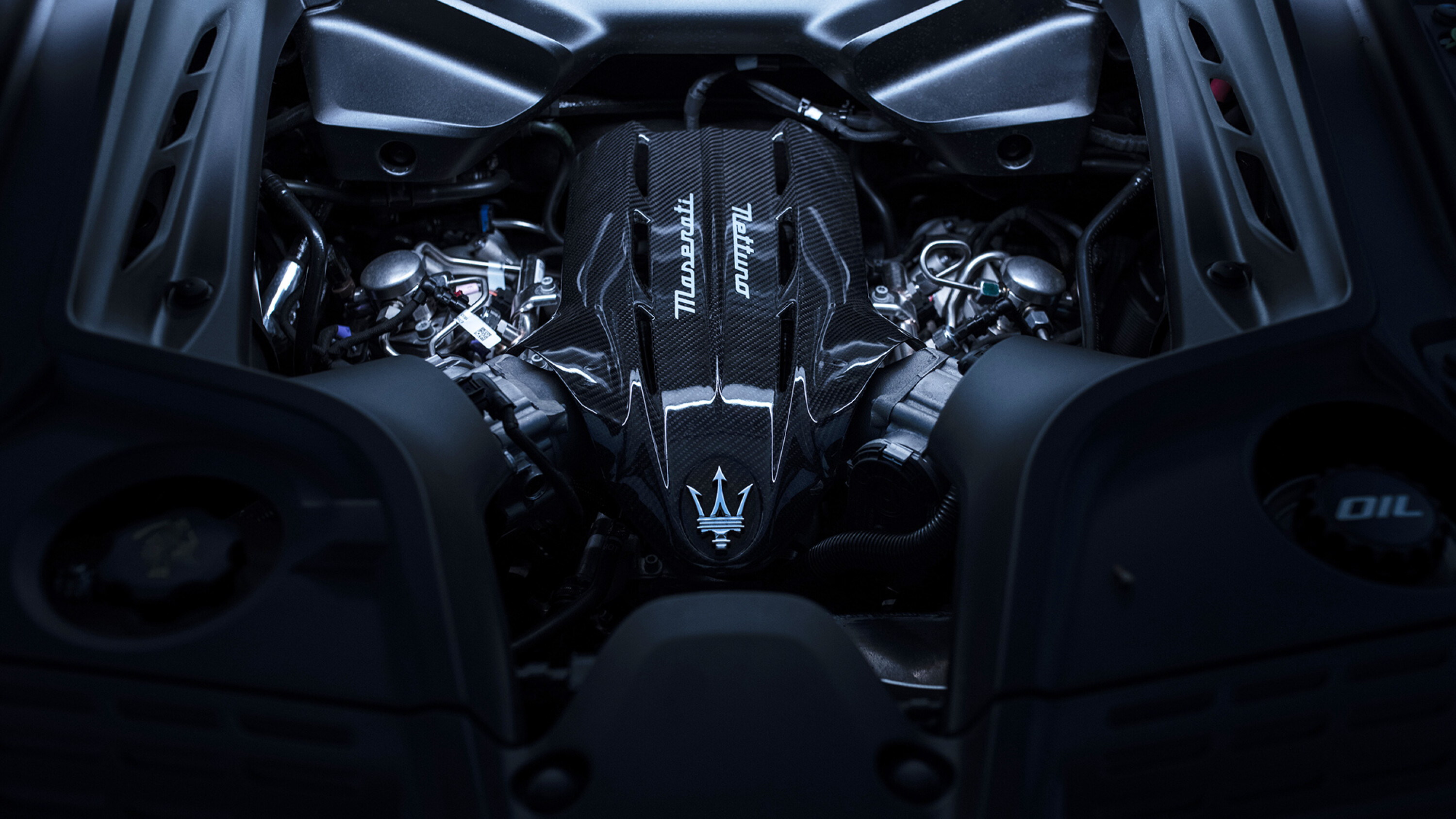
At its heart, the GT2 Stradale is powered by Maserati’s twin-turbo 3.0-litre V6, boosted from the MC20‘s 463kW to a new 471kW, and matched to an eight-speed dual-clutch transmission driving the rear wheels. Peak torque is listed at 720Nm, available between 3000 and 5500rpm.
On the scales, Maserati claims a 59kg drop in kerb weight to 1365kg. Contributing to the weight loss are a new carbon-ceramic brake package (-17kg), lighter wheels (-18kg) and racing seats (-20kg), along with a carbon-fibre exterior package (-5kg) and reduced interior sound insulation (-4.5kg).
1
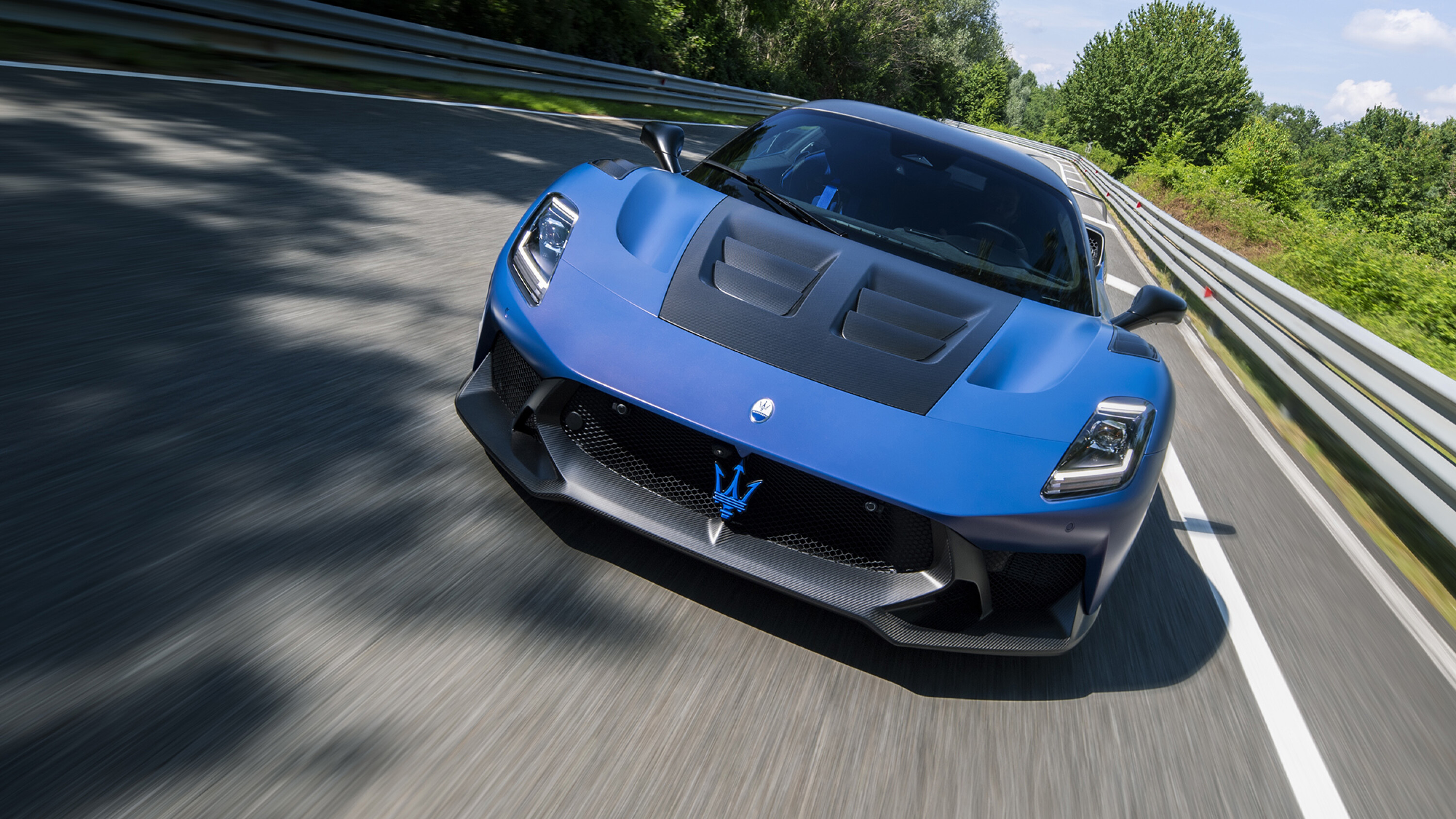
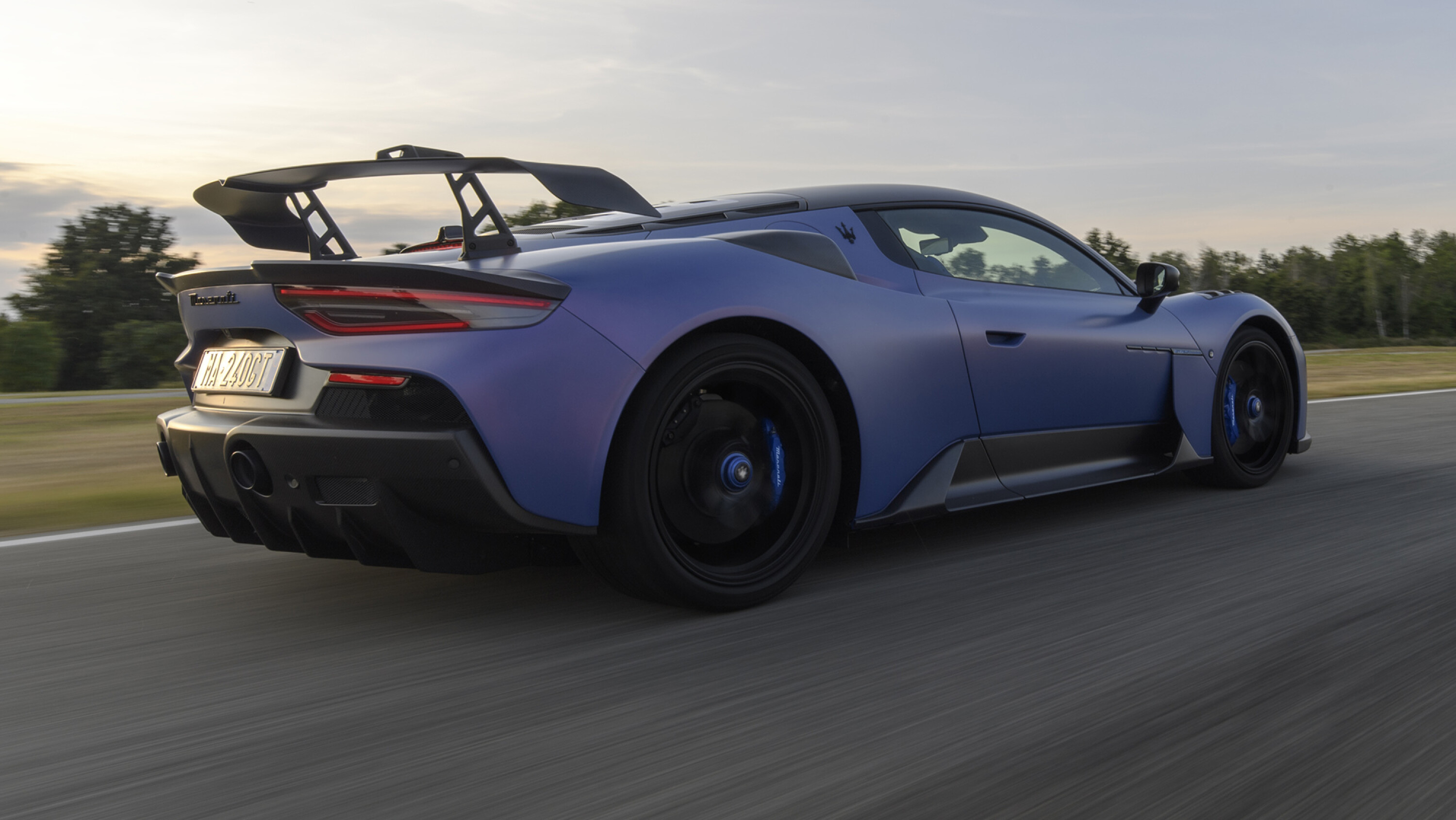
Aero includes a new adjustable wing that, although 8kg heavier than the MC20’s unit, increases rear downforce from 110kg to 170kg at 280km/h. At the same speed, front downforce increases from 35kg to 130kg.
Performance claims have the GT2 Stradale hitting 100km/h in 2.8 seconds –shaving 0.1 seconds off the MC20’s time – with a top speed of 324km/h. It rides on 245/35 R20 front and 305/30 R20 rubber.
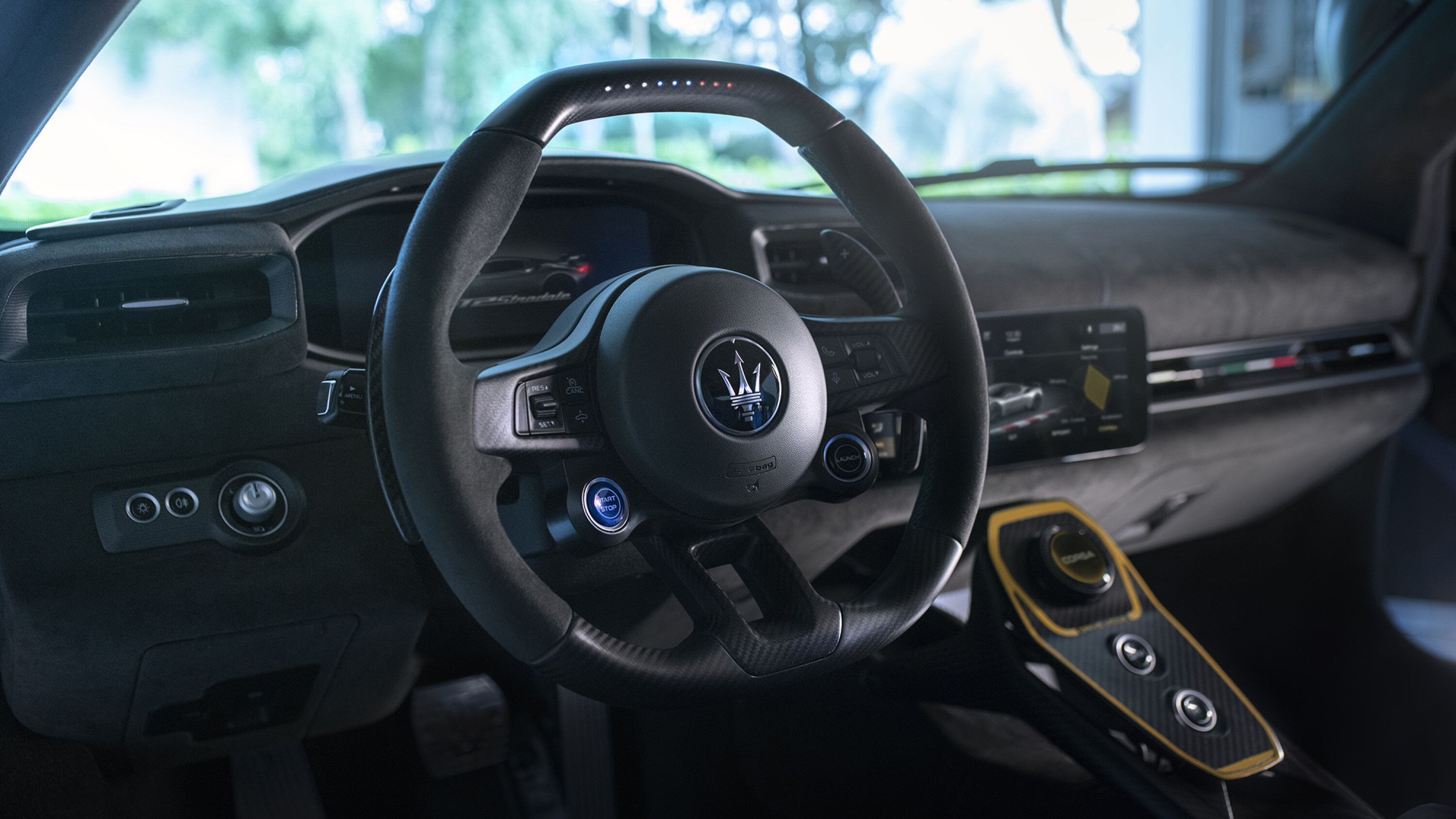
Key features of the GT2 Stradale include a carbon-fibre bonnet with enlarged cooling vents, lightweight polycarbonate side windows, race-spec suspension, and a full track telemetry system.
1
1
Maserati lists the following highlights for the GT2 Stradale
- Race-calibrated eight-speed dual-clutch transmission
- Three-position adjustable rear wing
- Carbon ceramic brake package
- Carbon-fibre racing seats
- Enhanced engine and brake cooling systems
- Modified brake pedal response for circuit use
- Dashboard-mounted shift light indicator
- Track-specific anti-lock brake calibration
- Adjustable traction control and differential settings
- Built-in performance data logger
- Race-specification suspension setup
- Carbon-fibre hood with enlarged cooling vents
- Lightweight polycarbonate side windows
- Carbon-fibre exterior package
- Reduced interior sound insulation
- Lightweight alloy wheels
1
Australian-delivered cars will also come standard with some items reserved in Europe for the optional performance pack: Corsa Evo driving mode, Michelin semi-slicks, and a fire extinguisher.
Four standard colours will be offered – black, blue, yellow and white – with custom options available. Brake caliper options include black, red, silver, yellow and blue.
First Australian deliveries are scheduled for late 2025.
MORE
Everything Maserati
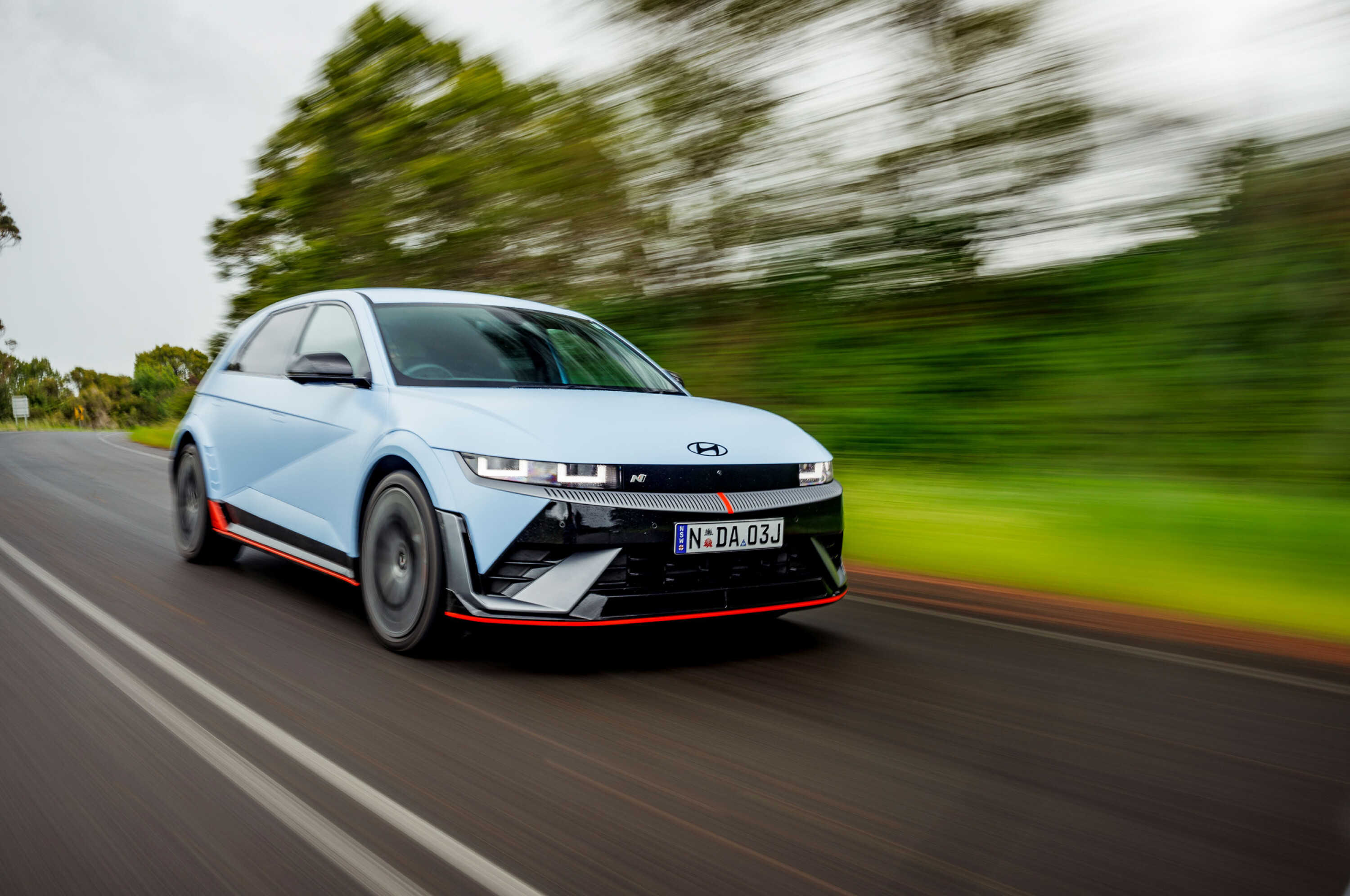
It’s not often the winner of the prestigious Wheels Car of the Year (COTY) award is a unanimous choice of all the judges after a week of rigorous testing on both track and road, but that is the case with the 2024-25 winner, the Hyundai IONIQ 5 N.
The boundary-pushing sports hatch beat the Toyota Camry Ascent Sport and stablemate, the Hyundai Santa Fe Calligraphy, into second and third place respectively.
The Hyundai IONIQ 5 N stood out because of the inventive, imaginative way it combines EV technology with motorsport-inspired performance and handling to create a truly thrilling drive. It’s the EV set to impress even those who will never relinquish their love of the internal combustion engine – and as Wheels Editor Andy Enright confirms in his edited Wheels Yearbook 2024 review of the winner below, that’s quite a feat…
1
Wheels Editor, Andy Enright
I pity those car enthusiasts who still feel that electric cars are some sort of soulless appliance.
Yes, there are many cheap EVs that are about as thrilling as reading a user manual for a USB hub, but then the same goes for many affordable combustion-engined cars.
Just as a dull car is a dull car regardless of how it’s powered, the inverse applies to fun and interesting cars.
Thing is, it’s easy to make dull cars. It’s far trickier to imbue a car with character, to make you want to drive it, to daydream of your favourite roads, to paint a huge smile on your face.
We’ve had well over a century of practice to figure out how to do exactly that with combustion-engined vehicles but, for the most part, around a decade to figure out how EVs deliver on that enthusiast promise.
The Hyundai IONIQ 5 N has cracked that particular problem, and in the most joyous way imaginable, which is why this landmark sports hatch wins Car of the Year.
It does so much so well that it delivered a unanimous verdict across all six judging scorecards in the blind final-round voting. Last year, COTY was a very close-run thing. Not on this occasion.
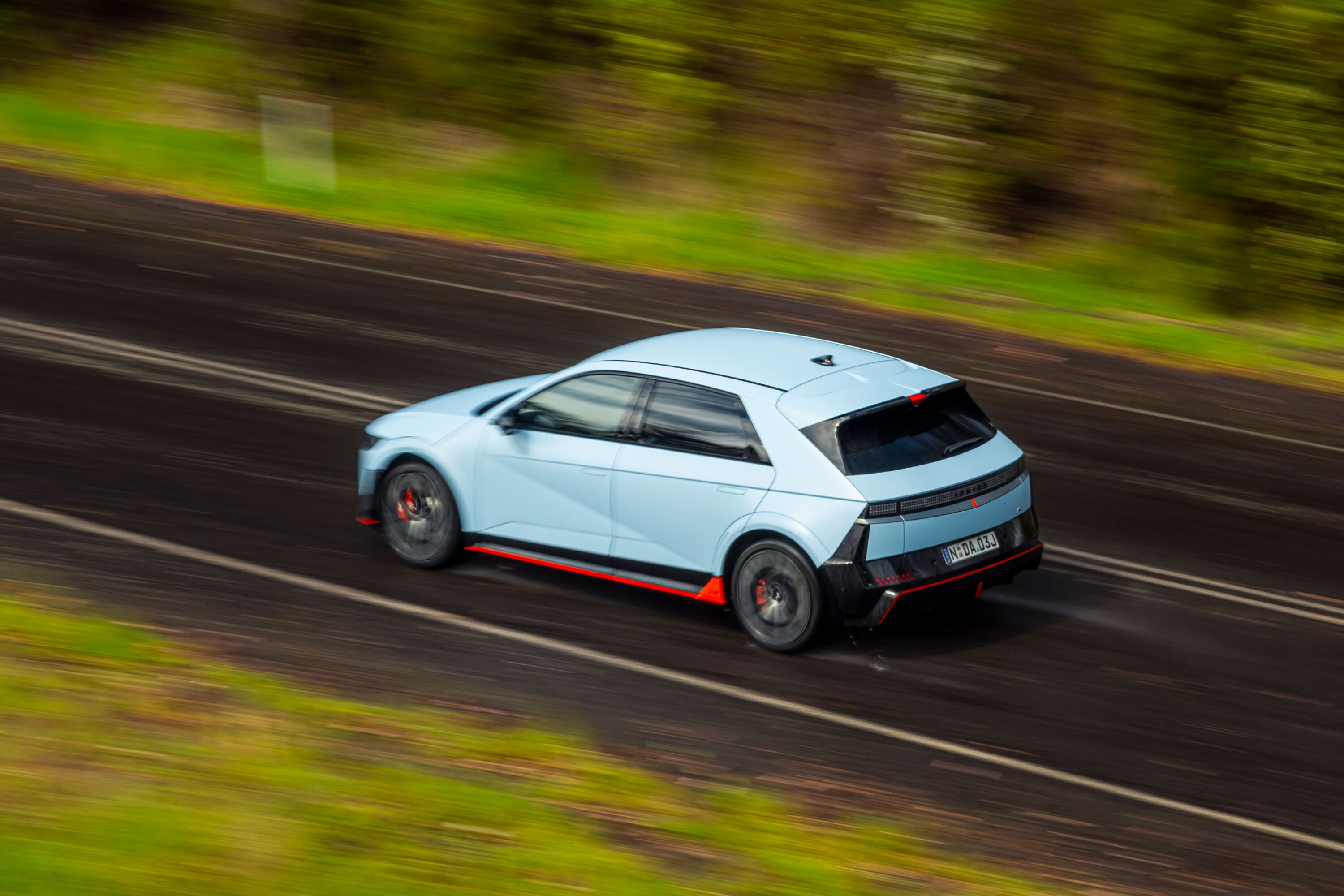
It takes a very special sort of road car to impress somebody who has won the Australian rally championship seven times, but after we ran performance tester Cody Crocker through the 5 N’s manual gear shifting system, he returned with a massive grin and a distinct reluctance to hand back the keys.
“I’ve got a new favourite car,” he said. “I had no idea it could do that.”
1
Ah, yes, that. It was always going to be a controversial move, offering drivers the option of artificially mandated gearshifts, a rev limiter, and the feeling of torque building as the entirely nonexistent engine comes on cam.
At first glance, it would seem to play into the hands of those who claim that electric powertrains are lame and that the old ways are better, but do we need to be that partisan, that binary?
Can we not take the best of both to create something new and incredible? That’s exactly what Albert Biermann and his team at Hyundai’s N division has done with this remarkable car.
What’s more, it blitzed the judging criteria.
Value? You’re getting a performance car with 478kW; comfortably more power than a McLaren F1 for $110K. Safety? The IONIQ 5 has returned a five-star ANCAP rating. Layer on top of that the bigger brakes, better tyres and additional safety systems of the 5 N and that box is resolutely ticked.
Cabin design and execution? It seats five adults in comfort, has a big boot and is well-appointed throughout, with thoughtful stowage inside the car, solid ergonomics and a flat floor.
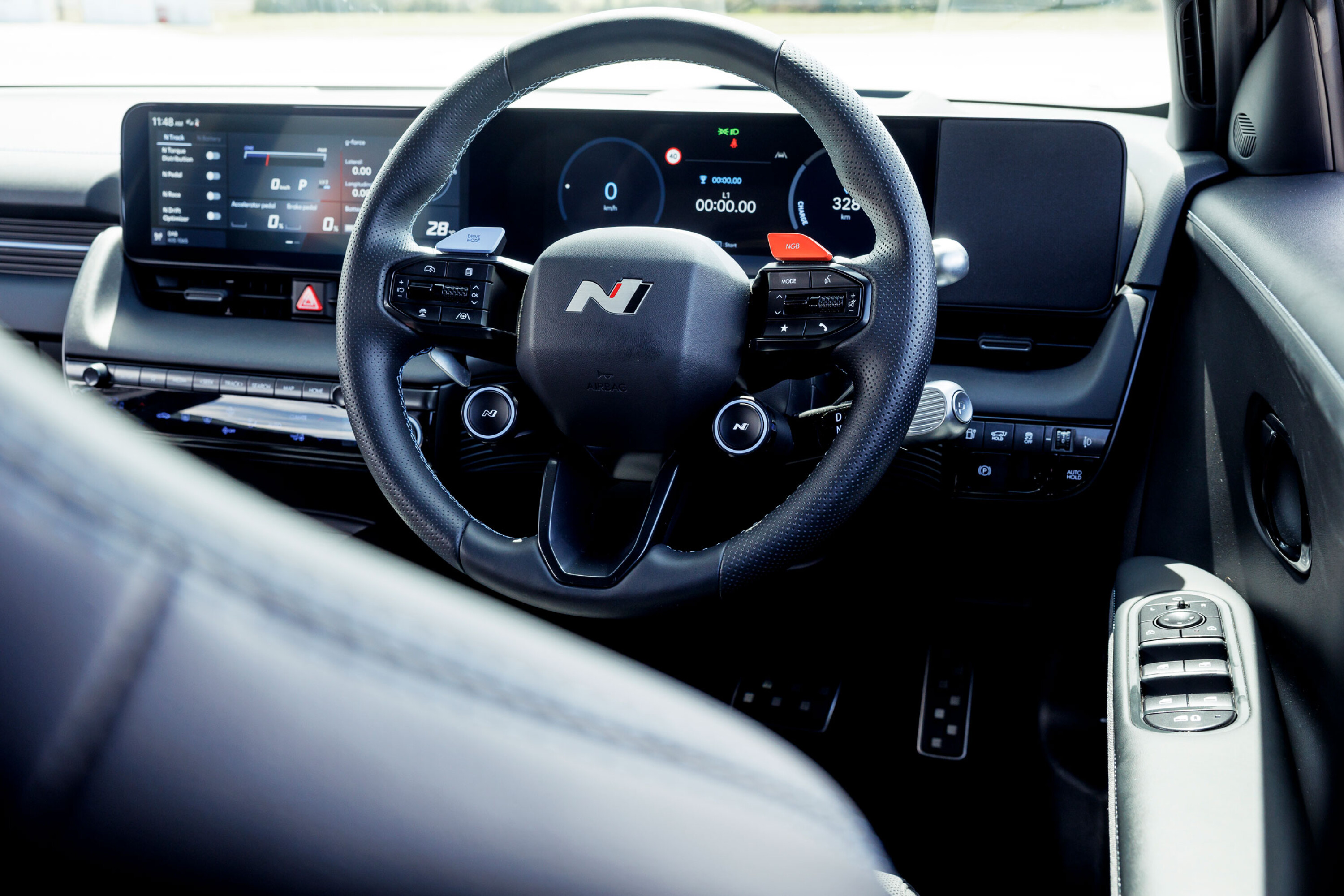
How it drives? If that includes the ability to make you laugh out loud in pure joy, then nothing at this year’s event, even the fabulous Mustang Dark Horse, could top it. The mantra that ran through the 5 N’s development speaks volumes: driving still matters.
1
Of course, it’s not perfect. No COTY winner ever is.
Drive it like you mean it and that claimed 448km WLTP-mandated range shrinks somewhat.
Throw it from lock to lock around hairpins at a racetrack and the tyres will let you know that, despite its nimble feel, there’s 2230kg of physics at work here. Then there are the whispers that Hyundai is ready to unleash something even focused, and that the full-bodied IONIQ 5 was a mere toe-in-the-water platform for the Koreans in order to gauge customer reception. As ever, we can only test the cars that are put in front of us.
At Lang Lang it was imperious. One particular quirk of the surfacing of the ride and handling track at this proving ground is that performance cars shod with Pirelli P Zero tyres tend to shine. The 5 N we had was wearing a set of 275/35ZR21 P Zeros, so its prospects looked good from the outset.
The speed limit through many of the corners is a fairly generous 130km/h and the Hyundai felt planted and confidence-inspiring, even on the sections specifically designed to upset the car mid-corner.
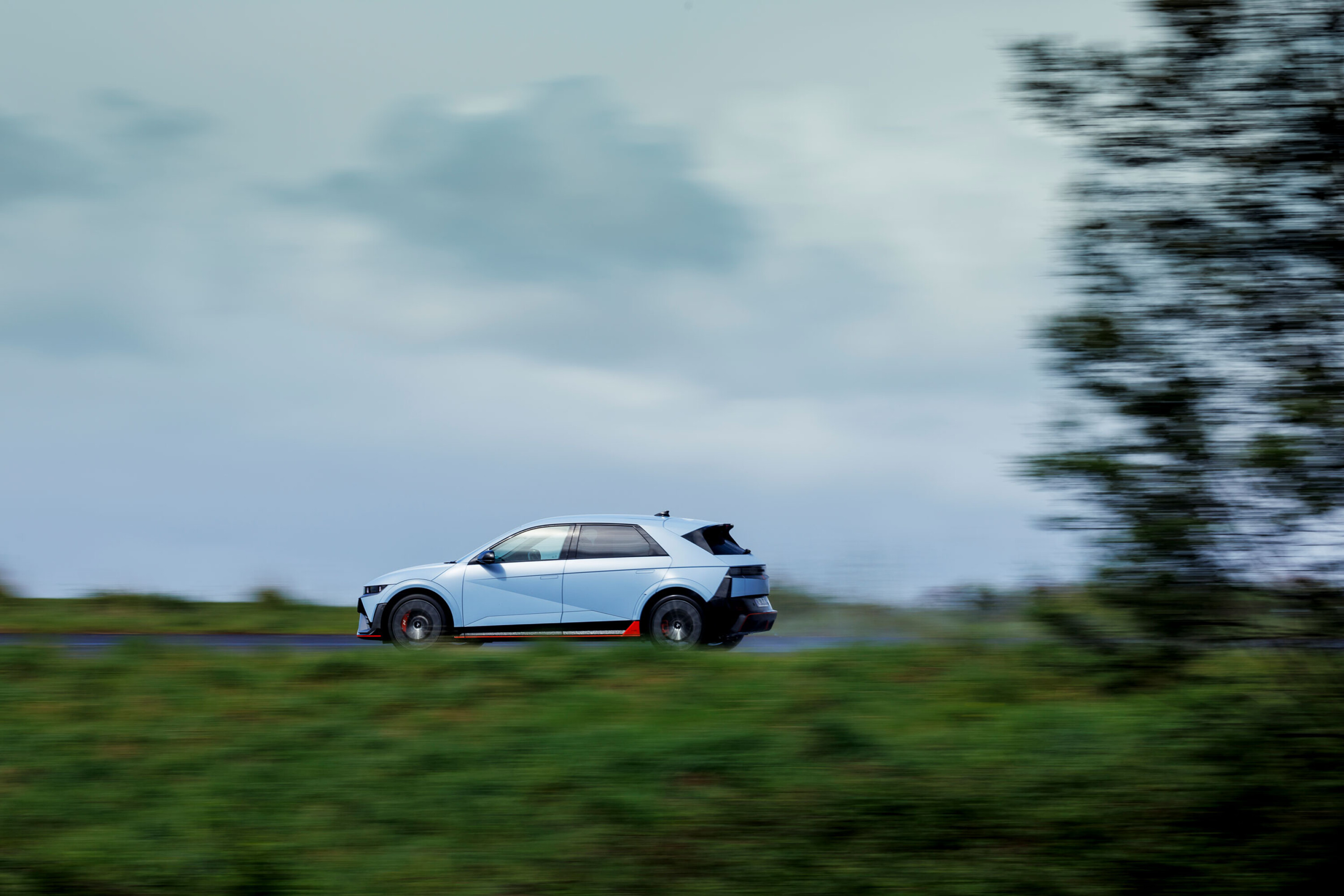
It resists roll well and there is so much to be said for plucking the gears yourself. At first, you’ll feel silly. Ten seconds later, you won’t give a hoot about how silly you think it is – you’ll be laughing too much. Isn’t that what we want from performance cars today: to feel connected and engaged? The IONIQ 5 N delivers that in spades. Don’t get mired in how you got there. Just enjoy the end result.
1
It’s a car that rewards good drivers.
It offers a drift mode, but it’s far more fun to get the car on a circuit and switch all of the electronic systems off in order to tease at the subtleties of its handling envelope. Like all N cars, the warranty covers circuit use, and the 5 N was developed with this use case in mind.
At the company’s Nürburgring development centre, the development team aimed for a 20-20-20 exercise. That’s 20 minutes of hot lapping on a track day, then 20 minutes on a high speed charger and then back out for 20 minutes on track again.
Thanks to its 800-volt electrical architecture, the 5 N will charge from 10 to 80 percent in a rapid 18 minutes on a 350kW fast charger, or 70 minutes on a more pedestrian 50kW unit.
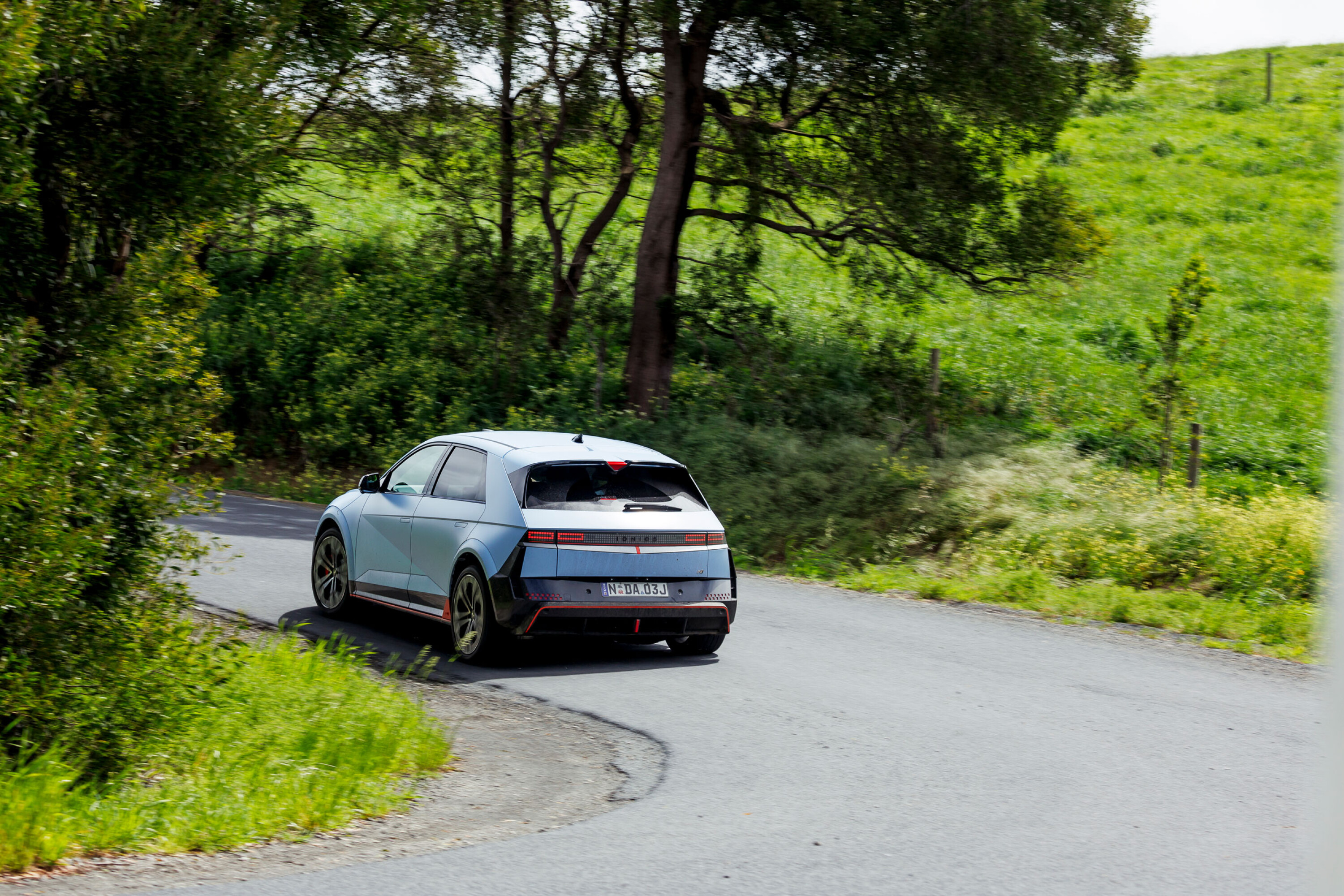
It’s on road that the 5 N really shines though. Its ride quality is more than compliant enough to make it realistic family transport, genuinely living up to the cliché of being able to drop the kids off at school while showing you a good time on the indirect route back.
The boot is a sizeable 480 litres with the seats up and 1540 litres with the second row folded. There’s even the utility of a V2L connector that can power tools, camping equipment or domestic appliances.
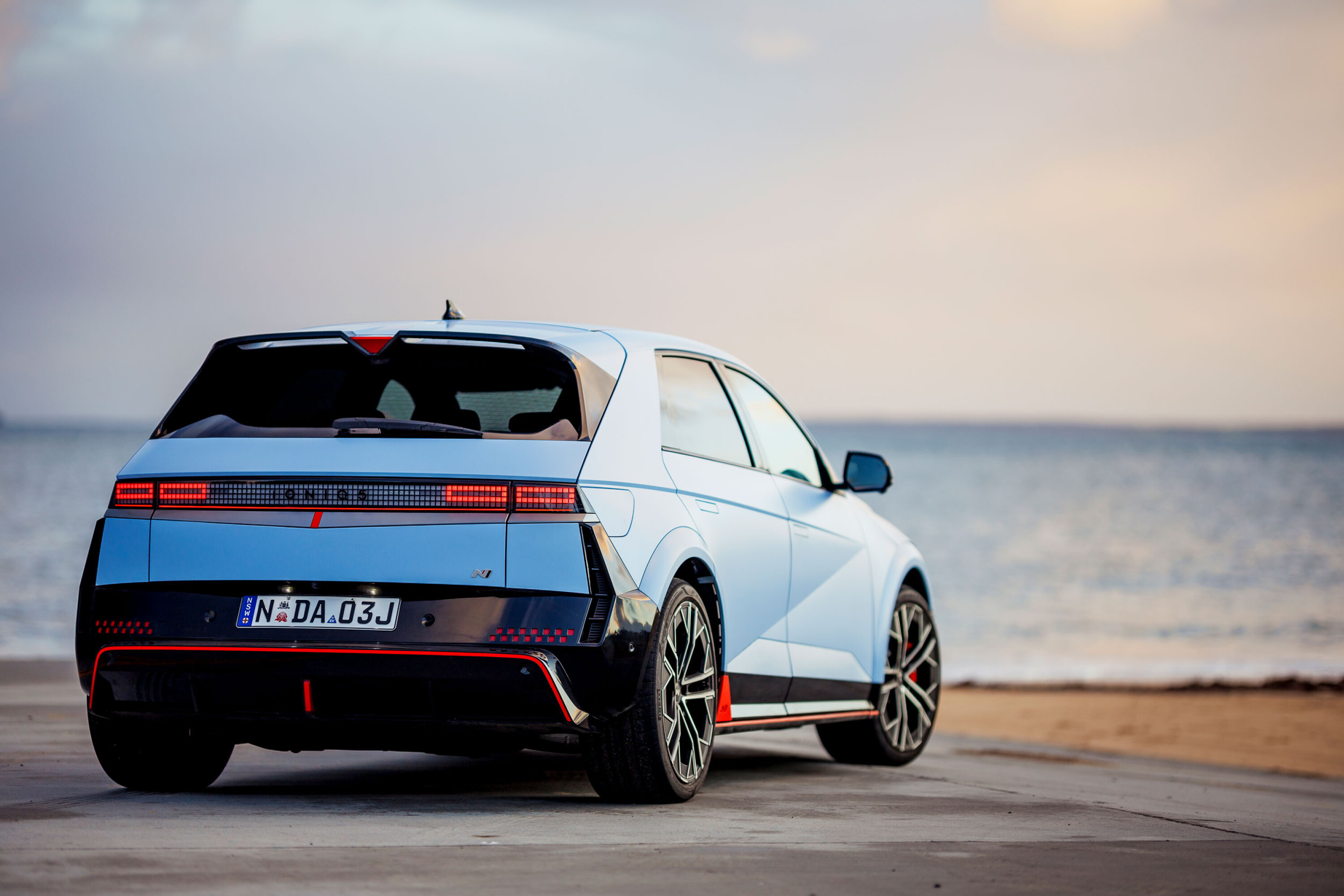
The Hyundai IONIQ 5 N is by some margin the most powerful car ever to have won Wheels Car of the Year. Heck, only one car in the lengthy winners’ roll boasts half the grunt of this rocketship Hyundai.
1
The last time a true enthusiast car won the big gong was in 2012, when the award was shared between the Subaru BRZ and the Toyota 86 coupe twins.
Since then we’ve witnessed the rise of SUVs which have become increasingly polished as family transport; albeit one given a dust-flecked tone by last year’s victor, the Ford Everest.
It takes something very special to break that mould. Car of the Year has long celebrated all-round excellence, but we enjoy it less when steady box-tickers win. This year, all the stars have aligned.
Not only do we get a brave, exciting and game-changing winner, but we get one that scores well across all the judging criteria. At $110K, the Hyundai IONIQ 5 N isn’t for everyone but it ought to be a car that everyone can see points to a bright future for keen drivers. In sweeping the board of all six judges, the IONIQ 5 N is a standout champion.
This is a win for optimism. It’s a win for something many had maybe forgotten in these turbulent times. A win that owes much to a scribbled note from Albert Biermann in the margin of his notes to the 5 N’s development team: ‘Driving still matters.’
1
| HYUNDAI IONIQ 5 N | |
|---|---|
| Price/as tested | $110,383/$112,383 |
| Drive | 2 x electric motors, 84kWh lithium-ion battery |
| Power | 448kW |
| Torque | 740Nm |
| Transmission | Single-speed reduction gear |
| Weight | 2230kg |
| L/W/H/WB | 4715/1940/1585/3000mm |
| Tyre | Pirelli P Zero 275/35ZR21 (f/r) |
| Safety | Untested |
Ford Mustang Dark Horse
The new S650 Dark Horse aims to show that the Mustang’s old days of the slightly unresolved and unsophisticated muscle car are behind it.
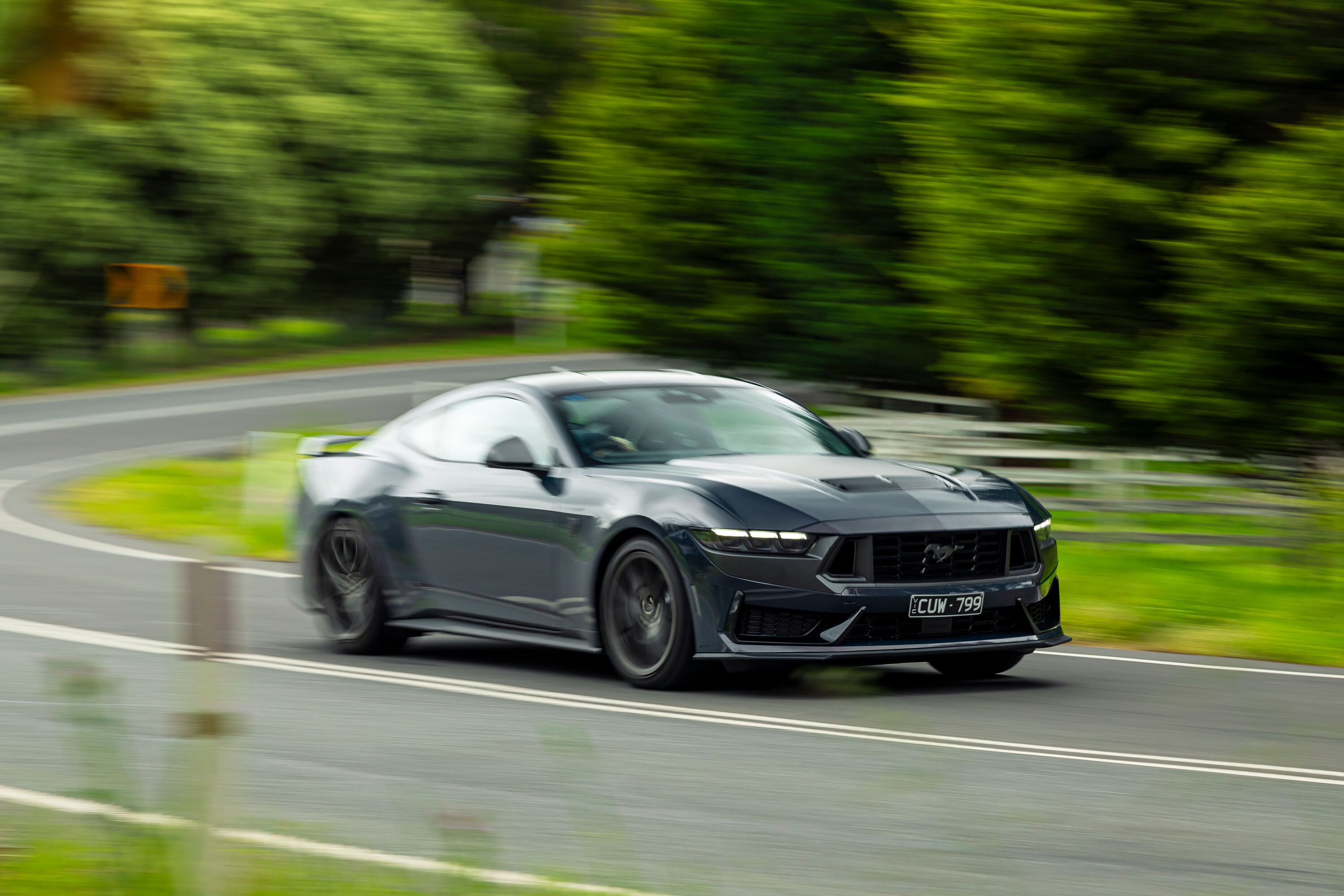
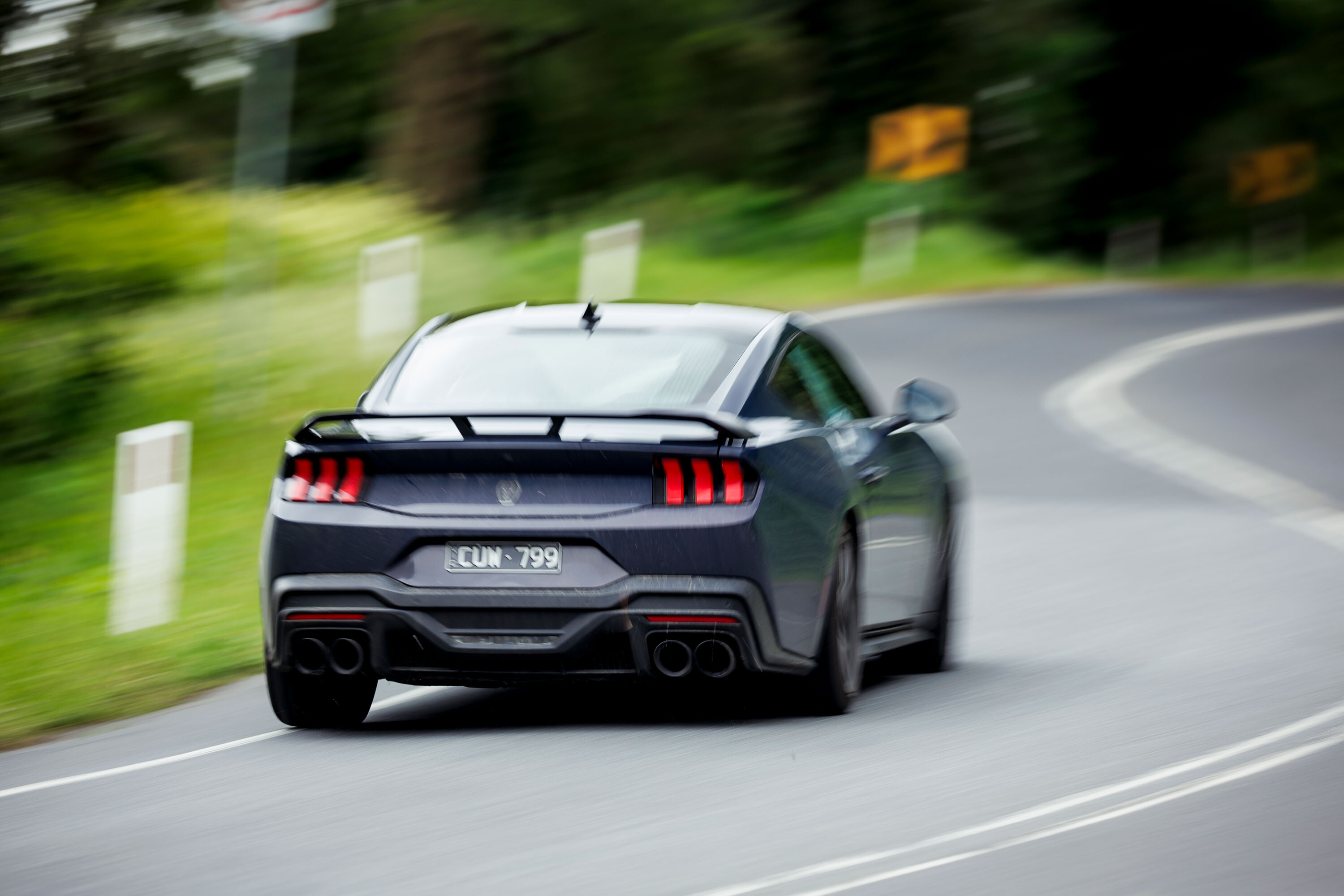
You might be wondering how a Ford that costs $105,332 as tested could possibly be considered good value. Especially when the Dark Horse doesn’t seem to be that different to the regular Mustang GT upon which it’s based, despite costing $22,000 more. And yet it only takes about 10 metres to realise the Dark Horse is unlike any Mustang we’ve ever driven.
1
It starts with the steering. The Dark Horse scores a different calibration and rides on overhauled suspension compared with the GT for a tauter, more track-focused set-up, and as soon as you crank on some lock you know you’re dealing with something special. There isn’t much feel per se, but there’s none of the usual Mustang wooliness either, and around Lang Lang’s tricky mix of low- and high-speed corners, the Dark Horse is a riot.
Fast, loud and with an athleticism that belies its nameplate and 1822kg kerb weight, the Dark Horse delivers a driving experience that is surprisingly involving and rewarding. A big part of that is down to the gearbox. You can have the Dark Horse as a 10-speed automatic but our car is the six-speed manual (remember those?) and it is without question the better pick. The manual ’box is different to other V8 Mustangs, with Ford ditching the GT’s Getrag MT82-D4 in favour of the same Tremec TR-3160 unit that’s fitted to the Shelby GT350.It brings shorter ratios, a revised final drive and, crucially, a more positive shift action.
With 350kW/550Nm on tap, the Dark Horse shares the core of its naturally aspirated 5.0-litre V8 with the regular GT but it gains additional cooling and uses connecting rods taken from the Shelby GT500. It also scores an active exhaust with five modes, ranging from quiet to racetrack, and it sounds brilliant. Deep and menacing at idle, it also has enough light and shade as you rise through the rev range to sound properly exciting.
Combine all this with a surprising litheness through the lane-change manoeuvre and an impressive ability to soak up Lang Lang’s lumps, bumps and surface changes (unique springs and MagneRide adaptive dampers are standard inclusions) and it’s little wonder the Dark Horse breezed through the first round of voting to become a finalist.
1
Amazingly, though, the Dark Horse is even more impressive on COTY’s road loop. Poise isn’t a word you’d usually associate with a Mustang but over our road course’s challenging mix of broken back roads, that’s exactly what the Dark Horse delivers. Given its track focus and wider wheel and tyre package compared with the GT, you could forgive the Dark Horse for feeling overly stiff but the compliance and control delivered by the tweaked suspension and MagneRide dampers is surprising. Grip and traction are strong, and instead of being upset by mid-corner bumps or skipping wide in traction zones, the Dark Horse offers a sense of connection, confidence and speed that suggests it’s a better road car than it is a track-day machine.
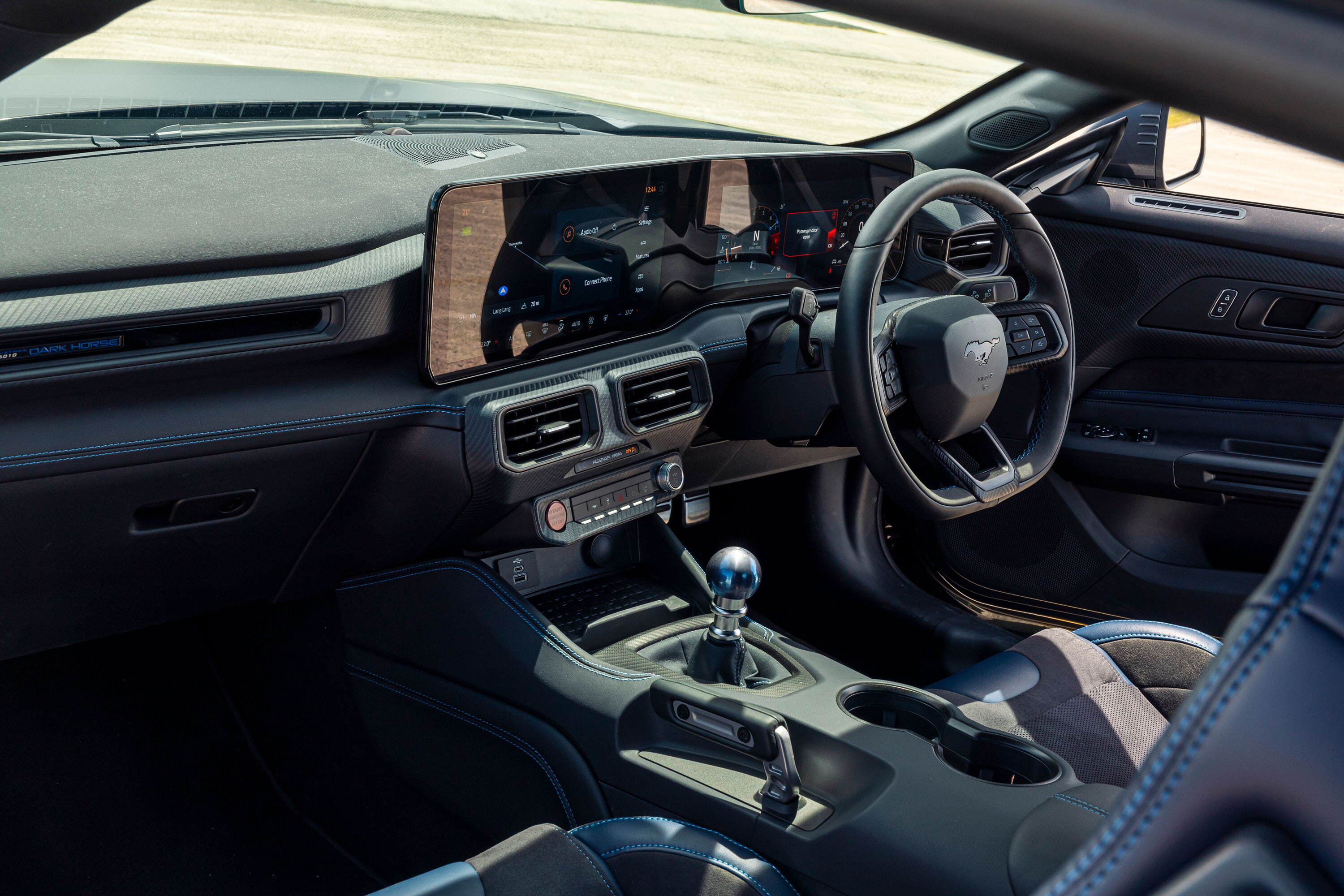
It’s certainly comfortable enough to use everyday. The ride has a pleasing duality and the cabin, which has long been a Mustang weakness, is a welcome improvement thanks to better quality materials and a new dual-screen digital dash. The dash which includes a nerdy level of performance data and the ability to cycle through design themes for the instruments which can replicate the look and feel of previous hero Mustangs like the original ’60s model, an ’80s Fox Body and, my personal favourite, the white dials of an SVT Cobra.
As it stands, the Dark Horse is a remarkable machine – certainly one that delivers a driving experience that is more than the sum of its parts.
– Alex Inwood
1
| Ford Mustang Dark Horse | |
|---|---|
| Price/as tested | $99,102/$105,332 |
| Drive | 5.0-litre V8, dohc, 32v |
| Power | 350kW @ 7250rpm |
| Torque | 550Nm @ 4850rpm |
| Transmission | 6-sp manual/10-sp auto |
| Weight | 1822kg (m), 1842kg (a) |
| L/W/H/WB | 4823/2097/1413/2719mm |
| Tyre | Pirelli P Zero 255/40R19 (f), 275/40R19 (r) |
| Safety | Untested |
Hyundai Santa Fe Calligraphy
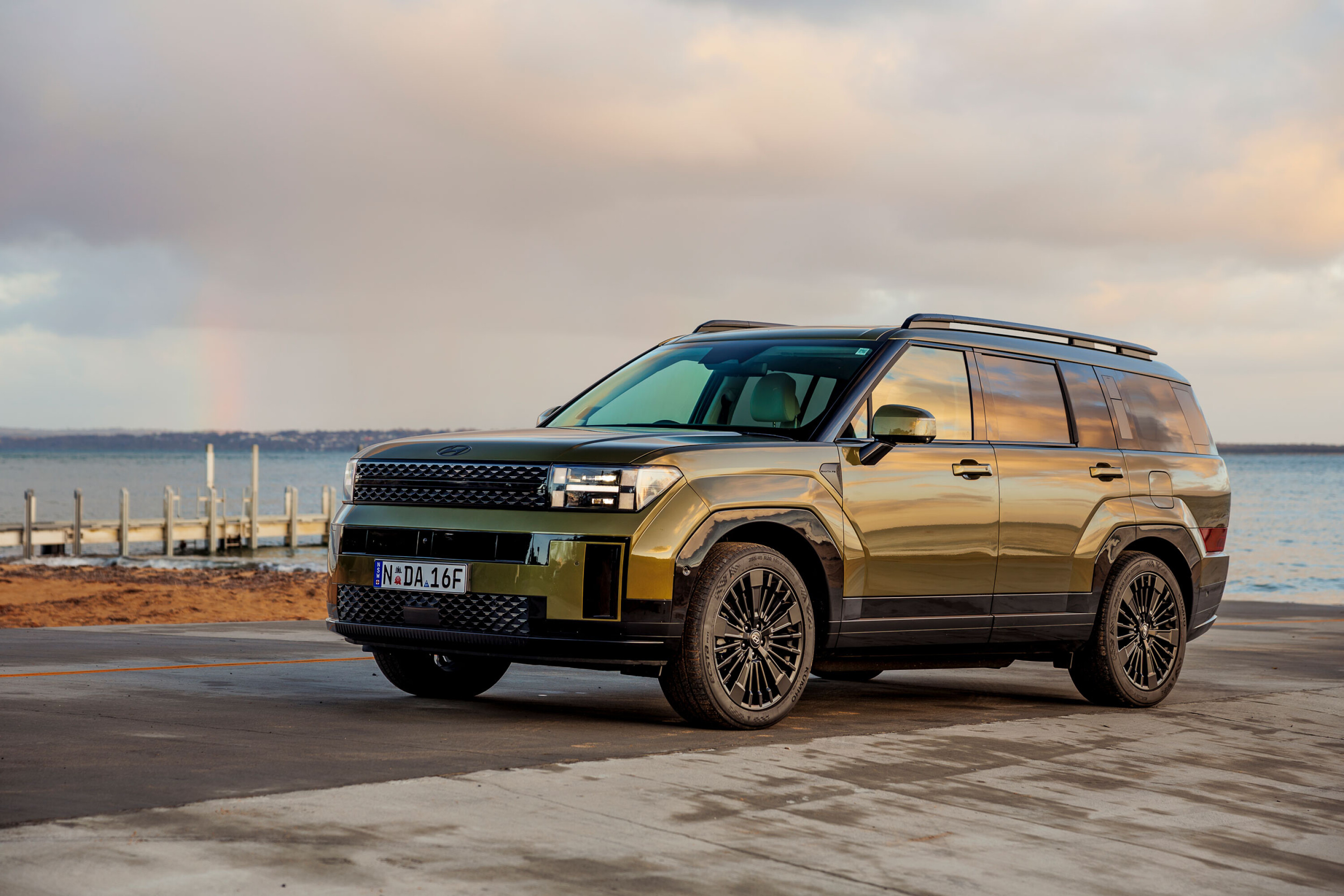
It’s ironic that Hyundai’s out-of-the-box design theme for the fifth-generation Santa Fe large SUV resembles a box on wheels. This eye-catching aesthetic, which is repeated outside and in, is designed to be exactly that. Hyundai wants the Santa Fe to be noticed because the previous four generations were too often overlooked by car shoppers.
1
The new Santa Fe hit Australian showrooms mid-year priced $10,000 above the outgoing model, which design changes alone can’t justify. All models are powered by a hybridised 172kW/367Nm 1.6-litre turbocharged petrol engine driving either the front wheels or all four. Hyundai will add a non-hybrid 206kW 2.5-litre turbo in due course, replacing the previous generation’s 3.5-litre V6. But diesel is no longer part of the Santa Fe range.
For now, the four-cylinder hybrid is where it’s at, and despite being the smallest Santa Fe engine ever, it delivers. Even though the Santa Fe Calligraphy we tested weighs in at 2105kg, the hybrid engine and six-speed automatic transmission do a more than adequate job of meeting daily driving demands.
There is a touch of throttle lag below 2500rpm, which can make the car feel a little lethargic, most obvious in Eco mode which is prioritising fuel economy. Move out of Eco to Normal mode and the engine responds better and is also more willing to smoothly drop gears to give the driver what they want. That said, the engine can become coarse when put under pressure.
The hybrid powertrain’s energy recuperation system is commendably invisible. There’s no jerkiness transitioning from regenerative braking to recuperation. It’s also clearly doing its primary job, because we recorded 6.6L/100km on our very hilly 50km open-road loop, just one litre higher than its official claim.
1
When it comes to ride quality, the Santa Fe is less impressive, but that’s more a reflection of its highly polished rivals than any real-world deficiency. The Santa Fe is another Hyundai whose suspension has not specifically been tuned for Australian conditions, the factory relying instead on historical data. This results in a vehicle that’s busier than its rivals, and also noisier on its Kumho Ecsta tyres.
The ride isn’t overly terse or overactive, just without the suppleness to match the Kluger or indeed its Kia Sorento stablemate. The tyres and suspension tune do make up for it dynamically; this may be a family truckster, but it also has the poise and the grip to make winding roads more enjoyable.
While some may debate the importance of chassis dynamics for a family SUV, Wheels sees merit in driving competence and confidence. We’d much rather a dynamically proficient family vehicle than the alternative. But still, the wider target market will be more focused on the Santa Fe’s space and practicality than any dynamic overtones.
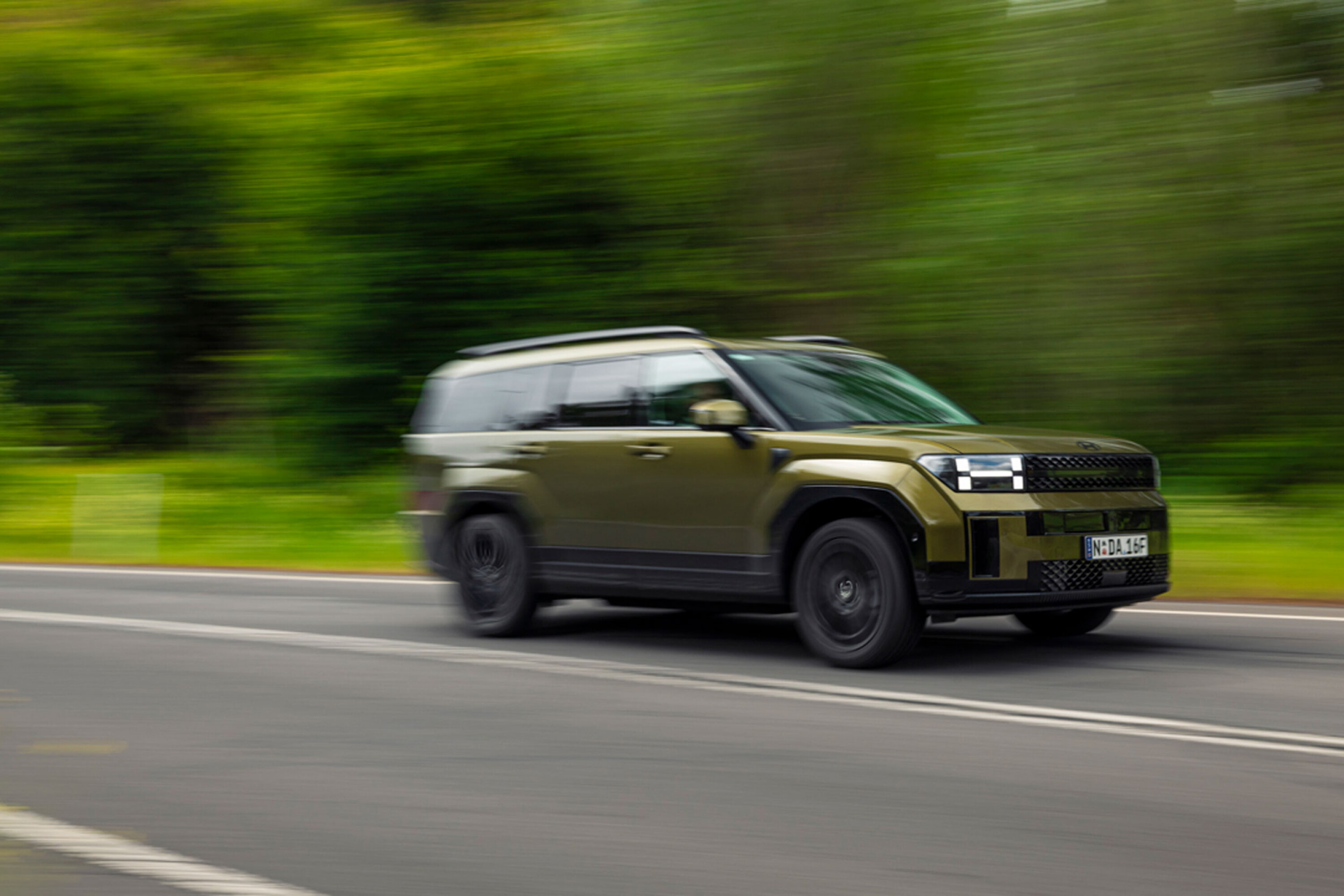
1
The new body is bigger: 45mm longer, 10mm taller, and riding on a 50mm-longer wheelbase, which liberates more legroom and cargo space inside. The boxy body also has some thoughtful touches, like the hidden handhold on the C-pillar which makes accessing rooftop loads easier, and also for clambering into the third row. The biggest dimensional change, however, has to be the boot opening which is 145mm wider, giving loads more load width. The boot floor’s loading height is lower, too.
The boot is a whopper in two-row mode (628 litres), but buyers will need to tick a few rooftop luggage options if they’re planning roadtrips with all three rows occupied because luggage space is almost non-existent in this configuration. Still, that’s the same for any SUV in this class, and Hyundai’s extensive – and affordable – options list again highlights the company’s family focus during development.
The range incorporates three model grades – Santa Fe, Elite and Calligraphy – and all come with three rows of seating in a 2+3+2 configuration. There’s a second Calligraphy model that replaces the bench middle row with two individual seats – handy for separating offspring that like to niggle and tease, and for walk-thru access to the third row.
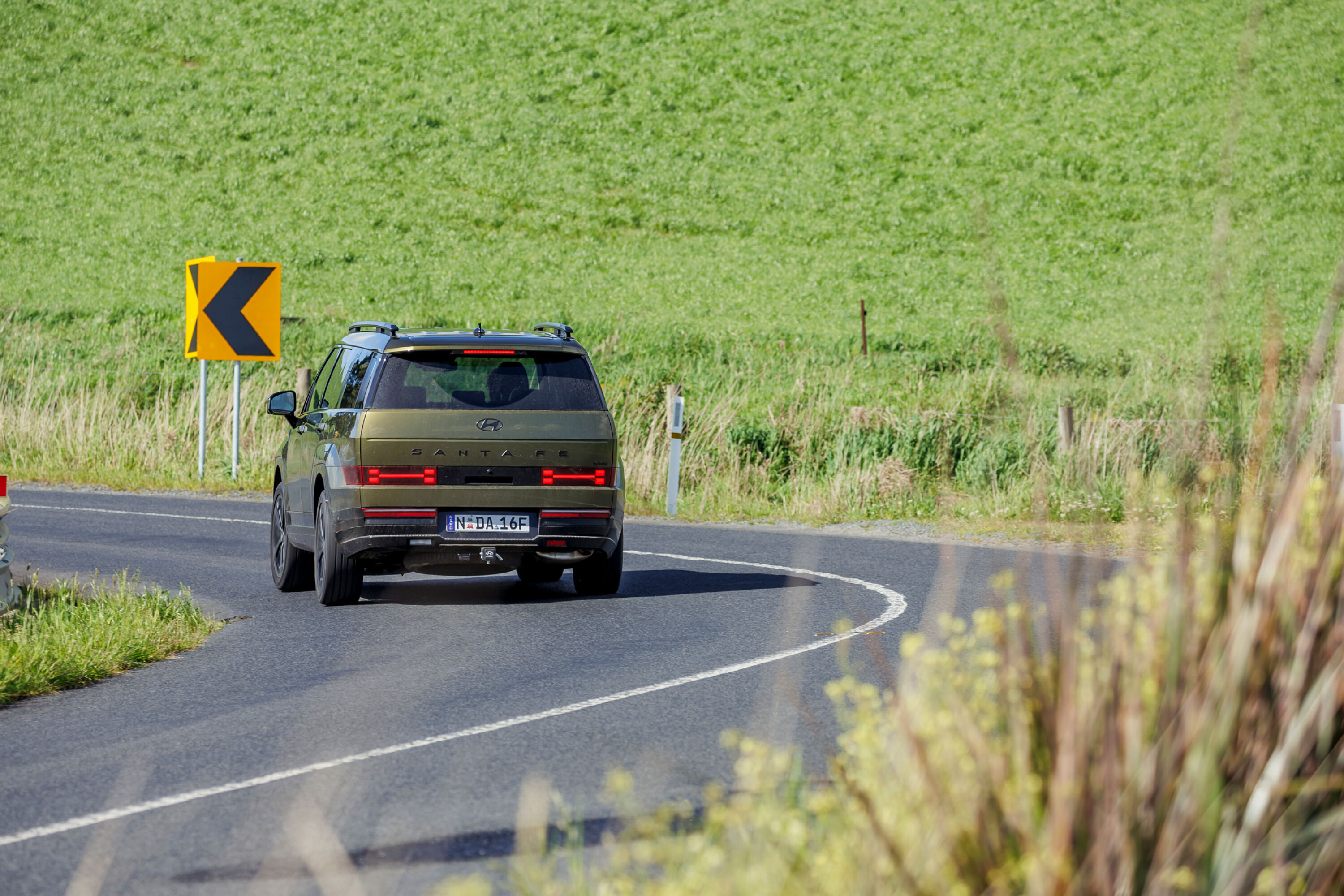
1
We chose to test the top-spec Calligraphy because it’s expected to outsell both the base model and the Elite combined. It puts everything on the table for buyers, but does cost $75,000 plus on-roads.
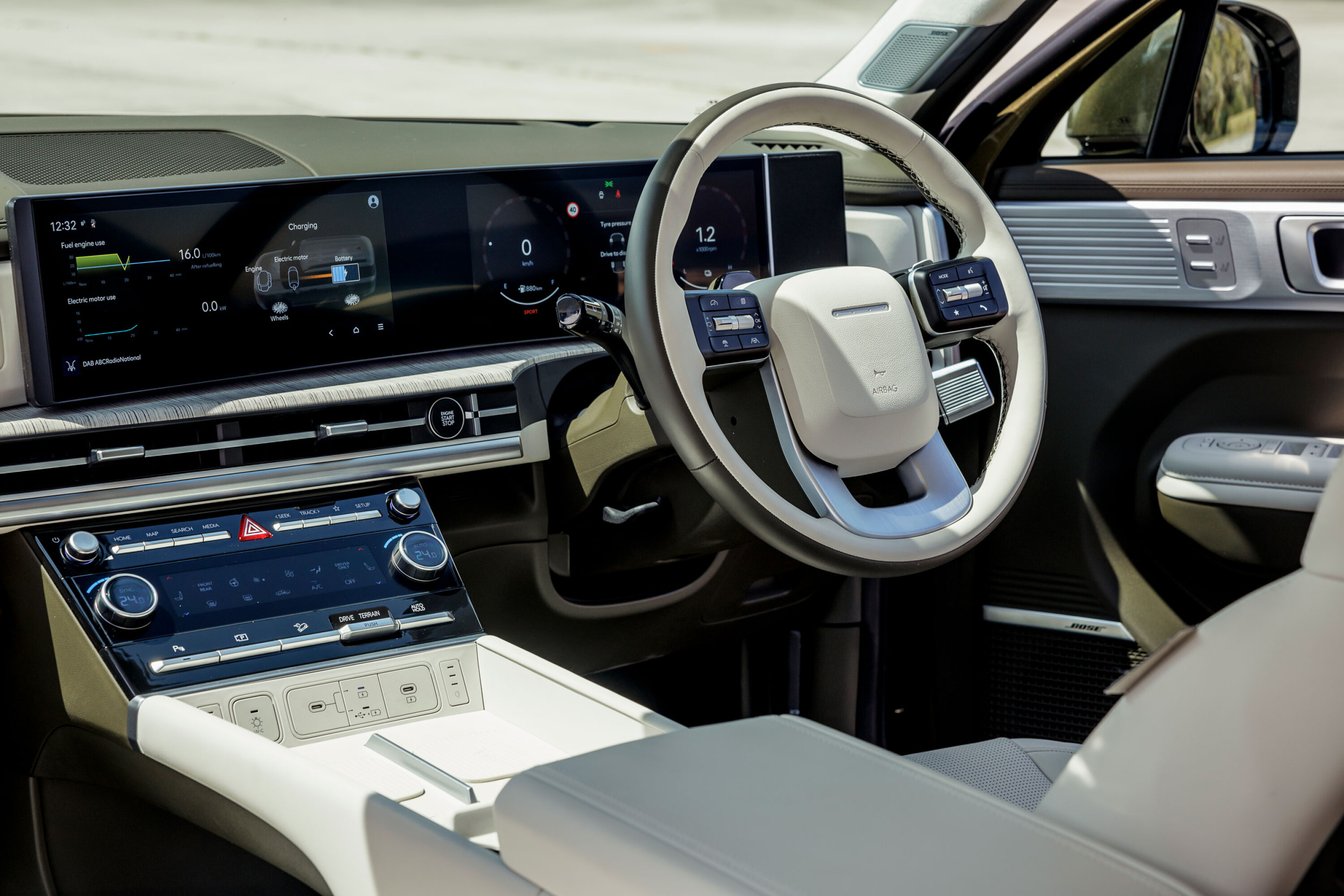
The cabin continues the boxy theme with amusing attention to detail, and also makes use of modern materials to convey quality and class. Again, Hyundai’s thoughtfulness and innovation shine through. For starters, dual wireless phone chargers speak to its family friendliness, as do the many useful storage spaces – including the centre console’s double-hinged lid that opens for rear occupants as well.
Kudos to Hyundai for also resisting the temptation to go all-in with touchscreen controls and retain actual buttons for the dual-zone climate control and other oft-used systems as well. And for adopting the one-touch speed warning override as debuted on Genesis models earlier this year, doing much to fix one of the Santa Fe’s most tedious features.
The second row has plenty of legroom and headroom, even with the Calligraphy’s huge sunroof, and the third row can accommodate adults at a push (if the second row compromises its legroom), but is more suited to children.
The more we delved into the Santa Fe, the more we understood the lengths Hyundai has gone to address buyer needs and concerns. This new Santa Fe is a thoughtfully designed and brilliantly executed family SUV that improves on the previous generation in all the right areas.
– Glenn Butler
1
| Hyundai Santa Fe Calligraphy | |
|---|---|
| Price/as tested | $75,000/$75,990 |
| Drive | 1598cc 4cyl, dohc, 16v, turbo, hybrid |
| Power | 172kW @ 5500rpm |
| Torque | 367Nm @ 1500-4500rpm |
| Transmission | 6-speed automatic |
| Weight | 2105kg |
| L/W/H/WB | 4830/1900/1770/2815mm |
| Tyre | Kumho Ecsta PS71 255/45R20 (f/r) |
| Safety | Untested |
Hyundai IONIQ 5 N
The first EV that you’d take for a drive just for the fun of it? That’s what the IONIQ 5 N could well be. Albert Biermann and the team at Hyundai’s N Division have engineered this to be ingrained from top to bottom with laugh-out-loud enjoyment and baked-in driver engagement.
1
It takes a very special sort of road car to impress somebody who has won the Australian rally championship seven times, but after we ran performance tester Cody Crocker through the 5 N’s manual gear shifting system, he returned with a massive grin and a distinct reluctance to hand back the keys. “I’ve got a new favourite car,” he said. “I had no idea it could do that.”
Ah, yes, that. It was always going to be a controversial move, offering drivers the option of artificially mandated gearshifts, a rev limiter, and the feeling of torque building as the entirely non-existent engine comes on cam. At first glance, it would seem to play into the hands of those who claim that electric powertrains are lame and that the old ways are better, but do we need to be that partisan, that binary? Can we not take the best of both to create something new and incredible? That’s exactly what Albert Biermann and his team at Hyundai’s N division has done with this remarkable car.
Value? You’re getting a performance car with 478kW; comfortably more power than a McLaren F1 for $110K. Safety? The IONIQ 5 has returned a five-star ANCAP rating. Layer on top of that the bigger brakes, better tyres and additional safety systems of the 5 N and that box is resolutely ticked. Cabin design and execution? It seats five adults in comfort, has a big boot and is well-appointed throughout, with thoughtful stowage inside the car, solid ergonomics and a flat floor. How it drives? If that includes the ability to make you laugh out loud in pure joy, then nothing at this year’s event, even the fabulous Mustang Dark Horse, could top it. The mantra that ran through the 5 N’s development speaks volumes: driving still matters.
1
Of course, it’s not perfect. No COTY winner ever is. Drive it like you mean it and that claimed 448km WLTP-mandated range shrinks somewhat. Throw it from lock to lock around hairpins at a racetrack and the tyres will let you know that, despite its nimble feel, there’s 2230kg of physics at work here. Then there are the whispers that Hyundai is ready to unleash something even focused, and that the full-bodied IONIQ 5 was a mere toe-in-the-water platform for the Koreans in order to gauge customer reception. As ever, we can only test the cars that are put in front of us.
It resists roll well and there is so much to be said for plucking the gears yourself. At first, you’ll feel silly. Ten seconds later, you won’t give a hoot about how silly you think it is – you’ll be laughing too much. Isn’t that what we want from performance cars today: to feel connected and engaged? The IONIQ 5 N delivers that in spades. Don’t get mired in how you got there. Just enjoy the end result.
– Andy Enright
1
| Hyundai IONIQ 5 N | |
|---|---|
| Price/as tested | $110,383/$112,383 |
| Drive | 2 x electric motors, 84kWh lithium-ion battery |
| Power | 448kW |
| Torque | 740Nm |
| Transmission | Single-speed reduction gear |
| Weight | 2230kg |
| L/W/H/WB | 4715/1940/1585/3000mm |
| Tyre | Pirelli P Zero 275/35ZR21 (f/r) |
| Safety | Untested |
Kia EV5 Earth AWD
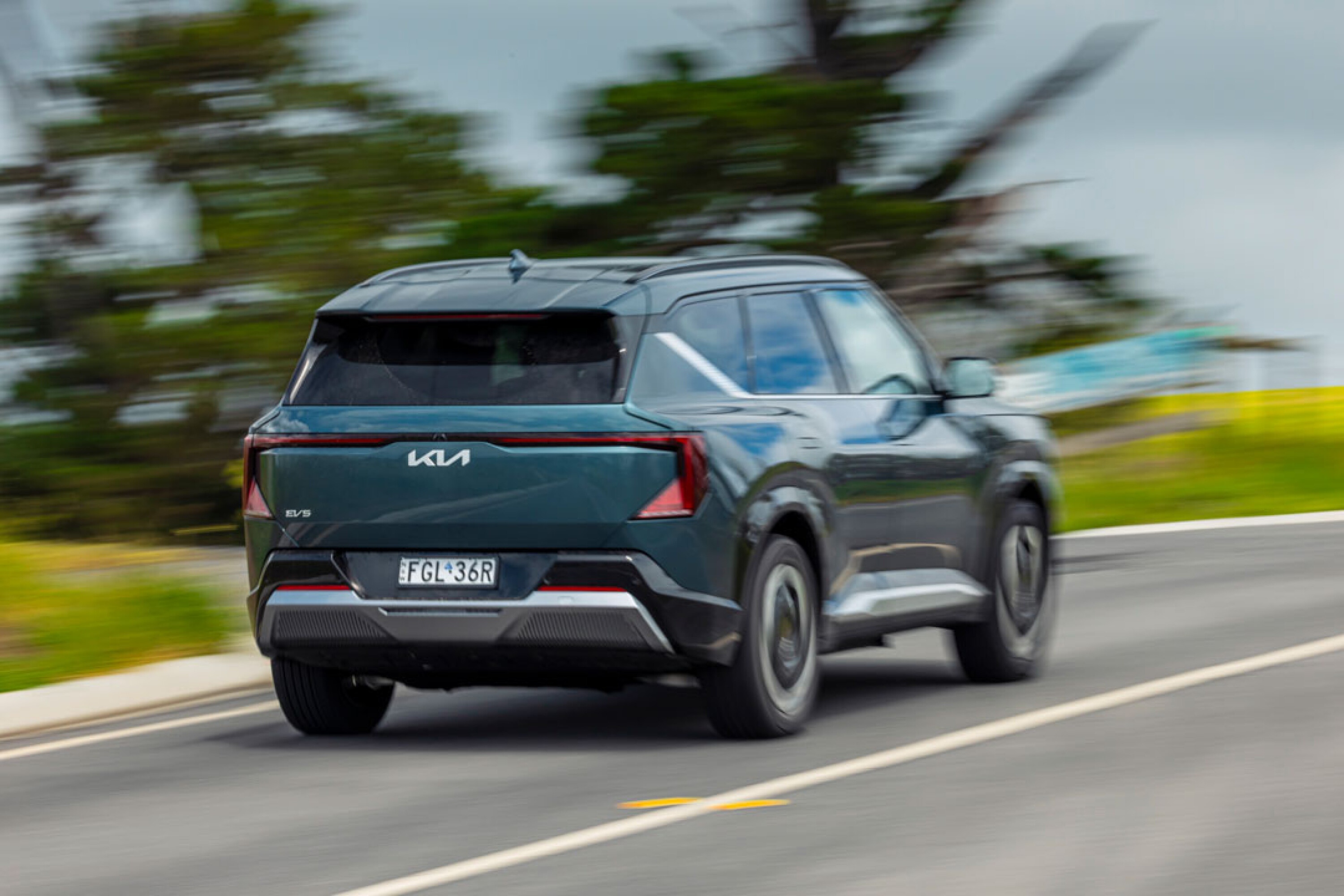
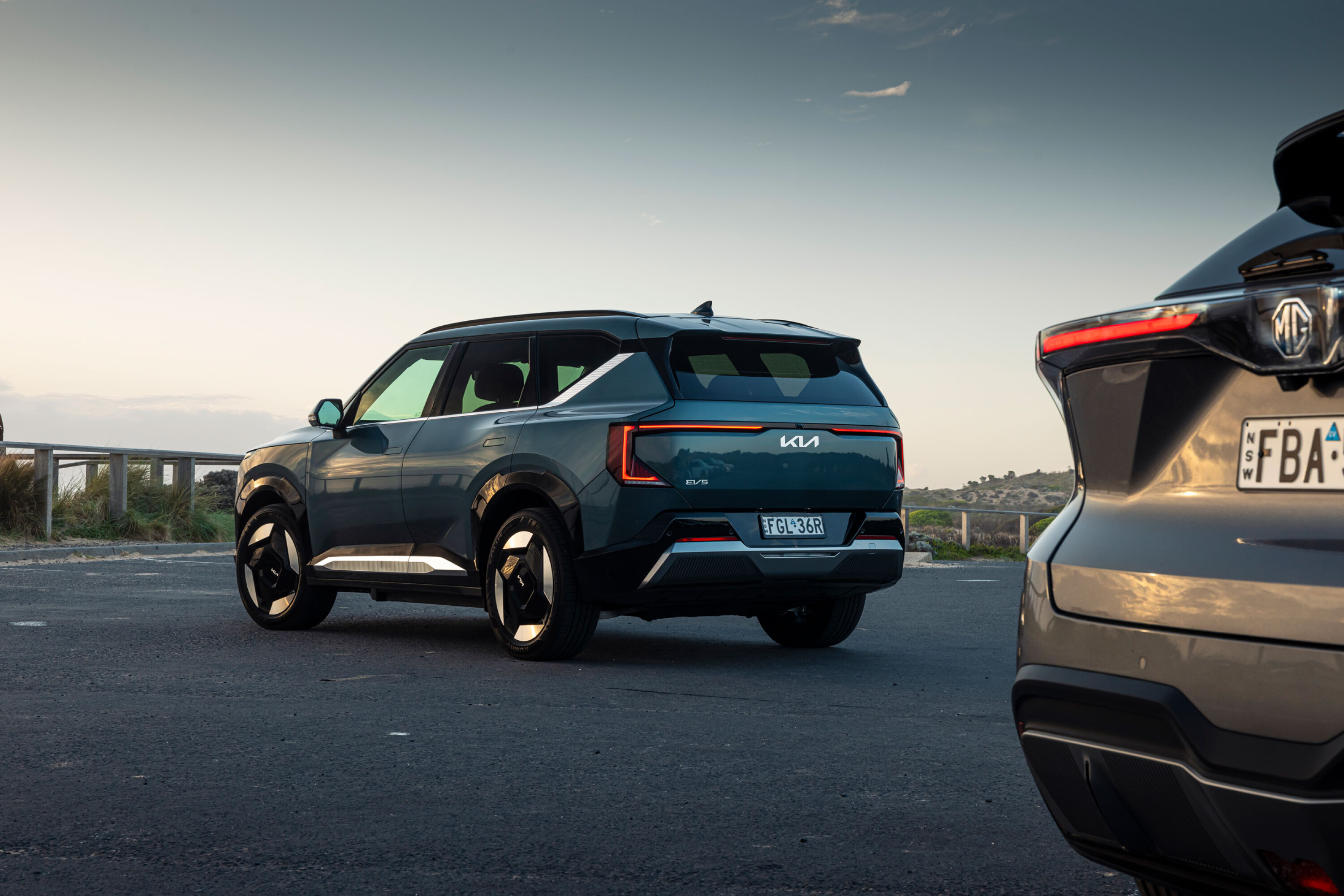
With the range starting at $56,770 drive-away for the base front-drive Air Standard Range, we chose the mid-spec $68,990 drive-away Earth with its larger 88.1kWh battery, 500km of claimed WLTP range, all-wheel drive and various other extra equipment. While it doesn’t quite make the same futuristic statement as the EV9 in the metal, it still looks plenty good to our eyes.
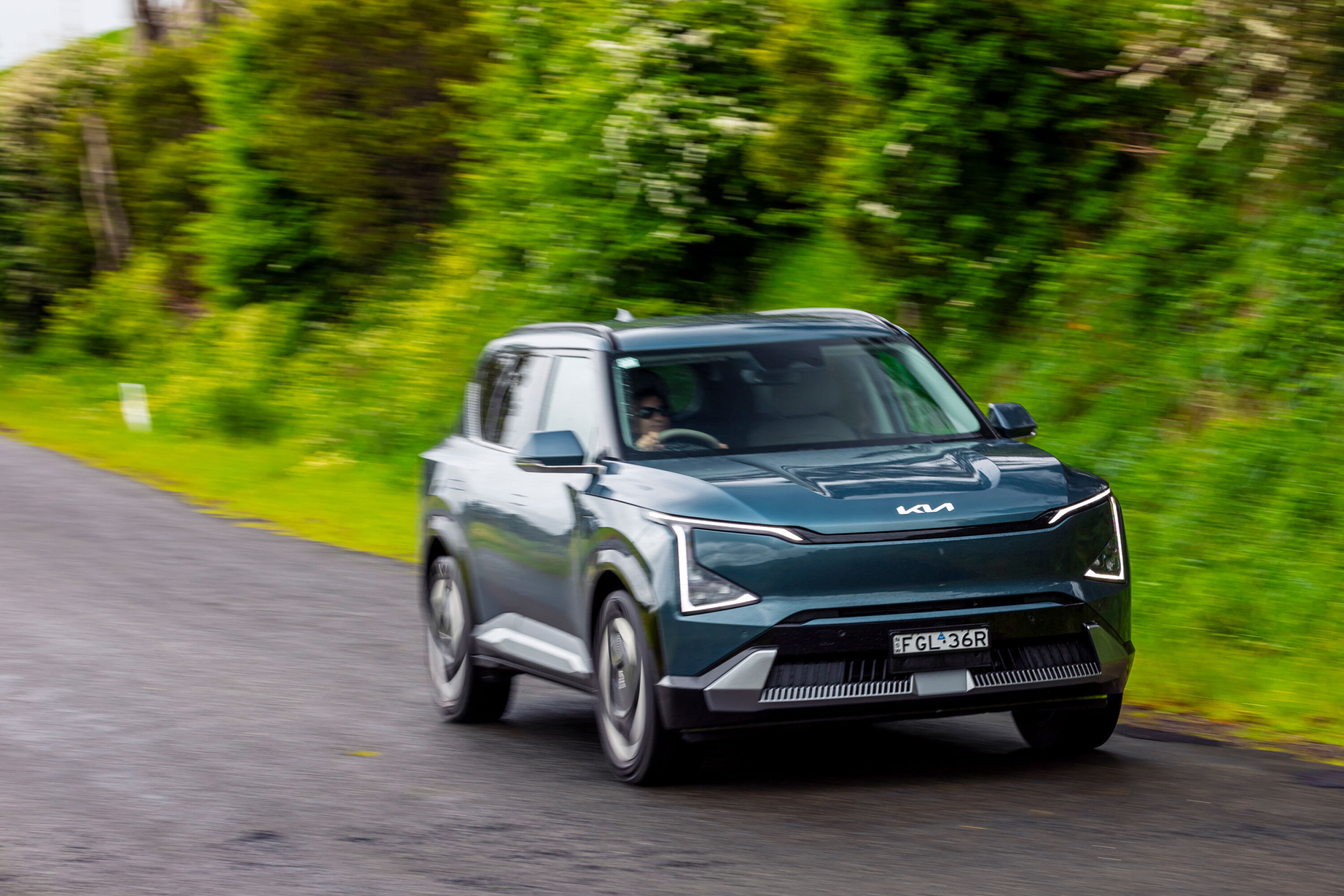
1
Inside, there are dual screens, a feeling of rock-solid build quality and a decent mix of materials – some premium, some a bit cheap. But on the whole, this is a pleasant place to be. Space in the back is also good, with a sliding second row, and there’s a decent 513-litre boot – no doubt helped by the lack of any spare wheel.
Back up front, there was one design feature that had the judges befuddled. Where you’d normally find the centre console, instead the EV5’s passenger seat lower cushion extends inwards almost like a faux bench. Nobody can sit on it, mind you. There’s a pocket in which to stuff things, but the consensus was a classic tale of form over function – no deal-breaker but robbing the EV5 of some crucial central storage space.
With its high seating position and tall overall proportions, the EV5 grants a curious boxy sensation when driving, as if you’re somehow in a short-wheelbase version. And it acquitted itself well enough around Lang Lang’s ride and handling circuit with accomplished EV damping, fluid handling and an absorbent ride quality.
1
While it has two electric motors, ‘just’ 230kW and 480Nm is on offer – something actually sensible if you ask us. You get the security and added usability of all-wheel drive with acceleration more than sufficient for the people who will be buying this vehicle. Not every dual-motor EV should be able to accelerate like a last-generation Ferrari hypercar. Especially in the hands of someone just trying to duck down to their local Woolies for more bread.
Away from the proving ground and road loops of COTY testing, the EV5 is a worthy alternative to the all-conquering Tesla Model Y.
In this guise, its $68,990 drive-away price undercuts the Model Y Long Range, but with comparable range (500km claimed WLTP, versus the Tesla’s 533km), a longer warranty (seven years versus four) and a more classic, car-like interior that makes a Model Y feel featureless inside. There’s also the fact it’s not a Tesla.
– Dylan Campbell
1
| Kia EV5 Earth AWD | |
|---|---|
| Price/as tested | $64,770/$68,990 (d/a) |
| Drive | 2 x electric motors, 88.1kWh lithium-ion phosphate battery |
| Power | 230kW |
| Torque | 480Nm |
| Transmission | Single-speed reduction gear |
| Weight | 2198kg |
| L/W/H/WB | 4615/1875/1715/2750mm |
| Tyre | Kumho Solus HS63 EV 235/35R19 |
| Safety | Untested |
MG4 Essence 64
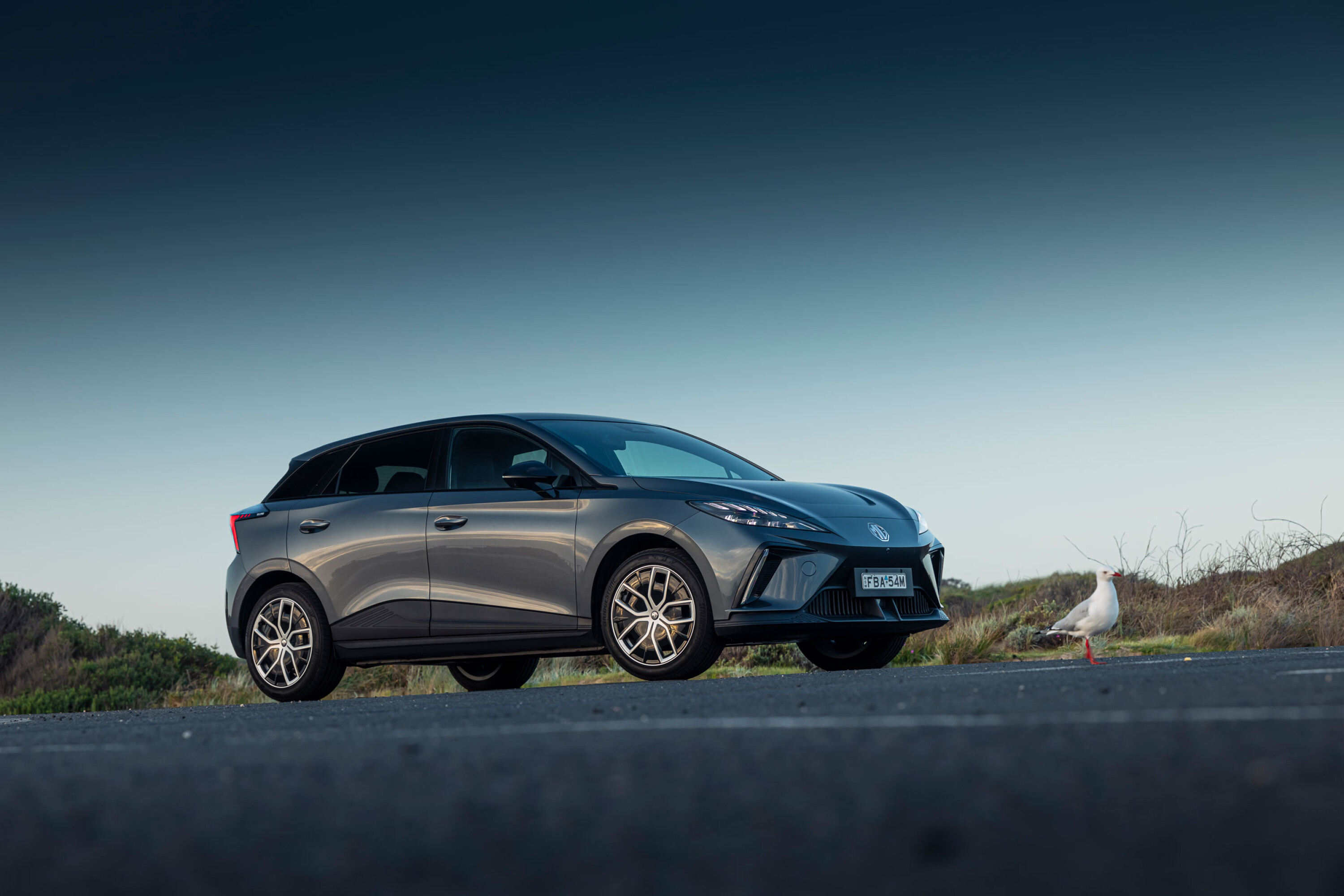
Here is a vehicle that offers performance, practicality and peace of mind – thanks to a 10-year/unlimited-kilometre warranty – but also changes the value equation and makes buying an EV a viable option for so many people by coming to market from just $37,990.
1
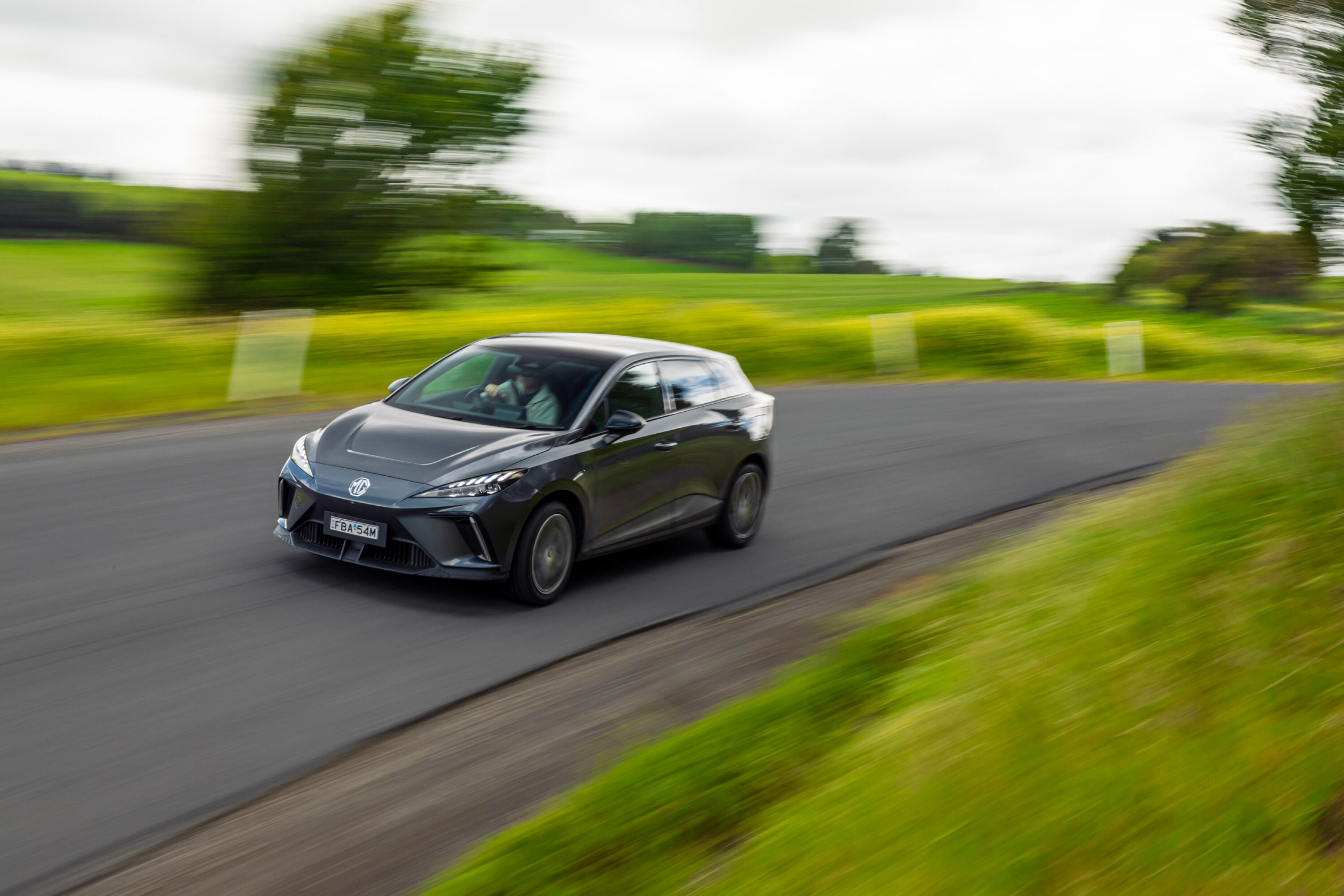
Even if this MG was only a very basic, barely pleasant thing to drive, it would be a game-changer, but in the shape of the MG4 Essence 64 model we were driving at COTY ($49,150 drive-away in Victoria), it’s a lot more than that. Indeed, even at this spec level, it’s a five-door, five-seat family hatch that makes plenty of EVs in the $60,000 to $70,000 price range look like terrible value, while also offering something to the purist with its single-motor, rear-wheel drive powertrain offering 150kW/250Nm and a 0-100km/h time of 7.2sec.
The fact is, it feels a lot faster than that and makes the most of the kind of instant-torque shove that electric vehicles are so good at delivering, particularly where you most want it in those overtaking moments between 60 and 80km/h, and 80 to 110km/h. It does lack a bit of punch above 120km/h, a problem that is resolved if you opt for a twin-motor MG4 model.
Better yet, as all of the judges noted after driving it around the ride and handling loop, the MG4 offers properly sporty turn-in, talkative steering. Having made it through to the final six of this year’s COTY, based on judges agreeing unanimously that the MG4 represents a vehicle that is a genuine game-changer and stands out from the field in terms of value in particular, as well as driver enjoyment (once you get it moving), it’s ride quality was found wanting on the testing road loop.
In terms of driving dynamics, there’s no doubt the MG4 is very good for what it is, and that it marks, as the judges agreed, a line in the sand for MG: “We don’t just make cheap cars – we make cars that are good to drive.”
– Stephen Corby
1
| MG4 Essence 64 | |
|---|---|
| Price/as tested | $44,990/$49,150 (d/a) |
| Drive | 1 x electric motor, 64kWh lithium-ion battery |
| Power | 150kW |
| Torque | 250Nm |
| Transmission | Single-speed reduction gear |
| Weight | 1672kg |
| L/W/H/WB | 4287/1836/1516/2705mm |
| Tyre | Bridgestone Turanza T005 235/45R18 (f/r) |
| Safety | Five stars |
Toyota Camry Ascent Sport
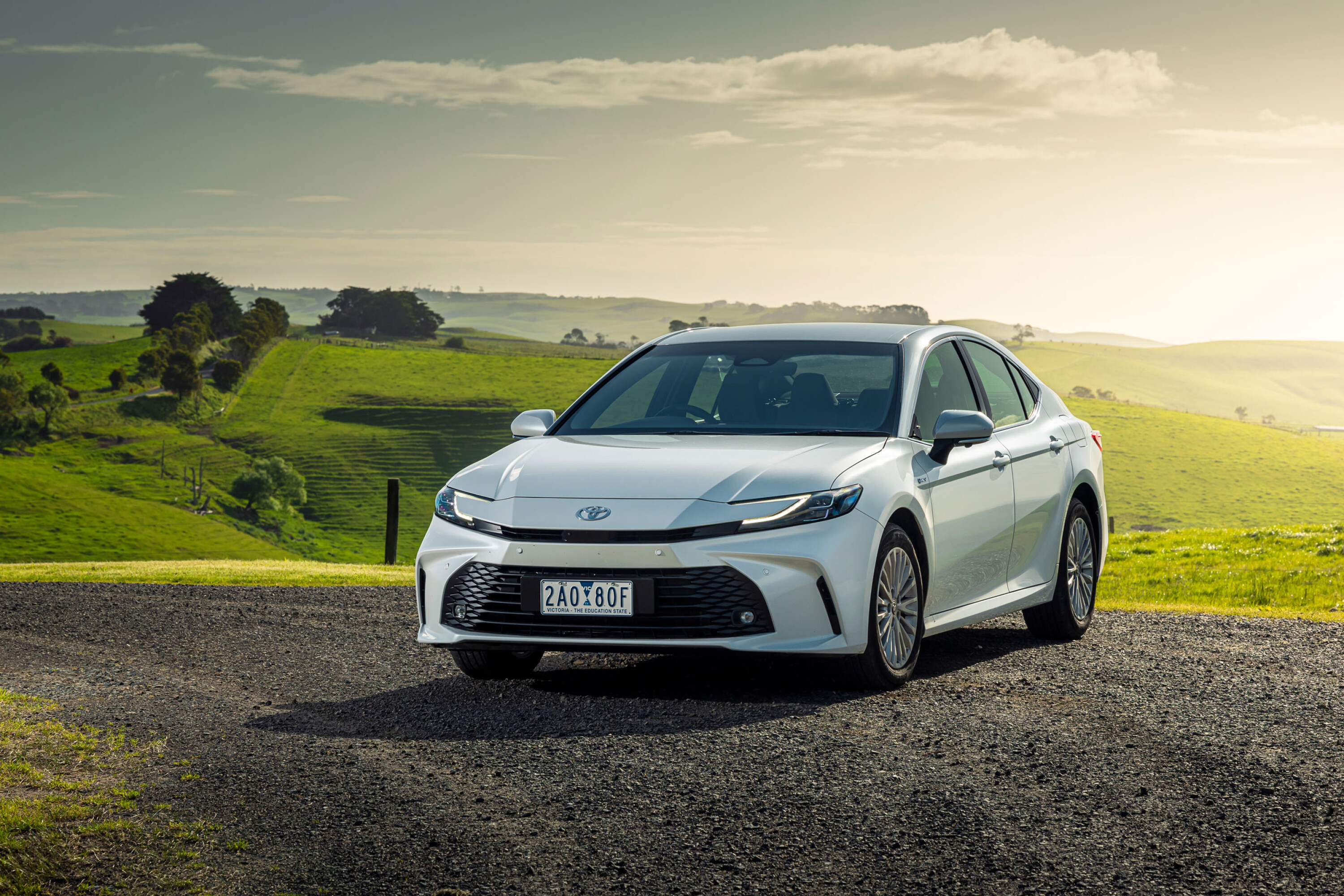
The reason this Toyota is Australia’s most popular sedan, our ubiquitous taxi, and is now employed by more ride-share drivers than any other vehicle, is easy to understand. No potential rival goes close to matching the Camry’s long-acknowledged low operating costs, reliability, and practicality.
1
With the coming of the latest generation, the list of virtues grows to include true refinement, spacious comfort and, now it’s hybrid-only, extremely thrifty fuel economy plus, most surprisingly, driving pleasure.
Today’s ninth-generation XV80 Camry is a worthy evolution of the previous XV70 model – the first based on Toyota’s TNGA-K platform (RAV4 and Kluger), and the Camry that lifted the dynamics and refinement above the mediocre XV50 that ran until 2018.
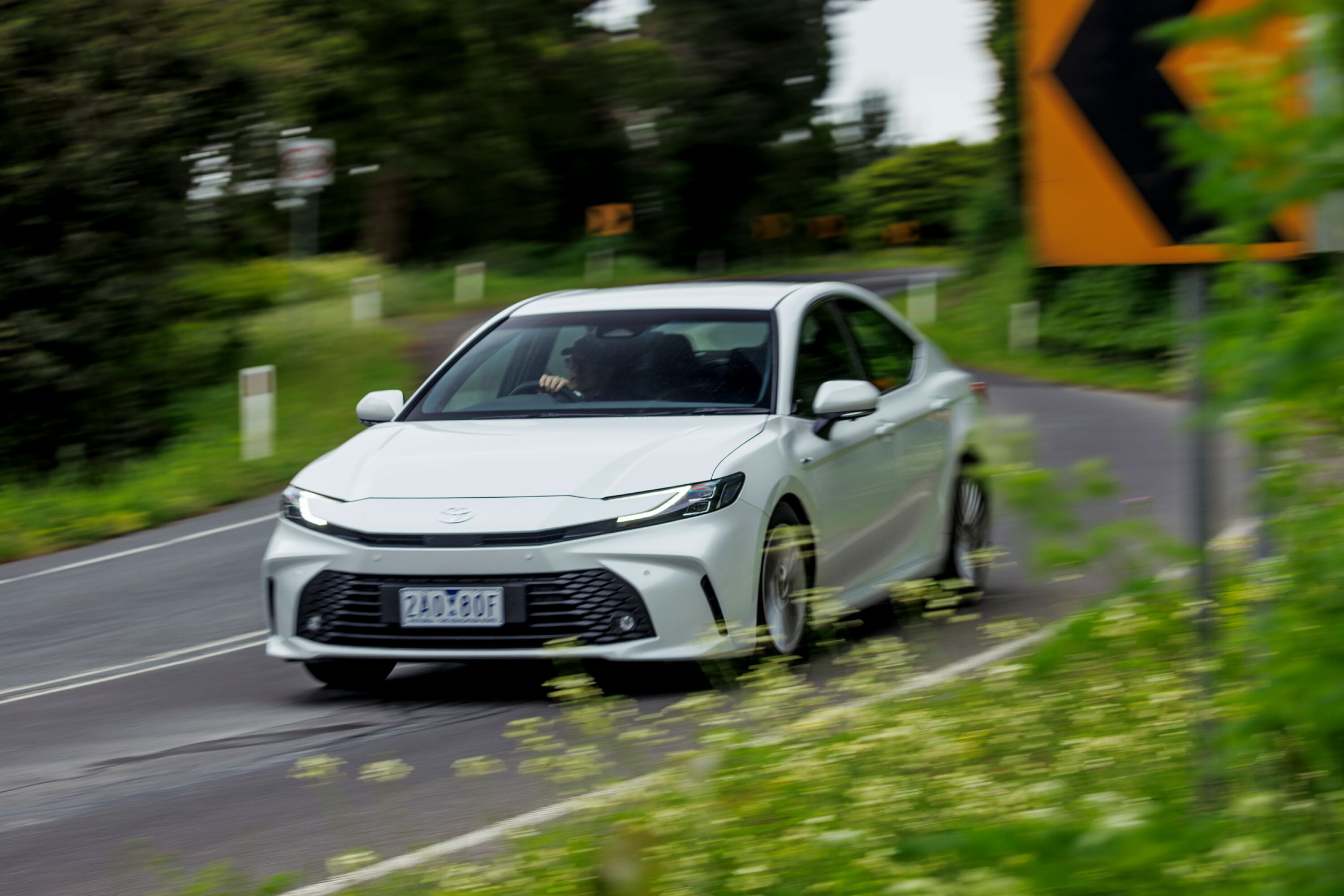
The new Camry is the latest evidence of a quarter of a century spent perfecting hybrid technology, and it shows. Driving it is to experience a wonderful powertrain, whose low-end EV-like performance gets you effortlessly around town. Quick and smooth, the experience feels more creamy and contemporary than ever. On the highway, more throttle is required to overtake but it’s so effortless that the erstwhile V6 is never missed. All this while delivery outstanding – think circa 4.0L/100km or less – economy, though admittedly the 2.5-litre DOHC four does need 95RON premium fuel. There’s no talk of a plug-in hybrid.
1
In as-tested Ascent Sport guise, and despite its conservative, evolutionary styling (the front doors and roof are carried over from the previous model), this is the sportiest Camry we’ve ever driven, as well as being the most comfortable. Subtle suspension and steering modifications (the power steering is now speed sensitive) and a reinforced structure mean this brilliant combination of qualities begins with quick, confidence-inspiring steering, relaxed yet stable and composed road manners, and surefooted braking via a short-travel pedal feel that is easy to modulate. Responsive handling, with just a touch of understeer, provides the Camry with the ability to be punted quickly and effortlessly on challenging roads. Yes, it’s true – here’s a Camry that is fun (perhaps pleasurable is more accurate) to drive.
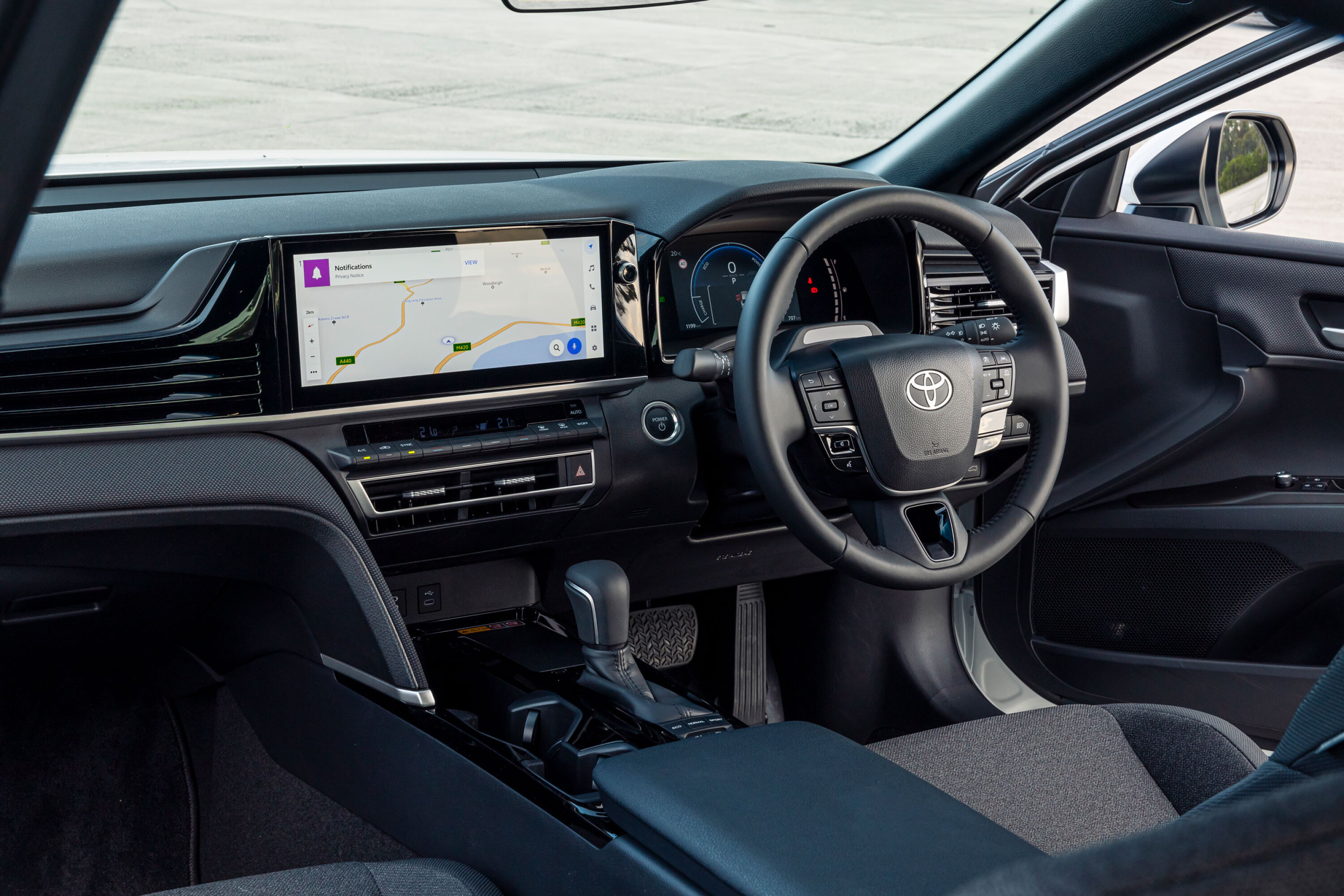
The three-tiered model line-up (the SX has been dropped) includes Ascent and Ascent Sport, clustered closely together on price and equipment. The top-of-the-range SL jumps both in price and equipment. The Camry Ascent, starting from $39,990 plus on-road costs, includes 17-inch alloy wheels, LED headlights and running lights, a urethane steering wheel, keyless entry and start, dual-zone climate control, a 7.0-inch infotainment screen, six-speaker audio, and 7.0-inch driver’s display plus 360-degree cameras.
Our $42,990 Ascent Sport gains high-grade LED headlights and LED fog lights, a powered driver’s seat with adjustable lumbar support, leather-wrapped wheel, and a wireless phone charger. The monitor steps up to a 12.3-inch display and all systems are equipped with wireless CarPlay and Android Auto, AM/FM/DAB+ radio, Bluetooth connectivity, and navigation.
1
The flagship Camry SL kicks off from $53,990 and gets a much longer list of standard features including 18-inch alloy wheels, a panoramic sunroof, leather seat trim (we prefer the cloth), a power-adjustable passenger seat, powered steering column and driver’s memory function, heated and ventilated front seats, heated steering wheel, 12.3-inch digital instrument display, digital rear-view mirror, rain-sensing wipers, a head-up instrument display, and a nine-speaker JBL sound system.
The spacious cabin allows a tall passenger to sit behind an equally tall driver, while the front seats deliver plenty of lateral support, a further encouragement to driving this Camry hard. Sensibly, there are plenty of buttons for the important controls and the 7.0-inch digital instrument display is terrific, with legibility much improved over the previous model. The boot is vast and supplemented by 60/40 split folding seats. A rear parking camera is standard.
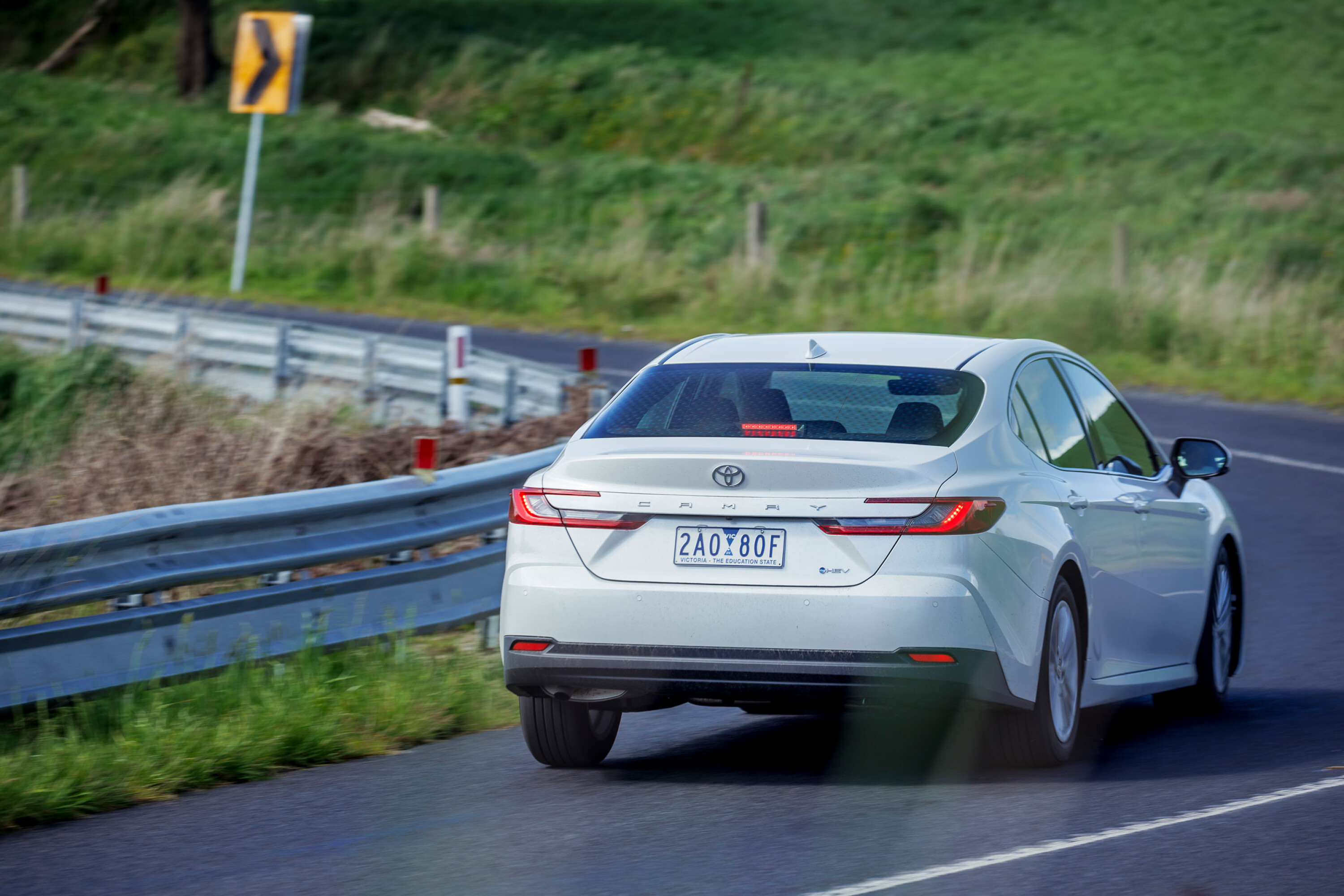
All Camrys come with a standard suite of driver-assistance features that includes automated emergency braking with pedestrian and cyclist detection and automatic high-beam headlamps, active cruise control, and a feature that helps the driver prepare for curves by gently applying the brakes.
– Peter Robinson
1
| Toyota Camry Ascent Sport | |
|---|---|
| Price | $42,990 |
| Engine | 2487cc 4cyl, dohc, 16v, hybrid |
| Power | 170kW (combined) |
| Torque | 221Nm @ 3600-5200rpm |
| Transmission | CVT |
| Weight | 1565kg |
| L/W/H/WB | 4920/1840/1445/2825mm |
| Tyre | Yokohama BluEarth GT 215/55R17 (f/r) |
| Safety | Five stars |
2024-25 Wheels Car of the Year
It eschews gimmickry and concentrates on utility, and that’s something which is sadly lacking. Many large vehicles at COTY were supplied without a spare wheel and tyre set. The Honda doesn’t just supply one, it’s a full-sized item.
It’s exactly this sort of consideration that sets the CR-V apart. Its designers have clearly thought long and hard about how it’s going to be used and have managed its compromises wisely. The ride and handling are measured and relaxing, yet it aced the lane change with less fuss than the driver-focused BMW iX2.
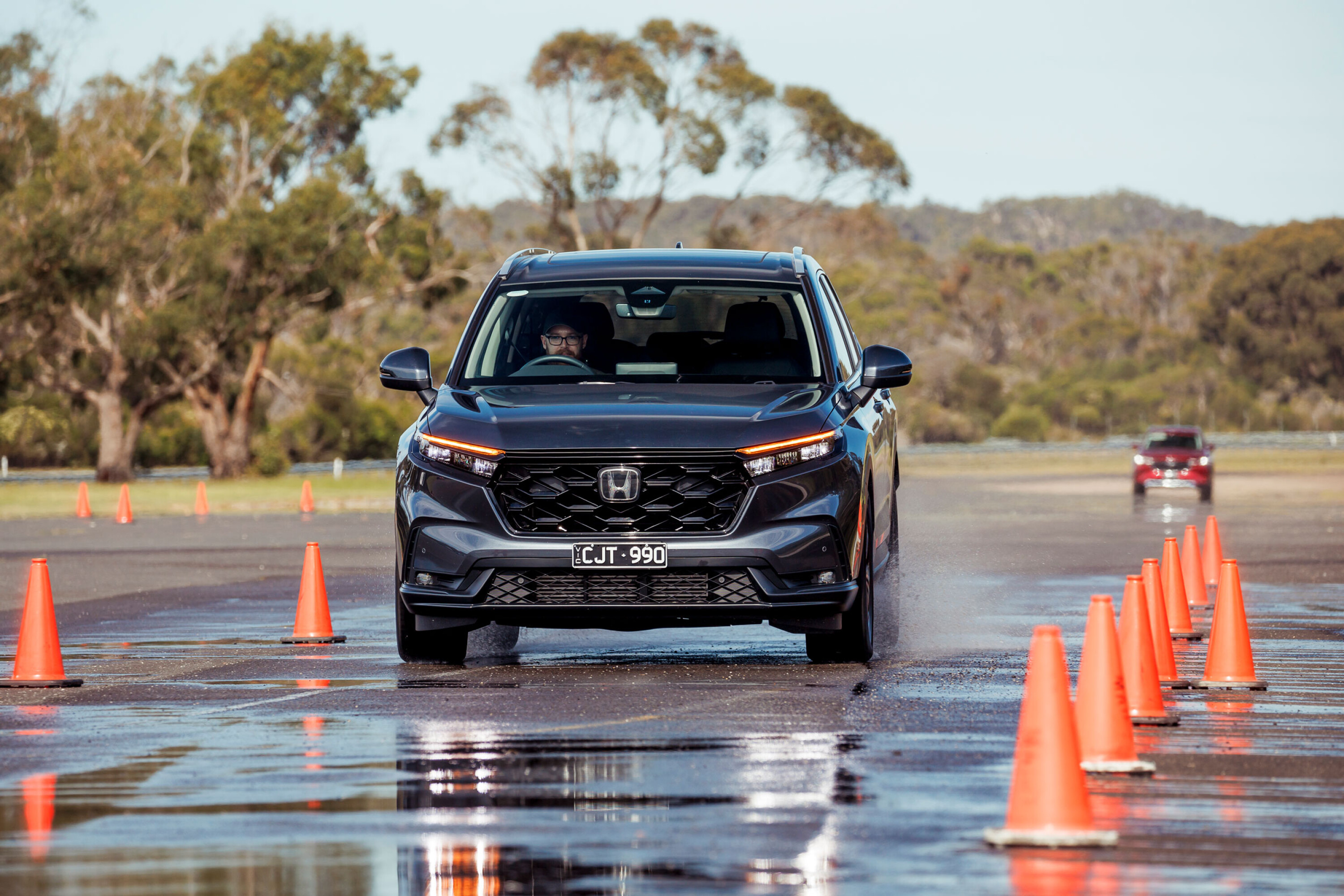
1
One chink in the Honda’s armour comes with its four-star ANCAP rating. It scored low (68 percent) on safety assist and there is a generation of buyers who may see a lack of electronic safety aids as a less-than-desirable thing.
COTY judges agreed that this was a very good five-seat SUV that could have asserted itself a little more stridently.
Honda CR-V VTi-L Specifications
| Price/as tested | $51,300/$51,300 |
|---|---|
| Drive | 1498cc 4cyl, dohc, 16v, turbo |
| Power | 140kW @ 6000rpm |
| Torque | 240Nm @ 1700-5000rpm |
| Transmission | CVT |
| Weight | 1669kg |
| L/W/H/WB | 4704/1866/1691/2700mm |
| Tyre | Michelin Latitude Sport 3 235/55R19 (f/r) |
| Safety | Five stars |
2024-25 Wheels Car of the Year
Beneath its executive exterior is a high-tech, Hyperscreened interior – like a giant smartphone with a steering wheel stuck into one side, faced by two seats.
The boot is classic sedan-capacious (although missing a spare wheel) while the rear seat is superbly comfortable, if tight on foot-room compared to your typical modern-age SUV.
Around the proving ground, a dime-tight turning circle impressed while the turbo-petrol four and nine-speed auto offered the most refined combustion powertrain I’ve ever experienced – incredibly smooth and just so very well done, as if the culmination of a century of development. But some rued the lack of a traditional straight-six, especially when the otherwise whisper-quiet four was put under demand.
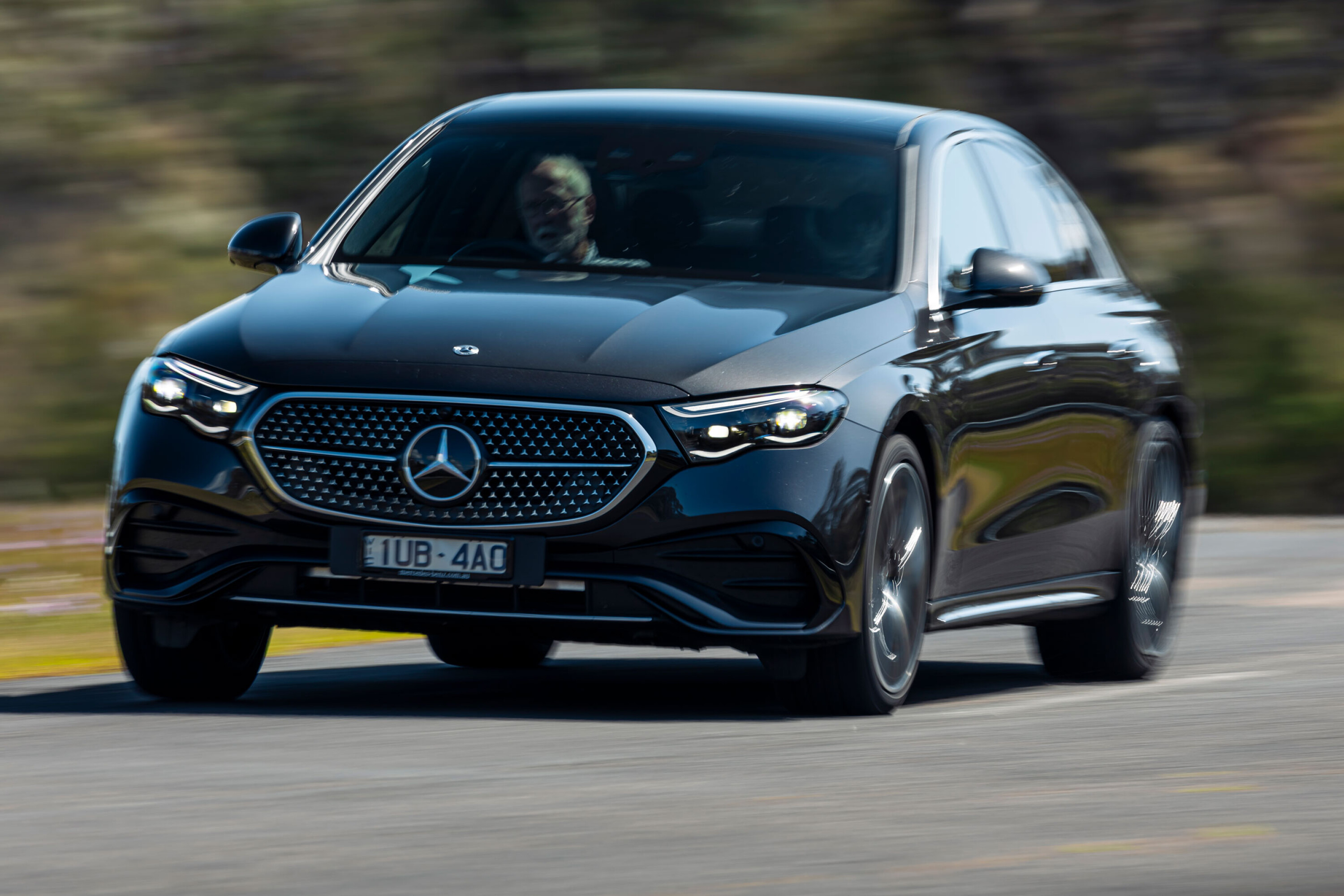
1
Prioritising security, the ride and handling are appropriate for an E300, though the mildly hybridised engine does need to work to shift 1850kg. At Lang Lang, the ESC and ABS, and the watchful aura of active safety software felt second-to-none. Ticks against the safety and driving criteria, then.
Value was also hotly discussed – a little pricey for an E300, or a cheap, junior S-Class? Whichever it was, the E300 is unquestionably a beautiful, professional sedan.
Mercedes-Benz E300 Specifications
| Price/as tested | $130,414/$130,414 |
|---|---|
| Drive | 1999cc 4cyl, dohc, 16v, turbo |
| Power | 190kW @ 5800rpm |
| Torque | 400Nm @ 2000-3200rpm |
| Transmission | 9-speed automatic |
| Weight | 1850kg |
| L/W/H/WB | 4949/1880/1468/2961mm |
| Tyre | Continental EcoContact 6 245/40R20 (f), 275/35R20 (r) |
| Safety | Untested |
2024-25 Wheels Car of the Year
Let’s start with the good stuff. After establishing a beachhead with the popular Atto 3 small SUV and then consolidating its market share with a host of other electric models, the Sealion 6 mid-size SUV is BYD’s first proper shot at nabbing some serious sales volume in Australia. As a rival for the Toyota RAV4, it’s playing in one of Australia’s most popular segments, and in a brochure or on the showroom floor, it presents beautifully.
The exterior design is generically handsome, the cabin offers an impressive amount of room and high levels of standard equipment, and the technology offering is also suitably high-tech thanks to the inclusion of BYD’s large 15.6-inch touchscreen which can rotate through 180 degrees.
Then there’s the price. At $48,990 before on-road costs for the entry-level Dynamic or $52,990 for the all-wheel-drive Premium version we’re testing here, the Sealion 6 delivers a lot of SUV for the money.
The BYD’s value equation only gets sweeter when you consider what’s under the bonnet. In combining a 1.5-litre turbo-petrol four-cylinder with twin electric motors and a relatively large 18.3kWh lithium-iron-phosphate battery, the Sealion 6 is BYD’s first plug-in hybrid. Power and performance are healthy thanks to combined outputs of 238kW and 550Nm (the cheaper non-turbo Dynamic makes do with 160kW/300Nm) but it’s the claimed driving range of 1092km from a full battery/tank that really appeals.
The powertrain is impressively refined, too, and the handover between battery and piston propulsion is imperceptibly smooth. The system favours electric power, which lends an EV-like driving experience, and BYD claims a full battery will provide 81km of range before the petrol engine kicks in.
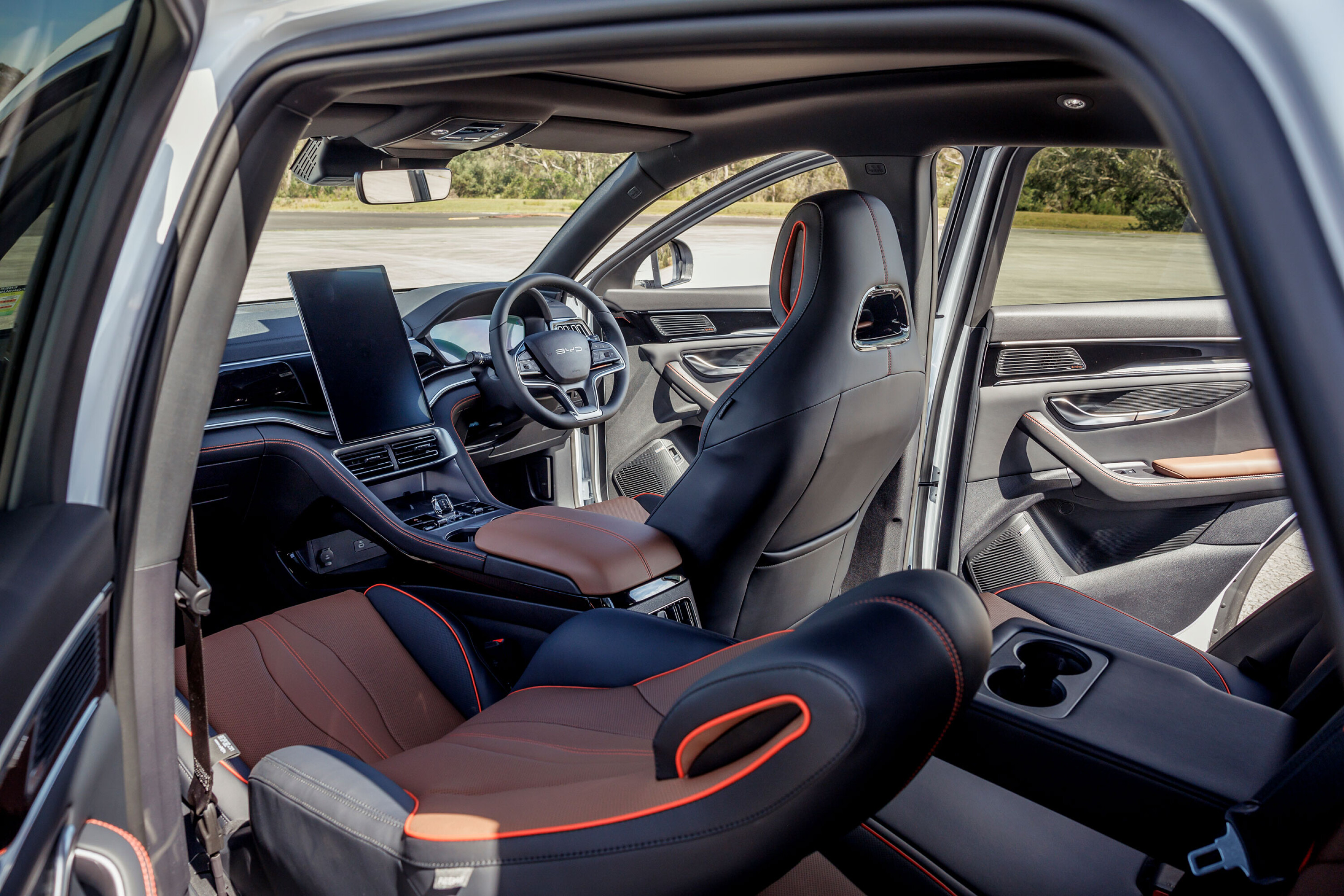
1
Where things start to head south is through the lane-change manoeuvre during COTY testing. Tip the Sealion 6 into the first swerve and its tail will scuttle cones on the outside before swinging wildly back the other way through the change-of-direction.
Things don’t improve around the ride and handling circuit. While the front seats lack proper lateral support, it’s the vague steering and underbaked suspension that really blemish the Sealion’s scorecard.
The good news is BYD is aware of the issues and has already introduced a running change to the suspension set-up for cars currently rolling off the production line. As it stands, though, it’s clear there’s plenty of room for improvement in how the Sealion 6 drives, despite its compelling on-paper promise.
BYD Sealion 6 Specifications
| Price/as tested | $52,990/$52,99 |
|---|---|
| Drive | 1498cc 4cyl turbo PHEV + dual electric motors, 18.3kWh battery |
| Power | 238kW |
| Torque | 550Nm |
| Transmission | Single-speed reduction gear |
| Weight | 2100kg |
| L/W/H/WB | 4775/1890/1670/2765mm |
| Tyre | Giti Giticomfort 235/50R19 |
| Safety | Five stars |
