
The original Volkswagen Tiguan was one of the better SUVs to drive, but held back by its limited practicality. This new, second-generation model sets out to offer a much-improved all-round experience. Let’s see if it succeeds…
WHAT STANDS OUTTiguan for 2017 is longer and wider than the old model, and makes use of its larger dimensions to improve space inside for passengers and cargo. That includes what is arguably the biggest change: where the Tiguan’s boot space was previously one of the smallest in its class, it’s now one of the biggest, and will more easily fit items such as prams and even bicycles.
Tiguan has a healthy range of variants once again, and it’s hard to go far wrong with any of the turbocharged engine choices. The base model powers the front wheels only; other models feature all-wheel drive.
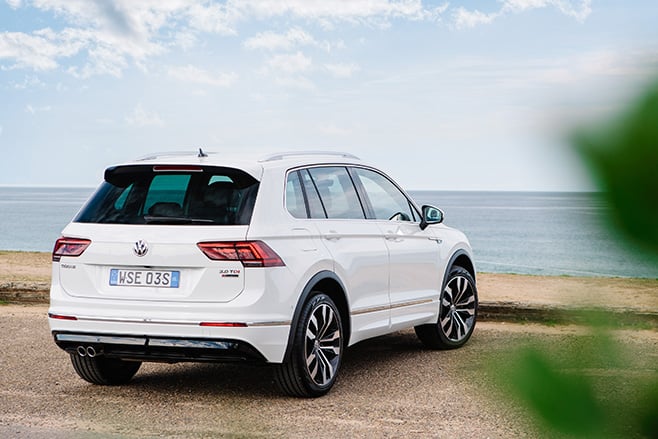
If you like sporty engines, it’s worth noting the Tiguan 162TSI, which is powered by the same engine as the iconic Golf GTI. The Tiguan can even match the hot-hatch’s 0-100km/h time of 6.5 seconds, by compensating for its extra weight with all-wheel-drive traction where the Golf is front-wheel drive only.
Standard equipment has also increased. All Tiguans include autonomous emergency braking, reversing camera, rear parking sensors, daytime running lights, and alloy wheels.
WHAT’S INSIDEThe Tiguan’s cabin presents class-leading quality, including the most important touch point, this tactile steering wheel, which is more or less identical to those in VW’s most luxurious models the Passat and Touareg.
An 8.0-inch touchscreen adds to a premium feel that helps offset its pricing that is a bit higher than the segment average.
Rear-seat passengers are treated to their own air vents, and the second-row bench slides forwards and backwards depending on whether leg or luggage space is the priority.
The middle Comfortline trim grade adds items including navigation, 3-zone climate control, and additional practical elements such as folding rear tables, storage drawers and luggage net.
Top-spec Highline models bring leather seats, ambient lighting, keyless entry, 18-inch wheels, LED headlights, and an automatic tailgate among their extras.
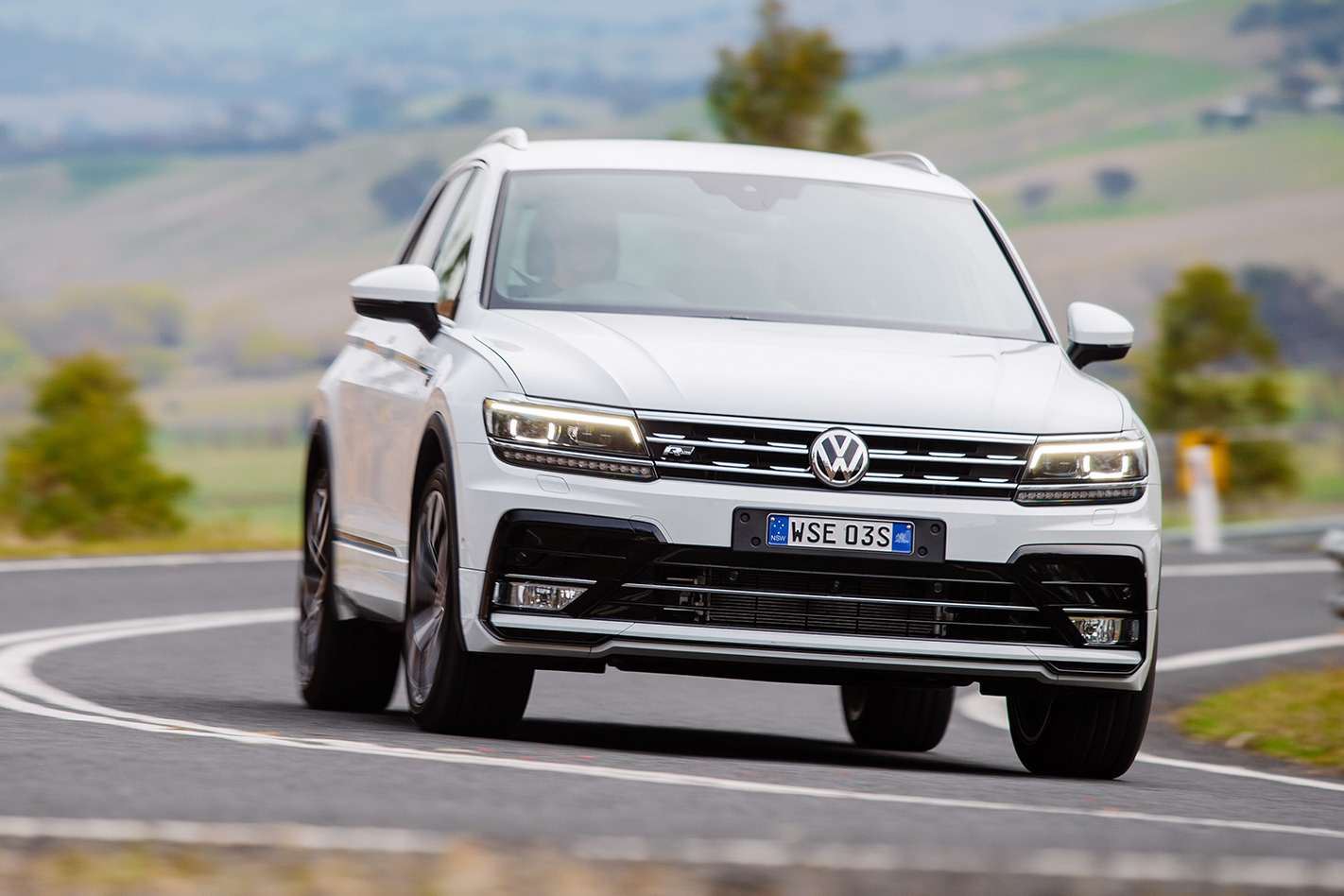
CHOOSING YOURSThe Volkswagen Tiguan is available in seven different configurations of trim grades and drivetrains, so there’s no shortage of options for varying budgets.
Engine and gearbox combinations are determined by trim grade. Where there’s a choice of petrol or diesel power, it largely depends on whether you prefer the sprightlier performance of petrol or the extra fuel efficiency of diesel.
Whichever way you go, the Tiguan is one of the best mid-sized SUVs to drive with a well- judged blend of refinement, comfort, and handling ability. The best ride quality comes with the addition of optional adaptive dampers.
If you have the budget for the 162TSI Highline, you have a genuine mainstream alternative to more expensive small SUVs from the luxury brands.
SUMMING UPThe Tiguan still isn’t the most affordable SUV in the mid-sized class, but it’s better than ever.This model addresses the packaging shortfalls of its predecessor while retaining a great driving experience. Throw in a higher-quality interior and stronger equipment levels, and the Volkswagen Tiguan is a must for your shortlist.
US CHEVROLET dealers have snapped up an entire year’s allocation of Holden Commodore-based SS sports sedans ahead of order books for the car closing at the end of this month.
Chevrolet confirmed to Wheels overnight that even the extra 1000 cars that Holden will build for the US export market this year on top of its existing 2000 units had gone.
“All US dealer orders are in for the allocated production of the 2017 Chevrolet SS,” Chevrolet said. “This includes any additional units that were confirmed for production last year.”
The iconic brand also confirmed Chevrolet dealers had sold out of 2016 model year builds of the SS sedan. It is believed that most of the allocation of 2017 cars has already sold out.
Chevrolet is anticipating big demand for the Commodore-sourced SS as the brand builds up to the opener for the 2017 NASCAR race season. Last weekend, NASCAR driver Chase Elliot and the #24 Chevrolet SS race car set the pole for next weekend’s Daytona 500.
Holden said from the outset in 2013 that limited exports of its V8-engined Chevrolet SS would make the car a niche model for the brand.
The Chevy-badged Commodore reignited Holden’s export program after the 2008 global credit crunch slammed the door on Pontiac-badged two-and four-door models sent to the US, and General Motors weighed up a potential sell-off of its Australian subsidiary to stave off bankruptcy.
Holden marks the end of almost 40 years of local Commodore production on October 20.
The US-based Road and Track magazine said the loss of the Chevrolet SS would leave the Dodge Charger as the only affordable rear-drive V8 sedan on sale.
“Besides the Charger, the closest car to the SS that’s still on sale today is, shockingly, the Lexus GS F,” it wrote.
“Both have similarly-powerful naturally aspirated V8s, and similar curb weights, though the Lexus is much more expensive and isn’t offered with a manual transmission.
“All of this is to say that the SS will be sorely missed by the few that recognised its charms.
“It’s so good, we deemed it worthy of comparison to the all-time benchmark sports sedan, the E39-chassis BMW M5.”
Want the Skoda Superb 206TSI but think it lacks some visual punch? Well, the Czech manufacturer has the answer with a new $1000 SportLine visual package.
Available for both the sedan and wagon versions of the Superb, the SportLine package adds new black accents and trim.
Outside, the pack adds new badging on the front fenders, black door mirrors, a black rear diffuser, chrome exhausts, black grille, black side strips, and new SportLine exclusive 19-inch anthracite alloy wheels.
For the sedan you also get a black rear spoiler, while for wagon owners the spoiler is in the body colour, and roof rails painted black.
Inside, there is a SportLine dash cluster, sport seats with Alacantra inserts, a three-spoke flat bottomed wheel trimmed in perforated leather with silver stitching, a dash strip with SportLine badging, aluminium pedal covers, Alacantra inserts in the door trims, black ceiling liner, and a customisable performance monitor with lap timer.
There are no performance upgrades for the extra cash.
The 206TSI is powered by a 206kW/350Nm 2.0-litre turbo four-cylinder, with a 6-speed dual clutch automatic gearbox, and permanent all-wheel-drive. The sporty Superb can do 0-100km/h in 5.8-seconds.
Skoda Australia Managing Director Michael Irmer says the introduction of the SportLine Package was driven by consumer demand.
“Our customers want ‘Christmas trees’, with all the latest available technology coming out of Europe” he said. “More than 90 per cent of them specify Tech and Comfort packages.”
The Skoda Superb SportLine will cost $51,990 for the sedan, and $53,690 for the wagon.
The Tech pack and Comfort pack are an additional $3400 and $700 respectively, while the addition of a sunroof will cost $1700 for the sedan, and $1900 for the wagon.
Skoda will introduce its new Kodiaq seven-seat SUV in July, plus a new Octavia and Scout later this year.
VICTORIA’S police force will ditch the digital world for analogue in its latest attempt to slow down the state’s speeding motorists, reviving decades-old technology for a blitz on leadfoots.
Operation Retro will reintroduce the digitector, a 1970s-era speed measurement device that uses two pneumatic strips placed 25 metres apart to work out the speed a vehicle is travelling. The recorded speed is then displayed to police on a digital device connected to the digitector.
“Even though we don’t use this technology often, it is a highly effective speed measurement device that enables us to enforce the speed limit in built up areas where other technology can’t be used,” Prahran Highway Patrol sergeant James Robbins said.
Strict speed limits ‘can be detrimental to road safety’
The blitz will run in the Stonnington and Port Phillip areas for one day a month over the next five months.
Reverting to analogue technology to trick motorists more used to digital forms of detection isn’t new, with Victoria Police often dusting off the digitector for a number of speed blitzes throughout the state. It was last used about three months ago.
NSW Police also appear to drag the devices out of the cupboard occasionally.
“These days, repeat speeding offenders are always on the lookout for a police car with a radar attached, but they have all forgotten about the digitector,” Victoria Police senior sergeant Wayne Cully said at a separate roll-out of the devices way back in 2009.
Speeding should be legal, says US proposal
“It’s pure mathematics. This device always catches the speeding drivers by surprise, they don’t realise they’ve been caught until they’re being waved in.”
Police are worried about the number of speeding motorists on the state’s roads after the death toll rose to 291 in 2016 – a 15 percent rise over 2015’s tally and the fourth year running that the annual toll has risen.
According to a Victorian auditor general’s report tabled in 2006, Digitectors were “not commonly used [by Victoria Police] because of the time taken for setting up the device and their poor covertness”.
Victoria recorded more than 299,000 speeding infringements in the first three months of the 2016-17 financial year. Of all the infringements handed out, more than 27,000 had the fine reduced to an official warning.
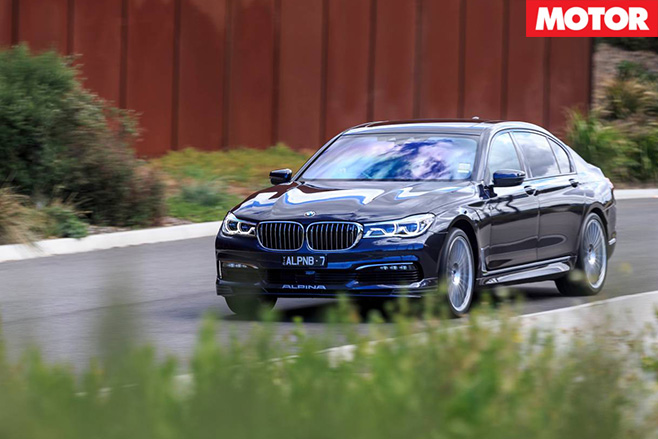
Alpina continues to introduce its performance-tweaked BMW range to Australia, with a fettled-7 Series dubbed B7 the latest to land priced from $369,720 plus on-road costs.
The price adds $55,000 to the regular BMW 750i-L on which the B7 is based. For that price, however, the 4.4-litre twin-turbocharged V8 engine moves from 330kW to a sizeable 447kW while torque lifts from 650Nm to a ‘bahn-storming 800Nm.
Alpina claims the B7 offers “class-leading performance figures in the segment of luxury performance sedans” with its 4.2-second 0-100km/h claim and 330km/h top speed. Audi may have something to say about that, though, given its more affordable (relatively speaking) $330K S8 Plus takes 3.8sec to reach triple digits, with 2kW and 50Nm less.
Read how the Alpina B7 compared to the Audi S8 and Jaguar XJR.
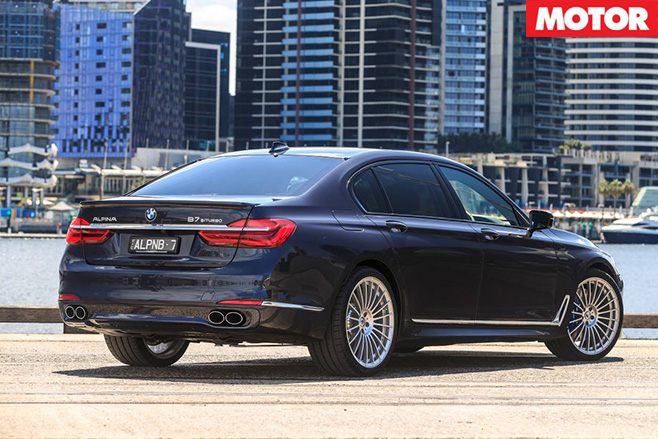
The B7 isn’t only about wafting straight-line speed, however.
While new pistons, spark plugs and exhaust system, and revised engine intake manifold, intercooler and turbocharger pressure take care of the lift in outputs, a new Sport+ adaptive suspension mode is an Alpina-only addition for this rear-wheel-driven tuner flagship.
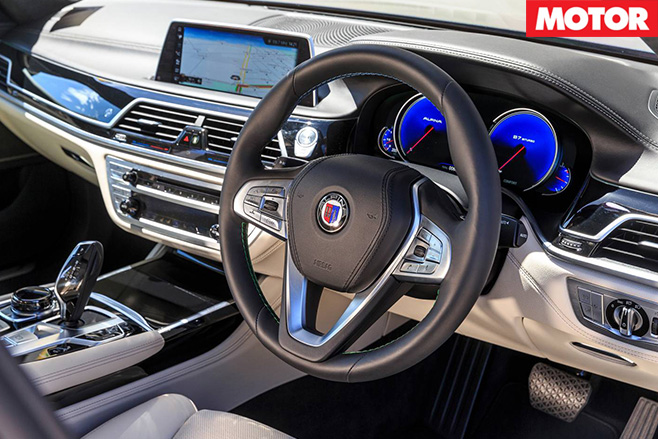
Alpina badging front and rear, quad exhaust outlets and subtly menacing multi-spoke alloy wheels and bodykit, all round out the exterior changes to this stealth executive express that remains as opulent inside as its donor car.
At this price, though, there are a number of options for Madam or Sir to consider – both from within its own ranks, and those of Audi, Aston Martin, Bentley and Mercedes-AMG.
A FACELIFTED Range Rover Sport spotted testing this month is reportedly a plug-in hybrid model featuring Jaguar Land Rover’s new petrol-electric powertrain.
Featuring high-voltage warning stickers signifying it’s an electric vehicle, the 2018 Range Rover test mule has a new front bumper and grille which, according to British motoring website Autocar, houses the charging port.
The hybrid unit is believed to include a 220kW in-line four-cylinder Ingenium petrol engine and a lithium-ion battery stored under the boot floor and is the same system expected to be used in hybrid versions of the Jaguar F-Pace, XF and XJ.
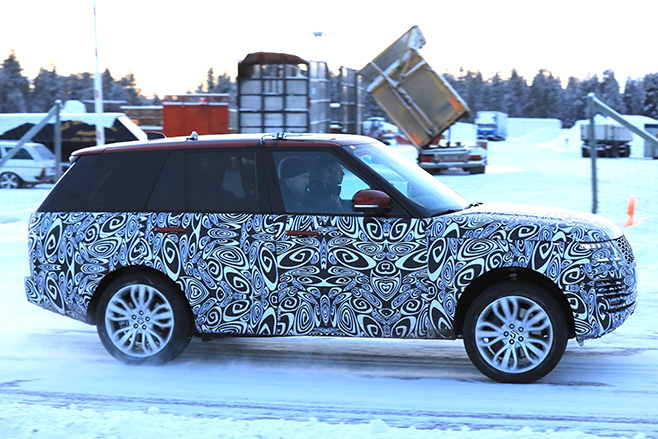
In the Range Rover it’s expected to have an electric only range of up to 50kms.
The all-new powertrain is a significant improvement over the current Range Rover Autobiography SDV6 Hybrid’s diesel-electric system available since 2013, which has an all-electric range of 1.6Kms limited to 48km/h.
All other engines are expected to carry across to the updated model including the 3.0-litre supercharged petrol V6, 3.0-litre twin-turbo diesel V6, 4.4-litre twin-turbo diesel V8 and the less-than frugal 5.0-litre supercharged petrol V8.
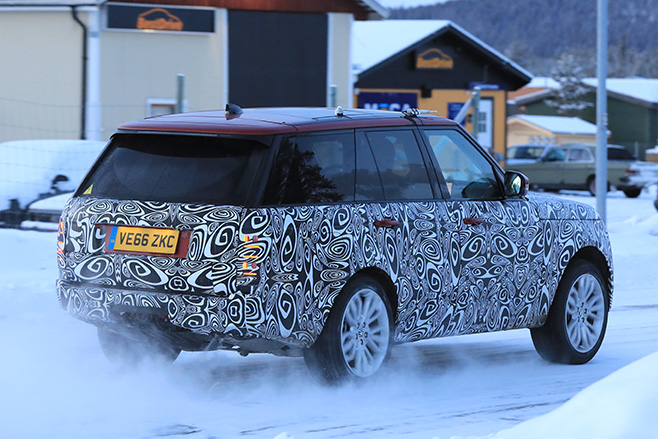
The camouflaged prototype features a couple of other slight differences to the current model including tweaked head and tail lights and a new wheel design.
Driver assist cameras and sensors also seem to take up more space at the top of windscreen which could mean more advanced autonomous driving tech.
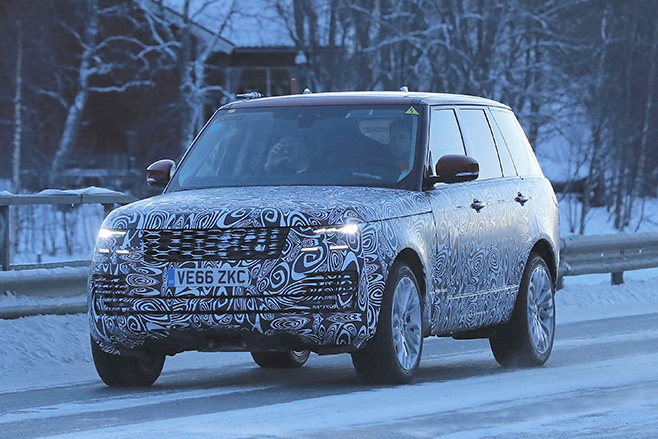
The interior was also disguised, which suggests the facelift will include more than just an exterior nip and tuck.
Other plug-in luxury SUVs include the BMW xDrive40e, Mercedes-Benz GLE550e, Porsche Cayenne S E-Hybrid, Volvo XC90 T8 and the upcoming Bentley Bentayga PHEV and Lamborghini Urus.
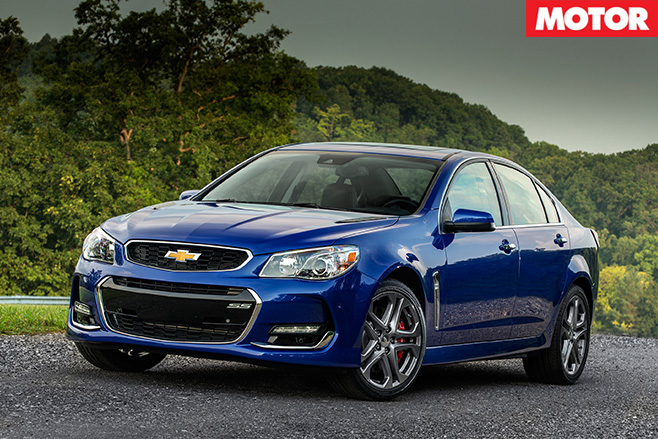
Chevrolet has now officially closed its order books for the SS – or what is our export Holden Commodore SS-V Redline.
Stateside automotive blogs and websites are in mourning this week as a Chevrolet spokesperson confirmed that Sunday February 19 would be when order books for the four-door with the Aussie accent would close. Which is right now, Yank time.
Chevrolet has confirmed this in a statement today saying “All US dealer orders are in for the allocated production of the 2017 Chevrolet SS. This includes any additional units that were confirmed for production last year.”
Essentially, anyone without an order in already will have to pick from existing dealer stock. The Chevrolet SS was only available as a single model overseas, heavily based on our Commodore SS-V Redline but with a few extras thrown in.
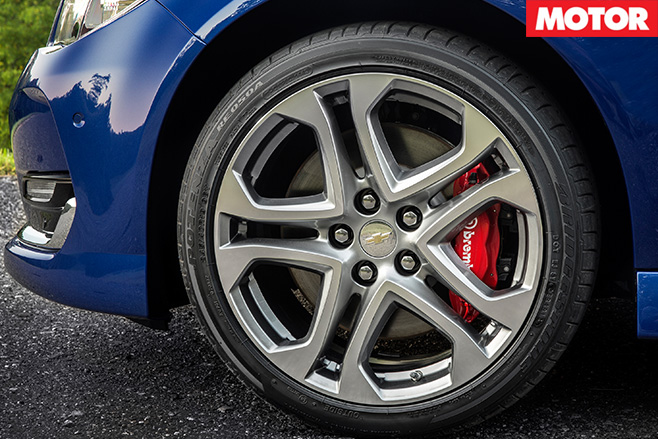
It received adaptive magnetoheorological dampers that Holden sadly reserved for the limited-run Commodore Motorsport Edition and Director locally, and was equipped with ventilated front seats and internet connectivity that have never (and will never be) available locally.
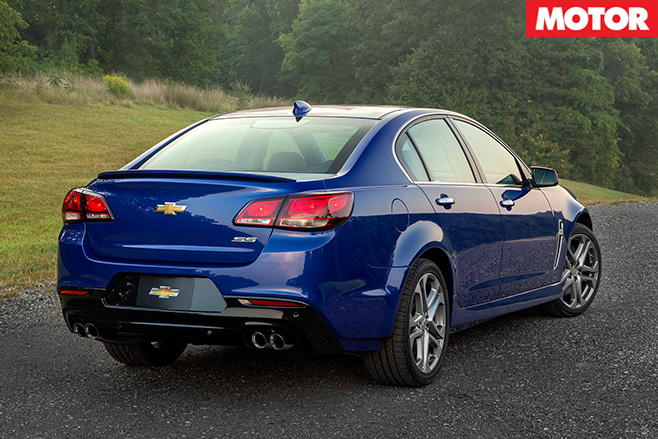
The 6.2-litre V8-engined Chevy was available in both six-speed manual and automatic transmission, but with a pricetag of US$46,625 plus on-road costs. As it turns out, the motoring press appeared to love the SS more than punters did – its popularity has remained low since it first launched in late 2013 and few are seen on American roads.
Why? For some context, a BMW 330i M Sport costs US $44,445 plus on-roads. It also isn’t subject to a further $1000 ‘gas guzzler’ tax, as the Chevy is in some states such as populous California. In Australia, it’s $54,990 Commodore SS V Redline versus $69,900 330i.
However, as Road and Track magazine reported: “The SS will be sorely missed by the few that recognised its charms. It’s so good, we deemed it worthy of comparison to the all-time benchmark sports sedan, the E39-chassis BMW M5.”
The original VE Commodore that debuted the wholly Australian-engineered Zeta platform, upon which the VF Commodore sits, was actually benchmarked on BMW’s E39 5 Series, which beyond the brilliant M5 also delivered a ride and handling balance in regular models that the successive runflats-equipped E60 and outgoing F10 generations struggled to match.
“Besides the Charger, the closest car to the SS that’s still on sale today is, shockingly, the Lexus GS F. The only other V8-powered four-door from GM is the 477kW Cadillac CTS-V, which carries a base price that’s nearly $40,000 higher than the SS.”
The Chevrolet SS export program was pushed into fruition by former GM Holden managing director Mark Reuss before his departure in 2009. The US-born citizen now holds the title of GM global president.
There is nothing quite as menacing as the face of a street-legal race car appearing in your rear-view mirror.
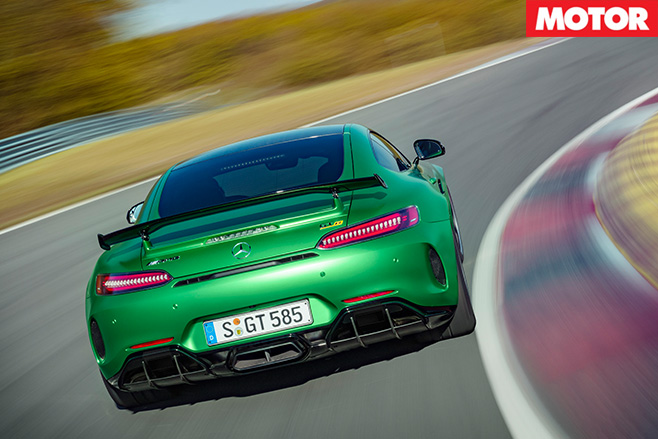
Halfway through a lap of Portugal’s fearsome Portimao circuit, between the Torre and Alonso corners, to be precise, I catch a glimpse of the angry grille of the new Mercedes-AMG GT R. Inspired by the 300SL Panamericana, it’s an aggressive sight, with 15 vertical chrome teeth and piercing LED eyebrows giving it a visage of pure evil.
The intimidation factor is ratcheted up a few notches by being sandwiched between two pros. Steering the lead car is former DTM champion Bernd Schneider, while the man filling my mirrors is Cristian Gebhardt, the driving wizard from Germany’s Sport Auto who set the staggering 7min10.9sec GT R Nurburgring lap time.
Prior to embarking on our hot laps, AMG’s new flagship signalled its focus with the need to manually adjust the carbonfibre seat. As ever with the GT, cabin space is tight and these new lightweight buckets add to the squeeze, while some of the plush niceties of the GT S are conspicuous in their absence.
Schneider offers some tips on extracting the best from this beast: “Put the drive-mode selector into Race. Now switch off ESP altogether. See the display between the speedo and the rev counter? It shows the traction control setting.
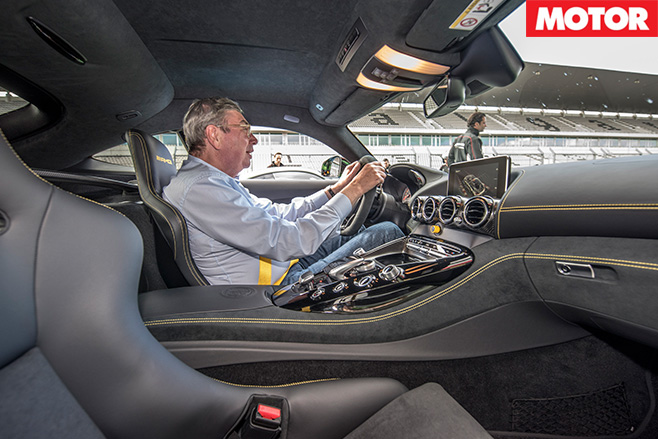
As well as a choice of four driving modes, three damper settings and three ESP modes, with the electronic nanny deactivated the GT R offers nine different traction control settings, with the ability to transform the handling characteristics from safe and placid to manic animal.
A challenging mix of slow and fast corners, gradient changes and blind crests, Portimao makes for a memorable driving experience. With every lap my confidence grows, but while the two professional racing drivers accompanying me do a wonderful job of taking the GT R to its limits, those of us with two left feet and an impatient temperament find it all too easy to find the AMG’s electronically-defined ragged edge, killing momentum in the process.
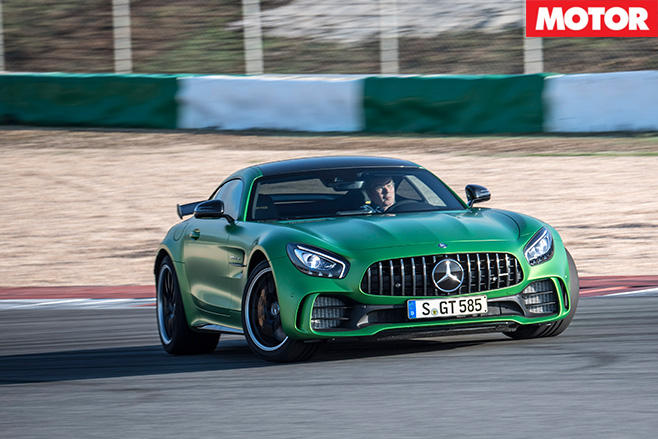
Despite weight saving measures such as aluminium suspension components, carbonfibre front guards, roof and propshaft, magnesium front deck and titanium exhaust system, at 1555kg the GT R is only 15kg lighter than the GT S thanks to the addition of active aerodynamics, wider wheels and tyres and all-wheel steering.
The variable-rate steering system is an intriguing and interesting setup. The weighting is much meatier than the GT S, but depending on speed, mode and lateral acceleration, driver input has complex consequences.
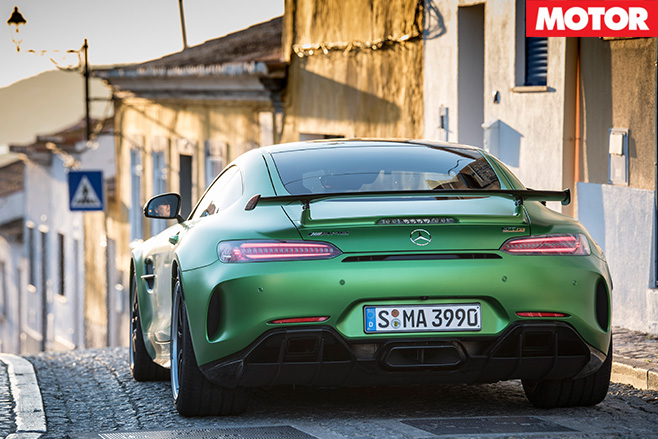
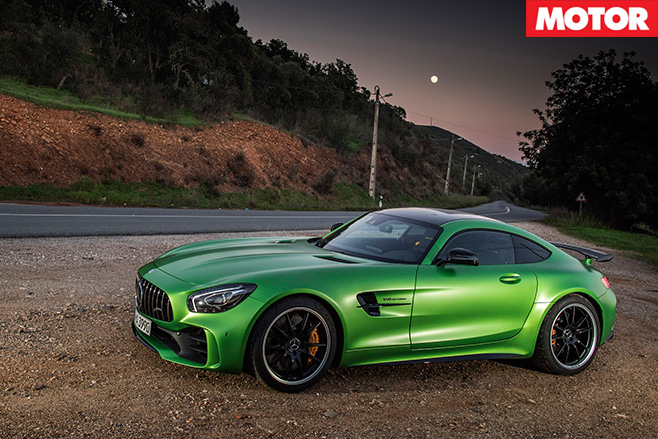
As a result, the latest sports car from Affalterbach is fitter than ever, more focused, sharper and ultimately faster than its lesser brethren. On the track the active aerodynamics boost high-speed stability, replacing traditional rubber bushings with uniball joints ensures instant response and the optional carbon-ceramic brakes are worth their weight in gold, matching the colour of the calipers.
Away from the circuit, this focus does force some compromises; even with the systems at their cushiest, compliance is not exactly a GT R strong suit. On the deserted highways from Portimao to the coast at Lagos it takes total concentration to hold the car at speed.
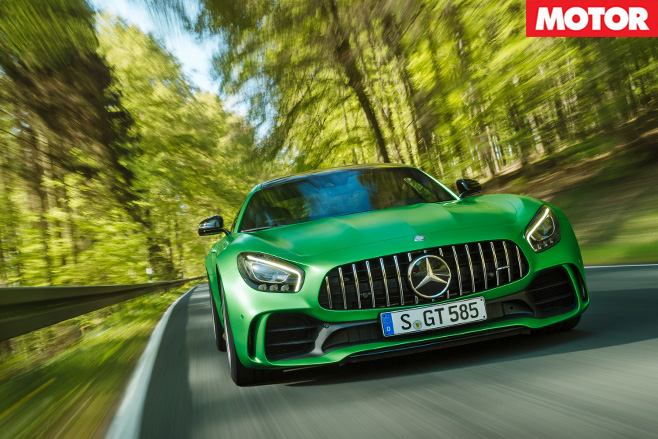
Regardless of the venue, however, the GT R’s straight-line pace never fails to make a dramatic impression. With the 6.2-litre naturally-aspirated V8 an increasingly distant memory, AMG is now concentrating all its efforts on the new 4.0-litre twin-turbo V8, with the turbos nestled between the cylinder banks in a ‘hot vee’.
In R guise an increase of boost pressure from 1.2 to 1.35bar (17 to 20psi) results in 430kW/700Nm, increases of 55kW/50Nm over the S. Combined with revised ratios for the seven-speed dual-clutch transaxle – a longer first gear and shorter ratios in sixth and seventh – the 0-100km/h sprint takes 3.6sec while top speed is pegged at a convenient 320km/h (199mph), presumably to leave the 200mph-plus trophy tucked away for the forthcoming Black Series.
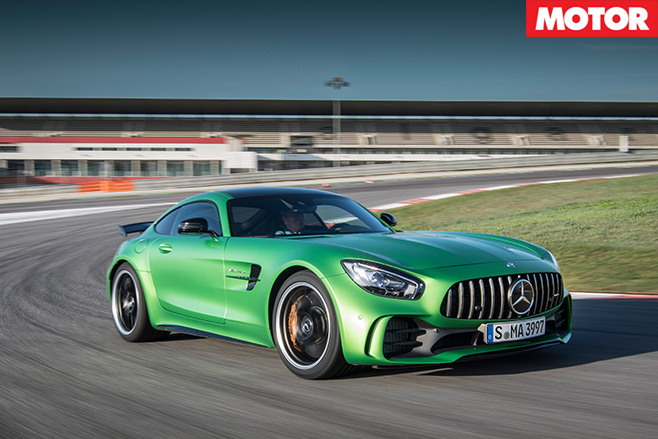
With the drivetrain locked in Sport, the urge to reach for the shift paddles is palpable, but on road and track with the selector set to Race the gearbox’s electronic brain proves better qualified than this driver to time up and downshifts to perfection. It’s ability to select the perfect ratio at the perfect time is uncanny, like it has eyes that scan the road ahead and act accordingly.
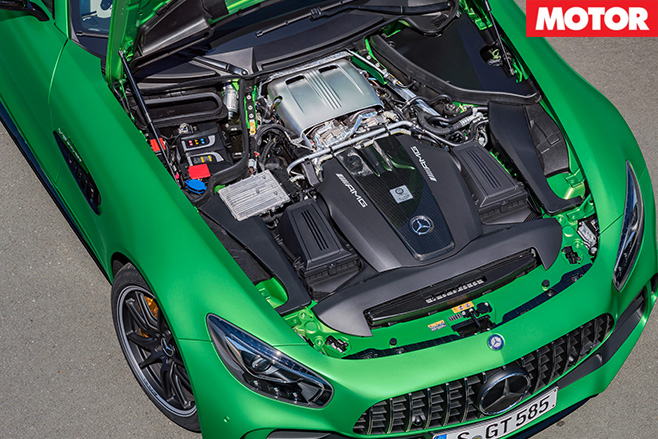
Its closest challenger, in concept and price, is likely to be Porsche’s next-gen GT3 RS. But while money is not likely to be a concern to many GT R buyers – local demand already outstrips supply – it is debatable whether the R is actually worth the extra coin.
The level of modification over the regular GT S is impressive, but a forthcoming GT C coupe, due in 2018, will boast 410kW/680Nm, as well as scoring the brawnier body and rear-wheel steering at a reasonable discount. For those in the market for a brawny V8 two-seater, I would either save a chunk of cash and buy the upcoming GT C, or hold off raiding the piggy bank for a little while longer and order the limited-edition Black Series.
THE Virgin Australia Supercars Championship (VASC) got the season underway yesterday at Sydney Motorsport Park. While it may appear that not much has changed for 2017 aside from the usual shifting of drivers/engineers, and new licks of paint, there are significant differences this year to seasons past – but it’s all in the rule book.
This season marks the debut of the Gen2 regulations, an evolution of the Car of the Future (or New Generation) era first implemented in 2013.
The Gen2 regs were first announced in December 2014, and shocked fans of the sport as they permitted the use of engines other than the V8 which had become synonymous with the category, along with coupe bodystyles (changing from a sedan-only history).
So what does it mean? And when are we going to see the first non-V8 two-door in the category?
The rules were developed to help attract more manufacturers to Supercars, so they can use engines and bodystyles that are more closely related to the road-going cars. However aside from the engine, a Supercar is still a ground-up race car built on the COTF chassis platform, with control suspension, braking, and gearbox components across the field.
Read more Motorsport news here
While engines are now open slather for teams and manufacturers, allowing for both forced induction and naturally aspirated combinations, along with any number of cylinders they desire, power is to be tightly controlled to ensure as much parity as possible.
The technical team at Supercars have their hypothetical work cut out for them trying to match the performance of a single-turbo four-cylinder, twin-turbo V6, and atmo V8.
While two-door bodystyles are now permitted, don’t expect to see any Lamborghini’s in the Bathurst 1000. The cars still need to have four seats, meaning cars like the Ford Mustang, and Nissan GT-R are more likely to be introduced. But the body must still fit on the COTF chassis, so roughly the same size as a Commodore, Falcon, Nissan Altima, or Volvo S60 – no Audi TT or hot hatches then.
The regulations were always going to be implemented for 2017, giving teams plenty of time to adjust, however it was always unlikely that a squad would jump ship to try something radically different. The Supercar teams have invested heavily in their current setups, and aren’t going to diverge from those paths just yet.
Holden and factory team Triple Eight Race Engineering (Or the Red Bull Holden Racing Team as it is called this year) is likely to be the first to ditch the V8 powerplant, with development currently being conducted on a twin-turbo V6 platform. Wheels believes this engine to be based on the 3.6-litre twin-turbo V6 LF3 from Cadillac road cars, and seen in the brand’s ATS-V.R GT3 race car.
This engine will debut at the same time as the NG Commodore body ‑ also being developed by Triple Eight for the 2018 season. It remains unclear how many Holden teams will replace their current V8-powered VF Commodore platforms with the V6 NG next year.
When the first two-door will join the championship is still unclear. Nissan has remained vague on whether it will continue with the Altima platform or change to the GT-R body. Meanwhile, both Ford teams (former factory squad Prodrive Racing, and DJR Team Penske) have expressed interest in running Mustang bodies in the future. This makes particular sense for Prodrive, with the team relaunching the Tickford brand last year, and the release of a tuned Mustang for the road. DJR Team Penske boss Ryan Story told Motorsport.com his team would need assistance from Ford if it was going to race the Pony car in Supercars. Don’t expect that funding to come from Ford Australia, however with Roger Penske’s close relationship with Ford in the US, never say never.
The ability for the championship to attract new manufacturers was a major selling point of the Gen2 regulations. Volvo pulled the pin on its Supercars operation with Garry Rogers Motorsport last year, leaving Holden and Nissan as the official manufacturers (all Fords are run without factory backing). However, rumours continue to abound in pitlane of at least two manufacturers circling teams for a crack at the category in the near future.
Kia and Alfa Romeo are both evaluating the prospect of a factory-backed assault on the Supercars championship. While they could join as early as next year, 2019 or even 2020 is far more likely – if they do decide on entering the series.
So while this year’s Supercar championship won’t appear too different on track, there will be plenty of studying of the rulebook behind the scenes as teams plan their futures in the sport. Although new engines and bodies will be introduced, it also highly unlikely the V8 sedan race car will disappear altogether due to the large investment placed in the package.
AUSTRALIA’S impressive young open-wheel star-on-the-rise, Joey Mawson, has signed a deal to contest the prestigious FIA European Formula 3 Championship in 2017 – an important next step towards his target of Formula One.
After a standout performance to win the ADAC German Formula 4 Championship last year ahead of Mick Schumacher, Mawson has chosen to stay with his title-winning team Van Amersfoort Racing for the 10-round 2017 Euro championship.
European F3 has been the launching pad for a few current F1 drivers, the most recent being 2016 champion Lance Stroll who has joined the Williams F1 team this season.
Two others are Esteban Ocon, now a Force India driver who won the 2014 Euro F3 title, and current Red Bull F1 driver Max Verstappen who was runner up that same year.
Mawson’s clear target is to continue to follow in the career path of fellow Australian Daniel Ricciardo who climbed through the European open-wheel scene before breaking into F1.
Unlike some of his contemporaries at the same level of the sport, Sydneysider Mawson can’t rely on family money or an instantly recognisable surname to help him climb the costly motorsport ladder.
His mother works evenings to make extra cash to provide living expenses for Mawson in Europe.
He will also continue to have the support of a Podium, a small yet enthusiastic group of Australian businessmen who are true believers in Mawson’s talent.
Mawson, 20, is also pleased to remain in the familiar surroundings of the Van Amersfoort team as he takes the next vital move to F3.
“This will be my third year with Van Amersfoort and I’m really excited about the adventure of moving into Formula 3 with them,” said Mawson.
“To win the [German F4] championship last year with them and the team at Podium was a real dream come true, that was our aim at the start of the year and we achieved everything that we set out to do.
“It’s a very big step from Formula 4 to Formula 3 but one that I’m really looking forward to,” said Mawson who will line up against a familiar rival from the recent past –Mick Schumacher.
And he’s up for the F3 fight. “I’ve tested a couple of times late last year and felt right at home,” Mawson said
Van Amersfoort Racing team principal Frits van Amersfoort, a believer in continuity, is delighted to have Mawson driving with his team for a third consecutive year.
Mawson, who is back home after contesting an Asian series over the break, will head back to Europe in the coming weeks before the European Formula 3 Championship begins on April 14 at Silverstone.
2017 Formula 3 European Championship schedule
- April 14-16 ‑ Silverstone (Great Britain) [WEC]
- April 29-30 ‑ Monza (Italy) [WTCC]
- May 20-21 ‑ Pau (France) [F3 GP]
- June 17-18 ‑ Hungaroring (Hungary) [DTM]
- July 1-2 ‑ Norisring (Germany) [DTM]
- July 28-29 ‑ Spa-Francorchamps (Belgium) [Blancpain GT Series]
- August 19-20 ‑ Zandvoort (The Netherlands) [DTM]
- September 9-10 ‑ Nürburgring (Germany) [DTM]
- September 23-24 ‑ Red Bull Ring – Spielberg (Austria) [DTM]
- October 14-15 ‑ Hockenheim (Germany) [DTM]
