
After years of slightly bonkers city cars – with bonkers pricing in Tributo or Biposto guises – Fiat’s tuning team must have oiled their overalls in excitement when they learnt they would get a proper sports car to work on.
It would have been sooner if the 4C hadn’t been handed instead to a desperate Alfa Romeo, but at least an ironic twist sent the 124 Spider the opposite way after FiatChrysler determined it was okay for a Fiat/Abarth but not an Alfa to wear a Made in Japan label.
With the regular Fiat version ignored locally (for now), the Abarth drop-top’s $43,500 driveaway deal squares it up almost identically to the upper-spec version of the Mazda MX-5 upon which it’s based.
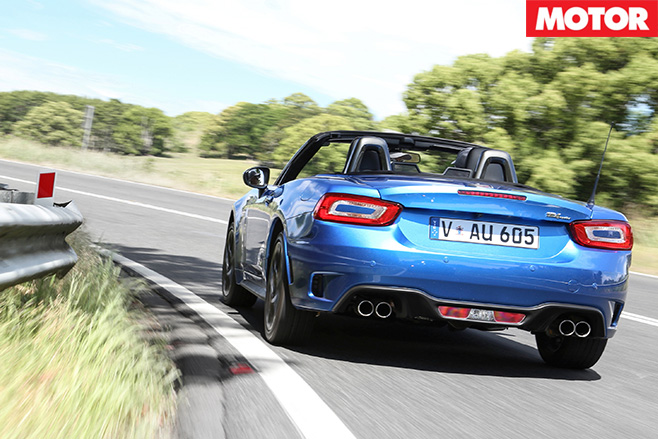
The Italian roadster then adds racier elements such as ‘Abarth by Bilstein’ monotube dampers, four-piston Brembo brakes up front, stiffer anti-roll bars, mechanical LSD, and a front strut brace across the engine bay.
And under that brace is a component Mazda consistently refuses to add to factory MX-5s. The turbocharger is part of Fiat’s trust-and-trusted Multiair 1.4-litre four-cylinder, which here develops 125kW and 250Nm to outnumber the 118kW and 200Nm of the biggest-engined MX-5, the 2.0-litre.
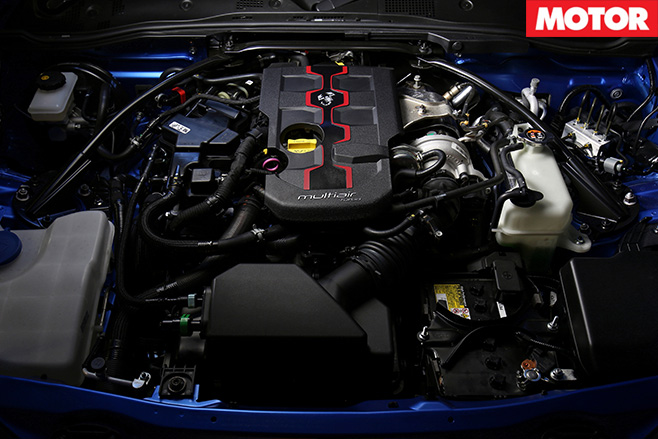
A 0-100km/h quote of 6.8 seconds isn’t far ahead, and it too would be well beaten by a comparably priced hot-hatch.
The 1.4L does provide a key differentiation in character, though. With more torque produced at almost half the revs – 2500rpm – there’s handier flexibility in every gear, simplifying everyday driving.
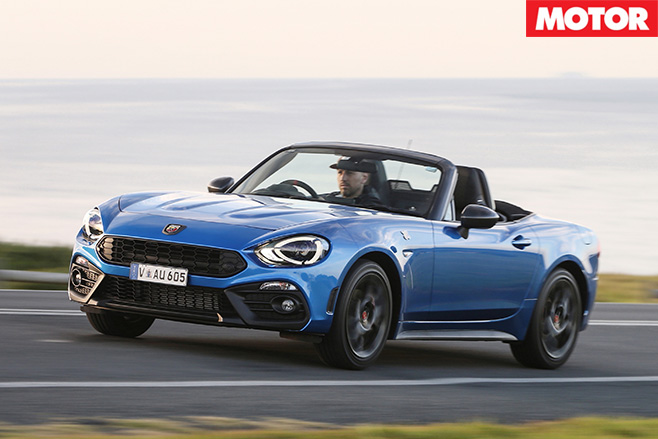
There’s a 6500rpm cut-out but the engine isn’t a wring-out-every-rev affair like the MX-5 – especially the 1.5L version – and it sounds pleasing rather than mesmerising. There’s some likeable induction noise through the mid-range, but an optional ($1895) Record Monza exhaust system may well be a must-tick once available.
Not sure we could say the same for the $2000 six-speed auto. While it wasn’t around to test on launch, it’s difficult to overlook the satisfying interaction of the precise six-speed Aisin manual that is slightly beefier than the Mazda’s same-brand gearbox to handle the 124’s extra torque.
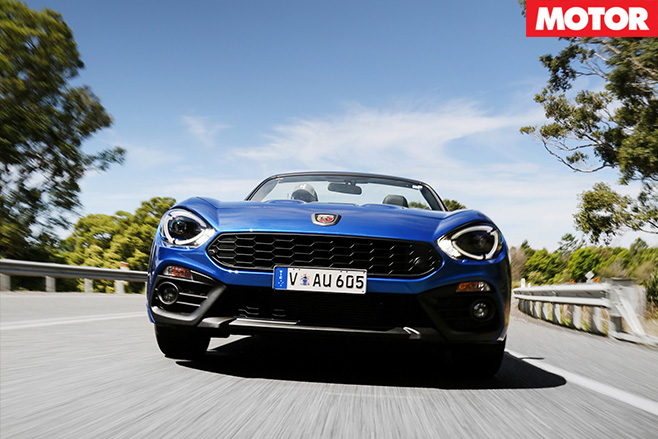
The mode also instructs the stability/traction control to provide more leeway, and adds more weight to the steering. While it’s not as darty off centre as the Mazda’s steering, it’s also easy to appreciate its more linear responses.
Thankfully, Abarth’s suspension tuning hasn’t turned the handling to spaghetti. With the same wheelbase and the engine still tucked behind the front axle, the 124 Spider pivots around bends with familiar enthusiasm – and the same slightly surprising body roll.
It’s never less than exceptionally balanced, though, giving the driver the confidence to four-wheel drift through three-digit-speed track bends knowing the angle of attack can be precisely adjusted via presses/lifts of the throttle. Even with stability control switched off, aggressive use of the throttle is still needed to unstick the 124’s rear end despite its boosted engine.
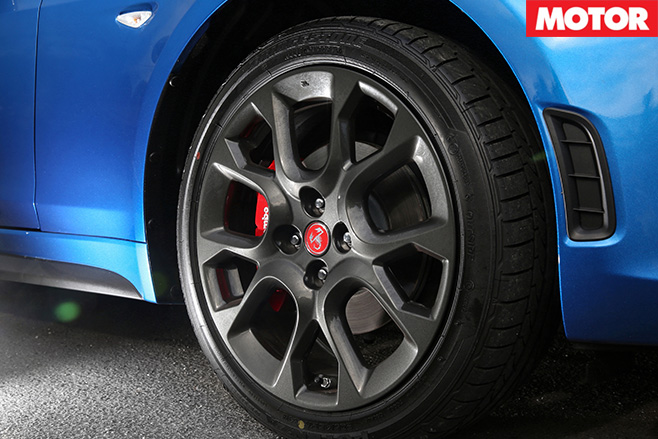
Extra hair rigidity isn’t needed, either, with the cabin relatively calm with the roof (manually) stowed.
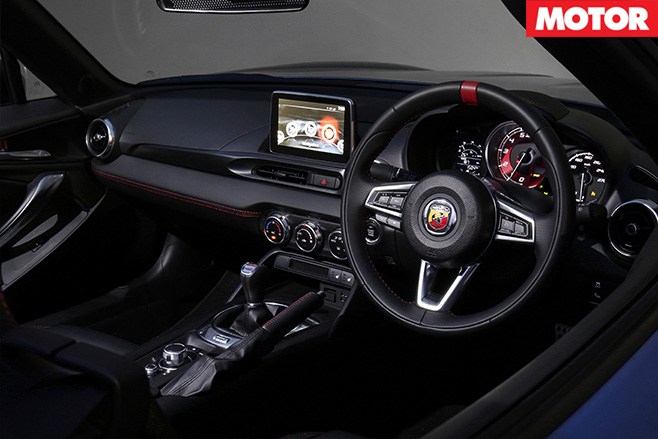
The interior brings the most obvious visual association with the MX-5. The harshest assessment would be that it’s essentially the Mazda’s cabin decorated with scorpion badges. But there is a slightly sportier steering wheel complete with red centre stripe, plus snazzy standard leather sports seats (or optional Recaros).
Flaws carried over include a steering wheel limited to tilt adjustment only, and the shortage of storage options.
SPECS
- Engine: 1368cc inline-4, SOHC, 16v, turbo
- Power: 125kW @ 6500rpm
- Torque: 250Nm @ 2500rpm
- Weight: 1060kg
- 0-100km/h: 6.8sec (claim)
- Price: $41,990; $43,500 driveaway ($43,990 auto; $45,500 driveaway)
A cheaper, more fuel efficient entry-level version of the Porsche Macan is coming to Oz, priced from $76,610.
The mid-size SUV will receive a four-cylinder engine for the first time; a 2.0-litre turbocharged petrol, good for 185kW and 370Nm. Porsche claims it is able to hit 100km/h from standstill in 6.7 seconds, and consumes fuel at a rate of 7.4L/100km.

The new variant is more than $15,000 cheaper than the least expensive six-cylinder models, the $91,855 Porsche Macan S Diesel, and $92,800 Macan S Petrol, which produce 190kW/580Nm and 250kW/ 460Nm respectively.
As for its transmission, the four-cylinder Macan will feature the same seven-speed PDK dual-clutch automatic and all-wheel drive system as the rest of the range.
Despite being the cheapest Macan, the base model isn’t lacking in equipment. It’s equipped with bi-xenon headlights with dynamic levelling, leather and Alcantara trim and three-zone climate control, along with safety features like lane departure warning, tyre pressure monitoring, satellite navigation, parking sensors front and rear and reversing camera as standard.

Bluetooth connectivity with smartphone mirroring will also be present in each car, coming with Porsches latest infotainment system.
Air suspension, Active Suspension Management adaptive dampers, and a Sport Chrono performance package are also available for extra cost.
Visually, the easiest means by which you can tell the new Macan apart from the more expensive variants is through the new black highlights on both the window strip and brake callipers.
The cheapest Porsche in more than 20 years can be ordered now, with deliveries expected to come early next year.
First published in the October 2016 issue of Wheels magazine, Australia’s best car mag since 1953.
The Kia Carnival S confines its brief to ‘movement of the people’. Succeeds.
Can’t wait to see the final score? Jump to the verdict now.
THE transformation of Kia’s Carnival from an unrefined, undercooked misery bus to something genuinely impressive has been so profound it probably deserved a different name. But Carnival it stays, and this time it’s worth paying for a ride.
Sharing DNA with its Sorento platform buddy, the Carnival takes a very different approach to ferrying bodies. It’s much bigger than the Sorento – 335mm longer and 95mm wider, riding on a 280mm-longer wheelbase, meaning you’ll need a McMansion if you want to garage it – yet the Carnival successfully marries handsome styling with luxurious space, which isn’t easy for a base-model people mover.
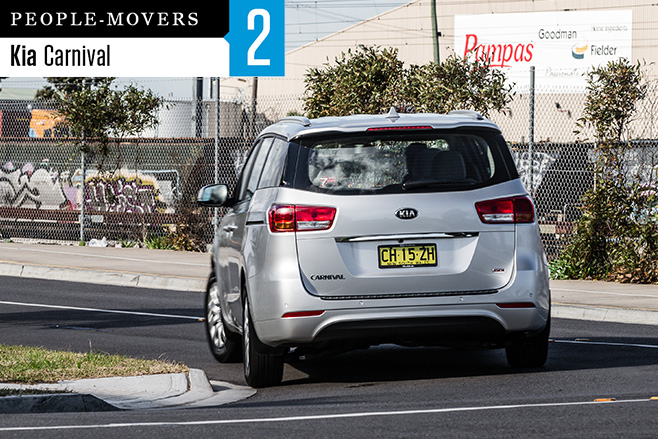
Surprise-and-delight features abound. A sliding front-centre armrest disguising an enormous bin; ingenius ‘stand-up’ centre-row seats that literally flip to a vertical position and slide forward for maximum entry room; side windows for the middle row that actually wind (electrically) down; reclining backrests in every row. Hell, in the back deck you get speakers, lights, air vents and two cupholders on each side, making it the go-to position for kids trying to escape the family unit. Unlike the rough-riding, poorly packaged Odyssey, this is a proper people mover designed to do exactly what it says on the tin.
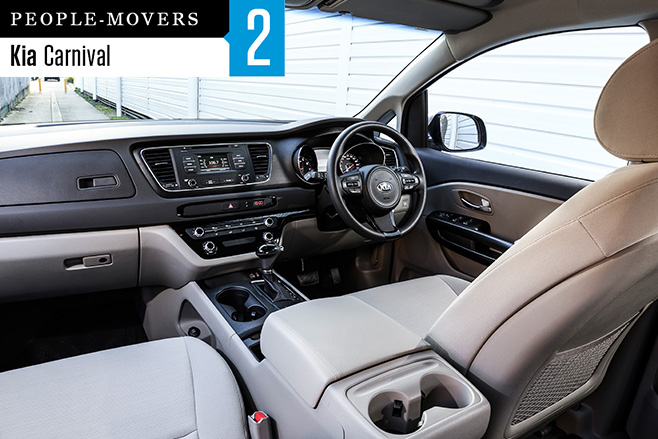
For such a big girl, the Carnival is no slouch. Its 3.3-litre V6 is tuned to offer a bit more grunt than the Sorento’s donk to offset its two-tonne tubbiness, yet the difference between the siblings is negligible, in both performance and economy.
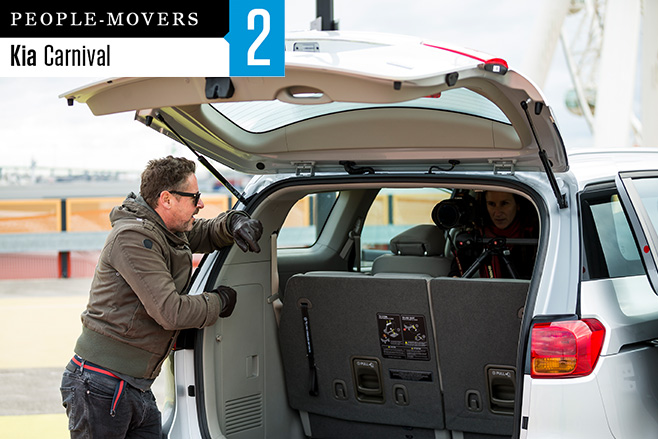
Spending $4K more on an Si with a leather wheel, auto-fold mirrors, sat-nav and tri-zone climate is probably money well spent. But no matter what the spec, Kia’s Carnival is an almost-suave people mover that packs the engineering solidity and amenities to overcome the nameplate’s chequered past.
Grunt my ride
Any parent out there familiar with sprinting from one child’s sporting event to another will be pleased to know the Carnival can comfortably hold its own in the traffic-light stakes. Foot flat from zero to 160km/h (the old imperial ton) – surely a prerequisite with this type of vehicle – the Carnival is barely a softball mit away from breaching the magic 20-second barrier (at 20.2sec), and is just a second off the pace of the Kluger (19.3sec), Sorento (19.1sec) and CX-9 (19.1sec). Hard-charging award goes to the Santa Fe and Pathfinder (both 18.8sec for 0-160km/h), while the wooden spoon gets passed (slowly) to the Volkswagen Multivan (0-140km/h in 29.1sec!).
 SPECS
SPECS
Price as tested: $41,490
Engine: 3342cc V6 (60°), dohc, 24v
Power: 206kW @ 6000rpm
Torque: 336Nm @ 5200rpm
Transmission: 6-speed automatic
Dimensions: (L/W/H/W-B): 5115/1985/1755/3060mm
Weight: 2048kg
Cargo capacity: 1596 litres
Tyres: Kumho Cruger Premium 235/65R17 104H
Test fuel cons: . 13.5L/100km
0-100km/h: 8.3sec
0-400m: 16.1sec @ 144.9km/h
80-120km/h: 5.4sec
3yr resale: 59%
Plus: Brilliant seat comfort; space and flexibility; refinement
Minus: Game-console steering; doughy throttle calibration
Verdict: 7.0/10
THE AUSTRALIAN New Car Assessment Program (ANCAP) claims some car dealers are wilfully spreading misinformation regarding car safety ratings in order to make sales.
The Australian Competition and Consumer Commission (ACCC) is currently conducting a market study of new cars, and ANCAP has made a submission stating some dealers are misleading customers over safety ratings.
“Our concern is that people are deceptively using the ANCAP ratings or deceptively misleading consumers in relation to the rating,” ANCAP CEO James Goodwin has told the ABC. “Some information given out to consumers is just wrong.”
ANCAP claims some dealers are omitting crash ratings entirely if they reflect poorly on the model that is being sold.
Goodwin said manufacturers can also get deceptive with their advertising, twisting information to make their cars sound safer.
“It’s selective use, so where the car has a good safety rating they’ll use it, but when it doesn’t they won’t use it,” he added.
“We also see some misleading or deceptive advertising where the manufacturers will make their own claims about how safe the vehicle is, such as it having high-tensile steel or energy-absorbing steel.
“Or even saying things like it’s standard with electronic stability control, well that’s misleading because that’s a regulation.”
Labels for fuel consumption and emissions are compulsory for new car sales, however safety ratings are not.
Goodwin claims this leaves car buyers uninformed of the facts.
“We’re concerned that perhaps people are using the wrong information to make that sale. This becomes particularly important when different models of that car have different ratings,” he said.
“Perhaps the top-rated model might be five star and the others are three star, and it’s important that the consumer knows the car they are buying has the correct safety information.”
This is highlighted with the incoming Holden Astra, where the top model receives a five-star safety rating, but the base model does not.
CEO of the Australasian Automotive Dealer Association (AADA), David Blackhall, said he couldn’t recall any instances of dealers providing misleading information.
“Casting my mind back, I’m not sure I’ve seen [misleading advertising] but I’m not saying it hasn’t happened,” he told the ABC.
“It can happen as an act of omission perhaps, a mistake, but we would say to our members to avoid that kind of behaviour because it’s only going to cause you problems.”
Blackhall backed the idea of compulsory ANCAP labelling for new car sales.
“It’s hard to see the downside. I mean why wouldn’t you have that if everybody’s interested in doing the right thing both by the dealers and the consumers?”
However, Tony Weber, who is the chief executive of the Federal Chamber of Automotive Industries, does not support the idea.
“ANCAP is just one of the safety measurement tools used by consumers around the world to purchase cars, there are many other providers of safety information,” he said.
“My members, the brands themselves, actually provide a lot of information on safety.
“I think that there’s a lot of information out there for consumers and there’s no great need to mandate a safety labelling form, and if there was there would have to be negotiations on what went into that.”
Overtaking’s a hard thing to pull off. But if there’s one man who can weave himself through traffic like magic it’s Valentino Rossi.
The nine-time world champ’s renowned for his ability to pass under brakes, and he’s before proved the skill isn’t limited to two wheels.
With Italy’s Monza Rally Show this weekend, an event that summons the world’s best drivers for a myriad of driving challenges, we’ve taken the chance to relive Rossi’s masterful move on four wheels in 2014.
Barrelling into a hairpin behind a leading car, Rossi, strapped into a rallycross Ford Fiesta, showed everyone what happens when the door’s left open for him.
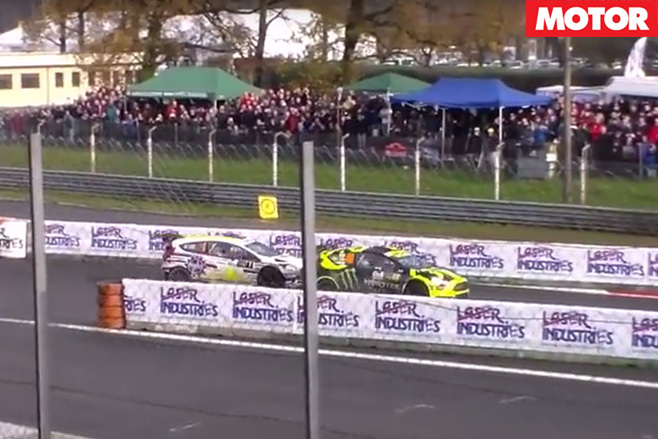
Braking finesse has obviously come easy to Rossi’s feet, but we bet a hydraulic brake lever is familiar for the motorcycle guru.
While he didn’t win that year, he took home the 2015 race to join previous winners Sebastien Loeb and Robert Kubica. High profile driver are part of the show, and has before included Lewis Hamilton, Ken Block, Alessandro Zanardi and Colin McRae.
As a celebration of all things rally, the Monza Rally Show is about bringing drool worthy machinery to fans:
But before you leave, here’s a video, perhaps, to remind you how Rossi honed this skill throughout his career.
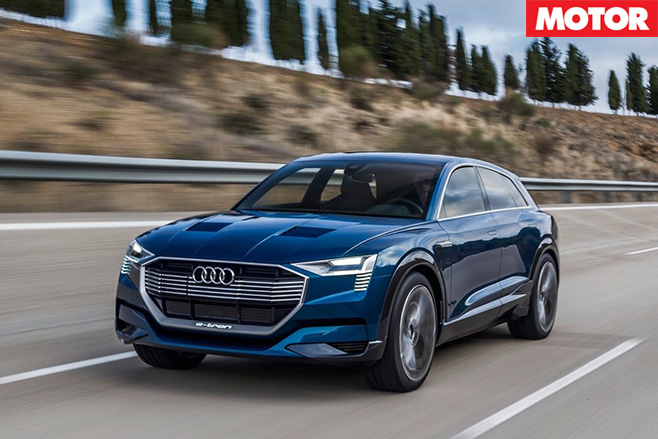
Tesla may have rolled out its battery electric vehicle (BEV) supercharging network across countries including Australia, but Audi, BMW, Ford, Mercedes-Benz and Porsche have now combined forces to roll out rival recharging stations across Europe.
It appears like the automotive equivalent of a gangland attack, with 400 fast-recharging stations set to be paved across the Continent in what is being tagged as an “unprecedented collaboration (to) form a brand-independent network for charging infrastructure.”
BMW Group, Daimler AG (Mercedes-Benz), Ford Motor Company and Volkswagen Group (Audi, Porsche) will have equal share in the Joint Venture agreement that can together ensure the power plug for BEVs and power recharging sites are compatible with all future offerings from each marque.
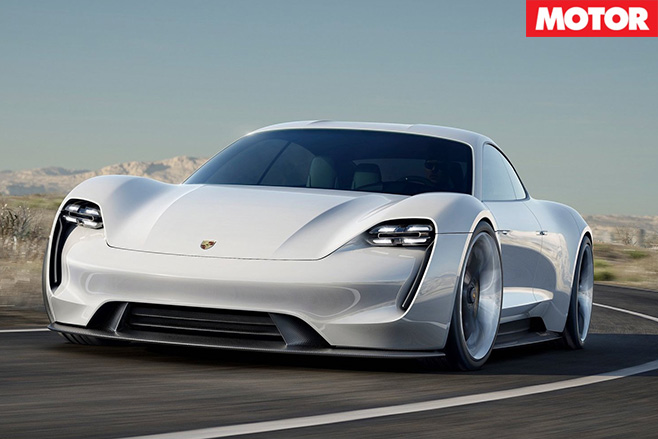
“The charging experience is expected to evolve to be as convenient as refueling at conventional gas stations,” the statement added.
Although contruction begins next year, by 2020 the quartet of automotive giants hope to have “thousands” of recharging sites rolled out across Europe, coinciding with the anticipated rise of BEV offerings from each. It even welcomes other manufacturers to invest – although we don’t yet know if the invitation extends to Tesla.
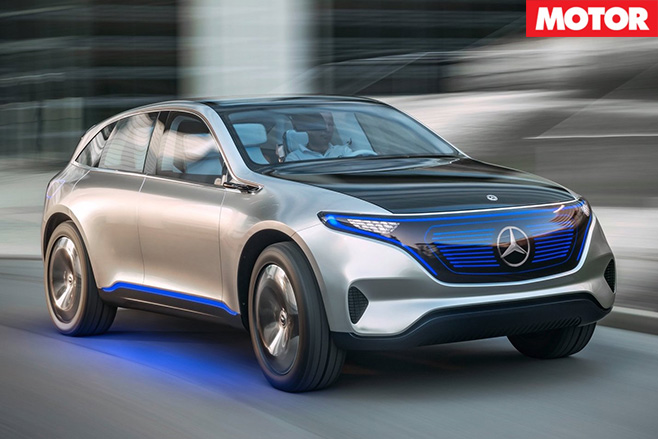
Audi will offer its Q6 all-electric coupe-SUV and sportier VW Group sub-brand Porsche will also ramp up its plug-in offerings, with the Tesla Model S-rivalling Mission E all expected within the next few years.
A baby car seat can be complicated to install. Even when you’ve secured it properly you have to make sure it is securely placed within the car seat and the belts are taut and remain correctly tensioned.
This leads to many car seats being fitted incorrectly, so one company has decided on a high-tech approach, which automatically adjusts, levels and tensions, leaving you to simply click the seat into place.
The 4moms self-installing car seat helps take the guess work out of installing the car seat with a “robotic” base that installs itself. Once the child seat is clicked into the ISOFIX points the seat continues monitoring its position to ensure it stays put.
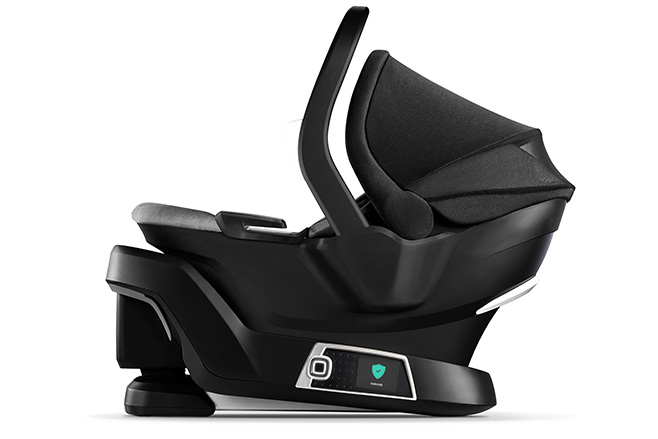
This updated version works with a phone app, which scans the car’s VIN code to let you know the best place for installation in that particular vehicle. The app also uses details such as the baby’s size and weight and the incline on which the car is parked to set the most secure seating position.
The base lets you know when it is securely latched, and once the software is satisfied with the setup it lets the user click the car seat into place on top. If the base is left in the car you don’t need to reinstall again – it will just monitor itself each time to ensure levels and tensions are correct.
The seat comes with an adapter to make function with other accessories including strollers.
The whole unit costs $675 (US$499) but isn’t yet available in Australia. Other 4moms product retails here through major outlets.
Now read our guide to child car seats here or learn about how to safely seat four children in the back of your car.
Toyota is giving the perpetually plain Toyota Camry a sexy makeover and is so excited it’s dropped a teaser pic ahead of a Detroit Motor Show reveal next month.
The image shows the rear quarter of a the new Camry in sporty XSE guise, featuring uncharacteristically aggressive coupe-like styling, including two distinct shoulder lines, a rear air vent, rear spoiler and narrow LED taillight.
The shapely lines were noticed under heavy cloaking in spy shots of the 2018 Toyota Camry taken in September which also showed its larger proportions, wider stance and sleeker shape.
The Mk8 Camry will share the same TNGA platform as the 2016 Prius which is lighter, stronger and should provide a more refined ride than the existing model launched late in 2011
Toyota execs have been generally been tight lipped about the new car, though one is quoted as saying that it “sent chills up my back” when he first set eyes on it. Hopefully he means in a good way.
Toyota has high hopes for new-generation Camry. It is one of the world’s most popular cars and a the top-seller in the US but its dominance is under threat by the ever-growing popularity of SUVs, not least its Toyota RAV4 stablemate, which is expected to steal its US sales crown next year.
It’s also a very important model for Toyota Australia, which will be importing its popular sedan for the first time since 1997 and for the first time will be a direct competitor of the Holden Commodore.
It’s expected to arrive in Australia at the end of 2017 and its launch means we’ll be closer to knowing the exact date of when local Toyota production ends.
A day after its global launch in Germany, Ford has released more details about the all-new Ford Fiesta city car, which it says is the most advanced small car in the world.
Looking at the bells and whistles on offer you can’t accuse the Blue Oval of hyperbole, with the seventh-generation Fiesta representing a quantum leap over its predecessor.
Its advanced driver assistance technology is controlled by two cameras, three radars and 12 ultrasonic sensors, which combined can monitor 360 degrees around the vehicle, and scan the road ahead up to a distance of 130m.
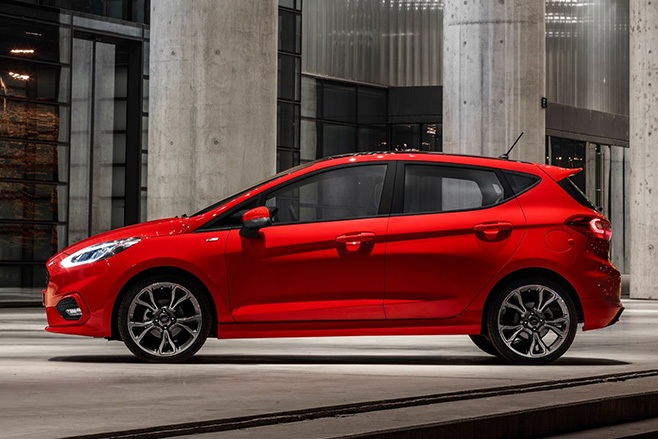
It’s the first Ford with the latest Pre-Collision Assist with Pedestrian Detection while also offering semi-autonomous and driver alert systems including Active Park Assist with Perpendicular Parking, Cross Traffic Alert, Adaptive Cruise Control, Adjustable Speed Limiter, Blind Spot Information System, Distance Indication, Driver Alert, Lane Keeping Aid, Lane Keeping Alert and Forward Collision Warning.
It’s still not clear how much of this tech will be standard across the range in Australia, or which features will be in each of the three- and five-door variants – including the stylish Fiesta Titanium, the Ford Performance-inspired Fiesta ST-Line, the upscale Fiesta Vignale and the Fiesta Active crossover.
According to Ford one thing they will all have in common is improved ride and handling over the outgoing version, despite sitting on the same Global B platform.
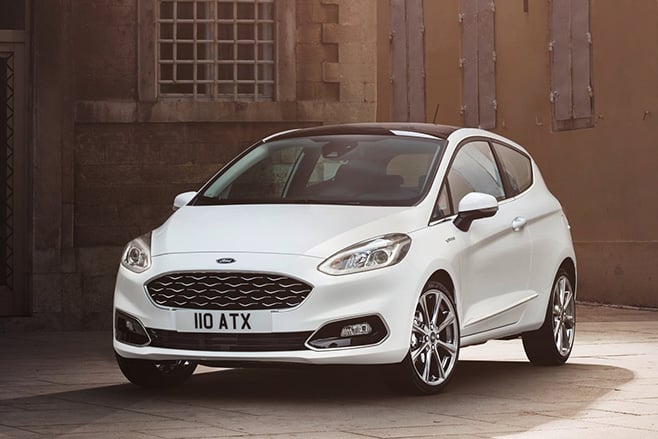
The chassis has been strengthened to deliver a 15 percent increase in torsional stiffness and it has a slightly bigger footprint enabling suspension to be optimised for larger 18-inch wheels. There’s also a 10 percent improvement in cornering and grip thanks to a lighter and stiffer hollow front anti-roll bar supported by Electronic Torque Vectoring Control.
Power will come from a choice of three-cylinder turbocharged EcoBoost petrol engines and a 1.5-litre turbo diesel.
The three-cylinder 1.0-litre EcoBoost petrol unit in three power guises – 73kW, the 92kW in the current Sport variant, and 103kW. All three are mated to a new six-speed manual gearbox, though the 73kW donk comes with a six-speed auto option.
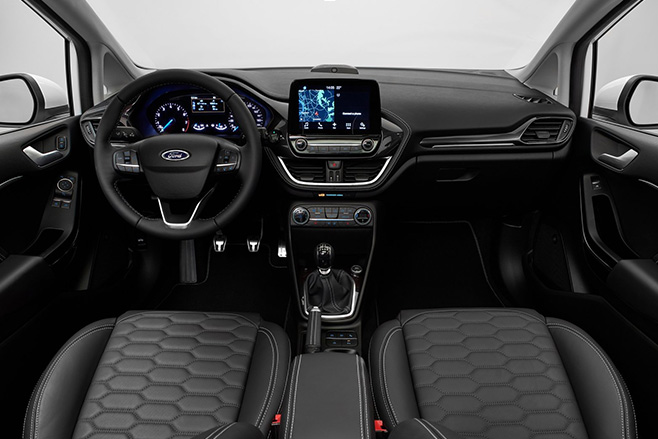
Entry-level models will come with a three-cylinder 1.1-litre Ecoboost petrol engine, in either 51kW or 62kW power guises, paired to a five-speed manual gearbox.
The 1.5-litre turbo diesel unit will come with a choice of 62kW and 88kW versions paired to a six speed manual gearbox. It would be surprising if that variant were to make its way here considering the lack of appetite for small oil burners.
While the 2017 Ford Fiesta is due on sale in Europe in the first half of next year, Ford Australia says it is unable to comment on which models will come to Australia or when as the launch models were for the European, Middle Eastern and African markets.
“We’re usually Commodore guys,” VCM Performance’s Steve Tayler remarks as we watch his Mercedes-Benz C63 AMG being wheelspun down the dragstrip. “We’re about factory fitment, factory form and factory feel… but we are car nuts and we do like our power.”
Hot Tuner 2016 is brought to you by Valvoline SynPower
And power is one thing the previous-generation Mercedes-Benz C63 AMG had in spades. Its 6.2-litre V8 is spoken about in hushed tones as one of the best ever, and its 336kW of grunt and tractor-like 600Nm of torque was plenty – enough for most people. Except…
The guys at VCM Performance in Melbourne are, as Tayler pointed out, more experienced with domestic bent-eight stuff, along with the odd V8 from the Chrysler/Dodge stable. But the potential of the C63 wasn’t lost on them, and supercharging seemed the logical answer – as long as it fit the brief.
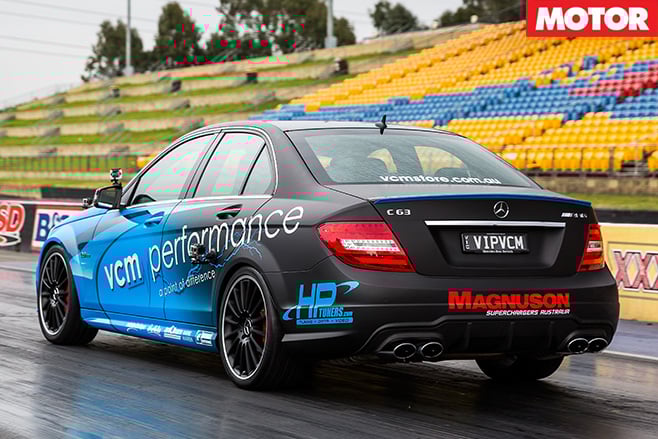
“The last thing an AMG customer wants is to drill a hole in their car,” Tayler observes, adding that the Magnuson set-up requires one small hole in a piece of plastic ducting to fit. “We’ve looked at everything on the market, and the systems are very intrusive.
“There’s a market for all-out power, but what about the guys who want to have just a bit more power, the bragging rights of a supercharger, and have it all reversible?” The VCM crew also works to retain as much of the factory gear as possible because “it actually works”.
“We’re about making it ‘factory’. It’s got factory headers, our airbox is made to suit the factory airbox lid,” Tayler says. “The intercooler just slides in from the top – you don’t have to take the bumper off, which is a good thing if you’ve ever tried to take the bumper bar off this thing. A mechanic who could fit a supercharger on a Commodore could fit this in six or seven hours.”
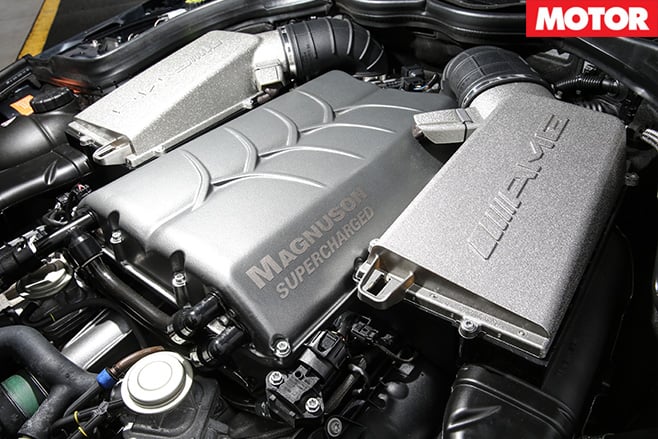
The main element of the VCM package is the ECU tuning, done via the very sophisticated HP Tuners software suite. Tayler reckons it’s a world first.
“It’s the first one we’ve tuned with HP Tuners software, which means we’ve got access to change a lot more things,” he says. “It’s more of a Toorak tourer – it’s a nice car to drive. The power isn’t on and off – you have to ask for it.”
The C63 has been tuned back a little, according to Tayler, who reckons it should be turning outabout 370rwkW.
“Pushing it, we can break the 400kW mark at the wheels, but I took a couple of degrees [of ignition] out because people would be thrashing it,” he says. Well, if you insist…
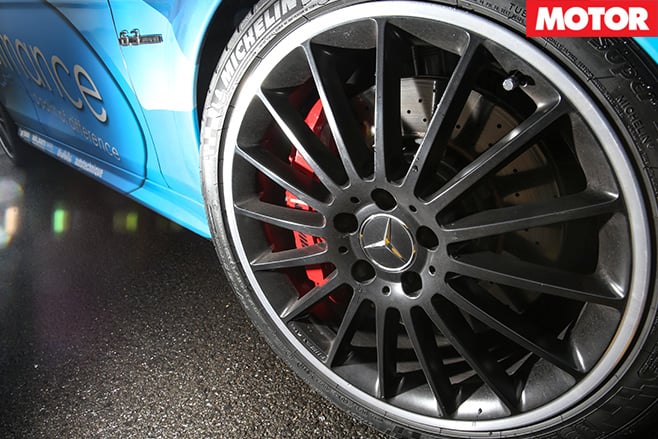
SPECIFICATIONS Drive: rear-wheel Engine: 6208cc V8, DOHC, 32v, supercharger Gearbox: 7-speed automatic Suspension: multi-links, coil-overs, anti-roll bar(f/r) Brakes: 360mm ventilated/drilled discs, 6-piston calipers(f); 330mm ventilated/drilled discs, 4-piston calipers(r) Wheels: 19 x 8.0-inch(f); 19 x 9.0-inch(r) Tyres: 235/35 ZR19(f); 255/30 ZR19(r); Michelin Pilot Super Sport
PARTS AND PRICES Supercharger kit: $16,500 Suspension: $6500 Brake pads: $800 Differential: $3800 Total mods cost: $27,600 Vehicle cost: $120,000 Total cost: $147,600
