
Wheels pitches 10 of the biggest sellers in the medium-to-large car segment to see which is the best of the current crop. Here’s number 10, the Toyota Camry.
Can’t wait to see the final score? Jump to the verdict now.
AFTER a world-beating 53 years building cars in this country – longer than anywhere else outside Japan – the Camry tested here will be Toyota’s sayonara to Australia. Yet in much the same way it signals the conclusion of domestic production, the evergreen Camry bookends the back end of this megatest field.
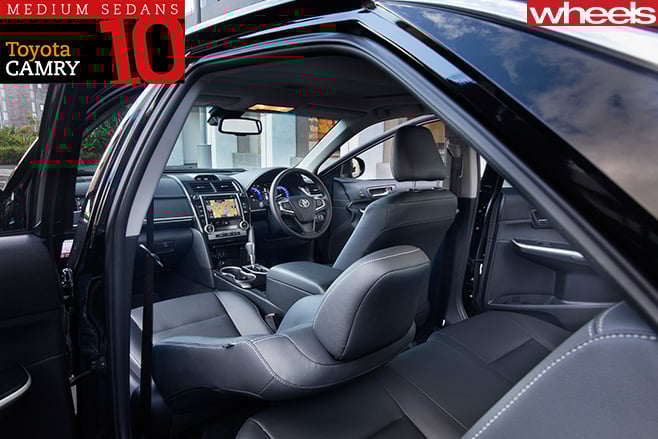
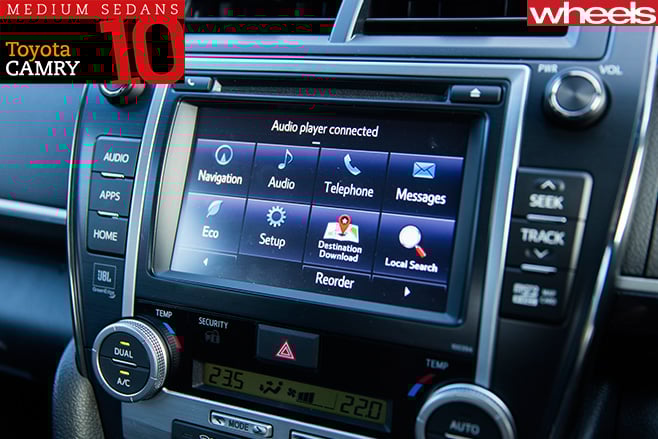
Perhaps unfairly, the Camry Atara SL Hybrid’s last-place position has more to do with the strength of the competition than any serious weaknesses on its behalf… apart from its interior. While last year’s extensive facelift refreshed every exterior panel, cost considerations meant the Aussie-built Camry missed out on the new dash and fittings that debuted elsewhere, leaving it with 2011’s cheap, cheerless plastics and a low-rent feel about as desirable as a home invasion.
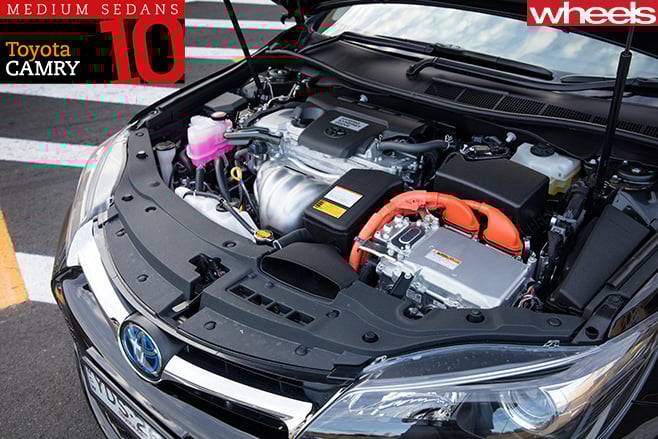
Things improve on the move, thanks to Camry’s sweetly muscular petrol-electric drivetrain and its effective suspension tune. Most punters would be surprised how quickly you can hustle a Camry Hybrid, particularly once you get used to the CVT’s lag and learn to stamp on the right pedal early. Its undeniable punch (15.8sec for the quarter) teams with a fluid and nicely balanced chassis that inspires confidence, at least until the ESC senses any kind of yaw and slams on the stability anchors like an irate parent smacking the dinner table.
Yet there’s a fundamentally sound decency to the workmanlike Camry. Even outside the Hybrid’s preferred environment – city gridlock – its 9.1L/100km test average puts it well ahead of the similarly swift Mazda 6 and Ford Mondeo, if not Peugeot’s parsimonious 508 and the VW Group’s outstanding Superb and Volkswagen Passat. And Camry Hybrid’s deep boot is much roomier than it used to be, supported by a full-size 17-inch alloy spare lurking underneath.
In several areas, the final Aussie-built Camry is an admirable piece of work. But compared to where the global benchmark is in 2016, it’s well adrift.
Soon to be expat
Toyota’s ninth-generation Camry is aiming for a US launch in the third quarter of 2017 and will be a substantially altered car. Riding on a brand-spanking Toyota New Global Architecture platform (shared with new-gen Prius), the next Camry is expected to be lighter, stronger and funkier than today’s model, whose underpinnings date back more than a decade. A 2.0-litre turbo-petrol four is rumoured to replace V6 models in the US, likely the 8AR-FTS unit used in Lexus’s 200t variants. No official word as to where Australia’s next Camry will hail from, but expect Thailand, sometime in 2018.
Want to compare the field? Check out all the Family sedan finalists.
 SPECS
SPECS
Price: $44,440 *includes moonroof ($1950)
Engine: 2494cc 4cyl, dohc, 16v + electric motor
Power: 151kW (max system output)
Torque: 270Nm (max system output)
Transmission: CVT automatic
Dimensions (L/W/H/W-B): 4850/1835/1470/2775mm
Weight: 1610kg
Cargo capacity: 421 litres
Tyres: Bridgestone Turanza ER33 215/55R17 94V
Test fuel cons: 9.1L/100km
0-100km/h: 8.0sec
0-400m: 15.8sec @ 147.4km/h
80-120km/h: 4.9sec
3yr resale: 45%
Plus: Keen and refined drivetrain; competent chassis
Minus: Budget interior; laggy CVT; comprehensively outclassed
Verdict: 5.0/10

BRACE yourself, Mercedes-AMG is preparing to set off the most powerful weapon in its arsenal – the new E63.
The company’s latest super sedan will arrive next year with more grunt than the AMG GT R, as confirmed by AMG boss Tobias Moers speaking to Australian media recently.
“It’s going be 600hp (441kW), under and above,” said Moers, suggesting E63 and E63 S models are in the works.
In its most powerful guise the Mercedes-AMG E63 is expected to push 450kW and 800Nm from AMG’s 4.0-litre twin-turbo V8, eclipsing the 430kW and 700Nm outputs from the same engine in AMG’s current performance hero, the GT R.
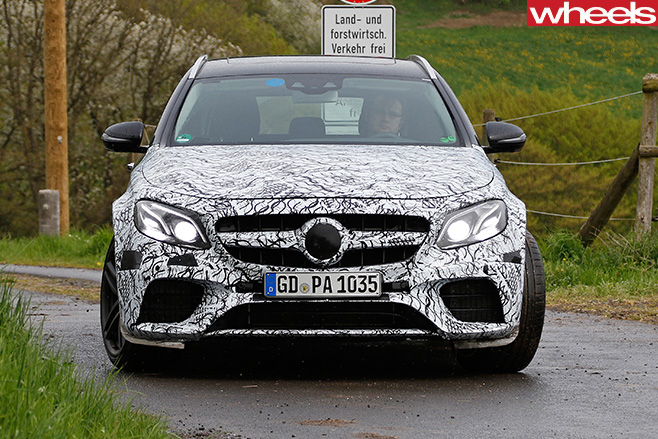
Acceleration figures are yet to be officially announced, though 0-100km/h times will rival supercars at “three point something” seconds. Wheels understands that number will be closer to three seconds than four.
Spy shots of an E63 estate in testing show extreme wide-body arch extensions and enormous rubber at each corner and typically aggressive AMG styling.
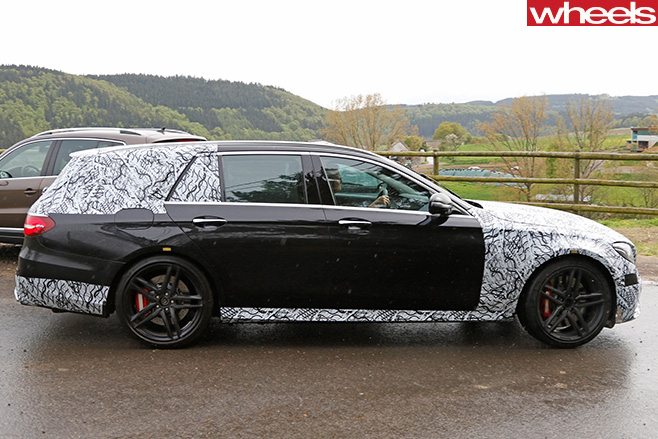
“It’ll be faster on the [Nurburgring] Nordschleife than ever. It’s going to be under 7m50s.”
Expect to see an AMG-tuned version of Merc’s nine-speed gearbox with a manual mode, as well as adjustable air suspension and a multi-tiered ESC system.
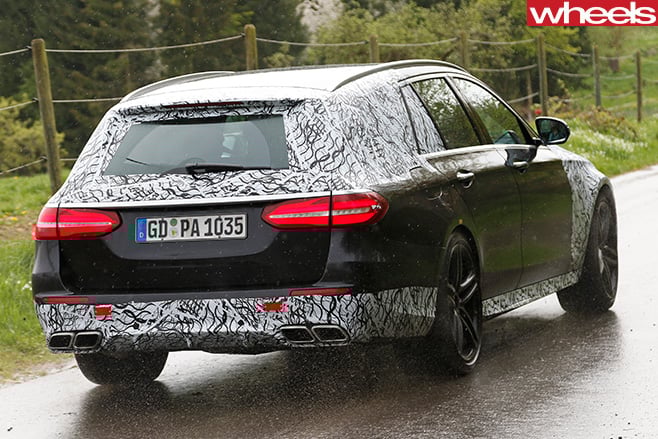
Sedan and wagon bodies will be built, though sadly a lack of demand in Australia means we’re unlikely to see any E63 Estates arriving here. These days, more people are interested in the GLE63 SUV.
Expect to see the E63 in production guise before the end of the year, most likely late next month at the Los Angeles Auto Show.
Maserati added indirect fuel injection to its 3500 GT in 1961 to become the first car manufacturer to use the GTI badge on a model.
These days, it’s strongly associated with hot-hatches. That trend started in 1976 with the first Volkswagen Golf GTI, and Peugeot followed with its own hallowed hatchback in the form of the 1980s 205 GTi.
Rumours suggest Suzuki could revive its much-missed Swift GTi for the upcoming next generation of its city car, though for now its Volkswagen and Peugeot who share exclusive use of the badge across a couple of models.
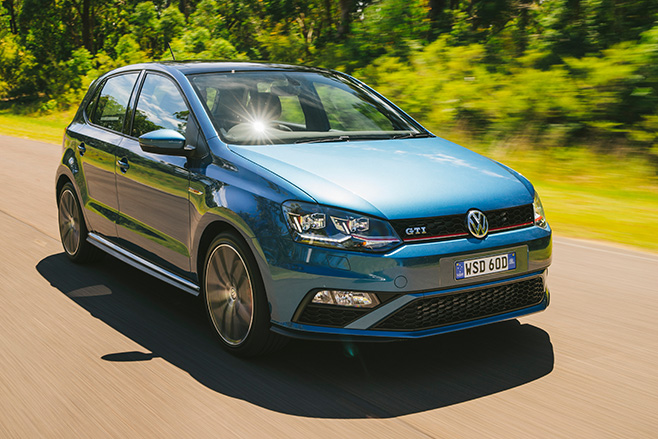
VW’s hot-hatch version of the Polo has been around locally for more than a decade now, though only in recent years has it managed to step out of its bigger brother’s shadow. The latest Polo GTI used a 2015 facelift to return to the 1.8-litre turbo four-cylinder format of the 2005-2010 model after dabbling with a 1.4-litre Twincharger featuring both a supercharger and turbocharger. More importantly for keen drivers was the re-introduction of a manual gearbox – which brought the added bonus of an extra 70Nm of torque (320Nm) over the seven-speed dual-clutch auto option. Priced from $27,490, the Polo GTI’s terrific combination of value and performance helped it win the 2016 Motor magazine Bang for your Buck award – the nameplate’s third victory in the competition. Its comfortable ride, flexible engine and refined interior also makes it a hatch to be enjoyed in everyday driving.
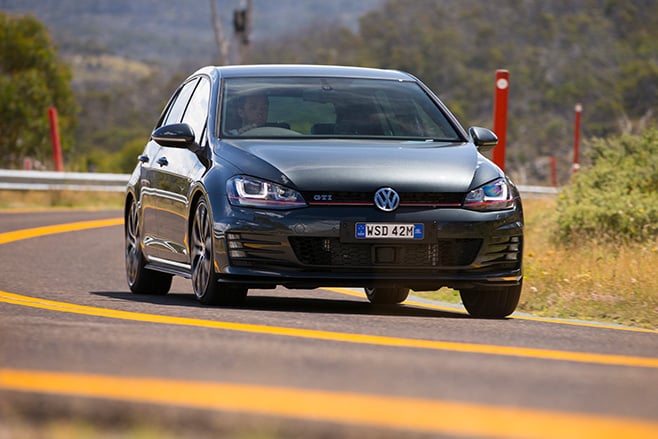
Hot-hatches have always been about blending affordable performance with practicality, and for that simple reason the cheapest GTI is our pick over the GTI Performance variant that costs an extra $3000. The Performance offers an extra 7kW of power and electronic limited-slip differential for assisting cornering traction, though the regular GTI is still immense fun to drive. Since 2005, when the Mark V Golf GTI overturned a couple of generations of less-than-thrilling models, VW’s famous hatch has been getting better and better.
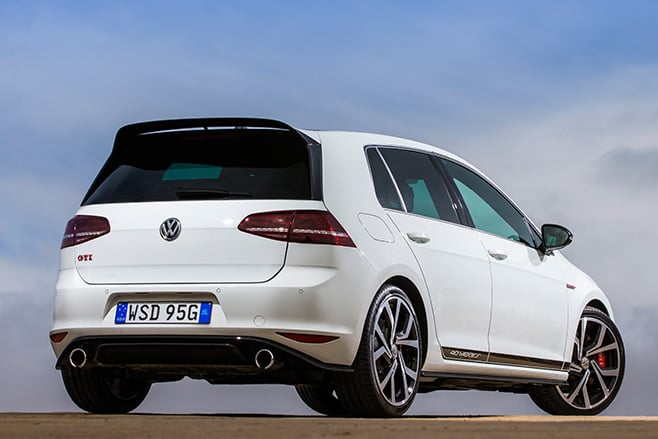
VW has marked a few GTI anniversaries with special editions, and the latest is the 40 Years (known as the Clubsport in Europe but substituted locally owing to HSV’s use of the name). Making the edition special is a further re-tuning of the GTI’s turbocharged 2.0-litre four-cylinder engine that raises power to 195kW. Pushing hard on the accelerator liberates 213kW via an overboost function, giving the GTI 40 more power than the flagship 206kW Golf R – although only for 10-second bursts and to the front wheels only rather than all wheels. Other welcome additions over the Performance include an adaptive suspension that allows drivers to instruct the dampers to prioritise comfort or handling, exclusive 19-inch alloy wheels, and a lovely-to-hold Alcantara sports steering wheel. There was a choice of $46,990 manual gearbox or $48,990 six-speed ‘DSG’ auto, though with all 500 units available here, now said to be sold out, the used-car market is your best bet for picking one up.
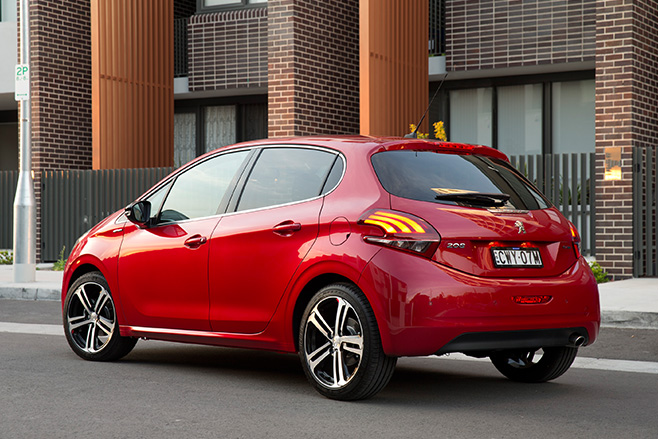
Many still regard the 205 GTi as one of the greatest ever hot-hatches, though you have to bypass the 206 and 207 versions to find a worthy successor. That was especially true of the 208 GTi 30th Anniversary limited edition that was engineered with feistier handling with a propensity for oversteer. The regular GTi remains a fine pocket rocket, capable of reaching 100km/h from standstill in 6.8 seconds thanks to its 153kW 1.6-litre turbo four-cylinder and the 208 model’s weight reduction over the 207. Tasteful sports trimmings are also applied to the 208’s classily minimalist cabin. Pricing kicks off at $30,990.
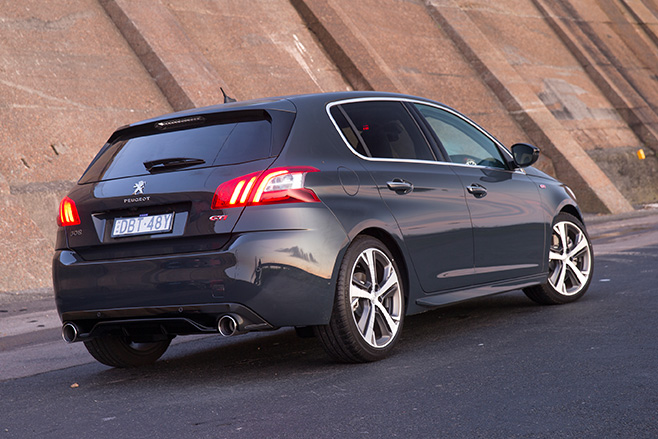
The media acclaim of the 208 GTi clearly gave Peugeot the confidence to return the badge to its larger, 3-badged series in early 2016 – 15 years after the 308 GTi-6. The 308 GTi doesn’t disappoint, either, despite pricing that’s a bit on the high side. Available in $44,990 250 or $49,990 270 guises, a case can be made for either. The 184kW 250 isn’t markedly slower than the 200kW 270, there’s strong grip from the 18-inch tyres, excellent braking performance, and the 308’s interior runs the Golf closest in the small-car class for perceived cabin quality. There’s also less wheel-tugging torque steer with the 250, though the 270 gives itself track-day viability with thicker seat bolstering, great in-gear flexibility, stickier rubber, and a Torsen mechanical limited-slip differential that improves the GTi’s ability to get all its power down to the ground via only the front wheels. That pricing and a not particularly satisfactory gearshift mean it hasn’t quite got the beating of its Golf namesake, though this is still another great member of the GTi/GTI breed.
James Brock, stepson of the late Peter Brock, has delivered a scathing review of Channel 10’s two-part mini series Brock.
In a statement made public on his Facebook page, James Brock described the first part of the telemovie as “D-grade trash”, saying “there was no need for embellishment or distorting of the facts”. You can read the full statement below.
The first half of the show aired last night (Sunday, October 9), attracting 1.3 million viewers nationally, with the conclusion to be shown tonight (Monday, October 10).

Brock was also hampered by Channel 7 refusing to allow production company Endemol Shine the use of historic race footage, leading to a plea from producers to fans in an attempt to replace the missing footage.
James Brock is the son of Peter Brock’s long-term partner Beverly Brock from a previous marriage. He followed his father’s footsteps as a race driver, competing in V8 Supercars, V8 utes and most recently the Australian GT Championship.
SO we all know the deal – there will be no more locally-made rear-drive V8s in our market by the end of 2017. Yet Australians are snapping up more bent eight-motivated performance metal than ever before.
Ford’s Mustang GT, for example, caught the local FoMoCo arm napping big time when orders outgunned predicted volumes by a factor of three. Mercedes-AMG can’t get enough C63s of any flavour to slake the thirst for cubic inches sent en masse to rear tyres.
Meanwhile, Holden is selling more V8 Commodores than it’s done in years.
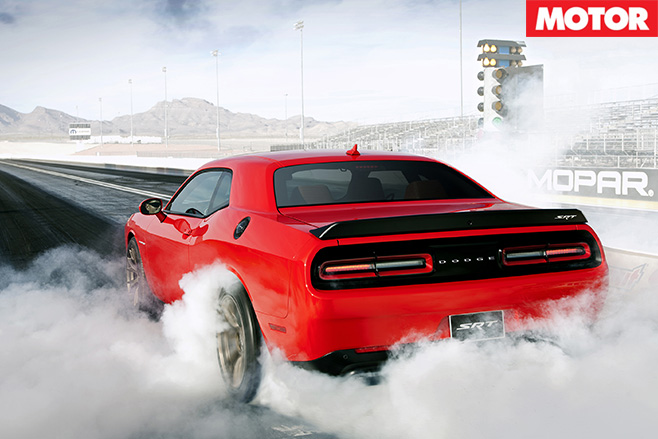
Well, it might’ve happened… And it still could.
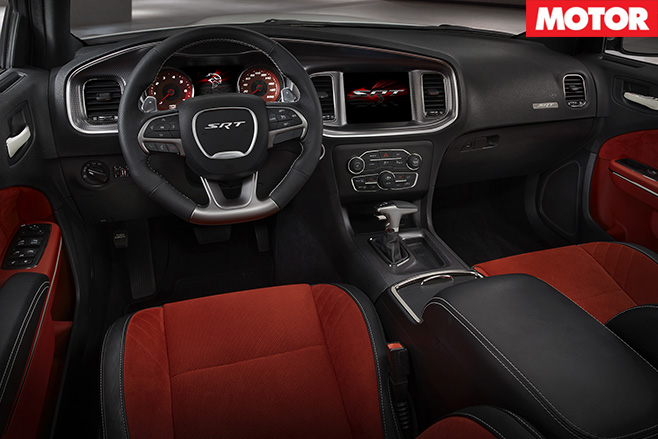
Fiat Chrysler Automotive’s Dodge brand currently sells the Charger two-door and Charger four-door large rear-driver in left-hand drive markets. Even though Mitsubishi owns the rights to the Challenger name locally, it’s not too much of an issue; Fiat Chrysler Oz has had the Charger nameplate on the books since the early ’00s and there’s still a lot of currency in the Charger brand with Aussie muscle car fans.
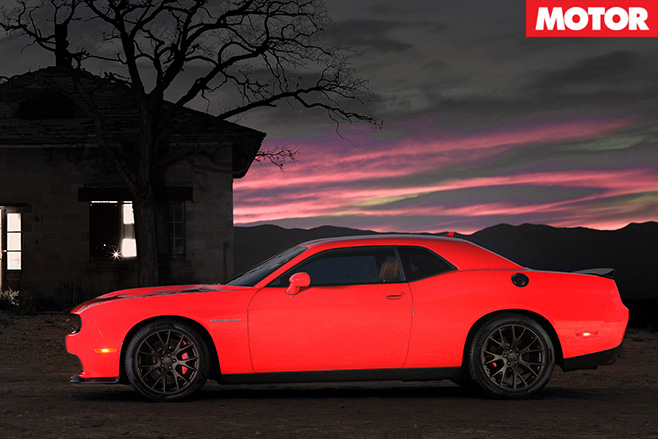
Forget your HSV GTS, or your C63, or your M4, or pretty much anything else. If it lobs Down Under, the Hellcat-equipped Challenger goes straight to the top of the bad-ass pile.
For a while there, the pair were odds-on favourites to make the trip. Former boss of Fiat Chrysler Australia – and the former boss of Chrysler’s performance parts maker Mopar – Pat Dougherty told MOTOR late last year that the car was in a “go/no go” mode – meaning that clearance from head office was imminent.
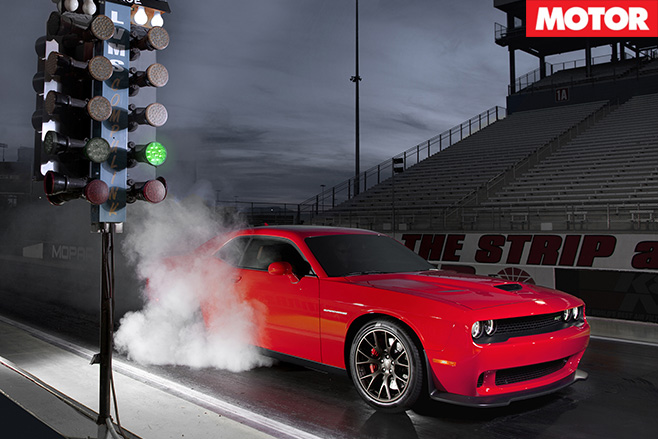
There were a couple of sizable obstacles standing in Dougherty’s way: the availability of the Hellcat-engined cars and unfavourable exchange rates.
This year in the States, Dodge was forced to boost production levels of the potent Hellcat twosome after demand outstripped supply to the point where the company had to instruct dealers to stop taking deposits on cars it couldn’t deliver.
In a move that could resonate here, prices also jumped sharply for the MY16 model year – around USD$5000 (approx AUD$6500) per car – which will put even more pressure on an already delicate exchange rate equation. The Aussie dollar has fallen more than 15 per cent in the last 16 months, from a high of USD$0.91 to its present level of about USD$0.76, which makes pricing a US-sourced car a tricky balance.
Another factor to consider is that neither car is currently available in any market as a right-hand drive. Indeed, the 300 SRT is a special project just for the Australian and Middle East markets and not replicated anywhere else in the FCA world.
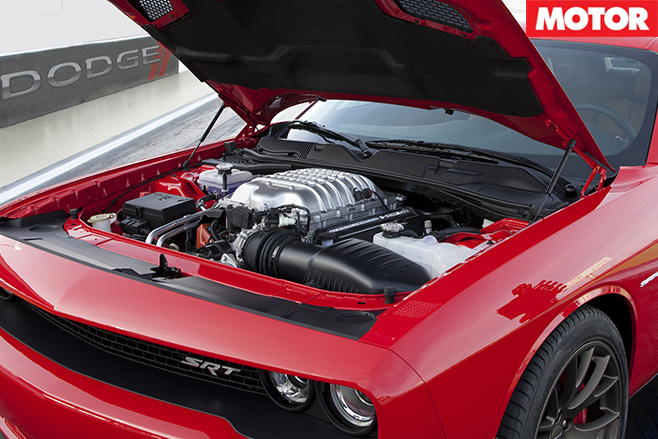
Dougherty left Fiat Chrysler Australia in August this year after less than two years to – somewhat ironically – return to his roots as Mopar’s head man in the Pacific region. He handed the reins to long-time Jeep man Steve Zanlunghi, an Australian-raised FCA-lifer who most recently ran the FCA’s operation in the UK.
While no one from Fiat Chrysler Australia was talking, we do know that there’s a Hellcat-powered version of the Jeep Grand Cherokee on the table and if it’s made in right-hand-drive, Fiat Chrysler Oz will have its hand up like an annoying first grader to bring it Down Under.
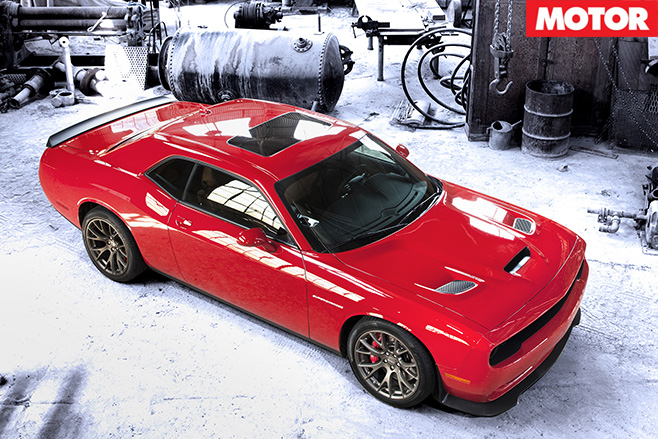
If we were the betting type, we’d suggest that if the Dodge brand – currently represented by one poor-selling SUV model – survives locally, Australia is in the frame for a full range of Chargers… but not until the new one debuts in 2019. At the forefront of the marketing campaign to capture the hearts and minds of a performance-mad Aussie market? The Hellcat.
Hellcats in Oz – now Of course, if you can’t live without a momentously powerful Mopar in your life, there are ways and means of acquiring one. Crossover Car Conversions in Melbourne, for example, would be more than happy to help you out with your predicament, offering a right-hand drive two-door Challenger Hellcat that’s ADR-compliant and ready to torch rear tyres for days, all for a slightly eye-watering sum of $190,000.
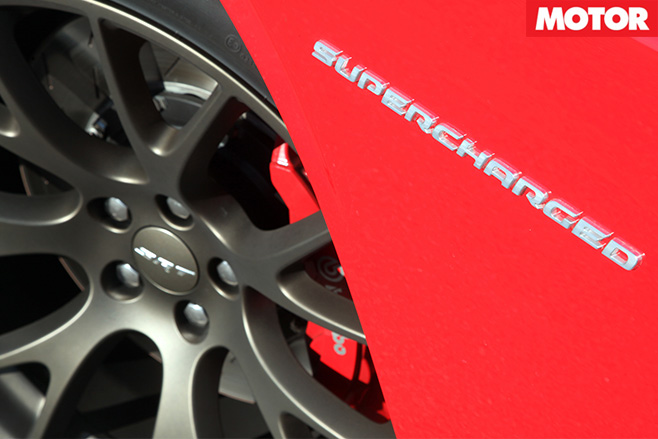
Hellcat… SUV? Australia’s first taste of Hellcat power may well be under the bonnet of the Grand Cherokee. All but confirmed recently by global Jeep chief Mike Manley, the Grand Cherokee Trackhawk could break cover later this year, complete with the barmy supercharged Hemi under its immense bonnet.
Jeep has form here, offering the naturally aspirated Grand Cherokee SRT. Fiat Chrysler Australia recently whipped the covers off a limited edition version called the SRT Night that previews the running changes to the 2017 SRT when it lobs at the end of the year. There’s still a couple of years left in the current cycle – and it’s highly unlikely that you’ll see a bent-eight version in the next generation SUV, thanks, of course, to tightening emissions regulations.
Diesel cars have received negative press of late because of the Volkswagen “Dieselgate” scandal, however they still provide a great mix of performance and fuel economy, particularly with larger cars and SUVs.
However, diesel cars aren’t great for every situation so here’s a list of pros and cons to see if an ‘oil burner’ is right for you.
DIESEL ENGINES PROS
- Diesel engines, particularly turbo diesels, provide good fuel economy especially with open road driving – if you do a lot of freeway and highway driving, diesel engines are generally around 20 to 35 percent more economical than the equivalent petrol driven car.
- The better fuel economy naturally means longer range.
- Some diesels are even more economical than hybrid equivalents and cheaper.
- Turbo diesel engines usually out-perform similar sized petrol engines in terms of torque and, quite often, power.
- The extra torque that diesel engines generate makes them great for carrying big loads and towing.
- Larger diesel cars often hold their value better than less efficient petrol versions.
- The extra economy you get from the diesel option can reduce purchase costs such as the luxury car tax.
- Diesel engines require less maintenance because they have fewer parts than petrol engines. They don’t need a spark plug ignition system, which should mean lower servicing costs because they don’t require tuning or replacing ignition parts such as sparkplugs.
- Diesel engines can run on alternative fuels such as bio-diesel.
- While diesel generally costs more than petrol, its price isn’t subject to the weekly fluctuations.
- Newer diesel engines don’t have issues associated with older ones such as excessive smoke or longer start-up times in cold weather.
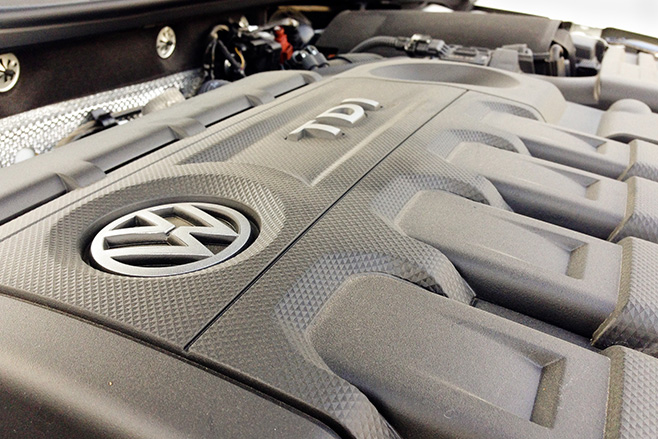
DIESEL ENGINE CONS
- You don’t get the fuel efficiency benefits if you mostly do city driving or short trips.
- If you only do short trips under 10kms every day you risk damage caused by a blocked particulate filter which can be very costly. The particulate filter collects exhaust soot and self-cleans by burning the soot into gas once the engine heats up as you drive.
- Diesel fuel isn’t cheaper than petrol like it used to be, which could negate the fuel saving benefit.
- Diesel-powered cars usually cost more than petrol-powered versions.
- Diesel fuel nozzles are often greasy, which is why some car manufacturers provide a box of latex gloves for filling up.
- Diesel cars have longer servicing intervals, but service costs are generally higher.
- If you do neglect servicing and something goes wrong with a diesel engine, such as with the fuel injection system, it will probably cost a lot more to fix than a petrol engine.
- Diesel cars aren’t great high-speed performers compared to petrol driven cars.
- Some cars with less refined diesel engines sound like a truck, particularly when idling.
Audi A3 Sedan
- TDI Ambition: 2.0L 4cyl turbo diesel, 110kW/320Nm, 4.4L/100kms, $45,500
- TFSI Ambition: 1.8L, 4cyl turbo petrol, 132kW/250Nm, 5.6L/100kms, $45,400
- 535d: 3.0L 6 cyl turbo diesel, 230kW/630Nm, 6.1L/100kms, $123,655
- 535i: 3.0L 6 cyl turbo petrol, 225kW/400Nm, 7.6L/100kms, $123,655
- Active Hybrid: 3.0L 6cyl turbo petrol /hybrid, 210kW/450Nm, 6.4L/100km, $121,700
- Active CRDi (manual) 2.2L 4 cyl turbo diesel, 147kW/440Nm, 6.3L/100kms, $41,990
- Active (manual) 2.4L 4 cyl petrol, 138kW/241Nm, 9.4L/100kms, $38,490
- Exceed 4WD DiD: 2.3L 4 cyl turbo diesel, 110kW/360Nm, 6.2L/100kms, $46,490
- Exceed 4WD: 2.4L 4 cyl petrol, 124kW/220Nm, 7.2L/100kms, $43,490
- PHEV 4WD: 2.0L 4 cyl petrol/hybrid, 149kW/196Nm, 1.9L/100kms, $47,490
- GXL: 4.5L V8 turbo diesel, 200kW/650Nm, 9.5L/100kms, $86,716
- GXL: 4.6L V8 petrol, 227kW/430Nm, 13.4L/100kms, $81,716
The South Australian Government has announced plans to invest $10 million into autonomous cars, just three days after Holden rolled the last Cruze off the production line at its Elizabeth Plant.
The funding will boost testing, research and development of connected and autonomous vehicles in South Australia, which was the first state to introduce laws to allow on-road trials for driverless cars as of March this year.
The State’s Transport Minister Stephen Mullighan will launch the initiative at the 23rd World Congress on Intelligent Transport Systems (ITS) which will be held in Melbourne from today (10-14 October, 2016).
The proposal invites companies, industry bodies, research institutions and other organisations to submit proposals in a bit to accelerate the growth of autonomous and connected vehicle technology.
The projects must take place in South Australia, while overseas-based partnerships are encouraged to partner with a local business or organisation.
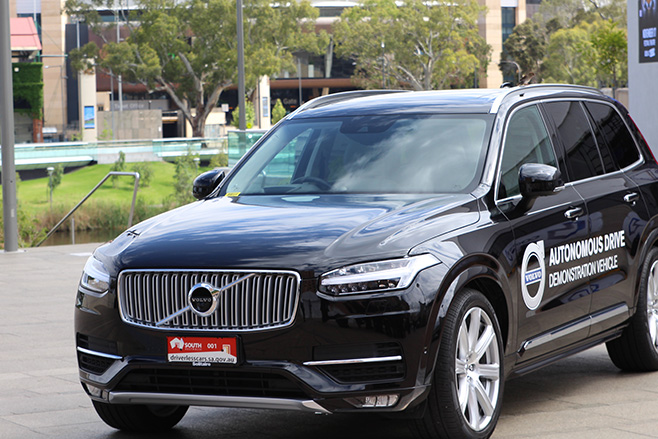
Despite wide criticism of autonomous cars, Mr Mullighan said “connected and autonomous vehicles can deliver huge benefits to South Australia – they have the capacity to reduce congestion, save lives and help people get around our community with more freedom.”
“We need to know more about what changes are needed to our roads and our laws so that this technology can improve safety on the roads, improve mobility for people with disabilities and reduce congestion and emissions.”
According to the minister, the industry will be worth an estimated $90 billion globally by 2030. “Getting our State involved early will open up new opportunities for South Australian businesses and our economy,” he said.
“Transforming the South Australian economy depends on our ability to adopt new ways of doing things, using advanced technologies to build globally competitive, high-value firms and sustainable, well-paid jobs.”
This comes just days after the Victorian Government announced a $1.2 million investment with Bosch for the first Australian-developed autonomous vehicle in a bid to improve road safety by 90 per cent.
The Victorian initiative will also partner with Transport Accident Commission and VicRoads and will be on display at the ITS World Congress 2016.
“By removing human error from the equation, self-driving vehicles will play a critical role in reducing deaths and serious injuries on Victorian roads,” said Victoria’s minister for Roads and Road Safety Luke Donnellan.
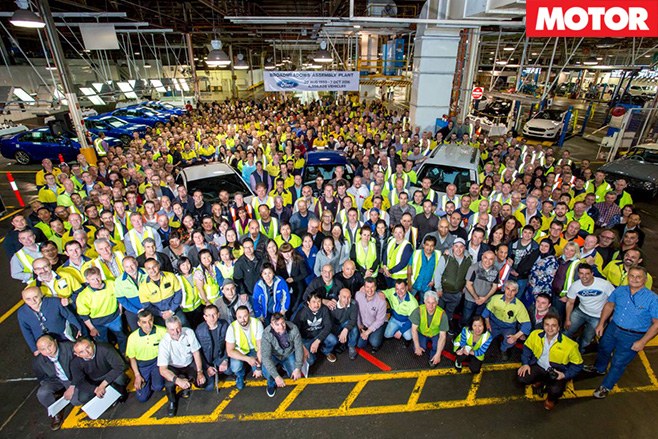
Ford Australia has given its Broadmeadows and Geelong local operations one final salute with an emotionally charged time-lapse video dubbed 24 Hours of Manufacturing.
Released after the final-ever Australian-made Fords rolled off the line late last week, the video has the sort of high production values to make it a fitting farewell to both the loved Ford Falcon and Territory, and the sizeable manufacturing workforce.
Aptly backed by Forever In Time by Canadian producer Tim McMorris, the video starts at dawn with steel-forming fire blazing at the casting plant in Geelong, and after two minutes, 30 seconds it ends at the assembly plant in Broadmeadows as vehicles undergo final checks.
Workers first check and sort the freshly baked components on a conveyor belt. A flag is draped from the roof, a Ford badge only with ‘PRIDE’ printed inside it.
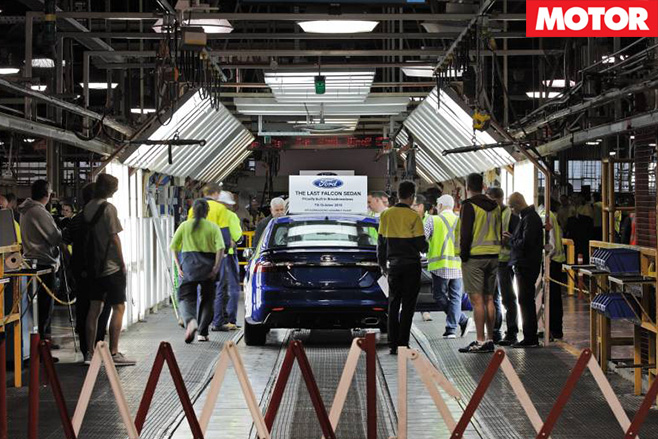
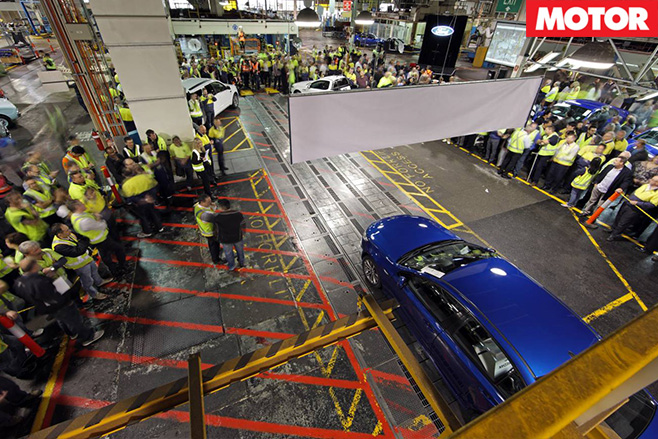
“Thank you to all the many dedicated employees who have supported Ford over the last 91 years and continue to support Ford in the future,” Ford Australia wrote on its Facebook page where the video was released.
Mercedes-Benz seal Constructors’ Championship with podium finishes at Suzuka.
In a controlled, possibly title-defining performance from start to finish, Mercedes’ Nico Rosberg moved closer to his maiden Formula One title with an emphatic win in the Japanese Grand Prix – his first triumph at Suzuka – while defending champ Lewis Hamilton made another dreadful start and went winless for the fifth race in a row.
From pole, Rosberg was never under serious threat, finishing 4.9 seconds clear of Red Bull’s Max Verstappen, and a recovering Hamilton.
“I had to save my engine a bit as it was my last race in the cycle – but the gap was always safe,” Rosberg said later. “I came here to win in Japan and I managed to do so, which is really special. It’s a fantastic feeling to win at this legendary race track.
“The season is not over yet with a few races still to go around the world, so I need to keep my energy up! Now we need to focus on the last four races.”
Runner-up Verstappen now has six podium finishes to his name this season, the same number as Red Bull team mate Daniel Ricciardo, who was a distant sixth.
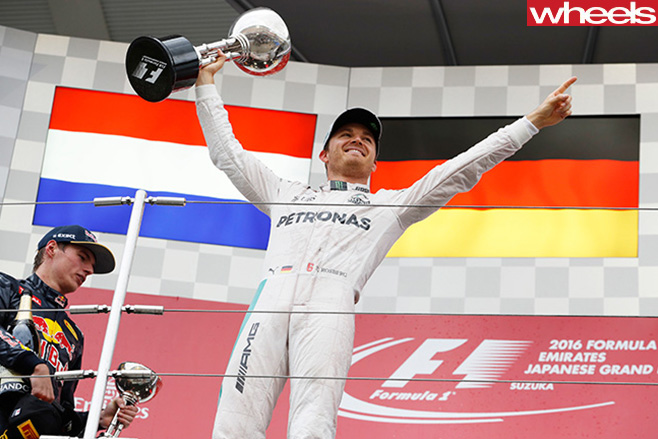
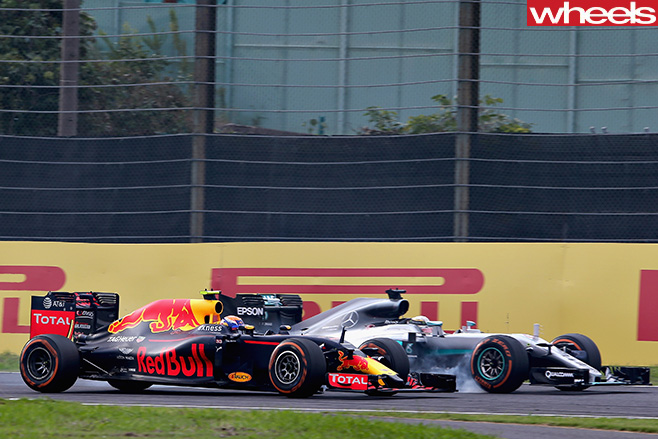
To keep second, the teenager had to defend vigorously in the final chicane, but unlike past races, no-one seemed to think his driving was anything but fair. “Lewis (Hamilton) was obviously a bit quicker in the final stages and I knew he was going to catch me, the gap time on the pit board was dropping every lap,” said Verstappen. “Into the last chicane I saw him coming in my mirrors so I defended my position, this allowed me to hang on for the second place.”
Ricciardo had a forgettable race after a sluggish start and a mysterious car issue. “Kimi’s (Raikkonen) penalty was a bit of a bummer for us as it put us on the wet side of the grid and that compromised the start,” the Australian reported.
“We struggled to stay close to the cars in front as we couldn’t follow them in the dirty air, and we didn’t have the straight line speed to make an attack. We struggled in the traffic and fell behind the eight ball. In the final stint towards the end I had a clear track and I was able put in some good laps but it wasn’t enough. I’m not going to get too down about it. I didn’t think there was anything else we could have done today.”
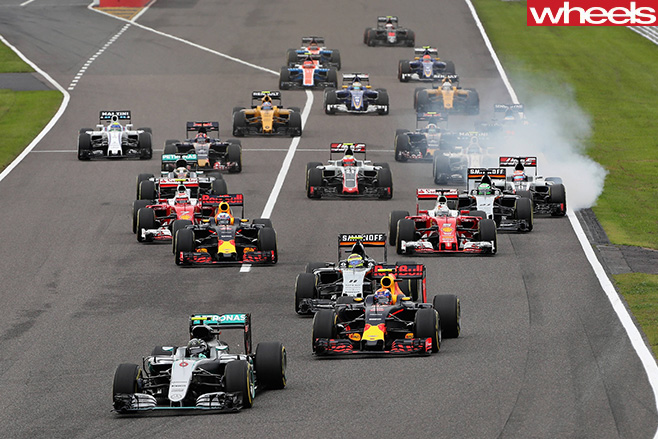
The Suzuka race did resolve one championship, the Constructors’, the one-three finish giving Mercedes the points they needed to seal a third successive title.
The Japanese GP was just the seventh time in history (but twice this year) that every starter made it to the chequered flag.
Ferrari’s Sebastian Vettel at least made it through the first lap this race, but the four-times world champion has claimed just one podium in his last nine races – his worst run of form since his first full season with Toro Rosso in 2008.
Rosberg (313) now leads the Drivers’ Championship by 33 points from Hamilton (280).
Next up is the 2016 United States Grand Prix at Austin – a venue that Hamilton has triumphed at in three of the last four years.
It took time and lots of a forensic investigation, but Mercedes has revealed the cause of Lewis Hamilton’s engine failure whilst the Brit was leading the recent Malaysian Grand Prix.
The reigning world champion was heading for victory at Sepang when his engine quit in spectacular fashion 15 laps from the chequer. It was the reigning world champ’s third power unit failure of the challenging season.
A big-end bearing failure in the crankshaft triggered the fiery explosion, which came, says Mercedes, unexpectedly after 618km of running, and a loss of oil pressure.
For yesterday’s Japanese GP, Hamilton was forced to go back to the power unit he used in Singapore.
Citroën Racing announces its crews for WRC
Kris Meeke/Paul Nagle will be joined by Craig Breen/Scott Martin and Stéphane Lefebvre/Gabin Moreau to form the nucleus of the Abu Dhabi Racing’s Citroën factory-backed squad chasing the FIA World Rally Championship in 2017 and 2018.
For its serious return to the WRC, Citroën will also enter Sheikh Khalid Al Qassimi with his co-driver Chris Patterson at some events in 2017.
Citroën is expected to pose a huge threat to the dominance of VW next year; its modern-era history in the WRC is impressive. Since joining the WRC, Citroën has won nine drivers’ titles, eight constructors’ championships and amassed 94 individual rally wins.
The ingredients of the Citroën Racing squad are coming together in an orderly way. From April this year, the Citroën C3 WRC has completed seven development tests, both on gravel and tarmac, and is now very close to the final version to be used in the opening event of the 2017 season, the Monte Carlo.
After confirming Meeke and Nagle at the end of last year, the line-up is now completed by two talented young crews, Breen/Martin and Lefebvre/Moreau.
At the start of the season, the team will enter two Citroën C3 WRCs: one for Meeke and the other for either Breen or Lefebvre, who will alternate. Citroën will start entering three cars as soon as possible. The FIA’s World Motorsport Council recently decided it would let manufacturers enter three cars, the top two scoring points towards the Manufacturers’ World Championship.
TELL ME ABOUT THIS CAR
This is the first AMG variant of the new Mercedes-Benz E-Class. It retains the E400’s high-tech safety tech and 3.0-litre twin turbo V6 engine, but with more power, an upgraded suspension and better steering. It’s nowhere near as bonkers as the impending E63, but it strikes a good balance of refinement and performance while managing to stay under the radar.
STRENGTHS
- It’s inconspicuous. Most current AMGs are raucous things that attract a lot of attention. That’s not a bad thing, but it’s not for everyone. The E43 is a plain-clothed way to get AMG driving thrills while dialling back the race car styling and boisterous snap, crackle and pop of the exhaust.
- It’s luxurious. The cabin is simply beautiful and of high quality. The standard air suspension in the E43 is also great. Variable drive modes can soften the suspension for maximum comfort, or firm up the dampening for better steering response without ever getting too harsh over rough road surfaces.

- It has heaps of grip. Where the ferocious AMG C63 is rear-driven only, the E43 gets a fixed all-wheel drive system that sends about two-thirds of the engine’s grunt to the rear wheels, and the other third to the front. It’s a good balance of grip and agility, and means on the road you never feel like the car is past its limits.
- It’s fast. No, not face-melting fast like the hi-po AMG GT. A mature kind of fast. 295kW and 520Nm are suitable power outputs for this softer, more useable AMG.
- It’s plain. Staying inconspicuous is good, but the E43 is maybe a little too bland. Even those who know what they’re looking at may find it hard to pick this AMG from a regular E-Class, and that’s not great when it’s likely to cost $165,000 when it arrives in Oz later this year. That much coin will also buy the far less covert AMG C63. Tough choice.
- It’s quiet. Dialling up the full force of the E43’s twin-turbo V6 through its Sport Plus mode should let out a bit more volume from the tailpipes. The exhaust system has valves inside it which can shut down engine noise in Comfort mode, and let it become more vocal in Sport and Sport Plus, though not as much as we’d like. It’s a good sounding engine when revved.

ANY COMPETITORS I SHOULD CONSIDER?
The Audi S6 is probably the most direct competitor to the E43, though it’s much older and not as engaging as the E43. A leftfield alternative is the Maserati Ghibli S which also features a twin-turbo V6 engine with very similar outputs (301kW/550Nm) and is similarly priced at $169,900. Its Italian character and perceived exclusivity will prove drawcards for some.
Strangely, in the current BMW 5 Series line up there’s no model that occupies quite the same niche as the E43. The 535i can’t keep up, the 550i no longer exists, and the M5 sits much further up the food chain.
If you ask Mercedes-Benz, competition from within its own ranks is where the majority of cross-shopping will take place. The AMG C63 is a compelling alternative. Priced at about the same money it takes performance to the extreme and will be quicker than the E43 over any test, though it is smaller, less luxurious and not as technologically savvy.
