
Texan tuning company Hennessey has announced it will be build this special performance version of America’s Ford F-150 Raptor pick-up truck, and would have been a shoo-in for our recent article on the rise of high-performance utes.
An extra, third axle increases the number of wheels by 50 per cent, with both rear axles featuring locking diffs to aid off-road driving. The suspension is also modified and there are new front and rear bumpers, LED roof lamps, roll bar, and bigger, 20-inch tyres – wrapped in off-road rubber.
The Raptor’s twin-turbocharged V6 engine, exhaust system, and intercooler system are all upgraded, lifting power from 336kW to a dyno-soaring 450kW (Hennessey quotes 600-plus horsepower).
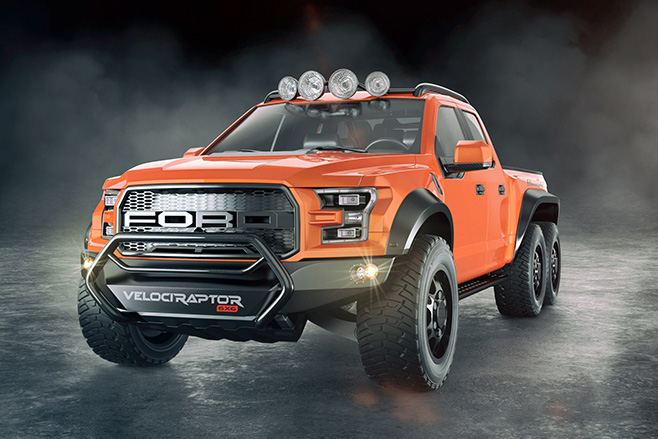
Owners of the regular Raptor can purchase the performance-enhancement package separately, for a cost of $22,500 (A$30,000).
The cost of the full Velociraptor package will put a meteor-sized hole in your wallet, though.
At $295,000 (A$390,000), the six-wheeled utility vehicle costs about six times the price of the standard F-150 Raptor SuperCrew.
And this doesn’t include additional options such as Brembo brakes, customised interior, larger wheel/tyre packages, and even armouring systems.
The Hennessey Velociraptor 6×6 is still more affordable than the equivalent model from Mercedes-Benz – the G63 AMG 6×6 introduced in Europe in 2013 at a converted price of about $550,000.
The G63 isn’t quite as powerful, though, with its 5.5-litre twin-turbo V8 producing 400kW.
In recent years Falcon advertising has been conspicuous by its absence, however it hasn’t always been the case.
We’ve trawled YouTube to bring you ads from every era of local Falcon and it’s a fascinating example of not just how automotive advertising changed, but how Australia itself changed over more than five decades.
One constant is Ford’s love of a jingle, which has usually reflected the popular music trends of the time, and there have been few catchier than the “Have you driven a Ford?” tune in the ad above.
XM
Early Falcons were a disaster, but a huge local development effort meant the 1964 XM was the first that was able to cope with local conditions, our well-spoken presenter keen to point out its “million-pound ride”.
XR
Our first jingle, an Austin Powers-style swingin’ sixties tune overdubbed with a more casual voiceover, but still with plenty of facts to inform the buyer.
XW
Information is out, catchy marketing slogans are in. “Strong construction” and “golden quality” are replaced by “more power” and “exciting Gran Sport options” with a Shirley Bassey-style tune letting everybody know that “Ford, it leads the way”.
XY
This is one Don Draper might’ve thought up. The ad agencies were clearly in charge now with big ideas; how long do you reckon it took to get all those wheels to roll straight?
XA Hardtop
More marketing agency concept rubbish, but who cares when there’s some enthusiastic driving (though did the footage really need to be sped up?) and a cool The Who-style soundtrack.
XB
Some clever point-of-view cinematography, a happy country tune and some light misogyny (“you’ve got an eye for a good figure, even when it’s your wife’s”) was the key to XB sales success.
XC
A rare early example of Ford leveraging its key racing drivers, coinciding with its brief foray back into Australian touring car racing as a factory effort. Nice editing, guys, but we know they’re really cardboard cutouts.
XD
Falcon commercial, or 2001: A Space Odyssey? Ford’s design team switched its inspiration from the US to Europe for the all-new XD and its advertising was equally ambitious.
XE
The Star Wars-esque computer-generated graphics are very cool; the Hannibal-Lecter-talking-into-a-fan voiceover less so. “Hello Clarice.”
EA
The facts-based advertising of the 1960s is now a distant memory, this EA Falcon ad scoring 10/10 for marketing waffle. Did anyone try submerging their EA in water and see if it still worked?
ED
Why is this guy driving his children around a construction site?
EF
We’re back to facts for one of the most successful periods in Falcon history, the EF Falcon leading the new-car market with 81,300 sales in 1995. Not sure about the rampant flower destruction, though.
AU
No marketing waffle here, just a grey nomad extolling the virtues of the Falcon’s new independent rear suspension and firing a shot across Holden’s bows at the same time. Not that Holden was worried, it was cleaning up on the sales charts at the time.
AU III XR8 ute
Before the likes of Harold Scruby got involved, you used to be able to make a cheeky, speed-related car ad in Australia, and this was one of the best.
BA XR8 ute
And here’s the result of Mr Scruby’s interference. No more fast driving or excitement of any kind, but a clever response from Ford.
BA Fairlane G220
The BA Falcon was a huge success and this confidence was reflected in Ford’s advertising. Few could’ve imagined that four years on the Fairlane would be gone forever.
FG
With Australia’s automotive advertising industry wrapped up in cotton wool, we end up with agency-driving efforts like this.
Ecoboost
One of Ford’s final Falcon ads, this slightly gruesome online-only effort to promote the excellent but largely ignored Ecoboost was controversial by Ford standards but, crucially, got everyone talking.
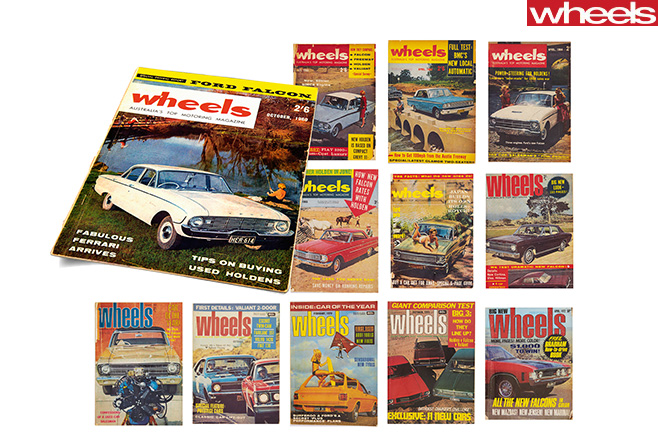
It’s been one hell of a journey. Here are all the Wheels covers to feature the Falcon since the dawn of the Australian icon.
FOR the last 56 years the Ford Falcon has been an Australian icon. Now, as the last four wheels are set to run off the production line for the very last time, we prepare to say our final farewell.
The Falcon started as Ford Australia’s stylish yet flimsy take on the Volkswagen Beetle, but soon developed to become a much-loved four-door family sedan.
Want to feast on some Falcon nostalgia? We’ll take you on a year-by-year journey through Ford Falcon history.
By the 1970s, the once-defeatist four-door released iconic models such as the XY GT HO Phase III that was considered the fastest four-door production sedan in the world when it was released in 1971, or 1972’s Ford XA Falcon that was the first of the truly Australian-designed family cars.
In the ’80s, the Ford Falcon ruled the roost as market leader. That all turned around in the 1990s, with the beginning of its demise as sales started to fall.
Wheels has been there with the Falcon every step of the way, featuring it on the cover 98 times.
“Only Wheels has been there since the beginning of Ford Falcon’s 56-year journey. Only Wheels can tell the Falcon story with the authority, empathy and passion that Australia’s most enduring nameplate so richly deserves,” Wheels editor Glenn Butler said.
So naturally, we had to share all the history Wheels and Falcon cover. Without further ado… it’s been one hell of a journey.
Ford proves that sometimes you can win hearts without winning the race.
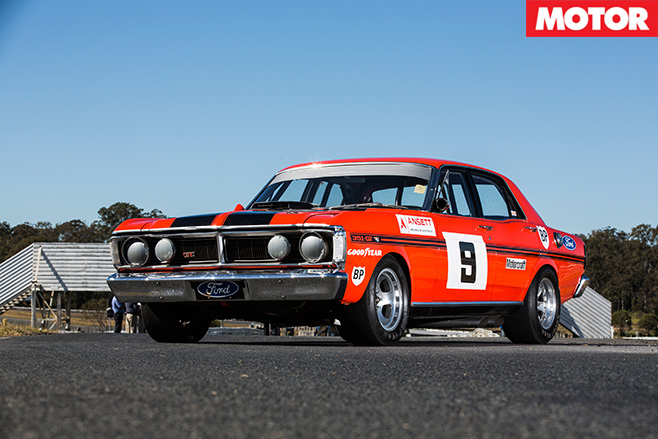
The last Falcon racer spun off a ‘homologation special’ production vehicle from the golden era of Australian muscle cars. The racing rules had changed in the wake of the 1972 supercars controversy, allowing greater modification. Moffat won his first ATCC crown in the XY – racing in the iconic ‘Brambles Red’ livery.
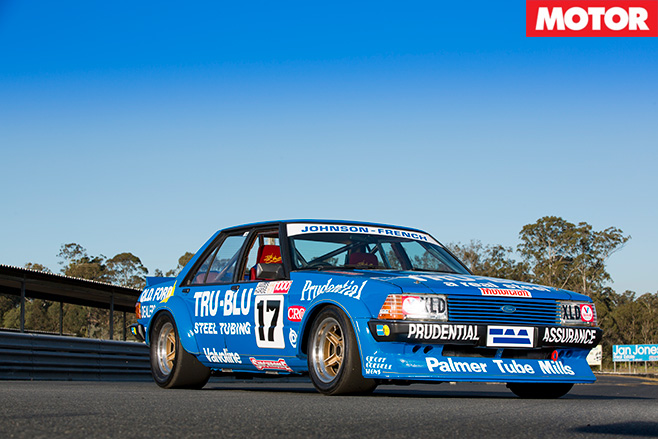
Hitting a rock on track while holding a big lead early in the 1980 Bathurst 1000 immortalised Dick Johnson and his Tru-Blu XD. Public donations matched by Ford Australia financed a replacement racer, which cemented the blue-hued Falcons’ fame by giving Johnson the 1981 ATCC/ Bathurst 1000 double.
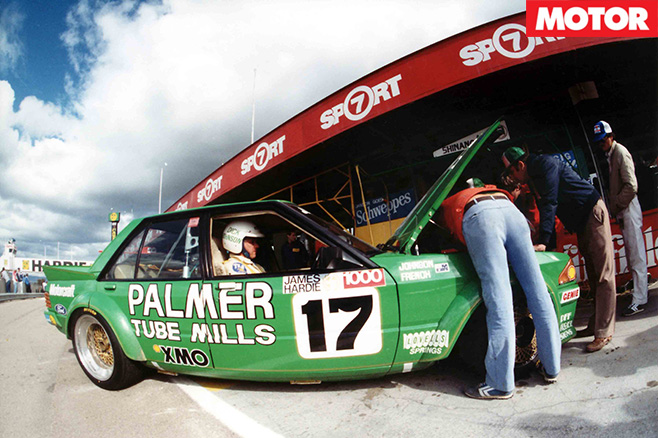
Never have Falcon racers looked so imposing, especially the ‘Last Of The Big Bangers’ version that carried Johnson to victory in the 1984 ATCC. Ultra-muscular with bulging fender flares and huge rear spoiler, the XEs’ striking appearance was accentuated by the bright green livery.
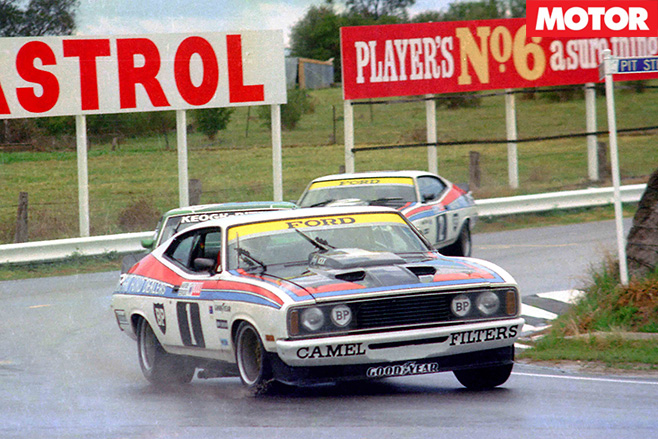
Arguably, the greatest Falcon racer of them all. With big backdoor backing from Broadmeadows, the Moffat Ford Dealers Team XC Hardtops of Moffat and Holden defector Colin Bond humbled the Holden Dealer Team Torana L34s in the ATCC – and famously orchestrated a 1-2 form finish at the Bathurst 1000.
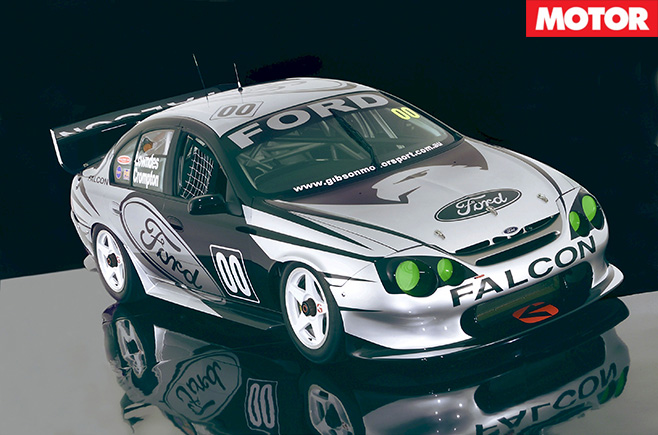
Craig Lowndes’ jump from Holden to Ford to lead a new factory-backed squad was as unsuccessful as it was divisive. The awkward AU struggled but fans loved its menacing green headlights. The car remains an all-time favourite for the contrast of those fluorescent dots with its sober silver, despite an undistinguished track record.
The Ford fight back starts at the touch of a button.
This article was originally published in the March 1997 issue of MOTOR.
Twist the ignition key, punch the glowing red circle high on the driver’s left side of the instrument panel and the big Boss 290 motor fires into life, then settles to a slightly uneven idle that gently shakes the BA Falcon’s solid frame.
What follows is something Ford fans, or anyone into hot sedans, has been looking forward to for years. A GT that’s fast and noisy, sits fat on the road and screams to the world that Ford Australia is right back in the performance car game.
Is the GT enough to have the boys at HSV quaking in their boots? You’d want to hope that Ford Performance Vehicles, as the old Tickford operation is now known, has its act together sufficiently to give certain rivals across town a good kicking in the slats. After all, it has been a few years, a couple of 1990s GT Falcons that never captured the public’s imagination and the Titanic-sized disaster of the AU Falcon is all ancient history. Now is the time for Ford to lift itself off the mat, and the GT is being seen as the ultimate counter-attack.

As you’ve probably read, the GT is the next step up the ladder. Along with the more luxurious (but mechanically identical) GT-P, it is now a permanent model in the FPV line-up, not a toe-in-water limited edition cash-grabber like the old EB and EL.
Plenty has gone into this car, starting with the total revamp of the AU that became the BA. Add to that the twin cam, 32-valve XR8 engine upgraded from 260 to 290 kW, toss in lots of suspension work, and the GT adds to what is a burgeoning performance portfolio from Broadmeadows.
In dollar terms, it’ll set you back $59,850 for the basic five-speed manual GT, although there’s also a four-speed auto for another $1150. The interior is based on the XR8, meaning it gets the entry level stereo and air conditioning display, with the auto climate control jobby reserved for the GT-P. You do get cruise control, six-stacker CD, traction control, ABS and 18-inch alloys, but leather, sports steering wheel and a metal gear knob are extra cost options.

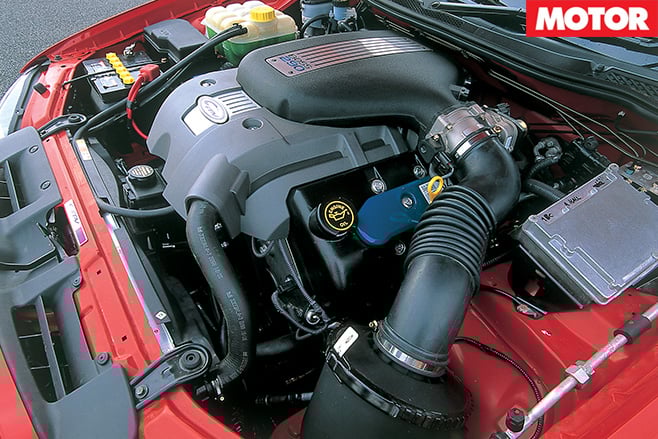
The top end changes are no less dramatic. A new camshaft gives 13 mm of lift on the inlet side compared with the XR8’s 10 mm, and exhaust valves open an extra two millimetres. Valve stems are longer to cope with the extra lift, finger followers are also longer, and the Visteon engine management system is overhauled for the new parameters.
It all sounds like FPV was looking for more revs and top-end power from its new and very undersquare V8 which, in SOHC form, is a low-speed, smooth and torquey unit, but not really a fire-breathing hotty at the top end. To that end, the outputs speak for themselves: Not only is there 30 kW more than the XR8, but it is produced 250 rpm higher in the rev range at 5500 rpm. Torque goes from 500 to 520 Nm, and again it peaks 250 rpm higher up, at 4500 instead of 4250 rpm.

But first, let’s get the weight issue out of the way. No two ways about it, at 1835 kg, the GT is a heavy bastard. It’s about 40 more than the already-porky XR8. That equates to a power-to-weight calculation of 6.3 kg/kW, so even with an HSV GTS-like power output, the engine is going to be working hard.
Just getting the GT off the line is an issue in itself: on Calder’s rubbery drag strip anything more than about 1800 rpm before dumping the clutch set the rear Dunlops alight, and there was enough axle tramp to give the Correvit (kindly donated by our friends at Victoria’s RACV tech dept after our beloved unit pooped itself) a hernia of sorts.
Revving the Boss out to its 6000 rpm cut-out in second just managed to get the GT to 100 km/h before the five-speed Tremec was brutalised with a bang into third, but to cross the 400 metre line yet another shift was needed into fourth. All the while, the big V8 is producing big power on the way to its redline, matching the abundant torque that gave it so much trouble off the start.
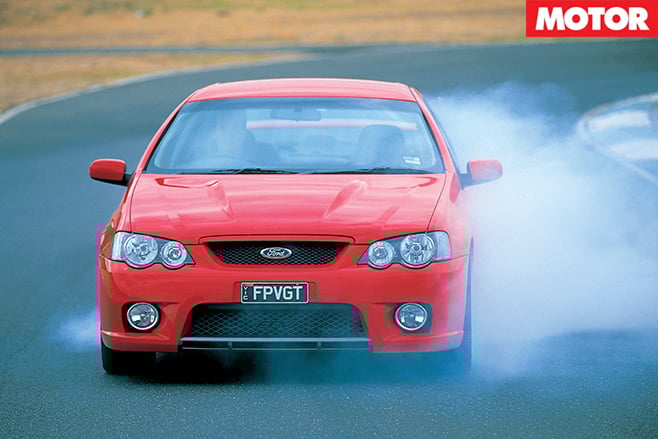
Practice kind of makes perfect, or in this case, GT acceleration times a little quicker than at Calder. Thanks to lower-than-recommended tyre pressures and a goodly number of attempts to match the perfect launch with the shift points, we got quicker. Still hard to get off the line, but 0-100 km/h in 5.81 sec and 400 metres in 14.06 is better, if still not in the same league as Holden’s heroes.
So after all the hype, is the GT actually a slug, given that only the most insane owner would go to all the trouble of producing these sorts of times? There’s no doubt the GT’s weight counts against it, as does the gearing of the Tremec five-speed requiring three shifts over the quarter, and then there’s the lack of traction off the line. In any public bar argument, it’s safe to say something like a 300 kW HSV GTS (costing about $30,000 more, don’t forget) has the GT’s measure.

The quest for top end power has also been achieved, but that’s not to say this is a peaky engine like Holden’s Gen III. Simply, the featherbed of torque turns into a raging torrent of horsepower as revs rise, with a noticeable increase in urge over 4000 rpm. There’s no red line marked on the tachometer, and it says a lot for such a large capacity and long-stroke V8 that it needs a weather eye to stop it banging off that 6000 rpm limiter.
It’s also something of a dolly to drive. The pedals might be off-set to the right, as in any BA Falcon, but clutch efforts are light, the fly-by-wire throttle is well modulated, and the shift action of the Tremec is so much quicker and more positive than the T5 in the XR6 Turbo that it’s not funny. There might not be quite the no-brainer lightness of a Toyota Corolla, but it puts to rest forever the theory that a muscle car needs muscle to pedal.
And did we mention the noise? Glorious. The twin-pipe exhaust set-up exiting through a single oval tip under the right-rear bumper might not look overwhelming, but the throaty howl it emits under full throttle, or the little tunes you can play at other times, justify the 60-grand entry price alone.
Whatever it is, there’s great stability with just a hint of tram-lining over longitudinal ridges. The overall impression on the road is of great solidity, which together with low noise levels and the powerhouse punch of the engine give something of the old iron-fist, velvet-glove feeling.
It is, however, a big, heavy car and while that shouldn’t necessarily affect the handling, this is no MX-5 on the twisty bits. The 18-inch wheel and tyre package is the same as the XR8’s (and indeed, as you can see in the pics our GT wore XR8 rims while it awaited the production items) which are enough to give the front end bite, while adding significantly more weight to the steering than the standard and overly light Falcon set-up.
Standard brakes are FPV’s Performance items, meaning grooved discs and twin-piston calipers on the front, and they work extremely well at hauling the GT’s mass down from speed while retaining a progressive and communicative pedal. Spend another $5950 and you get the Brembo package with bigger (try 355 mm at the front) cross-drilled rotors, with four-piston calipers front and rear.
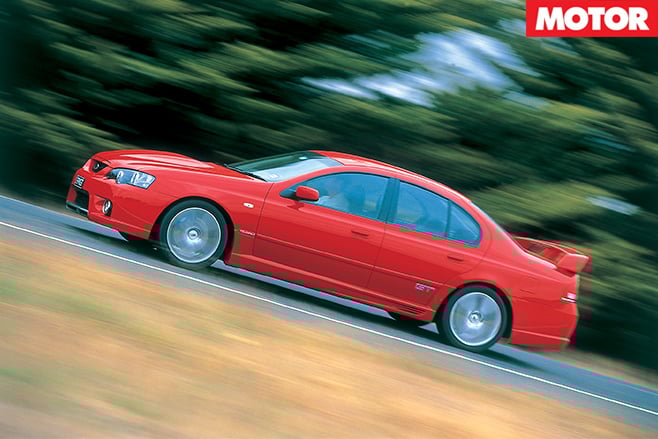
The GT copped some criticism for looking too mild when first displayed at the Sydney show last year, although those critics may have forgotten that a GT is meant to be a warmed-over Falcon, not an exercise in plastic moulding. Otherwise you end up with the EL GT. Urrk.
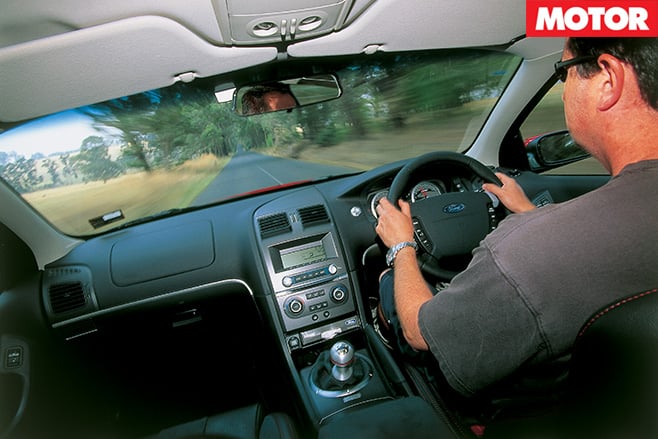
Inside there are grippy seats with GT badging, although the natty leather/suede combo is optional as is the spiffy metal gearshift knob. Instruments get FPV logos as backing and are a bit hard to read, and there are the usual BA foibles of switchgear hidden by the steering wheel (but you soon get used to finding the ‘traction off’ button), the off-set pedals and that gearknob can get too hot to touch in warm weather.
So, then. No excuses for the performance which, if not disappointing in ultimate terms, barely matches even a standard Subaru WRX. But raw figures only tell half the story, because the GT engine’s huge flexibility means the driver never feels it lacks anything on the road.

We think they will.
SPECS Body: four-door sedan Drive: rear Engine: 5.4-litre, 32-valve DOHC V8 Power: 290 kW at 5500 rpm Torque: 520 Nm at 4500 rpm Compression ratio: 10.5:1 Bore x stroke: 90.2 mm x 105.8 mm Weight: 1835 kg Weight/power: 6.3 kg/kW Specific power: 53.7 kW/litre Transmission: five-speed manual Suspension: double wishbones, coil springs, anti-roll bar (f); Control Blade IRS, coil springs, anti-roll bar (r) Length/Width/Height: 4920/1864/1435 mm Wheelbase: 2829 mm Track: 1560 mm (f); 1575 mm (r) Brakes: 325 mm grooved, ventilated discs, twin-piston calipers (f); 303 mm grooved, solid discs, single-piston calipers (r) Wheels: 18 x 8.0-inch (f & r), alloy Tyres: Dunlop SP Sport 9000, 235/40 ZR18 (f & r) Fuel: 68 litres, PULP Price: $59,850
FAST FIGURES 0-10 0.53 0-20 1.06 0-30 1.53 0-40 1.98 0-50 2.44 0-60 2.98 0-70 3.78 0-80 4.41 0-90 5.10 0-100 5.81 0-110 6.96 0-120 7.98 0-130 8.96 0-140 10.09 0-150 11.24 0-160 12.88
Join Wheels as we follow the last Aussie-made Ford Falcon off the line at Broadmeadows.
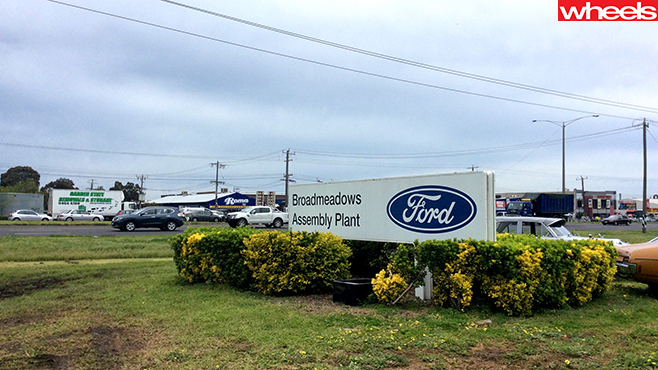
WHEELS is out at Broadmeadows standing vigil as the last Ford Falcon rolls off the line. Join us as we bring you all the colour and movement as one of Australia’s most iconic brands signs off on 56 years of Falcon and 91 years of local manufacturing.
Want to feast on some Falcon nostalgia? We’ll take you on a year-by-year journey through Ford Falcon history.
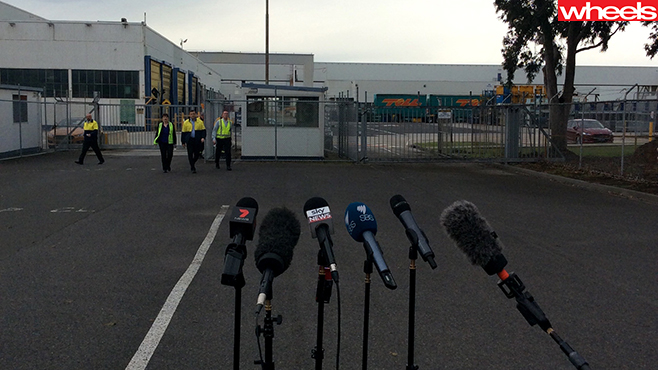
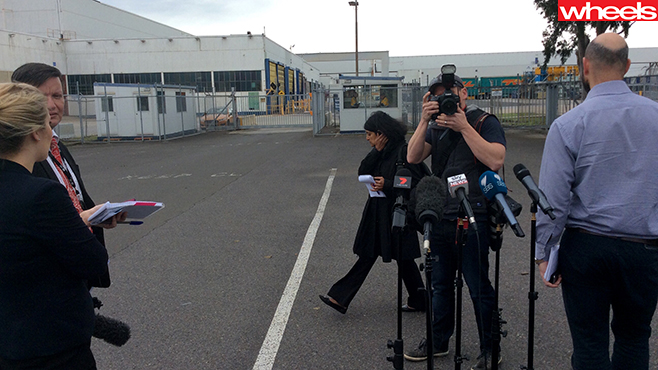
11:55AM: Press conference slated to begin at 12:15pm. We will broadcast live to the Wheels Facebook page as soon as it starts.
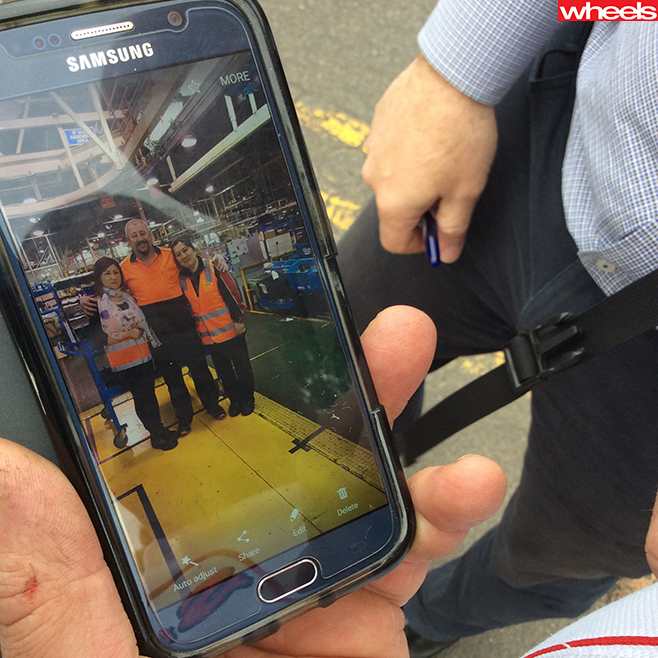
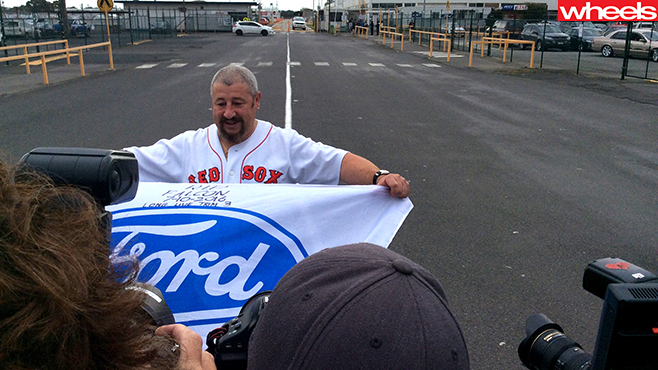
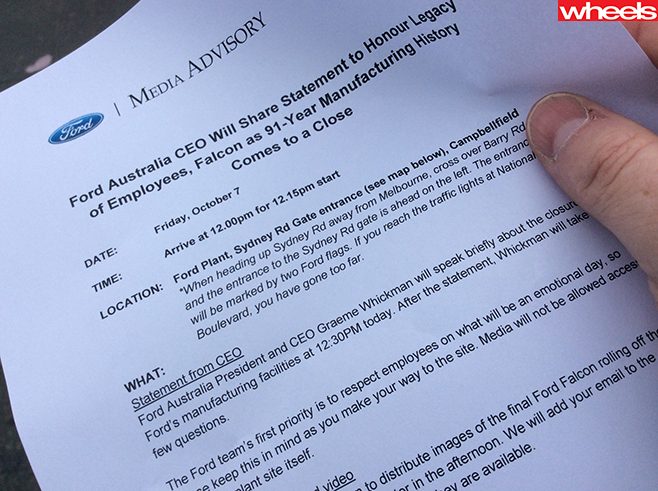
11:00AM: Ford Australia president Graeme Whickman is expected to make a separate statement in the next few hours.
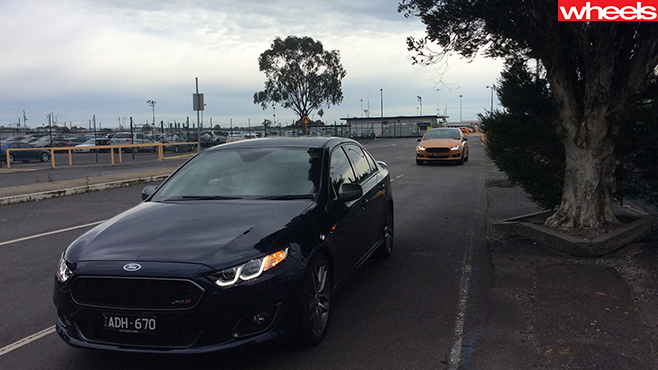
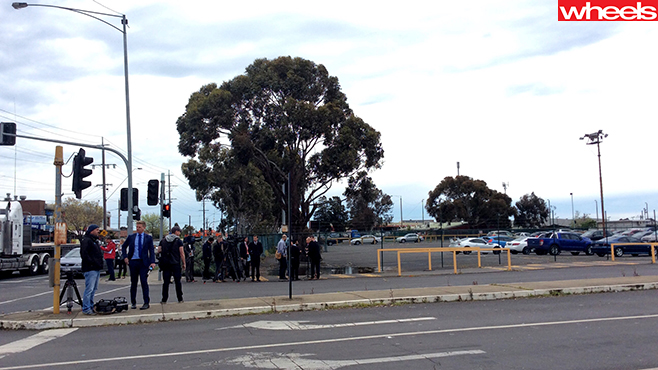
10:07AM: Tim from Auckland, New Zealand has just turned up to see the Ford factory. He’s here on what he calls “a petrol-head’s trip to Bathurst”.
9:56AM: Security has cleared media from the Barry Road employee entrance because it says a lot of people are about to come through.
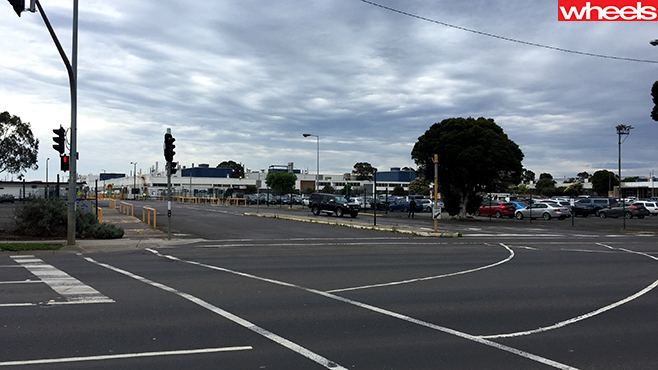
9:45AM: A trickle of workers are already coming out of the factory to the employees’ car park. A shout of “goodbye” and that’s it, they start up their cars and leave.
9:42AM: Ford says it is “privately honouring manufacturing employees’ decades of contributions as the final Falcon rolls off the Broadmeadows Assembly Plant line.” It says 600 workers will leave Ford, 160 will be re-employed somewhere else inside the business.
9:39AM: “Today is an emotional day for all of us at Ford. We are saying goodbye to some of our proud and committed manufacturing employees and marking an end to 91 years of manufacturing in Australia,” Ford Australia president Graeme Whickman says.
9:38AM: Ford has just issued an emotion-charged statement; its only communication with the outside world so far today.
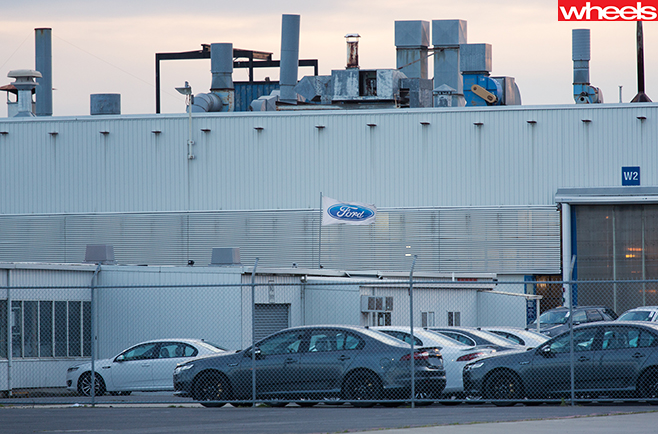
9:00AM: We’re now about half an hour away from when the last Falcon is due off the line. All is very quiet outside the factory.
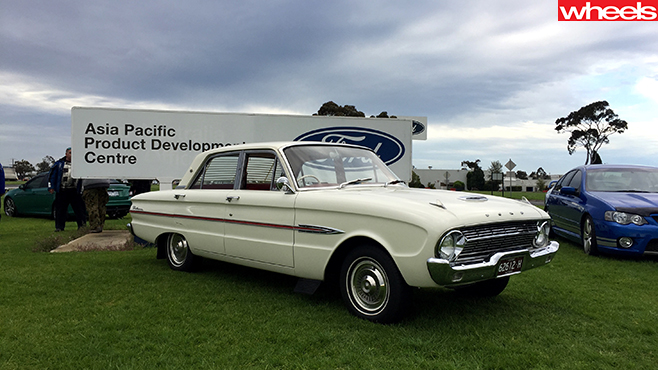
8:17AM: George has been with Ford for seven years in maintenance. He feels OK about today. His mate says today “is all a bit of a show” as the last cars have already been built.
7:56AM: Workers will be about an hour into their final shift. The last cars are still expected to come off the line at 9:30am.
7:54AM: Mick lives nearby and turned up in the GT he’s owned for the last 19 years. “Yeah, it’s a bit sad today,” he says. “I’ve got mates that work in there.”
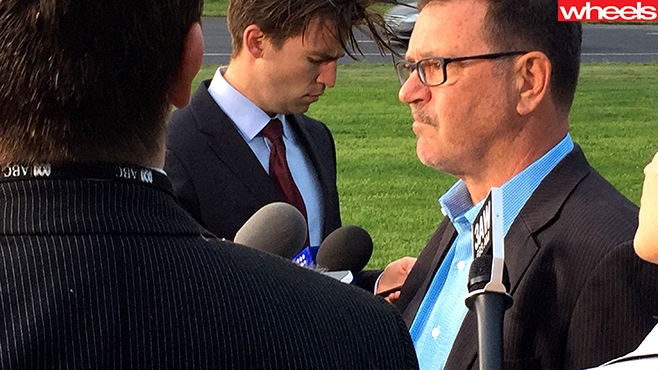
7:25AM: “We shouldn’t be here today,” says one Ford fan who has turned up outside the Broadmeadows head office. “It’s the government’s fault.”
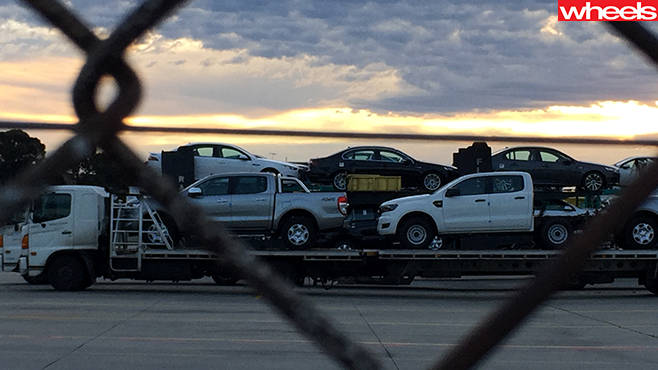
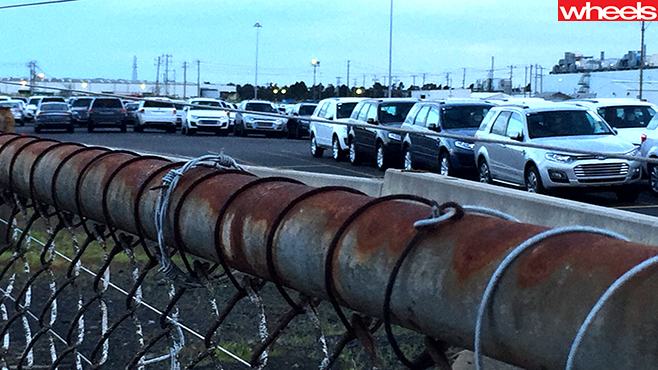
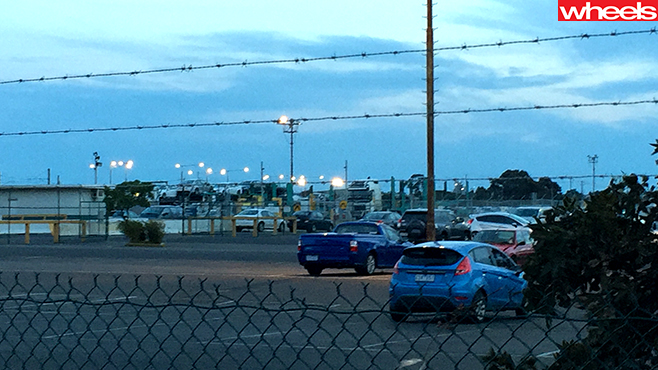
6:36AM: When asked what they would do after the last car is off the line, one says: “Don’t know. Just go home, I guess.” Another says he expects tears from workers once the last Falcon is off the line. “It’s a pretty emotional day for us.”
6:35AM: Workers meeting outside the factory for coffee together have confirmed the last two cars will be a white Ford Territory followed by a blue Ford Falcon XR6.
6:03AM: The Falcon has been built at Broadmeadows since production of the XK started in June 1960. Today, more than 56 years later, it’s all over.
6:02AM: We’re expecting the last Ford Territory, a Winter White TS featuring the Barra 4.0-litre in-line six-cylinder engine – the only SUV to ever win Wheels Car of the Year – to roll off the line shortly before 9.30am this morning. Soon after we expect a Kinetic Blue XR6 – the most Aussie Falcon there is, to follow it off the line as the last Ford made here.
6.00AM: Wheels is outside Ford’s assembly line at Broadmeadows today as we wait for the last Falcon to roll off the line sometime this morning. Like the last ute’s send-off here a few weeks before, and the Geelong casting plant’s final engines, Ford wants this to be a private affair for its workers. We’ll be on the outside, looking in.
What stands out?
The Ford Falcon emphasises long-distance comfort for four or five passengers, and can be had with a small but powerful turbocharged engine that saves cash at the bowser. You can still choose a traditional, six-cylinder engine, and for the hard core there is a high-performance V8. The Falcon can phone for help after a serious crash.This review covers the Falcon as sold in 2016, its final year of production.
What might bug me?
Getting comfortable with the steering wheel: many drivers find it too low.The prices you’re offered when it comes time to sell it. Most Falcons don’t hold their value well.
What body styles are there?
Four-door sedan only. The Falcon wagon was dropped in 2011.All versions drive the rear wheels.The Falcon is classified as a large car, lower priced.
What features do all Falcons have?
Satellite navigation, cruise control, power-adjusted driver’s seat, front and rear parking sensors, and a reversing camera. Headlights that switch on automatically at night.A large, clear, colour touchscreen. Each quadrant controls a different function and is easily accessed. There is voice operation, handy for making phone calls and using the sat-nav.Digital radio reception (also known as DAB), which brings better sound and more channels.Wheels made of an aluminium alloy, which is lighter than steel.An Emergency Assist system, which after a crash can use your mobile phone connection (if it is in range) to automatically call emergency services with your GPS location. Similar services from other car makers have gone through a call centre, whereas the Ford system calls 000 directly.All Falcons are covered by a three-year, 100,000km warranty.
Which engine uses least fuel, and why wouldn’t I choose it?
The 2.0-litre EcoBoost four-cylinder. In the least costly version, named simply the Falcon, it uses a claimed 8.1 litres/100km.This turbocharged engine goes just as well as the 4.0-litre six-cylinder that is also an option, but consumes about 20 per cent less fuel.One reason not to choose it is that most buyers want a six in the Falcon, and so the four-cylinder could be harder to sell second-hand.The 4.0-litre six has a well earned reputation for reliability, and builds speed effortlessly.If you want to save money on fuel and drive a six, you can get the EcoLPi version of this 4.0-litre engine. It runs only on liquid propane gas, and a gas tank replaces the car’s petrol tank. The EcoLPi six drives very like the petrol-fuelled six. It uses more fuel but costs less to fill up, because LPG is usually cheaper than petrol.If you want more power, there is a turbocharged version of the 4.0 litre six, available in the XR6 Turbo and G6E Turbo, that is much faster in all situations.Then there is the 5.0-litre V8 engine fitted to the Falcon XR8. With claimed consumption of 13.7 litres/100km, this is one of the thirstier cars on the market – and it needs premium unleaded. But the V8s are the most powerful Falcons by far.Limited-edition Sprint versions of the XR6 and XR8, available from May 2016, use modified, more powerful versions of the turbocharged six and V8, respectively.XR6 and XR8 models are available with a six-speed manual gearbox. On the XR8, the manual clutch pedal feels heavy and the gear lever can be clunky to operate.The more popular six-speed auto works very well with all engines.
What key features do I get if I spend more?
Where the Falcon runs on 16-inch wheels, a step up to the XR6 brings you 18-inch wheels, and wider tyres with a much lower profile – which provide more responsive steering and better grip.The XR6 also has a leather-wrapped steering wheel, a better sound system, and wipers that turn on when rain hits the windscreen. Styling touches extend to the headlights and a rear wing.Manual versions of the XR6 also gain a limited-slip differential, which helps the car accelerate by reducing wheelspin. (If you want a manual XR6, you can have these features for about the same as you would pay for the base-model Falcon, which comes only with an auto transmission.)The XR6 Turbo stretches the wheel size to 19 inches and offers extra power from the turbocharged six-cylinder engine. A limited-slip diff is fitted to auto versions as well.The XR8 brings V8 power and charm. It adds air-conditioning that can maintain different temperatures on each side of the cabin, partial leather seats, and bigger brakes that stop the car quicker. Tyres are wider at the rear, and the suspension is firmer to improve handling on smooth surfaces. The XR8 is also the only Falcon to come with a spare wheel that matches other wheels on the car (the rest get a space-saver spare that limits the recommended top speed to 80km/h).The limited edition XR6 Sprint and XR8 Sprint build on the XR8 equipment list, while using modified turbo-six and V8 engines respectively. Along with a bunch of cosmetic changes, both Sprints come with Ford’s SYNC2 connectivity, extra power, and a revised – and more effective all-round – chassis tune.There’s also a G6E Falcon that is more about luxury than sporty add-ons. It gets 18-inch wheels, leather seats, rain-sensing wipers, the better sound system, dual-zone air-conditioning and unique interior colours and trim elements.The G6E Turbo comes with the turbocharged six-cylinder engine and 19-inch wheels.
Does any upgrade have a down side?
The XR8 is bumpy and uncomfortable, because its suspension has been made very stiff to improve its speed through smooth corners. (The limited-edition Sprint models use softer rear springs and are better.)EcoLPi models get a smaller boot, because the LPG tank takes up space. And because these run only on LPG there will be some remote areas where you may not be able to refuel.White is the only standard colour, with the other nine costing extra.
How comfortable is the Ford Falcon?
The Falcon’s cabin is spacious and has supportive and comfortable front seats. The central screen is placed high on the dash, within easy reach of front-seat occupants and close to the driver’s line of sight.It’s easy to find places to store odds and ends up front, with good storage binnacles and a broad centre console. That centre console also doubles as a supportive centre arm rest.For many drivers, the steering wheel doesn’t adjust high enough. The base Falcon has a plastic steering wheel that doesn’t feel as good as the leather-wrapped wheels on other models.Standard sound systems are not very powerful, even the nine-speaker “premium” system fitted to the G6E, XR6 Turbo and XR8.But the Falcon is excellent for covering long distances, with its supple suspension and hushed interior. It is impressively quiet and smooth over bumps (XR8 excepted).Around town the steering is light and responsive, helping make the Falcon an easy car to live with. And all models offer effortless urge when you press the accelerator.
What about safety in a Falcon?
The Falcon has good airbag coverage and a reversing camera. Its Emergency Assistance system, which phones for help automatically after a significant crash, can reduce the time to contact of emergency services.(To see a list of the safety features on any model, select the car and look under the features tab. Safety-related features are listed in red.)The Australasian New Car Assessment Program (ANCAP) has rated the Falcon’s safety at five stars.
I like driving – will I enjoy this car?
While it’s a large car focused on family comfort, the Falcon also has excellent road manners that make it an enjoyable car to drive. Body control is good and the steering is accurate, something that helps give the driver confidence through corners.However the least costly Falcon has tyres designed to save fuel and they don’t grip as well through corners as those fitted to the other variants. Its softer suspension also doesn’t settle very quickly, especially at high speeds.The slightly firmer suspension on XR6 models makes for better control and still does a good job of absorbing bumps. With its wider tyres, the XR6 feels more secure through corners.The Falcon is one of the few remaining affordable passenger cars driving the rear wheels, which helps harness the outputs of the more powerful turbocharged and V8 models.The XR8 is very fast, and its supercharged V8 engine sounds good as well. Its firmer suspension helps it stay flat in corners, and with its bigger tyres delivers excellent roadholding.The limited edition XR6 and XR8 Sprints represent a send-off for the Australian built performance Falcon and benefit from a careful chassis tune, with attention paid to the steering rack, camber, spring rates and damper settings. Both ride more comfortably than the XR8, but also supply better cornering grip and balance – and allow much more finesse.
How is life in the rear seats?
Rear seat comfort and space has long been a forte of large Australian sedans and it’s no different with the Falcon. There is above average leg room, good head room, and rear air-conditioning vents. Even adults will be comfortable.The width of the back seat means it can also easily accommodate three adults, although the centre seat sits slightly higher. There is also a big central hump on the floor (for a shaft to drive the rear wheels), which restricts foot room.There are three mounting points for baby seats, but unusually only the centre position has the top tether bracket fitted. You’ll need to screw outer points in yourself if you need them (or get a dealer or mechanic to fit them).
How is it for carrying stuff?
The Falcon has a long, wide boot with a claimed 535 litres of space. There’s a deep well in the centre of the boot that’s great for storing a soft bag or other smaller item where it can’t roll around.That boot capacity drops to 464 if you choose an EcoLPi.The Falcon also gets a split-fold rear seat. Tow capacity is very good, at up to 2300kg for automatic six-cylinder models (the XR8 is limited to 1600kg).
Where is the Ford Falcon made?
All Ford Falcons are produced in Australia.
What might I miss that similar cars have?
A self-parking system, which can automatically steer the car into a parking spot. That is fitted as standard to all Holden Commodores.Active safety systems, such as automatic emergency braking and lane departure warning. Auto braking is available on the Mazda6 and Subaru Liberty, for example, while some Commodores have collision and lane-drift warnings.One-touch electric windows: most rivals now include a feature whereby the windows can be raised and lowered fully with a single press of the button. The Falcon only has that feature on the driver’s window, and it can only be lowered that way, not raised.A wagon body style, something that is popular in the rival Holden Commodore range.Other cars you might consider include the Toyota Camry, Toyota Aurion, Kia Optima and Ford Mondeo.If you are drawn to V8 performance and don’t need much room in the back, there is Ford’s US-built muscle car, the Mustang.
I like this car, but I can’t choose which version. Can you help?
Our reviewers like the G6E EcoBoost. The four-cylinder engine is a more frugal alternative to the six-cylinder models and is just as responsive to drive. The leather trim in the G6E improves the cabin.
Are there plans to update the Falcon soon?
The FG X Falcon reviewed here was the last update before Ford retired the Falcon nameplate, ceasing production on 7 October 2016 – and bringing down the curtain on the company’s 91 years of Australian manufacturing.The limited edition Falcon XR6 Sprint and XR8 Sprint went on sale in May 2016 as the last factory-built performance Falcons. Ford said it had advance orders from customers for all 1400 that it planned to build, including 150 allocated to New Zealand.
It’s been a long, long time since both Ford and Holden (okay, HSV) have concurrently had their mitts on truly big-capacity – as in bigger than 5.0-litre – V8s.
This article was originally published in the February 2002 issue of MOTOR.
In fact, it’d be, oooh, 1974 when Holden dropped the 350 Chev from its GTS Monaro, that both makers last offered bent-eights banging on 6.0-litres. And it’s all because Ford has finally caved in to the marketing temptation of having a V8 with the numbers to wipe that smug smile of HSV’s dial.
At 5.6 litres and 250 kW, the Henry falls 60 cc and 5 kW short of the mainstream HSV version of the Gen III, but when you’re talking digits like those, even a full 5 kW is just a two per cent deficit. Not worth arguing the toss, really. It’s pretty easy to see that Ford is sick and tired of being the dirty rascal while HSV plays king of the castle with the muscle-bound Chev.
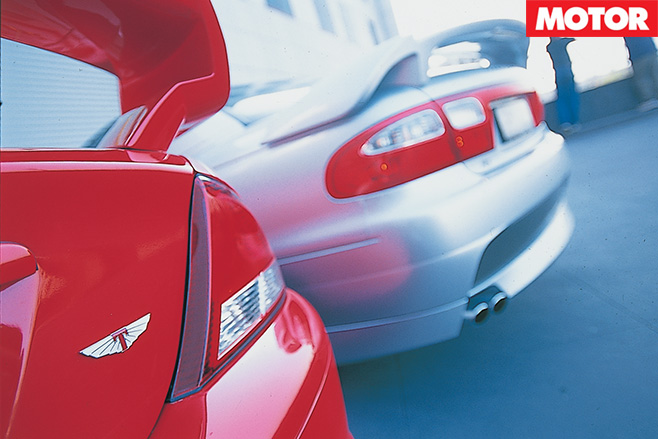
But the HSV Clubsport, with the R8 option of bigger brakes, better seats and more, is never going to be a push-over. And, by-the-by, does a theoretically lazier stroker engine in the Tickford TE50 make for a better sporting experience than the snorting 220 kW version of the same Windsor block? Only one goddamn way to find out: Gentlemen, start your bloody big engines.
Given that each manufacturer has spent so much time and money on their respective engines, it seems only fair that that’s where we should start. Check out the sidebar panel on the back page of this test and you’ll see that, although the Ford is the one being touted as the true stroker engine, the Gen III actually has a smaller bore and a longer stroke. All things being equal, you’d expect the Gen III to make more torque than the Ford (and at lower revs) with its power peak arriving earlier than the Henry’s. Bzzzzzt.
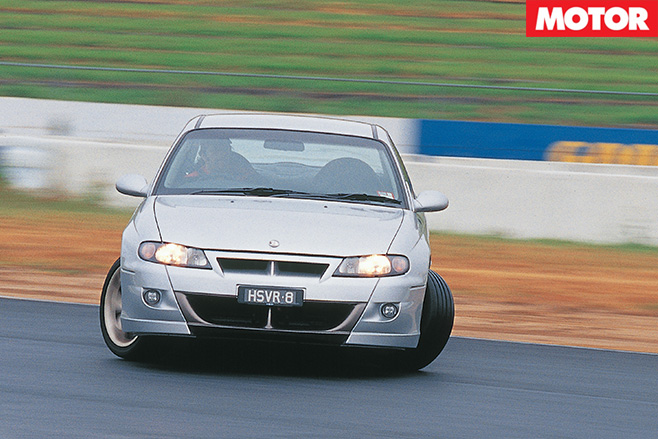
Subjectively, it’s the HSV that feels like it needs the biggest rev to get hauling. Whether it’s intake port shape and size or what, we don’t know, but it doesn’t feel like it’s really trying until you’ve got 2500 rpm showing. Three-thousand is even handier.
It’s way better than the 225 kW Holden-spec version of the same engine, but it’s no low-rev slugger. Once into its stride, however, HSV’s Gen III piles on the urge in a smooth, linear – if a tad noisy – way, and only pulls the pin at 5500 rpm.
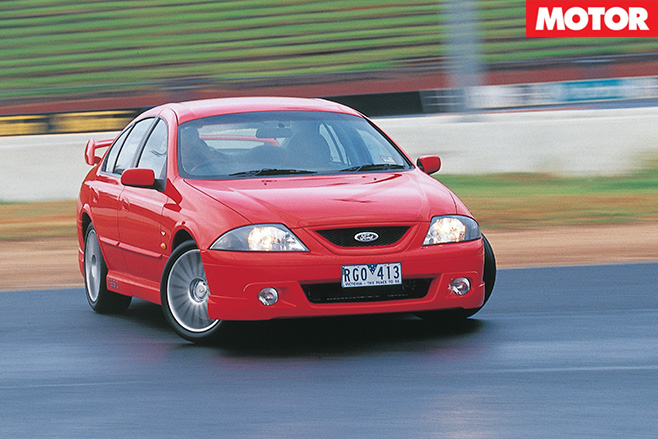
In fact, it feels even more willing to spin its innards than the 220 kW 5.0-litre Tickford mill. There’s (quite) a bit more yammering, vibration and yodelling than the Gen III, but the noise as you pass 4000 rpm has to be heard to be believed. Damn, it’s good.
Against the stopwatch, there’s really bugger-all in it. Of course, given the kerb weights of 1706 kg for the R8 and 1708 kg for the TE50, and the fact that the outright power figures are so close, any real difference comes down to gearing. Even then, because you’ve always got the engines in their blitz zone during a 400 m run, the gearing makes less difference than you might have imagined.
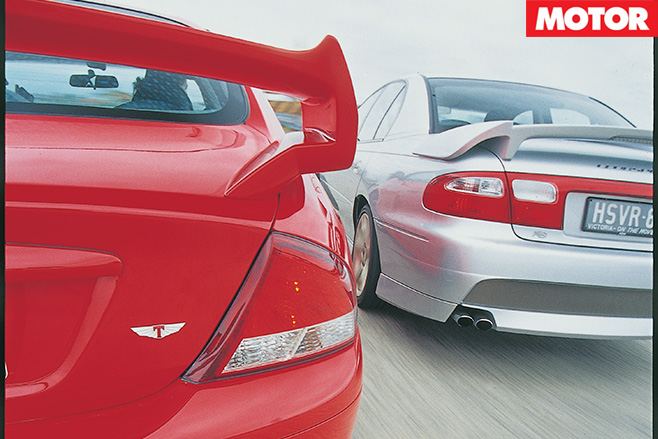
Those gearing differences that meant so little on the track suddenly come into focus in the world of speed restrictions and tight corners. At 100 km/h in fourth, the Henry is pulling just on 2900 rpm and in top at the same speed, the revs fall back to 1750. That’s a big gap, but it doesn’t feel too bad given there’s still plenty of urge available below 2000 rpm.
The six ratios in the HSV’s box allow it a little more scope with 100 km/h in fourth equating to 3100 rpm, 2400 rpm in fifth and a Mars probe-like 1600 rpm in sixth. So you’d expect the HSV to be quicker to accelerate in fifth than the Tickford in the same gear and, although it does, it’s not by much, and neither of them are exactly frying their tyres in the process.
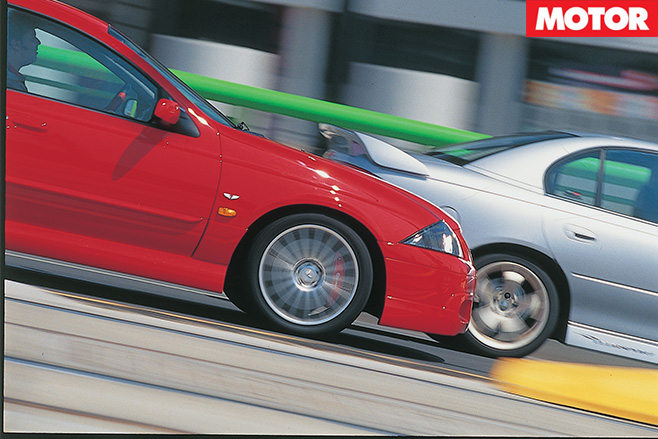
Staying in fifth also meant we could do with one less gearshift; no bad thing given the fact that the shift in the Clubsport is somewhat less than perfect. HSV’s work on the shift in recent times hasn’t turned the six-speed into a slick shifter by any stretch of the imagination.
The main problem is the glacial pace at which the box stirs its cogs about. The Ford’s Tremec five-speed is no great shakes either, but it is a quicker, more positive shift, even if you still need plenty of muscle. Speaking of which, you better have a strong left leg because the clutch in the Tickford is heavy, imprecise and needs to be pushed almost through the firewall if you’re to pick up first without a very loud, ‘I’m-a-gimp’ graunch.
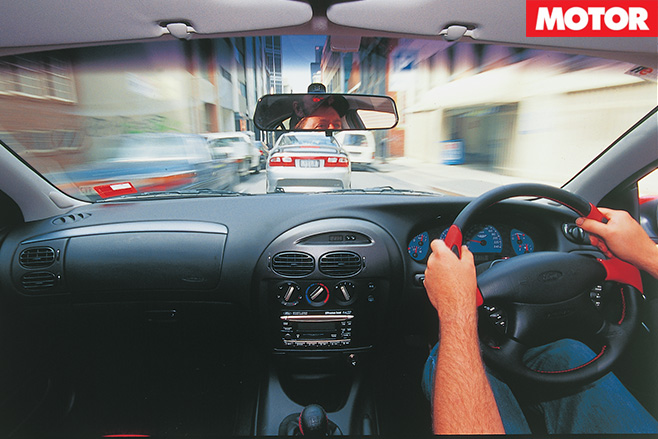
Inherent balance, the Pommy magazines call it. There’s no doubt the HSV is quick up a mountain pass, but unless there’s plenty of friction coefficient for the tyres to get a hold of, there’s simply not as much grip.
The bottom line is that while the HSV is quick point-to-point and reasonably surefooted with it, it’s a car you have to learn to trust, purely because it’s not offering as much in the way of feedback as the Tickford.
That car, meanwhile, is so talkative, it allows you to almost see round corners; to almost pre-empt any little slide from either end of what is a seriously good chassis. And for all that, the Tickford now has less of a trade-off in ride terms for the extra communication involved.
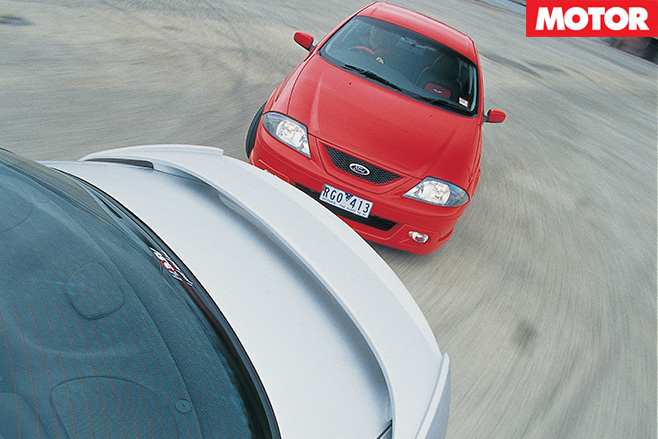
Much of the credit for this transformation is down to the optional (at $1500) Koni dampers which, in our humble opinion, makes them worth every cent. That background type of suspension and wind noise is more noticeable in the HSV, although it pales compared with the exhaust note in the Ford when you’re up it.
Both manufacturers are now deadly serious about brakes these days, and not before time. The R8 has plenty of stop and the classy-looking Brembo four-pot set-up on the Ford is exotic weapons-grade gear.
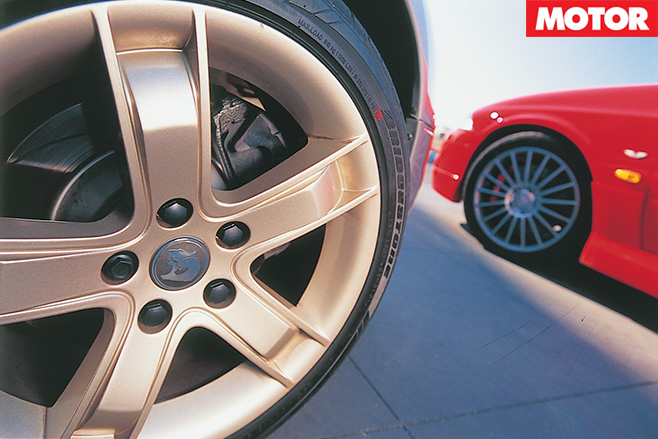
Inside, the Tickford just has too much taxi in evidence to be truly convincing. While the TS50 uses the Fairmont Ghia dashboard, the TE50 gets lumbered with the basic set-up. Curiously, it actually works better than the R8’s layout with better placement of window switches, a gorgeous MOMO tiller and shift-knob, but it just doesn’t work visually. And let’s not forget that the seats that form part of the R8 package (over and above the basic Clubsport) are the mutt’s nuts.
Externally, the Tickford is still hamstrung by the fact that it’s Falcon-based. Apparently, some people actually claim to like the look of the Ford sedan these days, but it’s also true that this is the best incarnation yet. That rear wing is too big to take seriously and the front spoiler is so low it’ll be gone in 60 seconds, but it’s a relatively cohesive effort.
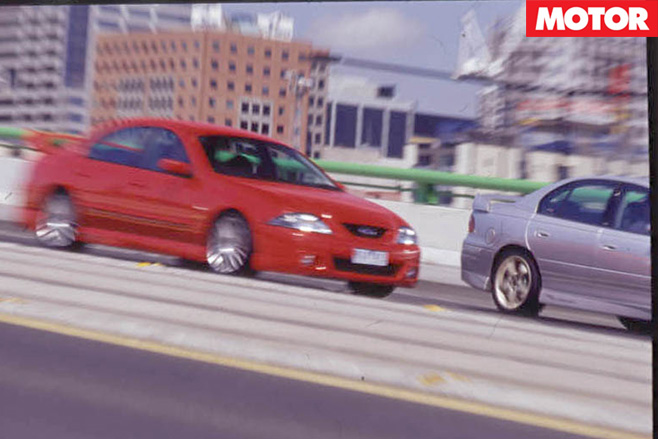
It’s been said before, but it remains that when you take two $35,000 cars, tizzy them up and then try to charge $60,000-plus for them, they’d better be more than just transport. And on that basis, the $64,200 T-Series is a clear winner.
There’s nothing devastatingly wrong with the Clubsport R8 at $66,950, but for anybody who likes to drive fast and have it feel like they’re driving fast, then the Tickford is a sharper tool. It changes direction more quickly, feels more agile and wants to get to know you. And when it matches the previously dominant HSV Clubsport at pretty much everything else, then we’ve got to say it actually moves the game on.
“No one knows quite how he does it but it’s true they say he’s the master of going faster”.
George Harrison’s 1979 song Faster is a moving tribute to Ronnie Peterson, almost certainly the fastest Grand Prix driver during the 1970s. SuperSwede, as he was universally known, died after an horrific multicar pileup in his Lotus 78 at the start of the 1978 Italian GP.
The story of Peterson’s apparently unnecessary death was first described in detail in my story Safe or sorry, which appeared in the August 1997 issue. How do I know? Because the last man to talk to Peterson as he lay dying in Milan’s Niguarda hospital was Peter Varolo, a Swedish-speaking orthopaedic doctor and, by coincidence, a friend and neighbour who lived five kilometres from our old home in northern Italy.
Watching the Italian Grand Prix that Sunday, September 11, 1978, Varolo learned that Peterson’s leg injuries were relatively minor and “there was nothing to make you think it was serious”. Only when watching the evening news did he hear that Ronnie was going to be operated on, something that should have happened hours earlier.
With his fluent Swedish and orthopaedic experience, Varolo rang the hospital and immediately left for Milan.
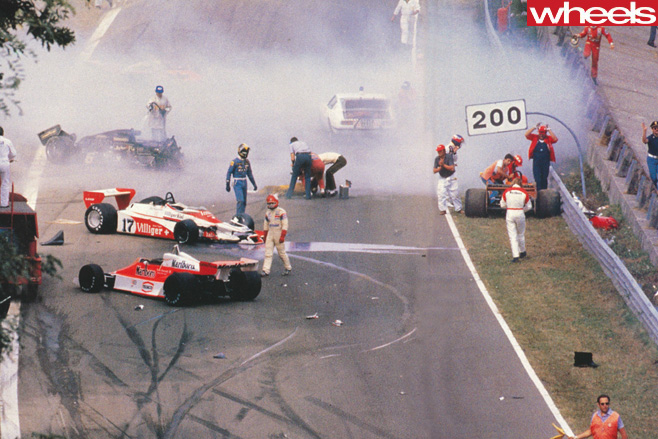
“The danger,” Varolo told me, “is bone marrow getting into the lungs through the blood (a condition known as fat embolism).” And that’s exactly what happened.
Varolo, Professor Sid Watkins (later the FIA’s official medical officer) and a young Columbian doctor employed by Lotus all signed a document stating that they would not talk about the operation. Varolo had already spoken briefly to a couple of Swedish journalists, who reported the news in Swedish newspapers, but signed the document anyway: “I realised it was useless to fight. It could have been a catastrophe for Italy and the scandal would have meant F1 was finished in Italy.”
Nineteen years later, Varolo finally told me the full story, breaking his confidentiality pledge. “Now that I’m retiring, I’m prepared to talk. It was ridiculous,” he told me shaking his head. “If the accident had happened in Sweden, I don’t think Ronnie would have died.”
I initially wrote Safe or Sorry for Motor Sport magazine in the UK. However, its editor, Andrew Frankel, thought the story so sensitive he showed it to Haymarket Media managing director Simon Taylor. After due consideration, Taylor, who also commentated on F1 races for BBC radio, decided the subject was still too delicate to appear in Motor Sport.
Taylor didn’t want Nina, Ronnie’s only child, to read that her father had died unnecessarily. Nina, born in 1975, was only two when her father died and just 12 when her mother Barbro, still depressed over Ronnie’s death, committed suicide in 1987.
Wheels editor Angus Mackenzie believed the story deserved to be told in the context of setting the record straight, improving driver safety and the need for vastly improved medical support in F1.
First published in the August 1997 issue of Wheels magazine, Australia’s best car mag since 1953.
Ronnie Peterson’s death at the 1978 Italian Grand Prix shocked the F1 world – and scandalised the way F1 handled the medical treatment of drivers.
As the inquiry into Ayrton Senna‘s death clouds the future of grand prix racing in Italy, PETER ROBINSON reveals the untold story behind another death that forever changed the face of F1
It was not an auspicious beginning. During the morning warm-up for the Italian Grand Prix at Monza in September, 1978, Ronnie Peterson’s Lotus 79 had mowed down several layers of catch fencing. For the race, he would start in the old 78. “Bloody rear brakes again,” he told Mario Andretti. “Just like yesterday.”
“You okay?” Mario asked. “Yes,” Ronnie said, rubbing his leg. “Just bruised.”
Ronnie and Mario were team mates. The blonde Swedish driver had come back to Lotus in an attempt to restore his reputation after some terrible seasons in the ageing and increasingly uncompetitive Lotus 72, a March and then Tyrrell’s dead-end six-wheeler. People said his magic days were over.
He wanted to prove they were wrong.
Peterson was prepared to accept team orders and run behind the American. Throughout the season he honoured his contract, even after it was clear he would not be staying at Lotus the following year. And in terms of raw talent, he could have beaten Andretti for the championship.
But Peterson was not like that. There was no guile, for this was a quiet, gentle, honest man. Yet nobody could make a car dance the way Ronnie did. There are those who still say there has never been a finer sight in all motor racing than to see Ronnie – everybody called him Ronnie – tiptoeing the Lotus 72 through the old 250km/h Woodcote corner at Silverstone. Tail out, Ronnie made the 72 oversteer at seemingly impossible angles and always seemed to be able to catch it. No driver was ever more exciting to watch. Not Rindt, not Senna, not Mansell. Nobody.
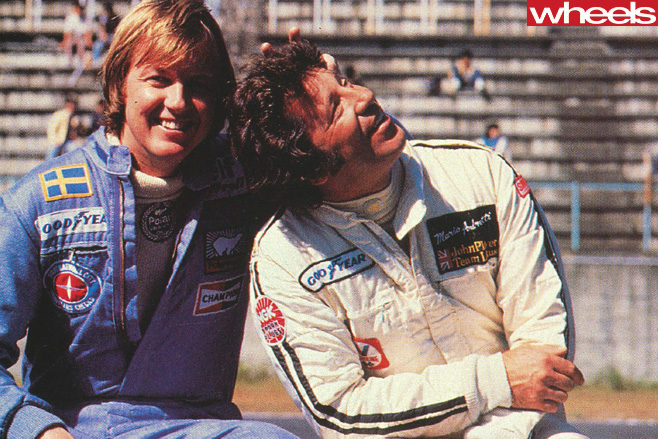
Ronnie was seriously injured, but in no apparent danger. Most people left Monza that night expecting Peterson to spend a stint in hospital before resuming his career next season. Next morning he was dead.
If Ronnie had been operated on in Sweden he would still be alive today,” says Pierangelo ‘Peter’ Varolo.
Varolo was the last person to speak to Ronnie before he died. Now 68 and winding down his medical practice, Varolo is well qualified to make this seemingly harsh judgement. You see, the doctor has a possibly unique combination of qualifications that took him to Peterson’s deathbed and guarantee that his words deserve a hearing 19 years on.
Varolo has three Italian medical degrees – general (1958), orthopaedic (1962) and legal (1964), from the Turin University – together with a Swedish orthopaedic degree (1969) which, by necessity, means he is also fluent in Swedish. For 10 years Varolo lived in Sweden, for three of these with his Swedish wife.
It was as a widower that he returned to Italy in 1972. On Sunday; September 11, 1978, Peter V arolo, now remarried, was watching the Italian Grand Prix on television at his home about 80km east of Monza. “I thought nothing of the accident,” he says today. “On television they talked about minor injuries to his legs. There was nothing to make you think it was serious.” Until he watched the evening news at 8.00pm.
“It was only then I heard he was going to be operated on and I wondered why it took so long,” says Varolo.
“If the injuries were only light, they should have been repaired immediately.
“In my opinion, if there was to be an operation they should have flown him immediately to Sweden.
“I became increasingly suspicious that something had gone wrong. Logically, he should have been treated by 8.00pm, five hours after the accident. I thought maybe I could help because I speak Swedish and have orthopaedic experience.
“My wife suggested I ring the hospital mentioned in the news: Niguarda, north of Milan. I rang and told them I was a Swedish doctor, and they asked me to come.”
Monza traffic slowed the journey and even Varolo’s Maserati Mexico, which he still drives, couldn’t get him to Niguarda before 11.00pm. As he entered the hospital, Varolo remembers hearing a Swede talking before getting into a Rolls-Royce and driving away. He later leamed that this was Steffan Svenby, Peterson’s manager.
Immediately, he was shown to the operating room. Colin Chapman, Mario Andretti, Emerson Fittipaldi and Bernie Ecclestone were still there, but they soon left because they believed Ronnie
was going to be okay. “Some Swedish friends of Ronnie’s and a few journalists were still waiting outside,” says Varolo.
“They wanted me to find out what was happening.”
Ronnie had multiple fractures of both legs, but Varolo believes that the injuries should not have been life threatening. Professor Sid Watkins, employed just three months’ earlier at the behest of Bernie Ecclestone as F1’s surgical advisor, was present.
But Watkins is a neurosurgeon and Peterson’s injuries were to his bones.
“There were seven or eight doctors in the room and I spoke to the head surgeon. They had just finished operating on the right femur. I knew that wasn’t necessary, it was an unpardonable mistake; they hadn’t touched his feet, the area most urgently in need of care.
“In Sweden we always waited a week before operating on the femur. The danger is bone-marrow getting into the lungs through the blood. We knew by experience that if the lungs became inundated with blood we’d have to give many blood transfusions. During that week we’d take daily X-rays to check the condition of the lungs.
“I would never have started on the femur, the risk was too great. The important thing was to treat the left foot, to put the bones in place, back where they belong. It was the left foot that was most injured and it was still untreated at 2.00am. Because the bones were isolated they weren’t getting any aerated blood. The navicular bone in the foot was subject to necrosis- the death of tissue- but it wasn’t treated until about 2.00am, 10 hours after the accident.
“There was a higher risk of fat emboli from the multiple fractures and especially from the femur. They should have left it alone.
“I asked why they had operated on the femur first and they told me it was because Ronnie had bums on his back and it was easier to move the patient. It was five hours before they operated at all, they took many X-rays, but nothing was decided.
“I assume it was because the head surgeon wasn’t there and they waited for him to arrive, but it’s a theory. How can you explain why they did not immediately start operating on his feet?”
At about 3.00am, after the long operation and as the anaesthetic was wearing off, Varolo attempted to wake Ronnie: “Vakna, vakna, Ronnie,” he called, speaking to Peterson in his native tongue. Ronnie stirred, reacting slightly to the cry to wake, then his head slumped back into the pillow.
Ronnie was taken away to be X-rayed at around 3.30am and, immediately on seeing the film Varolo understood. “I saw the lungs were clouded over and therefore were full of blood containing the bone marrow and I knew there was no hope. He was finished.”
Umberto Agnelli, a friend of Ronnie’s and the brother of Giovanni, the head of Fiat, rang at around 6.00am to see if there was any news.
“I told him Ronnie was dead, there was nothing to be done.”
That morning, Varolo also remembers hearing Svenby talking to Ronnie’s father on the phone, in Swedish. “He told him the operation went well, that they had been there all night, until the very end, and that everything possible had been done. Svenby had left at 11.00pm.”
After the operation and at Svenby’s behest, Varolo, Sid Watkins and a young Colombian doctor employed by Lotus, who was also present, signed a document saying they would not subsequently talk about the operation. But not before Varolo had spoken to a couple of Swedish journalists.
In his autobiography, Life at the Limit, Sid Watkins makes no mention of this secrecy. However, he does say that at about four in the morning he had a phone call from Peterson’s manager who told him, “things had taken a bad turn for Ronnie”.
“On the way to the hospital, he told me that during the night somebody claiming to be a doctor had telephoned Barbro (Ronnie’s wife who was at home in Monte Carlo), to tell that he thought the Italian doctors were killing her husband. We were never able to get to the bottom of who this person was, but it was suspected that the miscreant had impersonated medical staff in order to get into the hospital.”
Varolo’s comments were reported in the Swedish papers, and picked up the following day in Italy. Initially, the Italian papers had claimed Peterson died of petrol fumes in the lungs. “I told the Swedish journalists they (the Italian doctors) had operated too much and made a mess of it,” says Varolo.
The Italian papers and Autosprint magazine (September 19-26, 1978) quoted Varolo secondhand.
“I must criticise the manner in which they treated Peterson. In Sweden we would never have made a intervention so complicated on a person so weak from his injuries. He should have been sent to Sweden immediately.”
Why did Peter Varolo sign the no-talking document?
“I realised it was useless to fight,” he says today. “It could have been a catastrophe for Italy and the scandal would have meant F1 was finished in Italy. Now I’m retiring I’m prepared to talk.”
“It was ridiculous. If the accident had happened in Sweden, I don’t think Ronnie would have died.”
Peterson’s untimely death triggered a profound – and long overdue – change in F1 safety thinking. It decisively challenged the view that F1 drivers necessarily stared death in the face at every race; a view so entrenched that when Jackie Stewart began his safety campaign in the ’60s, traditionalists derisively called him and others the “milk and water brigade”.
Despite Stewart’s best efforts, Sid Watkins found that even in the late ’70s many tracks had little more than the most basic first-aid facilities. A mobile hospital largely funded by BRM owner Louis Stanley in the late ’60s was actually boycotted by some.
Few had workable plans for the rapid transfer of badly injured drivers to nearby hospitals. And Ronnie’s crash had pointed to the need for medical back-up to be instantly on the scene of a crash.
“One of the problems at Monza was that from the moment of the accident there was no information, and once the circuit had been sealed off by the police there was no access,” says Watkins. In the aftermath, Ecclestone came to the conclusion that Watkins’ authority had to be extended to supervising the rescue arrangements on the circuit.
Driven largely by Watkins – with Ecclestone’s support – safety slowly became a key element of F1 organisation. Races were all started by an official FIA starter, to minimise the risk of confusion, and circuits were obliged to provide fast chase cars with rapid response medical teams.
Helicopters for hospital transfers were made mandatory in 1986, while race cars were being crash tested and circuits redesigned to cut out danger points. By the early 1990s it seemed Formula One had banished its bloodsport image forever – since Riccardo Paletti’s death on the grid of the ’82 Canada GP, no driver had been fatally injured in a race crash. Then came that fateful weekend at Imola in May 1994…
