
First published in the July 1977 issue of Wheels magazine, Australia’s best car mag since 1953.
Sydney to Perth in 33 hours sounds much better as … Around the world in 13 days.
“YES, BUT what are you going over there for,” so·called friends ask, their faces full of puzzlement and scepticism. “What’s it in aid of?”
To us, full of the anticipation of a non-stop high speed trip of 4000 kilometres in a comfortable and long-legged car plus six days away from the phone and the tea lady with halitosis, this sudden need to justify ourselves knocks us off guard. It would be handy to say we were heading west for talks with Lang Hancock.
“Why, er … we’re going to have a look at a newly sealed part of the Eyre Highway”, we say pausing for a look of satisfaction on the face or the inquisitor (nothing) “… and, er we’re going to put some fast miles on the Falcon we’ve had optioned up for high speed cruising by Ford … ” (still nothing) ” … and, ah, we’re going to shoot some pictures and gather material for a story on the Nullarbor crossing”. By the time we get a glint of approval from the audience we’re wishing they’d go back to playing Scrabble on the loungeroom floor and leave us to our gentle pursuits.
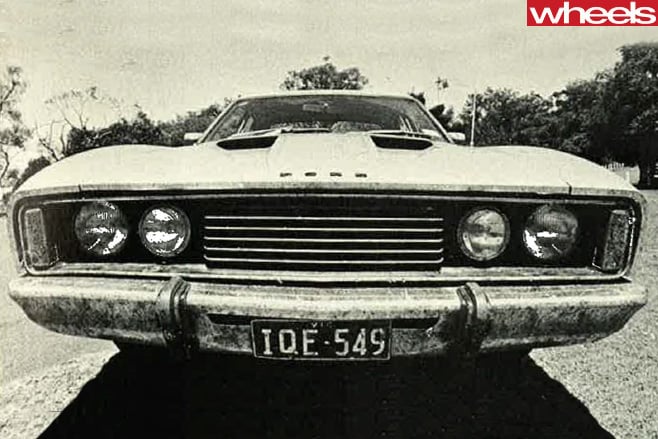
Our plan to do a quick trip across the Nullarbor is months old, born before we took delivery of our Ford Falcon 500 GS-packed long-term test car. It is specially equipped for the job with a tall rear axle radio, 4.9-litre engine with dual exhausts (reputed to give more top-end power), air conditioning, a tape player, a 125 litre tank, a stereo tape player plus Falcon GXL road wheels and fat ER70 tyres. The car also has GS instruments steering and trim, four-wheel disc brakes, and a limited slip diff. It looks ideal for the job.
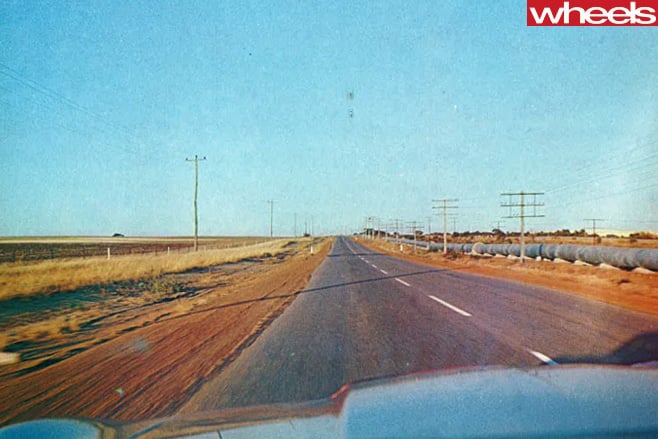
We calculate loosely that the trip ought to take around 35 hours or so, cruising well within the car’s, the roads’ and our own capabilities but not wasting any lime. That is an average speed of around 115 km/h (72 mph) which looked good on paper but when we hear that two men in a Citroen –rally-prepared but nevertheless only a bit over two litres – did it in a little less than 30 hours some years ago we are slightly deflated. We aren’t planning a record attempt, you understand, but we certainly have assumed that our 160 km/h cruising speed and our calculated range of 550 kilometres will lift us above the league of the two-litre cars.
We elect to leave Sydney at 2 am on a Monday morning, and aim to be in Perth city 35 hours later – 10 am Tuesday, local time. The early departure is to get us out of Sydney with the least possible holdup by traffic and long before the time policemen’s alarm clocks go off.
So we depart from the gates of the Terrey Hills rubbish tip – a point about equidistant from Mr Editor Robinson’s abode and mv own – at 2.04 Fomoco time and head west along the Bell’s Line towards Lithgow.
The car feels nicely balanced, loaded as it is with ourselves, light luggage for a few days, a full fuel tank – around 100 kg – keeping the tail down, plus a Sidchrome general purpose toolkit (containing spanners, screwdrivers, a first aid kit, a trouble light, a reflective triangle, insulating tape and other odds and sods) and a range of spares (a headlight, top and bottom radiator hoses, a fan belt, a set of points, some spark plugs et al) thrown in by Mr Ford.
We also have two of our Total 20-litre drums of petrol for the longer stretches between all-night petrol stops on the Eyre Highway where we reckon our built-in touring range might be stretched. Apart from that there are the comforts of home – a cushion for preventing the sleeping crewman’s scalp denting the B-pillar and cassettes starting at Billy Joel and running through Bach to Spike Milligan. We figure we’ll need a few laughs.
We plan to keep ourselves alive on sandwiches, fruit juice and dried fruit rather than throwing down the usual rot-gut or fizz and clang that o n a trip like this has polite people feeling bloated enough to burst and less-polite ones turning themselves into unpleasant company. Also along for the ride was a Snooper radar detector. We’d been driving it around Sydney for several months without detecting radar anywhere but at the airport.
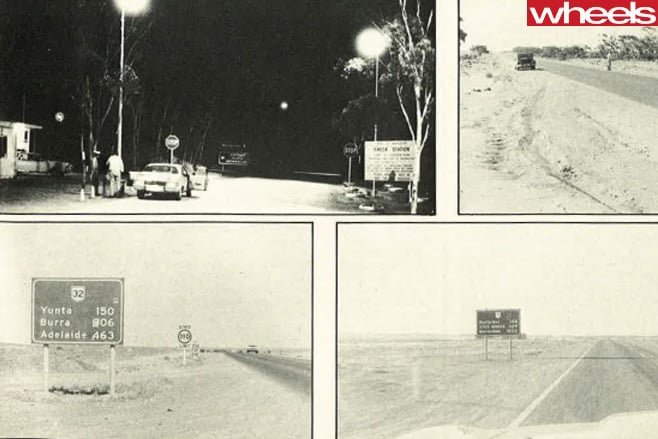
When you get past Bathurst, known to hundreds of unfortunates as the City Of Radar, you can open up a bit and for the first time it feels as though you’re really going somewhere. Past the de-restriction signs we run the car up to a 140 km/h cruise and notice as always that if it’s a while since you’ve driven these speeds it takes time to accustom yourself to the car’s responses.
Between Bathurst and Dubbo the car seems a little wayward, a little light in the steering and we think we’d probably have been better off with Ford’s high-geared manual steering system which self-centres much more powerfully than this power system.
Fifty kilometres up the road, the problem ceased to exist.
We have decided to take the shortest route to Perth – if not the most striking – and that means heading through Nyngan to Broken Hill and then to Port Augusta.
The speed limit signs end at Dubbo and the car settles into a loping cruise at just under a ton. It’s still dark but the lights – GS Falcons have a pair of quartz halogen lights to stab the darkness with – are fine. At this stage the roads are still fenced so there is only a small chance of our being violently introduced to a bull.
By this time we’ve had one driver change but the car still doesn’t need fuel. Our first scheduled petrol stop is Nyngan, 581 kilometres out and to be on schedule we must be there by seven in the morning. We’re there at 7.10 as the sun clears the horizon haze and begins to shine steadily through the rear window onto our shoulders. The car takes a mere $22.44 worth of gas giving 5.23 km/L (14.8 mpg) which is none too good because this hall been the gentlest end of the trip. We have been expected 6 km/L (about 17 mpg) on this leg.
Ten minutes’ break and we’re off towards Wilcannia where the roads are wide, straight and flat. The car’s cruise creeps up and before long we’re doing 180 km/h on the flats and 170 on the long rises with the tacho needle hovering at four grand or so. The wind noise isn’t too bad – you can converse and listen to the tapes without difficulty though there is quite a harsh rumble from the steel radials over the rougher surfaced parts. The road doesn’t have bumps that throw the car around, just higher frequency ripples to make the tyres rumble and the Snooper nod its head a bit above the dash. This trip, I observe to Mr Editor Robinson as we breast another gentle brow and look arrow-straight at the grey ribbon ahead, is turning into a tour of the straight roads of Australia.
Wilcannia is a Darling river town servicing travellers like us and the locals who run cattle on cattle stations round about. It is 398 kilometres further down the straight road and with Robbo at the wheel the Falc devours the road at 180 with us warbling “Glen Miller, Is Missing” along with the excellent ladies who were in the BBCTV show called Rock Follies. We rumble into Wilcannia with enough time to notice how clean and modestly prosperous it looks for a parched semi-desert town. The car swallows another $22 worth of Total.
We’ve averaged 176 km/h (110 mph) for the 400 kilometres but paid for it with a consumption rate of 3.59 km/L (10.1mpg). Our emotions are complicated. We wonder how this unexpectedly high consumption is going to affect our range on the long night hauls across the Great Australian Bight and whether we’re going to make it at all without asking the office for more money. On the other hand we’re elated to have averaged 176 km/h for 400 km – something you can’t do in most parts of the world any more. But that old environmental thug Robinson is a shade disappointed. He’s never got less than 10 miles per gallon out of a car and he’s disappointed to have missed out by just 0.1.
On along the straight road we go with the sun rising high behind us, lighting up the barren paddocks, some of them almost completely eaten down by stock and starting to lose their topsoil to the winds. It’s a wide, parched bowl of a place late in summer and we seem almost motionless in it at our 160 km/h cruise. It’s so grand that when you say “It’s a big country, mate” the comment seems to be charged with a special meaning. You clean forget that it’s a comment uttered probably a dozen times a day by other travellers on the same spot.
Broken Hill, it happens, is where I was born. I don’t often mention this fact because it leads to all sorts of inane questions at barbecues. “Is it as bad as they say?”, is the most commonly asked question, basically because a succession of TV documentary teams have made the place a kind of junior totalitarian state. Businessmen in Broken Hill will tell you that there is considerably less industrial disturbance than in the ” peaceful ” capital cities.
As we get closer to the Hill we run into the hills and folds and creeks surrounding the Barrier Range around the city. We pass the Mount Gipps pub, one of the Sunday watering holes 40 kilometres out of town, and I tell Robbo that over the next brow is a railway bridge which I used to play on as a kid and once had to jump off to avoid a goods train which appeared at one end.
But the bridge is not there. I feel like a drongo. It WAS here 20 years ago. I remember. I see a certain scepticism in the eyes of Cap’n Robbo. Only later do I discover that they’ve shifted the bloody railway line …
We take time out for a quick lap around Broken Hill – a fairly large (28-30,000 people) but unlovely city divided into two by a silver/lead/zinc lode of formidable proportions running through its middle. The easiest ore has been extracted now, and the three big companies left there are having to go deeper for what is left. But there’s plenty of life there yet. I show Mr Editor Robinson where I was born and where I went to school and where I had a fight with a kid who once pinched my bicycle and he generously pretends to be interested. It takes 10 minutes and we don’t get out of the car.
Now we’re onto perhaps the most treacherous piece of road on the entire Sydney to Perth trip. It’s 50 kilometres of winding road through the Thackaringa Hills out towards the town of Cockburn on the NSW /SA border. The road is quite well surfaced (though none-too-wide) but it was laid at least 20 years ago and its engineering is poor. There are bends hidden over crests; and a diabolical series of dips which result from the road-builders being too stretched for cash to build bridges across the creeks. This piece of road has killed people and damaged a lot of cars – and the worst part of it is that there is little warning of the severity of the dips.
Many people travelling at quite restrained speeds must have been surprised along here. It’s a pleasure to be past it, both for the pits of our stomachs and our average speed.
Across the SA border the road is transformed into a wide, smooth, straight aggregate surface which juts up at the horizon like a giant rifle sight. The State limit of 110 km/h could be safely doubled in the right car.
We press on down the fenced, deserted road through the first of a collection of fruit fly inspection points scattered across Australia and down the main road from Broken Hill to Adelaide. The car is getting low on fuel, even though we’ve slowed down a bit it seems pretty unlikely that we’ll get anywhere near our next fuel stop, Peterborough. But the old orange bitch surprises us. The fuel gauge needle goes into the red, it goes hard onto the “E” mark and eventually there’s pace between that mark and the needle before car falters a couple of kilometres before the shabby little SA town of Oodla Wirra. We use the old truckie’s technique of stopping immediately there’s a sign of fuel starvation so that there’s enough fuel left in the induction system to kick it over after we’ve put in more fuel.
We drive to Peterborough, 30 kilometres along, and watch a service station owner smile as he pumps $20 worth of petrol into the Falc. His wife stops work behind the counter to “watch them tumblers roll”. Wilcannia to Peterborough is a shade more economical. We’ve registered a mighty 3.9 km/L (10.9 mpg) which is better but it doesn’t exactly make us happy.
Wilcnnnia to Peterborough is only 490-odd kilometres by the odo and the Falc couldn’t make it on a tankful at its natural cruise. Tonight our longest hop is supposed to be 707 kilometres, Eucla to Norseman …
After Peterborough we head for Port Augusta where smoke belches from tall chimneys and a myriad of prosperous-looking mothers compete for parking spaces in the main drag. We fill up again and find that running a bit slower – nothing over an indicated ton – gives 4. 2 km/L (nearly 12 mpg). Hell, says Captain Robbo, the old tart’s getting economical . ..
It’s out of the question for trucks and larger caravans and even small vans and long cars can strike problems. To make matters worse there’s a large monument to the guys who found the pass first in the 1800s – slap in the middle of the pass – and there are large rubber lockup marks either s ide of it where tourists have stopped to read and very nearly caused an accident.
Out of Port Augusta we’re supposed to head for Iron Knob and Kimba but the navigator – I refuse to name him but it wasn’t Robinson – puts us on the wrong road and we finish up in Whyalla and have to take a corrugated and frequently rutted backroad to get back on Route One. It costs us about 60 kilometres and about 40 minutes.
Mr Editor Robinson demonstrates iron control over his temper as he flails his elbows to keep the Falc straight on the dirt at 110-130 km/h. Presently I come out of my cringe and offer him a dried apricot. Much later we find that on this fairly violent section we have torn a lug off one of our Uniroyal steels. Much later is actually at Kalgoorlie on the way back where we also discover that the fine men who serviced the car for us in Sydney forgot to put the jack back in …
Some way on we stop to put fuel into the Falc from our drums and as we pull off onto the verge the firmness of it proves to be only a crust and the left hand side wheels sink deep into sand. We struggle to get the car out and with the help of the slippery diff and myself pushing against the heel angle of the car we finally ease it out. We’re recovering ourselves when a little Daihatsu 4WD, travelling fast at 80 km/h re-passes us. We’d blown his doorhandles off at 160 a few minutes before. Could have been embarrassing to have had to ask for a tow …
At Ceduna we pause to shoot some pix with the water, jetty and fishing boats in the background. In between clicks of his shutter Captain Robinson explains to a persistent Aborigine that he can’t possibly spare 50c as we’ll probably need every sheckel to keep the big orange bitch in fuel. This is not a fob-off because even with slightly slower cruising (around 140-150 km/h) the Falc still won’t give better than 4.8 km/L (13.4 mpg) which is hardly brilliant.
Next stop is Eucla over the WA border and 520 kilometres away. We drive off with the setting sun becoming more and more of a problem to the driver. But as dusk approaches and the sinking sun cuts down forward visibility we are forced to cut back our cruise to 120-130 and it hurts. It really hurts.
The car is running on less than half throttle and begging for its freedom – not obtrusively but with a kind of well-exercised 7000 kilometre-old sharpness which develops from energetic treatment. The road is obviously good enough for 240 km/h in the right light conditions and it’s almost a privation to have to slow merely because of poor visibility. Naturally in your Morris Marina you’d be crazy to contemplate touching 120-130 km/h any of the way across Australia but in this car high speed is as safe as the Wales.
We drive on. We drive on as though we were born to do nothing but drive on. We aren’t bored – haven’t been at all yet, but we are starting to notice that we’ve been in the car for a long time.
When we stop to lay the dust or throw in extra fuel from the drums we are carrying we notice the effects of nearly a day’s inactivity in the car. We have no aches from orthopaedic lacks in the car’s seats – they’re still good to sit in – but we are getting stiff from lack of movement.
It is a blessed relief when the sun goes down. The horizon is still bright and it’s hard to spot the ‘roos and wombats and occasional emus that the signs periodically warn us about, but at least we aren’t dazzled. By the time the sun disappears we’ve crossed the Nullarbor, at least the small part of the Nullarbor crossed by the road. The newly sealed SA part of the road goes closer to the coastline than the old goat track did and so you’re only really on the Nullarbor for about half an hour these days. Along the coast route there are now signs – white painted camera symbols on blue backgrounds – which indicate areas where tourists may pull off and photograph the ragged Bight cliff , some of them a hundreed metres high, from selected vantage points.
The facilities for travellers along the new road are surprisingly good. There are frequent signposts (at least they’re frequent at a 160 km/h cruise) telling the traveller his distance from the nearest settlement, together with information about the services offered there (towing, food, campsites, motel, medical help, car repairs, petrol). There are water tanks scattered across the route and camping areas provided here and there. There are also signs that indicate the whereabouts of emergency telephones. It’s still a long drive but it’s certainly not the little piece of Burke and Wills it used to be . ..
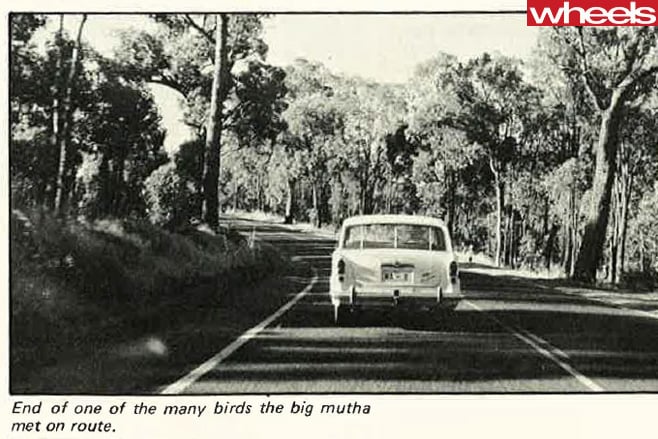
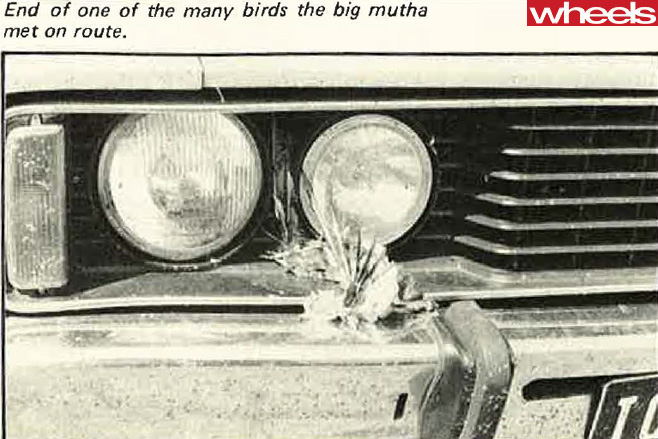
There are dead animals on the side of the road to reinforce the warning of the signs. We see heaps of ‘roos – particularly between Ceduna and Eucla, but nary a wombat or a camel. But we hit two rabbits and a fox.
At 2 am Tuesday (Sydney time) we calculate that we have covered 3223 miles in 24 hours at an average speed of 134 km/h (83.9 mph) and we’re still going well.
Not long after that we start to run right out of energy. From two-hourly intervals we’re forced to cut back our driving stints to an hour and eventually to about 30 minutes to stay awake. We begin to slow down and get exceedingly cautious about animals on the road – all the more because we don’t seem to be seeing as many as before. Tiredness is approaching and the help of cold air from the vents and flat-chat taped music helps but we feel that neither of us is going to be in a fit condition to drive for much longer.
But we reel in all the traveller’s fuel stops gradually. Madura (situated in a pass at the edge of the Hampton Tablelands), Cocklebiddy, Caiguna and Balladonia (with its olde English stone walls and homestead ruin) all pass in the darkness, though slowly because we’re stopping more (and enjoying it less).
Finally out of the darkness we spot the lights of Norseman and it feels as if we’ve arrived at the outskirts of Perth. Our slowness on that leg is just as well because we’ve averaged an astonishing 7.455 km/L (21 mpg). Just shows what driving when you’re dead beat can do.
We’re surprised to find that our past few hours of sluggishness hasn’t hurt our average speed much because we’ve been storing up time for close to 24 hours beforehand and we’re still averaging better than 125 km/h. It does the hearts good. We question the pump jockey at Norseman (whose brother has a GS Falc just like ours except it’s a 5.7 litre) about camels on the road ahead.
“Can’t tell”, he says, “sometimes ya don’t see a single one between here and Southern Cross; other times ya gotta drive in and out the bastards”.
We drive on, not seeing a single camel to drive in and out of but spotting a few experienced kangaroos which high-tail it into the low scrub as we go by. We don’t seem to get any worse though it is starting to be a pretty big task to enjoy the trip. But it’s hardly worth stopping. We can both steer a straight course still and anyway, sunrise is only an hour or two away.
Eventually, we reel in Coolgardie and then Southern Cross and the sun comes up and we’re both filled with the vigor of a pair of kids. We’ve been fearing this night but now we’ve beaten the bastard; we’re four-fifths of the way to Perth and we’ve got daylight and a healthy car to complete the trip. Everything is coming right.
Except one thing. We notice in daylight the lines painted across the road which we’ve been told are for an airborne police spotter aircraft which times a car over a set distance and radios to ground police who pull the car in. It is a Tuesday morning, early, and we’ve been told that the “bear in the air” only operates on weekends but it’s still a little unnerving to be crossing these cream-colored dotted lines all the time particularly at speeds perhaps a bit higher than the lawmen would like. So far there’s been no problem with police anywhere. The roads we’ve covered in NSW have been subject only to a prima facie limit, the ones in SA have been so deserted and remote as to be safe at practically any speed and so far we’ve traversed the WA section at reduced speed in unlikely hours.
Actually the road traffic control in WA isn’t handled by police at all but by officers of the RTA (Road Traffic Authority) using white pursuit cars with sirens and blue lights on the roof. They also have “unmarked” police cars but most of those have WA personalised plates in gold and blue starting with the prefix “RTA “. A greater threat than spotter planes (at least reports the RTA was waiting for a State grant to buy its own aircraft) is the hand-held radar gun as used by US Police forces. But our Snooper is to be silent from Sydney to Perth and all the way back.
Civilisation starts again at Menedin, about 260 kilometres from Perth. The paddocks get fences and there is evidence of large scale scrub clearance and crop growing. The suspense is all over. We’re going to make it – and about two hours before we expected to.
The country gets more and more lush as we approach Perth with vines and crops and trees and greenery getting thicker until we drive up and over some wooded hills and into Perth proper.
As always at the end of a long haul it’s an anti-climax. It’s a neat city – in fact Captain Robinson on my left is already romancing about it having a “feel” of its own: l can’t feel a thing except that my body is divorced from my head. The Coke signs and the MFA banners and the traffic lights are the same here as they are in Sydney. We’ve just driven the equivalent distance of Paris to Moscow and we’re still in the same country among the same people and the same white Holdens. A tenth of the way ’round the world we’ve driven, and we might as well have gone to the corner store and back for all the cultural differences there are. Still, there won’t be too many language problems …
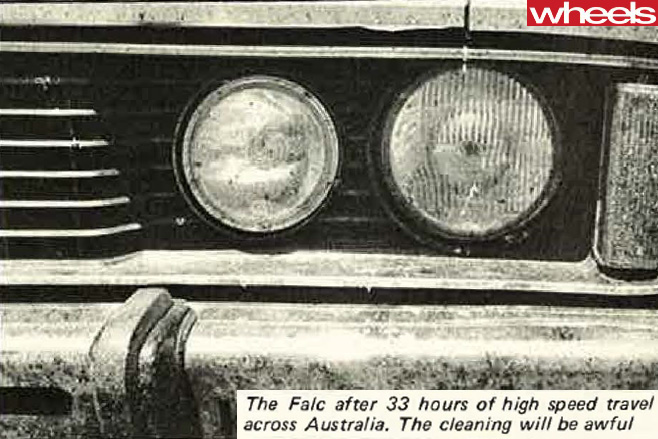
We amble into Perth among the morning “peak hour’; traffic. As we drive across the Swan River, Robbo calculates that we’ve been driving for 32 hours and 58 minutes and the odo imparts the info that it’s 4041 kilometres from the Terrey Hills tip to the Swan River. We’ve averaged 123.9 km/h (77.4 mph) including all stops and 45 minutes lost in going to Whyalla by mistake. But who gives a damn? I want to go to bed.
FALCON XC options maketh the proper car
FORD LIKES to believe that its XC Falcon is as much at home carting the kids to school as it is in the shadow of Ayers Rock. The industry calls the product of this philosophy the 100 percentile Aussie car, and it is one of the reasons why local cars have been so successfully assaulted by the Japanese in recent years.
The Japanese have always understood that to be popular, in Australia, you don’t need to build cars that are designed to match all the conditions a driver might meet if he drives around Australia once a month. Since the vast majority of people live in the eastern cities and few venture off the main roads, even if they do happen to wander away from the confines of the suburban speed limits, there really is little need to build big rugged, traditional, family-sized sedans.
For Ford and, perhaps to an even greater extent, GMH, the building of a car that is capable of coping with the outback conditions has always been a matter of conscience and it is one of the truisms (myths, perhaps?) of the local car scene that European and Japanese cars can’t take the strains imposed back of Bourke, even if that legend is about to be challenged from – of all places the new breed at Fishermen’s Bend.
If the Japanese have never bothered to build cars to match the conditions, Ford has tried hard to create the popular impression that the Falcon really belongs in a class above the other local stuff as a road machine and can (indeed should) be compared to the hot-shoe, long-legged Europeans. It shouldn’t go unnoticed here, that the Falcon GT would have been 10 years old in March if it had lived another nine months.
So when Ford’s senior executives expressed disappointment at the reception the XC received from WHEELS at the time of its introduction and suggested we should build up a Falcon – any Falcon – from the options list two selfish thoughts raced through the editor’s mind. Here was our chance to build a car specifically for our long planned trip from Sydney to Perth but, equally, we could discover once and for all time if a Falcon could be made that would turn the daily commuter grind into a pleasure. In other words it had to be a desirable hack and a fine touring car. And with somebody else footing the bill…
Clearly, with our objectives we could have gone either the GXL route (after all Ford claims this is the local car with a European theme) and fitted it with the biggest of the VS engines and had a GT in all but name, or we could elect a 500 and have a thoroughly enjoyable time wandering through the options lists to create an interesting car. To keep the price down (?) to a reasonable level we choose the 500, although it was not without pangs of indecision. With one or two minor exceptions, however, we have never regretted choosing the base car, perhaps because, by the time we had finished with the options lists we had virtually built a GXL anyway.
We made the right decision and have enjoyed that marvellously satisfying feeling of power that comes, not from dropping smokies, but from dribbling around behind a bent eight on throttle openings owners of small capacity fours would never believe and never having to use more than 1800 rpm through the gears and still be able to beat all but the most determined opposition at the traffic lights.
We agonised over the choice of gearbox. After preaching the advantages of an automatic in suburban use it was almost mandatory that we choose the auto. Instead we turned traitor and opted for the four speeder. Over 15,000 km later we’re happy with our decision.
The V8 is tractable and smooth enough to be driven as a two gear car in traffic if you’re fed up with changing cogs and it is quite the normal practice to go one/two/four, and yet all four ratios can be used to advantage if you want to run with the wind on your favorite piece of switchback. We also figured that on the run to Perth a manual might be more economical, and have more performance, than an auto. That was the theory of it.
The damage for a 4. 9 500 with four speed is (was) $6639 and we had only started down the options list. Ford’s engineers claim the addition of twin exhausts gives a measurable increase in power and improves engine efficiency so the $105 for twin pipes seems well spent. Four wheel disc brakes are standard on the GXL and give the Falcon a braking ability unobtainable on any other local car. At $193 they are not cheap but very worthwhile. We have long criticised Ford’s low geared and numb and heavy (with the fat ER70H14 Steelflex Olympic radials – $80 over the standard radials) manual steering and opted for power, although we knew it would be too light for high speed work and required some adjustment by a driver accustomed to even direct manual steering.
Of course we needed air conditioning ($633), not only for The Big Trip where it became the major factor in reducing driver fatigue to a minimum, but also for regular use around Sydney during a humid summer. For entertainment we ordered an AM/FM radio ($282) – has anybody else noticed just how good Australian radio has become over the past couple of years? – and a stereo cassette for the times when we want to choose the music (another $173).
We also ordered intermittent wipers ($24); a rally pack for the instruments and driving lights ($322); tinted laminated windscreen ($90) and every car should have one; long range, 125 litre (27.5 gallon) petrol tank which was essential for the Perth run, even if it meant the spare wheel ended up on the floor of the boot and not inside the well of the fuel tank ($34); sports handling suspension ( $97) for the rear anti-roll bar and the stiffened suspension; cloth trim ($35); rear inertia reel seat belts ($33); limited slip differential ($82); and a remote control right hand exterior mirror ($21). And because we liked them so much our 500 also came with the GXL alloy wheels although these are not a regular production option. It sometimes pays to have contacts in the industry.
All those options produce the very grand total of $9073. At which point we started to look through the new car price list at the back of WHEELS to see just what sort of proper car we could buy for nine grand that could tackle the same tasks we had in mind with some chance of success. It was a frustrating search. The Alfetta sedan perhaps; just maybe a Beta sedan; certainly a Peugeot 504; not really a Triumph 2500TC; or a Volvo 244 and not a Volkswagen Passat. All the rest are either too expensive or simply not up to it.
And at the end of the Perth trip we must admit to having decided that none of these cars could have logged the same average speeds, with the possible exception of the Alfetta and Beta. But even with their superior fuel consumption they would have been let down by their small petrol tanks. We also wondered about the ability of European air conditioning units to cope with local conditions.
All of this ignores the 308 HX Holden and the 265 Charger. But until the HX gets Joe Whitesell’s Radial Tuned Suspension it is not in the hunt and neither the Holden nor the Charger have those very necessary optional long range tanks.
We collected the Falcon in Melbourne one Friday afternoon, about six weeks after placing the order, happy with our choice of orange after seeing the car in the flesh although the doeskin, with houndstooth, upholstery seemed a little overpowering. We noted with interest that the driver’s seat was mounted straight onto the seat runners, in contrast to the XC test cars which had nylon bushes to raise the cushion and improve visibility at the expense of some headroom. We would have preferred it higher so one of the changes we requested early on was to have the seat raised and moved back to the second of the runner mounting points for more front seat legroom. Both moves were immediately noticeable to anyone coming back to the car, which again proves one of our pet theories that minor changes to seating height can make an enormous difference to driving comfort.
Running-in the Falcon – it had 137 km on the odometer when we picked it up – was made easy by the heavily policed Victorian speed limit of 100 km/h on the Hume Highway. With the recommended 2.92 final drive ratio, the Falcon runs to 41 km/h (25.5 mph) per 1000 rpm so the crank is turning over at less than 2500 rpm at the legal limit which makes the old idea of running-in virtually obsolete.
The 6.3 km/L (17.8 mpg) to Albury was about what we expected from a tight engine. Between Albury and Goulburn the Falcon returned 5. 7 km/L (16.0 mpg) which reflects the change in character of the road that always has us running quicker in NSW.
By the time we reached Sydney we had begun to like the Falcon, even if it did seem rather characterless, if not quite bland in the way a fleet operator’s 500 six with auto is bland. Nothing fell off and only a squeak from the A-pillar, and driving lights which needed adjustment, gave cause for complaint.
We liked the seemingly endless torque of the V8 and the general ease with which it can be driven but found the dashboard and control layout messy. It was obvious the Falcon still has all the much-vaunted virtues that local cars have been strong on since the 48-215. Our XC has now become the kind of car you can trust, not so much because it starts first time – which it doesn’t when the engine goes out of tune, which it does occasionally – but rather in its ability to get you out of trouble on the road. Of course the back axle can be made to get out of step and clatter around and hop sideways over bumps but it is quickly caught and controlled and the car has reserves of braking and even roadholding that still comes as a surprise. It goes around corners and point-to-point can set times even Europe’s best two-litre sedans must be wrung out to achieve. And all in relative comfort and quiet.
Mister Cropley will have entertained you with the story of The Big Trip but it is worth repeating that the Falcon is now running better than ever and we have become fond of its strengths and tend to rationalise its weaknesses, which are few within the fundamental limitations of the essentially late ’60s design.
The Falcon is the best of the present homegrown cars in both base form and the optioned up variety. Whether that remains the status quo after Whitesell has finished with the HX only time and plenty of kilometres will tell, but we’ll be sorry to see this Falc go out of our lives.
Now, if only we could reduce the weight by 225 kg (500 lbs) and improve its aerodynamics for better fuel consumption and cut its turning circle by a metre and increase the glass areas and do something about the rear axle location we’d really have a world beater … maybe that’s what the XD will be all about.
DANIEL Ricciardo, you’ve done it again!
No, not a brilliant podium at one of Formula One’s toughest tracks – a podium shoey!
Ricciardo first performed the quintessentially Australian podium celebration at the German Grand Prix earlier this year, pouring some of the world’s finest champagne into his sweat-soaked race boot to quench his post-race thirst.
It was the first time much of the world’s motorsport media had seen the bizzare act, and they flipped out accordingly.
But the shoey is old hat (or is that shoe?) for most Australians, with awareness of the unusual act on the increase.
In fact, Ricciardo isn’t even the first racing driver to consume a beverage from his boot.
It all started with V8 Utes driver Ryal Harris, who performed the very first motorsport shoey at the Perth round of the series in 2015.
Racing V8-powered Ford and Holden utes is arguably the most Australian motorsport category in the world, so it was no surprise a triple champion of the series would start the trend of the podium shoey.
It was David Reynolds who then made it mainstream in Australia, doing so after claiming victory at Hidden Valley in the Northern Territory later that same year.
The V8 Supercar driver is renowned for his unothodox podium celebrations, which have previously included throwing pot-plants off the rostrum, so Reynolds electing to use a shoe instead of a champagne flute was definitely in-character.
Reynolds’s celebration was celebrated within the V8 Supercar family as one of the best the series had seen, but it gained little traction internationally.
For a while the distinctly Australian act remained unnoticed, then Jack ‘the Jack Ass’ Miller came to town.
The Australian MotoGP rider blew everyone out of the water to claim his very first premier-class Grand Prix victory at Assen earlier this year.
The larrikin Aussie put the shoey on the international stage for the first time, swigging big gulps of victory champagne from his boot in spectacular fashion.
A few short weeks later and Ricciardo was following suit in Germany.
Now Mark Webber has joined the list of Aussies performing shoeys on the podium, with second place-getter Ricciardo nonchalantly pouring champagne into his race boot as Webber interviewed race winner Nico Rosberg, before presenting it to his countryman and insisting the Porsche LMP1 driver take a swing.
“I think we just made our country even more proud,” Ricciardo said as Webber wiped a mixture of foot sweat and champagne from his chin.
Straya.
FOR diehard Holden fans, the acrimonious split between the General and Peter Brock was a tragedy akin to their parents suddenly announcing that daddy won’t be living at home anymore.
Holden showed Brocky the door during a bitter dispute surrounding his fling with hocus-pocus resin infused crystals in the “Polariser”, a device fitted to the 1988 VL Director, and his insistence HDT cars would run better on deflated tyres.
But the fans continued to love the man behind a string of legendary Holden Dealer Team cars and Bathurst memories, even when he started racing BMW M3s. They were also sympathetic when he put his name and body kits to, of all things, the Russian-built Lada Samara just to keep his company afloat.
But the lingering sorrow turned to despair when, within months, the unthinkable occurred. Brock started messing about with Ford!
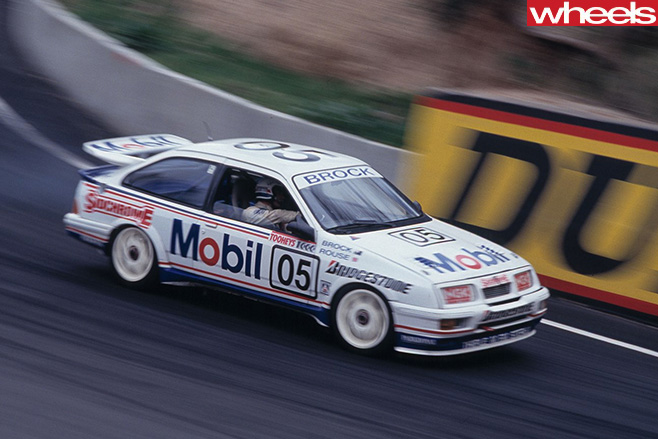
After the bitter split with Holden, Brock set up a company called Austech Automotive Developments, and started doing up EA Falcons and the like because Holden refused let him have any Commodores. Brock gave the modified Fords – the eighth generation of car to go through his workshops – the “B8” prefix.
The association with Ford wasn’t official, but the suits at Broadmeadows were more than happy for their cars to bear his name as it enhanced the brand’s performance credentials with very little investment on their part.
In 1990 he put his moniker on a range of tricked-up Fords called the Brock Executive Performance (EP) Series, which included cars such as the Brock (EA) Falcon, Brock Fairmont, Brock Fairlane and even a Brock Maverick (a rebadged Nissan Patrol that was years ahead of the performance SUV wave).
The original pamphlet for the EP range would have been difficult enough reading for any Holden fan still enamoured with Brock. But the salt was well and truly added to festering wounds with a picture of him and his Mobil 1-liveried Ford Sierra with the caption: “Brock & Ford: A winning combination.”
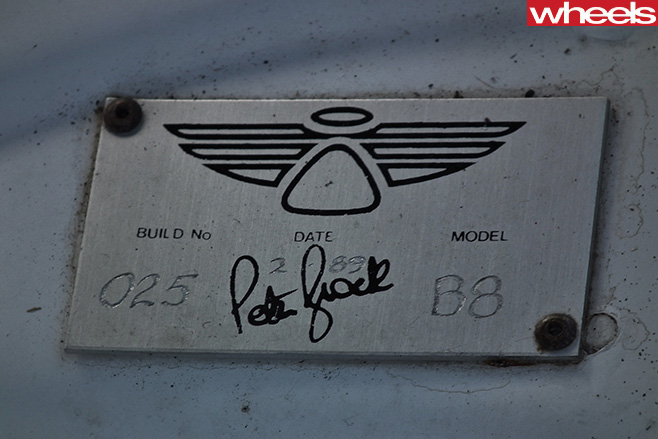
They came in three levels:
- Brock EPI – with level one enhancement that included suspension for improved ride, handling and safety; body-hugging colour coordinated sports seats; a Brock gear lever and knob; sports steering wheel and unique EPI badging.
- Brock EPII – which had all the above features plus a free-breathing engine and exhaust engineering “for improved performance and efficiency” and an EPII badge.
- Brock EPIII – the full enchilada with all the EPI and EPII enhancements plus colour keyed body hardware including bumpers and mirrors; road-hugger rear air foil; Brock 16-inch wheels fitted with high-performance radials and EPIII badging.
At least five Ford Telstar TX5s (a rebadged Mazda 626) are also believed to have worn an EP badge.
Brock’s short association with Ford resulted in several hundred cars being modified.
Even today, with unique Aussie cars of the era keeping auctioneers’ kids in private schools, they aren’t the most sought after of collectable classics. You can get B8 EA Falcons for around $10,000 – compare that to the $75,000 you’d have to fork out for a half decent ‘Blue Meanie’ VK Group A Commodore.
However, Brock did whet Ford’s appetite for a performance arm which set the groundwork for its relationship with Tickford Vehicle Engineering from 1991 (which had a very similar winged logo to Austech). This affiliation spawned a new generation of hot muscle cars and led to the Blue Oval’s official return to motor racing via Ford Tickford Racing. A decade later, Tickford morphed into the equally successful Ford Performance Vehicles, which produced the type of cars that Ford could only envy during the HDT era.
In the lead-up to the 10th anniversary of his untimely death, that is one Australian motoring legacy left by Peter Geoffrey Brock that gives Ford aficionados a cause to celebrate.
It used to be simple.
In your traditional triple-header V8 comparison you’d have three large four-door sedans, heralding from either Australia or the Fatherland, each with a fuel-guzzling lump in the front feeding tyre-frying torque to the rear wheels. There’d be a manual if it was designed for keen drivers, or a torque converter slushbox if it had luxo leanings.
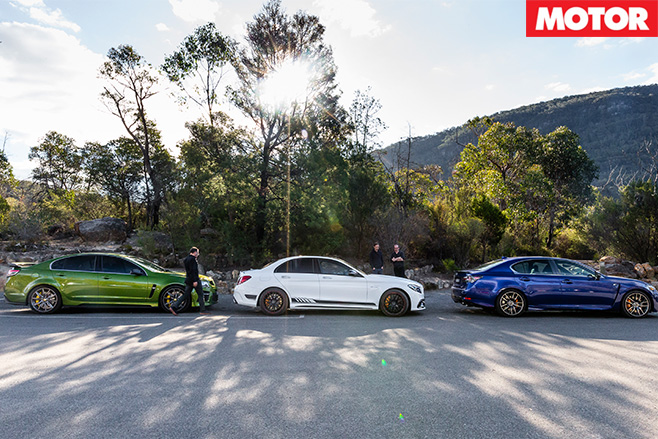
Things are very different in 2016. In today’s topsy-turvy world we have three different engine configurations (one of which claims to sip just 8.6L/100km), three different transmissions and two different body sizes. And the only contender that conforms to the traditional automatic gearbox, naturally-aspirated V8 stereotype is Japanese!
And it’s the Lexus GS F that’s the catalyst for this comparison. It impressed us at its local launch, but its pricing and performance leaves it in a bit of a no man’s land in terms of rivals. As a full-size V8 sedan its obvious competitors are the BMW M5 and Mercedes-AMG E63, but its price ($148,800) and performance (351kW/530Nm; 0-100km/h 4.6sec) neatly align with models the next rung down.
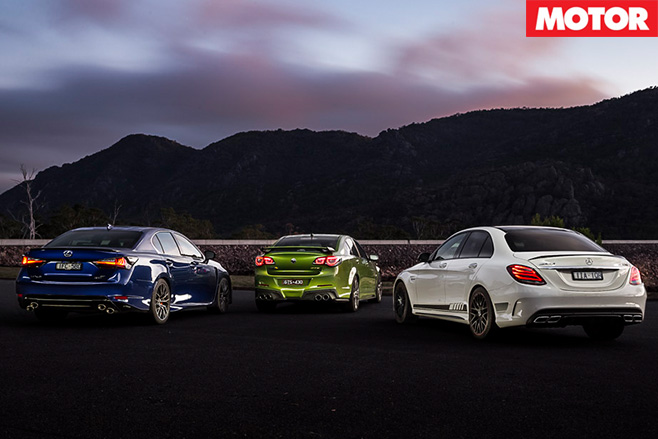
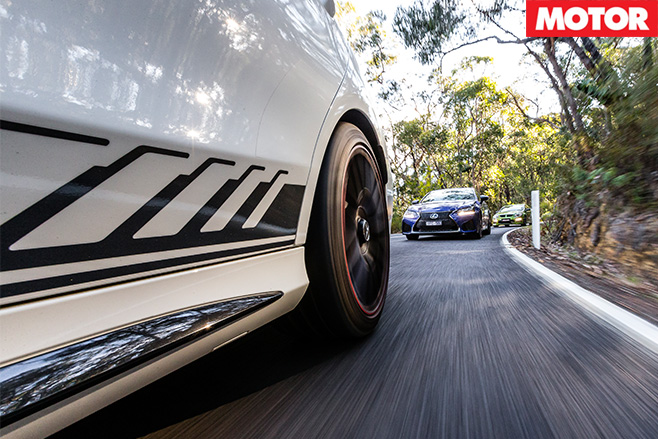
Key to the C63’s appeal is the 4.0-litre twin-turbo V8 under its heavily ridged bonnet. Producing 375kW/700Nm, it’s not so much an engine as a volcanic eruption, capable of turning the 265mm rear Michelin Pilot Super Sports into molten black lava at will. AMG’s Race Start launch control program is an easy way to reel off 4.4-4.5sec 0-100km/h times, but the furious struggle it sets off between electronics and wheelspin feels like The Hulk is trying to escape from the C63’s conservative Bruce Banner exterior.
Walking the car off the line oh-so-gently – not as easy as it sounds thanks to the wet-clutch auto’s hesitancy from a standstill – and feeding the power in smoothly proves more successful. There’s a fair amount of axle tramp in first gear, but drive through it and the C63 slithers its way to 100km/h in 4.16sec before storming across the quarter mile mark in 12.23sec at 192.50km/h.
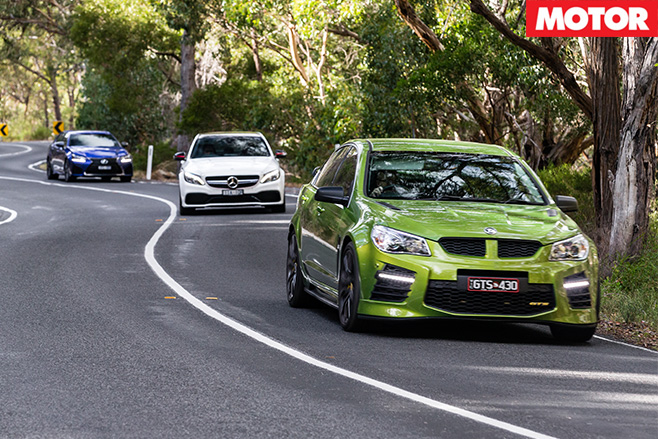
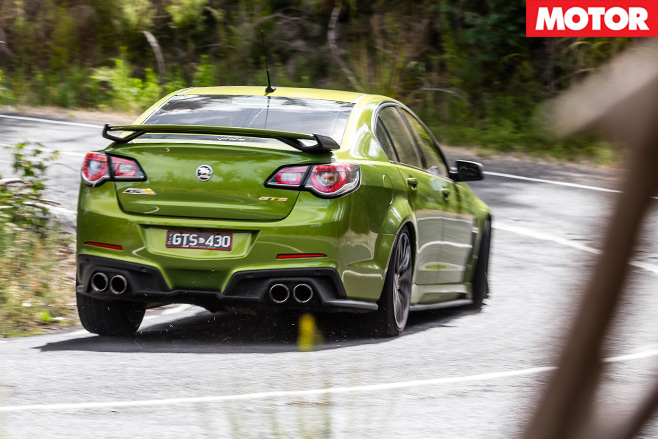
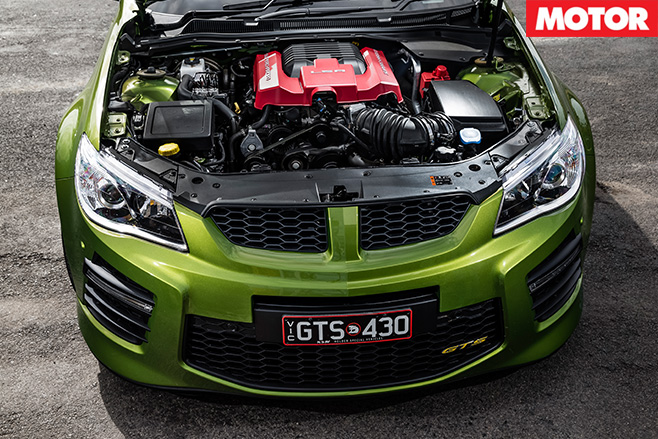
If anything, though, HSV’s 6.2-litre supercharged V8 sounds even better. The choof as the exhaust valves open is pretty naff, but it’s a dirty noise, full of aggression and pent-up rage. What exactly it’s angry about is unclear, because this manual GTS is the fastest standard Aussie car we’ve ever tested. After a number of 4.4sec 0-100km/h runs, a fluke of a launch and a crisp change into second nets 0-100km/h in 4.31sec and a 12.37sec quarter mile at 188.32km/h.
HSV’s range-topper hasn’t always felt its full 430kW, but with 7000 hard press kilometres under its Continentals, GTS-430 is a rocketship, hauling through the gears with ferocious enthusiasm. The Gen-F2 GTS is supposedly unchanged mechanically, but the gearbox in this car (and every other Gen-F2 or VF II product we try) feels particularly slick; quick changes are far less of a lottery now and, all other things being equal, saving a tenth or two on each shift would certainly explain the improvement in acceleration times.
The 5.0-litre V8 is a great engine, spinning easily to its 7300rpm cutout with a note that, while obviously synthetically enhanced, is a curiously pleasing mixture of smooth and raucous, like velvet sandpaper. Selecting Sport mode is a must, as Normal has the eight-speed auto clamouring for a higher gear and anaesthetises the throttle into the bargain.
The engine/gearbox combo is an effective one. The auto’s around town behaviour shames even the best dual-clutch, yet the shifts are quick and the eight tightly-stacked ratios make the most of the GS F’s relatively limited torque reserves. That may sound like an odd description for a 5.0-litre V8, but 530Nm (at a relatively high 4800rpm) just isn’t enough to trouble 275mm rear Michelin Pilot Super Sports.
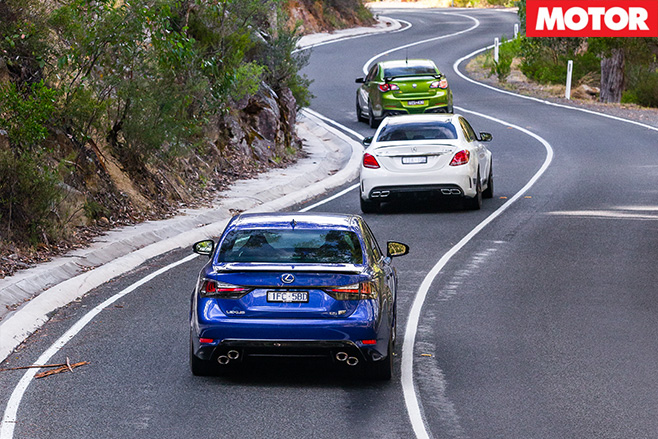
The electrically-assisted steering isn’t particularly fast, nor does it provide a whole lot of feel or feedback, but the weighting is about right and it feels nicely in tune with the rest of the car’s responses.
Despite being massively more powerful, the HSV feels equally all-of-a-piece. It’s too big to really shrink around you on a tight, twisty road, but the car’s inherent balance makes it a very friendly beast. Selecting ‘Performance’ on the Driver Preference Dial adds extra weight to the steering – though a little more response off-centre would be welcome – and firms the magnetorheological dampers, but the greatest strengths of the GTS are its brakes and ESP calibration.
The C63’s ESP isn’t quite as lenient, but then its potency is such that a tighter hold on the reins probably isn’t a bad idea. Traditionally, AMG’s sedans have been comfy grand tourers, but the first C63 took a big step in a sportier direction and the latest model has taken another stride again.
Handling response is now prioritised over ride comfort and with the chassis in its Sport mode the car feels taut and reactive. It skitters over small amplitude bumps and with less weight and stiffer suspension than the other two, body roll feels to be minimal. Reverting to Comfort increases compliance and gives the chassis a little more ‘feel’, but thankfully the ability to mix ’n’ match settings means the softer suspension can be teamed with the most aggressive engine map.
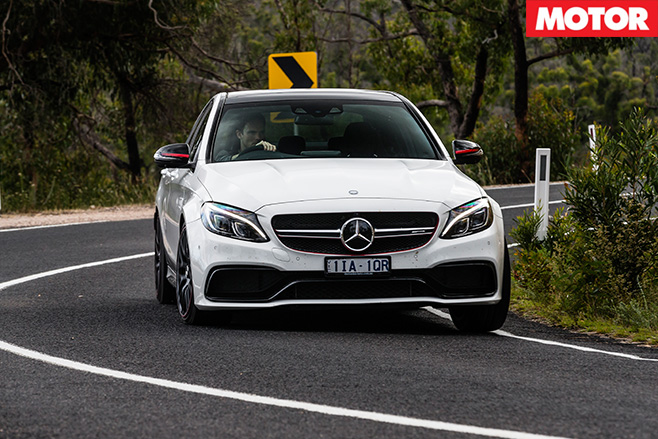
This means leaning hard on the awesome carbon-ceramic front brakes (a hefty $9900 option), rotating the car quickly mid-corner and then exiting as straight as possible to make the most of the available traction. It’s a different technique to the balls-out commitment allowed by the Lexus, but devastatingly effective.
With Sports ESP engaged the electronics will only step in if you’ve really made a hash of things, and it’s handy to have the safety net in place as while traction is strong once the tyres are up to temperature, with what feels like about 10,000Nm on tap it only takes a poorly timed bump, camber or patch of dirt to have the rear squirming. The transition to slip can be quite abrupt, too, a characteristic shared by virtually every car we drive on Michelin Pilot Super Sports.
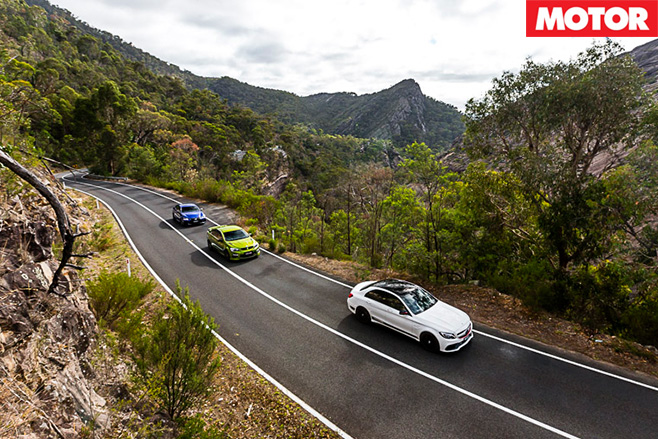
It’s a trait shared by the Lexus, though the GS F’s passive suspension setup can be quite abrupt at urban speeds. On the highway it’s still firm – your passengers are going to know you bought a sporty car – but not necessarily uncomfortably so. It’s roughly comparable to the Sport setting in the HSV, which just goes to show the value of adaptive dampers, as a twist of the Driver Preference Dial selects ‘Tour’ for the GTS’s clever suspension.
For outright comfort the HSV is the best here, absorbing all manner of road imperfections. Tour mode softens the dampers so much that the rear will actually bottom out over speed bumps, but on country roads it allows the GTS to lope along serenely, the steering also lightening to require less effort. Where the Australian loses points is low-speed refinement.
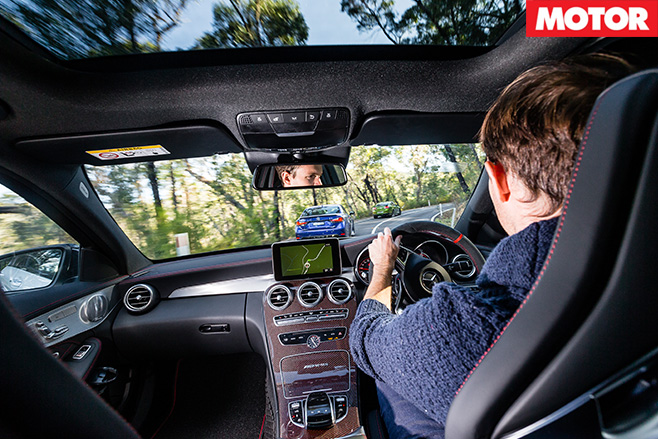
The greatest difference between these three can be found in the interiors. All three are up against it to varying degrees by being the range-topping variants and therefore sharing interior architecture with much cheaper models, but it’s in the HSV that this is most evident. Seats aside, there’s little to differentiate a $95K GTS from a $54K SS-V Redline, but then there’s not a lot to complain about either. The driving position is excellent, there’s plenty of equipment and masses of space front and rear for big, burly Aussie blokes.
Those same blokes would struggle in the back of the C63. Legroom is reasonable but the seat cushion is very short and simple physics denies it the head and shoulder room of its full-size rivals. Fine for kids, a squeeze for larger adults. Up front there’s plenty of alcantara, red-stitched leather and shiny chrome, though the ‘blood carbon’ effect on the centre console of our ‘Edition 1’ test car (see breakout) is an acquired taste. Only the odd hard plastic surface is a reminder the C63 shares its roots with a $60,000 C200.
Which kind of sums up the GS F; it’s a really good car, without quite nailing that final few per cent. It has a great engine, awesome brakes, handles well and is loaded with kit. At around $150,000 it deserves to be successful, and not just as a left-field choice. Unfortunately for Lexus, the GS F is a very good car in the company of two outstanding ones.
If value for money took precedence, the HSV GTS would be an easy winner – how could it not? It’s unbelievably fast, the roomiest and most comfortable car here and more than holds its own on a twisty road, all for 60 per cent the cost of the others. It’s a phenomenal achievement for a small Aussie company, and it’s difficult to countenance that the GTS will cease to exist in a little over 12 months’ time. It has a huge appetite for fuel and tyres and has a couple of rough edges compared to other $100K rivals, but it’s undoubtedly the best performance car Australia has ever produced.
Specs
| u00a0 | HSV GTS | MERCEDES_AMG C63 S | LEXUS GS F |
| Body | 4-door, 5-seat sedan | 4-door, 5-seat sedan | 4-door, 5-seat sedan |
| Drive | rear wheel | rear wheel | rear wheel |
| Engine | 6162cc V8, OHV, 16v, supercharger | 3982cc V8, DOHC, 32v, twin-turbo | 4969cc V8, DOHC, 32v |
| Bore/stroke | 103.1 x 92.0mm | 83.0 x 92.0mm | 94.0 x 89.5mm |
| Compression | 9.1:1 | 10.5:1 | 12.3:1 |
| Power | 430kW @ 6150rpm | 375kW @ 5500-6250rpm | 351kW @ 7100rpm |
| Torque | 740Nm @ 3850rpm | 700Nm @ 1750-4500rpm | 530Nm @ 4800-5600rpm |
| Power/weight | 234kW/tonne | 227kW/tonne | 188kW/tonne |
| Transmission | 6-speed manual | 7-speed wet-clutch automatic | 8-speed automatic |
| Weight | 1841kg | 1655kg | 1865kg |
| L/W/H | 4988/1899/1457mm | 4756/1839/1426mm | 4915/1845/1440mm |
| Tracks | 1616/1590mm (f/r) | 1609/1546mm (f/r) | 1555/1560mm (f/r) |
| Steering | electrically-assisted rack-and-pinion | electrically-assisted rack-and-pinion | electrically-assisted rack-and-pinion |
| Brakes(F) | 390mm ventilated/drilled discs, 6-piston calipers | 402mm ventilated/drilled carbon-ceramic discs, 6-piston calipers | 380mm ventilated/drilled discs, 6-piston calipers |
| Brakes(R) | 372mm ventilated/drilled discs, 4-piston calipers | 360mm ventilated/drilled discs, 4-piston calipers | 345mm ventilated/drilled discs, 4-piston calipers |
| Wheels | 20.0 x 8.5-inch, 20.0 x 9.5-inch (f/r) | 19.0 x 8.5-inch, 19.0 x 9.5-inch (f/r) | 19.0 x 8.5-inch (f/r); 19.0 x 9.5-inch |
| Tyre sizes | 255/35 ZR20 (f); 275/35 ZR20(r) | 245/35 ZR19 (f); 265/35 ZR19 (r) | 255/35 ZR19 (f); 275/35 ZR19 (r) |
| Tyre | Continental ContiSportContact | Michelin Pilot Super Sport | Michelin Pilot Super Sport |
| Price as tested | $95,590 | $172,310 | $151,700 |
| Pros | Incredible value; hugely fast; practical | Crazy power; great handling; brilliant brakes | Great drivetrain; chassis balance; sharp pricing |
| Cons | Outrageous thirst; low-speed refinement | Traction issues; firm ride; very expensive | Rivals much faster; abrupt ride; divisive looks |
| Star Rating | 4.5/5 | 4.5/5 | 4/5 |
50 years after Ford took sweet revenge on Ferrari with a 1-2-3 finish, we drive to Le Mans in a Ford Focus RS to watch as Ford strives to repeat history with the new Ford GT.
Well before we reach Rouen, our bingo card of Le Mans journey must-sees is almost fully ticked. There’s been a broken-down TVR, a Morgan being driven by a chap wearing a tweed suit, three Porsche 911 GT3s, a pack of Caterhams powering their way through a heavy rain shower with their tiny wipers flapping ineffectually, even a British-registered Lamborghini Aventador that, clearly confused by all this continental drive-on-the-right nonsense, leaves a service area on the wrong side of the road and narrowly avoids head-butting a Jaguar F-Type R. The only significant omission is the one I thought I’d see first, a speed trap.
The French police are drawn to the influx of British supercars heading to the 24 Hours like piranhas to a raw steak.
About 80,000 people come from the UK each year, many driving performance machinery with a disregard for limits that suggests an expensive speeding ticket is a badge of honour.
Only there’s nobody to do the slapping.
It’s only when a long convoy of police vans passes in the other direction, blue lights flashing, that we piece it together.
France is hosting the European soccer championships and crowd trouble at early games has clearly rebalanced police priorities. So we’ve got Russia’s notorious ‘ultra’-hooligans – their team is playing tonight in Lille – to thank for our unimpeded passage to Le Mans.
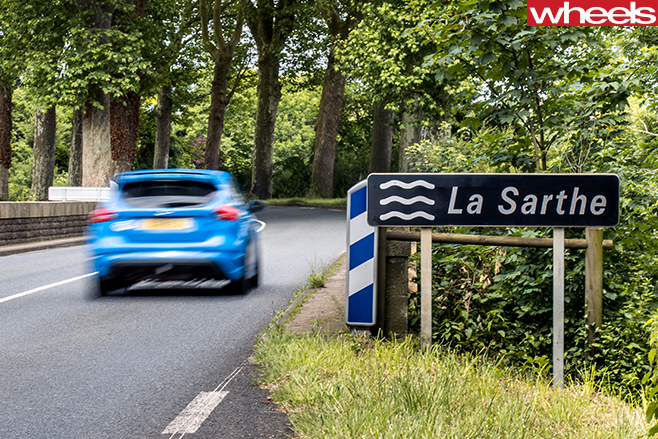
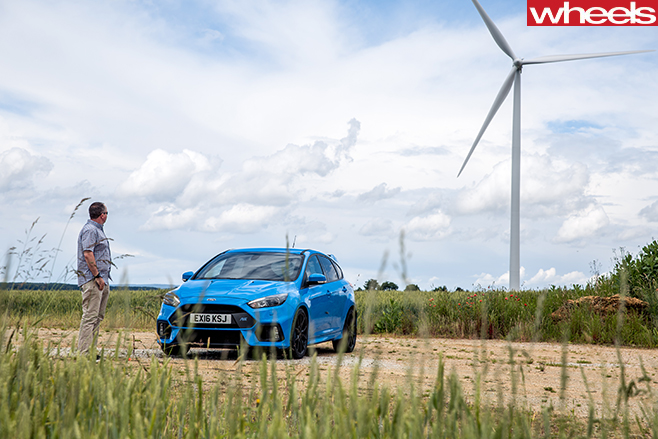
The Focus RS is the perfect way to get there, both for an opportunity to have a proper run in one ahead of sales starting in Australia in July, and because it’s been produced by the same Ford Racing team developing the road-going sister of the GT that’s racing at Le Mans.
Getting there is part of the fun. Despite being located deep in France, and run by the extremely French ACO, the 24 Heures du Mans has long been a British favourite. (And will certainly remain so, despite the UK’s vote to leave the European Union four days after this event.)
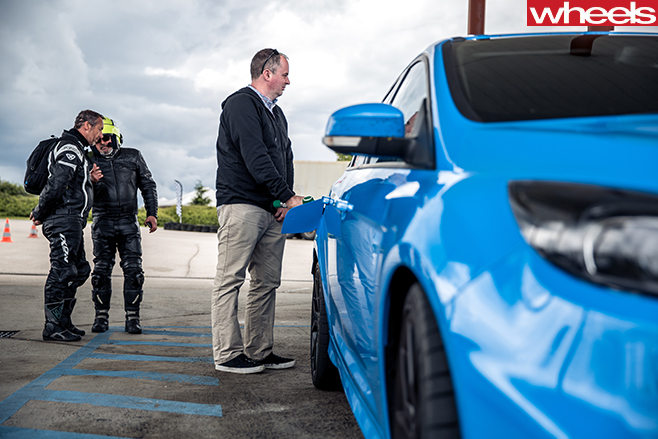
There are no stickers on the Focus.
There don’t need to be. It’s bluer than a naked Na’vi and comes from a long line of cult RS models, dating back to Capris and Escorts of the early 1970s, that ensures an audience appears every time we stop, which we do often thanks to its pitiful 400km fuel range.
Petrol stations give the chance to experience France’s woeful packaged sandwiches – we’re a long way from haut cuisine – but also for the Focus to draw crowds. One guy practically trips over an AC Cobra in his enthusiasm to get close enough for a selfie. Everybody knows what it is, and the most asked question is whether I’ve tried the Drift Mode yet.
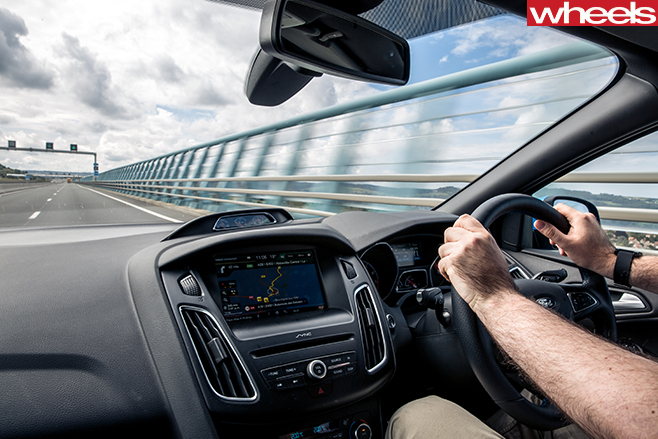
At Rouen we leave the high-speed péage for ‘the old road’. When I first came to Le Mans 20 years ago, there was no toll road and this was the only route; I remember that locals would bring deckchairs and picnics to the side of the road to watch the exodus of crazy rosbifs heading south.
These days most of the traffic sticks to the motorway and, figuring the gendarmes will be sticking close to their natural prey, I let the Focus off the leash.
Speed makes the RS feel instantly better.
It is one of those cars that wants to play hard all the time. An accomplished cruiser, just one that’s happiest travelling at about twice the speed limit. Extra loadings wake up the chassis, the heaving ride improves and the engine revels in a chance to get past 3000rpm, where it really starts to pull hard all the way to the 6800rpm limiter.
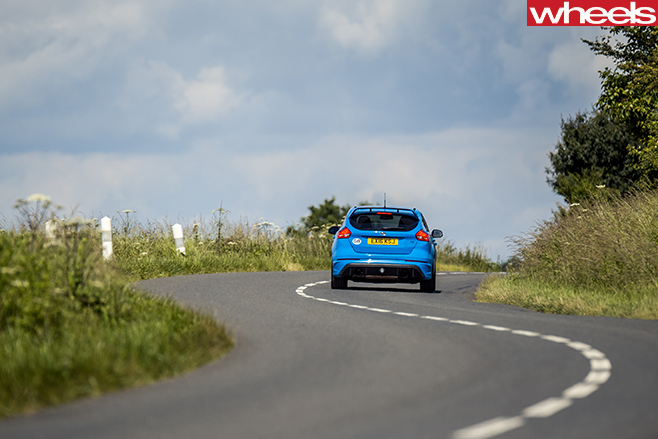
The road is practically empty and arrow straight for kilometres at a time. Despite the need to slow for occasional villages, our average speed is barely compromised.
What’s missing are corners. Occasional roundabouts give the magic torque-splitting rear axle a chance to show off its ability to tighten the cornering line, but otherwise it’s pretty much just along for the ride.
Past Alencon, with just 50km to go, I opt for a further diversion in search of more demanding tarmac, picking a circuitous course based pretty much on how twisty the minor ‘D’ roads look on the map.
A gravel parking area provides a chance to prove Drift Mode does what it claims, instantly kicking the tail out and then attempting to hold it there. But the clever torque-splitting rear axle is better at real-world stuff, it’s separate electronically controlled clutches on each side vectoring torque to effectively eliminate understeer.
You don’t have to go insanely fast to feel it working, sending a jolt of torque to the outside rear wheel to sharpen turn-in and digging in to tighten the line when the front runs out of grip. The result isn’t smoking oversteer – you need to work hard to make the RS relinquish grip, even in slow corners – rather it’s a car that manages to feel both ultra-keen and impressively stable at the same time.
Taking the scenic route was a good idea.
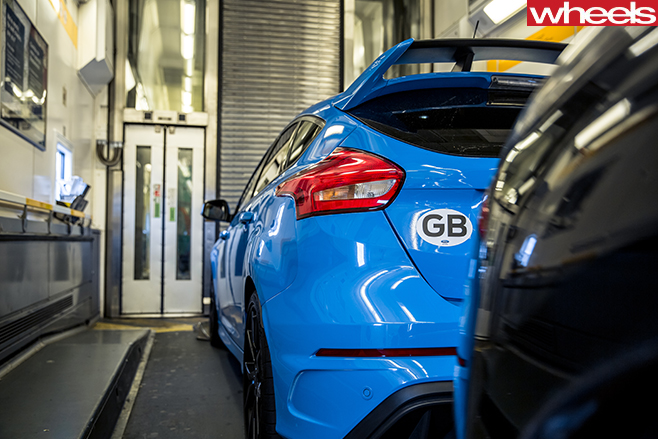
It’s clear why the roads have been so empty; everyone is already here, and in a vast jam that encircles the town. Having a racetrack that uses public roads gives Le Mans a unique character – you can drive on more than half the course 360 days a year – but does nothing for congestion.
The long drive across town to the accreditation centre then out to Arnage is at barely walking pace, and the heavy clutch pedal gives a deep-burn thigh workout. Although the manual gearshift has been a great companion on the journey down, I’m soon wishing for the dual-clutch auto Ford is said to be developing.
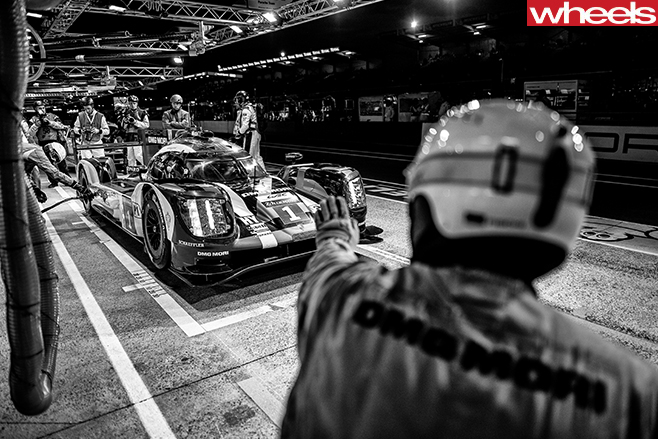
The vibe is good natured, although one drunk stands in the road demanding a burnout in return for letting us past. Not something the all-paw RS would be up for, even if there wasn’t a gendarme standing 10 metres away, although some heavy rubber marks on the road suggest that not everyone has been so careful.
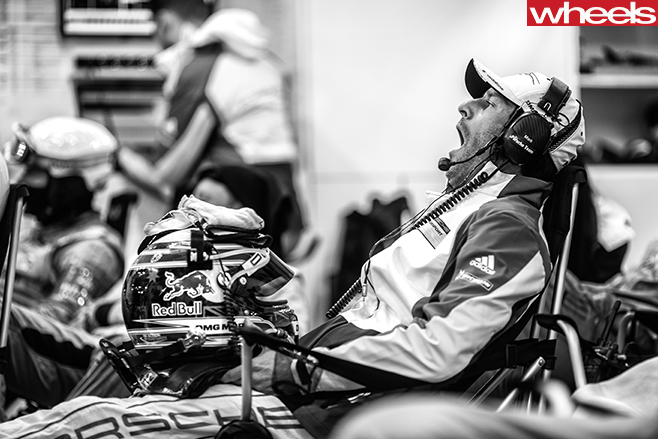
Manufacturers come and go at Le Mans, but Ford’s return after the best part of five decades away does feel special.
The GT40 project was designed to ramp Ford’s brand throughout the world, but it was also a hugely expensive “screw you” to Il Commendatore. It took three years to finally win the race, and the 1966 victory brought added controversy when Ford tried to stage a dead-heat, only for Bruce McLaren to sneak past leader Ken Miles right on the line.
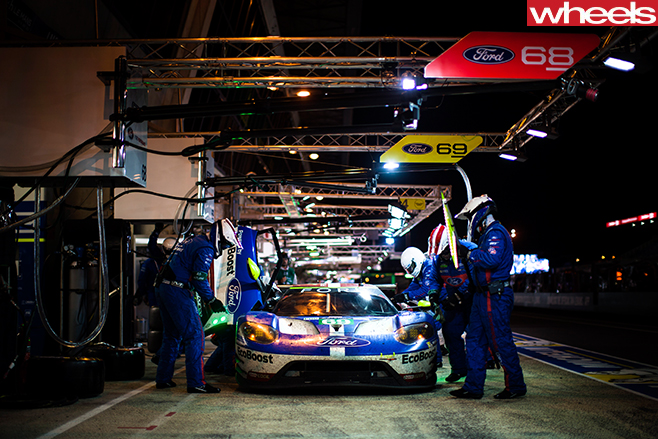
Le Mans really matters. Everyone from Bill Ford Jr to CEO Mark Fields are here to lend support. Technical chief Raj Nair, the man who pushed the GT program through, admits the car is “optimised not just for the class, but for here. It was designed for this track”.
Le Mans 2016 will be known forever as the one that got away for Toyota after the most heart-breaking finish in the race’s incredible 93-year history. But for much of the 24 hours the battle in GTE Pro is just as thrilling.
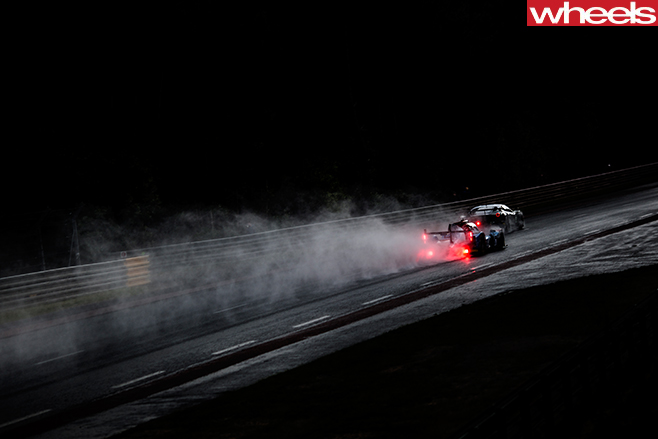
As the rain stops and the track dries, the race comes back to Ford. By 7.30 in the evening both works Ferraris are out, the Porsches are struggling for pace and the #68 Ford soars past the privateer Risi Competizione 488 to take the lead.
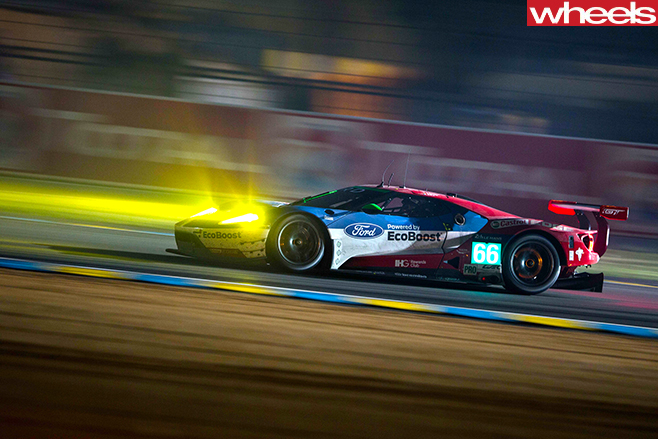
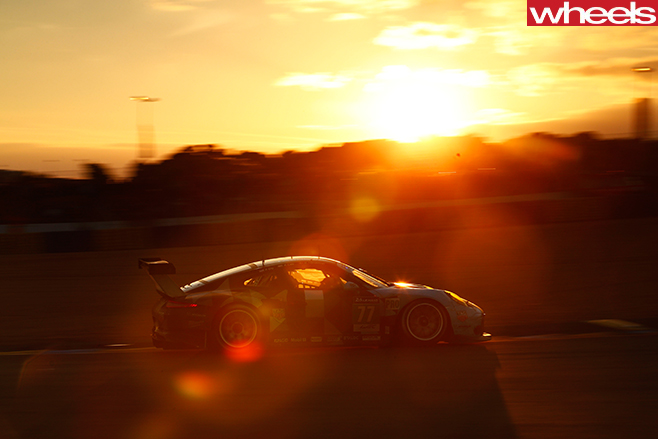
And the turbocharged V6 sounds like it’s gargling gravel as the traction control cuts in and out. As the light fades I walk out to the famous Dunlop Bridge and the GTs are easy to spot with their yellow headlights, and carry massive speed into the tight sequence that follows, yet look like they’re barely moving compared to the low-flying LMP1s that lap 30 seconds quicker.
Yet, despite the GT’s pace and the fact all four are still running after the #66 car is patched up and sent out, they just can’t shake off that awkward Ferrari, the leaders running within half a minute of each other for hours at a time and swapping positions several times.
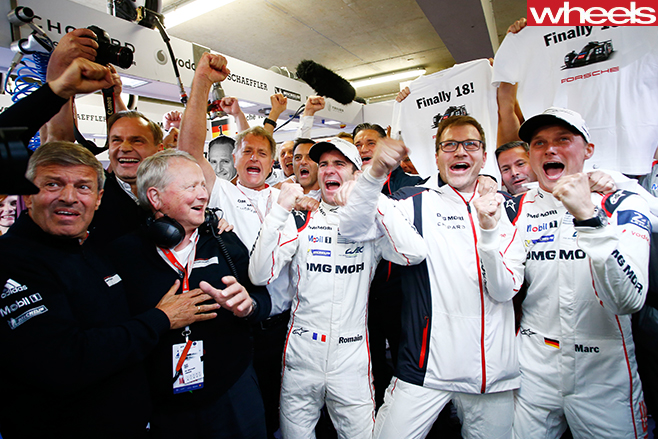
Ford’s desperation for a podium sweep creates some drama when, with 15 minutes to go, the timing screen announces the Risi car has to report to the pits to fix a broken position light (the cluster that shows where in class it’s running), after a complaint from Ford. The Ferrari stays out – the sort of thing you can get away with at Le Mans – and later counter-claims that Ford was speeding in a ‘slow zone’, equalising things.
The excitement caused by Toyota’s meltdown means few people are paying much attention when the class-winning GT crosses the line, and the Ferrari holds on to finish second and deny Ford the 1-2-3 it would have loved to put on the posters.
Somewhere I reckon Enzo is chuckling at that one.
Model: Ford Focus RS Engine: 2261cc 4cyl, dohc, 16v, turbo Max power: 257kW @ 6000rpm Max torque: 440Nm @ 2000-4500rpm Transmission: 6-speed manual Kerb weight: 1599kg 0-100km/h: 4.7sec Fuel economy: 8.1L/100km Price: $50,990 (estimated) On sale Now
Ford decided the task of meeting the new Australian anti-emission laws meant more than making engineering compromises, so it came up with two new cross-flow, six-cylinder engines and more powerful eights.
First published in the September 1976 issue of Wheels magazine, Australia’s best car mag since 1953.
ONE HUNDRED AND seventy thousand XBs later, Ford has produced a better and cleaner Falcon. The new XC is a major face-lift with engineering changes that seem certain to take The General by surprise in view of the Holden’s unfortunate HX restyle that must have been done simply to make the public aware that something important happened to Australian cars on July 1, 1976.
Ford took a less cynical view and has spent $16 million to improve the Falcon and not just change it. To meet ADR 27A, which calls for lower exhaust emissions, Ford has developed two new six-cylinder engines with cross-flow heads that have more power rather than less and it has rationalised its eight-cylinder engines and achieved the same result with them.
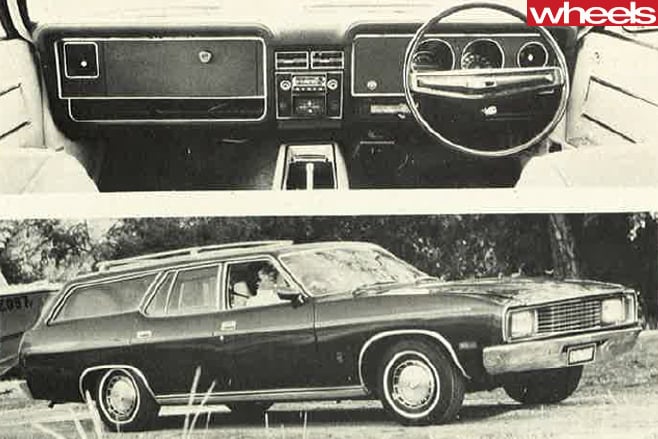
Unlike the new Fairlane, the XC retains the old body panels – apart from the new rear door, which are common to both Falcon and Fairlane — but it does get a distinctive new grille that accommodates the new bumper bar. And the new grille isn’t just a bolt-on, instant change-over affair but entails a new nose-cone and rectangular headlights on some models. We’ll reserve judgment on the styling, but first impression is that while it does look new, the nose just doesn’t relate to the rest of the body.
Also new is the dashboard, which follows the general format of the ZH Fairlane but gets circular instruments instead of the strip speedometer of the bigger Ford.
We’ll cover these changes in more detail later but after the engines and the exterior and interior changes the most significant development has been in the model line-up.
Ford has killed the GT. The once great Falcon – and we mean Great in the true sense of the word – has outlived its usefulness, done the job it was intended to do and won a thousand races in doing it and is now no more. In its place comes a new top-of-the-line Fairmont called the GXL which is halfway to being a GT and can be optioned up to resemble and perform the way a 27A Falcon GT would have done. But the GXL is a softer, more luxurious car aimed more at blunting Volvo’s rise in the lower luxury car class than at winning races.
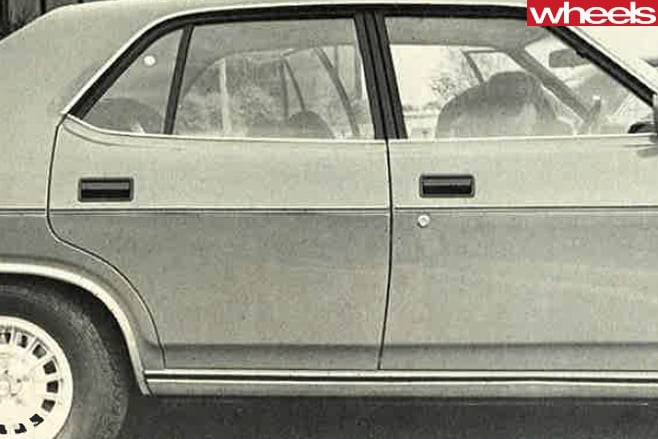
So the XC range is Falcon, Falcon 500, Fairmont and Fairmont GXL. The Futura, of course, was killed off late in the life of the XB. Initially the XC will shortly be available in sedans and wagons but the hardtop hasn’t been forgotten and will appear in a couple of months, along with the face-lifted LTD.
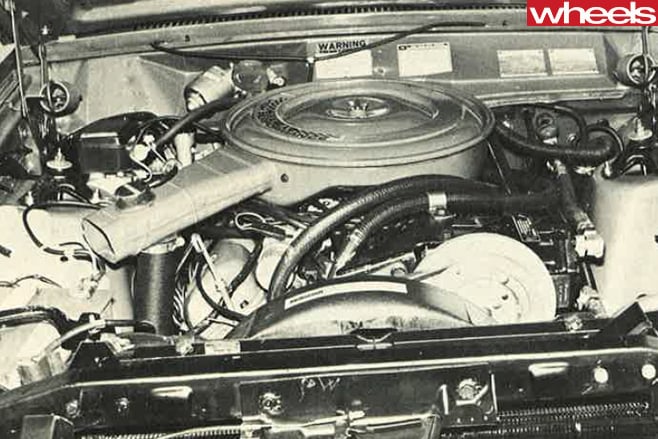
Our comparison chart details the engine changes and shows that Ford has upped the power on all its engines and at least maintained the same torque figures, although maximum torque is now achieved at higher revs. What the chart doesn’t show is that the six cylinder engines have a new cross-flow cylinder head with canted valves which are larger, new stamped rocker arms and an aluminium water heated intake manifold to improve gas flow and warm-up. Timing has been revised and the ignition system gets a higher capacity coil and dual diaphragm distributor. Only the block, crankshaft, pistons and conrods are carried over from the old engine.
The 3.3 litre six (Ford has switched to metric for its engine designations) runs on standard fuel, which will offset the expected increase in fuel consumption. You can expect to use around five percent more fuel in the new models.
The V8 range has been rationalised from three engines to two, both four-barrel versions of the 4.9 (the old 302 CID) and 5.8 (previously 351) engines. Ford now rates its engine by the DIN method so that there has been a reduction in advertised horsepower but the new horses are stronger. Both V8s now use a Carter “Thermo-Quad” four-barrel carburettor which is fully imported from the USA.
In a brief impressions run in the new model, many weeks before the official announcement, we gained the impression that the new 5.8 engine has the feel and performance of the old 351 GT donk. In a brand new car with less than 10 km on the clock it’s hard to get anything beyond an idea of what the car is all about but the GXL we drove impressed with its solid feel and although the all-black (apart from the headlining) interior became oppressive, Ford seems to have learned a thing or two from Europe with the latest model.
The new instruments are sited higher and the minor gauges are angled towards the driver. An impressive, new soft-rimmed steering wheel is part of the GXL package and so are the superb new Ford-designed, ROH-built alloy wheels. Visibility is improved because the top of the dashboard is lower and by the reduction in the waistline on the rear door but both tend to accentuate the shallow windscreen of the Falcon. It seems to become more shallow with every year, probably because other, newer cars are increasing their glass areas.
Other interior changes include the addition of a parcel shelf below the glove-box, intermittent control for the windscreen wipers, and four air vents, which are fan assisted, and very neat built-in door pulls on the Fairmont and GXL. Bucket seats are standard in everything except the base, fleet-owner’s Falcon and so are disc brakes with a proportioning valve and radial ply tyres.
The Falcon is still a big car. The only dimension to change is overall length which is up to 4865.8 mm (191.57 in.) from 4808 mm (189.32 in.) because of the new and much stronger bumpers.
Wheelbase, width, height and tracks remain as is. Weight, however has gone up from 1385 kg (3047 lb) to 1478 kg (3252lb), so those extra horses are going to be very necessary if the same performance levels are to be maintained.
Big car or not, the Falcon handles well except on rough roads when the limitations of the live axle, semi-elliptic rear suspension shows up, but with power steering it is easy to drive and still has the precision necessary to appeal to keen drivers. With sales of medium sized cars – meaning Falcon, Holden and Valiant – running at a steady one-third of the total market, Ford is ready to provide even tougher competition for The General and we can only hope, for its own sake, that Chrysler has something to pull out of the box when it shows off the new Valiant in a few months.
Check out Wheels Archive online now for other great Ford Falcon features and more from decades past!
Simply log in here using your existing MagShop account or create a FREE account and select this article from the homepage.
Don’t have a MagShop account?

Have a MagShop account?

1. It’s a hatchback, well, er, kind of. In terms of size and ride-height the Q30 fills the gap between convention hatches and taller, small SUVs. This makes it more of a crossover than a traditional hatch, with its longer suspension travel resulting in a more comfortable ride and a higher seating position.
2. It’s actually a Mercedes-Benz underneath. The Q30 is the result of a product-sharing agreement between Infiniti and Mercedes, and is based on the same MFA architecture that underpins the Mercedes A-Class, CLA and GLA.
3. This partnership is obvious inside, with the Q30 using the same steering wheel, indicator stalks and switchgear as the before mentioned Mercs. Even the Q30’s engines, dual-clutch gearbox, brakes and basic suspension hardware come from the Mercedes parts bin.
4. What is unique to the Q30 is its bold exterior styling. And its front seats, which have been engineered specifically by Infiniti for this model.
5. It’s more exclusive than a Porsche. Infiniti is a small brand in Australia when it comes to sales, and only sold 574 cars last year. For the same period, Porsche’s volume was about seven times larger.
6. Infiniti is planning more models based on the Q30. A four-wheel drive version called the QX30 (the Q30 is front-wheel-drive only) arrives here next month. It will have higher pricing, more equipment and different bumper designs front and rear.
7. Despite wearing a Japanese badge and being mostly German underneath, the Q30 is actually built in the United Kingdom. It comes from Nissan’s production plant in Sunderland in the north-east of England, and is built alongside the Nissan Qashqai and Juke.
8. Infinti boasts it evaluated 52 different suspension settings during the Q30’s development to ensure it delivers an optimal blend of ride comfort and control.
I’m always leery and a bit stand-offish when I meet somebody called ‘Peugeot Pete’ or ‘Mustang Maurie’ or ‘GM Jeremy’.
See, you don’t get a handle like that unless you’re totally devoted to a particular make or model and that, my friends, makes me a bit squirmy. Because in my experience, that level of devotion usually comes at the expense of anything approaching rational thought or independent assessment. Not to mention you’ll be unable to talk to the bastard about anything else.
When people stop questioning why things happen the way they do, why they do things the way they do, or when they give up on the notion of being at least slightly analytical, then I start to lose interest in seeing them fed and clothed. It’s why climate-change deniers make me wanna take them out the back and stand on their soft bits. Maybe they’re right, maybe science has got it wrong.

And I see a lot of this ear-fingering and la-la-la-ing when it comes to the cars people choose to buy. Not that I much give a bugger who drives what, but people who slavishly buy the same brand they’ve always had stagger me.
My own sister – bless her – is an example. She’s a Volkswagen girl, I she’ll proudly tell you. But when I point out that the air-cooled Beetle she owned 30 years ago bears absolutely zero resemblance to the Jetta she’s just bought (her third VW on the trot) she looks at me like I’m some kind of romance-free zone.
Now, I’m not saying she shouldn’t have bought a Jetta (God knows it was cheap enough), but to do so without even looking through a showroom window at the alternatives (or, heaven forbid, asking her road-testing big brother for an opinion) just makes me question her sanity. More. She may have settled on a Jetta anyway, she may have fallen for a different make and model altogether. But as it stands, she’ll never know.
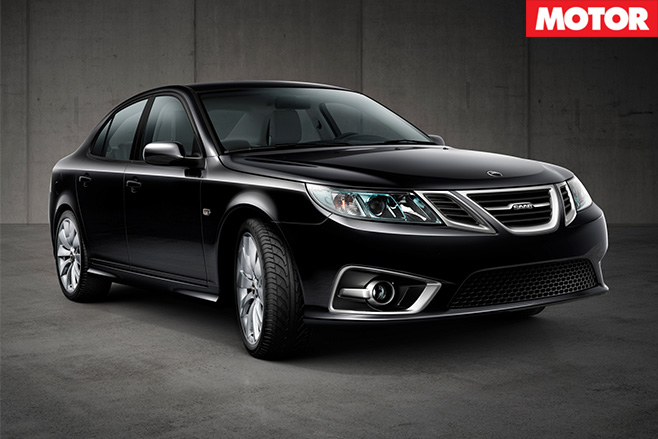
Those 9-3s and 9-5s built under GM ownership were a pox. They weren’t real Saabs. They weren’t even proper imitations. But the way my mates approached it, they were the only cars they could possibly consider. From where I stand, that makes them the cars that put the Dog into Dogma.
We have never had such a rich choice when it comes to buying a car. But to deny yourself that choice, to deliberately make a poor decision, purely on the basis of some twisted notion of self, allegedly represented by an inanimate object, is just plain dumb.
The brands offered to us now are countless, the models endless and the variations in specification could sink a boat. Pity it wasn’t the boat loaded with Saab 9-3s.
Ford’s upcoming XC Falcon had to deal with tough anti-pollution requirements. Turns out it didn’t need those bulky American-style bumpers, though.
First published in the January 1976 issue of Wheels magazine, Australia’s best car mag since 1953.
Here’s details of:
- XC FALCON
- XG FAIRLAINE
- TE CORTINA
FORD PLANS a grand slam of new models in 1976 in a bold attempt to win back market leadership from The General. Escort has taken the small car class by- storm and now Ford is turning its attention to the medium and large classes with a face-lifted range of new modeIs.
First comes the Cortina in March, followed by the Fairlane in April and the Falcon in June. LTD and Landau are also clue for minor styling changes but Ford has yet to decide upon a release date, according to our spies.
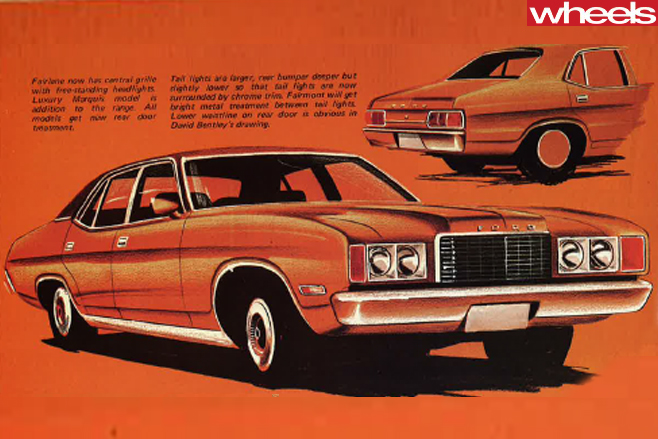
As David Bentley’s drawing indicates the front doors are identical to XB but on the XC the waist line continues straight through from the B-pillar, instead of rising as on XB, to the rear quarter window. This change applies only to the tour-door sedan, we have yet to see a new hardtop but understand it retains its massive C-pillar.
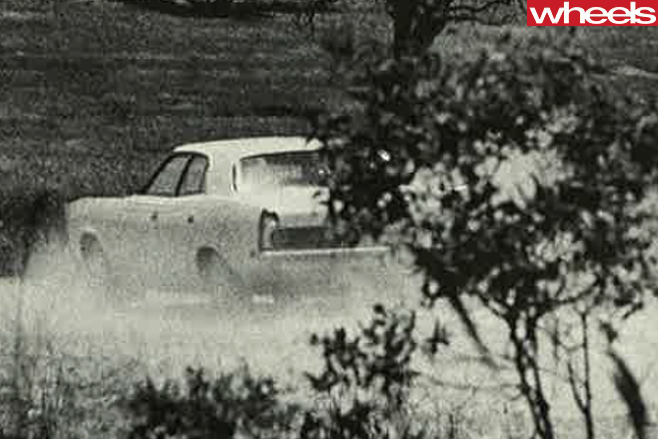
Under the skin the XC gets much improved equipment levels across the board and don’t be surprised if the slow-selling Futura model is dropped from the range. The dashboard has come in for a complete restyle with two large circular dials in front of the steering wheel and four smaller dials (on the GT and GS) to the left with warning lights in between. In other words the instruments revert to the layout of the old XY/XW models but within a similar outer shape to the XB. The protruding padding that juts out at the centre passenger has been reduced in size. The top of the line Fairmont seems certain to get four headlights.
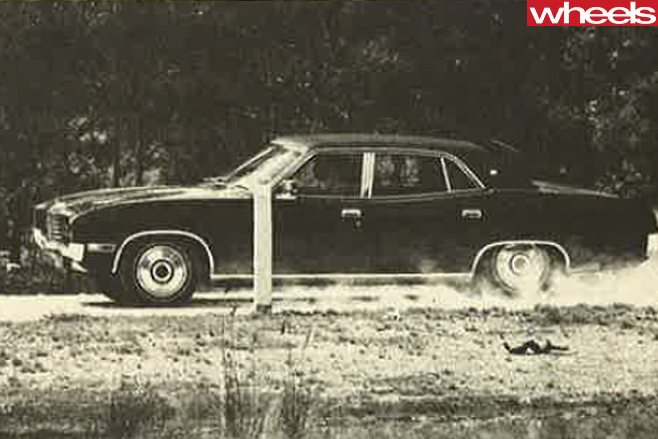
The ZG Fairlane has been deliberately restyled to widen the gap between it and the Ford Falcon. Big news is the introduction of a super-luxury Fairlane to compete with GMH’s Caprice. Ford apparently feels the LTD is all alone at the top of the luxury pile and that the Caprice has created a further market segment all its own, as a not-too-big ultra-luxury car. The new Fairlane – to be known as the Marquis – will have air-conditioning, electric windows, leather or cloth seats, deep pile carpets, self-seeker radio and more interior lights.
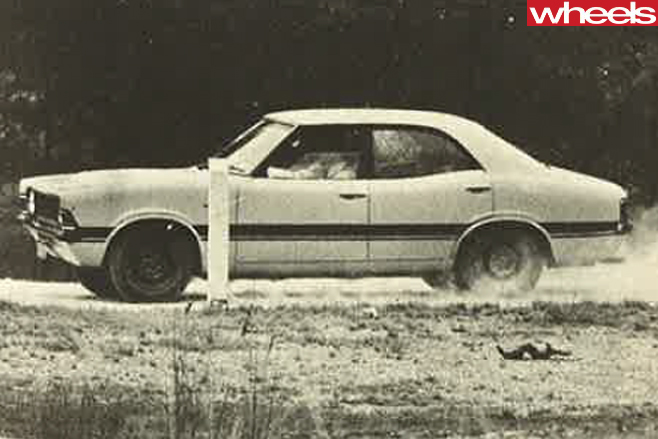
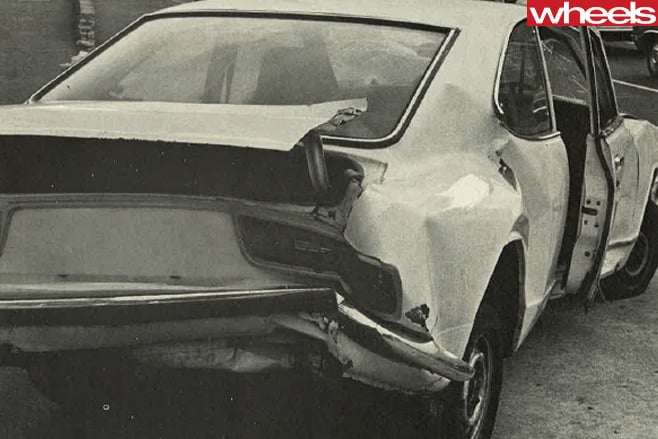
The Fairlane also gets the new rear doors and the Falcon’s heavy bumpers which give the impression they are anticipating the Australian ADRs picking up the early American bumper standards which require the bumpers withstand a 2.5 mph crash without damaging the bumper or its supports.
One minor, but still interesting, change is the addition of extractor vents in the C-pillar. Our spies have only seen these on Fairlanes but they will obviously appear on the Falcon, if Ford can overcome the bugs normally associated with such systems in Australia.
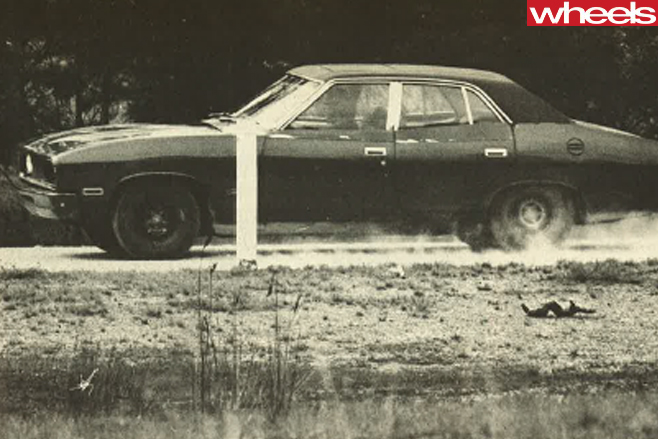
Cortina will be the least changed of the new models. It will rely on a minor face-lift – probably matt black grille, badge work, new side and tail lights and new colors – but will also be further upgraded in equipment levels to keep pace with the Japanese opposition. The major change to Cortina (WHEELS August) is still18 months away.
Ford’s answer to the hatchback Torana (which is now scheduled for release late in February) has been postponed indefinitely. Code-named project Cyprelis, it was to have been a short wheelbase two-door Cortina with a hatchback rear door. All body panels were different to the Cortina and it looked vaguely like a Pinto. But unless there is a major change of heart within Ford management, Ford looks like staying with the Cortina four-door sedans and using the wagon to counter the, new Torana. Remember the Torana isn’t available as a wagon and this gives Ford a major advantage over the General.
Check out Wheels Archive online now for other great Ford Falcon features and more from decades past!
Simply log in here using your existing MagShop account or create a FREE account and select this article from the homepage.
Don’t have a MagShop account?
Have a MagShop account?
Kia’s plug-in hybrid version of its popular Optima appears to be a step in the right direction, even if it has a few handling shortfalls.
WHAT IS IT? Kia’s first plug-in hybrid, which offers credibility-stretching fuel economy figures to those who complete short journeys between destinations equipped with recharging facilities. It uses a powerful 50kW electric motor and a sizeable battery pack to deliver up to 53km of electric-only range, with a 2.0-litre petrol engine backing this up to ensure you don’t get stuck when you run short on electrons.
WHY WE’RE TESTING IT? Both Kia and Hyundai are set to launch a wave of electric and hybrid vehicles over the next few years. The Optima PHEV isn’t confirmed for Australia yet, but it gives a good indication of the scale of the company’s ambitions. Is it good enough to persuade sceptics that a plug-in hybrid doesn’t have to be as compromised as most of its ilk?
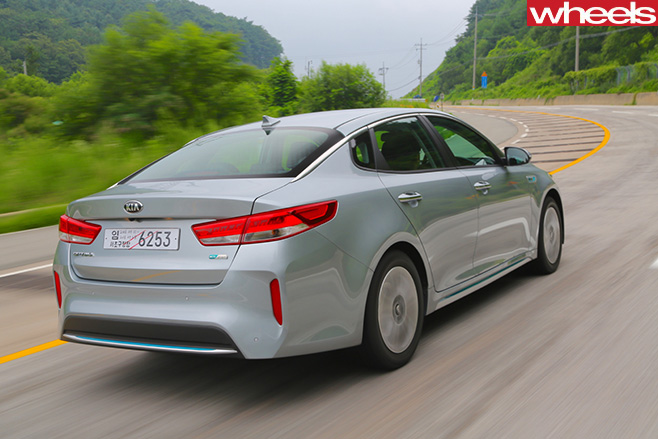
THE WHEELS VERDICT The Optima PHEV is an impressive piece of engineering, but it also confirms that plug-in hybrids don’t really make sense for markets like Australia yet. Trying to combine both petrol and electric powertrains in one car feels like a stop-gap solution on the road to the future and the Kia Optima’s complexity and weight doesn’t bring significant economy gains over anything but short journeys.
THE WHEELS REVIEW The plug-in hybrid remains an odd proposition – hugely complicated cars that struggle to match the real-world economy figures of modern diesels. Plug-ins offer a belt and braces approach to future mobility – electric operation backed up by internal combustion – but trying to combine both worlds makes them both heavy and expensive.
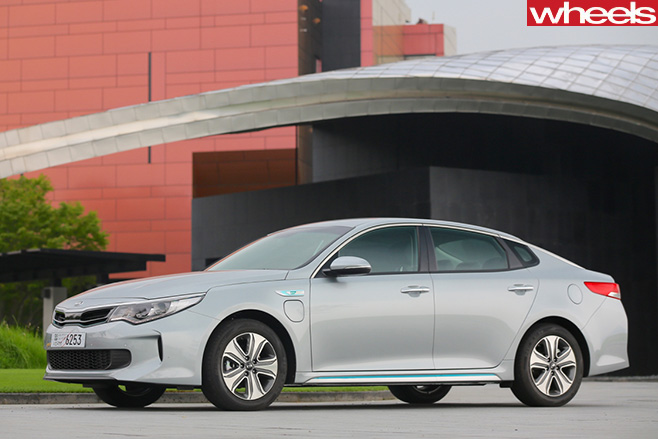
The 9.8kW/h lithium-ion polymer battery is claimed to be good for an electric-only range of 53 km and can be recharged from flat in just three hours from a domestic 240 Volt supply.
Travel further than that without recharging and the PHEV becomes a hybrid with a very big battery pack, the mass of which is confirmed by the car’s chunky 1780kg kerbweight.
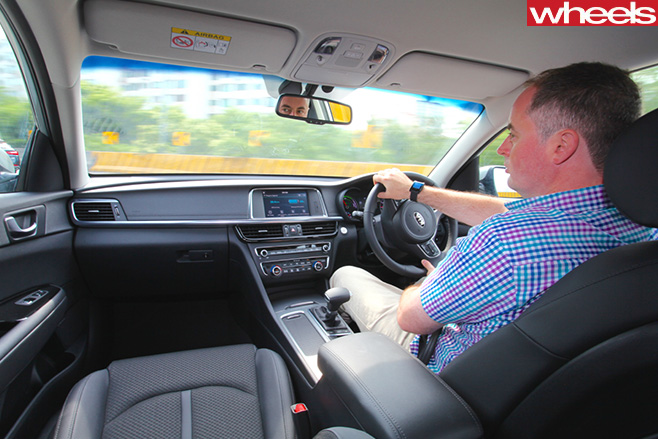
The electric side of the powertrain does a good job of filling in the petrol motor’s torque deficiencies and the Optima feels respectably rapid in real-world use.
Not that it has any enthusiasm for going faster. Kia claims it is going to sharpen the handling of all of its cars, but the PHEV’s chassis set-up seems to pre-date that pledge. Grip levels are modest and easily breached and the Optima suffers from understeer in tighter corners at everyday speeds.
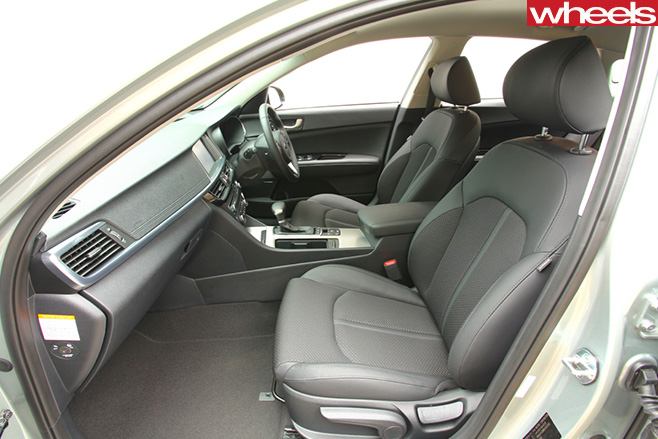
It’s not all bad. The Optima can be switched into pure EV mode and it feels more sprightly than most of its rivals when operating electrically – it will even go at speeds of up to 120km/h, although those speeds will have the electric charge gauge falling visibly.
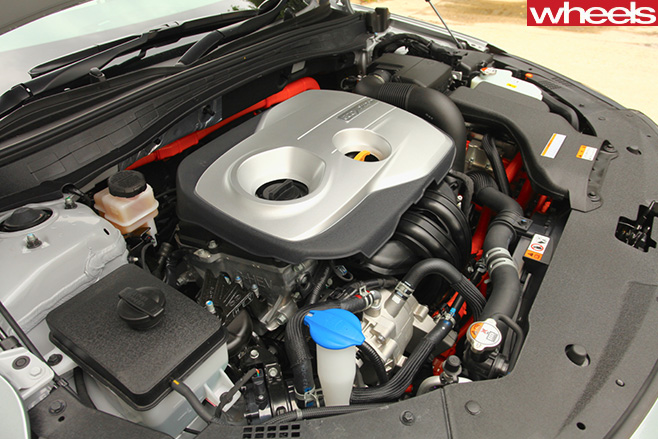
The PHEV also comes with copious standard kit.
Kia is ahead of the curve on this one – we can expect a wave of plug-equipped models from pretty much every car maker as global emissions standards get stricter – but the company hasn’t decided whether the Optima PHEV will be coming to Australia or not. That’s understandable given that, at the moment, it feels like the answer to an unasked question.
SPECS Model: Kia Optima PHEV Engine: 1999cc 4cyl, dohc, 16v, with electric motor. Max power: 114kW @ 6000rpm (IC)/ 151kW @ 6000rpm (total system) Max torque: 188Nm @ 5000rpm (IC)/ 374Nm @ 2330rpm (total system) Transmission: six-speed automatic, front-wheel drive Weight: 1780kg 0-100km/h: 9.3 sec (manufacturer) Fuel economy: 1.6 lit/100km (EUDC) Price: TBC On sale: TBC
