
AMG has revealed its fastest and most technically advanced car ever – the track-focused, Porsche 911 GT3 RS-fighting GT R.
Officially shown for the first time at this weekend’s Goodwood Festival of Speed, the GT R sits at the top of the rapidly expanding AMG GT family, and debuts a number of technical firsts for Mercedes’ in-house performance arm.
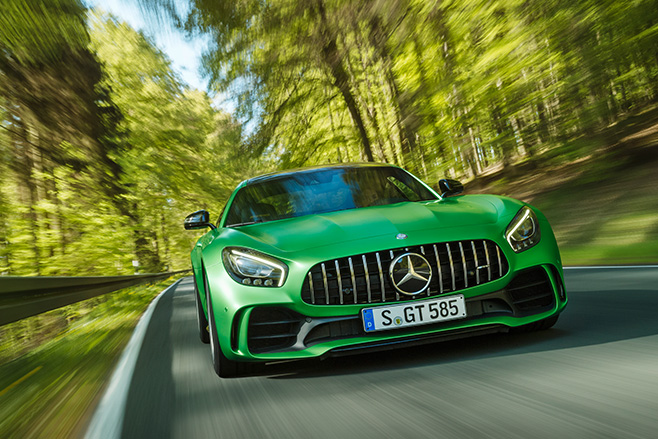
Leading the list is active aerodynamics and four-wheel steering; additions designed to make the GT R the fastest track-focused AMG to date.
There’s more power too, with new turbochargers and more boost helping the GT R’s 4.0-litre V8 to produce 430kW/700Nm. That’s a 55kW/50Nm hike over the existing AMG GT S that we get here in Australia.
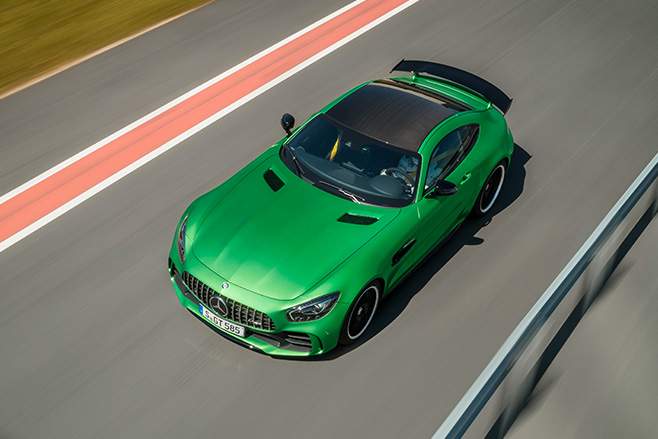
All that grunt is sent solely to the rear wheels via a seven-speed dual-clutch gearbox, which now boasts revised ratios and a shorter final drive.
Combine this with sticky, racing-spec Michelin tyres and the GT R can rocket from 0-100km/h in 3.6seconds – two tenths faster than the GT S.
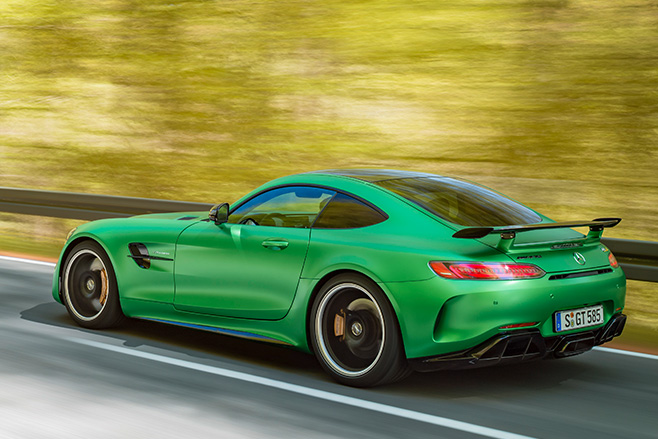
Top speed is 318km/h, but AMG says the GT R is more about bending the laws of physics through the corners, than brutal straight-line performance.
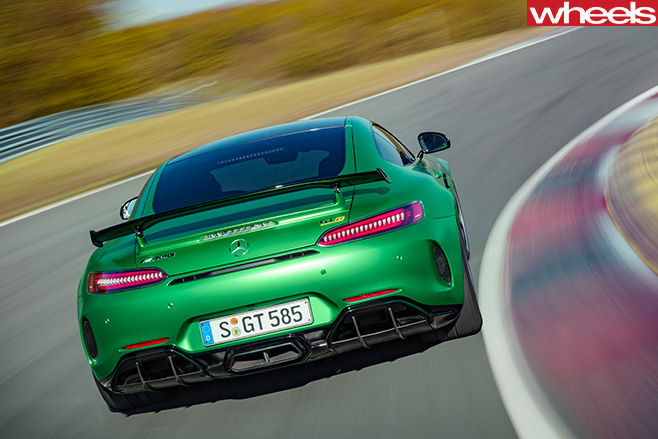
Helping that cause is revised body work; it’s not only wider and more aggressive, but generates 155kg more downforce than the standard GT.
There’s also new suspension, comprising adjustable coil-overs and adaptive dampers, which results in a much stiffer set-up for improved cornering.
So what about price? Mercedes Australia isn’t saying, but expect the GT R to cost between $350-400K when it lands here in mid-2017.
I hate spiders. Always have. Big or small, deadly or harmless, doesn’t matter, I wish every one of these eight-legged freaks would disappear off the face of the planet. Spyders, however, are a different matter, particularly when there’s a Porsche badge on the front.
Instead of long, spindly legs and eight tiny eyes, the Boxster Spyder has a detuned version of the previous generation 911 Carrera S’s 3.8-litre flat-six. Producing 276kW/420Nm, it lifts Porsche’s roadster to new performance heights, devouring 0-100km/h in 4.5sec and powering on to a 290km/h top speed.
With the imminent arrival of the new turbocharged 718 Boxster (see p52), this might be the final naturally aspirated version of Porsche’s open-top sportster, and if so it’s going out on a high. The Boxster is a top-notch sports car in any guise, but as sweet as the smaller flat-sixes are, they tend to be an accompaniment to the chassis rather than the main event.
The larger, more powerful engine balances the grunt-to-grip equation somewhat, though it still needs to be extended to give its best. It’s content to trickle along in sixth gear at 60km/h and pull cleanly from virtually idle, but if you’ve become used to modern turbocharged torque, the need to pile on revs to make progress will feel unfamiliar at first.
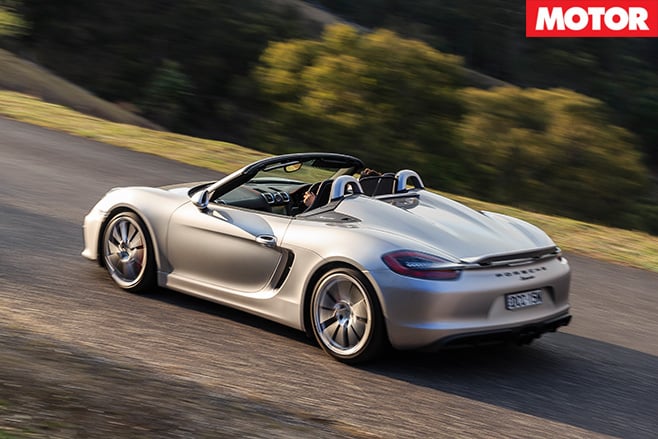
And like Barnsey in his Cold Chisel prime, the Boxster is also incredibly loud with the sports exhaust activated, which is fantastic but does make you a bit conspicuous on a hard drive. Thankfully, with the exhaust button deactivated it’s markedly quieter, to the point that tyre roar becomes the dominant noise when on a cruise.
Purists will be pleased to note that the means of controlling this delicious engine is via a six-speed manual only. The clutch is surprisingly heavy and the gearchanges do require some effort, but the speed and slickness with which each gear slots home – up or down changes – is sublime.
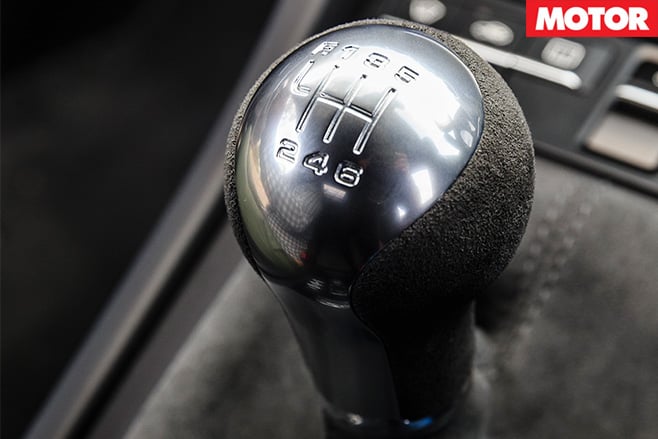
Unfortunately, the biggest problem with the Spyder is the same one that affects all Boxsters and Caymans, incredibly tall gearing. While the extra power means it certainly doesn’t struggle to accelerate, the intergalactic ratios deny you the opportunity to use both the engine and gearbox to their full potential, particularly on public roads.
Put it this way, if your favourite twisty road has a 100km/h limit and you wish to remain a law-abiding citizen – which obviously we all do – you can enjoy the Boxster Spyder until 5800rpm in second gear (cutout is 7800rpm). Subsequently, you’re rarely using that excellent gearbox, as second gear (which stretches to 134km/h) is more than enough for most roads. It doesn’t spoil the car by any means, but equally it would be a faster, more involving car with a shorter diff ratio.
Of course, the Boxster Spyder isn’t Porsche’s first mid-engined model to receive the 911 engine treatment, however it’s not an open-top Cayman GT4. Unlike its hardtop sibling, the Spyder is not a product of Porsche’s motorsport department and doesn’t benefit from the GT4’s extensive chassis and aerodynamic upgrades.
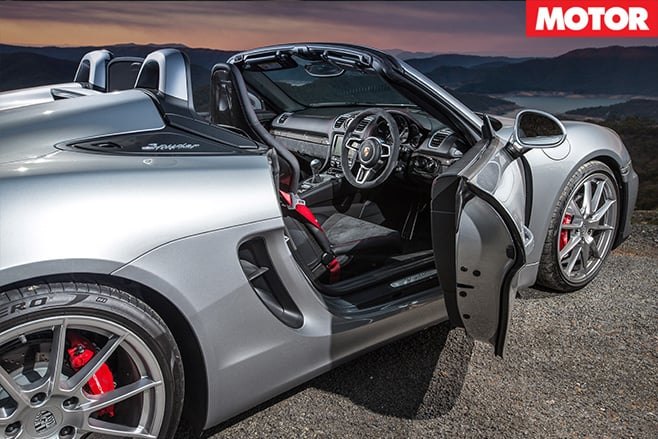
Grip levels are still huge – you can commit to corners with enormous confidence – but the car will now gently slide under power at the rear, especially if the corner exit is off camber. The steering is lighter, faster (it uses the 911 Turbo rack) and perhaps a little more communicative than the proper GT cars and makes correcting these movements a breeze.
As with all Porsches – well, the sports cars at least – it refuses to wilt no matter how hard you drive it, and as the tyres get hotter you can use the throttle to steer the car more, though the Spyder’s ESP system doesn’t feel as permissive as in the likes of the GT3. It’s also possible for the low nose to make some wince-inducing scuffs as it kisses the road over bumps at speed, which can limit how hard you can attack.
It’s all relative, however, and in the overall scheme of things these foibles are tiny blemishes. As a driver’s car the Boxster Spyder is sublime in almost every way. It feels fantastic in isolation, but it’s only in comparison that you realise just how good it is.
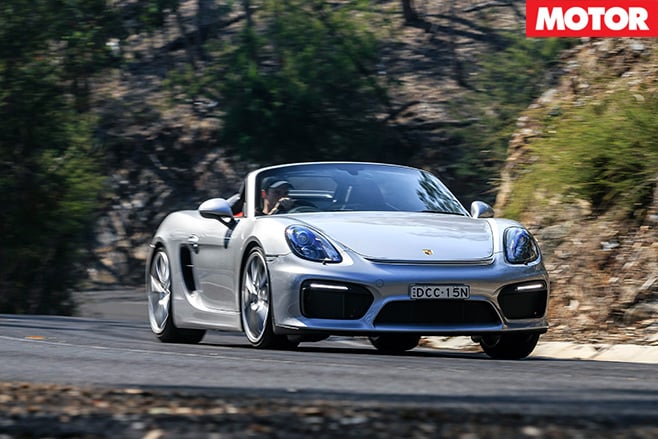
Of course, such of what makes the Spyder great can also be found in the regular $104,500 Boxster, which makes the $64,500 premium pretty steep, especially as you trade the practicality of the base car’s electrically-folding roof for a manually-operated arrangement which, while a big improvement on the previous Spyder’s tent-like affair, is still a bit of a faff.
However, such is its depth of ability and character, not to mention its rarity (just 35 or so will come to Australia), that $200,000 or more would still seem like reasonable value, which makes the current ask seem somewhat of a bargain.
Yes, the $20,000 cheaper Boxster GTS is fantastic, but if you can make the stretch its bigger brother is well worth the extra. Eight-legged spiders might be horrific, but six-cylinder ones are superb.
5 OUT OF 5 STARS
LIKE: Everything. Engine, handling, brakes, looks, noise, etc
DISLIKE: Limited supply; gearing too long
SPECS Engine: 3800cc flat-6, DOHC, 24v Power: 276kW @ 6700rpm Torque: 420Nm @ 4750-6000rpm Weight: 1315kg 0-100km/h: 4.5sec (claimed) Price: $169,000
AMG reveals its newest and most advanced weapon, but Wheels saw it weeks ago. We even scored a private tour by the company’s boss.
TOBIAS Moers – the muscular, forceful and slightly intimidating boss of AMG – is standing next a car covered in a silver cloth, a boyish grin spread wide across his broad, freshly shaven face.
We’re deep inside AMG’s Affalterbach HQ, in a private showing room, and under the cover lurks the hulking shape of the performance company’s latest and greatest creation – the track-focused GT R, a clear rival for the Porsche 911 GT3.
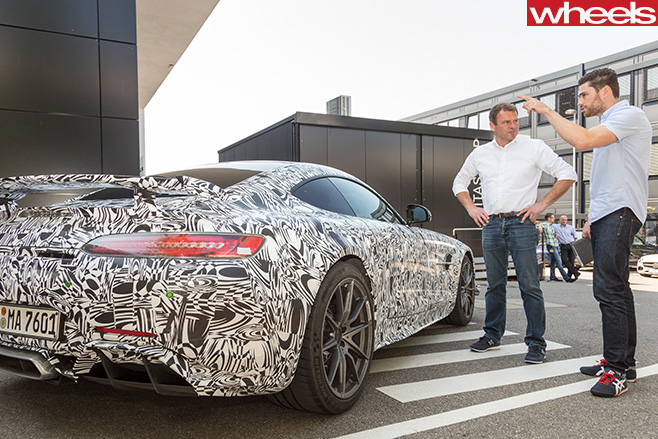
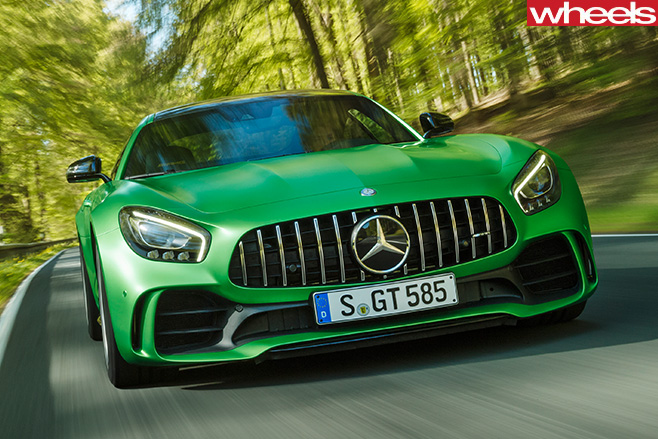
“Here it is!” Moers proclaims. He’s like a proud father and I can see why as I drink in the GT R’s angular shape, its lower and wider bodywork, manually adjustable rear wing and brilliant green hue.
It looks brilliant. It’s also, Moers quickly points out, festooned with AMG firsts.
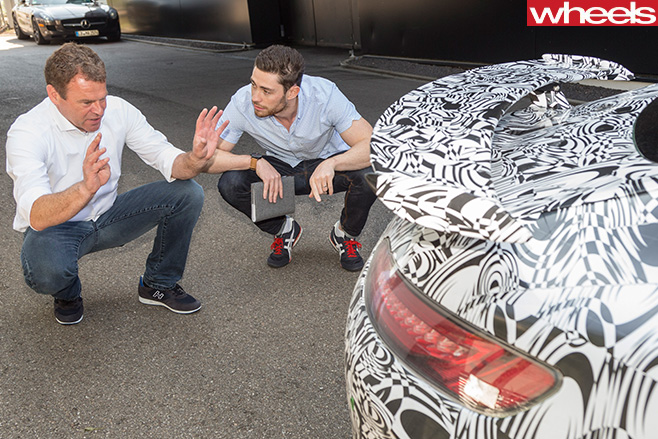
Before we get to all that, though, let’s talk about power.
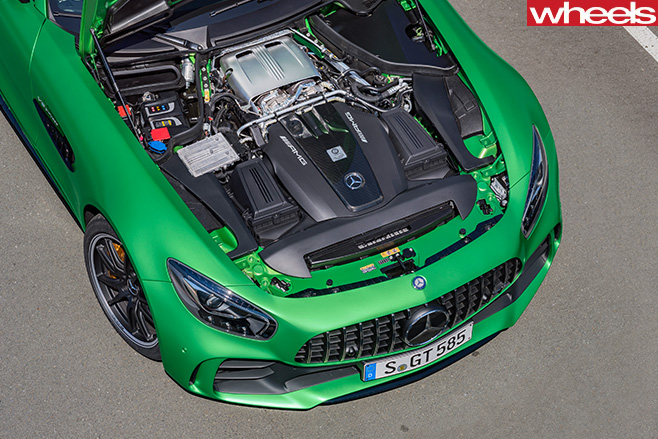
The GT R uses the same 4.0-litre twin-turbo V8 as the regular GT S we get here in Oz, but AMG’s engine experts have fitted bigger turbos and injected more boost to push outputs to 430kW/700Nm.
That’s an improvement of 55kW/50Nm over the already very fast GT S.
Combine this with super-sticky Michelin Pilot Sport Cup 2 tyres, which measure 325/30R20 on the rear axle (“That’s the same profile as the SLS Black Series,” says Moers) and the GT R will rocket from rest to 100km/h in 3.6sec, two-tenths quicker than the GT S.
Impressive numbers, then, but Moers points out the GT R isn’t really about raw power and straight-line performance. It’s more about ruining your internal organs through the corners.
“That’s the aim,” he says. “We haven’t achieved it yet, but we will.”
AMG honed the GT R’s handling package extensively at the ’Ring – hence the brilliant green paint, called Green Hell Magno – and Moers himself did some of the driving.
“You can really feel the four-wheel steering working, and it’s great,” he says. “It adds much more stability.”
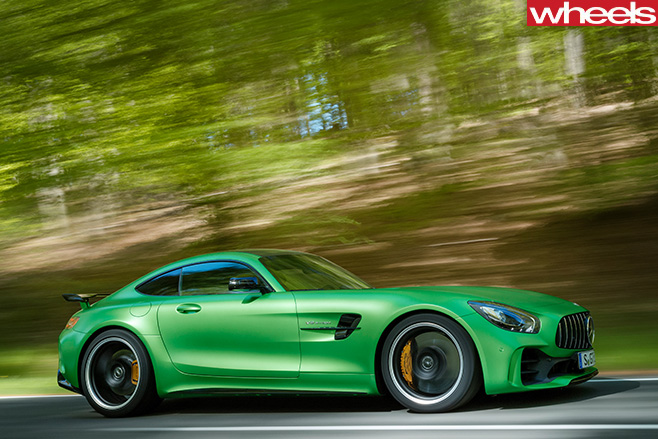
AMG has tweaked the onboard electronics, the headline change being a nine-way adjustable traction control system developed for racing. It’s operated via a rotating dial placed in the centre of the dash and lets the driver choose how much slip you’d like from the rear axle.
And that aggressive bodywork isn’t just for looks – it’s functional, too.
Special carbonfibre flaps hidden behind the front splitter lower by 40mm at speeds above 80km/h to create a venturi effect (anyone familiar with ground effects in F1 will know this term) to suck the GT R into the road.
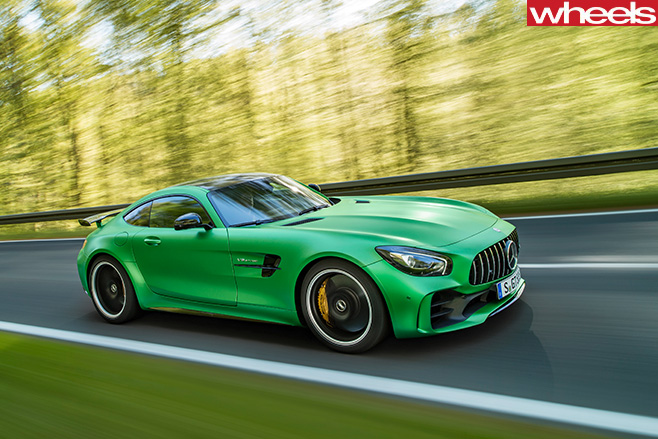
There are three exhausts; in Comfort and Sport all of the noise is sent through the large central opening, but dial in Sport+ or Race and flaps open to active two extra pipes set wider in the rear bumper.
“It’s louder than the GT S, but also has a more distinct note,” says Moers.
All up, AMG claims the GT R generates 155kg more downforce than the regular GT S.
As you’d expect, lightweight carbonfibre features throughout – it’s in the front fenders and the torque tube (itself 40 percent lighter than the aluminium one in the standard GT) – but overall weight hasn’t actually dropped that much.
“It’s about the same as the GT S,” Moers says of the GT R’s 1555kg kerb weight.
“The goal was to be lighter and we have taken lots of weight out, but we’ve also added heavier items like the four-wheel steering and active aero.”
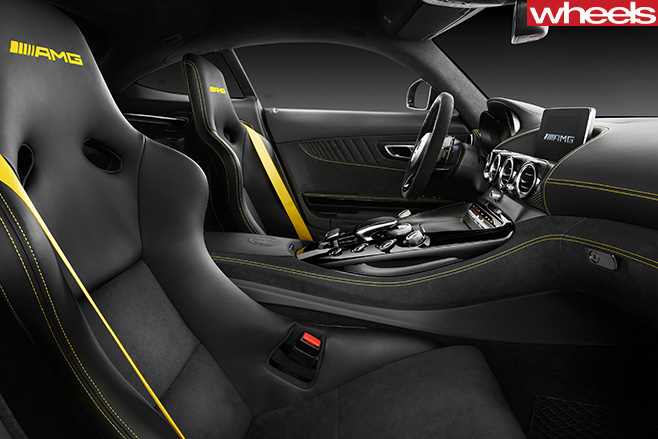
“We’ve changed everything,” says Moers. “Even the steering is different. It’s more direct and has a faster rack. But it doesn’t feel nervous because of the rear-wheel steering. We can afford to make it faster because the GT R is so stable at high speed.”
Great news is the GT R’s suspension geometry will soon make its way into the rest of the GT range.
So what about price? Mercedes-Benz Australia isn’t saying, but expect a sticker of $350-400K, which should put it on the shopping list of anyone considering a 911 GT3 RS.
We can’t wait to find out which is better.
Mercedes-AMG has the Porsche 911 GT3 RS firmly in its sights, unveiling its most focused model yet, the GT R, at this weekend’s Goodwood Festival of Speed.
Developed primarily at the Nurburgring the GT R is lighter, more powerful and incorporates high-tech chassis componentry, including rear-wheel steering and active aerodynamics, all aimed at maximising racetrack performance.
The GT R is based on AMG’s range-topping GT S sports car, however virtually no aspect has gone untouched in the pursuit of performance. The dry-sumped 4.0-litre twin-turbo V8 now produces 430kW/700Nm, increases of 55kW/50Nm, thanks to new engine mapping and an increase in boost pressure from 1.2 to 1.35bar.
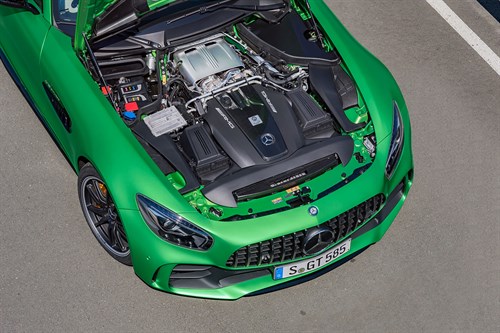
It’s the GT R’s dynamics, though, rather than its straight-line performance that is likely to raise most eyebrows. Never before has AMG created a model so focused on lap times, not even the mighty SLS Black of 2012.
The bodywork is wider by 46mm at the front and 57mm at the rear, which allows the GT R to wear wheels measuring 19 x 10.0-inch front and 20 x 12.0-inch rear wrapped in massive 275/35 R19 (front) and 325/30 ZR20 (rear) Michelin Pilot Sport Cup 2 tyres. AMG’s three-mode adaptive dampers remain, but spring pre-load is adjustable and there’s a thicker rear anti-roll bar.
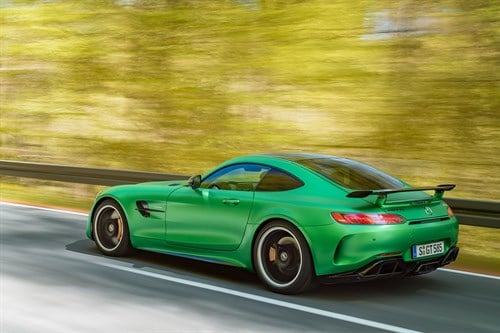
Rear-wheel steering heads the list, which as is increasingly common turns the rear wheels in the opposite direction to the fronts below 100km/h to improve agility and in the same direction above 100km/h to aid high-speed stability. Carbon fibre braces for the underbody and front-end increase body stiffness.
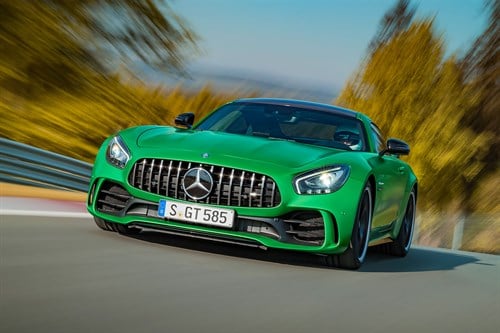
A carbon flap in front of the engine descends 40mm when above 80km/h in RACE mode, accelerating the airflow and sucking the front end of the car to the road. At the same time the radiator air outlet opens to feed air to the rear double diffuser while vertical louvres behind the front fascia can close to reduce drag or open to provide cooling air to vital componentry.
Equally clever is AMG’s nine-stage traction control, lifted from its GT3 race car. Operating independently of the three-stage ESP, a rotary dial on the centre console allows drivers to select the amount of rear-wheel slip they want depending on the available traction and road conditions.
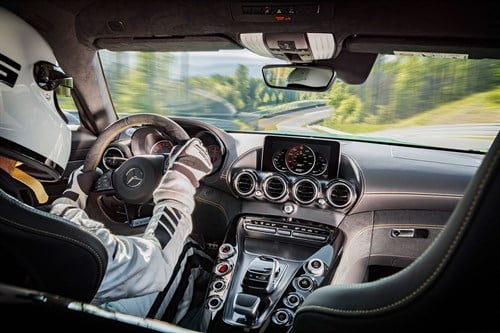
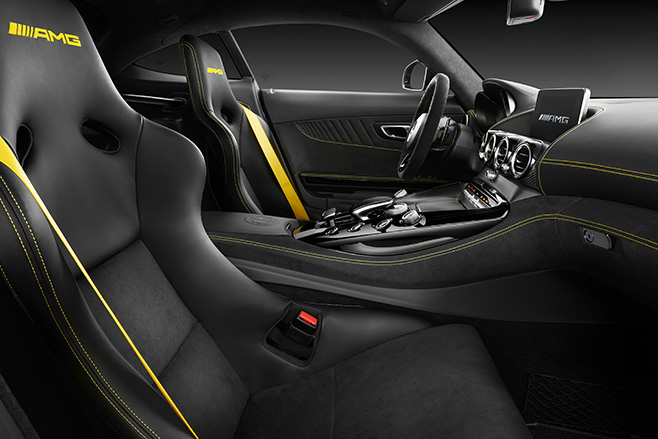
Inside, the AMG GT R scores manually-adjustable lightweight bucket seats, while its wider stance and aggressive aero are matched to a brand new ‘Green Hell magno’ paint job.
The GT R arrives in Australia in July 2017, however expect supply to be extremely limited and pricing to nudge the $400,000 mark.
The Škoda Octavia mid-sized sedan and wagon line-up has added a host of extra features in return for small price increases.
Volkswagen’s Czech brand says the value of additional equipment is worth $4300, even for models such as the entry-level Ambition manual that increases by $500 to $22,990 RRP (or $24,490 driveaway).
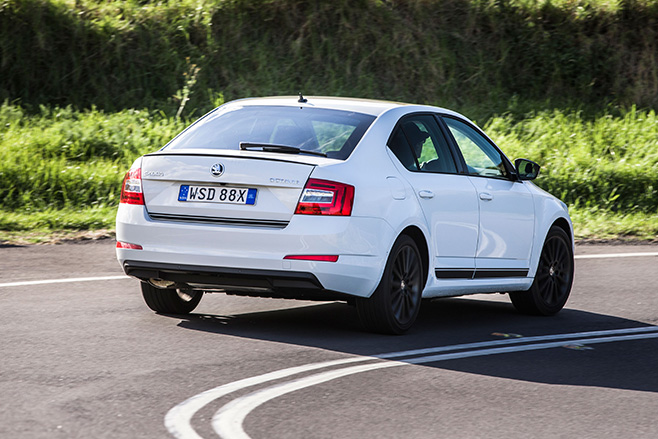
All Octavia models, including the all-wheel-drive Scout, now feature autonomous emergency braking, adaptive cruise control, rear camera plus sensors, and Apple CarPlay and Android Auto smartphone integration.
Škoda Australia has also introduced an optional five-year warranty, as well as a guaranteed future value scheme – designed to overcome concerns about resale.
The 1.4-litre turbocharged petrol engine available for the base Ambition and mid-spec Style gets a small power increase to 110kW. The Style is again offered with an alternative, 2.0-litre diesel engine, also with 110kW but extra torque at 320Nm
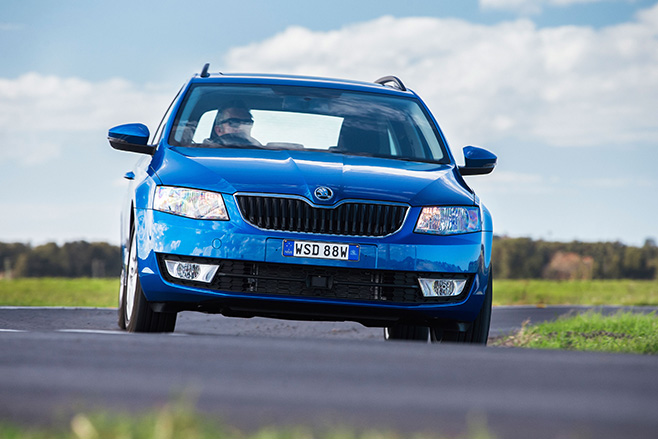
The mid-spec Octavia Style’s feature list includes 18-inch alloy wheels, bi-xenon lights, front sensors, leather upholstery, navigation, 8-inch touchscreen and fatigue alert.
At the top of the tree remains the sporty RS model, which comes with additional gear including a stiffer suspension plus more powerful engines – either a 162kW 2.0-litre turbo petrol or a 135kW 2.0-litre turbo diesel.
All models pair engines with DSG dual-clutch autos, with the exceptions of the 110TSI and 162TSI models that also offer a six-speed manual.
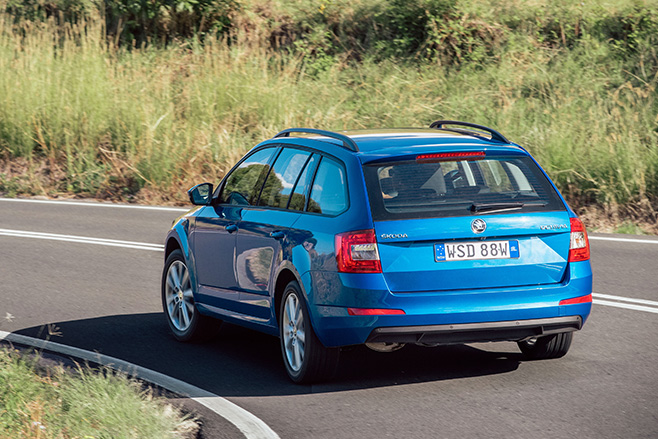
Various option packages are also offered depending on spec level, and also play the value card. The $3400 Sports Pack available for the Ambition trim grade, for example, brings the likes of a flat-bottom steering wheel, bi-xenon lights, 18-inch ‘Turini’ alloy wheels and black body trim that Skoda says collectively are worth $5670.
Choosing a wagon variant instead of the sedan again costs a $1700 premium.
Driveaway pricing ranges from $24,490 for the Ambition 110TSI manual to $44,390 for the RS 135TDI.
Subaru is launching a station wagon that draws on rally-bred experience to appeal to buyers who don’t want to park a sports utility vehicle in the driveway. It has the heart of a Subaru WRX sedan, and all the family appeal of a sporty, conventional load lugger with room for a dog. Here’s 10 things you didn’t know about it.
- Subaru’s Levorg is aimed at a group of buyers the carmaker has labelled the “SUV rejectors”. These are all the new-car buyers who would prefer to have a conventional station wagon over a jacked-up, faux off-roading one.
- It has a special Australian suspension tune that is very different from those used in Europe and the US — two of Subaru’s other major markets.
- The name “Levorg” is made up from the words “Legacy Evolution Touring”. Why “Legacy” and not “Liberty”? It’s the name given to Subaru’s small sedan and wagon in markets outside Australia. We call it the Liberty.
- There is no manual gearbox option because the Levorg has to sell to women, who tend to want instant acceleration. The best way to deliver that is with a continuously variable transmission (CVT)
- The transmission is “stepless”, meaning there’s an infinite number of gear ratios available. They allow the engine to always sit in its optimal rev range for whatever you happen to be doing. A manual mode tricks the gearbox into thinking it has six gears in the Levorg’s normal driving mode, and eight gears in the two more spirited driving modes.
- Subaru’s decision to fit the Levorg with an automatic transmission leaves WRX, STi and Outback diesel as the brand’s only cars to still offer the option of a manual gearbox option.
- Smartphone friendliness is a priority. The Levorg has three USB slots: One in between the front seats, and two that are accessible via the rear seats.
- Levorg sales start at the same time as a mid-lifecycle model update arrives for the Subaru WRX, which shares the same engine as Levorg.
- You’re not going to see too many other Levorgs out on the road; Subaru plans to sell about 200 a month, making them more rare than …
- Levorg is rated to tow 1200kg — the equivalent of a small boat, a couple of power skis, a camper trailer or small caravan. That’s what wagons are for, Subaru says.
TELL ME ABOUT THIS CAR
Two years ago, Subaru decided to drop the Legacy wagon from Australian showrooms after claiming buyers were walking past traditional family load-luggers to buy jacked-up SUV-styled versions. Skip to today, and Subaru says it has discovered a clutch of about 200 buyers a month now keen to walk past SUVs to buy a traditional Legacy wagon, although renamed the Levorg this time around. It’s expensive – priced from $42,990 – but small enough to appeal to female buyers and with enough under-bonnet performance to keep males happy, Subaru says.
STRENGTHS
- It’s not an SUV. Instead, you get a sharply styled, long, low and sleek station wagon that is guaranteed to stand out on the daily school run.
- It’s powerful. Under the bonnet is an engine shared with the Subaru WRX: a high-performance sedan that has real cred on racetracks and rally stages worldwide. It’s a fun, sprightly engine.
- All Levorg models – the $42,990 2.0GT, $48,890 2.0GT-S and $52,890 2.0GT-S Spec B – have Subaru’s EyeSight driver assist system that can automatically jump on the brakes to stop you from running into the car in front. This technology is now up to its third generation, and is also standard fit on the Liberty sedan and Outback SUV.
- Despite its sports-hardened 197kW engine, the Levorg is P-plater friendly. The 2.0GT produces 0.128kW/kg and the 2.0GT-S 0.124kW/kg. There’s no manual gearbox option, so you only need to have an automatic licence to drive it.
- The Levorg’s brakes include something called active torque vectoring that helps with cornering. As you turn into a corner, the Levorg automatically applies a bit of braking to the inside wheels to help rotate the station wagon.
- The Levorg is based on the Liberty station wagon, which has a top five-star safety rating.
- Subaru says some customers don’t like dark interiors. To cater for them, the Levorg offers a “Pearl White” option that was first launched on the Japanese market.
- You’re buying Aussie smarts. The Levorg rides on a suspension set-up that’s unique to Australia after Subaru said it had to adapt the wagon to our unique – read: rougher than anywhere else in the world – roads.
- The rear seat is pretty roomy. Both knee space behind, and toe space under, the front seats is enough for adults.
- If you’re a DINK (dual income, no kids), young family or empty nester looking at an Audi, BMW, or Skoda, Subaru reckons you’re ripe for the Levorg. As long as you don’t want an SUV – a class of buyers Subaru labels the “SUV rejectors”.
- It’s expensive. An entry-level Mazda CX-9, with seven seats, is $500 cheaper and arguably a lot more car for the money. You must really hate SUVs to lean towards a Levorg.
- Fuel economy. The Levorg officially uses 8.7 litres per 100 kilometres, which – for a 2.0-litre engine – is well off the pace of some rivals with similar-sized powerplants. It doesn’t even have an idle-stop system to save fuel when you’re stuck in traffic or at a red light.
- The Dunlop tyres are very noisy. Engineers went for performance over comfort with their tyre choice, and while the tyres hang on like limpets, the downside is lots of roar inside the cabin over coarse chip roads.
- The suspension is a bit rough at low speeds. Because it plays up the performance angle and to get the Levorg to stay safe at higher speeds, Subaru’s engineers have had to make some sacrifices. It has left the Levorg with a low-speed ride that feeds every small lump and bump into the cabin, but delivers a high-speed ride that is pretty good.
- If you’re a driving enthusiast, the continuously variable transmission – a type of gearbox that helps to stretch fuel efficiency – sucks a lot of fun out of the experience.
- There’s no keyless option for the Levorg’s tailgate, so you need to put down the shopping and fox the key fob from your pocket to hold down a button and open it.
Things have just become interesting in the small sports station wagon segment, with Škoda launching a facelifted Octavia RS wagon in Australia. Priced a little higher than the Levorg, it isn’t as powerful but is much more fuel-efficient and contains a bit more commuter-friendly technology such as active cruise control that can keep the car a set distance from the one in front. If you’re feeling any Aussie pride, the Levorg is also the same price as a V6-engined Holden Calais Sportwagon. For something different, Renault sells the Megane GT220 Premium wagon, but only with a manual gearbox.
These motorsport moments will tug at your heartstrings.
MOTORSPORT is a cruel and unforgiving mistress. Sometimes it provides rousing stories of victory: underdogs battling against adversity to win against all odds; legends created and history being made before our very eyes. But the opposite end of the spectrum can also tug at your heartstrings quite firmly. The sport is littered with devastating stories of defeat being snatched from the jaws of victory. Beginning with last weekend’s crushing final-lap pain for Toyota at the 24 hours of Le Mans, here’s our list of the most agonising heartbreaks in motorsport.
2016 24 Hours of Le Mans – Toyota falters within sight of the finish.
THERE are few stories as cruel as this. Having finished second at the 24 Hour epic on no less than four different occasions, Toyota commanded this year’s race and was set to claim its very first victory. But then, after 23 hours and 57 minutes and with a lead of over a minute and a half, the Toyota TS050 Hybrid – piloted by the trio of Stéphane Sarrazin, Mike Conway and Kamui Kobayashi – ground to an agonising halt. Words cannot do justice how that must have felt. Just watch the video and witness the raw emotion of the Toyota garage as it realises what just happened.
2008 Formula 1 World Championship – Felipe Massa’s 30 second crown
The 2008 Formula 1 championship was witness to one of the most dramatic and intriguing stories of heartbreak around. Picture this; Felipe Massa heads to his home Grand Prix in Brazil, fighting with Lewis Hamilton for the World Championship. Massa salutes the chequered flag, which at the time was enough to give him the title in front of a home crowd at the final race of the year. But then, while the Ferrari garage erupts into celebration, Lewis Hamilton gains another position, which gives him enough points to claim the championship crown. The looks of confusion and despair at Ferrari are harrowing, while Massa’s defiant roar on the podium in front of his fellow countrymen will send chills down your spine.
1998 World Rally Championship – Carlos Sainz stops 500-meters from winning the title
Like the Hamilton and Massa battle, this tale of heatbreak fell in the final metres of a season, with a world championship hanging in the balance. Tommi Makinen and Carlos Sainz fought a rigorous to-and-fro battle for the 1998 World Rally Championship title, with it all coming down to the final round in Great Britain. Only two points separated them heading into the final round, with no other contenders, and Makinen coming off the back of a hat-trick of victories. But then on just Stage 4 of the rally, Makinen is taken out, theoretically leaving Sainz to cruise to victory (the Spaniard only had to finish fourth and the championship would be his). The despair was so immense for Makinen he left the rally, unable to bear watching in person. However, only 500-meters from the end of the final stage, Sainz’s engine detonated. Dramatic scenes ensued, and Makinen was crowned champion while sitting in a hotel lobby.
2011 Indy 500 – Rookie J.R.R Hilderbrand crashes at the last corner
Winning the Indy 500 is an achievement some drivers strive for over their entire careers and never achieve. In 2011 JR Hildebrand was staring down the barrel of winning the biggest single-day sporting event in the world in his rookie year – the 100th anniversary of the first running, no less! But on the last corner it all came unravelled, and he clouted the wall trying to overtake traffic. He crossed the line in second, forced to sit in his broken car as Dan Wheldon shot past for victory.
2014 Bathurst 1000 – Jamie Whincup runs out of fuel
The 2014 Bathurst 1000 was truly one of the greatest chapters of the Great Race. The race to the flag was between Jamie Whincup and Chaz Mostert, who both started at the rear of the grid. Whincup had fought his way to the lead of the race, served a drive through penalty, and was leading once more at race end. Meanwhile, Mostert was hunting him down in a car that had been into the fence throughout the day. They came to heads on the final lap and then, as they turned onto Conrod, Whincup’s car ran out of fuel. It was an epic finish for the longest Bathurst 1000 in history.
2007 Bathurst 1000 – Mark Winterbottom nearly rolls while leading
Speaking of epic moments, while the other heartbreaks on this list have been the results of miscalculations, mechanical failures, or sheer bad luck, this is one which surely stings double as it comes courtesy of a small mistake. Mark Winterbottom was in line to claim his first Bathurst 1000 in 2007 as rain began to fall on the track. He was leading the race in the treacherous conditions, and had everything under control, but he was caught out, and went for a wild ride through one of the scariest corners in Australian motorsport – The Chase. Winterbottom avoided disaster and kept the car straight after catching serious air time, but his first serious chance at Bathurst victory was thrown out the window.
THE crafting by hand of bespoke steel panels is often lamented as a thing of the past. At Sydney firm WD Hadley Pty Ltd, traditional coachbuilding methods have been a dying art since 1965 – and not in the way you’d think.
Walter ‘Wal’ Hadley worked as a coachbuilder at the famous London firm of Hooper’s. Says son Gary: “Back then, when they left school at 14, it was, ‘Woodwork or metalwork?’ Dad did the timber body frames.”
Wal migrated to Australia in 1957, finding work in Sydney at WG Smith, a truck body builder. There, he taught himself to weld and work with steel, and applied his skills to the company’s line of hearses. He soon caught the attention of racing and sports car constructor Guy Buckingham, for whom Hadley began building aluminium bodies.
Racing driver Jack Allen enticed Hadley to go into business in 1963, building truck and tractor cabins and Hadley’s real passion, automotive coachwork. At his Smithfield premises, Hadley built aluminium bodies for Frank Matich’s SR3 sports-racing car (1967), the Gvang Steam Car (1972) and the mid-engined Triad (1984). But the real business, and Wal’s specialty, was hearses.
Sons Gary and Wayne were drafted into the business, which in 53 years has built more than 500 hearses for funeral directors. The way Gary tells it, a lot has changed – and a lot hasn’t.
“When Dad started, he was building on Chevrolets and Dodges that were built here by AMI,” Gary says. “Then the unibody Fairlane came out [’67] and he went to those. A few funeral directors used the Ford Falcon station wagon with the drop-down tailgate … then Ford brought out the XD Falcon with the lift-up tailgate and that changed the industry. It was Ford for years and years, until they dropped the Fairlane and the wagon. All our customers went over to Holden and that’s what we do the most today.”
He’s now well aware that the Holden Commodore has its own funeral appointment. “We’re hoping there’ll be a nice Cadillac come here, which would be a brilliant vehicle to work on.”
Gary, 61, says 99 percent of hearses are based on new vehicles. A recent exception was a Bentley Spur, also unusual in that it wasn’t subjected to a wheelbase stretch. “We only extended the back, mainly because the wiring loom was as thick as my arm and it would have been a nightmare.”
Hadley’s workshop has a four-bay production line. A car is almost completely stripped out, then cut in half. The wheelbase is stretched and the chassis and rear bodywork reinforced with a load-bearing steel tube spaceframe. The hand-formed panels, all in steel, are applied and the car painted and trimmed.
Suspension and tyres are uprated, but Hadley says the additional weight (up to 750kg) is no different to towing a loaded box-trailer.
“Some customers keep their hearses for 15, 20 years,” Gary says. “But the ones who are switched on turn them over in five. That way they can still get a good dollar and afford to have a new one.”
Lotus has launched a fresh local lineup with the 3.8sec 0-100km/h Exige Sport 350 now the company’s fastest offering, and joining a new hardcore flagship Evora Sport 410.
The British sports car brand is heading for a new distributorship in Australia – further details will be announced next week – but the new and more compelling Lotus line-up has already been established.
Replacing the previous $132,990 Exige S is the new $134,500 Exige Sport 350. The 258kW/400Nm 3.5-litre supercharged V6 is retained, but a 52kg weight loss diet enables the 1125kg coupe to shave a tenth from a claimed 0-100km/h, now either 3.9sec or 3.8sec for the $5K-optional six-speed auto.
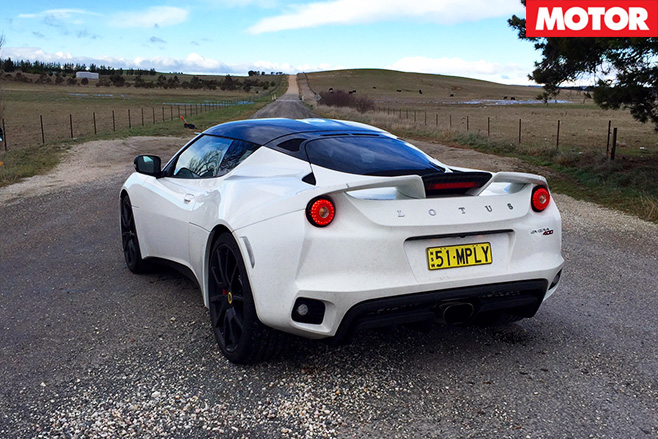
Each get big power upgrades, from the previous 258kW/400Nm to 298kW in the Evora 400, 306kW in the Evora Sport 410 and 410Nm from both versions of the same 3.5-litre supercharged V6.
The 0-100km/h claim for the entry Evora tumbles by four-tenths to 4.2sec while the latest $200K range-topper reduces weight from 1395kg to 1325kg (yet curiously it delivers an identical acceleration time).
Choosing the $10K-optional six-speed automatic for each model reduces the time by a further tenth, however.
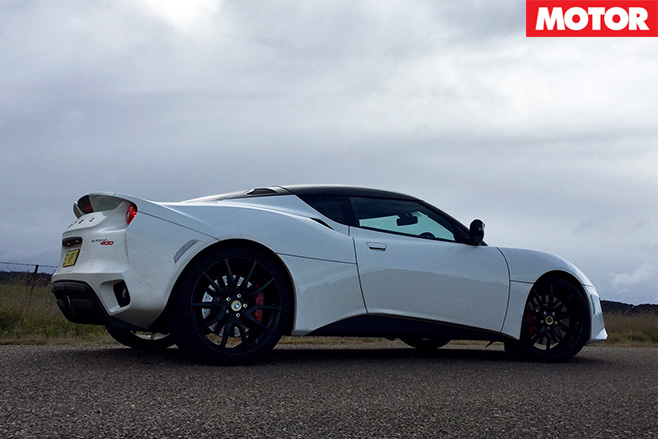
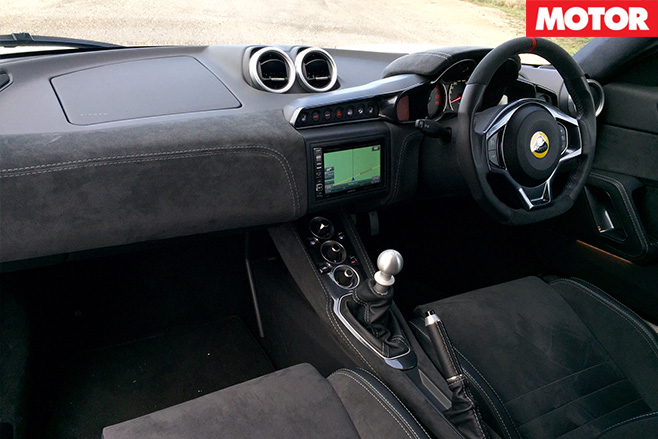
This major facelift of the original 2009 Evora delivers a comprehensively revised chassis and new interior aimed at addressing entry and egress, seating position and footwell room issues cited by previous owners as issues.
At the other end of the Lotus range, the Elise range doesn’t change to the same degree as its Exige and Evora stablemates.
Meanwhile the old Elise Cup 220 now becomes the $104,990 Elise Cup 250 thanks to an upgrade from 162kW to 181kW (along with an unchanged 250Nm) and three-tenths-faster 4.3sec 0-100km/h.
MOTOR is at the local launch of the Lotus Evora 400 at Wakefield Park Raceway today, with a full review coming soon.
