
Brabus has form turning Benz models bonkers and the 1450Nm S63 AMG Cabriolet with its 350km/h top speed nears the (drop) top of that list.
Claimed to be the world’s fastest and most powerful four-seat drop-top, the Brabus 850 Cabriolet supersizes the S63’s 5.5-litre twin-turbo V8 and 430kW/900Nm output to a fuller 6.0 litres and 625kW/1450rpm.
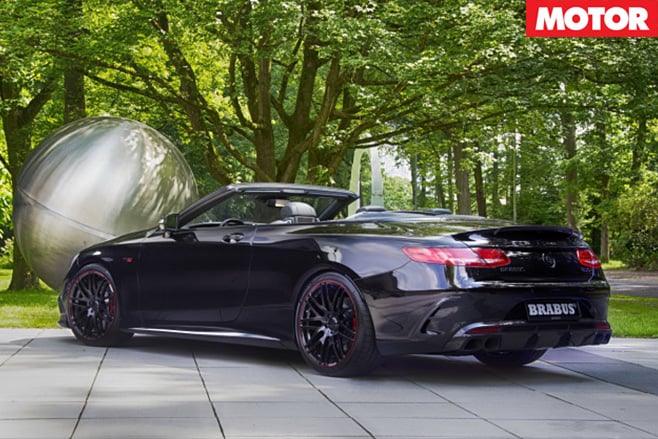
Brabus reckons the 850 Cabriolet could sprint faster than the claimed 3.5-second 0-100km/h, but traction is the limiting factor as if often the case with AMG models. In this case, however, the S63 AMG Cabriolet already runs all-wheel drive and a fat (or is that phat?) 21-inch wheel and tyre package.
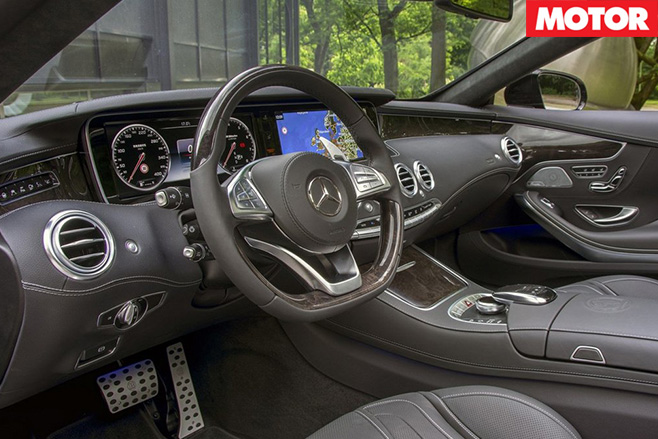
In a toupee-shredding autobahn tussle the 850 Cabriolet’s 350km/h top speed exceeds its fellow topless German by 30km/h.
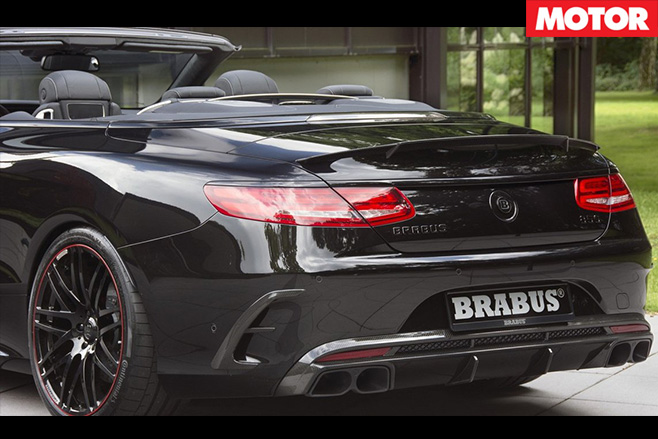
This bad Benz would look equally at home in Hollywood as it would on an autobahn, but as with all Brabus models there is no sign of an Australian introduction. The closest we’ll get to the work of a fast German tuning company is the imminent local introduction of BMW-backed Alpina.
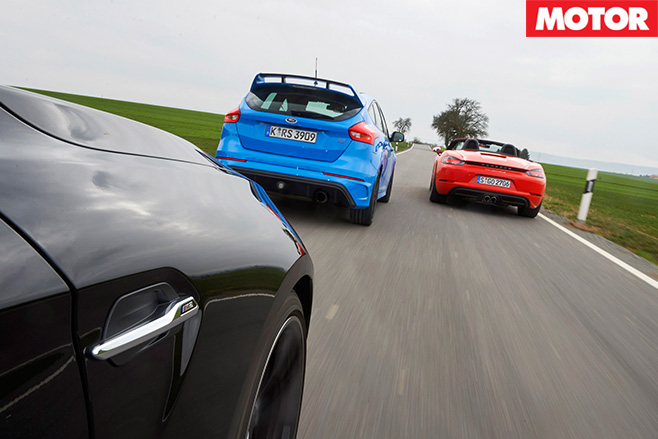
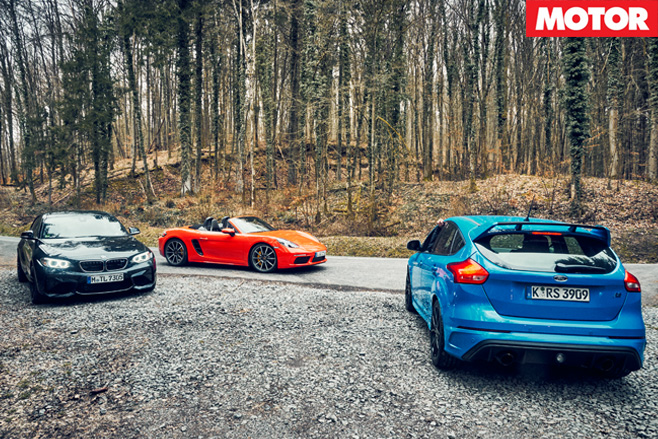
This trio does not exactly look like the makings of your classic three-car comparison.
Maybe it’s better to look at this as a get-to-know-you session with three of the hottest new hard-charging performance cars. The good news is we’re not talking ultra-exclusive limited-edition vehicles with astronomical price tags.
In a fast-changing automotive world dominated by digitalisation, autonomous driving and alternative powerplants, here are three respected drivers’ cars that blend heritage and innovation, ability and relative affordability.
There are three chassis layouts here, the engines all turbocharged. We could moan about the departure of the sharply tuned naturally-aspirated engine, but instead let us focus on what we aim to discover.
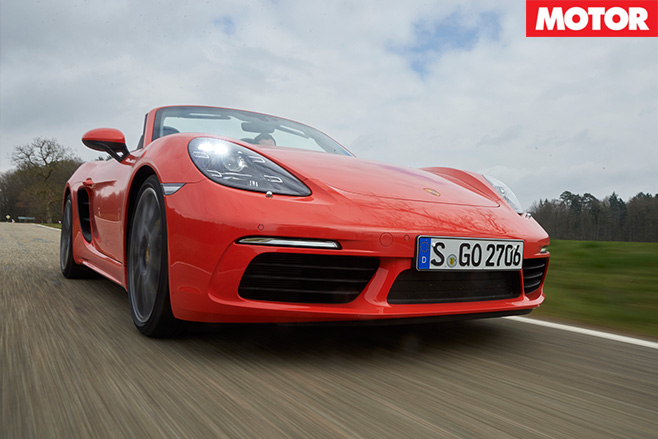
Uniquely, the Porsche retains a time-honoured starting strategy: a key inserted adjacent of the steering column. Fired up, this new boxer four-cylinder lets you know it’s awake, especially in Sport with the top down and with the two-tone exhaust set to blare. Give it some stick and listen as the 2.5-litre unit spins smoothly, perfectly linear but also strangely monosyllabic.
Redlined at 7500rpm, it only takes 6500rpm to round up all 257kW in ‘S’ guise. While the torque curve of the previous atmo flat-six rose gently like the backrest of granddad’s lounge chair, the twist curve of the new turbo four is as flat as a floor. Between 1900-4500rpm, there’s 420Nm to play with.
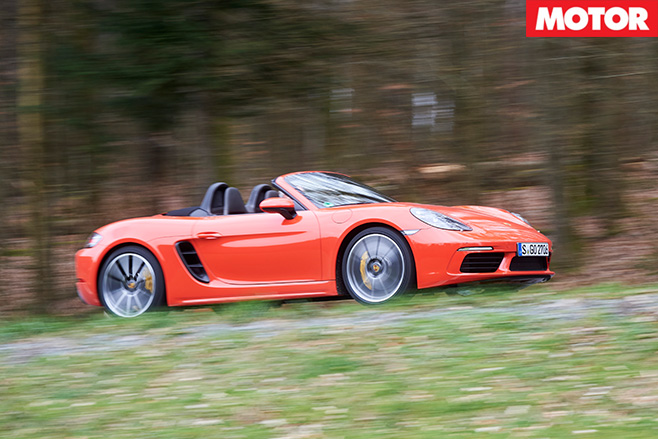
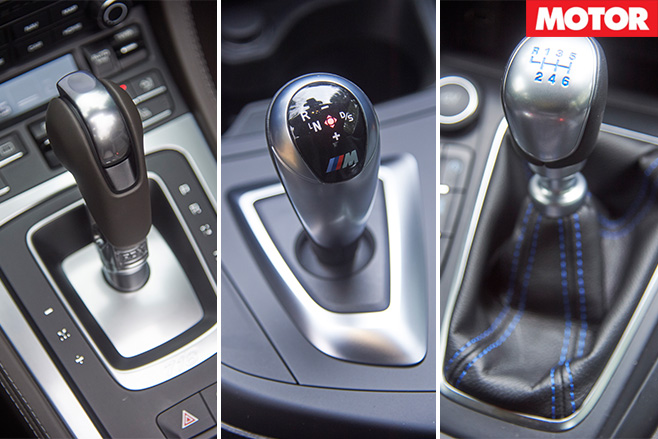
Having said that, the manual transmission could do with shorter throws, the throttle response in Track mode is scarily skittish, and the fake lift-off misfiring of all three cars is just as embarrassing as the throttle blipping during downshifts, not to mention the nuisance of squaring off the bottom of the steering-wheels.
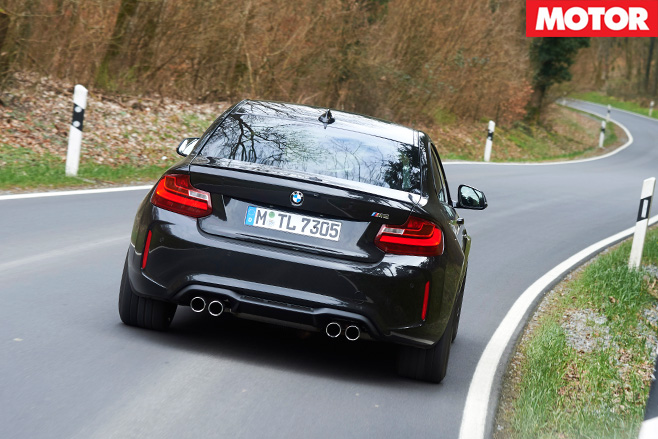
Our M2 is gothic black inside and out; even the 19-inch wheels are as dark as a night shift in a coal mine. Just about every detail you see here is included in the generous standard specification. Under the bonnet is a turbocharged 272kW 3.0-litre straight six. The double-clutch transmission is nice to have, but only if the owner is committed to plucking gears themselves. Upshifts are particularly rewarding in DSC Sport.
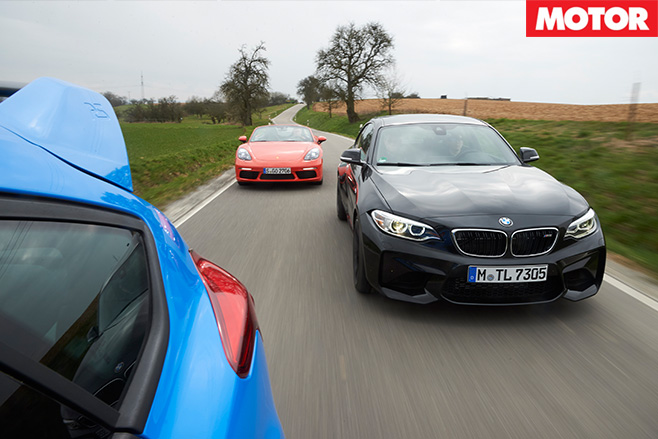
According to Porsche, the new Boxster’s throttle response is every bit as brisk as the pre-718 models. According to our test car, however, there is still room for improvement: turbo lag remains an issue despite the variable-geometry turbo, a loose bypass valve and a reprogrammed black box.
Flooring the loud pedal at 2000rpm in fourth creates a momentary blackout followed by a highly energetic kick in the rear. One possible explanation is the long and complex intake system put under pressure by a solitary turbo positioned in the centre of the pile of pipes. Fuel economy? It’s a clear improvement over last year’s vintage, with an official number in the same ball park as M2 and RS, though all three become heavy drinkers under duress.
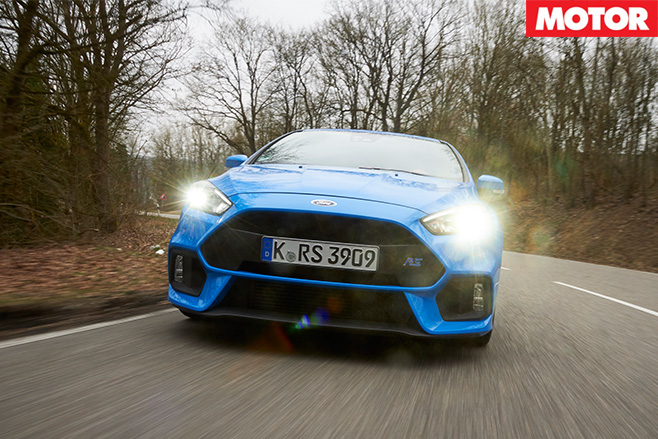
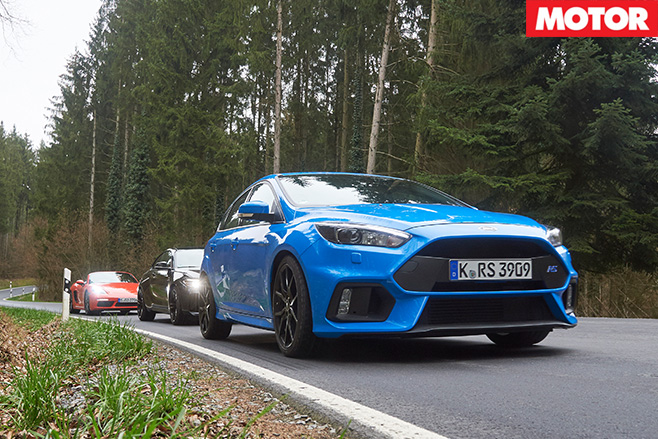
Yes, this hatchback is a remarkable piece of kit in more ways than one. It owes much of its character to the adaptive all-wheel drive system which addresses each wheel individually. Other sporty AWD models are perfectly happy with only a modest torque bias to the rear, but the RS can send up to 70 per cent of the twist to the tail and, widely reported, even has a ‘Drift’ mode. It’s an adventurous type of AWD system that encourages you to swat flies with the side windows.
What the Ford lacks is a mix-and-match drive mode configuration. As it is, only Normal warrants the most comfortable damper setting, the most relaxed throttle response and the most laid back steering calibration. Drift permits lairiness, but it does so only in combination with a nervous tip-in/tip-out behaviour and jerky steering. The ability to mix from the menu would be nice.
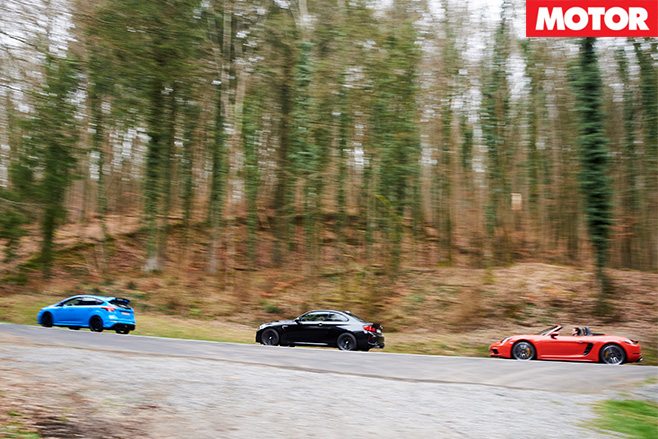
Over the really rough stuff, the edgy here-there-and-everywhere BMW is hard work. But what do you expect from a rebodied short-wheelbase M4 clone? As soon as it finds smoother ground, the M2 morphs into a precise and responsive corner-carver.
From behind the steering-wheel, the RS looks like a tarted up Avis or Hertz-type Focus and the M2 has similarly fleet-and-family familiarity, but the Boxster is special. The driving position is bang-on, though the merits of the lava orange paintwork over black-brown interior trim are debatable.
Long undulations are no problem at all, transverse irritations don’t upset things and low-speed ripples and potholes don’t destroy the composure. Although the three candidates are separated by mere nuances, the Porsche’s suspension is marginally less brusque.
Unlike the M2 and the Boxster, the Focus RS isn’t overly dependent on tyre temp to display good manners. The handling accurately reflects the vehicle’s DNA: neutral at the limit and stable at speed. Sounds a tad uninspiring, but it’s not. The weight of the steering works in perfect synchronicity with the torque flow and the chassis movements.
Unlike the 1 Series M coupé, where a lack of downforce threatened to lift the front skirt at speed, the M2 tends to rest deep within itself. Sudden lane changes? No worries. Emergency braking manoeuvre on the autobahn? This car has a life insurance contract signed with brake dust and rubber marbles. Gearing? Long enough for economy, short enough to summon fifth at 200km/h. Noise? Yes, and plenty of it, but not as intense as under the awning of the Boxster. It sounds good, too.
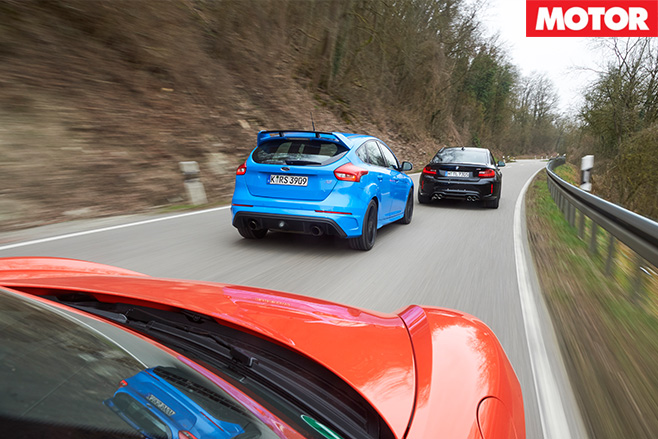
As expected, the specs-on-paper would not yield a winner here. We’re not comparing rear seat space nor how-many-kays-per-tank. Cars such as these are about passion and punch and we’re open to emotional persuasions, prepared to let design and prestige influence the verdict, to put the feel-good factor on its pedestal.
Maybe the final shootout can be postponed for a moment to let us look at alternatives. For far less than our rear-drive contenders, any Ford dealer would happily sell you a Mustang, complete with V8 drawl, but that’s a hopeless proposal for roads that require pinpoint handling.
The BMW fraternity may be tempted by the M235i, be it a fixed-head or a drop-top, but nostalgics may even consider a low-kay V8-engined M3.
The Porsche really is two cars in one, with two perfectly useable luggage compartments, beautiful build quality, great appearance – it’s generally hard to fault. It collects plenty of street cred points; it is the quickest and fastest contender here; it has the sweetest steering and absolutely indestructible brakes. As far as the stats go, the four-cylinder engine ticks all the right boxes. So if money is no object and you have never before tried – and been enthralled by – a flat six, the Boxster could have your name written all over it.
That the Focus RS has the roomiest cabin and the biggest boot doesn’t even enter this equation. What makes the heart beat that little faster for the Ford is the keen price tag (10 points), that special Q-car surprise factor (20 points) and the admirable level of dynamic competence (70 points).
We have no doubt at all that Henry’s finest this side of the GT supercar has what it takes to play the game at the same high level as Boxster S and M2.
| u00a0 | PORSCHE 718 BOXSTER S | BMW M2 | FORD FOCUS RS |
| Body | 2-door, 2-seat roadster | 2-door, 4-seat coupe | 5-door, 5-seat hatch |
| Drive | rear-wheel | rear-wheel | all-wheel |
| Engine | 2497cc inline-4, DOHC, 16v, turbo | 2979cc inline-6, DOHC, 24v, turbo | 2261cc inline-4, DOHC, 16v, turbo |
| Power | 257kW @ 6500rpm | 272kW @ 6500rpm | 257kW @ 6000rpm |
| Torque | 420Nm @ 1900-4500rpm | 465Nm @ 1400-5560rpm | 440Nm @ 2000-4500rpm (470Nm overboost) |
| Transmission | 7-speed dual-clutchu00a0 | 7-speed dual-clutch | 6-speed manual |
| Weight | 1385kg | 1520kg | 1575kg |
| L/W/H | 4379/1801/1280mm | 4468/1854/1410mm | 4390/1823/1472mm |
| Steering | electrically-assisted rack-and-pinion | electrically-assisted rack and pinion | electrically-assisted rack-and-pinion |
| Price as tested | $143,400 | $98,900 | $50,990 |
| Pros | Seriously fast; easy/satisfying/fun to drive | Better than an M4 for $60K less; drifteru2019s delight | Practical performance perfection; amazing price |
| Cons | Engine lacks character; pricey in this company | Ride can be terse; can be a handful at the limit | Stiff ride; canu2019t mix u2019nu2019 match drive modes |
| Star Rating | 4.5/5 | 4.5/5 | 4.5/5 |
The P90D is the quickest Tesla to date, and the latest software updates open the door to Ludicrous mode, Autopilot and self-parking. We get behind the wheel and play beta testers.
WHAT IS IT? The benchmark high-end electric car just became a good deal smarter. The Tesla Model S P90D sees a pair of the company’s most powerful electric motors fizz it to 100km/h in three seconds flat. If that party piece isn’t enough, it will even drive itself, up to a point.
WHY WE’RE TESTING IT We’ve driven earlier versions of the Tesla Model S but the opportunity to guinea-pig the first release of the Autopilot software, and experience the otherworldly acceleration of the P90D’s Ludicrous mode on Aussie roads, was something we just couldn’t pass up.
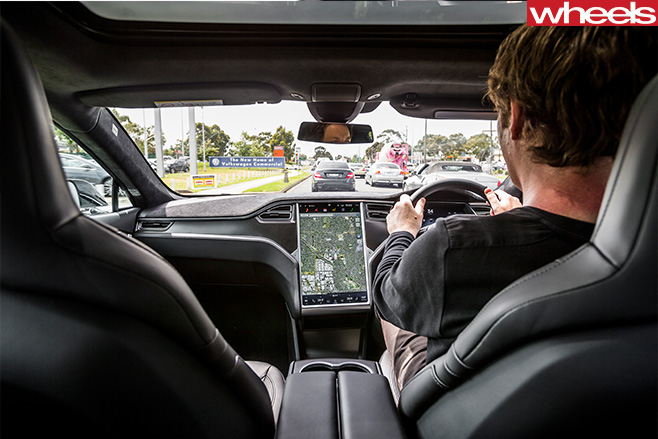
THE WHEELS VERDICT No production car can astonish quite like the Tesla Model S P90D. For better and for worse, it’s clearly built by a company with no significant heritage in vehicle production. Autopilot and Ludicrous mode together combine to make internal combustion rivals feel utterly antediluvian.
PLUS: Devastating pace, refinement, ease of use, space, gadgetry MINUS: Vast windscreen pillars, feeble headlights, poor interior storage, can get expensive, gadgetry
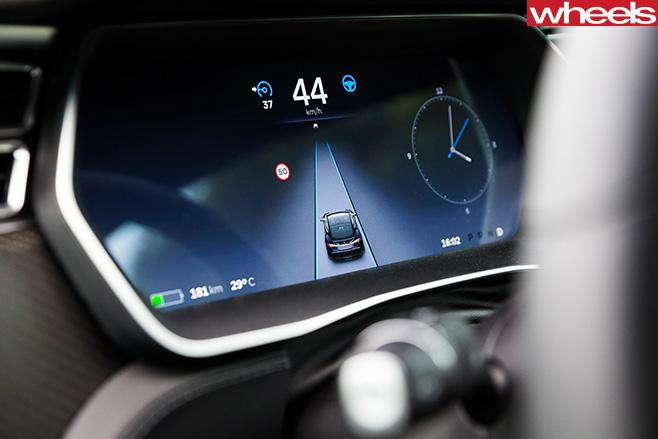
The steering wheel begins making tiny adjustments of its own accord, the instrument panel draws a lock on the vehicle ahead, and you can take your hands off the wheel and relax. You can, but Tesla doesn’t recommend this, covering itself by claiming you should keep your paws resting on the tiller at all times.
The thing is, Autopilot seems so bloody good that, after a short while, you gain faith. The way it scribes an arc around sweepers without pinballing from left to right within its lane is hugely confidence-inspiring, as is the way the radar cruise control holds station with traffic up the road, the distance driver-selectable.
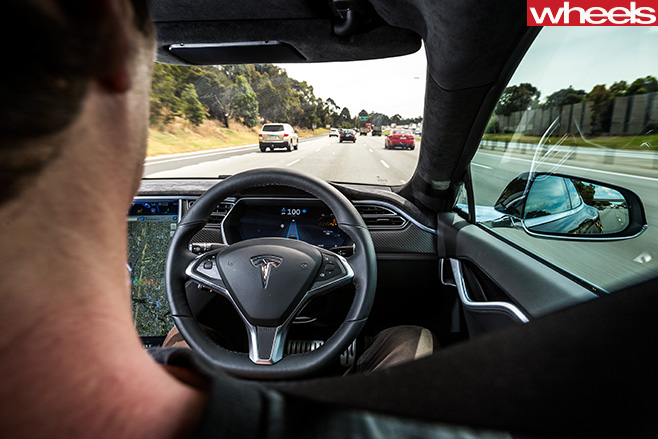
Autopilot engaged, it’s easy to be lulled into thinking you’re in some omnipotent form of automotive higher intelligence, only to realise that it won’t slow down for revised speed limits or traffic lights. It’s easily flummoxed by the weak link behind the wheel too. With the indicator on the left and the similar (non-detented) column shift on the right, it’s all too easy to accidentally flick it into neutral and find yourself flatlining but going nowhere.
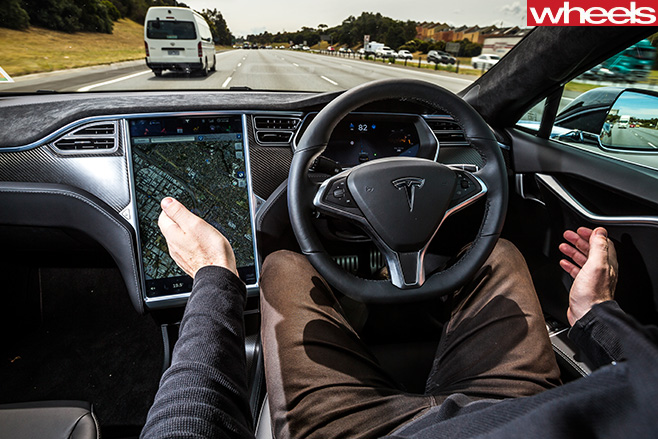
The self-parking system is another jaw-dropper. Unlike most vehicles, which require you to operate the throttle and brakes while they automatically twirl the wheel, the Model S can now perform the whole show, right from identifying a space to shuffling you into it, leaving a scant few millimetres from kerbing those big alloys.
Which brings us to the Ludicrous performance mode, Tesla’s next step after Insane. Bring the twin-engined, all-wheel-drive Model S P90D to a standstill, grip the wheel and stamp the right-hand pedal: it’s that straightforward. The mute violence of what happens next is hard to comprehend. It’s as quick to 100km/h as a McLaren P1.
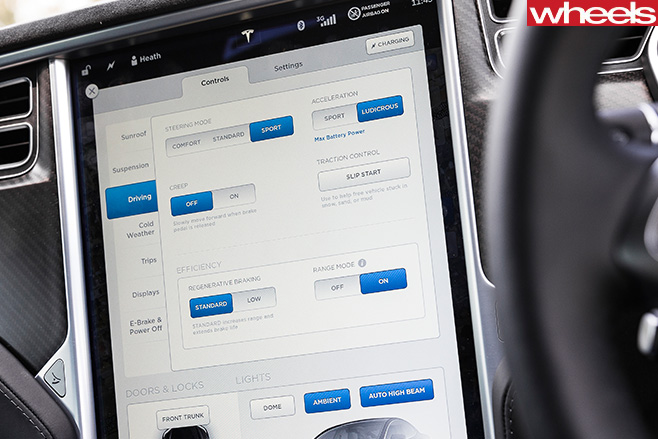
You do get used to it, though, and begin searching for pole position at the traffic lights. A couple of seconds or so after they turn green, you already have a hundred metres of clear road. Now there’s a contribution to safety we can all get behind.
SPECS Model: Tesla Model S P90D with Ludicrous Engine: Three-phase, four-pole AC induction with copper rotor Battery: 90kWh lithium-ion Max power: 568kW at 0rpm (193kW front motor, 375 kW rear motor) Max torque: 967Nm at 0rpm Transmission: Single speed fixed gear, 9.73:1 reduction ratio Weight: 2127kg 0-100km/h: 3.0sec Range: 480km (NEDC) Price: $215,937 On sale: Now
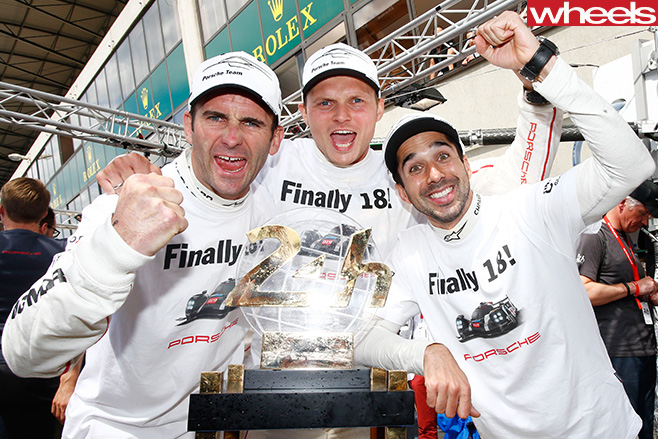
Unbelievable twist hands Porsche its 18th victory.
For most of the 84th running of the 24 Hours of Le Mans, Toyota seemed on track to finally land its first win in the world’s toughest sports car endurance race. It had been a tense battle between Toyota and Porsche with their prototype racers separated by only seconds for the majority of the classic. But Toyota, with surprising pace and slightly better fuel consumption and therefore reduced time in the pits, seemed to have the slightest of edges.
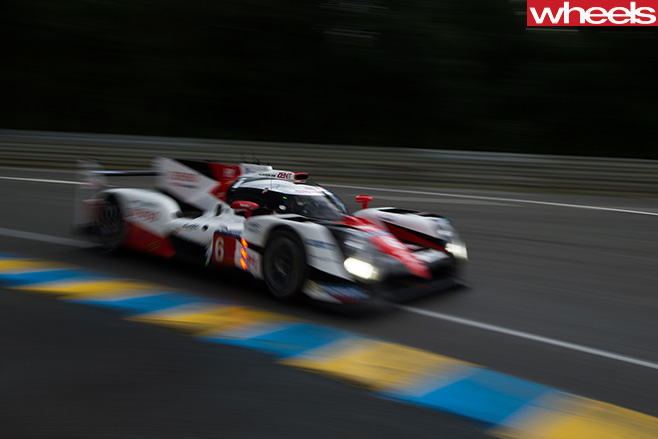
After a painfully long pause, #5 eventually restarted and completed the final lap…but in a further knife to the heart, it moved too slowly to be classified as a finisher.
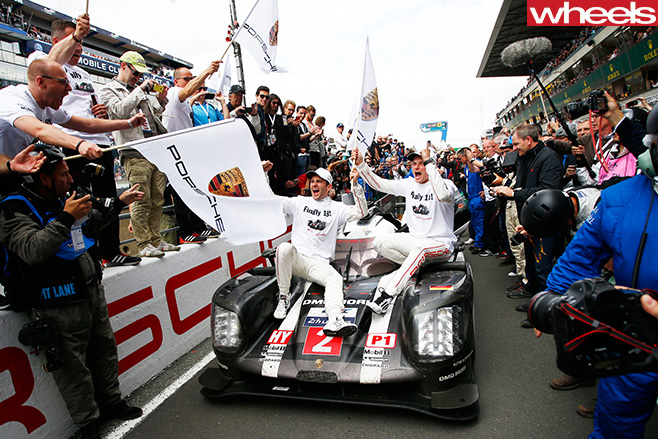
With a mixture of incredulity and elation, Jani, Dumas and Lieb, celebrated on the podium in front of a huge crowd of 263,500. The drenching wet start to the race behind the safety car at 3pm Saturday seemed an eternity earlier..
Mark Webber’s Le Mans dream went all nightmarish around 11pm on Saturday – after eight hours – when his Porsche overheated with water pump issues whilst fighting up front, leaving the #2 sister car to continue the fight.
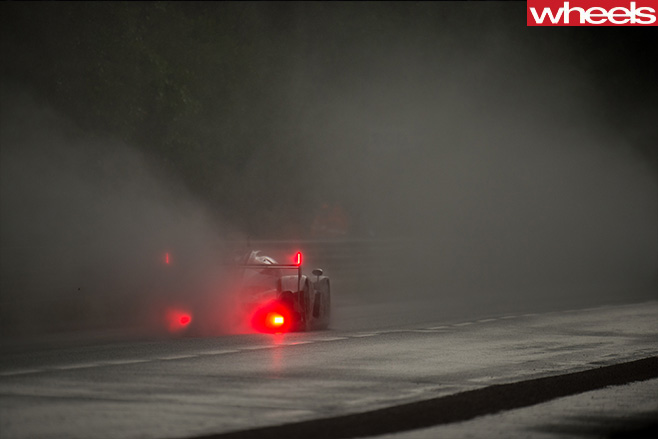
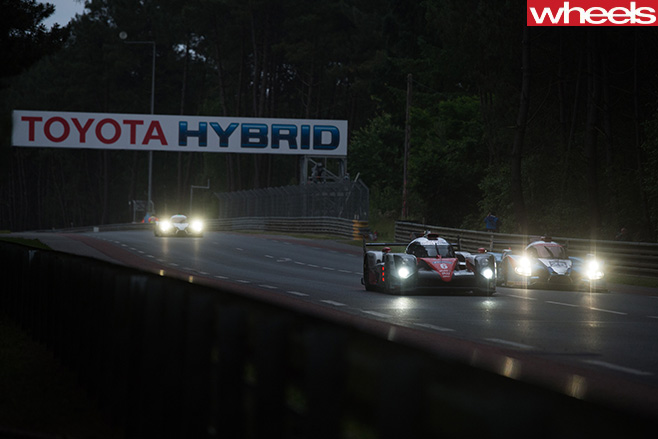
The two Toyotas and lone Porsche duked it out with often only seconds overing the three-way battle for glory.
A regular winner in the modern era of endurance racing, Audi struggled after early turbocharger failure.
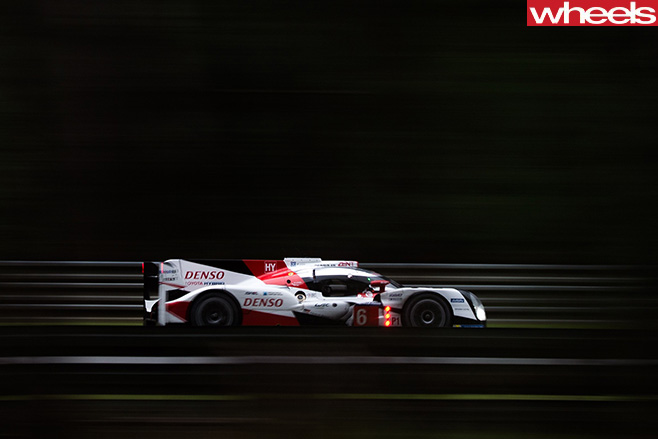
The race was one of the closest in Le Mans history, with three cars locked in an intense battle for supremacy whilst weaving through the still-heavy traffic – 50 of the 60 starters were running at the finish.
All three contenders had kept up a relentless pace through the night and into the last phase of the race before the second Toyota lost time to have bodywork repaired.
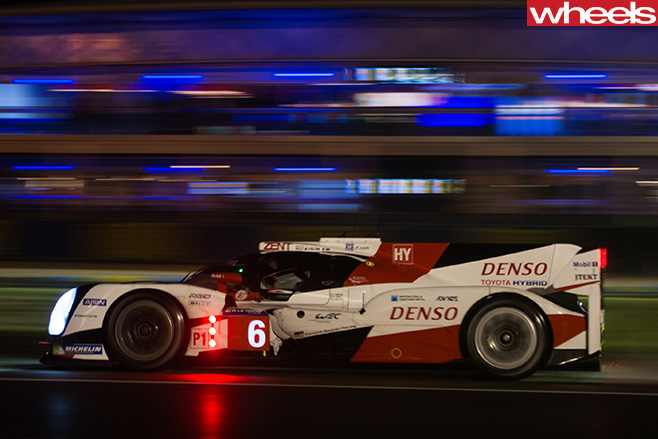
“It’s hard to find the words for what has happened today,” said a shattered Buemi. “We were in control of the race and were so close to the win that we all want. This is the biggest race of the year so it’s even tougher to accept. It is so disappointing for the whole team; we did the right preparation and we had the car to win. So we already look to next year when the target will be clear.”
After a long stop for repairs the Webber Porsche fought back to finished 13th overall, Queanbeyan’s favourite son commenting: “I’m happy for our team mates and Porsche. But what has happened to Toyota is really hard to take and you have to feel for them.”
The revival of the hectic Ferrari versus Ford rivalry of 50 years ago was no fizzer with the two legendary Le Mans brands fighting hard throughout in the GTE Pro category, with the Blue Oval finally gaining the upper hand.
Aussie Ryan Briscoe’s Ganassi Ford GT took third in class and 21st overall.
Hyundai’s latest mid-engined concept, the RM16, previews a number of high-performance technologies being developed for the Korean firm’s standalone N performance brand.
The RM16 is the third Veloster-based concept and while not currently slated for production, offers an insight into the specification of future N models, the first of which are expected to be based on the i30 hatch and G70 mid-size sedan.
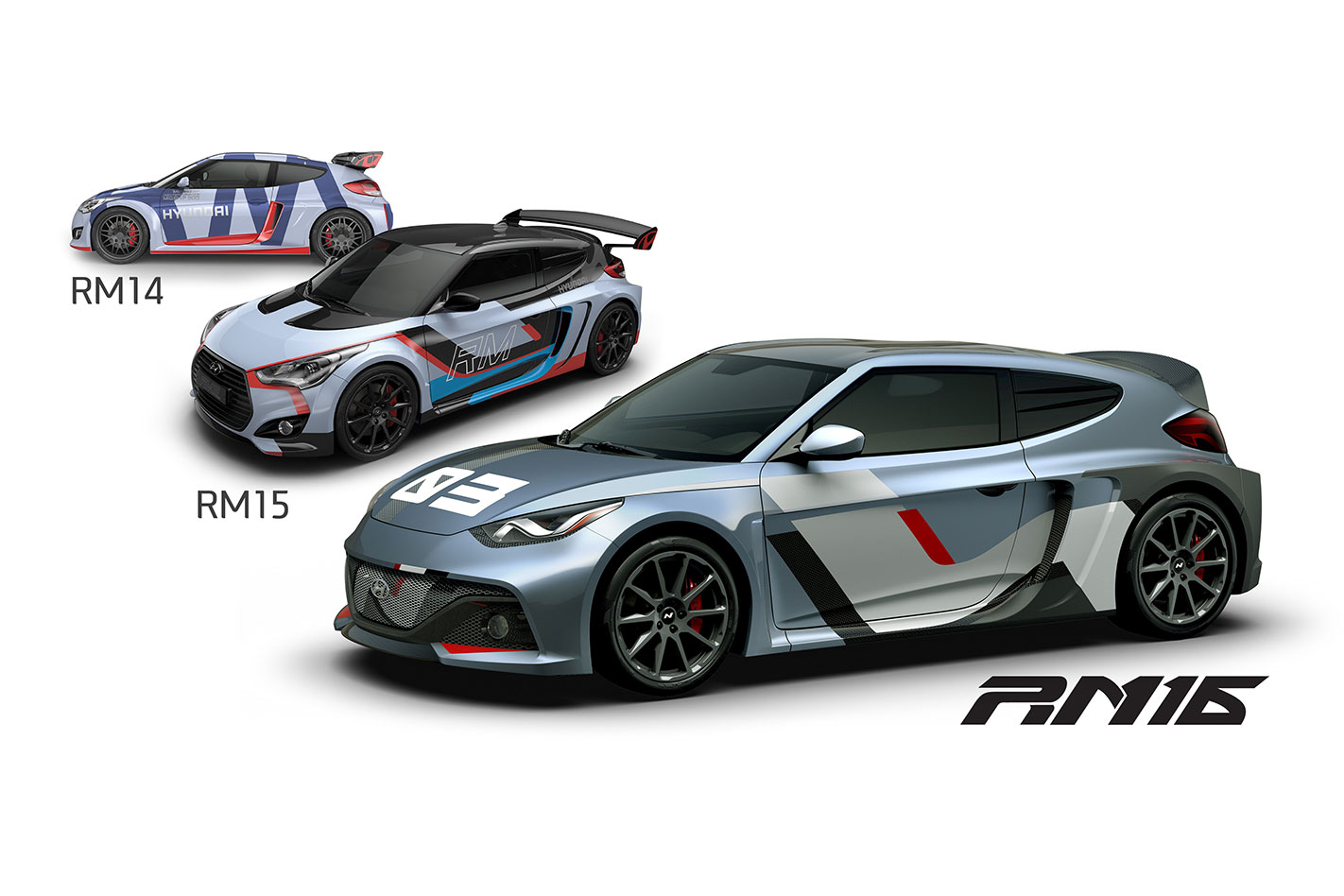
The RM16 is powered by a mid-mounted 2.0-litre turbocharged four-cylinder producing 220kW, which drives the rear wheels through a six-speed manual gearbox.
It retains the weight-saving techniques introduced on the RM15, including an aluminium space frame clad in carbonfibre-reinforced plastic panels, but adds high-tech chassis and powertrain solutions.
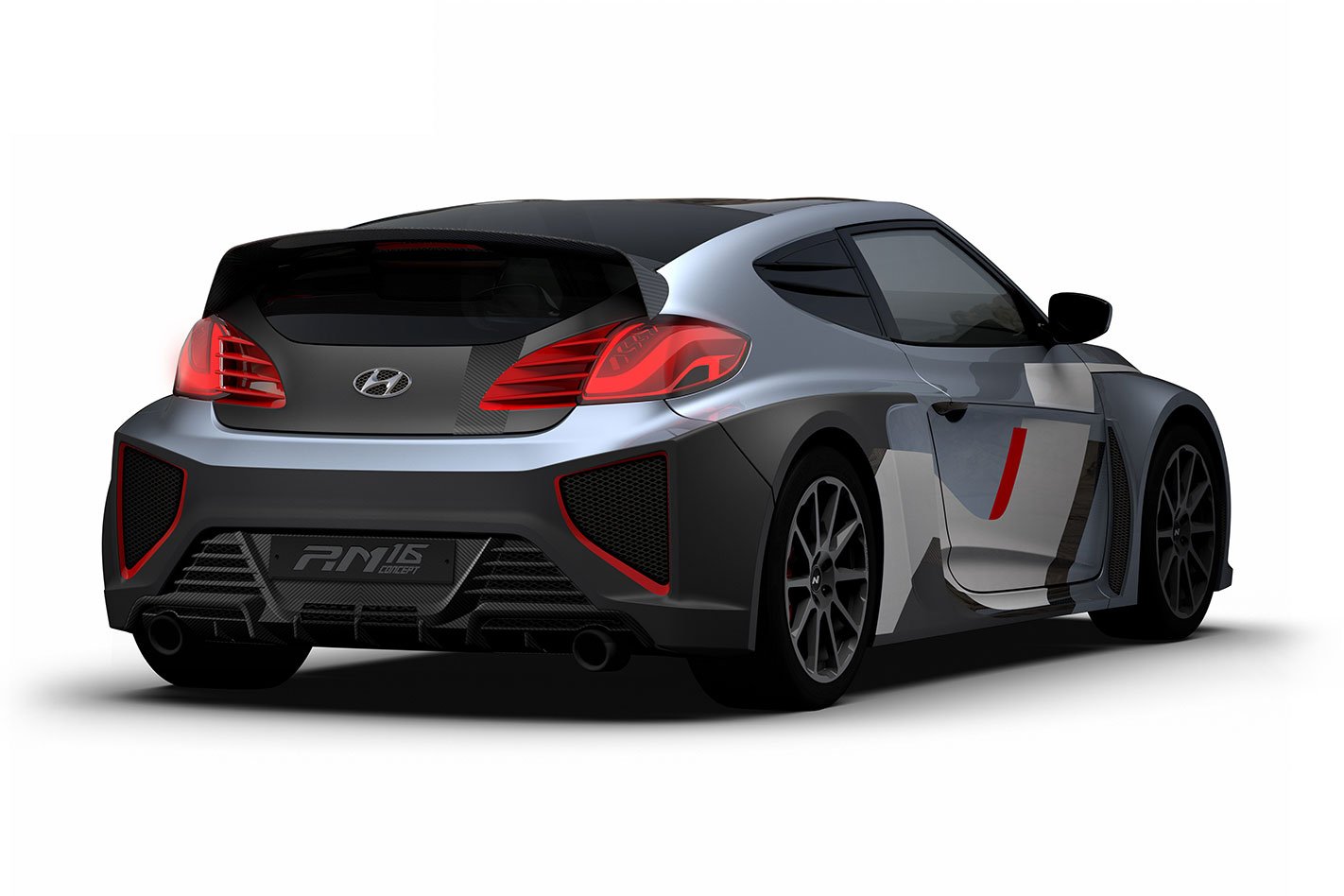
Hyundai’s first N production car is expected to appear in the fourth quarter of 2016 ahead of an Australian debut in 2017.
BMW BAITING! Alfa Romeo declares war on AMG and BMW’s M Division; BMW M4 GTS driven; Supra returns; Taming $470K of Italian fury.
ALSO INSIDE THIS EDITION:
- Last shout for the LS3
- Koreans pitch for a hot-hatch war
- Driven: Honda’s new future
- Maserati’s diesel SUV
- You dirty Finke: Wheels goes sand blasting
- Holden Spark v Kia Picanto v Suzuki Celerio
- The hearse whisperers
At long last, Aston Martin’s new generation DB11 has broken cover in Australia, after debuting in Geneva earlier in the year.
Aston Martin Asia Pacific marketing manager Kevin Wall said that the company has taken a thousand orders for the car since its reveal, with “several” down for potential Australian customers when the cars drop in September.
“We’re betting the house on this car,” Mr Wall said. “Our dealers in Australia have made major investments in the brand for the launch of this car.”
It’s a top-to-tail redo for one of the most iconic sports cars on the planet, though it hasn’t strayed too far from the formula that sets it apart from other premium marques.
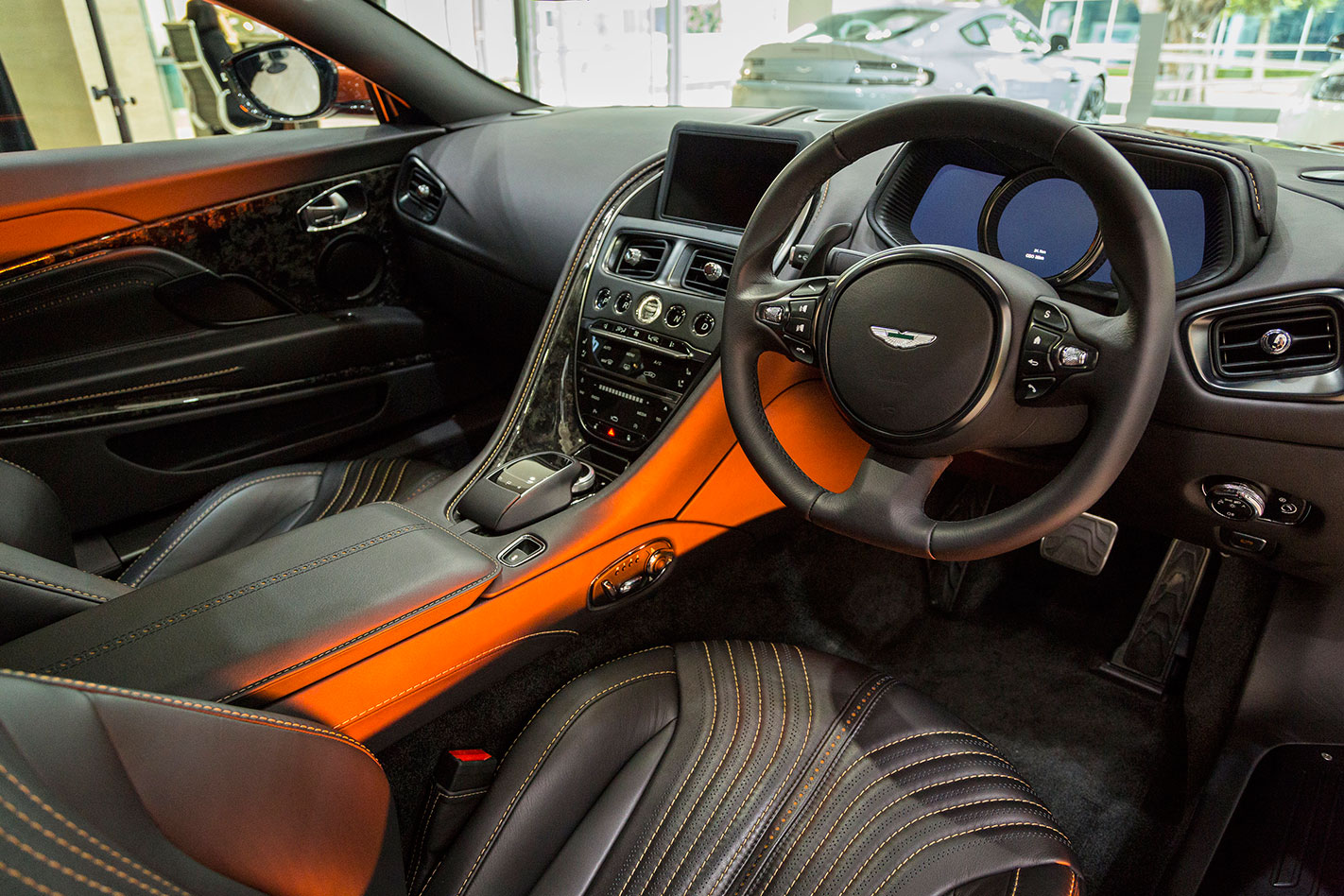
Under the clamshell bonnet – a first for Aston Martin – lies a inhouse-developed 5.2-litre twin-turbo V12 engine, backed by a traditional eight-speed auto turning the rear tyres via an electronic limited-slip diff.
It makes 447kW and 600Nm, which is good for a 0-100km/h sprint of 3.9 seconds and a top whack of 322km/h.
An extruded and bonded alloy chassis is reinforced with magnesium door frames and clad in aluminium and carbon fibre panels, while a comprehensive and pretty revolutionary aero makeover does away for the need for a visible rear spoiler.
Air is drawn in through ducts at the tops of the rear windows, passed theough the C-pillars and out of a slot that’s cut lengthways in the bootlid, creating a virtual Gurney flap.
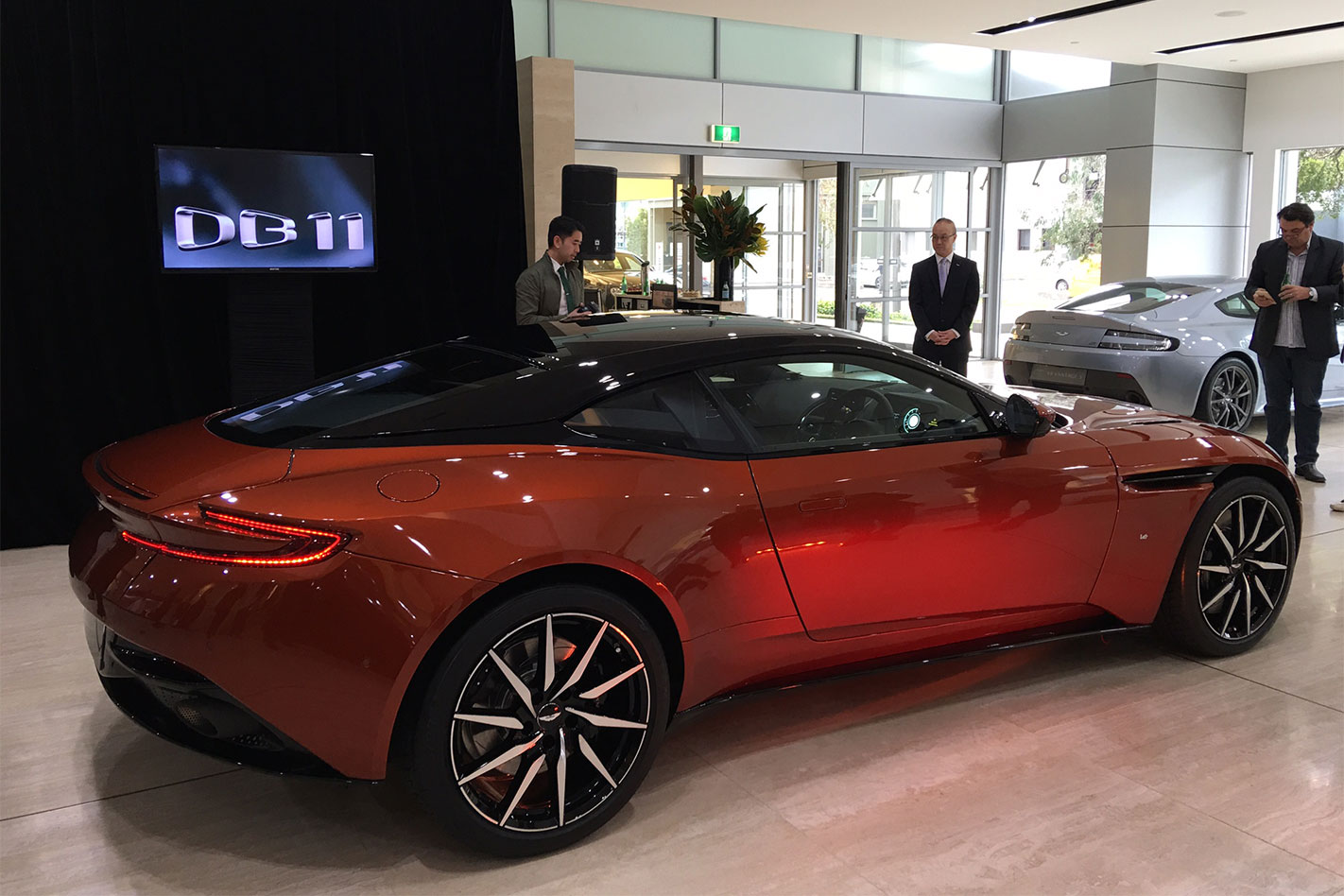
The DB11 will start at a very particular $428,032 plus on-road costs.
Here at WhichCar, we’d love nothing more than to be able to recklessly drive through some of the country’s urban and country landscapes in ultra-expensive cars, with little to no consequence on the environment, our cars, our bank accounts or the law.
Thankfully, we have simulation games like Forza Horizon to save us from real-world handcuffs or the consequences of driving Lamborghinis through saltwater (cringe!).
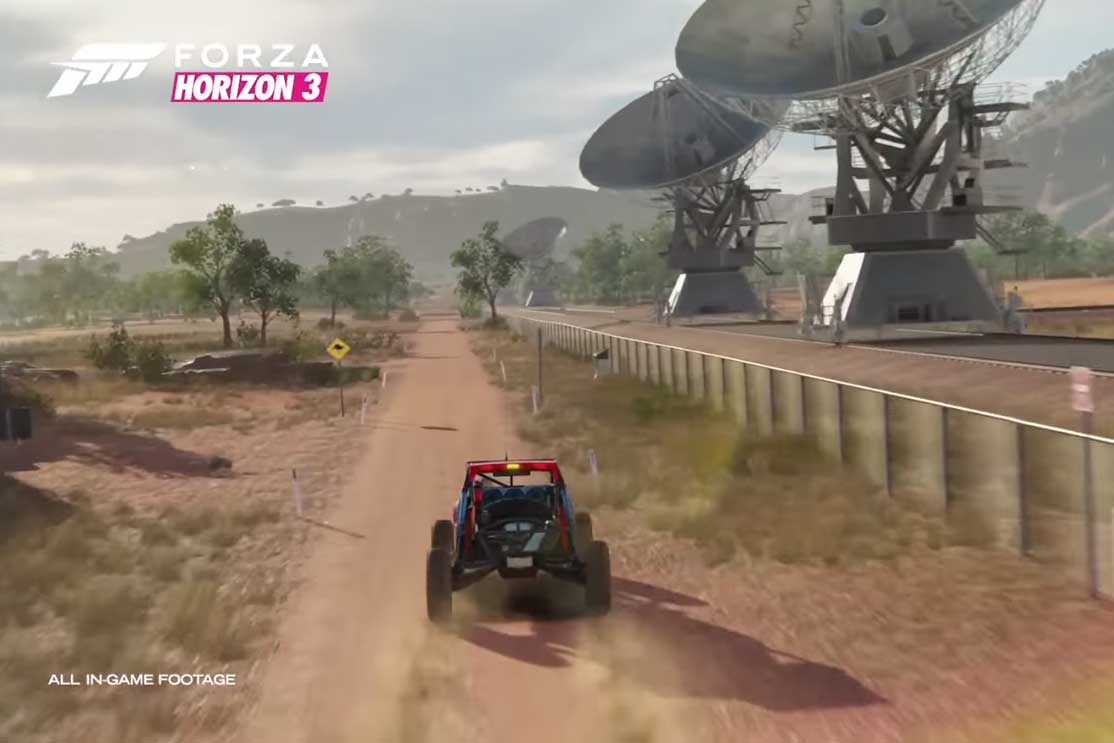
The Xbox racing video game simulates professional driving in production and modified cars in a similar way to Gran Turismo, while Forza Horizon opens the racetrack to anywhere in the world – streets, beaches, outback, people’s back fences… the usual.
Horizon 3 is set in Australia, and by the looks of the trailer, we can expect plenty of off-roading in buggies, trucks, Ford Raptors and ultra-rare 2017 Lamborghini Centenario which was revealed at the Geneva Motor Show this year and said to be worth more than $1.6 million.
The game’s plot is a group of rich kids, dangerously street racing their rich kid cars. Horizon 1 was based in the USA and 2 in Italy, but Australia opens the game up to a diverse landscape not captured in the other games.
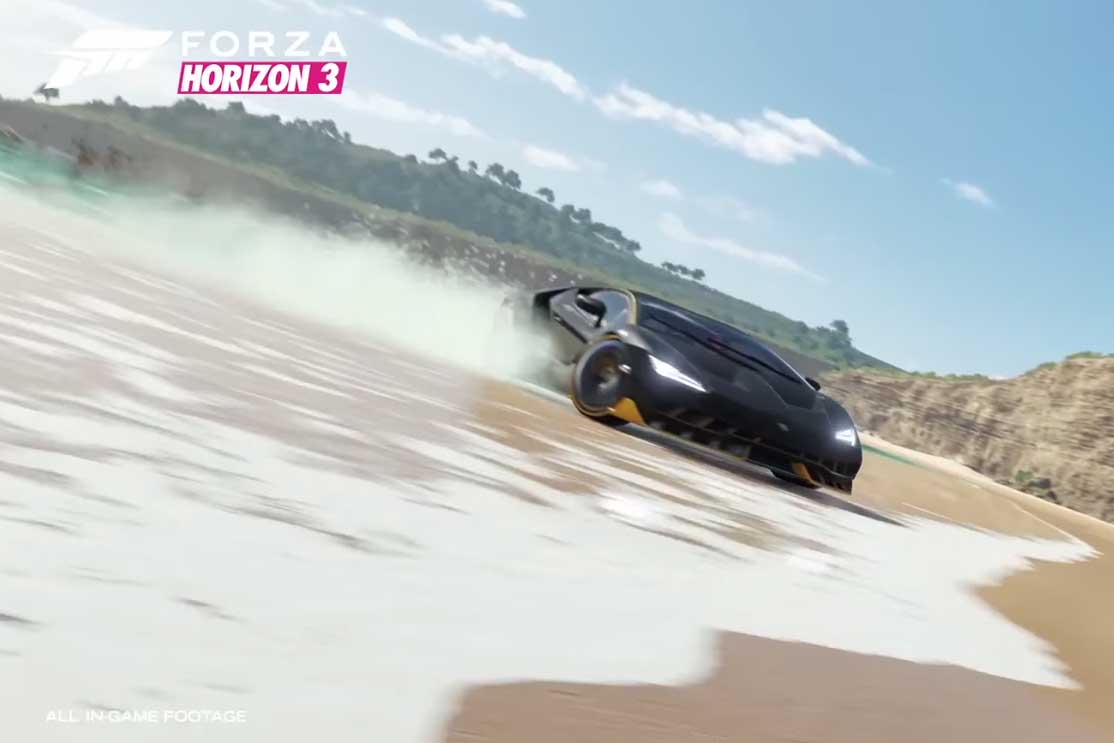
The mindboggling, realistic game allows you to drive through some of Australia’s best landscapes, including Byron Bay, Surfers Paradise, and the 12 Apostles, at your own speed, without the usual reality-restrictions. You can fulfill all your left-hand drive only hypercar dreams!
The game is due to launch on September 27 and will be available to play on your Xbox One or Windows 10 PC.
But our words don’t do it justice, watch the trailer for yourself.
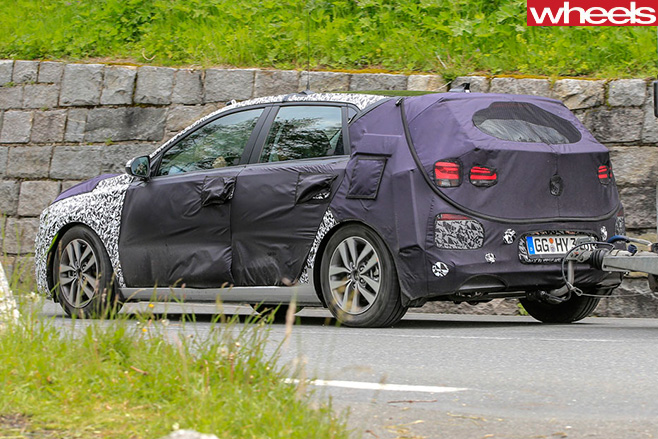
HERE IS the next-generation Hyundai i30, completing testing in Germany ahead of a likely Paris motor show debut this September. But don’t expect to see it in Australian dealerships before the middle of 2017.
Styled under ex-Audi designer Peter Schreyer’s watch, the third iteration of the Korean brand’s bestseller forsakes the fussy look of the existing four-year old version, for a more Euro-centric conservatism, as it steps up against the Volkswagen Golf, Opel-sourced Holden Astra, Peugeot 308, Renault Megane, and Ford Focus.
To that end, look for a longer bonnet, more upright proportions, thinner pillars, a larger glasshouse, and sleeker headlights, framing the corporate hexagonal grille treatment as seen on the closely related Elantra sedan.
Of course, this does not mean Hyundai will abandon its epic battle against the popular Mazda 3 and Toyota Corolla for the title of Australia’s bestselling car, so base pricing will most probably remain at the $20,000 level it is today, rising up to the mid-$30K mark.
While a peek inside isn’t possible from the images provided, we hear that that rear-seat space will improve, while the current i30’s fussy vertical-stack dashboard layout will give way to the neater (if blockier) horizontal item as per the latest Elantra. Not as distinctive, perhaps, but the switch points to a more elegant fascia with fewer buttons courtesy of a sizeable central touchscreen.
However, European-market (and Czech Republic made) i30s such as the three-door and spacious five-door wagon employ a multi-link back end, so some variants may still sport the more sophisticated suspension set-up in future guises.
Speaking of which, the Mk3 i30 will eventually include the Volkswagen Golf R, Ford Focus RS, Peugeot 308 GTi 270, and Renault Megane RS chasing i30 N high-performance flagship, reportedly powered by a 2.0-litre four-cylinder turbo firecracker capable of delivering nearly 200kW of power and 300Nm of torque to the front wheels via a six-speed manual or dual-clutch transmission. An electronically controlled mechanical limited-slip differential and properly sorted tuning on the Nurburgring ought to keep the front axle from spinning away all that grunt.
We believe that while the i30 N will match or even eclipse its European foes in terms of total performance output, the pricing will be very sharp indeed – more in line with the $40,000 Golf GTI than the circa-$55K Golf R 4Motion.
Moving away from the hot-hatch brigade, most versions are expected to utilise the Elantra’s 112kW/192Nm 2.0-litre atmo four-cylinder engine, with more salubrious i30s set to gain either the current SR’s 124kW/201Nm 2.0-litre engine, or a variation of the Veloster’s 150kW/265Nm 1.6-litre GDI Gasoline Direct Injection turbo. Whether we see a return of the i30 turbo-diesel to replace the existing 100kW/300Nm 1.6-litre CRDi models is unknown.
With less than 500 units separating the current i30, Mazda 3, and Corolla from the top of the sales charts, the importance of the next-gen Hyundai i30 cannot be overstated. Roll on 2017.
Have spy pics of your own? We’d love to see them. Just email them to [email protected]
I am often accused of not having anything constructive to say. Apparently I’m keen to point out the problems of a particular situation, while not actually offering up any solutions to those problems. But to hell with that; what would my mother know?
Anyways, I’m turning over a new leaf, because I’ve got a plan. And you, my overworked, stressed-out friends, are going to love it. Not only that, it’s a plan to cut the road toll. But that’s not the only reason you’ll love it.
I’ll admit that, in the past, not everybody has agreed with my proposed road safety initiatives. Beige-Camry drivers, from what I can gather, did not agree with me that the roads would be safer for everybody if they all stayed home. BMW 3 Series’ owners were also less than thrilled with my concept of them staying the hell out of the fast lane as another road-safety measure. And the cops did not express too much in the way of agreement when I suggested upping the freeway speed limit to 140km/h as a means of cutting the carnage.
Thing is, all those suggestions would, indeed, lead to a lower road toll, but for selfish reasons, those who have the power to implement them seem to be reluctant to do so. But this time, I’m dead-set onto a winner. Trust me on this one.
So what’s the big idea? It’s simple, really. Aussies are already among the hardest grafters in the world. Well, based on hours worked that is, because I’m not going to compare driving around in other people’s cars and filling a blank space in a magazine with going down a coal mine in Albania or lugging huge bags of sticks around on your back in Cambodia. But the fact remains, the average Australian worker would be better off working fewer hours.
So, we simply make the working week a four-day one. Half the country’s toilers get Mondays off, the other half rests on Fridays. By splitting the workforce on those days businesses can still operate, but everybody gets a three-day weekend. Now, that’s crucial, because it also means that every weekend is now a staggered long weekend. For everyone.
The next step is to get rid of all gazetted public holidays. We won’t need them because, remember, every weekend is a long weekend. So how does this affect the road toll?
Haven’t you worked it out yet? The worst, most dangerous times to be on the road are those gazetted public-holiday long weekends, where every overworked Gazza Lunchpail packs the entire family into the Commodore, hitches up the ski-boat and heads for Bonnie Doon. You only have to look at a freeway heading out of the city on the afternoon before a long weekend to know what I’m talking about.
But if every weekend was a long weekend, everybody would have a chance to get away on whatever weekend they wanted, without creating the same mass exodus, the same traffic chaos and – crucially – without killing each other on the roads. Meanwhile, your favourite caravan park wouldn’t be chockers for six weekends a year and empty for the rest, and Big Oil wouldn’t know when to spike petrol prices.
I know this is a grown-up concept, and to those who know me, don’t worry, as I haven’t abandoned my childish passion for mayhem and absurdity. It’s just that this occurred to me the other day when I was trying to merge on a freeway on a Friday arvo before a long weekend and three lanes of beige Camrys took me to the brink.
Meantime, employers will tell you that Mondays and Fridays are the least productive days of the week to start with, so why not stay home, boost workplace efficiency, improve workers’ mental health and tackle the road toll? Discuss.
