
There are just two Australian drivers competing in the Le Mans 24 Hours this year, but they are both in cars that are starting at the sharp end of their respective classes.
Mark Webber’s LMP1 Porsche 919 qualified in P2 after team-mate Tim Bernard set a time that was just 0.47 seconds adrift of its sister during the last dry qualifying session.
In the LM GTE Pro class Ford’s return to Le Mans in the new GT – 50 years after the original GT40 won here for the first time – has seen no fewer than four cars entered, with U.S.-based Aussie Ryan Briscoe’s number 69 car starting just behind its number 68 sister, also second place in class.
We caught up with the Indycar veteran before the race to ask him what he’s looking forward to, and also what he’s not…
Q: What’s the big challenge at Le Mans?
A: The weather, definitely. You’ve got always changing conditions and it’s such a long track that it’s quite normal to have dry and wet parts at the same time. It’s one of those tracks you have to respect, I compare it to Indianapolis, you have to hold a high level of regard and not get too cocky out there. It will bite you pretty quickly.
Q: Which is the hardest section?
A: There are a few challenging corners, especially because you run low downforce for the straights. That’s not really a problem until you get to the Porsche Curves, which are very fast and narrow. The car’s moving around a lot on a very narrow groove and you’re having to watch for the LMP1 cars that are coming at you at 1000mph. So that’s probably the hardest part to drive, otherwise it’s pretty straightforward.
Q: Are you drumming your fingers on the wheel at the end of the long straights?A: Ha! It gives you time to relax maybe, but you’re always having to watch your mirrors for traffic. And you have to make sure you’re switched on before the corner comes up…
Q: We often hear that Le Mans has become a 24 hour sprint racing, will you be flat-out the whole time?
A: I don’t know about 100 percent, there’s a lot of strategy. At times you need to be absolutely on it and at other times you don’t, but it’s not just coasting around – you can’t go out and be a second off the pace. Between pushing and being 90 percent you’re talking maybe a couple of tenths a second.
Q: What’s the Ford GT’s biggest strength?
A: We’ve got good speed, the car is basically built for a track like this with a small frontal area and low drag, it’s very efficient.
Q: How do you deal with the time you’re not in the car?A: I’m still learning about it, I’m pretty new to endurance racing. It’s hard to get used to having team mates in the car, my whole career I’ve been in single seaters where if you’re not in the car it’s not running.
Q: Will you go to sleep between stints?A: Yeah, I’m normally pretty good at that. Put some music on to drown out the noise and then grab some sleep. It’s important to remember that even when you’re out of the car you’re in the race, getting rest is an important part of the strategy.
Q: Do you think you can win the class?
A: Like any race, the end of it is what you look forward to. I hope I can go out and do the best job possible and everything goes smoothly; yeah, we could win it and stand on the top of the podium. That’s what I’m hoping for right now, but you don’t usually win a race like this that way, there are obstacles to overcome and unforeseen problems. But I’m really looking forward to it.
Q: Who do you see as the big threat?
A: Based on qualifying, Ferrari. Based on recent results, the Corvette. And based on the unknown Porsche, because you can never rule them out, especially if it’s wet. Porsche has been the strongest car in the wet so far this year and we’ve got lots of rain forecast. We’re not terrible in the wet, but I know that we can be really strong in the dry.
THE UNRELENTING tide of fresh product from the Three Pointed Star brand continues unabated, with the first spy pictures of the next-generation Mercedes-Benz A-Class emerging this month.
Spotted wearing heavy camo while testing in its native Germany, the fourth iteration of Daimler’s answer to the Audi A3, BMW 1 Series, and Lexus CT retains the proportions of the current hatchback, but with some important improvements designed to extend the appeal of an already wildly popular premium small car.
While not diverging far from established styling themes, a close inspection of the A177-series prototype reveals a noticeably longer wheelbase and rear doors, presumably in aid of addressing the meagre back-seat legroom and luggage capacity afflicting today’s A176 five-door.
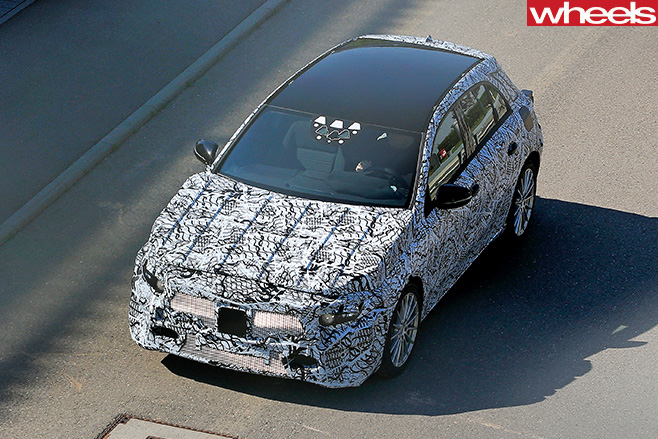
Never a laggard on the engineering front, the A-Class is nevertheless expected to usher in a heavily modified version of the current MFA modular front-drive architecture, meaning a return of MacPherson struts and a multi-link rear. Reports suggest that it will include a boost in rigidity and fall in weight, to help achieve improved handling and ride attributes, as well as important gains in efficiency.
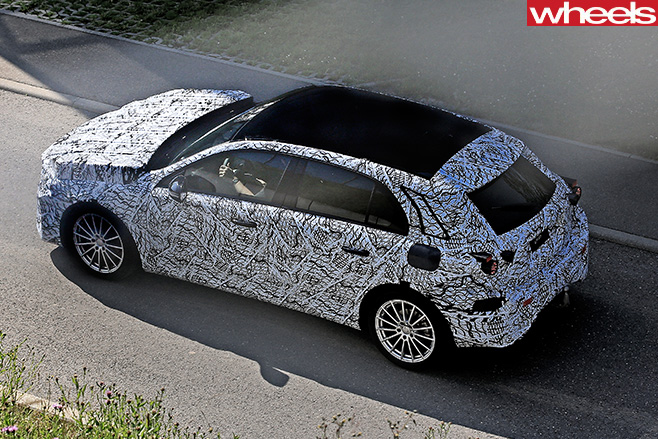
Do not count on seeing the next-generation A-Class in Australia before 2018, as the facelifted version of the Mk3 only went on sale at the beginning of this year. Prices, of course, will not stray too far from today’s models, which kick off from around $38,000 to nearly $80,000.

As we said, it’s all systems go at Mercedes-Benz…
Have spy pics of your own? We’d love to see them. Just email them to [email protected]
Cars have never been cheaper and wages have never been higher, so these days there is little reason anyone should buy a mediocre car.
Starting from a $5000 hot-hatchback and topping out with a $25,000 fast European coupe, our top picks from the classifieds are less than a decade old with reasonable kilometres and in good condition.
Fancy a weekend bargain? Then read on.
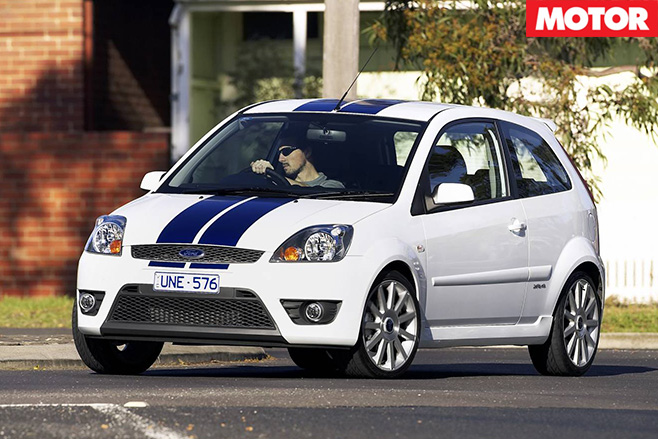
1. 2007 Ford Fiesta XR4 – $5000
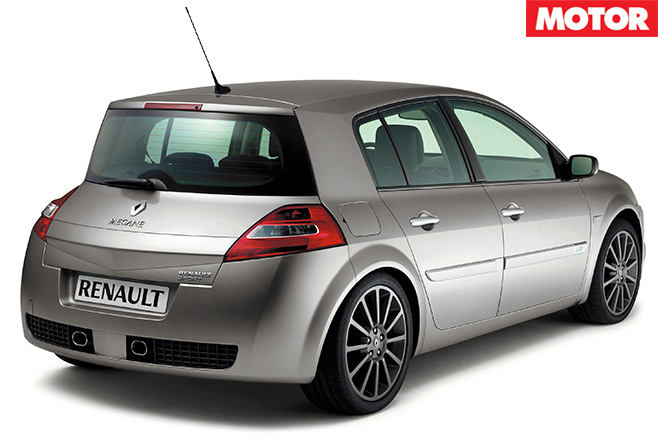
2. 2008 Renault Sport Megane 225 Cup – $10,000
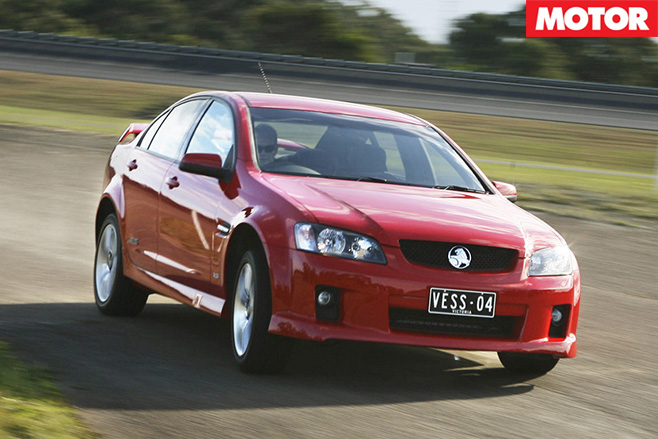
3. 2010 Holden Commodore SS – $15,000
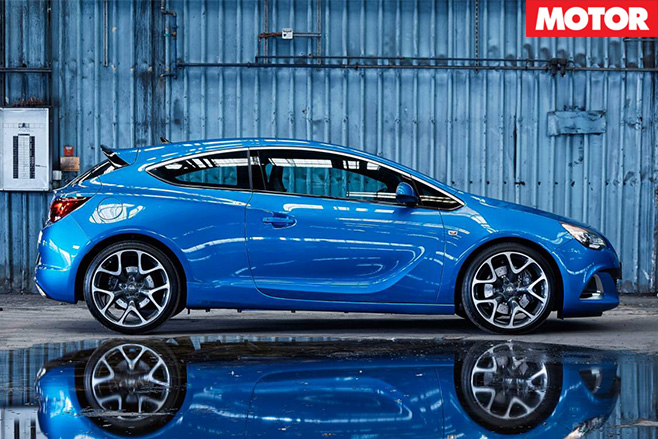
4. 2013 Opel Astra OPC – $20,000
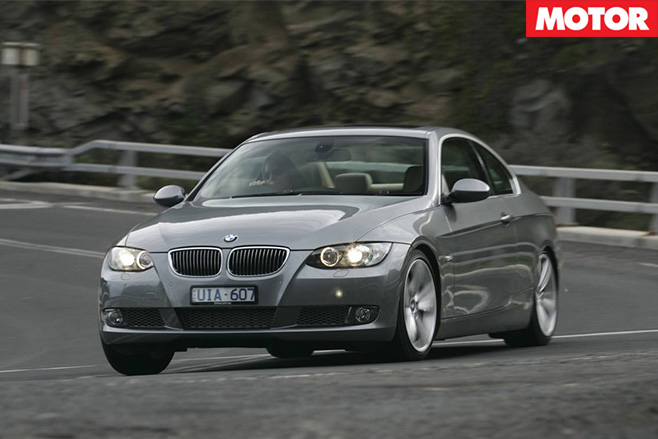
5. 2009 BMW 335i Coupe
Is it a Ferrari? Is it a Dino? Peter Robinson delves into the history of the much loved classic which was an orphan of sorts from day one.
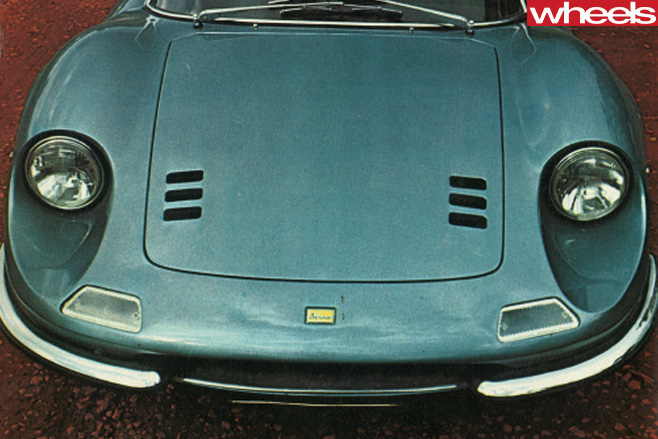
My first Ferrari wasn’t really a Ferrari. Not strictly speaking. The Dino badge on the 246 GT’s exquisite nose confirmed that the little mid-engine V6 was a Dino, Enzo’s secondary brand, created with the aim of building a ‘relatively’ more affordable sports car to compete with the Porsche 911.
Of course, that didn’t stop the world from referring to the car as the Dino Ferrari – some owners even added Ferrari badges – though the sub-marque lived on until May 1976 when the replacement Bertone-designed 308 GT4 swapped the Dino badge for the Prancing Horse.
Australia’s first Dino was imported in left-hand-drive form by W.H. Lowe, then Ferrari’s local representative (and the oldest Ferrari dealer in the world), to build interest in the new 246 GT, a model they believed would double Ferrari sales.
Initially, Maranello planned to build the Dino only in LHD. The Australian agent was told that Ferrari needed 40 to 50 orders to justify the cost of engineering right-hand-drive Dinos. Lowes predicted they could sell just 15 cars, but worked out how a conversion could be done and set about convincing the UK agent that they should order enough cars to justify the build. It worked. In 1973 Lowes sold close to 50 cars, most of which were 246 Dinos.
By the time Mel Nichols drove Australia’s first Dino for Wheels in 1973, the steering wheel had been moved to the right-hand side, this being the engineering car used by Lowes to prove to Maranello that it was not only possible but comparatively simple.
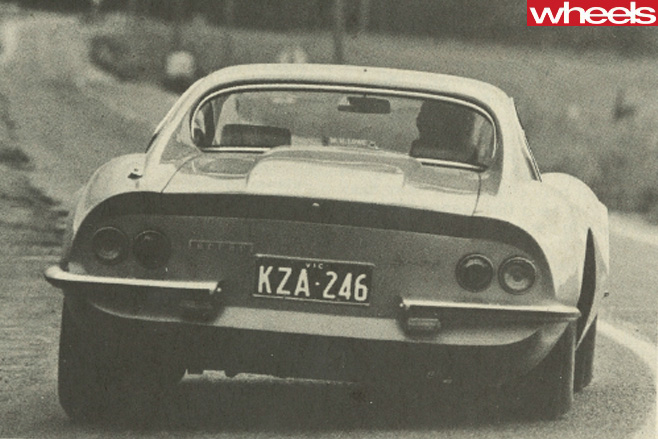
Wrote Nichols: “The important part, the tremendous part, is that the car’s performance is finely balanced to every other part of it, giving an overall ‘totality’ feel that is probably the most desirable quality in a motor vehicle.”
Mel didn’t spend more than a sentence on the Dino’s beauty (the driving experience was too important) yet today the 246 is seen as a Ferrari/Pininfarina masterpiece, one reason why you’ll pay upwards of $400K for a mint example.
Styled by 27-year old Leonardo Fioravanti – who’d previously designed the 250LM (Ferrari’s last Le Mans winner) and was about to start on the famed 365 GTB/4 Daytona – the sublime Dino, all voluptuous curves, delicate details and a huge windscreen for brilliant visibility, was also aerodynamically efficient and thus stable up to the 248km/h V-max.
Nichols criticised the difficult-to-see instruments, the weak ventilation and lack of adjustment for the little bucket seats, but found so much to love in the driving that these flaws became irrelevant.
Mel Nichols revels in the V6 glory of Ferrari’s first ‘budget’ sports car when it was released in 1973.
First published in the March 1973 issue of Wheels magazine, Australia’s most experienced and most trusted car magazine since 1953.
You leave in the early morning rain, heading for the south coastal in a Ferrari Dino. Along the green, tree-lined avenues of suburban Lindfield, down and across the Sydney Harbor Bridge. Through the city snarl and the southern suburban wrangle and the smog to the coast.
The road that leads out to the southern seashore is twisty. It flies down into, and then up out of, a park of many square miles. It crosses a causeway and snakes up through the trees in a series of bends that are predominantly left hand. Some curl tightly around a cliff face, climbing all the while, but opening out gradually. You can place a car in tight to the cliff going into them fast, screw on full power and sweep through, opening out with the bend itself. As you exit you will grab another gear and maybe another on the uphill run to the next bend – another left-hander – and take it in the same fashion.
A Falcon GT will be running hard in third. A Dino will have gone into fourth, the cam chains wailing and the exhausts howling as its V6 claws up past 6600rpm, heading for the 7800 red line.
But further on up, nearing the top of the hill, this road betrays its consistency. It kicks ‘ hard and nastily to the right in almost a full U-bend. It is easy to forget about it, to come· in much too fast- lured into false security by the smooth flow of the earlier bends.
Too late you see this bend’s spiteful twist. Too late you see the gravel spread like orange ball-bearings across it; the haggard rock bank on the outside edge staring at you coldly.
And too late you remember the only failing of mid-engined cars. That their weight distribution, biased towards the rear, is prone to letting the front wheels suddenly skip across the road if they hit a wet patch, or strewn gravel, in a tight bend …
Many things flash through your mind in that instant before you make a decision and commit yourself to an action that may or may not work, may or may not keep that leering bank and this $16,000 jewel apart…***
… You think about the first time you slipped the key into the dashboard of a Dino. The excitement is easy to remember. You have it every time your hand reaches out to twist the key in a car of breeding, a car that costs a lot of money and you suspect is probably worth every penny of it.
There is the aloof feeling of using something that is of rare high quality, and is duly respected and envied by other drivers less fortunate. There is the feeling of satisfaction and of adventure in the discovery of it that you know lies ahead.
There is anxiety, too, that someone will run into you in a parking lot. But you don’t wait too long before you turn the key.
The 2418 cc oversquare V6, DOHC, sits transversely in the car, between the seats and the rear wheels. The diaphragm clutch is at its left side. From the clutch, three pinion gears drive down to the gearbox which lies beside and parallel to the crankcase; so close that you might think it was in the crankcase, like a Mini’s.
A pair of helical gears take the output from the gearbox to the diff and its drive shafts which, as a result of all this parallel design, are mere inches behind the line-of the crankshaft.
Power from the engine is 195bhp at 7600 rpm, with 166 lb/ft of torque at 5500 rpm. It is a crisp engine, with a reassuringly clean feel to it.
Instantly a very easy, confidence inspiring car to drive, the _Dino is very light in all its controls. It takes quite a while to adjust to this- at first you use too many revs when changing up, not allowing for the swiftness of the gearchange, the rapid take-up of the clutch and the lightness and precision of the throttle. But soon you get it all co-ordinated into the smooth, effortless system that it is and it all becomes second nature. The presence of a naked racing gate is forgotten.
Some people have criticised the Dina’s gearchange, but I find it fine; smooth, and like a precision instrument under your palm, and full of feel.
Though the Dino is red-lined at 7800 rpm, you find yourself changing up around 3000 rpm. The low-down pull of the V6 is so pleasant and smooth you don’t feel that you need any more for quiet motoring.
Even so, once past 3500 rpm you can feel the engine climb up on its cams and really storm ahead. Taking it right out to maximum revs brings not only power you can revel in (not because it’s so strong, but simply so damned nice) but a glorious barking from the exhausts as well.
You become aware of the living sounds behind your head, in a different way this time, as the valves and the cams and the chains do their job at the speeds they really prefer. The noise is all part and parcel of the performance and the car, sports car stuff to the ultimate degree and available only in mid-engined cars.
But the noise has its drawbacks. After a few hundred miles you find its novelty disappears, to become a tiring drone at moderate touring speeds. Above 110 mph the drone goes, and the car is a much more pleasant tourer; there being no wind noise.
The Dino is not a potent car, not really one of your “super cars”. Its standing quarter times are a moderate 15.1 seconds, 0·1 00 mph 17.4 seconds. But the important part, the tremendous part, is that the car’s performance is finely balanced to every other part of it, giving an overall “totality” feel that is probably the most desirable quality in a motor vehicle.
One area where the Dino’s performance does triumph in terms of pure acceleration is above 100 mph. Its time to the ton may be only 17.4 seconds, but the superb body shape and the top-end pull of the engine mean that it maintains it accelerative rate much better than cars that will eat it over the · quarter. For instance, the 2.4 911S records 14.7 second quarters with 17.2 seconds to 100 mph, but its time to 120 mph is 30.8. The Dino gets-there in 28.8 seconds.
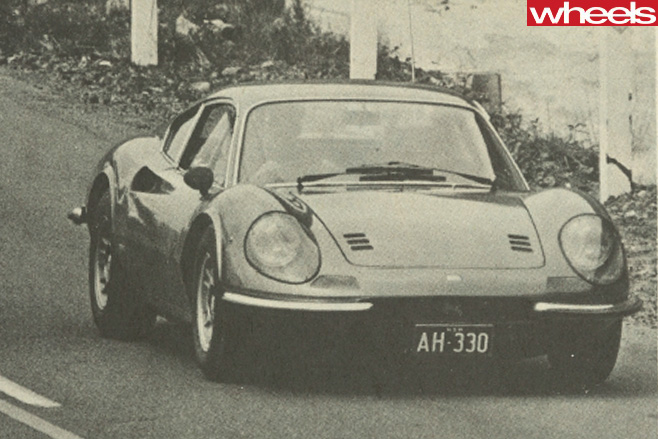
You soon learn not to overdrive the Dino. By that I mean using full-power in second or third, which will kick the tail out savagely. Fourth or fifth is smoother, quieter and probably even faster. So after leaving a few bends sideways in full-bore power oversteer you find yourself graduating past the kidstuff to a slow, relaxed style that really is the way you drive a Dino – just letting it flow along the road.
Because of the car’s tremendous handling and roadholding you are, of course, travelling very fast even though your driving actions might seem so slow.
The Dino just comes in, maybe under brakes if it’s a really tight one, maybe down a gear. And then you just accelerate through, the car simply tightening its line as it goes around.
This tightening of the line under power is a strange phenomenon you won’t have experienced before if you haven’t driven other mid-engined cars. It is a characteristic of the type, and a wonderful one at that since it gives the car an ability over and above other types, making cornering not only naturally faster, but safer and more relaxing, too.
You soon get in the system of going in with a light or trailing throttle and then just squeezing the pedal right the way home as you go around the bend.
Backing off bard (and I mean hard) in a bend produces no spin; just a gentle drifting of the tail you learn to trust and love the feeling, using it gently in your driving. Stamping on the brakes will bring little more tail movement; such is the grip on the road. But you do get the feeling that if you did reach the limits, perhaps in the wet on a truly treacherous surface, the Dina might prove to be a very difficult proposition to get back.
Normally though, the only way you’ll really get that tail hanging right out is by booting on full power in first, second or third. Then it comes quick; real quick, and you’ll need a big grab of swift opposite lock then, boy.
Do it, and the ear will answer immediately, and just like a true race car you can leave it as far out as you wish until you feel like winding the lock back off.
With the miles slipping behind you, particularly in winding rain-forested mountain country with lots of descending hairpins you notice that the front is inclined to lose its grip, going into sudden understeer slides if there is water, ice or even round gravel across the apex .
You learn to watch the road very closely, and allow for it, the only time you need ever be at all in doubt in any way about the car’s cornering ability.
The steering has that familiar Ferrari smoothness and light ness and precision that is so pricelessly beautiful. There are 3.1 turns lock-to-lock, but it is still a little low geared. The wheel is also canted away from you at too great an angle, forcing you to tilt the seat to the furthest forward of its three positions to allow an action quick enough for opposite lock work.
Few cars will outbrake the Dino. Tremendously progressive and informative, and with a light pedal, the four vented discs haul the car clown like giant claws.
More miles reveal that the Dina’s seats aren’t very good. The little leather buckets have no squab adjustment – only that three-position tilt for the whole seat, and normal fore and aft travel. The bulk head prevents the seats going back far enough for anyone much over six foot.
Considering the pure sports car that it is, the Dino’s ride is superb. Ferrari has given it long spring travel so that it soaks up bumps instead of thumping over them in the more common fashion. For this reason the Dino will never move off line in bumpy bends.
Driving out and away on country roads, delirious with every moment and movement, you do not notice – nor much care – that the Dino is an impractical car for everyday use. There is nowhere to hang a coat as you drive to an appointment on a hot day; nowhere to put her make-up bag; nowhere to slip your briefcase, or the million other things people get used to slinging into a car. There is only the glovebox and two small door pockets which might very well be taken up with tapes for the stereo deck anyway.
Everything else must go in the boot, which, fortunately, is big and holds plenty of suitcases.
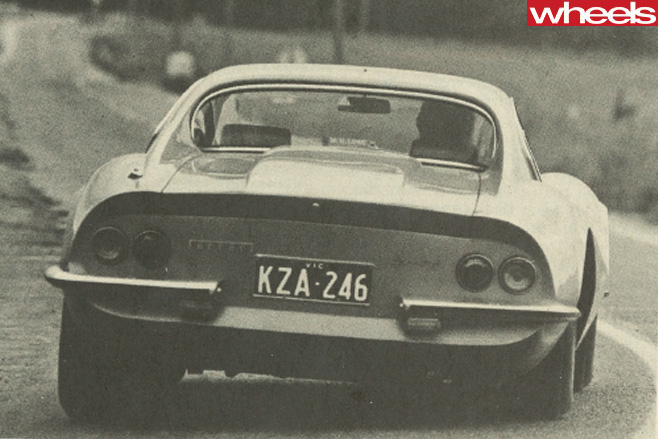
Otherwise, you love this cockpit, for it really is a cockpit. You appreciate the tasteful, almost delicate finish; the leather and the black suede covering the dash board. You love the view through the big, wide windscreen down to the road with only those two big humps where the body flows over the front alloy wheels and their fat Michelin XVRs. If ever a view out of a car had appeal, then this is it.
If the day is hot though you find that you would like – need, really – air-conditioning. The ventilation is typically European. Fine for them maybe, far too weak for us. At the end of your test you pull into a garage to fill the 15.5-gallon tank for the last time. Quick calculations show that you’ve been getting just over 21 mpg, even with that top speed run, and the quick, singing miles through a brace of mountain ranges.
You swing slowly into the owner’s garage, reach out slowly for the key and turn it off, smiling again at the way the engine dies instantly. Even in death it is so businesslike.
The owner comes to your door as you curl out. You smile quietly at each other, for you know what you have shared in the driving of this vehicle.
You thank him and you leave, wondering how long it will be before you drive another one.
***
…there is the slightest of crests as you hit the entrance to this bend that is about to gobble you. Yes, it might just be enough. Back off hard… NOW! Yes it is enough! Enough to accentuate the flick into oversteer to get you more sideways than is normally possible with just throttle back-off.
Your foot aches to stamp back on the throttle, to stop the tail, for it fears a spin. But you won’t – can’t – let it. It must hold off an instant longer, to make sure you are fully sideways to get that Achilles’ heel of a nose lancing tight into the inside of the bend, and before the apex.
You can the gravel waiting, waiting on the road. But it is thinner on this inside edge and if you can keep the nose in there, keep the oversteer on so that when the wheels hit it the whole car and not just the front will slide, you might make it.
Oh no! You’ve stayed off the throttle a fraction too long! The tail is coming around too far. We will spin and go backwards. It will crush the engine.
Quickly, throw the opposite lock on firmly. Push the throttle… and yes, feel that back end bite as the howl behind you gets savage once more. The back holds.
The front wheels hit the gravel, and they skip sure enough, but they’re in opposite lock and the weight has you moving in the right direction.
It’s all over. The car is coming back in to line obediently, as mid-engined cars do when the power is pushed on , and moving cleanly and fast out to the edge of the road, almost at the ideal exit point.
You will not hit the bank. You do not even drop a back wheel off the bitumen as you exit.
You have learnt well about the Dino. Now there is just the road ahead, and soon the coast.
Wheels Road Test Technical Detail
Make: Ferrari Model: Dino Body Type: Coupe Price: $16,000 Color: Blue Milaeage Start: 2036 Milaeage Finish: 2598 Weight: 2380lb (1079kg)
FUEL CONSUMPTION Overall: (7 .5 kpl) 21.2 mpg Cruising: (8.8 kpl) 25 mpg
TEST CONDITIONS Weather: Fine Surface: Castlereagh drag strip Load: Two persons Fuel: Super
SPEEDOMETER ERROR Indicated mph: 30 40 50 60 70 80 90 100 Actual mph: 30 40 49 59 68 77 87 97
PERFORMANCE Piston speed at max bhp: 2989 ft/min Top gear mph per 1000 rpm: (30.5 kph) 19 Engine rpm at max speed: 7800 Lbs (laden) per gross bhp (power-to-weight): (5.5 kg) 12.2
MAXIMUM SPEEDS Fastest run: (241 kph) 150mph Average of all runs: (238 kph) 148 mph Speedometer indication, fastest run: (247 kph) 154 mph
IN GEARS 1st: 41 mph (65 kph) (7800 rpm) 2nd: 59 mph (96 kph) (7800 rpm) 3rd: 87 mph (129 kph) (7800 rpm) 4th: 110 mph (177 kph) (7800 rpm) 5th: 148 mph (238 kph) (7800 rpm)ACCELERATION 0-30 mph: 2.7 sec 0-40 mph: 3.6 sec 0-50 mph: 5.4 sec 0-60 mph: 7.0 sec 0-70 mph: 9.1 sec 0-80 mph: 11.3 sec 0-90 mph: 14.2 sec 0-100 mph: 17.4 secSTANDING QUARTER MILE Fastest Run: 15.1 sec Average all runs: 15.2 sec
BRAKING From 30 mph: (9.1 m) 30ft From 60 mph: (32.8m) 108ft
Specifications
ENGINE Cylinders: Six in V Bore and stroke: 92.5 mm (3.64 in.) x 60 mm (2.36 in .) Cubic capacity: 24.8 cc (48.1 cu in.) Compression ratio: 9 to 1 Valves: DOHC Carburettor: Three 2V downdraught Fuel pump: Two, electric Oil filter: Full flow Power at rpm: 195 (net) bhp at 7600 rpm Torque at rpm: (23.9 kg/m) 1661b/ft at 5500 rpm
TRANSMISSION Type: Manual, five-speed Clutch: Single dry plate Gear lever: location Floor
CHASSIS AND RUNNING GEAR Construction: Tubular steel chassis, steel body Suspension front: Independent, coil springs, wishbones, anti-roll bar Suspension rear: Independent, coil springs, wishbones, anti-roll bar Shock absorbers: Telescopic Steering type: Rack and pinion Turns l to l: 3.0 Turning circle: 10.9 m) 36ft Brakes type: Four-wheel discs, servo assisted, dual circuits Dimensions: (269 mm) 10.6 in. diameter
DIMENSIONS Wheelbase: (2339 mm) 92.1 in. Track front: (1425 mm) 56.1 in. Track rear: (1430 mm) 56.3 in. Length: (4216 mm) 166.2 in. Width: (1701 mm) 67.0 in. Height: (1143 mm) 45.0 in. Fuel tank capacity: (70 litres) 15.5 gallons
TYRES Size: 205/70VR 14 Pressures Front/rear: ( 19/21 kg/cm2) 27/31 psi Make on test car: Michelin XVR
GROUND CLEARANCE Registered: ( 155 mm) 5.5 in.
Brisbane-based Tritium has developed a solution to our electric vehicle woes.
Veefil stations are fast charging stations that will provide 50km worth of driving for 10 minutes of charging, theoretically allowing motorists to drive from Brisbane to Sydney with just three stops.
With most EVs travelling around 250 to 300km on a full charge, it’ll currently take 60 minutes to fully charge a vehicle, but according to the company a soon-to-be-released update will triple m4ost EVs charging range, reducing charge time to just 20 minutes per stop.
Tritium is a company has been developing technology in electric vehicles since 2001, but moved into the commercial vehicle market as the popularity of electric vehicles started to grow.
“We had some clients looking for a solution around electric vehicle charging and so we basically developed a product based on the technology that we’d already been developing for a number of years,” Tritium’s Commercial Director, Paul Sernia, said.
“In the near future, electric vehicles will have larger battery packs and will require faster charging stations to allow people to take long trips, and as more people are driving them, we’ll need more chargers in more locations. That’s where we’re looking to develop solutions to meet that need.”
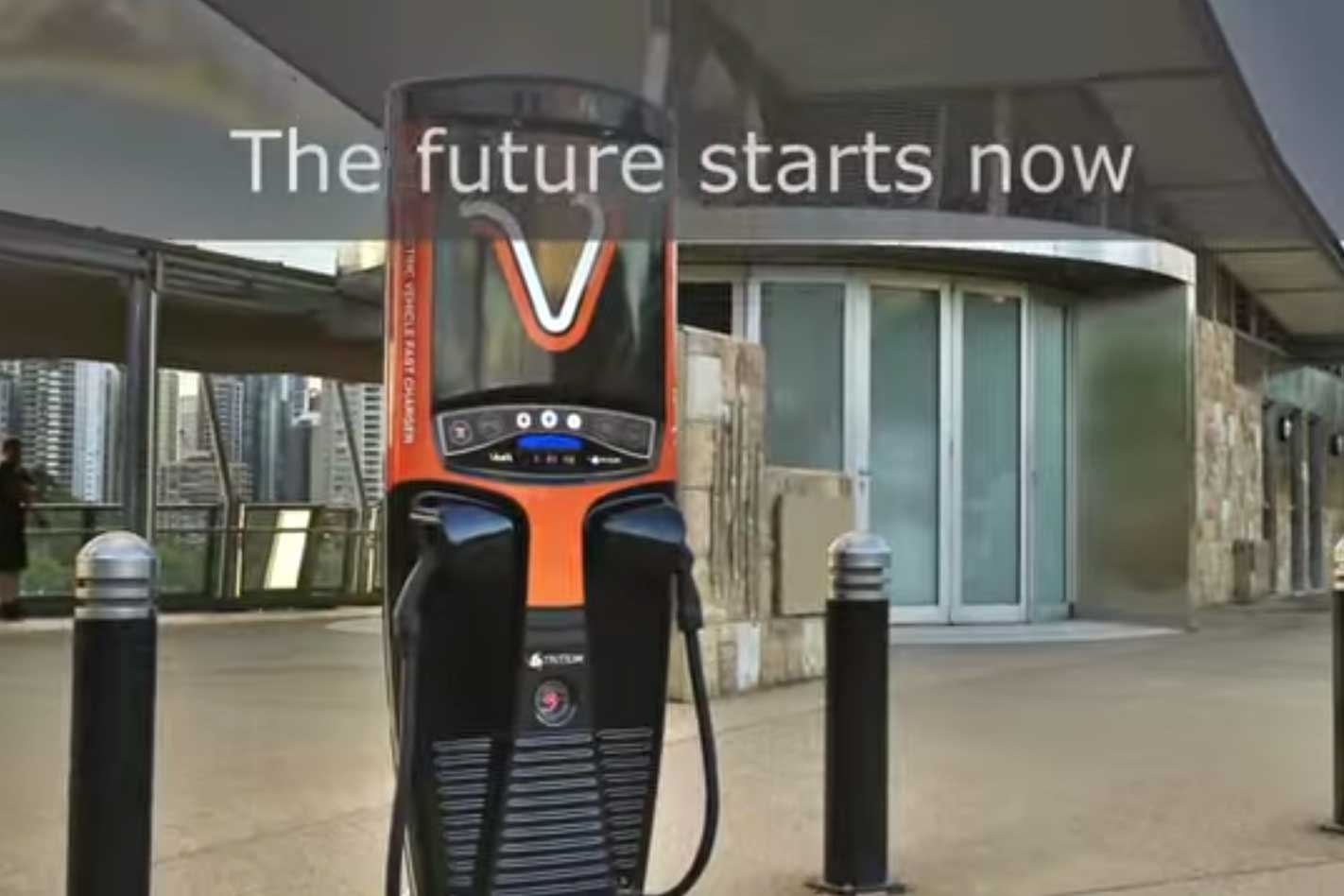
The Veefil chargers have been in development since 2011, and this year the company secured a $2.5 million Business Development Fund (BDF) from the Queensland government which will be used to improve research, manufacturing capabilities and supporting customers.
The charger has already been sold and tested in the USA, Europe and Asia Pacific, and the company intends to extend this in the Australian market.
“In terms of charging networks in Australia, we have a lot of experience overseas and we want to bring the best of what we see there to Australia. We’ve got the advantage of learning from the mistakes of other countries,” Sernia said.
“We have some stations installed in Australia and over the next couple of years we expect to install more and more of those. We think it’s a great industry and there are a lot of benefits to our drivers in adopting electric vehicles, so we want to make sure we get the advantage of that locally as well.”
While the cost equates to the same as using a petrol pump on a per kilometer basis, Sernia says they expect it to cost $8 to $12 to fill up in Australia.
Want to see more? Check out our top 5 eco-friendly cars.
SIT down and strap in, because this is one hell of a ride.
Since the 24 Hours of Le Mans is taking place this weekend, we at Wheels thought it would be prudent to remind you of what it used to be like to race in the toughest sports car race in the world.
The year is 1983, the Mulsanne straight is void of chicanes, and Derek Bell is armed with a Porsche 956.
Ride onboard with Bell as he holds the car at full throttle down the seemingly never-ending straight, the outside world transformed into a 300km/h+ blur.
Bell shared his 956 with racing legend Jacky Ickx that year, with the pair finishing second behind the winning 956 which was piloted by Aussie Vern Schuppan alongside Hurley Haywood and Al Holbert.
Bell and Ickx nabbed both pole and the fastest lap of the race, at 3:16.560 and 3:29.070 respectively.
Neel Jani qualified on pole for the 2016 race with a 3:19.733 lap of the La Sarthe circuit – which included two chicanes on the Mulsanne.
Being a safety car driver sounds like fun, but in general it involves a lot of waiting around doing nothing interspersed with brief flurries of frantic action.
Little wonder, then, that when the safety car is unleashed the drivers tend to want to have a bit of fun. Here are the five best bits of safety car sliding YouTube has to offer.
Our first is our most recent, captured during qualifying for this year’s Le Mans 24hr, with Yannick Dalmas having a massive moment in an Audi R8.
Bernd Maylander has been F1’s safety car driver forever, and when it gives him the chance to fry tyres in AMG’s finest, you can’t blame him for liking the gig.
Apologies for the terrible video quality, but here’s Bernd again hazing tyres in a Mercedes-Benz CL55 AMG back in the day.
Our most unusual contender is this Nissan X-Trail, that got w-a-y out of shape while leading the field during a GT race in China.
Finally, BMW supplies course and safety cars to the Moto GP, and it must also face a very hefty tyre bill at season’s end.
What’s this, then?
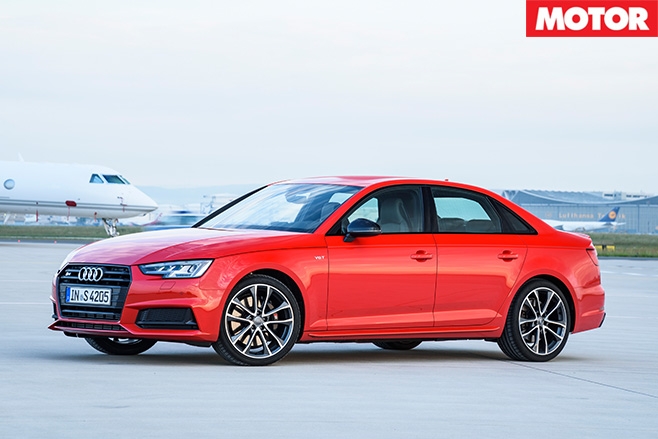
Audi’s latest S4. It’s the sixth generation of the badge and is all-new.
What’s so new about it?
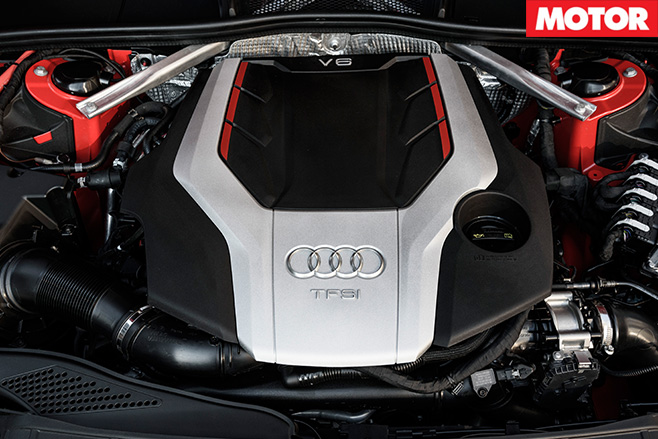
Audi’s dropped in a 3.0-litre turbocharged V6, replacing the old supercharged 3.0-litre V6 MOTOR loved so much.
On paper it might seem like Audi’s simply bolted a huffer to the old alloy block V6. It again uses 24 valves, and identical bore and stroke measurements. But the bore spacing’s changed, and it’s 14kg lighter. It’s now also bolted to an eight-speed auto.
Also, like an RS6, the cylinder heads have been rotated to pump air through a twin-scroll turbo in its vee. It churns out 260kW and 500Nm, or 15kW/60Nm more than the old one.
Wrong. The new chassis, based on the MLB evo platform, sheds 15kg, while its panels, steering, and body in white slash another 16kg. Further kilos were outed by things like seats, and overall 75kg has vanished from the S4’s mass.
Looks good too, but how do you even know it’s an S4?
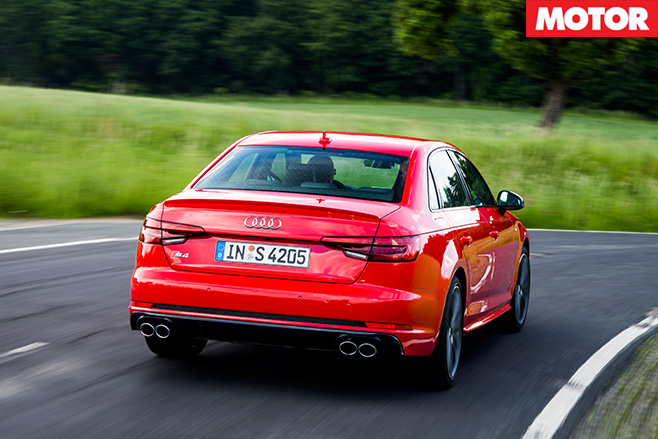
Badges, silver mirror scalps and a set of quad-exhausts poking from the rear diffuser are the subtle clues, but new front six-piston calipers are the real giveaways.
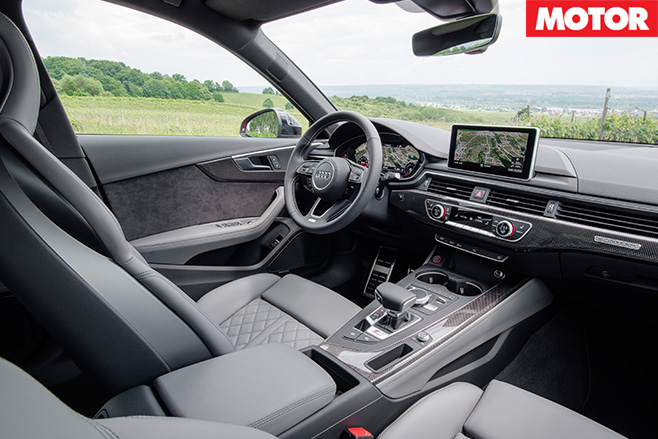
There’s not much inside to reveal you’re in an S model either. It’s the same high-tech affair as the A4, in that you’re greeted by a suave layered stack and rich materials.
The new S4 is fast. Despite its Hankooks’ low grip levels, the five-link suspension setup all-round and quattro drivetrain extract the most from them.
Adaptive damping and a rear sports differential are still its cornerstone dynamic weapons, and with inside-wheel braking now added you can power out of corners so early. It rides okay, too, but we didn’t try a car without adaptive damping.
With the turbine harboured in its vee, gas paths are extremely short. The reality of this is the engine’s super responsive. Even in the depths of its rev-range it pulls hard, making peak torque 1530rpm sooner than the old supercharged mill at 1370rpm.
It doesn’t rev high as the old unit, but with the new turbo V6’s delivery over by 6400rpm there’s no point. And there’s no aural treat to keep you hanging around either.
So less character, but is it better value?
If Audi can price it right (it’s aiming for $106K for the sedan and $109K for the Avant) the S4’s going to be hard to beat. There’s so much technology available – Wi-Fi, inductive phone charging, matrix LEDs, automatic safety tech – that it comes down to what ends up standard.
It’ll be most likely be the head-up display, virtual cockpit, and round steering wheel on local S4s. Which isn’t a bad deal, but if Audi wants to tempt buyers out of serious sport metal at $100K, we’d also want either nappa seats, the sports rear diff, or adaptive dampers.
Stay tuned for a stoush between Jaguar’s XE S, BMW’s 340i, and the soon-to-arrive Mercedes-Benz C43 AMG after the S4 lands fourth quarter this year.
SPECS Engine: 2995cc V6, DOHC, 24v, turbo Power: 260kW @ 5400-6400rpm Torque: 500Nm @ 1370-4500rpm Weight: 1610kg 0-100km/h: 4.7sec (claimed) Price: $106K (estimated)
SEVENTY-NINE bucks. It might not sound like a lot of money to most of us. Heck, it’s not even a tank of fuel in plenty of cars these days. But that amount represents Ford’s latest attempt to woo and retain new car buyers.
From July 1, Ford adds free annual satellite-navigation updates to its service offer for owners of Ford vehicles fitted with the SYNC2 infotainment system.
If you own an FG X Falcon, SZ II Territory, Everest, Ranger, Ford Kuga, Focus, Mondeo or Mustang, you stand to pocket $79 a year, rather than handing it over to your Ford dealer. And that deal stays in place until 2024 when the system will no longer be updated.
It’s handy considering there are more than 120,000 kilometres of road added each year in Australia, almost 23,000 road name changes and about 2000 roundabout changes, says Ford.
The initiative is being claimed as a global first within Ford, but other brands in Australia including Peugeot, Citroen and DS importer Sime Darby, and Mazda, already offer it. Subaru says most of its models will be updated free from this year.
Sime Darby says offering three updates a year as part of the price saves customers up to $450.
Ford’s $79 charge seemed pretty fair by industry standards when other brands are charging $300 or more for their updates.
Right now there are about 80,000 Fords on Aussie roads using SYNC2 – and growing (SYNC3 is just starting to arrive here, too, but there is no decision on free updates there yet). So if every owner were to take advantage of this offer then it becomes a multi-million dollar investment. And that’s just what Ford wants – every possible customer to take advantage of this offer.
This is another small step along the way in Ford’s change (it likes to say “transformation”) from fleet sale-focused local manufacturer to private customer-loving importer; a process completed on October 7 when its local assembly plants are shut and production of locally developed Falcon and Territory end.
The free sat-nav updates go are on top of other initiatives including free service loan cars, roadside emergency service and capped price servicing.
The idea is to not only sell you a car, but to keep you spending your money in the Ford family with the lure of a high quality sales and service experience, rather than using the local garage. Ford Australia president Graeme Whickman insists it’s working, claiming a 37 per cent increase in service retention since 2012.
The other stat that will be pleasing Whickman is a 16.4 per cent lift in sales year-on-year, which means Ford is on course to increase its annual sales for the first time since 2004.
“We are just getting started and we already have seen significant progress in sales and service satisfaction, which has helped us increase sales and improve service retention… this has become a differentiator for Ford,” Whickman said.
