
WE ALL know about the new Nissan GT-R that we’re going to get when it lands in September. But how about the version of the GT-R we really want?
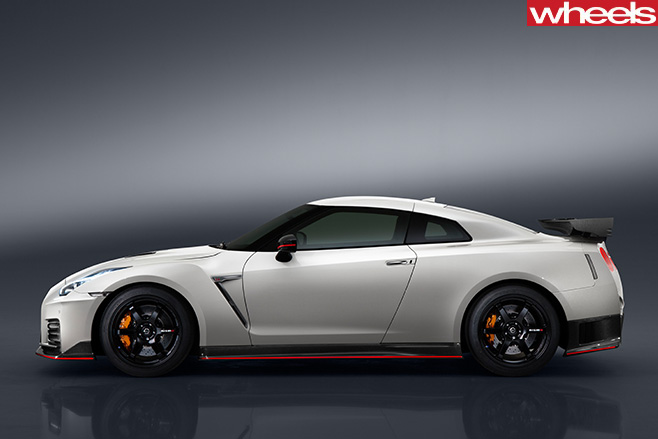
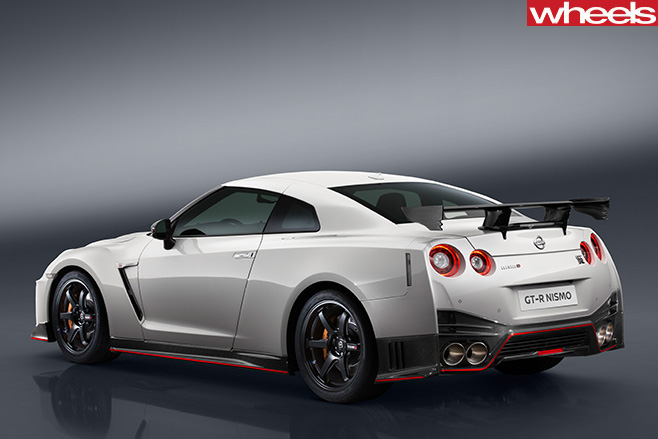
Nissan has pulled the wraps off the Nismo-badged version of the updated GT-R, featuring a more aerodynamically enhanced body wrapped around a 441kW/652Nm 3.8-litre V6 engine that features a pair of large diameter high-flow turbochargers more at home in GT3 race cars.
Other Nismo tweaks to the body include a more rigid bonnet that won’t deform at high speed, a wider, deeper grille built into a carbonfibre bumper that’s designed to suck in more air, and improved airflow around the front wheels.

The stiffer body structure allowed the Nismo engineering team to stiffen up the suspension’s shock absorbers, springs and stabilizers to enhance cornering ability via a driver-selectable mode.
“Its direct ties with racing makes it at home on any racetrack, providing the highest levels of excitement and exhilaration for the driver” he said.
“With the 2017 GT-R as a starting point, the new Nismo version has become a more well-balanced machine, with not just increased performance, but a heightened premium feel overall.”
The bad news is, Australia is still unlikely to get it.
Nissan told Wheels recently that after years of waiting, it was still to gain approval to bring the Nismo performance sub-brand to Australia, adding that plans to inject more excitement to the brand were long overdue.
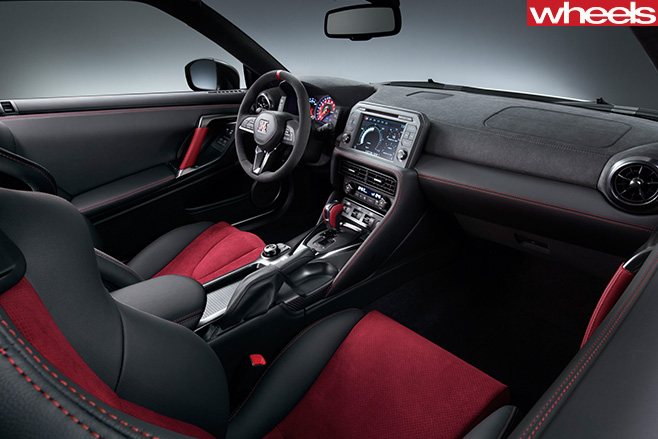
However, Nissan Australia is aware that GT-R enthusiasts are likely to want a bit more from the current GT-R range. In light of that, we’re expecting to receive a Nismo-tuned Track Edition of the GT-R, possibly as early as when the fresh-faced version unveiled in New York hits local showrooms in September.
The Honda Accord large car has received some small updates for its first facelift since the latest, ninth-generation model went on sale in mid 2013.
A revised look is created with subtle changes to the Accord’s front and rear ends. The nose adopts a new ‘wing’ chrome strip on top of the grille, the headlamps feature a new LED cluster arrangement, and the foglights are now LED and housed within a sportier-looking lower bumper.
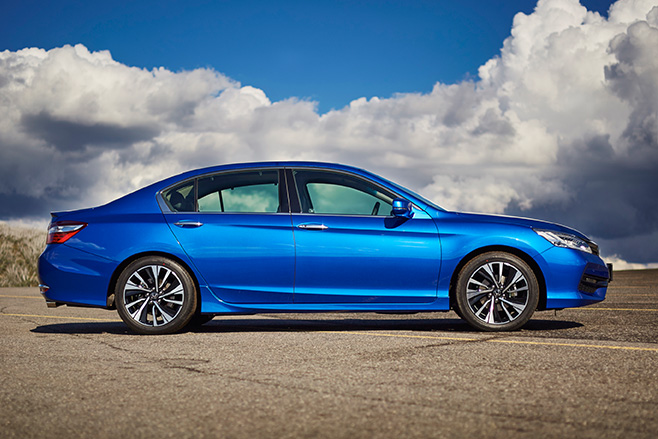
The Accord’s tail-light lenses are also tweaked and are accompanied by a chrome strip that is now wider and shaped to mirror the ‘wing’ grille strip. The lower rear bumper’s chrome strip is also stretched further across.
The Honda Accord range comprises three models, which have crept up in price by between $1000 and $1500.
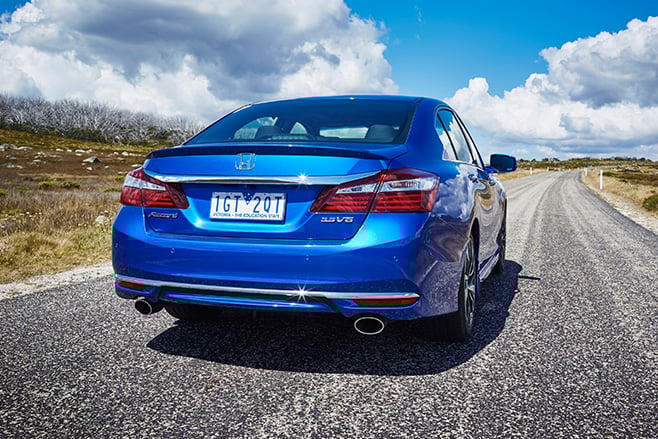
In return, the VTi base model now sits on 17-inch rather than 16-inch alloys and adds blind spot monitoring (called LaneWatch).
Honda’s mid-range Accord, the VTi-L, now includes a suite of active safety technology dubbed Honda Sensing, which was previously standard only on the top-shelf V6L model.
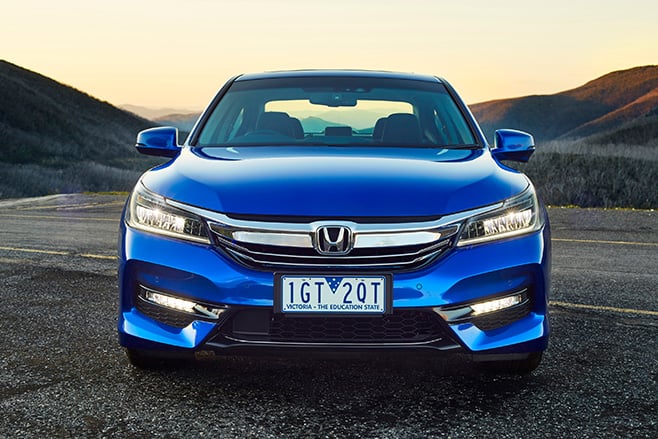
All models gain a new Advanced Display Audio that brings greater clarity to the touchscreen display and introduced Apple Carplay and Android Auto smartphone integration.
The entry-level VTi and VTi-L continue to be powered by a 2.4-litre four-cylinder engine with 129kW of power and 225Nm of torque, and are priced from $32,990 and $43,990, respectively.
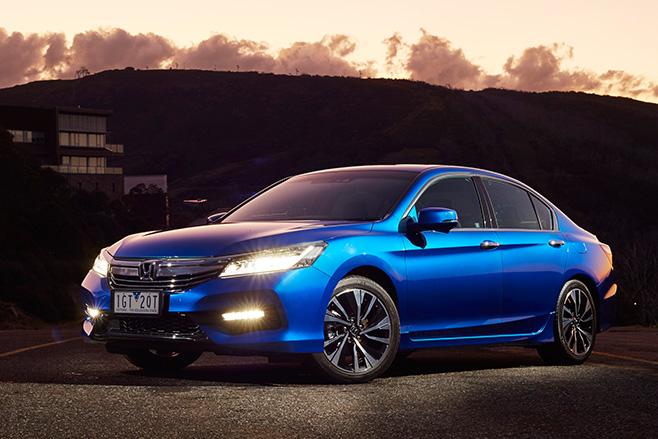
Honda’s Accord V6L, still featuring a six-cylinder with 206kW and 339Nm, carries a $52,990 RRP before on-road costs are added.
The four-cylinders remain linked to a five-speed auto that has at least one fewer gear than most modern self-shifting transmissions. The V6 is again teamed with a six-speed auto.
The more powerful V6 Accord still uses slightly more fuel than the four-cylinder models – 9.3 litres per 100km versus 8.0L/100km (VTi) and 8.1L/100km (VTi-L).
Ask any manufacturer of hybrid cars about the benefits involved and you’ll be told hybrids are saving fuel, money and the planet. But what’s the truth? Well, first, we need to establish exactly what type of hybrid car we’re dealing with here. There are plug-in hybrids, hybrids that use a petrol engine only to charge their on-board batteries and the most common type, the petrol-electric hybrid as in, say, the Toyota Prius.
The Prius (and its ilk) is the most common one out there, so let’s deal with petrol-electrics in general. The hybrid aims to save fuel by running on electric power when possible. But when you need full acceleration or the batteries are discharged, or you want to run a long distance like on a highway or country road, then the petrol engine chimes in to both drive the car and charge the batteries. That means that unless you’re driving in stop-start traffic for the majority of the time, the hybrid won’t save you nearly as much fuel as you might have thought. In fact, on a freeway run with the engine running the whole time, you might actually use more fuel than a small conventional car or a turbo-diesel.
That’s because the hybrid is typically heavier than a normal car thanks to all those batteries. In the city, sure, go for a hybrid, but a small-capacity turbo-diesel or high-tech petrol engine would be our pick for people living in the bush. There’s often a little extra servicing required for most hybrids and then there’s the dreaded question of what happens when the batteries up and die (as they will in time). Replacing those will never be cheap and could just eat up any savings you’ve accrued in the years leading up to their demise. We’re not saying you shouldn’t buy a hybrid, just that you need to make sure it’s fit for your specific needs.
What do the Formula One Brabham BT46B ‘Fan Car’, the McLaren F1 supercar and a compact city car have in common?
Well, in Gordon Murray’s vision for the future of passenger car design, the three share advanced design and construction to deliver superior lightweight performance.
The South African-born Englishman calls his radical new design, development and manufacturing process iStream. ‘Stream’ stands for Stabilised Tube-Reinforced Exoframe Advanced Manufacturing. A composite monocoque structure bonded to a tubular steel frame forms the basis of the car, but not the whole life-cycle iStream process.
Cars have been manufactured in much the same way since, well, the dawn of the car. Murray’s new system, which does away with pressed steel body/chassis structures, is a car development and production overhaul designed to dramatically reduce production costs, increase vehicle efficiency and safety, and provide numerous flow-on benefits that result from lighter vehicle weight, including increased durability and reduced running costs.
Murray’s website tells of 80 per cent reductions in the capital investment required for car manufacturing plants, a 40 per cent drop in vehicle life-cycle CO2 emissions, and a weight drop of 200kg in a Ford Fiesta-sized car. And if all that sounds like a dramatic change of pace for the man who was involved in the design of the McLaren MP4/4, which took the late Ayrton Senna to his first World Drivers’ Championship in 1988, well… it’s not.

Apply Formula One techniques to an affordable, lightweight sportscar, rather than a run-about, and now you have our attention. And while few technical details about the Sports Ride Concept are available, the prospect of a low-cost, light sportster with a motorcycle engine is tasty.
This concept marks the intersection point, where the philosophies of a Formula One car and an efficient city car collide. Let us explain.
If you reduce its weight, a car can accelerate, decelerate and change direction more quickly. Or, in a city car, such as the iStream Yamaha MOTIV.e shown at Tokyo in 2013, you can reduce the size of the engine and brakes by a corresponding amount, while maintaining an acceptable level of performance (and you get a free handling upgrade).
Reduce manufacturing and running costs and the consumer can spend their money on something else. Or, in Formula One, the team can spend it elsewhere to make its cars go quicker.
Y’see, for all its pragmatism, Gordon Murray’s iStream isn’t an about-face – it’s the man doing what he does best. It’s clear from the Yamaha MOTIV.e, Sports Ride Concept, and the iStream-lined next-gen of TVR cars, that Murray’s latest endeavour, as ever, amounts to him exercising his brilliant engineering skills.

Light, simple: Murray’s Chassis Secrets
1. Laser sharp The Yamaha Sports Ride Concept’s monocoque chassis is built around a welded ‘iFrame’ of laser-cut and CNC-bent, large-diameter, thin-walled steel tubes. It features bonded ‘iPanels’ that sandwich paper (or paper-core honeycomb) between thin skins of woven, uni-directional, random matte glass or natural fibre.
2. Slimmer MX Mazda’s ND MX-5 is commendably light at little more than a tonne (1009kg), however the Sports Ride Concept, which is only slightly smaller, is said to weigh just 750kg (it’s only around 16mm less in length, 15mm narrower and 59mm shorter in height). Not even a Lotus Elise is that light these days.
3. Safe tech Direct Load Path tech allows the iFrame’s steel tubes to carry crash forces through the chassis and away from the passenger cell. With the uni-directional (the carbonfibres are aligned with each other) composite/honeycomb sandwich panels attached, the highly rigid architecture exceeds NCAP standards.
4. Bike donk Yamaha makes no mention of the engine in the Sports Ride Concept, but the fuel-injected, DOHC, 998cc in-line four-cylinder from a Yamaha YZF-R1 sports bike makes sense. It produces around 130kW at 12,500rpm, which would give the coupe a power-to-weight of more than 170kW/tonne.
5. Stiff work iStream architecture reportedly maintains its torsional rigidity more than five times better than spot-welded steel. Tests showed the iStream structure maintained its stiffness after 100,000 cycles, while a steel body exhibited a severe reduction in strength and rigidity after just 20,000 cycles.
Not just bikes
Yamaha’s crack at cars
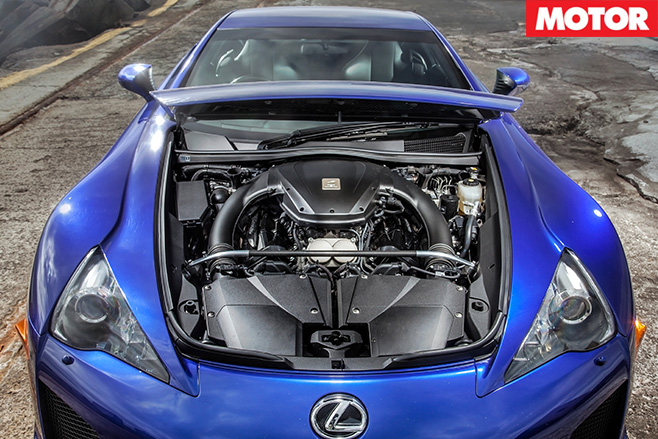
It’s also developed and built engines for Ford/SHO, the 4.4-litre V8 for previous-gen Volvo S80 and XC90 models, and twin-cam Toyota/Lexus cylinder heads, including those atop the LFA supercar’s epic 1LR-GUE V10.
Given the concept coupe’s proportions, mid-engine layout, and the long-term Yamaha/Toyota tie-up, could the Sports Ride actually be the fourth-gen MR2?
DANIEL Ricciardo has every right to feel gutted, robbed, let down by his Red Bull team, the same Red Bull lads that on three previous weekends in his career helped him to grand prix victories.
Motorsport is like that. Sometimes everything clicks beautifully. And occasionally there are glitches, stuff-ups, bad calls, finger problems…
“I actually hate being like this,” Ricciardo said later. Much later. “I hate being miserable. I got a podium in Monaco. I should be extremely happy, grateful and thankful. I’ve been fast now for two races and that’s the positive, but again no win so I’m a little bit sick of being fast and not getting any real rewards. I don’t like being the sad story.”
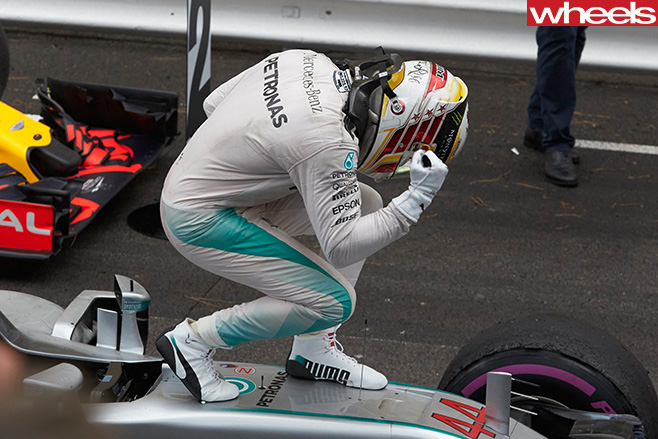
For two weekends, Daniel Ricciardo has felt the victim. Rightly so. He knows he could have been a winner of the Monaco Grand Prix, the most prestigious on the planet. Instead, the beneficiary of the Red Bull stumble was Lewis Hamilton, who repeated his fortunate 2008 Monte Carlo victory to record his first win of the year, igniting his 2016 challenge.
Ricciardo had done everything wonderfully well. His pole-winning lap was a doozy. In the race, after the grid did seven laps behind the safety car, Ricciardo was on top of his game in wet-yet-drying conditions. And then there was that dreadful miscommunication that cost him the race.
Called to the pits to switch to slicks, Ricciardo was stunned to discover the team unprepared. There was an agonising delay as the crew rushed the replacement wheels and tyres to the box, Ricciardo rejoining behind Hamilton. That was the cruel.
Ricciardo again: “On the extremes [full wets] in the beginning we were quick and I did everything I had to. I asked a couple of times how the people on inters [intermediate wets] were doing but they said that my pace was really good on the extremes so we stayed out and that was no problem.”
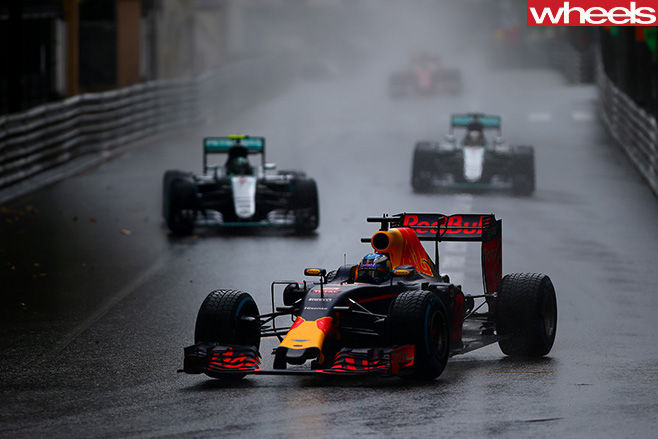
Hamilton conceded he got lucky: “If he [Ricciardo] hadn’t had a bad stop I wouldn’t have been ahead. But these things happen for a reason – and today the reason was that 44th win.”
Ricciardo pushed hard to catch and pass Hamilton – two tyre lockups were testament to just how hard he tried.
But it was Lewis Hamilton’s day again. And Mercedes.
“What a special day… truly one of the hardest races I can ever remember having,” said the reigning world champion. “To stay in the zone, not make any mistakes and come out on top is just unbelievable. I walk along here every day and think about the greats who have won this race – the likes of Fangio, Moss, Hill and Senna – and it’s a truly amazing feeling to have my name added to that list again.”
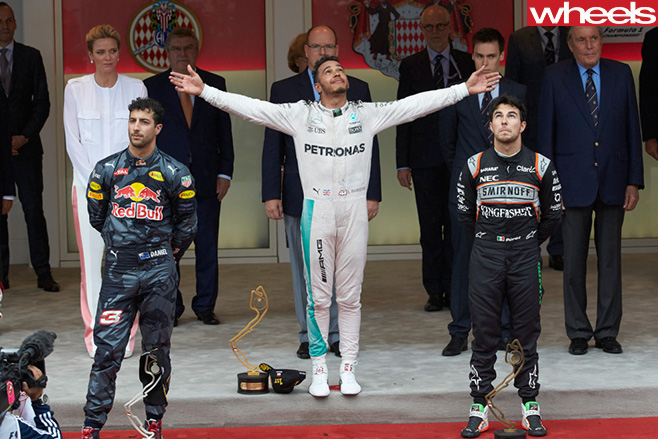
It was Red Bull’s first pole since Brazil in 2013, when Sebastian Vettel was fastest at what was Mark Webber’s last F1 race weekend.
Saturday in Monaco continued Ricciardo’s 100 percent record of out-qualifying his teammate in 2016 – Daniil Kvyat for the first four races, and Max Verstappen for the last two. The boy wonder found the streets of Monte Carlo no easy conquest, crashing once on Saturday’s practice and then repeating the messy day in qualifying, consigning himself to a replacement chassis and pit-lane start. Who trotted out that line about the peacock and feather duster…?
Then in the race, the teenager crashed again. He is still way short of the complete driver. Youthful exuberance doesn’t buy experience.
Happier than both Red Bull drivers was Sergio Perez, who grabbed third after a terrific drive in the Force India Mercedes, keeping Sebastian Vettel’s Ferrari off the podium. McLaren Honda had reason to be happy too, with Fernando Alonso (fifth) and Jenson Button (ninth) in the points, split by Nico Hulkenberg (Force India), Rosberg who had earlier brake issues, and Carlos Sainz (Toro Rosso).
After a spell of reflection, Ricciardo finally plucked a positive from his frustrating day. “To end it on a positive note, we are fast in all conditions, which is good.”
Let’s see what Canada brings. Meanwhile we now know that Ricciardo’s perma smile is not that permanent.
Rookie Rossi wins 100th running of Indy 500…on fumes
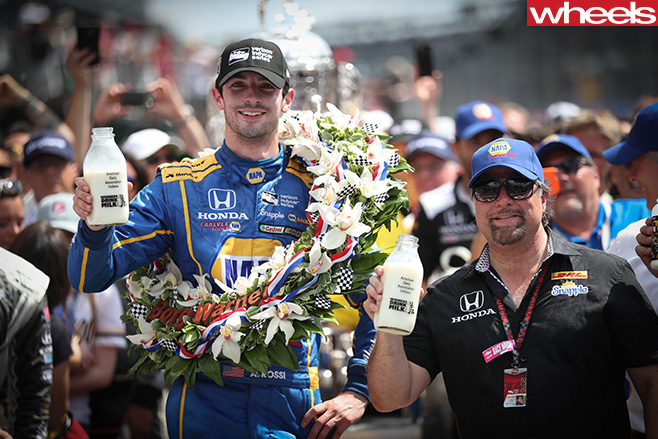
Rossi had so little fuel left, he needed a tow to get to victory lane to celebrate in front of the first sell-out crowd – 350,000 – in Indy 500 history.
The 24-year old is the first rookie to win the Indianapolis 500 – the so-called Greatest Spectacle in Racing – since Helio Castroneves in 2001.
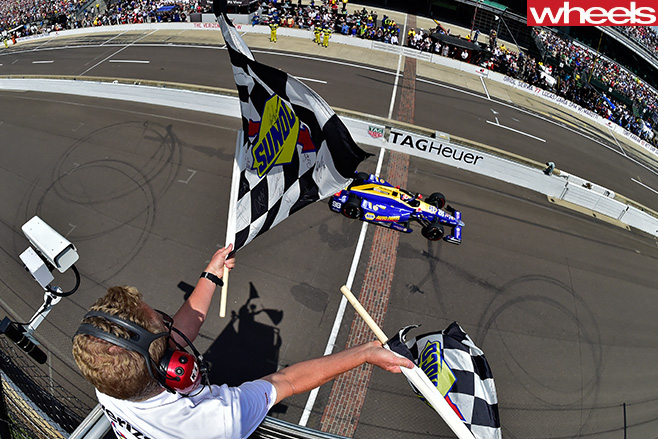
“I have no idea how we pulled that off,” Rossi said in victory lane after his Bryan Herta team (in an alliance with Andretti Autosport) gambled on eking out the fuel to the flag.
“Ryan [Hunter-Reay] was giving me a tow at the end. We rolled the dice and it came through.
“I’ll cherish the fact that at one point we were 33rd,” said Rossi, who also gave Honda its first win of the season. “We rolled the dice and came through and made it happen. This is unbelievable. I have no doubt it’s going to change my life.”
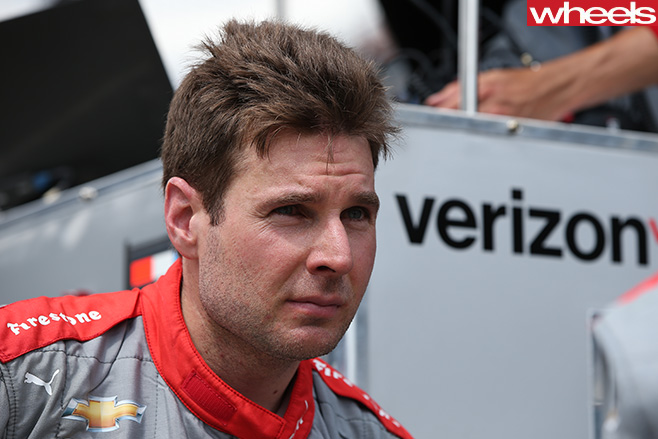
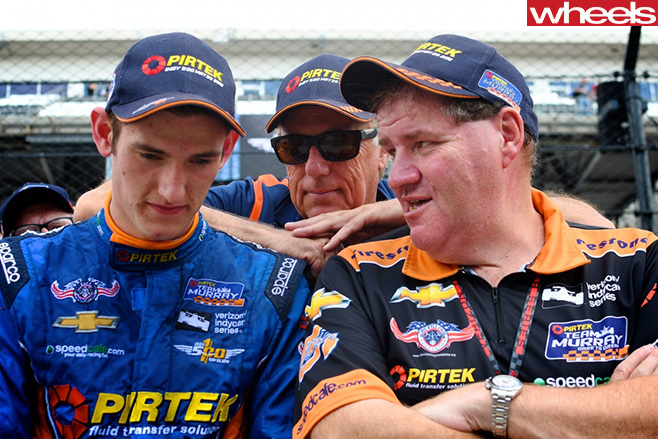
Australian Will Power (Team Penske) was never really in the picture, finishing 10th after a pit-lane penalty for an unsafe release marred his campaign. His rookie compatriot, Pirtek Team Murray’s Matt Brabham, finished 22nd after starting 27th.
The 22-year-old ran as high as 14th. He was one of many who had to make a late stop for fuel inside the final 10 laps.
There were the usual incidents including the crash on lap 64 that ended Juan Pablo Montoya’s shot at becoming a three-time winner.
Rossi wasn’t really a factor in this race until when it counted.
With the laps running down, the 500 clearly shifted to a fuel mileage game of nerve as Newgarden and Munoz both swapped the lead repeatedly. But both had to pit for fuel, and Rossi inherited the lead.
Honourary Aussie Engel takes Nurburging 24 Hours thriller
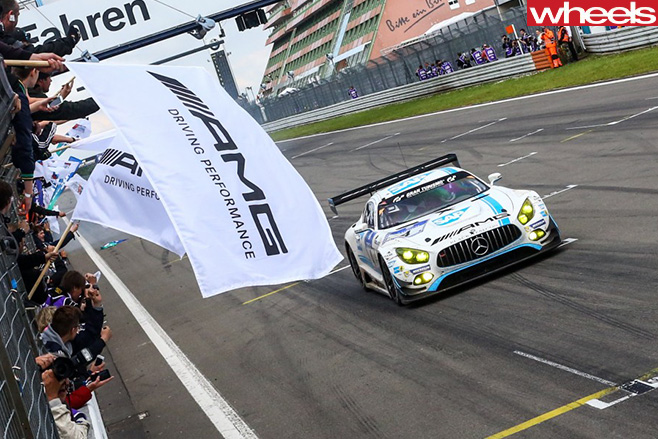
Engel was behind the No.29 HTP Mercedes on the final lap, but sensationally zinged inside Christian Hohenadel to snatch a thriller.
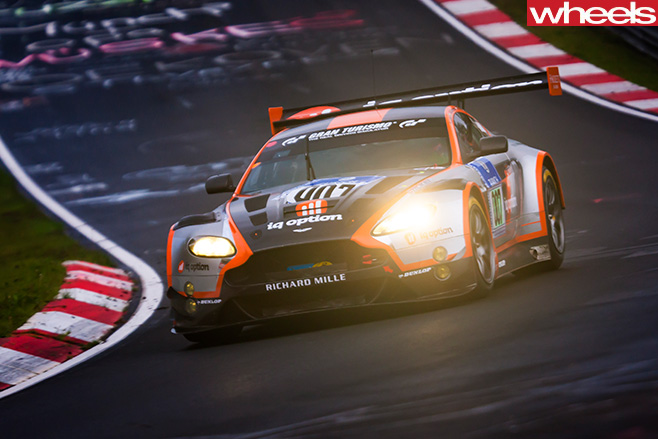
The winning margin of 5.697s was the tightest in the history of the 24-Hour race.
Mercedes dominated throughout and nailed a one-two-three-four sweep.
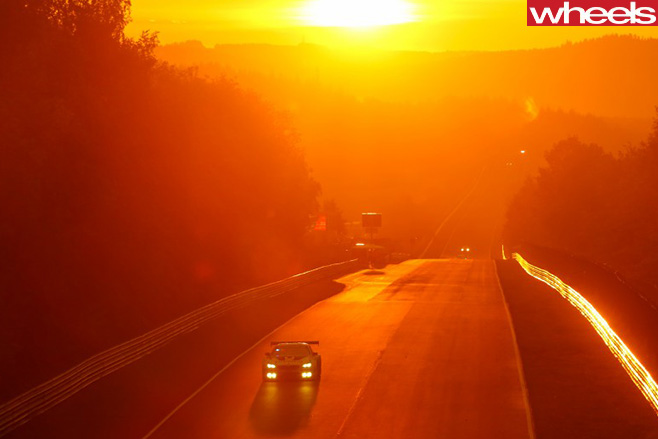
The endurance race started at 3.30pm on Saturday with polesitter Engel leading away the field under sunny skies. But then, after 49 minutes, a huge hailstorm slammed the circuit. Parts of the 25.4-kilometre combination of the Nürburgring GP circuit and the Nordschleife were impassable due to heavy hail. Dozens of cars slipped off the track.
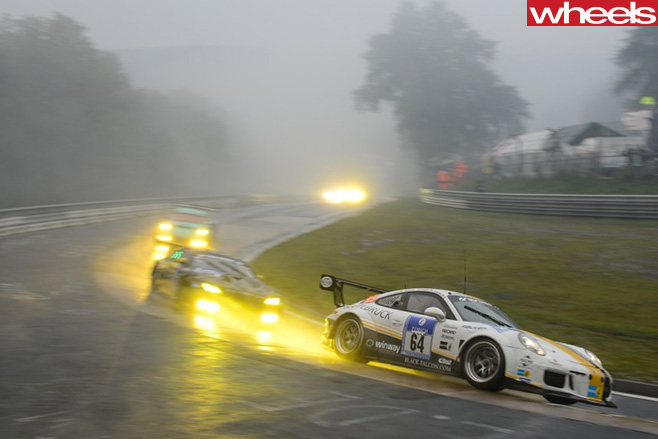
Racing resumed at 8pm local time on a still very wet track.
That is regulation Nurburgring, aka The Green Hell.
Reeves wins National Capital Rally
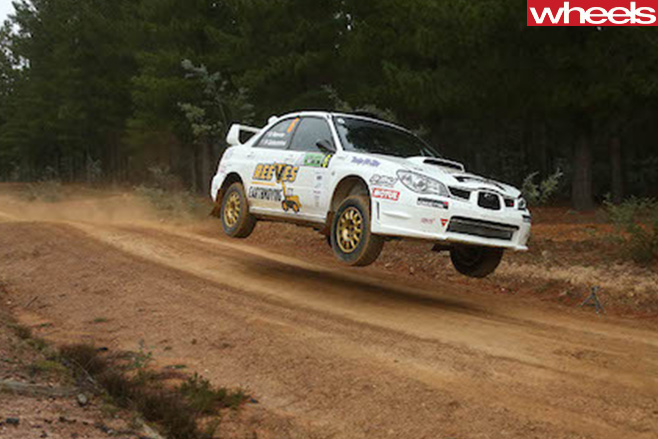
Despite their gearbox dramas in their Subaru Impreza WRX STI on the first day, Reeves took second behind Simon Evans (WRX) on a day when single-digit temperatures tested die-hard rally fans out in the forests.
Overnight, Reeves and his team replaced their broken “dog” gearbox with a standard one, courtesy of Tasmanian Craig Brookes.
Though Reeves had to modify his driving technique – left foot braking isn’t possible with a standard gearbox – he put championship leader Evans (Subaru) under pressure early into Sunday’s heat two stages. The multiple Australian champion lost time when he went wide and ended up in a ditch. From that point Reeves was never headed, taking the Sunday honours by more than a minute.
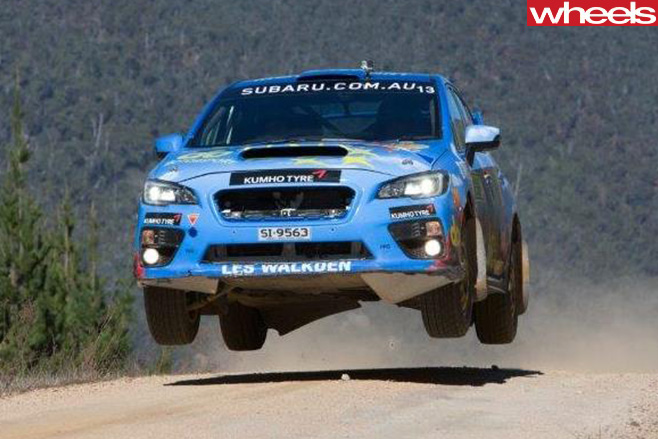
“It’s a fantastic feeling to win at Canberra again,” said Reeves, who won the event in 2014.
No-one could match the consistency of Reeves across the two days. Nathan Quinn (Lancer) backed up a third on Saturday with a second in heat two to be classified second overall for the weekend. And Evans charged back in Sunday’s afternoon stages to claim third for the weekend, just ahead of Molly Taylor (pictured above) in the Group N Production Subaru WRX STI.
Evans continues to top the points standings from Harry Bates (Toyota) and Taylor.
In the quest for lighter, faster and more powerful supercars, it’s not uncommon for manufacturers to go all-out on new engines, new materials and new technologies.
For their new supercar, however, the top brass at Audi decided that none of these were enough – the next R8 needed to be built in a completely new way, with new tools and in a brand new factory, and it needed to redefine ‘going all-out’.
As it happened, Audi had a few hundred million Euro lying around, so the big wigs got their wish: a brand new, state-of-the-art facility, right next to the Neckarsulm plant in Germany’s south. So, just three weeks after the last of the old R8s rolled off the line in the main Neckarsulm plant, the first of the new breed were already rolling out of a highly specialised site known as Böllinger Höfe.
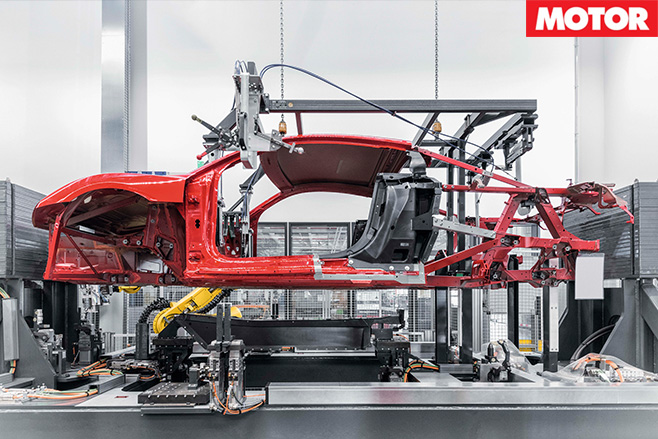
The R8’s new home, then, is an incredibly focused facility, dedicated to making only the fastest, most savage and least sane cars possible under the watchful eye of parent company Audi. That’s right – at least technically speaking – Böllinger Höfe isn’t an Audi factory; it’s the domain of the specialists, and mentalists, of the Quattro GmbH skunkworks. Quattro is responsible for the R8 and everything with an RS badge, as well as turn-key racers ready for action in endurance events across the globe.
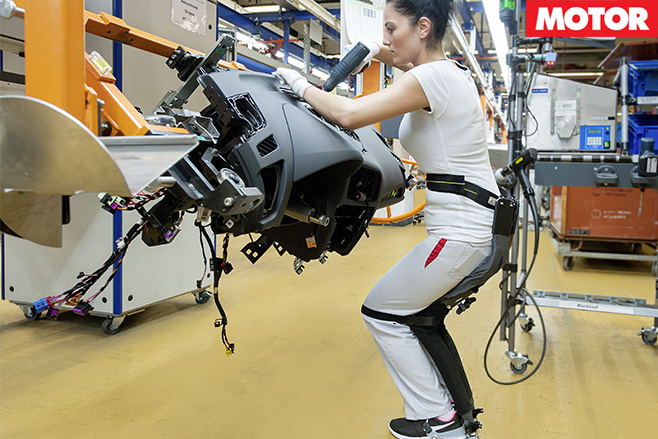
Take, for instance, the carbonfibre exoskeletons Audi is trialling for its main assembly workers, which augment their fragile human forms – at least for the duration of a shift. The exosuit reaches from an employee’s hips down to their feet and comes with hydraulically adjustable, carbon-reinforced plastic struts to match different body sizes.
And, while Neckarsulm workers spend their shift pretending to be the ABC Warrior from Judge Dredd, workers down at the Höfe can indulge their inner Jetsons fantasy by having R8 bodies delivered by a robot butler. Yes, science fiction has found a home in the Audi factory.
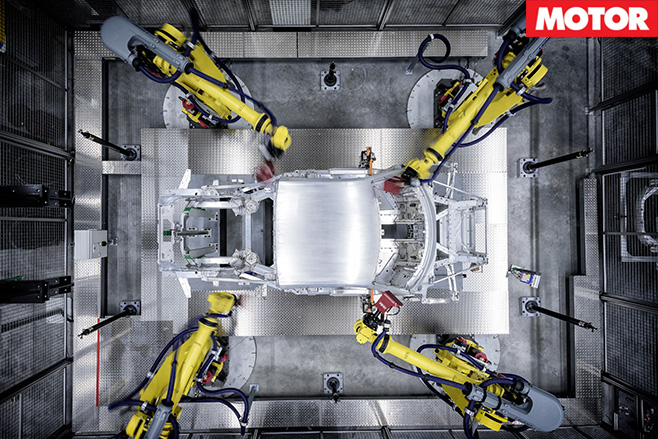
If one of the bodyshells needs to be pulled out of the ‘line’ for special attention, it’s just a case of asking R2-D2 to take the chassis in question to where it’s needed. The production of the other shells is unaffected, because no actual line has to be paused while the chassis is redirected.
This multi-stage production method means the specialist hands at Quattro can build road-going R8s and full-blown racers on the same assembly line, regardless of the fact the two models only share about 50 per cent of their parts.
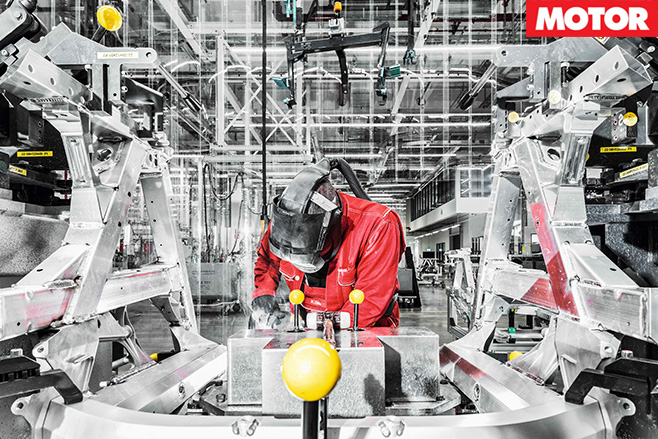
Coincidentally, Audi has already taken honours at the Daytona 24 Hour with a Böllinger-built R8 LMS. And, in early February 2016, the Phoenix Racing R8 LMS secured fourth spot at the Bathurst 12 Hour.
Production of the R8 itself is a maelstrom of science and sums. Audi says the final mixture for the chassis that underpins its new R8 is 70 per cent aluminium and 13 per cent carbonfibre-reinforced plastic (CFRP). The remaining 17 per cent is unexplained, so we’ll just assume it’s a subtle blend of rivets, unobtanium and Porsche-can-suck-it carbide. In any case, Audi claims the lightweight, multi-material frame helps its new R8 shed a full 50kg compared to its predecessor, so the mix must be fairly decent.
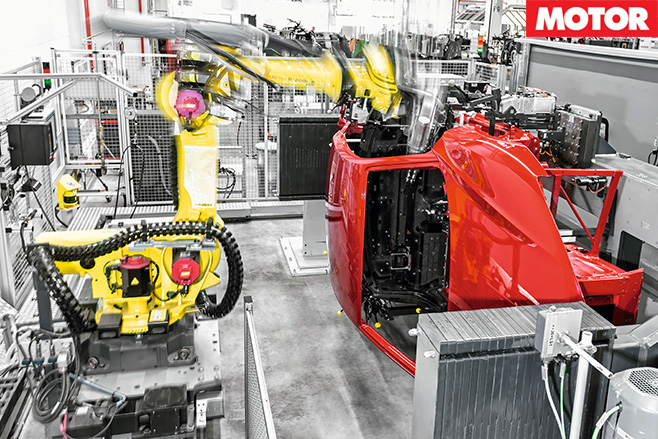
To make sure the R8 manages to be both hand-built and well-built, robots are still involved, but – crucially – only as a supporting act. Along the length of the build, robots and humans work in tandem; humans are responsible for 89 metres of delicate aluminium welding per car, but when it comes to the frame’s 1100-odd rivets and screws, the robots are brought in.
The same division of labour applies when it’s time to strengthen the aluminium frame with liberal swathes of CFRP. Robots cut the mounting points, dole out adhesive and fit certain pieces with literal laser precision. Then it’s time for those with hands and heartbeats to finish the job.
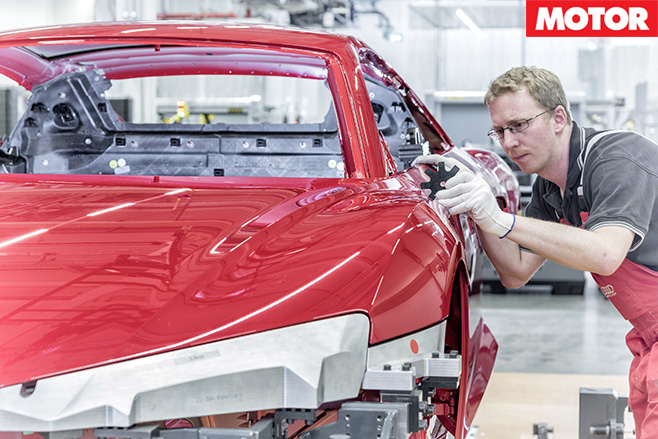
Panel gaps are measured to within fractions of a millimetre and quality testers dump 1200 litres of water on each R8 – just to make sure it’s watertight. Presumably, should someone ever get it wrong, they’d be banished from Böllinger and sent to make VW Jettas until they’ve served their penance.
Now, as hand-built as the R8 is, there are still places where it’s best for robots to take full control. A vat of electrified paint, for instance, is a good place for humans to avoid, but it’s where each R8 goes for a dip. The R8’s aluminium shell is negatively charged, then submerged in a giant tub of what basically amounts to positively charged undercoat, undergoing a process called electrophoretic deposition.
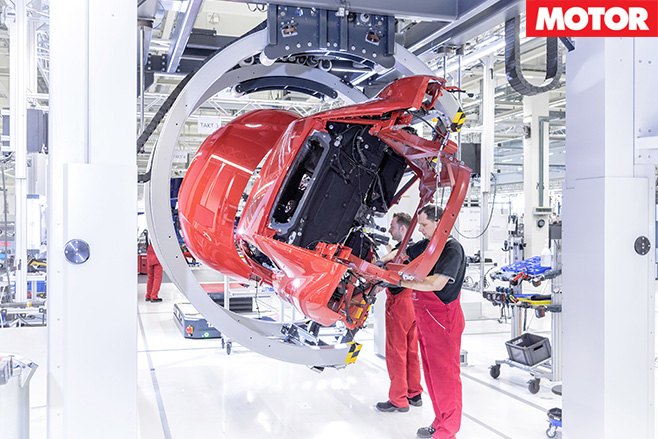
Another robots-only area is the oven, where each R8 goes through a double bake – once at a heady 200°C to cure the electro-painted aluminium and again at a less severe 80°C to sort out the CFRP and adhesive.
In a factory that’s as incredible as Böllinger Höfe, the most amazing bit is that everything – robot butlers, electrified paint and quality controllers with OCD and Michael Jackson’s gloves – is happening under one roof, making it the first time the R8 has enjoyed such exclusive treatment.
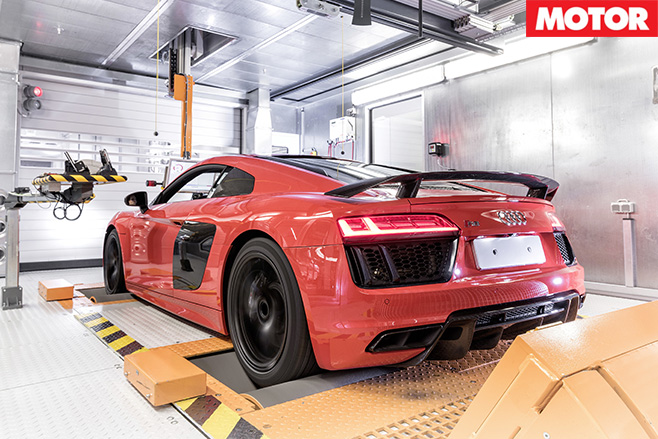
Luckily for us, everyone’s attention seems to be focused on just one thing: the new R8.
Dazzling Digits
Making R8 – in numbers
40 R8s built per day at Böllinger Höfe, compared to 2000 Audis at Ingolstadt
50kg Weight saved in new R8 due to increased use of lighter chassis materials
70% Aluminium – the chassis of new R8; 13 per cent is CFRP
200°C The R8 is cooked in an oven to cure the electro-painted aluminium
1200L To make sure each R8 is watertight, testers dump a spa’s worth of H2O on each
Police are taking new steps to hunt down texting drivers, introducing technology that can spot not-so-smart smartphone users up to 1.2 kilometres away.
The Royal Canadian Mounted Police have taken to the province of British Columbia with spotting scopes that are attached to a high-resolution digital SLR camera equipped with fast shutter speed capability.
“Traffic services have used spotting scopes for years, but the new part of this technology is now we have a spotting scope we can actually attach a DSLR camera with 24.2 megapixels and a 50 millimeter lens,” RCMP Constable Melissa Wutke told Canadian news service CBC.
“So we attach that camera to our scope and that allows us to see 1200 metres [away].”
Officers are focusing on intersections, where distracted driving can be both particularly prevalent and dangerous.
The special scope allows them to see offending drivers without being seen themselves. If they spy a driver texting, the officer can take a photograph for evidence and radio to a colleague closer to the intersection to pull over the offending motorist.
Constable Wutke told CBC the RCMP was also targeting other forms of distracted driving, such as putting on make-up or eating a bowl of cereal.
Which Car has previously reported on how New York City police will soon be implementing new ‘textalyser’ technology, which will allow roadside officers to scan a driver’s smartphone for recent activity if there’s a suspicion of distracted driving.
Citroen has teamed up with Aussie surf brand, Rip Curl, to release a special edition C4 Cactus.
Almost two months after the French car maker revealed its C4 Cactus Rip Curl at the Geneva International Motor Show, the special edition has been released in Europe with the first cars going on sale in the UK on June 1.
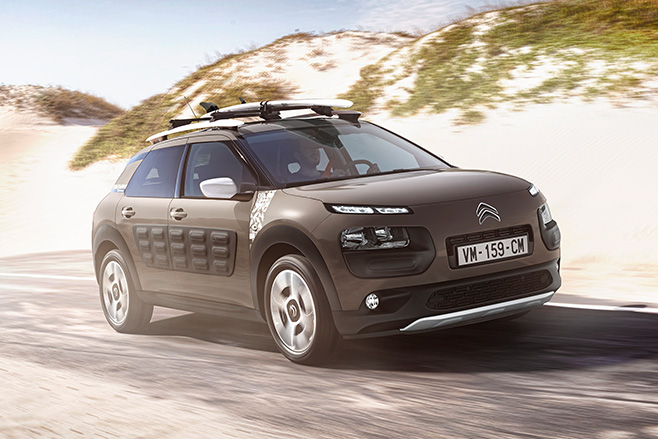
Despite its connection to the Aussie surf brand, Citroen Australia says it has no plans to release the Cactus Rip Curl on Australian shores at this stage.
“Given the Cactus was only introduced to Australia eight weeks ago (in March), limited editions like this aren’t planned this early in the life cycle,” Citroen spokeman Tyson Bowen said.
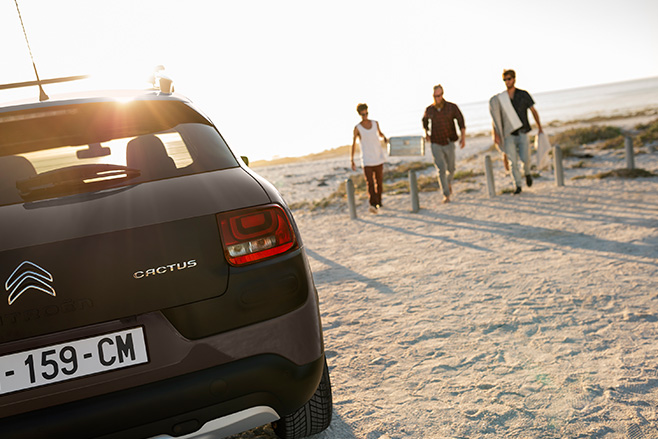
The Cactus Rip Curl Special Edition is more than just a design collaboration, though there’s evidence of that thanks to the sticker graphics on the wing, white treatment of the side mirrors and roof racks, and plenty of branding homage to Rip Curl.
What the surfer’s car really brings to the table is a toughness that’s missing on the standard Cactus. Aside from protective front and rear skid plates, the Cactus Rip Curl adds Citroen’s Grip Control to the front-wheel drive car. This technology gives the concept-like Cactus traction modes for sand, off-road and snow driving, and the ability to turn off electronic stability control (ESC).
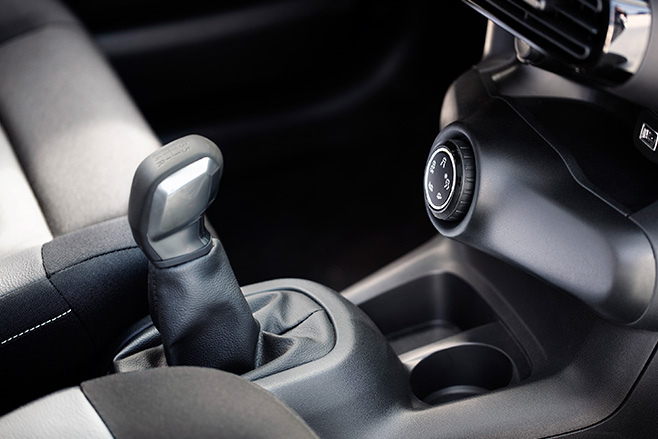
But Citroen has held on to the Cactus’ colourful personality. Inside, it embraces all things orange, from seatbelts to detailing on the speakers and carpet mats, while its exterior body has five different colour offers: Obsidian Black, Arctic Steel, Pearl White, Sport Red and Tapenade Grey.
While the French car won’t be making an appearance in Australia in the next couple of years, Citroen Australia has said the C4 Cactus Rip Curl isn’t off the table completely.
While the road toll rose in 2015, your chance of being killed on Australian roads is still miniscule.
First published in the March 2016 issue of Wheels magazine, Australia’s most experienced and most trusted car magazine since 1953.
Earlier this year there was a call by a road safety expert for 40km/h zones in Victoria to be lowered to 30km/h. He said this move would deliver substantial safety and public health benefits. Give me a break.
Bruce Corben’s pedestrian-focused proposal might have been a response to the increase in fatalities on Victorian roads last year. In 2015, 258 people died, eight more than the year before and 15 more than the 2013 total of 243, the lowest ever recorded in the state.
But Dr Corben has worked as a researcher for the Monash University Accident Research Centre, so we have to assume he was aware of the 2015 figures, which include a reduction in pedestrian deaths from 44 in 2014 to 33 last year, a considerable drop by any measure.
Dr Corben justified his 30km/h proposal by saying, “It is simply a matter of physics and acknowledging that humans can withstand only a limited amount of energy in a collision before the risk of injury or death starts to rise rapidly.”
That word ‘risk’ is a doozy. It’s wielded by road safety experts as a bludgeon against cogent counter-argument. That and the ridiculous throwaway line, “If it saves one life, it’s worth it.”
If we truly want to adhere to that statement, then outlaw cars altogether. And trucks and buses and bicycles and horses, and any ‘conveyance’ that can move a human faster than we can run. In fact, better outlaw running too because if two humans run into each other, then severe injury and possibly death will result. And remember, if it saves one life, it’s worth it.
Can we please lay that overly simplistic line to rest and instead have an educated discussion about making our roads safer?
As for that word risk, let’s look more closely.
Nationally, 1209 people died on our roads last year. That’s 5.1 deaths per 100,000 people. Based on that, there is a 0.0051 percent ‘chance’ that you will die on Australian roads in the next 12 months.
Is it not an admirable achievement to get road safety to the point where the risk of death is so small? Should we not be congratulating our legislators and road builders and car companies in getting an inherently dangerous activity undertaken by millions of Australians every day to the point where the risk really is miniscule?
The problem with acknowledging that we have achieved remarkable things in making our roads safer comes as soon as there’s a face behind the fatality. What if it was somebody I knew? My sister? A close friend? Would I still think the risk was acceptable?
I agree that every human life lost on Australian roads is a tragedy. A tragedy I personally witnessed when two drunk young men crashed heavily near a country motel in which I was staying. I was one of a dozen bystanders who got them out of the car before it caught fire, and I watched as their lives slipped away before the ambulance could get there.
I would be devastated if one of my family or close friends died on our roads. But I’m realistic enough to know that it happens. Just like planes crash, and non-smokers die from cancer. Life is not without risks, and while we should never stop working to minimise the risks, balance is required.
Road transport is there to get us from A to B. Let’s acknowledge how far we’ve come, and never stop searching for ways to make it even safer. But let’s not forget its fundamental purpose.
National road toll at three-year high
The Australian road toll rose 4.9 percent to 1209 in 2015, the highest since 2012. Only South Australia (102 deaths, down 5 percent) and Western Australia (160, down 13 percent) improved their safety record year on year. The worst-performing state or territory by percentage was the ACT, with a 50 percent increase from 10 to 15 deaths. NSW had the highest road toll with 348 (up 13 percent), followed by Victoria on 257 (up 3 percent) and Queensland on 242 (up 8 percent). Tasmania’s road toll was up one to 36, the Northern Territory up 10 to 49.
It’s crunch time, kids. It ain’t no news flash, but if you want to buy a brand-new muscle car for sensible money in the next couple of years, chances are it’s going to come from the US. Fact.
But is that the end of the world? Will a move to US-sourced iron rob us of everything that Aussie muscle has come to represent? Are US-made performance cars as bleak – in some aspects – as they used to be?
See, for those of us who buy razors rather than zit cream, the world of factory muscle cars has always drawn some pretty trustworthy lines in the hi-po sand. It’s a bit of an us-versus-them thing, and over the years several defining features of each have emerged and been subsequently set in stone.
But as the Aussie industry winds down and we look to the US of A for our next generation of boredom-beaters, do any of those old rules still apply? And, if so, which ones? Does an Australian muscle car still stand out from a Yankee one?
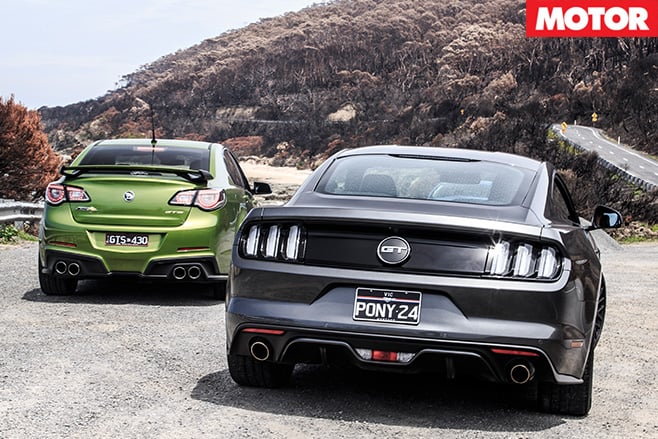
Holding the two brochures up together, it soon becomes clear that maybe some of those diehard rules of engagement no longer apply. I’ll start you off with an easy one: Engine displacement. Now, back in the good old days, the Septics dead-set had the wood on us in that department. As long as a Torana with a six-potter could win Bathurst, the local car-makers figured a small-block was as big as we needed to go. Not so in the US, where the big-block ruled the roads and, thanks to whole banks of carburettors and eight-plus litres, horsepower outputs in multiples of 100 were the order of the day. That, however, was then.
Oh, how we laughed when we first saw the specs for the VF HSV GTS. Not only was the engine embiggened over its Holden Commodore basis (although the Commy has caught up cube-wise in VF Series II trim) but those 6.2 litres were then blown by a dirty great twin-screw pump.
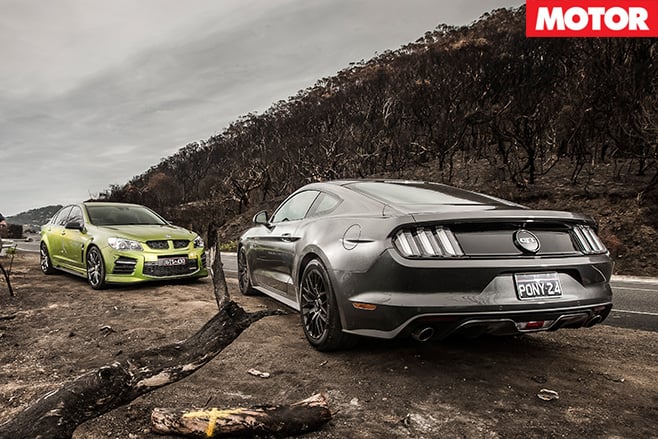
Tradition one shot to bits. That said, the V8 in the Mustang is a bloody good atmo 5.0-litre and it sounds and feels at least a litre bigger than that. It goes hard, too, and despite handing back 1.2 litres and nine psi, it’s less than a second slower across 400m.
Mind you, that 0.9 of a tick at the pointy end of a 12-second car (in the GTS’s case) is still a big deficit. And while the Ford does feel muscular and lively, it’s never the wrecking ball in the back of your strides that the GTS is. If the Mustang’s Coyote was all you could get your hands on, you’d still be chuffed. But knowing that the HSV’s LSA exists will always leave you wondering what might have been. You’ll get it in the neck at the pump, though, and while the Mustang is no sipper, with 13.8L/100km on test, the HSV gurgled away 16.2L/100km.
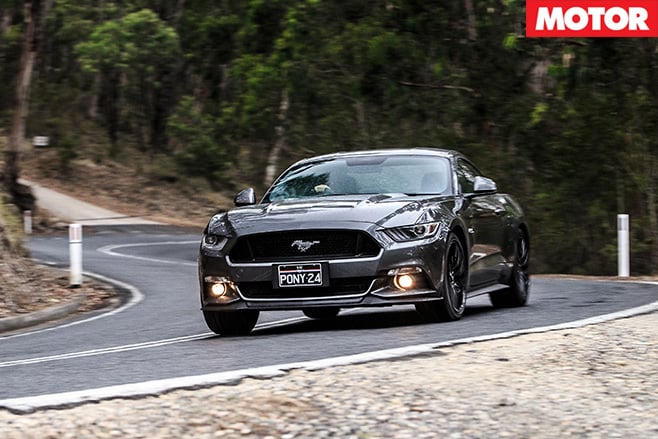
The HSV’s can’t be fiddled (but feels to be calibrated just-so anyway) while the Mustang’s launch function can be varied to set sail at anything from 3000 to 4500rpm. On the day, we found 3100 to be just right and 3300 was a tad too much. Yep, it’s that sensitive. Folks like AMG and BMW should take a long, hard look at how these systems work, because their own set-ups are pants by comparison.
So what about handling and ride? We’ve always been kind of proud of our Aussie engineers for their ability to turn a big heavy car into something with a decent sidestep. Similarly, the myth of the Yank Tank, the land-yacht, the boulevardier, is well entrenched, with plenty of proof to be seen in previous US makes and models.
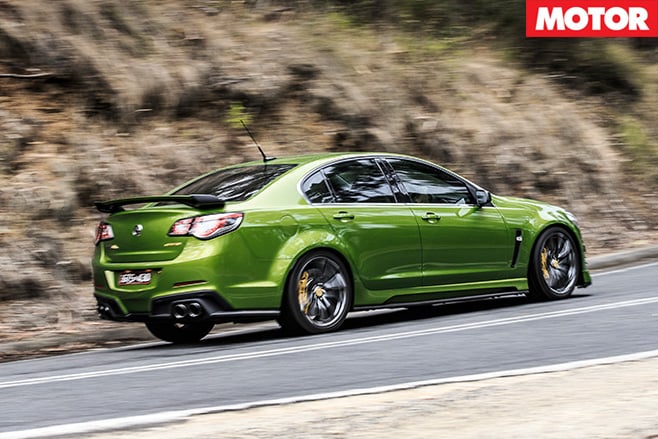
The Mustang also has selectable drive modes, but they do bugger-all for the ride quality. But that’s okay, because the ’Stang’s ride is only a fraction sharper than the GTS’s Tour mode. The Ford is also less crashy, and ultimately, better damped, with less secondary jounce. And while really big lumps will launch the HSV on a successful search for its front bump stops, there’s no such carry-on from the Mustang. And just to rub salt into things, the ’Stang is a more natural steerer on those quickish secondary roads; the slightly more accurate helm also makes the Ford feel smaller and narrower (even though it’s really not).
All right, let’s talk tech. It’s often been noted that US-made cars don’t always encompass the cutting-edge techo stuff that other cars – Australian included – seem to embrace a lot earlier. In a way, that still holds true, because while the HSV gets driver-aid gizmos like lane-assist, blind-spot warning and forward-collision warning, the Ford has no such thing. Oh sure, the Mustang gets a total of eight airbags, including one each for the driver’s and passenger’s knees, but experience tells us that a car usually only gets knee-bags because it needs them.
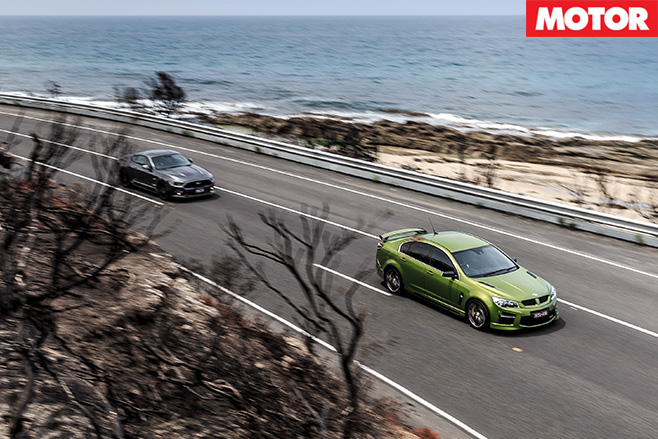
In the HSV, it’s all contained in Track mode, while in the Ford it’s called Race mode. But since, in the ’Stang, the toggles only work one way, you need to cycle through Race mode to get back to the normal settings. And Race mode switches off the ESP, so for a split second you might find that ESP is disabled when all you wanted was to go back to a normal setting. And if the ducks-of-death happened to line up in that split second…
But surely, the Ford must follow Stateside tradition and offer up all those little luxuries that the average US tub-o-consumer has demanded for years? Well, maybe, maybe not. The Mustang’s convenience-item list might be a long one back in Detroit (where a stolen shopping trolley is now basic transport) but against the HSV, it can’t cut it.
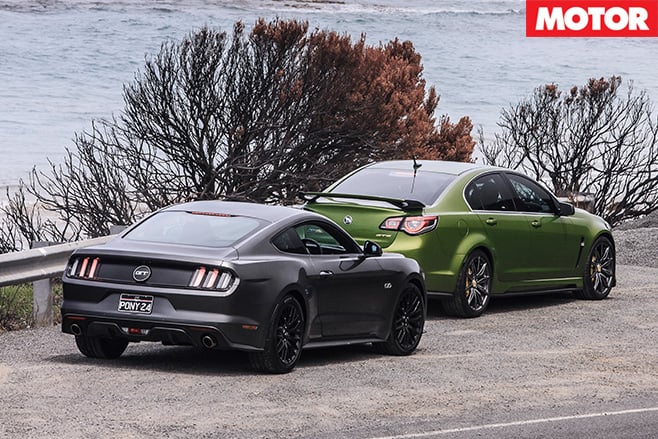
The Ford also suffers from a couple of cheap shots that hark back to its original left-hand-drive spec: The park-brake is on the passenger’s side of the console (but at least it’s not an e-brake like the HSV gets) and the tune and volume knobs on the stereo are the wrong way around.
Speaking of which, the Mustang’s interior also supports another widely held theory that US cars have rubbish interiors and can’t match the Aussie stuff for build quality. And we’d have to agree. The ’Stang has lots of hard, black plastic and the fit and finish is nowhere near the HSV’s. Both have some brightwork around the dashboard that’s just a reflective nightmare under the Aussie sun. And stowage space? Geez, both have gone backwards.
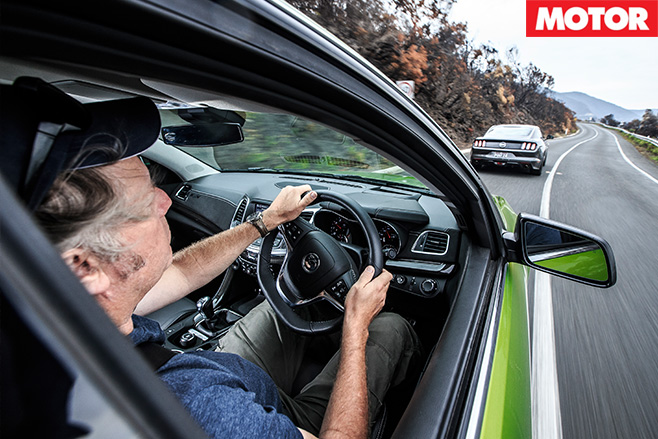
So where does this all leave us? Well, it shows that we’ll absolutely miss the wallop that only a supercharged engine with a capacity north of six litres can provide. And the loss of the local flavour as it pertains to interiors and packaging will likewise play a sad little tune on our heartstrings. But equally, the new Mustang proves that somebody on the other side of the Pacific has been paying attention and that there are at least some folks in white coats who are grooving to the same tunes.
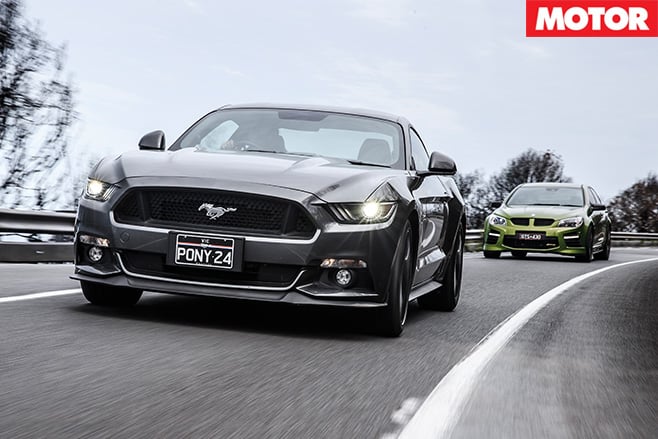
It is, of course, the least the Yanks can do. I mean, they gave us the Kardashians, right? They owe us.
| u00a0 | FORD MUSTANG GT | HSV GTS GEN-F2 |
| Body | 2-door, 4-seat coupe | 4-door, 5-seat sedan |
| Drive | rear-wheel | rear-wheel |
| Engine | 4951cc V8, DOHC, 32v | 6162cc V8, OHV, 16v, supercharged |
| Bore/stroke | 92.2 x 92.7mm | 103.1 x 91.95mm |
| Compression | 11.0:1 | 10.7:1 |
| Power | 306kW @ 6500rpm | 430kW @ 5900rpm |
| Torque | 530Nm @ 4250rpm | 740Nm @ 4200rpm |
| Power/weight | 176kW/tonne | 234kW/tonne |
| Transmission | 6-speed manual | 6-speed manual |
| Weight | 1739kg | 1841kg |
| Suspension(F) | struts, anti-roll bar | struts, adaptive dampers, anti-roll bar |
| Suspension(R) | multi-links, anti-roll bar | multi-links, adaptive dampers, anti-roll bar |
| L/W/H | 4784/2080/1381mm | 4943/1899/1467mm |
| Wheelbase | 2720mm | 2915mm |
| Tracks | 1582/1655mm (f/r) | 1586/1628mm (f/r) |
| Steering | electrically-assisted rack-and-pinion | electrically-assisted rack-and-pinion |
| Brakes(F) | 380mm ventilated discs, 6-piston calipers | 390mm ventilated discs, 6-piston calipers |
| Brakes(R) | 330mm ventilated discs, single-piston calipers | 372mm ventilated discs, 4-piston calipers |
| Wheels | 19.0 x 9.0-inch (f); 19.0 x 9.5-inch (r) | 20.0 x 8.5-inch (f); 20 x 9.5-inch (r) |
| Tyre Sizes | 255/40 R19 (f); 275/40 R19 (r)u00a0 | 255/35 R20 (f); 275/35 R20 (r) |
| Tyre | Pirelli P-Zero | Continental ContiSportContact |
| Price as tested | $57,490 | $95,990 |
| Pros | Sweet V8; excellent tourer; value | Stonking supercharged grunt; finely-tuned handilng |
| Cons | Flimsy build, lacks straight-line grunt; on-limit handling | Terse ride; fearsome thirst |
| Star Rating | 4/5 | 4.5/5 |
