
FORMER Holden design boss Mike Simcoe – the man who brought the Monaro back to Australia in 2001 – has been promoted to the position of vice president of General Motors design.
Simcoe, who started with Holden in 1983 and was influential in vehicles such as the VT and VE Commodores, will move into the new role on May 1, replacing 44-year GM veteran Ed Welburn for the most senior design job in one of the world’s biggest car companies.
Simcoe is only the seventh design chief in GM’s 100-year-plus history.
In announcing the promotion for Simcoe – making him the most senior Australian currently working in the global automotive industry – former Holden boss and the current vice president of product development, Mark Reuss, praised Welburn’s 13-year tenure as the boss of GM design. He also reflected on Simcoe’s expertise and respect within the company and the automotive industry generally.
“Given his deep global experience and passion for breakthrough design, Michael is the right person to lead GM Global Design,” said Reuss. “He is known for his ability to take diverse ideas and mold them into great products that surprise and delight our customers.”
Holden’s Melbourne-based Australian design team – officially GM Australia Design – plays an instrumental role in the global GM design world.
As well as assisting with the look of upcoming production models, Australian designers play a key role in advanced design, which involves developing one-off concept cars that set and reflect future trends.
Simcoe is set to become one of the most influential Australians who have become major forces in the global automotive industry. They include former Ford president Jac Nasser, former Jaguar and Land Rover boss Geoff Polites and former GM China boss Kevin Wale.
Wheels will be talking to Mike Simcoe this morning and will publish a story with his comments.
Back in 1985, when telephones still had cords, people still read newspapers and reality TV meant watching the footy replay on a Saturday night, Mercedes-Benz’s entire model range – 190E, Mercedes-Benz E-Class, S-Class, SEC, SL, G-Wagen – would have fit in a modest showroom.
Today you’d almost need an entire block on Parramatta Road because no fewer than 15 model lines now carry the three-pointed star, with more coming as the frenzied cadence of new model launches from Stuttgart continues at full throttle.
In 1985 the W124 E-Class was the core model of the line-up. Quietly elegant, deeply capable and, despite some initial quality glitches, fundamentally bulletproof, the W124 is today widely regarded as a benchmark Benz, the engineer’s E-Class. But the brand-new W213 E-Class, which made its world debut at the North American International Auto Show in Detroit, may prove to be no less significant.
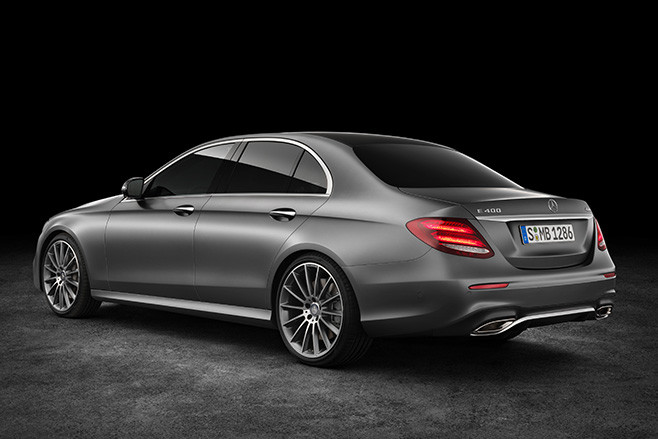
The W213 is the centrepiece of Daimler’s new MRA rear-drive architecture strategy. MRA also underpins the new Mercedes-Benz C-Class and the Mercedes-Benz GLC. Both those vehicles were launched before the W213, but when MRA was conceived it was the E-Class that was top of mind among the engineers. Why? Because no other Mercedes-Benz model has such a diverse customer base, from phlegmatic taxi drivers in Dortmund to well-coiffed Double Bay matrons and hard-driving enthusiasts in Dubai.
At first glance it would seem impossible to engineer one car that does it all, and does it all well; the demands of one customer group must surely compromise the desires of the other. Not so, says W213 chief engineer Michael Kelz: “In the end there’s a benefit for every customer.” The Dortmund taxi driver, he explains, gets a car that has a light and rigid body structure, while the AMG owner in Dubai benefits from components that are produced in large volumes and so are less expensive.
MRA allows components to be freely mixed and matched, cutting costs. There is, however, one constant, regardless of whether the end product is E-Class, C-Class, GLC or the forthcoming third-gen CLS, which will be the next MRA-based car – the distance from the front axle centreline to the front-seat mounting points. The apparent dimensional difference in the GLC is a trick of the tape, Kelz explains. You sit higher in the GLC, and that automatically moves the H-point forward. The floor stampings used for both the GLC and the W213 are in fact identical.
But MRA is just part of the story. The W213 also debuts an all-new electronic architecture that delivers near-autonomous driving capability; it will ultimately be used across the Mercedes range, even in the flagship S-Class.
“The classical engineering was a lot work,” says Kelz, “but in the end the really major challenge in developing this E-Class was the electrical architecture, especially as it will be the basis for all the cars coming in the future.”
The world has changed a lot over the past 30 years. In 1985, the E-Class sedan was the touchstone Mercedes-Benz, the car that defined the very essence of the brand. Three decades later it still is.
IT’S BUSINESS
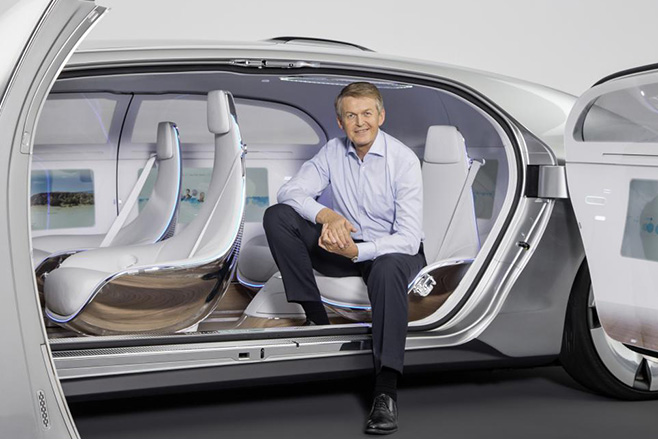
“We have focused intensively on the trend to SUVs,” says Daimler research chief Thomas Weber (pictured above), “but if you look on a global perspective, sedans are still the base of mobility, especially among businessmen, and it will stay that way.” Weber’s point is that, while the S-Class might be for plutocrats, the E-Class is often the company car of choice for the senior managers who run their businesses for them.
This article was originally published in Wheels magazine March 2016
The next generation of Mazda’s big SUV, the Mazda CX-9, is due mid-year and it’s said to address the current model’s biggest weakness – fuel thirst – while bringing extra safety and convenience equipment, and a new flagship atop a four-tiered line-up.
A new 2.5-litre four-cylinder petrol engine will cut official fuel consumption by more than 20 percent – as much as 27.6 percent in city driving, in some versions – while delivering low speed power to rival the outgoing 3.7-litre V6, with thanks to a turbocharger. This improvement in efficiency will make the new CX-9 the most economical SUV available, among seven-seater petrol peers.
Mazda claims the new engine is also more refined, which should make the CX-9 a quieter and more pleasant family car, and the inclusion of automatic stop-start, and brake energy regeneration and storage systems will also help save money on fuel, as will the fact the CX-9 uses ordinary 91 RON petrol rather than pricier premium.
The Japanese designed and built wagon will offer advanced safety features such as autonomous emergency braking, blind-spot monitoring, lane-departure warning and rear cross-traffic alert systems, which will come standard on the high-level versions and are likely to be also available as part of an optional safety pack.
A reversing camera and parking sensors as expected as standard across the range, as is a count of at least six airbags protecting all three rows of occupants.
Mazda’s MZD-connect touchscreen infotainment interface and satellite navigation will also come standard, and upper versions will bring extras such as leather interior trim, a sunroof and larger, nicer-looking alloy wheels.
There will be four versions of the new Mazda CX-9, from the entry-level Sport, via the mid and high level Touring and GT, to the flagship Azami, with a choice of front-wheel-drive or on-demand all-wheel-drive.
Check out the current Mazda CX-9 range here.
Aston Martin is viewing the demise of the manual supercar as a unique opportunity, adding a seven-speed DIY-shifter as a V12 Vantage S option.
Not only is the V12 Vantage S now available with a manual transmission, but also it is a dog-leg unit that places first gear to the lower left of the double H-pattern that takes care of the six higher ratios.
Aston Martin says the aim of the design “ensures the gears used most frequently are located in a double H-pattern like that of a conventional six-speed manual” and it is designed to “unashamedly champion classic tradition and total driver engagement.”
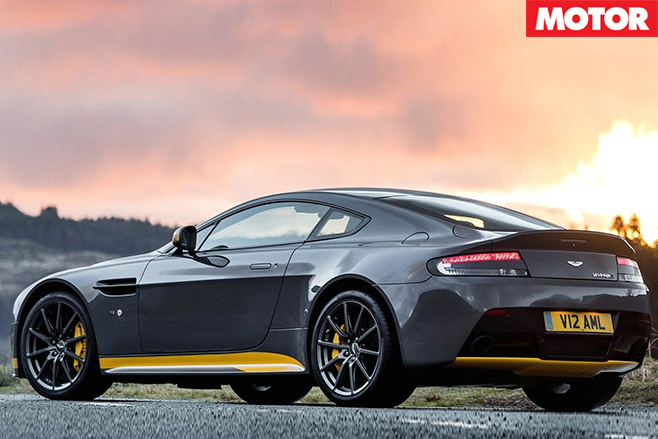
“At a time when manual transmissions have almost entirely disappeared in high performance cars, this makes the manual V12 Vantage S a very special car indeed.”
Aston Martin CEO Andy Palmer went a step further: “Broadening the scope of the V12 Vantage S with a manual transmission option is an indication of our desire to offer the keenest drivers a more analogue and immersive machine to enjoy.”
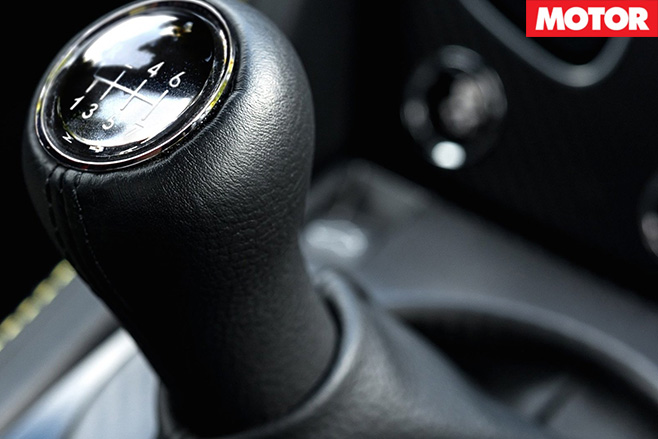
The rear-mid mounted manual transmission is a variation of the seven-speed Sportshift III automated manual long available in the V12 Vantage S, adding a clutch pedal in the driver footwell instead of being robotically actuated.
The manual also features a throttle-blipping rev-matching function called AMSHIFT. Both transmissions contribute to an identical 1665kg kerb weight and link with the 421kW/620Nm 5.9-litre V12 engine to achieve a claimed 3.9-second 0-100km/h.
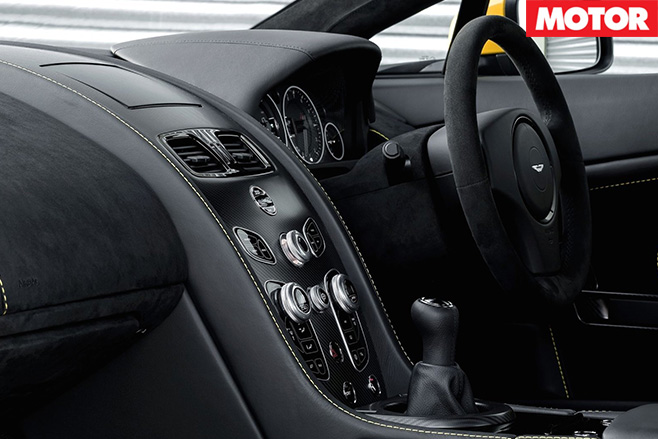
Along with the adoption of a manual for V12 Vantage S, the entry-level V8 Vantage GT coupe and roadster have also been dropped, replaced by the V8 Vantage S in each bodystyle with either manual or automated manual.
Here’s your chance to buy a piece of British royalty. It’s a 2012 Bentley Mulsanne owned and used by Her Royal Majesty herself, Queen Elizabeth, and it’s up for sale.
The Bentley is listed by a dealership in Surrey, England on car-trading website Auto Trader for £199,850.
Convert that to Aussie dollars and the stately limo will set you back around $371,000, which while a lot of money, isn’t actually that outrageous given its royal pedigree.
A brand new Mulsanne will set you back $662,857, and some quick digging revealed you’ll pay over $400,000 for a second hand Mulsanne of similar age and mileage in Australia.
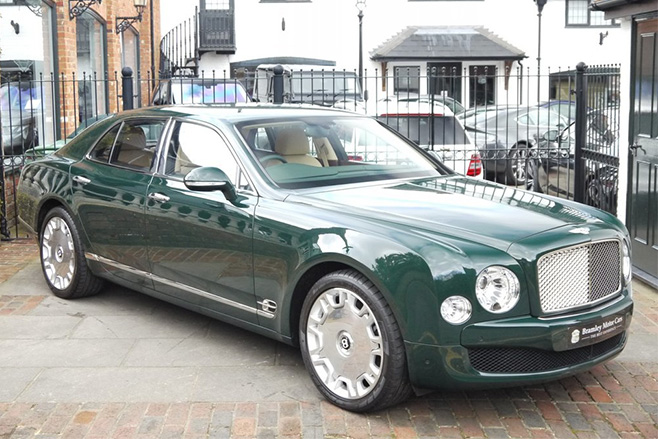
Joining the royal service in 2012, the Queen’s Bentley is finished in regal Barnato green paint and boasts a leather interior with walnut trim. Other royal touches include fold down tables in the rear seats and the satellite navigation system lists Windsor Castle as the home address.
HM Queen Elizabeth II used the Bentley to transport her to special occasions between 2012 and 2014, including her Diamond Jubilee celebrations and also for a visit to the Prime Minister at No. 10 Downing Street.
Under the bonnet lies a powerful 6.8-litre V8 engine capable of propelling the huge sedan from 0-100km/h in just over five seconds, though we doubt this Mulsanne has ever crept above a stately pace.
At the very least it proves the Queens has exquisite automotive taste. Her Royal Majesty has a long history of prestigious royal vehicles, with previous rides including Range Rovers and Jaguars.
The Bentley Mulsanne is one of the top 10 most expensive cars. Check out what else made the list.
When the next-generation Jeep Wrangler becomes available, possibly in 2018, a dual-cab ute will be built as part of the range.
Dubbed the JL Wrangler, it’ll go into production in the latter part of 2017. It’s part of an extended Wrangler line-up that will also include diesel models for the USA.
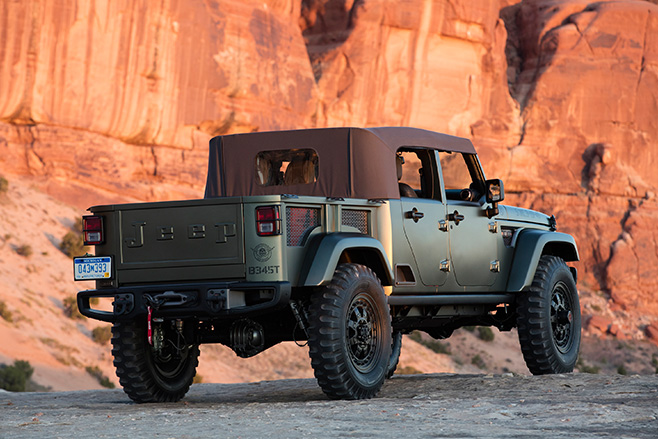
“We’re looking at extending that (Wrangler) line beyond just two- and four-door variants that we have today with the pick-up,” said Zac Loo, head of product strategy and marketing at FCA.
This comes after the Easter Jeep Safari where we saw a range on concept vehicles including the Crew Chief concept double-cab.
The double-cab Wrangler has been around for some time, built by American Expedition Vehicles (AEV) but with FCA offering should be more affordable.
For more information, go to www.4x4australia.com.au
Ford’s racing to keep up with Australia’s overwhelming appetite for its brand new Mustang.
Being the first made-for-Oz Pony car offered here, local interest has exploded and today’s waiting list stretches long as 6000 people – significantly more than the 1000 orders Ford expected when the car was first announced.
It won’t be able to clear that order book anytime soon, but Ford announced it has snaffled an extra 2000 Mustangs to meet burgeoning demand.
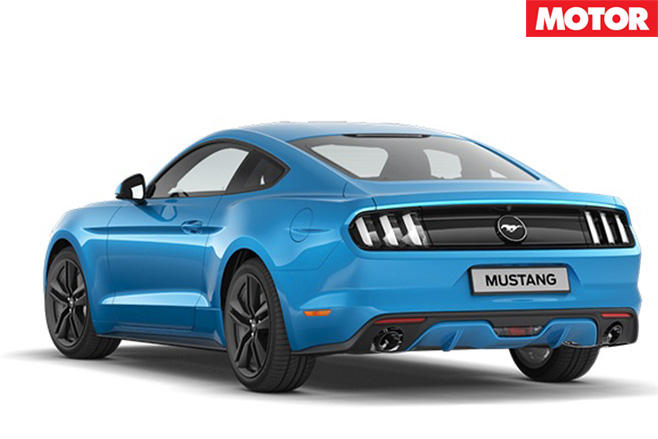
No mechanical changes are planned as part of the 2017MY update. However, the new Mustangs will receive Ford’s latest infotainment technology called SYNC 3.
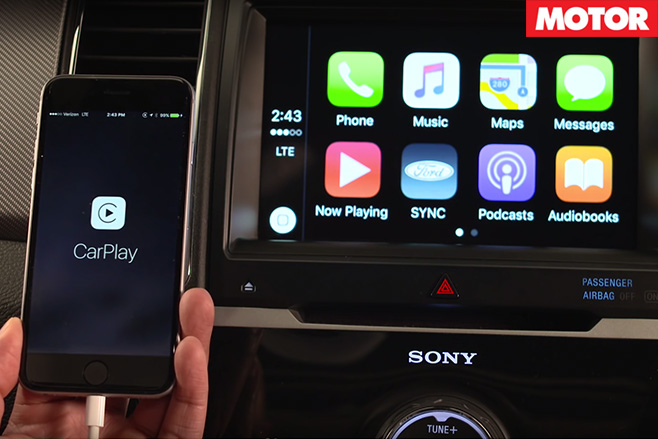
This introduces a host of new features on top of Ford’s SYNC 2, which is currently found in models like the FG X Ford Falcon, such as Apple Carplay (which lets you do things like synchronise Siri and navigation commands from your phone), Android Auto and Ford Applink 3.0. It also crucially updates to a smartphone-style user interface for increased ease of use.
EcoBoost models, which make up 40 per cent of convertible Mustang sales, will also come with a spare wheel, while Mustang GT customers will miss out on the spare tube due to the car’s large front Brembo brakes.
Ford has also confirmed prices across the Mustang range will not change when the 2017MY models arrive this third quarter.
Remember those little red cars with the yellow roof? Well, a fellow by the name of John Bitmead from Bicester, Oxfordshire spent four months creating an adult-size version.
John copied every detail, from the bright red body, to the glassless windows, and even added some enlarged drink holders. Except, rather than having to drop your feet through the floor and run like Fred Flinstone, John’s creation gets its power from an 800cc engine; allowing this Little Tikes mobile to sprint to 100km/h in just 17 seconds.
John started with a Daewoo Matiz and spent over 16 weeks turning it into the ‘Crazy Coupe’ that it is today. Last year, the car was put on Ebay along with the caption:
‘We have covered over 5,000 miles in the past two years driving around shows and charity events in the UK and apart from it not being the fastest car on the planet has been the most incredible fun with people queuing up to take photos along dual carriageways and highways on every trip. Guaranteed to create smiles wherever it goes!’
Despite a couple of enquiries, it never sold, so for now, Bitmead is holding on tight to his little red and yellow Crazy Coupe, and even using it to continue to make people smile at various charity events.As the old saying goes, “Growing old is mandatory; growing up is optional”.
Want more? Check out this Tesla Model S for kids.
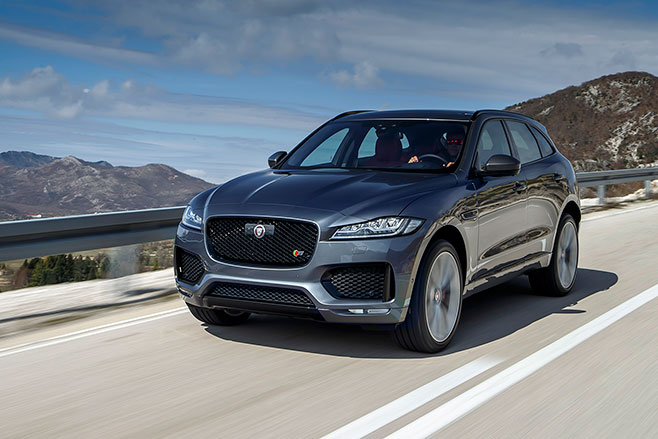
THE birthplace of the posh SUV spawns a surprisingly roomy and entertaining nemesis for the Porsche Macan and Audi Q5 – the Jaguar F-Pace.
WHAT IS IT?
The British marque’s first-ever SUV, 13 years after Porsche proved there was money to be made – lots of it – in leveraging a sports car’s brand image via a family-friendly ‘4WD’. Like others in its field, the Jaguar F-Pace will also be available in rear-wheel drive, and a manual gearbox, however Australia will be exclusively all-wheel drive and automatic.
WHY WE’RE TESTING IT?
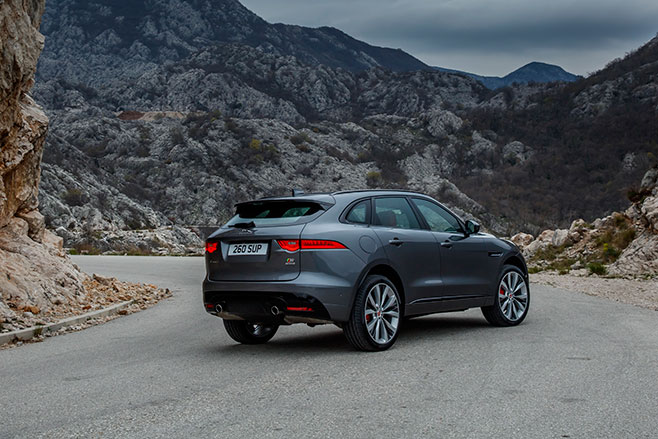
Jaguar has made big claims about the F-Pace, including Macan-rivalling dynamics and class-beating space. In fact, the F-Pace owes quite a lot to the Macan and its benchmark handling and driver appeal. Having appeared late in the F-Pace’s development cycle, Jaguar’s engineers were determined to produce an SUV that could (literally) stand tall alongside the Stuttgart stormer, while maintaining Jaguar’s long-held reputation for comfort. This is our first international drive of the F-Pace.
MAIN RIVALS
Porsche Macan, Mercedes-Benz GLC and GLC Coupe, Audi Q5 and SQ5, BMW X3 and X4, and, inevitably, Land Rover’s Discovery Sport. But thanks to the F-Pace’s class-straddling size, it will also compete against the BMW X5 and Mercedes-Benz GLE.
THE WHEELS VERDICT
Interesting enough to stand out from the crowd and roomy enough to genuinely succeed as a family truckster, the F-Pace is an impressive all-rounder with the polish you’d expect from an SUV as crucial as this is for Jaguar. A Porsche Macan might be sportier, but the F-Pace is far from shortchanged in that department. And thanks to the strength of its drivetrains and the breadth of its dynamic finesse – garnished with plenty of F-Type in its styling – there’s a strong chance the F-Pace will become Jaguar’s best-seller.
PLUS: Individual styling; fluid handling and steering; comfortable and roomy; Jaguar’s most accomplished interior design in recent times; performance and exhaust rasp of supercharged V6 S; refinement
MINUS: Front headrests block view from rear seat; form-over-function transmission dial; Portfolio’s dated alloys; some erroneous cabin trims; Macan remains the SUV handling king
THE WHEELS REVIEW
NEW month, new luxury SUV. And from the least likely suspects, too. So far this year we’ve seen the Bentley Bentayga and Maserati Levante, and in the pipeline is Lamborghini’s exotic Urus, but we’ve just driven arguably the most relevant, and certainly the most affordable, of the lot – the Jaguar F-Pace.
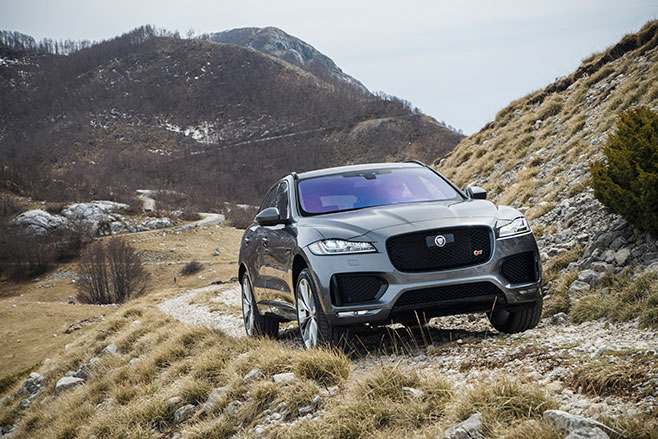
Sharing its D7A architecture with the compact XE and larger XF sedans to keep the cost and speed of manufacture in check, Jaguar’s first-ever SUV is a close relative of both those cars under the skin. But on the surface, the F-Pace is all about its F-Type-inspired curves, and the dynamic reward they promise.
Given its XE and XF DNA, it is no surprise the F-Pace knows how to devour a challenging road. Neutrally balanced and tenaciously grippy, the F-Pace has a very natural and flowing dynamic personality. Even when driven hard on really tight roads, the sportier F-Pace variants (R-Sport and S) maintain their cool with well-contained bodyroll and disciplined body control, and that’s even on the adaptive suspension’s ‘Normal’ setting. Dial up ‘Dynamic’ and the F-Pace’s keenness to change direction is enhanced, though really bumpy roads can make this setting a step too far.
All that applies to the luxo Portfolio, riding on slightly softer suspension, as much as it does the R-Sport and S, though the Portfolio is more prone to understeer when pushed really hard and has the occasional moments of float.
While the F-Pace was never going to match the poise and panache of the brilliant Jaguar XE, for an SUV standing almost 1.7m tall and approaching 1900kg, it does a bloody good job blending a firmly damped but comfortable ride with well-weighted, accurate steering and really confident cornering prowess.
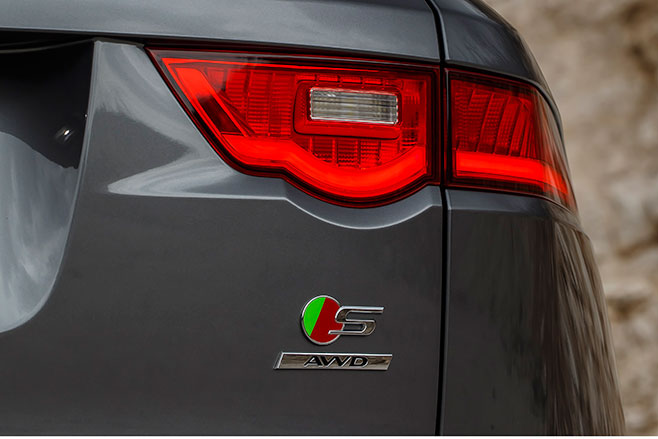
It goes pretty hard, too. On offer at the top end is a trio of 3.0-litre V6s – two supercharged petrols in 250kW and 280kW tunes (each with 450Nm of torque) and a 221kW/700Nm twin-turbo diesel. The oiler is available in all trim levels (Prestige, R-Sport, Portfolio, S and a launch special dubbed First Edition) whereas the 280kW blown petrol is offered only on the S and Launch Edition.
None of them lack in the pants department, though the high-power petrol is clearly the enthusiast’s choice. With a lovely bent-six exhaust rasp between 3000 and 4000rpm, and a rich vein of linear accelerative thrust, it hustles the F-Pace along with ample urgency, though its throttle ‘tip-in’ in Sport mode is too aggressive, and can instigate understeer when the F-Pace is loaded up in a corner and you unintentionally dial in too much throttle.
The twin-turbo diesel is similarly effective in full-bore driving (0-100km/h in 6.2sec), though it’s the 700Nm of torque (at 2000rpm) that really does the talking. Capable of lugging the F-Pace uphill with as little as 1000rpm on board, the V6 diesel’s refined, unstressed nature is the perfect companion for an SUV such as this, while drinking just 6.0L/100km on the EU combined cycle.
There’s also a four-cylinder F-Pace running a 2.0-litre turbo-diesel hailing from JLR’s new Ingenium engine family. On its Pat Malone until a turbo-petrol sibling joins the ranks in 2017 (apart from China, which gets the Ford-derived 177kW 2.0-litre from the XE 25t), the Ingenium diesel produces a solid 132kW/430Nm, enough to shift the AWD F-Pace to 100km/h in 8.7sec, while sipping just 5.3L/100km on the Euro fuel cycle.
The four-pot Ingenium lacks the V6 diesel’s low-rev refinement and outright punch, but there’s a cleanness and a hard-working honesty to its demeanour that makes it a fine base engine. Add a lighter nose and less overall weight (1775kg) and the base diesel’s benefits to the F-Pace’s agility are apparent, if not overwhelmingly so.
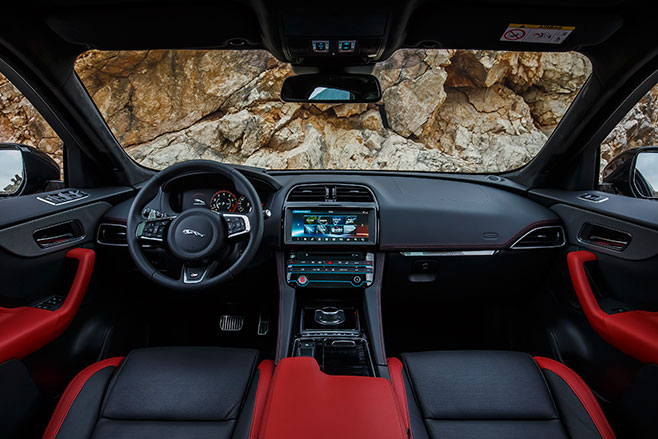
Ultimately, though, it’s the F-Pace’s cabin and packaging functionality that really need to shine – especially when the competition is as slick as the Macan and GLC. And while the F-Pace doesn’t quite match the Porsche’s feeling of expense, or the Benz’s superb vision and showroom razzle-dazzle, it’s a better effort than the XF and XE that preceded it.
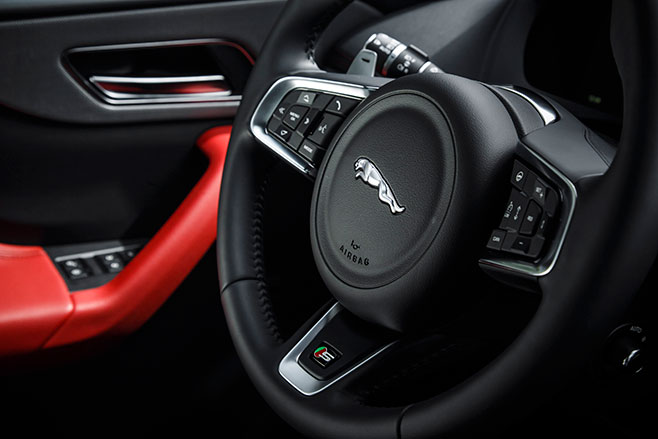
Brownie points go to Jaguar’s broad new 10.2-inch centre touchscreen, as well as the F-Pace’s 12.3-inch virtual instrument display (think new-gen Audi TT and A4) and a super-clever little device called the Activity Key.
Looking a little like a court-sanctioned security band, the black rubber bracelet is like a watch band without the face and can be worn while surfing, diving, swimming, you name it – meaning you don’t need to hide the car keys under a bush somewhere. Instead, you leave them in the centre console and simply ‘shazam’ your band against the letter ‘J’ on the tailgate badge, at which point the F-Pace’s lights flash and it unlocks. Genius!
The rest of its interior package passes muster pretty much without complaint. Shared front seats with XF are amply supportive, the seat trim at all levels is high quality and stylish, and F-Pace’s rear seat offers class-beating space … for two. The centre spot is okay in the cushion, but too firm and concave-like in the backrest.
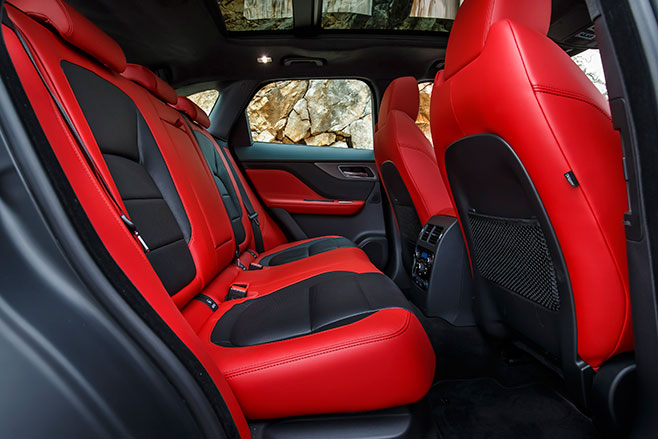
The F-Pace’s saving grace, however, is class-best boot space. In a Jaguar! After generations of compact cargo holds, the F-Pace blitzes the field by 100 litres (at 650 litres) and can even squeeze a 19-inch space-saver beneath the floor. In this respect, the relatively rakish F-Pace proves that athletic looks and generous practicality aren’t mutually exclusive.
So it turns out Leaping Cat fans needn’t have worried about Jaguar’s foray into Toorak Tractor territory. The F-Pace is good – in some ways, bloody good – and is a genuinely convincing attempt at distilling Jaguar’s sporting values into a handsome SUV. It might lack the dynamic X-factor of the superb XE, but for what it is, the F-Pace is impressively well-rounded and flaw-free. With prices starting at just $74K, expect to see a shedload once it goes on sale here in July.
SPECS
Model: Jaguar F-Pace S AWD First Edition Engine: 2995cc V6, dohc, 24v, S/C Max power: 280kW @ 6500rpm Max torque: 450Nm @ 4500rpm Transmission: 8-speed automatic Weight: 1861kg 0-100km/h: 5.5sec (claimed) Economy: 8.9L/100km (EU) Price: $120,700 On sale: July
Porsche’s turn to turbocharging continues apace with the release of the new 718 Boxster.
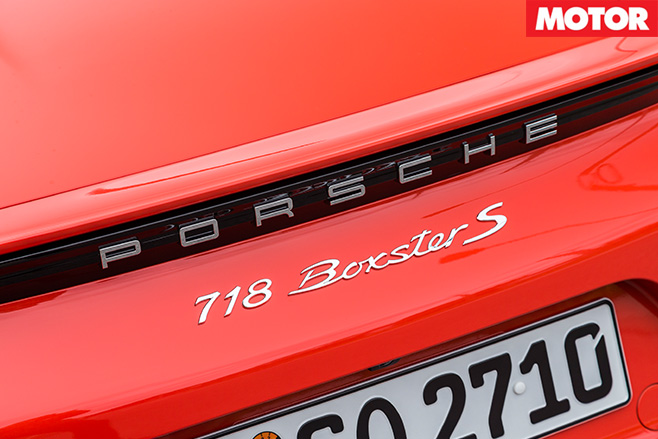
The number – pronounced seven-eighteen – pays homage to the iconic mid-engined race car that won everywhere from the Targa Florio to the Nurburgring, and has been revived as the new Boxster, like its famous ancestor, uses just four horizontally opposed cylinders.
Two engines are available, a 257kW/420Nm 2.5-litre for the S and a 220kW/380Nm 2.0-litre for the regular Boxster, both with the option of six-speed manual or seven-speed PDK transmissions.
Our test car is a PDK-equipped S, loaded to the hilt with extras like Sport Chrono, PASM adaptive dampers, carbon ceramic brakes, 20-inch wheels and 918-style fixed-back bucket seats.
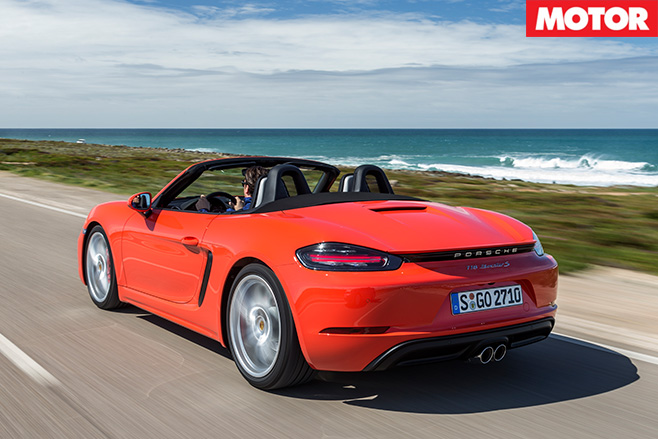
Extra equipment, including Porsche’s latest touchscreen infotainment system, offsets some of that price increase, however there is also a substantial lift in performance, which brings us to the all-important issue of those new turbocharged four-cylinder engines.
Equipped with the PDK and Sport Chrono of our test car, Porsche claims the 718 S will dispatch the 0-100km/h sprint in just 4.2sec, which matches the 996 911 Turbo.
This is now a seriously potent sports car in a straight line; based on our acceleration runs on an old Portuguese military runway we’d expect it to match its 0-100km/h claim while crossing the quarter mile in around 12.2sec at about 180km/h.
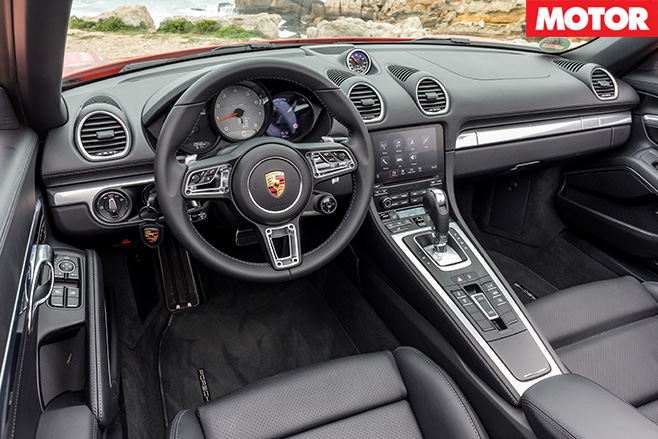
Porsche has worked very hard to replicate the linear power delivery of a naturally-aspirated engine and by and large succeeded. While it doesn’t build to quite the same crescendo, there is just masses more performance all throughout the rev range.
Unfortunately, the soundtrack has suffered quite severely. In the context of similar high-performance four-cylinder rivals it sounds reasonable; there’s a deep growl on start-up, a hint of WRX STI in stop-start traffic and a reasonably accurate impersonation of the VW Golf R’s artificially-enhanced engine note at full noise, but compared to the superb acoustics of the old flat sixes a large portion of the car’s character has been lost.
Chassis tweaks have been minor but wide-ranging, headlined by larger brakes, 10 per cent quicker steering, half-inch wider rear wheels, retuned springs and anti-roll bars and PASM being available as an option for the first time.
Thus equipped, the Boxster rides beautifully, firm but with plenty of compliance and so much control it’s difficult to imagine ever needing to engage the much firmer Sport setting on the public road.
The chassis is superb, providing the driver with enormous confidence to push the car right to the limit of its substantial grip levels. Aiding this is the new PSM Sport setting, part of the Sport Chrono option, which slackens the ESP reins beautifully while still keeping a safety net in place.
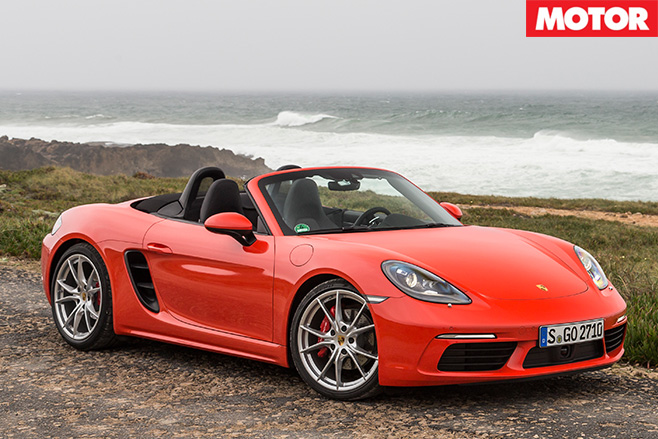
The 718 Boxster does nothing to dent the model’s reputation as a sensational sports car, and by all objective measures is a better car than the one it replaces. However, subjective assessment plays a big role in the selection of a sports car, and there’s no doubt losing that spine-tingling soundtrack has dented the Boxster’s ‘want one’ factor.
For some, it’ll be a deal breaker, for others, the added performance will be ample compensation. Whether or not increased exposure will increase our affection for this effective and efficient new powerplant we’ll find find out when the 718 Boxster lands in Australia in a couple of months’ time.
4.5 stars out of 5
Specs
Engine: 2497cc flat-4, DOHC, 16v, turbocharger Power: 257kW @ 6500rpm Torque: 420Nm @ 1900-4500rpm Weight: 1385kg (PDK) 0-100km/h: 4.2sec (PDK/claimed) Price: from $143,400
