
Things have gone a little quiet on the Giulia QV since Alfa told all and sundry that its new 377kW/600Nm super sedan could lap the Nürburgring in 7min39sec – that’s 14sec faster than a BMW M4.
Word is, however, that the lap time could have been its undoing, with the Giulia sent back for suspension revisions after the discovery that it was too stiff, even for the racetrack.
Alfa’s most potent offering since the 8C is still a mouth-watering prospect, its light weight (1524kg) and searing speed – 3.9sec 0-100km/h thanks to its 2.9-litre Ferrari-derived twin-turbo V6 – providing it the on-paper ability to give the M3 and Mercedes-AMG C63 a bloody nose.
So when will it finally get here? Last time it was talked about the date was late 2016. Today it seems 2017 is more likely. Whatever the case, you can rest assured it is coming.
This article was originally published in MOTOR February 2016.
It’s a good thing we weren’t holding our breath for the unveiling of the next-generation of Jeep’s compact SUV at the New York motor show last week. The replacement for the Compass and Patriot was a no show at the event, but word on the street is we’ll see it released in the second half of this year with a world premiere in Brazil.
While there’s been no official unveiling, the compact SUV has been spied with several pics flurrying the internet. It’s expected the new Compass/Patriot Jeep will be a longer version of the Jeep Renegade, sitting somewhere between the baby Jeep and the Jeep Cherokee. No doubt it’ll measure in close to the current Compass and Patriot which sit at 4.4metres long.
We probably won’t see the new Jeep SUV here until 2017, but we are expecting the Compass and Patriot name to disappear as Jeep merges these two popular SUVs, which account for 25 per cent of the brand’s global volume.
Holden’s decision to revive the famous badge is bold given its turbulent past.
Read the Wheels exclusive on the revival of the Holden Director.
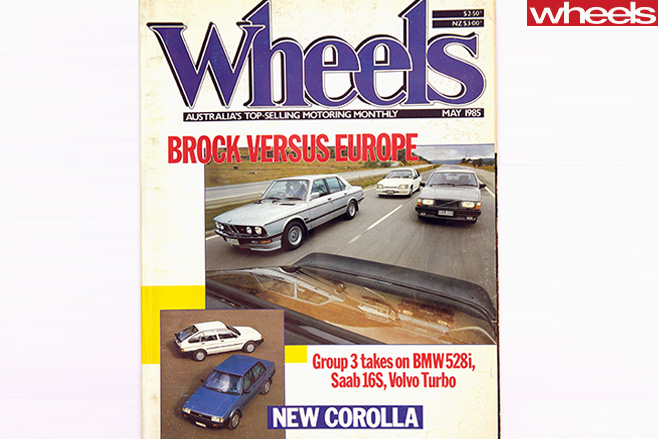
PETER Brock was not pleased. Wheels had compared his HDT Special Vehicles VK Group III Commodore with a BMW 528i, Saab 16S Turbo and Volvo 760 Turbo. A letter to then-editor Peter Robinson – as well as a flurry from readers accusing Wheels of being out to “knock the Brock” – followed.
We’d tested a car built from a low-spec Commodore Executive and criticised it for lacking refinement and sophistication against the European cars. Brock objected to us whacking “a sporty Group III up against the Veuve Clicquot set”.
The car for the task was the VK Director, HDT’s Calais-based ‘Velvet Thunder’, essentially the precursor to today’s HSV Senator. It was the most advanced HDT model, the most sophisticated Commodore of the time. Sure, it was powered by an iron-block Holden V8 with pushrods and a four-barrel carburettor, but it was Brock’s tenacious goal to build Australian-made products to compete with the best in the world – with BMW as a constant benchmark for his Melbourne-based outfit – that elevated the Director as his tech tour de force.
As the HDT flagship, in its final guise ahead of the fateful night in February 1987 that saw Brock and Holden part company, the VL Calais Director sported a 177kW 4987cc high-performance version of the locally made V8.
In Wheels’ hands the earlier $28K 1985 VK Director did a 0-100km/h time of 7.0sec on its way to a 14.6sec quarter-mile. That compares favourably with the 7.4sec run we did in the Cosworth-powered Mercedes-Benz 190E the same year, describing it as “the most exhilarating Mercedes-Benz for years”.
Brock was the first of the locals to introduce an independent rear-end on a handful of VL Directors, sourced from the then latest version of the Opel Rekord platform that underpinned the VB-VL Commodores.
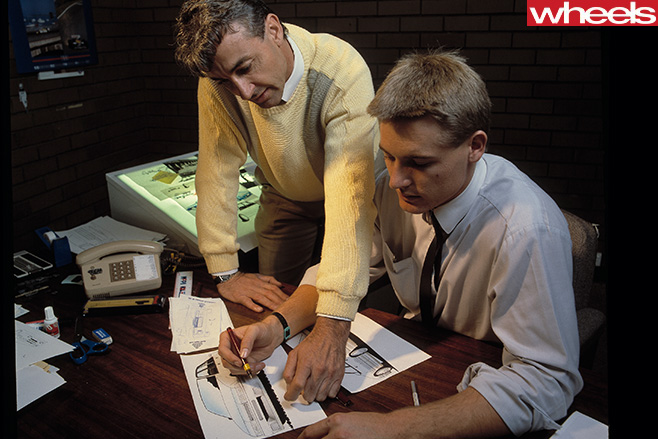
The Europeans didn’t offer an Energy Polarizer, though. “It’s a magic cure. It makes a shithouse car good,” Brock told Wheels in 1986, with the device already the subject of much scepticism. “There’s never been any truly avant garde invention that hasn’t received derision,” added the soon to be nine-time King of the Mountain.
That is what the Director was: Brock delivering cutting-edge Aussie innovation. His motives were solid; the science and his approach to the heavily cladded, almost bloated VL unveiled against Holden’s corporate will were not so.
That steely determination, stubbornness and pride eventually meant the Director went down as the car that ended the possibility of more world-class local performance cars from Holden’s Bathurst legend.
Rare value

Holden’s reduced engineering team is set to ramp up its local development of imported models – and the new Holden Spark is an example of the impact it can have here.
Not all models will get the local engineering treatment – it’s understood Holden is happy with the European tune for the upcoming new Astra, for example – but others are ripe for development.
One expected to be revised for Australian conditions is the upcoming new Holden Colorado ute and its seven-seat SUV offshoot. The Cruze small car – which will sell alongside the hatch-only Holden Astra – is also likely to get Australian suspension revisions.
“That’s one of the key reasons we retained the proving ground is being able to tune cars to Australian tastes and conditions,” said a Holden spokesman.
The outgoing Holden Spark (called Barina Spark) saw zero involvement from the men who make Holdens handle, and it was painfully obvious in the driving.
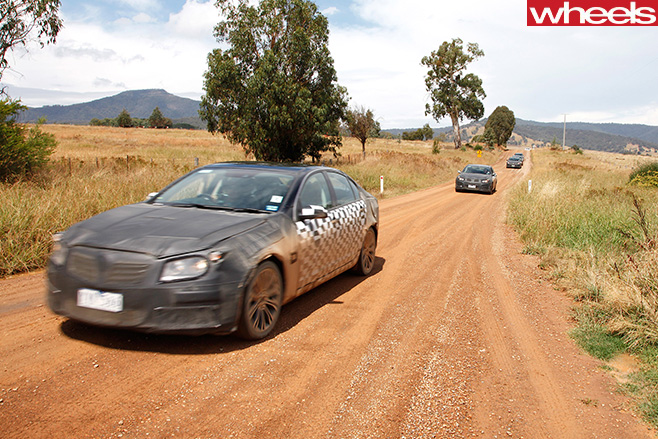
Vehicle development manager, Jeremy Tassone, admits the outgoing car was underdone, and his team would not make the same mistake twice.
“This new car needed to be really good to drive,” he told Wheels. “Yes, it’s primarily a city car, but we had to also make sure it was capable and confident on country roads. We know the target market are not boy racers; we know no one is going to go rallying in it, but it still had to be properly engaging to drive.”
Holden was involved in the initial development of the platform, and was able to choose from a ‘menu’ of bushes, anti-roll bars, and springs. Dampers, electric power steering (EPS) tuning, and ESC calibration were the key areas Holden worked on locally.
“Our process starts with [vehicle dynamics engineer] Rob Trubiani pounding a prototype around Lang Lang,” said Tassone. “He’ll make a list of key areas he thinks need addressing, then myself and other members of the team will do our evaluations and we compare notes. From there, damper development can start. The supplier sends us a set of fully rebuildable and tuneable dampers which allows us to experiment with valves and flow rates and so on, and test both on the car and on a suspension dyno. Once we’ve arrived at a tune, that specification is provided to the supplier, and a sealed set is sent to us, which are ideally close to final production spec.”
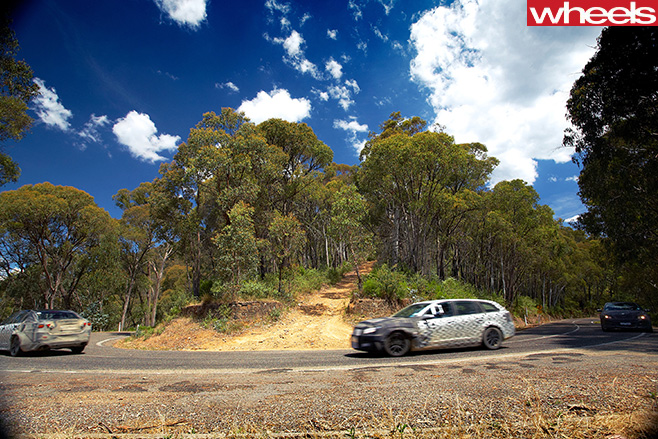
Then comes tuning of the EPS, which is done with a software engineer from the supplier. “We wanted more on-centre feel, and better weighting at speed,” said Tassone. “Better damping, too, but that’s a careful balancing act, because more damping can start to rob road feel.” The desired characteristics are arrived at via changes to the system’s software; no hardware changes are involved.
The final element of the dynamics tuning was to the Bosche-supplied ESC system. “Again, we wanted a very progressive, non-invasive tune to the ESC. There’s nothing worse than a system that intervenes too suddenly, then takes too long to release,” said Tassone. “After a long run of testing and calibration work, Bosche was able to supply that.”
Holden’s team was also able to have an influence in the NVH performance of the new Spark, but not in the more predictable realm of sound-deadening materials or drivetrain mounting hardware. Instead, the team was able to specify thicker glass to better insulate the interior from both road noise, and ambient noise from heavy vehicles and the like.
The proof is the driving. Finally, Holden’s entry-level micro car is no-one’s fool.
Here’s one ‘barn find’ you won’t be able to have for cheap.
Swedish company WrapZone have taken to a white Porsche 911 GT3 RS with a unique wrap job that mimics the aesthetic of vehicles left long unloved.
The design comes from Florida-based designer Scott Kepple, who has before worked with WrapZone on similar designs for a Dodge Charger and modern Volkswagen Beetle.
https://www.instagram.com/p/BDV92-VQWNw/
Neglect is obviously the main theme here, and at first look it seems the sun’s faded the super 911’s Martini livery for decades.
Details find their way on to everything like the front bar, which ‘wears’ stress fracture cracks, to fake rust on the front guards, mould streaks on the window sill, and dark smudges smattered all over.
https://www.instagram.com/p/BDJwkYqwWIY/
Yet, the ‘patina’ is contrasted brilliantly with the high-performance bits that define the GT3 RS, like its high-tech aerodynamic package, centrelock wheel nuts, and roll-cage interior.
This GT3 RS is not the first car that has showcased WrapZone’s handy craft to the world, either. The company is also responsible for the stealth camouflage draped on Red Bull skier Jon Olsson’s widebody RS6.
https://www.instagram.com/p/BDLYvZtitCf/
As for price, the beauty is you could remove the wrap and the GT3 RS would command every penny it did new, maybe even more if current demand for hot 911s are anything to go by.
But does such a car suit the old aesthetic, or in other words, would you leave the wrap on? Let us know in the comments below.
PLUS
- Decent power. Its 3.0-litre turbo six-cylinder engine breaks no sweat hurling the long sedan up the road.
- Cushy, comfortable ride. The 740i floats along like it’s on a small cloud…
- … yet its relatively light chassis (which is built with carbonfibre) and tricky suspension technology (the rear wheels turn into corners too) means the 740i also handles sharply.
- Its interior is predictably classy and a new benchmark for the brand. A new cabin design debuts in the BMW 7-Series and introduces a wide suite of new features while still feeling and looking familiar. The infotainment system is new, along with gesture command technology that allows you to control functions without touching a button.
- It’s just as sumptuous and high-tech in the back. Lower the middle backrest and you’ll find a 7-inch Samsung tablet nestled in the armrest. It’ll allow you to play with the cabin’s ecosystem and infotainment, and also able to be pulled from its dock and used as a regular tablet by switching to Android mode.
- There’s so much tech inside you’ll need to set aside the time to learn how to operate everything. The infotainment system takes a while to warm to if you’re used to the standard system in less expensive BMWs, and the gesture command works better controlling some functions (volume) than others (switching tabs).
- Run-flat tyres spoil the ride around the city, adding a bite over tram tracks and edges.
- Although the standard rear seats are already beautifully comfortable, a set of heated, titling, and electric massage units will set you back $15K.
- Semi-autonomous driving technology, which comes standard and operates with the radar-controlled cruise control, sometimes misses lane markings and shouldn’t be trusted on even long corners.
- The transmission feels too keen to kick down. While cruising at highway speeds, it only takes a small prod of the throttle for it to drop gears and accelerate too hastily.
Ford projected to sell around 4500 cars in 2016 but has been shocked to see a higher-than-expected 6000 orders placed for the first direct-from-factory, right-hand-drive Ford Mustang in Australia. In January, the lauded pony car performed so well that it out-sold the Ford Falcon. The waiting list for new Mustang orders to be delivered is said to extend all the way to late 2017.
The new ‘Stang is available in two powertrain variants: The V8-powered GT or the four-cylinder EcoBoost. Both choices are available in a Fastback or convertible body style.
Fastback customers have the choice of an updated six-speed manual or automatic transmission however all convertible buyers will be restricted to an automatic gearbox.
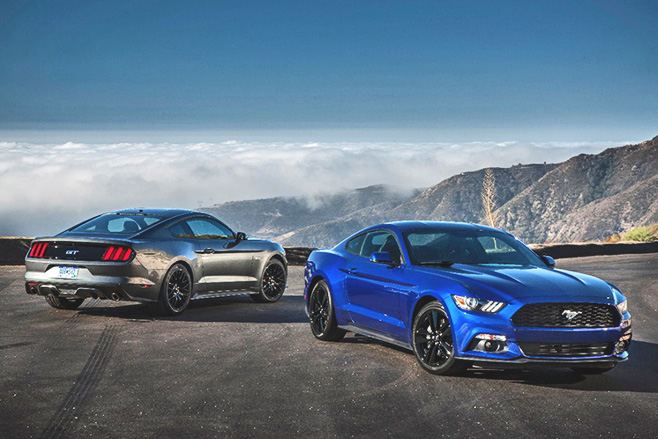
Sales figures show that Australian customers prefer the V8 models, and are drawn towards the ‘Race Red’ colour scheme. ‘Magnetic’ and ‘Ruby Red’ paint options are also in high demand.
Aussie owners of the new Mustang have been given celebrity-like status with fans flocking to get a glimpse of the iconic car. Jenny Richardson and husband Scott recently took delivery of their red EcoBoost convertible and have been overwhelmed by the reaction it has received.
“I don’t think there’s been one time I’ve gone out and not had someone stop me to chat about the Mustang,” Jenny explained. “Often times when I walk up to the Mustang in a car park I find strangers standing next to it snapping selfies – it’s really quite remarkable.”
In February, 40 percent of convertibles sold were equipped with an EcoBoost engine. The four-cylinder turbocharged option is more fuel efficient and environmentally-friendly than its V8 sibling, while pumping out 233kW of power; that’s more grunt than the original V8 1964 Mustang.
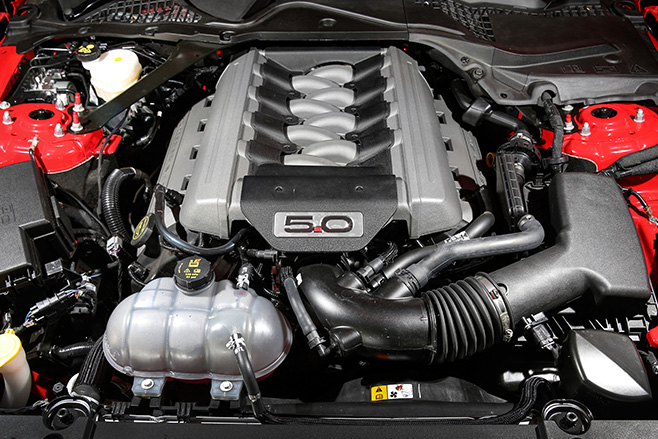
The popular Mustang GT is powered by the latest version of Ford’s 5.0-litre V8 engine (pictured above). The big-displacement variant produces a mighty 306kW of power.
Our love affair with the famed sportscar is further illustrated by the tremendous increase in orders of personalised license plates. In Victoria alone, over 340 sets of Mustang number plates have been sold – more custom license plates than have been sold for any other Ford nameplate.
The Australian-delivered Mustang has undergone substantial design changes from previous models sold overseas. Ford claims that although styling has changed significantly, the new Fastback and Convertible evoke ‘the essential character of the brand’.
Notable exterior design features include a low roof height and a wide track that allows for a lower and wider stance. The Fastback has a steeply sloped windshield and rear window creating a sleeker profile which is said to reduce drag and increase fuel efficiency.
Convertible Mustang owner Derek Poulton has been amazed by the attention his car has received.
“It seems that everyone young and old – is in love with the Mustang,” says Derek. “I’ve had old men approach me to chat about it and I’ve had little kids give me a thumbs-up as I drive past. All the attention takes a bit of getting used to!”
The hype continued in March when Ford’s Facebook page was ‘over-run’ with fans as the company released a video of the Ford Mustang taking on the Great Ocean Road and Sea Cliff Bridge.
“Our Australian R&D and product investments are paying off as we transform Ford in Australia and customers respond to our new vehicles,” says Graeme Whickman, President and CEO of Ford Australia. “The Mustang typifies this excitement as we expand our performance vehicle line-up as part of plans to launch 20 new vehicles by 2020.”
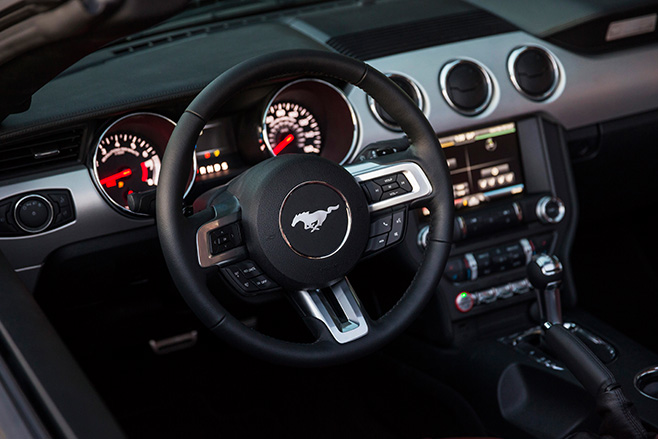
If you’re willing to wait it out and purchase the all-new Ford Mustang, prices are as follows:
MUSTANG ECOBOOST
- Fastback (Manual Transmission) $45,990
- Fastback (Automatic Transmission) $48,490
- Convertible (Automatic Transmission $54,990
- Fastback (Manual Transmission) $57,490
- Fastback (Automatic Transmission) $59,990
- Convertible (Automatic Transmission) $66,490
What stands out?
The Subaru Impreza feels solid for a small car, thanks to doors that thud shut and an interior that’s well built and well isolated from wind and road noise. It also drives all four wheels – which helps on slippery roads – and is packed with features. This review covers the fourth generation Impreza, sold new from 2012 to December 2016.
What might bug me?
How much slower it is than the iconic Subaru WRX, to which it is distantly related. The Impreza is among the more leisurely cars of its size.Driving under 80km/h on the space-saver spare tyre until you can fix your full-sized flat.
What body styles are there?
Five-door hatchback and four-door sedan.The Impreza drives all four wheels, and it is classed as a small car, lower priced.
What features do all versions have?
Cruise control, and climate control air-conditioning (which maintains a set temperature).Bluetooth phone and audio connectivity, with a touchscreen interface (6.2 inches on the less costly models), a voice command function, and audio controls on the steering wheel.An automatic stop/start system, which saves fuel by shutting off the engine when you stop, and restarting it when you press the accelerator to drive away.Hill-start assist, which operates the brakes automatically to make take-offs on hills easier.Headlights that turn off when the car is switched off.All-wheel-drive, which improves drive and stability on slippery surfaces.Aluminium alloy wheels (and a space-saver steel spare wheel).Seven airbags: two directly in front of the driver and front passenger; one alongside each front occupant to protect the upper body; a curtain airbag on each side covering the front and rear side-windows; and a knee protection airbag for the driver.Electronic stability control, which can help the driver to control a skidding car. All new cars must have this feature.Every Subaru Impreza carries a three-year, unlimited kilometre warranty.
Which engine uses least fuel, and why wouldn’t I choose it?
The sole engine available with the Subaru Impreza is a 2.0-litre petrol four-cylinder. When teamed with the continuously variable automatic transmission, it uses 6.8 litres/100km on the official combined cycle test.With the optional six-speed manual transmission it consumes 7.1 litres/100km, but you can make more of the engine’s modest power output.The Impreza’s engine differs from every other small-car four-cylinder in that it lies flat across the engine bay rather than standing up vertically. This places the weight of the engine lower in the car, which helps it steer more responsively.
What key features do I get if I spend more?
Stepping past the least costly 2.0i and into the 2.0i Premium brings you a reversing camera, leather trim on the seats and steering wheel, foglights, and a 4.3-inch colour multi-function display that presents helpful information.Spend more again for the 2.0i-S and the driver’s seat is power-adjustable. There is a bigger, 7.0-inch touchscreen, and satellite navigation. Dual-zone air-conditioning allows different temperatures for each side of the cabin, and the S has a powered sunroof.Other changes include side spoilers on the body, a boot lip spoiler on the sedan, and control pedals finished in aluminium with rubber grip pads, for a sporty look and feel. An increase in the wheel size, from 16 inches to 17 inches and with tyres slightly lower in profile, is also mainly a cosmetic change.
Does any upgrade have a down side?
The sunroof reduces headroom for occupants in the front.You might slide around more on the leather seats than on the more grippy cloth versions.Choosing the best-equipped version, the 2.0i-S, means you forgo a choice of transmission – it is CVT auto only.Seven metallic and pearl colours are available, and they come at no additional cost. One of those colours, Jasmine Green Metallic, is only available on the 2.0i-S.
How comfortable is it?
The Subaru Impreza is very comfortable to drive and ride in. The suspension is softer than in some similar cars, which helps it roll smoothly over bumpy roads.The Impreza is among the quietest small cars. Its cabin is well insulated from outside noises, such as the noise of the suspension working, and the sound of the tyres rolling over coarse road surfaces. The only noticeable sound at highway speeds is airstream rustle around the large, door-mounted side mirrors.The cabin is made from good plastics and textiles, which fit together well. That brings an air of quality to the driving experience that elevates the Subaru above some Japanese competitors.Supportive standard seats stay comfortable for drives of up to two hours, and the driving position is easily tailored thanks to the standard tilt and telescopic adjustable steering column. The eight-way power-adjustable driver’s seat in the 2.0i-S makes it even easier to get comfortable behind the wheel.
What about safety?
Seven airbags, a reversing camera, voice recognition, and seatbelt reminders for all five seats contribute to a safety rating of Excellent for the 2.0i Premium and 2.0i-S.The Impreza 2.0i receives the lesser rating of Very Good but the key difference here is its offering a reversing camera as an option rather than standard. Choose that option and it too would be rated Excellent.Automatic emergency braking is not offered on an Impreza.The forward location of the Impreza’s A-pillars (those either side of the windscreen) allows good vision for tight corners and roundabouts, increasing primary safety. The door-mounted exterior mirrors aid vision in the same driving conditions.The Australasian New Car Assessment Program (ANCAP) awarded the Subaru Impreza a five-star rating for safety, its maximum.
I like driving – will I enjoy this car?
Yes, you will mostly enjoy driving the Subaru Impreza, though it’s not the ideal pick for a very keen driver.The electrically assisted power steering is weighted just right, and the car turns into corners quite responsively. The Impreza’s body doesn’t lean much when cornering – the flat layout of the boxer four-cylinder is partly responsible for this quality – which adds to the feeling of good handling.However, for those who sometimes drive with enthusiasm, the Impreza becomes less impressive. Vigorous driving can upset the usually composed suspension, and expose the moderate level of cornering grip.The engine is a weak link in driver enjoyment of the Impreza. It is very smooth and quiet, and feels good in normal driving. But on hilly roads, or when asked to accelerate the car quickly, it lacks the ability to respond decisively.The continuously variable automatic transmission can be manually operated using gear-shift paddles behind the steering wheel, which makes it more fun than some conventional automatics.
How is life in the rear seats?
The Impreza’s wheelbase – the distance between its front and rear wheels – is longer than those of some small cars, which translates directly into generous leg room in the back. A comfortable, well-angled base and backrest, and good shoulder and foot room, contribute to a comfortable rear seat.The seat can carry three passengers, with lap and sash belts for all.
How is it for carrying stuff?
The Subaru Impreza sedan offers 460 litres of boot space, which is 120 litres more than the hatch has with its rear seatbacks upright. The large Holden Commodore, as a comparison, has a 495 litre boot.However, the hatchback, with its 40/60 seatbacks folded, offers 771 litres of space when loaded to the window line, or 1230 litres loaded to the roof. The sedan has a big boot, but the hatch body style is more versatile and ultimately offers greater cargo volume.
Where is it made?
The Subaru Impreza is manufactured in Japan.
What might I miss that similar cars have?
Turbocharged small cars such as the Volkswagen Golf respond more eagerly to the accelerator pedal, particularly from low speeds.Some small cars, among them the Golf and the Mazda3, offer low-speed automatic emergency braking on most models, at least as an option. A sensor detects obstacles in front of the car – typically another car that has slowed suddenly – and a computer applies the brakes if it concludes that a collision is imminent.The Renault Megane and Hyundai Elantra and i30 offer five-year warranties, and the Kia Cerato is warrantied for seven years.Another small car worth considering is the Honda Civic.
I like this car, but I can’t choose which version. Can you help?
Absolutely – the Subaru Impreza 2.0i Premium hatch is our pick of the line-up, for the reversing camera and leather trim.
When did Subaru update this Impreza?
The fourth-generation Impreza arrived in Australia in early 2012. There was a facelift about May 2015, which introduced the 2.0-i Premium model, revised the grille and headlamps, and brought new touchscreen interfaces and minor changes to the interior trim.An all-new, fifth-generation Impreza arrived in December 2016 for the 2017 model year. It brought better steering and cornering, better economy and a little more power from direct petrol injection, a bigger and much nicer cabin, and automatic braking via Subaru’s EyeSight system.
They might be the best drivers in the world, but F1 stars aren’t always into road cars.
Damon Hill, for one, has been quoted as saying “you don’t need the thrill, what you just want is something practical that gets you around.”
Thankfully, not everyone agrees with this sentiment, with a number of the current grid enjoying pretty serious car collections.
Jenson Button is one of them, and in an interview with F1 Racing mag has opened up on what currently sits in the Button garage.
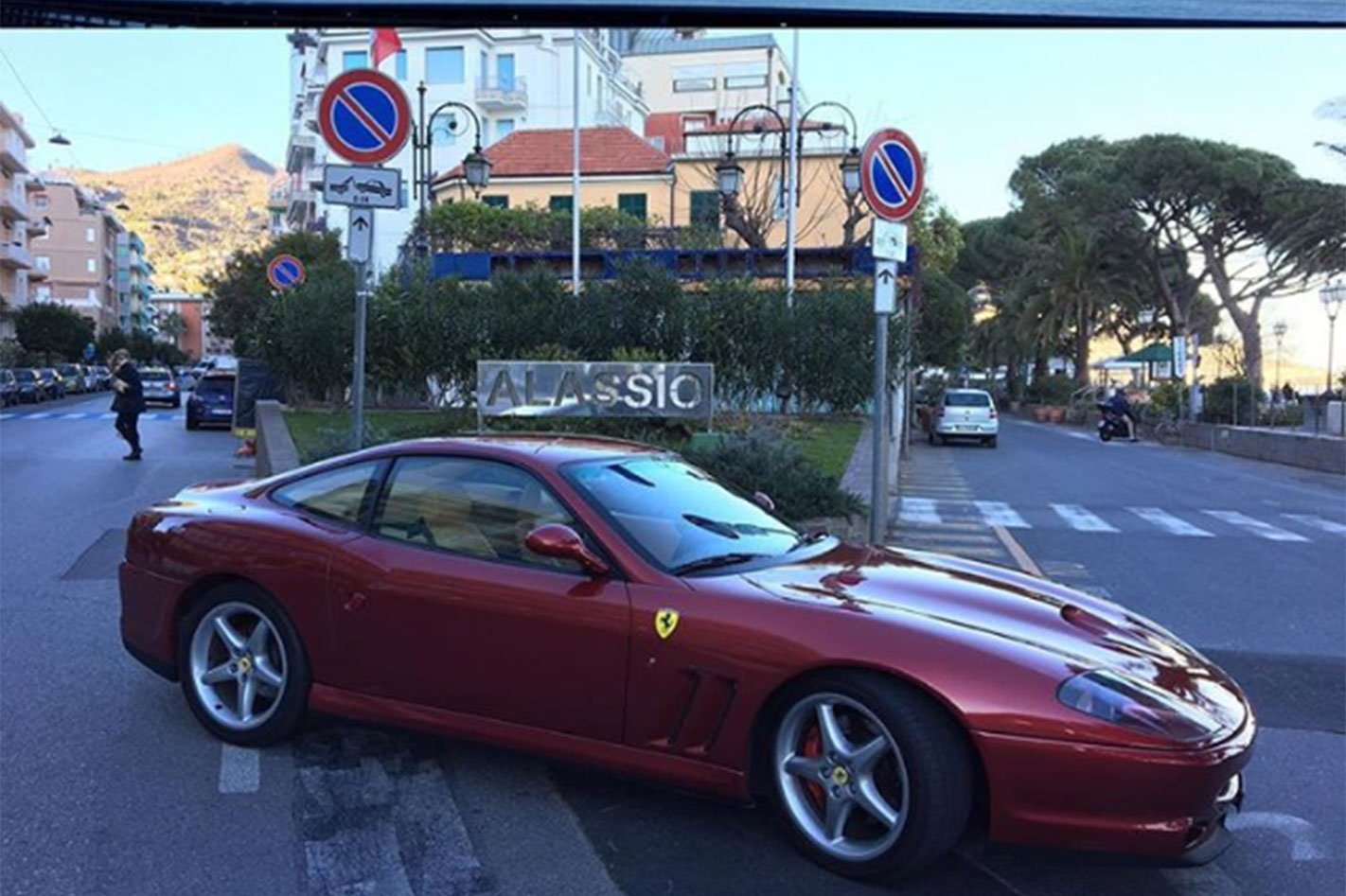
According to Button, the total number is “15, but [manager] Richard and me that we share for investment purposes. But those 15 are my cars.”
These include a Ferrari F40 and 1956 VW campervan, a Ferrari 550 and 1957 Chevrolet Corvette that belonged to his father John, and a 1970 Pontiac GTO that was Button’s wedding car.
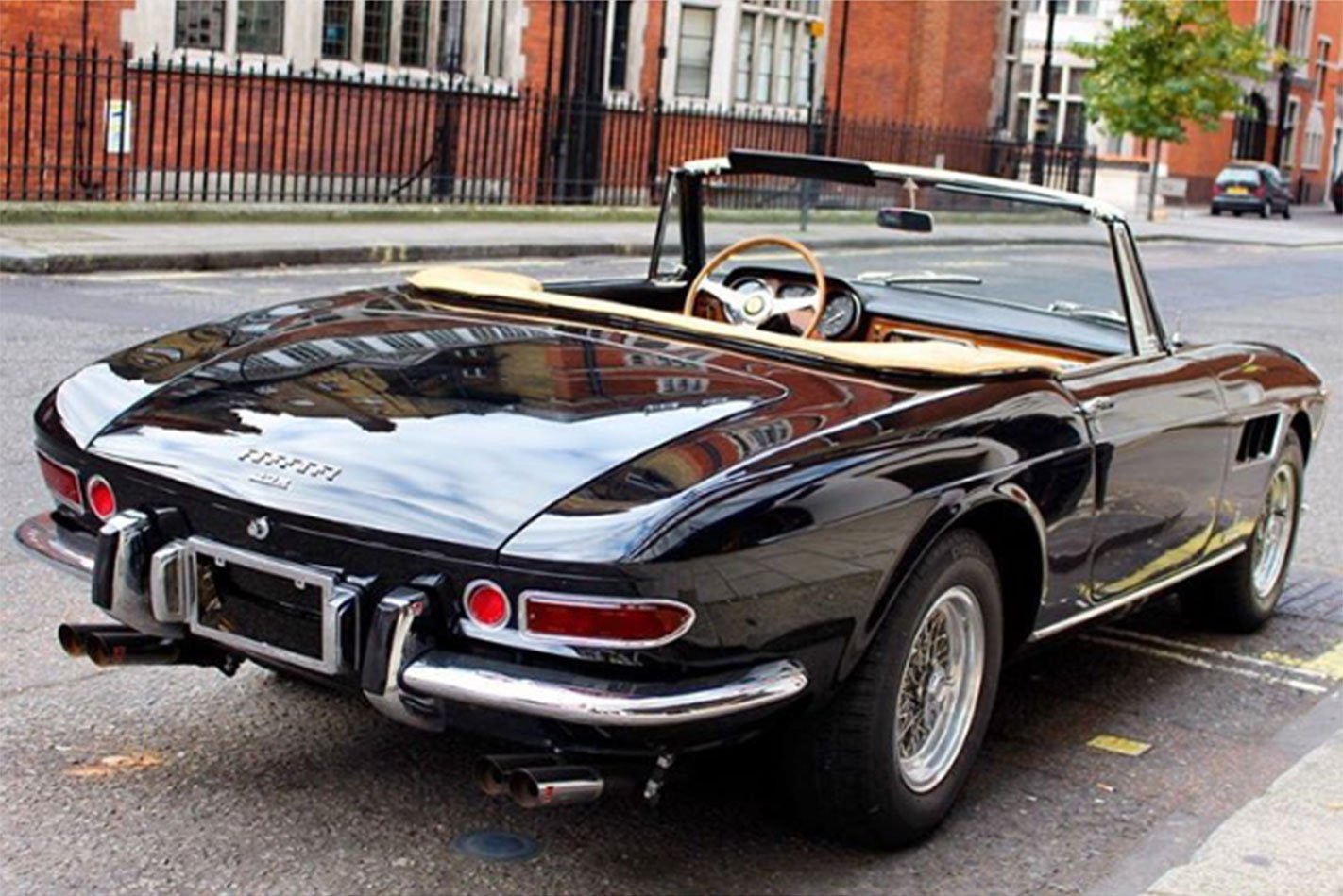
While he’s never driven for Ferrari, Button is a bit of a Prancing Horse fan, with the first car he bought as an F1 driver being a Ferrari 355 that he still owns and a recent acquisition, a Ferrari 275 GTS Cabriolet.
The actress managed to fang the new model up to 323km/h (201mph).
The new model Jaguar F-Type is the fastest production Jag ever.
But if you’re worried about safety there is no need to be concerned. The video was shot on a closed highway in the Nevada Desert.
“The fastest I’ve ever taken a car is 140-145 miles an hour (233km/h). But today, 200 miles an hour on the Jaguar F-Type SVR.”
“This is going to be exciting. I hope I stay on the ground,” she said.
Watch the video to see how she goes!
