
Have you driven a Ford lately? It could be the question that determines whether the American brand allows you to purchase its GT supercar.
Ford has confirmed it will handpick the first 250 buyers of the outrageous GT supercar that sprung a huge surprise on show-goers at the Detroit motor show in January 2015. The selection process for all buyers will be via an online questionnaire set to go live in February – so be prepared to log on, Jay Leno.
It will reportedly prioritise long-time Ford customers and even ask how the buyer uses social media; while ensuring the car must be driven (and not kept in a museum) and the GT won’t be immediately on-sold for a profit.
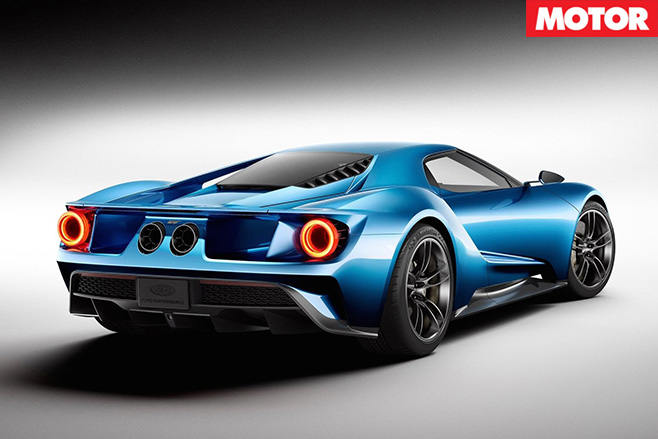
“There’s a loyal following to the car [and] we want to prioritise people who are going to care about the car, keep the car and drive the car,” he added.
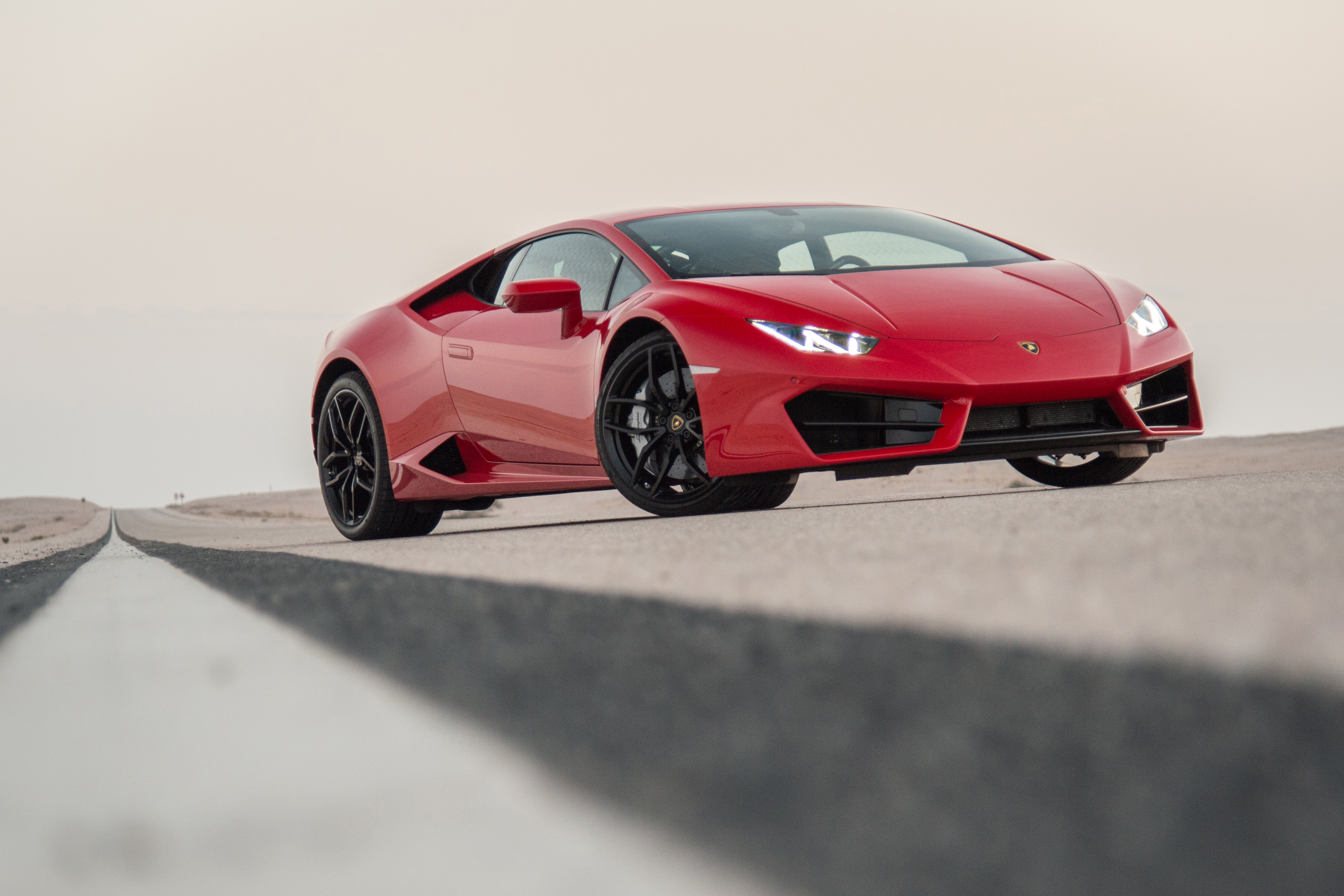
Ford clearly isn’t only interested in how many zeroes attach to the end of your bank account – although it may require a few, as Ford views the GT as a Lamborghini Aventador competitor, which costs $760,000 locally. Australian buyers are unlikely to be given the chance to buy a GT at any time, though.
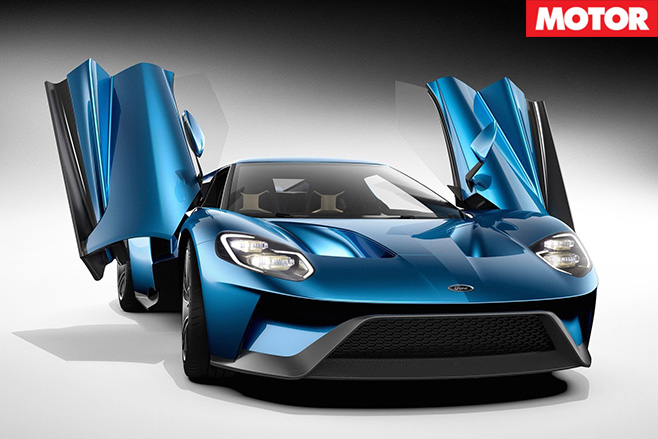
Ford has, however, confirmed that the mid-mounted Ecoboost 3.5-litre twin-turbocharged V6 engine of the show car will be retained for production models, producing more than 447kW and teamed with a seven-speed dual-clutch transmission.
That should make it speedier than internet connection required to get your online application in the moment the questionnaire goes live…
Call 911, the world’s gone mad. At some point over the last few years, Porsches (both modern and classic) have become slightly more sought-after than The Holy Grail.
The classic car market in general has gone berserk, with values of some models rising 300-400% in the space of half a decade, but for some reason Porsches have been particularly affected.
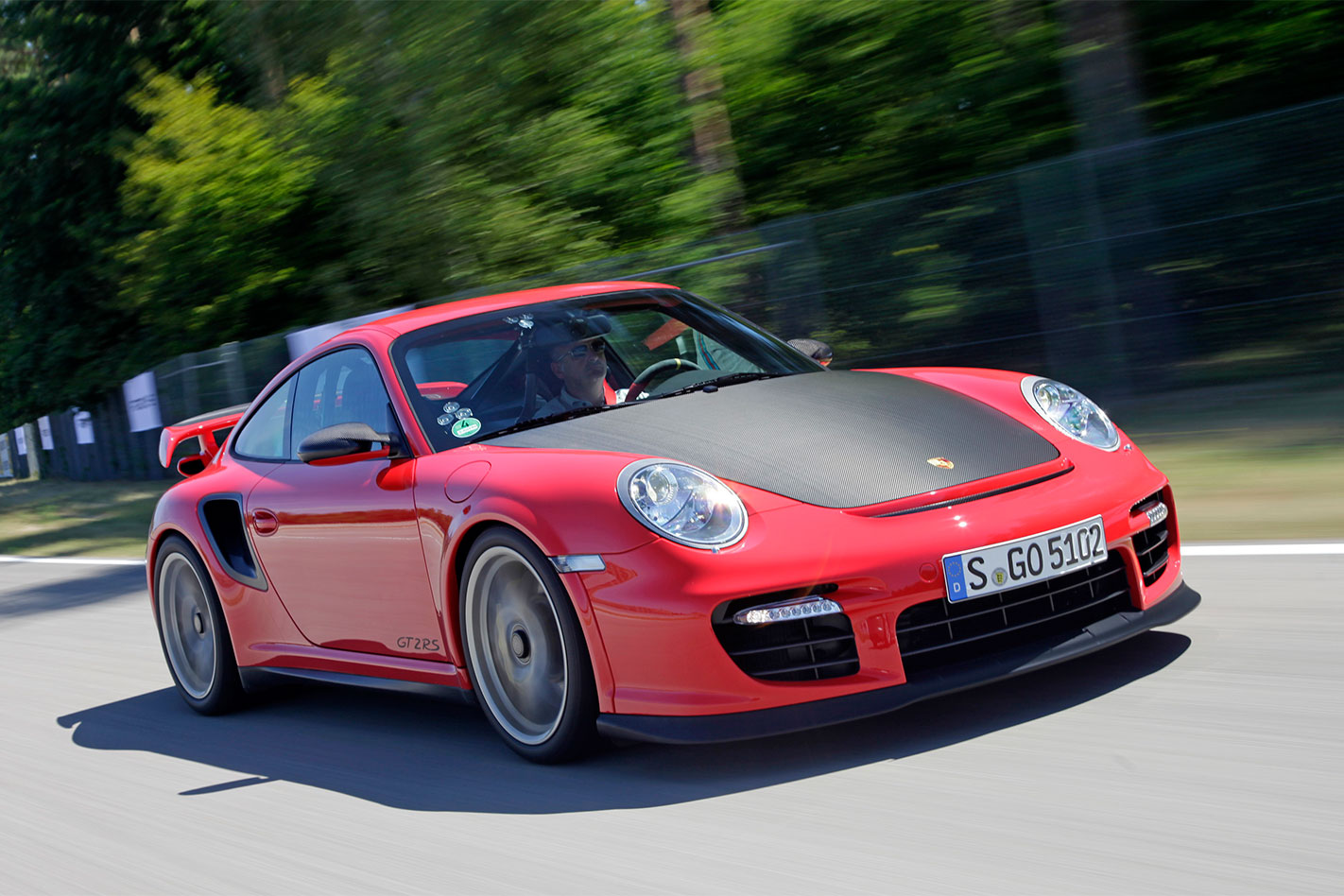
At the time of writing, there is a 2010 997 GT2 RS for sale in Queensland for – are you sitting down? – $949,000. Yes, this is a supremely rare – just 500 built – and desirable Porsche, however that price is $390,000 more than it cost brand new!
It’s a similar story with the naturally-aspirated GT3 RS. At the time of writing, there are three 997.2 911 GT3 RSs easily found for sale online, the cheapest being $478,000, the most expensive $550,000.
Now, the GT3 RS is a brilliant car, one of Porsche’s greats and MOTOR’s 2010 Performance Car of the Year, but it cost $387,000 when new – aren’t cars meant to depreciate as they get older?
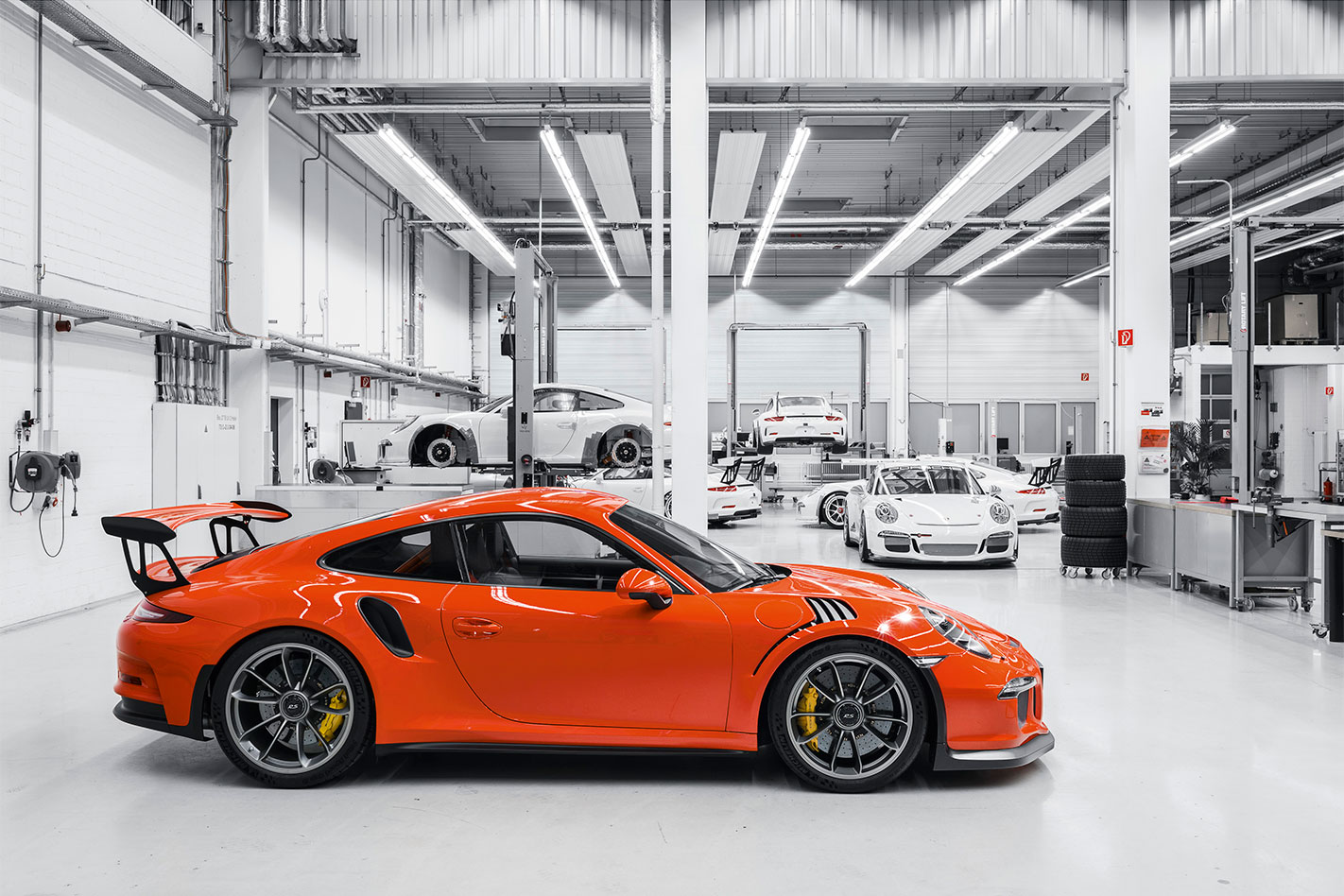
It seems that if your 911 is wearing a GT or an RS badge it might as well be made out of solid diamond.
But hang on, I’ve just punched 993 into the search engine. As the last of the air-cooled 911s, it’s always occupied a special place in the hearts and minds of Porsche purists, but prices have recently exploded.

While these prices seem absurd given what similar cars were fetching a handful of years ago, any car is only worth what someone is willing to pay for it, so if you can sell it for twice what you paid, good luck to you.
However, as prices skyrocket the cars affected will be increasingly seen as investments rather than something to enjoy, which means all enthusiasts will be deprived of seeing these beautiful machines in their natural habitat – on the road or racetrack.

While Porsches have been the topic of this piece, as mentioned at the top of the article the classic car market in general has gone crazy, with any classic or limited edition Ferrari, Mercedes or Lamborghini skyrocketing in value.
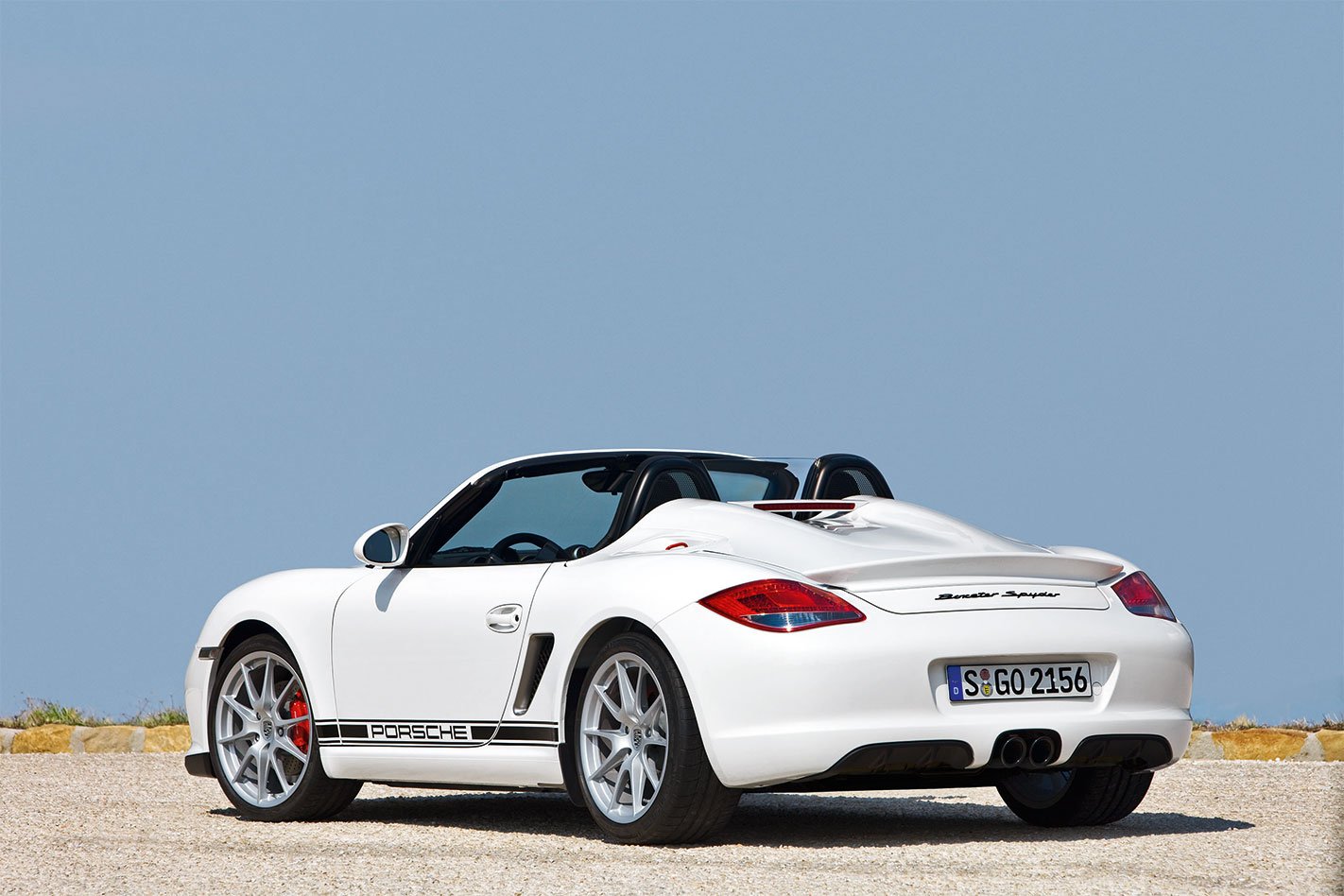
I could be wrong, but I suspect the market will at some point undergo a significant adjustment. As with any bubble picking when it’s going to burst is nigh impossible, but in the meantime, if you’re about to buy a car that was worth half as much a few years ago, it might be worth asking yourself why.
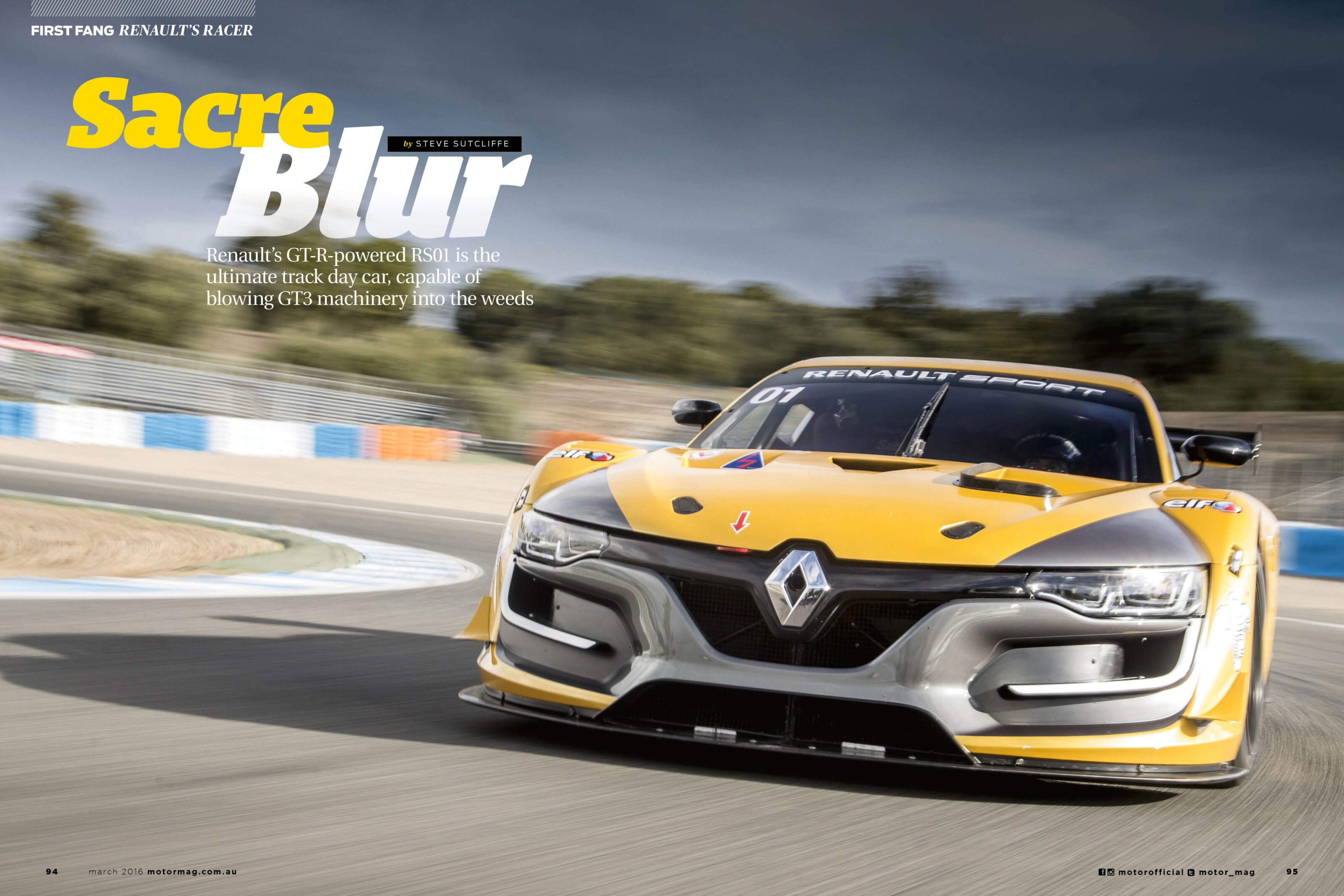
RENAULT’S return to Formula One as a constructor after five years as solely an engine supplier is part of its strategy to double sales of its high-performance Renault Sport road cars by 2020.
The strategy sees the Renault Sport brand split into two entities: Renault Sport Racing, which will encompass not only F1, but Formula E, Formula Renault, the Renault Sport RS01 Trophy as well as customer track and rally programs; and Renault Sport Cars, which will operate the road car business.
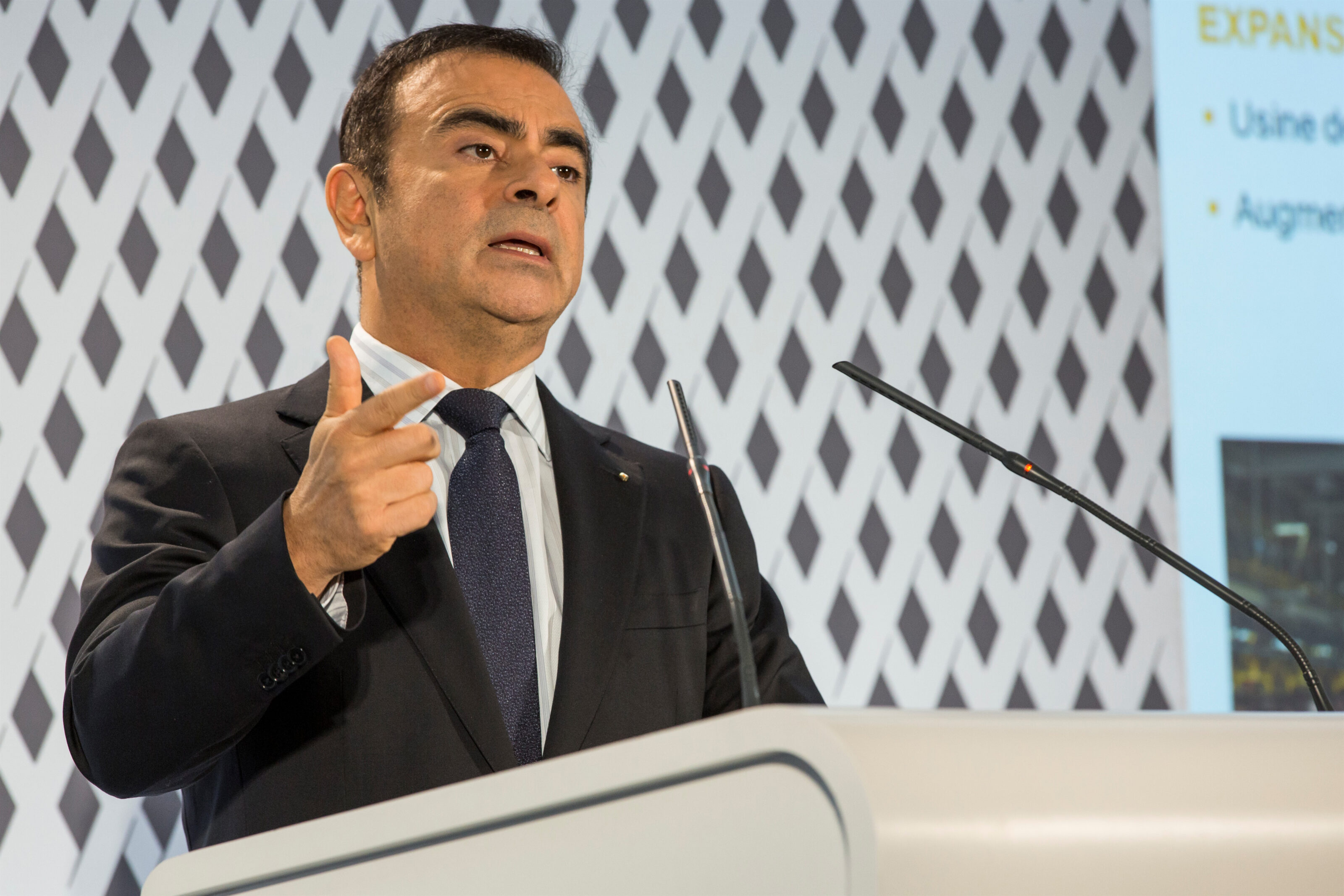
Announcing its 2016 motorsport strategy at the Renault Technocentre in Guyancourt, France, Renault-Nissan Alliance chief executive Carlos Ghosn (pictured, above) said: “We believe that motorsport still sparks the imagination of both enthusiasts and drivers.” As well as heading up the alliance, Ghosn will act as chairman of the carmaker’s motorsport supervisory board.
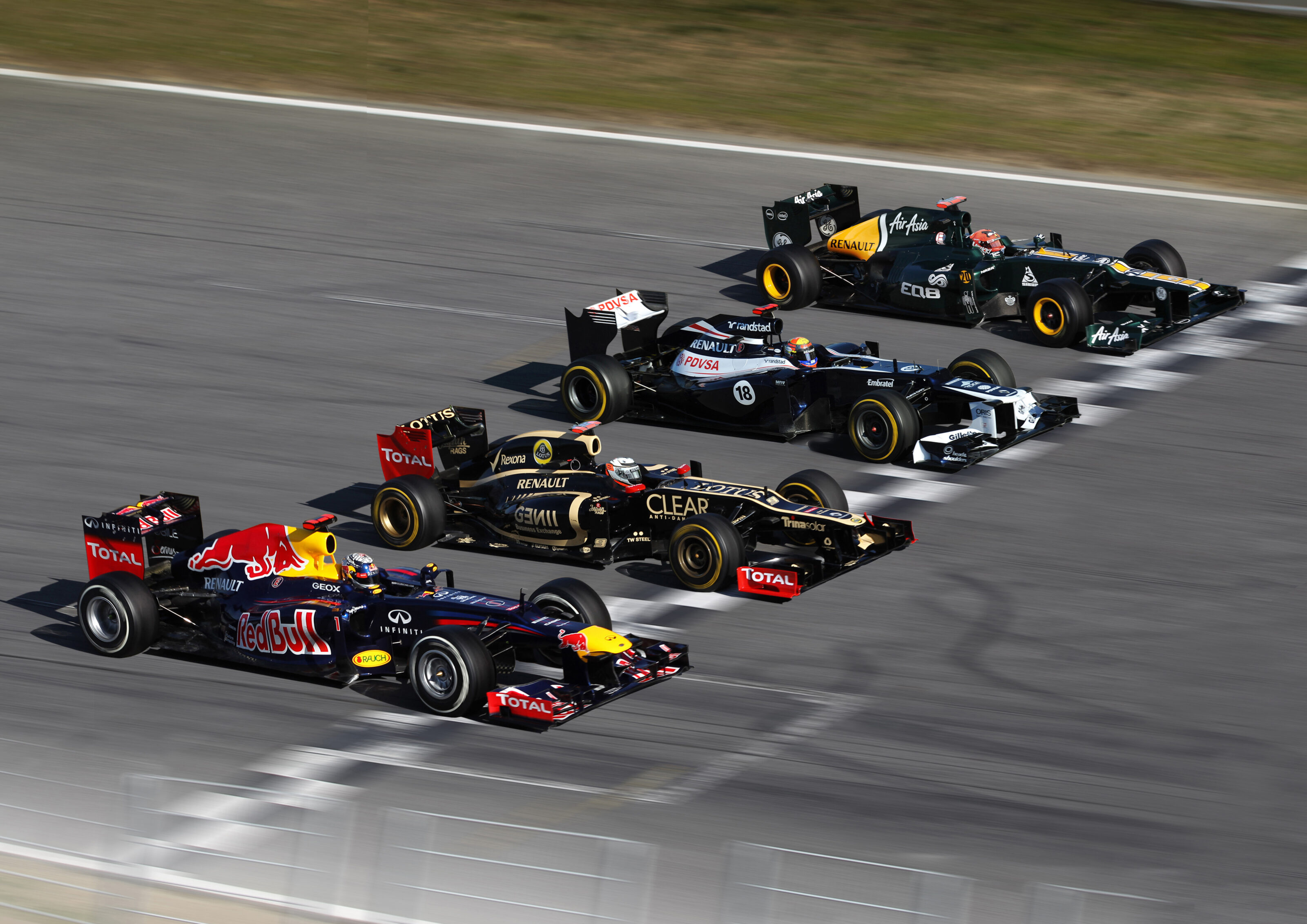
Renault has been in Formula One since 1977 as a supplier and/or constructor, rivalling Ferrari, McLaren and Mercedes in terms of its association with the modern-day form of the sport. It’s participated in more than 500 grands prix, and won 168. Its buyout of the Lotus F1 Team late last year to create its new factory outfit builds on its legacy and intent to exploit the carmaker’s involvement in the sport, with the track and customer programs intended to bridge the gap between road car and its racing success.
“Naturally we hope that our commitment to motorsport will have a direct impact on Renault Sport sales,” Ghosn said. “We aim to anchor engineering development, but enable it to be transferred and commercialised.”
The strategy follows a year in which Renault-powered Red Bull Racing, which for four consecutive years in a row from 2010-13 won both the drivers’ title with Sebastian Vettel as well as the constructors’ crown, suffered a significant performance slump. Renault-powered cars did not win a single grand prix of the 2015 season, causing public friction between the Red Bull team and the French car maker.
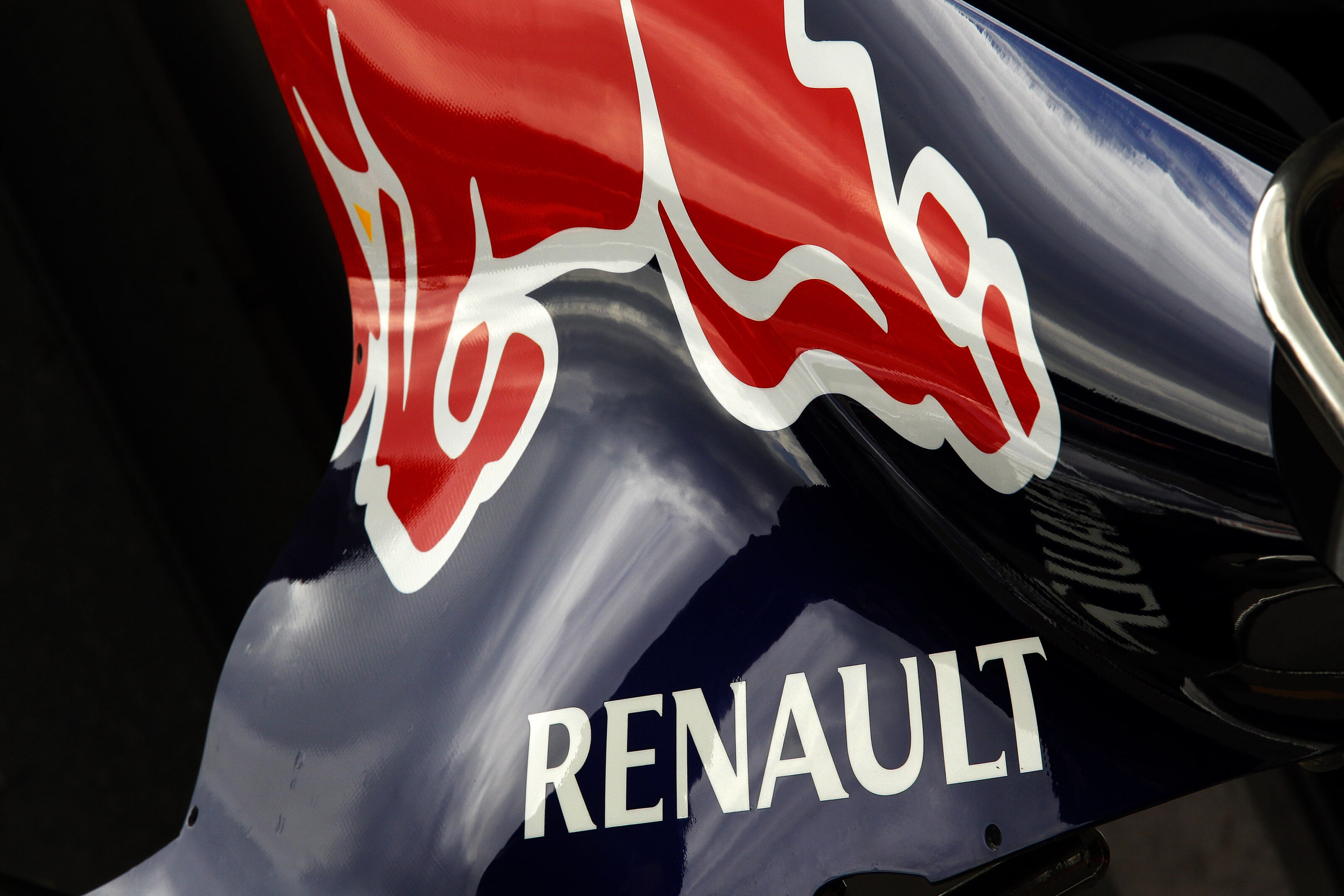
Despite the team’s success, supplying F1 engines has not been a smooth road for Renault. “This is the worst position,” said Jerome Stoll, who was today confirmed as president of Renault Sport Racing, speaking at last year’s Frankfurt motor show. “When the team wins, nobody talks about you. When the team loses, it’s always the responsibility of the engine maker. I’m fed up with this situation, to be honest.”
The company’s involvement in F1 is based on two premises, said Stoll. “We have to develop the awareness of the brand in new territories – I am not talking about Europe, but Australia, Asia, China, Mexico – all countries where we are still small with low awareness, and where Formula One could be a really relevant event to promote and to support the development of the organisation,” he said.
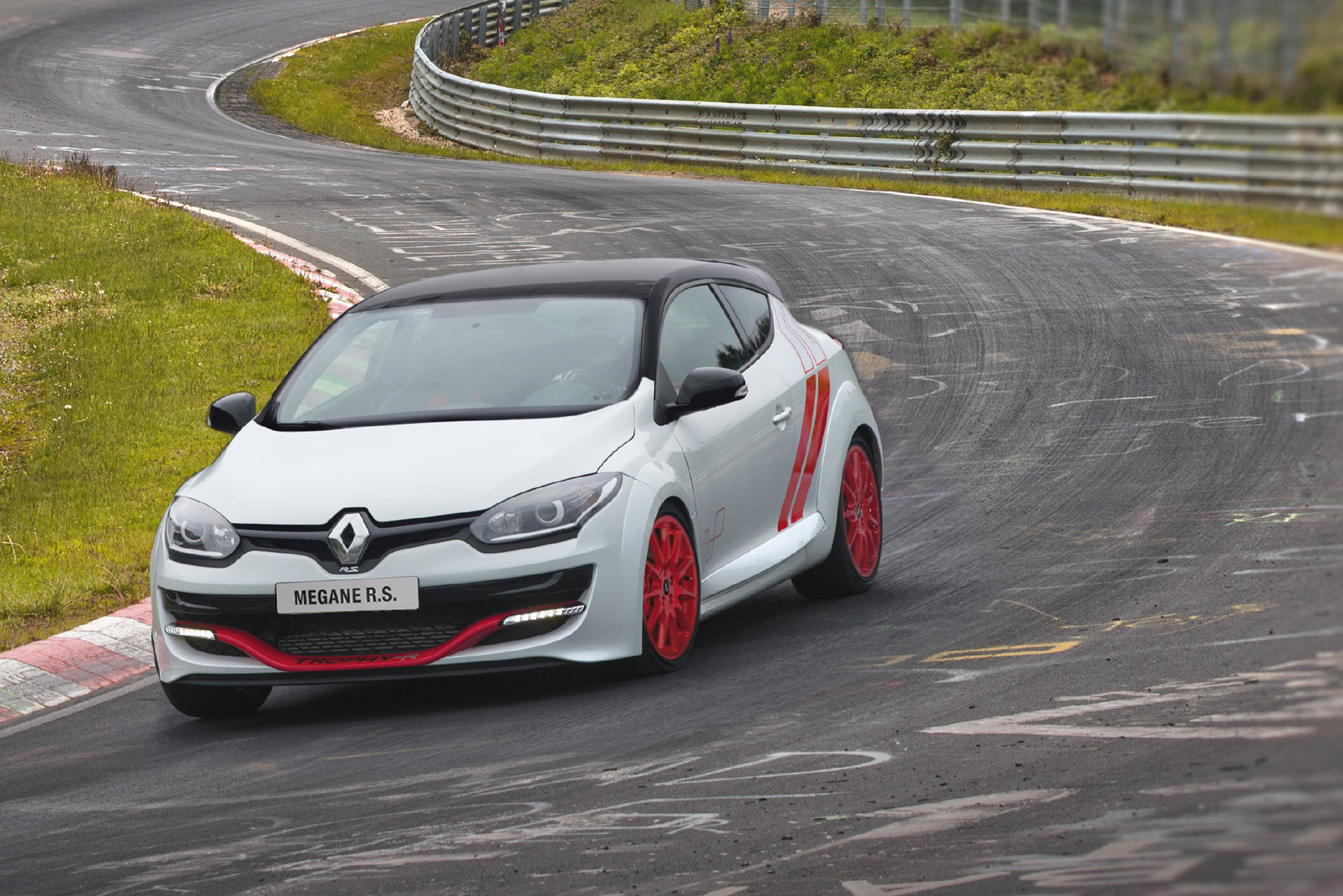
The second premise, said Stoll, was to support Renault’s product onslaught that started with the Clio in 2013, and will see the new Megane arrive here later this year. “For all these new cars, I would like our customers to put more value on the brand,” he said. “Formula One can answer these two issues … being part of this game is really being part of being best of the best … for these two aspects, Formula One makes sense.”
Part of this includes a doubling of Renault Sport road car sales to 80,000 a year with the new Renault Sport Megane, due here in 2017, as well as cheaper GT Line models. As reported by Wheels, a high-performance SUV is also being considered for the Renault Sport brand.
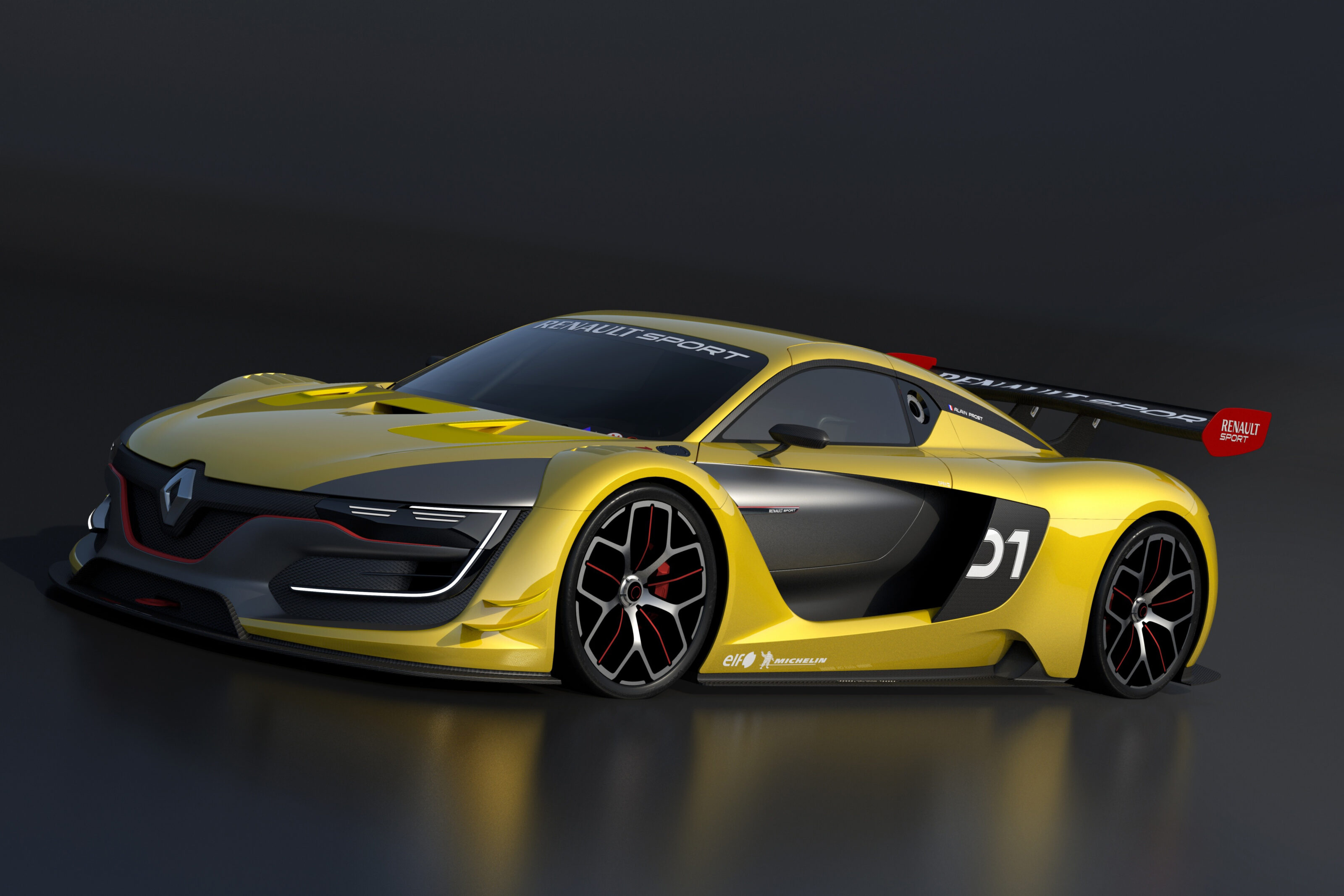
The Renault Sport Formula One Team’s first F1 event will be the Australian Grand Prix from March 17-20.
There’s a V8 version of the Genesis prestige sedan in America and Korea, so why didn’t Hyundai Oz stamp its passport?
WHAT IS IT? The Genesis is Hyundai’s more affordable rival for European prestige sedans such as the BMW 5 Series, Audi A6 and Mercedes-Benz E-class.
WHY WE’RE TESTING IT This is the one that got away. When Hyundai Australia built its business case for the prestige Genesis sedan, it chose to bring only the 3.8-litre V6 rather than offering the 5.0-litre V8 as well. We wanted to know why.
MAIN RIVALS Holden Calais V, Ford Falcon G6E, Lexus GS, Audi A6, BMW 5 Series, Mercedes-Benz E-class
THE WHEELS VERDICT The Genesis V8 has the performance and character to stand above its V6 brother, but it would need a lesson in road manners to work as well in Australia.
PLUS: Stronger engine; quiet cabin; premium feel; value for money MINUS: Busy ride; touchy throttle; thirsty; lifeless steering

We Aussies have an affinity with such beasts, so surely it was a no-brainer. And yet Hyundai Australia plumped for just the 3.8-litre V6.
Having spent the past five months in an Oz-spec Genesis V6, I can tell you it’s not short on herbs. So that clearly wasn’t a strong motivating factor. And Hyundai says the V8, which sells mostly in North America, had not been engineered for right-hand drive. To do so, it says, would have added too many millions to the program’s cost.
But still, what if the Genesis V8 had been engineered for RHD from the outset? Would it have contributed significantly to the car’s appeal? I had to know. So on my way to the Detroit show, I detoured to California to find out.
The V8’s extra 84kW and 113Nm is immediately noticeable, even though the car weighs 170kg more than the top-spec V6 sold in Australia. It accelerates more vigorously from standstill and is more generous in its response to throttle inputs.
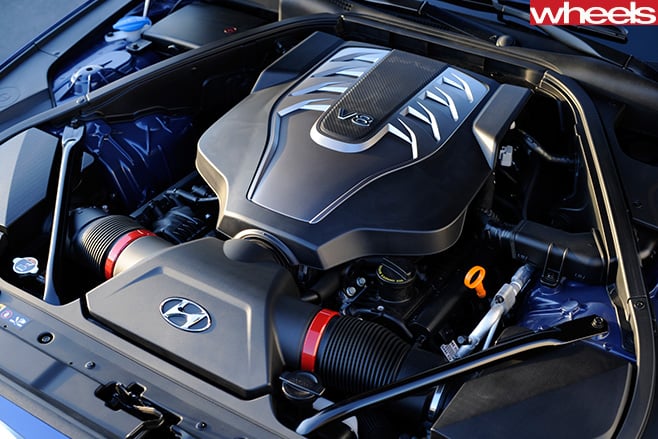
Other equipment is not so obvious, but obviously welcome, like lane-keeping assist (Aussie V6 thrums the wheel when you stray; the US V8 steers as well). And there’s a traction-control button, too, in which ‘Off’ really means off.
There’s little difference with in-cabin refinement – the visual and tactile kind, and the on-the-move kind. Materials and finish are top-notch, the driving position spot-on.
The V8 engine is barely audible during normal driving. Press harder and a pleasing V8 burble is evident but still restrained, as befits a prestige sedan. Give it full wellie and there’s noticeably more kick, but not as much as you’d expect with 30 percent more capacity, and it doesn’t feel like the 1.8sec 0-60mph difference one US mag claims between the V6 and V8 (7.2 v 5.4).
The eight-speed auto lacks the smarts to really leverage the V8’s stronger bottom end. The gearchange mapping feels out of step with the engine’s charms. It’s also not as smooth as my V6.

The ride, however, is less than stellar. Overly busy and sharp, particularly at low speeds, it’s a weakness for a prestige sedan. It’s also a pointed reminder that Hyundai Australia’s local tuning efforts, which deliver a more absorbent and more controlled ride, are to be applauded.
That’s not a deal-breaker, though. If it were to come Down Under, Hyundai Oz would surely fettle the V8’s manners. It’d make a pretty decent flagship, too, with that extra performance and equipment. But business cases are about numbers and it’s hard to see the V8 adding much to the V6’s 50 sales per month. Not enough to recoup the cost of a RHD program.
SPECS
Model: Hyundai Genesis V8 Engine: 5038cc V8 (90°), dohc, 32v Max power: 313kW @ 6000rpm Max torque: 519Nm @ 5000rpm Transmission: 8-speed automatic Weight: 2060kg 0-100km/h: n/a Economy: 13.1 L/100km (US) Price: $US53,850 On sale: Not for Australia
The Kia Optima set the design trend for the car maker, which spruiks ‘The Power to Surprise’ as its slogan. Yet for a car that set the look and characterised the confidence, verve and difference of the Korean brand, the second-gen Optima plays an awfully straight bat in terms of its looks. There’s hardly any resemblance to the stunning ‘Sportspace’ concept shown at Geneva 2015. It’s a good thing, then, that it sits on a new platform, offers more space and is a far more honed execution than its predecessor.
There are just two trim levels. The $33,490 Optima Si is the price leader, aimed primarily at fleets and pragmatists. The step up to the Optima GT we’re driving here is an eyebrow-raising $10K. At $43,990, it’s the most expensive Optima ever offered.
The GT not only gets unique bumpers, as well as a rear diffuser, 18-inch alloys and bi-xenon headlamps, it also gets the 2.0-litre turbocharged four from the Hyundai Sonata, with which this car shares its underpinnings. It features the same 180kW/350Nm outputs and six-speed automatic as the Sonata, but uses less fuel (8.5L/100km) and is loaded with far more equipment.
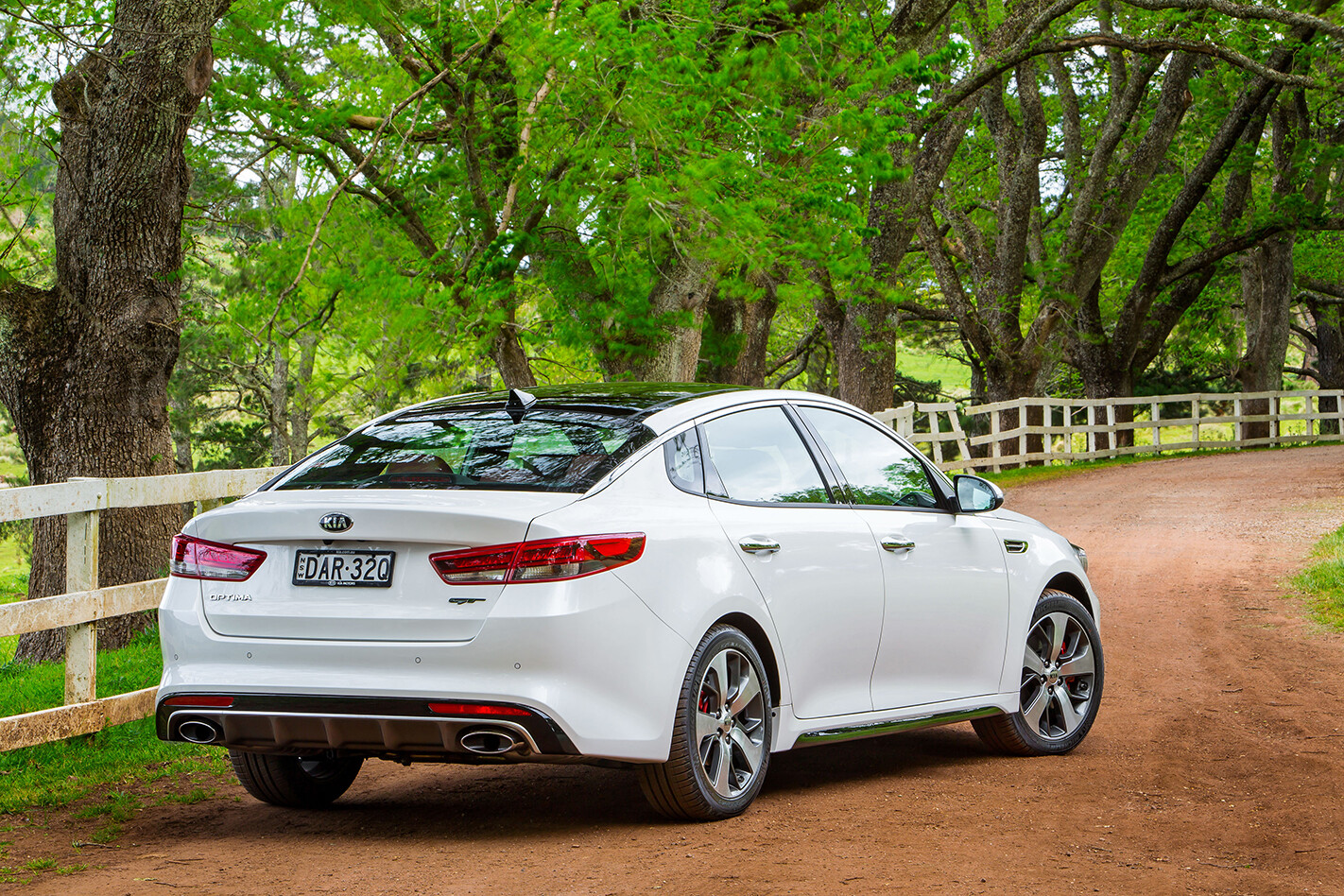
It ought to be, as the 2.0T-GDI engine is available in Sonata Elite for $36,990 with the same packaging and roominess. New Optima’s 2805mm wheelbase is 10mm longer than before, resulting in masses of rear-seat space for easy six-foot passenger comfort, and a 510-litre boot hiding a full-size alloy spare.
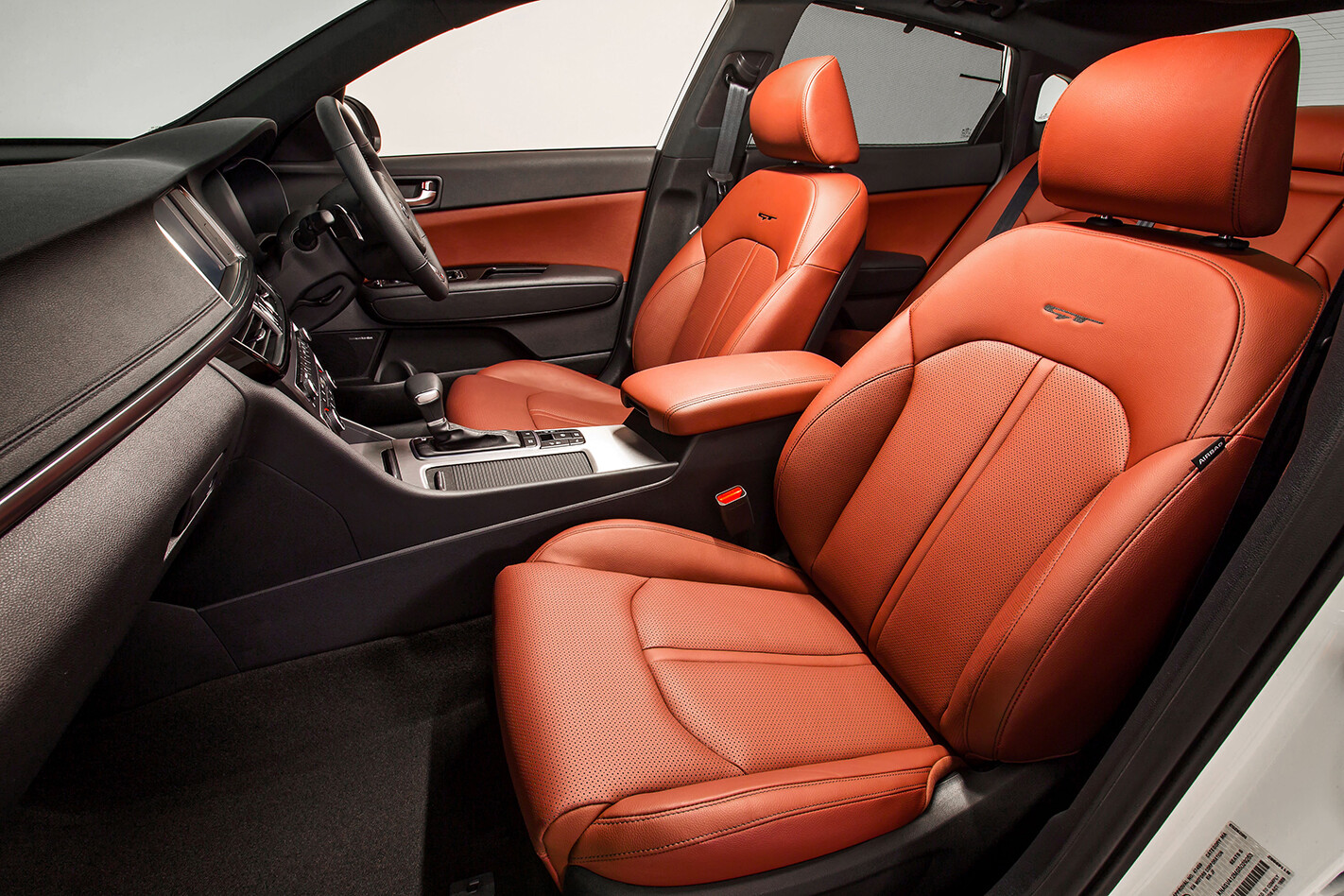
The cabin is a significant step up from the plastic-laden, cheap and nasty cockpit of its predecessor. The overall layout is simple, neat and effective, with aluminium (not coated plastic) inlays, a crisp 8.0-inch centre screen for the standard sat-nav and a reverse camera. There are also heated/ventilated leather seats, a good driving position with ample adjustment of both steering column and seat, and a flat-bottomed steering wheel.
On the road, the Optima GT shows dabs of talent, yet it doesn’t quite pull it all together.
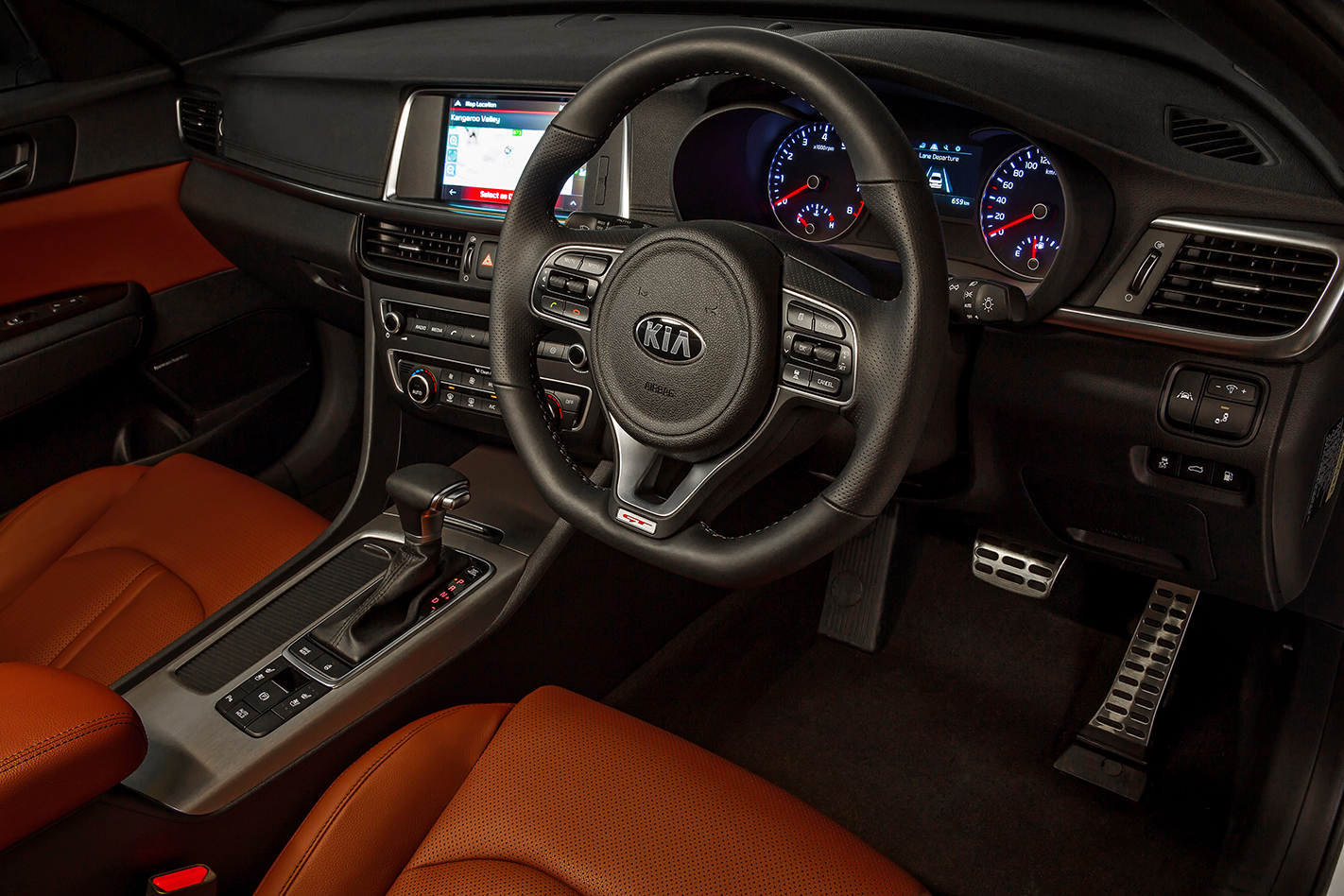
The 180kW turbo donk is responsive, if a little gruff when pushed, and if you select the ‘Sport’ Drive Mode, the GT’s throttle pedal is far too toey and difficult to modulate. Best leave it in ‘Normal’ mode and enjoy crisper steering too.
The engine is reasonably quiet around town – where the Optima offers good overall refinement – and while the auto is also a little slow at getting it all together, its smoothness is admirable.
At slow speeds, the GT’s ride (on excellent 235/45R18 Michelin Pilot Sport 3 tyres) is too firm, even for a pseudo-sports model. This fidgety ride is transmitted through the chassis and steering wheel, and can become tiresome. There’s also too much road noise. Yet the local input to the Optima’s rear suspension has clearly helped: at speeds above 70km/h, the ride matures into an almost supple, yet still sporting, pliancy on bumpy country roads. The electric steering, too, is a highlight, as it’s reasonably accurate and sharp enough to make a game of a windy road.
The body control, however, isn’t. That high-speed ride may be a plus, but a larger bump will see the Optima GT feel a bit spongy, and quick changes of direction aren’t its forte.
Does that mean the Optima GT doesn’t make the cut? No. While it lacks the chassis talent and overall polish of VW’s new Passat, the biggest Kia makes huge strides in the areas of perceived quality, safety, and luxury.
It doesn’t seem that long ago that to wrench better than 600 horsepower out of a street engine, you had to supercharge a big-block V8, take it right to the edge and then cross your fingers, making sure nothing fragile was nearby any time you wanted to risk starting it.
Shares in a fuel company didn’t hurt, either. Getting a reliable, tractable, streetable, 600-plus neddies from a small-block? Forget about it. That, of course, was then. Now, here we have a pair of cars with a combined horsepower total of more than 1300 neddies – let’s call it 1000kW in these modern times.
But more than that, they both comply fully with emissions laws (both retain their factory cat-cons, for instance) they will idle all day in 40-ambient, they’ll last for hundreds of thousands of kays and they can get their fuel consumption into the 10s, or even nines if you drive them carefully.
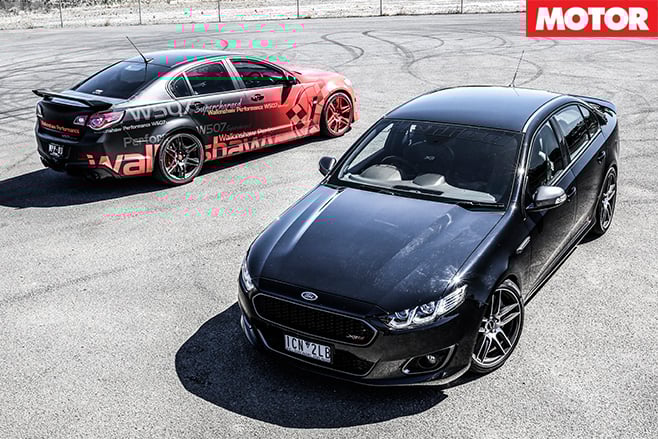
And an industry that has learned and adapted to maximise the extra potential inherent in these newer, better designs. Speaking of which, please stand up Walkinshaw Performance and Herrod Motorsport, because if you ever needed proof of the above, these are the guys and gals that can provide it.
What’s it like to drive a modern 500kW street car, then? Good question and I’m glad you asked, because having spent some time in both the Walkinshaw WP507 and the Herrod XR8, I’m having trouble thinking about anything else.
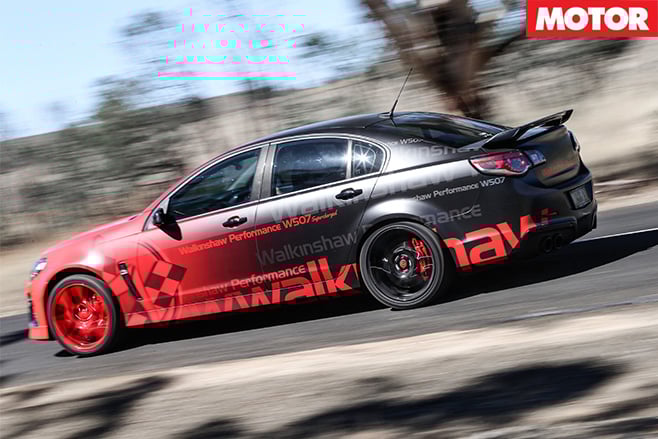
The Walkinshaw is the least modified of these two, mainly because the basis for the WP507, the HSV GTS, has so much going on to start with. It already gets the six-pot front calipers, two-piece rotors, 20-inch wheels and tyres (ContiSport Contacts) and the selectable drive modes which control the Magnetic Ride Control settings.
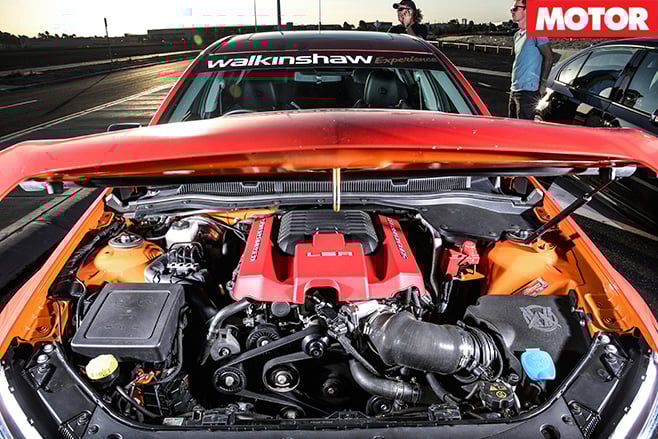
Robbie Herrod’s XR8, meanwhile, is a bit more extreme, purely because with a starting price of $52,490, Australia’s most enthusiastic car-tuner had more wriggle-room to begin with. So let’s break it down into the various chunks (all of which are available separately) starting with the engine.
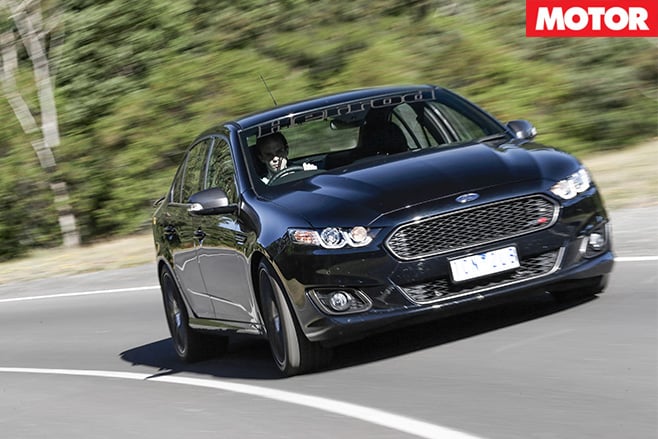
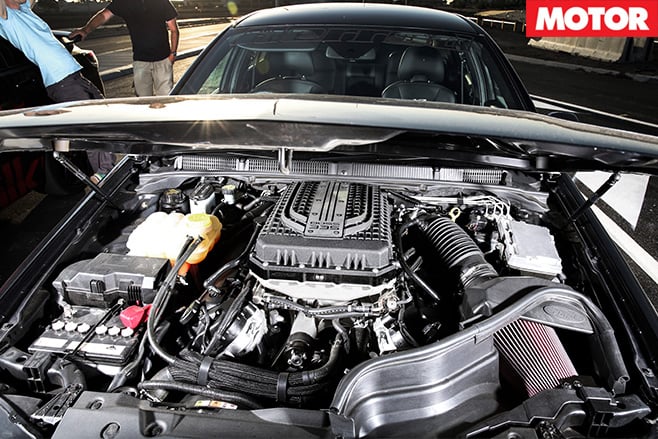
But the big mods don’t stop there. While the WP507 gets away without an intercooler, Herrod has developed a kit for the Miami that fits neatly between the plenum and the intake and, according to Rob, drops intake charge temps from around 65 to 40-45 degrees.
There’s an ECU tune to make each bit talk to the others and nice touches like an oil breather mod and a spark-booster kit. Herrod has also developed an exhaust system which amounts to a stainless cat-back set-up and adds $2200 to the $10,630 total for the engine mods.
That’s been made possible by a set of Herrod-modded rear suspension blades. All that adds another $4850. There’s also a custom-calibrated spring and Koni shock package for $2380. As tested, then, the Herrod hot-rod stands as a $27,260 advance over the stock XR8 manual, taking the total to $79,750, well short of the Walky’s $103,480.
And like we said, you only want the Herrod motor, just buy the Herrod motor. Me? I’d take the motor, the brakes and the suspension and probably live with the stock wheels and tyres till it was time to replace them. Which wouldn’t be long.
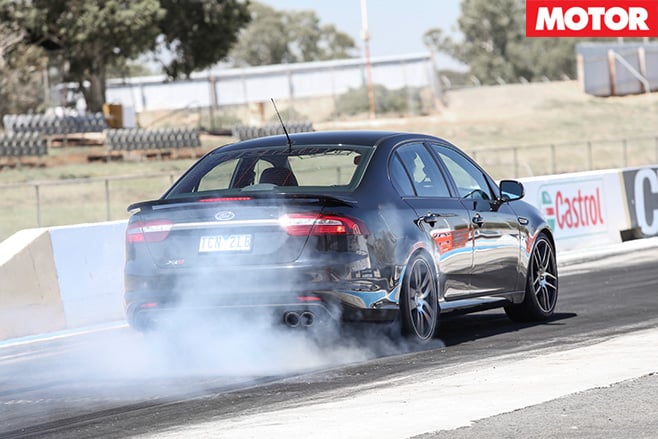
See, while it’s common knowledge that a dyno can lie, so can the dragstrip. Well, maybe not actually tell porky-pies, but the bald numbers from a 400-metre run can sometimes fail to tell the whole, real-world story. And that’s what’s going on here. I’ll explain in a minute.
The nub of it is that the Herrod XR8 is w-a-y faster than a stocker, but in manual form, it’s nastier than a nest of vipers when it comes to getting a clean getaway. You’ve got to puppy-walk it off the line and then be Forrest Gump-slow on the shift into second to get it back on the noise.
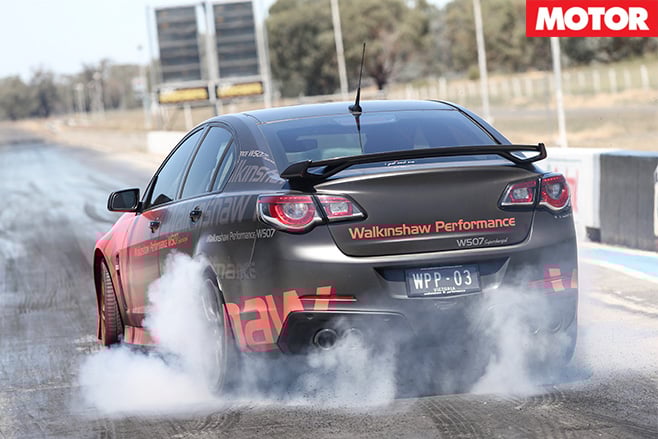
In contrast, the Walkinshaw is almost stupid-easy to launch. Oh, sure, you can still set fire to its tail with too much clog, but with a small stall-up the WP507 will scamper off to a 12.4 quarter-mile and do it repeatably. So it’s much quicker, no? Er, well, here’s where that dragstrip-can-deceive thing comes in.
In the interests of science, we decided to run both cars down the strip side-by-side, starting from 60km/h in second gear in each. And guess what? By eliminating the need to include a from-rest launch in proceedings, things evened up quite a bit.
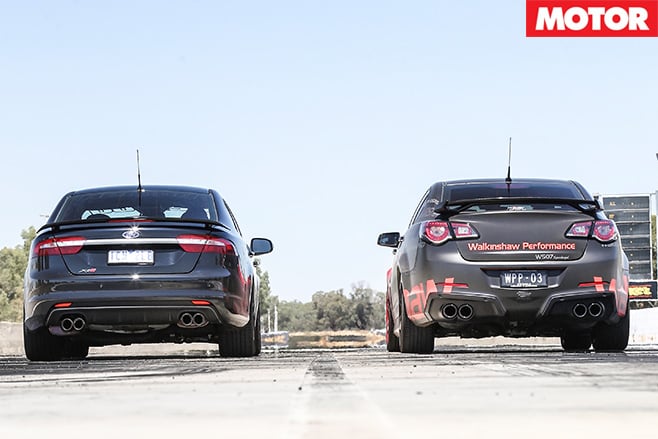
The six-speed auto in the WP507 has been tweaked for greater shift clarity, so it fair dinkum changes up like the rear end of the car has just been whacked by a huge sledgehammer. My initial suspicion was also that the tranny had been treated to a high-stall converter, and the way this trans allows the engine to spool up, build boost and then lets the car catch-up, feels just like your mate’s high-stalled 308 HZ Kingswood did back in the day. Times 10, of course.
Walkinshaw denies that it’s done any such thing (swapping the converter) so without pulling the thing apart, I have to believe that it’s just a recalibration at work here. But it has a big effect. Maybe an XR8 auto tricked to the same extent. Maybe not.
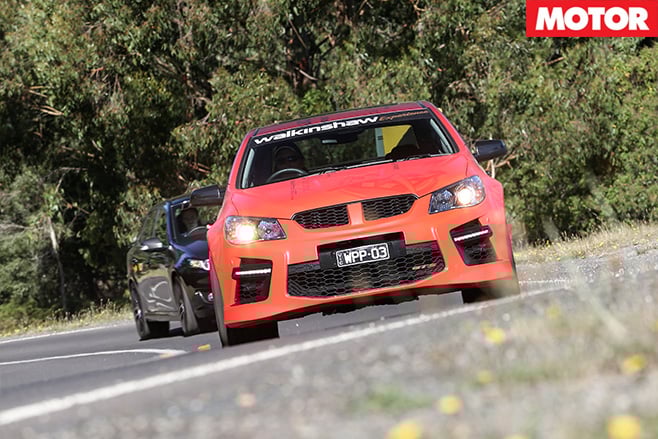
The WP507 will kick down a couple of gears and then grunt on by, while the driver of the Herrod has a choice to make: Drop three gears and leave themselves open for a lethal injection. Or, stay in sixth gear for the overtake and maybe get off light with a 20-year non-parole period.
Gunning either car away from an intersection or cross-roads out in the bush is more fun than I can tell you. Both have a bit of blower-whine as you load them up and increase the revs beyond about 3500rpm, and both have the ability to leave you open-mouthed time and time again. That’ll be 500kW, then.
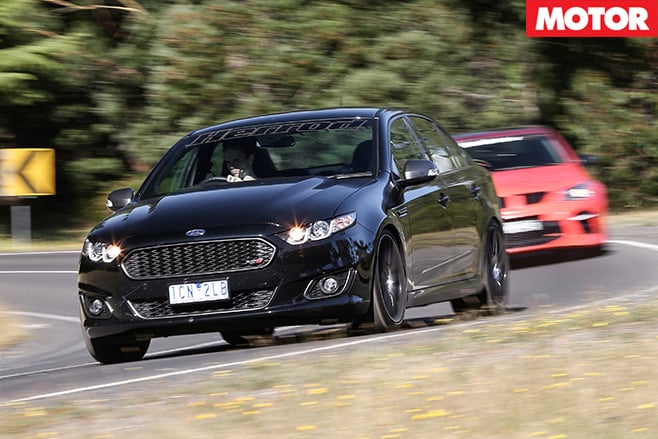
And thanks to those tranny tweaks we mentioned, it has that old-fashioned, speedboat-coming-out-of-the-hole thing going on. And from inside, it honestly sounds like a Doorslammer when you’re fair up it. The only question is whether, over time, you might get a bit tired of this level of extroversion.
For all that mayhem and madness, either car would be completely at home doing the interstate run, and towing a boat or caravan would involve no hardship. If anything, we’d pick the Herrod for long trips because the man has fixed the two things that let the basic XR8 down a little.
For a start, the revised springs in the rear of the Herrod Falcon have tamed that choppiness in the ride. This is big news, too, because in stock form, the Ford and the HSV have reversed roles with the GTS possessing the more supple, subtle ride.
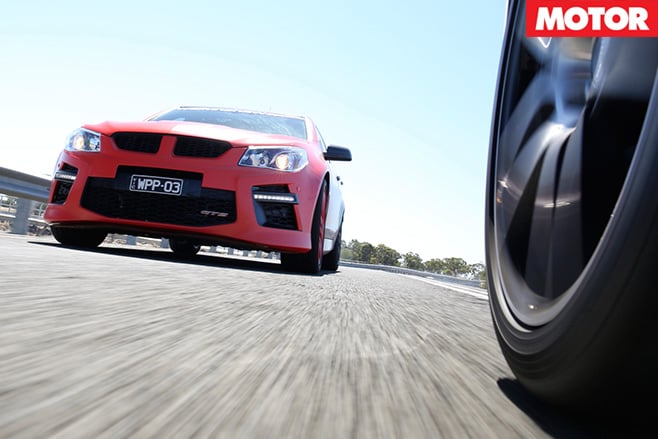
Another thing Herrod has fixed is the basic Falcon’s crook driving position. By re-sculpting the seat foam, there’s now more room between the tiller and the seat cushion. You finally feel as though you’re sitting in an XR8 and not on it.
The relevance of cars like this in 2015 is the other big question people tend to throw our way. But when the thing can better 10 litres per 100km on a cruise and has the usual plethora of air-bags and driver aids (the Walky even has blind-spot sensors and lane-departure warnings) it’s hard to argue that case on any level.
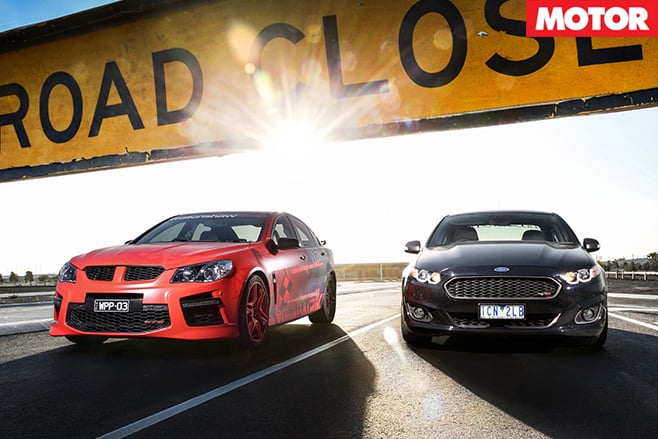
And in an age where I’m constantly being told to get off the lounge and get out into the world for the sake of my health, maybe a WP507 or a Herrod XR8 is just what the doctor ordered. “Mind telling me why you were speeding, sir?” “Doctor’s orders.”
| u00a0 | HERROD XR8 | WALKINSHAW WP507 |
| Body | 4-door, 5-seat sedan | 4-door, 5-seat sedan |
| Drive | rear-wheel | rear-wheel |
| Engine | 4951cc V8, DOHC, 32v, supercharger | 6162cc V8, OHV, 16v, supercharger |
| Bore/Stroke | 92.2 x 92.7mm | 103.2 x 92.0mm |
| Compression | 9.25:1 | 9.1:1 |
| Power | 510kW @ 5800rpmu00a0 | 507kW @ 6200rpm |
| Torque | 760Nm @ 4800rpm | 850Nm @ 4400rpm |
| Power/weight | 269kW/tonne | 275kW/tonne |
| Transmission | 6-speed manual | 6-speed auto |
| Weight | 1861kg | 1841kg |
| Suspension | double A-arms, coil springs, anti-roll bar (f); multi-links, coil springs, anti-roll bar (r)u00a0 | struts, coil springs, stabiliser bar (f); multi-links, coil springs, stabiliser bar (r) |
| L/W/H | 4949/1868/1458mm | 4505/1895/1220mm |
| Wheelbase | 2650mm | 2915mm |
Tracks | 1583/1598mm (f/r) | 1616/1590mm (f/r) |
| Steering | hydraulically-assisted rack-and-pinion | electrically-assisted rack-and-pinion |
| Brakes | 381mm ventilated discs, 6-piston calipers (f); 356mm ventilated discs, 4-piston calipers (r)u00a0 | 390mm two-piece carbon ceramic rotors, 6-piston calipers (f); 350mm two-piece carbon ceramic rotors, 4-piston calipers (r) |
| Wheels | 19 x 9.0-inch (f); 19 x 10.0-inch (r) | 20 x 8.5-inch (f); 20 x 9.5-inch (r) |
| Tyres | 255/35 ZR19 96Y (f); 295/30 ZR19 100Y (r) ContiSport Contacts | 255/35 R20 (f); 275/35 R20 (r) ContiSport Contacts |
| Price | 52490 | $95,490u00a0 |
| Price as tested | $79,750* *Engine mods ($10,630); brakes ($7200); wheels and tyres ($4850); custom spring and Koni shock package ($2380); exhaust system ($2200) | $103,480* *W507 Package ($7990) |
| Positives | Fearsome engine; comfy ride; looks great; value for money | Shockingly quick; sounds gnarly; hot-rod vibe; brakes and handling |
| Negatives | Still a bit of a woolly handler; almost scary fast; power-down issues | Ride has been compromised somewhat; garish sticker package |
| u00a0 | 4.5 out of 5 stars | 4.5 out of 5 stars |
A massive month at MOTOR with 10 huge features as well as all the usual news, reviews and issue regulars. We hope you enjoy it!
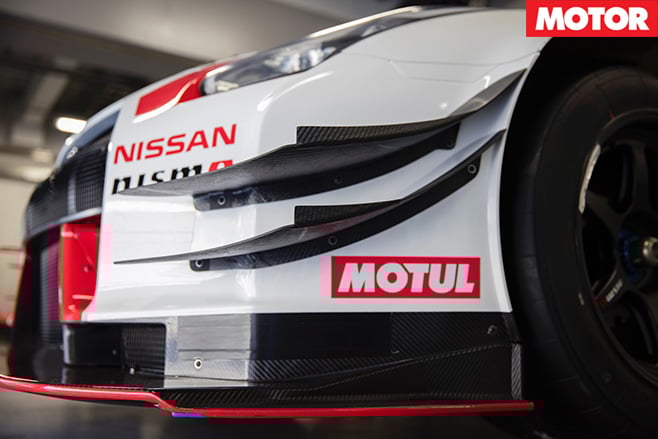
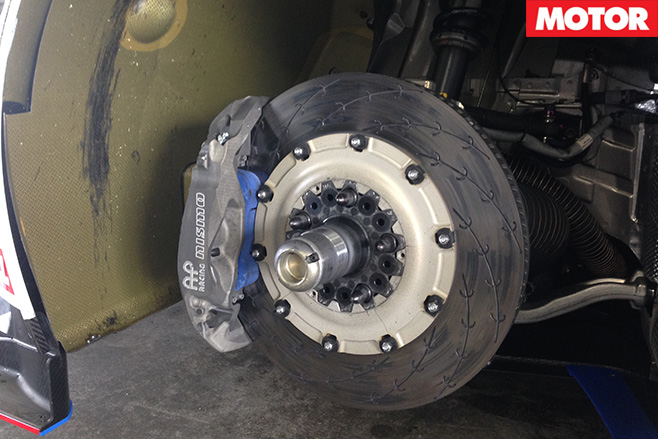
With the Bathurst 12 Hour only days away, Nissan’s been busy preparing its sole Nissan GT-R Nismo GT3 to defend last year’s win at The Mountain.
MOTOR joined Nismo last week at Phillip Island to watch the team dial in the Nismo GT3 for the upcoming race. And here we had the chance to peek at the hulking racecar up close.
We learned quickly GT3 cars like the Nismo, despite being based on road cars, are serious machines.
Here are five quick GT-R Nismo GT3 details worth drooling over…
1] Crazy aero
2] Monster brakes
3] Carbon fibre
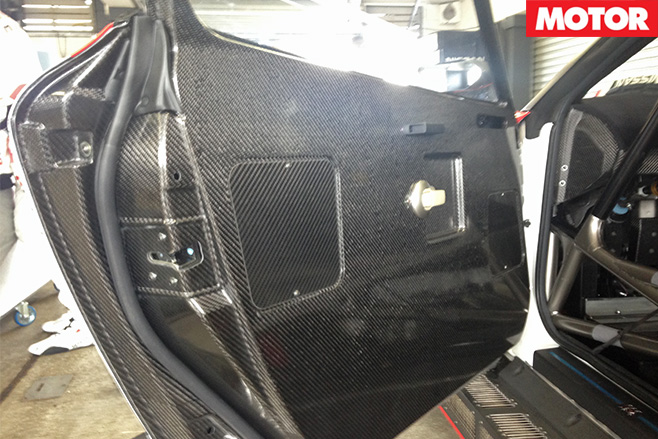
4] Serious cooling
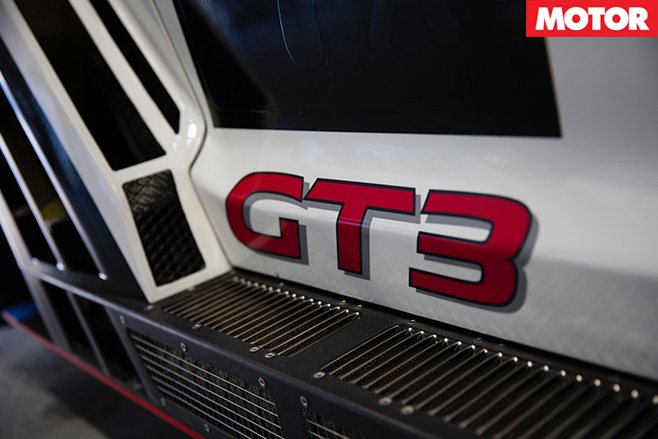
5] Road car relation
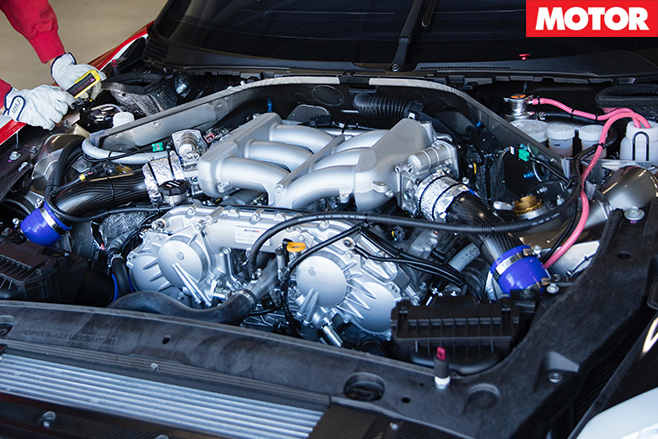
To read more on what makes GT3 cars tick and how manufacturers like Bentley are fighting Ferraris and McLarens, and winning, check out our “Bentley & the rise of GT3 racing” feature from MOTOR Magazine’s March 2015 issue here.
It’s difficult to call a $229,000 car the base model with a clear conscience.
‘Entry-level’ doesn’t quite sit right either. So let’s go with ‘introductory’, as in, the SL400 is the new introductory model to Mercedes-Benz’s flagship roadster range, replacing the SL350.
And with its passing goes the last bastion of Mercedes-Benz naming logic, for the SL350’s 3.5-litre V6 has not been replaced with a 4.0-litre engine, but a 3.0-litre V6 with twin turbochargers.
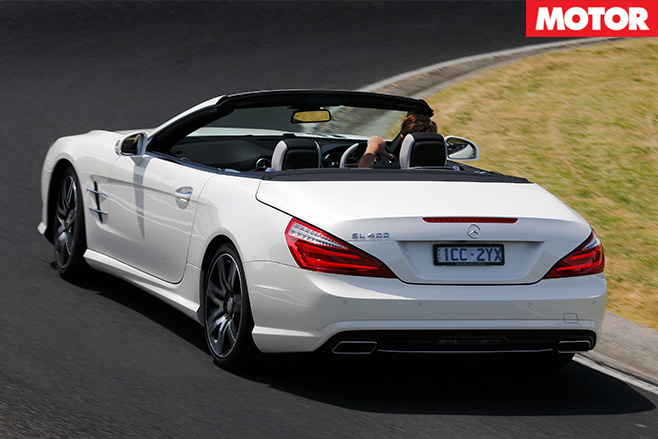
Obviously, it lacks the outrageous grunt of its AMG-badged siblings, but at 1655kg the all-alloy SL400 is much lighter than you’d think and its 245kW and 480Nm do a fine job of motivating it in most circumstances.
The SL legend was built on six-cylinder powerplants – original 300SL Gullwing, W113 280SL – and this new engine upholds that tradition with heaps of torque, a keenness to rev and a mellifluous V6 howl. Lovely.
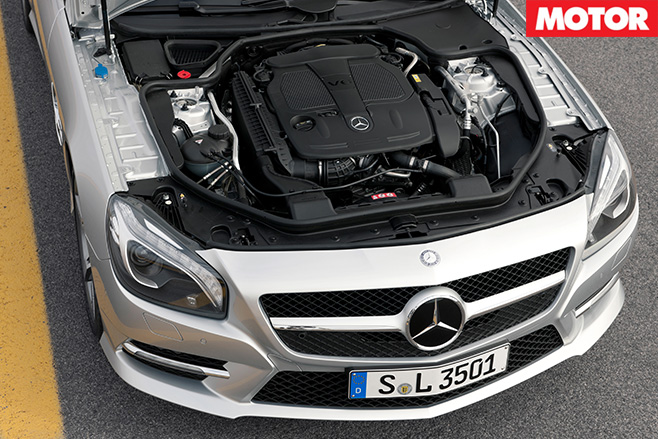
So few of these cars will be driven enthusiastically that most owners will probably never encounter it, but SL does stand for ‘Sport Light’, so surely a high level of handling sophistication isn’t asking too much?
The issues don’t end there. While the SL’s primary ride – larger bumps and so on – is suitably wafty, it constantly fidgets over smaller imperfections like a bored toddler. Perhaps the 30-profile tyres of our test car were to blame, but it falls short of the level of comfort you’d expect from a luxury grand tourer.
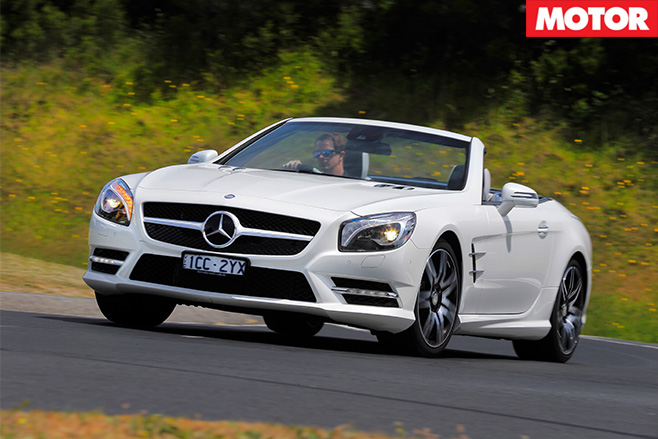
Bar its excellent new engine, the SL feels like a car nearing the end of its life cycle, which despite being barely three years old, it is. An all-new model is due in late-2016/early-2017, and based on Benz’s recent output, there’s every reason to believe it’ll be a big improvement on the current car.
Then again, if it’s to reclaim its position as king of the luxury hill, it’ll need to be.
3 out of 5 stars
Specs
Engine: 2996cc V6, DOHC, 24v, twin-turbo Power: 245kW @ 5250-6000rpm Torque: 480Nm @ 1600-4000rpm Weight: 1655kg 0-100km/h: 5.2sec (claimed) Price: $229,000
SALES of Australian-made cars plummeted in a new-car market that grew 2.7 percent compared with the same time last year, falling just shy of its 85,430 January record, set in 2013.
Locally-produced Holdens, Fords and Toyotas accounted for only 4.9 percent of the 84,373 cars sold in January 2016, almost half of the market share Australian-made cars achieved in 2015.
For the first time ever an Australian-made car didn’t make the list of top 10 best-selling vehicles; 1242 sales for the Holden Commodore made it the top selling locally-manufactured car, enough for only 15th place.
The figures were tempered by a dismal result for the Australian-made Toyota Camry, which managed just 503 sales – less than one-tenth the Camrys it sold in December, when it was the top-selling car.
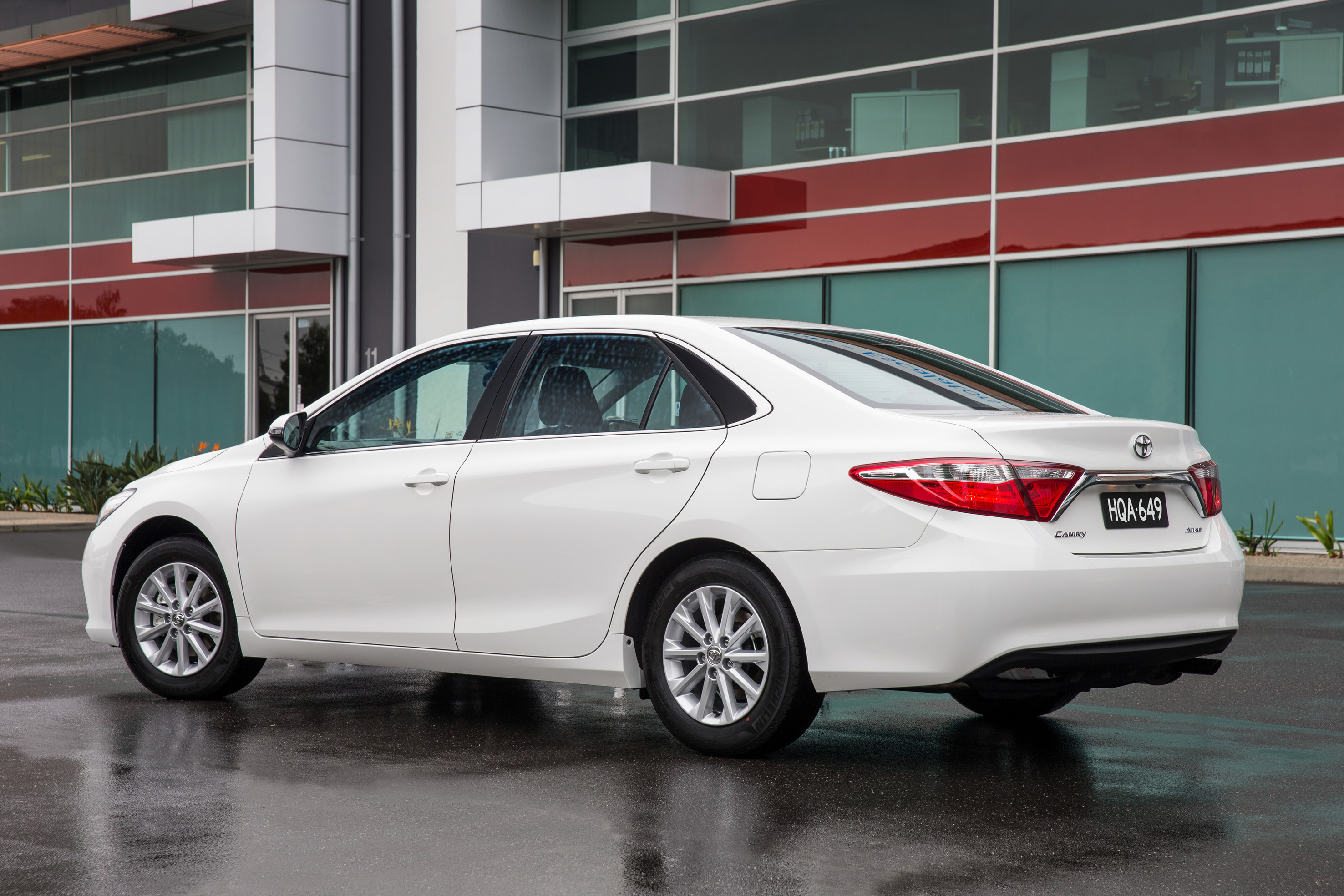
Indeed Toyota’s January result of just 12,453 (down 8.8 percent) was its worst performance since 2002, and the Toyota Corolla that has dominated the sales charts in recent years was outsold by the Mazda 3 (3722 to 2758), the top-selling vehicle in January.
Just nine months out from its planned stop of production, the Ford Falcon registered an all-time low, with just 235 cars sold – that’s only one sale more than the Porsche Macan.
It was another month to forget for Ford on the passenger car front, with the Kuga, Mondeo, Focus and EcoSport all posting poor results of fewer than 500 cars each.
Once again it was up to the Ranger to do the heavy lifting for Ford, accounting for 44 percent of the brand’s sales with 2418. The Ranger was also the top-selling ute, beating the new Toyota Hilux (2341) that had held the top position since going on sale in October.
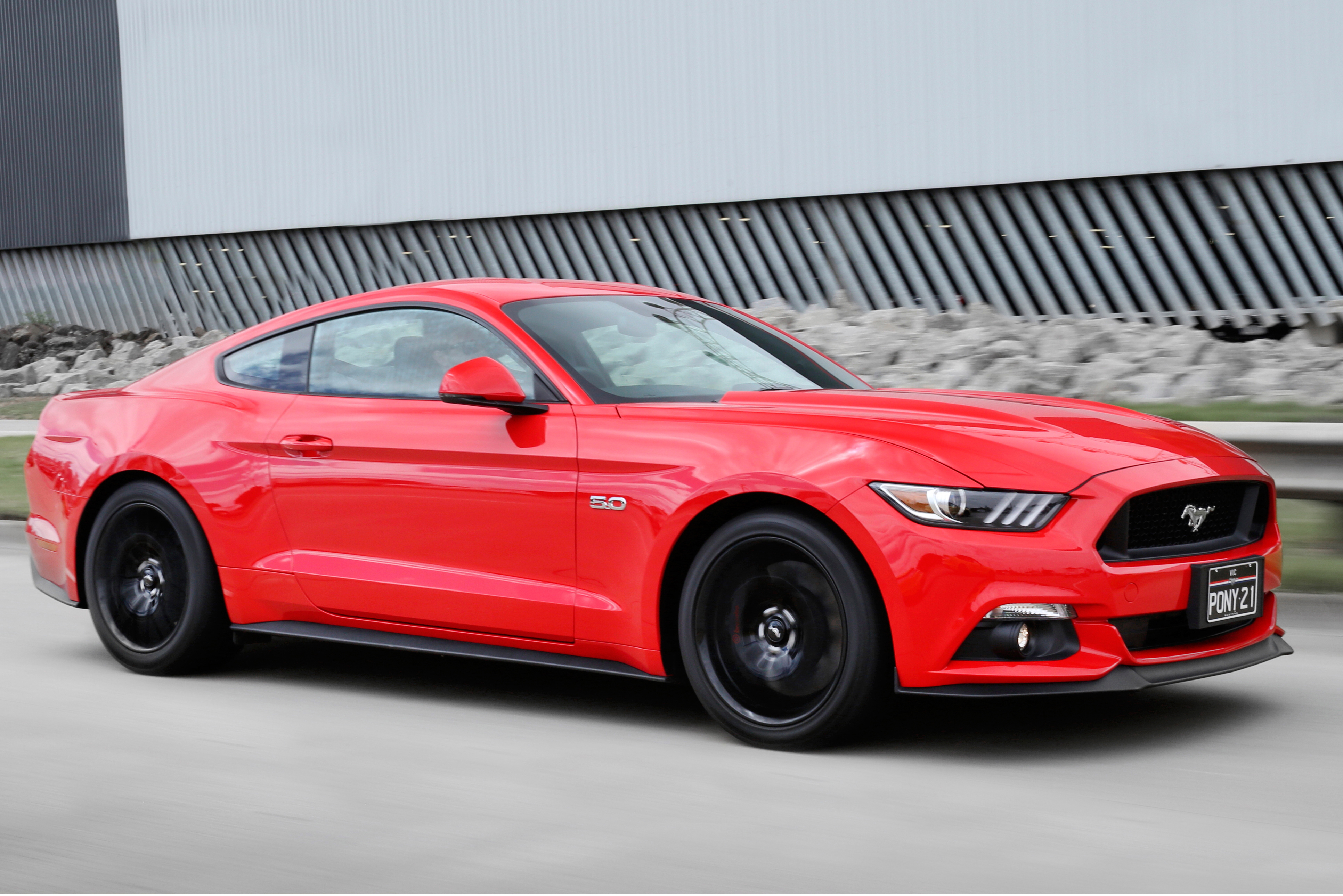
Arch-rival Holden also had a disappointing start to the year, with a meagre 6824 sales for 8.1 percent of the market, relegating it to fourth on the sales charts to slip behind third-placed Hyundai (7001).
The big winner – in a now familiar trend – was Mazda, with sales up 11.2 percent and a record 11.9 percent market share.
Luxury brands carried on their buoyant 2015 results to post another record in January 2016. Audi achieved an increase of 11.3 percent with 2142 sales, ahead of BMW on 2075 (up a whopping 19.8 percent), but it was Mercedes-Benz’s continued charge at the top with 3099 sales and 19.5 percent increase to see it knock off Honda (2898) for the last spot in the Top Ten.
The SUV juggernaut rolled on in January with an increase of 19.5 percent. There were 33,073 SUVs sold compared with 35,214 passenger cars, the latter dropping 11.5 percent; the artificial drop in Camry sales accounted for a large chunk of that decline.

Hyundai had the top selling SUV with its resurgent Tucson managing 2065 sales, pipping the Mazda CX-5 (1750) that’s held the top spot in recent years.
Sales of utes – which dropped market share in 2015 – rebounded in the first month of the year. There were 12,811 utes sold, an increase of 15 percent.
January 2016 sales figures: Top 10 best-selling brands
| RANKu00a0 | BRAND | SALES |
| 1. | Toyota | 12,453 |
| 2. | Mazda | 10,016 |
| 3. | Hyundai | 7001 |
| 4. | Holden | 6824 |
| 5. | Nissan | 5563 |
| 6. | Ford | 5504 |
| 7. | Mitsubishi | 5007 |
| 8. | Volkswagen | 4341 |
| 9. | Kia | 3116 |
| 10. | Mercedes-Benzu00a0 | 3099 |
January 2016 sales figures: Top 15 best-selling cars
| RANKu00a0 | MODEL | SALES |
| 1. | Mazda 3 | 3722 |
| 2. | Toyota Corolla | 2758 |
| 3. | Ford Ranger | 2418 |
| 4. | Toyota Hilux | 2341 |
| 5. | Hyundai Tucson | 2065 |
| 6. | Hyundai i30 | 1852 |
| 7. | Mazda CX-5 | 1750 |
| 8. | Holden Colorado | 1691 |
| 9. | Nissan Navara | 1670 |
| 10. | Volkswagen Golf | 1606 |
| 11. | Toyota RAV4 | 1440 |
| 12. | Mitsubishi ASX | 1393 |
| 13. | Mazda CX-3 | 1391 |
| 14. | Mazda 2 | 1381 |
| 15. | Holden Commodoreu00a0 | 1242 |
