
The Alfa Romeo 4C was named the winner of the WhichCar Style Award at the Australian Motoring Awards 2016.
The Australian Motoring Awards 2016 was held on Wednesday, 20 January at the Crown Casino Palladium in Melbourne.
Previously held under the title of Wheels Car Of The Year, this year the awards night also included the announcement of 4X4 Of The Year, Motor Performance Car Of The Year and the very first WhichCar Style Award. The awards were presented in front of the automotive industry’s most influential people.
The Alfa Romeo 4C was crowned WhichCar’s most stylish car for 2016 and the award was presented to Fiat Chrysler Australia’s manager of PR and Communications, Rachel Reed.
“We are very pleased with the outcome of the WhichCar Style Award and the response we had both through the online poll voting system and our judging panel. While all four finalists were very stylish and received acclaims from our judges, it was the Alfa Romeo 4C that stole the spotlight.
“At the end of the day, its lovely detailing, X factor appeal and innovative design made it a worthy winner,” WhichCar’s Lifestyle Editor, Anna Kantilaftas, said.
FCA Australia President and CEO, Pat Dougherty, said: “We are incredibly proud of the Alfa Romeo 4C and the many awards it has won both in Australia and around the world. It’s a hugely exciting time for the Alfa Romeo brand, and even more so because the stunning 4C and 4C Spider are just the beginning of that story. Watch this space, as there’s a lot more to come from this iconic and storied brand.”
The Ford Everest received the award for 4X4 Of The Year while Motor presented its gong for Performance Car Of The Year to the Porsche 911 GT3.
For the main event, Mazda walked home with smiling faces after Wheels editor Glenn Butler announced the Mazda MX-5 the winner of Wheels Car Of The Year. It’s the third win for the popular sports car after also receiving the award in 1989 and 2005.
For more photos from the event, click on the gallery above.
What is it?
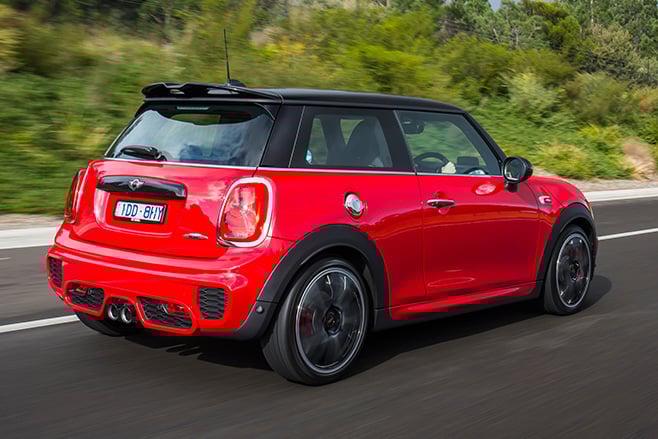
A compact high-performance hatch that takes its name from a 60s Mini racer and tuning specialist, and these days signifies the most focused, expensive as well as the fastest Mini Cooper. Earlier iterations of the JCW, as it’s known, were revered by enthusiasts for their brilliant blend of speed and driver involvement; this third generation aims to continue the legacy.
What’s new about it?
It’s built on an all-new platform used by parent company BMW to underpin front-drive models such as the 2 Series Active Tourer and the X1 compact SUV.
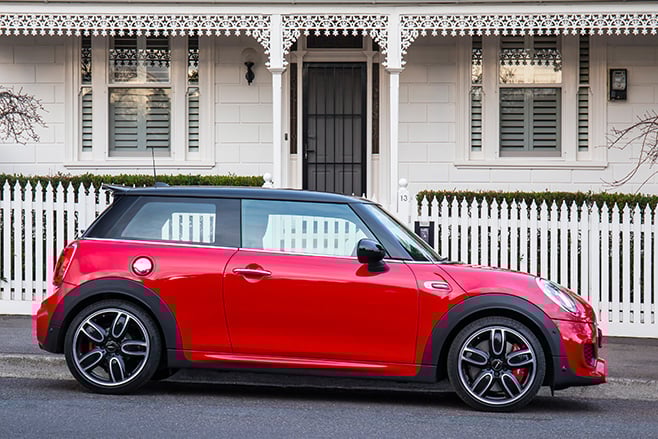
The aim was to add interior space without blowing out the exterior dimensions too far, and it mostly succeeds. The styling hasn’t made such a happy transition. The first New Mini was a skillful reinterpretation of the original – a larger, yet tightly drawn small car that cleverly acknowledged much of what made its 1960s forebear such a hit.
The third generation has lost much of that, instead becoming a slightly bloated, garish caricature. The nose juts awkwardly, the tail-lights bulge proud of the sheet metal like there’s a subcutaneous infection going on, the front end is a collision of angles and vents, not all of them functional.
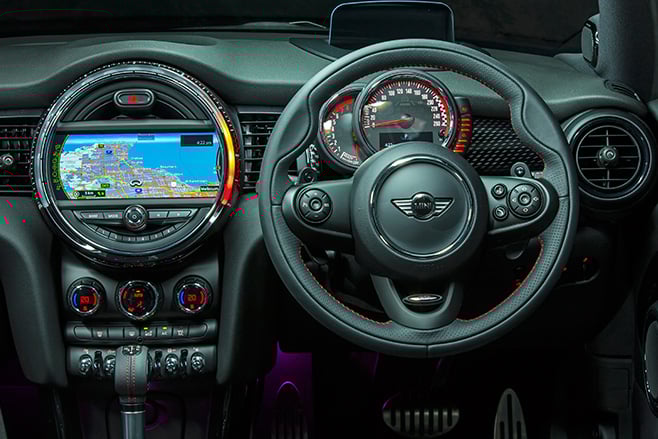
Inside, the cartoonification continues, with garish decals, fluro lighting options and dumbed-down infotainment messages aimed at the youth market. But how many young people who like this treatment actually have $50K-plus to drop on a top-of-the-range Mini?
What’s it like to drive fast?
It should be an absolute blast; an eager bundle of energy that fizzes and crackles and goads you into pushing the limits. So does it? Not entirely. The steering is direct to the point of hyperactivity, which can create the impression that the back of the car is struggling to keep up with the super-fast changes of direction from the front.
Compounding the problem, if you’ll excuse the pun, is Mini’s inexplicable choice of comfort/eco-biased tyres, rather than the high-performance rubber a car like this demands. The 18-inch Pirelli P7s are designed to reduce rolling resistance, with the result that the car can feel skatey on typical blue-metal (as opposed to hot-mix bitumen) Aussie roads.
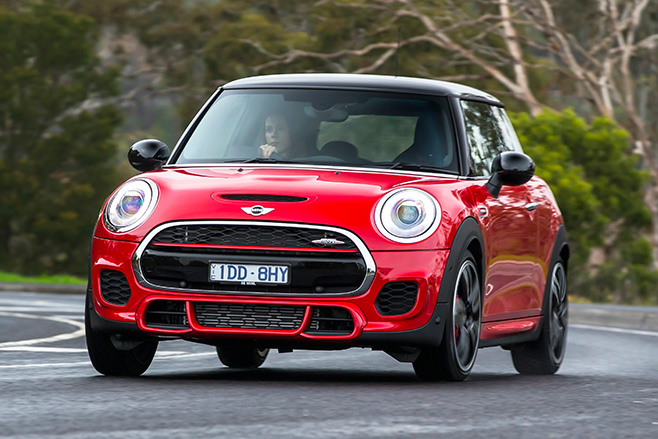
What you end up with is a car that doesn’t feel completely glued down in the middle of a corner, and begins to wag its tail if the driver has to back off the throttle or start applying the brakes before things are all in a straight line. Skilled operators may find this fun and interactive, but plenty of others will find it unnerving. There’s no question better tyres would transform the JCW driving experience and bring a level of dynamic cohesion that’s currently lacking.
At least the engine feels well sorted, which is no surprise, as it comes from parent company BMW. It makes a generous 170kW (up 29kW on the regular Cooper S) and is potent enough to hurl the Mini from 0-100km/h in a claimed 6.1 seconds and make it feel plenty quick enough when driven with gusto. The JCW is also offered with an automatic transmission, which seems a little at odds with its super-sporty intentions, but at least it can be operated by paddleshifters behind the steering wheel, giving the driver back a reasonable level of control.
There’s plenty of blurting and popping from the exhaust when you’re really on it, which goes some way to taking your mind of the grip and balance issues.
What about the commute home?
Even overlooking the chintzy treatment, there are problems from the driver’s seat. The dash is abnormally deep, moving the driver back from the windscreen and taking away any sense of intimacy and connection. The rear seat only offers enough space for very small kids, while the luggage compartment will struggle to take a weekly grocery shop for a typical family, unless you fold down the rear-seat backrests. Otherwise it’s reasonably civilised, with a Comfort mode to soften the suspension, light, direct steering, and a powertrain that is happy to lug taller gears and cruise quietly.
What’s it worth? And is it worth the coin?
Oh dear – another area to weaken the case for a JCW. The automatic version we tested sells for $49,950; the manual is $2550 less. The regular Cooper S hatch (minus the JCW) is $39,300. Yes, its engine, among other things, is less muscular, making 141kW/280Nm, but given the $10K more expensive JCW doesn’t having you gagging to thrash every last bit of performance from it, it’s not hard to convince yourself that the regular Cooper S fills the role more roundly.
Click here to find out more about the Mini Cooper John John Cooper Works.
IT IS EFFECTIVELY the world’s biggest car comparo: 55 cars from 25 model ranges brought to the one place at the one time for a ruthless evaluation.
So what goes on during the always secret Car of the Year testing process? How do the Car of the Year judges treat the cars during testing, and what do they say behind closed doors about the vehicles’ merits and shortcomings?
This video, shot inside the Holden proving ground at Lang Lang, south east of Melbourne, during the first three days of assessment for Car of the Year 2016, will give you some answers. It covers the period when the 25 candidates were reduced to eight finalists.
After the proving ground tests, we take the finalists onto public roads for a further four days before reaching a verdict.
Strap in, and crank up the volume!
Imagine if Ford put the XR6 Turbo engine in the Focus and made it rear-wheel drive.
In 2012 BMW sort of did its version of that in creating the M135i. Not quite an M car and sort of a hot hatch, yet one with a north-south 3.0-litre turbo six sending its not insignificant grunt to a solitary rear-mounted axle.
Of course, all hot hatches before it tended to be bum-draggers or come with a driveshaft quartet, but now here was something tempting HSV customers.
But since then, quite a few rivals have popped up. HSV customers are being tempted back by the $83K, auto 400kW LSA Clubsport. Or even the $56K, 304kW auto SS-V Redline.
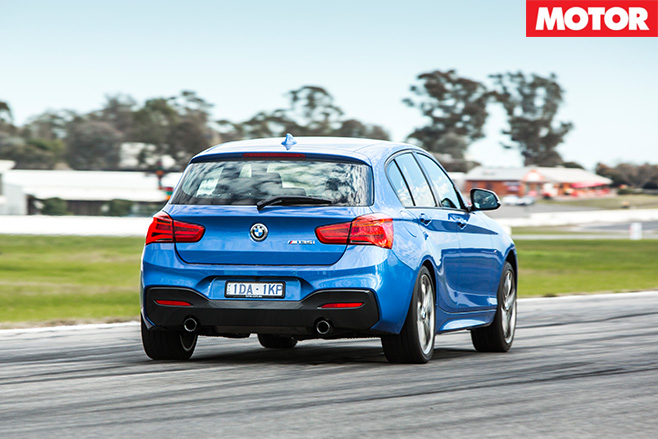
And the spec sheet suggests it has been treading water. Three years on, same N55 engine (itself getting on six years old), same eight-speed torque converter auto, and more or less same outputs.
In June, BMW reheated and restyled the 1-Series range, including M135i (in what BMW calls a “Life Cycle Impulse”) and upped power by 5kW, to 240kW at 5800rpm. Torque was unchanged, 450Nm between 1300rpm to 4500rpm. With launch control, the M135i will hurl its 1450kg to 100km/h in 4.9 seconds. All the previously mentioned rivals are just as fast, or faster, to 100 clicks at least.
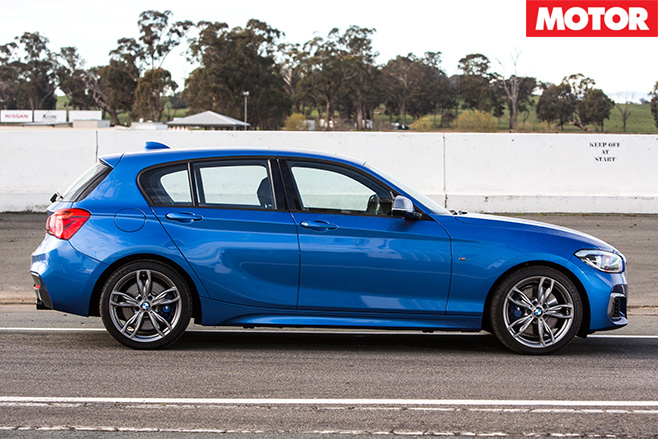
Today you can effectively get the same car for $62,900 – auto, dampers, and sat-nav, for $15,200 less. It has absolutely everything to do with why the facelifted M135i won this year’s $50K-$100K class at Bang For Your Bucks. And it wasn’t just the data that brought home the trophy; the M135i had the judges fawning, too.
With 22 cars to test on the day, the drive was all too brief, so we’re excited to welcome the exact Bang-winning car to the MOTOR Garage for four months. It’s done the press rounds already, so the new-car smell is on the way out and the odo on the way up, closing in on 6000km. You won’t be reading about any run-in periods here.
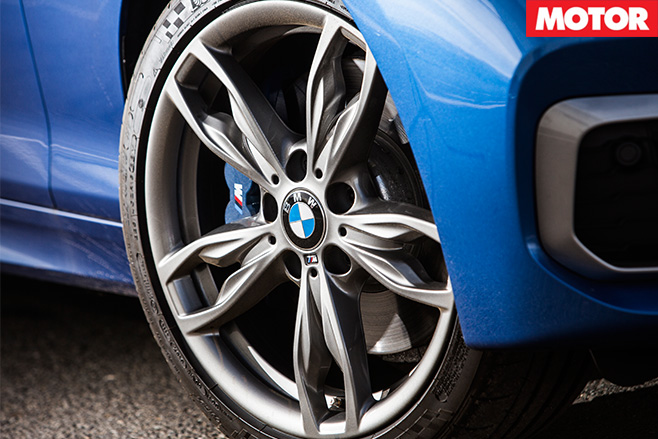
We’ve clocked precious few kilometres on our Estoril Blue M135i this month, but much like at Bang, it didn’t take long to notice the diff, or lack of. The M135i has proper turbo six-cylinder grunt – bags of torque – and sounds snarly. But it took just one opening of the taps in first gear to encounter an angry spike of revs but no accompanying rear-end wriggle – the telltale sign of a diff wide open.
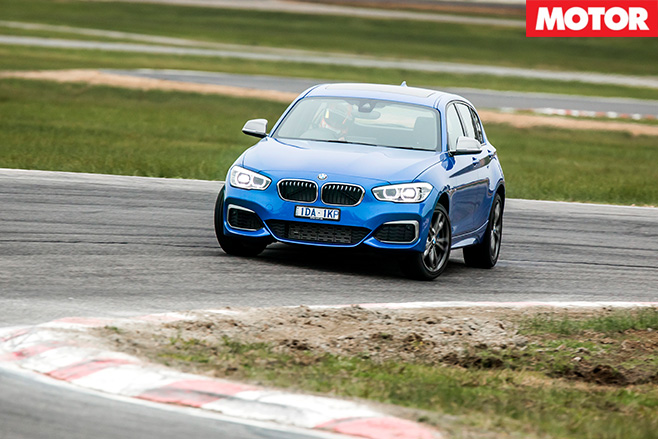
We’re just starting to reacquaint ourselves with this rear-drive hot hatch thing, and it feels novel all over again. Hopefully, in the coming months, the love only blossoms.
Month: One Liked: The grunt. It’s got some Disliked: Variable steering darty off-centre, taking some getting used to Favourite Moment: Freeway on-ramp, getting reminded how much snot this thing has
Fuel This Month: 11.4L/100km Average: 11.4L/100km Distance this Month: 100KM Total: 5523km
There are two ways you can legally do 300km/h in Australia.
You could drive to the derestricted bit of Stuart Highway near Alice Springs. From Sydney it’s 2774km, from Melbourne 2255km, Brisbane 3000km. Practical? Not entirely.
And that’s overlooking the fact it’s no billion-dollar dual-carriageway. Your 911 Turbo’s also going to need ’roo whistles.
Option two is an airport. To hire one, you’ll need an account balance that looks more like an international phone number. But we still suggest doing 300km/h on a runway, just sipping champers and reading MOTOR as your jumbo lifts off. On its way to Germany.
For readers wishing to join the 300km/h club, MOTOR gives you its short-but-sweet guide to high-speed ’bahn burning.
1. THE RIGHT CAR You might think this is the hard part but, in fact, it’s relatively easy with a bit of disposable income. And the good news is you don’t need to be a mining magnate.
Of course, if you’re a coal baron you’ll be interested to hear you can hire a Bugatti Veyron Grand Vitesse in Europe for only, er, $23,000 a day. You’ll also need $230K for a security deposit. We might save that one for our “guide to 400km/h”.
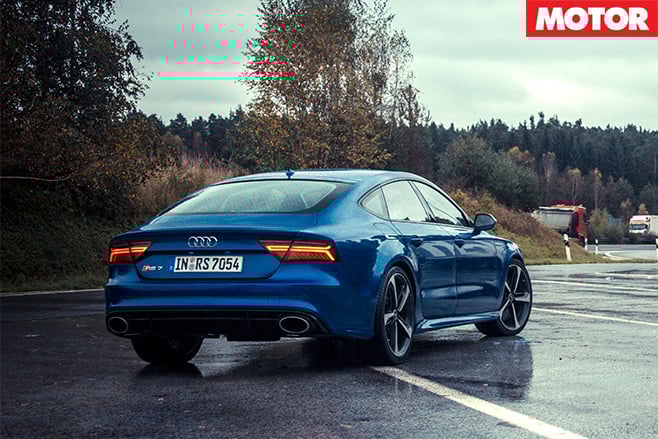
In Germany you can hire one for as little as $450 a day (there’s a $7600 security deposit to frighten off the dills). If you think $450, and a deposit that’ll melt your Visa, still sounds a little steep, think of it this way: for 16 hours that’s $28 an hour.
Remind us, how much did you last pay to drive a nine-horsepower go kart around your local hire kart joint for 15 minutes? Exactly. So you’ve got your car and we assume you’ve sorted your flights and accom (it’s a long way to swim). Time for step two.
2. THE RIGHT TIME Just like Australia, German roads can choke with holiday traffic – not ideal for your safe top speed run. MOTOR’s German correspondent Georg Kacher recommends heading to Deutschland “May/June and September/October. There’s little holiday traffic, decent weather. And you want to head out mid-week or an early weekend morning.”
3. THE RIGHT ROAD They might criss-cross Germany like a fishnet stocking but not all autobahns are equal. You want a stretch that’s ideally three lanes, largely empty of traffic and devoid of the road works that regularly pop up on autobahns.
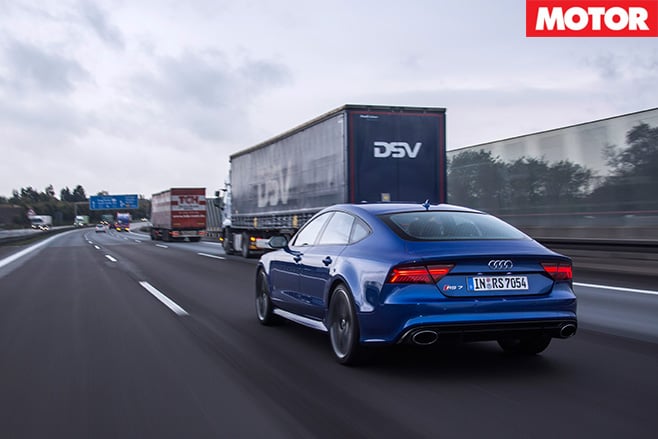
Remember, only certain parts are derestricted so keep an eye out for the sign (as seen above). Even then, the speed limit is a “recommended” 130km/h. You can travel any speed so long as it’s within the ability of your experience and your car. It’s a responsibility that’ll feel foreign – and not just because you’re overseas.
4. BE PREPARED An autobahn blast requires you to channel your inner boy scout. By that, we mean make sure you’re feeling up to the job – and the conditions are right.
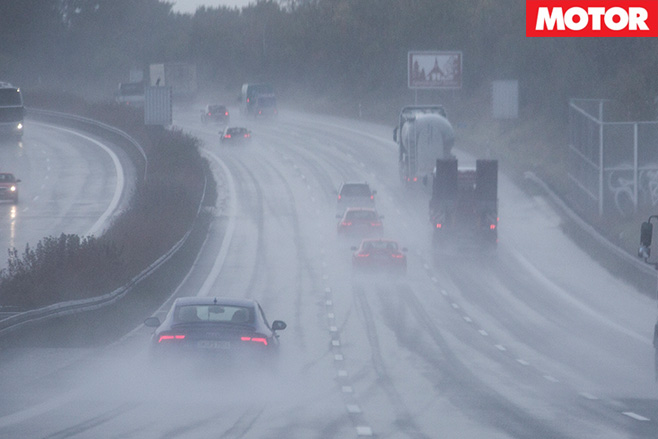
Make sure you’ve got plenty of fuel. Make sure you’re not jet-lagged but if you can’t avoid it, time your run for the morning – it’s evening back in Australia so your body still thinks it’s awake.
Make sure you’re suitably acclimatised to the steering wheel on the wrong side, and the fact the fast lane is the far left – the slow lane the far right. You might want to take a GoPro or similar. Make sure it’s ready to go before your run – so you can set a bad example for your grandkids.
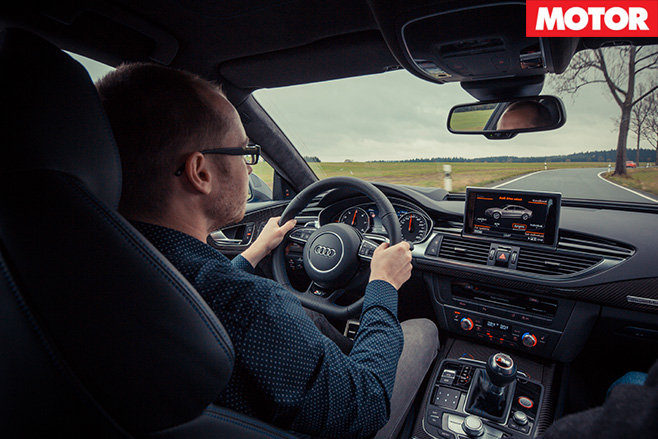
5. YOU’RE READY TO GO Before you give her the berries, it helps to know the rules of the ’bahn. (The Germans love a good rule.)
First, never overtake in the autobahn’s middle or right lanes. We can’t stress this enough. German lane etiquette is world-class – you won’t get fast-lane dawdlers here and they’ll always move right. Second, it’s not rude to flash your lights. In fact, if the tacho needle is past noon in top gear, it’s wise to hit those high beams every few seconds.
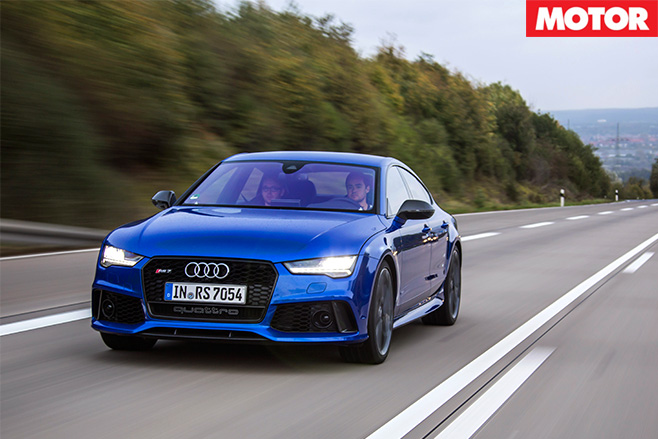
All that out of the way and you’ve found a straight bit of ’bahn, the sun’s out, the traffic’s light, you’re feeling good. Time to move into that far left lane. Since you ended up hiring that R8, you open the taps at 150km/h. Seven seconds later, you’re seeing 200km/h, 7900rpm. Pluck fifth gear. Here’s a tip: keep your eyes on the horizon, scanning across the lanes. Give the high beams a flash.
Keep your foot in it. It feels like an eternity winding out fifth – 7750rpm, 7800rpm, 7850rpm, 7900rpm – but finally, you grab sixth, 250km/h now. Things are whooshing past pretty rapidly, cars in the middle lane included. The acceleration is slowing as you push into a wall of wind.
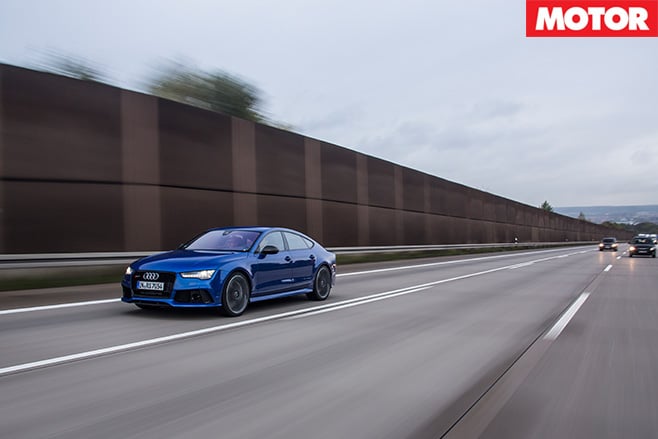
At 295km/h, the thing’s roaring – engine, tyres, wind. Your heart’s racing, you’re perspiring, your mouth is drying. You’re almost there. 295, 296, 297. 7700rpm. As the speed clocks over in slow motion, resist the temptation to watch it. Eyes up.
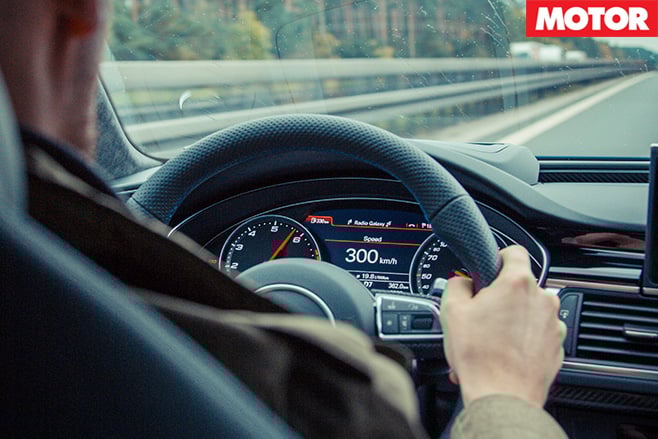
Move into the middle lane – 150km/h will feel like jogging pace. In an R8 V8, it’s taken three and a half minutes and around 13km to go from 150 to 300km/h but you’ve bloody well done it – you’ve joined the 300 club. And you didn’t even have to drive to Alice Springs.
KACHER’S BEST OF THE ’BAHN
1. A31, Essen to Emden, 253km. And parallel to it – but not quite as relaxed.
2. A1, Osnabrück to Oldenburg, 109km.
3. A24/A19, Berlin to Rostock, 234km. Great stuff; a few random speed limits.
4. A38, Göttingen to Leipzig, 229km. If the Nürburgring was reborn as autobahn, this would be it.
5. A3, Frankfurt to Bonn, 174km. Can get busy in the day, but tempting at night. Three lanes all the way!
6. A62, Landstuhl to Nonnweiler, 58km. Classic case for a 200km/h speed limit. Quick and challenging.
7. A5, Karlsruhe to Basel, 193km. Almost no corners but a lot of traffic. Ideal for beginners, Sunday morning.
8. A92, Munich to Deggendorf, 145km. Flat-out, engine-killing stretch. Boring landscape.
9. A96, Landsberg to Bregenz, 124km. Only two lanes, but wow. Watch out for deer and boars.
Trades sex appeal for sense appeal, but does it move the innovation meter?
SEXY isn’t a COTY criteria, which is probably a good thing for the Volkswagen Passat.
As with previous Passat iterations, this newly minted mid-sizer is all about clean-cut visual neatness, yet it rollicked all over the five COTY criteria.
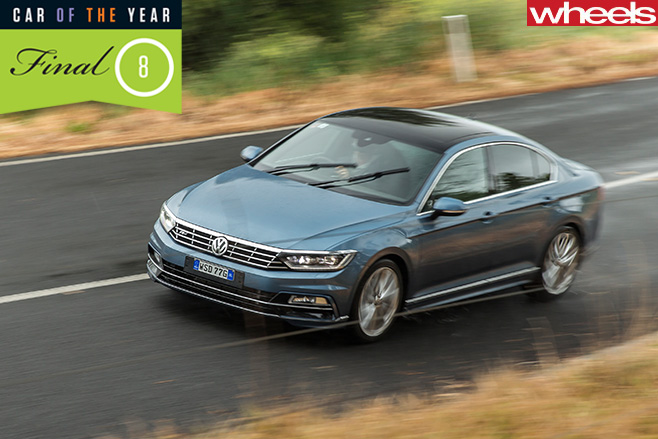
It stormed into the second round with the frugality and verve of its four-cylinder engines, all the while impressing with a cabin that generates a premium ambience well beyond the car’s $35K starting price.
But value was a two-part story with the Passat. In its most affordable form, the 132TSI, those elegantly executed Teutonic finishes and its exemplary attention to detail allow it to soar above rivals.
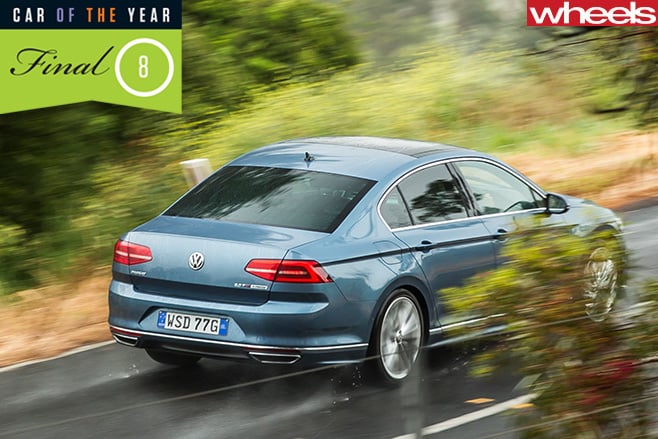
Yet in the $50K-plus Highline with R-Line sporties thrown in, the only-partial electric seat adjustment and lack of features such as digital radio are suddenly more apparent. Cheap sound from the audio system is also a rare letdown.
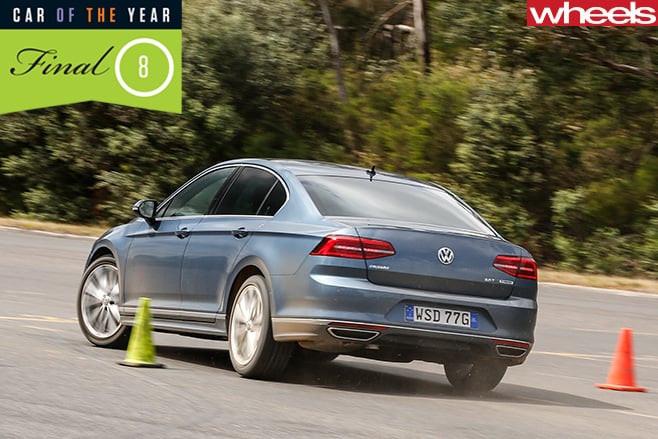
From the driver’s seat, Passat’s understated demeanour transforms into a tantalising handler. Refinement is top notch, too, especially in the 132TSI, which uses its 1.8-litre turbo to good effect. Modest 132kW/250Nm outputs are helped by a slick-shifting seven-speed dual-clutch ’box. The diesel isn’t as adept, with some top-end breathlessness.
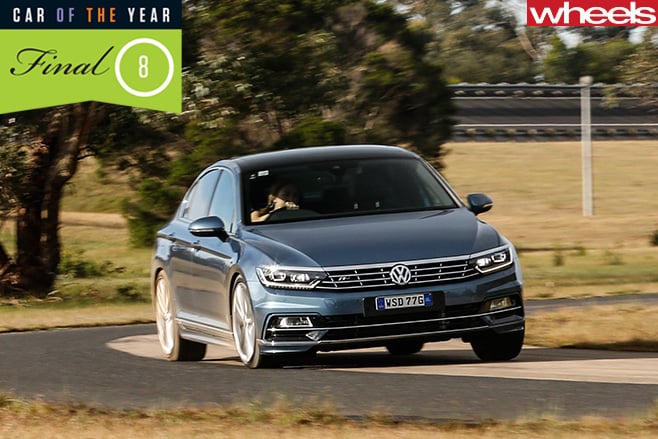
One key to its talent is impressive weight saving, a result of increased use of aluminium. From 1450kg, it’s one of the lighter medium cars on the market – which that helps agility, performance and fuel economy.
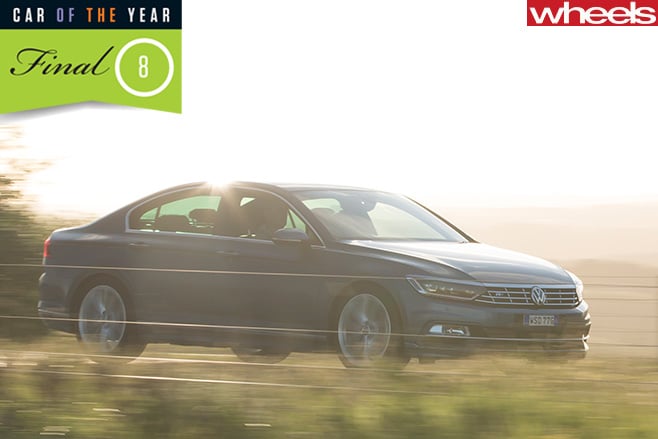
Yet it was the lack of genuine innovation – Passat is more about refining a proven formula – that saw its COTY run end in the second round. That and the fact the Passat was up against a stellar field, and one with a diversity and breadth COTY has never experienced before.
GT once stood for Grand Tourer, but not when AMG gets involved.
IF THERE was an award for Sound of the Year – and many who drove this bright yellow AMG GT S thought there should be – you’d be looking at the winner.
Of the 2016 COTY field, nothing came within a V8 decibel of the AMG’s fuel-gurgling, eardrum-shattering soundtrack, which made even the 5.0-litre V8-powered Lexus RC-F seem timid in comparison.
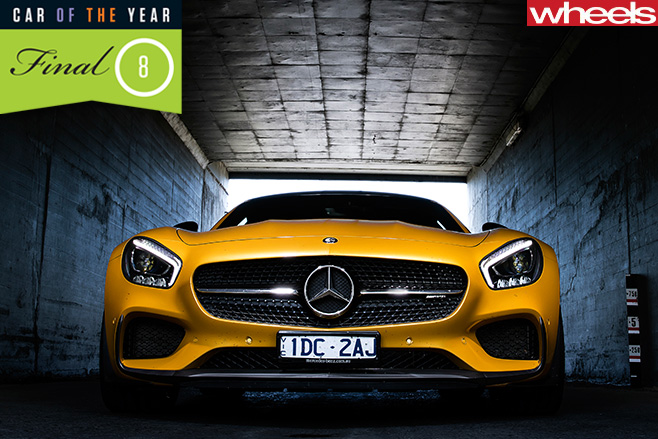
As good as it looks, it’s a credit to AMG’s engine boffins that the one thing that dominates the GT’s driving experience is what lies under its long, wide bonnet. Punching out 375kW and 650Nm from 1750 to 4750rpm, AMG’s front/mid-mounted 4.0-litre twin-turbo V8 is an absolute monster. Flattening the right pedal makes very long straights suddenly quite short, with the GT’s tidal wave of grunt only increasing in ferocity with every cracking upshift from the seven-speed dual clutch.
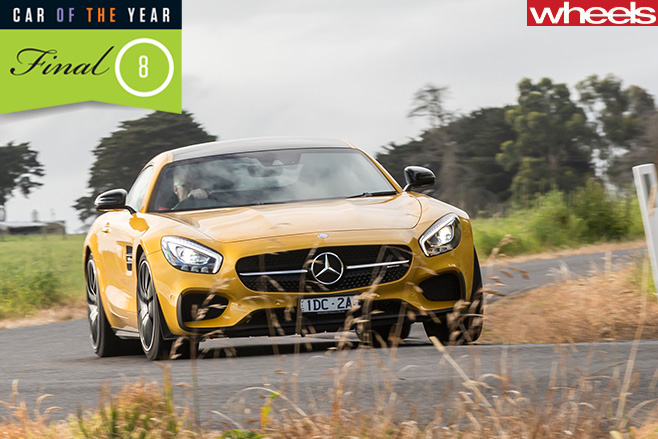
The downside is that such finely honed smooth-road dynamics bring severe compromises. Over Lang Lang’s rough road section, the GT’s ride was unforgiving, and on public roads it’s even firmer. Occupants feel every lump, bump and crease.
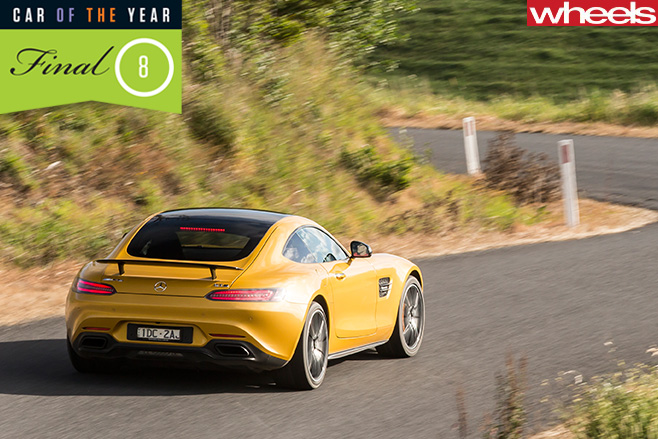
There are worse places to get pummelled about in. The GT’s cabin is snug and beautifully appointed with a rich mix of materials dominated by supple leather and exposed carbonfibre. There’s little doubt the GT’s rock-star exterior and expensively trimmed interior reflect its near-$300K price.
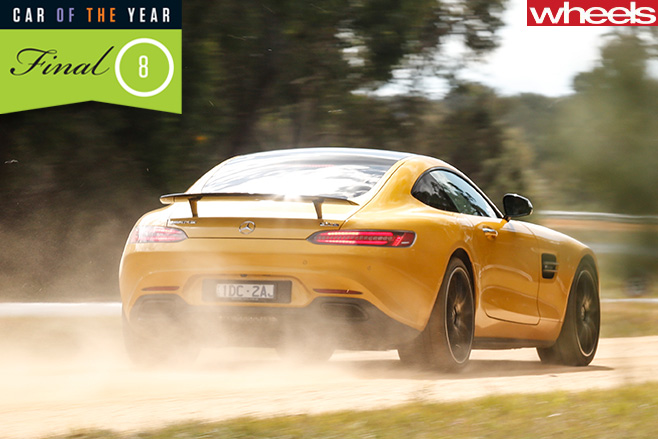
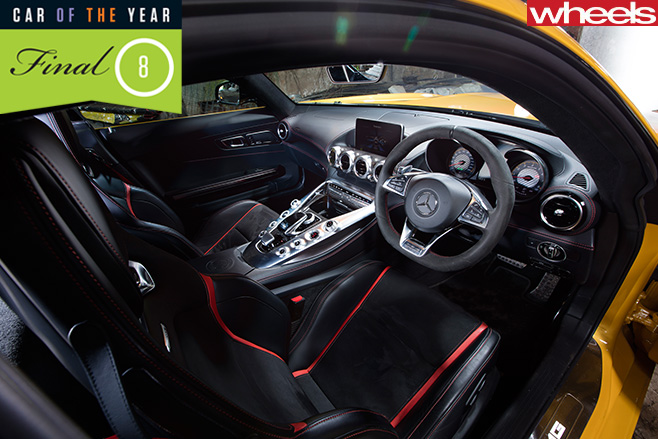
So there are flaws, which is why the AMG GT S fell short of claiming our highest honour. But these shortcomings don’t detract from what is undeniably a brilliant piece of engineering.
The most driver-focused compact SUV to date, with some perplexing inconsistencies that blur the lines.
MAZDA has finally cracked it.
Every small SUV to date has in some way fallen short. Some, like the Honda HR-V and Renault Captur, are nearly there. But only one is good enough to break through.
Welcome the engaging, involving, and interesting 2016 Mazda CX-3.
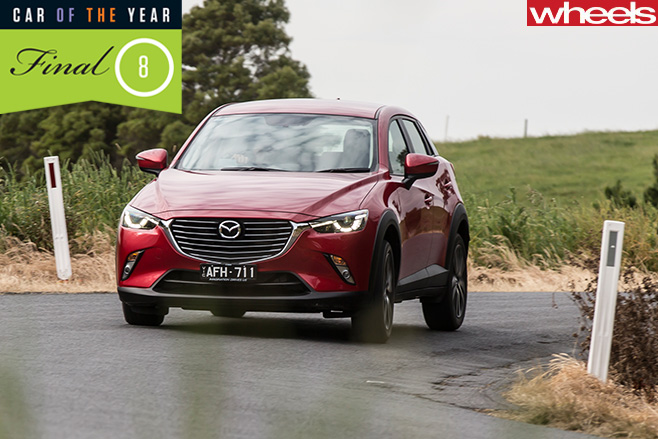
Rear-seat space isn’t palatial. But smart thinking ensures comfortable seating for four adults, or two with three kids out back. Cargo capacity isn’t too bad, either.
Moving forward, the funky dash is arguably Mazda’s best. It’s all about ease, clarity, practicality, and minimal distraction.
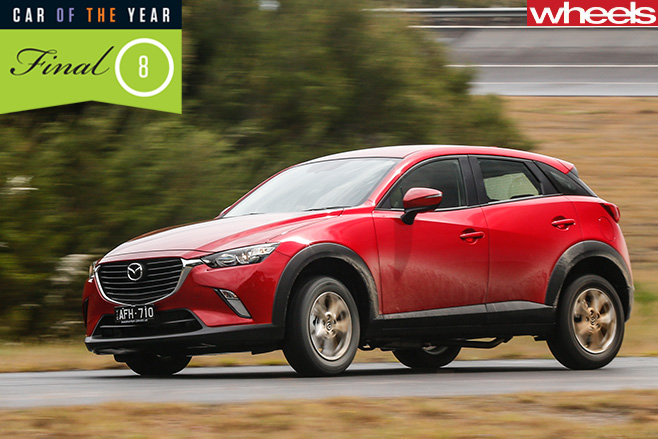
Find another $1030 and you’ll also score (low-speed) AEB. But it’s the $22,390 CX-3 Maxx, with standard sat-nav, MZD Connect multimedia, alloys and a leather steering wheel, that shines brightest for value.
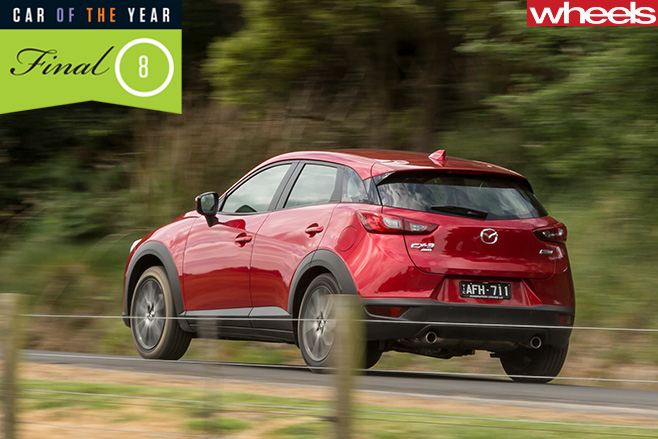
The CX-3’s chassis is built to please, whether you’re pottering around in the urban jungle, or tearing up Lang Lang. No matter what version, the electric rack-and-pinion steering offers a weight, response, and fluidity alien to most SUV alternatives. Move to the AWD and there’s a tangible increase in grip and poise.
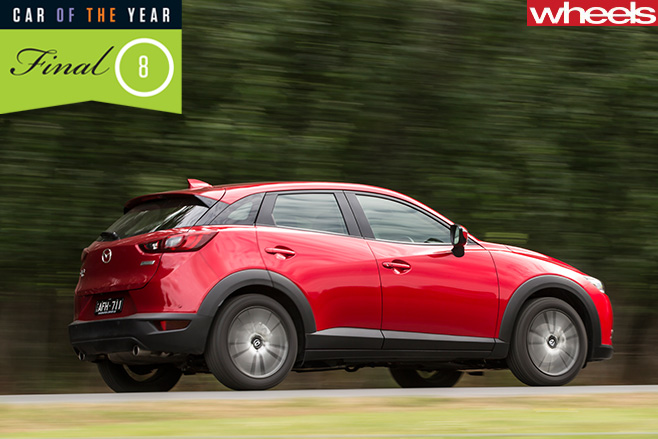
Perhaps the most infuriating is the noise intrusion from the 2.0-litre petrol engine. Above 4000rpm it roars and vibrates, undermining refinement significantly. That wouldn’t be such an issue if there was loads of low-down torque to rely on, but there’s a low-rev tractability hole. And the engine’s NVH issues are inconsistent. Our front-drive petrol Maxx manual was noticeably less vibey than the petrol sTouring AWD also at COTY.
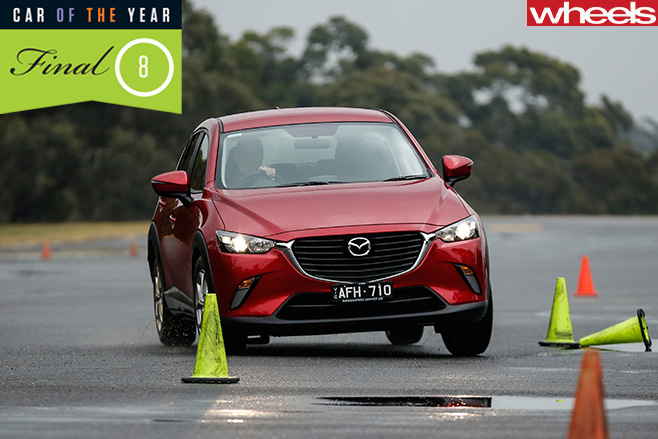
Just as flummoxing is the CX-3’s busy ride quality on the larger of the two wheel packages. Choosing the 215/50R18 rubber is a recipe for a stiff-legged suspension tune that undoes some of the seating’s great work.
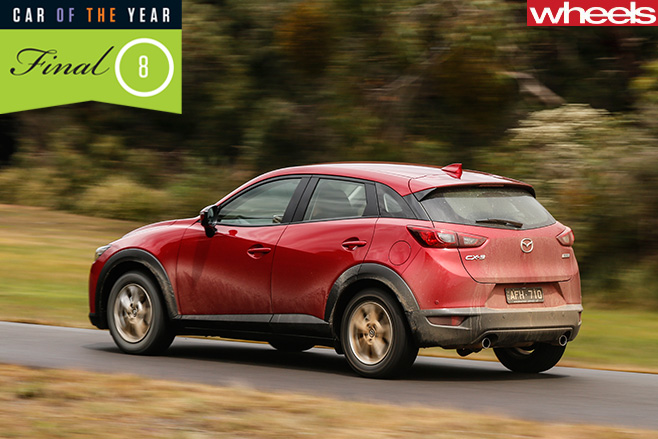
In the end, it was inconsistent refinement and patchy ride issues that held the CX-3 SUV back from progressing to COTY’s final round. That doesn’t diminish the boundaries it pushes compared to its rivals. By a clear margin, Mazda’s crossover is our favourite baby SUV.
Impressive SUV takes Swedes to higher ground.
THERE are no excuses for the new XC90. With a new platform, engines and in-house development from the ground up, this is Gothenburg’s chance to prove that it can produce a genuinely world-class car under its Chinese owner, Geely.
And yes, it really has delivered.
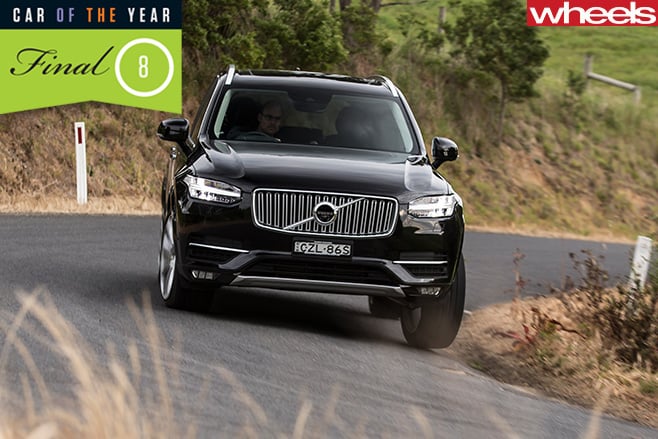
The XC90’s exterior was designed by a German, its interior by a Brit, and the two shining black beauties supplied by Volvo were lauded for their style, both inside and out.
The D5 Inscription, XC90’s mid-spec starting at $96,950, is powered by an all-new 2.0-litre turbo-diesel making 165kW and a solid 470Nm from 1750-2500rpm. The petrol XC90 T6, here in entry-level Momentum trim producing 235kW/400Nm, shares the diesel’s 1969cc capacity and eight-speed automatic gearbox.
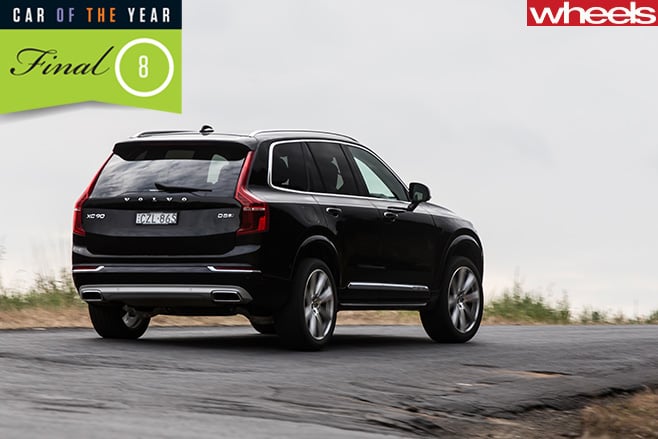
The front cabin initially dazzled with its excellent surfacing, tactile materials, crisp digital dash and that ‘Tesla reaction’ 12.3-inch centre touchscreen. Gradually, however, the cabin’s freshness began to wear off, thanks to the presence of the Q7.
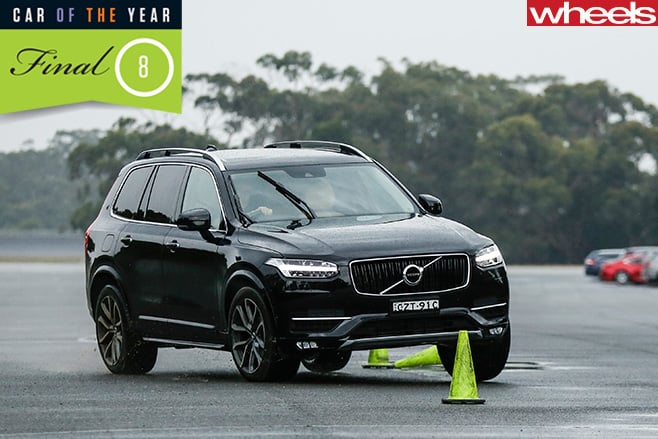
On its air suspension (a $3760 option) and 21-inch wheels, the D5 looked even better at a standstill than the steel-sprung T6 on 20s. The larger rim choices are worth noting, as Audi (cleverly) stuck with its standard 19-inch wheels for both Q7s.
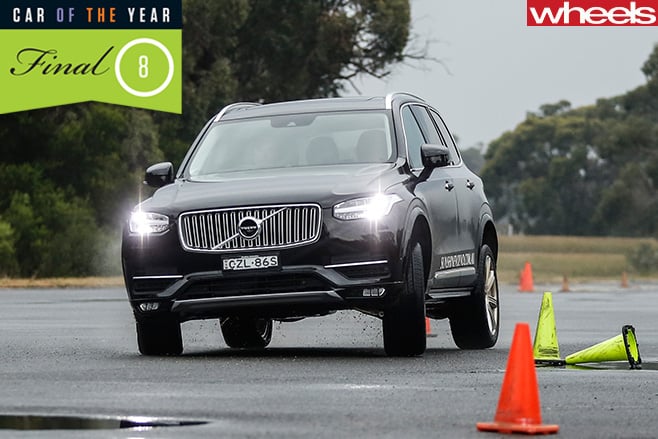
Laying on the talent is the characterful diesel – so refined you wouldn’t know which bowser to pull up to – and the gutsy, rev-happy petrol, underlining the competence of Volvo’s new engine family.
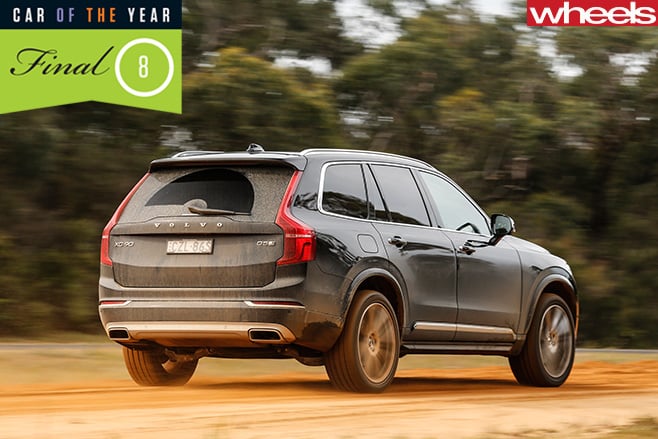
Yet the XC90 is a clear win for the Swedes. Its impressive fundamentals provide a rock-solid foundation for Volvos of the future. Plus, it has personality, and that’s a virtue you can’t measure.
A tantalising taste of our sports car future left judges hungry for more.
THIS shapely, scissor-winged, plug-in hybrid coupe was the most divisive Wheels COTY 2016 contender of all.
There were judges who loved the way the i8 drove every bit as much as its concept-car looks. And there were some unconvinced by the BMW, arguing that its performance and handling failed to keep the promise made by its sensational styling.
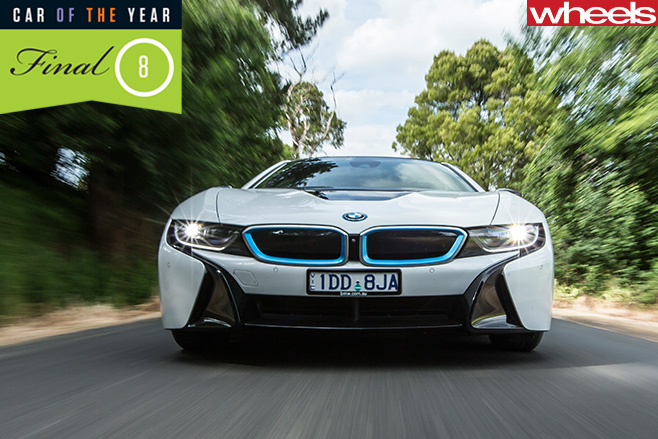
BMW also remained reasonably faithful to the broad technical detail of the Vision concept. Its centre section is a carbonfibre cell, with aluminium subframes bolted on fore and aft to serve as mounting points for the suspension and steering, and to cradle drivetrain components. Behind the passenger compartment is a three-cylinder 1.5-litre turbo. It’s from BMW’s modular engine family, but boosted to produce a hefty 170kW. It drives the rear wheels through a six-speed automatic transmission.
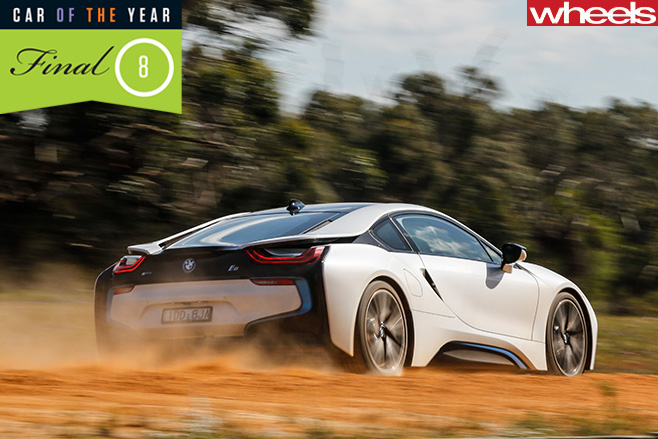
The i8 can run in three different driver-selectable modes. In eDrive it’s a front-drive electric car, drawing on energy stored in a 5kWh usable-capacity lithium-ion battery pack. Once this is used up – around 35km is the claimed range – the i8 switches to Comfort mode, where internal combustion and electric power are blended. Nudging the gear lever to the left engages Sport mode, where the internal-combustion engine runs full-time.
Judges who tried it were impressed by eDrive. There’s strong acceleration, but top speed is limited to 120km/h, making it well suited for city and suburban driving. But from this point, opinions diverge…
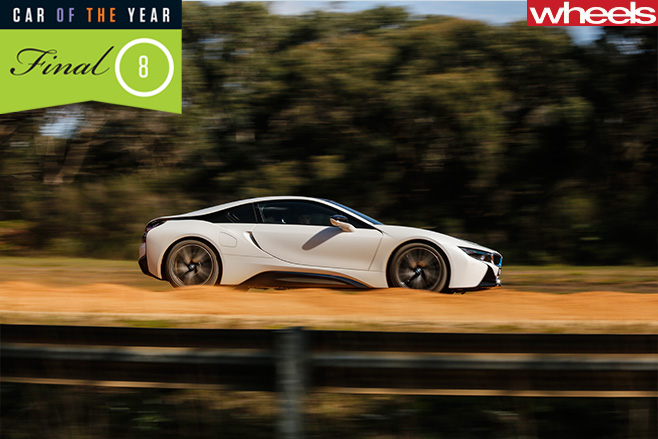
Other judges were smitten by the sound of the turbo triple when working hard in Sport mode. They also liked the flavour of the i8’s performance in this mode, with the hybrid system’s full 266kW and 570Nm on tap.
There was something approaching consensus on the i8’s dynamics. The BMW’s ride impressed most judges. But while the i8 has no handling vices, it lacks on-limit adjustability.
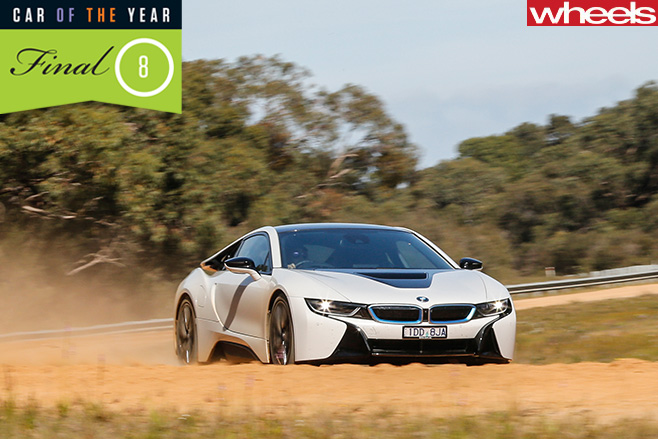
The way the i8 split the judging panel on key points like function, practicality and value was fatal. Without broad support it’s simply impossible for a car to make it to COTY’s closing stage.
