
Bentley has published footage from high-speed testing of its new Bentayga SUV which seemingly confirms it will be the world’s fastest SUV.
Powered by Bentley’s new-generation 447kW/900Nm 6.0-litre twin-turbo W12, the Bentayga manages to assault physics by blasting its bulk to over 300km/h.
This puts clear air between it and existing rivals like the Porsche Cayenne Turbo S and Range Rover Sport SVR, though the Bentley off-roader is expected to be significantly more expensive than either.
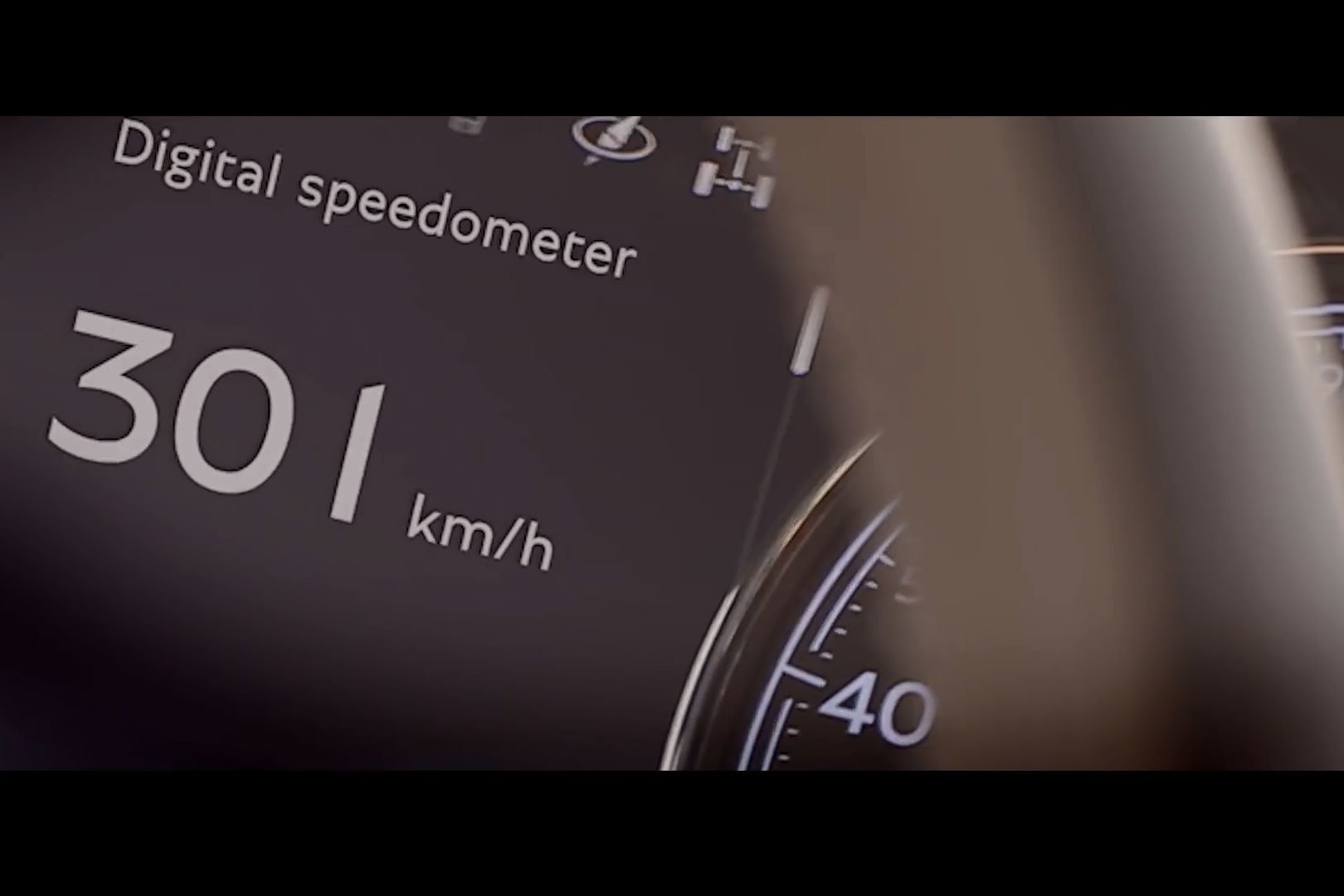
Impressive as it is from an engineering perspective, we can’t help but feel that the Bentayga’s hig-speed ability is of little relevance on anything other than the spec sheet.
As far as conventional supercar engineering goes, Lamborghini’s Aventador SuperVeloce represents the pinnacle.
Its stunning Nürburgring lap time and the sheer ferocity of its performance proves that. But conventional supercar engineering only has so much more to give. While there may be plenty of speed still to unlock in petrol power, it’s increasingly unlikely that emissions regulations will allow it to be unlocked.
Still, as the recent slew of hybrid hypercars from Porsche, Ferrari, McLaren and even Koenigsegg prove, batteries can be made to not only electrify the car but your senses as well, suggesting that petrol-electric performance might be the way to go, regardless of regulation.
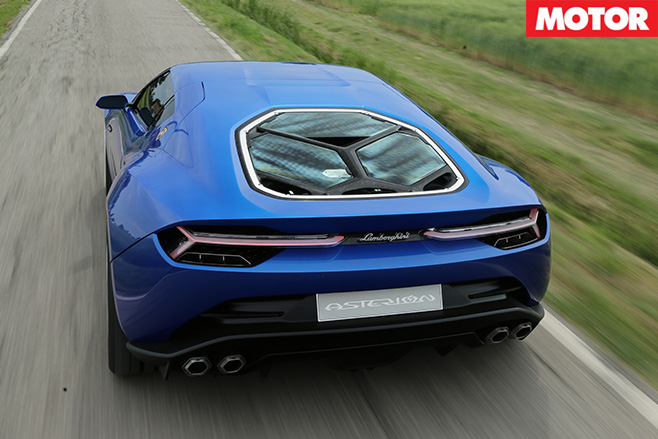
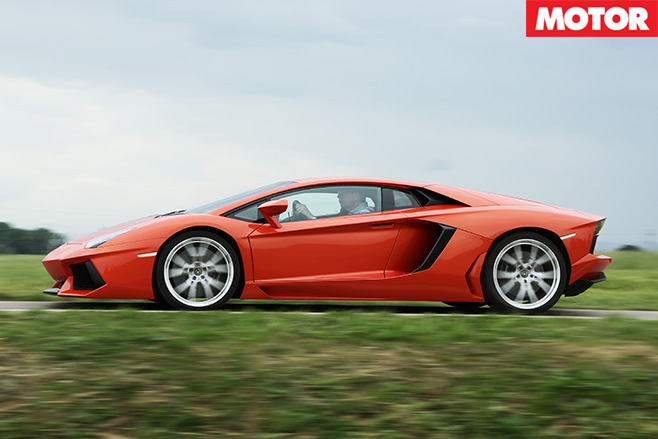
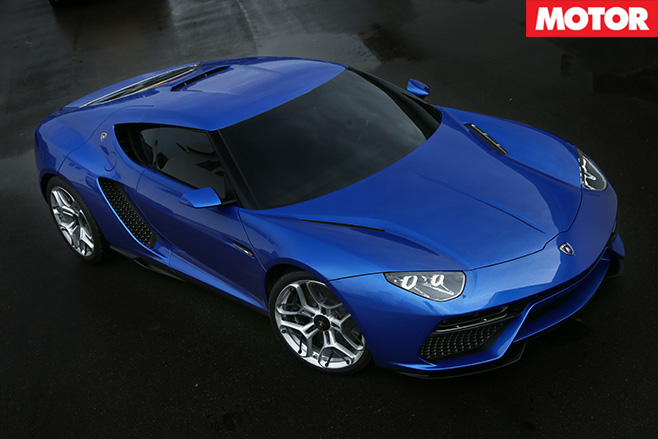
It’s an approach Lamborghini is looking into closely. The Sant’Agata supercar maker made its ambitions clear with its stunning Asterion LP910-4 concept at last year’s Paris Motor Show, a car we’re driving today, but of more interest is the perfectly normal looking orange Aventador sitting silently next to the beautiful blue show car and radically bewinged Aventador SV.
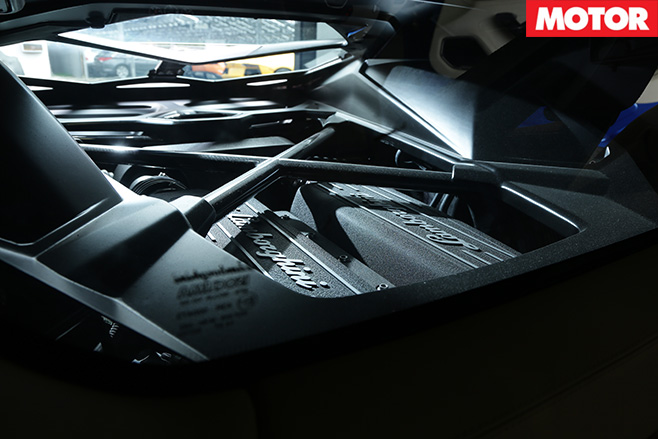
Nicknamed Tosca, after Puccini’s opera, this mule is Lamborghini’s solitary development prototype for its plug-in hybrid system, a bet on the future run on a shoestring budget. Despite being based on the larger of Lamborghini’s two super sports car, finding room for the hybrid system means that, like the Asterion, Tosca has downsized from the Aventador’s 6.5-litre V12 to the Huracán’s 5.2-litre V10.
Reggiani explains the concept further: “We have settled for electric front-wheel drive and petrol-fed rear-wheel drive. The third electric drive unit, which incorporates a starter motor and generator, is sandwiched between the 449kW V10 engine and the sequential seven-speed transmission. What this configuration gives us is on-demand four-wheel drive and a hybrid mode which fuses all powerplants irrespective of the state of charge”.
The Asterion’s performance targets may only be hypothetical for now, but they offer a clear indication of the direction this project is going to take. The main focus is to achieve a zero-emission range of 50km, which Lamborghini believes will be mandatory for all new vehicles sold in the US and China before too long.
Mission number two is to the lower the brand’s fairly terrible average CO2 emissions, something the Asterion manages with a claimed average fuel consumption of 4.12L/100km and just 98g/km of CO2. However unlikely these figures are in the real world, it’s the on-paper stats that matter to regulators, and both numbers are significantly better than the Aventador’s claims of 16.0L/100km and 381g/km.
“We did not want to create a shape that is even more extreme than Huracán or Aventador,” says chief designer, Filippo Perini. “After all, this car points in a direction which is new for us. It is less about acceleration and top speed and more about environment-friendliness.”
While still clearly a Lamborghini, parked next to the overtly butch Aventador the Asterion looks very clean and almost subtle, with a hint of Miura. The interior, too, reflects the user-friendly nature of the concept, with ivory-over-brown leather and sparse aluminium accents replacing the liberally-applied alcantara and carbonfibre. Visibility is good, the seats are comfortable and all the main controls are logically arranged.
The main in-dash display is promising a range of 50km, but the state-of-charge meter says otherwise. Given large parts of the monocoque, suspension, steering and brakes are closely related to Lamborghini’s current range, it should be no surprise that the Asterion feels reasonably familiar, albeit handicapped by its ultra-wide footwear.
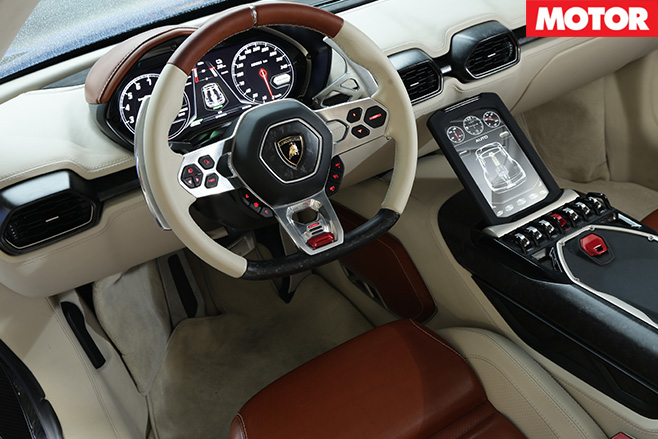
By midday the Asterion desperately seeks attachment to the nearest plug, so we swap into Tosca for a more thorough evaluation of this technology’s talents. It’s clearly a mule – there’s lot of black tape and plenty of impromptu amendments.
Although it musters an extra 154kW over a standard Aventador, the plug-in hybrid is actually claimed to take one-tenth longer to accelerate from 0-100km/h and top speed is 30km/h down. Blame those extra 200kg, as well as the infancy of the electronic systems such as torque vectoring, eletronic throttle and e-boost.
The extra wide transmission tunnel separating driver and passenger, stuffed with high voltage battery pouches, provides a hint as to the extra heft, but despite the heavy load, in-gear acceleration is simply sensational. Floor the throttle and ESC assistance is required in first, second and third gear. No specific data is available, but it’s safe to assume that aggregate torque is somewhere closer to four figures.
The greatest hurdle facing Lamborghini’s electrified future, though, isn’t likely to be mastering the technology, but overcoming corporate finance. “Lamborghini can at best be a fast follower – we are too small and lack the funds to set trends,” states Lambo’s shrewd CEO, Stephen Winkelmann. “Do we believe in PHEV? Absolutely. Can we afford it? Absolutely not.”
Winkelmann agrees: “The situation may change once the right technology is available at the right price. We are talking about the next-generation of sports cars here, not about next year or the year after. You don’t have to be an expert in reading the crystal ball to assume that a hybrid edition of Urus is on the cards. But when it comes to Huracán and Aventador, Lamborghini needs a tailormade concept that honours our chief brand values.”
What Winkelmann does not say is that these values rank performance and excitement well ahead of saving the planet. Reggiani sums it up with a smile: “We must do what Italians don’t do very well – be patient. But of course it does help to prepare for all eventualities.”
WHERE DOES IT FEEL AT HOME?
If you’re after an SUV for the city, the CX-3 hits the mark. It’s based on the excellent Mazda 2, which means it’s small and nimble and ideal in tight traffic. It’s even available in all-wheel drive versions for confidence in wet weather and on gravel roads.
The CX-3 is designed for modern lifestyles. The wide range of models means there’s a CX-3 that can do just about anything you could ask of a small SUV. It’ll get you through your commute with a smile and still let you explore the great outdoors.
STAND OUT FEATURE
If I had to pick one stand-out feature about the CX-3, it’d be this interior. For such a small car it’s packed with individuality and equipment. It’s also a bit of a bargain, with the entry-level Neo model coming in at a very competitive price.
WE LOVE
Let’s talk about fuel. The CX-3 is available with both petrol and diesel engines. The diesel claims just 4.8L/100km. In car speak, that’s really good. Cheaper to run and better for the environment. The petrol engine’s economy is good too. We also love the CX-3s compact size. It’s an SUV but without the rudeness. In fact it’s only a little bit longer and taller than the Mazda 2, just enough to give it more boot space.
THINGS WE’D LIKE TO CHANGE
As a car aimed at young couples the space in the backseat isn’t really the CX-3’s strong point. You’ll get your mates in here at a pinch, but you wouldn’t want to do any long trips. Visibility over-the-shoulder can also be a bit tricky, and it’s kind of noisy inside, but it’s not so bad you’ll want to wear headphones.
WHO WILL IT SUIT?
The Mazda CX-3 is made for fashionable young people who like a weekend away just as much as they enjoy being surrounded by the city lights. And who wouldn’t the best of both worlds?
Click here to read the full review on the Mazda CX-3.
PORSCHE has confirmed its new-generation 911 Carrera will debut an all-new twin-turbo flat-six engine at the Frankfurt motor show, which it says will bring more power and acceleration while being more thrifty with fuel.
The updated 911 is due in Australia in the first quarter of 2016. Visual tweaks will include new bumpers and horizontal louvres over the engine cover.
The headline, though, is the twin-turbo engine that will power the Carrera and Carrera S, which will be of 3.0-litre capacity as Wheels predicted last month.
The first-ever turbocharged entry-level Carrera will have 272kW, a 15kW increase over the 3.4-litre naturally-aspirated flat-six it replaces. Torque increases 60Nm to 450Nm, and the new engine’s rev range is 100rpm wider, topping out at 7500rpm.
The new Porsche Carrera S, which will have 309kW and 500Nm thanks primarily to a more intense turbo tune, is able to hit 100km/h from rest in 3.9sec, three-tenths quicker than Wheels’ best in the current 991-series car.
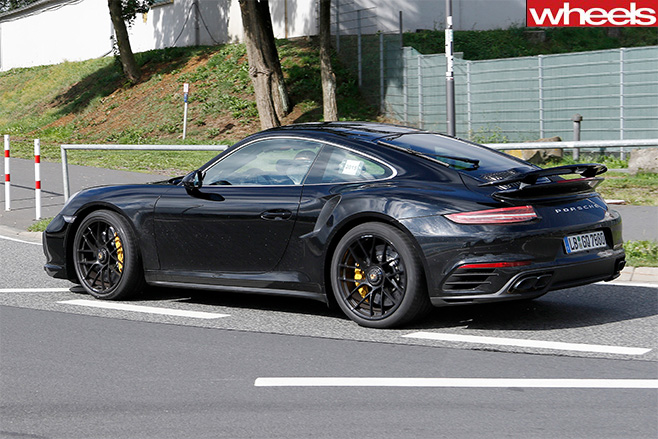
All Carreras will also come with rear wheels half an inch wider, and on the Carrera S the rear tyre width also increases 10mm, to 305mm.
The update sees the Carrera S get the option of the active-steer system used in GT3 and Turbo variants, which counter-steers the rear wheels at speeds up to 50km/h for added manoeuvrability. At speeds above this, the system increases stability by providing up to three degrees of lock in parallel with the front wheels.
There are minimal changes inside, mostly extra equipment.
Pricing for the Carrera will start at $217,800, an increase of almost $10,000, but that includes Porsche’s PASM active suspension (which will be standard), front park assist and a reversing camera.
Cabriolet versions will arrive alongside the coupes in early 2016.
Despite the proliferation of turbocharging across all 911 models – bar the GTS and GT3 that reports suggest will remain non-turbo for now – the fastest and most powerful 911 Turbo will be the only one to have Turbo in its name.
Classifieds are sure to throw up an unusual gem every once in a while, but not often a Formula One car.
An ‘authentic’ Team Lotus T128 F1 car has appeared on well-known American classifieds site Craigslist.org with a converted AU$136,907 price tag attached to it.
The car was driven by Heikki Kovalainen and Jarno Trulli in the 2011 season of the Formula One world championship, and still features the seven-speed sequential transmission developed by Red Bull technologies.
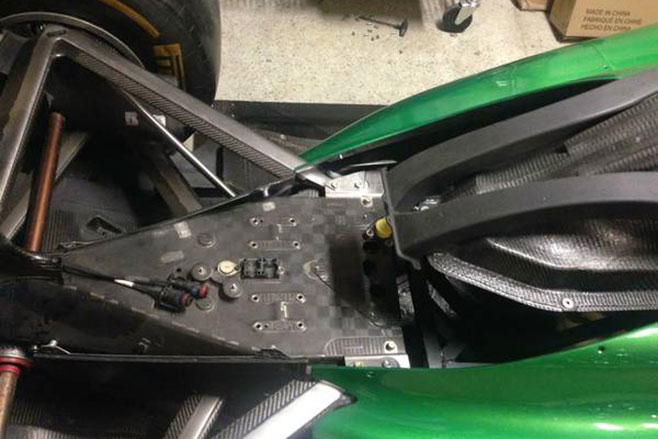
While the photos and description lend enough of an explanation on the condition of the car, the biggest mystery of all –the car’s personal history and how it made its way to Alabama, United States— isn’t revealed in the description.
It’s a rather expensive ornament, if you’re frightened by the idea of reviving a Formula One car back to life. But if you can’t front up the cash, there’s still good news: the seller’s listed they will entertain trade offers. A Cosworth 2.4-litre V8, perhaps?
We live in a clever country. Seriously, are you aware just how many great inventions this little nation has been responsible for?
Australians have revolutionised warfare through the invention of the tank and the underwater missile, created a number of medical breakthroughs like the pacemaker, ultrasound and the bionic ear, and have been responsible for major advances in aviation safety thanks to the black box flight recorder and inflatable escape slide.
Not only are we good at inventing stuff, our good old Aussie ingenuity allows us to think up all sorts of unique applications for the things we create. What other country would think of combining two of its greatest inventions – cask wine and the Hills Hoist – to produce that game beloved of university students everywhere, Goon of Fortune?
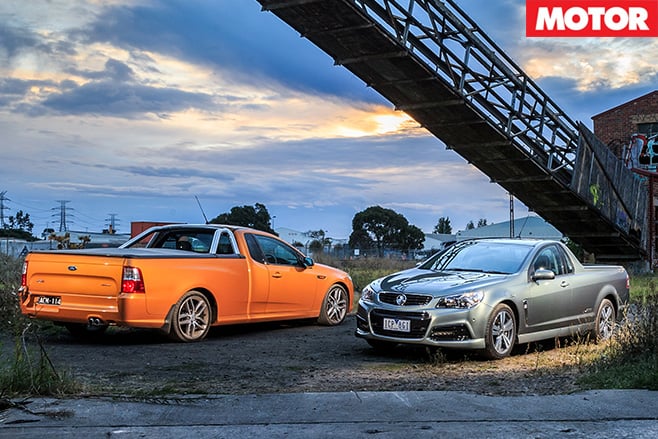
When Ford Australia designer, Louis (Lewis) Bandt, created the first coupe-utility back in 1934 he had little idea he would be laying the foundations for what would essentially become Australia’s sports car, with performance to burn, room for two and a bloody big boot.
Bandt’s brief was simply to answer the needs of Victoria’s farming community, a Gippsland farmer’s wife famously writing to Ford asking it to consider making a vehicle that would allow passengers to travel to church in comfort on Sunday yet still be able to cart the pigs to the market on Monday.
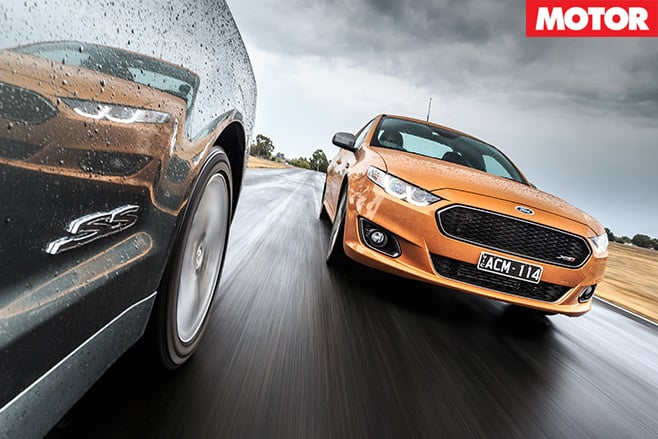
Anyway, the performance ute’s brilliant combination of pace and practicality has made it a crucial part of the local enthusiast scene, and the release of the FG X Falcon provided the perfect excuse for a traditional red vs blue face-off.
Now we’re used to that gaping double-decker grille, we reckon the latest (and last) iteration of the Falcon looks excellent. For some reason, the sleek, modern nose seems to improve the look of the whole car, though the rear track is still far too narrow for its ‘muffin top’ hips (ask your kids).
Also, the seating position wasn’t going to be mentioned, as our dislike of the high driver’s seat is well known and it’s not going to change now! That was until a chance drive in MOTOR photographer Nathan Jacob’s BF II Fairmont. While the seat in that was also high, the wheel could be adjusted much higher than is possible in FG-series cars for a much more comfortable driving position – it’s a shame Ford changed it.
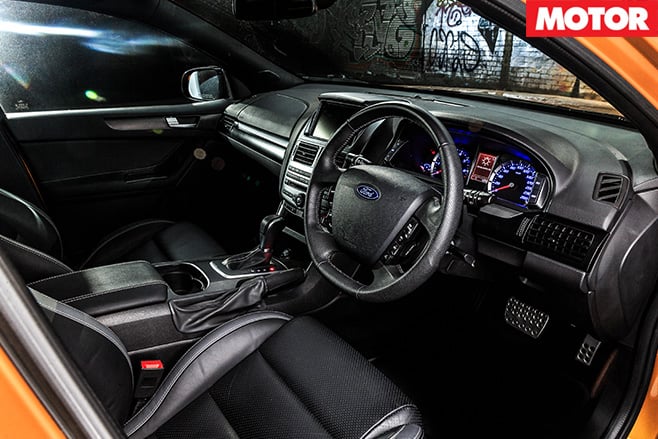
The lack of sat-nav feels a bit cheap at 40 grand, but the reversing camera is worth its weight in gold in a vehicle severely lacking in rearward visibility – parallel parking the similarly-challenged Ford is largely an exercise in guesswork.
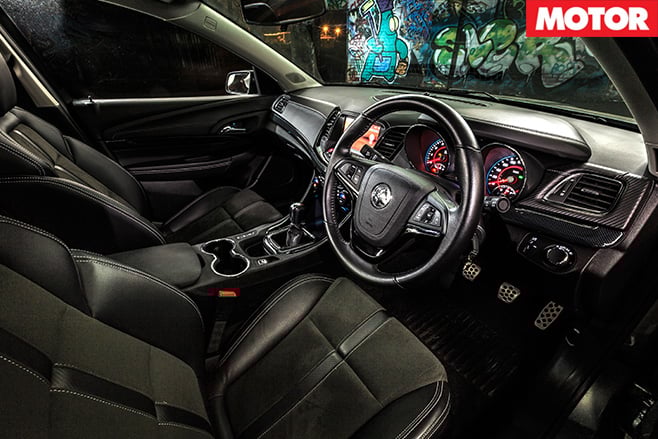
On the flipside, it makes the Holden something of a sleeper, as the performance is anything but dated. It’s difficult to keep perspective when we live in a time of 400kW-plus sedans and hot hatches that rocket to 100km/h in less than five seconds, but the 270kW/530Nm 6.0-litre V8 in the nose of the SS is still a potent device.
It needs plenty of revs to give its best, but once it’s singing there’s easily enough grunt to overwhelm the rear tyres, wet or dry.
It would be nice if it sang a bit louder, though. Sink the slipper and your reward is more of a muted hum than a fearsome roar. Experience with lightly-tuned Commodores has shown us that even if they’re not that much faster, the sharper response and extra volume make them much more fun to drive. Regardless, 0-100km/h in 5.56sec and a 13.77sec quarter mile at 169.09km/h are some of the fastest numbers that have ever flashed up in an SS – sedan or ute.
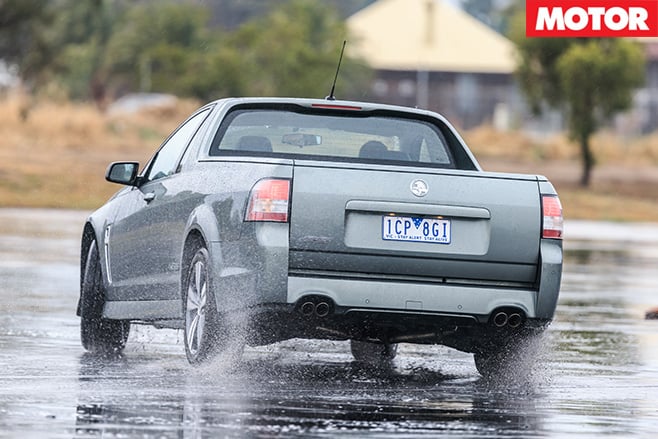
Without over-analysing it, there are a couple of possible explanations for the Blue Oval’s superiority. Firstly, the Falcon’s longer ratios mean it crosses the quarter mile at the top end of third, whereas the Holden requires a shift to fourth.
Secondly, the Falcon was an auto and the SS a manual – Holden ’boxes are much friendlier than they used to be, but even the world’s fastest gearchanger is going to lose a tenth or two, particularly on the tricky two-three shift.
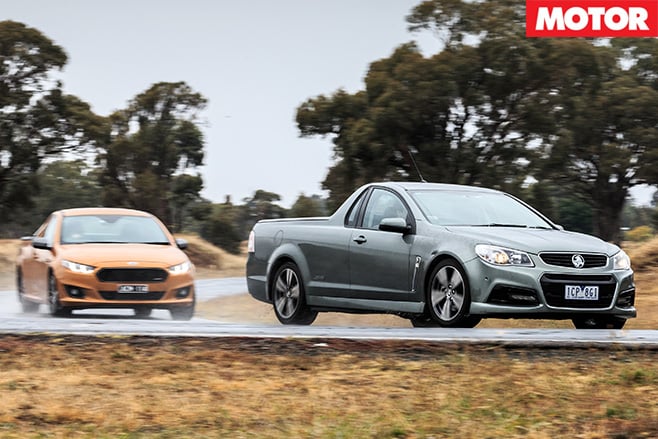
There is a small amount of lag, but that’s simply the turbo taking a breath before unleashing a tidal wave of shove. And tidal wave is the appropriate metaphor; the boost doesn’t arrive violently, in the manner of an early WRX, instead it swells, the acceleration a steady but irrepressible force.
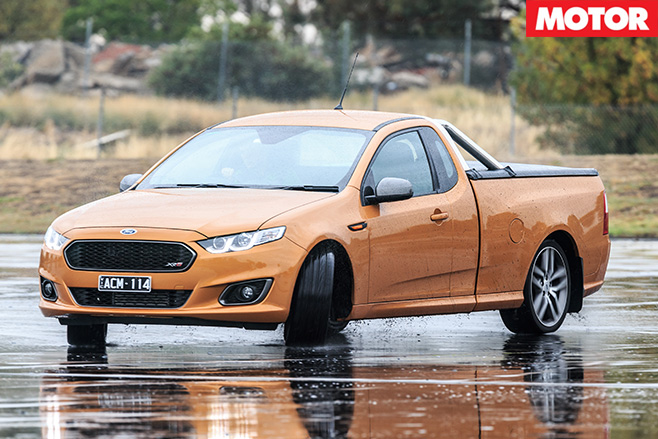
Traction is much stronger than you’d expect in the dry, but in the wet the XR6T will easily break into wheelspin at almost any speed in the first three gears.
Thankfully, it’s extremely predictable to catch, which is just as well given the effect filming drag strip video had on the rear tyres of our test car. On the wide expanses of DECA’s saturated skidpan, anticipating when the boost is going to arrive to spit the car sideways takes some acclimatisation, but with a bit of practice it can be slid around on the lock stops with abandon.
A long wheelbase and plenty of steering lock make the XR6 Turbo a natural drifter.
That said, while the Ford is more predictable once sideways, it can be difficult to sense when it’s going to happen, like when the rear wheels flare up over DECA’s infamous road course hump at 100km/h – new underwear, please. Its steering, too, can’t match the accuracy of the Holden’s, though this MY14 SS has the annoying on-centre deadness that seems to have been improved in MY15 cars.
Up until this point the two contenders have been evenly matched, trading punches and heading for what looked like a points decision. On the public road, however, the two begin to diverge and it’s the Holden that demonstrates its superiority.
The Ford is hamstrung by its commercial origins, with the leaf-sprung rear end unable to cope with bumps, resulting in a very poor unladen ride. The seats are big and comfy, but occupants are constantly jostled and thrown around over bumps.
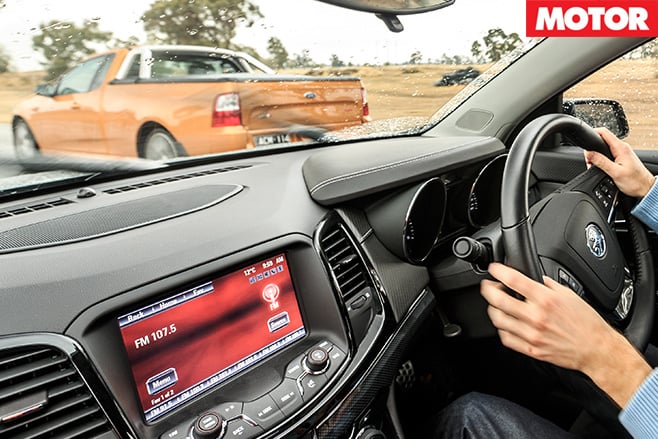
Choosing a manual Ford raises this to 550kg, but lowers the towing capacity from 2300kg to 1200kg, whereas the Holden can tow 1600kg auto or manual. Both cars, however, are severely underbraked for heavy towing – it’s their biggest weakness.
The XR6 Turbo is a surprise packet. It’s a flawed car, and has changed little since the FG’s introduction in 2008, but it’s also a likeable one. Its combination of practicality and straight-line pace means it will appeal to more than just those with Blue Oval tattoos. And, starting from $38,110, you won’t go faster for less.
It’s a blunt instrument, and arguably overpowered, but that makes it exciting in a way that few cars manage these days.
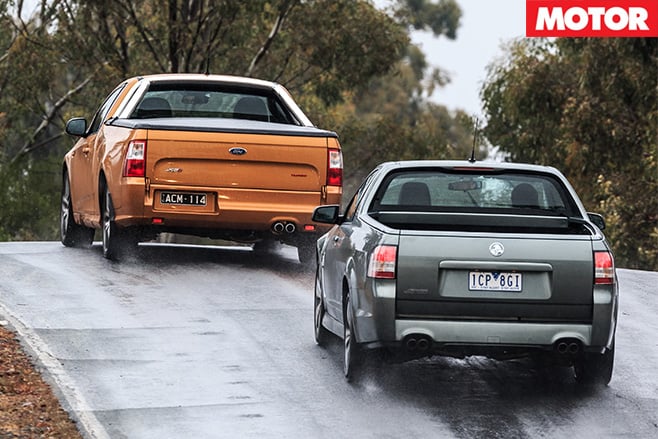
Sadly, in a couple of years’ time we won’t have the choice, as our home-grown utes will be gone and we’ll be left hoping Ford puts a V8 in the Ranger or Volkswagen fits a Golf R donk in the Amarok. It might not yet be clear how we’ll continue the uniquely Australian tradition of high-performance utes, but if history is anything to go by, we’ll think of something.
| u00a0 | FORD XR6T UTE | HOLDEN SS UTE |
| Body | 2-door, 2-seat ute | 2-door, 2-seat ute |
| Drive | rear-wheel | rear-wheel |
| Engine | 3984cc inline-6, DOHC, 24v, turbo | 5967cc V8, OHC, 16v |
| Bore/Stroke | 92.25 x 93.31mm | 101.6 x 92.0mm |
| Compression | 8.8:1 | 10.4:1 |
| Power | 270kW @ 5250rpm | 270kW @ 5600rpmu00a0 |
| Torque | 533Nm @ 2000-5250rpm | 530Nm @ 4400rpmu00a0 |
| Power/Weight | 147kW/tonne | 156kW/tonne |
| Transmission | 6-speed auto | 6-speed manual |
| Weight | 1832kg | 1729kg |
| Suspension | A-arms, coil springs, anti-roll bar (f); leaf springs (r) | struts, coil springs, stabiliser bar (f); multi-links, coil springs, stabiliser bar (r)u00a0 |
| L/W/H | 5065/1934/1485mm | 5083/1898/1494mm |
| Wheelbase | 3103mm | 3009mm |
| Tracks | 1583/1583mm (f/r) | 1592/1606mm (f/r) |
| Steering | hydraulically-assisted rack-and-pinion | electrically-assisted rack-and-pinion |
| Brakes | 322mm ventilated discs, 2-piston calipers (f); 303mm solid discs, single-piston calipers (r)u00a0 | 321mm ventilated discs, 2-piston calipers (f); 324mm ventilated discs, single-piston floating calipers (r) |
| Wheels | 19 x 8.0-inch (f/r) | 18 x 8.0-inch (f/r) |
| Tyres | 245/36 R19 (f/r); Dunlop Sport Maxx | 245/45 R18 (f/r); Bridgestone Potenza RE050A |
| Price | $39,810 | $39,490 |
| Positives | Stonking engine, turbo acceleration, overpowered in a good way, looks | Chassis balance, playful handling, crisp V8, decent payload |
| Negatives | Crummy ride, unsophisticated handling, brakes underdone | Subtle looks, engine needs more aggro, woeful stoppers |
| u00a0 | 3/5 | 3.5/5 |
Click here to read the full range review of the Holden Ute.
F1: Monza dramas came before and after 53 laps of boredom
THE race itself was damned boring. But an outbreak of crazy grid penalties before the race, and then a post-race inquiry into the winning car, gave the Italian Grand Prix some talking points.
Ultimately though, after stewards ruled no action was necessary against Mercedes over a potential tyre pressure infringement, Lewis Hamilton could keep his crushing Italian Grand Prix victory at Monza – the seventh win of 2015 for the Brit.
The newly blond Hamilton was supreme, again taking pole and then romping away to a faultless 25 second victory over Ferrari’s Sebastian Vettel, ahead of the duelling Williams pair Felipe Massa and Valtteri Bottas.

“This race is so special for every driver. When you stand up on that podium it’s so emotional. It’s a really proud moment to be up there in front of that sea of fans and to walk in the footsteps of so many great drivers who have won here,” Hamilton said.
Title challenger Nico Rosberg’s race ended disastrously two laps from the end with a smoky engine failure, soon after Mercedes cranked up the power on his old engine in a late attempt to catch Vettel’s Ferrari.
Australian Daniel Ricciardo was a fighting eighth, charging from the last row of the grid.
“It was a great result for the team considering where we started and the characteristics of this track. It was sweet taking that eighth place on the last lap from Ericsson,” the Red Bull star said.

Hamilton again dominated qualifying, claiming his fourth Italian Grand Prix pole, the 49th of his career. Mercedes team-mate Rosberg qualified fourth despite being forced to change engines following a problem with his planned race unit. The replacement hybrid power unit was previously used in Spa and was tackling its sixth race weekend.
The Mercs were split on the grid by the Ferraris of Kimi Raikkonen and Sebastian Vettel. This was always going to be a race between the silver and red teams.
Qualifying dictated the fortunes of most of the drivers after a record (and ludicrous) total of 168 grid place penalties were imposed to punish component changes and drivers.
Ricciardo copped it hardest, belted with a 50-place penalty for a double engine change.

Daniil Kvyat also suffered, his 14th in qualifying adjusted to 18th after the officials a got busy applying a 35-spot penalty for two power unit component changes plus a gearbox penalty.
(If anyone remotely understands all this penalty stuff, go to the top of the class.)
Toro Rosso’s Max Verstappen was also sent to the rear of the grid following a 20-place penalty for using his seventh and fifth power unit elements – plus an extra 10 places for broken engine seals (counting as him using his eighth engine).
If this wasn’t enough, Verstappen also had to serve a drive-through penalty because his car shed bodywork bits when heading out to qualify.
Similarly, after also taking grid penalties, the McLaren Honda pair and Toro Rosso’s Carlos Sainz Jr started a long way from the pointy end.
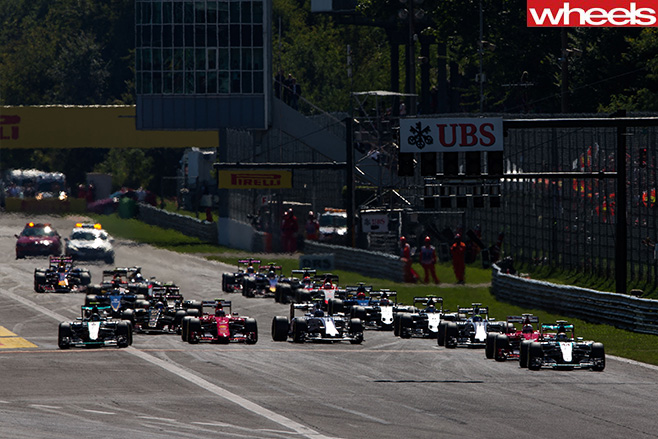
Hamilton stretched his gap to 25.0 seconds at the chequer and celebrated with delight on the podium. Soon afterwards, it was revealed that a check of tyre pressures on the grid before the race had shown that both Mercedes’ left rears were under Pirelli’s recommended minimum of 19.5psi. Hamilton’s tyre was 0.3psi underinflated; Rosberg’s a more significant 1.1psi.
These discrepancies might not be much on your Corolla or Commodore, but in the pedantic world of F1, where performance is extracted using the barest margins, rival teams seemed to opine that there were gains to be made from the lower pressures. There was also a safety issue (after Vettel suffered a blowout at Spa), which is the reason the minimum pressures were mandated.
Williams chief technical officer Pat Symonds equated the under-inflation to the FIA discovering a rear wing on a car was a few millimetres too wide. It would result in automatic disqualification, he said.
In the inquiry into the underinflated tyres on the Mercedes cars, stewards gave some leniency due to the absence of a defined time for checking the pressures.
Merc’s Toto Wolff said later that the precise time the pressures are checked by the FIA – on Sunday this was after the five-minute signal before the race – needed to be specified.
Wolff said the Mercedes tyres were checked when they were put on the car.
He denied emphatically that Mercedes had deliberately inflated the Pirellis so that they would meet the rules at the time of testing but drop lower by the start of the race.
WRC: Rally Australia could be champagne time for VW
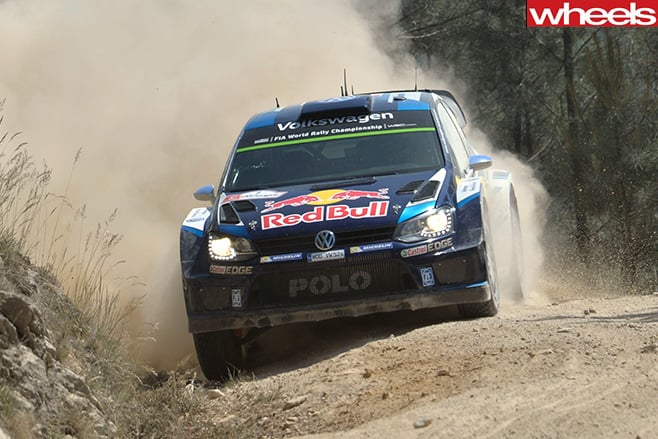
AFTER Volkswagen’s breakthrough triumph in its home event last time out, the German brand has a golden opportunity to wrap up three championships at Rally Australia next weekend – titles for drivers, co-drivers and manufacturers…
History could be made on the gravel around Coffs harbour: never before would the championship have been decided at such an early point in the season.
There is reason for VW to be confident. A year ago, Australia was the scene of Volkswagen’s first ever one-two-three with the Polo R WRC. The three Polo crews will be familiar with roughly three quarters of the challenging gravel routes from last year’s event. In total, they must complete 311.36 kilometres against the clock, spread over 17 special stages.
The what-ifs are simple…
French pair Sebastien Ogier/Julian Ingrassia lead by 93 points. Their destiny is in their own hands as they aim for their third WRC title in a row.

To pull this off, they must maintain a margin of at least 84 points over Finns Jari-Matti Latvala/Miikka Anttila and Norwegians Andreas Mikkelsen/Ola Fløene. Only the three Volkswagen driver/co-driver combos can still mathematically be crowned champions in 2015.
The title leaders can afford to lose no more than nine points to Latvala/Anttila – should Latvala win, second place and a bonus point from the Power Stage would suffice for Ogier. Should they finish ahead of Latvala/Anttila, the title is theirs.
The chances of Mikkelsen/Fløene winning the title are more mathematical than realistic, given that they trail the leaders by 109 points,
Ogier is raring to go: “I love the Rally Australia. It is a very special event. As it is an overseas rally, there is a little less hustle and bustle than at Volkswagen’s home race in Germany, for example. It is a bit more intimate, and I like that. Furthermore, the special stages in Australia are very nice to drive. Always have a lot of fun in the car. Last year it was a great duel between Jari-Matti and me, and we were ultimately separated by just 6.8 seconds.”
F1: Gossip and innuendo
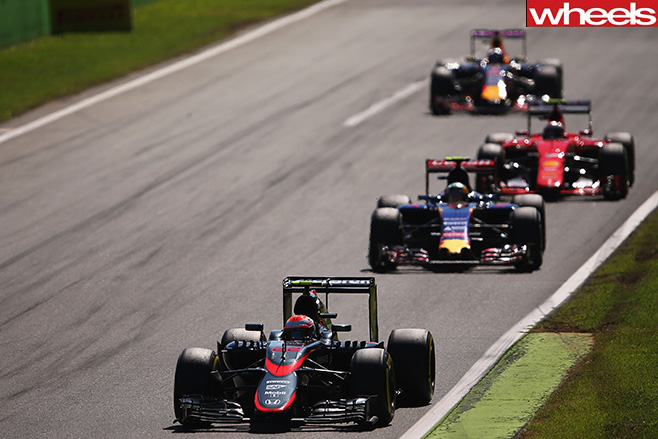
Button did at least finish the Italian Grand Prix. His team-mate Fernando Alonso went out with yet another power unit failure.
McLaren racing director Eric Boullier had declared before the race that the team intended to retain its current driver line-up, but Button’s body language was that of someone wary of being bitten again.
Asked by Sky News about his future after finishing 14th at Monza, Button said: “I think that’s something we need to discuss away from the circuit over the next few weeks.”
Button has shown plenty of speed and fight in his intra-team battles with Alonso, but he is also clearly keen to put his bum into a car capable of running faster than the current McLaren Honda.

Still on under-performing engines, the Red Bull team will not run Renault power units next season, according to a report from Autosport.
The website suggests that the relationship between the engine supplier and Red Bull management has become irretrievably untenable after a succession of reliability and performance problems.
While Red Bull’s deal with Renault runs until the end of 2016, Autosport is convinced the partnership will not continue next year.
Attributing its report to unnamed sources, Autosport said Red Bull had formally requested a termination of the partnership, and that this would be accepted by Renault, which has been linked to a buyout of the struggling Lotus team.
Mercedes and Ferrari are the only engine options open to Red Bull.
The world’s worst-kept secret is now official – the new Porsche 911 Carrera range is now turbocharged.
As first reported by MOTOR back in July, the need decrease fuel consumption and emissions has led Porsche to introduce a turbocharged engine to its 911 Carrera range for the first time.
A 3.0-litre twin-turbo flat-six in two states of tune replaces both the previous 3.4-litre and 3.8-litre naturally-aspirated units that powered the Carrera and Carrera S respectively.
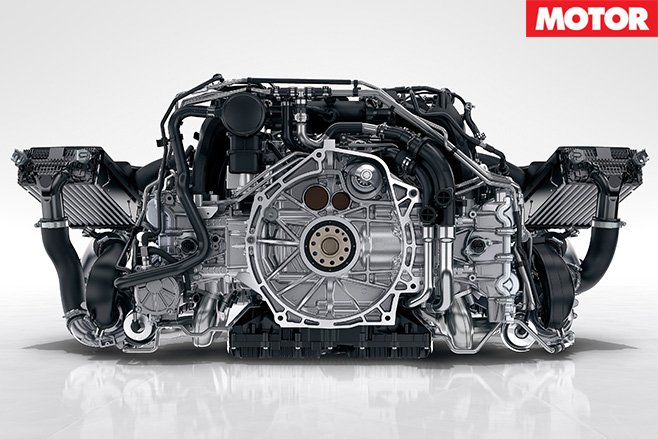
Speed also increases, the Carrera dispatching 0-100km/h in 4.2sec (an improvement of 0.2sec) when equipped with the seven-speed PDK gearbox, while the Carrera S dips under the magic four-second mark for the first time, claimed to hit 100km/h in just 3.9sec.
As you’d hope given it was the reason for the change, fuel consumption has also improved markedly, a PDK-equipped Carrera claiming just 7.4L/100km on the combined cycle, and the more powerful Carrera S just 0.3L/100km more.
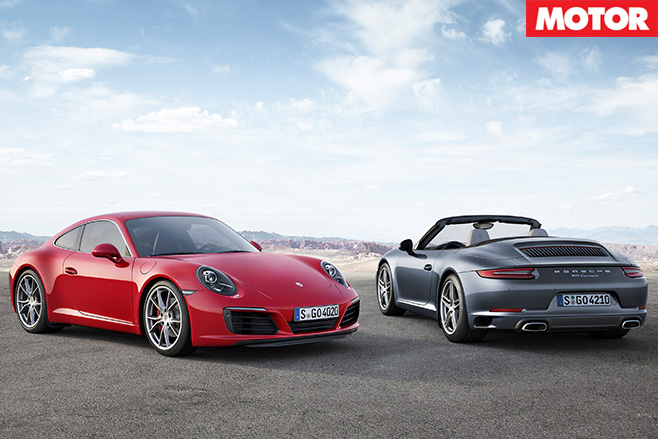
In fine Porsche tradition, exterior tweaks have been limited to new headlights and taillights, redesigned door handles and a new louvred engine cover.
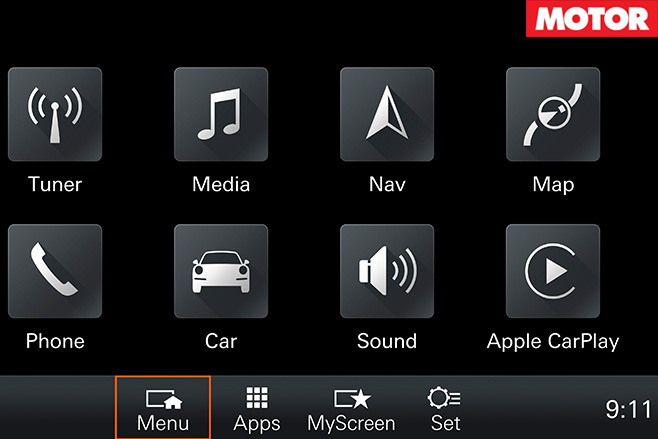
Inside the changes have been greater, with the latest Porsche Communication Management offering a smartphone-like touch-and-swipe interface.
With extra equipment now standard, prices have crept up by roughly $10,000 across the board, with the updated 911 range set to debut locally in mid-March 2016 as follows:
Porsche 911 Carrera $217,800 Porsche 911 Carrera S $252,800 Porsche 911 Carrera Cabriolet $239,300 Porsche 911 Carrera S Cabriolet $274,300
Ford has re-nosed its compact Focus and revised its ride and steering, while extending turbo power to every car in the line-up. So where has this facelift left the model’s renowned dynamics?
WHAT IS IT? The Ford answer to the Golf, Corolla and Mazda 3. The Focus is a dynamics leader and the top-selling Ford globally. It’s absolutely crucial for Ford regaining its sales strength in Australia.
WHY WE’RE DRIVING IT Ford has given the current-gen Focus, which was introduced here in 2011, a mid-life facelift and cabin clean-up. The range has been streamlined to fewer models, and one engine has been given huge price cuts across the range.
MAIN RIVALS An armada of cars competes with the Focus hatch and sedan. The Toyota Corolla, Mazda 3, Hyundai i30, Holden Cruze hatch, Volkswagen Golf, Honda Civic, Peugeot 308, Renault Megane, Nissan Pulsar and countless others are fighting for buyers in the same segment.
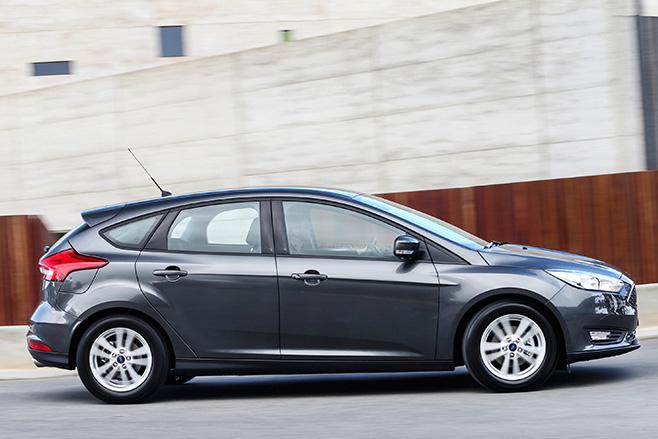
Plus: Cohesive look, excellent equipment levels, safety gear, vastly improved cabin Minus: Lack of engine urge, ride on 18-inch alloys, still can’t match Golf
THE WHEELS REVIEW WE FIND ourselves frequently saying that Ford Australia has some brilliant products but doesn’t seem to have the marketing and sales force to shift its metal from showrooms.
So here’s hoping that this mid-life update for the Ford Focus (designated LZ) has given the people tasked with selling it renewed vigour. Because the changes make this a seriously accomplished and desirable hatch, with more punch, better economy and improved manners.
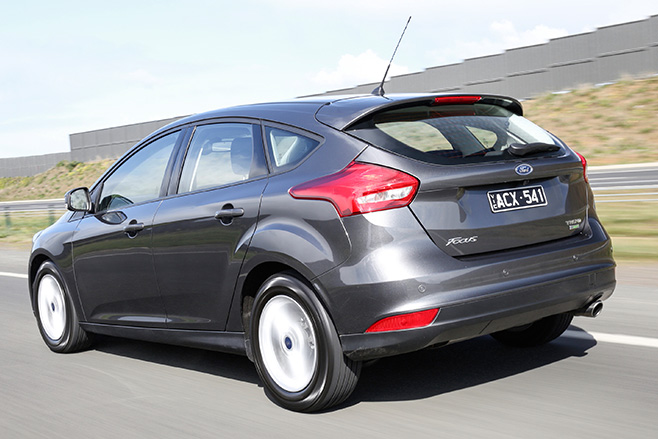
The Focus line-up has been streamlined, with the entry-level Ambiente dumped (no-one was buying it), and one engine offered across the entire line-up (apart from flagship ST and forthcoming Focus RS, of course). That means all three trim levels, starting with the Trend, then Sport and Titanium, come with the same 1.5-litre turbocharged four-cylinder Ecoboost engine. It replaces the 125kW/202Nm 2.0-litre, and delivers 132kW/240Nm with better fuel economy. That’s now 6.2/100km, and 6.6L/100km for auto models, thanks partly to the idle-stop in its eco-arsenal.
The shake-up also means the troublesome dual-clutch transmission has been dumped in favour of a smoother, quieter, conventional automatic, while a six-speed manual is also offered. And the diesel Focus is no more – it had made up a paltry 3 percent of the car’s sales here.
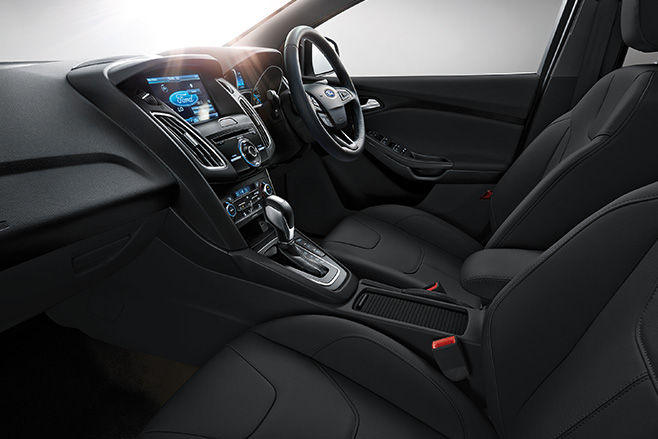
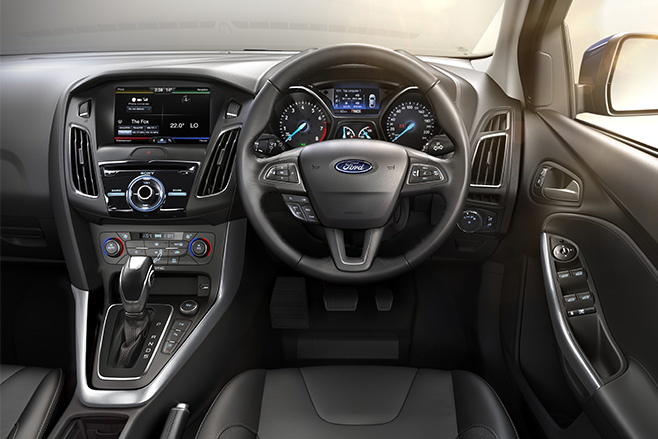
Changed too is the driving experience, with the goal of making this car – whose previous generations were dynamics benchmarks – more comfortable and refined. Tweaks include additional sound insulation and thicker front window glass, for instance, as well as plusher carpet for greater sound deadening. The changes have worked: the Focus cabin is now more refined, albeit let down marginally by road noise and some buffeting from the side mirrors, which have been reshaped for better aero.
That new engine is quiet at slow speeds, but give it a prod and it’s a tad coarse, with a note that’s more gruff than buff. Teamed with the new automatic, which shifts smoothly but has mapping that can’t quite keep up with throttle inputs, it is an adequate rather than rousing drivetrain, with the priority obviously around-town improvement.
That’s where the Focus benefits from a litany of safety and tech features – including auto emergency braking, lane keep assist, and perpendicular auto-parking – as well as the new tune for its electric steering. The steering feels too light at first, but it’s intended to feel lighter around town, with less resistance, and that’s exactly the result. There’s excellent feedback at greater speed, though, and while the fact that it’s not linear may seem odd at first, needing a few bites on tighter corners, the Focus is planted and sure on long, fast sweepers.
That ride comes courtesy of revised bushings front and rear, and dampers that now have an adjustment valve that means engineers have had greater scope for tuning. On the downside, the Titanic-like turning circle remains for larger-wheeled models, with the same steering tune across the range.
The $23,390 starting price for the Trend is a substantial $3K more than the previous starting point, but there’s far more gear for the outlay, with Ford chasing private buyers rather than relying on slash-and-burn fleet deals. Overall, Focus has had the edges of its dynamic ability planed off ever-so-slightly, but it can still offer a compelling drive down a ragged road and manage the supermarket sweep with ease.
SPECS Model: 2015 Ford Focus Trend Engine: 1498cc 4cyl, dohc, 16v, turbo Power: 132kW@6000rpm Torque: 240Nm@1600-5000rpm Transmission: 6-speed automatic Weight: 1393kg 0-100km/h: n/a Fuel Economy: 6.2L/100km Price: $24,390 On sale: Now
Click here to read the full range review of the Ford Focus.
The ‘ideal gas law’ should be familiar to anyone who ever studied thermodynamics.
But for those who were spared that university engineering torture device, it basically says that when you’re talking about a gas, pressure multiplied by volume equals mass multiplied by temperature (there’s a ‘gas constant’ in there, but we won’t go into that).
Why am I telling you this? Because it explains why turbochargers work much better with some form of intake air charge cooling – an intercooler, usually. You see, when a turbo increases the pressure of the air entering an engine, it also increases its temperature, which in turn means the density of the air is decreased.
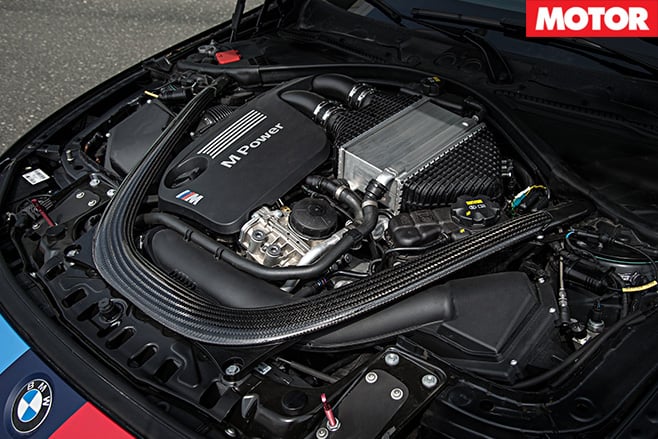
A cylinder full of relatively cool, high-pressure, high-density air is, however, much better for two reasons.
Firstly, as the ideal gas law shows, if pressure is increased and temperature is kept low, both the volume and mass of the air entering the engine is increased. This means that, at a fixed maximum boost pressure, an intercooled turbo engine will ingest more air than one without an intercooler and produce more power.
The second reason has implications for both durability and power output. A hot intake air charge will make the engine more prone to pre-ignition or detonation, which is an abnormal mode of combustion that can damage the engine.
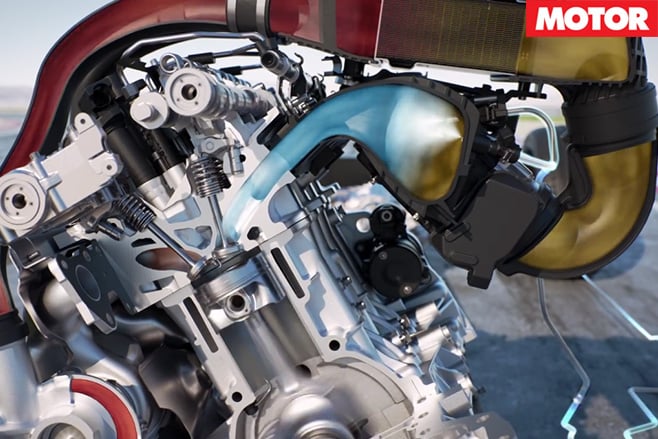
Today’s turbo cars are all intercooled, most often with an ‘air-to-air’ intercooler, which is commonly located atop the engine. It’s called ‘air-to-air’ because the turbo’s boosted air is pumped through the core, while ambient air is forced through the car’s grille or bonnet scoop and over the intercooler’s fins.
Water-to-air intercoolers, such as those found in the iconic Subaru Legacy/Liberty RS Turbo – or today’s BMW M3 and M4 – are less common, though remain very effective, especially in a road car.
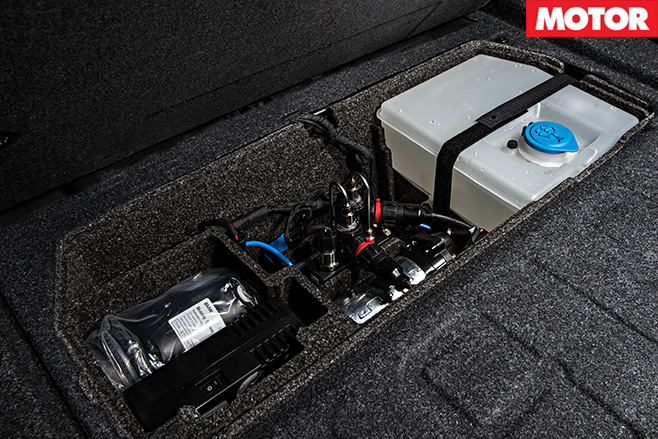
If BMW’s water-injected MotoGP M4 is any indication, however, H2O could again be the way to go.
