
There’s a part of your brain called the amygdala.
It’s the bit that makes you spin your arms at 1000rpm towards the beach when you see an inbound dorsal fin. And when it’s raining it’s the part that causes your finger to quiver as you reach for the ESP button in a Jaguar F-Type Coupe R.
Even in dry conditions a Coupe R’s rear 295-section tyres stand little hope in the face of 404kW and 680Nm. And in the wet, if so much as a moth flaps its wings on the throttle pedal, the traction control light will flicker.
So in some ways it makes sense to fit this car with some extra driveshafts. With that, the Coupe R AWD was born.
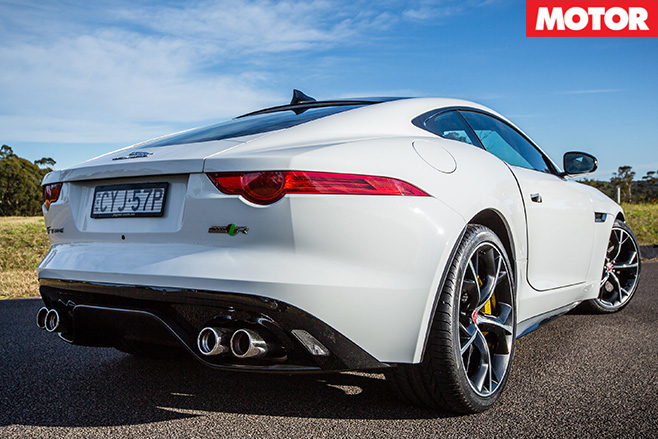
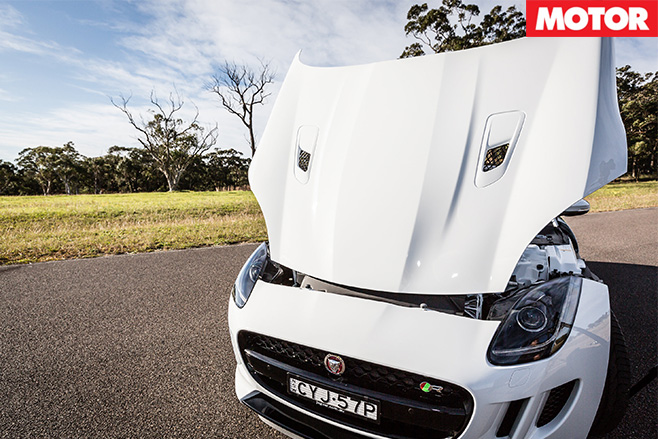
Visually the bonnet has a deeper central (and perhaps unfortunately-named) “power bulge” while the bonnet vents are unique to the all-claw kitty.
But the biggest differences are to be found driving. MOTOR was unleashed on a private road somewhere near Sydney we’re not allowed to tell you about. And the first thing we noticed, or were reminded, is just how fast the Coupe R is. By god; it’s brutally, scarily, oh-my-effing-lord rapid in a straight line.
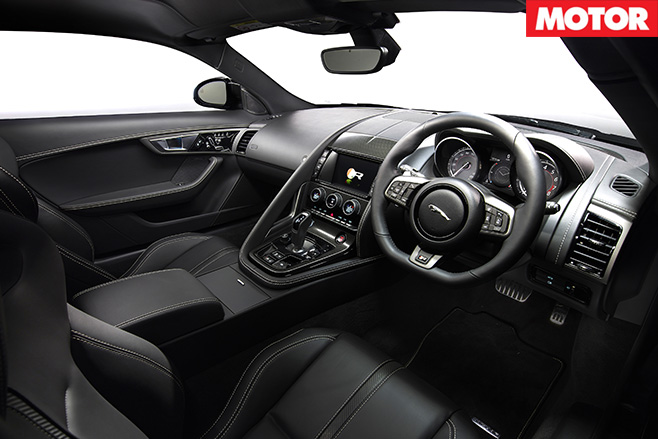
The crack it makes as you change up gears is laugh-out-loud funny. The F-Type Coupe R AWD is, at the very least, entertaining no matter the speed.
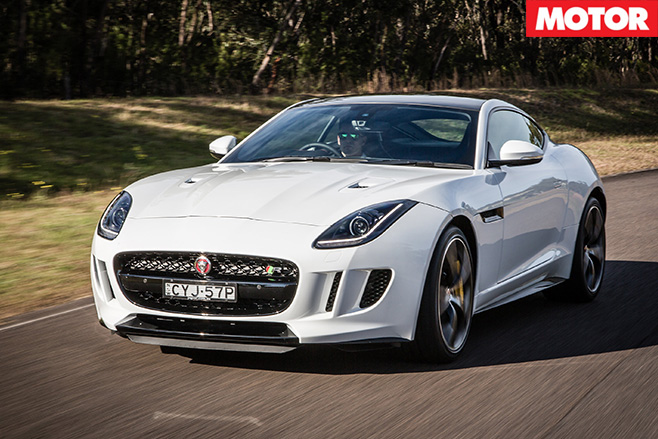
Its default drivetrain setting is rear-drive, meaning up to 50 per cent power can be sent forward. So in all conditions otherwise, it may as well be rear-drive. It feels it, too. Driving fast and smooth, the Coupe R AWD is much like its rear-drive sibling: frighteningly rapid in a straight line and deft through corners, if in a burly way.
Not quite as talented or surgical as perhaps a Cayman, the Coupe R AWD corners like a surprisingly limber Greco-Roman wrestler.
But in terms of how lairy the possible powerslides, the jury is still out. Trees lined the edges of our test track, so we’ll save the bigger skids for a proper track.
That said, there’s no doubting all-wheel drive has endowed the borderline-overpowered Coupe R with the tractive grip it’s pretty desperate for. In this territory, $16K isn’t much, but there’s still some philosophical reckoning to be had whether or not you need the extra driveshafts.
4/5
Specs
Engine: 5000cc V8, DOHC, 32v, supercharged Power: 404kW @ 6500rpm Torque: 680Nm @ 3500rpm Weight: 1730kg 0-100km/h: 4.1 sec (claimed) Price: $242,670
Get your free weekly report from the world of fast cars – subscribe to the MOTOR newsletter!
Is Jeep planning on building the world’s maddest SUV? It appears so, with whispers that a 522kW Grand Cherokee is due to go on sale within the next two years.
Rumours of this super-SUV, powered by the 6.4-litre supercharged HEMI V8 from the Dodge Challenger and Charger Hellcat, first surfaced when Jeep trademarked the ‘Trackhawk’ name, suggesting a more performance-focused variant than the current SRT8 is on the way.
According to numerous US outlets, the Grand Cherokee Trackhawk has made its first appearance at a major dealership conference currently being held by Fiat-Chrysler Automobiles (FCA) in Las Vegas.
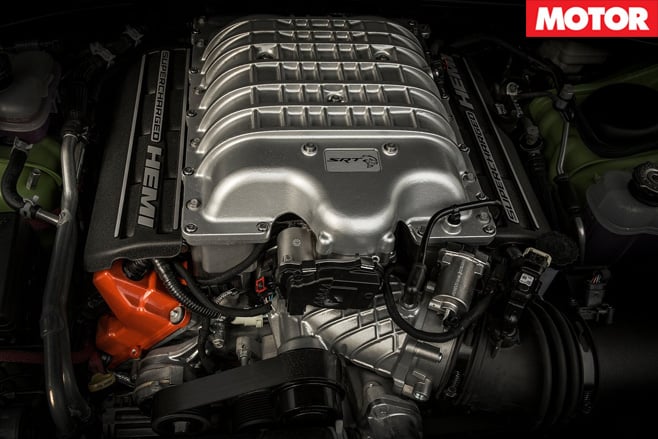
Scuttlebutt suggests that a Hellcat engine-equipped Grand Cherokee would be capable of 0-100km/h in just 3.0 seconds.
Before you dismiss such an outrageous figure, Melbourne’s Herrod Motorsport has supercharged the current Grand Cherokee SRT8, the result supposedly capable of 0-100km/h in 3.5sec – we’re hoping to independently verify that claim shortly.
Get your free weekly report from the world of fast cars – subscribe to the MOTOR newsletter!
FATHER’S DAY is just around the corner – and in case you needed a better reason for subscribing to Wheels, we’ve lopped 25 percent off the bill.
As well, if you subscribe, renew or give a gift subscription to Wheels, you get a chance to win one of five African style safaris at Jamala Wildlife Lodge in Canberra.
Wheels is Australia’s best and most distinguished motoring magazine, a world-class read with a formidable international reputation.
We offer entertaining and forthright comparisons of cars to suit all needs – from sports cars to family wagons and luxury limousines – but we also bring you the personalities, power plays and latest developments from the automobile world.
And if Wheels isn’t enough, you also save at least 25 percent on the cover price when you subscribe to a range of other magazines, from Motor, Outdoor and Gourmet Traveller to Rolling Stone, Money and GQ.
Take a ride with Wheels in print, on iPad or on Android.
Sign up here to receive the latest round-up of Wheels news, reviews and video highlights straight to your inbox each week.
THE NEXT-GENERATION Mazda CX-9 has surfaced, undergoing final prototype testing in the US ahead of its debut at the Los Angeles Auto Show in November.
Due in Australia in the first half of next year, the new-from-the-ground-up SUV will be a seven-seat rival for the Toyota Kluger, Nissan Pathfinder, Ford Territory, Kia Sorrento, Hyundai Santa Fe, and Holden Captiva 7.
It adopts a stretched version of the current CX-5 medium SUV’s SkyActiv architecture and technologies, ushering in a much-needed fall in weight and a big lift in fuel efficiency.
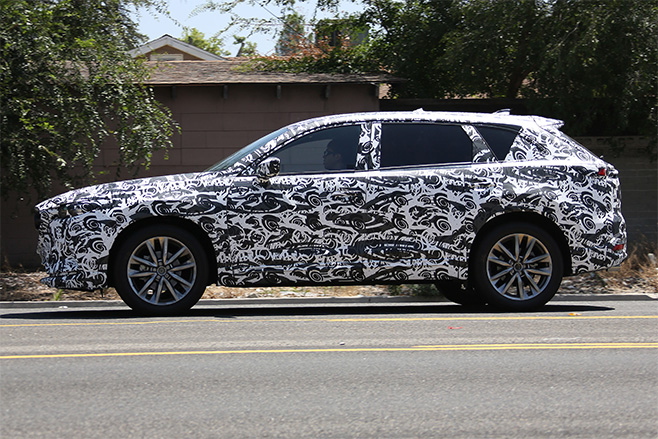
Driving either the front wheels or all four via a six-speed torque converter automatic, it is said to improve performance as well as cut fuel consumption by some margin.
Whether a turbo-diesel is also part of the mechanical equation is not known, although the main market that this seven-seater will be pitched to – North America – prefers its crossovers to be petrol-powered.
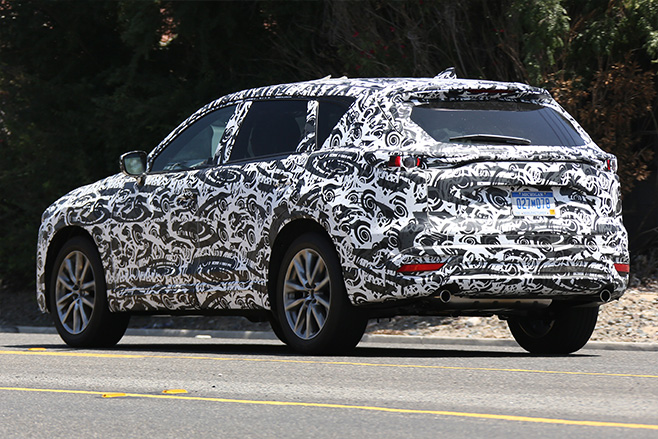
We also understand that interior space packaging steps up over today’s version, backed up by substantially better material quality and noise insulation. As before, production will be out of Japan.
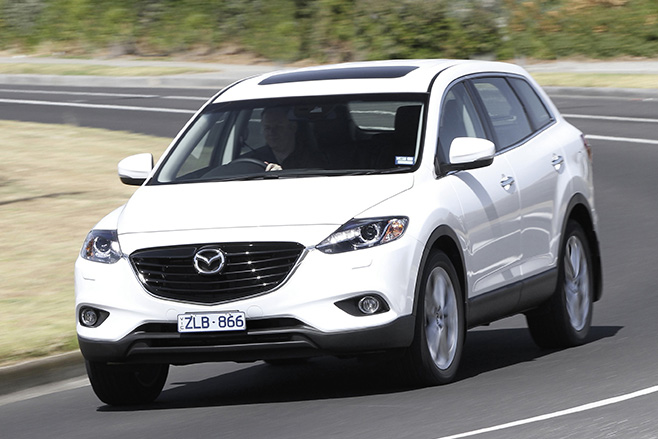
Today’s TB CX-9 starts from $43,770 for the front-drive Classic 2WD, stretching to the Grand Touring AWD’s price tag of $61,680. Don’t expect the largest Mazda to depart too far from these, despite a significant rise in standard spec, which should include a host of driver-assist technologies including Autonomous Emergency Braking.
Watch this space, as we’ll have more on Mazda’s vital new seven-seater SUV shortly.
Have spy pics of your own? We’d love to see them. Email them to [email protected]
The three big names of Australian automotive design talk to Wheels about their craft, what makes Australia such a great breeding ground, and what the future holds.
THE FIRST, arresting presence is a large and luxurious American sedan. It’s the original clay model of the Buick Avenir concept, a headline act of this year’s Detroit Auto Show. Nearby is the Holden Efijy, no less striking now than almost 10 years ago when it, too, rocked the US motor show circuit.
Through the doors just beyond there’s a cutting-edge hot rod in carbonfibre; low-slung sports-racing cars that took on Europe’s best; Abigail-curvy muscle cars; a practical pick-up that delivered a global trend; a Formula 1 world championship winner. All are world-class cars. All designed here in Australia.
The National Gallery of Victoria’s recent exhibition Shifting Gear: Design Innovation and the Australian Car was remarkable in being the first major exhibition to celebrate Australian automotive design.
It’s a sad irony that so many visitors were at last awakened to 120 years of Australian automotive achievement, as the industry itself counts down to the end of local car production in 2017. The curtain will be drawn on almost 70 years of a major manufacturing industry that, thanks to the foresight of our wartime political leaders, propagated far-reaching knowledge, skills and employment.

What now for the car-mad kids who gawp at the retro-futurist edginess of the Torana GTR-X – designed and built just down the road? What hope for the next Todd Willing, Tasmanian-born designer of the 2015 Detroit Show-stopping Ford GT, whose career began with a high school work-experience placement in Ford’s Broadmeadows studio?
While there’s little consolation for manufacturing jobs, each of Holden, Ford and Toyota has indicated its intention to continue designing cars in Australia. Shifting Gear may indeed have represented just that: a lift of the throttle as the industry selects a new speed.
Wheels assembled the three heads of Australian automotive design – Richard Ferlazzo of GM, Nick Hogios of Toyota and Todd Willing of Ford – against the backdrop of the Shifting Gear exhibition, to shed light on the past, present and future of their craft.
What became apparent is that Australia, with its richness of cultures, a skilled technology base, proximity to the world’s growth markets and – not least – enviable lifestyle, is a great place in which to design motor cars. And, as the likes of Mike Simcoe (GM), Max Wolff (Lincoln), Peter Arcadipane (Beijing Auto) and others continue to prove, a great place to cultivate designers.
Long may it be so.
RICHARD FERLAZZO Design Director, GM Australia Design
Richard Ferlazzo, 53, was born in Windsor, north-west of Sydney, to Italian parents. His father owned a 1948 Fiat 1400 until he “did the wise thing” and bought an EH Holden Special.
“Growing up, the only cars I was interested in were Italian sports cars and Australian muscle cars,” Richard says. He studied industrial design at Royal Melbourne Institute of Technology, graduating in 1982, and joined Toyota in 1986.
He moved to Holden in 1988 and has worked on every Commodore since VN, leading interior design on VR, exterior design on VT and serving as chief designer on VE and VF. He also redesigned Holden’s logo in 1994. Despite all that, Ferlazzo is justly famed for his 2005 Efijy concept. He was named design director of GM Australia in 2013.

“The challenges are the same as they’ve always been. We’re a small market, we historically only did products for our own market, a limited number of platforms, and therefore a concentration on mostly sensible, family vehicles.
“The way we injected interest was to create things like Monaros, Falcon GTs and Chargers, turning a humble family sedan into a very high-performance vehicle, like our Commodore SS. And that’s the upside of Australian design and engineering; we don’t have this close-minded mentality.
“We have a very broad understanding of the whole process. I can go to the engineering guys – we’re on a first-name basis – and we discuss the issue. With larger organisations, that’s not possible. We don’t just style something and throw it over the fence.
“People often ask: ‘If you had the same resources as BMW or Mercedes, could you do as good a job?’ Probably. But I’ll ask: If they had the limited resources we have, would they do as good a job as we do? And I don’t think so, because the mindset is different.
“Is there an Australian design aesthetic? I would say pragmatic, with a bit of bravado. All of our large cars have a good stance. Drop ’em a couple of inches, put big wheels on and they look great. That athletic look, the purposeful look, is part of the feel you get from Australian products.

“Our design department currently has about 140 people. Of those, there are about 10 exterior and 10 interior designers. There are five or six people in colour and trim design. The rest is mostly in larger groups: 20-30 clay modellers, about 25 in studio engineering [the link between design and manufacturing], probably 25 in digital modelling, and 15-20 in the fabrication team.
“We’ve been designing for other GM brands for many, many years. Around the mid-2000s, it flipped from mostly Holden work to a small portion being Holden work. We’ve been doing work for Pontiac, Chevrolet, Buick, Cadillac, plus regional stuff for China. The way the global GM design system works now, we’re heavily involved in just about any large project.
“Our design will remain exactly as it is. We have no intention of reducing at all – at times we will probably expand. We will continue to design for different GM brands, some of which will come back to us as Holdens. We’re working on something like that, let’s say for Chevrolet, right now.”
TODD WILLING Design Director, Ford Asia-Pacific
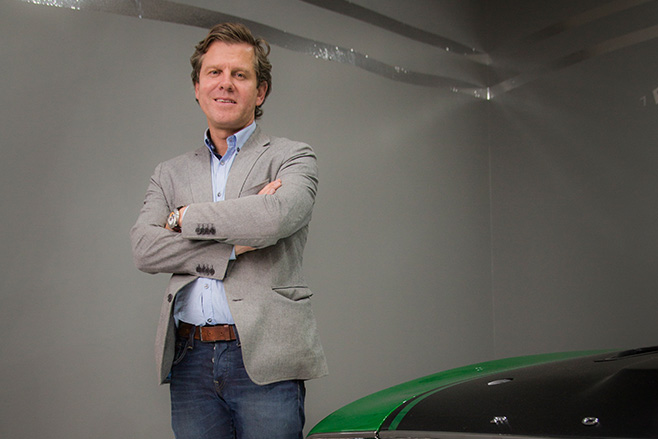
Todd Willing, 41, grew up around cars, his father owning a motor garage in Hobart. Todd became passionate about kart racing and sketching cars and mechanical things. Through a family friend, he secured work experience in Ford Australia’s design department, where he met Steve Park, Wayne Draper and others. “The atmosphere, the way they went about things, I knew it was for me.”
The Ford team steered him towards studying industrial design at Monash University in Melbourne, though Willing returned for a couple more placements during his study. After graduating in 1995, he joined independent design firm Radial Pacific (now defunct), then joined Ford in 2003. He has worked in Ford studios in Melbourne, Hiroshima, Cologne, Dunton (UK), Detroit and back to Melbourne in 2014, as design director of Ford Asia-Pacific.
“The Australian taste was inherently conservative, but it’s far less so today. On the fringe, we’ve always had this performance car rub that’s affected pretty much everything we do.
“In terms of design, we’re not limited in any way at all. The scale gives us nimbleness and flexibility. I’ve worked in all the Ford studios and we’re not missing anything. In fact, we have an advantage in being a bit out of the way; you can keep your nose down and get on with it.
“We have monthly virtual reviews with the global teams, when we go into the office from midnight to 4am. Our representation is always just as strong as anywhere. In fact, Moray Callum feels that we punch above our weight quite regularly, and that’s why we’re growing.
“We have one main studio, quite an open-plan area. We have surface plates, where all the models are set up, with a modular armature [modelling framework] that allows different platforms to be simulated. We try and keep our team as close as possible. I want to be able to see everything from my office in the corner.
“Right now our studio is sitting at about 140 people, but we’re in a period of growth. By the third or fourth quarter of this year we’ll have increased that by about 40 people. That’s across the board: the ratio of designers, modellers, digital modellers and engineers is pretty similar, because that’s what it takes to deliver a program.
“We are responsible for Asia-Pacific, and the predominant market is China. Our advantage is a little bit geographical, but a lot to do with the time zone, and being able to operate there using the skill base we have here. We share information daily, and doing it in Australia, you don’t end up with a day’s slack while you’re waiting for someone to respond to something.
“Australia is already unnaturally represented when it comes to the automotive industry, in design and engineering, for our population and scale. And that’s come out of that historical legacy. The skills and expertise exist here and will continue to do so.”
NICK HOGIOS Corporate Manager, Product Design, Toyota Australia
Nick Hogios, 40, wasn’t from a car family, but his immigrant parents were definitely an inspiration for hard work.
“As a child, I loved anything with movement, colour and speed – whether it was robots, spaceships or cars,” says Sydney-born Hogios. He developed dual enthusiasms for Australian muscle cars and interesting Japanese cars.
Convinced early of his calling, Hogios began studying industrial design at the University of NSW in 1992 and emerged four years later as dux.
He freelanced for a couple of years (he designed the Wayne Gardner Racing bodykits) until he saw his big chance in the 1999 Ford Australia/Wheels Young Designer of the Year. “I put everything into it, and it was a busy year for me, as I got married as well.” He won, and spent two years at Ford before crossing to the newly established Toyota Style Australia in 2002.

“Our history of design has proved that we can do a lot with a little. We don’t have teams of thousands of people, with everyone doing their own little bit. Our success is that we have a very holistic view of the overall design of the car. Our smaller teams can put out a lot more work and a much more unified design that the world seems to be loving at the moment.
“People might think we spend our time sketching pretty pictures and handing it over to someone who miraculously makes it happen. It’s not the case. We come up with our own ideas and directions and we have to fight for them against the commercial realities.
“There are other design resources around the world and we have to go out and actually get the work and bring it back to Australia. There are competitive design programs, but we’re constantly in contact with our other affiliates and head office and putting ideas in front of them.
“Toyota is obviously the most recent [2002] and the smallest of the three [design centres]. Our Port Melbourne studio was built in 2007. It’s a main double-level studio area, two clay plates, all the designers sitting there, a milling machine, a fabrication shop. It’s all arranged in a big loop, so from the first clay model you go around to each station.

“When I was studying, the internet wasn’t around. We had to scour any article in Wheels that had a sketch from one of the local heroes or an overseas designer. If there was one sketch, we’d buy the magazine and stick it in the scrapbook.
“These days, on YouTube, you can see instantly what the car design world is doing. We’ve just got a little bit further to travel for business trips or motor shows, but there is really no reason that we can’t be globally competitive.
“We fully plan to continue doing what we’re doing, and we want to expand and keep growing. Without being too specific, Toyota has a commitment to keeping the design function going in Australia, which is fantastic, and we want to have more of a global significance.
“We can offer the world something unique.”
THE END OF LOCAL MANUFACTURING
HOGIOS: “I’m very critical of where Australia is heading. Our ingenuity, our skill is where we have to position ourselves in future. The guys in the factories; you’re not just talking about line workers, you’re talking about very smart people who have continually strived to make things better. But moving forward, with design or local engineering, I believe we need the government’s support, we need recognition that this is a big part of Australia’s future. I want my kids to be able to pride themselves on this kind of thing. Okay, we can’t make stuff any more, but we can certainly design it here.”
THE FUTURE OF AUSTRALIAN AUTOMOTIVE DESIGN

FERLAZZO: “Design studios will continue here. We can work without manufacturing. The universities will continue to be feeders to our studios, and the fact we have more focus on global programs means we’ll probably rotate people through our other studios more than before – meaning those designers will have even more exposure to other markets. All the design studios here are held in high regard around the world.”
HOGIOS: “I came out of university during the recession and there were very few design jobs here. There was pretty much only a local focus. If you think where we are now, with so much more international intention in what we do and our involvement in the international scene, I think it’s actually a better situation. I don’t believe there’s any reason we should just stop and curl up, or all become baristas.”
FUTURE TRENDS
WILLING: “Composites in body construction and surface panels, and the freedom it gives us in terms of sculpting a more radical appearance. The technology has become affordable and there’s a double benefit in light weight and the ability to create new aerodynamic profiles. In fact, the universities here are at the global forefront of composite development technology.”
HOGIOS: “It’s manufacturing technology as well as technical advancements in powertrain and so on; that’s when you see big shifts in design. I don’t have one favourite thing but we’re still making headlamp shapes with LED lighting inside. The next stage will be to integrate that LED or other types of lighting technology more into the vehicle.”
FERLAZZO: “On the interior, we’re seeing fewer and fewer mechanical devices. You can’t get rid of all buttons; if things are menu-driven, people hate it. But you won’t see too many mechanical gauges in future. It may be that you can make it look mechanical; it will be more personal in the interface.”
Sign up here to receive the latest round-up of Wheels news, reviews and video highlights straight to your inbox each week.
WHO’D HAVE THOUGHT that wood-fired motoring would never catch on.
Sun power

Then provided the answer: “More likely yes than no.” Hmm.
The same article also predicted that by 1965, American cars would be tear-drop in shape, use radar for navigation, be made from a combination of titanium, aluminum, magnesium and plastic and be powered by a rear-mounted gas turbine engine.
It’s easy to see how such a prediction was made given the rapid technological development of the car – and of course other aspects of technology, such as flight – in the previous decades.
GM was trying to crack the ‘sun power’ nut.
Respected engineer Charles Kettering, who was head of research at GM from 1920 to 1947, was hung up on mimicking the way nature turned solar radiation into energy using chlorophyll as a catalyst. To this day, scientists are still getting headaches trying to make solar energy from organic compounds.
However, Kettering also acknowledged other proposals at the time, including the direct conversion of solar to electrical energy using the photoelectric cell. This is the technology used for modern solar panels. A large unit fitted to a house can generate enough energy to fully charge an electric car.
Experimental solar race cars aside, the idea of a vehicle powered by onboard solar doesn’t quite pass the reality test.
THE GOOD: A catchy name for a sun-powered car would be the Solarium. Wait, scratch that. THE BAD: Giant roof-mounted panels wouldn’t be so great navigating a Maccas drive-through.
4/10
Steam power
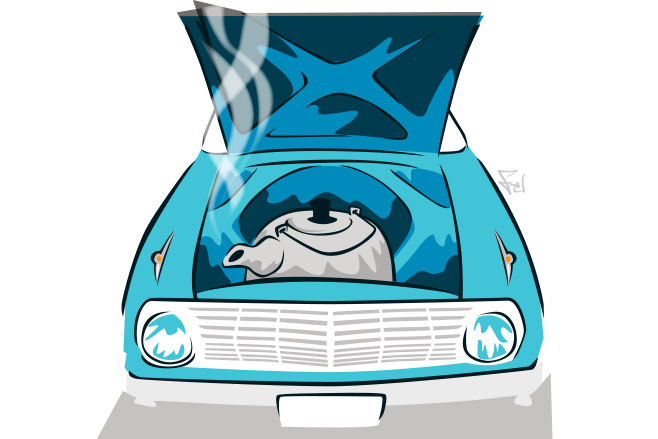
From 1899 to 1905, the Stanley Steamer outsold petrol cars, though it was outsold by the electric vehicles of the Columbia Automobile Company. A Stanley also set a new land speed record of 204km/h on Ormond Beach, California in 1906.
But by 1924 the Stanley car company (and most other steam car producers) had folded, beaten by good old gasoline.
There have been several attempts to reintroduce steam as an alternative to petrol.
In the early 1970s, Melbourne’s Ted Pritchard fitted a 1963 Falcon with a garage lab steam-powered driveline. It had a boiler in the engine bay that could be heated by any reasonably flammable liquid fuel including sump oil, ethanol, diesel and petrol.
The power pushed the pistons in a V-twin engine, which was linked directly to the driveshaft. There was no gearbox.
In 1972, the prototype was flown to Los Angeles, where the big American carmakers tested it and appeared impressed.
However, when the oil crisis eased, oil prices slumped and motivation to take on new technology was gone.
Pritchard continued trying to raise enough money and interest to make his invention a reality up until 1980, but it never happened.
THE GOOD: Supporters say it burns cleaner than petrol. THE BAD: Aussie prototype was impressive, but we’ll never know if it would have worked as a production model.
6/10
Wood power

Spotting a wood gas vehicle on the road generally means your country is going through temporary trouble or, quite simply, is rooted.
The technology was most widely used during World War 2 in the UK, US and Germany, when all the available oil was being used to build and power fighting machines.
Alternatively some very poor countries have turned to wood gas when other fuels couldn’t be relied on or remained too expensive. Some regions in China used wood-burning buses into the 1990s.
The system works by burning small pieces of wood and creating gasses such as atmospheric nitrogen, hydrogen, methane and carbon monoxide, which can then be treated and used to power a traditional internal-combustion engine. The burner generally needs to be very large and they are often fitted to the tubs of pick-up trucks, leaving little room for other gear.
Wood gas engines have been promoted by the environmentally conscious, given they can burn more cleanly than most fossil fuels, although trees are chopped down to make them run.
And, if the systems fail, occupants can be exposed to high levels of carbon monoxide, which can be unpleasant. And deadly.
THE GOOD: The government can’t tax wood like it taxes petrol and diesel, can it? THE BAD: Starting any fire is hard enough, let alone one that determines whether a car will tick over.
5/10
Nuclear power
It seems laughable now, but in the mid-1950s, nuclear-powered cars didn’t seem quite so crazy.
Just one decade after the Americans dropped an atomic bomb on Hiroshima in Japan, a nuclear reactor was employed to power a US submarine called Nautilus. Unlike conventional diesel-electric subs, it didn’t need to surface for fuel and was super-fast thanks to its abundance of power. Today, six nations have nuclear-powered submarines. Australia, with its diesel-engined Collins Class subs, doesn’t, which is probably a good thing.
Next up, the US Air Force bunged a couple of reactors into a B-36 to create a super long-range bomber. As Car magazine explained: “The next step is obviously for automobiles.”
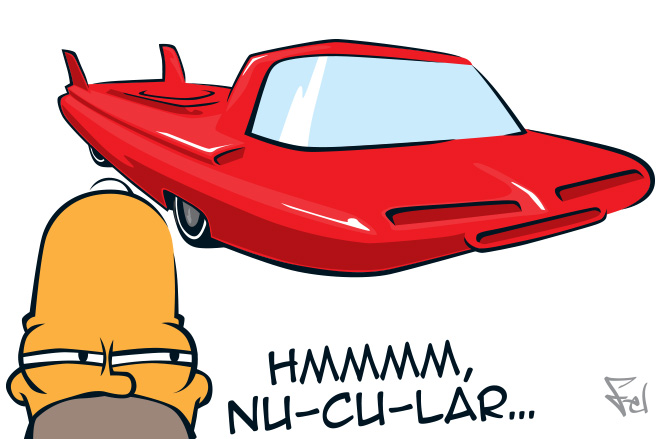
Ford either thought the idea had merit or simply had a good sense of humour when it revealed the Nucleon concept car in 1958. Instead of having a boring non-apocalyptic combustion engine, it had a small nuclear reactor in the back.
The Nucleon didn’t make it into production. Neither did the nuclear-powered bomber. It was cancelled, not due to concerns for mankind, but simply because the US and Russia developed intercontinental ballistic missiles that were far better at wreaking nuclear destruction from afar.
THE GOOD: Never having to stop, except maybe to go to the toilet. THE BAD: The possibility of a nuclear apocalypse destroying humankind as we know it.
1/10
Methane power
More recently, we discovered the same type of gasses (which are rather unpleasant when released inside a car’s confines) can also be used to propel the vehicle when fed into its engine.
But people have known for some time that gas produced from various bits of stinky matter could be used as a fuel. There is evidence that biogas was used to heat bath water in Assyria (a region that contained northern Iraq, north-eastern Syria and south-eastern Turkey) in the 10th century BC.
The Brits worked out that the gas created during the sewage treatment process could be used for various purposes; it was employed to power the street lights in Exeter from 1895.
It also appears American inventors started experimenting with biogas as a fuel for combustion engines during the 1930s, along with regular compressed natural gas (CNG), which is a gas refined from fossil fuels rather one generated from smelly matter.
Europe has always been big on the gas and motorists in several countries including Sweden, Switzerland and Germany use biogas regularly.
THE GOOD: Super clean because burning it doesn’t actually increase the carbon dioxide in the environment. THE BAD: Some poor bastards have to collect it.
8/10
Coal power
Technically, coal-powered cars are on sale now, with much of the grid power used to charge electric cars like the Nissan Leaf and BMW i3 generated by dirty coal.
Once there were cars that used coal directly, burnt aboard the car itself to fuel the engine. Some of the earliest cars used coal or kerosene to fire steam engines.
From time to time, coal was used in engines similar to wood-fired engines. The idea is that the coal produces gas, which can then be burnt in a converted combustion engine.
Interestingly, the son of the founder of Cummins claimed that Rudolf Diesel – inventor of the diesel engine – initially tried to use coal dust in the combustion chamber of his engine. It blew up.
Now it has been reported that cars burning “clean coal pellets” could soon be a reality. Sane people have dismissed the idea, pointing out that, even if it did burn cleanly, it would still produce a poisonous solid ash.
THE GOOD:We certainly have plenty of the stuff here in Australia. THE BAD: Choking the planet.
2/10
Fuel cell power
Countless car companies have produced futuristic concept vehicles with supposed fuel cell powerplants for more than a decade, but fuel cell vehicles are still not produced in any meaningful volume.
The idea is tantalising. Just bung in some hydrogen and out pops some electricity to drive your wheels. With steam the only byproduct, there are no nasty exhaust emissions (although the hydrogen production process can produce them).
Fuel cells make power using a chemical reaction that turns hydrogen and oxygen into heat and electricity. Electrical energy is unlocked directly from chemicals, unlike fossil fuels and the relatively inefficient refining and combustion process.
The fuel cell concept dates back to the 1830s, and in the 1960s, NASA used them for the US space program. Even so, fuel cell cars are still not produced in any meaningful volume.
Hyundai and Toyota each offer one, but only produce a handful of them, while fuel cell buses, forklifts, boats and submarines are currently in service in pilot programs, though none have proven to be cost-effective.
Issues include the cost of the fuel stacks, problems with on-board hydrogen storage and a massive refuelling infrastructure.
THE GOOD: Super-efficient and near silent energy production. THE BAD: It may never, ever be cost-effective.
6/10
Air power

It also makes an amusing noise that would sound great coming out a great big exhaust pipe on a P-platers’ pride and joy.
Several engineers have been working on air engines for nearly a century, including Melbourne’s Angelo di Pietro, but the technology has not progressed into production.
Compressed air was used from the late 1800s to propel some trains and trams where fossil fuel emissions would have been problematic – such as underground mines – but were soon replaced by electric models.
Compressed air has a very low energy density and developers have not worked out a practical way to give a car the kind of range needed to be taken seriously for general use.
However, there is still a chance for compressed air with the pneumatic hybrid concept, which PSA Peugeot-Citroen thinks could soon be a reality.
This hybrid concept has a regular combustion engine, but harvests electricity (like a petrol-electric hybrid). Instead of being stored in a battery, the energy is used to compress air in a tank. The air can then be used to power the engine at lower speeds.
THE GOOD: A hybrid that might actually be worthwhile. THE BAD: Poor range, unless used as a hybrid with a combustion engine.
5/10
Turbine power

The 1962 Chrysler Turbine Car is the only vehicle to be produced and released into the hands of the public, though just 50 were allowed out on trial.
The turbines could run on pretty much anything, from jet fuel to diesel and vegetable oil, although they had a problem with leaded petrol, which was the common fuel of the day. Chrysler claims the Mexican president, who was loaned a prototype, successfully ran it on tequila.
The turbine engines had 80 percent fewer parts, didn’t need tune ups or oil changes, were light, didn’t need to warm up, ran smoothly and delivered good performance, though took some time to spool up and the lag bothered some customers.
Chrysler finally killed the project in the late 1970s, partly because the US government pulled much-needed funding, but also because it sucked fuel, was expensive to build and the exhaust was red hot.
Gas turbines could make a comeback with plug-in hybrids, with GM engineers saying in 2010 the technology would be great for charging the battery. Later that year, Jaguar presented the CX-75 concept, which used two mini-turbines that charged its batteries. Unfortunately, it was killed off when Jaguar realised it had no money.
THE GOOD: The more revolutions the better. Che Guevara would be proud. THE BAD: Engineers would have to solve the noise issue. It was said to sound like a big vacuum cleaner.
7/10
Rocket power

The most infamous solid rocket car story emerged in 1995, spreading around the internet (then known as the Information Super Highway, rather than the Porn and Spam and Videos of Cats Super Highway that it has become). Its fame was heightened when given the celebrated Darwin Award that champions the deaths of stupid people in the name of evolution.
Apparently a retired US Air Force sergeant managed to get hold of a solid-fuel rocket used to help heavy planes lift off from short runways and strapped it to his 1967 Chevrolet Impala on a remote road in Arizona.
The story goes that when he lit the candle, the car reached a terminal velocity of 480km/h before taking off, soaring like an eagle (strapped to a rocket) before slamming into a mountain. Unfortunately (or fortunately?) it was all a big hoax.
However, the British Bloodhound team is very real and is preparing a land speed record racer that uses a jet engine and a hybrid solid fuel rocket, with a Cosworth F1 V8 just to pump in the oxidizing agent. Thankfully it can be shut off at any time.
THE GOOD: Stunning acceleration. THE BAD: The possibility of unscheduled flight.
2/10
Water power

An actual water engine was used in London during the 19th century, using the water pressure from the mains water to drive an engine (with valves and everything) that operated machines like cranes and water pumps. But that isn’t going to work for your Commodore.
Water can also be treated in order to extract hydrogen, which can be used in a modified combustion engine or put through a chemical reaction in order to generate electricity in a fuel cell, but that system is complex and expensive.
However, an American preacher-salesman-inventor (yes, you should be worried already) by the name of Dennis Lee has clearly out-done the car companies, coming up with the incredible HHO Hydrogen Generator that turns water into hydrogen, which can then be fed into the engine and cuts fuel consumption by more than 50 percent. Genius.
You can have one installed for about $3300 or become a dealer for just $330,000. US news outlet NBC, described by Lee as an “oil company stooge”, did an independent test and found the device simply didn’t work.
THE GOOD: Promises to cut your fuel bills by more than 50 percent. THE BAD: Doesn’t actually work.
0/10
Ethanol power

As for the rest of the world, we’re not so sure – about the fuel, that is, not the hair business.
Ethanol is a form of alcohol, which is good, but when used in most engines made before the late 1990s, it corrodes some of the components, which is bad.
In Brazil, most vehicles run on at least 20 percent ethanol, but many use 100 percent.
The 40-year ethanol push is all about utilising Brazil’s massive sugar cane industry because, try as we might, the world can only eat so much sugar.
Now the North Americans are turning to ethanol because it can also be made from corn, and the US has many corn farmers. Then there is the added benefit of reducing America’s reliance on imported oil, which means it doesn’t have to invade as many Middle Eastern countries, unless it wants to.
But Ethanol production is contentious, with critics arguing that crops grown for food could soon be replaced by crops grown for fuel.
Used in blends of up to 85 percent in Australia, ethanol has a higher octane rating than petrol, but less energy per drop, which results in higher fuel use.
Don’t expect to see ethanol use surge here as there are only a handful of producers in Australia.
THE GOOD: Simple enough to make at home in an alcohol still. THE BAD: Alcohol is for solving human problems, not car problems.
6/10
Sign up here to receive the latest round-up of Wheels news, reviews and video highlights straight to your inbox each week.
Hyundai is kicking off its performance aspirations by officially revealing its new ‘N’ division at next month’s Frankfurt motor show.
It is tagged by Hyundai as a “new high-performance sub-brand” that will initially show a duo of concept cars ahead of launching the first N production car in around two years.
“The result of intensive testing and product development, the sub-brand N builds on Hyundai motor’s successful motorsport experiences and technology capability to drive future performance-oriented and race-track-capable models,” the Korean brand communicated in a statement.
A further aim Hyundai says is to “bring ‘the most thrilling winding road’ fun to customers who truly love cars.”
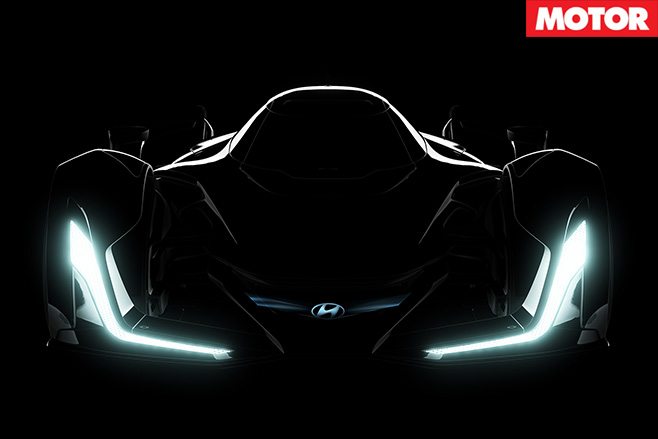
Indications are that in a decade’s time – as the 2025 badging reflects – the Koreans could build a proper, Audi R8-style halo sports car for its new division that stands for Namyang, the company’s hometown and proving ground location.
Closer to reality is a mid-engined, 221kW 2.0-litre turbo Veloster concept complete with aluminium suspension design and unique chassis configuration. Called the Hyundai RM15 concept, it is “suggesting how the Hyundai N driver-focused technologies could come into production”.
Hyundai World Rally Championship (WRC) chief Michel Nandan recently told UK outlet Autocar that the first N division product would be a next-generation i30 hot-hatch to compete with the Volkswagen Golf GTI and even the Golf R.
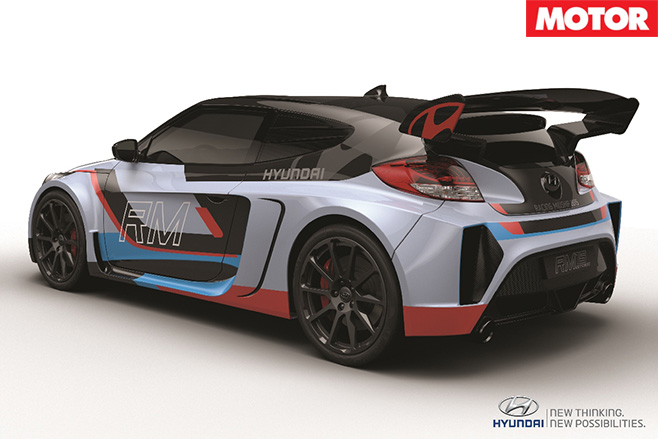
Responding to the speculation, Hyundai Australia public relations manager Bill Thomas didn’t mince his words.
“We hope that because Australia is such a big hot-hatch market, and also is the world’s biggest i30 market, we’re very keen on the car, we’re very happy to be involved in whatever planning for that car is happening,” he said.
“We hope that it’s a serious hot-hatch, I think the more serious it is the better because you’re only going to get one chance to launch it right the first time”.
Get your free weekly report from the world of fast cars – subscribe to the MOTOR newsletter!
There’s no doubt that SUVs are Australia’s newest obsession. It’s all anyone is talking about. Gone are the days when you had to give up comfort for a car that can take you from the ’burbs to the bush. Sure, they may not get the chance to get their tyres muddy too often, and a bunch of die-hard off-roaders probably scoff every time they see one drive past, but the Toorak Tractor is still going strong in Australia.
Wheels has given us its insight into five great cars in the luxury SUV segment. From bigger boots to interiors loaded with technology, here are our picks.
THE CONTESTANTS
Land Rover Discovery Sport Audi Q5 Lexus NX300h Volvo XC60 BMW X3
These cars are all luxury SUVs.
THE AIM OF THE WHEELS GAME
The Audi Q5 may be the reigning champ of the medium-sized premium SUV class, but new competitors have driven interest in the segment and buyers now have greater choice than ever. The team at Wheels pit Audi’s offering against its rivals to see which car emerges victorious (click here to read the full Wheels comparison).
Land Rover Discovery Sport
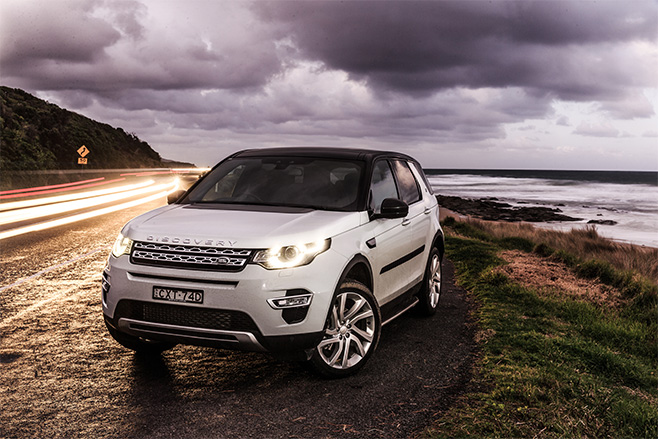
As standard, the Land Rover Discovery Sport includes satellite navigation, reverse camera and automatic braking. Of this group of mid-sized SUVs, the Disco Sport is the only capable off-roader for those who don’t mind getting their tyres dirty. It’s spacious, flexible, and includes some pretty cool technologies such as Wade Sensoring which gauges water crossings.
It is also available with an optional third row of seats for added versatility at a cost of about $1990. On the downside, the Sport has experienced some technical glitches. It also has a fairly large turning circle and lacks the hardware of other four-wheel drives.
Audi Q5
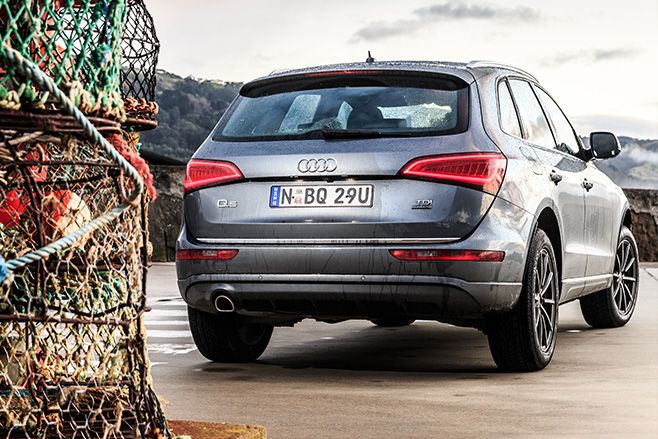
In typical Audi fashion, the Audi Q5’s interiors are bursting with class and flexibility with a cabin that can adapt to your needs. It features the Technik package, with three-zone climate control, reversing camera and satellite navigation. Large side mirrors with blind spot monitoring add to the already high visibility.
It’s not the most spacious in its class, but the rear seats are versatile and can be folded flat for greater cargo space.
Lexus NX300h

The Lexus NX300h offers great value with electric steering wheel adjustment, heated seats and reversing camera. For the eco-conscious, its hybrid engine delivers good fuel economy and for music lovers it has 10 speakers scattered throughout its cabin. The Enform Communications system, an added extra, delivers handy information such as weather, and can even locate your closest petrol station.
As the smallest car tested here, the Lexus is marked down for cargo room and interior space. The drive can also feel unsettled at times.
Volvo XC60
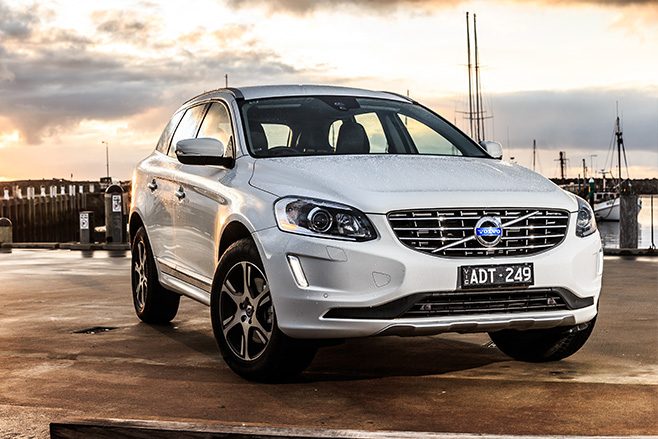
Space is a notable feature in the Volvo XC60. The second row is propped up so everyone gets a good view, the boot swallows any cargo you have, and with the back seats and front passenger seat folded down, you could move a small apartment. Its safety credentials are also solid with Collision Avoidance technology to help prevent low-speed impacts.
Satellite navigation comes at an added expense of a few thousand dollars and the Volvo XC60 Road Sign Information technology can be a bit hit and miss.
BMW X3
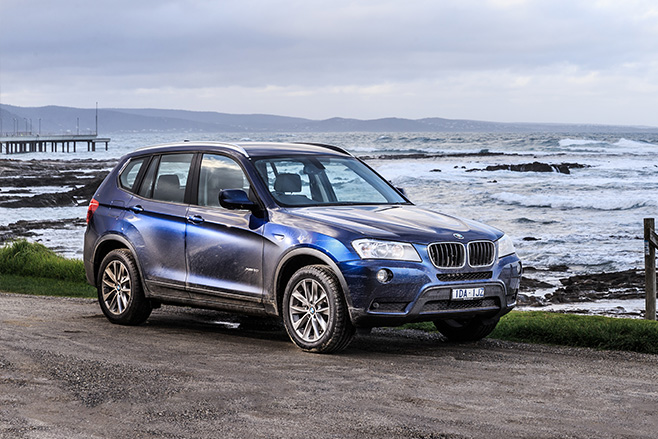
The BMW X3 offers an entertaining all-round driving experience from its comfortable seating position, accurate steering and powerful engine. It is especially suited to those who feel like putting their foot down. The iDrive controller and dials are easy to use and boot space is abundant.
The X3 loses points inside where the interior feels cheaply made by comparison, with hard materials, a low-resolution centre screen and flat and firm seats. The ride of X3 is also less refined over poor surfaces.
THE VERDICT
Audi Q5 2.0TDI Quattro: 7.5/10 BMW X3 xDrive 20i: 5.5/10 Land Rover Discovery Sport HSE Luxury: 7.5/10 Lexus NX300h F-Sport: 6.0/10 Volvo XC60 D4 Luxury: 6.5/10
As for the WhichCar verdict, we realise one size doesn’t fit all. In-built booster seats in the XC60 are great for families whilst the ability to take the Land Rover off-road is a drawcard for others. However if we were to categorise, these would be our choices:
- The Volvo XC60 is our pick for a younger family.
- The Audi Q5 rates highly as an all-round family car.
- The Land Rover Discovery Sport takes the cake for anyone searching for a little more adventure.
- The Lexus NX300h is perfect for those wanting a city car with extra space and a whole lot of luxury.
- The BMW X3 is our choice for more enthusiastic drivers.
With its head out the window, tongue dangling from its slobbering lips, and tail wagging with more excitement than a kid in a candy store, there’s nothing a pooch loves more than a car trip. Well, except maybe left-overs from dinner and a tennis ball.
For most people, a dog is a part of the family, so it’s only natural to keep them safe. There’s no shortage of safety equipment keeping human babies protected in your car, so why not your pooch too?
If you’ve ever got the sweats worrying that poochie is going to leap out of an open window, stress less; because Skoda is here to help keep the fury members of your fam-bam safe.
To do this, it’s introduced a dog seat belt, a non-slip, water resistant and washable back-seat protector, and a double-sided boot floor with one side covered in a dirt-repelling, waterproof coat.
Skoda has our tails wagging when it comes to keeping man’s best mate clean and safe!
The accessories are available through all Skoda dealers.
The new Ford Mustang squares off with its old nemesis the Chevrolet Camaro in California’s high Sierras.
THUS it was written: Lee Iacocca’s pen smote the boardroom table and up popped the Ford Mustang. It stopped the 1964 World’s Fair in New York cold on debut, and then created an entirely new class of American sports cars. A money monsoon fell on the bean-counters at Ford’s Glass House for the two-and-a-half years it took mighty General Motors to respond with its Chevrolet Camaro, and the two cars have been at each other’s throats ever since.
Neither the Mustang nor the Camaro, nor even the Cougars and Challengers and Javelins and ’Cudas that followed, would sway Enzo Ferrari in his firm conviction that “the only good sports car America ever built was the Jeep”. But to deny the charms of the pony car in all its peculiarly American excess is to have the most cynical view of cars in general.
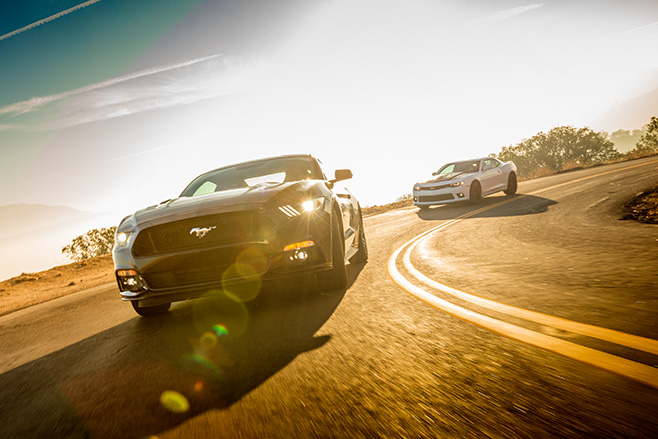
The future reliably frustrates all attempts at prediction, and all that really matters is this: today, the sun rose on two pony cars – one brand new, one still a couple of years away from a re-boot – that incorporate the best environmental protections, safety technology and street performance that the industry can muster at an affordable price. And they retreat not one iota from the promise of freedom and personal expression made by Iacocca’s original Mustang in 1964.
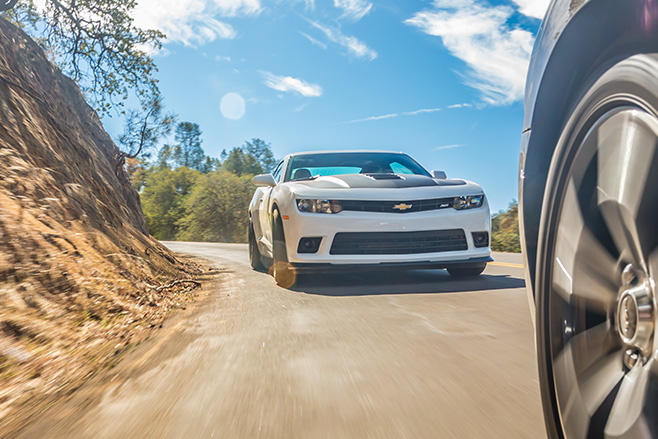
Fittingly, the Mustang is not only the first pony car, but the only one to survive in an unbroken (though not unsullied) bloodline from the original. Its record, especially since the 1980s, has been one of continuous gradual improvement from year to year, sometimes so minute as to virtually go unnoticed.
With the 2015 overhaul, done with a gaze fixed steadily on the target of increased international appeal, the model breaks its slow trot of progress and instead makes one giant leap for Mustang-kind. Chief engineer Dave Pericak said the initial plan, to leverage more of Ford’s existing hardware, was eventually shelved as engineers struggled to make a new-enough Mustang from the bones of the old one. Ultimately, he says, they were given a freer hand to “make a Mustang that we can put a 50th anniversary badge on and be proud of”.
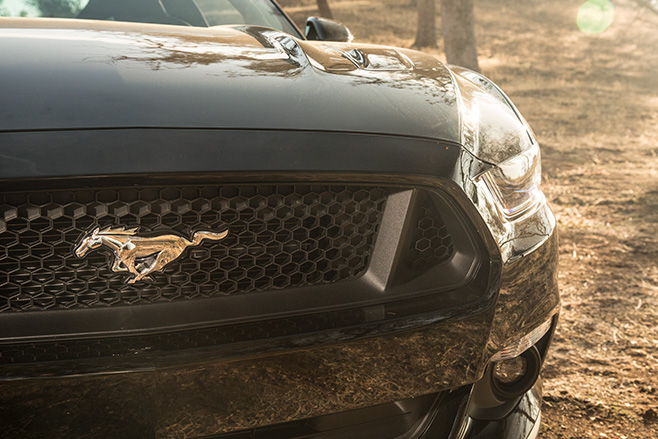
Underneath, Ford decided to finally ditch the solid axle for an independent rear suspension, which in turn required a rethink of the strut front suspension. And if they were doing that, they thought, might as well look at the subframes. And the brakes. And the steering linkages and cross-bracing. And so on, until Ford pretty much had a new car.
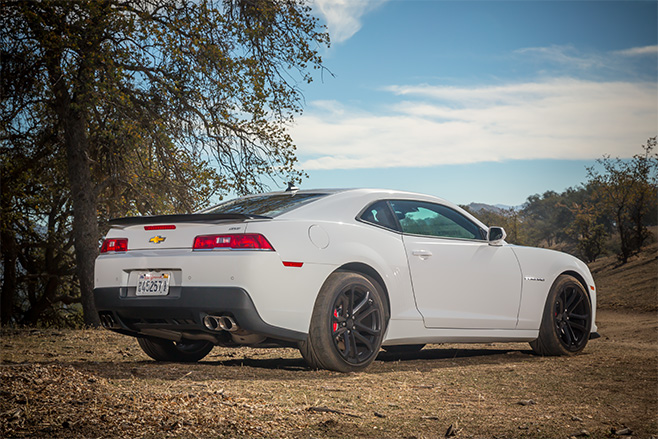
The Camaro was facelifted in 2013, followed by the introduction of a couple of new and ever more weaponised models, including this SS 1LE with its meaner suspension, and the totally track-rat Z/28. The top power dog remains the 433kW ZL1, however all will be short-lived as a new Camaro breaks cover in 2016 sporting the LT4 V8 from the current Corvette.
Inside, the Mustang is the new kid and it shows, with the latest and greatest materials and electronic frippery, such as collision warning, parking sensors and a cross-traffic alert that prevents you from backing out the driveway into an oncoming petrol tanker. Drop the extra $US4000 ($A4760) for a GT Premium and you’re swaddled in soft-touch leather, aluminum trim and chrome accents. Click the unlock button on the fob and tiny lamps hidden in the side-view mirrors project the galloping Mustang logo on the ground next to the car, a great Batman-style party trick.
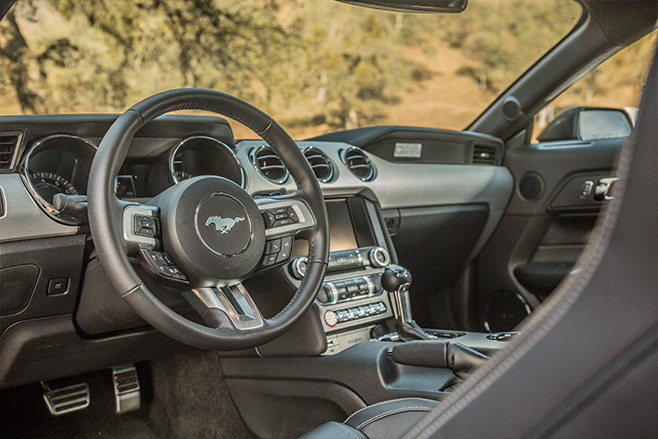
The screen in the Mustang’s cluster can be configured to digitally render all kinds of fascinating gauges you didn’t know you needed, such as twitching dial indicators for the air/fuel ratio, intake boost/vacuum (though there’s no boost on this version, of course) or inlet-air temperature. It’s with this screen and accompanying steering-wheel buttons that you engage the track mode for the stability control and the line-lock function, which at a standstill allows you to electronically lock just the front brakes and barbecue the rear tyres for up to 15 seconds. A panel toggle lets you dial up three levels of steering effort.
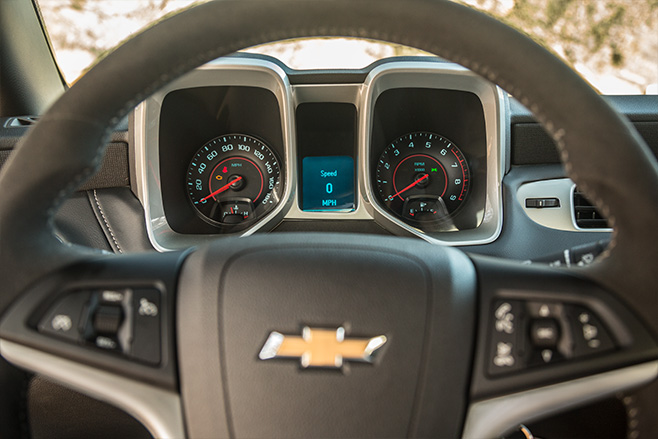
By comparison, the Camaro looks like public infrastructure inside, even with its optional two-grand Recaro buckets. The phone company has cars with fancier trim than this. Ponds and rivers of plain black plastic stand in for design, though swathes of synthetic suede, especially wrapping the shifter and steering wheel rim with attractive herring-bone stitching, at least provide a sense of performance authenticity at the touch points. If you didn’t like the Camaro’s green-lit gauge presentation when it was new, staring wide-eyed at you like Elton John in his mega-sunnies heyday, you won’t love it any more today as it rapidly approaches retirement.
Of these two cars, the Camaro is the corner killer. First, Chevy fits blocky Goodyear Eagle F1 Supercar G2 tyres to the 20-inch rims of the 1LE spec, which combined with the stiff suspension package makes this SS a sticky, stable handler. The fierce turn-in and cornering grip indicate how deeply the Camaro sinks its claws into the pavement. With all that gum on the road, it’s difficult to even break the rear end sideways for the photographer. The downside is a crashing expressway ride complemented by extra thrum from those big rubber rolling pins.
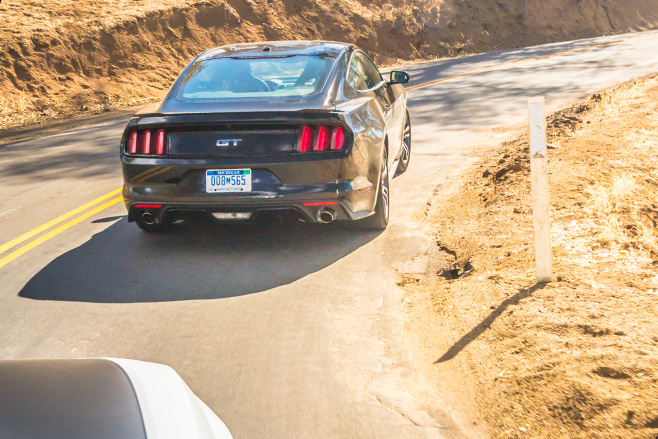
The Mustang GT isn’t really a bad handler; its base suspension is just set on the soft side. It is a perfect pleasure to drive at seven-tenths, with direct steering and reassuring brakes. Ford’s engineers obviously left overhead clearance in the suspension for performance tunes and future models such as the already announced Shelby GT350 and a Boss that is almost certainly coming. That frees up the GT to be just that, a comfy, everyday gran turismo.
Both cars make the right big-bore snorts from their V8s, though the Mustang’s oddly rhythmic puff-puff from its twin tailpipes at idle sounds almost computer-generated. They’re evenly matched to 100km/h, with times in the mid-fours, and to 400m. Separate testing of a six-speed manual Mustang GT proves the automatic suffers nothing in acceleration and would be even quicker if launched on proper tyres. They also burned fuel at similar rates, the Mustang edging the Camaro.
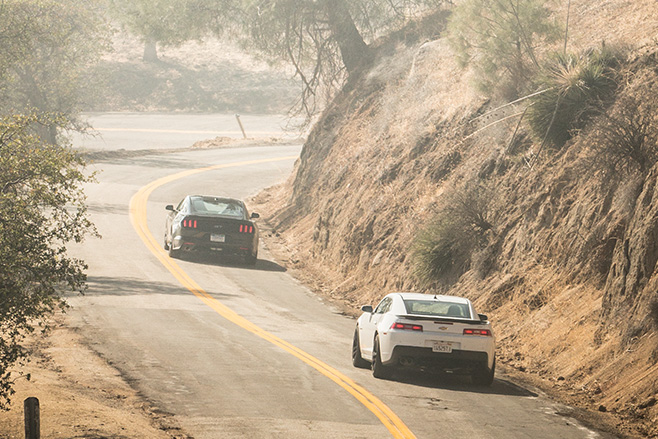
Our Camaro is definitely the most nostalgic. Even with its sharper handling, it’s the most I’ll-be-18-forever car of the pair, recalling hot summer nights on long-gone main streets and some of the nuisances of muscle cars that you didn’t mind or even notice when you were a teenager.
This Mustang, conversely, is from people who figure that if you’ve got that much to spend, they have to persuade you not only against buying a Camaro, but also an Audi A5 or a BMW 428i. In America, at least.
The many-button Mustang wants to play in the international sand box, albeit with a distinctly American girth and attitude. The Camaro has international roots but has gone completely native, as American as guacamole on a pizza. But even America is ready for something a little less old school, and the Mustang is it.
Four for economy
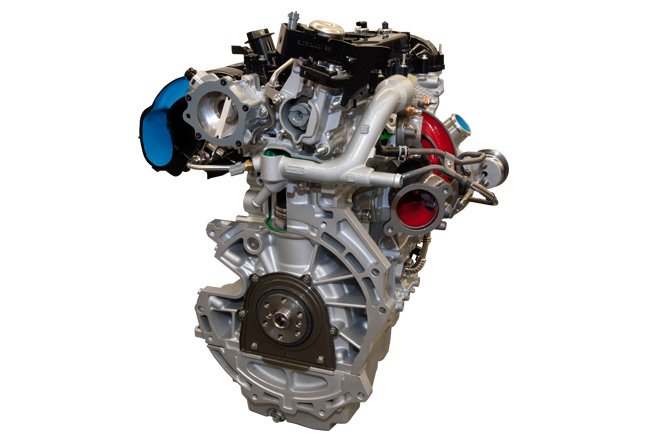
Muscle-car buyers only see a four-potter as half a V8, but Ford figures the potential fuel economy gain (9.4L/100km in federal testing versus 12.4 for the V8) should help it win over up to 40 percent of customers. We’ll see; US fuel prices have dropped significantly since the engine’s debut.
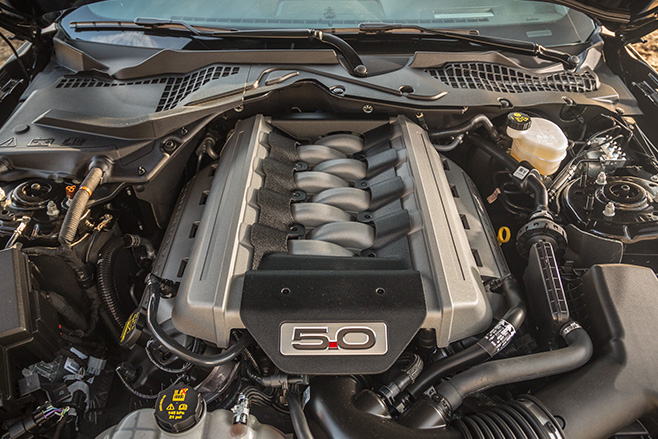
However, if you come to the ’States and rent a Mustang convertible for the required drive up California’s Highway 1, as many visitors do, you’re most likely to get the entry-level 224kW 3.7-litre V6.
Small-block survival
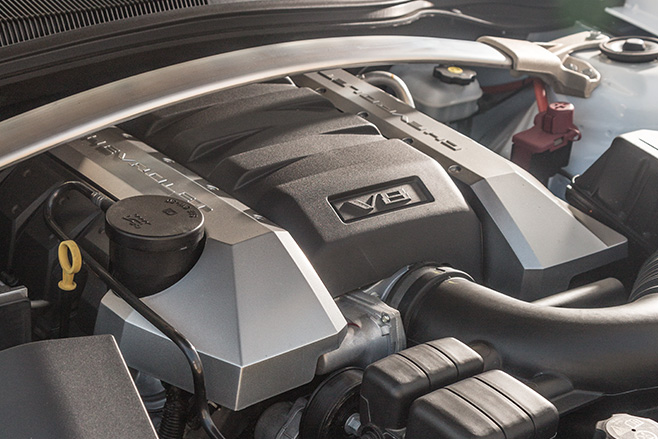
Current Camaro line-up includes the 298kW L99 on automatic SS and 318kW LS3 for manuals, while Z/28’s 7.0-litre LS7 makes 376kW and ZL1’s supercharged 6.2-litre LSA produces 427kW. In 2016, Camaro gets the Corvette’s new LT1 and its supercharged LT4 variant, which update the small-block with direct injection and cylinder deactivation.
No doubt Chevy is closely watching the sales of the EcoBoost Mustang to see if buyers would swallow a four-cylinder Camaro. Either way, there likely won’t be one at launch.
