
The trouble with rallying is there is really nowhere to go if you make a mistake.
You might get lucky and find a handily placed escape road or soft ditch to land in, but more often than not you’re going to hit something hard and unforgiving.
Case in point, this footage from the recent Rally Ronde de La Durance. The crew of this Citroen C2, Yoan Droumenq and Gabriel Durand, are slightly off line over the preceding crest, which lightens the rear and pitches them into the right-hand bank.
This launches the car into the air where it heavily impacts a tree, thankfully with the empty rear of the car, rather than the front where the occupants are.
Thankfully, both crew members escaped shaken but unharmed, but the same can’t be said for the poor little Citroen.
Get your free weekly report from the world of fast cars – subscribe to the MOTOR newsletter!
The big question surrounding Ferrari’s move to turbocharging is not whether the cars will be fast enough, that’s a given, but whether they’ll sound any good.
Following our first drive of the California T, the jury was still out; it sounds pretty good, without being amazing.
However, its GT personality means it doesn’t necessarily need a spine-tingling soundtrack; the new 488 GTB, though, definitely does.
As the replacement for the amazing 458, the bar is set very high, but this amateur video, taken outside the Ferrari factory in Maranello.
Unfortunately, at no point to the lucky test drivers really give it the beans, but on first impressions the trademark Ferrari blare is still present.
Let us know what you think!
Get your free weekly report from the world of fast cars – subscribe to the MOTOR newsletter!
SKODA is trying again with the third-gen Fabia Combi – a pert and practical compact wagon that finally exorcises the narrow clumsiness of its unpopular predecessor. As Australia’s cheapest wagon, there is plenty to commend, with appealing dynamics to boot.
WHAT IS IT? The only B-segment supermini wagon on sale in Australia, the Mk3 Fabia Combi takes over from the radical but unsuccessful Skoda Roomster as an inexpensive yet quality five-seater family-friendly urban runabout. All-turbo direct-injection petrol drivetrains and Polo-based hardware underneath ensure competent Euro dynamics.
WHY WE’RE TESTING IT Skodas are improving all the time, with the Yeti and Octavia near the top of their respective compact SUV and small/medium car classes for value, space, practicality and enjoyable dynamics. Come July, and the Fabia is set to do the same in the supermini segment, with the redesigned Mk3 model. As Australia’s only baby wagon, the Combi version represents a unique and likeable proposition.
MAIN RIVALS Peugeot 2008 Active, Renault Megane wagon, Hyundai i30 wagon, Kia Soul
THE WHEELS VERDICT If there is any justice in the automotive world, the upcoming NJ-series Fabia Combi deserves to be one of the best-selling superminis in the light car class, bringing in SUV-shaming cabin space and load-lugging capability with proper European dynamics and efficient low-emissions turbo-petrol powertrain performance. Throw in attractive design and an elegant interior, and the smallest Skoda wagon ought to be one of the sub-$20K sector’s biggest sellers.
PLUS: Compact, perky, involving and refined practical wagon alternative to hatch MINUS: Small glovebox, firmish ride, no brilliant 3-pot diesel belter
THE WHEELS REVIEW HERE’S an idea, Skoda. With the 2015 Skoda Fabia Combi as a case in point, how about not even bothering with your hatchbacks and, instead, become a wagon and SUV-only importer? It would differentiate your fine but underrated products from Volkswagen’s right there.
Adding about $1300 to the circa-$15,990 five-door hatch launching in July, the Czech-built Fabia wagon lobs in with a pair of 1.2-litre direct-injection four-pot turbos cribbed from the closely related VW Polo – a 66kW five-speed manual and 81kW seven-speed DSG dual-clutch auto.
The smallest wagon around (and sole class entrant), the Fabia is like a 75 percent scale version of its handsome Octavia bro. Stretching the body, wheelbase and tracks, lowering the roofline, and raking the windscreen finally banishes the previous version’s visual awkwardness.
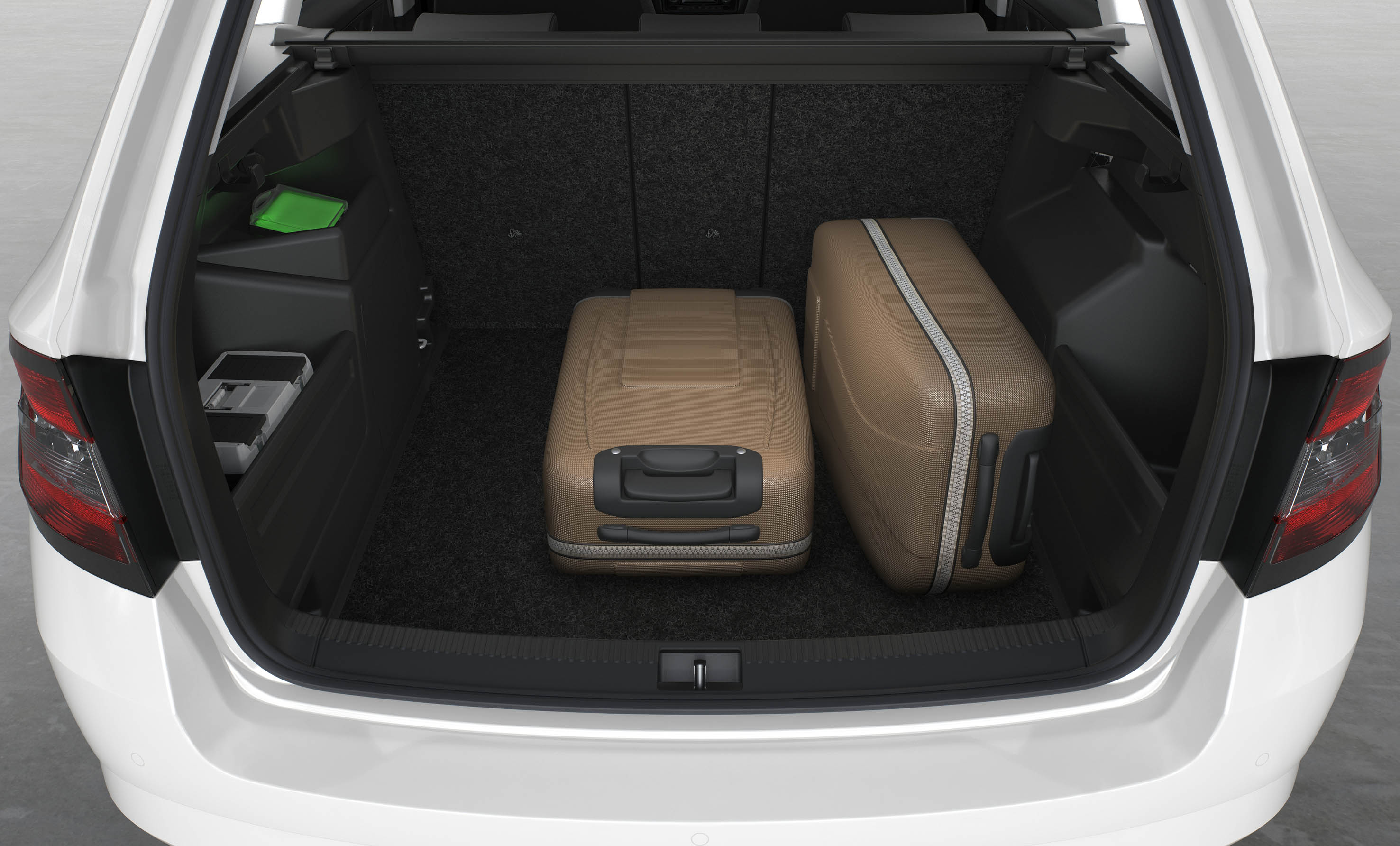
Out back, the Combi appeals with a compelling 530L boot (up 25L from before), or 1395L with the backrests folded. Unlike in the hatch, the rear cushions will tip forward for a flat floor, while a removable shelf for versatile compartmentalisation is also possible. If you’re 155cm tall, welcome to your new crash pad. Nothing offers such functionality for the money.
A 21mm cabin-width increase equals more space up front, while sufficient all-round vision enhances an excellent driving position on firm yet supportive seats. Cosy but not cramped, even six footers will find the rear seat accommodating.
Smartly designed, with an appealing and contemporary symmetry, the Fabia’s dash scores for clarity, usability, and functionality, although the glovebox is small. All models include VW’s new ‘Mirrorlink’ smartphone tech, displaying navigation, audio, comms, and other apps from a paired device. Note that ours proved glitchy, however.
Hitting the road, the punchy yet refined 66kW 1.2 TSI manual easily overcomes the Combi’s nominal 24kg weight penalty. Allied to a sweet-shifting manual, the Skoda made short work of hauling three adults and luggage across a couple of hundred kilometres of Tuscan autostrada and countryside.
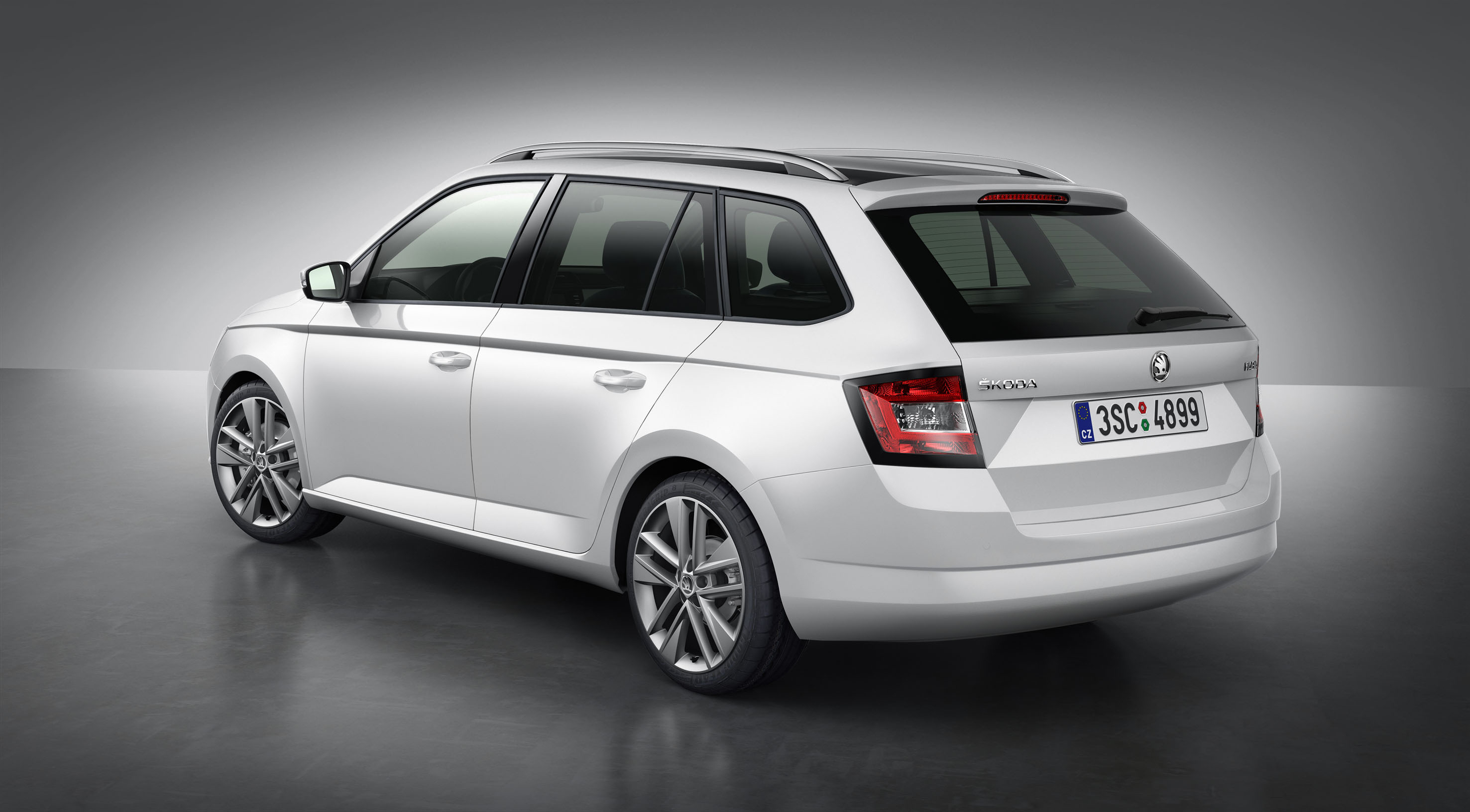
The Fabia also proved usefully agile in heavy public-holiday traffic, with enough low-down torque for the point-and-squirt driving vital when negotiating Italian city streets. However, though isolated and mostly absorbent, the ride on 16-inch alloys would occasionally jolt over larger bumps, while a bit more steering sharpness at lower speeds would improve an otherwise enjoyable handler.
Unfortunately no 81kW 1.2 TSI DSG was available for us to assess.
Perky, composed and comfortable, the Fabia wagon brings deft dynamics to a compact, attractive and practical package. The hatch version is fine, but there’s nothing like the Combi for the cash. It deserves Skoda’s full resources.
SPECS Model: Skoda Fabia Combi 66kW 1.2 TSI Engine: 1197cc 4cyl, dohc, 16v turbo Max power: 66kW @ 4400rpm Max torque: 160Nm @ 1400-3500rpm Transmission: 5-speed manual Weight: 1133kg 0-100km/h: 11.4s Fuel economy: 4.7L/100km Price: $17,500 (estimated) On sale: July

IT’S TAKEN a while to get here, but Ford’s mid-cycle update for its Focus hot hatch has allowed its European RS team to further hone the ST’s credentials as the thriller in its segment.
THE DAMAGE: $38,990
VITALS: 2.0-litre inline-4, turbo, 184kW/360Nm, front-drive, 1464kg
SAME ST, BUT DIFFERENT…
The most obvious changes for the 2015 Focus ST live on its outside, where it’s has welcomed a new face, new colours to its pallet, and a new-look bum.
Elsewhere, beneath the sheetmetal, Ford’s stiffened the body surrounding the engine bay, retuned the suspension, and reprogrammed the car’s electric steering.
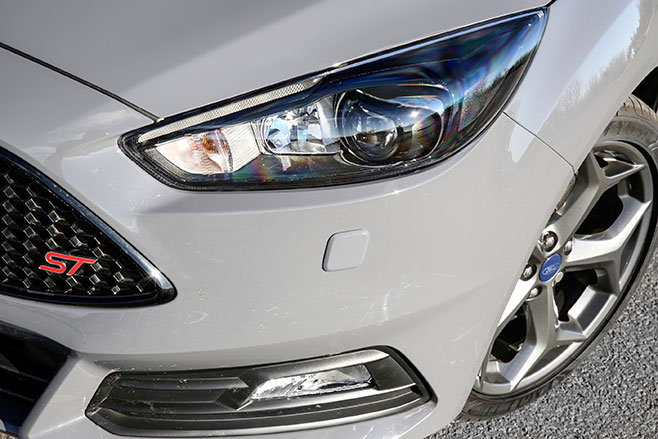
The aesthetic result? Gone is the cutesy, bulbous nose of the old ST, now traded in for a squinty new pair of headlamps matched to a subtle new bonnet bulge. The tweaks align the ST’s facade with Ford’s incoming all-paw, banzai, RS super hatch, but there are still plenty of ST-specific details.
These are its subtly offset 18-inch alloys, the rear roof spoiler, and oh-so-cool centre dual hexagonal exhaust tip that fly the boy-racer flag. Meanwhile, brake calipers finished in red and a new flat grey body colour named ‘stealth’ continue that theme.
But where its visual redesign loses points is out back. Ford’s designers made the right move zapping 40mm from the rear taillights’ height, but the louvered rear lower insert that has replaced the old winged item above the exhaust tips has dulled its visual impact.
Moving inside, the interior has been much improved despite small changes. The new Ford SYNC2 infotainment system’s touch functionality has seen the button clutter replaced and liberated space for not only a much bigger 8-inch screen, but more storage space behind the gearshift.
Otherwise, besides the new flat-bottom steering wheel – which, much like the centre stack, has cleaned up its button act– the cabin’s very familiar, with the same partial-leather Recaros and defining its performance vibe, and overall it’s a nice place to be.
SHARP AND STEADY
Bombing through Victoria’s mountainous outskirts reveals the Focus ST drives a lot like it looks: sharp, fast, and mildly intimidating.
Ford’s RS crew have had a re-think about its dynamic package to make better use of the broad 235mm Goodyear rubber, erecting new, stiffer shock absorbers –and harder bushes on the front lower arms and rear spring links—under each wheel guard matched to new springs.
Between the front hubs, however, the engine remains untouched, which is probably for the best as the ST’s beefy 360Nm often tries to shrug you off the steering wheel with rampant torque steer.
The engine’s fat and urgent bottom-end pays dividends in corners, freeing your hands to spend more time on the tiller than the gearshift. And that’s where you’ll want them, because while the car may balance its tyre load nicely once mid-corner, the ST’s still likes to rotate.
This adjustability might explain why the steering is geared at 1.8-turns from lock to lock. It’s bullet fast, and also nicely weighted. But despite the new software tune, the steering can feel doughy when winding off excessive lock, and overall there are not great levels of feedback.
Feedback is more an issue when it comes to the ST’s ride. Without any adjustable tech to soften things up in urban environments, the static dampers tend to transfer a lot of high-speed compressions. The gain, however, is good body control, and a car that feels attune and extremely obedient to inputs.
Dynamically it’s very impressive, and the ST revels smooth, winding, roads. Meanwhile its deep, bolstered seating position matched to a gearshift that slots with a magnetic-like catch richen the experience.
Where it’s ultimately let down is the lack of a proper front differential, as the electronic inside-wheel braking unit is constantly challenged by the 2.0-litre’s brawn.
LET ME THRILL YOU
Not everyone will adore the Focus ST in the same way not everyone wants to own a Rottweiler. From its rampant torque steer, to the firm ride and adjustable-but-slightly-threatening chassis, it feels a little unhinged. But that’s the ST’s allure.
In 2015 form, the ST feels more resolved, is better looking, while remaining still resolute in what it intends to do, which is egg you on for a thrilling drive. And for that, it gets our thumbs up.
3.5 stars out of five
Click here to read the full range review of the Ford Focus.
Get your free weekly report from the world of fast cars – subscribe to the MOTOR newsletter!
Finding a Nissan S15 200SX (Aussie-peak for Silvia) that hasn’t been modified is like looking for a needle in a haystack.
But lo and behold, we have found one – a really good one.
This Australian delivered 2001 200SX is completely standard – not a fart cannon exhaust or blow off valve in sight – and it’s travelled less than 100,000km.
It’s a desirable spec too, finished in electric blue and fitted with a six-speed manual gearbox.
When Toyota unleashed the 86 sports car the world went mental for a brief moment. This was a cheap, fun to drive, four-cylinder rear-wheel drive coupe with 147kW – it seemed like a completely new concept.
Only it wasn’t, because ten years earlier Nissan was also making a 147kW rear-wheel drive coupe for less than $40k – the 200SX.
In standard form the 200SX produced 147kW/265Nm from its 2.0-litre turbo engine and 0-100km/h took around seven seconds.
But the SR20 motor’s tolerance to extra boost pressure and strong aftermarket support meant that few examples remained standard.
Here at MOTOR we loved it like a first child, awarding it our 2001 Performance Car of the Year title, beating such luminaries as the Porsche 911 Turbo, Audi RS4 and HSV GTS 300.
So, if you want an unmolested 200SX or a blank canvas from which to build a modified monster, this could be the car for you.
Get your free weekly report from the world of fast cars – subscribe to the MOTOR newsletter!
What stands out?
The Toyota HiLux is the most popular ute in Australia, and in four-wheel drive form it is also the best-selling 4WD vehicle. Most people choose diesel 4WD dual cabs, which are the most expensive HiLuxes but very versatile. This review covers only HiLuxes produced prior to the major model update of October 2015.
What might bug me?
Not much, but the hard ride when lightly loaded is a typical ute problem.And while the Hilux is not as bulky as some direct competitors, it’s still a big vehicle and awkward in tight car parks.
What body styles are there?
Single-cab chassis; extra-cab chassis and Pick-Up; double-cab chassis and Pick-Up.Pick-Up models come with a factory tub at the rear, while cab-chassis models allow their buyers to fit a tray of their choice, either a dealer-fit accessory from Toyota or a tray from an after-market supplier.The Hilux is available as rear-wheel-drive only vehicle, or with dual-range four-wheel drive. It is classed as a commercial light pick-up.
What features do all versions have?
Two airbags, directly in front of the driver and front passenger.Bluetooth connectivity and a USB plug for easy charging of phones.A decent audio head unit, with control buttons on the steering wheel.The basic Workmate does not have air-conditioning. But dealers tend not to stock them without what is seen as an essential feature these days, and so you can add the cost of air-con to the base price.The warranty is three years or 100,000km, and all HiLux models come with capped-price servicing for the first three years or 60,000km, whichever occurs first.
Which engine uses least fuel, and why wouldn’t I choose it?
The most fuel-efficient engine available in the HiLux is the 3.0-litre four-cylinder turbo diesel, which on the official test uses 8.7 litres/100km in a four-wheel drive auto (urban and country).This engine is also economical in the real world, where it uses about 10.5 litres/100km in 4WD manuals, and 11 litres/100km in 4WD automatics.In two-wheel drive models, which are manual only, it uses about 9.5 litres/100km in typical use.This is engine is by far the most popular in a HiLux. More than 99 percent of HiLux 4WD buyers go for the diesel, and these comprise two-thirds of Hilux buyers overall. It works well with the five-speed auto transmission, and its strong pull from low engine speeds makes it the pick for towing or if you’ll be regularly loading the tray. The other gearbox option is a five-speed manual, which is also easy to use.A cheaper, 2.7-litre four-cylinder petrol engine is offered, but only in 2WD models, where it is easily the most popular engine.For best performance in 2WD or 4WD, the largely unloved 4.0-litre V6 petrol is the pick. But it does get thirsty when worked hard.
What key features do I get if I spend more?
The basic WorkMate, which is only available in 2WD, comes with vinyl seats and vinyl floor coverings. You’ll also be winding your own windows up or down and manually adjusting the mirrors.The Hilux SR adds cloth seats, power windows, and cruise control. Extra Cab and Double Cab 4WD versions get four more airbags: side airbags protecting the upper body of front occupants; and curtain airbags protecting the heads of front and rear occupants from side impacts.The SR5 adds carpets, fancier alloy wheels, a reversing camera, climate-control air-conditioning that maintains a set temperature, headlights that switch on automatically when it gets dark, and lashings of chrome topped off with the rollover bar. There is a six-speaker sound system. The SR5 is only available as an Extra-Cab or Double Cab.Electronic stability control, which can control a slide and is credited with reducing crashes, comes on all 4WD HiLuxes. This feature is not mandatory on vehicles classed as commercial, such as the HiLux.Not all bodies and combinations are available in each trim level, but there is a host of combinations to cover everything from basic work vehicles to well appointed five-seat family transport.
Does any upgrade have a down side?
Carpets and cloth seats need more looking after than the vinyl items on the more basic work versions.The chrome roll-over or ‘sports’ bar generates wind noise in some conditions.Only white paint is available as standard. All other colours are extra-cost options.
How comfortable is it?
The HiLux has a comfortable and easy to live with cabin, with big, easy to operate controls.The basic fit-out of the Workmate gives it a spartan feel but it’s easy to clean and maintain.By the time you get to the SR5, the materials and equipment levels are more akin to those of a passenger car. You can even order leather seats as option.Nevertheless the HiLux, like its competitors utes, is more truck than car, something reflected in its basic design.The rear is suspended with stiff leaf springs, for example, and it is a live-axle setup rather than a more subtle independent configuration.That means the ride can be hard and uncomfortable on rough roads, especially when there is no load in the back. Having weight in the tray or tub, or even a canopy fitted at the back, will help smooth things out.
What about safety?
Because of its commercial background and age, the HiLux lags behind in some areas of safety. For example, no 2WD model has electronic stability control, a feature with proven benefits.Only SR5 models have a reversing camera, something that makes backing-up more of a challenge in something this long.(To see a list of the safety features on any model, select the car and look under the features tab. Safety-related features are listed in red.)Nevertheless, the Australasian New Car Assessment Program (ANCAP) has awarded all 4WD HiLux models the maximum five stars for safety. Workmate single-cab 2WD models get four stars.
I like driving – will I enjoy this car?
The HiLux is designed more for work than for driving pleasure or handling precision. It’s a big and bulky vehicle by passenger-car standards, although not as big as some direct competitors.The diesel engine is not as quiet as some newer alternatives, but its strong response low in the rev range makes for relaxed driving.The optional 4.0 litre V6 petrol engine endows the Hilux with plenty of punch.One significant plus with the Hilux is its reliability, something that bodes well for those looking to use it in more remote locations. Toyota also has the biggest service network, so parts and repair back up is second to none – and especially away from the major service centres.
How is life in the rear seats?
Dual-cab models bring seating for five, although the rear seat is not as comfortable as a passenger wagon’s nor as spacious as those in some alternative utes such as the Ford Ranger, Mazda BT-50 and Volkswagen Amarok.Extra Cab models have two fold-down jump seats for occasional, short-distance use.
How is it for carrying stuff?
Being a ute, the Hilux is purpose-made for carrying stuff. Single-cab 2WD models have the biggest tray and payloads rated up to 1460kg, the weight of the tray and any passengers not included.Double-cab models have a smaller tub or tray and their payloads (not including any passengers) fall to 835kg, which is about 200kg less than the best among the alternative utes.Note that these are on-paper maximum weights: use caution (in any ute) if you want to drive with loads approaching these limits.Tow capacity for the HiLux is up to 2500kg, which is 1000kg less than class leaders.
Where is it made?
All Australian-delivered HiLux models are made in Thailand.
What might I miss that similar cars have?
The HiLux cannot match the performance of the Ford Ranger and Mazda BT-50, or the refinement of the Volkswagen Amarok. These utes also offer better on-road ride and handling, and in 4WD form, more off-road ability.Some utes have better safety credentials.Other alternatives include the Holden Colorado, Mitsubishi Triton, Nissan Navara, and Isuzu D-Max.
I like this car, but I can’t choose which version. Can you help?
The SR5 Double Cab 4WD is the pick for families. It comes with a reversing camera and a better equipped, more comfortable interior. Commercial buyers will prefer the cheaper 2WD variants.
Are there plans to update this model soon?
The current model went on sale in late 2005 and was replaced with an all-new model in October 2015. The new model is nicer inside, better off-road, better to drive, and more comfortable to ride in. It can also tow a heavier trailer.
What stands out?
The 2014-15 Ford Ranger is rugged but easy to live with. All versions have electronic stability control, a key safety feature not compulsory on this class of vehicle. There are Hi-Rider rear-wheel drive versions that have the clearance and chunkier looks of the capable four-wheel drive Rangers. This review covers Rangers available prior to a model update in August 2015.
What might bug me?
The bouncy ride when unladen. But most truck-based utes are like that – they are sprung stiffly at the rear so that they can handle big loads.
What body styles are there?
Single cab chassis and pickup; super cab chassis and pickup; double cab chassis and pickup.All are available in rear-wheel drive, and in four-wheel drive with dual-range gearing. The Ranger is classed as a commercial light pick-up.
What features do all Ford Rangers have?
Bluetooth connectivity and cruise control.Electronic stability control, which can help control a slide and avoid a crash.Two airbags, immediately in front of the driver and front passenger.Front-side airbags – which protect the bodies of the front occupants in side impacts – and side curtain airbags – which protect the heads of front and rear-seat occupants in side impacts – are also standard on all but one version, for a total of six airbags. The exception is the basic XL single cab-chassis work truck, on which the extra four airbags are optional.Every Ranger comes with a three-year, 100,000km warranty.
Which engine uses least fuel, and why wouldn’t I choose it?
Ford has thrown its weight behind diesel engines with the Ranger, offering two of them – and no petrol option any longer.The 2.2-litre four-cylinder turbo-diesel used in less costly models makes modest power but is still quite flexible thanks to its 375Nm of torque. However, it can take a while for the turbo to kick in, resulting in some initial sluggishness.That diesel is also the fuel economy leader for the Ranger, consuming 8.1 litres/ 100km in official tests (urban and country combined) with a manual gearbox. However, with the auto transmission it’s a lot thirstier: 9.4 litres/100km.The other engine, a 3.2-litre five-cylinder turbo diesel producing 470Nm, brings more punch. With an auto gearbox it is as easy on fuel as the smaller engine: about 9.5 litres/100km officially and about 12 litres/100km in the real world.The standard six-speed manual gearbox can be notchy in its shifts but comes with a hill-hold function to make hill starts easier. The six-speed auto is more user friendly.
What key features do I get if I spend more?
Entry to the Ranger line-up is with the XL single cab. It’s basic motoring, with only vinyl floor coverings.From there it’s a leap to the XL Hi-Rider, which is a cleverly marketed two-wheel drive model that gets a taller four-wheel drive stance but without the expense and weight of 4×4 hardware. Hi-Rider variants are also legally cleared to tow more: up from 2500kg to 3500kg.The XL Hi-Rider is also the least costly Ranger to offer an automatic gearbox option.An XL Plus model is available only as a 4×4 and with the bigger five-cylinder turbo diesel.Similarly, an XLS is available only in 4×4. It adds a rear differential lock (which helps in difficult conditions off road), alloy wheels and carpet.The volume selling XLT adds satellite-navigation, and dual-zone air-conditioning – which allows the driver and front passenger independent control of air temperature. It also has rear parking sensors, tinted windows, wipers that operate automatically when it rains, a sports/rollover bar, voice control over Bluetooth, and a cooled centre console. A 12V power outlet in the tray is ideal for a small fridge or camping light.The XLT also gets a towbar for up to 3500kg, a feature many buyers of this style of vehicle would otherwise have to add. It comes with the flagship 3.2-litre five-cylinder turbo-diesel engine.Top of the Ranger tree is the adventurously-named Wildtrak, which adds a reversing camera, floor mats, a roller shutter for the load area, heated front seats, and a power-adjustable driver’s seat. It also has unique wheels and other styling tweaks that make it stand out visually.
Does any upgrade have a down side?
The better trimmed interiors will be harder to look after in working or off-road environments.
How comfortable is the Ford Ranger?
Inside, XL Rangers feel basic and in some parts cheap, but the main controls fall easily to hand, the seats are comfortable, and head and leg room is generous. For the steering column there is only height adjustment, and no reach adjustment.Buttons on the steering wheel make accessing major functions easier on the run, while a separate cluster of legible, large buttons and knobs continues the easy usability theme. Some blue tinges and illumination look good, although the centre screen on top of the dash is small.The XLT is more welcoming thanks to carpeted floors and more features, as well as a bigger screen, while the Wildtrak ramps it up a notch with more upmarket and modern-looking materials.Underneath, the Ranger has a truck-like ladder frame chassis and stiff leaf-springs at the rear, to handle the one-tonne-plus load it’s designed to carry. It’s a good, rugged combination but one that’s not conducive to car-like manners.On second-grade roads the unladen tray can shudder and buck. It settles with a load on board but the Ranger still lacks the precision of a passenger car.The utilitarian tyres do well to minimise noise, and overall noise levels are relatively low, something that makes the Ranger easy to live with – whether for work or play.
What about safety in a Ranger?
Standard stability control adds security and can help recover the ute from a skid. Ford fits six airbags to all but the most basic version, and the Ranger is a leader in safety among utes.However, other crash avoidance systems – such as automatic emergency braking – are not available, and the absence of a reversing camera on most models hurts safety shield ratings.(To see a list of the safety features on any model, select the car and look under the features tab. Safety-related features are listed in red.)The Australasian New Car Assessment Program (ANCAP) has awarded the Ranger its maximum safety score of five stars.
I like driving – will I enjoy this car?
Among vehicles of its type, the Ranger is towards the top of the tree when it comes to the way it steers and corners.The tyres ultimately don’t offer the grip of a car’s but they do a respectable job.When fitted with the more powerful five-cylinder turbo-diesel, the Ranger makes light work of hills and loads.Off-road, the Ranger is a solid performer with good traction thanks to a part-time four-wheel-drive system with dual-range gearing, which is shifted using a rotary electronic selector.
How is life in the rear seats?
The Super Cab gets a pair of upright rear seats with minimal leg room. Best, though, to treat it as an area for pets – or for great in-cabin storage behind the front seats.More impressive are the rear-hinged doors, which open at 90 degrees and combine with the fronts to create a cavernous aperture.But it’s the Double Cab that most buyers looking for added flexibility opt for. The bench rear seat will fit three at a pinch and brings decent head and leg room, although there are no rear air-conditioning vents.
How is it for carrying stuff?
Those looking to carry a lot of stuff will find more tray space in the single cab models, especially those with a tray back (the tray can be tailored to your needs).The dual-cab has a much shorter load area.Tow capacity of the Ranger is 3.5 tonnes, which is as much as you can haul with any ute.
Where does Ford make the Ranger?
The Ranger is built in Thailand, sharing its engines, suspension and platform with the Mazda BT-50 ute made in the same factory.
What might I miss that similar cars have?
Some utes (such as the Volkswagen Amarok) come with a light to illuminate the tray area at night, which can be handy.Alternatives include the Toyota HiLux, Nissan Navara, Mitsubishi Triton, and the Amarok. The Mazda BT-50 is a twin under the skin, sharing major mechanical and other features with the Ranger.
I like this car, but I can’t choose which version. Can you help?
Our reviewers see value in the XLT Double Cab. Features include better looking alloy wheels and a tow kit.
When was this model Ford Ranger updated?
An updated Ranger went on sale in August 2015. It brought styling changes at the front, revised suspension settings and a new steering system. The more expensive models gained an 8.0-inch touchscreen and tyre pressure monitors, among other enhancements. Adaptive cruise control, a forward collision warning and other advanced safety systems became available as options.
THE facelifted Ford Focus ST takes the fight to Volkswagen’s all-conquering Golf GTI with a trendy new look, a much-improved interior and a sharper chassis.
WHAT IS IT? A mid-life update of Ford’s global best-seller, though we score the Ford Focus ST version first because it’s built in Germany, rather than the Thai factory that pumps out Australia’s bread-and-butter line-up and is yet to start production. Given there is scorching competition at the $40K mark, the ST needs that extra build-quality pizzazz the Saarlouis factory delivers, though Ford Australia’s new president and chief executive, Graeme Whickman, claims there will be “no discernable differences” between Asian and German versions.
WHY WE’RE TESTING IT Five months ahead of the Thai-built models, Ford served up the 2015 Focus ST on some of Victoria’s best roads in order to demonstrate the talents of its tweaked chassis set-up. But it was also a fine opportunity to reiterate the excellence of its 2.0-litre EcoBoost turbo four, the quality of its Recaro seating and the ambience of its restyled dashboard.
MAIN RIVALS Alfa Romeo Giulietta QV, Holden Astra VXR, Kia Proceed GT, Mini Cooper S five-door, Peugeot 308 GT, Renault Megane GT220 and Renaultsport Megane 265 Cup, Skoda Octavia RS, Subaru Impreza WRX, and of course, the class-leading Volkswagen Golf GTI.
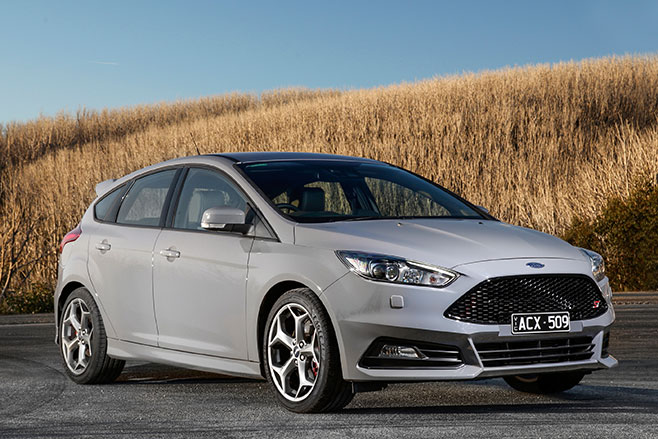
THE WHEELS VERDICT A worthwhile enhancement of the Focus ST formula, though Ford’s smaller Fiesta ST has sweeter balance and is a more cohesive package. That said, the great thing about the revamped Focus is that it’s not trying to be a Golf GTI. Instead, the hairy aggression of its chassis, its ability to oversteer, and the unbridled enthusiasm of its engine – tied solely to a manual transmission – says this is a good-time hot-hatch that doesn’t mind getting messy.
PLUS: Superb seating; outstanding engine flexibility; entertaining and adjustable handling; improved interior quality and functionality MINUS: All that grunt through the front end is a bit too much for wet surfaces or racetracks; body control below class best; huge turning circle
THE WHEELS REVIEW FORD must have felt quietly confident when its current-generation Focus launched in 2011, backed up by the lairy 184kW ST as an encore in 2012. Then Volkswagen’s Mk7 Golf photo-bombed its way onto centre stage and, well, the landscape changed.
There’s nothing like a smarter, slicker, better-dressed, more aspirational competitor to rain on your parade. But Ford has tried hard with this mid-life refresh to give the Focus a solid shot in the arm without simply copying what Vollswagen does. And nowhere is that more obvious than in the stove-hot ST.
Imperfect as it may be, it’s the Focus ST’s defiance to toe a mannered line that makes it genuinely appealing. From its more aggressive snout to its new Audi RS-inspired Stealth Grey hue to its super-huggy Recaro buckets and animalistic dynamics, this is a family-sized hot-hatch with attitude.
New front springs, stiffer lower front control-arm bushes and rear spring links, and firmer dampers all round result in a sharper, more sporting chassis that loves to hit the dance floor, regardless of how messy it gets. Retuned electric steering assistance delivers consistently solid weighting that combines with the ST’s rapid 1.8 turns lock-to-lock for truly incisive directional control (though its 12-metre turning circle is bloody ginormous). Still, at least the ST’s amusement at speed makes up for any frustration when parking.
While the ST’s steering doesn’t quite achieve the desired level of feel at straight ahead, it’s impressive once you start to add some lock. Combined with a super-keen chassis that truly carves, you find the ST corners tighter than you expect for the first few bends. Get your head around its terrific adjustability, however – via either throttle, brakes or steering inputs – and you can hurl a Focus ST down a windy road with absolute abandon.
Where it falls down a little is when the surface deteriorates. Some bumps expose a slight chink in the front-end’s body control, while a wet surface is a pertinent reminder that the ST doesn’t have a mechanical LSD. Its 184kW/360Nm 2.0-litre EcoBoost turbo four is so strong that there’s plenty of torque steer if you ask for too much, too early, with your right foot. Even on a dry, dead straight road, the ST’s superb engine still reminds you of its muscle through the steering wheel.
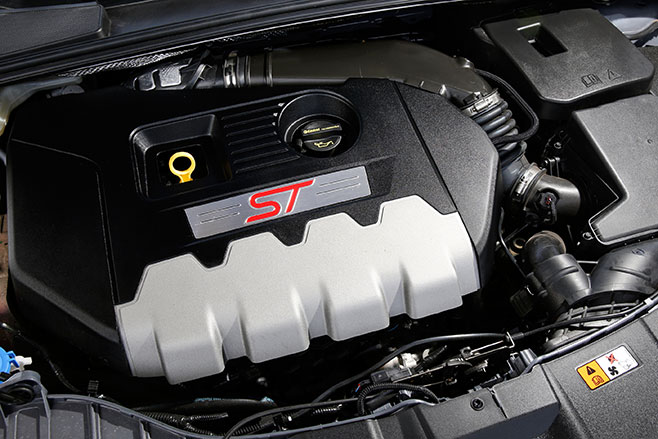
But this engine makes the car. Marvellously flexible, with an almost frictionless desire to rev, its usable power band spans 1400rpm to the 6800 cut-out, supported by a silky induction throatiness plumbed from the airbox to the firewall. While those in search of a two-pedal experience will be disappointed by the Focus ST’s manual-only status, the slick-shifting ’box is a fine companion to the Ford’s chuckable chassis and huggable engine.
Speaking of which, the ST’s Recaro front seats are extremely intimate – arguably too much so for anyone over 100kg – but their support is unquestioned, and the cross-hatched, mixed-material upholstery looks classy and feels expensive. The ST’s rear seat is similarly generous, though it’s the freshly reskinned dashboard that grabs attention. It’s much easier to use and less challenging to look at, and even though it’s still no Golf VII in terms of tactile luxury, the Focus no longer feels like it’s a generation behind.
Ford’s 8.0-inch colour touchscreen with SYNC2 connectivity is simple to use, with effective voice actuation, and besides $450 metallic paint, the ST has just one option – a $2000 Technology Pack that includes active city stop, blind-spot detection, rear cross-traffic alert, lane assist, lane departure warning, a driver impairment monitor, and auto high-beam for its adaptive bi-xenon headlamps.
Given its $38,990 ask, you get a lot of car in the Focus ST. Roomy enough to seat five, plus their luggage in its well-shaped boot, and economical enough to achieve a 7.3L/100km combined figure (in conjunction with a new idle-stop feature), the ST is the definition of a hot-hatch all-rounder.
While it lacks the overall slickness and breath of ability of, say, a Golf GTI Performance or a Renaultsport Megane 275 Trophy, the Focus ST has enough fire in its belly and animal in its personality to know what constitutes a good time.
SPECS Model: Ford Focus ST Engine: 1999cc 4cyl, dohc, 16v, turbo Max power: 184kW @ 5500rpm Max torque: 360Nm @ 2000-4500rpm Transmission: 6-speed manual Kerb weight: 1389kg 0-100km/h: 6.5sec (claimed) Economy: 7.3L/100km Price: $38,990 On sale: Now
WEC: Audi triumphs over Porsche in dramatic Spa
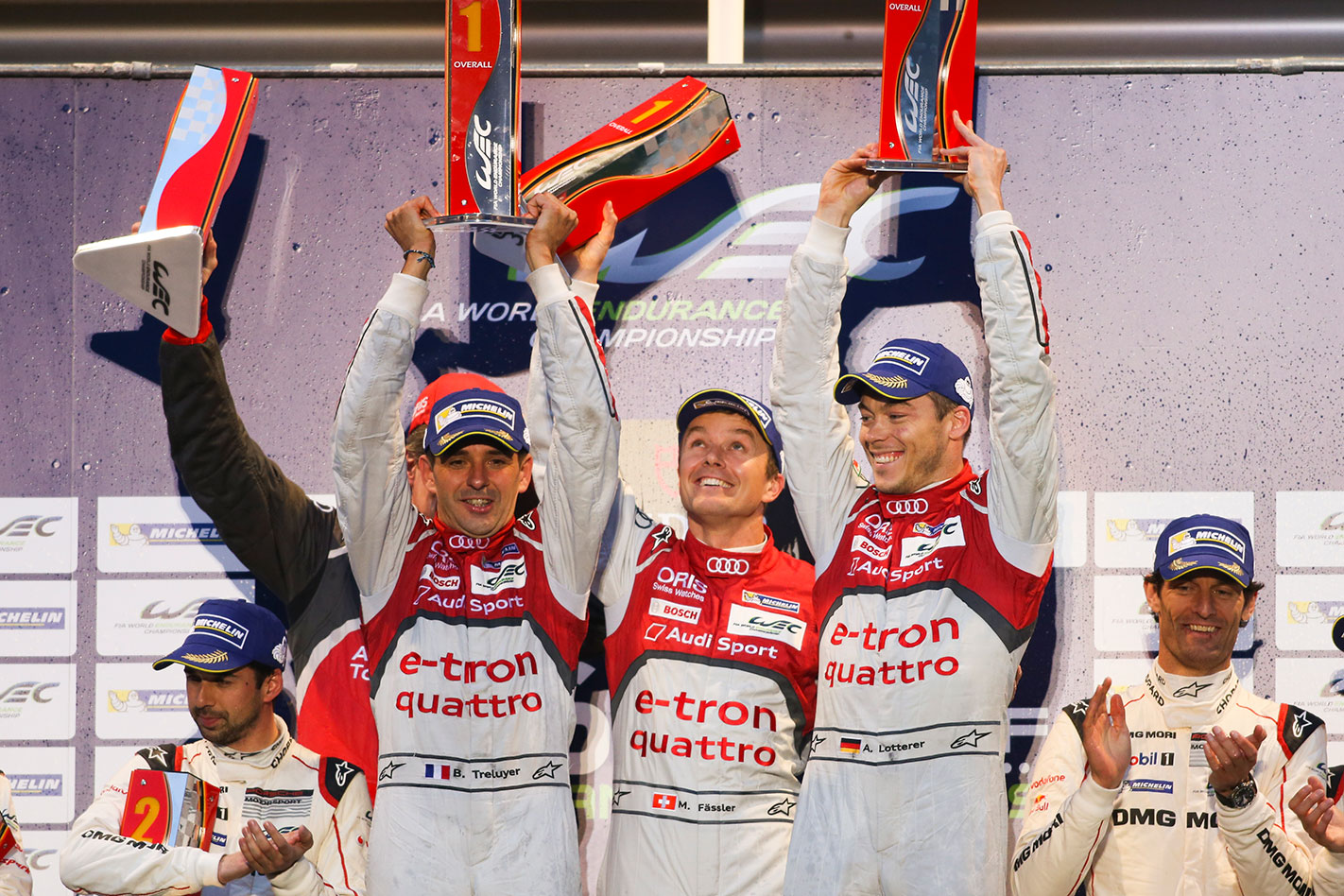
AFTER a tough see-sawing contest with Porsche for six tense hours, Audi drivers Andre Lotterer, Benoit Treluyer and Marcel Fassler had a winning gap of just 13 seconds in the World Endurance Championship at Spa-Franchorchamps in Belgium on Saturday.
In the best possible hit-out heading to Le Mans, the Audi R18 e-tron in low-downforce mode edged the Porsche 919 Hybrid shared by Marc Lieb, Romain Dumas and Neel Jani.
Watched by 54,000 fans, the victory in the Six Hours of Spa gave the Audi drivers two WEC round wins from two races.
The Mark Webber, Timo Bernhard and Brendon Hartley Porsche took third in a race that had its share of incidents as the ugly yet blindingly fast LMP1 prototypes slalomed their way past the slower GT cars.
Kiwi Hartley led early from pole but lost time with a drive-through penalty early after he overshot the Bus Stop chicane and bizarrely drove through a gap between barriers on the start/finish straight. The # 19 Porsche subsequently lost more time with a damper problem, finishing a lap down.
“Having a mechanical problem is never nice, and we lost a lot of time,” said Webber after the race. “In the first part of my double stint I didn’t quite find a good rhythm, but in the second half it was a bit better. The result is not what we were aiming for, but at least we were fighting strongly.”
The Porsche was the faster LMP1 car over a regulation stint around Spa, but the Audi was quicker when the team elected to double-stint its Michelin tyres. This was the difference between winning and losing.
The double-stinting strategy paid off in the fourth hour when Lotterer leapt ahead of the Porsche in the pits.
Porsche then tried the double-stinting ploy with Lieb, but the aggressive Treluyer regained the lead with a daring outside pass.
Jani regained the lead for Porsche in the fifth hour, but the double-stinting Audi jumped back to the front at the next round of stops.
Finally, Treluyer adventurously stayed on old tyres for the brief burst to the finish. “When they told me that I was going to keep the tyres for a third stint, I thought… oh!” said Treluyer. “But that was our chance to win and I was still able to take risks in traffic and push like hell.”
The third factory Porsche shared by F1 regular Nico Hulkenberg, Nick Tandy and Earl Bamber finished three laps down in sixth after losing time for body repairs after Tandy was elbowed off into a barrier by a Porsche 911 RSR driven by Kevin Estre.
Toyota endured a weekend to forget, starting Thursday when Kazuki Nakajima suffered a fractured vertebra in a heavy practice shunt in the wet, and a difficult race day did little to improve the team’s mood.
With a larger-than-expected gap to Audi and Porsche at Spa, Toyota’s race was an exercise in damage limitation with the championship fight in mind.
Alex Wurz, Stephane Sarrazin and Mike Conway were the leading TS040 Hybrid crew in fifth. World champions Anthony Davidson and Sebastien Buemi suffered technical problems and finished eighth.
All teams are now focussed on the next race, the Le Mans 24 Hours classic on June 13-14.
V8 SUPERCARS: Davo’s day of karma
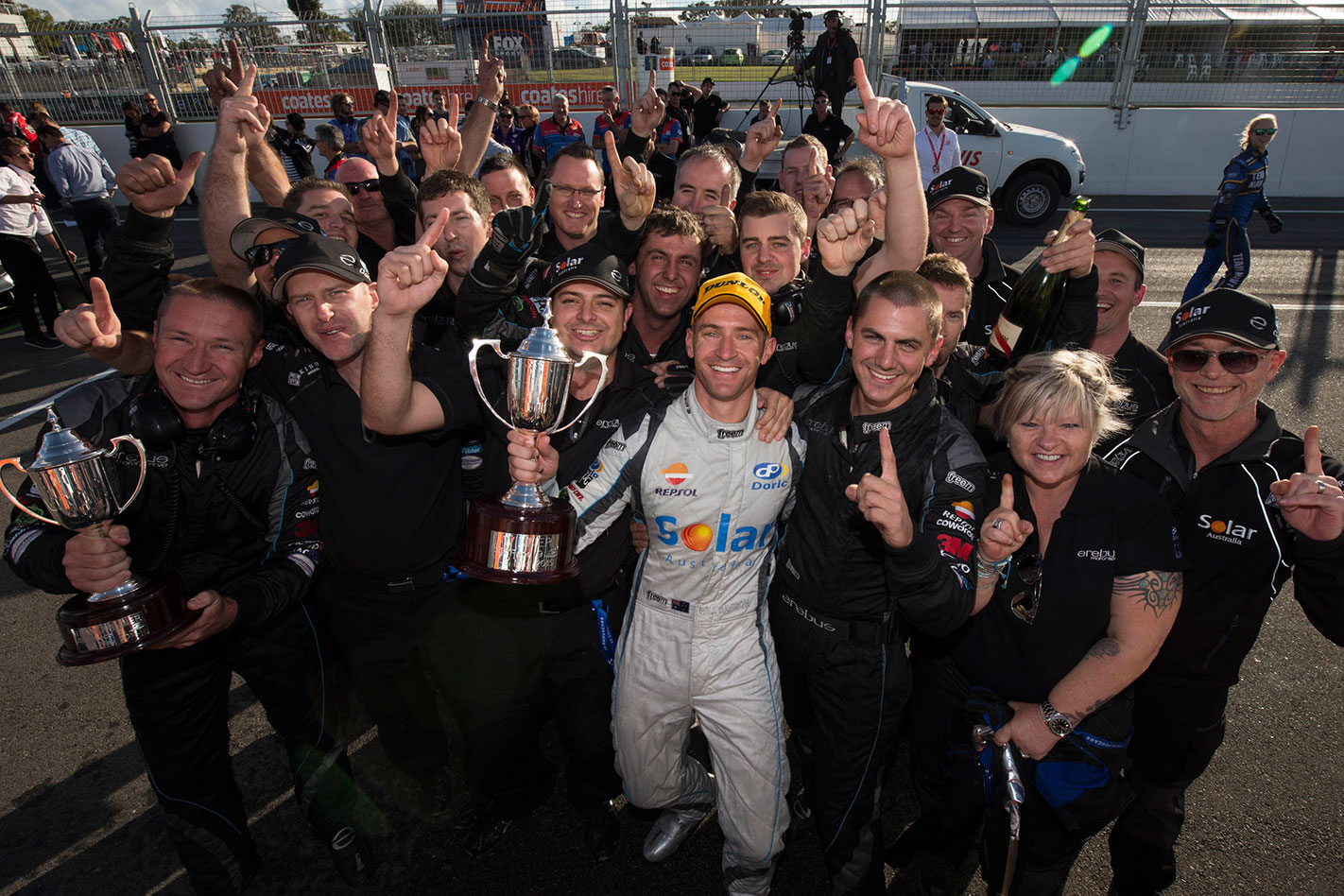
WILL Davison finally scored his first win for Erebus Mercedes AMG, catching and passing Craig Lowndes in the closing laps of yesterday’s 200km race at Barbagallo Raceway, near Perth.
Fan fave Lowndes looked set to notch his long-awaited 100th V8 Supercar win but fell foul of a degrading set of tyres and a determined Davison.
Davison and Lowndes started seventh and eighth on the grid and, after passing Saturday’s dominant Pepsi Max Fords, drove away from the field.
As usual, the racing in the west was all about tyre management – the circuit is savage on all compounds of tyres, particularly the softs.
Davison’s win follows being targeted by the tabloids and V8 Supercar followers for the temerity of taking exception to being turned around by James Courtney at the previous round in Tasmania.
Rather than fire back at the trolls, Davison let his driving do the talking in Perth, nursing his tyres admirably as he coolly chased down Lowndes, who clung on for second.
The clearly emotional Davison wasn’t too torn about raining on Lowndes’ parade: “I’m one of CL’s [Craig Lowndes] biggest fans and I’ve got a lot of respect for him sitting on 99 there,” Davison said. “But as much as that would have been a great headline, you don’t feel sorry for someone on 99 race wins.
“We’ve been working pretty hard for this. We wanted to do it clean. It’s very, very special for the team.”
Davison said he had been prepared to settle for second when he noticed the Red Bull Commodore struggling up front.
“I couldn’t believe when I started seeing CL have some big slides with about five or six laps to go. That actually drew me to go even smoother, just to really give us that tyre [life]. I just drove real smooth. They’re the races you dream of.”
Lowndes wasn’t too displeased with second and takes a 52-point championship lead to the next race at Winton.
“It’s been a good day,” the veteran said. “Having a podium finish was obviously fantastic given where we started in sixth, so for us it was a good end to the weekend. With five laps to go I lost the rear tyres completely and just had nothing to fight with.”
Fabian Coulthard put in an outstanding drive, coming from the back to the podium after a rear-of-grid penalty went his way for a qualifying indiscretion.
Pole man Chaz Mostert was the first Ford home in fourth, with HRT pair James Courtney and Garth Tander fifth and sixth, Nissan’s James Moffat seventh, Nick Percat eighth, David Reynolds ninth and Michael Caruso rounding out the top 10.
Until an inopportune safety car intervention destroyed a number of carefully laid strategies in the last half of the race, Prodrive Ford’s Mark Winterbottom looked on track to notch his third win of the weekend, but on shagged tyres faded to 15th.
It was a forgettable day for defending champ Jamie Whincup, who was 19th after spearing off track early.
MOTO GP: Masterful Lorenzo dominates Jerez
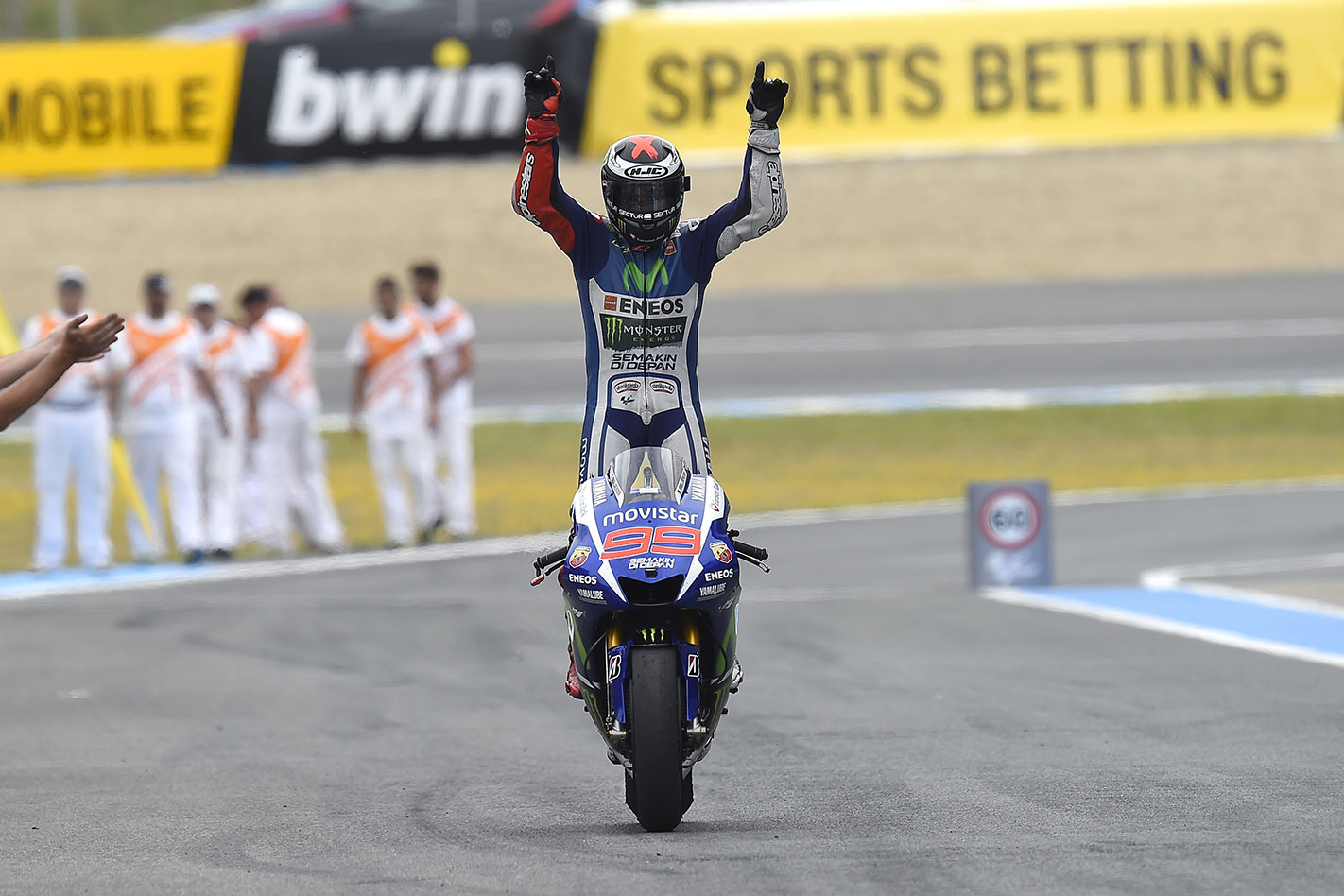
MISSING in action for the start of this season, Yamaha’s Jorge Lorenzo got his act (and his head) together in Jerez on Sunday, delivering a faultless start-to-finish win – the 55th of his career – to show that he is back as a title force in 2015.
Honda’s Marc Marquez overcame a broken finger from a training crash to land a well-earned second place at the Gran Premio de España in front of 122,000 spectators, while Lorenzo’s team-mate Valentino Rossi sealed his 200th career podium with third place.
Lorenzo finished with a 5.5-second winning margin and a new lap record.
Rossi, twice a winner this year, now leads the championship by 15 points ahead of Ducati’s Andrea Dovizioso in second and Lorenzo.
Australian Jack Miller couldn’t reproduce the last-start form which brought him a win for Honda in the Open bike category, finishing a lonely 20th.
Moto2 was won by German Jonas Folger, while the other podium places were decided in an almost regulation Jerez last-turn contretemps. Queenslander Ant West finished 15th.
Aussie youngster Remy Gardner could do no better than 25th in another action-packed Moto3 race, won by Danny Kent in the final corner. It was Kent’s third consecutive Grand Prix win, and the first time a Brit has done the deed since Barry Sheene managed it in 500cc racing in 1977.
TARGA TASMANIA: Number five for White
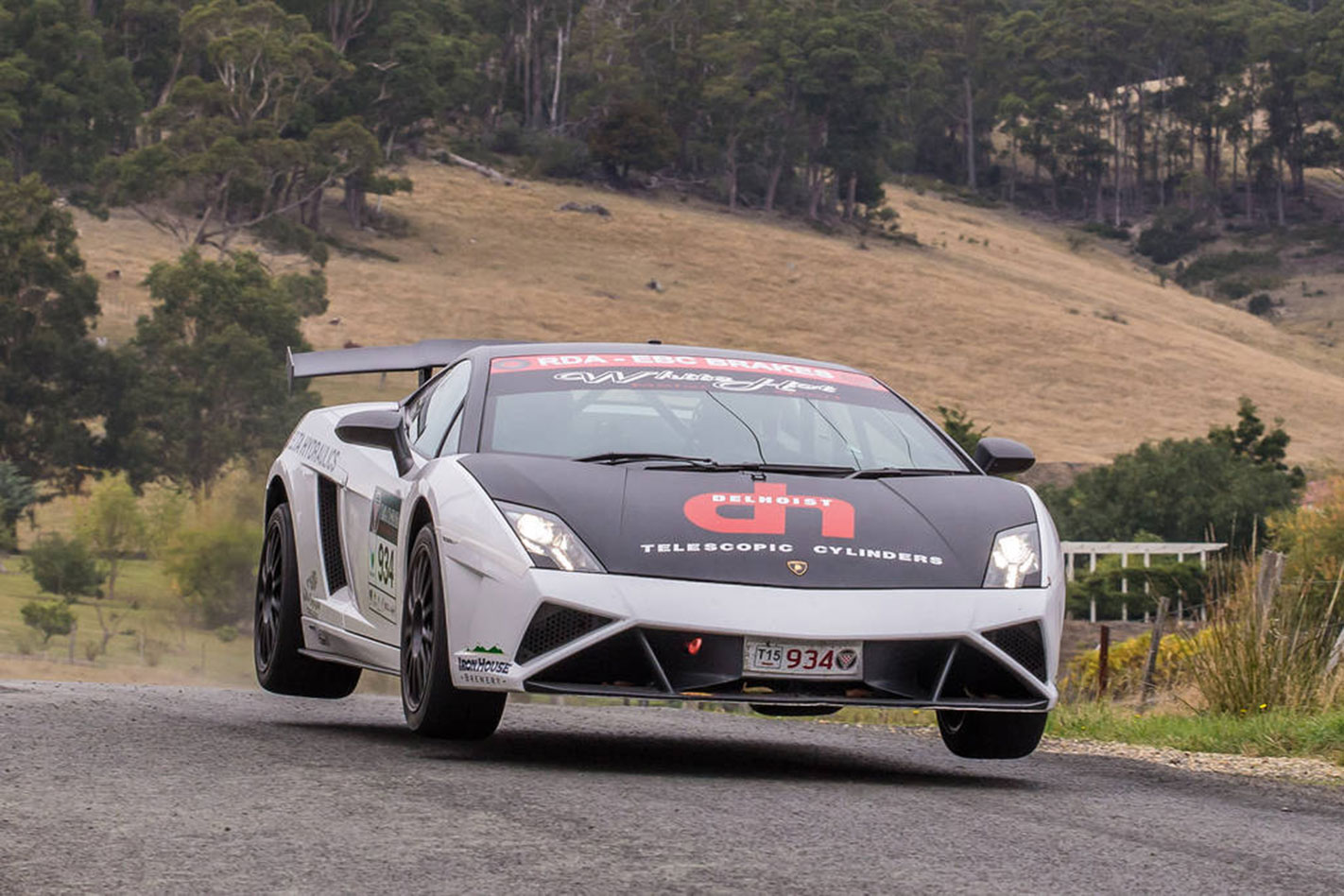
LOCAL Lamborghini driver Jason White secured his fifth Targa Tasmania title in the Modern competition after a tense last-day duel south of Hobart with arch-rival, versatile rally charger Steve Glenney.
After almost 500 competitive kilometres, White went into the sixth and final day with a 74-second lead, but the flying Glenney set about reducing the gap, uncorking blistering pace in his Nissan GT-R.
After two stages he had cut the gap to 42 seconds and was closing on an improbable victory.
Struggling with mechanical issues, White managed to hold on, crossing the finish line 26 seconds clear to claim a popular win.
“We had a slipping clutch this morning, so I just had to back off a bit and manage it,” White said. “It was fairly bad and we almost thought that was the end of our 2015 targa. We were pretty sure we weren’t going to make it.
“We managed to bleed off a bit of time on each stage, but that wasn’t the plan for the final day. It was a massive relief to get to the finish – I’ve never come so close to thinking it was all over.”
White and co-driver John White also won in 2005, 2010, 2012 and 2013.
Having dropped 84 seconds with mechanical problems on day one, Glenney’s comeback was remarkable, and he finished well clear of last year’s winner, Burnie driver Jamie Vandenberg in another Nissan GT-R.
In the Showroom category for production cars, Tony Quinn led from start to finish in his McLaren 650S, ahead of the 2012 Renault Megane of Grant Denyer.
Some were surprised by TV personality Denyer’s performance, although he has a long motor sport history, including contesting the Bathurst 1000. He won several stages, and finished 38 seconds ahead of the Ford Mustang of Victorian Craig Dean.
WRC: Rally Oz adds night stage
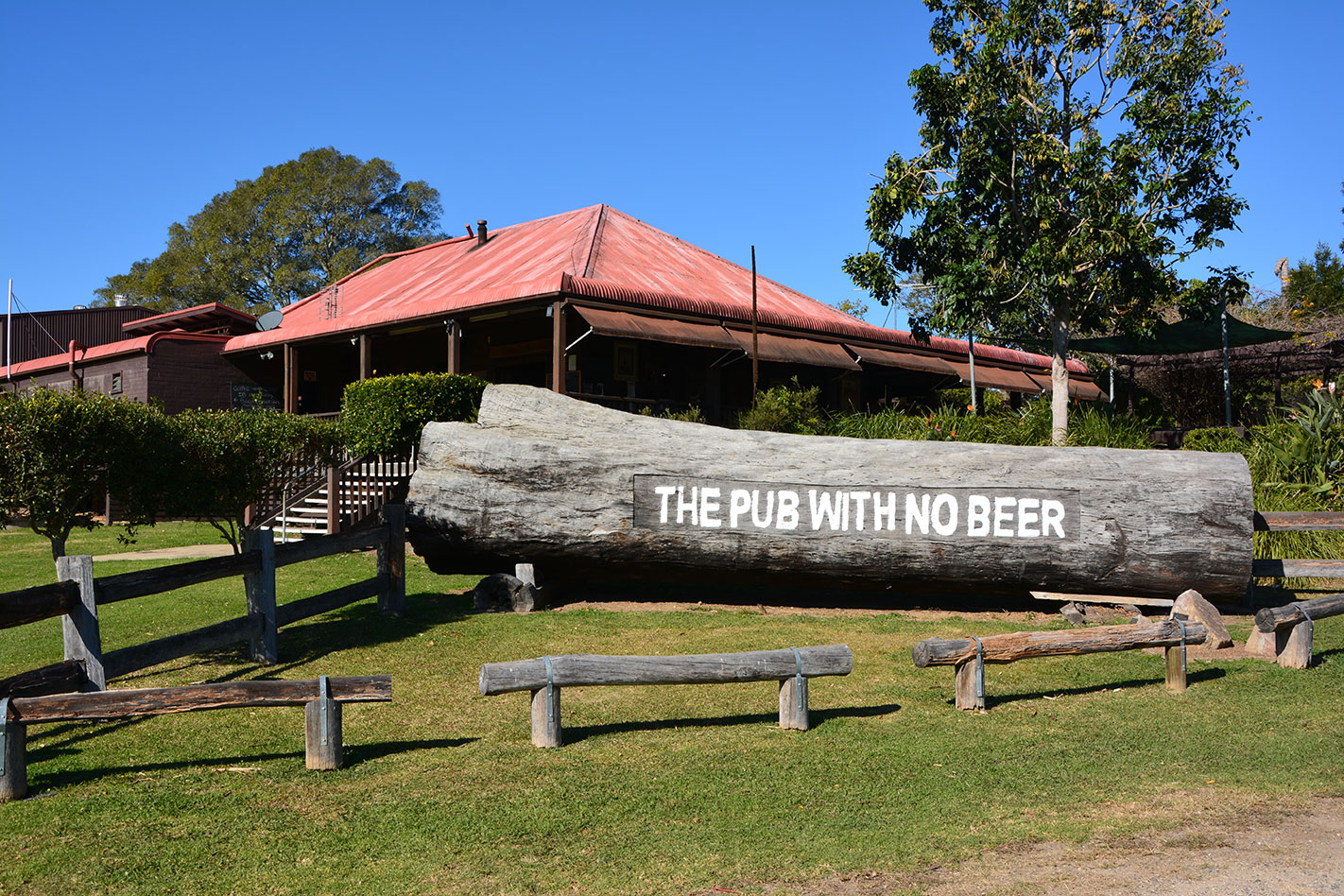
With Rally Australia just over four months away, organisers have announced a night stage and three new stages – plus a visit to the famous Pub With No Beer –promising to add more spice to the World Rally Championship round.
The proposed route changes for the Coffs Harbour-based 10th round of the FIA WRC at from September 10-13 are intended to provide a tougher challenge for the world’s fastest rally drivers and more for spectators to look at.
The rally route for the 24th Rally Australia, subject to official approval, will offer similar overall competitive and liaison distances totalling 922 kilometres, but with a longer day on Saturday and a shorter one on Sunday to allow a noon start for the rally-ending, globally-televised Wedding Bells stage.
Located around 80km south of rally headquarters at Coffs Harbour’s Opal Cove Resort, the stages are in the same region as last year’s 49km Nambucca test, voted by drivers as one of the WRC’s best.
“Nambucca remains in the itinerary on Saturday, but the new stages of Utungun, Bakers Creek and Northbank although shorter will be an even bigger test for drivers… They are fast, technical, set in magnificent countryside and truly some of the best roads in the rally world,” the event’s sporting director, Adrian Stafford, said.
A bonus for Friday spectators will be two regroups (stopovers) by competitors in Taylors Arm, a little-known hamlet who’s pub was immortalised in a popular folk ballad by the late country singing legend Slim Dusty.
Saturday’s five stages conclude with a night run through the 7.94 km Valla, giving spectators a chance to experience one of the most traditional, but now rare, elements of rallying.
Sunday’s itinerary includes another new stage, Settles Road. The 6.1km sprint replaces the 30km Shipmans, which was deleted after feedback from competitors in 2014.
Wedding Bells will retain its popular Rally Village, water splash and jump.
Packing enough prestige to pale a supercar rental company’s fleet, Floyd Mayweather Jr’s personal supercar collection reveals how the filthy-rich sometime satisfy their ludicrous spending habits.
While conjecture surrounds the exact worth and size of his garage – Mayweather’s personal driver says it’s US$9 million while ESPN revealed it stands closer to US$15 million – one thing is for certain: Mayweather likes showing off.
Three Bugatti Veyrons, three Rolls Royce phantoms and a Ferrari Enzo are only a handful of cars he owns, and are joined by the likes of McLaren’s 650S, a Ferrari 458 and Mercedes-Benz SLS AMG, usually optioned in a white hue.
His ostentatious tastes are little surprise, the five-division world champion was 2014’s highest paid athlete according to Forbes, earning more the US$100 million in that year alone.
With this Sunday’s much publicised bout with Philippine boxer Manny Pacquiao predicted to smash records for financial earnings from a fight, we’ve pilfered his Instagram account to bring you nine glimpses of Mayweather’s auto collection that may be about to get even bigger…
#1 Not one to be known for humility, Mayweather’s instagram has a picture of not one, but of the three 400km/h-plus Bugattis he owns, along with some other exotic chariots of his.
https://instagram.com/p/xeEV6pR3VT/
#2 The Mercedes-Benz SLS AMG’s gullwing doors along with the scissor items on the Mercedes-McLaren SLR and Lamborghini Aventador are typical of Mayweather’s taste.
https://instagram.com/p/VH91Gcx3Uy/
#3 There’s little to criticise about his choice for Ferrari’s Enzo, though, the V12-powered tribute to the company’s founder untouched and left in its red hue.
https://instagram.com/p/yKsxwOR3Zj/
#4 Expanding his ownership of Ferraris are a 458 Spider and 599 GTB Fiorano…
https://instagram.com/p/YDbDcjx3Vy/
#5 …and his spouse’s silver 458. Whom he also gifted a silver Bentley Flying Spur…
https://instagram.com/p/mjuQElx3Vl/
#6 …to match his white and black Mulsannes.
https://instagram.com/p/VNVsD1x3dO/
#7 Joining his three Rolls Royce Phantoms from Manchester is a 2014 Wraith coupe.
https://instagram.com/p/gM0UvRx3SG/
#8 Again for his partner, a red Ferrari 458 Spider to match his own in white.
https://instagram.com/p/iIuNN5x3Xs/
#9 In a change of colours, but not style, is a black Rolls Royce Ghost.
https://instagram.com/p/gkp7w1x3dK/
Get your free weekly report from the world of fast cars – subscribe to the MOTOR newsletter!
