
BOB Graziano will retire as head of Ford Australia and New Zealand on April 1.
The US-born managing director has been head of the company since November 2010 and will be replaced by Graeme Whickman, who will be the company’s fifth head in a decade.
Graziano joined Ford Australia from the company’s China division, where he was CEO and chairman, and was tasked with the unenviable job of announcing the closure of Ford’s Australian manufacturing facilities.
“Leading the team in Australia through such an important and difficult time has been an honour,” Graziano said today.
Graziano also presided over the decision for Ford to exit the V8 Supercars racing category, and pushed what he calls the “transition” from being a manufacturer to a marketing and sales company.
Three months ago, he told Wheels: “We have to take decisions based on where we’re going for the long term, and ensure that we’re investing in those areas of our business that we think customers are looking for us to have. We’ve laid that strategy out not only for you, but also for the Australian public, and we’re going to continue to work that plan.”
The choice of Graeme Whickman, currently Ford Australia’s vice-president of marketing, sales and service, follows the publicised strategy of focusing on customer service and experience as Ford aims to be “the most respected” car company in Australia.
Whickman has been with Ford for 18 years. Born in England and raised in New Zealand, he has served the company in Canada, Europe and Asia-Pacific.
Ford has suffered a decade of market decline and last year sold only 79,000 vehicles to be the nation’s fifth-best seller; its market share last year was 7.2 percent, sales having fallen 8.6 percent over the previous year.
The company’s shining light is the hot-selling Ford Ranger ute; its best performing passenger car is the Focus, which sold just 15,116 last year compared with 43,735 for the top-selling Corolla.
The news comes only weeks after Holden announced Australian expat Mark Bernhard as its third chairman and managing director in 13 months, and the sixth in seven years.
Whickman will work out of the company’s new head office when it relocates to Richmond in inner Melbourne later this year.
Ford Australia’s revolving door
- Geoff Polites (1999-2004)
- Tom Gorman (2004-08)
- Bill Osborne (only seven months in the chair)
- Marin Burela (2008-10)
- Bob Graziano (2010-15)
- Graeme Whickman (from 1 April)
Packing more than 500kW, we drive the ultimate XR8.
What is it?
It’s long-time Ford tuner Herrod Motorsport’s take on the new FG X Falcon XR8.
What’s been done to it?
Despite the short time frame between them receiving the car and us driving it, Robbie Herrod and his band of merry men managed a complete overhaul.
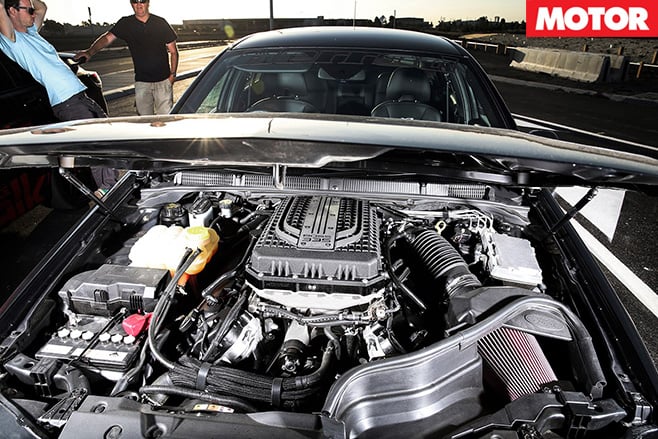
The 5.0-litre supercharged Miami V8 benefits from Herrod’s Stage 3 Power Pack, which consists of a pulley upgrade to increase boost to 11.5psi, a modified fuel pump, competition fuel regulator, 1000cc injectors, intercooler, modified oil breather, spark-booster kit, cat-back exhaust and ECU tune. The net result: 510kW at 5800rpm and 760Nm at 4800rpm.
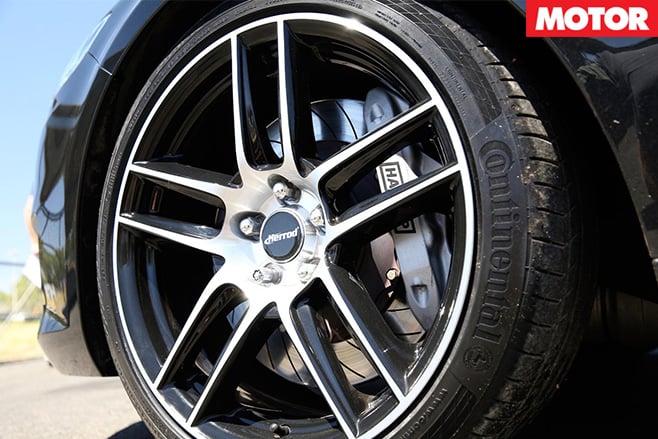
Allowing such wide rear rubber is a set of Herrod-modified rear suspension blades, while the stock springs and dampers are replaced by a custom Koni setup. Brakes are by Harrop, with mammoth 381mm rotors up front clamped by six-piston calipers matched to 356mm rear rotors and four-piston calipers.
Is it fast?
Absolutely. Looking at the numbers, you mightn’t think so, as 0-100km/h in 5.08sec and a 13.12sec quarter-mile isn’t significantly faster than the stocker. The clue lies in the trap speed, 185.17km/h being a good 10km/h faster than the regular XR8.
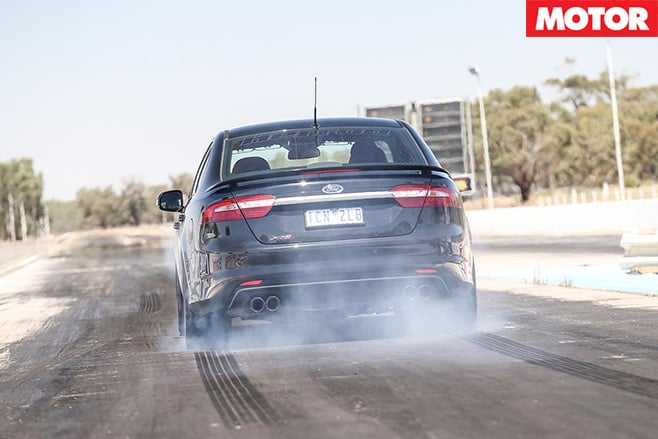
On the right surface, there’s no reason why an auto-equipped Herrod XR8 wouldn’t go the good part of a second faster. Put it this way, in a 60km/h roll-on drag with the Walkinshaw WP507, the two cars were absolutely neck and neck to beyond 200km/h.
How’s it drive?
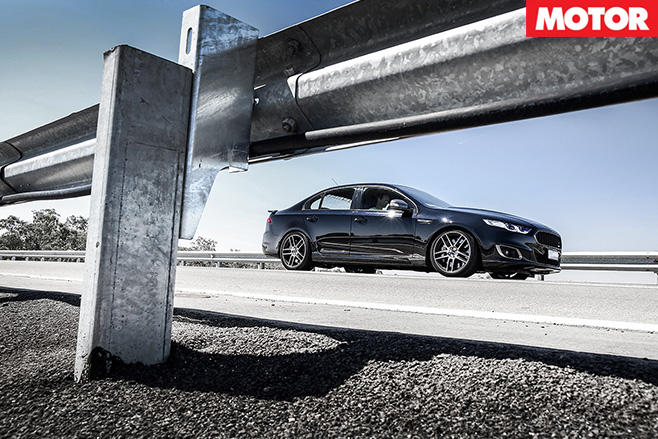
Extremely well. Herrod has managed the rare trick of not just making the base vehicle faster, but improving it as an overall package. The suspension setup is softer than standard, making the Herrod car a much more comfortable cruiser without unduly hurting the XR8’s cornering ability.
Of course, given you more or less have to drive Falcons with ESP off due to there being no intermediate setting, it makes for quite a wild ride. Herrod’s XR8 must be treated with the utmost respect simply because there’s so much power on tap.

Faults? Despite the impressive hardware the brakes feel quite soft, which isn’t very reassuring when you’re approaching corners at Mach 2. There’s also still work to do on the tune, as when coming to a halt after hard acceleration the car would sometimes stall. The latter is purely down to Herrod not having sufficient dyno time with the car before we had to drive it, so no doubt it will be sorted by the time you read this.
How much?
With the engine tweaks totalling $10,630 and the brakes, suspension and rolling stock adding another $16,630, the Herrod modifications add $27,260 on top of the $52,490 Ford ask for an XR8. Not cheap, but then you’ve got a dead-set weapon of a Falcon for around $80K.
Four stars
Keep an eye out for MOTOR’s April issue, on sale now, where the Herrod XR8 bumps gloves with Walkinshaw’s W507 GTS in a 1000kW-plus showdown.
Specs Engine: 4951cc V8, DOHC, 32v, supercharger Power: 510kW @ 5800rpm Torque: 760Nm @ 4800rpm Gearbox: 6-speed manual or automatic 0-100km/h: 5.08sec (tested) 0-400m: 13.12sec @ 185.17km/h (tested) Price: $79,750 (based on manual XR8)
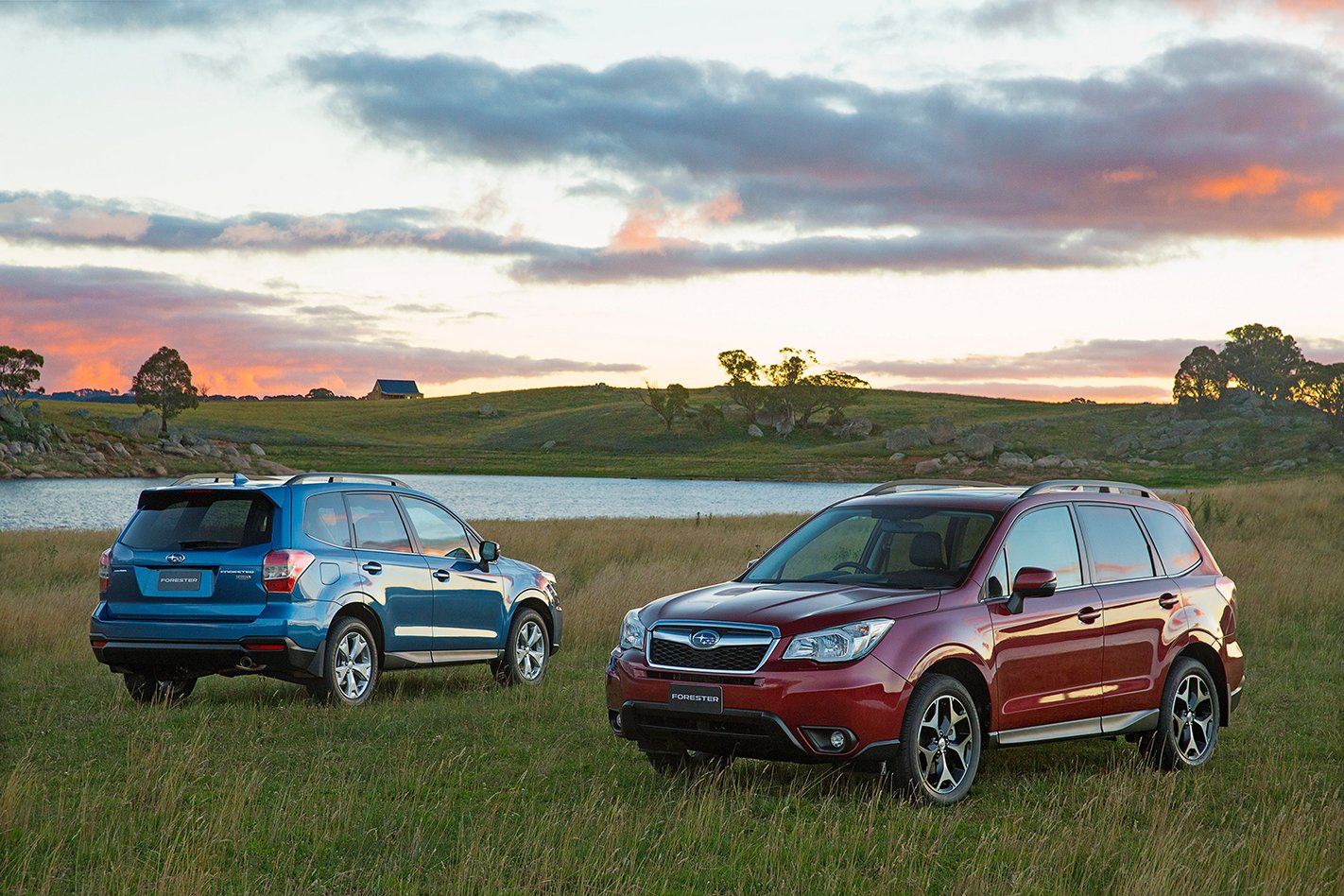
Subaru finally plugs a glaring gap in its successful medium SUV range with an automatic version of the Forester 2.0D turbo-diesel. It broadens the MY15 Series II line-up that now also includes better trim, updated multimedia and sharper pricing.
WHAT IS IT? With the vast majority of medium SUV diesel buyers preferring autos, Subaru’s hitherto manual-only 2.0D offering has lacked the transmission required to take on the high-flying Mazda CX-5 SkyActiv-D and the like. That’s all changed with the Series II gaining a CVT and more value to boot.
WHY WE’RE TESTING IT Petrol prices may be low, but medium SUV diesel sales continue to bound along. So it’s surprising to learn that one of the booming segment’s most respected combatants – the Subaru Forester – has long lacked an auto diesel offering. Now it does, and with the new CVT comes a host of range-wide upgrades well worth considering.
MAIN RIVALS Toyota RAV4, Ford Kuga, Mazda CX-5, Nissan X-Trail, Kia Sportage, Hyundai ix35, Honda CR-V, Volkswagen Tiguan, Skoda Yeti, Mitsubishi Outlander
THE WHEELS VERDICT It might not be the prettiest SUV on the market, but repeated exposure to the current Forester underlines its fiercely competitive packaging, driveability, efficiency and value. The Series II makeover improves on all that with a smooth and refined diesel auto of sufficient (rather than sparkling) performance capabilities, backed up by more compelling value. Try before you buy any rival medium crossover.
PLUS: Refinement; dynamic; packaging; vision; value; quality; efficiency MINUS: Needs more low-rev torque; gawky styling; no rear vents; no EyeSight or idle-stop tech on diesel
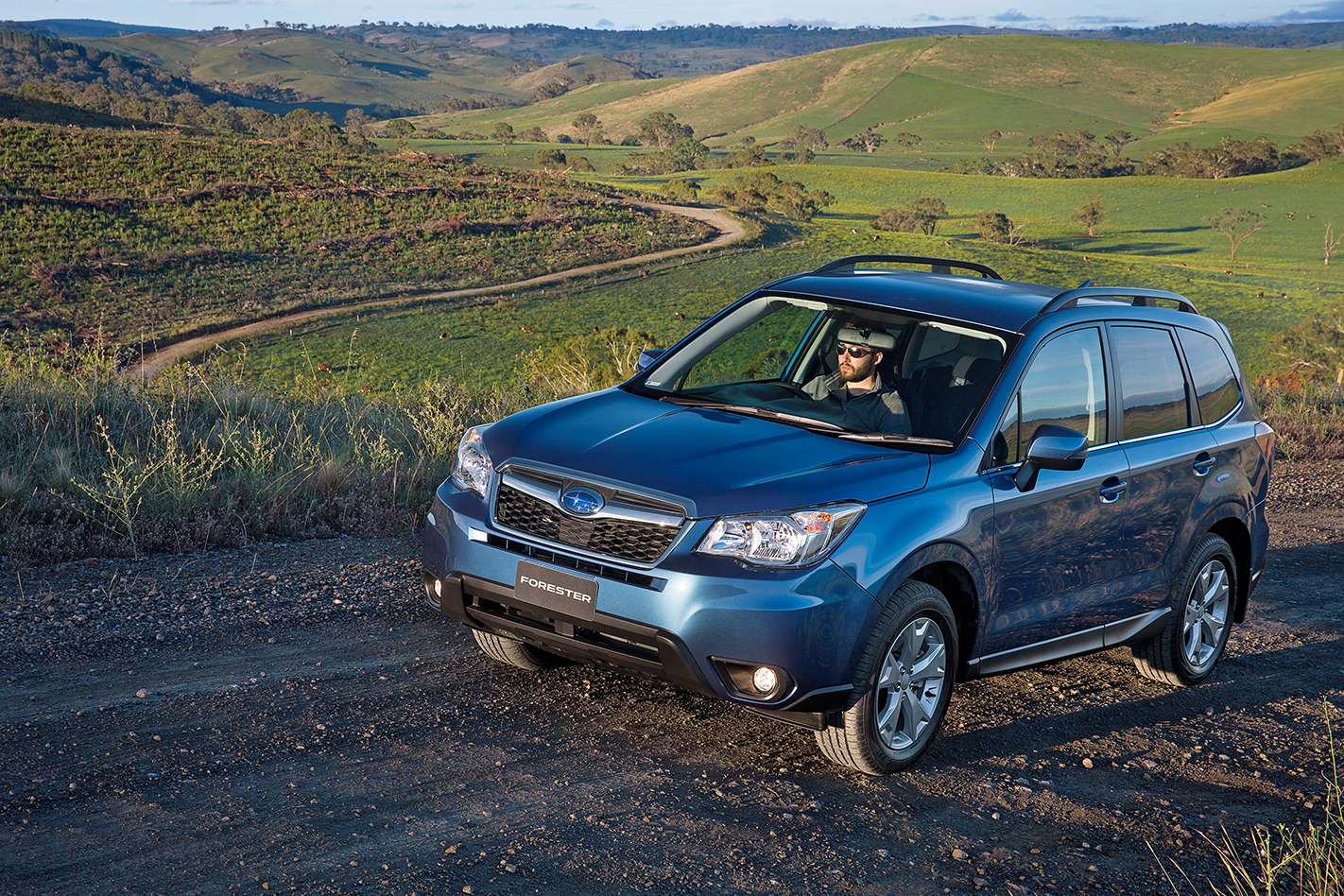
THE WHEELS REVIEW IS THERE a more beautiful SUV… said nobody ever? If that cheap jibe is the only major missive aimed at the long-overdue automatic version of the Subaru Forester diesel, then the latest addition in a subtly revised range might get ugly indeed for rivals.
The $35,490 2.0D-L Lineartronic CVT and the more salubriously specified 2.0D-S for $7K extra broaden the already popular Japanese medium SUV’s appeal. And it shouldn’t surprise that its allure is in the way the newcomer looks and feels from behind the wheel.
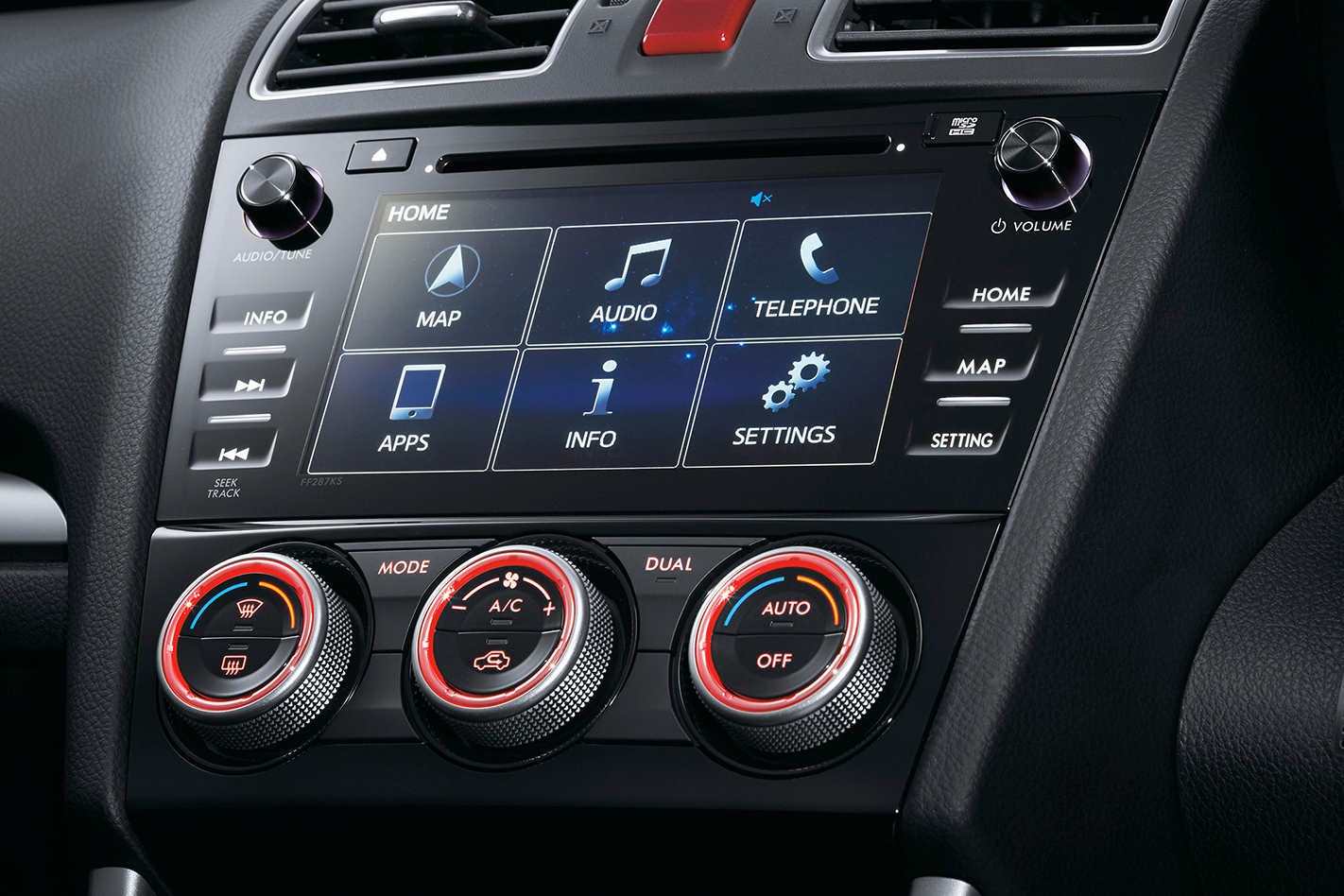
As with all MY15 models, the Forester’s cabin has been deftly enhanced with less cheapo plastics, more brightwork, a big new touchscreen, voice-recognition tech, improved multimedia, and digital graphics that no longer look pilfered from a Laserdisc player.
All build on a continuing mix of adult-friendly comfort and space, confidence-boosting deep glasshouse, and family-aiding practicality, though the lack of driver’s lumbar support and rear-seat vents, and an oddly high cargo floor (containing a full-size alloy spare) still need correcting. And the clever EyeSight preventative safety tech remains the provenance of Subaru’s petrol-powered models.
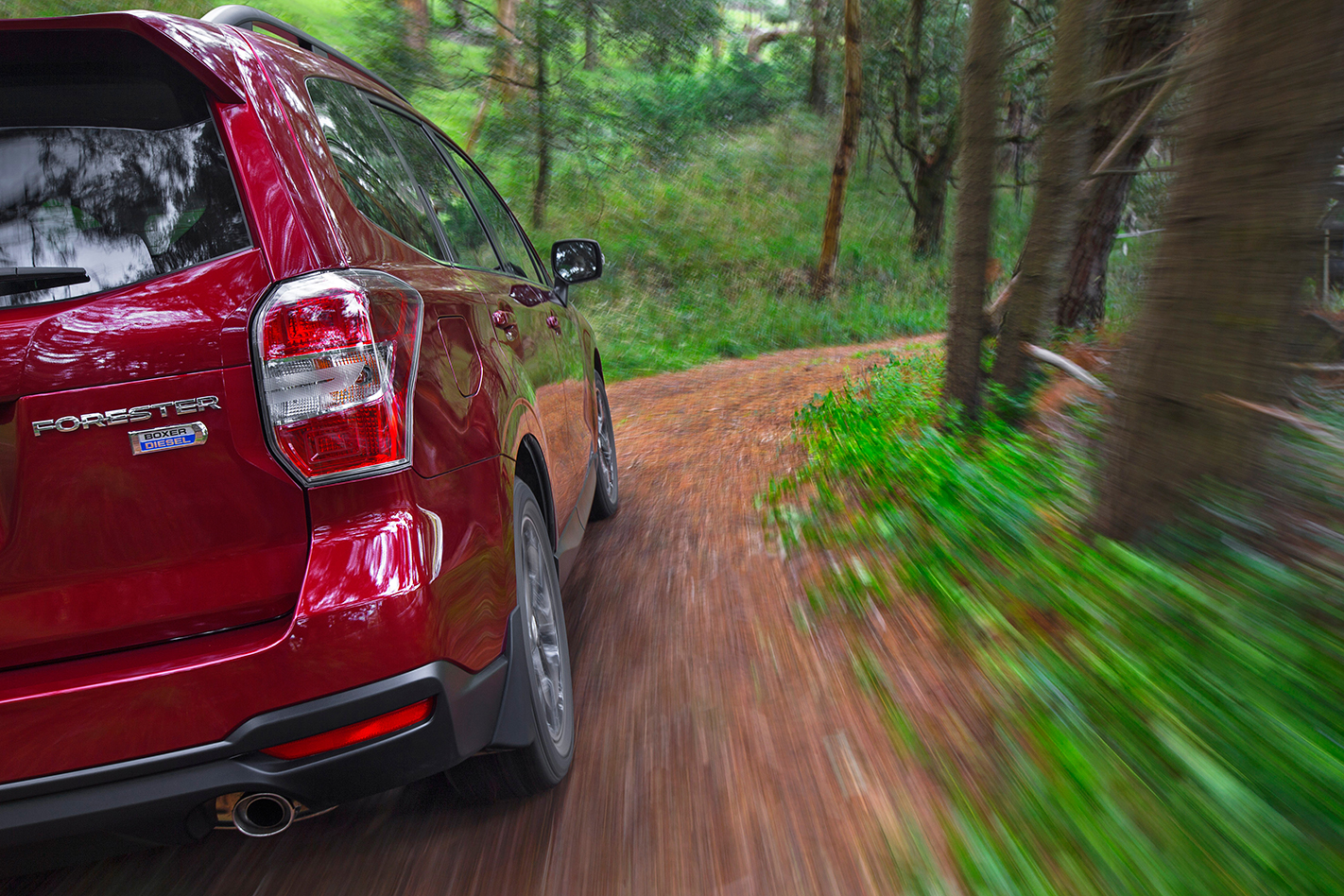
Meanwhile, the world’s sole horizontally opposed diesel steps up to Euro 6 emissions compliance thanks to a thorough makeover, scoring a multitude of efficiency and NVH-mitigating measures to create an uncannily quiet operator.
Weighing up to 1667kg, the diesel auto is no waif, and with identical 108kW/350Nm outputs as the continuing (bar the previous ‘2.0D’ base) six-speed manual, off-the-line performance isn’t blistering. However, speed builds strongly with revs, enhanced by the satiny smoothness of the intuitively responsive CVT, so it’s capable of rapid progress. Largely normal in behaviour, there’s virtually no lag or slippage detectable in this lively drivetrain combo.
Throw in balanced (if overly light) steering, measured handling and always-dependable roadholding from the beautifully planted permanent all-wheel-drive chassis (particularly on gravel, where the stability control intervention is nicely calibrated) and the diesel delivers the same dynamic prowess as its impressive petrol-powered sibling, even if the 2.0D-L is saddled with unrefined Yokohama Geolander tyres. Despite riding on inch-bigger Bridgestone 225/55R18s, the 2.0D-S maintains the Forester’s supple suspension quality.
There’s a compelling new value story, with range-wide price cuts of between $1500 and $3500. The base 110kW/198Nm 2.0i-L manual petrol is now $29,990, while the volume-selling 126kW/235Nm 2.5i-L CVT petrol is $2K cheaper at $32,990.
Last year, the latter won our rigorous medium SUV Megatest on the strength of solid consistency. The 2.0D CVT only builds on that. So never mind the face, the Forester is like Miss World winning on personality and brainpower.
SPECS Model: Subaru Forester 2.0D-L Lineartronic Engine: 1998cc 4cyl, dohc, 16v, TD Max power: 108kW @ 3600rpm Max torque: 350Nm @ 1600-2400rpm Transmission: CVT Weight: 1578kg 0-100km/h: 9.9sec (claimed) Economy: 6.3L/100km Price: $35,490 On sale: NowClick here to read the full range review of the Subaru Forester
We rip, tear and snort the new Mercedes-AMG C63 S with its stonking 375kW twin-turbo V8 that rockets to the top of our wish list.
Or is it the lighter, faster and now V10-only Audi R8 supercar that tops our wish list? Its 3.2sec 0-100km/h time makes it as devasting as its evolutionary styling is handsome. Has Audi done enough?
We drive the R8’s little brother, the Audi TT, for the first time on Aussie soil, but we also turn rather posh with the new Volvo XC90 – the most anticapted car from the Swedish maker under its new ownership.
It’s not all new: our Bucket List takes dreams and makes then happen: A Ferrari, a Model T Ford and Holden Torana SS A9X all make giggling children our of grown men.
Join us for the ride in this April 2015 edition of Wheels in print or iPad: on sale now.
TOYOTA workers have locked in the final wages and conditions that will carry them through until the end of local manufacturing in 2017.
The Australian Manufacturing Workers Union, which announced the landmark enterprise bargaining agreement between the Altona production line and engine casting plant’s 2000 employees, said nine out of 10 had voted in favour of the last-ever agreement.
Importantly, it also guarantees them work until the factories close.
Toyota Australia spokeswoman Beck Angel confirmed the award locked in last week would be the final one for Toyota’s manufacturing workers.
“We’re very pleased that we were able to reach a positive outcome for those employees,” she said. She said the EBA did not need to include any special provisions for the late 2017 shift from a manufacturer to a full sales and marketing company.
“We organised all the packages after we made the announcement [to quit manufacturing] in February, and in the next 10 weeks we confirmed the severance package and everything, which we worked very heavily with the union,” she said.
“Now that the union has secured certainty over the closure arrangements, we will be putting all our efforts into working with governments and industry to create alternative jobs,” AMWU national vehicles secretary Dave Smith said while announcing the deal.
Toyota is yet to set a final production date for its Australian manufacturing operations, which is still only vaguely slated for closure in “late 2017”. The company is also yet to announce which of Toyota’s other factories will pick up Australia’s annual production capacity, currently sitting at around 110,000 units a year – with seven out of every 10 cars made here slated for export markets.
A heavily facelifted “Big Little Change” Camry and Camry Hybrid mid-sizer, and mildly updated Aurion V6 that will carry both vehicles to the end of Australian manufacturing are expected to launch in the next couple of months.
In addition to the Toyota deal, Holden workers locked in their fait accompli in November last year, securing a package that equated to four week’s pay for each year of service, as well as four weeks’ severance pay. The package agreed to by Holden workers equated to four weeks’ pay for every year of service, plus four weeks’ severance pay.
A number of Ford workers, who will see the its manufacturing close in 2016 with the local head office relocated from Broadmeadows to Richmond, Victoria, have been offered redundancies in what it calls its ‘transition’ from manufacturing to a full-line importer. Its workers still live under a cloud of uncertainty with its manufacturing set to close in 2016.
Smith also says that Canberra’s recent announcement to offer $500 million in industry support – part of a $900 million total package promised under the Australian Transformation Scheme – is too little, too late. “If the government had chosen to support the industry and its 50,000 workers 18 months ago, the falling dollar would have resulted in the industry being export competitive again,” said Smith.
The model hotly tipped to become Holden’s next-gen muscle car will be unveiled in Detroit on May 16.
General Motors has released a teaser video revealing little more than a red, white and blue badge and the sixth-generation Camaro’s V8 engine note, though all is promised to be revealed at the mid-May event.
Holden has been open about its plan to introduce a rear-driven, V8-powered sportscar ever since momentum began gathering on key rival Mustang’s reintroduction into the Australian market.
Expected to be offered in V8, V6 and potentially turbo-four power in both coupe and convertible body style, the next-gen Camaro range lines up perfectly with Ford’s six-model pony car stable bound for Oz.
The Camaro certainly fits Holden’s ‘smaller and lighter’ promise for future local muscle as the new-gen version does away with the Commodore-shared Zeta platform and will adopt the Alpha platform as used for Cadillac ATS and CTS.
While rebadging a right-hook Camaro as a Holden is a no-brainer, GM-H has stated that its future sportscar will be ‘localised’, though to what actual degree is purely speculative.
The Camaro is also likely to use a new Gen V 6.2-litre V8, in a state of tune that will undoubtedly match Mustang’s 5.0-litre unit – 325kW in US tune, 303kW locally – depending on the region in which they’re sold.
For Holden fans, though, it looks to be a two months’ wait before concrete answers surface as to the future of next muscle car hero.
Get your free weekly report from the world of fast cars – subscribe to the MOTOR newsletter!
THE updated Peugeot 508 arrives with price increases accompanied by extra features, an uprated entry-level engine, and styling tweaks showing the French brand’s new face.
WHAT IS IT? Peugeot’s biggest passenger car – the successor to greats such as the 504, 505 and 406, and the not-so-great 407 – gets an update. It’s available in sedan or wagon (Tourer) body styles, with the engine – either a turbo-petrol or two different-sized turbo-diesels – determined by trim grade. The wagon is available in mid-spec Allure and top-spec GT, but not base Active.
WHY WE’RE TESTING IT This is the first facelift for the 508 since it was launched locally in mid-2011. Key changes are a new touchscreen interface, longer standard equipment lists and an improved engine for the base model.
MAIN RIVALS The 508 straddles the medium and large car segments, so you can include the Ford Mondeo, Holden Commodore, Hyundai Sonata, Mazda 6, Subaru Liberty and Volkswagen Passat.
THE WHEELS VERDICT No major faux pas, but likeable rather than loveable
PLUS: Decent dynamics in GT guise; smooth steering; spacious cabin; extra gear MINUS: Price increases; underdamped front suspension of regular models; storage options; road noise
THE WHEELS REVIEW IF YOU’RE still waiting for that big Peugeot passenger car that invokes the long-legged, long-hauling traits of the 504 and 406, don’t get up yet.
Peugeot has given its 508 a first makeover three years after it replaced the unmemorable 407 and 607, though updates don’t extend to suspension finessing. So, while the 508 remains on a petite list of recent Pugs that can’t be described as riding poorly and are capable of fairly supple progress on motorways, the word ‘plush’ escapes this context once again.
However, additional comfort can be found in other ways with the 2015 update. As part of a model range repositioning, extra equipment has been added that is worth more than the price increases introduced. The entry-level Active benefits the most, jumping $1000 to $37,990 but gaining features valued at $4000.
Settling into the 508’s relaxing driver’s seat, you now look at a 7.0-inch touchscreen rather than a small, monochromatic rectangle of Casio calculator fonts; select reverse gear and the display switches to the new rear-view camera; press Nav and there’s now-standard satellite mapping.
Blind-spot monitoring and a head-up display are also in the mix if you step up to the $45,990 Allure (HUD optional) or $58,490 GT.
LED daytime running daylights have been added to the overhauled front design, the 508’s edgier-looking headlights and sleeker grille inspired by the Exalt concept car.
Peugeot has also aimed to bring a more horizontal look to the bonnet, which has added 16mm to the front overhang. With rear overhang also greater, by 22mm, the body is 38mm longer overall. There’s no extra space inside, but the 508 still provides plenty of space ahead of the knees and above the head for a six-footer sitting in the back behind their own driving position.
Cabin storage remains a weak point, and the 508’s design would welcome an injection of the sophisticated minimalism of the 308’s interior. There are still too many buttons, including those for key functions that make the touch aspect of the touchscreen seem redundant at times.
Paddleshift levers are also new, and worth using in the petrol-only base Active that now features a more powerful and more economical 1.6-litre turbo-petrol four-cylinder. They’re the best way to enjoy this refined and rorty unit, which now has 121kW (up 6kW).
Official combined fuel use has been reduced by 1.3L/100km to 5.8L/100km, effectively removing consumption as a point of difference for the alternative turbo-diesels, which are 5.7L/100km for both the 2.0-litre (Allure) and 2.2-litre (GT). You would instead pick these for their greater ability to tackle inclines or overtake with less effort, though only the GT is quicker than the petrol in the 0-100 stakes: 8.2 versus 8.9sec (2.0 diesel 9.2sec).
Steering is likeably linear across the range, though the GT – featuring double wishbones up front instead of the conventional struts of lower-spec models – remains the choice for keen drivers who aren’t tempted by the Mazda 6, Mondeo or Commodore.
Ride quality doesn’t deteriorate on the GT’s 19-inch wheels compared with the 17s of the base model, though the same road rumble and inability to take the edge off all bumps is consistent with the models below it.
This is a facelift that presents a smarter-looking 508 inside and out, without masking a platform linked to Peugeot’s recent past rather than the superior, lighter-weight new generation that has already turned the 208 and 308 into stars.
We’ll move to the edge of our seat in anticipation of the next big Peugeot sedan/wagon that might just have a chance of reviving the glories of its revered ancestors.
Model: Peugeot 508 Active Engine: 1598cc, dohc, 16v, turbo Max power: 121kW @ 6000rpm Max torque: 240Nm @ 1400-4000rpm Transmission: 6-speed auto Weight: 1410kg 0-100km/h: 8.9sec (claimed) Economy: 5.8L/100km Price: $37,990 On sale: Now

Mazda’s fifth new-generation ‘SkyActiv’ model – the pint-sized CX-3 SUV – prepares to shake up its class with a vast model range that kicks off at just $19,990
WHAT IS IT? Sportily low and strikingly styled, the CX-3 shares DNA with both the Mazda 2 and Mazda 3, and has an identical wheelbase to the smaller 2. Intended as a lifestyle vehicle for couples, in contrast to the breeder-oriented CX-5, the CX-3 offers front- and all-wheel drive, petrol and turbo-diesel engines, and an excellent manual transmission, as well as an automatic.
WHY WE’RE TESTING IT After driving pre-production versions of the CX-3 at Victoria’s Anglesea Proving Ground last December, Mazda has now officially launched the car in Australia, following its debut in Japan last month. In showrooms from this Saturday will be CX-3 Maxx, s-Touring and Akari variants, spanning $22,390 to $37,690. The entry-level CX-3 Neo ($19,990-$23,020) goes into production next month, and will arrive here in May.
MAIN RIVALS Ford EcoSport, Holden Trax, Honda HR-V, Nissan Juke, Peugeot 2008, Renault Captur, Suzuki S-Cross and Mitsubishi ASX, though due to arrive later this year are Citroen C4 Cactus, Fiat 500X and Jeep Renegade.
THE WHEELS VERDICT Punters will love the way the CX-3 looks, and they’ll be smitten with its characterful interior and winning price. The all-wheel-drive versions are keen handlers and are more sweetly balanced than the less impressive front-drive CX-3s, which don’t quite hit the mark, especially the diesel. While CX-3 can’t challenge its roomiest competitors for rear-seat or boot space, it has a broad-ranging appeal that should see Mazda Australia fighting to import every one it can get.
PLUS: Great styling; poised AWD chassis; terrific interior; packaging; efficiency; value MINUS: Petrol engine noisy at high revs; front-drive models aren’t as dynamic as AWD versions; rear-seat side vision
THE WHEELS REVIEW PLEASE don’t bag out the small SUV. After all, it doesn’t matter how much we whinge about the inherent compromises of becoming taller, heavier, and less impressive, people will keep buying them by the container load. So if you’re going to have an SUV, may as well make it a small one. Other drivers might hate you less.
We covered the CX-3’s DNA extensively last December, but here’s a quick recap. Essentially it’s a Mazda 2, riding on the same 2570mm wheelbase, but sporting a 215mm-longer body that delivers slightly more rear leg- and knee-room, and a larger 264-litre boot. CX-3’s petrol engine – a 109kW/192Nm 2.0-litre ‘SkyActiv-G’ four – is the same as that used by the base Mazda 3, including six-speed manual and six-speed automatic transmissions, though the CX-3’s 1.5-litre ‘SkyActiv-D’ turbo-diesel four is a newcomer to Australia.
Available in either front-drive Maxx or AWD sTouring and Akari variants, solely with an automatic transmission, the 77kW/270Nm turbo-diesel won’t attract performance enthusiasts. But its 4.8L/100km combined fuel number puts it right at the top of the baby SUV class (5.1 for the AWD). The petrol is impressively frugal too, spanning 6.1L/100km (FWD auto), 6.3L/100km (FWD manual) and 6.7L/100km (AWD auto).
Kicking off at $26,790 for the six-speed auto Maxx, the turbo-diesel CX-3 is a well-mannered little thing. You can tell it’s a diesel at slow speeds but it’s far from a rattler, and skipping along at three-figure velocities, you’d honestly never know. With plenty of torque – 270Nm from 1600-2500rpm – the diesel is incredibly tractable and devours undulating terrain with effortless composure, yet there’s something deceptive about its performance. Changing up well below the 5000rpm redline, the diesel demonstrates the beauty of long and strong legs, even though perceived acceleration is leisurely.
The diesel doesn’t respond too promptly to a wide-open throttle at standstill – gathering its thoughts before punching off the mark – but it’s the front-drive diesel’s damping that raises an eyebrow or two. While the Maxx’s ride on 215/60R16 Bridgestone Turanzas is quieter than expected, it feels underdamped at the front, as if the diesel’s 36kg weight gain over the petrol and the CX-3’s long nose somehow expose a lack of damping resistance. It nods over undulations more than it should, and it lacks front-end point in corners.
Riding on 215/50R18 Toyo Proxes rubber, the front-drive CX-3 s-Touring petrol manual ($26,990) feels noticeably more dynamic. Its sportier tyres produce a little more noise, but they also introduce a keener feel, as if the petrol front-driver has a sportier suspension tune. It doesn’t, but the perception is definitely there.
What the FWD petrol on 18s shares with the diesel on 16s is a slight discrepancy in steering response. It feels a little disconnected with a quarter-turn of lock on, and slightly viscous too, as if consistency in weighting and steering response haven’t quite been finessed. The front-drive CX-3’s steering is certainly not as crisp and natural as it could be.
But the petrol does have one game-winning ace up its sleeve besides more performance – the choice of a manual transmission. Mazda’s SkyActiv-MT six-speeder is a bloody ripper, with fabulous precision and a beautifully oiled weightiness that makes it feel like it’s come from a sports car (like, say, the new MX-5…). Combine that with the 2.0-litre petrol’s lively enthusiasm and the CX-3’s superb three-spoke leather steering wheel (on Maxx, s-Touring and Akari) and here’s a baby SUV with real panache.
Thing is, you can’t get a manual CX-3 with all-wheel drive, and that’s a massive shame because the AWD version has easily the best chassis. In top-spec Akari guise with the 2.0-litre petrol ($35,290), the CX-3 AWD is a seriously luxe little tinker, complete with a sunroof, proper leather (not the s-Touring’s shameful ‘Maztek’ vinyl), and just about every safety bleeper known to man. But it’s the AWD chassis that sets it apart.
Meatier, more consistent steering, real chassis poise and an involving feel as the AWD’s semi-independent de Dion back end drives the nose into bends, the flagship CX-3 Akari disproves the notion that base is best. At this level, the swish CX-3 pretty much transcends the class divide, and would look just as at home in Double Bay as it would in Doonside. About the only thing tarnishing the illusion is the engine’s strident induction note, and the vibes you feel through the pedals and steering wheel, above 6000rpm. It’s super-keen, but could shut its trap a bit more.
So, despite moments of brilliance, the CX-3 range is ultimately a little patchy. Its packaging, driving position and theatre-style rear seating might be spot on, but you just wish it offered a broader range of seat adjustment – when will the Asian car makers learn? – and greater over-the-shoulder vision. The refined and relaxing diesel is an efficiency wizard, yet it ultimately lacks herbs, while the feisty petrol has superb transmissions and genuine spirit, if not quietness. Driving enthusiasts will be drawn to the excellent AWD version, yet you can’t pair easily the best chassis with Mazda’s wonderful manual transmission!
There’s no doubt the CX-3’s pricing and equipment are A-grade. Cue the $22K Maxx’s standard sat-nav, rear-view camera and parking sensors, 7.0-inch colour touchscreen, leather steering wheel, cruise control, telescopic steering, Bluetooth, the list goes on. And there’s no doubt the CX-3 deserves to sell like crazy. But there’s some finessing to be done here, and only careful selection from Mazda’s vast CX-3 range will deliver a sweet spot.
For us, it’s either the s-Touring ($26,990) or Akari ($31,290) FWD manuals, or one of the petrol AWD autos, spanning Maxx ($26,390) to Akari ($35,290).
Model: Mazda CX-3 Maxx AWD Engine: 1998cc 4cyl, dohc, 16v Max power: 109kW @ 6000rpm Max torque: 192Nm @ 2800rpm Transmission: 6-speed automatic Kerb weight: 1294kg 0-100km/h: 10.0sec (estimated) Economy: 6.7L/100km Price: $26,390 On sale: NowClick here to read the full range review of the Mazda CX-3.
Latest in a long line of special editions, the RS275 Trophy garnishes the R.S Megane with a few special bits to intensify its hot-hatch experience.
THE DAMAGE: $52,990
VITALS: 2.0-litre turbocharged four, 201kW/360Nm, 6.0sec to 100km/h, front-drive, 1376kg
THE ’RING KING… OR, ERM, PRINCE
To clarify things, this is not the ‘Trophy-R’ limited edition Dieppe built to commemorate its 7:54.36 lap time round the ’Ring.
Rather, the RS275 Trophy channels the R’s performance vibe but in a watered-down package.
Inside the recently face-lifted body there are a few special items, like deeply bucketed Recaros and a zinc-alloy gearknob, that help justify its $6000 premium over standard production RS 265 Cup Premium.
You can deduce from its name the Trophy’s copped a power hike, too. An extra 10 metric horsepower is wrung from its engine thanks to some ECU fiddling and a titanium exhaust from Akrapovic.
Finishing off the package is a set of Bridgestone RE050As in place of Continental hoops and Platinum grey hate-em-or-love-em decals draped over its hips. Australia has received an allocation of 100 units.
HORSES FOR COURSES
With the same front strut/rear torsion-beam set up found in the RS 265 under the Trophy’s bulging guards, you won’t be overly enthusiastic about commuting. Like an over-friendly cabbie the 275 won’t shut up, it’s always telling you about the road surface through the seat and steering.
However that’s not to say it can’t cope with the suburbs. Its direct front-end makes it a delight to thread though heavy traffic and if you’ve ever endured a track car day-to-day you’ll find its ride liveable.
Clear the city though and the 275 finds its element. Aim its bulbous nose at a winding road, prod the Renault Sport mode button next to the steering column and the Trophy hardens with focus.
The computer has now unleashed an extra 18kW, or the full 201kW, programmed more exhaust bark on overrun and weighted up the steering. And thanks to the brilliant seating position that sits you deep in the Megane’s cabin, you’re already in the same mood.
Turn in to a bend, wait until the outside front tyre is loaded up, stomp the throttle then let the RS’s mechanical LSD and tricky steering hub set-up lunge you down the road.
Snick the next gear, wait for a distinctive burp from the exhaust, ride the meaty 360Nm surge to the next turn and repeat – the Trophy simply devours corners.
BUT IT’S WORTH IT
If you’ve driven any third-generation RS Megane you would know largely what the Trophy is like.
On one hand it’s a focused and potentially exhausting machine. Its personality – constituted by its stiff suspension, heavily bolstered seats and eager drivetrain – doesn’t have a soft side.
But those ails are easily forgotten anywhere the road starts to curve. Its ferocious appetite for speed is addictive and is only enhanced by the Trophy’s crackling titanium exhaust and moulded Recaro seats.
At $52,990 there still are only a few cars that could keep with the RS275 Trophy on a mountain road, however none would make it such an event.
Get your free weekly report from the world of fast cars – subscribe to the MOTOR newsletter!
Marcos Ambrose has voluntarily relinquished his V8 Supercars drive to Scott Pye ahead of the Symmons Plains round of the V8 Supercars.
As reported by MOTOR’s sister publication, Auto Action, Ambrose has stepped back from full-time driving duties following an uncompetitive showing in the opening two rounds of the 2015 series.
In a statement released this afternoon, Ambrose said “Although this is a decision which has been hard to make, it has become clear to me over the first two events of the season that I need more experience in these cars to do what is required of the lead driver and to be competitive for the team and our partners.”
He will be replaced in the #17 DJR Penske Falcon by Scott Pye, who lost his full-time gig at the end of last year as DJR transitioned back to being a one-car operation.
Ambrose’s future plans are unclear at this time, but he said he remains fully committed to the Penske team and hopes to be back behind the wheel later this year.
