
Snapshot
- 2023 Mercedes-Benz Citan likely for Australia
- Small panel van based on the all-new Renault Kangoo
- Features a turbo-petrol engine and dual-clutch automatic transmission
Mercedes-Benz Australia appears to be readying a rival to the Volkswagen Caddy small van.
The 2023 Mercedes-Benz Citan – based on the latest Renault Kangoo due early next year – is now all but certain for Australia, following its tick of approval for sale this week.
Mercedes-Benz Citan: Australian specification
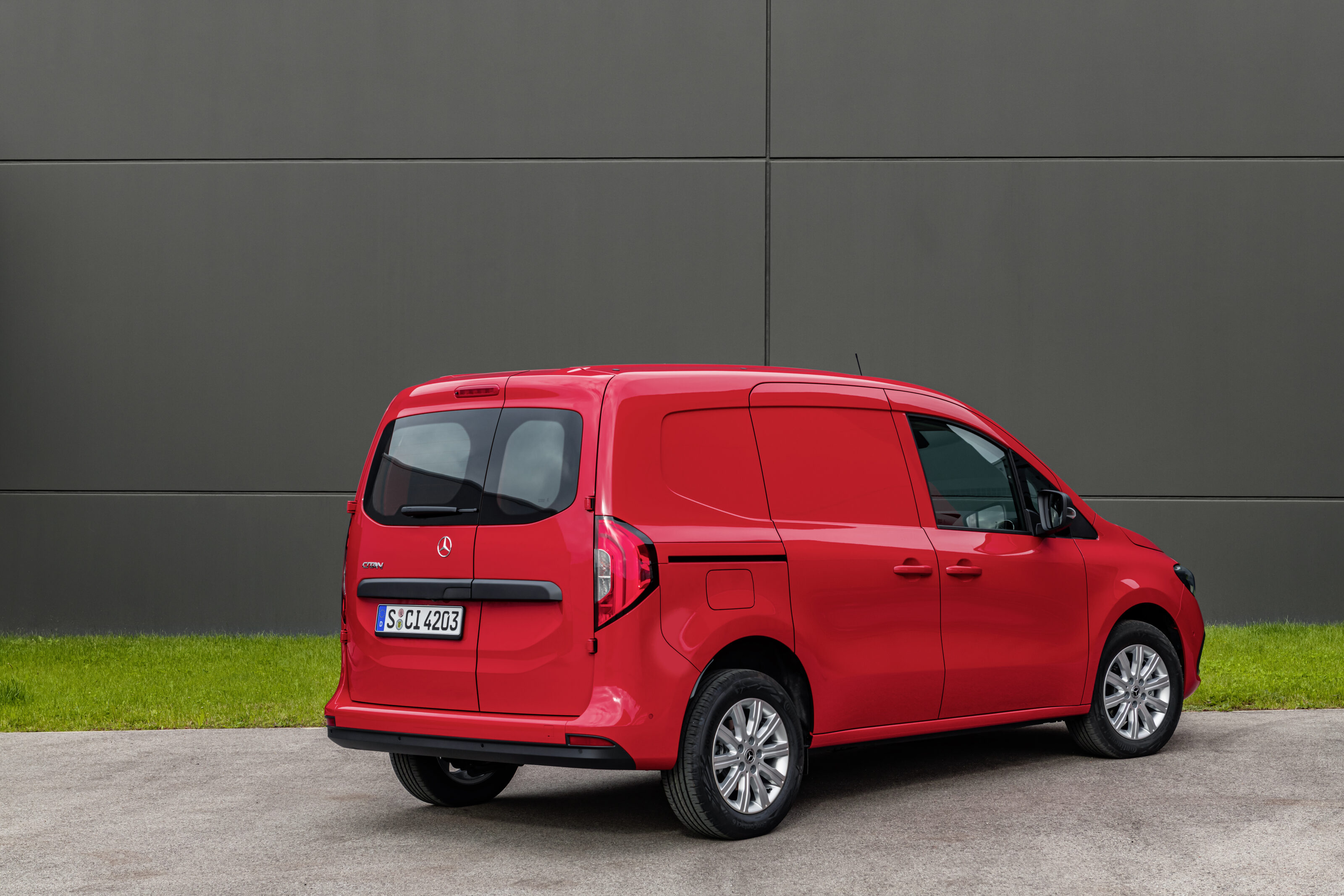
Government regulatory documents seen by Wheels reveal the Citan has been homologated in one specification: a short-wheelbase panel van with a 1.3-litre turbocharged four-cylinder petrol engine.
It will be exclusively paired with a seven-speed dual-clutch automatic transmission, while a six-speed manual is available overseas.
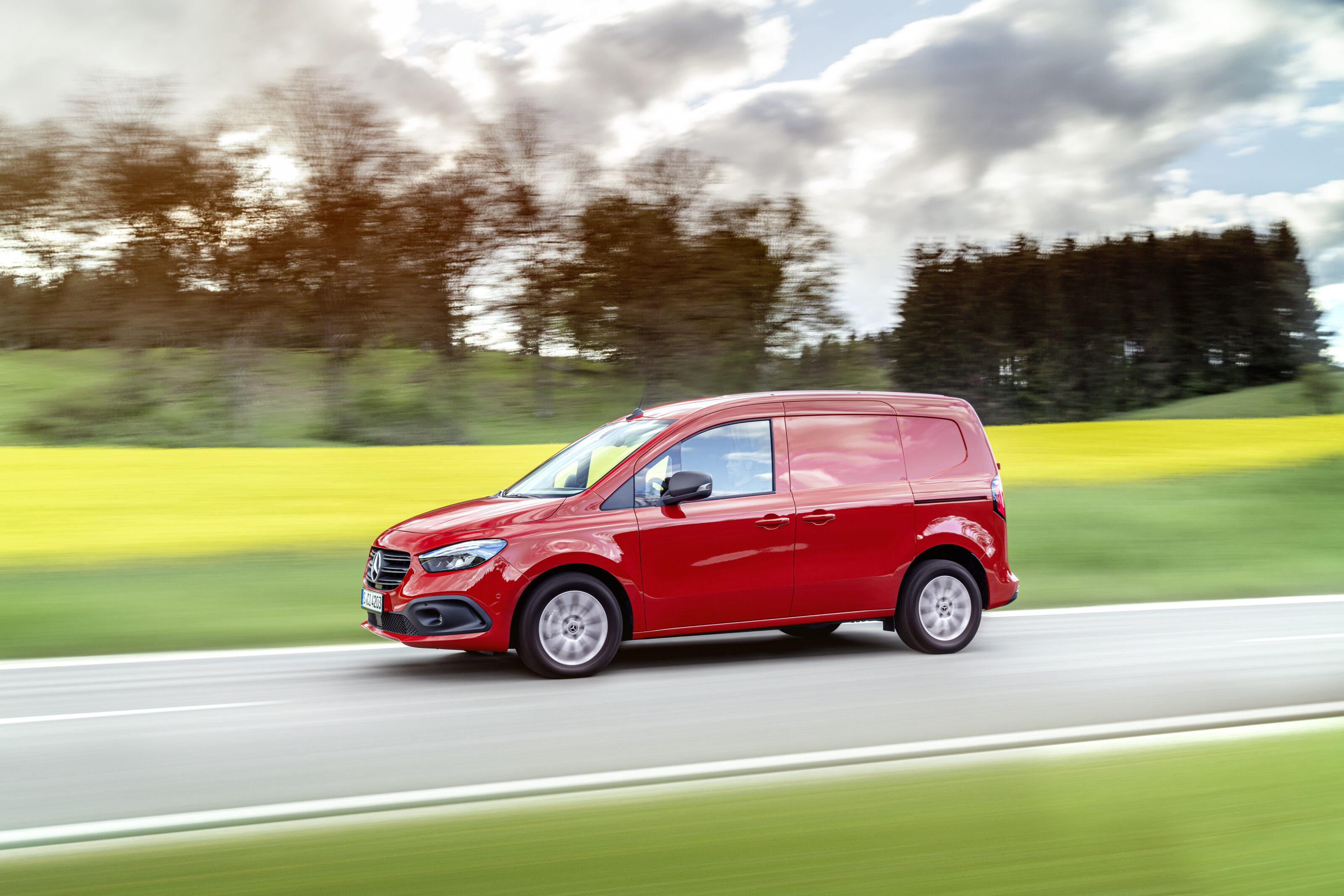
The turbo-petrol engine – also found in the Mercedes-Benz A-Class and GLA, Renault Captur, and the latest Nissan Qashqai – produces 96kW and 240Nm in the Citan and Kangoo.
A 1.5-litre Renault-sourced diesel is available in select markets, but it isn’t expected to feature in the local Citan line-up.
A five-seat people-mover, the Citan Tourer, is also unlikely to reach Australia as a rival to the Volkswagen Caddy Maxi, which offers seating for up to seven occupants.
Will Australia get the electric eCitan and EQT models?
The prospects of all-electric versions, known as the eCitan and EQT, are unknown for Australia, with the eCitan van featuring an identical powertrain to the Renault Kangoo E-Tech due in 2023.
It features a single electric motor producing 130kW and 245Nm, a 44kWh lithium-ion battery, a WTLP-rated 285-kilometre claimed driving range, and regenerative braking.
Mercedes-Benz Citan features
The latest-generation Citan, based on the Renault-Nissan-Mitsubishi Alliance’s CMF-CD platform, was unveiled in mid-2021.
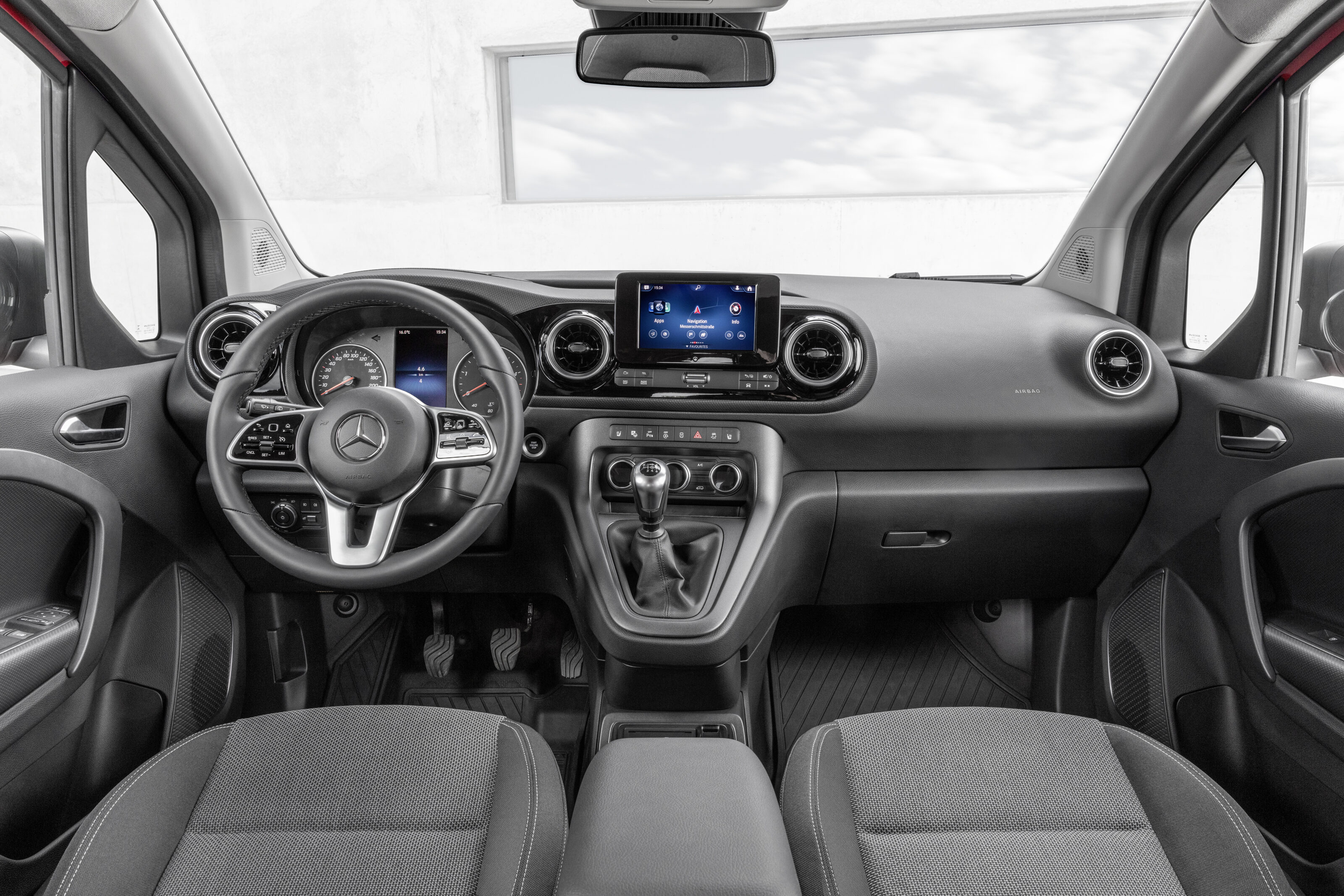
Two grades are offered globally – Base and Pro – with standard equipment including 16-inch steel wheels, a 7-inch MBUX infotainment system, wired Apple CarPlay and Android Auto, digital radio, autonomous emergency braking, lane-keep assist, driver attention alert, and the ‘Hey, Mercedes’ voice assistant.
The flagship Pro adds alloy wheels, body-coloured bumpers, door handles and side mirrors, fog lamps, a height-adjustable driver’s seat and LED interior lighting.
Adaptive cruise control, blind-spot alert and automatic parking are also available, along with emergency calling and traffic sign recognition.
Mercedes-Benz Citan dimensions
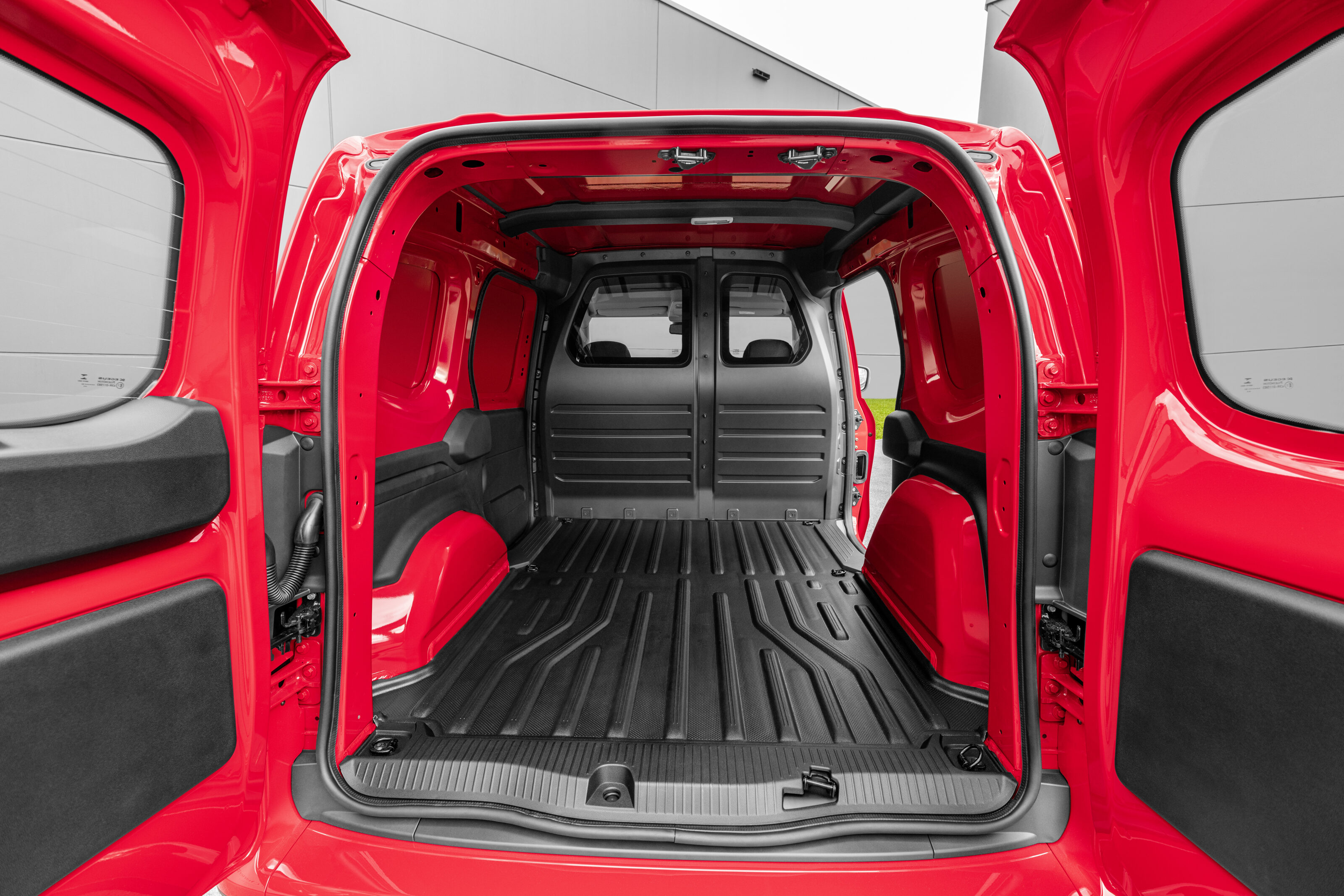
It measures 4488mm long, 1859mm wide and 1822mm tall, with a 2716-millimetre wheelbase. This provides 3050mm of load space compartment length, while the entry to the rear compartment is 615mm wide and 1059mm tall.
When will the Mercedes-Benz Citan come to Australia?
The 2023 Mercedes-Benz Citan is expected to launch in Australia in the first half of 2023, with further details expected in the coming months.
Wheels has contacted Mercedes-Benz Australia for comment. This article will be updated with its response.
Monash University researchers have released a future energy study, finding Australians believe public electric vehicle chargers are an “eyesore” – despite admitting more public infrastructure is needed and charging at home is most preferred.
Snapshot
- Study reveals Australians dislike the look of public EV chargers;
- Concede more infrastructure needed
- Participants preferred to charge at home using solar
- Emergence of EV charging inequities in urban, rural areas
“Our foresights suggest that households will want fully charged vehicles every morning, electric vehicle ownership will likely be higher where there is better charging infrastructure, and future drivers will be more dependent on battery services and roadside assistance,” lead author and academic Professor Sarah Pink said.
The Melbourne-based university studied 72 households in Victoria and New South Wales, and used secondary data and reports.
Key findings
The Monash-led study reveals there’s a unanimous belief that most EV charging would be done at home overnight to have a full battery at the start of every day.
Participants prefer to utilise rooftop solar panels at home and charge during the day for those who work from home or tradies who get home by 3pm to enable early afternoon EV charging, especially in rural and regional areas
Public EV chargers were perceived as bulky, ugly and “eyesores”; participants didn’t want them to disrupt local life spaces like parks and shopping centres. But, respondents concede more public charging stations are needed at health, leisure centres and supermarkets to top-up while doing everyday errands.
EV Buyer’s Guide: Electric Vehicles Under $65K Ranked – The Best and The Rest
Welcome to part one of three price-based EV buying guides, this one focused on the most affordable electric cars available in Australia today
When topping-up charging or selling electricity back at public stations as part of vehicle-to-grid (V2G) systems, Australians envisioned that they would receive loyalty scheme rewards or discounted charging rates in return. Automated plug-in or wireless charging stations were also welcomed to improve convenience.
Interest in big EV charging hubs and spaces for switching to alternative transport modes like at a train station car park, with the ability to book spots ahead of time was also mooted. The study reveals the need for more roadside assistance providers to provide fast DC charging support when stranded (rather than trickle charging currently).
It also points to the fact that electric cars won’t only draw in environmental- or cost-conscious Australians, as more consumers will be interested in technology, acceleration and other features instead.
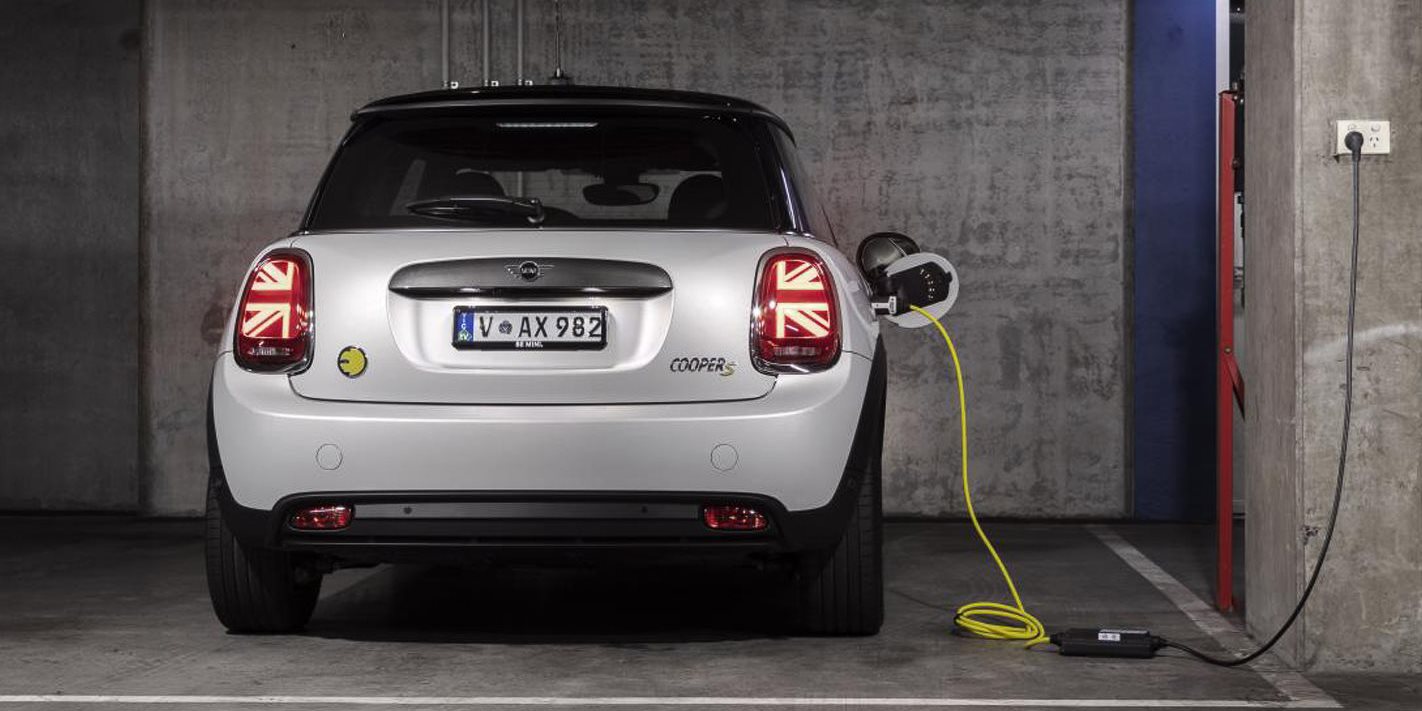
Charging inequality emerging
However, the report also emphasised that uneven access to public EV charging infrastructure will lead to new inequalities. For example, not all apartment dwellers can plug-in their electric cars and retirement villages don’t offer car parking spaces for residents.
People living in rural areas also lack alternative public transport modes and those who need to travel longer distances to access facilities (eg: medical appointments), but can’t charge their car prior to leaving or at the destination may be disadvantaged.
Personal EV ownership was also questioned for urban residents, who prioritise convenience, with the everyday challenge of finding parking and charging proving a barrier to adoption.
Snapshot
- 2023 Mercedes-Benz EQV pricing and features
- All-electric luxury people-mover to launch in one spec
- Priced from $155,338 before on-road costs
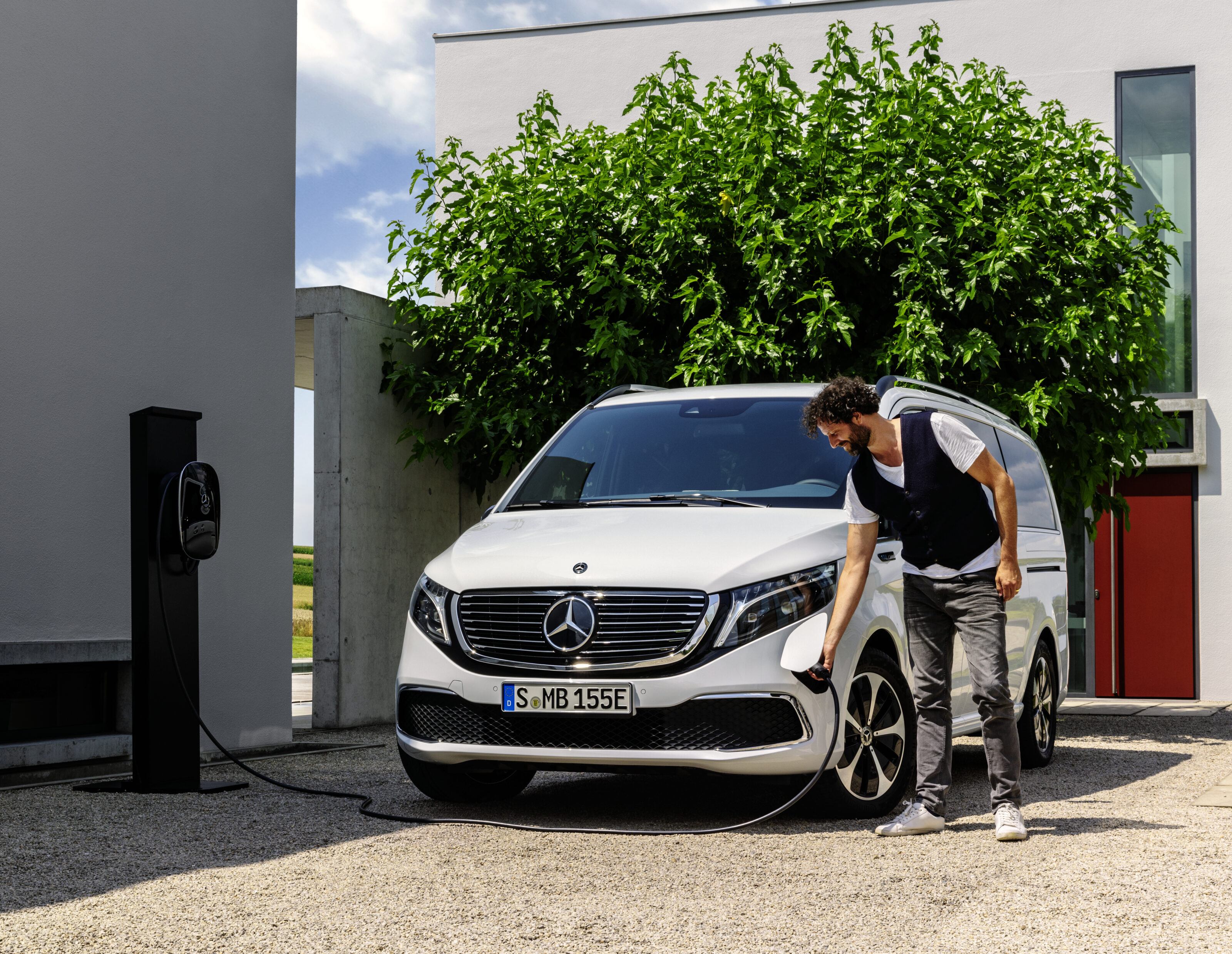
The all-electric 2023 Mercedes-Benz EQV people-mover has arrived in Australia, providing chauffeurs with a premium battery-powered option for the first time in the local market.
It launches exactly 12 months after the brand’s local arm announced it would introduce three battery-powered vans in the second half of 2022, joining the more-affordable eVito panel van and eVito Tourer people-mover.
The luxury-focused seven-seat electric van – based on the eight-year-old ‘W447’ V-Class and Vito platform – is priced from $155,338 before on-road costs, equating to a circa-$40,000 increase over the diesel V250d, which has similar power outputs.
A flagship V-Class, the V300d AMG-Line, retails for $132,480 plus on-road costs.
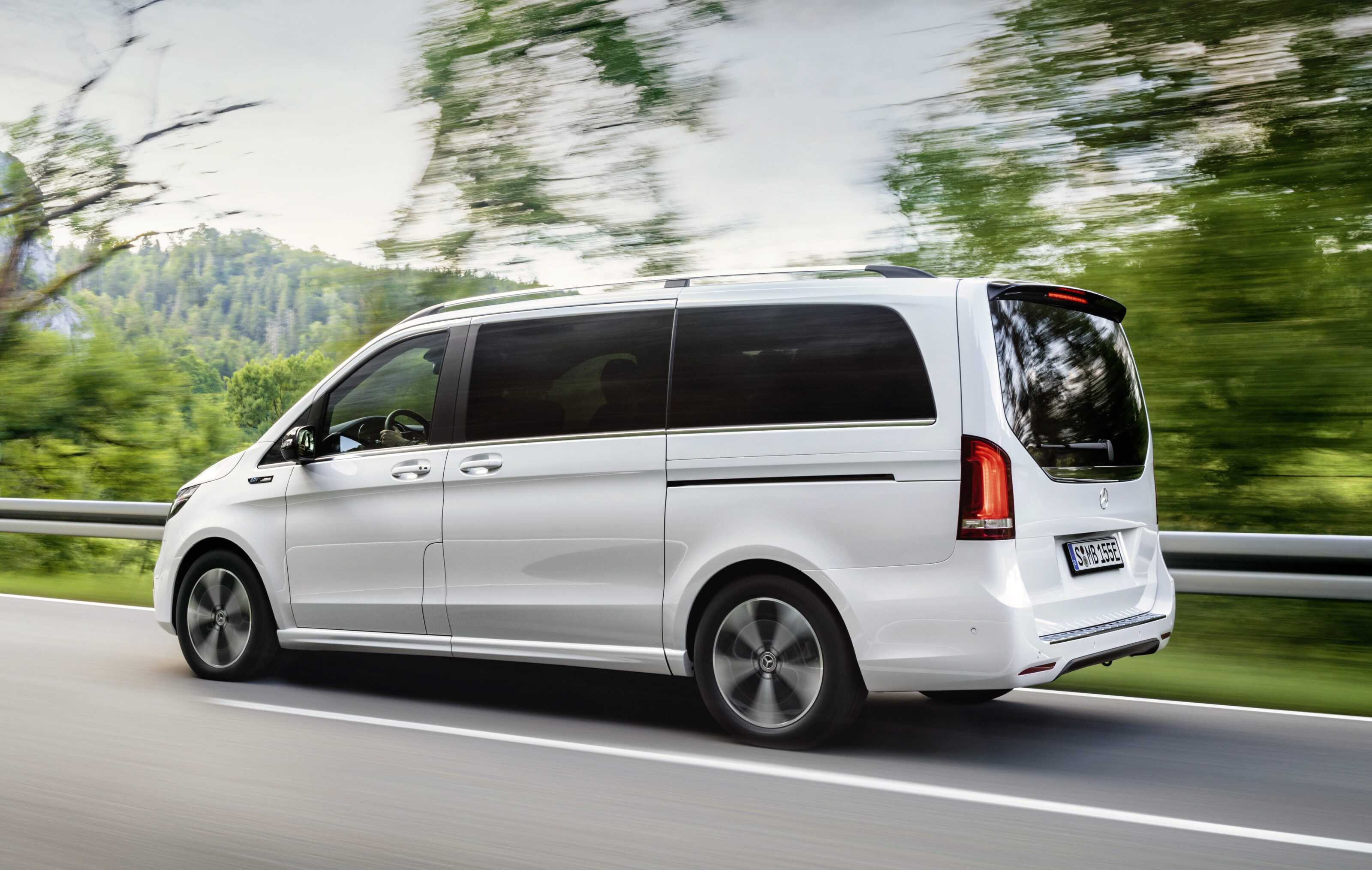
Under the bonnet, the EQV 300 replaces the V-Class’s turbo-diesel engine with a single electric motor producing 150kW and 365Nm, with power sent to the front wheels.
For reference, the V250d produces 140kW/440Nm, while the more powerful V300d has 174kW and 500Nm.
It features a 90kWh lithium-ion battery, allowing for a WLTP-rated 363-kilometre driving range, with a 110kW maximum DC charging rate bringing a claimed 10 to 80 per cent top-up in approximately 45 minutes.
This is an identical setup to the stripped-back eVito Tourer priced from $116,155 before on-road costs, which excludes several features exclusive to the EQV.
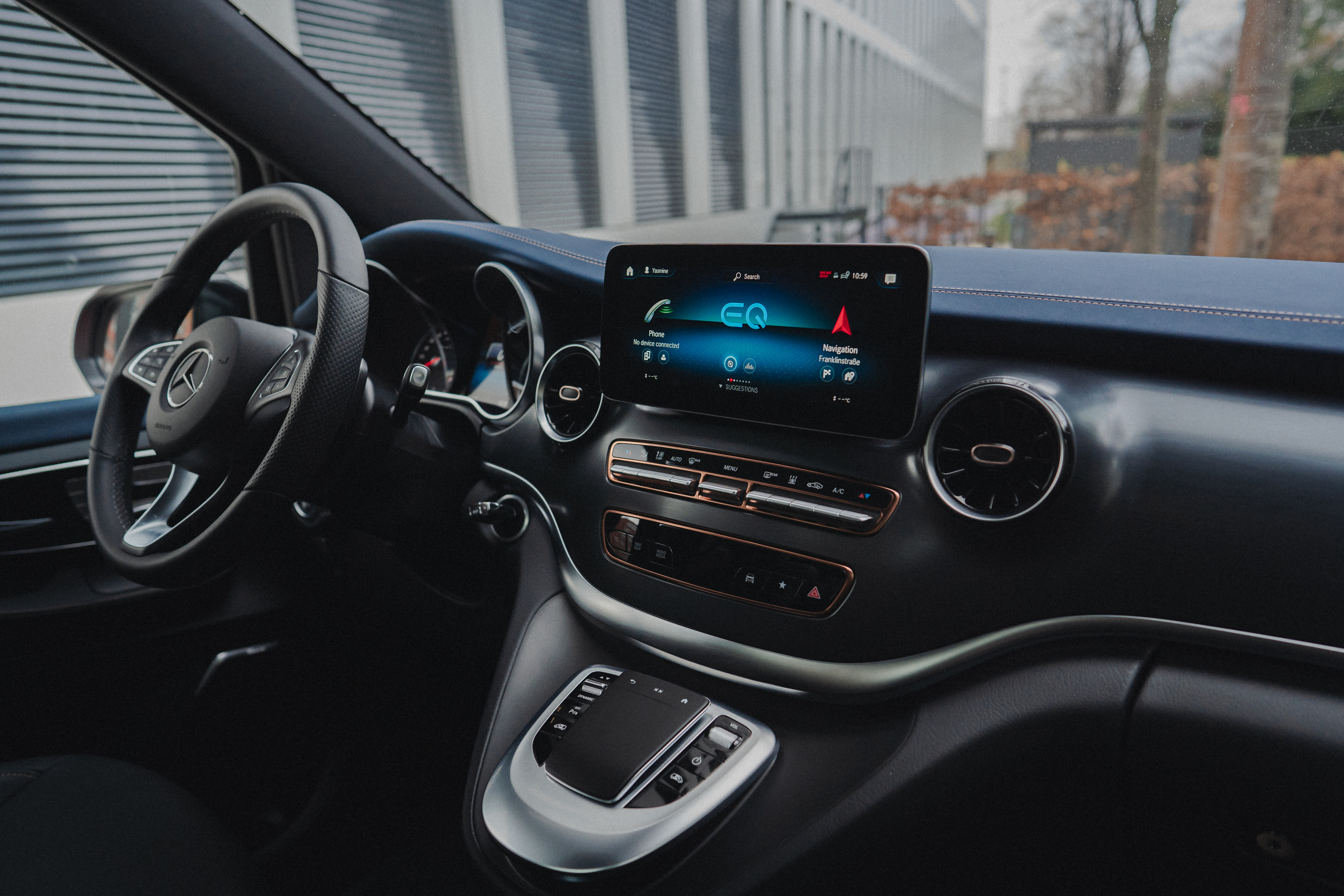
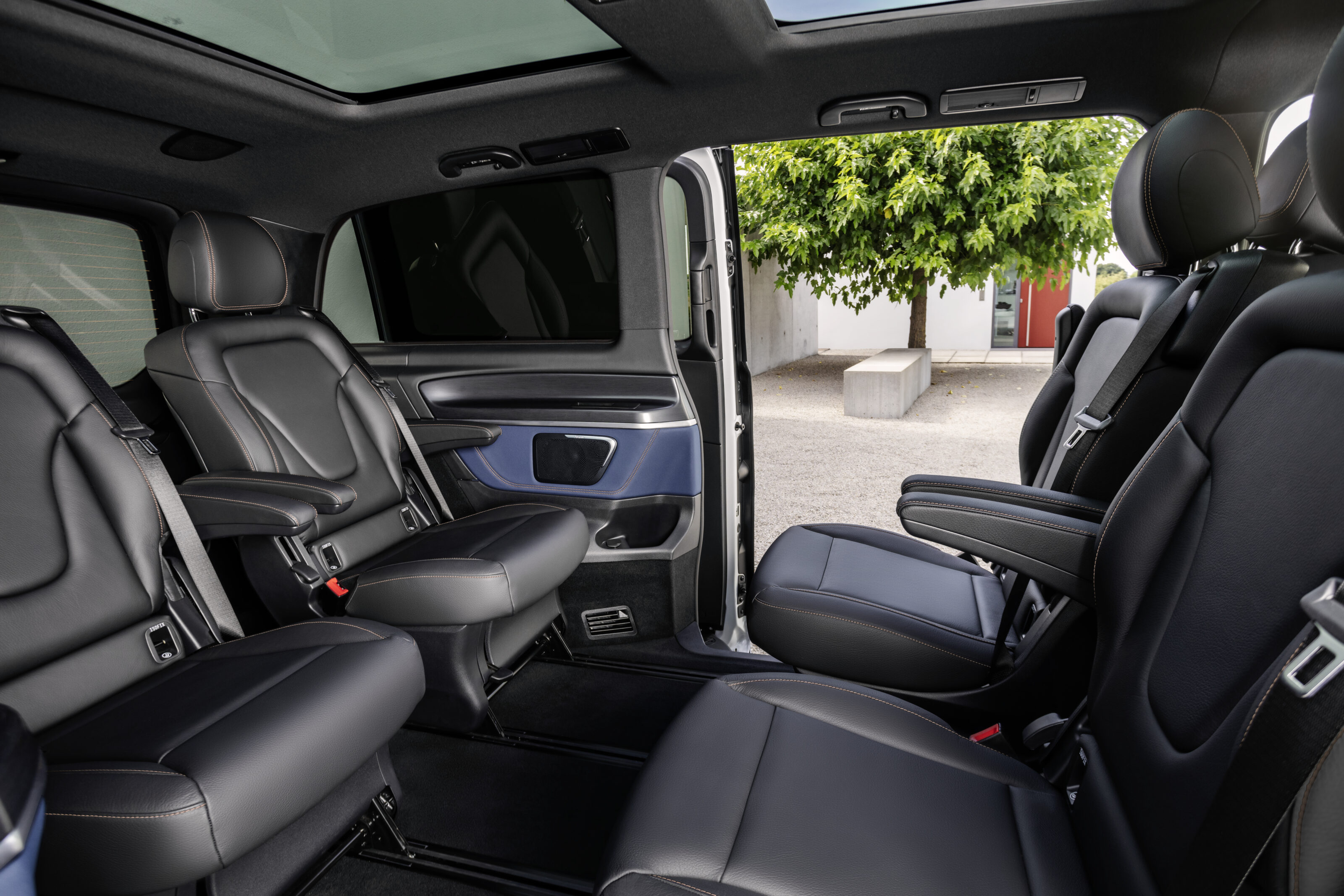
A six-seat configuration is available as a no-cost option with four individual armchairs in the rear, while equipment unique to the EQV includes remote air-conditioning and EV-specific information within the infotainment system.
As with the Mercedes-Benz’s range of EQ-branded electric vehicles, the EQV includes a complimentary one-year subscription to the Chargefox public charging network, while its high-voltage components are covered by an eight-year/160,000-kilometre warranty.
JUMP AHEAD
- Pricing
- Features
- Options
- Colours
- Powertrains, charging, and driving range
- Safety
- Dimensions
- Warranty and servicing
- Availability
2023 Mercedes-Benz EQV pricing
| Model | Pricing |
|---|---|
| EQV 300 | $155,338 |
2023 Mercedes-Benz EQV features
EQV 300
Options
Colours
Powertrains, charging, and driving range
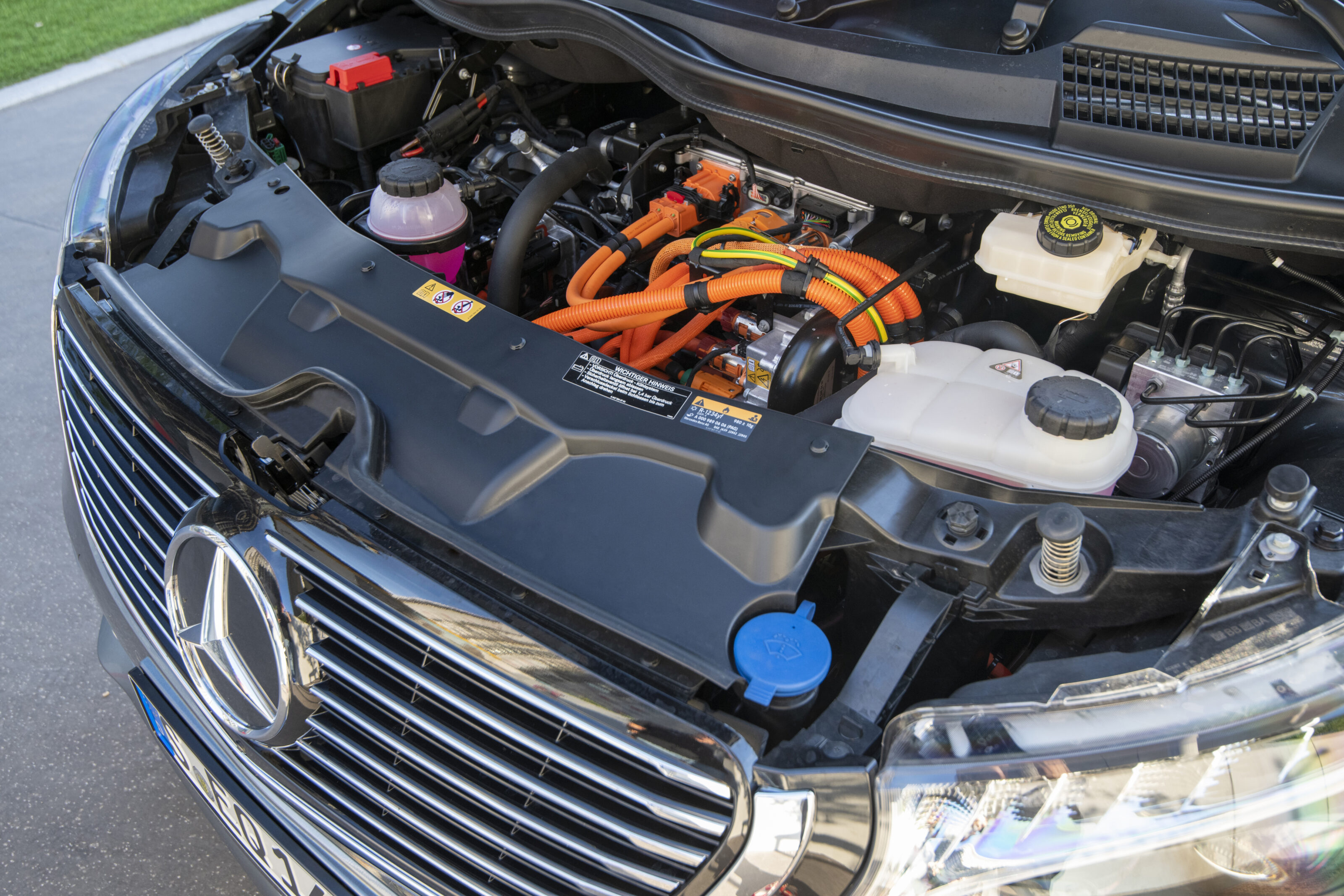
The single-specification EQV 300 features a single electric motor producing 150kW and 365Nm, exclusively sending power to the front wheels.
It has a 90kWh battery pack, with a WLTP-rated 363-kilometre driving range.
According to the brand, the EQV 300 will complete the 0-100km/h sprint in around 12.1 seconds.
There are several charging options for the EQV, including an onboard charger that allows up to 11kW with an alternating current (AC).
It also supports direct current (DC) charging of up to 110kW, with the 10 to 80 per cent fast charge claimed to take approximately 45 minutes.
Safety
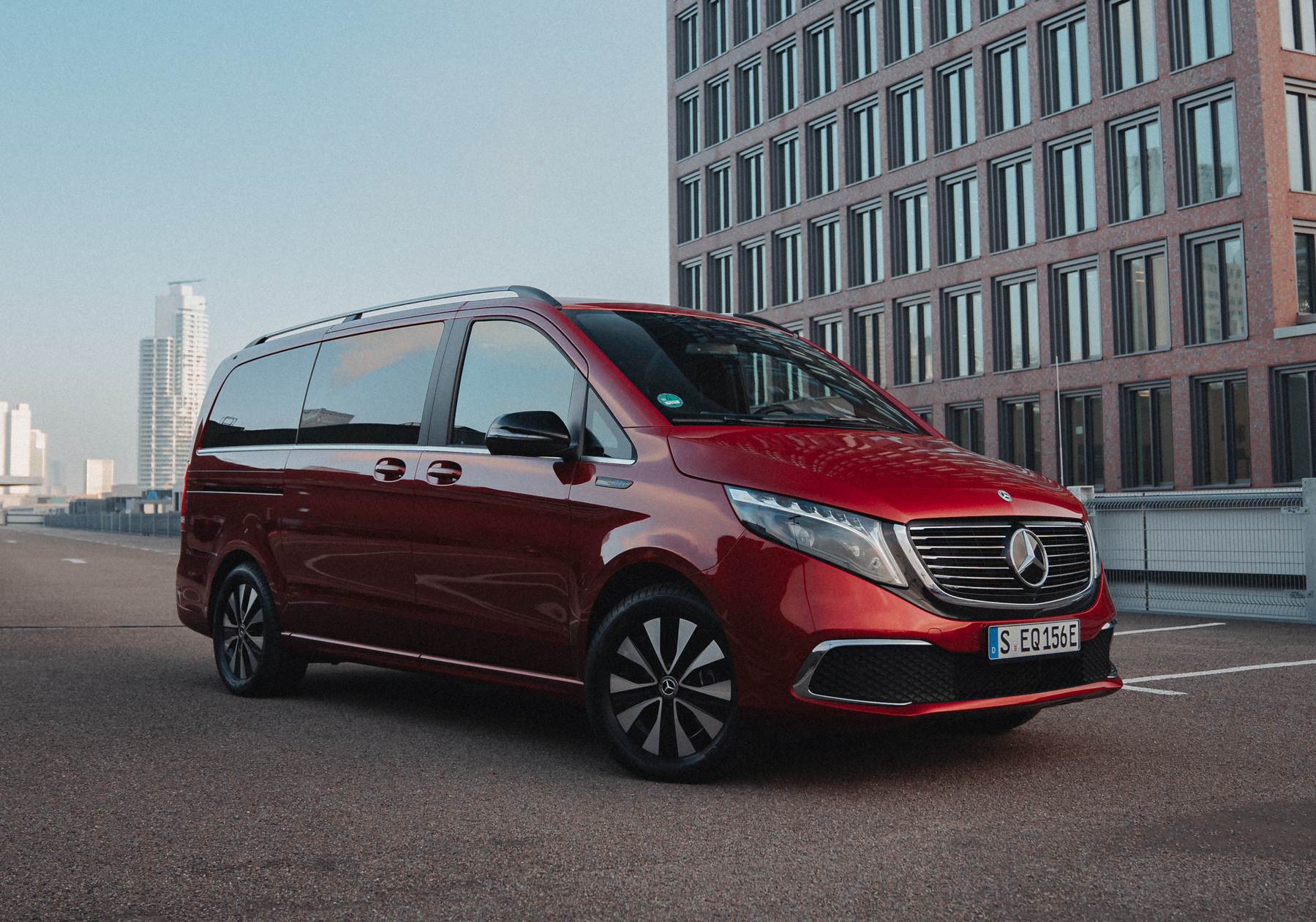
While the internal combustion V-Class is covered by a five-star ANCAP safety rating, based on testing conducted in 2014, this does not apply to the EQV.
Six airbags (dual front, side and curtain) are fitted across the range.
It includes the following active safety equipment as standard:
Dimensions
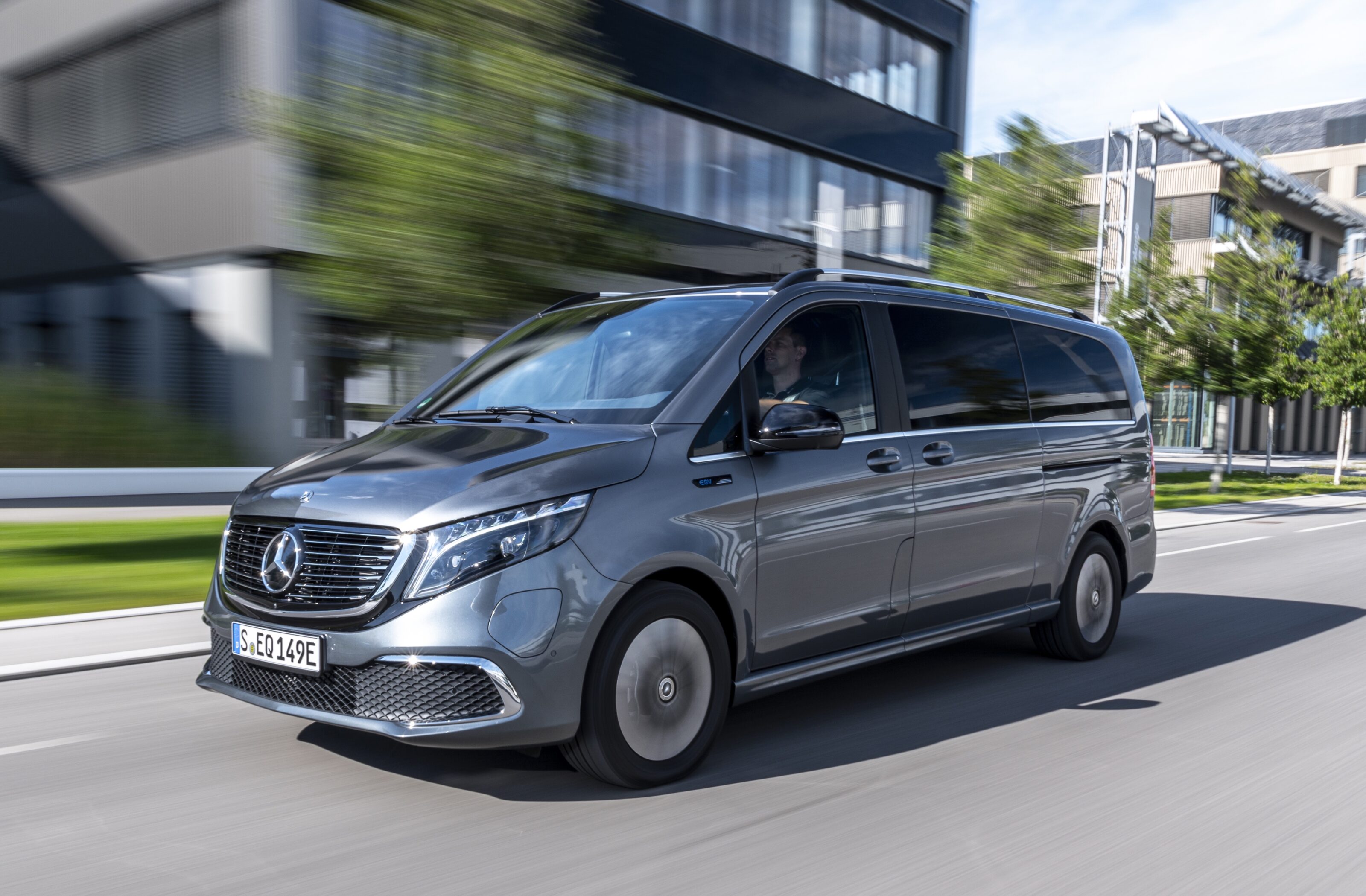
The Mercedes-Benz EQV has a wheelbase of 3200 millimetres, and is 5140mm long, 1928mm wide and 1910mm tall.
This makes it 30mm taller than the diesel V-Class, due to the placement of the batteries underneath the vehicle.
The people-mover has a claimed 1030-litre boot capacity, expanding to 4630L with all seats folded.
Warranty and servicing
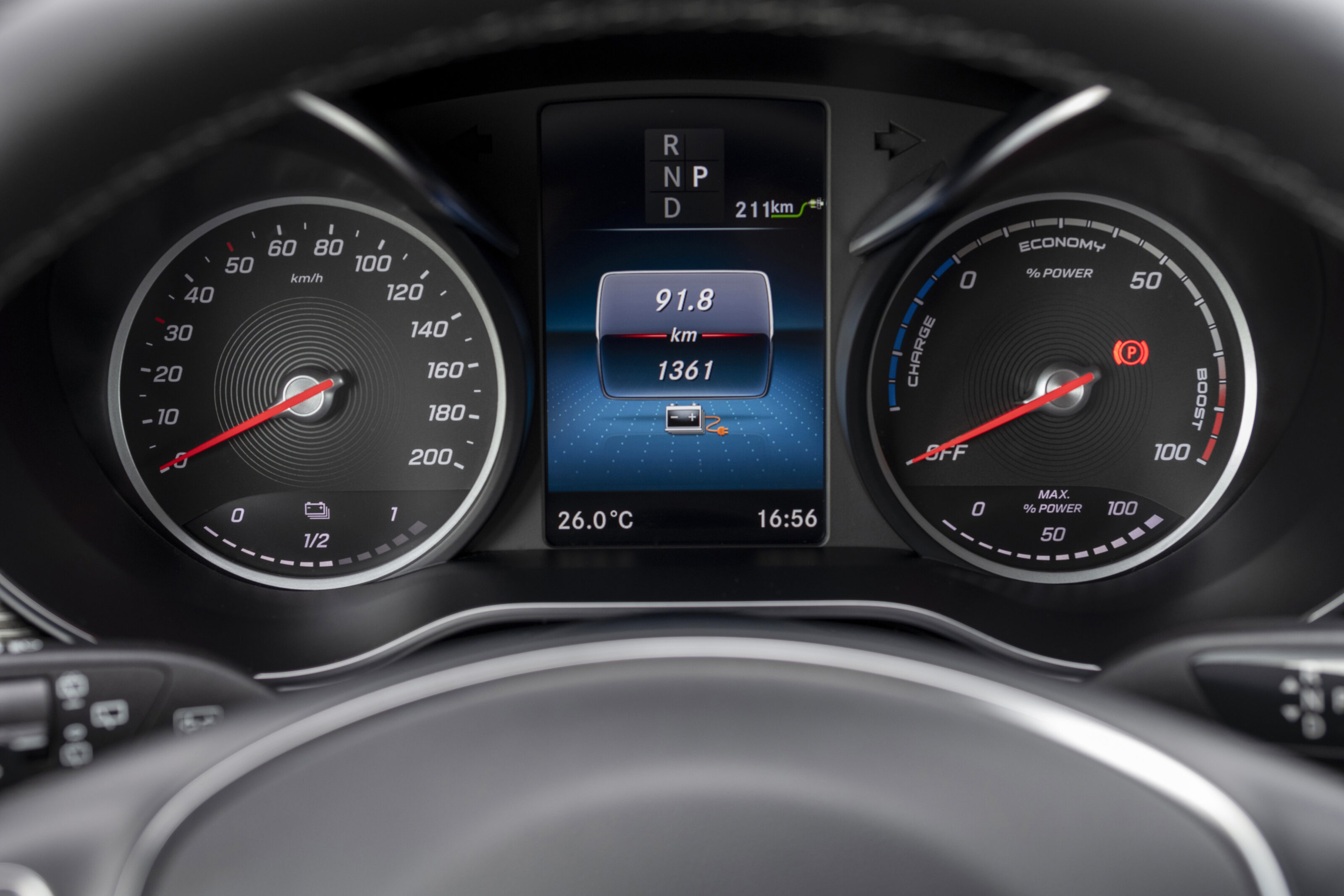
As per the wider Mercedes-Benz range, the EQV electric people-mover is covered by the brand’s five-year, unlimited-kilometre warranty. This is reduced to a five-year/250,000-kilometre period for commercial use.
It includes a complimentary roadside assistance program during the vehicle’s warranty period. The program can be extended for $149.60 per year.
The battery pack is covered by a separate eight-year/160,000-kilometre warranty.
Maintenance is recommended every 12 months or 40,000 kilometres, whichever occurs first.
Availability
The 2023 Mercedes-Benz EQV 300 is on sale now.
Stay tuned for our in-depth local review of the Mercedes-Benz EQV, coming soon to WhichCar.com.au.
It’s official, 2023 is the year of the absurd off-road supercar with Lamborghini finally unveiling its lifted, 455kW, V10-powered Huracan Sterrato to duke it out with Porsche’s 911 Dakar.
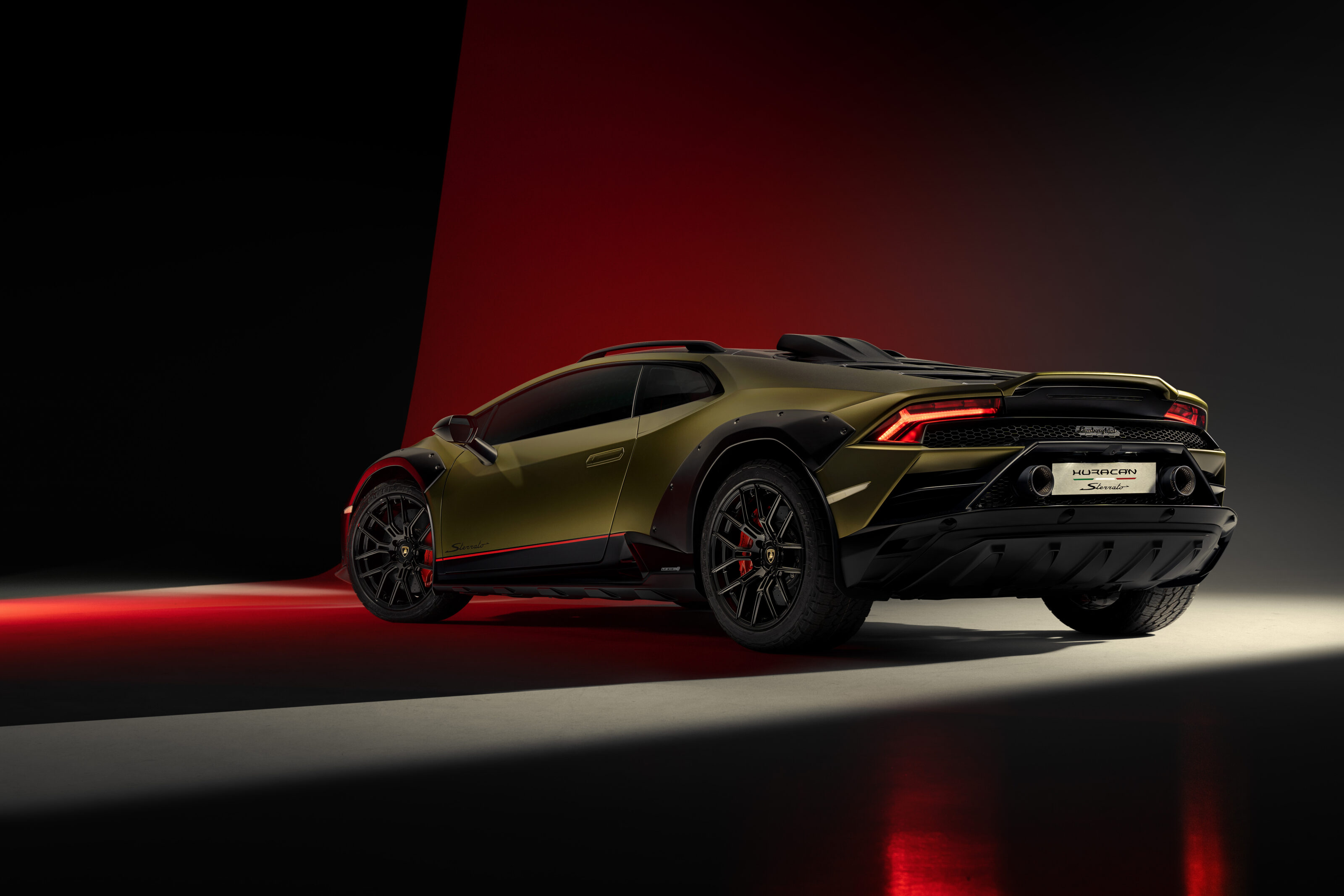
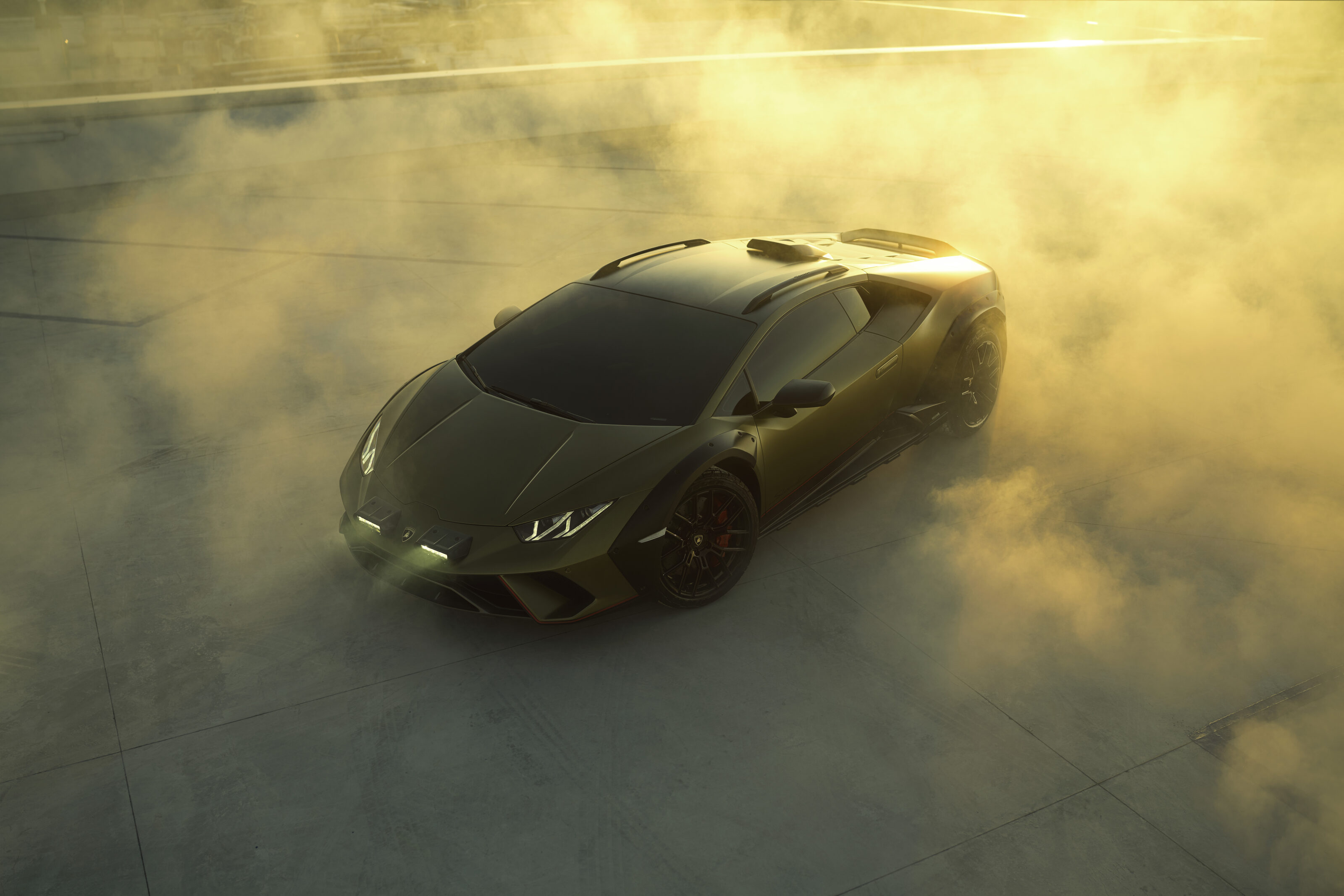
The Sterrato is bold, angry and unique, riding 44mm higher than a Huracan Evo while wearing Bridgestone Dueler rubber where Pirelli Trofeos are typically found.
Like the 911 Dakar, Sterrato isn’t a rock-crawler to trouble the likes of the Mercedes-Benz G-Class, but a sand and dirt road specialist. That is if a buyer – likely a collector – is willing to cop the stone chips.
The best part? We’ve had a preview drive in the concept, which you can read here.
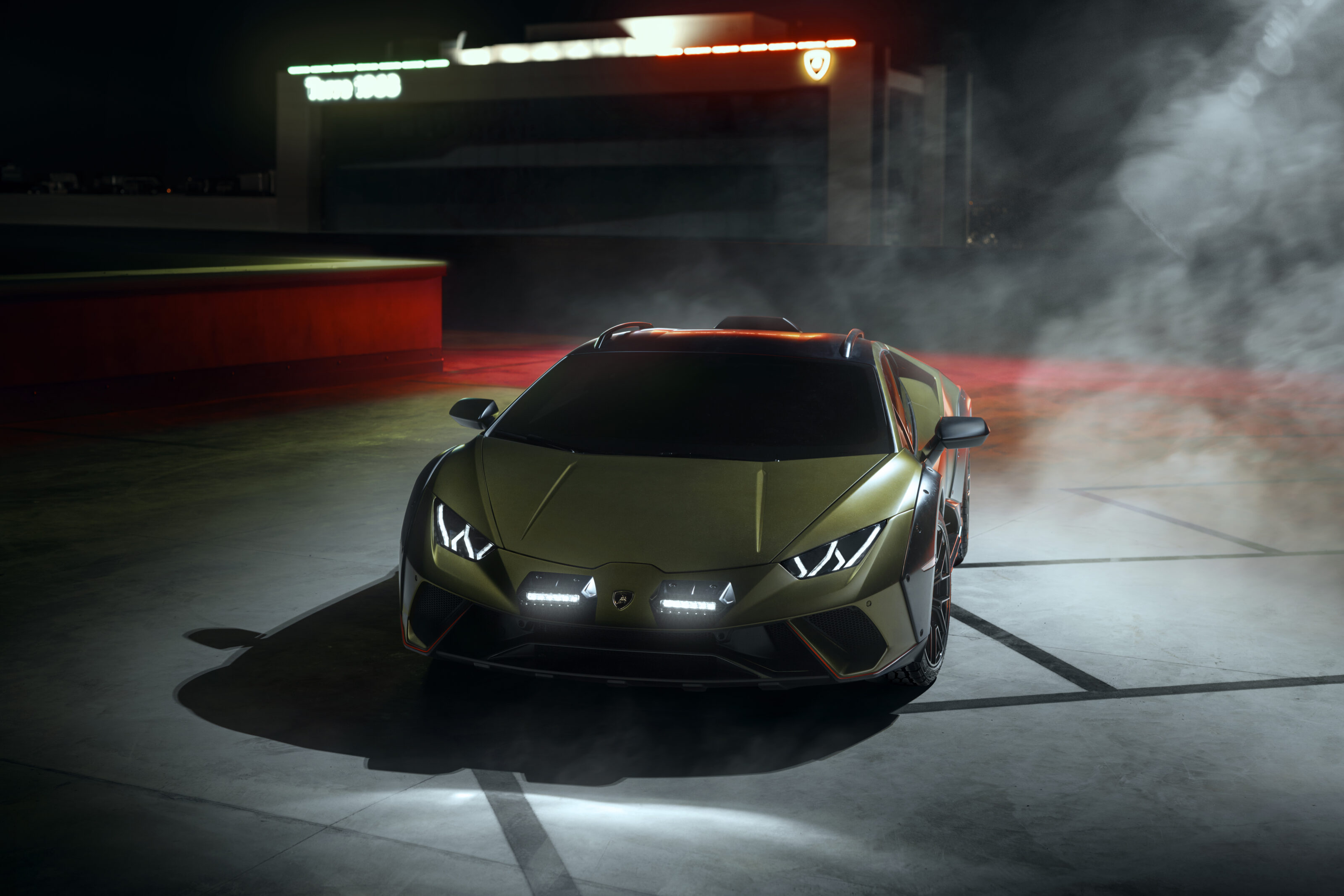
“Presenting the car at Art Basel, Miami Beach reflects how, just like an avant-garde work of art, the Sterrato represents a radical and original representation of a super sports car concept but, in terms of performance, the Sterrato belongs in the world’s most dynamic and exciting environments”, said Lamborghini CEO Stephan Winkelmann.
This special edition marks the last hurrah for the Huracan following the Tecnica’s release, with only 1499 Sterratos being produced globally. The Sterrato is likely to hit Australia in limited quantities with pricing still to be confirmed.
What’s new with the Huracan Sterrato?
Taking a mid-engine supercar off-road may sound like an odd or foolish pursuit, but the Sterrato has a host of changes to make it suitable.
Starting with a 44mm lift in ground clearance courtesy of longer stroke suspension components and taller 235/40R19 front and 285/40 R19 rear Bridgestone Dueler all-terrain run-flat tyres designed specifically for the Sterrato.
The track widths have also grown by 30mm up front and 34mm in the rear for greater stability – the tyres are, naturally, hidden by a set of over-fenders with exposed bolt heads.
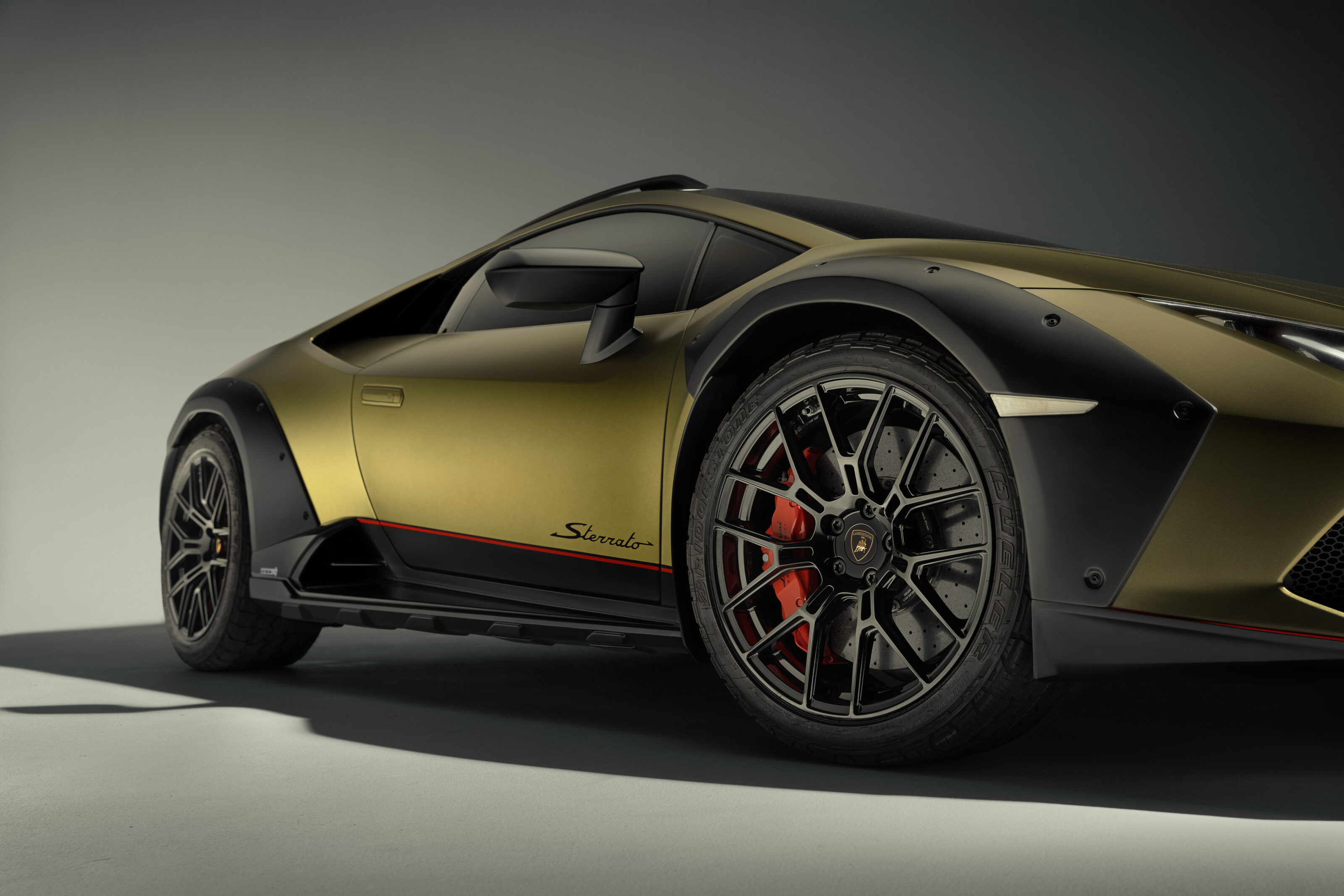
The Sterrato’s adaptive dampers link the tyres to the chassis via independent double wishbone suspension at all four corners. Lamborghini has also retuned the Sterrato’s vehicle dynamics and ESC settings, with specific Strada and Sport modes to suit off-road driving.
Rally mode has been added for ultimate loose surface control, while the Sterrato’s ESC system can be fully deactivated.
Braking is taken care of by six-piston front and four-piston rear monoblock calipers respectively clamping 380mm and 365mm ventilated rotors.
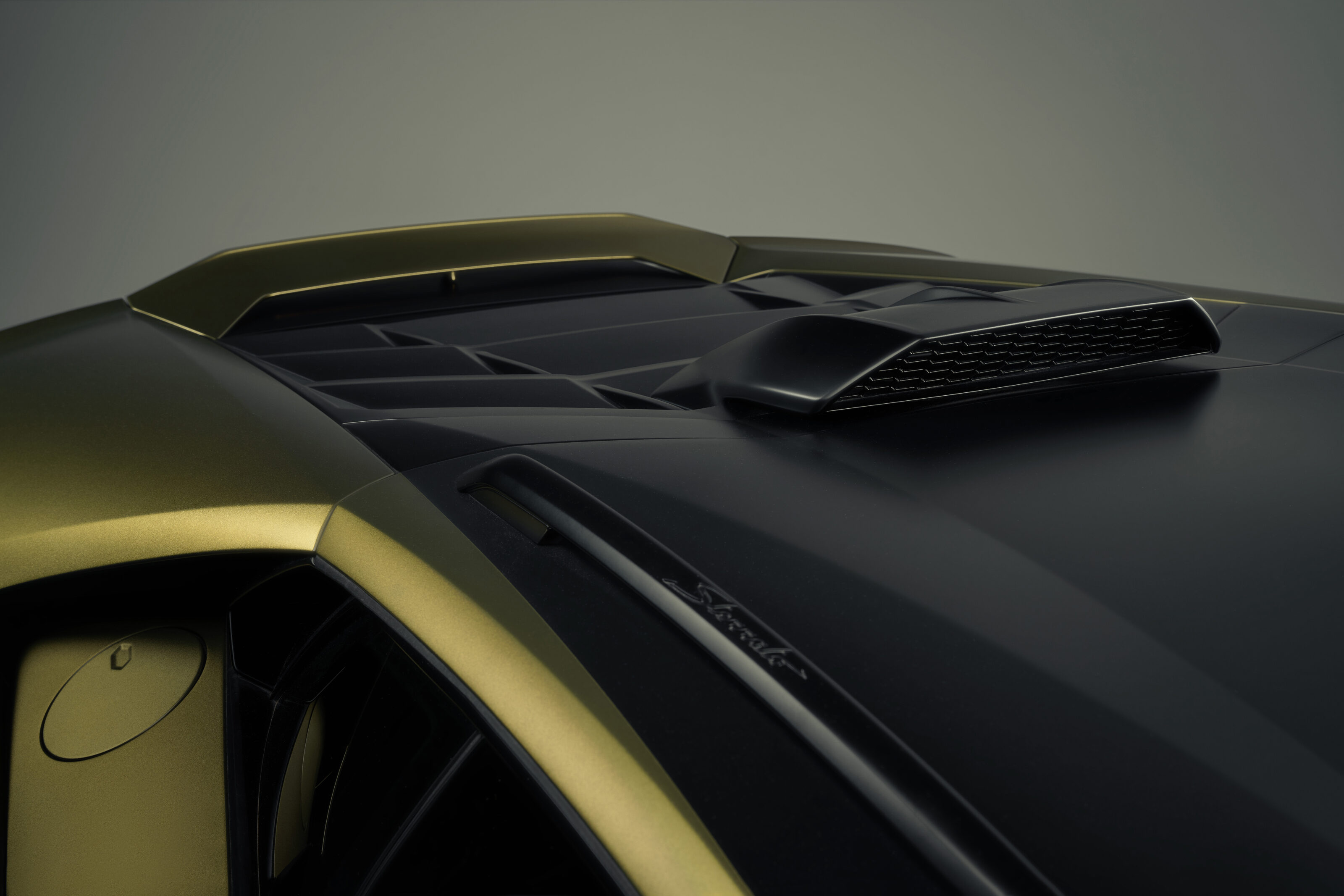
Under the rear deck is a 5.2-litre petrol V10 developing 455kW of power – a touch less than the 470kW Huracan Evo – and 610Nm of torque. A functional roof-mounted air intake helps feed the V10 when the going gets dusty.
The Sterrato uses the Huracan’s seven-speed dual-clutch automatic, with an electronically-controlled AWD system and mechanical rear limited-slip differential.
The Huracan Sterrato sprints from 0-100km/h in 3.4 seconds, and has a 260km/h top speed.
Huracan Sterrato design
While the Sterrato offers huge customisation, with 350 paint, and 60 upholstery colour choices via the Ad Personam program.
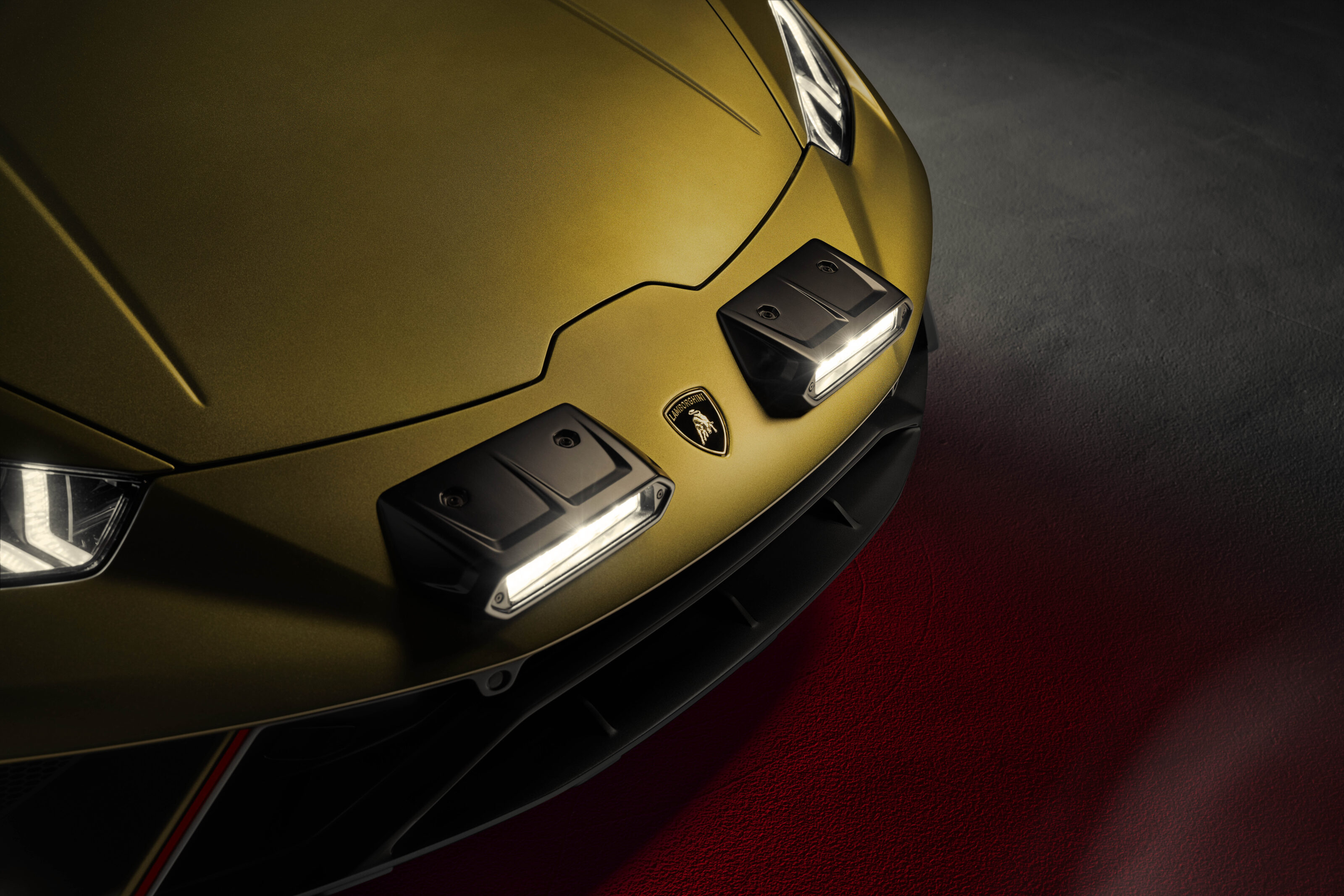
The Sterrato’s theme inside and out is of a new kind of sportiness for Lamborghini. The sharp, angular fenders and matte green paintwork are accented with red decals and a contrasting black roof with rails.
There are new wheel designs, red brake calipers, and LED light pods on the front fenders. You won’t miss a Sterrato on (or off) road.
Inside, this example is fitted with Verde Sterrato coloured Alcantara upholstery while the infotainment and digital driving display graphics have been redesigned to suit the Sterrato.
Australian plans are yet to be confirmed, but it’s likely the Sterrato will arrive here in limited quantities, with pricing likely north of $450K.
Kaizen.
If you had to sum up the 2023 Honda Civic Type R in a single word, that’s it. For Japanese carmakers, kaizen means continuous improvement, and the new Type R is a masterclass in the art and science of the process.
Every tiny piece of the FL5 Type R, from the powertrain to the suspension to the steering and brakes and gearshift and driver support systems, all of which are based on hardware used in the previous generation FK8 model, has been lovingly, meticulously, polished and preened to tease out incremental improvements in performance and handling and all-round driveability.
And what does that all that mean? In simple terms, confidence.
JUMP AHEAD
2023 Honda Civic Type R pricing and availability
Australian order books open for the new Civic Type R on December 1, and a drive-away price of $72,600 has been confirmed. Get all the details at the link below, and continue reading here for our first drive impressions.
| 2023 Honda Civic Type R features for Australia | |
|---|---|
| Individual drive mode in addition to Comfort, Sport and +R | 9.0-inch central infotainment touchscreen |
| Active exhaust valve | Wireless Apple CarPlay |
| 265/30 Michelin Pilot Sport 4S tyres | Wireless phone charger |
| 10.2-inch digital driver display | Honda LogR telemetry system |
| Blind-spot information system | Satellite navigation |
| Rear cross-traffic alert | Acoustic windscreen |
| Traffic sign recognition | Smart Clear Wiper windscreen wiper/washer system |
| Intelligent speed limiter | Auto-retractable door mirrors |
| Driver attention monitor | Full suede-effect seat trim |
| Knee airbags (driver and front passenger) | Ambient door and footwell lighting |
This Type R the definition of a great driver’s car; its calm and consistent demeanour under pressure invites you to explore the very edge of the performance envelope
You can, as we did, jump into the new Type R on a damp and unfamiliar racetrack and within a couple of laps be driving the wheels off the thing, revelling in the muscular response of the 2.0-litre VTEC turbo four, the snickety-snick-snick of the gearshift, the easy playfulness of the chassis, the meaty yet precise steering, and brakes that never give up.
This Civic Type R the definition of a great driver’s car; its calm and consistent demeanour under pressure invites you to explore the very edge of the performance envelope – yours, or, if you’re good enough, that of the machinery – and it won’t rip your head off when you make a mistake.

New Civic Type R styling and shape
Visually, the new Type R has none of the manga comic craziness of the FK8.
That’s partly because the fundamental design of the five-door Civic hatch is much cleaner and more sophisticated than that of the previous model, but also because Honda engineers have spent a lot of time working with their motorsport colleagues on reducing drag while increasing downforce. The rear wing, combined with the rear diffuser, the redesigned bonnet and sporty front fascia, all work together to produce 92kg of downforce at 200km/h.
There’s no mistaking the more aggressive front and rear fascias, the vents on the bonnet and behind the front wheels, and those three bazooka-calibre exhausts looming under the rear bumper. There’s Type R DNA all over the car.
The FL5 body is slightly bigger in every dimension, making this the biggest Civic Type R yet, but in terms of its mission, the important dimensional changes versus the previous model are the 35mm increase in the wheelbase, the 26mm increase in the front track, the 30mm increase in the rear track, and the lowering of the driver and front passenger H-point by 8mm.
The longer wheelbase, wider track, and lower centre of gravity help the new Type R feel even more planted than its predecessor.

Build and powertrain
Under the skin, the FL5 features 3.8 times the structural adhesive of the FK8 to improve body rigidity, particularly at the rear of the car.
The use of adhesives has also helped save weight, obviating the need for additional steel bracing. Other weight saving measures include the new aluminium bonnet, which is 43 percent lighter than the FK8’s steel item, and a resin rear hatch that’s 20 percent lighter.
The revised version of the K20C1 four-banger under the bonnet now develops 235kW at 6500rpm, and 420Nm of torque from 2200rpm to 4000rpm, increases of 7kW and 20Nm over FK8 spec. They’re not big bumps, but they’re enough to get the Type R comfortably into the 5 second bracket for the 0-100km/h sprint – Honda claims 5.4 seconds, compared with the 6.0 seconds we recorded when testing an FK8 Type R back in mid-2020.
As any tuner knows, there’s a law of diminishing returns when it comes to tweaking an engine that’s already making big power and torque for its size. The FK8’s engine punched out 117kW per litre. Getting the FL5 version to better that number by just three percent involved fitting a redesigned turbocharger that, among other things, features fewer blades on the impeller to reduce inertia by 14 percent and thus reduce lag, as well as designing an intake and exhaust system with 10 and 13 percent better flow rates, respectively.
To help engine response, particularly in terms of rev matching on downshifts, the flywheel is 18 percent lighter overall, and where the weight has been removed has reduced the flywheel’s inertia by 25 percent.

The FK8’s six-speed manual was already one of the best in the business in terms of shift feel and precision, but Honda engineers thought there was still room for improvement.
As a result, the FL5 Type R’s shifter has a more rigid throw, less free play, and moves across a carefully optimised gate that’s been designed for faster, more precise shifts between second and third, and fourth and fifth gears.
The new Type R has the fundamentally same suspension layout as the previous model, though everything has been tweaked. The adaptive dampers, carried over from the FK8, feature a revised control logic for roll and pitch control.
The dual-axis front suspension, which helps minimise torque steer, has new lower arms that deliver a 16 percent increase in camber rigidity over the previous generation Type R. The front axle geometry has also been revised to make better use of the increased engine torque and the 265/30 R19 Michelin Pilot Sport 4S tyres.
The decision to step down from 20-in to 19-in rims compared with the FK8 Type R was driven by the dimensional changes of the FL5 platform, their effect on the suspension geometry, and improvements in tyre technology.
The Michelins have been engineered to work their inner edges harder than before, and the new 19in alloy wheels thus have their smallest inner diameter on the inside of the rim, rather than the outside, as is usual. That’s why the new 19in wheels look like 20s from a distance.

Lurking behind the wheels is an upgraded Brembo braking system that features a new mechanical brake master cylinder to improve tip-in feel.
Revised brake ducts help keep the rotors and callipers cooler – Honda engineers claim they’ve seen 60 degree C lower pad temperatures than in the FK8 after five hot laps of Suzuka.
To make the most of the more responsive chassis, the steering column has bearings honed to improve rigidity and longevity, and the tie-rod ends are made from a high-rigidity material for increased steering feel.
Thanks to upgrades to the electronic power steering control software a larger diameter, a 60 percent more rigid torsion bar reduces unwanted steering deflections to improve feedback and response.
Telemetry: Geeking out
Data geeks will go all gooey over the new Type R’s upgraded Honda Log R 2.0 performance data acquisition app.
The app is now built into the car’s infotainment system and no longer requires hosting via a hardwired smartphone and features a Performance Monitor function and a Scoring function.
In Performance Monitor, 12 separate items of vehicle information can be displayed including engine, water, and oil temperatures as well as steering angle, brake pressure, accelerator pedal angle and yaw rate.
New is a digital tyre friction circle display, which calculates and shows in real time the potential maximum grip each of the four tyres, as well as the value of the grip levels achieved.

The Scoring function allows Type R drivers to review their driving to help improve skills behind the wheel. An Auto Score function evaluates driving performance on the public road in everyday situations, while the Data Log function records and analyses track driving data.
In Data Log mode the system awards up to 100 performance-based points per lap, the total determining whether the car considers you to be a C, B, A, S, or S+ driver – with S+ as the best.
It’s the same system Honda uses to rank its professional R&D evaluators. Never mind F1…
With Honda even we mere mortals now have nowhere to hide when it comes to explaining a duff lap time.
Driving and comfort
Despite all the focus on its capability on the track, most Civic Type Rs of course spend most of their lives on the road. And the good news is the FL5 version is not just a great track day weapon, but a terrific road car, too.
Inside the roomier interior, the trademark bright red R-spec front seats are supportive and comfortable, although the lever to adjust the backrest is almost impossible to operate with the seatbelt fastened. For a car that elsewhere displays such meticulous attention to detail, it’s an unforgivable error. The steering wheel is just the right diameter, and the rim is not too thick. The graphics on the digital dash are clean and bright.
Pressing the +R button on the centre console changes the dash display to a race-style layout with a bar-type tach, shift lights, and the selected gear displayed front and centre.

Pressing the +R button, which activates the race-face +R drive mode, is best left for the track, however, not the least because the +R mode’s adaptive damping setting is so stiff the ride will jiggle your kidneys and blur your vision on anything other than billiard table-smooth roads.
If you want to have a lash on a quiet back road, Sport mode works just fine in terms of the body control and steering weighting and throttle response. The 2.0-litre VTEC turbo’s meaty mid-range and solid top end, combined with the well-stacked gear ratios, means you’re never really wrong-footed by a deceptive corner, and the wonderful steering, prodigious front-end grip and finely wrought chassis balance means the Type R changes direction with an alacrity few front drive cars can match.
What’s more, the FL5 Type R now offers an Individual mode that allows you to mix and match various elements of the Comfort, Sport, and +R drive modes to your liking. That means you can set the engine and steering to the most responsive +R settings, for example, while having the dampers, engine noise and automatic rev match function in either Sport or even Comfort settings.

The 2.0-litre VTEC turbo’s meaty mid-range and solid top end, combined with the well-stacked gear ratios, means you’re never really wrong-footed by a deceptive corner
Even better, the Type R will remember your last selected drive mode the next time you start the car.
In baseline Comfort mode, the Type R still feels very taut and tied down, but there’s just enough syrup in the inputs to make the car a liveable daily driver. Indeed, it feels a much more grown-up car than its predecessor all round; less raw and raucous, more sophisticated.
Which is just as well, because this Type R, first deliveries of which in Australia are expected in February 2023 carries a rather grownup price tag, too – a haggle-free $72,600, drive away. That’s a hefty $20,000 more than you’ll pay for Hyundai’s rascally i30 N hatch, and about the same money you’ll hand over for a Mk 8 Golf R, Wolfsburg’s all-wheel drive stealth supercar. Is it worth it? If you want what is the best front-drive hot hatch in the business, then yes.
But there’s one thing more. Could the expensive new Type R, a better car in every respect, be just a little too suave and sophisticated for fans of the demented FK8 model, which ended its life as the best-selling Civic Type R in history? Time will tell.
Related video
For a car enthusiast, driving a three-row hybrid SUV is about as exciting as Smooth FM’s fifth daily rotation of Phil Collins’ In The Air Tonight is to a Cannibal Corpse fan.
Except that, for the 2023 Hyundai Santa Fe hybrid’s Australian release, a seven-hour mixed-surface loop taking in mammoth potholes, corrugated dirt roads, a cow crossing and a rural model car shop was devised. It was a pretty epic drive.
Did it unearth how well the Santa Fe’s hybrid system works around town? In a way, yes. The hybrid powertrain’s refined urban operation was tested around Canberra and on the jaunt across Sydney to Hyundai’s Macquarie Park HQ.
But crucially, the route demonstrated that the Santa Fe’s first petrol all-wheel-drive powertrain is more than capable of withstanding Australia’s rough conditions.
This is good news because if you wanted a petrol AWD three-row SUV – like 73 per cent of the market segment does – you would have needed to buy a Toyota Kluger. With the introduction of the hybrid Santa Fe, then, not only is there a more economical option from Korea, but Hyundai finally has a configuration demanded by the masses.
Under the bonnet of the Santa Fe hybrid is the same 169kW/350Nm powertrain as the Kia Sorento hybrid that hit Aussie shores in April. The hybrid Hyundai three-rower may have been delayed (and is unlikely to be sold with a PHEV option), but Hyundai’s supply levels are healthier with 400 Santa Fe hybrids on the ground right now, compared to Kia’s monthly allocation of 20 Sorento HEVs.
JUMP AHEAD
- How much is it, and what do you get?
- How do rivals compare on value?
- Interior comfort, space and storage
- What is it like to drive?
- How much fuel does it use?
- How safe is it?
- Warranty and running costs
- VERDICT
- Specifications
How much is it, and what do you get?
The Santa Fe hybrid range is two-strong, starting with the $63,000 Elite trim and headlined by the $69,550 Highlander (both before on-road costs).
A $3000 upcharge is commanded for the hybrid over an equivalent 2.2-litre turbo-diesel Santa Fe but unlike the oil burner, the petrol-electric combo isn’t available on all four grades.
Instead, the very complete mid-spec Elite is where things kick off. Elite features leather upholstery (tanned in your choice of black for free or Cognac for $295), a 12.3-inch digital driver’s display, electric seats with heating and more, as detailed below.
| 2023 Santa Fe Elite features | |
|---|---|
| 19-inch alloy wheels | LED headlights |
| 12.3-inch digital cluster | 10.25-inch touchscreen |
| Navigation | Wired Apple CarPlay/Android Auto |
| 10-speaker Harman Kardon sound system | Dual-zone climate control |
| Leather upholstery (black or Cognac) | Third-row air vents |
| Power tailgate | Heated 10-way adjust power front seats |
| Wireless phone charging | Smart key remote |
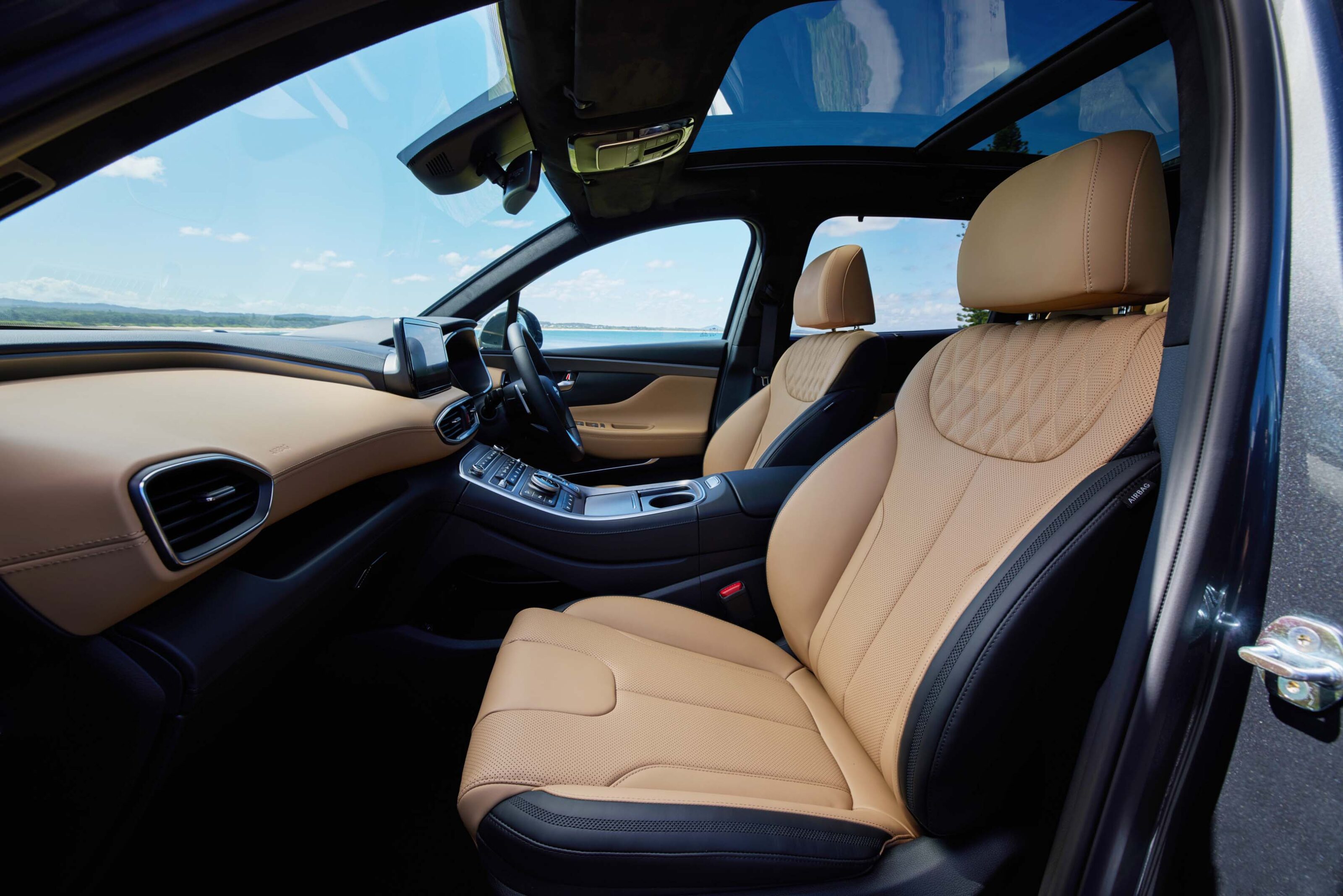
Above the Elite, the plush Highlander stands out with the $295 option of ‘Camel’ coloured Nappa cowhide, standard three-stage seat cooling, panoramic sunroof and – for the first time – availability of a six-seater arrangement with second-row captain’s chairs.
| 2023 Santa Fe Highlander features (in addition to Elite) | |
|---|---|
| Projector LED headlights | Heated and ventilated front seats |
| Nappa leather upholstery (black or Camel) | 14-way adjust power front seats |
| Heated second row seats | Opening panoramic sunroof |
| Available second row captainu2019s chairs | |
How do rivals compare on value?
Hyundai’s Santa Fe hybrid joins two other three-row petrol-electric SUVs in the Australian market, those being the Kia Sorento and Toyota Kluger that duked it out in a recent Wheels comparison test.
The Santa Fe is not the most affordable out there – that award goes to the cloth-upholstered Kluger GX hybrid ($54,150 before on-road costs) – but spec-for-spec, the Santa Fe shapes up well.
A range-topping 2023 Hyundai Santa Fe highlander AWD lists at $69,550 before on-road costs, $200 less than the equivalent Sorento GT-Line hybrid ($69,750) and $6150 cheaper than a Kluger Grande hybrid.
With the Elite understudy starting at $63,000 – which probably has enough spec for most – Santa Fe undercuts the Sorento GT-Line front-drive hybrid ($67,950) and the mid-spec Kluger GXL hybrid ($63,650). All before on-road costs.
Even compared to popular combustion-only rivals in the class, such as the Mazda CX-9 Azami LE turbo ($74,710) and larger Hyundai Palisade Highlander ($79,900) – both before on-road costs – the hybrid Hyundai stacks up smartly.
Interior comfort, space and storage
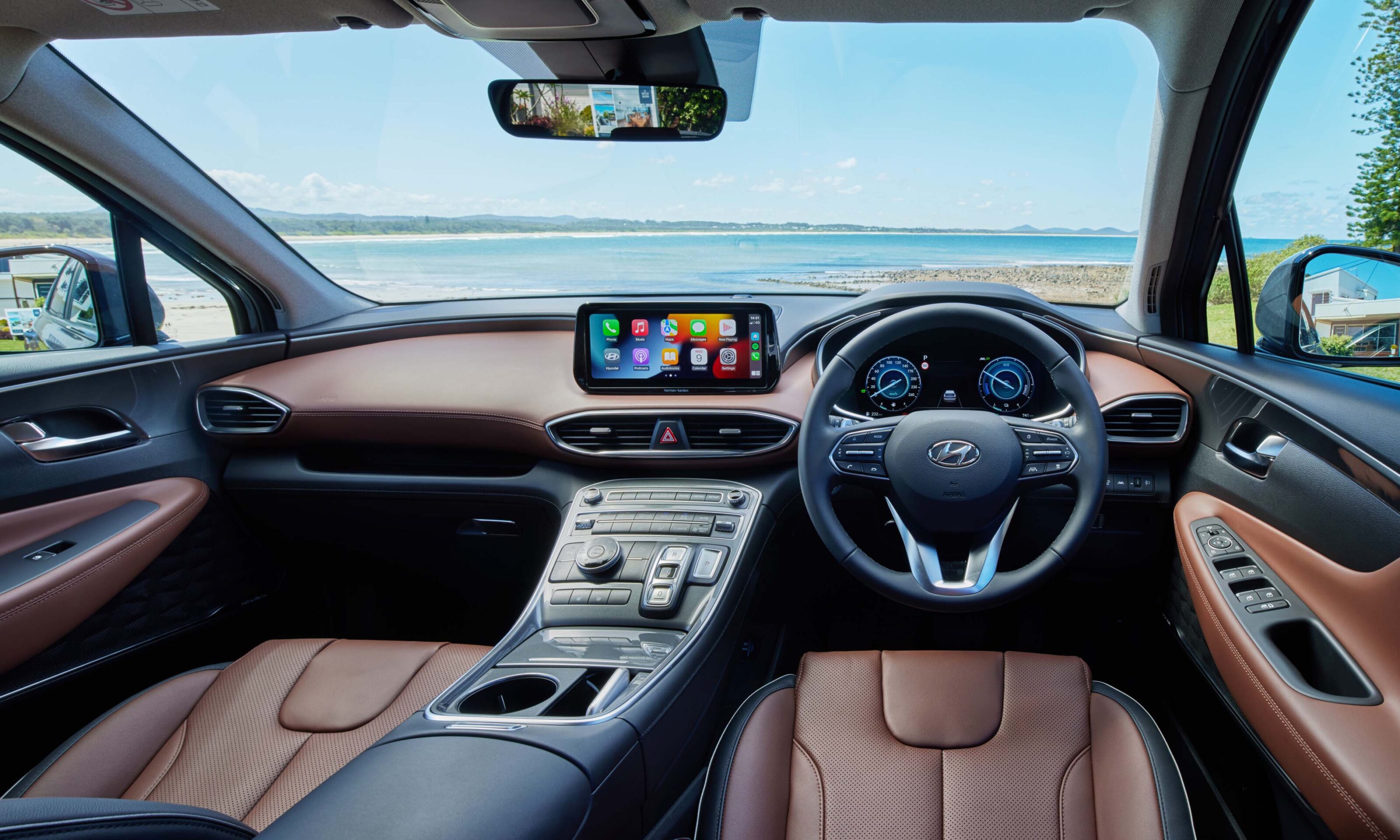
A light-coloured leather seems to effortlessly lift a cabin’s ambience. The Kia Sorento’s cabin may have a sleeker design than the Santa Fe’s but in Highlander trim with Camel upholstery and luxurious ventilated seats, Hyundai’s fairly affordable SUV feels a good deal more special than its list price.
Start looking around and this theme continues with that expansive glass roof, tactile suede-cloth headliner and soft-touch leather-appointed dashboard.
As you start to get over the initial wow factor, though, you notice the slightly messy-looking sea of buttons on the control-bridge-inspired centre console. I know, we complain endlessly about overly-minimal touchscreens, yet now we’re whingeing about too many buttons?
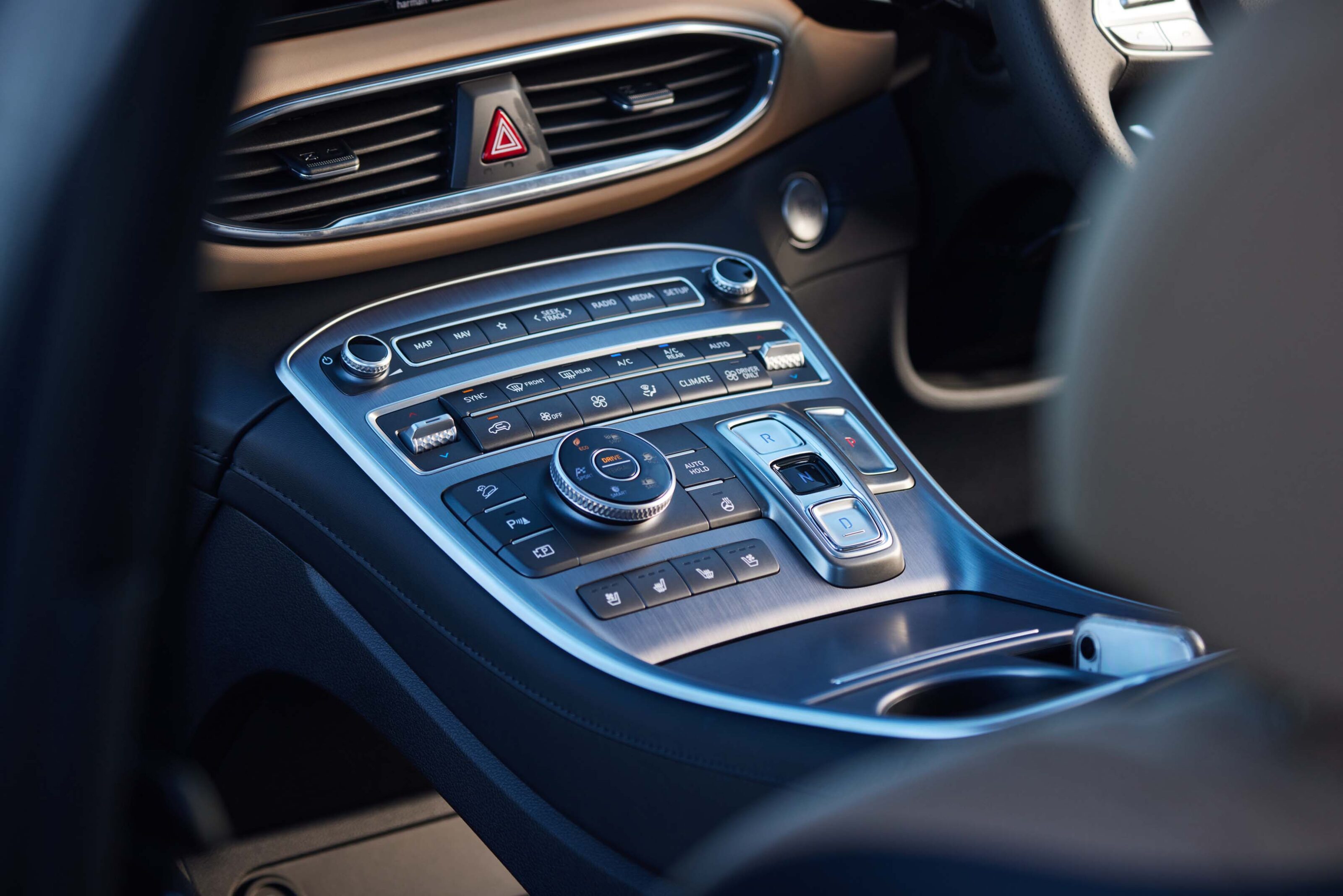
Some will surely appreciate the layout of the switches, but it is a touch bamboozling when you first get in. The button-controlled shifter takes time to wrap your head around, too.
The technology package is slick with attractive graphics rendered nicely on the Santa Fe’s 10.25-inch infotainment touchscreen. There’s navigation with live traffic and 10 years of updates plus DAB+ digital radio, as well as wired Apple CarPlay and Android Auto.
In front of the driver, there’s a 12.3-inch digital driver’s display on both Santa Fe hybrid trims, with graphics tied to the three drive modes: Eco, Smart and Sport.
Being appointed in soft Nappa leather with 14-way adjustment, heating and cooling the Santa Fe Highlander’s seats are a very comfy place to spend time. That said, even those in the Elite offer good adjustability including in-and-out lumbar support along with heating.
Bottle storage is good, with a comfy covered centre cubby and fairly decent door bins. There’s also a neat rubberised cubby ahead of the front passenger perfect for phones or notebooks. Hyundai’s vertical wireless smartphone charging is a really clever touch, further freeing up the centre console.
There’s one USB-A port for connectivity and another for charging, with a 12-volt socket located beneath the floating bridge where you’ll find further odds-and-ends storage with a rubberised floor to minimise slippage.
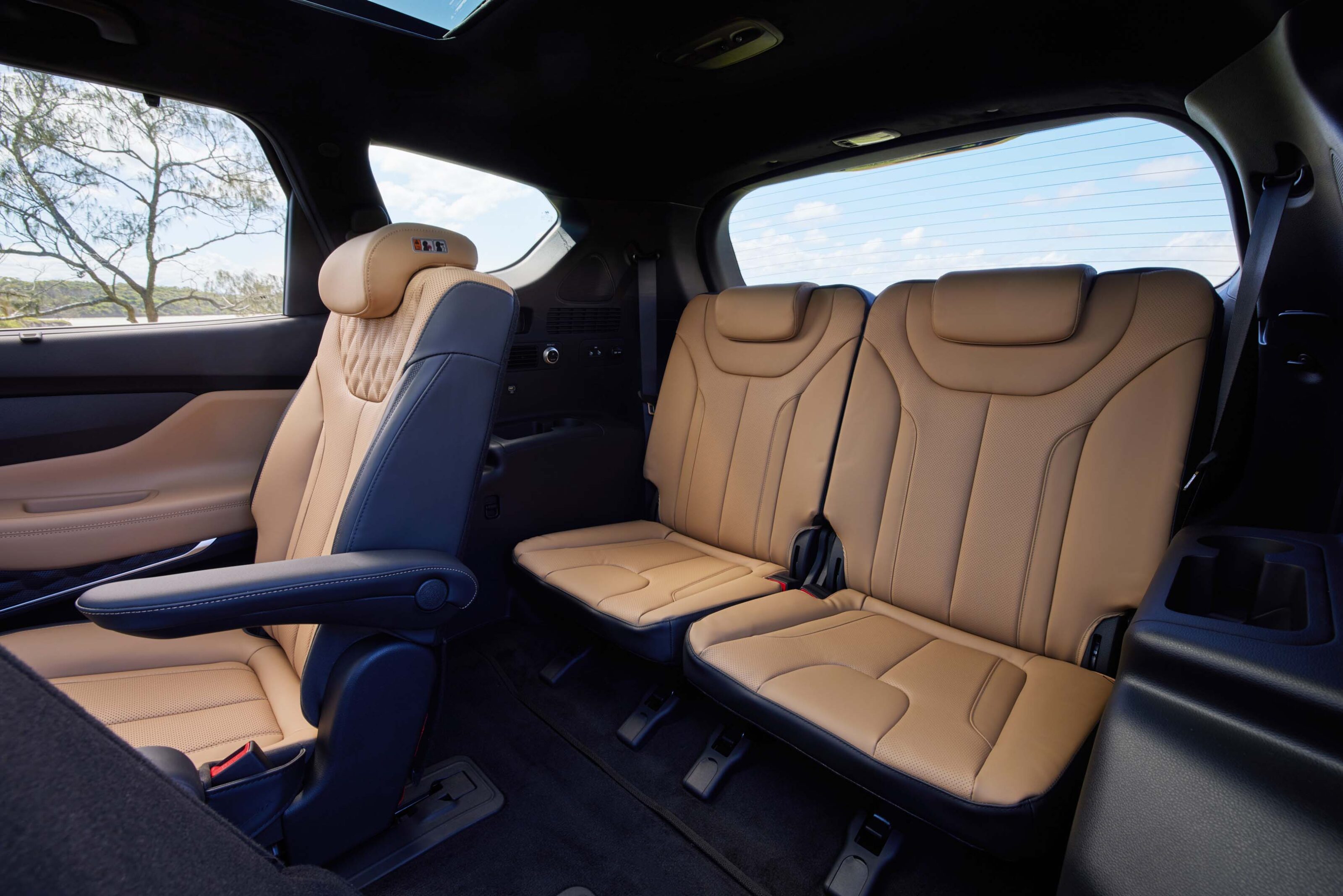
Jumping into the back seat and the three-wide bench is generous with lots of legroom and toe room. Headroom is generous, even under the Highlander’s panoramic sunroof.
The optional six-seat configuration with captain’s chairs, though, levels it up further. With individual adjustable armrests, power adjustment and space to stretch out, it’s an ultimate luxury conveyance for the kids.
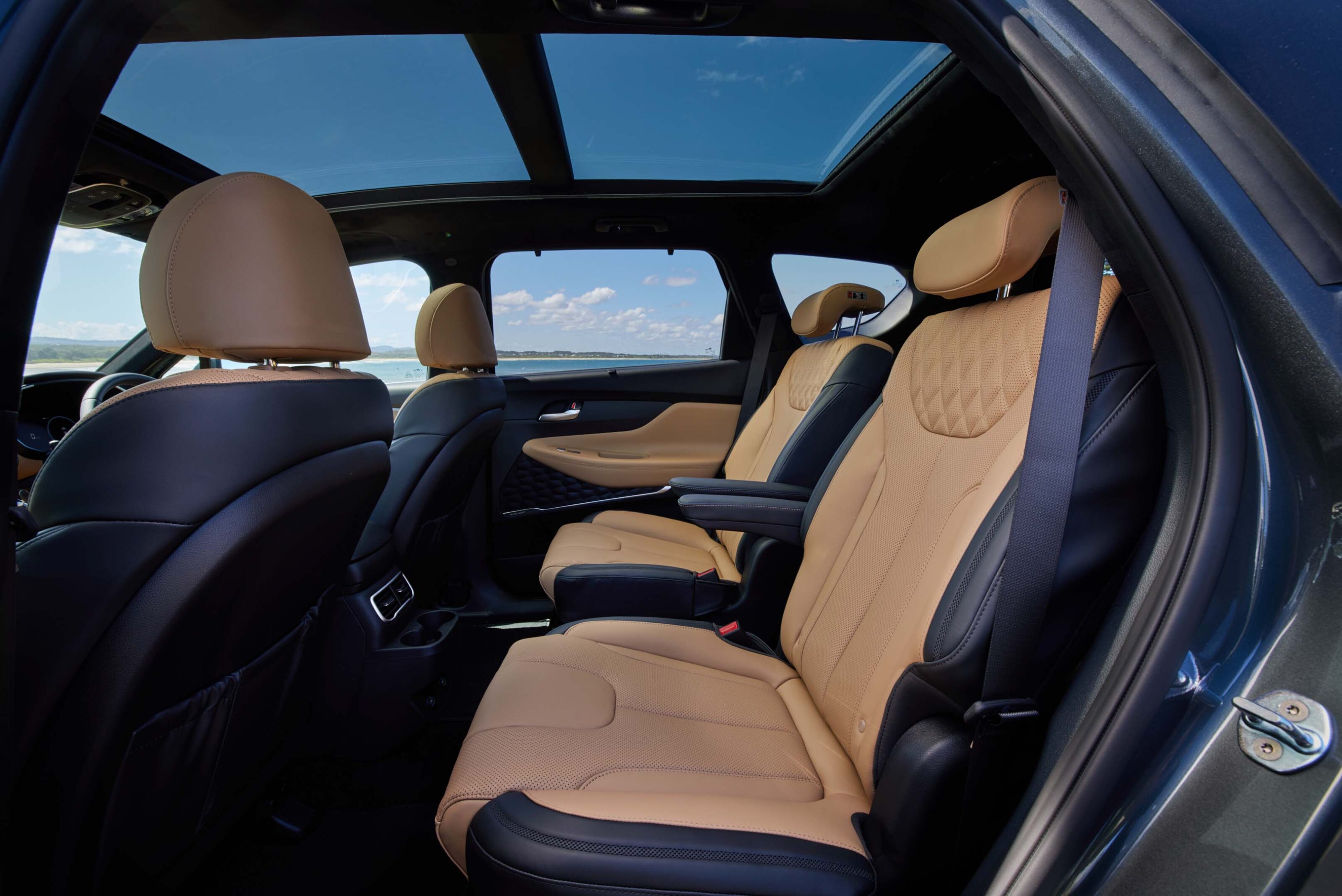
There are other benefits beyond luxury, such as the ability to leave baby capsules set up in the outboard seats with a corridor through the middle for older kids to climb into the third row.
Third-row passengers will find an adequate amount of room. Like the Kia Sorento, the Hyundai Santa Fe is a well-packaged bit of kit and actually offers a more generous third row than the larger Toyota Kluger.
2023 Hyundai Santa Fe Hybrid boot space
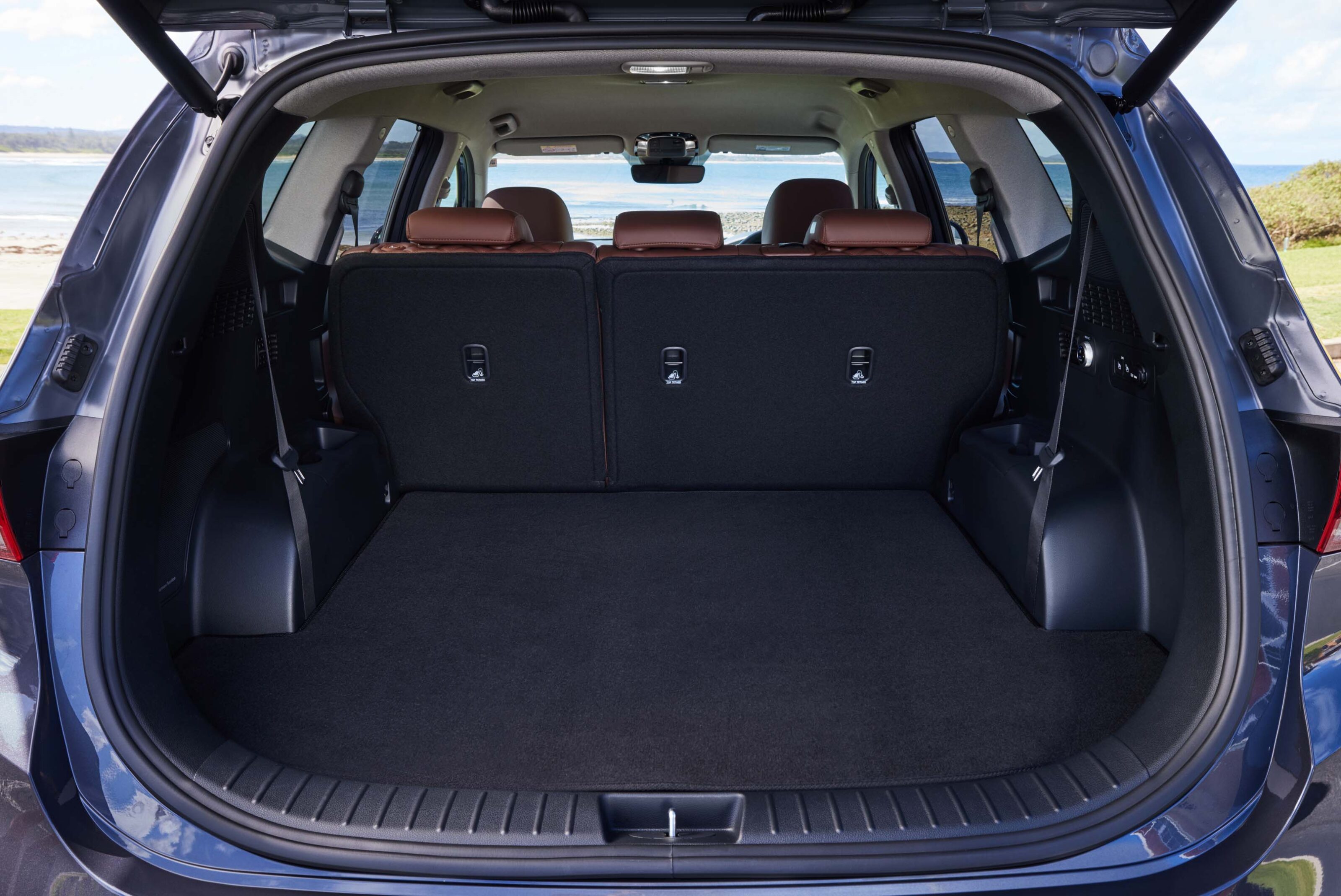
Cargo space is generous too, with 130L available when all seats are in place, 571 litres with the second row in its furthest back position on the sliders, and up to 782 litres with the second row slid forward.
The finish quality is likewise classy, with the Highlander and Elite getting a removable carpet. There’s a little more storage under the floor, and all Santa Fe hybrids get a full-size spare wheel under the car as the 1.49kWh battery lives beneath the driver’s seat in the chassis.
What is it like to drive?
With the battery located towards the nose of the Santa Fe hybrid, Hyundai had to tweak the front suspension tune to suit. Unlike the core range, the hybrid Santa Fe’s suspension was not tuned in Australia, but it was signed off by local boffins before hitting dealers.
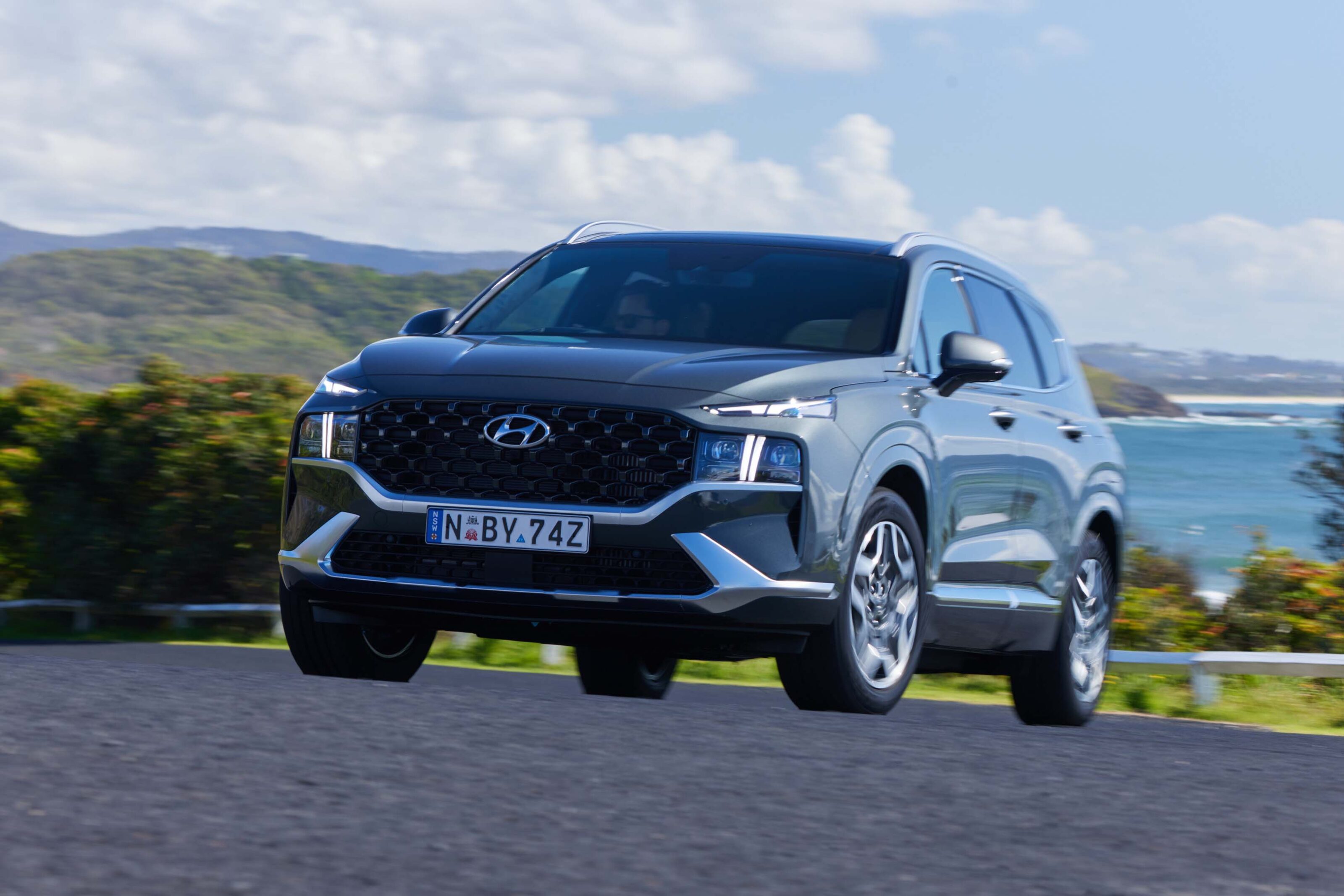
And it seems Hyundai global has been listening to Australian feedback about suspension tuning. The Santa Fe hybrid is smooth and plush, without being too wayward in its body control. It splits the difference between Kia Sorento GT-Line (firm) and Toyota Kluger Grande (supple).
Of the three selectable on-road drive modes, Smart cuts a nice balance as it responds to the driver’s inputs. Sport adds some welcome weight to the steering, which is fairly accurate for a vehicle of this type.
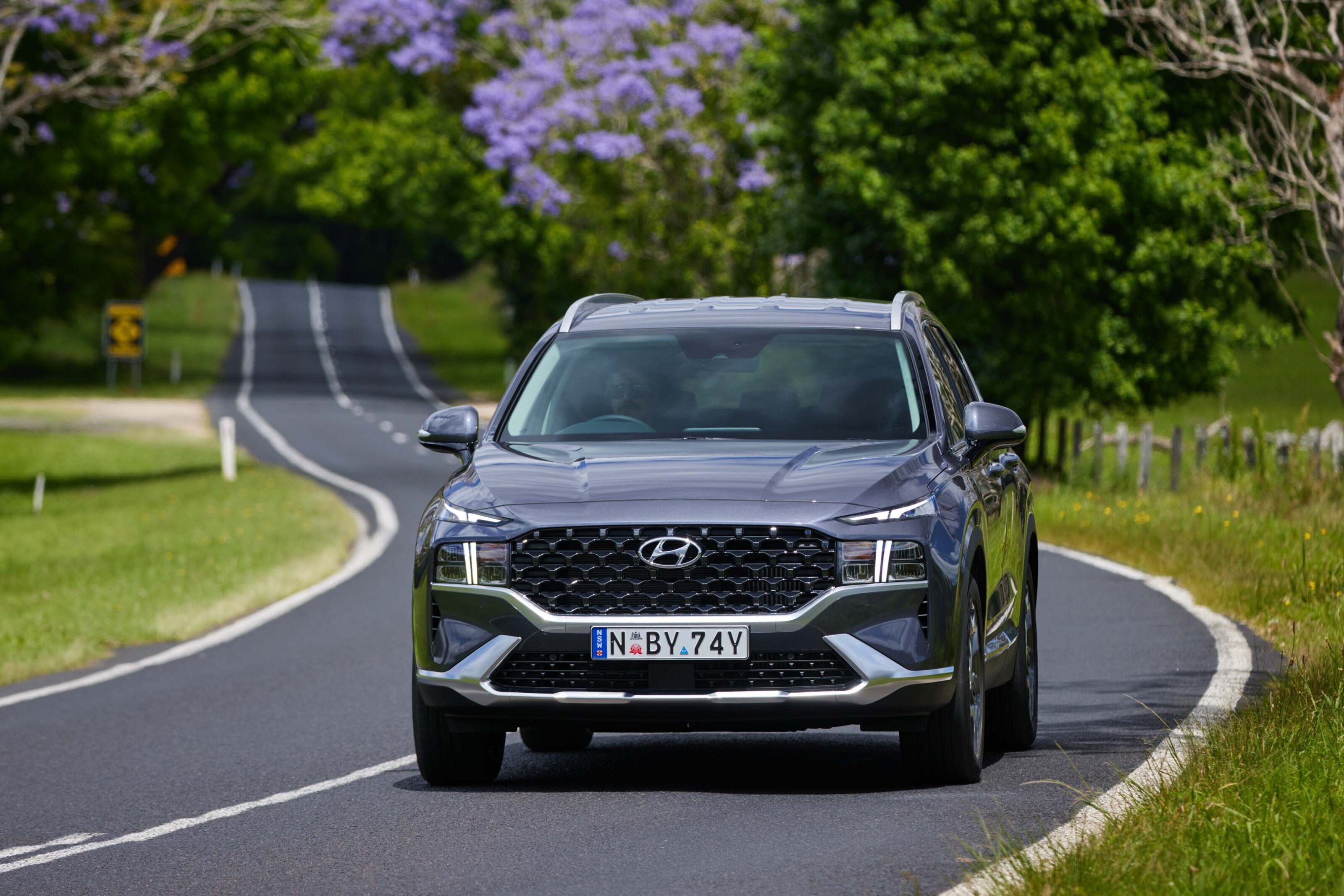
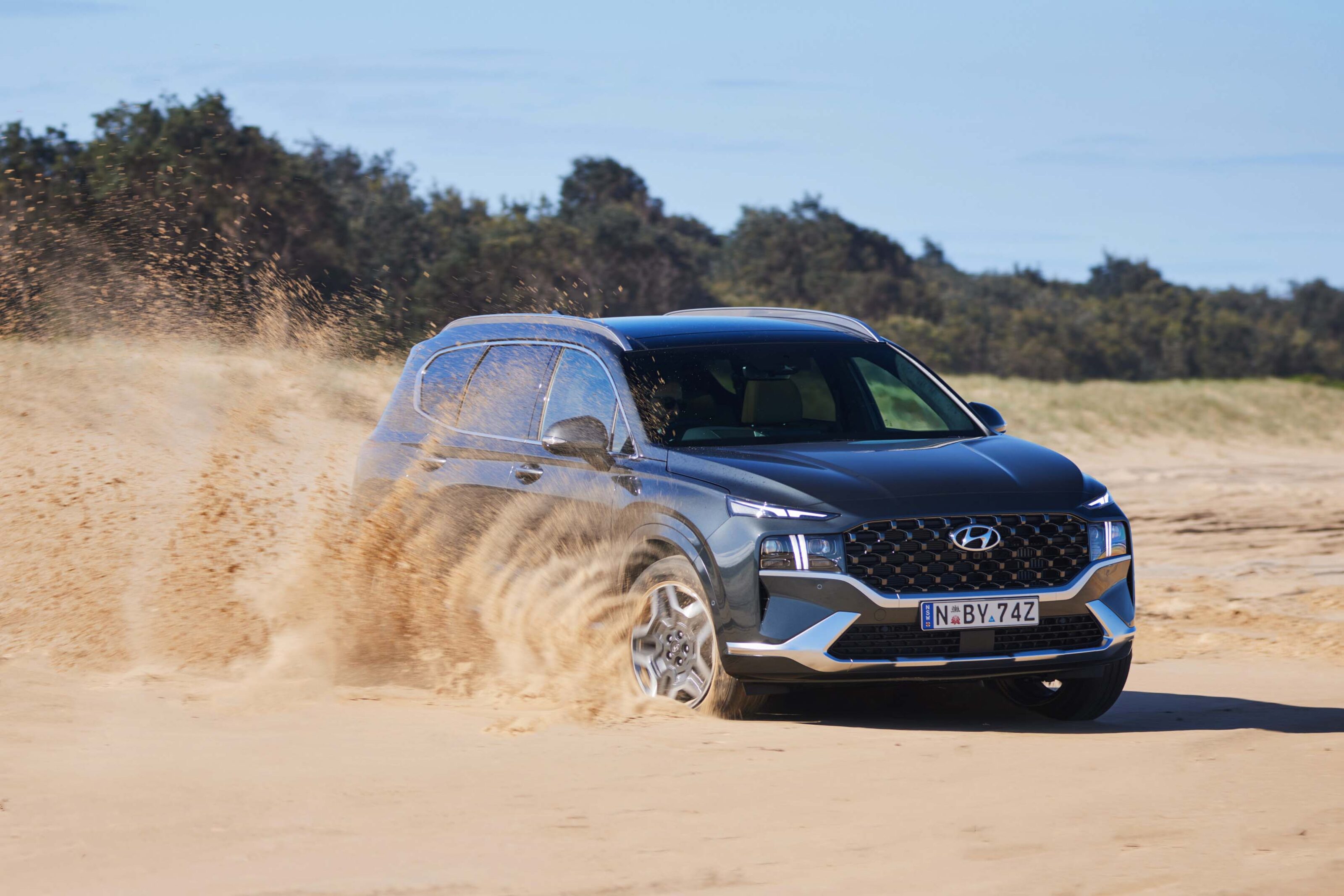
With only 176mm of ground clearance, the Santa Fe isn’t a rock crawler, but using Sand Terrain mode on the 60km of corrugated dirt road we encountered during the launch showed the Santa Fe’s ESC system to be smooth and proactive, with a neutral and predictable chassis balance.
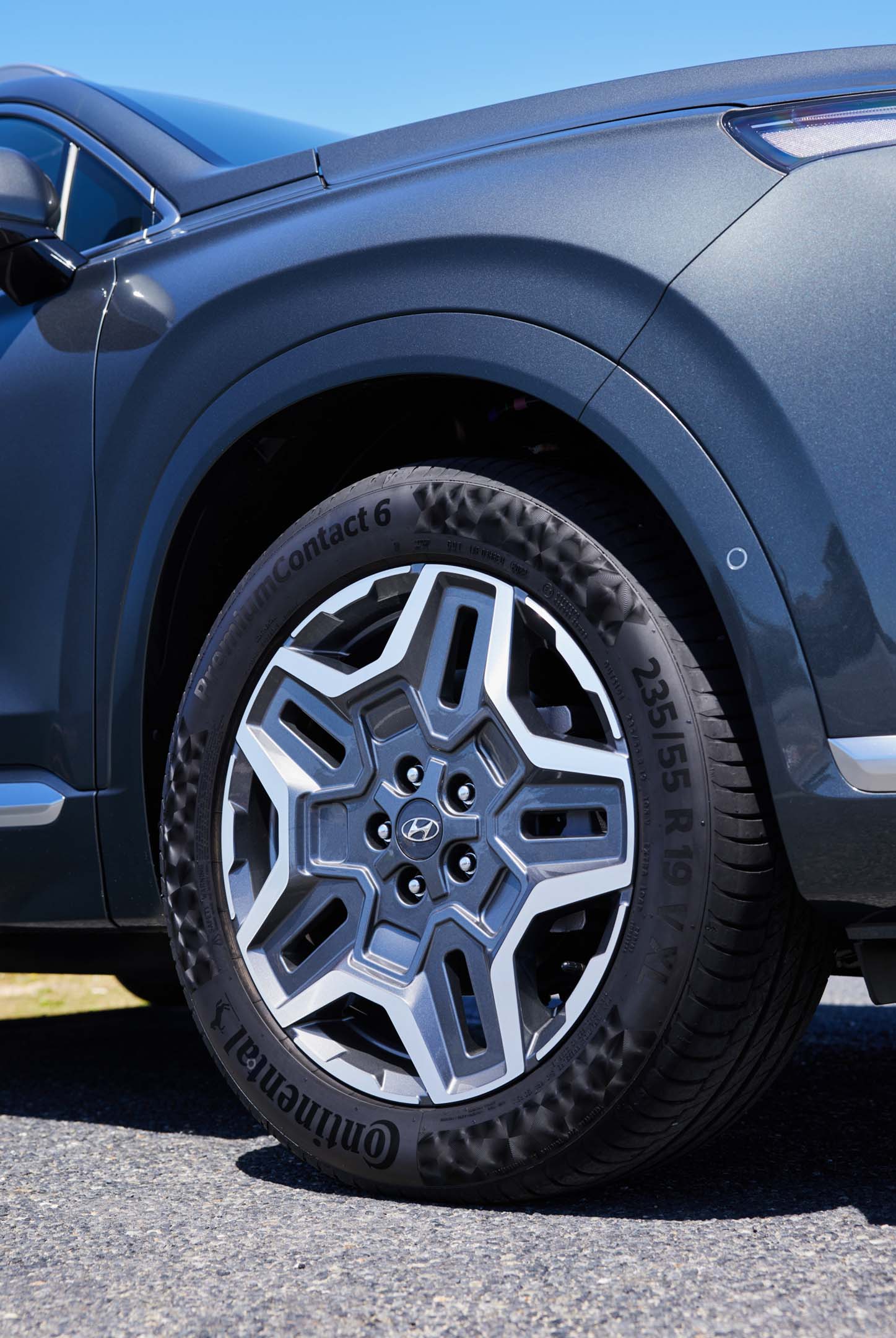
The Santa Fe hybrid turns in well and its 235/55 R19 Continental Premium Contact tyres offer a good amount of grip. In its heaviest Highlander trim, the 1983kg hybrid adds 40kg of weight over the 2.2-litre turbo-diesel. While the Santa Fe typically deals with its weight well, there are no clever adaptive suspension tricks like you’d find in an Audi Q8 or BMW X7, so body roll wins out in the end.
It all results in a long-legged grand tourer that suits pockmarked Australian backroads and dirt corrugations as well as it does speed humps and concrete expansion joints.
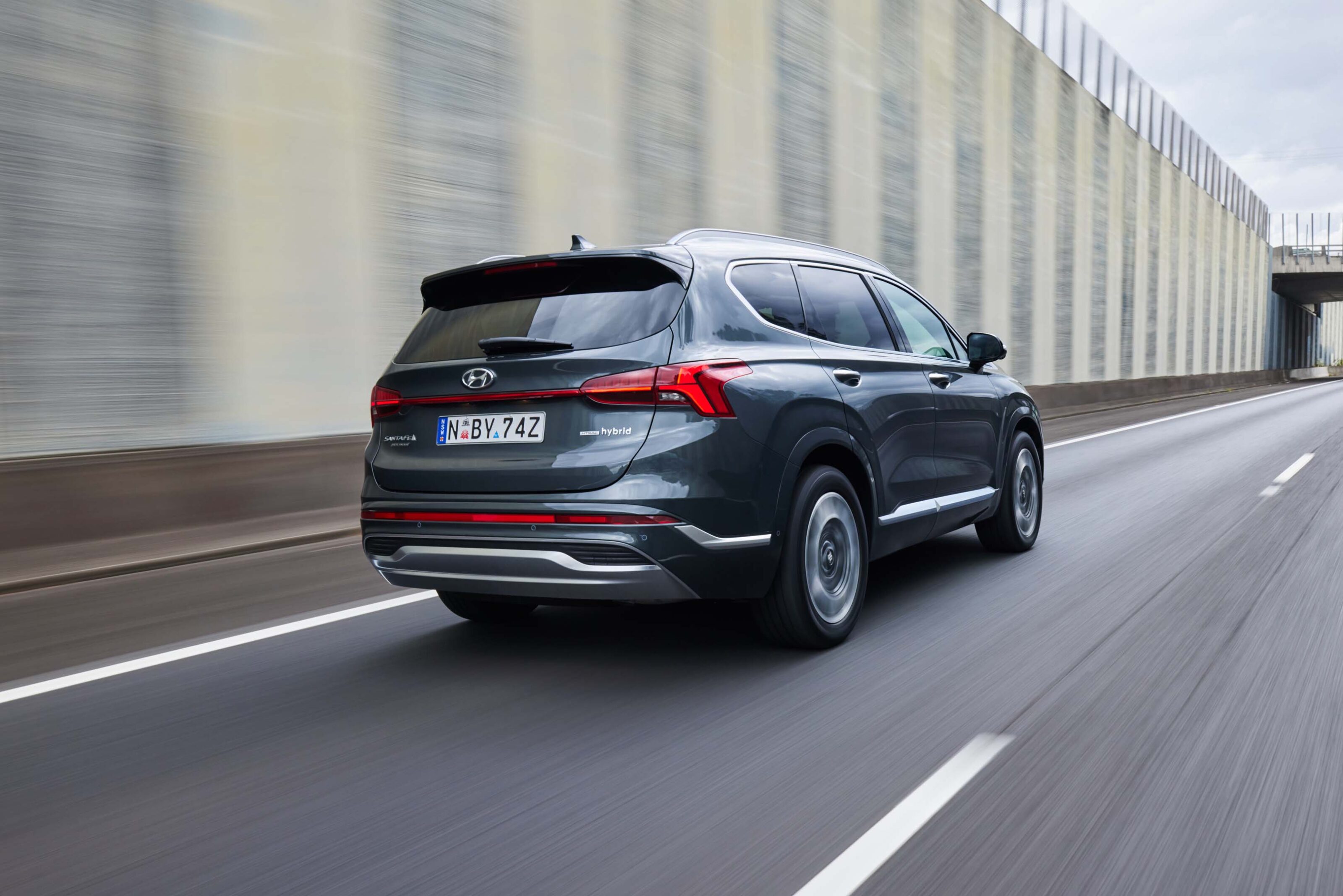
This is also an extremely quiet seven-seater, more so than the alloy-block 148kW 2.2-litre four-cylinder diesel that typically thrums away in the background when driving an AWD Santa Fe.
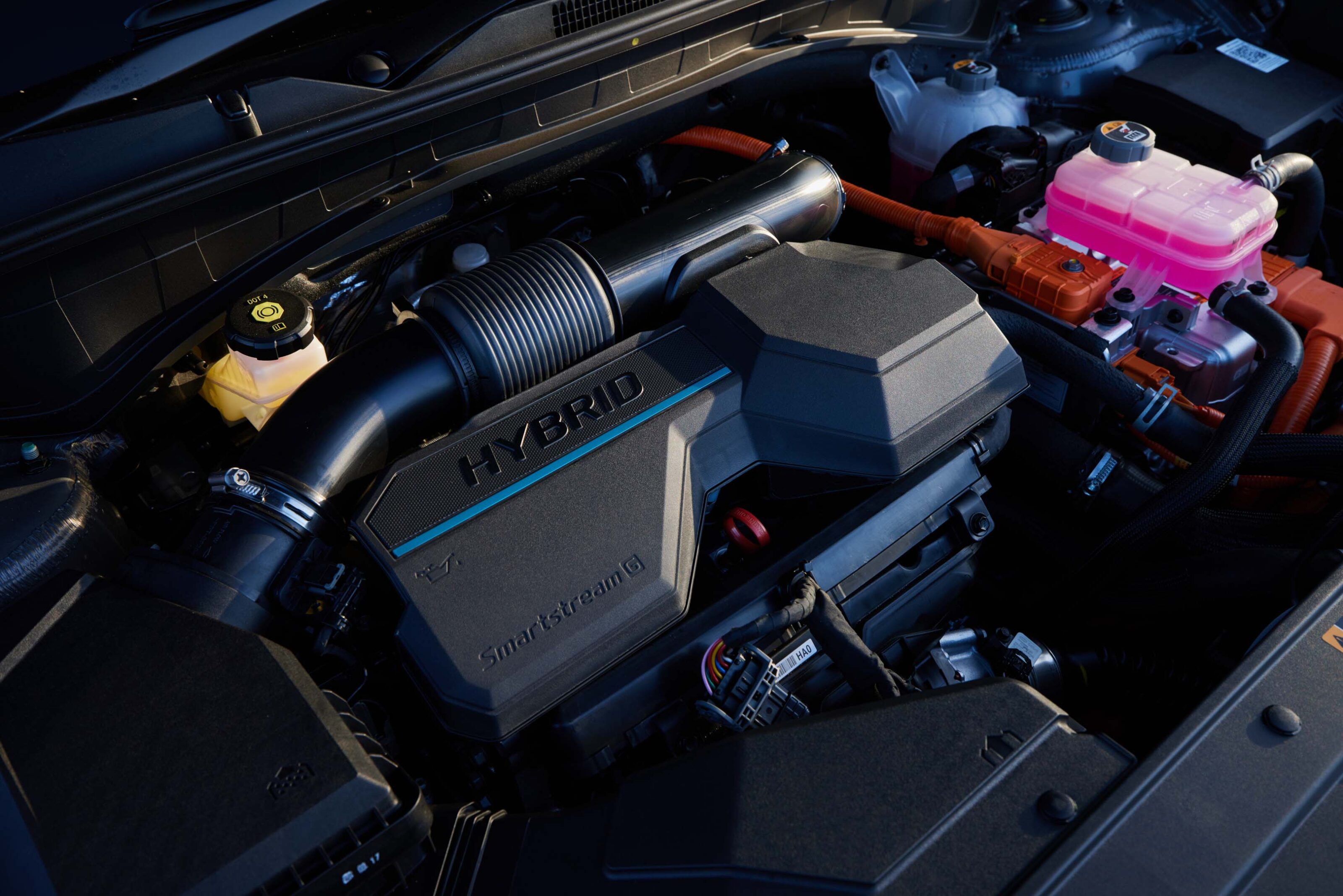
Its ‘Smartstream’ 1.6-litre turbo-petrol four-cylinder is linked to a six-speed torque converter automatic with a 44.2kW/264Nm electric motor sandwiched in between, meaning the 2023 Santa Fe hybrid develops a combined 169kW of power and 350Nm of torque.
This means the Santa Fe hybrid gets an active on-demand AWD system – Hyundai calls it HTRAC – rather than a solution like Toyota’s eFour system with a separate electric motor and no physical connection to the engine at the front.
We found traction to be strong on both dirt and tarmac, where the Santa Fe hybrid sprinted from 0-100km/h in 8.7 seconds. There are occasions that the electric motor isn’t powerful enough to motivate the Santa Fe – mainly on steep car park ramps – but mostly the system is seamless and whisper quiet in its operation.
How much fuel does it use?
The Santa Fe hybrid AWD is rated at 6.0L/100km in the combined ADR 81/02 fuel economy cycle and will accept 91 RON or E10 blend unleaded at the bowser.
Although 40 per cent better than the V6 petrol (10.5L/100km), the hybrid is only a whisker more efficient than the diesel’s 6.1L/100km figure.
The hybrid’s equation for saving money on fuel doesn’t look great next to the 2.2-litre diesel, taking over 100,000kms to offset that 0.1L/100km saving, even when taking into account the current elevated price of diesel at the bowser.
On the 450km test loop that involved lots of technical, twisting country roads meaning that the petrol engine was doing the majority of the work, not the electric motor, the Santa Fe hybrid was showing 9.0L/100km on the trip computer.
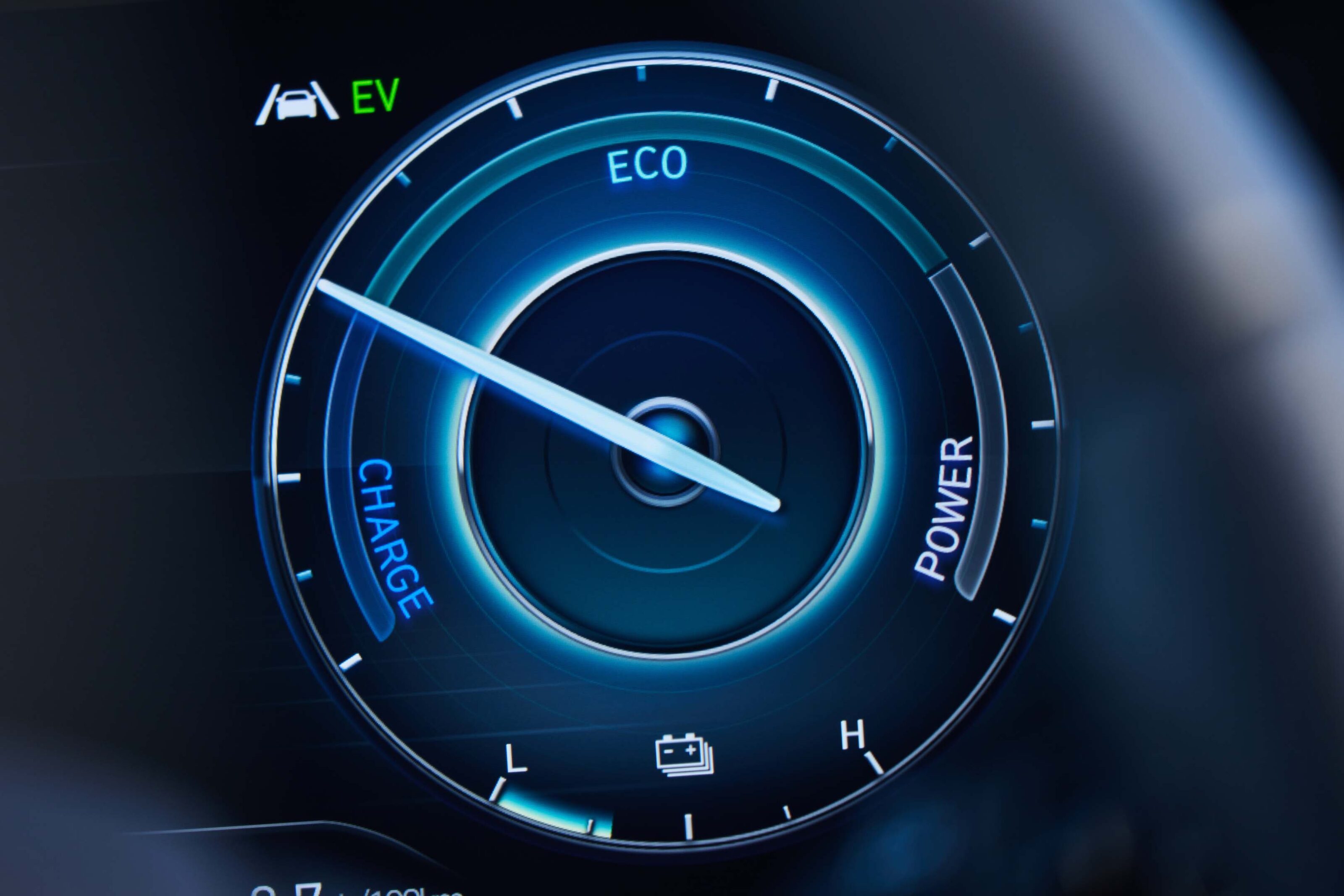
In similar circumstances, the diesel Santa Fe would perform just as well, if not better (its ADR highway rating is 5.3L/100km) with the added benefit of 2500kg braked towing capacity over the Hybrid’s 1650kg. So who exactly is the hybrid Santa Fe for then?
Returning from Canberra to Sydney, we found out. The Santa Fe hybrid’s consumption dropped to 6.0L/100km on the Federal and Hume highways, with a jaunt across Sydney’s inner west not affecting this fuel-sipping tendency.
It’s in urban environments where families will reap the rewards of the Santa Fe hybrid, then. There are also fewer nasty particulate emissions when burning petrol compared to diesel.
How safe is it?
The Hyundai Santa Fe was awarded five stars in 2018 ANCAP safety testing.
Since its December 2020 facelift, the Santa Fe’s safety list has improved further with the addition of junction auto emergency braking and a front centre airbag, bringing the total to seven. However, the Santa Fe’s curtain airbags don’t extend back to entirely cover third-row occupants.
Active safety features include forward AEB with pedestrian, cyclist and junction detection, low-speed reverse AEB, blind-spot monitoring, rear cross-traffic alert, rear occupant alert, driver monitoring, speed sign recognition and safe-exit assist.
Further driver aids include a conservative adaptive cruise control program with stop-and-go, somewhat jerky lane-trace assist, blind-spot view monitor (that handily beams a camera feed from the vehicle’s flanks into the digital cluster), and front and rear parking sensors. The Highlander scores a 360-degree camera over the Elite.
Warranty and running costs
Hyundai covers the Santa Fe hybrid – as it does all models – with a five-year, unlimited-kilometre warranty in Australia. In addition, the high voltage electrics are warranted for eight years or 160,000km.
The five-year warranty matches most mainstream rivals, though Kia offers seven years with no kilometre cap, and Mitsubishi up to 10 years or 200,000km for its Outlander three-row SUV if serviced at a main dealer.
Santa Fe hybrid servicing is due every 12 months or 10,000km and Hyundai offers pre-paid service plans for up to five years or 50,000km. Servicing is anticipated to be a little dearer than the diesel ($2295), but Hyundai had not finalised hybrid service pricing at the time of writing.
VERDICT
The Hyundai Santa Fe may have come late to the three-row hybrid SUV party, but its arrival is welcome.
In the Highlander, Camel-tanned Nappa leather with cooled front seats is such a refreshing option in a sea of dark leather and piano black trim.
And while the Highlander may garner all the attention, the $63K Elite specification is bursting with gear – you don’t feel like you’re missing out by getting the cheaper one at all.
Country buyers will be better served by the diesel with its more impressive highway fuel consumption and mid-range torque but for urban dwellers, the Santa Fe hybrid is a refined, composed and efficient option that’s well worth considering.
2023 Hyundai Santa Fe Hybrid specifications
| Hyundai Santa Fe hybrid | |
|---|---|
| DRIVETRAIN | |
| Engine | 4cyl, dohc, 16v, turbo-petrol, direct-injected |
| Layout | front engine (east-west) AWD |
| Capacity | 1598cc |
| Electric motor | Asynchronous 44.2kW/264Nm |
| Total power | 169kW |
| Total torque | 350Nm |
| Gearbox | 6-speed automatic |
| CHASSIS | |
| Body | steel, 5 door, 7-seat large SUV |
| L/W/H/Wu2013B | 4785/1900/1685/2765mm |
| Weight | 1845-1983kg |
| Boot | 130/571-782 litres |
| Fuel/tank | 91 RON/ 67 litres |
| Economy (rated) | 6.0L/100km (ADR combined cycle) |
| Suspension | Front: struts, coil springs, anti-roll bar. Rear: multi-link |
| Steering | electric rack-and-pinion |
| Front brakes | ventilated discs (325mm) |
| Rear brakes | solid discs (305mm) |
| Tyres | Continental Premium Contact 6 |
| Tyre size | 235/55R19 |
| SAFETY | |
| ANCAP rating | five stars (2018) |
| PERFORMANCE | |
| 0-100km/h | 8.7 sec (tested) |
Snapshot
- Ongoing COVID-19 restrictions in China is making BMW CEO worried
- Yet 2023 global sales are projected to be on par with this year
- A laundry list of electric cars are being made in China
BMW’s CEO is concerned about the impact China’s government-imposed lockdowns will have on car production, as the country continues to use strict measures to curb the spread of the COVID-19 pandemic.
“In China, lockdowns are currently increasing, not decreasing,” BMW CEO Oliver Zipse said.
“I am worried about how we get out of the lockdown situation in future quarters. There is no visibility that China has a solution.”
The Bavarian car brand has three factories in Shenyang, China thanks to its joint venture with Brilliance Auto, with a dedicated electric vehicle plant in Lydia recently opening in June.
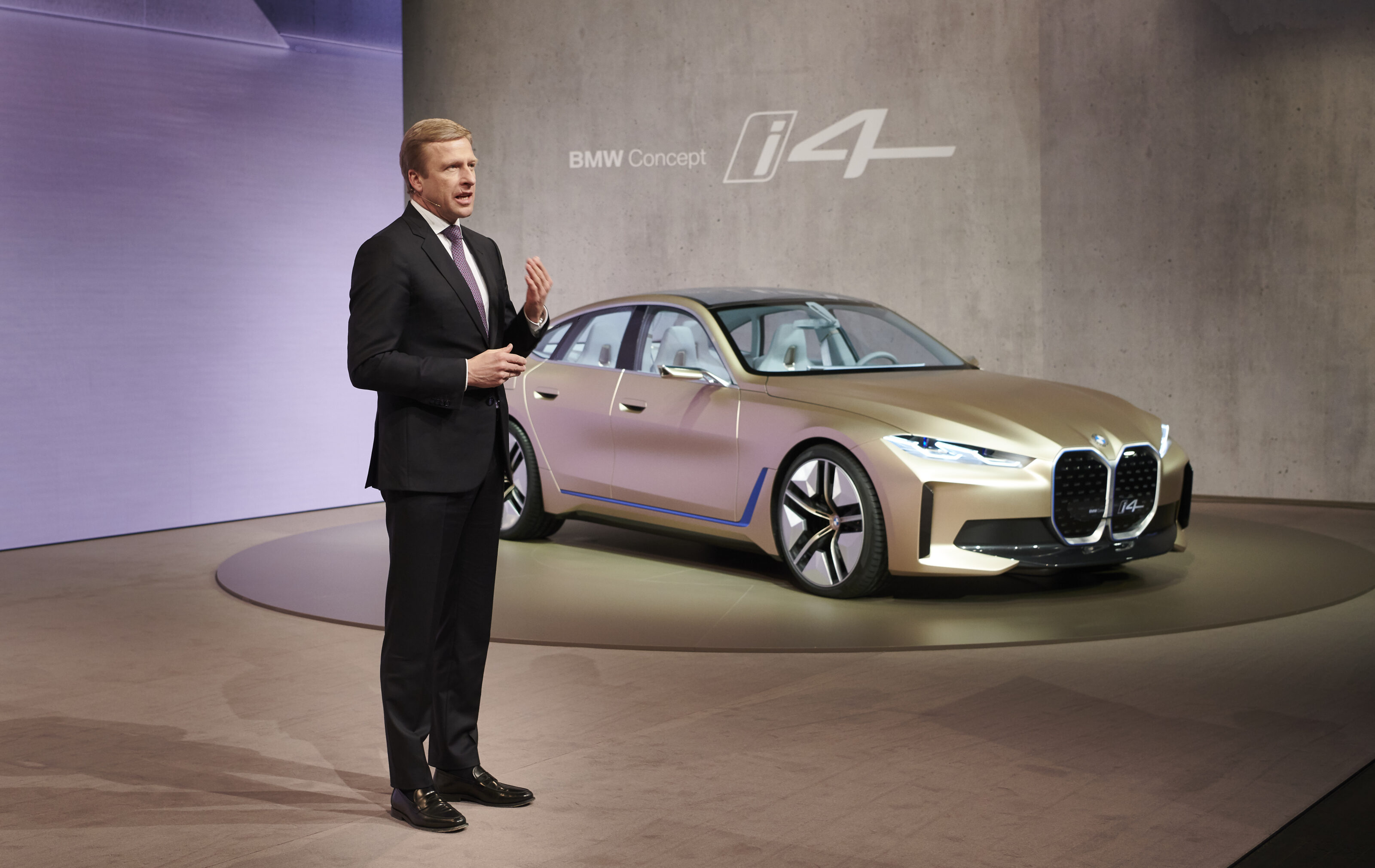
Chinese citizens have taken to the streets this week demanding an end to draconian lockdowns as part of the state’s zero-COVID strategy and, in a rarely seen move, the Xi Jinping government.
Similar dissidence ensued inside Foxconn’s Zhengzhou factory last week, where workers protested against COVID-19 restrictions, poor living and working conditions, and claims of overdue pay. Foxconn notably produces Apple iPhones, Fisker and its very own Foxtron EVs.
Despite continued lockdowns in China and ongoing semiconductor and parts supply chain issues, Zipse predicts 2023’s global sales will be around the same level as this year.
“There will be different developments in different parts of the world, but overall, they will compensate each other,” Zipse said.
To the end of October this year, BMW has sold 7975 cars in Australia. This represents a 17.8 per cent dip compared to the same period in 2021, but is in line with global expectations.
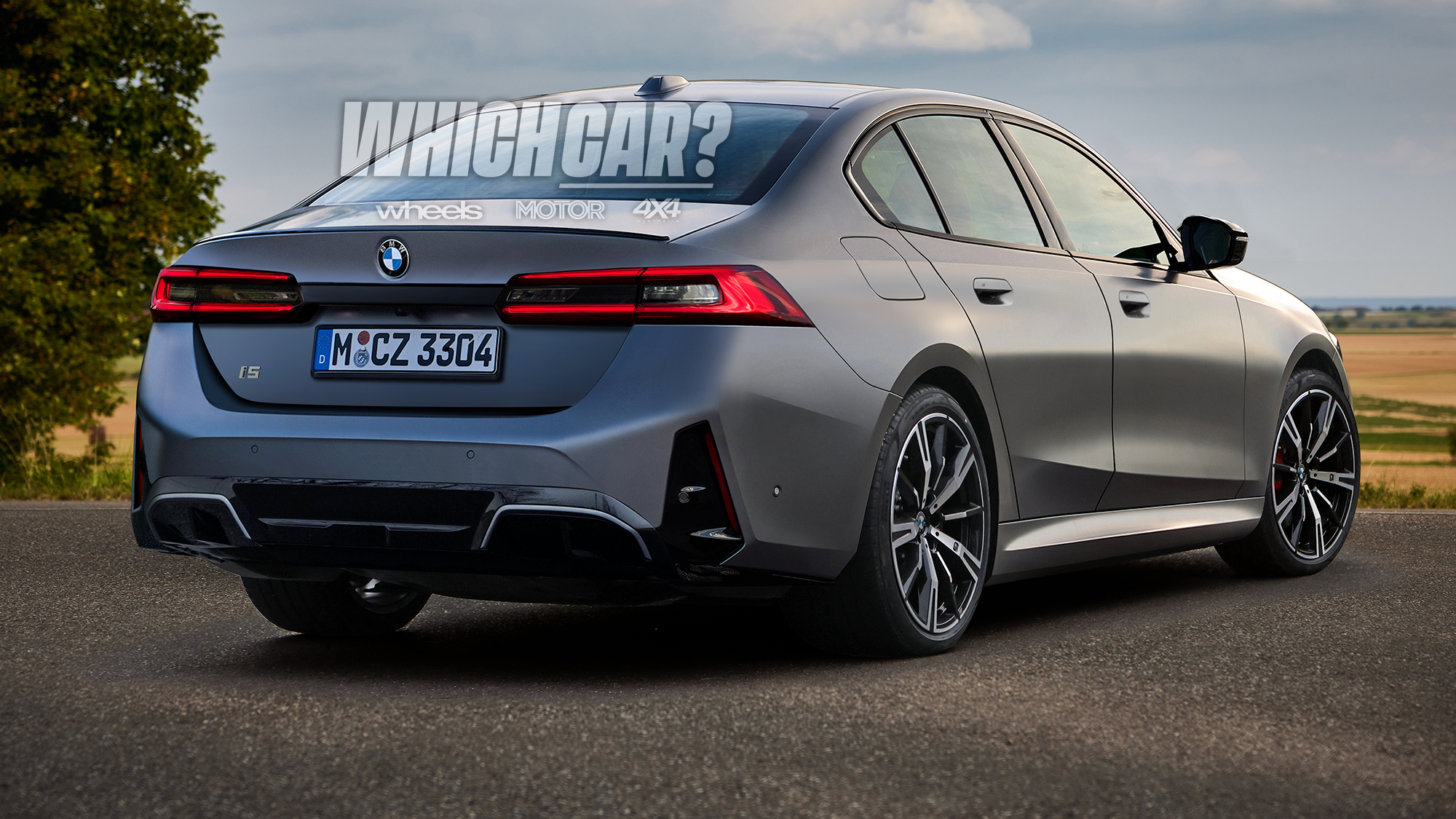
Australia sources the BMW iX3 medium electric SUV from its Dadong, Shenyang factory in China. The forthcoming i5 medium sedan, next-generation Mini Electric Hatch, and Aceman crossover battery-electric models are all expected to be made in China.
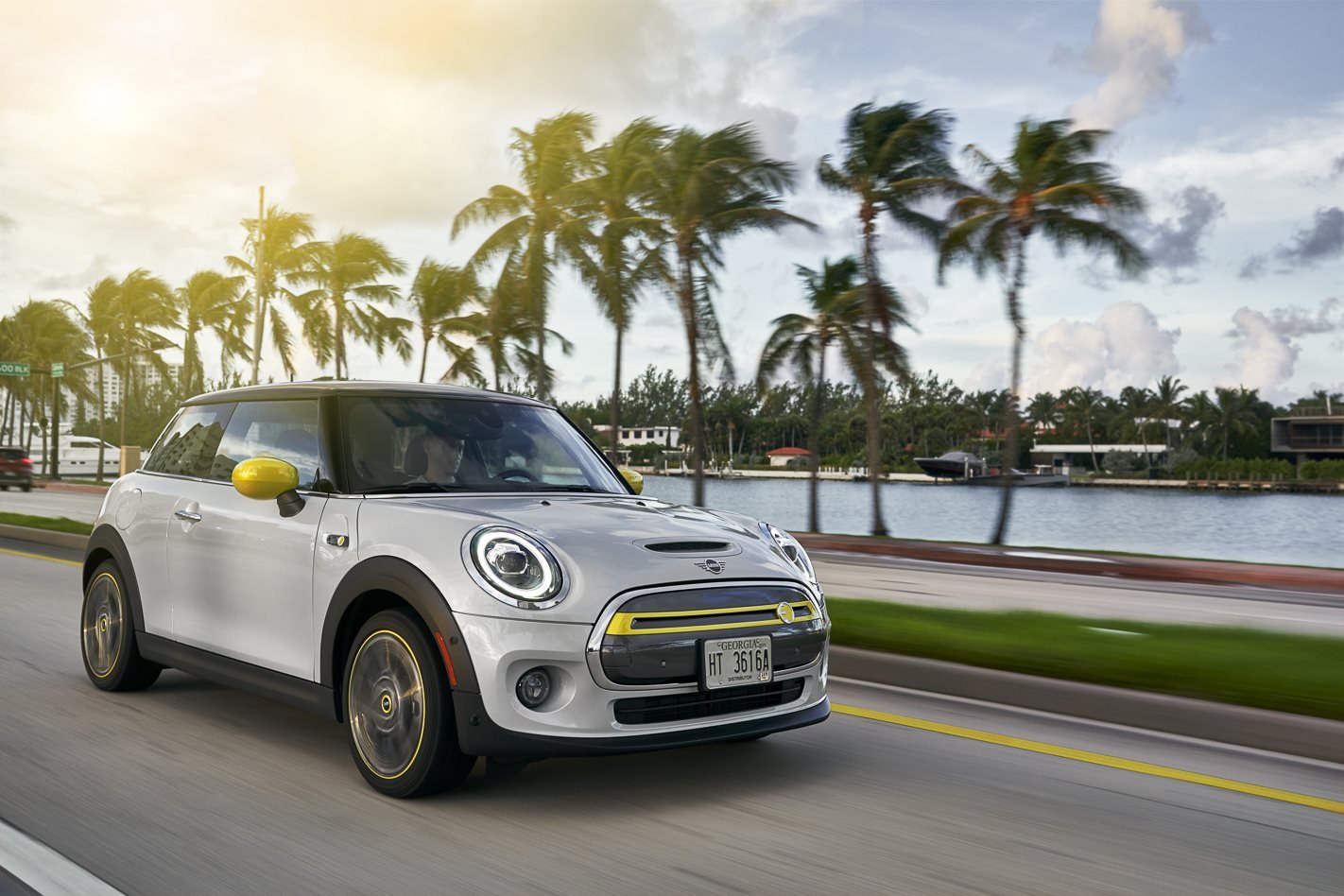
The quirky Mini sub brand won’t stray away from its spiritual home country, though. It will continue manufacturing internal combustion-engined vehicles in Oxford as it isn’t designed for EV production, but currently makes the soon-to-be replaced three-door Mini Electric.
A growing number of EVs are hailing from China, including the best-selling Tesla Model 3, Model Y, MG ZS EV, BYD Atto 3, Polestar 2, and upcoming MG 4, GWM Ora Funky Cat and more, alongside major battery suppliers like Contemporary Amperex Technology Co. Limited (CATL), BYD and CALB Technology.
EV sales are booming in China. More than three million battery-electric cars from domestic and Western brands have been registered year to the end of September, representing 22 per cent market share.
Snapshot
- Polestar CEO says the Polestar 7 will be the first European-made model
- But itu2019ll be around 2027 and Volvo has the final word
- Five separate factories currently confirmed in China and the USA
Sino-Swedish electric carmaker Polestar wants to add Europe as another manufacturing source, but it’ll need to wait at least five years and launch four other new models until it becomes a reality.
“For us, what is important is to come to Europe at some point in time. And that could be around the time we start making the Polestar 7,” Polestar CEO Thomas Ingenlath told Automotive News Europe.
Since Polestar uses an ‘asset-light’ model, it needs to negotiate with major shareholders of its two owners – Swedish firm Volvo Cars and Chinese automaker Geely – to utilise space at their factories.
Volvo’s European factories are currently spread in Sweden and Belgium, with a Slovakia plant opening in 2026. The Polestar 7 should debut by 2027 or later.
“It’s up to Volvo to see where they will put in the cars on the platform and where they would be built,” Ingenlath said.
It’s unclear what the Polestar 7 will be as the brand doesn’t link the number to the vehicle size, unlike the Hyundai Motor Group and Volkswagen Group approach.
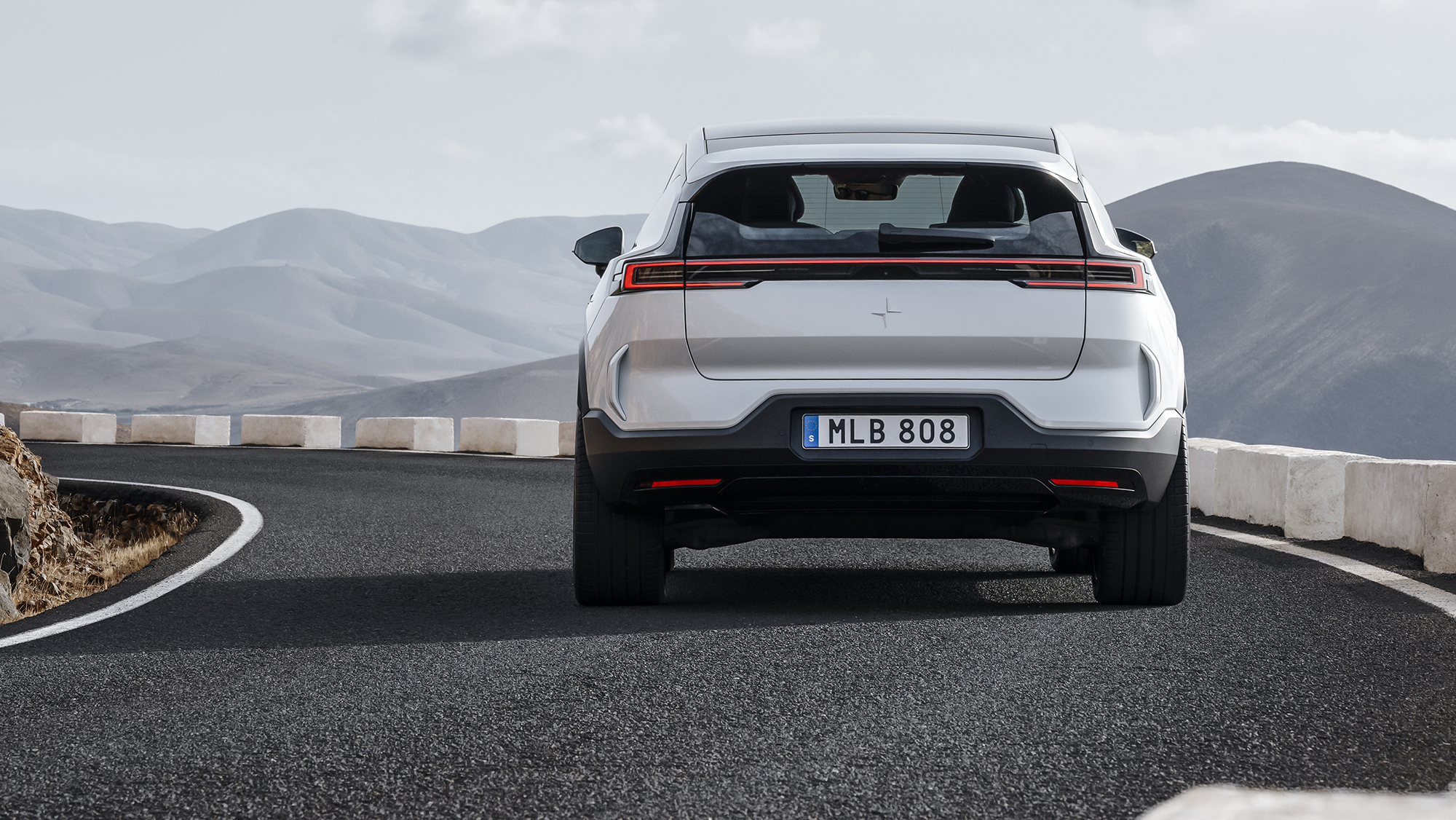
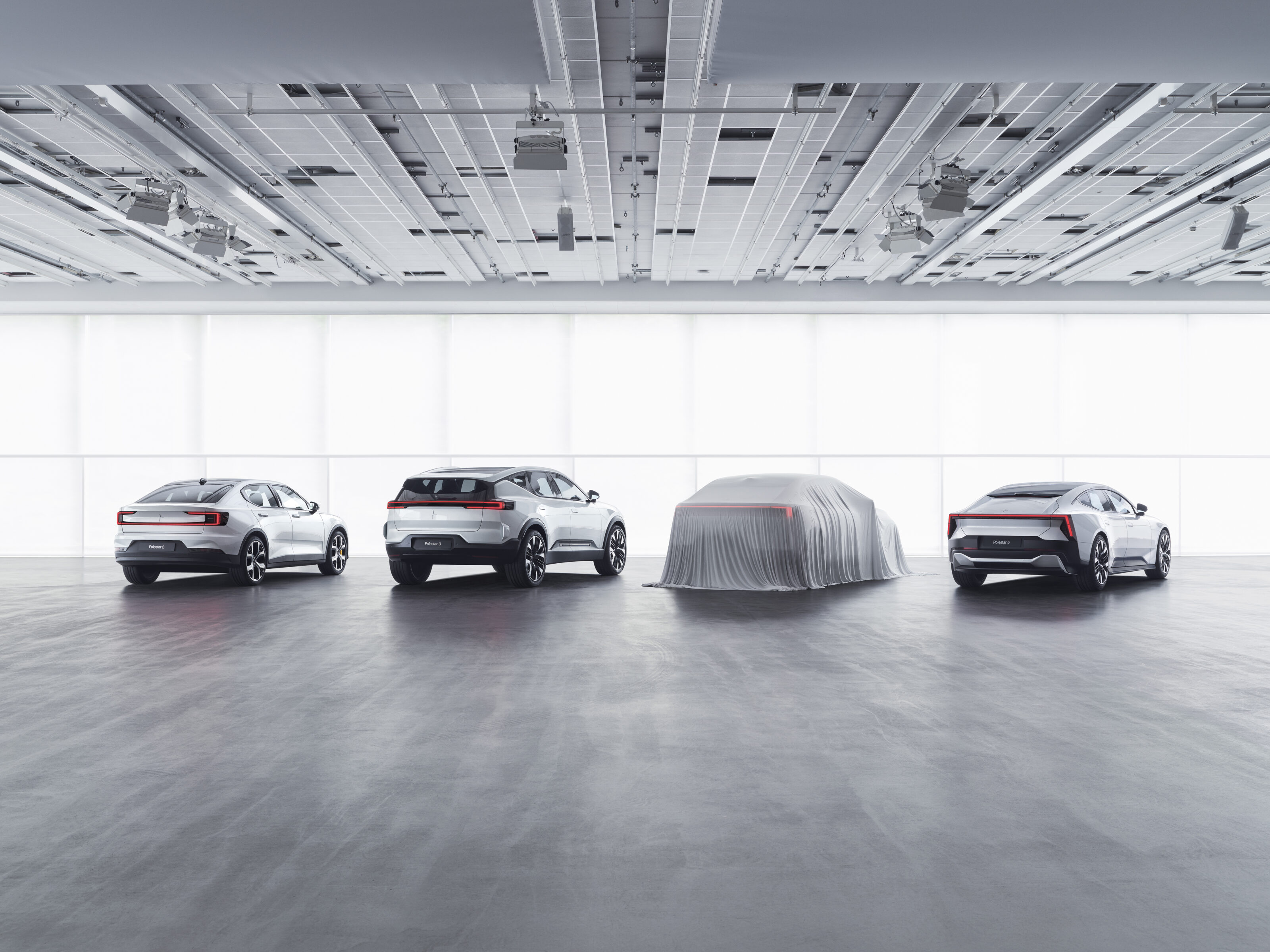
It is currently selling the Tesla Model 3-rivalling Polestar 2 electric liftback which is made in Volvo’s Luqiao, China factory shared with the related Volvo XC40.
It’ll be joined by the Polestar 3 large SUV, which is produced at Volvo’s USA plant in South Carolina and Chengdu, China. The luxury electric car will launch globally next year, then lob in Australia from 2024 hailing from the USA factory.
The yet-to-be revealed Polestar 4 coupe crossover will be more affordable and smaller than the 3, but will be produced at another separate plant: Geely’s Hangzhou Bay factory in China. It’s positioned squarely to rival the forthcoming Porsche Macan EV and launch from 2024.
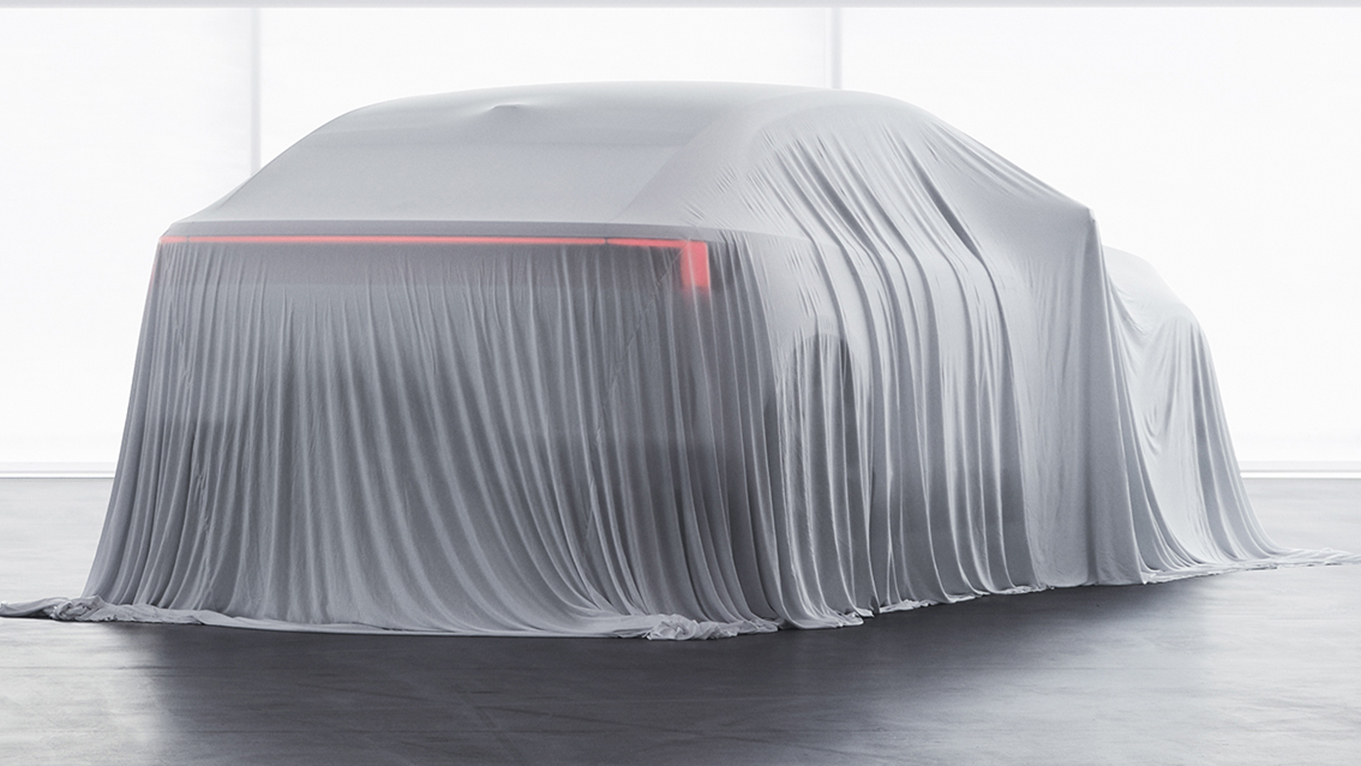
Finally, the Polestar 5 large grand tourer sedan and related Polestar 6 convertible roadster will be made at the carmaker’s first dedicated factory in Chongqing, China set to open in 2024.
That’s when the high performance 5 is scheduled to launch globally, followed by the 6 in 2026. The latter will launch in a Polestar 6 LA Concept variant limited to 500 examples globally – which have all been sold out.
The Polestar 0 is also planned for release by 2030, as the brand’s first climate-neutral production car from start to finish in the circular economy.
Well-known German automotive supplier ZF has announced improved versions of its modular drive units for electric vehicles.
The revised, second-generation components are expected on the market in 2025 to reduce the development time for manufacturers of the latest battery-electric vehicles by several months.
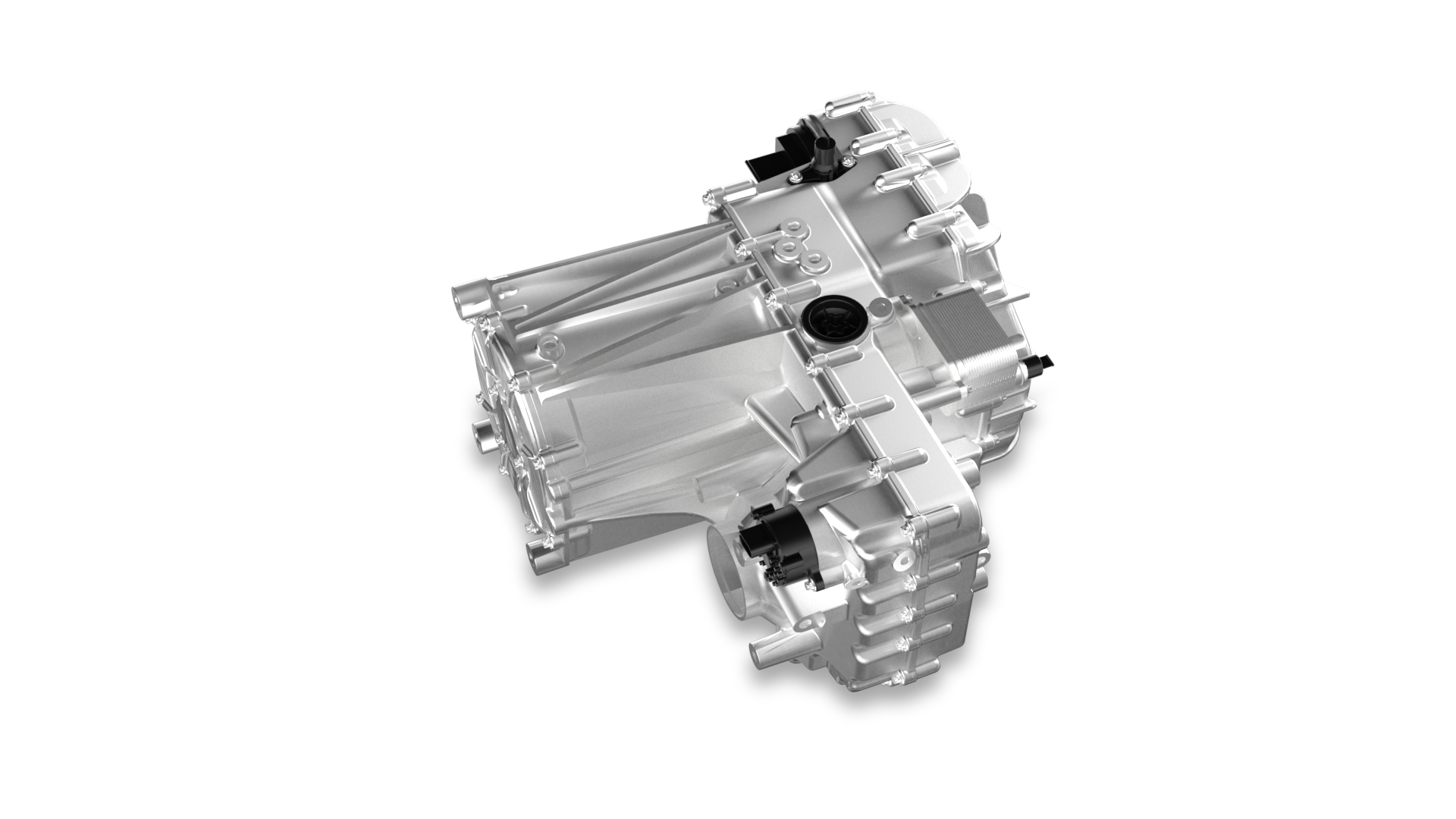
ZF claims the units – known as ‘e-drives’ – will be built in three basic configurations for passenger cars and light commercial vehicles. It consists of a motor, inverter, controllers, transmission and software, with optimisations to reduce cost and size, and improve performance.
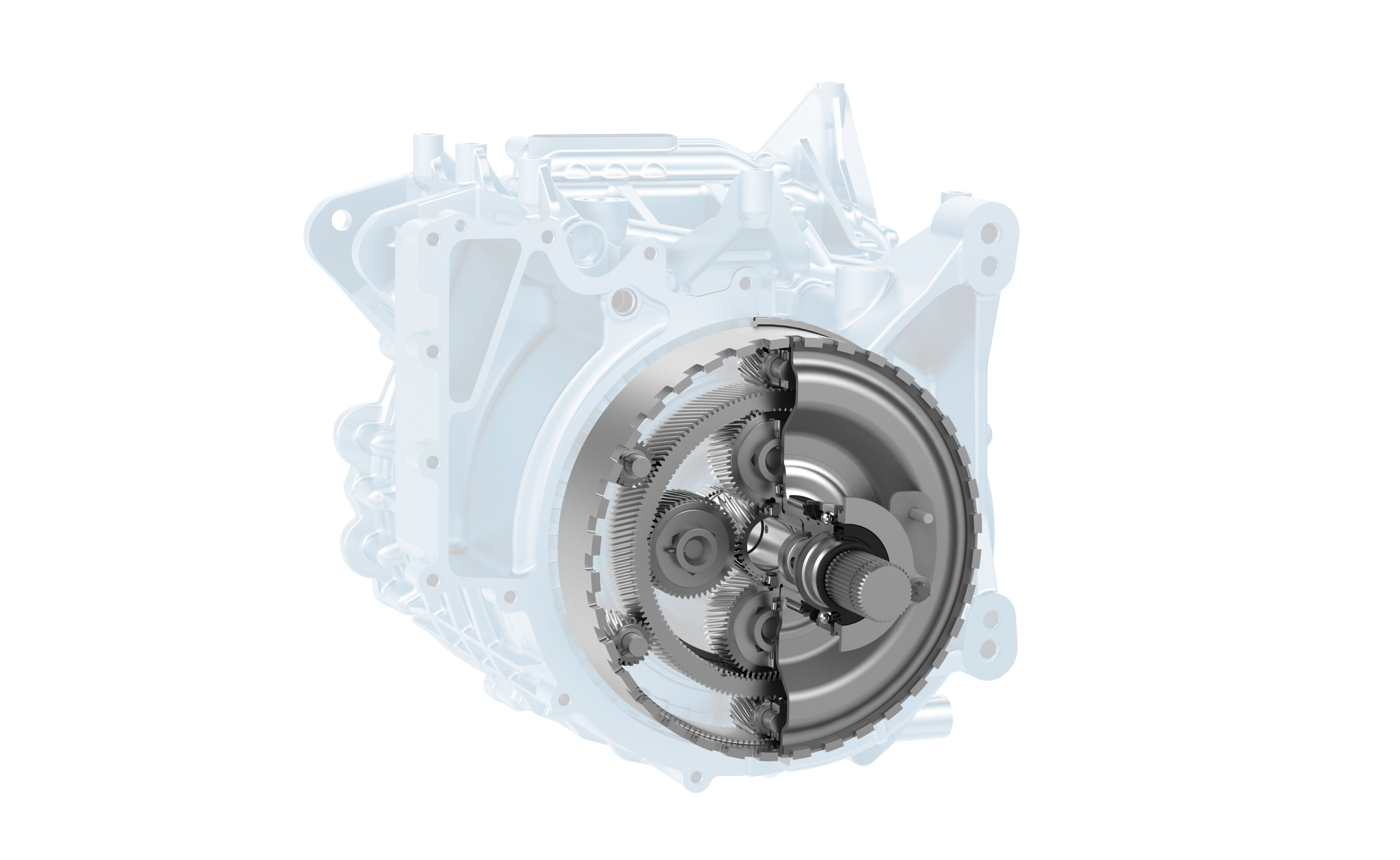
Unlike off-the-shelf solutions for internal combustion vehicles, ZF says its electric motor can be customised to meet the demands of an OEM.
The electric motor will support 400-volt and 800-volt configurations, with increased power density using oil-flow cooling. It says this will increase the continuous power rating to 85 per cent of peak power, allowing smaller motors to be fitted for improved efficiency.
This is achieved through the use of braided windings in the motor, decreasing volume by 10 per cent and allowing for a reduction in the use of heavy and expensive rare earth materials.
To further improve efficiency and performance, ZF has developed an integrated planetary gearbox with a combination of forward and reverse speeds, as seen in the Porsche Taycan.
The two-speed automatic transmission will support a “fully integrated differential function”, potentially allowing for axles to turn in opposite directions, similar to the upcoming Mercedes-Benz EQG’s tank turn.
However, efficiency is the most important selling point, with a two-speed gearbox allowing for a taller gearing ratio to lower an electric vehicle’s RPM at highway speeds.
ZF expects its ‘e-drives’ to commence sales to potentials customers such as BMW, Audi, Porsche, in 2025, however, it said individual components will enter production before that.
According to the German-based brand, it has an order bank equivalent to €25 billion (AU$38.7 billion).
The BYD Dolphin and Seal have hit a slight delay for Australia, with pre-orders now expected to open in 2023 in order to cut delivery wait times.
Snapshot
- Dolphin to start pre-orders and deliveries in H1 2023, Seal in H2 2023
- Order books delayed until next year to shorten delivery wait time
- Distributor aims to have more BYD cars in stock locally
The all-electric Dolphin city hatchback is slated to open its order books and commence deliveries in the first half of 2023, while the Seal sedan will follow in the second half.
Previously, local distributor EVDirect had said the new BYD electric cars would be on sale before the end of this year.
“We had hoped to put the Dolphin on sale this year, but decided to hold the pre-sale date back to be closer to the actual delivery date,” EVDirect chief executive Luke Todd told Wheels Media this morning.
“We want to move towards being a brand that can release models closer to the actual delivery date.
Todd added that BYD’s “massive production capability” meant that the brand should have stock in-country in 2023, ready to go as customers place their orders.
However, this doesn’t indicate that customer deliveries of the BYD electric cars have been pushed back.
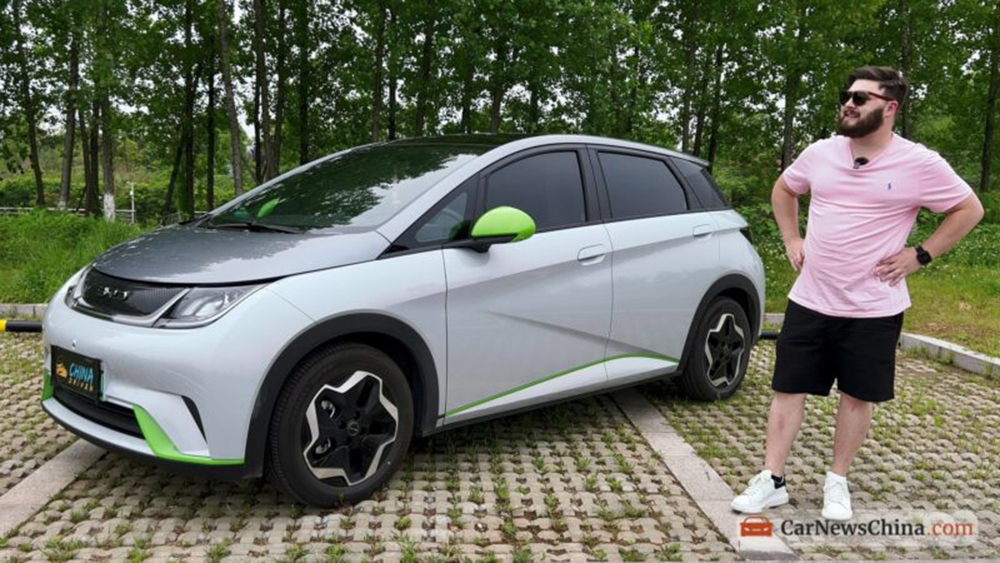
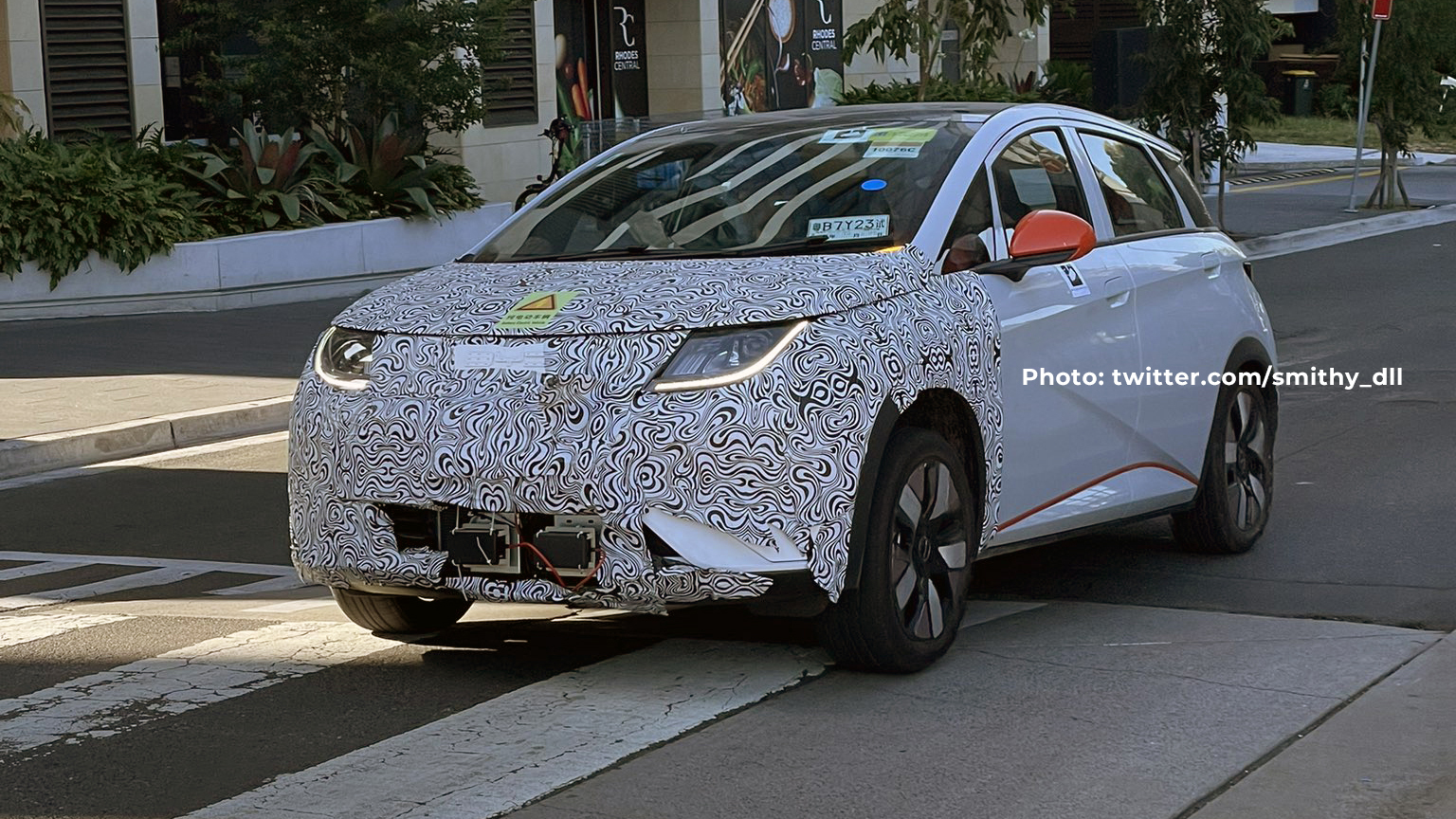
The Dolphin electric hatch is expected to wear a price tag below $40,000 to undercut the only BYD model currently on sale, the Atto 3 small SUV, which starts at $44,381 before on-road costs and incentives.
The Dolphin was spied testing in Sydney this week, and a Chinese-market version is already on show in its Darlinghurst showroom featuring the Shenzhen automaker’s signature marine-like design theme, rotating 12.8-inch tablet infotainment system, and the lithium-iron-phosphate (LFP) Blade Battery that’s said to be more durable and safer.
The Dolphin will directly rival the forthcoming MG 4 and GWM Ora Funky Cat small electric hatchbacks when they arrive in the new year, too.
Meanwhile, the BYD Seal sedan is the brand’s answer to the ubiquitous Tesla Model 3 with a more upmarket interior, a larger 15.6-inch rotating touchscreen and 10.25-inch driver’s display, a ‘frunk’ under the bonnet, and flush door handles. It’s expected to be priced around the $60,000 mark.
It’s unclear whether the company will rename the Dolphin and Seal with the Atto naming convention, but both electric cars will launch in Japan with unchanged nameplates.
Independent distributor EVDirect has backtracked on multiple decisions prior to releasing the BYD Atto 3, including implementing odd warranty exclusions on specific parts. Showrooms, test drives and delivery handovers are facilitated by its Eagers Automotive dealer giant partner.
