
The final Walkinshaw-fettled Volkswagen Amarok has rolled off the production line in Clayton, bring to a close a partnership which produced 2600 dual-cab utes.
However, the door remains open Volkswagen Australia to work with Walkinshaw again once the next-gen Amarok arrives in Australia in 2023.
Of the 2600 Walkinshaw Amaroks, 1555 were built during the 2022 calendar year, with production for the limited-run models only commencing in March 2021.
December 7: NEW AMAROK DRIVEN! Words & Video
We’ve finally driven the new-gen 2023 Volkswagen Amarok, with Jez jetting (Jet jezzing?) to South Africa for a world’s-first spin in the new ute. Get our full story below.
Story continues
Volkswagen Walkinshaw Amarok ceases production ahead of next-gen launchEditorSEO AnalysisCurrent version
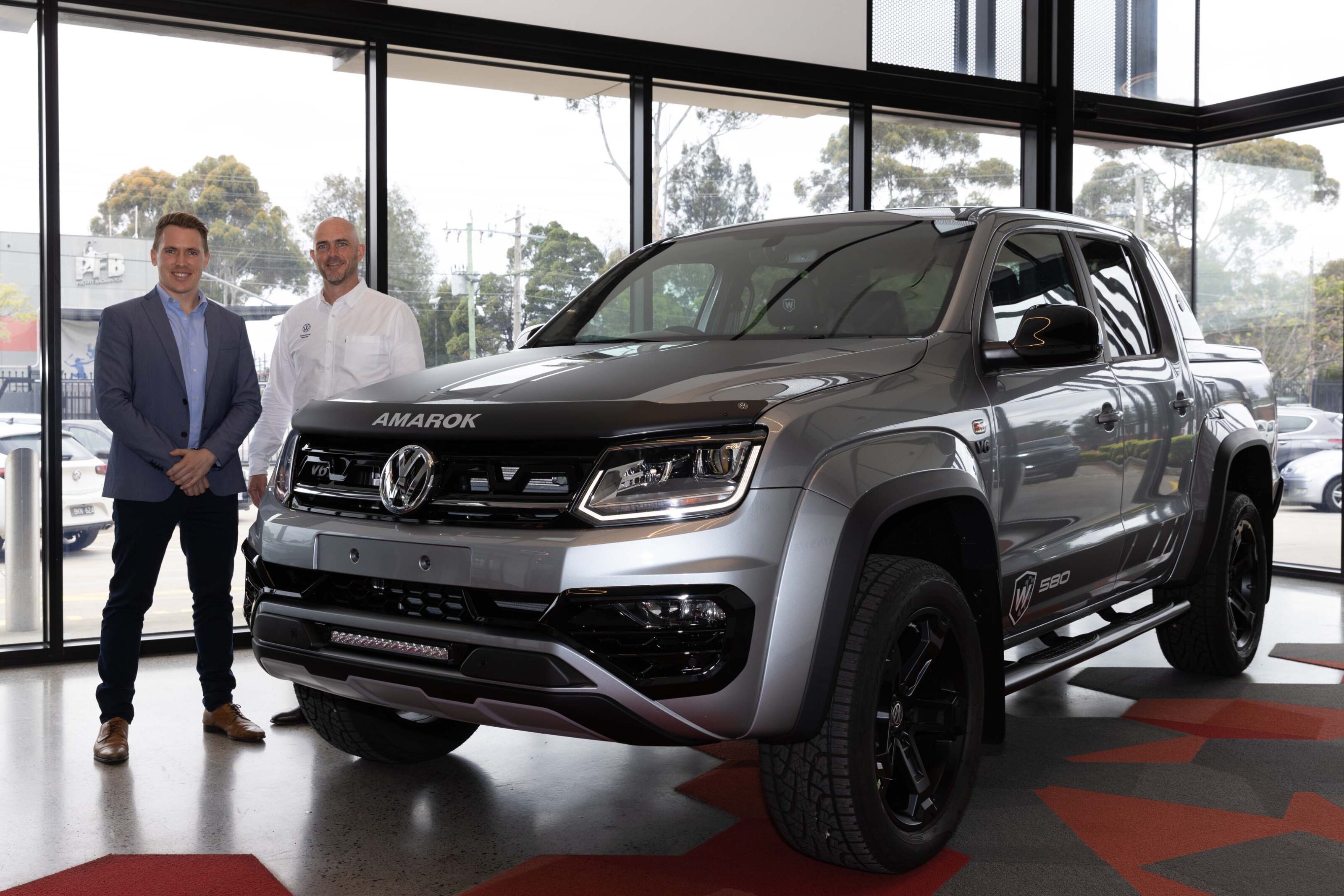
Initially the plan was for 2000 vehicles to be produced as part of the partnership, however substantial demand from consumers saw the number increase to 2600.
In total, the production run included 458 examples of the W580, 1419 W580S units, 599 W580X and the rarest model being the W580SE of which only 99 were built. There were also an additional 25 pilot builds to bring the total to a neat 2600 units.
Volkswagen Commercial Vehicles director Ryan Davies revealed that Australians had shown a clear appetite for the flagship models.

“Australians have voted with their wallets to make 90 per cent of Amarok sales the class leading diesel V6 and 20 per cent of Amarok sales a Walkinshaw engineered variant,” Davies said.
“This is testimony to both the fundamentals of this first-generation Amarok, which have helped influence and shape the incoming second generation model, and the great design and engineering of Walkinshaw.”
Volkswagen states that “up to 99 unique parts” feature on the W580X, coming from 26 different suppliers.
Ryan Walkinshaw, the director of Walkinshaw Automotive Group, pointed to the joint program as a win for the local manufacturing firm.
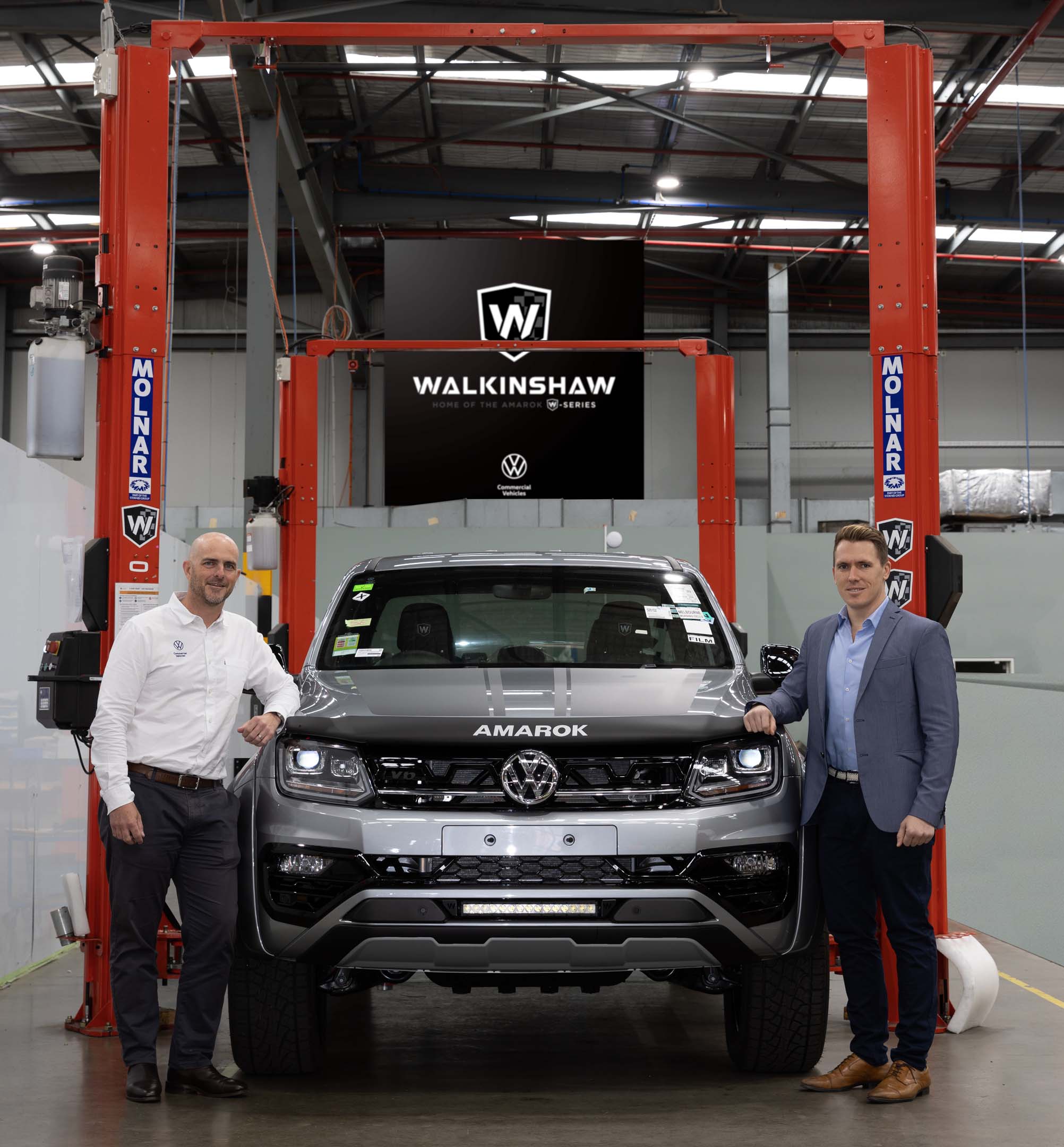
“The numbers speak for themselves, but it’s also been really pleasing to be able to support local manufacturing and suppliers in the process – all while taking a great platform that is the Amarok to the next level,” he said.
“We are looking forward to working closely once again with Volkswagen to see what the future may hold with their second-generation.”
Volkswagen and Walkinshaw both lauded the Amarok program as a success, and while there is no official confirmation it will continue, both are positive about the possibility of working together on a similar project once the next-gen vehicle arrives locally.
Australia is expected to be the biggest global market for the second-generation Amarok when it arrives early next year.
? MORE 2023 AMAROK
Get all of our latest stories in one handy place, with our Everything You Need to Know article at the link below.
December 7: NEW AMAROK DRIVEN! Words & Video
We’ve finally driven the new-gen 2023 Volkswagen Amarok, with Jez jetting (Jet jezzing?) to South Africa for a world’s-first spin in the new ute. Get our full story below.
Story continues
Volkswagen open to selling more powerful Amaroks with Walkinshaw
Volkswagen has stated it is keeping the door open for more powerful versions of the next-gen Amarok thanks to its partnership with Australian engineering firm, Walkinshaw.
Walkinshaw has worked with Volkswagen Australia to offer local customers tweaked versions of the outgoing Amarok, badged W580.
While incredibly popular, the W580 Amarok’s powertrain remains unchanged from the standard V6 turbo-diesel models, with Walkinshaw’s expertise going mostly toward suspension tweaks.
However, Volkswagen Australia Commercial Vehicles director Ryan Davies says that there is the potential for that to change when the next-gen Amarok arrives in Australia.
While avoiding any specifics when questioned on whether a future partnership could include allowing Walkinshaw to work its magic on the next-gen Amarok’s powertrain, Davies mentioned that a wider scope could be on the books.
“We’ve openly respected each other’s part in the relationship to say ‘what can we, and what can’t we achieve in this program together?’,” Davies said.
“What we will see in the future is we are probably going to challenge each other a bit harder on that topic and attempt to come up with bigger and better ways on how we can make the new program a success story.”
Walkinshaw has an extensive history in Australia producing more powerful versions of Holden products, both under its own name, and as Holden Special Vehicles.
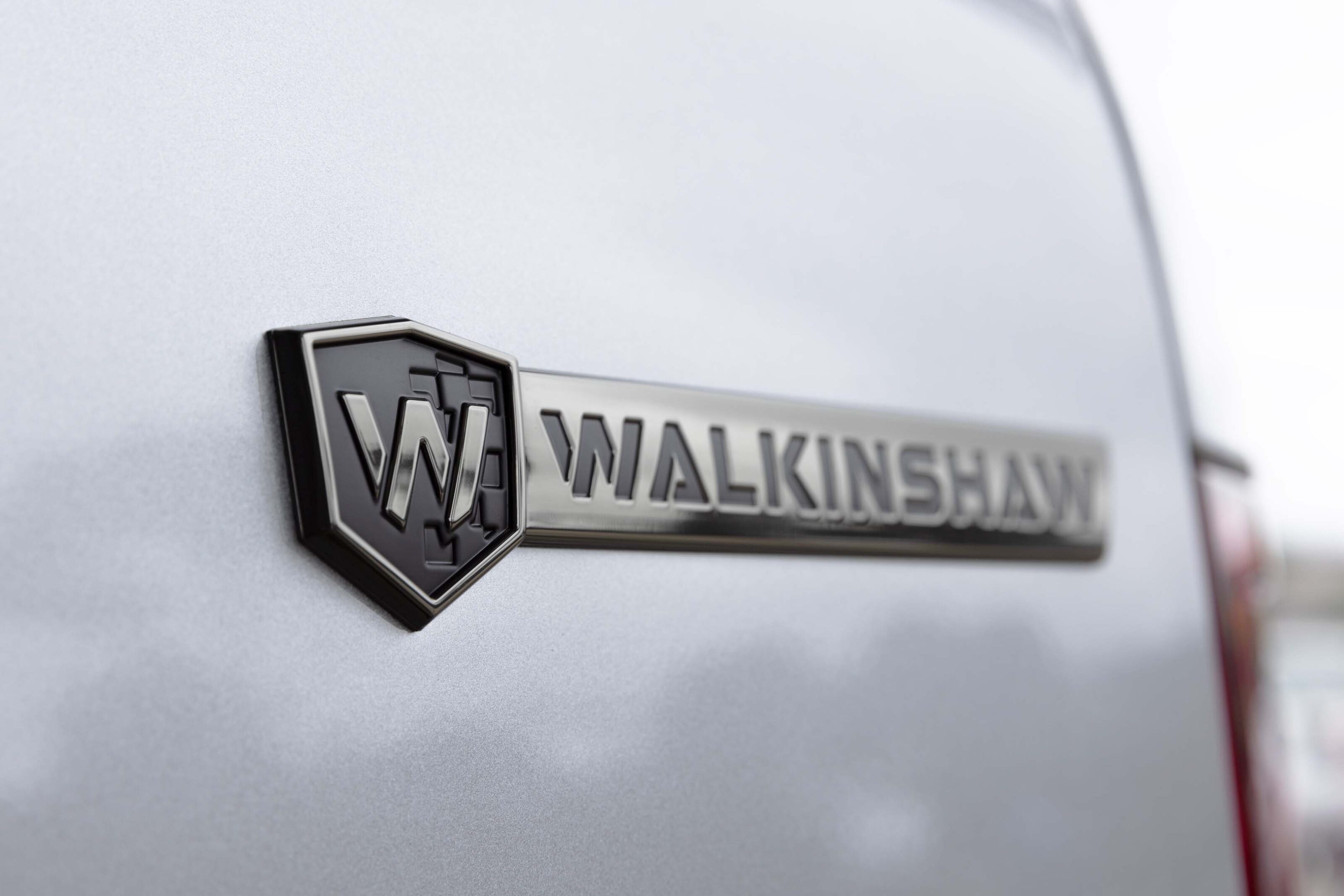
The next-gen Amarok is due in Australia in the first half of 2023, and shares its platform with the class-leading Ford Ranger.
While the final line-up is not yet confirmed, it is expected the next-gen Amarok will be available with four different engines. Three are shared with Ford – two 2.0-litre, four-cylinder units producing 125kW/405Nm and 154kW/500Nm respectively as well as a 3.0-litre V6 making 184kW/600Nm – while the fourth is a Volkswagen-specific 2.3-litre, four-cylinder turbocharged petrol engine making 222kW/452Nm.
It is the V6 and petrol four-cylinder that would make the most logical choices for performance boosts from Walkinshaw.
“While I think there are many elements in the new Amarok that are a benchmark in the class, i.e. V6 diesel, 600Nm of torque, I am sure the Walkinshaw guys are going to challenge us on some of our previously uncharted territories with the new car,” Davies added.
A partnership between Walkinshaw and Volkswagen for the next-gen Amarok is not yet officially confirmed. However, when speaking to Wheels this week, both parties made positive comments about a potential future continuation of the program, which debuted with the W580.
“Ultimately, in these kinds of programs we can’t go and tell an OEM like Volkswagen what to do with its product, because it knows it best,” Walkinshaw Automotive Group director Ryan Walkinshaw said.
“But at the same time, when it comes to these kinds of programs, there is a requirement from us to have the parameters that allow us to add value. That allows us to do them in the short timeframe and for low cost that we are able to do them.”
? MORE 2023 AMAROK
Get all of our latest stories in one handy place, with our Everything You Need to Know article at the link below.
UPDATE, November 25: Updated 2023 Kia Seltos driven
Kia’s updated 2023 Kia Seltos range is now in Australia, and we’ve driven it. Get the full story, and video, at the link below. Or, keep scrolling to continue reading this story!
Story continues: 2023 Seltos pricing and features
The 2023 Kia Seltos small SUV range is now on sale in Australia
Snapshot
- 2023 Kia Seltos facelift revealed
- New design and features for Kia’s small SUV
- Australian launch set for the fourth quarter of 2022
JUMP AHEAD
Headlining the changes to the 2023 Kia Seltos is an updated version of the Hyundai group’s 1.6-litre turbo-petrol engine, which is also now mated to an eight-speed torque-converter automatic transmission in place of the seven-speed dual-clutch auto it used previously.
Buyers are also treated to an upgraded safety features list and updated technology in the cabin – with the standout feature being the remote-connectivity and control app, Kia Connect, which debuted in July with the new-gen Kia Niro range.
Like with the Niro, Seltos buyers will get a complimentary subscription for the first seven years.
On the styling front, the facelift brings a revised front and rear look, subtly updated for the new model year.
All of this comes at a price, however – meaning the complimentary Kia Connect is arguably built into the price increase. Pricing is up by at least $2000 across the range, as outlined in the table below.
2023 Kia Seltos pricing
NOTE
- ‘2.0 CVT FWD’ means 2.0-litre four-cylinder naturally-aspirated (non-turbo) petrol engine, continuously variable automatic transmission, and front-wheel drive.
- ‘1.6T 8A AWD’ means 1.6-litre four-cylinder turbo petrol engine, eight-speed automatic transmission (not dual-clutch), and all-wheel drive.
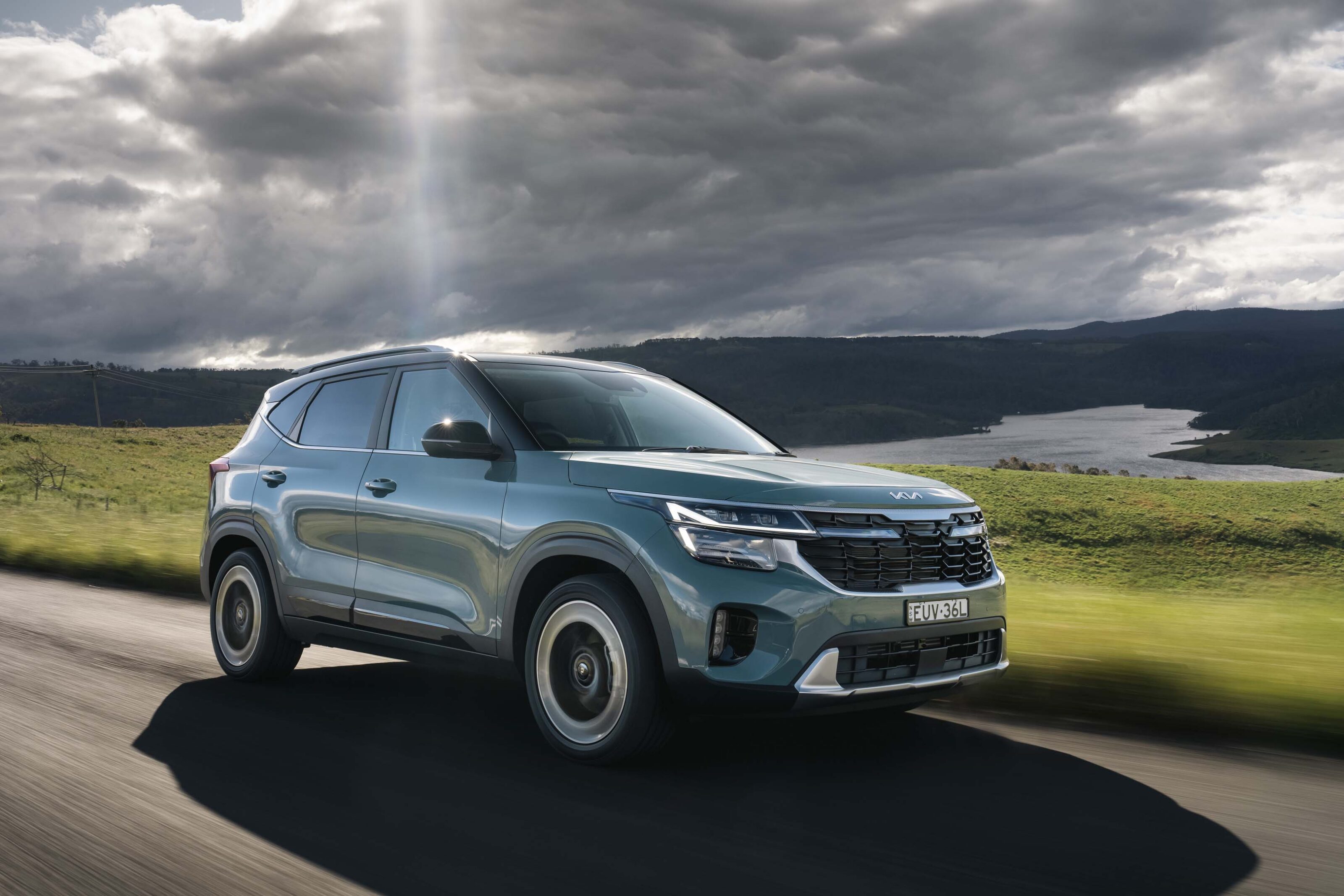
Styling updates
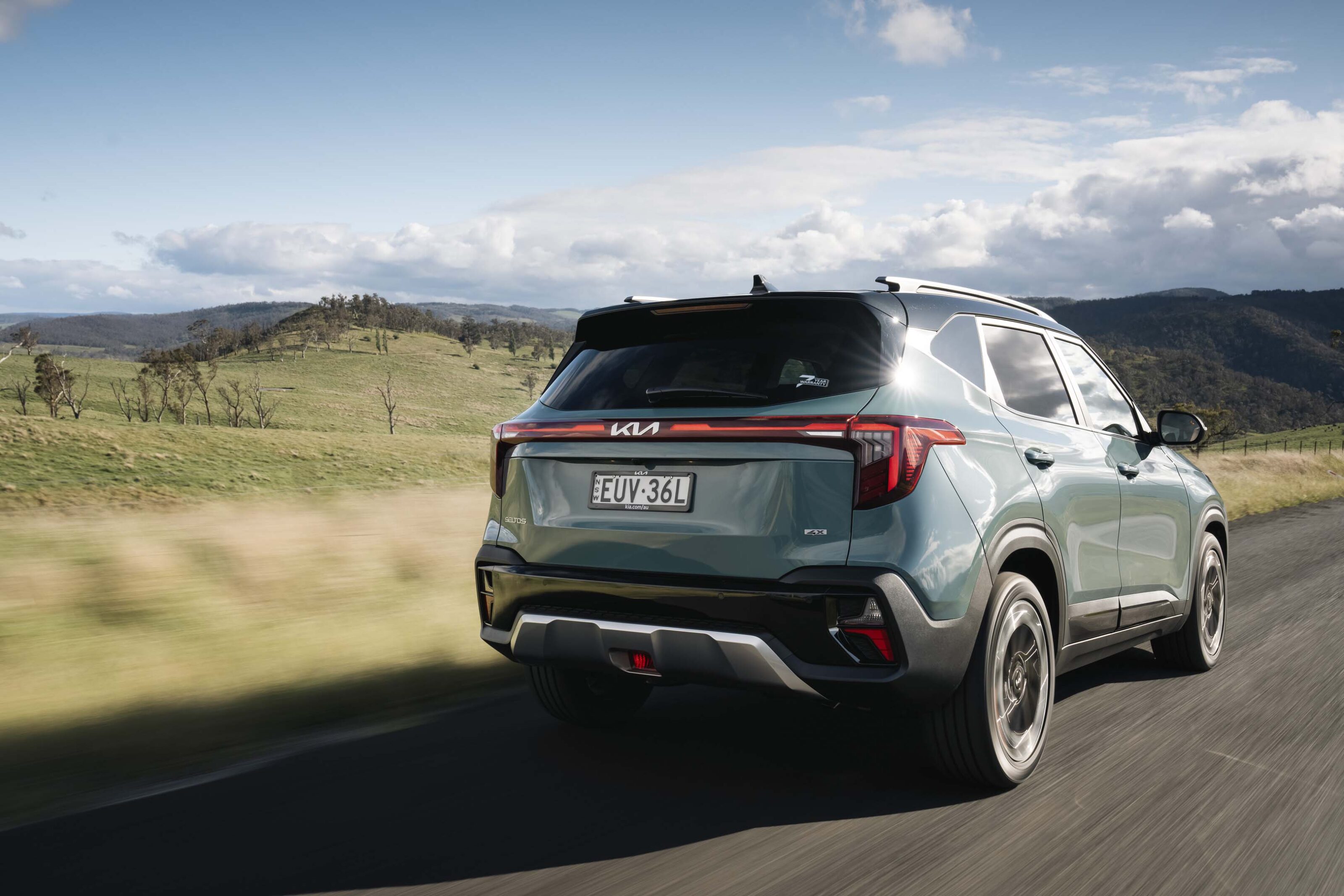
A facelift of the current 2019-launched model, the 2023 Seltos wears a revised front-end design, with a new bumper, grille, LED headlights with daytime running lights, and Kia’s updated emblem on its upper portion.
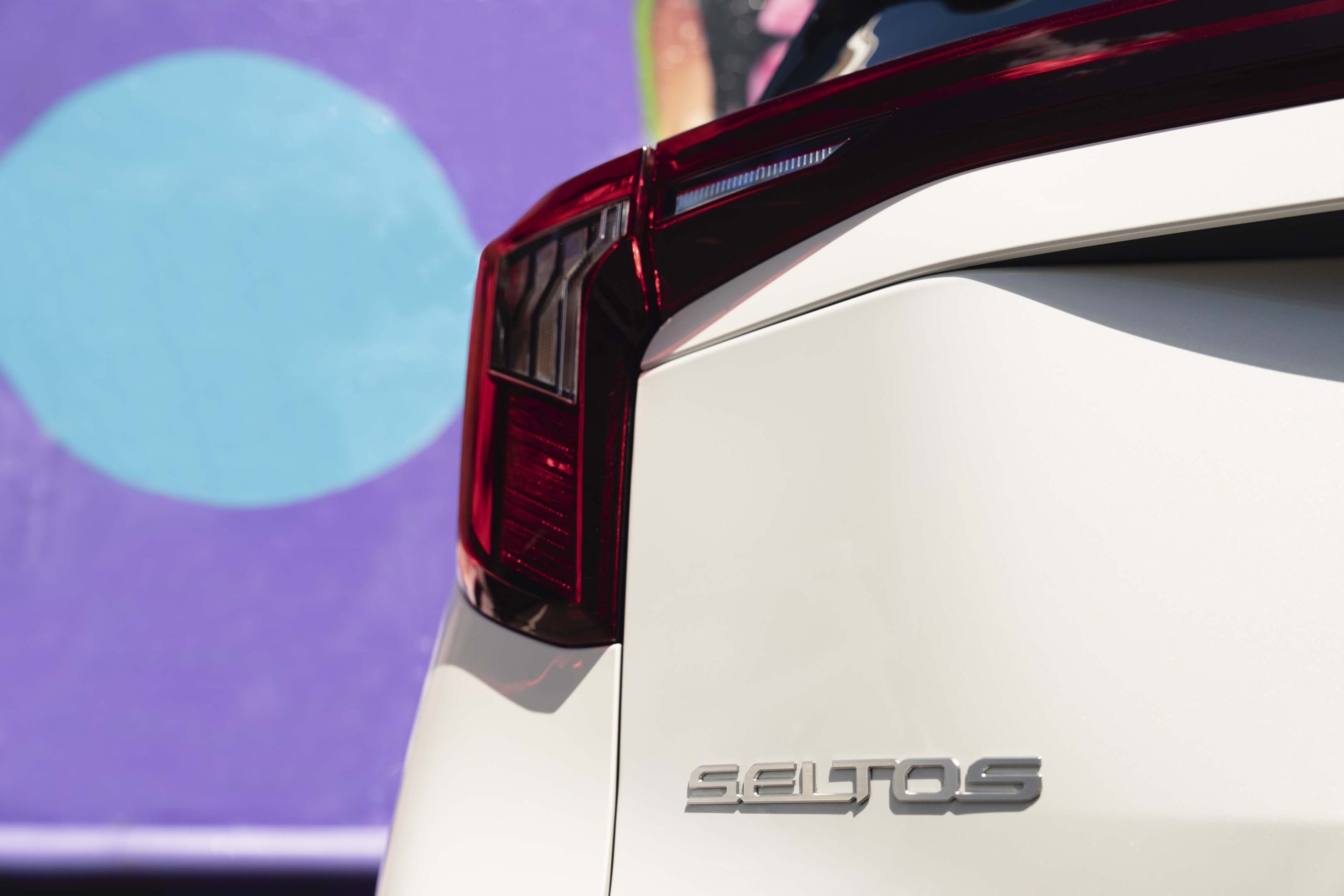
Despite being called a facelift, it’s the rear of the Seltos which has changed the most, now incorporating T-shaped tail-lights running horizontally across the boot lid, and its lower bumper has also been restyled to feature a more prominent silver ‘bash plate’ and fog lights.
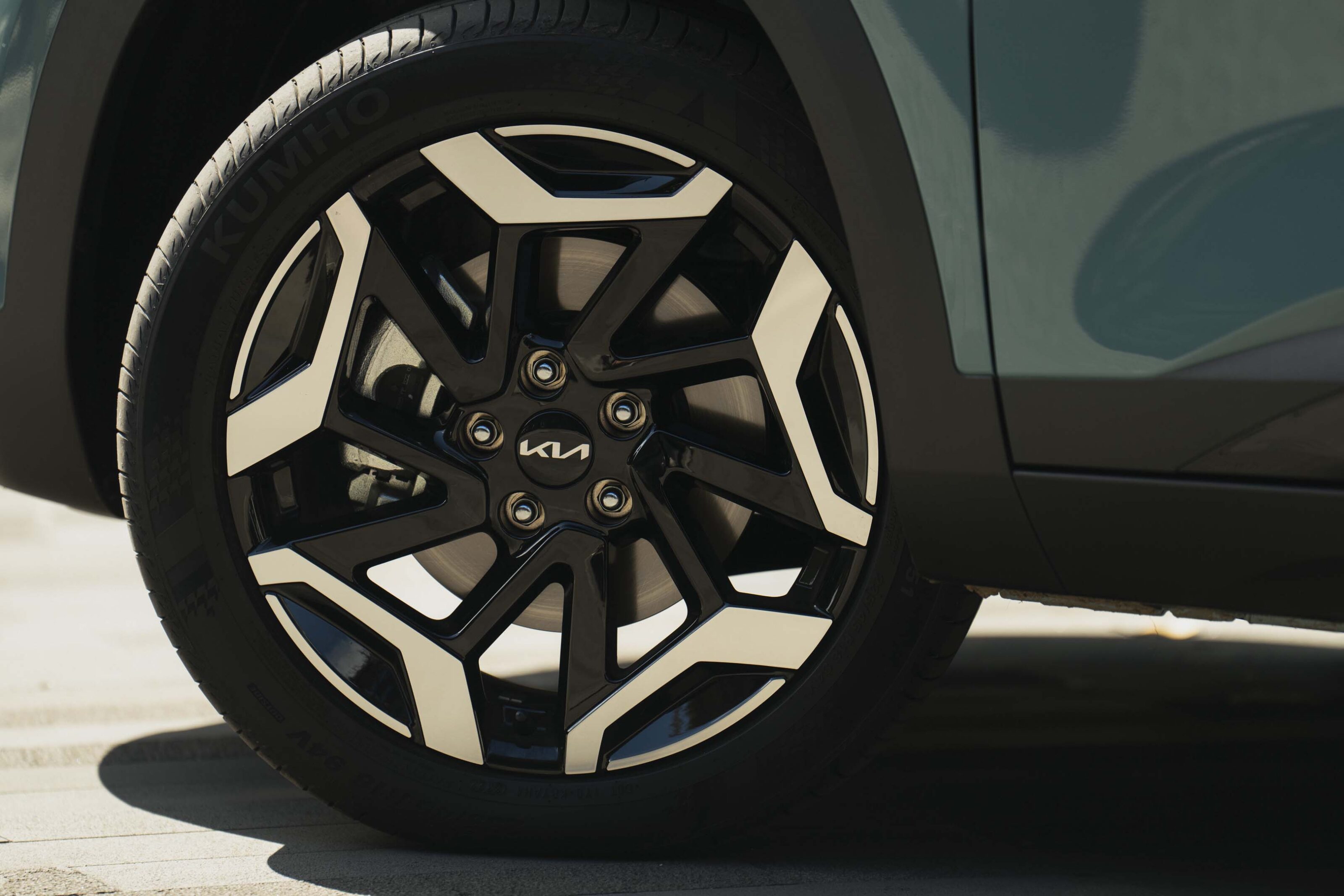
Other exterior changes include a set of new-look 18-inch alloy wheels, similar to the design of those on some of its updated Kia SUV stablemates, and a choice of seven paint colours – with Mars orange taking over from starbright yellow as the standard offering, and pluton blue being added as one of the premium option.
Two two-tone paint choices can be had on the top-spec GT-Line, combining either clear white or pluton blue with a black roof.
The small SUV will continue to be offered in four grades: S, Sport, Sport+ and GT-Line.
Interior tech upgrades
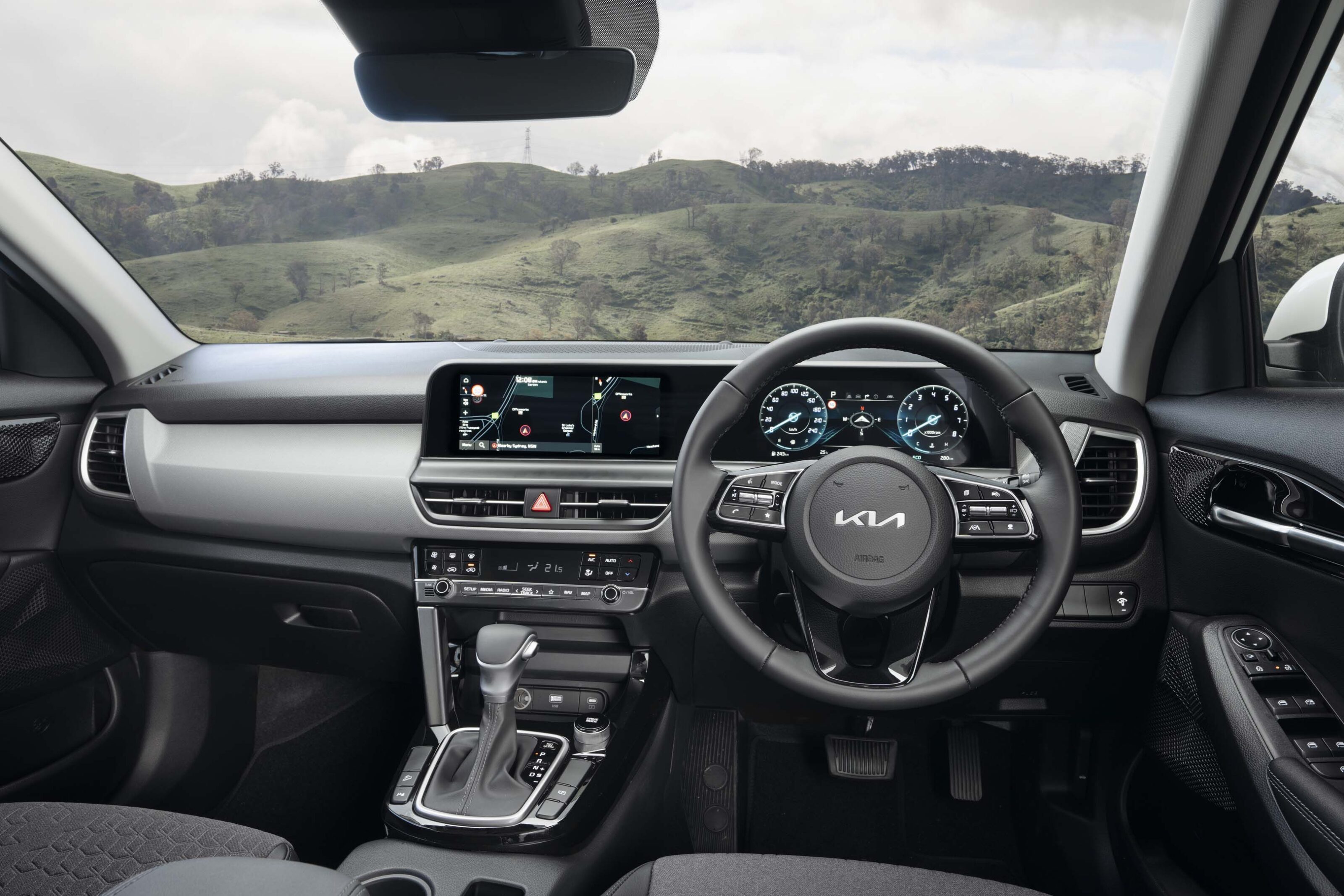
Stepping inside the cabin, the Seltos has been given a significant equipment upgrade with the addition of a 10.25-inch digital instrument cluster on all grades except the entry-level S, which gets a 4.2-inch unit.
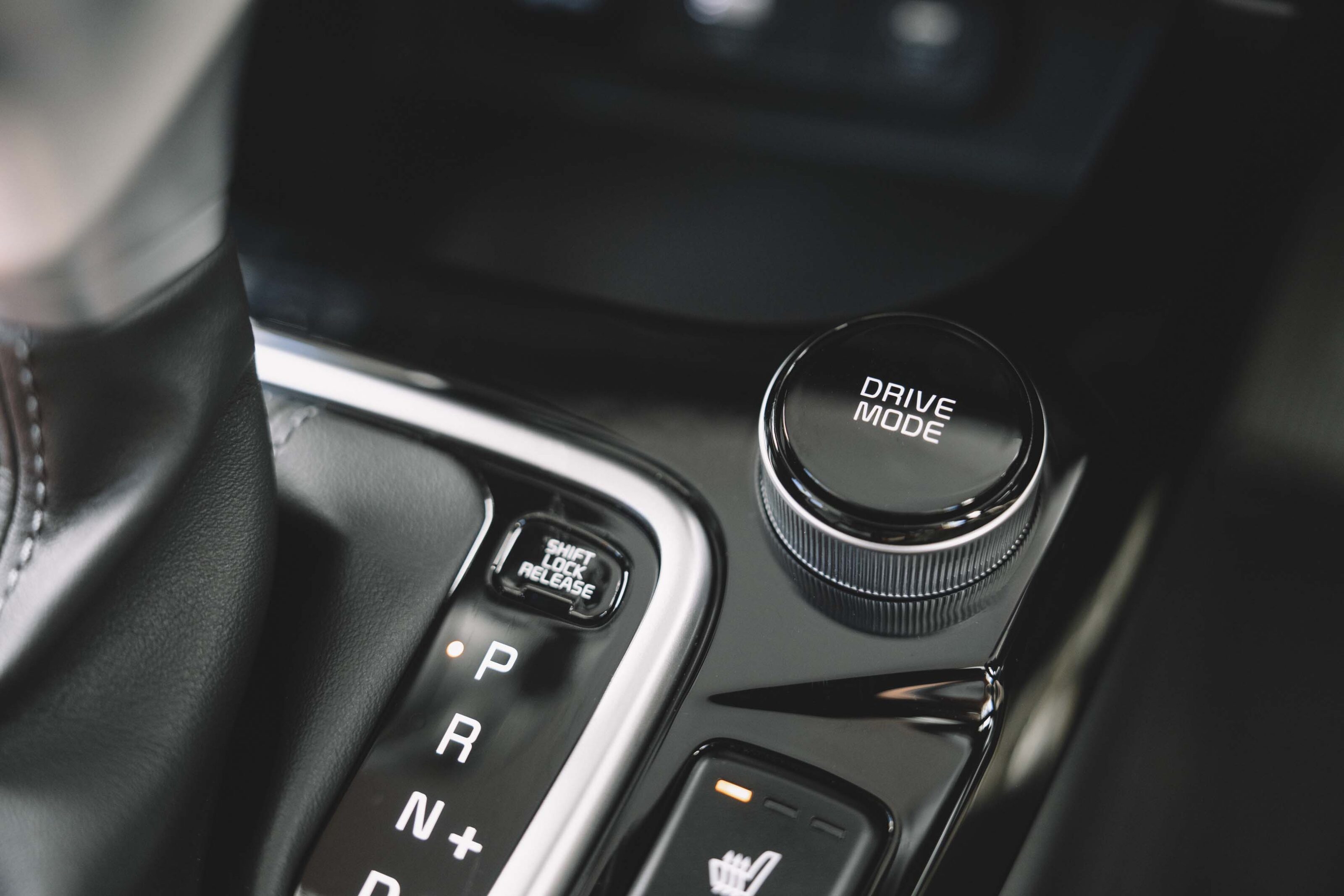
Just like the current GT-Line, all upcoming Seltos grades look set to feature a 10.25-inch infotainment touchscreen – angled towards the driver as a carryover from the EV6, Niro and Sportage – while also ditching the traditional gear selector, now adopting a rotary shift-by-wire dial.
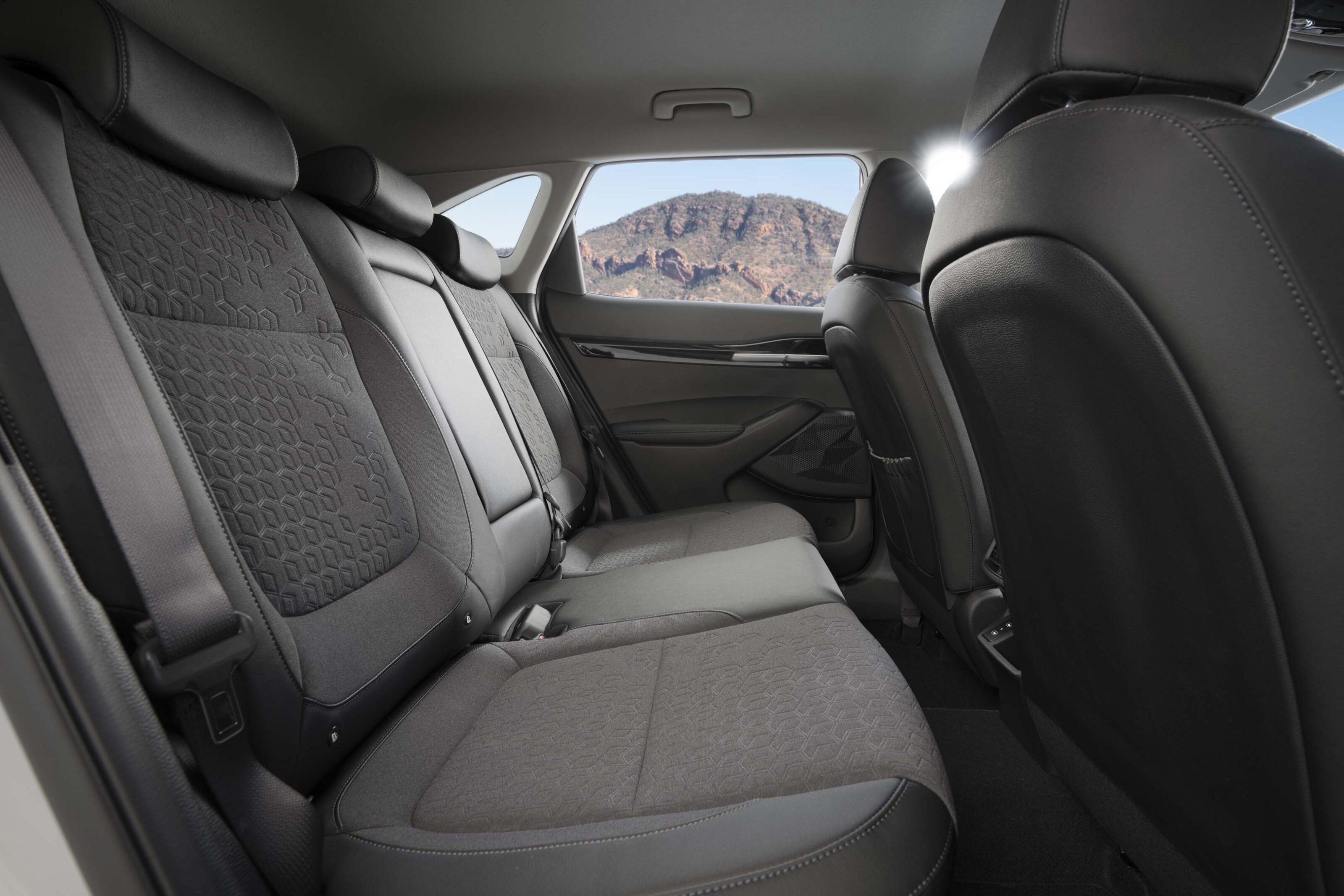
Rear occupants also gain air vents and USB-C charging points across all variants, while the GT-Line benefits from an electronically-adjustable driver’s seat (with memory function) and a powered tailgate.
Powertrain
Kia has upgraded the 1.6-litre turbo-petrol four-cylinder and swapped out the current seven-speed dual-clutch automatic (DCT) for an eight-speed torque converter.
Power outputs are currently unconfirmed for Australia, however, Korean models have received a power boost from 130kW to 148kW (and 265Nm) for 2023.
The new powertrain option, which continues to drive all four wheels, is available exclusively on the Sport + and GT-Line variants.
Meanwhile, the existing 112kW/180Nm 2.0-litre naturally-aspirated four-cylinder petrol engine is carried over as standard across the range, and remains mated to a continuously variable automatic transmission (CVT) driving the front wheels.
Safety
Kia has also upped the level of safety equipment found in the Seltos, which now includes features such as; intelligent speed limit assist, lane following assist, rear cross-traffic collision avoidance assist and blind-spot collision-avoidance assist integrated as standard, even on the base S trim.
When is the 2023 Kia Seltos on sale?
The new Seltos is on sale now.
BMW‘s M Division shocked the world overnight, with the surprise rebirth of an icon: the 2023 BMW 3.0 CSL.
Celebrating 50 years of the Bavarian carmaker’s storied motorsports division, the 3.0 CSL represents a definitive touchpoint of half a century’s experience, and bears all the hallmarks of a classical driver focused M Car. It’s got a straight-six up front, driven wheels at the back, with two seats and a manual H-pattern in the middle.
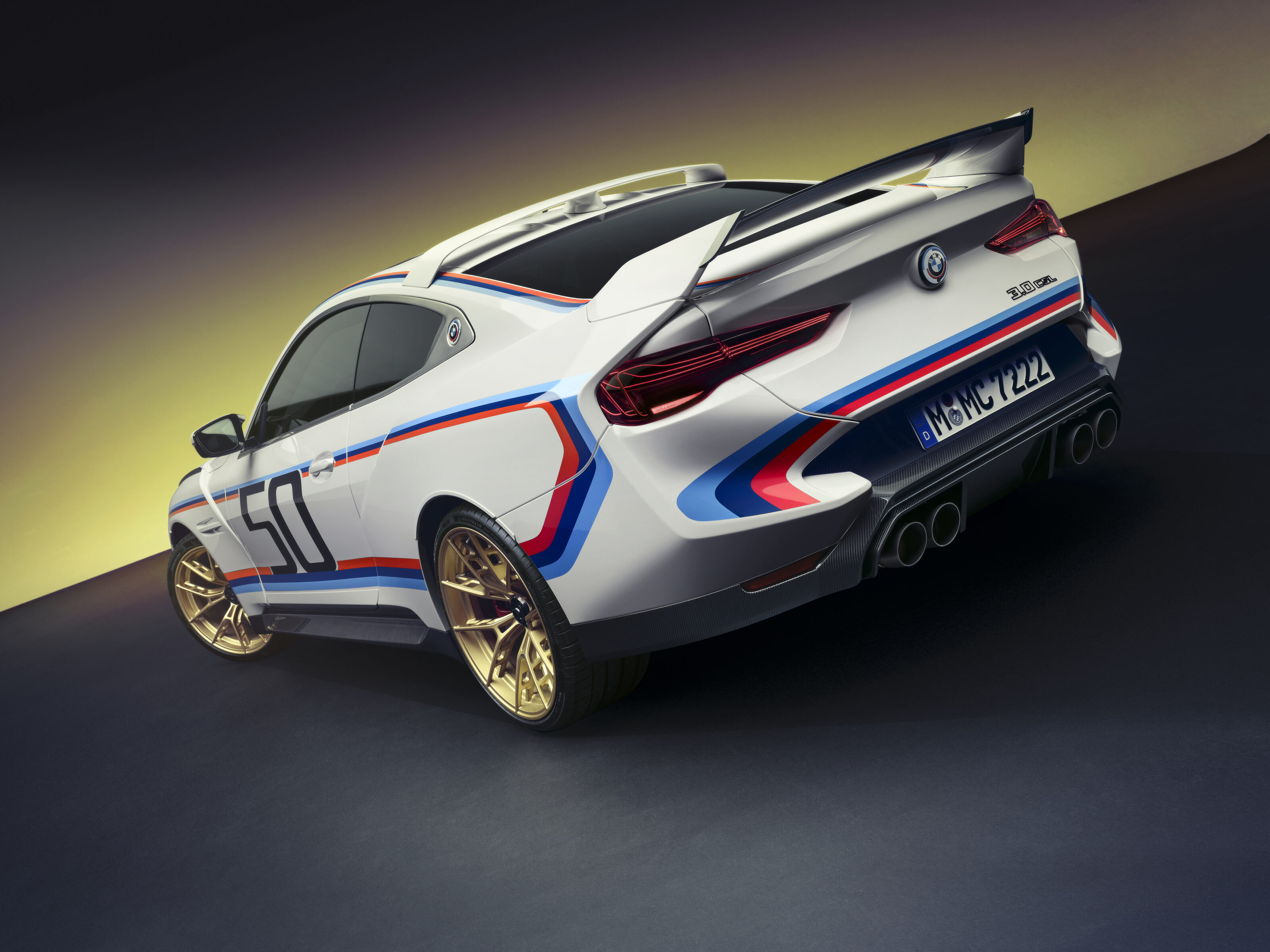
As a rolling tribute to half a century of M Division, just 50 BMW 3.0 CSLs will be built, offered to “particularly loyal and enthusiastic fans of the BMW M brand”.
The distinctly retro design’s long wheelbase and roofline suggest the car is M4-based, built atop BMW’s flexible CLAR platform and powered by a modified version of the existing M4’s wonderful S58 twin-turbo 3.0-litre inline-six.
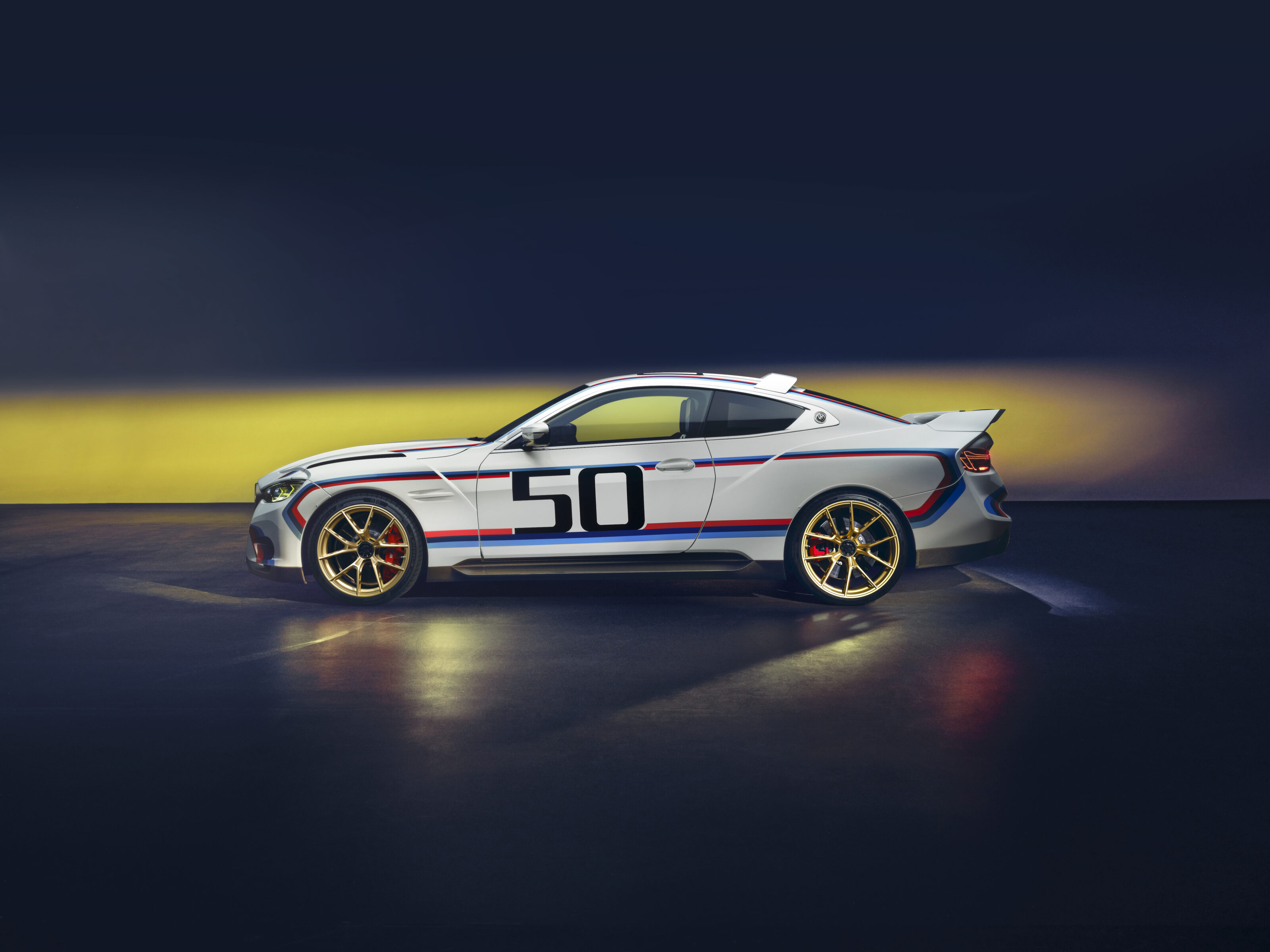
Displacement has been increased to 3153cc, up from 2979cc, deploying a maximum output of 412kW/550Nm – marking the most powerful six-cylinder ever fitted to a roadgoing BMW. The highly-strung six-cylinder breathes out through a titanium exhaust system.
BMW’s sublime six-speed manual is the only transmission available, with revised gear ratios “ideally matched to the performance characteristics” of the retro touring car tribute. Of course, modernity has its place with the presence of BMW’s deft ‘shift assistant’ auto rev-match feature.
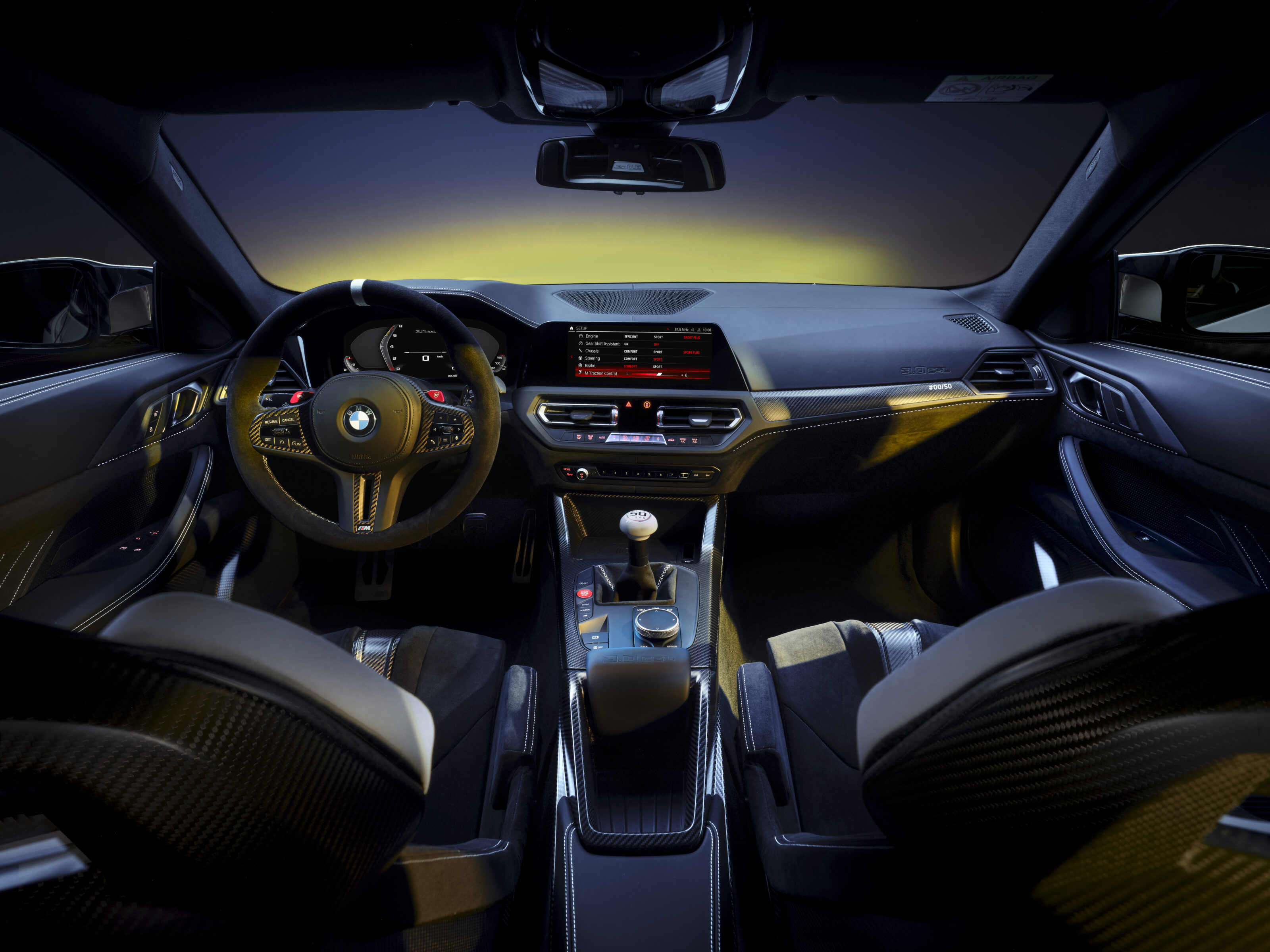
An active M differential features commands power delivery to the rear wheels and is able to lock up to 100 per cent, complementing the car’s ESC system. Ten-stage traction control ranges from the full safety net all the way to ‘you’re on your own, kid’.
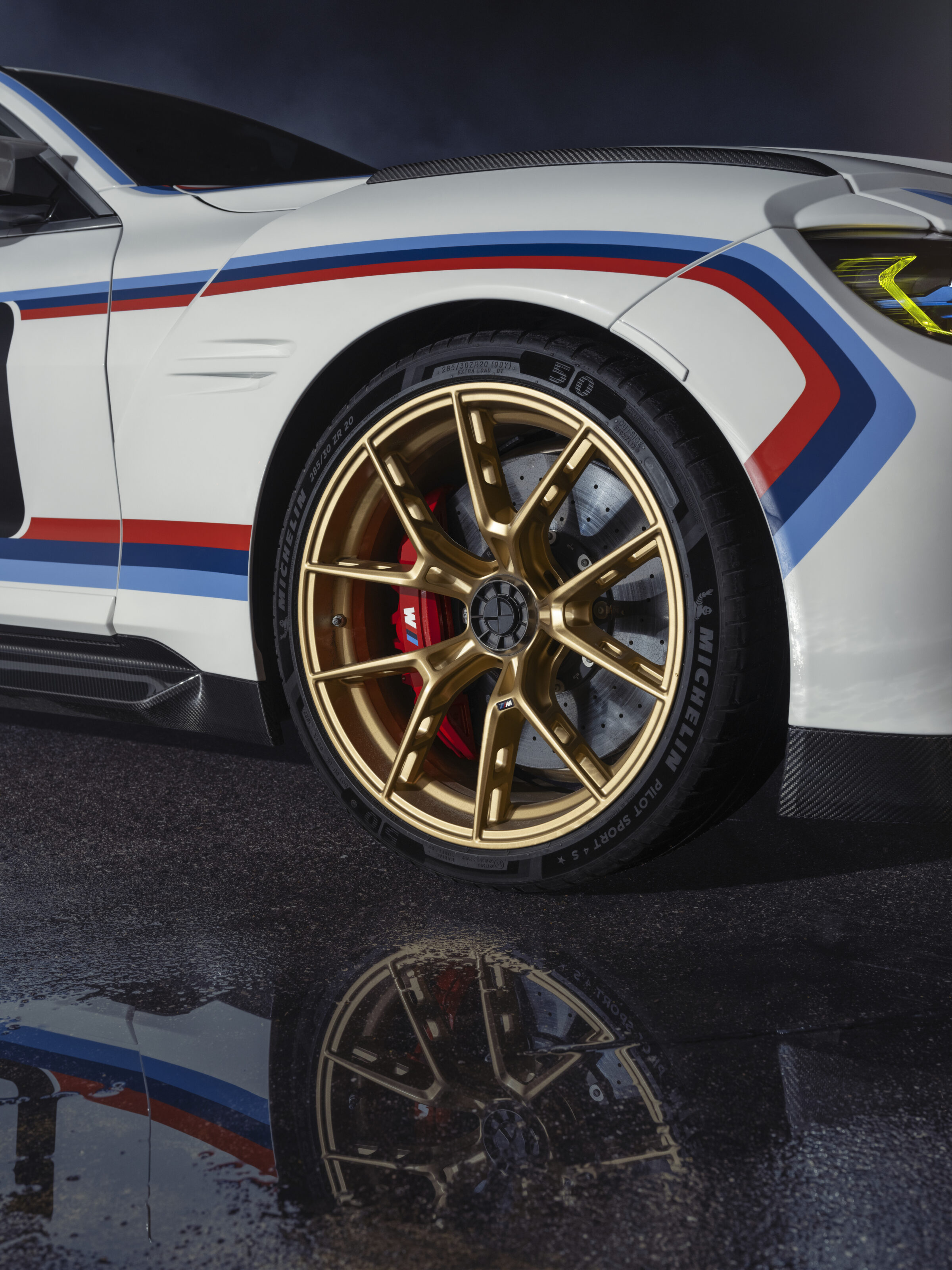
The drastically redesigned surfacing is suspended by the M4’s basic double-joint front axle and five-link rear suspension configuration, further boasting widened front and rear tracks and cornered by forged and staggered Y-spoke 20/21-inch centrelock wheels shod in a CSL-specific blend of Michelin performance tyre.
Of course, you don’t revive such a hallowed nameplate without your fair share of nostalgic design choices, and the Gen-Alpha 3.0 CSL is positively dripping with nods to BMW’s sporting past.
Like BMW’s prior collectible sporting models, such as the E92 M3 and F82 M4 GTS, M Divisions latest halo model puristically features just two M Carbon bucket seats, with the second row replaced by a slick pair of integrated helmet compartments. Lashing of carbon fibre adorn the dashboard, steering wheel and centre console, with suede seat inserts, lower dash and steering wheel.
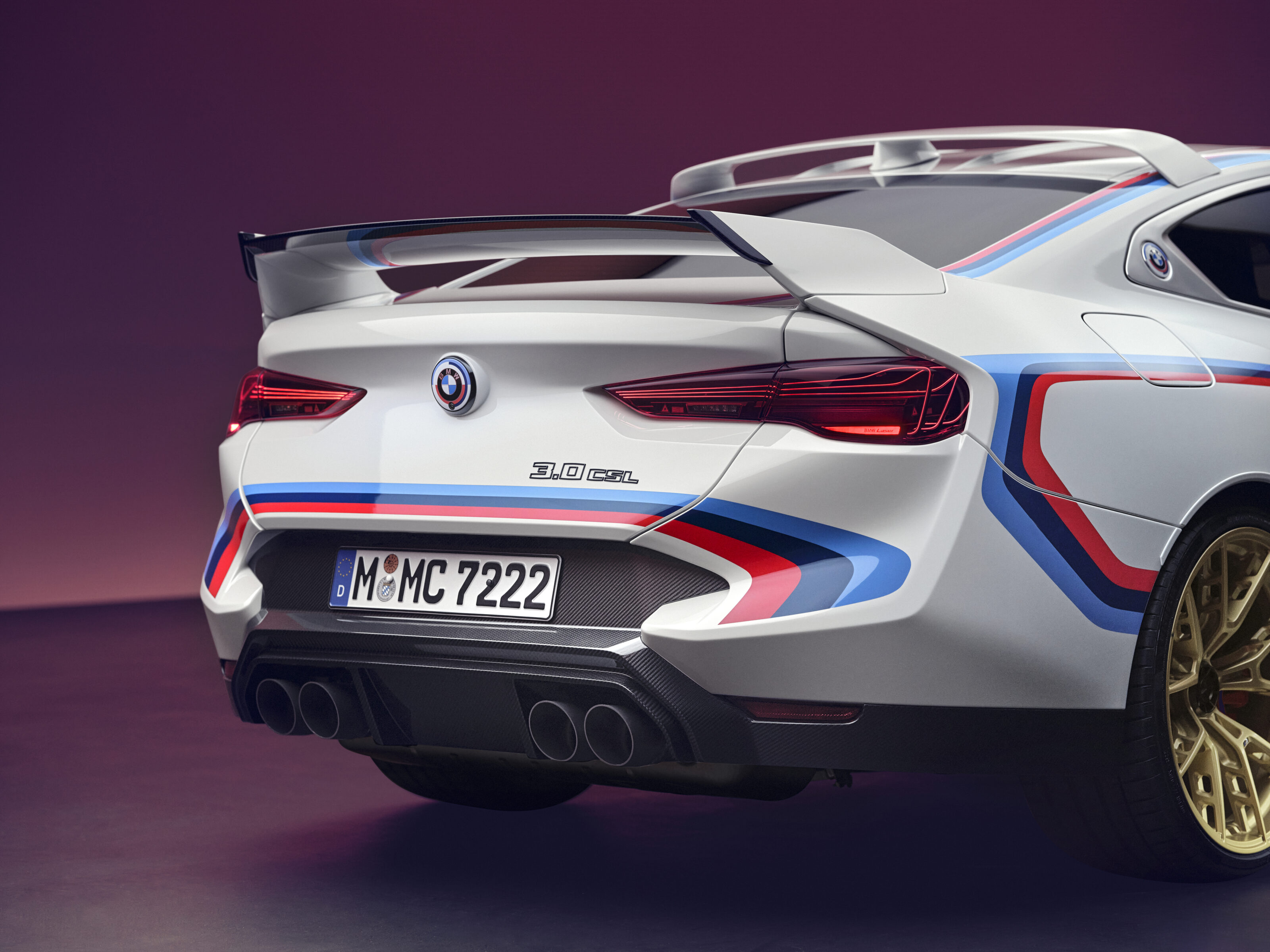
Embodying the ‘Coupe, Sport, Lightweight’ name, literally, sees the new CSL comprehensively clad in Carbon Fibre-Reinforced Plastic (CFRP) on “virtually all bodywork sections”. The classic Batmobile’s box wing, iconic roof spoiler, bonnet aero winglets, pumped haunches and jutting front air dam are all gloriously present and accounted for.
The icing on the cake, so to speak, is a painstaking recreation of BMW’s iconic tricolor livery, which sees each CSL pass through eight assembly cycles, at eight individual production stations, in which each car is assembled over three months. Cars are hand-assembled by 30 specialist technicians, at BMW’s Dingolfing factory, the historic home of the flagship 7 Series – and where Rolls-Royce bodies are produced.
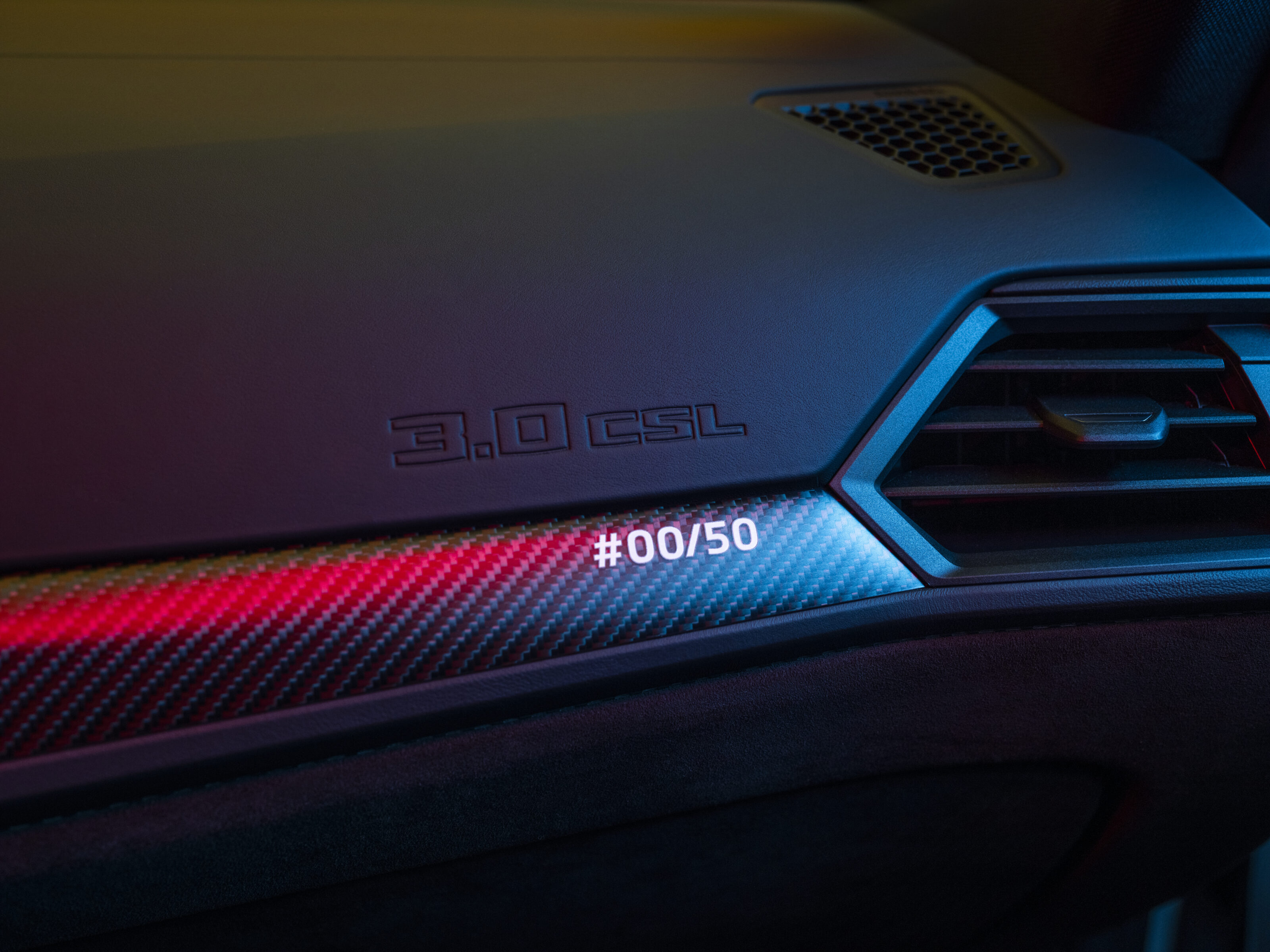
BMW have not publically announced a price for its special limited production 50th birthday present. If they’re not already sold out, we’d have to imagine it’s a case of “if you have to ask…”
Snapshot
- Vic learners could get Ps earlier under Liberal plans
- Labor trashed the idea on social media
- Would put Victoria in line with other jurisdictions nationally
The Victorian Liberals have outlined plans to allow learner drivers to get their probationary licence at 17 years-old rather than 18 if the party wins tomorrow’s State Election.
Liberal leader Matthew Guy made the promise on Thursday night, just two days before Victorians go to the polls to cast their votes.
According to the Party, lowering the probationary driving age would reduce the impact of isolation and disadvantage for those living in regional areas where there is a need to travel long distances, and where there is a lack of public transport services available.

Guy said the plan would help get more young people in work.
“We trust young Victorians to make the right decisions on the road,” the leader said.
“This simple, common-sense change will mean Victorians are no longer at a disadvantage to other states, and bring us in line with the rest of the country.”
The move would put Victoria in line with other states and territories nationally because it is the only jurisdiction in Australia that still requires probationary drivers licence holders to be aged 18 or over.
In South Australia, Western Australia, New South Wales, the ACT, Tasmania and Queensland the age for applying for your Ps is already 17.
While in the Northern Territory you can apply for a probationary licence at 16 provided you’ve held a learner licence for at least six months and met the other requirements.
Despite the difference in age requirements, road incident data doesn’t indicate that Victorian drivers are safer than in other states, a statement from the Liberals said.
Shadow Minister for Police, Brad Battin, said younger drivers could be moulded to become better and safer drivers.
“This rule has held back too many young Victorians for too long, especially those living along the border,” he said.
“Our plan to provide simulation driver training to students will produce better, safer drivers on our roads earlier.
“By lowering the driving age, we are opening up a world of work and study opportunities for 17-year-olds.”
However, the Victorian Labour Party took to Twitter to rubbish the plans, posting a picture of a crashed car with the caption: ‘Matthew Guy’s Liberals want to lower the driving age. Their last Shadow Minister for Road Safety was Tim Smith.’
The former Member for Kew resigned as shadow attorney-general last year after his vehicle hit a car and then the wall of a home in Melbourne’s inner east.
The Kia Seltos arrived triumphantly in 2019 to plug the small SUV gap in the Korean carmaker’s range. In those three years, the Seltos has ingrained itself in the segment, regularly trading places in the sales race with Subaru’s Crosstrek (XV).
With the Seltos, Kia launched what was really the first truly practical, family-friendly little crossover – the Goldilocks of small SUVs, if you will – and is a recipe that rivals have been scrambling to fill. The Mazda CX-30 and Toyota Corolla Cross come to mind as two of the best in the segment, but there are also Chinese rivals including the Haval Jolion and MG ZS.
The Seltos and Corolla Cross, though, have a lot of similarities: boxy bluff small SUVs not trying to be coupes, instead tough little cubes that maximise cabin space. Thing is, Kia’s updated Seltos pulls off the visual appeal much better than the Corolla Cross and is now one of the most eye-catching in the class.
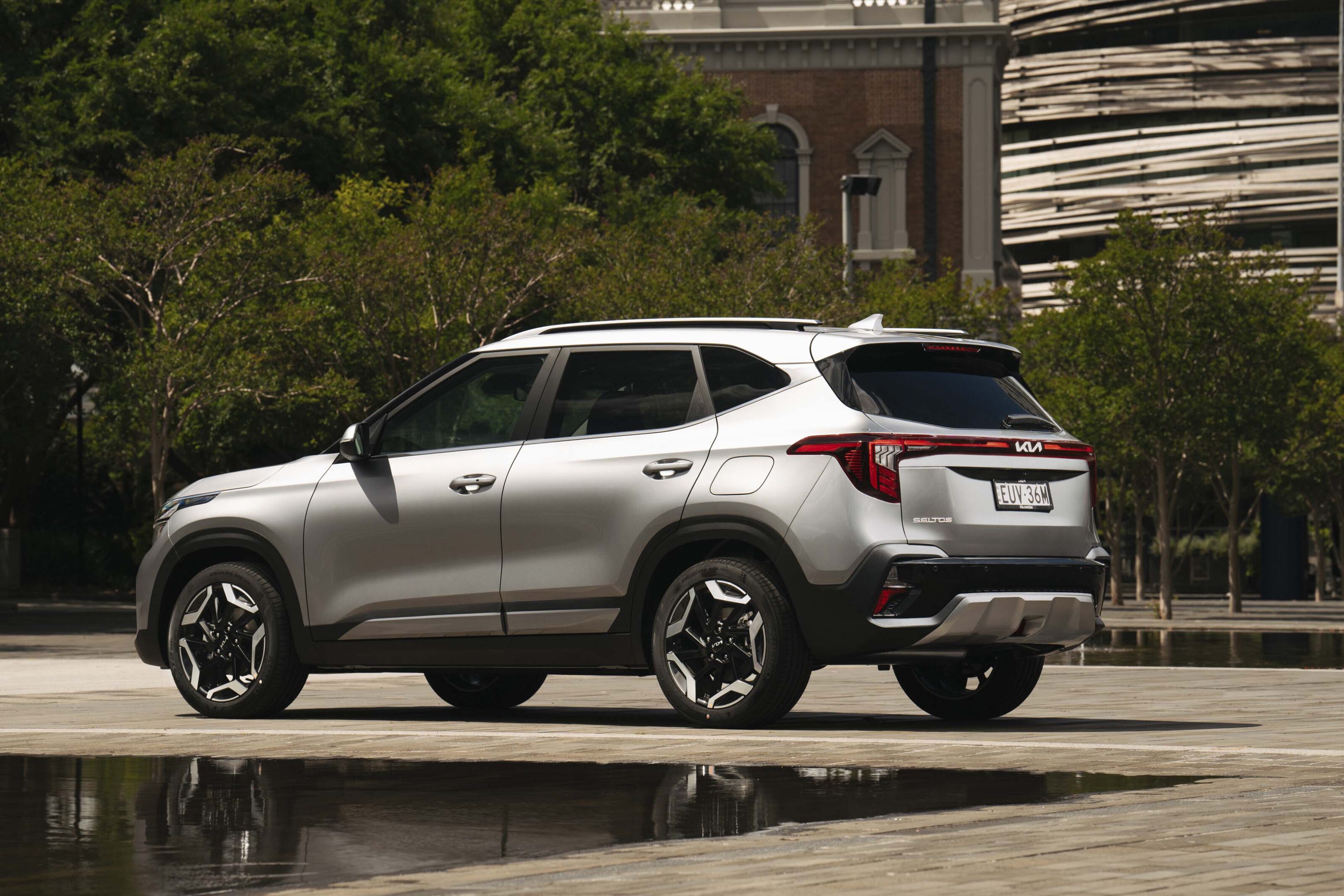
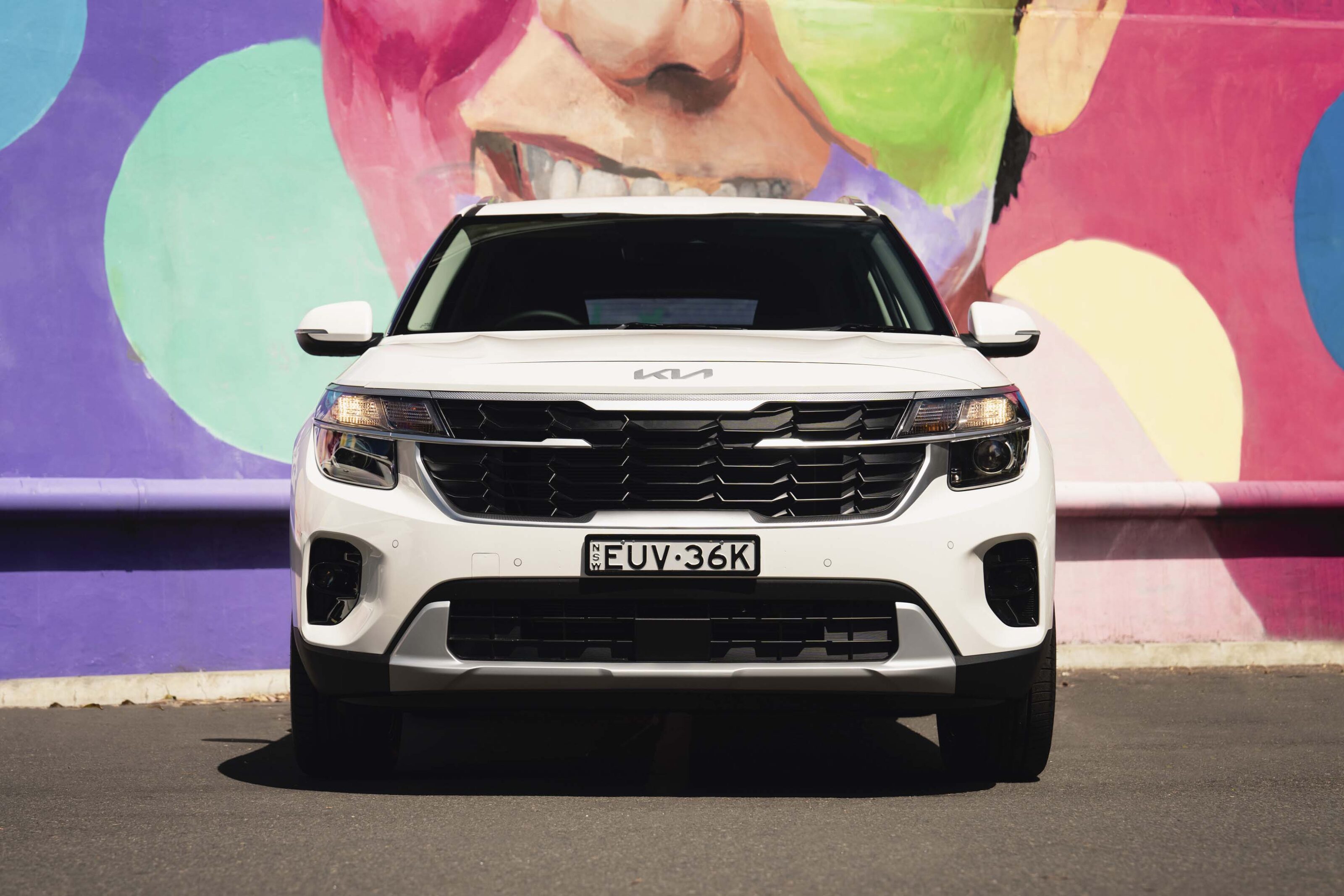
Much of the sheet metal on a Seltos remains the same but in its new hero Pluton Blue/Midnight Black two-tone colourway, the GT-Line looks the part.
The grille has been broadened, the lower air dam redesigned with a more pronounced skid plate and the GT-Line features new LED lighting signatures that emphasise the SUV’s width.
Aside from fresh looks, all-wheel drive (AWD) Seltos grades score a new turbo-petrol engine and – drumroll please – an eight-speed torque converter automatic in place of the dithering dual-clutch.
The Seltos also brings Kia’s connected services ‘to the masses’ (following the debut in its electrified – and pricier – Niro showroom sibling) with a seven-year subscription thrown in with the purchase. Take note, Toyota.
During the Australian launch of the updated Seltos, we took in some urban, highway and great country roads to the west of Sydney. We split time between two popular variants: the GT-Line turbo AWD which is projected to take 25 per cent of sales, and the Sport+ FWD.
Kia didn’t have any S base models with 16-inch alloys or mid-spec Sport variants on launch, so we’ll be sure to get those through the garage for full reviews shortly.
The Pluton Blue GT-Line pictured here is also becoming a Wheels long-termer in the hands of Peter Anderson, so stay tuned for future insights.
JUMP AHEAD
- How much is it, and what do you get?
- How do rivals compare on value?
- Interior comfort, space and storage
- What is it like to drive?
- How much fuel does it use?
- How safe is it?
- Warranty and running costs
- VERDICT
How much is it, and what do you get?
And what’s the cost of all this extra Seltos? Well, not that much. Kia hasn’t gone all price-gougey on us punters.
The entry-level S is up by $2400 to $31,690 drive-away, and while that seems a steep jump, the S does gain much-needed added safety features such as blind-spot monitoring, rear cross-traffic alert with braking and safe-exit warning as standard.
2023 Kia Seltos S features
| 16-inch alloy wheels | Auto halogen headlights |
| 4.2-inch digital cluster | Cloth upholstery |
| 6-speaker sound system | 8.0-inch touchscreen |
| Wireless Apple CarPlay/Android Auto | Rear air vents |
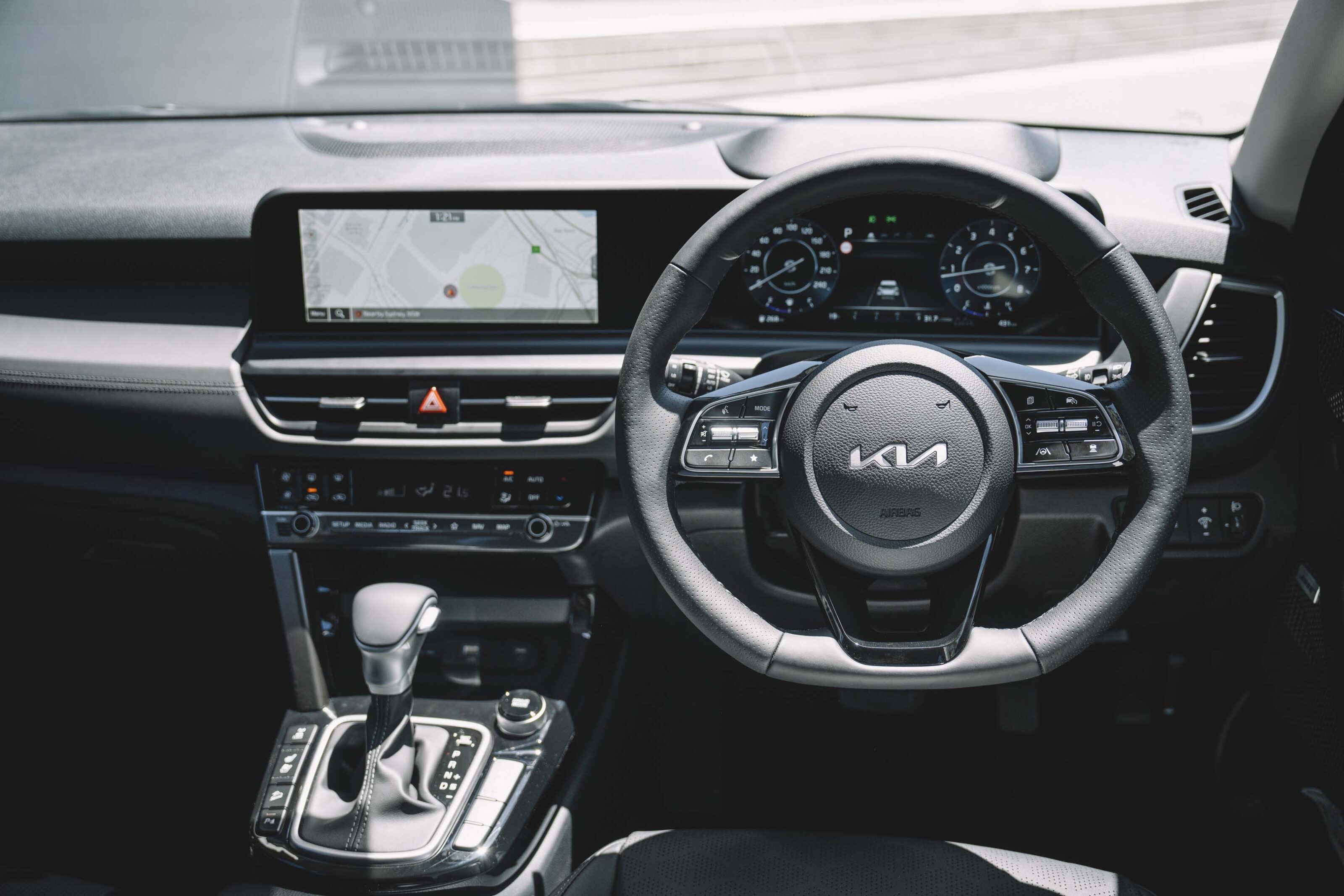
Value improves as you go up the range, too. Take the Sport ($35,390 drive-away) as an example. It’s up by $2600 but you get seven years of connected services and the safety pack (previously $1000) thrown in free, much more sound deadening and a fresher technology package built around a pair of 10.25-inch screens.
2023 Kia Seltos Sport features (in addition to S)
| 16-inch alloy wheels | Auto halogen headlights |
| 10.25-inch digital driveru2019s display | Cloth upholstery |
| 10.25-inch touchscreen | Kia Connect |
| Wired Apple CarPlay/Android Auto | Leather steering wheel trim |
| Auto-fold mirrors | DAB+ digital radio |
Lower grades are only available with the 110kW 2.0-litre petrol four-cylinder, but the top trims can be had with either engine.
The Sport+ is up by $2200 for FWD ($38,490 drive-away) or AWD ($41,990 drive-away) and the flagship Seltos GT-Line AWD ($47,690 drive-away) is bumped by $2400, with the GT-Line FWD ($44,590 drive-away) now offered as a permanent variant after the success of last year’s special edition.
2023 Kia Seltos Sport+ features (in addition to Sport)
| Navigation | Premium cloth/vinyl upholstery |
| Smart key | Auto-dimming rear mirror |
| Covered central storage bin |
2023 Kia Seltos GT-Line features (in addition to Sport+)
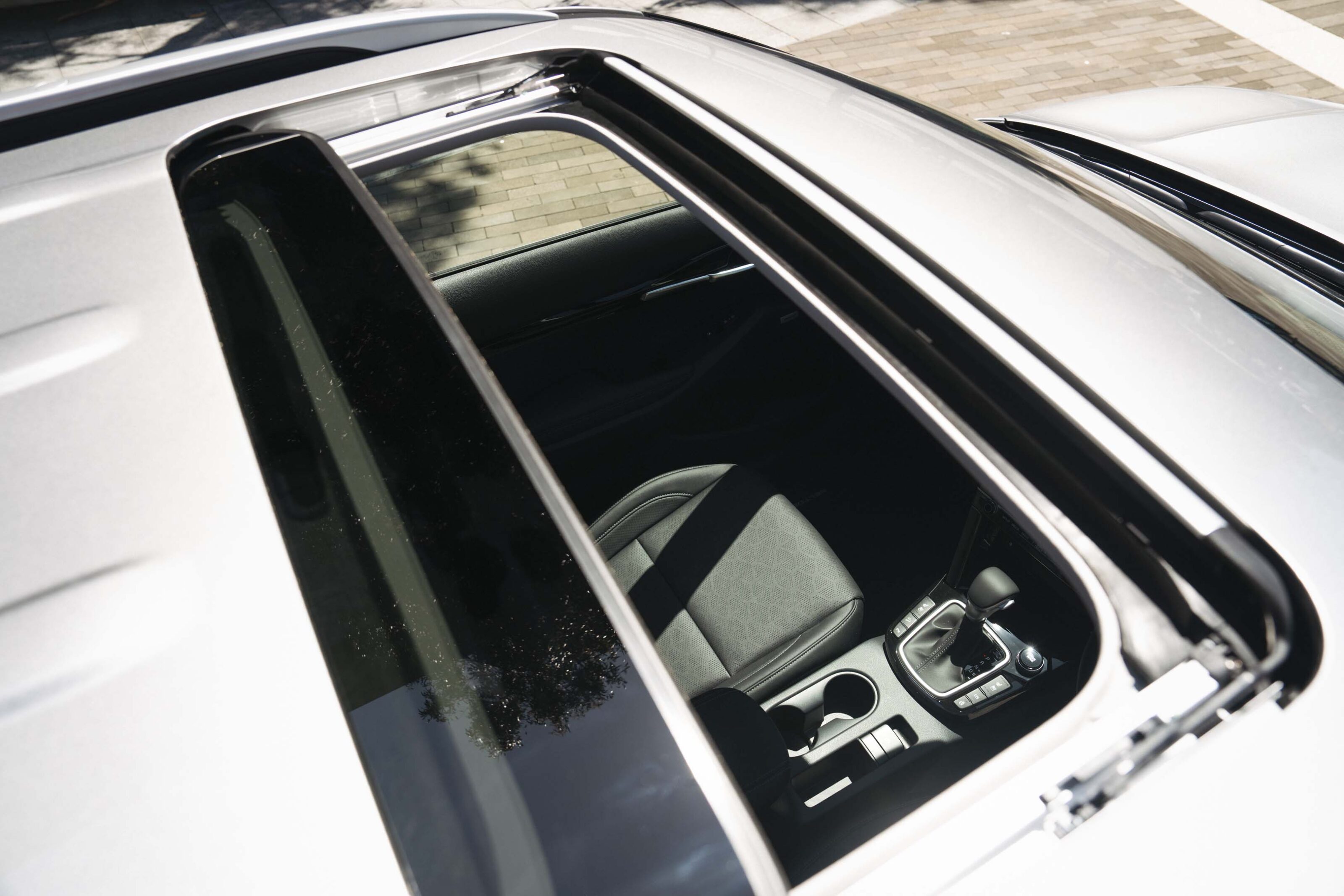
| 18-inch alloy wheels | LED headlights |
| LED daytime running lights | Electric front seat adjustment with memory |
| Heated and cooled front seats | Vinyl upholstery |
| 8-speaker Bose sound system | LED interior lights |
| Heated steering wheel | Power tailgate |
| Qi wireless phone charging | Rear-seat centre armrest |
Only fitting an auto-down switch for the driver’s window is one of the few letdowns for what is an otherwise very full spec sheet. Given Kia listened to feedback with the latest update by adding rear air vents and USB-C charging across the range, hopefully, some two-dollar auto-switches make their way into the cabin soon.
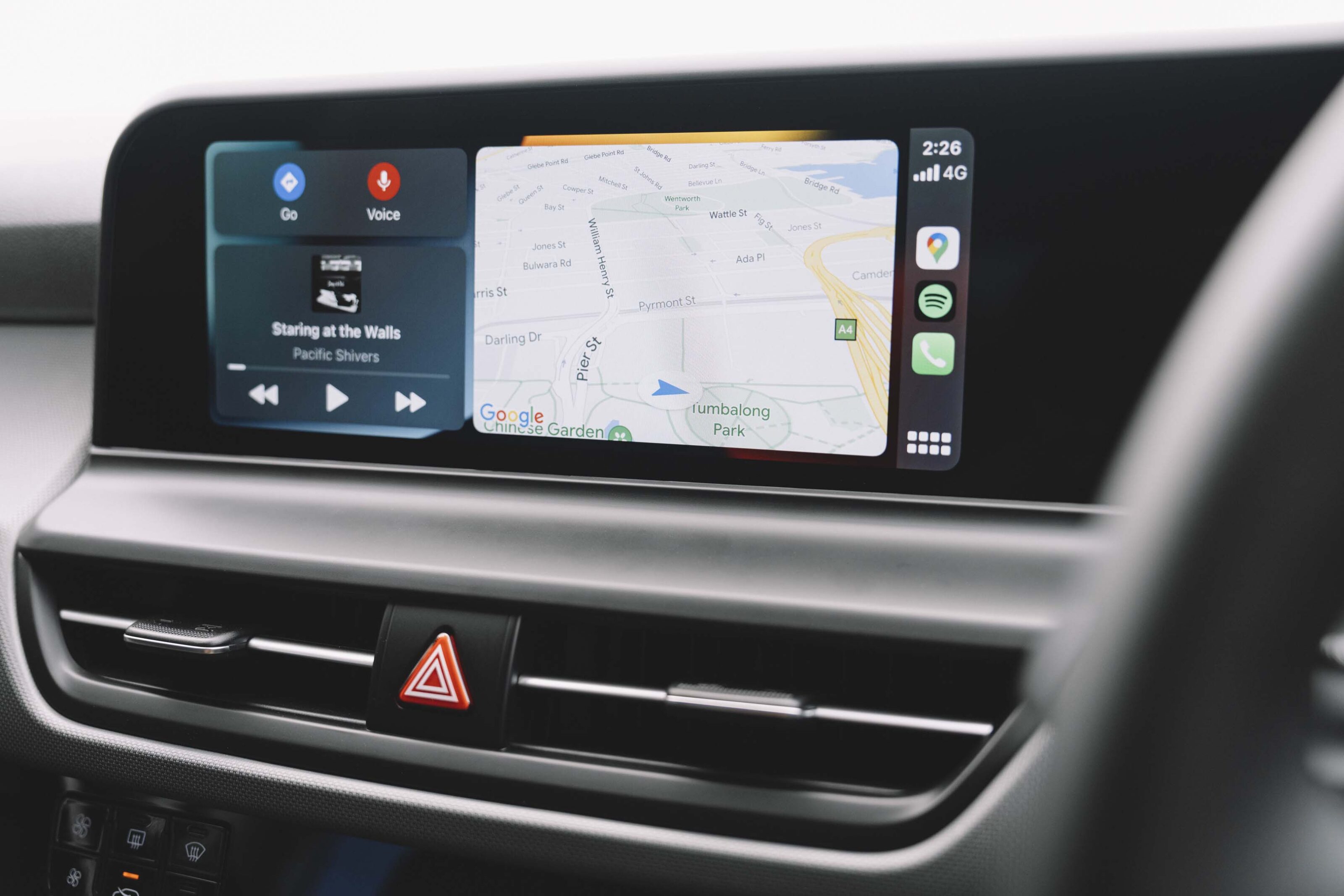
Kia’s technology package looks sharp, too, with customisable dial colours and looks tied to drive modes. The in-built sat-nav comes with 10 years of free map updates, but it’s a shame Kia still doesn’t support wireless smartphone mirroring in the big-screened trims.
There are a host of cute features including ‘Sounds of Nature’ ambient noise generator built in, and the Seltos brings Kia’s Connected Services to the masses. Via a smartphone app, its telematics features enable the owner to remotely start the car, keep track of fuel levels, location, lock status and pre-condition the climate settings before driving away.
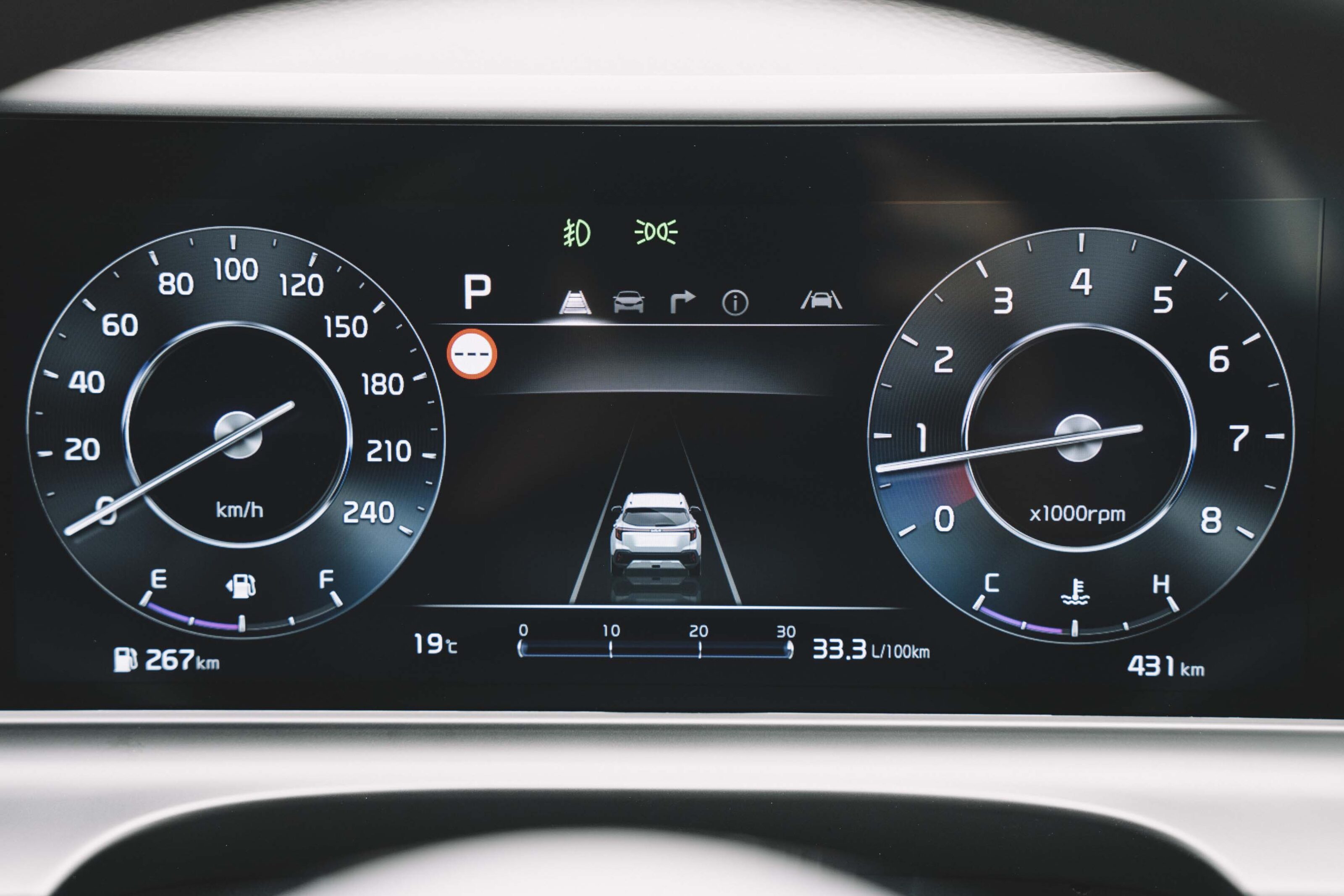
Kia Seltos: The basics
| Feature | Seltos FWD | Seltos AWD |
|---|---|---|
| Drive | front-wheel | all-wheel |
| Engine | 2.0L, MPI I4, DOHC, Atkinson cycle petrol | 1.6L, DI I4, DOHC, CVVD turbo-petrol |
| Power | 110kW | 146kW |
| Torque | 180Nm | 265Nm |
| 0-100km/h (claimed) | 10 seconds (estimated) | 8.5 seconds |
| Transmission | continuously variable | 8-speed torque converter |
| Body | steel, 5-door, 5-seat small SUV | steel, 5-door, 5-seat small SUV |
| Weight | 1375kg | 1495kg |
| Fuel consumption (tested) | 6.7lL100km | 8.7L/100km |
| Boot space | 433L (S 468L) | 433L |
How do rivals compare on value?
Traditionally, the small SUV has offered less-than-stellar value compared to hatchbacks, but sales charts suggest that isn’t enough to put anyone off.
In the case of Seltos, the base small SUV commands a $4700 premium over a Cerato (when the hatch is equipped with the necessary $1500 safety pack). For those looking to save without sacrificing, it pays to look beyond SUVs.
But because 13 per cent of Australia’s new-car sales (18 per cent when you throw smaller ‘light’ SUVs in) come from small SUVs, they’re clearly here to stay.

The 2023 Kia Seltos compares favourably to the latest player in the space, Toyota’s Corolla Cross. That starts at $33,000 before on-road costs, which makes a Corolla Cross GX about $5000 dearer drive-away than the Seltos S without offering a larger touchscreen or slicker cabin materials.
Looking at the top of the range, Mazda’s sharp and premium-feeling CX-30 is an attractive option, but once you add on-roads to the G25 Astina’s $45,190 price (about $49,699 drive-away) and Toyota’s Corolla Cross Atmos 2.0 FWD $43,550 ($47,693 drive-away), the $47,690 drive-away Seltos GT-Line AWD looks right on the money.
Of course, for those looking for absolute bargain SUVs, your money will go towards a more bulging spec sheet on a Mitsubishi ASX, Haval Jolion or MG ZS, but none of those has been blessed with Kia’s Australian ride and handling program.
Interior comfort, space and storage
For all the value the Seltos offers, there’s definitely some style worth talking about too. The three top trims have their infotainment interfaces and instrument panels near-seamlessly integrated into a pair of screens.
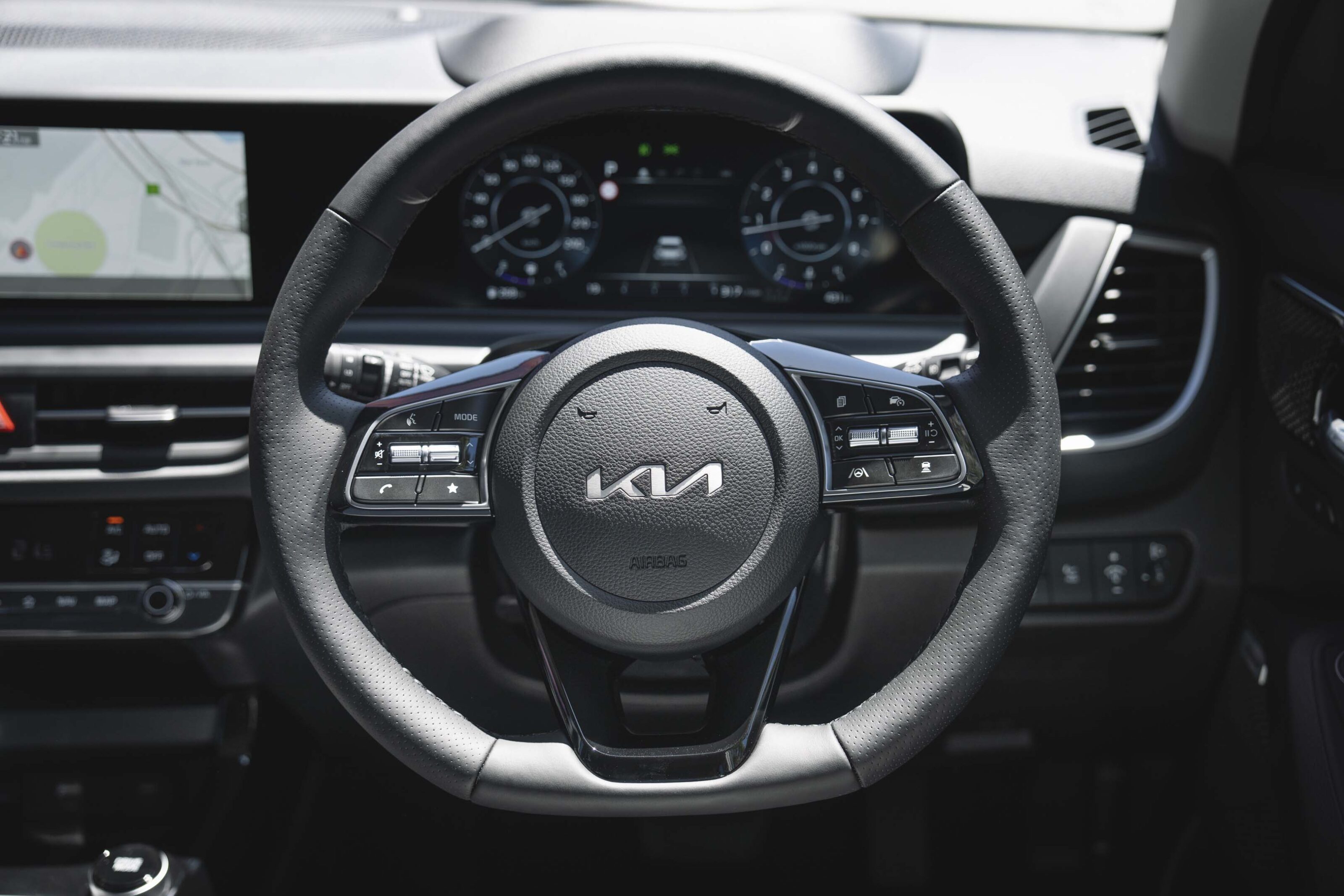
High-traffic touch points are generally nicely appointed, including the satin silver-look door handles and soft leatherette steering wheel (with sporty perforations and a flat bottom on the GT-Line). Build quality is sturdy, too.
Look further afield, though, and there is still a lot of scratchy black plastic. The door tops – even in the front of GT-Line – are hard, and the dash’s solid moulding means this is quite a glary car in the Australian sun, though luckily the glare doesn’t impact the legibility of the digital driving display.
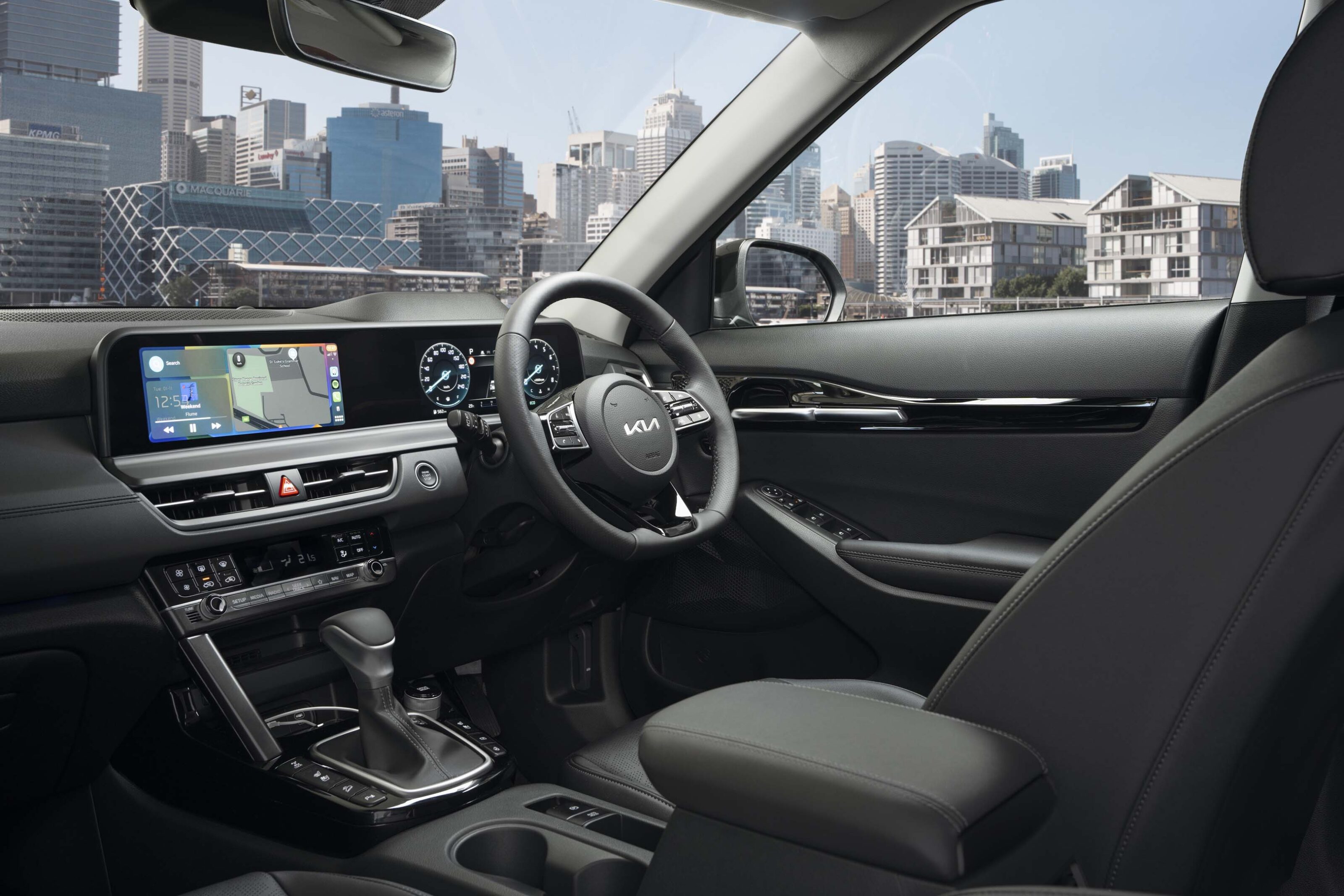
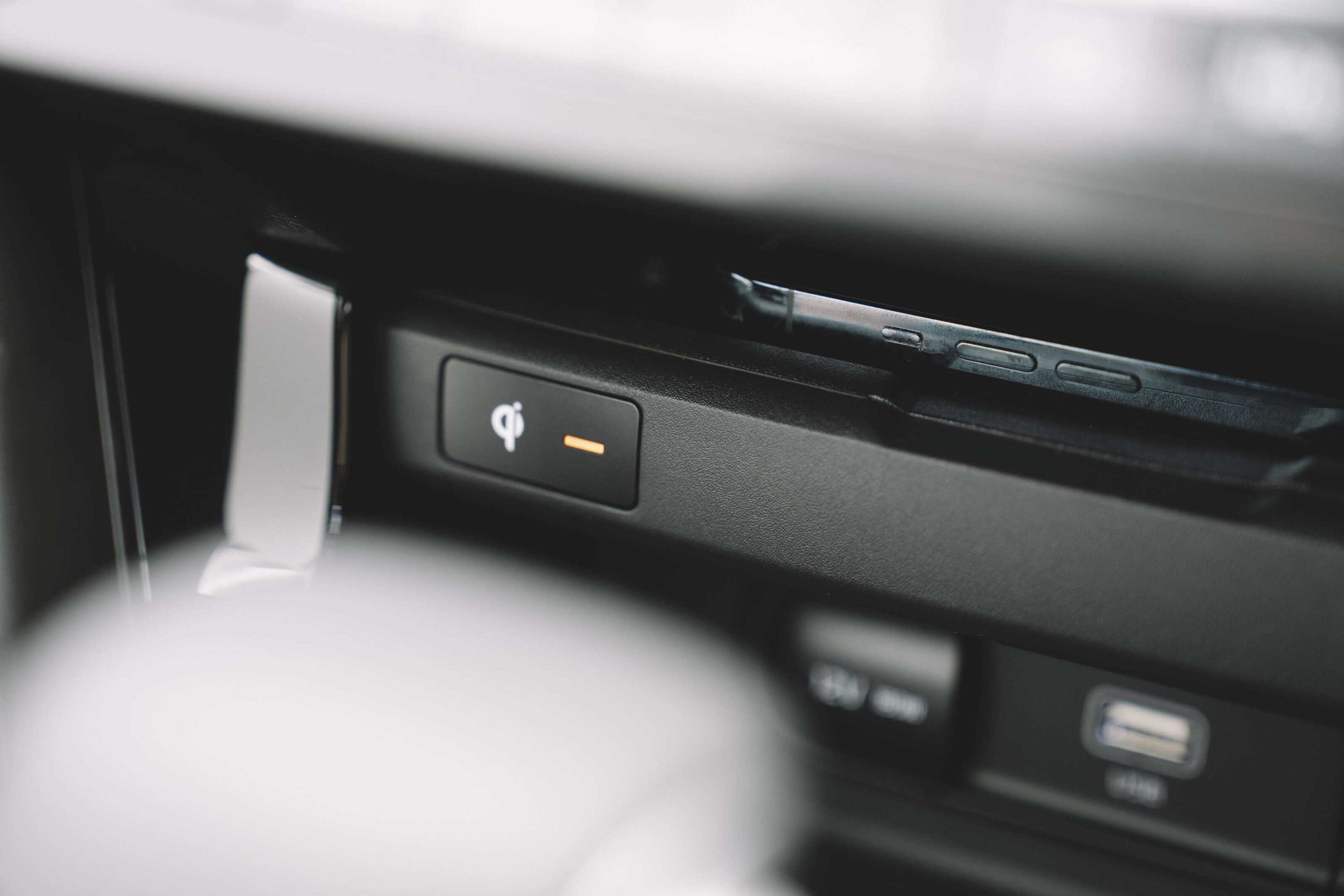
From Sport+ up the Seltos has a covered central storage cubby. Every grade has two cup holders and a two-tiered storage compartment ahead of the gear selector. In the GT-Line, the top level houses a wireless phone charging pad, but in every grade there’s a USB-A slot for phone communication, a USB-C fast-charging slot and a 12-volt socket easily accessible.
The door bins are fairly spacious, but not generous enough for a one-litre camping bottle.
Seating is a mixed bag in the Seltos. Lower grades get manual front seat adjustment that the driver can set nice and low (but the passenger misses height adjustment).
Meanwhile, the GT-Line’s vinyl-trimmed seats with electric adjustment sit much taller in the cabin. They are comfortable and do have three-stage heating and cooling for much-needed temperature regulation. The result being, the Sport+ has all the comfort you need with lower-set seats with premium-feeling patterned cloth upholstery.
Jumping into the back seat is typically where the Seltos has the Mazda CX-30 licked, and the facelift is almost no different. At 188cm I have generous knee- and toe-room, with enough headroom to be comfortable.
You could fit three slender people across the back if needed, and for securing child seats, the 2023 Seltos has three top tether anchor points plus ISOFIX ports for both outboard seats.
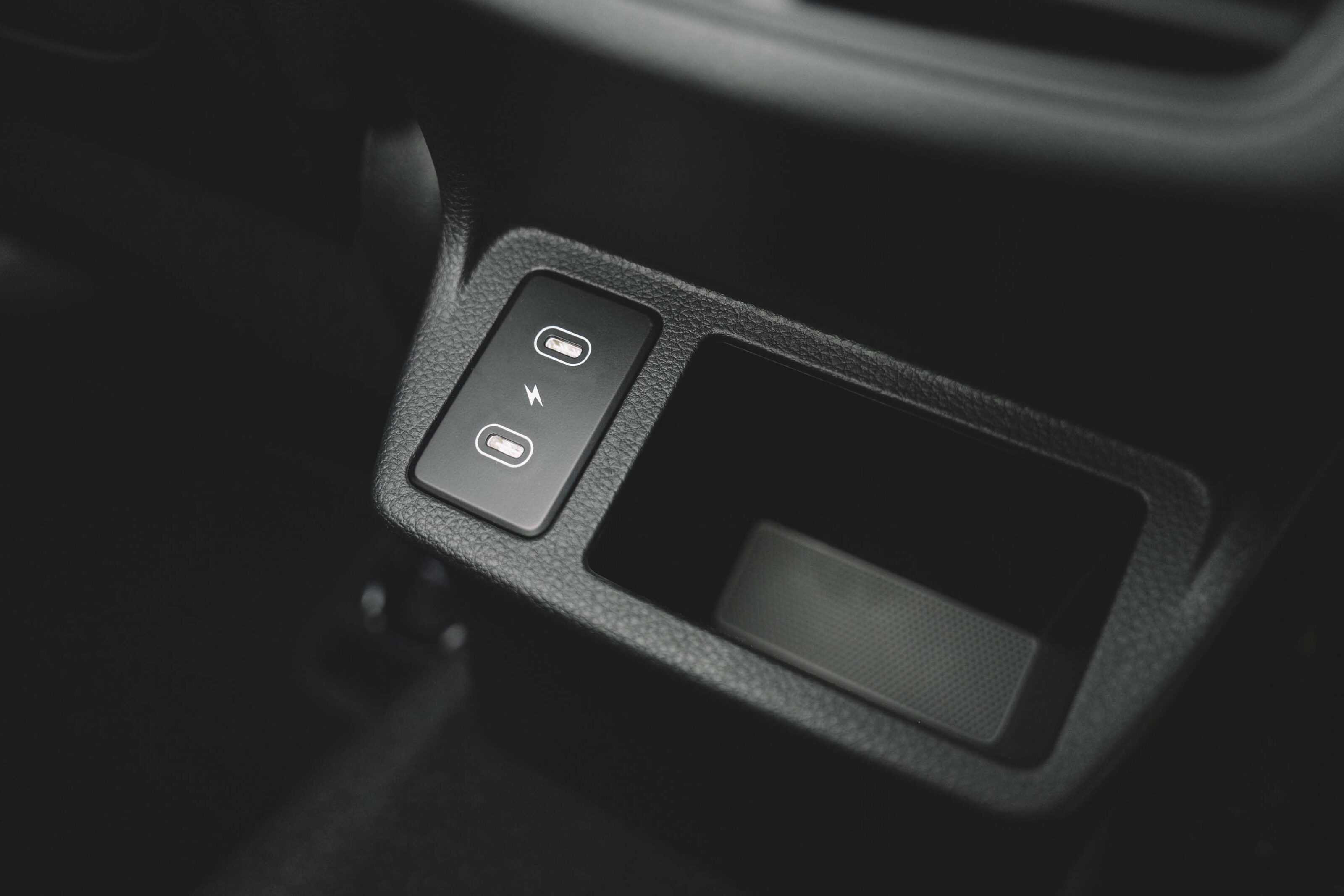
The rear backrest of the Seltos has two positions to choose from, but no sliding base. For the facelift, Kia has sprinkled air vents across the whole range, great in a hot country like ours. There are also USB-C charging points to keep kids’ devices charged.
Material quality, though, is not so stellar. The door plastics are very firm to the touch, and the back of the driver’s seat has no vinyl padding – it’s just black PVC. The GT-Line exclusively gets a back seat centre armrest.
2023 Kia Seltos boot space
Another boon for Seltos is its boot, which again, is unchanged and still the biggest in class. The base Seltos S has 468L of cargo space, growing to 1428L with the seats folded. As Sport and above Seltos trims get full-size spares in 2023, their boot space is 433L (climbing to 1393 with the second row down).
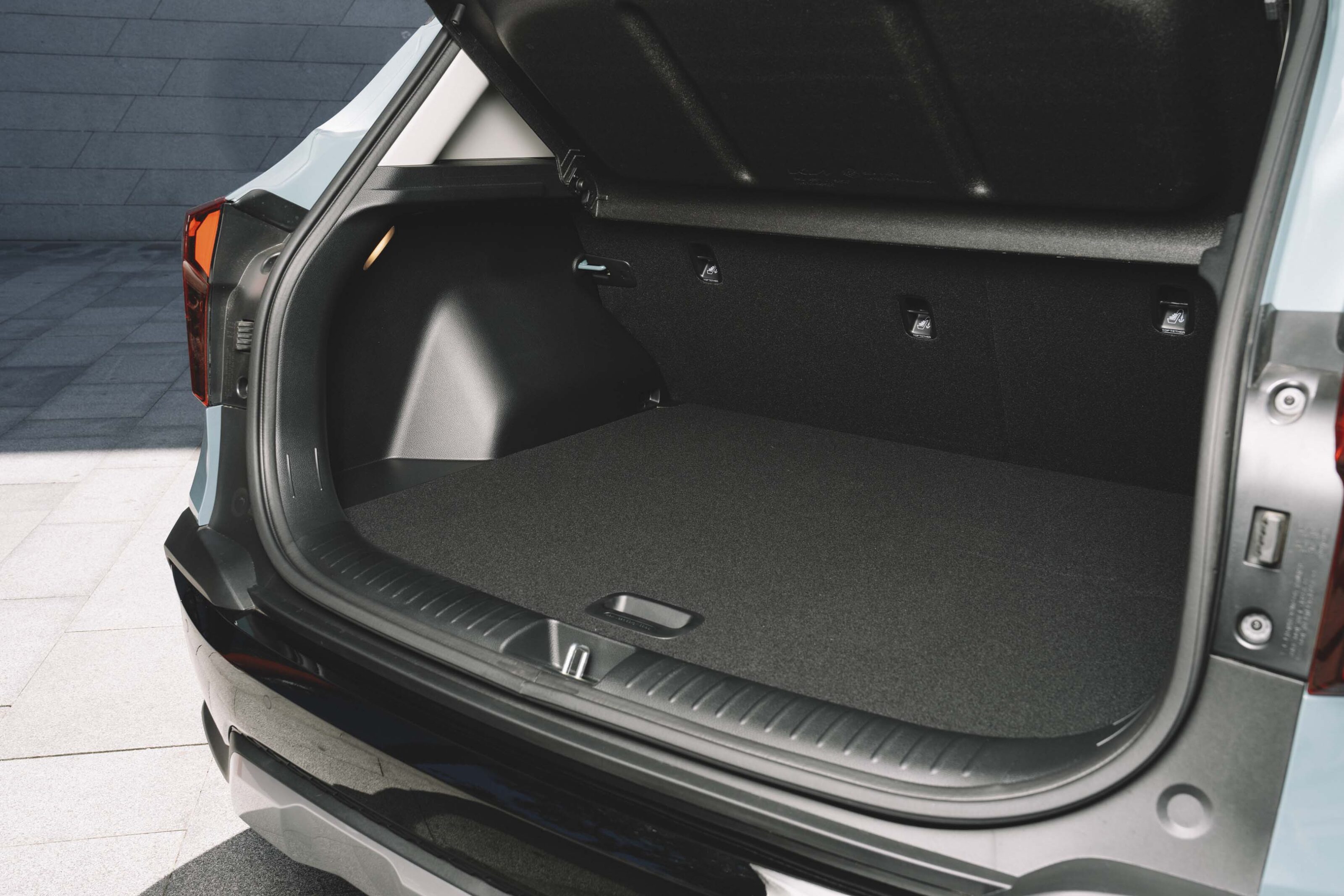
2023 Small SUV boot comparison
| Kia Seltos | 433L-468L |
|---|---|
| Haval Jolion | 430L |
| Toyota Corolla Cross | 425L-436L |
| Mitsubishi ASX | 393L |
| Volkswagen T-Roc | 392L |
| MG ZS | 359L |
| Mazda CX-30 | 317L |
What is it like to drive?
So the Seltos is an impressively packaged SUV that offers great value, and as we know from before, is one that doesn’t fall apart on the road.
Kia hasn’t messed with the suspension and steering settings of the Seltos for the facelift as it deemed the chassis more than adequate, something with which we agree.
Instead, Kia focused on making the drive smoother in a number of ways. Starting with sound – there’s more absorbing material behind the pillar and door trims, as well as under the carpet and in the wheelarches. The result is suspension that feels quieter in its operation and less noticeable road noise.
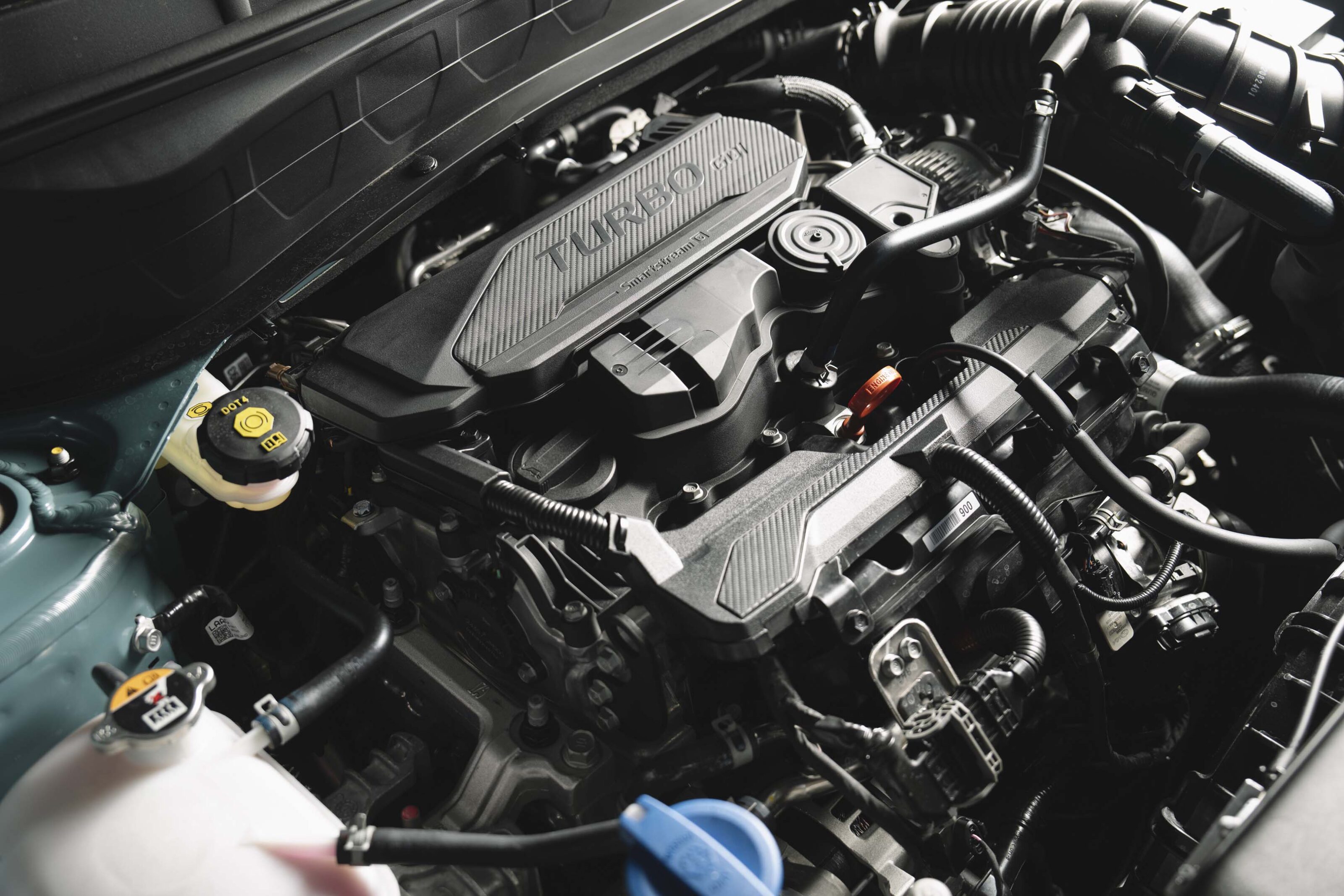
The big headline is the new powertrain for the AWD Seltos. Gone is the 1591cc 130kW/265Nm petrol engine, and instead we have the 1598cc Smartstream unit found in the Hyundai i20 N and i30 N Line sedan.
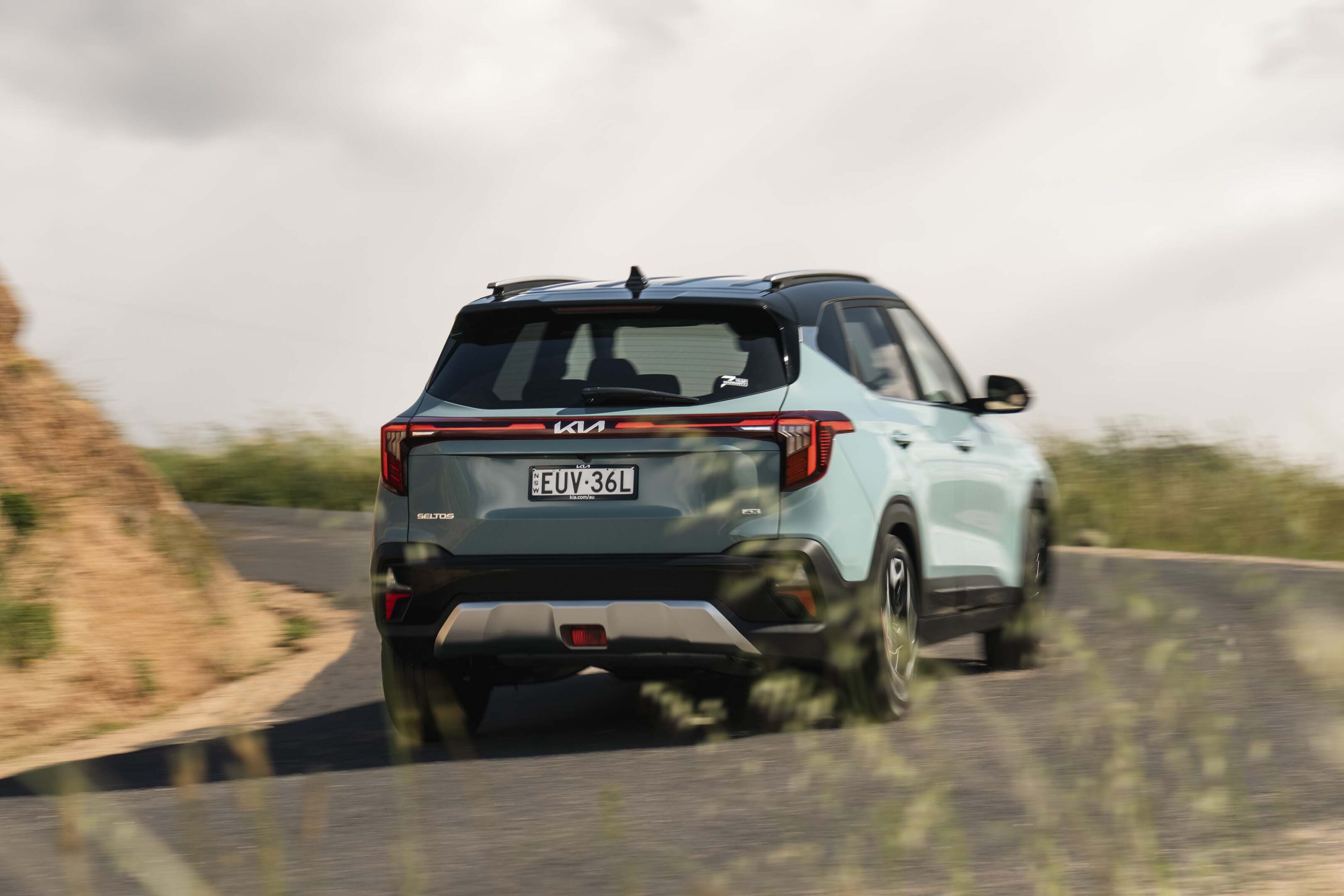
Power is up by 16kW to 146kW, while torque is unchanged. The result is a 0-100km/h sprint a tenth faster (now 8.4 seconds) but an 80-120km/h interval taking 5.7 seconds, half a tick faster for much-improved overtaking performance.
An all-alloy four-cylinder, it employs continuously variable valve duration technology to help it achieve better power and efficiency. It’s also a quieter unit, with the old engine’s high rpm buzzy resonance banished.
The 2023 Seltos AWD uses an eight-speed torque converter automatic from Aisin, which doesn’t have the old dual-clutch unit’s tendency to roll back and deliver jerky shifts.
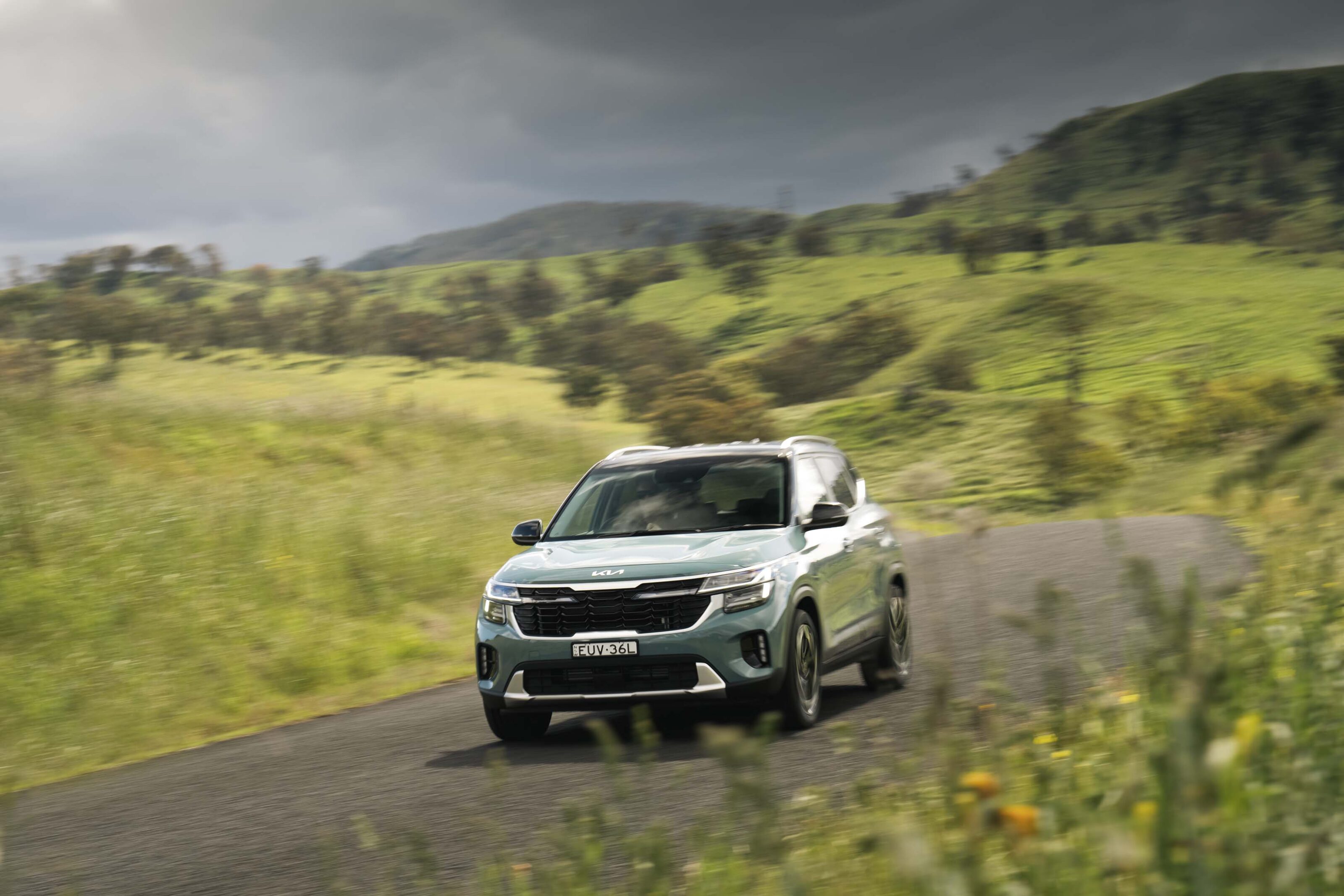
Sometimes the new transmission refuses manual gear changes, and even in Sport mode will only hold a gear to a maximum of 6000rpm before changing up (the redline looks to be at 6500rpm), but as a small SUV rather than a performance car, it’s not such a big issue.
The other engine remains unchanged, a 2.0-litre multi-point injected Atkinson cycle petrol developing 110kW/180Nm. The outputs sound pretty lazy but are adequate for urban running. The front-drive Seltos remains a surprisingly sweet companion around town, but the new 1.6 turbo is a more enticing option.
Also, the AWD 1.6 Seltos is blessed with multi-link independent rear suspension that offers a more supple, fluid ride than the occasionally hoppy torsion beam in the front-drive cars.
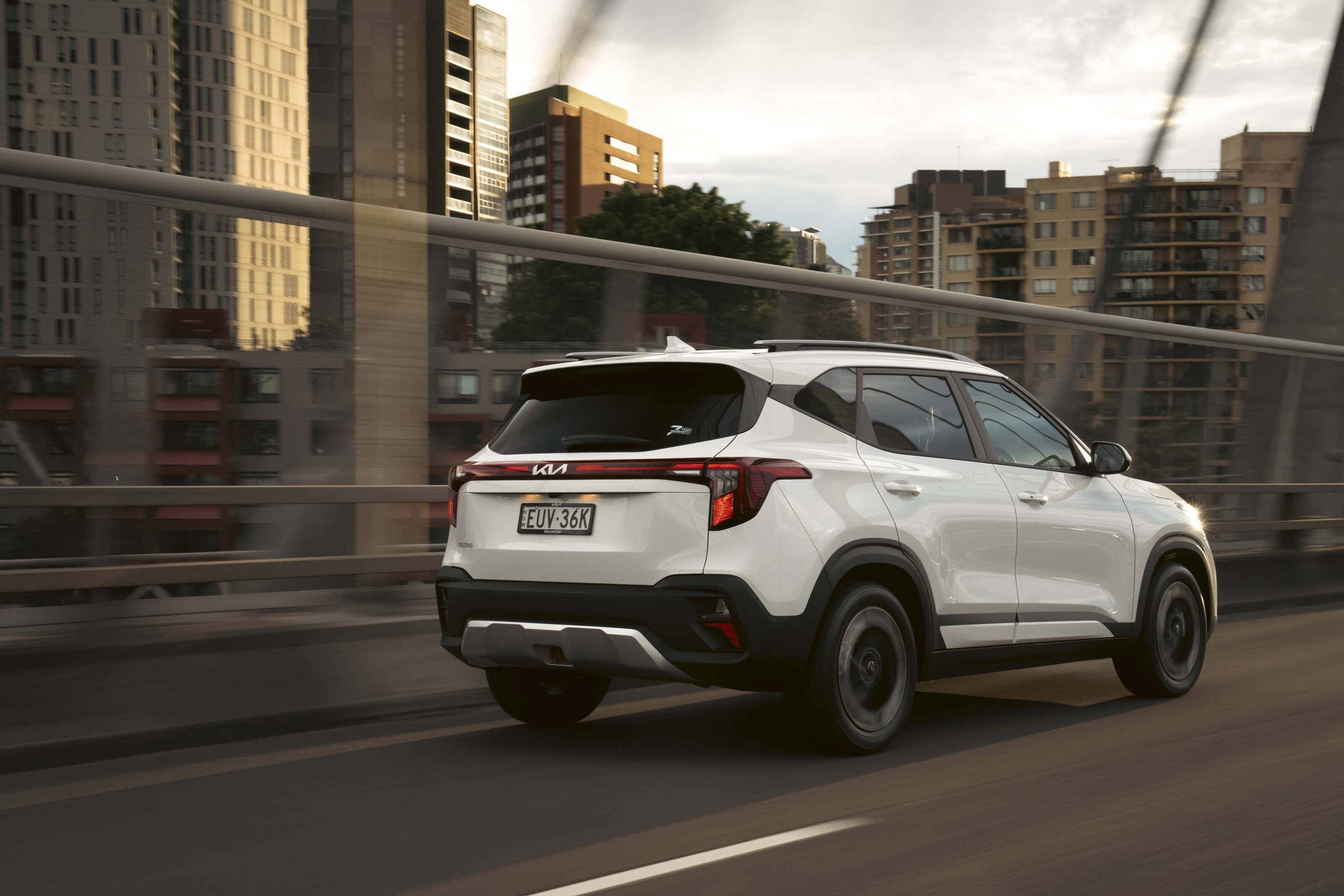
Out on the twists and turns through the Blue Mountains and over the Great Dividing Range the Seltos performs admirably. The chassis is firmer in its tune than the Corolla Cross, but more compliant than a CX-30. Cornering support is good, and the Seltos is a fluid and talented companion on a country road.
If there’s one complaint, on the Seltos GT-Line’s bigger 235/45R18 wheel and tyre combo the secondary ride can be abrupt, especially over urban imperfections. The Sport+ and Sport’s 17-inch alloys are shod in 215/55 R17 Kumho Ecsta HS51 tyres that better cushion your coccyx from potholes.
The Seltos has Australian-tuned steering and it’s good on the whole, though there’s still some vagueness on-centre. But once in the meat of the rack, things improve and make the Seltos a confident handler.
How much fuel does it use?
The combined ADR 81/02 consumption figure for the 2023 Seltos front-wheel drive is 6.9L/100km.
According to the trip computer on the car we drove during the Australian launch, we managed to better its claim, returning 6.7L/100km, which is pretty impressive for a naturally aspirated four-banger.
While the new Smartstream turbo is cleverer, the combined fuel efficiency creeps down by two-tenths to 7.4L/100km.
We saw 8.7L/100km in the AWD Seltos, potentially reflecting its portlier 1495kg tare weight and extra driveshafts when compared to the front-driver’s 1375kg claim. No Seltos has a stop-start system for fuel saving.
Given the swelling hybrid options in this space, it’s a shame the Seltos is petrol only. As it uses many of the same underpinnings as the Niro, the engineering complexity would – theoretically – not be too huge. But Kia execs have all but ruled out a hybrid Seltos until a new gen arrives around 2025.
How safe is it?
Kia has improved safety across the Seltos range, and banished the $1000 safety pack, opting instead to dump extra kit onto the base car.
The 2023 Seltos S is equipped with lane-trace assist, safe-exit warning, blind-spot monitoring, rear cross-traffic alert, front and rear parking sensors, and emergency call contact.
This is in addition to auto emergency braking (AEB) with pedestrian detection, lane-keep assist, driver attention alert, rear occupant monitoring and six airbags that were fitted to the pre-facelift cars.
As the S is not fitted with a radar sensor (its AEB system uses cameras only), the S is no longer available with adaptive cruise control, front junction AEB or cyclist detection.
The Seltos Sport mirrors the S, while the Sport+ and GT-Line score the radar sensor meaning adaptive cruise control, front junction and cyclist detection for the AEB and lead vehicle departure alert are added.
No Seltos is available with a surround-view camera and Kia has not integrated Sportage’s clever blind-spot cameras into the Seltos’s digital cluster. Also, Kia’s lane-keep aid is still not the best in the business.
The Seltos has also picked up a new feature called ‘intelligent speed limit assist’.
Like lane-keep, this defaults on every time you spark up the engine. The system either subtly trims the Seltos’s throttle inputs to match the speed limit (obtained from traffic sign recognition cameras) or plays a constant chime when breaking what the car thinks is the current limit, even by small 1-5km/h increments where your true speed is within the posted sign.
This may be helpful to some, but I’ll bet a crisp pineapple that having to jump through three menu layers to switch it off will wear thin very quickly.
Warranty and running costs
Kia maintains its seven-year, unlimited-kilometre warranty in Australia.
Once industry-leading, it is slowly being adopted by more manufacturers, including Skoda and GWM/Haval, while Mitsubishi offers a 10-year/200,000km warranty when the car is serviced at a dealer.
Servicing for the front-wheel drive Seltos is due every 12 months or 15,000km and will cost $2072 over five years, or $3040 for seven.
The turbo-petrol Seltos requires maintenance a little more regularly, at 12 months or 10,000km, at a cost of $2178 for five years and $3479 for seven.
VERDICT
Revamped, more handsome and now with a better AWD powertrain, the Seltos is really only missing a hybrid to totally challenge the best in the small SUV segment.
It’s a great little SUV to drive, with abundant practicalities and an extensive spec list. The facelift has amped the cabin ambience, but there’s still a way to go to match the gorgeous CX-30 and premium-feeling Volkswagen T-Roc.
The inclusion of connected services for seven years is also a great deal for prospective Seltos buyers. Kia says there will be stock in dealers later this month, but as with all cars at the moment you’ll probably be waiting a while.
Still, the Seltos is well worth putting on your shortlist. This is a small SUV that will weather the rigours of family life.
As cool as the GT-Line looks, our money would go to the Sport+ with either powertrain.
| Kia Seltos FWD | Kia Seltos AWD | |
|---|---|---|
| DRIVETRAIN | ||
| Engine | 4cyl, dohc, 16v, Atkinson cycle | 4cyl, dohc, turbo, direct-injected 16v |
| Layout | front engine (east-west) FWD | front engine (east-west) + single motor, AWD |
| Capacity | 1999cc | 1598cc |
| Power | 110kW | 146kW |
| Torque | 180Nm | 265Nm |
| Gearbox | CVT automatic | 8-speed automatic |
| CHASSIS | ||
| Body | steel, 5 doors, 5 seats | steel, 5 doors, 5 seats |
| L/W/H/Wu2013B | 4385/1800/1635/2630mm | |
| Weight | 1375kg | 1495kg |
| Boot | 468L/1428L (S) OR 433L/1393L (other trims) | 433L/1393L |
| Fuel/tank | 91 RON/ 50 litres | 91 RON/ 50 litres |
| Economy | 6.9L/100km (ADR81/02) | 7.4L/100km (ADR 81/02) |
| Suspension | Front: struts, coil springs, anti-roll bar. Rear: coupled torsion beam axle | Front: struts, coil springs, anti-roll bar. Rear: multi-link, coil springs, anti-roll bar |
| Steering | electric rack-and-pinion | electric rack-and-pinion |
| Front brakes | ventilated discs (280mm) | ventilated discs (305mm) |
| Rear brakes | solid discs (262mm) | solid discs (284mm) |
| Tyres | Kumho Ecsta HS51 | Kumho Ecsta HS51 |
| Tyre size | 215/55 R17 OR 235/45R18 (GT-Line) | 215/55 R17 OR 235/45R18 (GT-Line) |
| SAFETY | ||
| ANCAP rating | five stars | five stars |
| PERFORMANCE | ||
| 0-100km/h | 10.5sec (estimated) | 8.4sec (claimed) |
Kia Australia’s general manager of product planning, Roland Rivero called the firm’s effort to build Sorento hybrids for Australia “tokenism at best” at this week’s Kia Seltos small SUV release.
As it stands, Kia Australia is able to secure 20 Sorento hybrids each month, making an annual number around 240, or less than four per cent of total Sorento sales.
And it isn’t as though the Sorento HEV has experienced a lukewarm reception since launching in April 2022, with the brand quoting 12 month waits for the electrified three-row SUV.
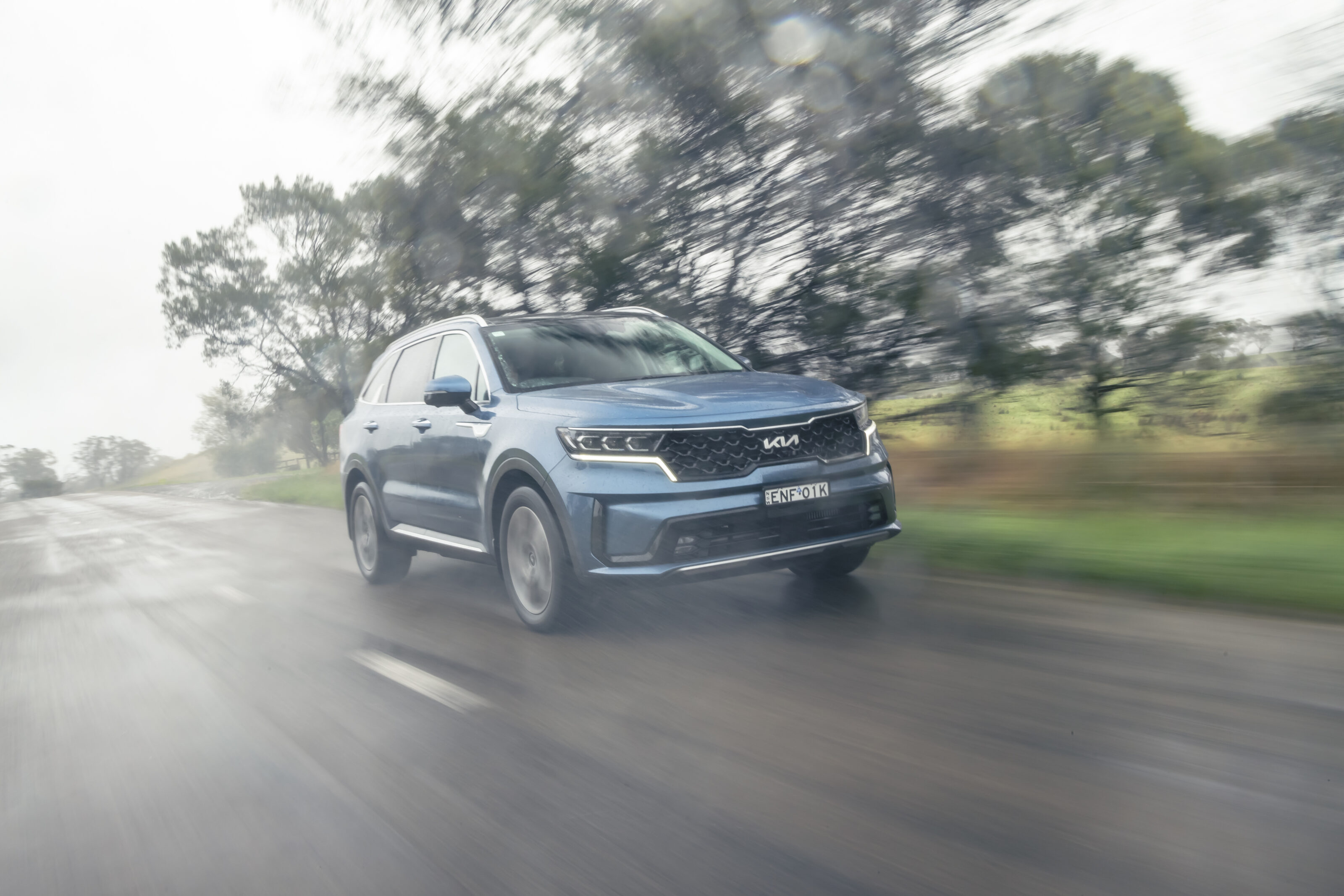
It may be expensive historically, but starting from $66,750 before on-road costs, the Sorento GT-Line hybrid FWD is competitive against the Toyota Kluger Grande hybrid AWD ($75,700) and Hyundai Santa Fe Highlander hybrid ($69,550).
Rivero floated the notion that, due to its popularity, Kia’s head office may need to tell dealers to close order books momentarily to address the delays.
“It’s actually becoming a problem, to be honest with you,” Rivero said.
“The backorders are growing on the Sorento hybrid range, and the bigger the back orders get, the more we have to start even considering telling dealers ‘you might have to stop’ a little’.”
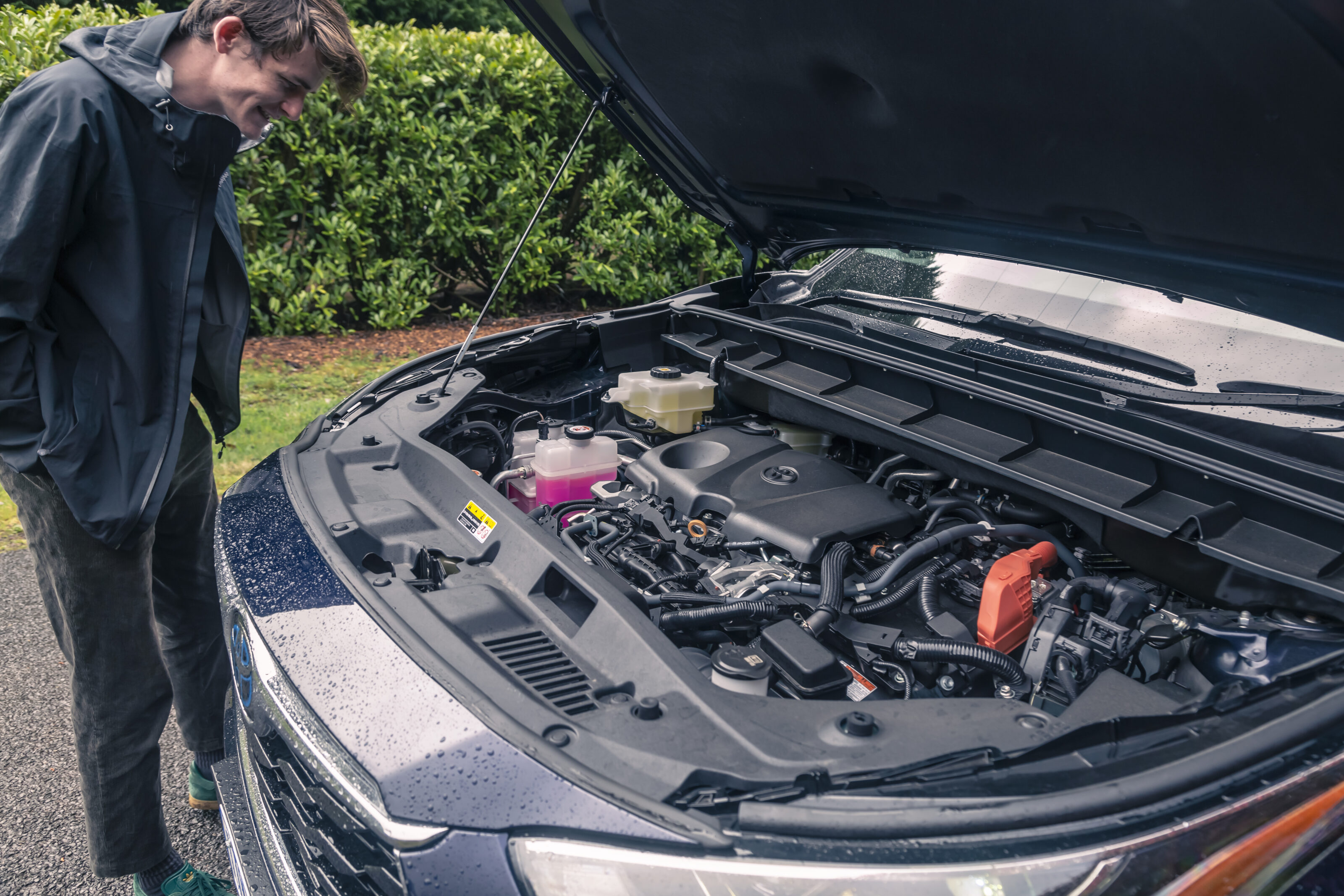
The other issue being, with Kia’s six-year product cycles, a Sorento facelift is likely only 18-24 months’ away from being unveiled, making projected 12 month wait times for the current vehicle – that are only growing – an issue for buyers with a refresh on the way.
Why can’t Kia get Sorento hybrids?
As for why, Roland noted that “Australia is only a small part of the greater globe, and we don’t have any CO2 regulations. The Sorento hybrid range only comes out of Korea to supply the world, and some countries have very stringent CO2 regulations.”
At the launch of Hyundai’s Santa Fe hybrid rival, Kia’s sister brand claimed it had 400 examples of its hybrid three-row SUV in Australia, far exceeding stock of the Sorento HEV.
With the Federal Government currently considering future fuels regulation though, hybrid supply (and EV supply, for that matter) could improve with emissions mandates.
“What happens with [a CO2 mandate] is that we get more time out of headquarters so that we can study our case in stronger terms if we’ve got the legislation backing us up. I think that’s fair”, said Kia COO Damien Meredith.
“Western Europe and North America have been [dealing with emissions targets] for a long time, so when it comes to [Australia], when we get that sort of homogenous legislation, well, we’ll be having a good crack to increase our volumes and increase what’s available.”
UPDATE, November 25: Updated 2023 Kia Seltos driven
Kia’s updated 2023 Kia Seltos range is now in Australia, and we’ve driven it. Get the full story, and video, at the link below.
Story continues
Snapshot
- Hybrid Seltos not on the horizon
- Kia execs do see potential, however
- Niro to do hybrid-heavy-lifting in Aus for now
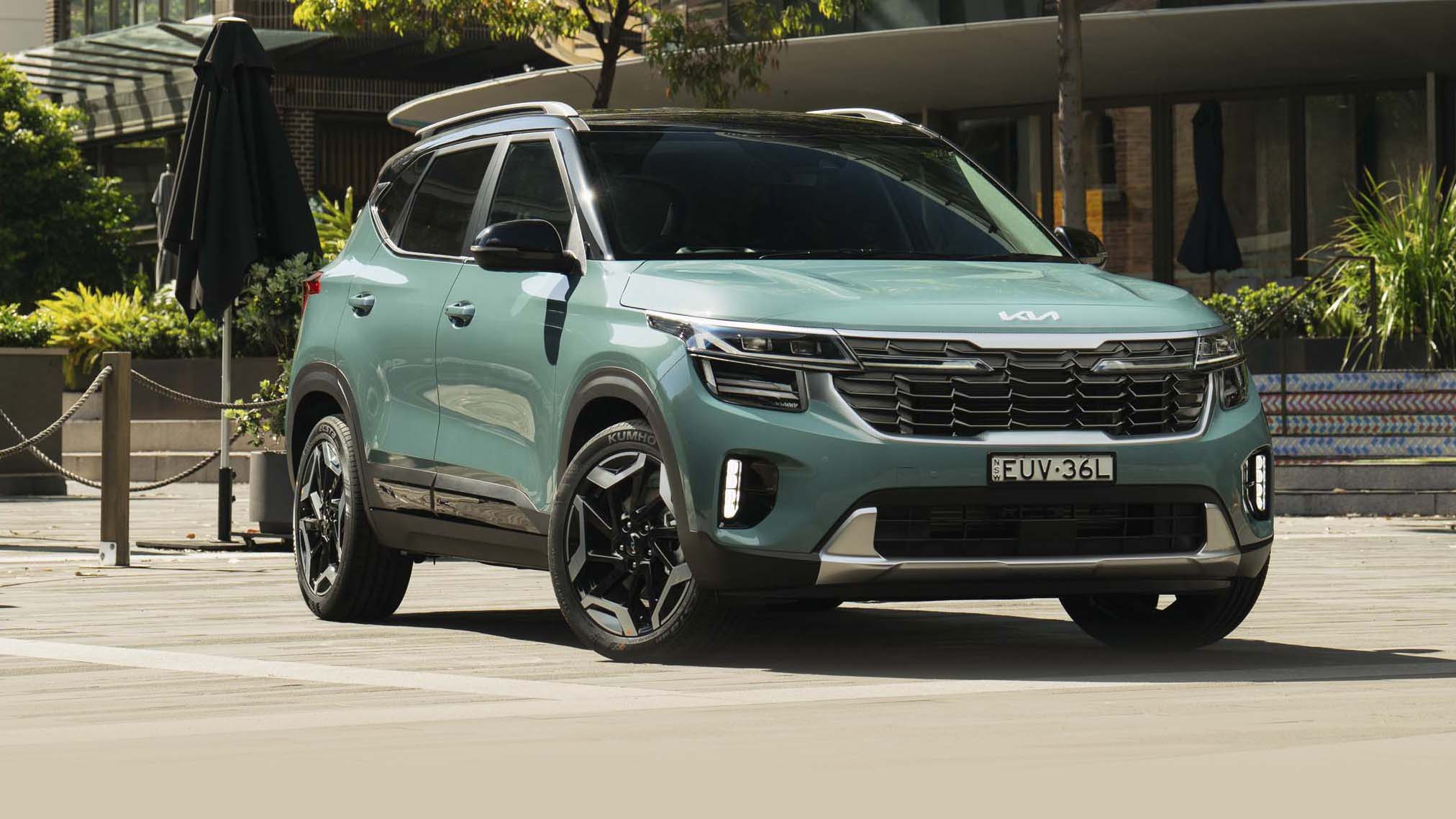
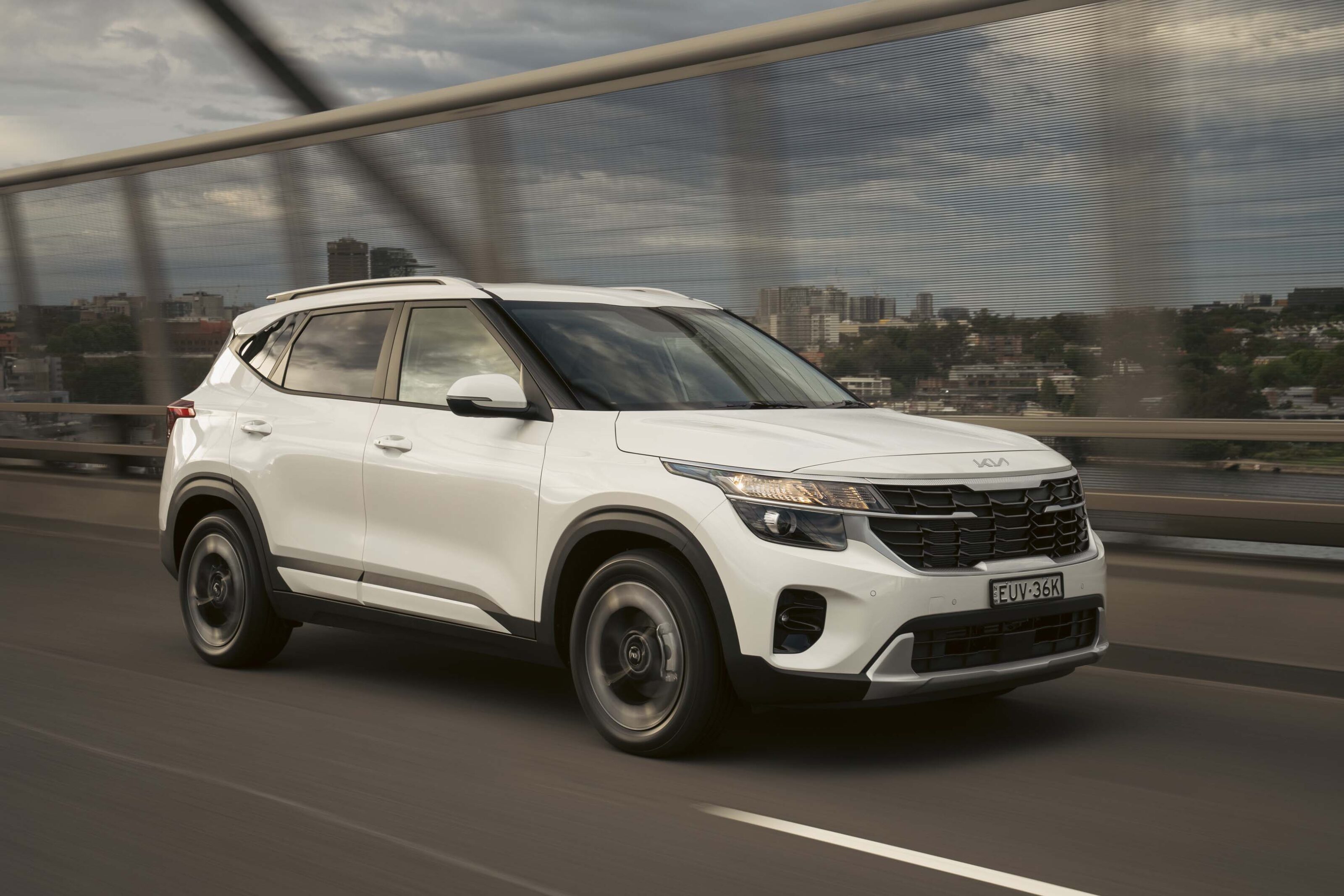
The facelifted 2023 Kia Seltos was released in Australia this week packing a more frugal turbo petrol powertrain, but no hybrid option to rival the Toyota Corolla Cross or Honda HR-V.
Kia justified this choice by pointing to the recently-refreshed Niro, another small SUV that offers conventional hybrid and battery-electric power in Australia.
“In some brands there’s only one small SUV offering and the powertrains will be diverse for that one model”, said GM product planning Roland Rivero.
Pointing to Hyundai, Rivero added “you only have to look at our sister brand where Kona does all the heavy lifting and is offered in multiple powertrains. I think Niro being part of the same segment [as Seltos] made it a case of, well, we don’t really need a hybrid in the Seltos at the moment.”
“With this current generation of Seltos, there’s no plan to introduce a hybrid.
“But that doesn’t necessarily mean that the future will forever be that way. There might be some optimisation in time. But at this point, if you look at the short term, Niro is Niro and Seltos is Seltos”, Rivero said.
Kia’s product lifecycle is typically six years. The Seltos midlife facelift came three years after the car’s initial 2019 Australian release, meaning we can expect a new gen – potentially electrified – in 2025.

Is there really no space for a hybrid Seltos?
The Kia Seltos range runs from $31,690 drive-away for a base 2.0-litre petrol front-wheel-drive S to $47,690 for the flagship GT-Line AWD. The best fuel consumption is achieved by the FWD Seltos, at 6.9L/100km.
Meanwhile, the Niro range kicks off with the S hybrid, priced from $44,380 (before on-road costs), while the GT-Line commands $50,030. Both return a combined fuel consumption of 4.0L/100km in the ADR combined cycle.
The Niro may be more efficient, but it’s also a more expensive vehicle compared to Seltos. This is reflected in sales figures, with Kia targeting around 10,000 annual Seltos sales. In October, Kia sold 764 examples of the Seltos (just ahead of the facelift hitting dealers), vs 207 Niros.
When asked if a hybrid Seltos would perform, Rivero said: “Hybrids in general are in strong demand. You only have to look at the success that Toyota is having today with its hybrid range.
“If positioned right and specced right, then Australians will go for it. And with fuel prices right now I think any savings that can transfer through to the household will be appreciated by Australians, no matter what.
“I think that there are opportunities there, and that’s been proven by the likes of Toyota, that you do the product strategy right and customers will buy,” Rivero concluded.
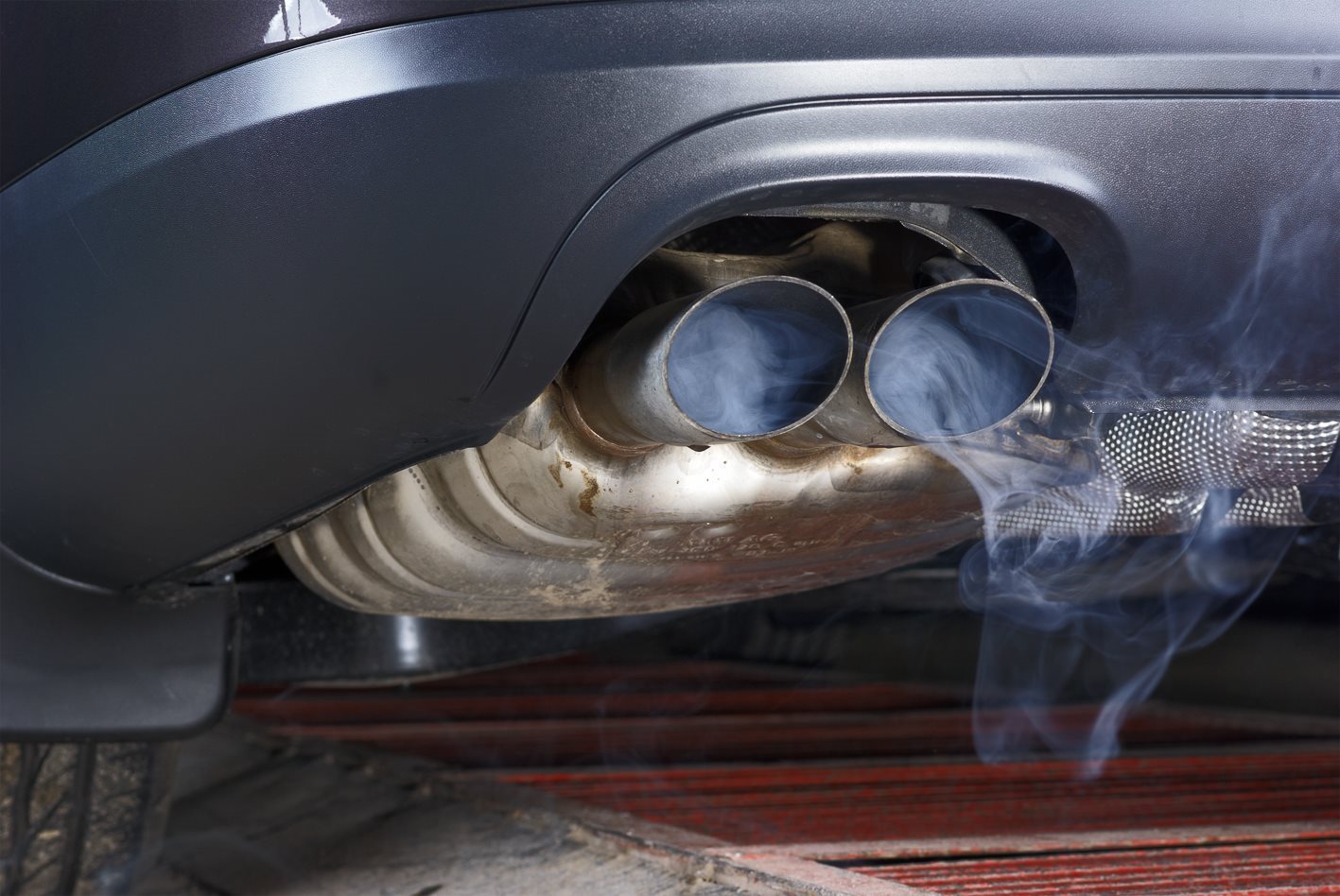
The Federal Government has set up a dedicated Net-Zero Unit to drive down emissions from the transport and infrastructure sectors.
The new unit, which is part of the Department of Infrastructure, Transport, Regional Development, Communication and the Arts, has been created with the aim of identifying how the Department can work across government and with industry to help achieve net-zero emissions by 2050.
It will also look at how to improve the resilience of our transport networks and supply chains in the face of increasing extreme weather events.
The unit will be headed up by Ian Porter, who has years of experience in climate change, energy and sustainability policy, as well as working across government, public service, consulting and the not-for-profit sector – including most recently heading up program delivery for Climateworks.
According to the Department, it will “help advance the Government’s emissions commitments by connecting government agencies, industry and climate experts to put the latest research into action, while ensuring climate expertise is embedded into policies and investments”.
The move follows work already underway on consulting on fuel-efficiency standards as part of a National Electric Vehicle Strategy.

“Achieving our Government’s emissions reduction targets on the path to net zero by 2050 will require concerted action to drive emissions lower across the transport sector,” said Infrastructure, Transport, Regional Development and Local Government Minister Catherine King.
“We are already helping to achieve this by increasing the uptake of electric vehicles, considering fuel efficiency standards, improving consumer information, promoting alternative aviation fuels and other technologies, and engaging with international partners to reduce shipping emissions.”
Today’s news was welcomed by bodies such as the Australian Automotive Dealers’ Association (AADA), which said the Government was finally showing initiative and advancing coordination towards net-zero.
“Dealers support an ambitious, but achievable transition to lower emissions and electrification. Franchised new car Dealers work closely with their Manufacturers in developing inventory which reflects market preferences, and as this preference transitions to EVs our members will respond to the market,” said CEO James Voortman.
“We look forward to working closely with the Net Zero Unit to ensure the voice of Australia’s more than 3,000 automotive Dealers and their 59,000 employees are taken into account.”
Sometimes things disappear for a while and you don’t miss them.
I think for a lot of people, that’s things like MySpace or the Motorola Razr or, in a few hours/days/weeks/months, Twitter. Heck, hardly anyone misses the Holden Commodore.
Interestingly, I think the Peugeot 308 isn’t one of those cases. In a shrinking market for European hatches, the 308 always stood out as something a bit different, especially in its previous guise.
You could get a 1.2-litre turbo three-cylinder, right up to the fire-breathing 1.6-litre GTI that I genuinely thought was as good as the Golf GTI of the time.
I bet people walked into a Peugeot dealer expecting to see it and saw nothing but 2008, 3008 and 5008s.
You see, just before we were slapped around by the ghastly pandemic, Peugeot stuck a sign on the 308’s bit of the showroom that said, “Be right back, just getting changed.” Then the plague arrived, along with chip shortages and other supply chain nonsense.
And reading between the lines, you kind of get the idea the 308 has outperformed what were no doubt modest expectations, so Peugeot’s local importer decided to wait until there was plenty of stock.
JUMP AHEAD
- What is the Peugeot 308?
- How much is it, and what do you get?
- How do rivals compare on value?
- Interior comfort, space and storage
- What is it like to drive?
- How is it on fuel?
- How safe is it?
- Warranty and running costs
- VERDICT
- Specifications
What is the Peugeot 308?
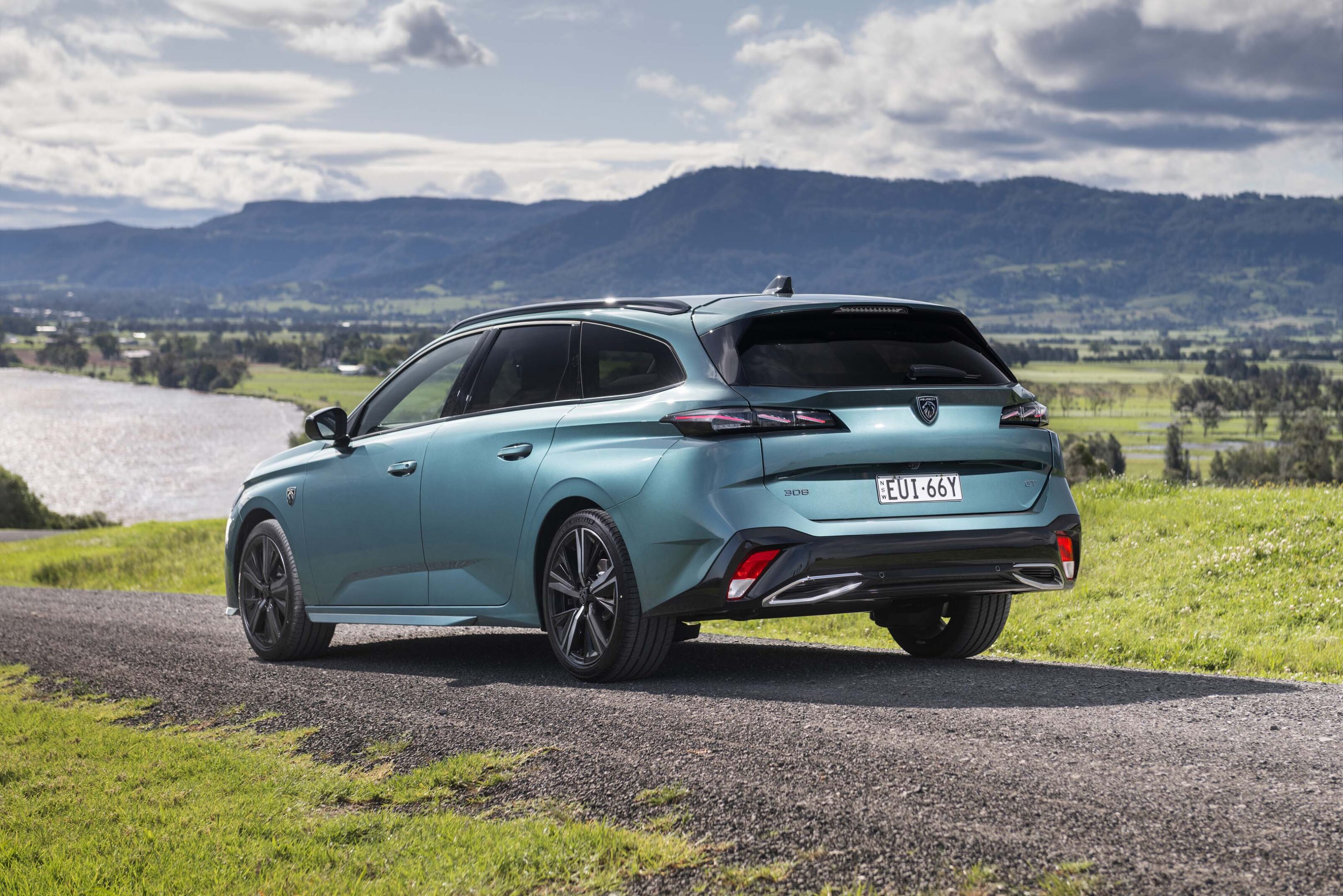
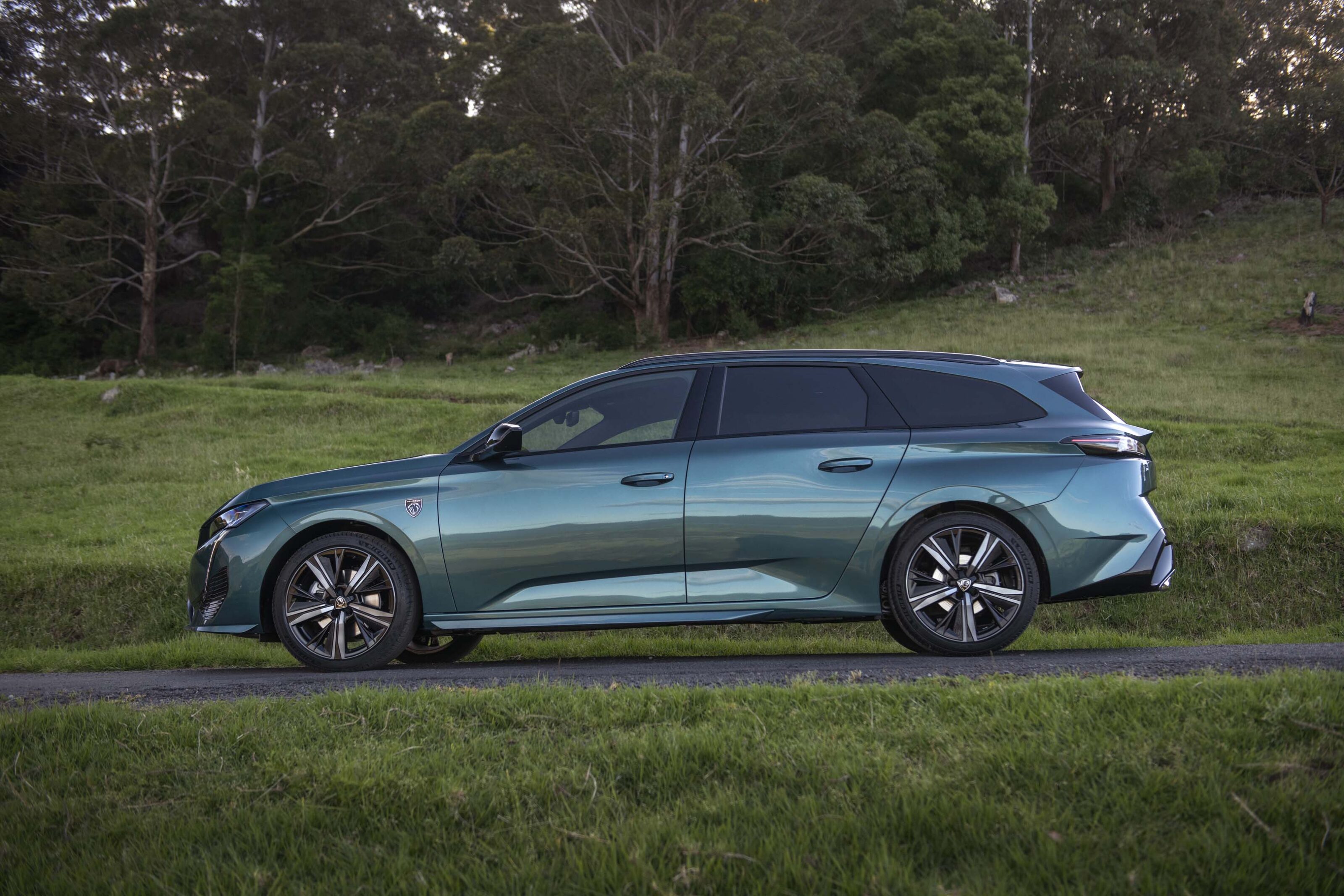
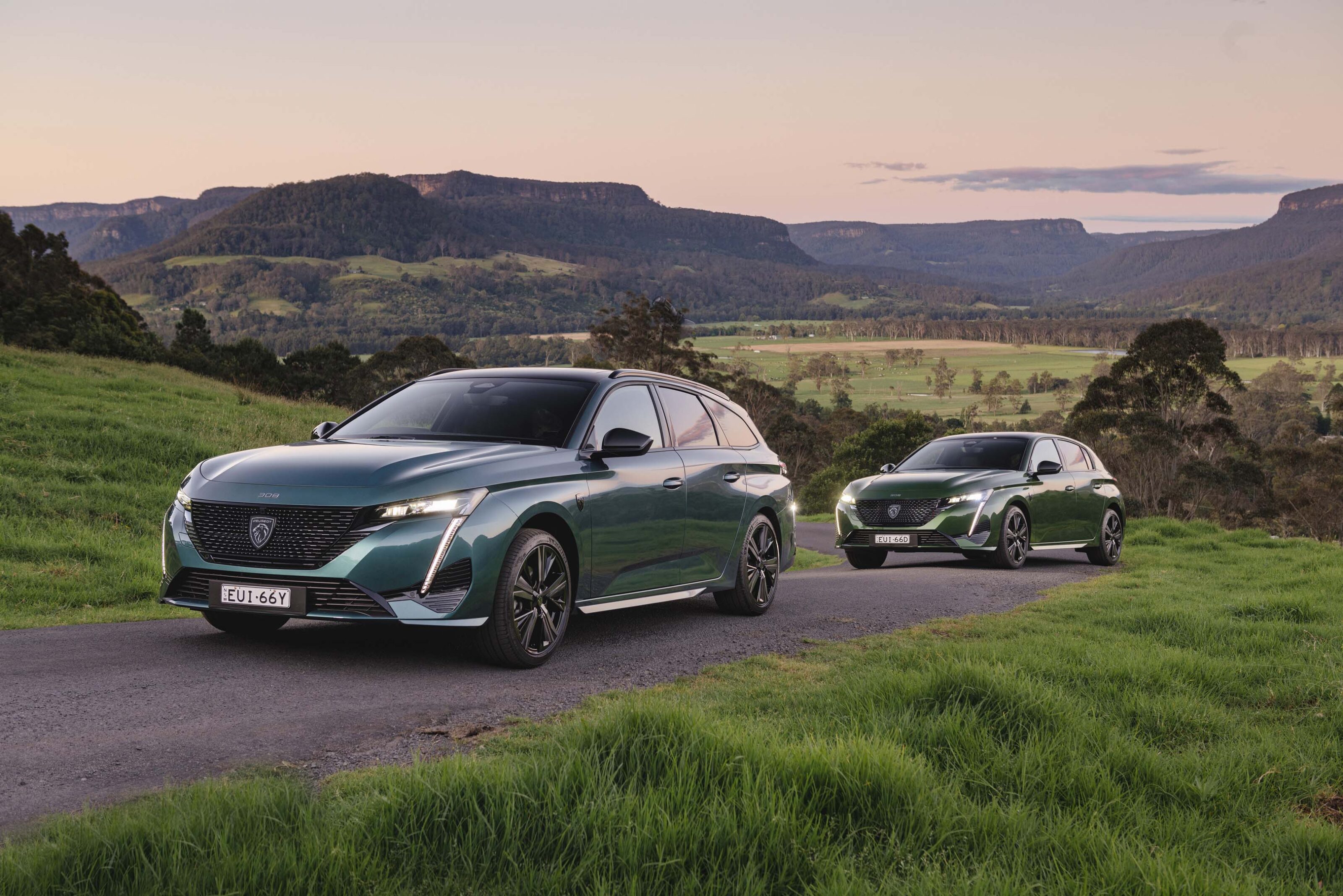
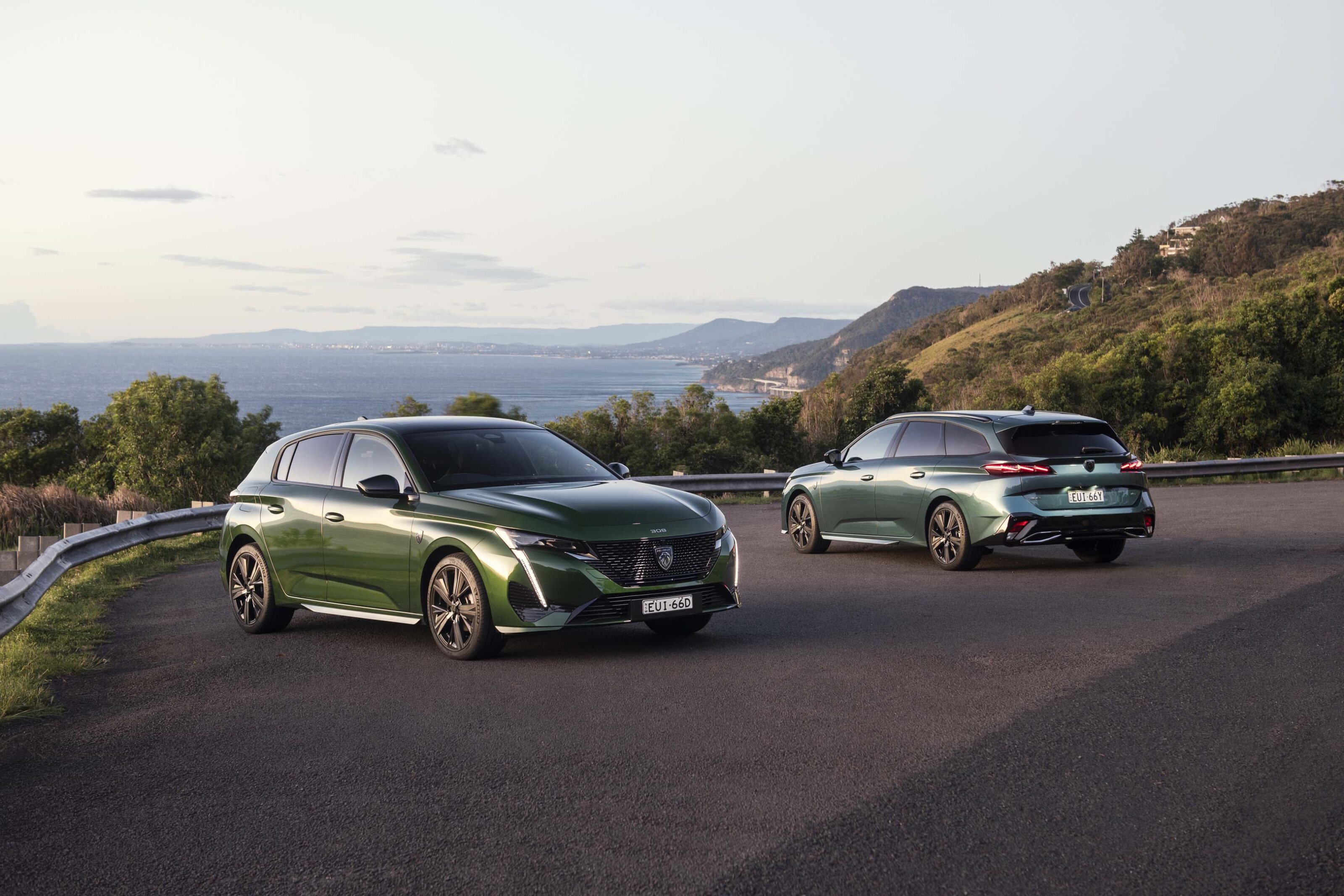
The Peugeot 308 is available as a small five-door hatchback and wagon.
Last seen on our shores in early 2020, you could have a 308 Allure for $30,499, an Allure wagon for $32,499, or a GT-Line hatch for $34,990 (all before on-road costs). The manual GTI fell out of the range a couple of years previously and is much-missed by an admittedly small section of the hot hatch fandom (i.e. me).
The most famous of the Peugeot 300s was probably the Pininfarina-designed 306, which was very successful here in Australia because it was a ripper of a car. Its successor, the 307 and the first 308 weren’t great cars, so sales fell away.
Peugeot’s second iteration of the 308 was awfully good, but too expensive compared to its obvious rivals. And then SUVs happened.
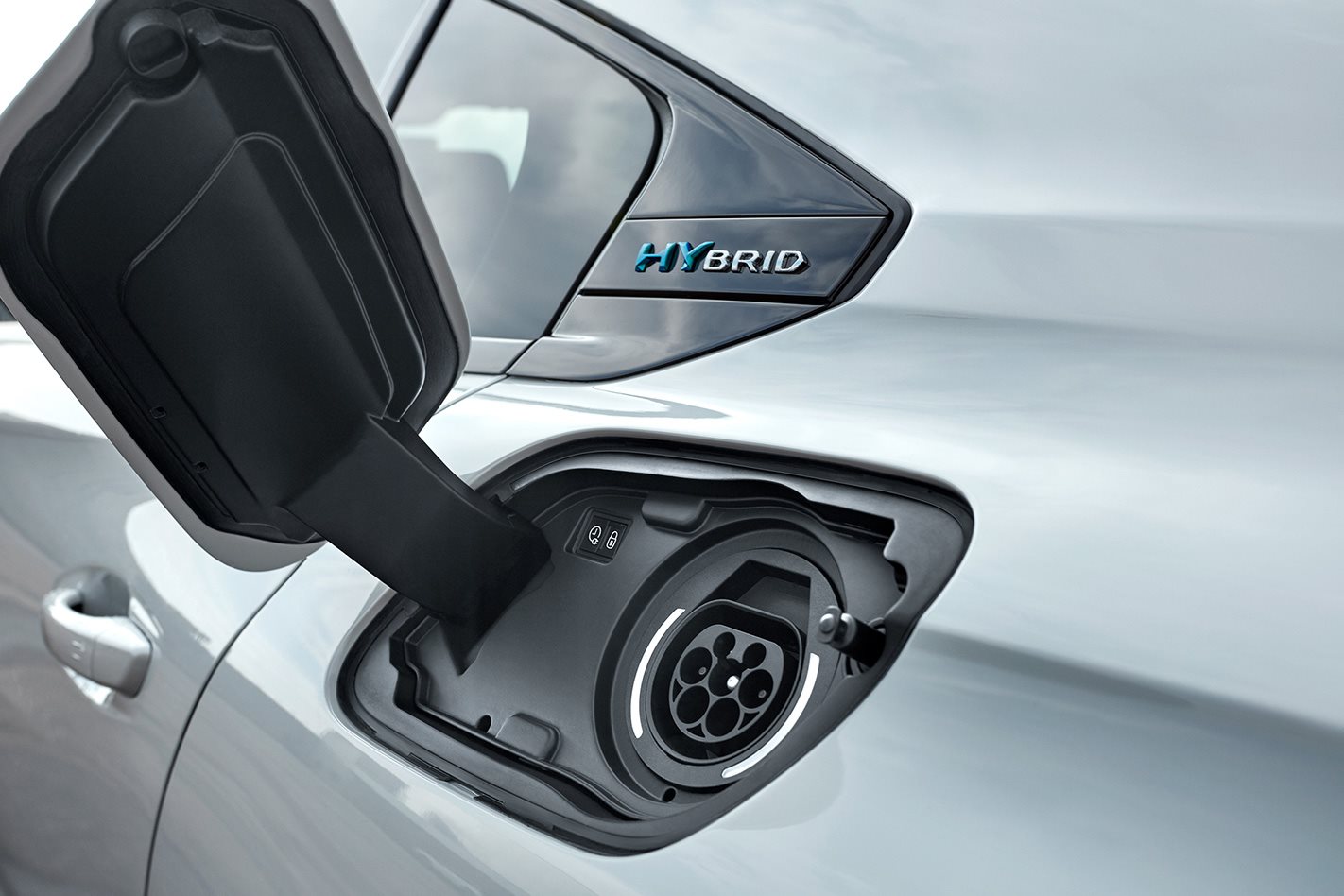
Peugeot has looked at the market and decided the cheaper Active and Allure spec levels probably wouldn’t sell in Australia. In the first half of next year, the 165kW plug-in hybrid will arrive, with a price and exact timing yet to be determined. There is no replacement for the GTI hot hatch but there is an all-electric 308 that is “under consideration”.
The new 308 is built on the Stellantis EMP2 platform which allows for internal combustion, plug-in hybrid and electric-propelled machines. As of a few weeks ago, the 308 is all three of those. At least in Europe.
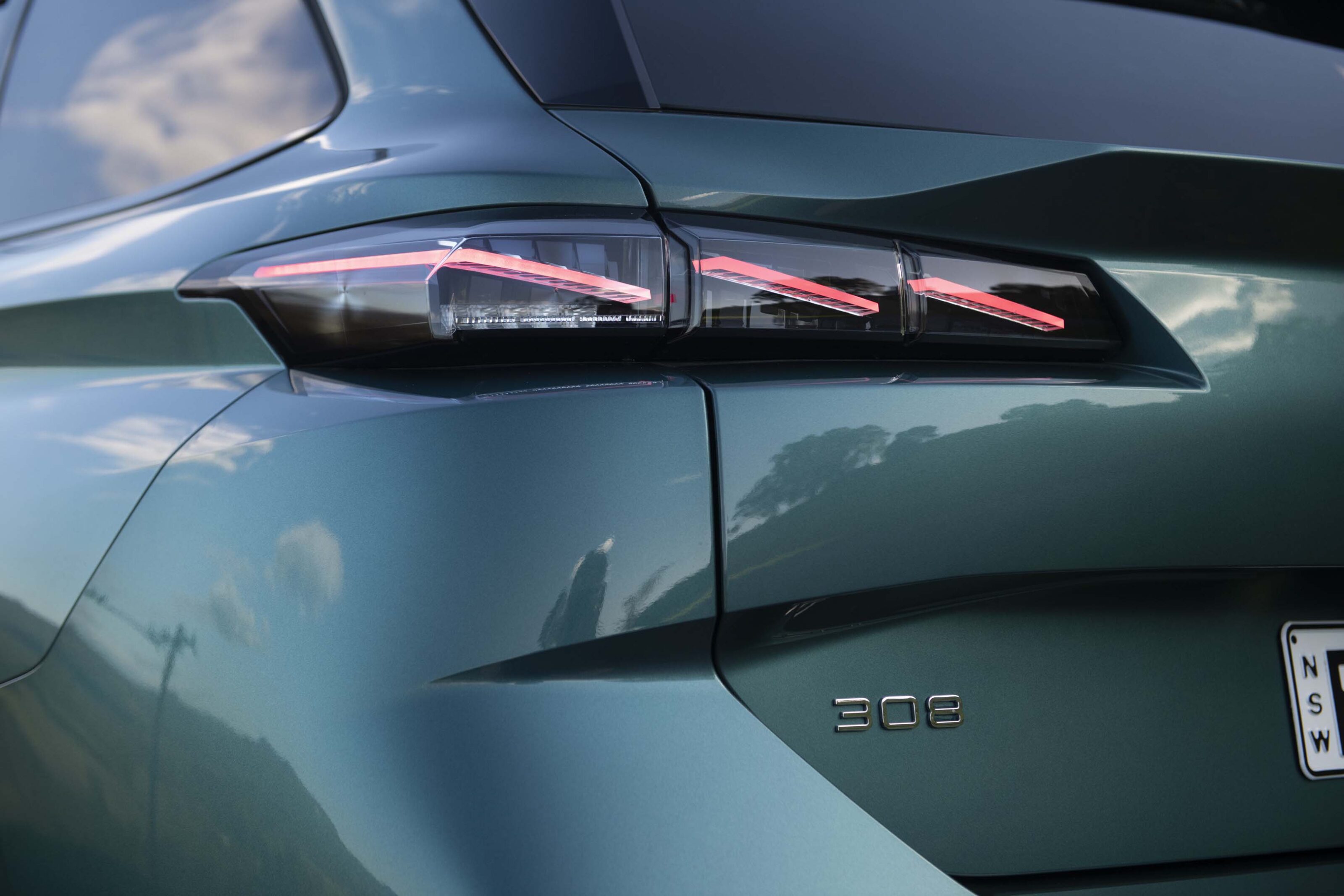
You will be able to spot the new car with its bold blacked-out grille, the new Peugeot badge, Matrix LED headlights, the LED daytime running light fangs and the new claw taillights. The new Olivine green will catch your eye as well.
How much is it, and what do you get?
At launch, three versions are available. The 308 GT Hatch starts at a formidable $43,990, rising to $48,990 for the Premium Hatch.
The wagon tops the range at $50,490 and is only available in GT Premium spec. All these prices are before on-road costs.
| GT | GT Premium |
|---|---|
| 18-inch alloys | 18-inch alloys |
| 6-speaker stereo | 10-speaker stereo (hatch only) |
| Wireless phone charging | Wireless phone charging |
| Wireless Apple CarPlay | Wireless Apple CarPlay |
| Wired Android Auto | Wired Android Auto |
| Leather-trimmed steering wheel | Leather-trimmed steering wheel |
| Digital dashboard | Digital dashboard |
| 10-inch touchscreen | 10-inch touchscreen |
| Dual-zone climate control | Dual-zone climate control |
| Reversing camera | 360-degree cameras |
| Keyless entry and start | Keyless entry and start |
| Adaptive cruise control | Adaptive cruise control |
| Front and rear parking sensors | Front and rear parking sensors |
| DAB+ digital radio | DAB+ digital radio |
| Auto wipers | Auto wipers |
| Matrix LED headlights | Matrix LED headlights |
| Auto high beam | Auto high beam |
| Sunroof | |
| Electric front seat adjustment | |
| Front seat heating and massage function | |
| Power tailgate with gesture control (wagon only) |
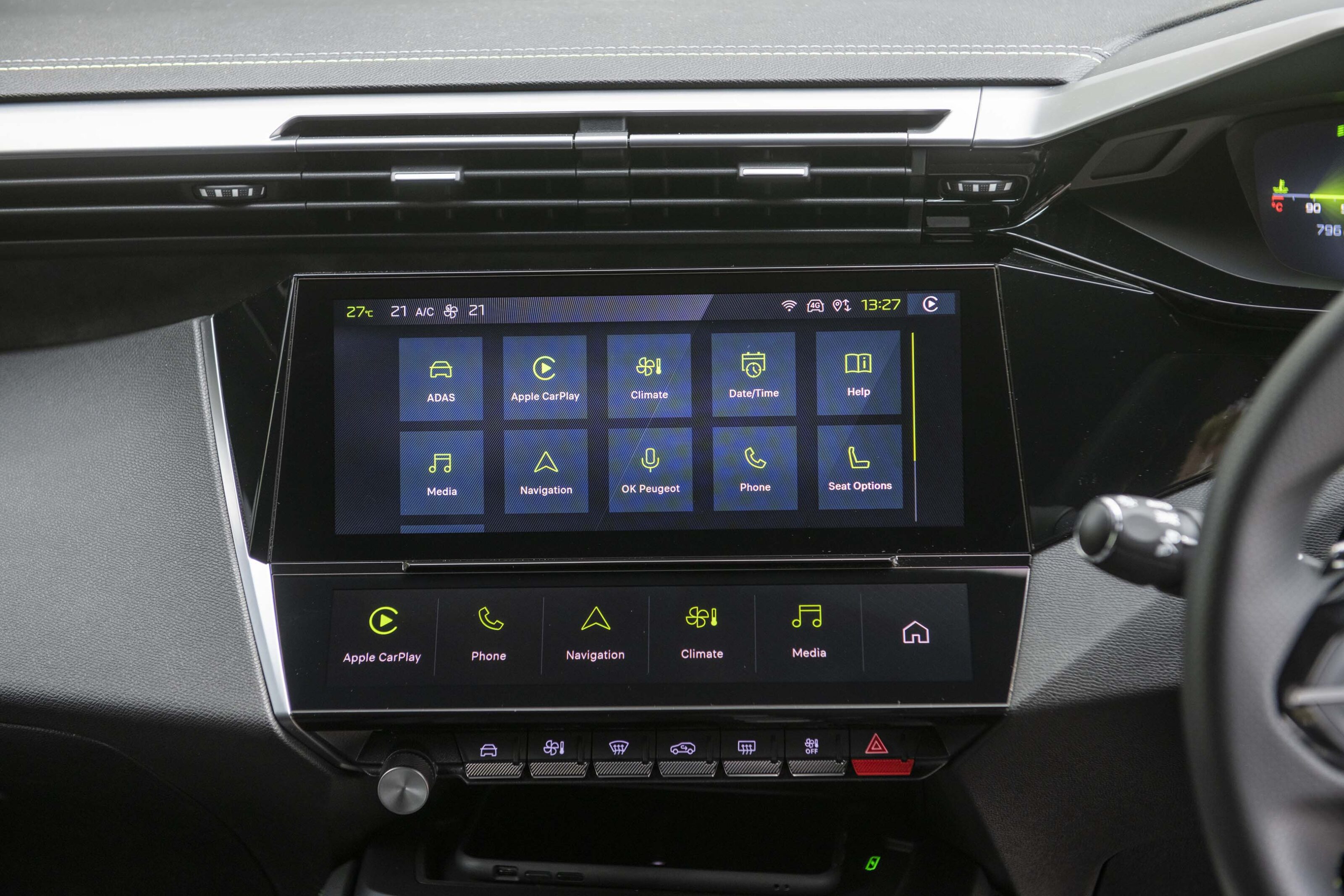
Also along for the ride is Peugeot’s new internet-connected 3D Navigation.
Like the Connected Services of sister brand Citroen, Peugeot’s TomTom-run system powers a range of cleverness like finding things you need, car park spaces, daily fuel prices, live traffic and monthly map updates for three years.
The ten-speaker Focal stereo in the GT Premium is some kind of complicated scientific experiment. The supplier worked with Peugeot on what materials were where, the design and the angles and how thick the glass is (probably). The result is impressive sound quality that feels like it fills the car.
I’ll be quite interested to see the results of the wagon coming only in Premium spec, too, but sadly without the Focal system.
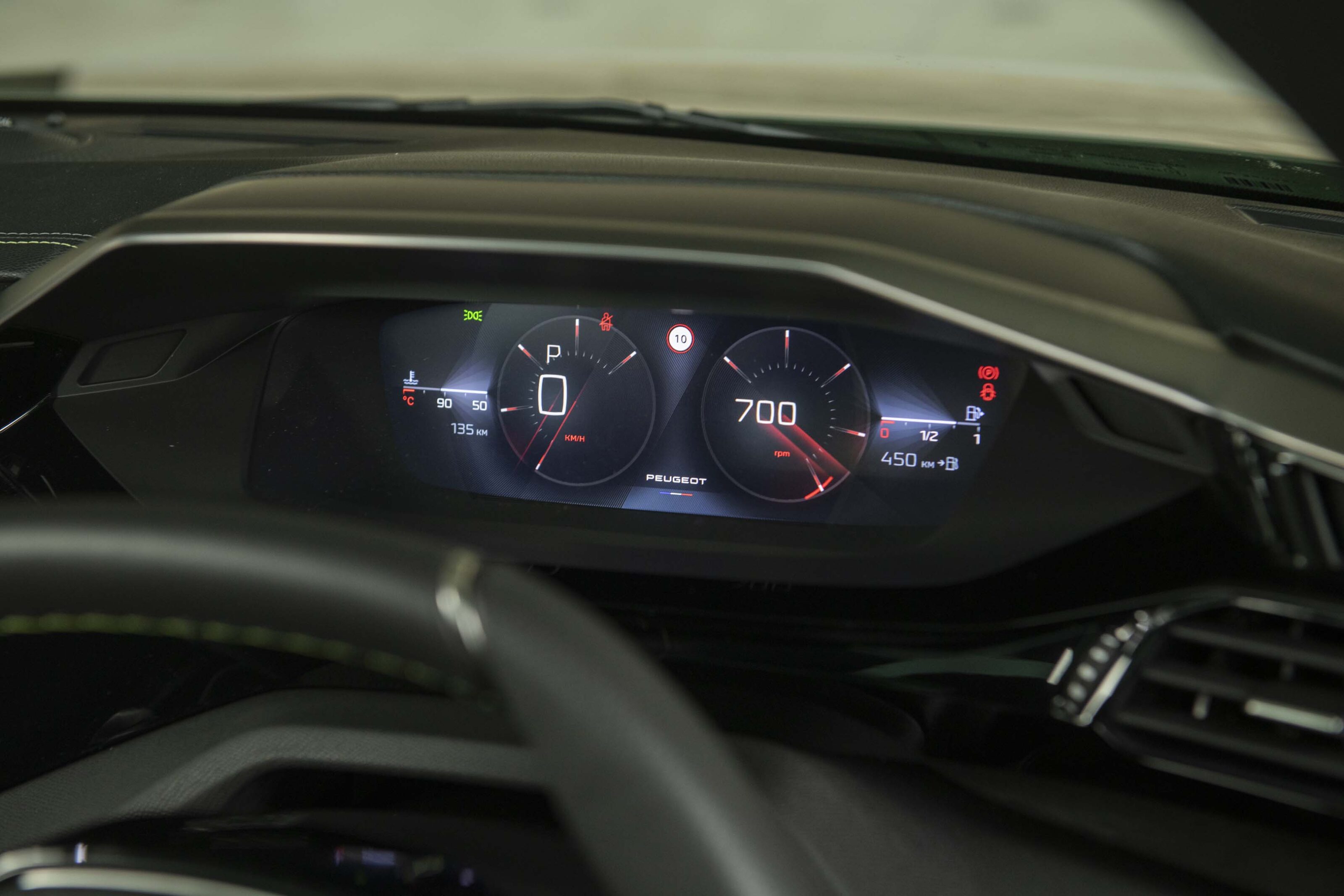
The new 3D digital dashboard is really good. It seems slimmer than the old one so the relationship with the low-set steering wheel is improved. The new 10-inch touchscreen is vastly better than the unit it replaces, with new software and hardware. Both screens are configurable, too, which is nice.
How do rivals compare on value?
If the pricing wasn’t a giveaway, Peugeot has its sights set firmly on the premium market, which fits between mainstream and luxury.
To that end, the most obvious competitor is the Volkswagen Golf which starts at $34,690 for the 110 TSI, rising to $36,990 for the TSI Life and $39,990 for the 110 TSI R-Line (all before on-road costs). The wagons add a $2000 premium but aren’t available in R-Line trim.
Give or take a few bits and pieces, the Golf 110 TSI R-Line hatch is about the same specification as the 308 GT Premium, but is $4000 less.
Skoda’s newly-released Fabia is available only in well-specced Monte Carlo form. It’s a much bigger unit than the old one and stuffed full of gear, if not quite as much as the 308 GT hatch. That weighs in at $39,990 drive-away and has a longer warranty.

Interior comfort, space and storage
Peugeot has been doing great interiors for a few years now, starting with the car this replaces.
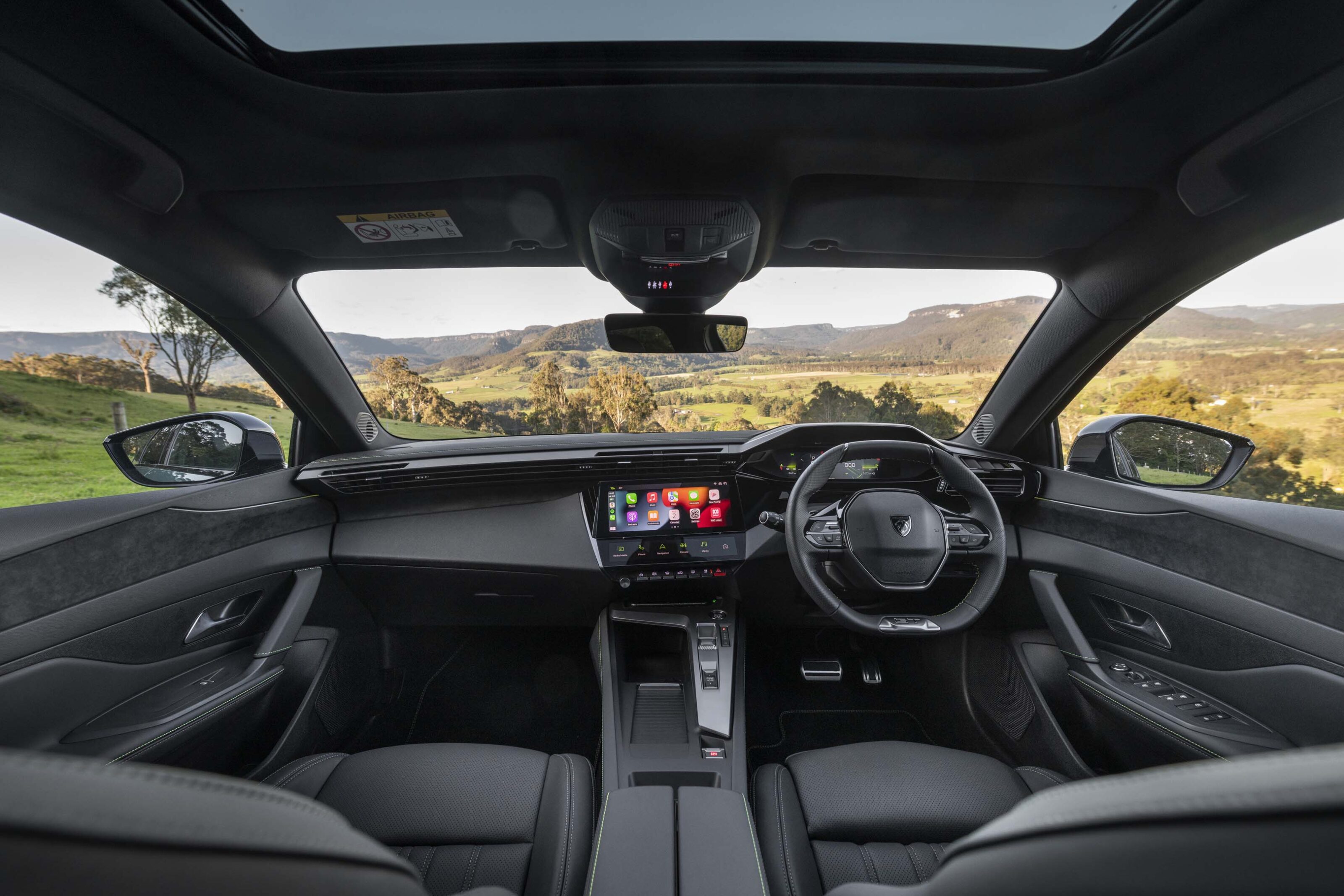
You still get the whacky small-and-low steering wheel matched with the high-set instrument pack that you’ll either love or not buy. It’s worth getting the hang of because Peugeot has refined it over the years.
The 308’s front seats feel great whether they’re cloth or leather. They lean towards the sporty end of the spectrum so may not be for everyone, but I found them very comfortable.
A fresh dashboard design reminds me a lot of the 3008/5008 pair but the new screen is the real deal and much nicer to use than the old one, which could be a bit slow off the mark. It’s crisp, too and goes some way to justifying the price of admission.
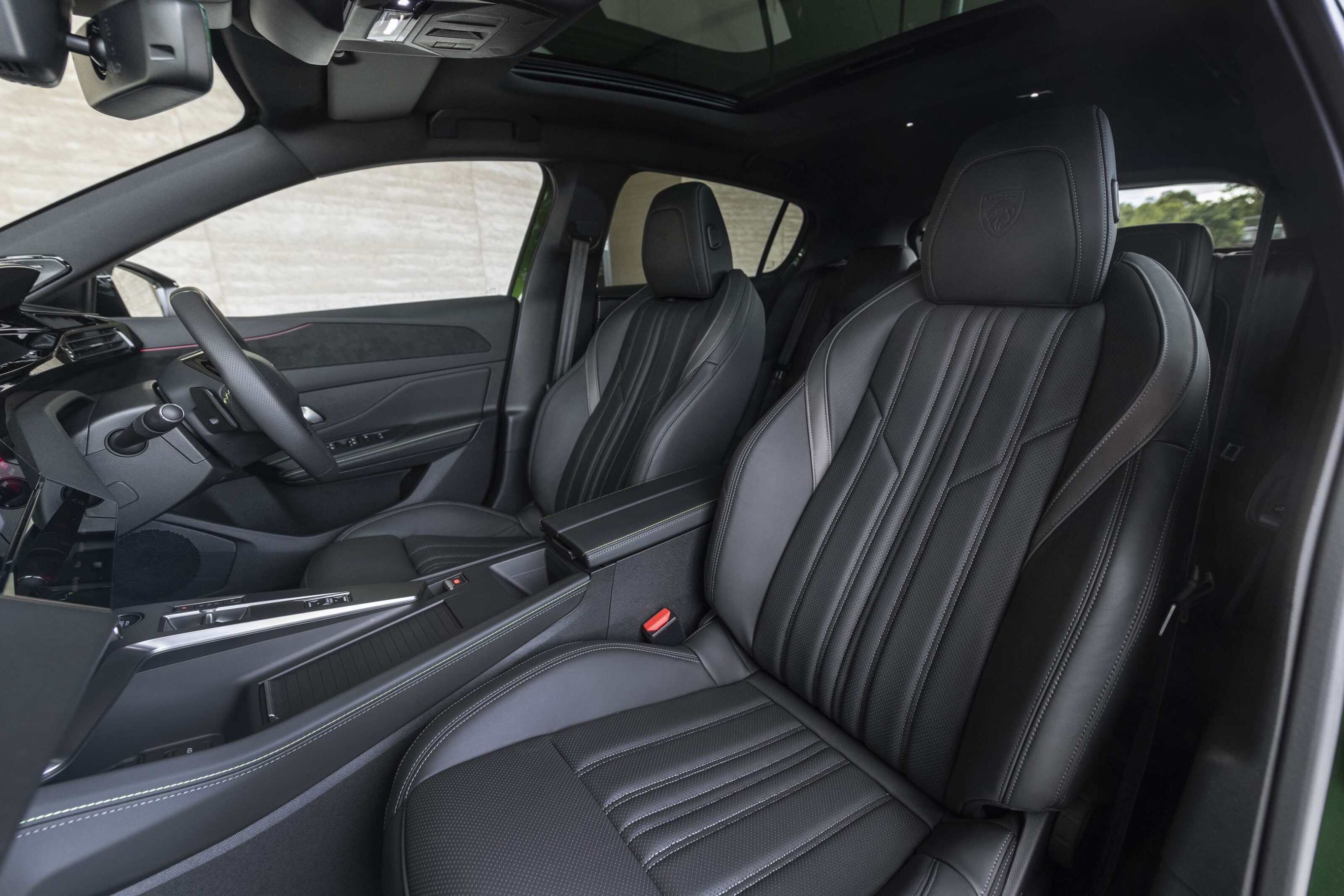
Two cup holders in the centre console have a lot of room because Peugeot has taken the VW route of a little pokey tongue for a transmission selector. There’s an open tray behind them, a space for your phone under the centre stack (with wireless charging pad) and a bin under the armrest. Bottle holders in the doors, too.
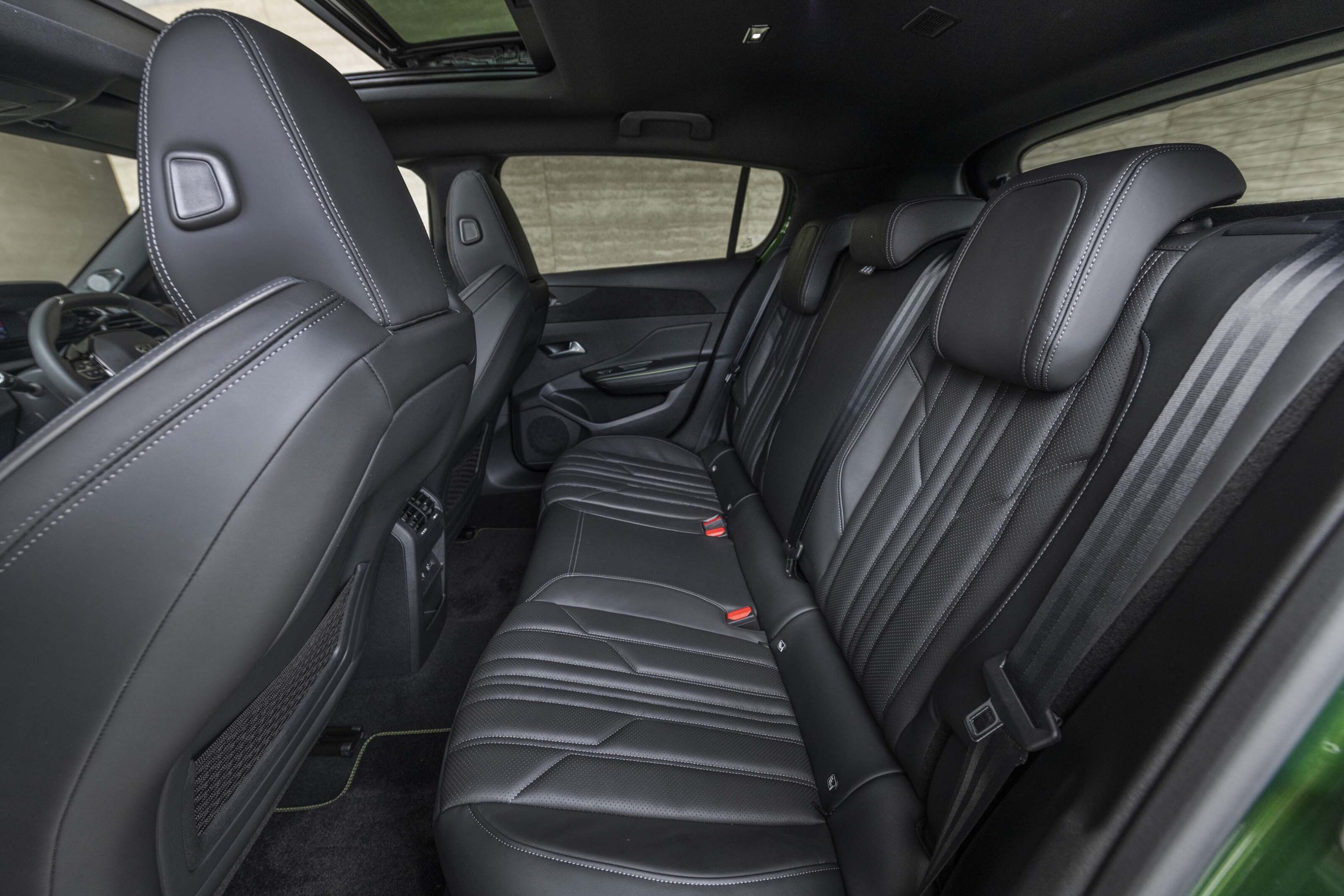
In the rear, things are tight in the hatch, as in the old car. It’s no worse than a Corolla or Hyundai i30, though. Nobody will want to sit in the middle, which makes the lack of a centre armrest even more baffling. You do get two USB-C ports, though they won’t hold up your elbows.
Between the GT and Premium, the major interior change is the upholstery, going from what I consider a quite appealing Alcantara and fabric mix to a slightly overwrought Nappa leather with lots of perforation and stitching.
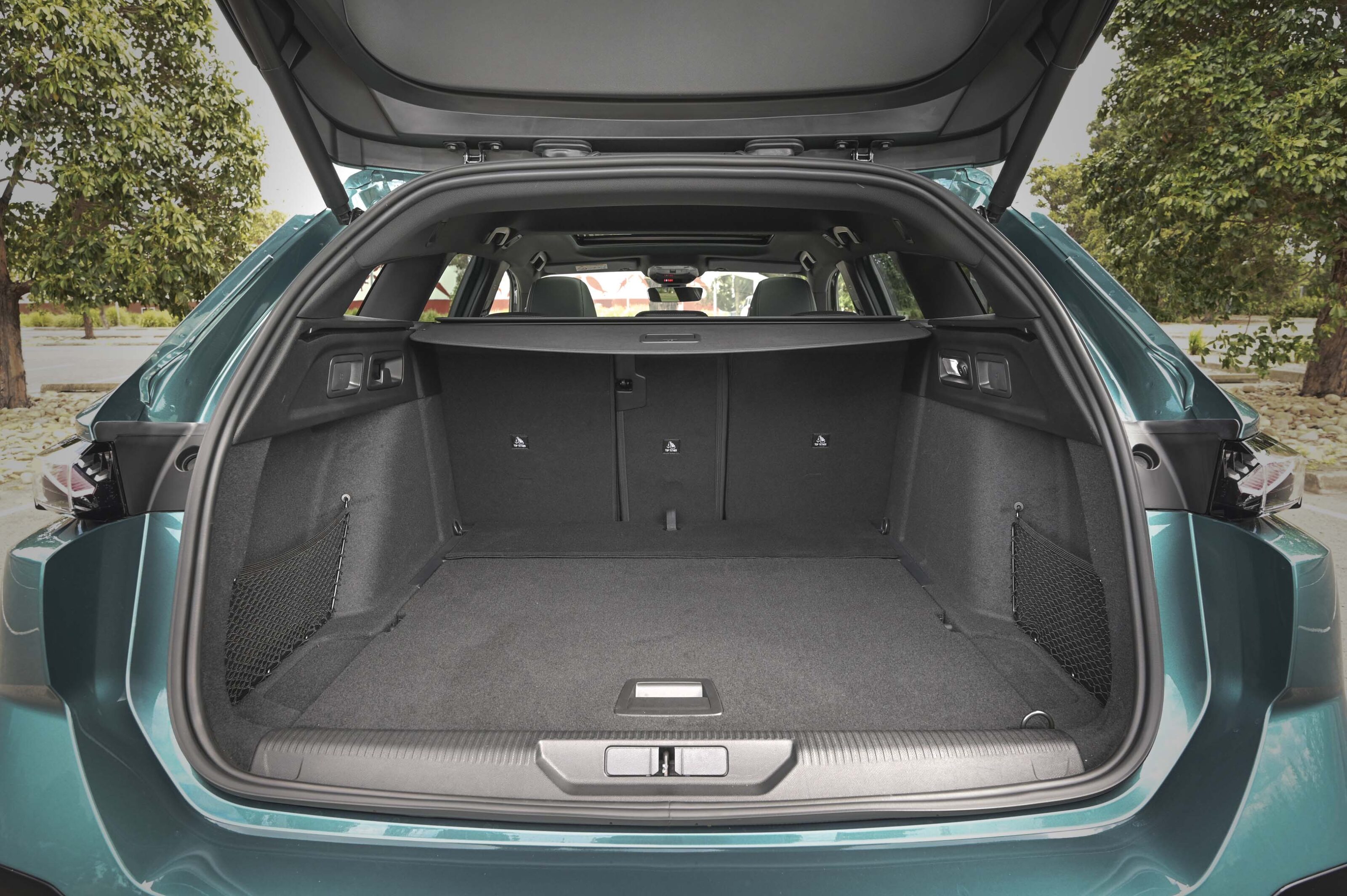
2023 Peugeot 308 boot space
As far as boot space goes, the new 308 is a genuine mixed bag. The GT Hatch kicks off with a pretty hefty 412 litres, rising to 1323 with the 60:40 split-fold backrest down. That’s quite a bit for a hatchback.
A fully sick subwoofer under the boot floor causes the Premium Hatch to lose space, down to 384 litres/1295 litres.
The wagon is an absolute monster at 608 litres and 1634 litres with the 40:20:40 split-fold backrest out of the way. That’s a mammoth cargo area, coming up on the larger Skoda Octavia and running almost level with the Golf wagon. The boot floor also offers two positions for maximum volume.
What is it like to drive?
The basics
| Drive: | front-wheel |
|---|---|
| Engine: | 1.2-litre three-cylinder turbo-petrol |
| Transmission: | 8-speed automatic |
| Power: | 96kW @ 5550rpm |
One of the highlights of the old 308 was the 1.2-litre Puretech engine, and it reappears here in the third-generation 308.
It’s a brilliant engine, with very little turbo lag, quiet and, last time I drove one, commendably easy on fuel. This is the only engine available in the 308 at the moment, so it’s fortunate that it’s a good one.
Distributing drive to only the front wheels is an Aisin eight-speed automatic. This is a familiar transmission in the Peugeot-Citroen empire and the company tends to do an excellent job setting it up.
It works extremely well with the 1.2 and given it has so many gears, the 308 manages a fuss-free sprint to 100km/h in under ten seconds. While not quick, it’s not slow either.
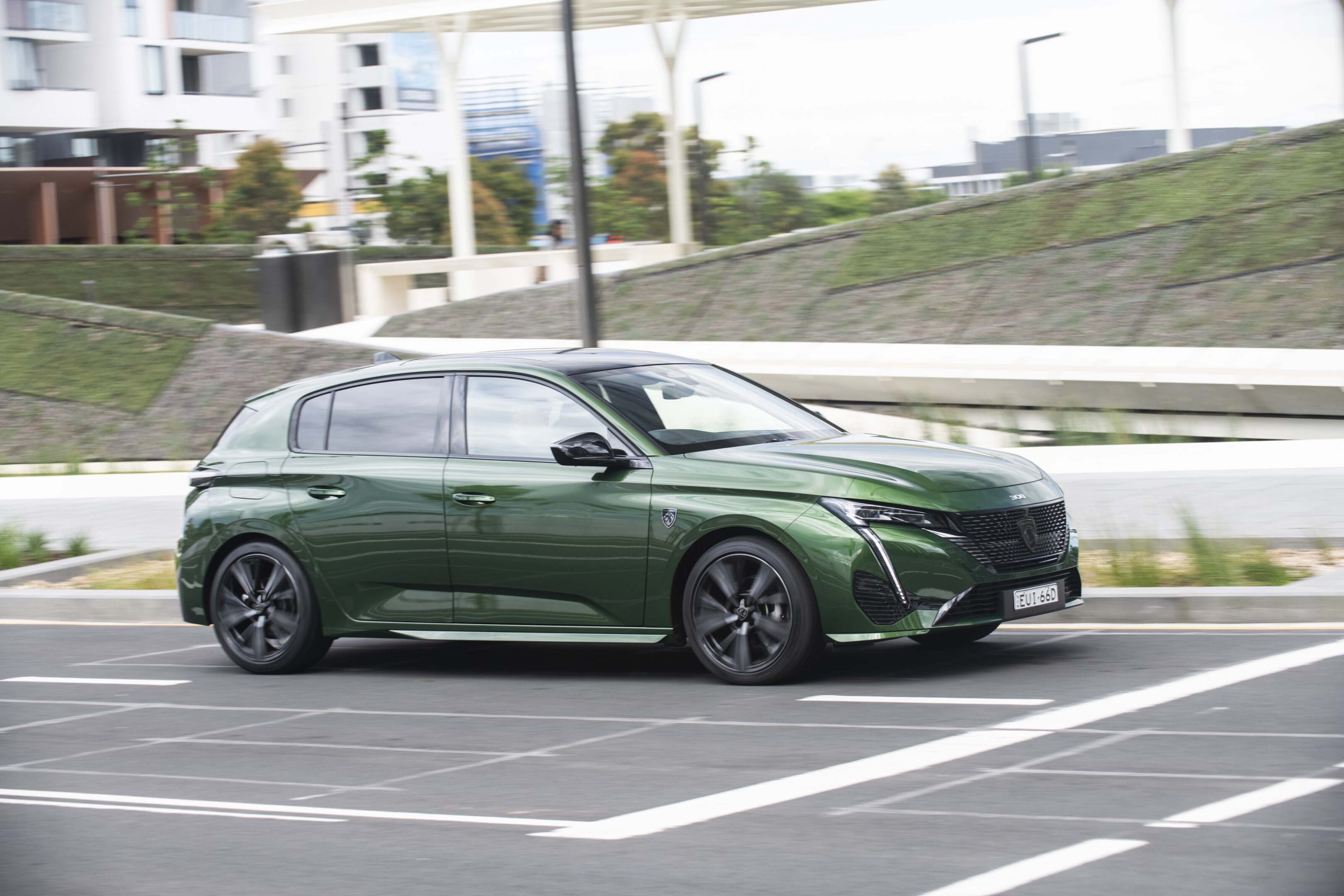
A decent slab of torque is available low down but seems to carry a long way through the rev range. Part of the drive program was quite steeply uphill and very twisty, with some awkward hairpins. The 308 lapped it up, pulling strongly uphill once in its stride.
It’s also a pretty decent overtaker on the motorway and while our B-road excursions also meant a few well-planned overtakes of farmers’ utes, the speed kept building, the engine not falling off boost as the transmission grabbed another gear.
The way it handles reminds me a little of the 306. That car – famously – had an innovative rear axle with passive rear steer. This used lateral G-forces to steer the rears in the same direction as the fronts during cornering and had the net result of being quite a lot of fun.
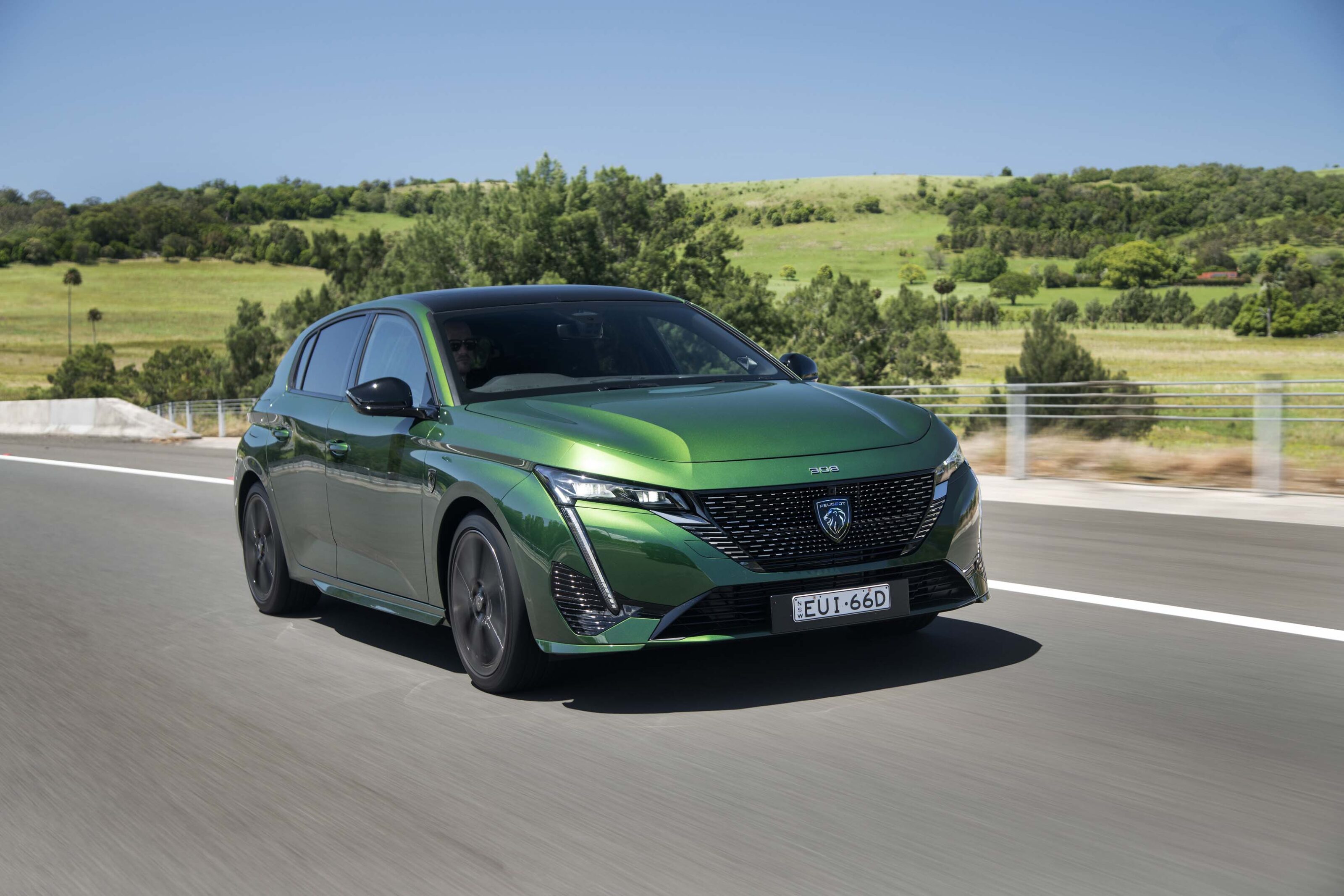
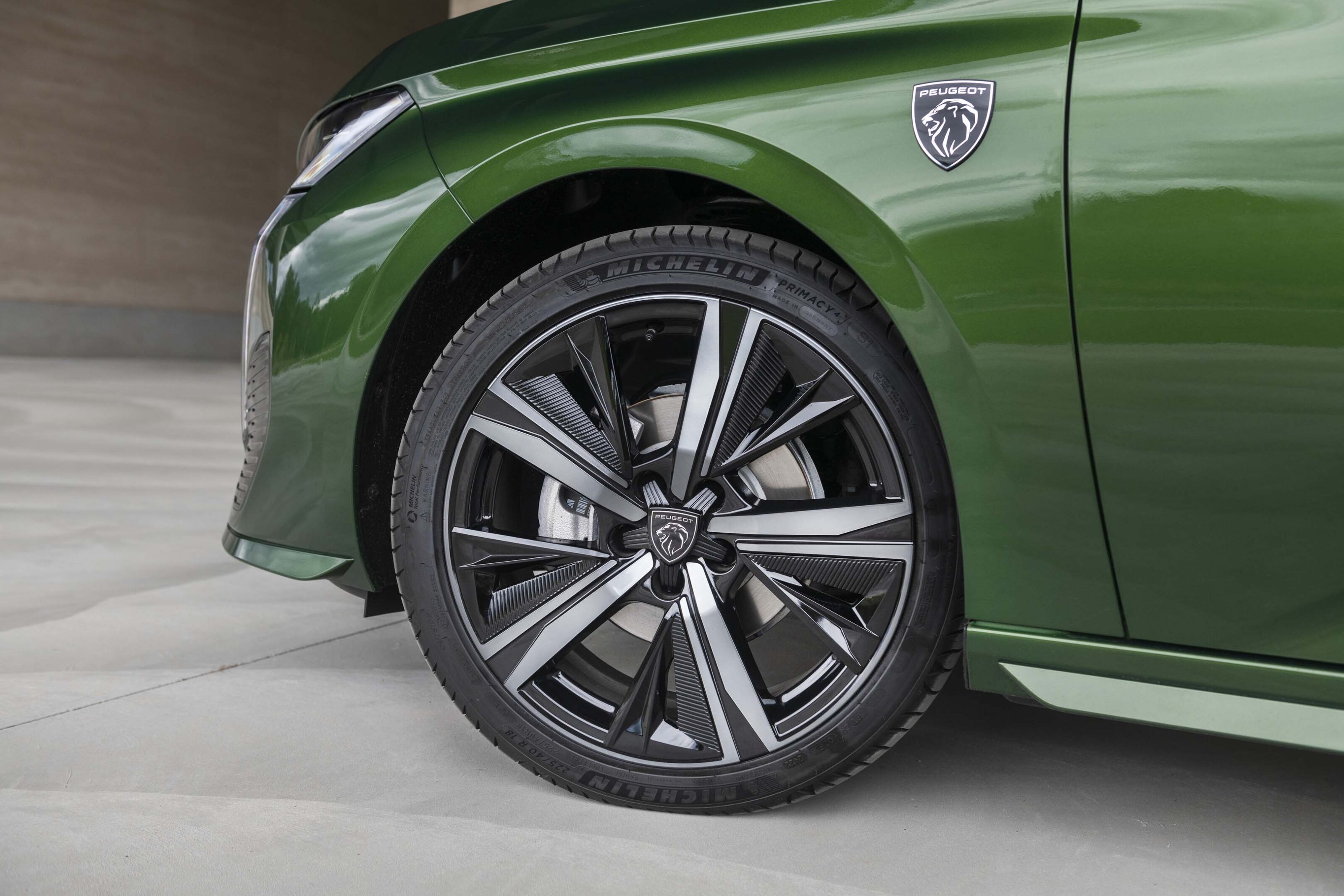
While the new car doesn’t have that kind of expensive trickery, it feels a lot like it. The front end is pretty sharp for what is a mainstream hatchback in its home market. The Michelin Primacy 4 tyres help, but it’s got a great chassis, even with torsion beams at the rear.
The engine shone in that back road run, but the security of the 308’s handling was even better than the old 308, with good grip at both ends but a willingness of the rear to come out and play if you were really enjoying yourself.
Despite plenty of potholes to swerve around and lots of bumps and ambitiously narrow roads, the 308 was unshakeable. Out on the freeway it was smooth and quiet, but you do need a smooth surface for a properly hushed cabin.
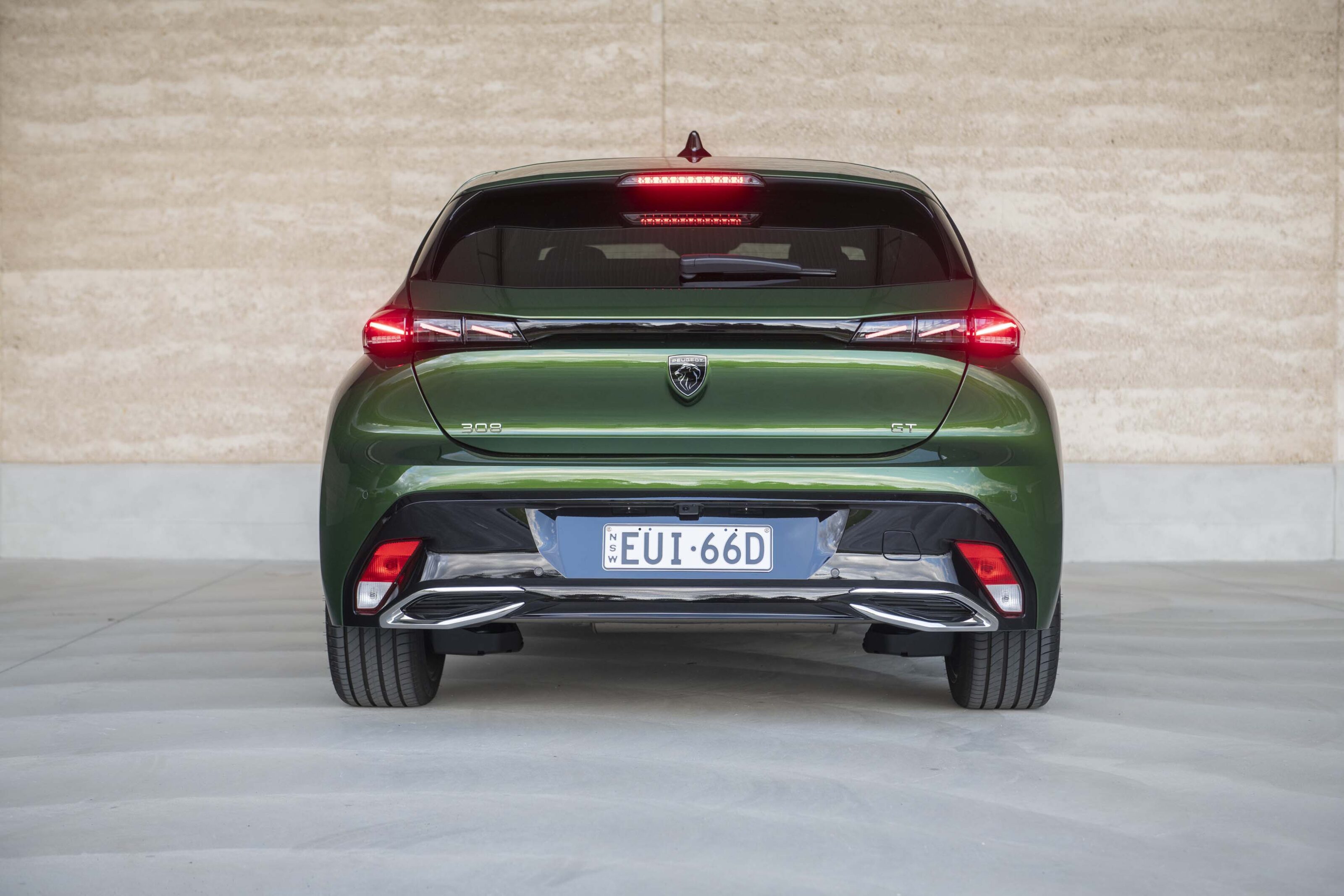
That was probably the worst thing I could say about the way it drives and rides – it’s a touch noisy, but no worse than most cars in this class. Of course, more power would be nice, but until next year, 96kW is your lot.
Driving the wagon feels very similar but with a longer wheelbase, the ride is a little more settled on the rough stuff. Like its predecessor, it’s a lot of fun and I had to keep reminding myself it was a wagon. It’s a tad slower, of course, but didn’t feel any noisier than the hatch despite the cavernous boot. It looks great, too.
Peugeot’s i-Cockpit has “evolved” (their word) but the small steering wheel setup feels as good as ever while the slight re-jig of the whole layout makes it feel a bit more natural. I was always a fan, but some folks find it a bit of a challenge. It isn’t really, just needs a short period of adjustment for most people.
How is it on fuel?
As we drove this on a launch program, it’s difficult to accurately assess fuel usage, so we’ll wait until we have it for a week. The previous car was pretty frugal, though. The downside of a Euro is the need for premium petrol, of course, but the Peugeot isn’t alone.
| 2023 Peugeot 308 fuel consumption | |
|---|---|
| ADR combined cycle | 5.3L/100km |
| On test (trip computer) | N/A |
| Fuel type | Petrol 95 RON |
| Fuel tank | 52 litres |
How safe is it?
| 2023 Peugeot 308 safety features | |
|---|---|
| Six airbags | Driver attention detection |
| ABS | Rear cross-traffic alert |
| Stability and traction controls | Forward AEB (with pedestrian and cyclist detection) |
| Post-collision braking | Speed limit recognition |
| Blind-spot monitoring | Premium only: Active lane positioning |
The back seats feature two sets of ISOFIX points and three top-tether anchors for securing child seats.
ANCAP is yet to issue a safety rating but in Euro NCAP testing, the 308 scored four stars. Euro NCAP’s report on this less-than-stellar result is below.
The passenger compartment of the 308 remained stable in the frontal offset test. Dummy numbers showed good protection of the knees and femurs of both the driver and passenger. Peugeot showed that a similar level of protection would be provided to occupants of different sizes and to those sitting in different positions. For the driver, dummy readings of chest compression indicated a weak level of protection for that part of the body, and protection of the lower leg was marginal. Analysis of the deceleration of the impact trolley during the test, and analysis of the deformable barrier after the test, revealed that the 308 would be a moderately benign impact partner in a frontal collision. In the full-width rigid barrier test, protection of the driver’s chest was rated as marginal, based on dummy readings of chest compression, with that of all other critical body areas rated as good or adequate. In the side barrier test, protection of all critical body areas was good and the car scored maximum points in this part of the assessment. Even in the more severe side pole impact, protection of the chest was adequate and that of other body areas good. Control of excursion (the extent to which a body is thrown to the other side of the vehicle when it is hit from the far side) was found to be marginal. The 308 does not have a counter-measure, such as a centre airbag, to mitigate against occupant to occupant injuries in such impacts. Tests on the front seats and head restraints demonstrated good protection against whiplash injuries in the event of a rear-end collision. A geometric analysis of the rear seats also indicated good whiplash protection. The 308 lacks an advanced eCall system which alerts the emergency services in the event of a crash. The car also has a system which applies the brakes after an impact, to avoid secondary collisions. |
Warranty and running costs
Peugeot offers a five-year warranty with unlimited kilometres, which matches up nicely with pretty much everyone else except Kia and Mitsubishi.
Servicing is expensive if you go the pay-as-you-go route, working out at a hefty $2489 over five years, or $498 per year. However, you can save a lot of money by going with pre-paid maintenance, with three years costing $1000 (saves $427) and five years $1800 (saves $689). You’d be nuts not to if you can afford the pre-paid option.
This is a few hundred dollars cheaper than the Golf’s five-year service plan.
VERDICT
Prices are up, but so is the equipment level. Forty-four grand is a solid start for a hatchback, especially when Hyundai will sell you a tidy-handling car of similar size and shape with a lot more grunt and a handy chassis for ten grand less.
Thing is, though, none of its competitors is a Peugeot. While that might be stating the obvious, there’s a certain something (no, not a je ne sais quoi, I’m just slightly better than that) about the way the 308 drives. It seems happy enough pottering around, cruises effortlessly despite its titchy engine and is packed full of stuff.
Plenty of quality remains in the small car segment, but none really have the Peugeot’s surprisingly coherent but different interior design, comfortable ride and super-competent vibe.
It’s an interesting car that will definitely keep the fans happy, but might draw a few people in from the VW firmament looking for something a bit special. It has to be special for the money, so it’s going to be very interesting to see who bites and how often.
2023 Peugeot 308 specifications
| GT Hatch | GT Wagon | |
|---|---|---|
| Body: | 5-door, 5-seat small hatch | 5-door, 5-seat small wagon |
| Drive: | front-wheel | front-wheel |
| Engine: | 1.2-litre three-cylinder turbo-petrol | 1.2-litre three-cylinder turbo-petrol |
| Transmission: | 8-speed automatic | 8-speed automatic |
| Power: | 96kW @ 5550rpm | 96kW @ 5550rpm |
| Torque: | 230Nm @ 1750rpm | 230Nm @ 1750rpm |
| Bore stroke (mm): | 75 x 90.5 | 75 x 90.5 |
| Compression ratio: | 10.5 : 1.0 | 10.5 : 1.0 |
| 0-100km/h: | 9.7 sec (estimate/claimed) | 9.9 sec (estimate/claimed) |
| Fuel consumption: | 5.3L/100km (combined) | 5.3L/100km (combined) |
| Weight: | 1258kg | 1314kg |
| Suspension: | MacPherson struts front/torsion beam rear | MacPherson struts front/torsion beam rear |
| L/W/H: | 4365mm/2062mm/1465mm | 4635mm/2062mm/1475mm |
| Wheelbase: | 2675mm | 2730mm |
| Brakes: | 283mm ventilated disc front / 268mm solid disc rear | 304mm ventilated disc front / 268mm solid disc rear |
| Tyres: | 225/40 R18 | 225/40 R18 |
| Wheels: | 18-inch alloy (no spare) | 18-inch alloy (no spare) |
| Price: | $43,990 / $48,990 (premium) + on-road costs | $50,490 + on-road costs |
