
Having only arrived in Australia in its first generation in 2021, the Kia Niro is still a relatively new player in the EV space here but we already have a second generation on our hands offering fresh looks and tech.
The Niro was Kia’s first EV but is now positioned in second place behind its flagship EV6 for those still wanting a fully-electric vehicle but for less money.
However, considering it’s not sitting too far behind its bigger brother in terms of price, is the Niro EV, and particularly the entry-level S grade we have on test here, worth the cash? Or it is worth splashing out to have the best the Korean marque can offer us?
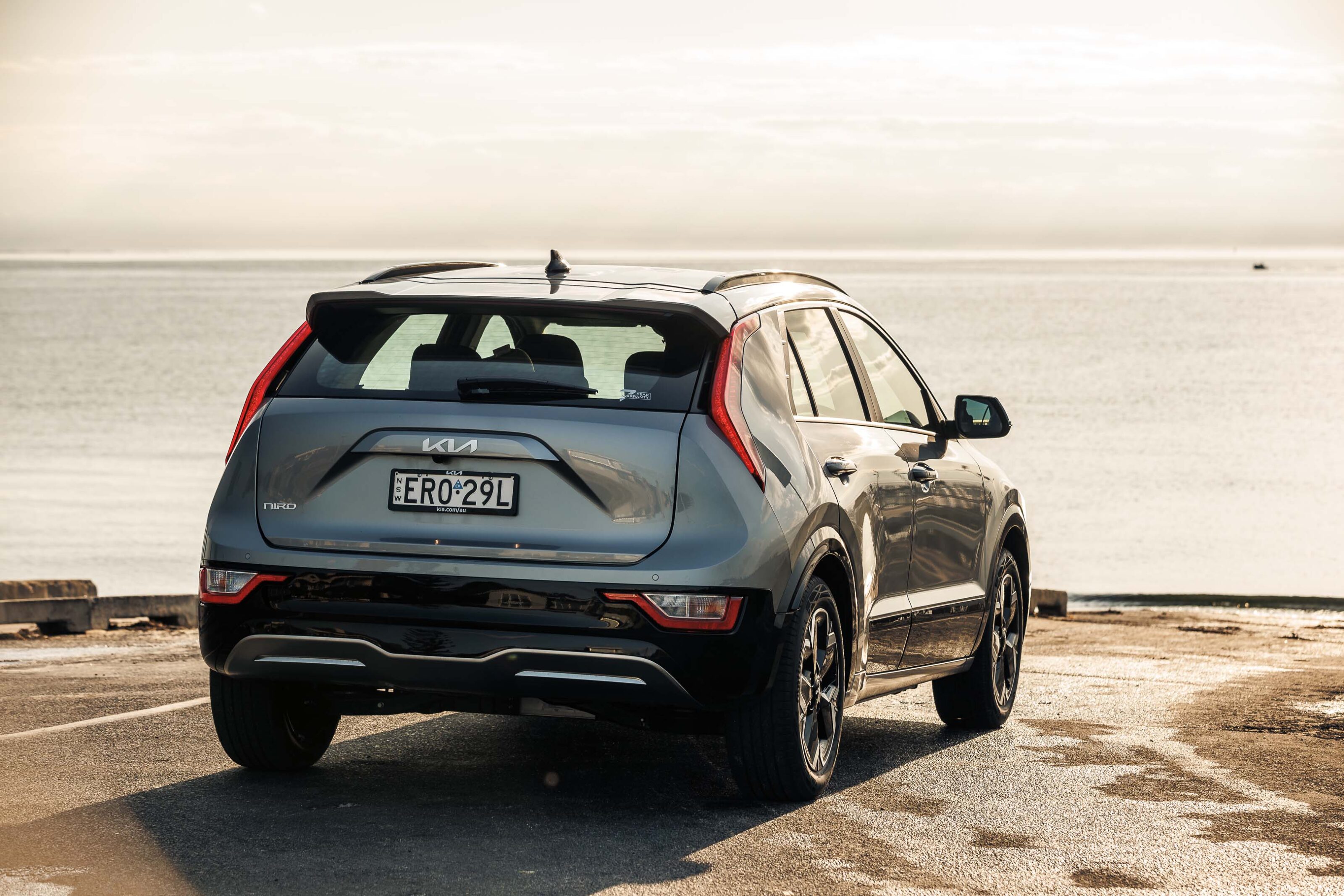
It also faces tough competition from existing rivals such as the MG ZS EV – which has just been facelifted in our market – as well as up-and-comers like the recently launched BYD Atto 3, both of which have significantly lower asking prices.
So what’s the deal? Let’s find out.
Pricing and features
The 2022 Kia Niro EV comes in two grades, starting with the entry-level S priced from $65,300, before moving up to the top-spec GT-Line which starts from $72,100 (both before on-road costs and state or territory incentives which means only the S qualifies for those in NSW, VIC, SA and WA).
We are testing the lower-priced S that costs $71,517 drive-away in Melbourne, which includes $520 worth of steel grey premium paint. There are also seven other optional colour choices, with just clear white offered free.

Being the base grade, the S misses out on quite a lot of the nice kit found in the GT-Line, such as satellite navigation, a sunroof, rear privacy glass, powered tailgate, wireless smartphone charger, eight-speaker Harman Kardon sound system, heated steering wheel and seats, head-up display, and an electric front passenger seat adjustment.
A fair bit then. It also makes do with a small-by-modern-standards, eight-inch infotainment screen that is paired with a 10.25-inch digital cluster.
Compared to the EV6’s gigantic two 12.3-inch units the screens are a bit disappointing, feeling much more run-of-the-mill than its future-oriented flagship sibling for a $65K asking price – and even the top-grade GT-Line gets two 10.25-inch displays.
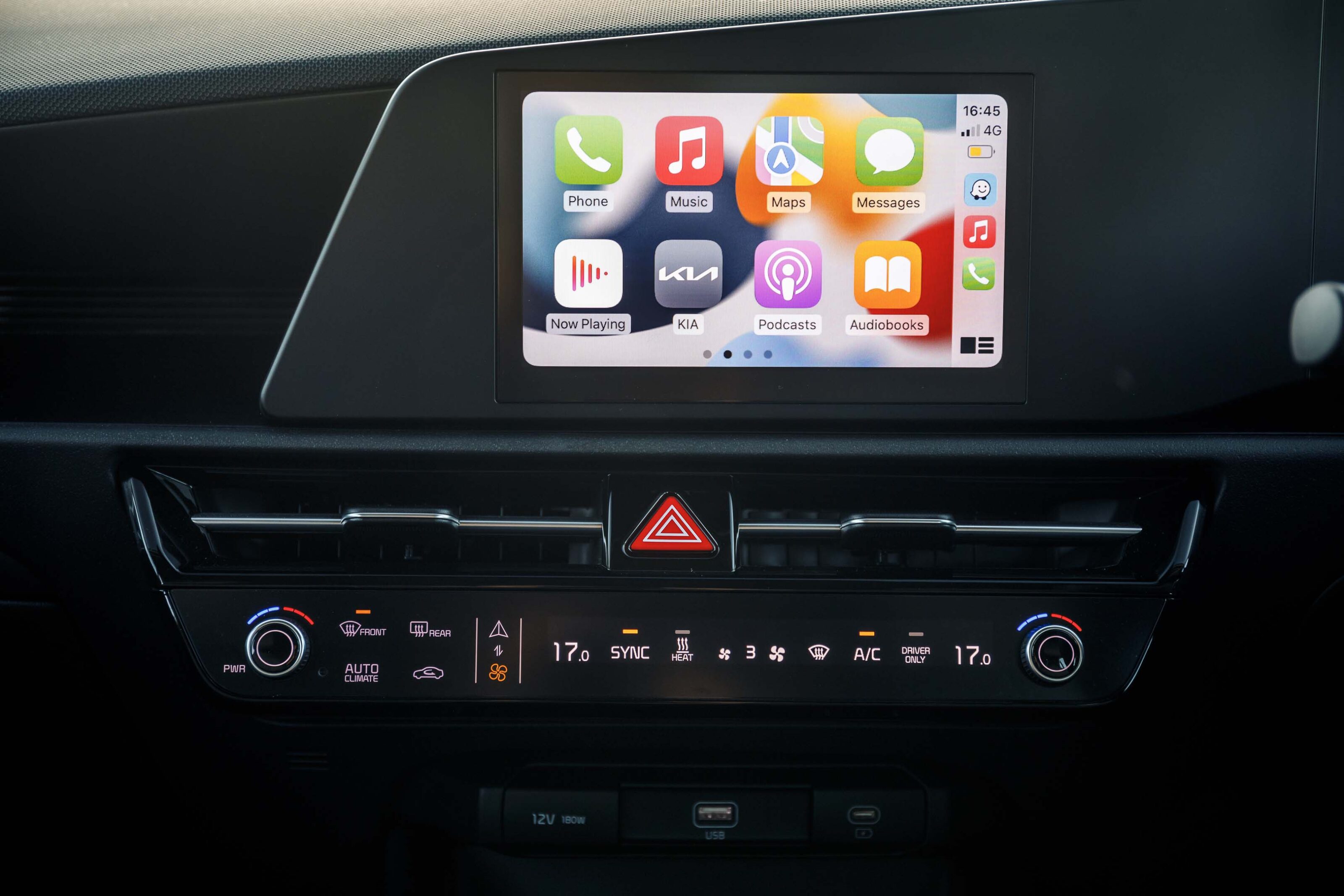
The Niro’s unit however performs just fine, even if it’s not quite as aesthetically pleasing as the larger version in the EV6, and is surrounded by obvious-looking matte plastic.
Media and climate controls are accessible via the dual-function haptic-touch bar running along the bottom of the dash, which is easy enough to use, though it can be a bit fiddly and distracting stretching across from the driver’s seat to reach certain elements at times.
For the money, in the Niro S EV you get as standard: electric driver’s seat adjustment, six-speaker sound system, one USB-A and one USB-C port in the front as well as two USB-Cs for the rear, dual-zone climate control with second-row vents, and wireless Apple CarPlay and Android Auto (an upside to the S that the bigger touchscreen of the GT-Line has to do without).
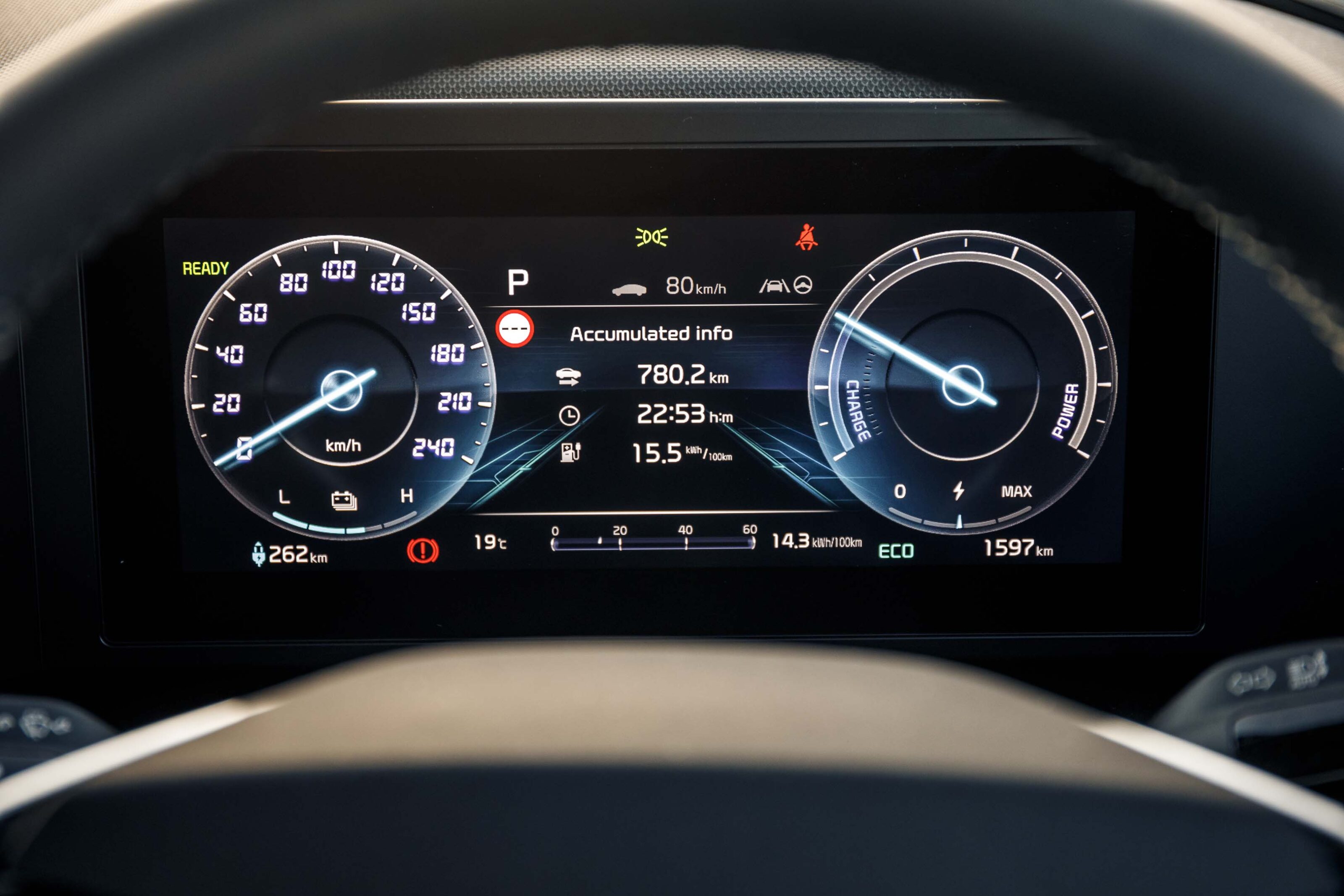
Despite being the entry-level version, the S still gains access to almost all of Kia’s safety tech suite, including key features such as advanced smart cruise control with stop and go, blind-spot monitoring with rear cross-traffic warning and avoidance, rear parking sensors, a rearview camera, autonomous emergency braking (AEB), lane-keep and lane follow assist, and intelligent speed limit assist. It only misses out on the GT-Line’s safe exit assist, reverse parking collision avoidance assist and front parking sensors.
The new Niro has received a five-star ANCAP safety rating.
EV Buyer’s Guide: Electric Vehicles Under $65K Ranked – The Best and The Rest
Welcome to part one of three price-based EV buying guides, this one focused on the most affordable electric cars available in Australia today
Comfort and space
The interior of the S grade looks and feels of high quality, if not as top-notch for luxury as found in the GT-Line. There are still some budget-looking matte plastics though – surrounding the screen as mentioned earlier, and also on the doors.
On the latter, however, the effect is softened by being in contrast with other fabrics. Small details, like the piano black jewelled effect surround of the start button, which matches the grille, are a nice touch.
The seats and trim are wrapped in a combination of charcoal cloth and artificial leather fabric, which are suitably comfortable and well padded. The driver’s side can be adjusted electrically, but the passenger side just gets manual controls. Considering the price point for this vehicle, electric seats for both doesn’t feel like it’s an unreasonable request.
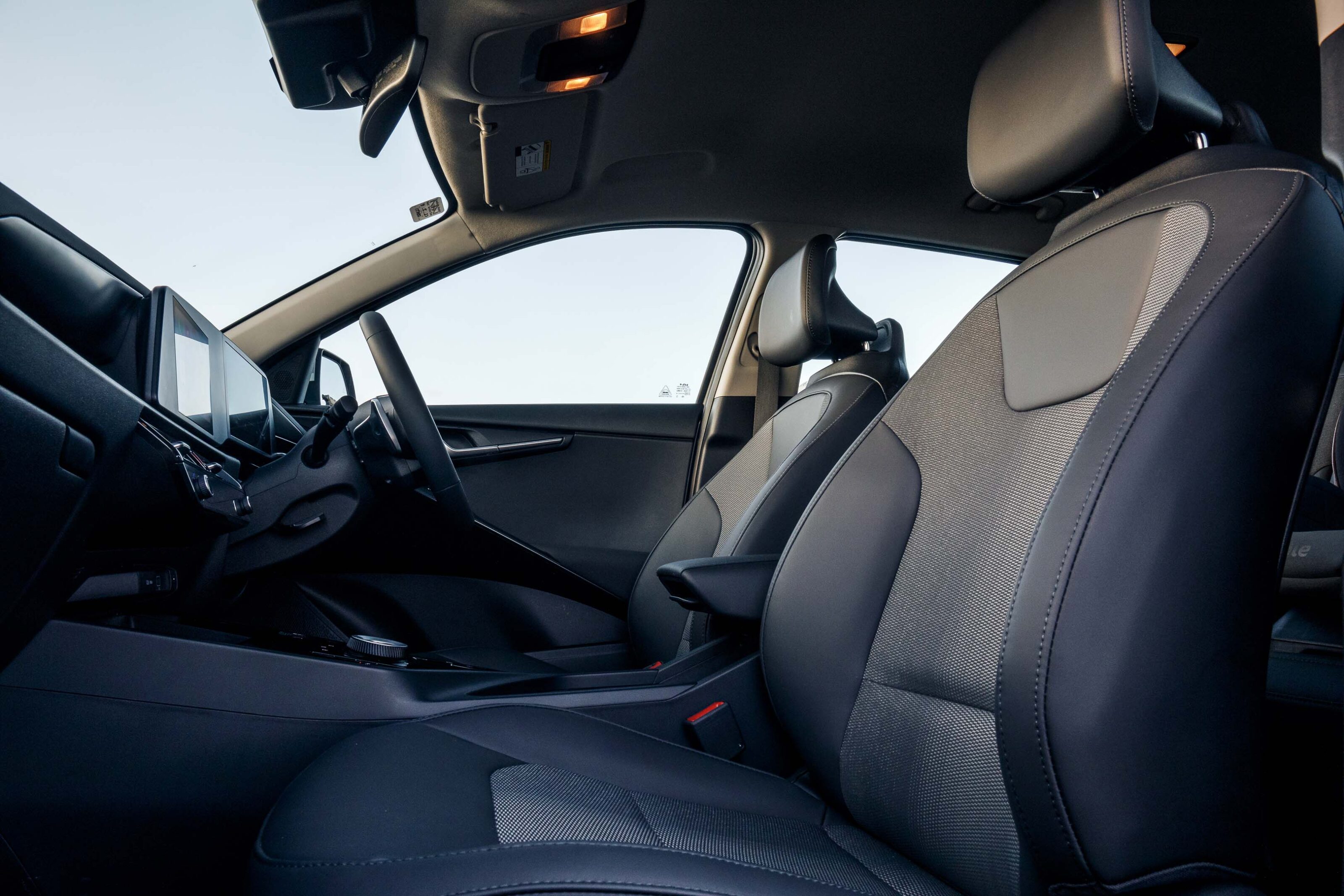
Storage is not as ample as one would hope, with little room in the doors, a poky cubby bin in the centre console, and the existence of a transmission tunnel – carried over from the hybrid variant – occupying a great deal of room in the front row.
The EV6 gets a floating centre console, which opens up the space hugely – if not quite as much as in the closely-related Ioniq 5 that has absolutely nothing in the way.
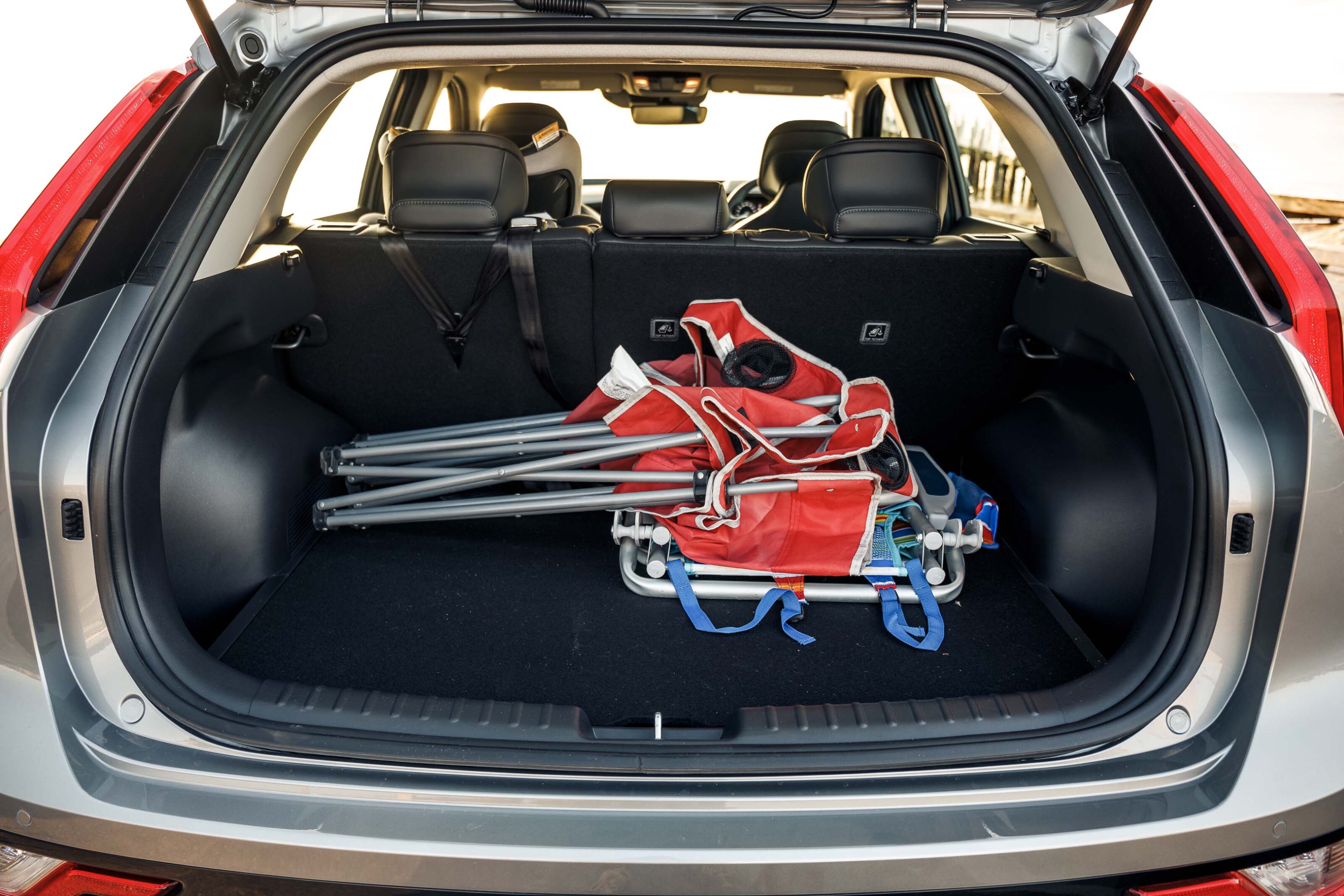
Compensation for this is a decent-sized boot, which holds 475L with the seats up and 1329L with them down, and a respectable amount of legroom in the second row.
Best Electric Cars Under $65k: Affordable EVs Rated
Welcome to part one of three price-based EV buying guides, this one focused on the most affordable electric cars available in Australia today
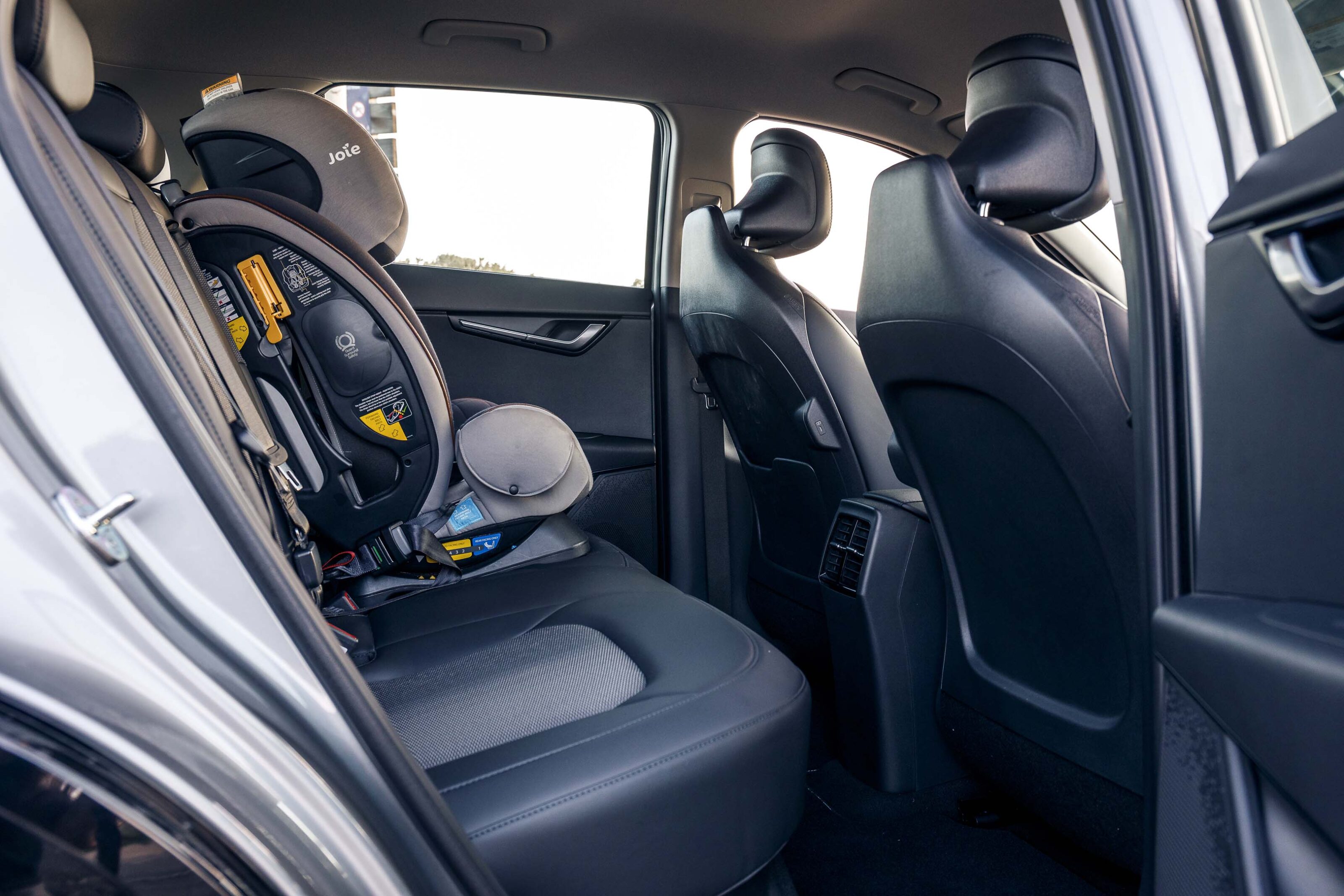
Rear occupants get a pretty good deal overall – as well as the legroom, there are two USB-C ports on the sides of the front seats (in addition to the one type A and one type C in the front), heating/cooling vents, and one map pocket on the left side.
For families though, the two ISOFIX points for installing child seats are tricky to access and click in, and the hooks for the top tethers are also hidden away behind the fabric in the back of the second-row seats, which makes them fiddly to attach.
Additionally, it’s quite a low vehicle, measuring just 1570mm in height, which means bending over to help a young child into their seat – or getting in and out yourself – a little hard on your back at times.
On the road
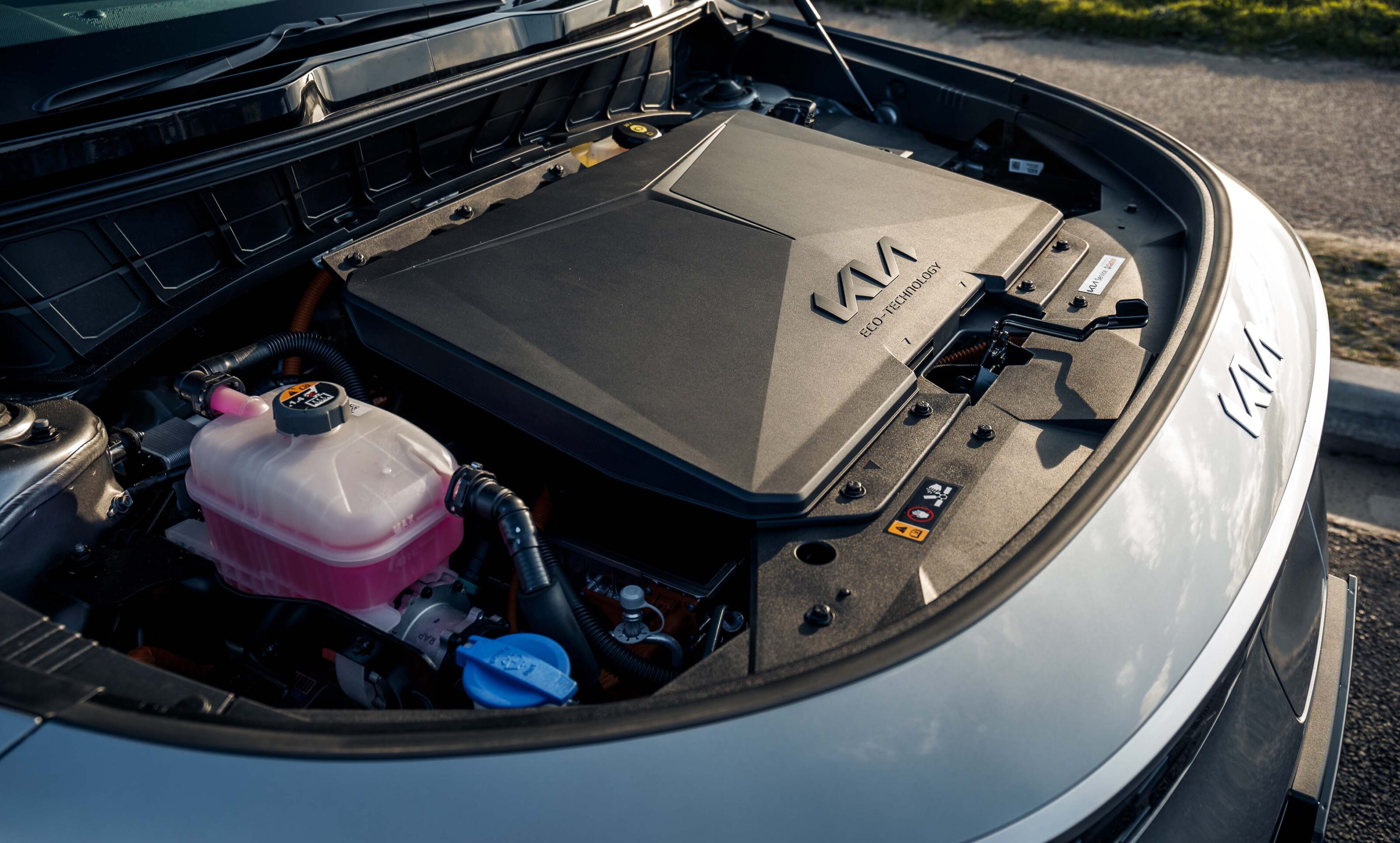
Both pure-electric grades of the Niro have a 64.8kWh battery pack and electric motor, with power and torque rated at 150kW and 255Nm respectively.
The motor is paired with a single-speed transmission (operated through an easy-to-use rotary dial), with only front-wheel drive offered.
As well as Eco mode, driving settings include Normal, Sport and Snow. Sport is unsurprisingly the most feisty, however, Eco still provided a decent surge of power, which was more than enough for most scenarios.
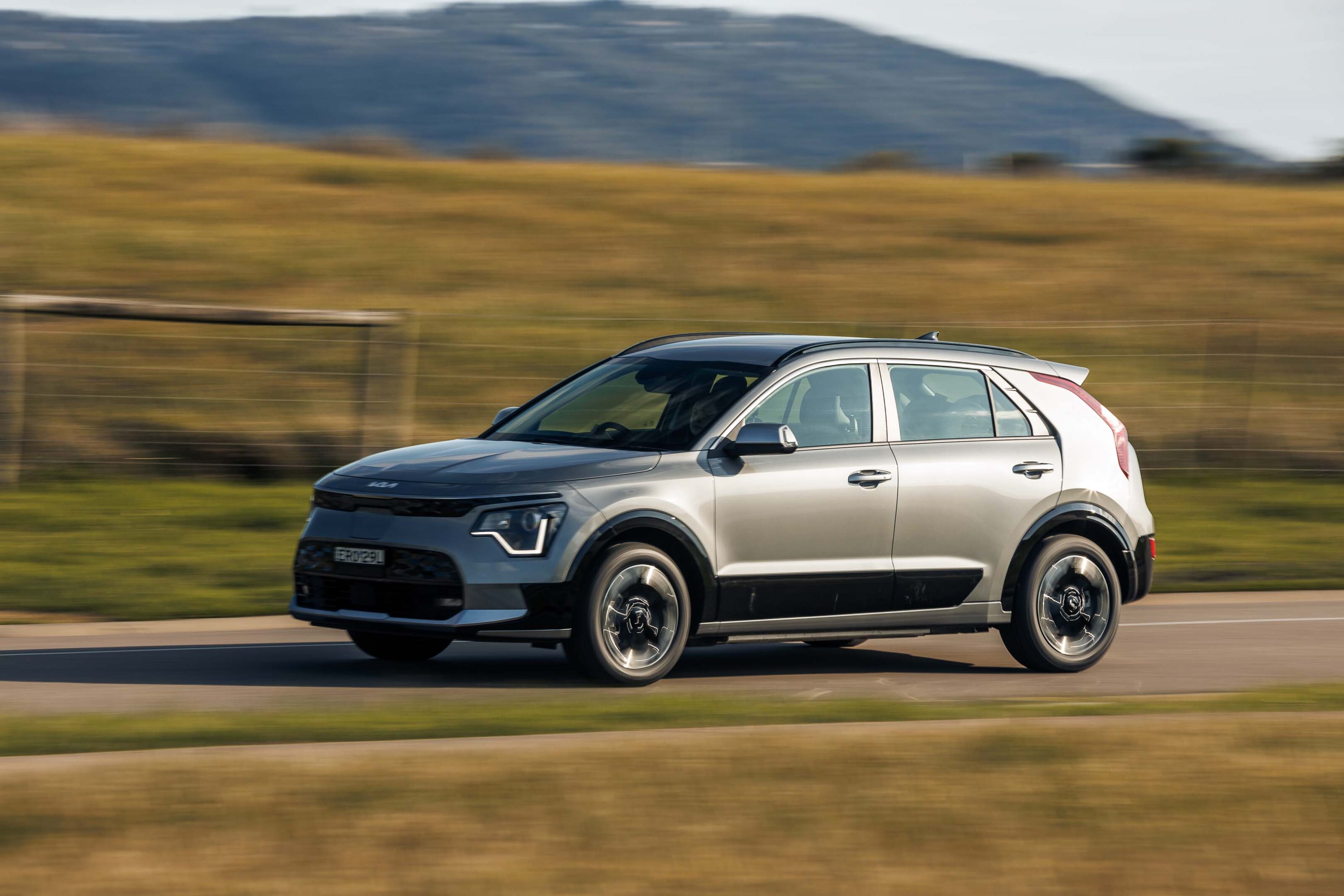
It lacks the oomph that the EV6 provides from its 168kW/350Nm, despite being a smaller vehicle, which makes it a little less exciting to drive – though it does feel nippier through corners as a result. However, its claimed 0-100km/h time is 7.8 seconds, so not all that far off the 7.4s possible in the EV6 Air.
The steering also feels fluid and natural, with a good turning circle and no need for additional feeding of the wheel to get around tighter bends in town.
Sport mode does firm it up quite considerably, but our preference was to keep it in Normal – there doesn’t really seem a need to ever switch.
The ride too is incredibly smooth and undeterred by anything other than the harshest of bumps.
Size-wise the Niro measures in at 4420 millimetres in length, which is just a tad shorter than the BYD Atto 3 at 4455mm, but substantially smaller than its EV6 sibling (4680mm) and the Tesla Model Y (4751mm).
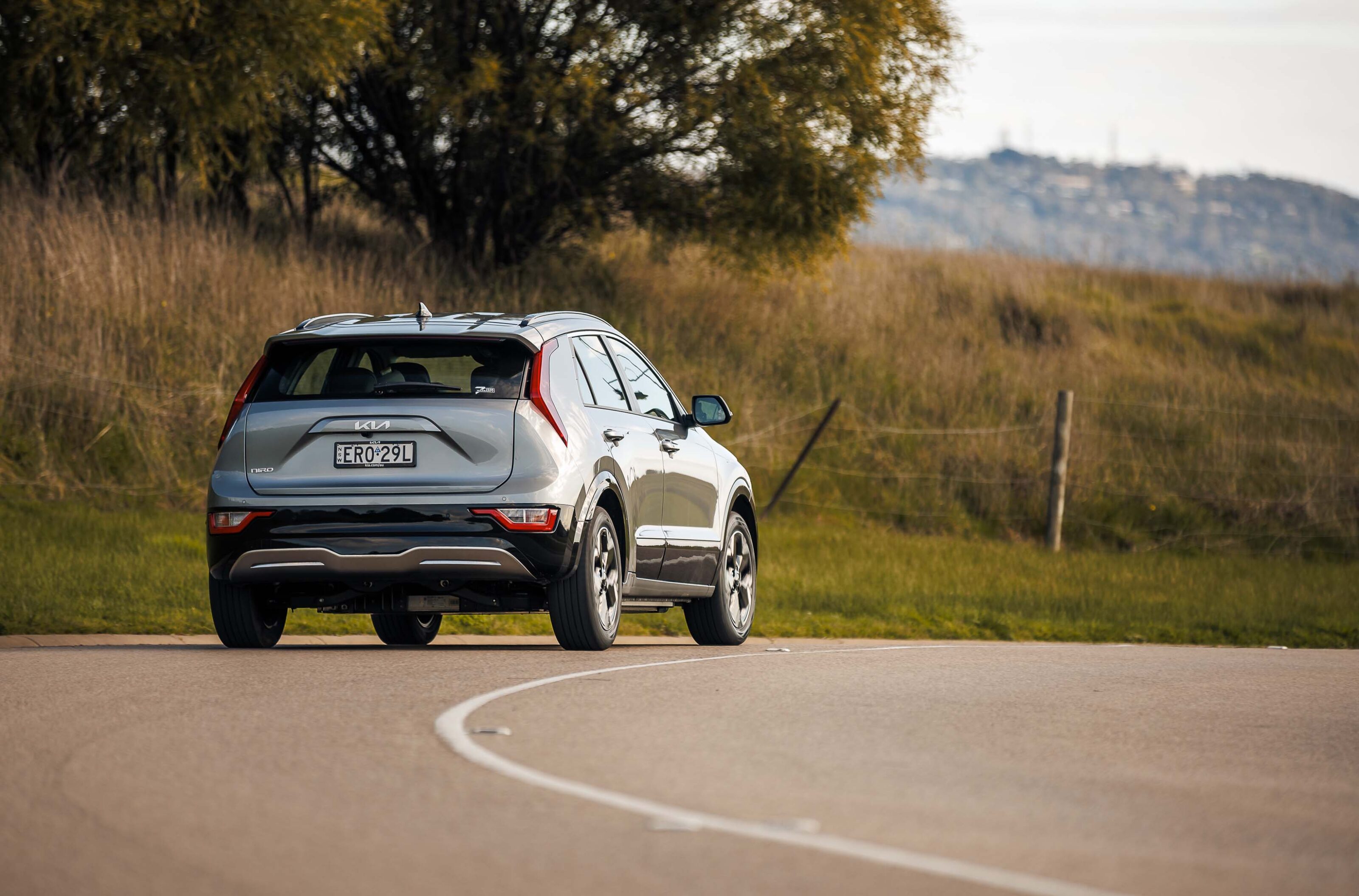
Our only real gripes are the forcefulness of the regenerative braking system, which feels quite aggressive even in its softest setting (it can be manually changed from full strength to off using the steering wheel paddleshifters), and infiltration of the cabin by tyre roar.
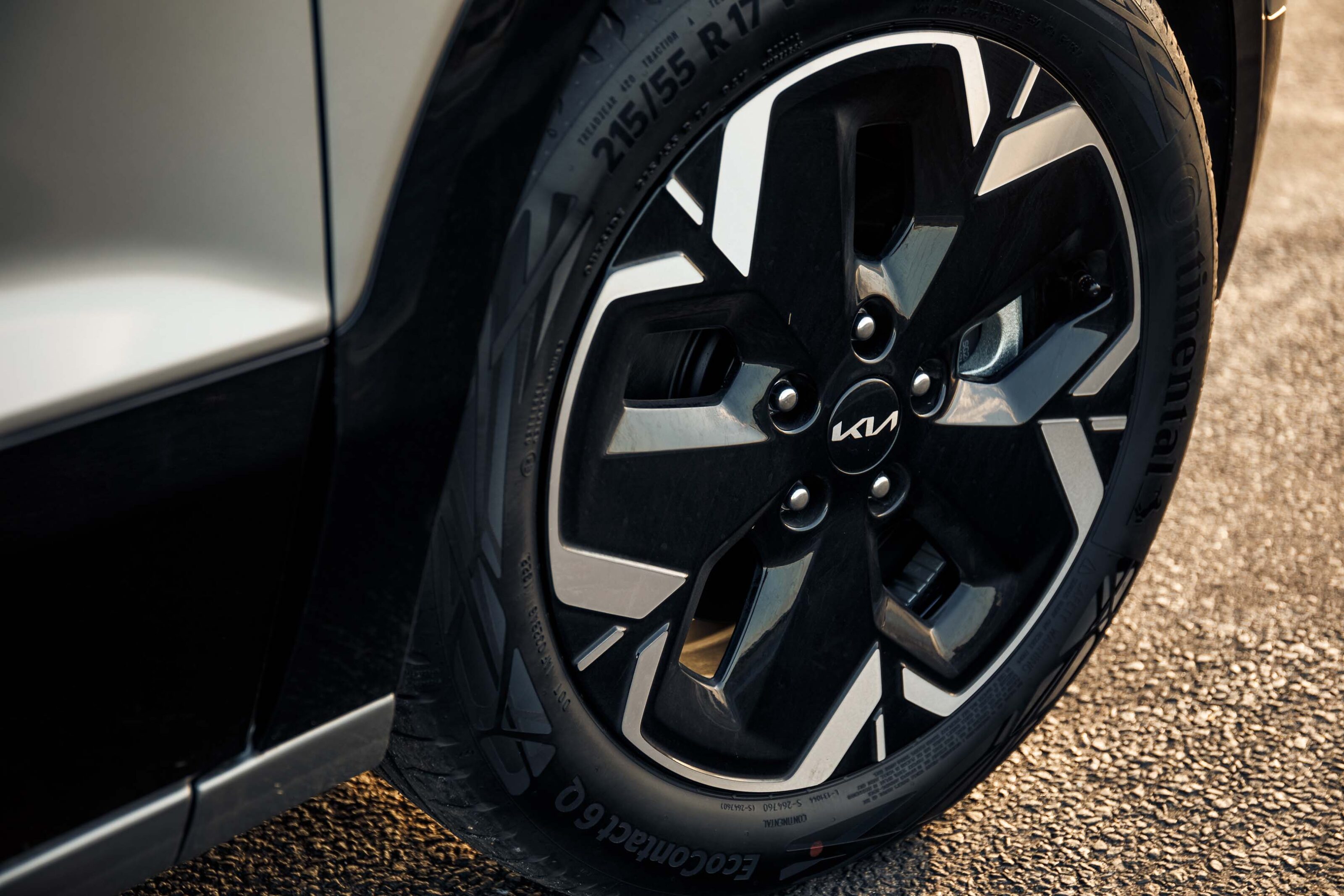
As logical as it is for an EV such as the Niro to ride on eco tyres to aid energy efficiency, it does seem to have an impact on overall noise levels.
The Niro S EV has a claimed driving range of 460km (markedly less than the EV6 Air’s 528km), with energy consumption rated at 16.2kWh/100km. We found our absolute best in everyday driving to be 12.6kWh, our average 15.6kWh and our worst performance due to extended freeway driving to be a touch above 30kWh/100km.
With an 80kW DC fast charger Kia says the Niro will charge in 43 minutes, or an hour and five minutes with a 50kW. In our time we used only the three-pin trickle home charger for overnight top-ups, which gave us 10-15 per cent in approximately 15 hours and a 7kW charger at Melbourne’s Dromana drive-in movie venue which provided 12 per cent in roughly 90 minutes.
Ownership
Like all Kia products, the 2022 Niro S EV has a seven-year, unlimited-kilometre warranty. The battery is covered for seven years or 150,000km.
Kia also offers capped-price servicing with intervals of 12 months or 15,000km as indicated below:
| 1 year or 15,000 km | $87.00 |
|---|---|
| 2 years or 30,000 km | $445.00 |
| 3 years or 45,000 km | $89.00 |
| 4 years or 60,000 km | $473.00 |
| 5 years or 75,000 km | $92.00 |
| 6 years or 90,000 km | $473.00 |
| 7 years or 105,000 km | $95.00 |
Kia also offers a pre-paid service option, which costs as follows:
| 3 years | $621 |
|---|---|
| 5 years | $1,187 |
| 7 years | $1,754 |
VERDICT
The 2023 Kia Niro S EV is a solid electric vehicle. Its crossover styling is easy on the eye, it’s comfortable and has good levels of rear passenger room as well as boot space, so would make a compelling proposition for families looking for their first EV.
Driving performance is natural and enjoyable, with no risk of leaving you yearning for the days of internal combustion.
However, looking specifically at the entry-level S variant, there’s a lot of kit missing for the cash, and some flaws such as cabin noise, which are hard to swallow for a starting price of $65K before on-road costs and incentives.
A price cut would do wonders to distinguish it more from the flagship EV6 and separate it from premium offerings such as the Tesla Model 3 and Polestar 2, which also start at around the mid-60K mark. After all, the BYD Atto 3, a similar sized car, comes in at more than $20K less. And even the EV6 Air started off at $67,990 RRP when it first went on sale at the beginning of this year, despite being the more premium option, and its range now starts at $72,590 – only a touch over $7K more.
But with stock of the EV6 harder to come by than hen’s teeth, just purely being able to get hold of a Niro EV sooner may hold great appeal for some.

2022 Kia Niro S EV specifications
| Body | 5-door, 5-seat small SUV |
|---|---|
| Drive | front-wheel |
| Engine | single electric motor |
| Transmission | single-speed reduction gear |
| Power | 150kW |
| Torque | 255Nm |
| Battery size | 64.8kWh |
| Battery type | lithium-ion polymer |
| AC charging | up to 11kW |
| DC Charging | up to 80kW |
| 0-100km/h | 7.8s |
| Energy consumption | 16.3kWh/100km |
| Weight | 1727kg |
| Suspension | MacPherson strut front/multi-link rear |
| L/W/H | 4420mm/1825mm/1570mm |
| Wheelbase | 2720mm |
| Tyres | 215/55 R17 |
| Wheels | 17-inch alloy (no spare) |
| Price | $65,300 + on-road costs |
At 10am today, 48 of Australia’s oldest and rarest motor vehicles will leave Melbourne’s Noble Park for a nine-day event to celebrate the centenary of the RACV Alpine Trial.
In 1921, RACV launched its first of a series of Alpine Trials to test vehicles and advocate for better roads and services in Victoria’s high-country region.

The RACV Alpine Trials were popular with private individuals and motoring companies, attracting up to 60 entrants to each event. Each vehicle carried at least two people, including the driver, an observer and sometimes an administrator.
The trials’ routes were onerous. At the time the Australian Motorist reported that the RACV Sports Committee deliberately designed the trial to be “one of great severity” so manufacturers’ claims about their vehicles could be put to the test “for the benefit of prospective purchasers.”

To celebrate 100 years since the first Alpine Trial, RACV and the Vintage Drivers Club (VDC) will recreate the inaugural event.
The vehicles participating in this celebratory event are all manufactured between 1921 and 1930. Australia’s oldest Bentley, one of the original participants in the 1922 trial, will be joining the fleet again in 2022 alongside RACV’s 1928 Model-A Ford.

The 1921 trial ran from Melbourne to Lakes Entrance, Tallangatta, Mount Buffalo, Wangaratta, Healesville, Ballarat and Geelong before returning to Melbourne.
This year’s event will follow, as closely as possible, that 1000-mile route and run from Saturday, October 15 to Sunday, October 23. Other towns included this year will be Mansfield, Bright and Creswick.

“The Vintage Drivers Club, along with the event committee have done a fantastic job of organising the RACV Alpine Trial Centenary,” the RACV’s Louise Steinfort said.
“This event would not be possible without their dedication and commitment to preserving the history of Australian motoring.”
The continuation of Alpine Trials by the Victorian Light Car Club, and then by the Historic Rally Association, makes it one of the world’s oldest surviving motor sport events.

Alpine Trial schedule
| Day | Where To |
|---|---|
| Day 1 u2013 Saturday, October 15 | Noble Park to Traralgon |
| Day 2 u2013 Sunday, October 16 | Traralgon to Lakes Entrance |
| Day 3 u2013 Monday, October 17 | Lakes Entrance to Wodonga |
| Day 4 u2013 Tuesday, October 18 | Wodonga to Bright |
| Day 5 u2013 Wednesday, October 19 | Bright to Mt Buffalo, Harrietville & return to Bright |
| Day 6 u2013 Thursday, October 20 | Bright to Mansfield |
| Day 7 u2013 Friday, October 21 | Mansfield to Healesville |
| Day 8 u2013 Saturday, October 22 | Healesville to Creswick |
| Day 9 u2013 Sunday, October 23 | Creswick to Home |

Last year some of our team took on the rally in honour of what would have been its 100th anniversary had it not been cancelled due to the COVID-19 pandemic.
Click the link below to find out how they got on.
Snapshot
- Toyota defends the hybrid powertrain
- Not opposed to BEVs, but not the only solution
- A diverse approach needed, says Toyota
Toyota has been the subject of debate in the automotive industry recently, with the EV Council, Greenpeace and others calling out the brand’s lack of participation in the push to lower transport emissions.
But the firm’s Vice President of sales, marketing and franchising, Sean Hanley, is adamant Toyota isn’t against the transition to BEVs, citing the introduction of all electric BZ4x next year – expected around a similar time as Volkswagen Australia’s first EV, the ID.4.
Hanley did, however, assert that a forced and single-minded transition to EVs would leave some buyers behind. “If you want to take everyone on a journey, where you’re reducing the footprint, you’ve got to have options,” he said.
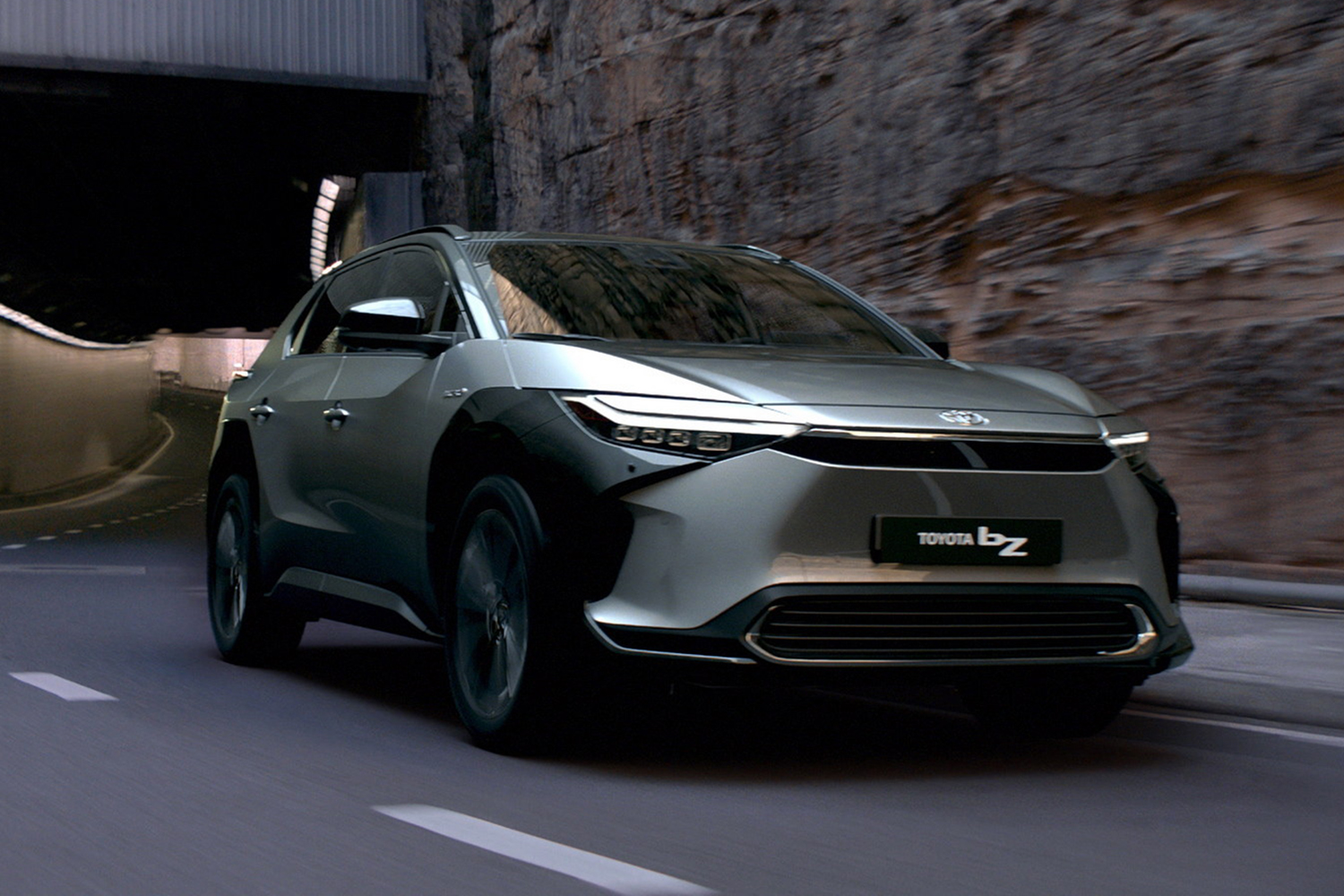
Toyota sees BEVs as the answer, but not the only one
In a supply constricted new-car market, the chip shortage has been quickly been put to blame for long lead times. But there’s also restrictions on raw materials – particularly those needed to make batteries, as Hanley put it.
“Precious metals for making batteries are in desperately short supply right now. So this whole notion that BEVs are going to be flying out of factories, and that’s the only solution, well I’d challenge that in so far as: Where are you going to get the metals to make all these batteries over the next five years?
“So that’s why diversity of technology, diversity of powertrains is deeply important to us. It’s not that we’re opposed to BEVs. We’re not. In fact we’re going to launch one in the second half of next year”, Hanley said.
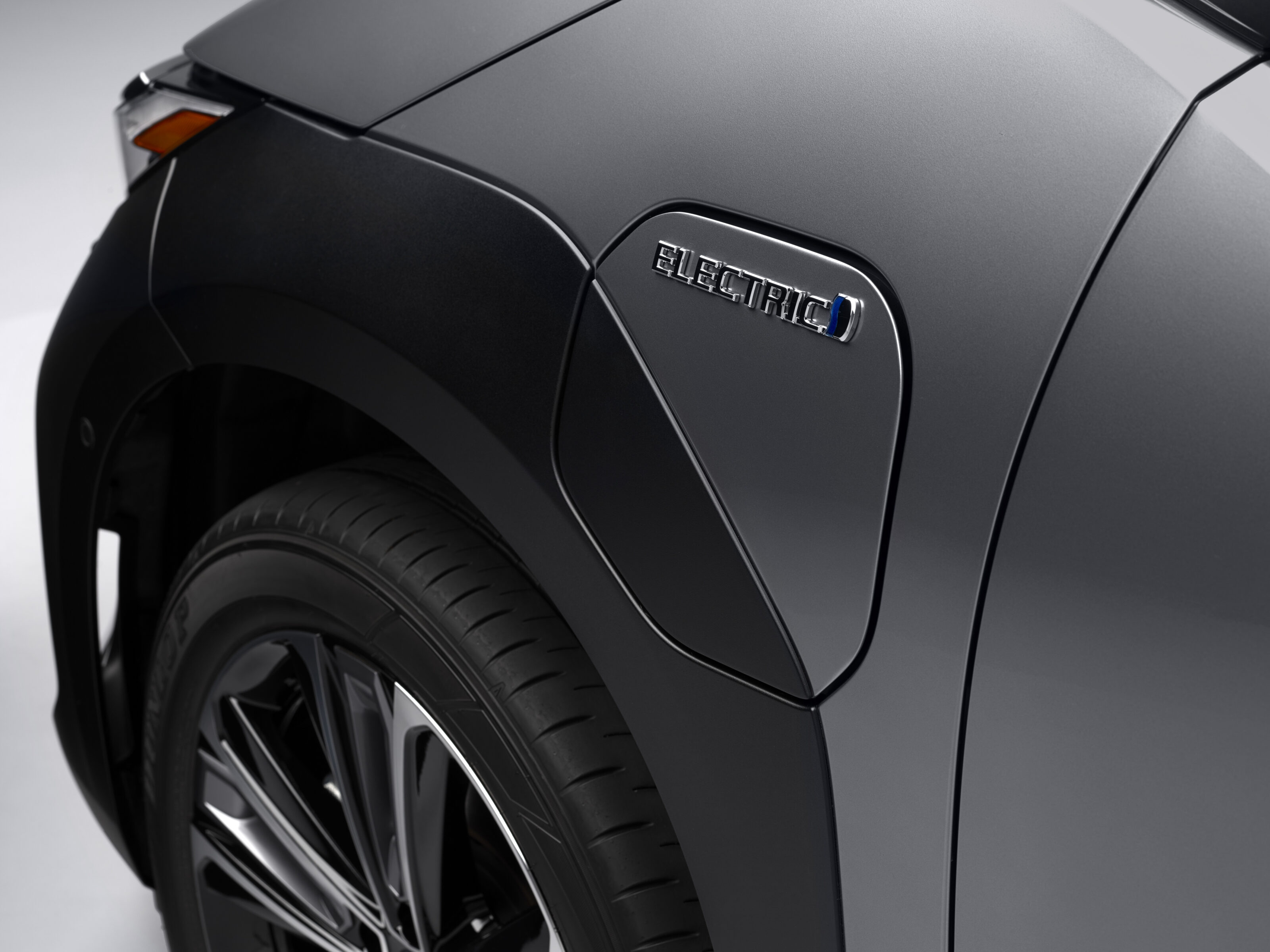
Why does Toyota think the hybrid model works right now?
Self-charging and plug-in hybrid vehicles are still guilty of tailpipe emissions. The 2023 Toyota Corolla Cross hybrid emits 97g CO2/km, only just below the Federal Chamber of Automotive Industries’ (FCAI) proposed 2030 mandate, but 29 per cent less than the petrol only car’s claim (136 CO2/km).Wheels asked Hanley why he thought hybrids have been so successful with Australian new-car buyers. Apart from their availability, he added: “I believe that the hybrid powertrain is a practical, affordable alternative right now.
“That doesn’t mean [hybrid] will be the only type of technology, it certainly won’t be, we’re seeing that expansion now of electrification. But, of course, the thing about hybrid technology is, it’s practical, it’s affordable, there’s no infrastructure required to support it that we don’t have… and there’s no anxiety attached to it. It’s technology that we are used to.”
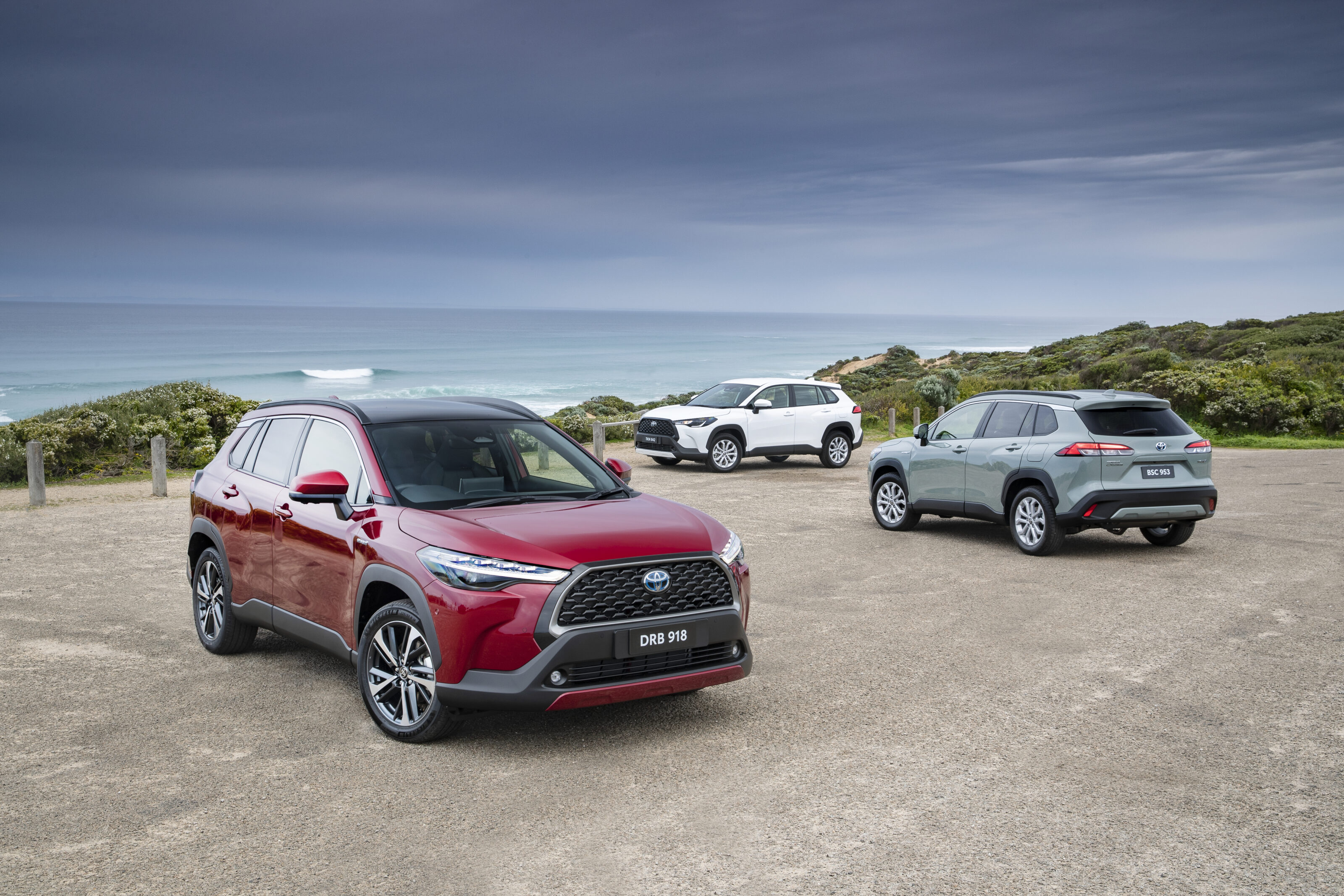
Hanley said that Toyota will electrify all of its product lines – save for GR performance – by 2023, including plug-in hybrids (PHEVs). The brand currently sells the plug-in RAV4 Prime overseas, but has announced no Australian plans.
“In the market we operate in, we believe, right now, that the solution is a diversity of product. In other words, we’ll have a battery-electric (BEV) for some customers, hydrogen fuel-cell electric vehicle (FCEV), and PHEVs. By 2030, every Toyota in our range – apart from GR Performance range – will have electrification.”
So far in 2022, Australians have bought 63,899 self-charging and plug-in hybrid vehicles compared to 21,771 EVs. Battery EVs increased their YTD sales a staggering 510 per cent over 2021, where hybrid sales grew 7.3 per cent.
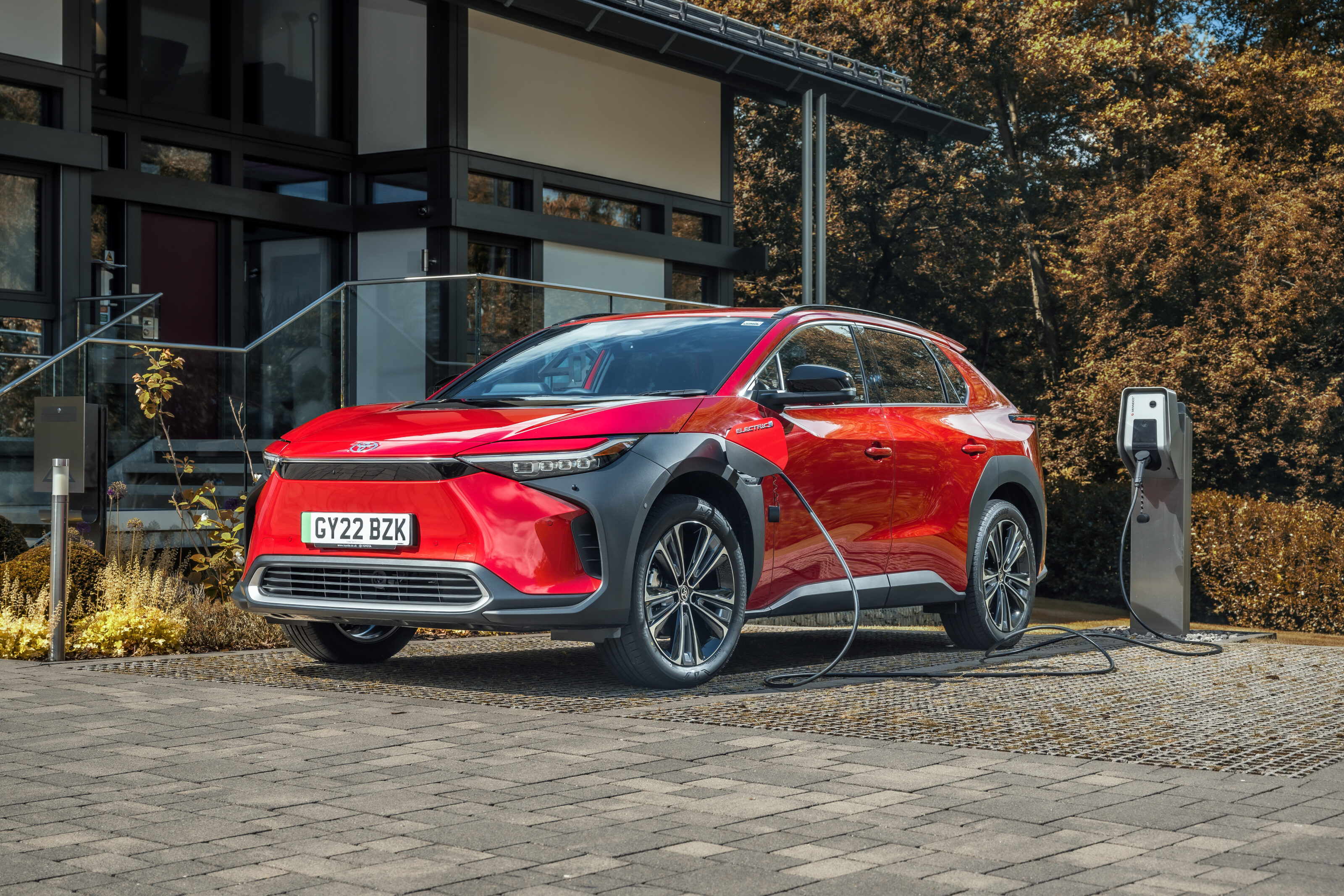
Hybrids are all well and good, but what about those polluting diesels?
While Toyota Australia sells some of the most efficient SUVS and passenger cars such as hybrid RAV4s and Corollas in large volumes, it also caters to the rather polluting ute market, its HiLux light commercial vehicle being Australia’s best-selling car.
For example, a diesel 4X4 HiLux produces 207g CO2/km, more than twice a hybrid Corolla. A LandCruiser 79 Series produces a whopping 281g CO2/km. Combined, Toyota customers have bought 45,649 of these vehicles this year (excluding HiLux 4X2).
We asked Hanley how Toyota will strike a balance, and he replied: “From our perspective, we’ve got to come up with a solution that allows those vehicles to do the things they’re designed to do, but reduce your carbon footprint, and eventually get it to zero.

“And that’s why we’re saying, to convert to BEV tomorrow – which is exaggerated – or even five to 10 years is not a practical solution.”
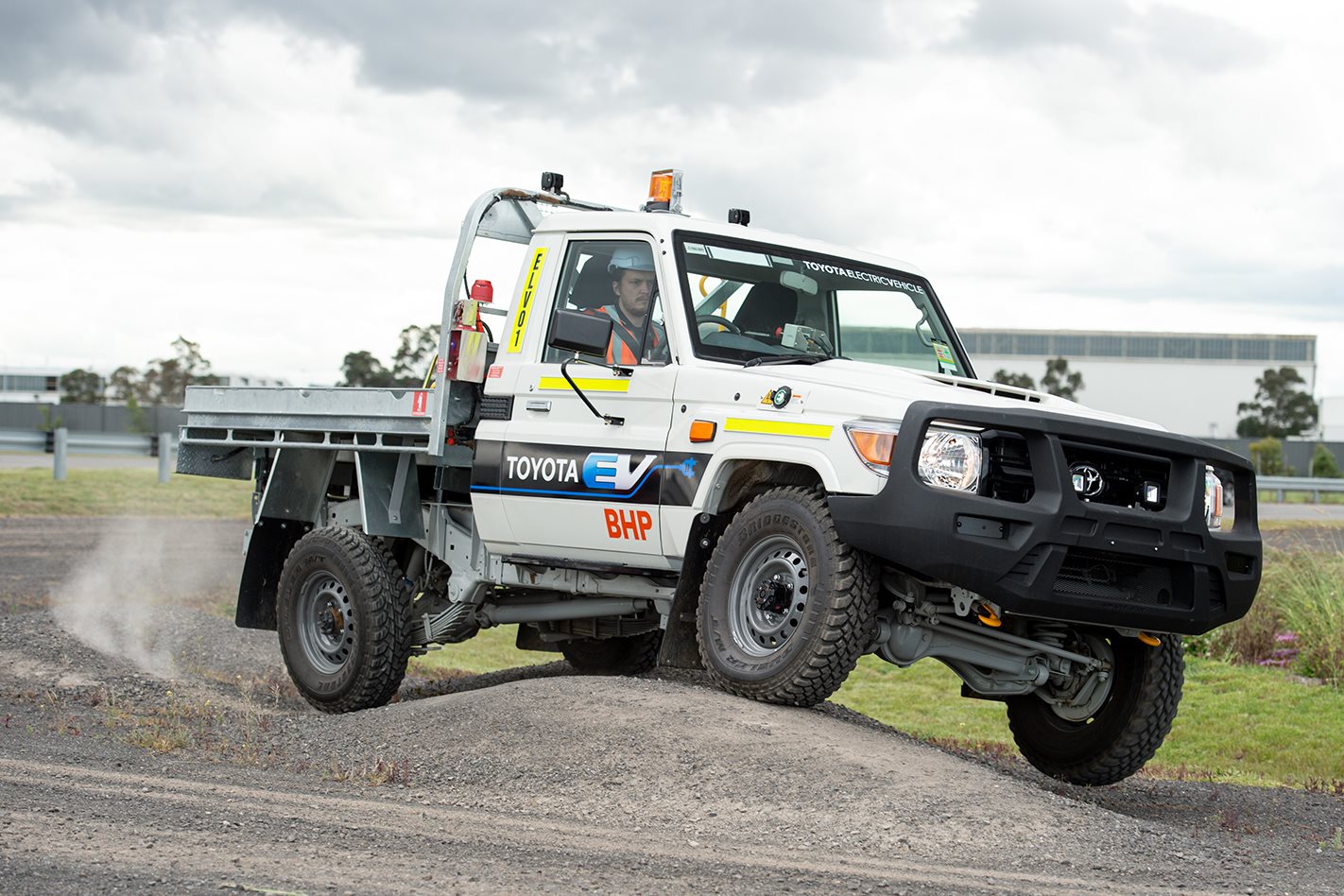
Toyota is in the process of trialling a pair of LandCruiser 70 Series converted with BEV powertrains as mining fleet vehicles for BHP.
Hanley did say that the electrified 70 Series could prove part of the solution if it can be made to suit the needs of the commercial stakeholders. Additionally, the Tundra full-size pick-up currently under evaluation in Australia uses a hybrid powertrain.
“The point is this: Carbon is the enemy here, not the powertrain. We are a full supporter of some mandate or legislation around CO2 [targets]… The debate is not about if you get to a carbon neutral position but how. Toyota is not opposed to battery-electric vehicles at all”, Mr Hanley said.
Snapshot
- Toyota Connected Services shifts to 12-month trial period
- Corolla Cross debuts connected sat-nav, remote engine start, and more
- Two subscription packages available; existing vehicles require payment after three years
Toyota Australia has detailed its updated suite of connected vehicle technology.
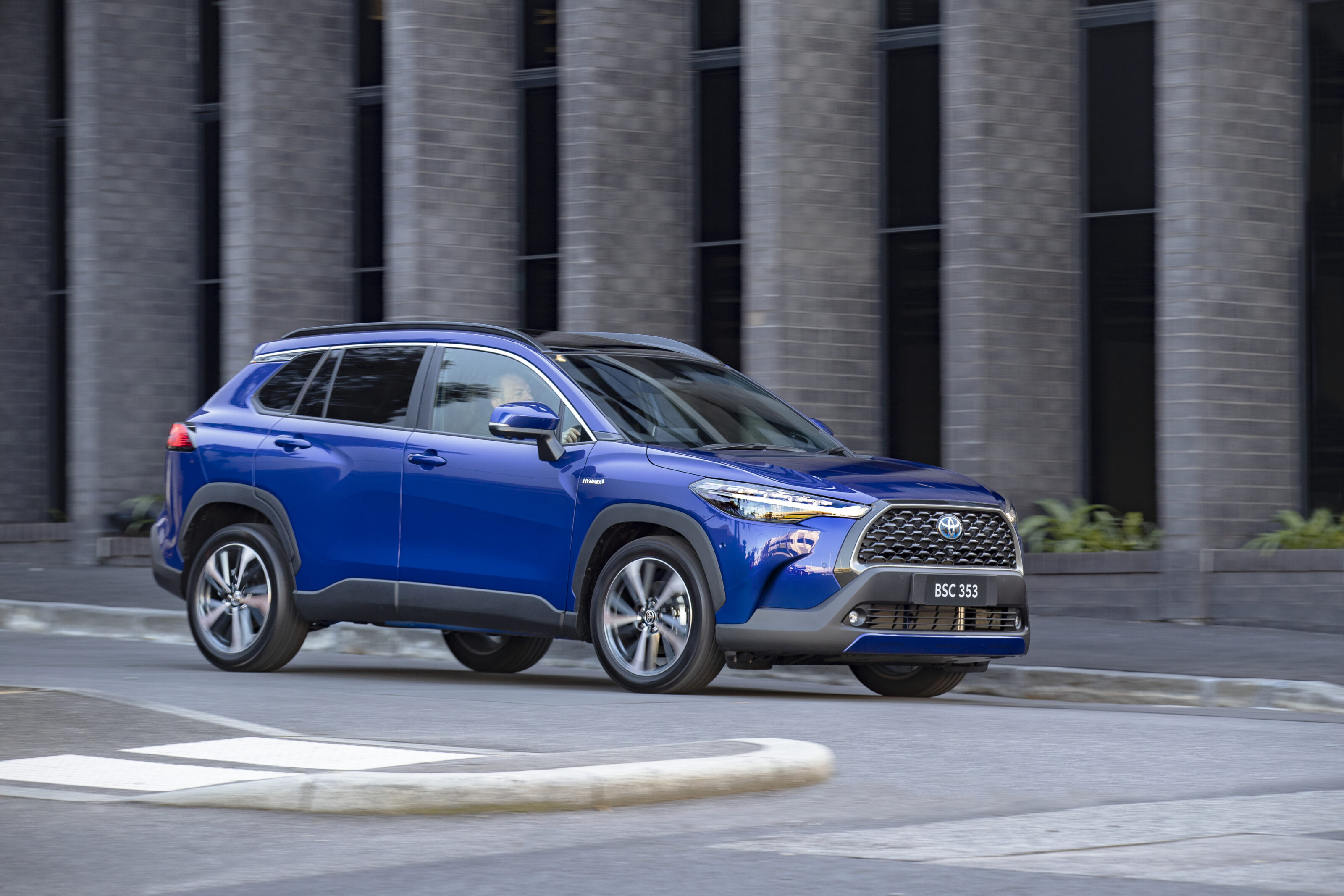
The enhanced version of Toyota Connected Services debuted on the 2023 Toyota Corolla Cross this month, and will be standard on upcoming vehicles – including the facelifted Corolla hatch/sedan due in November.
According to the brand, the new Corolla Cross is “the most technologically advanced vehicle Toyota has ever produced”, with features including remote engine start and connected satellite navigation offered.
Matched with a built-in data communication module – connected to Telstra’s 4G network – owners can view information and perform actions on the myToyota Connect smartphone application.
However, there’s a caveat with the updated Toyota Connected Services – a monthly subscription.
While vehicles fitted with the current system receive a three-year service, Corolla Cross buyers will be required to purchase a monthly subscription.
This will apply after a 12-month complimentary period in order to retain all of the features available at delivery.
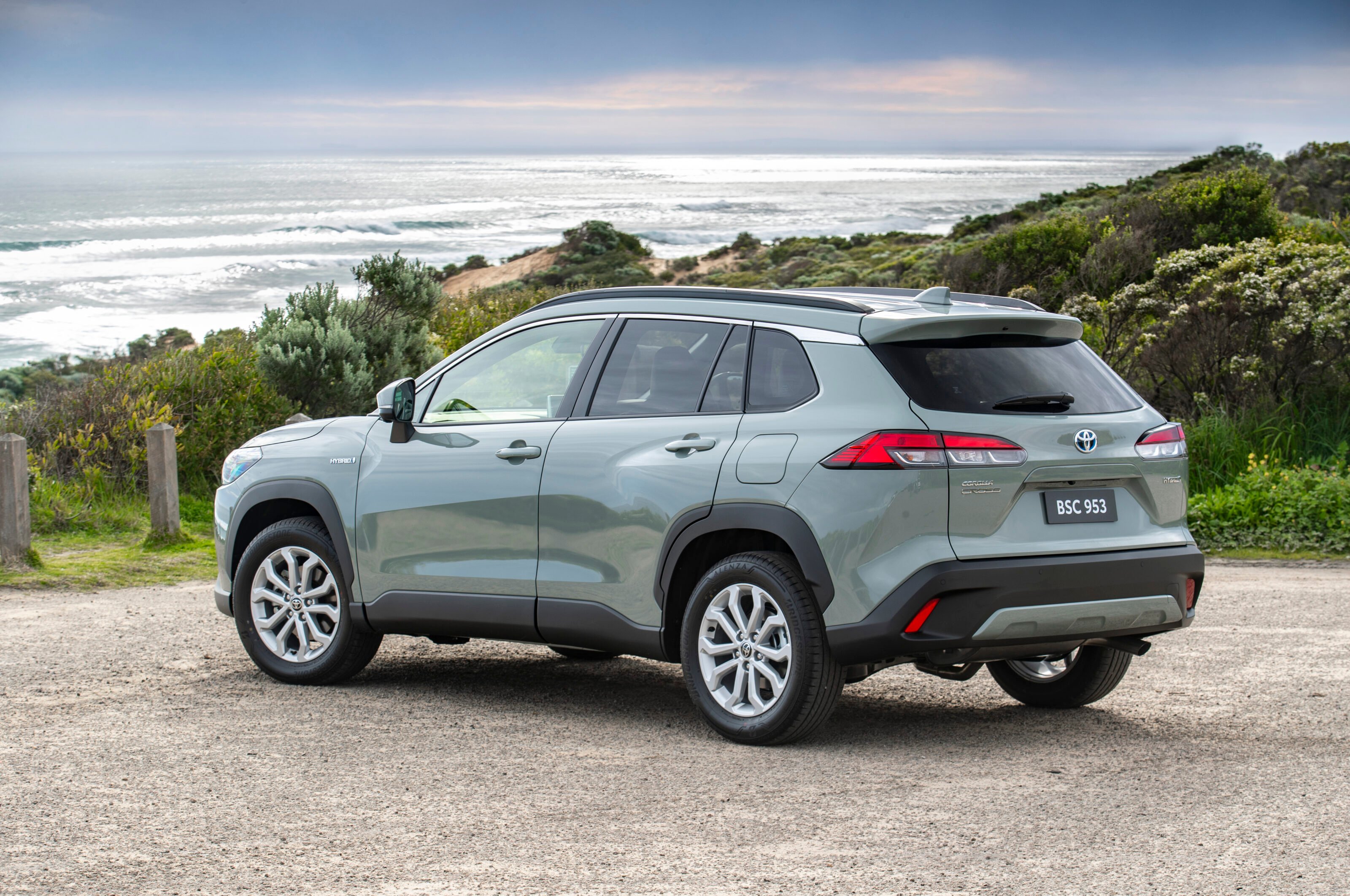
A monthly subscription will also be required for existing vehicles fitted with Toyota Connected Services, but only after a three-year complimentary period.
As standard, the ‘Toyota Essentials’ package will be included throughout the life of the Corolla Cross, offering the current Connected Services basics – at least while Telstra’s 4G network remains active.
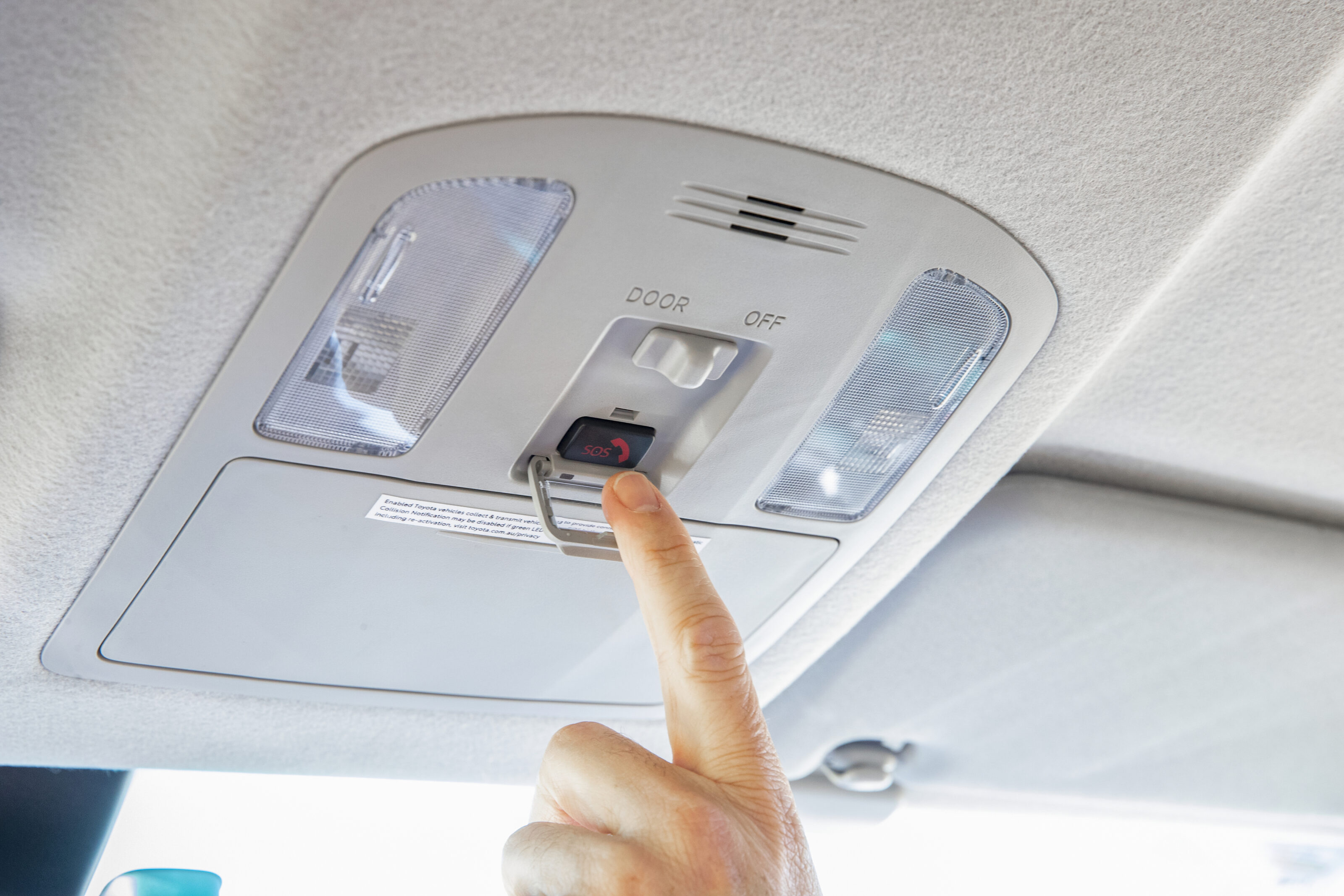
This includes SOS emergency calling, automatic collision notification, a vehicle locator, digital owner’s manual and warranty information, and odometer, distance to empty and fuel level information.
To access stolen vehicle tracking and the Status Connect feature – which monitors a vehicle’s acceleration, braking and cornering – drivers must purchase a ‘Toyota Connect+’ subscription after the complimentary 12 months, at $9.95 per month.
These features are currently standard on the Yaris Cross (all models), Camry (from April 2021), HiLux (from October 2021), Fortuner (from October 2021), HiAce (from October 2021), Granvia (from September 2021) and LandCruiser 300 (all models).
A spokesperson for Toyota Australia said the current models “will continue to be offered with those services free of charge for three years from purchase.”
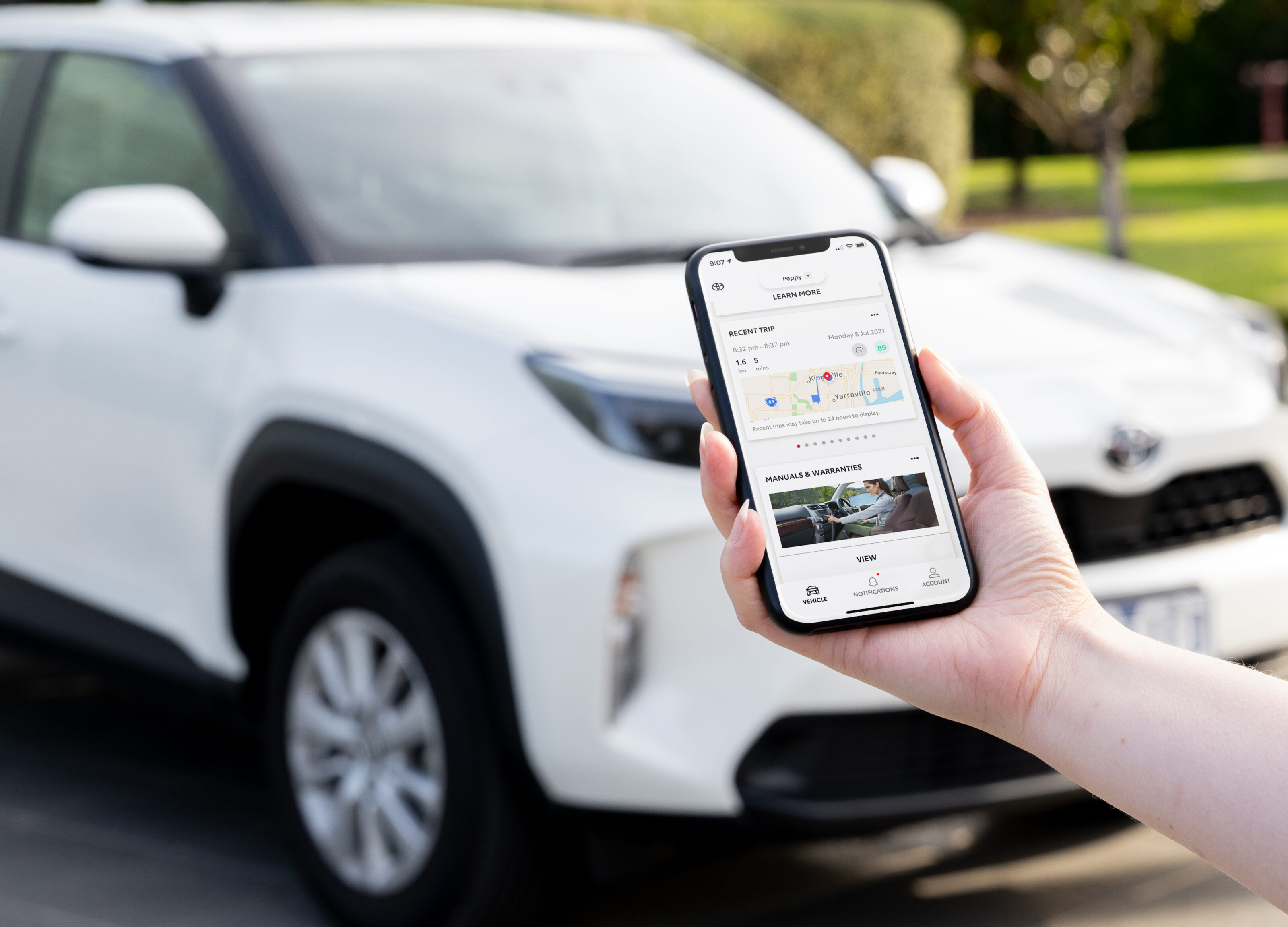
After this period, a $4.95 per month Toyota Connect subscription will be required to access stolen vehicle tracking and Status Connect.
Status Connect allows owners to set guest driver settings, which will send a notification if the vehicle exceeds set speed limits, curfews, and time or distance limits – handy for parents letting teen drivers borrow their car.
However, the ‘Toyota Connect+’ subscription for the Corolla Cross also includes remote vehicle functionality, allowing owners to lock/unlock and start their vehicle, set the climate control, and operate the horn and lights from a smartphone.
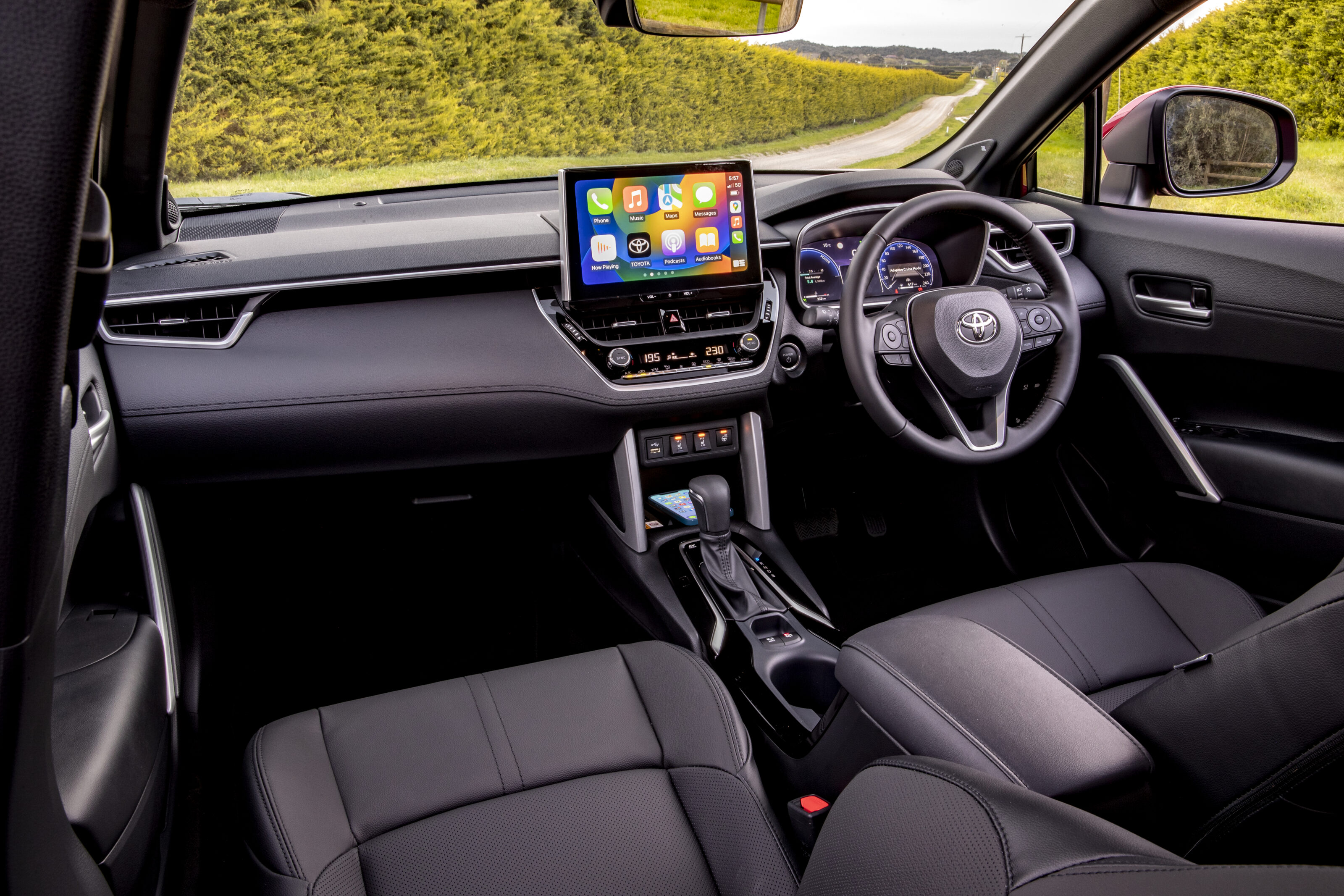
Meanwhile, another subscription – Toyota Connected Multimedia – will be required after one year, if buyers wish to continue using the connected navigation, customisable multimedia profiles and ‘Hey, Toyota’ voice assistant on the brand’s next-generation infotainment system.
It is priced at $12.50 per month, and includes the features of the Toyota Connect+ service.
Toyota has yet to confirm the vehicle roll-out for the updated version of Connected Services, beyond the Corolla range.
However, it will likely be included in the updated RAV4 and Kluger family SUVs due in the coming months.
UPDATE, January 2023: 2023 Subaru Crosstrek pricing announced; pre-orders open
Subaru has confirmed its XV replacement, the 2023 Crosstrek small SUV, will arrive in Australia in April from $34,990 before on-roads.
For the full run-down, click on the read more link below:
Story continues…
2023 Subaru Crosstrek confirmed for Australia
Snapshot
- 2023 Subaru Crosstrek revealed
- XV nameplate dropped for third-generation model
- Now confirmed for Australian market
Subaru has announced the next-gen XV – but under the new name of Crosstrek – is bound for Australia, and confirmed with hybrid power.
While the brand has yet to finalise timing, it is expected to arrive in early 2023, with full details – including pricing – to be announced in the coming months.
At this stage local specification details are thin on the ground, however, we know it will feature the firm’s symmetrical all-wheel drive, the latest generation EyeSight driver assist system and driver monitoring system – Driver Focus – as well as a total of nine airbags.
Inside the cabin, the Crosstrek gets an 11.6-inch infotainment touchscreen, wireless Apple CarPlay and Android Auto connectivity, as well as wireless smartphone charging.
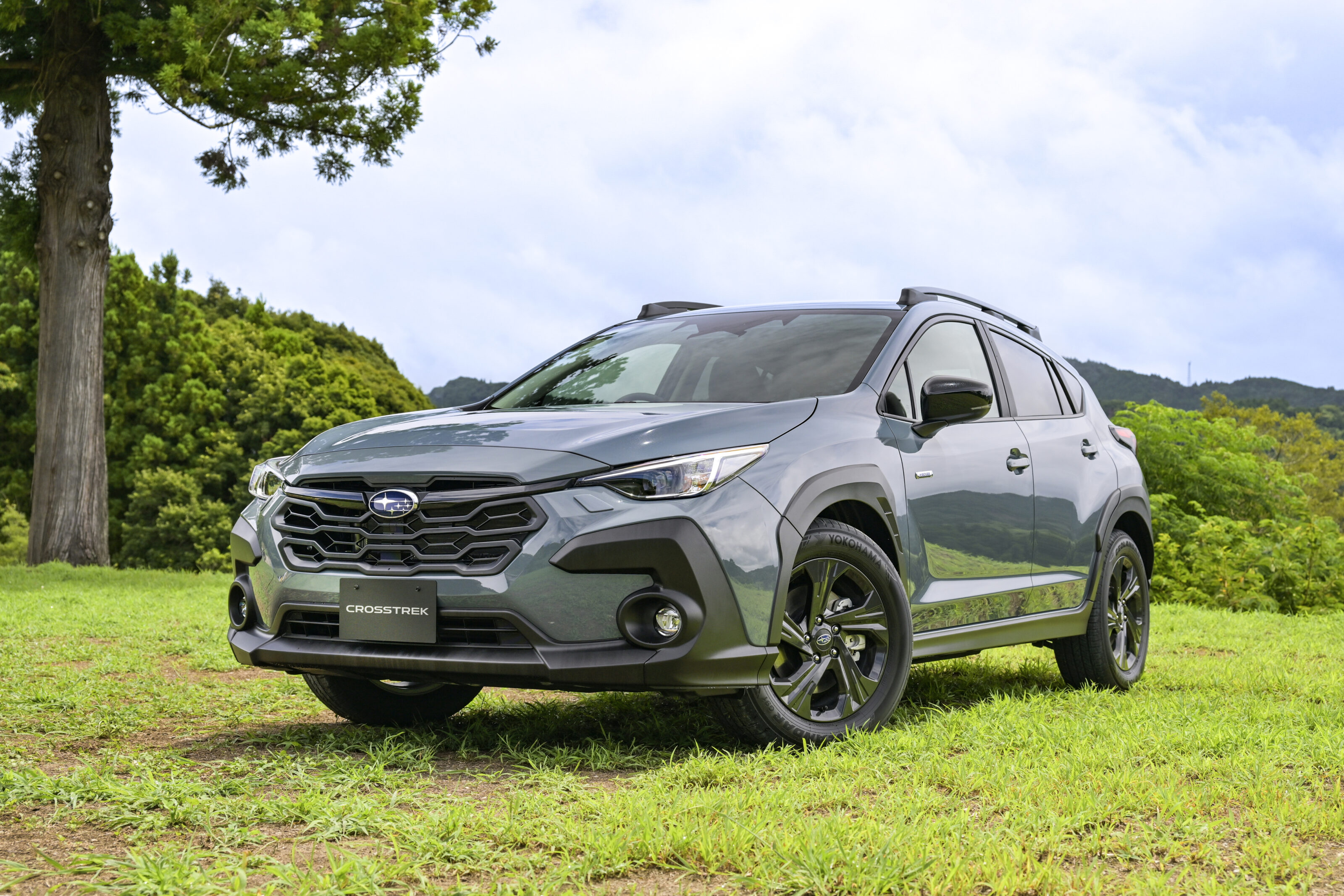
Under the bonnet, it will be powered by a 2.0-litre boxer engine and a Lineartronic automatic transmission with eight-speed paddle shift manual mode, and the option of a hybrid variant.
“The new name embodies what the Crosstrek does and is, an All-Wheel Drive crossover small SUV that’s capable of trekking almost anywhere you please, whether that’s urban driving or outdoor adventures, with absolute confidence and enjoyment,” said Subaru Australia’s Managing Director, Blair Read.
“The all-new Subaru Crosstrek SUV encapsulates an active lifestyle, through its distinctive exterior design and drivability, and offers plenty of versatility meaning its skilled to take on any adventure with a sense of ease.”
The story to here
September 15: 2023 Subaru Crosstrek: XV successor revealed, Australian details unclear
The next-generation Subaru XV has been unveiled – but it will be known as the 2023 Subaru Crosstrek globally.
While the small SUV is familiar to locals as the XV – and also in other markets, including Japan – it has been badged Crosstrek in North America since 2012, with Subaru deciding to take the name global for its third generation.
Australian details are currently unclear, with further information expected in the coming months.
“The latest global reveal from Subaru Corporation is very exciting! Details for the Australian market to come soon,” said the brand’s local division in a media statement.
Deliveries will commence in Japan next year, with an Australian launch likely to follow before the end of 2023.
It previews the next-generation Subaru Impreza hatch and sedan, which Japanese media reports will be revealed before the end of 2022.
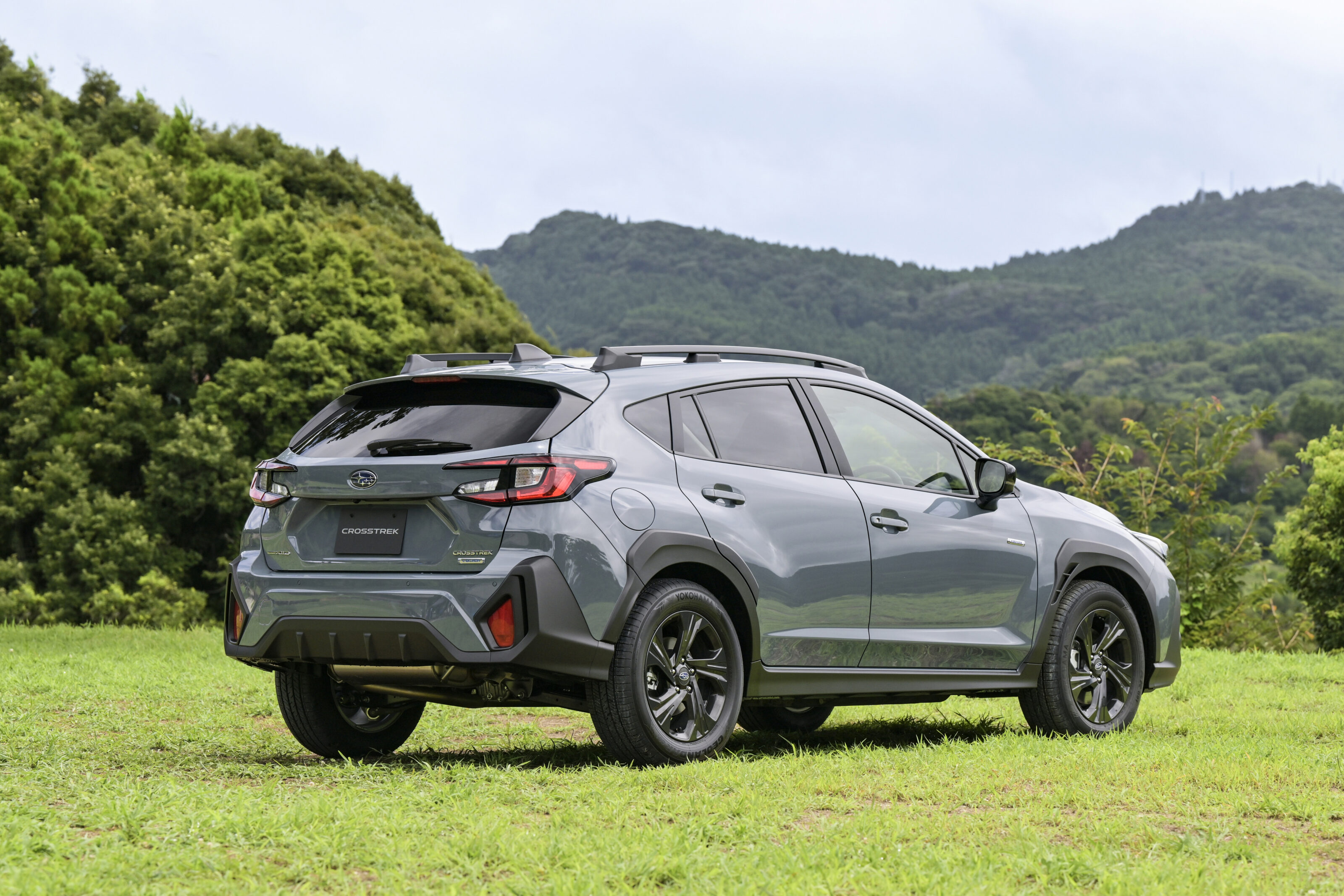
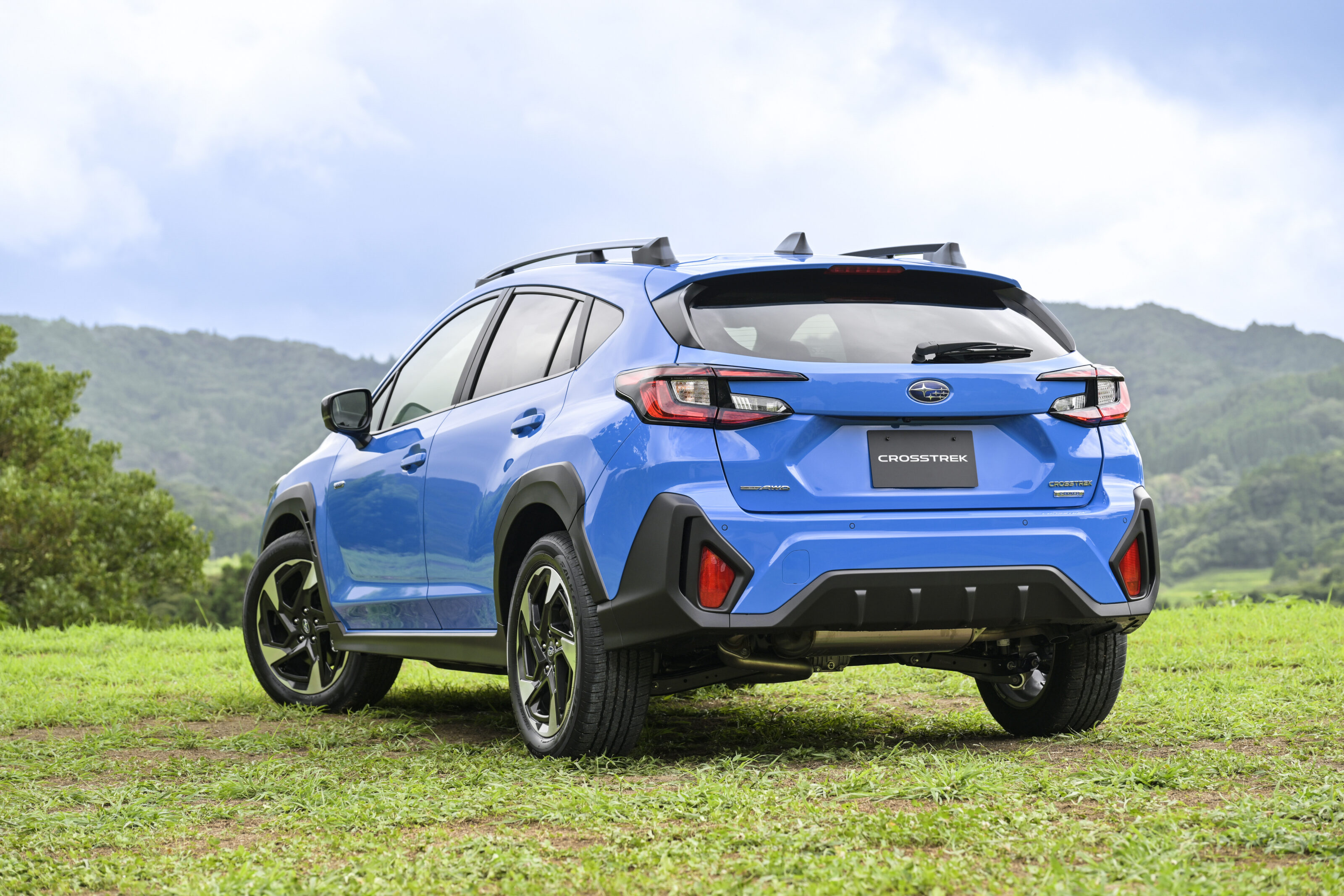
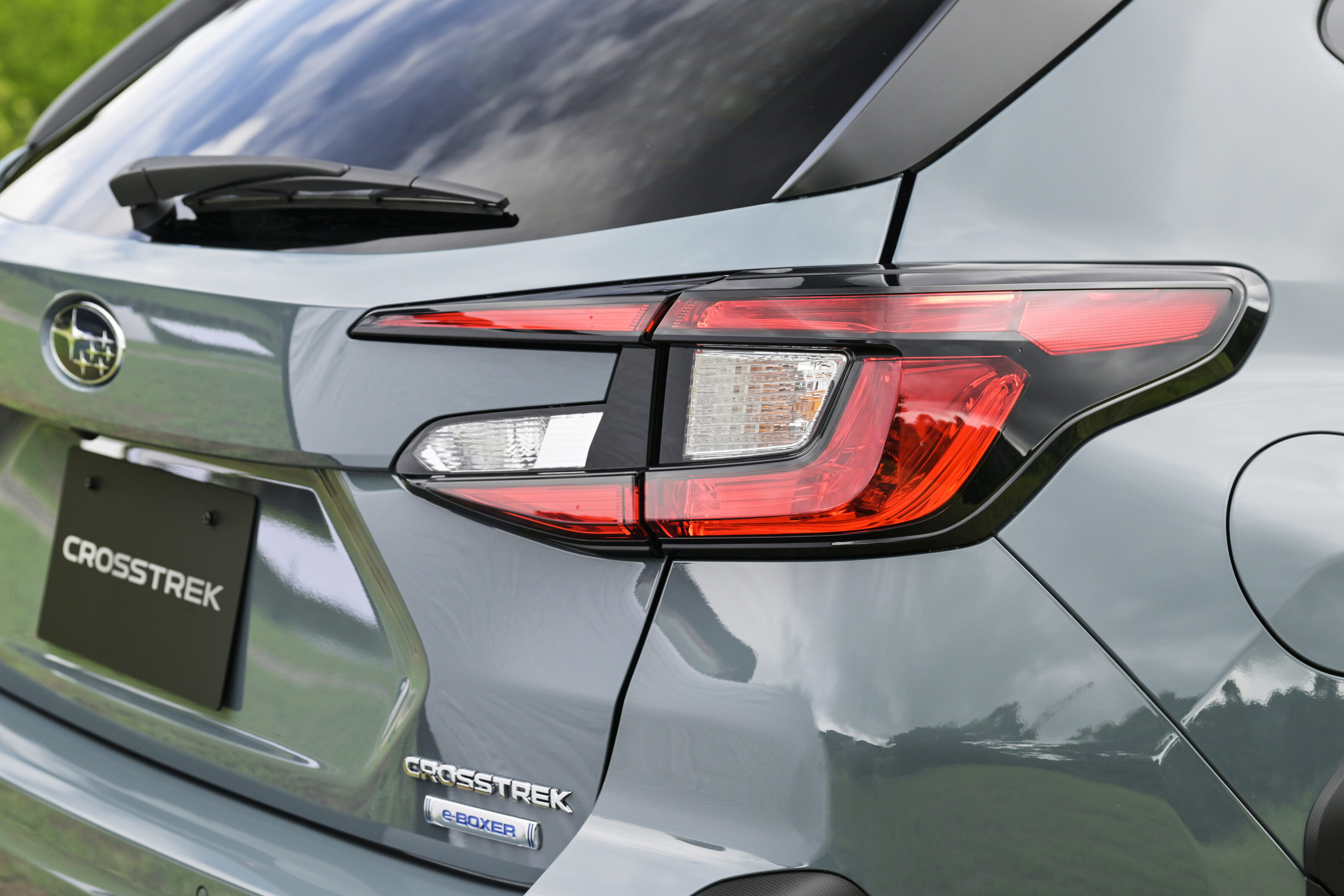
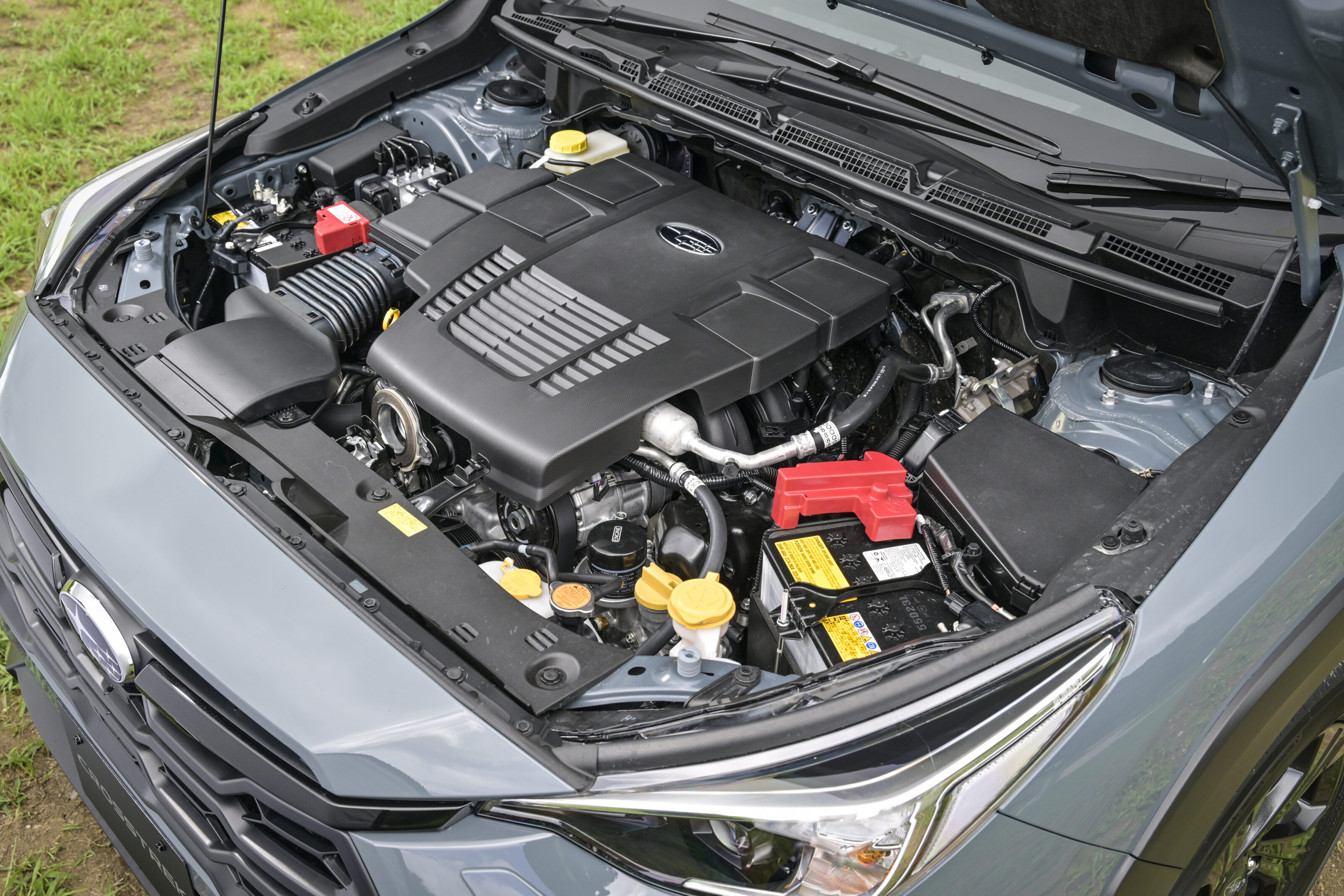
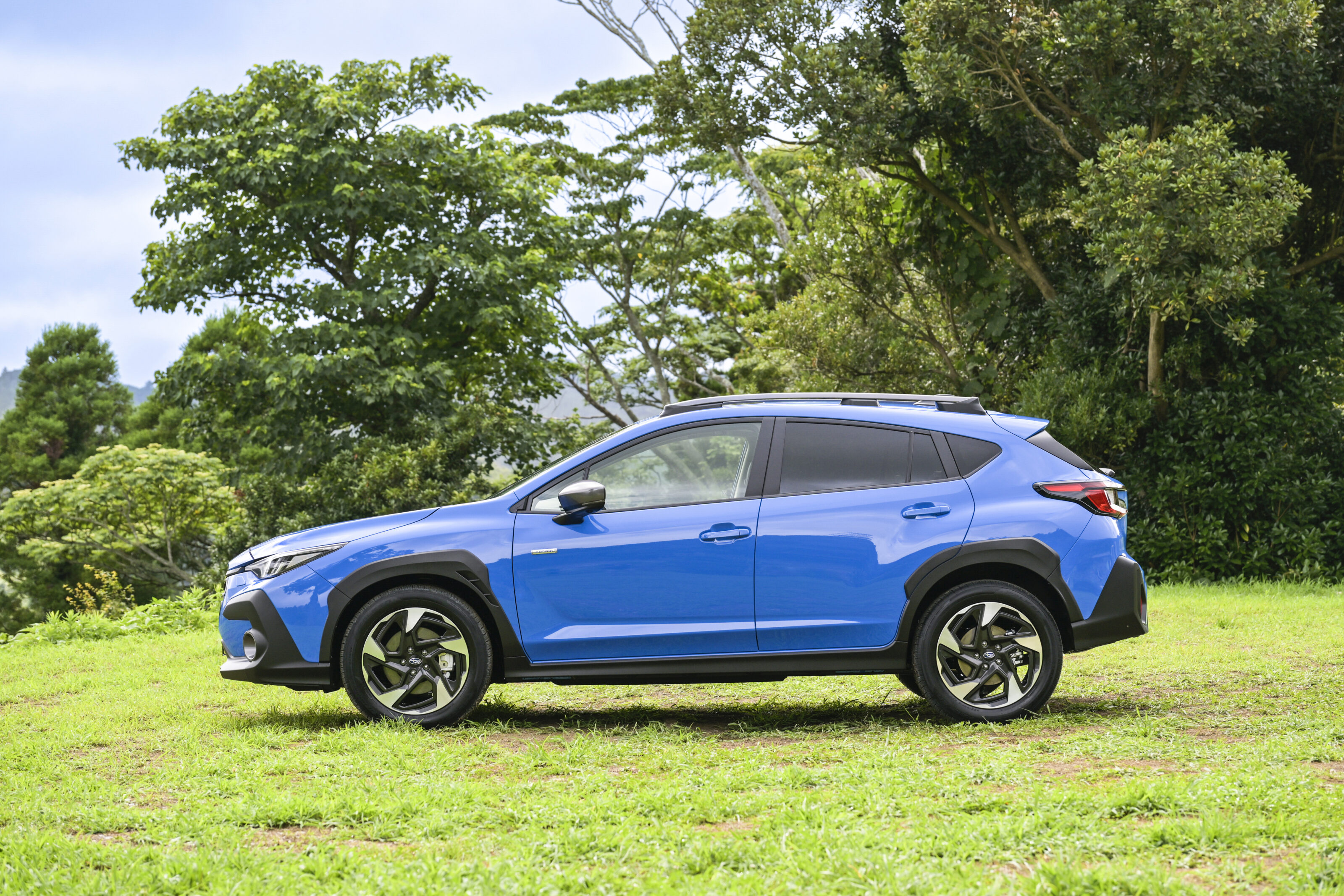
Under the skin, the Crosstrek retains the current XV’s Subaru Global Platform, but with a new design, slim full-LED headlights and WRX Sportswagon-like tail-lights.
It rides on a 2670mm wheelbase, and measures 4480mm long, 1800mm wide and 1580mm high – 5mm longer in wheelbase, 15mm longer, no wider and 30mm taller than before.
Subaru quotes a 200mm ground clearance – 20mm less than the current model – while the independent front and rear suspension remain in place.
Like the WRX sedan, the Crosstrek features angular plastic body cladding with vents behind the front wheels, while nine exterior colours and 17-inch or 19-inch alloy wheels are available in Japan.
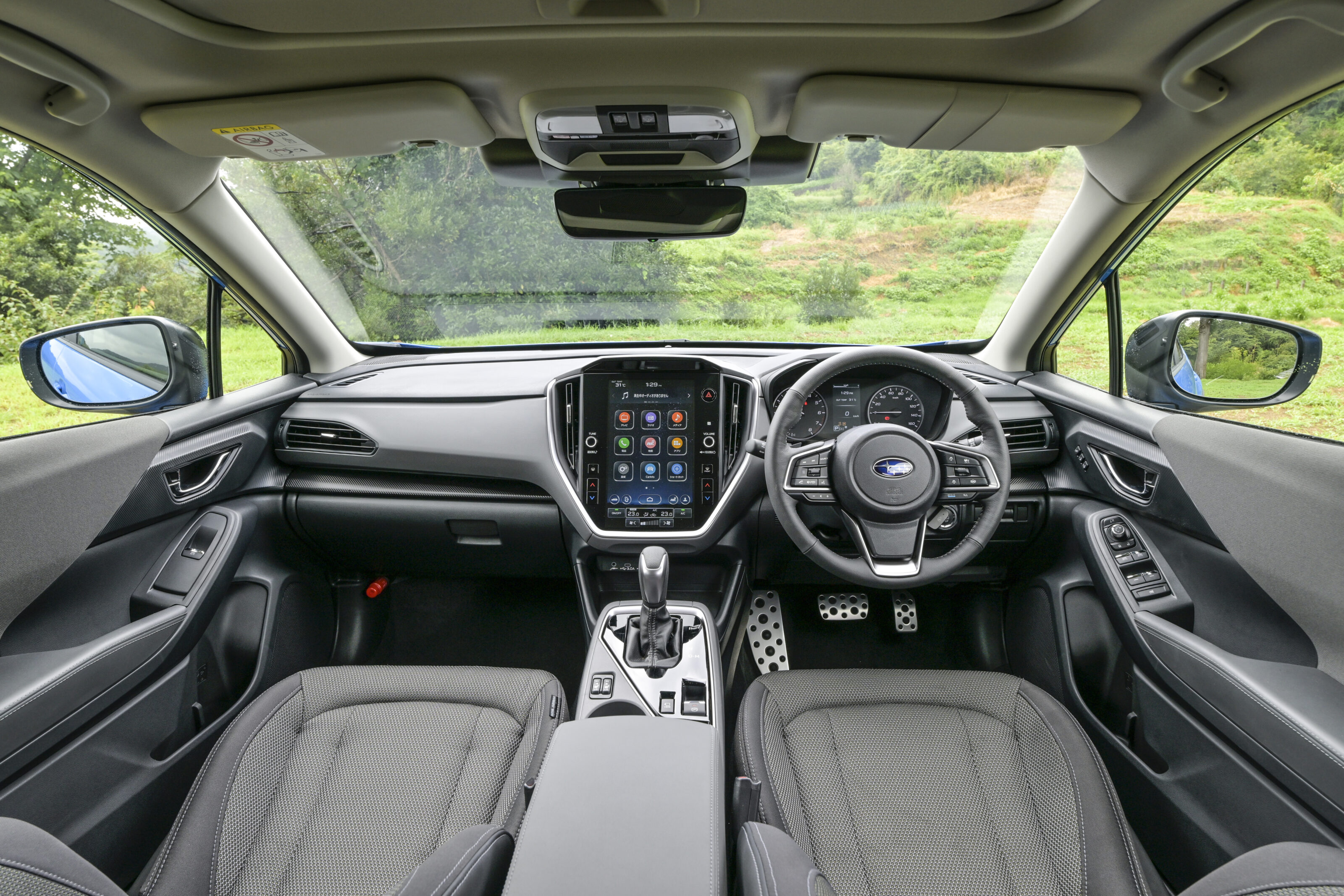
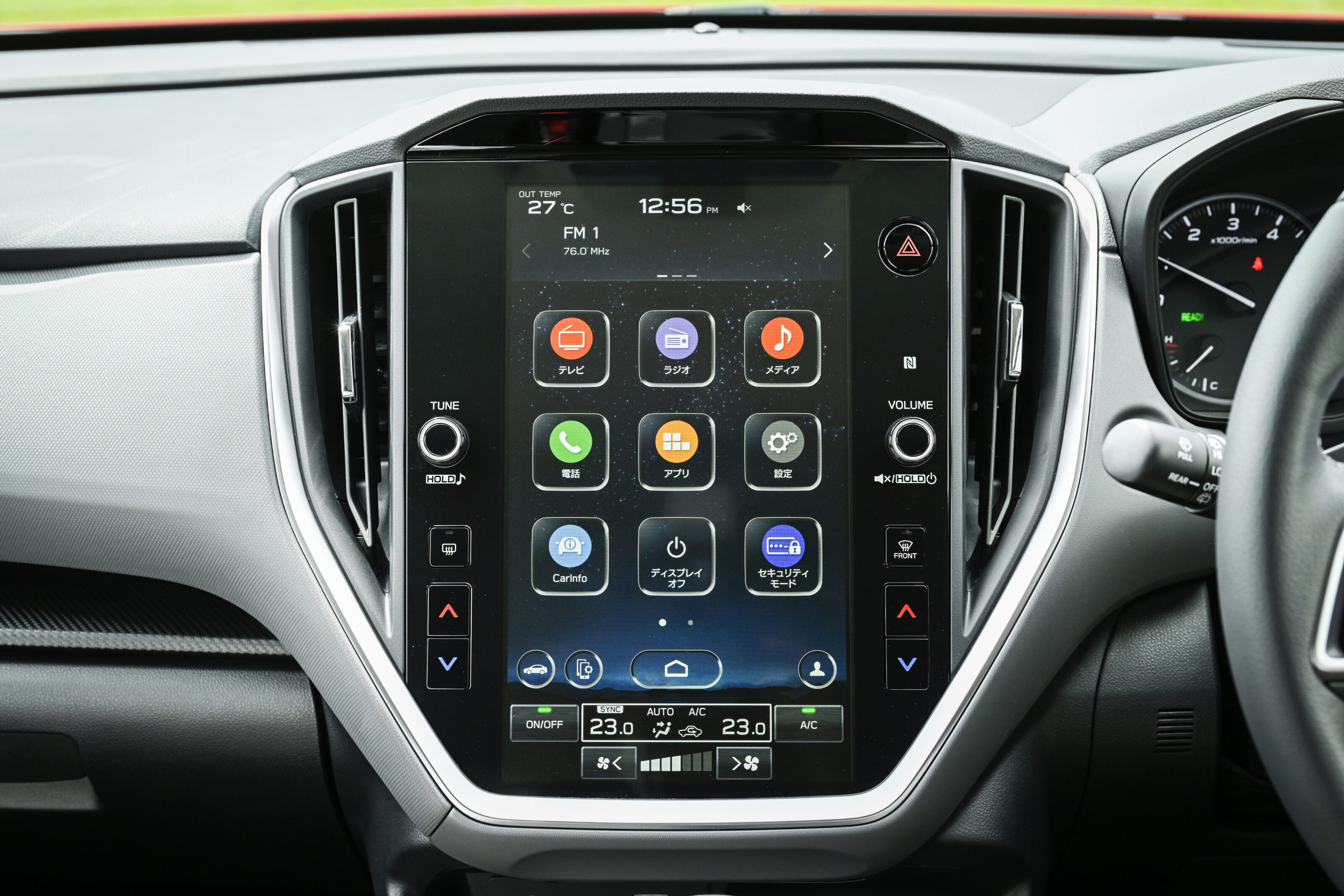
Inside, the new small SUV looks familiar to the current XV, but gains the same portrait-orientated 11.6-inch infotainment system found in the WRX and Outback, with wireless Apple CarPlay and Android Auto, satellite navigation and touch-based climate controls.
This setup replaces the current 8-inch infotainment system and 6.3-inch multi-function display.
However, unlike the Japanese-market WRX sedan and Levorg wagon (known as WRX Sportswagon in Australia), the Crosstrek does not feature a 12.3-inch digital instrument cluster, with a small LCD display – likely 4.2-inch, in line with the current XV – carrying across.
Cloth or leather upholstery will be available, along with a wireless phone charger and a 360-degree camera.
At launch, the Crosstrek will be powered by a carry-over ‘e-Boxer’ mild-hybrid system in Japan, which features a 2.0-litre naturally-aspirated four-cylinder and an electric motor.
Technical specifications are unconfirmed, but the outgoing model produced 110kW/196Nm, with a 12.3kW electric motor and continuously-variable automatic transmission (CVT).
As with all Subaru models but the rear-drive BRZ, the Crosstrek features standard all-wheel-drive.
It is unknown if Subaru will offer the Crosstrek with non-hybrid power, with the current model featuring a naturally-aspirated 2.0-litre engine.
Overseas reports suggested a 1.5-litre turbo-petrol would be offered to replace the 2.0-litre unit, but this engine did not appear in today’s announcement.
Subaru claims it has stiffened the chassis for an improved driving experience, with a “full inner frame” construction to reduce vibration and body flex – and new adhesives and seat base designs.
A revised suite of active safety technology will be offered, with additions including; intersection support for the autonomous emergency braking system and a Japan-first stereo camera unit with a wider viewing angle, and a wide-angle mono camera for enhanced pedestrian and cyclist detection.
Other safety equipment – featured under Subaru’s EyeSight branding – remains, such as lane-keep assist and adaptive cruise control, while the brand has strengthened the body for greater collision performance.
The 2023 Subaru Crosstrek will arrive in Japanese showrooms in 2023, with Australian details to be announced soon.
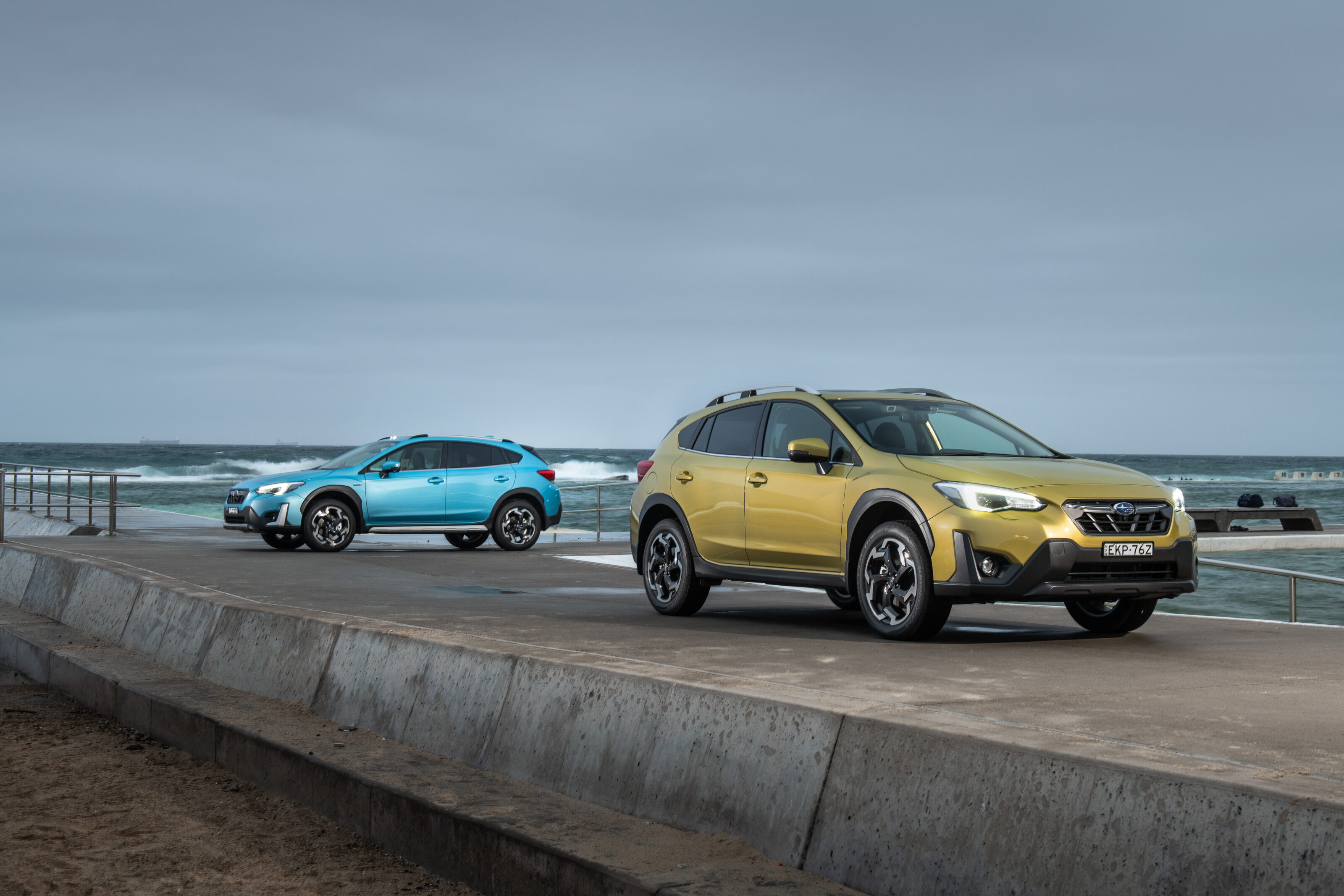
Below: The current 2022 Subaru XV
Sony and Honda have formally inaugurated a joint venture to produce electric vehicles.
The entity, known as Sony Honda Mobility, will produce its first vehicle in the United States, with exports across the globe – including Japan, opening the door to Australia.
It will be headquartered in Tokyo, Japan. The electric vehicles will commence production in early 2026, with sales in the United States and Japan soon after.
Pre-orders will open in 2025, with sales and vehicle configuration to have an online focus – perhaps with a central delivery centre and a minuscule in-person presence in major shopping centres.
Sony Honda Mobility says it will provide a “personalised post-sales customer experience” and invite customers to assist with the product development process.
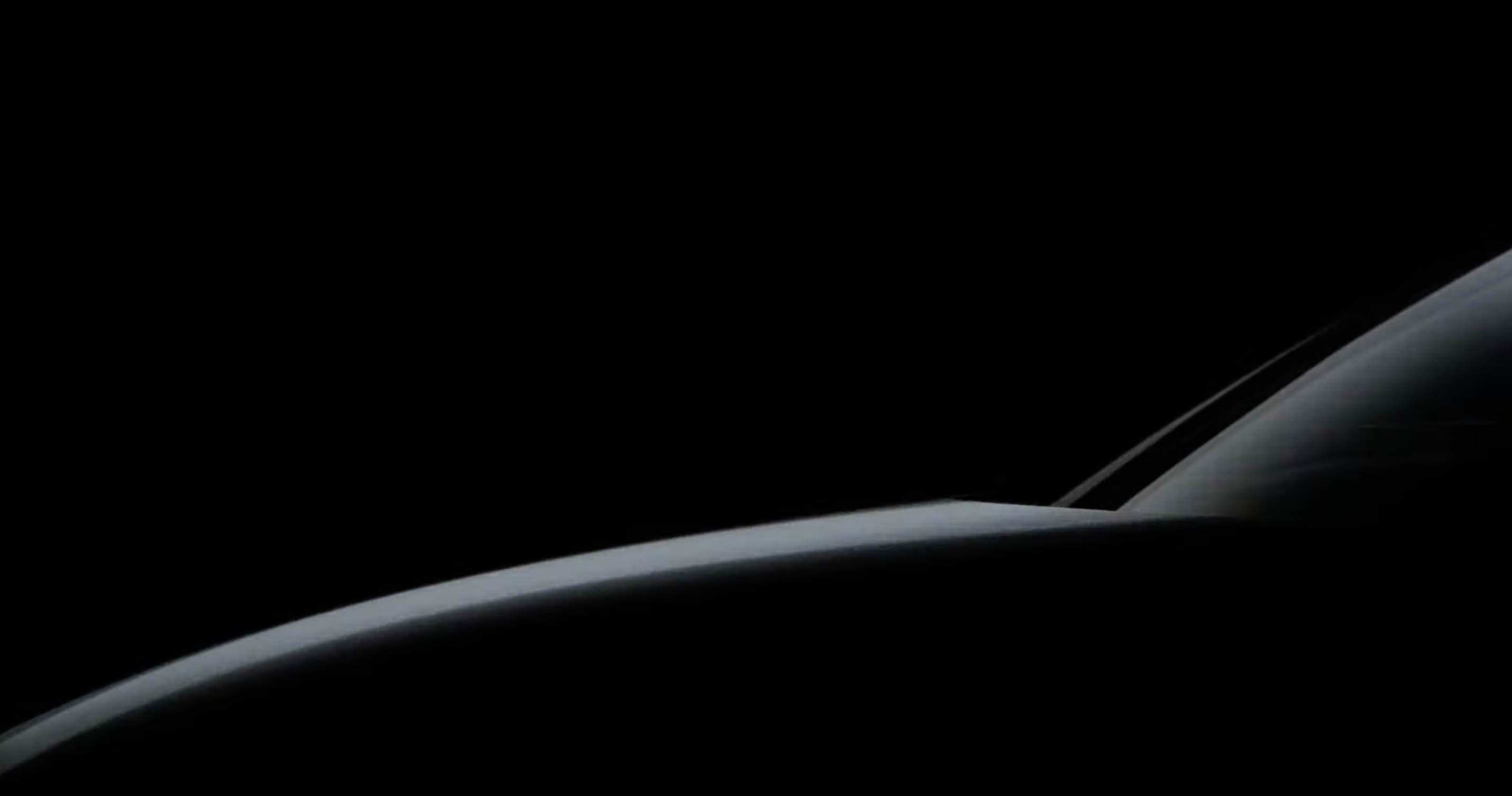
A teaser video was published overnight, providing shadowy clues about Sony Honda’s first electric vehicle.
It is expected to be previewed by a concept vehicle set to debut at the 2023 Consumer Electronics Show in January.
That preview car will follow-up the Vision-S 01 sedan and Vision-S 02 SUV concepts, which debuted at CES 2021 and 2022 respectively.

The latest announcement follows the initial plans detailed in March, when the iconic Japanese brands first joined forces.
Honda will be responsible for manufacturing the new model, while Sony will supply a ‘mobility service platform’, likely for areas such as autonomous driving sensors, infotainment, telecommunications, and other aspects that the technology company is known for.
Honda Motor Corporation CEO Toshihiro Mibe said the new company “will aim to stand at the forefront of innovation, evolution, and expansion of mobility around the world, by taking a broad and ambitious approach to creating value that exceeds the expectations and imagination of customers.”
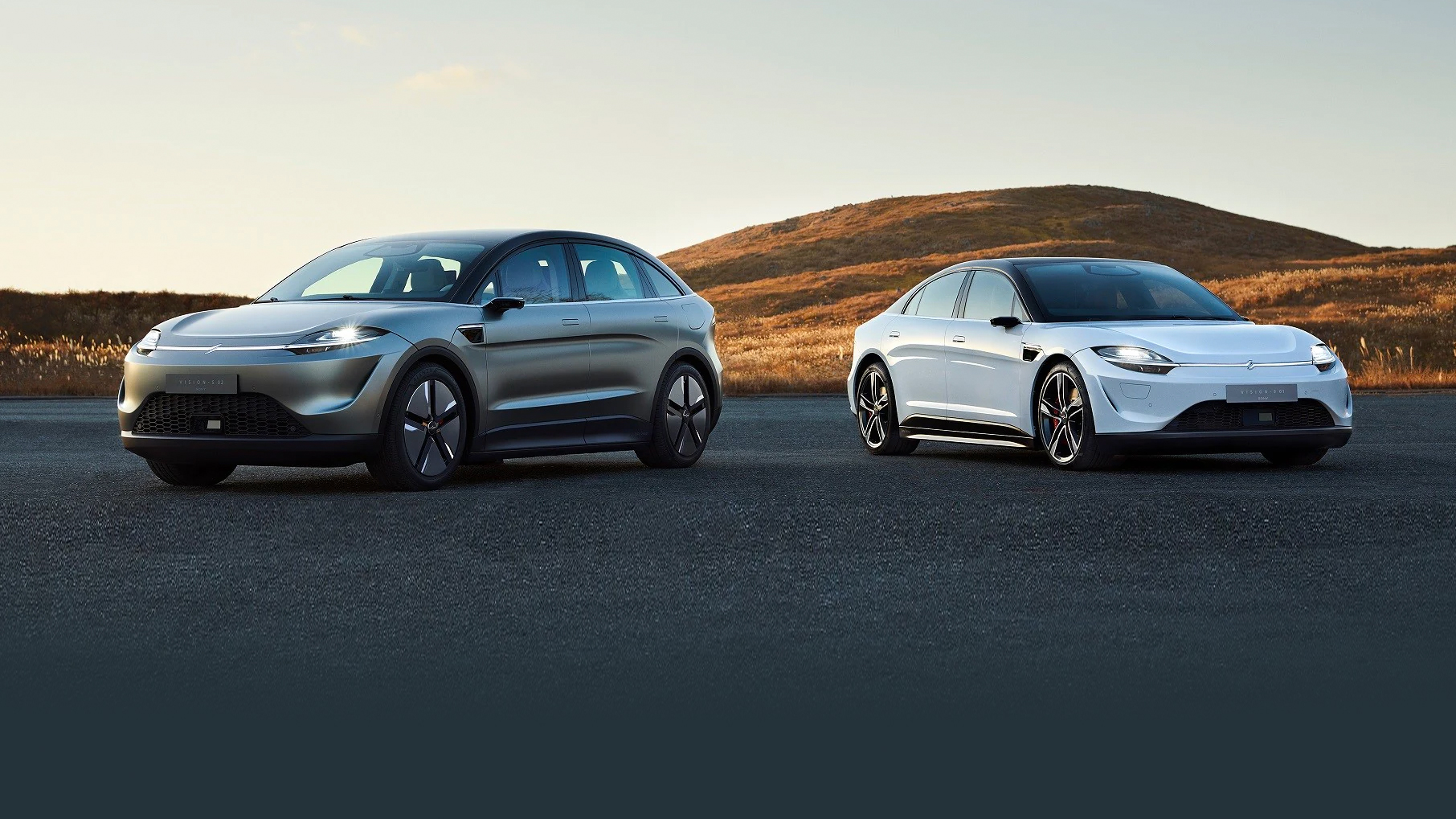
“We will do so by leveraging Honda’s cutting-edge technology and know-how in relation to the environment and safety, while aligning the technological assets of both companies,” he added.
The official mission of the mobility company is to ‘help realise a world where everyone can live in harmony with robots on a daily basis, fill people with emotion, and contribute to society’.
“Through this alliance with Honda, which has accumulated extensive global experience and achievements in the automobile industry over many years and continues to make revolutionary advancements in this field… [Sony will] contribute to the evolution of mobility centred around safety, entertainment and adaptability,” said Kenichiro Yoshida, president and CEO of Sony Corporation.
Let’s begin with two irrefutable facts before we dive into a review of the GWM Ute Canon-X. Firstly, Australia’s favourite type of car is currently the dual-cab ute. Secondly, almost all segments – including one-tonne utes – are heavily price-led.
With that in mind, the Cannon range is priced from $35,990 while the range-topping Cannon-X costs just $45,490 (both drive-away), so you might expect it to be warmly received Down Under. Correct.
It isn’t troubling the industry heavyweights for sales just yet, but it has managed to snare a 3.5 per cent share of the 4×4 ute segment with nearly 4500 sales to the end of August this year. Not bad for a company that only really got serious about dual-cabs in 2020.
If you’re in the market for a dual-cab, no doubt you’ll have given the segment-dominating Ford Ranger, Toyota HiLux and Mitsubishi Triton a look, but should the GWM be on the list too?
But it’s easy to see why so many Australians are giving the Chinese challenger brand a chance. Bargain basement entry-level versions of the GWM Ute Cannon are best left to the workhorse end of the market with relatively spartan specs, but at the pointy end of the line-up, the Cannon-X is absolutely packed with standard equipment and features.
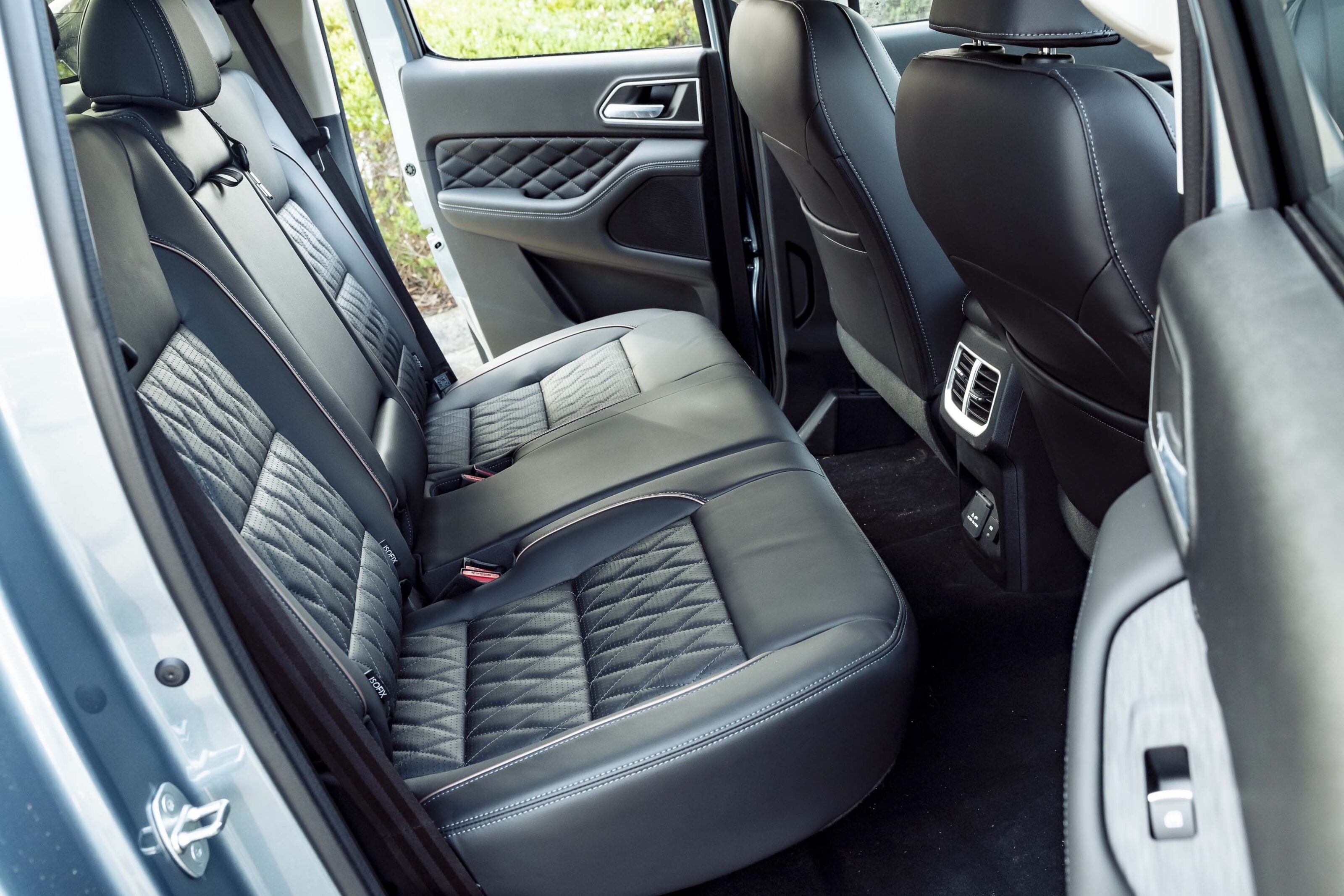
Its cabin is one of the most impressive in the entire segment, including the Cannon’s proportionally more expensive rivals. Plush quilted synthetic leather upholstery covers the seats and doors to create a decidedly un-ute-like interior ambience, high-quality materials are used in almost all areas including the dash covering, there is leather for the steering wheel and pleasant decorative trim inserts.
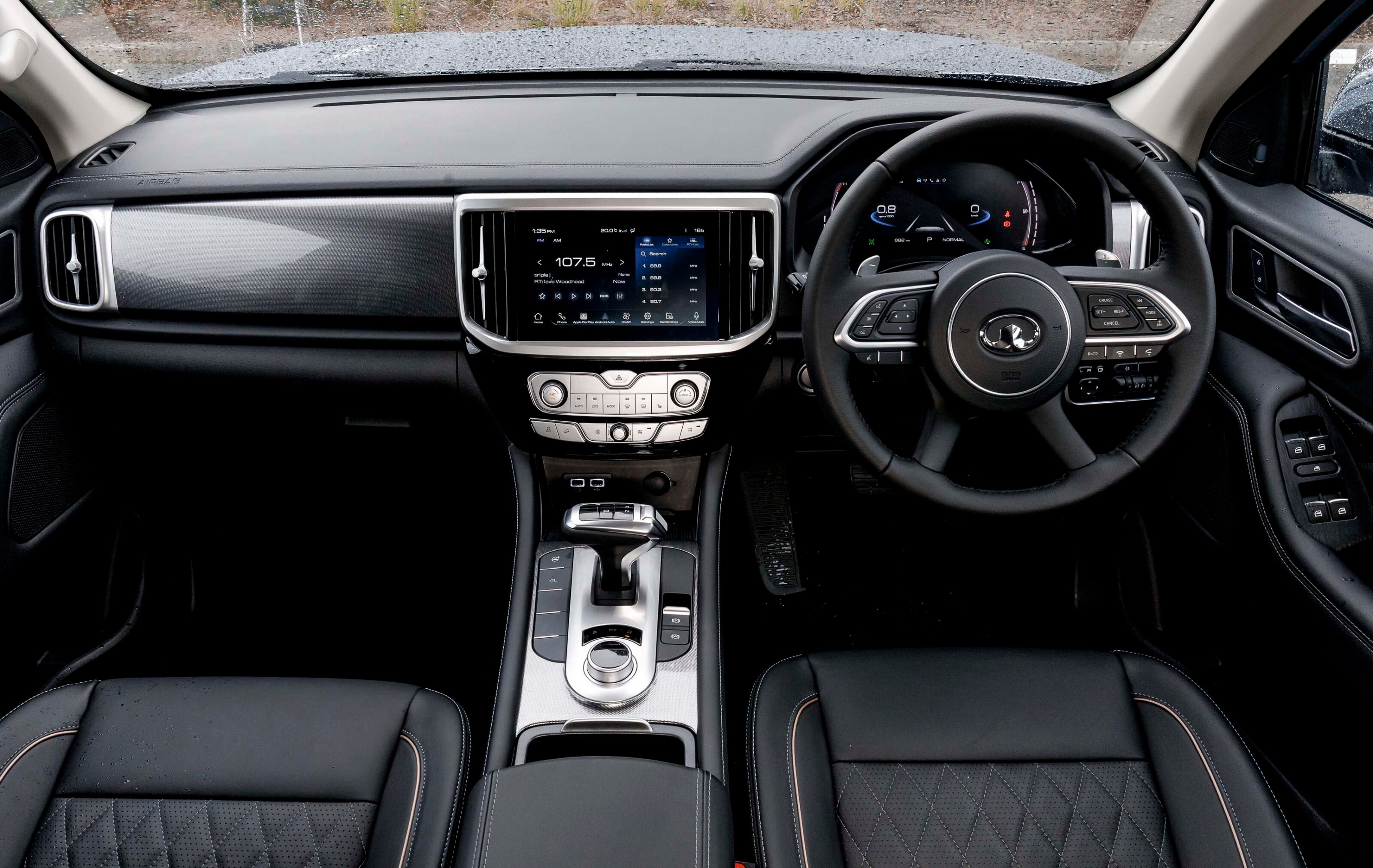
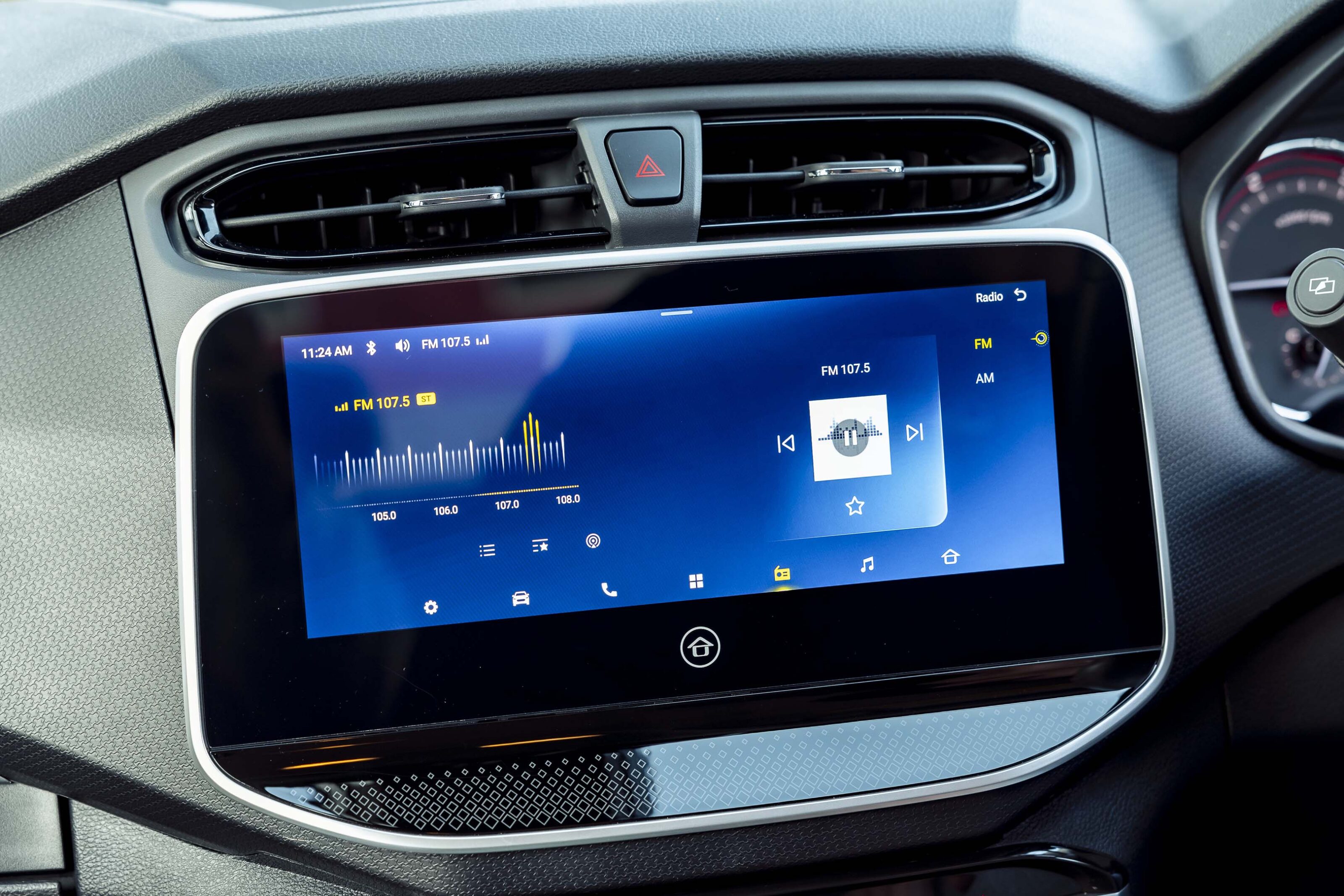
Then there’s the class-leading technology. A fully digital instrument cluster complements a large 9.0-inch central touchscreen. It contains excellent levels of technology including a 3D 360-degree camera that’s unique to the segment and home-screen shortcuts for Android Auto and Apple CarPlay with wireless device charging located below.
But just as the Cannon is stacking up with some serious firepower, the functional fails start to sneak in.
A single button that appears to activate heated seats but does nothing when pushed. An auto-on manoeuvring camera that takes over the touchscreen when slowing to a standstill and must be manually deactivated each time if other infotainment functions are required – even changing the audio volume.
The steering wheel is visually attractive but has poor ergonomics with nowhere for the driver’s fingers to comfortably settle – like trying to pick up a big cardboard box with no handles.
What initially appears to be a sophisticated and advanced cabin doesn’t stack up quite so strongly once you scratch the surface.
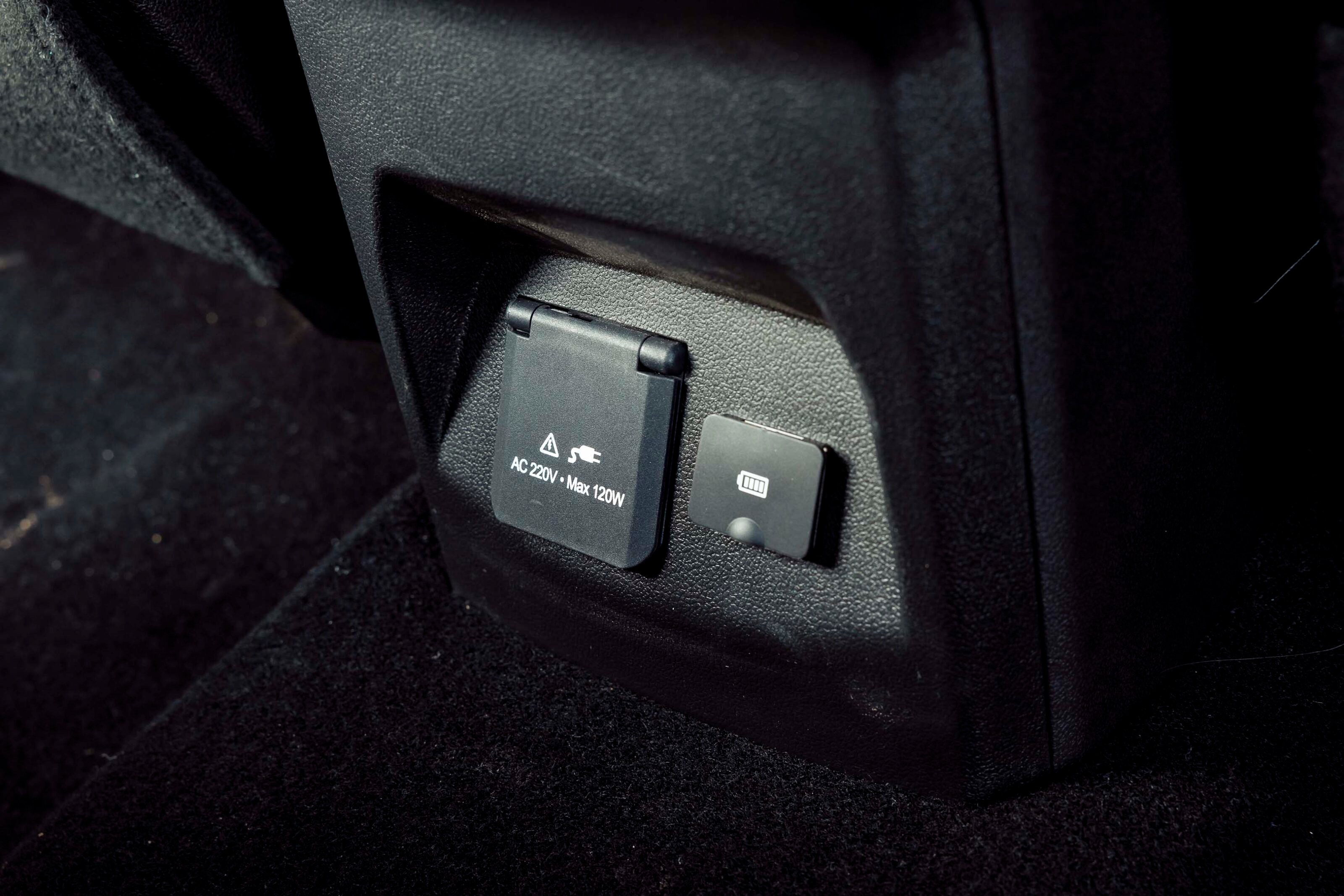
Front seat comfort is generally good and the driver gets a lofty 80mm of headroom but there’s no adjustment for lumbar or seat base tilt. A pair of USB-A and a 12-volt socket are standard in the front row but there’s an additional 240-volt power point in the second row.
Rear passengers also have a USB-A socket, reasonably comfortable seating and heaps of space with a massive 130mm of knee room and 65mm of headroom. Our only main gripe in the second row is a weird ridge on the floor that is less comfortable to rest your feet on.
Go for a drive and the disappointments keep coming. Up front is a turbocharged 2.0-litre four-cylinder diesel engine that produces 120kW and 400Nm which, on paper, is at the lower end of the category but still just about comparable with its rivals. Unfortunately, in practice, the manner in which the performance is delivered is not.
Noticeable turbo lag from a standing start feels as though it will be followed by a mountain of torque once the boost threshold is reached, but the resulting peak grunt is only a small increase over off-boost driving and is short-lived. The engine quickly revs out to its 4300rpm limit.
Thankfully, noise and vibration levels are almost as refined as the GWM’s exterior suggests, with only a little clatter making its way into the cabin. Power production is smooth compared with some other small-capacity diesels under ute bonnets.
Progress is, in part, redeemed by a solid ZF eight-speed automatic transmission that uses its tight ratios to more effectively keep the engine in its frustratingly narrow torque band (just 1100rpm between 1500rpm and 2600rpm).
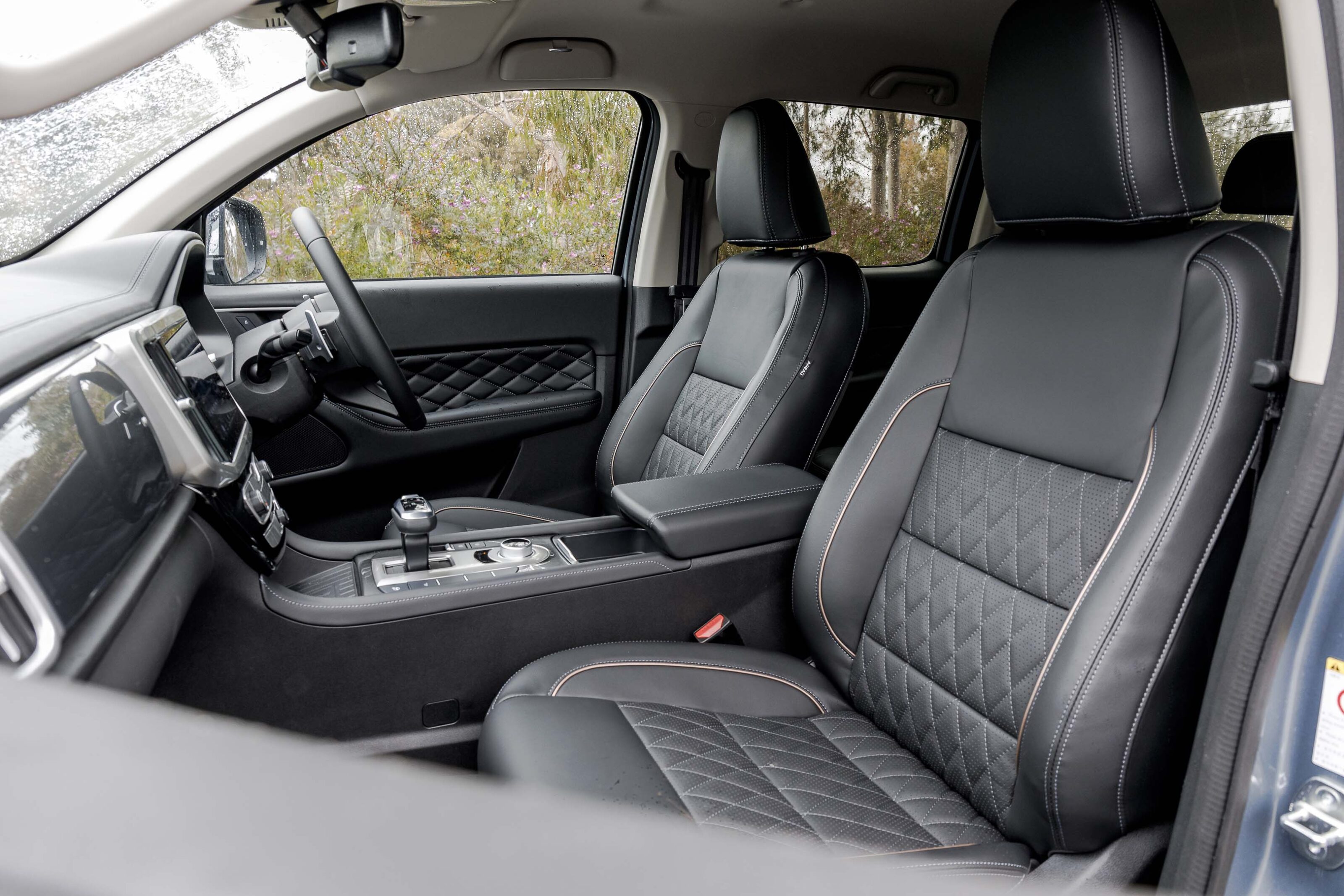
Gearshifts are snappy and urgent but still smooth, and if you don’t completely agree with the selection, the GWM is one of the few utes to offer steering wheel paddles.
No dual-cab is known for offering car-like steering feel or limousine levels of ride comfort but, even relatively speaking, the GWM doesn’t score highly when it comes to either.
About the dead-ahead mark, the steering is heavy but becomes excessively light when turned away from centre and a variable mode only adds or removes weight not feel. About half the time, the button refused to do anything at all when pressed.
An over-sprung ride would probably behave much better when loaded – again, a trait common to many rear leaf-spring arrangements – and the stiff tune does result in surprisingly good body control in corners. The downside is poor ride quality when cruising.
The combination of vague steering and jarring ride makes the GWM Ute Cannon tend to wander in the lane and occupants will find it harder to relax on longer road trips.
One feature that frequent road users will appreciate is the generous level of standard safety tech and driver assistance systems.
Particularly impressive is the lane-keep warning which only warns of a departure when an actual excursion is imminent, unlike many rival systems that are far too paranoid and nagging.
It’s offered alongside lane-keep assistance, auto emergency braking, adaptive cruise control, rear cross-traffic alert, speed sign recognition, hill start and descent controls, seven airbags and a five-star ANCAP safety rating. Thankfully we had no cause to test the other various safety features during our time on the road.
A black mark against its name, however, is the lethargic reversing radar that makes its final continuous warning beep shortly after an object would have been collided with if the driver hadn’t applied the brake in anticipation.
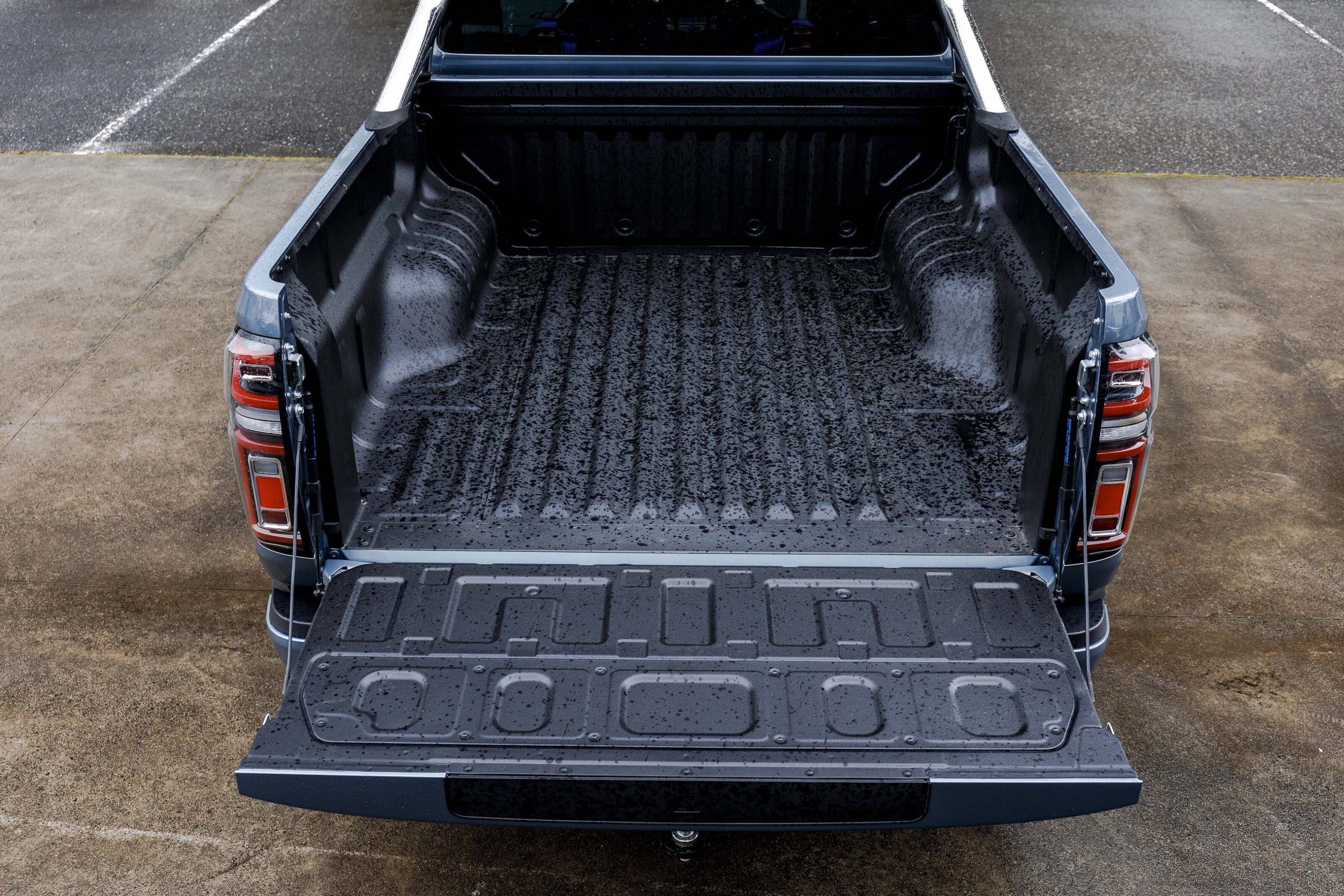
Speaking of which, stopping is not an issue for the GWM thanks mostly to the standard fitment of rear disc brakes – another unusual feature in the dual-cab world, as is the innovative step that unfolds from the open tailgate to help short or less agile users in and out of the tray without risk of falling.
Away from sealed roads, the GWM’s manners improve. Negotiating gravel trails is possible with confidence and the more agricultural suspension set-up lends itself better to loose surfaces. Cooper Discoverer HTS all-terrain rubber seems more at home on damp dirt than on the freeway and the electronic stability system is calibrated to be a little on the slack side without becoming unnerving.
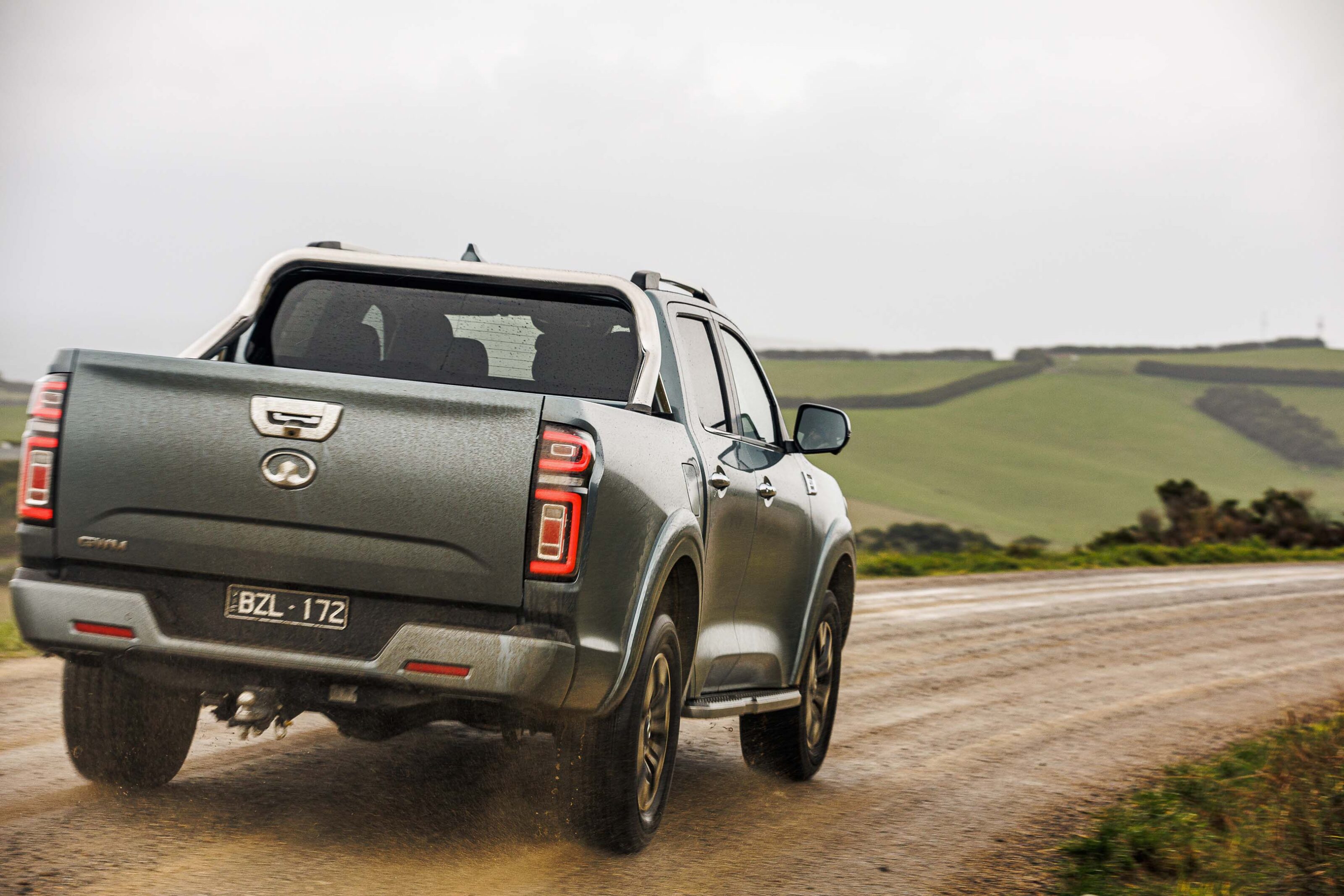
If you intend to spend a fair share of your driving time away from freeways and the school run, the GWM would be easier to live with.
While almost all other ute offerings come at the market with an even focus on driveability, practicality, comfort and equipment levels, the Cannon’s strategy puts more of a weighting on the latter. With a braked towing capacity that’s 500kg down on the industry standard of 3500kg, sub-par ride comfort and too many functional fails, it can’t compete with the more mature and refined dual-cab utes.
That said, it does offer the segment’s second-longest warranty at seven years, has an almost unbeatable list of standard kit and a price that’s hard to believe. That in itself should be seen as a show of confidence by GWM but the recommendation is still very much try before you buy.
Showroom appeal of the Cannon-X is undeniable and, on paper at least, the range-topping version offers irresistible value for money. But it’s the things that can’t be arranged in sales brochures and presented in spec tables that unravel the model’s value equation in practice.
Budget dual-cabs certainly have a place and it would be unrealistic to expect the same levels of refinement of the most expensive options in something costing about $10,000 less.
But affordable alternatives such as the SsangYong Musso prove that you can have a cut-price family workhorse with decent levels of equipment without the hidden compromises.
2022 GWM Ute Cannon X specifications
| Model | 2022 GWM Ute Cannon-X |
|---|---|
| Engine | 1996cc I4, dohc, 16v turbo-diesel |
| Max power | 120kW @ 3600rpm |
| Max torque | 400Nm @ 1500-2600rpm |
| Transmission | 8-speed auto |
| Weight | 2058kg |
| 0-100km/h | 11.0s (estimated) |
| Economy | 10.4L/100km (tested) |
| Price | $45,490 drive-away |
| On sale | now |
Australian new car buyers will benefit from a new real-world fuel usage program over the next four years, in a bid to improve customer transparency.
The Albanese Government has announced it will provide $14 million to the Australian Automotive Association to facilitate the testing, which is designed to more accurately evaluate the fuel consumption of Australia’s most popular vehicles – and supplement laboratory testing.
While the exact number of vehicle models that will be tested is currently unknown, it is expected to include the best-selling cars, SUVs and utes sold in Australia – such as the Toyota HiLux, Ford Ranger, Toyota RAV4, Mazda CX-5, Toyota Corolla and Hyundai i30, amongst others.

It follows a pilot study conducted by the Australian Automotive Association in 2016, which found that 29 of 30 vehicles used more fuel than what is claimed in laboratory conditions.
On average, the vehicles were said to have used 23 per cent more fuel than what is claimed on the windscreen sticker and on the Green Vehicle Guide website.
The pilot test was conducted in the aftermath of the Volkswagen Group’s diesel emissions scandal in 2015, when cheating devices – intended to reduce harmful CO2 emissions during laboratory testing – were unearthed by US regulators.

A fuel consumption label has been mandatory on all new vehicles sold in Australia since 2001.
It uses results from the Australian Design Rules 81/02 testing procedure, which is based on the New European Driving Cycle (NEDC) introduced in the 1980s.
Federal Infrastructure and Transport Minister Catherine King said the investment will help car buyers to reduce the amount they spend at the fuel bowser.
“Our $14 million investment for on-road testing will help improve the information available on how much fuel different vehicles use on the road, which will also give consumers a better idea of how much it will cost to run.

Earlier this year, the Federal Government redesigned the Green Vehicle Guide website, which uses laboratory test data to compare the fuel efficiency of vehicles sold in Australia.
In addition, it has launched a consultation paper to discuss strategies to introduce vehicle efficiency standards, improved CO2 emissions schemes, and grow electric vehicle sales in Australia.
“Buying and running a car is a large cost for families and businesses and is a big contributor to household energy bills,” said Federal Climate Change and Energy Minister Chris Bowen.
“Consumers deserve accurate information about their running costs so they aren’t hit in the hip-pocket.
“This overdue initiative will help drive fuel savings through informed consumer choice, and help ensure emissions footprint claims by carmakers are accurate.”
Further details on the real-world testing program are expected later this year, with the first vehicles to be assessed in early 2023.
Snapshot
- EV uptake in the commercial space could improve with incentives, report says
- Introducing road user charges though would slow it down
- Commercial vehicles can’t be dependant on public charging for fleets
A new report focusing on the future of electric vehicles in the commercial space has found there could be more uptake if the Government introduced the right incentives.
The study, entitled The Future of Buses and Light Commercial Vehicles is Electric, was carried out by Boston Consulting Group and looked at what opportunities and barriers there are for these kinds of vehicles.
Key findings included that price parity – said to “only be one year away” – more infrastructure (public and private as fleet vehicles can’t be dependant on using public charging networks), and regulatory support were all crucial for uptake of electric utes and vans is to happen in Australia.
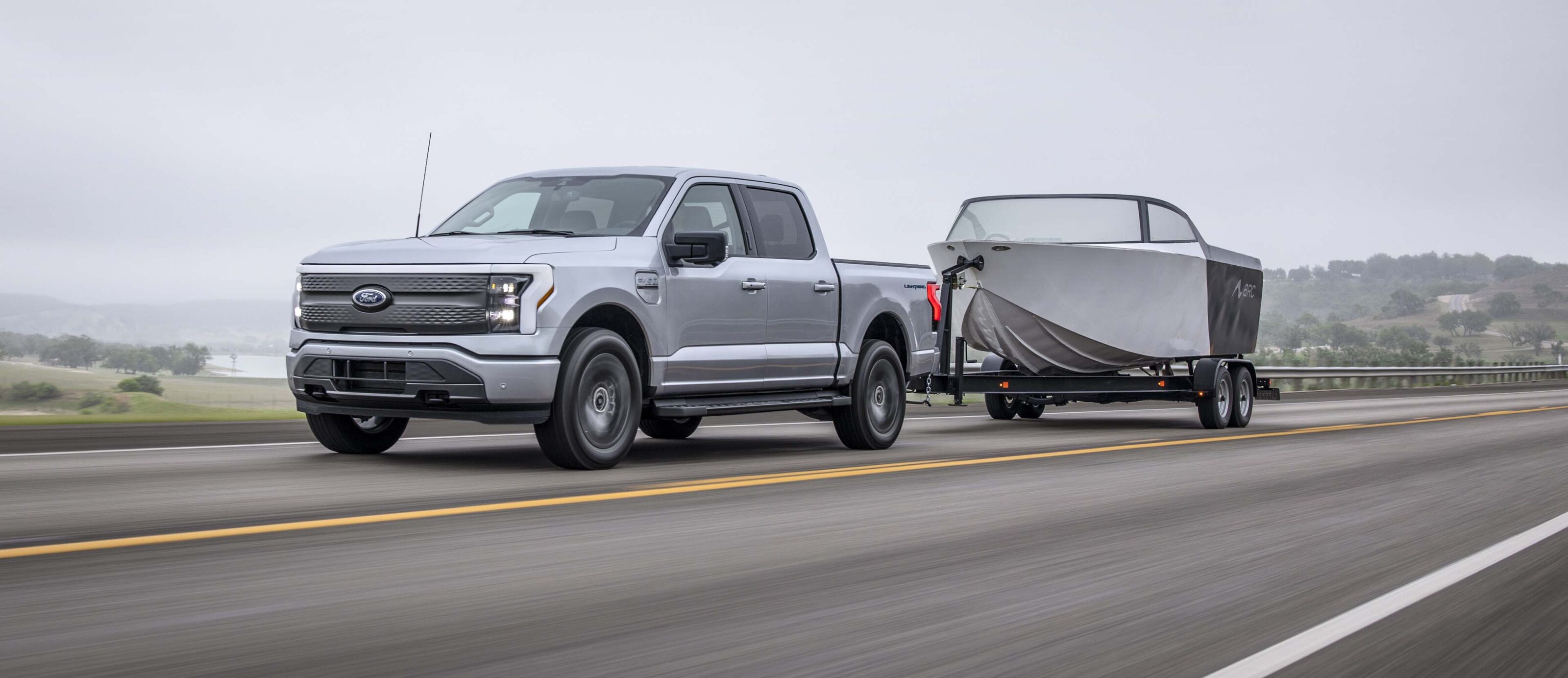
‘Regulatory support is likely to be an accelerator for adoption through, for example, ICE [internal combustion engine] bans or incentives to switch to EVs,’ it read. ‘In the US, the Inflation Reduction Act (August 2022) has multiple tax credits and incentives, including US$40,000 for purchases of new electric or hydrogen trucks and buses including off highway vehicles.
‘While Australia is lagging international peers in terms of regulatory support, this is expected to change following the recent federal election. The recently published National Electric Vehicle Strategy is a first sign of a stronger federal support for greater adoption of electric vehicles.
‘In addition to a more robust federal climate agenda, Australian state governments have also focused on emissions reduction and other interventions, particularly in the transport sector. Targeted interventions can speed up the adoption of specific types of commercial vehicles.’
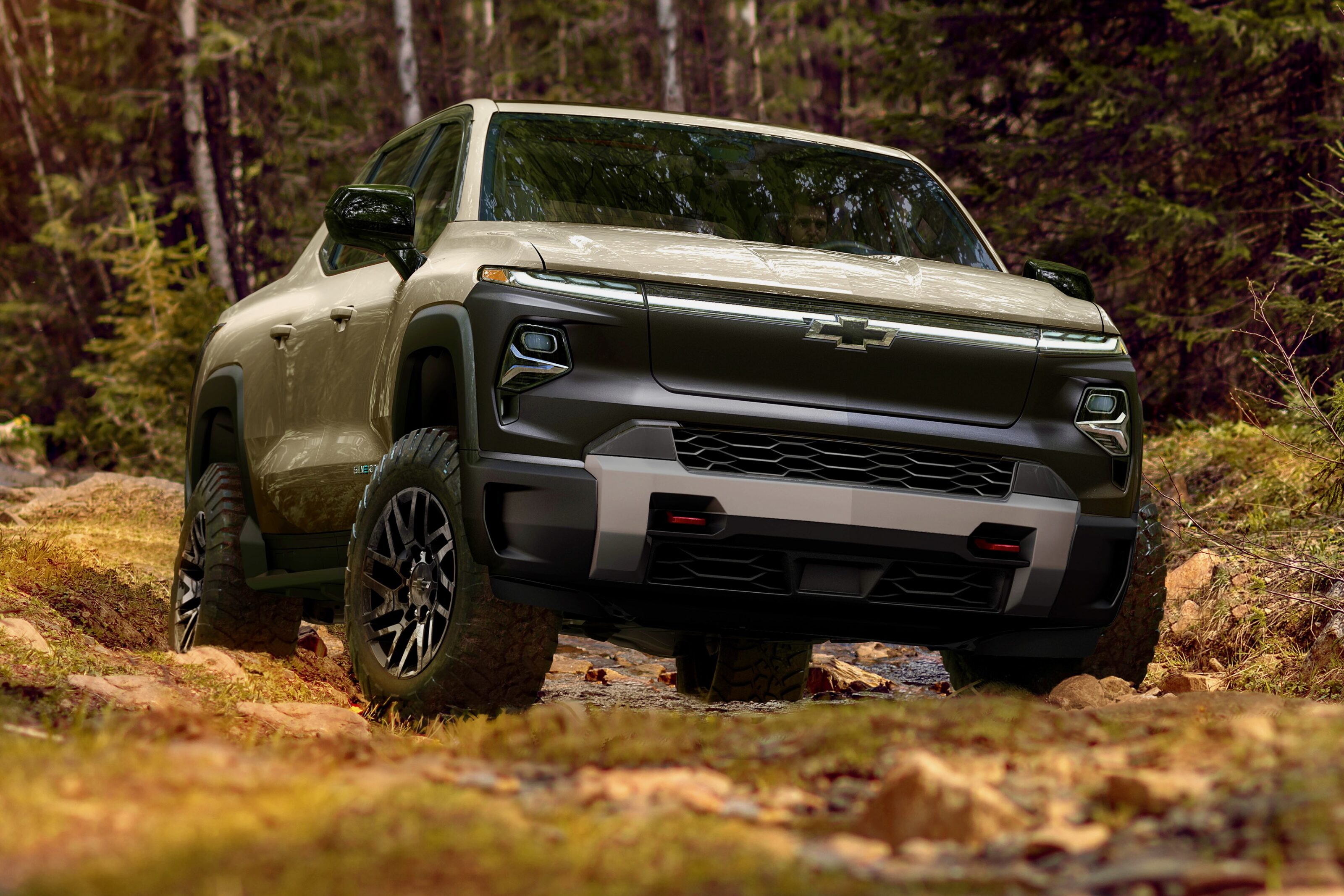
So far there aren’t any electric utes on sale in Australia, however the first one – the LDV eT60 – is on its way next month and there is a Ford Ranger plug-in hybrid (PHEV) confirmed to be coming in 2024. BYD also claims to have a ute in the pipeline due late 2023.
Currently there is only one electric van on sale locally – the Mercedes eVito (some stock, available now, some coming later this year) – though until recently there was the Renault Kangoo ZE (which is being replaced by the Kangoo E-Tech soon), and there are several others on their way here in the coming months and years including; the Ford E-Transit (2024) and the Volkswagen ID.Buzz (date not yet confirmed).
Next month LDV will bring its eDeliver 9 and Mifa 9 LCVs here, and Peugeot also recently announced its first EV locally will be a version of one of its electric vans.
Importantly, the report also said though that road-user charges, such as those already in place in VIC and planned in NSW in 2027, could have great potential to put buyers off.
‘While regulation in Australia is now generally very supportive of legislation, one policy on the table could slow down adoption: road user levies,’ the document noted.
‘Presently, electric vehicles receive an inadvertent subsidy by not paying the federal fuel excise (because they don’t purchase any fuel). But Victoria has implemented a per-kilometre levy for EVs, and other states may follow suite. While a necessary change in the long term, such policies may have a detrimental impact on EV impact in the short term.’
The report comes as the Federal Government brings in tighter emissions standards on heavy goods vehicles and buses, announcing the introduction of Euro 6 on Thursday – due to be phased in over 12 months from November 1, 2024.
“These tighter noxious emissions standards for new trucks and buses will reduce this significant pollutant in Australia, and help reduce the number of premature deaths and chronic illnesses as a result,” said Transport Minister Catherine King.
“Australia has been lagging in our vehicle noxious emissions standards for years now, and this move will help bring our vehicle market into the 21st century – and into line with overseas vehicle markets.”
Further upcoming improvements to fuel quality could also help support introduction of tighter standards for light vehicles, the Government said.
Euro VI standards are already in place in the European Union and United Kingdom, and equivalent standards also apply in most developed countries, including the United States and Japan. China and India have also recently adopted equivalent standards.
The introduction of a legal emissions target is currently being consulted on by the Albanese Government as part of what could become Australia’s first national EV strategy.
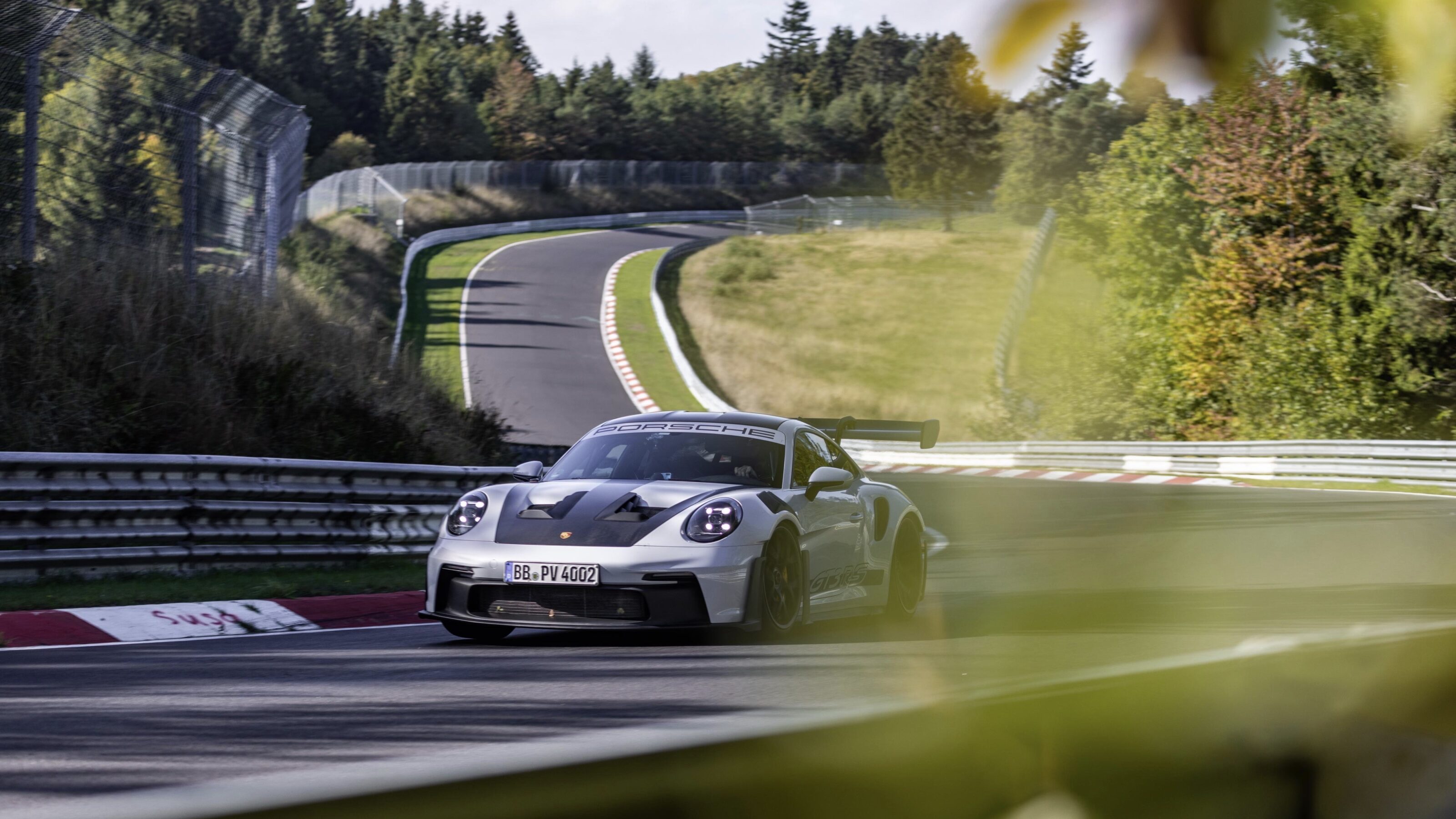
The new Porsche 911 GT3 RS has lapped the famous Nürburgring Nordschleife in a blistering 6:49.328 minutes.
The latest 911 GT3 RS completed the 20.8 kilometre main circuit a whole 10 seconds faster than the current 911 GT3 with Porsche brand ambassador Jörg Bergmeister at the wheel.
Bergmeister, says Porsche, was intensely involved in the development of the new flagship of the 911 series.
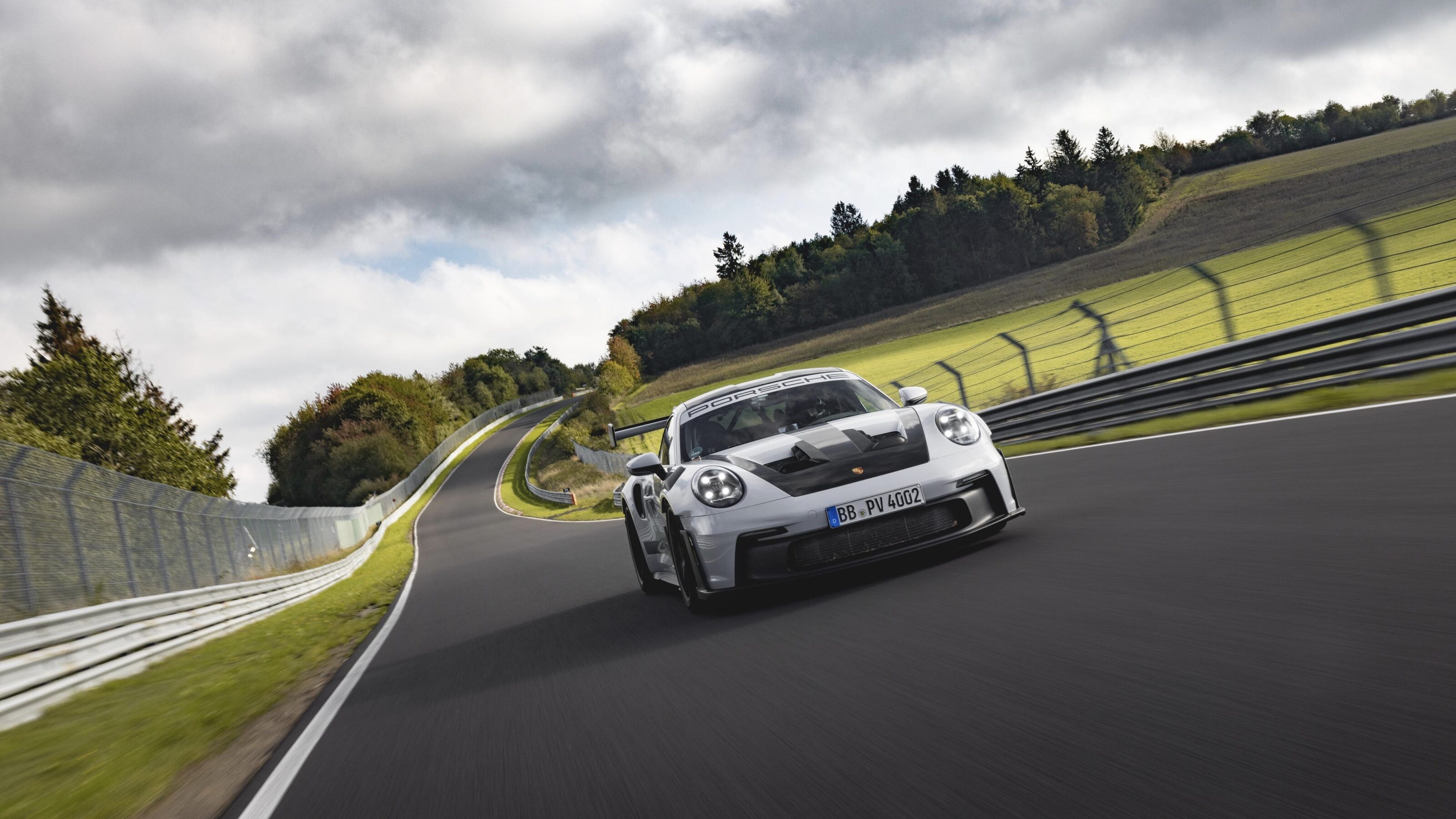
When travelling at 285 km/h on the racetrack, the 386kW road-legal high-performance sports car achieves a total downforce of 860 kilograms – three times as much as a 911 GT3.
The 911 GT3 RS was equipped with the Weissach package and optionally available Michelin Pilot Sport Cup 2 R tyres – sized 275/35 R 20 at the front and 335/30 R21 at the rear. The new 911 GT3 RS completed the previously standard shorter lap in 6:44.848 minutes.
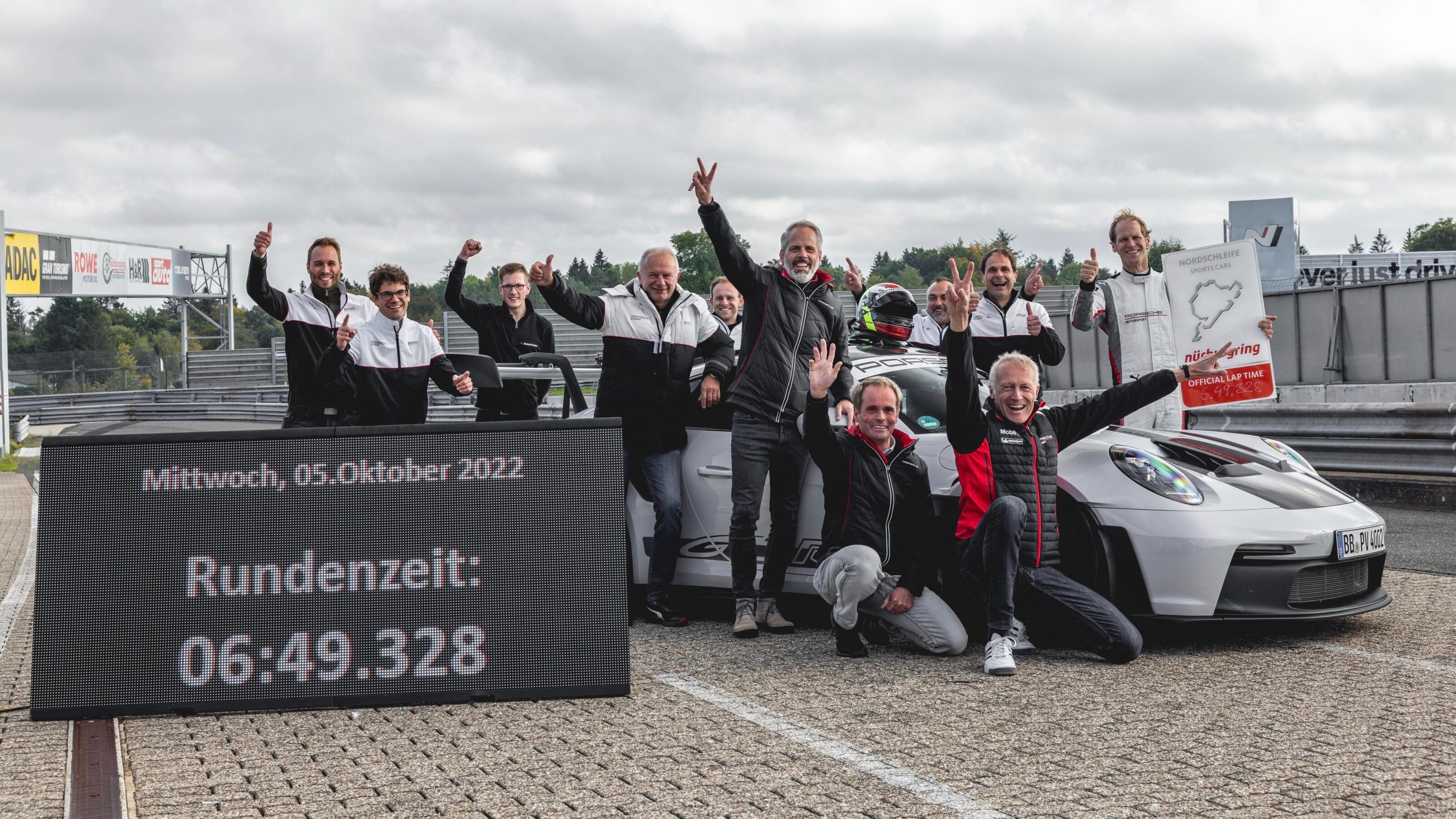
“The 911 GT3 RS delivered what it had already promised at first glance – absolute excellence on the racetrack,” said Andreas Preuninger, Porsche’s Director of GT cars.
“Considering the far from ideal conditions, with a strong headwind on the long straight of the Döttinger Höhe and cool asphalt temperatures, we are satisfied with this time.
“The 911 GT3 RS is setting new standards for aerodynamics and the chassis. Never before has a road car embodied so much motorsport.”
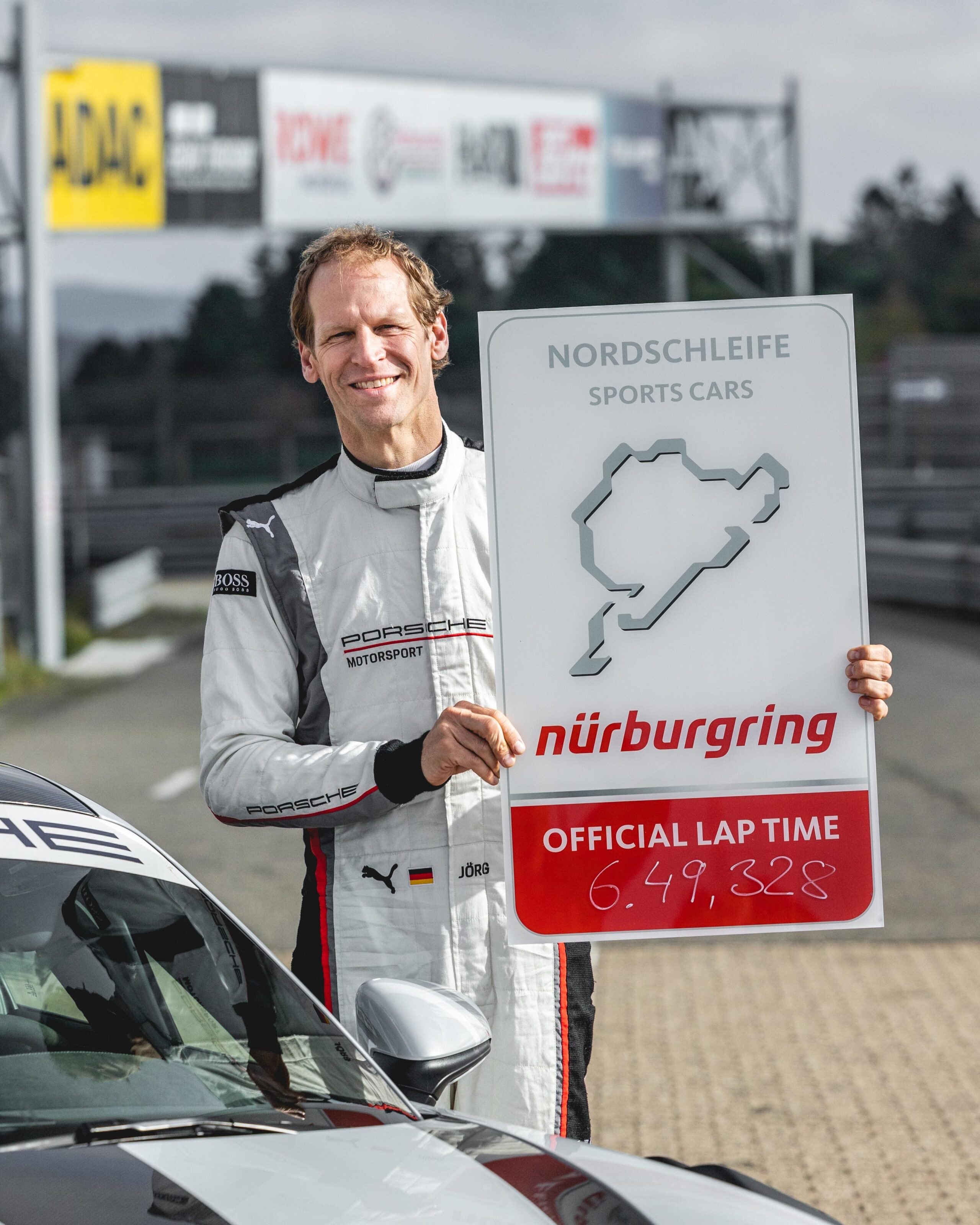
“We lost a little downforce due to the strong, sometimes gusting wind, but I’m still very happy with the lap,” added Bergmeister.
“In the fast sections in particular, the 911 GT3 RS is in a league of its own. Here it’s on a level usually reserved for top-class racing cars. The car is also setting new standards in braking. Fast laps on the Nordschleife are simply so much fun in this car.”
The current ‘Ring record for a production car is held by the Mercedes-AMG GT Black Series, which completed its lap in 6:48.047 minutes in late 2020. Porsche’s own Taycan set the electric car record in August by finishing in 7:33.
