
US electric vehicle startup Lucid Motors has unveiled a high-performance rival for the Tesla Model S Plaid and Porsche Taycan Turbo S.
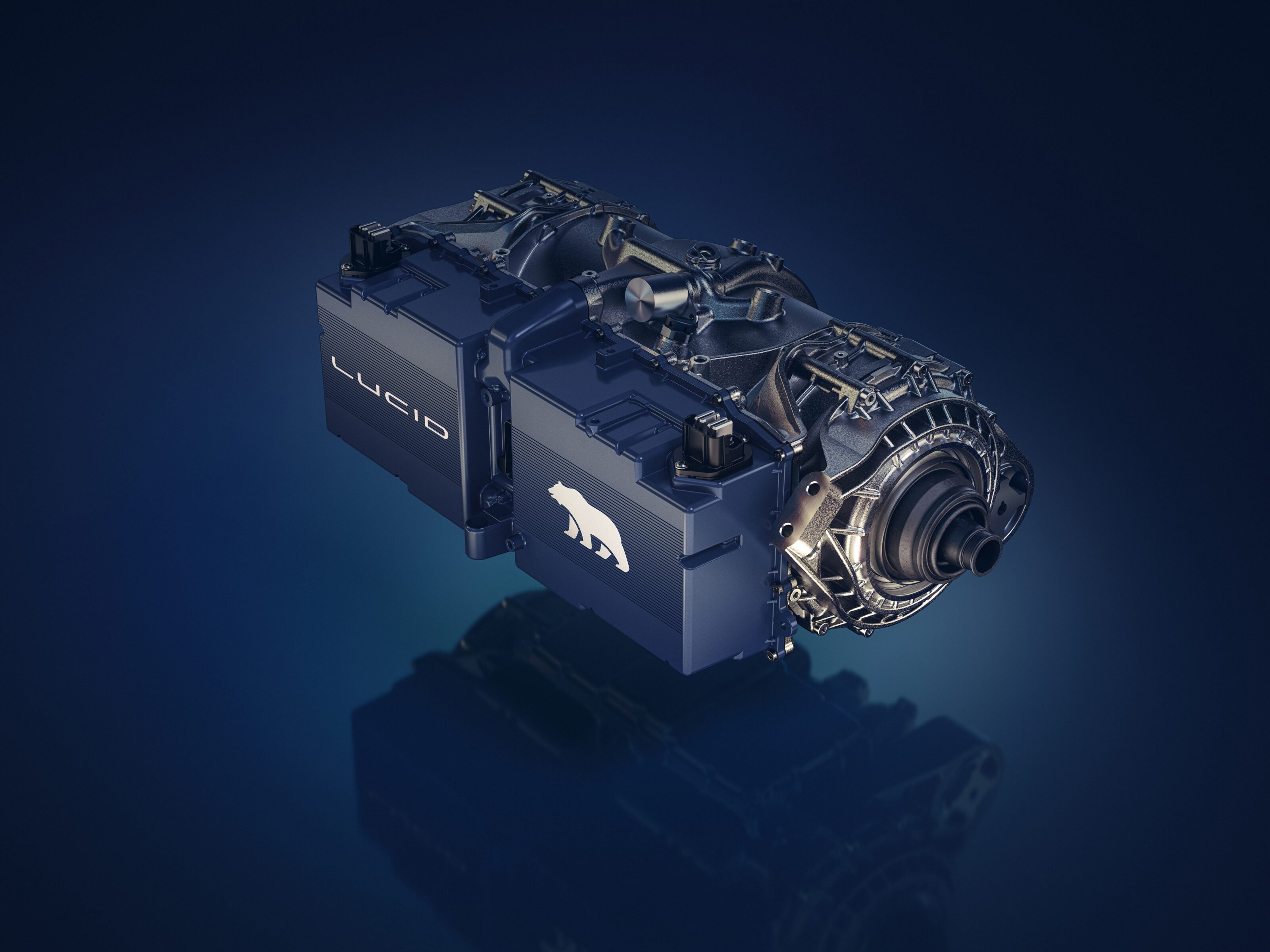
The limited-run 2023 Lucid Air Sapphire claims to be the “most powerful sedan in the world”, with three electric motors – two on the rear axle and one on the front – producing more than 895kW of power.
Lucid says the flagship model will complete the 0-97km/h (60mph) sprint in “less than two seconds”, 0-100mph (161km/h) in “less than four seconds”, and the quarter mile in less than nine seconds, in addition to a top speed exceeding 320km/h.
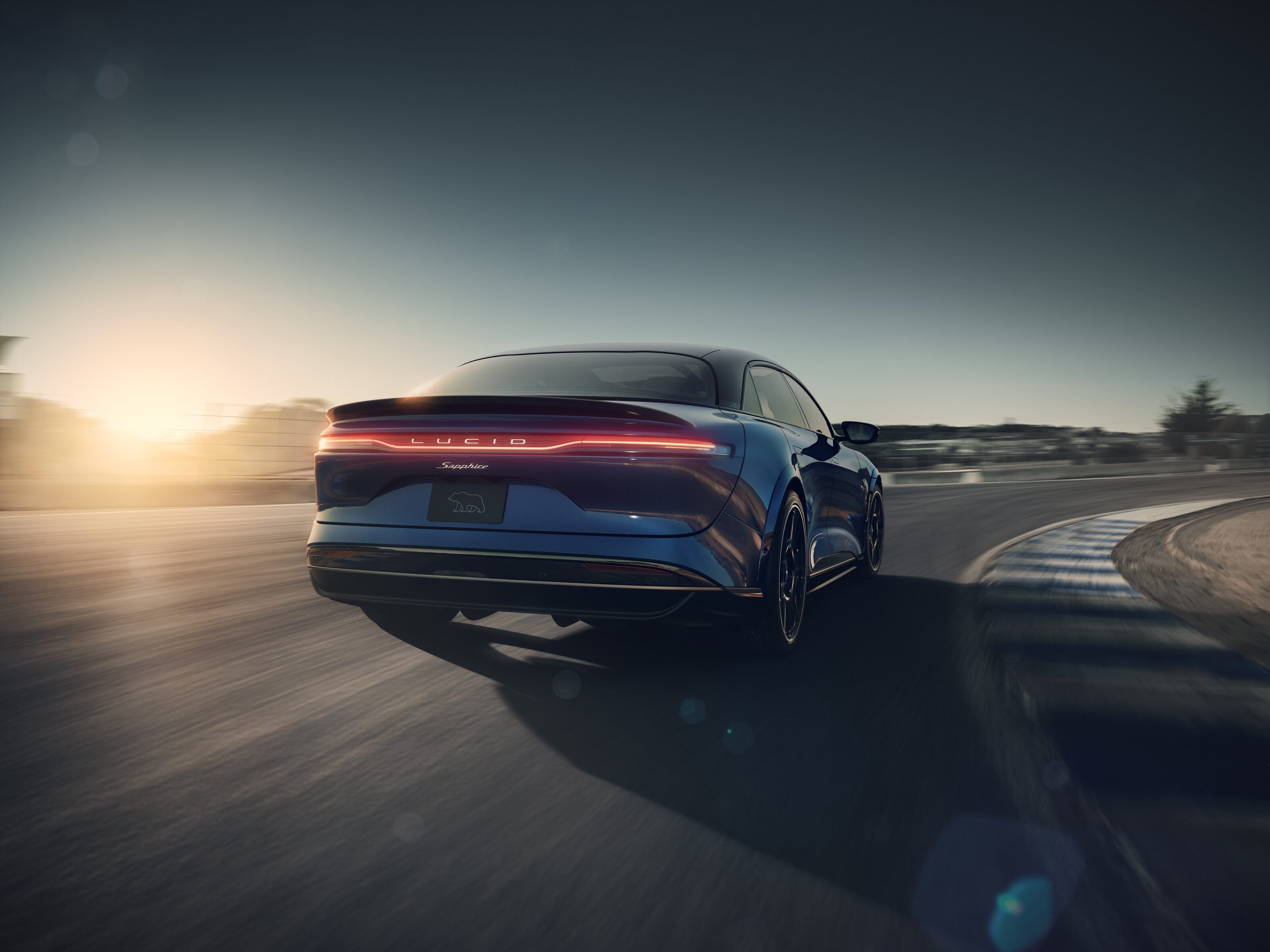
However, these claims are projected figures, with Lucid claiming final power outputs “will be announced later”, along with real-world instrumented demonstrations.
If accurate, this places the Lucid Air Sapphire on a level playing field with the Tesla Model S Plaid, which has a claimed 0-97km/h time of 1.98 seconds, while both vehicles are faster in a straight line than the Porsche Taycan Turbo S (2.8s from zero to 100km/h).
The three-motor Model S Plaid produces 761kW of power, with a 322km/h top speed and a sub-10 second quarter-mile time.
Currently, the most-powerful Lucid Air is the limited-edition, dual-motor Dream Edition P – now sold out – which offered 828kW, a 2.5-second 0-97km/h time, and a 270km/h top speed.
Lucid claims the Air Sapphire’s independently controlled rear motors will allow the outside motor to deliver full power while the inside motor regeneratively brakes.
Other changes include; stiffer springs and bushings, unique dampers, retuned driver assists, and carbon ceramic brakes.
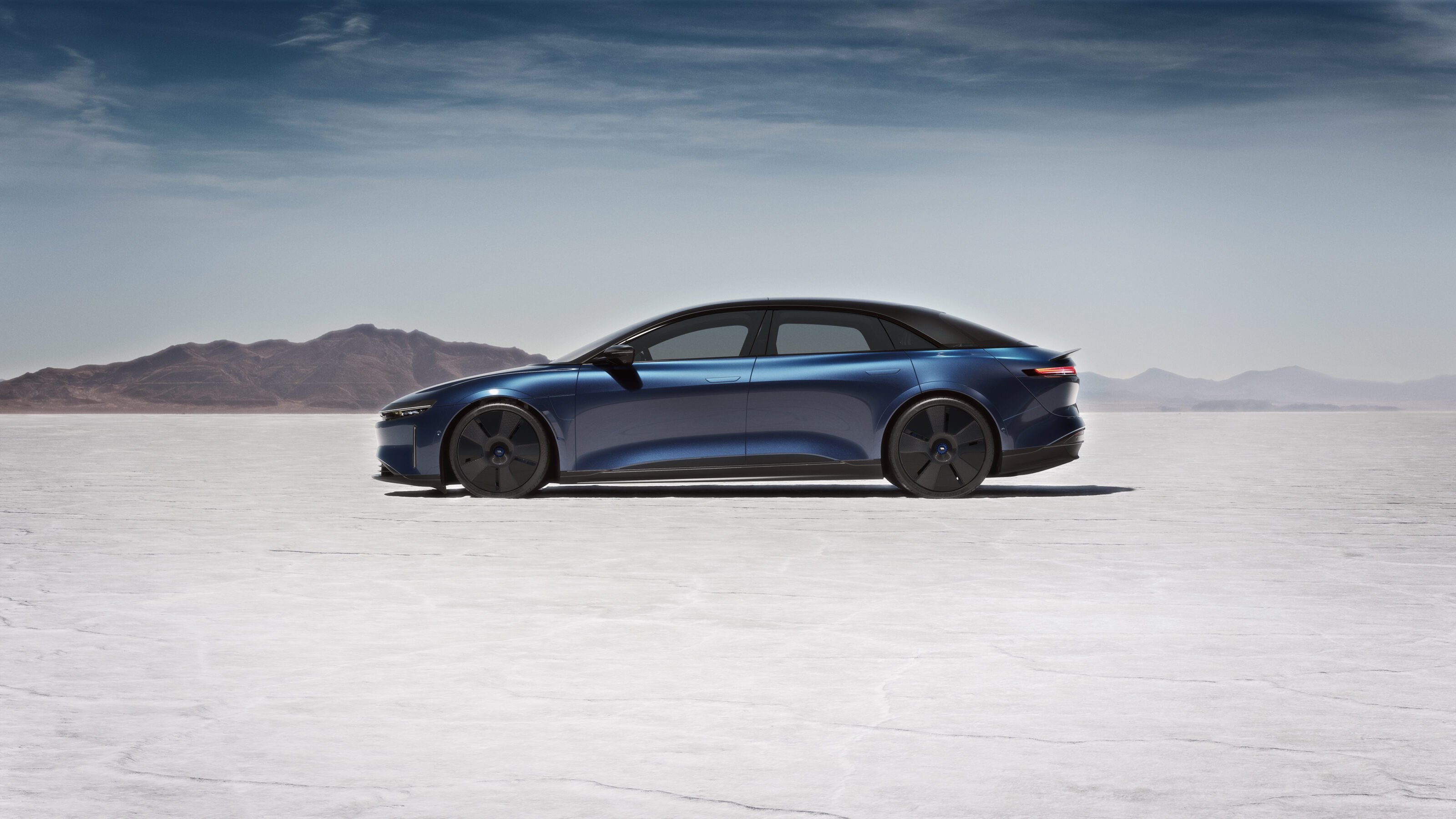
In addition, the performance model includes black exterior accents, beefier wheel arch extensions, an understated spoiler, and Sapphire badging.
The vehicle features 20-inch front and 21-inch rear wheels with Michelin Pilot Sport 4S tyres.
While the standard model wears a five-spoke black and white alloy wheel design, carbon-fibre aerodynamic covers are optional to maximise efficiency – bringing additional driving range on a long journey.
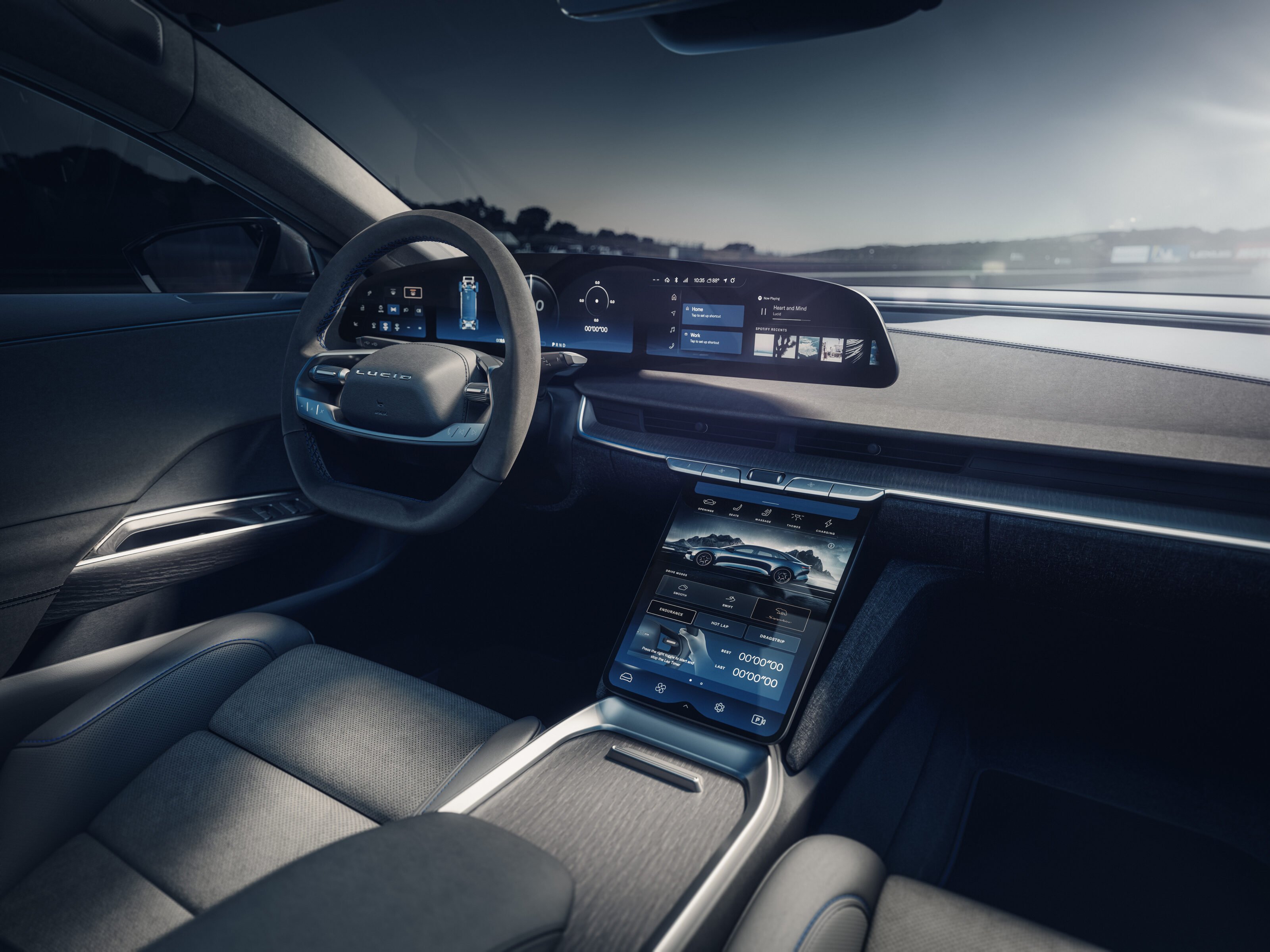
Inside, the driver and passenger are treated to 18-way power-adjustable sports seats with heating, cooling and massaging, while Lucid has updated the infotainment system to display graphics unique to the Sapphire.
First deliveries of the 2023 Lucid Air Sapphire are expected to commence next year, priced from US$249,000 (AU$360,500) – compared to US$169,000 (AU$244,680) for the now-defunct Air Dream Edition P, and US$135,990 (AU$196,885) for the Tesla Model S Plaid.
With priority given to selling electric vehicles in the North American market, the startup has not announced any official plans to expand to others yet – including Australia.
The brand has previously said an Australian launch is on the agenda, while a reservation page on its website lists the United Kingdom, suggesting right-hand drive production is at least under consideration.
Snapshot
- Powertrains remain the same as 2022 update
- More technology and safety features on offer for MY23
- Range starts from $62,140 plus on-road costs
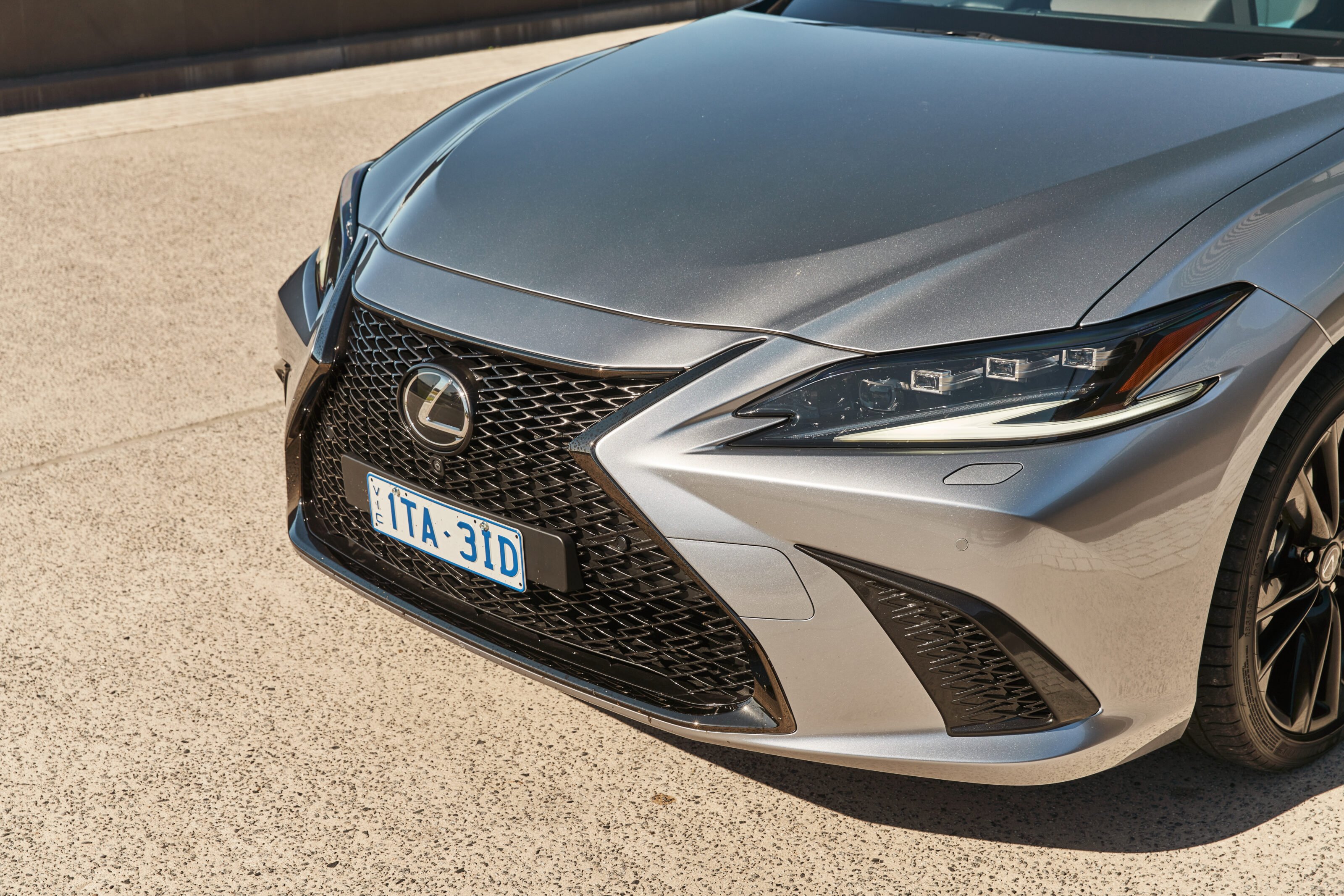
The 2023 Lexus ES has undergone an update, with technology and safety improvements leading the changes for the new model year.
The updated model will go on sale in Australia next month, priced from $62,140.
The ES range, which continues to offer a choice of petrol and hybrid powertrains (dubbed the 250 and 200h respectively), also gains Lexus’s Connected Services smartphone system.
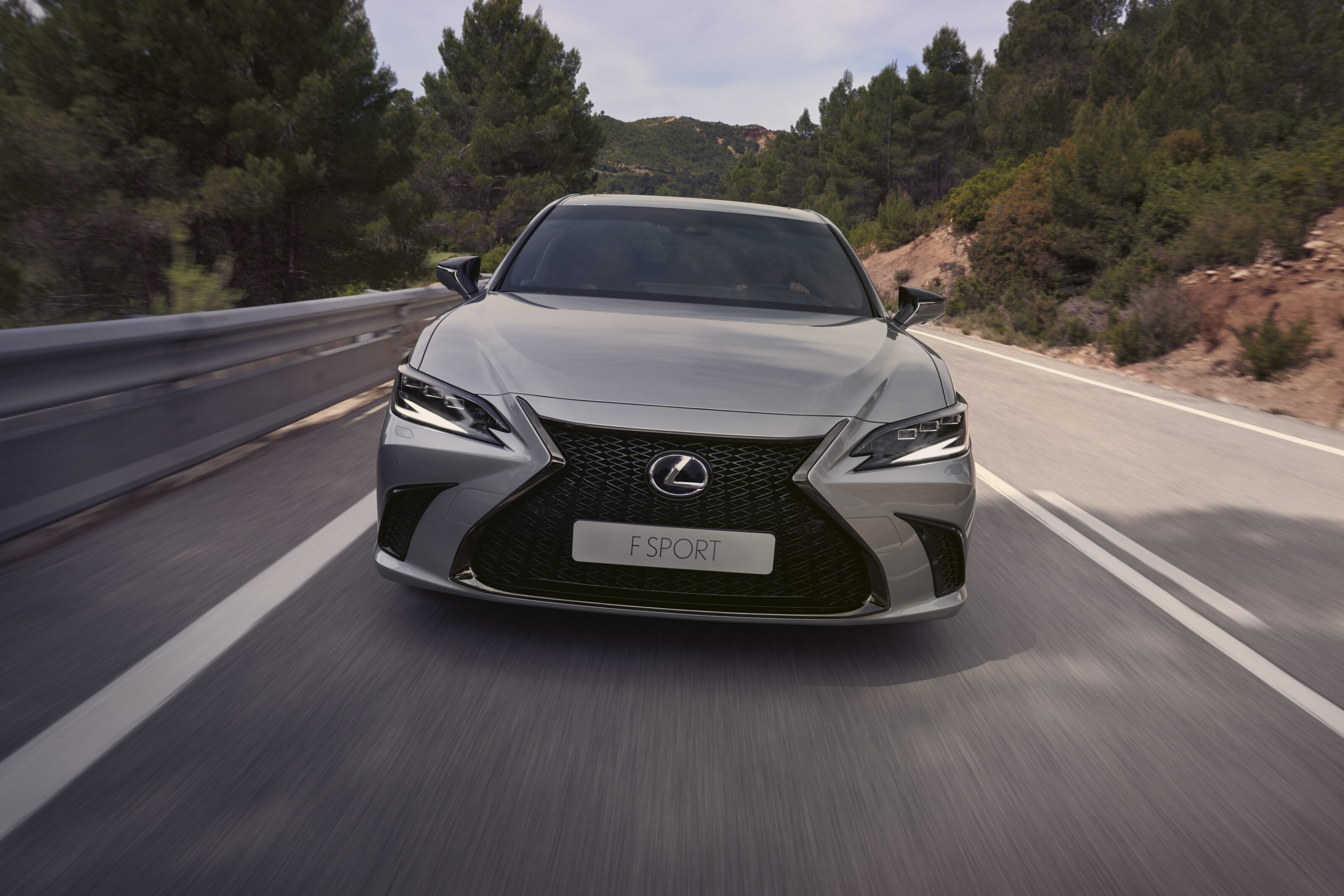
The connectivity service allows owners instant access on their phone to their car’s odometer and fuel level readings, remaining range, the vehicle’s last known location, vehicle diagnostics data and recent trip details.
Through the app, they can also now remotely check whether the doors, windows, boot and bonnet are closed and locked – as well as start the car, monitor its tyre pressure status and turn on the hazard lights or horn.
In addition to featuring automatic collision notification, SOS emergency call and stolen vehicle tracking, the upgraded ES now adds Lexus Multimedia Connect – which syncs the app with the multimedia system to offer cloud-based connected navigation with live traffic, weather, parking and map updates, location searching, and first- and last-kilometre routing.
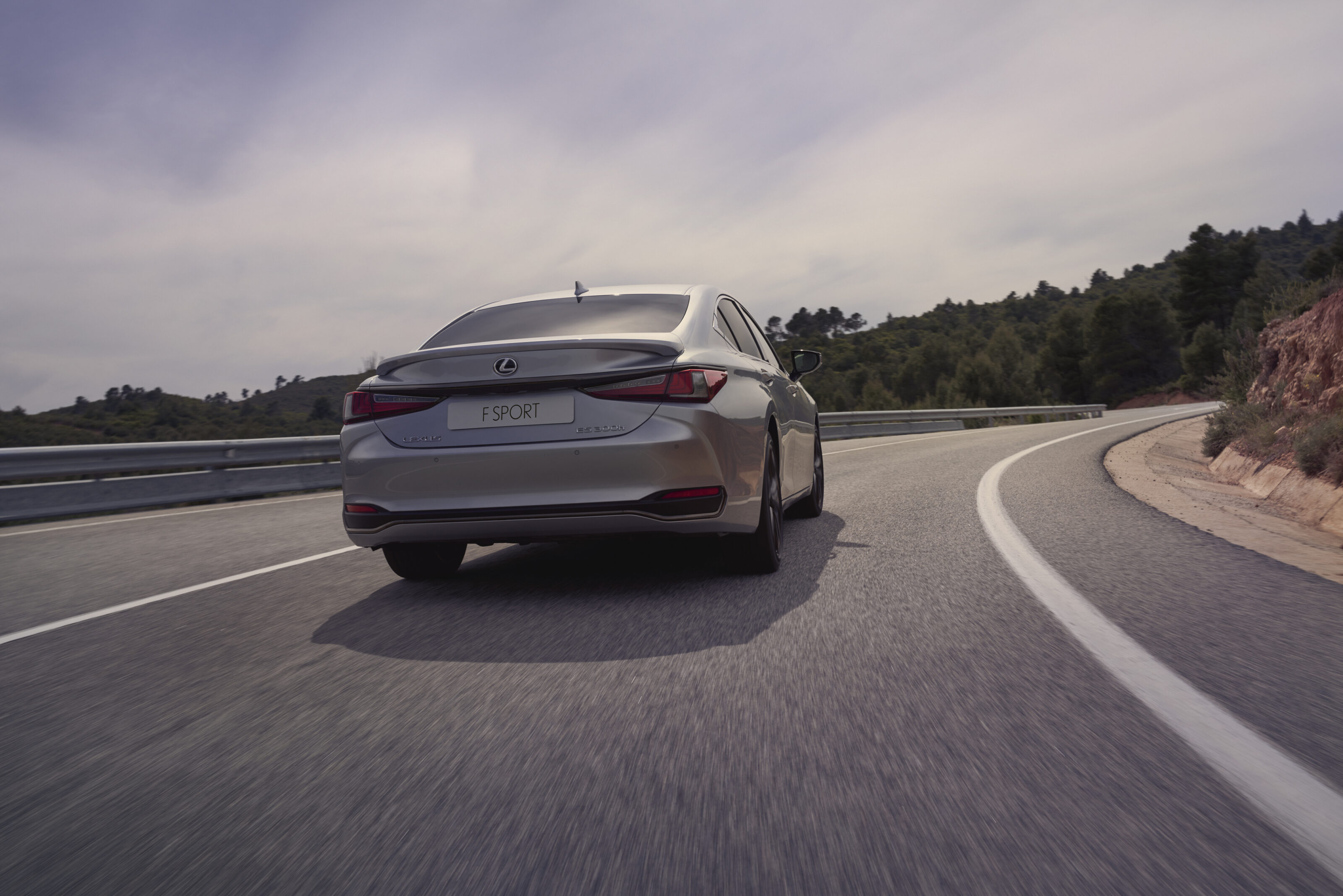
2023 Lexus ES Australian pricing
The ES range remains the same for the 2023 model year, with an increase in prices coming to the line-up. The cost of an Enhancement Pack on each however continues to be the same.
Prices exclude on-road costs.
| Variant | Pricing |
| ES 250 Luxury | $62,140 (+$520) |
| ES 250 Luxury with Enhancement Pack | $63,640 |
| ES 250 F Sport | $71,380 (+$520) |
| ES 300h Luxury | $64,540 (+$990) |
| ES 300h Luxury with Enhancement Pack | $72,800 |
| ES 300h F Sport | $73,920 (+$990) |
| ES 300h F Sport with Enhancement Pack | $77,520 |
| ES 350h Sports Luxury | $79,170 (+$990) |
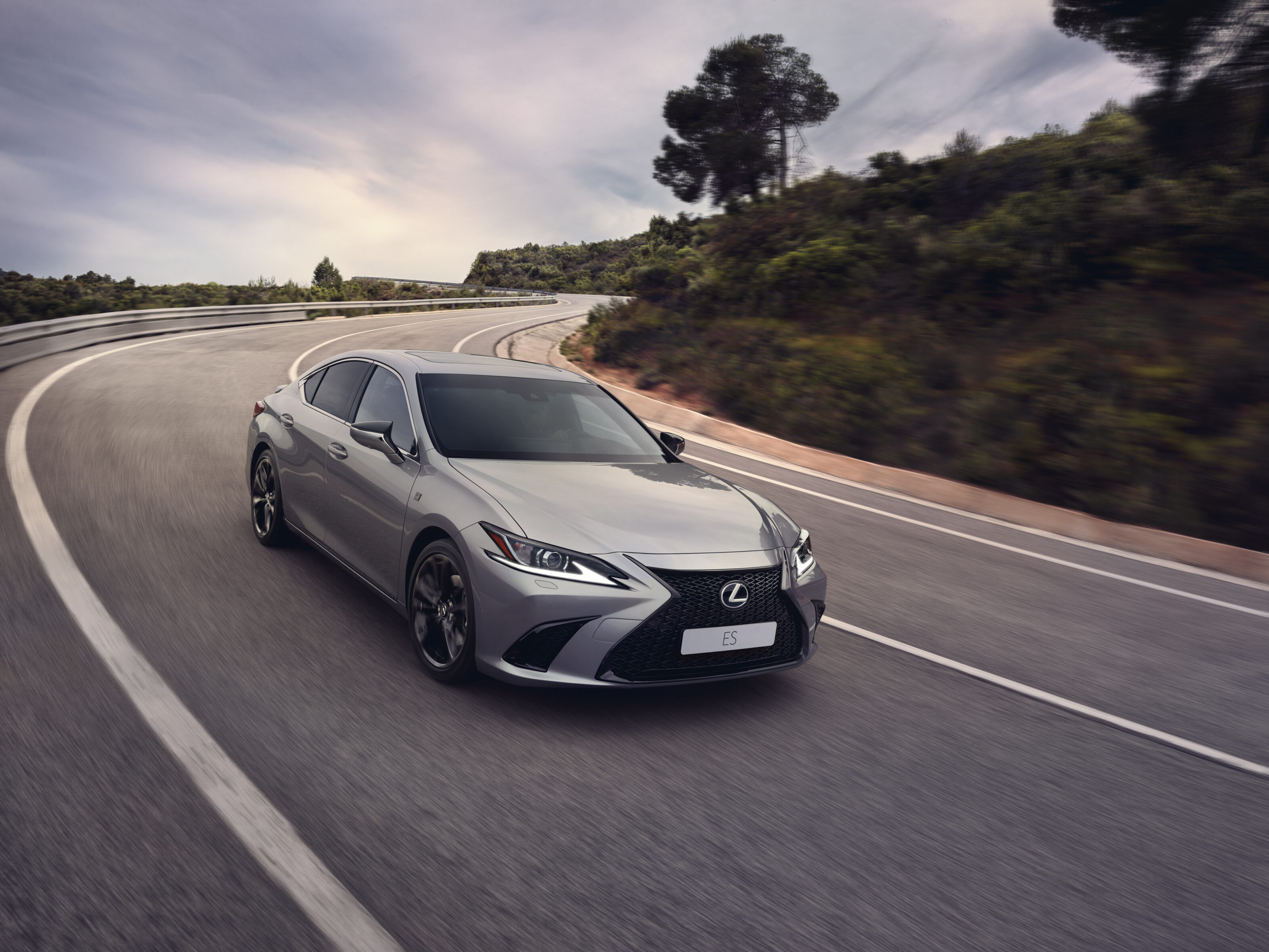
Features
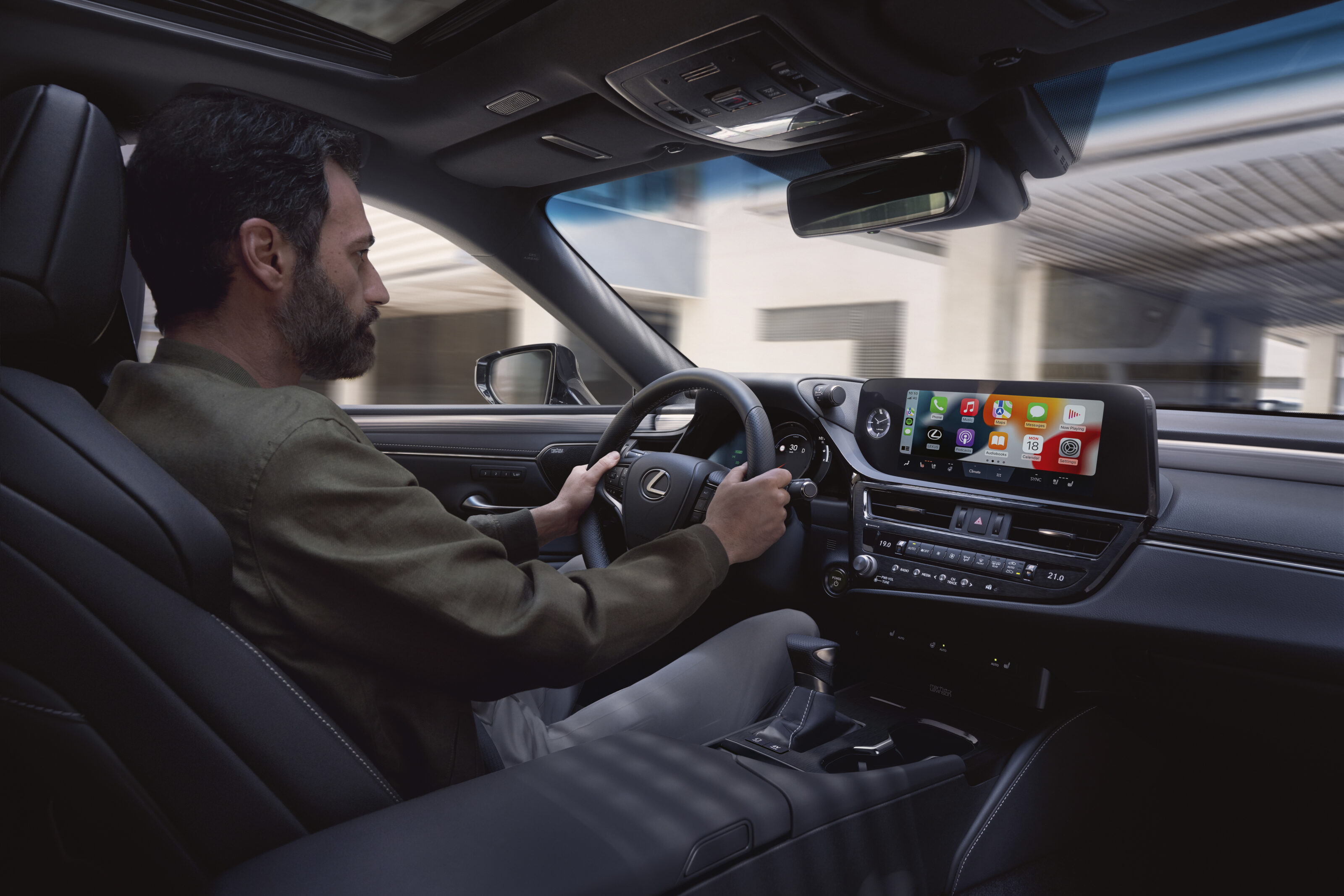
New for MY23 is wireless Apple CarPlay (Android Auto continues to be wired-only), while a redesigned centre console adds another USB-C port next to the gear selector.
While the pair of USB-C ports previously in the centre console storage box were previously deleted with the fitment of a wireless charger, new setup accommodates both – with a wireless charger now standard across the range.
ES 250 Luxury
As the entry-level variant to the range, the ES 250 Luxury features a base range of equipment including:
| Drive mode select u2013 Eco, Normal, Sport |
| Active cornering assist |
| 17-inch alloy wheels |
| LED low-beam headlights with automatic high beam |
| LED daytime running lights |
| Keyless smart entry with an ultrasonic break-in alarm |
| Tilt and slide moonroof |
| LED rear tail-lamps |
| Choice of hazel or black interior trim |
| 3D film ornamentation |
| 12.3-inch multimedia touch-display |
| Reversing camera with rear guide assist (RGA) |
| Apple CarPlay and Android Auto |
| 10 speaker audio |
| DAB+ Digital Radio USB & AUX Input |
| Satellite navigation system |
| Dual zone climate control air conditioning with Nanoe X |
| Lexus Climate concierge |
| 10-way power adjustable front seats |
| Heated front seats |
| Self-dimming interior mirror |
ES 250 Luxury with Enhancement Pack
On top of the standard ES 250 Luxury, the Enhancement Pack adds:
| Wireless smartphone charger |
| Head-up display |
| Smart key card |
| Privacy rear-side and rear glass |
| Type-C USB chargers |
| Rear spoiler |
| Power adjustable steering column with easy access functionality |
| Active noise control |
ES 250 F Sport
The F Sport package is the highest spec for the ES 250, adding the following equipment onto the Enhancement Pack:
| F Sport suspension |
| LED headlamps with BladeScan adaptive high-beam system |
| 19-inch F Sport alloy wheels |
| F Sport performance dampers |
| F Sport grille and rear spoiler |
| F Sport seats in F Sport white, F Sport black or Flare Red |
| Power back door with kick sensor |
| Power sunshade on rear window |
| Hadori aluminium ornamentation |
| 8.0-inch driver display |
| Panoramic View monitor |
| Ventilated front seats |
| 12-way power adjustable driver’s seat with memory |
| Panoramic view monitor |
ES 300h Luxury
The ES 300h is the base trim in the hybrid variant’s range and features the same base equipment as the ES 250 Luxury, although its hybrid powertrain does add an EV-only mode which is unavailable in the 250
| Drive mode select u2013 Eco, Normal, Sport |
| Active cornering assist |
| 17-inch alloy wheels |
| LED low-beam headlights with automatic high beam |
| LED daytime running lights |
| Keyless smart entry with an ultrasonic break-in alarm |
| Tilt and slide moonroof |
| LED rear tail-lamps |
| Choice of hazel or black interior trim |
| 3D film ornamentation |
| 12.3-inch multimedia touch-display |
| Reversing camera with rear guide assist (RGA) |
| Apple CarPlay and Android Auto |
| 10 speaker audio |
| DAB+ Digital Radio USB & AUX Input |
| Satellite navigation system |
| Dual zone climate control air conditioning with Nanoe X |
| Lexus Climate concierge |
| 10-way power adjustable front seats |
| Heated front seats |
| Self-dimming interior mirror |
| EV mode |
ES 300h Luxury with Enhancement Pack
Stepping up to the Enhancement Pack, ES buyers score extra features such as:
| Choice of Hazel, Mauve, Black or Rich Cream interior trim |
| Choice of Sumi black walnut or brown walnut ornamentation |
| Power Back Door with kick sensor |
| 18-inch alloy wheels |
| Ventilated front seats |
| 12-way power adjustable driver’s seat with memory |
| Panoramic view monitor |
| Sunshade on rear window (power) and rear door (manual) |
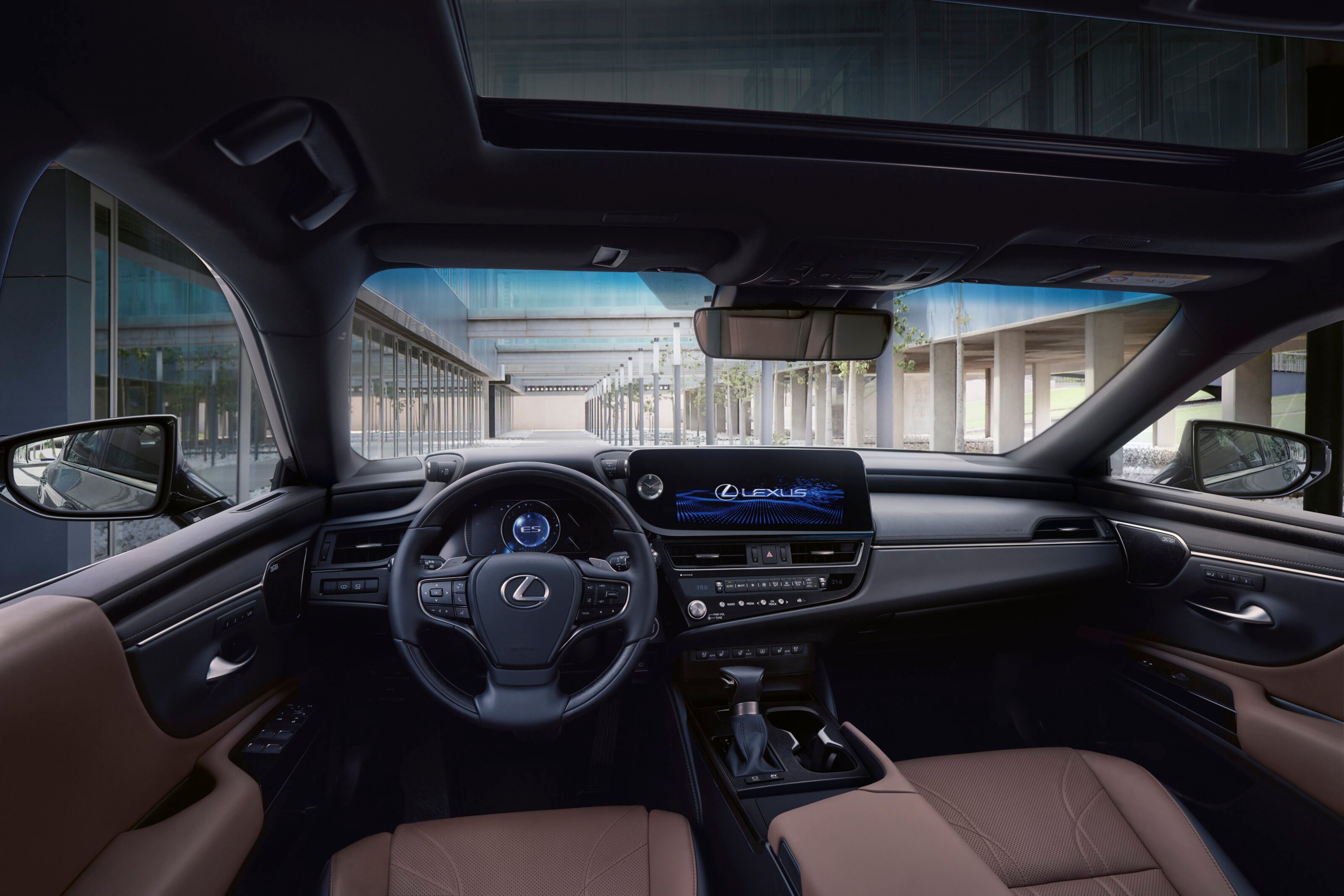
ES 300h F Sport
Building on the Enhancement pack, the F Sport trim in 300h guise adds features including:
| F Sport suspension |
| LED headlamps with BladeScan adaptive high-beam system |
| 19-inch F Sport alloy wheels |
| F Sport performance dampers |
| F Sport grille and rear spoiler |
| F Sport seats in F Sport white, F Sport black or Flare Red |
| Power back door with kick sensor |
| Power sunshade on rear window |
| Hadori aluminium ornamentation |
| 8.0-inch driver display |
| Panoramic View monitor |
| Ventilated front seats |
| 12-way power adjustable driver’s seat with memory |
| Panoramic view monitor |
| F Sport adaptive variable suspension |
| Drive mode select u2013 Eco, Normal, Sport S, Sport S+ and Custom |
ES 300h F Sport with Enhancement Package
The F Sport Enhancement Package builds on the F Sport with the following equipment:
| Heated steering wheel |
| Mark Levinson 17 speaker audio including subwoofer and amplifier |
ES 300h Sports Luxury
Finally, the range-topping 300h Sports Luxury, adding on top of the Enhancement Pack:
| Heated steering wheel |
| Mark Levinson 17 speaker audio including subwoofer and amplifier |
| Tri-zone climate control air conditioning with humidity sensor |
| Power adjustable reclining/heated outer rear seats |
| Rear Armrest with air conditioning, audio, rear heater, rear reclining and sunshade controls |
Nine exterior colours are now offered: Sonic quartz, titanium, sonic iridium, sonic chrome, graphite black, vermillion, glacial ecru, radiata green and deep blue – with black now deleted as an option. On F Sport grades white nova and cobalt mica replace sonic quartz and deep blue.
On the inside, solis white leather replaces the previous rich cream upholstery.
Engine, transmission and fuel economy
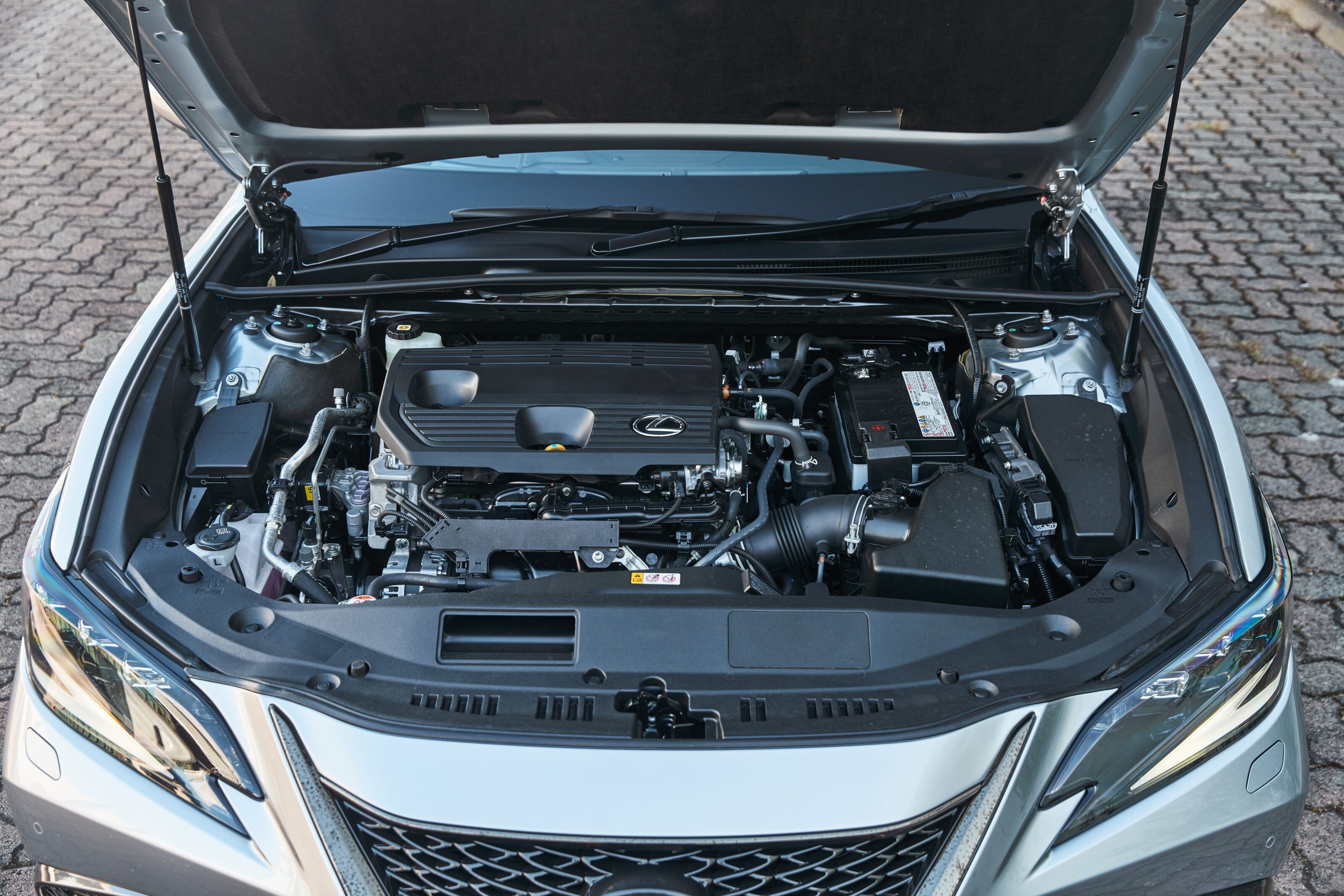
The ES 250 grades utilise a naturally-aspirated 2.5-litre four-cylinder petrol unit with direct injection, making 152kW and 243Nm, with power being sent to the front wheels through an eight-speed automatic gearbox.
The 300h, meanwhile, uses a 131kW/221Nm 2.5-litre petrol engine and 88kW/202Nm electric motor, combining for a maximum power output of 160kW delivered to the front wheels through a CVT automatic.
As expected, the more conventional ES 250 is thirstier, with a tested combined consumption figure of 6.6L/100km – almost two litres more than the 300h which achieves 4.8L/100km.
Safety
Retaining the five-star safety rating from 2021, the updated ES features as standard:
| Intersection Assist with Turning Assist (new) |
| Emergency Steering Assist (new) |
| Lexus Connected Services (new) |
| Radar active cruise control with road sign assist |
| Pre-collision safety system with pedestrian detection |
| Blind spot monitor with rear cross traffic alert and brake |
| Parking support with brake including intelligent clearance sonar |
| Lane tracing assist |
| Tyre pressure warning system |
| 10 SRS airbags |
| Alarm system with intrusion sensor |
Availability
The updated 2023 Lexus ES range will go on sale in Australia in September 2022.
The 2023 Lamborghini Urus SUV has received the Performante treatment, with the new go-faster variant revealed this week at Monterey Car Week.
The Lamborghini Urus Performante will be landing in Australia, asking from $465,876 (before on-road costs) with first vehicles expected to arrive in Q2 of 2023.
In the meantime, the Lamborghini Urus Performante is fresh from setting the record for a production SUV at this year’s Pikes Peak International Hill Climb, blitzing the Bentley Bentayga’s 2018 record by 17.838-seconds.
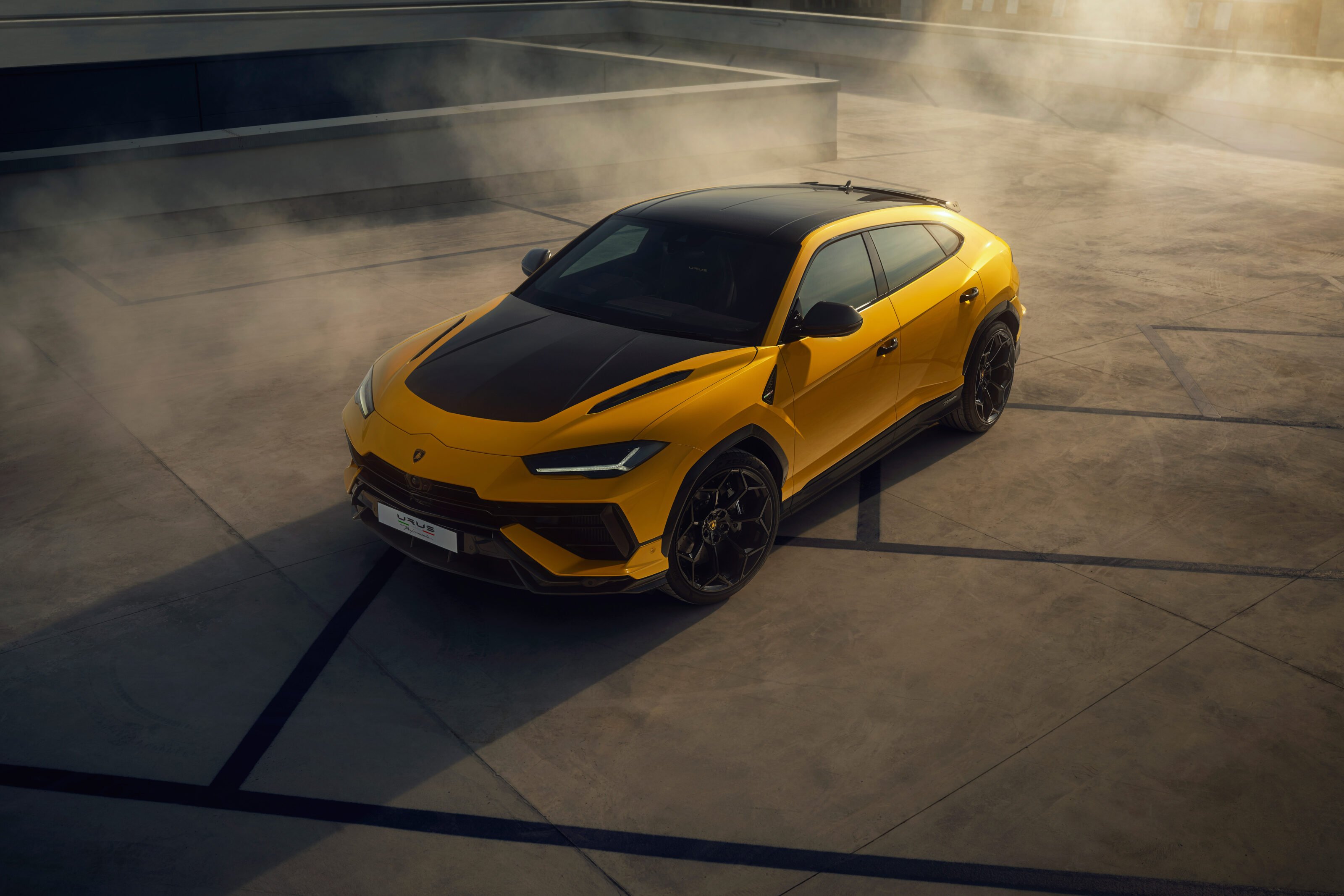
The existing Urus’s twin-turbo V8 has been massaged to 490kW/850Nm, powering the Urus Performante up to a maximum speed of 306km/h. The boosted V8 breathes through a titanium Akropovic exhaust.
Meanwhile, a 47 kilogram reduction in weight gives the Urus Performante a best-in-class power-to-weight ratio of 228kW per tonne. Homologation of Chinese Domestic Market vehicles, however, sees vehicles sold in China wound down to 470kW.
New composite panels, including an optional carbon-fibre roof, provide the Urus’s weight savings, with the new front fascia providing extra cooling properties. Down the side, there are new air curtains to smooth airflow over the front wheels, directing air to the newly-designed rear spoiler – which provides a 38 per cent increase in rear downforce.
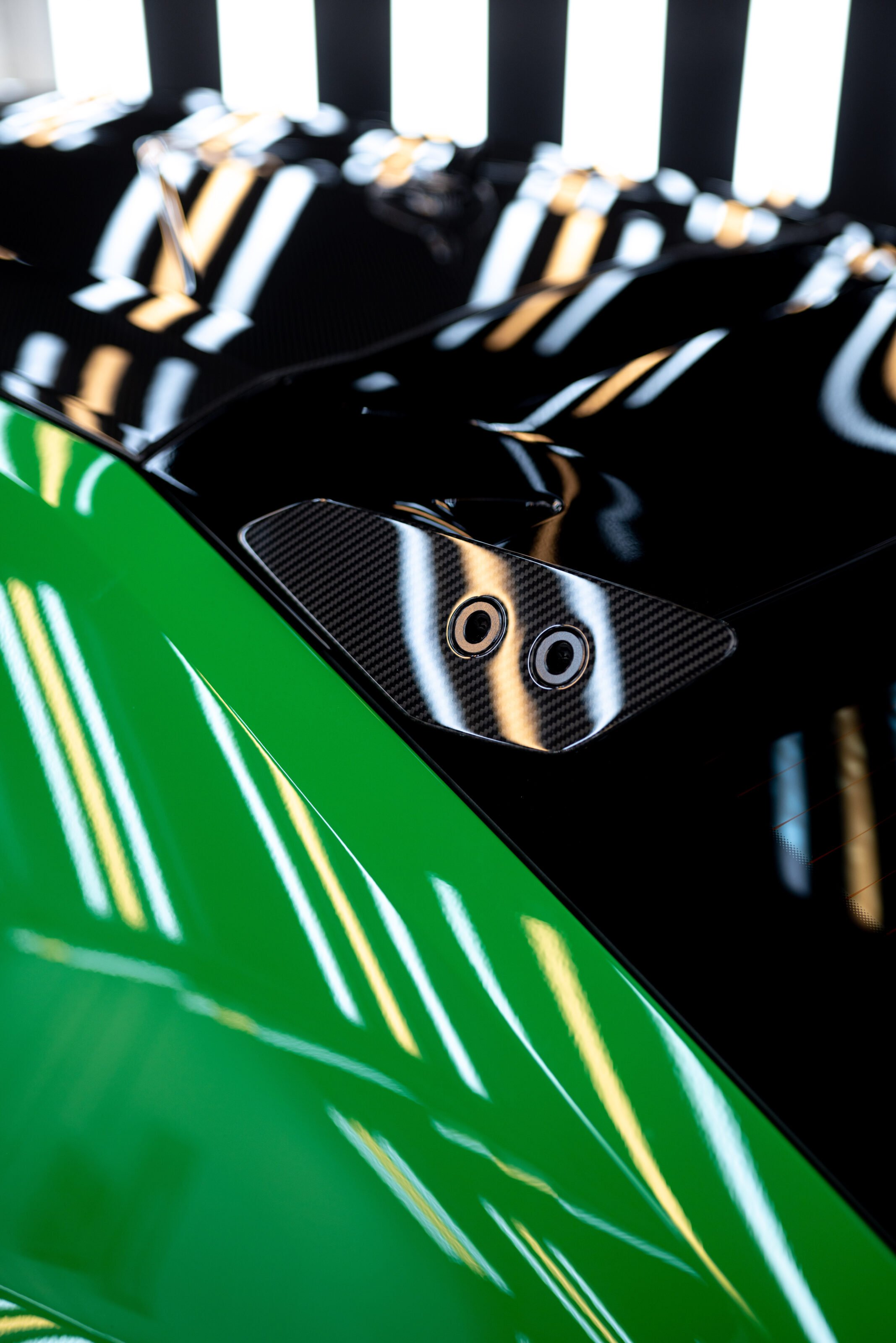
The Lamborghini Urus Performante is cornered by forged 22-inch, or optional 23-inch, wheels, mounted on a 16 millimetre wider track with steel springs that lower the ride height by 20mm.
Lamborghini is also offering newly-developed Urus-specific Pirelli P Zero Trofeo R semi-slick tyres, delivering high dry grip at higher ambient temperatures, with increased purchase on cold wet surfaces.
Rear-wheel steering is aided by a torque-vectoring rear differential that functions both on-road and off-road.
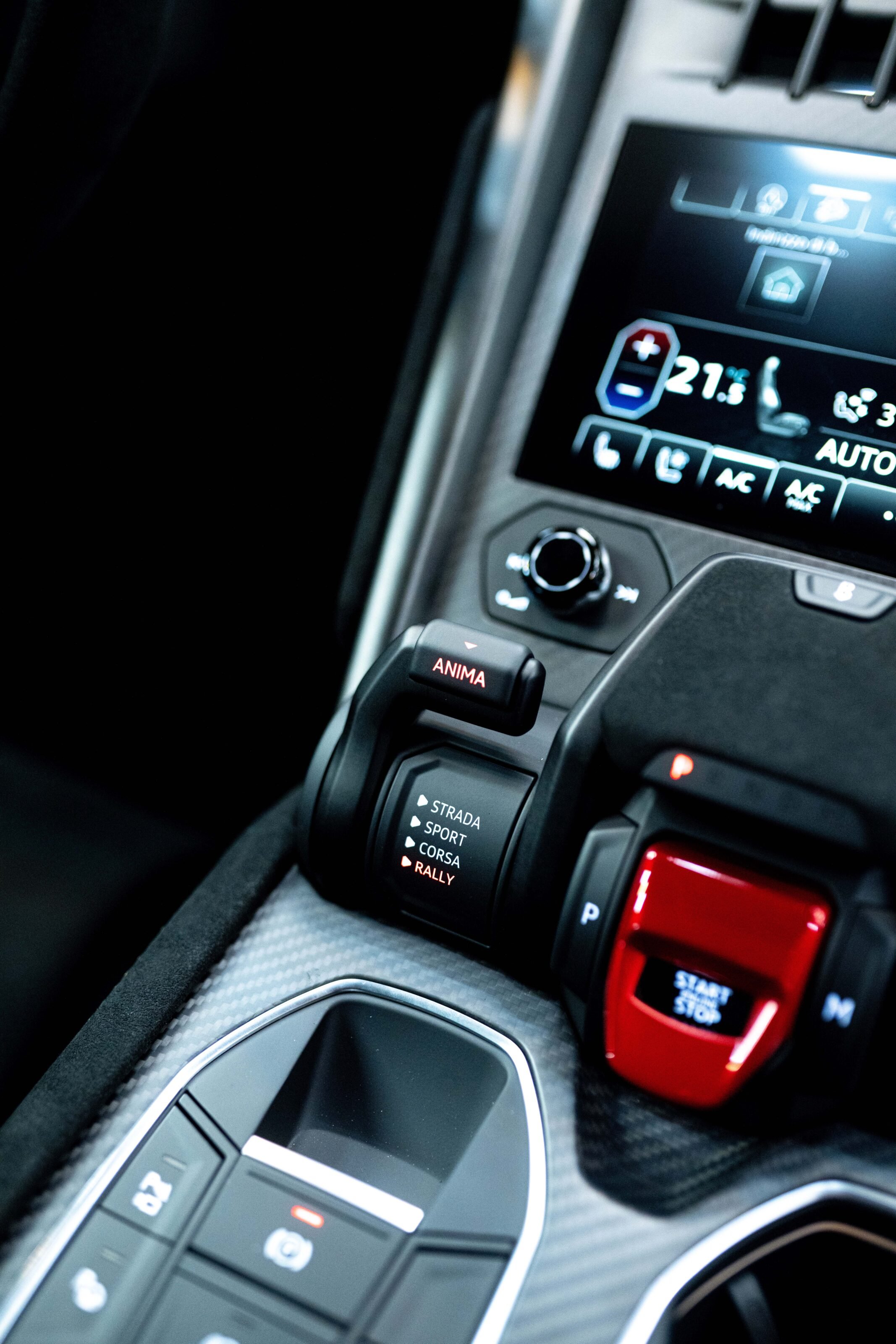
Speaking of which, the high-riding Urus won’t be tackling Cape York’s Old Telegraph Track, but offers a new Rally drive mode emphasising an oversteer character on loose surface. Strada (comfort), Sport and Corsa (race) drive modes remain.
Inside the cockpit, new hexagonal Performante trim proliferates throughout nero cosmos black Alcantara upholstery as standard. Leather is available as an option, with further colour and trim options offered alongside many Performante-specific options – not to mention Lamborghini’s Ad Personam program too. The Urus Performante also gains new instrument graphics specific to the variant.
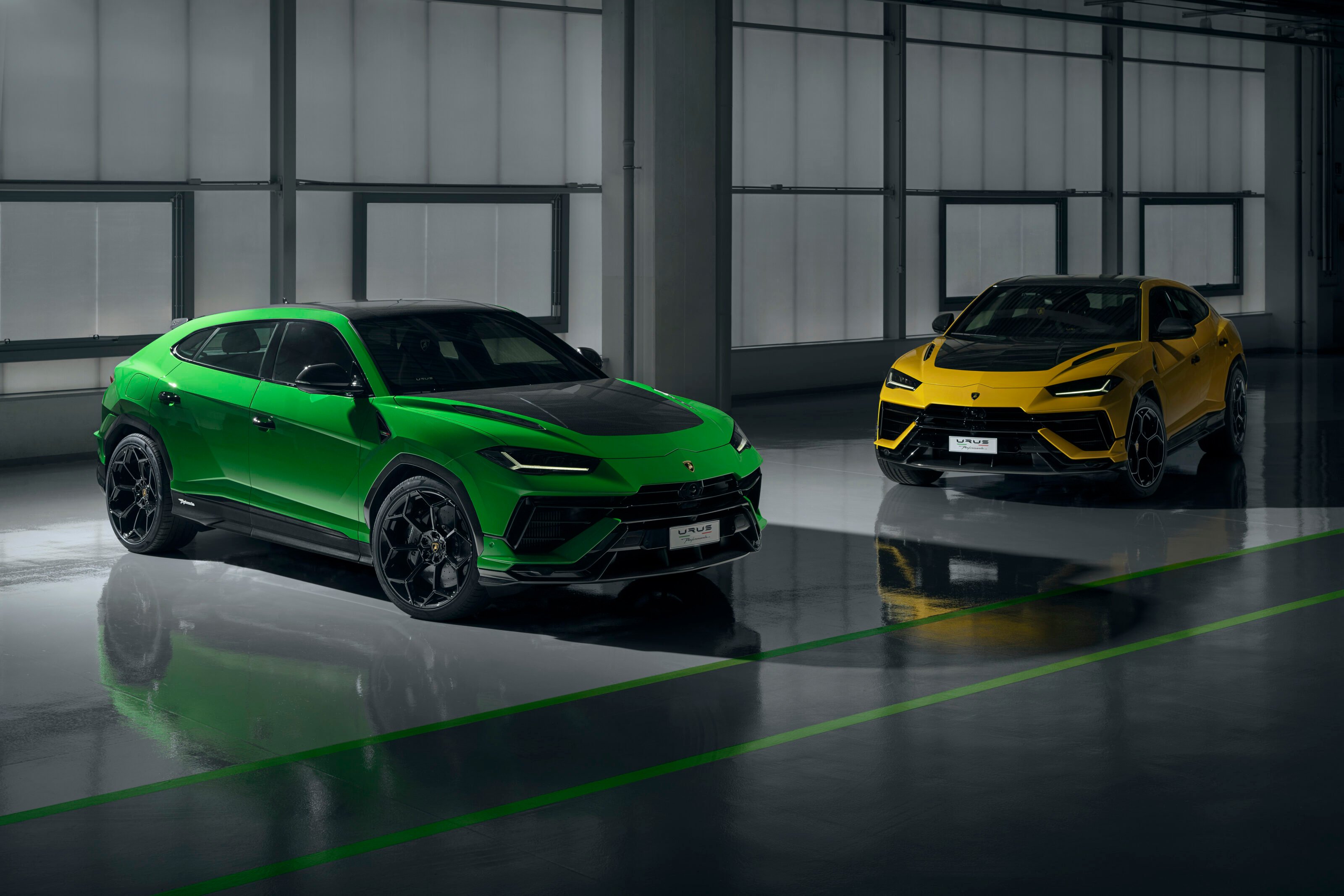
First international customer deliveries are expected before the end of the year. A spokeperson for Lamborghini Australia has confirmed the Urus Performante’s impending arrival, asking $465,876, with vehicles expected locally from Q2 2023.
The 2023 Bentley Mulliner Batur has been revealed – the most powerful Bentley ever made.
The latest super-exclusive hand-built special vehicle to roll out of Bentley’s Mulliner division has made its esteemed debut at this year’s Monterey Car Week in California.
At a distinguished Bentley event, playing host to almost 500 VIP guests, Bentley announced the Batur will come via a special production run of just 18 vehicles.
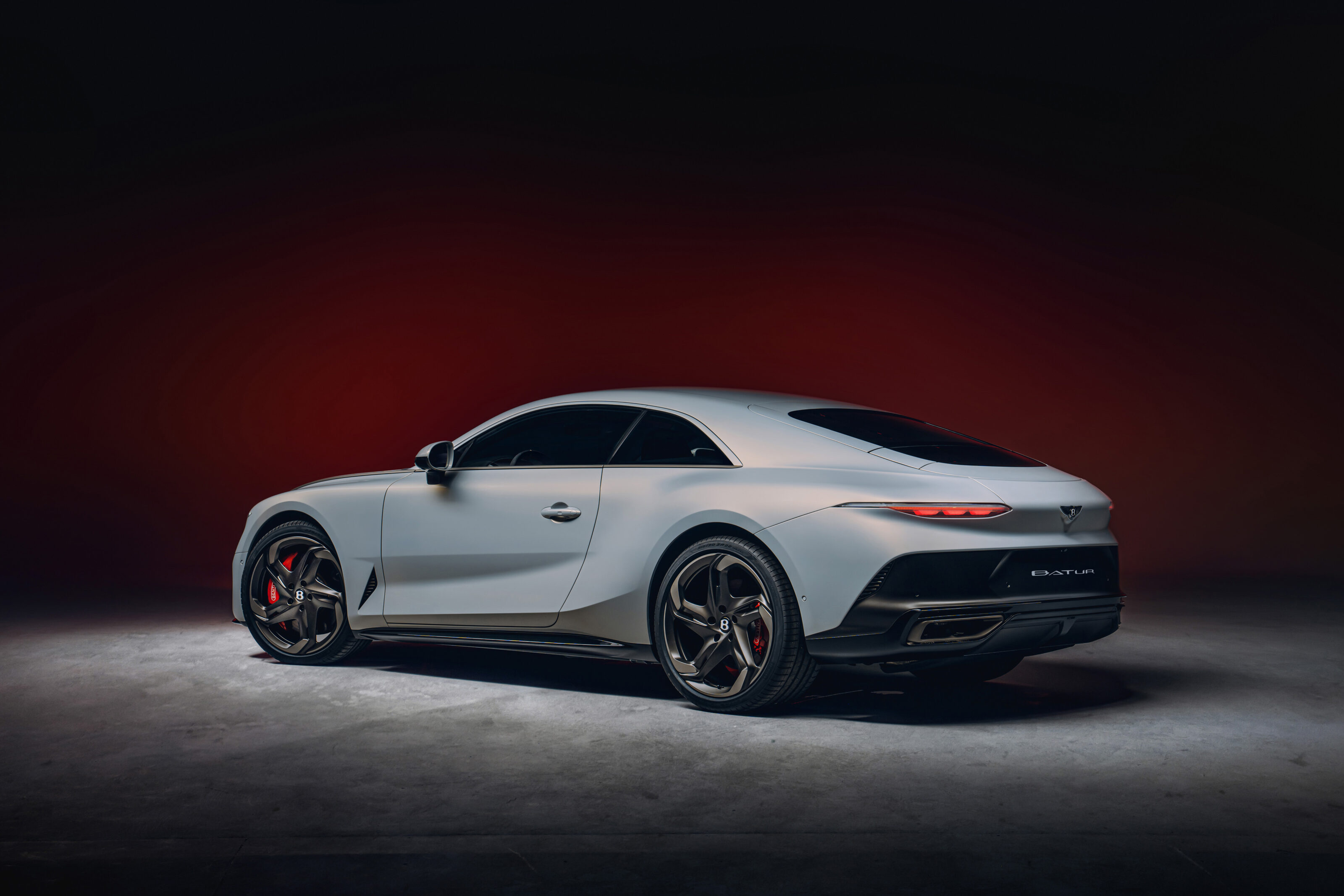
Each Batur will cost Mulliner clients around AU$2.6 million each, affording them the most powerful Bentley ever produced.
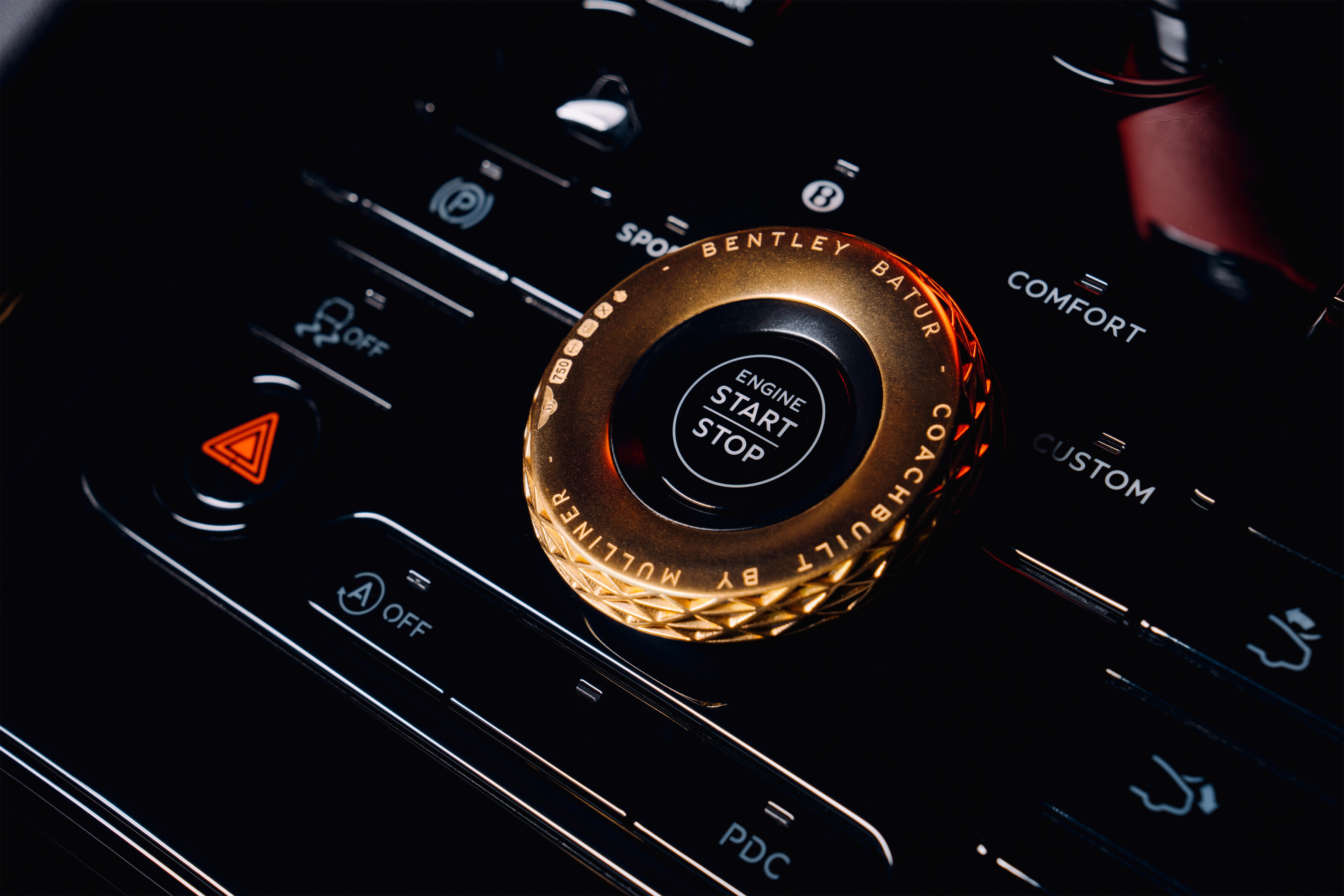
Fitted with Bentley’s enduring 6.0-litre twin-turbocharged W12, the Batur produces over 545kW and 1000Nm. Chassis advancements include speed-tuned air suspension, electric active anti-roll control, an electronic limited-slip differential, four-wheel steering and torque vectoring.
The Batur forms the first part of a celebration of Bentley’s long-serving W12, as the dawn of internal combustion continues to pass through its twilight, and Bentley continues on the path of its Beyond100 EV strategy.
Compared to Bentley’s existing catalogue of vehicles, the Batur represents the genesis of a new, bold and modern design language that will see Bentley’s transition to a producer of battery-electric vehicles (BEVs).
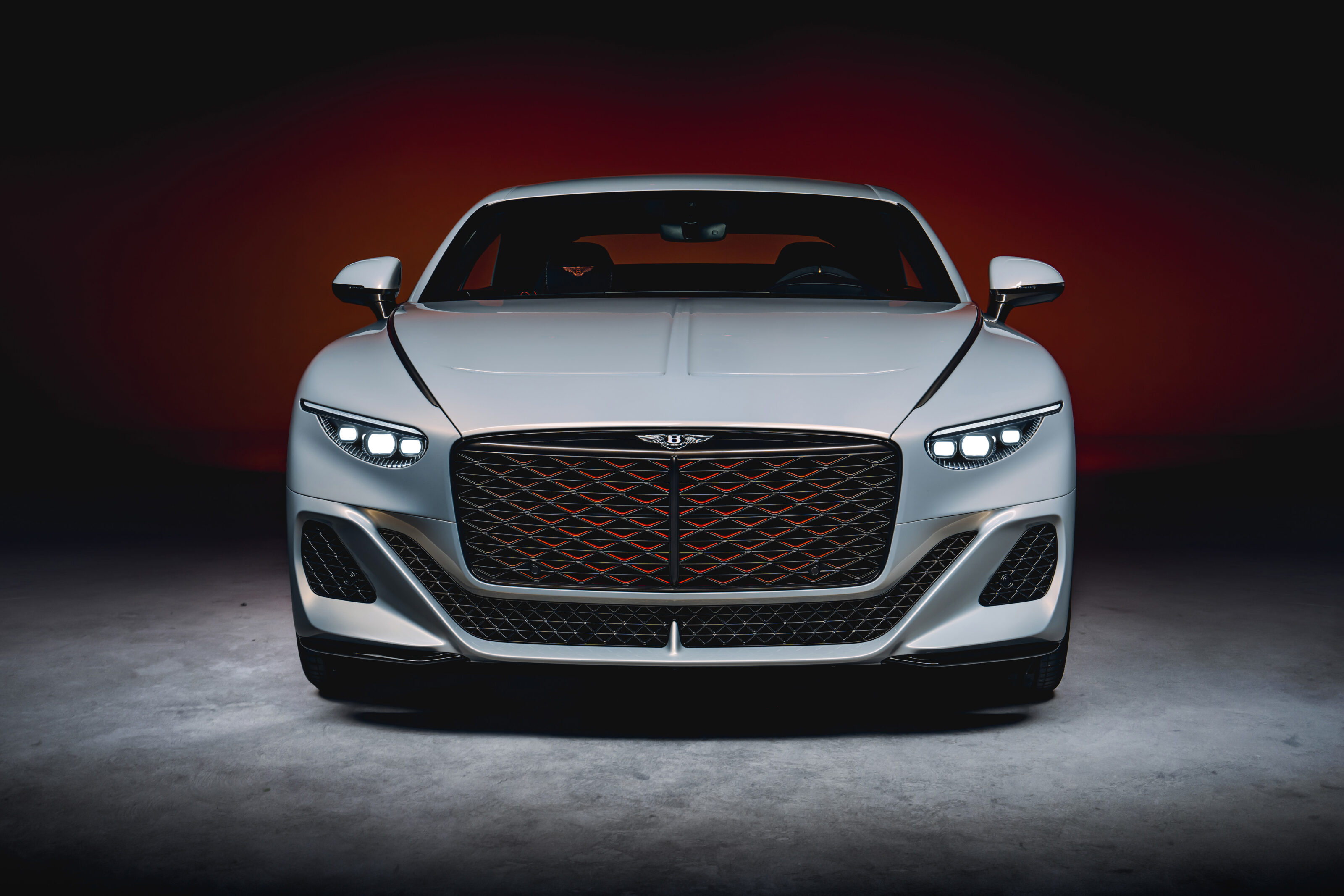
The Batur was created by Andreas Mindt, Bentley Director of Design, and his team. Gone are the signature quad circular headlights, with a sleek pair of teardrop-shaped headlights fitted in their place.
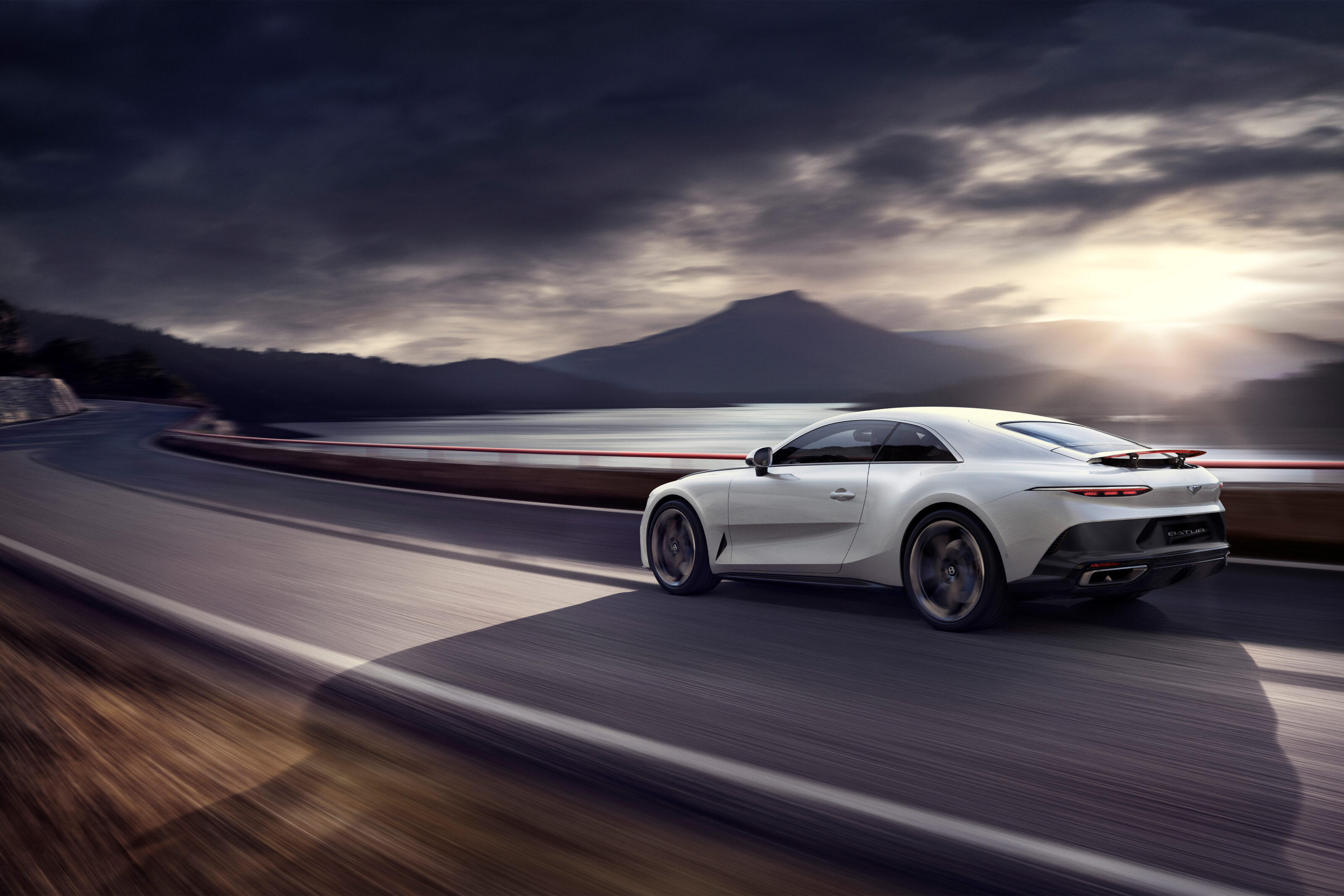
Oval tail-lights that have hallmarked Bentley’s recent road cars have too been stretched and thinned dramatically at the rear. The Bentley Batur previews numerous design themes that will appear on the company’s first BEV, due in 2025, and a family of cars to follow.
Mulliner’s latest creation will be produced in bespoke pieces by the in-house coachbuilding division. Bentley chose the name Batur, after Lake Batur, a 88 metre-deep nutrient rich crater lake in Kintamani on the island of Bali, Indonesia.
Sadly, all 18 examples of the circa-$2.6 million-dollar Bentley Baturs have already been reserved. Each vehicle will be collaboratively specified by each Mulliner client, guided by the Mulliner design team. Virtually every surface of the car can be personalised, with each car individually finished to its owner’s exacting tastes.
Cars will be hand-crafted over several months at Mulliner’s carbon-neutral workshop at Bentley’s historic Crewe, England, factory.
First customer deliveries are expected in mid-2023.
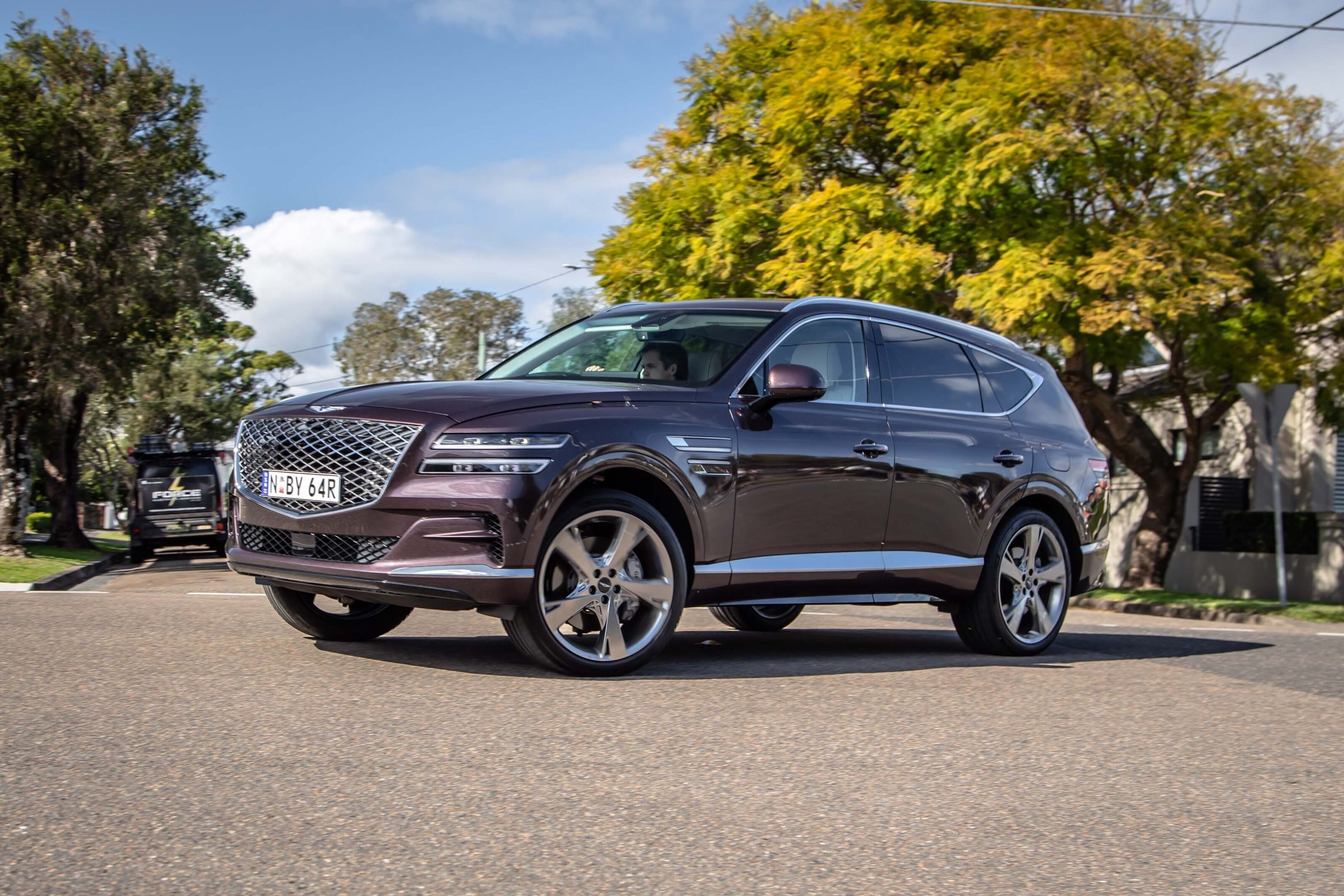
Genesis was a bit of a slow burn for Hyundai. Originally the name of a very nice executive sedan, it later became a brand in its own right, in much the same way Ioniq did. Taking the path that Toyota took with Lexus, the luxury brand from South Korea now faces up to the prestige car market with a mix of SUVs and sedans.
Its biggest, the GV80, is a genuine presence on the road. A distinctive but, I think, genuinely beautiful exterior design is backed by an impressive interior and a healthy aftersales package to build confidence in the brand.
Genesis needs all of these things because it’s not like the market is short of seven-seat premium SUVs with badges people have known and bought for decades.
Taking on the luxury market isn’t easy – ask Nissan about how Infiniti went outside of the US – and in this sector, even less so. The GV80 has its work cut out.
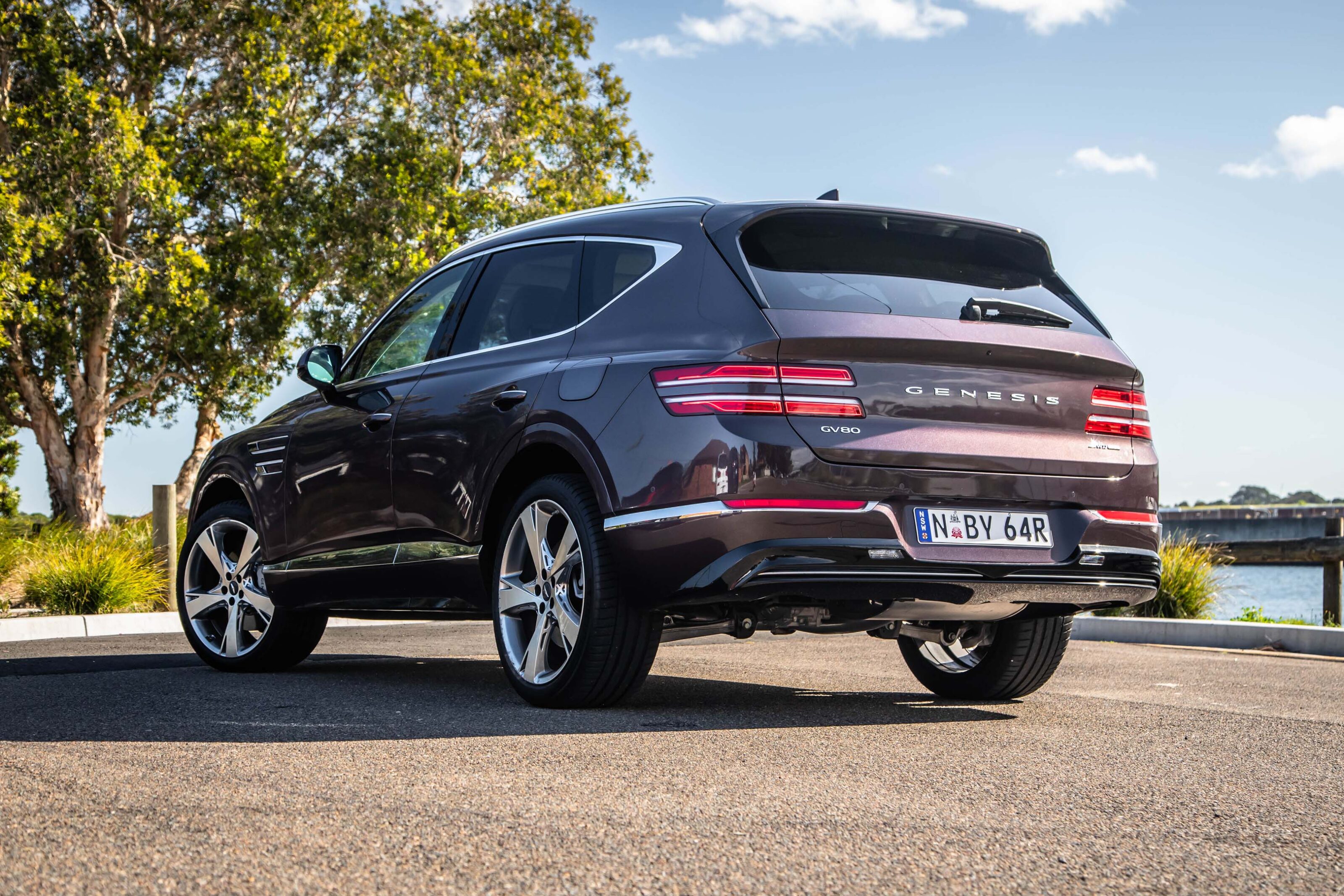
Pricing and features
While you can get a rear-wheel drive 2.5-litre turbo four-cylinder GV80 for well under a hundred grand, the GV80 3.0d starts at $104,191 before on-road costs – which is well in the ballpark of the Audi Q7, exactly what you might expect for a seven-seat V6-powered luxury SUV.
Highlights
| 22-inch alloy wheels |
| 21-speaker stereo |
| multi-zone climate control |
| front, side and reversing cameras |
| front and rear parking sensors |
| adaptive cruise control |
| powered and heated front seats |
| sat-nav, front and rear sunroof |
| auto LED headlights with auto high beam |
| keyless entry and start |
| leather and wood trim (with no-cost optional choices) |
| wireless charging pad |
| head-up display |
| power tailgate |
| variable ratio steering |
| power everything |
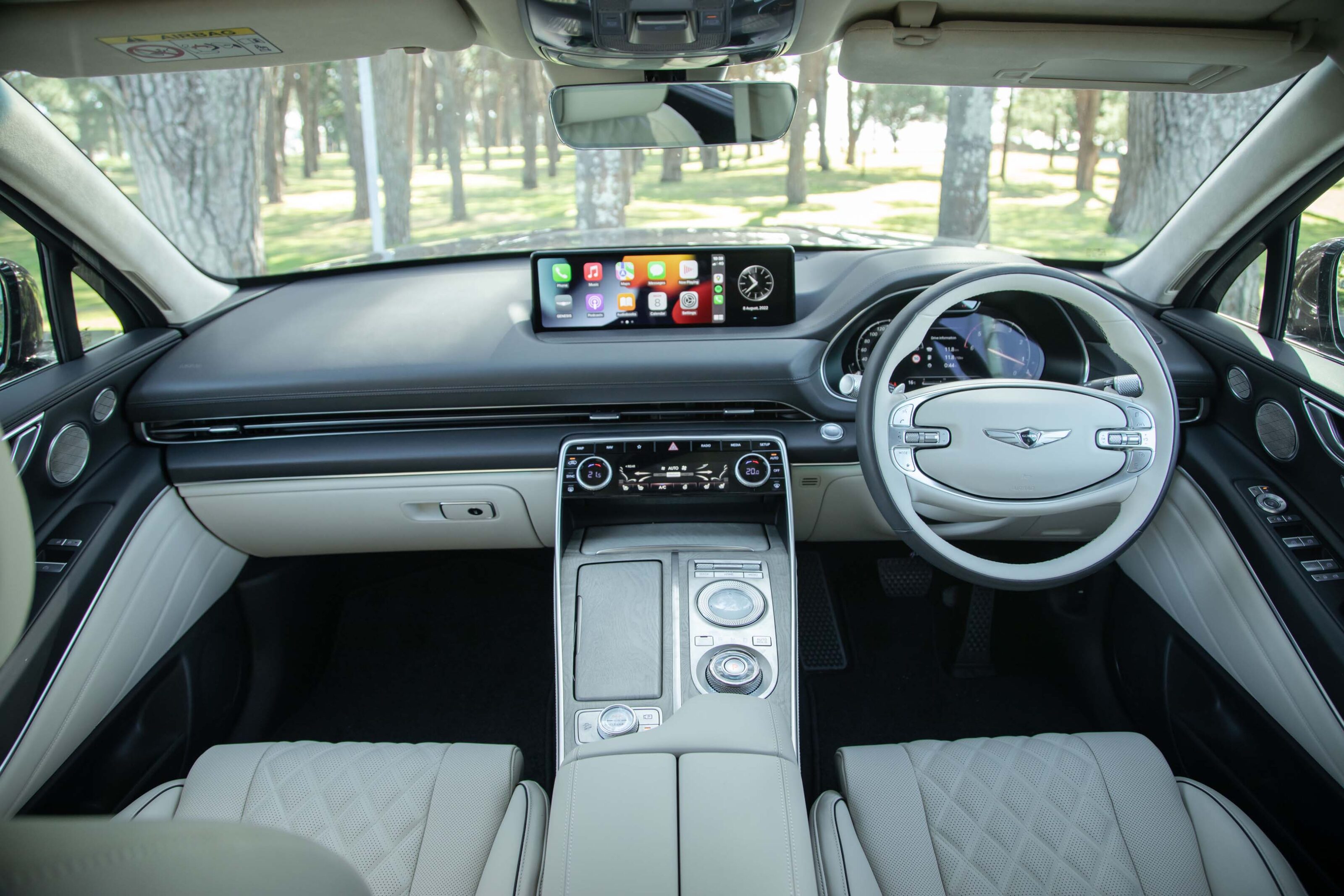
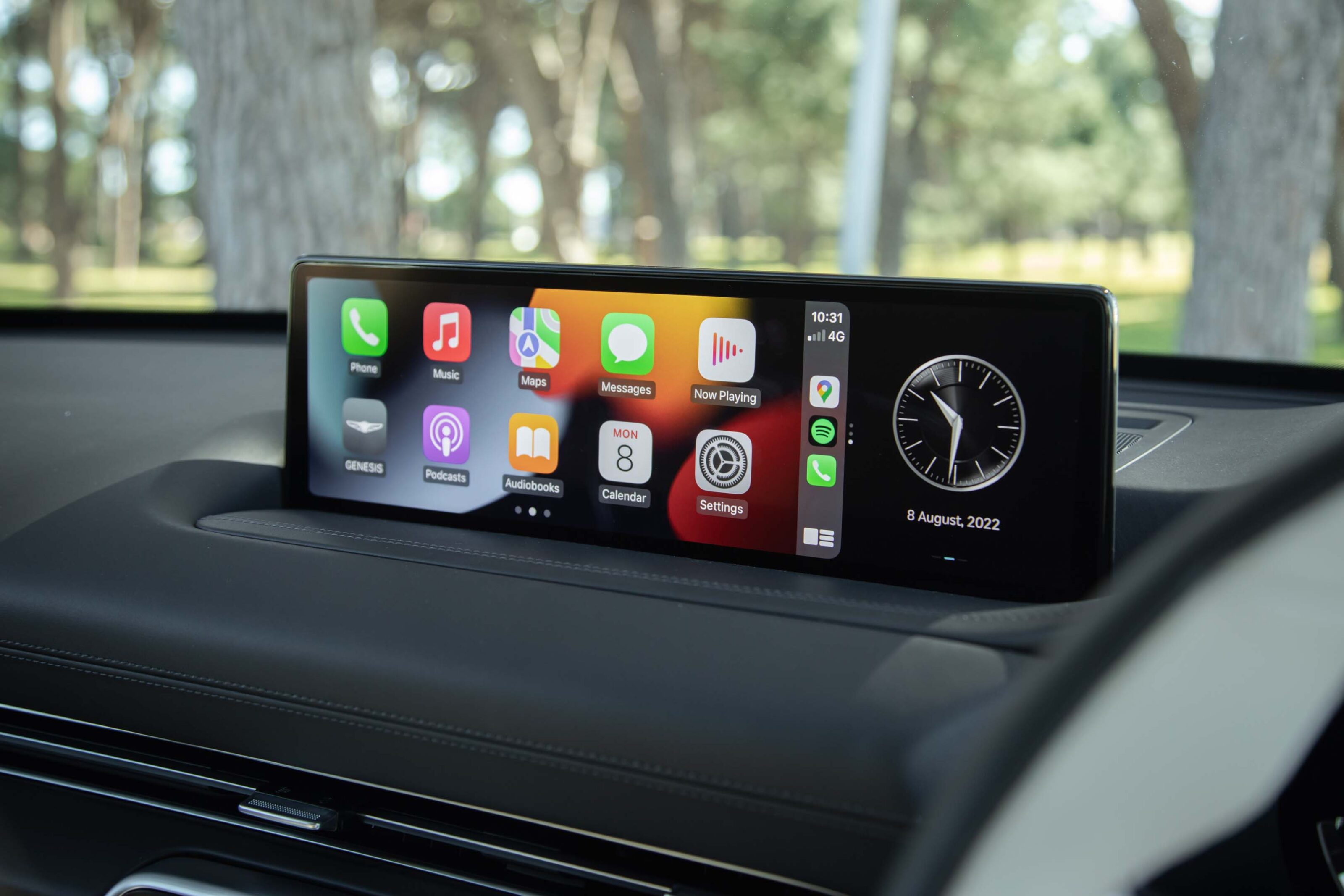
A 14.5-inch screen runs Genesis’ own media and vehicle settings software in a fairly sober scheme that is a cross between BMW’s iDrive tiles and the old Mercedes-Benz Comand interface.
It has the obligatory DAB+ digital radio, along with Apple CarPlay and Android Auto, both wired (only low-spec Hyundai models with the smaller screens have wireless – it’s baffling and related to supplier issues), and it’s all very crisp and clear. It’s fantastic to use and easy to navigate, and the Luxury Pack fitted to the model tested here adds a very impressive augmented reality sat-nav display.
The system is easy to use if you stick to using it as a touchscreen, which might be tough for those with shorter arms (which would be inconvenient if your pockets are deep enough to fork out for a GV80).
Joking aside, the easier-to-reach rotary controller in the centre console is oddly counterintuitive and I completely failed to gel with it. That could just have been me or the fact I just plugged in my phone and drove off most of the time.
Safety equipment
| 10 airbags (including for driveru2019s knee and a front-centre airbag to prevent head clashes in side impacts) |
| ABS and stability controls |
| blind-spot monitor |
| forward auto emergency braking (AEB) |
| rear AEB |
| forward collision warning |
| front cross-traffic alert |
| rear cross-traffic alert |
| driver attention detection |
| driver fatigue warning |
| lane departure warning |
| lane-keep assist |
| side exit warning |
| road sign recognition |
Genesis’ forward AEB covers both high and low speeds and features pedestrian detection. Unlike its Santa Fe relative, the curtain airbags reach all the way to the third row.
The furthest row does not have ISOFIX points or top tether anchors, whereas the middle row has two of the former and three of the latter in seven-seat versions.
The $13,500 six-seat Luxury Package – as fitted to this car – adds a hefty list of additions while deleting a seat to accommodate some of them.
Luxury Package
| Nappa leather with quilting |
| fully digital dashboard with 3D effect |
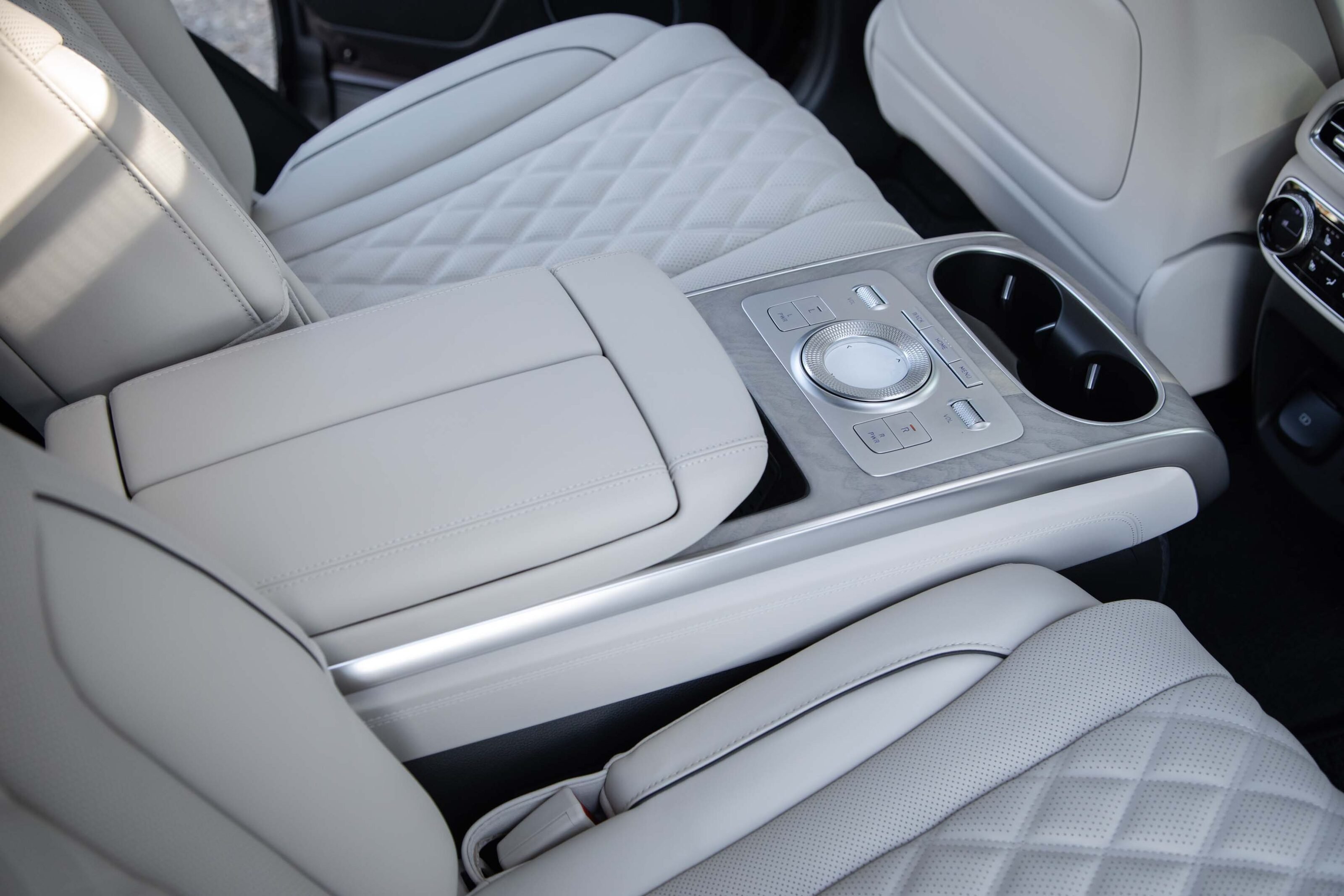
| chunky centre console in the rear with storage, cup holders and wireless phone charger |
| heated two-tone leather steering wheel |
| high beam with active shadowing |
| fake suede headlining |
| massaging front seats |
| heated and ventilated second row with recline function |
…and a few other bits and pieces. It’s a big headline number but it comes with a surprising amount of stuff – if you’re used to Euro pricing – so Genesis is kind of making it a no-brainer box to tick.
You can get all the same stuff but retain the seventh seat – while losing the luxurious rear console – for $10,000.
Three of the ten available colours are a whopping $2000 (Melbourne Grey, Matterhorn White, Brunswick Green), while the rest are freebies, which is comforting given the already six-figure price tag.
Comfort and space
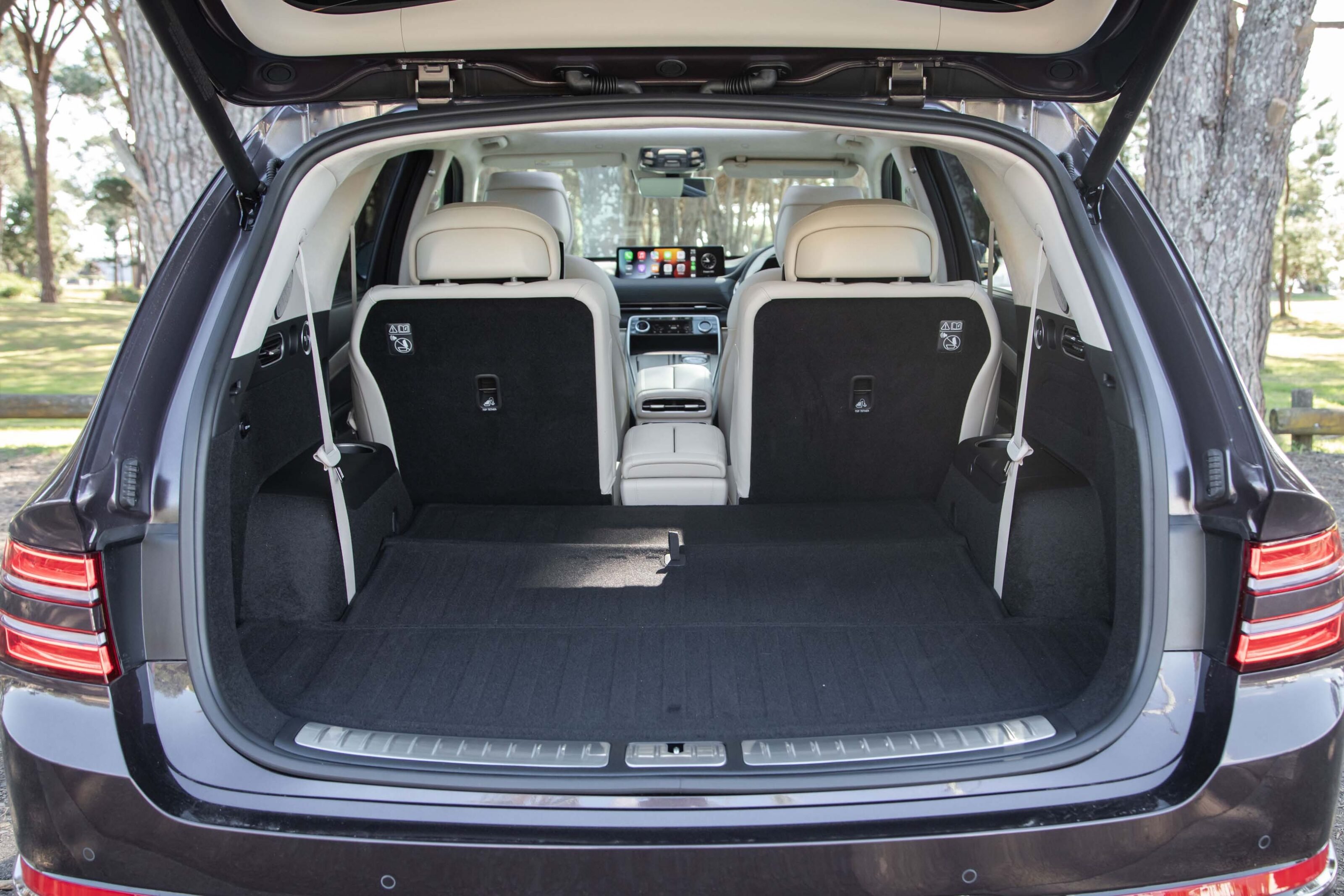
The GV80 is a lot of car and it looks like even more because it’s riding on huge 22-inch wheels with racy fastback styling. With all rows in play, there’s not much boot space; somewhere between 200 and 300 litres.
Electrical seat folding does what it says on the tin and with the 50:50 split-fold activated, delivers 727 litres of cargo capacity, which is probably handier than the actual third row.
With the second row folded (also electrically), you have 2144 litres available to you, although you might want to keep an eye on protecting the rear centre console if your GV80 is in six-seat format.
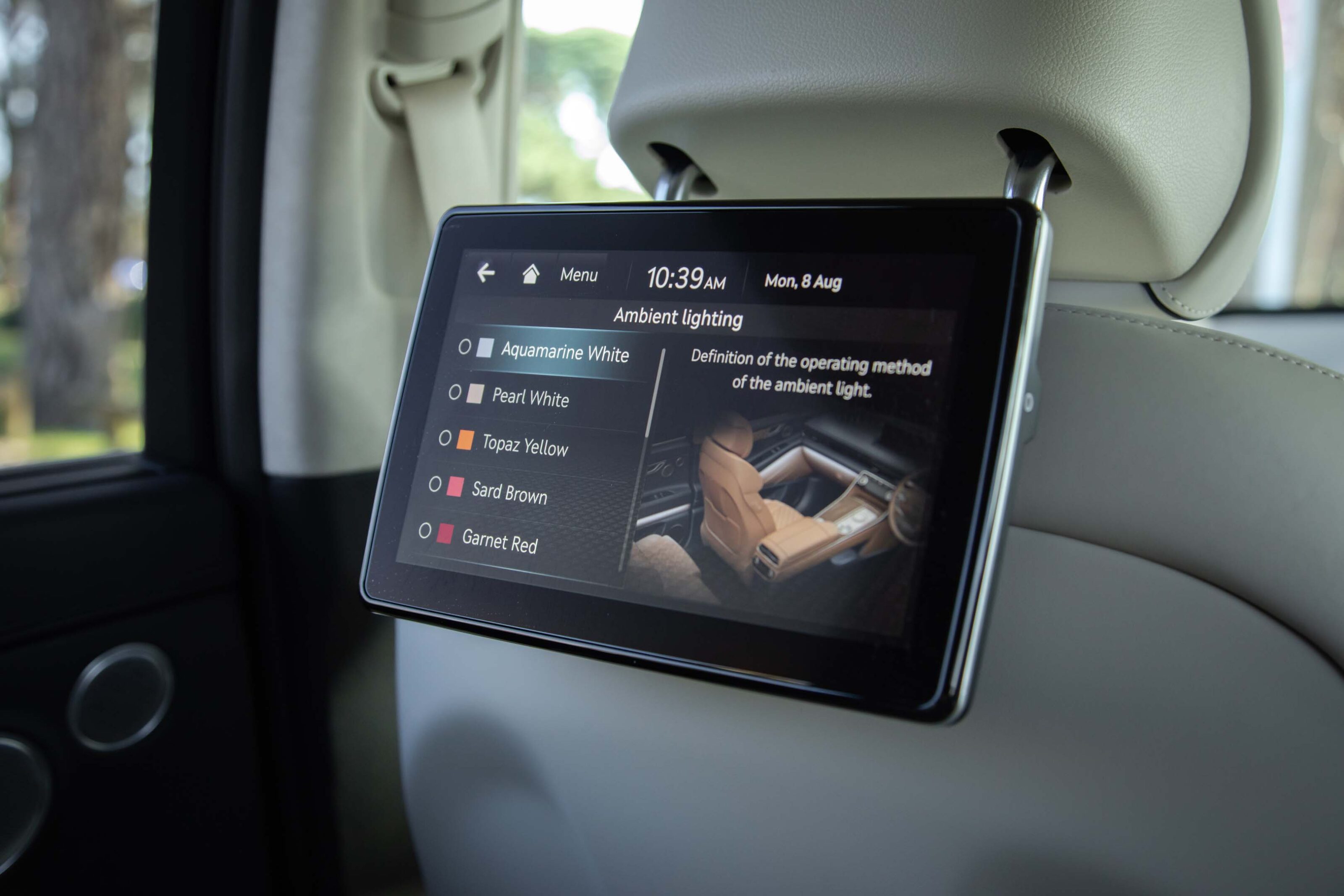
On that note, the 8.3-inch entertainment screens hanging off the front seats also tend to get in the way when you’re folding the seats either for third-row access or to create the biggest load area.
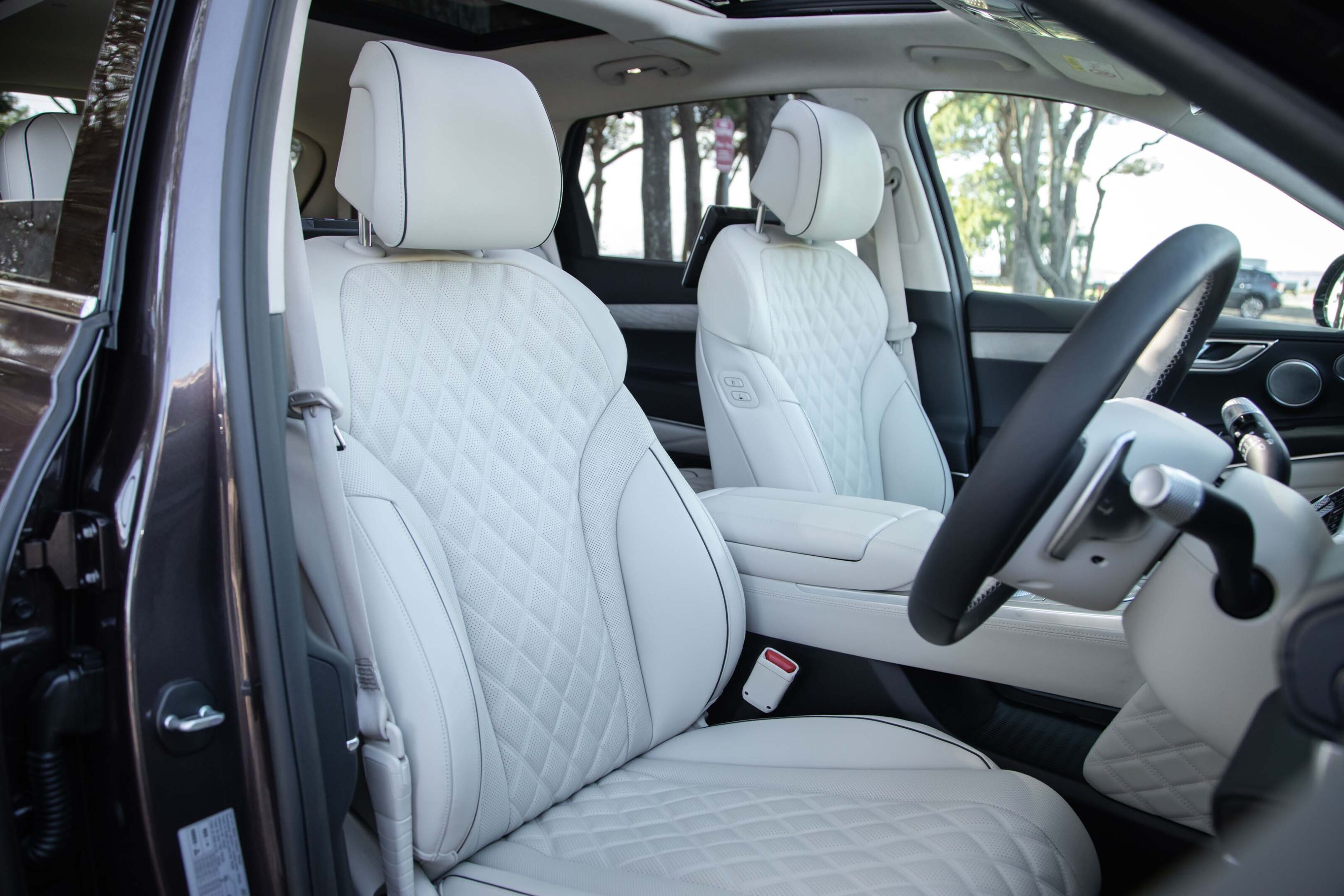
With all the seats in use, the third row will take two smaller humans.
There isn’t a great deal of headroom but some light does get through the window so it’s not too dark, but definitely an occasional-use-only proposition. You get cup holders and air vents and there’s even an intercom system between the front and rear seats so you don’t have to bellow.
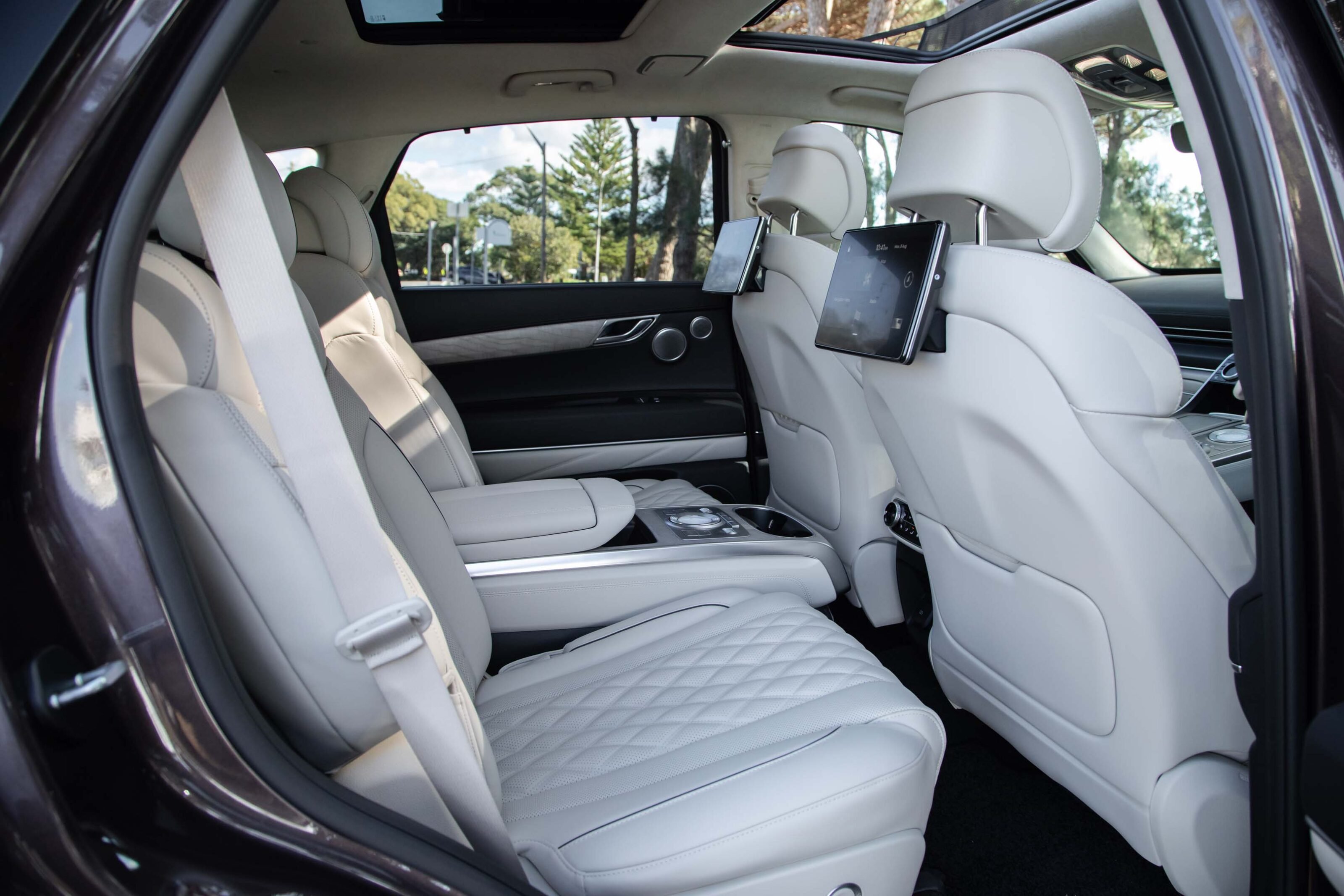
The middle row in the six-seater features two seats that are almost the same as the front seats. It’s not as roomy as you might expect for such a big car, but it’s still pretty impressive for knee and headroom. Foot room is a little limited if the front seat is all the way down but I can tell you that my wife and I had a picnic in the back and we were very comfortable.
For second-row passengers, the centre console has a similar set-up to that up front, with a storage bin covered by a two-piece leather-wrapped armrest, cup holders, another media controller and a wireless phone charger.
You also have your own climate controls and vents as well as window blinds. The seats are powered and heated, too. All that’s missing is the decadent massage functionality.
Being Hyundai’s version of Lexus, Genesis could have fallen into the trap of slipping in the odd familiar switch and screen here or there. While I’m sure there are common bits and pieces, there is absolutely nothing obvious to suggest the designers raided the Santa Fe/Palisade parts bin to keep costs under control.
Restrained use of colour, wood and textures creates a plush, luxury environment that you don’t always get in the Germans and only the new Lexus RX feels anything like this for similar money.
The Nappa leather feels genuinely expensive and the attention to detail around the cabin, even the suede-like headlining, absolutely lifts the GV80 into genuine luxury status.
On the road
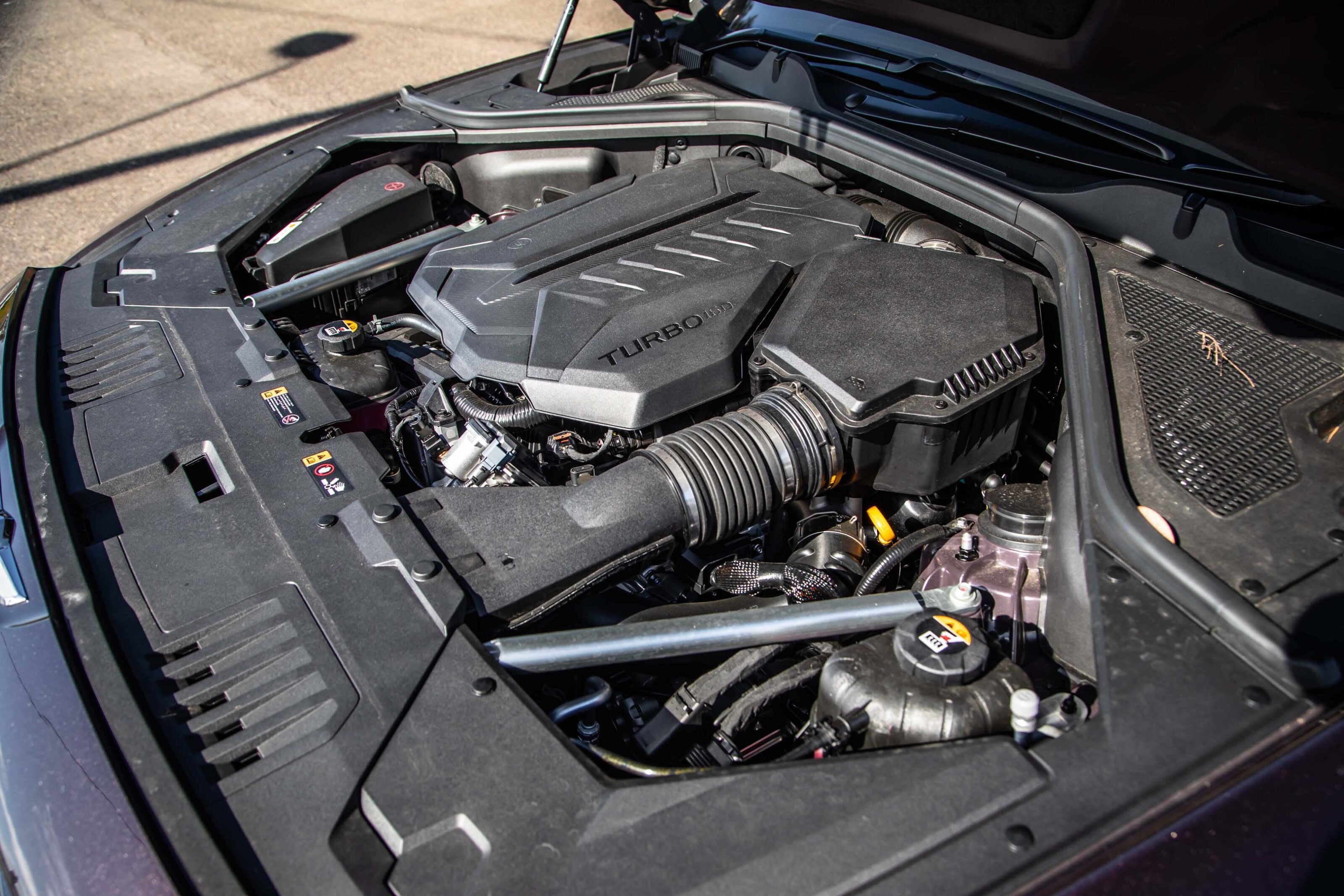
The 3.0d has a 3.0-litre turbo-diesel winding up for 204kW and a massive 588Nm, driving all four wheels via an eight-speed automatic transmission.
It’s the only diesel in the line-up, with a 2.5-litre turbo-petrol four in the two below and 3.5-litre twin-turbo petrol in the one above.
With those figures and even with 2267kg to shift, the diesel GV80 will hit 100km/h in 6.8 seconds, which isn’t hanging around. The all-wheel-drive system acts on-demand to save fuel but operates seamlessly.
The eight-speed transmission, operated by a rotary dial on the console, is almost faultlessly smooth, shifting easily between gears without drama.
That impressive torque figure probably helps create the overall impression of easy driving. It’s rare to catch the 3.0-litre off-boost and a quick downshift from the transmission has you on your regal way with a minimum of fuss.
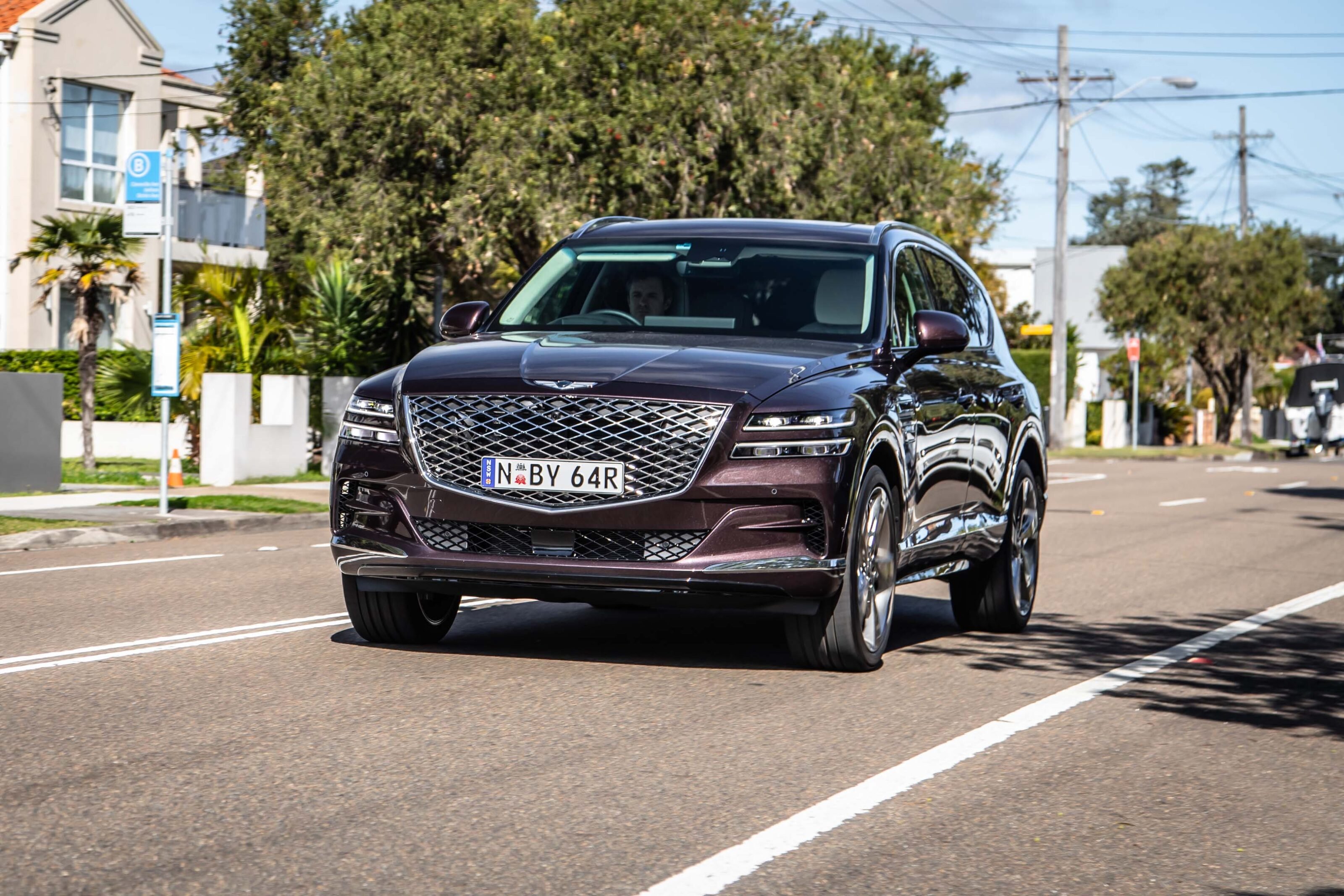
It’s a match for BMW’s straight-six turbodiesel and smoother than Audi’s 3.0 TDI. It also seems a long way away, with a distant diesel rumble that you’ll only hear under a floored throttle.
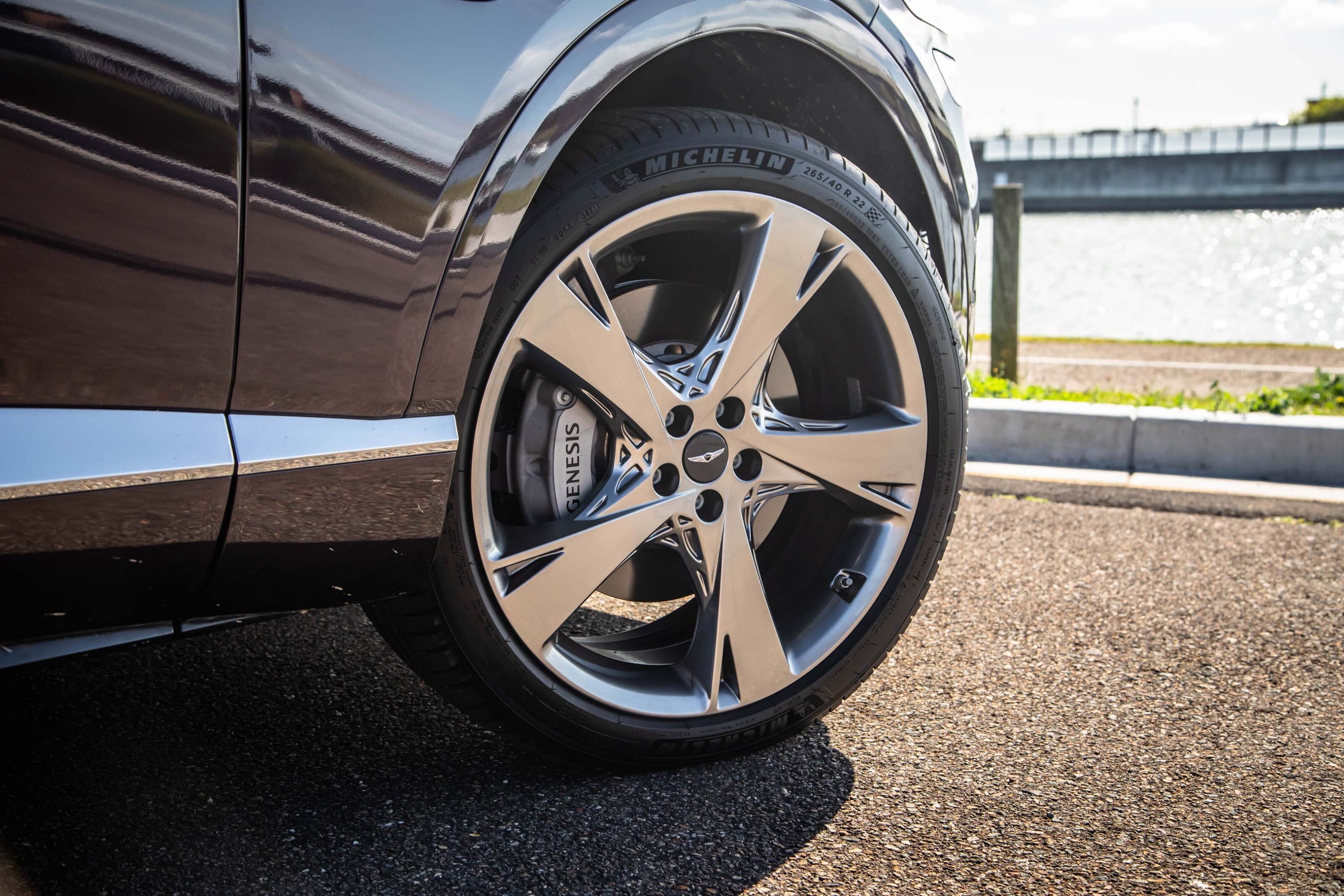
Despite riding on absolutely gigantic (and I’m sad to say, vulnerable) 22-inch alloys, the ride is mostly very good. The adaptive suspension – which Genesis says reads the road ahead and adjusts accordingly – is set to a more sporting attitude than, say, a Lexus.
And for me, that’s a plus because a high-riding heavyweight like this could roll around all over the place and feel less secure than it does. It can get unsettled on poor surfaces, though, which I put down largely to the huge wheels perhaps being not so well reined in by the suspension set-up.
The 2023 GV80 has a slightly different tune, so it will be interesting to see what that does.
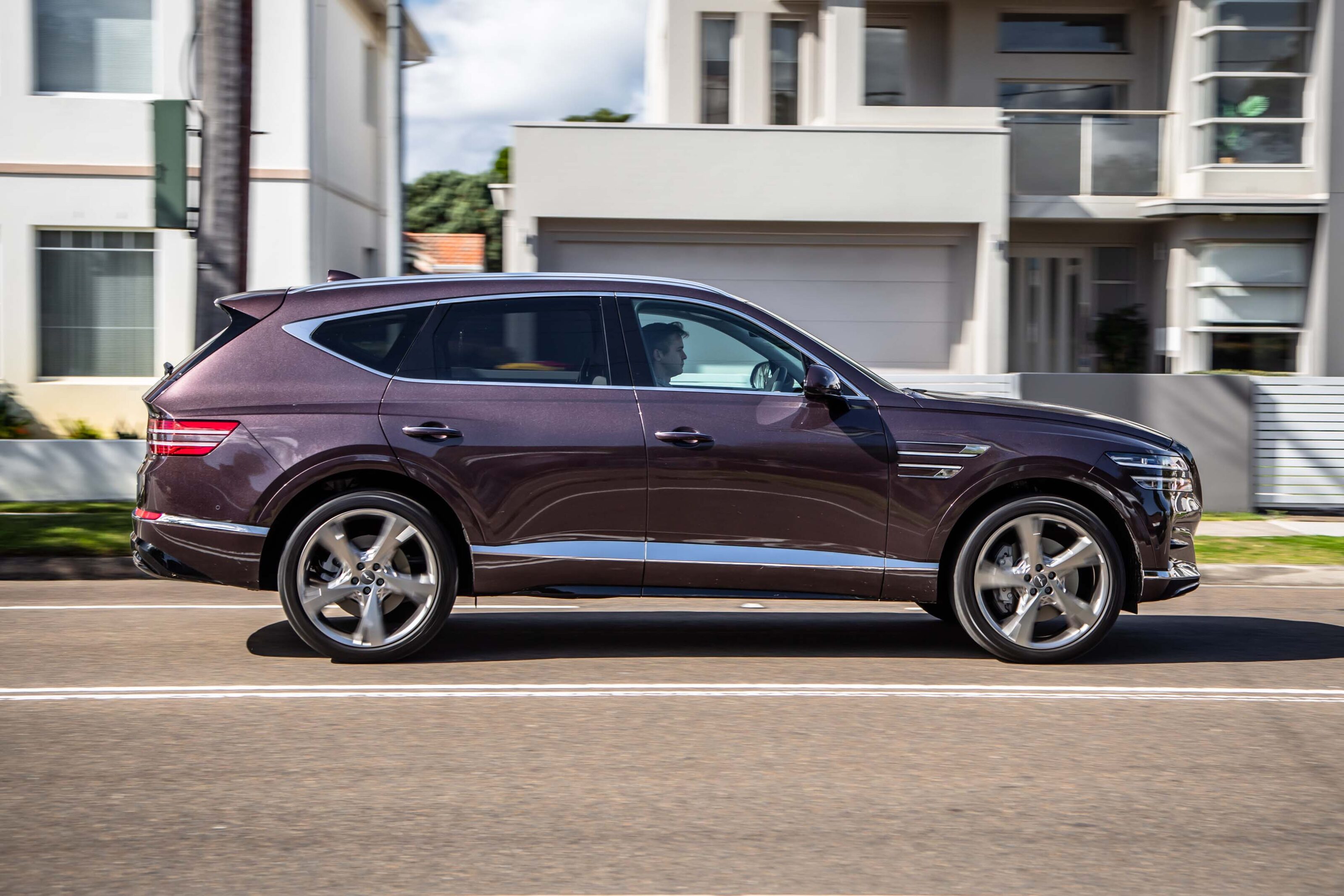
The GV80 is well-planted in corners, with the front end easy to place. The variable rack steering is transparent, too, with little to suggest when it has changed ratios.
In fact, it’s so good I had to check, and I had to be paying attention to realise that at parking speeds I wasn’t turning the chunky-rimmed wheel all that much.
I’d like to feel a bit more about what’s going on underneath the Michelin Pilot Sport 4 tyres, but it’s a genuinely good balance that will keep more people happy more of the time.
The gigantic brakes also build confidence, with four-piston calipers gripping 380mm discs up front and single-piston units at the rear, with 360mm discs. It’s a lot of braking power, which is obviously required for the sheer size and weight of the car let alone any occupants and cargo you might add.
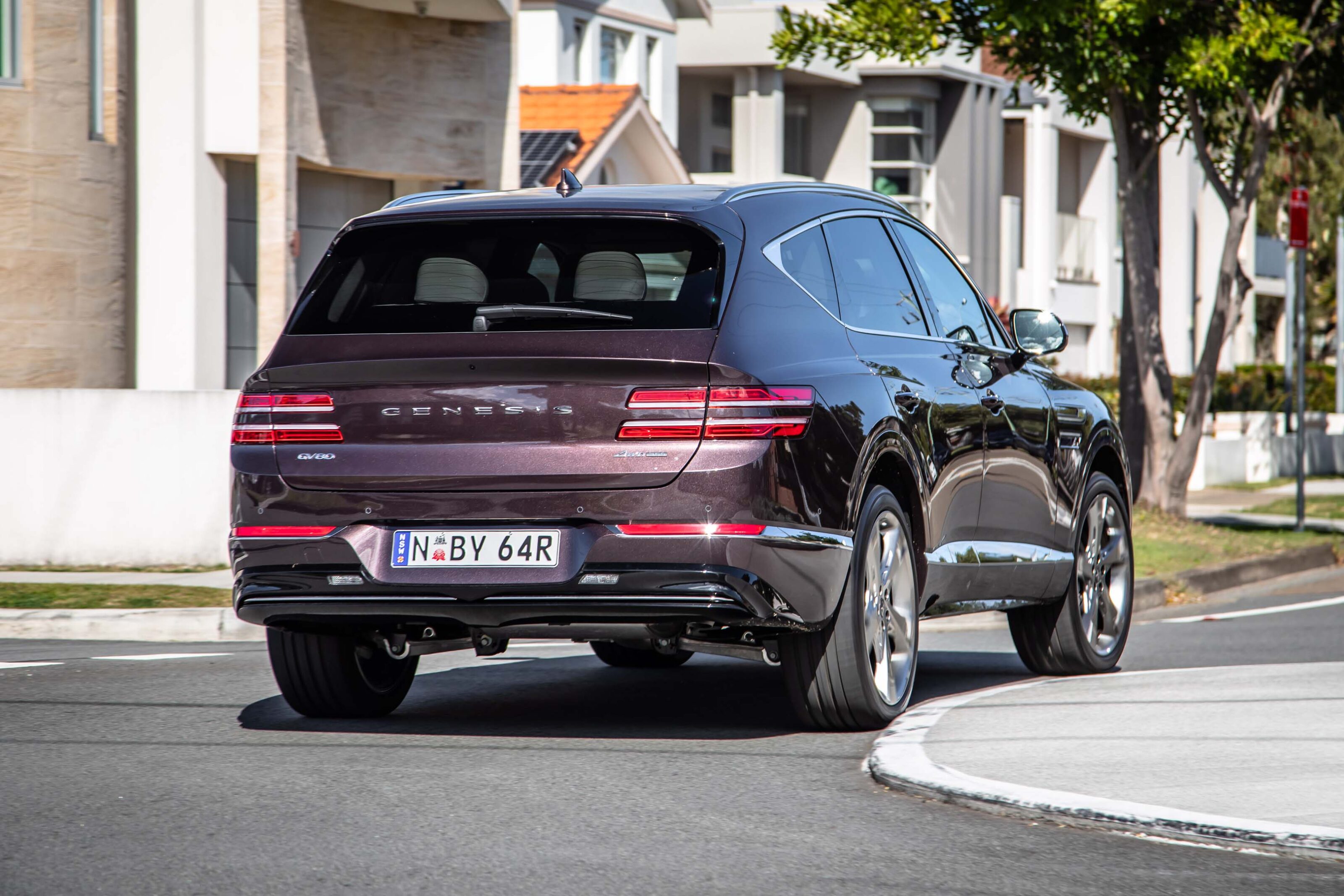
Out on the freeway, the GV80 is at its best. It belts along in serene quietness, with little of the outside world making it into the cabin. What does get through is filtered out by active noise cancelling, the whole cabin acting as a pair of those expensive headphones that get people run over/shouted at because they’re talking far too loudly.
Given its size, this is not the easiest car to live with in the city, but that’s what you get with a full-size seven-seater. The cameras take the sting out of the size, though, as does the park assist functionality.
Fuel use
According to Genesis, the GV80 diesel will use 8.8L/100km and, at the risk of invoking the brand’s parent company Hyundai, the 8.9L/100km I got is indicative of a company that does a good job of delivering a real-world figure on its ADR testing.
Ownership
Genesis offers a five-year, unlimited-kilometre warranty that matches most premium brands and, of course, clobbers BMW’s three-year warranty. You also get five years of roadside assist.
Servicing is free for the first five years or 50,000km, which is mighty impressive if a bit on the short side for the mileage. On top of that, someone will come and fetch the car in another Genesis and leave it with you for the day while your car is being serviced.
VERDICT
The Genesis GV80 feels absolutely like its own thing, a creation apart from its more mainstream parent brand.
Taking aim at established brands and going after their cash cows is not something you do in a half-baked way. Well, you can, but it will end badly. The last decade of quality pouring out of Hyundai and now Genesis shows that there is no more half-baked.
And the GV80 is a belter of a car. It feels like it belongs up there with the luxury players. It’s smooth, quick, fantastic to look at and delivers in the cabin as well as in aftersales. Plenty of its owners will be KPI smashers and the car smashes luxury KPIs.
With more to come from the brand in the form of electrification, Genesis is giving you more reasons to stray from the establishment.
2022 Genesis GV80 3.0d Luxury Package specifications
The Ford Ranger came with the big build up, so we get behind the wheel of the latest and greatest from Ford Australia to see if it can live up to the hype.
We also drive a prototype version of the forthcoming Ranger Raptor – because when Ford invites you to a desert playground to put one through its paces, you’d have to have taken leave of your senses to say no.

But we get it. Utes aren’t for everyone.
According to the VFACTS data, there are still five or six of you out there who prefer passenger cars, and do we have an issue for you!
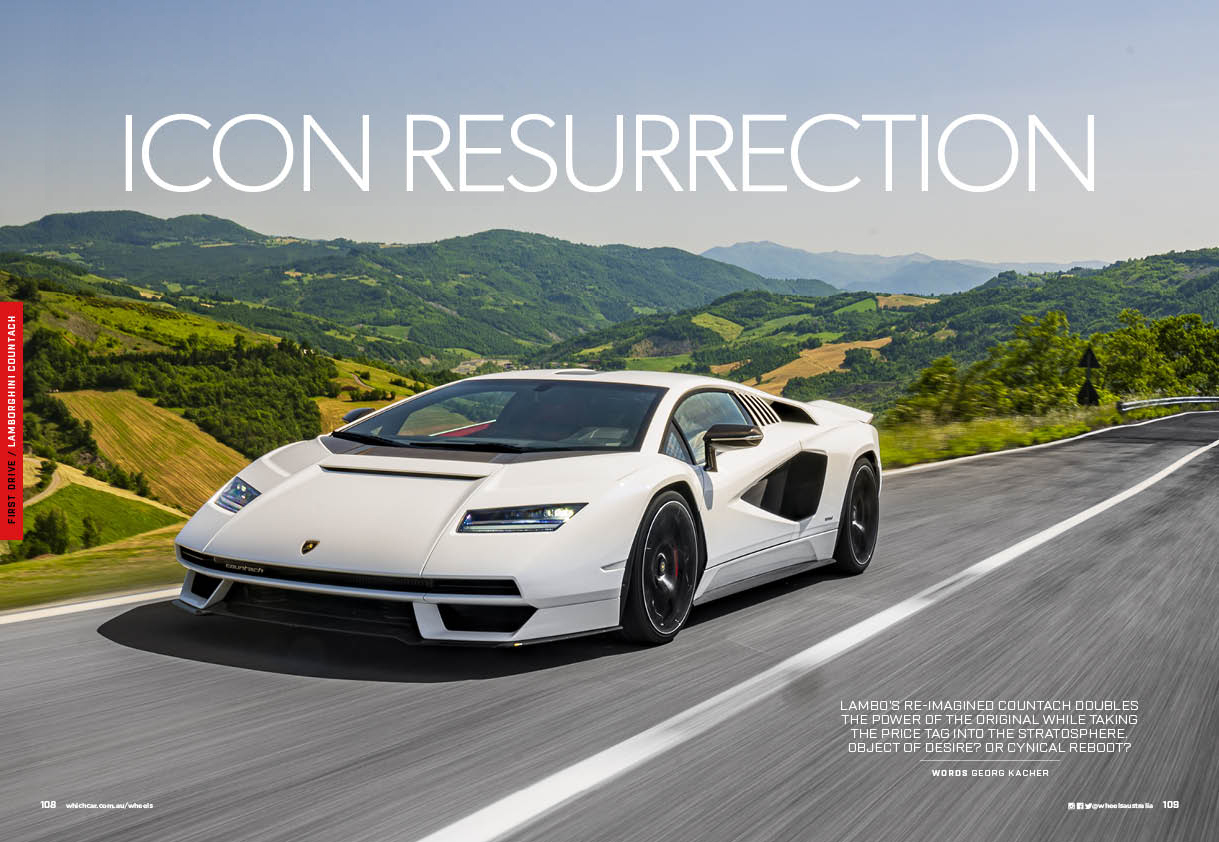
We lever 6’7” Georg Kacher into the new Lamborghini Countach and set him loose on Italian roads. Daniel Gardner’s been off to South Korea to drive the next instalment in Hyundai’s bid for world domination: the slinky Ioniq 6 streamliner.

There’s also the run down on the Kia Niro, the Mercedes-AMG EQE 53 and BMW’s 220i coupe.
Kirby gets to drive every generation of Audi’s stonking RS6 back-to-back and we put the new 300 Series Toyota Landcruiser up against its cousin from Lexus, the LX600.
Elsewhere we pit the Corvette C8 against the best of its European rivals, Ferlazzo talks paint, Dylan Campbell’s getting into steer-by-wire tech and Andy Enright takes a look at two very different cars: the classic Mercedes R107 SL and the astonishing Hyundai N Vision 74.
It’ll be on shelves from August 22nd, or you can subscribe here from just $59. Well, what are you waiting for?
Not yet a subscriber?
You can subscribe to Wheels magazine from only $59 and we’ll send you a copy of the current issue straight away.Subscriber benefits include:*
- Huge savings on the regular cover price• Free delivery to your doorstep
- Free digital access
- Browse the entire Wheels archive back to 1953
- Exclusive benefits and discounts

Porsche’s next new electric model, the upcoming electric 2023 Porsche Macan, has been visualised in a set of new renderings for Wheels.
Coming as a follow-up to the hugely popular Taycan, Porsche’s first EV, the electric Macan will move the game forward by adopting the company’s new Premium Platform Electric (PPE) architecture.
As reported below, the all-electric Macan will be sold alongside regular petrol versions of the next-generation Macan, before eventually transitioning to an electric-only offering.
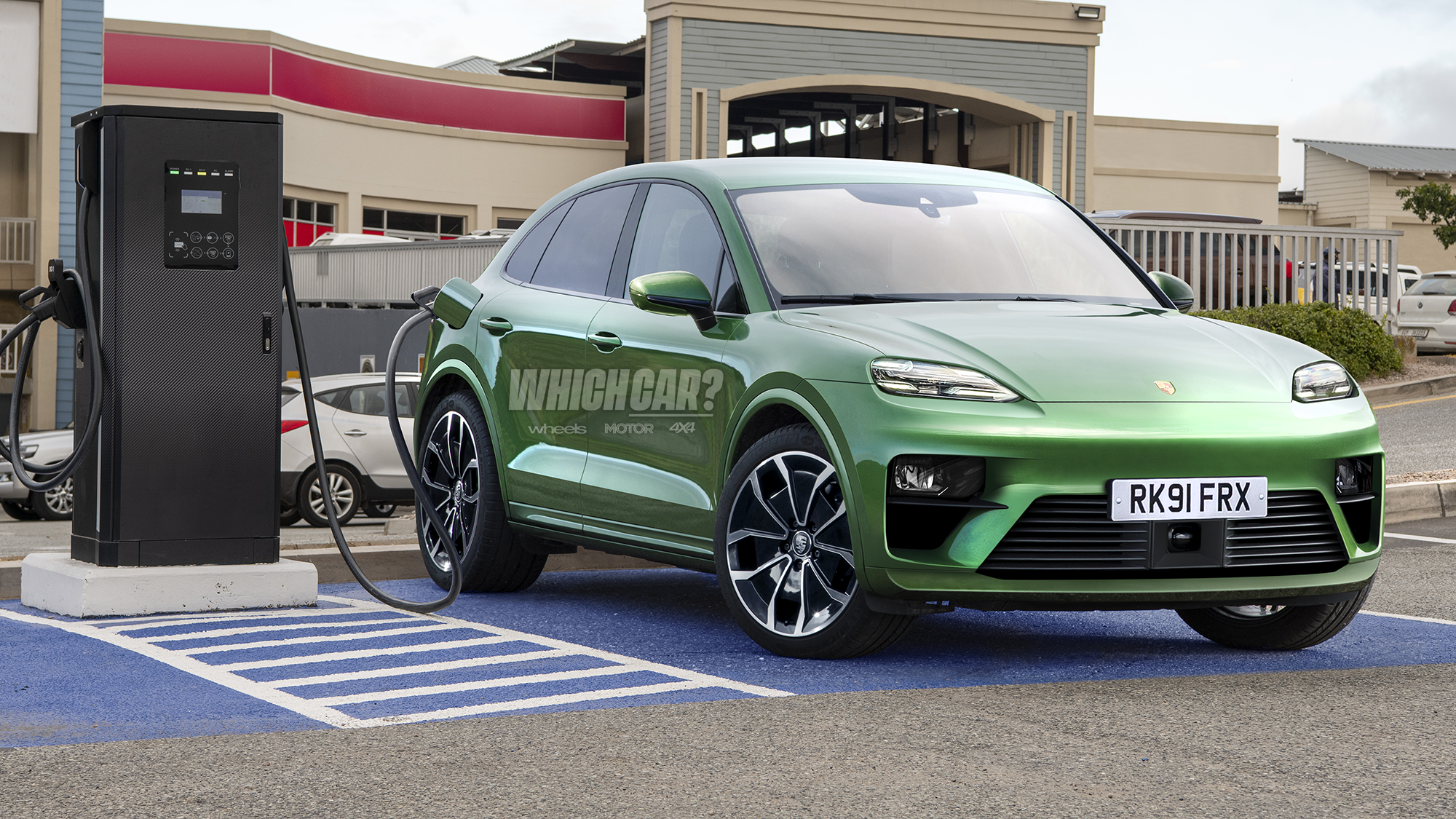
On the styling front, the electric Macan will take its cues from the Taycan up front, with a slender new headlight design the most obvious change.
At the rear, a streamlined lightbar design, again borrowed from the Taycan is also expected.
The launch of the EV will also debut the long anticipated ‘coupe’ body style for the Macan, following in the treads of the larger Cayenne Coupe. We can likely expect this shape to be available with the regular Macan models too – which might also stick with a more familiar headlight design.
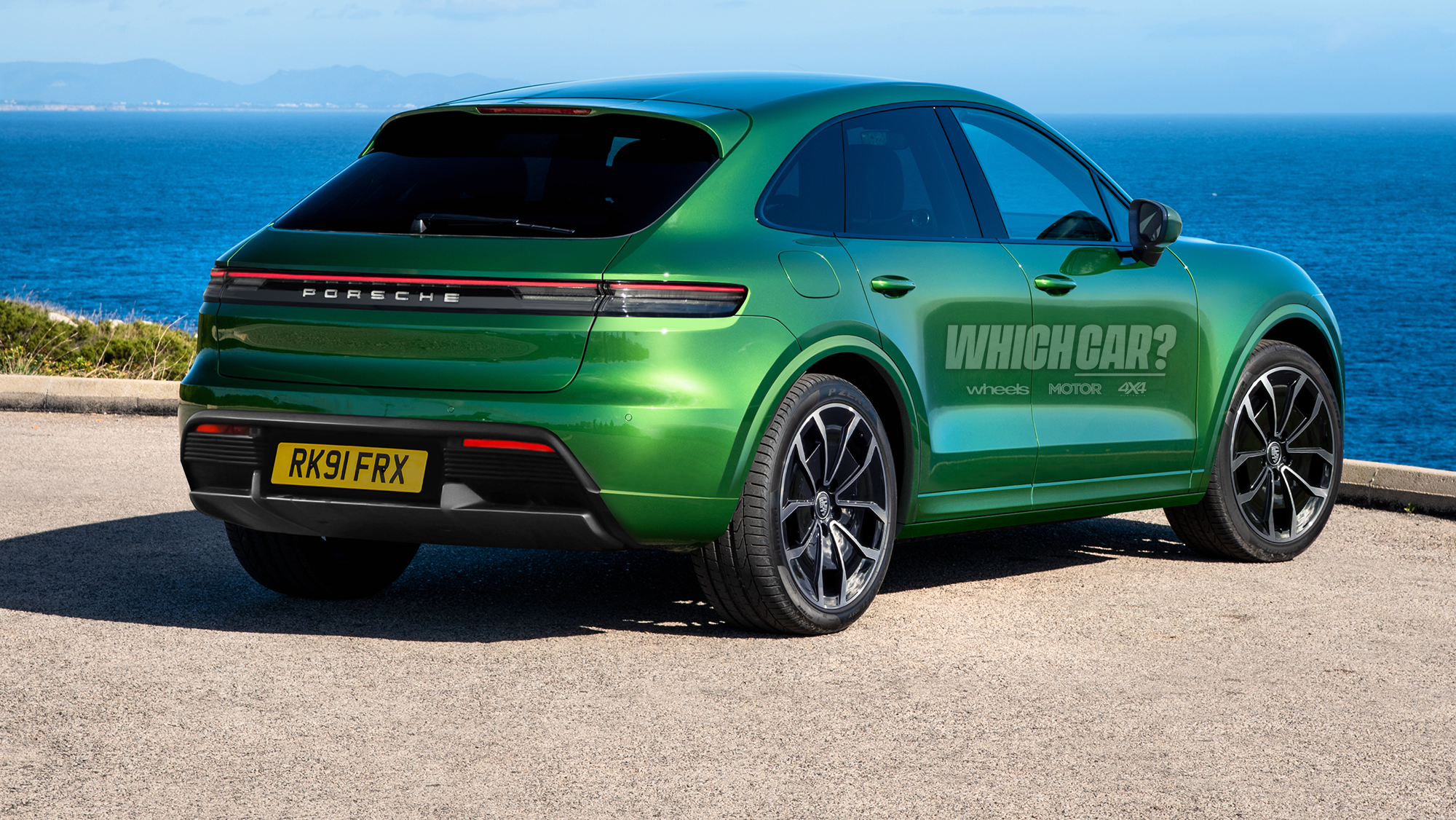
What do you think of our take on the new electric Macan’s look? Tell us in the comments below.
The story to here
Snapshot
- Electric Macan to be sold alongside petrol model
- Better than 500 kilometres of driving range
- Upwards of 400kW of power
July 4, 2021: New electric Macan spied testing
The next-generation, all-electric Porsche Macan has been spied testing again this week, appearing in just the latest of a long-running set of prototype spy photos.
While these images of the exterior reveal nothing new – Porsche itself has shown the new Macan in this same level of camouflage – we do now have a first look at its interior.

It’s unclear how much of the interior we see here is a final production design, and certainly the digital display behind the steering wheel looks to be a development unit for prototyping – but it’s clear we can expect more screens and fewer of the buttons normally positioned on the outside edges of the centre console.
The model shown here looks vaguely like a ‘coupe’ model, but Porsche has previously confirmed it will offer no further models like the Cayenne Coupe – which means the next Macan will simply have a more tapered roofline than the current wagon-themed Macan.

More than any other element, Taycan-inspired headlights set the new model apart from its petrol-powered predecessor – which is expected to continue for a while into the new Macan’s lifestyle, albeit in a dramatically updated form to keep it fresh.
The new Macan will be built the ‘Premium Platform Electric’ architecture developed together with Audi – unlike the J1 platform that underpins the Taycan and E-Tron GT.
Engineering chief Dr Michael Steiner describes PPE as a crucial piece that can better accommodate high-riding models. (Which might explain why the Taycan Cross Turismo is only a little jacked up…)

Speaking with Wheels partner Car in the UK, Dr Steiner said: “PPE is totally different from the Taycan. Taycan was designed for cars sitting low on the road. PPE will be used by Macan and other high-floor cars – there could be further derivatives in the SUV range. It is totally new. The Macan will go all the way up to Turbo and Turbo S levels of performance.”
Porsche has hinted at outputs upwards of 400kW, with a driving range beyond the 484 kilometres claimed by the rear-wheel-drive version of the Taycan.
Rear- and all-wheel-drive variants will be available, and as with most EVs, buyers should expect more power potential in the AWD forms and longer driving ranges in the RWD variants.

When will the electric Porsche Macan come to Australia?
Specific launch timing for the electric Macan is still to be revealed, although the company has said we can expect the global sales process to kick off in 2023.
Australian Porsche buyers rarely have a long wait, so whatever the final timing, we should expect to see it here not long after the European debut.
As for pricing, we might expect the entry-level electric Macan to kick off around the $170,000 to $180,000 mark – placing it a little below the electric Taycan’s base price. By comparison, the Audi E-Tron SUV begins at $137,100 in Australia and tops out at $169,950.
One reason SUVs are so popular is the additional practicality they offer – and a big part of that practicality equation is how many kilos they can tow behind them.
While the following list shows the maximum towing capacities of different SUVs, it’s worth knowing that this doesn’t necessarily mean that is the actual weight you can tow as there are several other factors including the gross vehicle weight and maximum tow-ball weight.
Our story, Towing weights explained, covers this in more detail.
As a rule, if you want to tow anything bigger than a camper trailer, you’d want a vehicle with at least 2000kg braked towing capacity, which is the maximum towing weight with a trailer or caravan that has its own brakes.
As a guide, the Toyota LandCruiser Prado, a common choice among those who tow heavy loads, can lug up to 3000kg. Most dual-cab utes, like the Ford Ranger, can tow up to 3500kg braked.
Got a model in mind? Jump ahead!
- Ford Everest
- Hyundai Santa Fe
- Isuzu MU-X
- Jeep Grand Cherokee
- Kia Sorento
- Mazda CX-8
- Mazda CX-9
- Mitsubishi Pajero Sport
- Nissan Pathfinder
- Nissan Patrol
- Subaru Outback
- Toyota Fortuner
- Toyota Kluger
- Toyota LandCruiser Prado
- Toyota LandCruiser 300
- Genesis GV80
- BMW X5
- BMW X6
- BMW X7
- BMW iX
- Audi Q7
- Audi Q8
- Mercedes-Benz GLE
- Mercedes G-Class
- Volvo XC90
- Land Rover Defender
- Land Rover Discovery Sport
- Land Rover Discovery
- Range Rover
- LDV D90
- Ineos Grenadier
So how do the popular mainstream family SUVs stack up?
Ford Everest
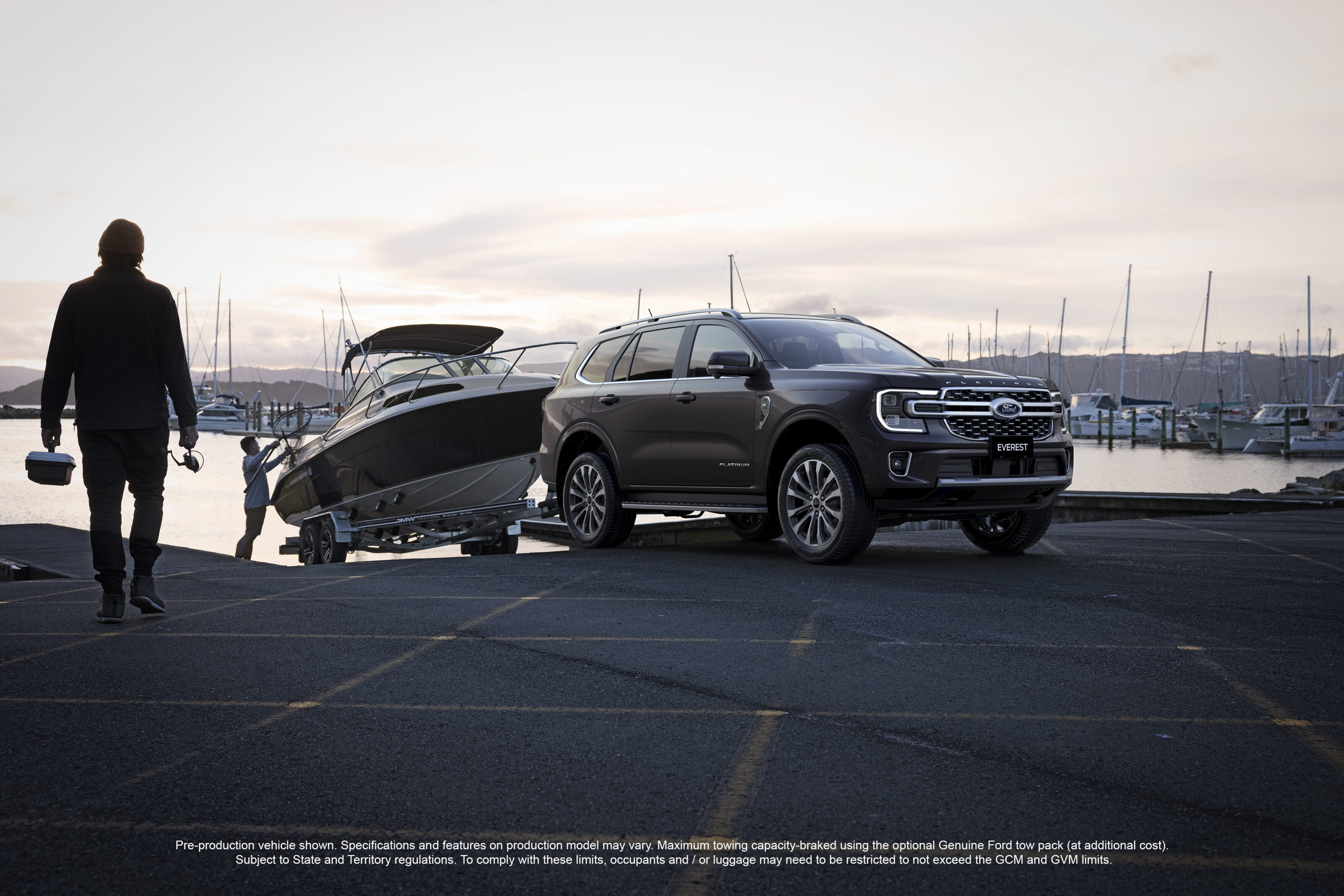
With a new Ranger comes a new Everest and a whole new set of figures. The rear-wheel drive Trend, all-wheel drive Trend and Sport are powered by a 2.0-litre twin-turbo diesel four with a ten-speed automatic. The thrifty four pumps out 154kW and 500Nm.
Stepping up to the Platinum you’ll find a 3.2-litre turbodiesel V6 (replacing the five-cylinder), also with a ten-speed automatic. The big banger spins up 184kW and 600Nm.
Either will tow 3500kg braked (up from 3000kg) while a trailer without brakes should max out at 750kg. The difference between the two is the slightly higher payload figure and therefore higher GVM and GCM of the six.
Hyundai Santa Fe
Hyundai’s seven-seat large SUV has a 2500kg braked towing capacity for both the 3.5-litre petrol V6 and 2.2-litre turbodiesel versions. The maximum towball down load is 200kg.
Isuzu MU-X
Like most other ladder-chassis ute-based SUVs, the MU-X can tow up to 3500kg in both 4×4 and 4×2 guises and comes standard with trailer stability control.
Maximum towball down load is 350kg.

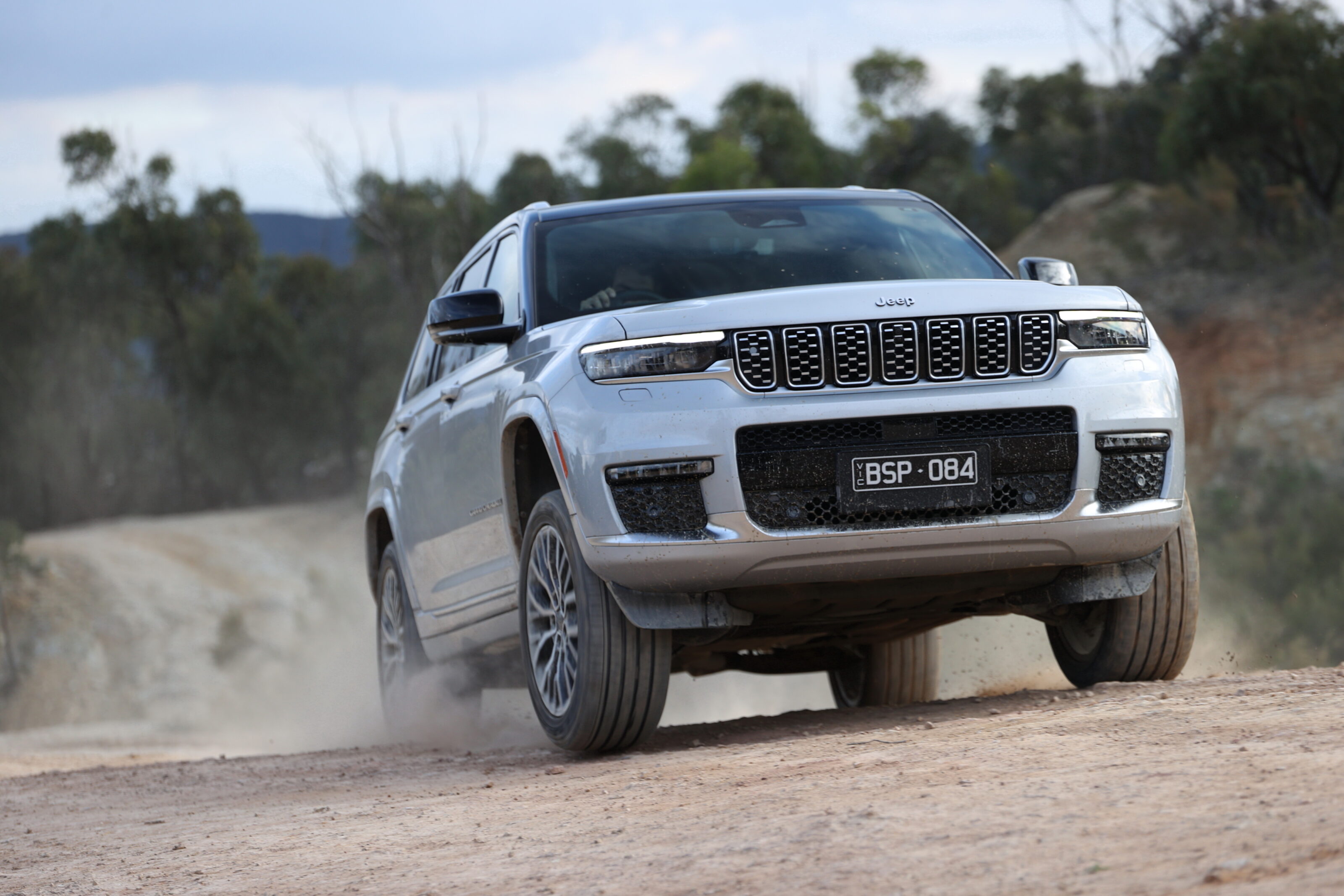
Jeep Grand Cherokee L
The new Grand Cherokee L is exclusively powered by a 3.5-litre Pentastar petrol V6. All grades except the Summit Reserve can pull 2800kg with a braked strailer. The top-of-the-range has air suspension so towing is down to 2240kg. Both will tow 750kg with an unbraked trailer.
With the release of the new Grand Cherokee L, the diesel motor has been dropped.
All versions have a maximum towball down load of 281kg.
Kia Sorento
All versions of the seven-seat Kia Sorento have a 2000kg braked towing capacity regardless of petrol or diesel drivetrains.
The Sorento’s maximum towball down load is 200kg.
Mazda CX-8
The diesel seven-seater has a 2000kg towing capacity and trailer stability control. The 2.5-litre petrol is slightly less capable at 1800kg.
Maximum towball down load measures 150kg for the diesel and 150kg for the petrol.
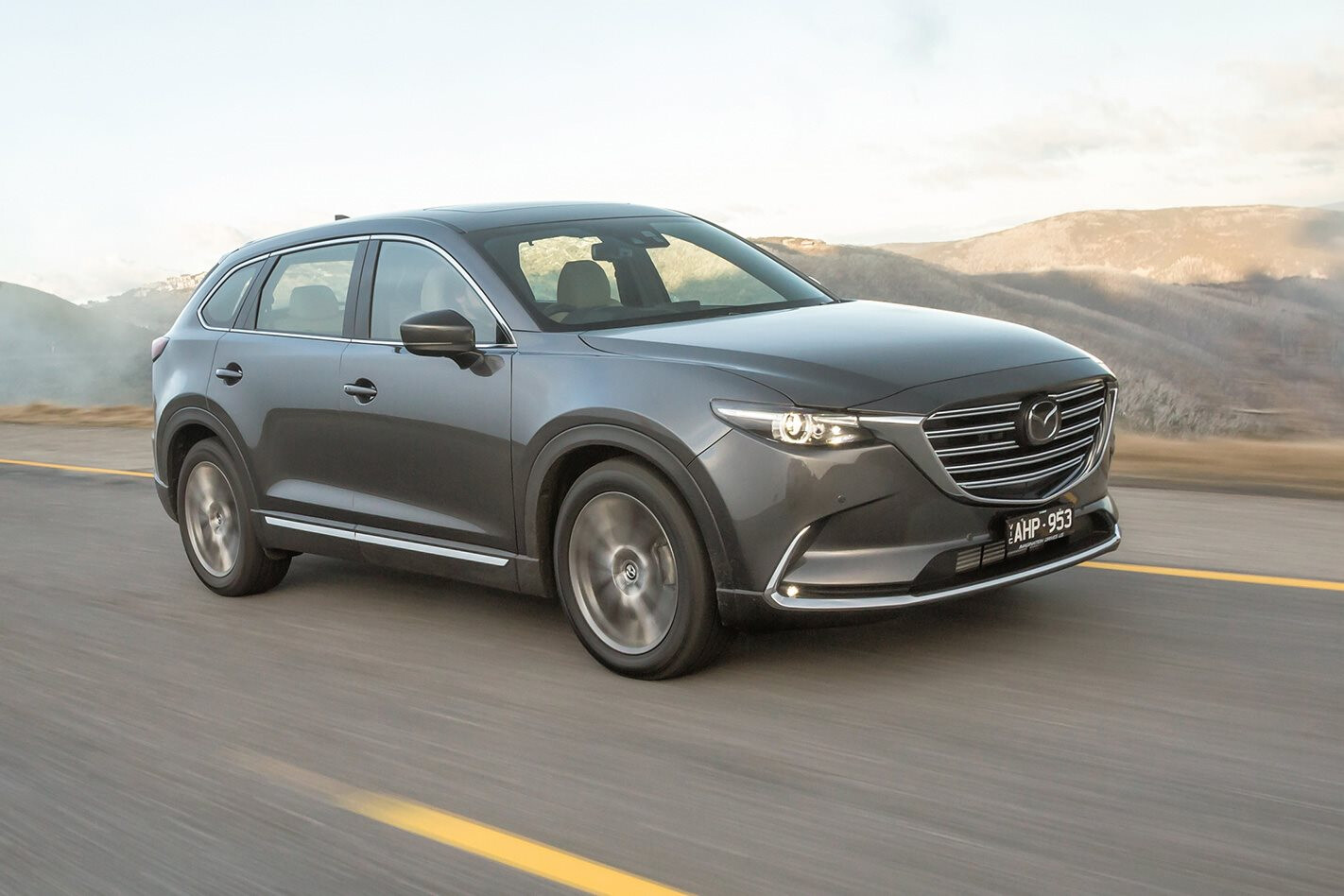
Mazda CX-9
Like the CX-8, Mazda’s SUV flagship has a 2000kg towing capacity and trailer stability control.
The towball download figure is 150kg and all figures are the same for the two and all-wheel drive versions.
Mitsubishi Pajero Sport
The Triton-ute based Pajero Sport has an excellent 3100kg braked towing capacity and trailer stability control.
The maximum towball download number is 310kg.
Nissan Pathfinder
The incoming new 2022 V6 petrol Pathfinders have a 2700kg braked towing capacity, and we’re yet to see a hybrid in the new car.
The towball down load maximum is 270kg.
Nissan Patrol
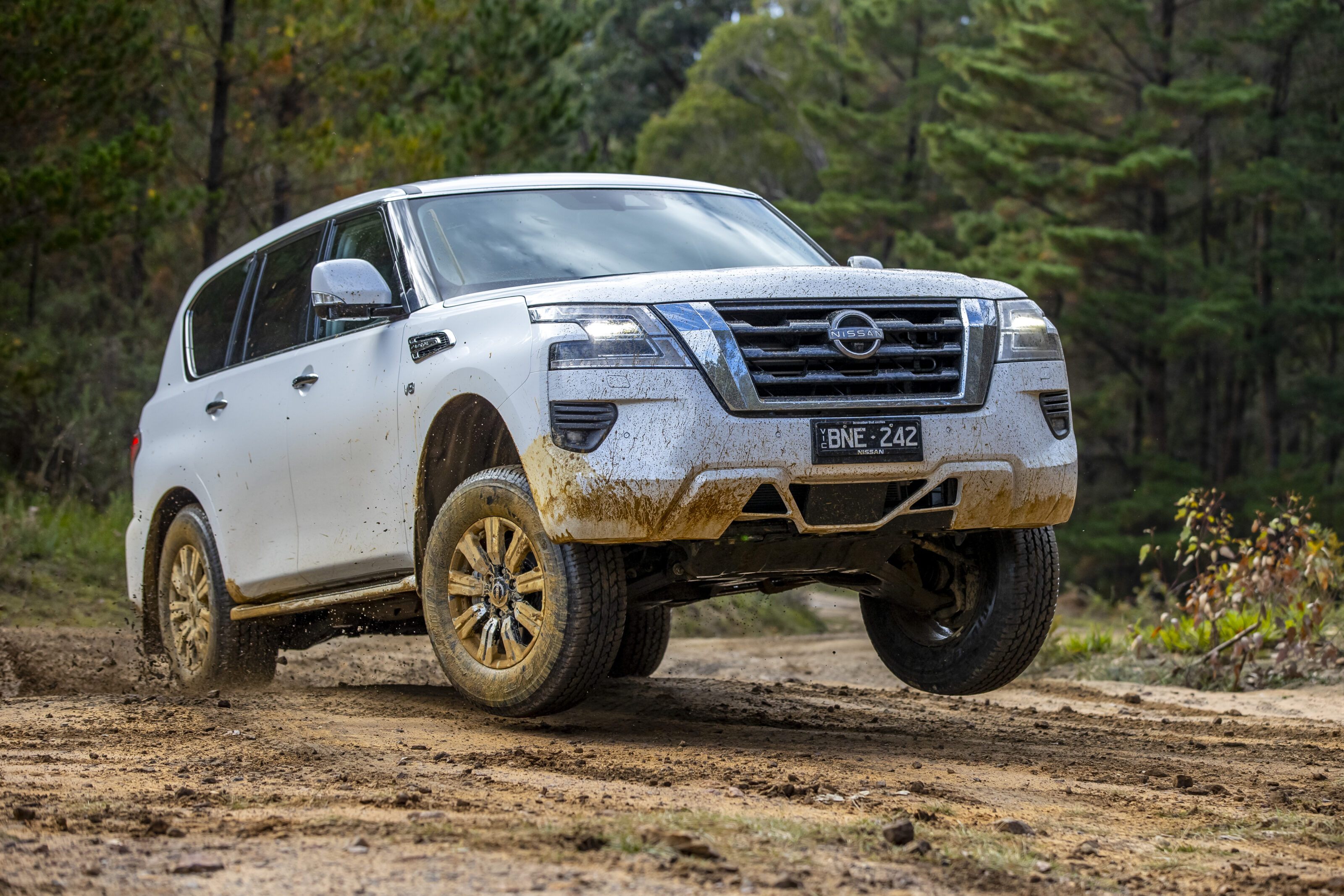
Nissan big 4X4 SUV has a 3500kg braked towing capacity, with pulling large loads made easier thanks to its big 5.6-litre V8 petrol engine. The highest load you should put on the towball is 350kg.
Subaru Outback
The car-based four-cylinder petrol Outbacks can tow 2000kg, up 500kg on the recently-replaced version. This figure is also 300kg more than the now-discontinued flat-six.
The maximum towball down load rating is 200kg.
Toyota Fortuner
The Hilux-based 4×4 now has a 3100kg braked towing capacity that’s handy but falls short of its main rivals such as the Ford Everest but matches the Mitsubishi Pajero Sport. Trailer stability control is standard.
The maximum towball down load figure is 280kg.
Toyota Kluger
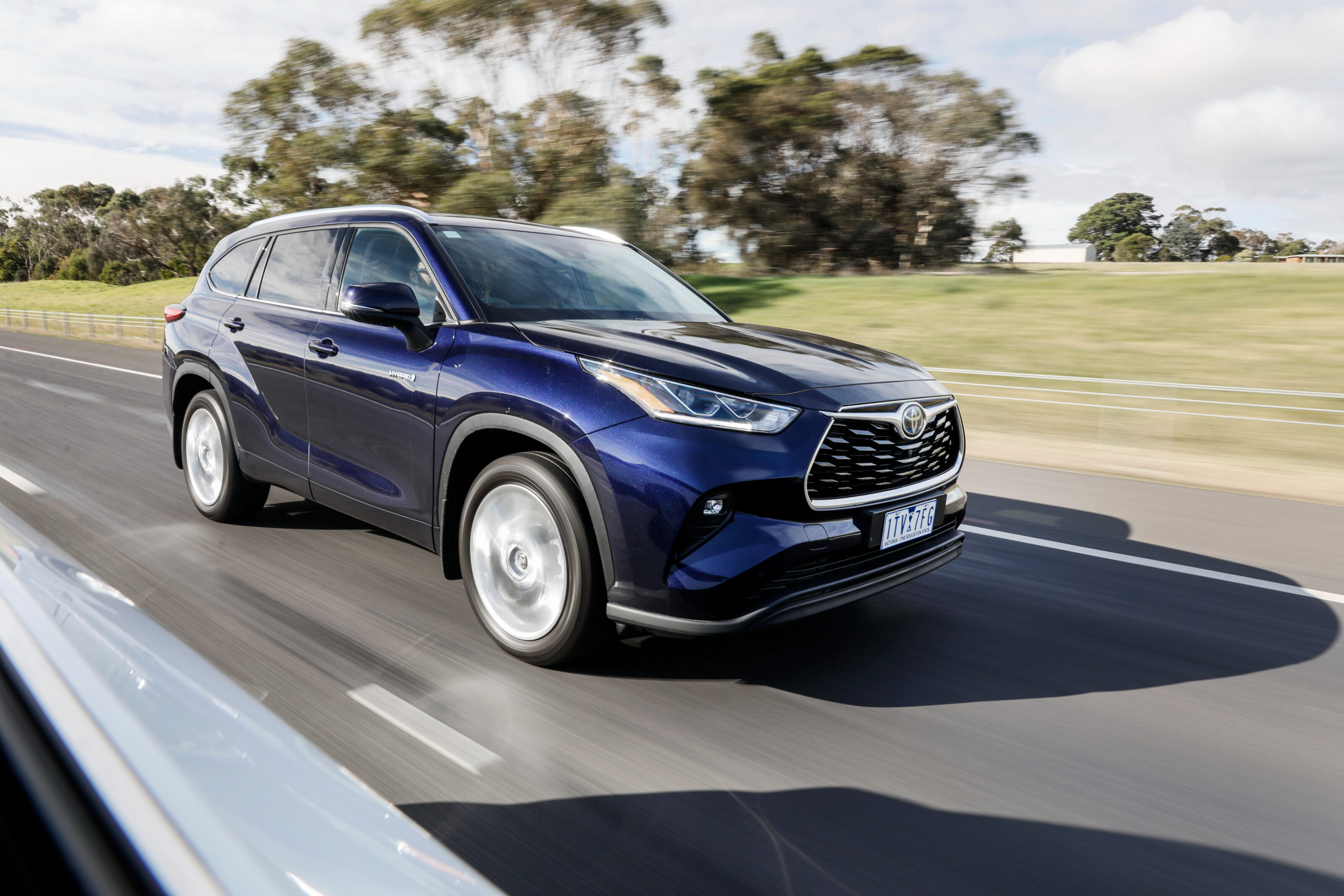
Toyota’s new-generation family-sized SUV has a choice of a four-cylinder hybrid AWD or 3.5-litre six-cylinder in both two and all-wheel drive. All versions have a 2000kg braked towing capacity.
The Kluger’s towball down load maximum is 200kg.
Why such a modest capacity for such a large vehicle? Put it down to the Kluger’s unibody construction, which can’t handle as much load as a more rugged ladder-frame chassis. Thankfully, Toyota has more tow-happy alternatives that fit the bill…
Toyota LandCruiser Prado
Australia’s biggest selling large SUV has braked towing capacities of 2500kg and 3000kg for the manual and automatic versions respectively, with towing made safer with trailer stability control.
The maximum towball downball limit is 250kg for the manual and 300kg for the automatic.
Toyota LandCruiser 300
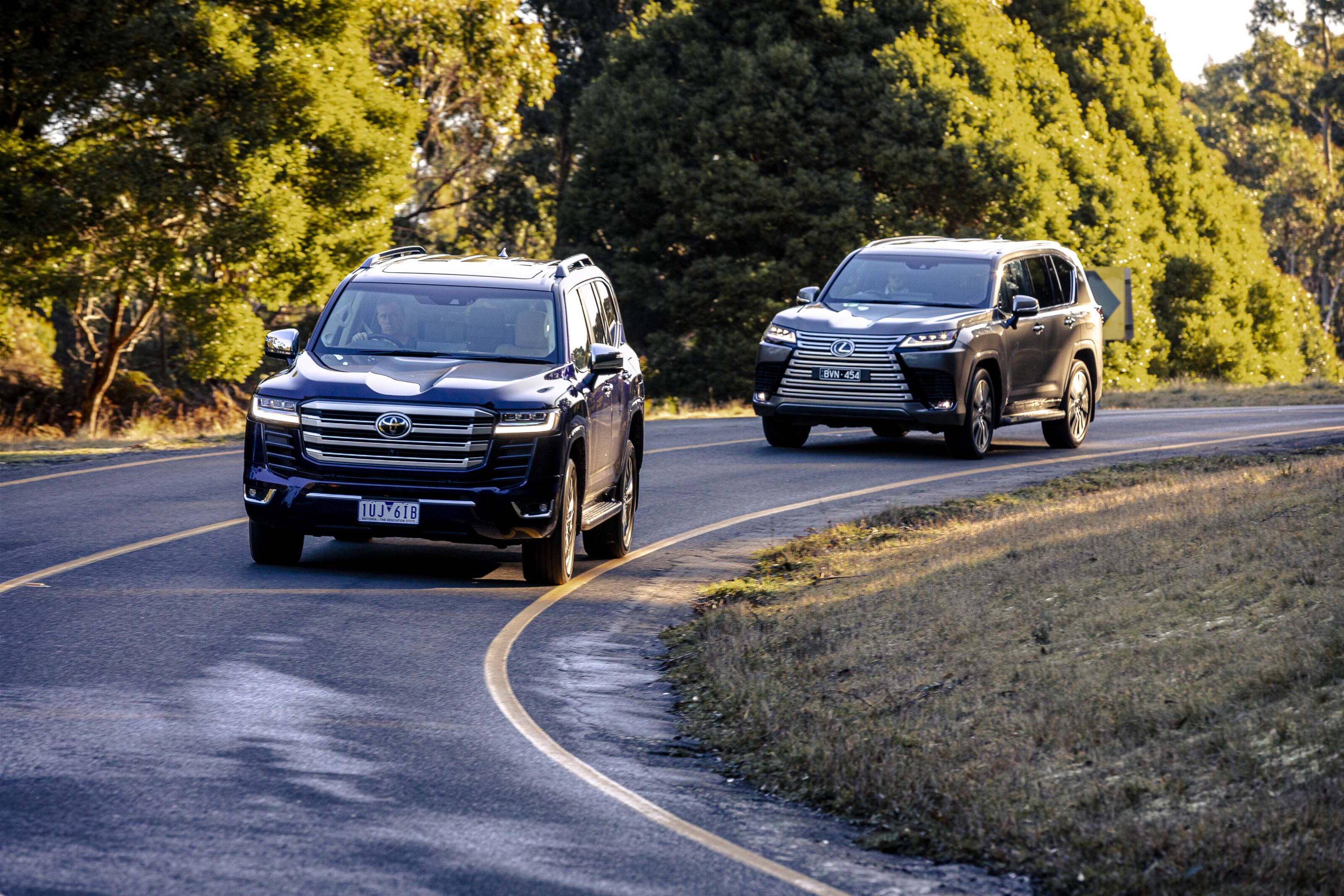
Like its main rival the Nissan Patrol, the Landcruiser 300 wagons are rated to tow a 3500kg braked trailer. Unlike the petrol-only Patrol, the 300-series Landcruiser can be had with a grunty – yet thrifty – turbo diesel V6 for even better long-distance towing capability.
The 300’s maximum towball down load limit is 350kg.
Genesis GV80
Hyundai’s premium brand Genesis includes a large SUV called the GV80. The twin-turbo 3.5-litre V6, 3.0-litre turbodiesel and 2.5-litre turbo four will each pull 2722kg.
The maximum towball down load is 182kg.
BMW X5
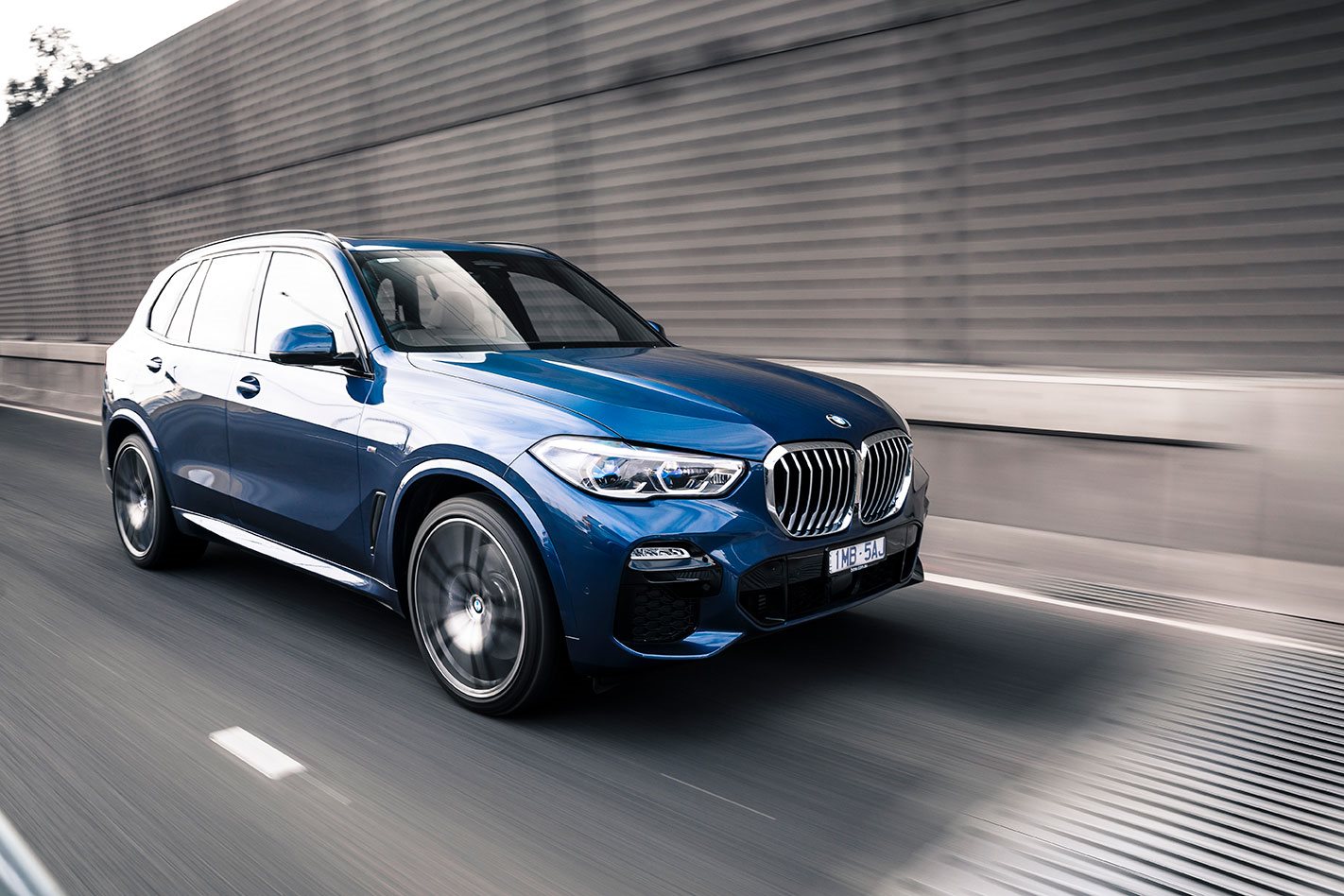
BMW’s first SAV – sport activity vehicle – the X5 is still going strong. The big Beemer can tow 2800kg braked with a maximum towball down load of 140kg. These figures apply to all versions.
BMW X6
The X6 mirrors the X5’s 2800kg towing capacity with a towball download of 140kg.
BMW X7
Munich’s biggest SUV, the X7, has a 2800kg towing capacity and a maximum towball down load of 100kg in petrol M50i form.
Step down to the xDrive30d and braked towing drops to 2200kg and towball down load rises to 140kg.
BMW iX
The first electric car to arrive on this list, the BMW iX can haul 2500kg with a maximum towball download of 100kg.
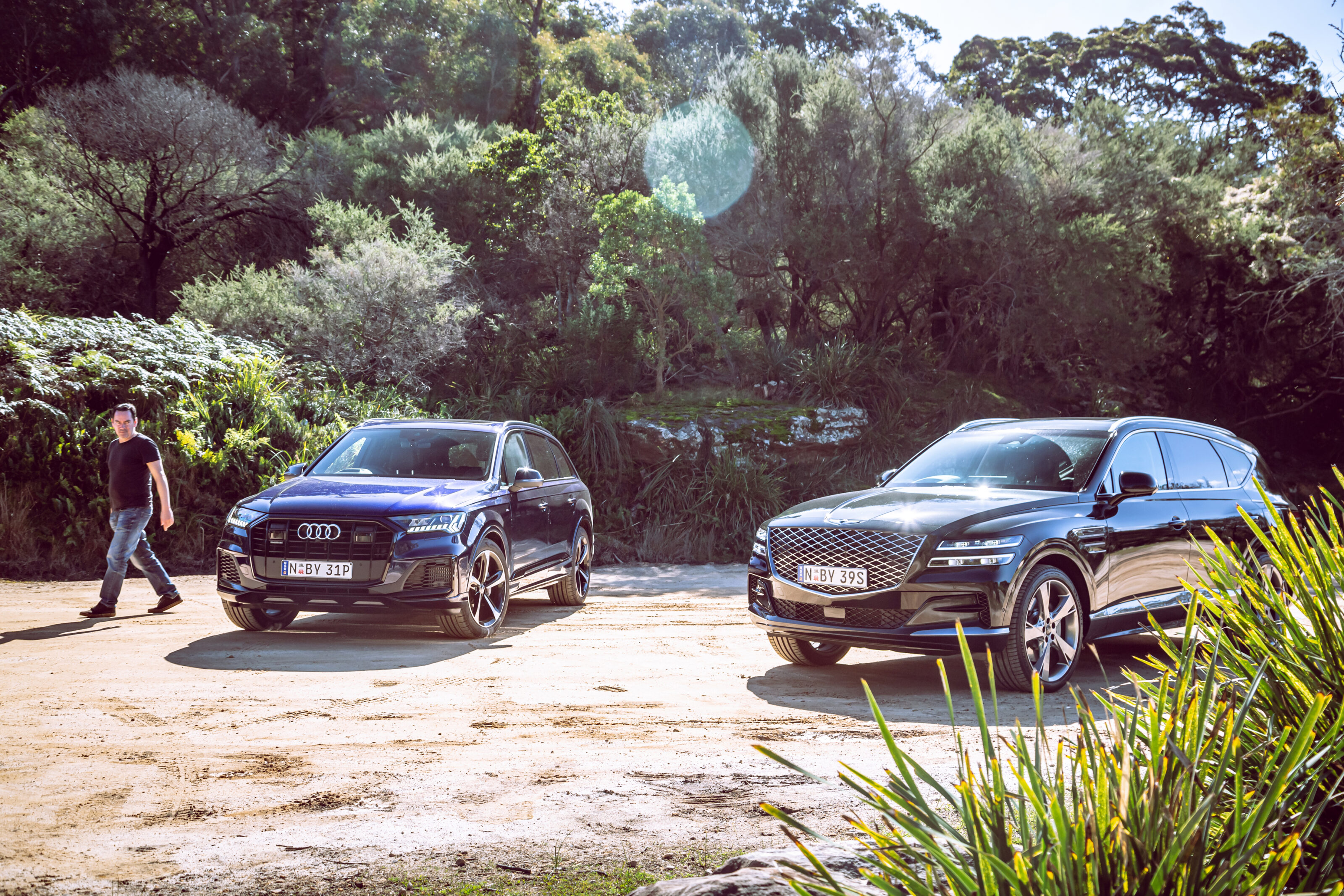
Audi Q7
Audi’s second-generation Q7 can haul 3500kg in 45TDI, 50TDI, 55 TFSI and SQ7 versions. Each has a towball down load maximum of 350kg.
Audi Q8
The luxurious Q8 SUV can tow the same 3500kg as the Q7, with an identical maximum towball down load of 350kg.
Mercedes-Benz GLE
Benz’s huge GLE class can move 2700kg of braked trailer load with a maximum towball down load of 216kg.
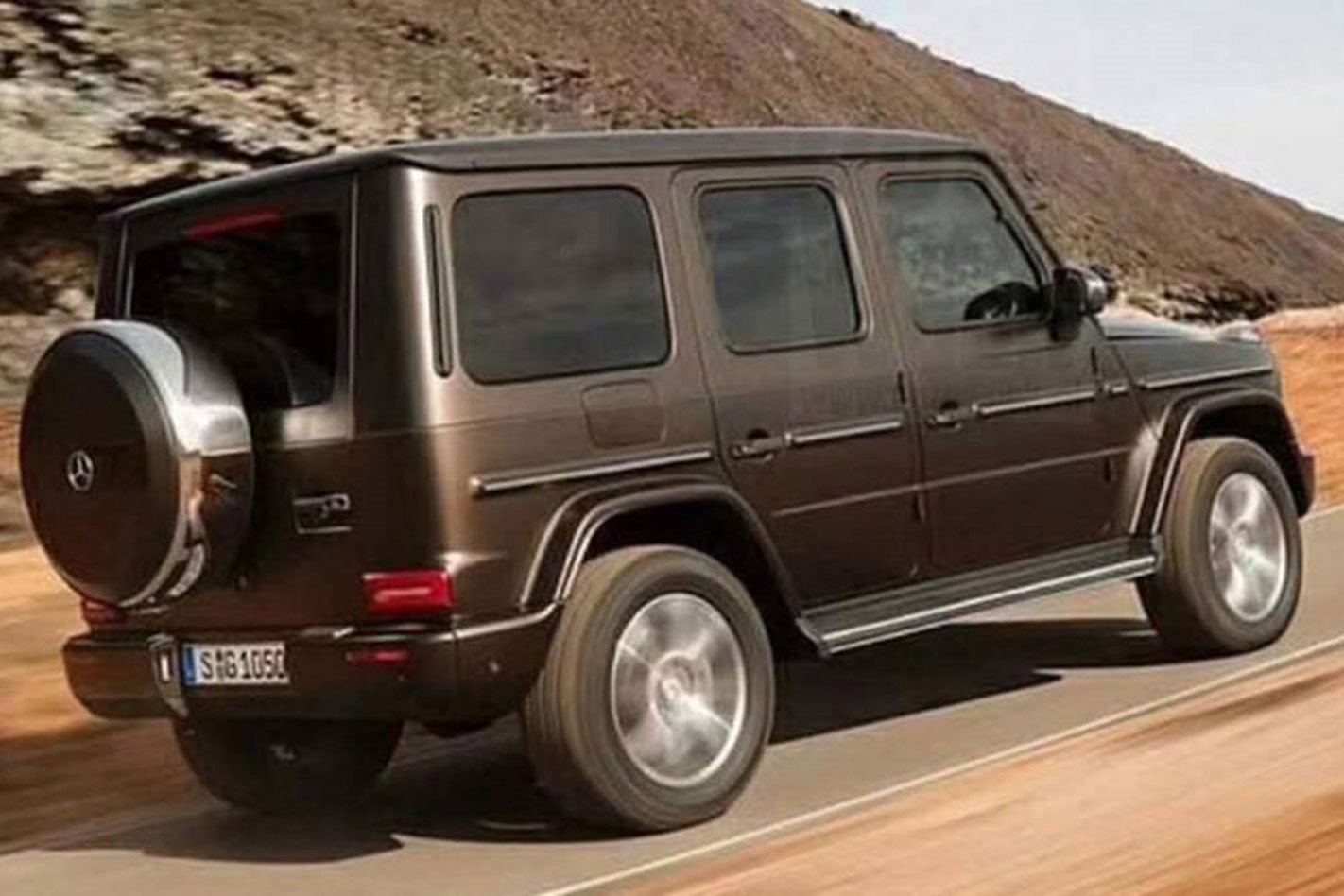
Mercedes G-Class
The iconic G-Class – or Geldanewagen – can tow 3500kg of braked trailer in petrol and diesel versions.
Volvo XC90
Sweden’s answer to the X5, GLE and Q7 can move 2400kg with a braked trailer and have a maximum towball down load of 110kg.
Land Rover Defender
It’s hard to believe, but the classic Defender nameplate is only now in its second-generation. The modern machine can tow 3500kg with a braked trailer.
The Defender’s maximim towball down load is 350kg.
Land Rover Discovery Sport
LR’s Disco Sport as it’s affectionately known can tow up 2000kg in with a braked trailer and boasts a 100kg towball down load.
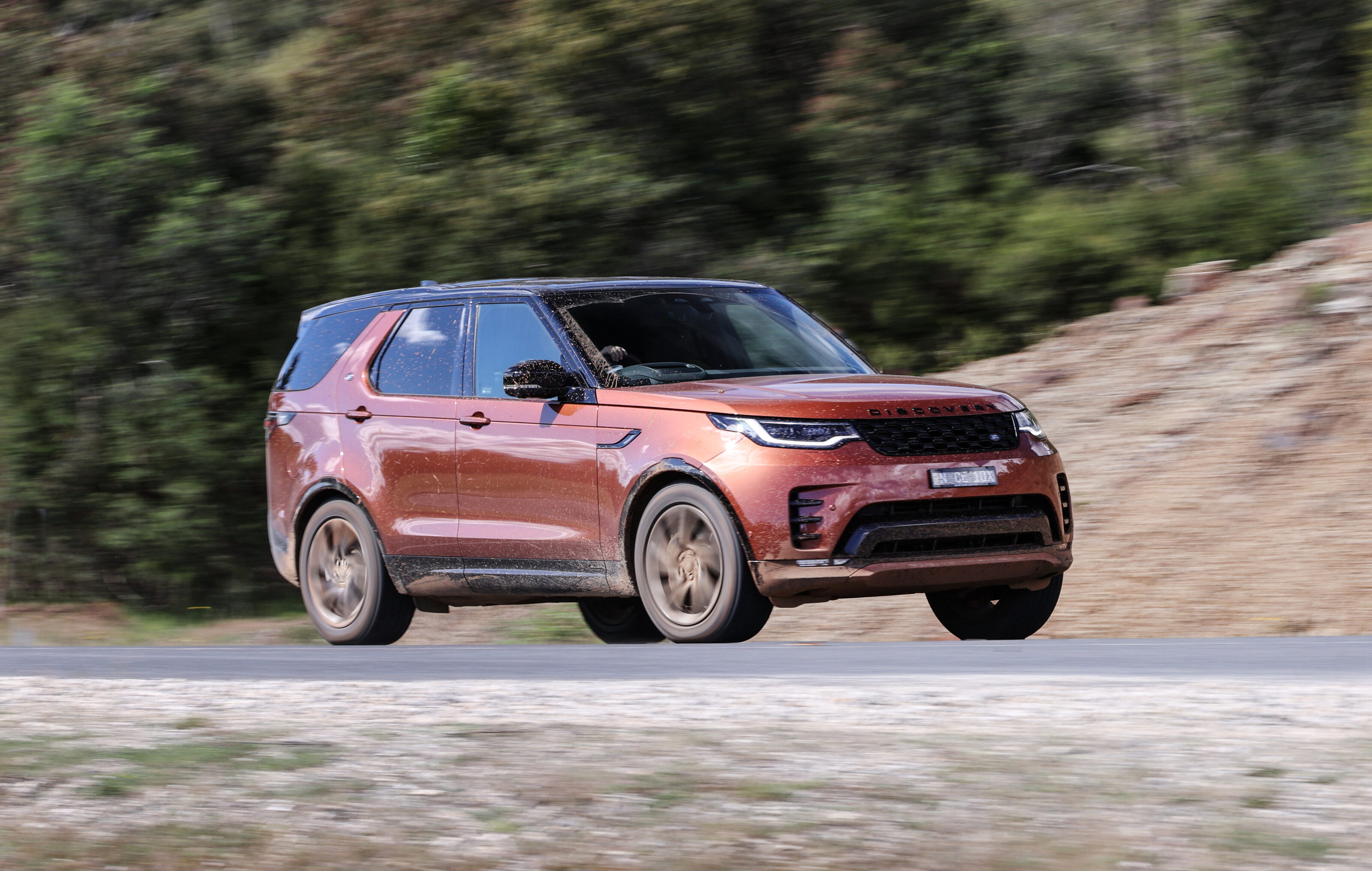
Land Rover Discovery
Land Rover’s second nameplate, the Discovery, is now in its fifth generation and can tow 3500kg with a maximum towball down load of 350kg.
Range Rover
Land Rover’s posh boi, the Range Rover, comes in about 1500 variants and can tow 2500kg with a towball download of 250kg.
LDV D90
LDV’s biggest SUV, the D90, can tow 2000kg. The LDC spec sheet does not include a towball down load figure.
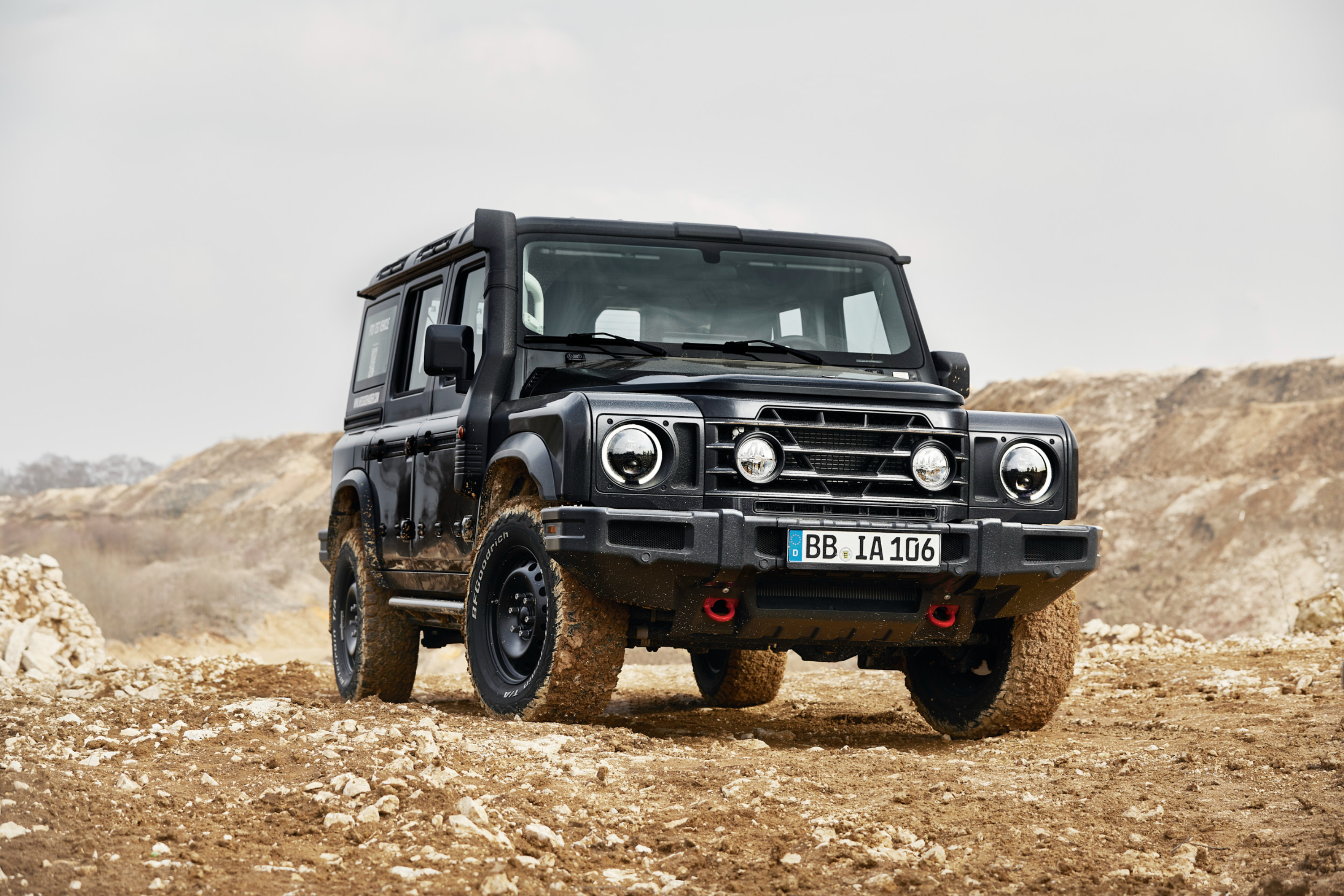
Ineos Grenadier
The brainchild of a billionaire petro-chemicals boss, the Grenadier puts its BMW engines to good use in a body shell inspired by the original Land Rover Defender (never proved in court) to tow up to 3500kg. The towball download figure is 350kg.
Any questions? Let us know below and we’ll work to either update this story, or explore some new story ideas to help you make the right decision!
Related stories
Related pages
UPDATE: Listen to that electrified scream
As promised, the newly revealed Dodge Charger Daytona SRT Banshee concept has a pretty wild wail.
It’s entirely synthesised of course, but it migh be the sort of thing that wins muscle car fans over to the ‘dark side’ of electrification.
What do you think? Have a look below, tell us in the comments, and get the rest of the story below the vids.
The story to here
August 18: As much as Sergio Marchionne might’ve been at peace with the idea, Dodge isn’t going silently into the impending electric future.
In fact, its new Charger Daytona SRT Banshee electric muscle concept car produces a 126-decibel shriek – as loud as a Hellcat’s 6.2-litre 527kW V8.
For now, the Charger Daytona SRT Banshee concept previews Stellantis’ long-term vision for Dodge as a leading battery-electric car maker.
To that end, this electric ‘muscle car’ is slated for production as soon as 2024, after long serving Challenger and Chargers bow out.
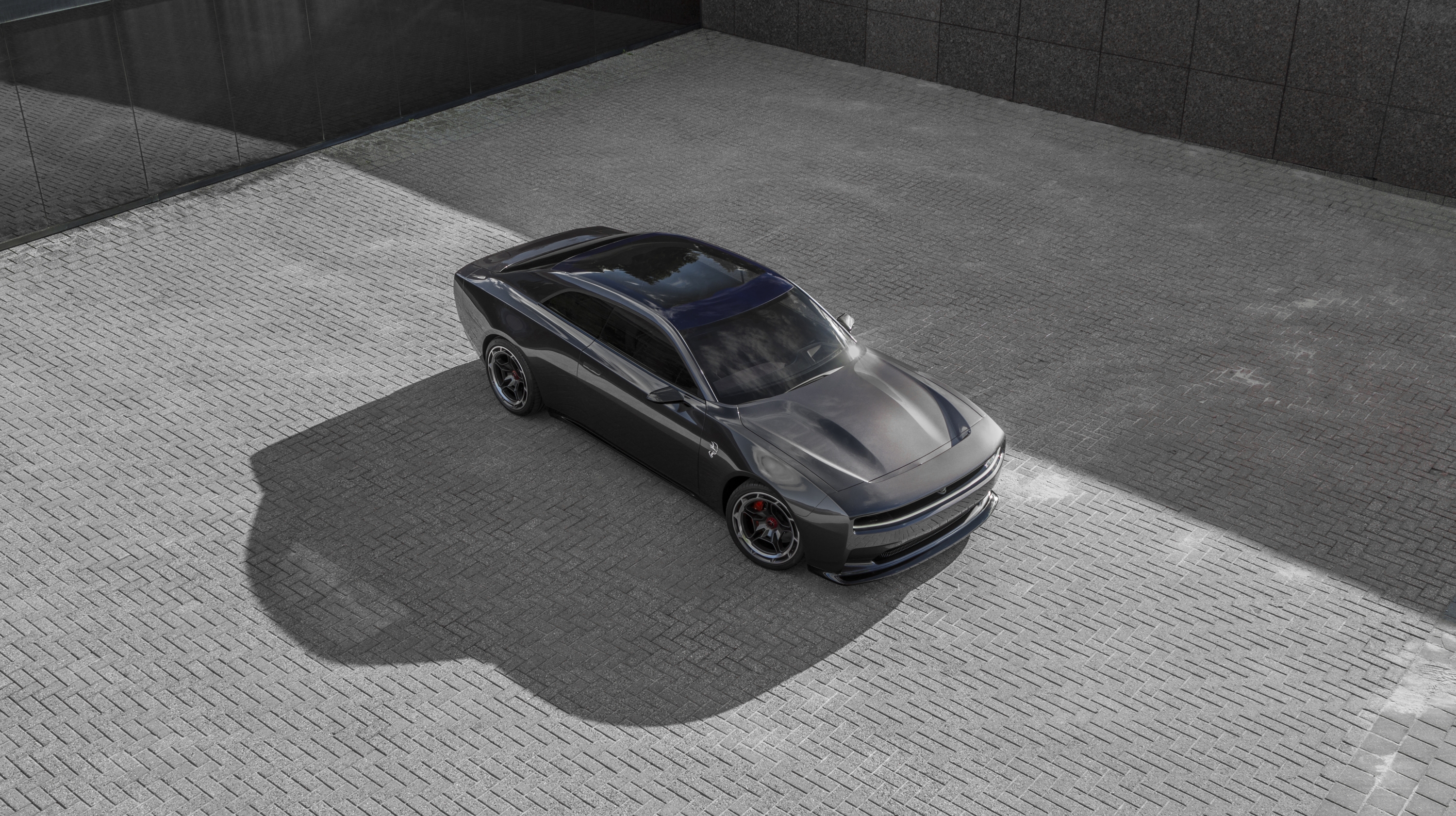
For a time, Dodge seemed to be one of the last bastions of gluttonous combustion performance, but the industry trends and pressure are clear.
Ahead of the Charger Daytona SRT Banshee’s debut, Dodge CEO Tim Kuniskis said, “We can sit at home watching streaming videos and say we’re not going to be a part of it [electrification]”.
“The party is set. The band is booked. This thing is happening, so we said, ‘OK, if it’s going to happen, let’s go there like Dodge. Let’s crash this party and do it differently than everybody else”.
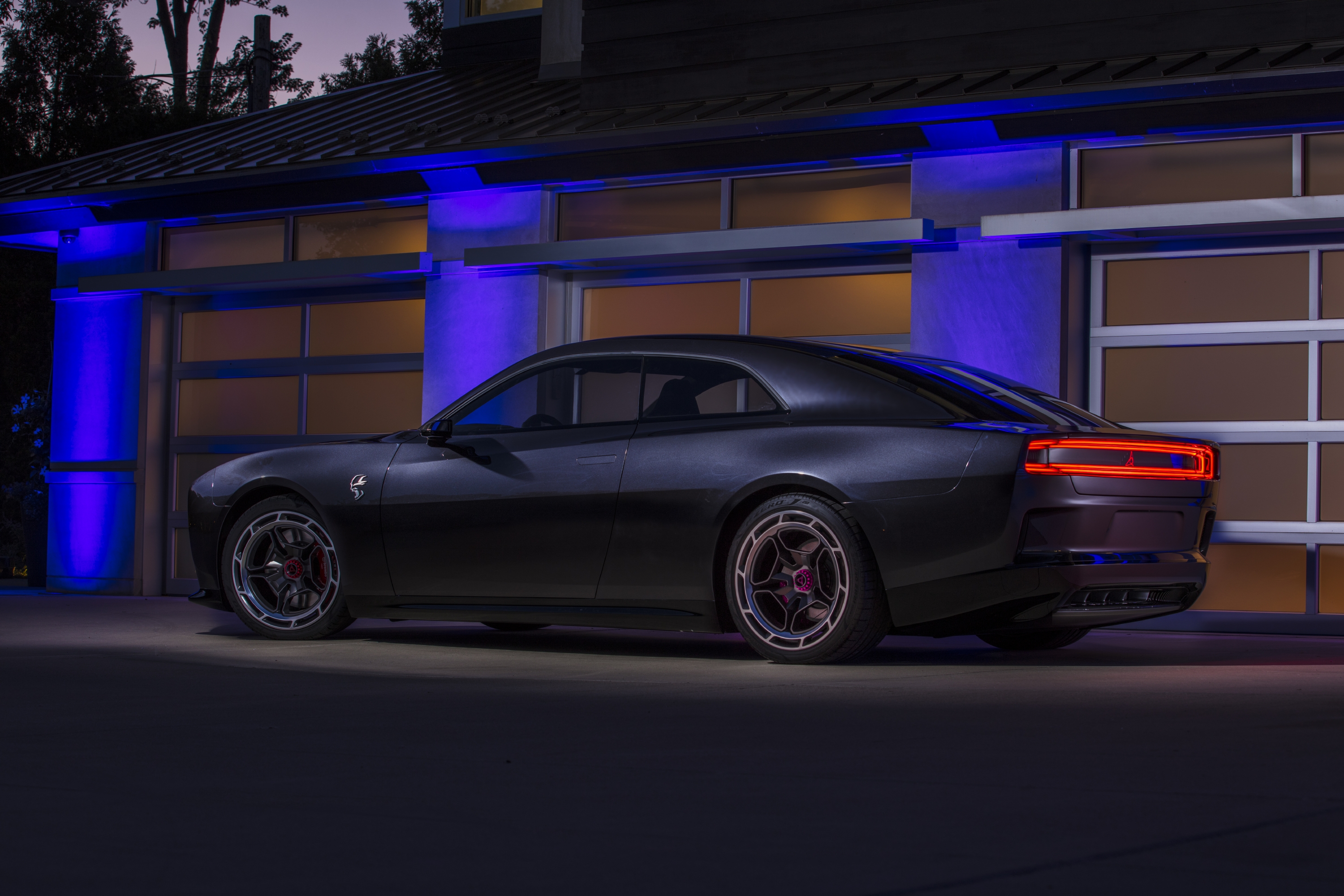
But how? While many manufacturers are leaning into EV’s muted auditory characteristics as boons for NVH improvement, Dodge brand identity is steeped in auditory senses – so it fitted the Charger Daytona SRT Banshee with a shrieking note of its own.
The patented-for-production “Fratzonic” system moves air like a pipe organ through an amplifier and tuning chamber, which Dodge says produces a sinister grumble and a whirring scream at speed as loud as 126-decibels.
Like Porsche’s Taycan and Audi’s e-tron GT sibling, the Dodge Charger Daytona SRT Banshee utilises a multi-speed transmission, comprising a patented ‘eRupt’ multi-speed system with electro-mechanical shifting.
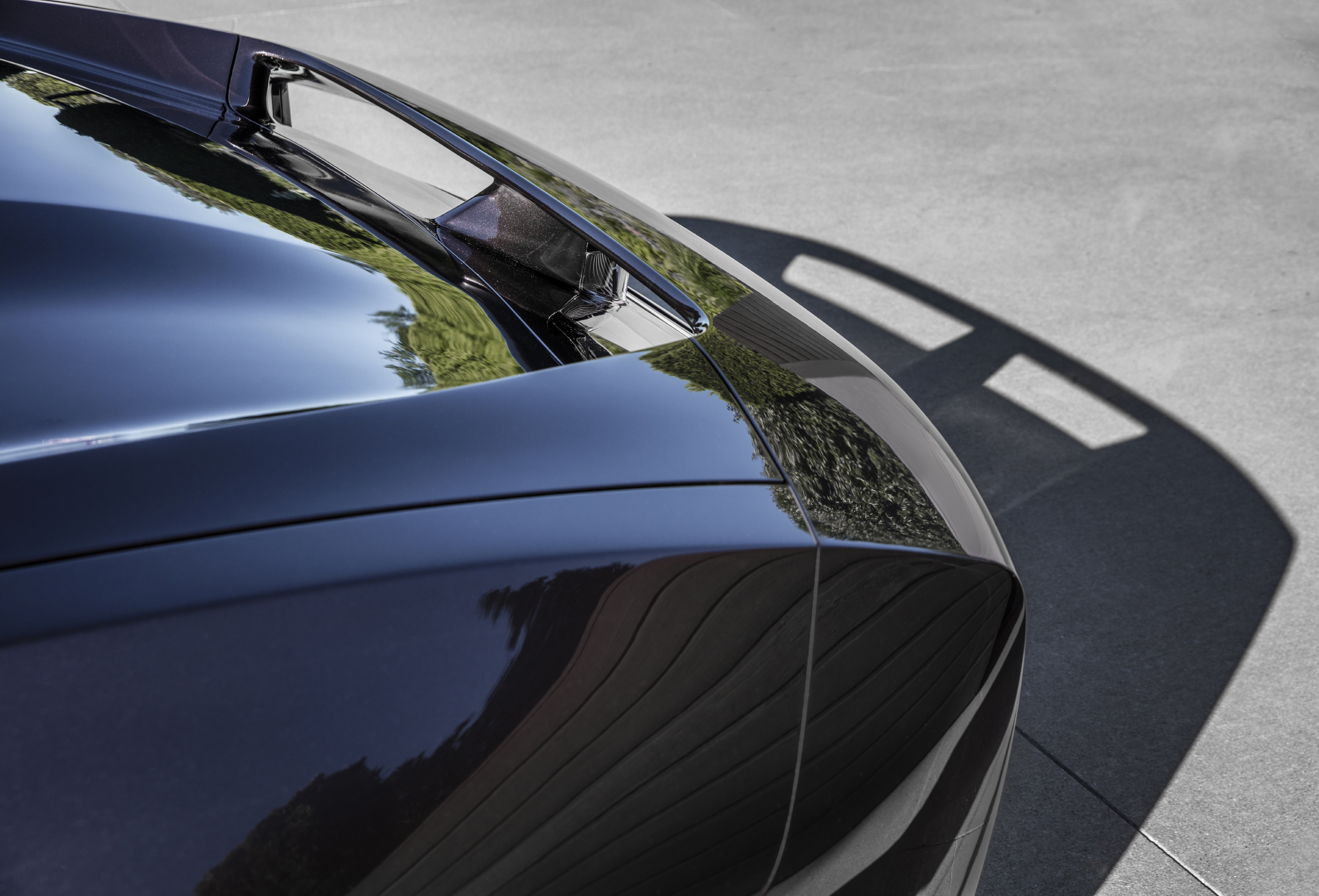
Aerodynamics also play a key factor in ultimate EV efficiency, and saw Dodge dip into the history books, reviving the classic Charger Daytona‘s iconic nose-cone design that saw it banned from NASCAR in the 1970s.
The iconic design provides the ‘Daytona’ tribute in the Banshee’s name, and also provides an approximate 25 per cent improvement in aerodynamics compared to Dodge’s current road cars.
Dodge’s patent-pending ‘R-Wing’ over the front nose was added in honour of Gary Romberg, the rocket scientist who designed the original 1970 Daytona. Carbon-fibre intakes at the front and rear also assist with aerodynamics. In concept form at least, there is no ‘frunk’ storage space.
“It looks like a proper muscle car, aerodynamic like a full BEV, but not a melted jellybean”, jests Kuniskis.
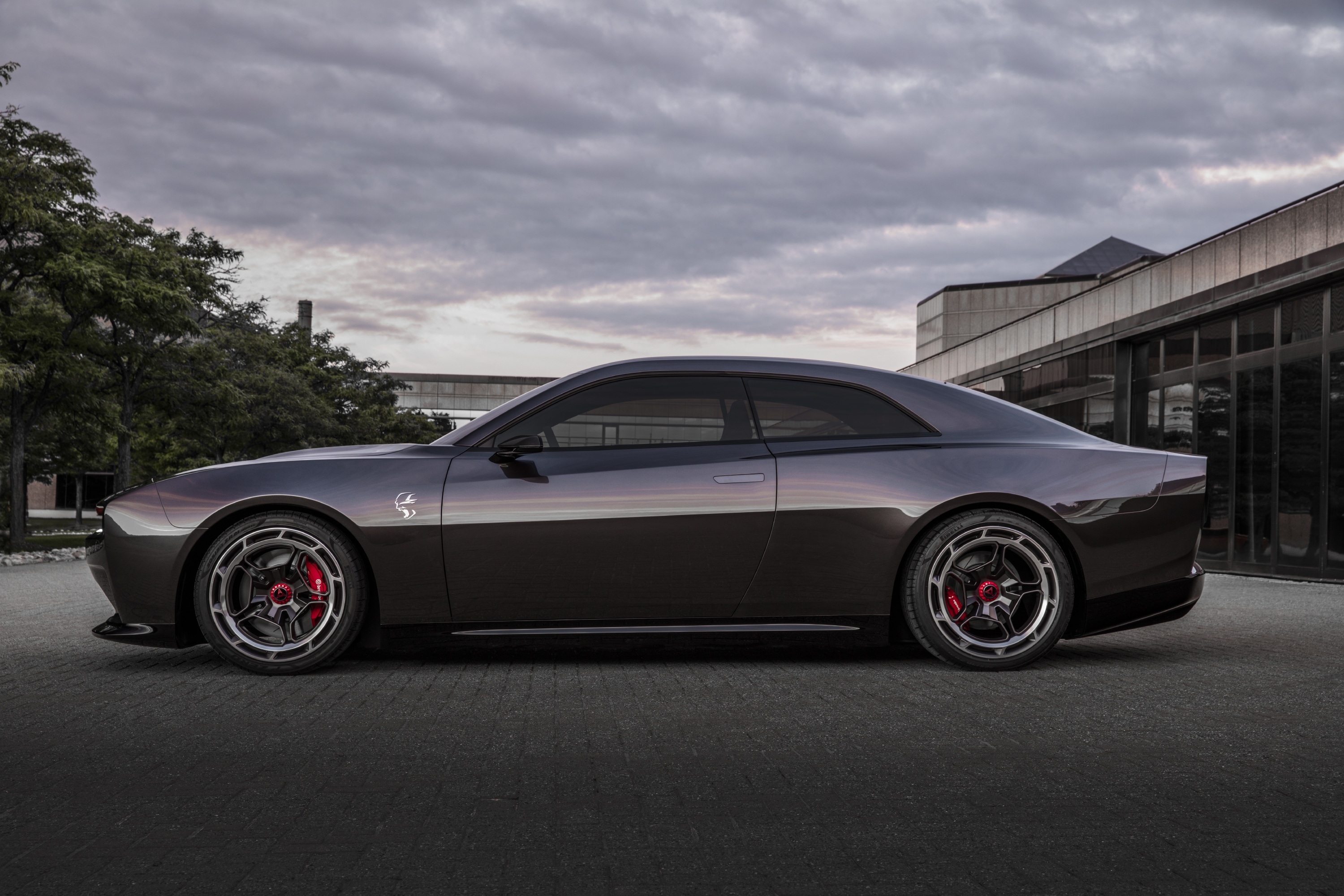
Dodge has yet to publicise any performance figures, with no claims made in regards to driving range or 0-100km/h times, with little information given in regards to its powertrain.
Dodge says, however, that the Charger Daytona SRT Banshee boasts an 800-volt system, with Dodge intending to offer three differing power levels, including a lower 400-volt option.
Dodge’s aftersales parts catalogue, Direct Connection, will provide two further power-up steps for those three model variants, similar to the tuner and stage upgrade kits it has offered for current combustion-powered performance cars.
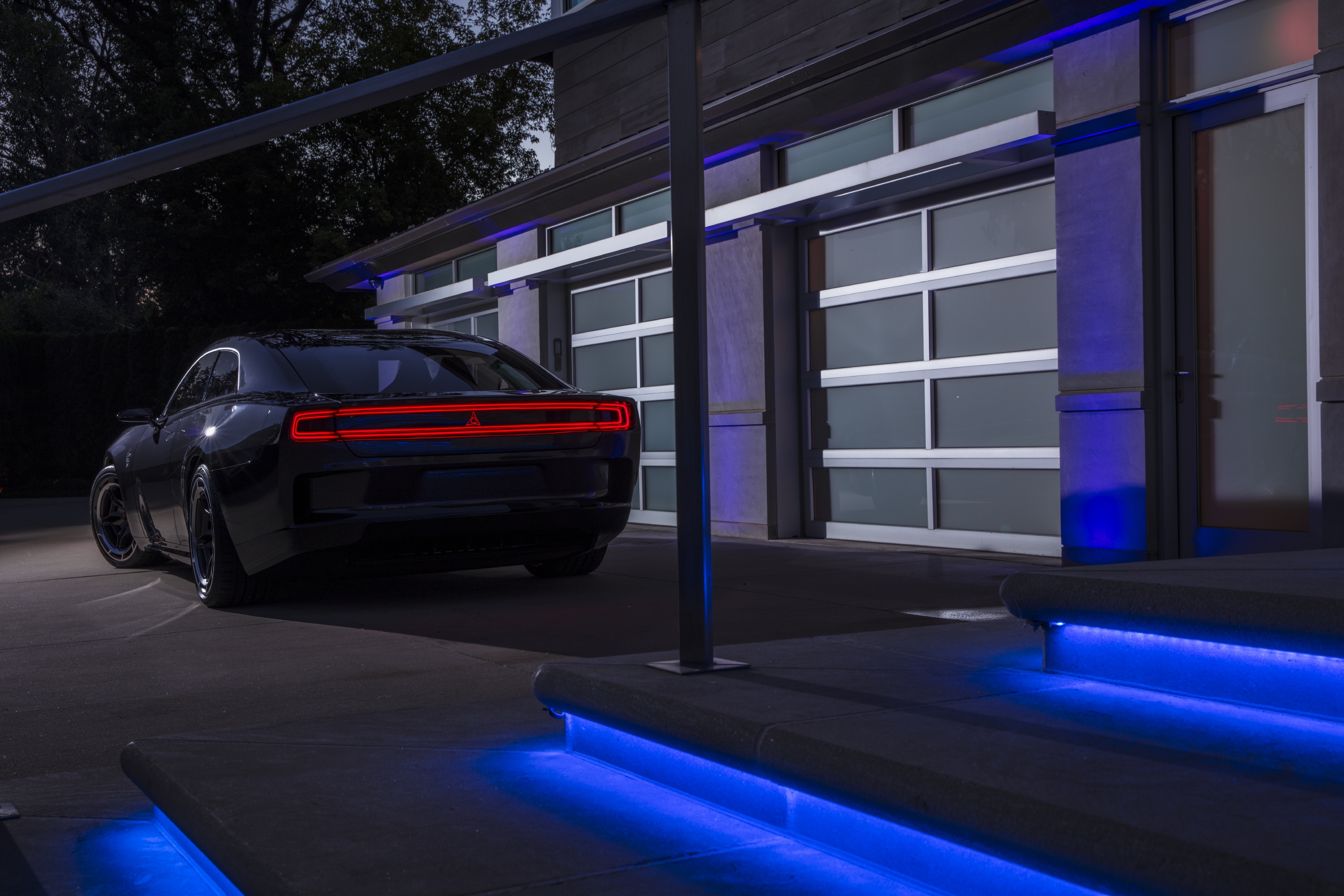
Further upgrades may be available through over-the-air updates, though Dodge intends on offering most of its upgrades through its authorised network of North American ‘Power Broker’ dealers.
Unlike Dodge’s traditional front-engine, rear-drive performance cars, the Charger Daytona SRT Banshee leverages an all-wheel drive system with varying drive modes – auto, sport, track and drag.
The concept car, rolling on 21-inch wheels, is built on Stellantis’s STLA Large platform which, in other cases, can offer over 800km of range.
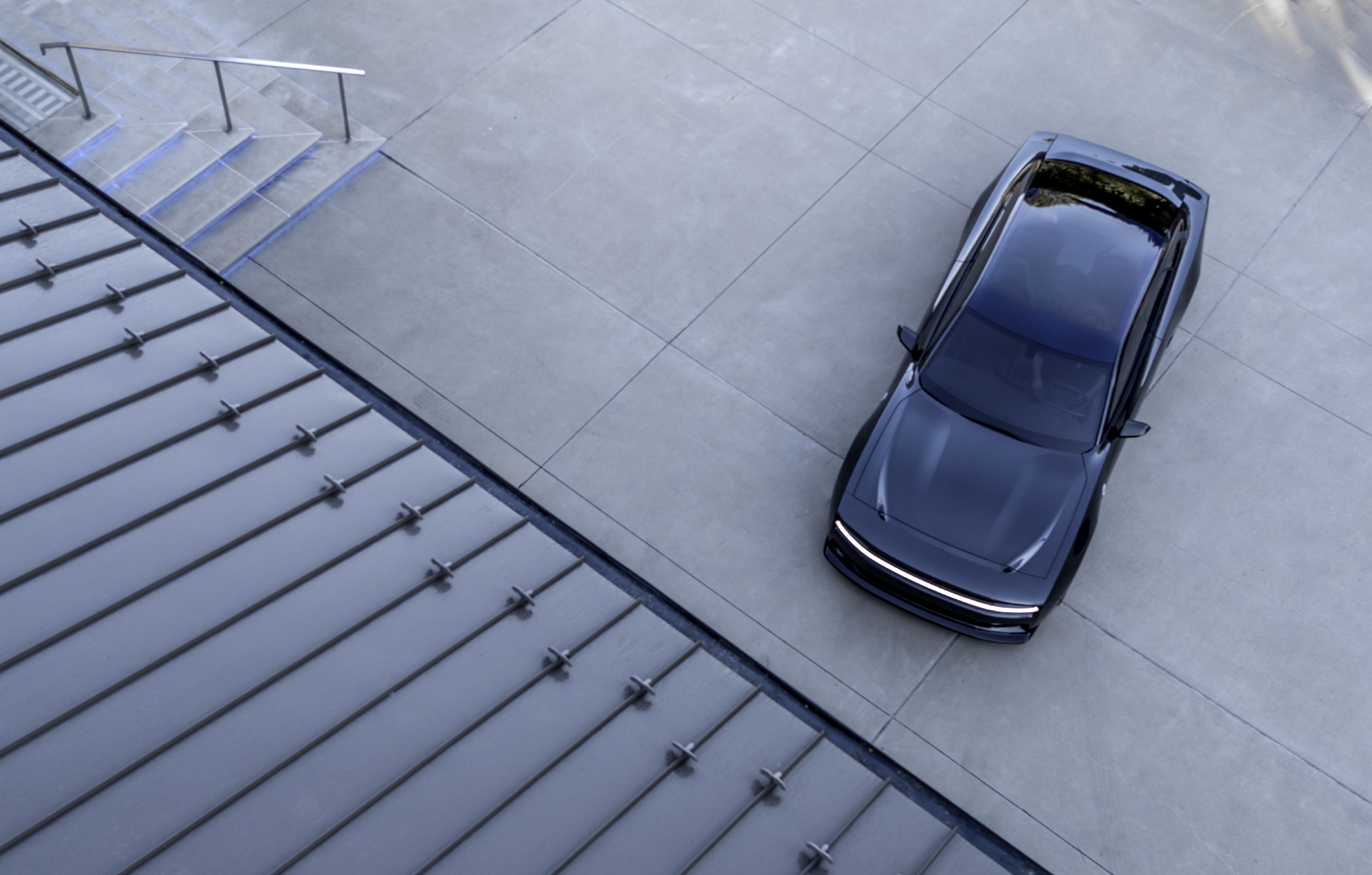
Kuniskis, however, isn’t wedded to those figures. Speaking to The Detroit News, Kuniskis said: “please don’t try to tie that back, because the things we do on this car are not range-enablers. The front end, the transmission, the sound system, they’re not range enablers”.
He continues, “I’m not going to worry about the actual number [driving range]… If you look at the Hellcat today, the Hellcat Redeye has [273 kilometres].
“Sure, you can pull over, fill it up with gas, but the range is not a purchase reason for that customer. As long as I have a competitive range, I’m fine. You’re never going to hear me bragging, ‘I’ve got the best range.’”
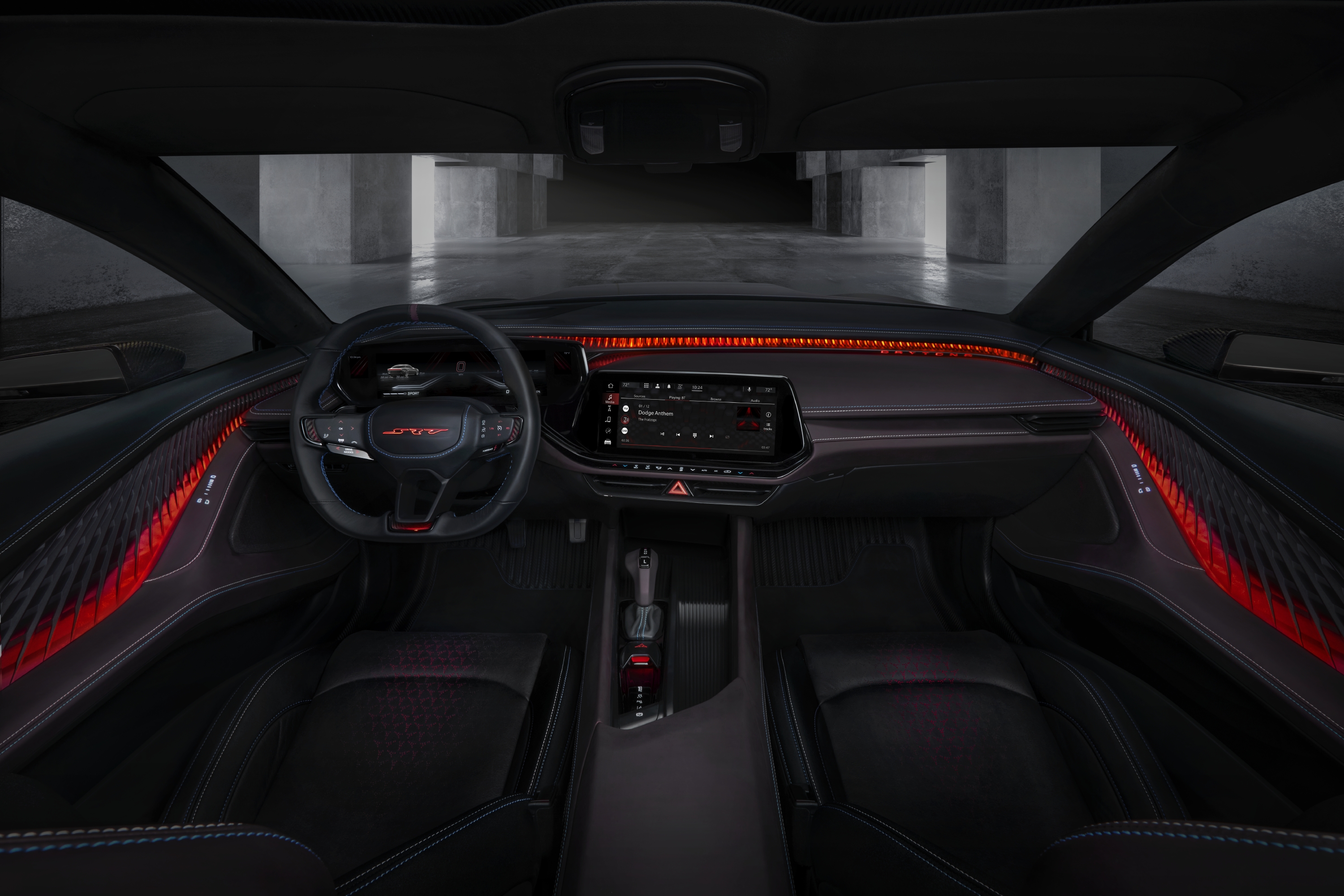
Inside the cabin, occupants are treated to an open, airy glasshouse fitted with a 12.3-inch centre screen, a 16-inch digital instrument cluster plus an eight by three inch heads-up display. A throwback pistol-grip shifter is a neat nod to the past, and the rear seats can fold flat for extra storage space.
It remains unclear where Dodge will produce its forthcoming production EV muscle car, expected to launch in 2024. Current combustion Challengers and Chargers are assembled in Brampton, Ontario Canada, which is expected to be retooled for electric platform production in 2024 – however it’s understood the plant will only be operational for manufacturing come 2025.
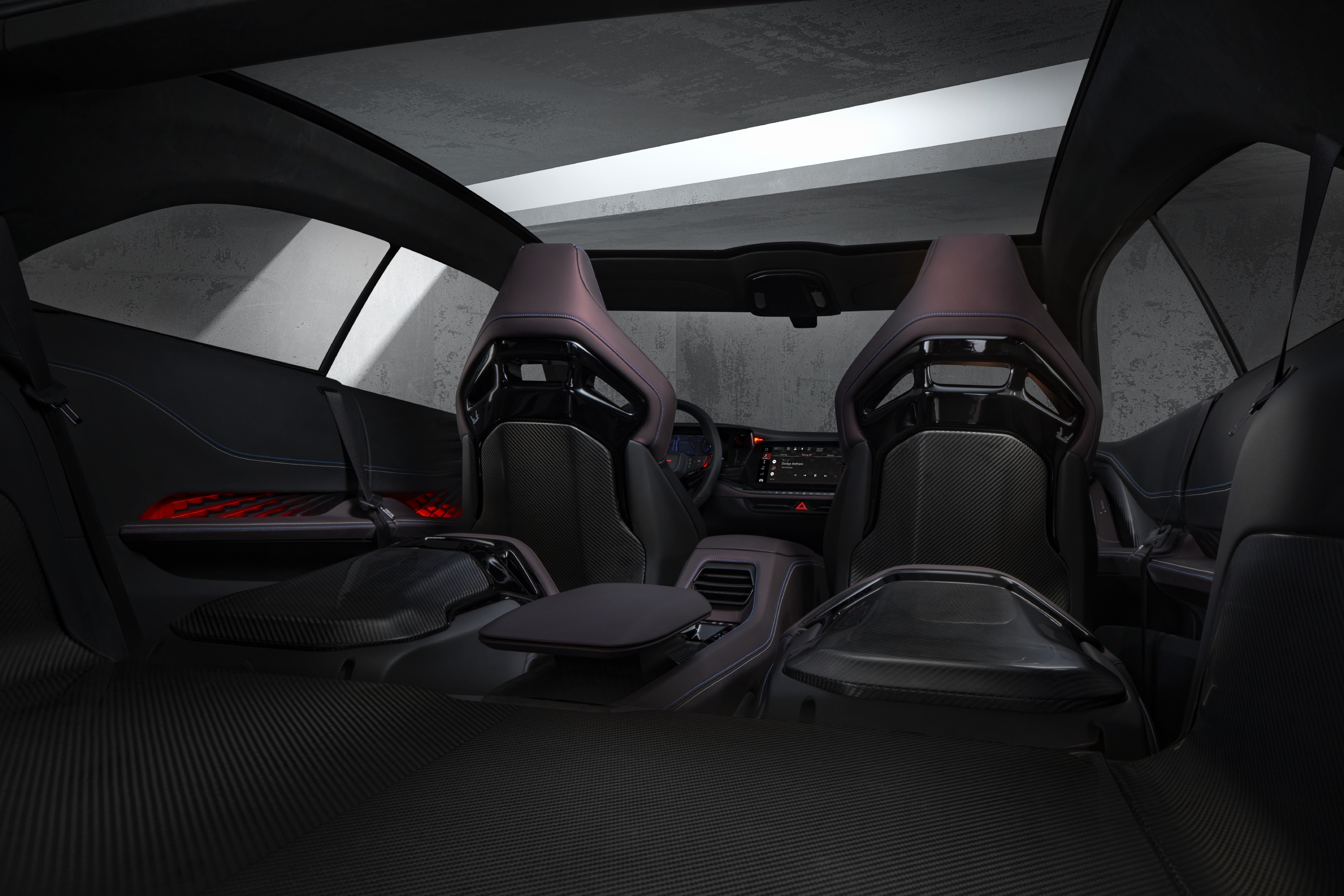
Regardless, the Charger Daytona SRT Banshee is a clear statement of intent for Dodge’s electric future.
When quizzed on this whether this particular concept will lead to a production-ready offering, Kuniskis’ answer was blunt.
“This is not a science project”.
Oh Dodge, never change.
Sales of Volkswagen Group models in Australia are “suffering more than most” as its brands continue to be strangled by supply issues, its boss has said.
Speaking exclusively to Wheels, Managing Director of Volkswagen Group Australia Paul Sansom said the Group’s brands – which include Audi, Volkswagen, Skoda and the recently launched Cupra – had a tough start to 2022 locally, but are expecting a better result for the second half of the year.
Globally however, the Volkswagen Group has recently reported good financial performance – posting a €13.2 billion operating result for the first half of this year, 16.1 per cent up on 2021, and €4.7bn profit for the second quarter of 2022. Its 2021 profit was €19.3bn.
Year-to-date, Volkswagen Australia has sold 15,077 vehicles, with Skoda adding another 3758 into the mix and Audi 7748. Cupra’s three-model lineup, which went on sale last month, adds another 49 cars for the year so far.
In 2021 for the whole 12 months Volkswagen locally sold 40,770 cars, Skoda 9185 and Audi 16,003. With only five months left of 2022 to go (August results are not posted until the beginning of September) it’s unlikely the Group will be able to meet or exceed last year’s numbers.
“There’s obviously still some huge headwinds out there in the supply chain that are affecting us – probably more significantly than some others here in Australia,” said Sansom. “Despite that, we are selling pretty much everything we can lay our hands on and our order banks are really strong across all of our brands – including Cupra.
The MD said its supply chain issues stem from the three big problems affecting the entire industry – and those beyond – over the last year or two, including the COVID-19 pandemic, shortage of semiconductors and war in Ukraine.
“The pandemic and shortage in semiconductors were quickly compounded by the horrific invasion of Ukraine by Russia – where there are a lot of component parts,” he added. “Then there was a second shutdown in Shanghai where we’ve got 19 component factories – they weren’t operating for the best part of two months. All of those three major seismic events have happened in the space of six to 12 months have had a profound effect on the supply chain.
“The sales numbers for the Group are reflective of simply the cars that we’ve been able to produce and import. We’re much further down than we’d like to be. We’ve got a lot of cars sitting in an order bank, which is great – it gives us confidence. We will have a much stronger second half of this year to the first half.
“We’ve lost a bit of market share, but we’re very confident that we’ll bring it back. Our products are the strongest they’ve ever been. Whether it’s traditional combustion engine products or some of the new battery-electric vehicles that will be bringing to market, they really are the benchmark. So we’re very confident that we’ll recover.
“It’s really a question of just getting the cars here to Australia, but of course we are cautious the world’s changing rapidly and things have even in these last few months – such as some economic factors that we’re very mindful of as we’re planning our volumes for the foreseeable future.
“Interest rates are rising, inflation’s going up significantly, household costs are too, and disposable income is coming down. So there’s reason to be optimistic in the sense that we’ve got a big order bank that’s strong, but the showrooms are starting to slow down a little bit over these last couple of months.”
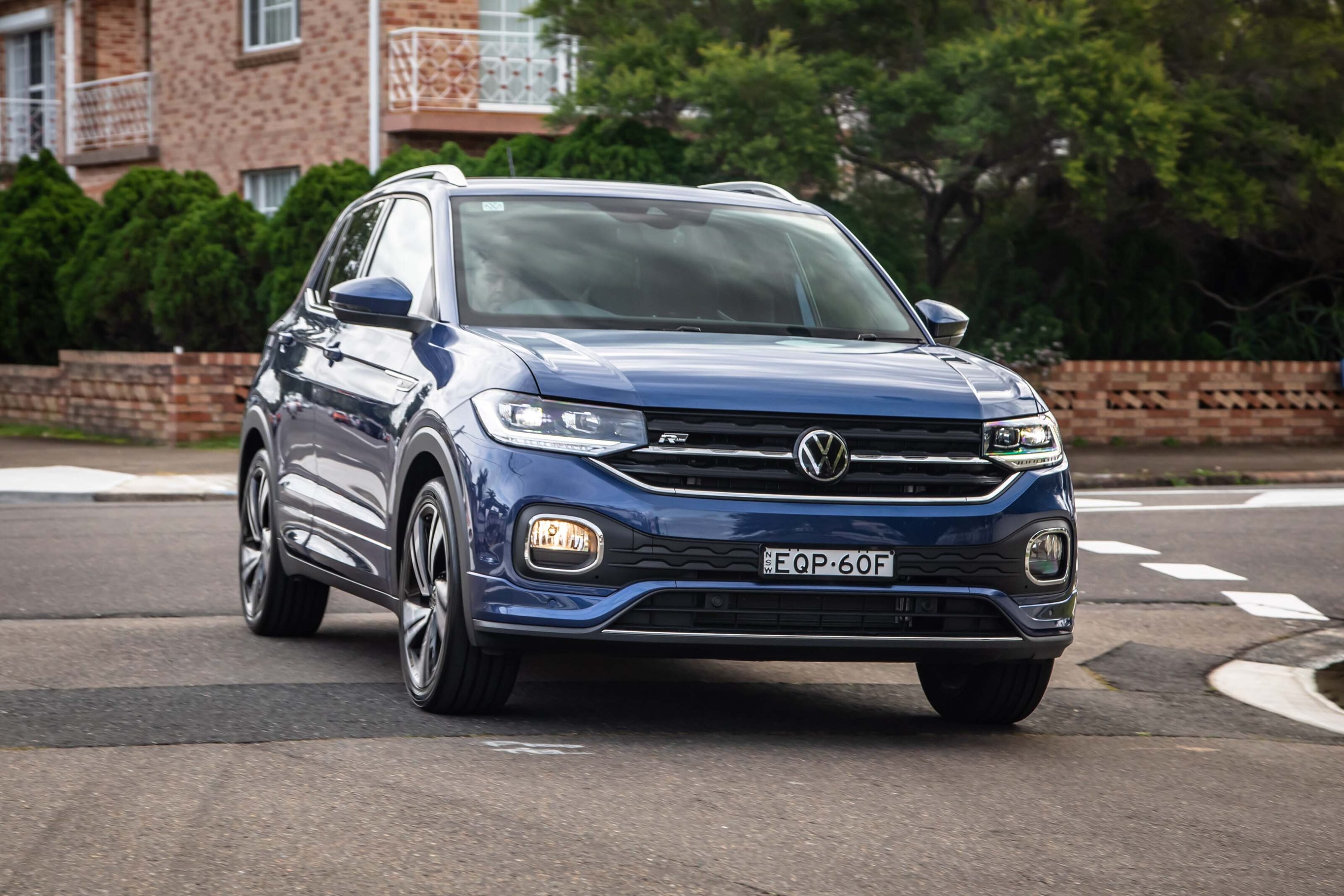
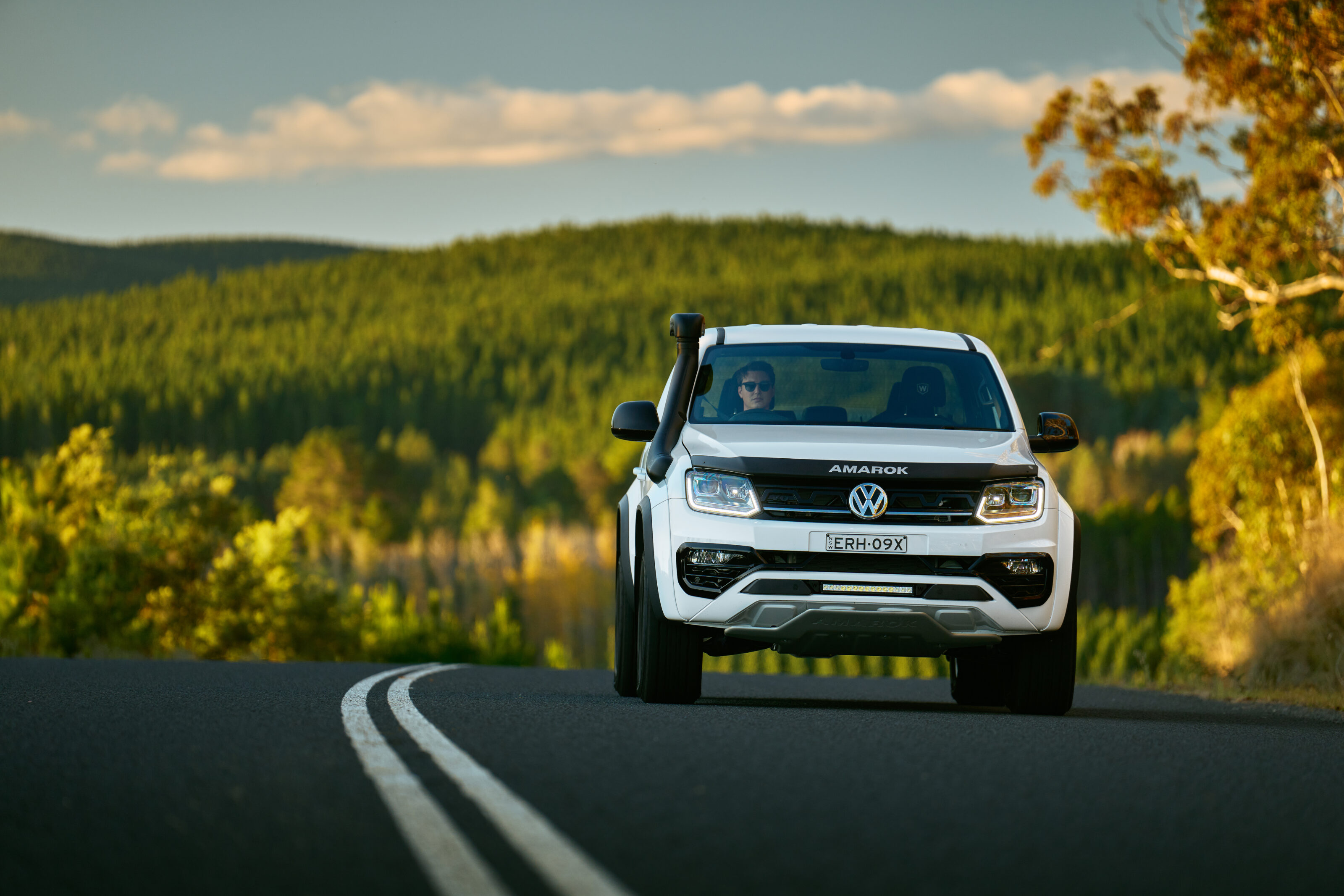
So far this year, Volkswagen’s most popular model has been its T-Cross light SUV, followed by the Tiguan mid-sized SUV and Amarok ute. Meanwhile, Skoda’s Kamiq small SUV continues to be its best-seller, followed by the Octavia sedan and wagon, and Audi leads with its Q3 small SUV, Q5 medium SUV and A3 hatch/sedan.
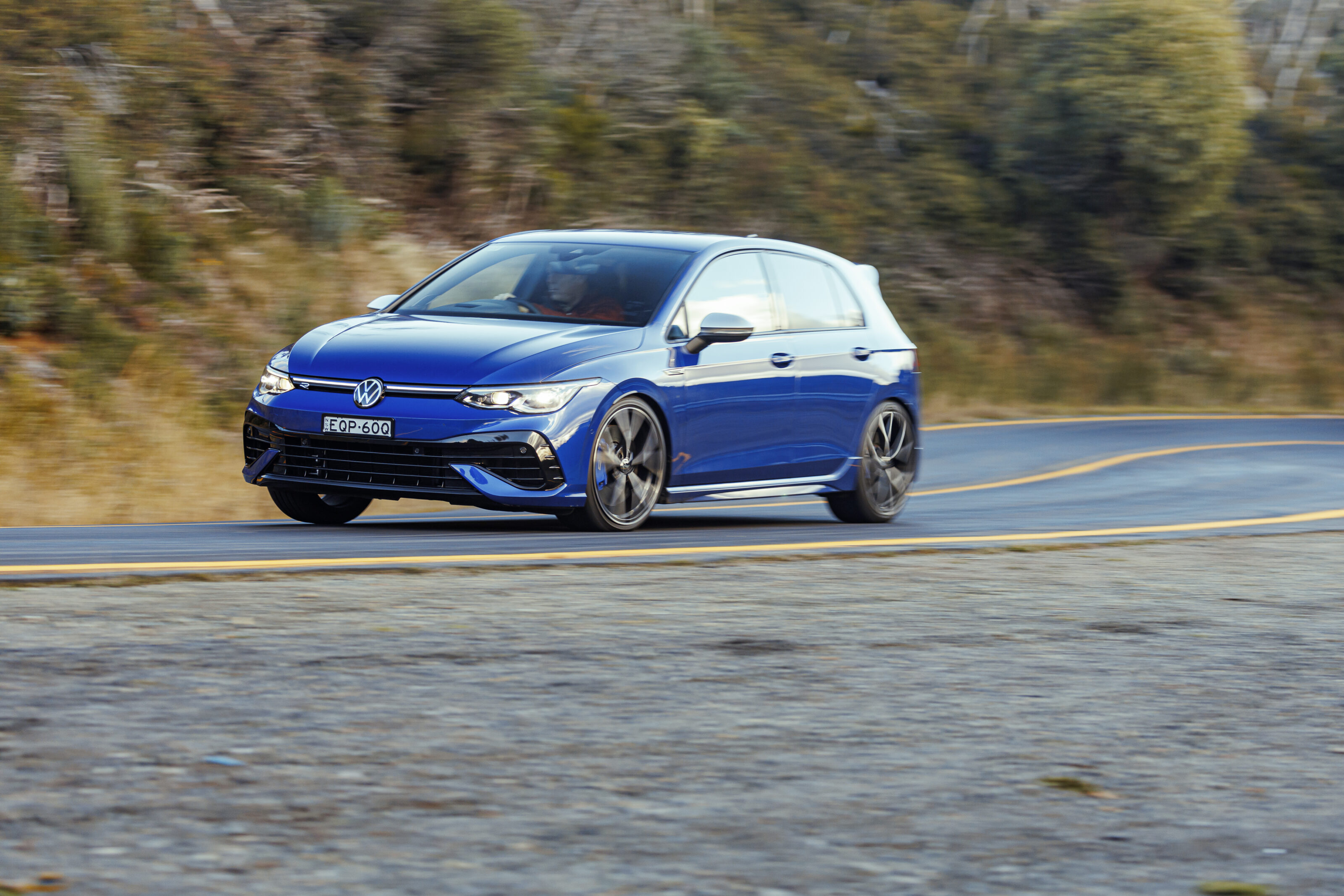
But, says Sansom, there is still a place for the Group’s pioneering models – such as the iconic Golf, the future of which was recently thrown into doubt due to European emissions regulations.
“[Golf] is still an important pillar. I think the point to make about the Golf is that it’s synonymous with the brand. Now there are other, more popular, cars sure, such as the T-Roc and the T-Cross we’re relaunching at the end of this month – they’re all brand pillars, there’s not just a single one.
“It’s great to have that staple model, like a Golf, because it’s your bread and butter. But it’s good to have that diversity as well, that’s the best formula. We’ve built our reputation on the back of Polo and Golf in particular, and that gives you the platform to expand. It’s so reliable, you know that you’re gonna make sales with that car, and as a result the others you can afford to be a little bit more adventurous with as well.”
