
Tesla’s Australian arm is facing further stock delays, with reports emerging of Model Y and Model 3 production coming to a halt this month.
According to Automotive News, the Shanghai production line for the Model Y will pause for the first two weeks of the month, followed by the Model 3 line stopping work for 20 days from July 18.
It’s understood Tesla is planning performing upgrades to the Chinese facility, which will allow it to increase future output for markets served by the factory, including Australia – which now exclusively imports cars from south-east Asia.

Announced for Australia last month, unprecedented demand for the Model Y led Tesla boss Elon Musk to declare the manufacturer was working on accelerating production of its right-hand-drive models.
Despite driving up the price of its SUV to $72,300 and $96,700 before on-road costs for the base and Performance grades respectively, Tesla’s website still lists wait times of between seven and 12 months, identical to the projected delivery period for the Model 3.
The electric sedan was Australia’s most popular EV last year and at the start of this year, however extended lockdowns in Shanghai have put a dent in its recent sales performance, delivering just 172 examples last month – 29 units less than its Polestar 2 rival.

It’s understood Tesla’s new German plant just outside Berlin will also be taking a two-week break from July 11, with August production set to double the current output.
The Grünheide factory will eventually produce 500,000 cars annually, although it currently only manages roughly 4500 per week.
Snapshot
- Haval H6 GT arrives in Australia
- On sale from $40,990 in front-wheel-drive guise, $46,490 for all-wheel-drive
- Five-star ANCAP safety rating standard across the model range
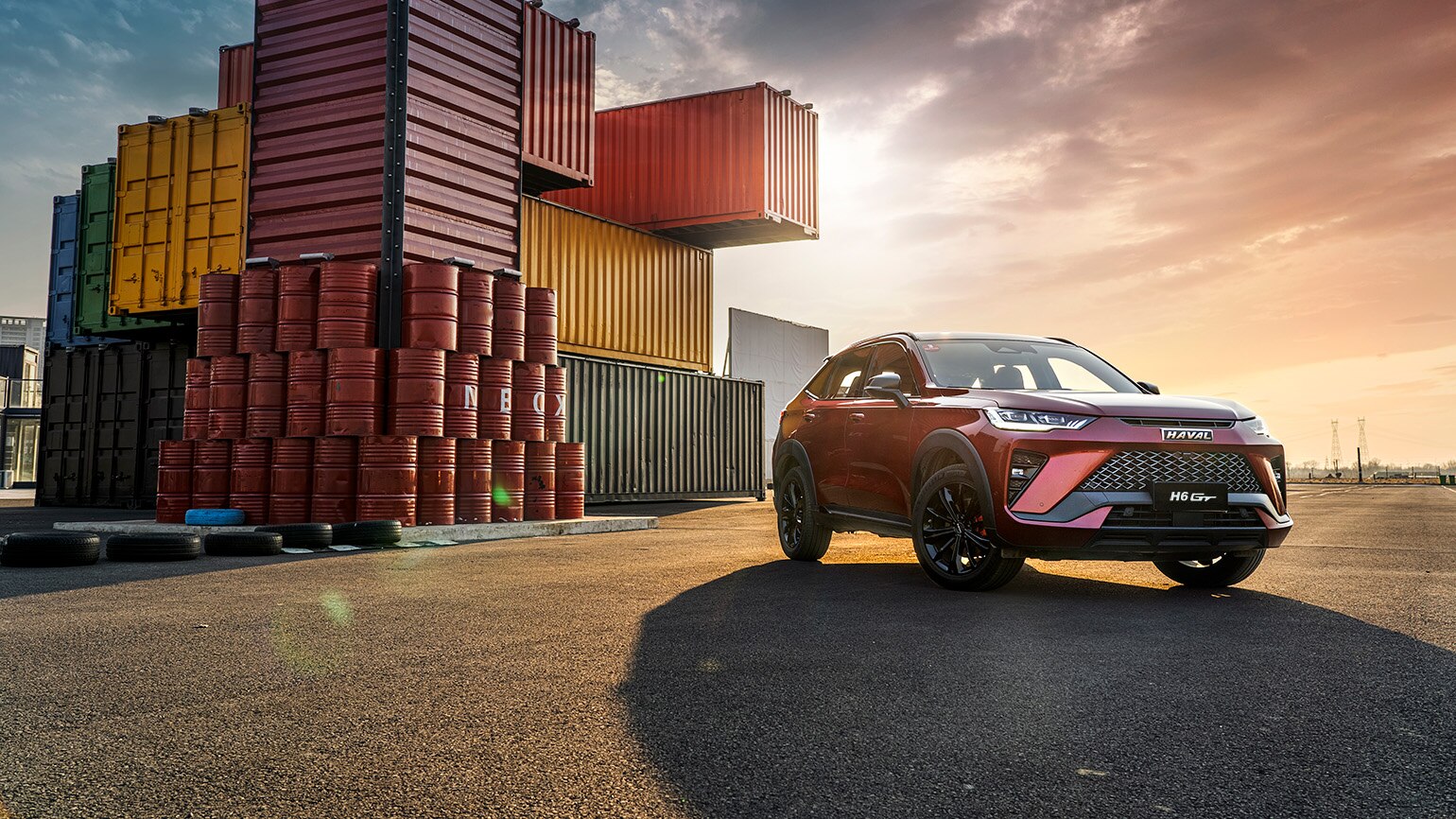
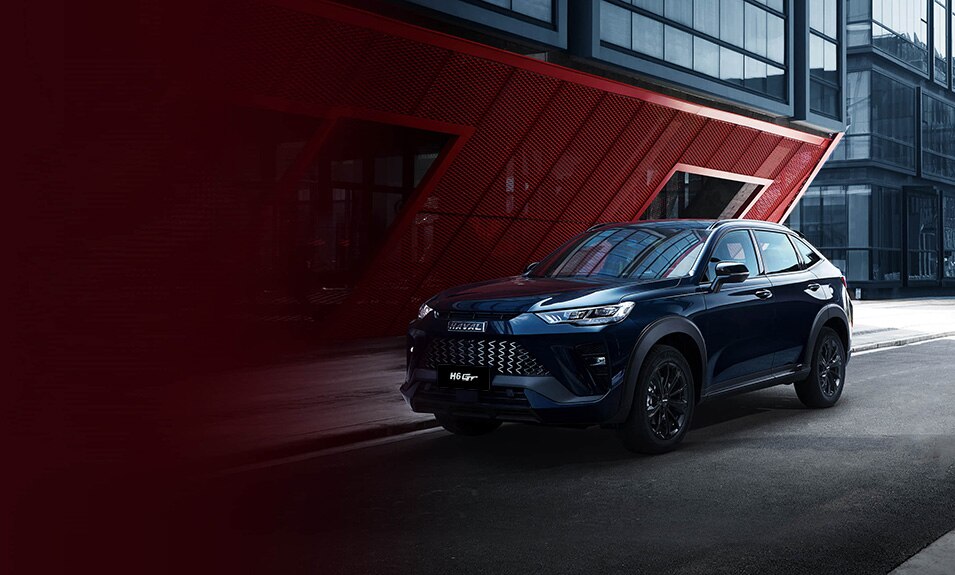
The 2023 Haval H6 GT has landed in Australia, with the first deliveries of the coupe-esque SUV rolling out this month.
Previously intended to launch in the second-quarter of 2022, delays pushed back the H6 GT’s arrival to this month, confirmed today with Haval reporting its first batch is in Australia’s ports.
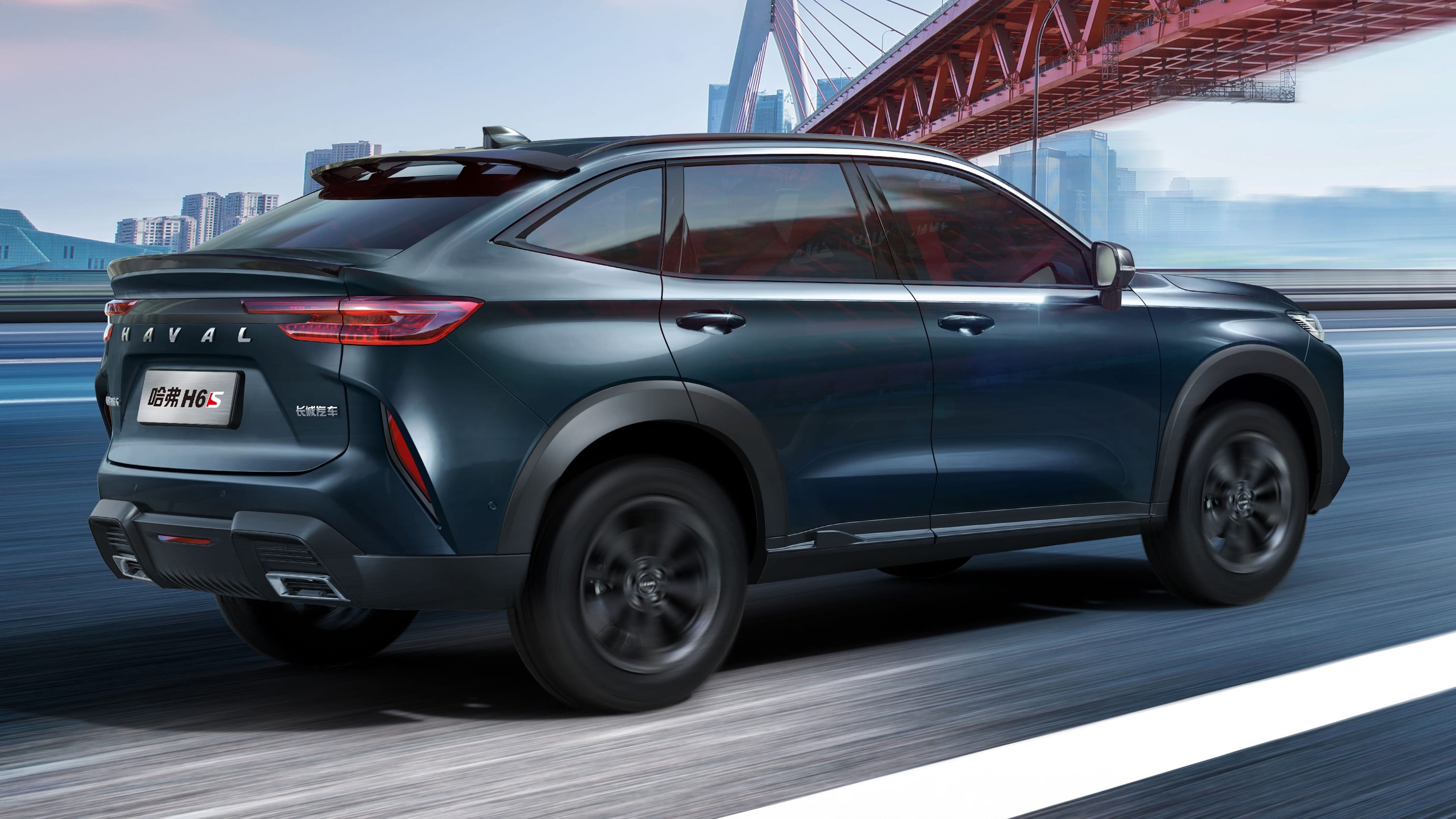
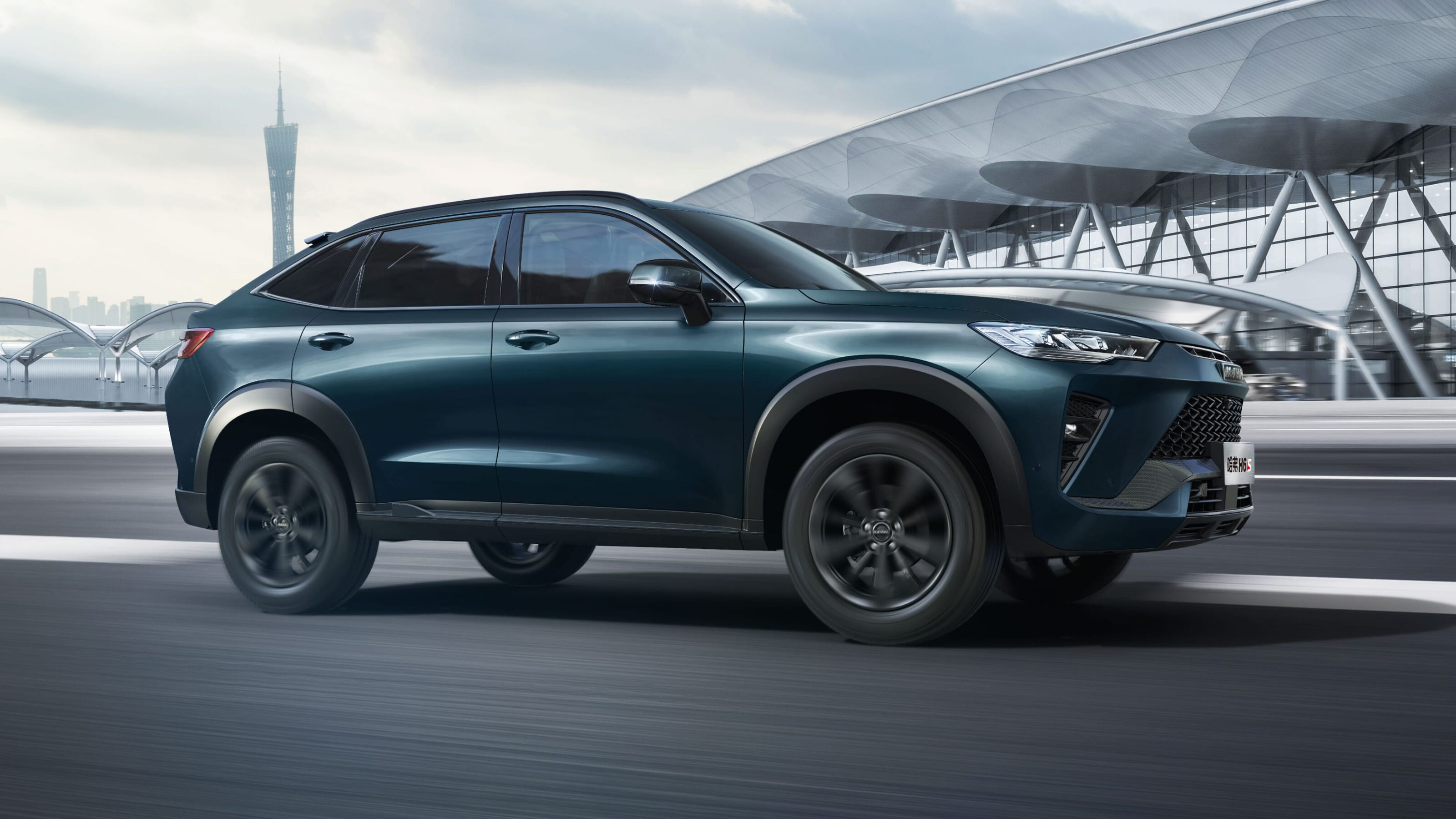
Based on the same platform as the standard H6, the new addition to the line-up features revised and more aggressive styling, as well as a more comprehensive level of equipment.
Note: due to a supply issue, Haval will no longer offer the H6 GT Ultra with Brembo brakes, with the manufacturer saying its price will remain unchanged.
Pricing
With the H6 GT range starting at $40,990 drive-away for the entry-level Lux grade, the base variant is $4000 more than the existing H6 Lux – with the GT Ultra incurring a $3500 premium over its traditionally-styled counterpart.
Prices include on-road costs.
| Model | Price |
|---|---|
| H6 GT Lux | $40,990 |
| H6 GT Ultra | $46,490 |
Features
H6 GT Lux
| 19-inch black alloy wheels |
| LED headlamps, DRL, tail-lights, front and rear fog lamps |
| 10.25-inch colour LED instrument cluster |
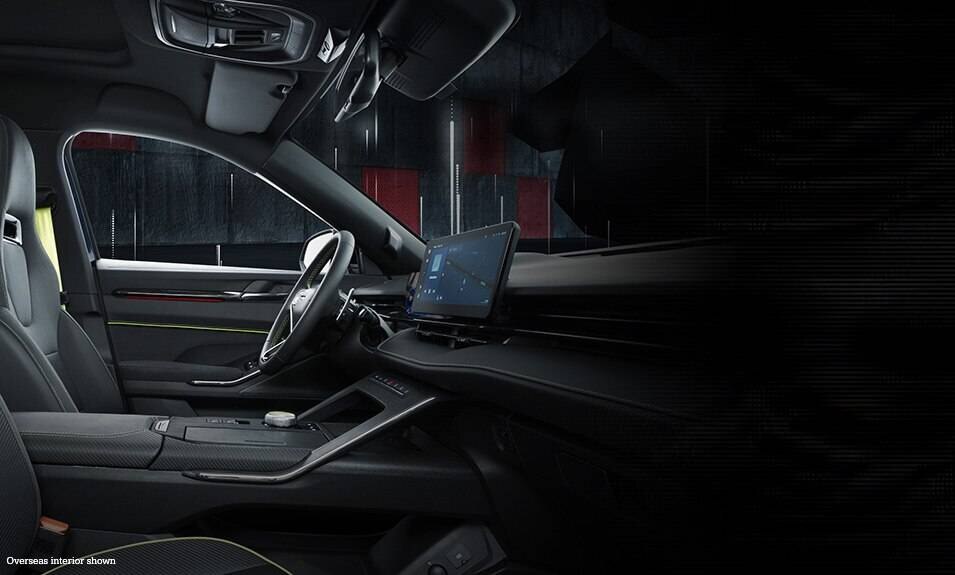
| 10.25-inch colour multimedia touchscreen |
| Apple CarPlay and Android Auto |
| Eight-speaker DTS audio |
| Front USB port with charge and data transmission |
| Rear USB port |
| Dual-zone climate control |
| Leather steering wheel |
| Heated Comfort-Tek eco-leather front seats |
| Eight-way electrically adjustable driver’s seat with lumbar |
| Automatic anti-glare rear view mirror |
| Electric tailgate |
| Roof rails |
H6 GT Ultra (over Lux)
| 4WD with multi-modes (normal, eco, sport, snow, all-terrain response system) |
| Michelin Pilot Sport tyres |
| 12.3-inch colour multimedia touchscreen |
| Head-up display |
| Heated leather steering wheel |
| Heated and ventilated front seats |
| Four-way electrically adjustable front passenger seat |
| Wireless phone charging |
| Mood lighting |
| Electric tailgate with hands-free opening function |
| Panoramic sunroof |
| Heated door mirrors |
| Fully automatic parking |
Engine, drivetrain and fuel economy
Both H6 GT grades are powered by a 2.0-litre, turbocharged four-cylinder petrol engine, developing 150kW and 320Nm, that’s mated to a seven-speed dual-clutch automatic transmission.
The H6 GT Lux utilises a front-wheel-drive layout, while the Ultra is all-wheel-drive, returning combined fuel consumption figures of 7.5L/100km and 8.4L/100km respectively.
Safety
Recently awarded a five-star ANCAP safety rating, the H6 GT is loaded with equipment to protect its occupants, including:
| Seven airbags including centre airbag |
| Autonomous emergency braking (AEB) with pedestrian, bicycle and cross-road detection |
| Forward collision warning (FCW) |
| Lane departure warning (LDW) |
| Lane keep assist (LKA) |
| Emergency lane keep (ELK) |
| Traffic sign recognition |
| Lane change assist with blind-spot monitoring (BSM) |
| Adaptive cruise control (ACC) with stop and go |
| Intelligent cruise assist |
| Traffic jam assist |
| Hill descent control (HDC) |
| Hill start assist control |
| Driver drowsiness detection |
| 360-degree camera |
| Front and rear parking sensors |
| Tyre pressure monitoring |
| Rear cross traffic alert (RCTA) with braking u2013 Ultra only |
Warranty and servicing
As with the rest of Haval and its parent company GWM’s model range, the G6 GT is covered by a seven-year/unlimited-kilometre warranty.
In addition to this, owners are able to access five-years roadside assistance as well as five-years capped price servicing.
Availability
Haval says the first examples of its H6 GT have arrived in Australian ports, with a local launch imminent.
The Australian Government’s Green Vehicle Guide has been given a makeover.
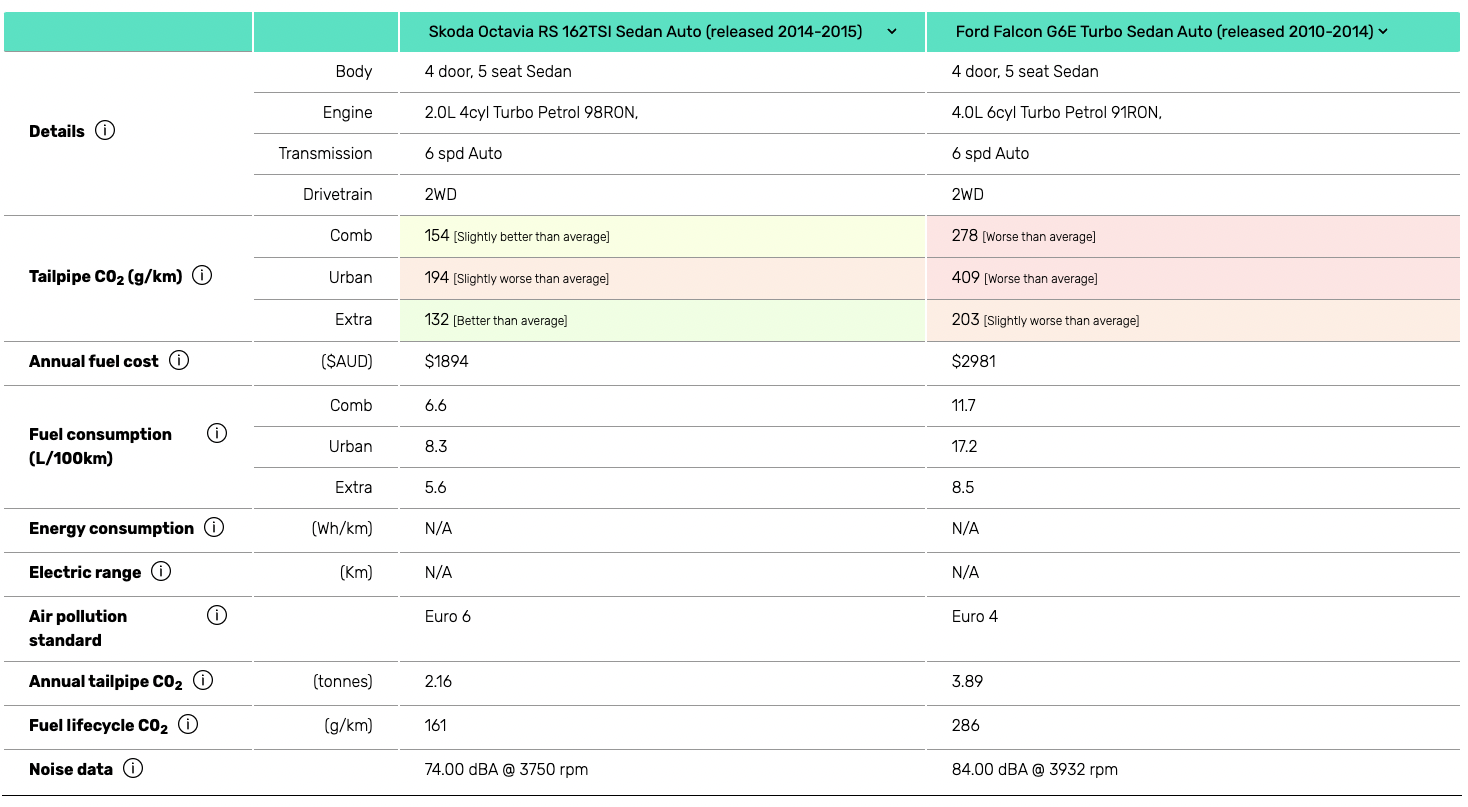
A project of the Department of Infrastructure, Transport, Regional Development and Local Government, the Green Vehicle Guide compares factors such as the fuel efficiency, emissions and running costs, with all light vehicles sold locally since 2004 listed.
It also provides estimations on annual fuel and charging costs, charge times and rankings of Australia’s most efficient vehicles.
“To make greener choices, Australians need to be provided with clear and accurate information,” said Minister for Infrastructure, Transport, Regional Development and Local Government, Catherine King.
“The Green Vehicle Guide…aligns with the Government’s commitment to developing Australia’s first National Electric Vehicle Strategy, making electric cars cheaper for families who want them and reducing emissions.
“Green vehicles, including electric and fuel-efficient cars, are overall cheaper to run and maintain.”
According to the guide, the recently-axed Hyundai Ioniq EV boasts the lowest annual charging cost of any electric vehicle (based on an average of 14,000km travelled), while almost all variants of the best-selling Toyota HiLux emit higher than average tailpipe C02 emissions.
UPDATE, July 2022: Outlander PHEV pricing announced
Australian pricing and details for the Outlander PHEV have now been revealed. Even better, we’ve also driven it! Get the full story at the links below.
February 15: Standard equipment reduced, prices increased
Mitsubishi announced it would take off some standard features from the MY22.5 Outlander to combat the semiconductor shortage.
Despite the ES, LS and Aspire variants being affected, the range-topping Exceed and Exceed Touring remain unchanged, with increased production costs leading to a price rise of $500 and $1000 for the variants respectively.
January 19: Five-star ANCAP safety rating awarded
Australian crash testing authority ANCAP has given the new Mitsubishi Outlander a five-star rating, praising it for its child protection scores.
Applauded for its results across the board, all four categories tested came back with scores above 80 per cent, one of the highest overall performances for a new car under ANCAP’s stringent tests.
Read the full report through the link below.
Key Points
- Bold new looks (love ’em or hate ’em)
- High-quality cabin but a compromised third row
- Much improved dynamics, despite weight gain
November 13, 2021: First drive review
It’s here. The 2022 Mitsubishi Outlander is now in Australia, and Scott Newman has put the new family hauler through its paces for Wheels.
Read Scott’s full review at the link below.
October 28: new Outlander PHEV confirmed
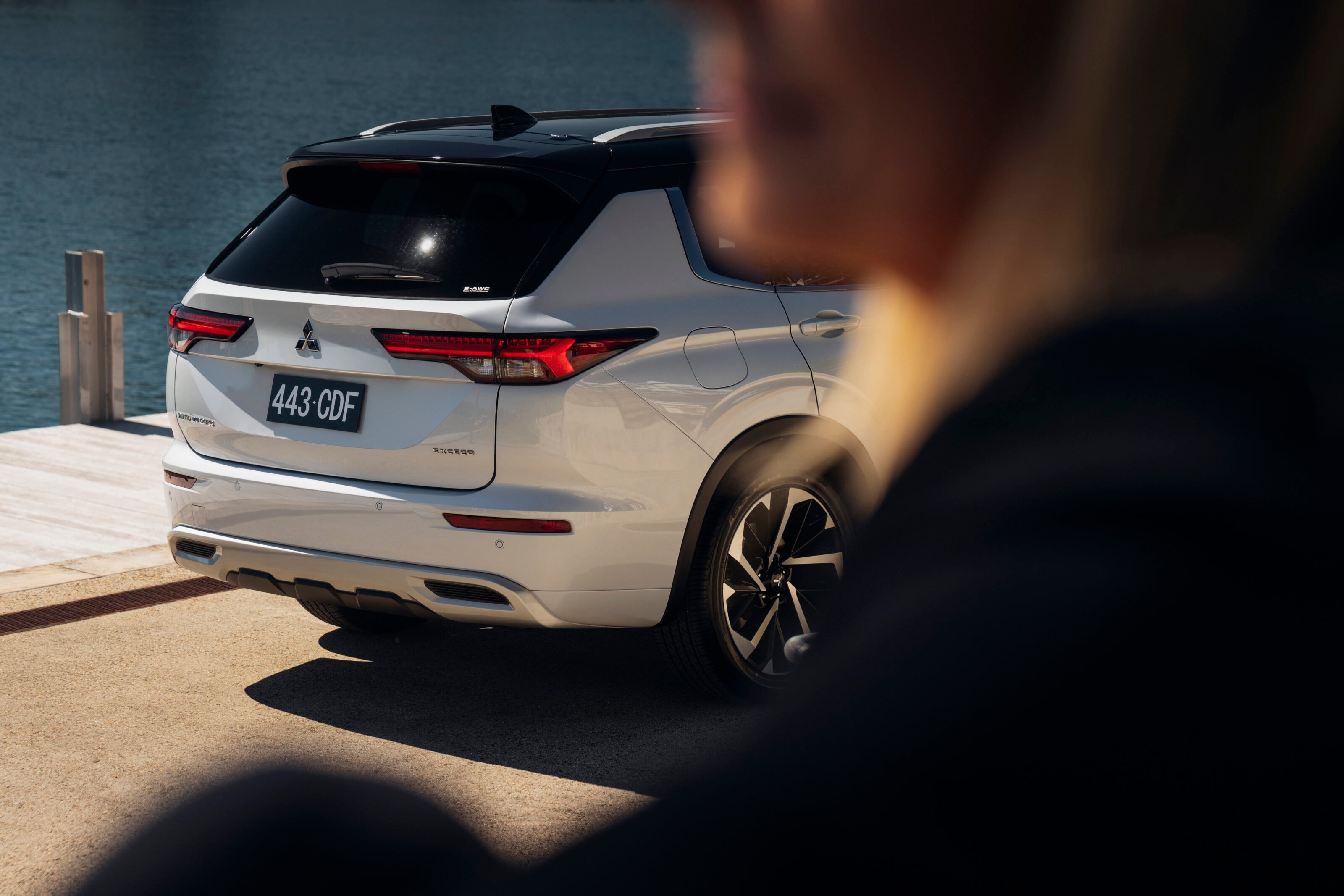
Mitsubishi Australia has revealed its new 2022 Outlander PHEV, at the same time confirming an Australian launch is imminent.
In the first major update for the Outlander PHEV since its local debut in 2013, Mitsubishi says it will feature a more powerful motor and a larger battery, helping to deliver an increase on the existing model’s 60kW front and 70kW rear motors, combining for a total driving range of 56km in electric-only mode.
Initially rolling out in Japan later this year, the Outlander PHEV will arrive in Australian showrooms from the first quarter of 2022.
August 27: Full pricing and features revealed
Mitsubishi is finally replacing its long-serving Outlander with a new, bigger car and a sizeable uplift in features and safety – and price.
Confirmed today, the local line-up will begin at at $34,490 and rise to $49,990 for the all 2.5-litre petrol line-up.
Prices are up across the range by between $1500 and $4000, depending on the model, but there is a hefty increase in safety specification and a claimed improvement in materials, as well as a general specification uplift.
Get all the details at the link below.
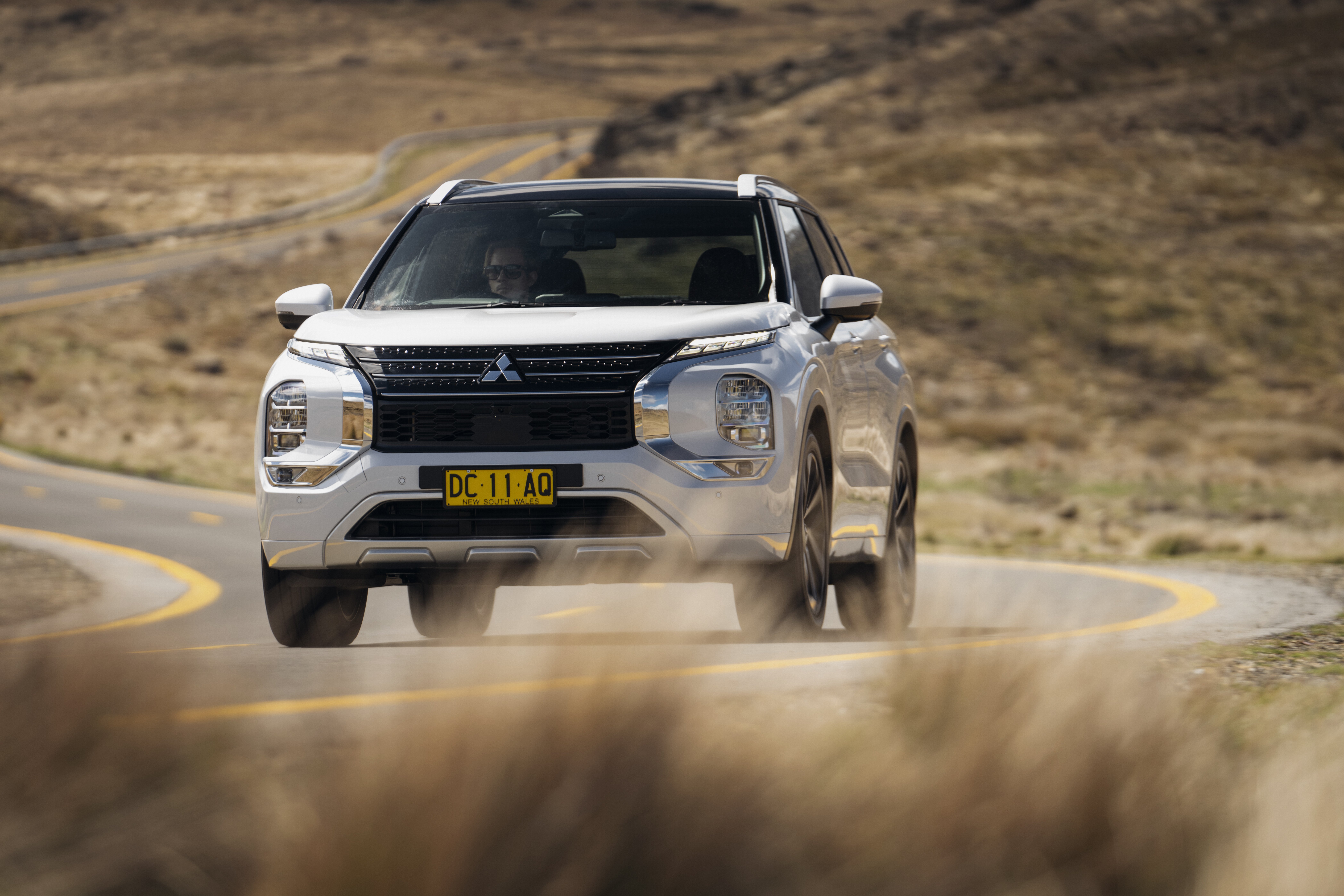
February 17: Global reveal
Mitsubishi has revealed the fourth-generation Outlander medium SUV during an online event on Amazon Live stream.
Based on the ‘I-Fu-Do-Do’ product concept – which means authentic and majestic in Japanese – the all-new Outlander features bolder styling and plusher interior trim features than the outgoing model, while promising enhanced performance both on and off road.
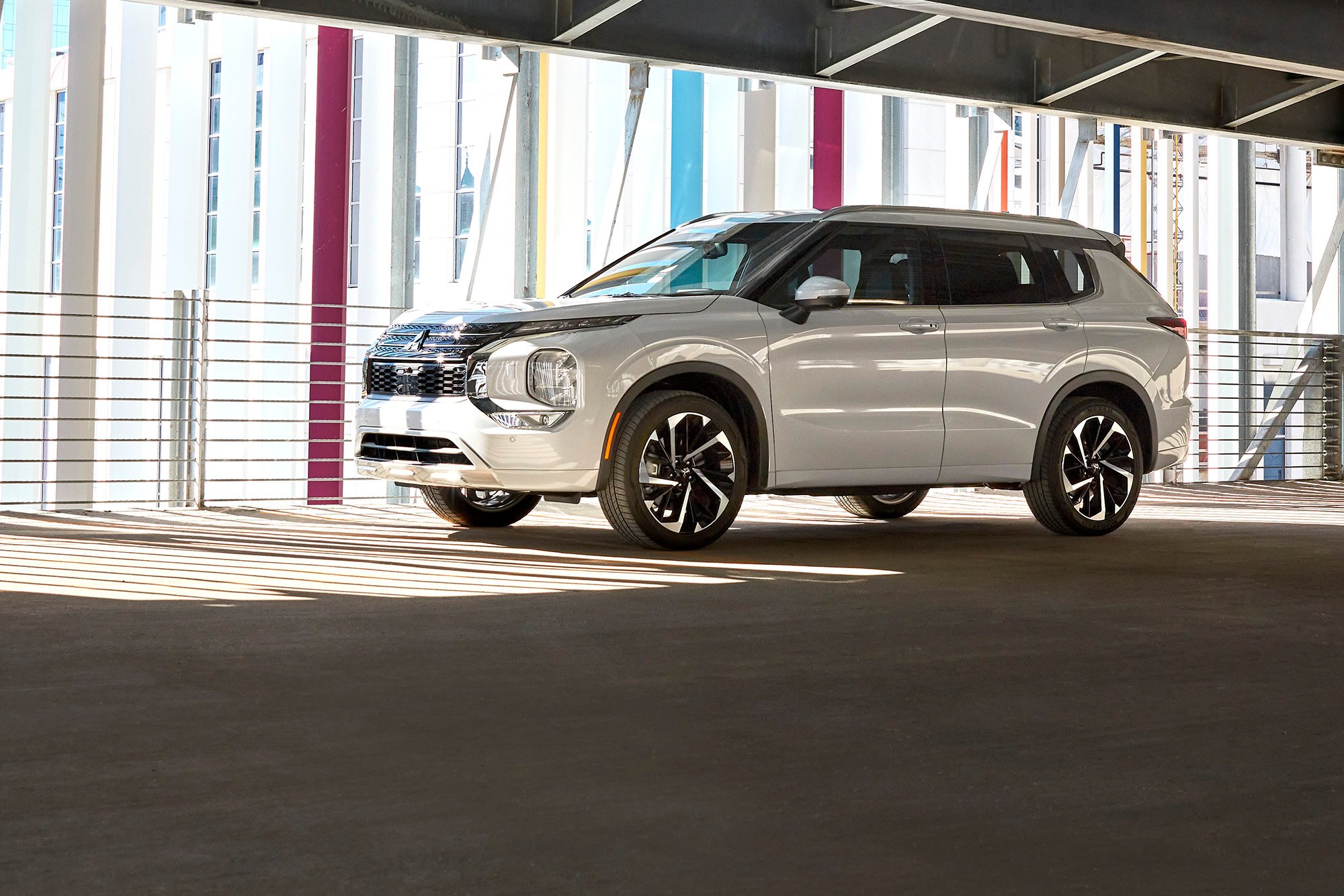
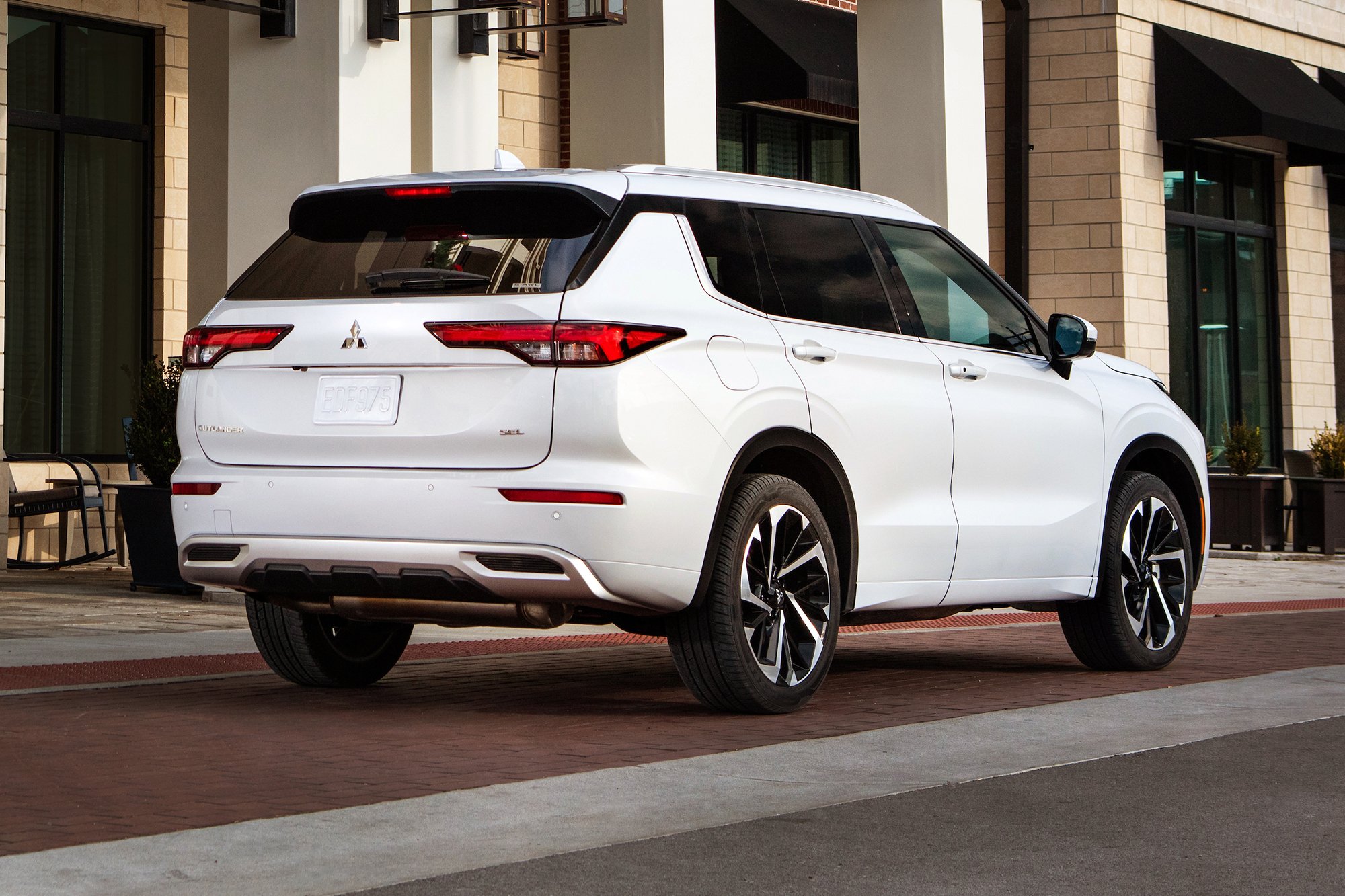
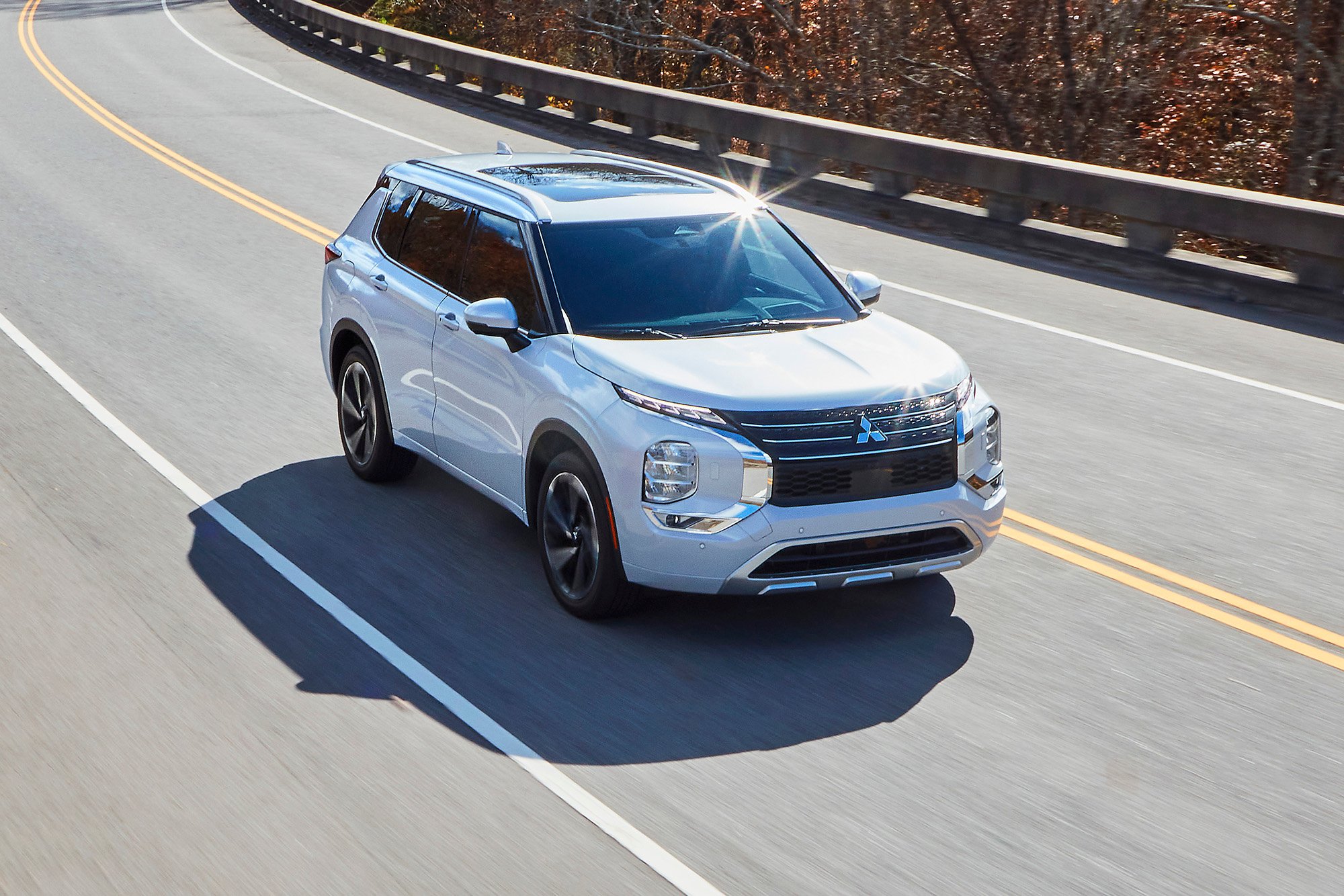
The 2022 Outlander’s styling is highlighted by a next-generation ‘Dynamic Shield’ front fascia that extends into the LED daytime running lights, chunky horizontal lines, big 20-inch wheels and a carved tailgate that’s a nod to the recently-discontinued Pajero’s rear-mounted spare wheel.
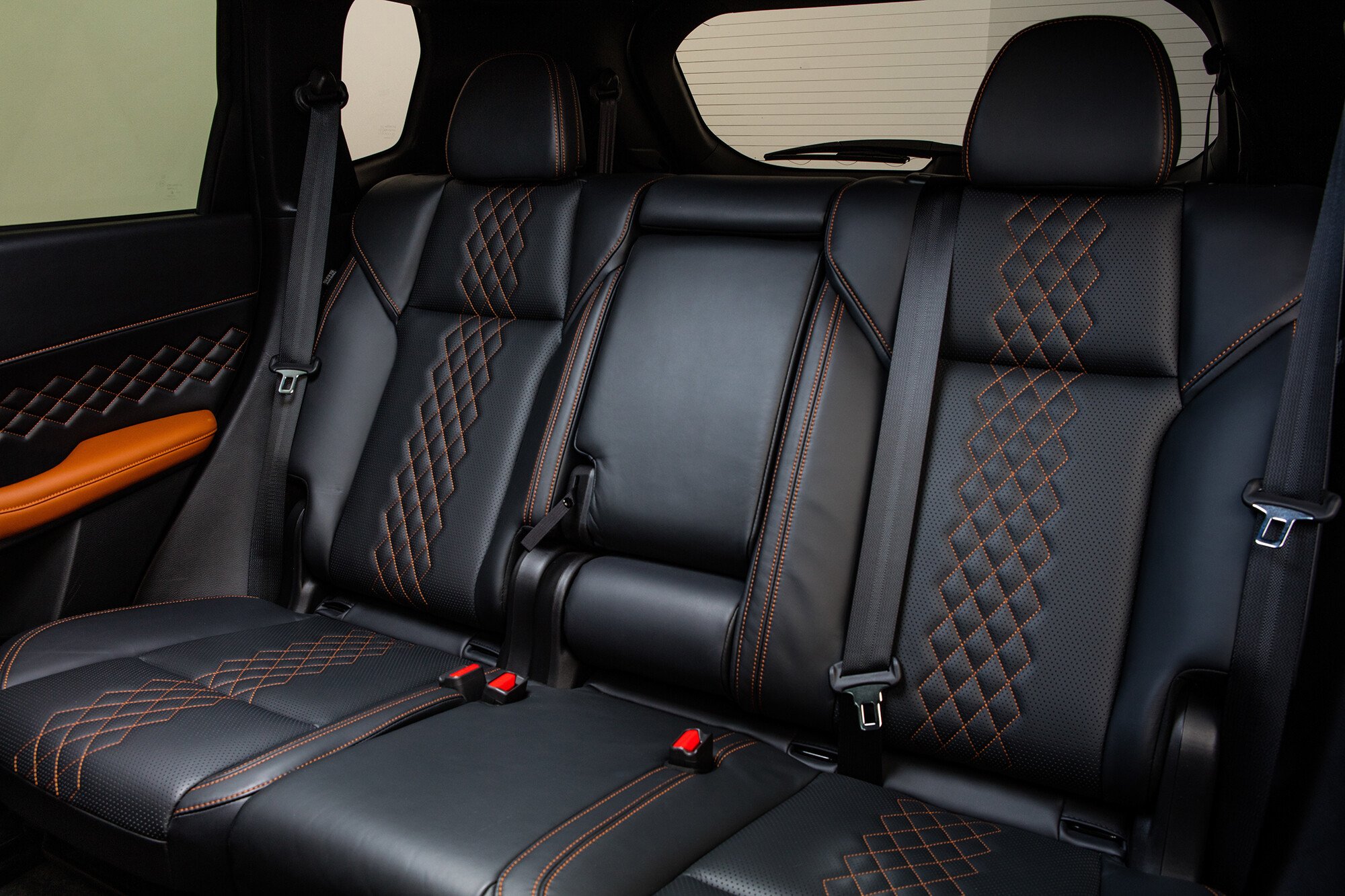
Step inside, and the cabin is clad with soft padding and, in upper-spec variants, stitched leather that provides a premium look and feel.
Mitsubishi says space and comfort has been enhanced by increasing the wheelbase by 25mm to 2705mm, resulting in additional legroom for the first and second row seats.
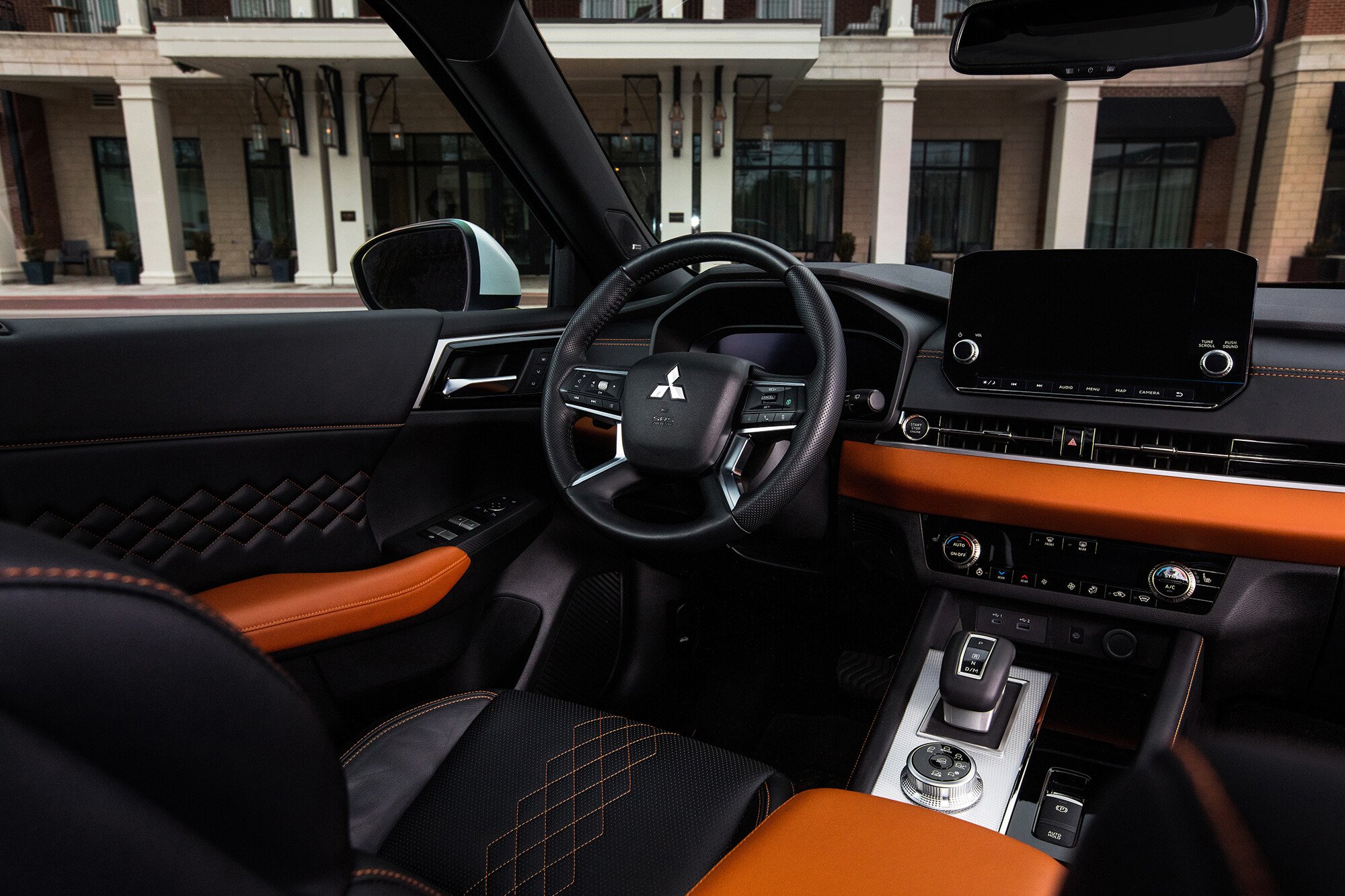
In addition, features such as seat heaters, three-zone automatic climate control, and rear window sunshades are also available down back to make the rear seats more comfortable for family members.
Up front there are two types of gauge clusters, also depending on trim level, including a 12.3-inch digital instrument display with customisable views and functions.
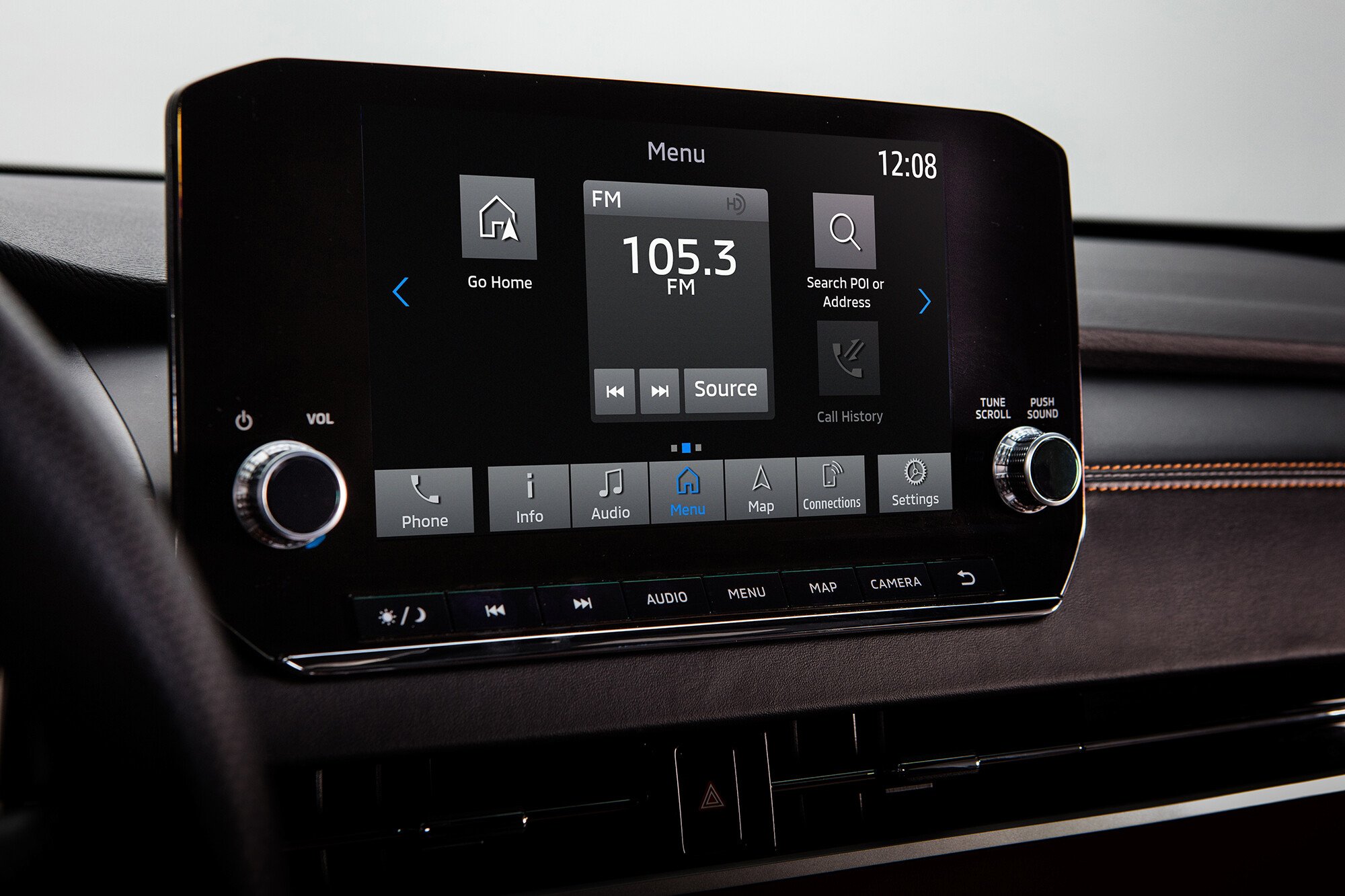
Infotainment is viewed and operated via a 9.0- or 8.0-inch floating touchscreen, again dependent on troim level, with Smartphone-link Display Audio navigation system and Android Auto/Apple CarPlay connectivity. A 10.8-inch head-up display (HUD), showing driving and navigation information, will also be available.
Two- or three-row options
The all-new 2021 Outlander will continue to offer a choice of five or seven seats.
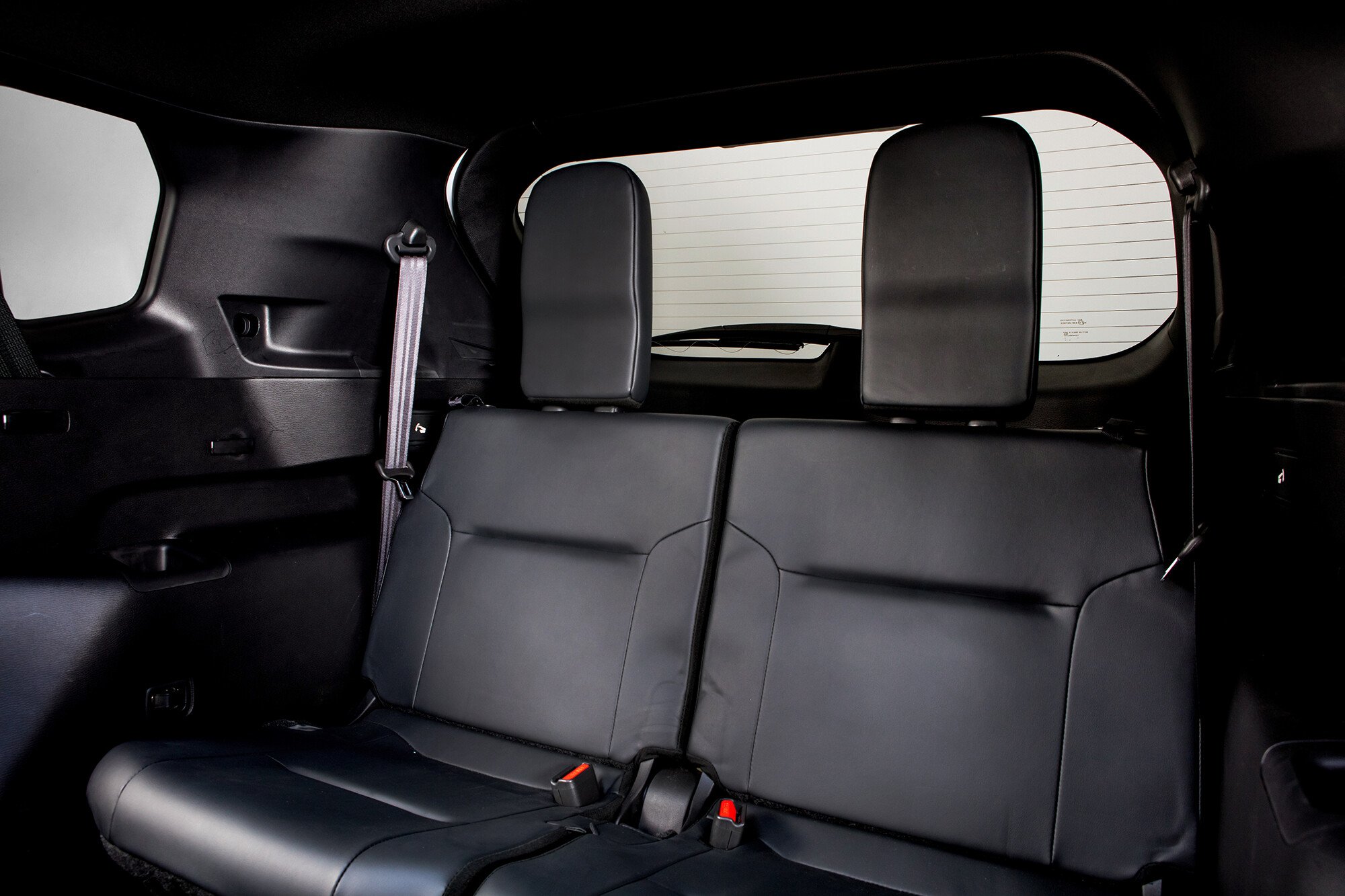
Seats can be flexibly arranged into multiple configurations to suit the number of passengers and their luggage. Second-row seats have a sliding and reclining function, as well as a 40:20:40 split-fold division. They also have a one-touch folding mechanism to simplify access to the third row.
Space for storing objects such as smartphones is provided in the centre console tray, centre console side pockets, driver’s seat back pocket, and quarter trim pockets.
The centre console tray also has a 15w wireless phone charger, with type A and C USB charging ports also provided at the front and back of the centre console.
Advanced driver assist features include smart adaptive cruise control with stop and go function, lane-keep assist and speed sign recognition that, using satellite navigation data, can adjust the Outlander’s speed to suit the speed limit.
Other available active safety features include radar-based autonomous emergency braking, collision warning, active blind-spot assist that will prevent the Outlander changing lanes if there is another vehicle to the side, driver attention alert, rear auto braking, and rear cross traffic alert.
There are also 11 airbags, including a front centre one that deploys between the driver’s seat and front passenger seat in the case of a side impact.
Performance and handling
Engine wise, the Outlander rides on a new platform with power coming from a newly developed 2.5-litre petrol engine that Mitsubishi claims improves output by 8.9 per cent, and is 2.6 per cent more fuel efficient.
The engine is coupled with an eight-speed continuously variable transmission that, according to Mitsubishi, changes speeds crisply like a multi-stage automatic transmission for more powerful acceleration, while feeling smooth and quiet when cruising.
Last night’s reveal did not mention the plug-in hybrid (PHEV) version, which will be announced at a later date and is expected to from part of the new Outlander range when it arrives in Australia in September or October 2021.
The 4WD versions feature an electronically-controlled torque distribution system incorporating a hydraulic clutch that provides extra traction when taking off on slippery surfaces.
The new Outlander also has an improved S-AWC integrated vehicle dynamics control system and brake AYC (Active Yaw Control) on the rear wheels, making it possible to provide front and rear wheel distributed control.
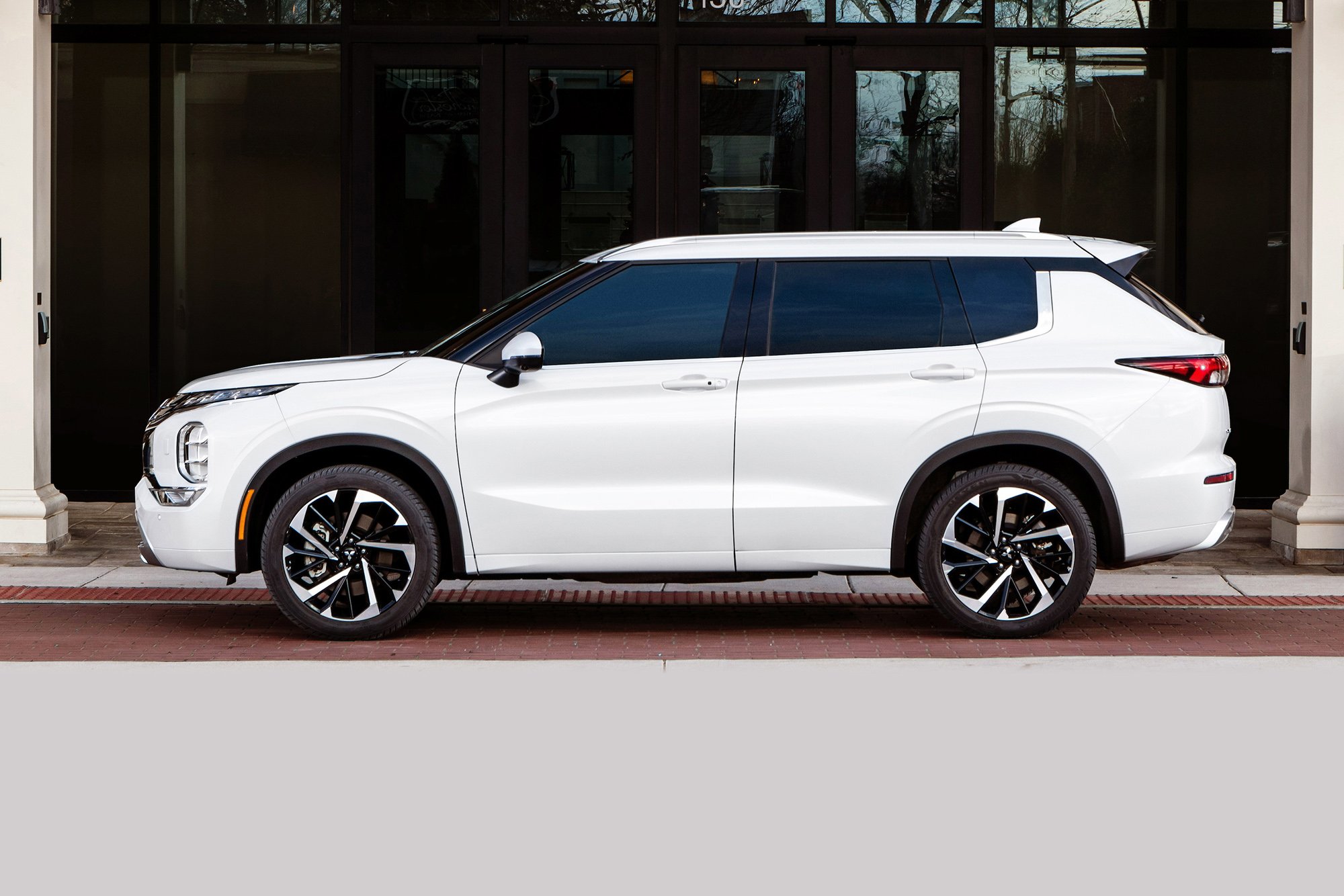
The all-new platform offers improved torsional rigidity over that of the previous model for improved handling. This is further enhanced, according to Mitsubishi, by the multi-link suspension and dual pinion electric power steering that improves cornering and “achieves high-quality ride comfort while also providing operability with a direct, linear feel”.
The 2021 Mitsubishi Outlander is slated to launch in the US in April 2021 and is due to arrive in Australia in September or October 2021, which will be a few months ahead of its closest rival, and cousin, the all-new 2022 Nissan X-Trail.
Local pricing and features will be revealed closer to launch.
I have no idea, by the time you read this, what Australians will be paying per litre at the pumps.
When the figure hit $2.20 earlier this year, the only thing that narrowly avoided a conflict on our own turf was a hastily implemented temporary tax cut to offset the inflation.
A few months later, unfortunately, any price correction had long since been overtaken by an ongoing energy crisis and when I rolled onto a forecourt last week I simply couldn’t believe what the retailer was asking. An inanimate fuel bowser cannot be haggled with and no amount of tapping would convince the price gauge to reconsider and drop below $2.50.
You definitely don’t need me to put that into perspective but if petrol sat alongside milk on supermarket shelves, it would be cheaper to pick up a litre of cow juice. If the current trajectory continues, before we know it, the same will apply to shiraz.

But despite the recent global events and what the headlines may lead you to believe, someone is making a lot of cash every time you fill up and, while I won’t waste words speculating on whose coffers are ringing the loudest, what I can tell you with confidence is that the price is not about to go into remission – high fuel prices are here to stay.
With that in mind, I wouldn’t be surprised if your list of new car priorities has jumbled about a bit. Where performance, practicality and design might have once featured fairly high up, you’re likely to be one of the many Australians now putting L/100km before 0-100km/h.
I certainly can’t blame you. As car people, we will always place a big chunk of value on how beautiful a car is to behold and to drive, but all of that amounts to not much if the damn thing is too expensive to run.

But what if you didn’t have to compromise on everything to find a more efficient car? That’s what this comparison is all about.
If outright efficiency at the cost of everything else was your only goal then might I suggest something with a Piaggio badge, but if you’d like something that makes each drop go further and also offers room for at least four, Japanese reliability, SUV flexibility oh, and significantly better safety and comfort, read on.
Toyota’s RAV4 is a very familiar face on Australian roads – it’s the nation’s favourite mid-sized SUV, it’s up there as one of the most popular hybrids, and it’s worked hard for both of those titles.

Regardless of whether you’re looking at the entry-level two-wheel drive options, petrol, mild hybrid, or the kit-packed and all-wheel drive range-toppers, the RAV4 has always put up a convincing fight in previous testing.
Any of the 11 variants that launched in 2019 would still offer a strong contender in this comparison, but the version you’re looking at is the freshly introduced XSE.
Growing the line-up to 13, the new version is slap-bang in the middle of the RAV4 family. The offering is a compelling list of kit, Toyota’s proven hybrid drivetrain and a choice of front-wheel drive or eFour all-wheel drive.

For this battle, we’ve gone for the two-wheel drive. Why? Because it costs $42,825 (before on-road costs) and that rather nicely aligns in price with our second car in this efficiency mission.
Its face is less familiar than the Toyota, but its boot badge is not. The Honda HR-V has been cruising Australian roads since 1999, but this is the freshly unboxed third-generation model.
Compared with the RAV4’s catholic-sized family, the Honda is available (for now) in just two variants – the entry Vi X and this, the $45,000 (drive-away) e:HEV L.
| EDITOR’S NOTE, 12/8/22: Buyers should note the HR-V e:HEV L copped a $2000 price increase in August, some months after this comparison was published. We’re leaving the story unchanged, but buyers should keep this new $47,000 drive-away pricing in mind. |

Like the Toyota, it gets front-wheel drive, a hybrid powertrain with long battery warranty, Japanese-brand confidence and heaps of SUV appeal. Beyond that though, these two fuel-sipping SUVs are very different offerings.
Let’s address the elephant in the room – size. Over 28 years and five generations, the RAV4 has ballooned and now competes in the medium segment, while the HR-V has stuck to the small SUV class it entered 23 years ago, and that might well be the deciding factor for many buyers.
Jump into the RAV and its capacious cabin offers room for five adults, heaps of headroom in both rows of seating and a mighty 580-litre boot.
Despite the class disparity, the Honda’s occupant space is almost comparable and even its more coupe-like roofline doesn’t intrude as much as expected – but there are significant disadvantages.

Despite the class disparity, the Honda’s occupant space is almost comparable and even its more coupe-like roofline doesn’t intrude as much as expected
Its boot is a relatively tiny 308 litres and seating is limited to four people rather than five. If two of those people happen to be tiny, both models offer ISOFIX anchors for two child seats in the second row.
The Toyota wins more practicality points for having a space-saver spare wheel but get a flat in the Honda and it’ll be the dreaded inflator kit for you.
However, the Honda, like other small models from the Japanese brand, has a secret weapon in the form of ‘magic seats’. Both cars can significantly boost boot space with a flat-folding second row, but the HR-V goes a big step further with the clever seat bases that fold up onto the back support and liberate a floor-to-ceiling space behind the front row.

This allows tall and awkward-shaped items to be easily transported despite the Honda’s diminutive exterior dimensions. When it comes to technology and standard equipment, however, there is less of a void dividing the pair, with enough kit to attract savvy buyers while only minimally raising the price.
That’s why you won’t find typically big-ticket items such as a sunroof, leather seats or branded sound systems but there’s still lots to like. At the RAV4’s helm, its interior layout is a little clumsy but there are high-quality touches including the rubberised door handles and large dash control dials.
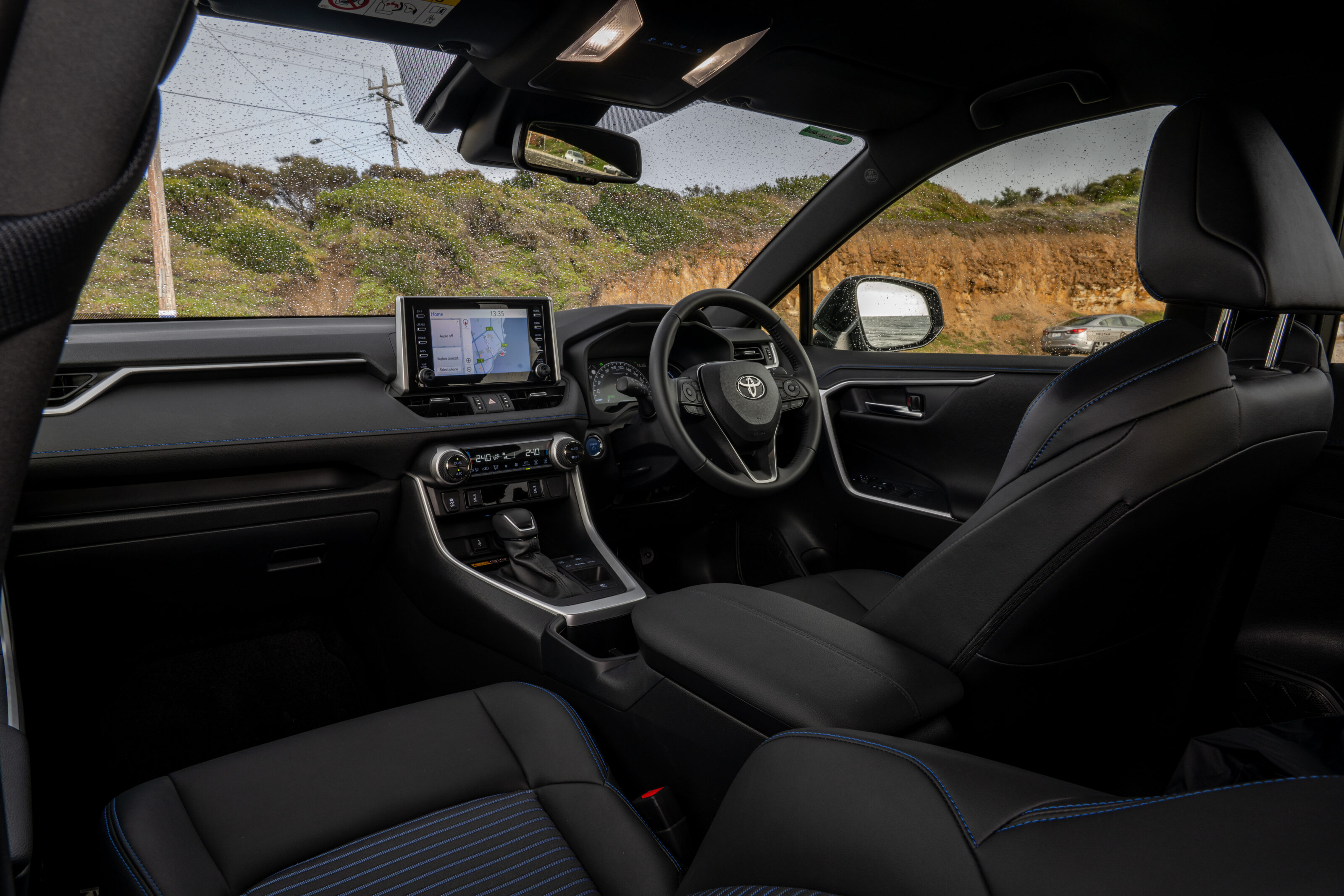
The driver’s seat gets 10-way electric adjustment, there’s wired Android Auto and Apple CarPlay, wireless device charging and an 8.0-inch central touchscreen – even if it is full of slightly dated-looking graphics. Thankfully, Toyota has updated the functionality of its operating system with the addition of hot keys that look a bit daggy but enable far easier operation.
There’s a 7.0-inch digital display to be found in the driver’s instrument cluster, with a 50:50 split of central electronic screen and traditional dials.
Board the Honda, however, and the first impressions have a greater impact. A little of the Civic’s upmarket direction and enhanced visibility has migrated into the new HR-V, along with a clean but sharp interior design.
Board the Honda, however, and the first impressions have a greater impact.

Skinny A-pillars, uncluttered screen, repositioned door mirrors and a lowered bonnet have increased the driver’s vision significantly. Then there’s the attractive dash layout with satisfying tactile air vent controls and top-quality steering wheel leather.
Its instrument cluster is a different interpretation of the half-and-half split of gauge and digital display but it works, while its central touchscreen is an inch larger than the Toyota.
It too gets all smartphone mirroring although it lacks the combination of wireless CarPlay and device charging found in the Toyota (although it is optional) and another notable omission is electric seat adjustment of any description.
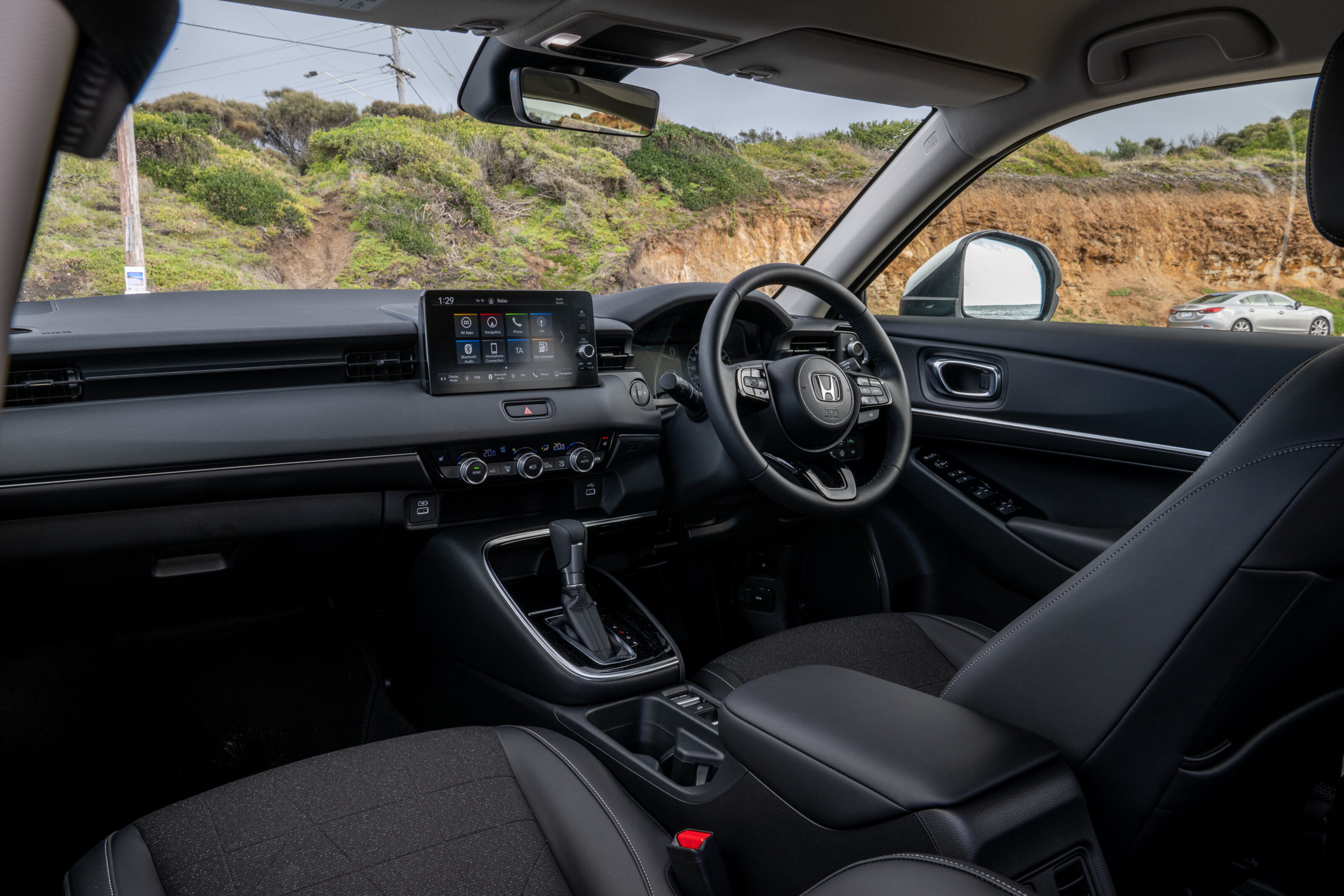
Given Melbourne’s overly enthusiastic start to winter, heated seats in both were an option we would have paid for but thankfully in the Honda you don’t have to and there’s a heated steering wheel as well.
Equipment dollar values are therefore about equal but cater to differing sensibilities. When it comes to aesthetics, on the other hand, the RAV4’s looks are familiar and safe, while the Honda’s approach to styling and design is more contemporary and exciting.

Where the pair deviates tangentially though, is in the way they drive.
Powering the Toyota is a 2.5-litre naturally aspirated four-cylinder petrol coupled to a CVT with 160kW and 221Nm sent to the front wheels, while the Honda is fitted with a 1.5-litre (also non-turbo) four-pot petrol developing 96kW and 253Nm.
Don’t be fooled by the more impressive torque figure because Toyota for some reason doesn’t list the combined output of petrol and electric – and the RAV4 is significantly faster. Both cars provide the satisfying instant surge of electric, but the Honda is the one left floundering when you need to be somewhere in a hurry.
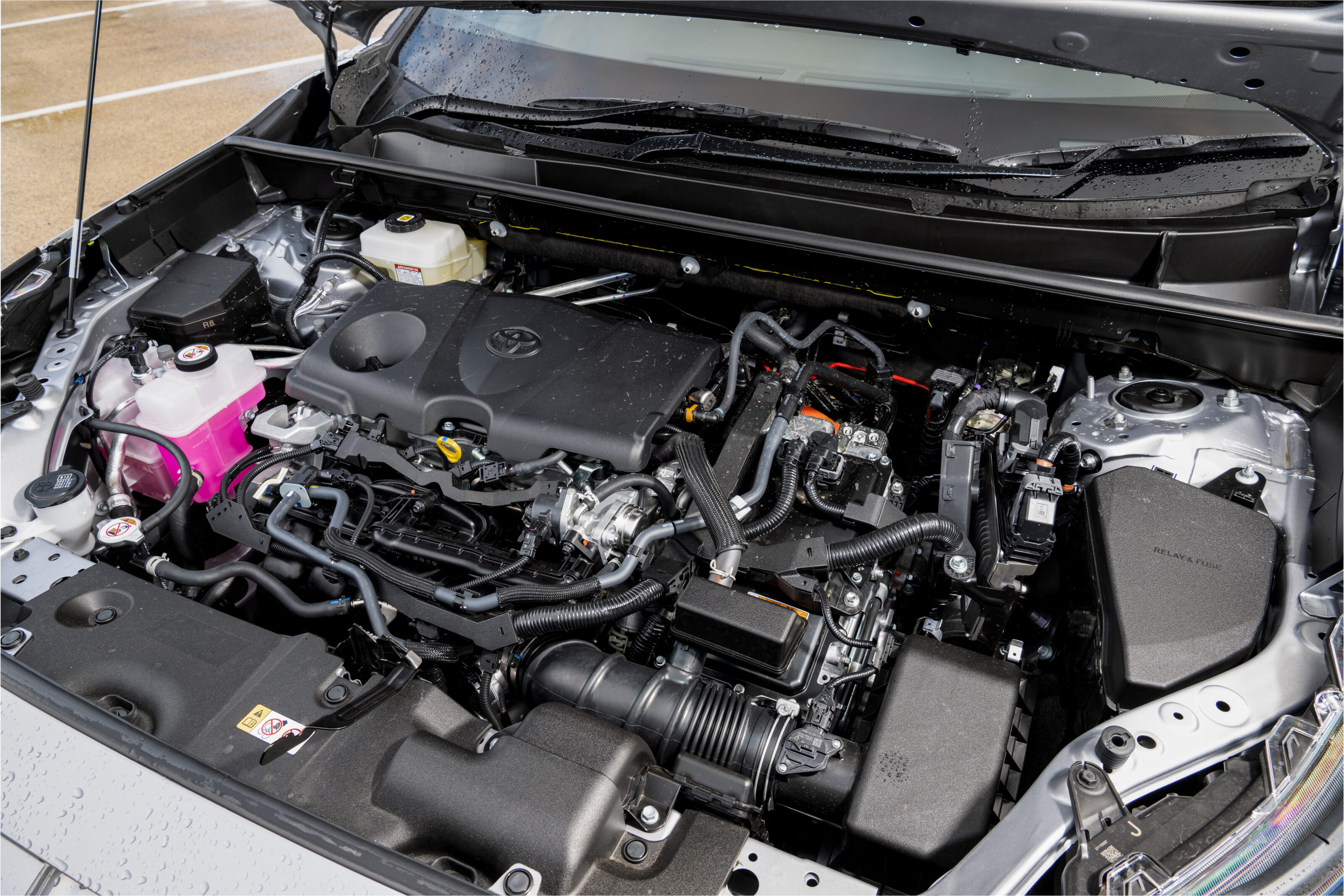
With simulated gearchanges from the RAV4’s continuously variable transmission, it offers the more familiar driving experience but Honda’s unusual fixed-gear eCVT has been very much engineered for efficiency.
There are subtle stepped changes in engine revs but for the most part, engine sound from the HR-V is not directly related to progress as its role is mostly to power a generator, rather than drive the front wheels directly as the Toyota does.
When it comes to slowing down, there are more contrasts. While the RAV4 has a grabby pedal at low speed and minimal regenerative braking effect on overrun, the HR-V has a firm and progressive pedal with paddles to choose how much regen effect the driver wants. It feels like the Toyota is trying to hide its electrified assets while the Honda is embracing them.

It feels like the Toyota is trying to hide its electrified assets while the Honda is embracing them.
Don’t be fooled by either of the responsible powertrains though, because both cars are fun to chuck about. Neither can resist wheelspin in the wet but the RAV4’s sensitive steering pairs well with a resistance to roll, excellent grip and a ride that is planted, confident, comfortable and quiet.
At the wheel of the HR-V, there’s a little more fidgeting at higher speeds but even more agility than the Toyota thanks in part to Michelin Primacy rubber versus the RAV4’s Bridgestone Alenzas and significantly lower kerb weight.
Not only does the Honda have a smaller 1.1kWh battery, it is a lithium-ion type, compared with the Toyota’s 1.6kWh nickel-metal hydride chemistry.

The difference is 1382kg versus 1690kg and the mass is noticeable in virtually all types of driving. With its shorter legs, smaller size and lighter weight the Honda is at home in suburbia, but the more solid-feeling Toyota does better out of town.
Ultimately though, the biggest chunk of this battle comes back to the hybrid boot badge each car wears and how that translates to saving you cash each time you fill up. It’s here that the game swings dramatically back in the Honda’s favour.
Officially, Toyota says its offering will return a combined-cycle fuel economy figure of 4.7 litres per 100km while the lighter and smaller-engined Honda promises 4.3L/100km.

Photo shoots are not known for enabling the most efficient driving, with lots of stopping and starting, long periods of idling and some enthusiastic stuff thrown into the mix, which is why higher than average consumption is perfectly acceptable under these circumstances.
The onboard trip computers were reporting figures of 6.2L/100km for the RAV4 and 5.5L/100km in the HR-V.
However, when we ran the numbers and calculated actual fuel use, the picture looked very different.
While the Honda had indeed used exactly what its computer claimed, the Toyota had averaged a far thirstier 7.3L/100km. This revelation initially raised an eyebrow but, when viewed objectively, it shouldn’t be quite so surprising.

The Honda has a smaller engine, a lower drag coefficient, a drivetrain that prioritises electric propulsion more than the RAV4 and weighs a whopping 308kg less. It was always going to have the upper hand when it came to economy.
The Toyota still dominates on the open road and with the option to spend a little more by adding all-wheel drive, it also represents the best option for hitting unsealed trails.
It’s also the space champion, offering a vastly superior size and shape of boot plus accommodation for an entire extra human on board. Rounding out the RAV4’s list of attributes is a comprehensive standard equipment set thanks to the new mid-range XSE variant.

The Toyota still dominates on the open road and with the option to spend a little more by adding all-wheel drive, it also represents the best option for hitting unsealed trails.
In that regard, the Toyota would have to represent the best value out of this pair. Not so fast. If you want your own example of a hybrid RAV4, be prepared to wait for about 12 to 24 months, whereas the HR-V will be on your driveway in about four months.
Regardless of the model, nobody knows how much it’ll cost you to top up the tank once it’s arrived but in the time it’s taken you to read this, the price of fuel has probably increased another 10 cents per litre.
If that concerns you as much as it does us, then the Honda’s almost teetotal demand for petrol has to be the true winner in this fight for frugal supremacy.
Rivals

With around $45K including on-road costs to spend in the small segment, premium player Lexus and its UX200 SUV come within range but you’ll need to spend $52K to get into the hybrid UX250h. Mazda’s MX-30 G20e is also one to consider but has the mildest of hybrid systems from $33,990 (before on-road costs) and has practical compromises in return for its very style-led offering.
If the mid-size segment is where you insist on shopping, offerings from Mazda, Hyundai and Ford all come into play but none can offer their competing models with a hybrid powertrain (unless you count the Escape plug-in hybrid that comes in around $10K over budget.
But how about this for an option – potentially two options? On the not too distant horizon is Kia’s new Niro and it’ll be available as a mild hybrid and plug-in hybrid for a price within the ballpark of these two.
Sounds like a rematch is on.

SCORING
2022 Honda HR-V e:HEV: 7.5/10
What we liked:
- Very low fuel consumption
- Sophisticated spacious cabin
- Nimble handling
Not so much…
- Pricey for a small SUV (even more so from August 2022)
- Only one spec level for now
- Tiny boot
2022 Toyota RAV4 XSE 2WD Hybrid: 7.5/10
What we liked
- Lots of kit for the cash
- Lovely road manners out of town
- Long battery warranty
Not so much…
- Old battery tech
- High fuel consumption
- Long wait list
Specifications
Snapshot
- New Kia Sportage now carries a five-star ANCAP rating
- Strong scores across adult and child occupant protection categories
- AEB system wouldn’t react to pedestrians in reverse or while turning
The 2022 Kia Sportage has become the latest medium SUV to be awarded a five-star ANCAP safety rating.
Having launched towards the back end of last year, Kia’s popular SUV is now backed by ANCAP, with the Sportage meeting the crash test authority’s stringent 2020-2022 test regulations.
“The new Kia Sportage has already proven to be a popular choice for fleets and families, and Kia is to be congratulated for achieving another five-star safety rating against ANCAP’s 2020-2022 protocols,” said ANCAP Chief Executive Officer, Carla Hoorweg.

Scoring particularly well for child occupant protection, the Sportage took 42.73 out of 49 available points for a 87 per cent score, owing to its strong results in the front dynamic test (15.70/16), side dynamic test (7.80/8) and restraint installation (11.24/12).
An identical 87 per cent result was achieved in the adult occupant protection category, with a total of 33.43 from 38 points on offer.
The Sportage managed either perfect scores or within a point of full marks in every test bar the frontal offset crash, where it still managed a respectable 6.38 out of eight.

Next-best was the Sportage’s safety assist systems, with a 74 per cent score attributed to 11.90 out of 16 points being scored.
Again, a majority of tests resulted in points totals within one of full marks, however its autonomous emergency braking (AEB) junction assist system wasn’t evaluated due to it not being fitted to the test vehicle in Europe – despite being a standard feature in Australia and New Zealand, leading to a loss of two points.

The lack of a working AEB system in reversing situations caused the Sportage’s vulnerable road user protection score to be the lowest of the four categories, ending up with a 66 per cent rating after taking 36.10 points out of 54.
Although it lost two points due to the AEB pedestrian backover test not being conducted, the bigger hit was taken in the upper leg impact test, recording its lowest individual score so far with 1.65 points out of six – head impacts were also a marginal pass with 16.16 points from 24.
Last month the Sportage was the seventh best-selling vehicle in the Australian new car market, recording 2044 sales throughout June – a 137 per cent rise over the same month last year.
This is it. The very last edition of MOTOR will be appearing on shelves tomorrow, July 7.
We’ve put together a special collector’s edition to send the old girl off in style, featuring landmark road tests, all-time features, editorial from editors past and a few surprises.
Oh, and a road test of MOTOR’s undefeated champ – the only car to win Performance Car of the Year, Bang For Your Bucks and every single comparison test it ever entered. Clue: it’s not a Porsche.
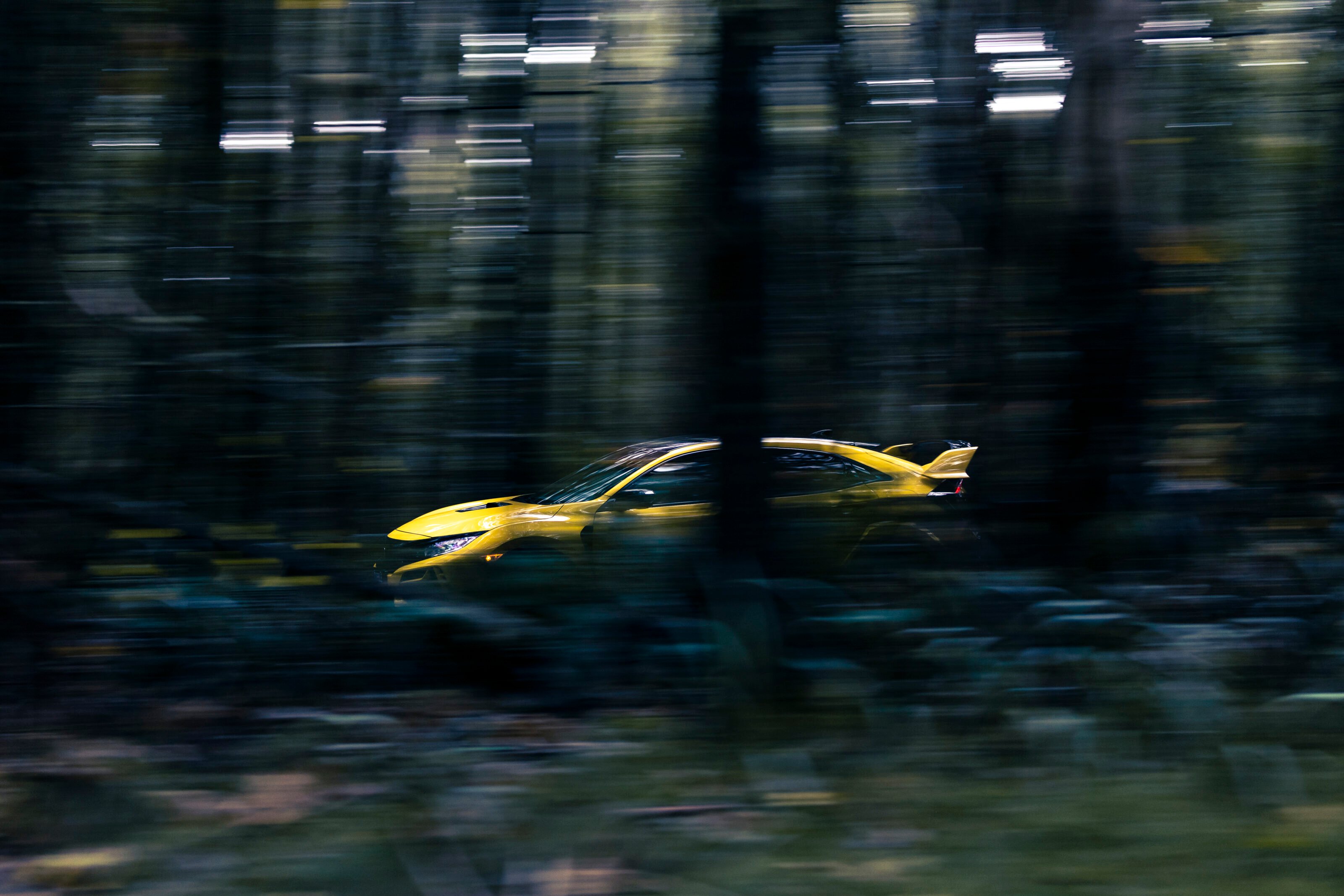
Wading through the title’s 68-year archive was bittersweet. There were so many incredible stories that it was easy to lose yourself for days, discovering writers you’d never previously read, cars you’d long forgotten and hilarious yarns that were scarcely believable had they not been documented right there in gradually yellowing print.
That chapter ends here. It feels like the harshest of decisions, but the balance sheet of the title told its own story.
When I took over the magazine in 2020, under different ownership, I was given two or three issues before it went exclusively online.
To give you an idea of how parlous our finances were, previous editor Dylan Campbell was even mulling the possibility of paying a contributor out of his own pocket. Thankfully things got better.
We negotiated a workable budget, and a small team of hugely dedicated writers, designers and photographers kept the magazine not only afloat, but tracking ahead of a declining market for 22 issues. It wasn’t enough. A 25 per cent price hike in paper stock, coupled with the coup de grace of fuel surcharges on top, tipped the financial balance against us.
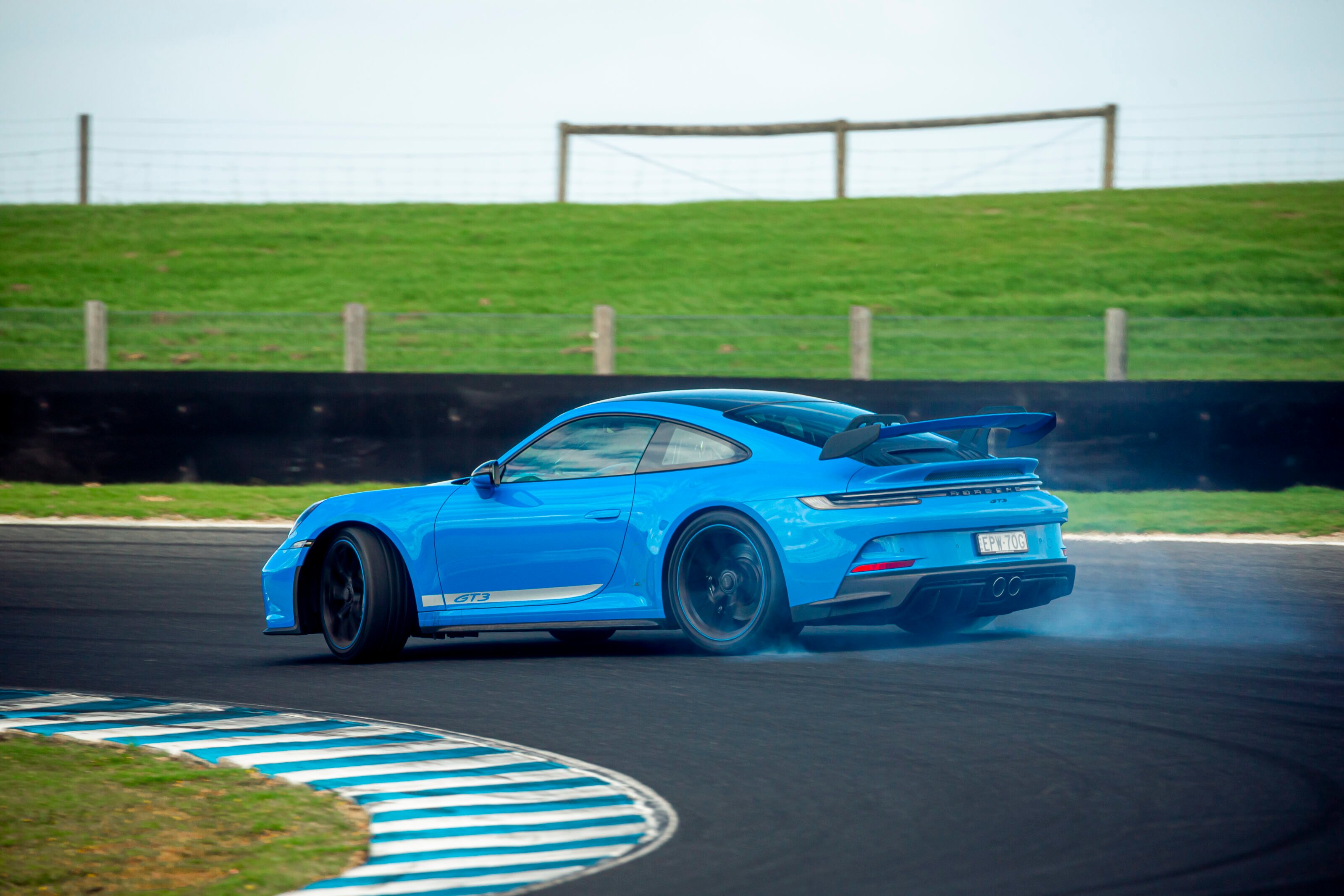
But for every cloud there’s a silver lining. Recognising that MOTOR had transformed itself into something beautiful, thoughtful and genuinely exciting, the team that brought you the magazine has now been given the keys to Wheels.
I’m taking over the editor’s chair from the capable stewardship of Ash Westerman and we’re looking to inject even more passion and quality into the flagship title. So you’ll see a few changes in the coming months. Above all, I want Wheels to be a forward-looking magazine; one that leverages its heritage without leaning lazily on those laurels. We’ve got work to do.
In the meantime, we’re transferring the subscriptions of MOTOR readers across to Wheels. If you’ve subscribed to both titles, the balance of your MOTOR subscription will be added to Wheels.
Of course, should you prefer not to continue, that’s an option too. By now, all subscribers should have received an email detailing exactly this.
I’d like to personally thank everybody that kept MOTOR alive for all those years. In a world of free content, it takes something special to put your hand in your pocket – and that’s not a commitment we take lightly. We’d love to be able to repay that loyalty with a rejuvenated, re-energised Wheels.
The crew is back in a brand-new office, the vibe is back, and we’re keen to get after it. All we ask is that you stick with us. It might be the end of the road for MOTOR, but the same team now has a different sign above the door. We felt we were just hitting our straps. Help us make good on that.
Regards,
Andy Enright Editor MOTOR / Wheels
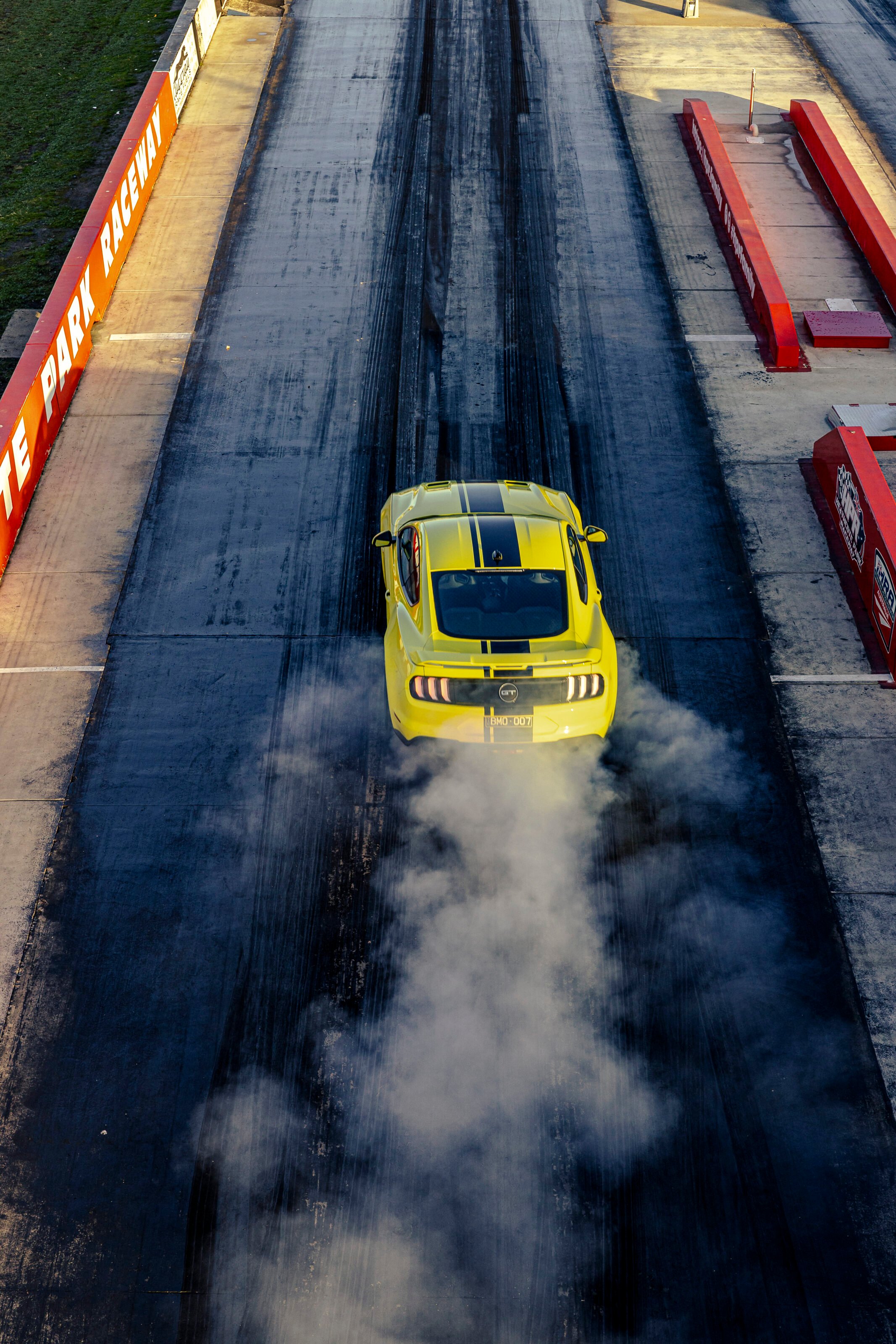
I’m going to hit you with some headline figures first because they’re vaguely ridiculous. If you spec your 2023 Mercedes-AMG EQE53 with the Dynamic Plus package it will produce 505kW and 1000Nm.
Dial in launch control and despite weighing in at more than 2.5 tonnes, you’ll rocket from 0-100km/h in 3.3 seconds once you step off the brake pedal.
And finally, the price. If you decide to purchase an EQE53 when it arrives in Australia later this year, you’ll need to fork over around $200,000. That’s a huge amount of money but, weirdly, it also makes this electric Benz something of a bargain when you compare it with its rivals.
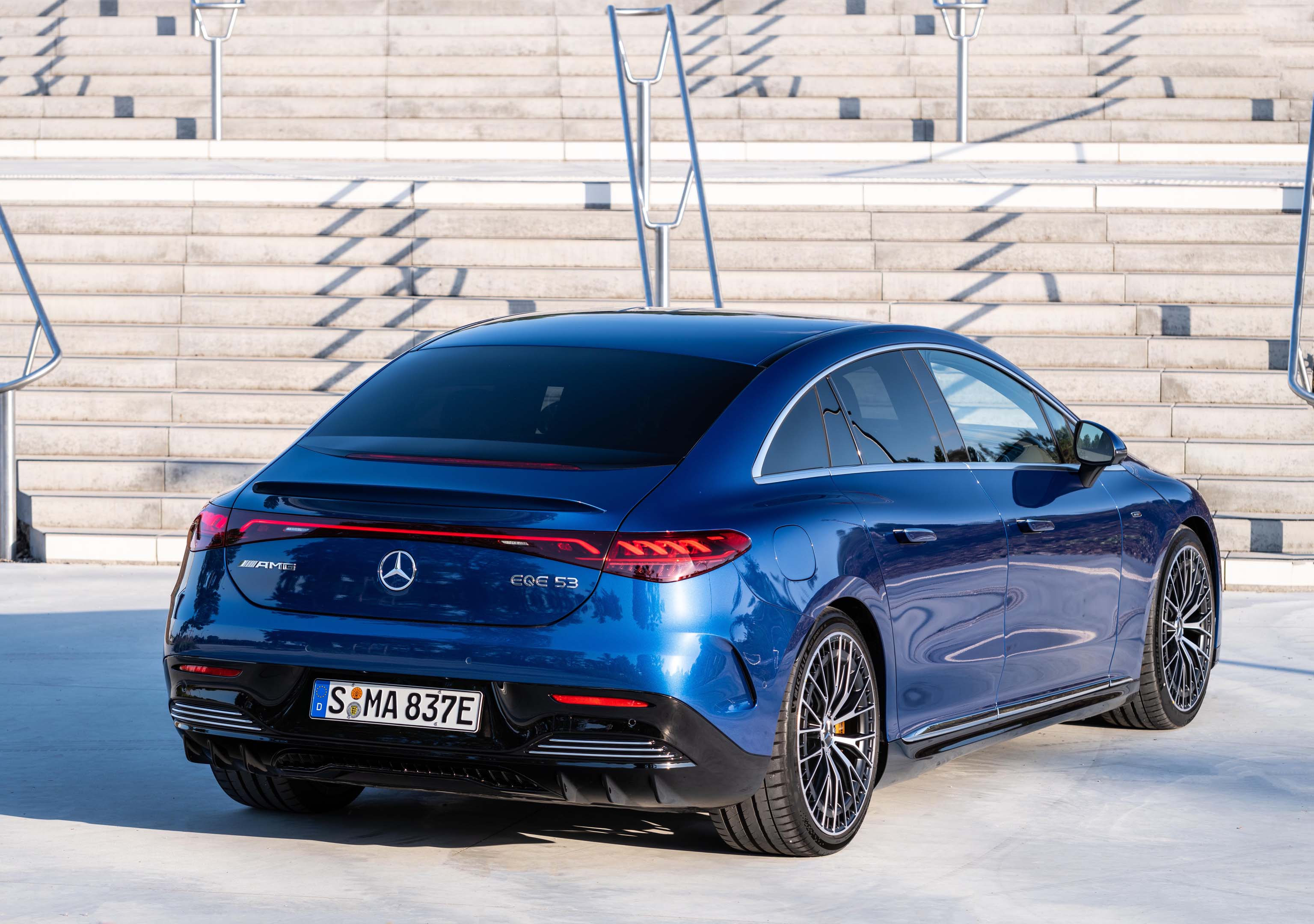
An AMG without a menacing V8 soundtrack? It’s like Nike with no Swoosh. Top Gun with no Cruise.
Want the same degree of potency and acceleration in a Porsche Taycan? Prepare to hand over $150K more for a Turbo S. And if you measure the EQE against its combustion-powered sibling, the AMG E63 S, the petrol-powered sedan costs around $50K more, is almost a full generation older, and is 50kW/150Nm down.
Frame it this way and the EQE53 is suddenly an intriguing proposition but there are even deeper questions at play, too. Just like its competitors, AMG is starting to embrace electrification but somehow it feels a more seismic shift for the brand from Affalterbach. An AMG without a menacing V8 soundtrack?
It’s like Nike with no Swoosh. Top Gun with no Cruise. So can an electric super sedan deliver the same sense of excitement and character we’ve come to expect from AMG? Let’s find out.
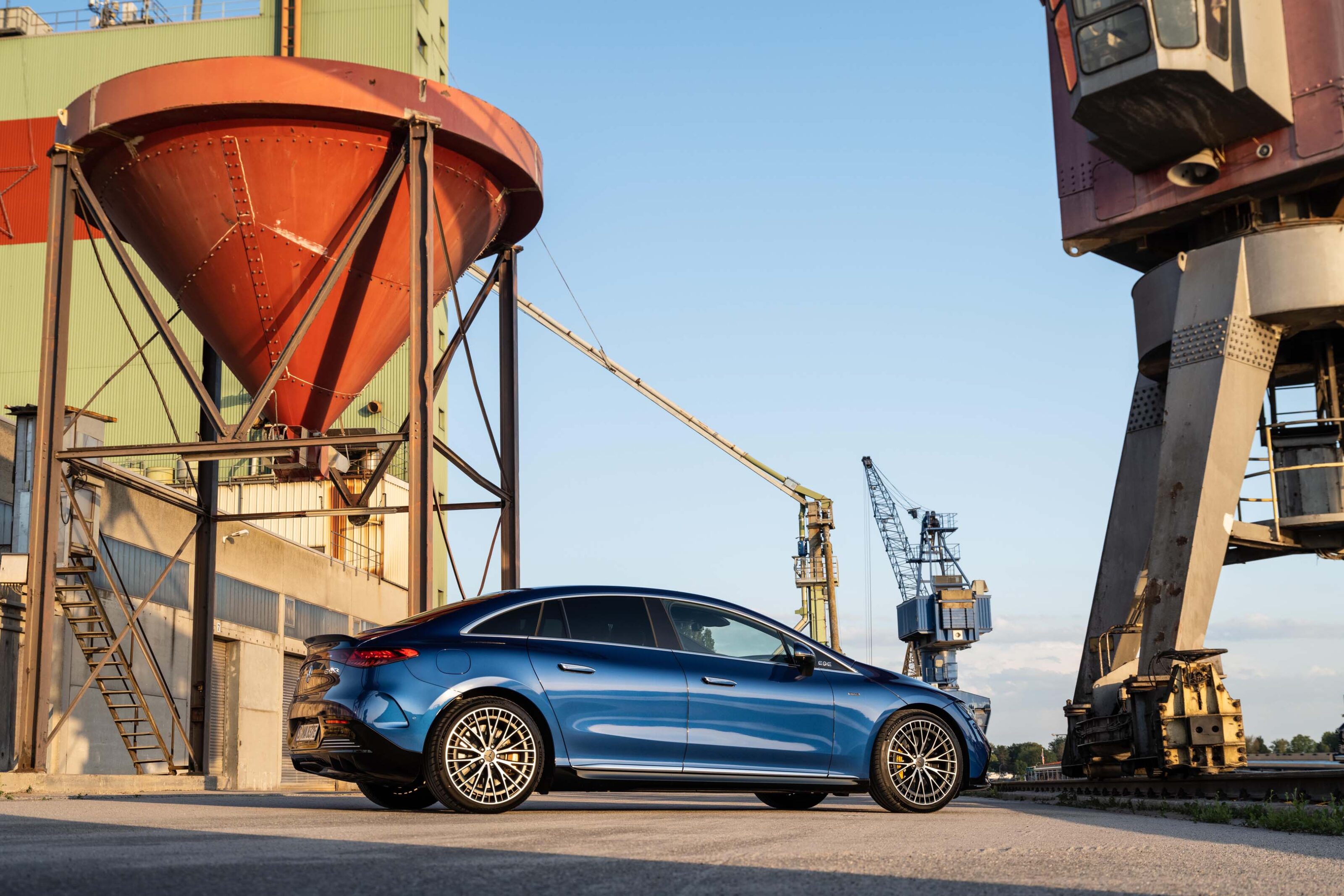
Pricing and features
The car I’ve been talking about until now is the flagship EQE53 with the Dynamic Plus package – but if that sounds a little too intense for your liking, Mercedes will also offer a ‘regular’ EQE53 with ‘just’ 460kW and 950Nm.
An even more sedate version is available globally, badged EQE43, but it won’t be offered in Australia. As usual, our market demands the richest and most powerful recipe possible.
Exact pricing and spec are yet to be locked in, but if the EQE53 can land around the $200,000 mark as Mercedes is predicting, you’ll certainly be getting a lot of car for your money.
Peel back the skin and you’ll find two electric motors, one for each axle, but the motor at the back features a six-phase design rather than the usual three, which helps with power density and repeatability.
So, unlike some other high-performance EVs, you should be able to do full-bore acceleration runs until you feel sick, rather than when the car starts to wilt.
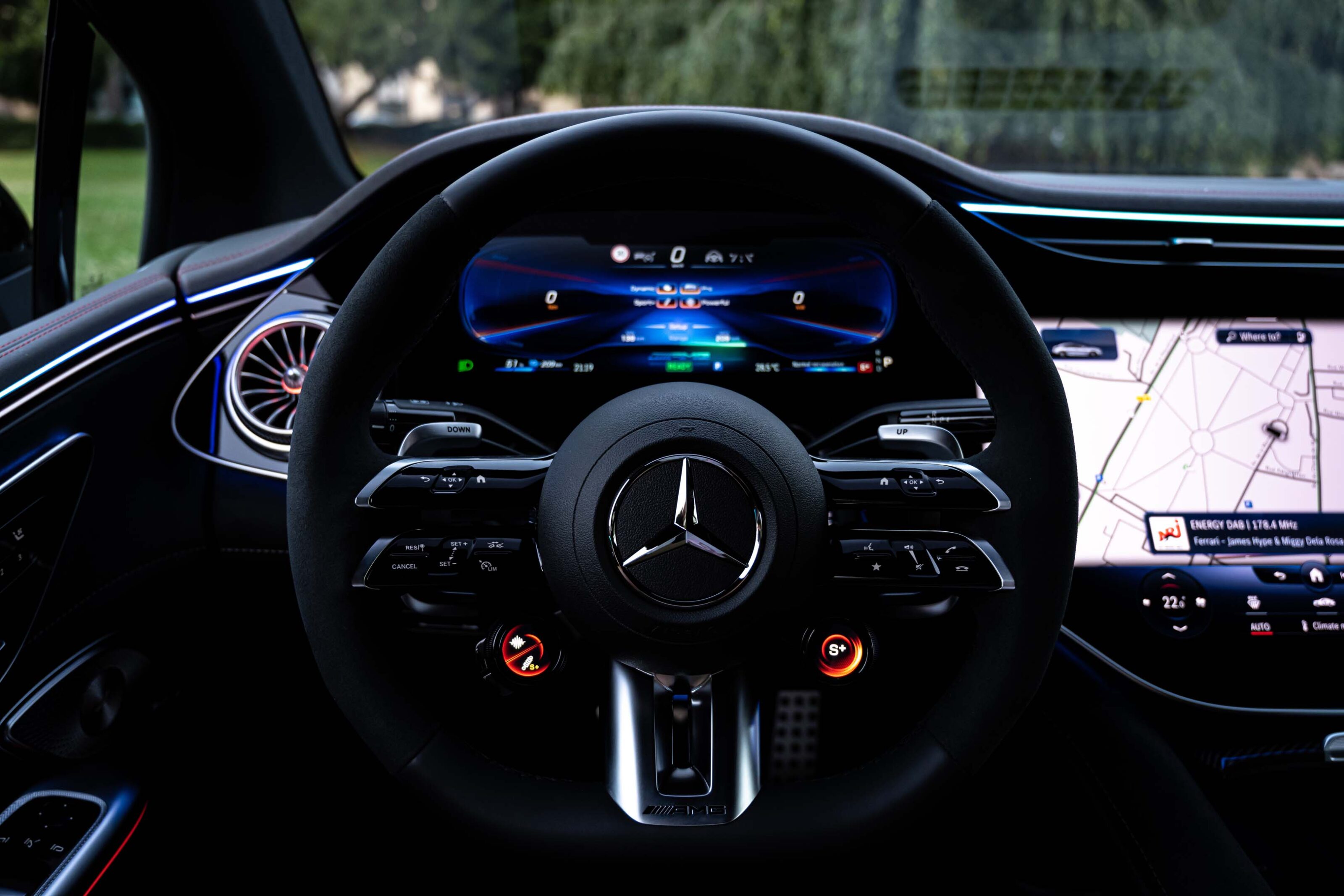
Being electric, torque distribution is fully variable and it isn’t only shuffled between the two axles but also side-to-side between individual wheels. As usual there are a host of drive modes to play with but, intriguingly, the modes also dictate how much performance the EQE53 develops.
Switch it to Slippery mode and you’ll only have 50 per cent of the available power and torque to play with. Comfort turns the wick up to 80 per cent, while Sport offers 90, and it’s not until you engage Sport+ that you have the full fruit basket at your disposal.
The suspension comprises air springs with adaptive dampers and the tune is AMG-specific, meaning you score different roll-bars, wheel carriers and stiffer bearings compared with the ‘regular’ EQE range. Speaking of which, non-AMG versions of the EQE are tipped to hit Aussie showrooms around the same time (fourth quarter, 2022).
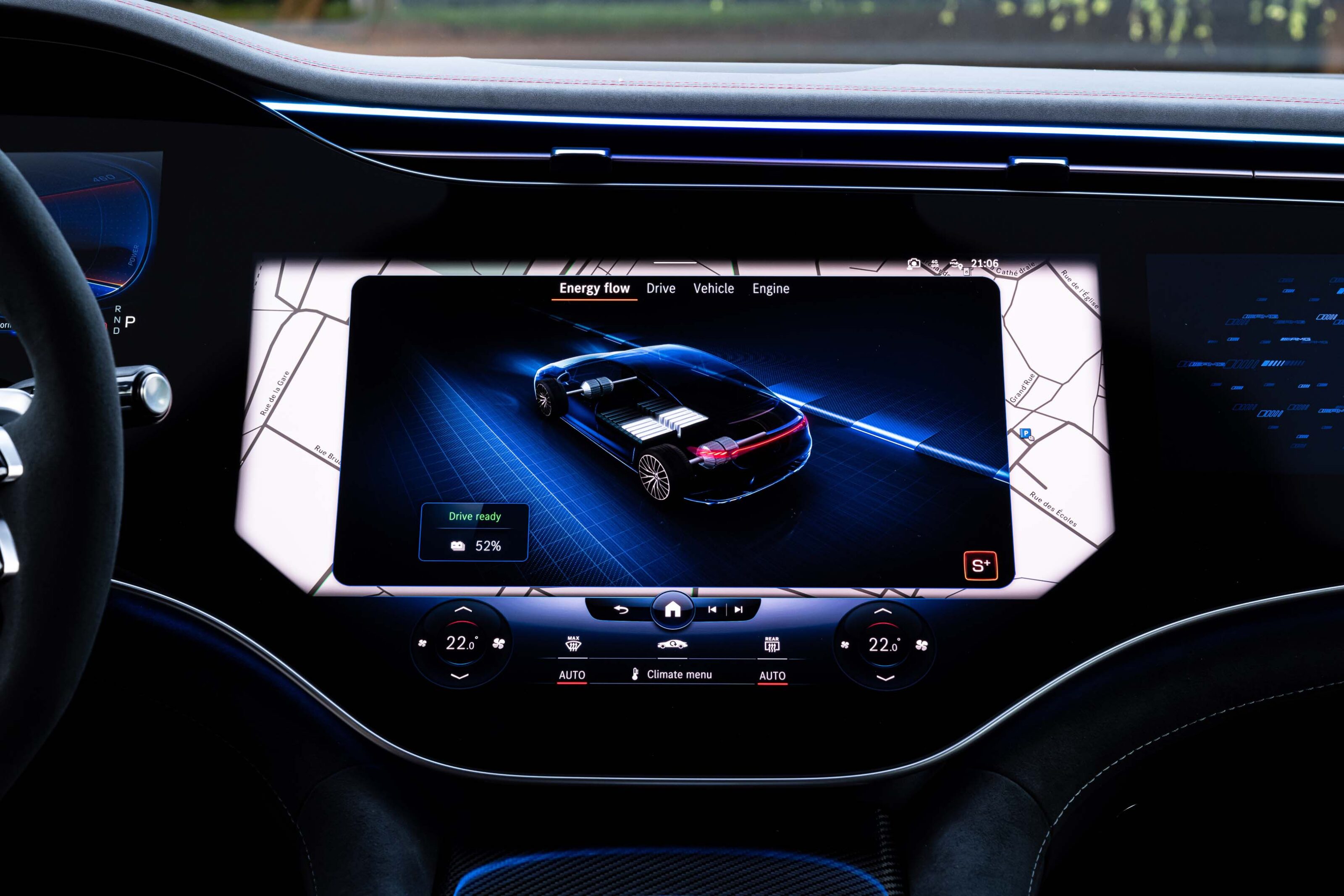
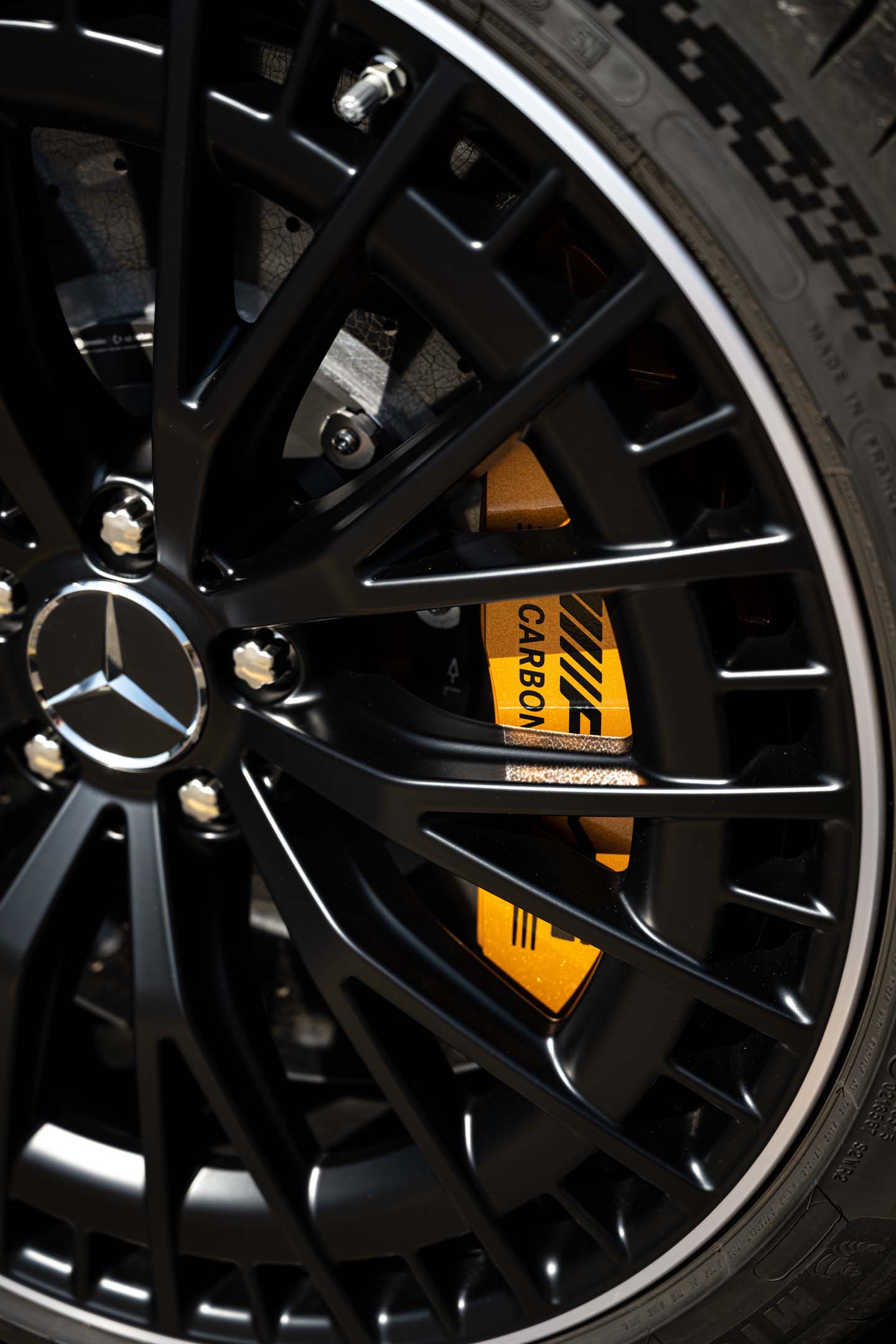
As is the EV norm, the EQE53 is monumentally heavy – officially it hits the scales at 2525kg – but thankfully it has equally colossal brakes. As standard, you score 415mm front discs clamped by four-piston calipers but the car we drove at the international launch in France was fitted with optional 440mm carbon-ceramics. Yikes.
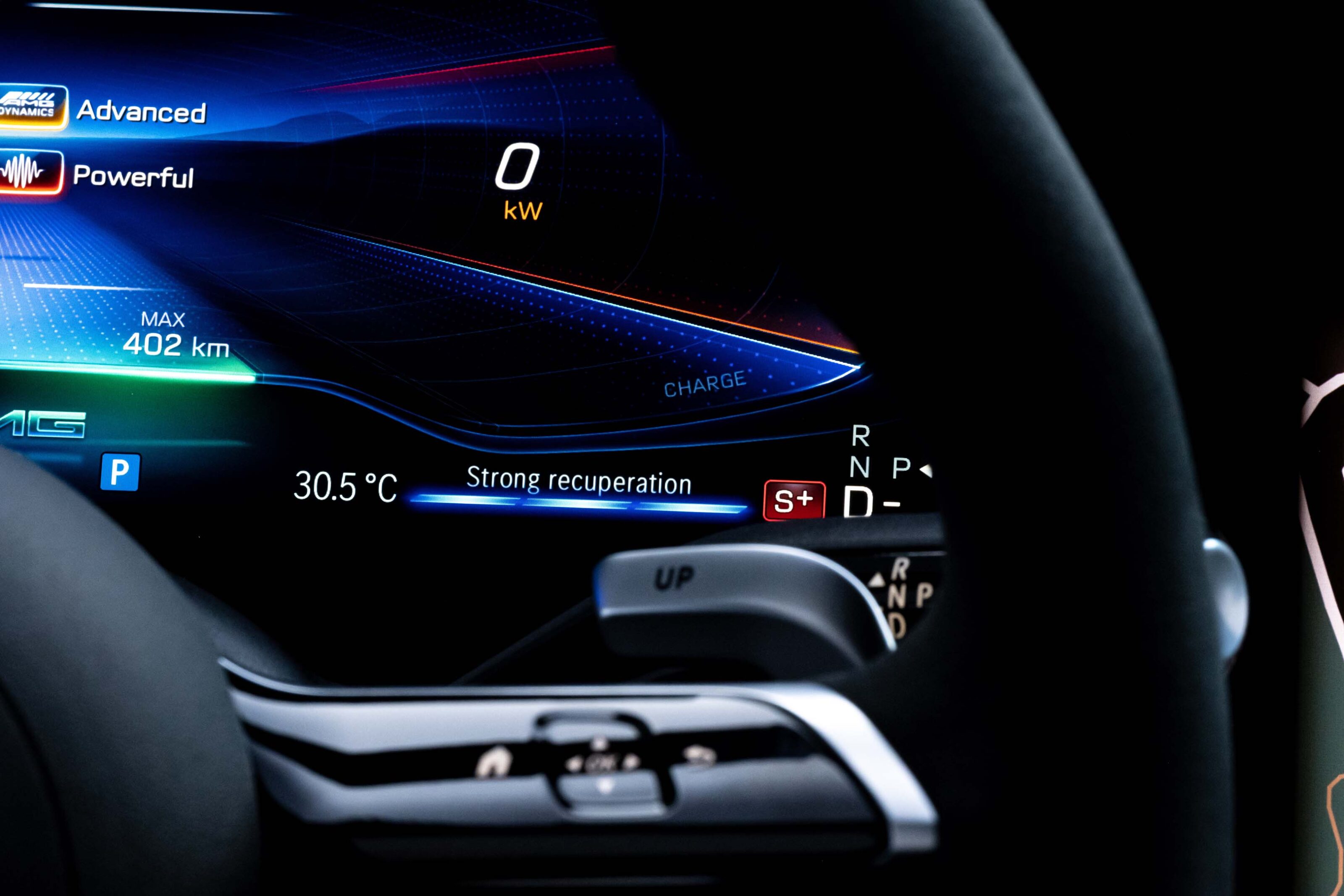
The brakes recoup energy, too, through three different stages of resistance and can feed up to 260kW back into the battery.
Standard four-wheel steering, which can turn the rear wheels by up to 3.6 degrees, helps with low-speed manoeuvrability and high-speed stability.
Providing you resist the urge to engage warp drive at every possibility (with so much acceleration on tap, that’s easier said than done), range is rated at a respectable 518km on the WLTP cycle.
As is the EV norm, the EQE53 is monumentally heavy – officially it hits the scales at 2525kg – but thankfully it has equally colossal brakes.
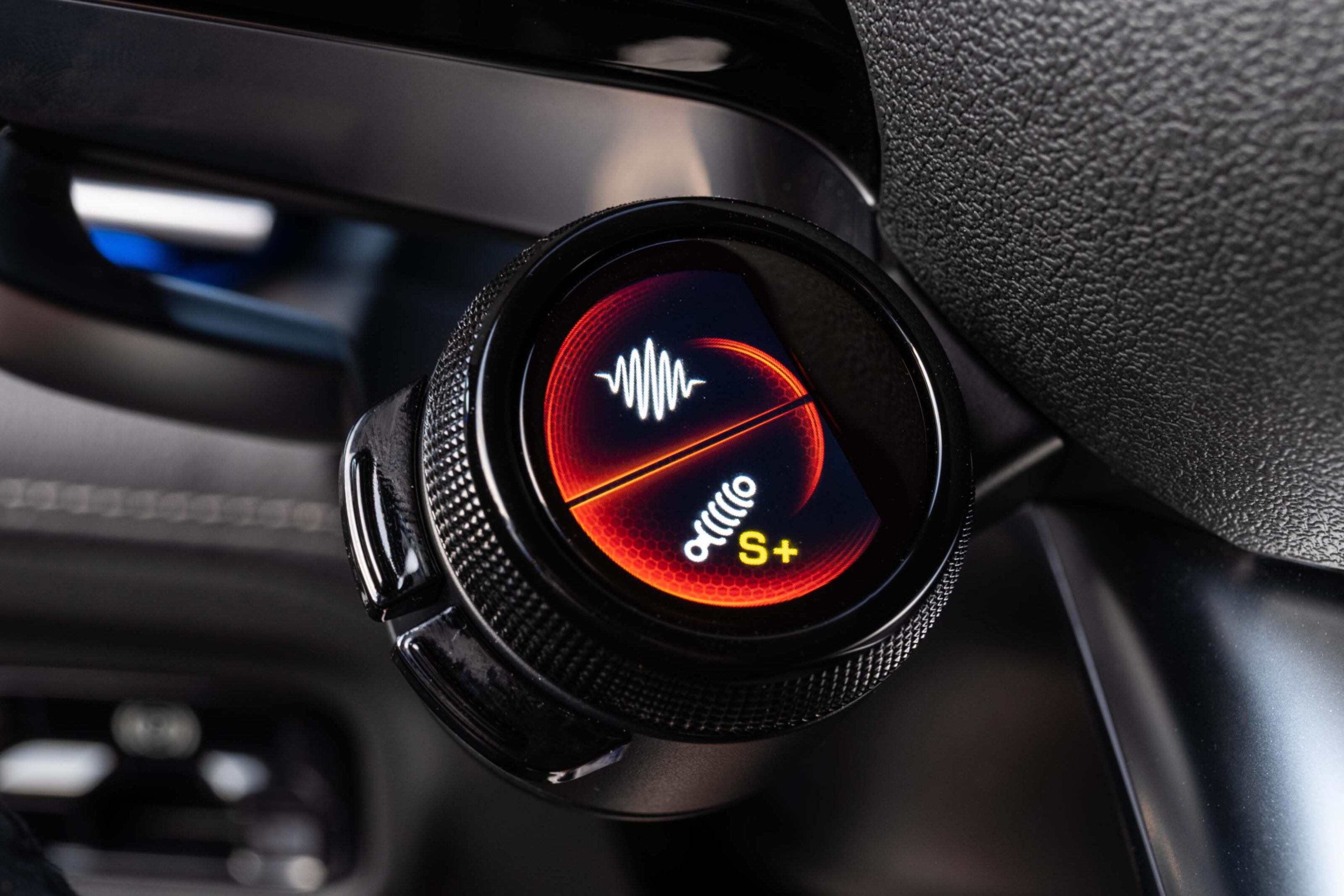
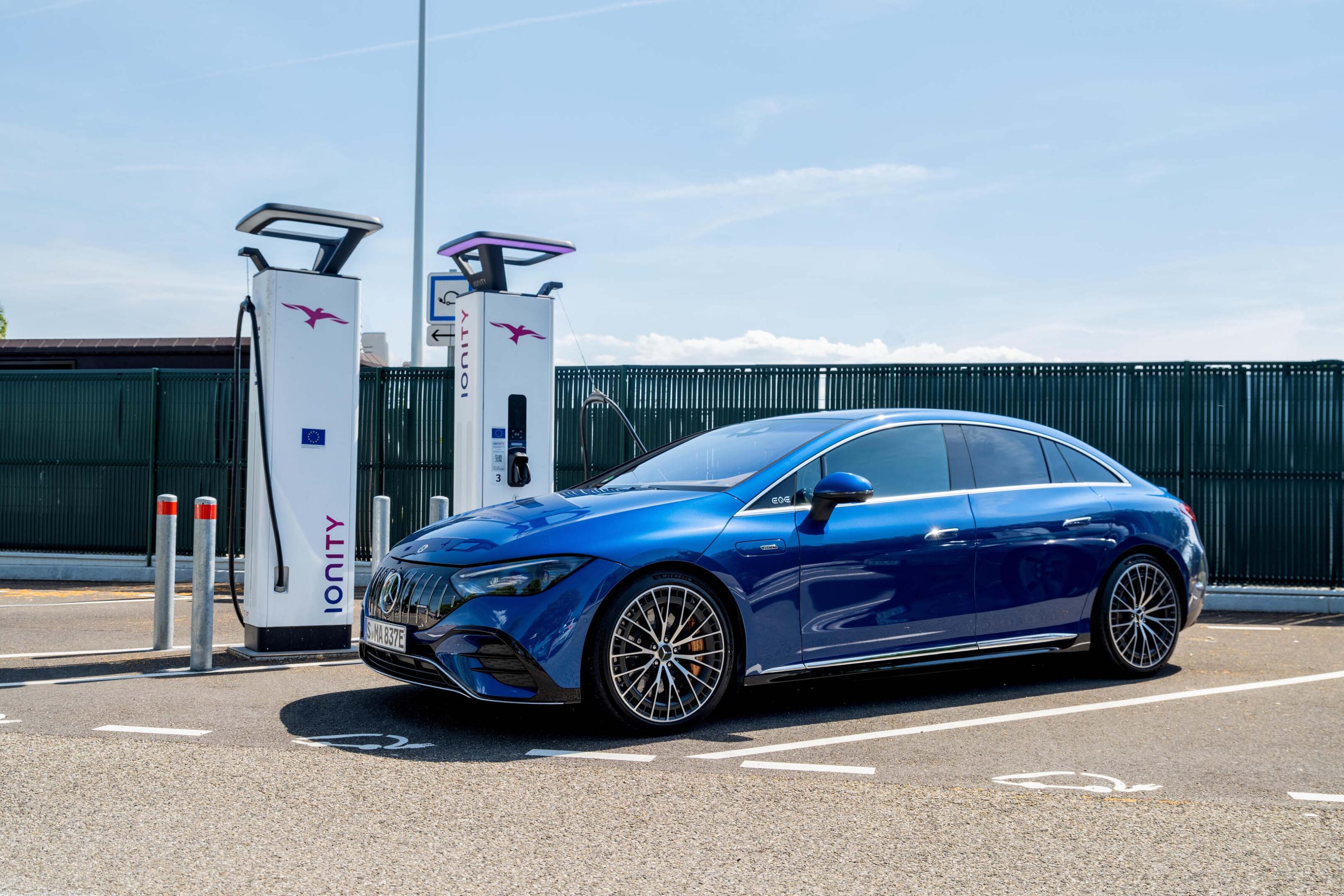
The 90.6kWh battery can also cope with 170kW DC fast charging, meaning you can add 180km of range in 15 minutes, according to Mercedes.
Worth noting, however, that a Porsche Taycan and Kia EV6/Hyundai Ioniq 5 can be recharged much more quickly due to their 800-volt architectures that can handle charge rates of 270kW and 350kW respectfully.
One final feature worth mentioning? AMG has fitted a unique augmented ‘sound experience’ that can be toggled through various modes and, in its most intrusive setting, it sounds as though you’re operating a podracer from Star Wars. It’s an attempt to fill the acoustic void usually filled by a thumping V8 but as we’ll get to a bit later, it won’t be to everyone’s taste…
Comfort and space
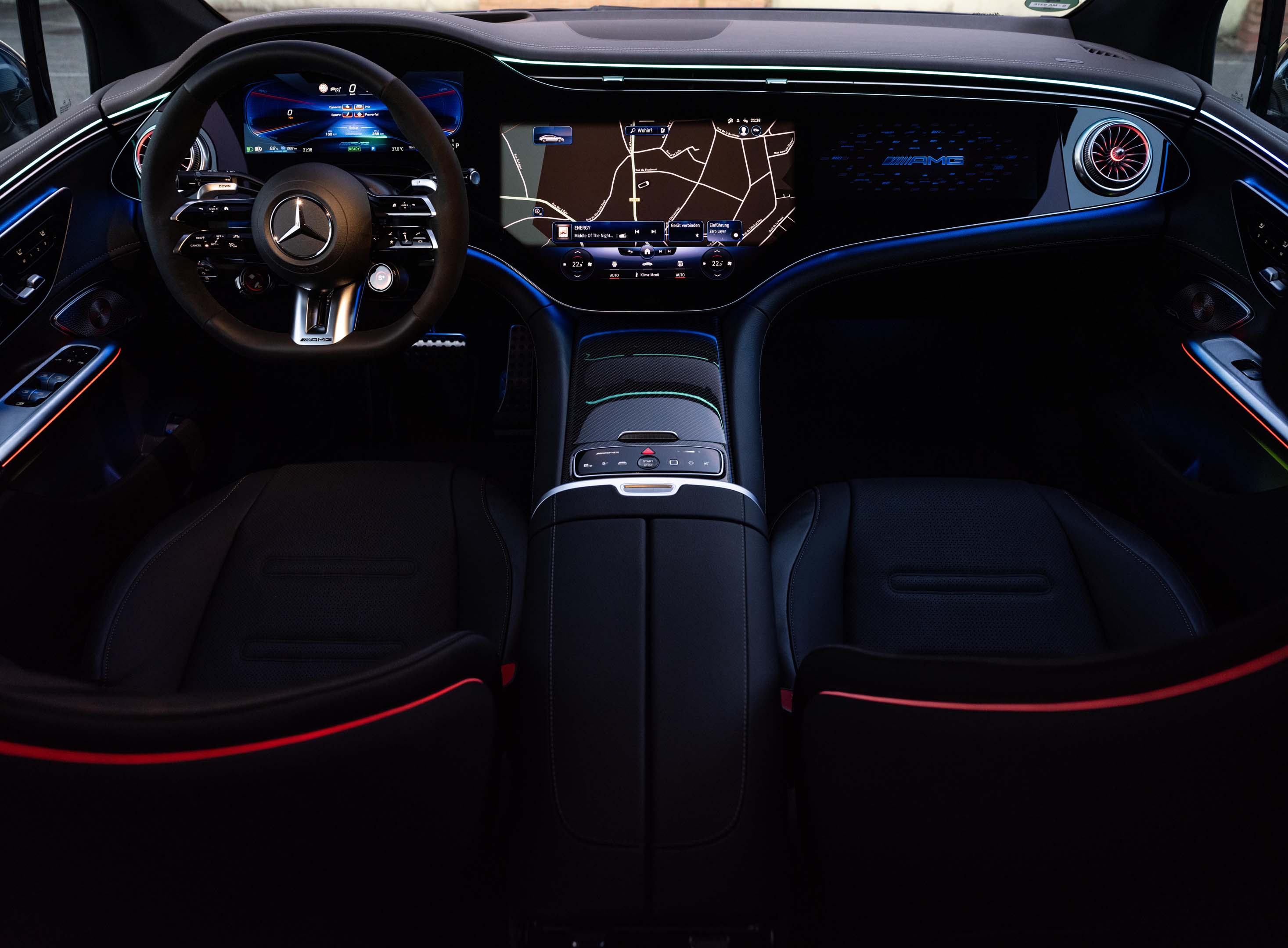
Inside the EQE53 offers plenty of wow factor. All of the cars at launch featured Merc’s enormous 141cm OLED hyperscreen digital dash (no word yet if it’ll standard or optional in Australia) and the functionality and resolution of the screens is deeply impressive. Just be sure to tuck a microfibre cloth into one of the many storage cubbies; fingerprints are going to be an issue.
Comfortable and supportive sports seats are standard and you also score an AMG-specific steering wheel. The wheel is a tech tour de force in its own right and is festooned with so many touch pads, haptic sliders and dials that it can be a touch daunting at first.
Some of the controls are on the small side, too, so you often find yourself glancing away from the road to ensure you prod the right thing. That bugbear should diminish as familiarisation builds, but it’s not a simple car to operate straight off the bat.
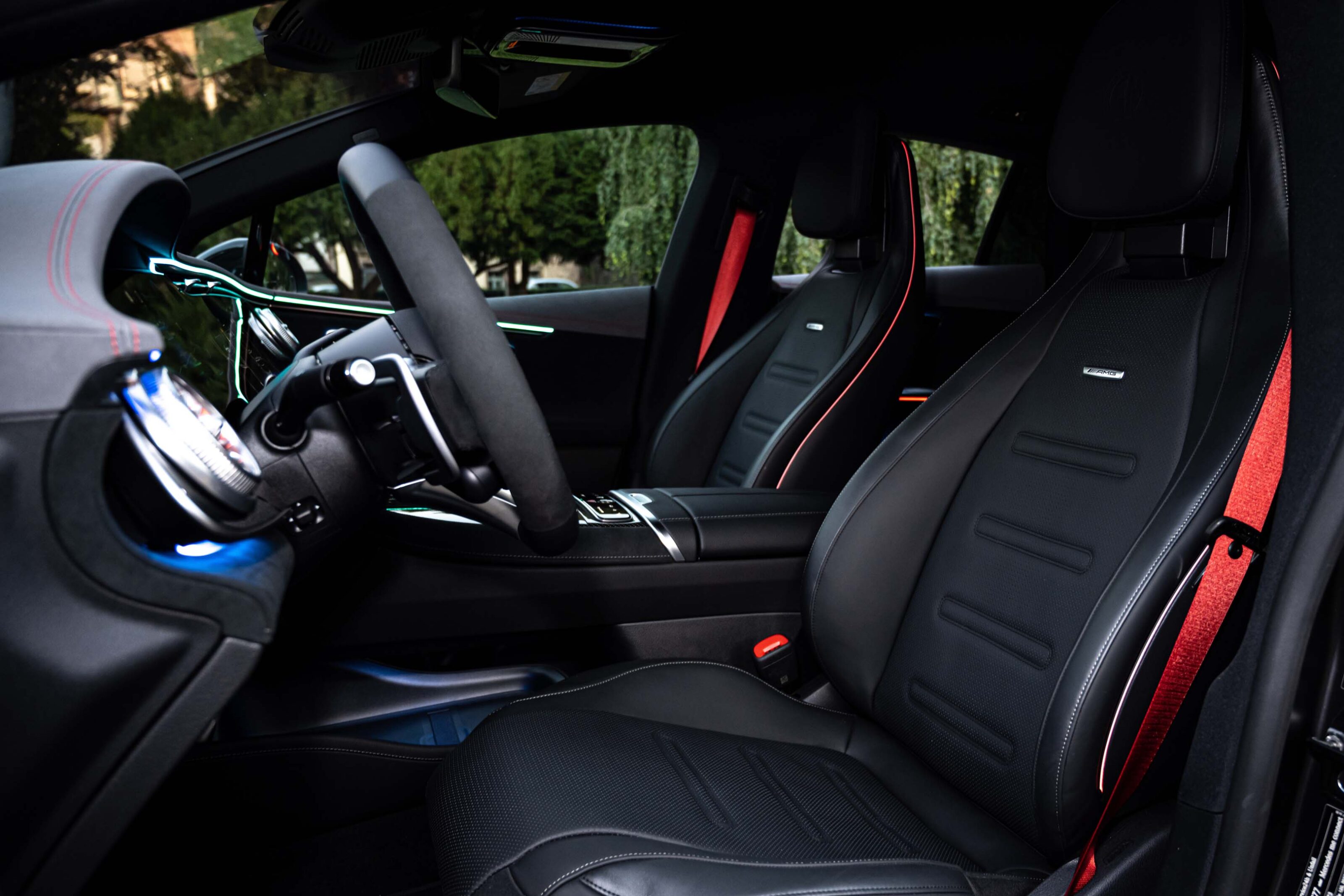
Better news is that the focus on tech hasn’t come at the expense of the basics. The cabin feels airy and spacious and there’s loads of cabin storage.
The rubber-lined door pockets are cavernous, there’s a massive central storage cubby that offers two cup holders, a wireless charging pad and two USB-C ports, and there’s an even larger compartment below the centre console that’s big enough for bags and houses another two USB-C ports.
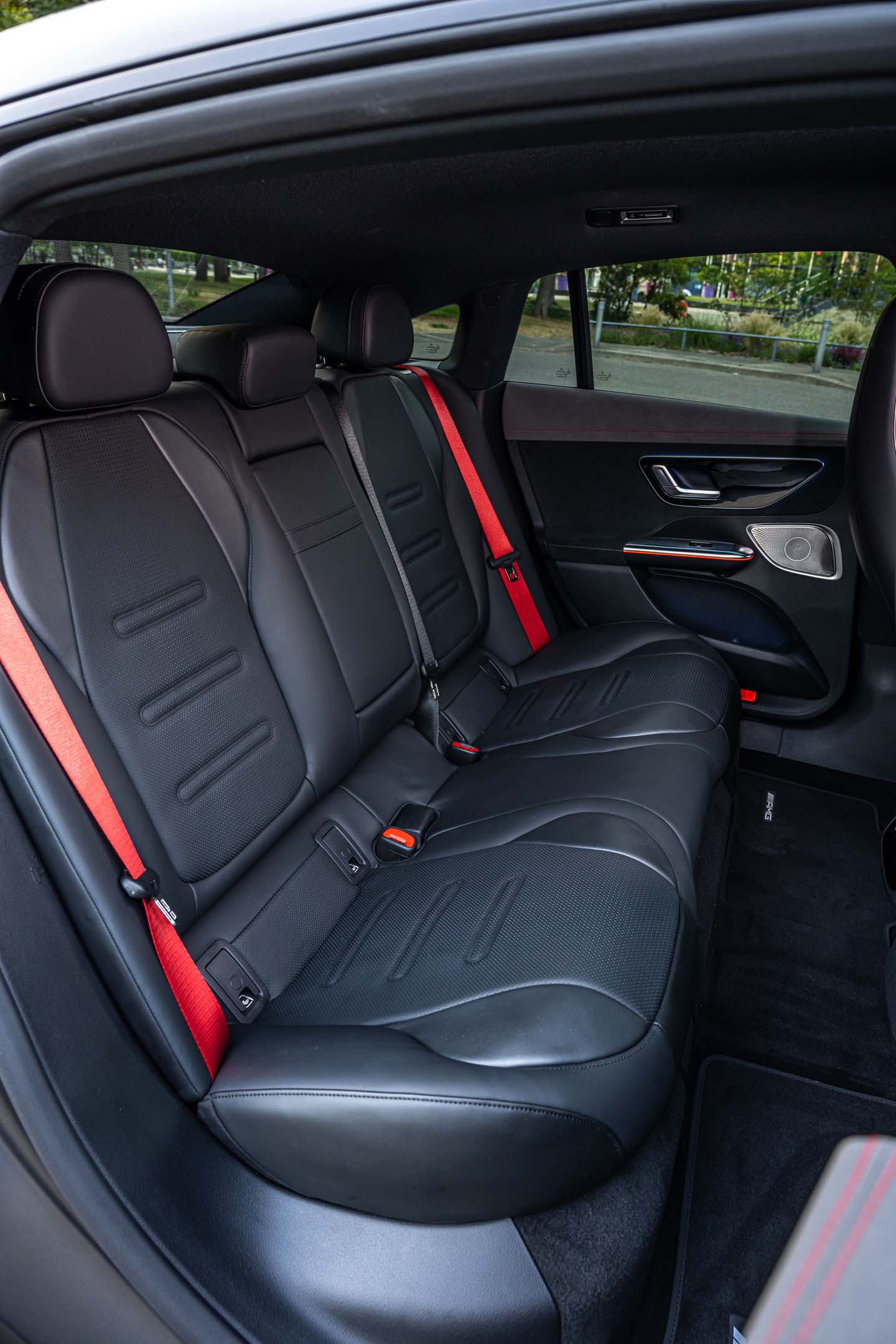
Rear seating is equally roomy. Six-foot adults have ample head-, knee- and toe-room and because the transmission tunnel is a minor blip rather than the usual hump, fitting three across the rear bench should be a cinch.
Plenty of equipment back there, too, thanks to twin air vents, a central armrest, heated outboard seats and a further pair of USB-C ports.
Charging your device isn’t going to be an issue in the EQE. About the only real complaint concerns rear vision. The rear window is quite shallow, so clocking what’s behind you in the rear-view mirror can be a touch tricky.
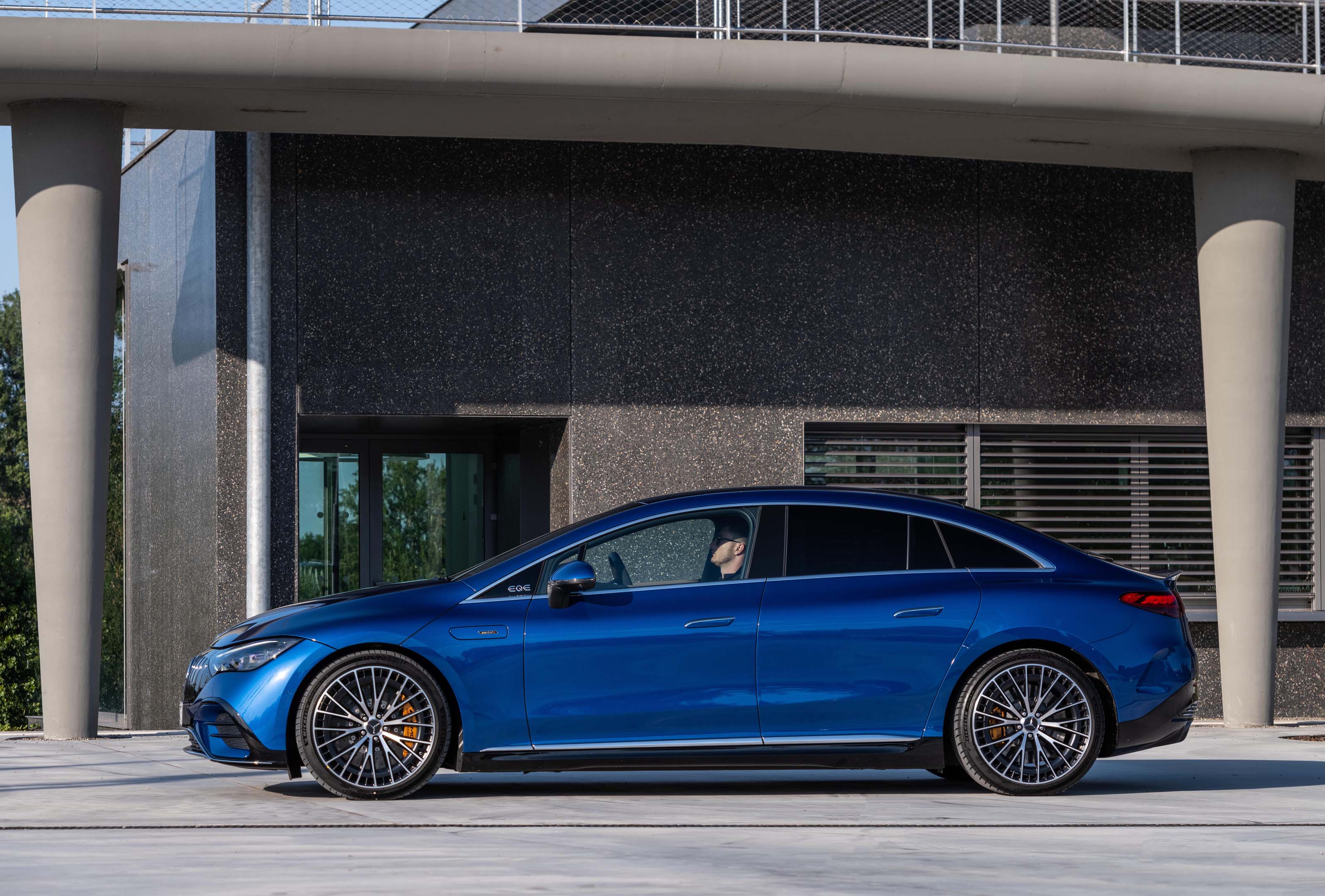
Because its aero-honed exterior design is so amorphous (it’s very slippery at 0.22Cd but does anyone else see a giant bar of soap?) it can be tricky to place the EQE53 size-wise, so I’ll offer some context. It’s big.
Compared with an E-Class it’s 29mm longer, 54mm wider and 32mm taller but its wheelbase is a whopping 181mm longer. At 3120mm, the EQE53’s wheelbase is actually even longer than an S-Class’s, which is why the cabin feels so roomy. As for the boot? The aggressively tapered rear end means it’s on the small side at 430L.
On the Road
So how does it drive? Well around town it’s a doddle. The cabin is quiet and comfortable, the control weights are natural and because there’s no delay from the electric powertrain, it’s a breeze to slip into tight gaps in traffic. Four-wheel steer helps it feel surprisingly wieldy, too, despite its sizeable dimensions and there’s even decent ride compliance.
Our test car was rolling on optional 21-inch alloys (20s are standard) but despite their size and low-profile rubber (tyres are specially developed Michelin Pilot Sport EVs that measure 265/35 R21 up front and a whopping 295/30 R21 out back), the ride never felt overly firm or harsh. Gnarly Aussie tarmac will be the true test of ride comfort, so stay tuned, but early signs are good.
Hurl the EQE53 up a tasty section of road and it’s ballistically fast. That sounds incredibly obvious in a car with 505kW/1000Nm on tap, but it’s the way the thrust is doled out that makes it so addictive.
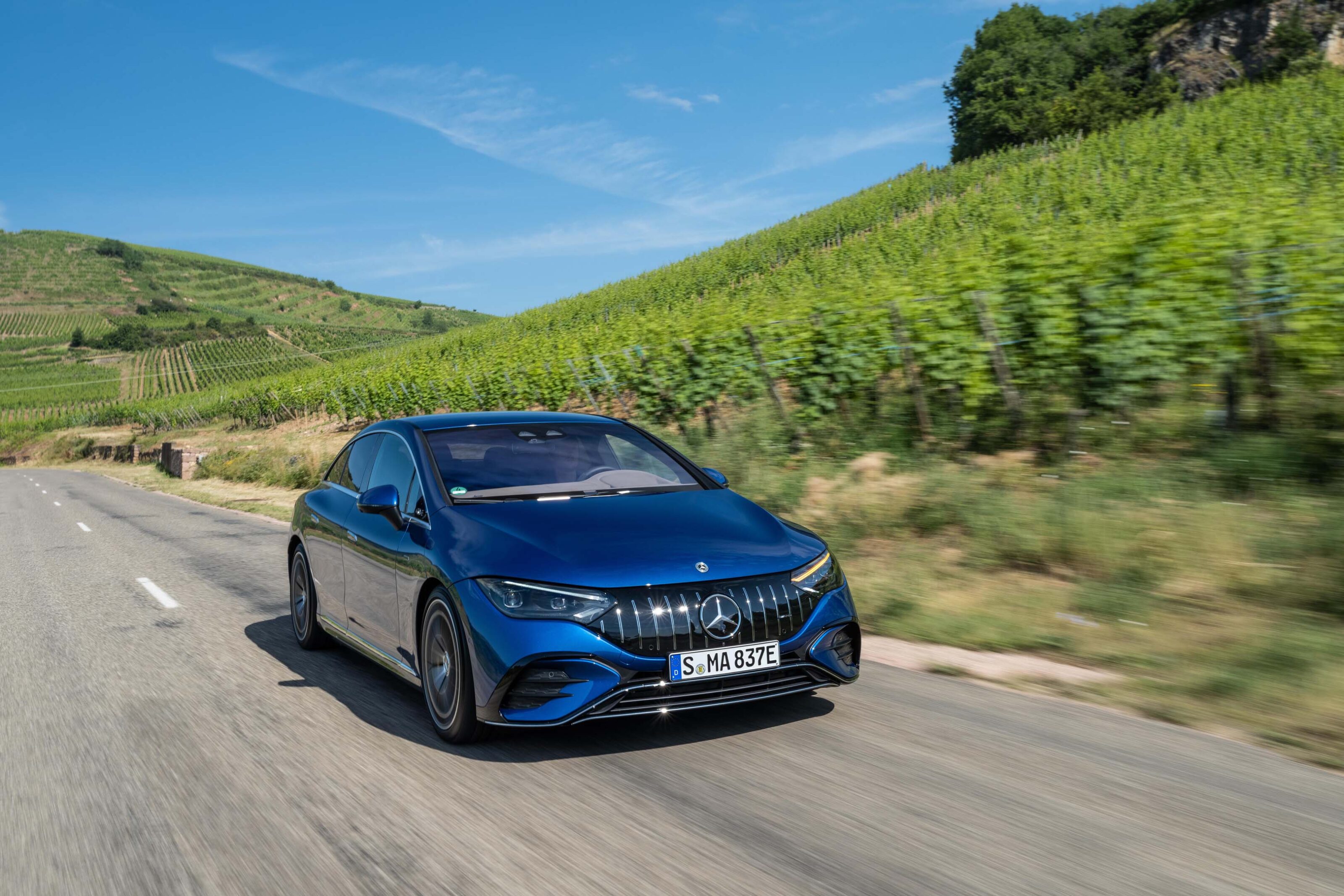
Flatten the throttle and there’s no delay as you wait for turbos to spool or gears to change; just unrelenting propulsion. It makes the EQE an incredibly potent point-and-shoot machine but there’s genuine talent to exploit from the chassis on corner exit, too.
Traction from the enormous rear Michelins is immense and when you nail the throttle you can actually feel the car’s brain working hard to distribute drive across all four tyres. It’s amazingly complex and in Sport+ mode you can even relish in moments where the EQE53 feels appealingly rear-driven as you rocket out of corners.
It is tricky to understand where the limits are, especially on corner entry. It was raining hard during our drive and on slippery roads it was difficult to know just how much grip you had at the front axle. Most of that was down to the lack of feedback coming through the steering wheel.
Flatten the throttle and there’s no delay as you wait for turbos to spool or gears to change; just unrelenting propulsion.
Although the steering is accurate enough, and the speed of the variable rack is natural, the wheel feels vague and distant in your hands, which robs your ability to place the car with confidence. Plus, you can never quite escape the thought that you’re hurling about a car that weighs 2.5 tonnes.
The EQE hides its mass well but there’s a sense that if it does let go, there won’t be much hope of getting it back…
Brakes are good, though. Given the high level of recuperation going on, I had feared the pedal would feel strange and be difficult to modulate but AMG’s engineers have kept it wonderfully free of electric corruption. Hit the brakes hard and they feel like a conventional set of performance stoppers, which is high praise for such a complex system.
Ah yes, the sound. AMG’s ‘sound experience’ is piped through the speakers and the level of volume and intensity increases as you cycle through the drive modes. You can also choose between two sound profiles. ‘Authentic’ is standard but ‘Performance’ is optional and it’s the latter that gives you the full Podracer effect when you accelerate.
Does it sound like an AMG? Not like one we’re used to but it also doesn’t sound bad. It’s actually quite fun to lean into the theatre of the noise and owners will no doubt enjoy showing their friends but it never feels authentic. You get the noise but none of the supporting sensations that are so intrinsic to an engaging performance car soundtrack.
Happily, the system can be switched off altogether if it’s not to your taste.
VERDICT
So is the EQE53 a proper AMG? That’s a curly one to answer. Measure it by the usual AMG yardsticks of pantomime and panache and you might be a touch disappointed. It lacks the personality, the connection and the fizzy sense of engagement you get from an E63 but it feels wrong to judge the EQE53 this way.
The rules of engagement are changing and on many levels it trounces AMG’s conventional super sedan. It’s faster, more spacious, more comfortable, makes an intriguing noise and won’t only be cheaper to run but it should be significantly cheaper to buy, too.
But it’s how it measures up against its battery-powered rivals that’s arguably more important. At first blush it feels sharper to drive than a Tesla Model S Plaid but not quite as agile or as engaging as a Porsche Taycan or Audi RS e-tron GT.
We feel a comparison coming on…
Mercedes-AMG EQE53 specifications
(with Dynamic Plus package)
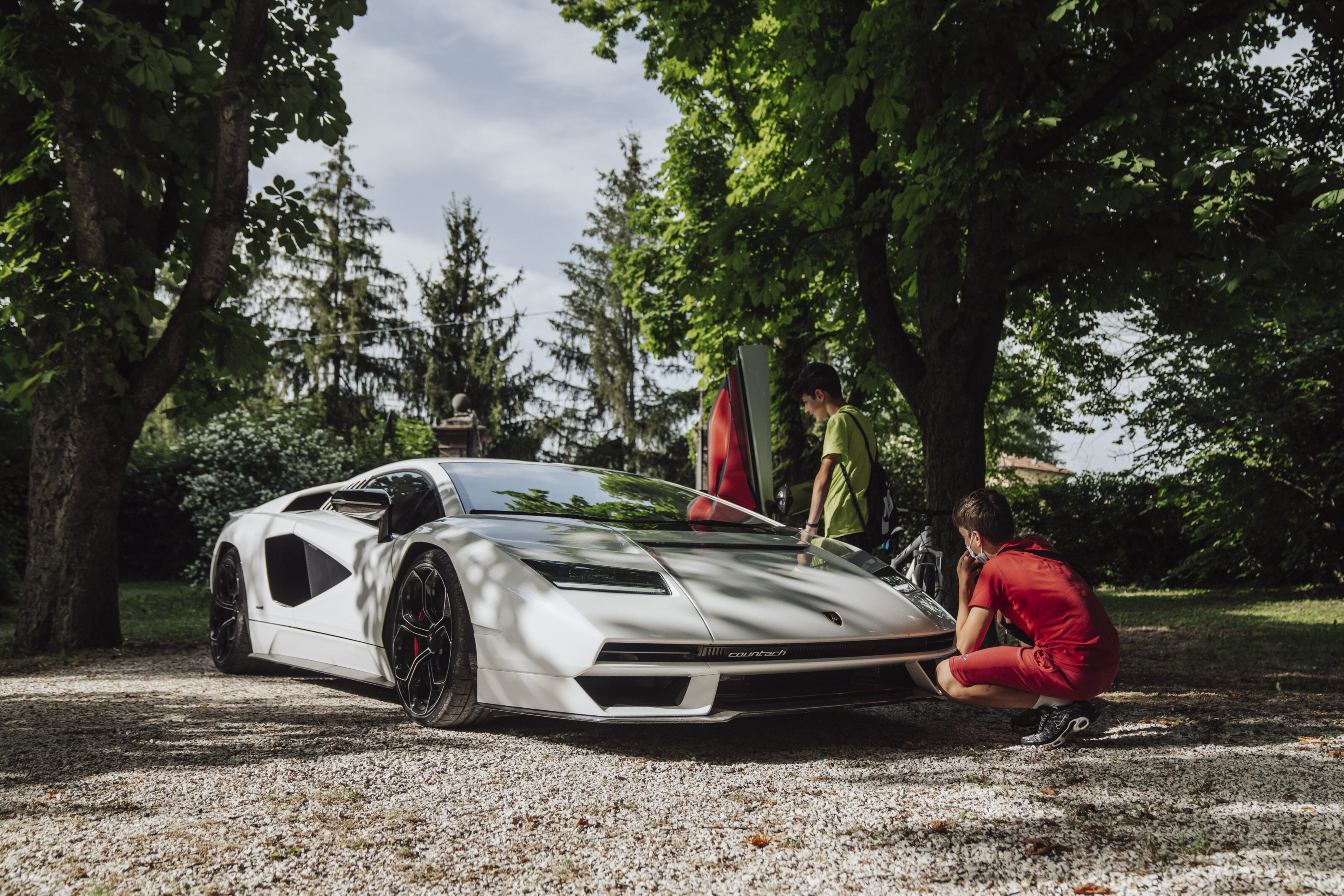
The sole surviving presentable prototype of the small reborn Countach fleet is a white, wide and wedge-shaped wild thing.
Over two years old now, it has 40,840 clicks on the clock, rattles and squeaks freely when it feels like it, and likes to wear its battle scars collected at the ‘Ring and on the Nardo high-speed oval with casually touched up pride.
Parked next to the grotesquely over-spoilered 25th anniversary original, the 2022 version exudes a totally different type of timely cool, symbolises priceless laidback grandezza and oozes Italianitá.
Based on the discontinued Aventador, the eye-catching LPI (Longitudinale Posteriore Ibrido) limbo dancer from Sant’Agata Bolognese is definitely not another loud batmobile with Supertrofeo overtones but pays homage instead to Marcello Gandini’s drop-dead beautiful bedroom poster favourite from the early ’80s.
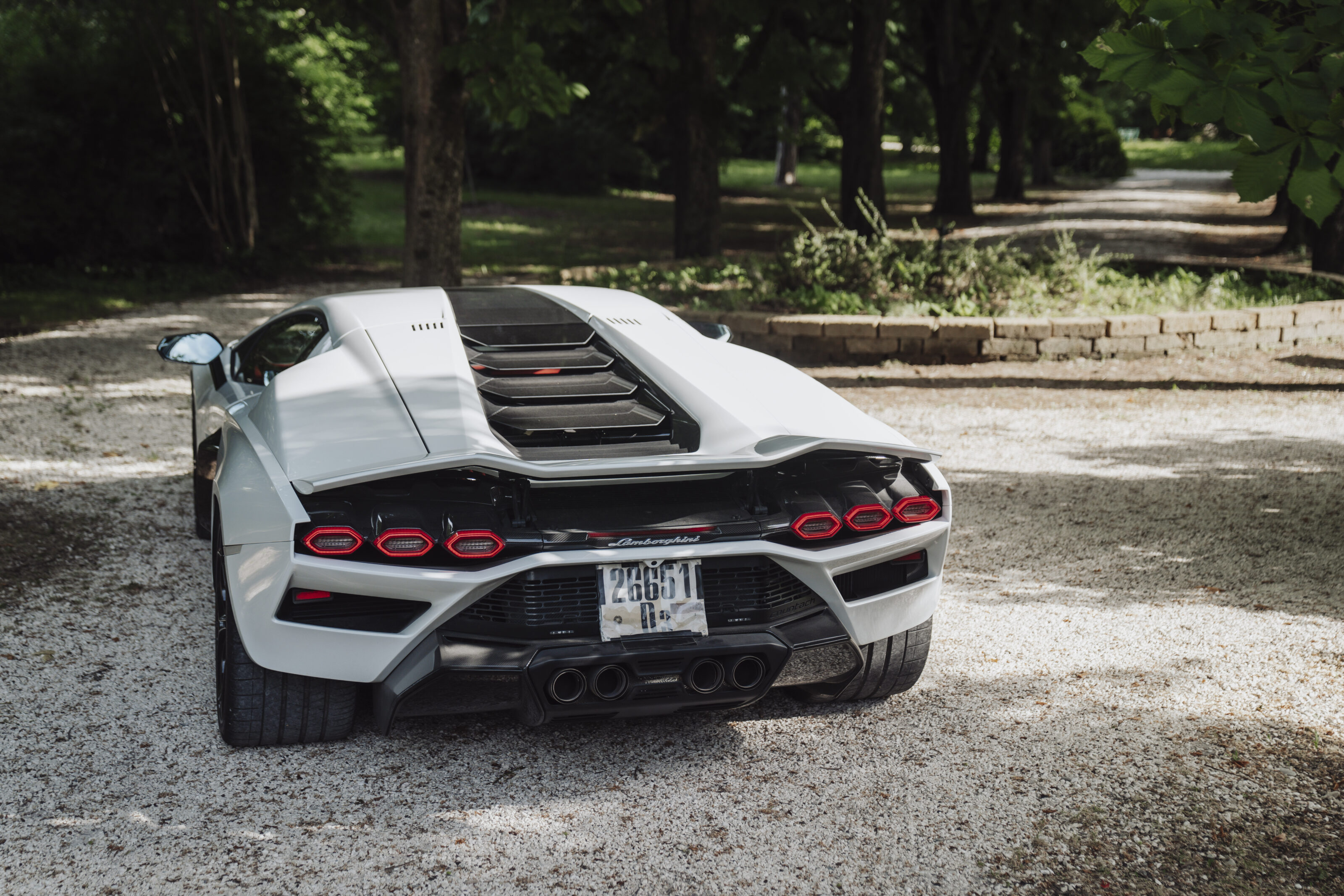
Unlike the brand’s more recent one- and few-offs like the aggressively extrovert Egoista, Veneno and Centenario, the comeback Countach is all about style, substance and understated sex appeal. Its awesome proportions are bound to arouse every single dormant macho neuron of the bedazzled beholder.
Lower than the Huracan Spyder by 40mm, even wider than the Urus and 440mm longer than an Audi R8, the LPI 800-4 shatters the generic sportscar mould. Only the 2700mm wheelbase follows a less extreme dimensional pattern.
The flush rectangular headlamps, hexagonal windscreen, louvred backlight, periscope-inspired roof-mounted air intake and the trademark wheel arches are among the most obvious visual tributes to the puristic namesake. There is no doubt about it: Mitja Borkert, head of Lamborghini Design, created a striking yet beautifully balanced sportscar that is neither overtly retro nor as eccentric as a Sian or Essenza.
The comeback Countach is all about style, substance and understated sex appeal.
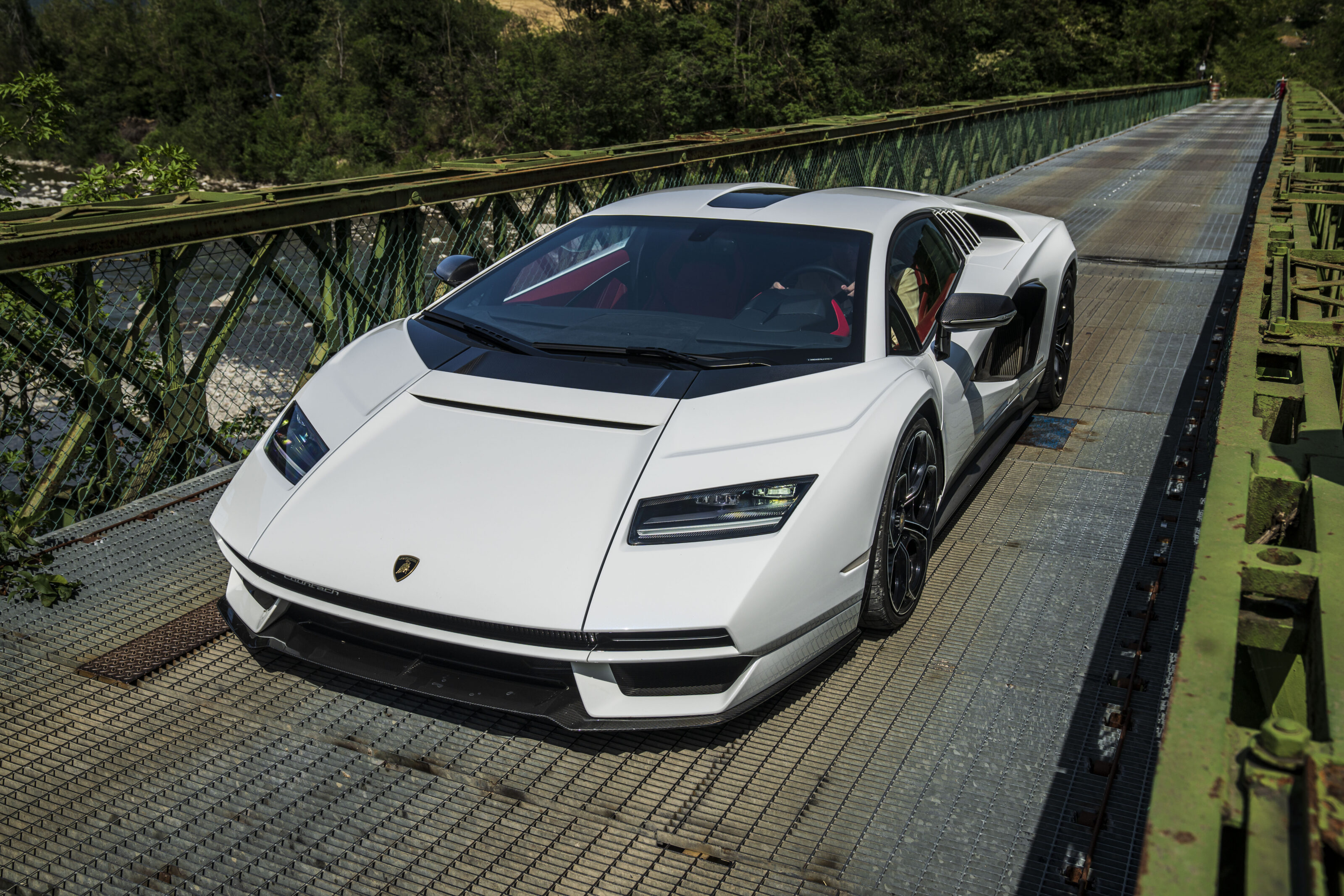
Driving chassis number zero out of 112 is in more ways than one a back-to-the-future experience.
The swan-wing doors, the familiar roofline and the massive lateral air intakes all shout Aventador, garnished with a dash of Murcielago and a whiff of Diablo, which was also penned by Gandini.
Tall people may need a can of rust-loosening spray or two to prepare their limbs for the challenging entry and exit procedure, but once the low-mounted carbonfibre bucket seat grabs your hips like a soft clamp and long legs can unravel in the deep but narrow footwell, creature comfort and confidence increase with every breath.
No, this driver environment is not nearly as compromised as it appeared from above.
There is actually plenty of room for shoulders and elbows, half a curler clearance between scalp and ceiling, pedals and steering wheel in the correct position. Are we ready to lift the red metal flap and unleash the devil inside?
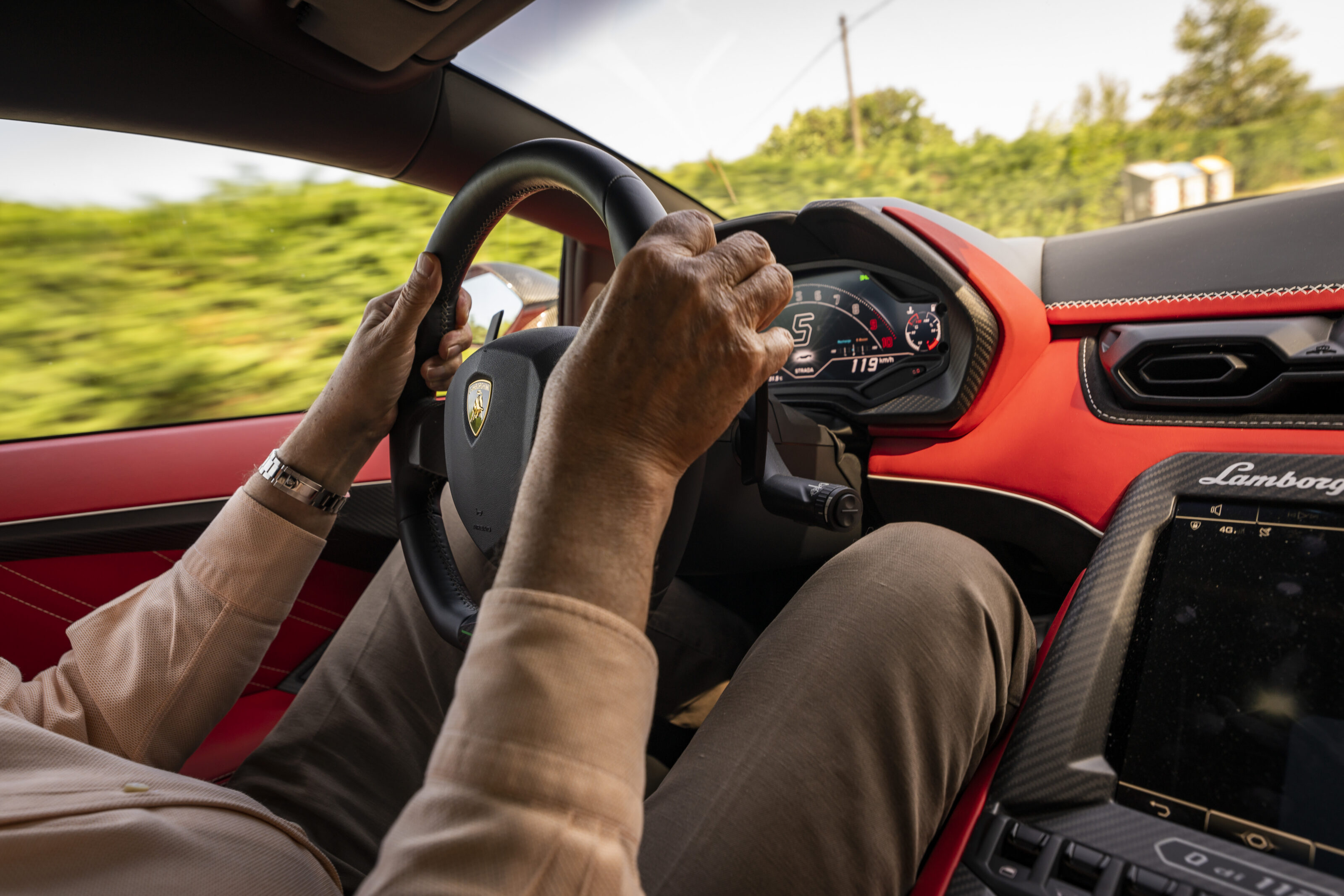
At the first roundabout, still in second gear, the lead car turns left and heads for the hills toward Pavullo, which actually is Ferrari test drivers’ heartland, but so what?
Although the road out west is bumpy, the Lambo wastes no time playing Pacman with the flock of Stilos, Puntos, Bravos and Cinquecentos.
With 582kW on tap at 8500rpm and 25 spare electric kilowatts waiting in the wings, the flatfish on V12 steroids exits the odd holding pattern as smoothly as it morphs into and out of e-boost assistance mode.
In this car, 50km/h feels like barely moving at all, 100km/h is hardly worth one more upshift, 130km/h creates a bit of a breeze at last, but it takes a foray into triple-figure territory to summon the driver’s full attention.
In a secret parallel universe, one could run this macchina prova at 356km/h all day long with no threat to the driving licence, but here, in the heart of the Modenese motor valley, the carabinieri no longer salute the local heroes with fasta, fasta! thumbs up gestures.
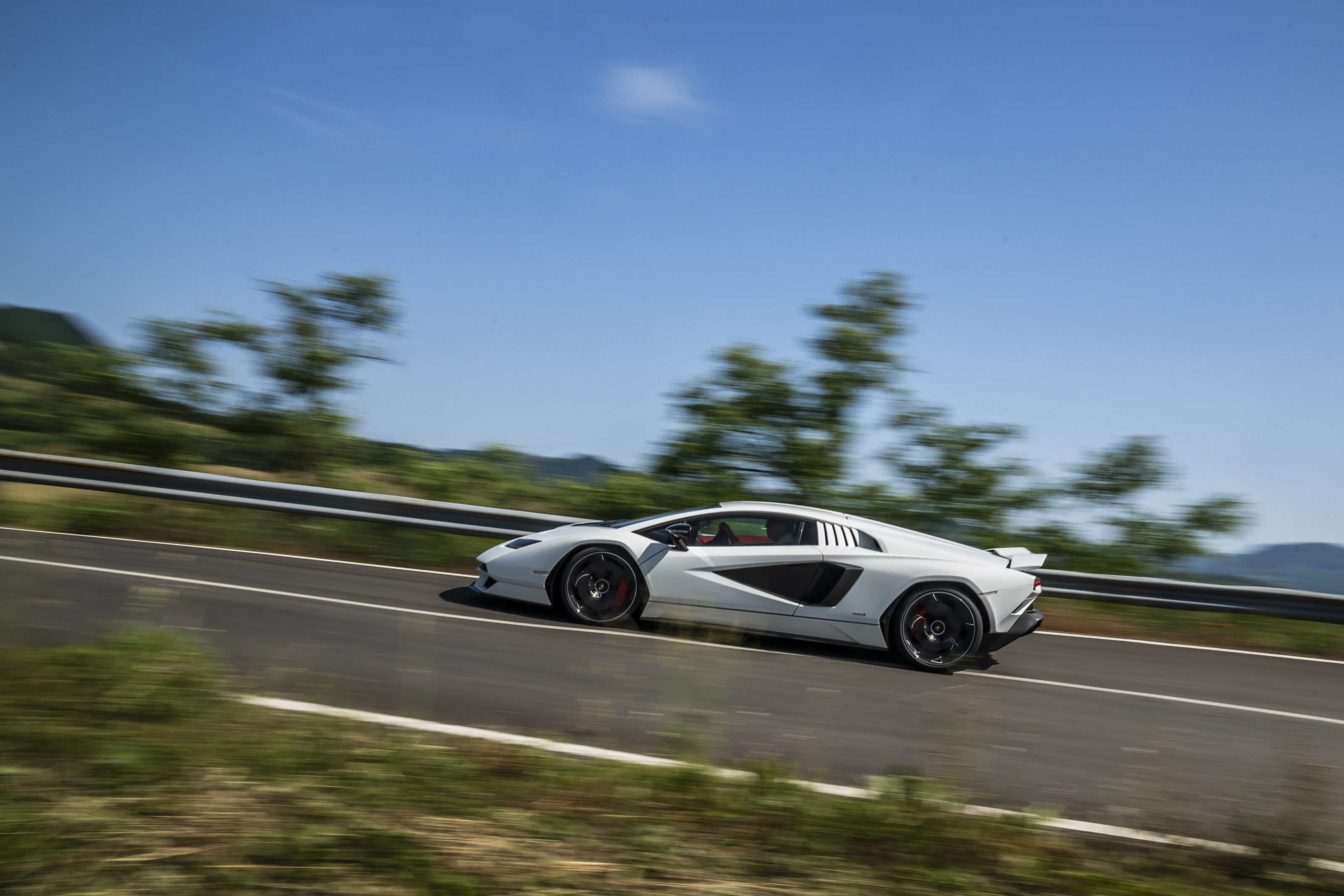
Oversexed hypercars are marketed as entry tickets to a whole new realm where extreme performance and unreal speed promise to kick off a second-to-none ego trip. Getting hooked is easy, accepting that the new opportunities are bound to clash with the rigid old rules less so.
But what the heck – let’s go for it and roar in eight seconds flat from zero to 200km/h. Hit the 100km/h mark in a time-warp 2.8 seconds.
Exert more stopping power than a firmly seated hairpiece can take. Open the g-force floodgates and flush the brain from one side of the skull to the other, and again.
Mix and match the transmission in Manual and the DNA selector in Race for a glorious workout session at the fat-rimmed steering wheel, complemented by the world’s longest paddleshifters.
But what the heck – let’s go for it and roar in eight seconds flat from zero to 200km/h. Hit the 100km/h mark in a time-warp 2.8 seconds.
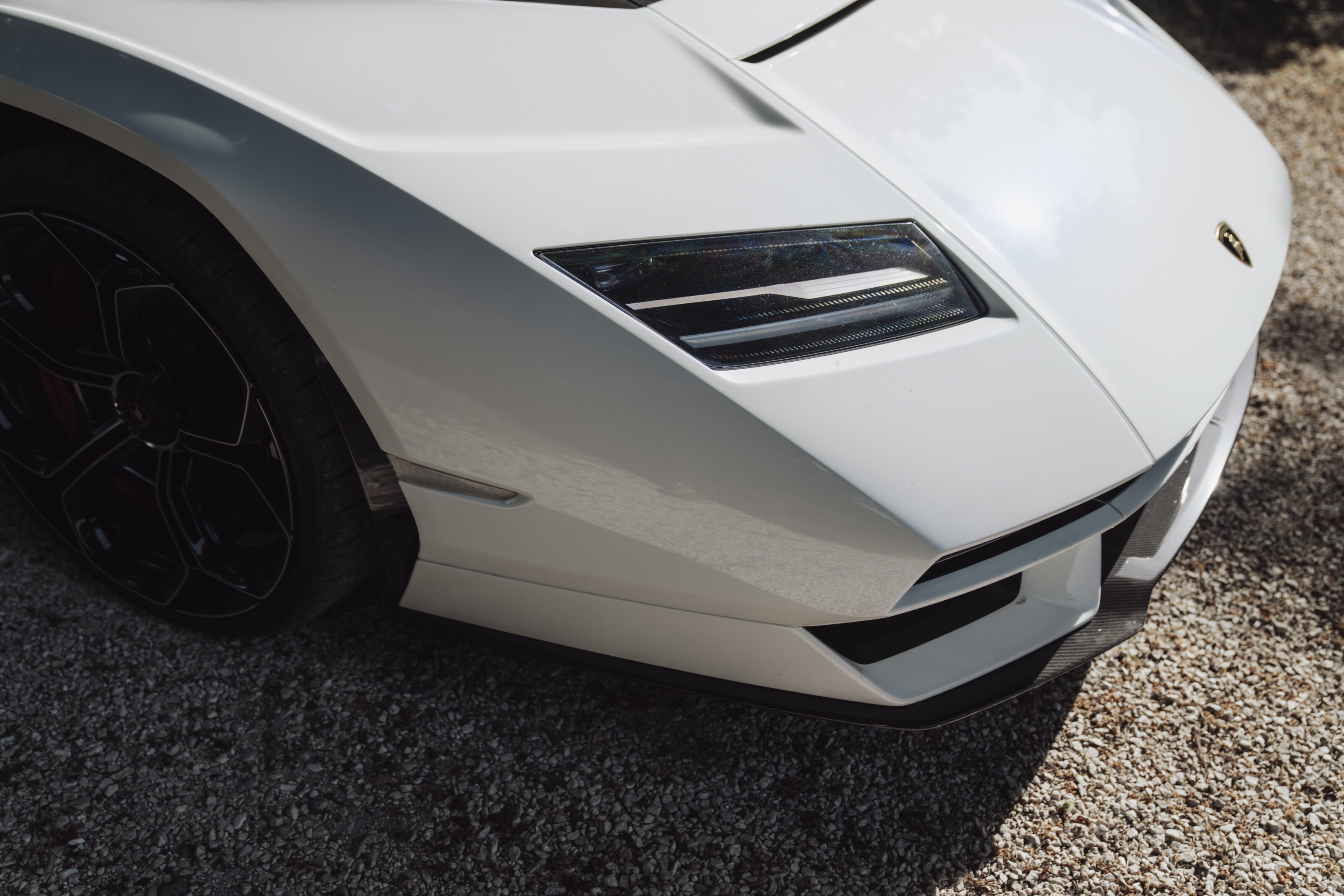
True, the Countach 2.0 comes with certain mod cons like AC and a basic infotainment system framed by ancient Audi switchgear, but the core drivetrain layout and the convoluted packaging date back to the days when Caesar was still in charge of the Roman empire.
Despite its elaborate carbonfibre monofuselage chassis and that tourbillon-complex twelve-cylinder engine, the LPI 800-4 feels decidedly more high-mech than high-tech. For a start, the newest old Lamborghini does not ride well at all.
Although the format of the Pirelli P Zero tyres – 255/30 ZR20 and 355/25 ZR21 – is not extreme by contemporary standards, the double-wishbone pushrod suspension boasting macaroni-size horizontal springs and not particularly concessive adaptive magneride dampers does not even fit the description of a modern off-piste set-up anymore.
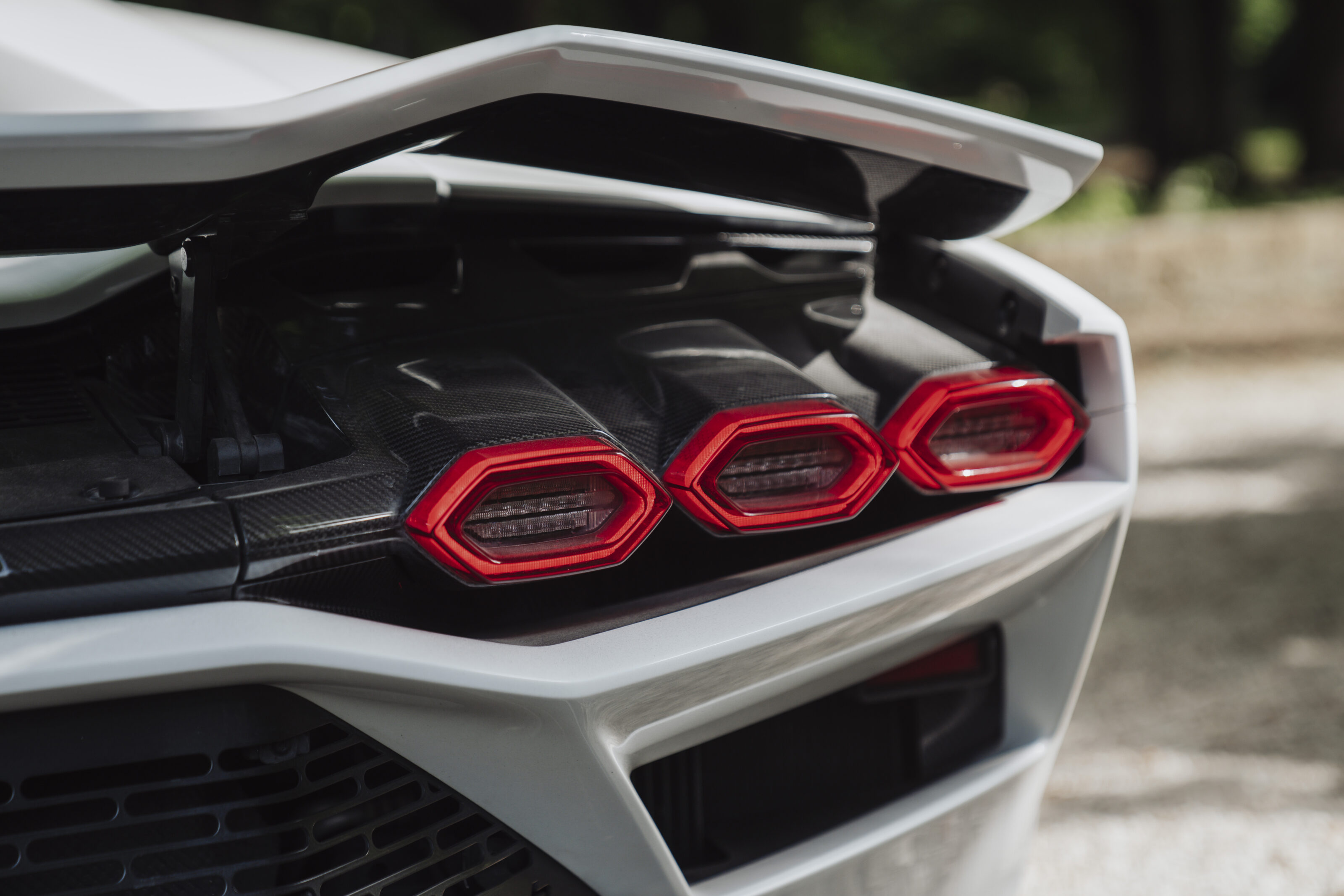
After all, compliance is an alien term to this arrangement. The desirable Ferrari-style on-demand softer shock absorber setting is conspicuous by its absence, and although the front axle is fitted with a quick-lift feature, the low-flying nose keeps bottoming out on the rough stuff. Instead of an even firmer set-up, the new Countach could have done with more lissom and user-friendly kinematics.
The steering is quite quick at 2.1 to 2.4 turns from lock to lock, depending on the selected drive mode. At 12.5 metres, the turning circle is not excessively wide, but the cab-forward driving position and that inherent inkling of light initial understeer softens to a degree the explosive trademark handling demonstrated in perfection by the Huracan Technica.
In direct comparison, the Countach is much harder work. Dialling in and unwinding lock can be an arm-twisting business, bracing yourself for ruts, bumps and potholes syphons attention and energy, the fat A-pillars keep interfering with your field of vision through second and third-gear corners, and the visibility from the B-pillars back is practically zero, even though the reversing camera does help to contain major embarrassments.
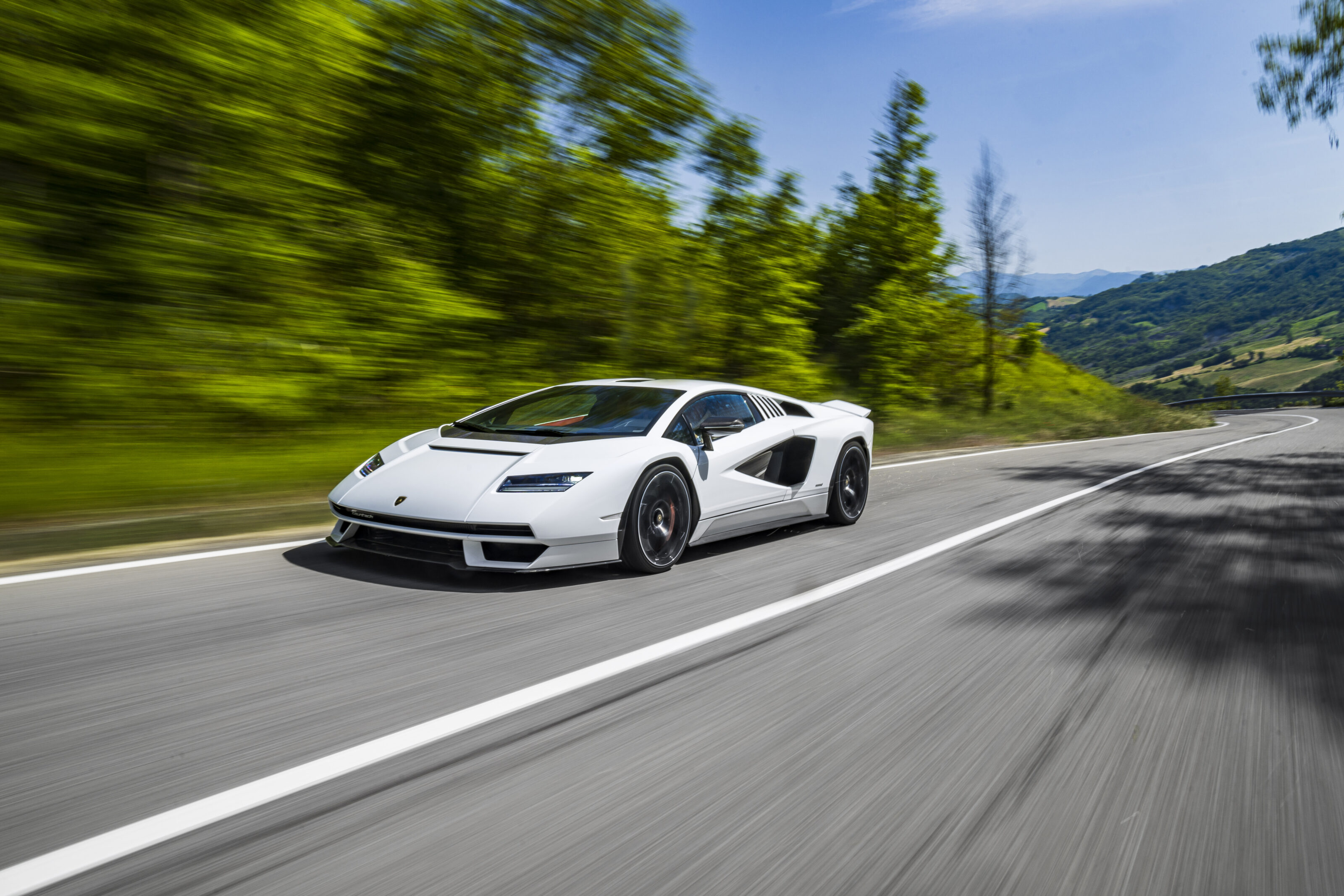
According to hard-nosed supercar junkies, trust in God and a firm stab on the throttle are safer escape tools than all the mirrors in the world.
The gaudy instrument display is full of surprises. Redlined at 8700rpm, the rev-counter throws in 200 unexpected bonus rpm when you really go for it.
At the other end of the dynamic scale, in what is best described as sauntering mode, however, a piston icon lights up to inform us that six of the twelve cylinders are currently off duty – not that the remaining 291kW would render the beast momentarily motionless.
Two more oddball add-ons are the erratic start-stop system and a small readout depicting any ongoing charging or discharging activity even though there are at best a token 30kW and 35Nm at stake either way.
The tiny e-motor and the supercapacitor it is fed by add 34kg to the total dry weight of 1595kg, which now also includes a 48V system but still no active anti-roll bars.
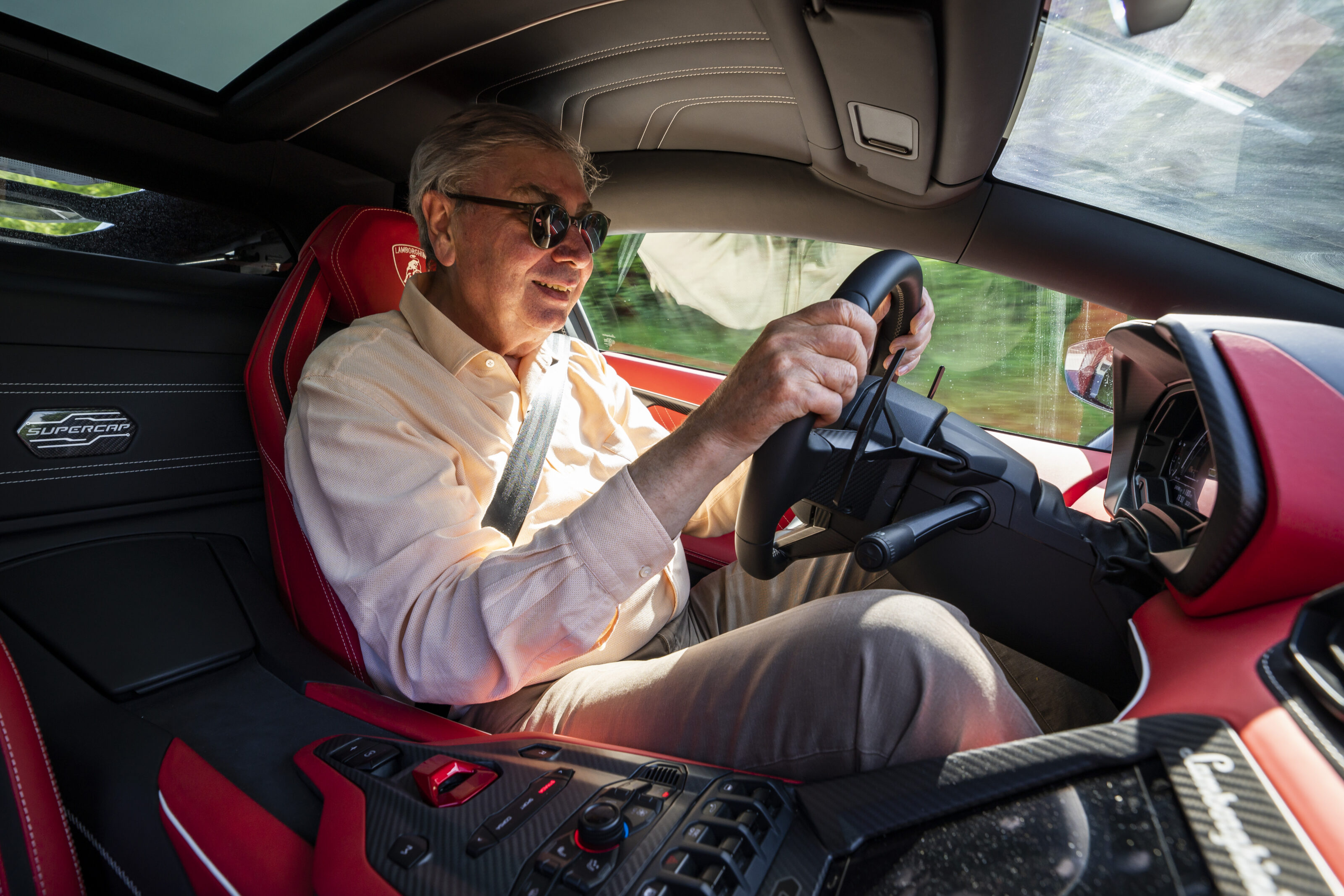
The seats, dashboard and door panels are trimmed in supple red and black leather with contrasting white stitching – nice. Less appealing are the plasticky rocker switches that run across the fascia like rows of identical black pockmarks.
A naturally-aspirated 6.5-litre engine is certainly not what the eco doctor ordered, but as compensation for the massive CO2 outburst, this highly addictive and emotional powerplant keeps adding irrevocable acoustic and dynamic memories to the black box inside your head.
Forget for a moment the fig-leaf hybrid nonsense. What matters here more than emission control is massive unbridled power (607kW with e-boost active) and brutal torque (720Nm at 6750rpm) as well as what this physical assault does to one’s mindset.
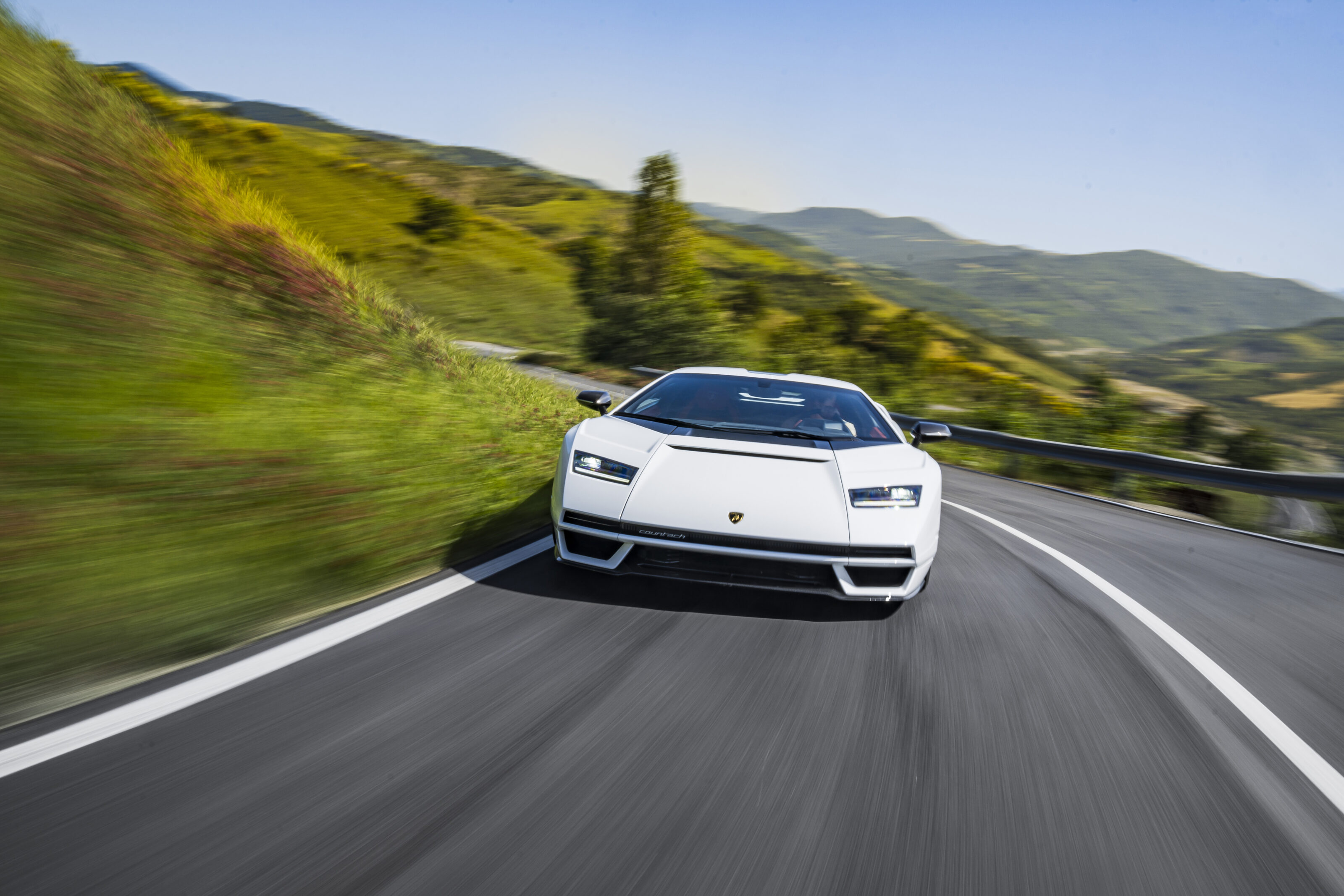
In Lambo terms, the difference between the Urus V8 and this V12 feels like the transition from a rock-meets-classic venue to an electric heavy metal big band gig featuring enough new solo artists to stage a truly unique goosebump-growing opera buffa. The dry sump lubrication and its stressed pumps are in charge of the bass-driven underground thunder.
The multi-vocal tune of the airflow over, under and through the car changes constantly in sync with speed, temperature and aero needs.
Valves, chains and camshafts form the main choir, the vast intake manifolds sound like closed-coupled synthesisers, and the quad-pipe exhaust vociferates its message with intense grunting and growling, screaming and shouting.
In terms of street cred, the new Countach deserves nine out of ten points when parked and eleven out of ten when the fireworks are underway. At full speed, it still vaguely looks like a car but it could also easily pass as a taxiing jet, a two-seater hovercraft hybrid, an alien object preparing for take-off and a proposal for the GT8 or GT9 videogame.
In terms of street cred, the new Countach deserves nine out of ten points when parked and eleven out of ten when the fireworks are underway.
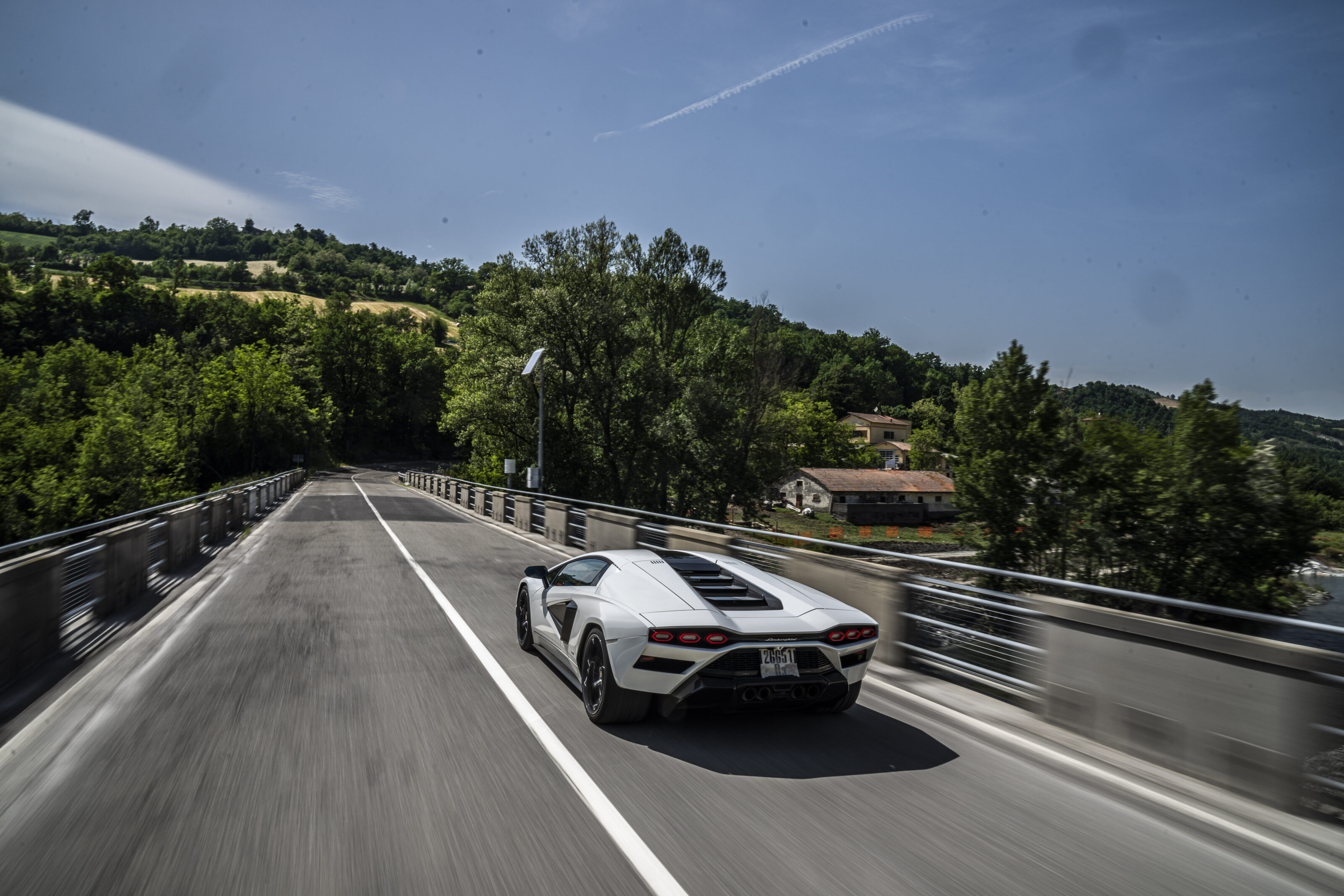
Since development of the donor model began back in 2005, the main advantages over today’s sportscar elite are flashiness, rarity value and the acoustic wow effect. Handling?
Deep down, the LPI 800-4 is half track racer and half boulevardier, but because of its sheer size it never truly excels on winding B- and C-roads peppered with hairpins, recurrent surface imperfections and latent camber changes.
Grip and traction are available in abundance, and the strong brakes do reel in Moby Dick with reassuring repeatability, but the undisputed domain of the big flatfish are very fast A-roads and any kind of autostrada.
Here, the Lambo comes closest to demolishing the competition with second-to-none 200-355km/h urge, stoic ground-effect roadholding even across yawning expansion joints, and ten-tenths feedback all the way to the limit.
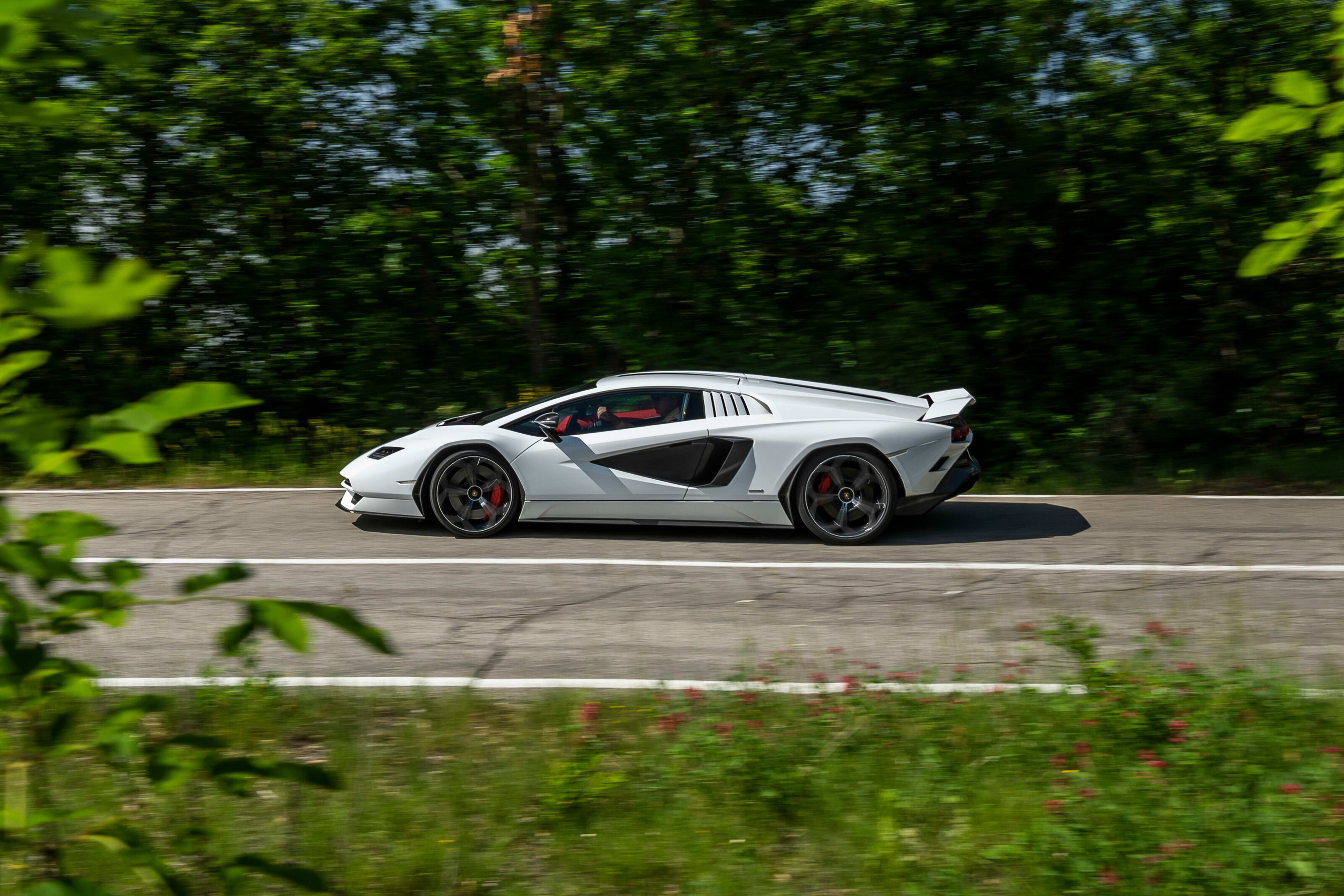
Be prepared though for occasional brusque cornering antics, aggressive high-speed tramlining, susceptibility to crosswinds, even mild lift-off aftershocks.
It is bound to take years before these 112 handbuilt bespoke one-offs will even in sum match our muletto’s 41,000km. After all, the Countach MkII that’s destined to plug the gap until the delayed Aventador replacement finally arrives next year is not a particularly practical daily driver.
Like that violet velvet Etro suit in the back of the closet, it is probably best perceived as a posh accessory for special occasions and as a fresh highlight of an important collection.
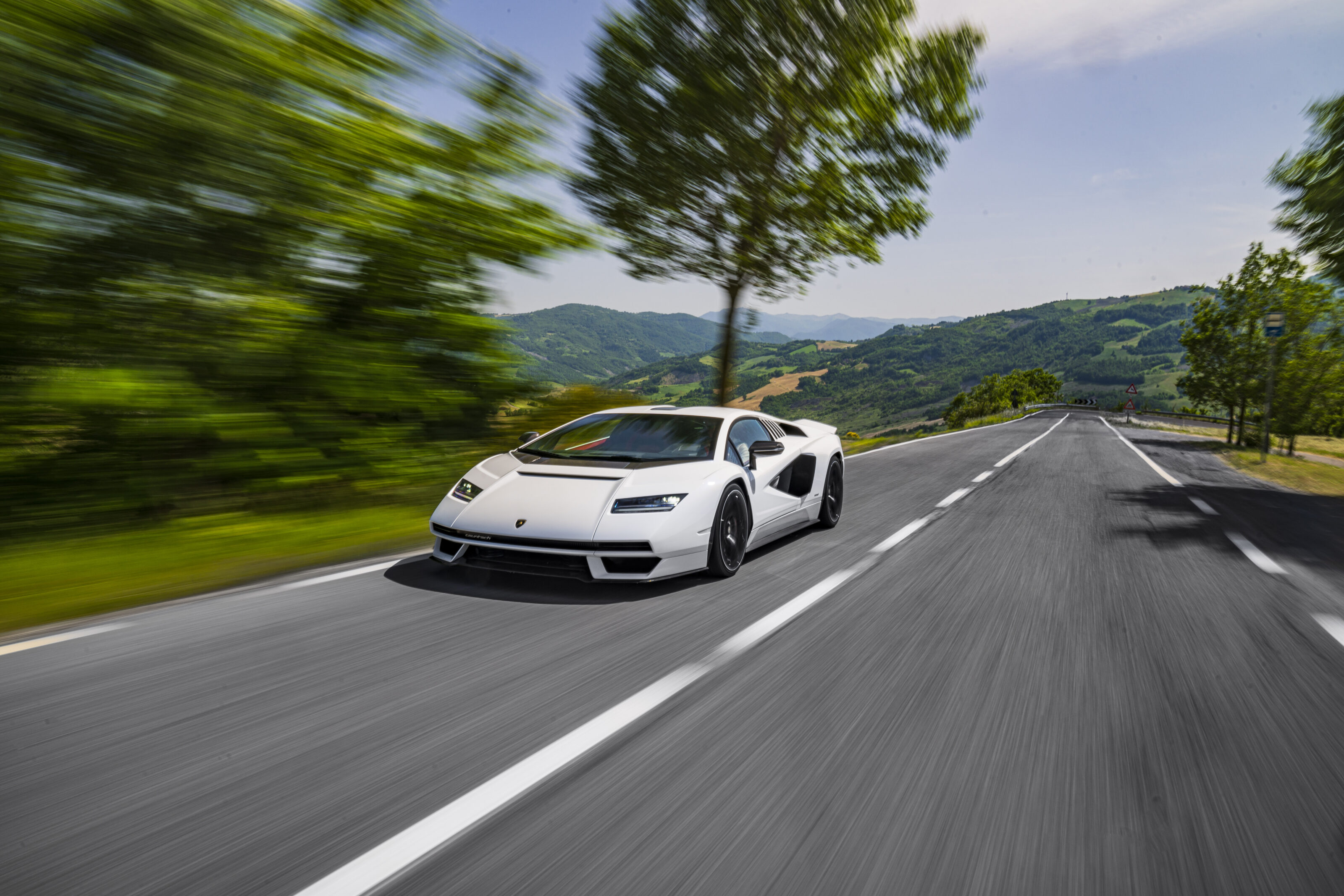
At the end of the day, it’s the scant 63 litres of luggage space, cramped cabin, 360-degree vulnerability in traffic, severely restricted visibility and that impossibly slow and jerky automated seven-speed transmission that impede the 24/7 useability of this very special Lamborghini.
While even Sport mode is a frustratingly passive work-to-rule programme when the transmission is left in auto, the raw Manual mode is a more rewarding but still blatantly uncouth option. To get the best out of this Lamborghini, find a wide-open road and treat yourself to the car’s many talents while keeping an eye on its few shortcomings.
Or look for a catwalk-quality boulevard and enjoy watching others marvel at this rare piece of street furniture from behind an ice-cold champagne cocktail.
VERDICT
The Countach 2.0 is a highly emotional and visually striking near-hypercar, but it is too pricey, violable and unwieldy for hardcore battles with modern B-road dominators.
Since its introduction in 1963, Porsche’s GTS badge has represented a particularly desirable point in each of the German manufacturer’s model ranges – and now it has been electrified, to create the 2022 Porsche Taycan GTS.
Whether it was applied to a large SUV, small convertible or the iconic 911, GTS has been synonymous with gently enhanced performance, luxury and style without crossing the line into garish opulence or hardcore RS and sledgehammer Turbo territory.
It’s a solid brand that has worked almost flawlessly with petrol-powered models in all classes, but is the equation strong enough to be transposed into the company’s first electric vehicle?
For $241,900 before on-road costs, Porsche has completed its GTS family in Australia with the very first electric vehicle to be branded with the special GTS moniker and adding a premium of about $47,000 over the Taycan 4S.
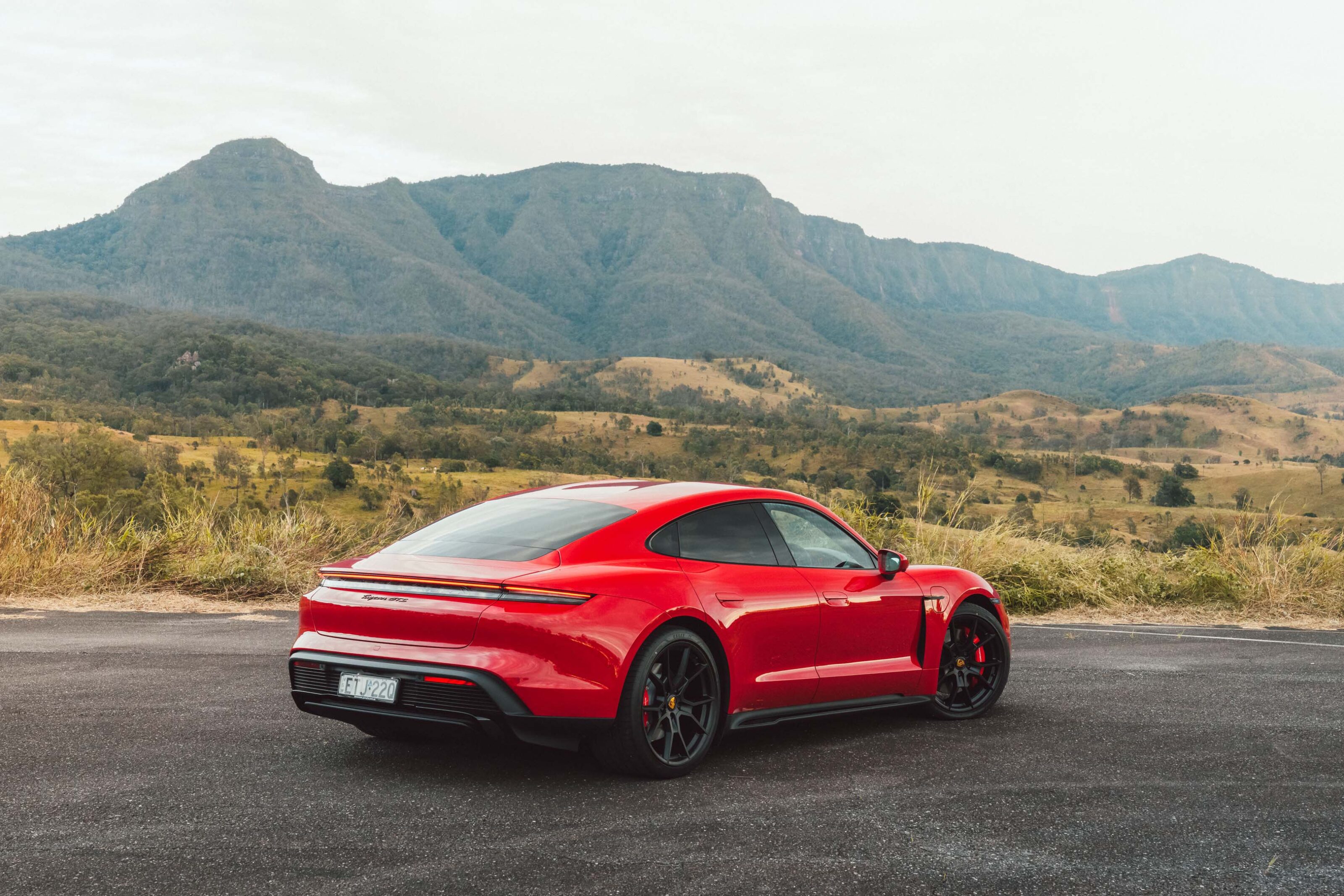
The Taycan line-up is now eight variants deep, so how does the ambitious newcomer fit in?
In the case of the Turbos, all appears to be working well, with the Taycan Turbo and Turbo S applying the maximum-punch principle in spectacular style, but the GTS treatment is traditionally more subtle and balanced than that.
When Porsche waved its GTS wand over the 992 911, for example, it gained a light but noticeable power and torque increase with 20Nm extra and 22kW compared with the 911 Carrera 4S. The Taycan GTS you see here though – it has up to a whopping 80kW and 210Nm over the Taycan 4S.
Along with the significant upgrade to its 800-volt electrical system, the Taycan GTS also gets a recalibrated adaptive air suspension system and Porsche Active Suspension Management to provide a sharper driving experience – something which extends to the GTS’s optional rear-wheel steering.
Then there are the wheels themselves, which are the same 20-inch rims fitted to the Taycan Turbo S but finished in satin black – a theme that runs throughout the GTS exterior and cabin.
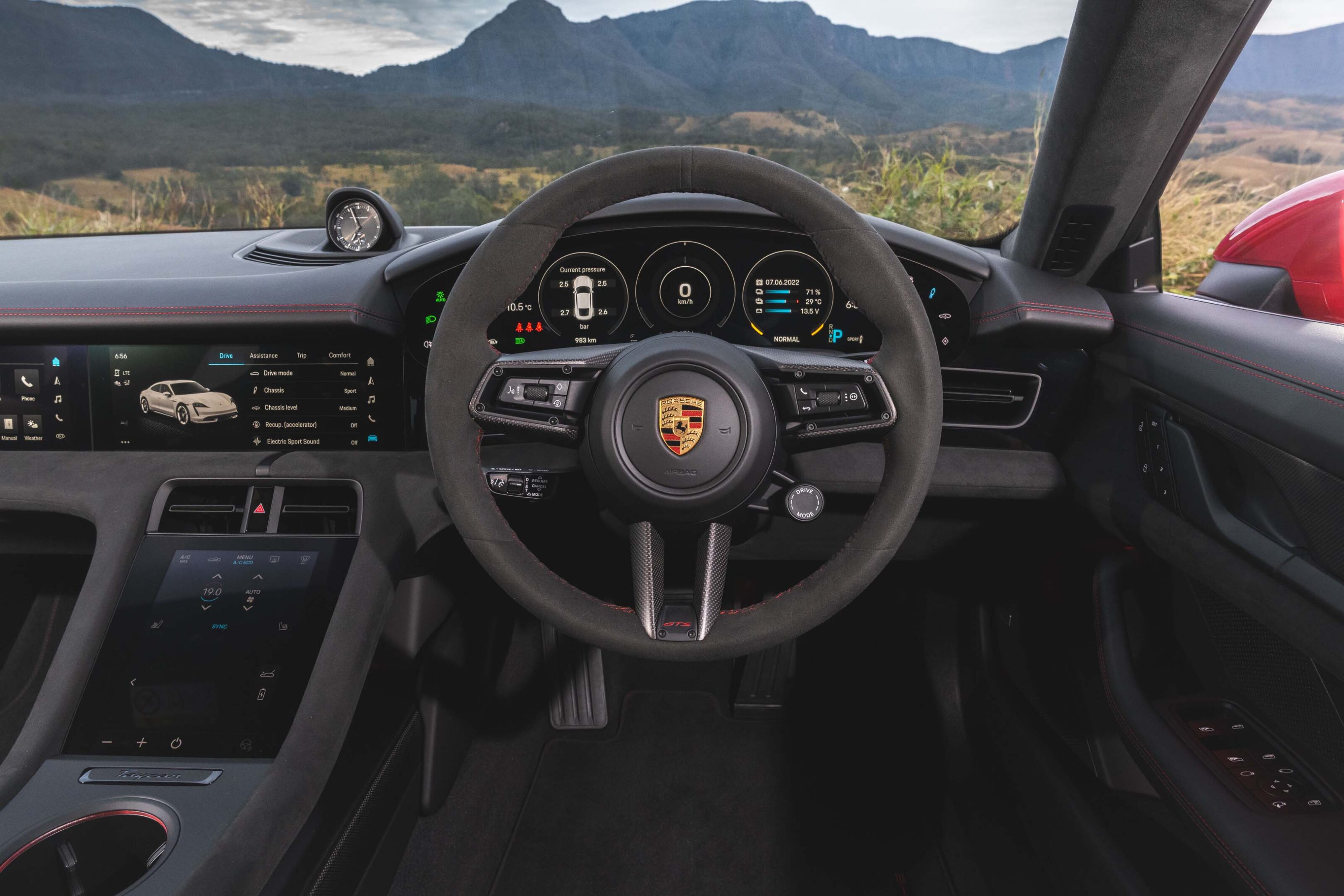
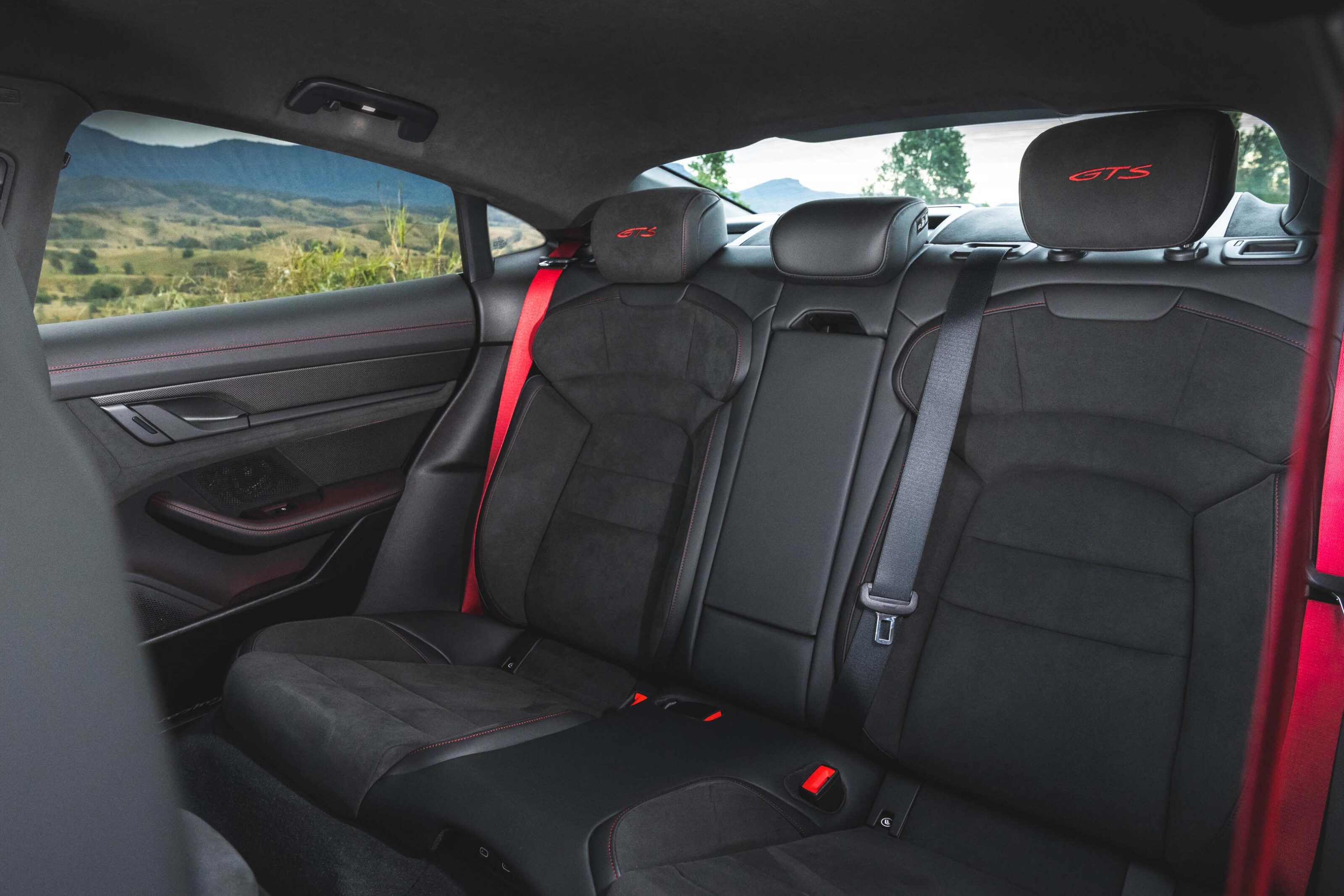
Adding to the blacked-out styling touches, the GTS cabin is given a more premium feel without compromising on sporty appeal with a liberal application of Race-Tex synthetic suede for the seats, roof liner, centre console, lower portion of the dash and the slim and sporty steering wheel.
Jumping straight into the Taycan GTS after a blast in the 911 equivalent feels very familiar and Porsche has been typically consistent in the application of GTS touches.
Once again, the car-maker has aced the enhancement of luxury without cheapening any high-performance credentials.
That said, the full lovely GTS interior added to our test car with Carmine red costs another $8370 on top of the base price.
Like the other GTS variants, there’s the slick-looking Sport Chrono package included as standard, forming a centrepiece with the beautiful stopwatch atop the dashboard; below that is a masterclass in Porsche minimalist design.
Once again, the car-maker has aced the enhancement of luxury without cheapening any high-performance credentials.
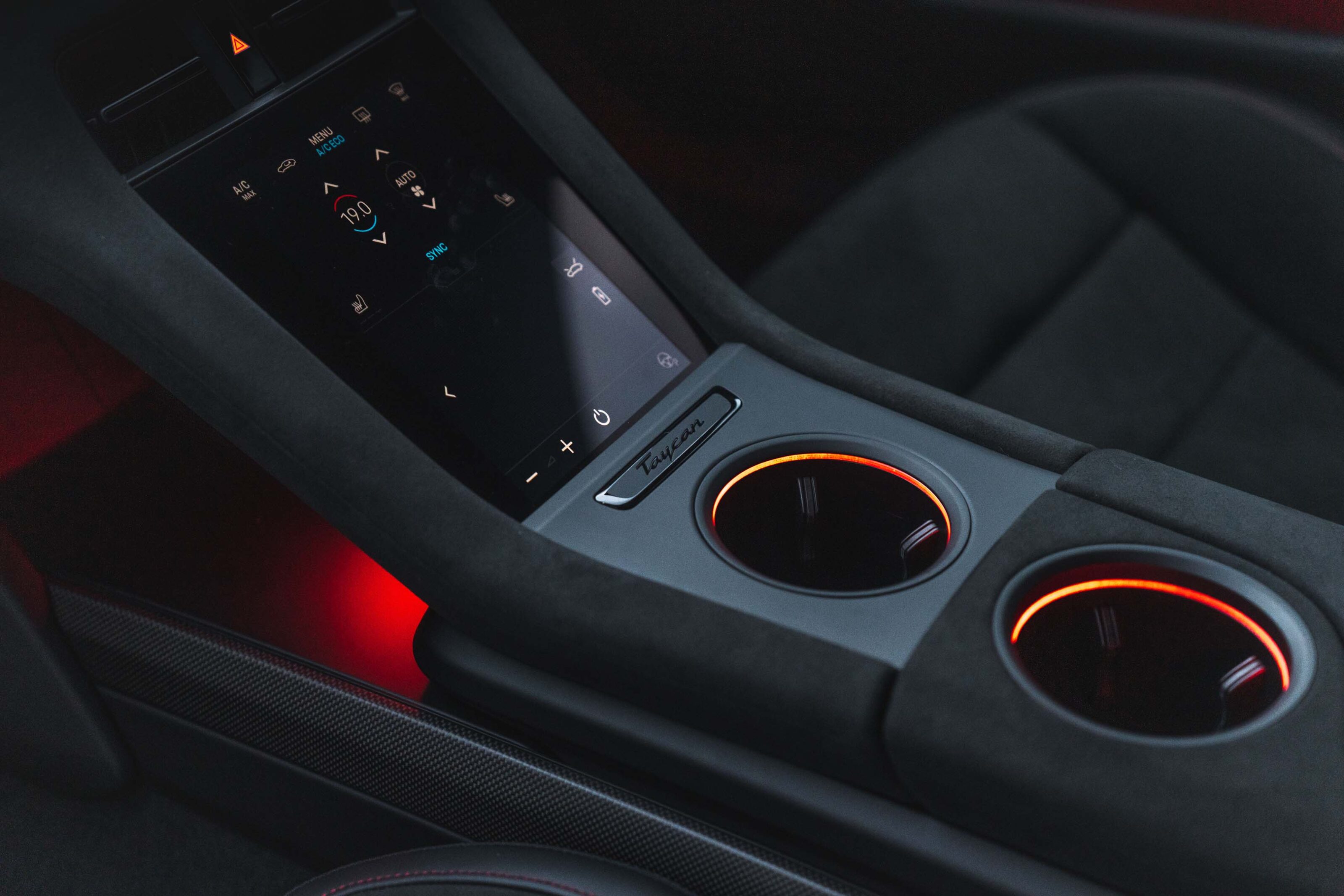
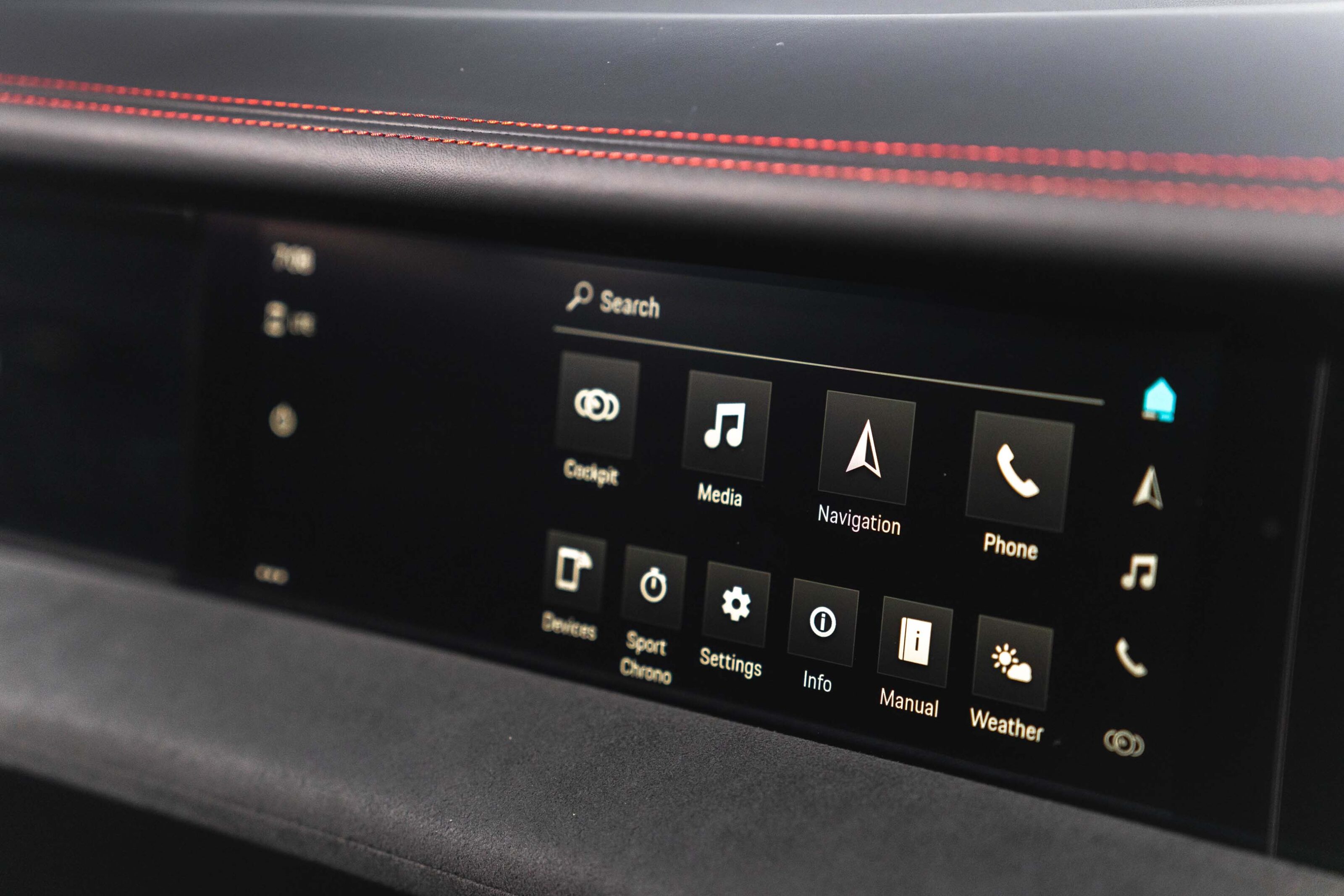
Expansive digital touchscreens are impressive not through sheer size, but their integration. The driver’s digital instruments mimic even the earliest Porsche dash pod with an elegant curve, while the centrally mounted climate and information screens are flush and feature beautifully sharp graphics.
Visually, the effect is striking, but the odd volume knob and hard button would make the overall functionality of the system as likeable as the aesthetics. That said, a little time spent in the GTS would likely negate most of this qualm.
In our particular test car, there’s a fourth display for the front passenger that duplicates most of the vehicle, trip, and entertainment information. Unfortunately, Australia doesn’t have the option to present TV or film entertainment via the screen as it does in other less overbearing nations like, err, China.
On the road
Watching a movie in the passenger seat of the newest Taycan to join the EV family is to waste a thoroughly enjoyable driving experience regardless of the roads – or the seat you’re occupying.
With the changes to the air suspension system and adaptive dampers, the Taycan GTS has a number of significantly different personalities at its disposal.
In the most comfortable setting, the GTS has the grace and elegance that other variants have already demonstrated, covering cruising kilometres with absolute ease.
Even some of Queensland’s storm-ravaged blacktop couldn’t faze the pleasant and stoic ride, with only the nastiest potholes sending a shiver through the low-profile tyres and stiff monocoque. Road roar and wind noise are also impressively quiet thanks to a slippery drag coefficient of 0.22cd.
But it’s when you find a more interesting road that the GTS really shows its value. With the driving mode selector spun round to Sport or Sport Plus, the three-chamber adaptive air springs are surprisingly aggressive and allow the Taycan to be hustled from apex to apex.
It carries a significant 2.3-tonne unladen weight, but it also disguises it commendably with a combination of good old-fashioned engineering and cutting-edge tech.
Firstly, front-to-rear balance is excellent on the GTS, promoting aggressive corner entry and allowing the weight to help the car turn in – not unlike a mid-engined model or even its 911 sibling.
It won’t, however, start to oversteer if power is backed off mid-corner and holds a line with a pleasant stubbornness.
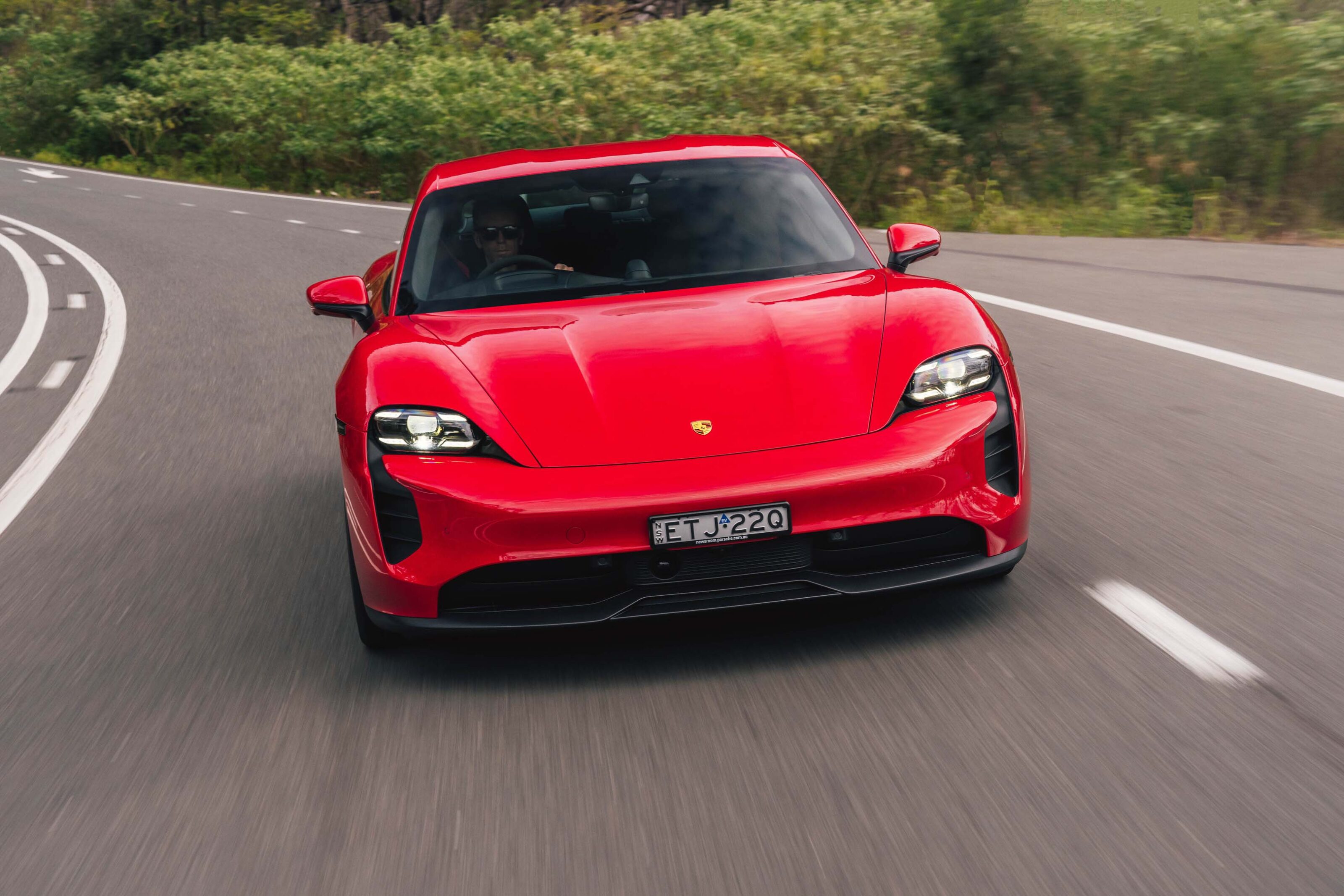
In the tightest corners, the effect of the optional rear-steering can be fully appreciated but if pushed too hard, the Torque Vectoring Plus system can be felt shifting power between front and rear motors and even individual corners. Not only is the result an amazing ability to lock onto a tight line but the absence of embarrassing tyre squeal.
It also handles fast cornering effortlessly. There’s a bit of roll but the body settles with an almost MX-5-like honesty, allowing the limits to be carefully monitored – rather than a loss of grip suddenly dropping in your lap. Running out of options in a 2.3-tonne Porsche at speed is not something anyone should experience.
Porsche’s suite of clever electronic stability systems is certainly in part responsible for the way a large and heavy sedan makes its way around a track without embarrassing its custodian, but the point at which talent is exhausted and when Traction Management (PTM), Stability Management (PSM) and optional $6870 Dynamic Chassis Control Sport (DCCS) comes into play is seamless.
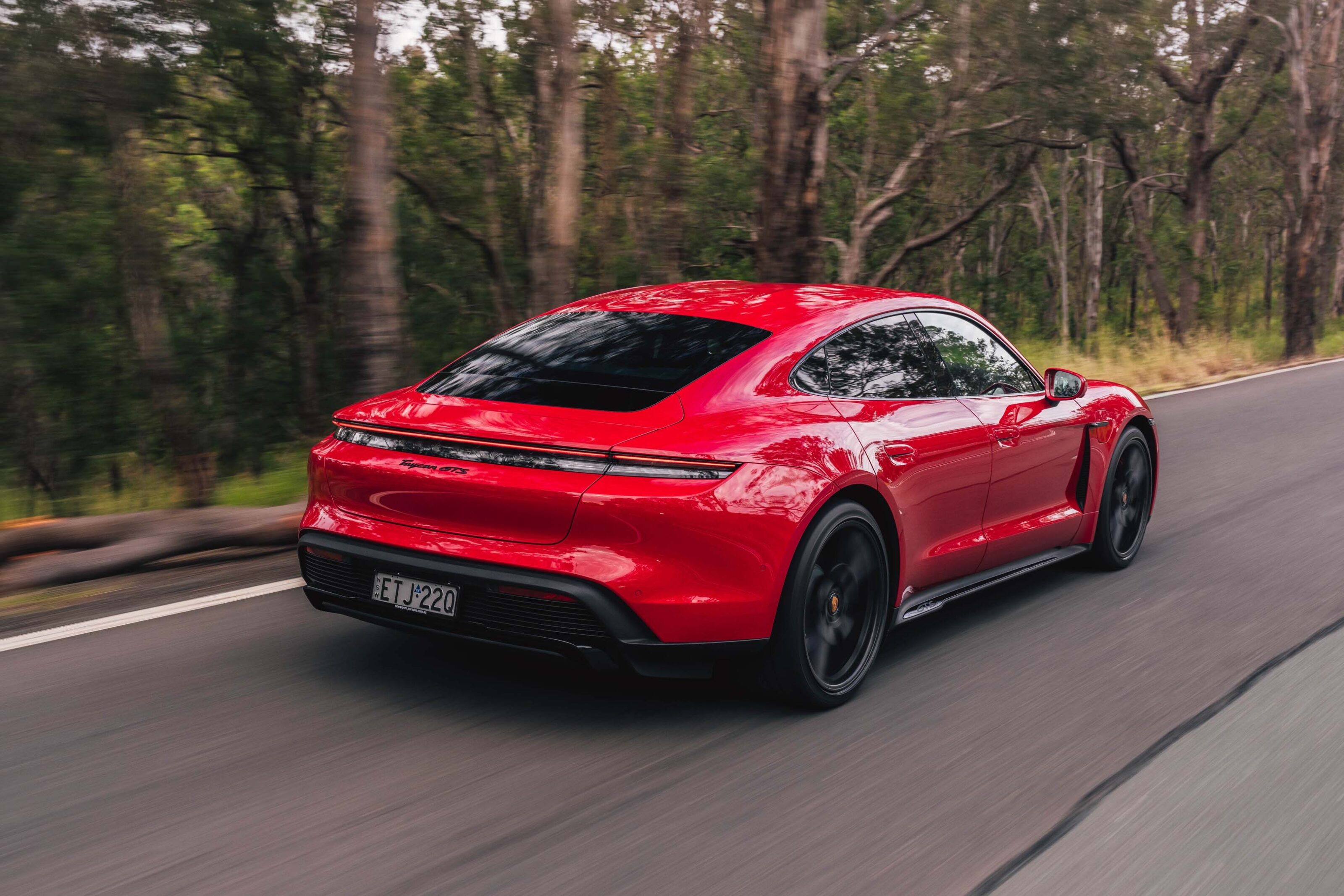
A squashy brake pedal is the least Porsche-like attribute of the GTS’s character, but the transition from aggressive regenerative braking (up to 275kW of recuperation) into the hydraulic six-piston calipers’ braking is very hard to spot, enabling confidence in stopping power – which is very typical of a Porsche.
Following five laps of Norwell’s challenging corners on a 25°C day, the Taycan’s brakes were hot but nowhere near as punished as expected, indicating a heavy reliance on regen even when under track conditions.
Battery, range and power
Power and performance is also another standout from the GTS transformation.
In everyday driving, the 800-volt system and 93.4kWh battery can pump the motors up to a maximum of 380kW and 850Nm but a limited overboost function ups the power to 440kW.
Power and performance is also another standout from the GTS transformation.
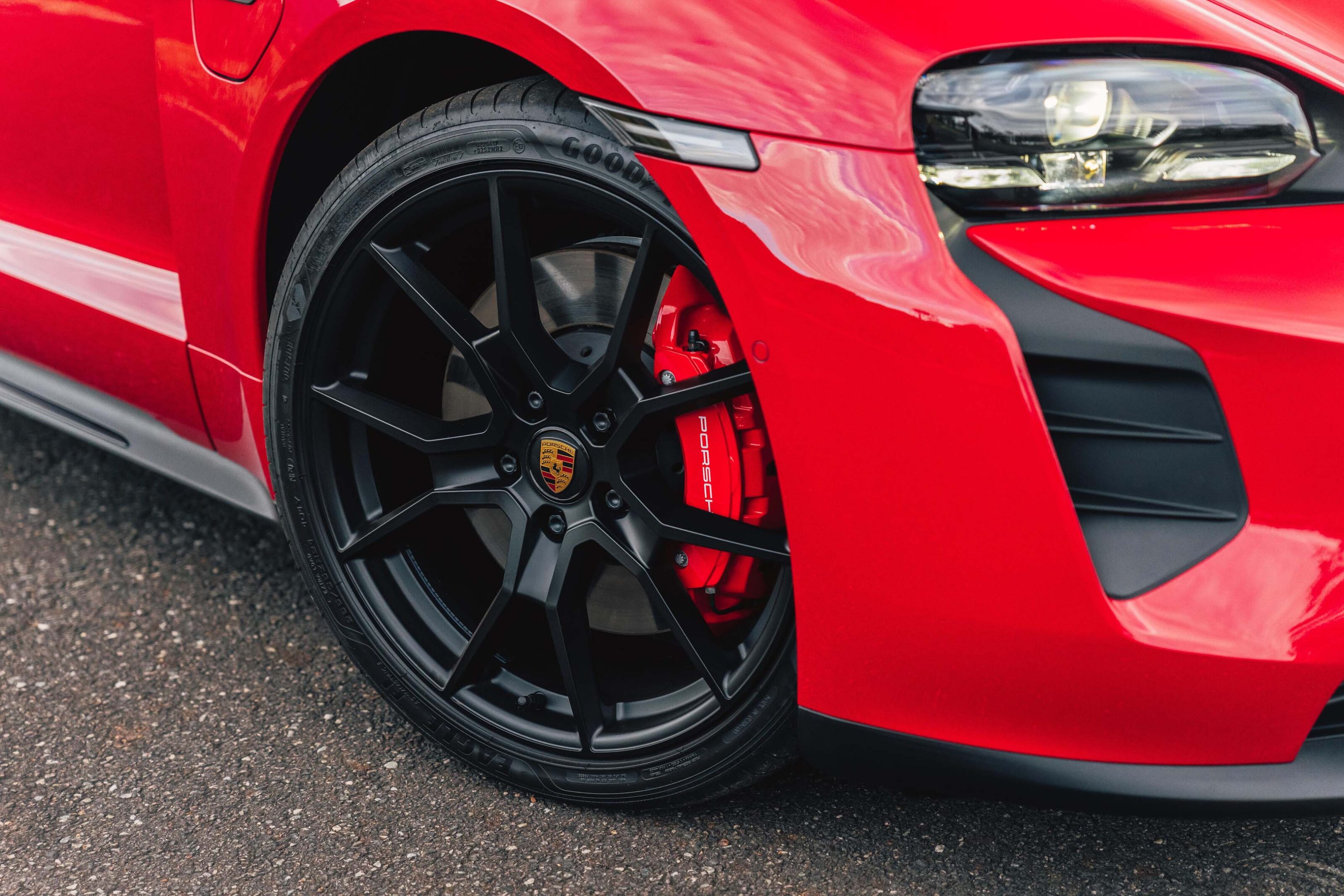
It wasn’t just a matter of plugging in a laptop and liberating a few more electronic horses; Porsche actually adapted the pair of motors specifically for the GTS to result in a bespoke GTS drivetrain.
Acceleration, therefore, is scintillating and a zero-to-100km/h dash is possible in 3.7 seconds, says Porsche. Perhaps more useful and enjoyable than off-the-mark acceleration, though, is the Taycan GTS’ ability to take off while already at speed.
You might not be as much of a fan as I am of Porsche’s Electric Sport sound but pushing the Taycan on track highlights a practical purpose.
With very little ‘natural’ sound to understand what the drivetrain is doing, it’s not hard to lose perspective on just how much pace the GTS has gathered when on an unbridled race track – especially when second gear thumps in.
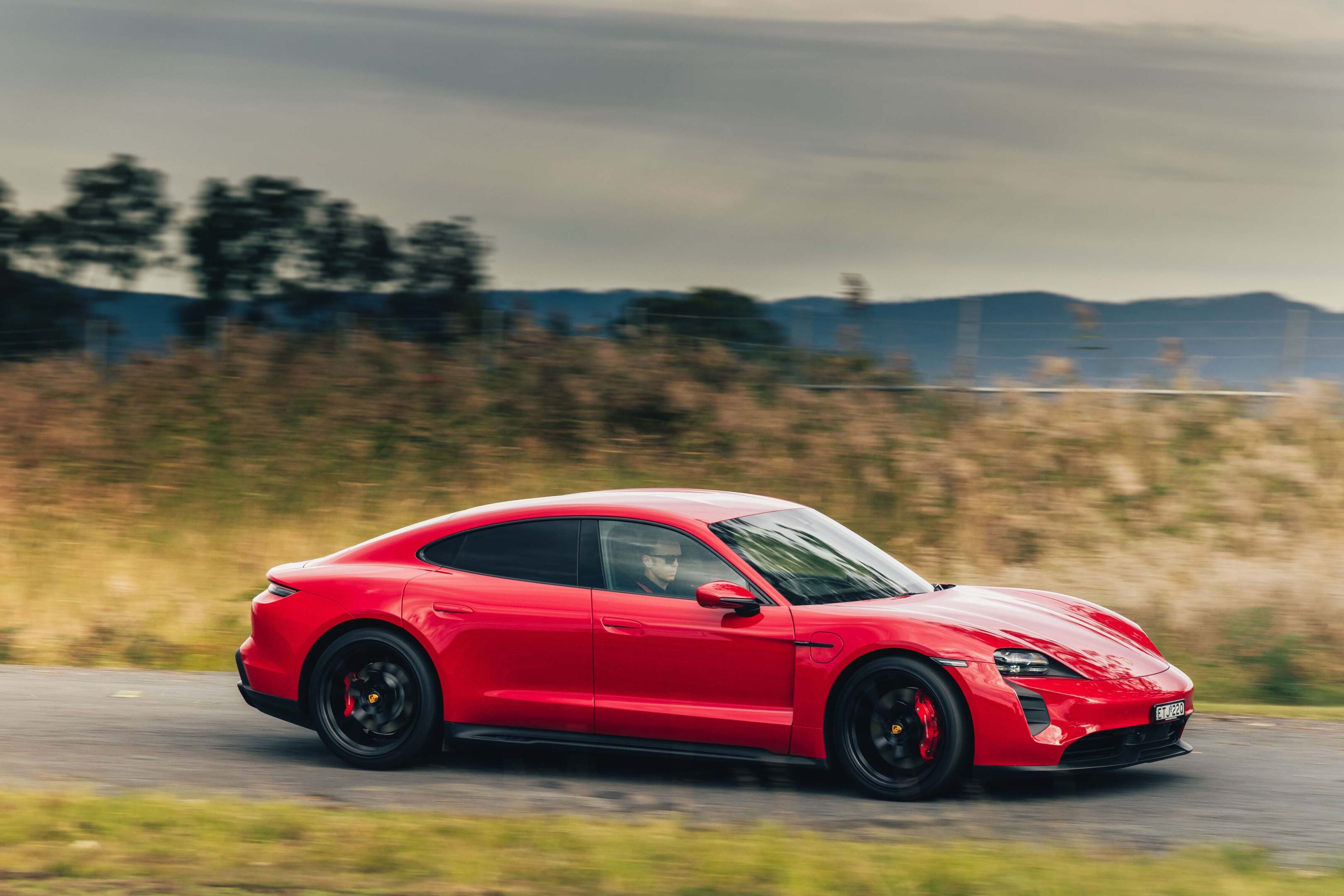
The strangely likeable whirring and whining, however, provides a useful way to keep an eye (ear) on the speed, while the rest of your senses may be telling you the velocity is much lower.
Despite the swathe of performance, when driven more sedately, the GTS will still cover about 485km on a single charge.
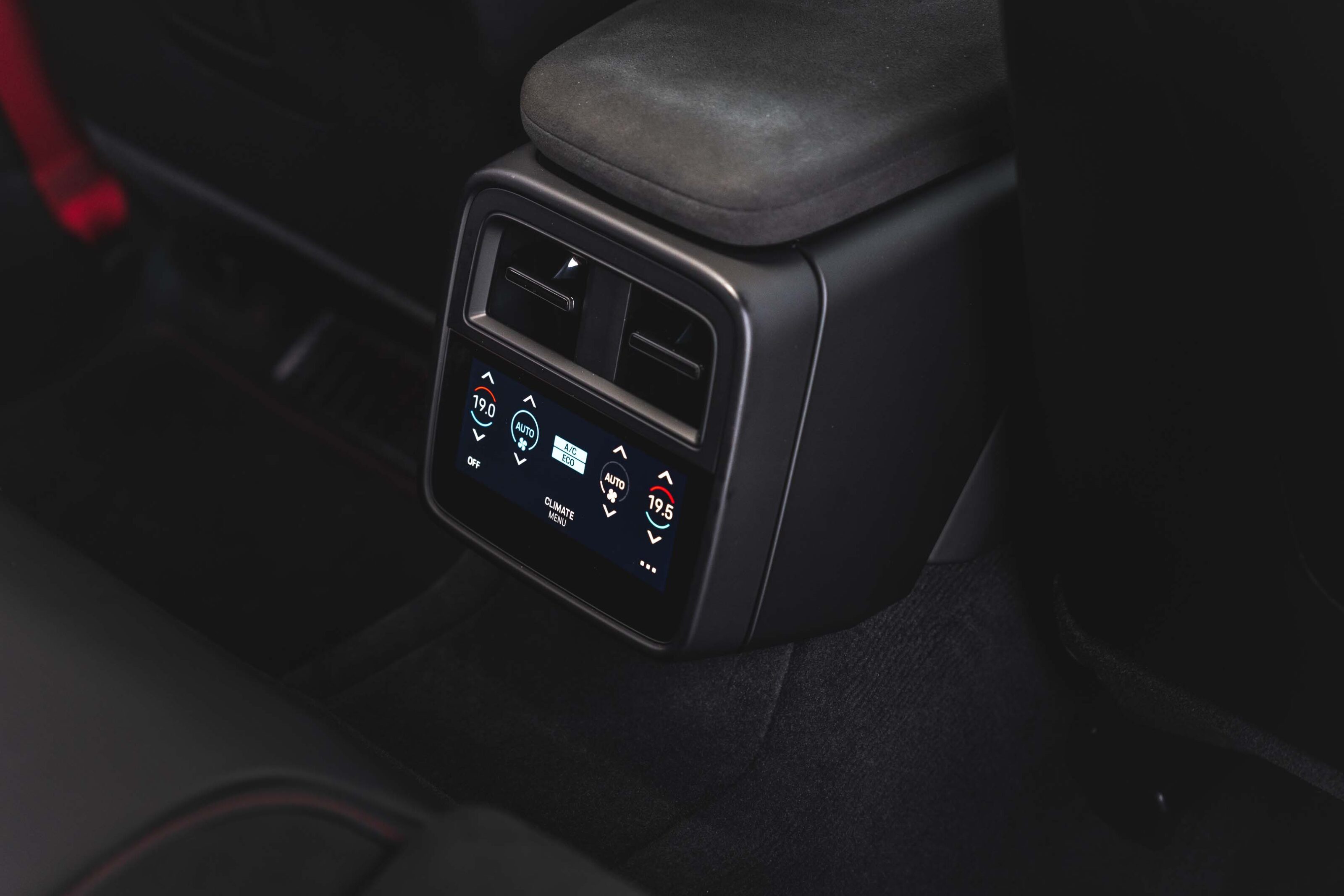
Ergonomics are also excellent for taking the Taycan to the track. The sports seats are not as deeply bucketed as some previous GTS variants but still more than adequately supportive (same goes for the rear seats if you have up to two passengers who are up for a lap too), while the driving position is a treat – allowing a long-legged-short-arm posture.
The snub bonnet drops quickly out of sight for positioning the Taycan confidently on track and the sharp steering is another calling card of the best Porsche machinery.
Despite the swathe of performance, when driven more sedately, the GTS will still cover about 485km on a single charge.
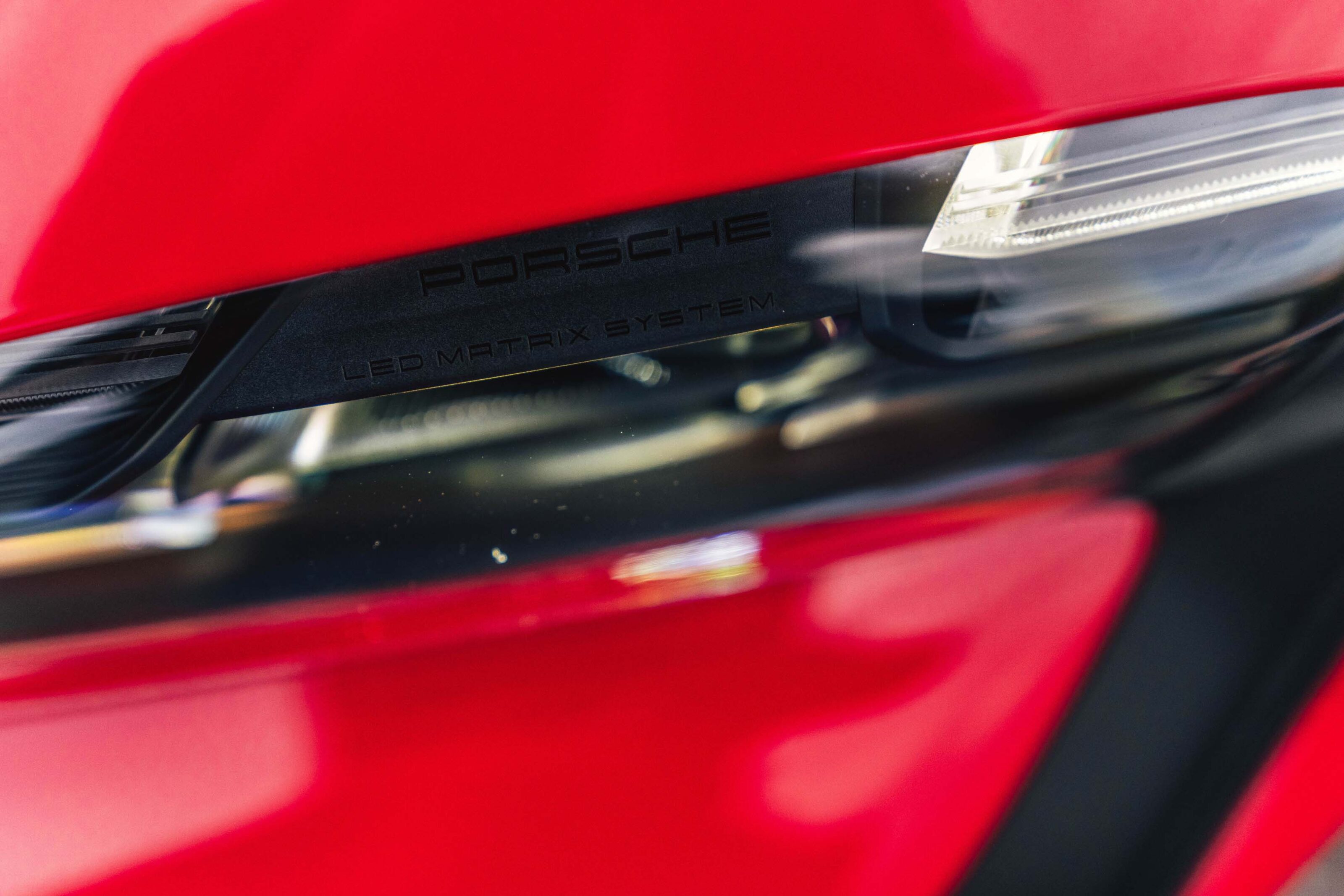
VERDICT
It’s hard to imagine how Porsche could have made their hugely impressive EV any better for a combination of road and track use and the traditional GTS blend of added performance with subtle luxury enhancements has been perfectly applied with no compromises from the electric drivetrain.
And yet there’s one thought I keep coming back to. I still feel the lighter and more raw rear-drive entry-level Taycan has much to offer despite a power and performance deficit, and the GTS transformation might work beautifully when applied to the most affordable version.
It would lack the excellent air suspension trickery, as well as the rear-steer agility, but a lighter, coil-sprung two-wheel-drive Taycan dressed up in the gorgeous GTS war paint would certainly be the Taycan for purists.
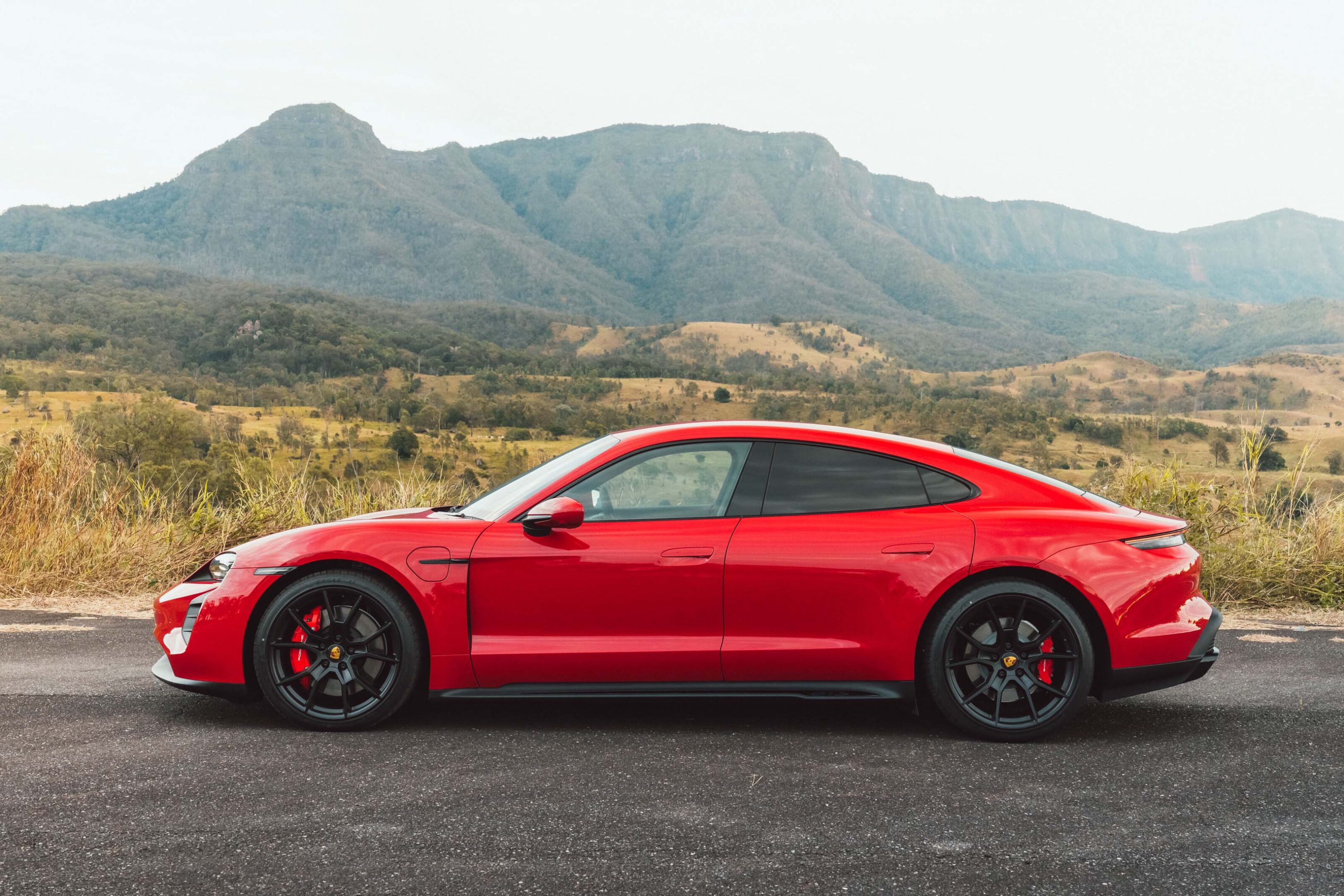
While we’re talking about things you can’t have, our fantasy would go further into a more off-road-focused Cross Turismo GTS that Porsche has no plans to build at this stage. And while other regions are offered a Sport Turismo GTS, Australia is unfortunately not on the list.
That said, the Taycan GTS does still offer a compelling range-splitting variant that appears to make a lot of sense, with a level of performance and exclusivity that brings more for your dollar than anything else in the current line-up.
If the Taycan recipe is something that might work for your taste and budget, the GTS is easily the version that has the greatest bandwidth and demonstrates just what this impressive EV is capable of.
