
Snapshot
- Uber in Federal Court over misleading messages within its app
- Rideshare pioneer has admitted to misleading or deceptive conduct
- Penalties of up to $26 million could be imposed
Ridesharing service Uber is facing a fine of up to $26 million after it admitted to engaging in deceptive conduct and false or misleading representations.
According to consumer watchdog the Australian Competition and Consumer Commission (ACCC), Uber has admitted to breaching the Australian Consumer Law (ACL) between December 2017 and September 2021, by making false or misleading statements in its cancellation warnings and fare estimates.
As a result, the ACCC and Uber will now both make submissions to the Federal Court which will decide the financial penalty the latter will receive.

The ACCC says Uber’s app produced a message telling customers who wished to cancel their pending trip that they would incur a fee due to the driver being en route, despite it happening within the free cancellation period.
Uber’s now defunct, Sydney-based Uber Taxi service has also been under fire for providing misleading fare estimates between June 2018 and August 2020, due to a mistake with the company’s algorithm which inflated the projected fare to above its actual cost.
“Uber admits it misled Australian users for a number of years, and may have caused some of them to decide not to cancel their ride after receiving the cancellation warning, even though they were entitled to cancel free of charge under Uber’s own policy,” said ACCC chairperson Gina Cass-Gottlieb.
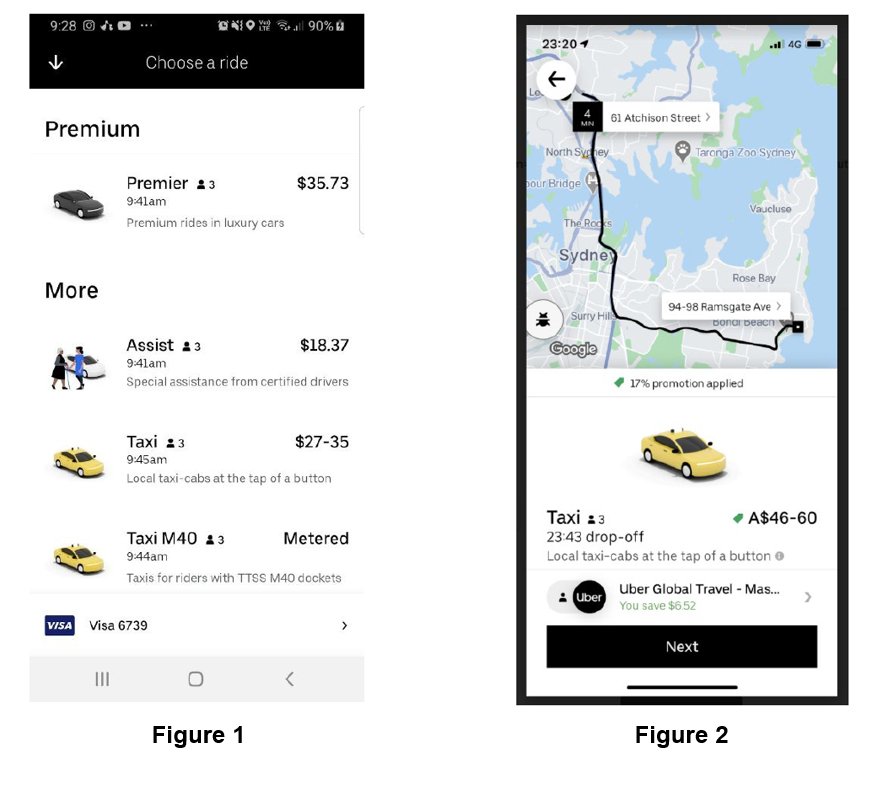
“Uber admits its conduct misled users about the likely cost of the taxi option, and that it did not monitor the algorithm used to generate these estimates to ensure it was accurate.
“Consumers rely on apps to provide accurate information, and the misleading information on Uber’s app deprived consumers of a chance to make an informed decision about whether or not to choose the Uber Taxi option.
“Digital platforms like Uber need to take adequate measures to monitor the accuracy of their algorithms and the accuracy of statements they make, which may affect what service consumers choose.
“This is particularly important as online businesses often carefully design their user interfaces to influence consumer behaviour.”

The ridesharing giant said it has co-operated with the ACCC throughout the process, wanting to ensure it was doing the right thing for its Australian customer base of just under four million people.
“Uber and the Australian Competition and Consumer Commission have today reached an agreed settlement position regarding two historical issues,” Uber said.
“The final resolution of the matter will be subject to the determination of the Federal Court.
“We value the important work the ACCC carries out and have cooperated with the ACCC throughout its two year investigation, including proactively making changes to our platform based on the concerns they raised.
“Over time we have constantly evolved our offering, looking for ways to create better customer experiences, trial new products and invest in our technology. We are committed to continually raising the bar – for ourselves, our industry, and most importantly for the people who use our services.
“As always, we will continue to listen to feedback from driver-partners and riders to make sure that the service we are offering continues to meet their needs.
“With more than 3.8 million Australians regularly choosing to take rides with the Uber app, we are committed to constantly innovating and investing in our technology and customer support to deliver an excellent experience for all of them.”
Last year Uber called out the Australian Government over its lack of emissions regulations, urging those in power to make changes which would allow its drivers to switch to electric and low emissions vehicles sooner, wanting its worldwide fleet to be zero-emissions by 2040.
Porsche has picked Australia to become the new home of its latest Porsche Studio, with a space opening in Brisbane.
Located in Indooropilly Shopping Centre on the Queensland capital’s inner northside, Porsche Studio Brisbane was launched in conjuction with Porsche Centre Brisbane and Eagers Automotive, aiming to give customers the VIP treatment while ordering their next purchase from Stuttgart.
As well as putting its current vehicles on display, the Studio will allow customers to book test drives, configure their purchases and browse Porsche’s lifestyle merchandise range, with a private cafe providing catering in-house.
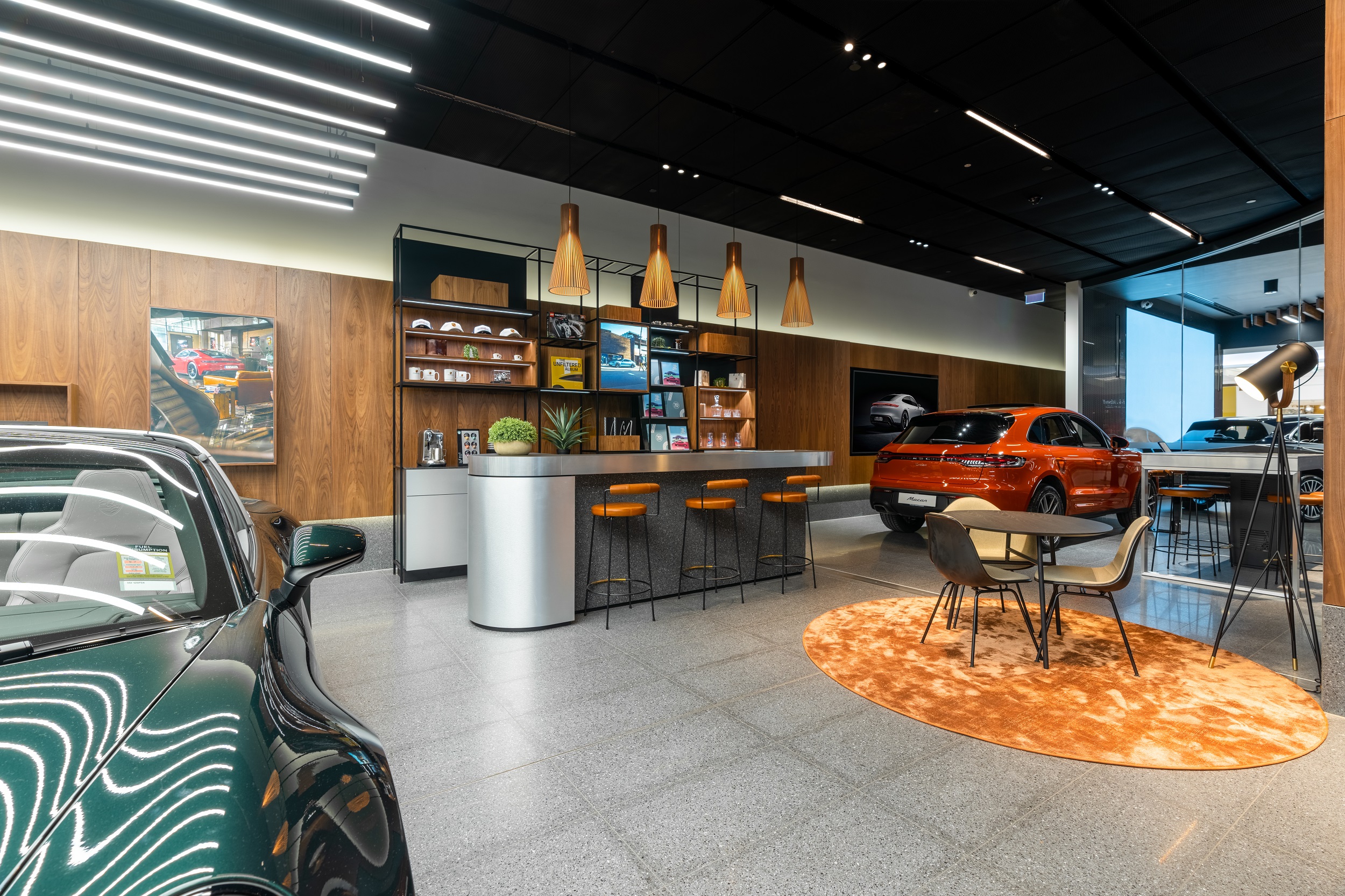
It’s the 20th Porsche Studio to open internationally, with Porsche Cars Australia CEO Daniel Schmollinger saying the new space is geared at bringing its products to the customers.
“Our retail formats are evolving for the future, so it is exciting to see the first Porsche Studio in Australia now open,” said Schmollinger.
“We opened our first ‘Destination Porsche’ dealership late last year, and now our first Porsche Studio. These new and exciting touchpoints give us a different way to interact with our Porsche owners, both new and existing.
“The Porsche Studio is a great place for likeminded people, be they Porsche owners or fans, to meet and interact with our brand, products and technology.”
Porsche recently announced its multi-million dollar investment in synthetic fuels would include a production facility in Australia, as the German manufacturer has allocated close to $100 million for the development of efuels to ensure the longevity of internal combustion engine vehicles.
Ford CEO Jim Farley has just announced the company has another electric ute on the way.
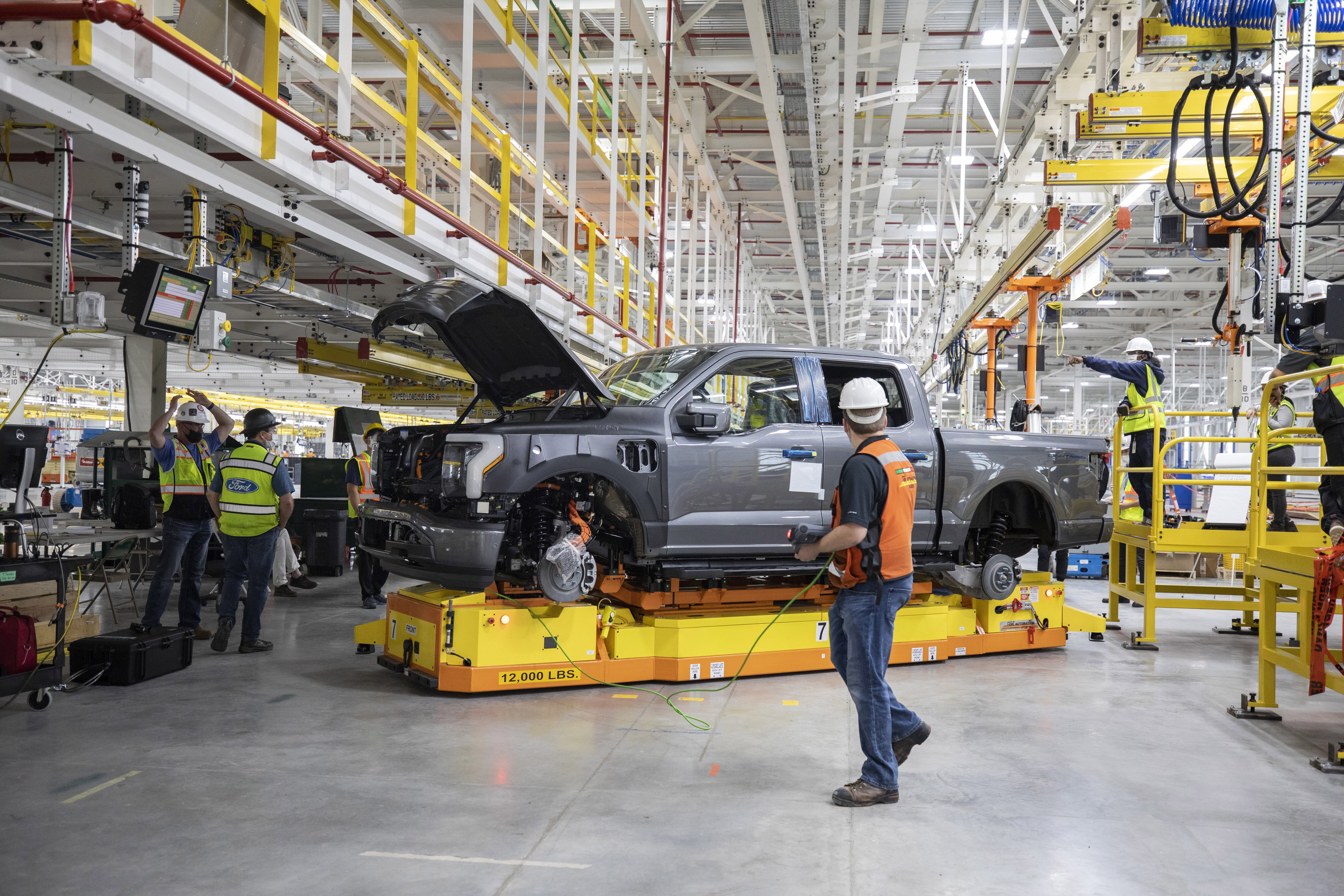
At a livestream event for the 2022 Ford F-150 Lightning – the first electric pick-up from Ford – Farley casually told the audience there was another battery-powered ute on the way.
“We’re already pushing dirt down in Blue Oval City in Tennessee for another electric pick-up truck that’s different than this one,” Farley said during the event.
A Ford spokesperson told Jalopnik the vehicle “will be a next-gen electric truck, different from the F-150 Lightning,” which suggests the Ford Ranger could be the next model to offer a battery-electric powertrain.
The phrasing points to the forthcoming Ranger, with the new-generation model being just months away from launching in Australia and the US.
UPDATE, July 2022: New Ford Ranger review – it’s here at last
The new 2023 Ford Ranger is now on sale in Australia, and the local media launch has been run. The Wheels and 4×4 Australia teams have both driven the new Ranger, and you can find their stories at the links below.
Story continues…
Farley’s comments come as a senior member of Volkswagen told the UK’s Autocar an electric version of the Volkswagen Amarok was under consideration.
“We’re looking at a pure-electric version,” said Lars Krause, Volkswagen Commercial Vehicle board member responsible for marketing.
“It’s still early, but it’s something we’re considering within the lifecycle.”
Given the Amarok is essentially a restyled Ford Ranger, it’s unlikely Volkswagen would be able to consider such a vehicle unless Ford already had an electric version in development.
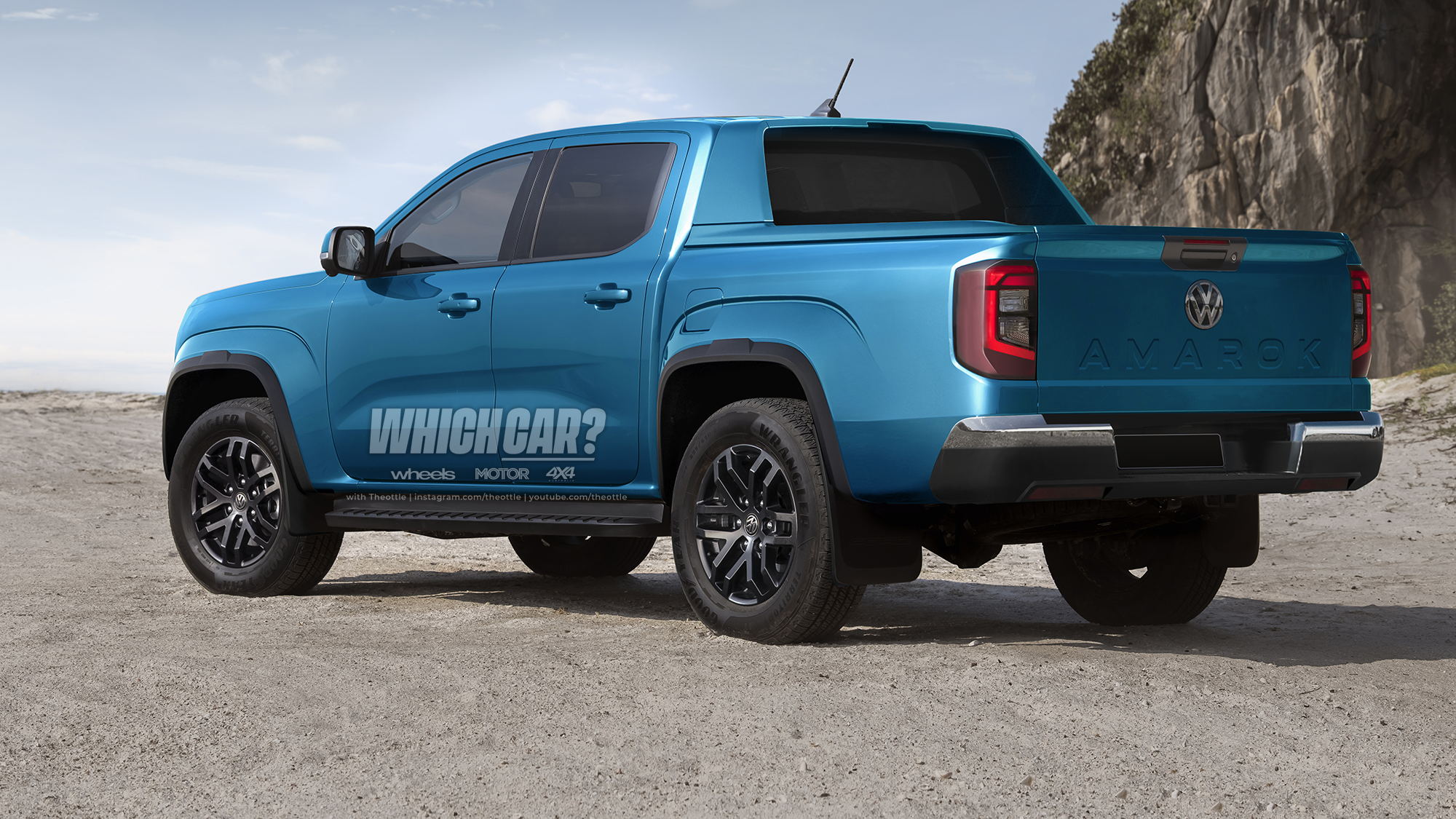
“Right now, we’re not satisfied with the electric range of the plug-in hybrid. I’d never say never, but we’re looking more towards a full electric version,” Krause said.
It’s thought an electric Ranger could begin production at Ford’s Blue Oval City in Tennessee from as early as 2023, with an Amarok likely to follow at a later date.
“We think it’s possible. Obviously, we’d need to modify certain elements. But yes, we’re seriously considering an electric variant.”
April 27, 2022: Nissan Z global launch delayed amid supply issues
The upcoming 2023 Nissan Z coupe’s global launch has been delayed with the manufacturer facing supply chain constraints.
Initially scheduled to launch in late June this year, The Nissan Z’s debut has now been pushed back, potentially hitting international streets as late as September.
Alongside the announcement of prices in its native Japan, Nissan said the rear-wheel drive coupe’s release would be impacted by parts supply issues.
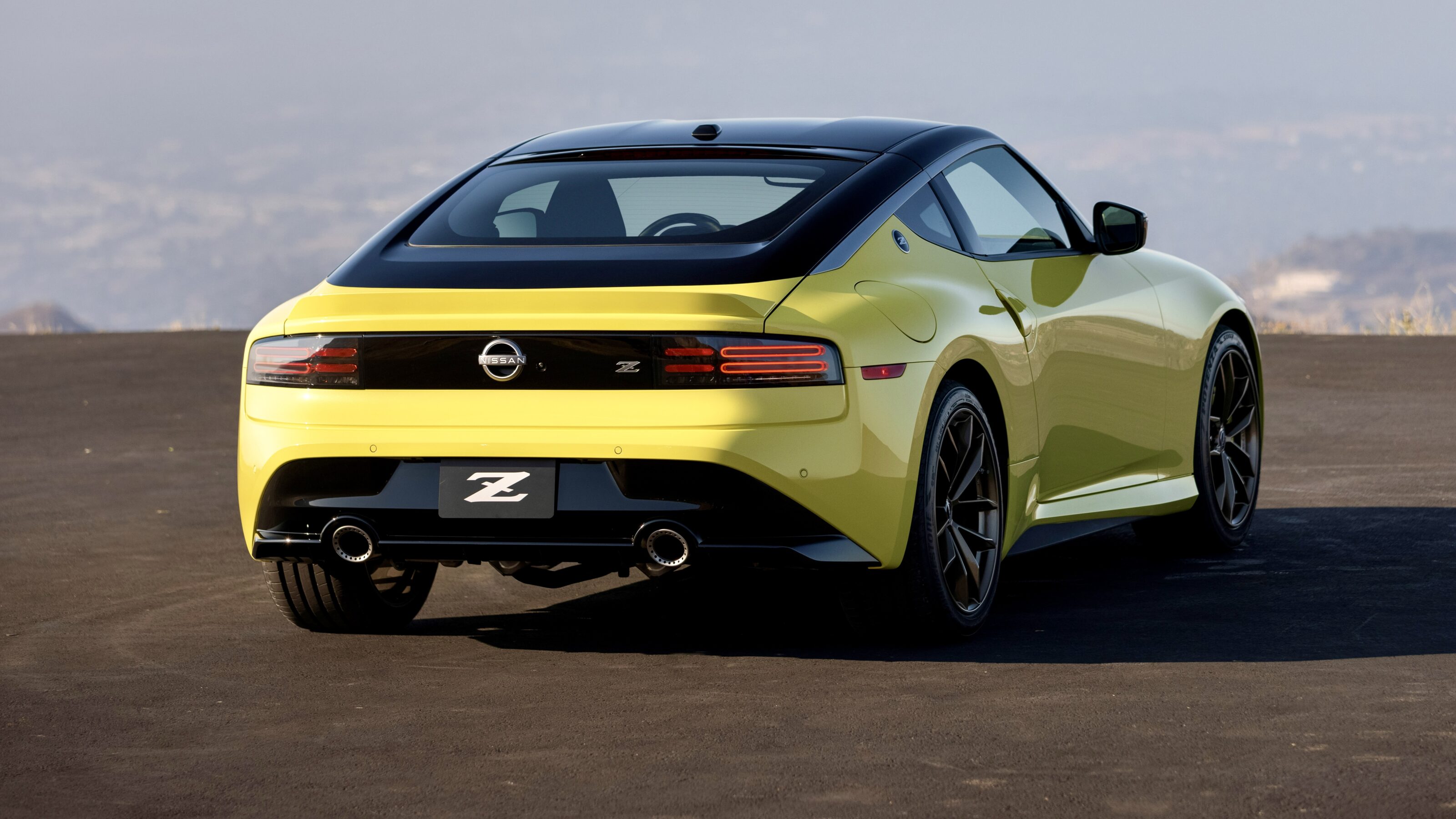
“The release date was originally scheduled for late June, but due to the recent impact of parts supply, it has been changed to this summer [in the Northern Hemisphere],” said Nissan. “The release schedule may change depending on the parts supply situation.”
Nissan initially anticipated the first local examples to land in Australia throughout the middle of the year, however the recent delays could delay its local launch to the end of the year.
Read on below to see what we know so far about Australian-bound Z.
The story to here
October 6, 2021: Nissan Z to launch in Australia mid-2022
The 2023 Nissan Z coupe will arrive into Australian dealerships in the middle of 2022, with a launch edition available in limited numbers.
While a single variant of the Z sports car will join the Nissan range locally, a limited-edition Z Proto Spec is to be offered with a number of unique features.
Borrowing its powertrain from Infiniti models in the US, the new Z will use a 3.0-litre twin-turbo V6 producing 298kW and 475Nm, powering the rear wheels through a six-speed manual gearbox with an Exedy high-performance clutch and rev-matching.
A nine-speed torque-converter automatic transmission is also available as an option, featuring aluminium paddle shifters.
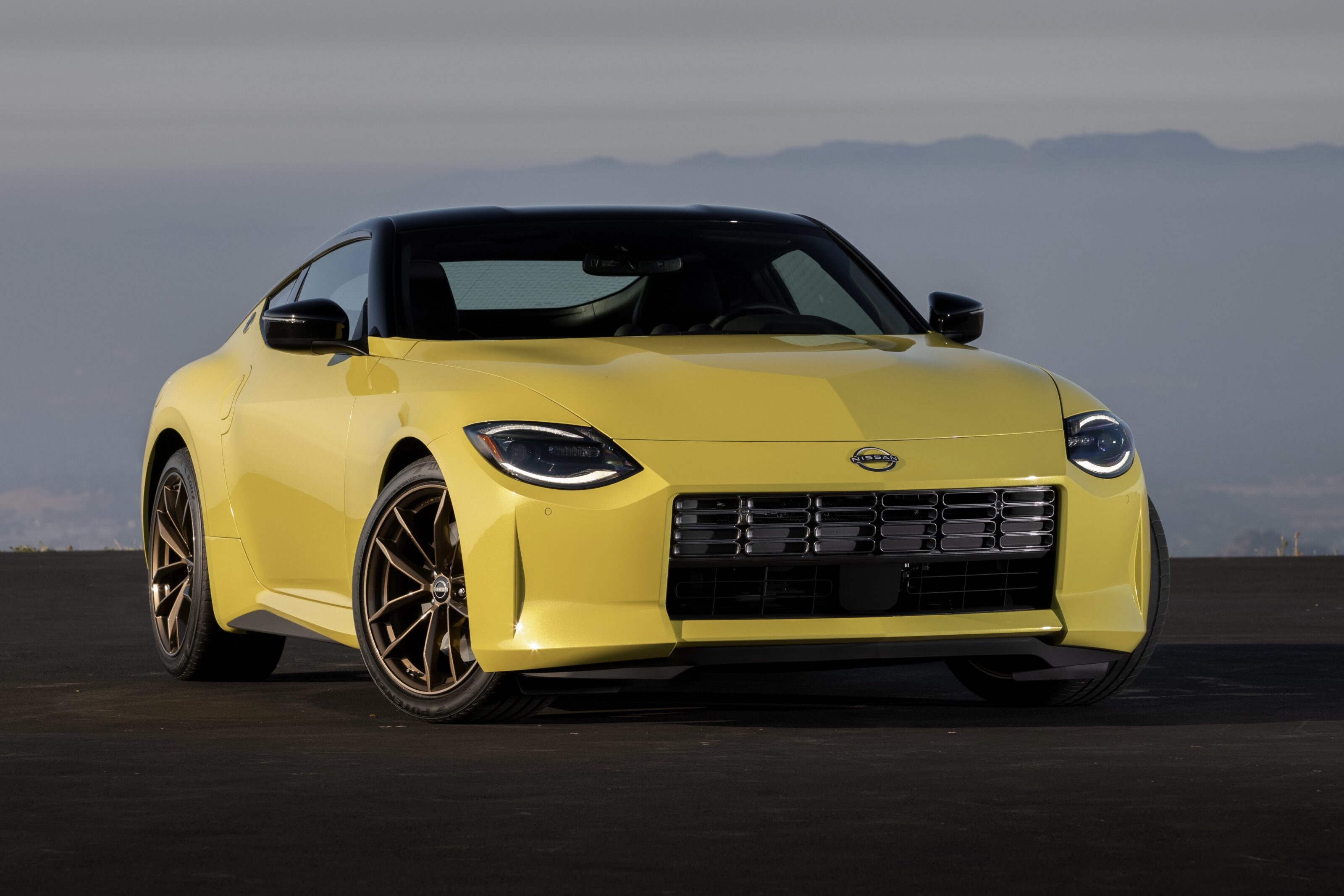
Leather-accented seats, a 12.3-inch digital instrument cluster, an 8.0-inch infotainment screen with Apple CarPlay and Android Auto, active cabin noise cancellation, reverse camera, front and rear parking sensors, radar cruise control, and launch control are all standard.
Those who opt for the limited-edition Z Proto Spec launch edition will also get a two-tone yellow with black roof paint job, yellow brake callipers, yellow contrast stitching and interior highlights, and 19-inch bronze forged alloy wheels.
The 2023 Nissan Z will arrive in Australia in mid-2022, with local pricing and specifications to be announced closer to launch.
Toyota says it has created a new way to paint over a car’s original paint, allowing customers to change colours while protecting its exterior.
Toyota says customers can choose from more than 100 colours, according to news outlet Nikkei Asia, with a high-pressure water spray used to strip the temporary coat from the car without damaging the paint originally applied at the factory.
Normally, repainting a car is a labour-intensive job costing many thousands of dollars, though vinyl wrapping has increased in popularity in recent years as it allows the owner to keep and protect the car’s original paint.
The carmaker says the technology is due to owners wanting to retain their cars for longer, allowing them to keep their original paint protected and improving resale values.
While the average age of vehicles in Australia increased slightly to 10.6 years in 2021, motorists in Japan are now holding on to their cars for roughly 14 years.
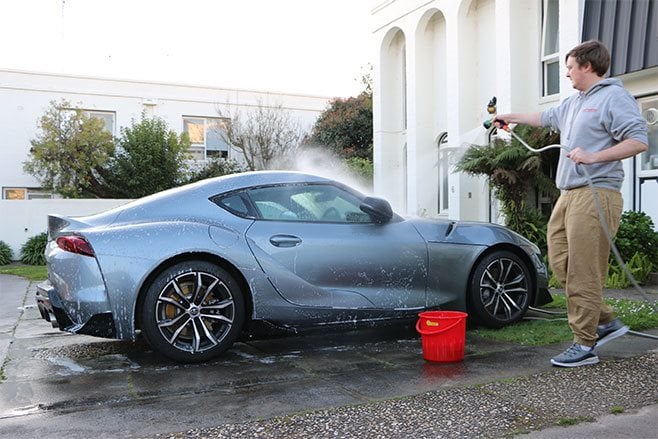
The new paint technology will be offered to customers using the Toyota-owned Kinto car subscription service in Japan.
Earlier this year, Kinto announced it was offering a restoration service for slightly older Toyota and Lexus models, whereby customers can get their cars refreshed, as well as getting the latest safety and technologies retrofitted.
There’s no word yet on pricing for the repainting from Kinto, but we recommend watching the 1997 Bruce Willis film The Jackal to get an idea of the process.
The desire to swap the iconic 2JZ engine into the latest, A90-generation Toyota Supra has been achieved in the United States.
Featured on Hoonigan’s new ‘Dyno Everything’ series, the heavily-modified 2020 Toyota GR Supra features a 3.0-litre twin-turbocharged 2JZ-GTE engine – as seen on the previous Supra produced until 2002 – replacing the BMW-sourced turbo inline-six.
However, the modifications haven’t ended with the engine swap. While the 2JZ mill maintains its existing displacement, the engine includes a number of key upgrades to boost performance.
https://www.instagram.com/p/CclHv5_JV1m/
This consists of new cams, heads, rods and pistons, in addition to an enormous Precision 7676 turbocharger, although the engine is shown to struggle with the additional power.
It is matched to a Getrag 420G six-speed manual transmission, as seen in the E46 BMW M3, along with a rear differential sourced from an E92 M3.
Other changes include; upgraded brakes, Work wheels, a larger rear wing, and a single-exit fire-breathing exhaust pipe.
An initial estimate by the owner, who installed the turbocharger less than 24 hours before the dyno run, placed power at around 671kW (900hp).
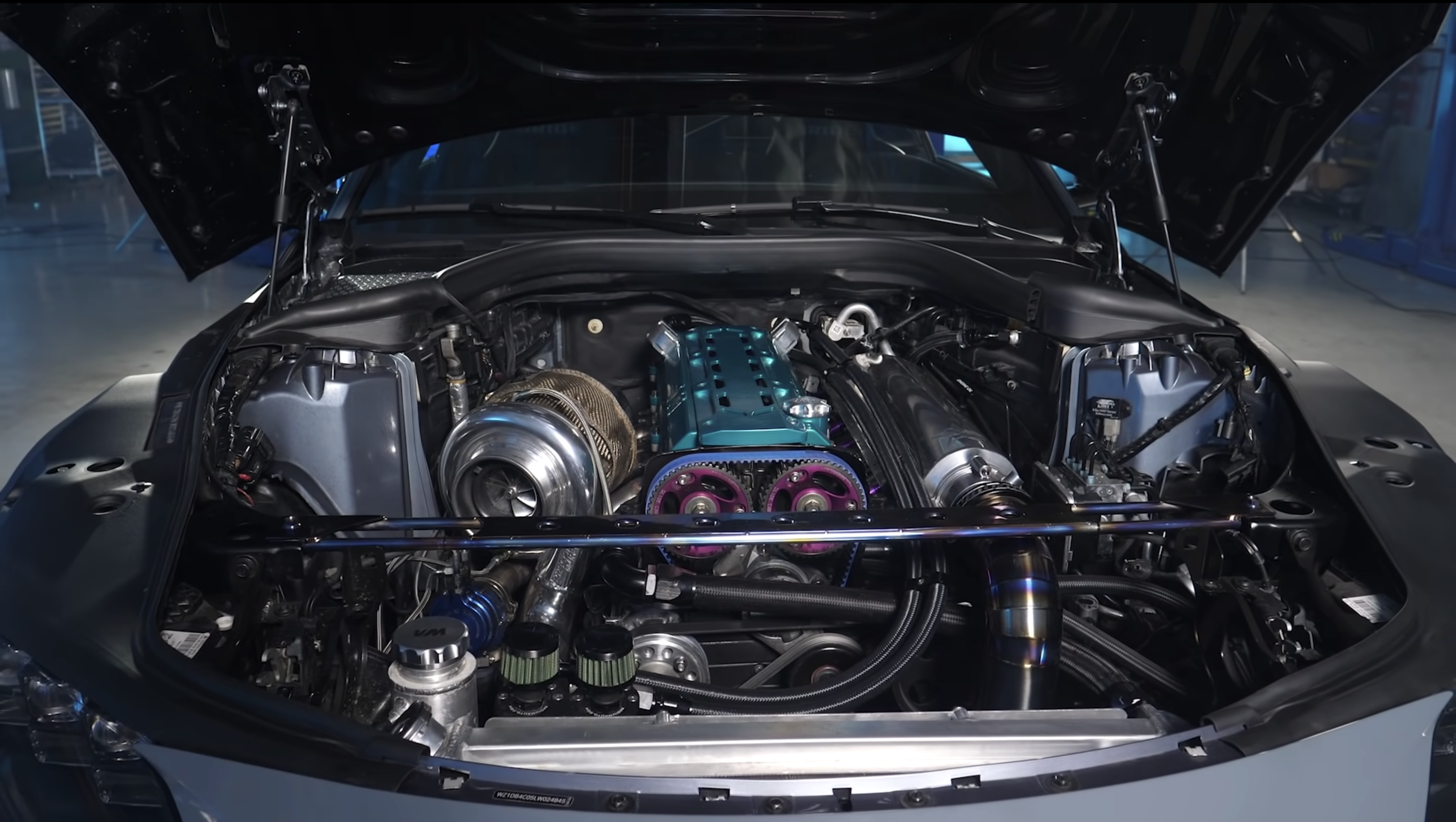
While the first pull resulted in output peak at just 406kW to the rear wheels, a series of quick adjustments and a dyno recalibration made the figure jump to 683kW.
A third run was completed, resulting in a still-impressive 668kW of power.
By comparison, in 2020 the Toyota Supra included a 3.0-litre B58 turbocharged inline-six producing 240kW of power before outputs were increased to 285kW for model-year 2021.
The new series consists of the Hoonigan crew guessing a car’s dyno figures using a format similar to the popular game show The Price is Right, with the lowest guess of 484kW winning in the first episode.
One in ten (million) LandCruisers were sold in Australia in its seven-decade history. So while in some respects the new-generation 300 Series, cut from conventional cloth as a replacement for its 14-year-old LC200 forebear, might appear a COTY outlier of sorts, its nameplate whets local motoring appetites quite unlike many of its COTY competitors here.
The new LC300, here in middling VX spec, sticks unapologetically to a tried-and-true mould. Meddling with its go-anywhere, lug-anything mettle wrapped in luxury’s lap would be risky business for Toyota.
LandCruiser’s headline shake-up, though, is its powertrain. Every judge remarked on the polished, refined and fitting marriage of the new, characterful 3.3-litre diesel six and slick 10-speed automatic.
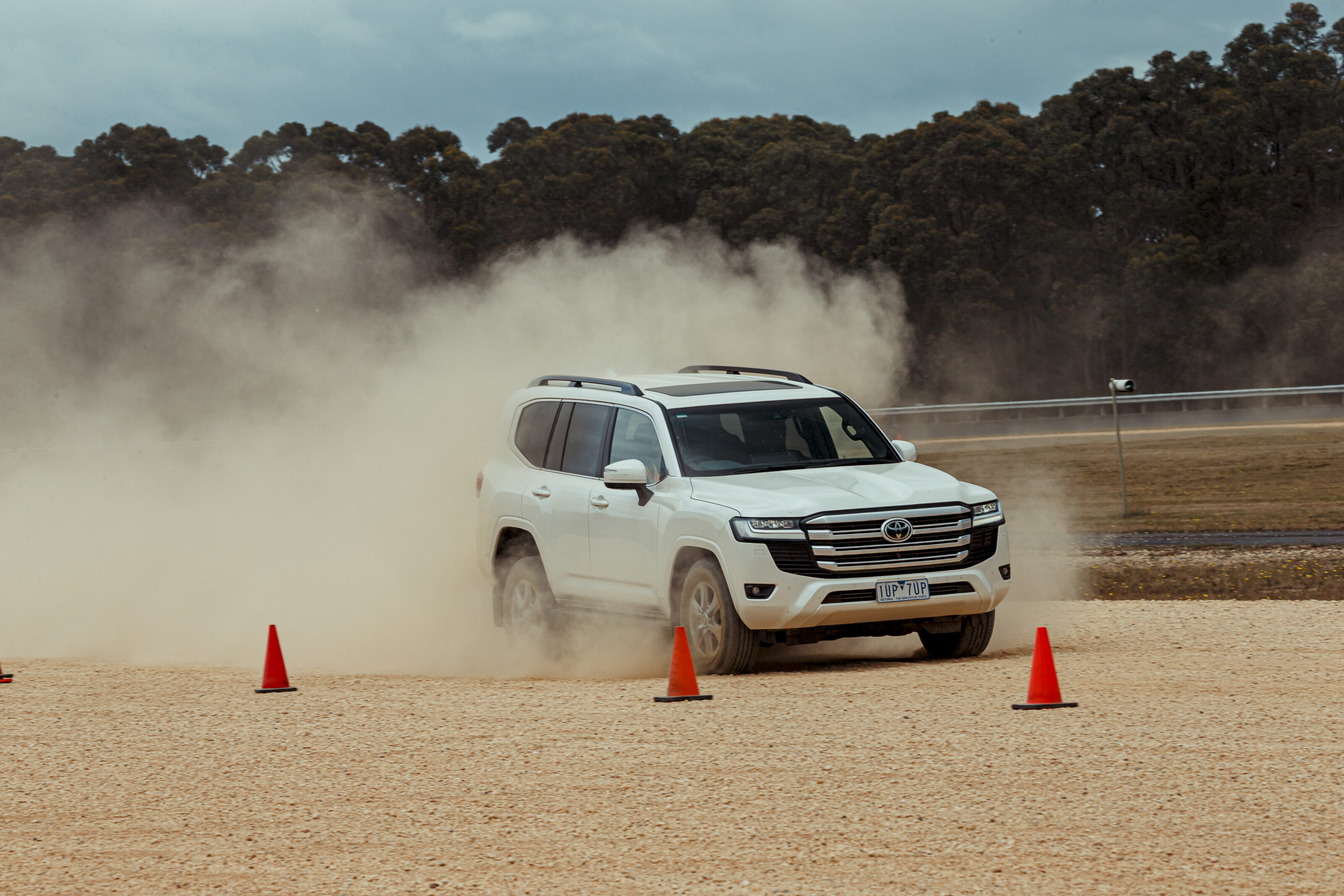
With 227kW and 700Nm, it’s amply fit and effortless (and a 8.9L/100km claim is appreciably frugal, all things considered), while dispatching its archaic 4.5-litre V8 diesel forebear to history … even if many diehards would have happily seen the dirty, lazy old V8 slog on into eternity.
Thus motivated, the ‘LandCrusher’ pummelled the AARC’s various testing disciplines, all the while delivering consummate comfort, particularly across the gravel and rough-road course. But it is wallowy and unwieldy as a default, and the big Toyota demands that the driver keep well on top of its 2.6-tonne mass and flailing inertia on either sealed or broken surfaces.
“The meaty V6 suits LC300’s tough persona,” said Jez, “but it’s still cumbersome on the road.”
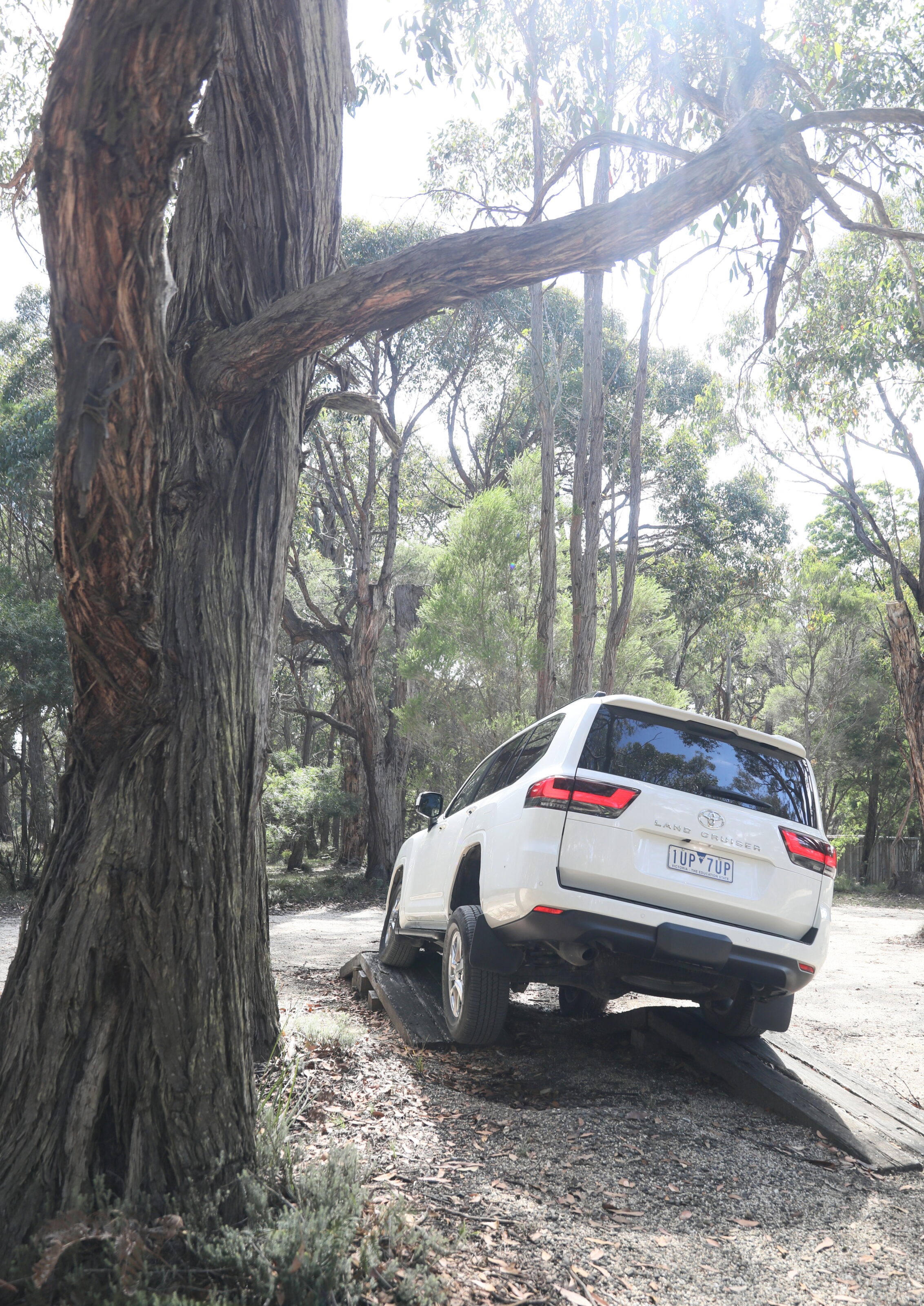
While proper off-roading sits outside COTY’s usual assessment wheelhouse, it’s unfair not to take such a large slice of LandCruiser’s remit into consideration. So we deferred to the expertise of our sister title 4×4 Australia, who were putting their own LC300 through their concurrent annual awards event at the AARC.
“Dynamics feel familiar, but powertrain is in another dimension” – Dylan Campbell
Against more dedicated mud-kickers, the LandCruiser garnered high praise for its well-rounded, largely compromise-free capabilities. It remains a go-to choice amongst the toughest of contemporary competition for long-haul touring across the broadest range of terrains. Fighting fit for purpose, then.
“Excellent traction and loose-surface manners,” Dan reckoned. “Lots of bodyroll does compromise dynamics, but what do you expect?”
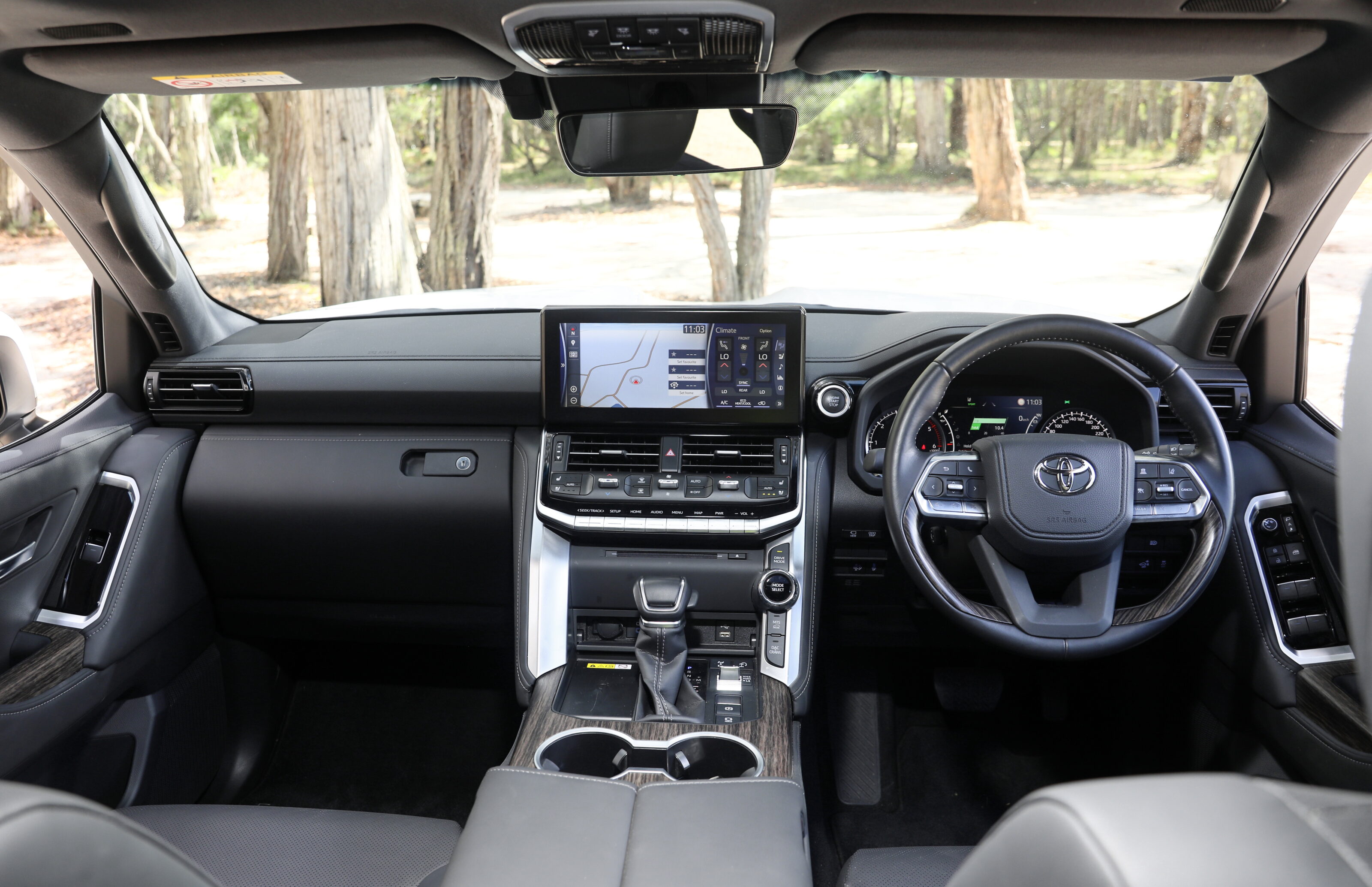
In particular, its new-school electronically governed traction smarts do compensate well for a distinct lack of dedicated off-roading hardware. Indeed, our VX version, while featuring dual-range drive, lacks front and rear mechanical differential locking of harder-core machinery – such as Toyota’s 70 Series – or adaptive damping found in big-dollar luxury off-roaders.
That Toyota has hiked pricing across the model range by five figures in new 300 guise – our middling VX lists for $115K – without significant specification change to show for it certainly weighed against the LandCruiser’s value pitch.
“General refinement is a mixed bag,” Alex noted. “There’s a lot of shudder and movement through the body on the rough course, though highway refinement is strong.”
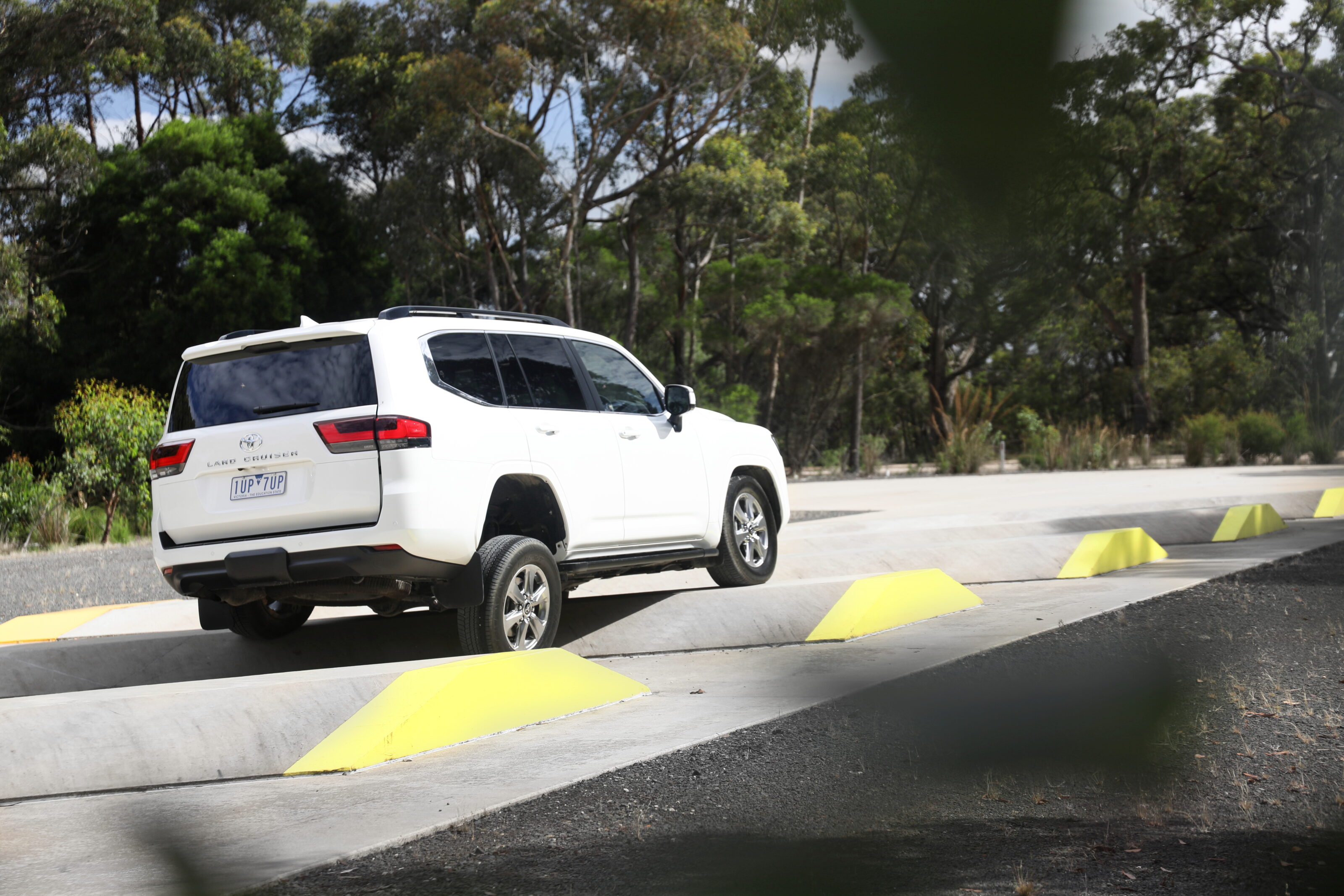
From the inert hydraulic steering to the fake-wood plastic trim inserts, the LC300 feels thoroughly old-school if unmistakably familiar. Its busy cabin design throws back to a bygone design ethos despite the odd contemporary flourish, while interior packaging, in comparison to the space-efficient and vastly roomier Carnival and Palisade at COTY, appears a big concession to LandCruiser’s imposing exterior form and proportions.
“Third-row accommodation is disappointing for LandCruiser’s size,” said Richard. “Interior has a robust feel, albeit with an archaic interface.”
Ultimately, the LC300 panders to its devoted fanbase via uncomplicated capability and rudimentary execution. And offering buyers what they want undoubtedly underpins its popularity. But the absence of significant advancement – beyond the powertrain – didn’t do the big Toyota any favours against much of the COTY judging criteria.
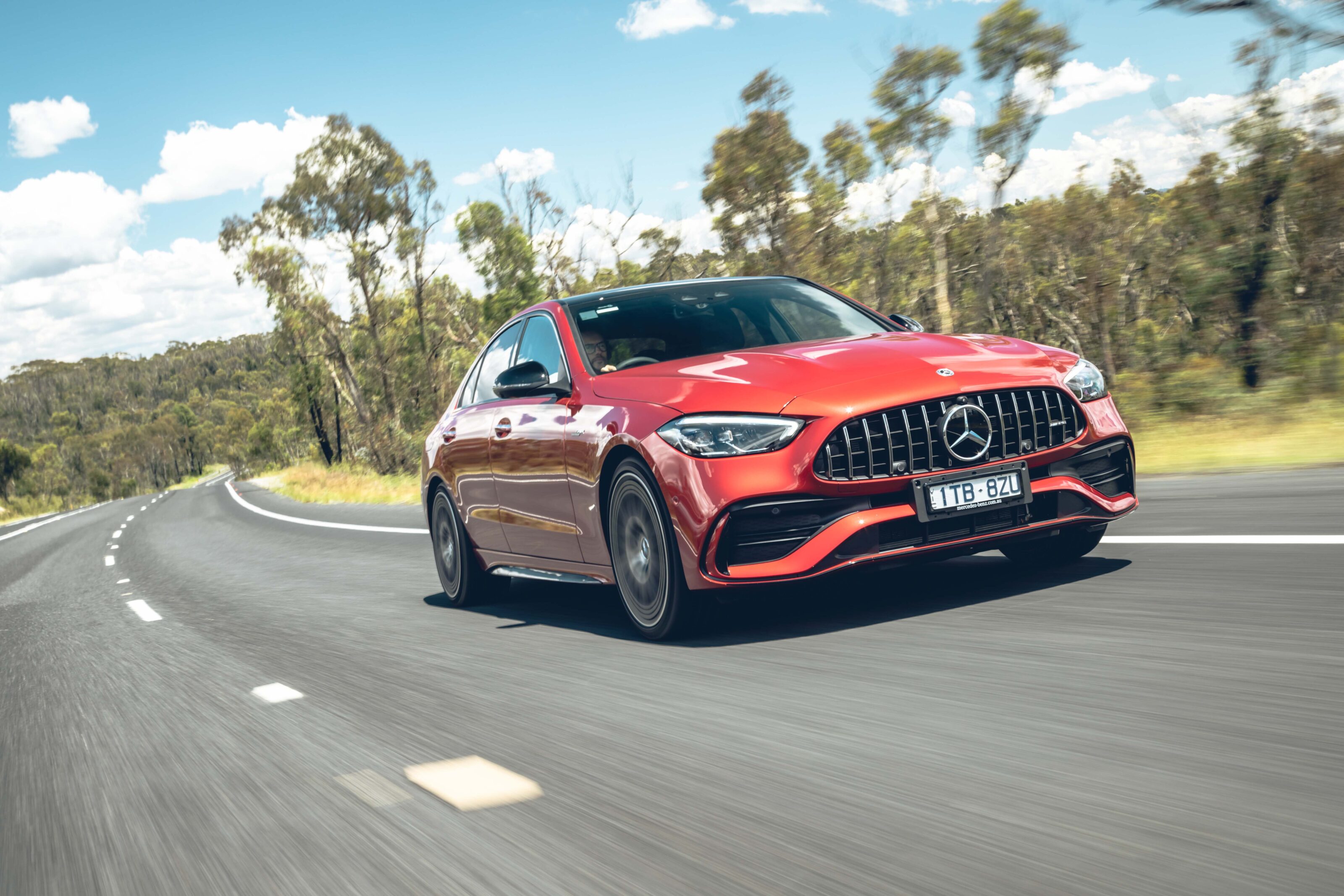
UPDATE, February 2023: New-gen C43 driven in Australia
The new-generation AMG C43 is now on sale in Australia, and we’ve driven it. Get the full story at the link below.
Story continues…
Mercedes-AMG has revealed what is, for now at least, the performance flagship of the C-Class range.
Details of the new 2023 C43 4Matic have finally been released by Affalterbach and it’s fair to say that there’s quite a bit to get into.
Snapshot
- 300kW, 500Nm 4-cylinder confirmed
- 4.6 seconds to 100km/h
- Australian launch due in 2023
We’ll start with the engine. The C43 gets much the same powerplant that’s recently been fitted to the AMG SL43 and is, at its core, a 2.0-litre four-cylinder. So far, so unspectacular. What happened to the great sixes of yore? Well this one firmly sits those old sixes on their rear ends.
The M139L engine, where the L stands for longitudinal, is the world’s first series production engine that features an electric exhaust gas turbocharger, designed to eliminate traditional turbo lag and developed using tech allied to that which the Mercedes-AMG Petronas F1 team has been utilising.
A four centimetre thick ‘pancake’ electric motor is fitted directly to the turbocharger shaft between the turbine wheel and the compressor wheel. This allows the compressor wheel to be rapidly brought up to speed without having to rely on exhaust gases spooling the hot side’s turbine wheel. Not only does this improve the response of the engine at low rpm, it also means that boost pressure can be maintained, even in throttle-off scenarios.
Driven by 48-volt architecture, the turbocharger can spin at up to 175,000rpm, which is nearly 3000 rotations per second, while the rigid closed-deck construction of the M139L powerplant allows for peak combustion pressures of 160 bar. Two water pumps ensure a cold cylinder head and a warm crankcase for optimum efficiency.
Peak power is nominally rated at 300kW at 6750rpm with peak torque a heady 500Nm at 5000rpm. The mild hybrid system can also generate a transient boost of 10kW in certain scenarios, courtesy of the belt-driven starter-generator (RSG). When paired with a Race Start launch control system and 4Matic all-wheel drive, this translates to a 0-100km/h time of just 4.6 seconds.
Mercedes-AMG has limited the top speed of the C43 to 250km/h, although an optional AMG Driver’s Package can see that lifted to 265km/h. That sounds like one for our German colleagues rather than anything that Aussie buyers will get too excited about.
Mercedes-AMG has fitted the C43 with a dynamic exhaust system the sound signature of which is controlled by an exhaust gas flap. Then there’s the AMG Real Performance Sound – yes, really – which features a sensor in the exhaust that feeds audio into into the interior for what AMG describes as a “particularly emotive sound experience.” We can’t wait to report on the success or otherwise of that feature.
That all-wheel drive system is decidedly rear-biased, with a fixed 31 per cent front and 69 per cent rear split. It works in conjunction with a five-mode AMG Dynamic Select system which can be cycled through Slippery, Comfort, Sport, Sport+ and Individual drive modes. On top of that, there’s also the AMG Dynamics suite of Basic, Advanced and Pro to further fine-tune the response of the electronic stability control, which is either on, in Sport mode for more yaw angles or can be switched off for driving on tracks. Adaptive dampers are fitted as standard and have three modes – Comfort, Sport and Sport+.
Agility is guaranteed by the rear-steer system, which can angle the rear wheels up to 2.5 degrees opposite the fronts at speeds of up to 100km/h (dependent on the AMG dynamics setting) after which the rears steer parallel to the fronts for improved stability, but only up to a maximum of 0.7 degrees. Braking duties are taken care of by internally vented and perforated iron brake discs measuring 370x36mm with a four-pot fixed caliper up front and 320x24mm rotors clamped by a single-piston floating caliper at the rear.
The C43 is built in both sedan and wagon body styles, but Mercedes-Benz here in Australia has yet to commit to the wagon version, which is understandable given this market’s predilection for performance SUVs.
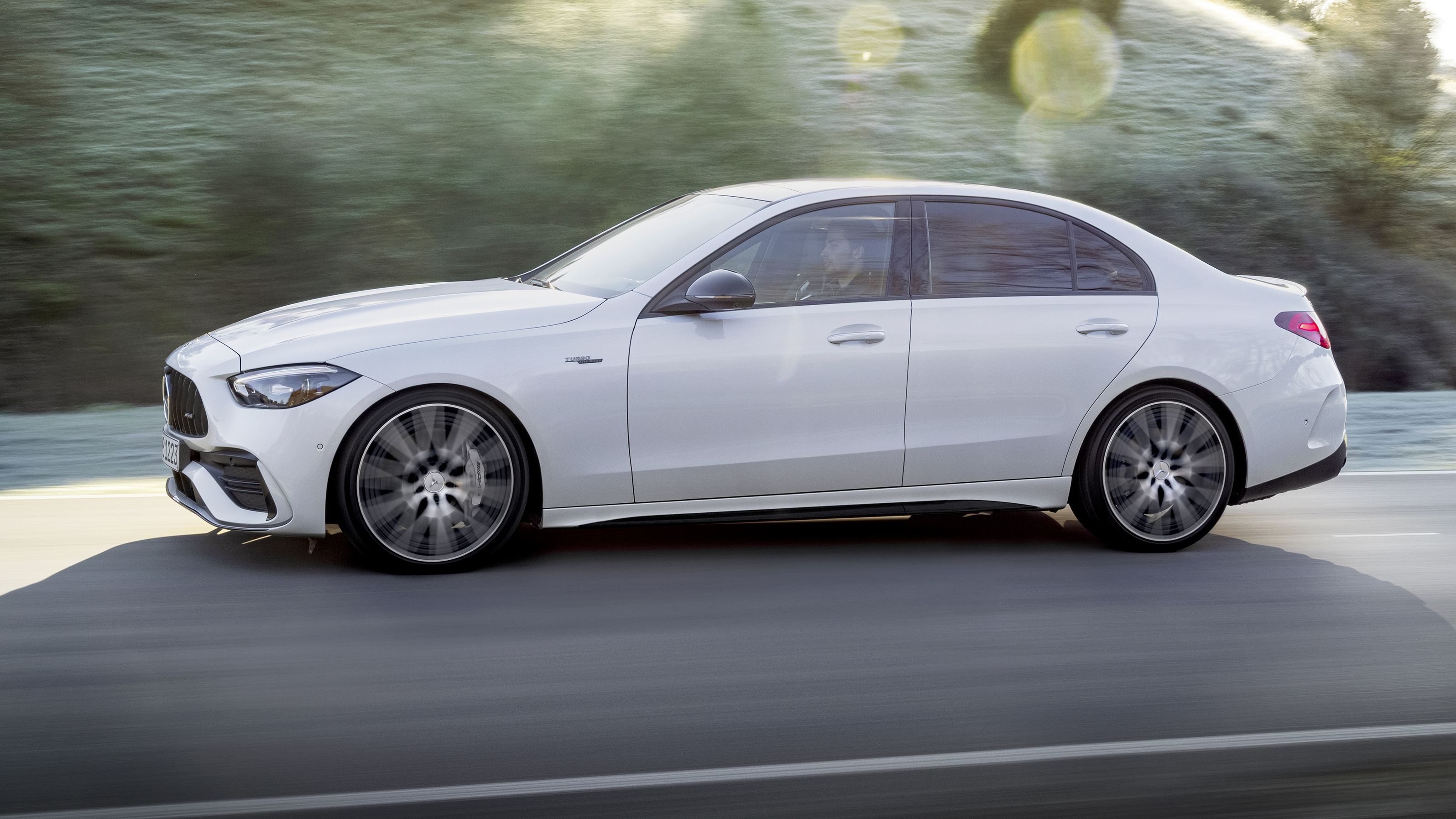
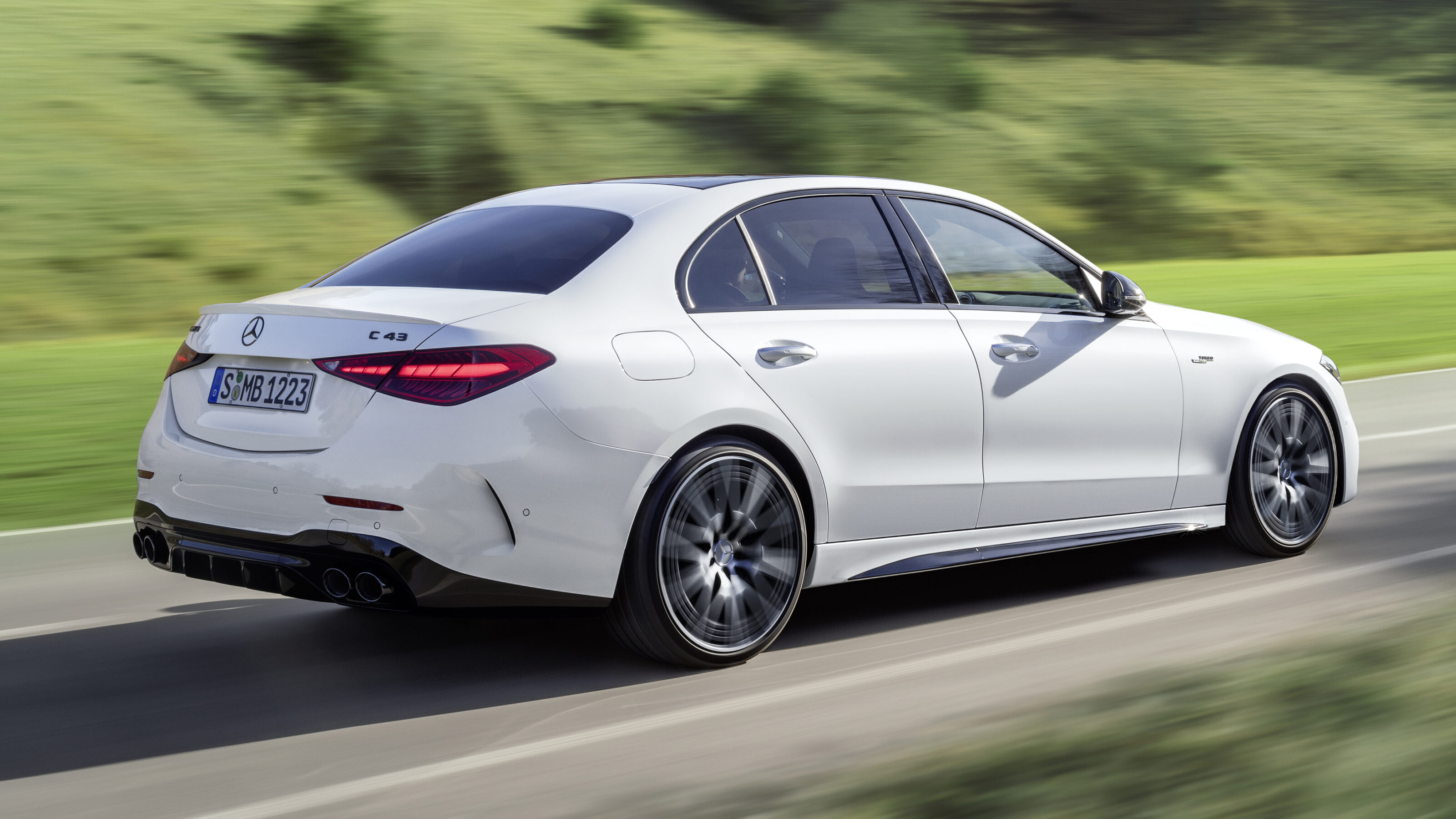
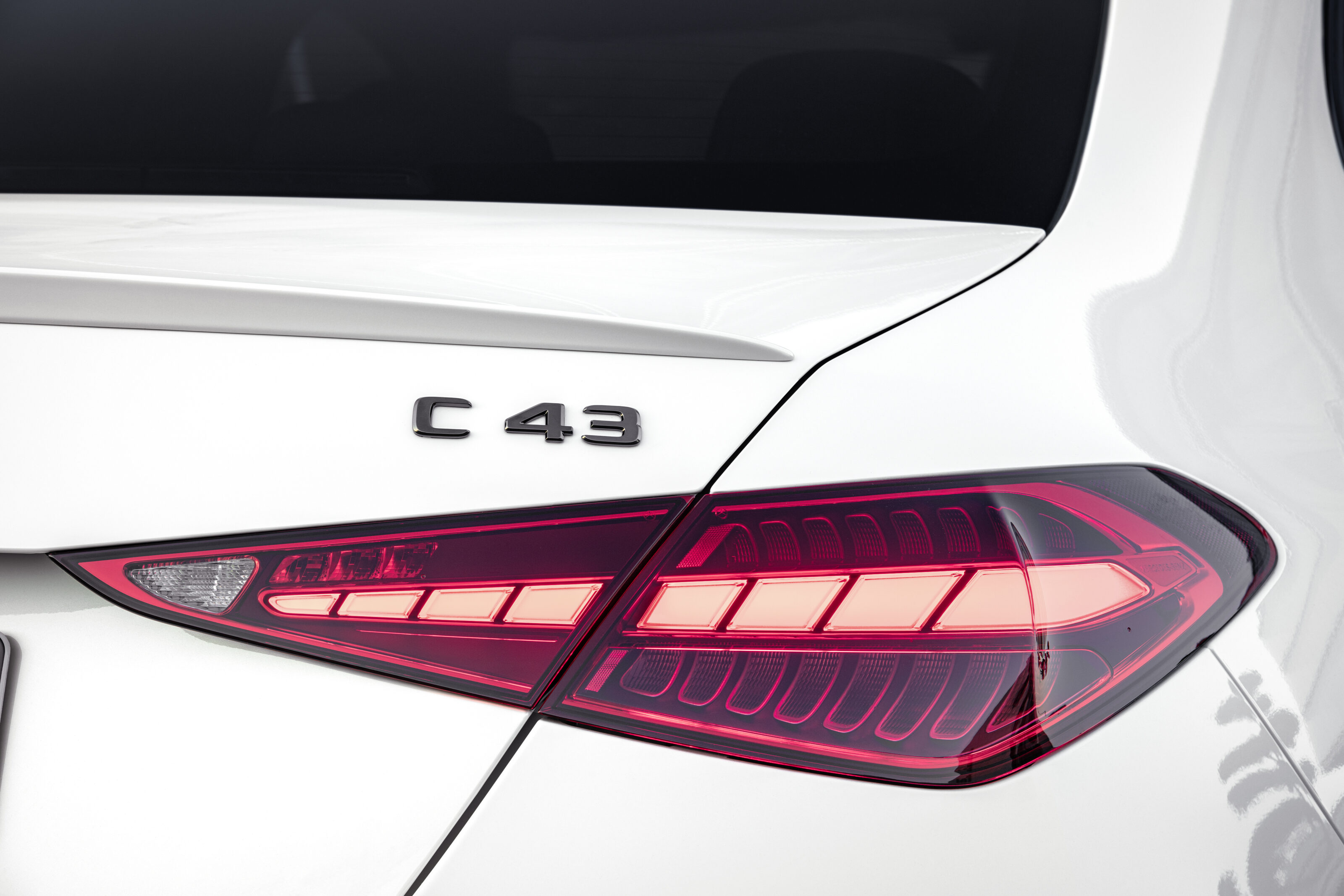
The C43 gets an AMG-specific radiator grille, and a front apron with aero flics, while round the back there’s a diffuser-look rear apron and two round twin-tailpipe trim elements. While that doesn’t sound totally functional, it does look good. 18-inch alloy wheels are fitted as standard, but we can’t see to many buyers sticking with the standard rims when 19 and 20-inch options are on offer.
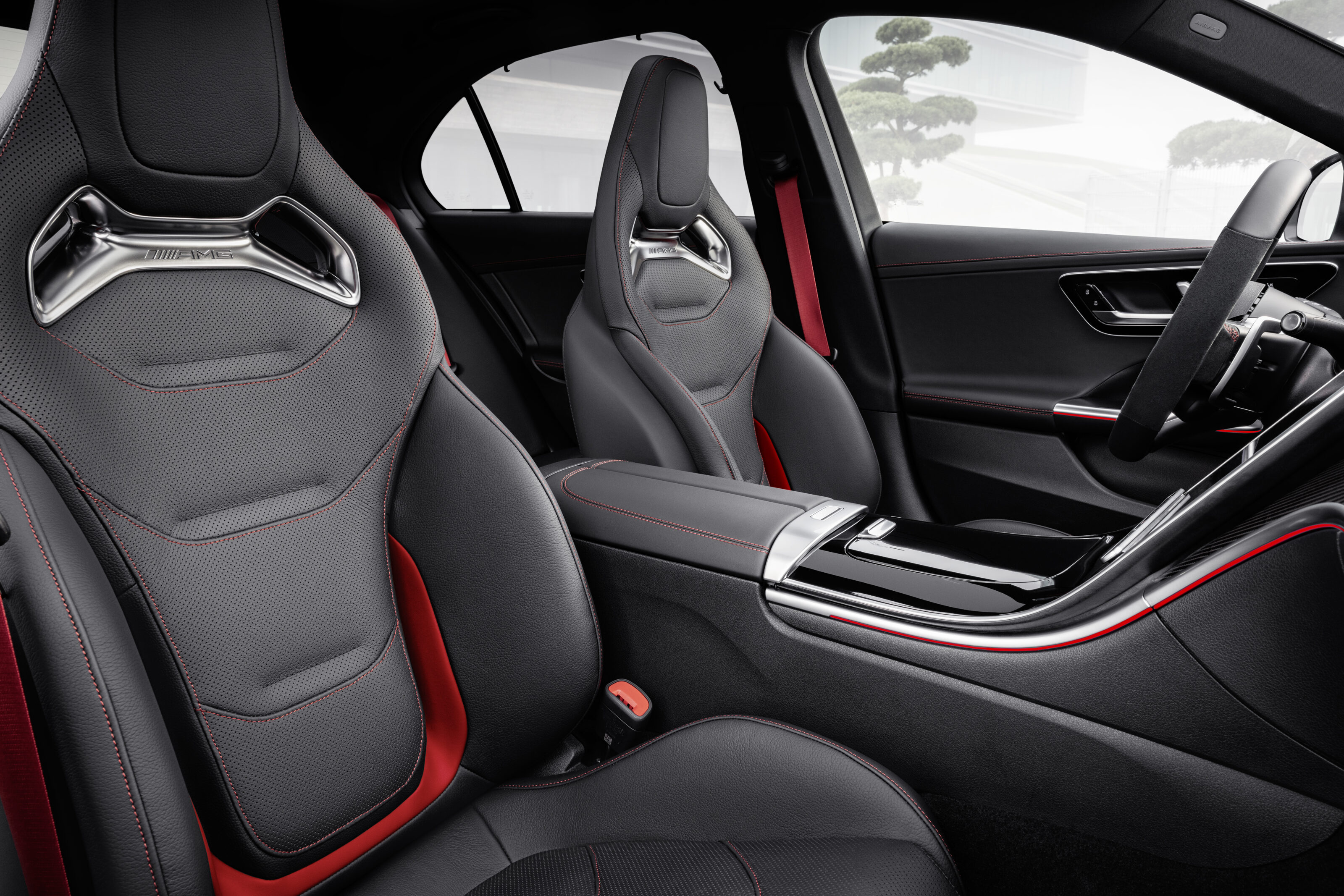
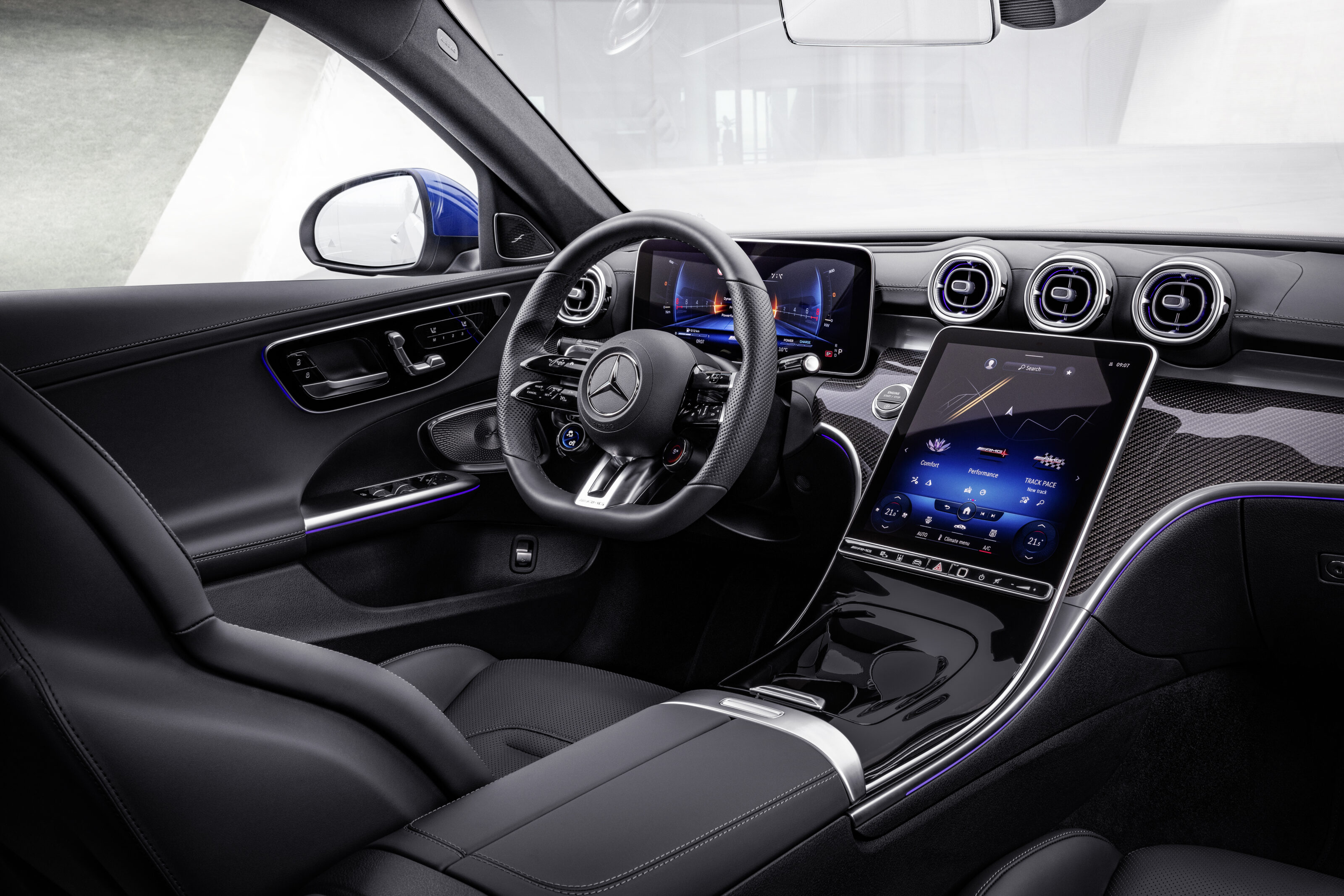
The cabin features a specifically-ported AMG version of the MBUX infotainment system, which integrates the AMG Track Pace data logger. The cabin features AMG Seats in hard-wearing Artico man-made leather and Microcut microfibre in black with red contrast stitching offset with red seat belts.
The AMG performance steering wheel is trimmed in Nappa leather, garnished by aluminium gearshift paddles. Two round wheel-mounted manettino-style dials allow rapid selection of the drive modes. In case you’d forgotten how you’d spent your money, the cabin’s rounded out with AMG sports pedals, AMG floor mats and AMG illuminated door sill trims.
It looks as if we’ll have to wait until later next year and possibly even later to see the fire-breathing C63e model, but there was always a very specific split between C43 and C63 buyers, the former wanting something more versatile but which could still entertain, while the latter wanted a performance sedan with little in the way of compromise. That differentiation looks set to continue.
When will the 2023 Mercedes-AMG C43 come to Australia?
Mercedes-Benz Australia has yet to reveal pricing and detailed trim specifications for domestic market models but were you to budget somewhere in the region of $125k for the C43 sedan – expected to arrive in the first half of 2023 – we don’t think you’d be too far off the mark.
We look forward to getting behind the wheel and if expressions of interest logged at Mercedes-Benz dealers are anything to go by, so do Australian performance sedan buyers.
2023 Mercedes-AMG C43 specifications
| Number of cylinders/arrangement: | 4/in-line |
|---|---|
| Displacement cc: | 1991 |
| Rated output kW: | 300 |
| at engine speed rpm: | 6750 |
| Additional output (Boost) kW: | 10 |
| Rated torque: | 500Nm |
| at engine speed rpm: | 5000 |
| Compression ratio: | 10 |
| Mixture formation: | combined direct petrol injection and intake manifold injection, turbocharging by means of electrically assisted exhaust gas turbocharger |
| Drive system: | All-wheel drive with rear-biased torque distribution (31:69 percent) |
| Transmission: | AMG SPEEDSHIFT MCT 9G (automatic transmission with wet multi-disc start-off clutch) |
| Gear ratios 1st/2nd/3rd/4th/5th/6th/7th/8th/9th gear: | 5.35/3.24/2.25/1.64/1.21/1.00/0.87/0.72/0.60 Reverse 4.80 |
| Front suspension: | AMG RIDE CONTROL suspension with aluminium double wishbones, anti-squat and anti-dive control, lightweight coil springs and stabiliser bar as well as Adaptive Damping System |
| Rear suspension: | AMG RIDE CONTROL suspension with aluminium double wishbones, anti-squat and anti-dive control, lightweight coil springs and stabiliser bar as well as Adaptive Damping System |
| Brakes: | Hydraulic dual-circuit brake system; 370 mm brake discs at front, internally ventilated and perforated, 6-piston aluminium fixed caliper; 320 mm brake discs at rear, internally ventilated and perforated, 1-piston aluminium floating caliper; electric parking brake, ABS, Brake Assist, 3-stage ESPu00ae |
| Steering: | Electromechanical speed-sensitive power steering with rack and pinion, variable steering ratio (12.8:1 at dead centre) and variable power assistance |
| Wheels front: | 8.0 J x 18; rear: 8.0 J x 18 |
| Tyres front: | 245/45 ZR 18; rear: 245/45 ZR 18 |
| Acceleration 0-100 km/h sec: | 4.6 |
| Top speed km/h: | 250 (electronically limited; 265 km/h with opt. Vmax increase) |
| Combined WLTP fuel consumption l/100 km: | 9.1-8.71 |
| Combined CO2 emissions g/km: | 206-196 |
This mighty plug-in hybrid doesn’t give a about the environment. Instead, the 2022 Mercedes-AMG GT 63 S uses its 152kW electric motor almost exclusively to boost power and torque to record heights.
629 kilowatts, wow, thazzebissnis! And 1470 Nm of King Kong muscle to boot, fuelled by five-star juice at a rate of 25 litres per 100km, give or take some, meaning at long last the household petrol and electricity bills can finally match.
Expected to cost around 400 big ones without extras – of which there are many – you’ll need about five rich aunts to finance it, not only one.
But with the aftermath of COVID still looming large, Putin’s war killing thousands every day, the global economy in the doldrums and yet another famine raging across Africa, AMG could not have picked a worse time to launch this ultra-high-performance four-door coupe. Yet here it is.
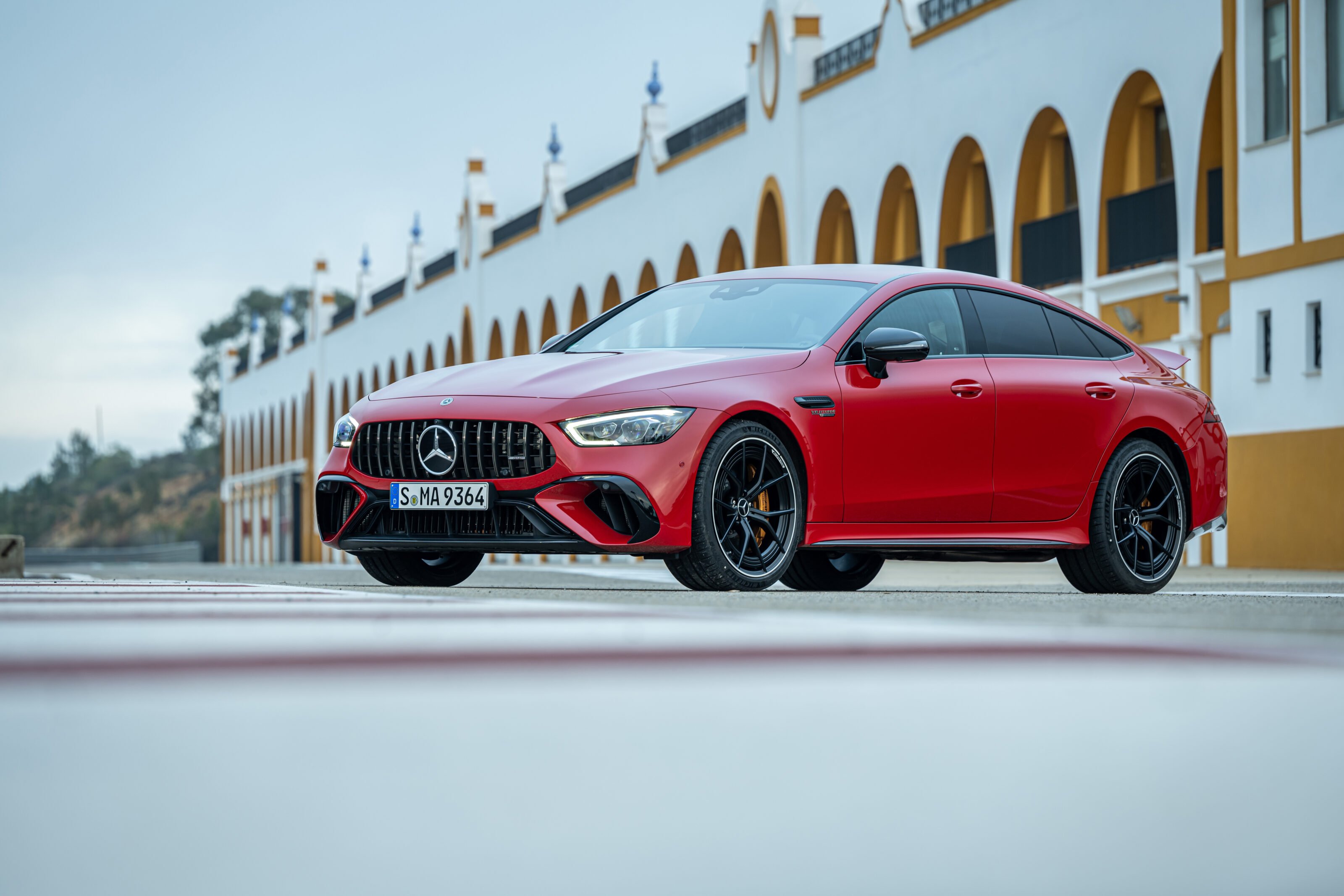
Although dubious social acceptance is at least in Europe fast stifling the luxury goods market, the overtly aggressive AMG GT 63 S still succeeds in massaging all the glands that matter to the rich enthusiast, ticks all the relevant boxes, opens the grand cru adrenalin floodgates and still stirs more old-fashioned emotions than the greenest 1000bhp-plus electric supercar.
It hits our mental sweet spot like a drug, as every old-fashioned hardcore Freude-durch-Kraft-Wagen should.
Open door, filter in, close door, then marvel at the quilted leather landscape that injects a Maybach touch of class to the suddenly sumptuous world of AMG. The level of craftsmanship astonishes, and so does the complexity of the operation that suggests that the post-Playstation generation is already in the market for this superpower CLS/S-class hybrid.
Just about the only task the latest polytech-certified MMI system cannot perform is fry eggs or serve a cup of tea. It will however display the car’s propulsion antics in animated widescreen technicolour depth, run different kinds of go-faster scenarios past you, and access more submenus than a NASA mainframe computer from the late nineties.
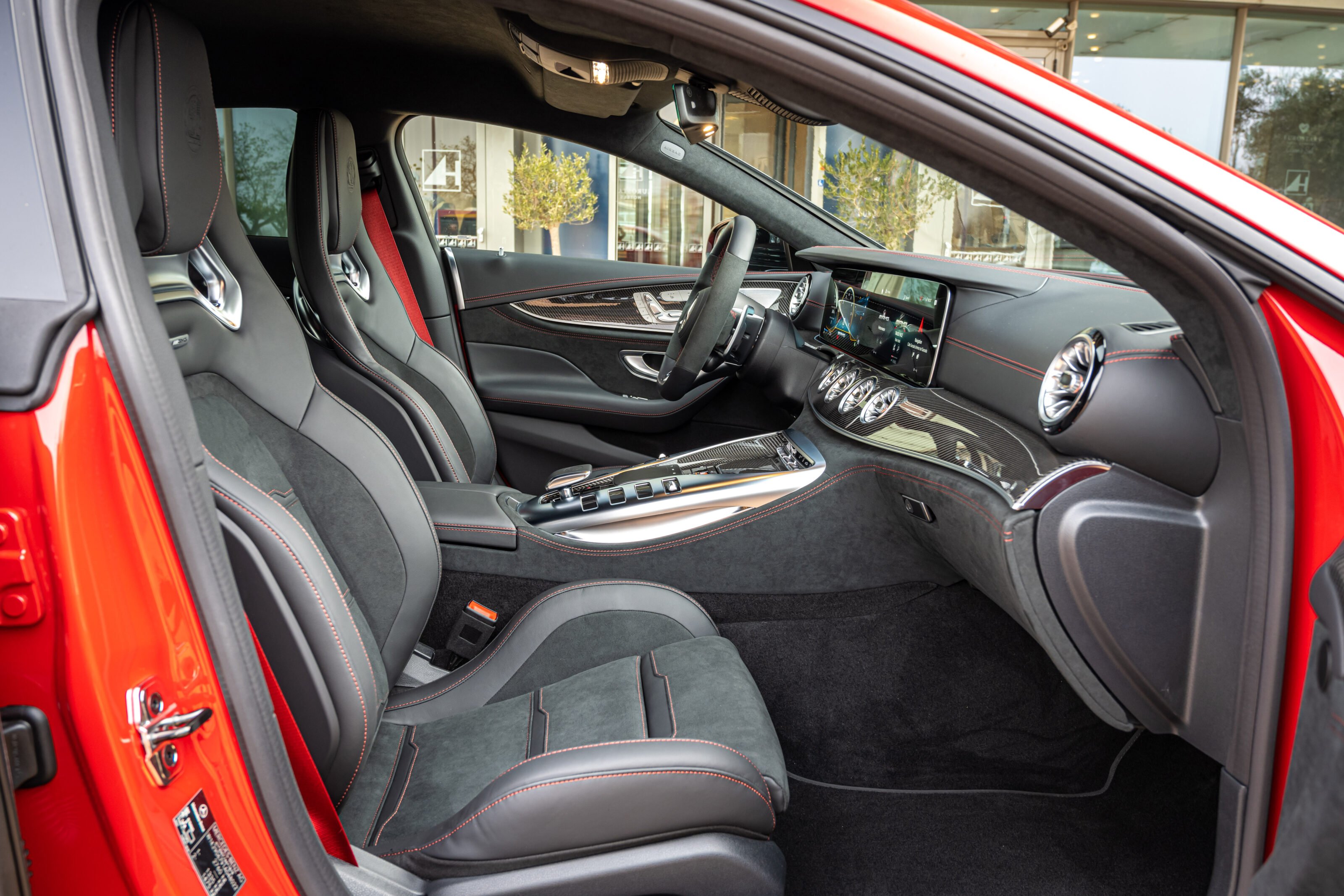
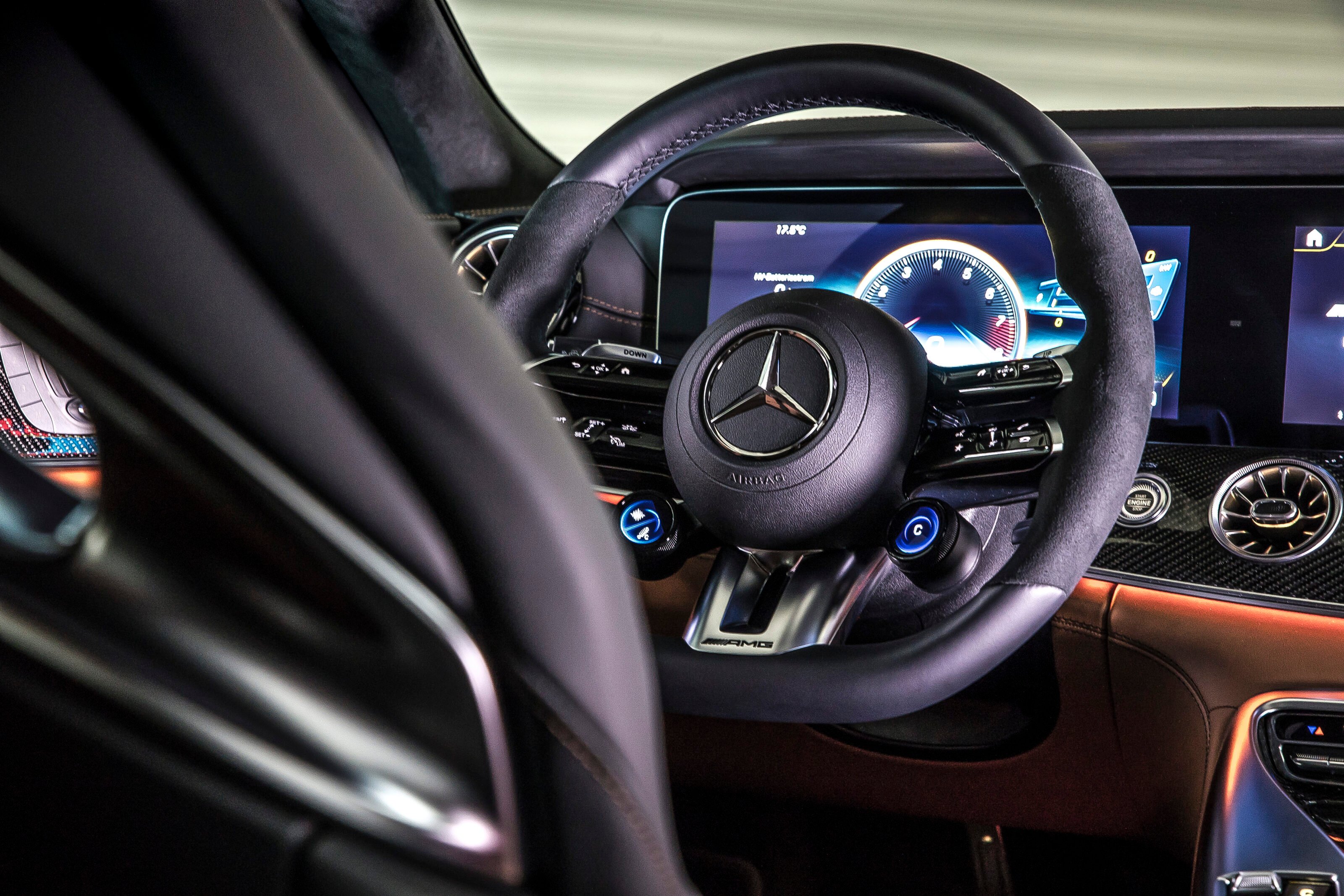
Truly annoying is the five-spoke steering wheel, which harbours the shift paddles, two large rotary controls and an overkill selection of tiny capacitive touch, slide and push areas. In a nutshell, this cockpit answers too many questions only very few users would ask, and it complicates simple tasks by prioritising the full digital monty over an intuitive direct-access approach.
Starting the engine summons the Affalterbach Big Band, the Mercedes Works Orchestra and the Brixton Synthesiser All-Stars. The unmistakable soundtrack is as tightly knit as an ancient kelim carpet but after a while, one learns to filter out the leading soloists like the turbo and wastegate quartet, the bluesy intake choir and the bass & drum formation in charge of the on-off-on exhaust blat-blat and wah-wah.
Spine-tingling stuff, this, especially when combined with the full-throttle forward thrust that grabs you by the throat while bolting the neck to the head restraint. The 2.9sec 0-100km/h acceleration time puts the GT-S E-Performance firmly in high-end Porsche and Ferrari territory, but there is more to come.
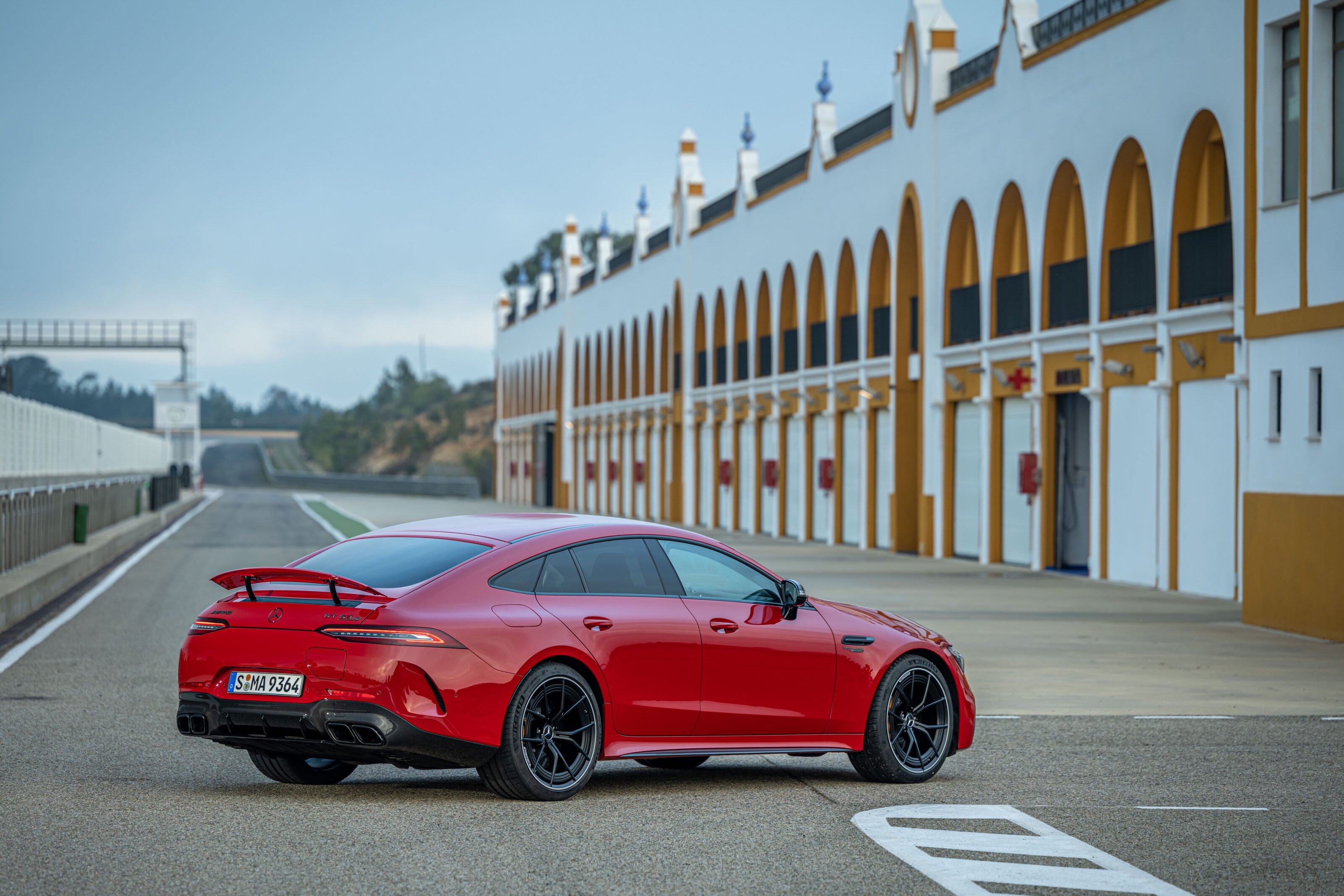
Like the ten-second overboost afterburner effect, which summons maximum power and torque. Only ten seconds? Find a straight that is long enough to fully explore the extra pedal-to-the-metal grunt, then we talk again.
By the way: the maximum output of 629kW and 1470Nm is exclusively available in this brief fangs-bared mode. At all other times, the 4.0-litre V8 peaks at 558kW and 1150Nm which is still very impressive but no longer totally hyper-mega-wild.
The car always starts up in Comfort aka Efficiency. There are six more steps to climb on the AMG stairway to heaven: Electric, Winter, Sport, Sport+, Race and Individual. Lock the drivetrain in Sport+ for inspiring throttle response and shift action, or try Sport for a wide middle ground in terms of chassis competence and steering action.
The AMG Dynamics programme shines brightest in the Master setting which can be accessed only in Sport Handling or ESP off mode. Sounds complicated, but the result is worth the effort. Next, take your pick between two different sound patterns labelled Balanced and Powerful, which is AMG speak for being that close to voiding the type approval.
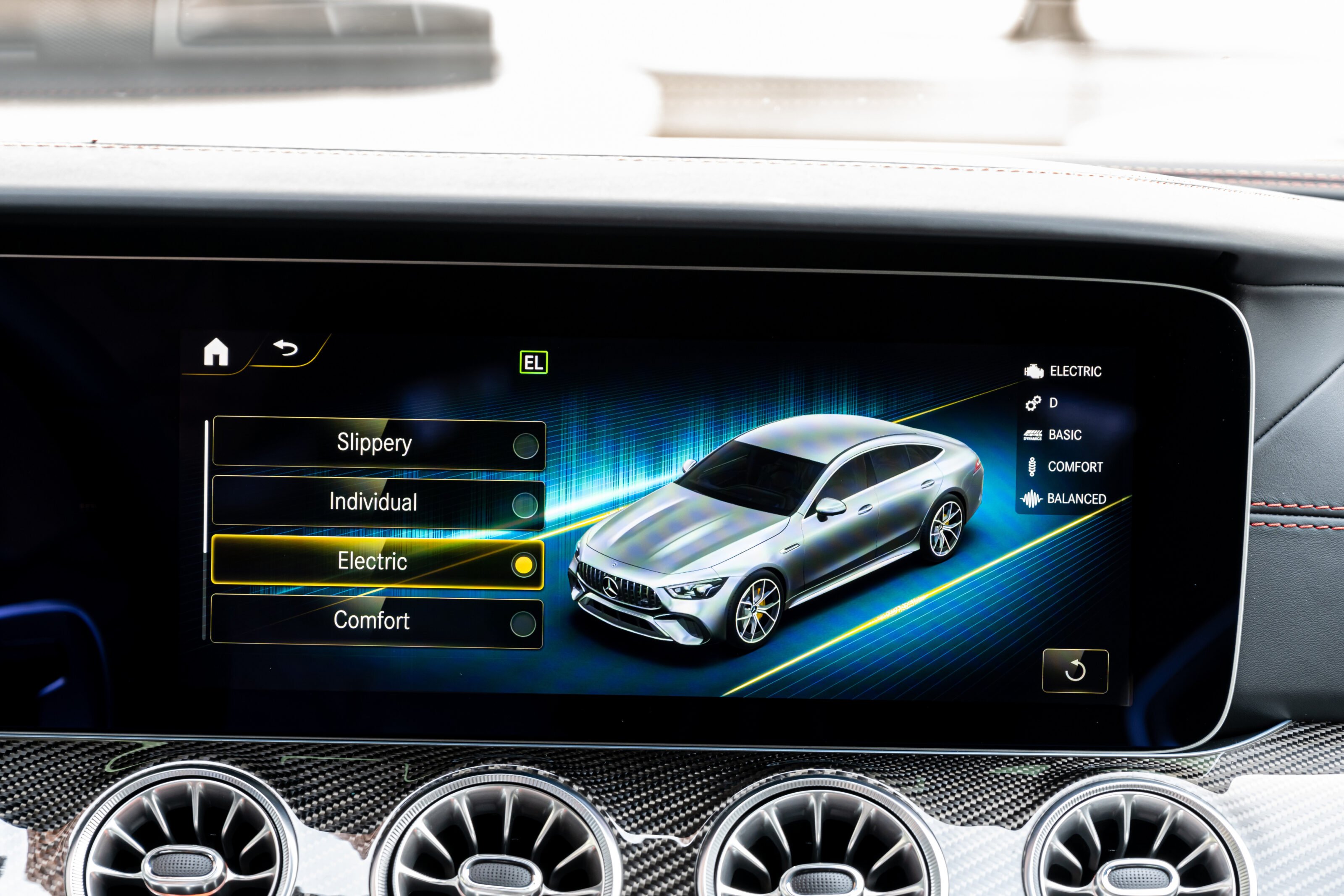
The final calibration measure to consider concerns the energy regeneration, which can be whipped up in four steps from zero to max, the latter better known as one-pedal feel. Electric drive is active up to 130km/h, but only very briefly.
In real life, the claimed zero-emission range of 12km is barely sufficient for a silent early morning tip-toe out of the gated community where a run-of-the-mill 11kW wallbox should have charged the briefcase-size battery pack overnight.
Thanks to all-wheel drive, sticky 265/40 and 295/35ZR20 tyres, the low centre of gravity and neatly balanced weight distribution, grip and traction cannot possibly be an issue for this four-door, four-seat 2.38-tonner. True – except when you feel like riding a radical impromptu torque attack on a winding wet or dust-coated road with ESP not paying full attention.
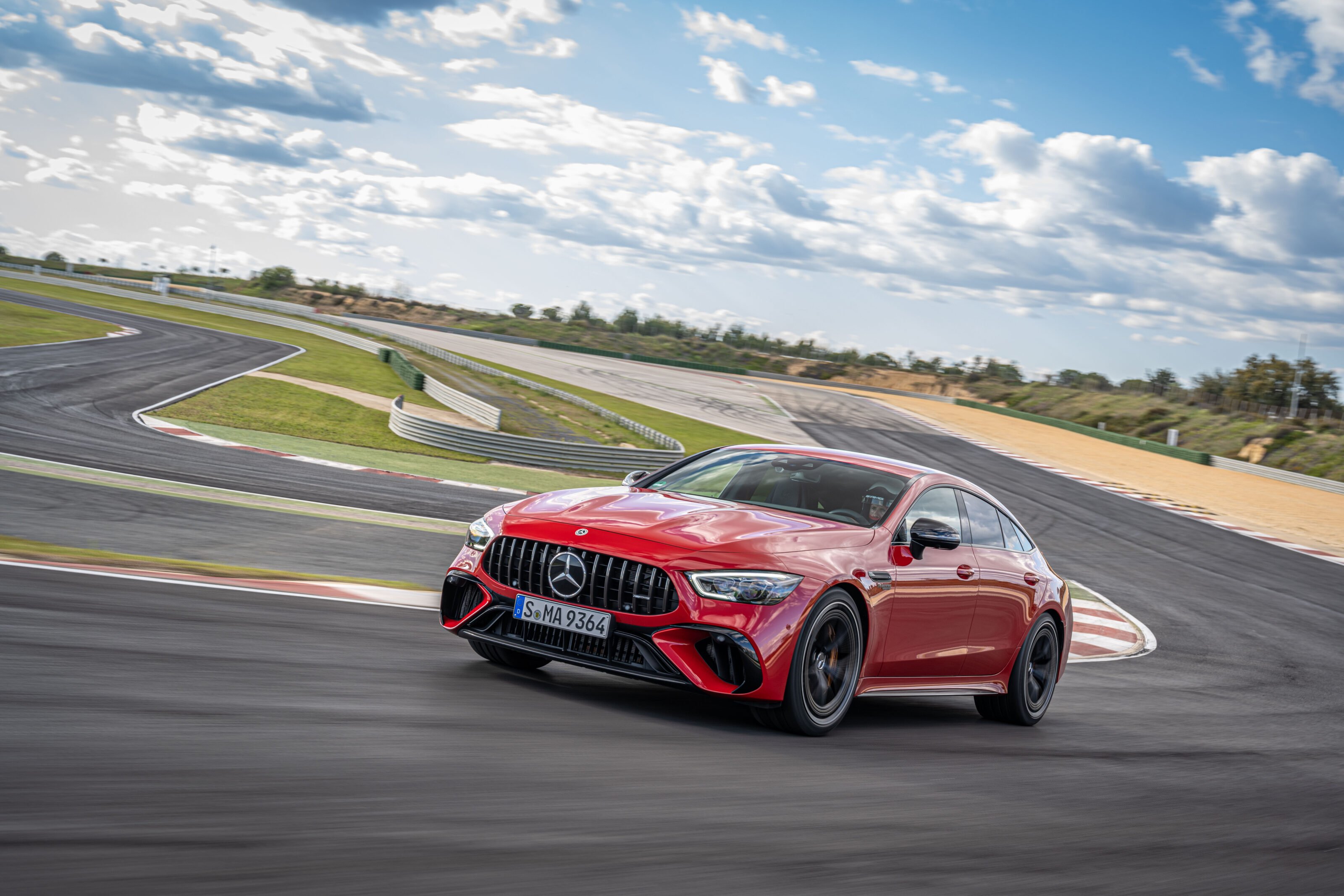
Unbuckling the torque belt is guaranteed to generate the same exuberant tail-happiness we last experienced fully wrapped in goose pimples at the wheel of a 527kW Dodge Charger. Like its two-door stablemates, the new AMG GT 63 S is sufficiently bling-loaded to exude more than a whiff of that drug baron gang-style.
An extended electric range might have helped to close the yawning social acceptance gap, but it’s too late now for such a fundamental change, and the third model generation currently under development will be exclusively battery-powered anyway, so if it wasn’t for the embarrassing fuel economy (the test car averaged 27.4L/100km) one should perhaps simply enjoy one of the old world’s finest pieces of kit before a litre of petrol costs more than a bottle of top-notch claret.
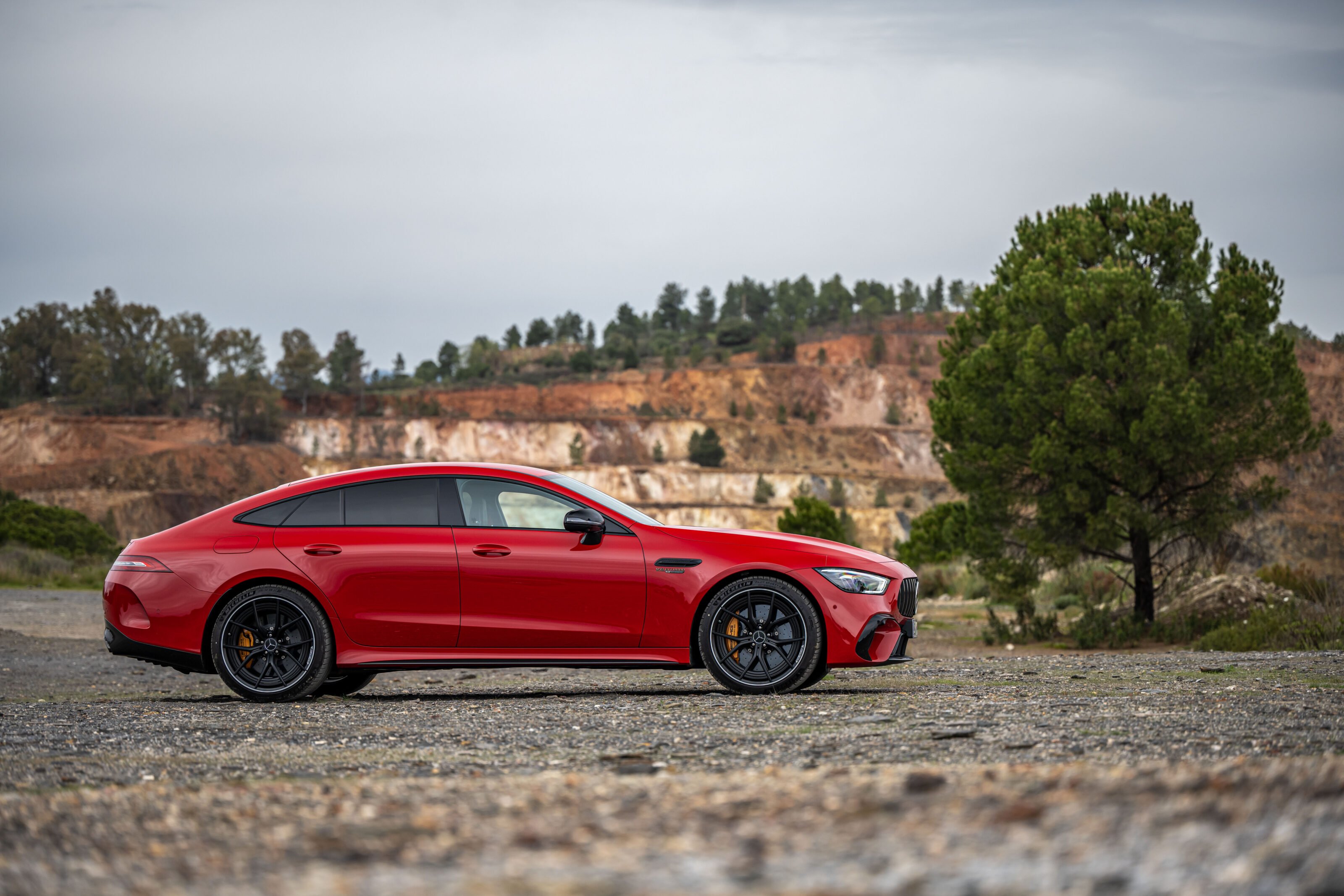
We have driven plenty of fine AMG products over time – think CLK DTM, 500E 6.0 or GT-R Black Series, but there were also several duffers clouding the picture like the first E55, SLK55 and S63. As far as the four-door models go, the W124-based so-called Hammer available only in the US was a truly outstanding effort, but at the end of the day, nothing comes close to the red overachiever featured here.
It musters more bottom-end grunt, mid-range urge and high-rpm explosivity than any of its rivals, its expertly honed suspension enhances the ride quality without sacrificing any dynamic strength, the handling is entertaining yet quite benign on a high level, and the advanced software makes extreme speeds a lot safer and thus more accessible.
Any nose-heavy rear-wheel-drive tyre-eater can play Smokey the Bandit all day long, but very few top-league entrants fuse two souls, sportscar and GT, with random instant access to both talents, either individually or in sync. This two-in-one DNA is particularly stunning in the 120-200km/h range when the two-speed transmission summons a taller final drive ratio at around 130km/h, that’s 13,500rpm in e-motor numericals, for a massive second-wave energy boost.
This is 2022, and we’re in Central European heartland where the automobile is currently undergoing a dramatic change of image and perception. But what the heck – let’s cover the badge on the boot with a strip of black gaffa tape, zero the fuel consumption readout, put on the biggest dark glasses, and enjoy the drive.
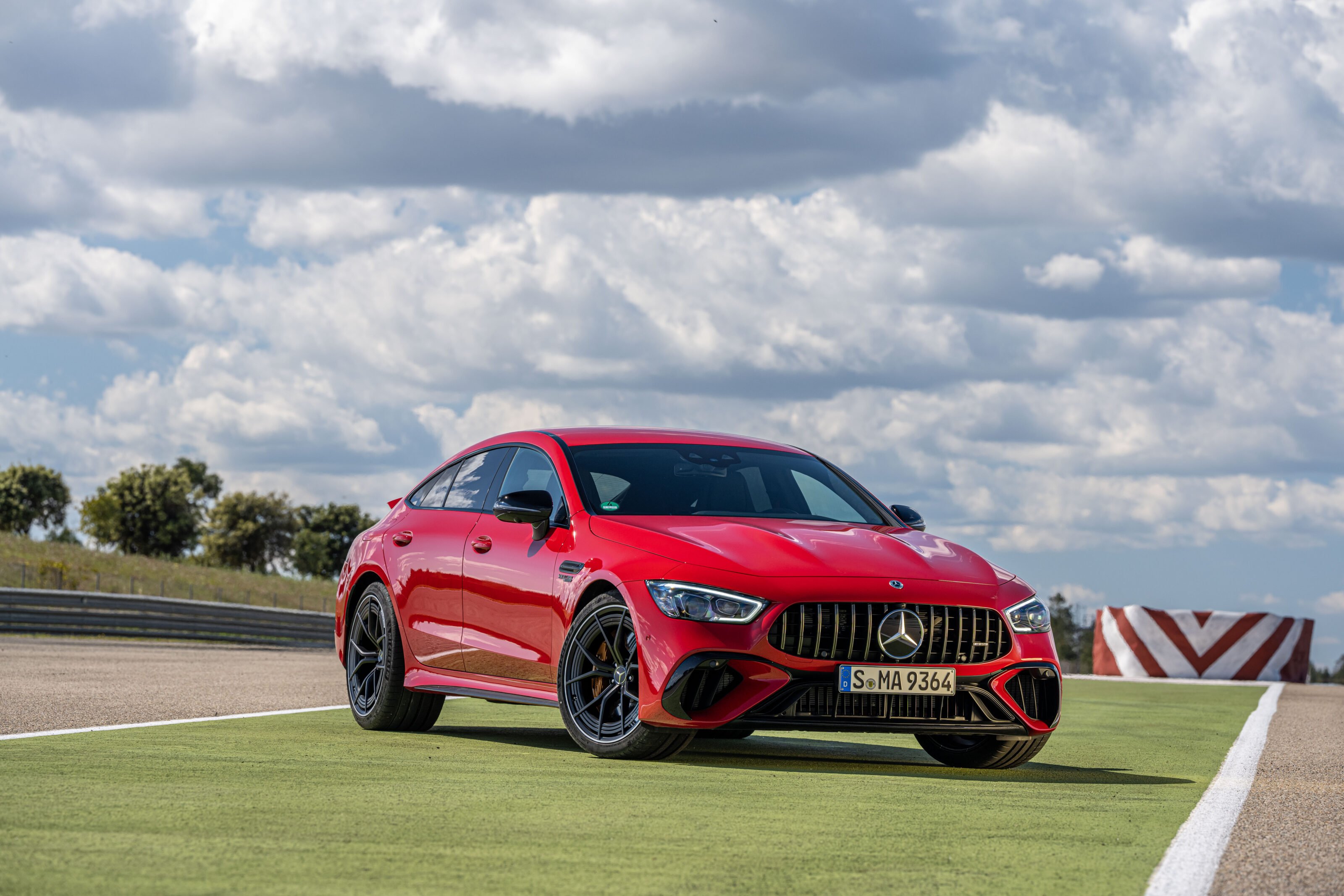
In more ways than one, this Benz feels as unreal as one of those six-figure SUV behemoths converted by AMG, BMW M, Audi Sport or JLR’s SVO division. The huge weight is at all times an obvious issue, but despite the massive bulk the AMG GT 63 S does not understeer like a dachshund pup, roll like a grizzly in heat or fight for grip like a cat on an ice rink.
The multi-talented steering does not just give vague instructions, it plots the course, clearly and precisely, period. The carbon-ceramic brakes don’t simply shorten the distance between now and not too late, they actually destroy kinetic energy with a physical force that makes the mind boggle and the eyes rotate in their sockets.
And the interaction of the adjustable dampers, rear-wheel steering and triple-chamber air springs does not merely keep all four wheels on the ground at all times but has compliance written all over its high-tech hardware and the software that masterminds it.
The battery pack weighs only 89kg, but in combination with the two-speed gearbox, the side-to-side diff lock and the elaborate 14-litre cooling system that washes round each of the 560 cells to keep the working temperature at a cosy 45 degrees C, the boot size shrinks to a paltry 335 litres. The payload is incidentally limited to a matching 380kg.
The morale of the nine-speed automatic varies from laissez-faire in Electric over velvety but firm in Sport to punchy in Race. Although the regeneration system will in stage four feed up to 100kW of excess energy back to the batteries, the one pedal mode is an acquired taste even in stop-and-go traffic.
On the autobahn, the theoretical top speed of 320km/h keeps clashing with reality now that soaring petrol prices have slowed down the flow for good. But as soon as a gap opens between groups of traffic, the red AMG coupe will challenge and conquer it like the new grandmaster of absolute speed, relative distances and the driver’s seventh sense.
There is no doubt about it: the brawniest AMG model ever deserves a place of honour on every petrolhead’s motherboard.
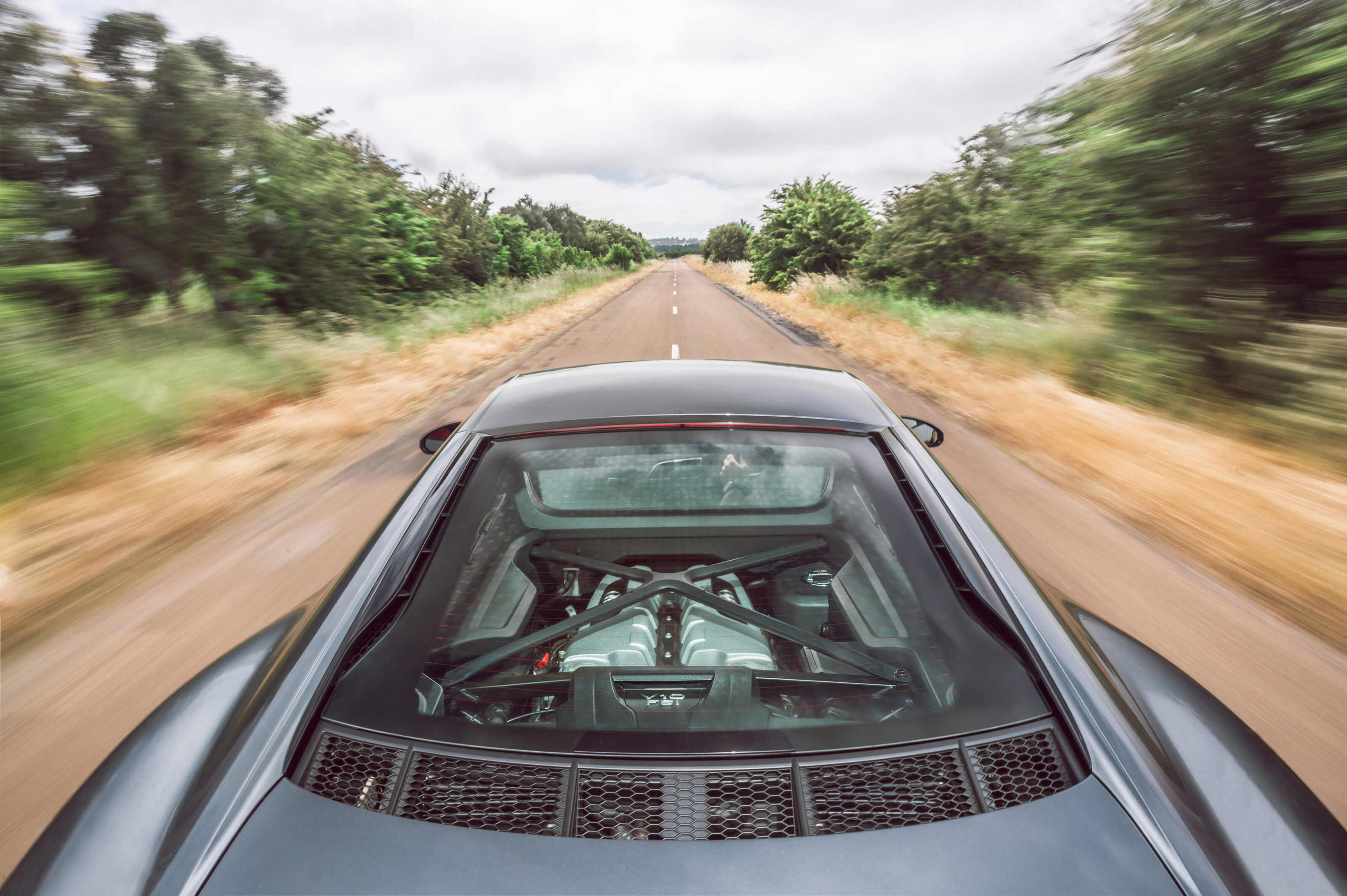
Some things are worth getting up early for. It’s funny how a howling V10 placed behind your head in a seductive body style that screams supercar makes it easy to get out of bed. And when said 5.2-litre engine is currently experiencing a fleeting stay of execution, any opportunity can’t be missed. Firing up the Audi R8 V10 Performance just as the sun breaks free of the horizon certainly causes a stir.
However, if you’re thinking this is merely a self-indulgent tale of a motoring fantasy fulfilled, then you’d be (partly) wrong. I’m sure you’ve already consumed the R8’s delights and why it’ll be missed via Editor Enright’s farewell celebration. However, one thing that struck me harder than this plot curve ball is the fact that when I glanced the R8’s odometer, I had to take a second look. (Read on for the second curve ball, this involves a mystifying, and tragic, bird spotting.)
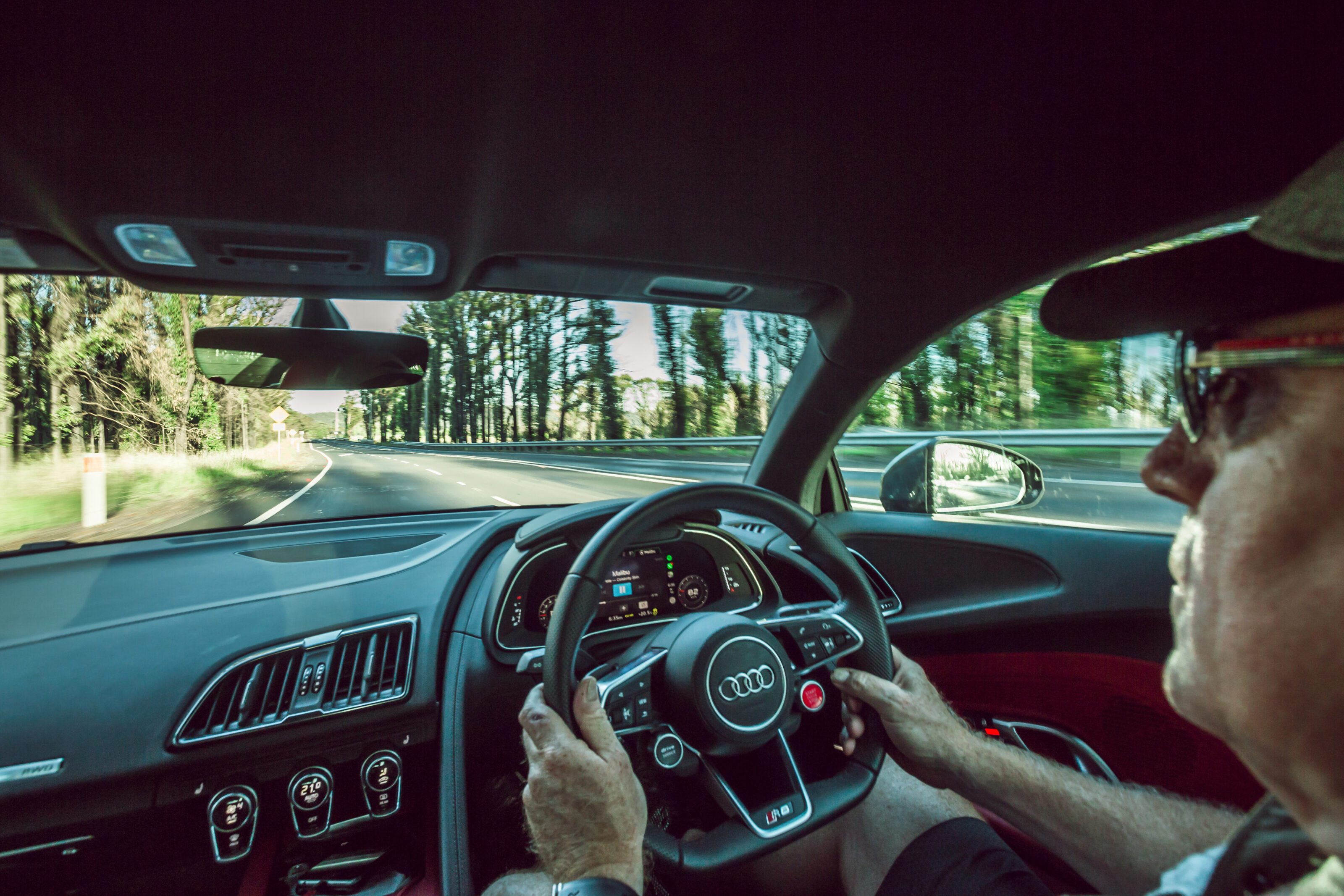
To those outside the motoring media, this figure isn’t going to be at all shocking. To be fair, you’ll be more intrigued as to why it’s a big deal. However, seeing a supercar still doing the press rounds with 12,000km on the clock is an oddity. Not that there’s little regard for mechanical sympathy within the industry, but you have to assume that those kays were clocked up with a big slice of ‘spirited driving’. The very R8 I’m referring to also competed, and impressed, at PCOTY in 2021. Yet, it isn’t showing any signs of it.
This is where myths of hard driving get somewhat debunked. Keep in mind that the servicing and upkeep of press fleets is far more meticulously controlled than that of the average owner. Yet, it is also an interesting study into reliability. Or, moreover, the fact that it’s often tough to detail in a new car review. While there might be reports of issues with certain makes and models, unless it happens to us when the car is in our care it’s hard to comment first-hand. That’s what our Garage section in the mag sets out to achieve.
The R8 isn’t my first taste of a relatively high-mileage press car. To be fair, the LC500 in question had transitioned to the Lexus on Demand program when I got behind the wheel, but the bright yellow example used to do the media rounds. Apart from some slight discolouration in the white leather and brake discs that needed machining, the stunning V8-powered two-door coupe ran as if it was fresh off the production line. In reality, it had 22,000km-worth of journo and customer kays on the clock. It’s impressive just how tight and new it felt.
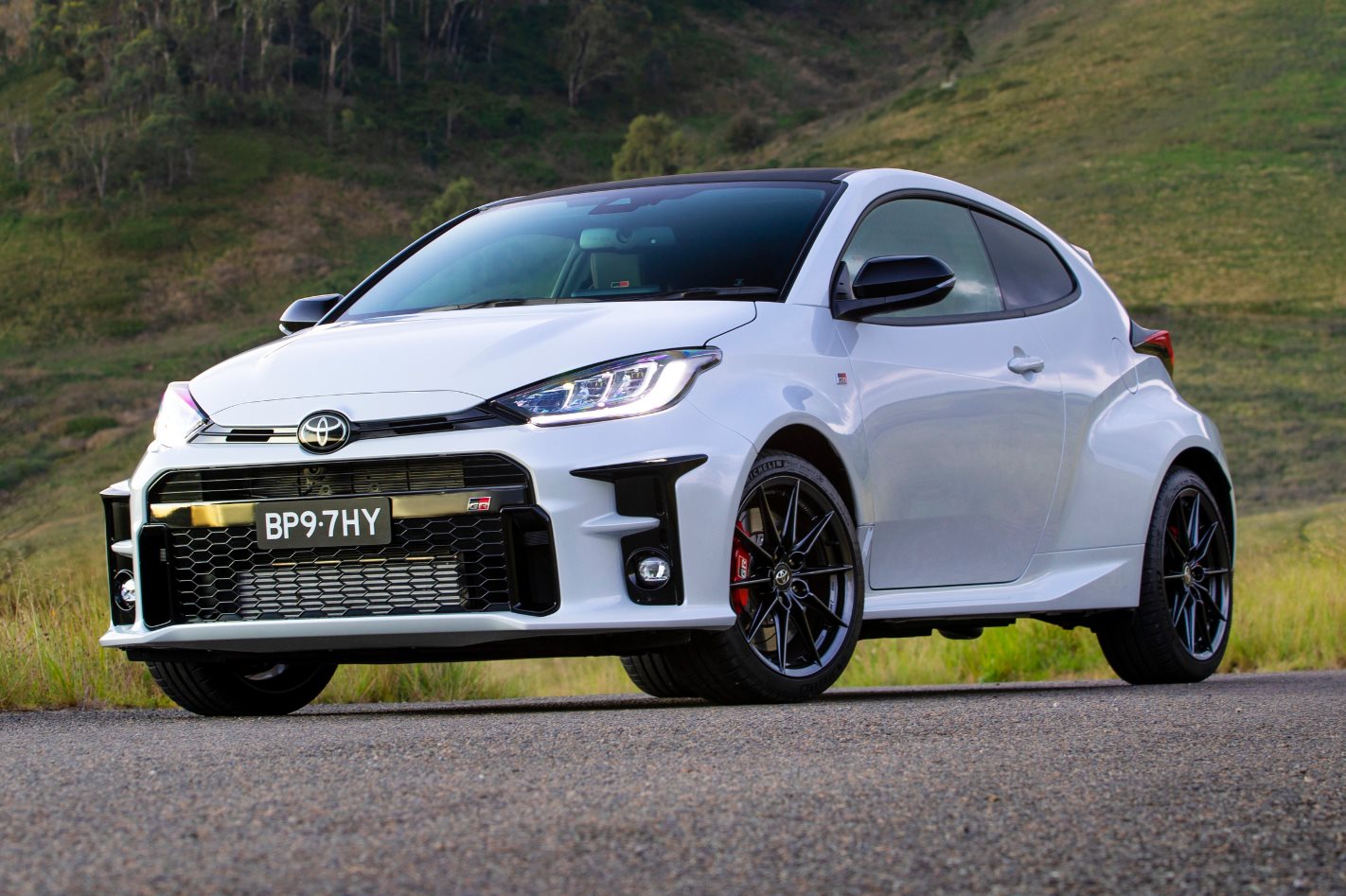
Two more examples are the Ford Mustang Mach 1 and the Toyota GR Yaris Rallye. The former amassed 10,000km and the latter 15,000km. It’s important to note that the little three-pot Toyota accrued most of its odo reading while in the MOTOR garage. Ironically, it even went along as a support car for The Great Alpine Trial feature in the December 2021 edition of MOTOR, in which it covered 1900 faultless kilometres. However, since returning from PCOTY 2022 we found out that some of the plumbing for the airbox had come loose and a little bird somehow met its end atop the plastic engine cover. Under-bonnet temps must get high, because the poor thing was very well done.
Ultimately, the best we can do is report on what actually happens to us. Hearsay doesn’t cut it when it comes to box-fresh product and, to be fair, mechanical issues are rarer than you’d think (please don’t let Murphy’s Law ring true…). Alternatively, if you’re after a hero model from the past and want to know all of its issues and vices, then Icon Buyer within the magazine is a great place to start for context and history. And if none of that takes your fancy, then reading a piece of automotive escapism on the Audi R8 will have to suffice.
