
It’s fair to say the 2022 Lexus NX medium SUV has hit the ground running.
Having launched locally in February, the NX is a box-fresh model from the ground up, adopting the still-warm TNGA platform, introducing new-generation infotainment suite from Lexus, and bringing to market the brand’s first production plug-in hybrid vehicle.
And it’s certainly been popular. In March, its first full month on sale, the NX was the most popular premium vehicle in the country with 474 sales. Not just the most popular premium mid-size SUV, mind you, but the most popular premium vehicle overall.
Granted, combining Mercedes-Benz GLC wagon (458 sales) with GLC coupe sales (177 sales) sees that nameplate leap above the NX, but it’s nevertheless a satisfying result for a marque that often trails its rivals by a long way.
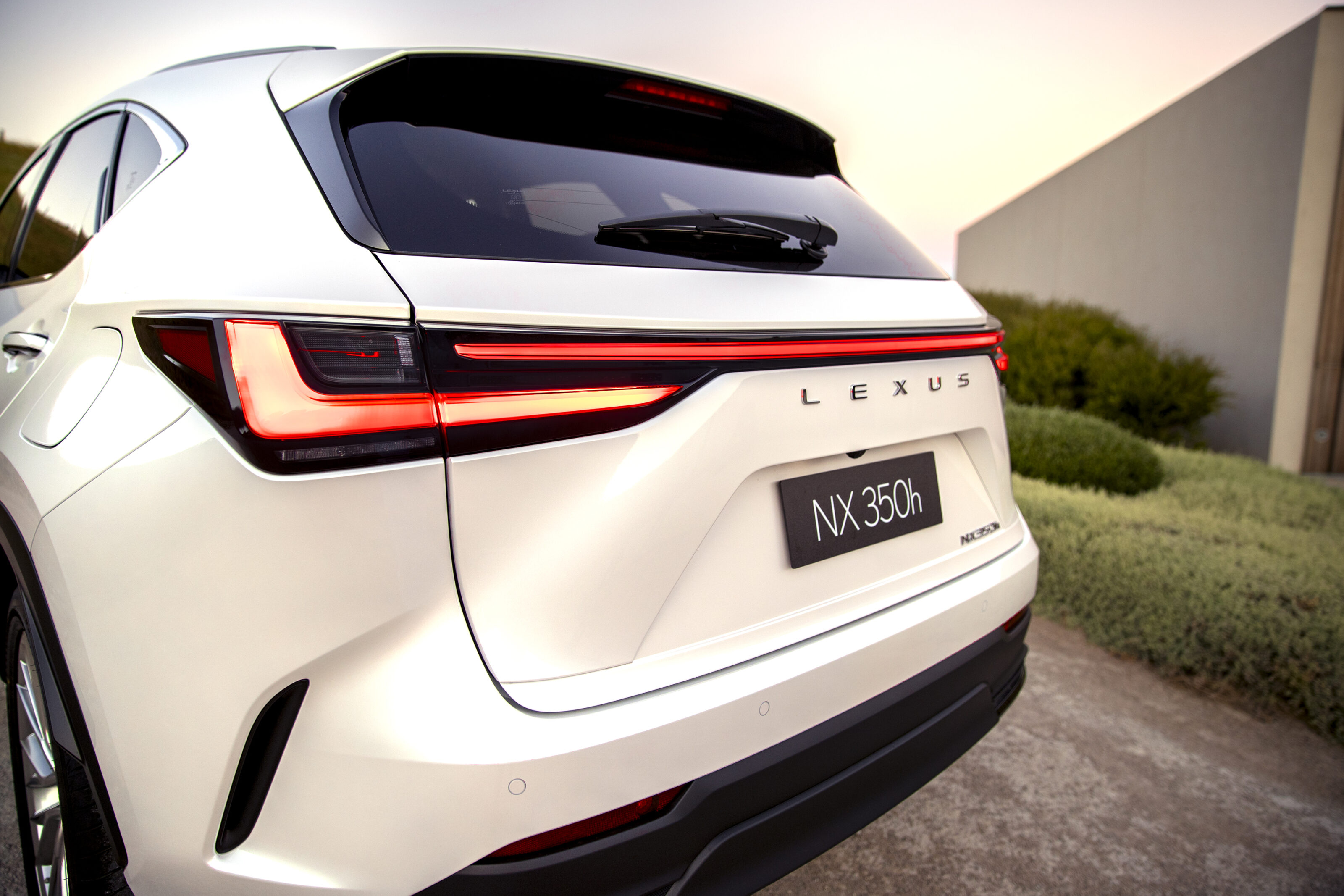
However, things could be better. According to Lexus’ local chief, lead times for the NX have already blown out to six months for variants that are purely combustion-powered, while waiting times for NX hybrids – including the NX 450h+ plug-in – now stretch beyond a full year. Ordering an NX hybrid now will likely result in a delivery time approaching mid-2023.
“NX started really, really well. When that car was coming, I knew it was going to be very strong for us, it’s bringing new buyers to Lexus as well,” said Lexus Australia chief executive John Pappas.
“We’ve had some challenges with NX in the first quarter on production. In March it was the number-one selling model in luxury [segment], but we’ve had a lot of cuts on NX in terms of production that have impacted us,” he said.
“With those cuts the petrol models are up to six months in lead times, but the NX hybrid is now reaching twelve-months plus, so that’s a challenge.”
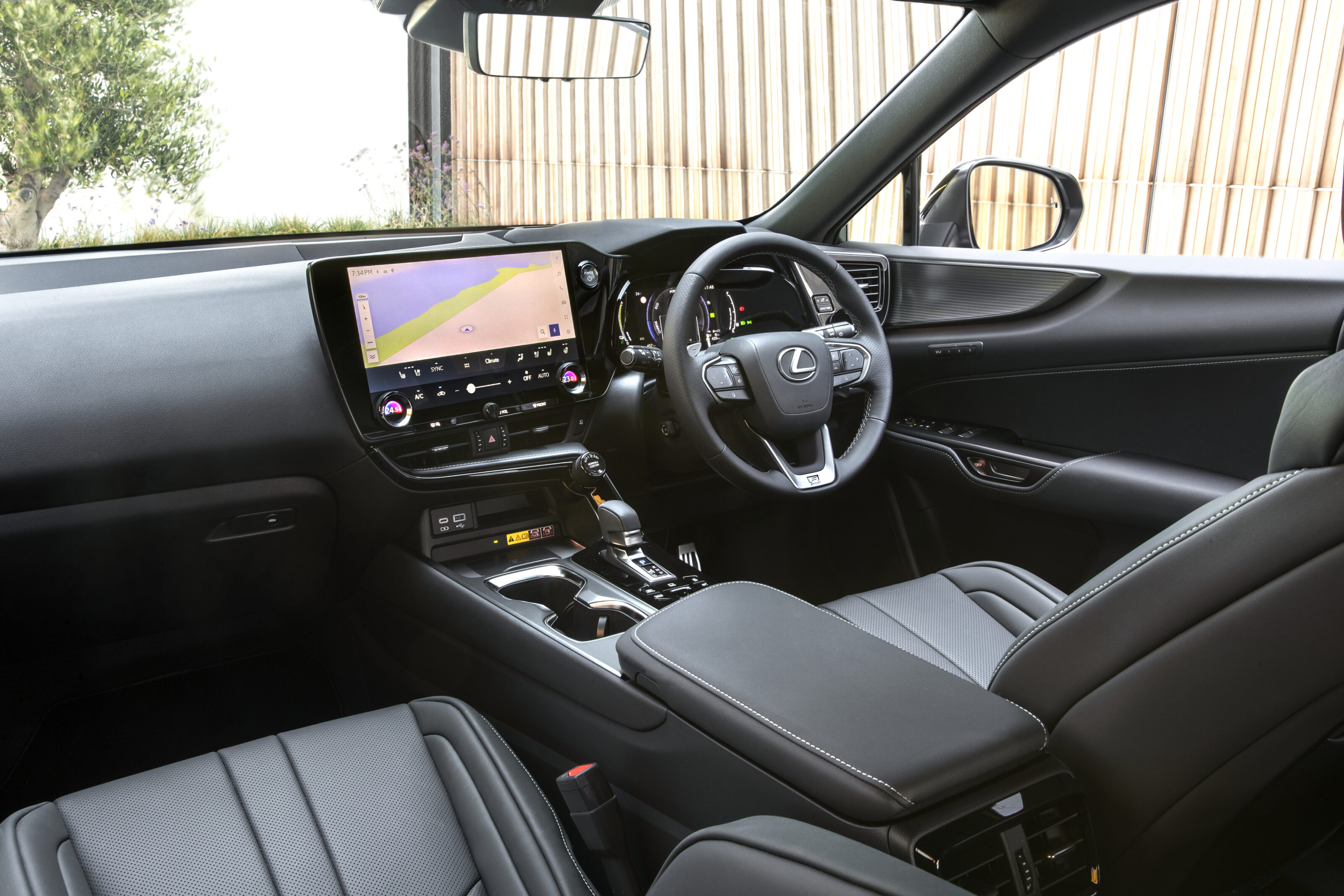
It’s largely a familiar story – semiconductor chip shortages and production interruptions from viral outbreaks continue to limit output at Lexus plants, and a just-announced stoppage will put further constraints on NX, LS and UX production – but the arrival of the NX also happened to coincide with Russia’s invasion of Ukraine, which has led to a rush on fuel-efficient vehicles as the price of petrol shot up.
Ergo, NX hybrid inventory was quickly spoken for.
“With fuel prices and everything going on there, the NX plug-in hybrid and [regular] hybrid are both doing really, really well from an order intake point of view, and with fuel prices, obviously, everyone is trying to save a buck with their fuel bill, and what a great powertrain to do that,” Pappas explained.
It’s not just the NX that’s exceeding expectations at Lexus. The UX 300e, which was launched in November last year, has already racked up over 130 orders since it arrived.
A modest number for a five-month period, sure, but considering Lexus product planners only expected it to sell in that volume over the space of a year, it’s clear that demand for battery-enhanced Lexus models is outpacing the estimates of experts.
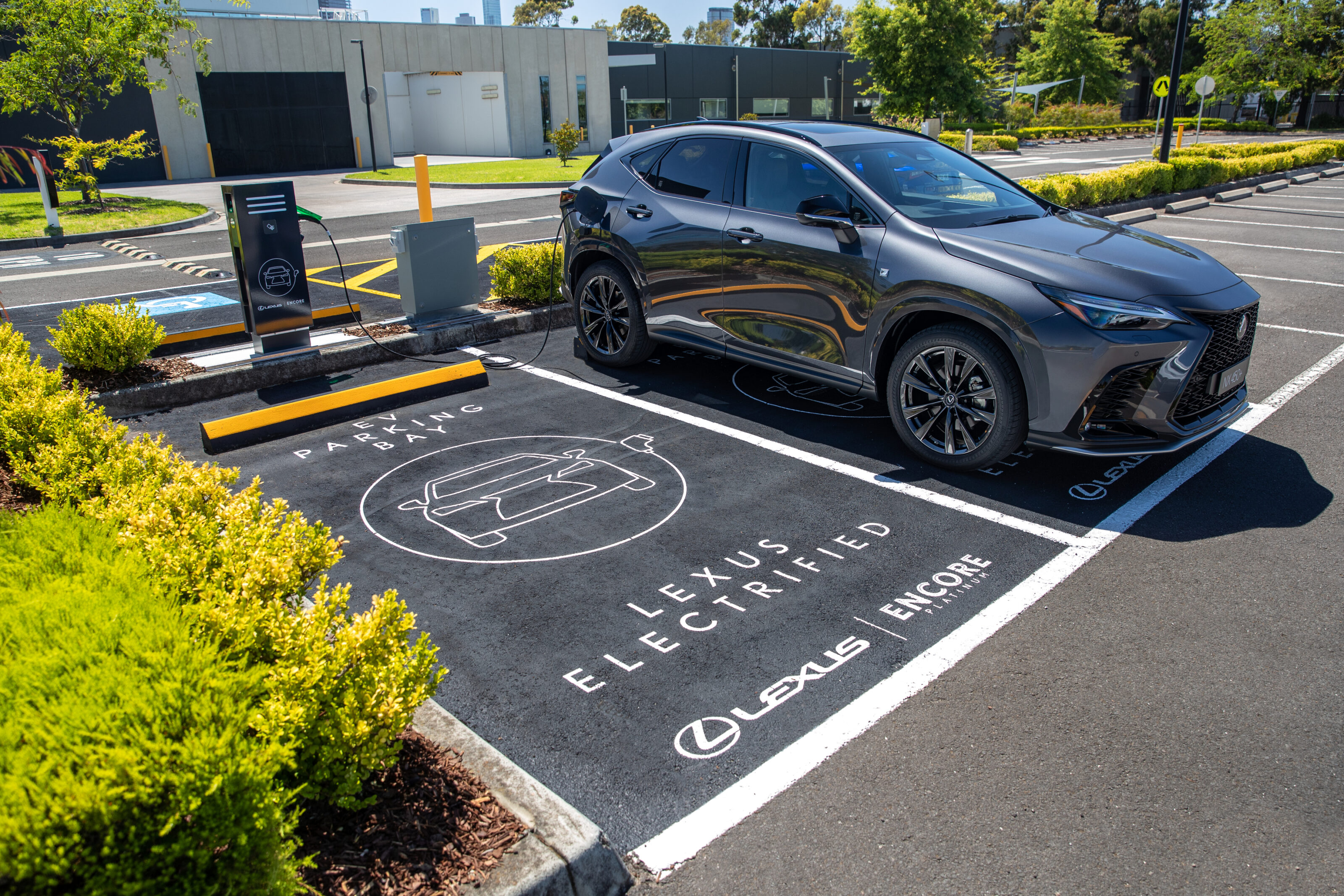
Such trends bode well for Lexus Australia’s long-term plans. The company aims to increase the showroom share of electrified product from its current figure of 40 per cent to 80 per cent by 2025, meaning four out of every five Lexus models offered in this country will either be a conventional parallel hybrid, a plug-in hybrid, or fully-electric.
It’s well on the way to that goal. Almost every model it sells – bar the LX offroader and LC Convertible – are already available with a hybrid option.
By 2035, Lexus expects that its entire global lineup will be made up of battery-powered electric vehicles. Cars like the UX 300e, NX 450h+ and the about-to-be-unveiled RZ 450e are the tip of that spear.
The Audi Urbansphere – the third and final of the ‘Sphere’ concepts – is an MPV-like four-seater built to take a look into what high-end transport could look like in a high-density megacity. Specifically, Audi had China in mind for this particular design.
Created in close collaboration with Audi’s Beijing design studios, the Urbansphere design also took input from potential customers in China into account, media was told during a ‘sneak peek’ prior to the concept’s reveal.
Despite dimensions which suggest a people-hauling van, the Urbansphere seats only a driver and three passengers, each with a properly first-class amount of space to enjoy.
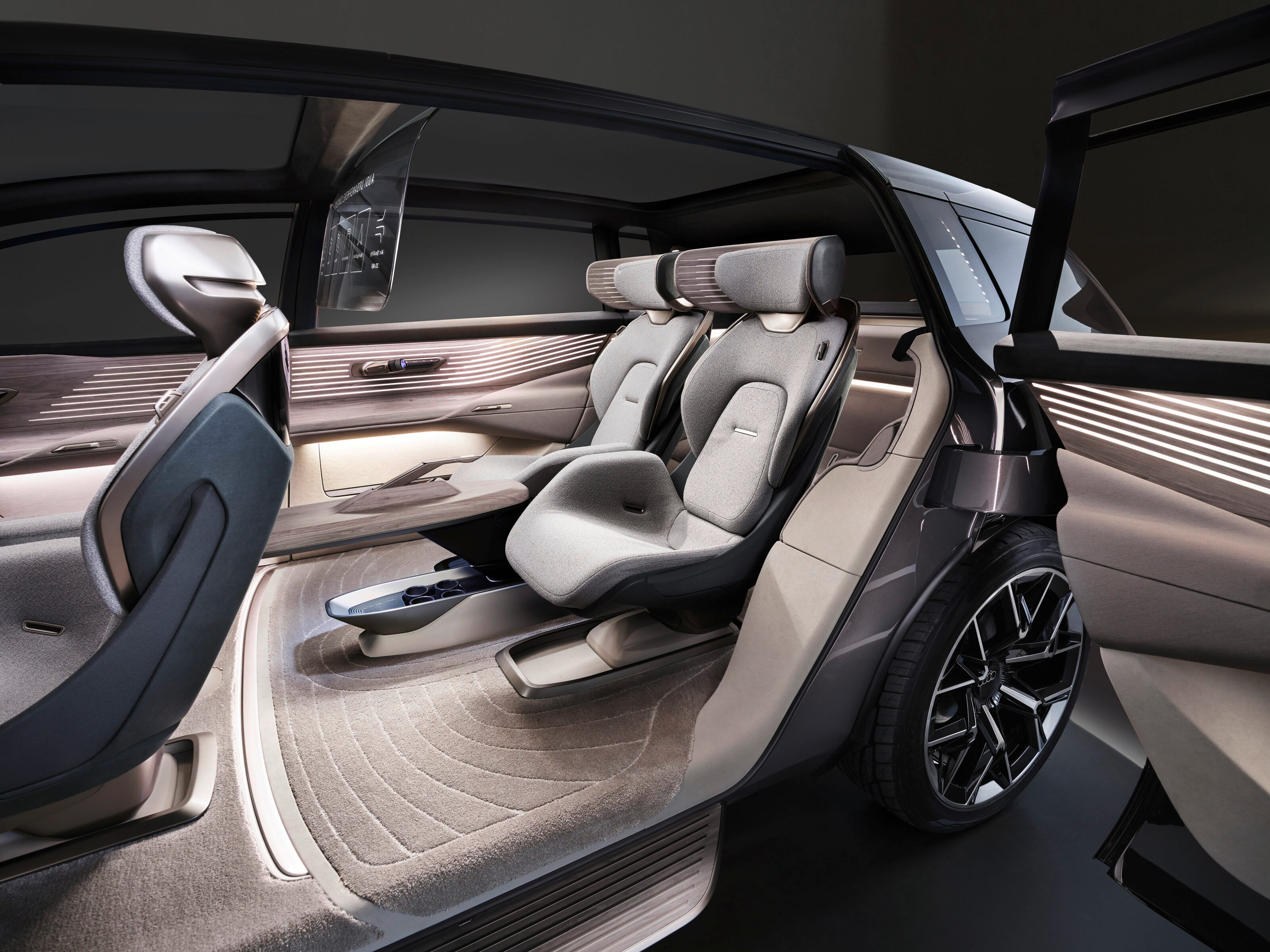
Audi considers the Urbansphere to be a “living space”, giving examples for use such as a lounge on wheels and a mobile office during the time its occupants are in traffic.
This is likely to be a significant amount of time, Audi expects, in a highly populated Chinese megacity. As such, autonomous driving is central to the interior space in the Urbansphere, and its steering wheel can be hidden within the dash.
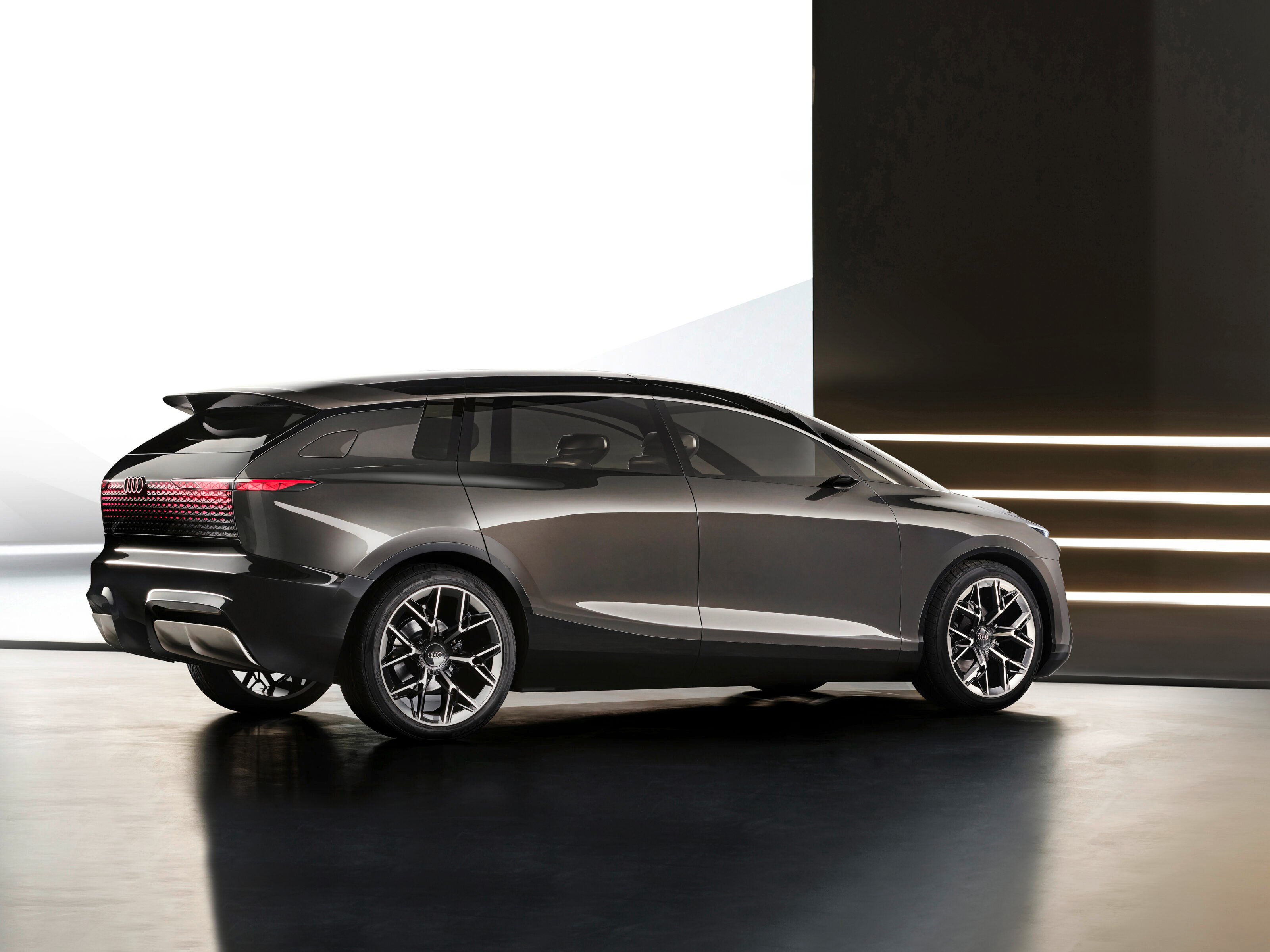
This increases the available space in the cabin, which is already plentiful thanks to the Urbansphere’s 5.51-metre length, 2.01-metre width, and 1.78-metre height. 3.4 metres of wheelbase keep the space inside usable.
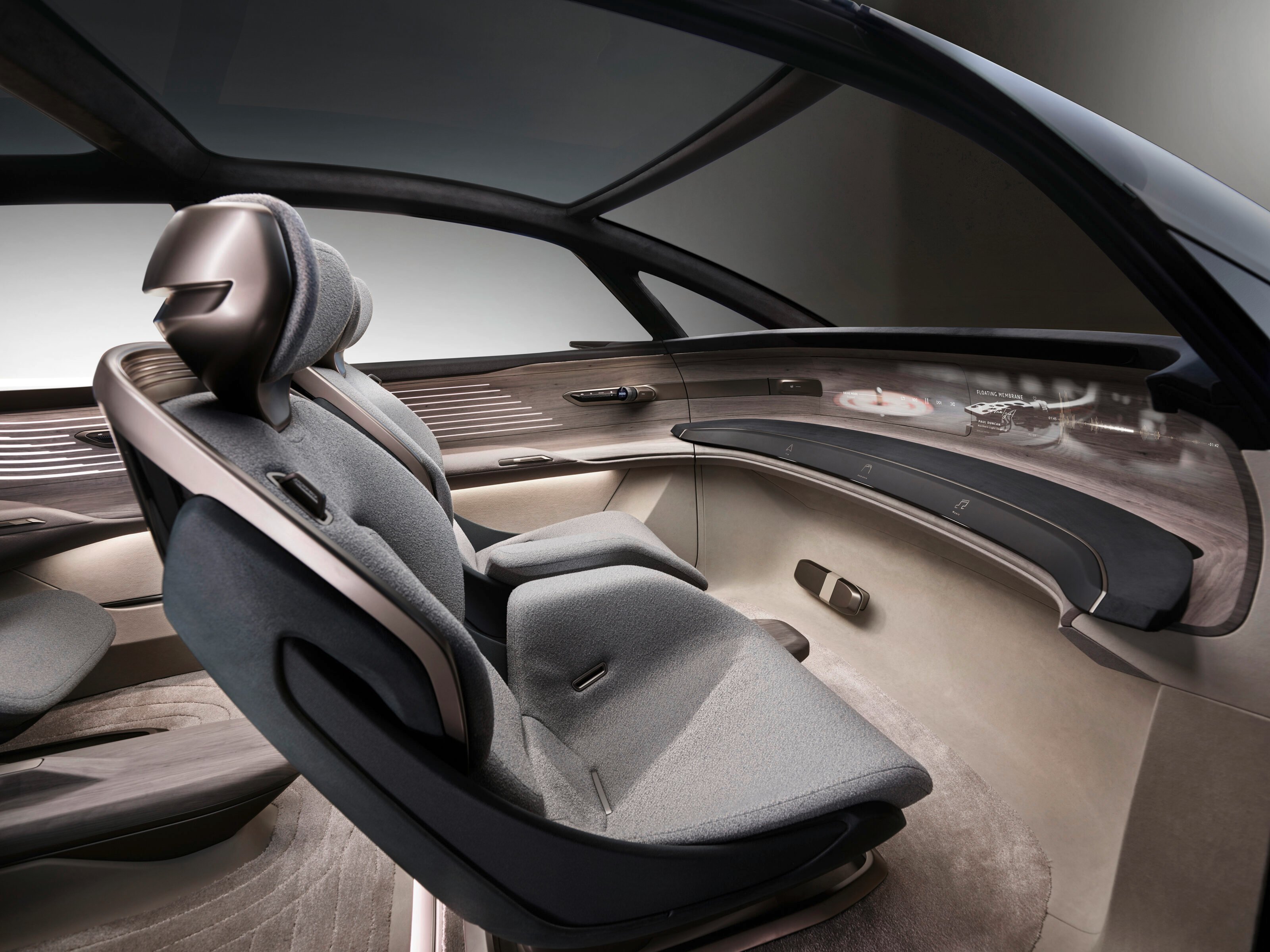
Particularly luxurious are the rear seats, which are able to swivel depending on social situations within the cabin, or become a semi-private media space thanks to a ‘blind’ which rotates around from behind the headrest.
Screens on the rear of the front seats provide additional media function for the second row.
Controls for the majority of the seat functions for each passenger are found in small clusters on the doors, which each open outwards from the centre. This means the rear doors are reversed, and there is no B-Pillar. Entry to the Urbansphere is as easy as Audi could have made it without employing someone to pick you up and carry you in.
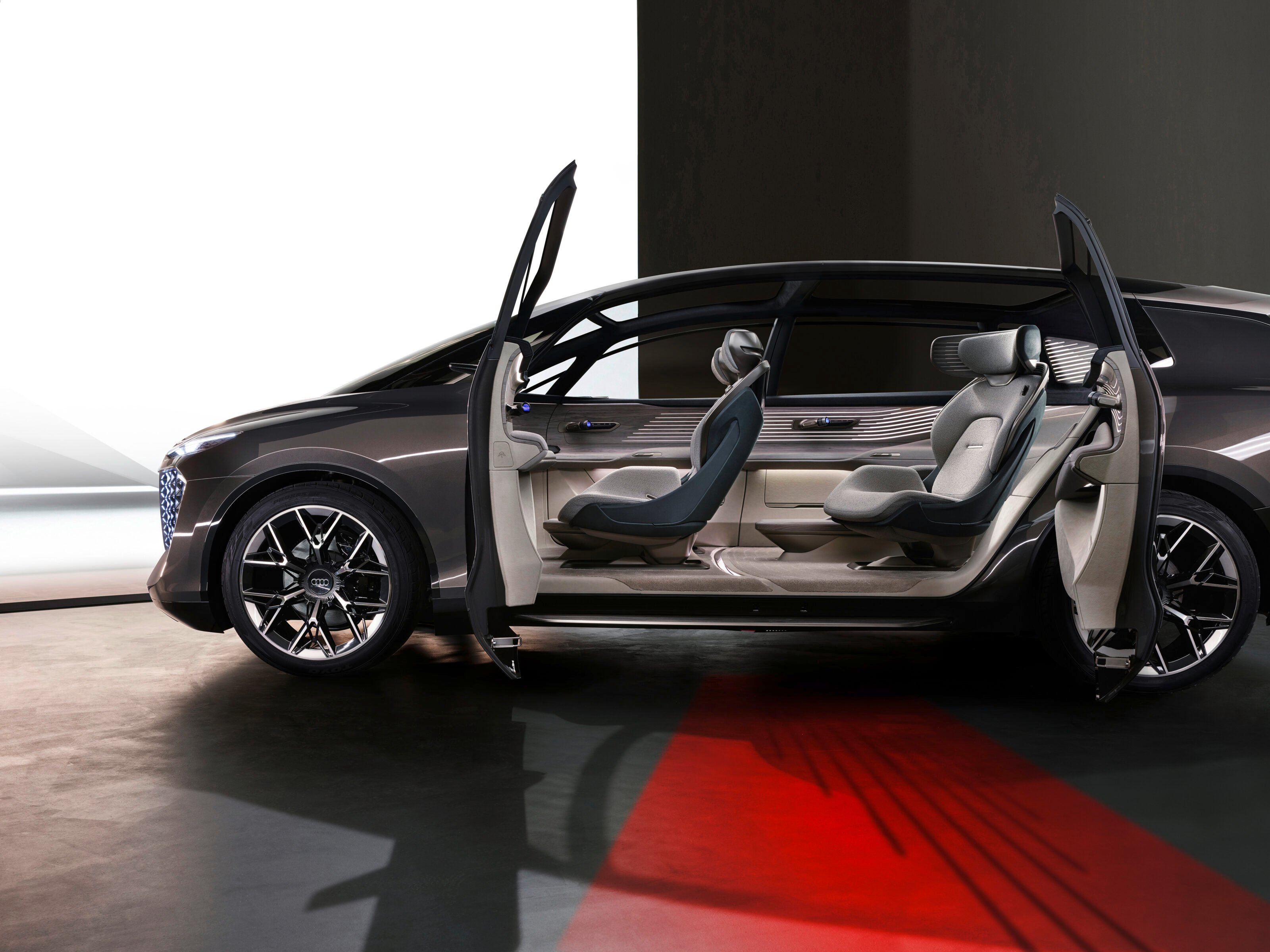
Bamboo fabric, sustainable wood veneer, and recycled seat padding contribute to what Audi hopes to be a ‘green’ manufacturing process, with the wood grown near the manufacture site and processed without chemicals.
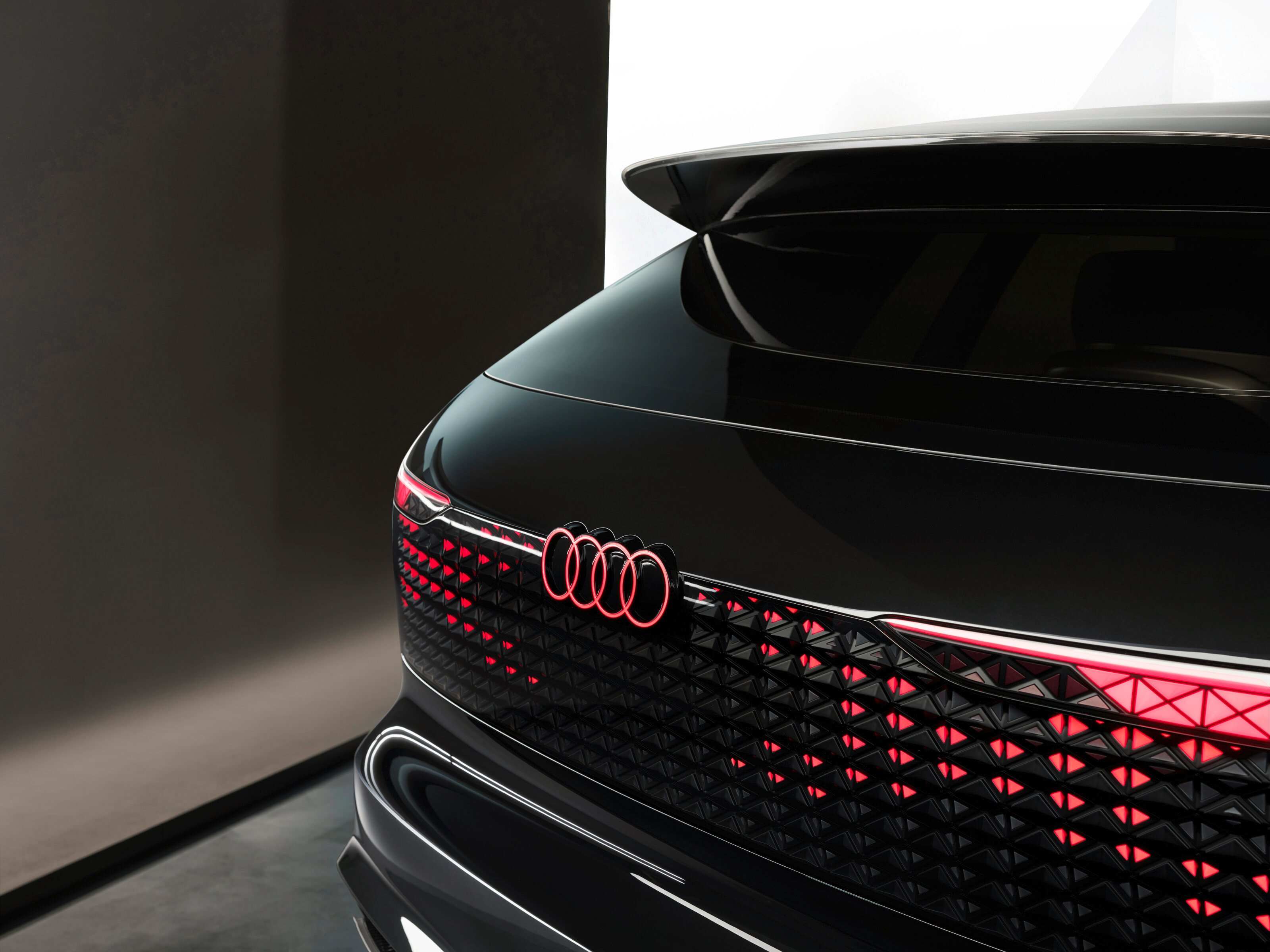
Outside, Audi has used the front ‘grille’ space and rear centre strip as entire light clusters, able to create headlights, taillights, reverse lights, and indicators out of the individual LED elements. On the subject of lights, Audi has also paid homage to China with a ‘Light Umbrella’ inspired by traditional Chinese umbrellas. It’s a reflective umbrella that contains lights within the frame to both light an individual’s surroundings and make them more visible for safety.
While it’s just a concept, Audi has revealed some technical specifications of the Urbansphere which highlight its range, drive, and outputs. With a 120kWh battery, the Urbansphere boasts a claimed 750km range, with 800v charging capability for 300km range in ten minutes of charging, or a charge from 5 to 80 per cent in less than 25 minutes.
The concept features a motor on each axle, driving all four wheels with a total 295kW and 690Nm.
Rear-wheel steering and air suspension, not dissimilar from some current high-end Audi models, allow for more nimble steering and a more comfortable ride.
When asked by Wheels if the three ‘Sphere’ concepts, including the Grandsphere and Skysphere, were a sign of a new ideology for Audi’s range, marketing spokesperson Silke Guse told us the Sphere concepts are intended to convey Audi’s ideas for the distant future.
“Having said that, in the second half of this decade we will have a completely new vehicle coming to the road, a lot has been taken from the Grandsphere that will be taken to that serial production model.
“The other two are show cars… especially the Urbansphere, but we are waiting for feedback from clients and customers to see how we can use these ideas for serial production models.
“Our model line will change massively over the next few years… we’ll see new electric models come into these segments, and combustion vehicles will fall by the wayside, which will have an effect on our model nomenclature.”
Snapshot
- EQS SUV slated to arrive in Australia in the first half of 2023
- New model will be available in three grades, local specs not yet confirmed
- All-electric driving range of 660km possible, depending on grade
The 2023 Mercedes-Benz EQS SUV has been revealed as the latest in a line of dedicated electric vehicles from the German manufacturer, with an Australian launch slated for early 2023.
Carrying on from the reveal of the EQS sedan last year, the Mercedes-Benz electric SUV rides on the same platform as its five-door liftback counterpart, although it gains an extra 20 centimetres in height for optimal ground clearance on light terrain.
Just like the sedan, three grades of the SUV will be available at launch – the rear-wheel-drive EQS 450+ (265kW/568Nm), all-wheel-drive EQS 450 4MATIC (265kW/800Nm) and the flagship EQS 580 4MATIC (400kW/858NM), all of which are powered by the same 107.8kWh lithium-ion battery.
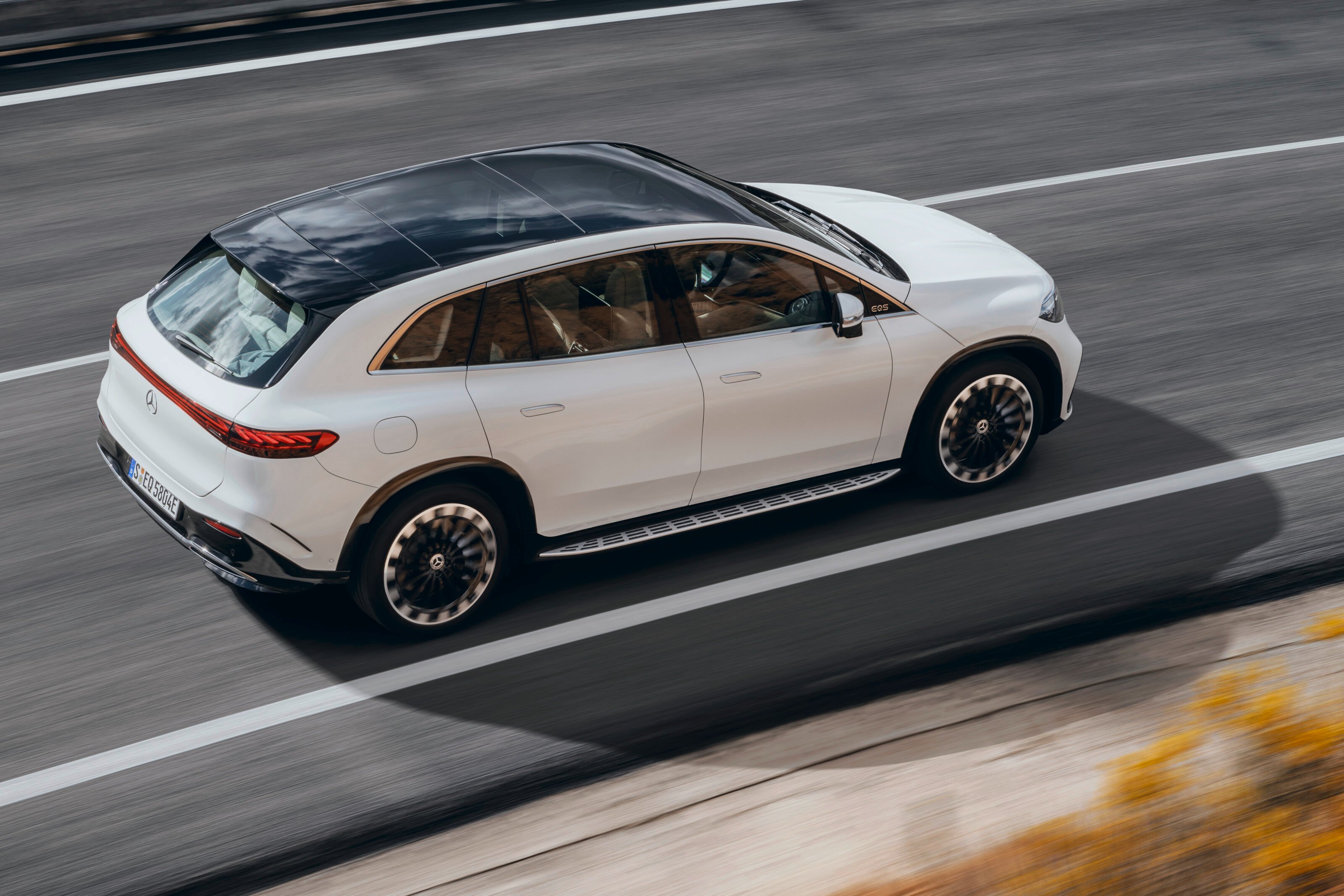
While the EQS SUV can’t match the sedan’s 770km driving range on a charge, the entry-level 450+ still boasts a WLTP range of up to 660km, with the all-wheel-drive variants sacrificing economy to record a range of 613km each.
The car’s on-board AC charger allows for charging at up to 22kW, with the DC fast charger stepping it up to 200kW, giving the EQS an extra 250km of range in just 15 minutes.
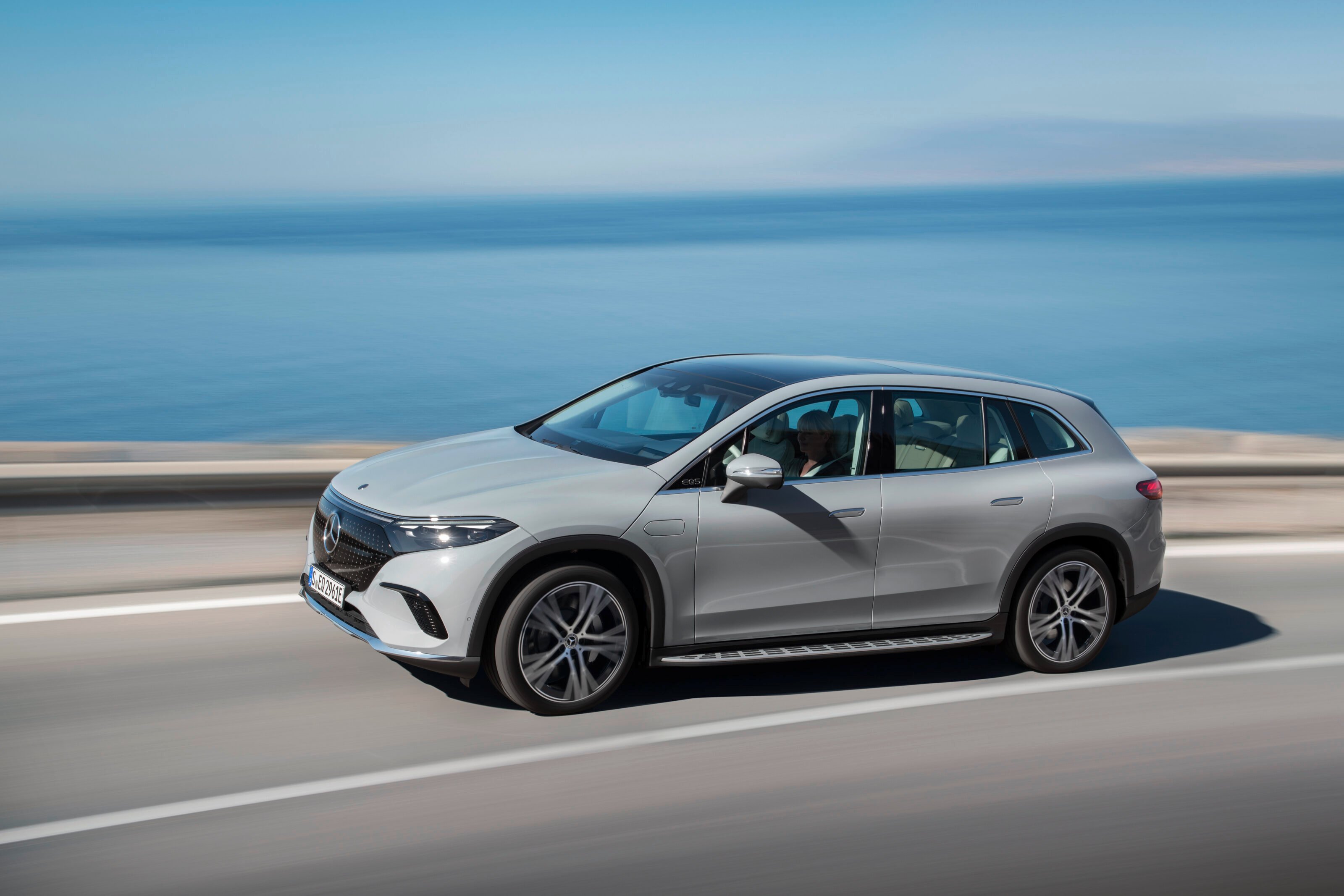
As with the sedan EQS, the SUV is equipped with rear-axle steering at up to 4.5 degrees as standard, with the full 10 degrees available as special equipment, reducing its turning circle from 11.9 to 11 metres.
Standard wheels on the EQS SUV measure up at 20 inches, although further options ranging up to 22 inches are available, with five-spoke light alloy and AMG multi-spoke light alloys available, both of which are aimed at increasing efficiency though better aerodynamics.
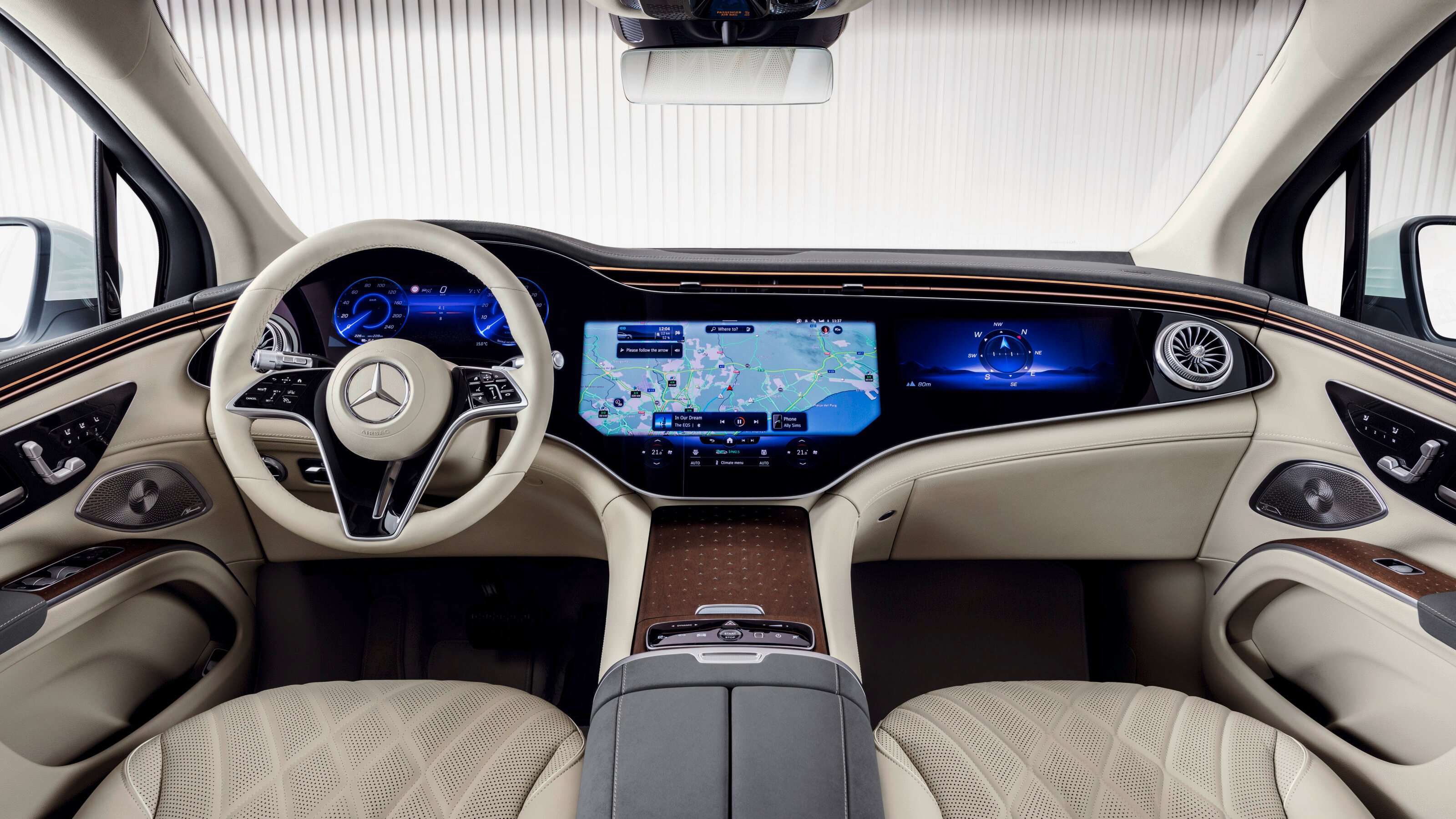
Inside the cabin, the front row occupants benefit from fully electric adjustable seats with ambient lighting, four-way lumbar support and seat heating, while climate control and multicontour massage seats are optional.
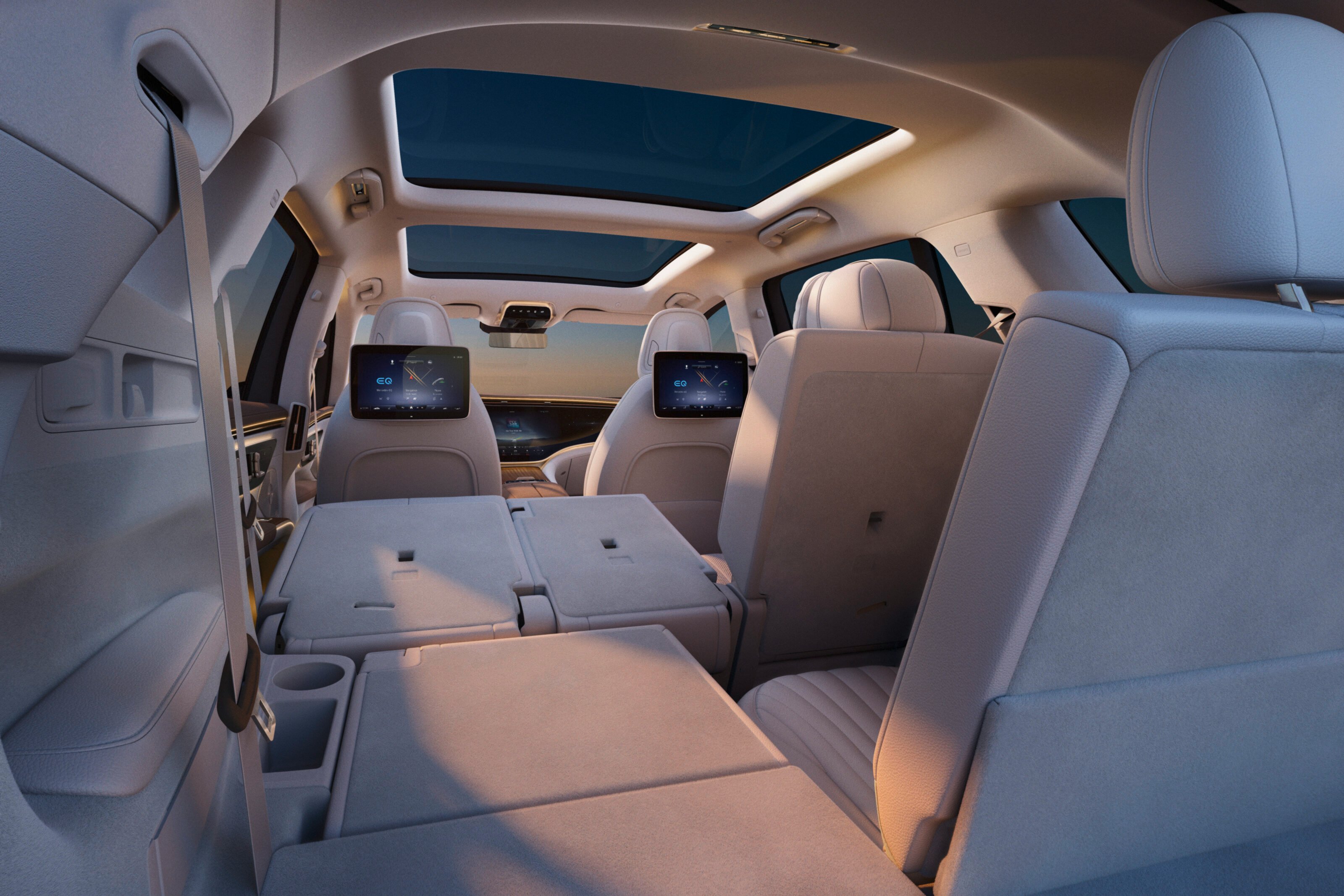
For those in the second row, the three-abreast seats features an electrically adjustable backrest angle and 130mm of fore and aft adjustment, as rear armrests, heating and an i-Size child seat attachment complete the options list.
Also available as an option is a third row of seats, expanding the EQS to be a seven-seater with two retractable seats, folding head restraints and easy-entry function on the second row.
Standard equipment includes a 12.3-inch digital instrument cluster which is coupled with a 12.8-inch, portrait-oriented infotainment screen, although those wanting the 55.5-inch MBUX Hyperscreen can order the high-tech display as an option.
Mercedes hasn’t confirmed what specs will be available for Australian buyers but it did lock in a local launch for the first half of 2023.
Local pricing and features will be announced closer to the model’s arrival.
For this set of data, it doesn’t matter how quickly our COTY contender can get to 100km/h. They just have to be able to do it, so we can use a decibel meter at that speed, across a stretch of tarmac representative of a typical Australian highway.
We conducted the measure twice for each car to ensure a one-off anomaly wouldn’t spike the maximum decibels recorded, then we averaged the two readings (which were both very similar in each case anyway) to get our scores in the table below.
Much to the relief of Mercedes-Benz, and anyone who spends a couple of hundred thousand in the pursuit of luxury, the S-Class (65.4dB) was the quietest in the COTY field, by a couple of decibels over its little bro, the C-Class (67.1dB). Yet another pointer that the C-Class is becoming more and more like the higher end of Mercedes offerings.
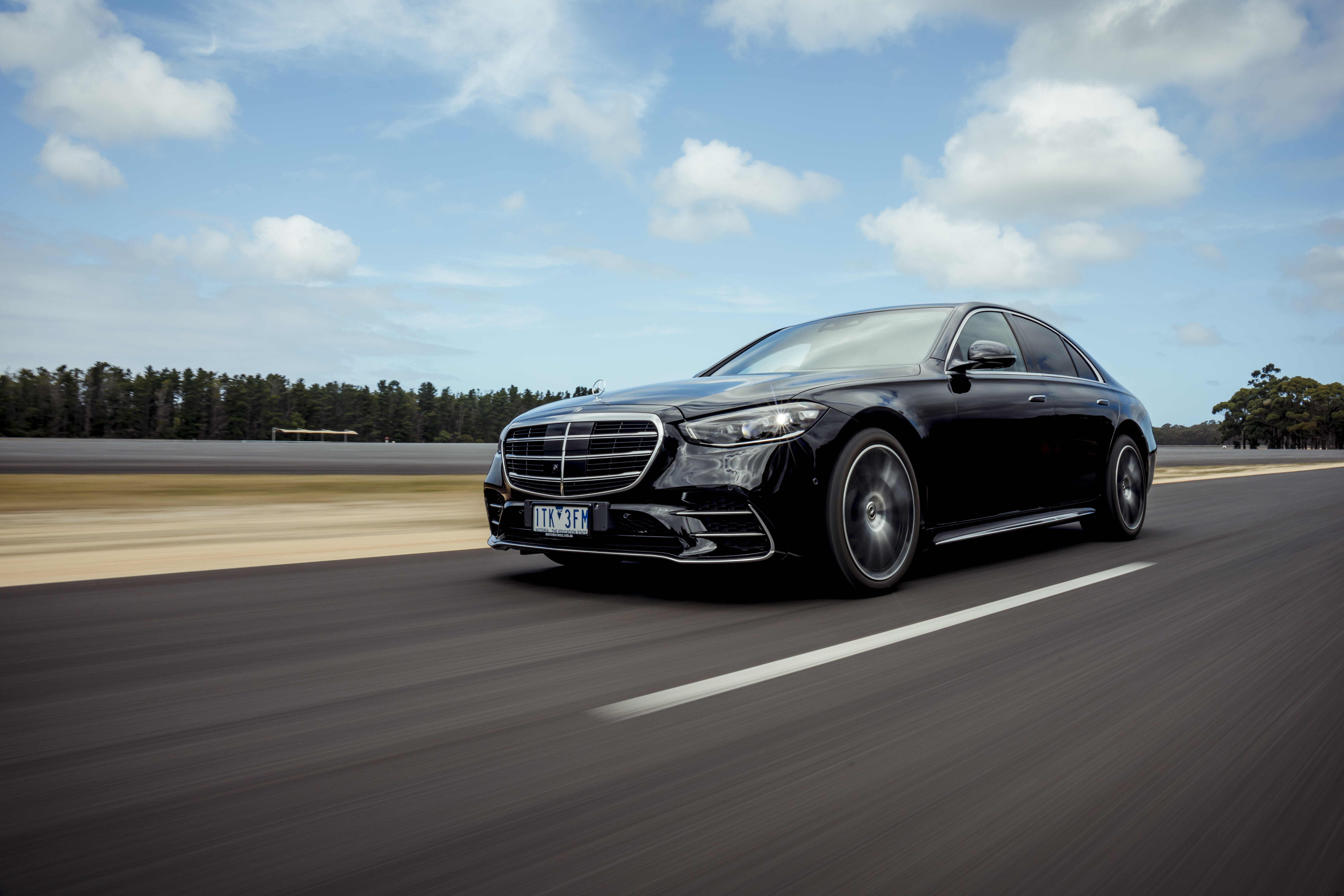
Speaking of the high end, our COTY winner is next quietest in line, the Kia EV6 measuring 67.25dB in the cabin. An EV being quiet should be no surprise, though the fact it ties with the twin-turbo V6 Genesis GV70 for noise is perhaps unexpected.
Not much louder, the BMW iX (67.65dB) is another EV that nails the interior ambience, though further down the list the Polestar 2 (71dB) was let down by tyre noise, and the Mazda MX-30 (74.4dB) let “boomy” noises (as described by judge Daniel Gardner) into the cabin on bumpy surfaces.
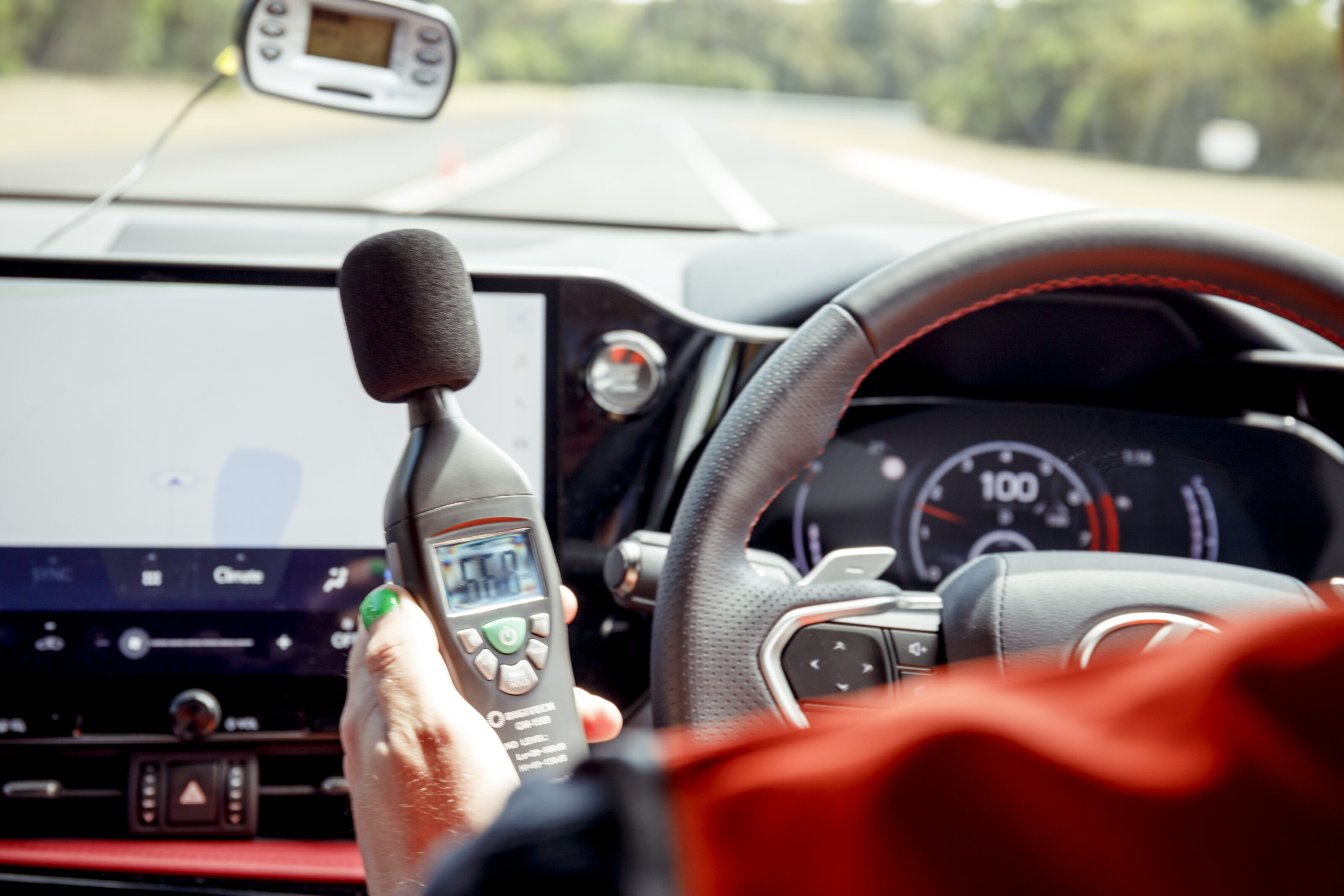
We were surprised to see the otherwise quite refined Honda Civic (72.8dB) down the ranks, too, though we can obviously excuse the noisiest COTY contenders, the Subaru BRZ (75.75dB) and Hyundai i20 N (74.65dB) for being sports cars with deliberately enticing soundtracks.
| Make | Decibels (100km/h)u00a0 |
|---|---|
| Mercedes S450L | 65.4 |
| Mercedes C300 | 67.1 |
| Kia EV6 | 67.25 |
| Genesis GV70 | 67.25 |
| BMW iX | 67.65 |
| Kia Sportage | 67.7 |
| Hyundai Palisade | 67.7 |
| Kia Carnival | 67.95 |
| Hyundai Ioniq 5 | 68.05 |
| Hyundai Tucson | 68.2 |
| Subaru Outback | 68.7 |
| Porsche Taycan | 68.85 |
| Lexus NX | 69.25 |
| Volkswagen Golf | 69.4 |
| Toyota LandCruiser | 69.4 |
| Skoda Octavia | 70.35 |
| Polestar 2 | 71 |
| Honda Civic | 72.8 |
| Mazda MX-30 | 74.4 |
| Hyundai i20 N | 74.65 |
| Subaru BRZ | 75.75 |
UPDATE, September 2022: Refreshed MY23 range and new turbo models
The updated 2023 Subaru Outback is now on sale in Australia, debuting a turbocharged XT model and a number of key infotainment upgrades.
Get the full story at the link below.
Original story continues
2023 Subaru Outback revealed
Snapshot
- 2023 Subaru Outback unveiled at New York International Auto Show
- Updated model features heavily facelifted front end, increased safety and tech upgrades
- Local launch set for early next year
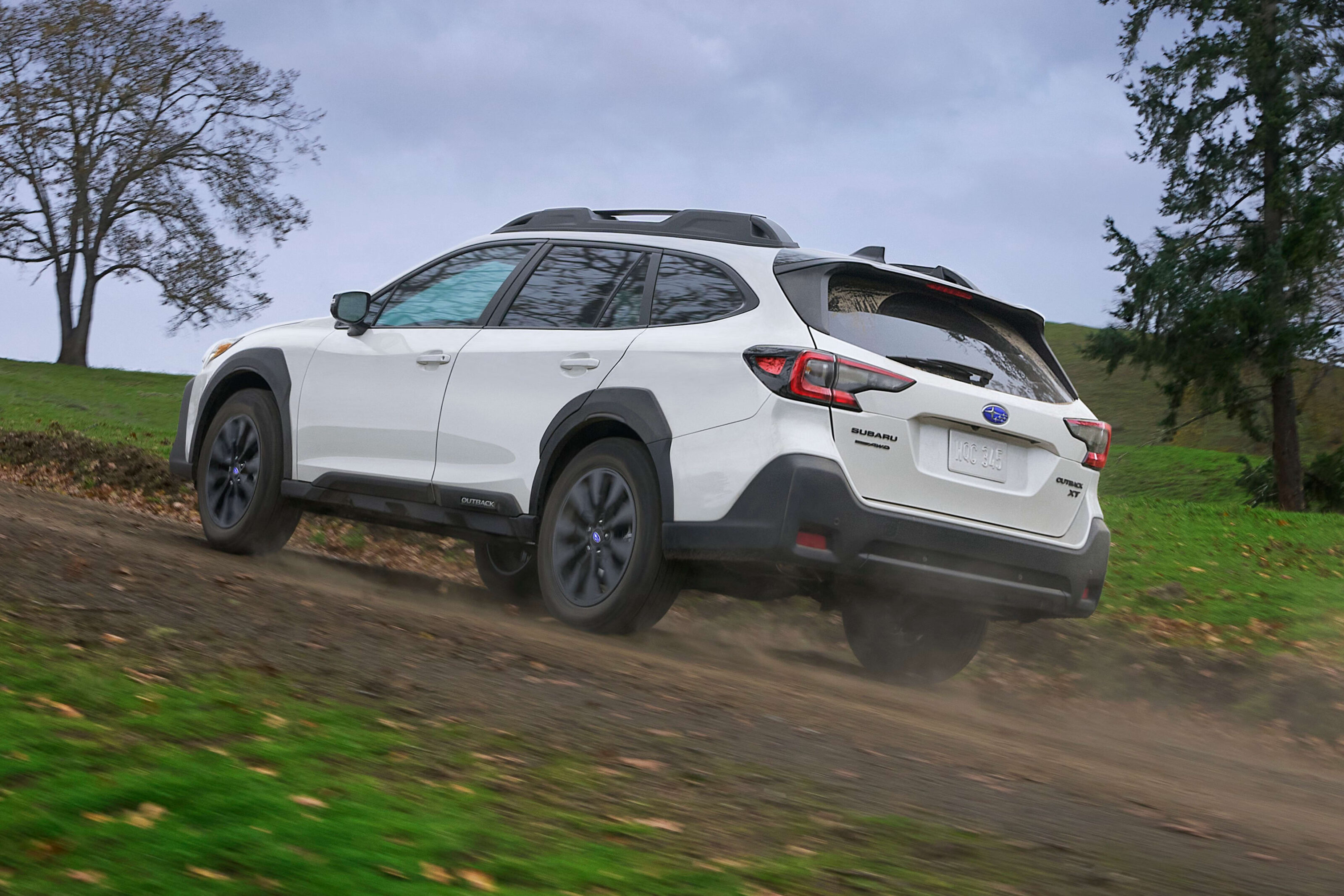
The 2023 Subaru Outback has been revealed overnight at this year’s New York International Auto Show, with the high-riding wagon adopting a new front design and more equipment than before.
Designed for the North American market, the update to the Outback sees its front end redesigned to fall in line with Subaru’s recent releases such as the new WRX, while extra black plastic cladding is aimed at both providing a more aggressive stance on top of extra protection.
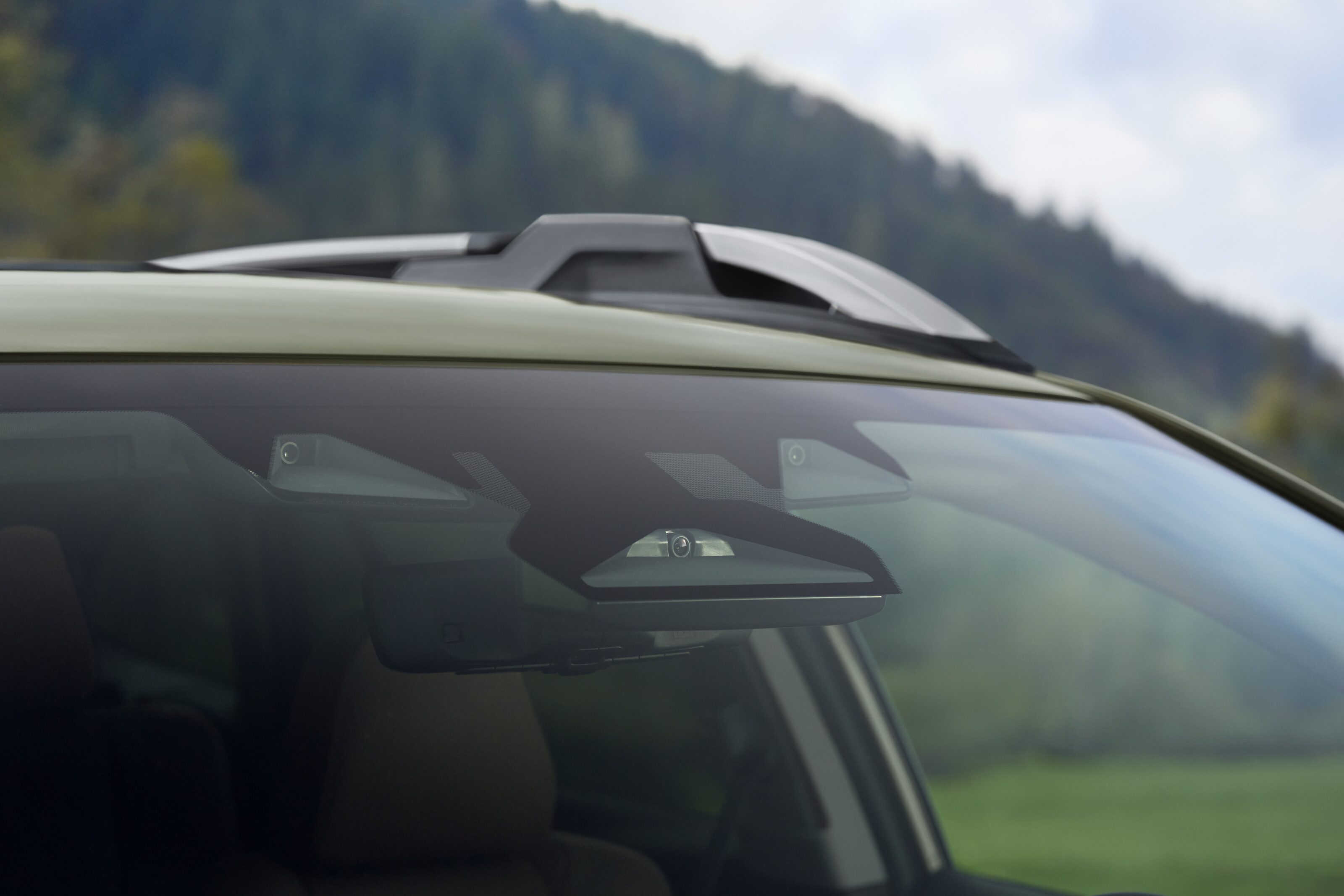
On top of the cosmetic changes, a number of equipment upgrades and improvements have been made to the 2023 model, with the latest version of Subaru’s EyeSight driver assist tech standard across the range, including a wider field of view for the camera, updated control software, and an electric brake booster.
The range-topping Touring grade scores an additional wide-angle mono camera – working in conjunction with the EyeSight system – as well as a full LCD smart rear-view mirror with auto-dimming, compass, and Homelink.
Subaru says examples of the Outback equipped with its blind-spot detection system now include automatic emergency steering on top of the autonomous emergency braking tech.
In the cabin, the 11.6-inch Starlink infotainment system on non-base models inculdes touch controls for multimedia, HVAC, X-MODE, and vehicle settings, while also incorporating Apple CarPlay and Android Auto.
Although unlikely to affect the Australian market, Subaru’s North American division continues to offer two engines in the Outback – a 2.5-litre naturally-aspirated four-cylinder, as well as a 2.4-litre turbocharged four-cylinder, although the latter has never been made available locally, with Australian buyers making do with the atmo 138kW/245Nm offering.
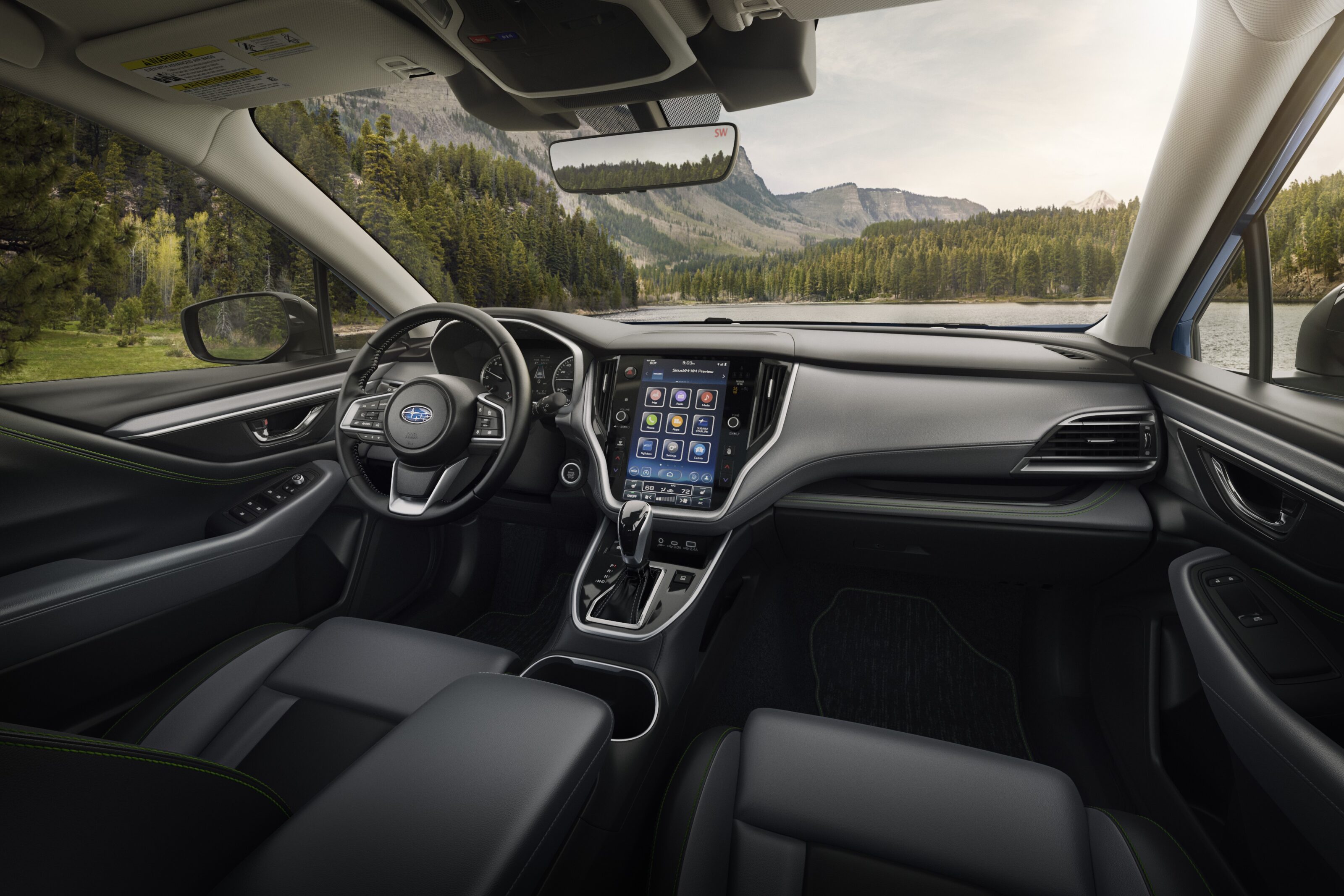
Subaru Australia hasn’t confirmed whether the updated Outback will be launched locally, as the North American wagon is produced in Lafayette, Indiana while Australian-delivered examples come from the manufacturer’s native Japan.
“Details of Australian specification MY23 [Outback] will be revealed closer to launch. The MY23 Outback will arrive in Australia early 2023,” a Subaru spokesperson told Wheels.
The Outback recently celebrated a local milestone last year with 150,000 examples sold in its 25-year history, with the latest-generation model gaining a fourth variant in December 2021.
Snapshot
- Cupra confirms local Born production to begin in November
- First examples to go on sale early next year
- 1800 expressions of interest have been made for the electric vehicle
Spanish brand Cupra has set a local launch date for its Born electric vehicle, with the performance hatch slated to go on sale in the early stages of 2023.
Production of the MEB platform-based EV will begin in November for the Australian market, as the first arrivals of Cupra’s Born are set to turn up on local shores in the first half of next year, becoming the first Volkswagen Group EV to be sold here.
Three test vehicles have been circulating on local roads since the start of the year, with Cupra eager to iron out any kinks from Australian conditions ahead of the Born’s launch.
UPDATE, December 2022: Australian Born pricing announced
Cupra has confirmed Australian pricing and features for its Born electric hatch. Get all the details at the link below.
Story continues…
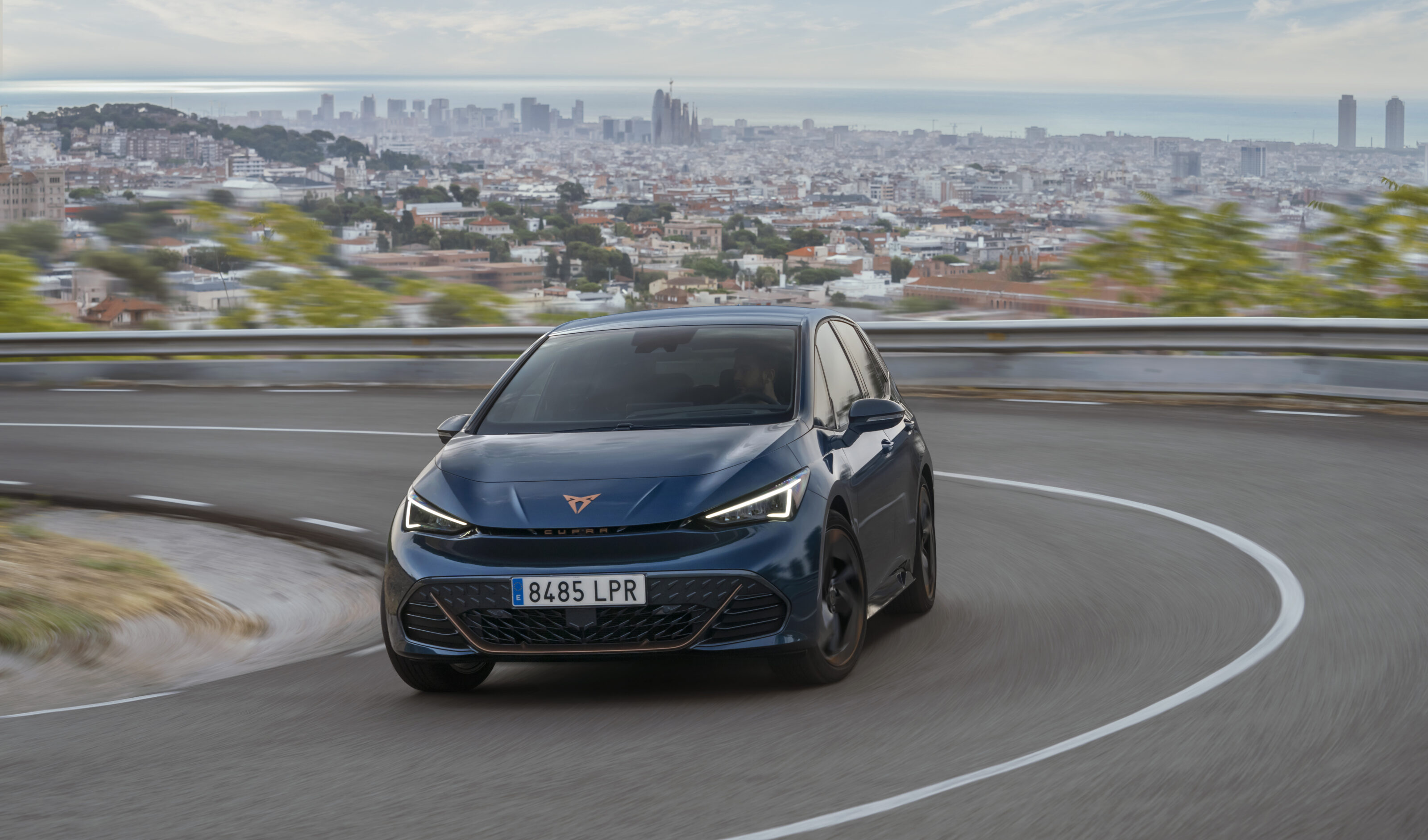
Cupra CEO and President Wayne Griffiths said the Born’s arrvial will kick-start a local interest in performance electric vehicles off the back of its success overseas.
“Last year in Munich I expressed my determination to get the Cupra Born to Australia as soon as possile,” said Griffifths.
“[Born] will go into production for Australia in the last quarter of this year and will start deliveries in early 2023.
“Already a sales succes in Europe, the Cupra Born is a car that in its every aspect embodies the visual and dynamic aesthetic that sets our brand apart. This car is set to be the impulse of a new generation of Aussie car lovers and to prove that performance and electrification can be a perfect match.
“As you know, since January we have had three Cupra Borns on your streets running tens of thousands of kilometres of tests, accruing valuable data that is being assessed in Barcelona right now.”
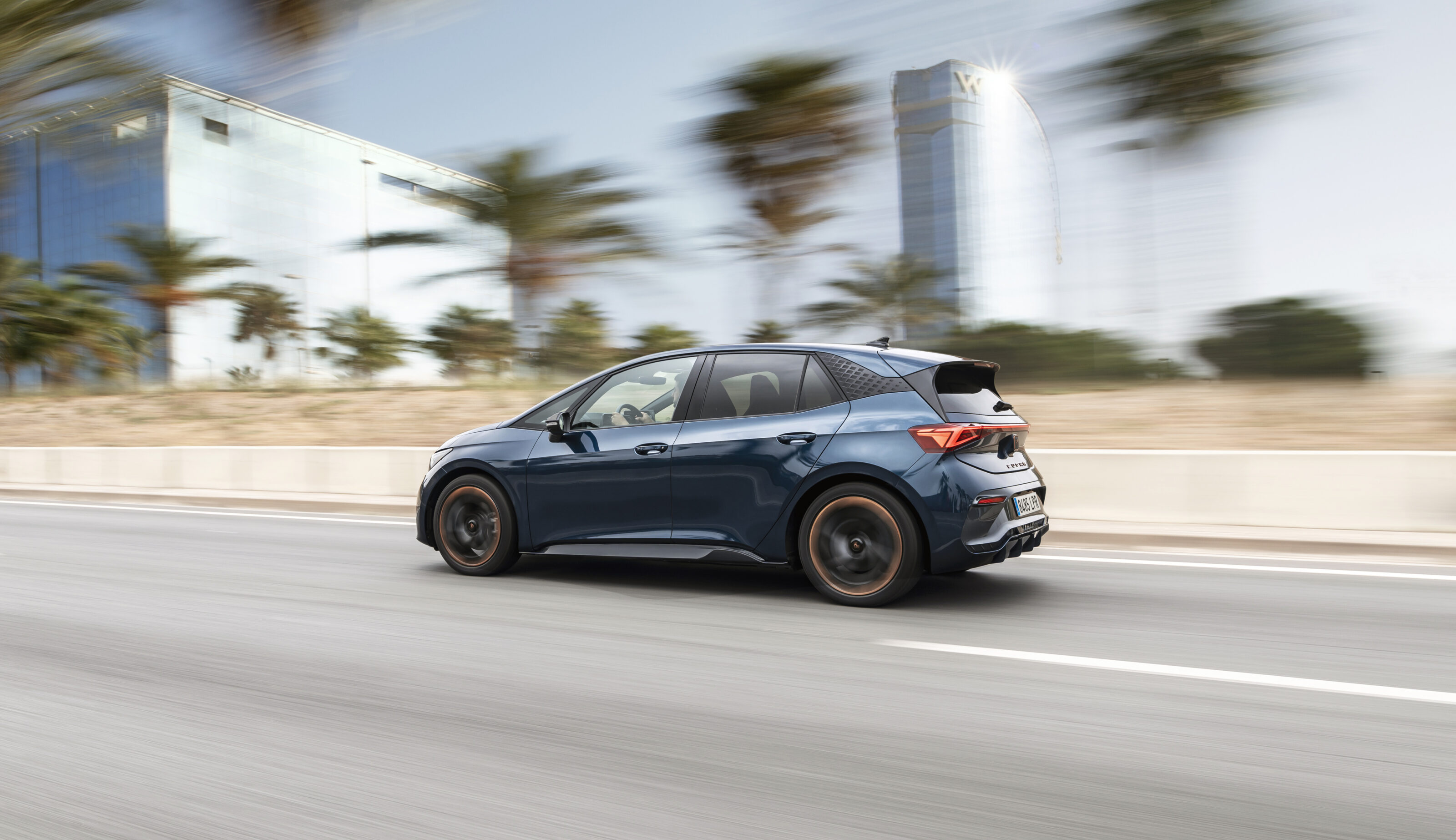
Australian director Ben Wilks said the 1800 expressions of interest for the Born make up a solid portion of the 6500 EOIs for the Cupra range, while the Formentor crossover spearheads the brand’s charge on 2900.
“This is a remarkable response to a brand that is entirely new to Australia and which is barely four years old,” said Wilks.
“To secure Born production at a time of unprecendented global supply challenges demonstrates Cupra’s commitment to Australia.”
Cupra is yet to confirm local prices and specs for the Born, although it has previously said the EV will come in around the same price as a Volkwagen Golf GTI, a vehicle which is on sale from $54,490 before on-road costs.
UPDATE, Tuesday April 19: Toyota has announced it will pause 10 production lines across nine Japanese factories throughout May.
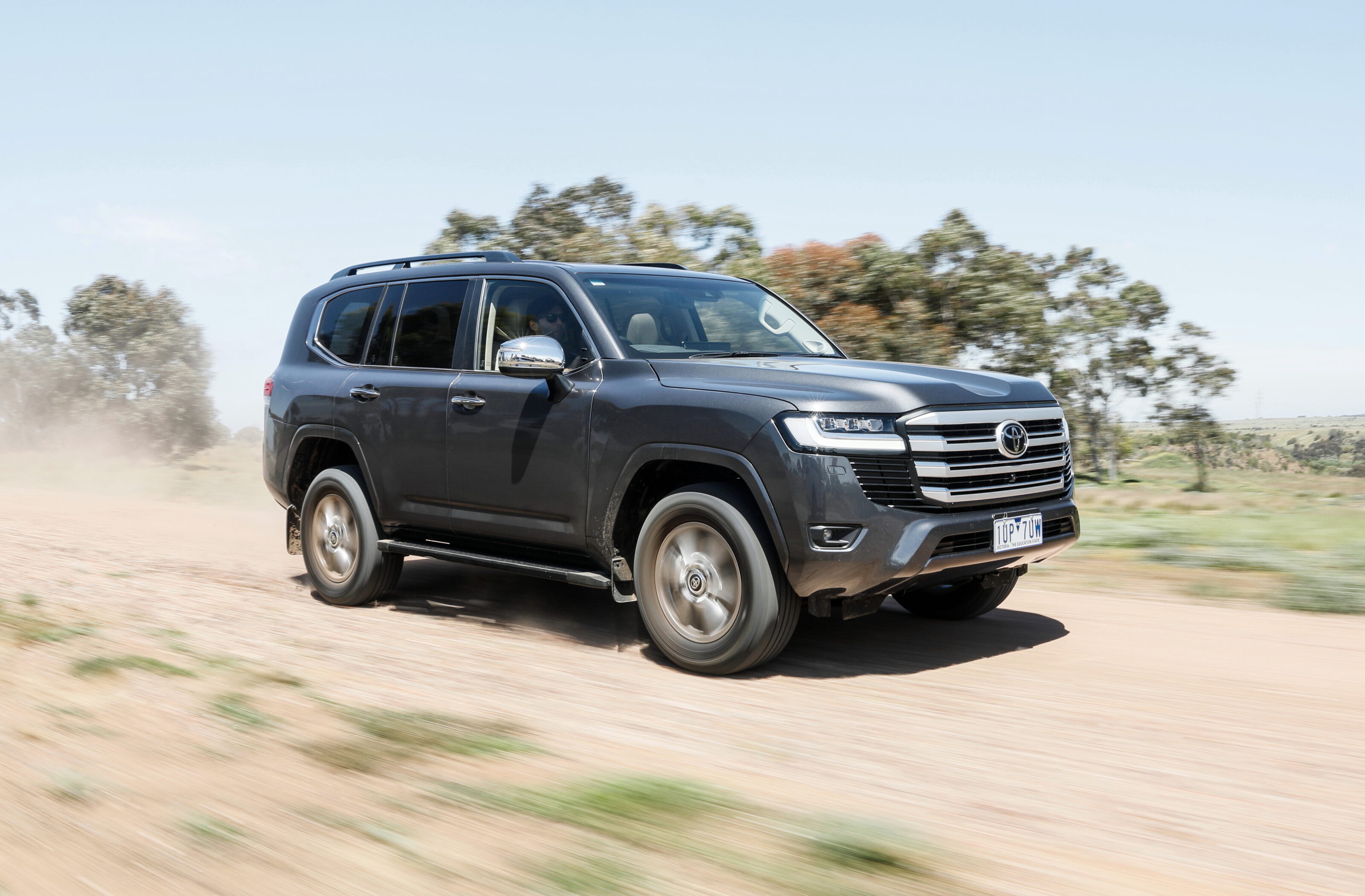
While a number of the models affected are not sold in Australia, Toyota will be halting production for the Corolla, Prius, C-HR, and RAV4 on certain days throughout the month.
Lexus models will also be impacted, including the LS, NX, and UX.
“We sincerely apologise for the inconvenience caused to our customers, suppliers and related parties,” Toyota wrote in a translated statement.
“It is still difficult to look ahead for several months due to a shortage of semiconductors and the spread of coronavirus infection, but we will continue to make efforts to deliver as many units as we can to our customers as soon as possible.”
As in previous months, the Japanese car giant expects production output to be reduced for May by around 17 per cent, to 750,000 vehicles.
The story to here
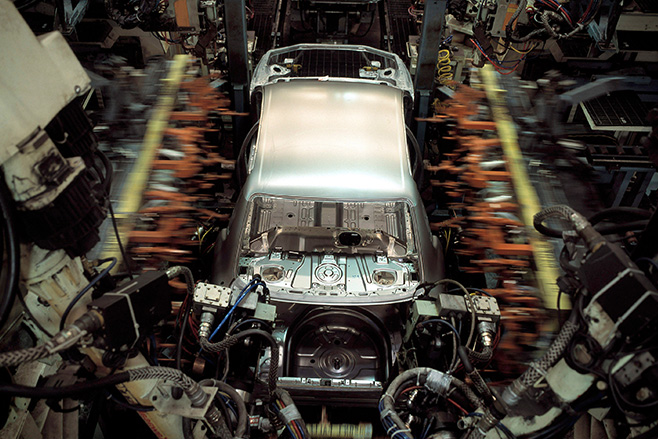
March 21: Toyota will suspend production across 11 more plants over the coming days, as the after effects of a recent earthquake hamper its efforts.
On top of its production volume for next month being dropped to 750,000 units (more information further below), Toyota has announced production will stop at 11 of its Japanese factories for the next three days, owing to a lack of supply due to last week’s earthquake in the Fukushima region.
Among the models impacted are the Yaris (including GR), Yaris Cross, LandCruiser (70 and 300 Series), Prado, RAV4 and C-HR, while luxury brand Lexus is also affected, with production coming to a temporary halt for its LC, LS, IS, RC, RC F and NX as well.
The manufacturer will continue to target a monthly average of 800,000 units between April and June.
The story to here
March 18: Further production pauses have been announced by Toyota for its global operations, also affecting luxury sub-brand Lexus.
Rolling on from similar shutdowns last year, the Japanese manufacturer’s planned production output has been slashed by almost 17 per cent, down from 900,000 units to roughly 750,000 vehicles throughout April.
A wide range of models from the manufacturers are set to be affected in some capacity, with Toyota’s Camry, C-HR, Yaris and Yaris Cross caught up in the pause while the Lexus LS, IS, RC, RC F, NX, CT, UX, ES, RX are also impacted.
In its native Japan alone, Toyota still plans to produce 250,000 vehicles throughout the month, while its international operations will account for two-thirds of April’s output – with 500,000 units planned to come off the production line.
Although it’s not yet known whether plans have changed for the coming months as well, Toyota stated its three-month production average from April to June will be “around 800,000 units”.
On top of the ongoing supply chain issues relating to semiconductor shortages and further COVID-19 outbreaks in south-east Asia, Toyota was dealt another blow earlier this week when a magnitude 7.4 earthquake was detected off the coast of Fukushima on Wednesday afternoon.
Production was suspended in nearby plants in Iwate and Miyagi prefectures, with Bloomberg reporting that it restarted late Thursday afternoon.
The earthquake also forced Nissan to close its Iwaki plant, although it’s understood the site was due to be shut on Thursday and Friday anyway for workers to be vaccinated.
UPDATE, April 19: BMW has confirmed the WLTP-rated driving range for its upcoming i7 flagship sedan, just days ahead of its reveal.
The luxury sedan will boast a driving range up to 625 kilometres in its most economical form – consuming 18.4kWh per 100 kilometres – while the ‘M’ variant of the electric vehicle is expected to return a range of 590 kilometres.
Covers are set to come off the electric 7 Series this week, signalling a major shift for BMW with its premium products moving away from internal-combustion engines.
The story to here
March 16: The 2023 BMW i7 will be fully revealed at the New York motor show next month.
BMW teased the electric 7 Series at the company’s annual conference, announcing the brand’s electric flagship will come with up to 610 kilometres of driving range.
While full details have yet to be confirmed, it’s expected the i7 will share much of its eDrive powertrain with the iX SUV, with the limousine rumoured to be offered in three variants: an entry-level rear-wheel-drive version, a mid-range all-wheel-drive version, and a range-topping M model.
The high-performance i7 will deliver 580km of range and a maximum of 455kW in M guise – matching the iX M60 – indicating the sedan will likely offer 1100Nm of torque and a 0-100km sprint in around four seconds or less.
BMW’s trademark coffin grille will also feature with LED outlines, complemented with sparkling LED headlights, and its party piece – fully-automatic doors.
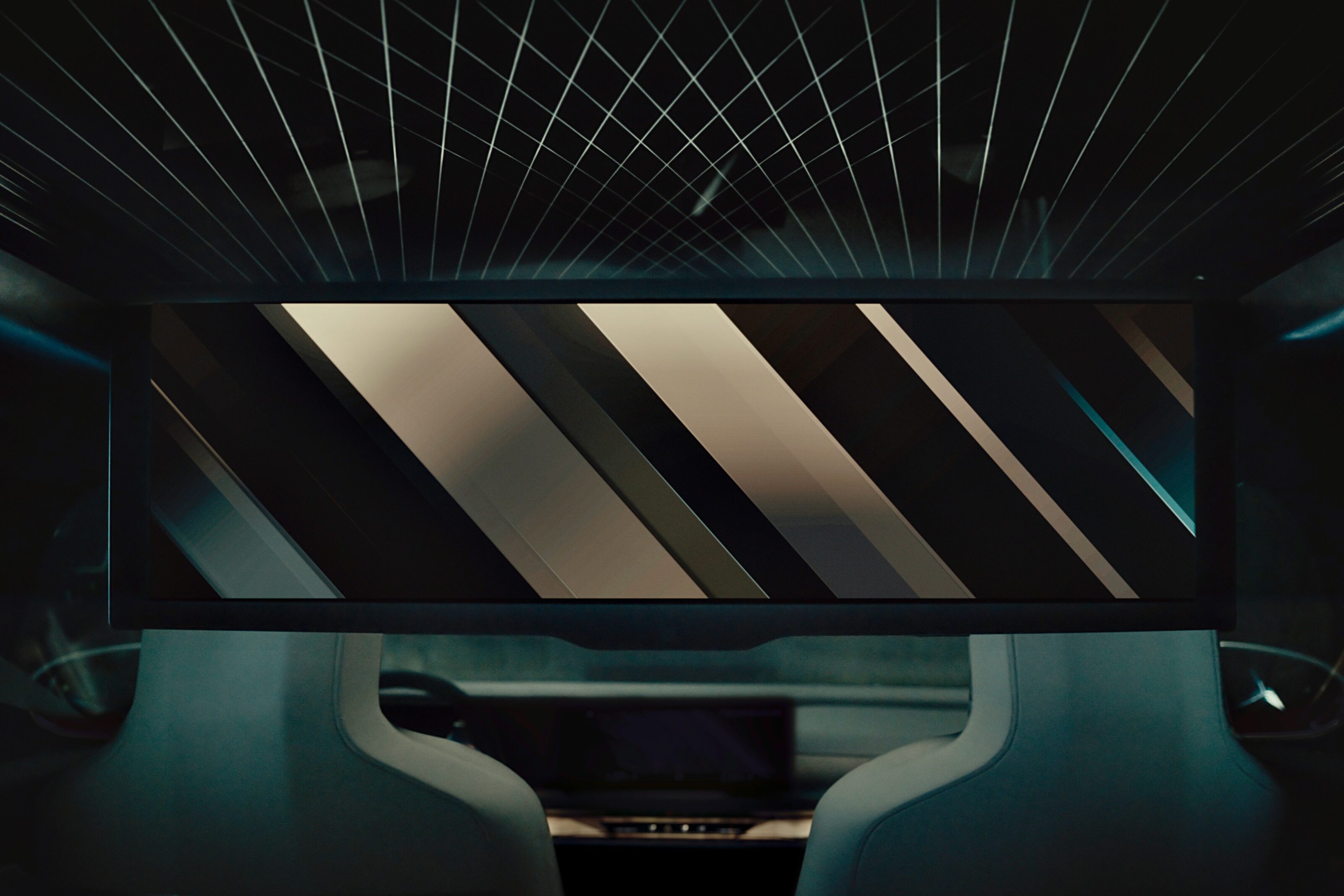
Inside, crystal ambient back-lit trims will greet occupants, while a 31-inch screen will slide down from the roof for rear-seat passengers, offering a 32:9 display and 8K streaming resolution.
The new 7 Series will also be available with petrol, hybrid, and fully-electric powertrains, with full specifications to be announced next month.
The 2023 BMW i7 will make its debut at the New York motor show on April 15, 2022, with local availability to be provided closer to its Australian launch.
The story to here
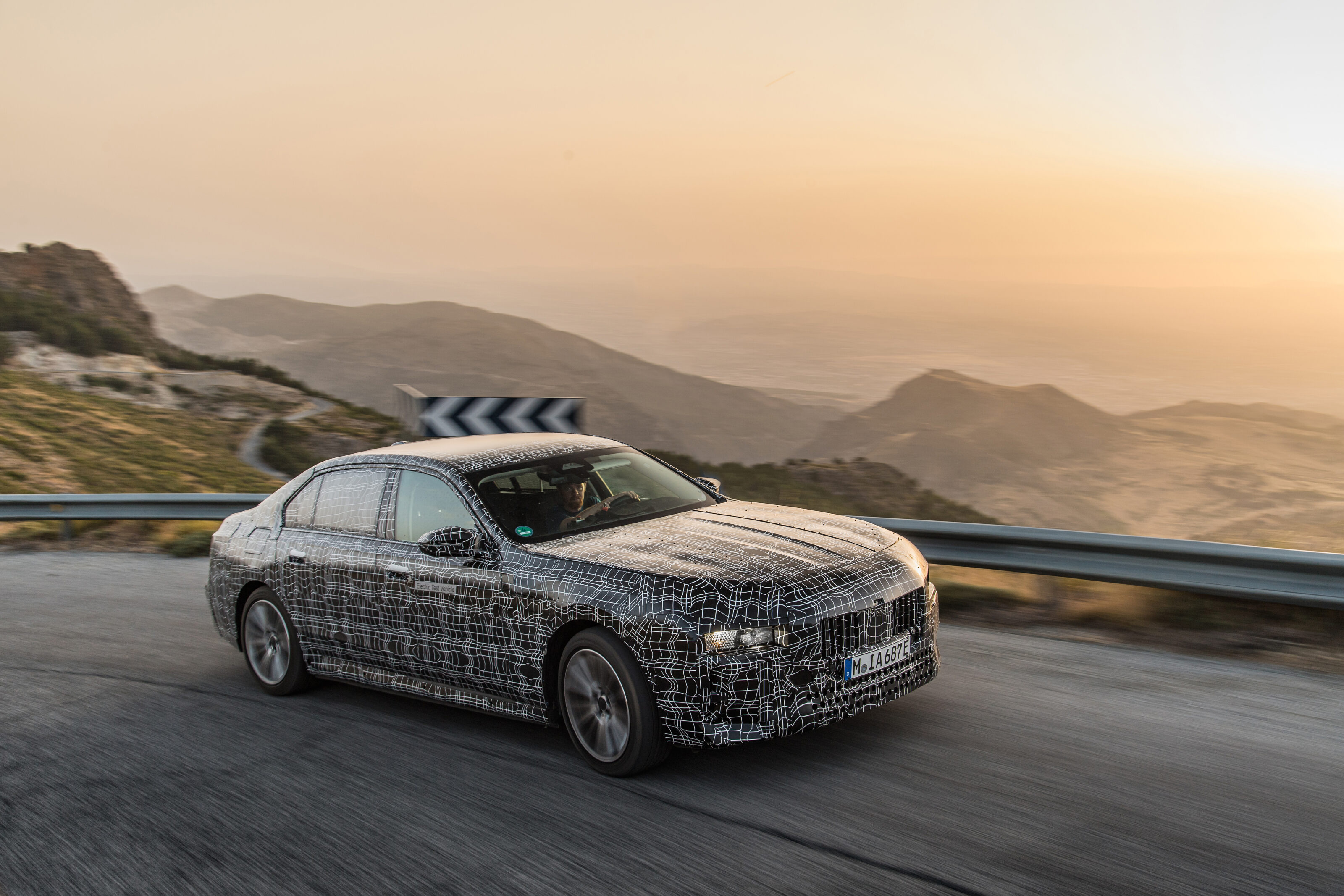
BMW has released more teasers of its upcoming luxury electric flagship, the i7.
While the i7 prototype in these “official spy shots” remains camouflaged, it is our best look yet at the model all around.
Unlike the EQS, which is changing the shape of Mercedes-Benz’s range-topping sedan in EV guise, the i7 appears to be more boxy and traditional in shape – although the finer details are yet to be seen.
As is customary on new BMWs however, the next i7 will feature a huge grille to be shared with the new 7 Series.
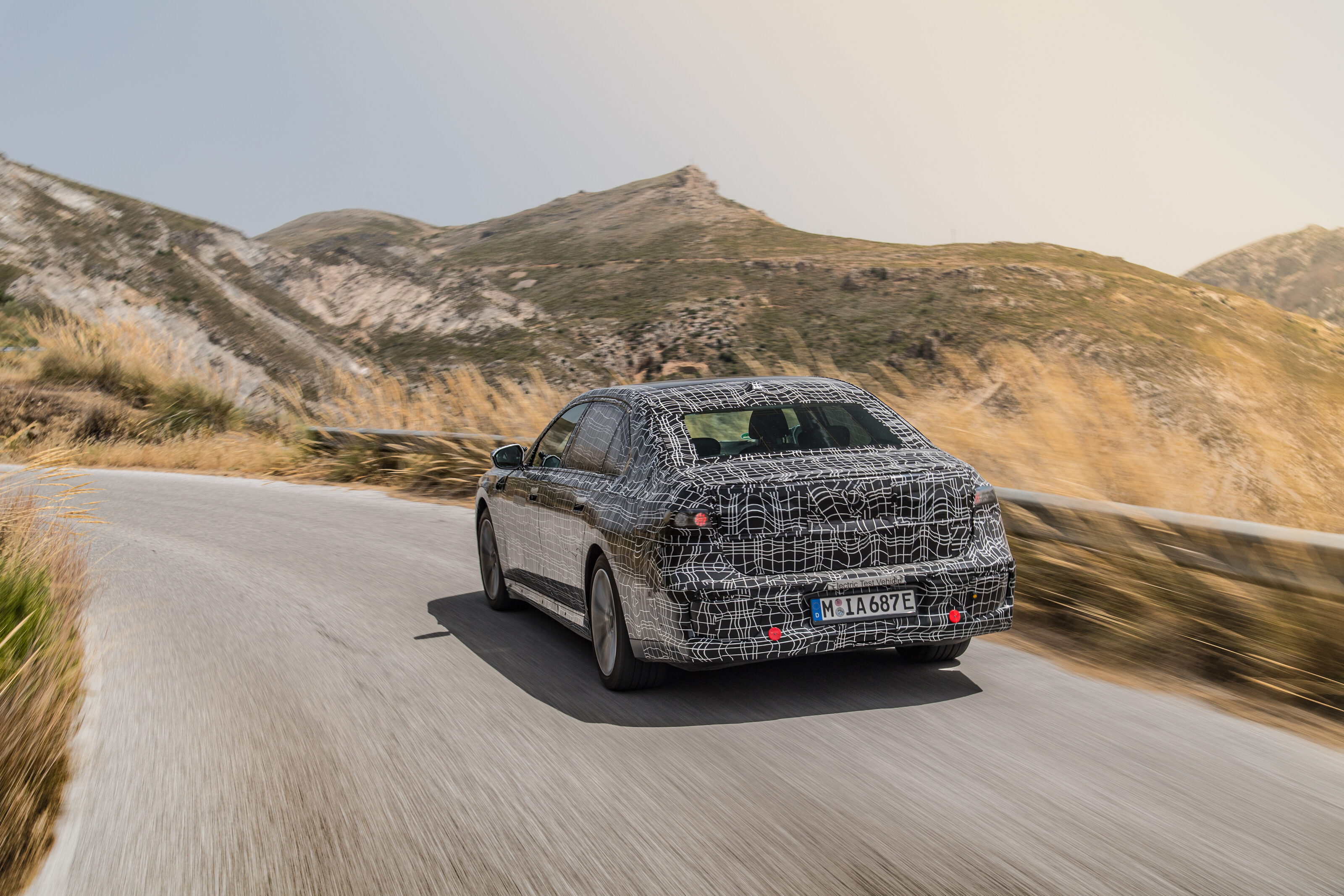
BMW also will introduce a new headlight design like that of the facelifted X7 SUV. Instead of single-unit headlights, there will be split daytime running lamps and driving lights above.
No drivetrain details have been released yet, but BMW’s modular CLAR platform which sits underneath the i4 and iX should also underpin the i7. This groups the electric motor, transmission and electronics into a single unit and reduces production time, and it’s lighter – which increases driving range. Anticipated is a dual-motor setup with 385kW of power and all-wheel drive in the xDrive50.
Specs should resemble a 0–100km/h time of around 4.5 seconds and a top speed over 200km/h. A more affordable xDrive40-badged variant with around 240kW is likely to be offered but with a slower six second 0-100km/h time.
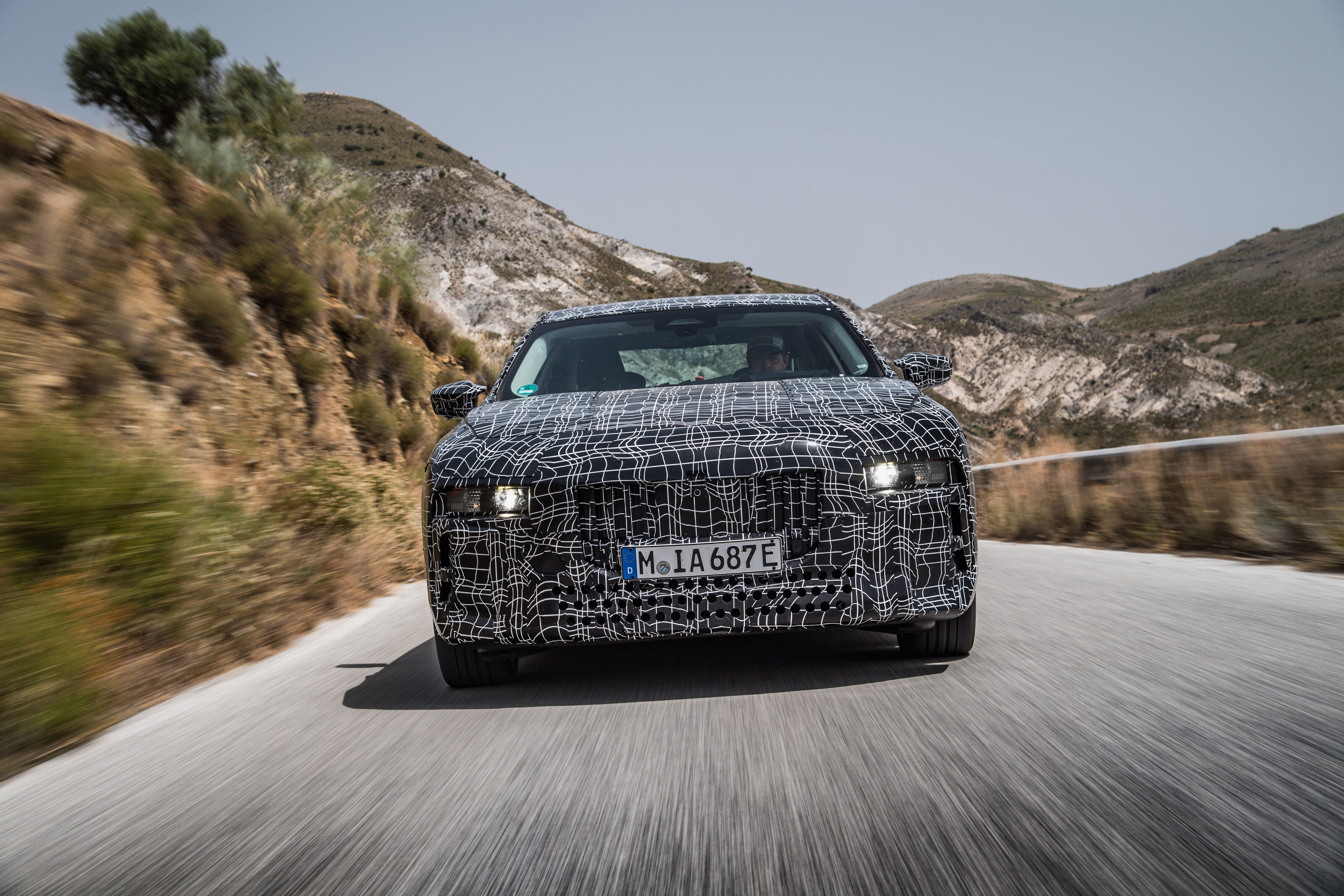
BMW also claims the car’s suspension, steering, braking, driving dynamics and stability systems have been “designed to raise the balance between sportiness and ride comfort that’s typical of the brand’s luxury sedans to the next level.”
With the i7 competing directly against the Mercedes-Benz EQS, we expect BMW will need to achieve a driving range of around 650 kilometres to remain competitive – as the the EQS is capable of almost 800km on a single charge. Rapid charging will be a necessity to be relevant.
Launch timing for BMW’s seventh-generation 7 Series is next year, as it goes on sale at the end of 2022 along with the traditional combustion-engine 7 Series.
Drift mode. It’s a headline feature that, beyond any other, suggests that Volkswagen’s latest Mark 8 hatch is the Golf R icon so many Aussies love if not as they know it. That and the fact that, roughly, the new hot hatch poster child is $10k pricier than the outgoing 7.5.
For what’s the thick end of 20 percent higher outlay, the clear expectation is that Mk8 Golf R ought to be better, hotter and somewhat different than its forebear. And presumably without losing the maturity and all-round goodness that underpins its everlasting popularity and cult following in Australia.
But given the decade-old MQB platform carries over from its forebear and its EA888 turbo four heartbeat date back to Mark VI, the question is: where is it lifting its game? Further, its familiar DNA is minted in five-door Golf convention, avoiding bespoke wide-bodied specialty and three-door exclusivity that has been offered in recent times by many of its hottest key hatchback rivals.
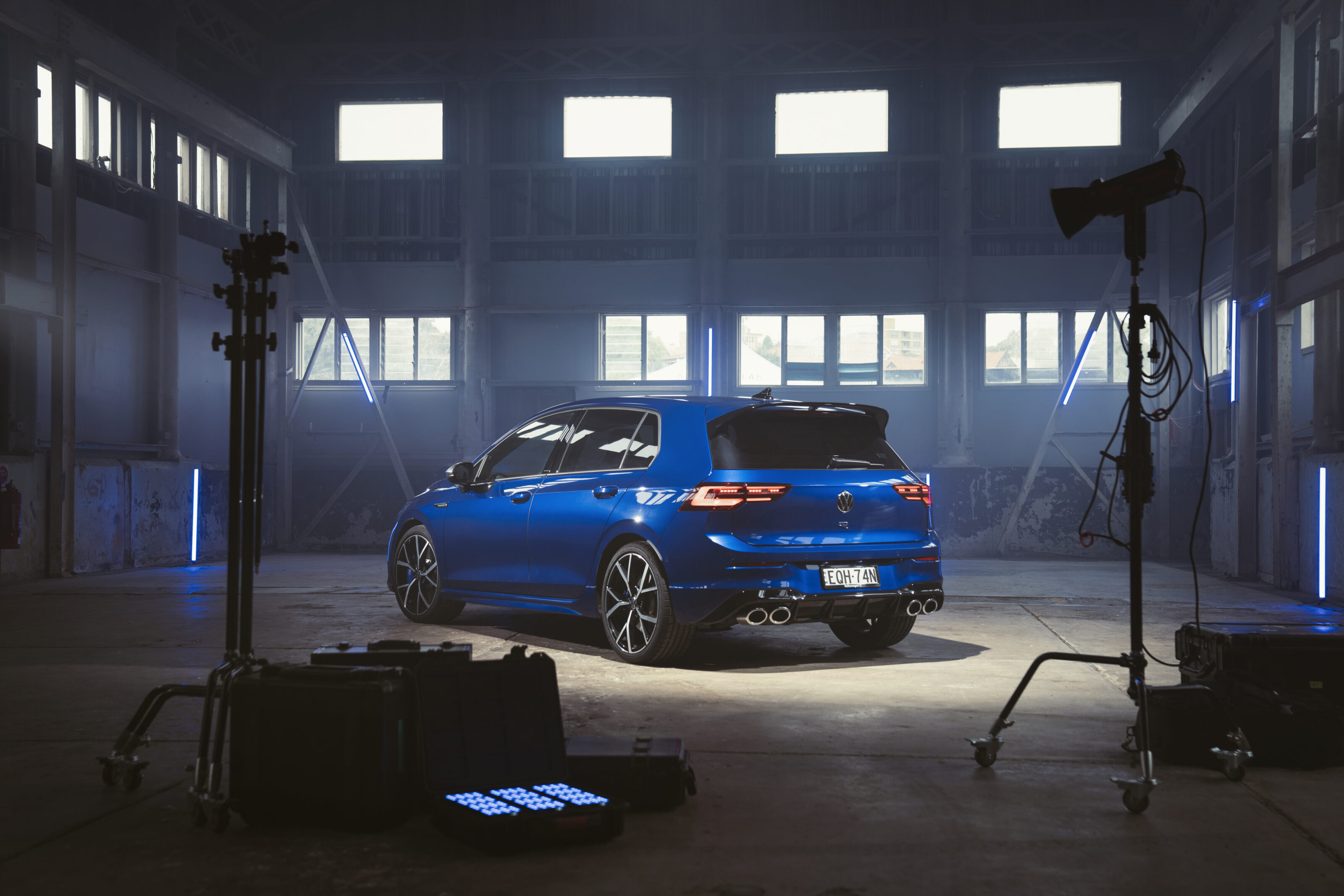
The Golf R’s timing is impeccable, lobbing in a moment where its main competition is either getting on (Hyundai i30 N, Renault Megane RS), between generations (Honda Civic Type R), yet to surface (Toyota Corolla GR) or shuffling off to extinction (Ford Focus RS and Subaru STi). Fit and present, though, is the Vee-Dub’s freshly baked Audi S3 Sportback cousin.
Finding oneself on a lean battlefield is no excuse for phoning the hot hatch experience in, but it does mean Volkswagen Australia has a hand in what you get for the sort of coin it asks for. Want a six-speed manual like North America gets? Tough. But local spec is fulsome and our Golf R arrives standard in Performance Pack guise other markets charge extra for.
Pricing is $65,990 list, originally announced as a thousand bucks higher though, because of component shortages, its Harmon Kardon sound system was relegated to the options list for a corresponding upcharge.
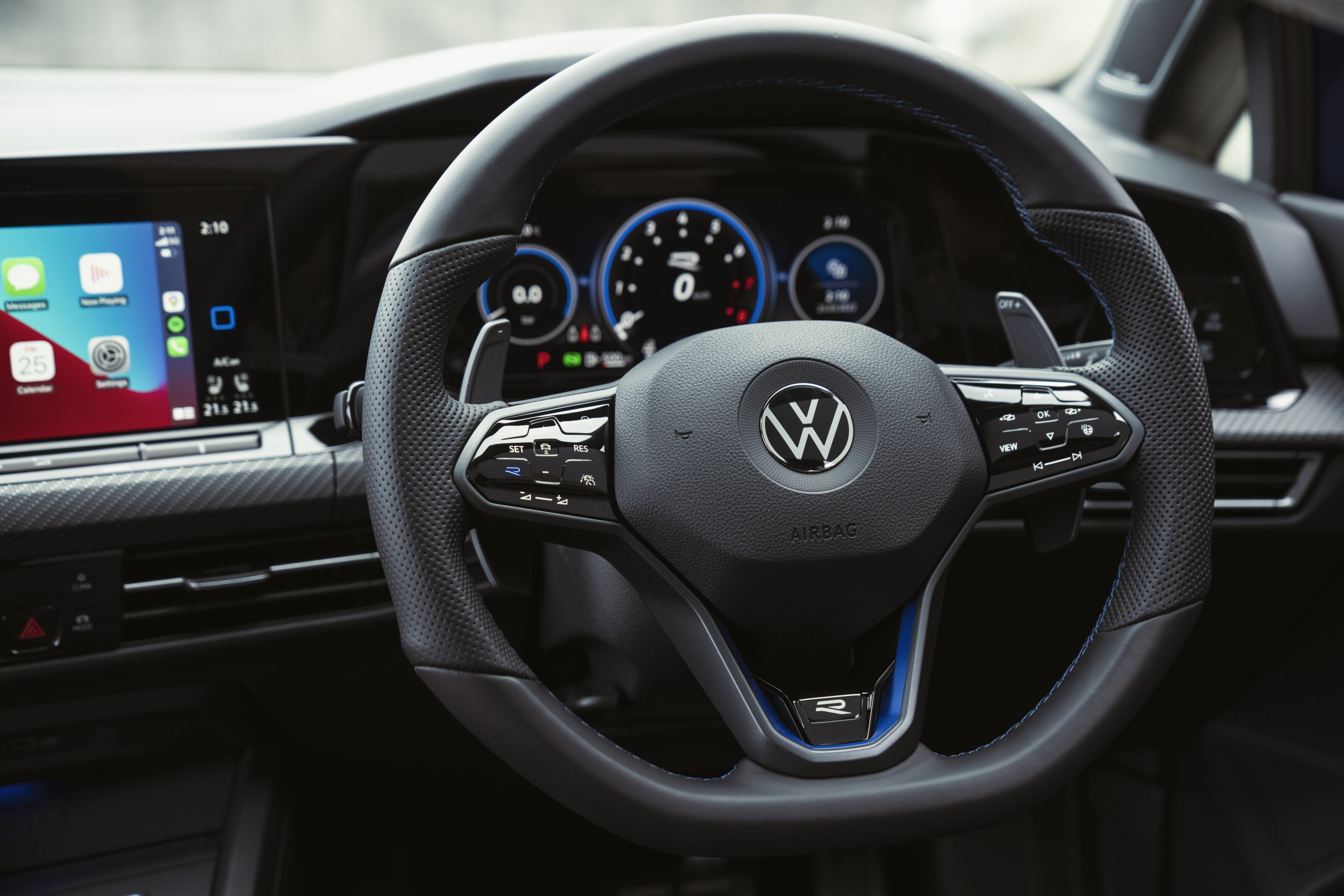
It’s a short list – a panoramic glass roof for $1900, all paint colours are no-cost – for a features suite that shoehorns in goodies such as Matrix-type LED headlights, 19-inch wheels, 12-way-electric nappa leather R-spec front seats, 10-inch Discover Pro infotainment, three-zone climate control and an exhaustive suite of IQ.Drive safety and assistance features.
Importantly, and finally, regular Golf R isn’t short-changed on outputs. This Evo4 iteration of the evergreen EA888 – new block, revised head and injection – outputs the same 235kW and 400Nm offered globally (and is seven kilowatts up on the new S3).
That’s identical to the new Tiguan R if 20Nm shy of the Golf R Wagon all launched concurrently on Oz, though the hatch is, with its 4.8 seconds for the 0-100km/h sprint, the swifter by one- and three-tenths respectively. The only transmission offered is a dual-clutch seven speed, an R-specific wet-type unit with launch control facility.
The significant technical change is the all-wheel-drive format. Gone is the time-honoured Haldex design, replaced by a torque-vectoring rear differential. Its twin electro-mechanical clutches can accurately apportion torque between the rear wheels for all manner of dynamic and stability needs, but its party trick is loading all torque to the outside rear wheel to facilitate the newfound Drift mode.
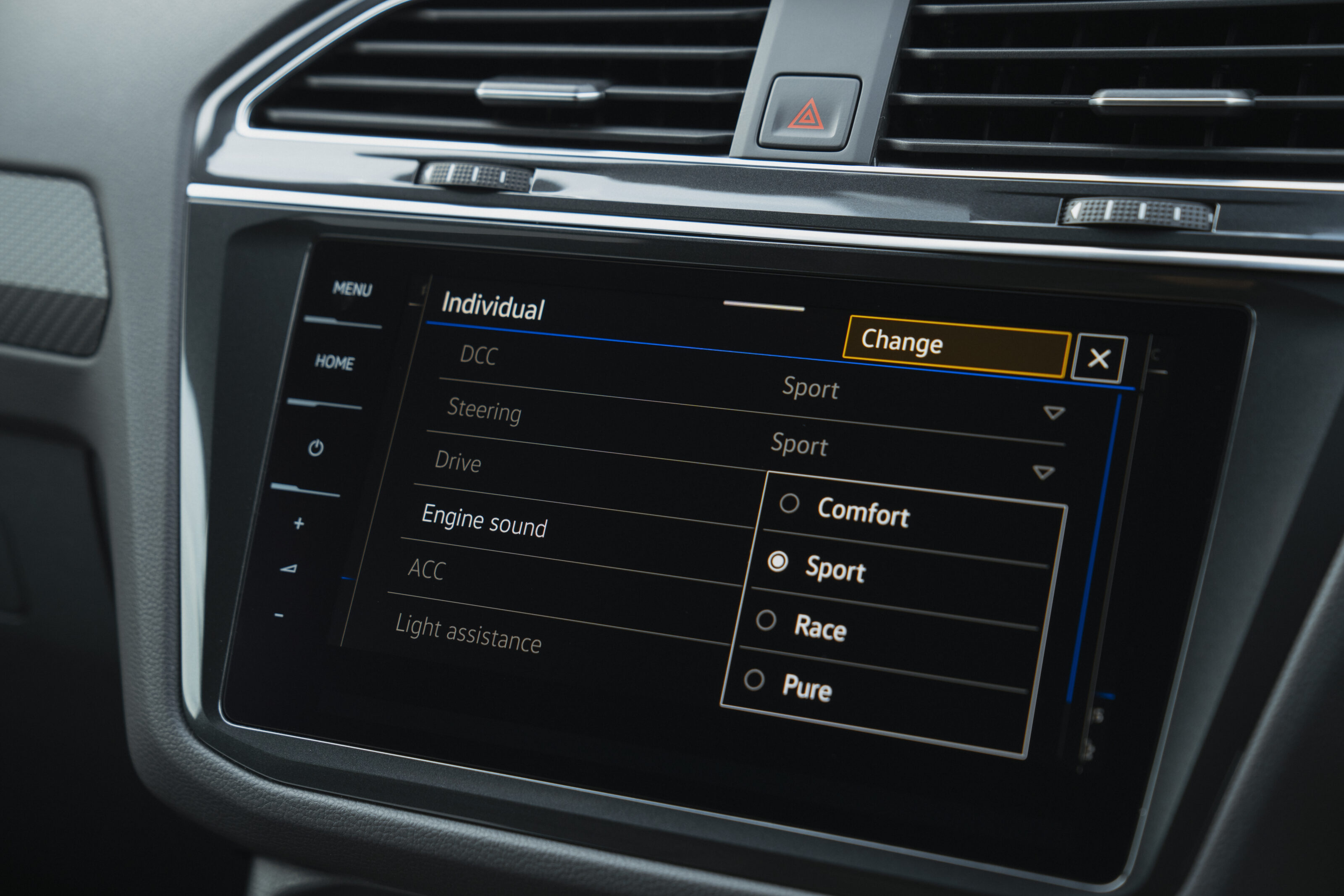
Less conspicuous is the host of features and user adjustability buried in the Golf R’s trick bag, most of it tied to the Vehicle Dynamics Manager key systems and dictates the hatch’s character. Separate from Race and Drift modes, there’s a Special (aka Nurburgring) rear-bias torque mode, left-paddle rapid-downshift setting, independent stability and launch programs, and even a new Pure soundtrack option.
It’s complex, some of it not terribly intuitive to adjust or navigate, and it demands a bit of a learning curve to get on top of and to dial up desired effect. Perhaps more that available at the Golf R’s local track launch.
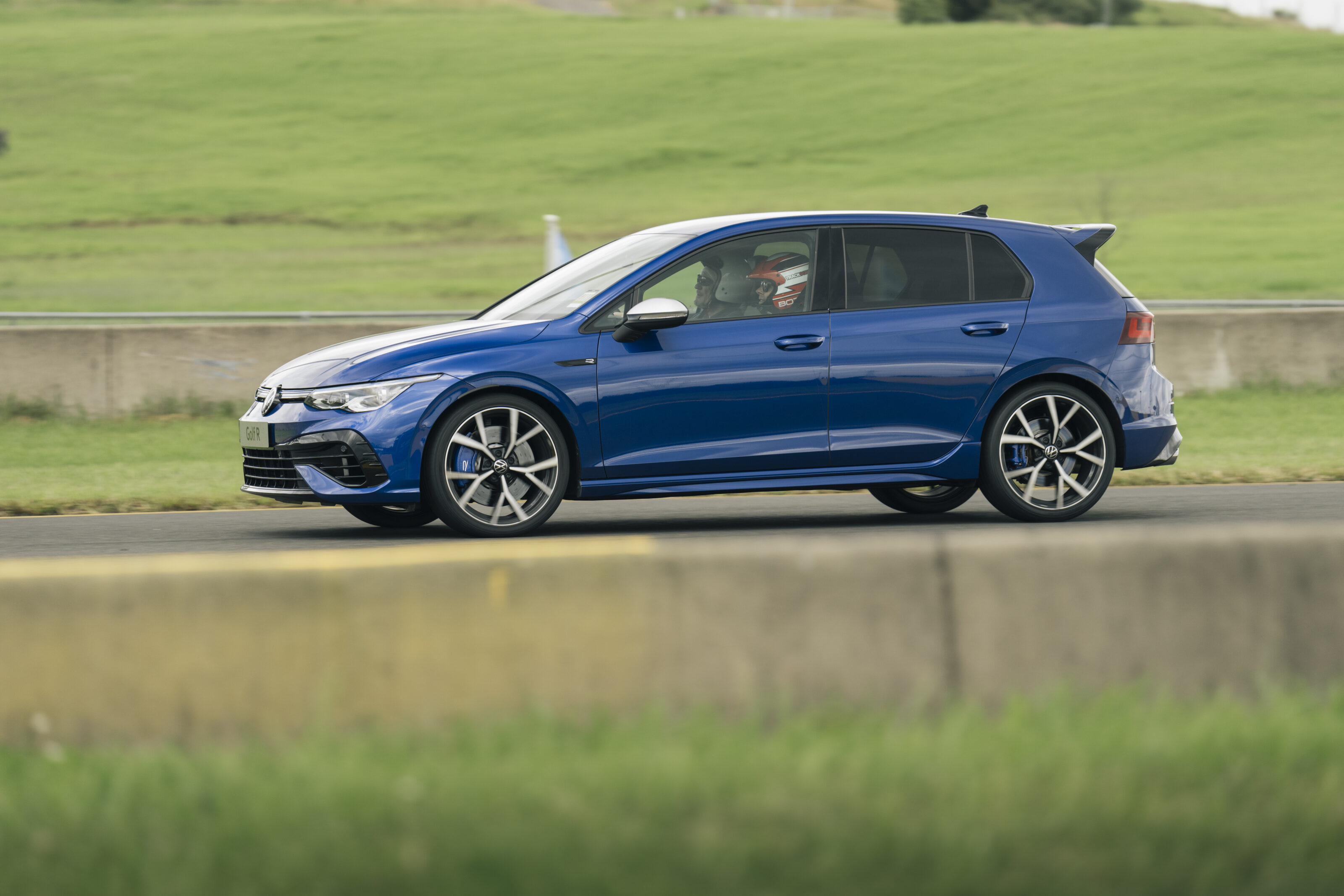
The old Eastern Creek, now Sydney Motorsport Park, is a good forum for measuring the Golf R’s outright heat. Though its allocated fast-flowing North Circuit experience, rather than the tighter and more dynamic South Circuit, isn’t perhaps ideal in showcasing new AWD torque-shuffling chops and the various whiz-bang modal flavours tied to it.
Thrown into red-misted circulation, its Race mode proves that the Mk8 is indeed properly fast and not out of water on track. Where the old 7.5 tended to trip over itself beyond eight-and-half tenths – in balance and point, mostly – the newcomer seems more confident and planted fully strung out. It tracks and responds well, if with that slightly benign response and round dynamic edges that have long been hallmarks of the Volkswagen’s raciest hatchback.
On track, the Mk8 seems keener to rotate through the mid-corner and lean on its outside rear on corner exit more assertively. At least exclusively through the tighter Turn 2 and subtly rather than obviously so. Any mode bar Race with ESC defeated tends to squash the turbo-four’s corner exit squirt excessively.
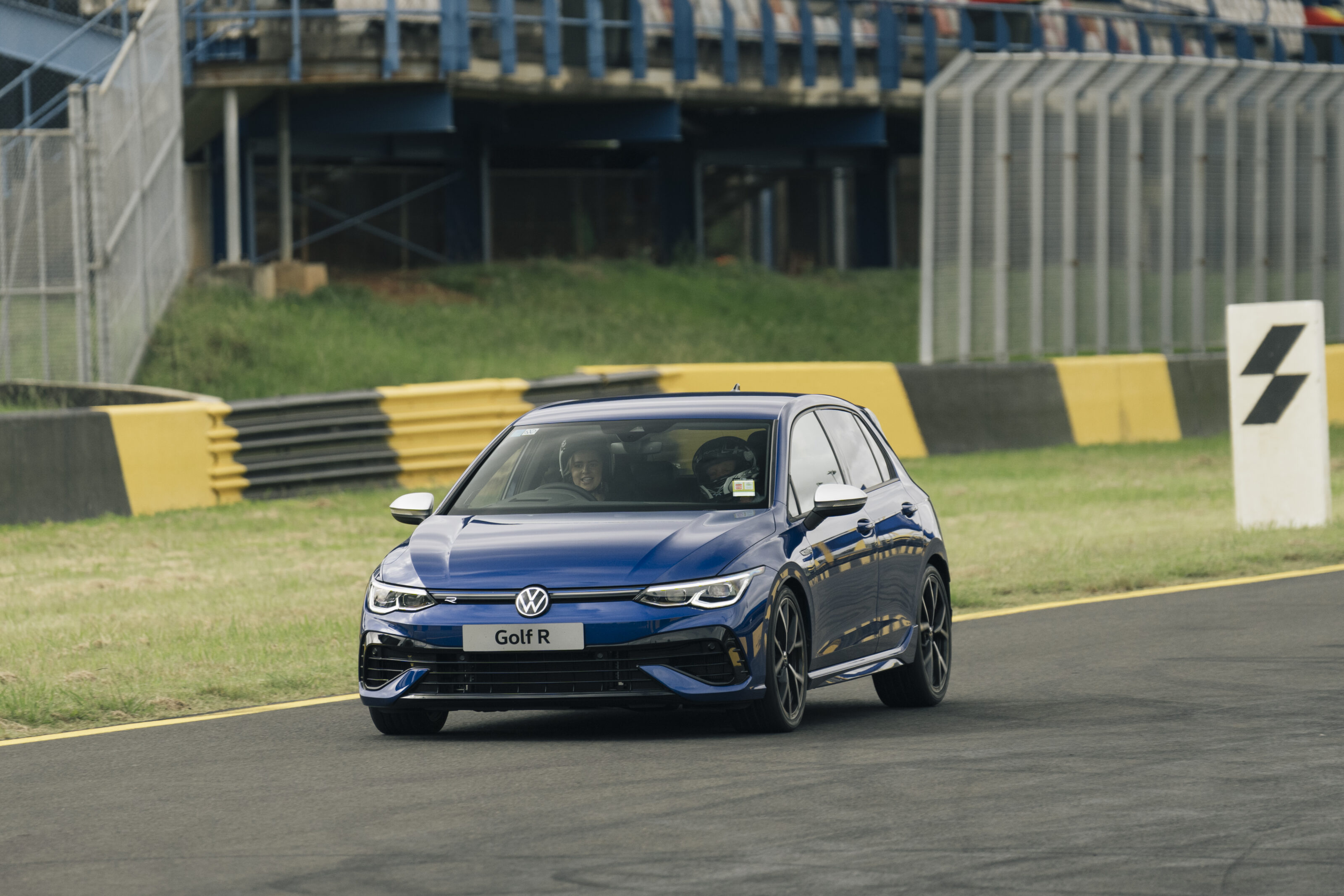
That said, on balance, corner speed is surly enough that, frankly, even its bumped outputs feel barely adequate for the pace the rest of the package musters up. At a little over 1.5 tonnes, it’s fairly light on its 235mm Hankook Ventus S1 Evo3 feet. However, at its limits some of those older Mk7.5 traits are inescapable: slightly leaden steering with aloof feedback, benign dynamics and less than assertive front-end point.
The Mk8 is not some miraculously sharper, clearer and more focused R revolution. Instead, it’s very much the old 7.5 character mildly evolved, flexing its dynamic muscles a little more confidently without bending an old and familiar mould. If you’re expecting some dramatic, fire-breathing, power-oversteering transformation, be prepared for some disappointment. At least on circuit.
A wet skidpan? Well, that’s something else entirely. Even as a spectator, watching the Golf R power-sliding at full noise around safety cones on a large expanse of wet concrete is highly entertaining. If merely because, while three wheels spin furiously, the inside undriven rear wheel slows in rotation to almost a standstill.
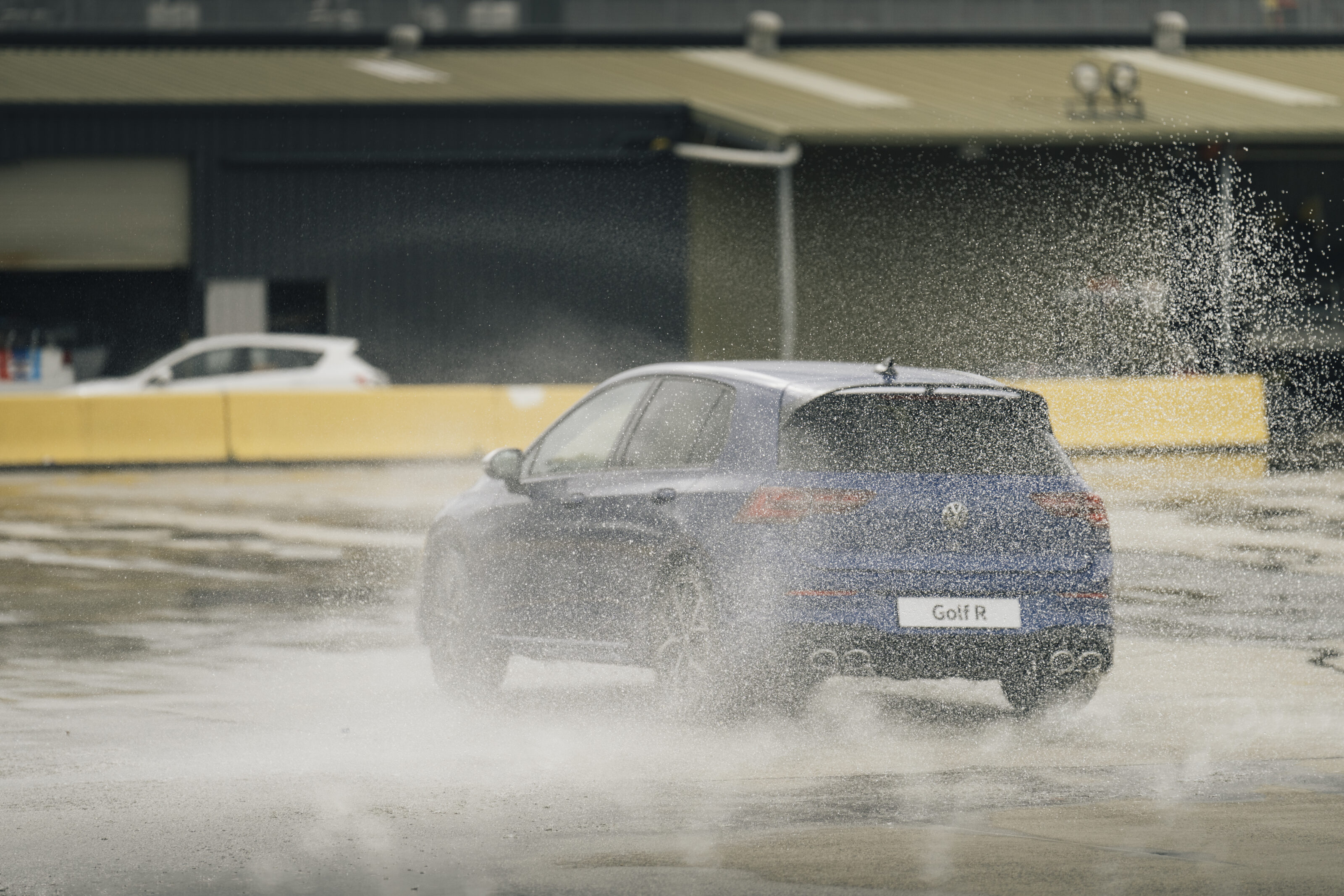
Nor does it drift itself. Thus activated, you can choose Sport ESC or ESC off, the former shutting torque down excessively if you attempt a sustained slide and is ideal, perhaps, for wet targa-type road rally activity.
The latter setting uncorks full Ken Block mode and sustained power-slides and it takes some mental calibration. Lifting out of the throttle to counter excessive yaw, as is natural intuition, stops the drift dead in its tracks. As torque vectoring doesn’t lock the rear axle under power, the system demands you bury the throttle, steer your way out of trouble exclusively and hang on for the lairy ride.
Drift mode is an absolute hoot. But I suspect it’s ideally served on a slippery or broken surface. The jury is out as to whether it’s quite as honed and, ahem, focused as Ford’s RS system, one that’ll liquify rubber on dry hot-mix in heroic fashion while delivering all of the control and poise demanded.
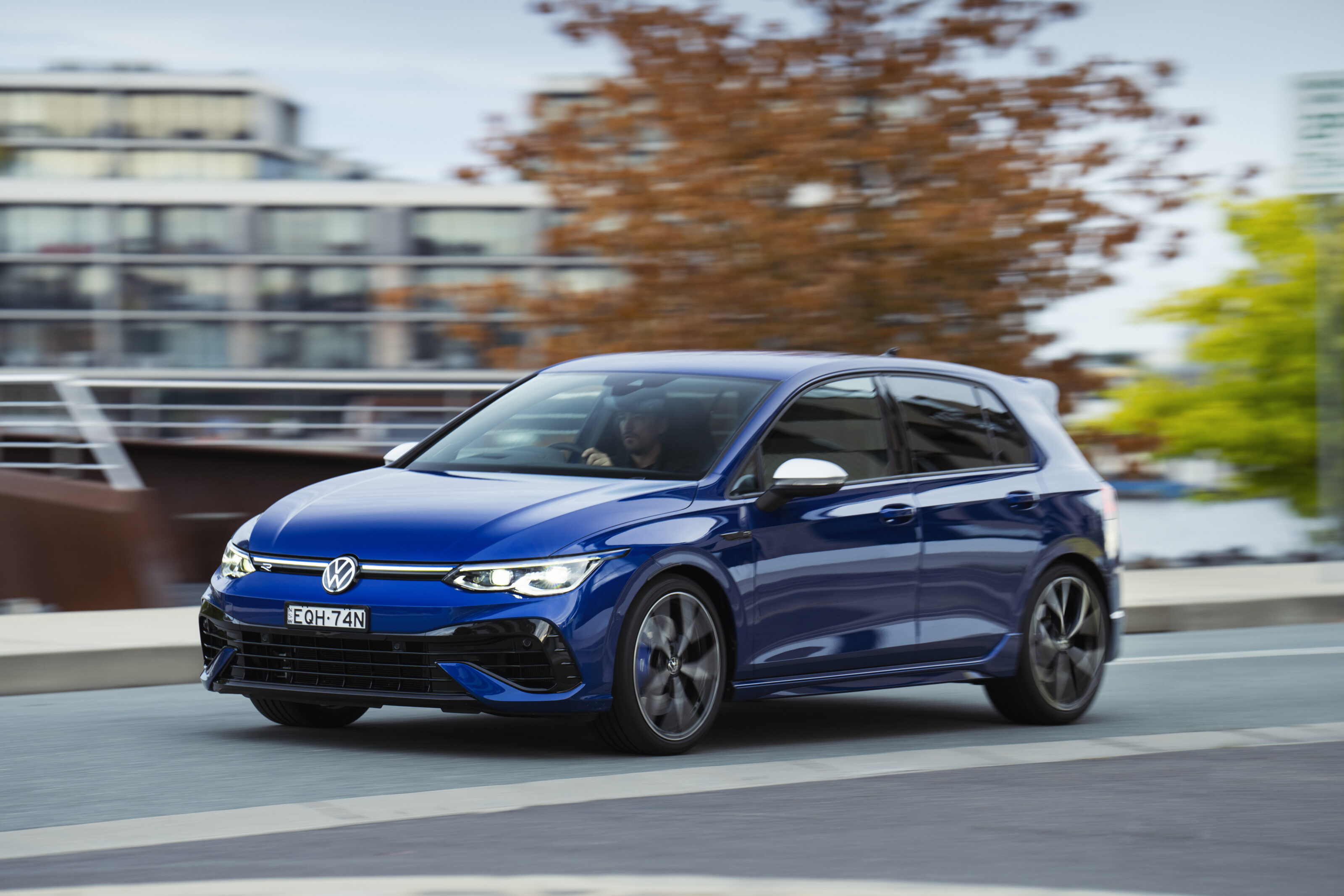
While as properly quick and unruly as it needs to be, the Golf R still brings its best where it’s most at home: on road. From the peak-hour grind to fair-weather backroad punting, it’s the breed’s hallmark breadth of real-world talent that continues to shine the brightest.
No matter how you drive, the Mk8 maintains a particular blend of overarching comfort and refinement underpinned with fizz and purpose no other spirited hatch, GTI included, balances quite so sweetly. It smooths out rough edges in general execution and brings a tampered manner that’s downright placid when it needs to be. And that’s key to a maturity that neatly sidesteps gauche boy/girl racer-isms that still stigmatize harder-core hatchback rivals.
As a grand tourer or everyday runabout, it remains a benchmark in polish and refinement, its ride user-adjustable with broad scope if wonderfully calibrated and disciplined in default. If there’s a markdown, it’s that it drums up a helluva lot of tyre road on coarse chip surfaces.
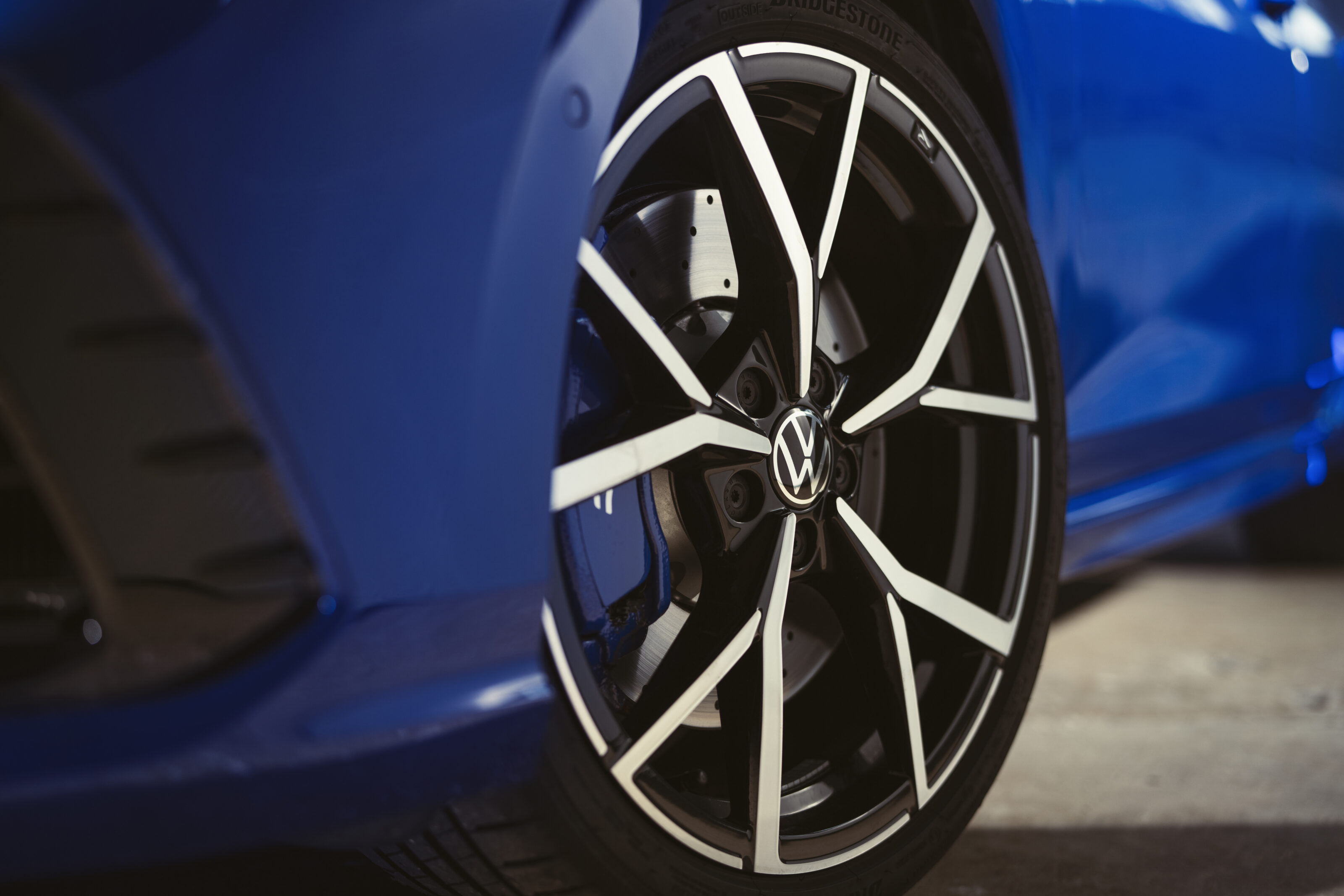
Tackle tighter twisties at a decent enough clip and the new torque vectoring augments dynamics nicely. It rotates a little keener, is generally more surefooted, and the chassis remains quite fluid in nature. Its effect is subtle, though it feels as if it might yield even bigger exit-drive benefit with higher commitment when tackling, say, a hillclimb course.
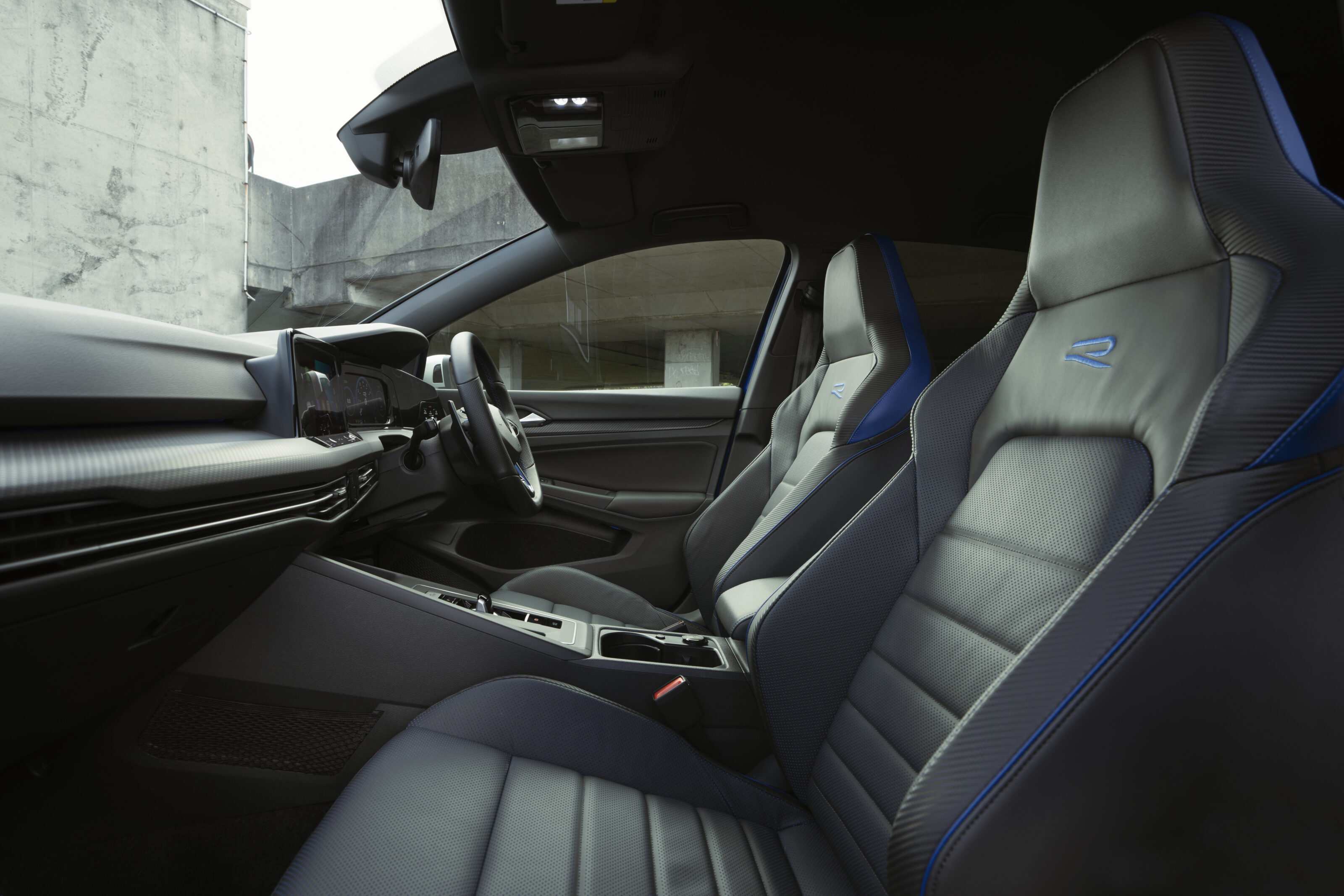
The R styling theme is as pleasing as it is predictable and formulaic, but inside and out it’s more fetching than the fancier and more-colourised GTI brief. The blackout with blue highlight effect in the cabin, with fetching blue dot perforations in the supple nappa leather trim, does wonders for the Golf’s current streamlined, big-screen cabin design.
The front buckets are fantastic, even if the wavy trimming looks a bit low rent. Some of the plastics, too, are cheapo for a hatchback asking $70k on the road.
I’ve been as critical of Mk8’s user interface as anyone. Some of it remains convoluted, clumsy and distracting to use, with some real own-goals. There’s no gear indicator in the head-up. The R mode and heater wheel button are so easily nudged during a hot punt. The climate control sliders are hard to find in the dark.
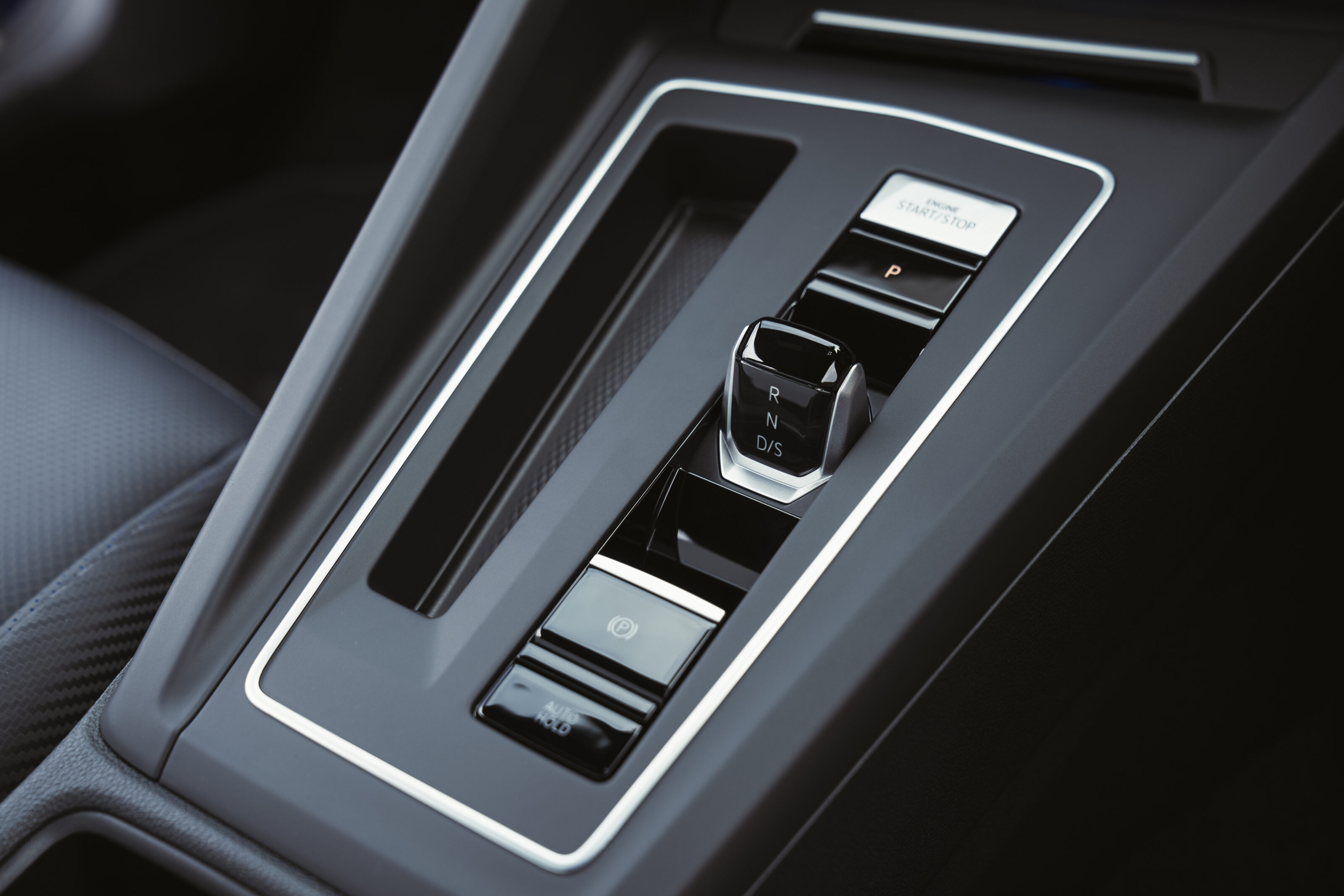
But in R guise the displays are sharp and slick, infotainment does offer handy shortcuts with some user acclimatisation, and the transmission selector console array offers fine one-hand convenience.
In terms of ownership, the Golf R gets Volkswagen’s five-year, unlimited-kilometre warranty, while servicing can be pre-purchased at $1700 for three years and $3000 for five years.
VERDICT
Is the Golf R now too polite? In hatch form, it does feel broadly palatable without robbing too much from the sense of go-fast purpose and driver-centric pitch.
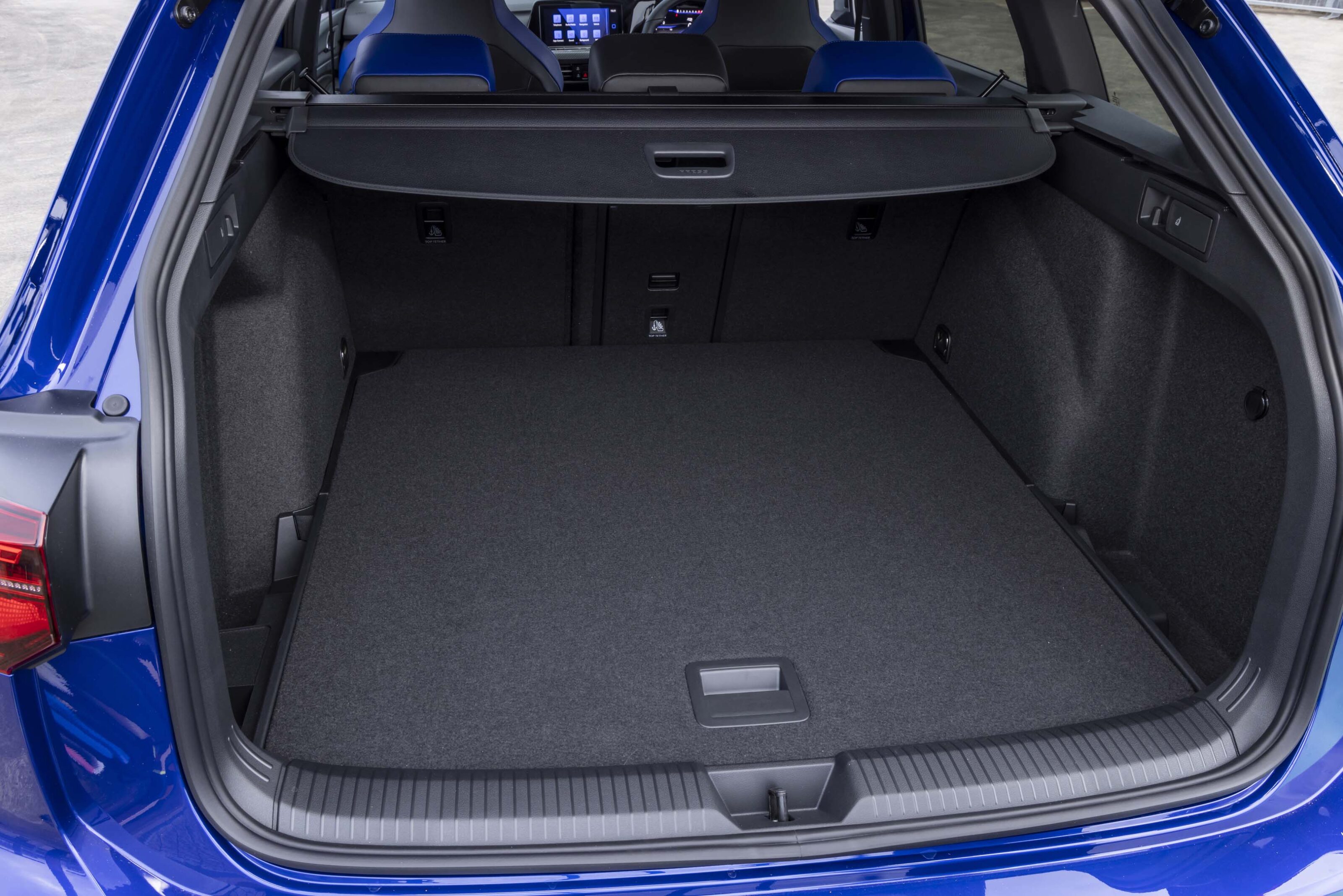
However, the pricier and measurably more spacious R wagon on static display at the local launch – 354mm longer, 50mm more wheelbase, big 611-litre boot space – doesn’t offer the lithe vibe of the older 7.5 machinery. And it could prove to be that the R formula is a little too homogenized, despite packing more torque and similar technical prowess.
In short, the Mk8 brings a bit more swagger, kit and some extra tricks to the experience that sits well within the wheel tracks of its 7.5 forebear. It’s a neat evolution, if not a dramatic one.
There’s also some headroom to up the heat for the inevitable conga line of special editions – hopefully with a manual option, regardless of any firm official denials that are currently communicated.
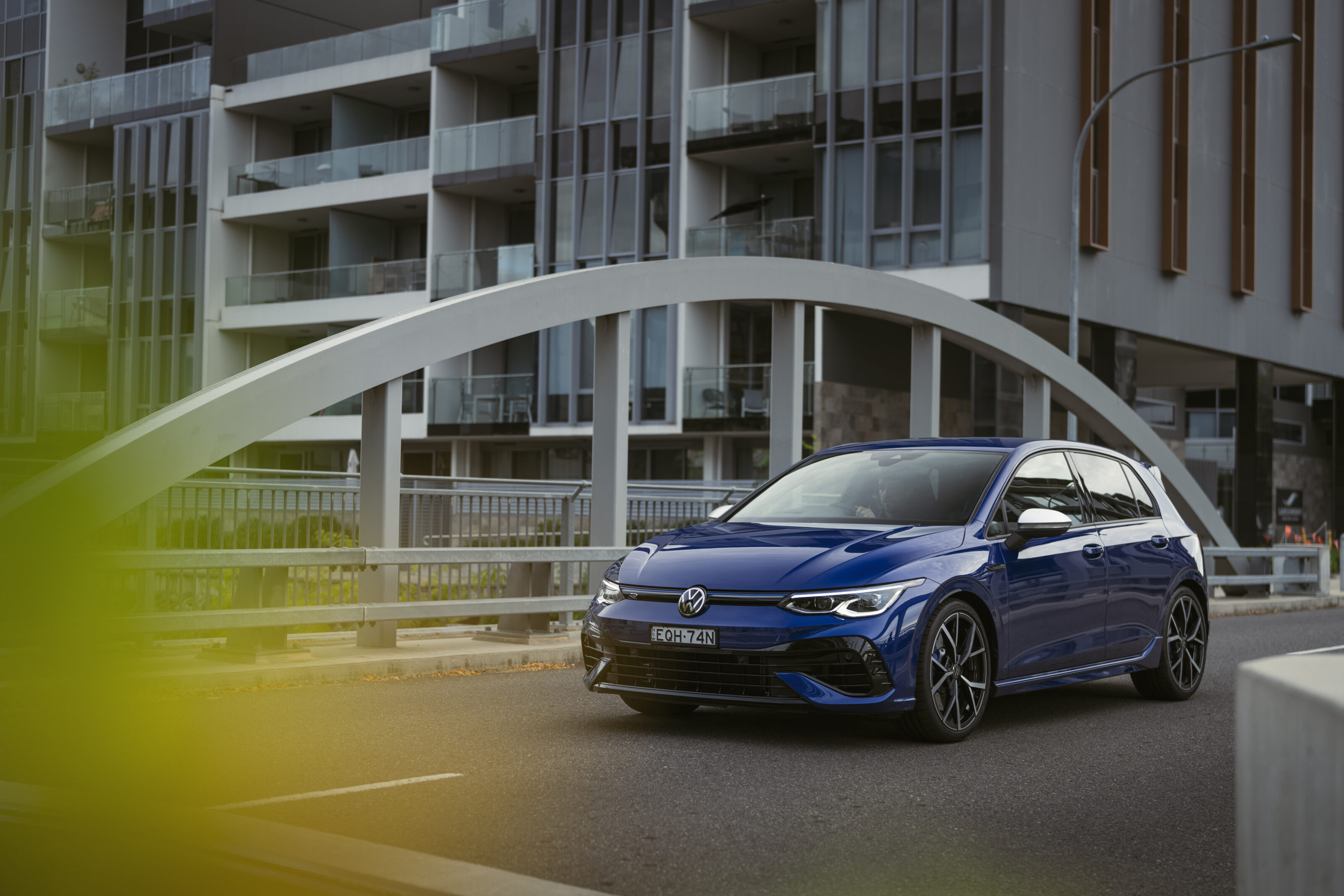
2022 Volkswagen Golf R specifications
| Body | five-door hatchback |
|---|---|
| Drive | AWD |
| Engine | 1984cc inline-4, DOHC, 16v, turbocharged |
| Bore/stroke | 82.5mm x 92.8mm |
| Compression ratio | 9.3:1 |
| Power | 235kW @ 5600-6500rpm |
| Torque | 400Nm @ 2000-5600rpm |
| 0-100km/h | 4.8sec (claimed) |
| Fuel consumption | 7.8L/100kms (combined/claimed) |
| Transmission | 7-speed dual-clutch |
| Weight | 1501kg (tare mass) |
| Power/weight | 156kW/tonne |
| Front suspension | MacPherson struts, coil springs, anti-roll bar |
| Rear suspension | multi-links, coil springs, anti-roll bar |
| L/W/H | 4290/1789/1458mm |
| Wheelbase | 2631mm |
| Tracks | 1541mm (f)/1516mm (r) |
| Steering | electrically assisted rack and pinion |
| Front brakes | 345mm ventilated discs, sliding calpiers |
| Rear brakes | 310mm ventilated discs, sliding calipers |
| Wheels | 19in x 8.0in (f/r) |
| Tyres | 235/35 R19 Hankook Ventus S1 Evo3 (f&r) |
| Price | $65,990 + on-road costs |
The ‘R’ means Race. That’s official. It’s a badge of honour and credibility worn by the swiftest Golfs that have graduated to icon status – and that Volkswagen now charge nigh on $70k for.
But combing through the badge’s providence reveals ambiguity, where instead ‘R’ is a suggestion of performance, extrapolated via the (V6) Passat R36, the (V10 diesel) Touareg R50 and soon-for-Oz Golf-based T-Roc R SUV. Track-savvy credo isn’t meant to be taken literally…
But the 2022 Volkswagen Tiguan R means red-hot business.
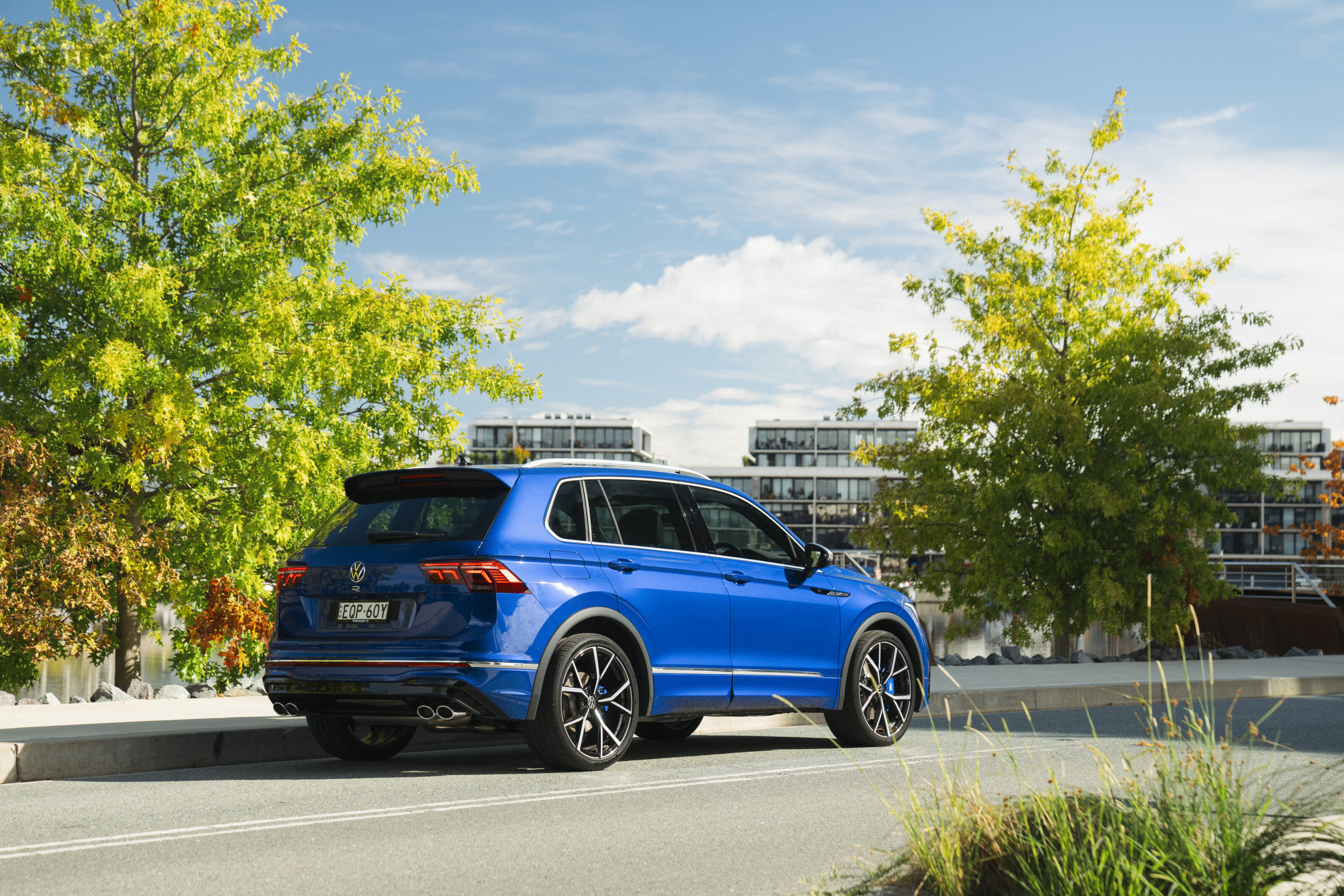
It ports a version of the heroic Mk8 Golf R newly pumped-up running gear, right down to the newfound twin-clutch torque-vectoring rear axle. And offers a Race mode. Whether or not you think a Volkswagen SUV should go anywhere near a race track, this is the mid-sized family hauler that promises, be it via mechanical suggestion or an on-the-box promise, that you could.
It arrives locally in conjunction with the new, feistier Golf R hatchback and wagon, priced similarly as an alternative body style, of equal consideration, with little-to-no dilution in on-paper purpose. With a perfectly feisty 162 TSI R-Line, the ‘GTI’ of all-paw Tiguans, currently offered, the R must assert its dominance in the model line-up for fizz, muscle and pace.
But it also demands breadth. R badge or not, the SUV format requires enough flexible scope to assume the polite school run mode and offer consummate practicality without much in the way of shortcomings.
Pricing and features
The Tiguan R is the seventh variant added to a range already offering both petrol and diesel power, all with 4Motion all-paw drive bar the bum-dragging 110TSI Life entry model.
The range has been gradually expanding since its early 2021 facelift, which brought a shakeup of styling, variant nomenclature, powertrains and driver tech to name a few areas, and pricing has crept up by a couple of grand across the board in the interim.
At $68,990, the R version is $13k more expensive than the 162 TSI R-Line and $11k higher than the oiler 147 TDI R-Line. It’s also, not coincidentally, price-matching the Mk8 Golf R Wagon.
For the vastly medium SUV landscape it arrives in, the Tiguan R’s combination of Euro lineage, mainstream badge, petrol heartbeat and luxo-performance aspiration sees surprising few direct rivals.
The Genesis GV70 2.5T AWD, for its part and $68,768 ask, lines up neatly in some respects, while Audi’s Q5 45 TFSI Sport quattro, at $80,800, makes for an alternative on others. And both the Alfa Romeo Stelvio Veloce, at $79,450, and Lexus NX 350 F Sport, at $77,900, bring fizzy family hauling at richer, if still somewhat semi-premium price points.
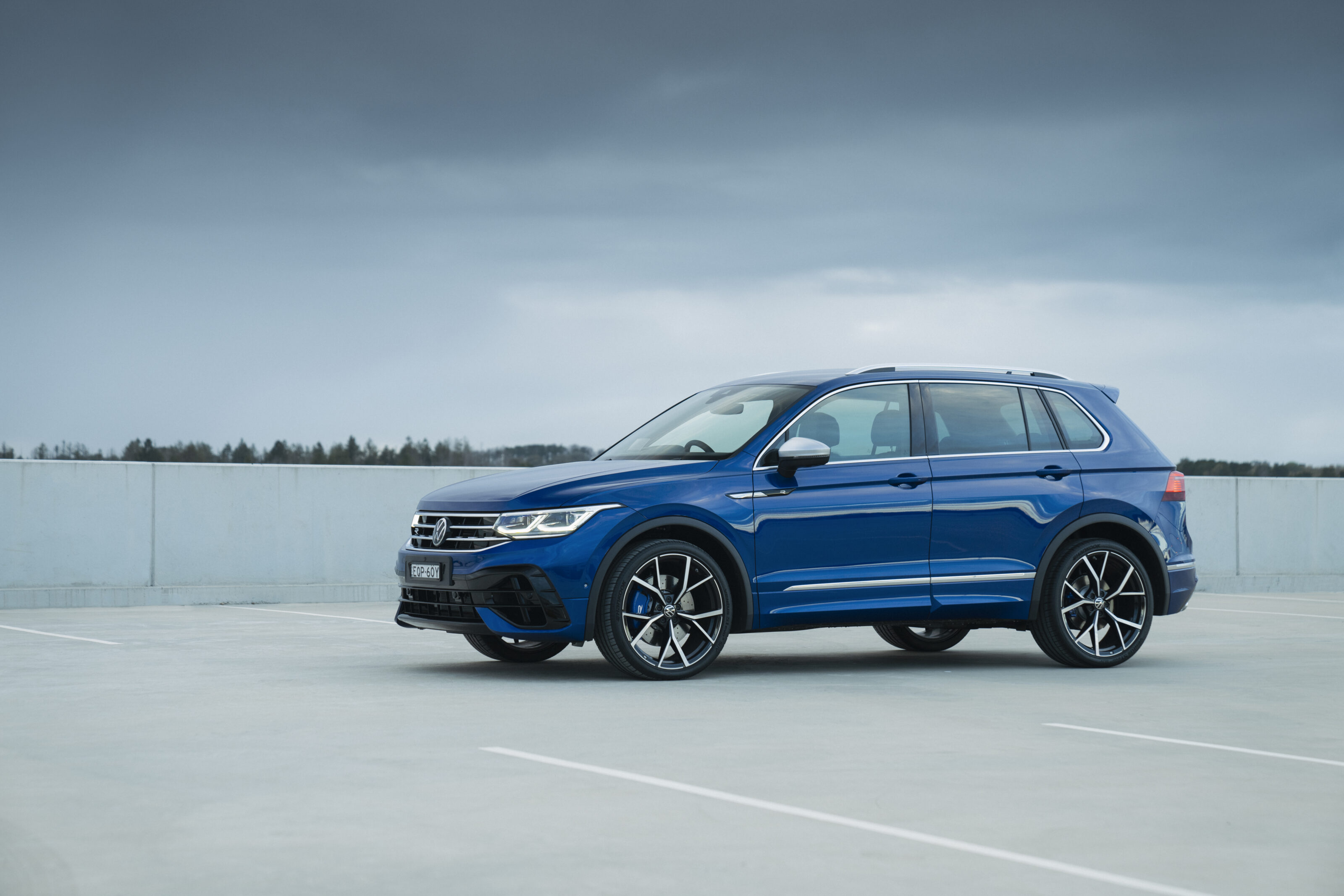
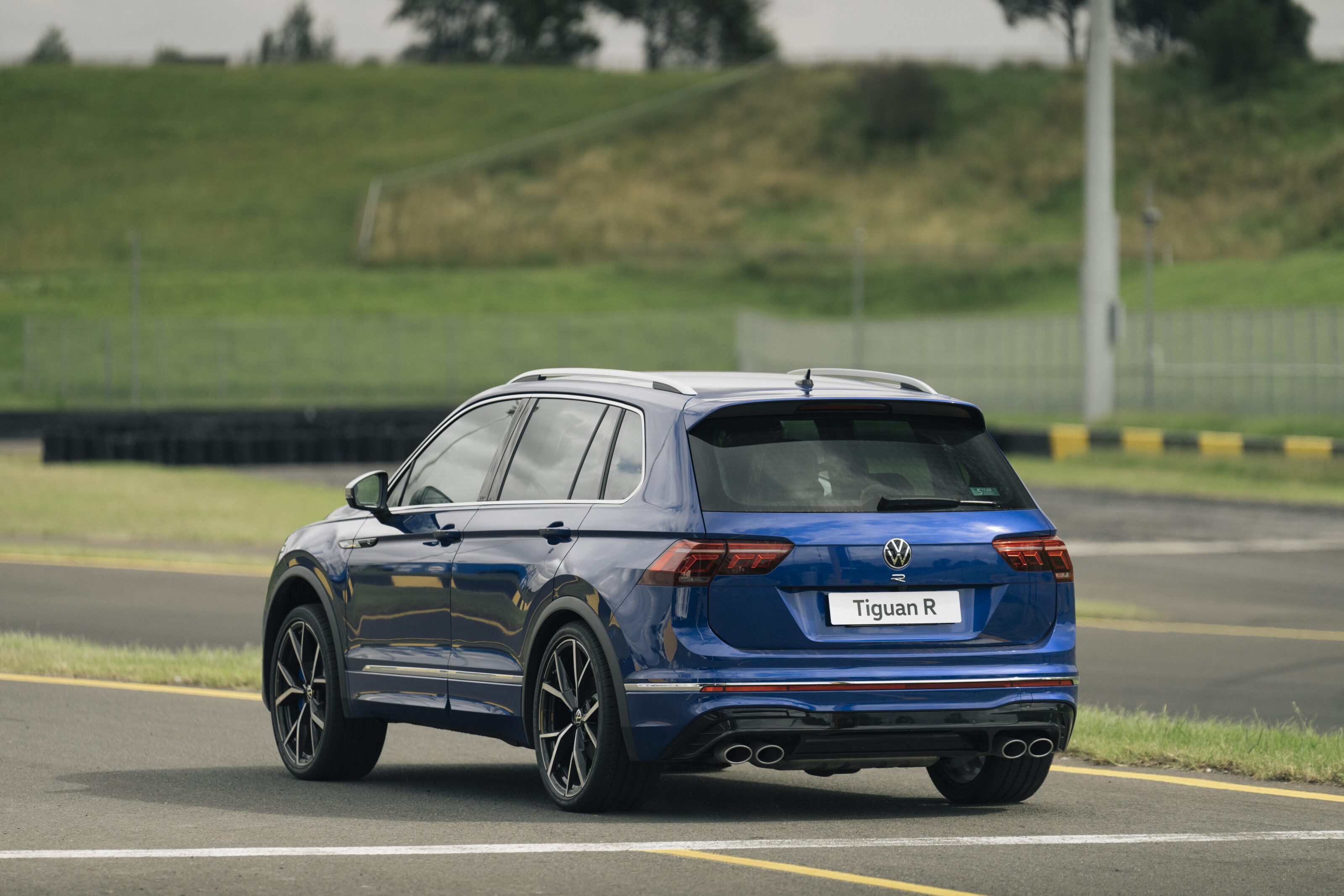
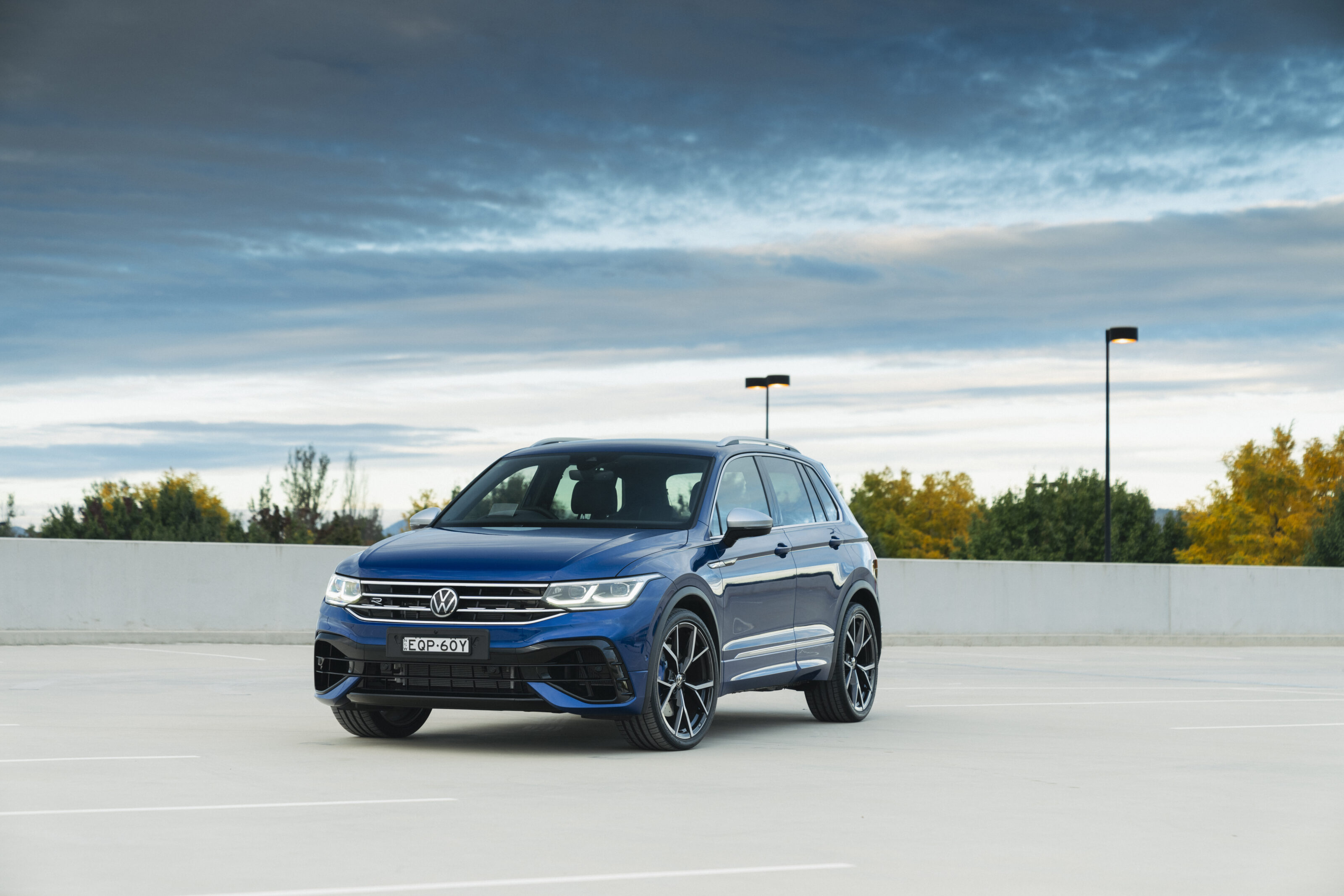
The R styling isn’t a dramatic departure from the lower-grade R-Line, though its big Performance brakes fill the larger 21-inch Estoril alloys neatly for a subtly more muscular appearance, while the tail brings a bespoke four-round-tip exhaust system.
Matrix-style LED headlights and Adaptive Chassis Control electronic damping are standard. No spare wheel, but it does fit an on-board 12v compressor and goo kit.
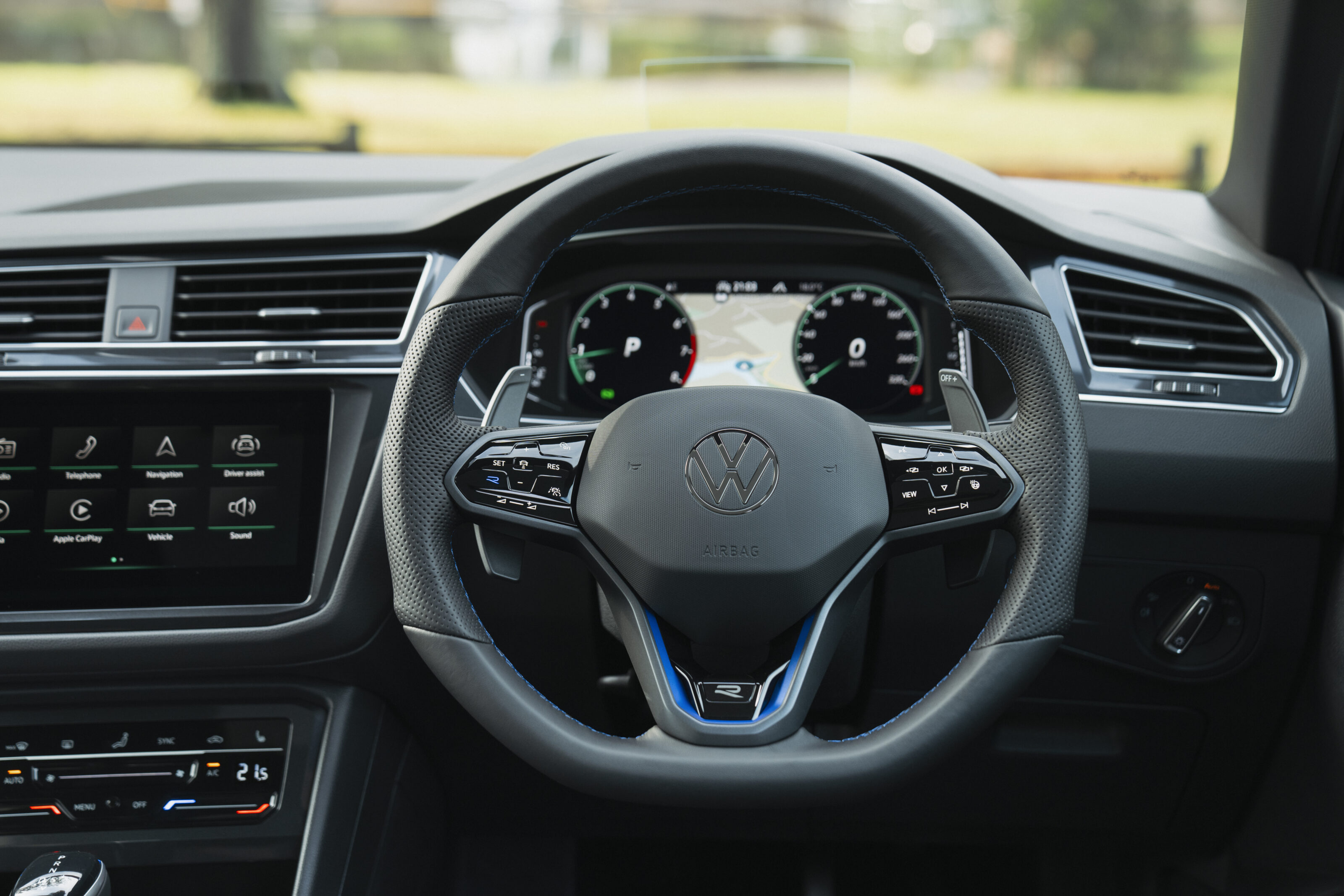
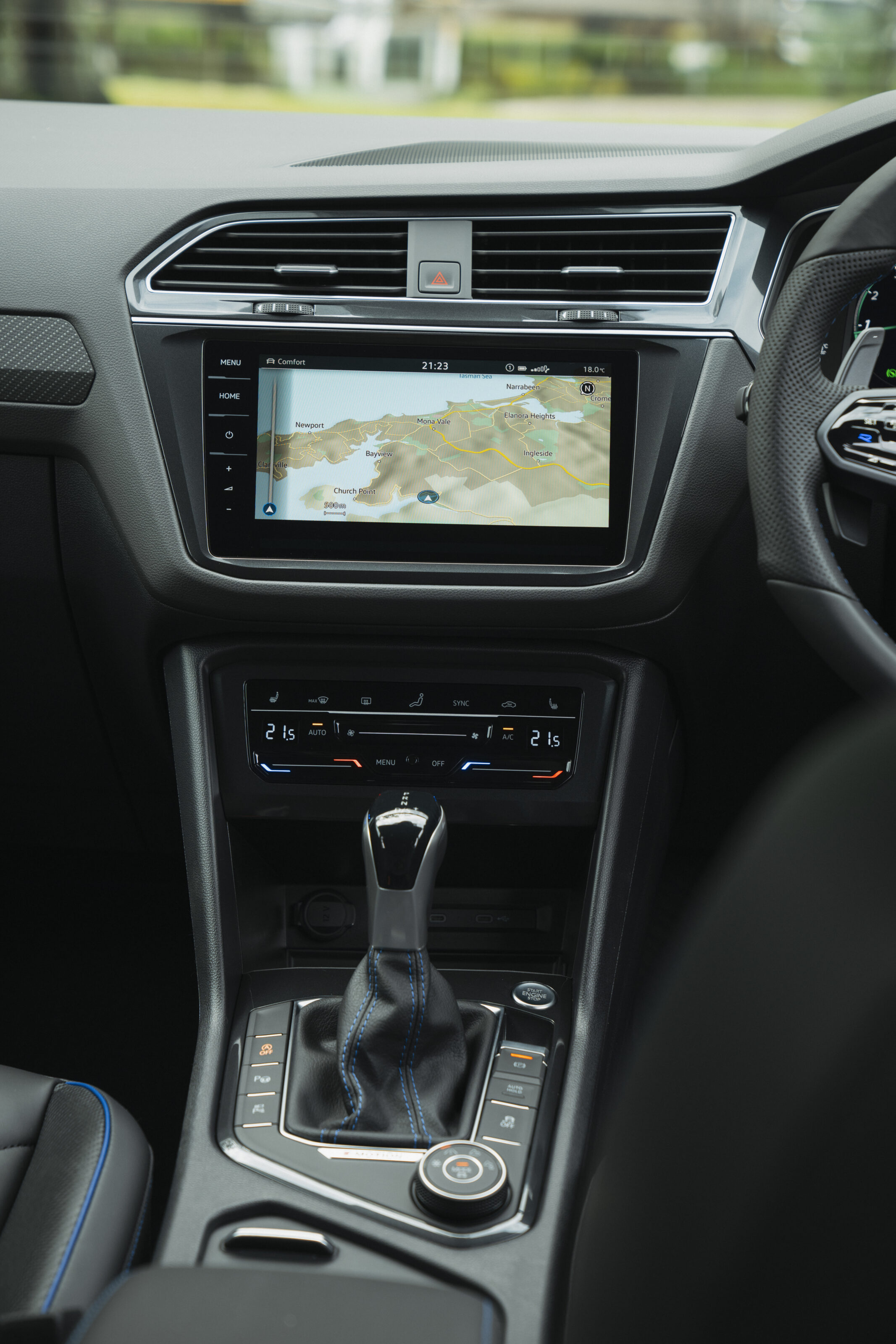
Inside, the R fit-out brings Nappa leather sport seats, 10.25-inch Digital Cockpit Pro instrumentation, a head-up display, tri-zone climate control, 30-colour ambient lighting, adaptive cruise control and a powered tailgate. Infotainment is a 9.2-inch touchscreen, with proprietary sat-nav, digital radio, and wireless Apple CarPlay and Android Auto mirroring.
Harman Kardon sound was originally standard, but microprocessor supply issues parked it in the options list for $1000, Volkswagen rounding down the initial vehicle list price correspondingly. The only other option is a sunroof, at $2000.
The Tiguan R carries the wider range’s five-star ANCAP rating, date stamped in 2016. Safety and assistance equipment includes all-speed AEB with pedestrian and cyclist detection, lane keeping and lane departure warning, blind spot assist, rear traffic alert, a 360-degree camera system, front and rear parking sensors and the aforementioned Matrix-type LED headlights. Seven airbags are fitted.
On the road
First up, the drive. Because, of course, that’s this machine’s big pitch.
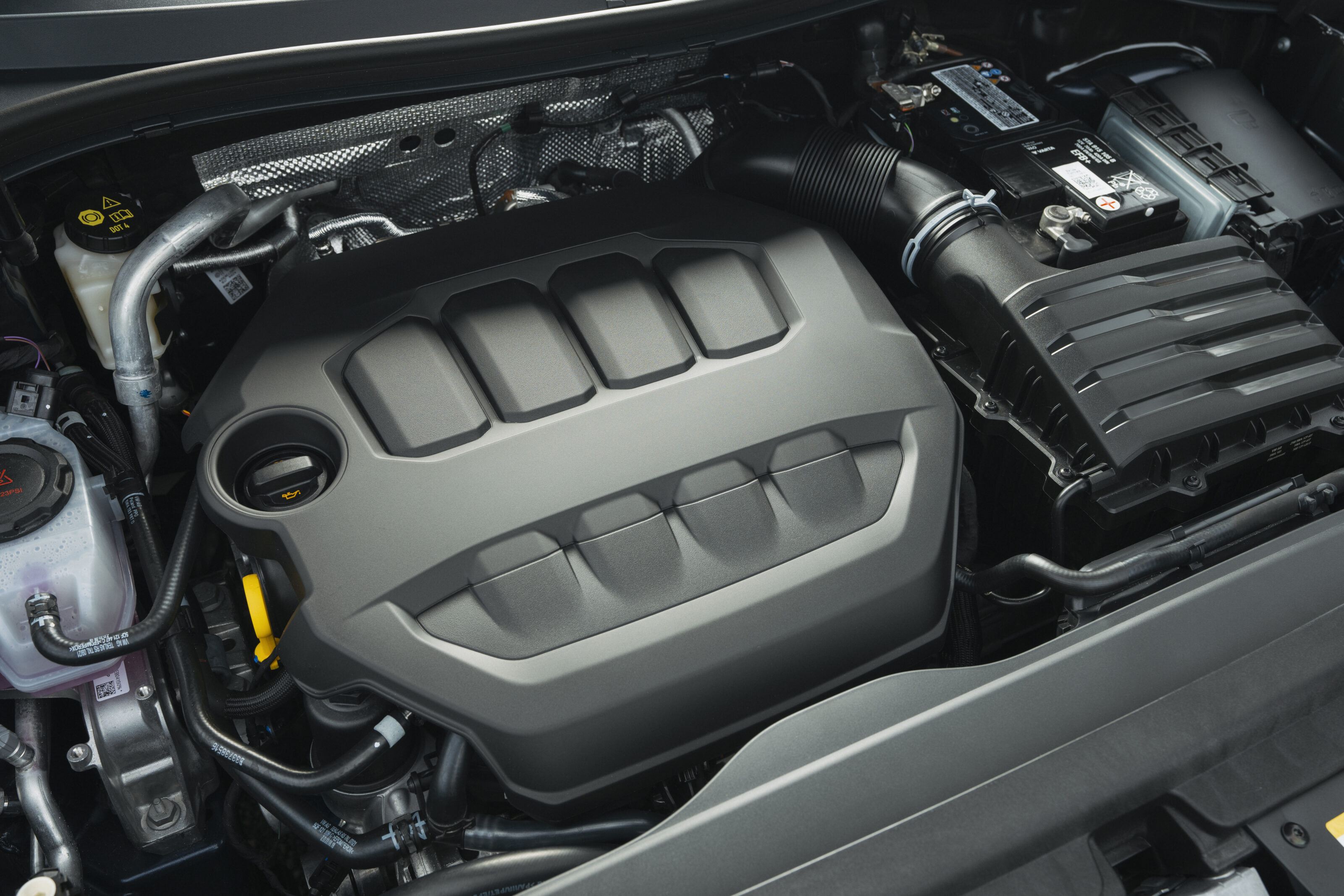
One might presume the Tiguan R is Golf R running gear rebodied. That’s not strictly true. The SUV’s ‘Evo4’ version of the EA888 2.0-litre turbo four, at 235kW and 400Nm, is shared with Volkswagen’s hot hatch, though they differ from the Golf R wagon’s 420Nm unit that fits a petrol particulate filter.
All and sundry fit a wet-type seven-speed DSG transmission exclusively and the old Haldex-based all-wheel drive has been turfed in favour of a more sophisticated 4Motion design bringing electro-mechanical torque vectoring, via twin clutch units, on the rear axle.
Functionally, the Tiguan’s all-wheel drive is specific. Unlike its Golf R brethren, the hot SUV omits Drift and Nurburgring drive mode / all-wheel-drive functionality. Instead, it offers light-duty multi-terrain functionality, including rear diff locking and hill descent control not featured on the Golf – should you be foolhardy enough to ply its liquorice-strip 21-inch road rubber off the beaten track.
Quick? At 5.1 seconds claimed for the 0-100km/h, it’s not hanging about. But the Tiguan is around a quarter-tonne heavier than the Golf R hatch and, unsurprisingly, it’s three-tenths slower to march in comparison.
Meanwhile, fuel consumption, at 8.8L combined as a claim – if around the ten-litre mark as demonstrated on test – is decent for the performance offered, and the EA888’s most potent tune does demand 98RON.
Towing is 2200kg braked.
There’s certainly some swagger in its on-road character, a bit of a jumbo hot hatch vibe if subtly so and not to the detriment of pleasantry and manners. There’s just enough muted rorty from the turbo-four and the transmission is, around town, a slick shifter, impressively bereft of the nibbling and shunting that once plagued Volkswagen’s dual-clutch designs.
Tap-for-Sport liberates more muscle and purpose without having the clumsy distraction of digging through drive modes. It’s real-world swift, with crisp response and ample low-rpm punch – and though it tones down the spark-cutting ‘brap’ theatrics, there’s enough sensory fizz to impart an authentic R experience.
The adaptive suspension modes are well judged, tempered and taut enough in Comfort to bring a sheen of nice mechanical connection to the large rolling stock, compliant enough not to fidget or jar across road imperfections. As a default, it delivers the requisite sportiness without being unpleasant or untidy. Steering, too, is quite direct and connected, though its weighing is a bit artificial and it’s not the most fluid direction finder out there.
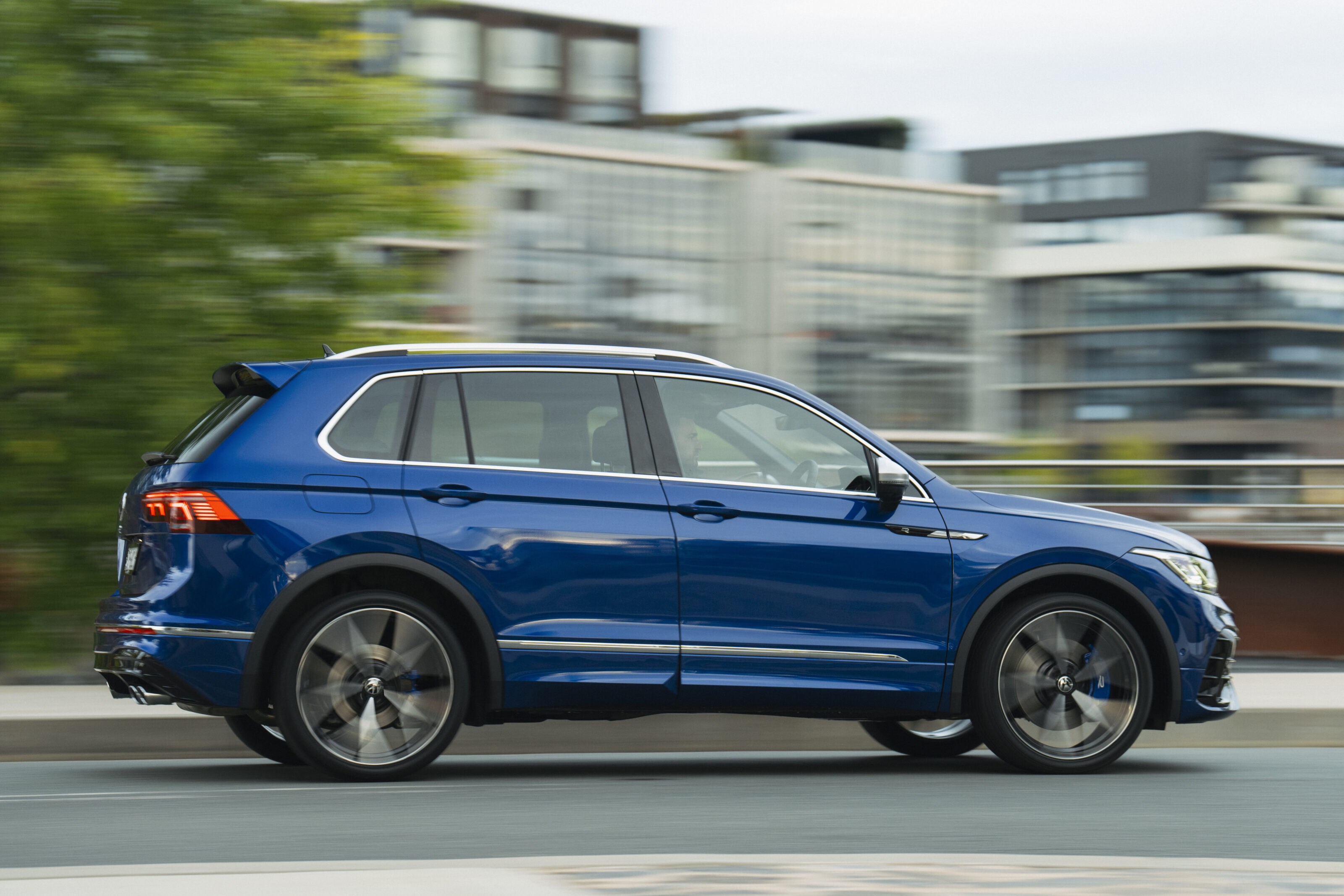
The Tiguan R’s around-town manner is polished enough that it would make a fine daily-driven family runabout without ever tapping into its feistier histrionics. But push on and it’s alert and keen, properly swift point to point while swinging a large enough stick to satisfy.
There’s ample fun factor in its make-up, though its evenly tempered manner does pull up short from genuine white-knuckled heroics. Much like a Golf R, then.
Still, anything with a dedicated Race drive mode drums up certain lofty go-fast expectations, and the Tiguan R is well-mannered enough to make one sceptical about how racy it can be.
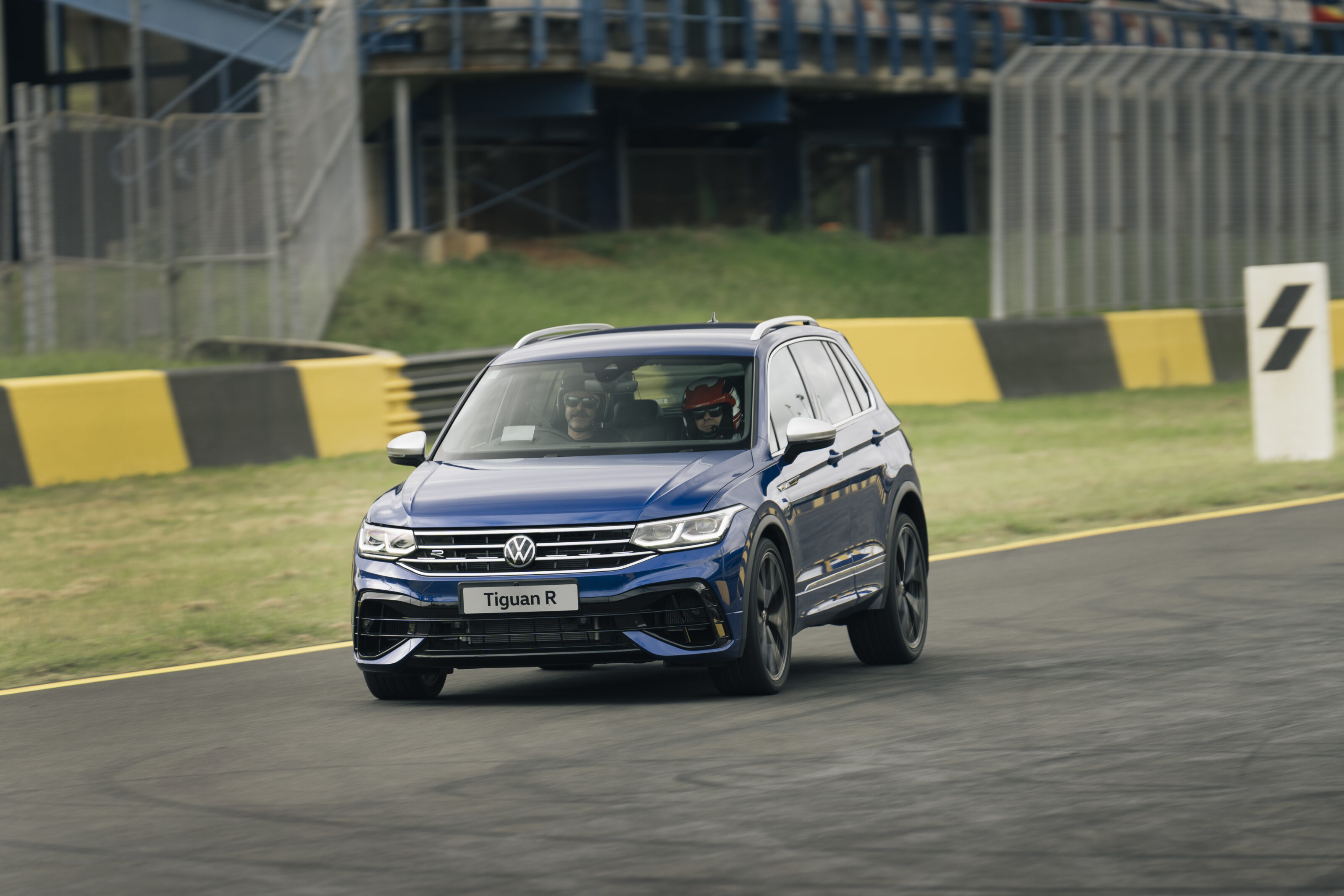
Volkswagen Australia is confident enough in its fast SUV’s capabilities to launch it locally at Sydney Motorsport Park, around the fast and flowing North Circuit. And in conjunction with the Aussie debut of the Mk8 Golf R, with opportunity for on-track comparison.
Off its leash, the flagship Tiguan is quick and capable enough to deserve its R designation. You discover quickly that a racetrack isn’t really the most natural environment for it, but nor does it embarrass itself up to speeds serious enough to see north of 200km/h before tipping into the Old Eastern Creek’s infamously daunting Turn One sweeper.
In the company of the new Golf R hatch, yes, it feels heavier and more unwieldy encumbered with its higher centre of gravity. But in outright terms, in SUV terms, it’s impressively balanced, grippy and capable for where it sits – for price, size and performance plied – in today’s pantheon of properly fast family haulers.
At full noise, it prefers to be guided more than manhandled. And dynamically, it’s more benign than it is properly lively. On balance, it tends to leverage grip and stability to channel pace rather than fronting up frisky playfulness as its chosen forum for enjoyment. Again, not unlike little brother Golf R.
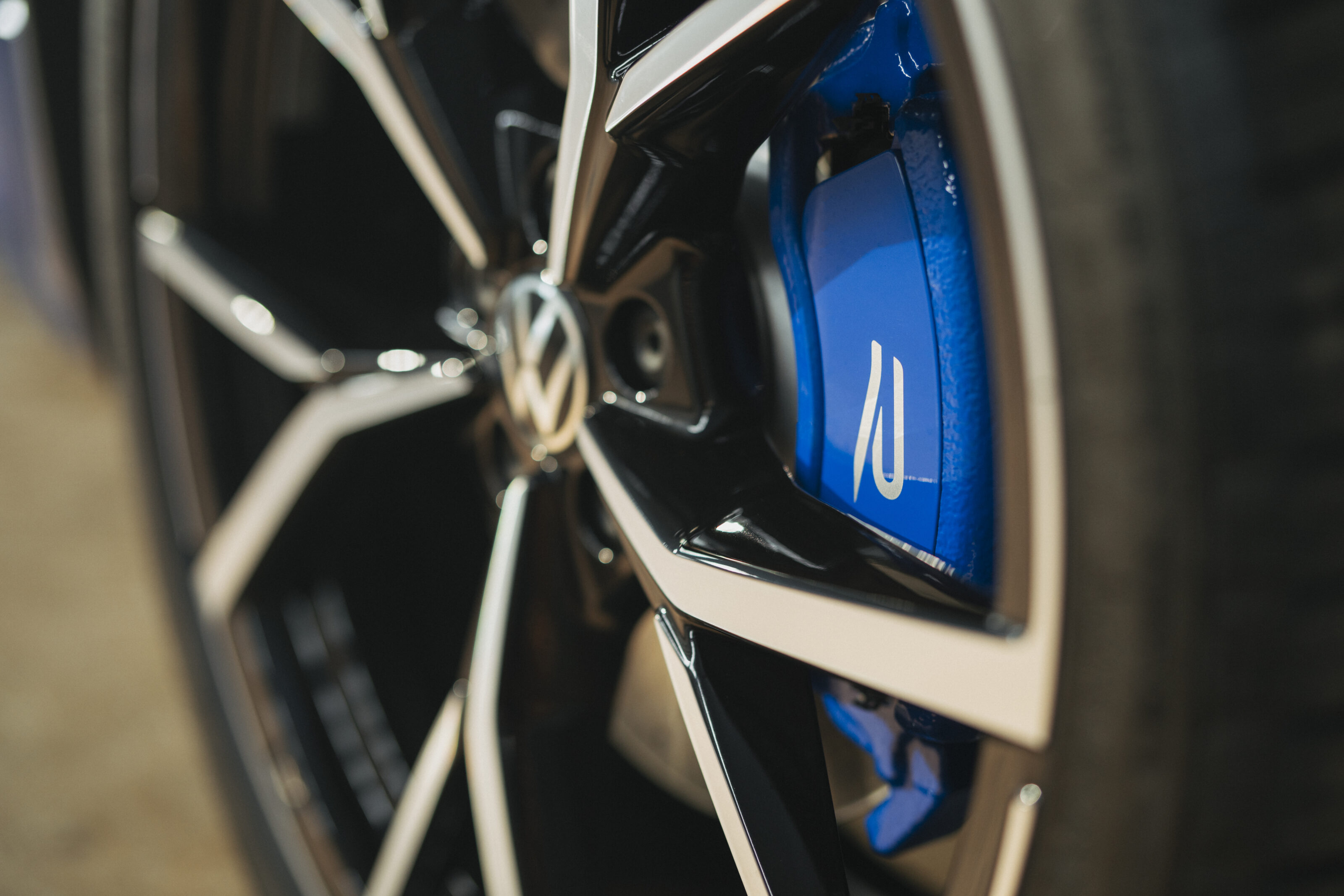
The torque vectoring smarts seem to work a charm, in that it functions with utmost transparency and corner exit drive is quite handy. The chassis could easily handle more output. Well, to a point…
The Tiguan R’s considerable on-track heat and competency isn’t really all that sustainable. It works its front tyres fairly hard and only offers a handful of laps before available grip starts to become overcooked.
Well then, is it trackable?
Whether you would or wouldn’t track the Tiguan R isn’t really the point. Fact it, there’s ample Hyde to balance its Jekyll in its breadth of talent, if you want it, need it, or are just buying (handsomely) into its potential without caring much to tap into it.
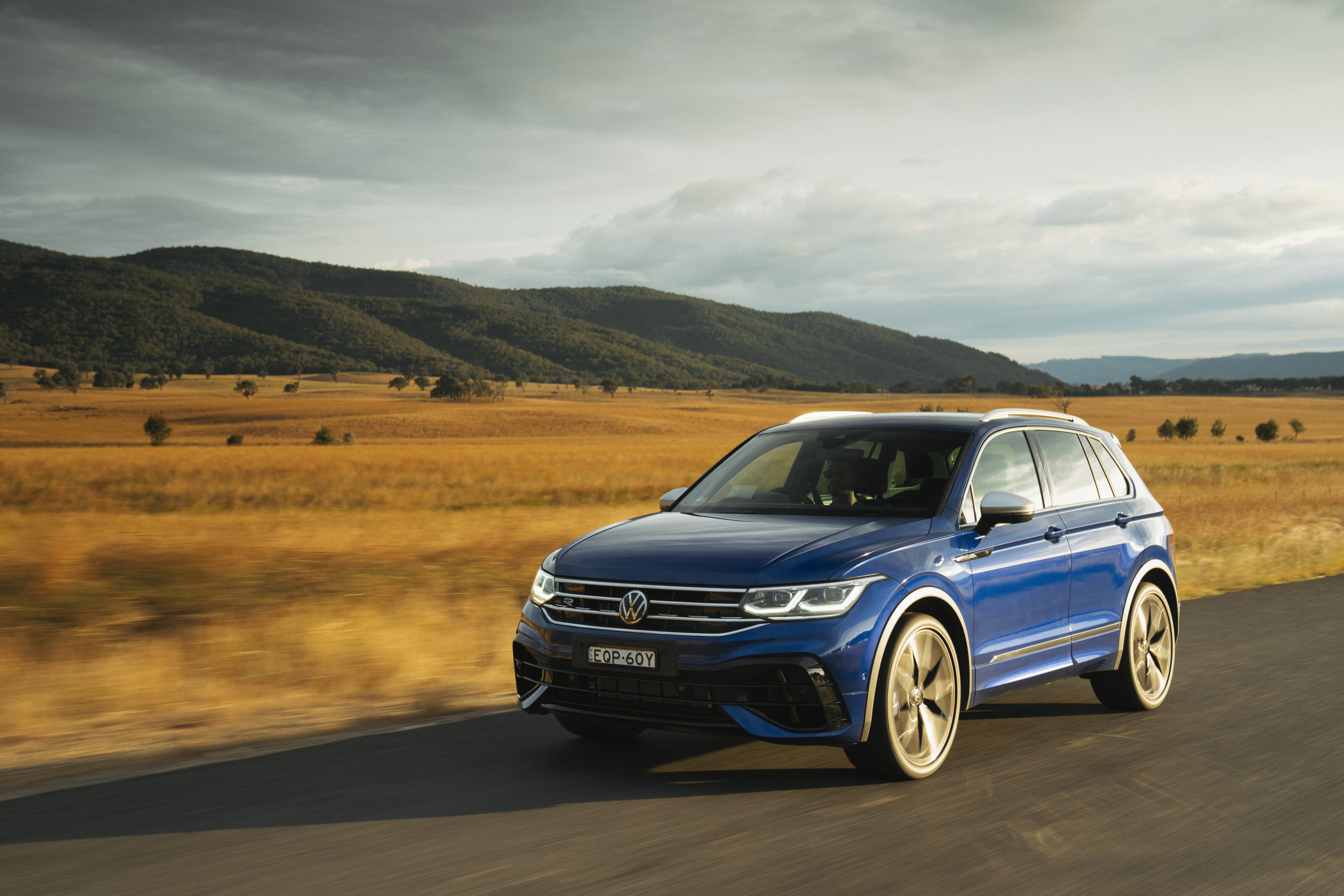
Comfort and space
Outside, the formulaic R design brief works cohesively in practice, particularly those monstrous 21-inch wheels. Inside, the racy stylisms initially seem a little incongruent in the spacious mid-size SUV package at first – particularly the propped up-front seating. But it does become quite natural with acclimatisation.
Volkswagen hasn’t simply copy-pasted the Golf R cabin accoutrement. For one thing, the Tiguan R doesn’t get the hatch/wagon siblings’ bespoke 12-way-electric race-style buckets, instead opting for Nappa-trimmed conventional SUV seating. At once, it makes for a more relax SUV-type vibe, but it does rob the cabin a little of sporty focus and a sense of occasion.
It’s a nice cabin, the ‘signature R’ blackout with blue-tinged detailing quite fetching in effect, but some of the leather trim fitment is a little haphazard and it’s not quite as upmarket-fancy as Skoda’s (larger seven-seat) Kodiaq RS wanting for similar coin.
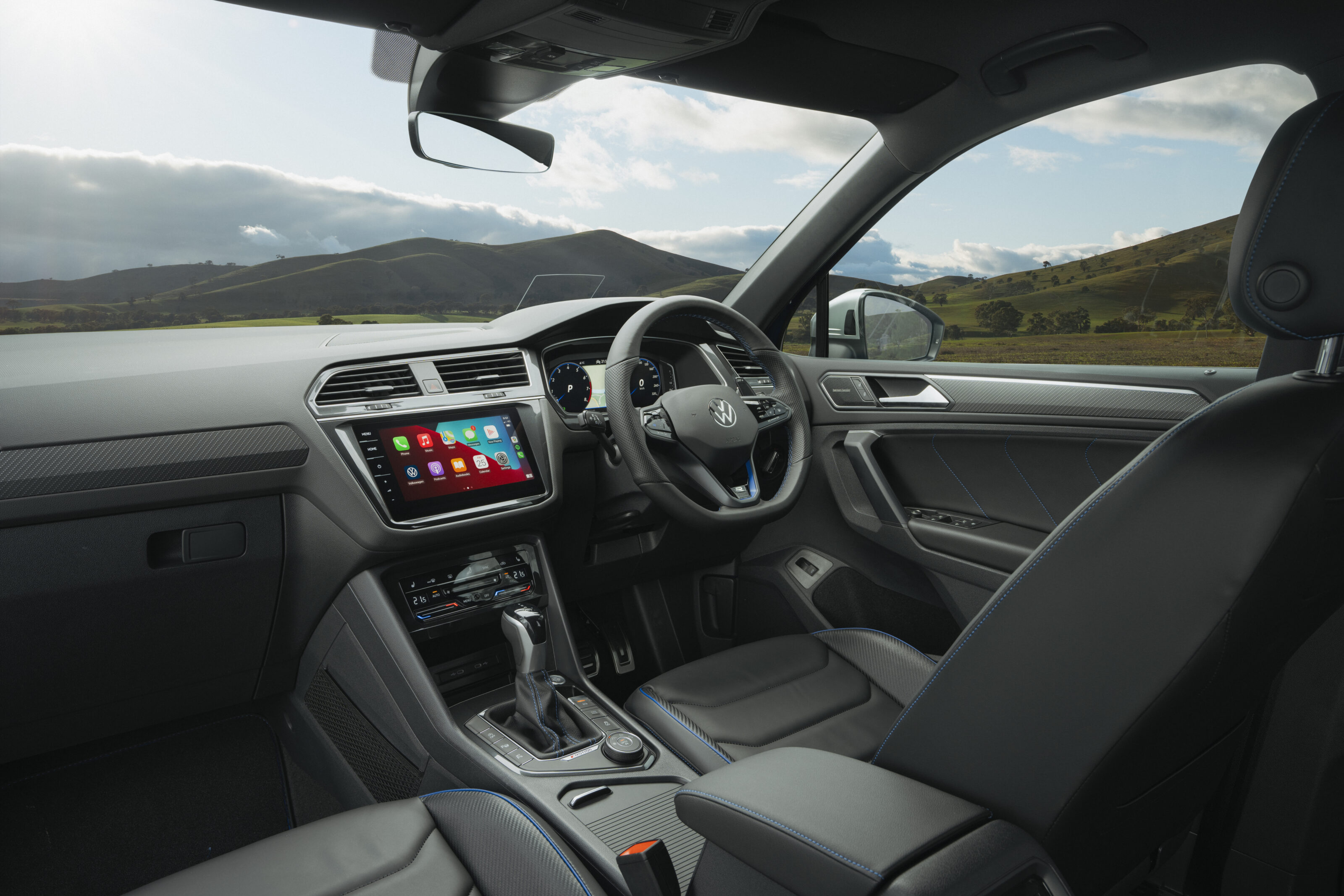
The R is minted in Tiguan’s MY21 update, which means it gets similar digital instrumentation hardware to Golf R, if with smaller 9.2-inch Discover Pro infotainment rather than the hatch/wagon’s larger 10-inch system.
But…the SUV offers superior touch capacitive HVAC controls and general user interface that’s easier and more intuitive to use than the minimalist if clumsy and distracting Golf format. Wireless smartphone mirroring without wireless phone charging, though, is a bit of a head scratcher.
Solid build, decent materials, oodles of storage, smart touches such as the flock-lined door bins…much of the core Tiguan practicality remains in feisty R guise.
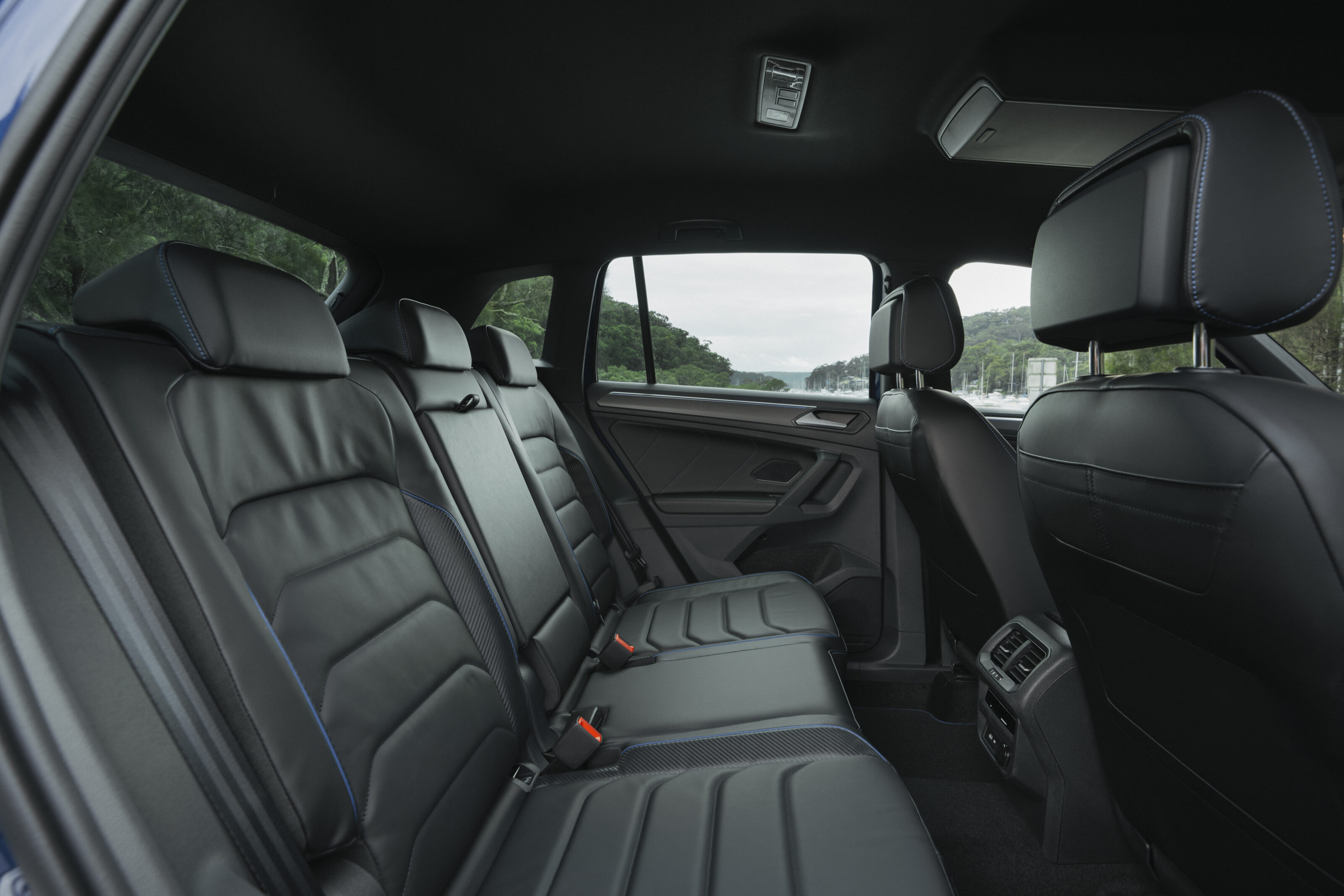
For an enthusiast offering, it’s quite utilitarian – be that good or bad as a matter of taste – but there are no functional shortcomings in accommodation if considered primarily as a rapid daily-driven family hauler.
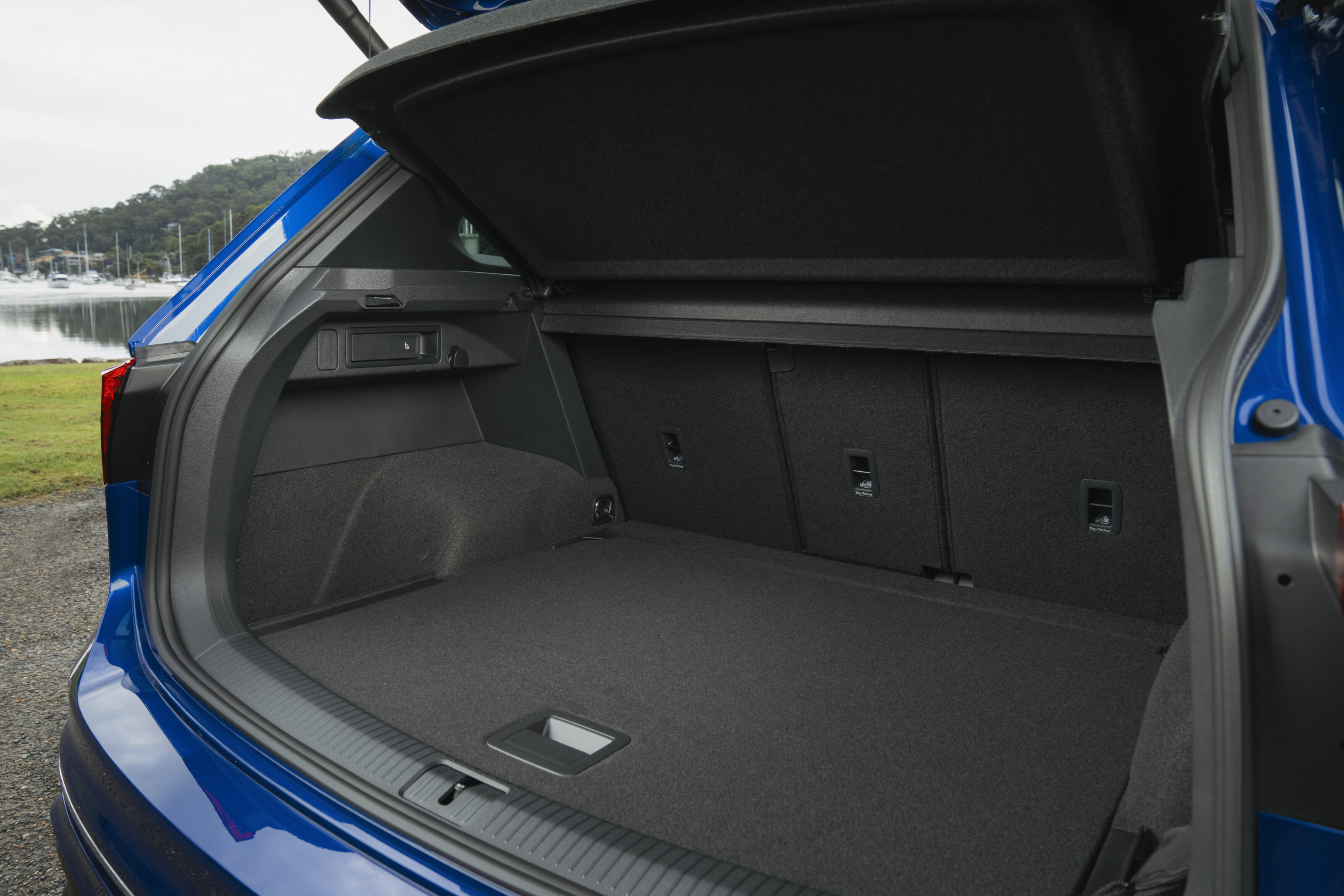
Further, Tiguan’s flexible tilt and slide 60:40-split rear seating and variable boot floor offer a heap of versatility. It’s roomy with a nice airy ambience, though realistically a four-adult proposition with enough room for five adults at a pinch of for short trips. Dedicated rear climate control is a nice touch.
When prioritising luggage space, there’s up to 615 litres of boot volume with the rear bench set fully forward, expanding to 1655L with the rear seating stowed.
Ownership
The Tiguan R is covered by Volkswagen’s five-year, unlimited-kilometre warranty.
Servicing packs are offered at $1650 for three years and $3100 for five years, with maintenance intervals of 12 months or 15,000 kilometres.
VERDICT
All-rounder capability is a hallmark of the Golf R and key to the nameplate’s popularity that’s garnered a strong cult following. And Volkswagen has largely successfully ported similar depth and flexibility into its Tiguan.
Unsurprisingly, the Tiguan R isn’t quite as fast and feisty as its hatch stablemate. And, obviously, the SUV is measurably more family-friendly and practical. Throw in the missing link, Golf R wagon, and Volkswagen covers a lot of bases – with intrinsically similar flavour and purpose – at a narrow upper-$60k pricing band that, frankly, looks more favourable as a value proposition in SUV guise.
On that, the Tiguan R appears priced nicely. It’s quicker and hotter than virtually any other spirited proper SUV under the $70k mark and it’s measurably more affordable than premium machinery capable of outpunching it.
A properly fast Tiguan doesn’t merely fill what was a clear hole in the Volkswagen line-up. It delivers a fair dinkum R experience where many fans want it to, in a body style that many buyers need it.
2022 Volkswagen Tiguan R specifications
| Body | 5-door, 5-seat SUV |
|---|---|
| Drive | all-wheel |
| Engine | 2.0-litre turbocharged four-cylinder petrol |
| Power | 235kW @ 5600-6500rpm |
| Torque | 400Nm @ 2000-5600rpm |
| Transmission | 7-speed dual-clutch auto |
| 0-100km/h | 5.1 seconds (claimed) |
| Weight | 1722kg (tare mass) |
| Fuel consumption | 8.8L/100kms (combined/claimed) |
| Suspension | strut (front), multi-links (rear) |
| L/W/H | 4520/1859/1668mm |
| Wheelbase | 2681mm |
| Brakes | 357mm single-piston front/310mm single-piston rear |
| Tyres | 255/35 R21 Hankook Ventus S1 Evo3 (f&r) |
| Wheels | 21 x 8.5in wheels |
| Price | $68,990 +ORC |
