
Snapshot
- New DBX707 could cost in excess of $400,000
- 520kW twin-turbo V8 will make it Aston’s second-most powerful model
- Flagship SUV aims to take on Lamborghini’s Urus
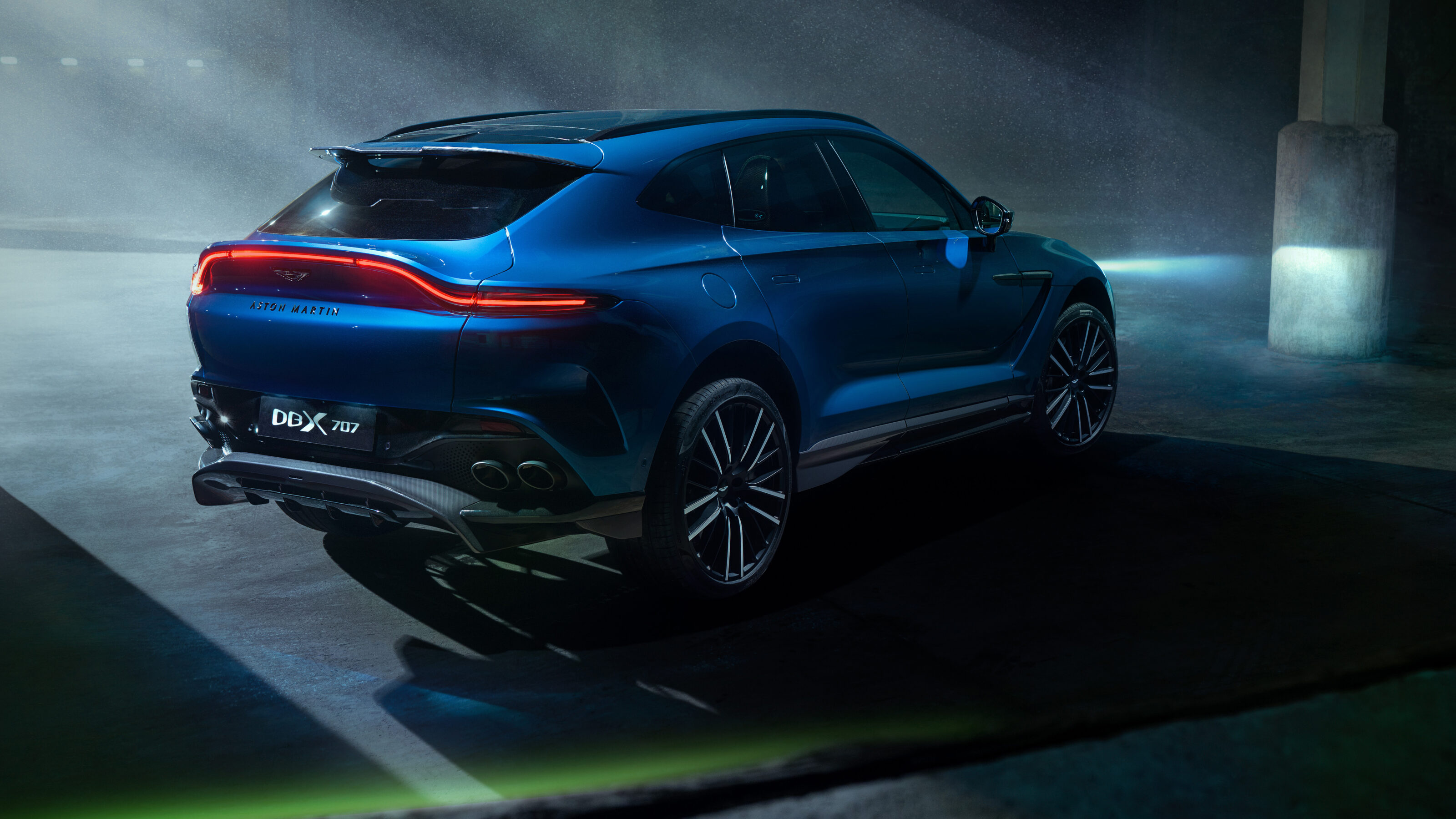
Sign of the times: When the Aston Martin DBX707 arrives in Australia later this year, it will be the second most powerful of the mainstream production Astons currently available, beaten only by the snarling 533kW, V12-powered DBS Coupe and Volante.
The 707 suffix refers to the output, in the pferdestarken beloved of German engineers, of the AMG-sourced twin-turbo 4.0-litre V8 lurking under this DBX’s bonnet. That translates to 520kW, enough, says Aston Martin, to hurl this 2300kg all-roader to an autobahn-busting 310km/h. And those numbers make the DBX707 the fastest, most powerful SUV in the world, faster and more powerful even than the Lamborghini Urus, which packs a mere 478kW and can only hit 305km/h.
And that’s entirely the point. Forget supercars – super SUVs are where the money is these days.
Former AMG chief Tobias Moers has had the Urus in his sights almost from the moment he arrived at Gaydon in August 2020 to take the top job at Aston Martin.
An ultra high-performance DBX, Moers realised, could be a relatively quick and easy win for the Aston brand while he worked to stabilise the business and sort out the troubled mid-engine sportscar programs. It had not escaped his attention that since its launch in 2018, the Urus had quickly become Lamborghini’s best-seller, accounting for more than a third of the company’s output; Lambo built its 10,000th Urus in mid-2020, the SUV reaching that production milestone in less than half time it had taken the Huraçan.
Moers had been pleasantly surprised by the DBX while doing his due diligence before accepting the Aston job. He thought the quality of its body engineering was impressive and, of course, he well understood the Urus-rivalling potential of its AMG-sourced powertrain.
The heart of the DBX707 is a tweaked version of the versatile M177 V8 that powers a bunch of Mercedes-AMG road-rockets as well as Aston’s own DB11, Vantage and the regular DBX. In the regular DBX the engine makes 404kW and 700Nm. The 520kW pumped out by the DBX707’s version, which boasts twin-scroll turbochargers that spin on ball-bearings for faster response, is underpinned by a mighty 900Nm of torque.
All that extra grunt dictated a transmission upgrade to the Speedshift MCT wet clutch nine-speed automatic used in high-power, high-torque Mercedes-AMG models. The transmission includes a Sport+ mode with launch control and a full manual control mode. A new e-diff has been fitted at the rear to handle the extra torque and deliver a faster locking rate. The final drive ratio has been shorted by seven percent compared with the regular DBX to help get the DBX707 to 100km/h in about 3.6 seconds.
That’s the one metric where the Urus, which will hit 100km/h in 3.2 seconds, still rules. The 12-cylinder Bentley Bentayga Speed, which boasts 467kW and 900Nm, is also a couple of ticks quicker than the Aston to 100 clicks. Not that anyone will put that to the test. What more people will notice is how the DBX707 handles the corners, and to make sure it doesn’t disappoint, the suspension, chassis and brakes have been given myriad detail upgrades designed to improve handling response and grip.
Compression and rebound damping have been respectively increased by 20 per cent and 10 per cent at the front end, and 15 per cent and five per cent at the rear. The electronic active roll system has been recalibrated to deliver 50 per cent more torque on low body motions, and the roll control is now more rear-biased at higher cornering speeds to reduce understeer.
The stiffness of the front shock top mounts has been upped 55 per cent with the addition of a cross brace and the front control arms have been fitted with hydrobushes to improve ride comfort and bump isolation without compromising dynamic performance. A 4mm underbody panel has increased torsional stiffness 1.3 per cent to improve steering response and impact control.
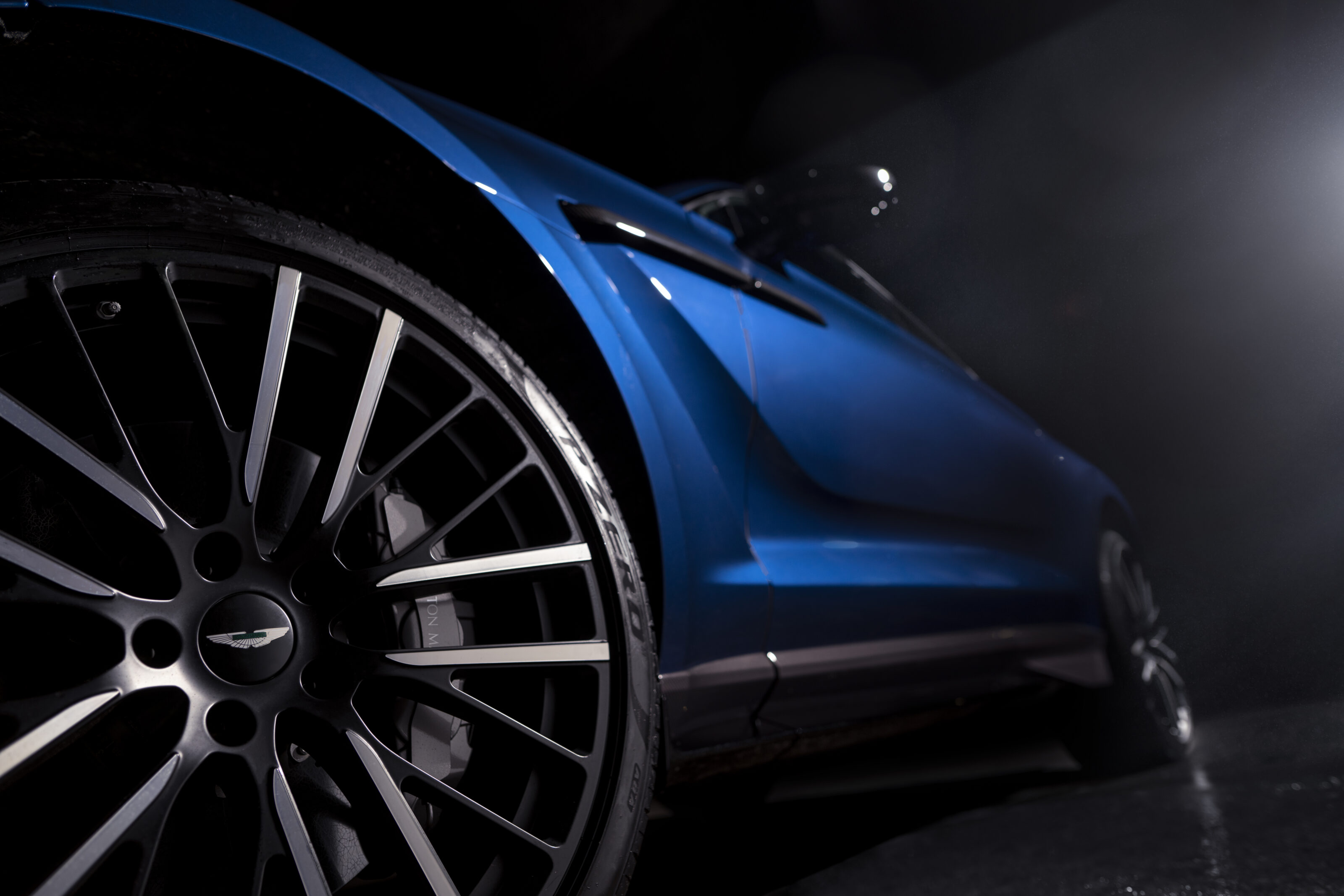
Standard brakes are 420mm front and 390mm rear carbon-ceramic rotors. Standard wheels are 22-inch alloys, shod with Pirelli P-Zero tyres. A new 707-exclusive 23-inch wheel design is available as an option.
With those dynamic upgrades, and given the DBX707’s V8 is mounted further back in the chassis than the Urus’s engine and its overall mass is about nine percent less than that of the Bentayga Speed, there’s no reason why this Aston shouldn’t be the most entertaining of these super-sport SUVs through the twisty bits.
Grafting iconic sportscar graphics onto a big two-box SUV is a challenge but chief creative officer Marek Reichmann’s team of designers have, by and large, succeeded in making the regular DBX look as glamourous as the rest of the Aston Martin family. The DBX707 adds muscle to the glamour.
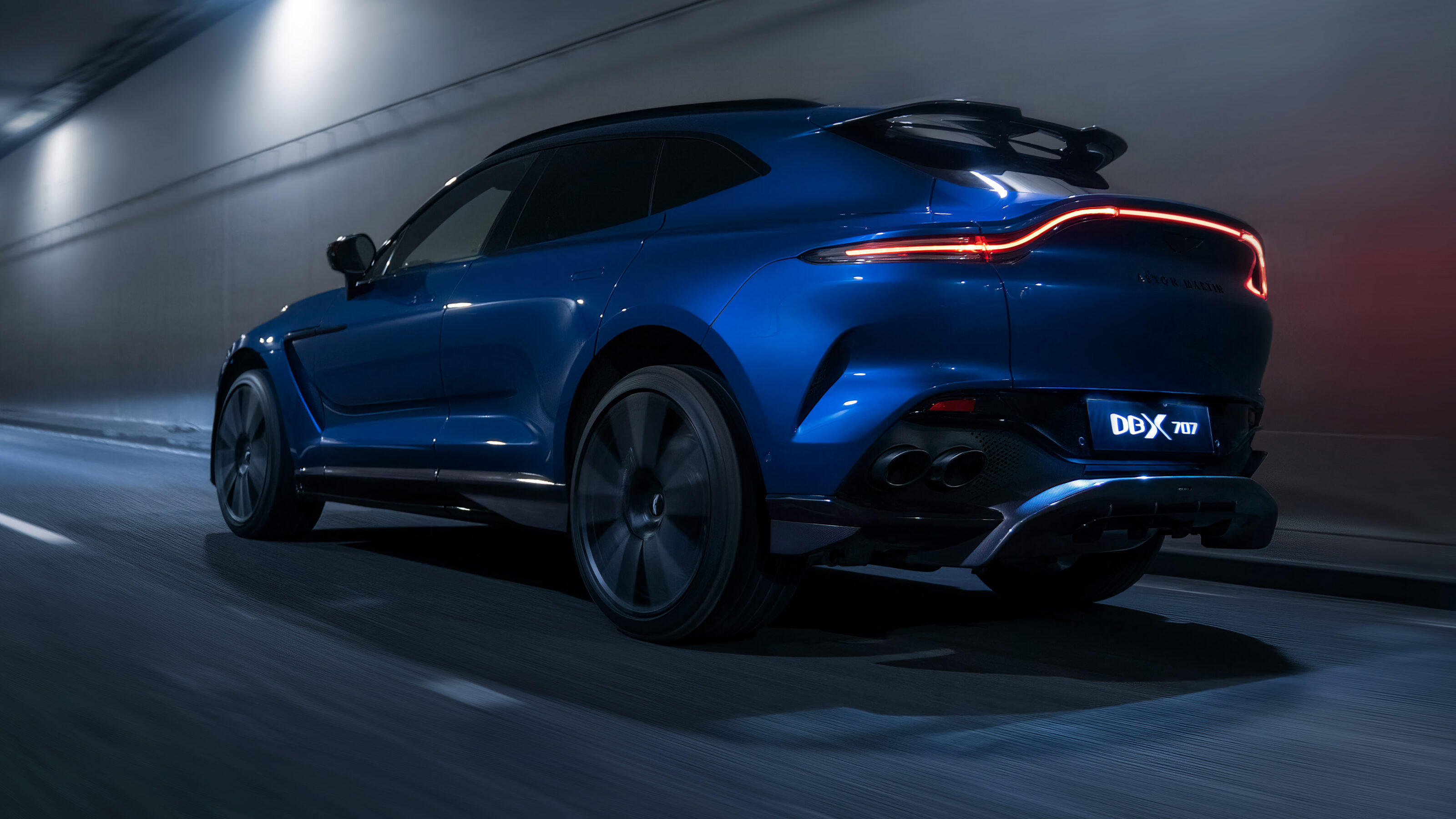
A new front fascia features a bigger, bolder grille, larger cooling intakes for the brakes and a more aggressive front splitter. The rear fascia is new, too, with quarter panel vents integrated into the bumper and a large diffuser underneath flanked by dual exhaust outlets. A larger spoiler extends from the trailing edge of the roof.
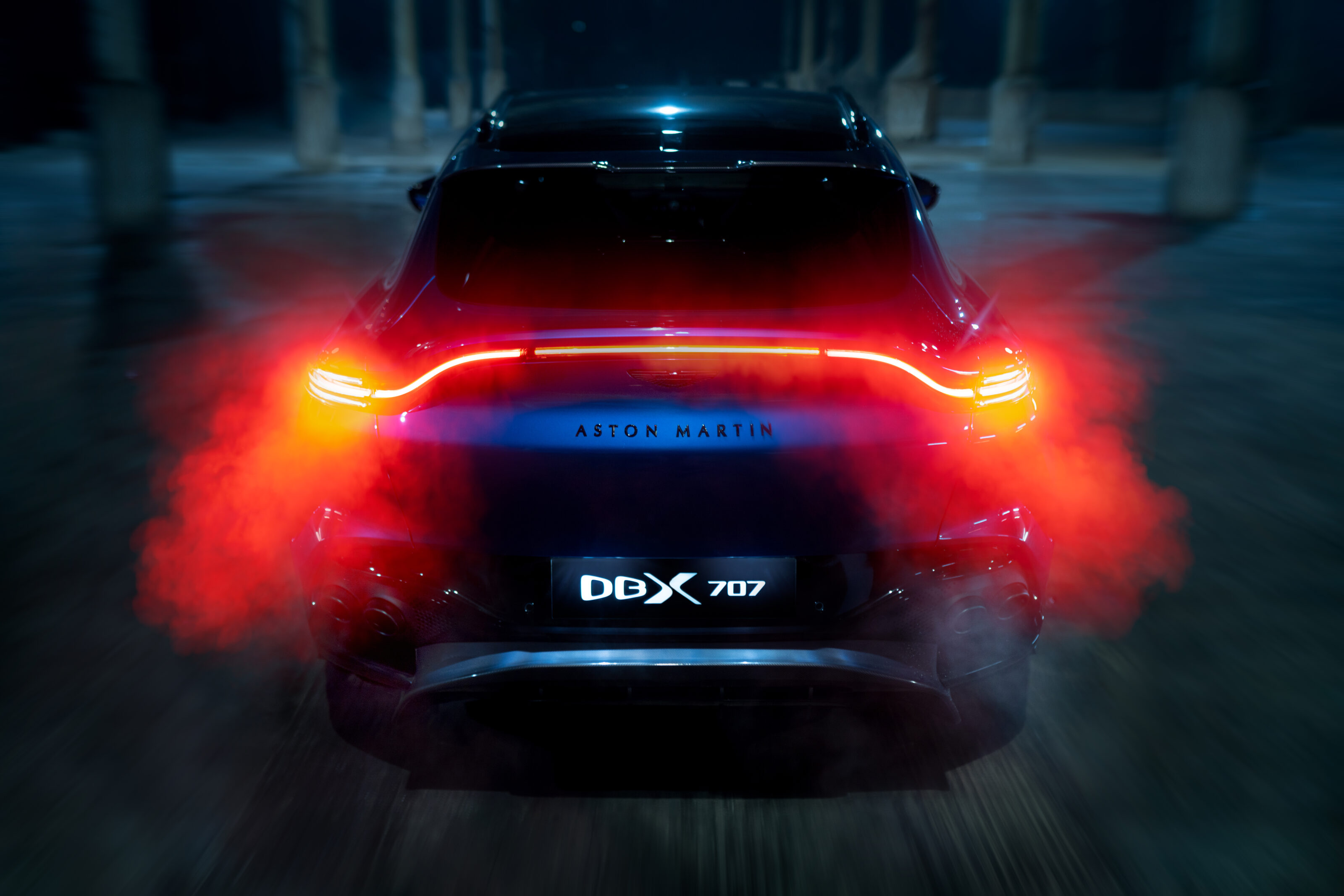
The aggressive styling details don’t compromise practicality, though: Front and rear departure angles remain the same as the standard DBX, and the 707 can be ordered in Europe with a retractable tow bar.
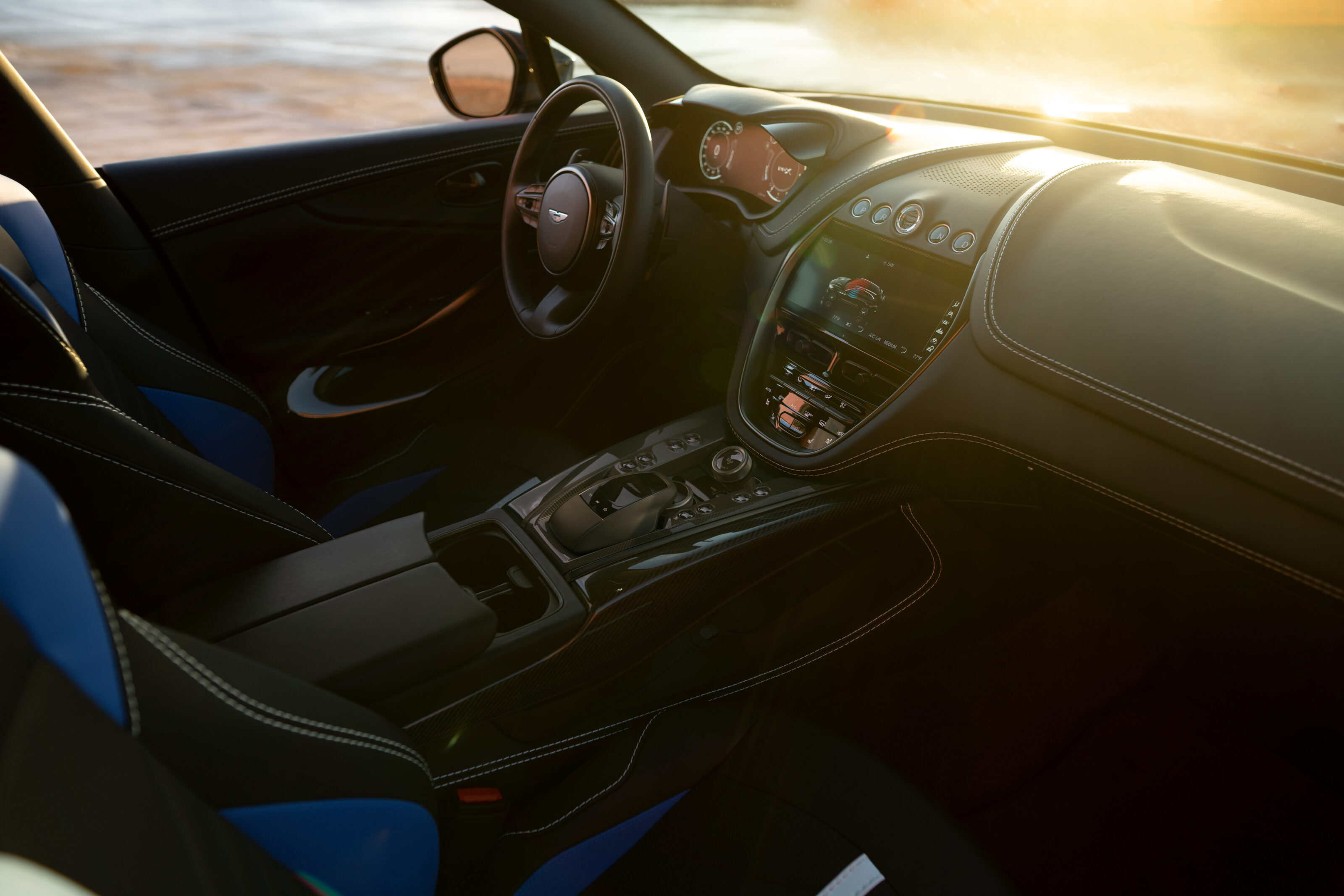
Inside, the DBX707 can be ordered with either sport or comfort front seats, the former offered with a unique herringbone perforation pattern on the backrest and squab. A vertically mounted rotary controller has been added to the cenre console to allow rapid selection of different drive modes.
The Aston Martin DBX707 is expected to arrive in Australia later this year. No word on price yet, but if the UK market is any guide, don’t expect much change from $400,000.
Could it be that taxes rather than incentives will motivate electric car ownership?
In the UK, Oxford city is soon to begin trialling a Zero Emission Zone (ZEZ) that will see fees applied to combustion engine vehicles entering the area – some equivalent to almost $20 per day.
The fee, which changes depending on the Euro-emissions standard of the car, includes hybrids – which are mostly motivated by a traditional combustion engine.

There have already been calls in Australia for similar schemes to be set up, with The Grattan Institute’s transport and cities program director, Marion Terrill in 2020 suggesting that Melbourne introduce ‘ultra low emission zones’ around Southbank, Queen Victoria Market, and Docklands in Melbourne.
While initially restricted to only a small number of streets around Oxford’s centre, the plan is that the ZEZ will expand to cover most of the city and that fees will also go higher.
The upshot for pure-electric vehicle owners is that they will not have to pay any fees for driving and parking in the ZEZ, although there are discounts for residents and some groups of people. But even those with a plug-in hybrid, some of which can drive on electricity alone for around 100 kilometres, will pay a tax.
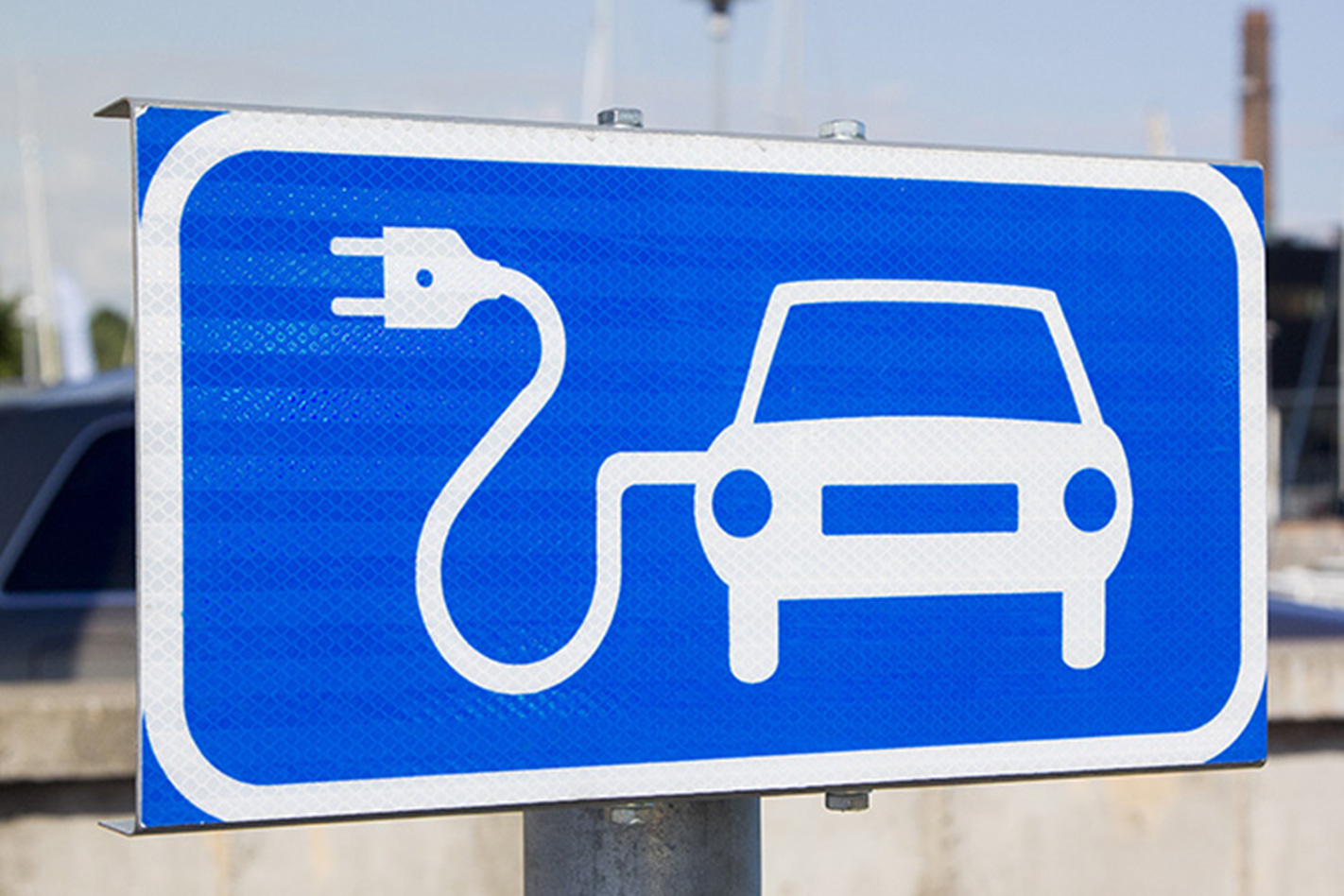
Set to start on February 28, the ZEZ will be enforced between 7am to 7pm every day of the year. Fees are based on the registered vehicle’s driveline.
Pure electric cars are free to use the ZEZ; while hybrids emitting less than 75g/km CO2, such as the Mitsubishi Outlander PHEV but not the Toyota Camry Hybrid, would pay around the equivalent of $3.80 per day. Cars with a Euro 4 certified petrol and Euro 6 diesel engine pay $7.60 per day; and any vehicle with an engine before that will be given a fee of $19 per day.
While almost $20 per day might sting a little, there are some waivers and discounts: residents and business owners get 90 per cent off, healthcare workers are allowed exemptions, students ‘in financial hardship’ can get through for free, and hire cars are given a 50 per cent discount.
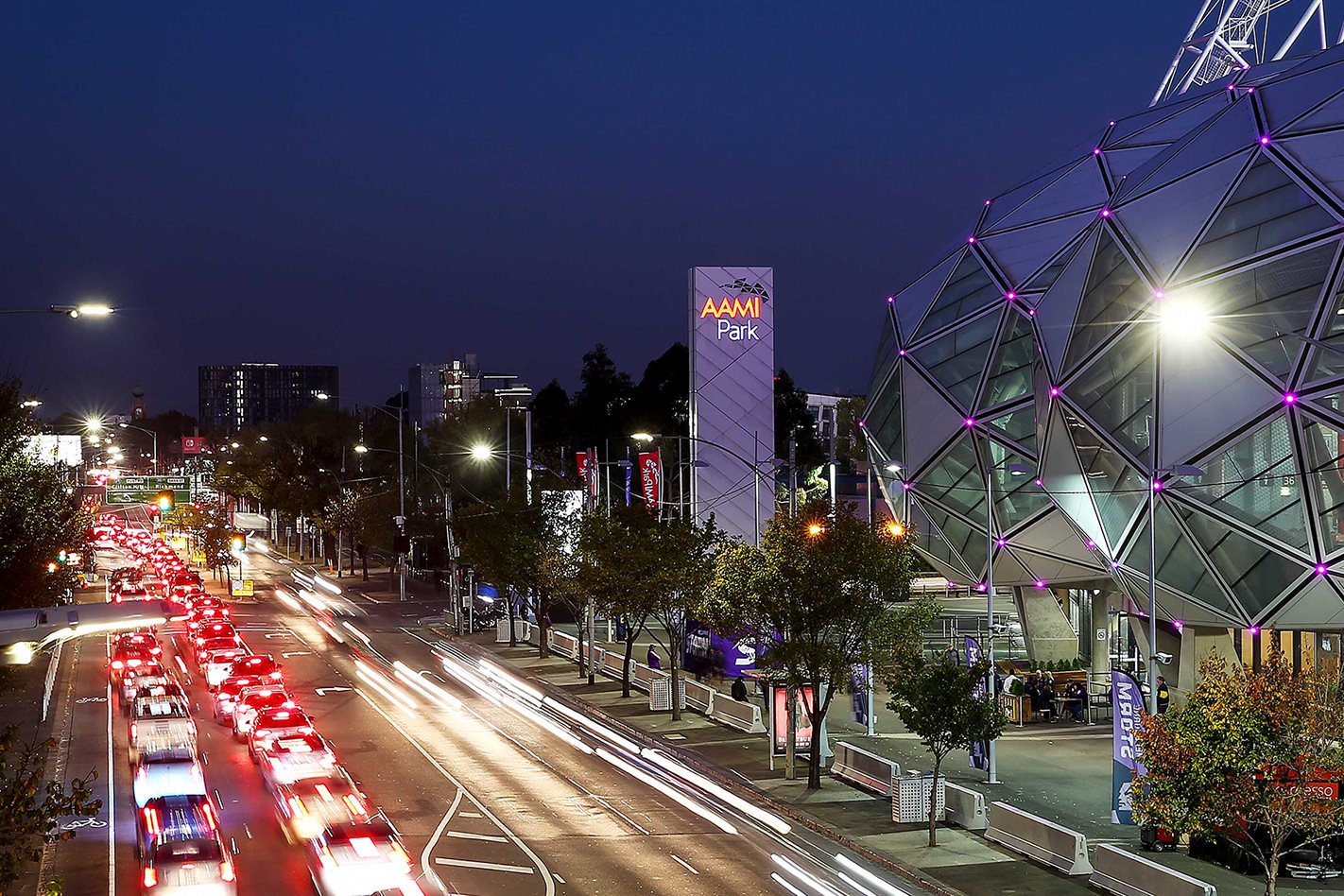
The idea of emissions zones in Australia is fledgling, but in Europe and the UK there are many and the push coincides with government mandates that are forcing new vehicle sales from the turn of the decade to be electrified and meet very strict emissions standards.
The Australian Government is yet to make such a commitment, leaving the market here in limbo and currently free of such regulated pressure.
Key specification details for the 2022 GWM Ora Ballet Cat have been announced.
The five-door retro-inspired electric hatch will go on sale in China in late March, in spite of concerns surrounding its similarities to the Volkswagen Beetle.
A spokesperson for the German brand told Carscoops it is investigating the vehicle “with regard to any violations of utility model or design rights of Volkswagen AG and reserves the right to take any necessary legal steps.”

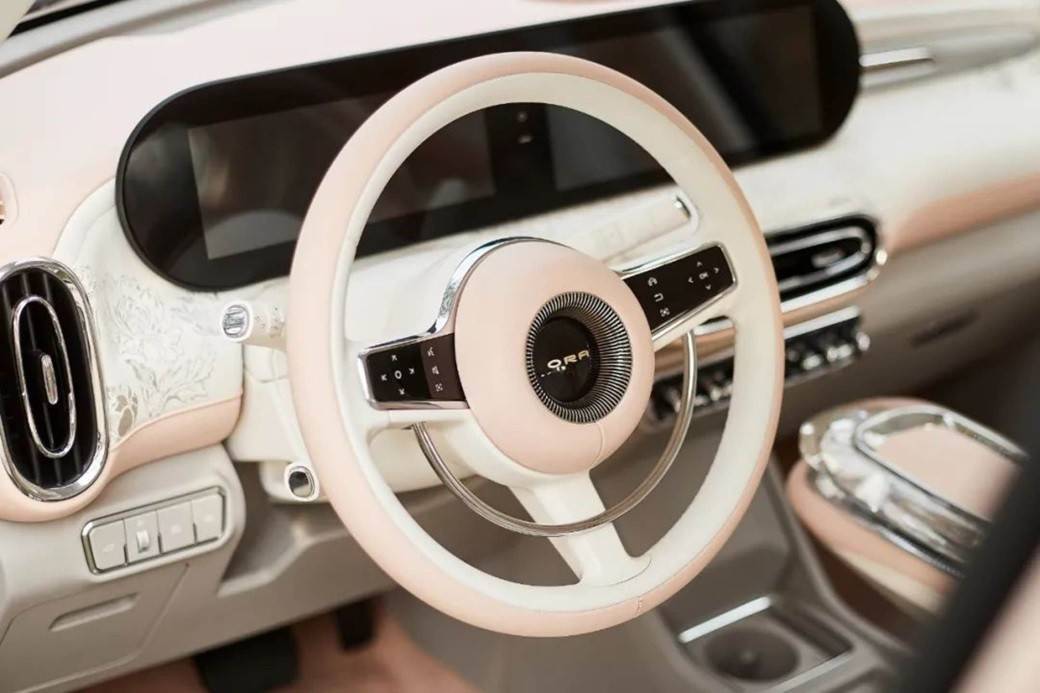
As the so-called ‘feminine’ version of the GWM Ora Punk Cat – which debuted at the 2021 Shanghai Auto Show – the Ballet Cat swaps the Beetle-inspired circular headlights and tail-lights out for a horseshoe-like set.
There are also fewer lashings of chrome trims and minor tweaks to the front and rear bumpers, along with two-tone paint and more-intricate alloy wheels.
The dimensions for the Ballet Cat are similar in nature to small hatchbacks – such as the Hyundai i30, Mazda 3 and Toyota Corolla – at 4401 millimetres long and 1867mm wide.
At 1633mm high and a wheelbase measuring 2750mm, it could also pass off as a small or medium SUV – with the skateboard EV platform allowing for the capacious footprint, much like the Hyundai Ioniq 5 and Kia EV6.
It will be offered with a single 126kW/250Nm electric motor powering the front wheels, combined with the choice of a 47.8kWh lithium iron phosphate (LFP) or 59.1kWh lithium-ion battery.
The electric driving range is said to be in excess of 500 kilometres, with a top speed of 155km/h.
Chinese pricing is yet to be announced, but it isn’t likely to stray far from the related Punk Cat, which starts at ¥103,900 (AU$23,122) and goes up to ¥143,900 (AU$32,024).
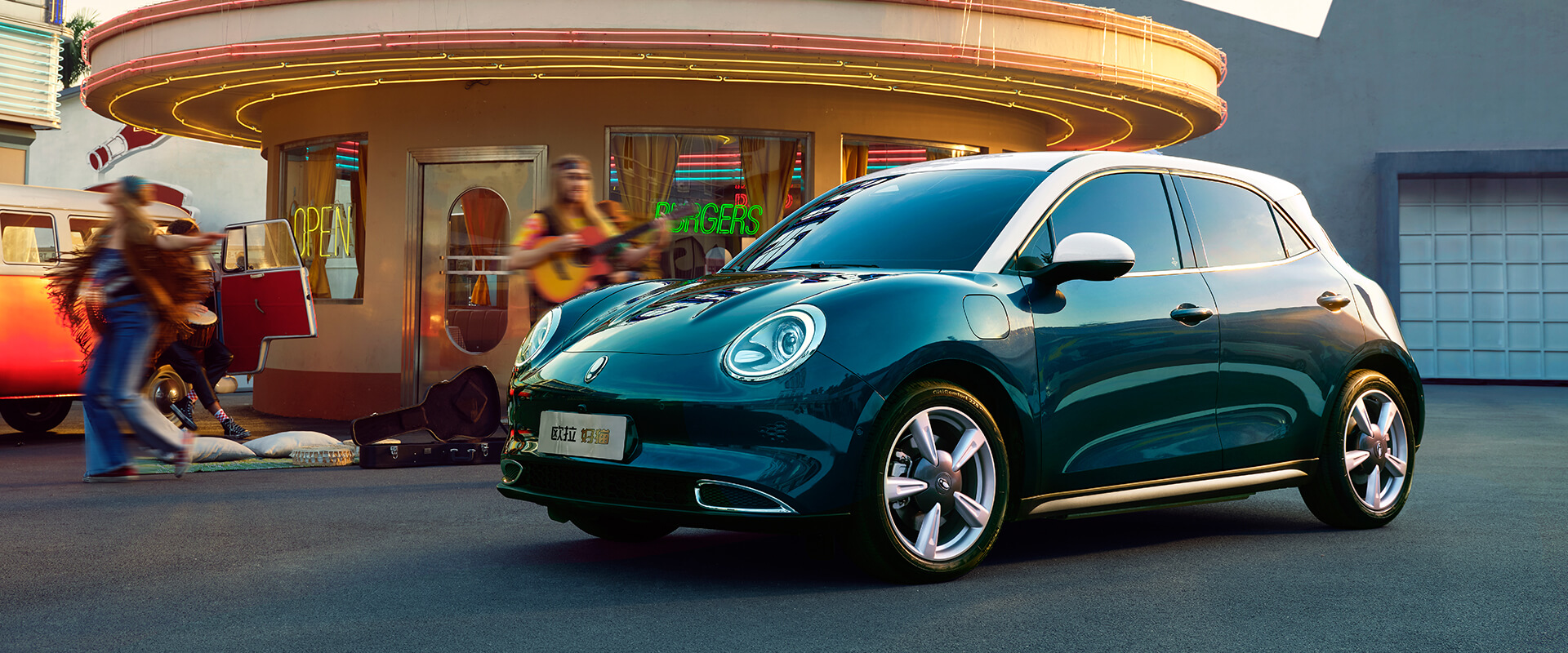
While the GWM Ora Ballet Cat and Punk Cat are both highly unlikely to extend beyond Chinese borders, the electric vehicle marque is gearing up for a local launch.
“Under the overwhelming wave of electrification, as one of the important areas of Great Wall Motor’s global strategic map, the Australian market has laid out the line-up of electrified products prospectively,” the company announced in a statement.
“In 2022, the first batch of electric models will be launched in Australia, including the pure-electric brand Ora.”
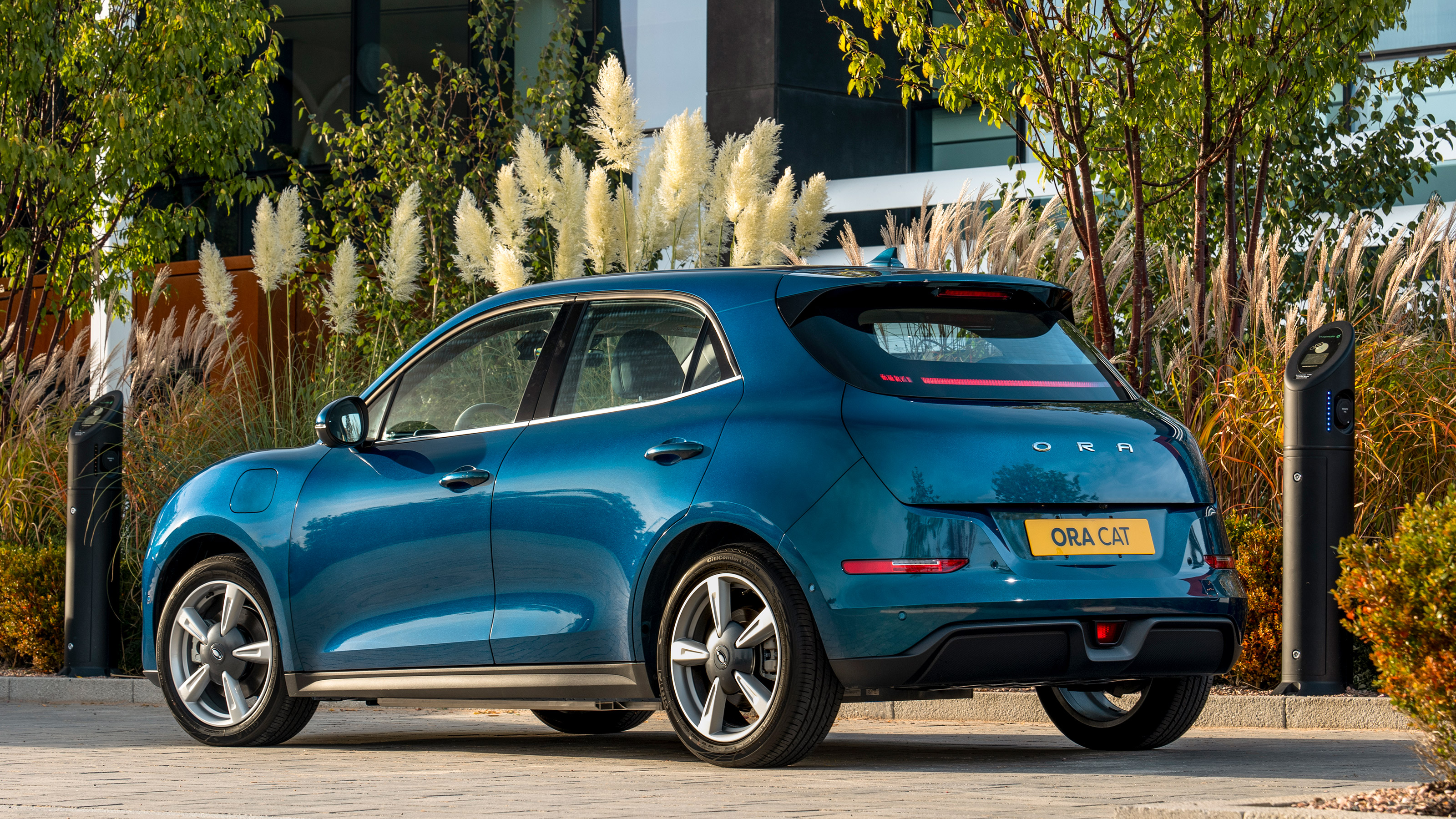
The first model to arrive will be the GWM Ora Cat 01 (pictured above), which offers the choice of 48kWh or 63kWh battery packs supplying a 126kW/250Nm motor driving the front wheels.
Although it is priced at around £25,000 in the UK (AU$46,000), the hatch could undercut the $44,990 drive-away MG ZS EV when it arrives locally, making it the cheapest electric vehicle in Australia.
AT $47,200 drive-away, the Honda Civic is the catalyst for this comparo. It’s the sole Civic on offer in Australia now that Honda’s local office has (vastly) simplified the line-up by reducing it to a single spec, and the first all-new model to transition to the company’s non-negotiable national drive-away pricing scheme. Think you’ll be able to haggle the dealer down? Forget about it.
That’s a lot of dosh for a small hatchback, even factoring in the inclusion of all on-road costs, so it begs the question: why buy a Civic when there are so many other options at the circa-$50k mark from brands that aren’t averse to negotiation?
Shopping at this price point opens the door to things like powerful midsize sedans and brands with proper premium cachet, not to mention a bevy of hot hatches and ultra-pragmatic mid-size and large SUVs. You can get a base Mazda CX-9 Sport for $46K before on-roads, for crying out loud, so where’s the value in a $47K small hatchback? We’re gonna find out.

We’ve got a small mainstream hatch, an entry-level premium sedan, and a feature-packed mid-size four-door. Only the presence of a turbo four-cylinder mounted east-westwards under their bonnets unifies this bunch, because in most other respects they are very disparate cars pitched at rather different demographics.
Factor in price, however, and they’re surprisingly close bedfellows. Like the Civic, which launched here at the end of last year, the Audi A3 is fresh metal. We’ve pinched the range-opening A3 35 TFSI sedan which, with a $49,400 retail sticker, is within coo-we of the Honda.
Opting for the five-door A3 Sportback bodystyle can trim the pricetag even further to $46,900, making the Audi A3 the most affordable small premium car in the country while still netting the same feature set as the sedan – save for an electrically-opening bootlid.

The presence of Hyundai’s Sonata N-Line may seem a little incongruous, because compared to the Civic and A3 it’s something of a whale – or a catfish, if that gaping maw of a front end is to be judged. Hailing from a size class above the other two, the Sonata doesn’t just exude a big-car feel, it flaunts a level of standard equipment that the A3 and Civic simply can’t rival (see breakout).
There’s also the considerable value offered by its turbocharged 2.5-litre engine, which cranks out nearly double the power of the Audi and 82kW more than the Honda. If you measure value in features-per-dollar, dollars-per-kilowatt or square-footage-per-dollar, then the Hyundai has already won this comparo.
The A3, on the other hand, is a bit of a stripper spec. The car you see here has been helped out a bit with some options, however, none which alter the driving experience.

That said, subtracting them would leave you with something very Spartan: the base A3’s faux leather upholstery, flat seats and spongy soft-touch surfaces (particularly those used on the door cards) aren’t aligned with the premium promise of those four rings in the grille, and the 50-shades-of-grey cabin furniture leans heavily on surfaces that don’t age well, like hard scratchy plastics and piano-black trims.
Key touchpoints like the steering wheel and door handles do look and feel upmarket, and the dashboard design is functional and modern, but if you were expecting a high-end aura then A3 35 TFSI may disappoint.
And forgive us for being shallow, but appearances matter. The A3’s sheetmetal has been styled with pronounced quarterpanels, the subtly bulging bodywork around each wheelarch hinting at the brand’s all-wheel drive heritage and performance nous.

The only problem is, the 35 TFSI is strictly a front-drive thing, and the 18-inchers fitted to it look lost within those big wheelwells thanks to weak offsets and plenty of airspace between tyre and arch liner. The tiny red “Audi Sport” decals on each rim also seem like a cruel joke, because the visual presentation looks about as sporty as a pair of leather loafers.
Speaking of things that are built for comfort, the Sonata manages to cut a figure that looks both elegant and athletic. Like the Civic, the Sonata is now a single-spec proposition in Australia, only offered in a high-tier N-Line config.
While this writer isn’t sold on the way the chrome window trim extends down the bonnet cutline and merges with the headlight’s DRLs, the rest of the Sonata’s bodykit gels well with its proportions – the obvious exception being those pointless vent-like appliques behind the rear wheels.

That aside, the Hyundai has great road presence. The corner-to-corner tail lamp graphic looks particularly handsome at night, and even the ‘Sonata’ script on the bootlid isn’t unwelcome. This badge has come a long way from its humble origins as Korea’s Camry.
On the inside, it’s less convincing. Besides committing the same crimes as the Audi with scratchy lower-dash plastics and piano black around key switch blocks, the steering wheel leather feels distinctly faux and the padded door armrests have an unappealing squish to them. As feature-rich as it is, the execution of the Sonata’s cabin does show room for improvement.
And that brings us to the Civic. The Civic is an exercise in quiet achievement, and that’s not exactly the best thing for a car that needs to pull in buyers who may already be put off from stepping into a showroom.

Once inside, however, you can appreciate the latent quality of its furnishings, its fine-grained leather wheel, the tasteful hexagonal mesh that stretches across the dash and the fine joysticks that control each air vent. The chrome dials suck heat from your fingertips like metal does, each button, lever and stalk operate with satisfying haptics, and the driver’s seating position is low-slung, sporty and comfortable.
There are some mis-steps though, with the Civic’s part-analogue, part-digital instrument panel lacking the wow-factor and reconfigurability of the all-digital A3 and Sonata, while its infotainment system is also not quite as intuitive and easy to use as those of the other two – though it’s admittedly a massive step forward from Honda infotainment software of the recent past.
Body quality is also a lowlight, with noticeable orange peel on virtually every panel and panel gaps on all shutlines that seem just a smidge too wide for a vehicle built in 2022.

Also, we miss the rear-facing camera view that the previous generation offered, which made merging left a whole lot safer. The Sonata, meanwhile, has that same feature not just on the left side, but on the right as well.
As far as static showroom assessment goes, the outcome is inconclusive – none are clear winners, though the Honda does at least get fundamentals like packaging and cabin quality right and the Hyundai is positively weighed down with technology and features. The A3 is a backmarker here.
So, to the on-road evaluation. For this, each car was subjected to two road loops: the dynamic country road ‘fun loop’ that journos love but is of dubious value to most buyers, and a 100km urban/highway fuel economy loop that’s a potent sedative for any car journalist, but arguably generates more useful data for the typical punter.

Let’s get the boring one out of the way. Steering the A3 around Melbourne’s urban streets, there’s an effortlessness to the way it gets the task done. It feels light, easy to steer and quite zippy thanks to its generous spread of low-rpm torque, which works nicely with the programming of its seven-speed dual-clutch.
The suspension has a generally taut nature but easily shrugs off big-amplitude obstacles like soft-edged speedbumps without jostling occupants, and while the 18-inchers look a tad undersized, their sidewalls are the right dimensions to filter out the smaller stuff.
Outward visibility is good too. The A3’s glasshouse is big, there’s no privacy tint getting in the way and the rear quarter windows also help shrink the blind spot – not that the door-mounted mirrors really have much of one.

The A3 also has an adaptive engine braking feature, which either uses the engine’s compression or dials up the resistance of the smart alternator (or a combination of the two) to gently hold you back from traffic in front and reduce fuel burn by a fraction. It actually works quite seamlessly, especially on highways, though its impact on fuel economy is hard to measure, and it’s only available with the Comfort pack option.
Also seamless is the 1.4-litre’s cylinder deactivation feature, which shuts down two pots during very light-throttle cruising to save juice. Result: 5.4L/100km over a 70:30 urban/highway cycle in real-world conditions. That’s a pretty great number for a non-hybrid.
The Sonata exists at the opposite end of the spectrum. Perhaps in an effort to justify the N-Line badge in its grille, the suspension has been tuned with body control in mind, however the net result is a suspension that feels unnecessarily firm and has plenty of jiggle on seemingly smooth roads. It’s a lot more cosseting on a highway, however.

But a bigger issue around town is just how eager it is to pile on speed. It’s not the easiest car to drive smoothly unless you really baby the accelerator, and that’s largely down to the way the Sonata’s 2.5-litre turbo piles on boost from the midrange.
It feels old-school turbo, with miles of upper-revs thrust offset by a fairly benign low-end. If you mush the throttle a little too much to overtake another car or pull out of a side street, tyre chirping and torque steer is often the result.
It’s a big and powerful machine, but is otherwise easy to drive besides its turbo lag. The power steering is light and friendly (though very much lacking in feel), and the aforementioned side-looking indicator cameras help keep tabs on what’s around the Sonata’s sizable hindquarters.

This might make a great limo – it’s big on the inside, effortless on a highway and not too unwieldy for city driving – if it weren’t for one thing: its prodigious thirst. The Sonata averaged 8.0L/100km by the end of that loop, but were it not for the highway component it would have easily recorded an urban average north of 10L/100km.
A heavy car plus a big-boost engine equals pain at the bowser. Another problem that might cost you some money: the speed sign recognition would routinely display the wrong speed, with 100 often showing in areas that were signposted for 80 and vice-versa. Erm, might want to fix that up, Hyundai.
The Civic occupies the safe middle ground. Its economy result was a respectable 6.7L/100km (close to the factory claim of 6.4L/100km), it’s the right size for both city and suburban roads, and its CVT pairs well with the outputs of its 1.5-litre turbo and works fine in a town environment.

However it rode more firmly than anticipated, with a tauter feel than the A3 but less sensitivity than the Sonata. Rearward vision isn’t as good as the A3 either, and we genuinely miss those side cameras. Honda, bring them back ASAP, and while you’re at it maybe take a look at the lane-keep assist calibration – it prevents you from drifting across solid white lines, but is perfectly fine with letting the car stray over dotted lines without so much as a warning.
Transitioning to a twisty road sees the Civic shine. It has a wonderfully balanced chassis, and the firmness that’s noticeable around town turns into an advantage when the road ahead weaves left and right. Roadholding from its Goodyear Eagle F1s is good, the CVT begins working through stepped ratios when you mat the throttle, and the steering is nicely weighted and has a rack ratio that’s not too fast, but not too dozy either.
There’s a bit of throttle hang as the CVT adjusts to throttle lifts and some mild torque steer too, but nothing that gets in the way of enjoying a country drive. Rock-solid and stable, it’s a fine partner for a fun road.

Actually, so is the A3. It generally performed well as a city car but my prediction was it would run out of steam on the winding stuff. Yet while the 110kW 1.4 does indeed get puffed when asked to perform above 80km/h, the chassis is certainly willing to engage with a keen driver. The biggest impediment it has in this environment is the minimal lateral support in its flat-cushioned driver’s seat.
Yet while the other two are adept, if underpowered, the Sonata is the total opposite. Its front Continentals are easily overwhelmed by the massive 422Nm torque output of its 2.5 turbo, and the torque steer can be colossal if you aren’t ready for it. The stiff-legged suspension does actually hang onto corners pretty well considering the car’s weight, but attempting to smoothly get on the power as you pass the apex often sees the balance upset by the sudden onset of boost.
There are many ways of spending fifty grand, but if you were wondering if a near-$50k pricetag for a non-Type R Civic was cheeky, well, it isn’t when judged in the context of what else is available.

The Sonata, though it gives you plenty of metal for your money, feels rough around the edges in more than one way. The A3, on the other hand, leaves you feeling short-changed – the core of it is undoubtedly good, but the base 35 TFSI gives you the overwhelming feeling that the best examples of the A3 are the ones further up the spec ladder.
But the real threats to the Honda are within the small-car category. We’ve already judged the Mark 8 Golf 110TSI Life to be the category benchmark, and that car starts well below $40K. Another Euro rival is Peugeot’s new-gen 308, arriving soon with the choice of hatch, wagon, hybrid and (eventually) an EV.
If Peugeot can make a diverse small-car lineup work, why can’t Honda? However, judged within the context of its price point, the Civic does present plenty of virtues. Don’t write it off just yet.

1. Audi A3
The A3 is a small car with a lowercase ‘s’. Back seat accommodation isn’t its strong suit, with cramped footwells, limited knee room and a rear bench that’s both flat and not really wide enough to carry three adults in comfort. It does at least have a light and airy feel though, thanks to a beige headliner and generously-sized glass, while boot capacity is plentiful for a few large suitcases.
With the Comfort Package ($2600) adding powered and heated front seats, adaptive cruise, electric lumbar adjustment and heated/power folding wing mirrors, our A3 looked and felt less plain than it otherwise would in unoptioned trim, though thankfully that crisp and intuitive 10.1-inch infotainment screen and electronic instrument panel are standard-issue.

2. Honda Civic
Perhaps one of the biggest things that sets the Civic apart from other small cars is its rear-seat space, which flaunts generous legroom and a comfortable bench and backrest. Three adults would be squeezy though, and headroom is constrained by the diving roofline and there’s a generally cave-like ambience from the black headliner and dark-tinted privacy glass.
Nice-feeling leather upholstery, Bose premium audio, a nine-inch touchscreen, wireless phone charger, dual-zone climate control, heated and powered front seats, active cruise – the Civic has all the basics covered and more, though simply cannot equal the Hyundai’s tech suite.

3. Hyundai Sonata
No surprises that the midsizer has a back-seat advantage, though to be honest it only edges ahead of the spacious Civic due to its provision of more airspace around the noggin. The standard pano sunroof also extends over the rear seats too, which is a nice touch, and the boot is definitely well suited to hotel transfer duty.
The Sonata N-Line is the most expensive in the gang, but besides its larger form factor the Sonata justifies its additional cost by packing in a feature set that encompasses luxuries like a panoramic glass sunroof, a head-up display, heated and cooled front seats, heated rear seats, leather, active cruise, retractable rear sunblinds and more.
SCORING
Honda Civic VTi-LX: 7.5/10
Audi A3 35 TFSI: 6.5/10
Hyundai Sonata N-Line: 7.0/10
Lee Noble, the founder of supercar maker Noble, has confirmed that his mid-engined supercar, the Exile, is still in the works.
Five years since Lee Noble teased a prototype supercar, it is now looking on track to launch this decade – albeit with a modified Ford Ecoboost V6 over the previous Cadillac-sourced motor. And there are also a few bridges to cross before then, including investment for production.
Noble told British outlet Autocar that he envisages the Exile going into production as a bespoke supercar, developing around 370kW from the 3.5-litre twin-turbo V6 engine to the rear wheels via a Graziano six-speed manual transmission and a limited-slip differential.
While there will not be any traction control trickery to maximise grip on take-off (something which will save time and money on certification), it should be good for completing the 0-100km/h sprint in around 3.5 seconds.
“It’s bulletproof and it will shift gear as quick as I can move my arm,” said Noble to Autocar.
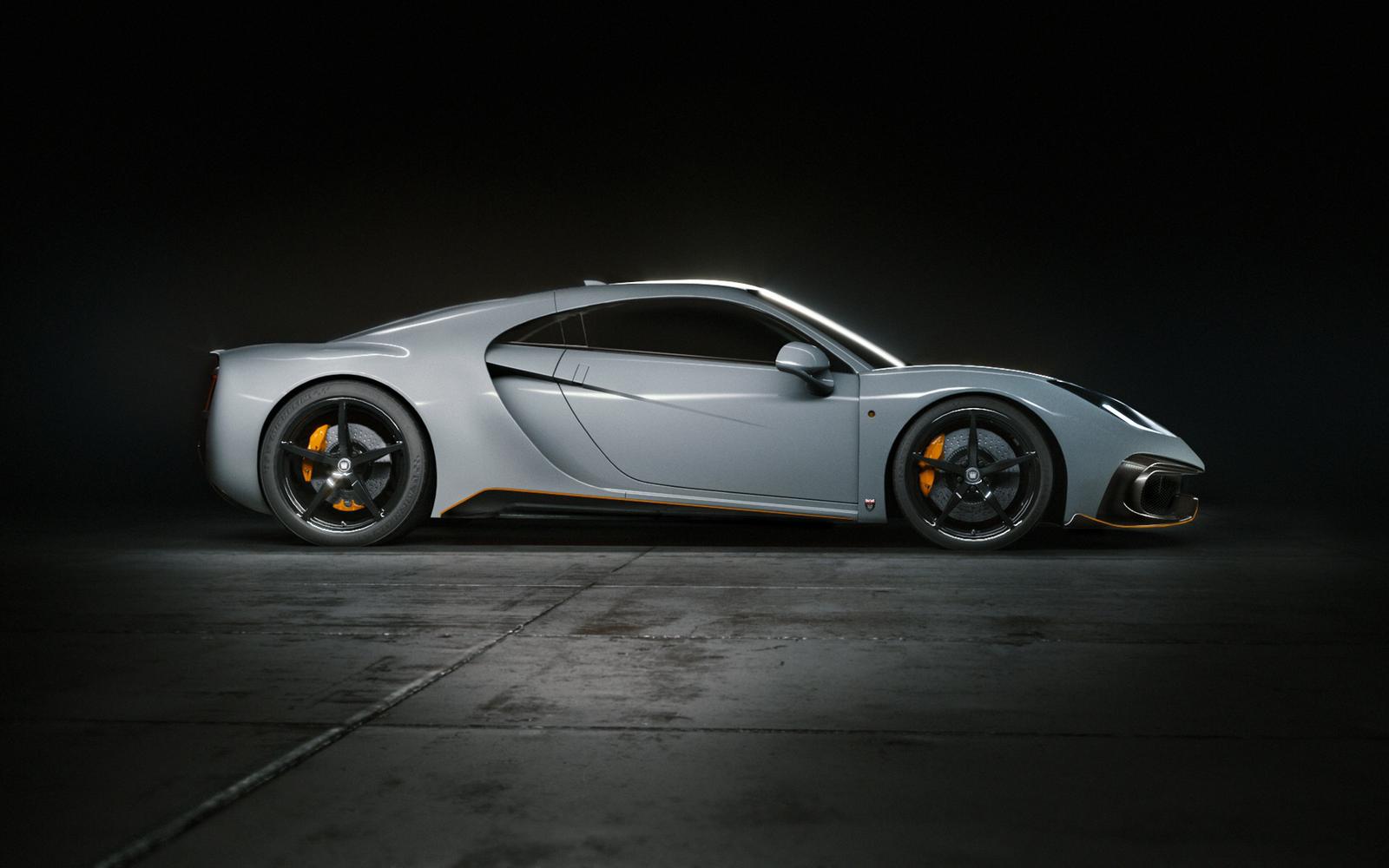
For those paying attention to his original car company, Noble, the Exile (the name of his new business) is not to be confused with the upcoming Noble M500 (pictured above), despite both using a Ford V6 engine midship, although investment funds might see the Exile built by High Tech Automotive in South Africa, where Noble built the M12.
The Exile is planned to have a chassis which can sit underneath different body styles and is constructed with steel subframes and a monocoque central structure. The first body is a targa coupe made from fibreglass to keep weight at a minimum – a claimed 1100 kilograms.
Suspension is sorted with double-wishbones front and rear and three-way adjustable dampers, while behind each wheel are Wilwood six-piston calipers for added clamping strength.
The supercar will also come with a sharp price, according to Noble, who is focusing on £100,000 pricetag, or around AU$190,000. To do that, the Exile will forgo some creature comforts and electronics such as traction control, but will also help the company to build an expected 200 units per year.
Snapshot
- Seven-seat SUV gains additional comfort and safety features for 2022
- Centre airbag and multi-collision braking system added across the range
- Price rises between $850 and $1700
Pricing and specification details for the updated 2022 Hyundai Santa Fe have been announced.
The family SUV will arrive in local showrooms this month, priced from $45,550 before on-road costs.
Hyundai has added a number of comfort and safety features to the Santa Fe for model-year 2022, including a centre airbag and multi-collision braking system – both of which are standard across the range.
If driver input is undetected, the latter system will apply the brakes after the airbags deploy to avoid a secondary collision.
Price rises between $850 and $1700 will accompany the update.
Third-row USB ports – previously available on the flagship Highlander – are now standard across each variant.
Active grades also gain a unique exterior design for 2022, with a chrome grille, skid plate, door garnish, bumper moulding and door handles.
The second-from-top Elite picks up some equipment previously exclusive to the Highlander, such as the 12.3-inch digital instrument cluster, heated front seats and LED tail-lights.
A hybrid powertrain will join the Santa Fe range in the coming months.
2022 Hyundai Santa Fe Australian pricing
Prices exclude on-road costs.
Premium paint is $695 extra across the Santa Fe range.
Elite buyers can opt for cognac brown leather upholstery for $295, with camel brown Nappa leather available for the same premium on the Highlander.
2022 Hyundai Santa Fe features
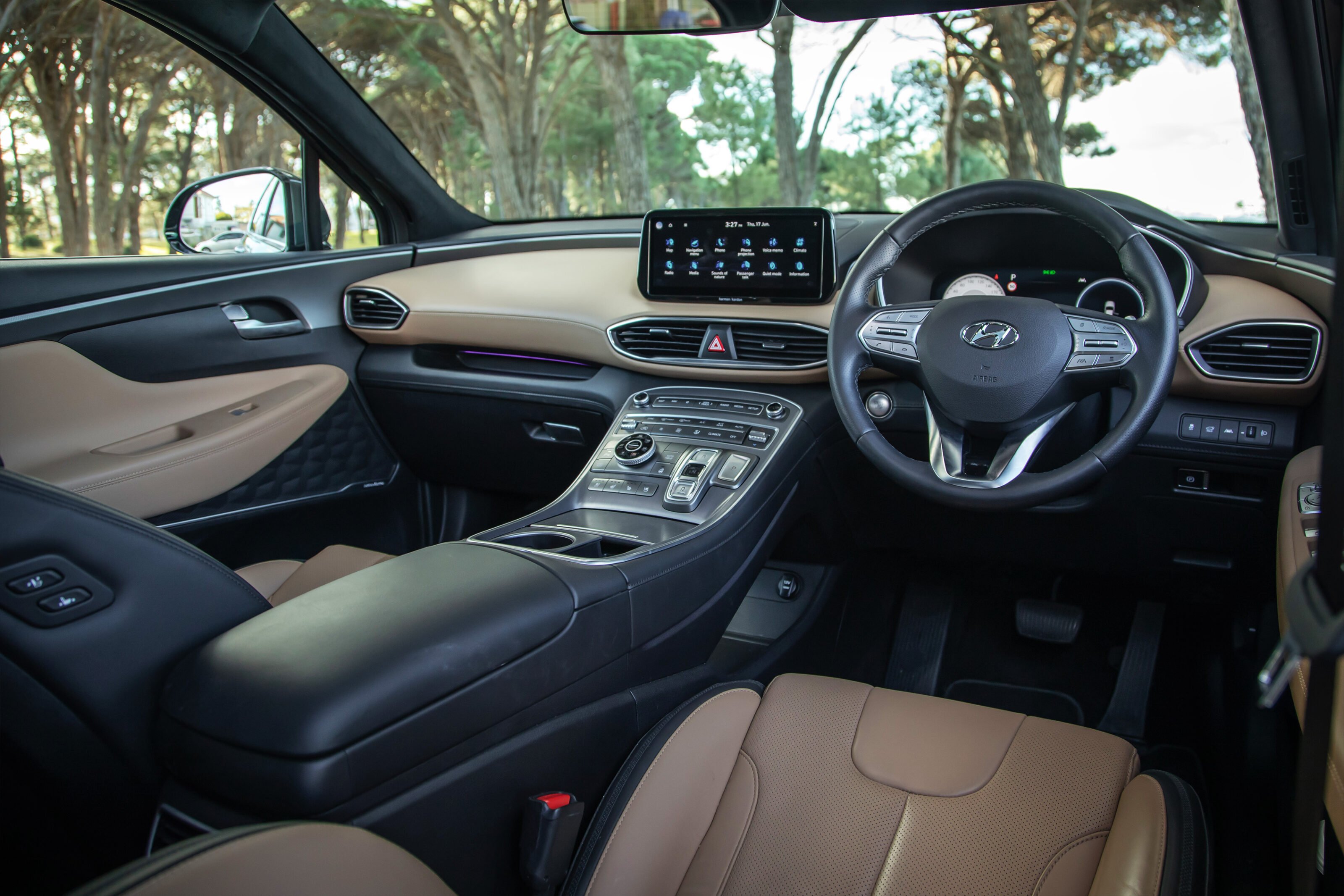
Santa Fe
Active
Elite
Highlander
Engine, drivetrain and fuel economy
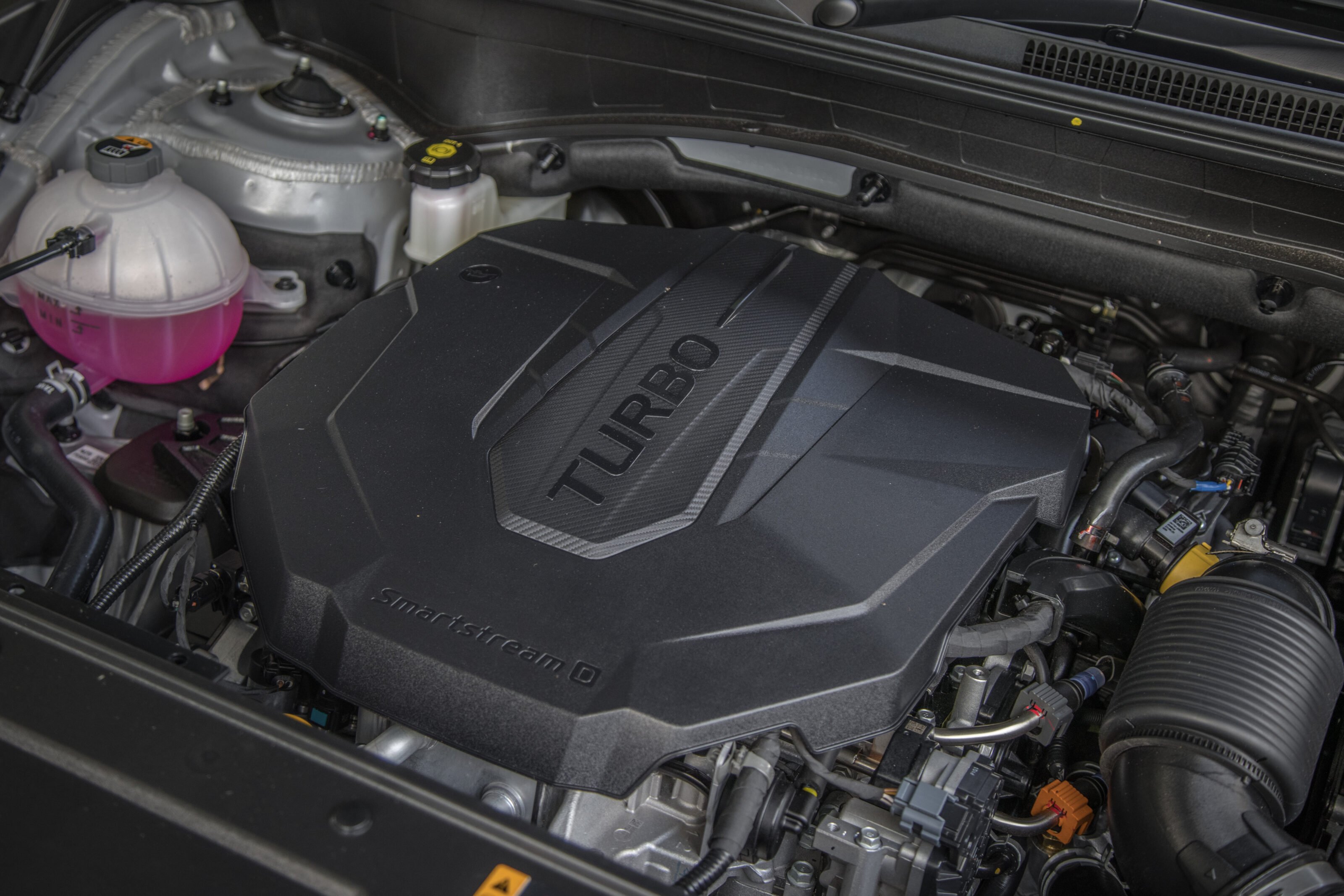
In identical fashion to the Kia Sorento and Mazda CX-8, the Hyundai Santa Fe can be chosen with either petrol or diesel power.
Petrol-powered Santa Fe variants feature a 3.5-litre naturally-aspirated V6 producing 200kW of power and 332Nm of torque. It is mated with an eight-speed torque-converter automatic transmission, exclusively sending power to the front wheels.
The 148kW/440Nm 2.2-litre four-cylinder diesel is available in all-wheel-drive guise only.
It is matched with an eight-speed ‘wet’ dual-clutch automatic transmission.
Fuel economy figures can be found in the table below:
Braked towing capacity is rated at 2500 kilograms, with a tow-ball down weight of 200kg.
Safety
The Hyundai Santa Fe is covered by a five-star ANCAP safety rating, based on testing conducted in 2018.
Seven airbags (dual frontal, side chest, side curtain and centre) are standard, although coverage does not extend into the third-row.
Each variant includes the following active safety equipment as standard:
Warranty and servicing
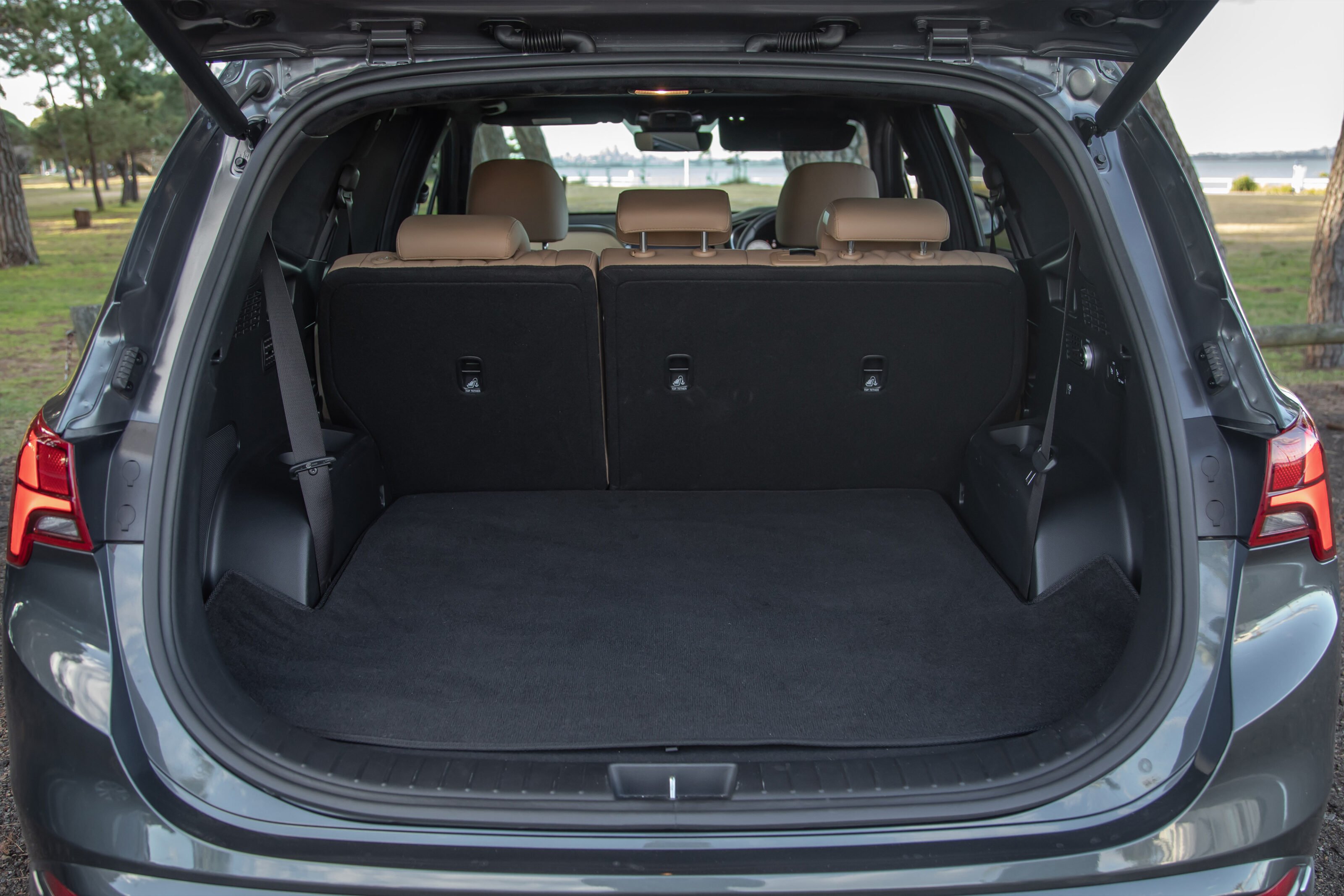
As per the wider Hyundai range, the Santa Fe is covered by the brand’s five-year/unlimited-kilometre warranty, along with a complimentary 12-month roadside assistance program.
This coverage extends for up to 10 years if the vehicle is exclusively serviced by the manufacturer.
Lifetime capped-price servicing is offered, with the first five services costing $399 each for the V6 and $459 each for the diesel.
Availability
The updated Hyundai Santa Fe range will arrive in Australia in February 2022.
Snapshot
- Plug-in vehicle sales in Australia almost tripled in 2021
- Tesla Model 3 is by far and away Australia’s most popular EV
- EV Council calls for Federal Government to help further boost EV sales
UPDATE, February 1: Tesla’s sales for 2021 were closer to 12,000 units rather than the 15,000 claimed as previously reported.
The Electric Vehicle Council (EVC) has since issued a new statement clarifying why the mistake was made.
“Due to a human error, the Tesla delivery figures for 2020 were erroneously added to the delivery figures for 2021 by Tesla before the figure was provided to the EVC,” an EV Council spokesperson said.
“So instead of 15,054 Tesla Model 3 deliveries in 2021, the figure should have been 12,094.”
Our original story has been updated to include the correct numbers below.
The story to here
January 31: For some reason, Tesla prefers to keep its Australian sales close to its chest– despite its Model 3 sedan being a huge success here.
But a new detailed list of the battery-powered vehicle sales in Australia has revealed the Model 3 was a chart-topper in Australia in 2021, with daylight between it and the second-most popular electric model on the list, which included plug-in hybrid models.
The list, revealed by the Electric Vehicle Council (EVC), shows the Elon Musk-run company sold more than 12,000 Model 3s in Australia last year, putting it in the same league as traditionally popular vehicles such as the Toyota Camry, Mazda 3 and Subaru Forester.
By comparison, only 211 examples of the Model S were sold, along with 292 Model X SUVs.
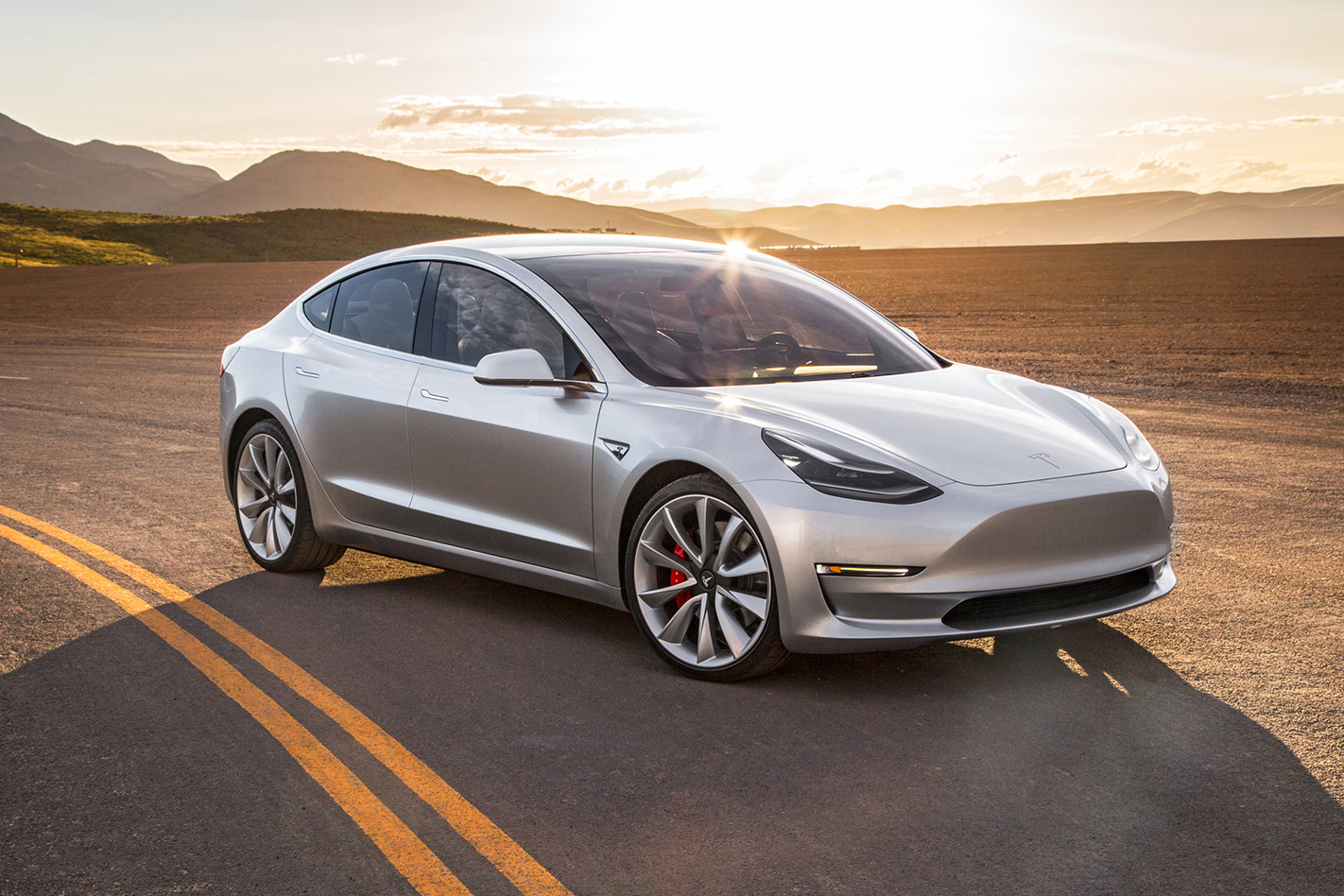
The Model 3’s 12,094 reported sales were 10,728 more than the second place model, the MG ZS (1366 sales), which is Australia’s most affordable BEV.
The Mitsubishi Outlander PHEV came in third with 592 sales, closely followed by the MG HS PHEV (590).
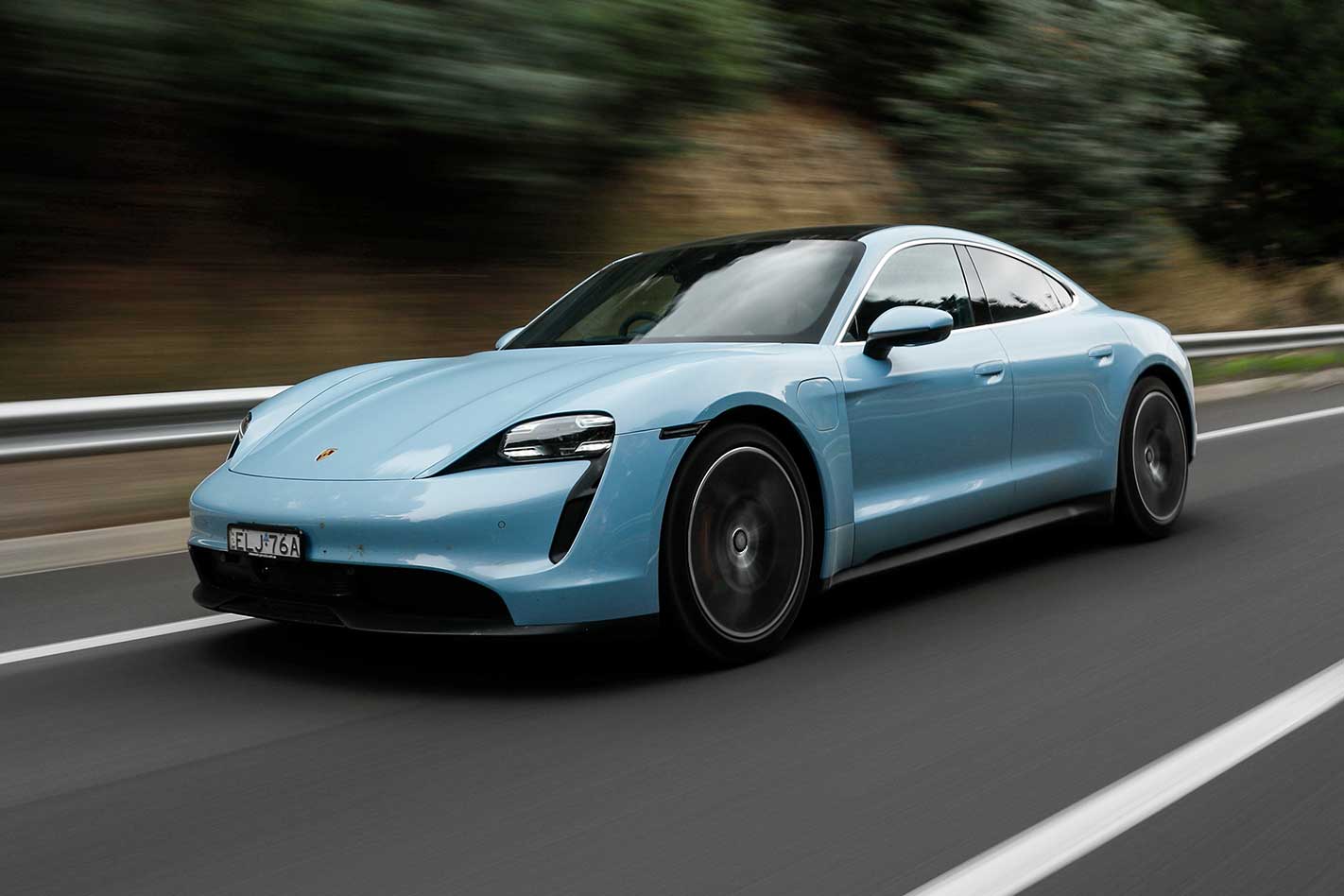
Australia’s most expensive BEV, the Porsche Taycan, sold 531 units to secure the fifth spot ahead of the Hyundai Kona (503), while other premium models, such as the Audi E-Tron and Mercedes-Benz EQS failed to make the top 10 (see the full list below).
More interestingly, the Taycan also outsold its iconic ICE stablemates, the 911 (428), Cayman (147) and Boxster (109)
EV sales rise sharply
According to the EVC, plug-in vehicle sales in Australia more than tripled during the past year from 6900 in 2020 to 20,665 in 2021 (20,727 if you include the Hyundai Nexo and Toyota Mirai hydrogen fuel-cell vehicles).
EVs now account for 1.95 percent market share of new vehicles, up from 0.78 per cent in 2020, despite the delivery of many models being delayed due to supply issues.
EVC chief executive Behyad Jafari said the boost in sales has been driven by positive policy changes at a state level and that momentum could now be built upon if the Federal Government plays its cards right this year.
“The penny has now well and truly dropped on how good electric vehicles are. Most people in the car market will now be considering an electric option. The role of government is to help them make the jump,” Jafari said.
“Governments that take the path of encouragement will capture myriad societal benefits – cleaner air, reduced respiratory illness, smaller carbon footprint, quieter roads. Those that lag will make themselves a dumping ground for old tech, dirty vehicles.”
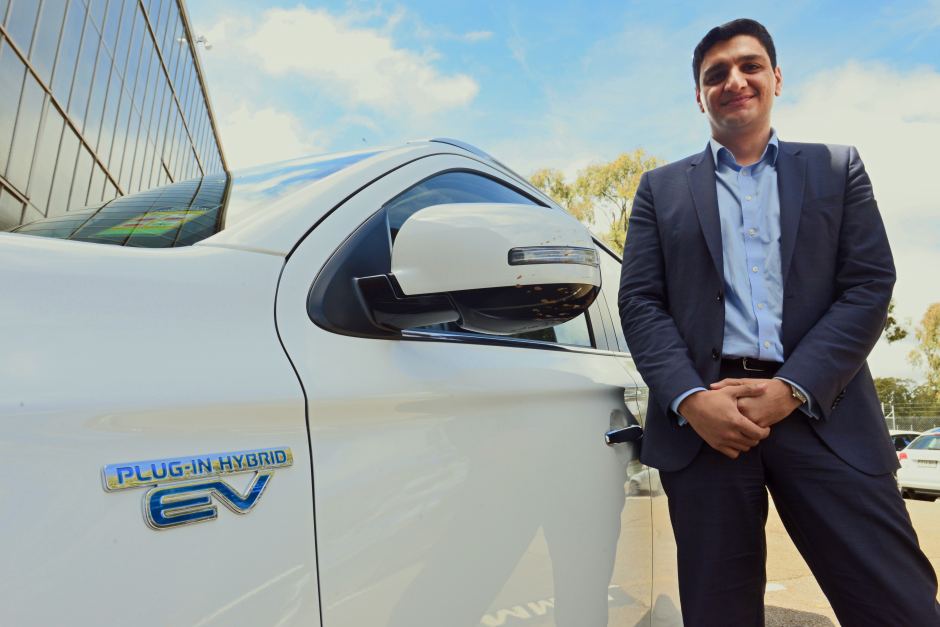
He said while some state governments have received the global message, at a national level we’re stuck in the past.
“We desperately need the Federal Government to introduce Australian EV rebates alongside fuel efficiency standards, just like other developed nations. If we get these changes, you’ll see sales figures really rocket ahead.
“After so many wasted years, Australia’s a long way back from the pack, but then again the cool thing about electric cars is how quickly they move from zero to a hundred.”
2021 Australian BEV & PHEV sales
| Rank | Make/Model | 2021 sales |
| 1 | Tesla Model 3 | 12,094 |
| 2 | MG ZS EV | 1388 |
| 3 | Mitsubishi Outlander PHEV | 592 |
| 4 | MG HS PHEV | 580 |
| 5 | Porsche Taycan | 531 |
| 6 | Hyundai Kona EV | 505 |
| 7 | Volvo XC40 Recharge BEV/PHEV | 495 |
| 8 | Hyundai Ioniq BEV/PHEV | 470 |
| 9 | Nissan Leaf | 367 |
| 10 | Mercedes-Benz EQA | 367 |
| 11 | XC60 (T8) Polestar Engineered | 308 |
| 12 | Mercedes-Benz GLC PHEV | 307 |
| 14 | Tesla Model X | 292 |
| 15 | Mini Hatch Electric | 291 |
| 16 | Kia Niro BEV/PHEV | 277 |
| 17 | Mitsubishi Eclipse Cross PHEV | 229 |
| 18 | Tesla Model S | 211 |
| 19 | Hyundai Ioniq 5 | 172 |
| 20 | XC90 (T8) Recharge Plug-in Hybrid | 170 |
| 21 | BMW 3 Series PHEV | 150 |
| 22 | Mini Countryman PHEV | 141 |
| 23 | BMW X5 PHEV | 118 |
| 24 | Audi E-Tron | 108 |
| 25 | BMW X3 PHEV | 99 |
| 26 | Porsche Cayenne Coupe PHEV | 67 |
| 27 | BMW i3 | 67 |
| 28 | Mercedes-Benz A-Class PHEV | 66 |
| 29 | Mazda MX-30 PHEV/EV | 63 |
| 30 | Porsche Cayenne Wagon PHEV | 55 |
| 31 | Renault Kangoo EV | 45 |
| 32 | Jaguar i-Pace | 44 |
| 33 | Lexus UX 300e | 43 |
| 34 | BMW iX | 35 |
| 35 | Hyundai Nexo FCEV | 26 |
| 36 | Ferrari SF90 | 25 |
| 37 | BMW 5 Series PHEV | 22 |
| 38 | Mercedes-Benz E-Class PHEV | 20 |
| 39 | Kia Sorento PHEV | 15 |
| 40 | Mercedes-Benz C-Class PHEV | 13 |
| 41 | Toyota Mirai FCEV | 12 |
| 42 | Range Rover Sport PHEV | 11 |
| 43 | Peugeot 508 PHEV | 11 |
| 44 | BMW 7 Series PHEV | 6 |
| 45 | Porsche Panamera PHEV | 6 |
| 46 | Peugeot 508 PHEV | 5 |
| 47 | Range Rover PHEV | 1 |
| 48 | Mercedes GLC Coupe PHEV | 1 |
Unsurprisingly, things might seem upside down on the other side of the world. For instance, while Australians flock to the 4×4 ute for hard yakka, in the United Kingdom, tradies rally behind the van.
However, what each country does share is a love for Ford-built workhorses. The Ford Transit Custom is by far the most popular light commercial vehicle in the UK, while we know how well the Ford Ranger does in Australia.
That popularity explains why the Brits can have a Transit Custom with raised suspension, all-wheel drive or even racing stripes. Cue the Sport. It has existed in Europe since the Transit Custom was born in 2012.

Recently, we were let in on the fun. Ford facelifted the Transit Custom range in 2018, then introduced the Sport to Australia a year later when the range welcomed a new interior, more safety equipment and an upgraded 2.0-litre diesel powertrain.
Today, the Sport tops the range in short- and long-wheelbase guises, both sold exclusively as an automatic. We’ll be reviewing the short wheelbase here, which comes finished in Metallic Blue, one of the two special colours reserved for the Sport alongside Orange Glow.
Priced at $49,590 before on-roads, it adds $3500 to the price of a regular SWB Transit Custom, which grows to $53,623 once priced up drive-away in Victoria. This puts it at the thick end of the mid-size van category, alongside others like the $50,990 Volkswagen Transporter TDI 450.
But Ford is one of the few manufacturers that backs its commercial vehicles with a five-year unlimited-kilometre warranty. Peugeot, Renault, Toyota, Hyundai and Mercedes caveat their five-year commercial warranties with a distance limit. Meanwhile, Volkswagen, Iveco and LDV deal with some form of three-year coverage.

Ford, however, isn’t positioning SWB Sport as super heavy-duty, evidenced by the model’s downgraded gross vehicle mass rating. Its 3100kg GVM rating falls 300kg short of what the standard Transit Custom 340S can muster.
After subtracting the Sport’s 2054kg kerb weight from its 3100kg GVM rating, you’re left with 1046kg for you, passengers, cargo and ball weight. Or if you’re hitching up an 1800kg braked trailer, there’s then only 254kg for passengers and cargo before you reach the 4100kg combined weight limit.
Despite the Sport’s blunted load-lugging potential, Ford has beefed up its acceleration and deceleration capabilities. The turbocharged inline-four is up to 136kW/405Nm (11kW/15Nm more than the base model’s 125kW/390Nm), while the front brake rotors are 20mm larger (up to 308mm).

You’ll easily spot a 320S Sport in a crowd, thanks to a unique lower front bumper, lower grille inserts and unique side skirts. They’re complemented by dual black racing stripes with a silver or orange pinstripe depending on the body colour.
Lower body pieces are now finished in body colour rather than bump-friendly plastic to complement new wheel arch blisters. Their extra width offsets new 17-inch alloys that also replace the base model’s 16-inch steelies.
Finishing the look is a pair of hockey-stick decals that streak down the van’s sides from its bi-Xenon headlights featuring cornering function and LED daytime running lights.

The Sport treatment continues inside, a three-seat front row now partially trimmed with leather and the driver’s pew upgraded to electrical adjustment. Trim pieces in the doors and centre stack are now gloss black, as well. The footwells are even illuminated.
Visually, these changes go a long way to gentrifying the base model’s blue-collar ambience, helping the Transit Custom’s smart-looking workstation stand out, with the dash architecture pinched from the latest Focus.
But fundamentally, the seats are still flat and hard-cushioned. You’ll begin fidgeting in the front row after an hour and craving a driving break after the next hour. But that’s it for complaints about comfort.

Locating a good driving position comes easily thanks to a 10-way adjustable driver’s seat. The standard-fit bulkhead behind the front cabin also suppresses road noise that would otherwise be amplified by the rear compartment, even if you often do hear the suspension jostling with the road.
But over-shoulder vision is compromised unless you pay extra for a sliding door with a window. The concave side mirrors are all you have for knowing what’s just beside you when turning across multiple lanes and not enough to feel completely secure.
The driver’s pew is upgraded to electrical operation. Trim pieces in the doors and centre stack are now gloss black, as well. The footwells are even illuminated.

Thankfully, the Transit Custom is loaded with a gamut of active safety technology to help. This includes adaptive cruise control, auto emergency braking, rear cross-traffic alert, lane-keep assist and blind-spot monitoring. There are also six airbags, one for the driver and outboard passenger, and a pair of curtain airbags and seat side airbags.
The Ford Transit Custom’s five-star ANCAP rating is old, originating from a 2012 Euro NCAP crash test. But after a big push to review commercial safety ratings in late 2020 for active safety, ANCAP gifted the Ford Transit Custom a gold rank, shared only with the Toyota Hiace in a field of 13 other vans.
But that’s not the end of it. Driving aids also include rollover mitigation, crosswind assist and trailer sway control. Sport variants also receive tyre pressure monitoring, viewed through the 4.2-inch colour screen on the cluster and accessed by steering wheel button pads.

Cabin technology also benefits from a central 8.0-inch touchscreen with Ford’s SYNC 3 technology, sat-nav and digital radio, providing backup if the two USB-A ports are occupied and you can’t access the wired smartphone mirroring.
There are also two 12-volt sockets and a drop-down centre armrest with cup holders. While the passenger glovebox can’t store anything bulky, storage compartments integrated into the dash and doors can accommodate everything from folders to large 1.25L drink bottles.
Driving aids also include rollover mitigation, crosswind assist and trailer sway control. Sport variants also receive tyre pressure monitoring.

As for carrying cargo, the 300kg difference between the Sport and base model’s GVM equals a similar shortfall in payload, which is replicated against other mid-size panel vans like the Renault Trafic (1046kg versus 1216kg), Volkswagen Transporter (versus 1220kg) and Mercedes-Benz Vito (versus 1260kg).
Despite that disadvantage, the Sport retains impressive load volume, swallowing six cubic metres up back – bang-on average among rivals. The Transit Custom and Sport use rear dual barn doors as standard, opening to 180 degrees. A lift-back hatch is optional, as is a second sliding door.
Cargo dimensions include a 1404mm rear door opening, while the rear wheelarches measure 1392mm apart, wider than most mid-size vans. But that measurement narrows between the area protected by the standard-fit plastic cargo floor.

Loading stuff is a cinch, as the load floor sits only 574mm above ground, while the rear opening measures 1347mm tall. The side opening is slightly shorter at 1324mm. Inside, the space measures 1406mm from floor to ceiling.
Inside the cargo bay are eight anchorage points plus wood panels protecting the walls and rear doors. A hatch extends the floor’s load length from 2554mm to 3037mm underneath the passenger seat. Keep in mind that the load hatch creates a passage of air between cargo and cabin, which is something to consider with toxic fumes on board.
Although a rear liftback hatch would be more convenient for anyone working out of a van, the Transit Custom’s sturdy grab handles help ingress and egress. At the same time, the plastic floor provides more grip than an unpainted surface – especially when wet. Also, you can lock the rear door’s hinges in place by simply pulling them out.

Driving the Ford Transit Custom SWB Sport speaks to how manoeuvrable a mid-size van can be. The 11.6m turning circle is within the ballpark of some large SUVs. However, at 3.0 turns lock-to-lock, the steering slow can feel slow when navigating tight turns. It at least minimises the chance of overshooting a corner and aids directional stability at higher speeds.
It’s an easy van to drive, with a nice if slightly artificial steering weight feeding you enough information on tyre grip. The throttle pedal is responsive and while brake travel is long, you’re rewarded with good feedback from the full-disc system and extra bite from the upgraded front rotors.

The Sport is slightly stiffer than a long-wheelbase Transit Custom through no fault of its own, but with 250kg on board and a full 72-litre fuel tank adding almost another 50kg, the ride fails to chill out. Shocks resonate through the cabin, mostly originating from the stiff rear torsion-beam axle, exposing cabin quality flaws such as a loose headrest on the driver’s seat.
NVH is otherwise okay, with the side mirrors catching little wind noise at highway speeds and the four-speaker audio overcoming a dull road noise easily. The adaptive cruise control maintain set distances well, while the front camera accurately reads speed signs.
It’s an easy van to drive, with a nice if slightly artificial steering weight feeding you enough information on tyre grip.

At highway speeds, the Sport’s transmission tune hangs in higher gears to harness the engine’s beefier mid-range – spreading 405Nm over the same 1500rpm-2000rpm range as the base model – especially when accelerating on a roll.
Otherwise, having so much torque buried down low often tests the limits of the front-wheel-drive layout. Careful throttle application helps avoid wheelspin from traffic lights or when exiting wet roundabouts.
Having manual mode just below Drive on the lever’s shift pattern makes gear selection annoying as well, as you don’t realise you’re stuck in manual until the revs are nearing the 4800rpm redline.

During cold months, standard-fit heating on the front seats, windshield and mirrors are useful. Meanwhile, pop-up roof racks (rated to hold 130kg) further broaden the Transit Custom’s excellent practicality. And that’s what is so appealing.
There is not much to compromise with a Transit Custom. It’s practical, safe, and drives well and wants for little when it comes to equipment or features. Ford knows what it’s doing in the light-commercial space.
There are some refinement/fit-and-finish issues. On our test vehicle, the exposed steering column behind the pedals would leak a very small amount of fluid, and in sun, the cargo floor bulged when trapped air expanded underneath.
But the Custom Sport is hard to beat on ownership. The excellent warranty terms are backed up by four years and 120,000km of fixed-price servicing. The Custom Sport’s ADR 81/02 combined fuel consumption figure of 6.6L/100km also rates better than its automatic rivals.

Our Sport variant underscores the Transit Custom’s little room for improvement. Extra power, luxury, and flair seem like a logical next step when something is already so well-rounded in this segment.
And yet, while it’s a great looking thing and the upgrades easily justify the $3500 cost, its extra grunt and stopping power are wasted on downgraded GVM and towing ratings. We feel our opinion will be trivial for Australians considering dropping this much on a niche mid-size front-drive van, but we’re glad it exists.
2021 Ford Transit Custom 320S Sport specifications
Snapshot
- Comes in VZx Australia-only trim
- 2.0-litre four-cylinder turbocharged petrol engine
- No pricing yet, expected to launch in July 2022
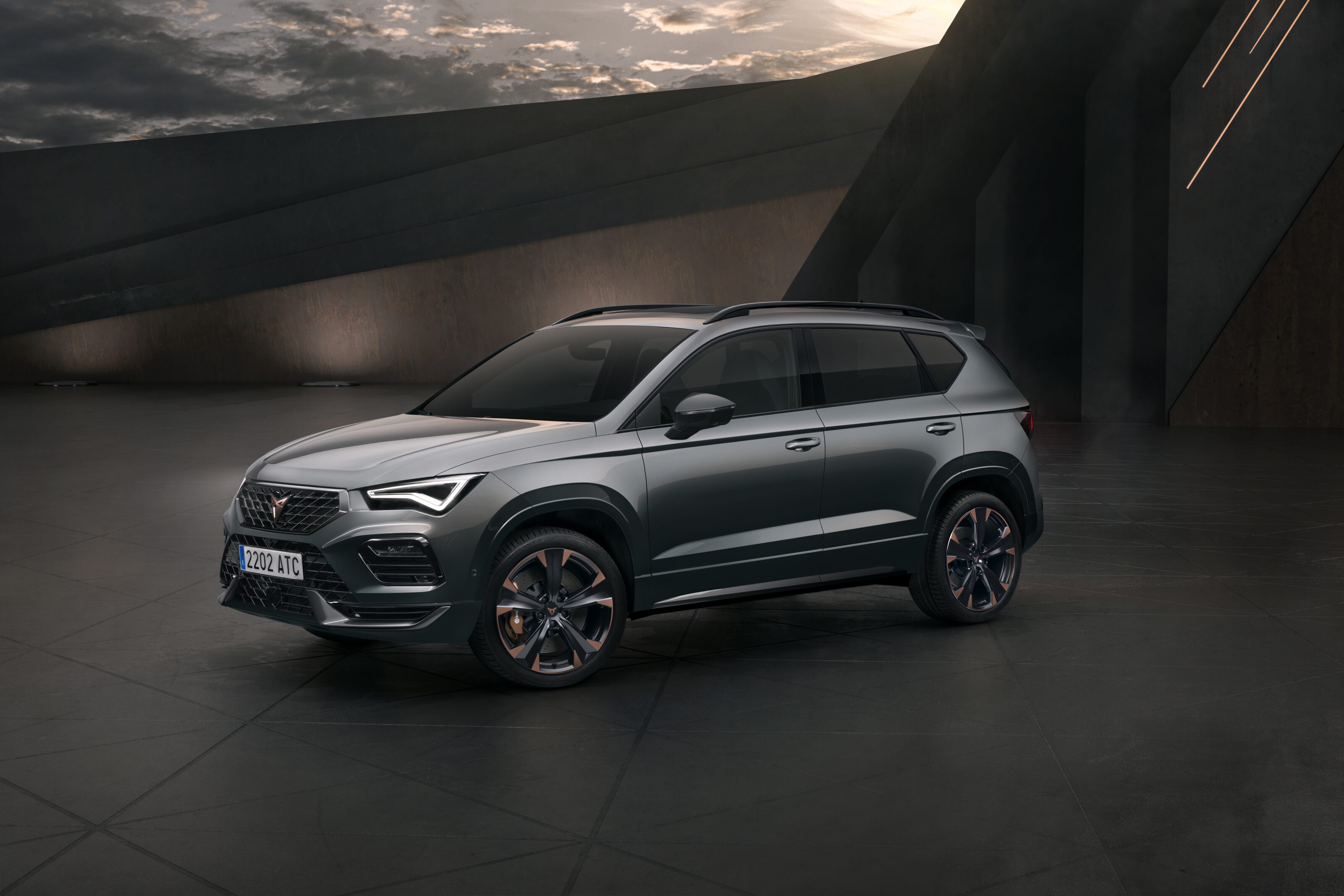
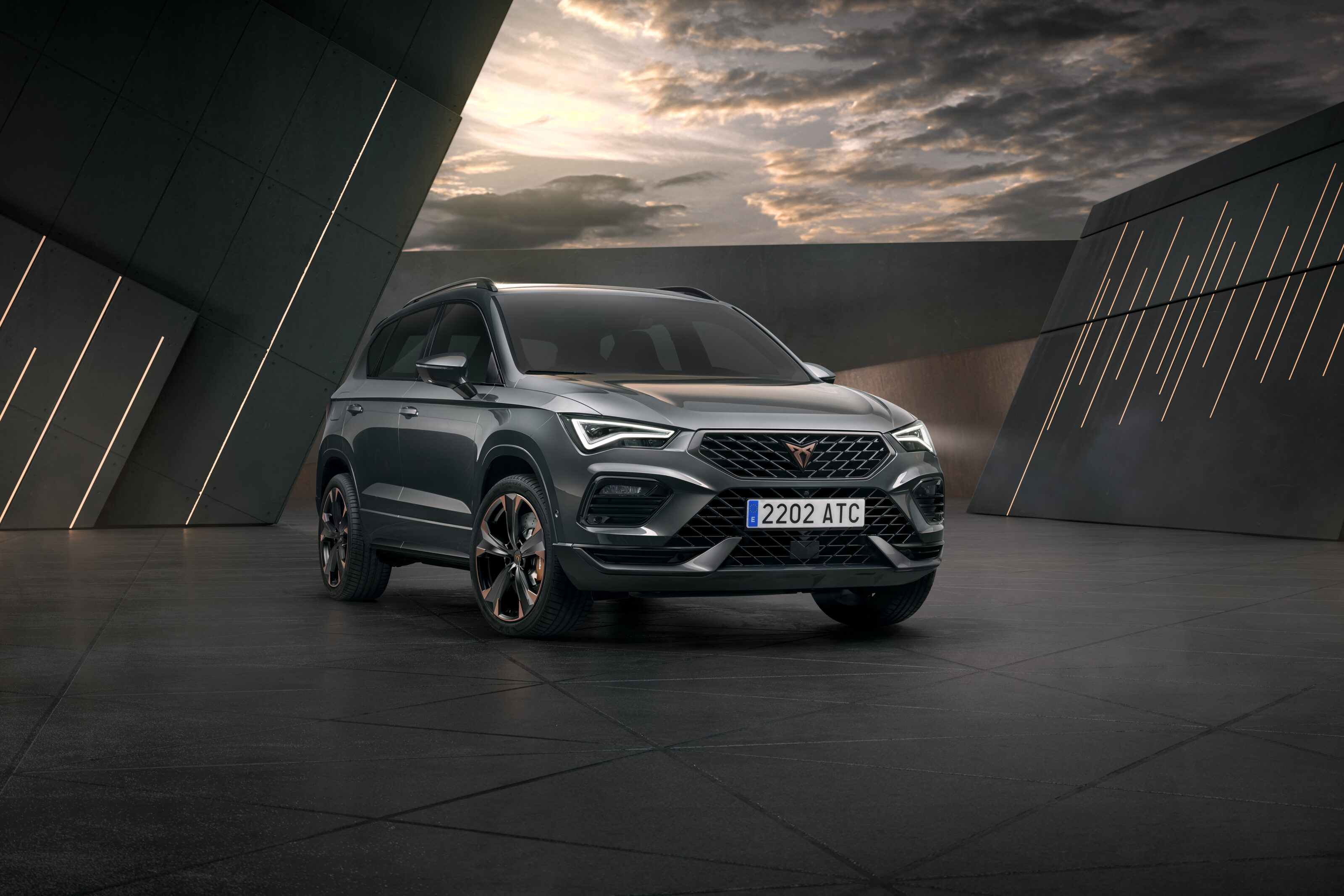
The 2022 Cupra Ateca is to arrive in Australia later this year, in high-spec Australia-only VZx trim, the brand has announced today.
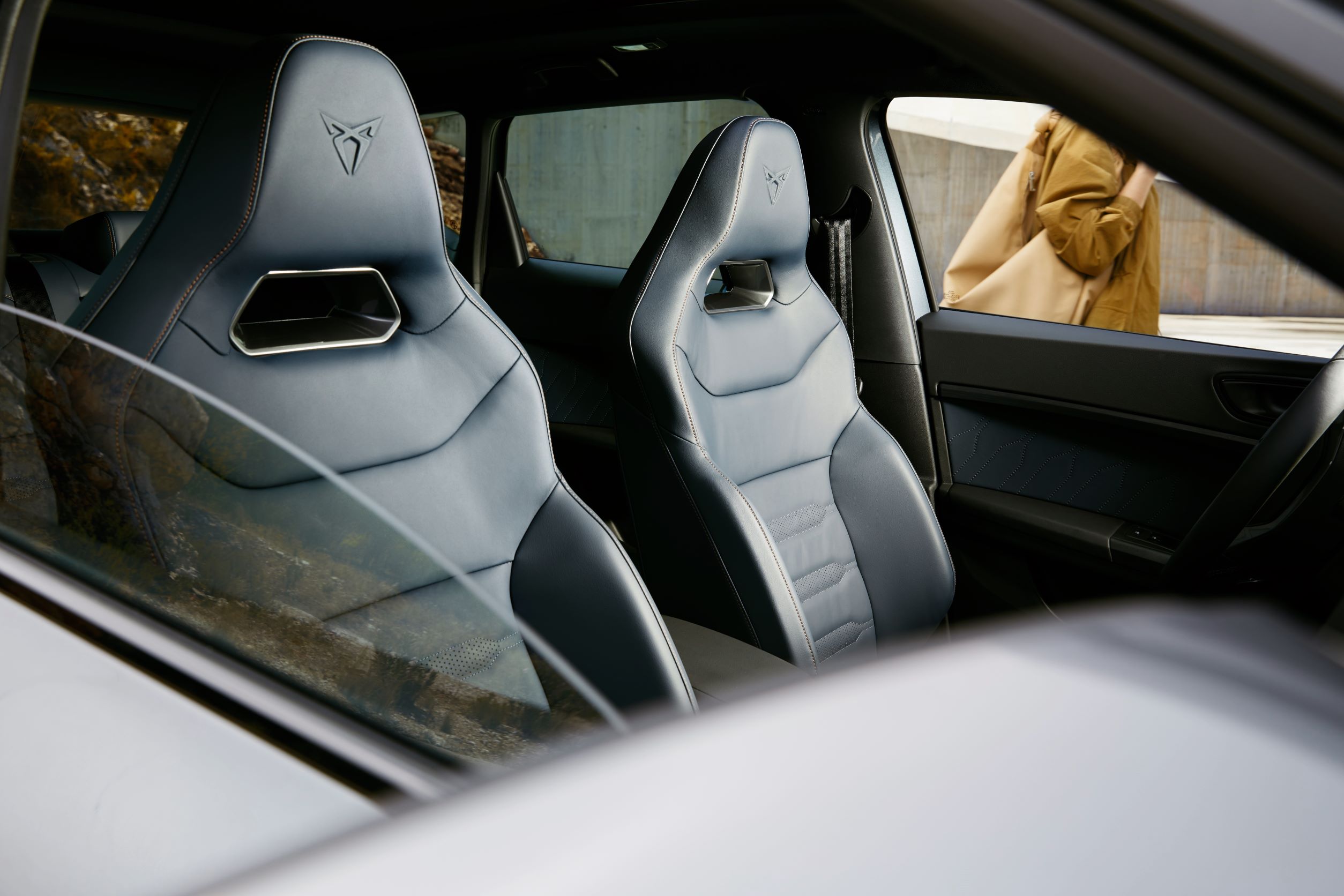
As the only Cupra Ateca model grade offered in Australia, the VZx will come with as standard; 19-inch Exclusive Sport alloy wheels in black and copper, full LED headlights with daytime running lamps, rear LEDs with dynamic ‘swiping’ indicators, automatic high-beam, dynamic chassis control and progressive steering – to name a few.
At first glance – though not yet confirmed – the VZx appears to sit above the VZ3 top-spec variant available in the UK, with more features on offer as standard such as progressive steering, three-zone climate control and aluminium pedals. An Akrapovic exhaust system and panoramic electric sunroof are also new optional extras.
The Ateca will form part of Cupra’s Australian model launch in July this year, which also includes the Leon hatchback, and the Formentor crossover SUV. The Born EV is slated to arrive towards the end of 2022.
Features
Offered in just one highly-specced variant in Australia that is not available elsewhere in the world, the 2022 Cupra Ateca features as standard:
| u2022 19-inch Exclusive Sport alloy wheels in black and copper |
| u2022 18-inch temporary spare wheel |
| u2022 Full LED headlights and daytime running lamps |
| u2022 Rear LED lamps with dynamic indicators |
| u2022 Fog lamps with cornering lamps |
| u2022 Light assist (auto high-beam) |
| u2022 Driving profile selection |
| u2022 Dynamic chassis control |
| u2022 Progressive steering |
| u2022 Hands-free powered tailgate |
| u2022 Rear roof spoiler |
| u2022 Black roof rails |
| u2022 Quad exhaust |
| u2022 Rear tinted windows |
| u2022 Gloss black highlights |
| u2022 Auto folding and heated mirrors with memory |
| u2022 Welcome light in exterior mirrors |
| u2022 Mirror cases in dark aluminium |
| Light and rain sensor |
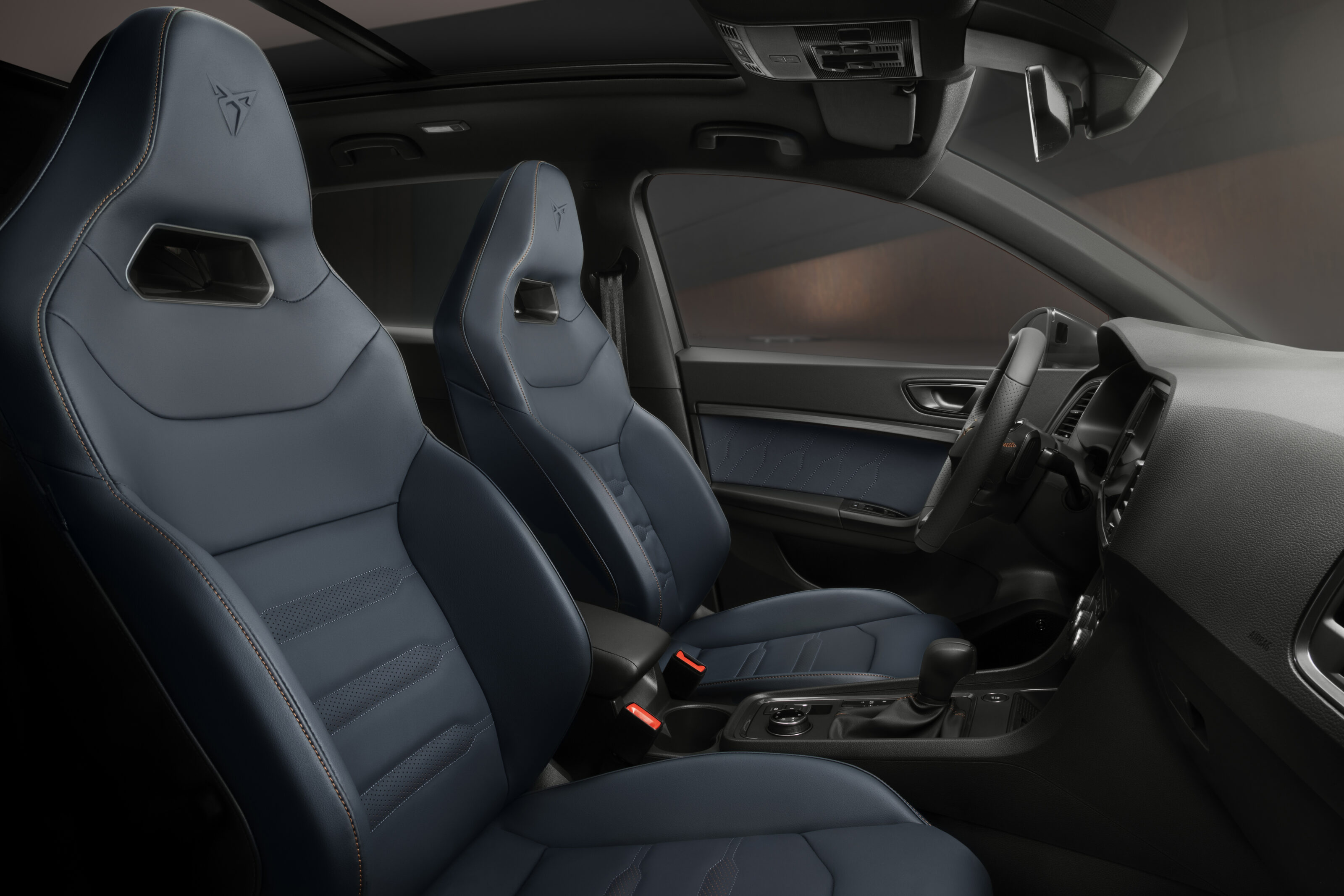
| u2022 Petrol blue leather sports bucket seats |
| u2022 Heated front seats |
| u2022 Driveru2019s seat power adjustment with memory |
| u2022 Keyless entry and start |
| u2022 Three-zone climate control air-conditioning |
| u2022 Ambient interior lighting |
| u2022 Leather gear knob with copper stitching |
| u2022 Illuminated scuff plates |
| u2022 Aluminium pedals |
| u2022 Floor mats |
| u2022 10.25-inch Digital Cockpit |
| u2022 9.2-inch navigation system |
| u2022 Cupra leather steering wheel with satellite buttons and heating |
| u2022 Paddle shifters |
| u2022 Wireless phone charging |
| u2022 Wired and wireless Apple Carplay and Android Auto |
| u2022 Beats Sound System, nine speakers plus subwoofer and 340w amplifier |
| u2022 Two front and two rear USB-C ports. |
As an already fully-optioned model, the Ateca VZx has a short list of costed extras. These include:
| u2022 Akrapovic exhaust |
| u2022 Brembo brakes |
| Panoramic electric sunroof. |
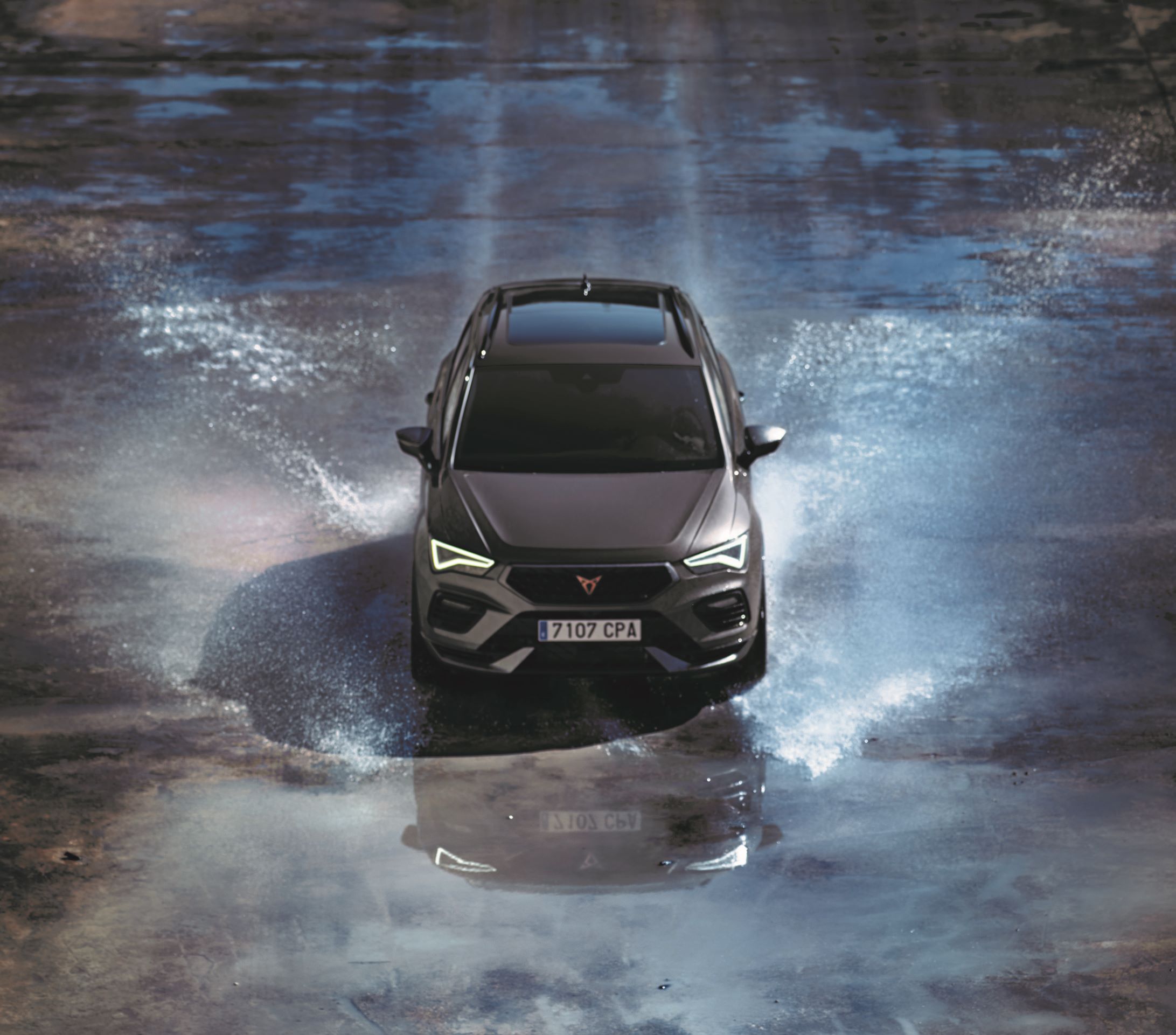
The Ateca is available in a range of no-cost metallic paint options, with one premium paint finish at an additional cost. Nevada white, graphite grey and magic black are all offered as standard, with the optional dark camouflage hue available for an additional charge.
Engine and drivetrain
Already known is that the compact SUV will feature the model’s existing 2.0-litre four-cylinder turbocharged petrol engine seen elsewhere globally, which makes 221kW and 400Nm, mated to a seven-speed DSG automatic transmission and all-wheel drive.
Together the combination enables the Ateca to complete the 0-100km/h sprint in a claimed 4.9 seconds.
“With Ateca we have a practical, versatile SUV, while still benefiting from CUPRA’s DNA; which transforms it,” Jeff Shafer, CUPRA Australia’s head of product and planning.
“By offering one fully-loaded variant, we can give customers the very best the brand has to offer in terms of tech, driving experience and style, while maintaining simple to understand model offering for our local launch.”
The Ateca offers a 485-litre boot and a 2100kg braked towing capacity.
Further details have yet to be revealed, but the Ateca found overseas is 4386mm long.
Safety
The Cupra Ateca’s safety and assistance features include:
| Adaptive cruise control |
| u2022 Front assist with pedestrian and cyclist detection |
| u2022 Side assist with exit assist |
| u2022 Lane assist |
| u2022 Travel assist |
| u2022 Driver fatigue detection |
| u2022 Proactive passenger protection (pre-crash) |
| u2022 Park assist |
| u2022 Front and rear parking sensors |
| Top-view camera (360 degree) x |
| Tyre pressure warning system |
| u2022 Seven airbags. |
Warranty
The Ateca ZVx will form part of CUPRA Australia’s local market introduction in mid-2022, and will come standard with a five-year warranty.
Availability
The Ateca will form part of Cupra’s Australian model launch in July this year. Further details around pricing will be announced closer to that time.
Nissan’s MID4 II might be a concept car resigned to the history books as yet another design study, but this one is important to Nissan and Nismo. And, come to that, us. We all know and love the R32 Skyline GT-R and the 300ZX (Z32), yet their existence was made possible by this mid-engined, two-door supercar. Ironically, while the models this supercar wannabe spawned rose to greatness, the MID4 II was unceremoniously shelved.
Unveiled in 1985, the Toyota MR2-looking original gained its name due to the mid-ship engine layout and all-wheel drive. Sending grunt to all four of the truly ’80s-spec wheels is a naturally aspirated VG30DE bent six (which would later go on to power Aus-delivered 300ZXs). However, by 1987 Nissan had overhauled the concept mechanically and design wise, unveiling the MID4 II at the Tokyo Motor Show that year.
What it showcased was a more eye-catching supercar silhouette cloaking serious mechanicals while the tail-lights unmistakeably give inspiration to the S14 Silvia. The gentleman’s agreement 206kW ceiling was ignored, with the 3.0-litre VG30DETT pumping out 242kW and 382Nm. It was sent to all four wheels with 235/55 ZR16 tyres up front and 255/50 ZR16 at the back. Ventilated discs were tasked with arresting the pace, and with a kerb weight of 1400kg and a power-to-weight ratio of 173kW/tonne, it was no slouch.

Underpinning the MID4 II is double wishbone front suspension and multi-links at the rear. Additionally, the back axle also provided steering via Nissan’s HICAS system, which would later feature heavily in Godzilla, otherwise known as the R32 Skyline GT-R. It would also be fitted overseas to the twin-turbo 300ZX. How dynamically effective the supercar concept was also proved open to question. Rumours persisted that the parallel-developed Z32 300ZX was even better to drive but significantly cheaper. The writing was on the wall.
It took Nissan another two years after the MID-4 II’s unveiling to complete the development and calibration processes it pioneered, at which point the Advanced Total Traction Engineering System for All-Terrain (ATTESA) all-wheel drive system was brought to market in the all-conquering R32 GT-R.
Ultimately, the true measure of the MID4 II’s legacy is its offspring. While it failed to launch, the cars to benefit from its engineering ingenuity would go on to become performance icons.

NISSAN MID4 II SPECIFICATIONS
| ENGINE: | 2960cc V6, DOHC, 24v, twin-turbo |
|---|---|
| POWER: | 242kW @ 6800rpm |
| TORQUE: | 382Nm @ 3200rpm |
| GEARBOX: | 5-speed manual |
| WEIGHT: | 1400kg |
