A very rare 1998 Subaru Impreza WRX STI 22B will be auctioned next month on behalf of the Federal Government.
The Subaru was seized under ‘proceeds of crime’ laws, and is being sold by Liquid Asset Management under the instruction of the Australian Financial Security Authority.
The Impreza WRX STI 22B is build number 132 of just 425 ever built, and a personal import from Japan – where the majority of the cars were sold.
Records also indicate this vehicle received its compliance plate in 2008, with its Victorian registration listed as cancelled in July of 2017 – roughly the time when the vehicle was confiscated, together with a large collection of other exotic cars.
The 22B is considered to be the most desirable Subaru ever made, and one of the most sought-after Japanese hero cars of the era, with prices skyrocketing in recent years.
In April 2021, one example sold for AU$424,000 on US website Bring a Trailer, while another vehicle sold privately through UK dealer Appreciating Classics after being advertised for AU$526,000 (though the price paid remains unknown).
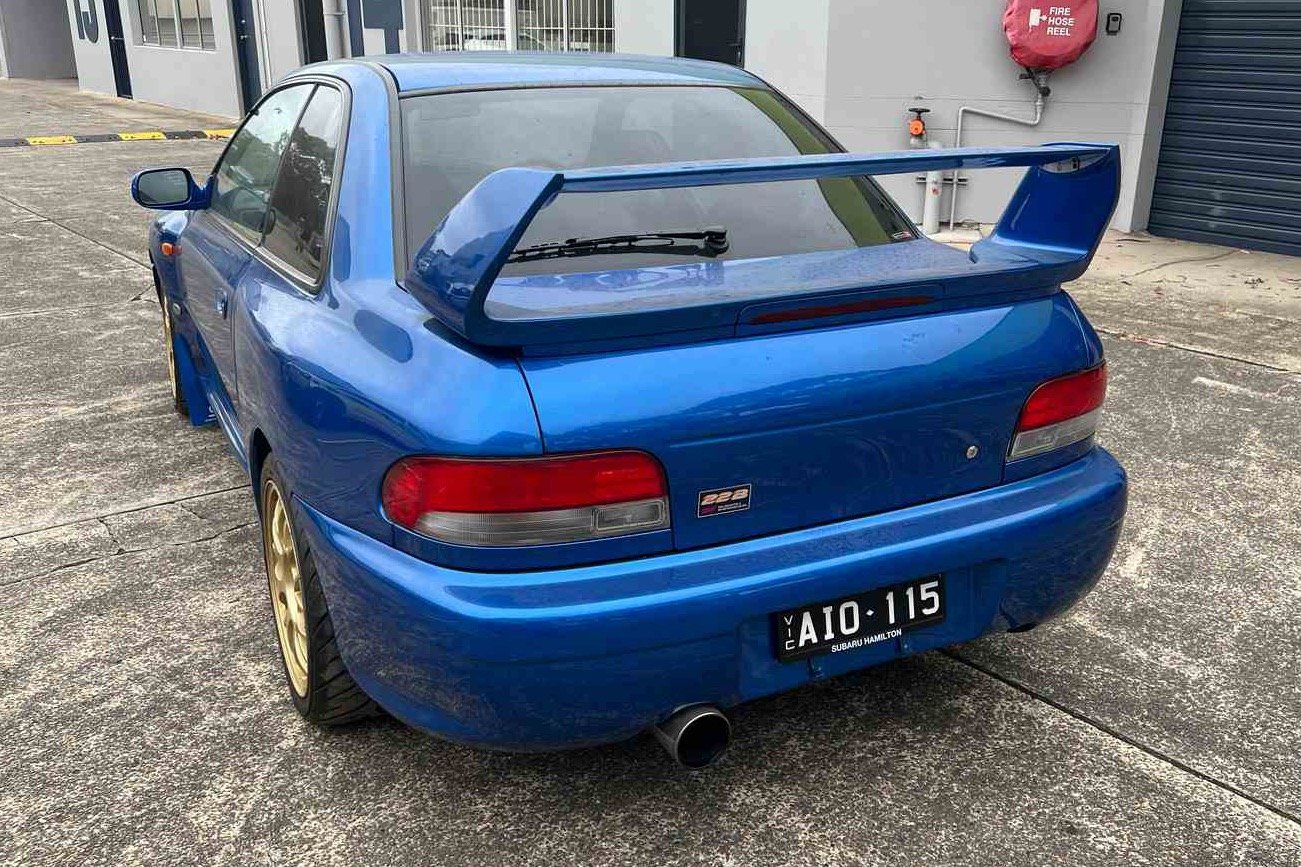
The 22B was created in celebration of Subaru’s rally successes and the company’s 40th anniversary, with 400 being produced for the Japanese market, 16 for the UK, and just five for Australia. Three were prototypes, and one is understood to have been kept by Subaru.
Also keeping one for itself, Subaru Australia sold the other four to collectors for $125,000 each – more than three times the price of a regular WRX at the time.
The wide-body coupe is powered by a 2.2-litre turbocharged four-cylinder boxer engine producing a 206kW and 363Nm – however, this has since been disputed, with many suggesting its performance figures are much higher than the manufacturer’s claims.
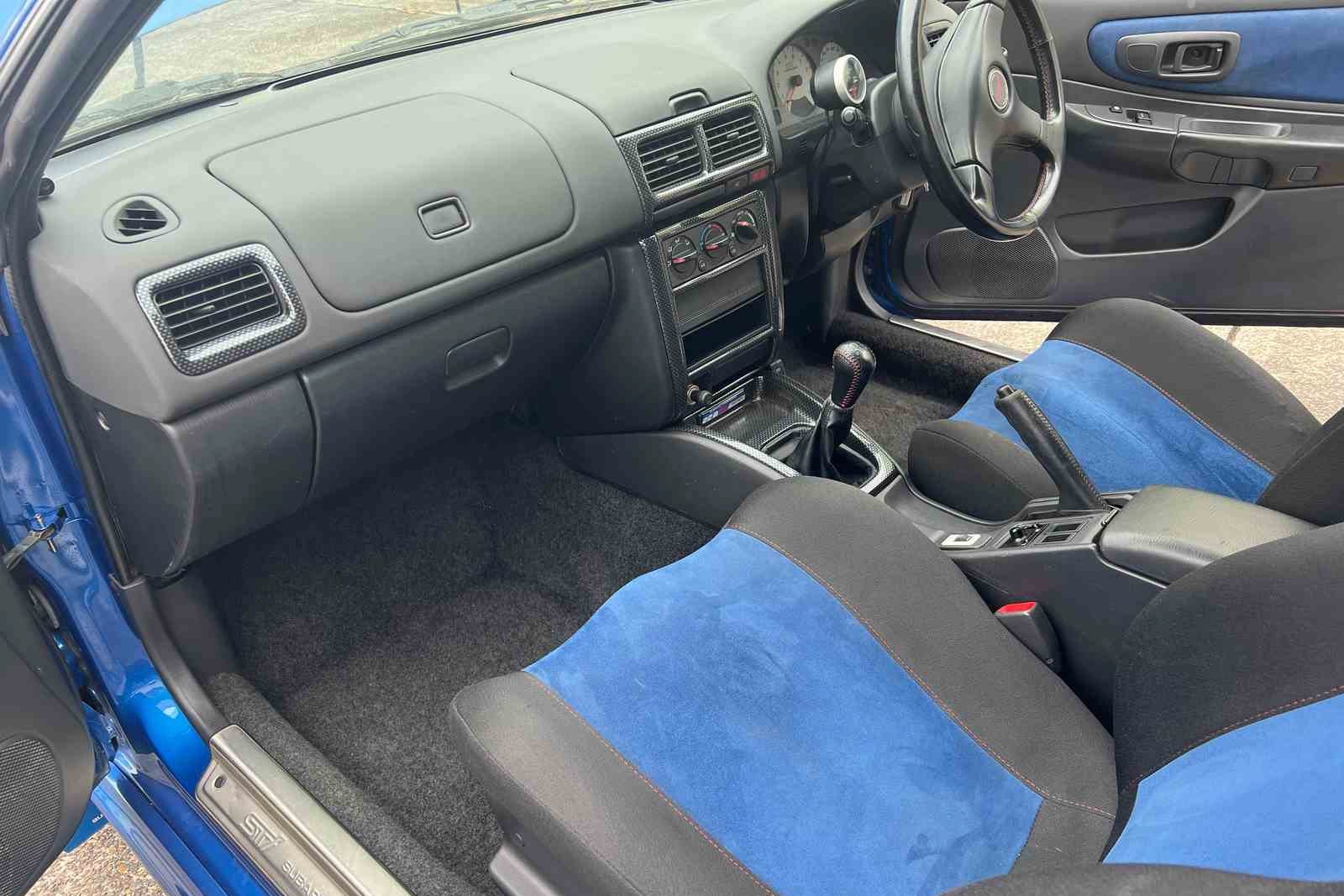
Power is sent via an adjustable centre locking differential to all four wheels through a five-speed close-ratio manual transmission, with the 0-100km/h sprint said and done in 4.7 seconds.
Created as a car for enthusiasts, the 22B does away with air conditioning and a radio to help save weight, further improving performance over the two-door WRX STI Type R upon which it’s based.
The auction for this 1998 Subaru Impreza WRX STI 22B will end at 1pm on January 27, 2022. You can view the listing by clicking here.
We’re off to a flying start as we head into 2022, as the January edition of MOTOR comes filled to the brim with everything that’s moving and shaking in the performance car world.
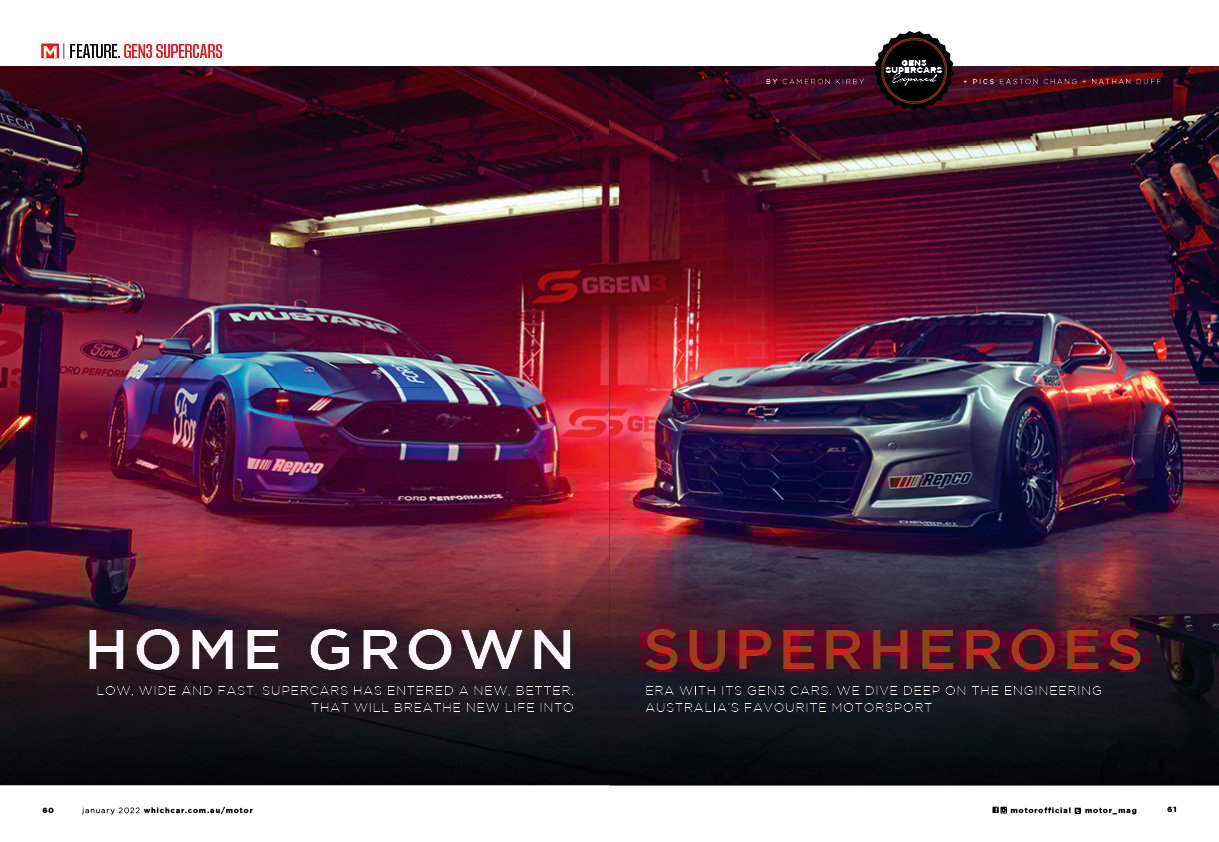
Earlier this month, we saw the public reveal of the new Gen3 Supercars that will take to the track at the opening round of the 2023 Supercars Championship. They’re vastly different beasts, with drastic aero reductions that should make them both harder to drive and better to watch.
We sit down with the brains behind the development of both the new Camaro and Mustang. We hope you like geek speak, because we’re going deep under the skin to bring you all of the technical details as we head into a new era of Supercars.
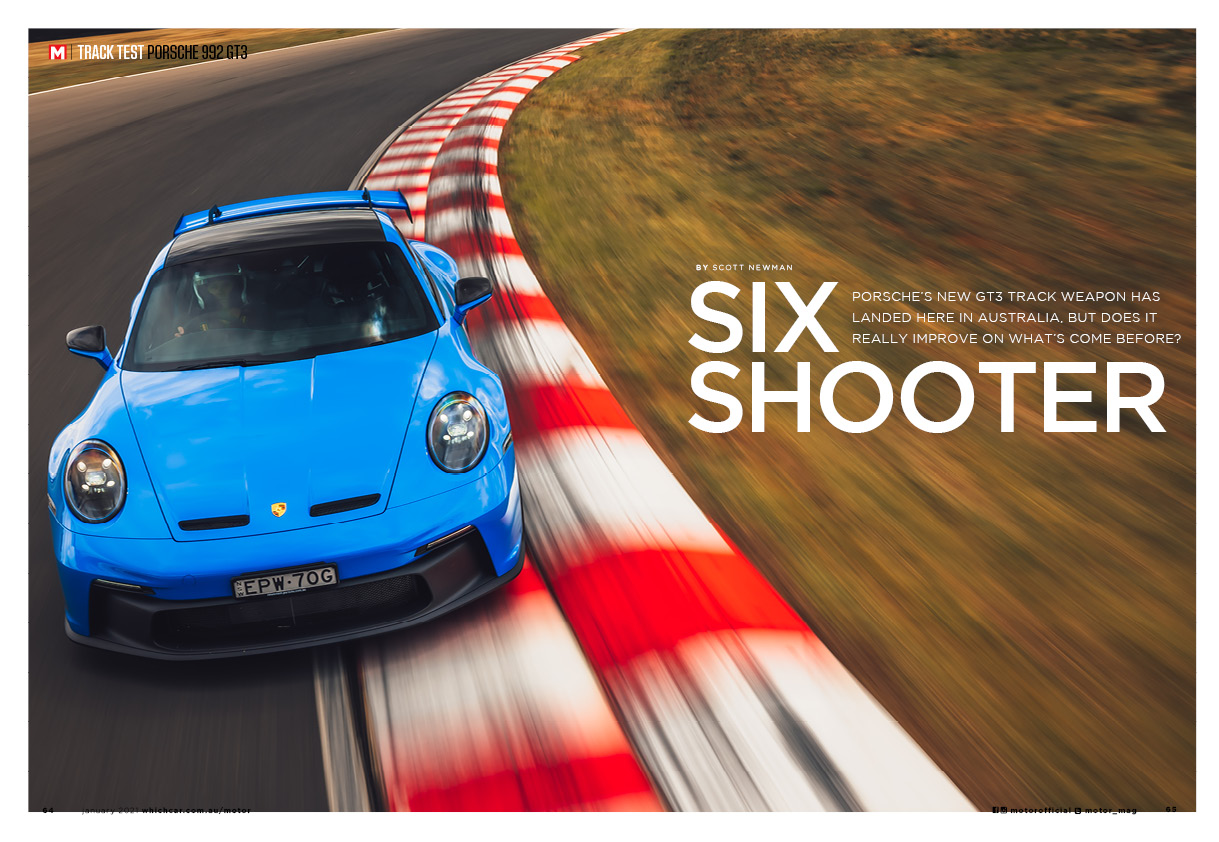
Speaking of track monsters, we get to grips with one of the most thinly-veiled road racers on the market: the new Porsche 911 GT3. With our weapon in tow, and Sydney Motorsport Park acting as our theatre, we push Porsche’s latest performance hero to the limit to see how Preuninger’s motley crew continue to improve on virtual perfection.
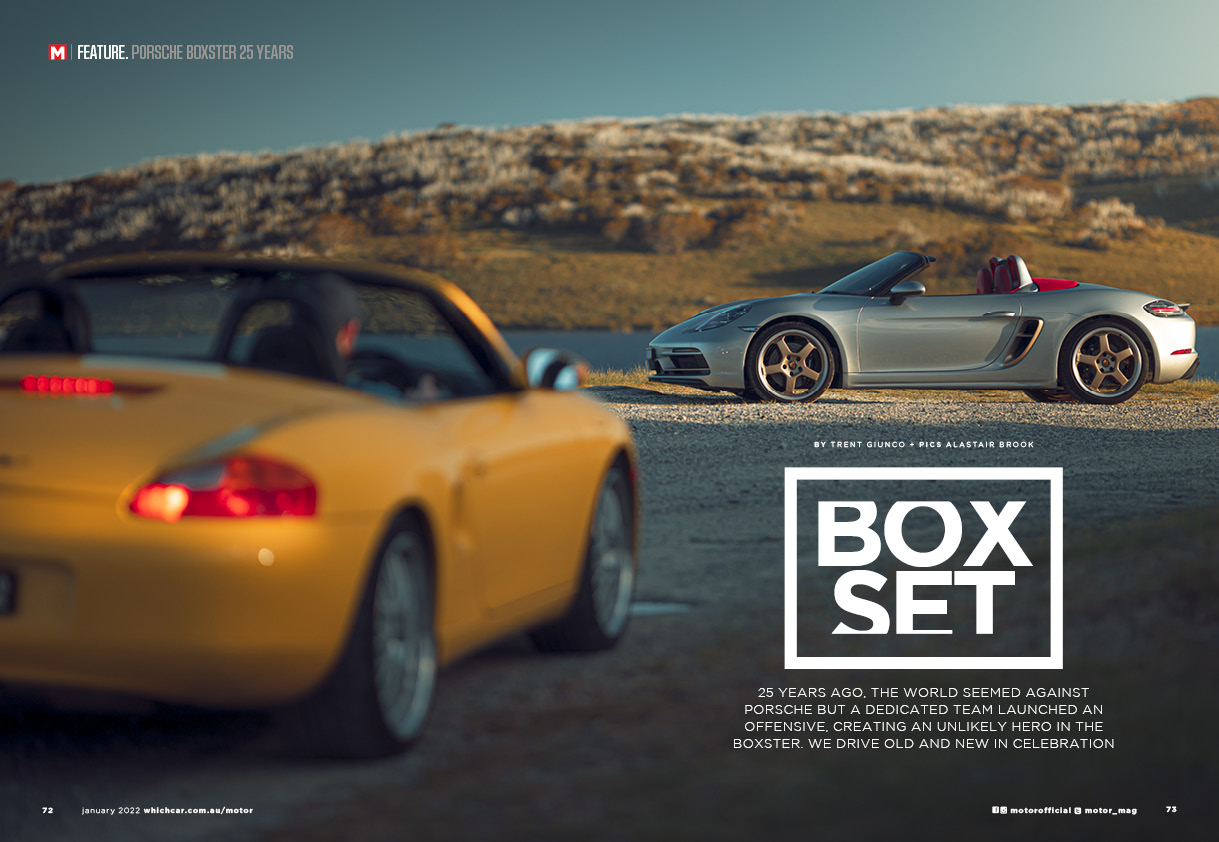
But what of the car that made the GT3 lineage possible in the first place? It’s no secret that the Porsche Boxster played a crucial role in securing the survival of the storied Stuttgart brand. We take the new Boxster 25 Years Edition out for a family reunion of sorts, matching it with an original 986 to see how much progress has been made throughout a quarter of a century.
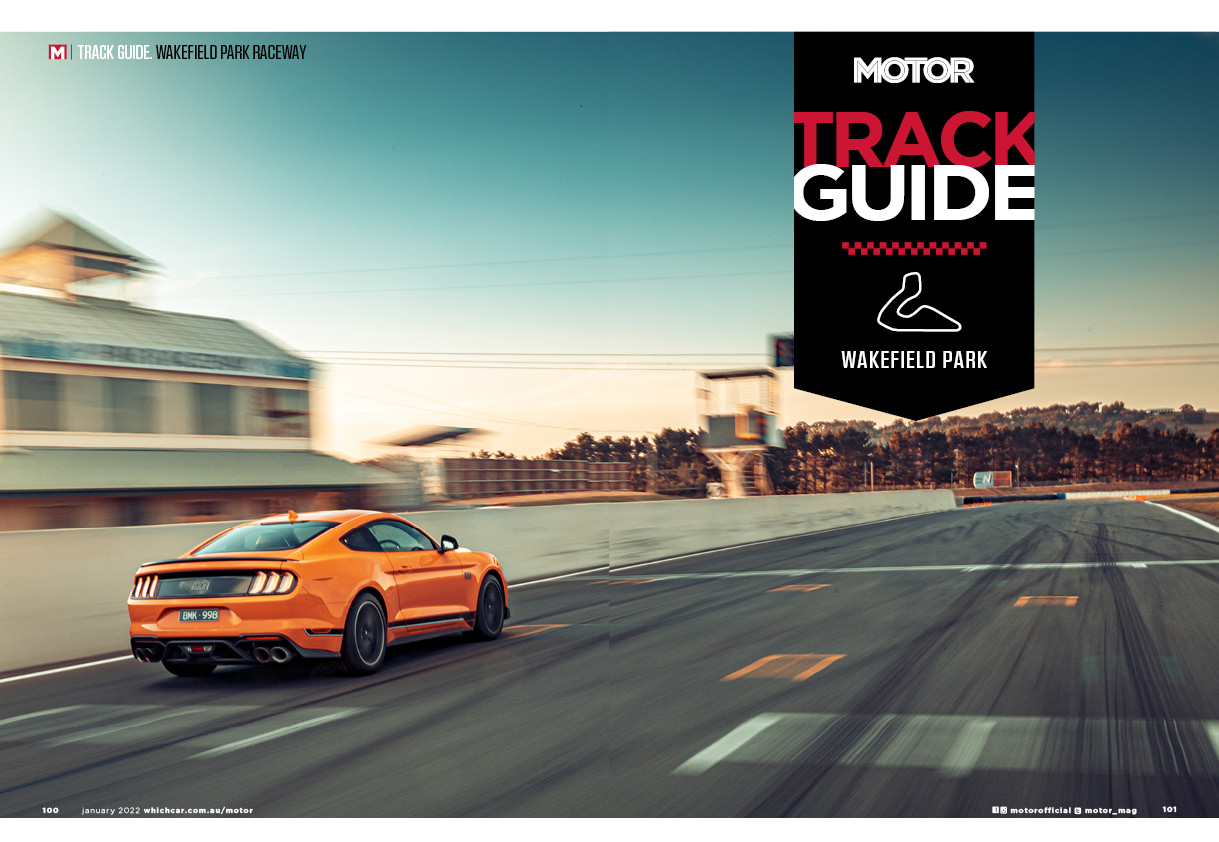
Further back, Scott Newman ranks the ten greatest WRC drivers of all time, and Luffy returns to give you a master’s guide to conquering Wakefield Park, one of Australia’s most underrated circuits.
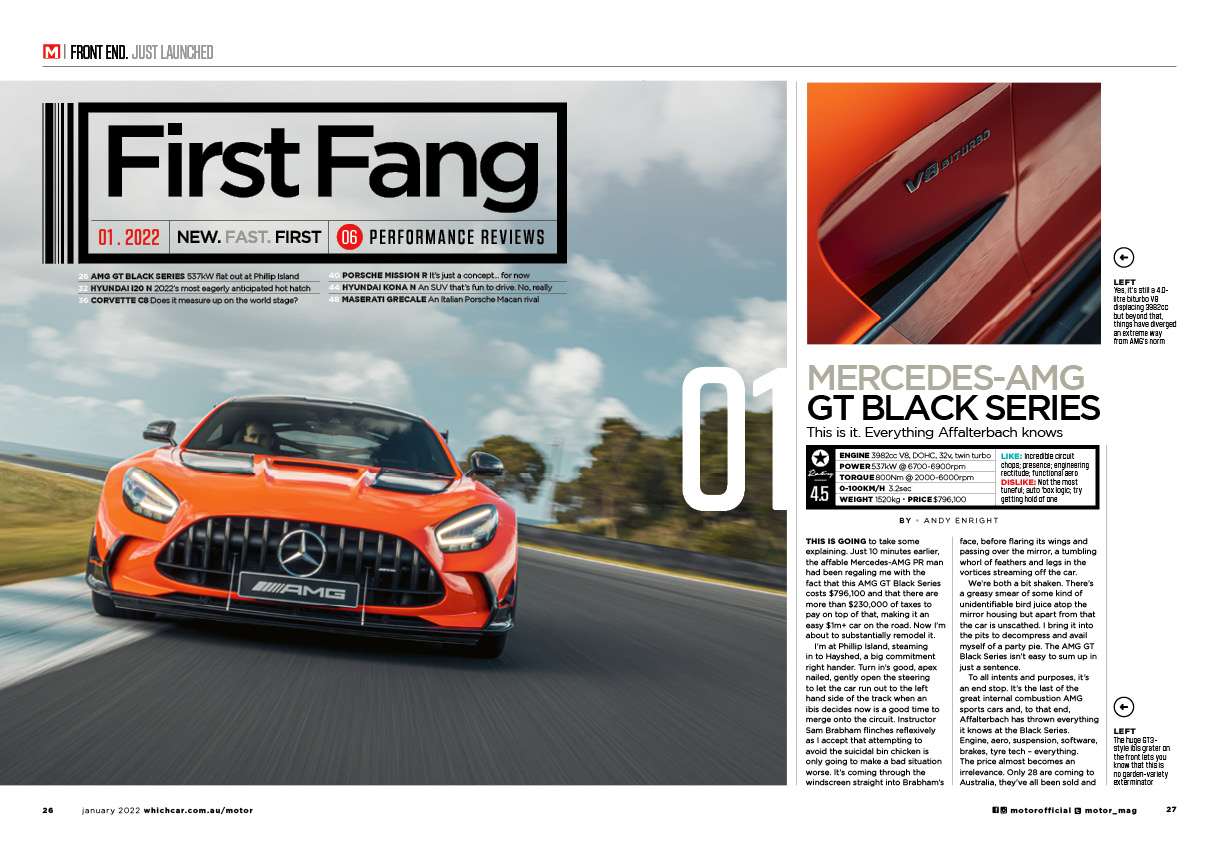
We also have our first drives of the C8 Corvette, AMG Black Series, Hyundai i20 N and Kona N, Porsche Mission R concept and Maserati Grecale.
That’s not all! In this month’s edition of Sweet Dream, we put on our product planning hats and imagine a properly-engineered hyper hatch from BMW, based on its 1-Series hatchback. Young Affat also considers the future classic credentials of the early Lotus Elise S1, and Andy has a brush with the law in his long-term GR Yaris.
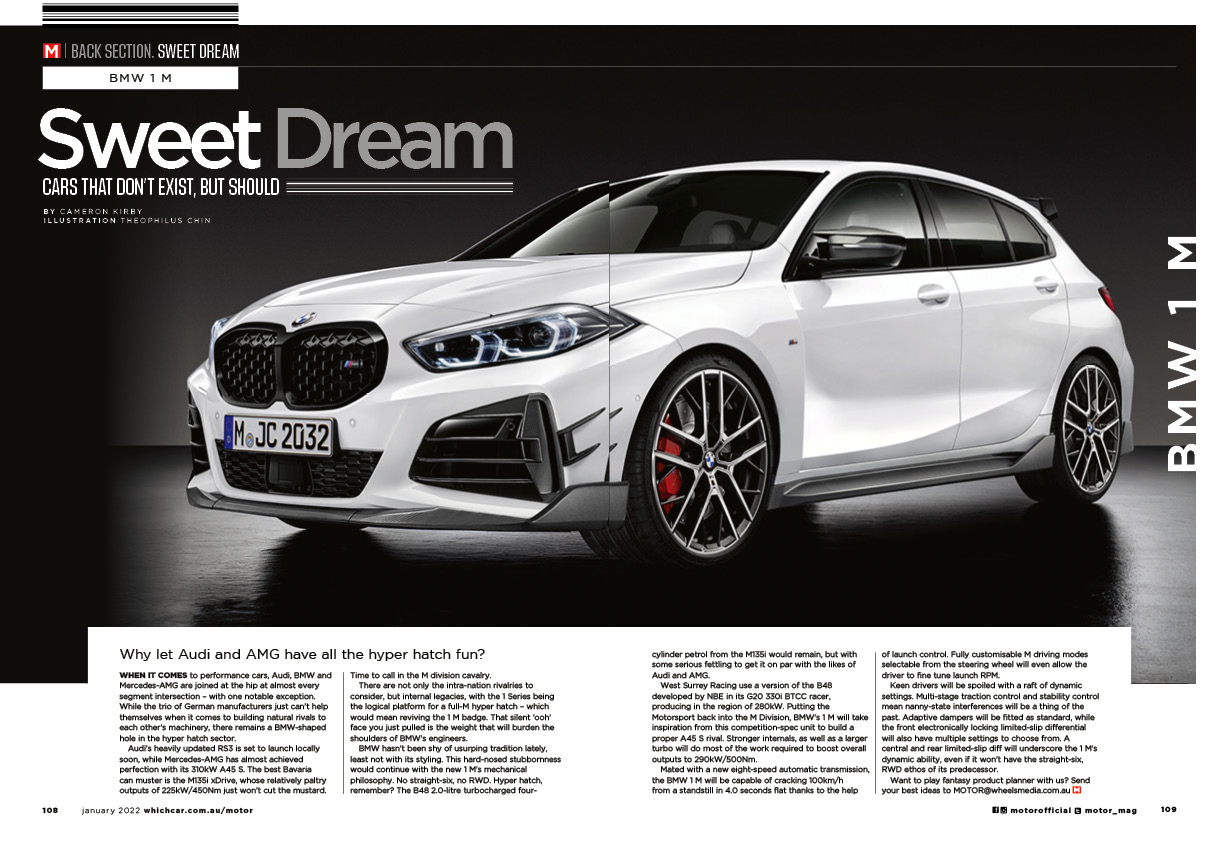
There’s plenty more gems to find inside the latest issue of MOTOR, which goes on sale today! Find yours in stores today, or subscribe here and have them delivered straight to your door!
The Volkswagen Tiguan medium SUV underwent a facelift earlier in 2021 that brought sharper exterior design elements, new driver technologies, refreshed engines and new variant badges.
Excluding the stretched seven-seat Tiguan Allspace, the 2021 Tiguan range comes in three spec grades – Life, Elegance and R-Line – with a choice of three petrol engines and one diesel. Pricing is book-ended by the entry-level 110 TSI Life that retails for $39,690 and the turbo-diesel 147 TDI R-Line for $55,290 (both before on-road costs).
The range-topping R-Line spec is also available with this very punchy 162 TSI variant that, as its badge specifies, packs 162kW of power along with 350Nm of torque.
Pricing and features
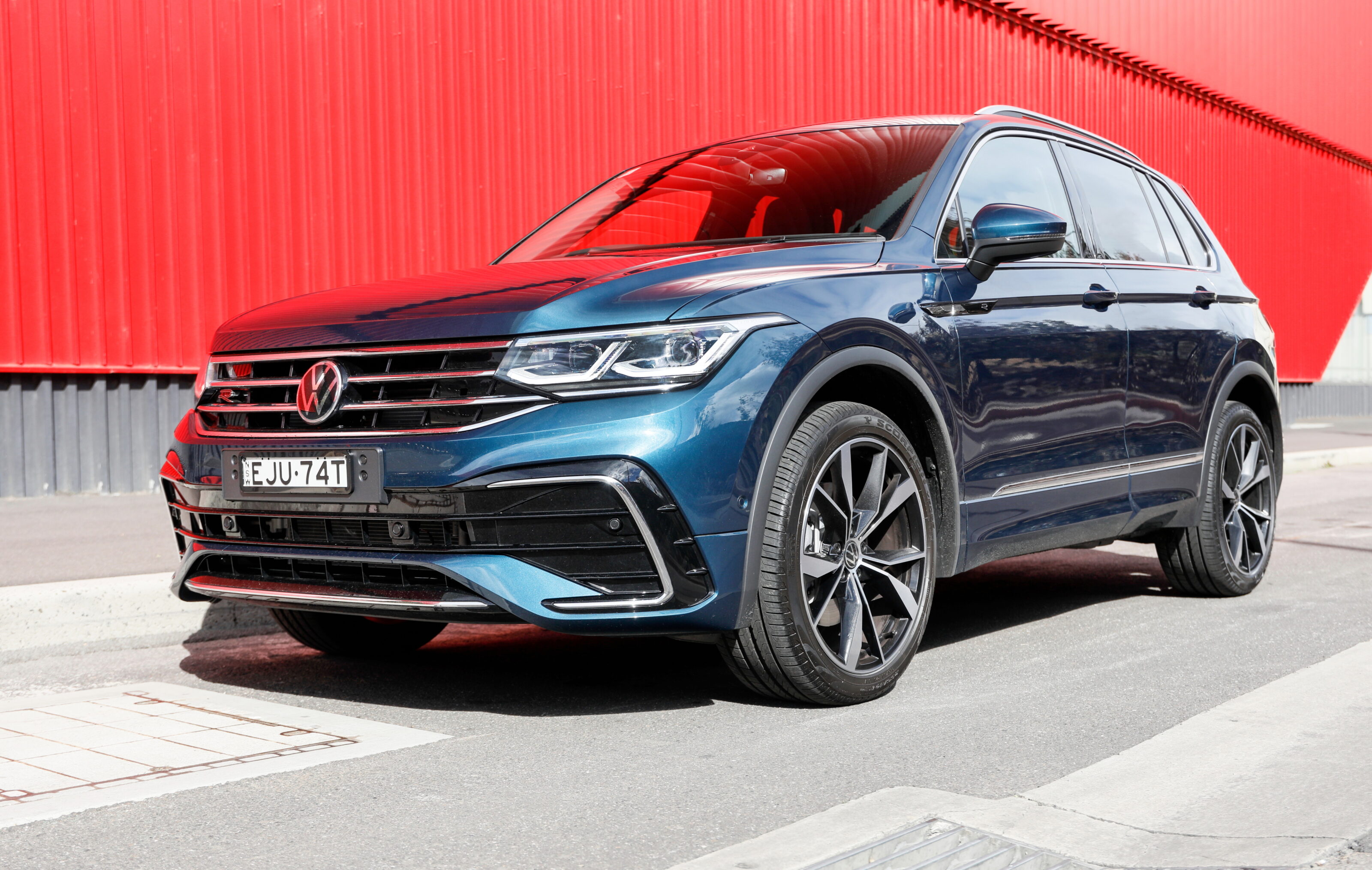
Paying $53,790 for the Tiguan 162 TSI R-Line won’t leave you wanting for much, and comes with much of the features found in the $50,790 mid-spec 162 TSI Elegance (both before on-road costs), such as:
- Digital Cockpit Pro driver display
- 9.2-inch touchscreen
- Wireless Apple CarPlay/Android Auto
- Three-zone climate control
- Vienna leather upholstery
- Power-operated and heated front seats
- Heated steering wheel
- Power-folding and heated door mirrors
- Powered tailgate
- Matrix LED headlights
- LED tail-lights with dynamic indicators
- Ambient interior lighting
- Adaptive chassis control.
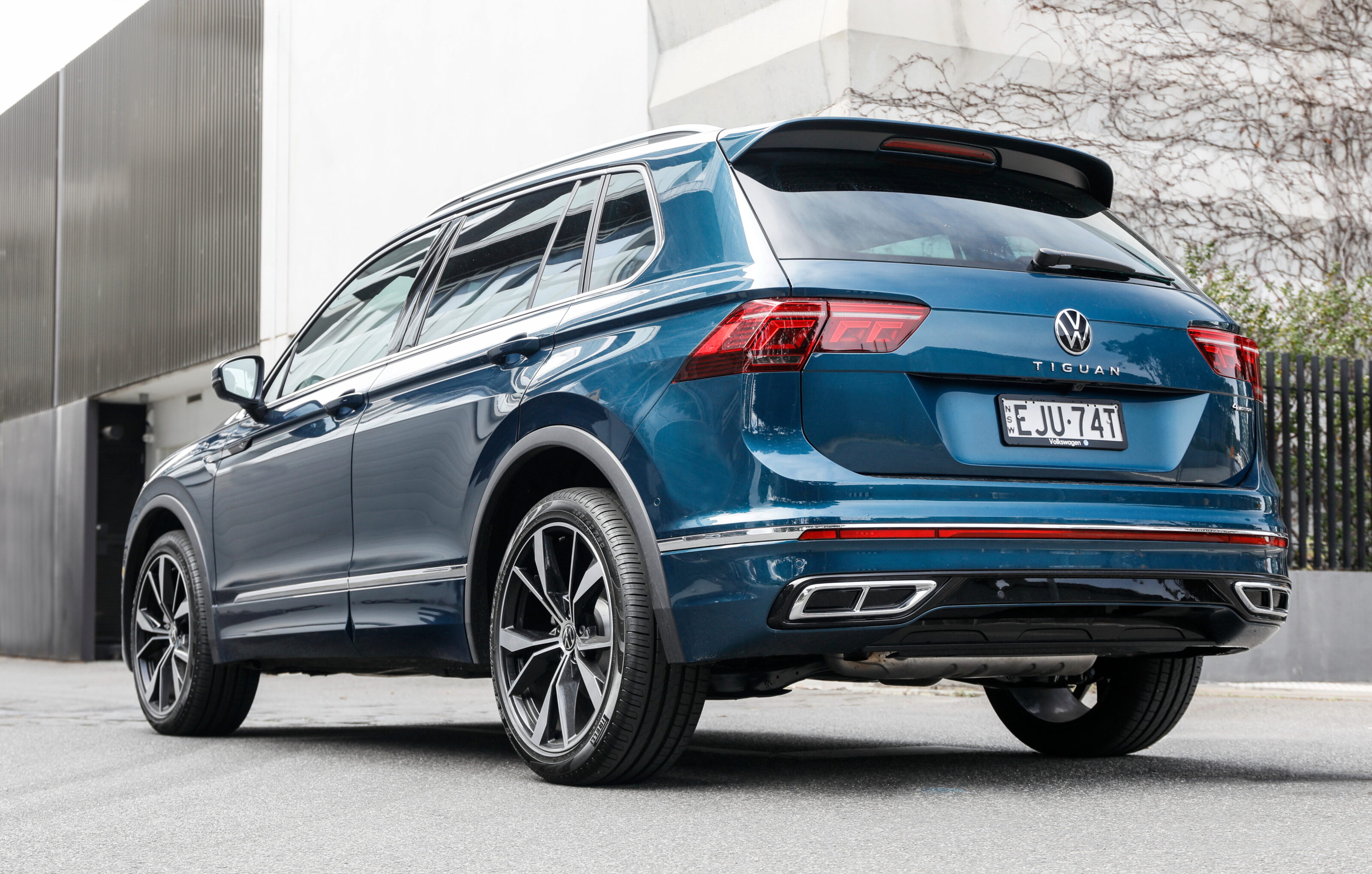
Paying $3000 more for the R-Line spec brings a bunch of aesthetic enhancements such as bigger 20-inch alloy wheels (compared to 19s on the Elegance), R-Line steering wheel with haptic touch controllers, black headliner, stainless steel sports pedals, R-Line trimmed upholstery and a body kit comprising bolder front and rear bumpers, side skirts and a rear spoiler.
You can also up-spec the Tiguan R-Line with metallic/pearlescent paint for $800, a panoramic sunroof for $1500 and the Sound and Vision package that for $2500 brings a head-up display, surround-view parking monitor and Harman Kardon premium sound system.
Safety
The current-generation Tiguan earned a five-star ANCAP safety rating in 2016, scoring a 96 per cent adult occupant protection rating.
Each update has brought new safety features and the 2021 model comes standard with IQ.Drive driver assistance technology, which includes safety features such as Travel Assist (VW’s moniker for semi-autonomous adaptive cruise control and lane-keeping assist technology), autonomous emergency braking with pedestrian monitoring, emergency assist, blind-spot monitor, park assist, parking sensors at both ends and driver fatigue detection.
Passive safety includes six airbags and 360-degree proactive occupant protection, which can detect situations in which there a potential accident kicks in, such as when the AEB activates. When this occurs it automatically tightens the front seat belts, closes the windows and (if fitted) the panoramic sunroof as a precautionary measure.
Space and comfort
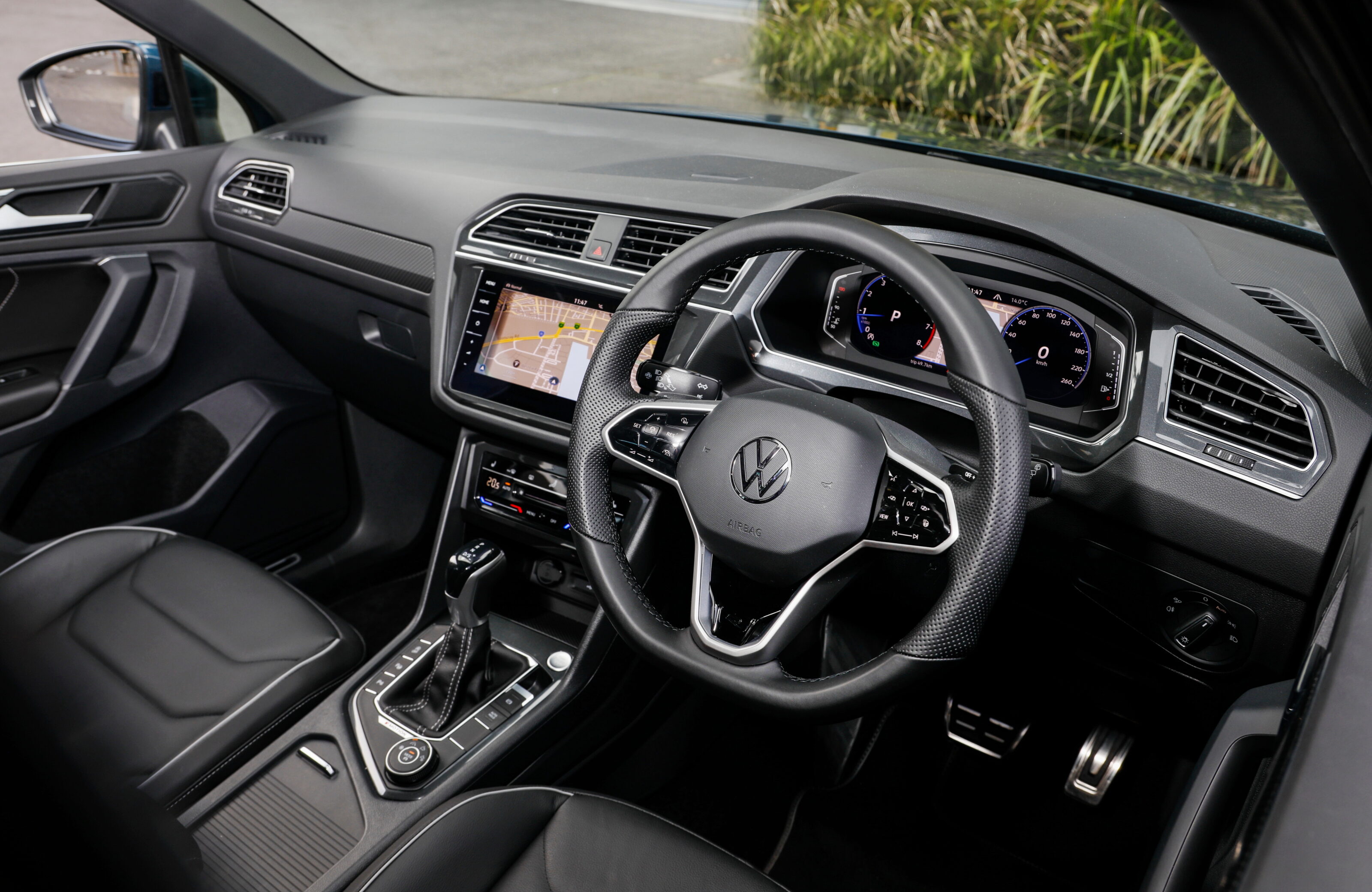
The Tiguan’s interior design looks fresh and clutter-free and everything is intuitively laid out.
Fit and finish are good and there are plenty of soft touches including the top of the dashboard, and top half of the door cards.
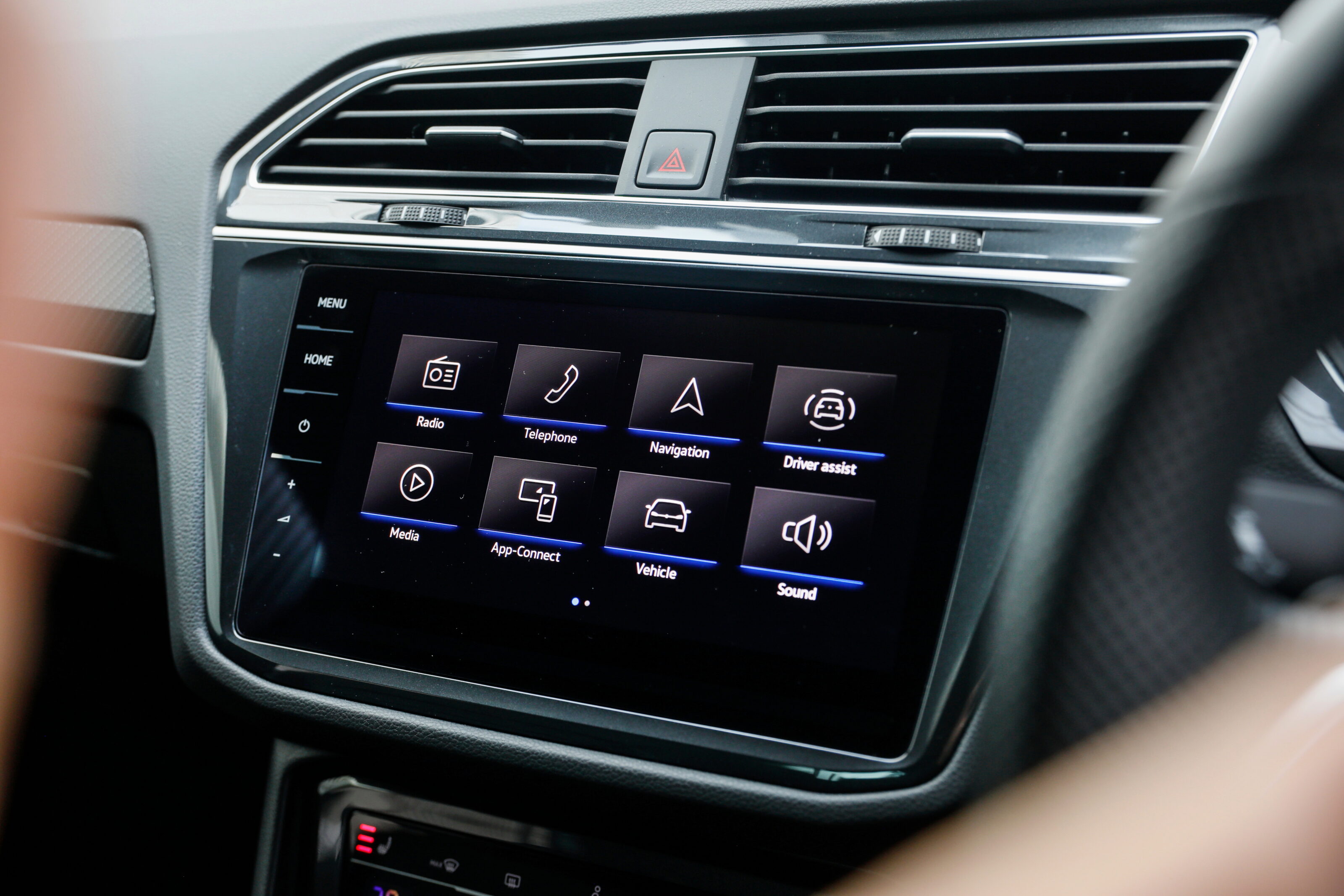
The dashboard has that crisp look that’s typical of Volkswagen models, and while the trim is rather monochromatic, the high-resolution graphics on the 9.2-inch touchscreen and 10.25-inch digital dashboard displays provide plenty of visual interest.
Each update has brought new safety features and the 2021 model comes standard with Volkswagen’s IQ.Drive driver assistance technology.
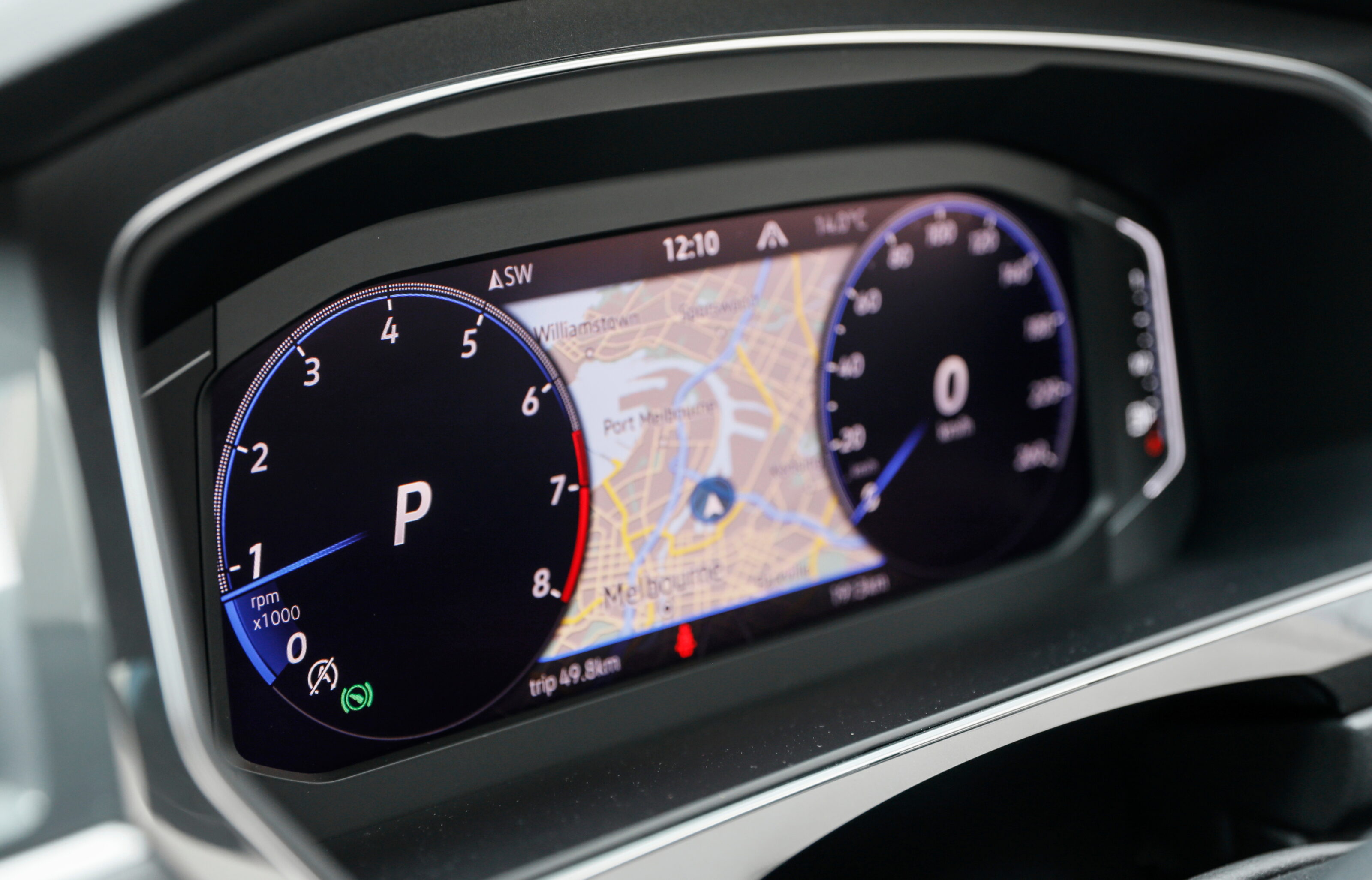
The leather D-shaped sports steering wheel is heated, with three settings, and has well laid-out buttons to operate the cruise control, audio, phone and digital cockpit buttons.
I say buttons but they are more like touchpads that can be pushed or swiped. While they do have a haptic feel, they can be a little fiddly while you’re driving and aren’t as good for eyes-off operation as physical switches.
The climate control system below the infotainment screen is also operated with touch-sensitive switches that work fine when you’re stationary, but sliding your finger along the fascia to adjust the fan speed is a lot more difficult while driving than with a traditional dial or slider.
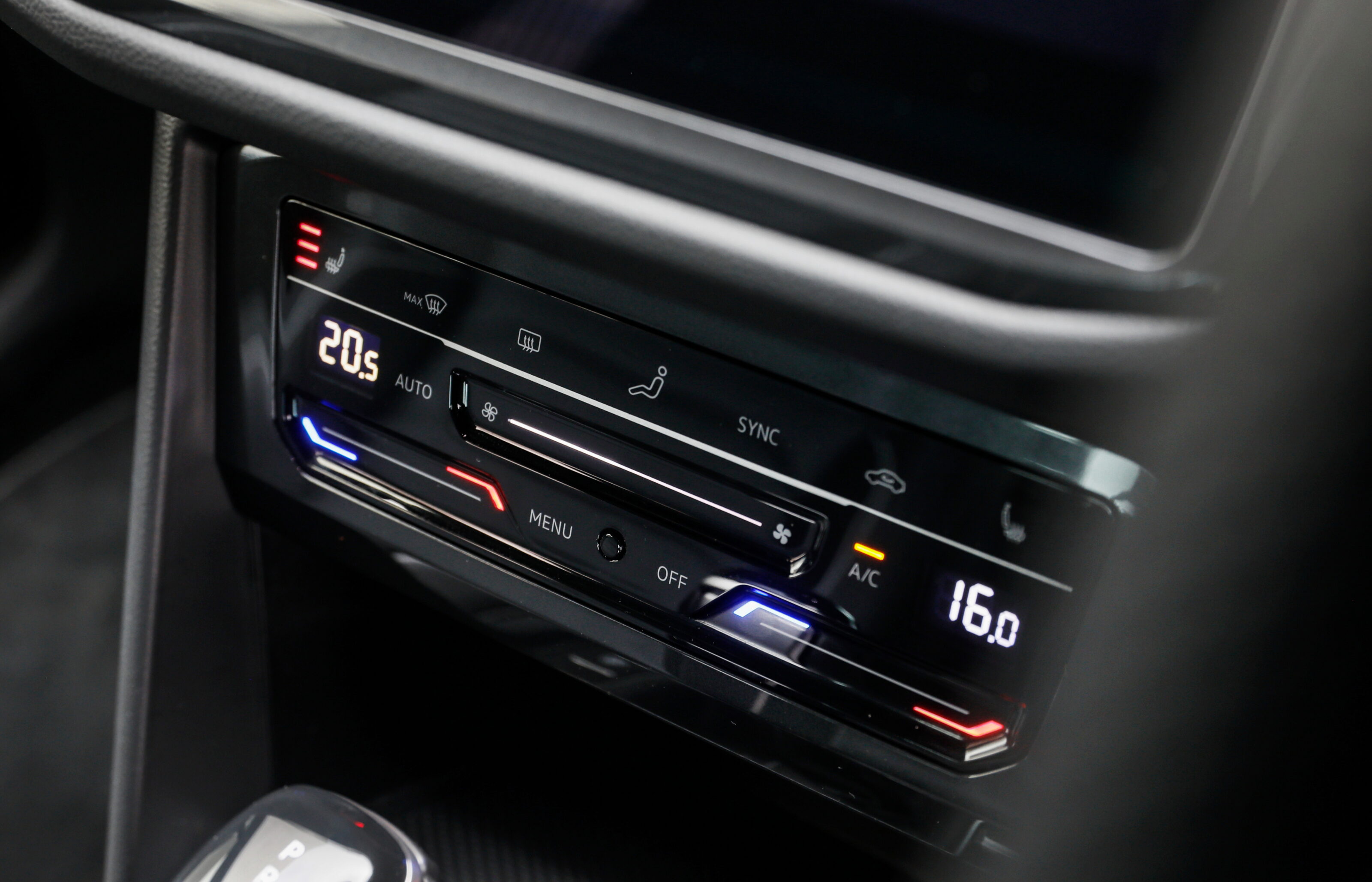
Volkswagen has thankfully retained a few physical buttons alongside the touchscreen to quickly access the menu, main screen and volume controls.
Once you’re in the infotainment menu, everything is well laid out and allows the user to find most functions with a single swipe.
Among these functions are wireless Apple CarPlay and Android Auto, which sync easily via Bluetooth. There is no wireless phone charger, which means you’ll have to plug in the phone anyway to keep it charged.
Like Mercedes-Benz, Volkswagen vehicles only come with smaller USB-C sockets now. There are two located next to a 12-volt socket in a nook in front of the gear selector where you can keep the phone and other small items such as keys.
The centre console houses two other storage areas including a covered tray with fold-away cup holders and a deeper tub under the padded armrest. There is also a glovebox and deep door bins with the latter lined with felt, which helps prevent objects from sliding around or vibrating.
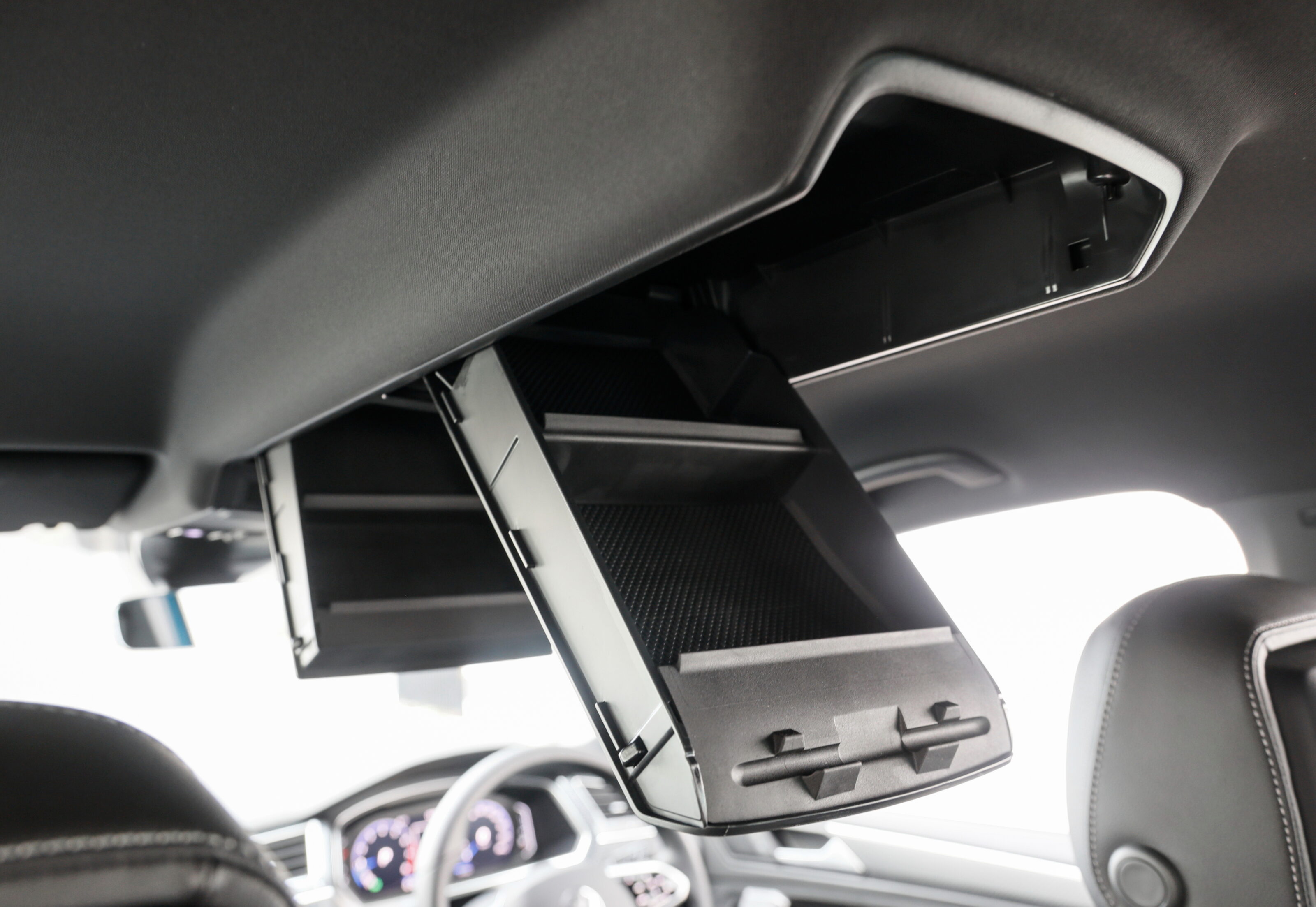
But wait, there’s more including a small pocket to put coins or keys to the right of the steering wheel, a bin with a pop-up lid in the middle of the dashboard, and two overhead pulldown storage hatches in which to place things like sunglasses or maps.
The dashboard has that crisp look that’s typical of VW models, and while the trim is rather monochromatic, the hi-res graphics on the displays provide plenty of visual interest.
The monogrammed ‘R’ grey leather front sports seats have good side bolstering and under-thigh support but do feel a little firm and flat. That said, they do afford a good driving position that is helped by the steering wheel’s broad adjustment range.
Both front seats are heated and power-adjustable, the driver’s side also providing three position memory settings.
The rear seats are also firm, but comfortable enough and even the middle seat will easily accommodate an adult, which is a rarity these days.
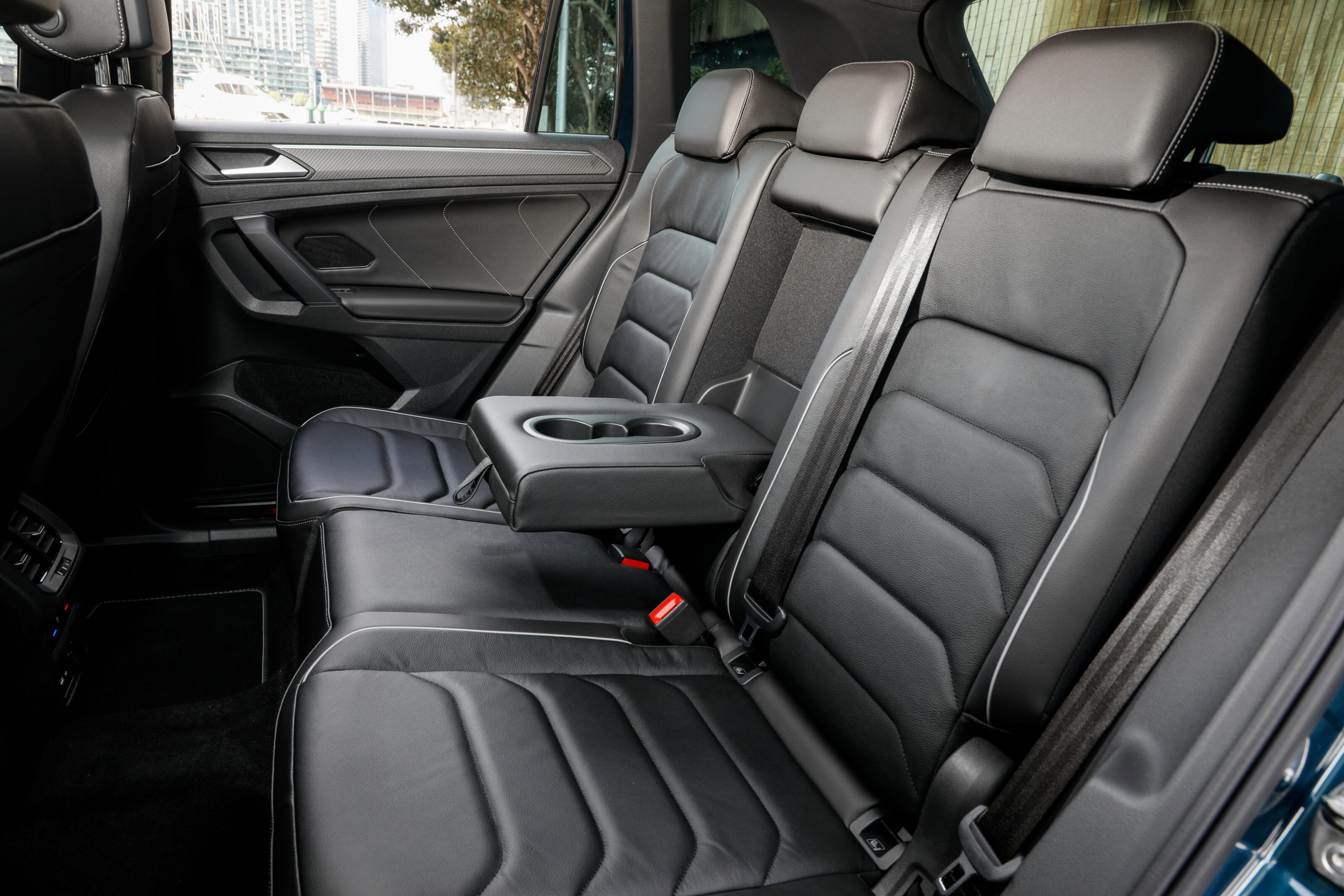
Rear-seat passengers benefit from a fold-down centre armrest with cup holders, deep door bins, a USB-C socket, 12-volt socket, HVAC controls and vents.
The rear bench sits a little higher than the front seats, which allows for good forward and side vision.
The 40:20:40 split backrest can be adjusted to recline a little or move forward to increase boot space, and you can also lower the boot floor by 75mm, which is one advantage of having a space-saver spare wheel.
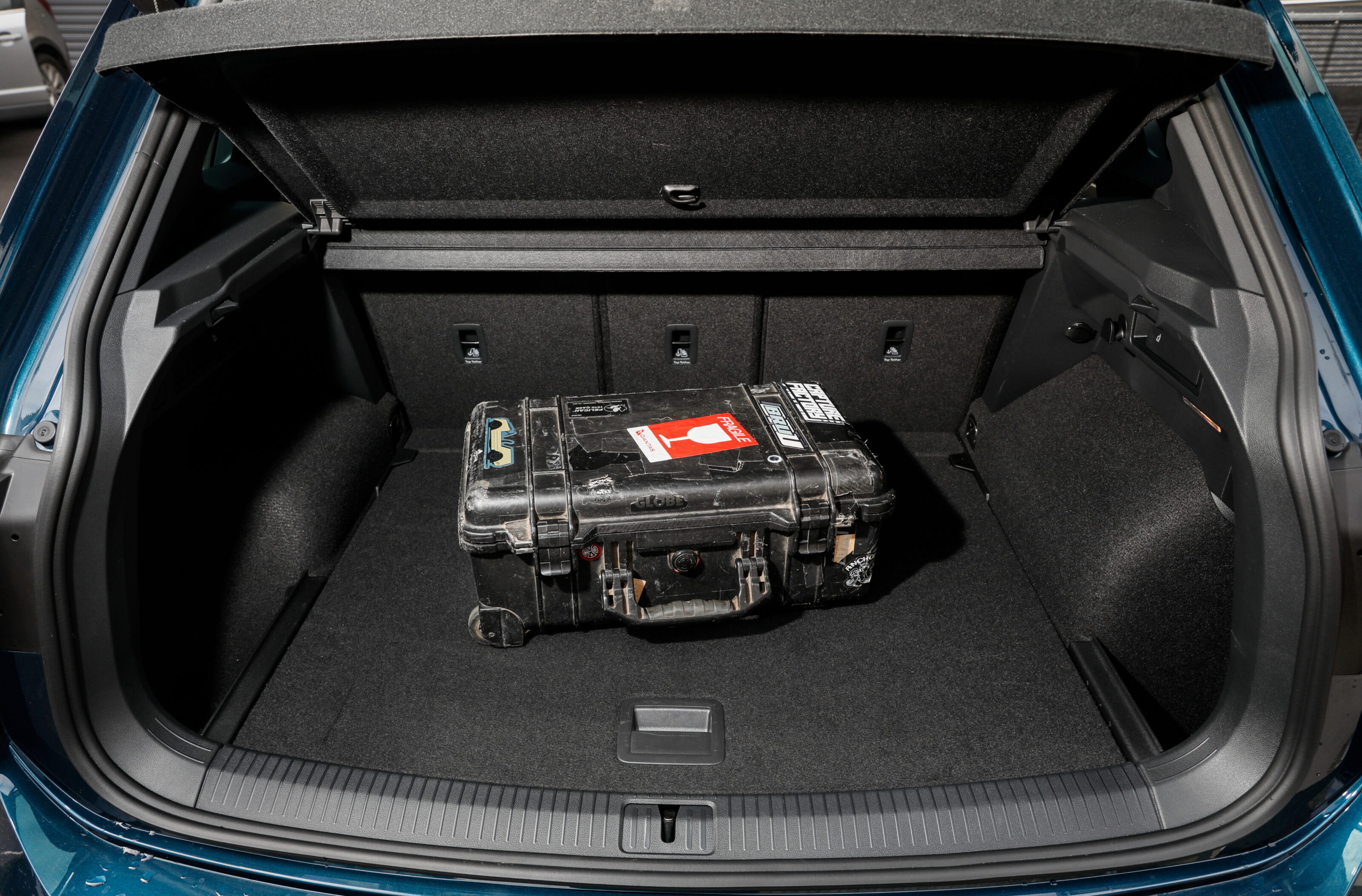
With the seats up in the standard position, boot space is a cavernous 615 litres, one of the most voluminous in the medium SUV category.
This translates to 850mm between the seatback and boot lip, 1000mm between the wheel arches and 460mm between the boot floor and parcel blind.
If you need to cart more, the Tiguan 162 TSI has a braked towing capacity of 2500kg and 750kg unbraked.
On the road
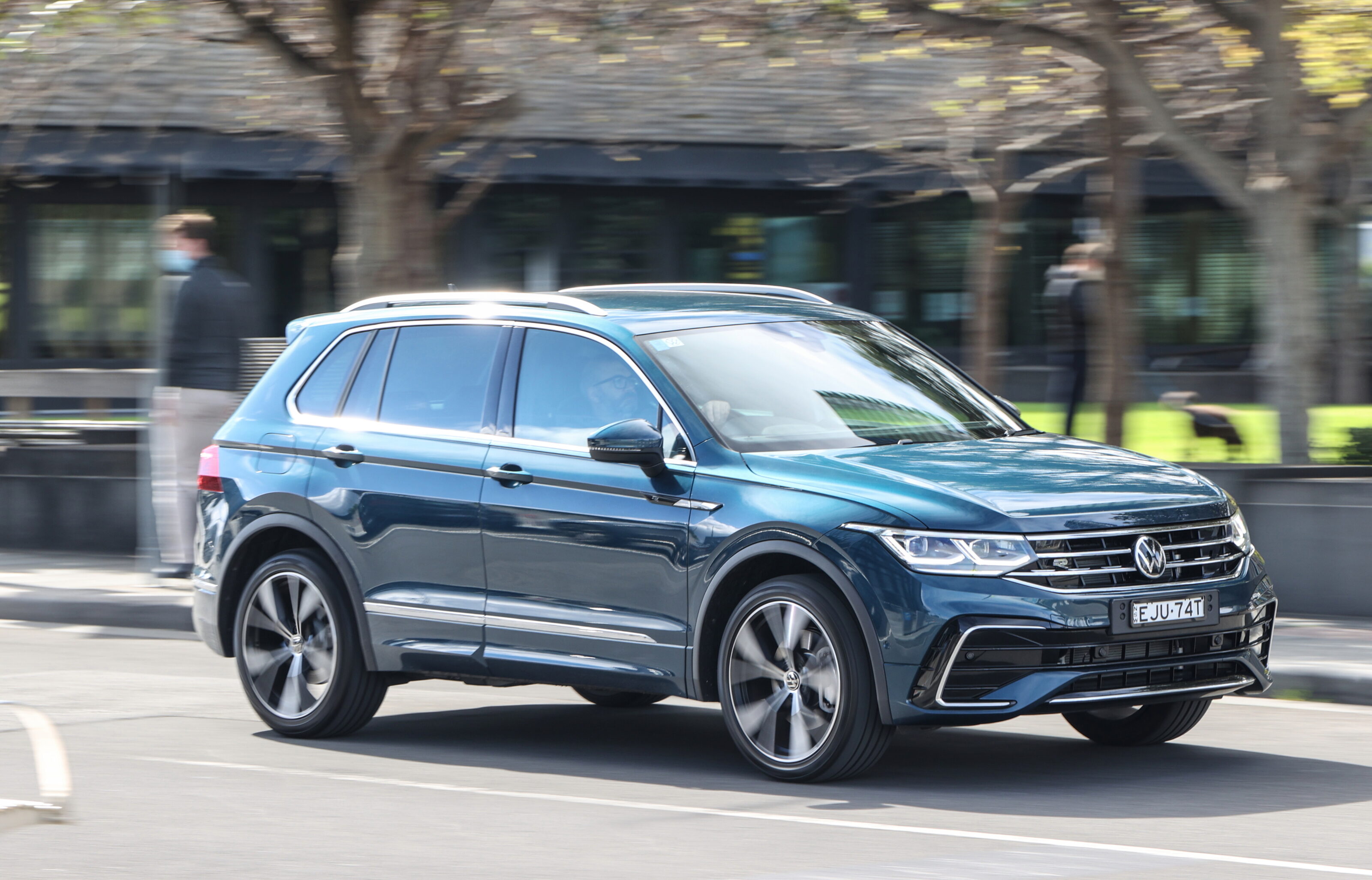
Until the arrival of the Tiguan R, this is the most powerful Tiguan in available in Australia and its punchy 162kW/350Nm 2.0-litre four-cylinder turbocharged petrol engine doesn’t disappoint.
It has some serious shove and can feel quite exhilarating when you put the foot down, especially in Sport mode, which ups the revs in each gear to overcome the low-rev lag associated with the seven-speed dual-clutch auto.
According to VW, it’s capable of a 7.0-second 0-100km/h sprint, though our man Alex Inwood managed 6.8-seconds using its launch control system (see the above video), which is just a half-second slower than the 183kW/370Nm Audi Q5 45 TFSI Sportback.
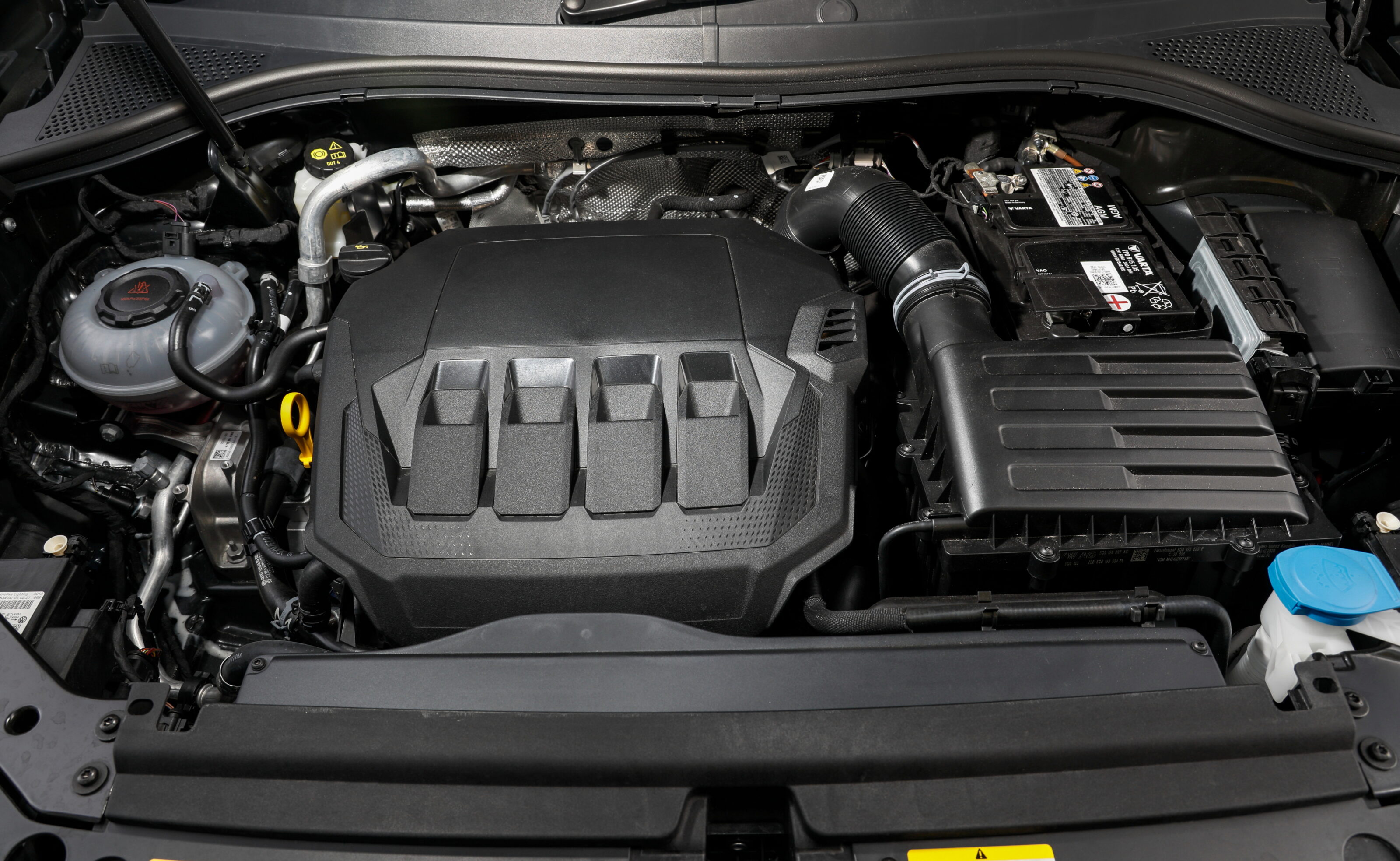
Indeed it feels incredibly quick, with that sensation aided by the gauges glowing red in Sport mode and an aggressive engine note when you reach about 4000rpm.
The Tiguan rides on Volkswagen’s MQB platform that underpins a range of vehicles including the Golf and as such it has surprisingly hatchback-like handling, which is further aided by the 4Motion all-wheel-drive system that can also be set to provide Snow and Off-road traction.
Sport mode also tightens the adaptive chassis control (ACC), or adaptive dampers, and firms up the steering for more performance-oriented ride and handling. The downside is that the ride can be overly firm, particularly through the rear multi-link suspension and low-profile Pirelli Scorpion rubber.
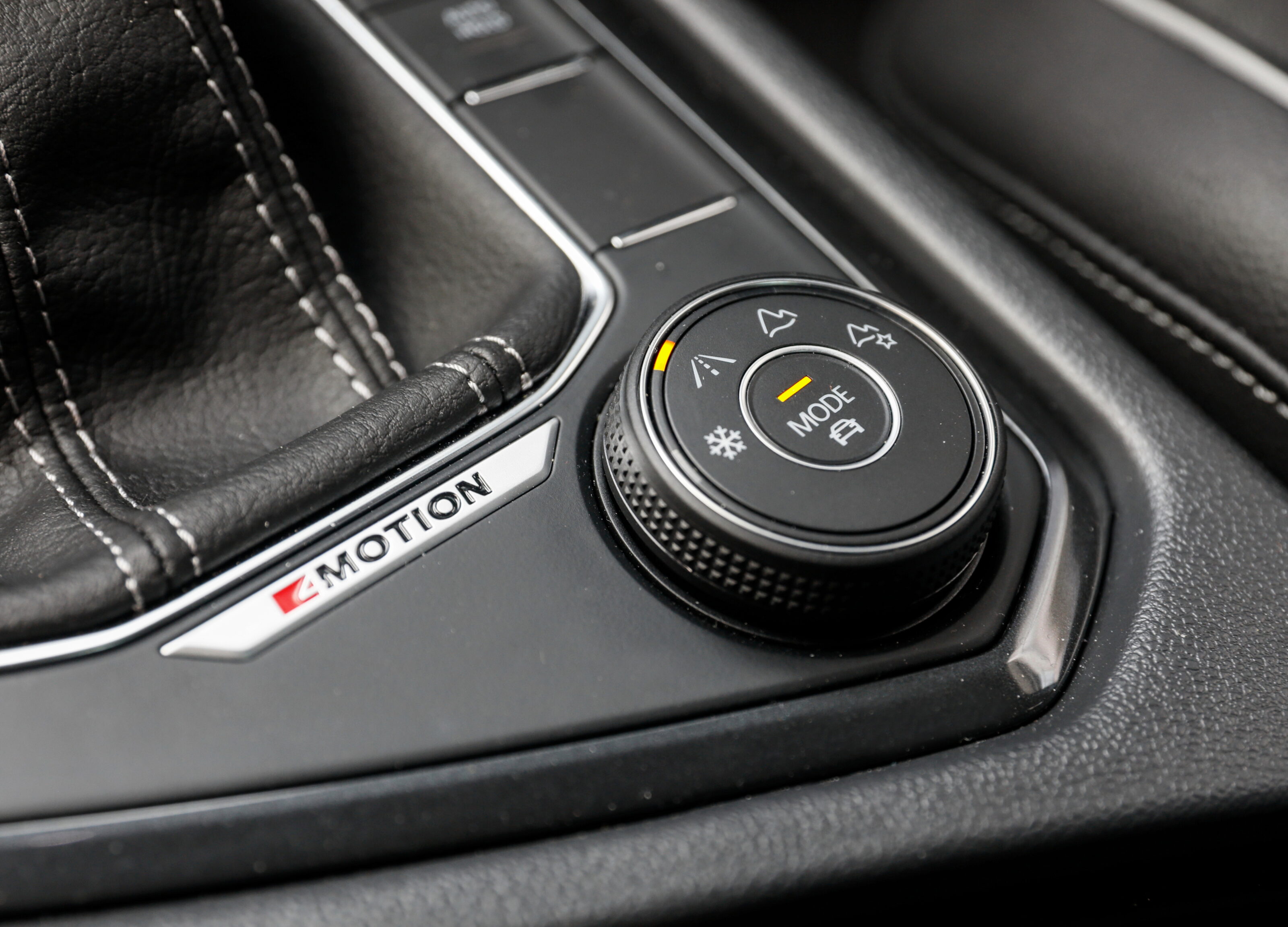
One way around this is to customise the vehicle settings so you can maintain the Sport performance with default Comfort damper settings using the Individual mode.
In full Comfort mode, the Tiguan is an excellent all-rounder that continues to offer driver enjoyment during the daily drive.
The progressive steering feels light and direct, making it good for negotiating tight spots, but tightens as you speed up for better accuracy.
The Tiguan rides on VW’s MQB platform that underpins the Golf and as such it has surprisingly hatchback-like handling.
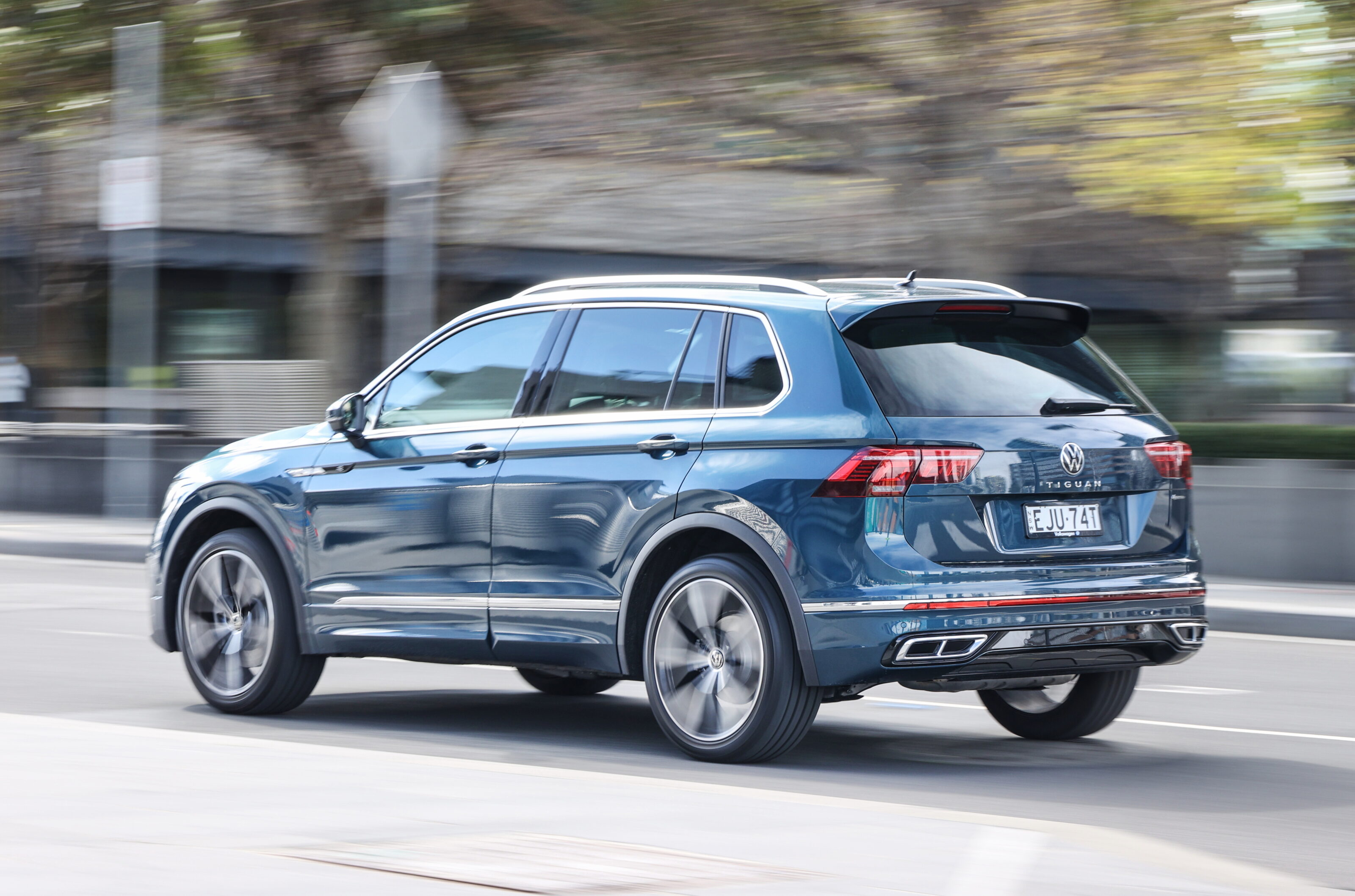
It’s one of the easier SUVs to park too, with excellent all-round vision and a host of aids including front and rear parking sensors and a surround-view camera.
If for some reason you still find getting into a particular parking spot difficult, you can engage Park Assist, enabling the Tiguan to virtually park itself at the touch of a button. All you need to do is apply the brakes.
In short, this is a great choice for anyone who may have to trade in a sporty hatch or sedan for something more practical without sacrificing much by way of driver enjoyment.
Ownership
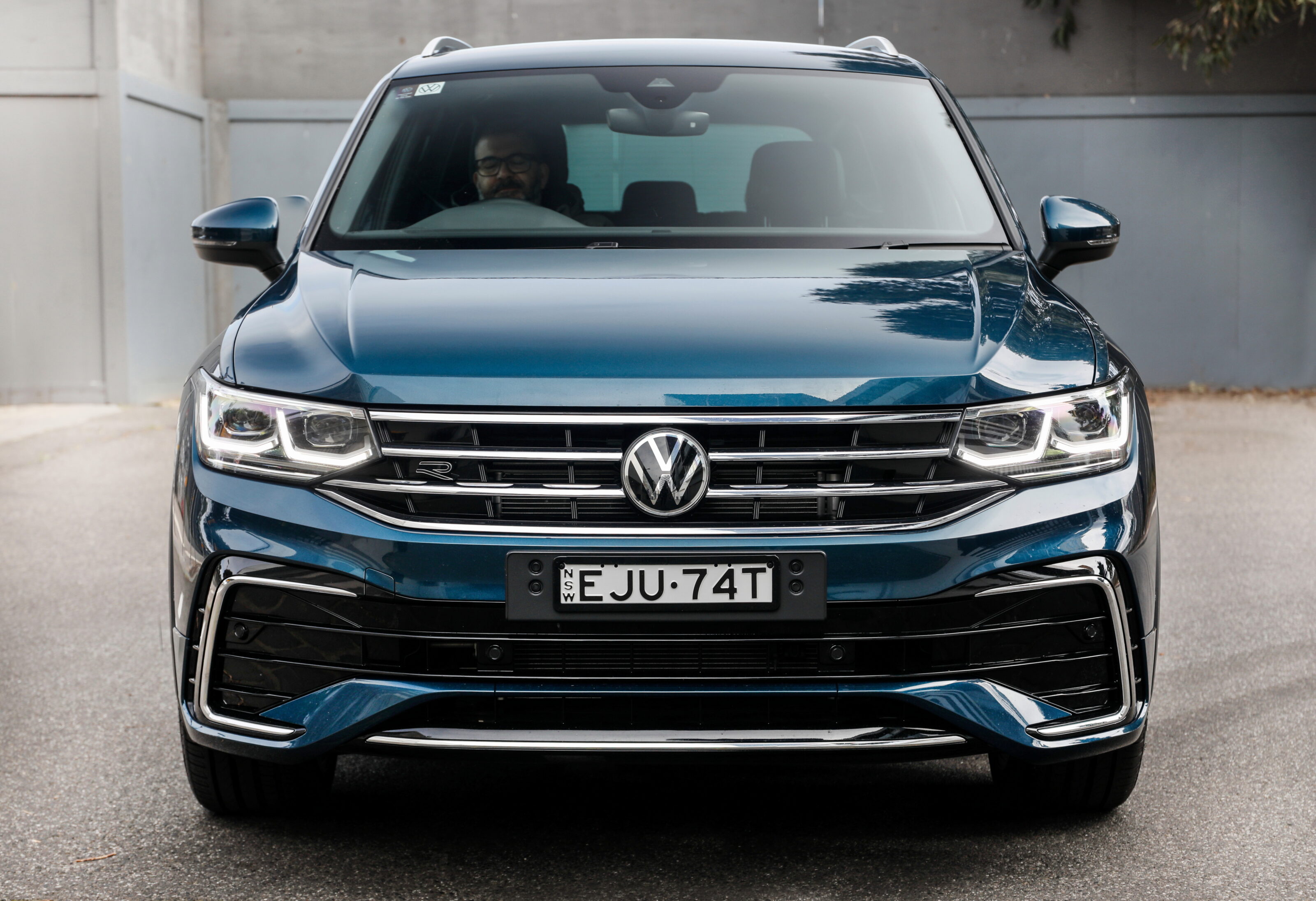
The Tiguan 162 TSI’s 2.0-litre turbo brings a not-too-frugal official combined fuel consumption of 8.5L/100km, which climbs beyond 10.0L/100km around town.
It’s covered by a five-year, unlimited-kilometre warranty and has 12-month/15,000km service intervals.
Each service at VW service centre costs $429 under the company’s Assured Service Pricing, or you can opt for three- or five-year ‘Care Plans’ for $1200 or $2400 respectively.
VERDICT
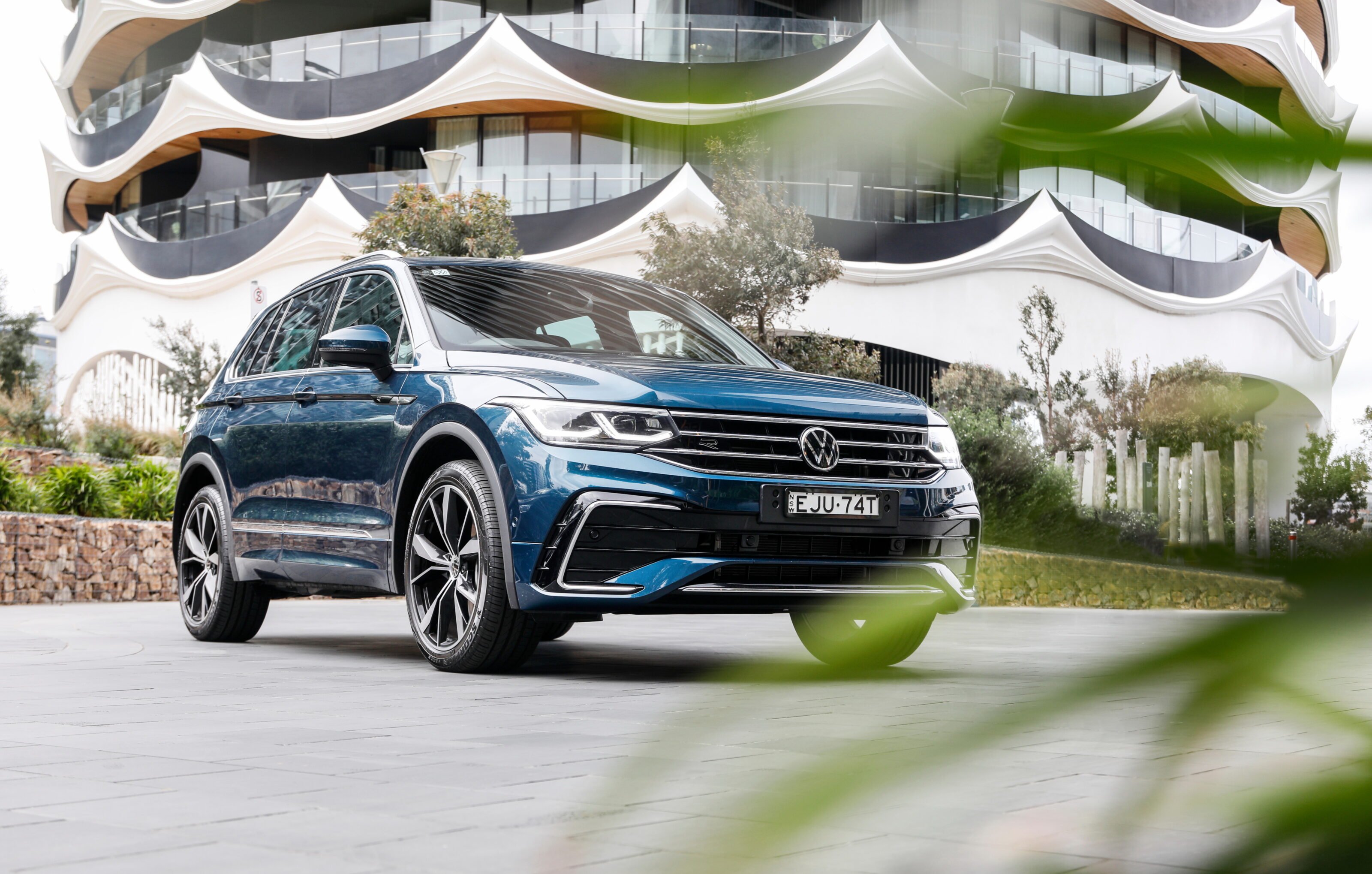
As well showing that practicality doesn’t need to come at the expense of driveability, the Tiguan 162 TSI draws on Volkswagen’s ability to provide viable alternatives to comparative premium models at a fraction of the price.
It’s about $20,000 less expensive than the likes of the Audi Q5 45 TFSI Quattro Sport and BMW X3 sDrive20i, but while they have about 20kW more in bragging rights, are no more fun to drive than this plucky VW.
2021 Volkswagen Tiguan R-Line specifications
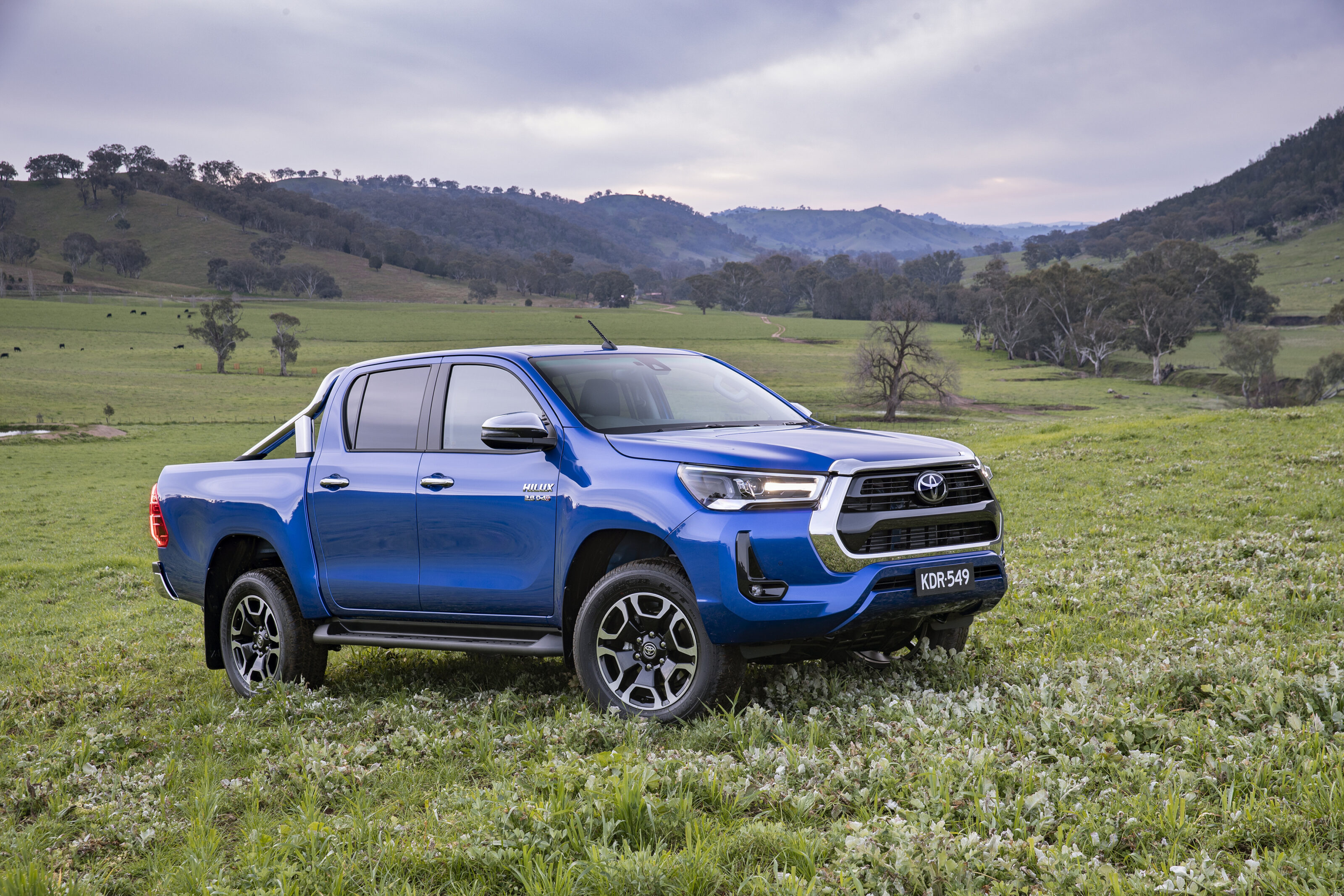
Toyota Australia has issued a recall for its best-selling HiLux ute after a fault with its passenger seat occupant sensor was identified.
The problem affects 1367 MY21 HiLux utes.
According to the Department for Infrastructure that issued the recall, the sensor may not meet manufacturing specifications.
This sensor is used to detect if the seat is occupied and determine whether to deploy the passenger airbag in the event of an accident. If the sensor does not operate as intended, it may result in an airbag not deploying when required and could cause serious injury or death to the occupant.
A list of VINs for the vehicles involved can be found here.
Owners of affected vehicles can contact Toyota and make an appointment at their preferred Toyota dealer for inspection and, if required, calibration of the occupant sensor, free of charge.
Toyota can be called on 1800 987 366 or emailed at [email protected]
Foreign companies will soon be allowed to have full ownership over their car manufacturing operations in China, thanks to eased regulations.
From January 1, carmakers will no longer need to enter a 70:30 joint venture with a Chinese company – a requirement since 1994, which were eased from a ratio of 50:50 in 2018.
The country’s top economic ministry regularly releases a document outlining the industries which are barred from outright foreign ownership, but the latest release has dropped the automotive sector from its list.
Forcing manufacturers to join up with local car companies meant more profits were kept from exiting the country – with five of the largest local manufacturers being state-owned.
The regulation has also allowed Chinese carmakers to rapidly close the gap with the world’s leading manufacturers, with access to best-practice design and manufacturing techniques.
It’s expected the rule change will make it easier for start-ups such as Lucid and Rivian to enter the Chinese market.
There’s real joy to be found in simple things done well. AC/DC’s music isn’t complex, but it’s played at an incredibly high standard. Likewise, we can all cook a roast, but when a professional chef does it the end result is always amazing.
This brings us to the Mazda CX-3 Neo, the bottom rung of Mazda’s small SUV ladder. Pricing starts at $24,990 drive-away for the six-speed manual while this automatic test car is $26,990 drive-away. Like all Mazdas, it’s covered by a five-year/unlimited-kilometre warranty and capped-price servicing equates to $1816 over that five-year period.
It’s a basic car. If you’re a fan of bright lights and fancy trim and the latest technology then this probably isn’t going to be the car for you, but if you want a well-engineered, no-frills machine then the CX-3 Neo is definitely worth a look.

When I say no frills, I don’t mean to infer that the CX-3 is completely barren. There’s push-button start, a 7.0-inch infotainment screen with smartphone mirroring and digital radio (that is now an 8.0-inch screen thanks to the MY22 update), a six-speaker stereo, Bluetooth, rear parking sensors, reversing camera, cruise control and air-conditioning.
On the other side of the ledger, there are steel wheels with hubcaps instead of alloys, manually adjustable cloth seats, no keyless entry and neither the headlights nor wipers are automatic. This is a car that still expects the driver to take care of things should they require it.
This is a basic car. If you’re a fan of fancy trim then this isn’t going to be the car for you, if you want a well-engineered, no frills machine then the CX-3 Neo is worth a look.

For the most part, this includes avoiding accidents. This generation CX-3 has been around for a while now and it shows its age in the lack of active safety equipment that’s now standard on many of its newer rivals.
It has six airbags and automatic emergency braking for forward and reverse directions (dubbed Smart City Brake support in Mazda-speak) but lacks blind-spot monitoring, driver attention alert, forward obstruction warning, lane departure warning and rear cross-traffic alert.
Stepping up to the $29,990 (drive-away) CX-3 Maxx Sport brings blind-spot monitoring and rear cross-traffic alert as well as auto headlights, rain-sensing wipers, climate control, auto-dimming rearview mirror, a leather steering wheel and native sat-nav.

While it’s difficult to argue against the safety benefits of the latest tech, if you’re the sort of driver that’s happy to focus on the task at hand – and hopefully you are – it is slightly refreshing not to have lane assist constantly corrupting the steering and various lights and sounds going off. Then again, you never need it until you do!
As befits the CX-3’s price and positioning, the interior is full of hard plastic but it’s also very easy to use. The air-conditioning is controlled by three large rotary dials and simple steering wheel toggle buttons operate the digital screens that flank the large analogue speedo.
The CX-3’s steep window line, which gives a coupe-ish profile, could make vision out a struggle for smaller folks.

The infotainment offers two usage options, either the central rotary controller or touch capability, but the latter only works when the car is stationary. Presumably this is a safety feature, but it both prevents the passenger from touch-operating the screen and forces the driver to use the central controller, which takes more attention away from the road.
In the back, there are no air vents or USB ports for charging devices, but there is a reasonable amount of space in terms of head and legroom for my 180cm frame, which is impressive given the CX-3’s relatively small dimensions.
The compromise comes in terms of boot space, with only 264 litres of capacity available – a Nissan Juke offers 422L, a Ford Puma 410L and Hyundai Venue 355L, for example – though this increases to 1174L with the 60:40 split rear seats folded and there’s a false floor with more storage space underneath.

The CX-3’s steep window line, which gives a coupe-ish profile, could make vision out a struggle for smaller folks. There are three child seat tethers on the back of the rear seats but ISOFIX points only on the outboard seats – not that you’d ever fit three child seats across in a CX-3 – and you need to dig into the seat upholstery to find them.
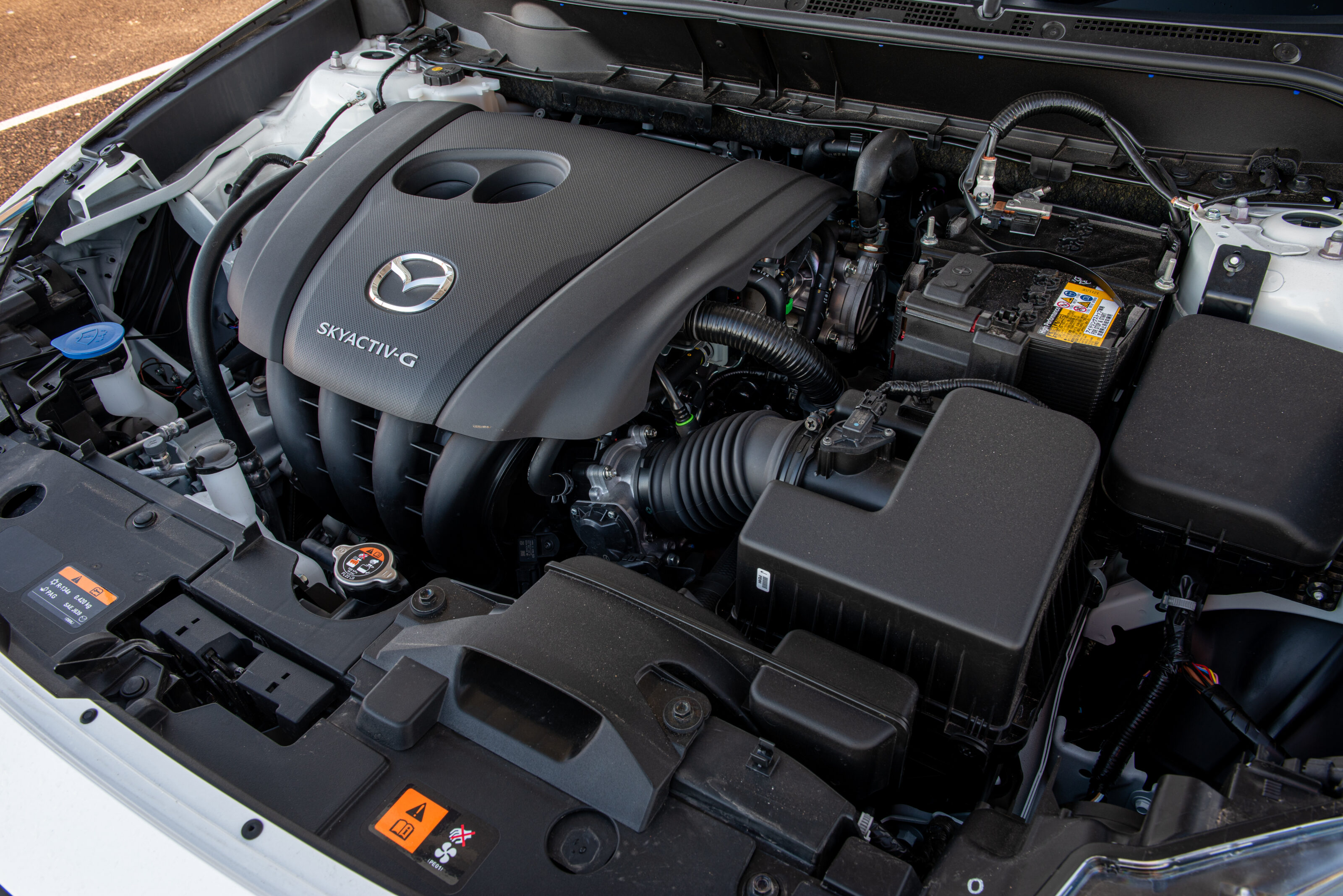
Where Mazda’s baby SUV shines is on the road. The 2.0-litre four-cylinder engine develops 110kW and 195Nm and is revvy and keen, though also quite noisy. Personally, it falls just the right side of raucous but the less enthusiastic might find it wearing.
Claimed fuel consumption is 6.3L/100km and our test figures of 7.0L/100km, recorded over a wide variety of circumstances including long highway tours and urban runarounds, suggests that it is reasonably accurate and 91RON fuel is accepted.
It’s clear the CX-3 has been developed by an engineering team that enjoys driving, with accurate, well-weighted steering and great body control. It’s unclear whether any potential owner would want to drive the CX-3 Neo in a spirited manner, but there’s every chance they’d have a smile on their face if they did.
The consequence of this handling nous is a slightly firm ride on rough surfaces but it simply provides feedback about the road surface rather than jostling or upsetting occupants.
It’s clear the CX-3 has been developed by an engineering team that enjoys driving, with accurate, well-weighted steering and great body control.

The Mazda CX-3 Neo won’t be for everyone. In fact, it could be considered quite a niche offering, though few rivals can match its super-sharp entry price.
I suspect many people will be happy to spend a little more for greater levels of safety and convenience equipment, but if you’re someone who does a lot of driving and thus appreciates quality driving dynamics without worrying about the latest tech, then the CX-3 Neo is something simple that’s been executed very well.
2021 Mazda CX-3 Neo specifications
Drivers in Sydney will cop another increase to the cost of living, with tolls across the city to ratchet up again on New Year’s Day.
From January 1, 2022, the cost of using toll roads in the New South Wales capital will increase by as much as 4.1 per cent.
Though the Sydney Harbour Bridge and Tunnel will remain at their current prices, those driving on the Westconnex M4 will see prices jump from $8.52 to $8.87.
The Westconnex M8 will increase to $7.52 from $7.23, and the Northconnex toll road will go up from $8.36 to $8.44.
The news is worse for truck drivers, with the Westconnex M4 costing as much as $26.61 per trip.
The Cross City Tunnel will see the smallest change, with an increase of 5c for cars.
While the price changes may seem minor, it’s estimated those who rely on the Westconnex M4 for their daily commute will be paying an additional $87.50 each year.
Snapshot
- 2020-2021 Mercedes-Benz A250e recalled
- The issue can cause the battery to corrode, increasing fire risk
- A total of 10 vehicles are included in the recall
Mercedes-Benz Australia has recalled a total of 10 examples of the 2020-2021 Mercedes-Benz A250e due to a potential issue with the car’s high-voltage battery housing.
According to the recall notice published by the Department of Infrastructure, a manufacturing defect could allow moisture to enter the battery, increasing the risk of an electrical fire.
Mercedes-Benz will contact affected owners, but the company can be contacted directly by calling 1300 300 896 or visiting a dealership, found here.
You can check a list of all 10 VINs related to the recall by clicking here.
Snapshot
- More affordable XC40 Electric variant announced
- Smaller battery, single front-mounted motor
- New ‘MY23’ styling
The entry cost to Volvo’s fully electric XC40 has dropped to $72,990 with the introduction of a new variant that features a smaller battery and a single motor.
Volvo’s front-wheel-drive XC40 Recharge Pure Electric joins the dual-motor, all-wheel-drive version that launched last August as the company’s first fully electric vehicle and sold out of its 2021 allocation within weeks.
The “MY23” range update also brings a price change for the Twin Recharge, which increases from $76,990 to $79,990.
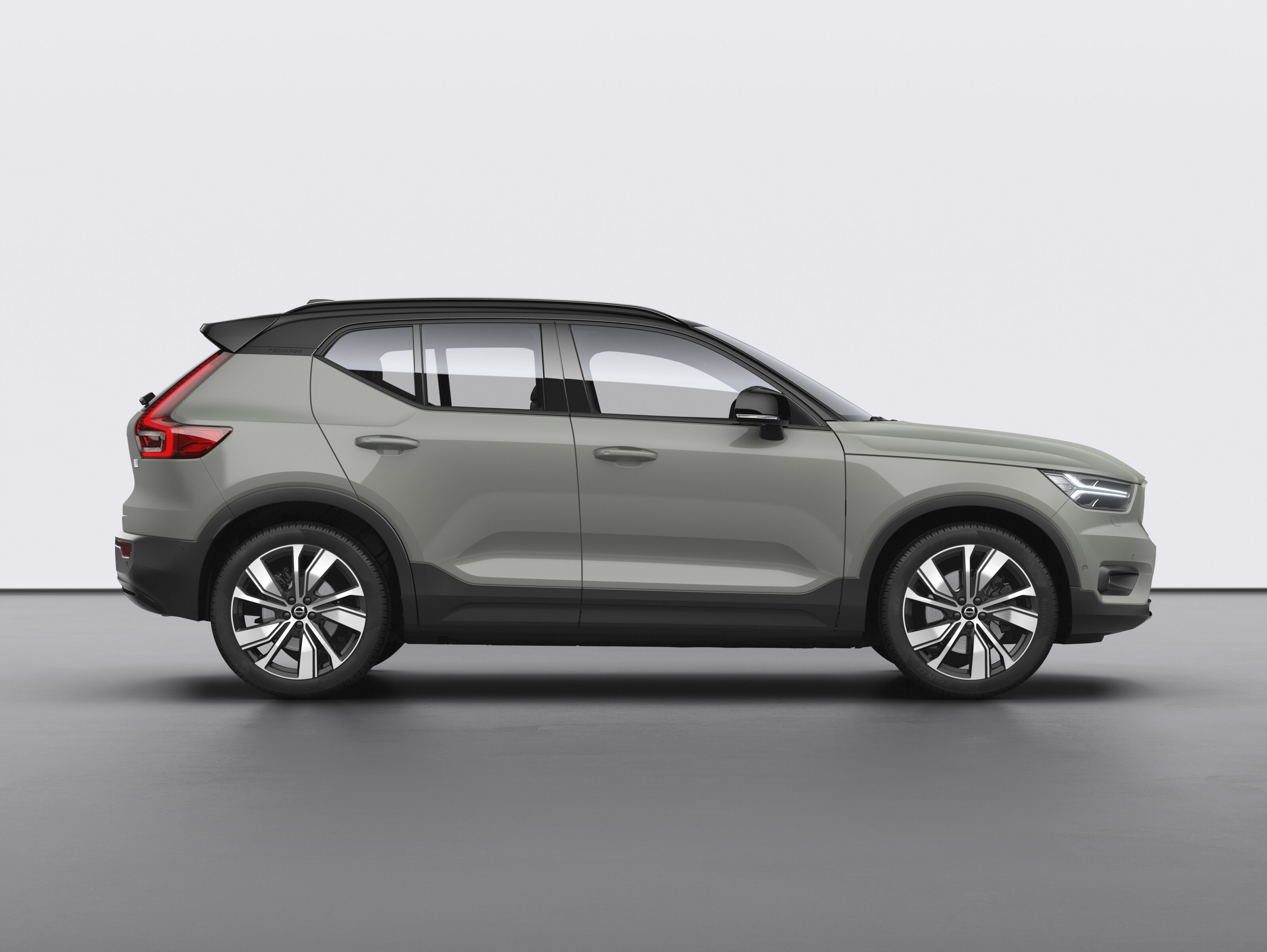
Upgrades specific to the twin-motor XC40 are Pixel LED headlights, new wheels and sustainable upholstery that switches from leather-accented seats.
All electric XC40 models will gain a new front bumper design, a frameless grille plate, revised finishes for the headlamp surrounds, and new rear bumper inserts.
Both Pure Electrics share a high equipment level based around the company’s R-Design grade. Wheel size will be one of the only variations, with the single-motor model featuring 19-inch rather than 20-inch rims.
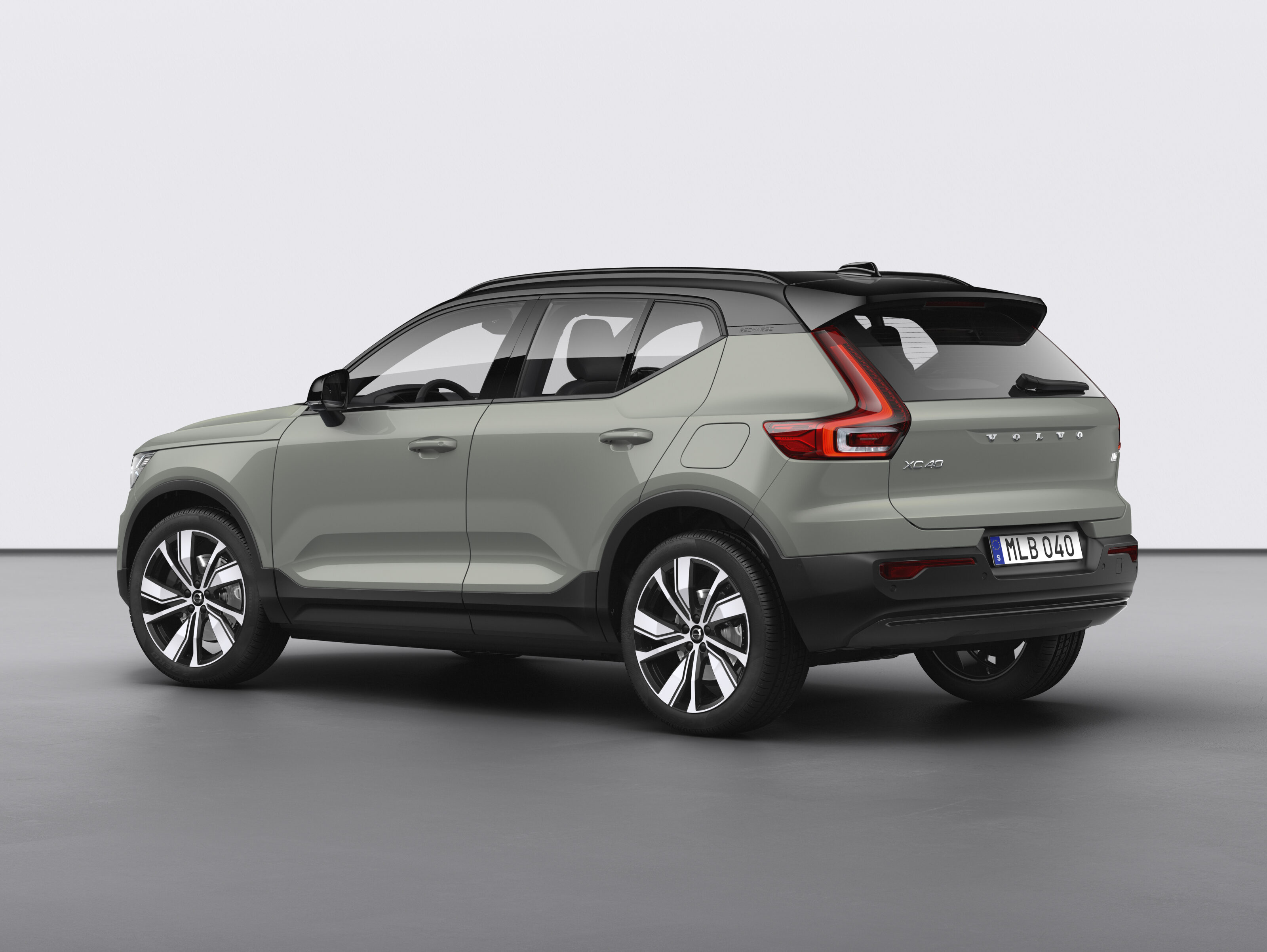
There’s a marked difference in range and performance.
The base Pure Electric uses a 69kWh battery powering a single front electric motor with outputs of 170kW and 330Nm. Volvo quotes 7.4 seconds for the 0-100km/h acceleration run and the company is anticipating a WLTP-rated ddriving driving range of about 380km.
The existing Twin Pure Electric incorporates a larger 78kWh battery, with an electric motor on both the front and rear axles producing a combined 300kW/660Nm.
Volvo says the AWD electric XC40 accelerates from 0-100km/h in 4.9 seconds and it has a maximum WLTP-rated range of 418km.
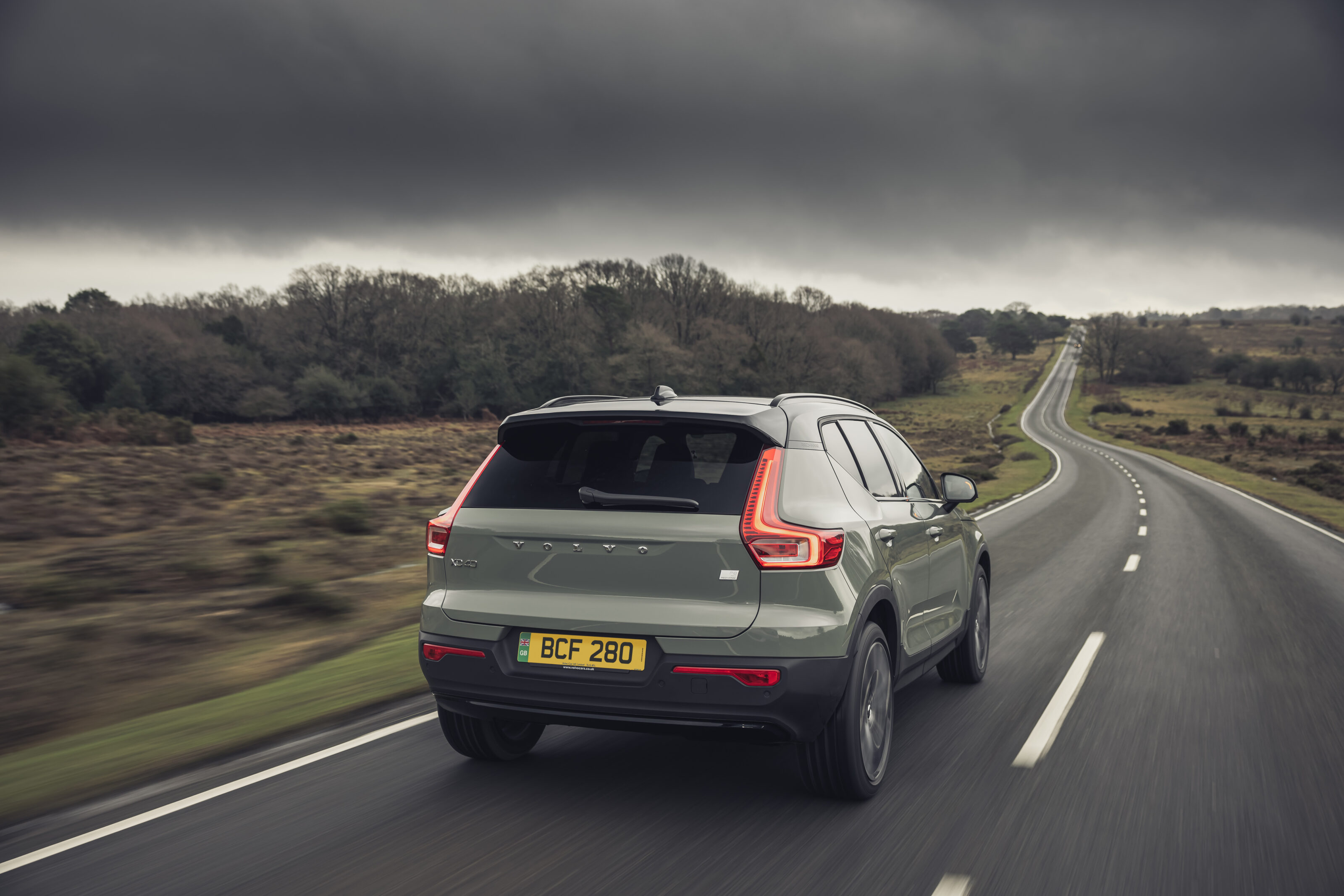
Volvo Australia says the more affordable, single-motor model will help it respond to “unprecedented” customer demand.
It will be comforting news for a brand that has committed to selling only electric vehicles from 2030.
A coupe-style twin to the XC40, called the C40 Recharge (see our review video below), will join the range in late 2022.
Volvo Australia’s managing director, Stephen Connor, believes 15,000 annual sales is achievable for the company soon – despite being set to miss out on its 10,000-unit target for 2021 amid a record year.
“We have secured a minimum of 20 per cent production growth for 2022 and we will continue to push for even more production to meet the demand of the brand,” said Connor. “If our factories can keep up, then our volumes will hit 15,000 units in the near future.”
Update: Our 2022 Lexus UX300e review has now been updated with a video review. You can watch it via the play button above, or here on YouTube. (Be sure to subscribe and hit the bell button for alerts!)
The story to here
November 26: When I first sat in a Lexus UX, I reckoned there was something about its cockpit-style interior and smooth ride that lent itself to being an EV.
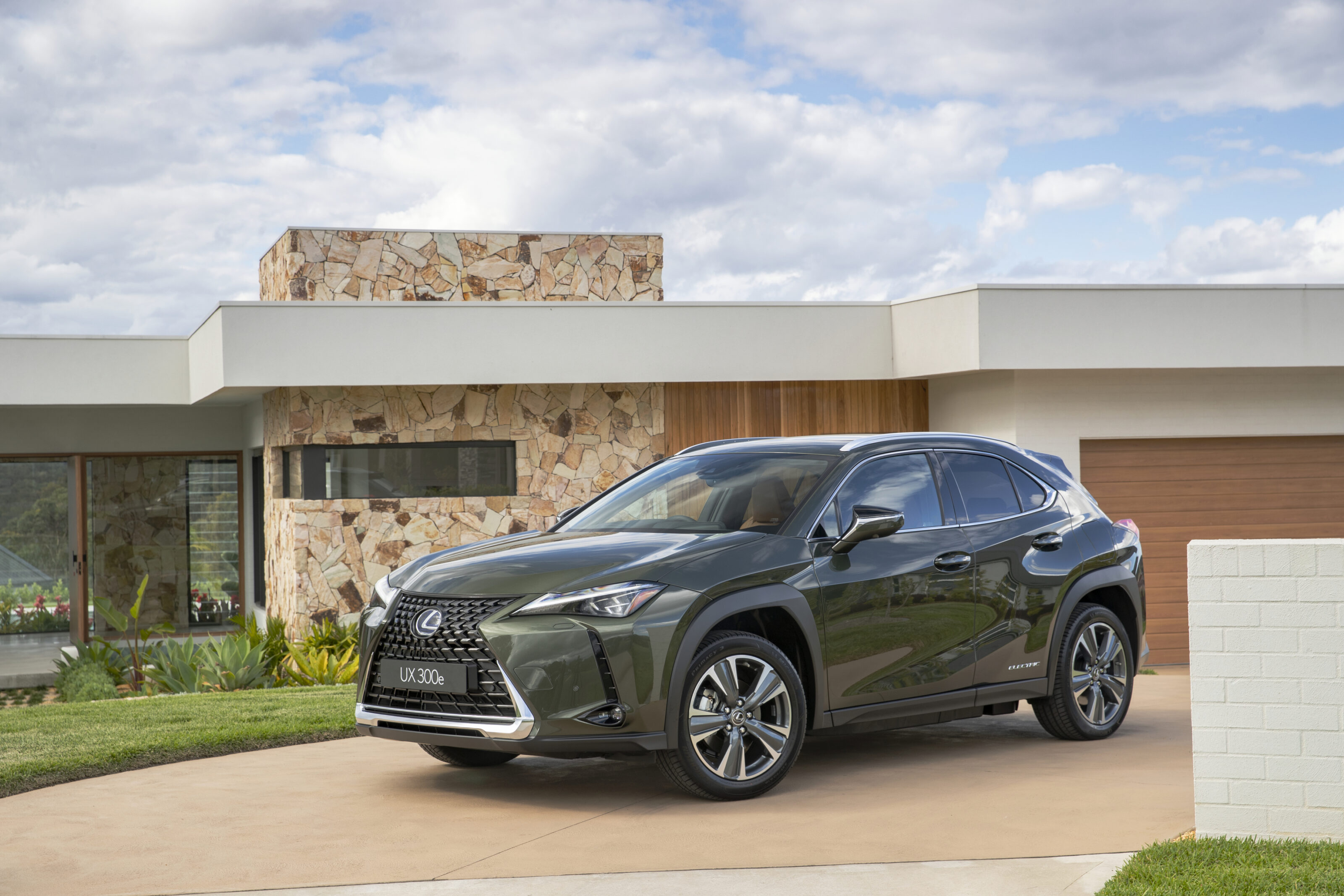
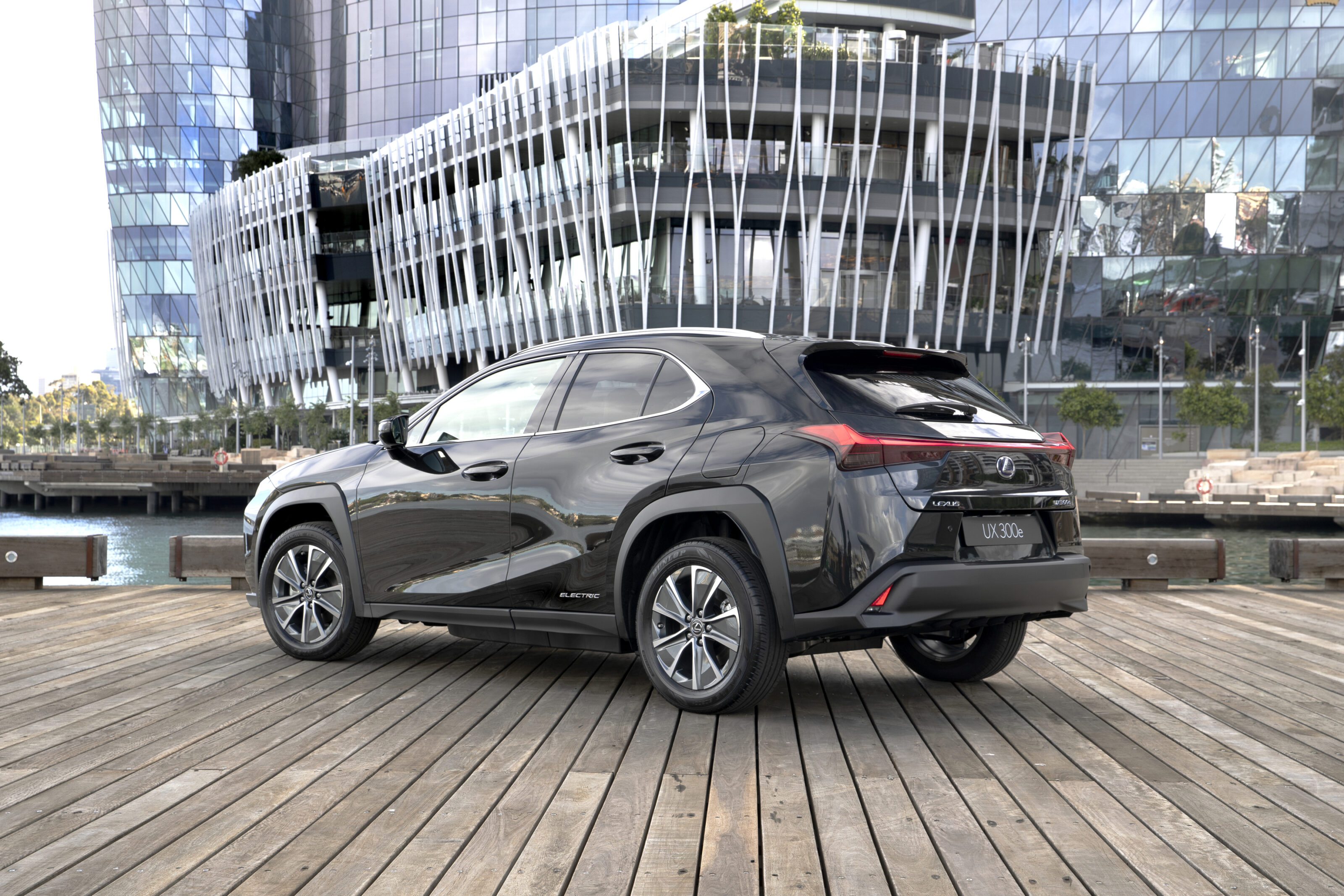
Fast-forward almost three years and Lexus has introduced the UX 300e, which is the Japanese luxury carmaker’s first production battery electric vehicle (BEV).
With a 150kW/300Nm electric motor and 54.3kWh lithium-ion battery providing up to 360 kilometres of driving range, it’s not the most powerful or practical BEV on the market.
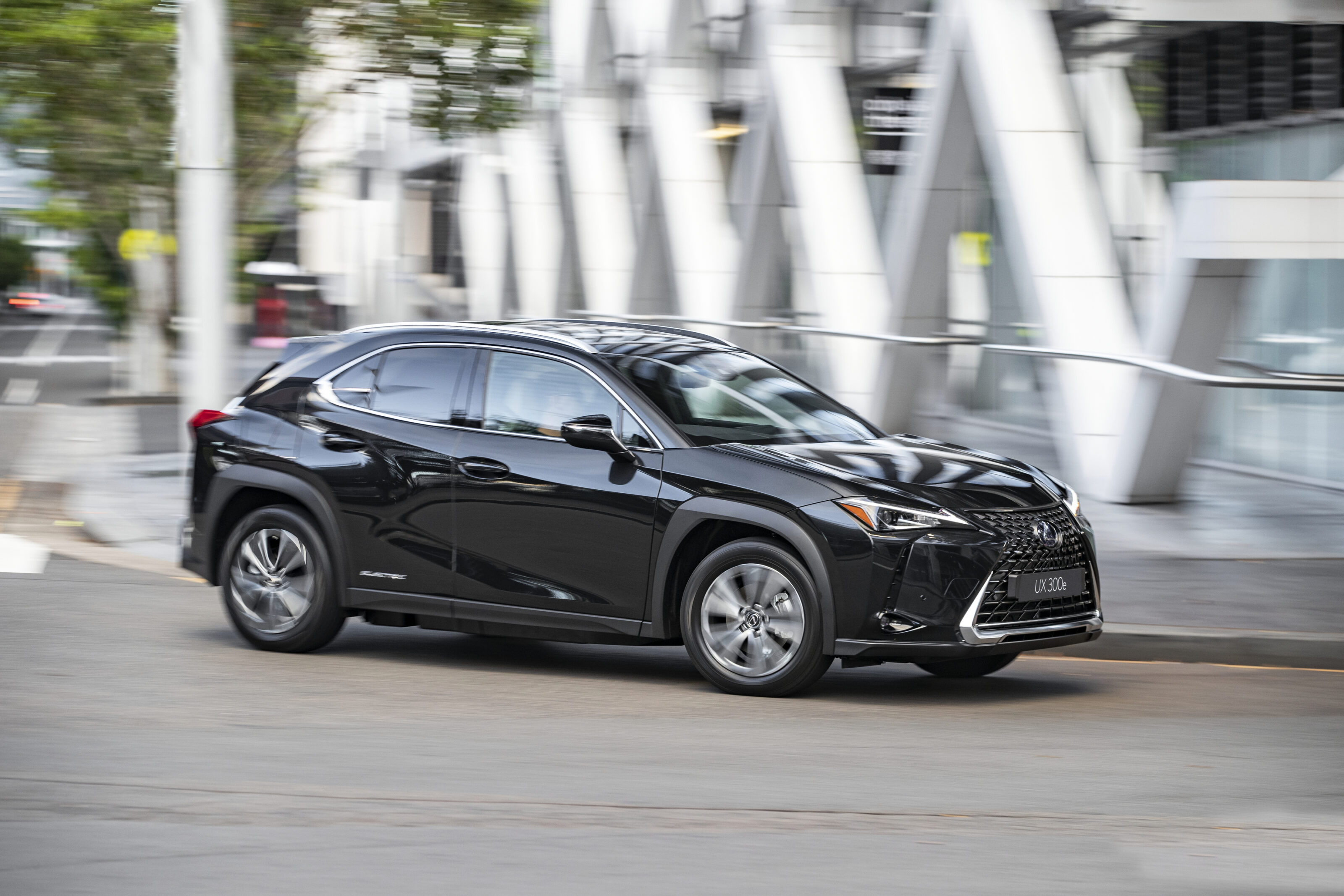
It’s also one of the most inconspicuous, with little to distinguish it aesthetically from its petrol and hybrid siblings.
So, is this a serious effort by Lexus to rival the Mercedes-Benz EQA and Volvo C40 Recharge, or just a half-baked attempt to join the BEV club?
Pricing and Ownership
The Lexus UX 300e is available in Australia in two flavours, Luxury and Sports Luxury, which come with the same powertrain for $74,000 and $81,000 respectively (both before on-road costs).
That’s $9900 more than the all-wheel-drive hybrid UX 250h Sports Luxury, which was the range-topper until now, though a more like-for-like comparison of the two Sports Luxury variants sees a difference of $16,900.
Lexus has introduced a few sweeteners for anyone considering paying the extra coin, including a free 7kW AC home charger with installation, three years of complementary rapid DC charging through the Chargefox network and three years of complimentary membership of the Lexus Encore Platinum owner benefits program.
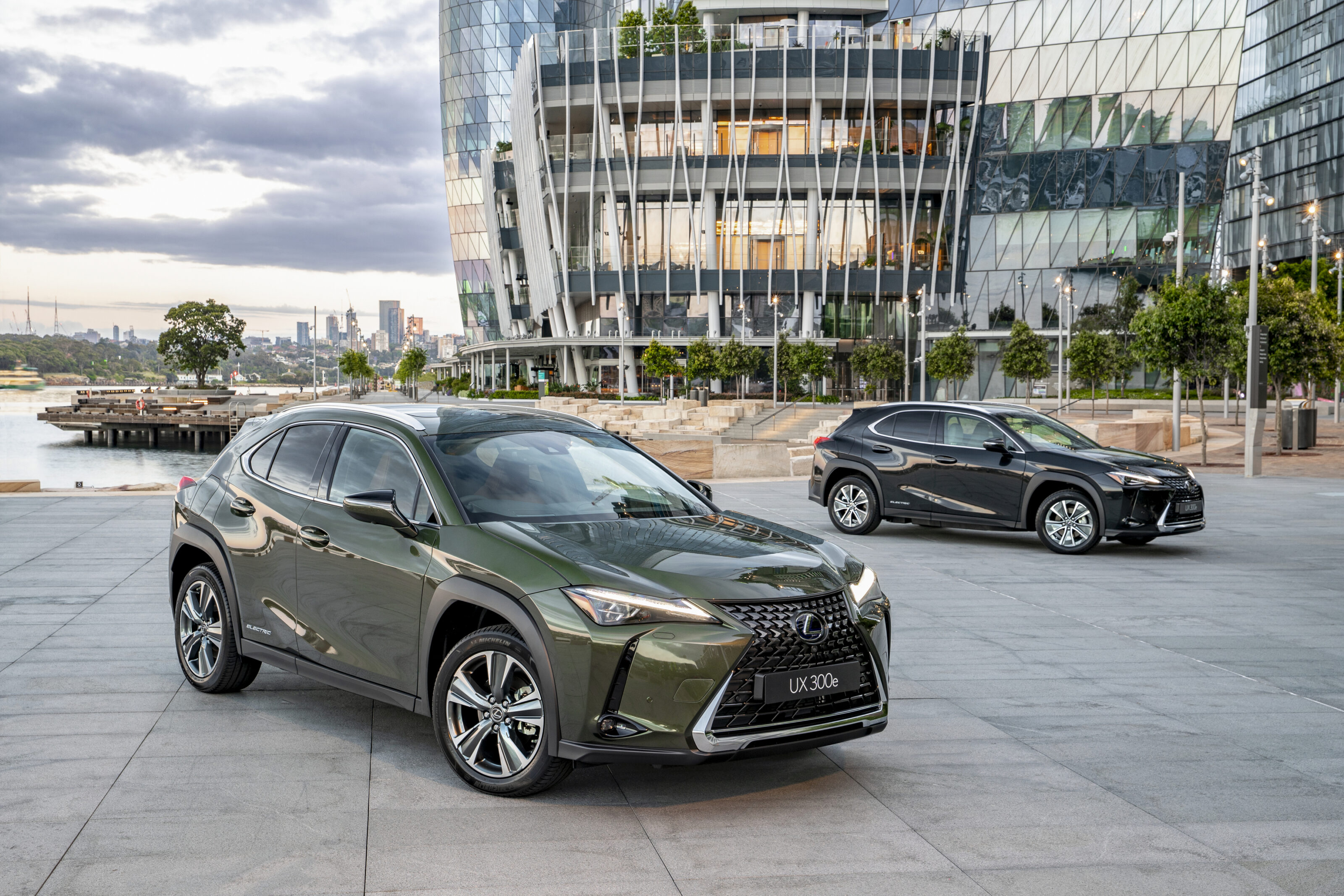
The UX 300e is also the first Lexus model to come with a five-year/unlimited-kilometre warranty instead of the usual four years and 100,000km, though this will apply to the rest of the Lexus range from January 2022 and will encompass all vehicles purchased in 2021.
The battery comes with a 10-year guarantee.
UX 300e owners will also receive five years of capped-price servicing, with each of the 12-month/15,000km intervals costing just $295 including free collection and a courtesy car.
Features
At first glance, the Lexus UX 300e is probably the most unassuming of any BEV on the market.
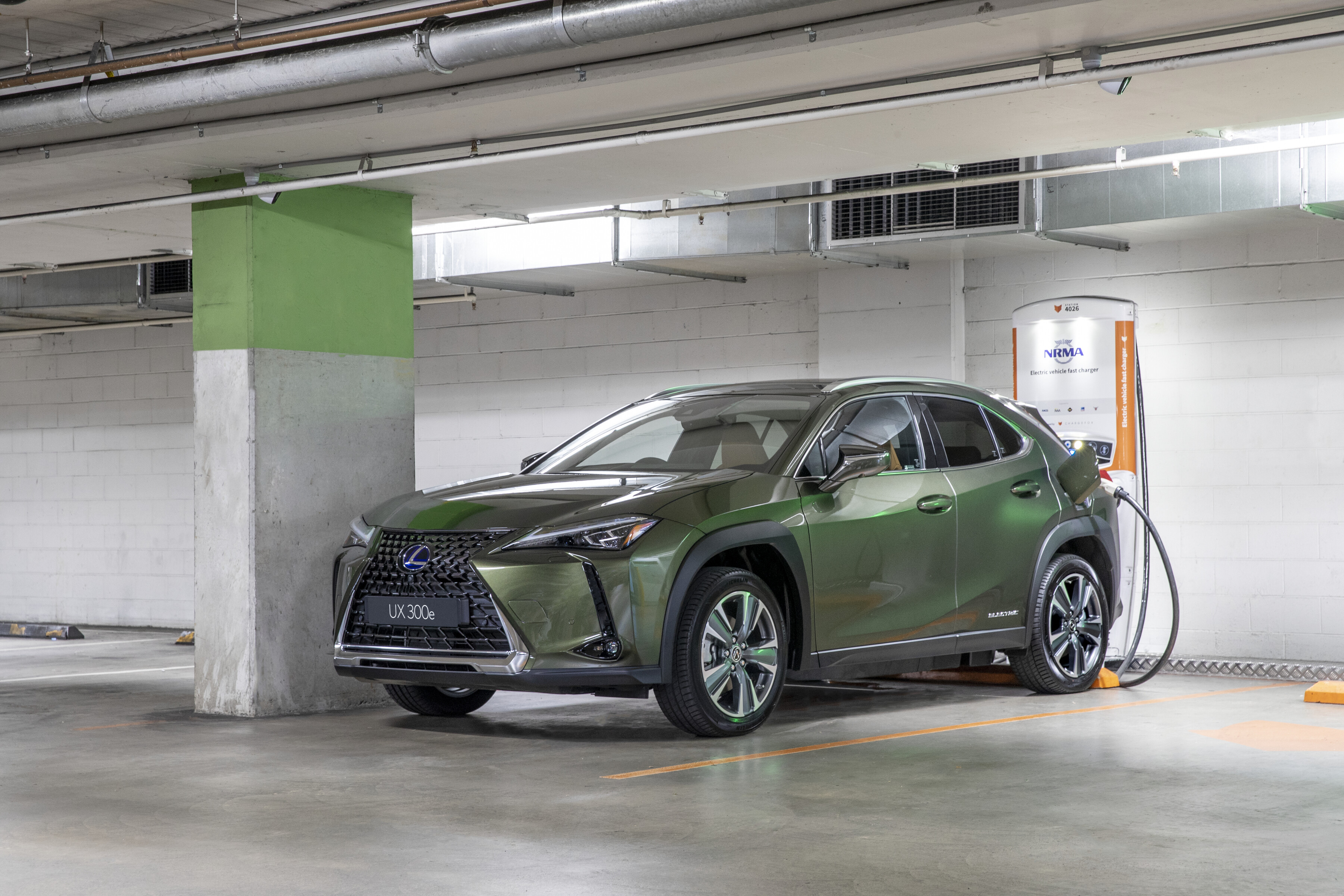
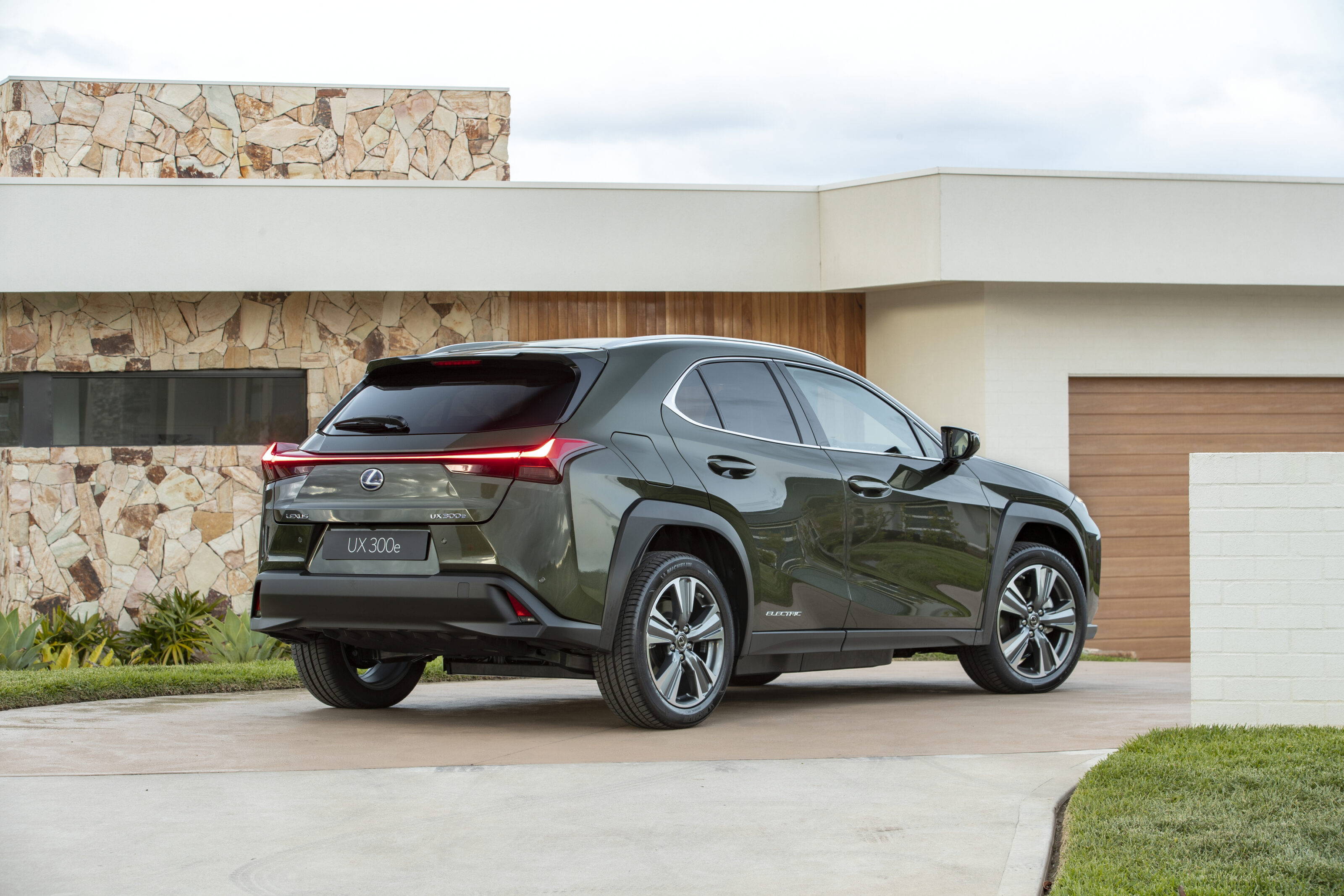
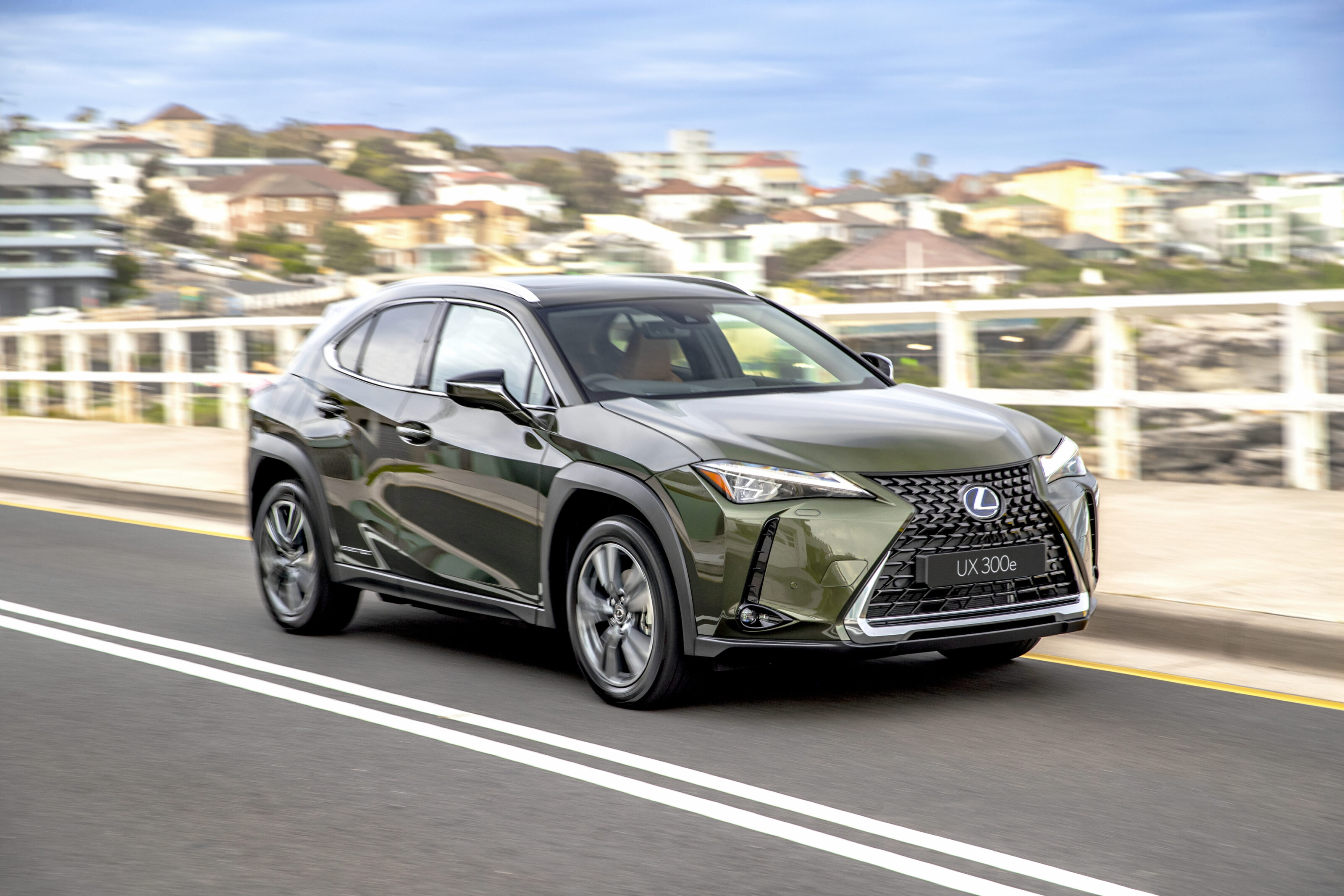
Lexus has barely done a thing to differentiate it from the petrol and hybrid variants apart from ‘Electric’ badges on the rear doors and dual ‘filler’ doors – one above each rear wheelarch – to access the AC and DC charging sockets.
Even the big spindle grille is the same – which is a good thing as a big body-colour faux grille taking up most of the front would probably look hideous.
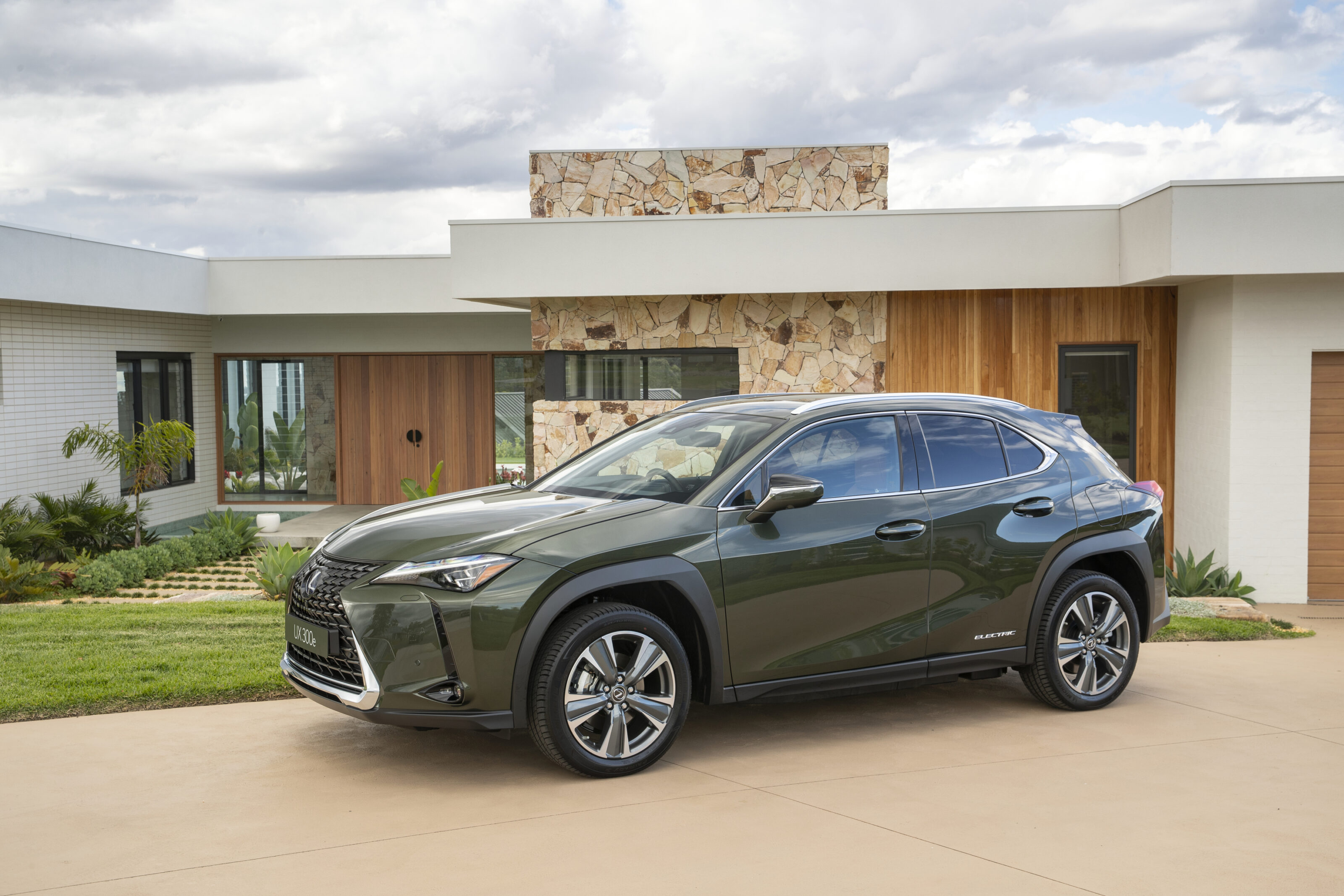
Exterior elements of the entry-level UX 300e Luxury include 17-inch alloy wheels, front and rear LED lighting including the daytime running lights and fog lights, headlight washers, roof rails, acoustic windscreen glass, and heated power-folding door mirrors.
The UX 300e Sports Luxury adds 18-inch alloy wheels, tri-beam LED headlights, LED front indicators, acoustic front side glass and a moonroof.
Inside, each variant is equipped with a 10.3-inch multimedia display with satellite navigation, Apple Carplay/Android Auto, DAB+ digital radio, 13-speaker Mark Levinson audio system, wireless smartphone charger, powered tailgate with kick sensor, and smart entry/start with a key card.
The list continues with alloy scuff plates, power-adjustable steering column, leather-accented heated steering wheel, vegan leather seats, eight-way power-adjustable front seats with variable lumbar support, heated and ventilated front seats, heated outboard rear seats and auto-dimming rearview mirror.
Spending $7000 more on the UX 300e Sports Luxury brings a head-up display, surround-view parking monitor, premium leather upholstery, higher-grade interior trim, instrument panel stitching and 3D-look illumination inside each front air vent bezel.
While the extras that come with the Sports Luxury spec are desirable, I can’t say they were missed when I jumped from that into the Luxury, which comes with all the important stuff.
Of course, being a Lexus, there is plenty of safety and driver assistance technology, which we’ll look at in the safety section below.
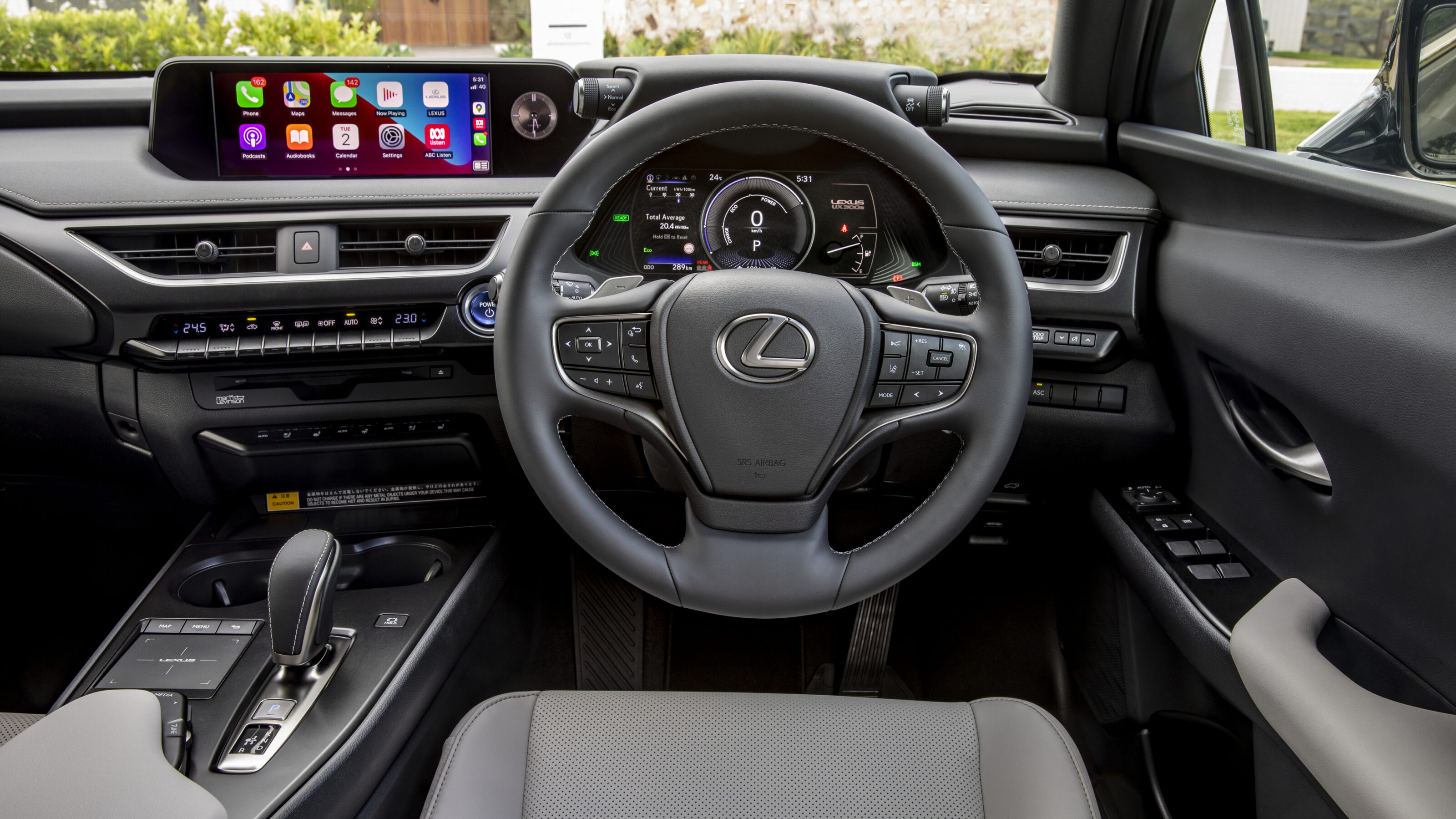
Space and Comfort
Like the exterior, little differentiates the UX 300e’s cabin from the other variants.
The battery pack is installed below the floor pan so doesn’t impinge on space, though there is still a transmission tunnel that provides space to facilitate battery cooling.
Small premium SUV interiors often feel inferior to their bigger siblings but the Lexus UX fit-out is very plush and well put together, with great attention to detail.
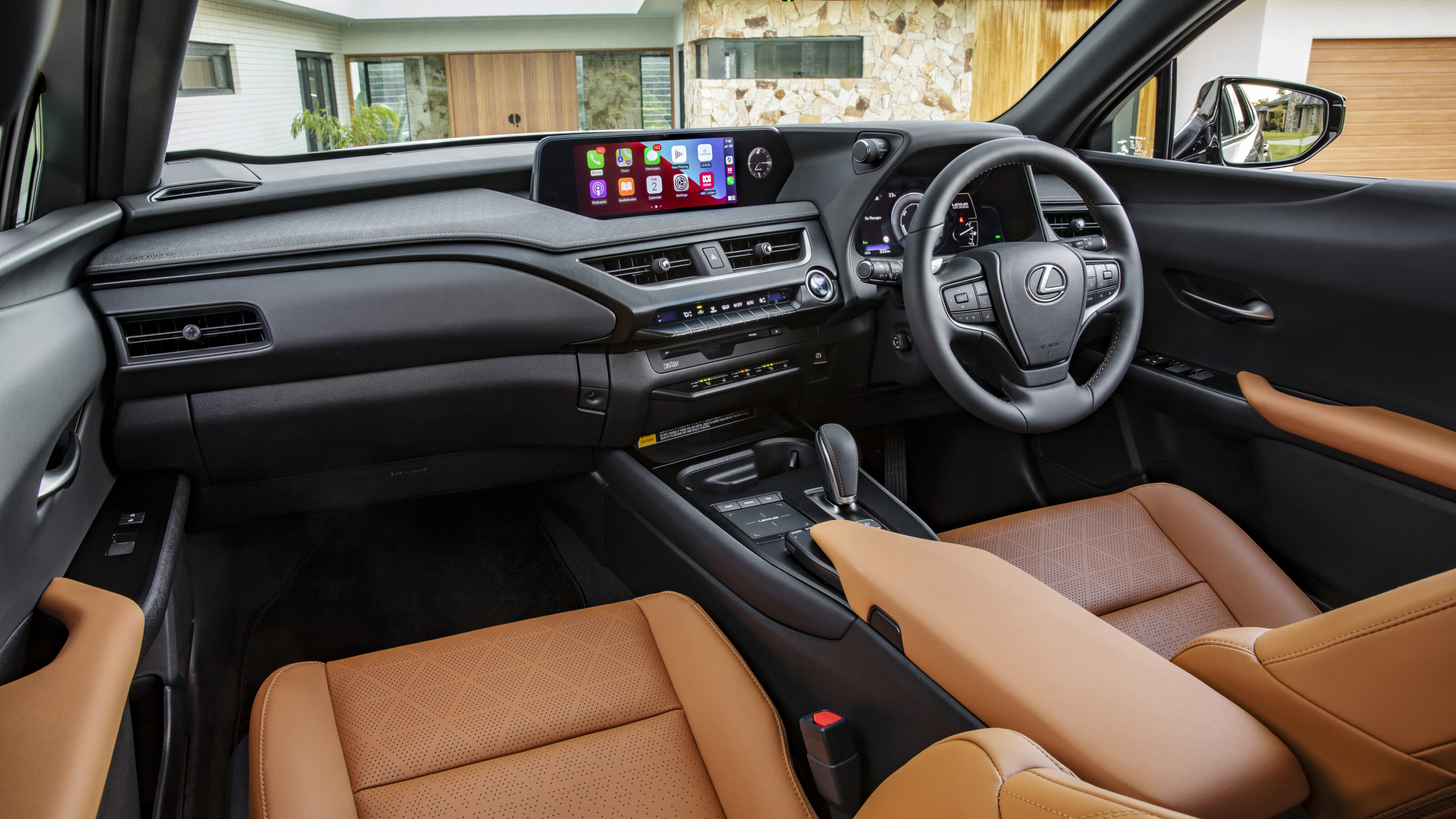
It wouldn’t be a Lexus review without a dig at the infotainment system’s dated graphics and fiddly touchpad that can make a simple menu selection a bit of a chore, though the inclusion of Apple CarPlay and Android Auto does make things a lot more bearable.
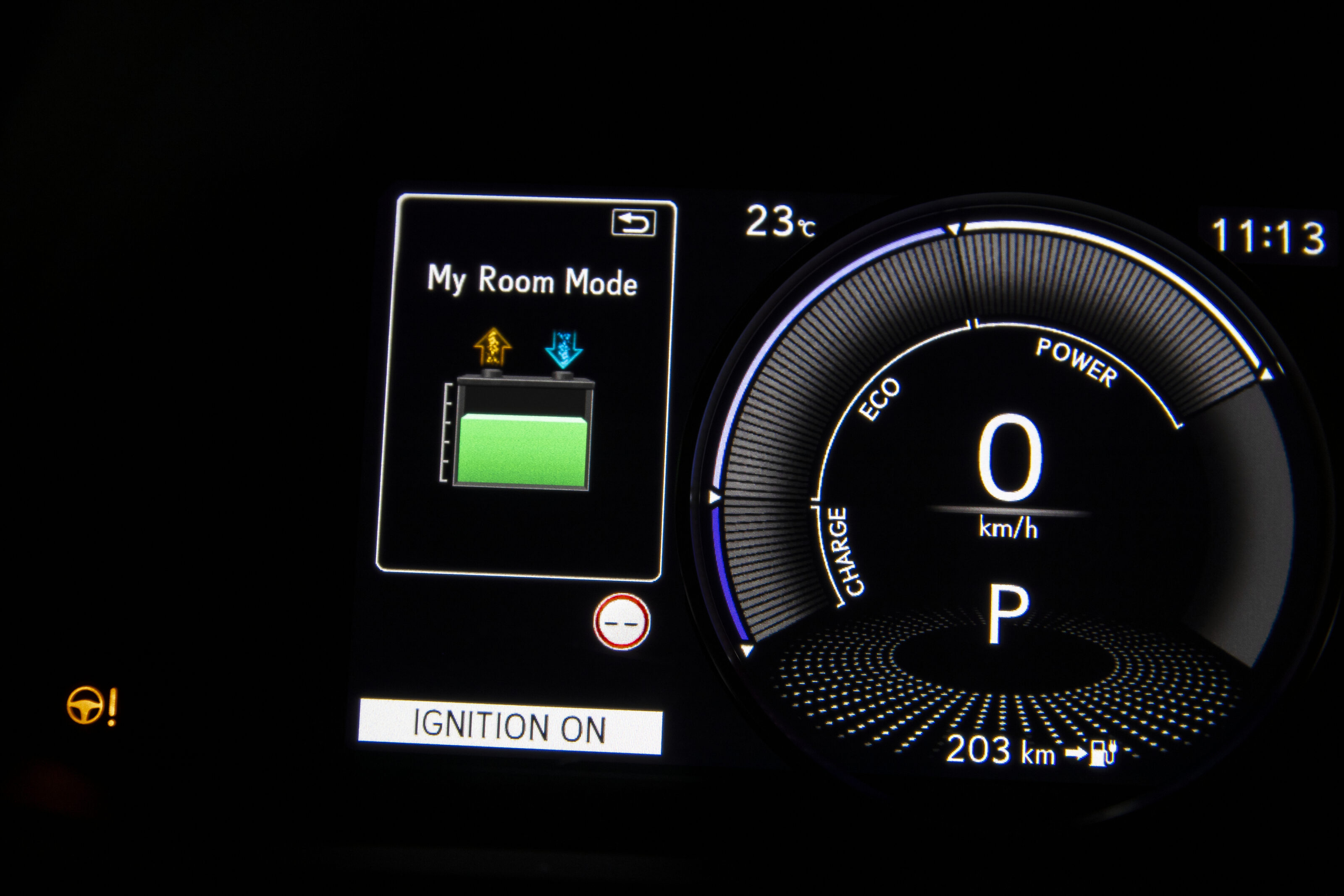
The same goes with the gauge cluster, which seems basic compared to the full digital units in most rival EVs. There isn’t much by way of EV info besides the main gauge showing where you’re at on the charge/eco/power scale and a battery meter on the 7.0-inch multi-function display.
Comfortable and embracing front seats provide plenty of legroom and a low, slightly reclined sports-car-like driving position.
This can come at the expense of rear legroom for taller folk, though the seats themselves are comfortable with a relaxing rake angle that helps maintain good headroom under the sloping roofline.
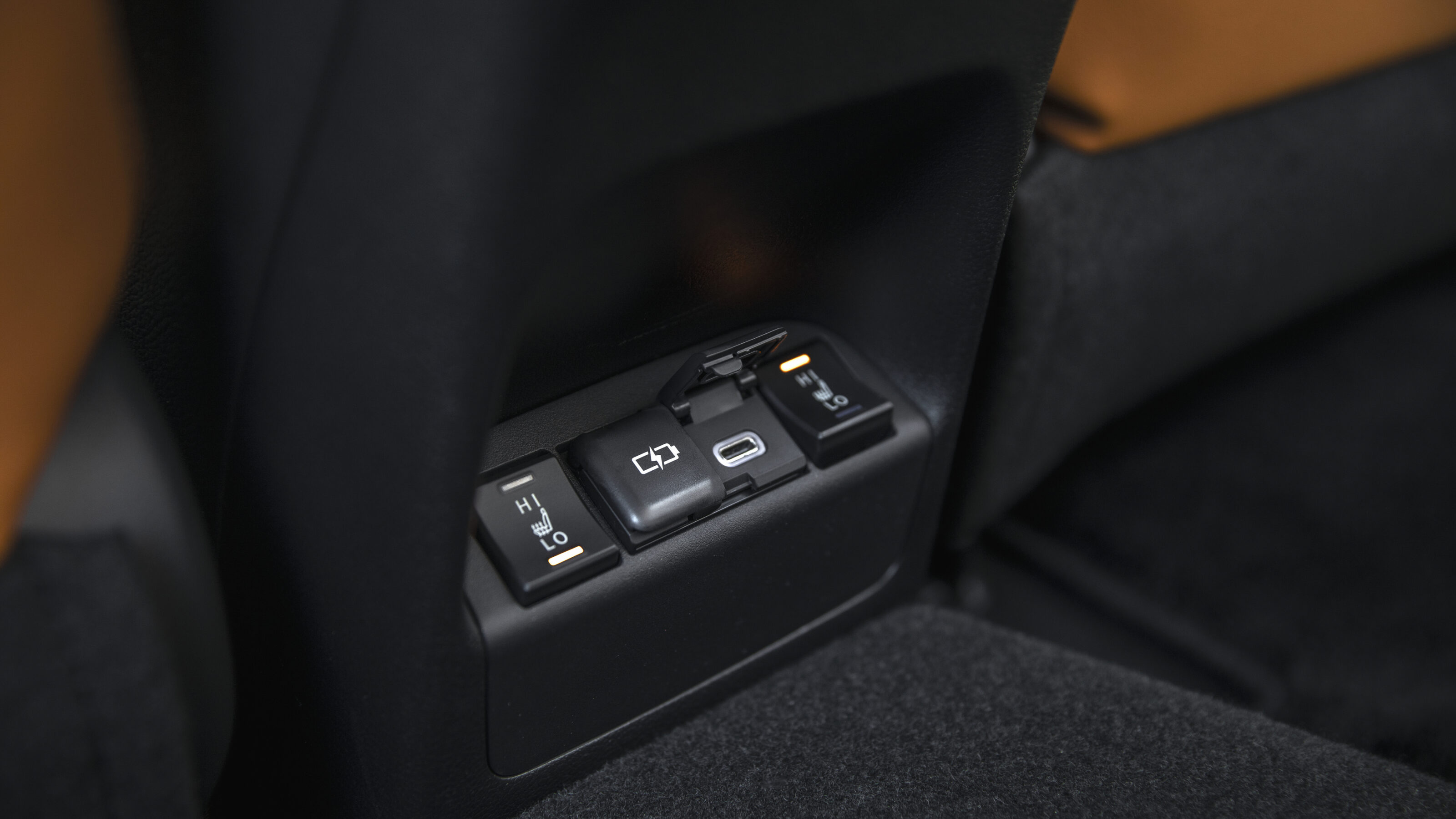
While the UX 300e is largely driver-focused, it caters to rear-seat passengers well, with the heated outboard seats, two USB sockets, air vents and a pull-down centre armrest with cup holders.
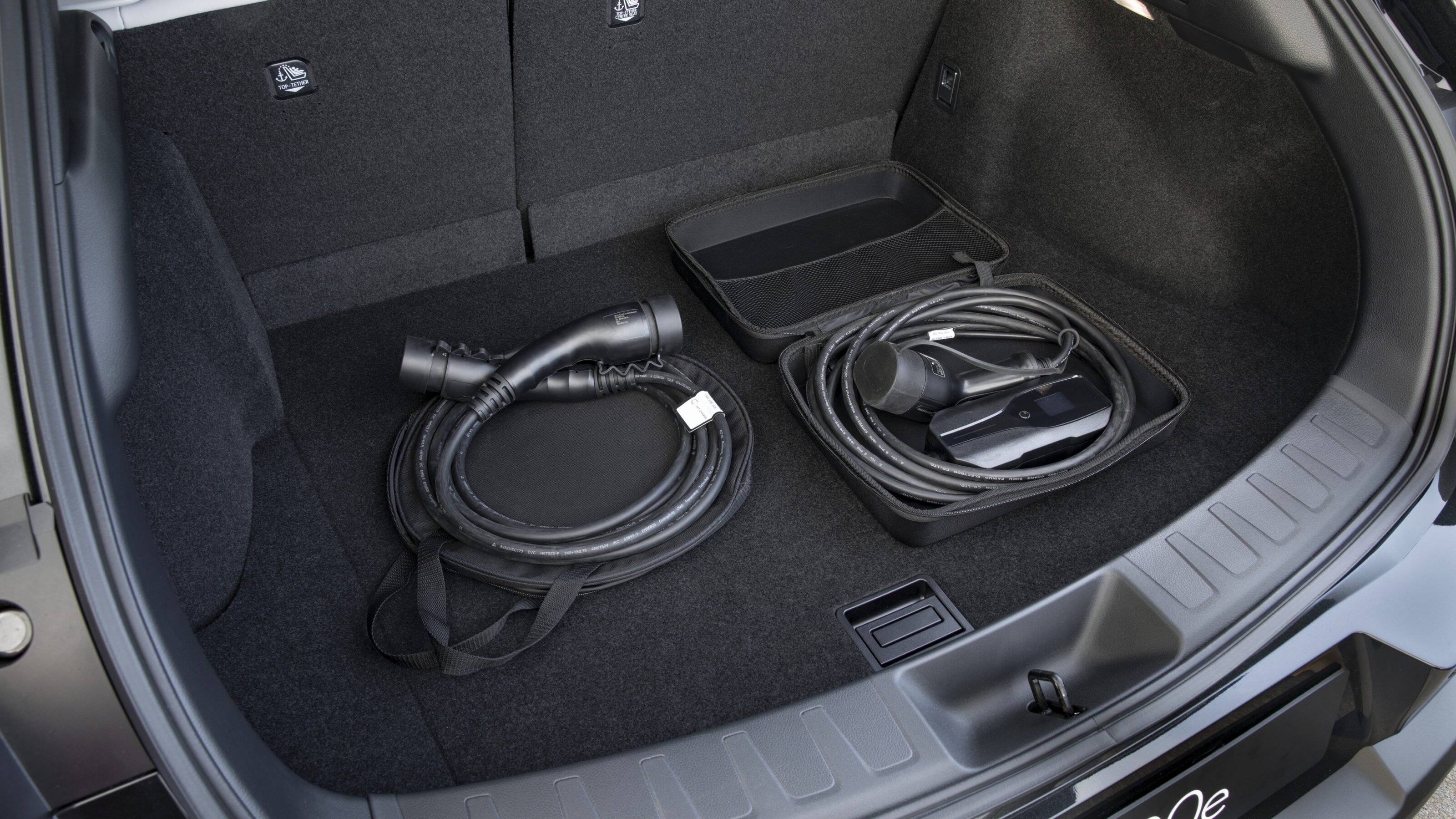
Looking further back, the boot space is a handy 413 litres, which is six less than you get in petrol variants but 45 litres more than the hybrids. Unlike the others, there is no space-saver spare wheel, with the space below the boot floor used to store two charging cables and a puncture repair kit.
Charging
Each UX 300e variant comes with a 54.3kWh lithium-ion battery that provides a claimed 360 kilometres of driving range. It’s not the biggest battery out there, though the upside of that is its reasonably quick charging time.
Fully charging the battery from flat with a standard 240V, 10A wall socket will take about 30 hours but plugging into one of the complementary 7kW home chargers reduces that time to just 6.5 hours or 40km of range per hour.
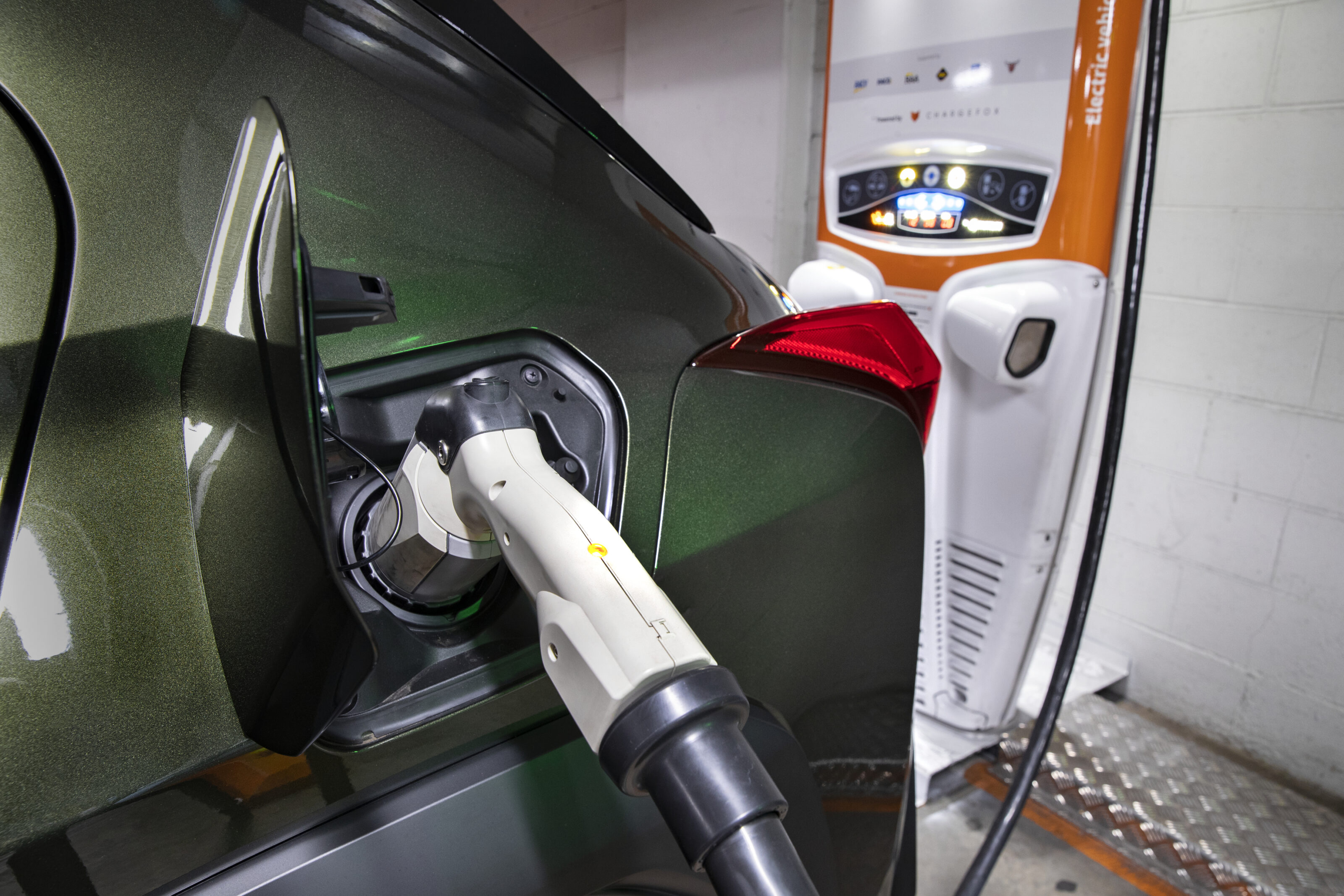
In addition to the free charger, UX 300e owners also receive three years of free access to the 1400-strong Chargefox DC rapid charging network. Using one of its 50kW chargers will fully juice up the UX 300e in about 80 minutes.
It’s worth noting that using more powerful 22kW AC or 350kW DC chargers will not have an impact on the above charging speeds.
The UX 300e is equipped with two charging ports towards the rear – a Type-2 socket for AC charging on the driver’s side, and a CHAdeMO port for DC charging on the passenger side.
CHAdeMO ports are still the preferred option in Japan but are becoming less common in Australia. However, there are still plenty of compatible chargers around – including at most Chargefox stations.
On the Road
As you’d expect from an EV the take off is quiet, but because there is no engine noise you do tend to notice wind and tyre noise a little more.
Even so, the UX 300e has excellent noise, vibration and harshness (NVH) properties even at speed, helped by a range of measures including noise insulation between the EV transaxle case and shift control actuator, around the tyres, fenders, and electric motor.
In a way, it’s all a moot point as the excellent 13-speaker Mark Levinson audio system will drown out whatever din does manage to make its way into the cabin.
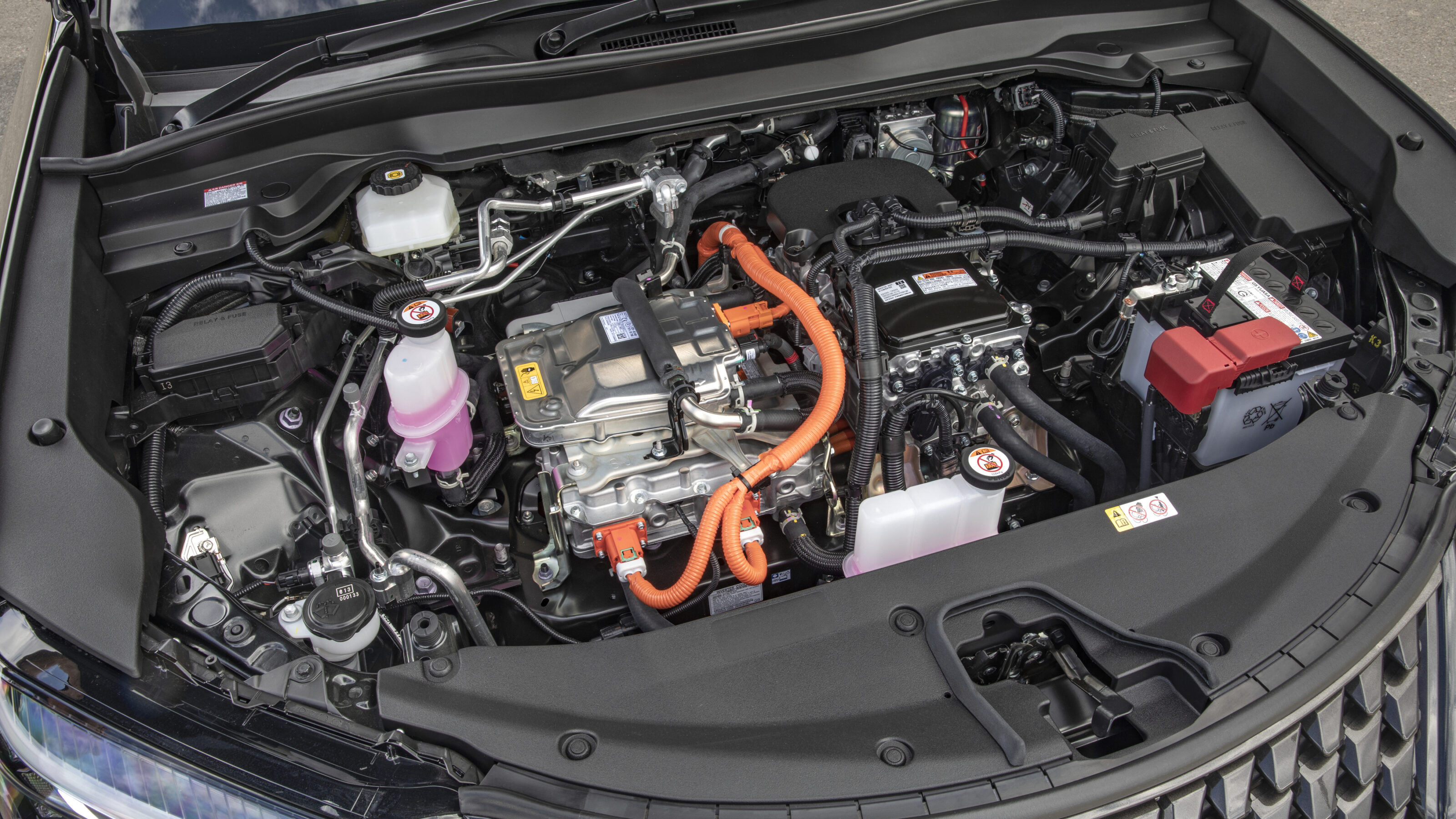
The 150kW/300Nm motor that drives the front wheels through a two-stage reduction gear doesn’t exactly offer the kind of breakneck acceleration we see in more powerful BEVs, but it provides enough shove to send the UX 300e from 0 to 100km/h in a claimed 7.5-seconds.
It means the UX 300e is just a tenth slower to the benchmark than a Polestar 2 Single Motor Long Range and more than a second quicker than a Mercedes-Benz EQA 250, thanks in part to the 1840kg Japanese car being 200kg lighter than its German rival.
The motor continues to instantly respond to pedal movements once on the move, with those peak outputs on tap whenever you need them.
Both UX 300e variants come with Eco, Comfort and Sport drive modes, with Sport providing more take-off boost while stiffening the steering, which is also very responsive.
But it’s the UX 300e’s ride and handling capabilities that make it stand out from most other small electric SUVs.
Lexus was obviously aware of this too, judging by the launch drive route that included a return journey along the Great Ocean Road from Torquay to Lorne with a sneaky trip up the hill to Deans Marsh and back to chase apexes on the Deans Marsh-Lorne Road.
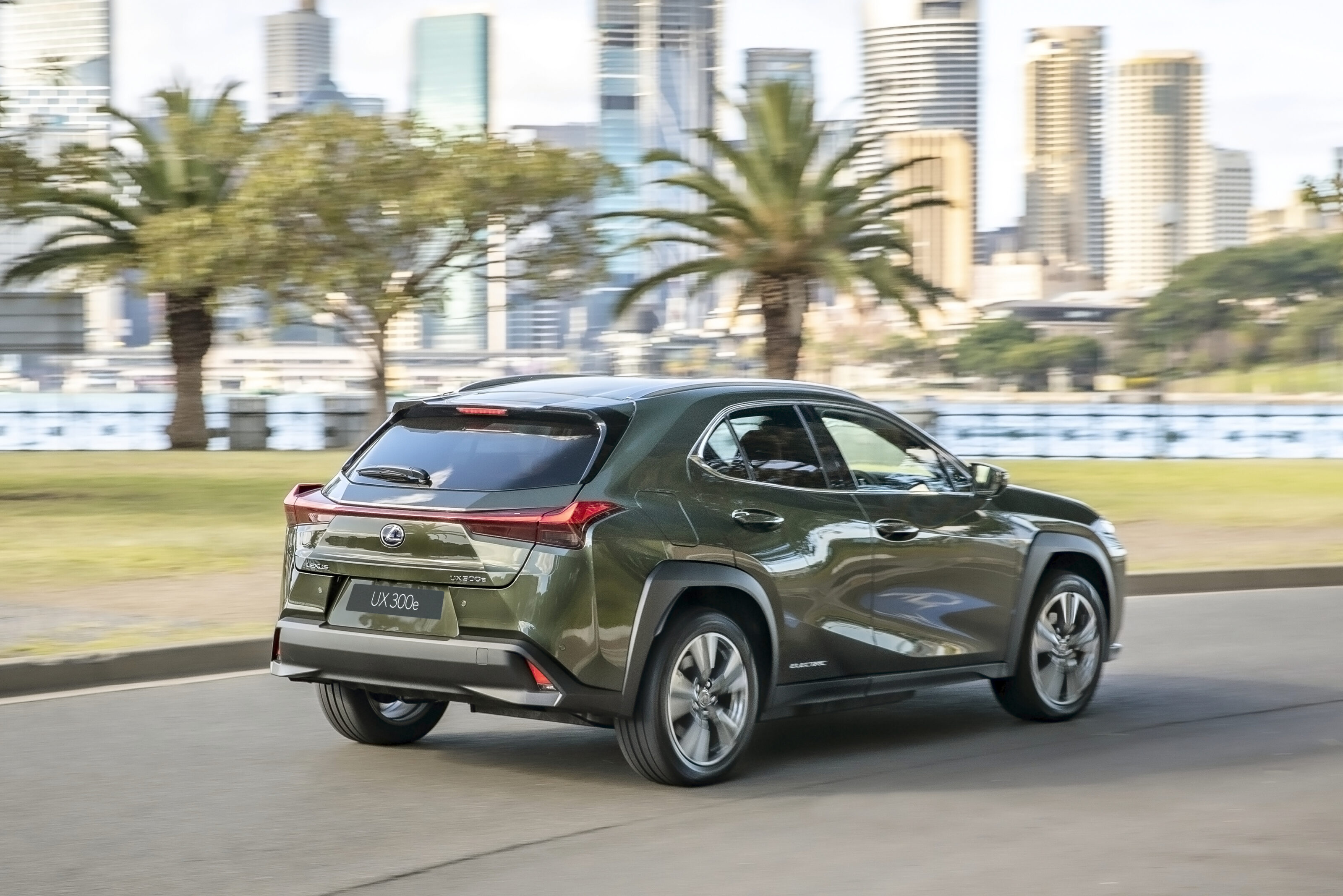
The last time I drove up to Deans Marsh was during a comparison test of cheap small SUVs including the Holden Trax, which didn’t exactly handle some of those bends with aplomb. I recall negotiating the odd bend with my left hand clinging white-knuckled to the wheel and my right arm propped against the door to counter the lean.
But in the UX 300e it was like I was driving on a completely different road. It handled more like a hot hatch than an SUV thanks to the underfloor battery pack that, according to Lexus, enhances its GA-C platform’s torsional rigidity.
The battery pack and the low-mounted electric motor also result in a significant drop to the centre of gravity (CoG), from 594mm in the UX 250h to just 530mm in the UX 300e, with the battery weight evenly distributed between the axles.
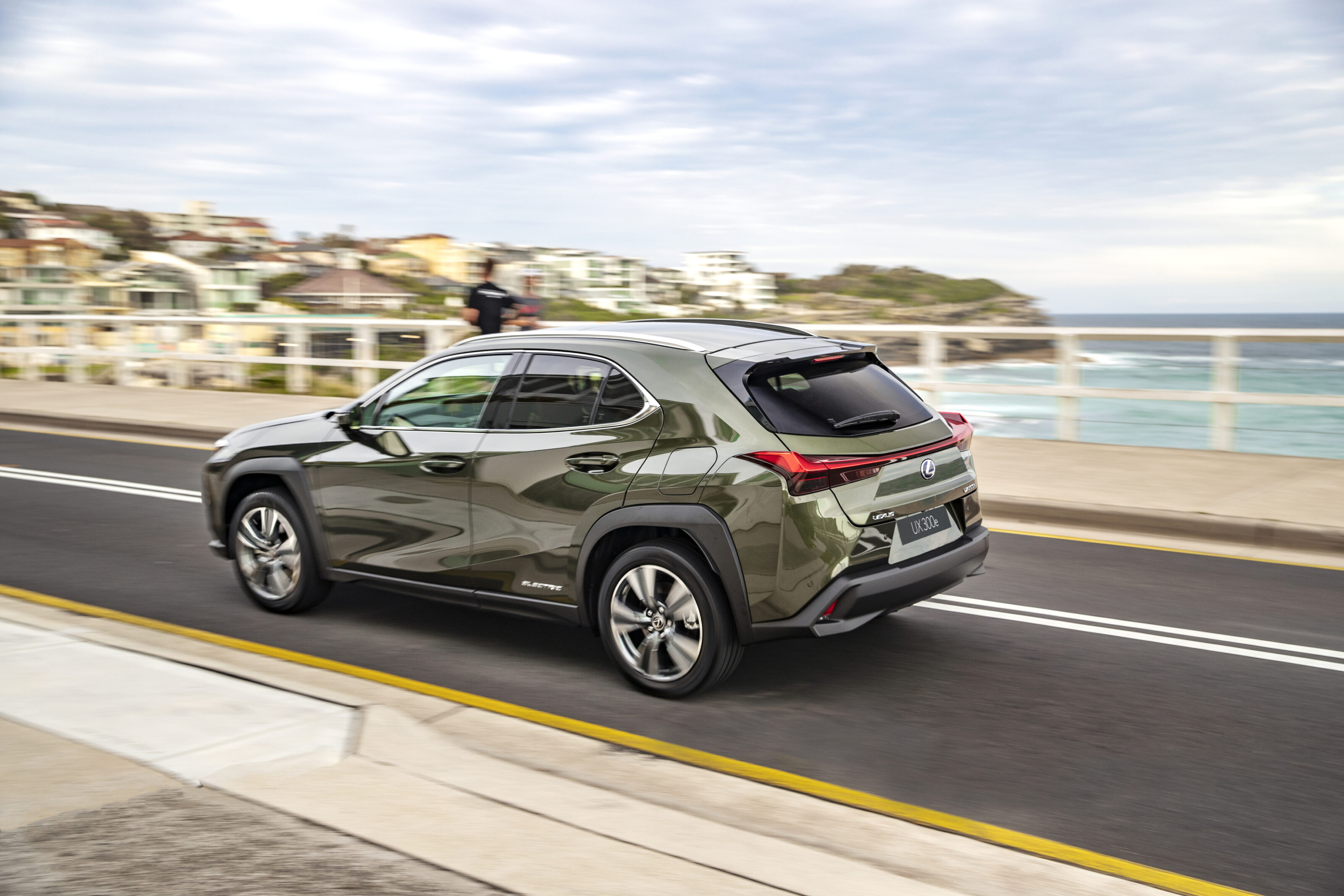
It results in effortless cornering, with excellent front and rear compliance yet barely any lean. The regenerative braking, controlled using paddle shifters, is quite subtle but forceful enough to allow for one-pedal driving in all but the sharpest of turns, which further inspires confidence.
Then there’s the fact you don’t have a complex gearbox trying to keep up with braking and throttle inputs, meaning your exit from each turn is instant and effortless – even up hills.
Incredibly, the tight handling doesn’t come at the expense of ride comfort. The UX 300e rides on a relatively rudimentary suspension set-up that includes front MacPherson struts and rear trailing wishbones, but the ride always feels silky even on some rougher rural roads.
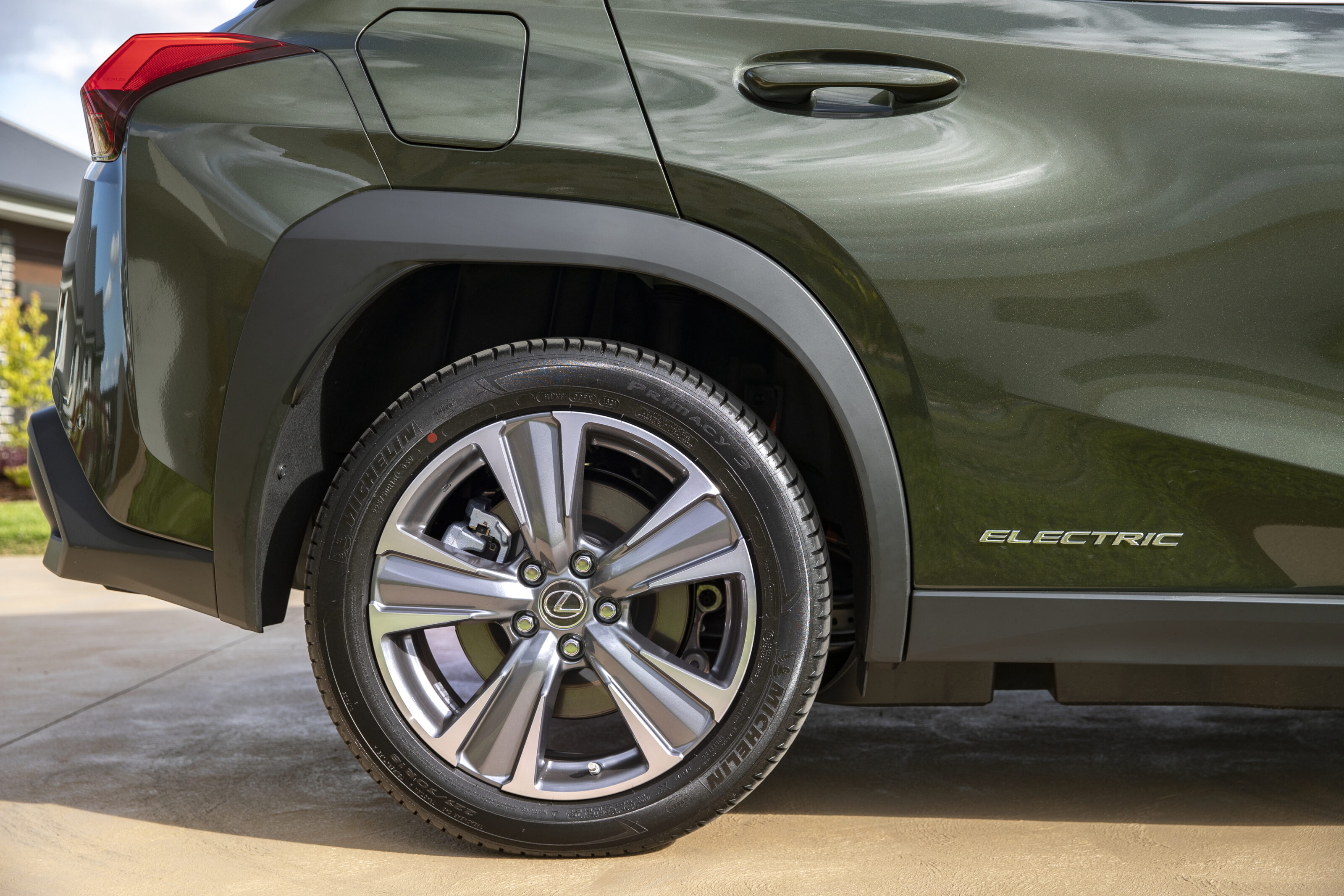
The UX 300e Luxury rides on 17-inch Michelin Primacy 3 rubber and the Sports Luxury on 18s. I can’t say I felt a difference in ride quality between the two, but the 18s did offer sharper steering.
Needless to say, that smooth ride applies to freeways and around town, where the UX 300e is quite nimble when it comes to negotiating tight streets.
Parking is easy. One issue I’ve always had with the UX is limited rear-side vision, though this is overcome by the reversing camera, or surround-view camera in the Sports Luxury, as well as the front and rear parking sensors. If for some reason you do miss an obstacle while parking, the car will come to a stop.
In short, the UX 300e has the zip you want from an electric crossover with further surprise and delight coming from its ride and handling.
Safety
The UX 300e shares safety features and a five-star ANCAP rating with the rest of the UX range.
It comes standard with eight airbags and a range of active safety and advanced driver assistance systems including autonomous emergency braking with night/day pedestrian detection and daytime cyclist detection, parking support braking, all-speed adaptive cruise control, lane-keep assist, road-sign assist, blind-spot monitoring with rear-cross traffic alert and automatic high beam.
VERDICT
The UX 300e is likely to be the only current-generation Lexus model to gain a BEV variant, with new electric models to be built on a bespoke EV platform from 2025.
One could argue it’s just a stop-gap to put Lexus in the EV game alongside other premium brands and I reckon there is a certain element of truth to that.
But while it lacks the kind of wow-factor display technology many EV buyers expect, this is a solid effort by Lexus, which has done an excellent job of adding the BEV powertrain to UX and arguably making it a more enjoyable drive.

It’s one of the more capable EVs in the sub-$100K price range when it comes to ride and handling, and its standard features and buyer incentives, such as the free home charger and Lexus Premium Encore membership, add to its showroom appeal.
Whether people choose this over more advanced EVs like the Tesla Model 3 or Ioniq 5, remains to be seen – but I reckon this will do very well with Lexus’s loyal customer base, which finally has the opportunity to enjoy the benefits of quick, silent, emissions-free driving along with the brand’s ownership experience.
They won’t be disappointed.