Classic Wheels

Gallery 1
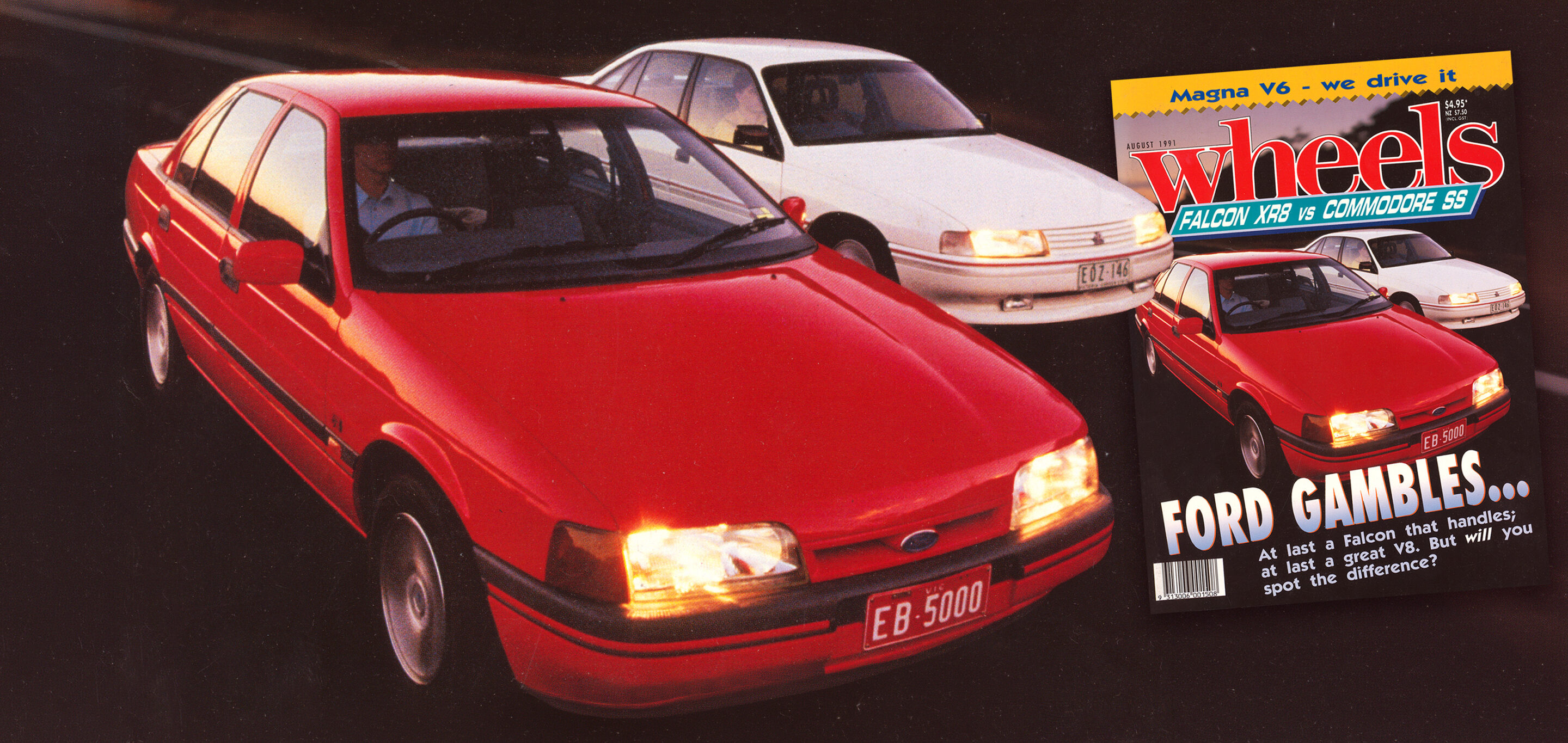
First published in the August 1991 issue of Wheels magazine, Australia’s best car mag since 1953. Subscribe here and gain access to 12 issues for $109 plus online access to every Wheels issue since 1953.
Hills hoists, red roofs, freshly mown lawns… and pushrod V8s. Australia on a postage stamp. Since 1982 this familiar suburban scene has been ruffled by the absence of Falcon V8s being lathered, lovingly, on sunny Sunday mornings. For those with a love-eight relationship, the choice has been rather restricted. It’s been a Commodore or a Commodore.
1
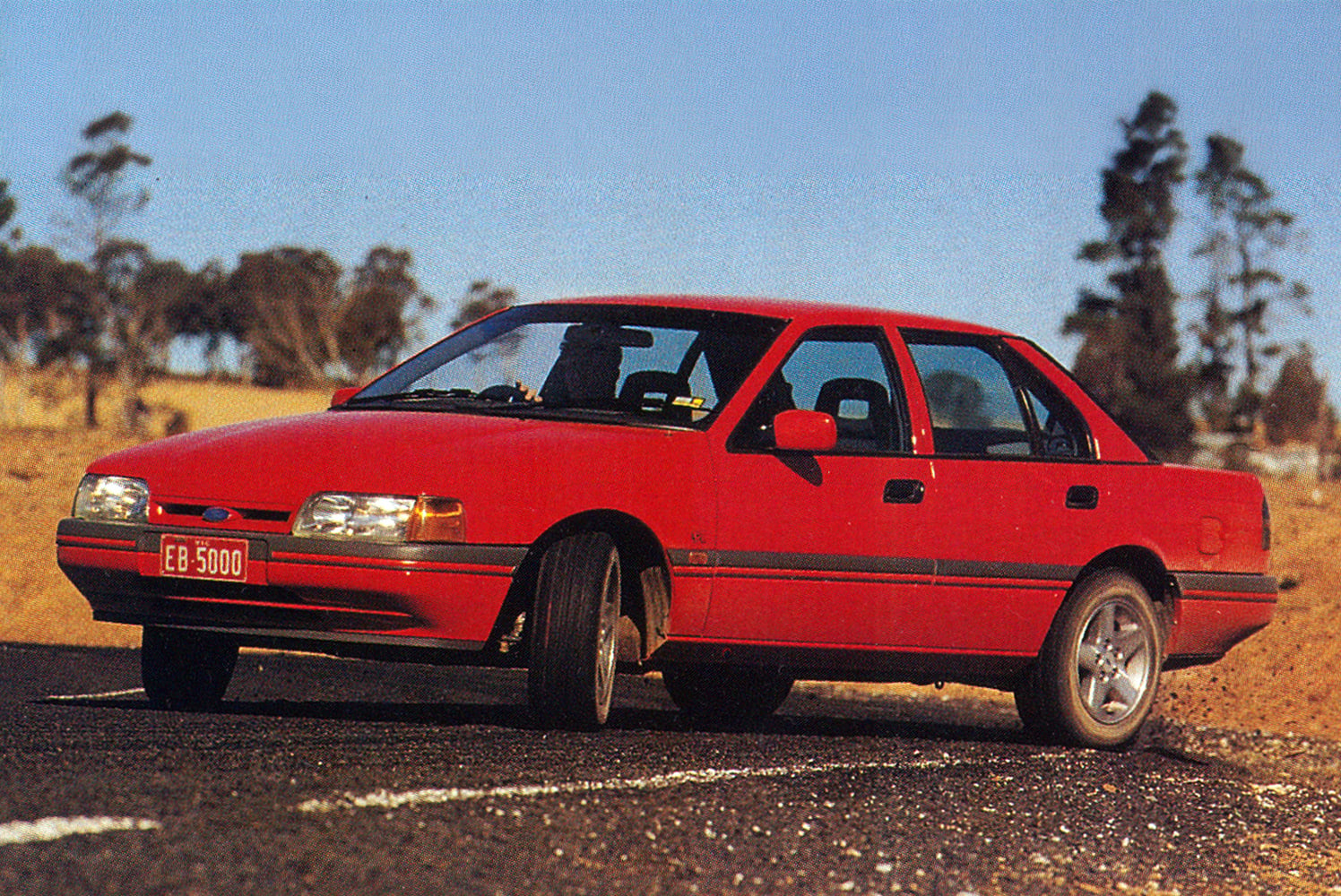
Now, from within Ford’s cold corporate culture, the long-awaited spring thaw has begun. As history demonstrates, the best way to revive a dead image in this country is to get a thumping V8 and create some tyre smoke. Enter the Falcon XR8, the first Ford V8 in nearly a decade, the first overtly sporty V8 produced by the factory since it canned the fat-tyred Fairmont Ghia ESP, way back in the XE days.
Holden wavered on its V8 decision, back in the dark early days of the 1980s, but then found the resolve to continue the flirtation, while Ford set about winning market share and profitability without the aid of an eight pack. The wheel turns.
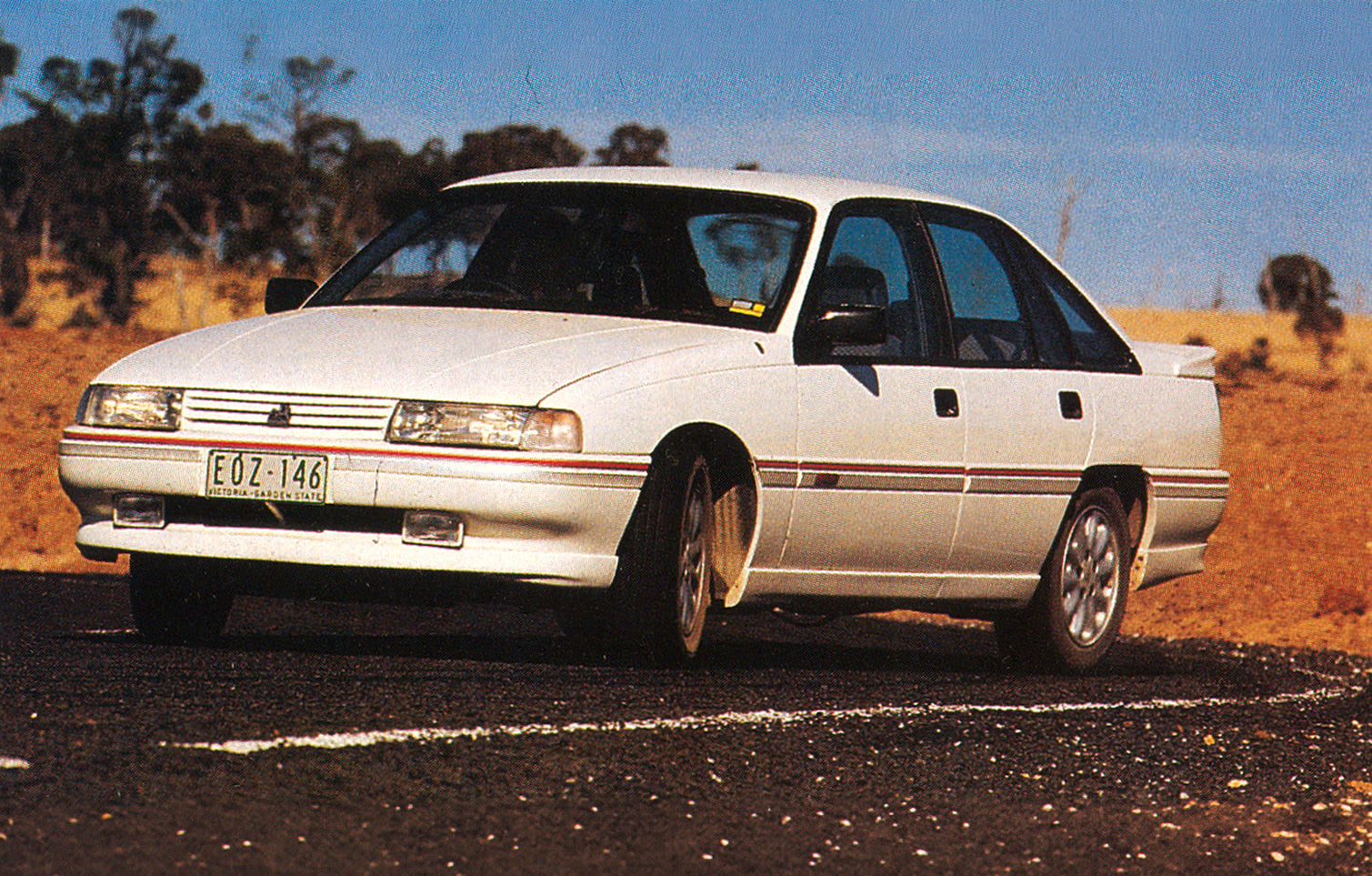
Now it’s Ford hoping the XR8 will, like the Commodore SS, reassure muscle car devotees that economic austerity hasn’t doused its corporate pulse.
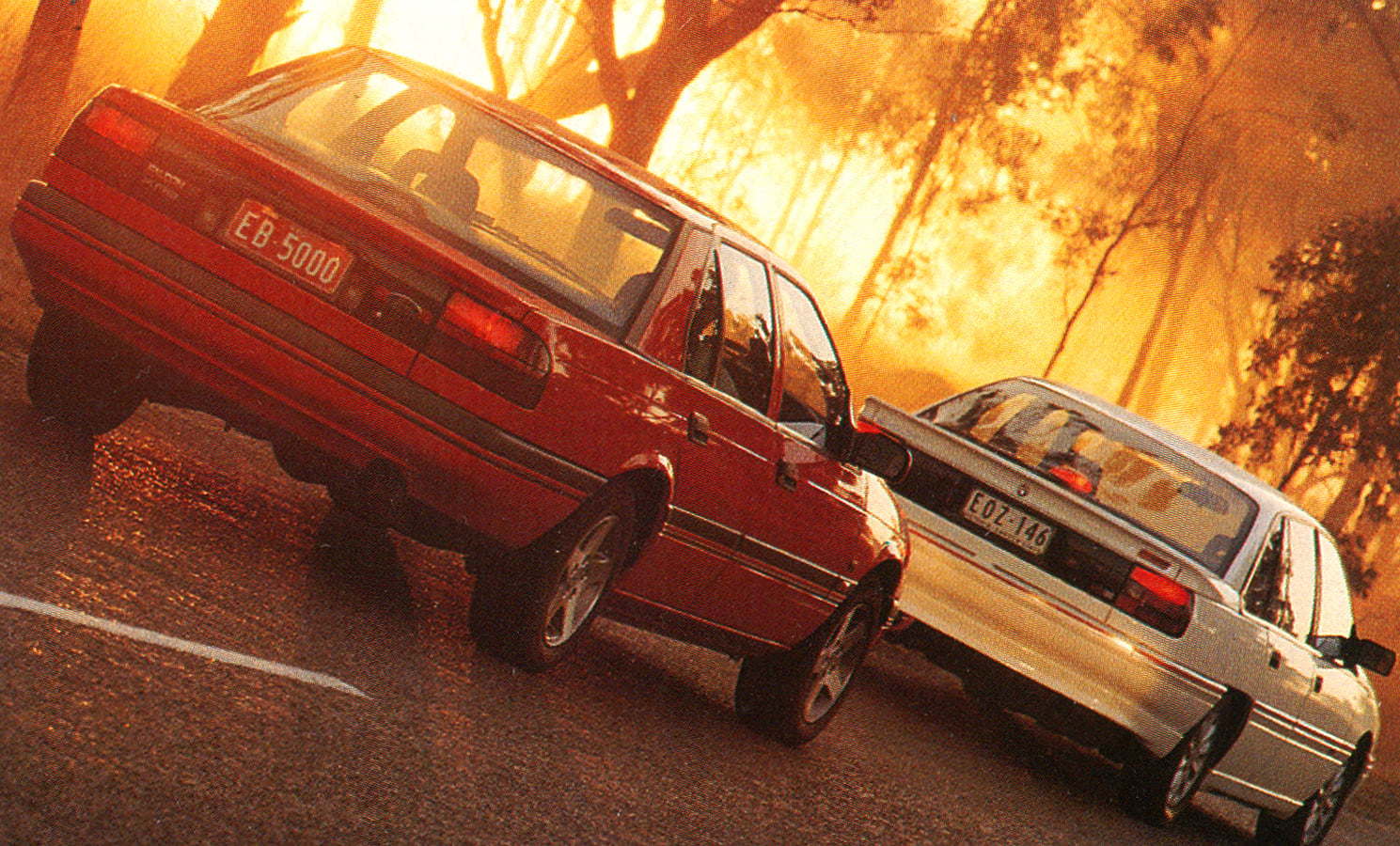
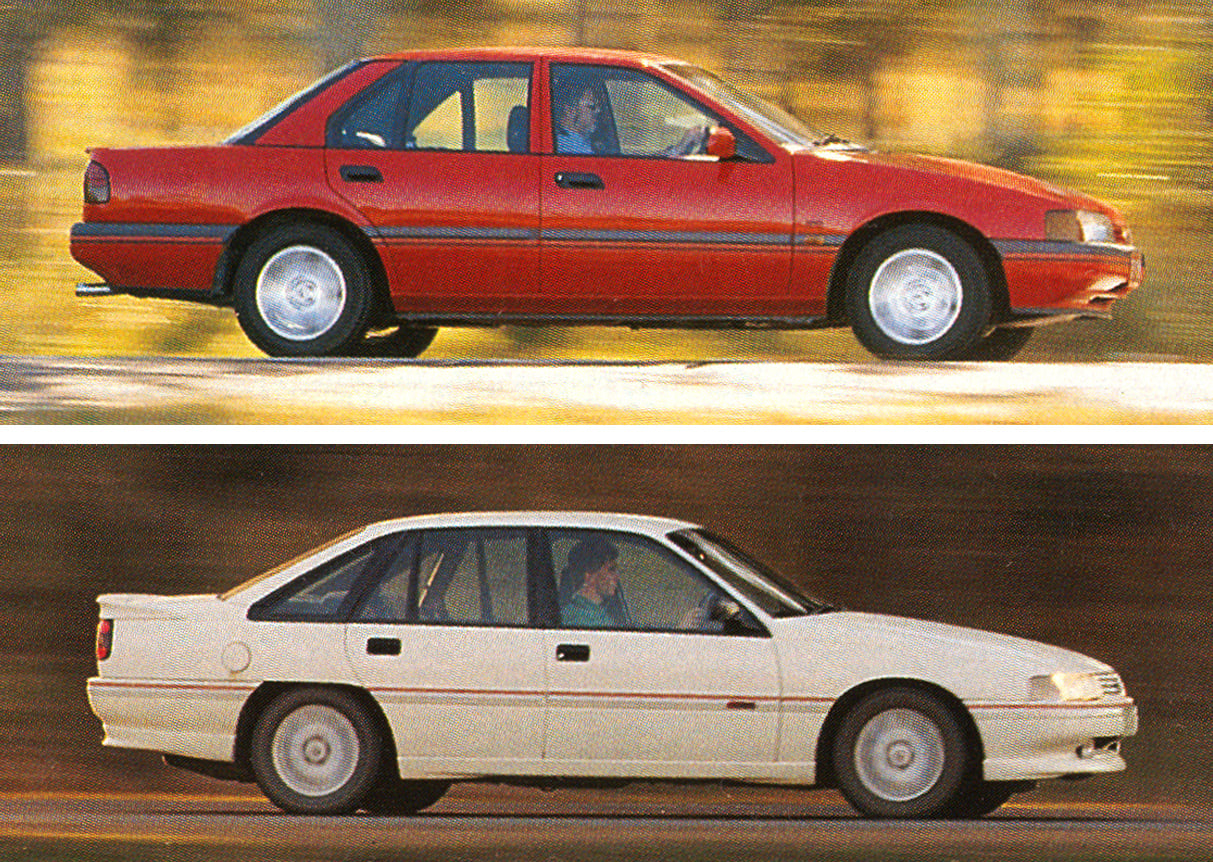
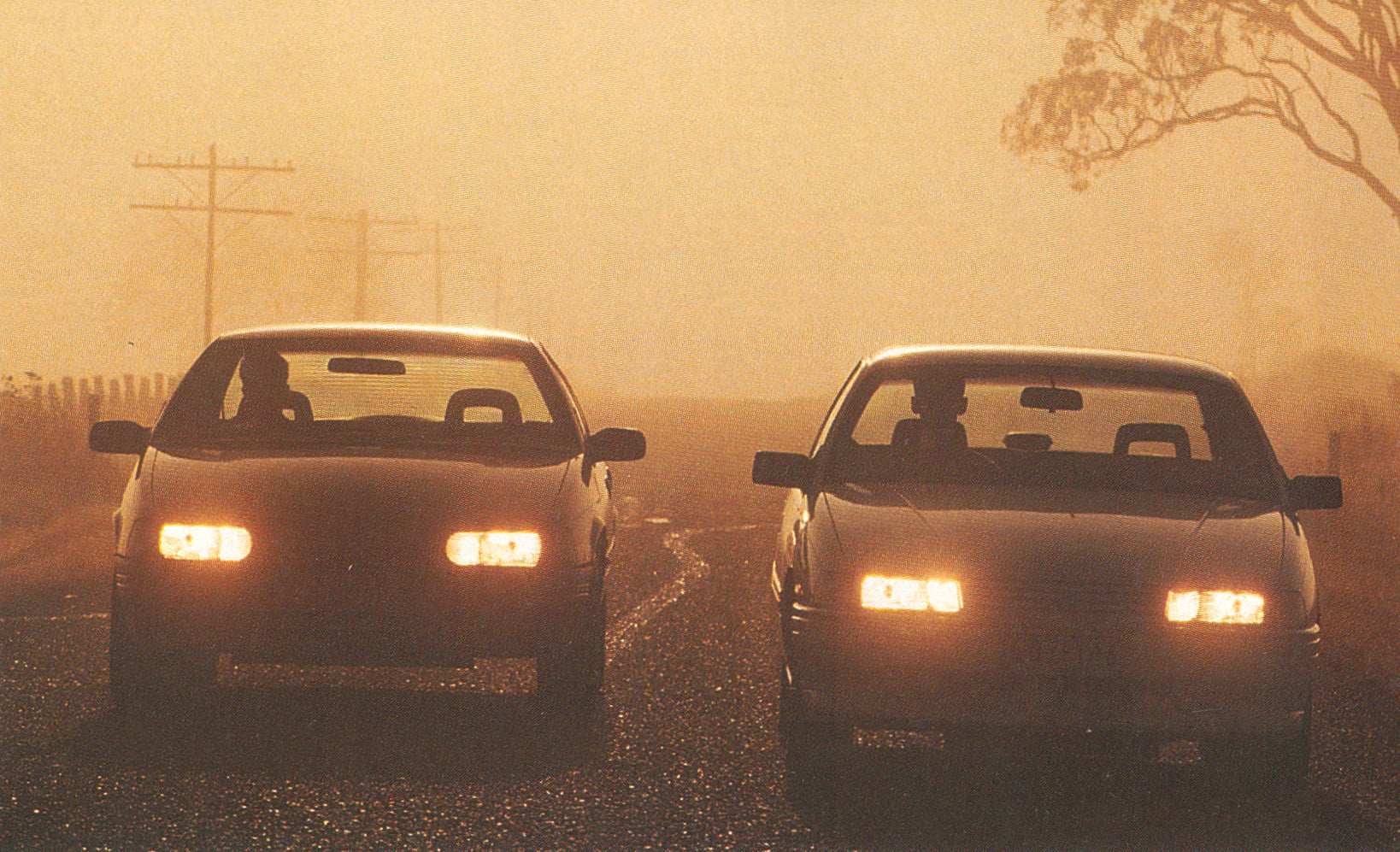
Both cars are affordable, honest and wholesome servings of plain ’70s-style factory muscle. But job descriptions aren’t all these two cars share.
1
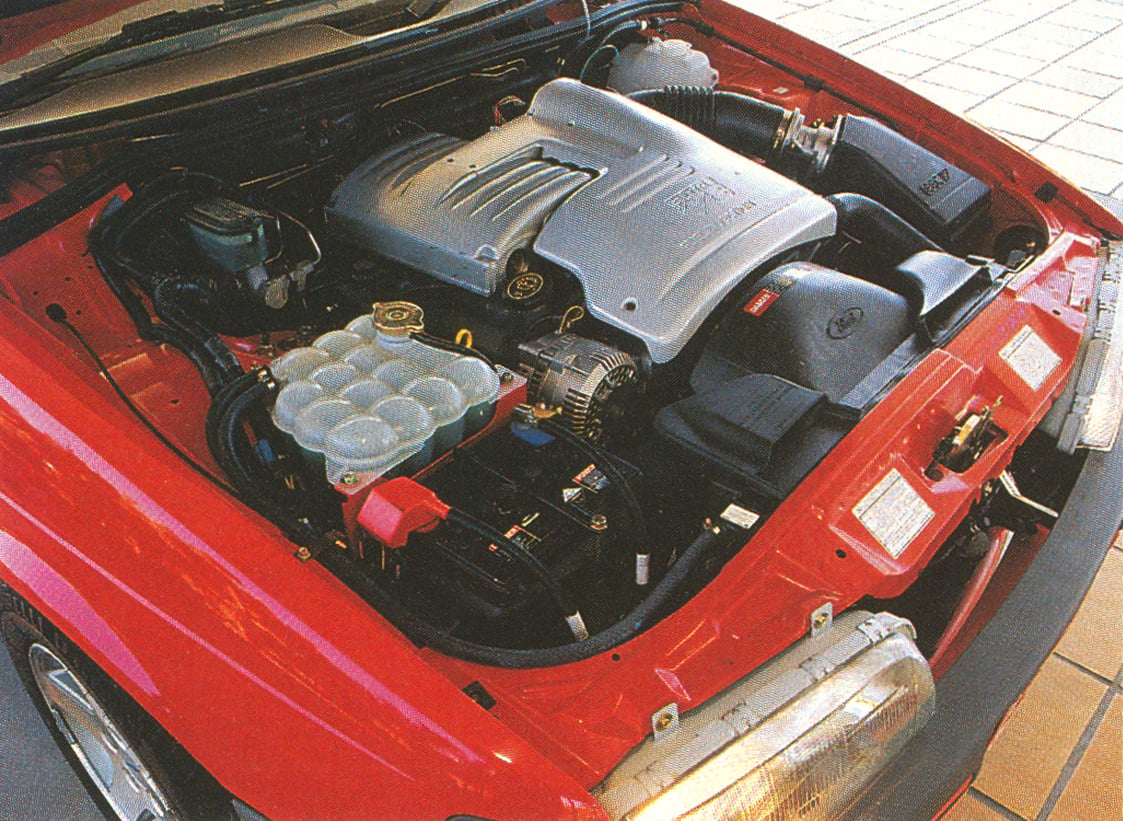
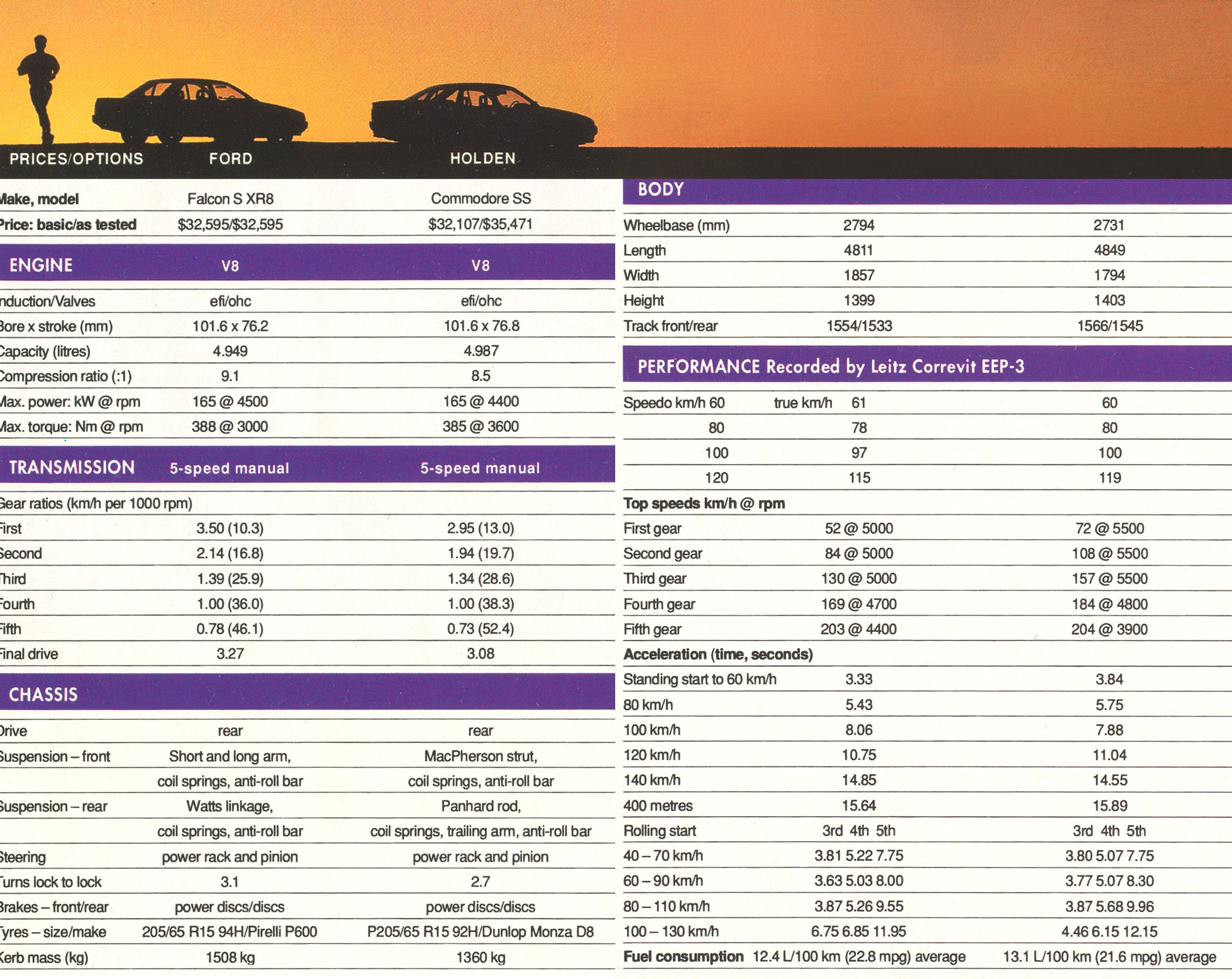
Their physical specifications are uncannily similar. Both are close as dammit to 5.0 litres, the XR8 being 4950cc, the SS 4987cc. And outputs are amazingly close. Power is identical at 165 kW, the difference being the Falcon peaks at 4500rpm, some 100rpm later than its GM counterpart. Take a look at the torque curves and the story’s almost the same, the Falcon pushing out 388Nm at only 3000rpm, and the Commodore a slightly inferior 385Nm at 3600 revs.
In manual trim, both transfer engine drive to the rear wheels via Borg Warner’s T5 five speed transmission. Live, limited-slip rear axles all round, but the Commodore controls lateral movement with a Panhard rod, the Falcon with a Watts linkage. And both are blessed with uprated damping and springing to cope with increased engine performance. The XR8 squeezes the scales some 148kg more than the lightweight Commodore, with that mass distributed proportionally 56:44 (XR8) and 55:45 (SS) front to rear.
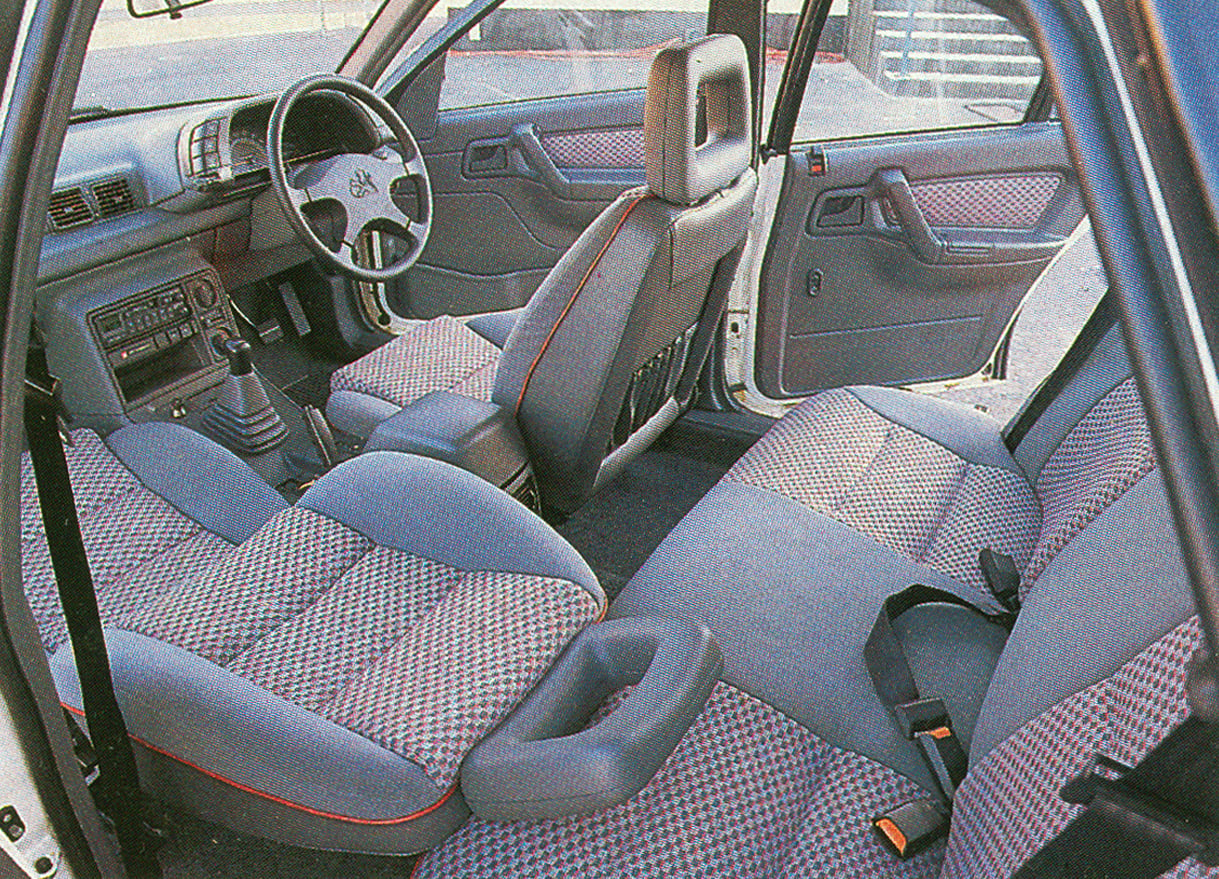
For all they share, the SS and XR8 are quite different in ambience. Nestled at the Commodore’s wheel, you’re snuggled down low with the seat height adjustment at its minimum level. Steering column tilt isn’t offered and, despite the wheel’s healthy diameter, it’s more natural in the palms than the stock VN boat tiller.
1
The front buckets are more heavily contoured than standard Commodore fare, dishing out good lateral support on the backrests, if remaining a little flat and unsupportive on the cushion. Unfortunately, the driver’s footrest is located too far back from the firewall, forcing your left leg upwards and making it difficult to sit far enough forward to correctly grasp the wheel without entering a yoga position. It’s more comfortable to place your foot beneath the clutch.
That’s not the SS’s only idiosyncrasy. The test vehicle’s rear vision mirror didn’t adjust in a linear fashion, preferring instead to reach a point, then … click, suddenly snapping into a position some way past the intended angle.
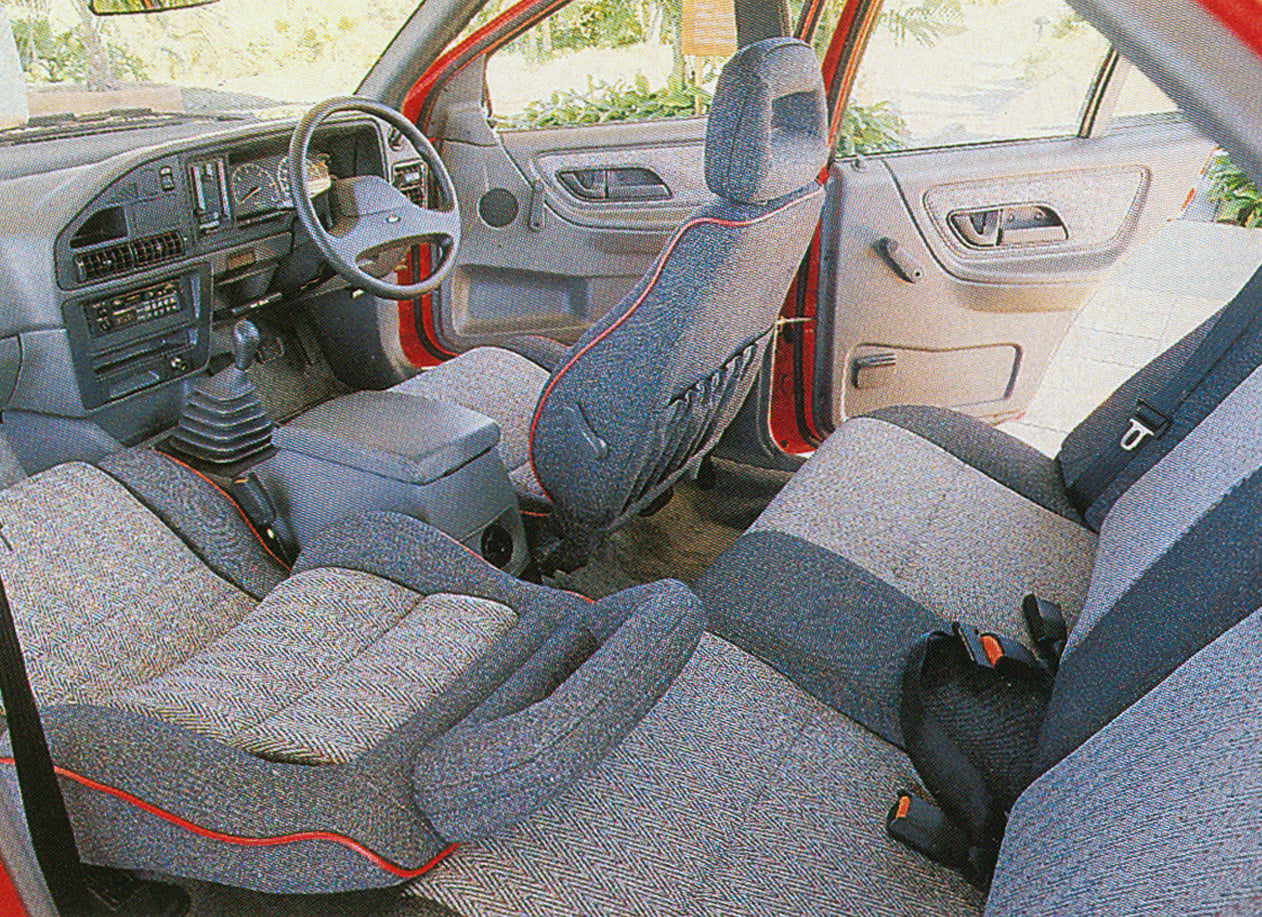
The XR8 retains that high Falcon seating position, which offers a good view of the left front corner (available in the Commodore with the seat up), but it does act against the car’s intended sporting nature. Thankfully, those park bench-flat seats have disappeared, replaced with buckets that are welcoming and give more restraint than the Holden in the horizontal plane and trail marginally on the backrest.
1
Like the rest of the Falcon range, the XR8 gives both tilt and reach movement for the steering wheel, a boon for those, like us, who are particularly fussy about how and where they sit. But even on maximum tilt, the Falcon’s wheel falls into a taller driver’s lap. And while that wheel is a more manageable diameter, its rim carries the suspicion of thinness. The foot rest passes without complaint.
Equipment levels are a mixed bag, the Commodore unmatched with power for windows (auto-down for the driver) and aerial, fog lamps and four speaker radio/cassette, but going without the Falcon’s roof-mounted grabhandles, driver’s lumbar adjustment and column adjustment. They tie on central locking, comfortable cloth trim, air-con and boot and fuel filler flap remote releases. So, mark the interior scorecard ever so slightly in the Commodore SS’s favour.
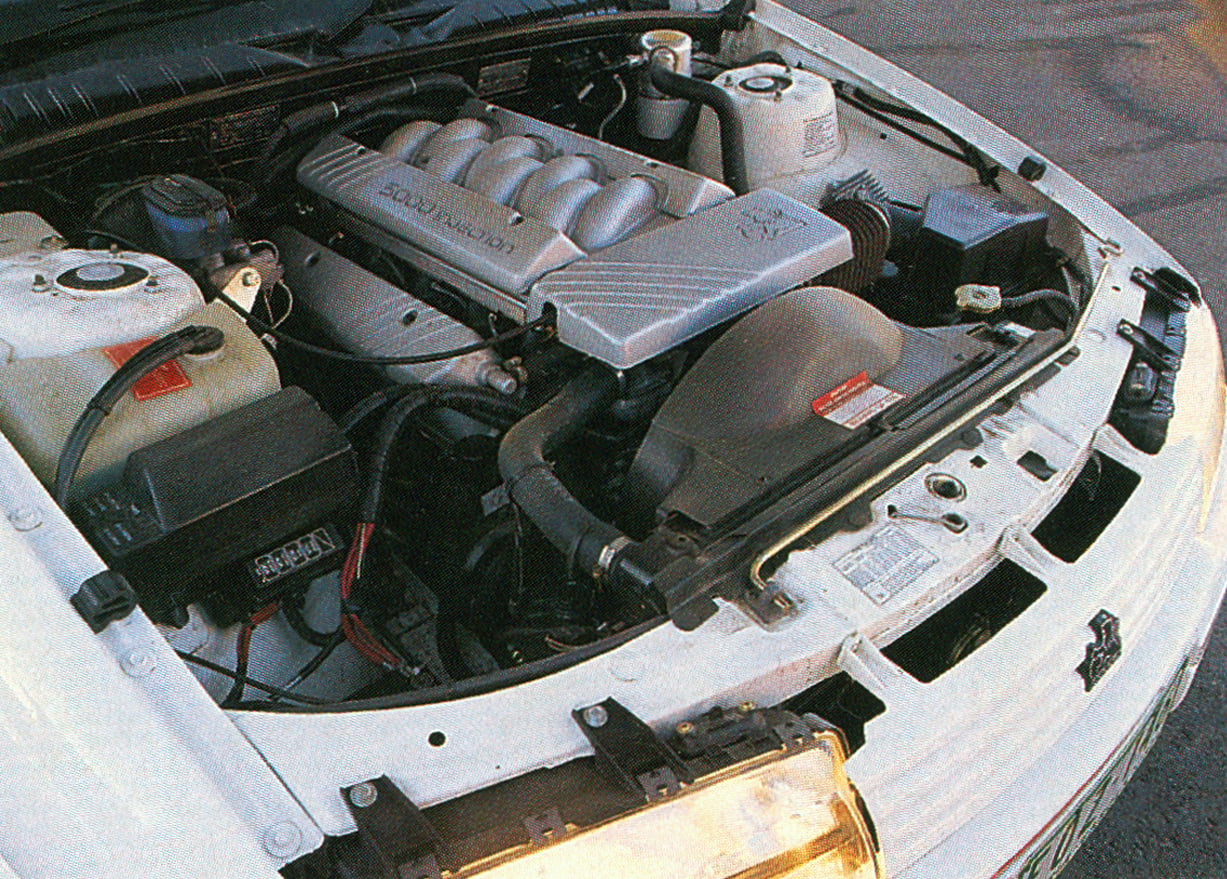
If you thought that was close, the V8 contest is a punch for punch affair, both going the distance. It’s ironic that a pair of pushrod two valve engines should generate so much interest – indeed,genuine excitement – in the hi-tech ’90s.
The benchmark, port-injected Commodore has long impressed with its smooth, unfussed manner. It doesn’t make its presence felt through the car at idle, offering an occasional, bucking reminder that all eight cylinders are firing.
1
With a redline set at a conservative 5500rpm, the SS accelerates in an unstepped, fluid motion, with little or no power band. The only reason engine revolutions become an issue is because of the car’s tall, 3.08: 1 final drive ratio. Instead of renewing that pushing force with each gear change, the Commodore tends towards a locomotive’s irresistible surge. Only when you’re working the car off the line with a snappy start does the SS feel fast in the first two gears.
The Holden is an otherwise progressive, still impressive performer. Third gear is the ratio, both in terms of overtaking and accelerating. Hard on the throttle and with around 4000rpm on board, the SS straps on the Reeboks and gets fair dinkum about its work. The GM 5.0 litre V8 is slightly less sweet between 4000 and 5000 rpm than the XR8’s unit, but it retains composure all the way to (and beyond) the no-no zone. It’s torquey, flexible and, in the final analysis, obviously powerful, but the Commodore’s gearing puts chewing gum on its soles. Fifth gear can’t really be used for overtaking without wide open throttle, thus negating the efficiency bonuses of an overdrive fifth. A snap back to fourth – or better, for immediate results, third – gets the big tourer hauling.
The XR8 feels faster. Its shorter final drive compensates for heavier kerb weight and this alone makes the XR8 seem the sportier alternative. The stringent demands of the new ADR 28.01 (for drive-by noise) mean no dual pipes or heavy induction roar, but Ford has managed to retain the aural attraction of the traditional carb-fed bent eight. The SS, on the other hand, is clinically proficient.
1
The Falcon, like the Commodore, starts to slow quite rapidly once past the 5000rpm danger mark on the rev counter and grows strained if you venture far into the red. Instantly accelerative in any gear, including fifth, the Falcon relays the impression of eagerness. Where the SS is happy to lope along, the XR8 just keeps smacking you in the nose, asking for it. Given the intended market, that’s a favourable trait.
But don’t misinterpret this to mean the Commodore’s a slug. It most certainly isn’t. Using an unfamiliar strip in Queensland, the Commodore’s standing 400 metre run disappeared in only 15.89 seconds. And with its speedo registering 100km/h from slack in 7.88 secs, this is a quick family fastie.
The Falcon blasts through the same disciplines in 15.64 secs and 8.06 secs respectively. While the Falcon out accelerates the Commodore across the benchmark 400 metres, the SS’s longer gearing helps it turn the tables to 100 km/h, by dint of needing only one gearchange to the Falcon’s two.
In gears, it’s similarly close, the Falcon holding sway up to the higher speed increments, where the SS starts to overcome its gearing disadvantage. Either way, these two are very, very close when it comes to the traffic light brawl.
1
Even hard core V8 buyers must these days consider fuel economy, an area where Ford proudly claims to have an edge. Both cars are reasonably frugal, given their capacity and performance, but the Falcon comes out on top in almost all conditions. Driven briskly, the XR8 returned 13.3L/100km, with the SS close behind on 13.4L/100km.
Overall, the gap proved to be somewhat wider, the XR8 settling on a respectable 12.4L/100km (22.8 mpg) and the SS 13.1L/100km (21.6 mpg). That gives the Falcon, with its 68 litre capacity, a minimum range of 510km, and a normally driven 550km. Motoring with great care, you could squeeze towards 600km from the new Ford.
The Holden’s least thrifty tank full would yield an impressive 640km, a more representative, middling figure of more than 650km, and a theoretical best nudging 700km! You can’t complain about range in either car, but the SS’s returns are reassuring for those living in, or simply passing through isolated areas.
1
This pair’s manual five speed transmissions are evidence of how shared componentry doesn’t have to mean identical characteristics. You wouldn’t know they came from a joint ancestor. Where the XR8’s shift feels slow, notchy and vague, the SS changes cleanly and quickly. Like a Falcon six, the XR8’s box is light, with a sensation of a very long shifter meeting resistance, then dropping into the next ratio with a slim, almost fragile sensation.
The Commodore is altogether heavier, both in clutch effort and detente springing within the transmission. The first through to fourth shifts are well defined and relatively close; fifth is a long way over and not conducive to easy, snapback downchanges to fourth. The Falcon’s ratio spread is marginally better, and that’s partly by dint of a more advantageous final drive.
At odds with everything you’ve just read, the Commodore is that bit easier to get off the mark. The SS doesn’t ask for many revs or clutch slippage to ease away from rest, but the Falcon is trickier. It stalls if the clutch is eased out at idle, and you have to be sure to bring revs up an instant before even a preliminary engagement of the left pedal. Pleasingly, both cars are silky smooth rolling on or off the throttle in traffic, but both suffer driveline shunt when slowing in higher gears.
1
That leaves it one all, with the chassis to go. Again, the SS and XR8 are strikingly different in function. Three manholes down the road, and the SS has stamped itself as a stiffly suspended and bushed car. Short amplitude bumps and cat’s eyes are felt at each corner. Dips exact retribution on vehicular and human bodies. It’s tied down tight.
The Falcon’s ride is, without doubt, measurably superior. The sensation is that of a longer wheelbase car soaking up surface irregularities with greater aplomb. The spring rates feel little dif-ferent, but the dampers have a greater sense of compliance, paying less attention to the riot going on beneath the rims.
The XR8 is more composed when hammering hard across uneven, rollercoaster roads. The live axle is apparent in both, but Holden and Ford have done a commendable job in almost taming the demons within. After driving a V8 SS, you’re given cause to wonder why lesser models aren’t afforded the same level of rear axle control.
1
Both cars grow uncomfortable with broken surfaces, but there isn’t the disconcerting arse-hopping we’ve come to expect from the locals. This ill at ease sensation grows in proportion with speed, but both can be punted very, very hard before the pilot fumbles for the ejector button.
The XR8 holds the handling edge, if only for its turn-in power and ease of driving. Ford’s front end development works; steering precision is a step forward and is also true to the XR8’s
badges and attractive alloy wheels. You caress the wheel for adequate response; in fact, on first acquaintance, it’s easy to turn too far, so drastic is the change and relatively light the required input. Accuracy on and just off centre is good – encouraging and rewarding measured handwork. A revelation, no less.
The XR8 certainly turns into tight corners more easily and smoothly than the SS. but suffers from a little front end roll steer on more open sweepers, where the car has a chance to remain loaded while running across changes in surface angle. The Commodore is, in this situation, marginally better, but you’re winding on more initial lock to turn as far.
1
The Commodore’s steering is heavier and the power assistance disappointingly inconsistent. More so at parking speeds, where the wheel weights up and lets go when the car’s performing sidewalk ballet. Running hard, the SS isn’t as pin sharp as the XR8, but it doesn’t disgrace itself.
The Falcon is the better handler simply because you point, it turns. Drive deep into the corner. come off the brakes and power out on oversteer. The Commodore is more nose heavy, preferring to under-steer during entry and up to the apex, with power-on oversteer on the exit.
To be driven quickly, its weight must be thrown to the outside rear wheel by giving the steering wheel a small flick on entry, thus allowing an early throttle open-ing. Then, the Commodore will match the Falcon’s cornering speed, dropping into controllable, power-on oversteer. But it’s not as easy to drive and definitely busier when pushing on.
1
Brakes are good on both, with the Falcon requiring less pedal pressure, but the Commodore offering friendlier pedal placement. XR8 and SS pads grow smel-ly, alright, but fade isn’t a concern under most circumstances.
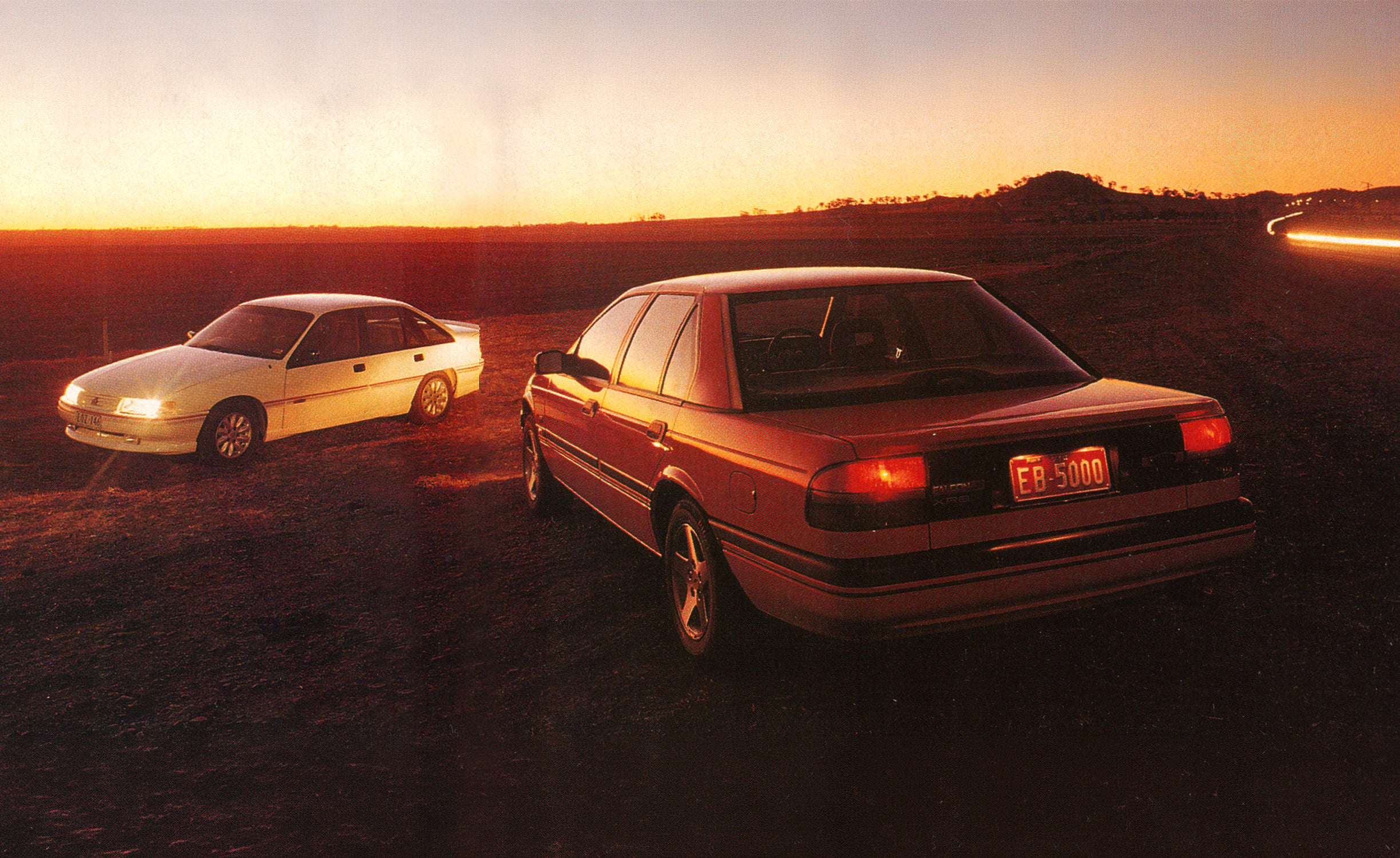
The XR8 and SS are uncomfortably close, but there’s only one winner – and it’s the XR8, by a whisker. A more modern feeling car, it imparts a solidness of bodyshell construction and has that bit more spirit, thanks to better transmission gearing. The Falcon is a fast, practical, family tourer. And with the XR8 enjoying a price advantage, V8 diehards again have a real alternative.
Follow WhichCar/Wheels on Google
Click the button below to make WhichCar by Wheels a preferred source for your news.

We recommend
-
 Classic Wheels
From the Wheels Archive: Ford’s New Hot One – the birth of the Falcon GT legend
Ford's legendary Australian muscle car heritage started with the 1967 XR Falcon GT... and we put the V8 super sedan through its paces.
-
 Classic Wheels
From the Wheels archive: The best Holden ever!
Wheels gushed over the all-new HQ Holden in September 1971, declaring it 'far and away the best Holden ever'.
-
 Features
From the Wheels archive: Ford's Monaro fighter
After years in the two-door wilderness, Ford threw down the gauntlet with the release of 1972's Falcon Hardtop.