
Mazda’s CX-5 really needs no introduction to WhichCar by Wheels readers. The boss of Mazda Australia is unequivocal when he says, “this is the most significant vehicle in our brand’s line-up’, and it’s fair to say Australians have loved the CX-5 since it was first released. Since its initial launch, more than 330,000 CX-5’s have left dealerships in the hands of Australian buyers. And Mazda’s internal data indicates that more than 20,000 current owners have bought more than one CX-5.
With more than five million sales globally, it’s just as popular around the world as it is here in Australia, also. Making up around 25 percent of all Mazda sales in Australia, the CX-5 has been the manufacturer’s most popular vehicle in this market for seven years running.
Key points for this third-generation version are a larger body, new technology and all- wheel drive as standard across the range.
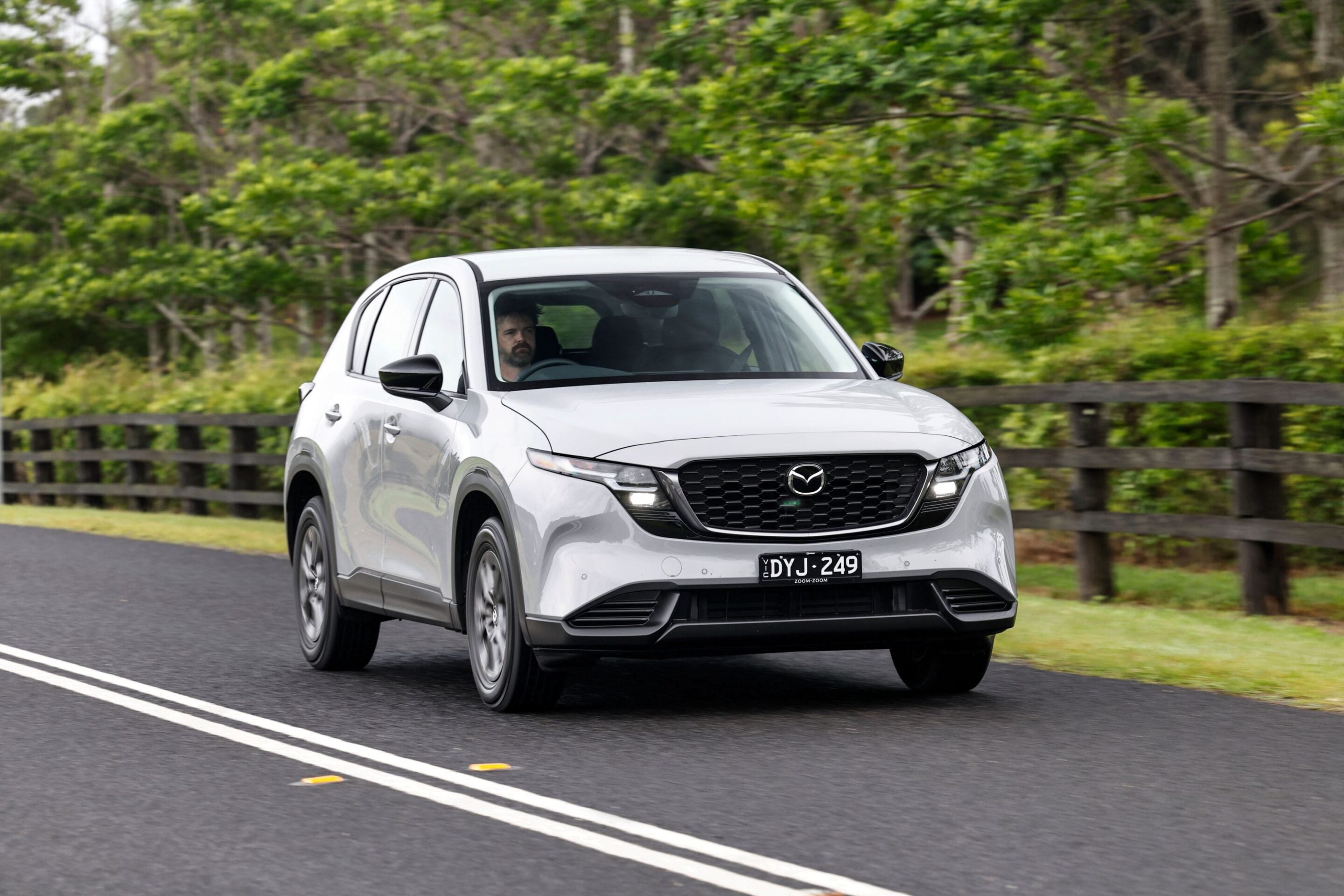
How much does the Mazda CX-5 cost to buy?
Mazda’s sharp pricing is noteworthy, too, even the entry to the range Pure, which starts from $39,990 before on-road costs, feels like a well-executed medium SUV. Standard equipment on the base model includes 17-inch alloy wheels, dusk-sensing LED headlights, 12.9-inch infotainment touchscreen, 10.25-inch digital driver’s display, black cloth trim, dual-zone climate control, wired smartphone connectivity, autonomous emergency braking in forward and reverse, adaptive cruise control with stop and go, lane-keep assist, blind-spot monitoring, parking sensors front and rear, and a rear-view camera.
Our standard specification list below, details that entry point to the range, with standard equipment increasing as you spend more money. Step up through the model grades and you will spend $42,990 for the Evolve, $47,490 for the Touring, $51,990 for the GT SP and $54,990 for the Akera. All prices listed are before on-road costs are factored in.
The most crucial question to be answered, and time will tell as the sales figures start to roll in, is whether the CX-5 can endure in this market, when all of its main competitors feature hybrid technology of some kind. At the time of the CX-5 launching, only Renault Koleos, Skoda Karoq and Mahindra XUV700 are not available with either hybrid or plug-in hybrid drivetrains.
For Mazda’s part, it says a hybrid CX-5 is on the way, and that vehicle must feel and respond like a Mazda from behind the wheel, rather than simply trumpet a headline efficiency number. As relevant as that may be to buyers, it’s also fair to say that plenty of buyers in this segment value efficiency as much as, if not more than, anything else. There is a response in the way that the CX-5 behaves on the road though, that not all SUVs can match. Certainly not at this competitive price point.
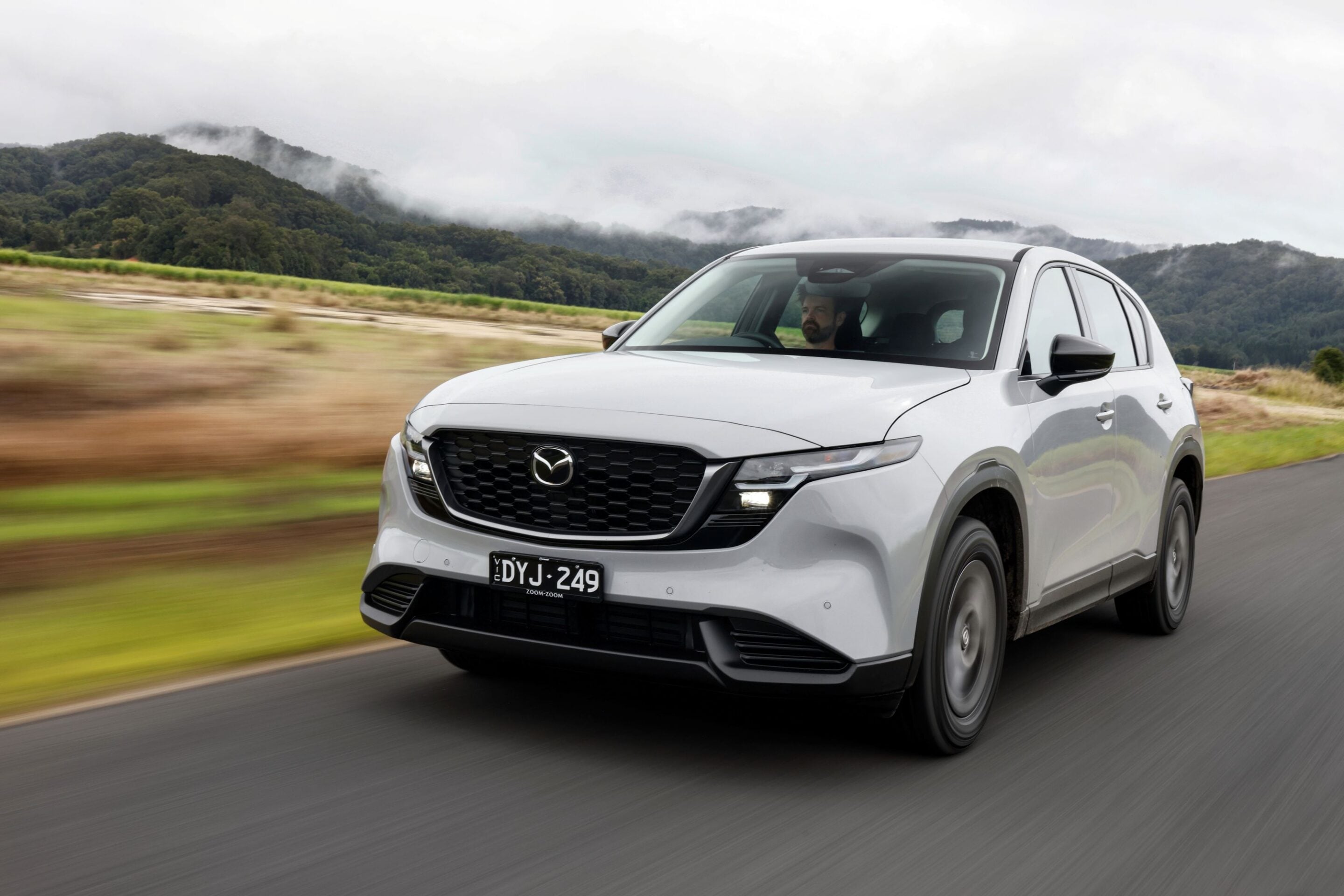
How powerful is the Mazda CX-5?
Significant to this revision of the lineup is the rationalisation of the previous engine options, with the range now powered by one engine only – Mazda’s 2.5-litre, naturally aspirated four-cylinder ‘G25’ petrol variant.
For 2026, both power and torque have been lowered – to meet stricter emissions standards – now 132kW and 242Nm (-8kW/10Nm). It’s fair to say that the CX-5 doesn’t have the punch it might with a more powerful engine, a larger engine, or a hybrid drivetrain, certainly off the mark when you nail the throttle. That said, it doesn’t feel slow either, with more than enough urge to do what the target buyer will need it to do day-to-day. And as noted, this engine was the most popular among Australian buyers.
On the subject of the engine note, nail the throttle and it’s evident there’s a naturally aspirated four-cylinder working away beneath the bonnet. While it doesn’t sound or feel like it’s being pushed beyond its comfort zone, the sound its making means its more noticeable than it would be if there was hybrid – or turbo – technology at play. Again, the CX-5 doesn’t feel slow, as you might fear looking at the spec sheet. The power and torque figures won’t cause your eyes to water, but they do allow the CX-5 to do what buyers will need it to do.
On typical country roads, the CX-5 is a fun SUV to drive, whether it’s on the 17s of the base model or the 19-inch tyres further up the grade walk. If you live in an area with particularly poor roads, the 17-inch wheels and tyres will serve you well, but even on 19s, the CX-5 manages to neatly deal with and insulate the worst surfaces beneath it. The balance between handling prowess and ride quality is something Mazda engineers have nailed for this segment, the way WhichCar by Wheels sees it.
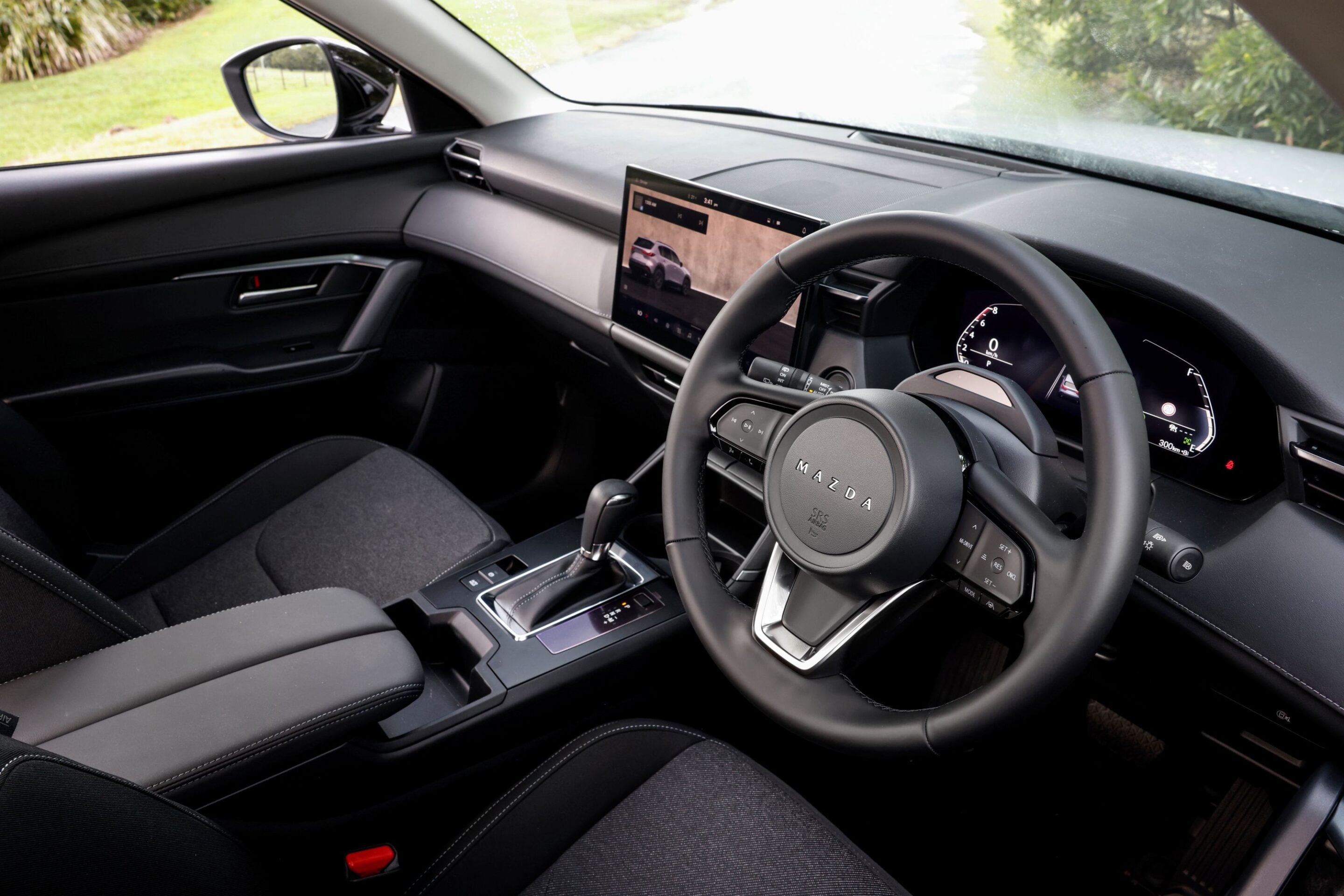
The six-speed automatic is another part of the CX-5 equation that works well across various driving disciplines. At a time when a CVT or a 10-speed automatic is common, there’s a lot to like about the simplicity and precision of Mazda’s six-speed, which doesn’t hunt through multiple ratios at city speeds, something that can grate with other transmissions. Whether you’re in town or on the highway, the Mazda automatic works nicely.
Step out of the base model into the more expensive, higher grade Akera variant and there’s a requisite step forward in terms of luxury, amenity and features. The 15.6-inch infotainment screen is a whopper, and the panoramic sunroof adds a light, airy feel to the cabin. Steering wheel paddle shifters lift the sporty aspiration a little, too. In real terms it’s no more fun to drive than the more austere base model, but it’s a more luxurious way to undertake the same road trip.
How fuel efficient is the Mazda CX-5?
The G25 can run on regular unleaded fuel and uses a claimed 7.4L/100km on the combined cycle. Interestingly, according to Mazda, the majority of buyers in 2025 – of the outgoing model – opted for the G25 engine, making the decision to switch the range to one engine, easier to understand.
Mated to the G25 across the range, is Mazda’s familiar six-speed automatic and all-wheel drive, and the good news is that while it’s not as efficient as the raft of hybrids on offer in the segment, it’s still comfortable below the 10.0L/100km mark in the real world. With the understanding that launch drives are tailored to suit the vehicle, we saw a live reading below the 7.4L/100km claim while cruising, while stop/start city driving saw it climb into the high 8 range. We’ll report back with a more accurate fuel use figure post launch.
Is the Mazda CX-5 practical?
Mazda is predicting a full five-star ANCAP safety rating to match the five-star Euro NCAP rating the CX-5 already has. Other key changes beyond those noted above include an overall length increase of 115mm, 70mm of which goes into a deeper second row door aperture, 15mm added to the width, and a boot increase to 466 litres with the second row in use. Fold that row down and available space is up 254 litres to 1594 litres.
The extra length in the wheelbase, with 70mm added to the rear door apertures, means getting into and out of the CX-5 is easier than it was previously, and the doors open almost square, too. There’s room in the second row for adults, but keep in mind you need to step up to Evolve (second in the range) to get rear air vents. Mazda touts the ability to fold the second row flat, reverse the headrests in the seat backs, and create a flat space to recline for occupants up to 185cm in height. If you’re into star gazing through the panoramic glass roof of the Akera variant, it’s a handy feature.
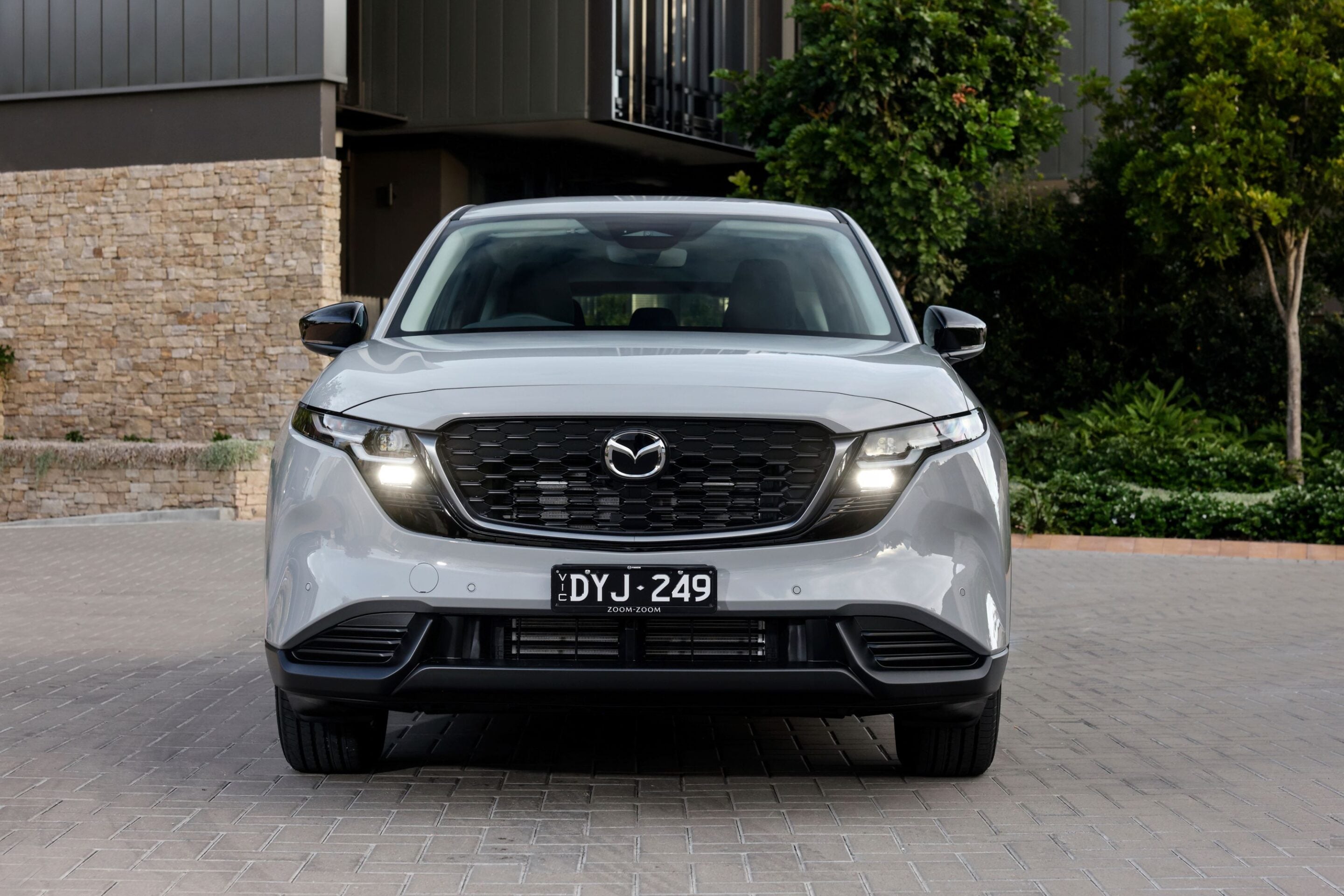
There is some hard plastic trim on the dash and door tops in the base Pure, but that aside, it features a quality cabin that is nicely insulated when you’re on the move. Tyre and wind noise is kept to a minimum, and while the engine note is noticeable as revs increase, it lends a sporty feel to the experience, which plenty of Mazda buyers like. Crucially, the most affordable CX-5 doesn’t feel like its built down to a price, which is a tangible benefit for those buyers on a tight budget.
What warranty covers the Mazda CX-5?
The CX-5 is, as all Mazdas are, covered by the brand’s five-year, unlimited kilometre warranty. Servicing is required every 12 months of 15,000km, whichever comes first, and cost $369, $556, $434, $556 and $369 respectively, for a five-year total of $2284 up to 75,000km.
Should I buy the Mazda CX-5?
The revised Mazda CX-5 is a high-quality medium SUV. There’s no doubt that even in its most affordable guise it’s quiet, refined, well-appointed and engaging to drive. There’s a line in the sand that separates the way in which a CX-5 behaves on a twisty road compared to most other medium SUVs and it certainly engages the driver in a way that others don’t. Is that enough to ensure it remains as popular as it has always been, while buyers wait for the launch of a hybrid? Time will tell.
Mazda CX-5 standard equipment
- 17-inch alloy wheels with space-saver spare
- 12.9-inch infotainment touchscreen
- Mazda Connected Services
- Wired Apple CarPlay and Android Auto
- Eight-speaker audio system
- Basic voice control
- FM/AM/DAB+ radio
- 10.25-inch full-digital instrument cluster
- Dual-zone climate control
- Rain-sensing wipers
- LED daytime running lights
- Black cloth seat upholstery
- Leather-wrapped steering wheel and gear shifter
- Eight-way manual driver’s seat adjustment
- Front and rear parking sensors
- Autonomous emergency braking
- Lane-keep assist
- Lane departure warning
- Blind-spot monitoring
- Front and rear cross-traffic alerts
- Adaptive cruise control
- Traffic jam assist
Mazda CX-5 Pure specs
| Price | $39,990 plus on-road costs |
|---|---|
| Engine | 2.5-litre, naturally-aspirated petrol four-cylinder |
| Peak power | 132kW |
| Peak torque | 242Nm |
| Transmission | Six-speed automatic, all-wheel drive |
| Claimed fuel consumption | 7.4L/100km |
| Claimed CO2 emissions | 173g/km |
| Fuel type/tank size | Diesel, 58 litres |
| Dimensions (l/w/h/wb) | 4690/1860/1695/2815mm |
| Kerb weight | 1559kg |
| Warranty | Five-year/unlimited km |
| Five-year service plan cost | $2284 |
| On sale | Now |
The first teaser for a compact electric car to kick off MG’s EV range has been revealed.
The new small car will make its first appearance in concept guise at the Goodwood Festival of Speed. A somewhat unusual choice for a car that won’t be particularly focused on performance.
The production version of the new model, which looks set to adopt the MG2 name, will join a wave of new compact Chinese rivals like the BYD Atto 1, GAC Aion UT, and Geely EX2.
The first teaser images reveal a front end that doesn’t stray too far from the soft curves and friendly face motifs of its Geely and GAC rivals. In concept form, the MG2 features a new LED lighting signature for the brand, and pixel-like main headlights.
The rear shows a largely conventional hatchback shape with a large rear spoiler and a curved taillight form that, again, lines up with the organic forms found on its Chinese rivals. The new hatch also carries an MG badge on its C-pillar.
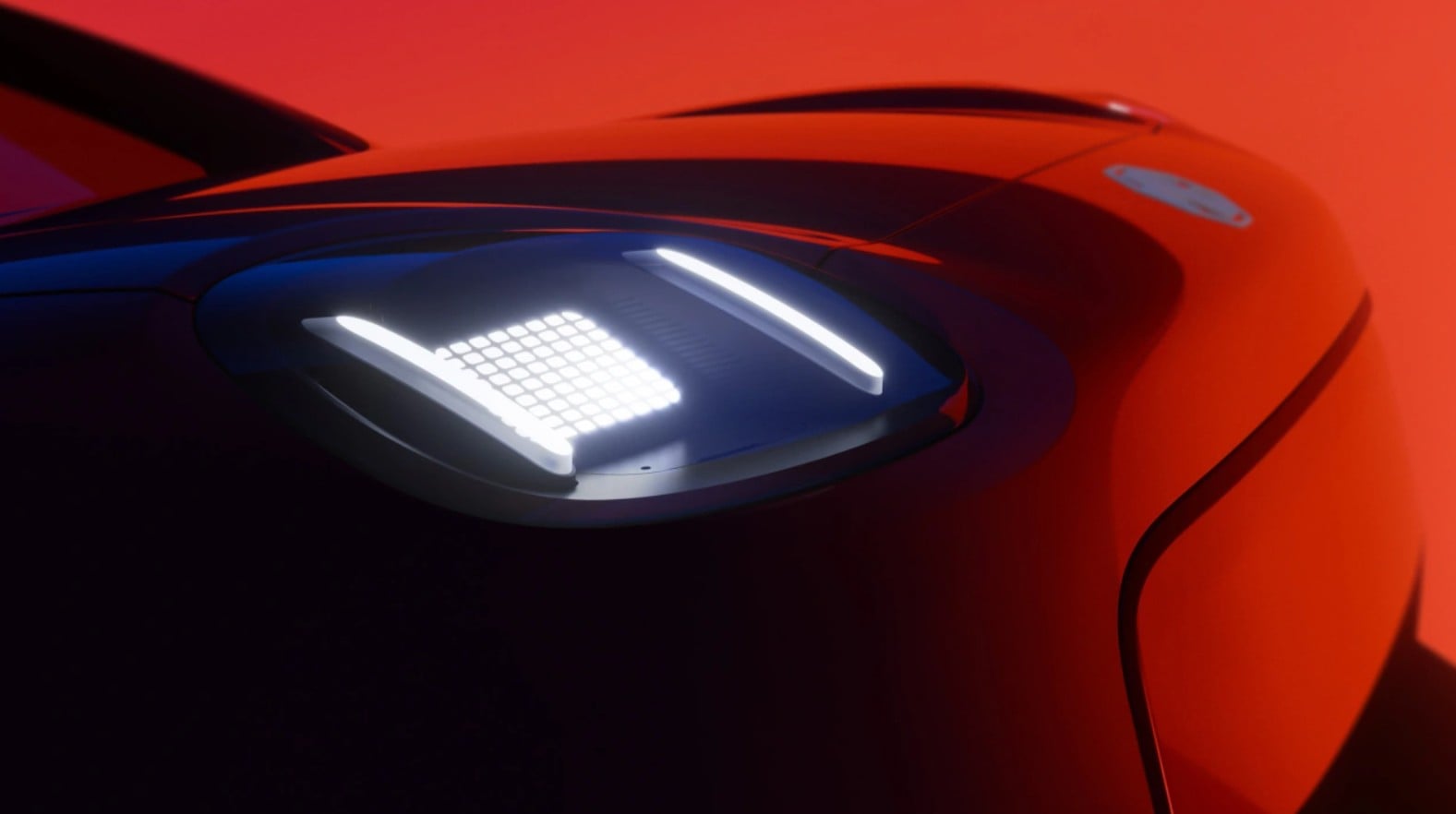
The concept will serve as a near-production-ready preview of a production model that is already under development, adding an electric alternative to sell alongside the existing MG3 petrol and hybrid range.
In an interview with the UK’s Auto Express, MG’s global design president, Jozef Kaban, suggested that the design for the new compact hatch was the work of MG’s UK-based design team. “Even when we are talking about an international brand with international design teams in different places, here we know that we want to deliver something that is not just global, but maybe a bit more British,” he said.
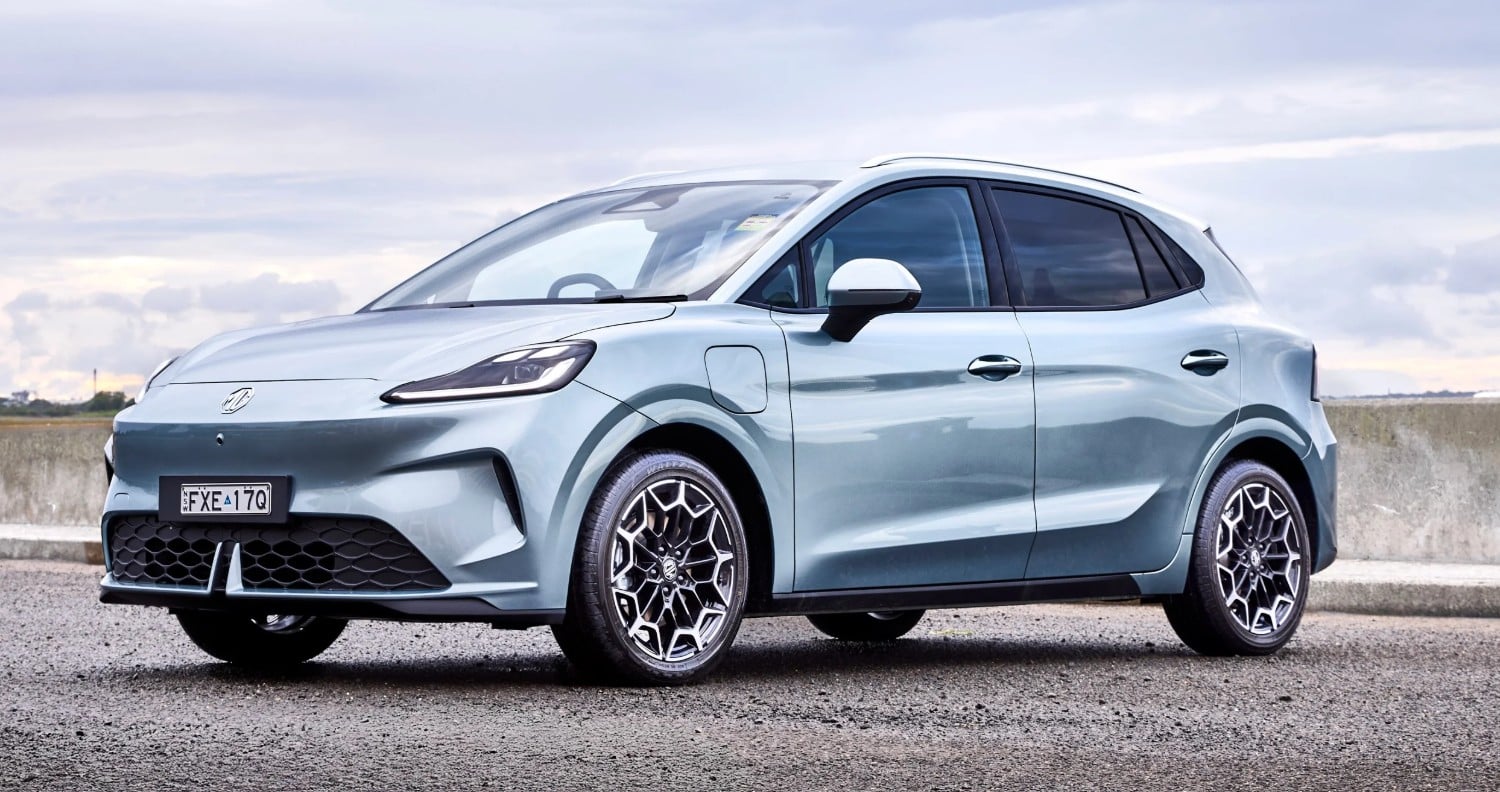
Rather than taking cues from the sharper design of models like the MG4 and S6 EV, with their pointed headlights and angular front intakes, the MG2 appears to be an evolution of the softer design language from the MG4 Urban (below).
Kaban referred to the new model as “the cute baby in the family.”
Specifications for the new model are as yet unknown, but it’s likely to utilise a downsized version of the front-wheel-drive ‘E3’ architecture from the MG4 Urban, equipped with a torsion beam rear end.
The small end of the EV market in Europe has seen a rush of activity with cars like the Renault 5 and its related Nissan Micra sibling, and new models on the horizon, including the Volkswagen ID. Polo and Cupra Raval.
The MG2 concept will debut at the Goodwood Festival of Speed in July, alongside another ‘electric design vision’ concept from the brand, and is expected to reach production by early 2027.
A recall for 1.3 million Jeep Wranglers and Gladiators has been announced overseas, owing to a risk of fire.
While not yet officially recognised as a recall in Australia, overseas owners of the Jeep Wrangler and Jeep Gladiator have been advised to park their vehicles outside, away from buildings, owing to the risk of fire.
Of the 1.3 million vehicles involved in the recall globally, over 1 million are located within the USA.
Documents filed with the National Highway Traffic Safety Administration (NHTSA) reveal that an electrical connector used in the electric-hydraulic power steering system may be loose, leading to the connector overheating, melting, and potentially igniting surrounding materials.
The fire risk may present itself even with vehicles switched off.

Jeep’s parent company, Stellantis, has identified 125,000 vehicles that may be affected outside of the USA, Canada, and Mexico. The recall affects vehicles produced between Model Year 2021 and 2025 – In Australia, Model Year 2021 Wranglers and Gladiators were available from the third quarter (July to September) of 2020.
According to US records, 72 vehicle fires have been linked to the vehicle fault, with one reported injury.
The NHTSA began an investigation into the fire risk in 2023 and 2024, but Stellantis closed the investigation due to a low rate of fires. The investigation was relaunched in August 2024 after an increase in reported incidents.
Stellatis said in a statement that overseas rectification would involve inspecting affected vehicles and potentially repairing or replacing parts of the vehicle wiring harness or the electric-hydraulic power steering pump. Parts to furnish the recall are expected by July.
A spokesperson for Stellantis in Australia told Which Car, “We are aware of a recall announced in the United States relating to 2021 to 2025 Jeep Wrangler and Gladiator.
“At this stage, no recall has been issued in Australia. Safety is our top priority, and we are working with our parent company to understand any local impact and next steps. We will provide updates as more information becomes available and will contact any affected customers directly.”
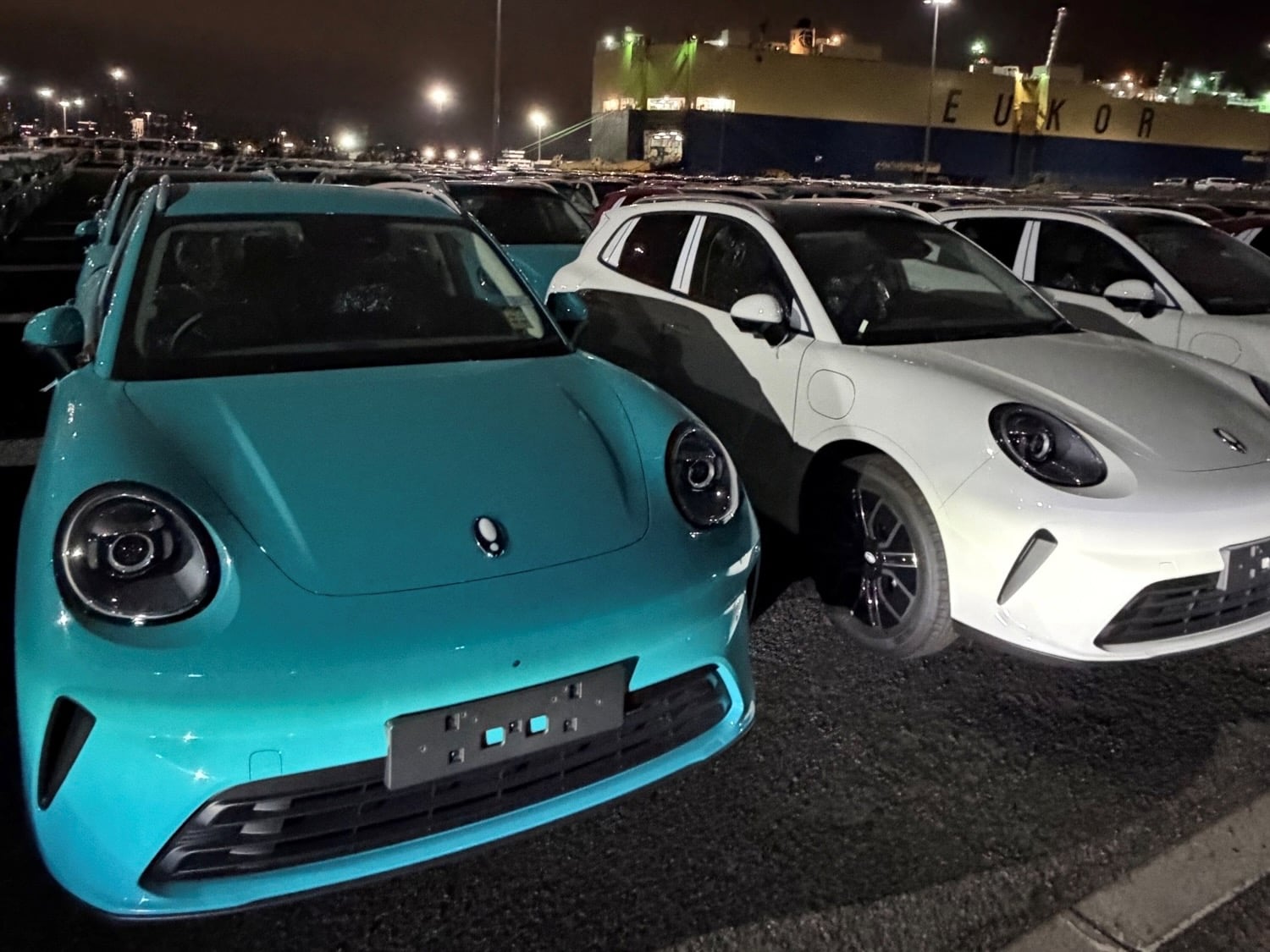
GWM Australia has announced that its new Ora 5 electric small SUV has arrived in Australia ahead of imminent deliveries. Priced from just $33,990 driveaway, the Ora 5 is one of the cheapest electric small SUVs and also one of the cheapest electric vehicles available on the new car market.
According to GWM, deliveries of the Ora 5 to GWM dealer showrooms across all states are expected within the coming days, meaning that prospective buyers can now book a test drive with their local dealer and get their first behind-the-wheel experience of the highly anticipated new model.
The Ora 5 originally debuted for the Australian market at the Melbourne Motor Show in April and since then, has received nearly 3,000 expressions of interest.
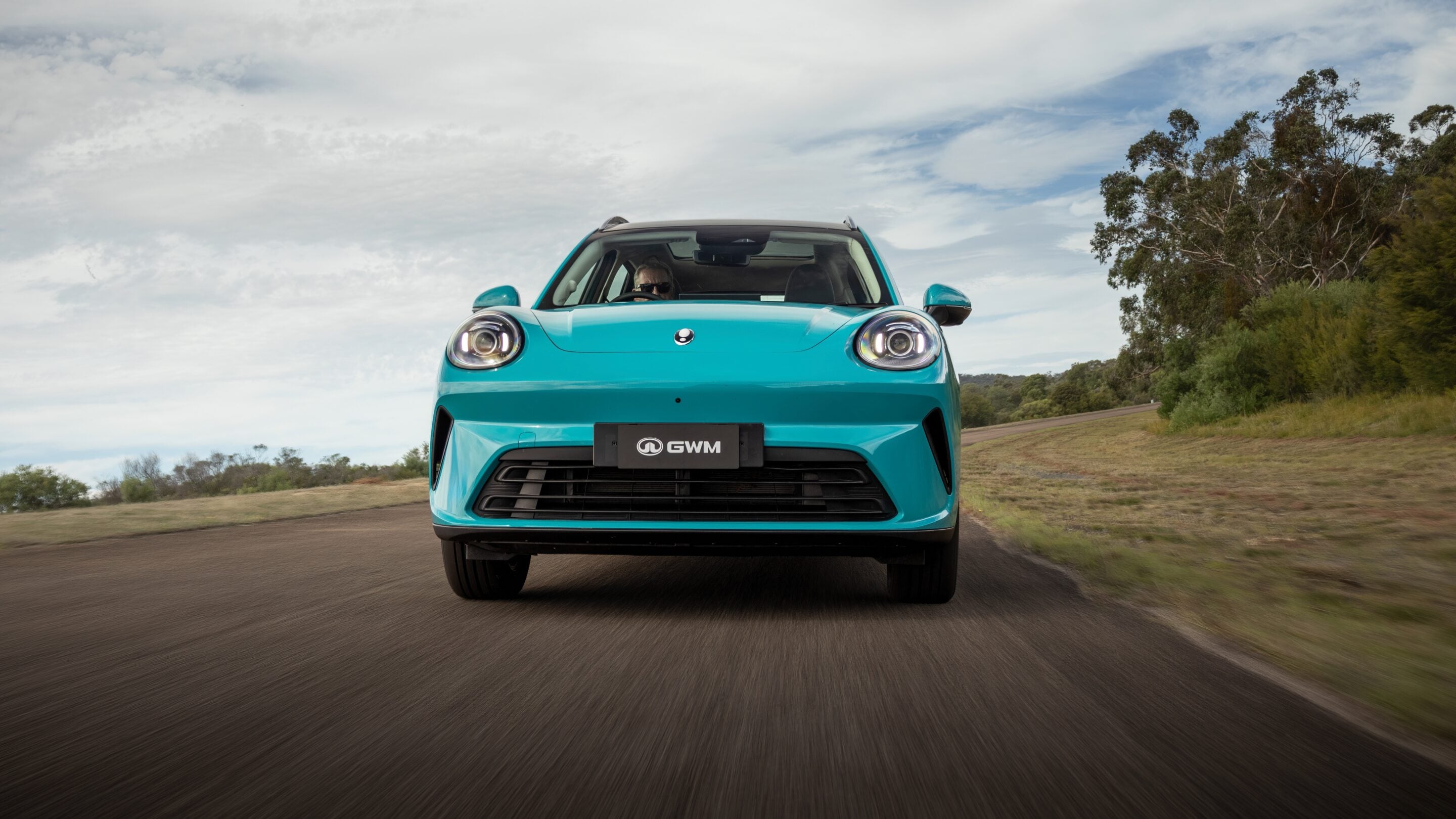
The Ora 5 uses a 58.2kWh LFP battery and is rated at 430km for range on the WLTC cycle. It can be DC fast charged at up to 120kW for a claimed 30 to 80 per cent charge time of approximately 20 minutes, while vehicle-to-load functionality up to 6kW is standard. A 150kW/260Nm front-mounted motor drives the Ora 5 and it hits 100km/h in 8.0 seconds.
2026 GWM Ora 5 pricing (driveaway):
| Lux | $33,990 |
|---|---|
| Ultra | $36,990 |
Ora 5 Lux standard features:
- 18-inch alloy wheels with a space saver spare tyre
- Automatic LED headlights
- Automatic wipers
- Roof rails
- Smart keyless access
- Rear privacy glass
- Synthetic leather steering wheel
- Synthetic leather upholstery
- Six-way electric driver’s seat
- Single-zone climate control with rear vents
- 10.25-inch driver’s display
- 14.6-inch touchscreen with live services
- Wireless Apple CarPlay and Android Auto
- DAB+ digital radio
- Six-speaker audio system
- Standard, eco, city, sport and auto driving modes
- 7x airbags
- Autonomous emergency braking with cyclist, pedestrian and junction assist
- Lane keeping assistance
- Adaptive cruise control with traffic jam assist
- Blind-spot monitoring
- Driver attention monitoring
- Traffic sign recognition
- Rear collision warning
- Rear cross-traffic alert with braking
- 360-degree camera
Ora 5 Ultra model adds to Lux:
- Electric tailgate
- Panoramic glass roof with sunshade
- Heated mirrors with auto-folding functionality
- Dual-zone automatic climate control
- Heated steering wheel
- Heated and ventilated front seats
- Memory for the driver’s seat
- Four-way electric front passenger seat
- Wireless phone charger
- 64-colour ambient lighting
- Nine-speaker audio system
The Geely Emgrand i-HEV sedan is about to launch with not one record efficiency figure, but two.
Geely claims the Emgrand i-HEV sets a record for thermal efficiency, a measure of how effectively it turns fuel into energy, rather than losing it to heat.
According to Geely’s calculations, the new hybrid system has a thermal efficiency of 48.41 per cent. In the Chinese fight for technological superiority, thermal efficiency is now a key recognisable metric.
Geely’s latest claim surpasses Dongfeng’s claimed 48.09 per cent for its 1.5-litre turbo revealed in December 2025, and beats Geely’s own 46.5 per cent claim for Chinese market versions of the Starray EM-i, known as the Starship 7.
The Emgrand i-HEV sedan uses a development of the Starship 7’s 11-in-1 hybrid drive system, with a dual-motor powertrain that Geely claims delivers up to 230kW on electric power alone, compared to the 100kW electric peak from a Toyota Camry hybrid, or 135kW from the electric drive side of the Honda Accord hybrid.
The hybrid system can operate in pure electric, hybrid parallel, or direct drive modes, depending on driving conditions.
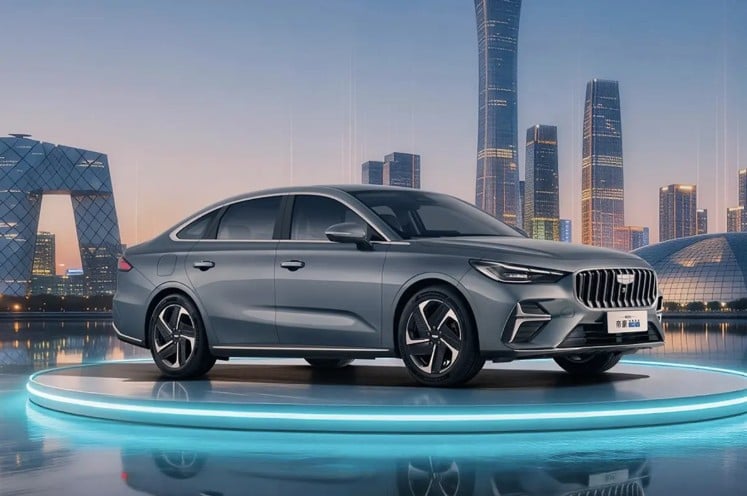
Geely also claims its new hybrid sedan sets a new fuel efficiency record, based on WLTC testing protocols, resulting in highway cycle fuel consumption as low as 2.22L/100km, 12 per cent more efficient than a Toyota Prius under similar conditions.
Mixed-cycle fuel consumption is rated at 3.83L/100km. By comparison, the Camry and Accord are rated 4.0L/100km and 4.3L/100km in Australian mixed-cycle testing.
The Emgrand hybrid uses an AI-powered drive control system to adapt to changes in temperature, humidity, altitude, and road gradient in real time. Geely says the electric drive system can power the vehicle in up to 80 per cent of driving situations, some 27 per cent higher than comparable hybrid drivetrains.
The Emgrand i-HEV hybrid will go on sale in China later this month, joining the 1.5-litre turbo patrol already on sale. In April this year, Geely displayed an earlier version of the plug-in hybrid Emgrand at the Melbourne Motor Show to gauge public reaction, but the model is yet to be confirmed for Australia.
The Federal Government’s Luxury Car Tax (LCT) is set to undergo the biggest restructure since its 1999 introduction next year, in line with changes proposed under a new Australia-European Union Free Trade Agreement.
Rather than an across-the-board change, European-sourced vehicles would no longer be subject to import duties, and the LCT threshold for zero-emissions vehicles from the region would be subject to a much higher $120,000 threshold.
The proposal could see dozens of prestige European-built electric vehicles drop in price, and could result in automakers shifting their pricing strategies to best fit with the LCT changes.
Right now, the changes are tabled as a proposal, and yet to be officially adopted, however Federal Government documents point to an expected July 1st, 2027, introduction for the new regime.
Current LCT thresholds are set to increase from July this year, in line with annual indexing linked to the Consumer Price Index as an indicator of inflation. LCT is calculated across two categories, with fuel-efficient vehicles (those that use under 3.5L/100km of fuel) and non-fuel-efficient vehicles calculated at a different rate.
LCT is charged at 33 per cent on the value above the respective threshold. In the current 2025-2026 financial year, non-fuel-efficient vehicles are taxed on their value above $80,567. For fuel-efficient vehicles, the threshold kicks in above $91,387.
From July 1, 2026, those thresholds will rise by $242 for non-efficient vehicles to $80,809. Fuel-efficient vehicles have a $274 higher threshold, starting from $91,661.
The revised thresholds increase by only $82.20 and $72.60 respectively, making them the smallest annual adjustments to the fuel-efficient and standard caps since 2016 and 2008.
As part of the newly proposed European Free Trade Agreement, the higher threshold from 2027 would not be applied to luxury vehicles universally, and creates a third category for LCT calculations.
The change means that zero-emission vehicles from Europe will have a rate separate from low-emission vehicles (those which use up to 3.5L/100km), essentially separating EVs and PHEVs into different categories. Vehicles sourced from regions like China, Japan, the USA, or other areas outside of the European Union will be subject to next year’s regular LCT adjustments, with no distinction between zero- and low-emission vehicles for taxation purposes.
Automakers are yet to reveal how they plan to integrate the LCT change into their pricing structures of applicable vehicles, with the final pricing adjustments and potential savings calculations to be calculated based on next year’s regular LCT indexing.
For a small subset of buyers, however, the change will be significant enough that sales are likely to be impacted on applicable models in the lead-up to the changeover.
ANCAP (the Australasian New Car Assessment Program) has revealed new safety ratings for vans under its Commercial Van Safety Comparison program, including the new Kia PV5 Cargo. Undertaken as a parallel consumer information program to ANCAP’s traditional star rating program, the Commercial Van Safety Comparison was designed for consumers and fleets to compare the availability and performance of advanced driver assistance systems (ADAS) across the commercial van market (NA and NB category vehicles).
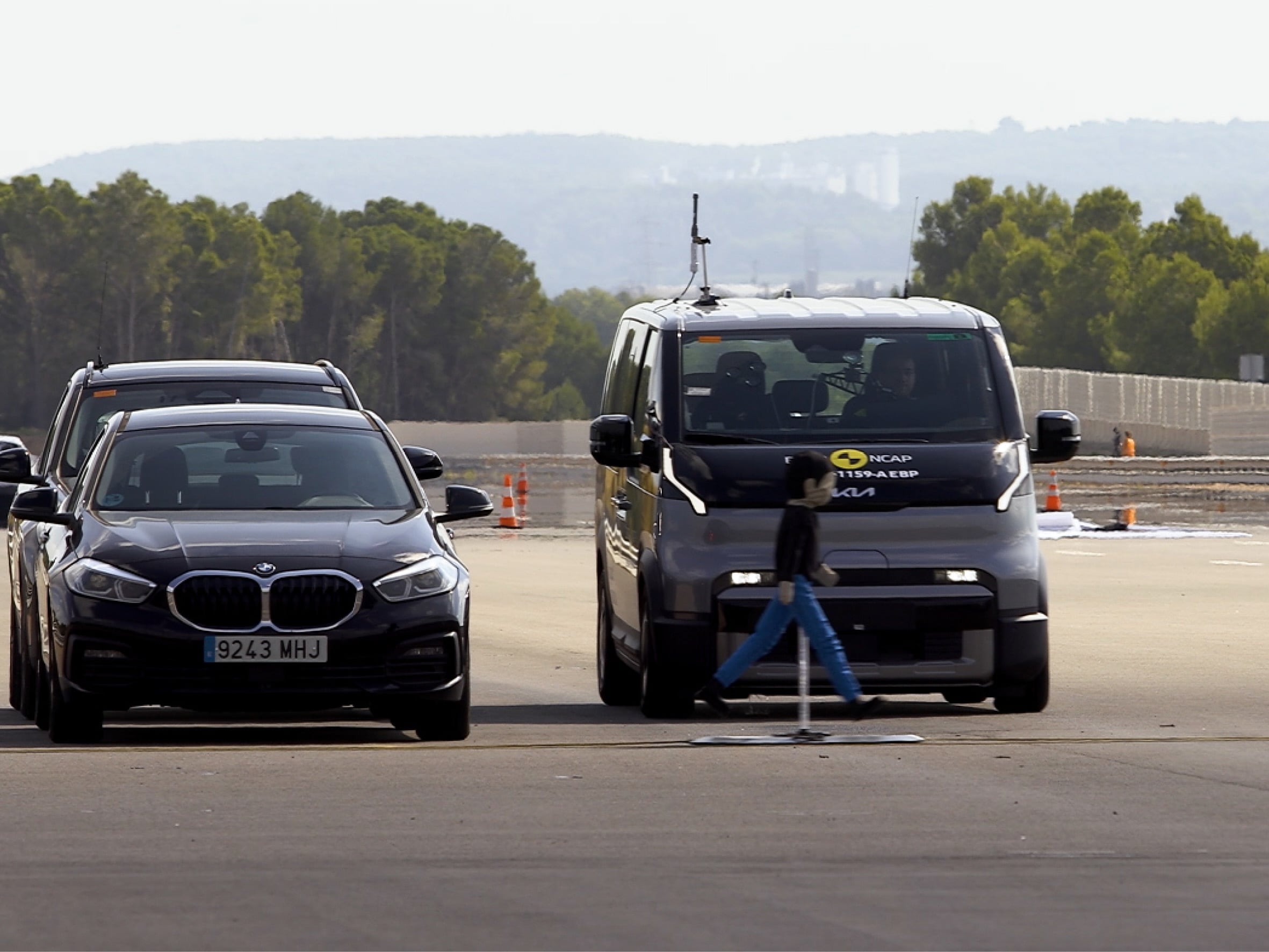
The new Kia PV5 Cargo, which is about to be released in Australia, is the newest model tested under the program and was awarded a 91 per cent or platinum rating. According to ANCAP, its testing showed the PV5 provided good levels of performance across the majority of autonomous emergency braking (AEB), lane support, and speed assistance test scenarios.
Adequate performance was observed in AEB scenarios involving pedestrians, while it lost points for not being available with automatic braking in reverse.
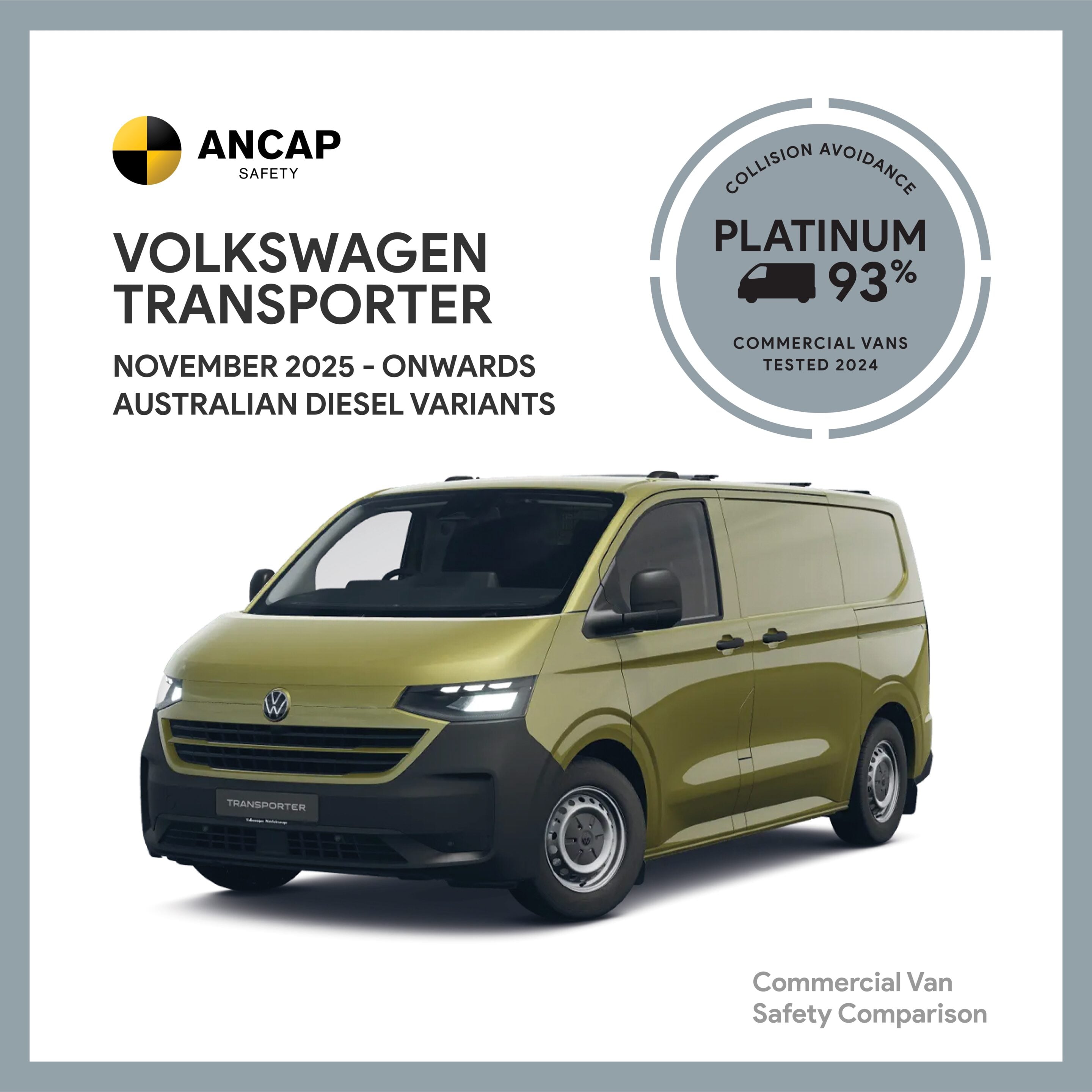
While the PV5 is the newest van on the block, it didn’t score quite as high as the Volkswagen Transporter (and the related Ford Transit Custom), which earned a 93 per cent or platinum rating. ANCAP said that its assessment of the Volkswagen Transporter confirmed good performance across all areas and unlike the PV5, it features reverse automatic braking.
The latest generation Transporter improved on the result of the previous model, which achieved a silver grading when assessed in 2022.
Under the latest release, the Fiat Scudo recently reintroduced to the Australian market earned an ANCAP safety grading for the first time, achieving a gold level of active safety performance (67%). As with all other vans in this latest assessment batch, the Scudo is equipped with autonomous braking, emergency lane keeping, blind spot monitoring, speed assistance, and a driver monitoring system. Its performance across these systems, however, was mixed – offering reduced overall capability to that of the Kia PV5 Cargo and VW Transporter.
Other new scores given by ANCAP for the Commercial Van Safety Comparison included the Peugeot Boxer and Fiat Ducato twins, which were given a gold or 77 per cent rating.
Highest-rated vans under ANCAP Commercial Van Safety Comparison:
- Volkswagen Transporter/Ford Transit Custom and Ford Transit: 93%
- Kia PV5 Cargo: 91%
- Toyota HiAce, Hyundai Staria Load and Mercedes-Benz Vito/eVito: 90%
- Mercedes-Benz Sprinter/eSprinter: 89%
- LDV Deliver 7: 86%
- Farizon SV: 84%
- Volkswagen ID. Buzz Cargo: 80%
- Peugeot Boxer/Fiat Ducato: 77%
- Fiat Scudo: 67%
Toyota is set to revive the MR2 formula, having confirmed earlier in 2026 that an affordable mid-engined sports car is under development.
The latest news to filter through about the new model, as revealed by Auto Express, reveals that Toyota’s open-air testing of the mid-engine platform will result in a major change to the new model, compared to the three generations that came before it.
With a modified version of the GR Yaris, called the Concept M, converted to a mid-engine layout, Toyota has been actively prototype testing the next MR2 in Japan’s Super Taikyu racing series.
The latest information to surface reveals that, as expected, the new mid-engine car will be powered by Toyota’s new ‘G20E’ 2.0-litre four-cylinder turbo petrol engine. In racing trim, the new engine produces up to 370kW, although production versions are expected to sit closer to 300kW in flagship GR cars.
The eye-opener, for the new MR2, is confirmation that, unlike its predecessors, the fourth-generation MR2 will adopt all-wheel drive to help it harness the new engine’s power. The chief engineer of Toyota’s GR performance car division, Naohiko Saito, is reported as saying that “This layout is new for us, but we have found in our initial testing that the combination of an all-wheel-drive mid-ship layout offers the best layout for high-performance driving”.
The new engine is set to appear not just in the MR2, but also become the basis for other future GR models, like the next-generation GR Corolla. Its larger capacity gives Toyota greater tuning freedom compared to the current size-restricted G16E 1.6-litre three-cylinder, which was designed with WRC homologation in mind.
As with its predecessors, the next MR is tipped to retain a transverse engine layout. A format similar to the Lotus Emira, but distinct from other all-wheel drive mid-engine cars, like the Lamborghini Temerario, which use a longitudinally-mounted mid-engine layout.
The lowlight among these latest details is that the new 2.0-litre, mid-engine, all-wheel-drive MR2 has been designed to pair with a version of the eight-speed automatic already available in the GR Yaris and GR Corolla, rather than a six-speed manual.
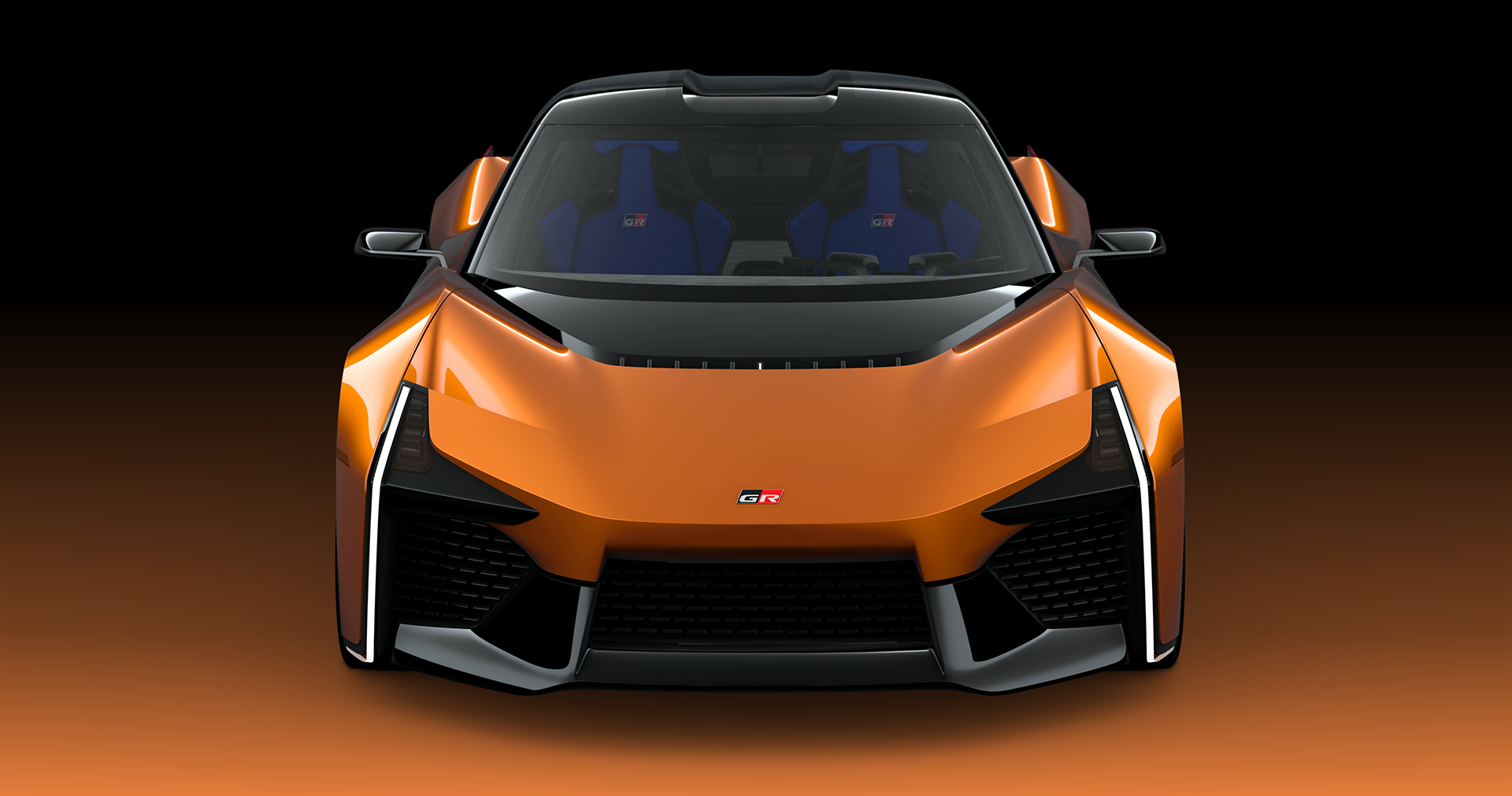
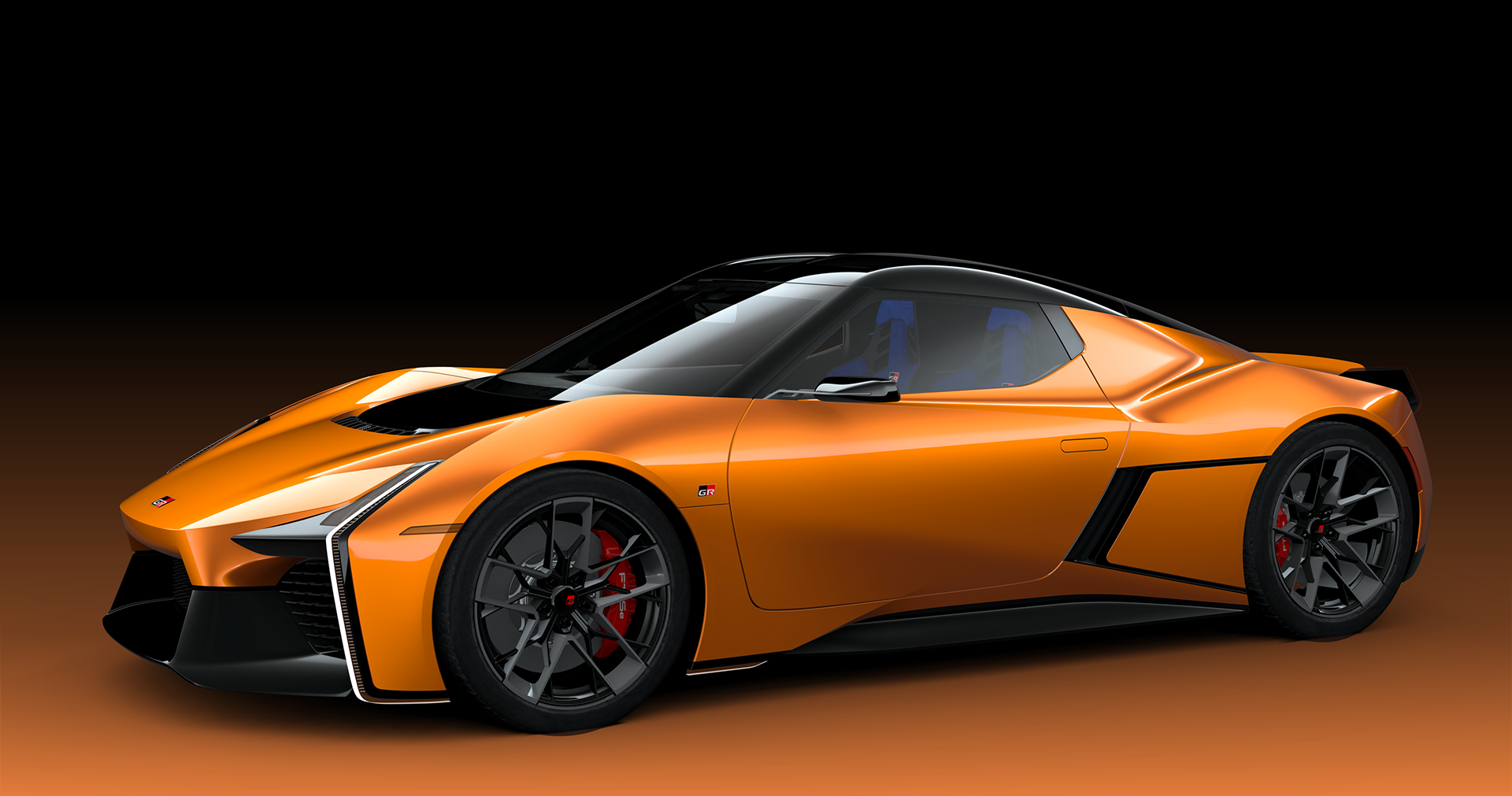
Styling for the new mid-engined sports car is expected to adhere to the design first proposed for the electric FT-Se concept (pictured here) in 2023, despite the switch to a combustion powertrain.
While this latest information provides a glimpse of what to expect from the new MR2 when it finally reaches production, Toyota is still no closer to formalising an expected timeframe for the new model’s arrival.
Mazda undoubtedly knows a thing or two about selling medium SUVs in the Australian market, with more than 330,000 CX-5s sold here and more than 20,000 current customers having owned more than one CX-5. So, Mazda’s sales leader is as popular as it is attractive the second time around.
Making up approximately 25 per cent of Mazda’s Australian sales – and topping the brand’s sales charts for the last seven years running – the CX-5 (below) is once again projected to crest 25,000 sales in 2026, with the outgoing model and new model combined.
But can that success be sustained in the face of increasing competition – specifically from China but also elsewhere? Mazda Australia’s boss, Vinesh Bhindi, reckons the current sales climate is a reflection of how it’s always been in Australia.
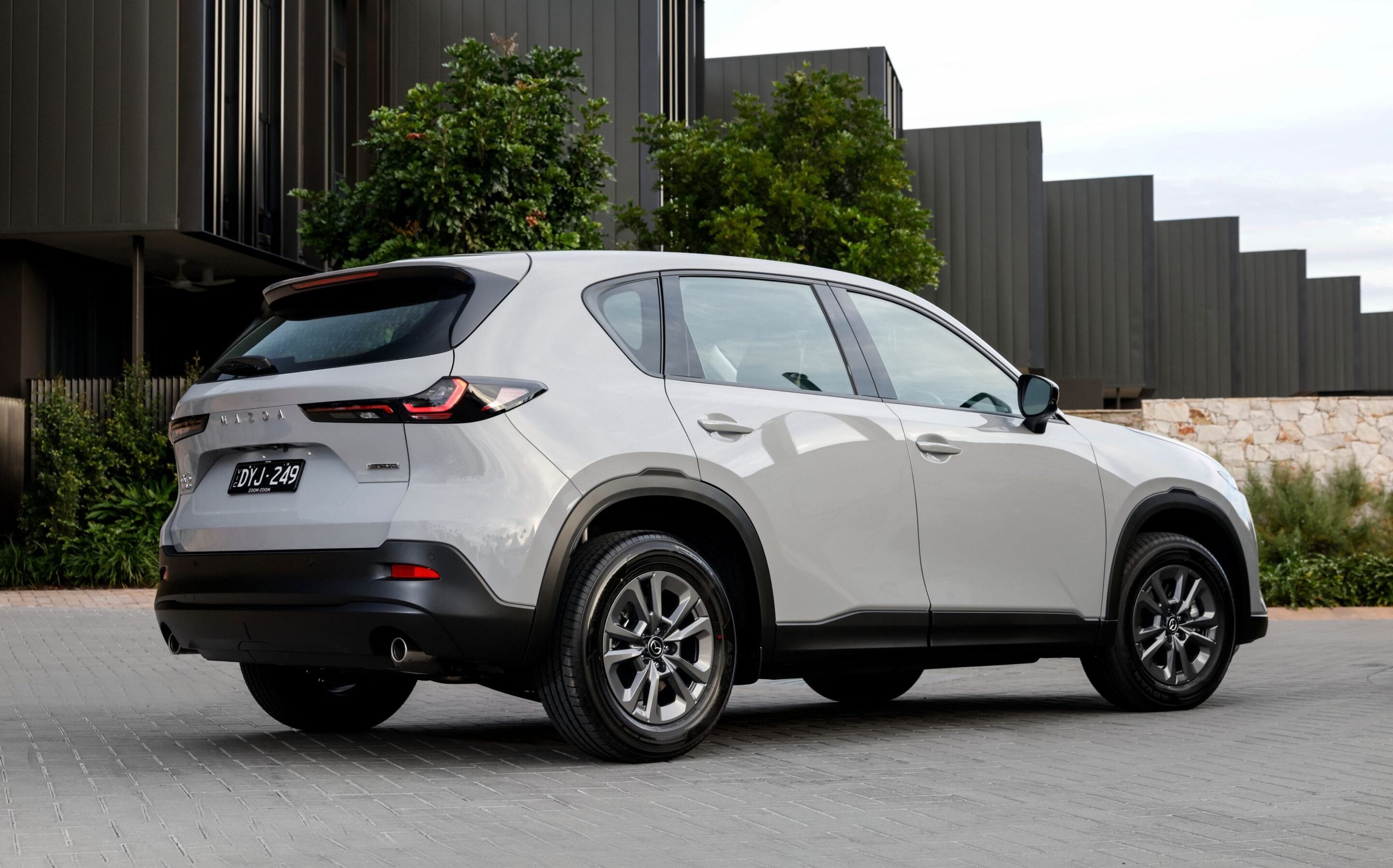
“When you go back in time, there are always others available that are cheap, or cheaper,” Bhindi told WhichCar by Wheels. “But Australians do understand the economics, and how purchasing a car works – that other implications outside of the sticker price should be taken into consideration.”
Bhindi reiterates that those ‘other implications’ should be taken into account before the purchase of something as expensive as a motor vehicle.
“The support, the warranty, the resale value, and the feeling… if you do want a Mazda drive, you’re only going to get it from a Mazda, not from any other product that’s around,” Bhindi said. “So there are customers who are still in tune with that thinking. We have to continue to make sure that our value package remains right, not over, not under, but we have to offer something that is different.”
That point of difference, according to Mazda, is in the range of vehicles you can access with its badge on them. While it’s unlikely sedans will have a resurgence similar to that seen in the USA of the last 12 to 24 months, Mazda will continue to offer cars like Mazda 2 and Mazda 3 which are still attractive to Australian buyers if not as popular as they once were.
“We haven’t gotten any indication that there will be a resurgence, but it won’t dip any further,” Mazda Australia Director of Sales and Marketing, Jarrod Gieschen said.
“There’s a market for those cars, but there are really different reasons for why people have made those choices,” Bhindi said. “And our plan is to offer as much choice as we can.”
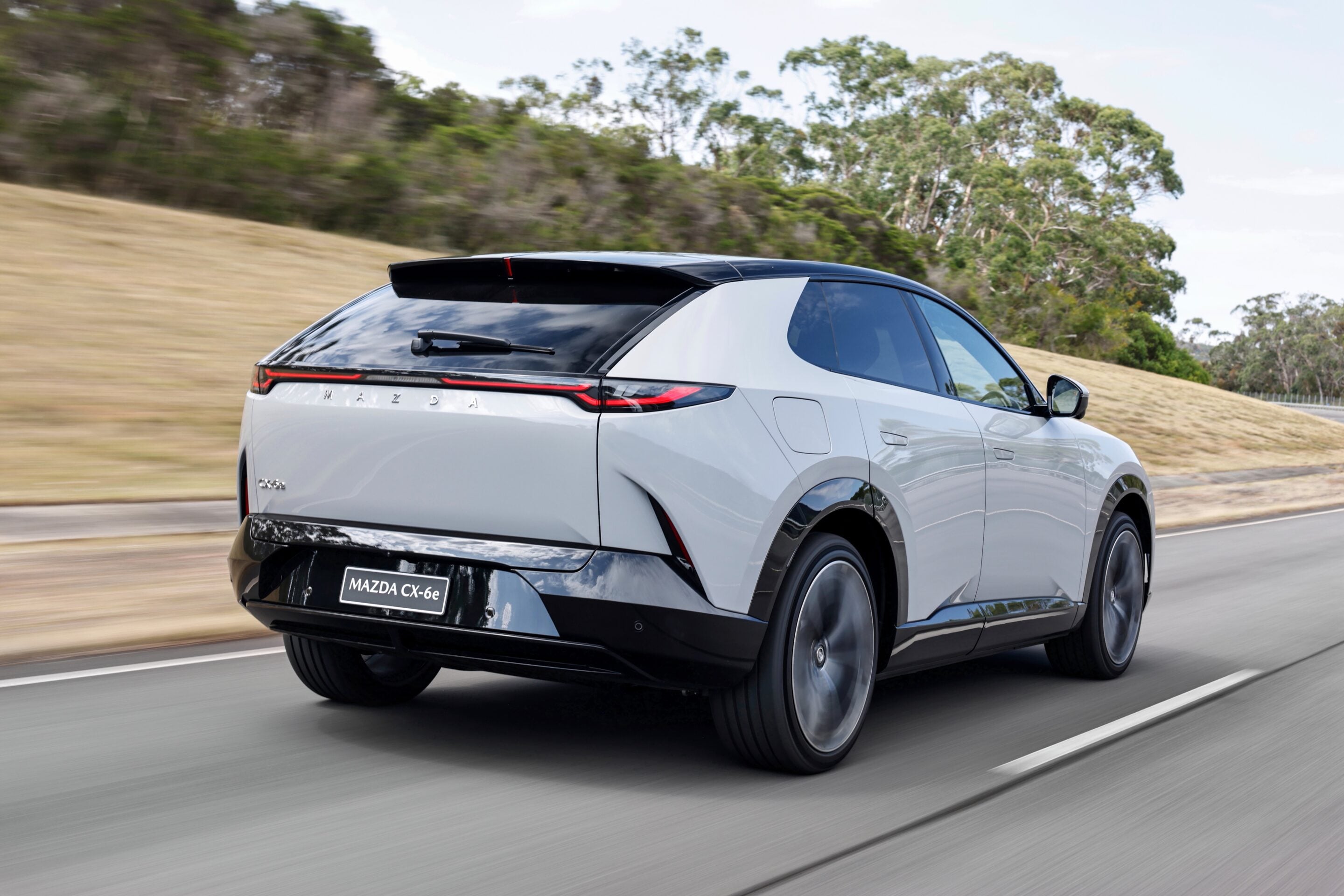
The addition of two soon-to-be released electric vehicles, the 6e and CX-6e (above), will again broaden that choice within the Mazda showroom.
“It’s been really interesting with 6e and CX-6e, where the 6e has appealed more to our traditional database (of owners), whereas the CX-6e has been new customers to the brand,” Gieschen said.
“So it just goes to show that Mazda, with our history of passenger cars, is still obviously appealing.”
For many Australians, the Mitsubishi Magna was more than just a family car. Built locally and engineered with Australian conditions in mind, it earned a reputation for practicality and value for money. As a result, over 750,000 units were built over its 20-year production span. While the nameplate sadly disappeared in 2005, it still holds a special place in the hearts of enthusiasts and former owners alike, with many enthusiast events still taking place each year celebrating Mitsu’s homegrown Australian icon.
But what if the Magna were still produced today? Well, isn’t this what AI is for? We’ve imagined what a modern-day Magna range might look like in 2026, from an affordable LS sedan to a flagship VR-X wagon.
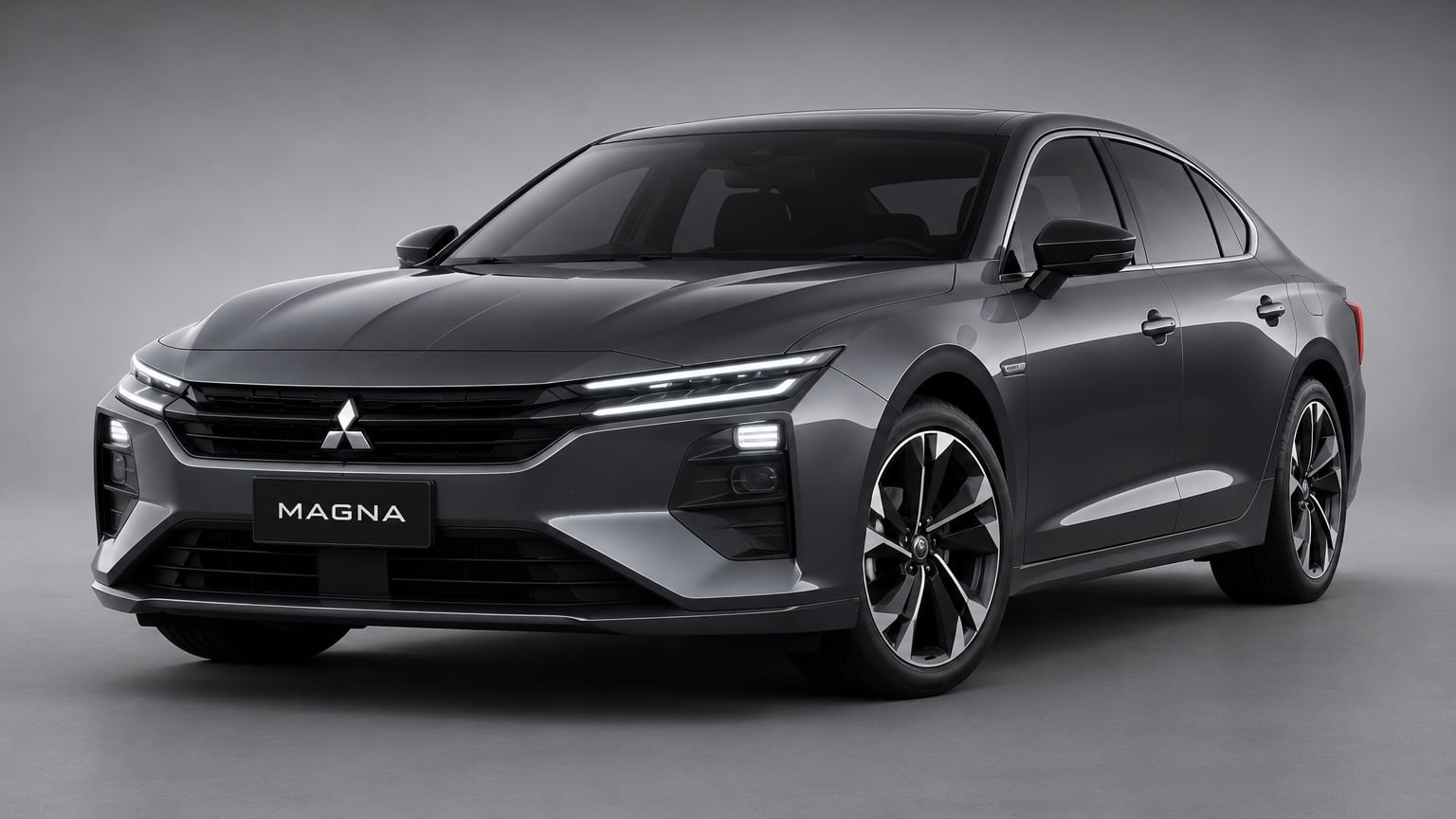
We have to say that AI delivered the goods when designing a 2027 Magna. It looks sharp, modern and like a current Mitsubishi product, with sharp headlights and a big grille. AI rendered both sedan and wagon versions of the Magna, as both bodystyles were big parts of the line-up throughout its life.
Both the sedan and wagon look somewhat European, with great proportions and detailing. AI designed the sedan and wagon in Exceed Tourer specification, which would be the luxury model in the line-up. As such, they feature large 19-inch wheels, LED exterior lighting, panoramic roofs and long wheelbases for plenty of rear seat legroom.
Under the bonnet, given the current Australian new car market, electrification would be the central drivetrain propulsion choice. Overseas, Mitsubishi sells the Outlander medium SUV with a mid-hybrid 1.5-litre turbo-petrol engine, so that could be the drivetrain choice for the entry-level models.
Above that, we would likely see a full-hybrid system, potentially the 1.8-litre hybrid drivetrain used in some Renault products, and above that, the 221kW 2.4-litre plug-in hybrid found in the Outlander PHEV. Could that be turbocharged for a return of the Magna Ralliart? Let’s hope so.
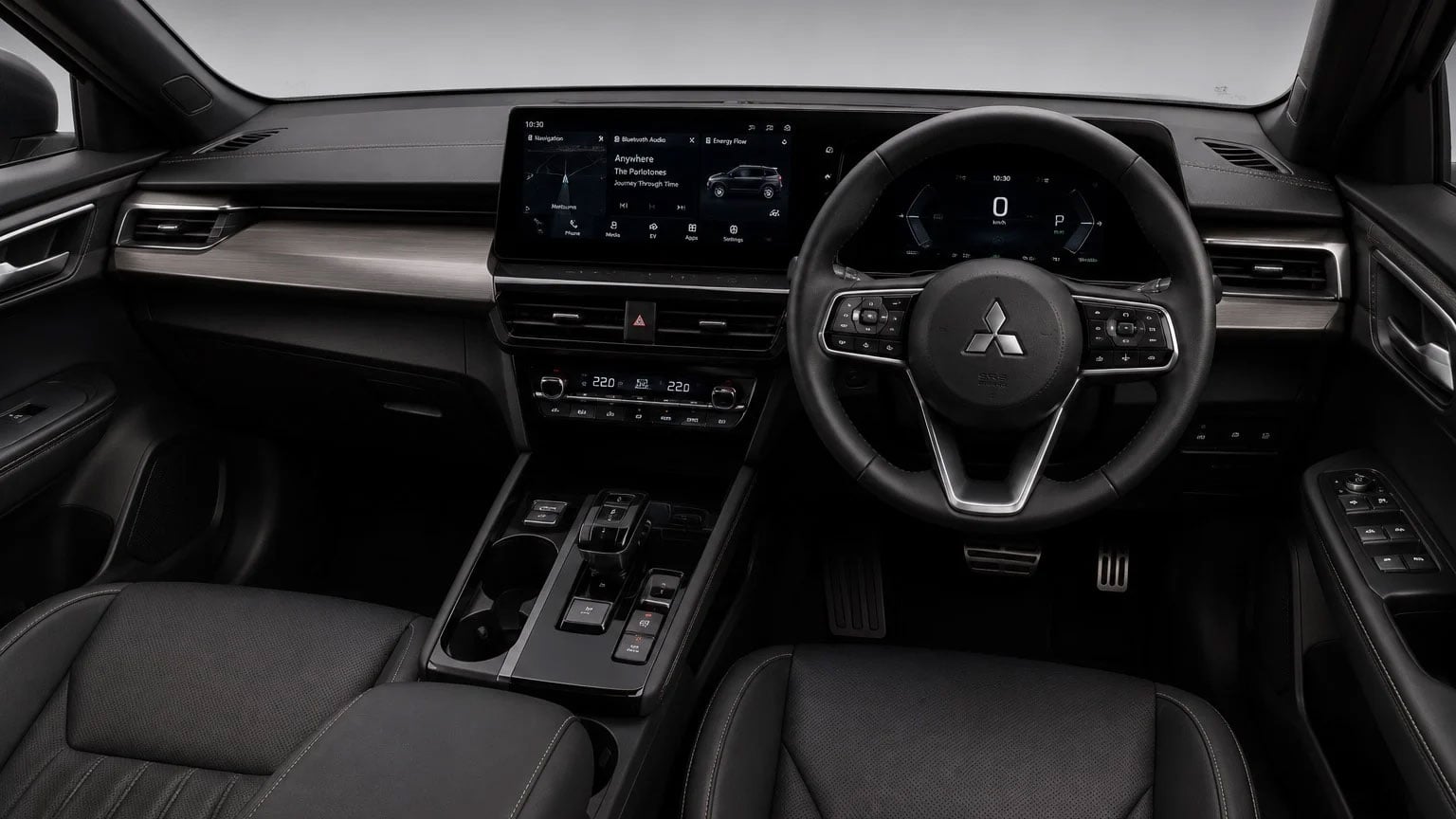
Inside, AI has rendered a classy and high quality cabin for the 2027 Magna range. Shown in both Exceed (black) and Exceed Tourer (tan) models, the dashboard layout takes from the Mitsubishi Expander that’s not sold in Australia with a joined panel featuring both a large infotainment screen and a large digital driver’s display.
The steering wheel takes from the Triton with a nice leather finish and buttons for features like the cruise control, while below the touchscreen is a dual-zone automatic climate control and a centre console with storage, cup holders, the gear selector and parking brake.
The new Magna’s rear seat looks huge, with ample space for taller adults, and it’s well featured with kit including a separate climate zone, heated seats, air vents and a central arm rest. The wagon’s boot measures over 600 litres with the rear seats up and over 1800 litres with the rear seats folded, and we’re sure the sedan would be quite practical for that body style.
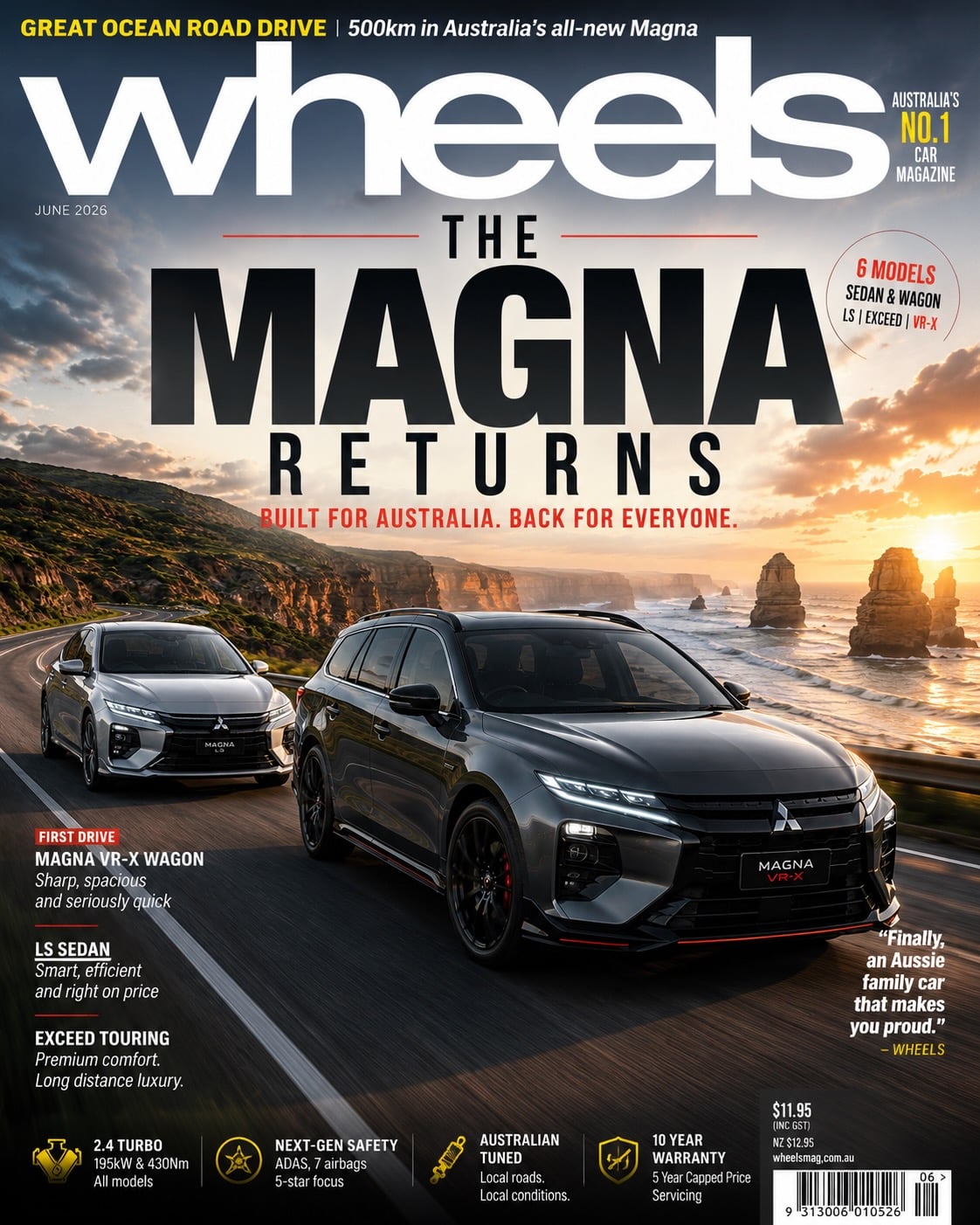
AI also rendered a Wheels-style cover for our enjoyment showing both the VR-X wagon and LS sedan driving along the Great Ocean Road, which looks really cool. Plus, it also rendered the same cars with the Sydney Harbour Bridge in the background for a “distinctly Australian flavour.”
Unfortunately, there is almost zero chance that we’ll ever see the Magna ever produced again. But these renders give us a look into a future that still offers Australian made products, as well as a Mitsubishi line-up that isn’t dominated by SUVs. One can only hope that happens again someday.
