
Classic Wheels
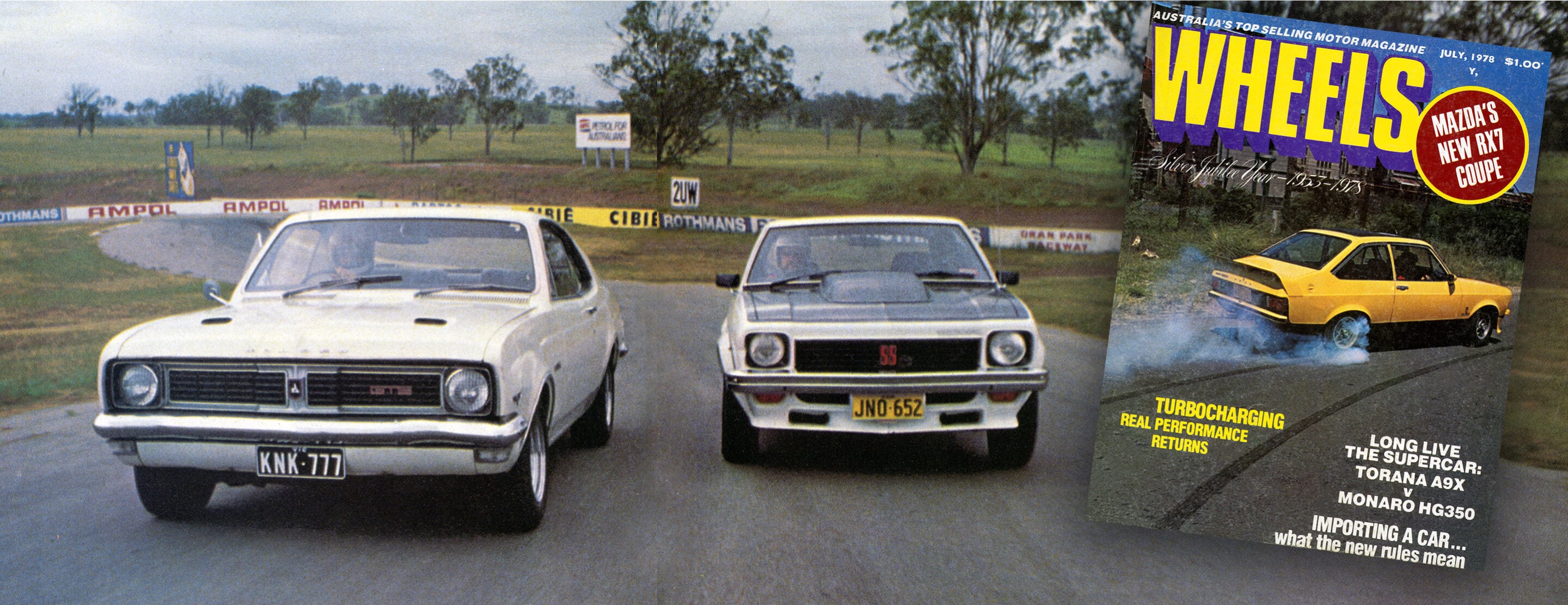
Gallery 1
First published in the July 1978 issue of Wheels magazine, Australia’s best car mag since 1953. Subscribe here and gain access to 12 issues for $109 plus online access to every Wheels issue since 1953.
Chrysler started it in 1962, quite unwittingly of course, with the first Valiant but except for one glorious period in the early Seventies it never really understood what they were all about or how they could be used to sell the bread-and-butter cars.
Henry and The General were late arrivals but they went in boots and V8 muscle and are still fighting the good fight on race tracks around Australia. However today’s race cars are very different to the road cars and in a way that was unimaginable 10 years ago.
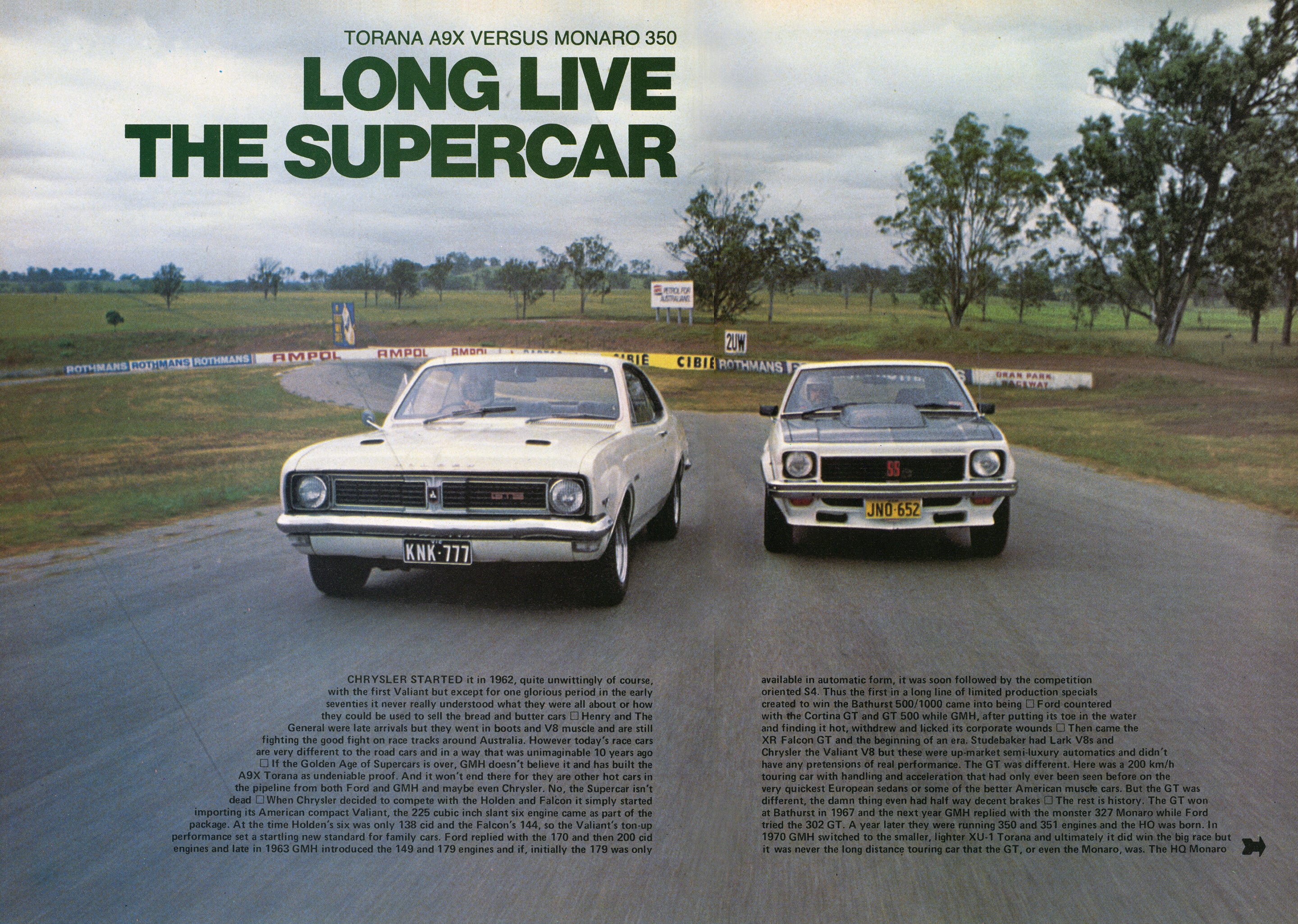
If the Golden Age of Supercars is over, GMH doesn’t believe it and has built the A9X Torana as undeniable proof. And it won’t end there for there are other hot cars in the pipeline from both Ford and GMH and maybe even Chrysler. No, the Supercar isn’t dead.
1
When Chrysler decided to compete with the Holden and Falcon it simply started importing its American compact Valiant, the 225 cubic-inch slant six engine came as part of the package. At the time Holden’s six was only 138cid and the Falcon’s 144, so the Valiant’s ton-up performance set a startling new standard for family cars.
Ford replied with the 170 and then 200cid engines and late in 1963 GMH introduced the 149 and 179 engines and if, initially the 179 was only available in automatic form, it was soon followed by the competition oriented S4. Thus the first in a long line of limited production specials created to win the Bathurst 500/1000 came into being.
Ford countered with the Cortina GT and GT 500 while GMH, after putting its toe in the water and finding it hot, withdrew and licked its corporate wounds. Then came the XR Falcon GT and the beginning of an era. Studebaker had Lark V8s and Chrysler the Valiant V8 but these were up-market semi-luxury automatics and didn’t have any pretensions of real performance.
The GT was different. Here was a 200km/h touring car with handling and acceleration that had only ever been seen before on the very quickest European sedans or some of the better American muscle cars. But the GT was different, the damn thing even had half way decent brakes.
The rest is history. The GT won at Bathurst in 1967 and the next year GMH replied with the monster 327 Monaro while Ford tried the 302 GT. A year later they were running 350 and 351 engines and the HO was born.
1
In 1970 GMH switched to the smaller, lighter XU-1 Torana and ultimately it did win the big race but it was never the long distance touring car that the GT, or even the Monaro, was. The HQ Monaro pretended to compete but didn’t, not on the race track or the road.
Then dear old Chrysler got into the act with the Charger E38, a favourite of ours, even with its three-speed gearbox and brakes which lacked power assistance. Raw in everything except the tripled Weber carburetted engine, it made all the right noises. But it was not enough and the great Phase III GT HO blasted GMH and Chrysler’s hopes into its slipstream down Conrod at Bathurst in 1971.
The Phase Ill was the ultimate Australian four-door sedan and just maybe the world’s. Then came the stillborn Torana V8, the Phase IV and the racing Charger 340 but they all died at the politicians’ knife. The rules for Bathurst were changed and an epoch finished.
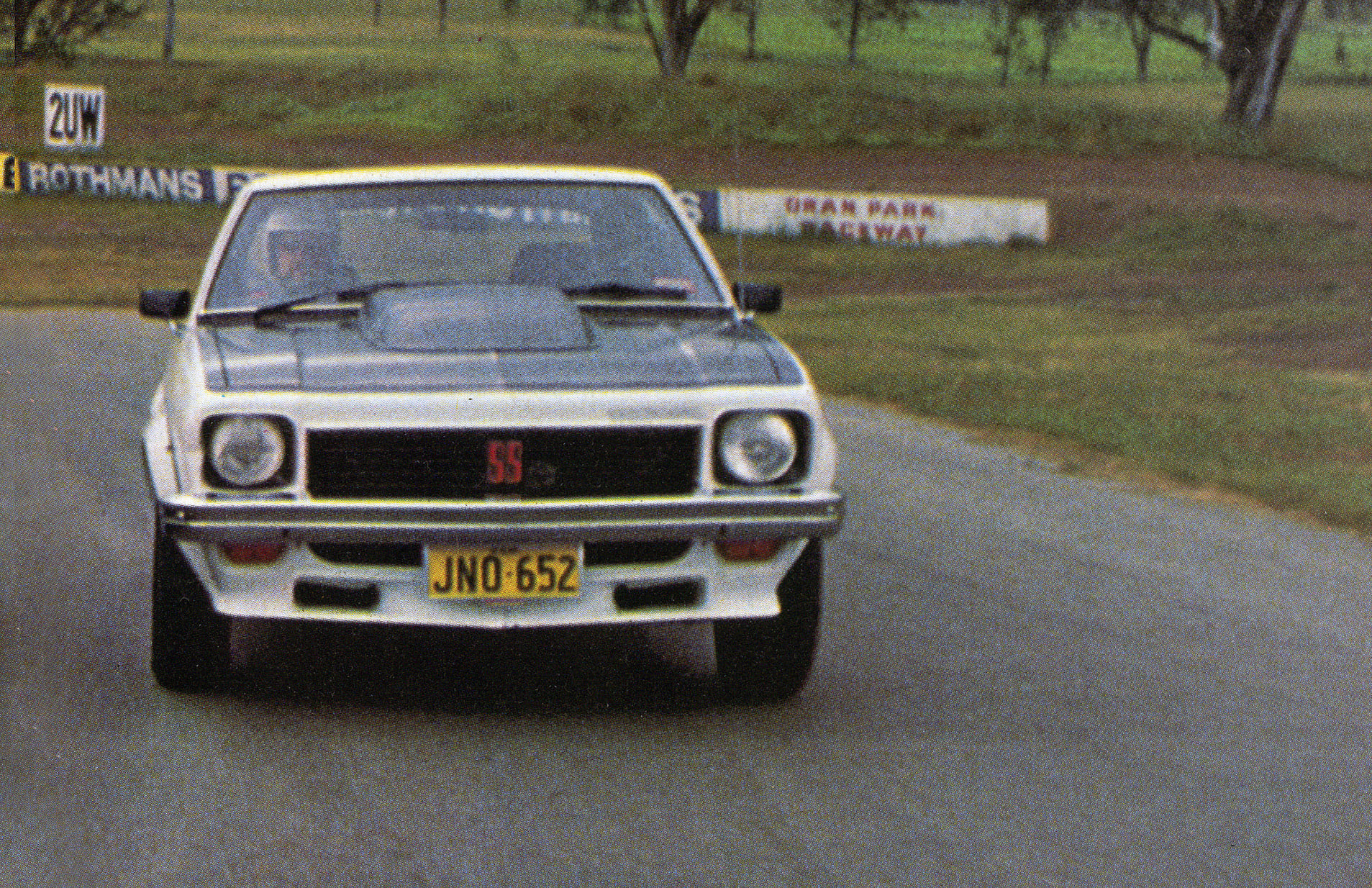
The Torana V8 appeared in the LH and the L34 formed the basis for the racing cars, while Ford dropped the GT and Chrysler decided one Bathurst was quite enough and retreated to the quiet of Adelaide. The L34 produced the A9X and the HO’s most serious challenger to the title of ultimate Supercar. But that’s what our story is all about.
Even now, at the distance of eight-and-a-bit years on, it is difficult to recall for those of you who for some reason or another were not aware at the time, the fascination the super cars exerted on Australian enthusiasts in the late ’60s. Certainly, we were bound up in the October pilgrimage to The Mount; it was also the spectacle of the two giants of the motor industry diverting as much technology and money as they could afford into designing and building what were then the fastest production sedans in the world.
1
There are some enthusiasts who recall with a bitterness normally reserved for Labor supporters remembering Sir John Kerr’s sacking of Gough Whitlam’s government, the spark that started the fire that led to the premature end of super cars in Australia. That spark was Evan Green’s article in the Sydney Sun-Herald that outlined the alleged 150mph new Toranas being secretly built for that year’s Bathurst. It was what is best gently described in journalistic terms as a legitimate Sunday newspaper beat-up; I am sure Evan never intended it to have the effect it did. But it came smack in the era of Naderism and on the threshold of the energy scare, and it took only a few questions in Parliament and a few panic statements by ministers to stop the Phase Four GTHO and postpone the planned V8 Torana and end the days of Bathurst as a genuine test of production sedans.
It was the end of some marvellous cars, until the A9X Torana – rare as it is – came onto the market with not a bang but a whisper. Could it be that GMH still remembered the scandal about those suicidally-dangerous monster cars being sold to the public? Of course it did; The General has a long memory about its public image.
But in 1969 the Bathurst frenzy came to its peak, because Ford had won in 1967 with the rudimentary first Falcon GT, then GM with the lumbering, clanking HK 327 Monaro in 1968; so 1969 was the first real confrontation. It was the first year of the Holden Dealer Team, The General sheltering behind the fiction of non-involvement by the factory while tipping bulk money into the end of the chute leading to Harry Firth’s wizard’s lair. It was also the first year of the GTHO. I cannot remember a Bathurst since that has had as much public interest.
The HDT ran three cars and won with Colin Bond and Tony Roberts. I drove a 350 for Boyded, a Sydney Holden dealer, and we were lying fifth when in the third hour the engine blew down Conrod. But the race started even more sensationally when in the first lap poor Bill Brown got shoved up the bank over Skyline and rolled his Falcon, starting a multiple car pileup that brought the race to a temporary halt, outed four other cars immediately and crippled another half-dozen. I remember well coming over Skyline in the pack of Monaros and GTHOs and seeing Brown about three metres off the ground; I somehow decided to flick to the right and got through, while the other cars slithered into the debris with wheels locked.
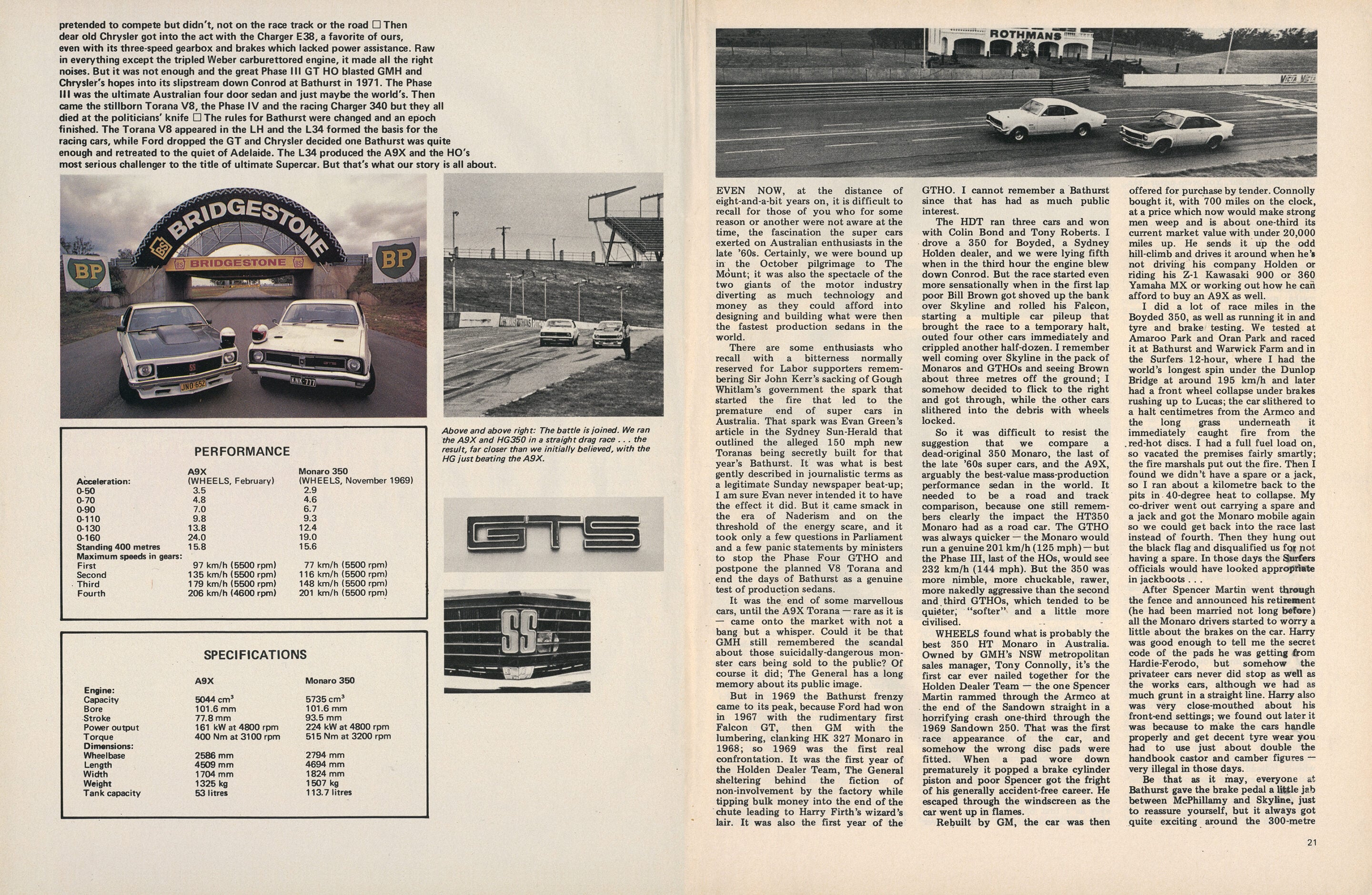
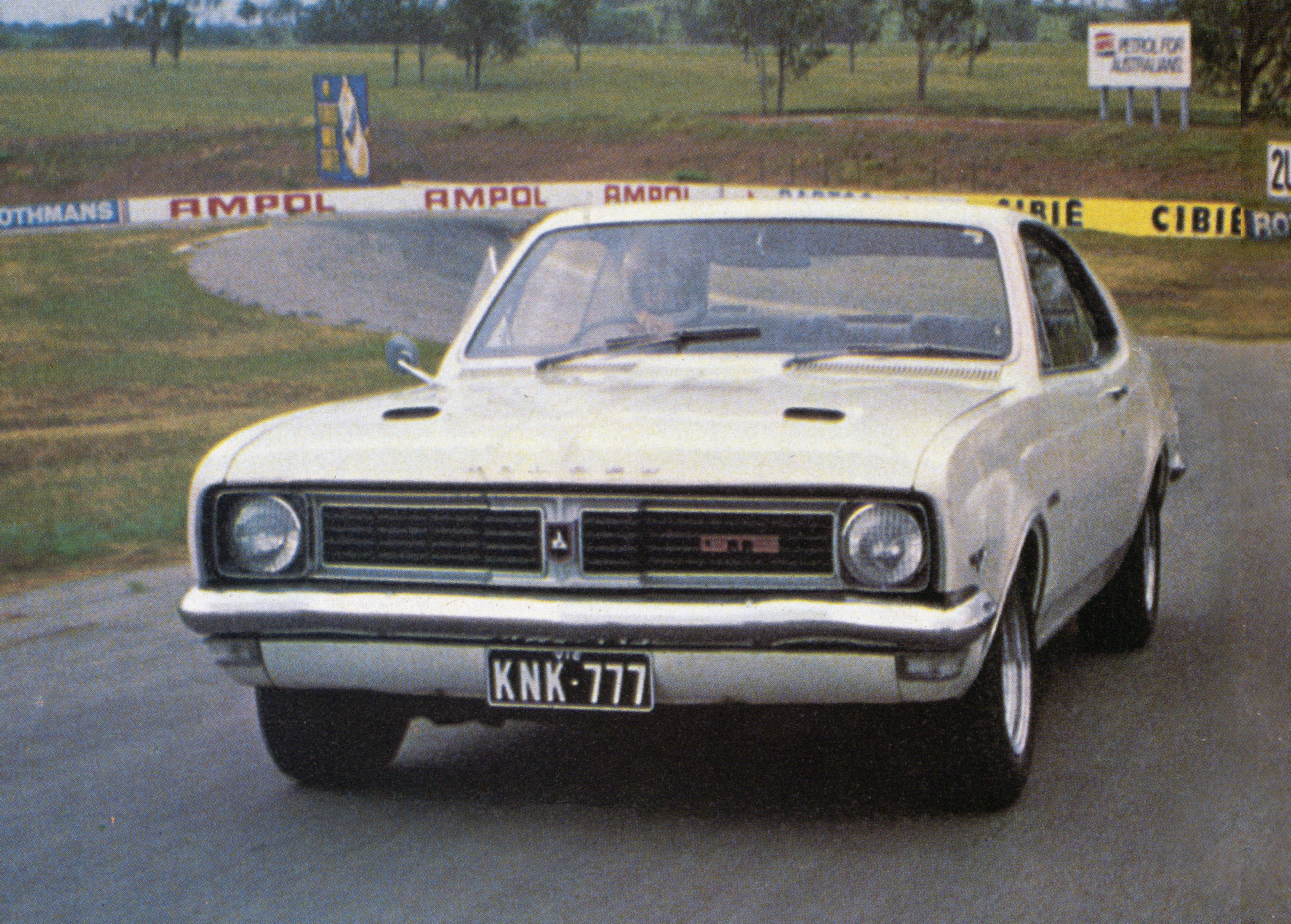
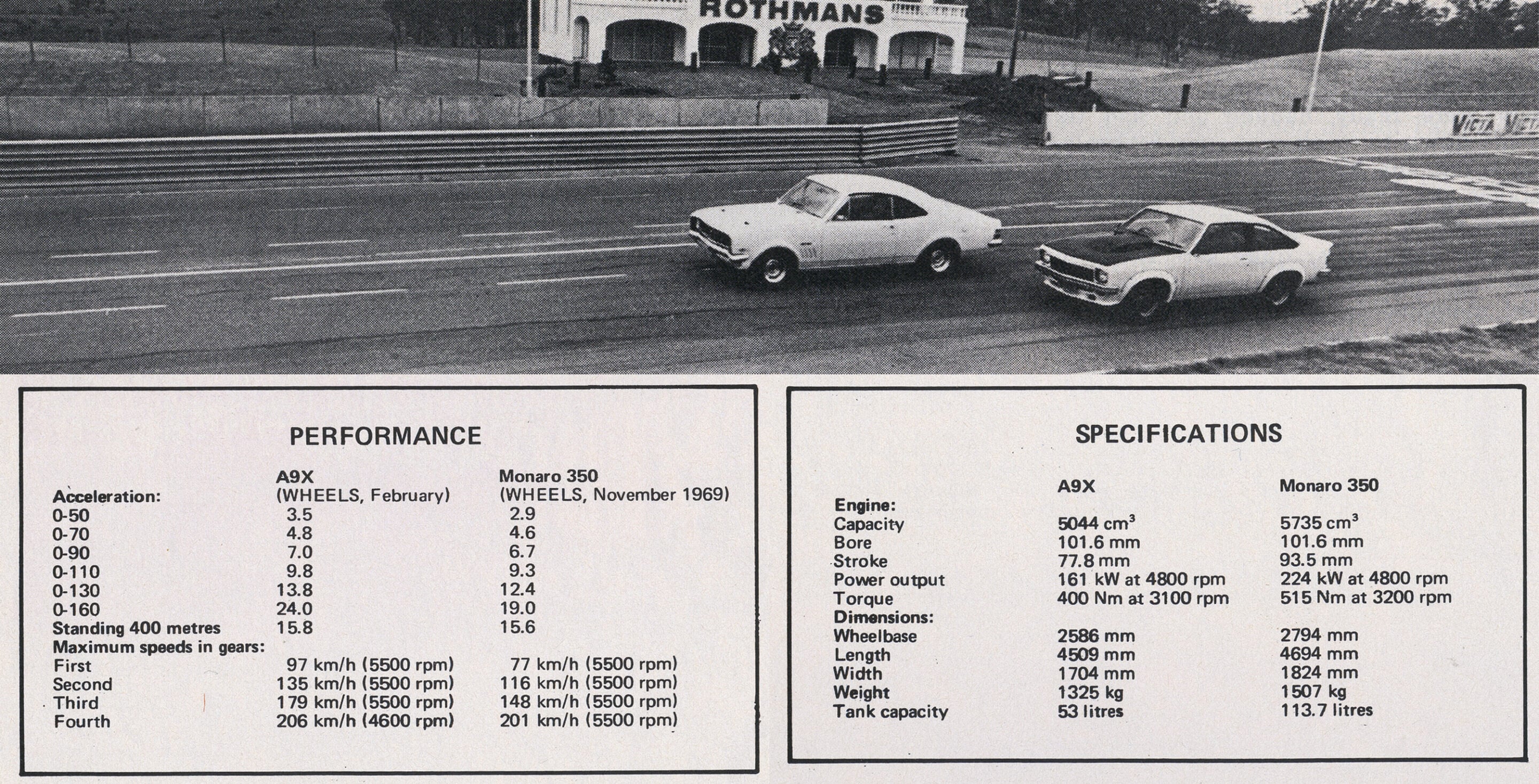
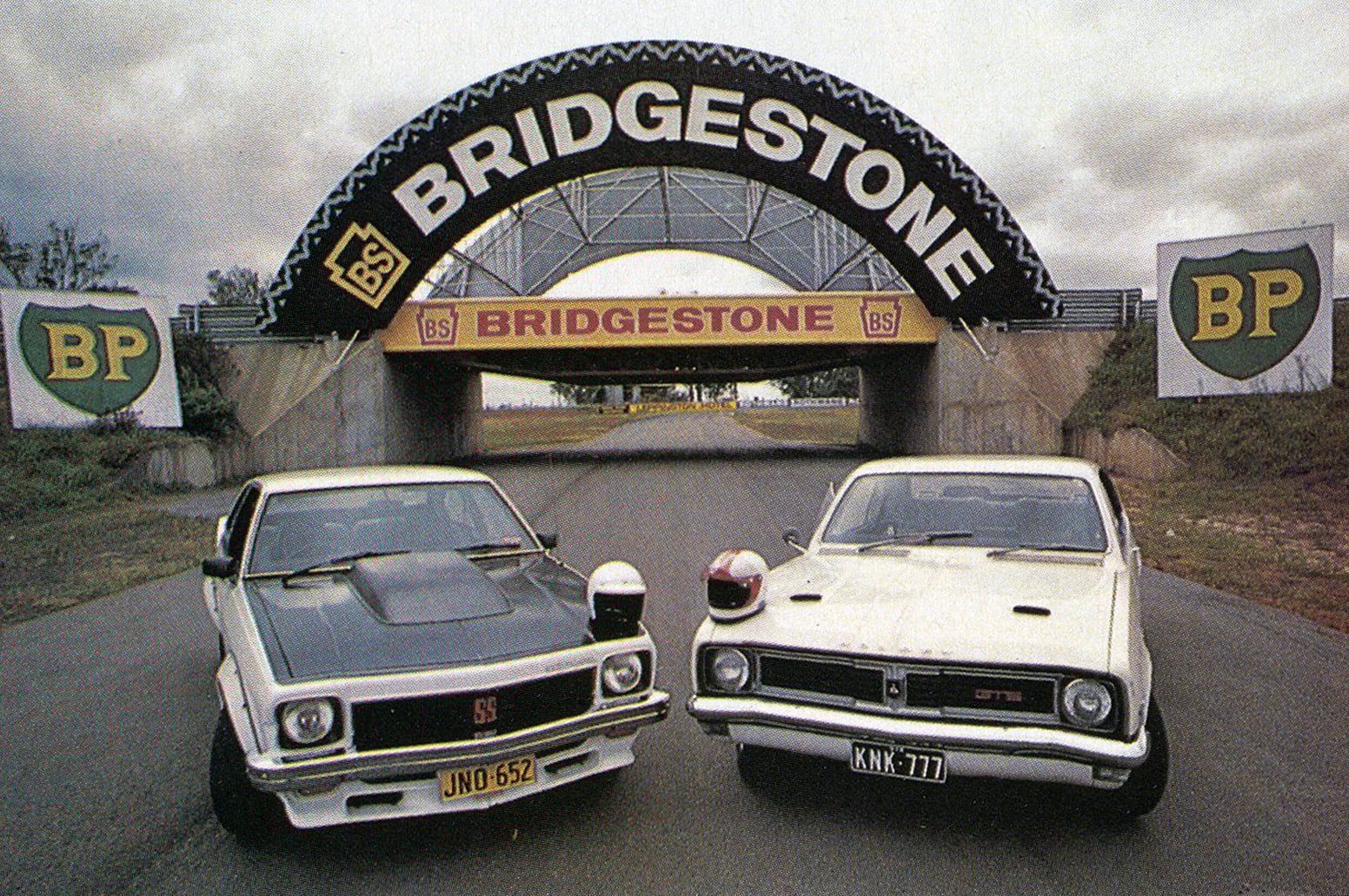
So it was difficult to resist the suggestion that we compare a dead-original 350 Monaro, the last of the late ’60s super cars, and the A9X, arguably the best-value mass-production performance sedan in the world. It needed to be a road and track comparison, because one still remembers clearly the impact the HT350 Monaro had as a road car. The GTHO was always quicker – the Monaro would run a genuine 201km/h (125 mph) – but the Phase III, last of the HOs, would see 232km/h (144 mph). But the 350 was more nimble, more chuckable, rawer, more nakedly aggressive than the second and third GTHOs, which tended to be quieter; “softer” and a little more civilised.
1
Wheels found what is probably the best 350 HT Monaro in Australia. Owned by GMH’s NSW metropolitan sales manager, Tony Connolly, it’s the first car ever nailed together for the Holden Dealer Team – the one Spencer Martin rammed through the Armco at the end of the Sandown straight in a horrifying crash one-third through the 1969 Sandown 250. That was the first race appearance of the car, and somehow the wrong disc pads were fitted. When a pad wore down prematurely it popped a brake cylinder piston and poor Spencer got the fright of his generally accident-free career. He escaped through the windscreen as the car went up in flames.
Rebuilt by GM, the car was then offered for purchase by tender. Connolly bought it, with 100 miles on the clock, at a price which now would make strong men weep and is about one-third its current market value with under 20,000 miles up. He sends it· up the odd hill-climb and drives it around when he’s not driving his company Holden or riding his Z-1 Kawasaki 900 or 360 Yamaha MX or working out how he can afford to buy an A9X as well.
I did a lot of race miles in the Boyded 350, as well as running it in and tyre and brake testing. We tested at Amaroo Park and Oran Park and raced it at Bathurst and Warwick Farm and in the Surfers. 12-hour where I had the world’s longest spin under the Dunlop Bridge at around 195km/h and later had a front wheel collapse under brakes rushing up to Lucas; the car slithered to a halt centimetres from the Armco and the long grass underneath it immediately caught fire from the red-hot discs. I had a full fuel load on, so vacated the premises fairly smartly; the fire marshals put out the fire. Then I found we didn’t have a spare or a jack, so I ran about a kilometre back to the pits in 40-degree heat to collapse.
My co-driver went out carrying a spare and a jack and got the Monaro mobile again so we could get back into the race last instead of fourth. Then they hung out the black flag and disqualified us for not having a spare. In those days the Surfers officials would have looked appropriate in jackboots …
1
After Spencer Martin went through the fence and announced his retirement (he had been married not long before) all the Monaro drivers started to worry a little about the brakes on the car. Harry was good enough to tell me the secret code of the pads he was getting from Hardie-Ferodo, but somehow the privateer cars never did stop as well as the works cars, although we had as much grunt in a straight line. Harry also was very close-mouthed about his front-end settings; we found out later it was because to make the cars handle properly and get decent tyre wear you had to use just about double the handbook castor and camber figures – very illegal in those days.
Be that as it may, everyone at Bathurst gave the brake pedal a little jab between McPhillamy and Skyline, just to reassure yourself, but it always got quite exciting around the 300-metre braking marker at the end of Conrod when you were doing around 215km/h.
I remember that coming down in to Creek Corner at the Farm, when the big cars were really hauling and had to come down to – oh – around 80km/h on entry, the Monaro front end under brakes got up a real shudder, what the bikers call a “tank-slapper”.
You were never quite sure whether the car would stop in the distance you had allocated for it. This feeling lasted right up to the last 20 or 30 metres into the corner, before you actually committed the car. You were never ever bored under brakes in a 350 Monaro.
1
So as I came down the 500 metre main straight at Oran Park for the first time and went for the brakes I had a flash of deja vu followed by the hot flush of recognition of the old uncertainty of Will We-Stop In Time? It was like coming home to your old school and seeing your old maths master Pussy Williams (the name of my old maths master) and finding that he hadn’t changed a scrap in 10 years except that he seemed to have shrunk.
You see, the fashion in GMH engineering in those days was for The Low Brake Pedal. All their cars had the pedal positioned close to the floor. The Wheels road test on November, 1969, explained this doubtful practice thus: “The go-pedal setup is evidently governed at present by the throttle linkage system GM employs on all its cars. Their policy is to provide a full throttle with a flat pedal for safety reasons (strain on linkages etc). This also prevents linkage reversal and means when the throttle is flat on the floor, the throttles are as wide as they’ll ever get … At present the car is fitted with a ‘low-pedal’ setup providing for a minimum ‘safe’ height from the floor of 4¾in on an adjustable arm.”
What all that meant was that GM liked a low throttle pedal and had to pull down the brake pedal height to ease the task of lifting the right foot from one pedal to the other. What it did on the race cars was to add to your awareness that you were trying to stop 1500 kilograms (3316 lbs, or around 29 cwt) of car from 210km/h with a pedal that went to within a hand’s thickness of the floor. At the bottom of Conrod the little Datsun 1000 you bombed past over the first hump would whistle past you at the 200 metre marker, laughing its head off at the purple veins standing out in your forehead.
1
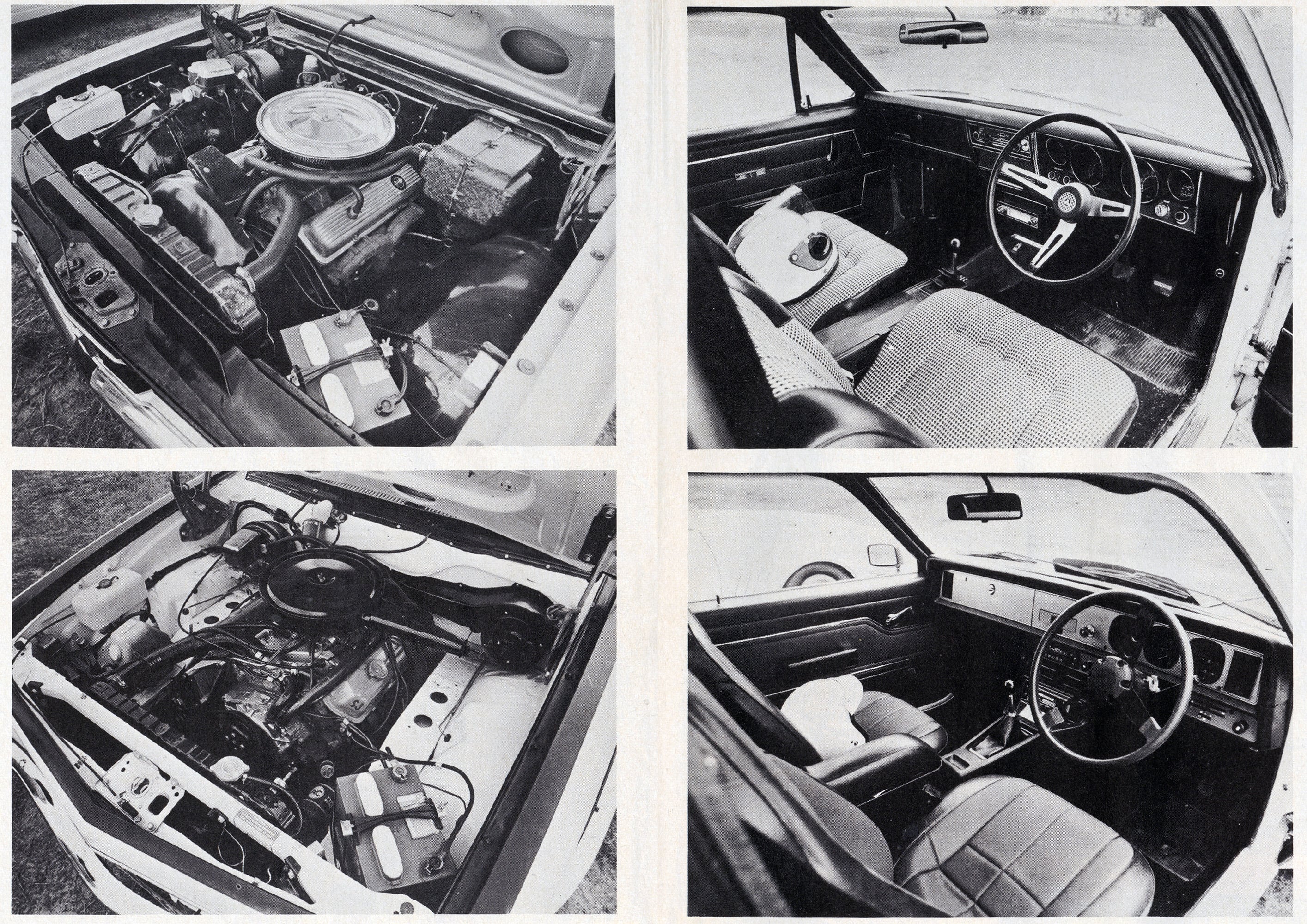
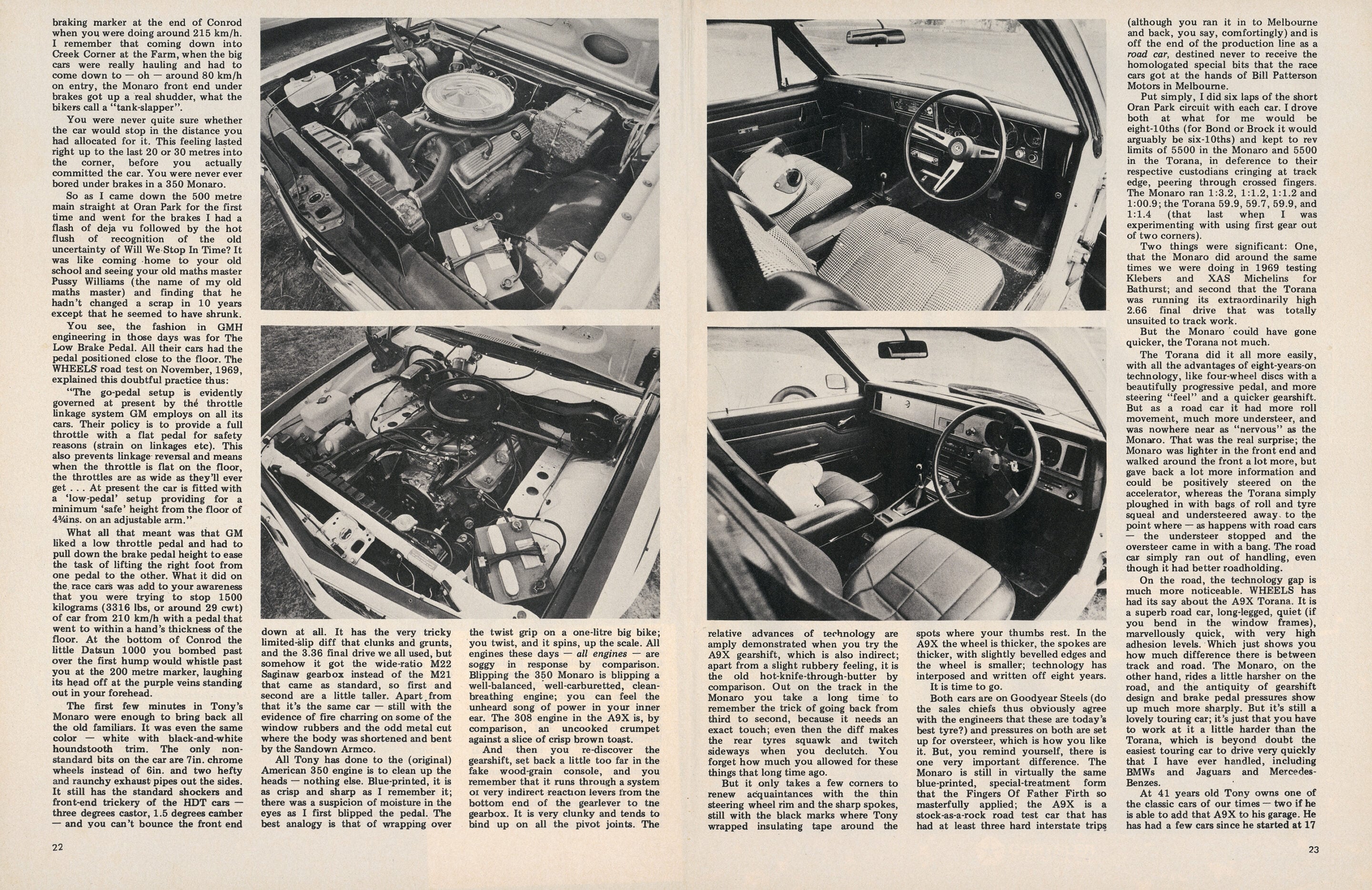
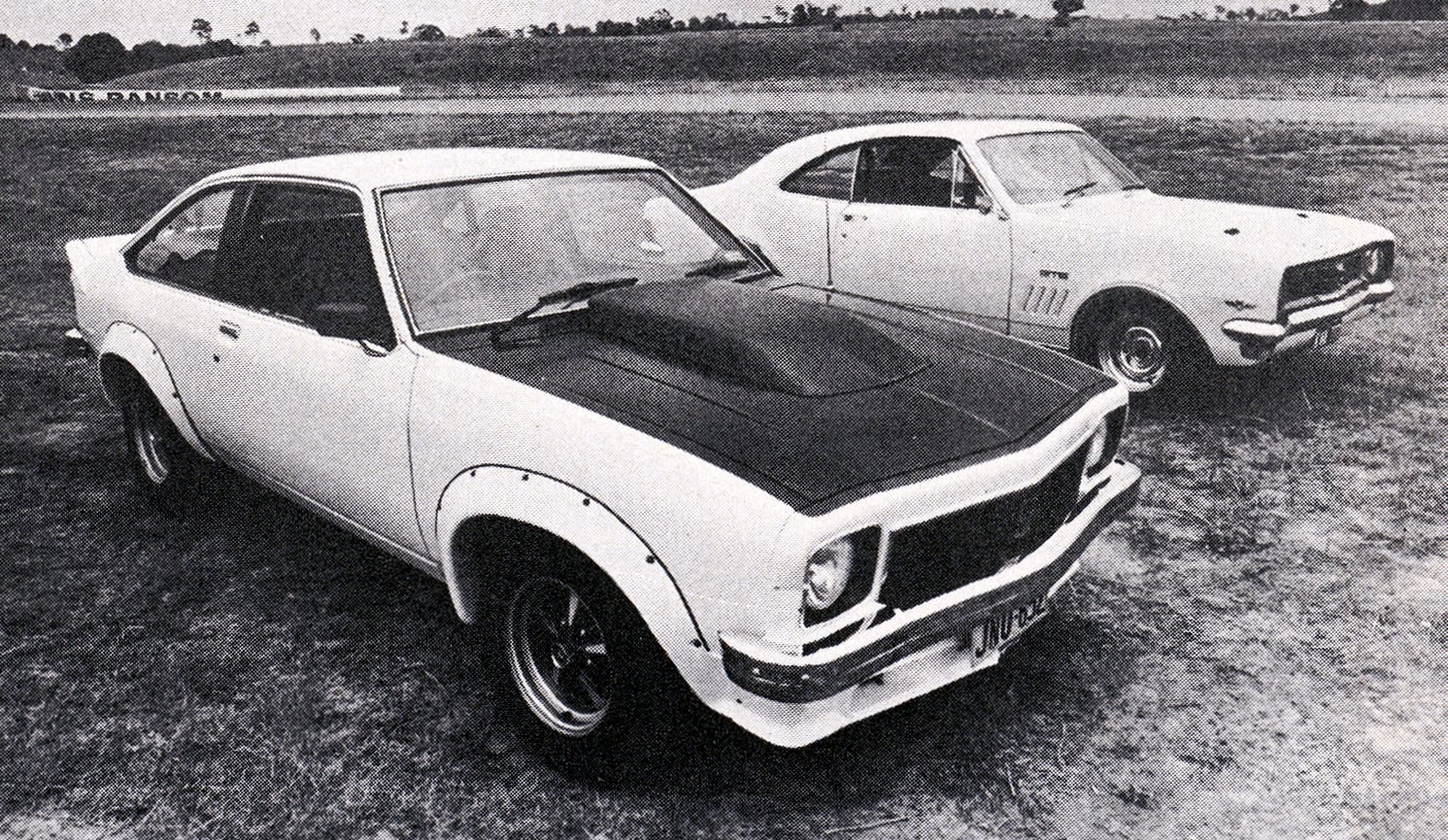
The first few minutes in Tony’s Monaro were enough to bring back all the old familiars. It was even the same colour – white with black-and-white houndstooth trim. The only non-standard bits on the car are 7in chrome wheels instead of 6in and two hefty and raunchy exhaust pipes out the sides. It still has the standard shockers and front-end trickery of the HDT cars – three degrees castor, 1.5 degrees camber – and you can’t bounce the front end down at all. It has the very tricky limited-slip diff that clunks and grunts, and the 3.36 final drive we all used, but somehow it got the wide-ratio M22 Saginaw gearbox instead of the M21 that came as standard, so first and second are a little taller. Apart from that it’s the same car – still with the evidence of fire charring on some of the window rubbers and the odd metal cut where the body was shortened and bent by the Sandown Armco.
All Tony has done to the (original) American 350 engine is to clean up the heads – nothing else. Blue-printed, it is as crisp and sharp as I remember it; there was a suspicion of moisture in the eyes as I first blipped the pedal. The best analogy is that of wrapping over the twist grip on a one-litre big bike; you twist, and it spins, up the scale. All engines these days – all engines – are soggy in response by comparison. Blipping the 350 Monaro is blipping a well-balanced, well-carburetted, clean-breathing engine; you can feel the unheard song of power in your inner ear. The 308 engine in the A9X is, by comparison, an uncooked crumpet against a slice of crisp brown toast.
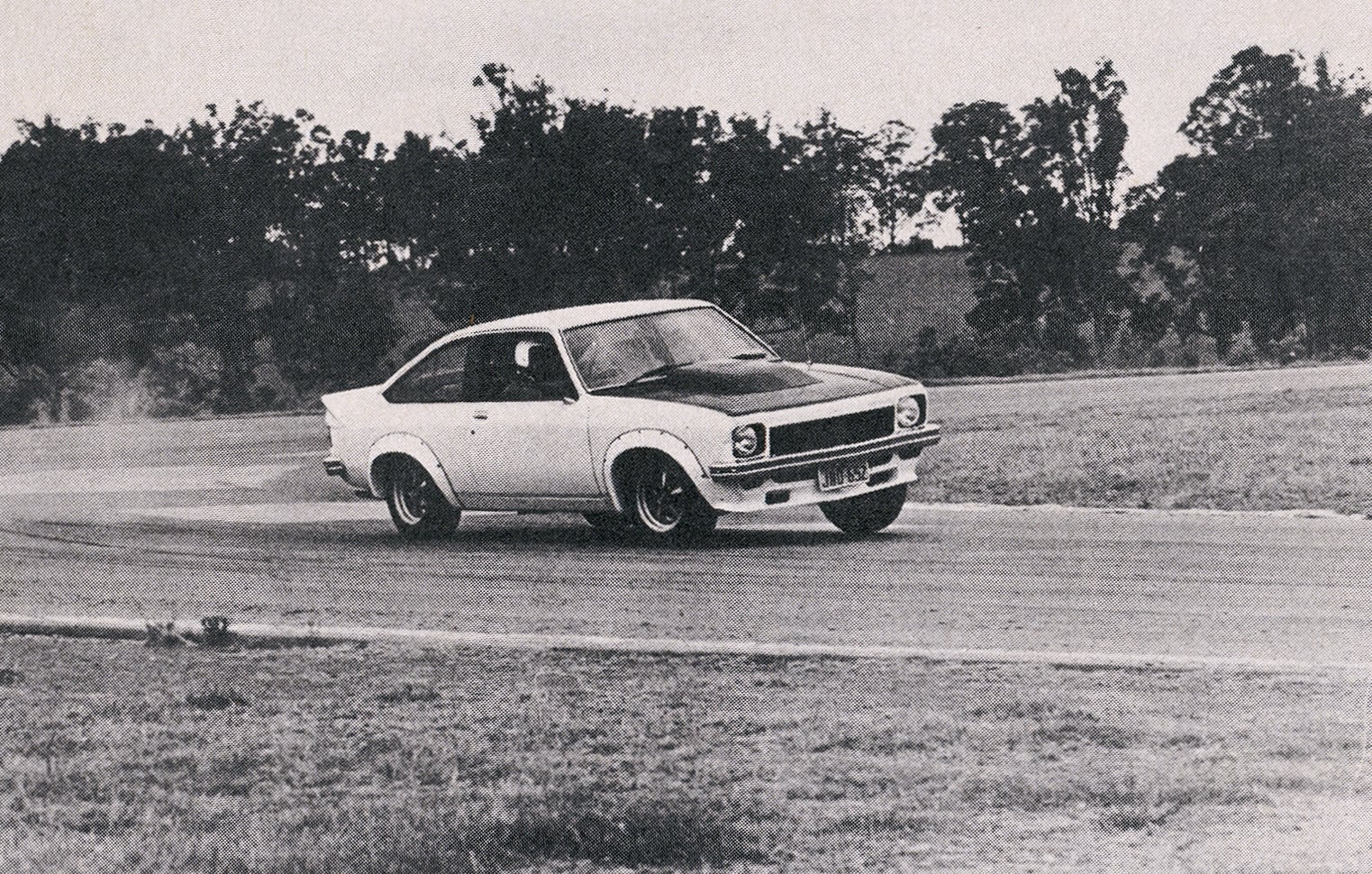
And then you re-discover the gearshift, set back a little too far in the fake wood-grain console, and you remember that it runs through a system of very indirect reaction levers from the bottom end of the gearlever to the gearbox. It is very clunky and tends to bind up on all the pivot joints. The relative advances of technology are amply demonstrated when you try the A9X gearshift, which is also indirect; apart from a slight rubbery feeling, it is the old hot-knife-through-butter by comparison. Out on the track in the Monaro you take a long time to remember the trick of going back from third to second, because it needs an exact touch; even then the diff makes the rear tyres squawk and twitch sideways when you declutch. You forget how much you allowed for these things that long time ago.
1
But it only takes a few corners to renew acquaintances with the thin steering wheel rim and the sharp spokes, still with the black marks where Tony wrapped insulating tape around the spots where your thumbs rest. In the A9X the wheel is thicker, the spokes are thicker, with slightly bevelled edges and the wheel is smaller; technology has interposed and written off eight years. It is time to go.
Both cars are on Goodyear Steels (do the sales chiefs thus obviously agree with the engineers that these are today’s best tyre?) and pressures on both are set up for oversteer, which is how you like it. But, you remind yourself, there is one very important difference. The Monaro is still in virtually the same blue-printed, special-treatment form that the Fingers Of Father Firth so masterfully applied; the A9X is a stock-as-a-rock road test car that has had at least three hard interstate trips (although you ran it in to Melbourne and back, you say, comfortingly) and is off the end of the production line as a road car, destined never to receive the homologated special bits that the race cars got at the hands of Bill Patterson Motors in Melbourne.
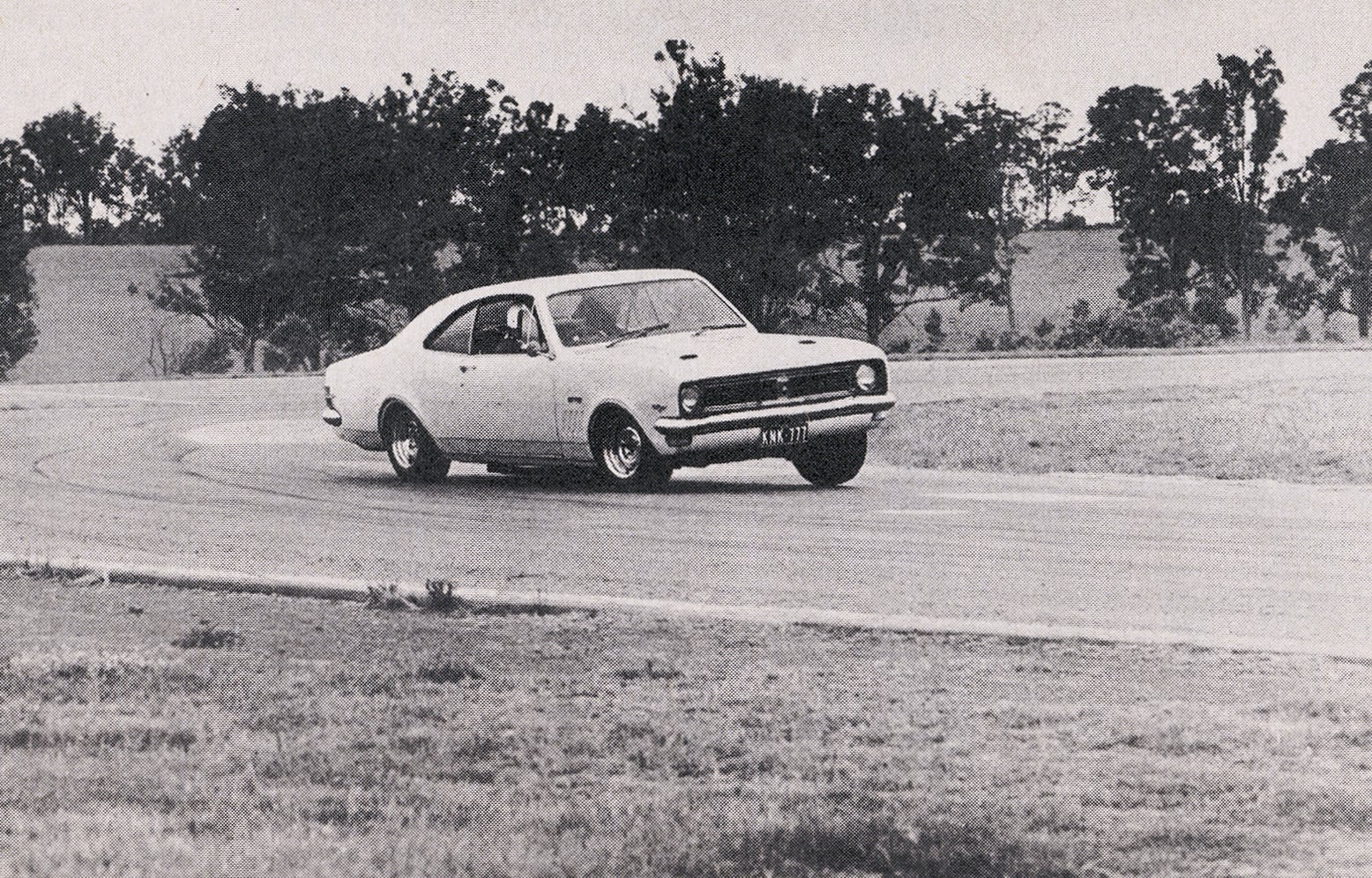
Put simply, I did six laps of the short Oran Park circuit with each car. I drove both at what for me would be eight-10ths (for Bond or Brock it would arguably be six-10ths) and kept to rev limits of 5500 in the Monaro and 5500 in the Torana, in deference to their respective custodians cringing at track edge, peering through crossed fingers. The Monaro ran 1:3.2, 1:1.2, 1:1.2 and 1:00.9; the Torana 59.9, 59.7, 59.9, and 1:1.4 (that last when I was experimenting with using first gear out of two corners).
Two things were significant: One, that the Monaro did around the same times we were doing in 1969 testing Klebers and XAS Michelins for Bathurst; and second that the Torana was running its extraordinarily high 2.66 final drive that was totally unsuited to track work. But the Monaro could have gone quicker, the Torana not much.
1
The Torana did it all more easily, with all the advantages of eight-years-on technology, like four-wheel discs with a beautifully progressive pedal, and more steering “feel” and a quicker gearshift. But as a road car it had more roll movement, much more understeer, and was nowhere near as “nervous” as the Monaro. That was the real surprise; the Monaro was lighter in the front end and walked around the front a lot more, but gave back a lot more information and could be positively steered on the accelerator, whereas the Torana simply ploughed in with bags of roll and tyre squeal and understeered away, to the point where – as happens with road cars – the understeer stopped and the oversteer came in with a bang. The road car simply ran out of handling, even though it had better roadholding.
On the road, the technology gap is much more noticeable. Wheels has had its say about the A9X Torana. It is a superb road car, long-legged, quiet (if you bend in the window frames), marvellously quick, with very high adhesion levels. Which just shows you how much difference there is between track and road. The Monaro, on the other hand, rides a little harsher on the road, and the antiquity of gearshift design and brake pedal pressures show up much more sharply. But it’s still a lovely touring car; it’s just that you have to work at it a little harder than the Torana, which is beyond doubt the easiest touring car to drive very quickly that I have ever handled, including BMWs and Jaguars and Mercedes-Benzes.
At 41 years old Tony owns one of the classic cars of our times – two if he is able to add that A9X to his garage. He has had a few cars since he started at 17 as an apprentice with Hollands in Melbourne, who prepared the late Lex Davison’s race cars … a blown P-Type, a 3¼-bore FJ (he would that he had it now) and a few others, including a superb red 327 HK Monaro from the Melbourne Motor Show I remember very well. He will not sell the HT Monaro 350 for any money.
I know it will hurt you to remember that in October, 1969, this car cost $3995 new. It hurts me.
1
But I said goodbye to the Monaro and drove the A9X back into Sydney in a peculiarly disembodied state of mind. Eventually I traced this feeling back to having been reminded so forcefully of what cars and driving were really like only eight short years ago – when The General could build cars like the 350 Monaro and go out and race them just as they were, not with thousands of dollars of weird gear on them, equipment that the ordinary motorist would never even see, let alone understand … and I then felt terribly sorry for the generation of drivers who instead of a car like the 350 Monaro or the GT Falcon or the A9X (if you can get one) are buying Celica hatchbacks or Lancer coupes or six-cylinder Ghia Cortinas or Datsun SSS 200Bs or similar and don’t know any better or that there was in fact something better, not long ago.
But it isn’t the end. The A9X is not the Last Of The Supercars, no matter what you hear. Both GMH and Ford will be producing more good quick road cars like it, and like the 350 Monaro and the GTHO.
But inevitably, they will be depilated, androgynous, cloned, brave new world versions of what these cars were in the ’60s.
Which is why, every now and then, it is good for Wheels to take its three generations of readers (for such it has) back in the time machine to remind them that there was a day when you could build a car and race it just like it was and everyone in Australia watched in breathless wonder.
1
So anyone who saw me trundling back into Sydney along the Hume Highway laughing my head off at the wheel of an A9X Torana will now know that I was recalling the words of ARDC secretary Ivan Stibbard. He said to me, not two years ago, that they couldn’t run stock production cars at Bathurst any more because today’s cars were much faster and thus there would be a safety problem.
Ivan, I have news for you. We dragged the HT 350 Monaro and the A9X Torana side-by-side over a quarter. The Monaro won by two lengths both times. Sure, the diff ratios were different. But I tell you this right now: Around Bathurst tomorrow morning, the Phase III GTHO and the 350 Monaro will be just as quick as a stock A9X. Where did those eight years go, baby? Who’s wrong?
Follow WhichCar/Wheels on Google
Click the button below to make WhichCar by Wheels a preferred source for your news.

We recommend
-
 Features
From the Wheels archives: We find the fastest Australian car
In September 1977, Wheels settled the argument about what is the fastest Australian car once and for all.
-
 Classic Wheels
From the Wheels archives: Holden SS Group A vs HDT Brock Group Three comparison review
From the March 1998 issue of Wheels, Peter Robinson gets between the two contenders for the title fight as Holden’s new kid on the block challenged Peter Brock’s title as muscle car champion.
-
 Features
From the Wheels archives: The famous ‘lemon’ cover for Wheels Car of the Year in 1979
A shock result in Wheels' Car of the Year award in 1979 got automotive tongues wagging.
