
JEEP Australia is bargaining extra hard with its first-ever all-electric SUV, with the company cleaving thousands off the sticker price of the Jeep Avenger before it’s even landed in showrooms.
It’s certainly good news for EV buyers, with the Avenger’s new opening price of $49,990 (down by $4000) for the Longitude grade allowing Jeep’s new arrival to sneak under the $50K barrier and clinch a pricing advantage against key EV SUV competitors like the new Mini Aceman, Renault Megane E-Tech, Kia Niro Electric and Hyundai Kona Electric. It’s even within striking distance of high-spec variants of popular Chinese EVs such as the BYD Atto 3 and MG ZS EV, with the latter’s flagship ZS Long Range retailing for the same amount of coin as the Avenger Longitude.
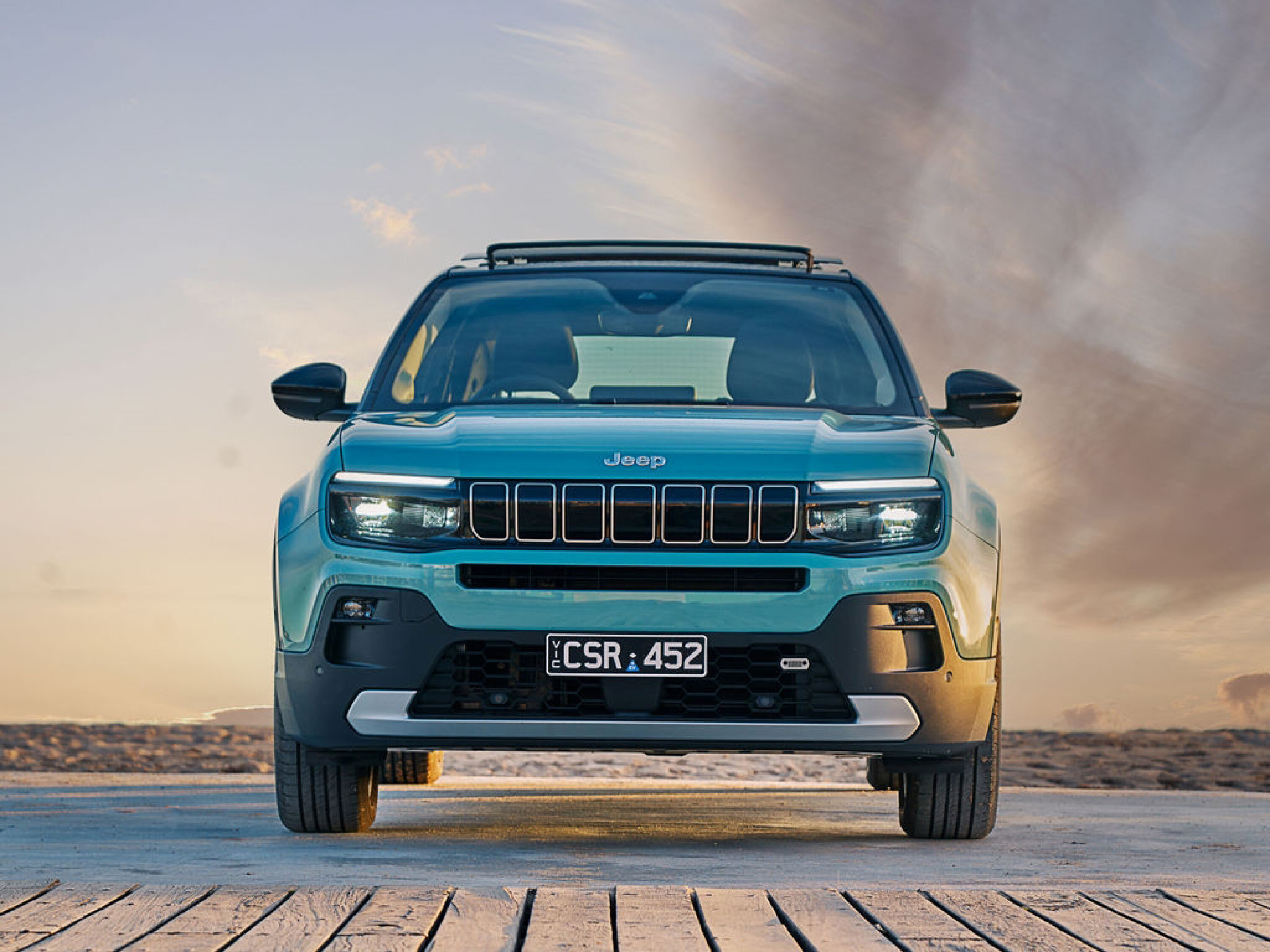
Offered in a three-grade lineup, the Avenger can also be had in mid-spec Limited ($54,990 RRP) and top-shelf Summit ($60,990 RRP) grades, though all variants are mechanically identical with power supplied by a 54kWh battery and drive provided by as single 115kW/260Nm 400-volt motor on the front axle. Prices are down by $3000 for both of those variants versus the original pricing that was announced back in March.
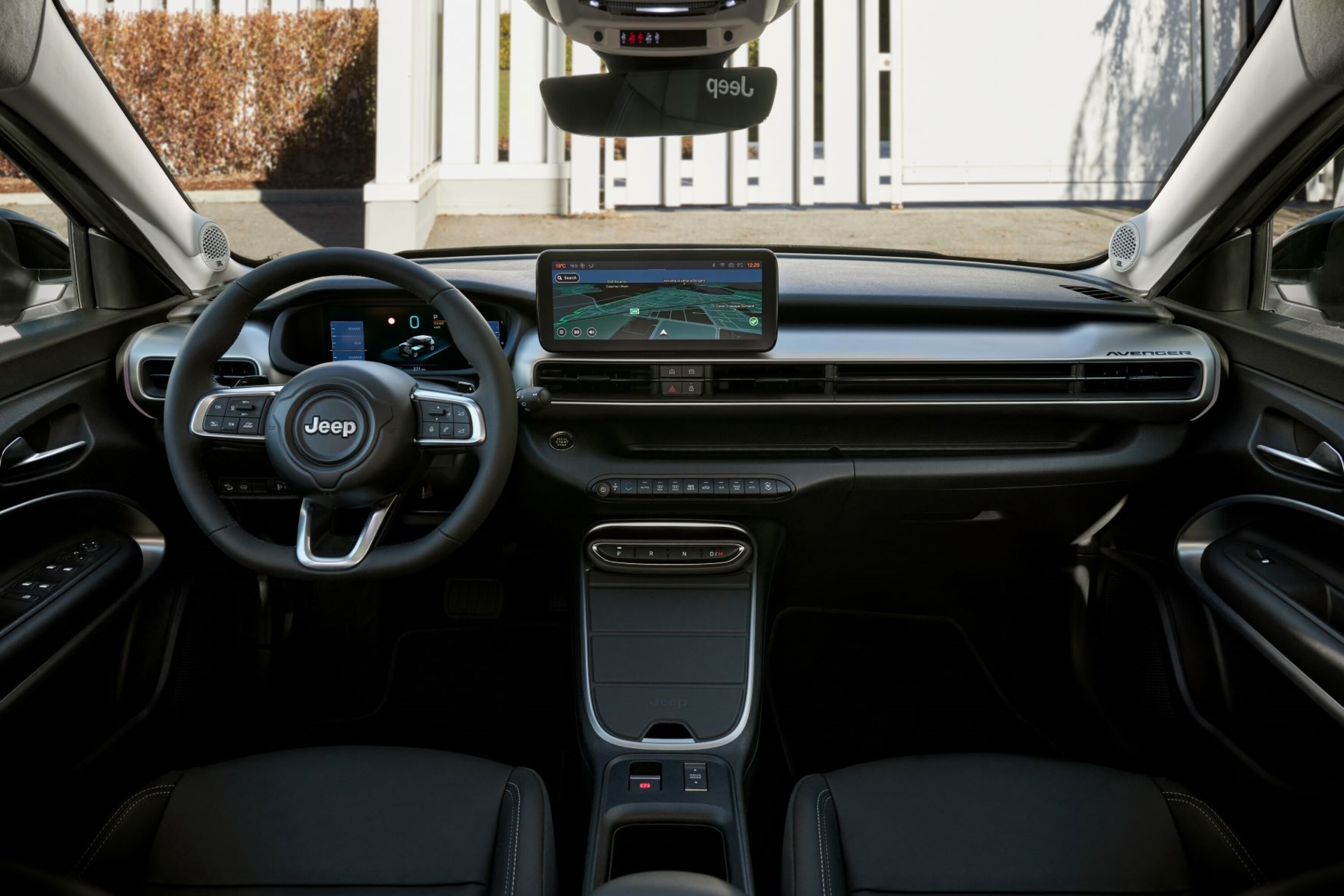
All variants receive a 10.25-inch infotainment display, wireless smartphone mirroring via Android Auto and Apple Carplay, alloy wheels (18”s for the Longitude and Limited, 19”s for the Summit), a 10.25-inch electronic instrument panel, adaptive cruise control, rear parking sensors, a reversing camera, and auto high-beam.
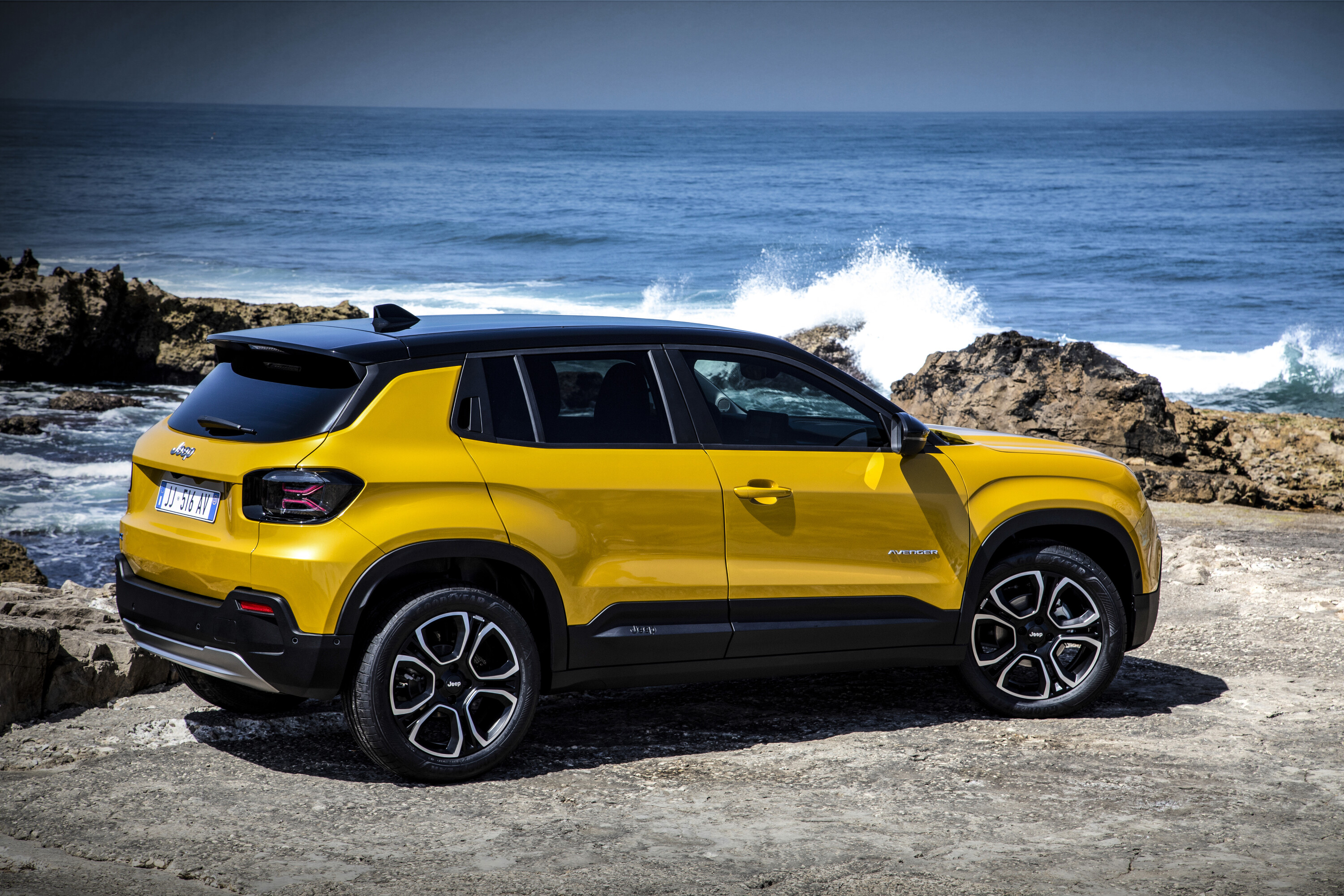
Moving into the Longitude also nets you a wireless phone charge pad, a powered tailgate, adjustable height boot floor, USB ports for the second row, keyless entry, front and rear parking sensors, lane keep assist, blind spot assist, keyless entry and heated wing mirrors.
For the Summit, unique equipment includes leather upholstery, LED headlamps and tail lamps, a sunroof, privacy glass, a power-adjustable driver’s seat with massage function and lumbar support, heated front seats and a heated windshield.
Built on the same e-CMP2 platform as the Peugeot e-2008 and incoming Alfa Romeo Junior, the Avenger bucks the trend of corpulent EVs, with a relatively svelte 1520kg kerb weight. That low mass (and a compact frontal cross-section) allows it to deliver a WLTP efficiency number of 15.6kWh/100km, which translates to a maximum range of 396km on its 54kWh battery.
Unusually for a Jeep, there’s no AWD selector in sight inside the cabin. The Avenger is strictly a front-driver, however its 200mm ground clearance and the provision of Selec-Terrain and hill descent control means it shouldn’t struggle on mild dirt trails. More relevant to most buyers, though, is the Avenger’s turning circle, which measures at an ultra-tight 10.5 metres.
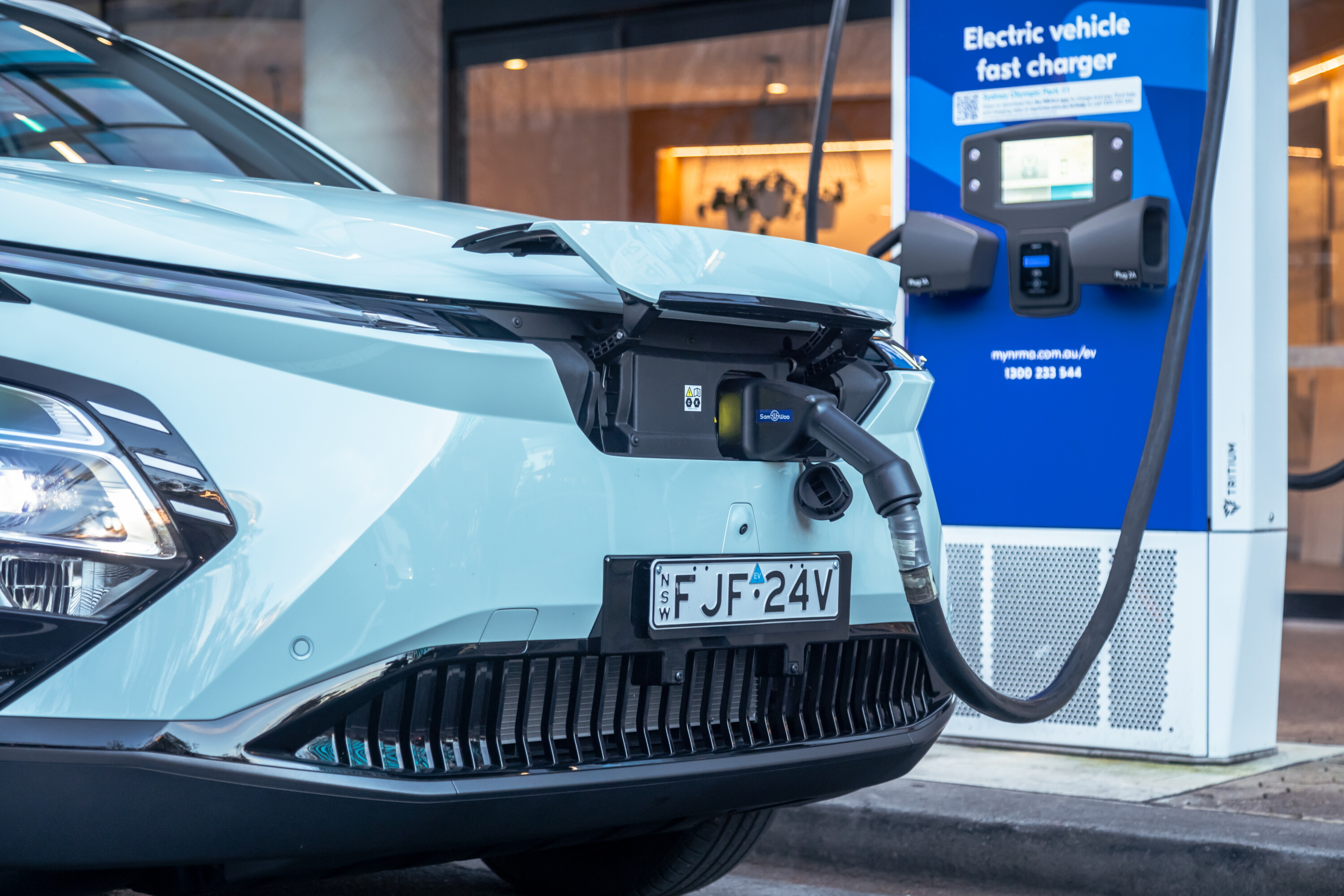
On a regular household outlet, the Avenger’s battery takes 26 hours to charge from zero to full. That drops to just under eight hours on a 7.4kW AC wall box, 5.5 hours on an 11kW AC charger, and just 24 minutes on a 100kW DC fast charger.
The 2025 Jeep Avenger range is available now with deliveries commencing this month.
Mitsubishi Australia currently has a stack of offers running to help clear out stock in its showrooms across Australia. With the help of The Beep we’ve dissected the data to outline the best current offers across the Mitsi range ?
Mitsubishi Eclipse Cross
Mitsubishi Australia currently has a few deals on offer until the end of September 2024 for its compact SUV.
Customers who sign on the dotted line for an Eclipse Cross ES (starting at $34,690 driveaway); LS ($37,690 driveaway); Black Edition ($40,120 driveaway); LS AWD ($41,410 driveaway); Aspire ($41,150 driveaway); Exceed ($45,270 driveaway); or Exceed AWD at ($47,850 driveaway) will also receive a $1000 bonus cash card (prepaid Mastercard) and three years of free servicing.*
Opting for an Eclipse Cross plug-in hybrid EV ES (from $51,790 driveaway); EV Aspire (from $56,480 driveaway); or EV Exceed (from $61,470 driveaway) will still get buyers a $1000 bonus cash card, but Mitsubishi is not offering three years of free servicing with its Exceed Cross EVs.*
Mitsubishi Outlander
Leave a Mitsubishi showroom behind the wheel of a new Outlander and you’ll also have a $1500 bonus cash card (prepaid Mastercard) in your pocket. Plus you’ll also get three years of free servicing. However, the offer doesn’t apply to PHEV variants. This deal will end on September 30, 2024.*
Mitsubishi Pajero Sport
The same deal applies to Mitsubishi’s family SUV, with new owners receiving a $2000 cash card and three years of free servicing when they secure a GLX 4WD (from $54,340 driveaway); GLS 4WD ($59,240 driveaway); Exceed ($65,640 driveaway); or top-spec GSR (from $67,890 driveaway). Again, this offer expires on September 30, 2024.*
Mitsubishi Triton
A loyalty bonus is currently on offer if current Mitsubishi owners stick with the brand and buy a new Triton. Buy a lower-spec GLX or GLX+ and you’ll get a $1000 bonus, or sign for a top-spec GLS or GSR and you’ll receive a $2000 bonus. Of course, this offer only applies if you already own a Mitsi. Three years of free servicing is also on offer, with the deal expiring on September 30, 2024.*
NBL offer
As a major sponsor of the NBL, Mitsubishi Australia is currently offering a bunch of bonuses to NBL and NBL1 club members. This extended offer is running until March 31, 2025.*
- Members will receive a $1000 prepaid Mastercard, $2000 fuel card and $2000 bonus towing package when purchasing a Triton or Pajero Sport.
- Members will receive a $500 prepaid Mastercard and $1000 fuel card when purchasing MY23 Eclipse Cross and Outlander petrol models.
- Members will receive a $500 prepaid Mastercard for the purchase of any other model.
Find more deals at The Beep!
IT’S somewhat unusual that the only model in Subaru’s modern lineup to wear the vaunted STI badge, a symbol of the brand’s rallying prowess and a mark of motorsport pedigree, is now the Forester.
With the arrival of a new special-edition Forester variant, Subaru’s high-riding family hauler is the sole bearer of the STI badge – at least until Subaru’s local operation sees fit to retire the fairly anonymous ‘tS’ branding of hotter BRZ and WRX variants in favour of the STI Sport labels they already use in the Japanese market.
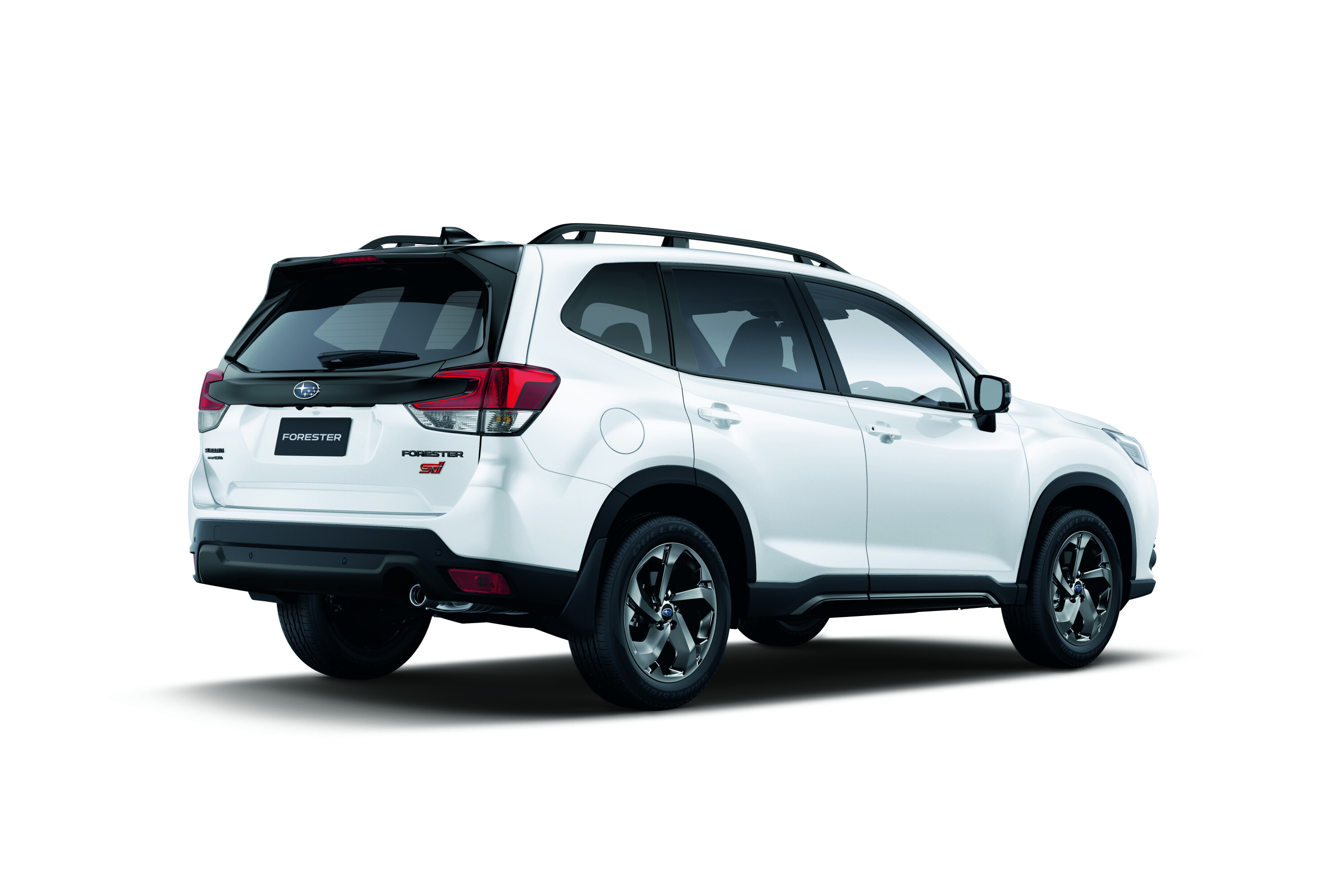
Curiously, the Subaru Forester STI Sport that’s just landed in Australia as a value-enhanced limited-edition actually carries the same branding as its Japanese-market equivalent, possibly indicating that Subaru Australia may be pondering adopting STI branding for its true performance cars as well. It’s also not a mere ploy to sex up the Forester by slapping a saucy STI badge on its tailgate, for behind the badges lies some STI-specific engineering.
The Forester STI Sport brings a unique suspension tune, which Subaru says was concocted by its STI engineers to “enhance control, stability and balance”, and should translate into slightly sharper dynamics. Springrates are untouched, however, with all of the STI magic concentrated in the front and rear damper valving.
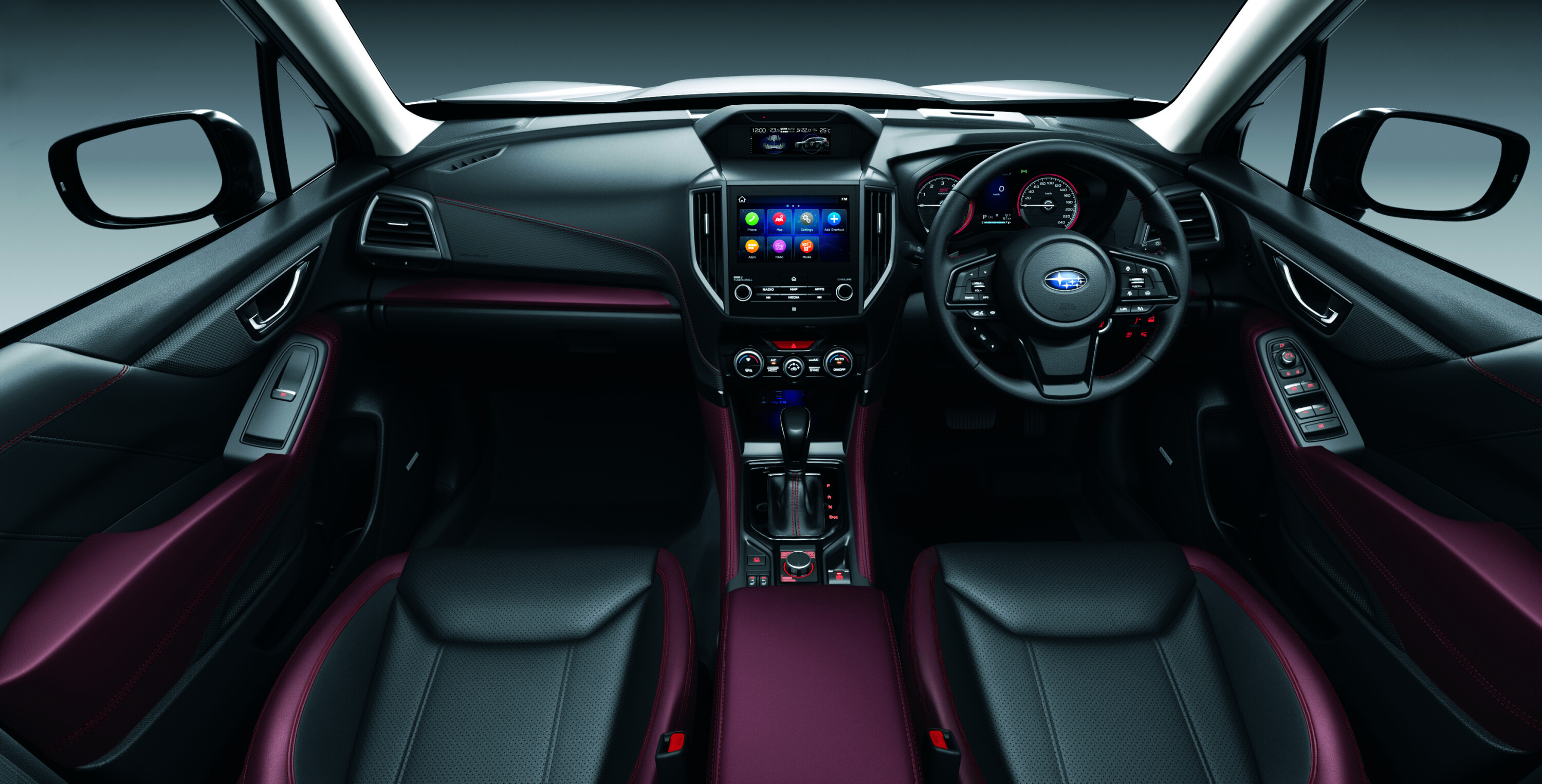
On top of the suspension gear, the Forester STI Sport receives a unique design and dark grey colouring for its 18-inch alloy wheels, as well as black-painted exterior elements like its grille, roof rails, mirror caps and foglamp surrounds. Interior features include a black and Bordeaux colour scheme with red contrast stitching for its Nappa leather upholstery, while STI branding appears on the instrument cluster and tailgate.
However, while the Forester STI Sport in Japan is available with a 1.8-litre direct-injection turbo flat-four engine with 130kW and 300Nm, Australia-bound examples, which are due to arrive in late September, will instead use the same powerplant as the regular Forester range, a 2.5-litre naturally-aspirated boxer four with 136kW and 239Nm. There won’t be a hybrid option for the STI Sport either.
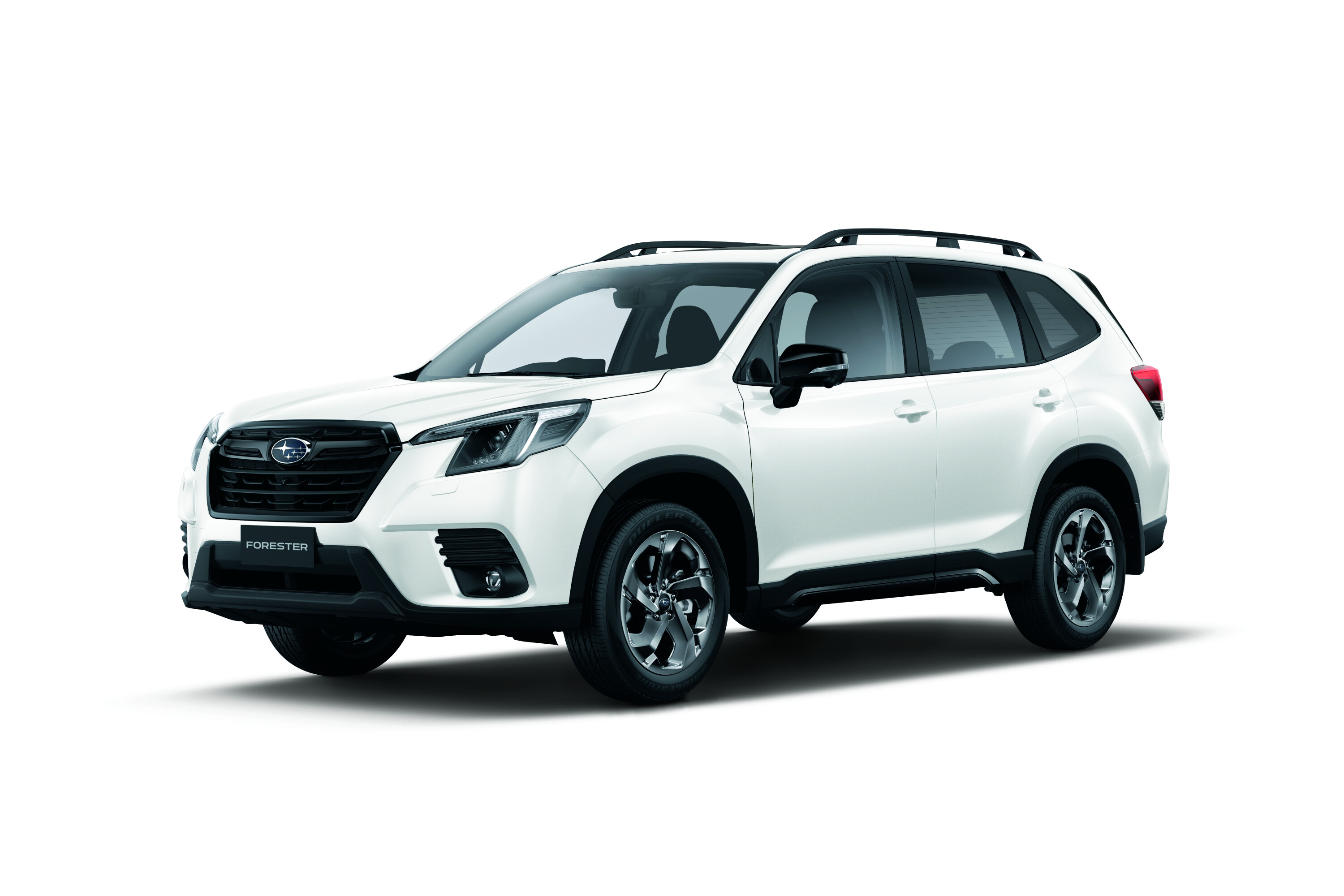
Priced at $48,640 before on-road costs, the Forester STI Sport sits at the top of the non-hybrid Forester range, slipping between the 2.5i-S grade and the range-topping Forester Hybrid S.
Next year, Subaru is expected to bring its next-generation Forester to Australia. The sixth-gen Forester was revealed in late 2023 and went on on sale in the USA earlier this year, with the all-new SUV coming to our shores in 2025 with a familiar naturally-aspirated petrol and petrol-electric hybrid powertrain lineup. Later on, a turbo petrol engines and a rugged outdoorsy Forester Wilderness variant may join the range, with the former potentially seeing the return of the powerful ‘XT’ grade – or perhaps another iteration of the Forester STI Sport.
Chery Australia has officially confirmed pricing for its Omoda E5, with the entry-level BX starting at $42,990 and the top-spec EX starting at $45,990.
Despite its entry-level status, the BX is highly equipped with premium kit including dual 12.3-inch screens, 18-inch alloy wheels, wireless Apple CarPlay and Android Auto, a wireless phone charger, and a full-size spare. For an extra $3000 the EX adds two extra speakers, synthetic leather pews (heated), a powered sunroof, and a 360-degree camera.
Both E5 models are powered by a front-wheel-driven single electric motor that generates 150kW and 340Nm. Chery quotes power consumption of 155Wh/km and states the EV has a range limit of up to 430km. It can be charged from 30 to 80 per cent in less than 30 minutes when using a DC fast charger
Features: BX
| 18-inch alloy wheels | 18 advanced driver aids |
| Dual 12.3-inch Instrument and Infotainment screens | Inbuilt sat-nav |
| Three drive modes | Intelligent voice command |
| 6 speaker Sony sound system | Apple CarPlay and Android Auto |
| DAB+ radio | Wireless phone charger |
| LED exterior lighting | Fabric seats with synthetic leather bolsters |
| Full-size spare wheel |
EX adds or replaces:
| Power tailgate | 8 speaker Sony sound system |
| Puddle lamps | Ambient interior lighting |
| Black synthetic leather seats | 360-degree camera |
| Heated front and rear seats (outboard) | Synthetic leather steering wheel |
| Powered sunroof |
“We’re thrilled to introduce our first electric vehicle, a testament to our commitment to innovation and sustainability,” said Lewis Lu, CEO of Chery Australia.
“We’re proud to offer a vehicle that not only delivers outstanding performance and range but also helps reduce our carbon footprint. This launch is a significant milestone in our journey towards a greener and more sustainable future.”
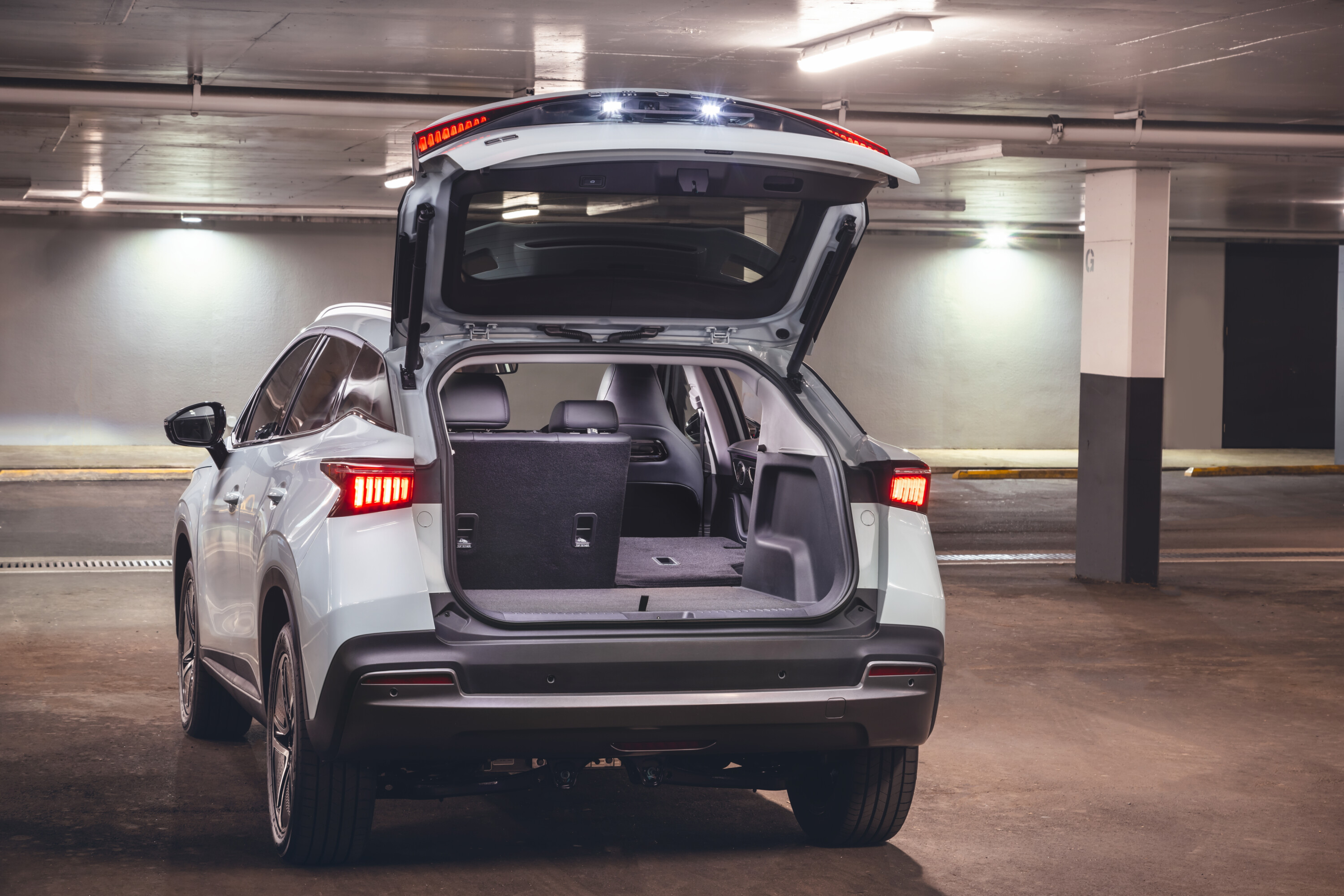
The E5 features a total of seven airbags (driver, passenger, centre, front side and side curtain), and a long list of driver assist functions including adaptive cruise control (ACC), autonomous emergency braking (AEB) and lane keeping assistance (LKA).
The all-electric crossover is covered by Chery’s comprehensive seven-year/unlimited kilometre warranty, seven-year capped price servicing and up to seven years of roadside assistance. Battery warranty is 8 years. It will be in local showrooms this month.
Pricing
| BX | $42,990 |
|---|---|
| EX | $45,990 |
Extras
| Premium paint | $500 |
|---|---|
| Black roof | $600 |
WERE you wondering whether Volvo was turning its back on the humble sedan?
We wouldn’t blame you, the XC and EX prefixes that are Volvo-speak for ‘SUV’ now dominate the Volvo lineup, with the S60, V60 and C40 the only exceptions (and let’s face it, the C40 is really just an SUV cosplaying as a hatchback).
But we’ve got good news: a three-box Volvo is back on the menu, with Volvo letting slip its first teaser of the ES90 large sedan this week – a spiritual successor for the S90.
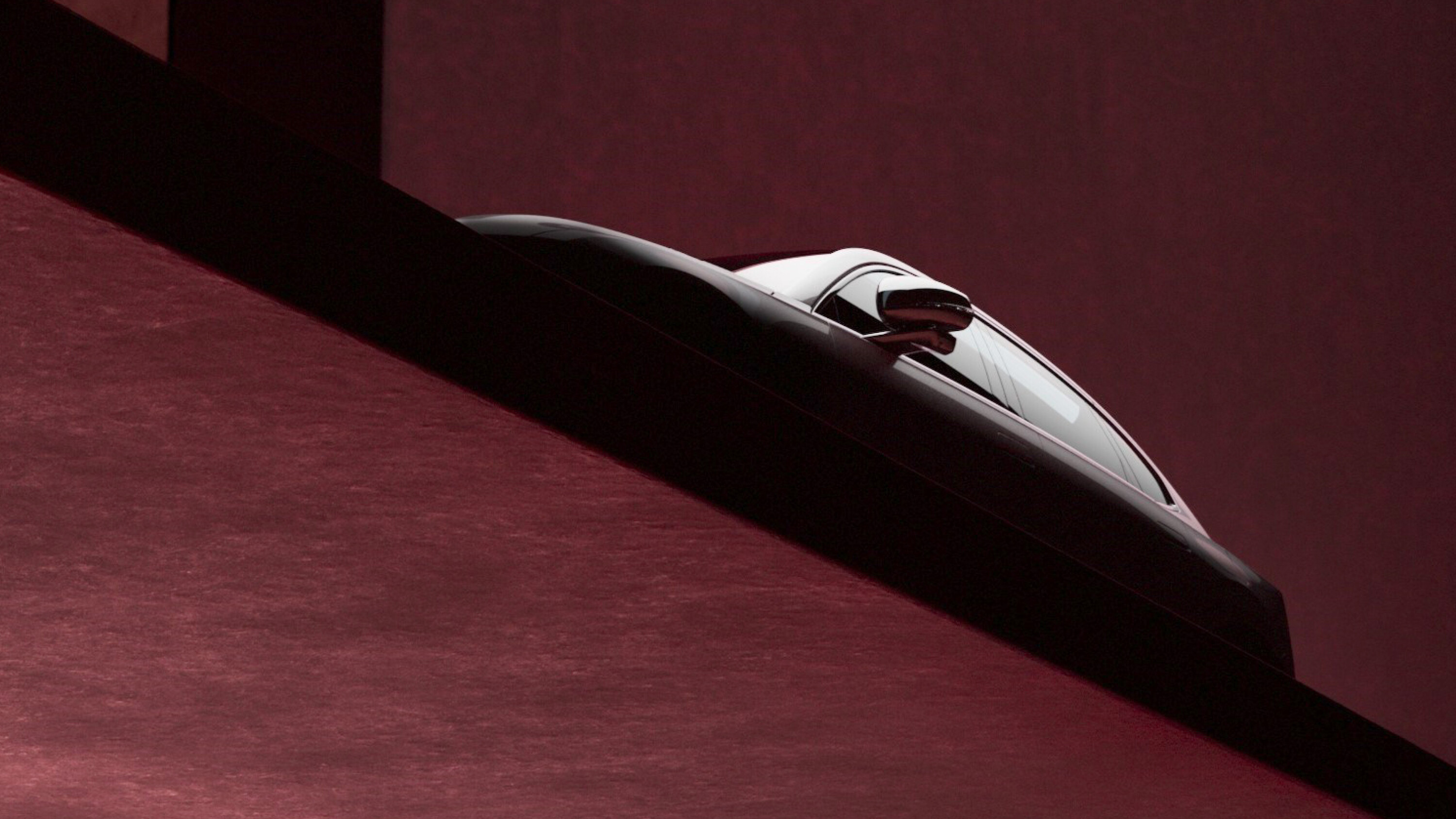
Due to make its global debut next March in Sweden, Volvo’s Australian arm has already confirmed the ES90 will arrive in showrooms in late 2025. As for what to expect, no details have been revealed besides the general outline of the new car’s profile – and the fact it will be electric.
Under Volvo’s new nomenclature, the ES90 stands for Electric Sedan, with the numerics indicating it will sit alongside the newly-released EX90 large SUV in terms of size. The ES90 will use the EX90’s SPA2 platform, and will also follow its high-riding sibling as the second Volvo vehicle to make use of the company’s newly-developed Volvo Cars Superset modular architecture.
It may also be the last Volvo to use SPA2 underpinnings, with the next model in Volvo’s product plan, the EX60, to debut the company’s all-new SPA3 scalable architecture.
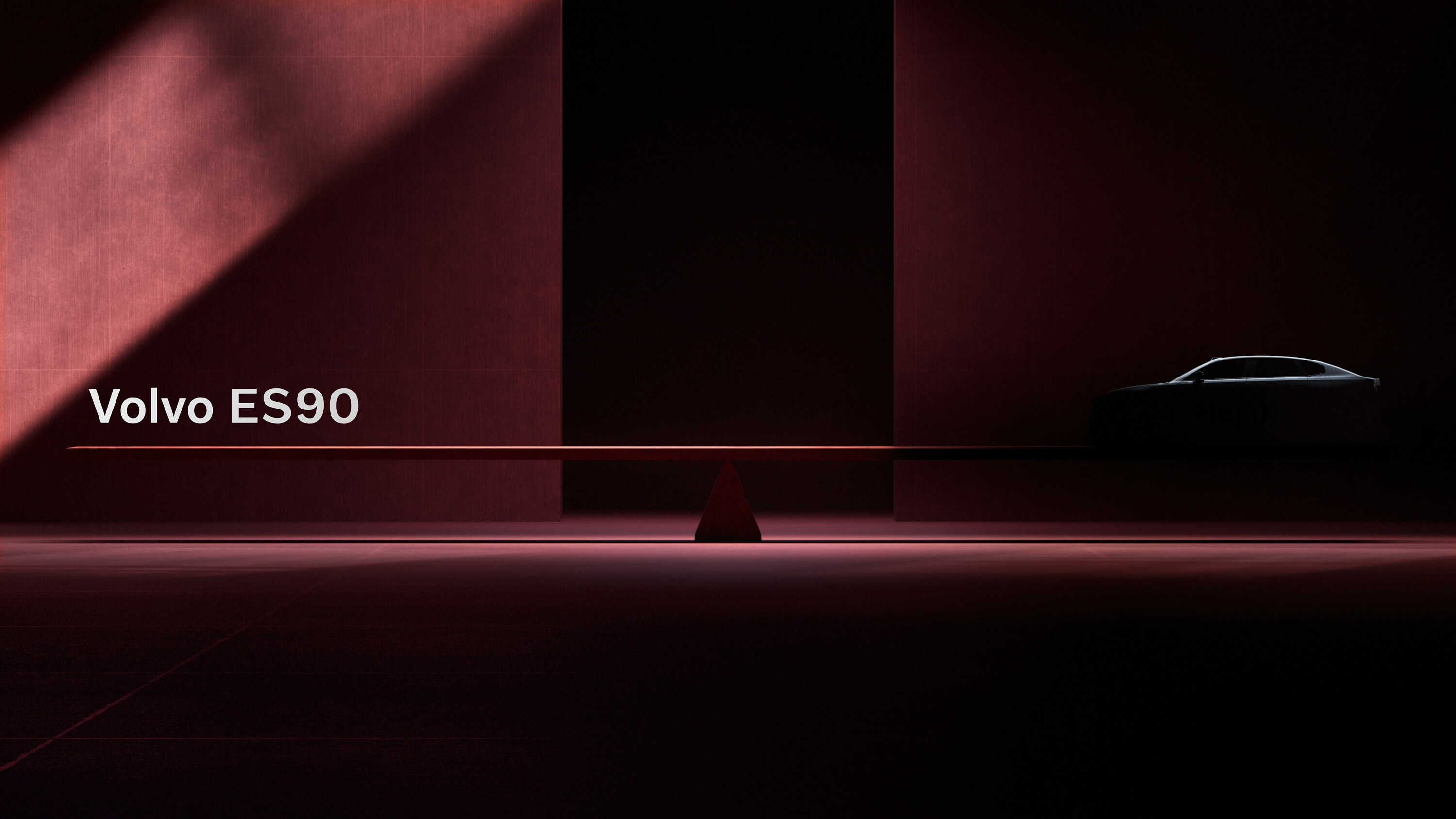
Comparing the silhouette presented by Volvo’s teaser with images of the outgoing S90, we can see that Volvo’s flagship sedan will retain its distinctive C-pillar with its generous quarterglass, though the transition from the rear windscreen to the bootlid is substantially softer than before.
The rear doors also appear to have grown markedly to become as long – perhaps even longer – than the front doors, while flush-fit door handles blend smoothly with the sheetmetal. At the front, there appears to still be a good distance between the front axle line and the front door, however it looks like frontal overhang has undergone a sizable chop.
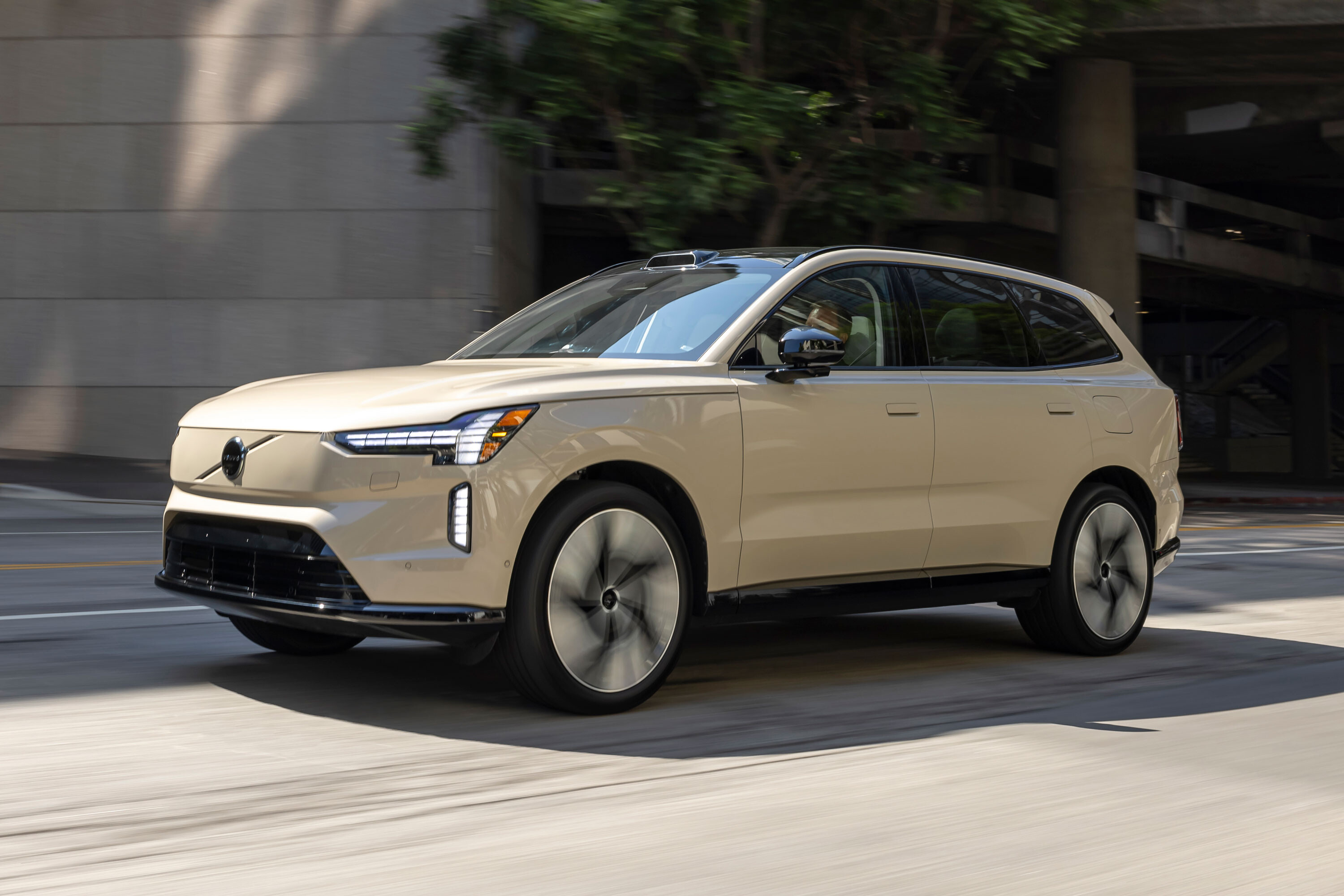
Tech specs are still far from being officially announced for the ES90 but expect a similar fit-out to the EX90, which offers a massive 111kWh battery pack and a dual-motor powertrain producing 380kW and a massive 910Nm. Performance stats include an impressive 4.9-second zero-to-hundred blast, and a maximum range of 590km on the WLTP cycle for the EX90, and with less frontal area and potentially less weight, we’d expect the ES90 to improve on those metrics.
In other markets the EX90 will be offered with a less powerful 300kW/770Nm twin-motor configuration with a 600km max range, which would also be a likely candidate for the ES90.
However, though Volvo has just recently walked back on its goal to go all-electric by 2030 and will instead continue offering plug-in hybrids for the forseeable, don’t expect the ES90 to arrive with a petrol-electric powertrain option: the SPA2 platform it’s built on is EV-specific, with no provision for combustion engines.
VOLVO’S plan to only sell fully-electric vehicles globally by 2030 was always an ambitious one, but the Swedish automaker has now, just three years after revealing that plan, walked back on its target.
Instead, Volvo has adjusted its electrification goal to something a little less rigid. Between now and the end of the decade, the brand will aim to make 90 to 100 percent of its global sales ‘electrified’ rather than purely electric vehicles (EVs), meaning not just EVs but also plug-in hybrids (PHEVs) will count towards its eco-car target. In Volvo’s own words, “all cars with a cord”.
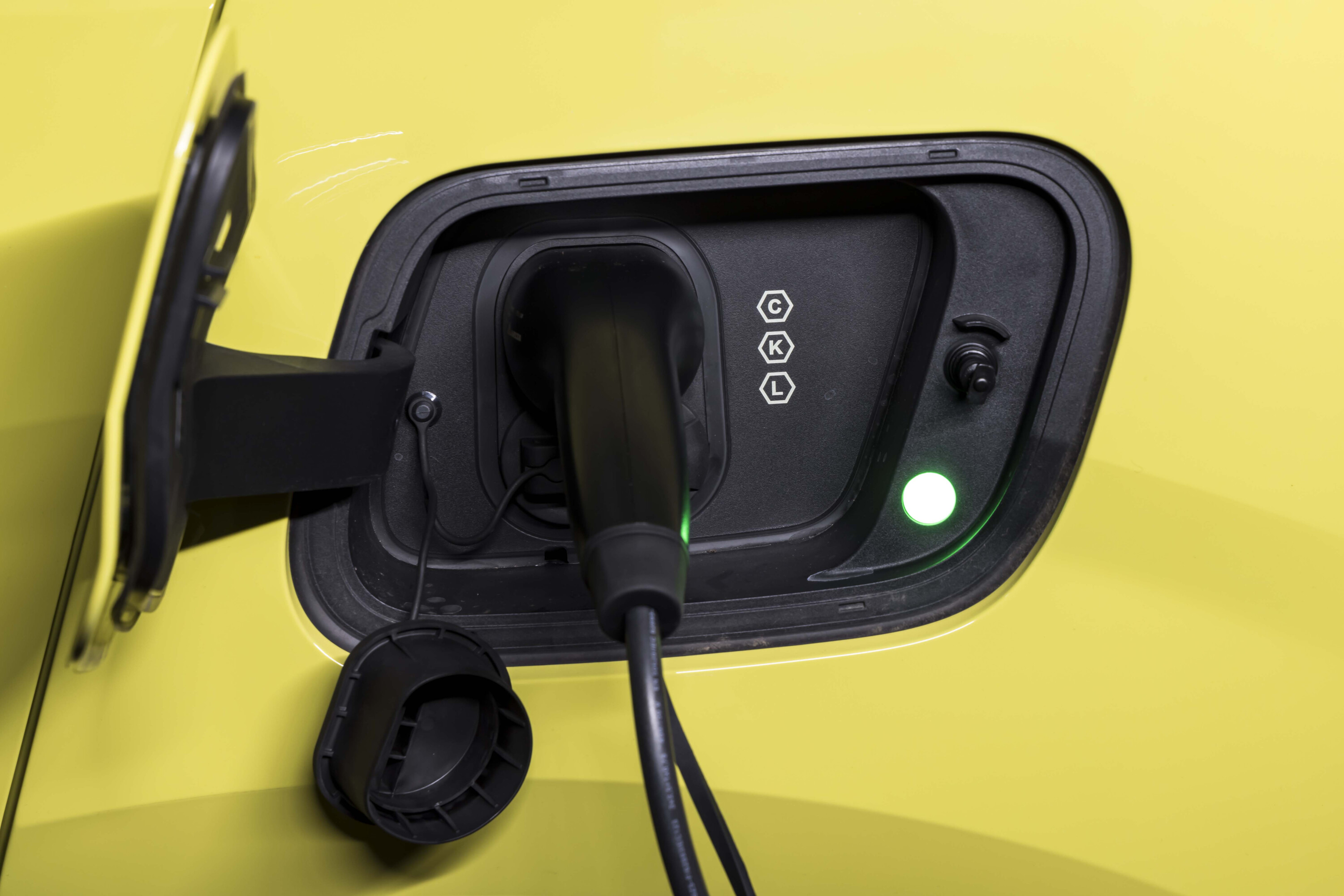
The remaining zero to 10 percent will be mild hybrid models, which are expected to remain relevant in parts of the world where electrical infrastructure and/or the cost of liquid fuels are impacting uptake of EVs and PHEVs.
However, the company remains committed to a long-term aim of going all-electric, even though it no longer has a hard timeline for when such a transition will be completed. That said, Volvo is still gunning for a net-zero CO2 timeline that should see all of its carbon dioxide emissions from manufacturing become neutral by 2040.
“We are resolute in our belief that our future is electric,” said Jim Rowan, chief executive of Volvo Cars.
“However, it is clear that the transition to electrification will not be linear, and customers and markets are moving at different speeds of adoption. We are pragmatic and flexible, while retaining an industry-leading position on electrification and sustainability.”
The softening of demand for EVs is one that’s been seen in Australia as well as overseas, as the latent demand for EVs that drove strong sales of battery-electrics in recent years tapered off and was replaced by more gradual growth as the early-adopter crowd took delivery of their first EVs.
Volvo pointed to slow roll-outs of charging infrastructure and the removal or reduction of government incentives as other factors in its decision to move away from its all-EV-by-2030 promise, with protectionist tariffs being highlighted by the company as another barrier. Volvo produces a large number of its EVs in China, a country that has been targeted with high import tariffs by a number of countries, including the commercially-critical US and European markets.
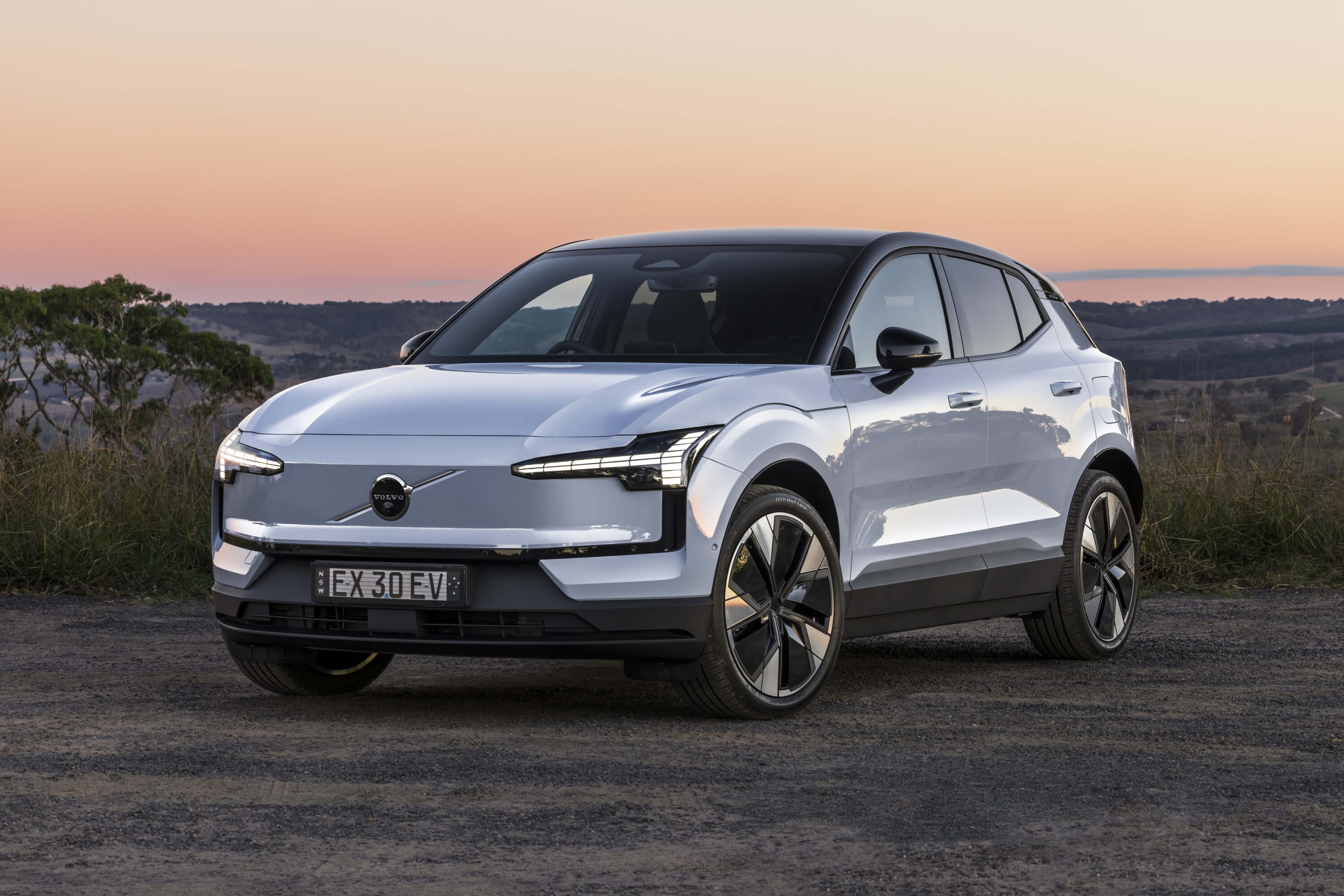
Volvo currently has five all-electric models in its global product portfolio (including the just-launched EX30 small SUV and EX90 large SUV), with another five currently in development – the ES90 luxury sedan being the next off the rank.
In Australia, the local range was slated to switch over to a pure EV lineup from 2026 onward – Wheels has contacted Volvo for comment on what implications the global strategy change will have for the Australian product plan.
For the rest of the world, Volvo is expecting the percentage of EV and PHEV sales to fall somewhere between 50 and 60 percent of its global total by the start of 2025, giving it five years to convert an additional 30-40 percent of sales to cord-having models. For the second quarter of 2024 the total percentage of electrified sales for Volvo was 48 percent, while pure EVs only accounted for 26 percent of the global total in the same period.
New electric platform to be key
The day after it announced it would no longer pursue an EV-only target for 2030, Volvo also announced that its future electric vehicles would be derived from a single “technology stack”. The new architecture, which combines both the physical and electronic architectures of the car, will provide the basis for all of its EVs going forward, beginning with the EX90 and the incoming ES90 luxury sedan.
Dubbed the “Volvo Cars Superset”, the tech stack allows Volvo’s engineers to combine modules together much like that other Scandinavian innovation: Lego. The end result is trimmed development times, lower development costs and increased production line flexibility. The SPA2 platform of the EX90 is the first Volvo architecture to use the tech stack approach, and will be followed by the ES90. The next all-electric model in the pipeline will be the EX60 – the successor to the popular XC60 midsize SUV, which will be the first model to use Volvo’s next-generation SPA3 architecture.
JUMP AHEAD
- Part 1: Introduction
- Part 2: Chief urban
- Part 3: Intercity hauling
- Part 4: Softly tweaked
- Part 5: Eastern feastin’
- Past 6: Parting thinking
There’s something quite grounding about doing a long-term deep dive on an electric car that the average Aussie might be able to afford.
In this case, it’s arguably the sweet spot in the MG4 EV line-up (a base Excite with 64kWh battery) – and a stand-out in MG’s entire range. Pricing was already good before MG introduced a national drive-away approach, which popped the entry Excite 51 below $40,000 and reduced this Excite 64 from about $48K drive-away to $44,990 drive-away.
Indeed, the chasm between the dynamics of the rear-drive MG4 and its similarly priced MG ZS EV sibling is so vast that you could lose an ocean liner in it … which seems appropriate given that driving a ZS EV on a bumpy road conjures sensations relating to being deep at sea.
The ZS represents the (recent) past for MG, though, rather than its future – which is why we are spending several months in the all-new MG4, to investigate what this booming brand is truly capable of.
What makes the MG4 such a game-changer for MG Motor Australia is that it debuts the brand’s first dedicated EV platform, as opposed to simply stuffing electric bits into an existing vehicle.
Developed by parent company SAIC, this Modular Scalable Platform (MSP) features sophisticated fully independent suspension – engineered and tuned by SAIC in conjunction with Spanish firm IDIADA – as well as 50:50 weight distribution and rear-wheel drive (on all variants bar the X-Power performance flagship that has all-wheel drive) to achieve handling and steering precision that feels distinctly British in its flavour, rather than depressingly lacking in, well, everything.
Building on the base Excite 51 (which brings a $5K cost saving with its reduced 51kWh battery size and 350km WLTP range), the Excite 64 is all about its additional mileage (450km WLTP), extra power (25kW), and slightly faster 0-100km/h time (7.2sec versus 7.7). Almost everything else is identical.
Maximum charging rate also increases from 88kW to 140kW, meaning it can go from 10-80 per cent (using a 150kW CCS public charger) in a claimed 28 minutes (rather than 37).
And given the $3K-dearer Essence 64 doesn’t introduce anything that’s a must-have – plus slightly less range (435km) and a marginally firmer ride on 18-inch wheels – the Excite 64 seems to be the definitive MG4.
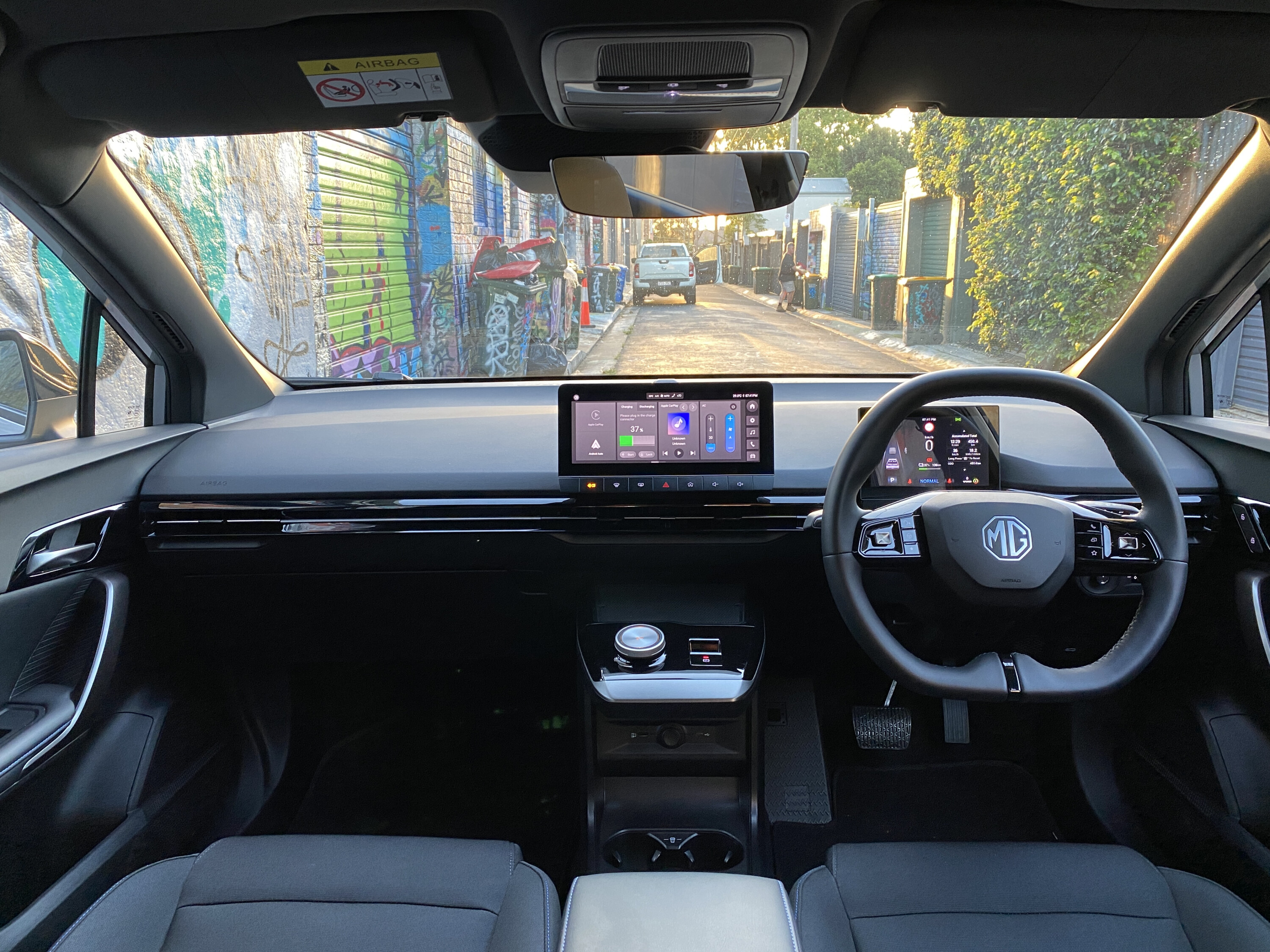
First impressions are, for the most part, positive. Power delivery is crisp and urgent, the steering delightfully brisk and accurate, its turning circle is brilliant (10.6m), forward vision over a very low cowl is tremendous, and its climate control (in Sydney’s oppressive recent weather) is instant and excellent … until it annoyingly starts to fog up every window and requires winter-style demisting to clear it.
Despite basic manual adjustment, the driving position is really good, with a terrific (and stylish) two-spoke steering wheel and supple black cloth upholstery (which absorbs a surprising amount of heat when parked in the sun).
MG’s welcome advance in screen technology means the MG 4 offers improved processing speed, respectable functionality, and clear, classy graphics.
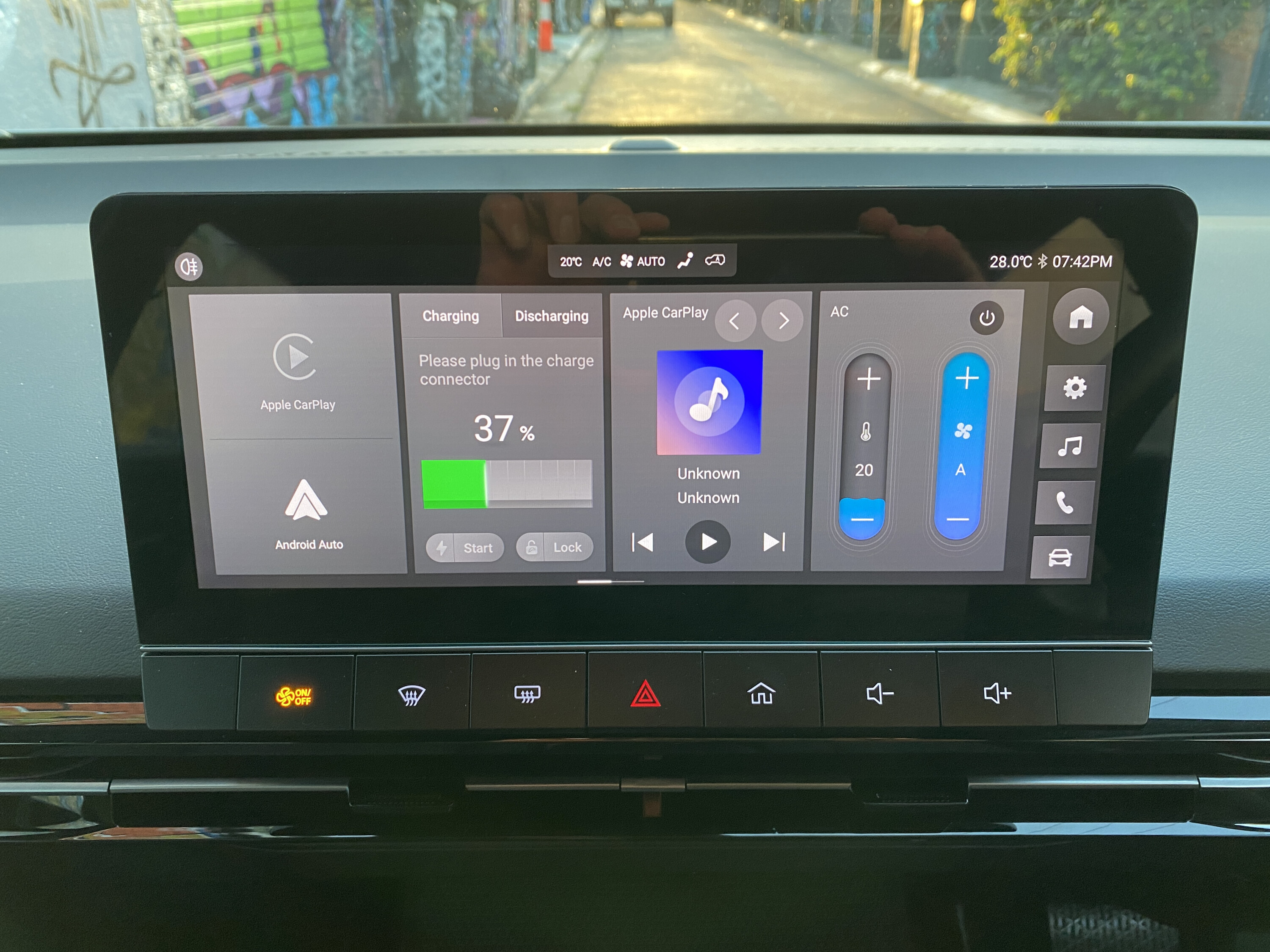
Even the basic four-speaker stereo sounds okay, though some of the switchgear (such as the mostly unmarked cruise control set-up on the left-hand steering wheel spoke) requires trial and error to get your head around how to operate it.
Then there are the few faults that have already jarred with the MG4’s generally sound design. If you stop and put the hazard lights on – for example, when swapping drivers so I can perform the challenging reverse park in my narrow one-way street – the rotary-dial gear selector will only select Neutral, not Drive or Reverse, until you switch the hazards off and depress the brake for several seconds.
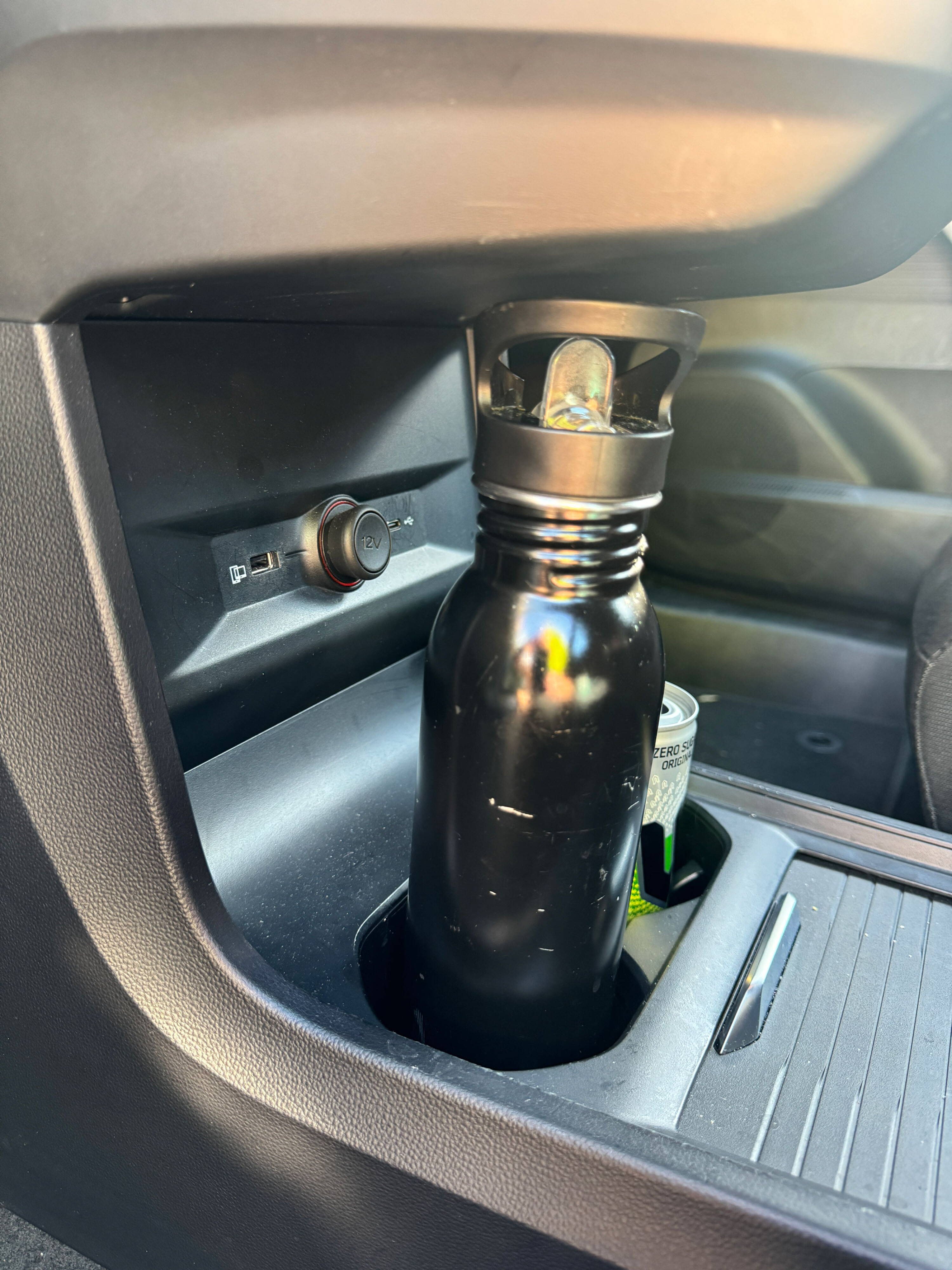
Sometimes, the wired Apple CarPlay requires multiple attempts to connect, the cup holders buried beneath the beaky transmission shelf are better suited to regular coffees rather than tall drinks with a straw, and the USB ports situated above are impossible to access without bending over.

The MG4 doesn’t have a start/stop button – it senses when a driver is seated and turns itself on when you depress the brake, then switches off when you lock the car.
It occasionally lost charge when parked overnight – sometimes up to five per cent – which I wasn’t expecting. We’ll scrutinise this further in the coming weeks.
As for efficiency, it has so far averaged 17.9kWh/100km (including a Sydney-Newcastle return journey) and took a suggested six hours and 48 minutes to go from 28 per cent to fully charged when using a friend’s Tesla charger in their garage.
Given the Excite 64’s useable battery capacity of 62.1kWh, that translates to 347km per full charge, which seems decent given the hideous temperatures, serious air-conditioning demands, and mostly freeway running the MG4 has copped so far.
Part 2, Feb 2024: Chief urban
A month in the city keeps MG4 mostly sitting pretty
- Price as tested: $48,786
- February 2024: 378km @ 18.4kWh/100km
- Overall: 813km @ 18.2kWh/100km
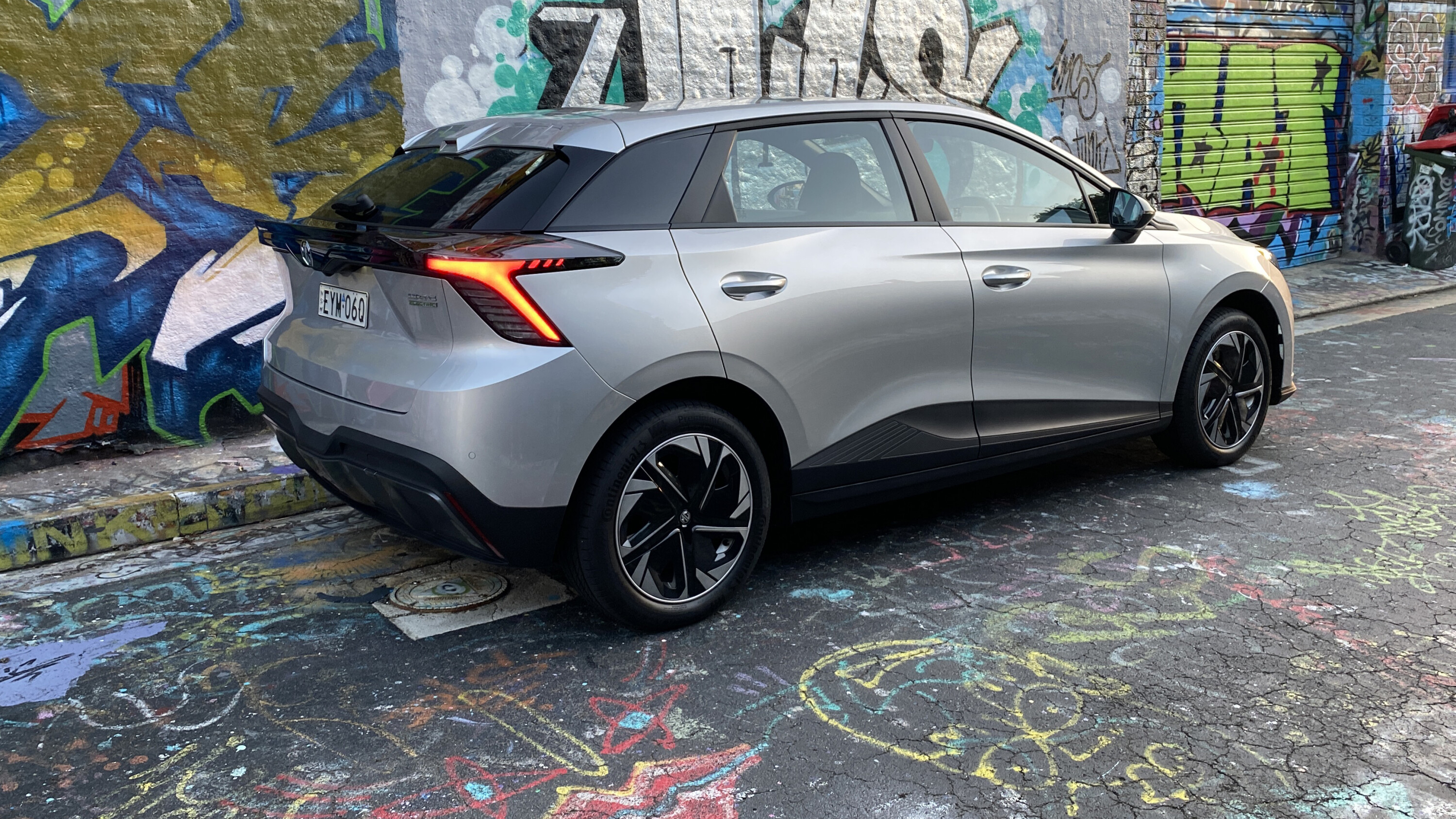
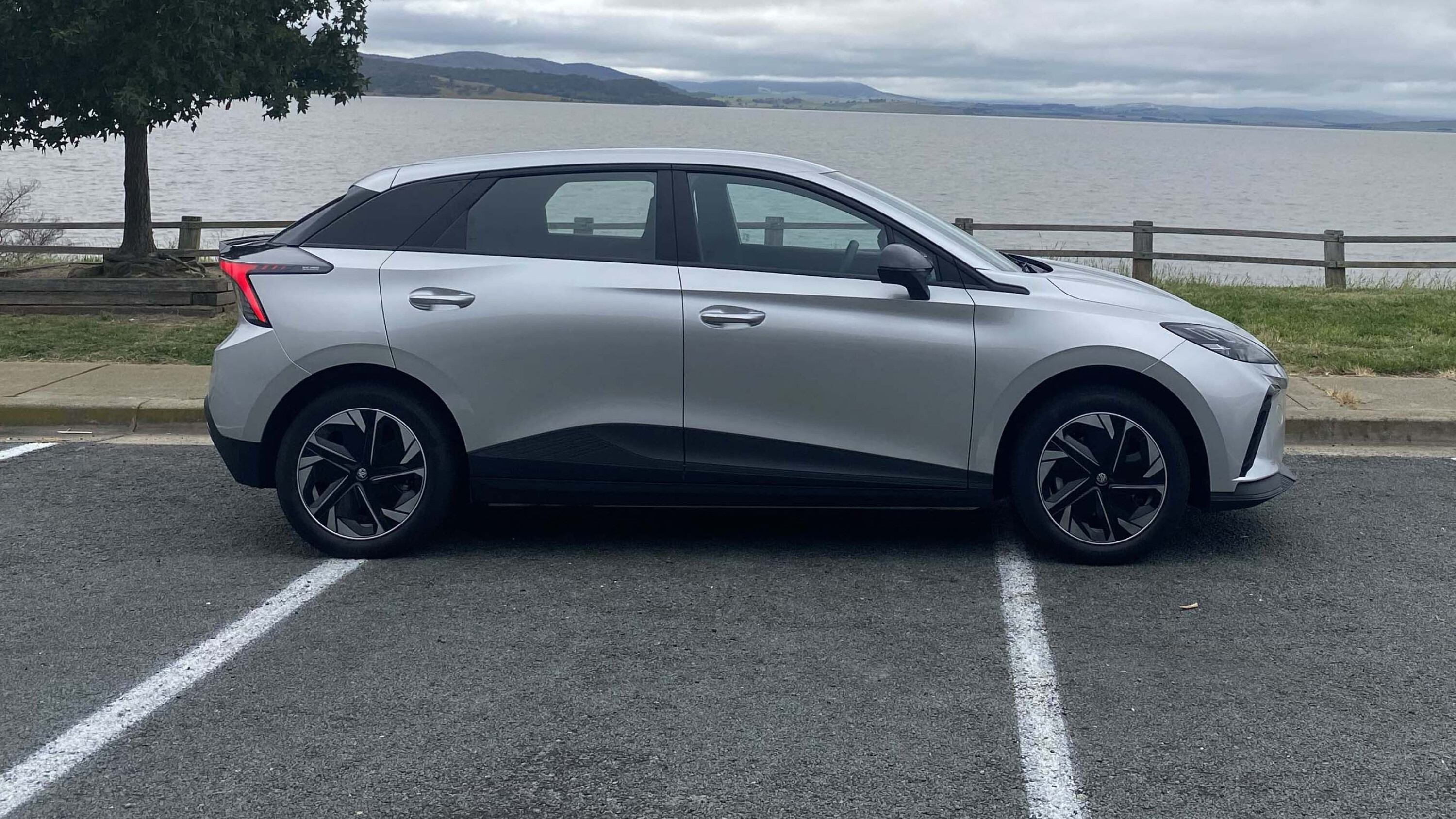
Bit by bit, its handy size (just 4287mm long) and handsome colour combo (metallic silver with gloss-black mirrors, window frames and tailgate garnish, black-accented 17-inch wheels and matte-black lower sections) adds a touch of egalitarian flair to Sydney’s enviro-conscious Inner West.
The refined silkiness of its drivetrain constantly impresses – particularly the satisfying surge in urgency when a burst of acceleration is required – and now that I’ve switched to MG’s version of one-pedal motoring (which isn’t as extreme as the ‘i-pedal’ operation in a Hyundai–Kia EV), there’s a seamless rhythm to the way the MG4 drives that makes punting it briskly around town effortlessly rewarding.
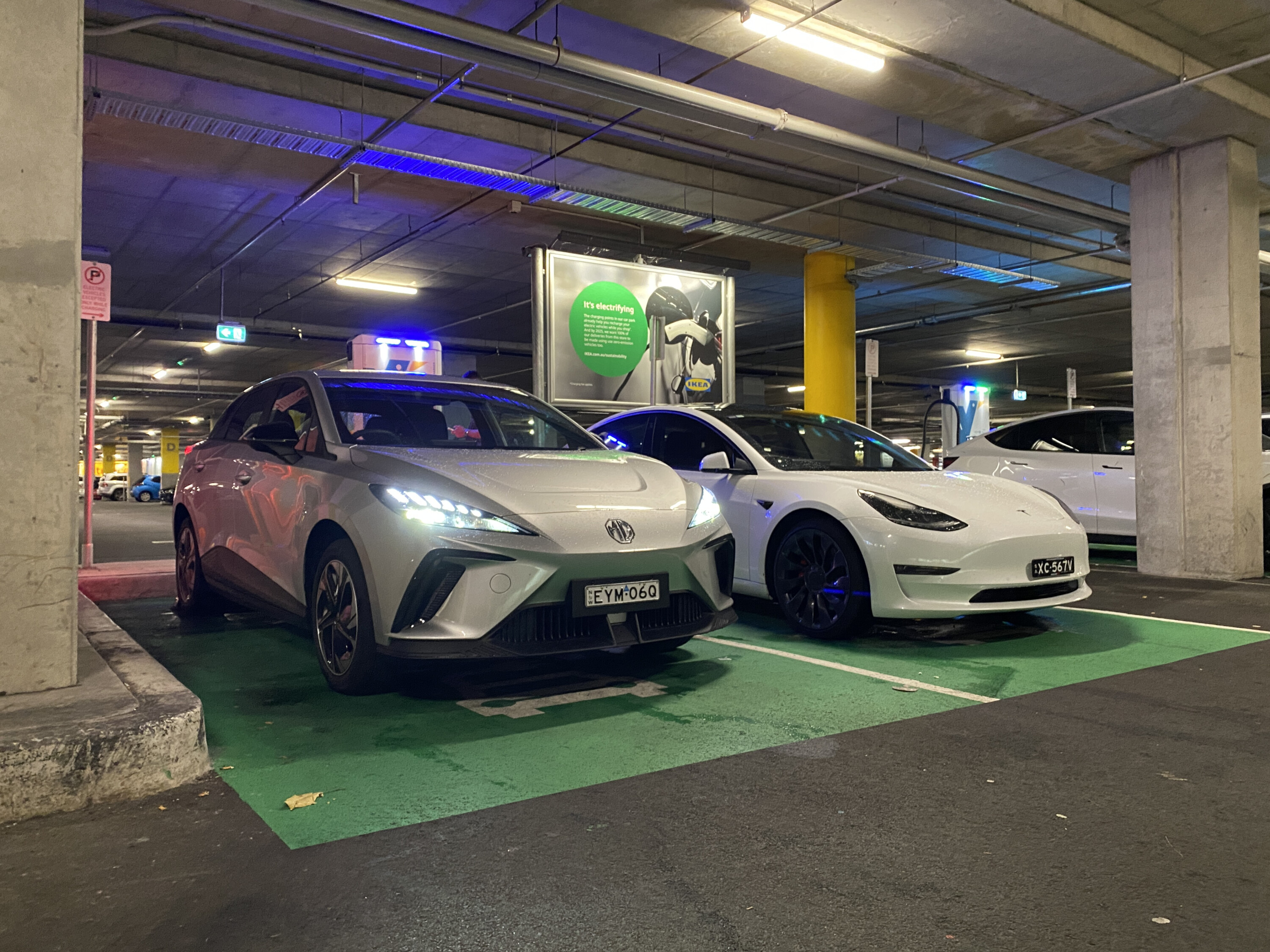
It clearly favours handling precision over comfort, though, so as long as you’re attuned to its excellent chassis balance, crisp steering and keenness to alter direction, you can (mostly) forgive its somewhat jiggly ride and tendency to fall into road depressions.
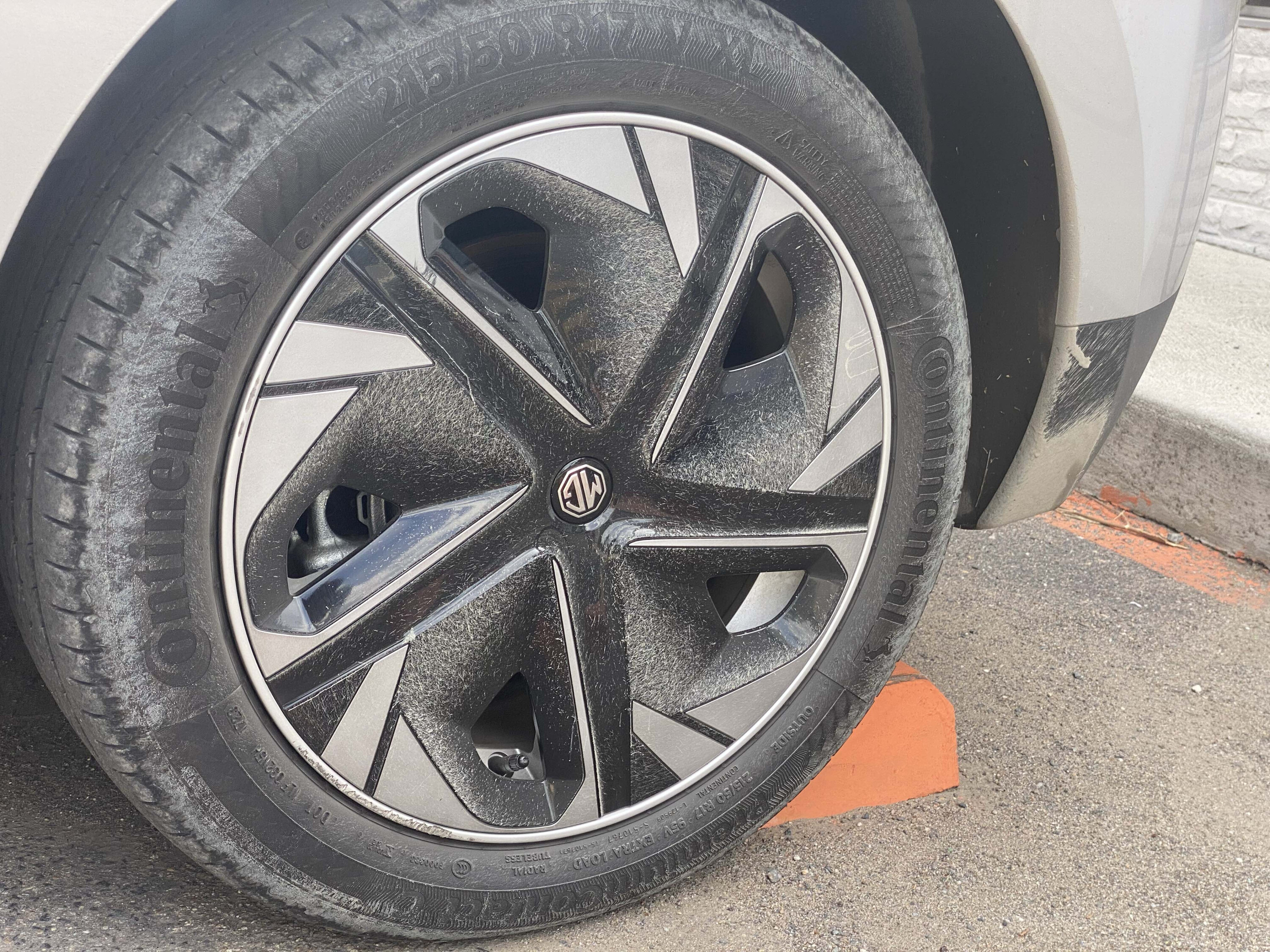
I’ve also noticed that its 205/50R17 Continental Premium Contact C tyres prioritise reduced rolling resistance, so eagerly exploring its dynamic envelope often results in turned heads. Even running recommended pressures, they squeal. Yet as a testament to its 50:50 weight distribution, they do so as a quartet.
Speaking of four-ways, having only four stereo speakers for the front passengers (door speakers, plus tweeters) isn’t that much of an issue – I often miss the simplicity of the ’80s – but for anyone sitting in the back, it’s tough luck if you want to catch the crispness of every hi-hat.

Same goes for lighting. The roof-mounted cabin light sits above the front console, so retrieving anything from the rear seat or floor in darkness often requires a double-check with a smartphone torch. It’s pitch-black back there, like the rest of the interior colouring.
Perhaps the $3K-dearer MG4 Essence does have a point after all, seeing it offers rear-seat speakers as well as electrically folding mirrors (I have to nudge ours in manually) and four one-touch windows (the Excite’s front passenger window only gets one-touch for opening), though the Essence doesn’t appear to offer rear-seat ‘courtesy lighting’, either, and its part-vinyl seats are a retrograde step.
I can forgive the plastic upholstery in my 1969 Peugeot 404 because it’s beautifully supple and aromatic – if equally sweaty – but in a modern, enviro-conscious car, vinyl isn’t ideal. In which case, perhaps the cloth-upholstered Excite is the go-to MG4 spec after all.
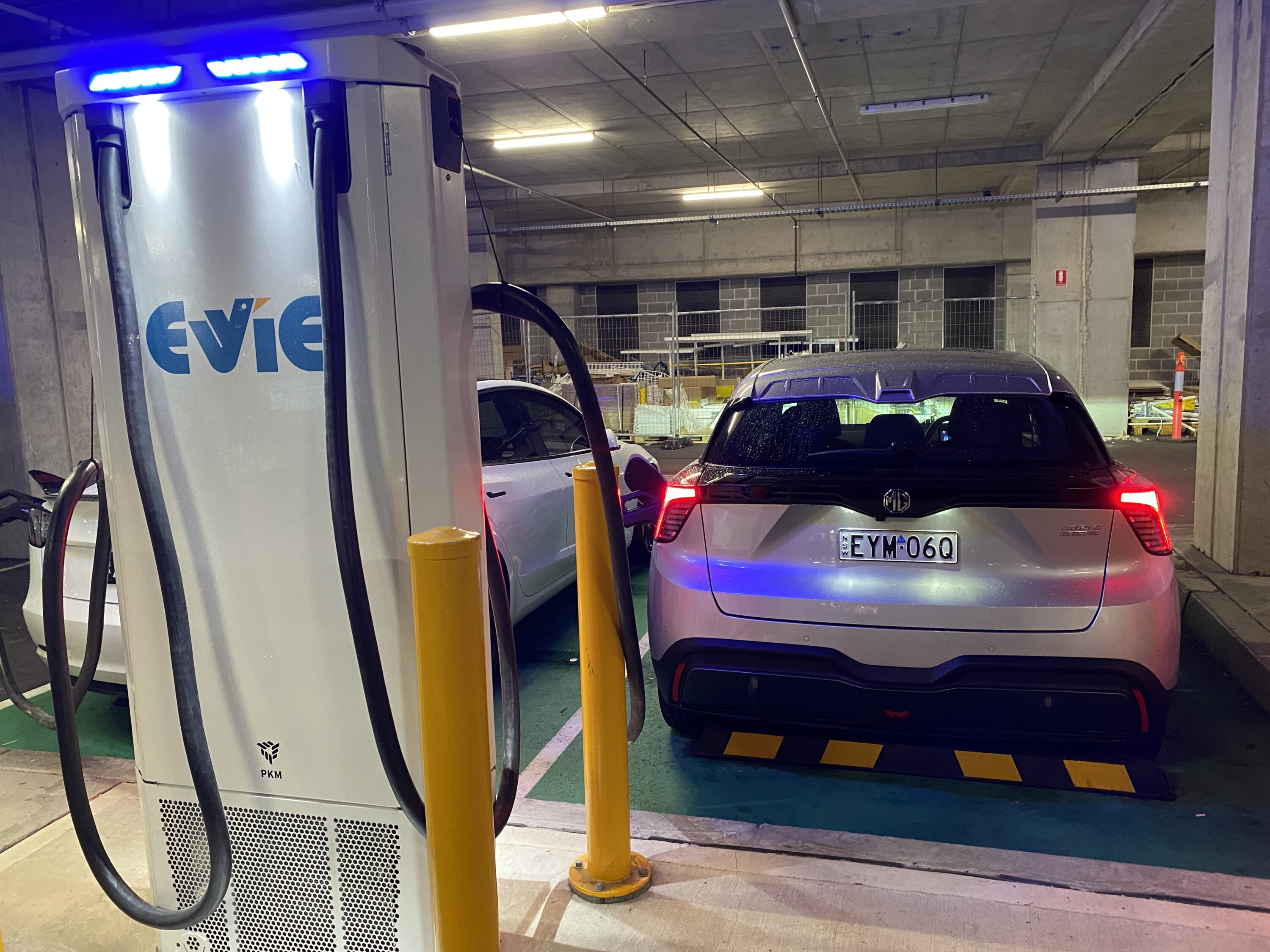
Having delayed my Christmas holidays until February, our running around this month had been a cost-conscious ‘staycation’ – meaning a lot of driving but not a whole lot of mileage.
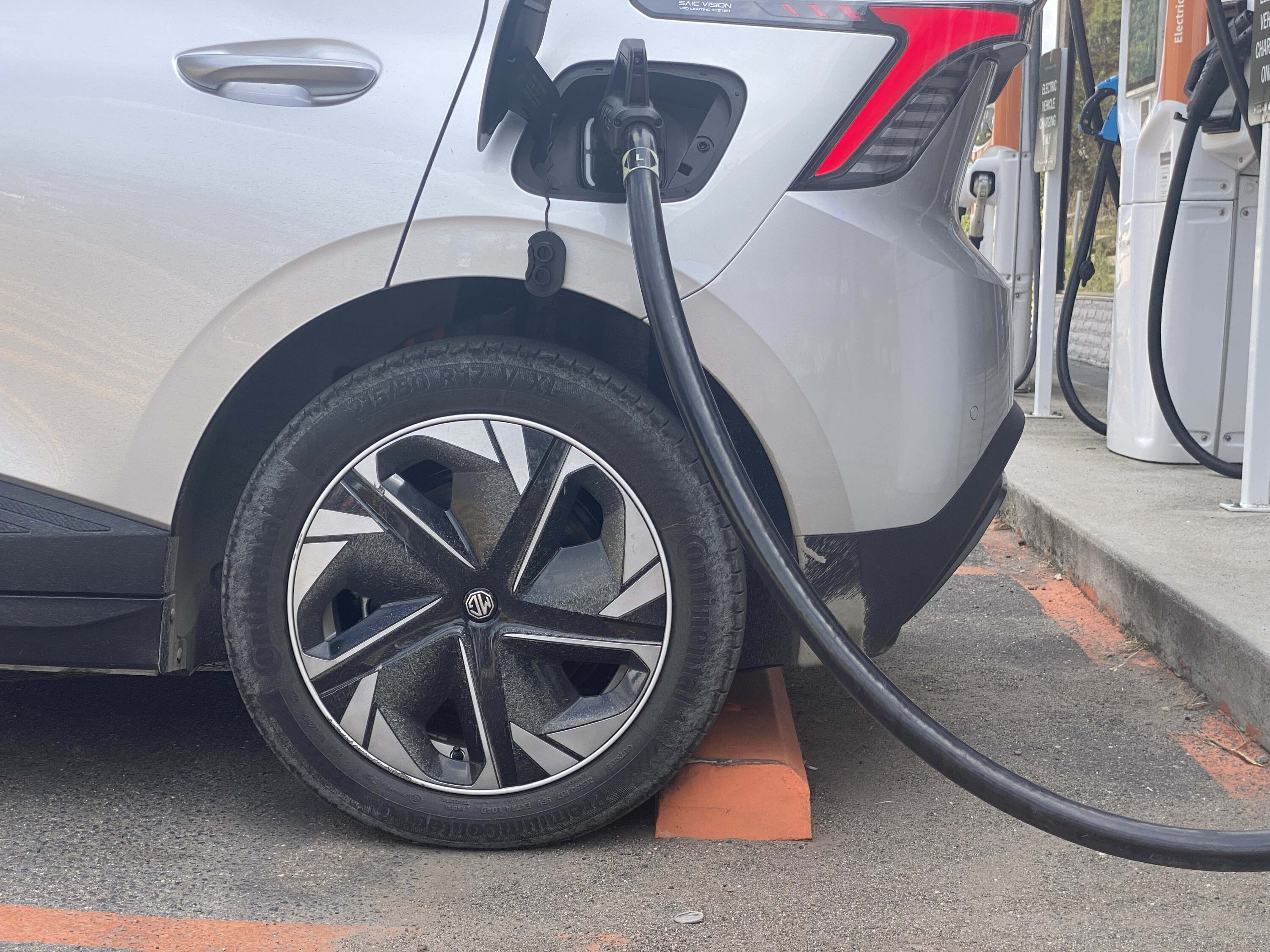
The first charge I fed into the MG4 was at a new charging station at Tempe BP, and while it didn’t cost much ($12.58 for 22.9kWh), it took 40 minutes to go from 18 to 54 percent. Don’t think I’ll be using its 36kW of inadequate energy ‘boost’ again.
Next attempt was at an ultra-fast NRMA/ChargeFox charger in the East Village carpark in Zetland – the only one in our immediate vicinity – which added 33.1kWh in 21 minutes (for $21.49), meaning we could duck upstairs for a coffee and return with 80 percent battery showing.
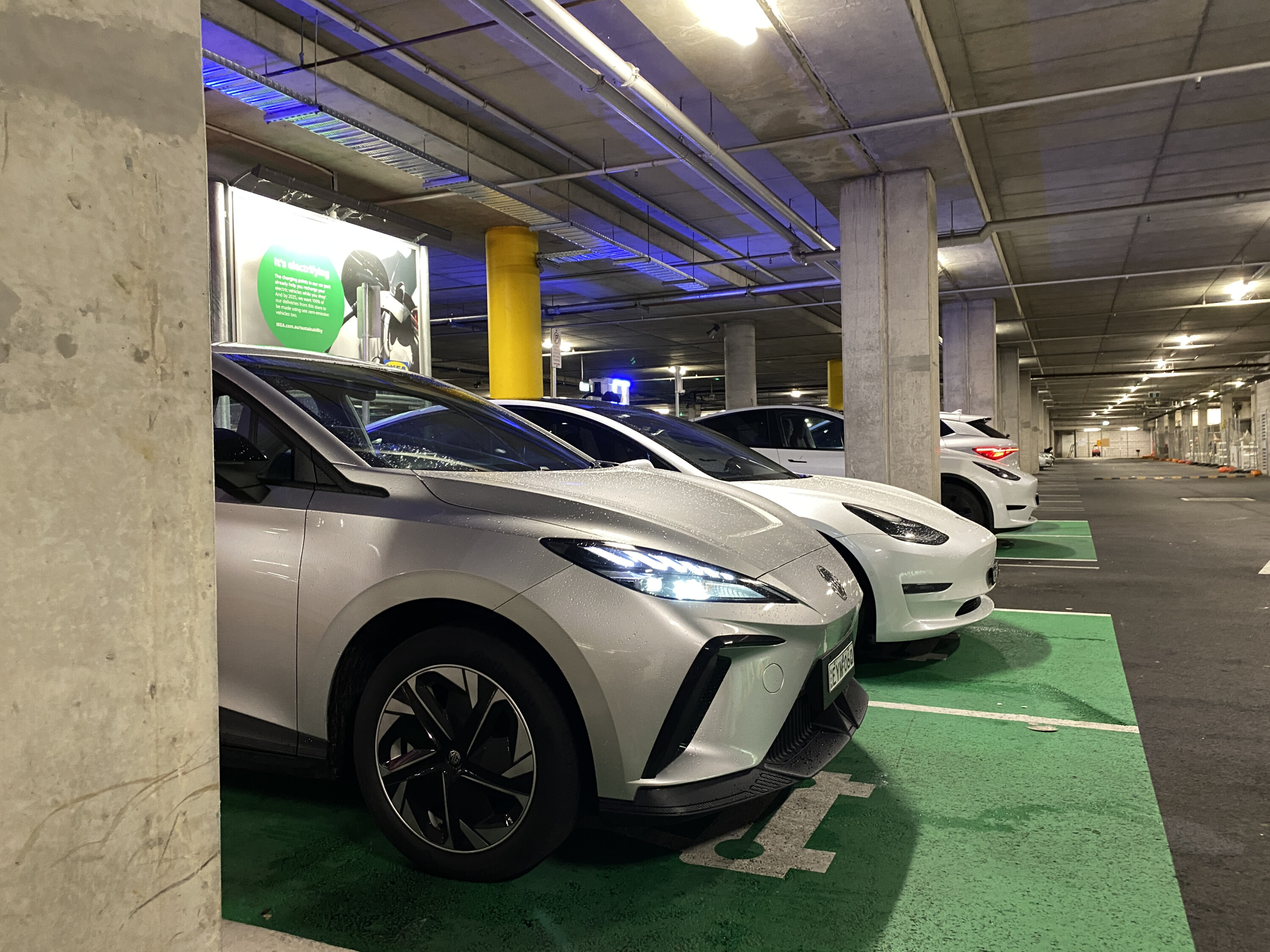
But we had to wait for a Tesla to finish charging first, and when we returned another Model Y was already poised to take our place.
So, for now, adopting EV ownership in a population-dense, garage-poor urban location requires a degree of patience and/or planning.
As for the MG4’s loss of charge overnight, it hasn’t happened again (any more than maybe one percent) so we can only put that down to the extreme temperature one January evening. And as for the rest of the ‘ownership’ experience, there’s still a few niggling faults that grate slightly.
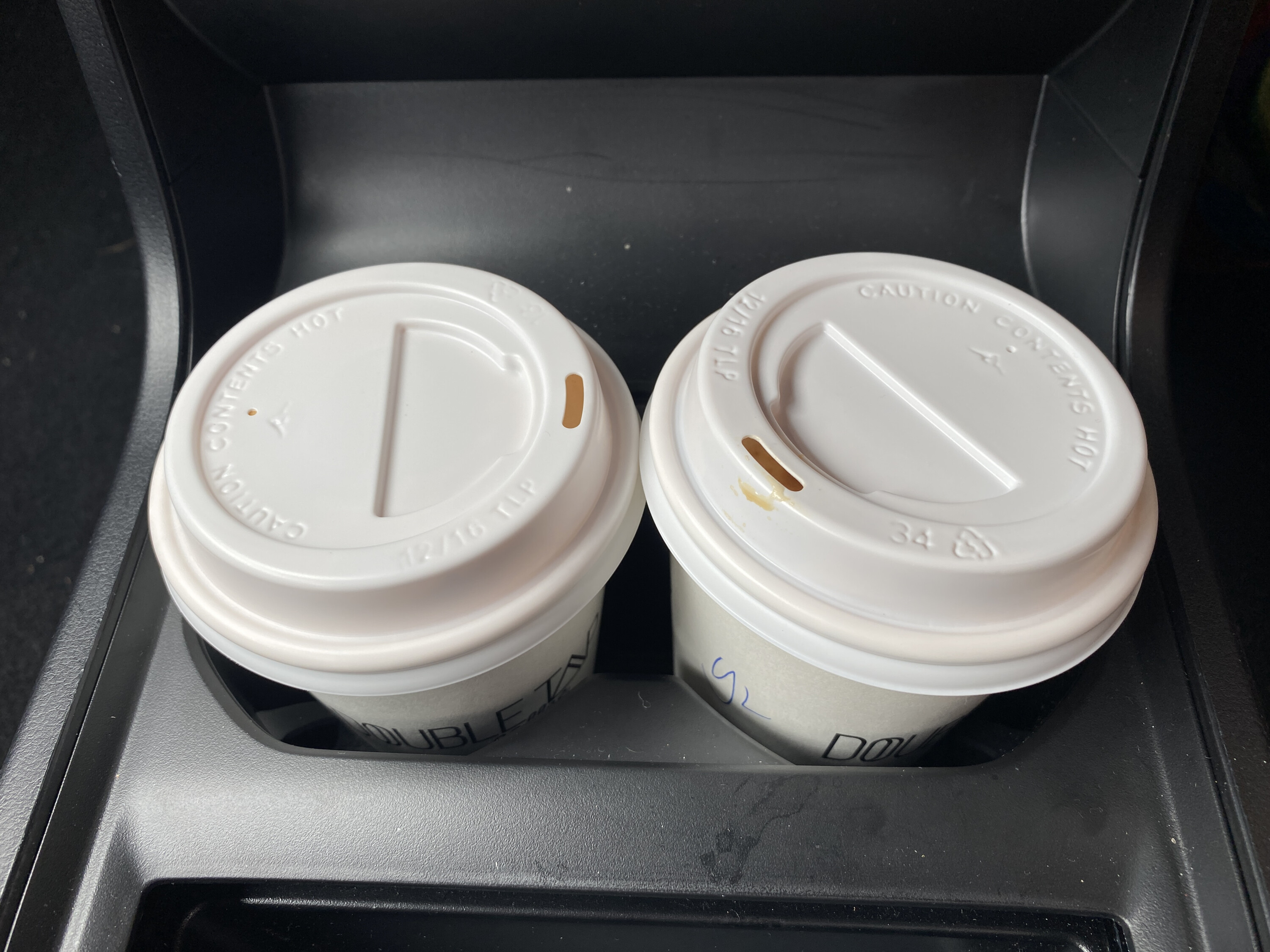
Two normal-sized ‘large’ Aussie coffees cannot comfortably coexist in the front cupholders, the Apple CarPlay regularly doesn’t connect properly (which hasn’t been an issue in other MG4 test cars we’ve had), and sometimes you need to depress the brake several times for the MG4 to display ‘ready’ in its instrument pack.
The doors won’t take larger-sized water bottles (though my preferred coconut water fits comfortably!) and the driver-centric switchgear – both on the steering wheel and the column stalks – needs a rethink. The wheel switches are mostly unmarked and it’s too easy to accidentally flick the LED headlights to ‘off’ or ‘parkers’, rather than ‘auto’.
Part 3, March 2024: Intercity hauling
Plenty of mileage and improved efficiency
- Price as tested: $48,786
- March 2024: 1433km @ 16.6kWh/100km
- Overall: 2246km @ 17.2kWh/100km
Making plans is a mug’s game – best to decide on the spur of the moment and keep some spontaneity in your life.
That’s what I’ve been telling myself as plans to take a delayed Christmas holiday in February evaporated faster than a rain shower in Oodnadatta. So I gifted the MG4 to John Law for a return trip to Canberra. And then followed up Johnny’s ACT adventure with several visits to Newcastle.
With the MG4’s overall energy consumption sitting at 18.2kWh/100km last month (after travelling 813km), it gave a stellar performance in month three, ripping that number down to 17.2kWh/100km, despite much of that mileage being accrued on NSW freeways.
Johnny’s Sydney-to-Canberra leg, purely on the Hume, netted 17.3kWh/100km, while his return journey via some entertaining back roads and a final (post-charge) sprint from Goulburn to Sydney back on the Hume delivered 16.0kWh/100km. For a relatively cheap EV, that’s impressive.
Mr Law had similar grievances to us when it came to the MG 4’s unlabelled steering-wheel controls, and he found the sometimes-recalcitrant gearshift dial and start-up procedure “awkward and annoying”.
But the rest of his notes were filled with nothing but praise for the MG4’s seat comfort, steering and handling, and chilly climate control.
“It was really good at scything through traffic on the busy M5 Motorway, if with a noticeable increase in consumption at speeds beyond 110km/h.
I found 25 degrees the perfect temperature for me on the climate control [we never go higher than 21, so maybe that’s due to Johnny’s lithe frame…], which is very rare for an EV – meaning the AC is ice-cold, unlike in a BYD Atto 3.
The four-speaker stereo is decent enough, the seats are comfy, and the driving is sporty.
“I like the MG4’s low centre-of-gravity and keen steering, and I found the ride quality really quite good – though it can be loud on coarse-chip surfaces, and the [multi-link] rear suspension is a little noisy and boomy. But what I liked most is the handling. We had to make an emergency right turn and the MG4 was bloody awesome!
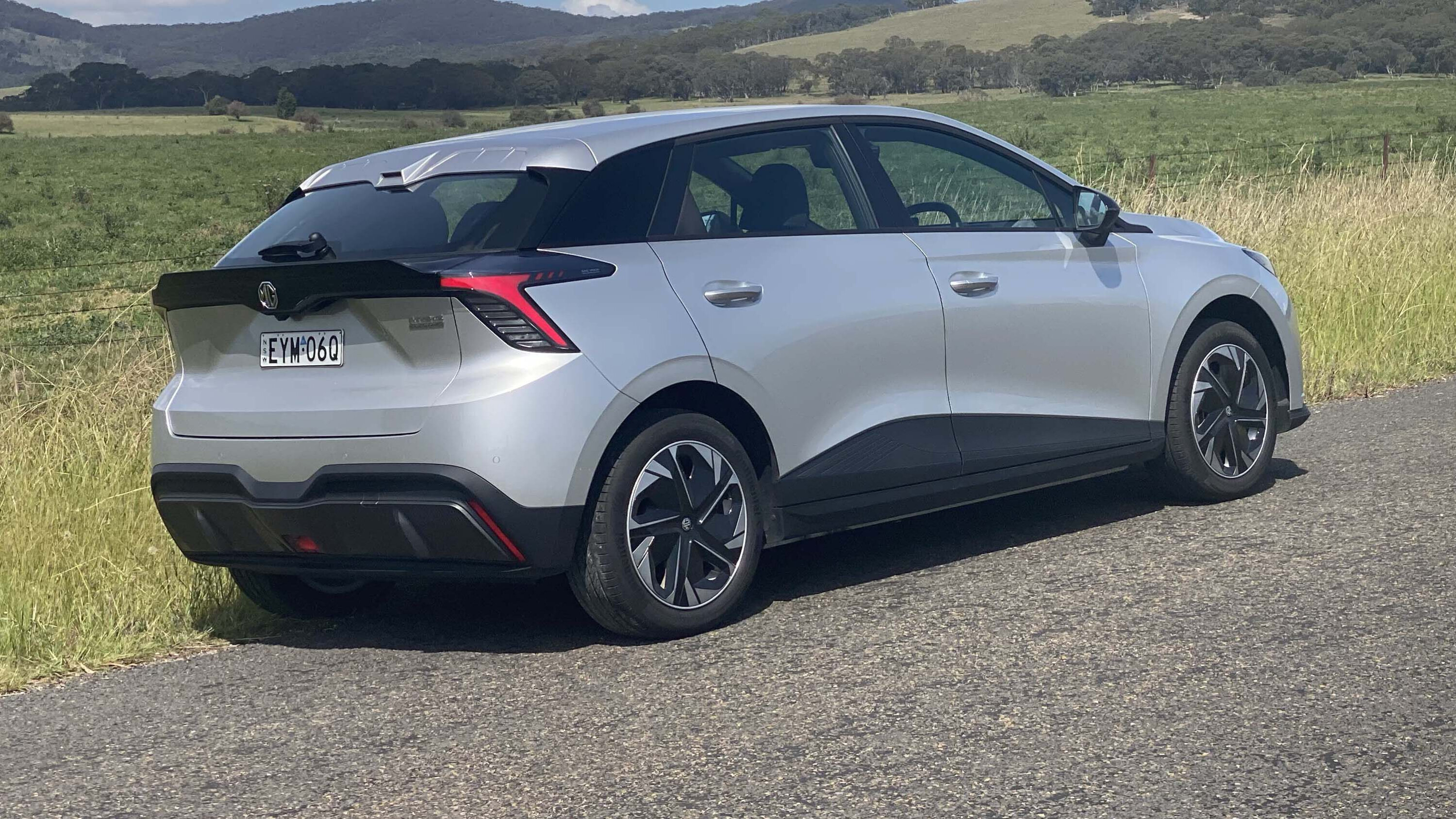
“Trailing the brake in allowed it to develop a good amount of attitude and it scrubbed off speed with a little four-wheel drift – effortlessly making the corner.
It achieves properly good small-car dynamics without trying to be sporty. The Excite 64 is definitely the sweet spot compared to overdone X-Power,” he wrote.
Meanwhile, back at home base, the MG4 has been serving its time well. Driving more than a dozen of the EVs in Wheels’ various comparison tests has simply confirmed how much of a rip-roaring bargain the MG4 Excite 64 is when you take into account its strong driver appeal, really comfortable seating, and fantastic size and vision.
As a small ICE hatchback alternative, it’s borderline brilliant … providing you can accept that some of its electronic quirks (and patchy Apple CarPlay) will probably require a software update to be smoothed over.
As an all-round driving experience, it’s better than any of the four contenders featured in our 2024 Wheels Best Small Electric SUVs (e-2008, Atto 3, Kona EV and Megane E-Tech), and the Excite 64’s narrower footprint compared to the next-up Essence 64 (wearing grippier 235/45R18s instead of 215/50R17s) allows it to find its balance better in a corner, nudging its tail out slightly on corner exits for a more fluid, more rewarding handling – plus a more absorbent ride.
If the MG4 is any guide, the next generation of SAIC-funded products could well earn the popularity the MG brand is already enjoying (albeit based on their fire-sale pricing, because Aussies have always loved a bargain).
Part 4: Softly tweaked
Electronic updates, plus a substantial price drop
- Price as tested: $45,690 drive-away
- This month: 711km @ 17.2kWh/100km
- Overall: 2957km @ 17.2kWh/100km
Just like the hand-held devices that have become the bane of our existence when there’s a pedestrian glued to them, the electric MG 4 requires software updates. Perhaps ‘requires’ is being a bit dramatic because if everything was perfect, it wouldn’t need them.
But having that capability allows the factory to upgrade and finesse this EV’s multitude of electronic systems for “a more optimal driving experience for all owners” (the company’s words).
The MG 4’s software update covered its forward collision warning and AEB performance – particularly for when the car is turning across traffic from the centre of the road while another car is doing the same in the opposite direction. Apparently, customers found the AEB overly eager to activate in situations where it wasn’t warranted, so the sensitivity of the system has been finessed. I’ve personally barely experienced this, though I did cop a major AEB moment on the motorway as I was pulling out to overtake a truck. Perhaps my margin-of-error tolerance is more nuanced than simply ‘computer says no’.
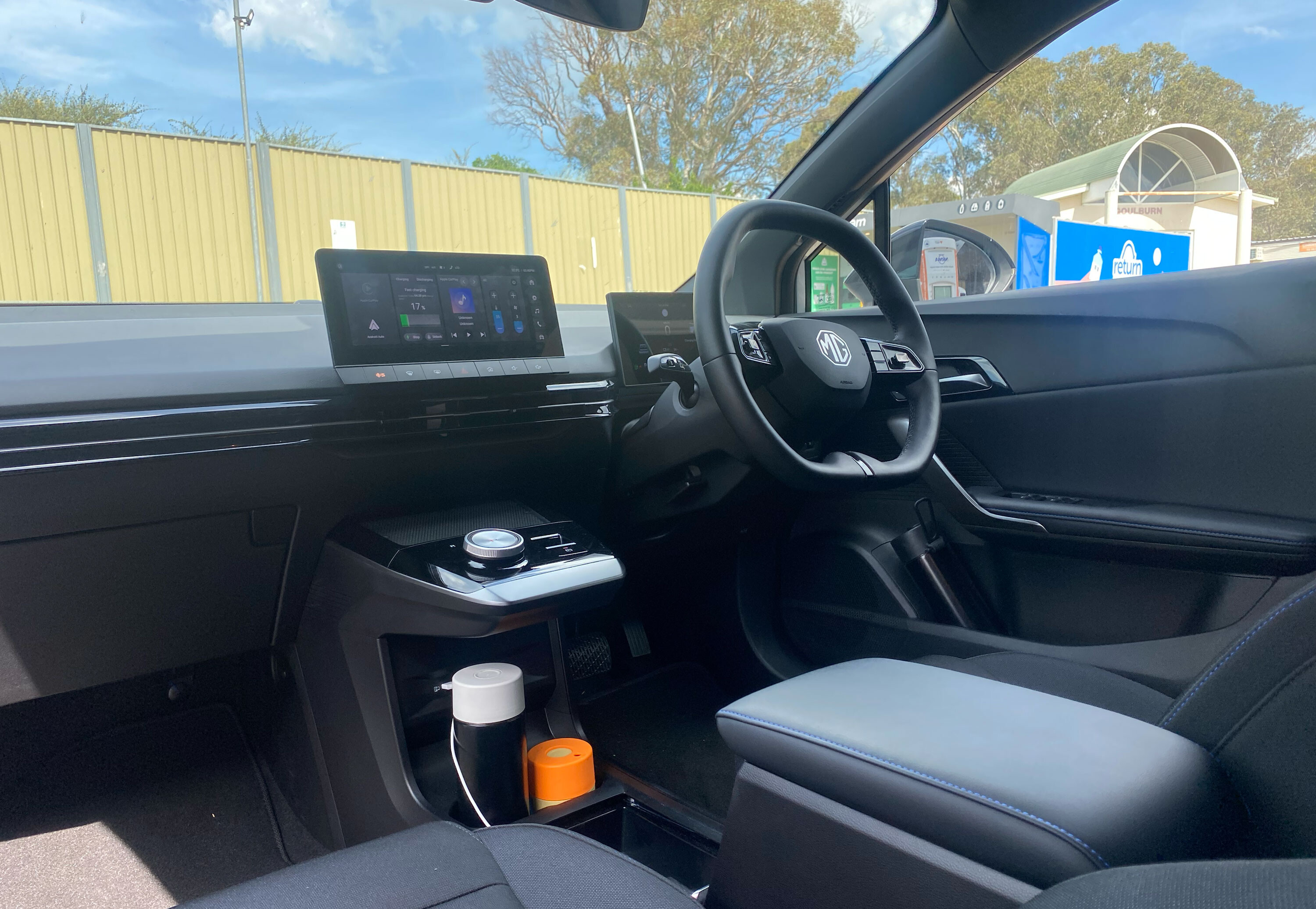
After driving an MG 4 Essence 64 hard for our recent EV testing, I’ve been playing with the Excite’s various driving modes. There’s plenty of stuff in there – easily accessed by pressing the touchscreen’s car icon, then selecting various tabs. I’ve simply left the long-termer in Normal mode, because every time you ‘start’ the car, that’s what it reverts to. So any experimentation with Custom mode, which can blend altered steering weighting and throttle response with proper ‘one-pedal’ regenerative braking, all gets thrown in the bin next time the MG 4 boots up. You need to configure it from scratch every time.
Thing is, none of it is necessary – certainly not the drive-mode stuff. I just leave the MG the way it is and select ‘one-pedal’, because its regenerative braking works well and will bring the car to a full stop.
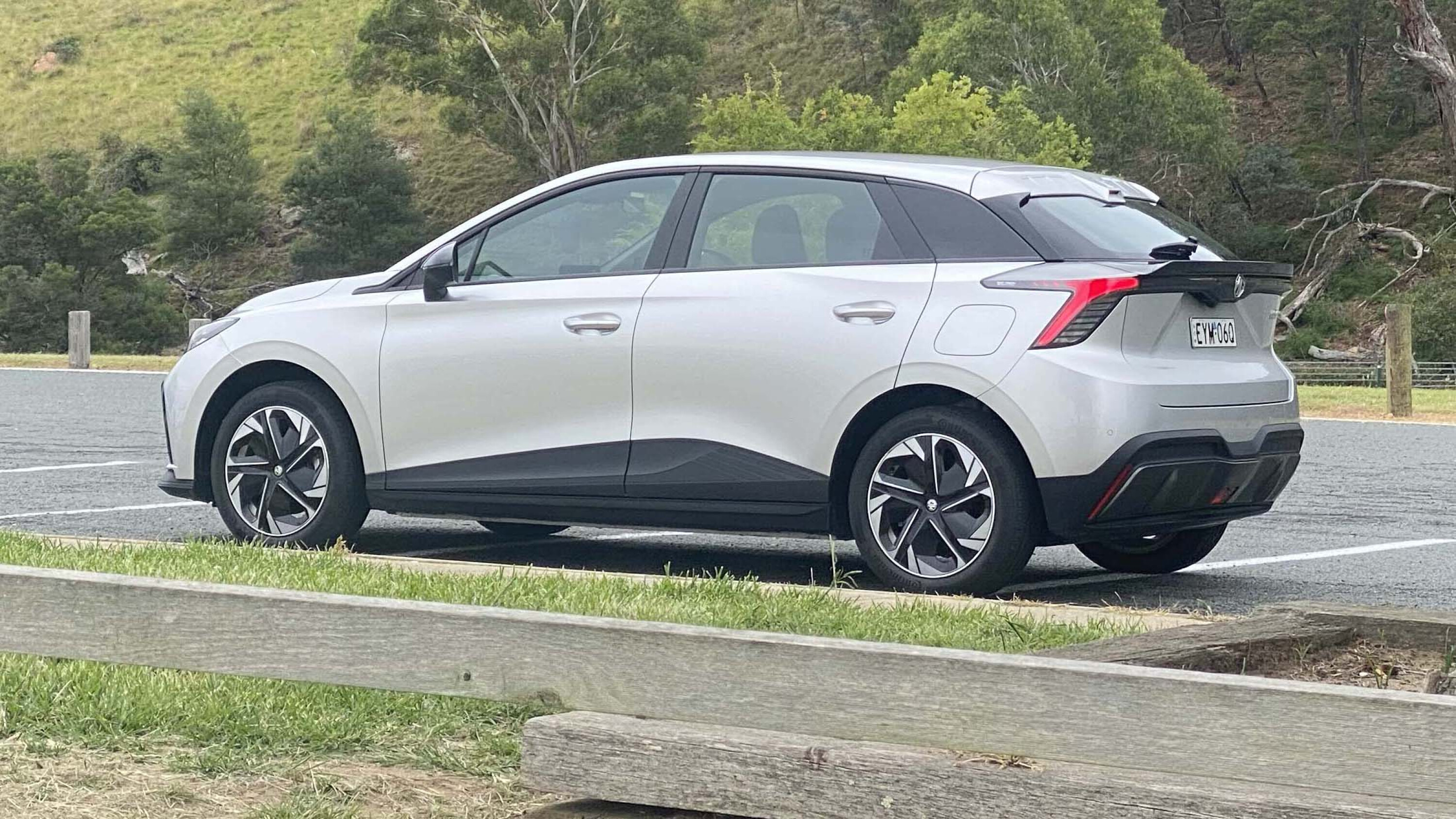
Based on EYM-06Q’s patchy Apple CarPlay connectivity, I asked MG’s software engineer whether a future update might address the multimedia system, and he replied “it’s coming.” Whether that will happen before this car goes back is unlikely, however my partner and I did get brand new Apple phones … which only connect via USB-C. Once I’ve sourced a piggyback USB-A plug, we’ll know for certain whether the MG’s frustrating wired smartphone mirroring is all its fault, or due to our ageing phones.
Thanks to a pricing sweetener at the end of March, the MG 4 could now be considered a genuinely cheap EV. The Excite 64’s previous manufacturer list price ($44,990) is now its national drive-away price, saving well over three grand in NSW. Ditto the base car at $39,990 driveaway. Moving up the range, the new drive-away price for the Essence 64 and Essence 77 is actually cheaper than their previous list prices (by $3K for the 77), though that doesn’t change my opinion that the smaller wheeled Excite 64 is clearly the MG 4 sweet spot.
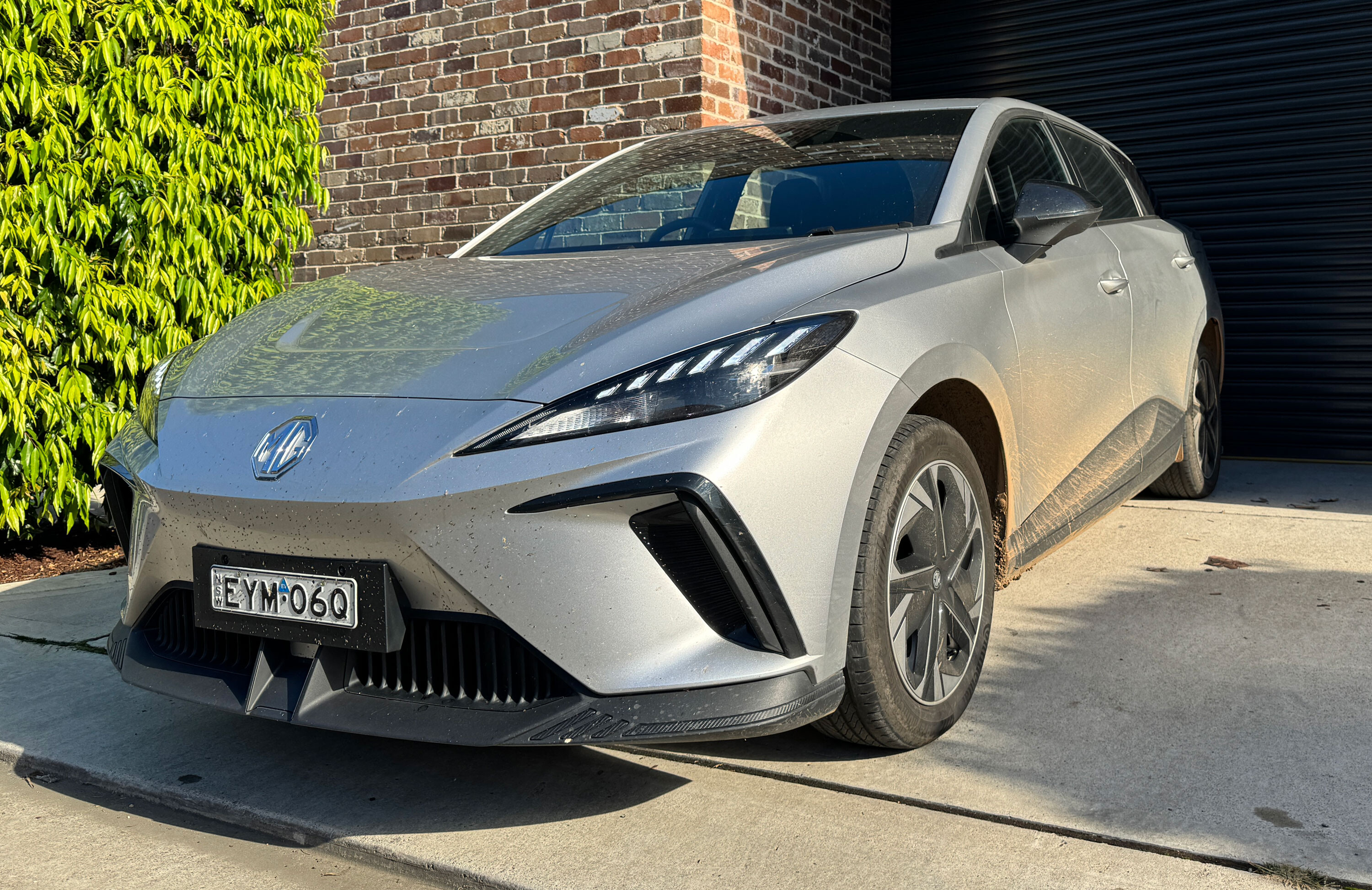
Unlike Andy and his now-departed Mach-E, no one has confronted me about the MG. It so easily blends into the landscape, it may as well be invisible. Sure, I’ve had pedestrians walking down the middle of our road, oblivious to the fact there’s an EV almost wedged up their date, who’ve then thrown me a startled ‘WTF?’ after I’ve given them a friendly toot, but that’s about it.
No blues at EV chargers yet either, though I suspect some degree of commotion is imminent. After many, many decades of service-station queueing etiquette – a process so effective in its lane-filtering ease that it’s been deployed across the globe – having nowhere to properly queue for an EV charger appears to be an argument waiting to happen. So far, the honesty system has been upheld. But its effectiveness seems tenuous.

There’s also the aspect of plugging into the same charging tower as someone else – thereby halving their charging speed. It happened to me recently at IKEA in Tempe, where there were two charging plugs free on one unit (for the full 150kW boost), but old mate decided he’d feel more comfortable sidled up next to the MG (which can handle up to 140kW DC charge), instantly plunging our charge speed to 75kW.
Perhaps the silence and refinement of a decent EV acts as a subliminal counterbalance to the potential anxiety and impatience in having to charge it. I keep a sharp eye on the apps, seeing when the chargers are free … but even if you’re only a few minutes’ drive away, that means nothing. Patience is a virtue when it comes to navigating Australia’s inconsistent charging infrastructure, as is strategy. But if you’re lucky enough to have a garage at home, with a decently powerful wallbox just for you, then great. I want your life.
Part 5: Eastern Feastin’
Two massive trips, many hours waiting to charge
- Price as tested: $45,690 drive-away
- This month: 4613km @ 17.5kWh/100km
- Overall: 7570km @ 17.4kWh/100km
The MG 4, as a car, performed well – comfortably accommodating us in its cloth-upholstered buckets, despite their rudimentary manual adjustment (including no height-adjust for the front passenger). Its deep cowl and vast windscreen framed the pink sunsets on the picturesque Pacific Highway beautifully, and even its 350km real-world range at 110km/h didn’t seem too horrendous given that this is essentially a city car (with a WLTP claim of 450km).
The first insect in this EV’s ointment turned out to be its solitary USB-C charging port – it doesn’t work. So balancing the available phone charge on our new iPhone 15s with music duties, navigation to the next EV station, and having enough phone power left to access the apps to charge the MG 4 became quite a challenge heading north. Thankfully, a wall outlet inside the servo at Taree South became our saviour.
Like the Evie chargers at Taree and Macksville, the pair at Shell in Tyndale, just south of Maclean in northern NSW, also provide 350kW ultra-fast charging speeds, but two of the four outlets were broken … and now several weeks later, remain ‘unavailable’. It’s this aspect of EV motoring, even more than their relatively short distance potential, that constantly frustrates.
Speaking of which, spending so much time in the MG 4 has crystallised what we like and don’t like about MG’s brand-enhancing EV. At its core, this is an excellent car. Handsome, roomy, keen, sweetly balanced, reasonably quiet, brisk (and cheap) to charge (when the chargers are working!), and great value for money, its fun-to-drive and easy-to park vibe makes it a terrific antidote to the stress of city living.
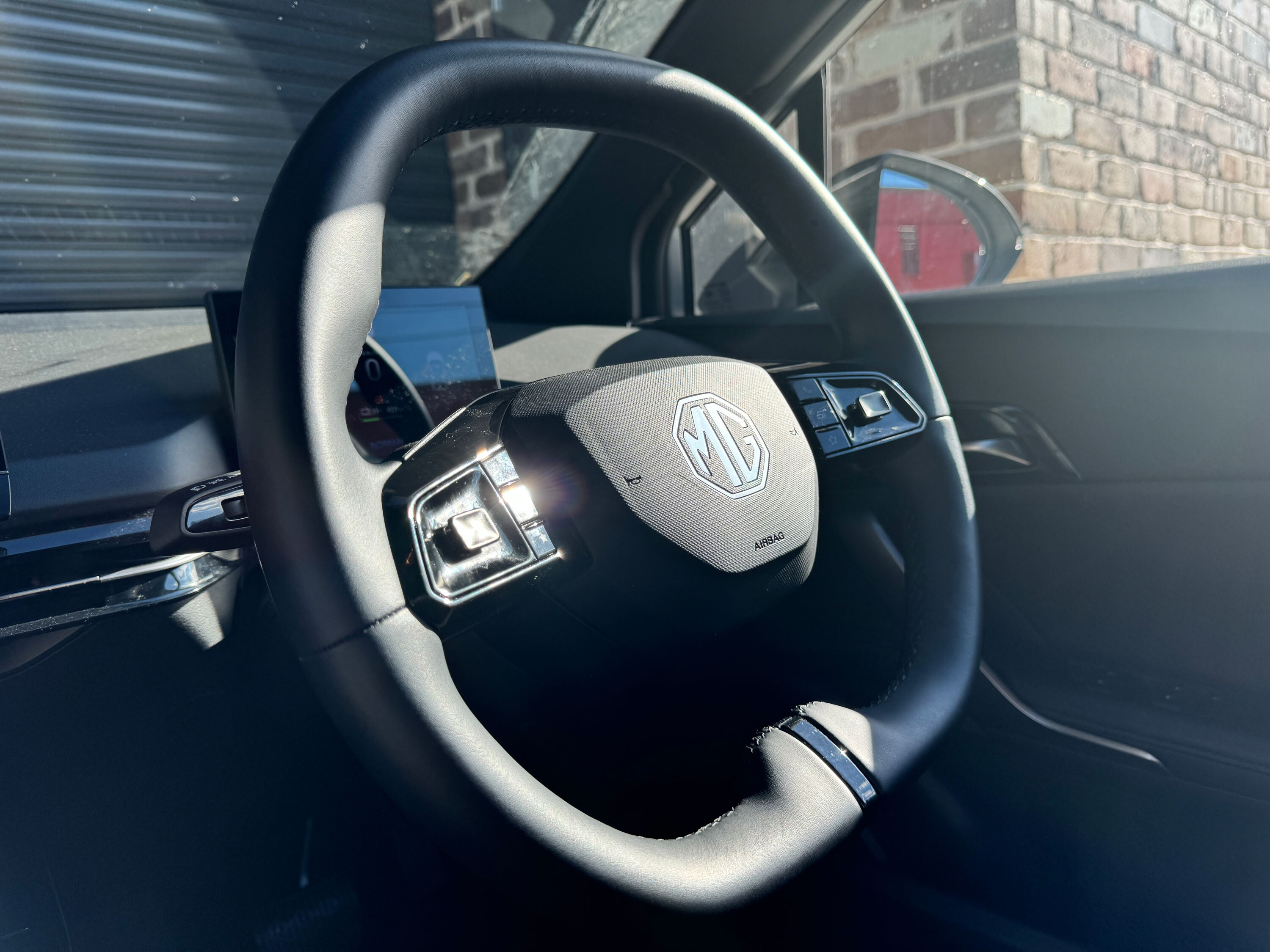
But its supplementary electronic systems such as its multimedia system and its active-safety aids require a considerable amount of redevelopment. Its Apple CarPlay hasn’t worked properly in months, its USB-C port appears to be completely dead, and its central touchscreen is so tardy to boot up that you’re often almost rear-ending whatever is behind you before there’s any camera vision. The start-up procedure is also hit and miss – depressing the brake once you’re seated prompts a green ‘READY’ light in the instrument pack – seeing it sometimes requires several stabs of the brake pedal, mostly after the car has already been running and has then switched itself off, to get it operational again.
The main glitches with its safety electronics concern its lane-keep assistance (which automatically engages every time cruise control is activated, including when you hit ‘resume’) and its auto high-beam. The MG 4’s lane-keep performance is the definition of snatch-and-grab – lacking any form of subtlety or awareness of the road ahead – while its auto high-beam also seems unaware of what it should be looking out for, including the tail-lights of vehicles less than 200m in front. It’s both laughably amateur in its dimwittedness and anxiety-inducing.
Finally, to its in-cabin storage. The front doors will house a narrow one litre bottle but nothing more, while locating the cramped centre-console cup holders below the console’s transmission ‘awning’ means you’re restricted for height as well. Why not put them where the large tray is between the front seats? The angled pad for where the wireless phone charging is in higher-spec models is also annoyingly slippery – your phone slides off at the first hint of lateral g-force – and having no rear-seat courtesy lighting smacks of 1970s penny-pinching.
As a motoring journalist, I can see past the flaws of this kind of ‘tinsel’ to truly appreciate what the MG 4 is good at. Apart from its slightly jiggly ride – especially around town – and the lack of true steering feel at higher speeds, the MG 4 is a genuinely likeable driver’s car. I love its seat comfort, its crisp accelerative urge, and its steering sharpness via a terrific two-spoke wheel. I even like its styling and could easily live with the audio quality from just four front seat speakers. But my partner has struggled to acclimatise to its niggling quirks, and while he enjoys driving it, the MG’s storage issues, electronic foibles and invisible Apple CarPlay have become deal-breakers.
At some point during its lifecycle, the MG 4 will surely hit its peak. With more range, plenty of software updating and some intelligent reworking of its interior packaging, it’ll be an absolute cracker for the money. For the time being, though, it remains a really impressive small electric hatch, best left in the city.
Part 6: Parting thinking
Back to base for some post-test analysis
- Price as tested: $45,690 drive-away
- Overall: 7570km @ 17.4kWh/100km
Firstly, EYM-06Q’s labour-averse USB-C port in the dashboard’s centre stack. Yep, it was dead. Bereft of life. Pushing up the daisies in an alternate UX universe somewhere, with ‘EX-USB-C’ marking its criminal record. MG assures us it’s a relatively painless fix and would’ve required a day at a dealership, but when you’re on a road-trip holiday, hanging out in a service department waiting area for eight hours equals an extra day’s accom in said locale, and that unscheduled inconvenience may lead one to drink.
MG flagged the possibility of providing a loaner vehicle to “mirror the customer experience we strive for” had we returned our MG 4 for rectification, but when you’re already balls-deep on a trip north, faffing about for non-essential car repairs would’ve been utterly pointless.
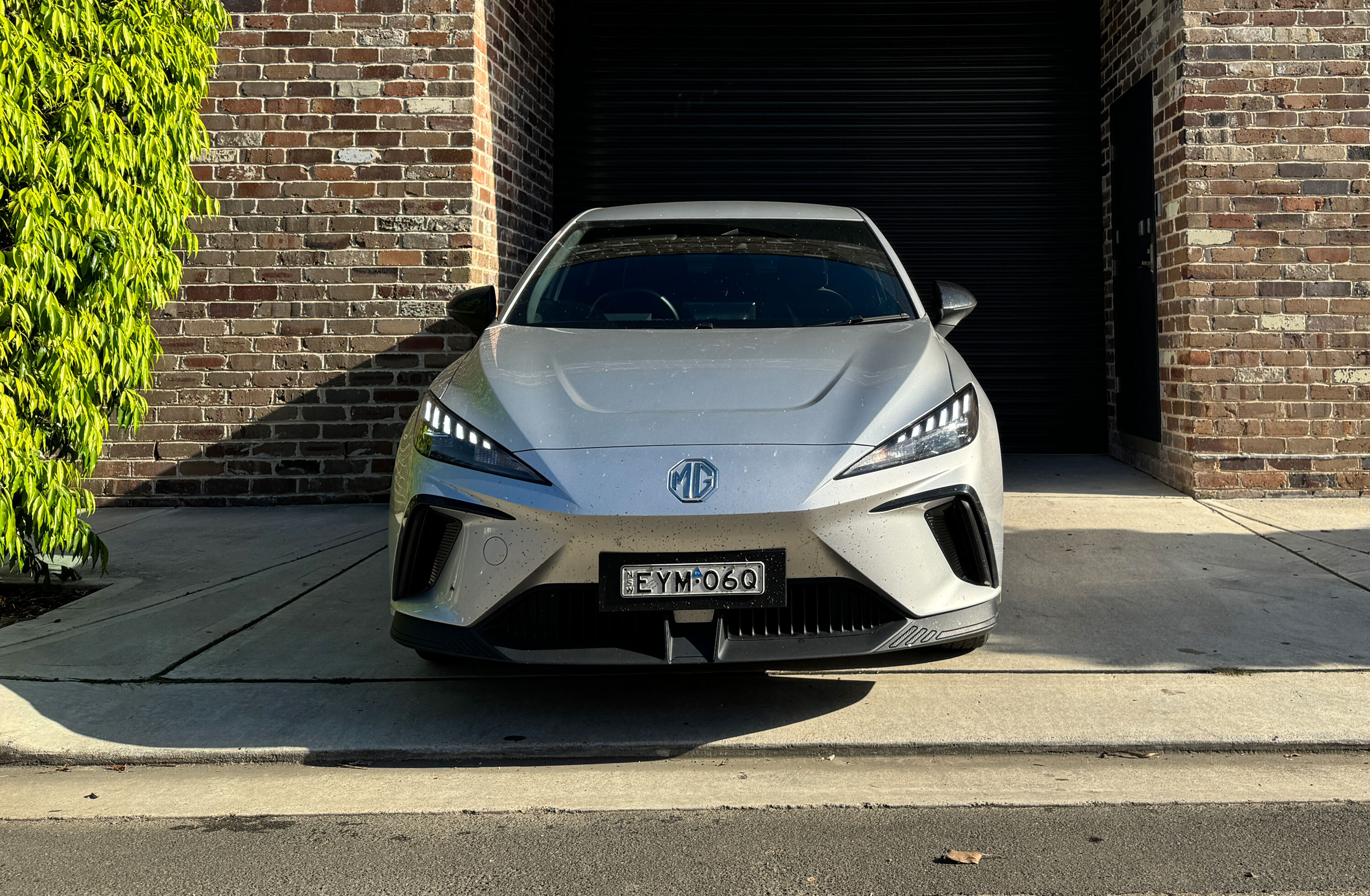
Then there’s the Apple CarPlay. MG’s technical wizard said it worked perfectly for him on two separate road tests using two different phones. We hadn’t used it properly for months, and when it did work, sometimes it required plugging in and unplugging more than a dozen times to get it to connect … which happened in no other test car using the same cords and phones. Anyhoo, MG said it “carried out a factory reset, reprogrammed and recalibrated the FICM anyway” and we’ve already reported there’s a factory software update coming for the MG 4’s smartphone mirroring.
Having now sampled the newer, quicker, clearer multimedia setup (with the same-size screen and general architecture as MG 4’s) in the new-generation MG 3, better things are coming in this department. Yet, to be honest, of the multitude of Chinese brands now wielding tech-heavy control screens in their products in Australia, the most user-friendly (ie. the least infuriating) is this set-up in the MG 3 and 4.
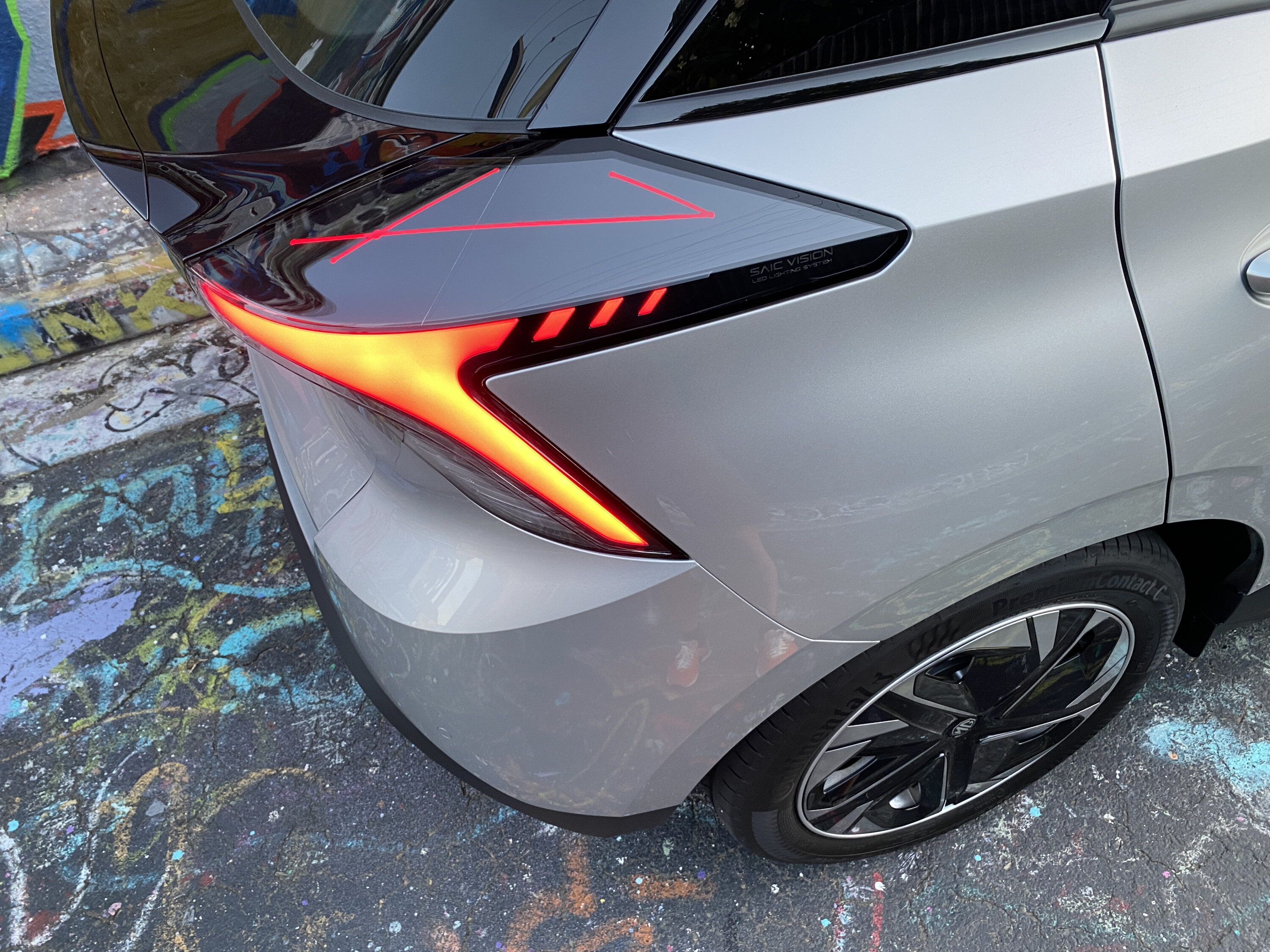
The final thing we noticed (after last month’s report) was the left-rear tail-light had taken in water during some serious rain. But after being parked in north-facing sun for five days, it all evaporated. MG says it’s a simple fix and will replace the taillight (covered under the seven-year warranty for a regular punter) before the car is sold. As with the other issues, it’ll be logged on a database that gets sent directly to Shanghai.
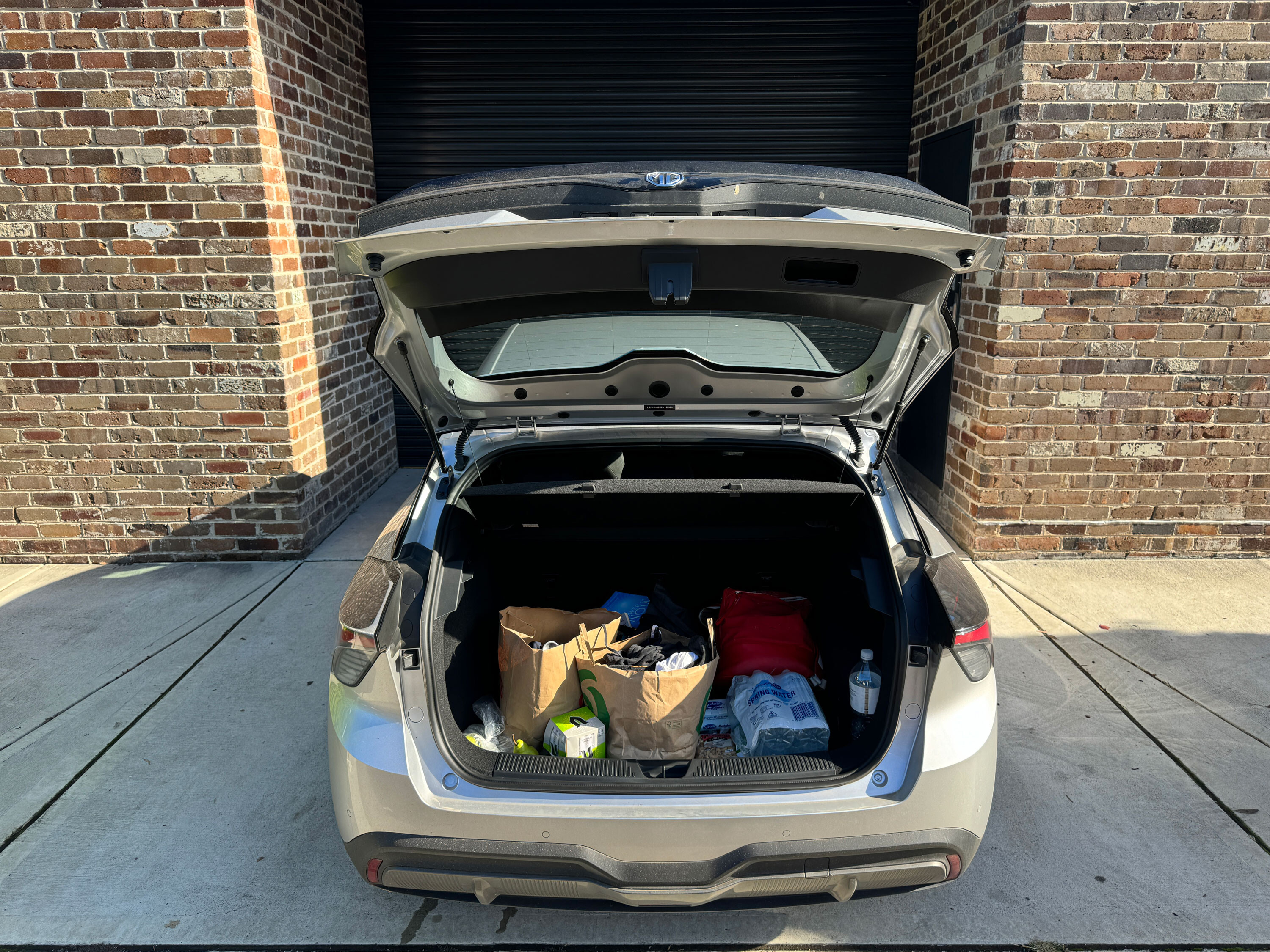
Having had time to reflect on the MG 4 Excite 64 for several weeks now, what do I miss and what would I change? Firstly, its general driving ease – thanks to light, quick steering, compact sizing, a tight turning circle, great handling and brilliant forward vision – makes it an excellent city car. And even when it needs charging, being able to swallow up to 140kW DC makes it happen reasonably quickly. I loved its seats, its five-door ease, its useful 363-litre boot, and its swift acceleration (7.2sec 0-100km/h). And I even liked the fonts in its dinky instrument pack.
There’s plenty I’d change though. A less reactive ride (without hampering the steering and handling) and much more reactive general electronics would make a huge difference. The inconsistent tardiness of its drivetrain and multimedia start-up procedures can test your patience, and they seem to work the least well just when you need them most! Non-folding electric mirrors and no rear-seat lighting both seem odd in 2024. And if the new MG 3 is any guide, it’s only a matter of time before the MG 4 gets better control markings on its steering wheel and all-new, simpler column stalks.
There’s always gonna be haters who wouldn’t buy Chinese, full stop. Admittedly, there’s a whole heap I wouldn’t go near but that’s car-dependent, not anything to do with the brand or country of origin. Given how fast the Chinese are learning and their keenness to overcome any faults, perhaps we’ll one day laugh about the ropey original Haval H6 or the MG GS. We’re already most of the way there, and the MG 4 is even closer again. But it’ll need a bit more finesse, focus and real-world electric range to truly realise its undoubted all-round potential.
The Cupra Tavascan will arrive in Australia in December as the brand’s first fully-electric SUV and second pure EV, joining the Born electric hatch that arrived in 2023.
Pitching into the increasingly competitive small all-electric SUV space, the Tavascan enter local showrooms in a two-model lineup, with the 210kW rear-wheel drive single motor Tavascan Endurance as the entrypoint and the 250kW dual-motor AWD Tavascan VZ as the flagship.
As a soon-to-be member of the near-premium EV SUV segment, the Tavascan won’t be short of rivals when it lands. Already present in Australia are battery-electric sporty SUVs like the dominant Tesla Model Y, Volvo EX30, Smart #3 and EV variants of the Mini Countryman, while the Hyundai Kona Electric, Lexus UX 300e and – to a lesser extent – the Renault Megane E-Tech, will also compete with the Cupra.
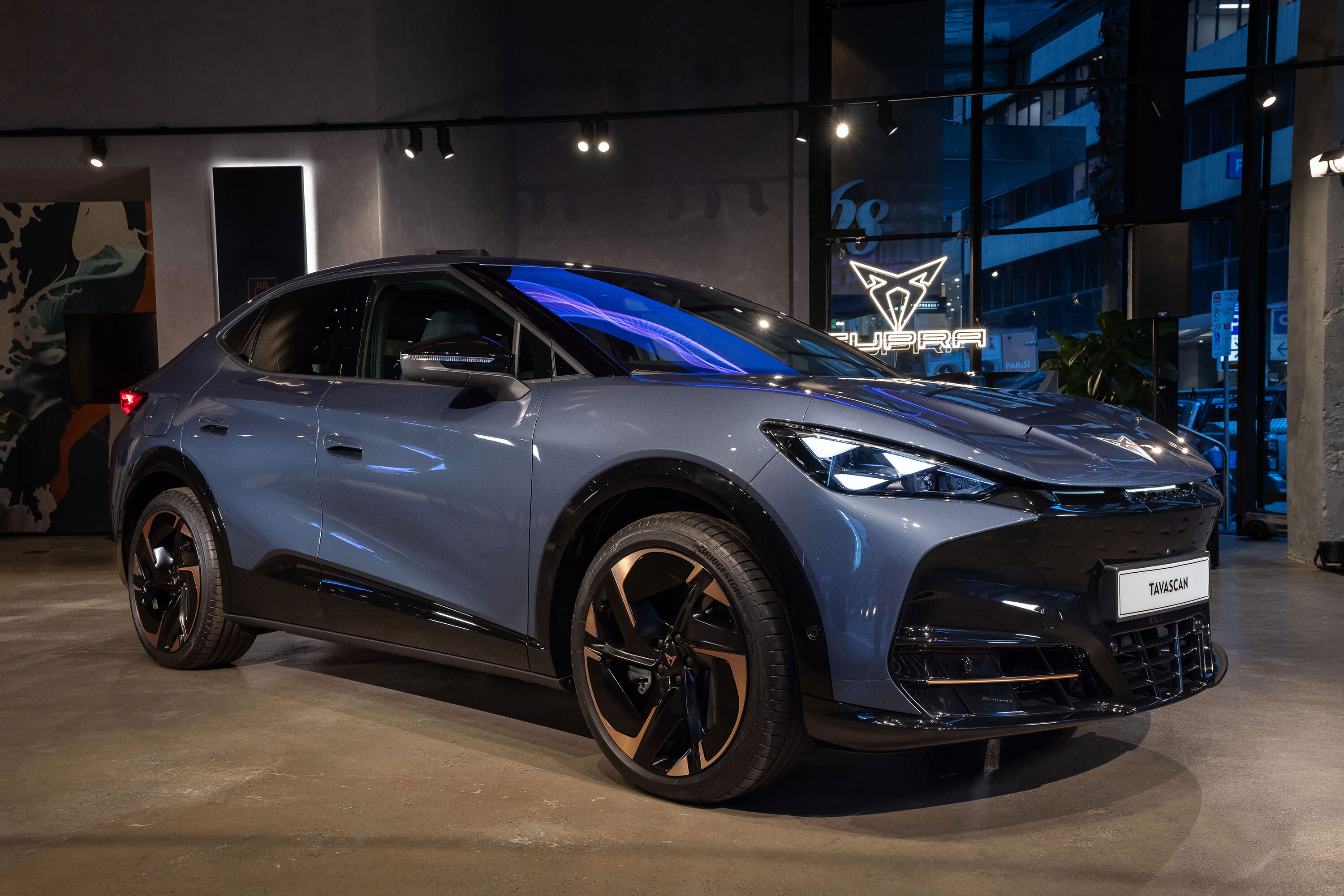
Pricing will help shape its fortunes in Australia, and though Cupra has yet to confirm Australian pricetags for the Tavascan Endurance and VZ (expect to find out closer to its December launch timing), local Cupra chief Ben Wilks says “we expect all variants to fall below the LCT threshold and to therefore qualify for FBT exemptions”. With the FBT threshold for fuel-efficient or zero-emission vehicles currently set at $91,387, we do at least know there’s a hard ceiling for the Tavascan VZ. As for the Tavascan Endurance, Wilks hinted that the entry model will be priced “slightly above” the RRP of Cupra’s Formentor VZx, which is currently retailing at $65,790.
Full Australian specifications haven’t been outlined yet, but key features will include a massive 15-inch infotainment touchscreen, 19-inch alloys for the Endurance (21-inchers for the sportier VZ), LED headlamps, keyless entry and ‘sit to start’ functionality, a powered tailgate with kick sensor and tri-zone climate control. The Endurance can also be optioned up with the ‘Interior Package’, which adds 20-inch alloys, a 360-degree parking camera, powered/heated front seats, a Sennheiser audio system, ambient cabin lighting and microfibre upholstery to replace the standard black cloth.
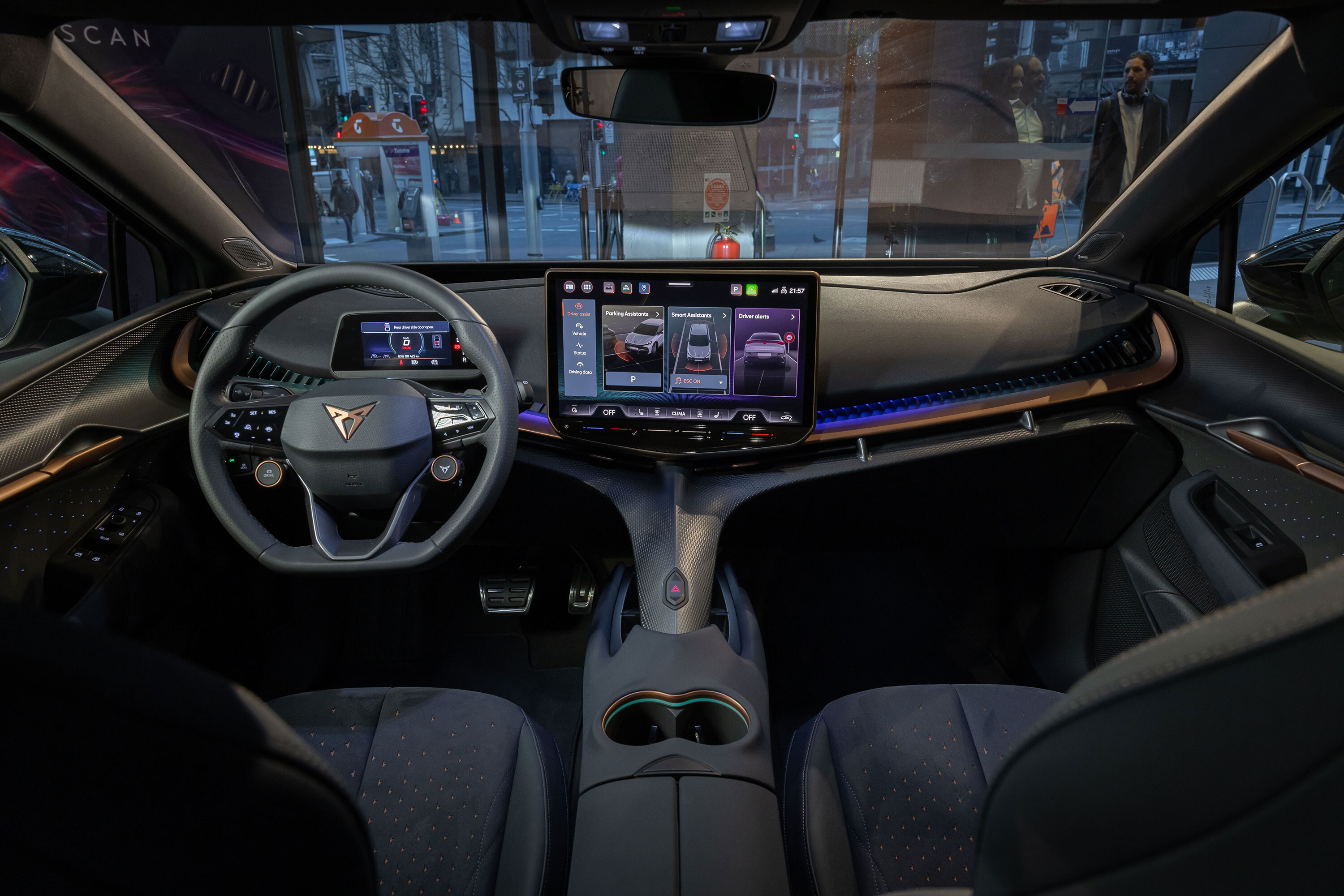
The VZ adds to the above by bringing ‘cascading Matrix LED’ headlamps, adaptive suspension and a glass roof with retractable sunblind. From early 2025 onward, an optional ‘Extreme Package’ for the VZ will replace the standard front seats with leather-clad racing buckets, as well as grippier tyres to help generate more cornering G.
Both variants will be powered by a 77kWh battery pack, delivering enough energy to the Endurance’s single 210kW/545Nm motor to go from 0-100km/h in 6.8 seconds and travel a maximum distance of 568km (WLTP). The Tavascan VZ adds an 80kW/145Nm motor to the front wheels to produce a combined total output of 250kW and 545Nm, enough to zip to 100km/h in 5.5 seconds, though it comes at the expense of range, dipping to 499km on a single charge. If equipped with the Extreme Package, the Tavascan VZ trims its range even further to 463km.
Expect full specifications and pricing for the 2025 Cupra Tavascan to be announced as we draw closer to its December launch date.
2024 Ford Mustang Mach-E long term review
JUMP AHEAD
- Part 1: Welcome
- Part 2: WTF: What’s that Ford?
- Part 3: A pony by any other name…
- Part 4: I think, therefore I am (puzzled)
- Part 5: Big Mach heads back
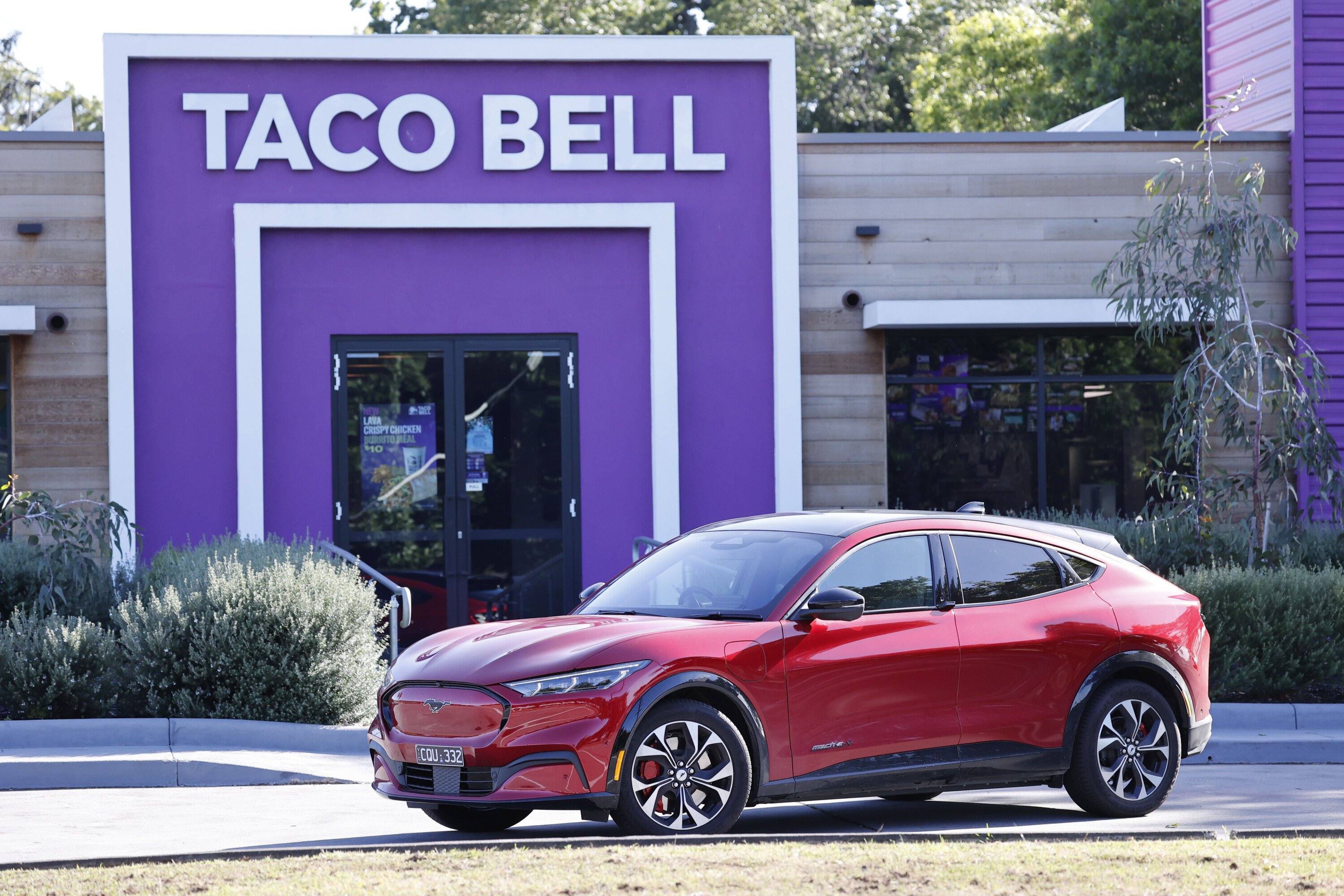
Welcome
- Model: Ford Mustang Mach-E
- Price as tested: $89,990 + on-road costs
- This month: 1100km
I have a feeling that this one might be a bit controversial. There just don’t seem to be too many fence-sitters when it comes to the Mexican-built Mustang Mach-E and that largely comes down to the idea of the car rather than the nuts and bolts of it.
I have to say that I don’t really buy into the Mustang branding. The Mach-E feels as if it has more in common with a latter-day interpretation of a Mondeo than a Mustang. It’s not cheap either. This single-motor Mach-E Premium was, at launch, lineball with the dual motor Tesla Model Y Performance, both wearing a c.$91K price tag.
That’s until Ford backtracked and slashed almost five grand off the asking price to make it a little more palatable to Aussie buyers who’d thrown their hands up in horror.
Thankfully it now comes in below the Luxury Car Tax threshold and is eligible for Fringe Benefits Tax exemption when bought on a novated lease. That’s a good deal smarter.
The ‘original’ asking price was a backtrack in and of itself. Back in 2022, Ford’s CFO John Lawler said that rising commodity costs had wiped out the profit expected on the Mach-E. It was profitable at launch in late 2020, then lithium prices went up by 144 percent and the whole project went into the red.
The price of the Mach-E shot up and, you’d have to say, the whole project looked emblematic of a huge company blundering into a rapidly moving market it hasn’t really got a firm handle on.
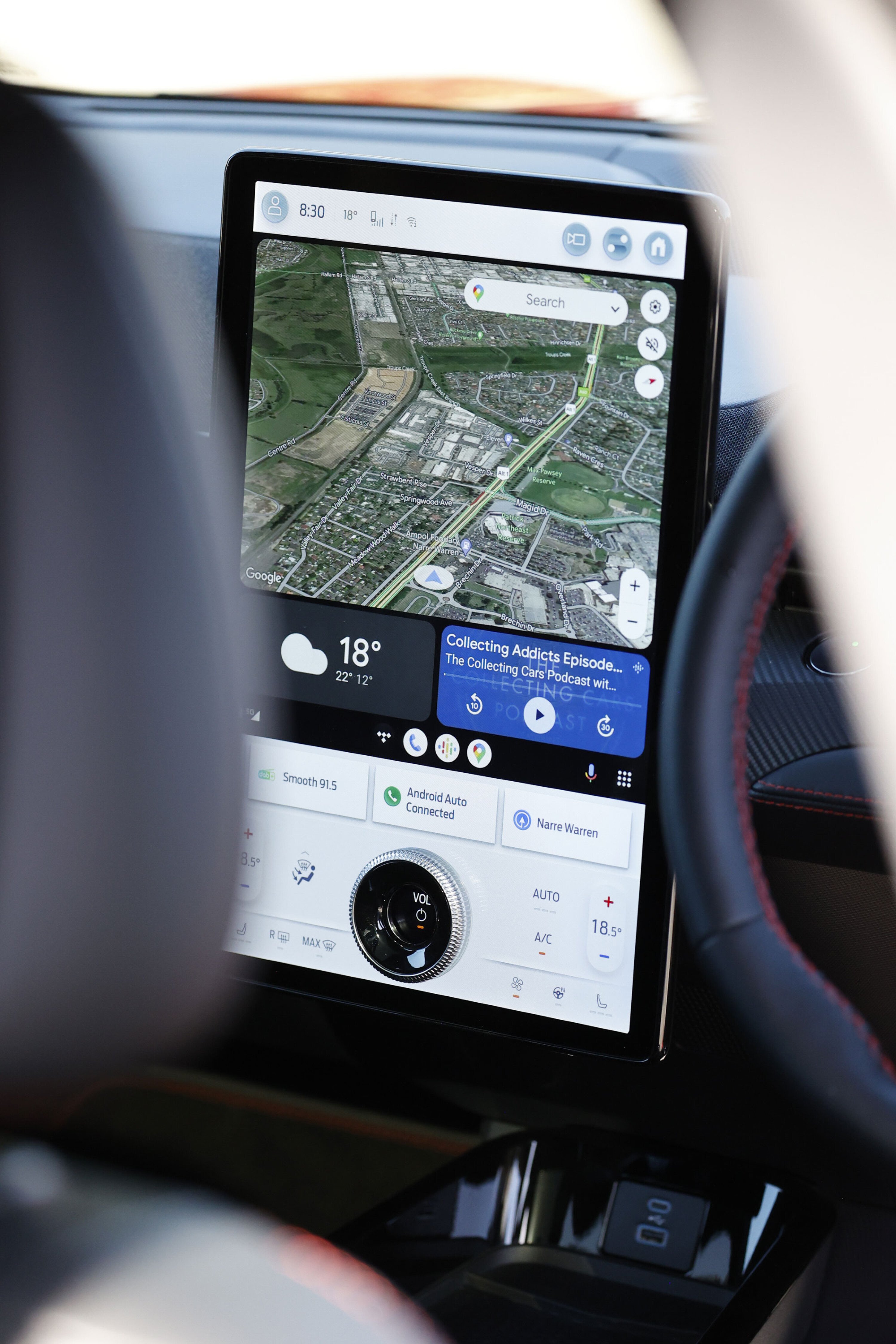
So it’s fair to say that this car has had a tough genesis and it would probably be understandable had the Mach-E proved to be a bad vehicle. But it’s clearly not.
Aussie-spec cars have been garnering cautiously decent reviews and in order to wrap my head around this intriguing vehicle, I figured that spending three months with one would give me the time to form an informed opinion to deliver to you, dear readers.
The child in me would certainly have opted for the top-spec dual-motor GT model, a car that at least delivers straight-line performance worthy of the Mustang branding, but given my unerring talent for running out of juice in electric cars, I figured it was probably a wiser decision to go for the Premium, the model with an extra 109km of range over the GT.
The Mach-E experience takes some keying into.
Yes, I’d do without all-wheel drive, and the performance is brisk rather than properly face-warping, but at least I’d give myself a fighting chance of demonstrating to my partner that there was more to EV ownership than skulking around the bins in the back of a dimly-lit servo at night trying to locate a charger that had long since gone unserviceable.
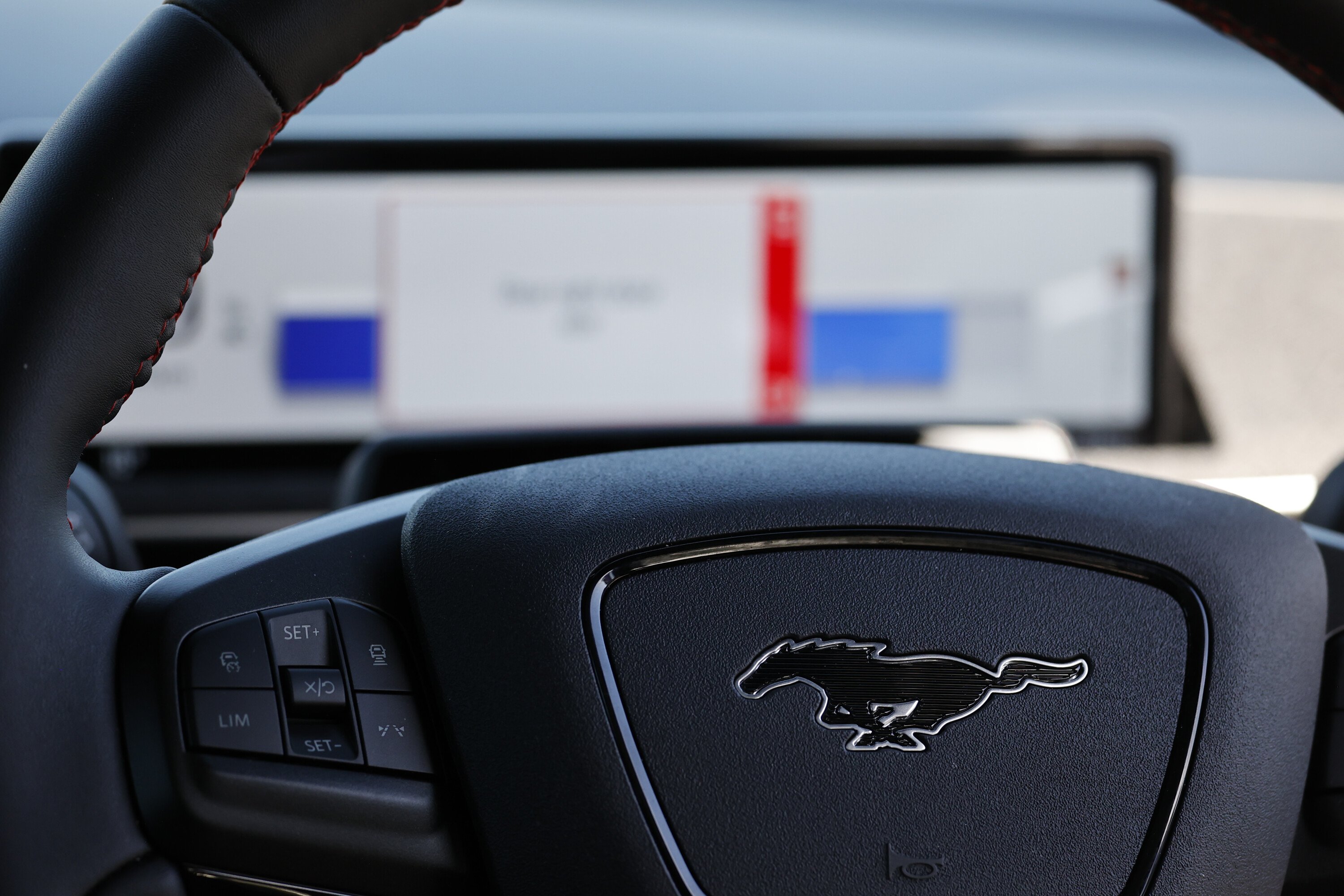
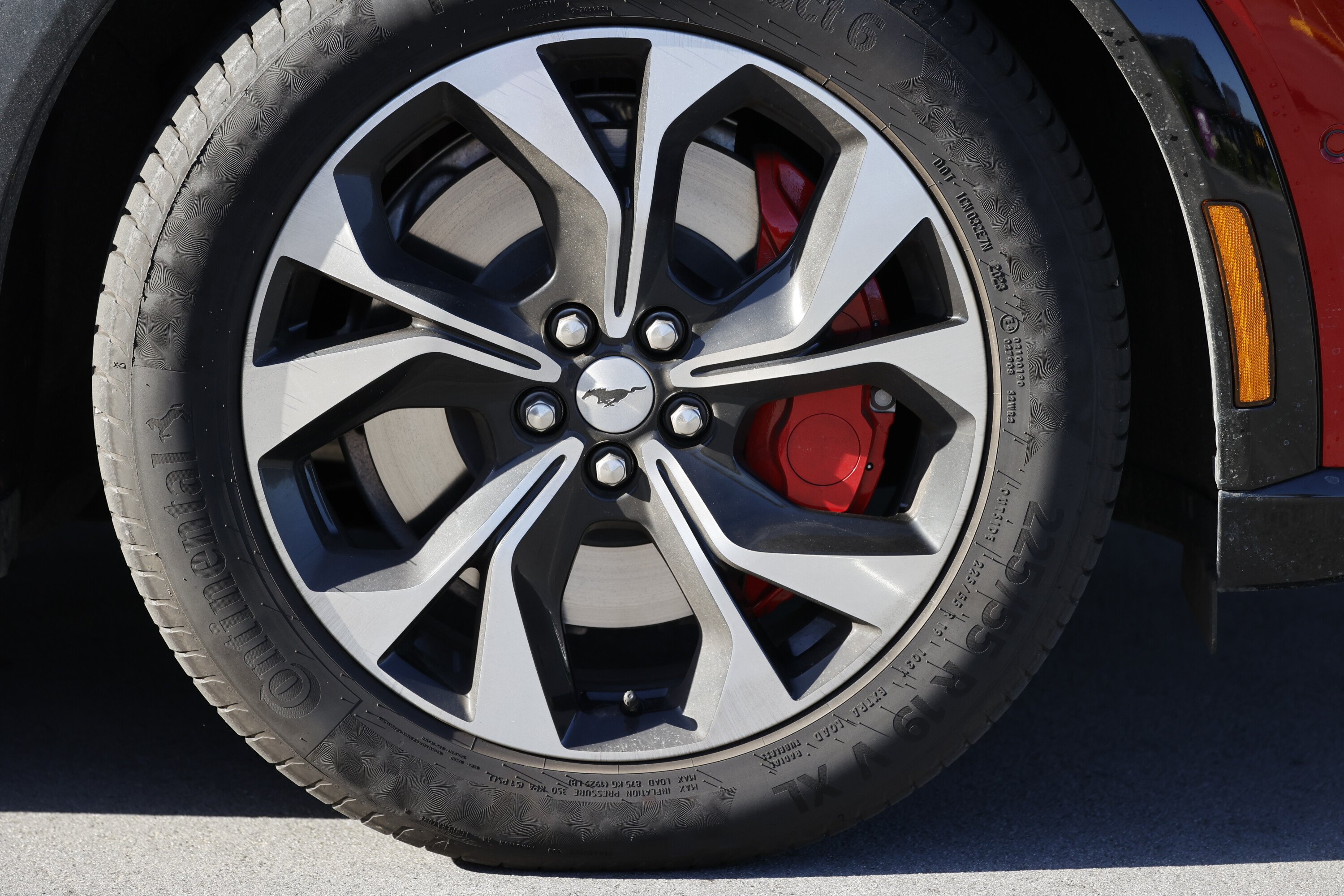
The Mach-E experience takes some keying into. At first, the cabin seemed a bit sparse, and I still don’t understand why it needs vast B&O door speakers that mean you can’t carry a bottle in the door pockets.
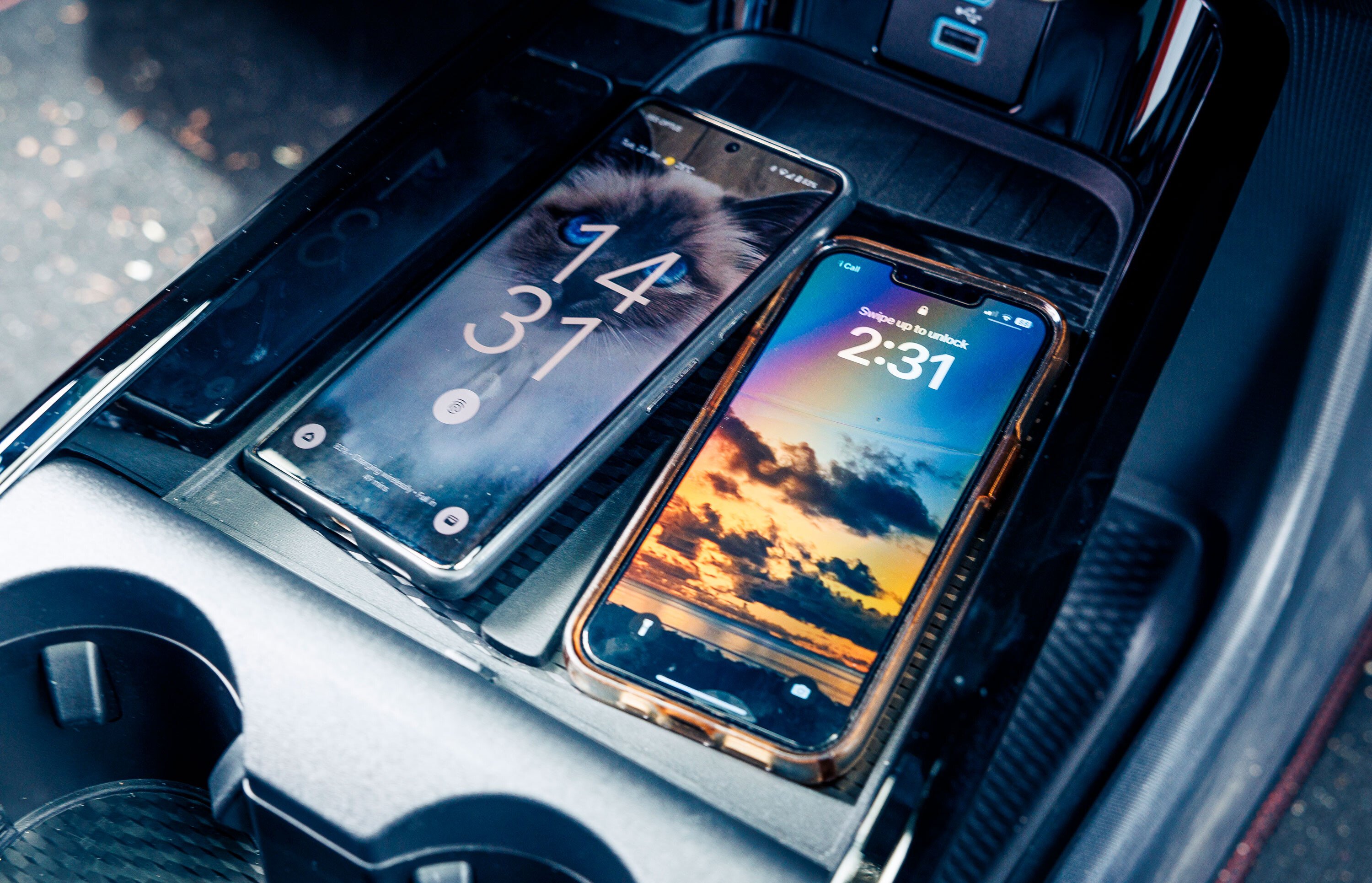
Likewise, it’s maddening that the two pads for mobile phones overlap at one corner, which means that you can’t sit two decently sized handsets flat on them.
Then there are the brakes. Whether it’s the handover from re-gen to friction braking or something else altogether, I found the brakes a bit snatchy. To that end, I’ve taken to switching the car into one-pedal driving mode and learning to drive it smoothly like that.
It means your pace will be more leisurely as a result, but I’ve come to enjoy that. I get more range from the car, I drive in a more considered fashion and everything feels agreeably serene. ¿Cómo está la serenidad?, as they might say in Cuautitlán Izcalli.
Update 2: WTF: What’s that Ford?
- This month: 1675km @ 16.9kWh/100km
- Overall: 2775km @ 16.4kWh/100km
Utter confusion. That’s been the overwhelming reaction to the Ford Mustang Mach-E from the public at large. I’ve yet to see another on Australian roads, so perhaps that’s understandable. “It’s a… Ford Mustang?” said the clearly befuddled man from the local pizza shop. “But it has four doors. Is it from China?” he asked, as if I’d casually ordered my Ford Mustang from Wish.com.
Driving along the freeway to work in the morning is to witness either furrowed brows of other road users trying to figure out just what it is, the odd thumbs up, occasional cameraphone snapping and, in one instance, a full-bore bit of limiter-banging from a guy in a ‘proper’ Mustang V8.
I can tell them what it is. It’s a very good, but still somewhat expensive, electric crossover and one that’s faced with a formidable competitor set. You have the Polestar 2, the Hyundai Ioniq 5, the Kia EV6, the Tesla Model Y and, before too long, the Volkswagen ID.5 all battling for much the same business, and a barrage of new entrants will be cannonballing into that pool very soon. Patchy public recognition doesn’t appear to be something that the Blue Oval can readily afford.
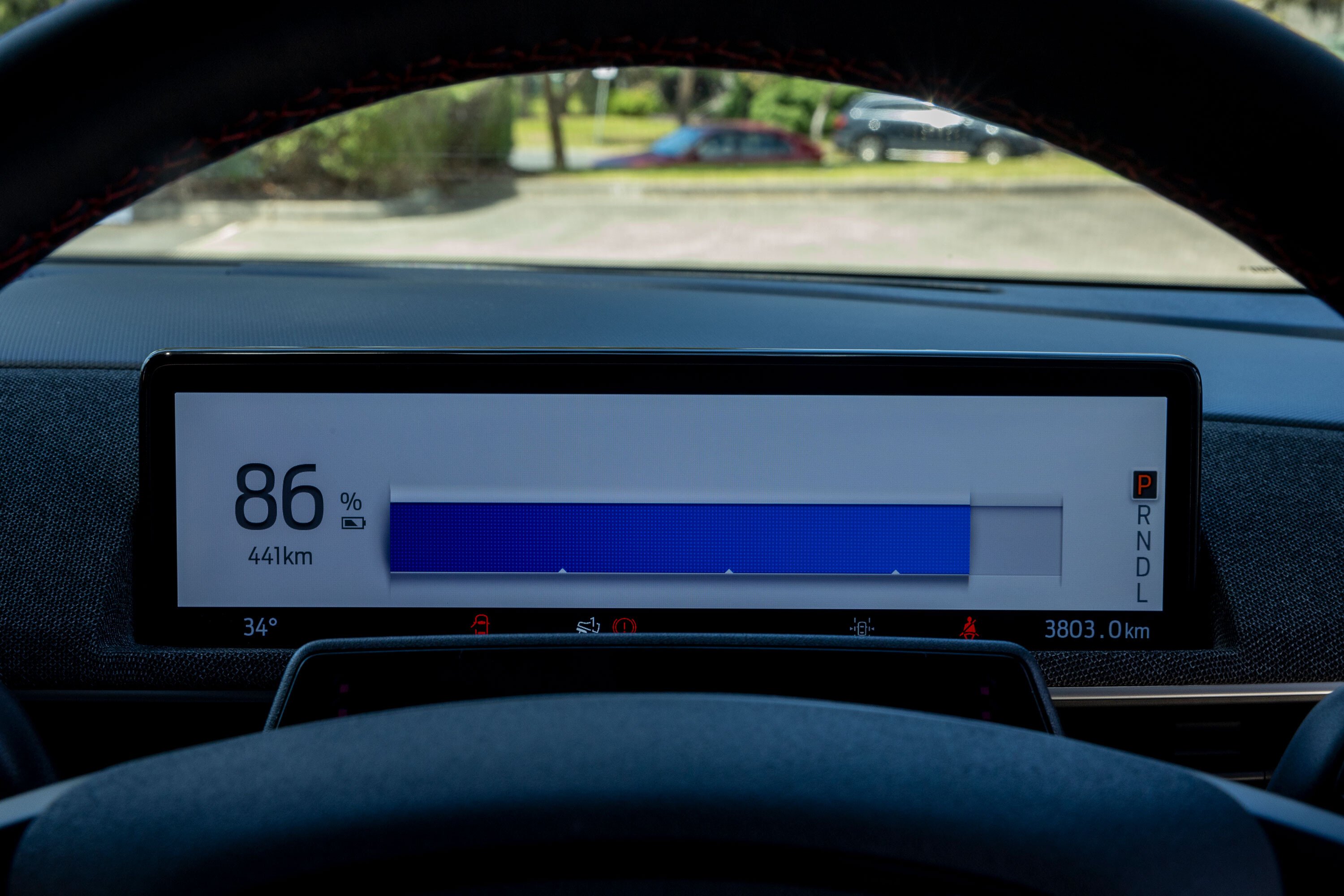
What do I love about it? First and foremost, the range. I drive with the air-con operating pretty much at all times and this sees the overall range dip when fully charged, from a theoretical max of 600km to typically 550km. But I’m fine with that. The one-pedal driving mode is marginally more efficient and I’ve become accustomed to using that mode on a daily basis. The throttle tip-in is incredibly nuanced, and in slow traffic, you genuinely have to be aware of whether you are actually stopped or crawling forward millimetre by millimetre.
The one-pedal driving mode is marginally more efficient and I’ve become accustomed to using that mode on a daily basis.
On the other side of the ledger, there’s the fact that in an Aussie summer, a car with a combo of black ‘Sensico’ vinyl seating and a glass roof with no sunblind heats up. Like, seriously heats up, to the extent that I’ve taken to keeping towels in the car to prevent anyone in shorts or summer dresses searing their legs on the seats. Fortunately, the air-con blows cold air instantly, so it’s only an issue when you return to a car that’s been parked in the direct sun.
Then there’s the ride. I’ve been reliably informed that the first batch of Mach-E models to be sold overseas rode like trolley jacks, and that Aussie cars have the more yielding Irish tune to their suspension. I found it still fairly terse though, in a way that would have probably furrowed the brow of the late, great Richard Parry-Jones. Upon closer inspection, the tyre placard showed that when lightly laden, the Mach-E should have 35psi in the front tyres and 41psi in the rears. It was set at 40psi all round. I’ve since adjusted the pressures to a smidge below placard and it now rides a heck of a lot better.
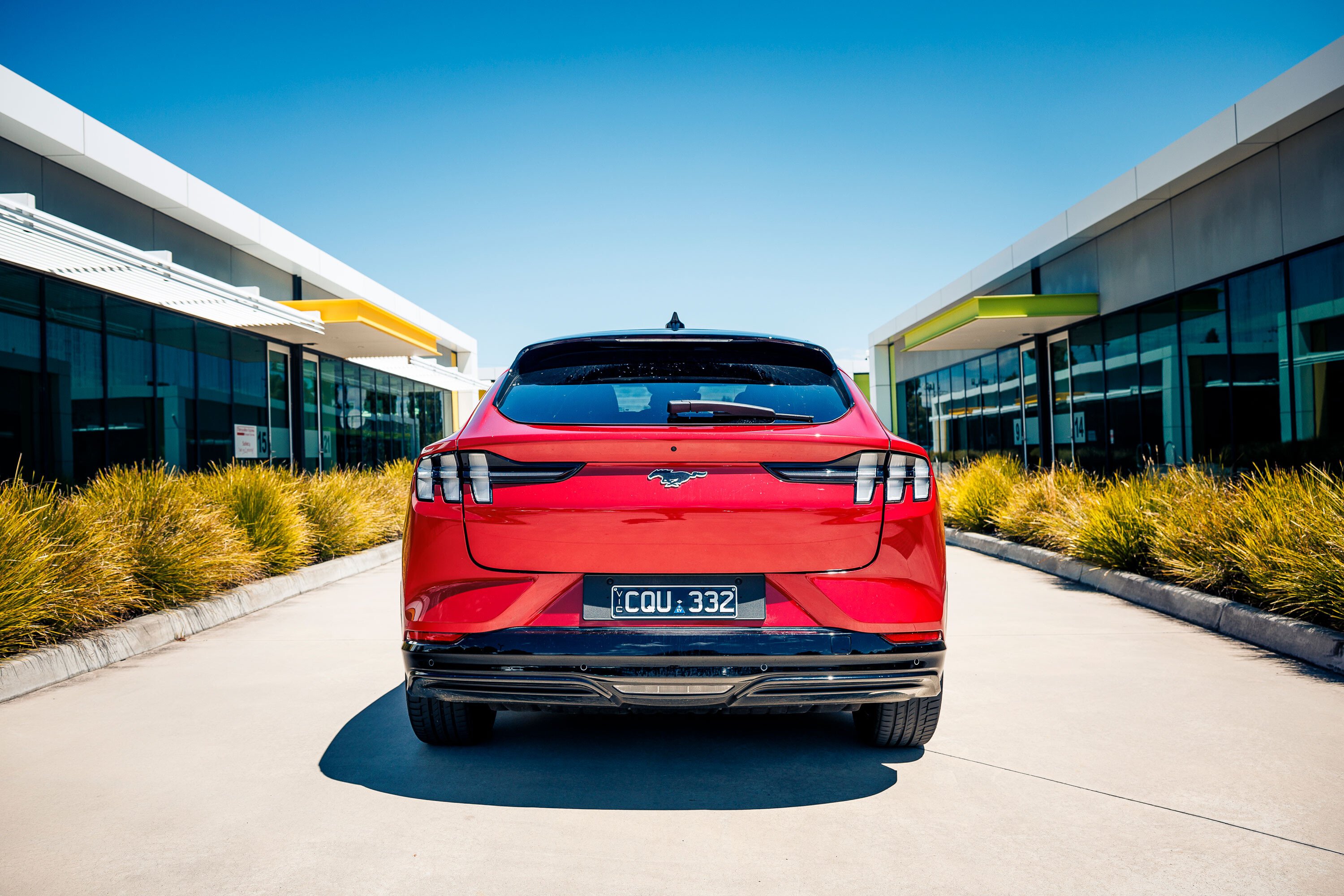
The recent rains have opened up a number of potholes around Melbourne and dodging them in the Mach-E keeps you on your toes. Good job it’s a pretty agile thing, despite the 2098kg kerb weight.
I’m enjoying this car. Given its troubled genesis, it’s a vehicle that’s far better than it really has any right to be. No, it’s not perfect, and many will point out that, at 86 grand, there are some compelling alternatives. But in the meantime, I’m enjoying its soothing blend of qualities, its rarity and, yes, the trail of confusion it leaves in its wake.
Update 3: A pony by any other name…
- This month: 1825km @ 16.2kWh/100km
- Overall: 4600km @ 16.3kWh/100km
Every once in a while, I’ll shlep along to the Highball Cars and Coffee meet at Bosch’s plant in Clayton. It’s a great opportunity to see what Melbourne’s magnificent car tragics will bowl up and it’s never boring. Someone will have plumbed a Barra engine into a Porsche or decide that driving six-wheeled army surplus represents a great way of spending Sunday mornings.
Figuring that some of the above might never have clapped eyes on a Mustang Mach-E, I parked the long termer next to a couple of Mustangs, who promptly left the event. Ah well. The Mach-E may have been unwelcome but on the plus side, life with it is rarely dull.
Aside from finding people staring at it in befuddlement most times you return to it, there’s also the fact that you need to be on point while driving it. I’ve lost count of the number of times I’ve glanced right on the freeway at a dawdling overtaker, only to look straight into the lens of a phone’s camera. Therefore bed-head hair, singing to embarrassing music, wearing inadvisable sunglasses or being caught undertaking a nasal excavation project are all activities instantly rendered off-limits.
I’ve lost count of the number of times I’ve glanced right on the freeway at a dawdling overtaker, only to look straight into the lens of a phone’s camera.
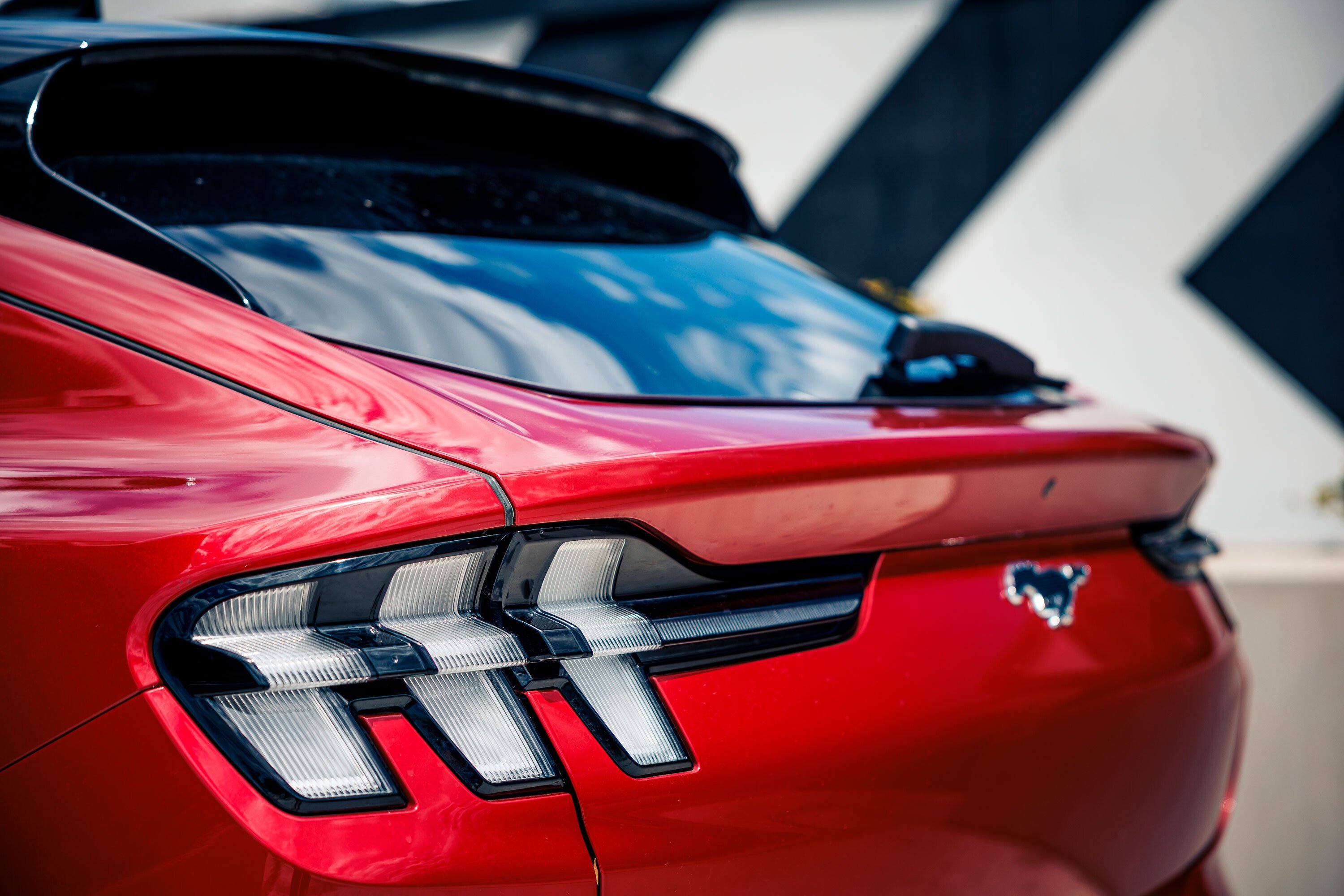
This is the first electric long termer I’ve taken under my wing and I’d be lying if I was to deny that my weekend circumference of leisure operations hasn’t contracted a little as a result. Those 250km round trips down to Phillip Island have been notable by their absence. With around 550km available from a full charge, they’re theoretically possible, but something still lurks in the back of my mind, wanting to save charge for another day.
Were you to drop $86K on a Mustang Mach-E, of course you’d spend two grand on a wallbox for your home. I haven’t and nor do most of my colleagues, which is why many EV reports from motoring writers are, firstly, obsessed with public chargers and, secondly, tinged with the resentful background hum that suggests the car’s a bit of a drag on their lifestyle.
What would I change about this car? Firstly, I’ve never driven a car that so badly needs seat coolers. That’s down to the glass roof, no sun shade and black vinyl seating. I’d also like a significantly less temperamental operating system, with Ford’s SYNC4 often freezing or failing to boot. To reboot it, hold down the volume toggle on the right spoke of the steering wheel for about 10 seconds while also holding the ‘next track’ button. The wireless charging pad also needs a redesign to fit two decently sized handsets.
The drive modes need to be easier to switch on the fly without recourse to touchscreen menus, the DC charging rate could be a little quicker and the price needs another haircut.
Nevertheless, there’s a lot that Ford has got right with the Mach-E and not a lot that’s a deal-breaker. It’s an easy car to get on with, it drives well and it looks good. Such a mild-mannered crossover wears its Mustang branding uncomfortably, but the GT model could be a different kettle of fish. More on that one soon.
Update 4: I think, therefore I am (puzzled)
- This month: 645km @ 16.0kWh/100km
- Overall: 5245km @ 16.2kWh/100km
After some deliberation I’ve come to the conclusion that I’m not very good at introspection. This realisation dawned on me after getting riled by coupe SUVs. You know, abominations like BMW X6s and Mercedes-Benz GLEs; those saggy-arsed horrors that blight our roads. It took my partner to point out, rather indelicately, that I was driving a coupe-SUV too.
This was followed by a rambling diatribe on my part about how they’re kind of okay if they’re not sold alongside an SUV ‘proper’. So I didn’t find the Mustang Mach-E offensive, nor the Porsche Macan, nor the Lexus RX. Which, when you pause to think about it, makes absolutely no sense whatsoever. So I changed the subject to the safer topic of starlings nesting in our loft insulation instead.
In the interests of a rigorous and scientific approach to road testing, I haven’t cleaned the Mach-E of late. It’s had an interesting effect. Apart from the fact that there’s a faint odour of steak and onion chips inside, the radar cruise control increasingly picks up phantom objects when it’s peering through a thin film of dust. Thankfully, it doesn’t throw on the anchors dramatically while mooching down the freeway, instead decelerating gently as if you’ve driven into wet bitumen.
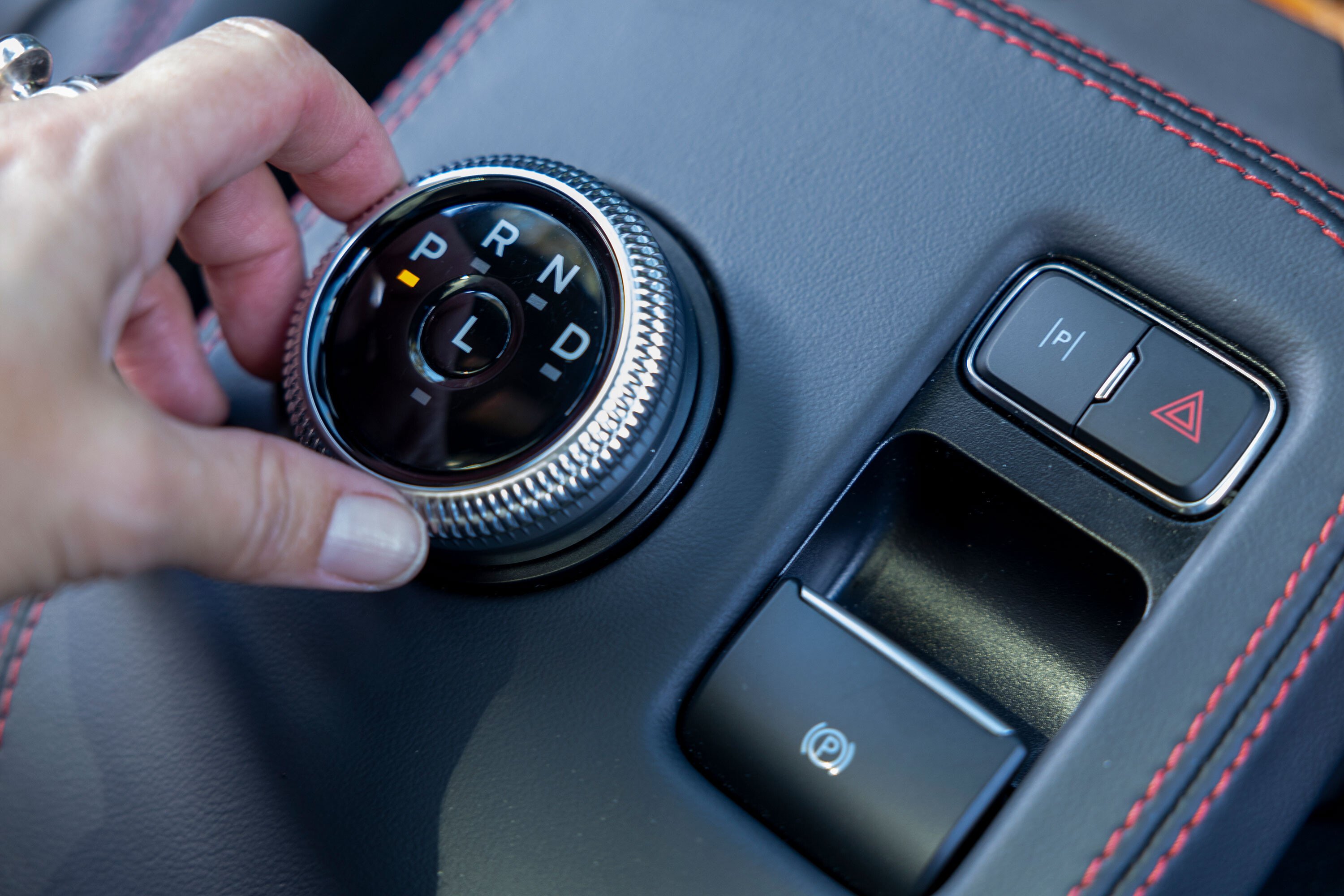
In addition, on dirt roads, it doesn’t take long for a message to flash up on the binnacle that the lane departure and front camera system has had a coma. A dusty road and, it appears, bright sunlight can cause some of the safety systems to wave the white flag.
The Mach-E is a car with a number of interesting quirks. Once in a while the electronic stability control will intervene while negotiating a corner at distinctly modest velocities. Now I’m all for ESC stepping in to save your blushes when it’s absolutely necessary, but the Mach-E will sometimes start graunching at an inside front wheel when bimbling out of a corner at pedestrian speeds.
You’ll hear it rather than feel any perceptible lurch, but it does make you wonder why the ESC algorithm decided it needed to put its cape on and fly to the rescue at that particular moment.
I remain impressed by the Mach- E’s real world range. So reliable is its reach that my partner, who was once firmly of the belief that we couldn’t take an EV down the road to Coles for fear of being stranded at the roadside, has taken to completely ignoring the range readout, taking it for granted that the Ford has the capability to get us where we want to go. Call her a convert.
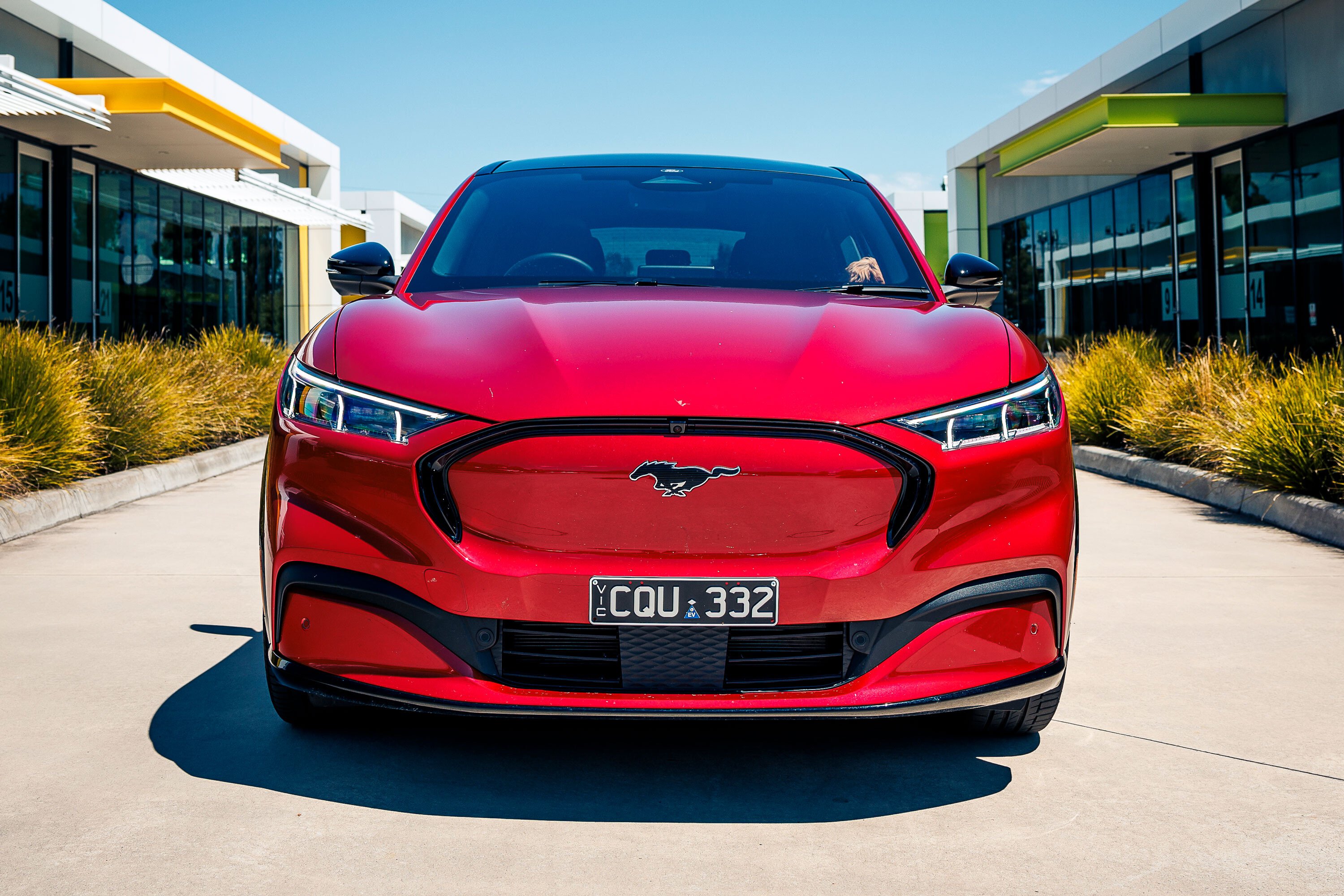
Having driven a number of competitor EVs of late, I’m arriving at the conclusion that perhaps the Mustang Mach-E is short of a genuinely convincing buyer proposition. I’m really enjoying running it and it’s an endearing thing to amble about in, but if I had to construct a simple proposition that would brook no comeback in favour of buying one, I’d struggle.
It’s not the cheapest, nor the best to drive, nor the prettiest, nor the most comfortable, nor the most spacious and nor does it boast the longest warranty. Is it pleasant enough? The fact that these are so rare on our roads may well offer the answer to that particular question. It came flat last in our comparo this month. Yet I still enjoy driving it. There’s a lot to be said for that rarest of things; an EV with little in the way of range anxiety.
Update 5: Big Mach heads back
- This month: 3880km @ 15.8kWh/100km
- Overall: 9125km @ 16.0kWh/100km
Do you drive a ‘best in class’ car? By that, I mean was your everyday driver widely acknowledged as the best car available in its category when you bought it?
I’m prepared to bet that most of you don’t and I love you for that. Wheels’ foundation is built on the mercilessly meritocratic foundation of the comparison test but it remains the case that if everybody’s purchasing decision was purely and absolutely rational, the world would be a wholly monotonous place.
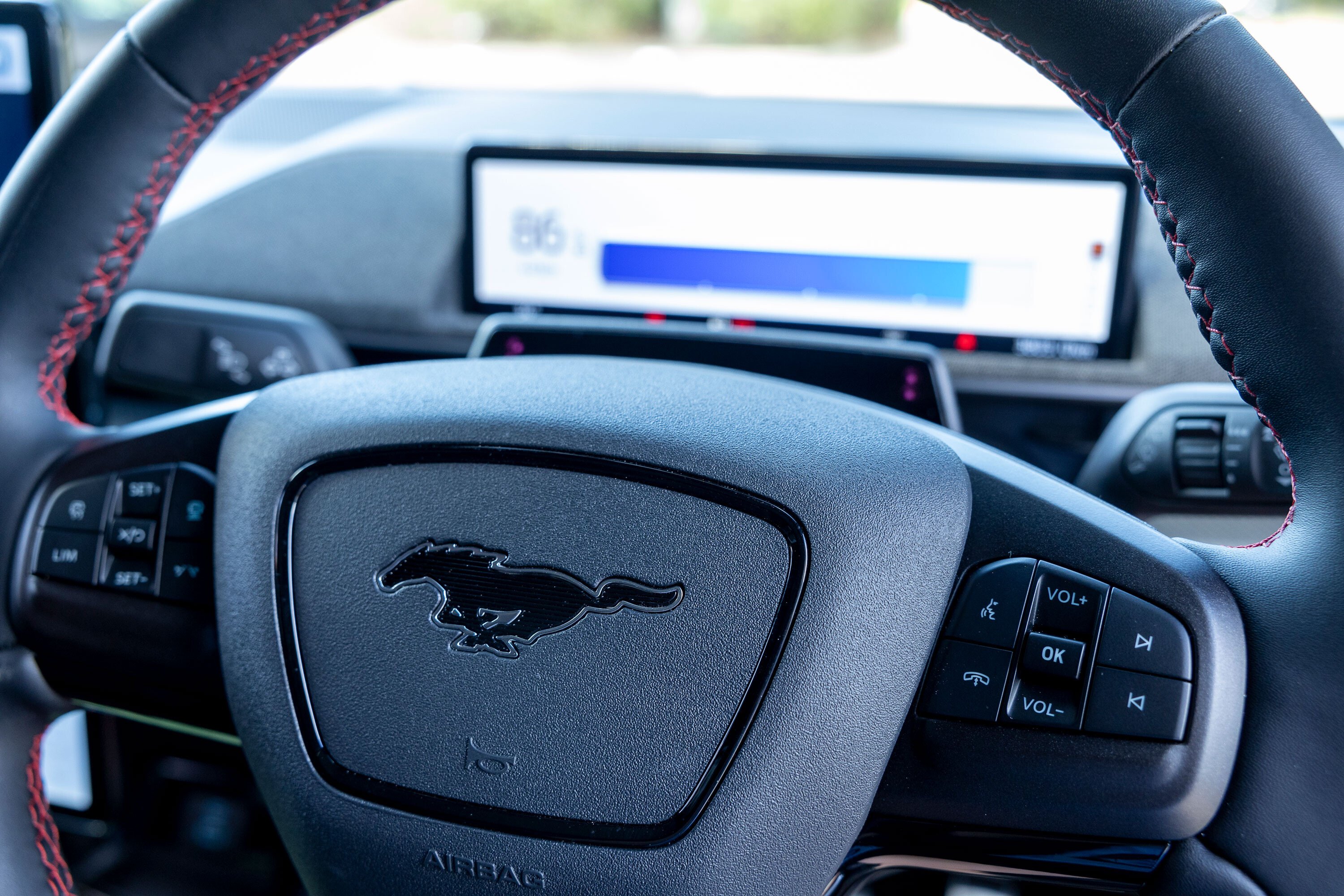
Every time you see a quirky and interesting car go the other way down the road, someone walked into a dealership and bought a car that they found interesting or which fit their individual circumstances. I’ve been pondering this behaviour a great deal while running this Ford Mach-E, because it’s a car that I’ve grown very fond of while being able to absolutely accept that, for most, there are many better options available.
I like the fact that for a modern car, it’s refreshingly free from chimes, it doesn’t snatch at the wheel, flash panicked warnings onto the dash over the most minor of things, or get in your face if it doesn’t need to. Flop the rear seats down and it does a reasonable impression of a delivery truck. I even like the way it looks, even if the Mustang branding grates.
It clearly irks others too. I had a guy eye it derisively in my local supermarket carpark and ask me whether I peed sitting down. He didn’t look too thrilled when I asked whether he needed to sit down to think, but many people have opinions about the Mach-E – some good, some bad. I’ve had encounters with a few more polite people who are keen to look over the car, and I’ve had a bloke in a Navara gesticulating at me at a junction, giving the car two thumbs down. I don’t think I’d ever even register if I drove something invisible like a Tesla Model Y.
I had a guy eye it derisively in my local supermarket carpark and ask me whether I peed sitting down.
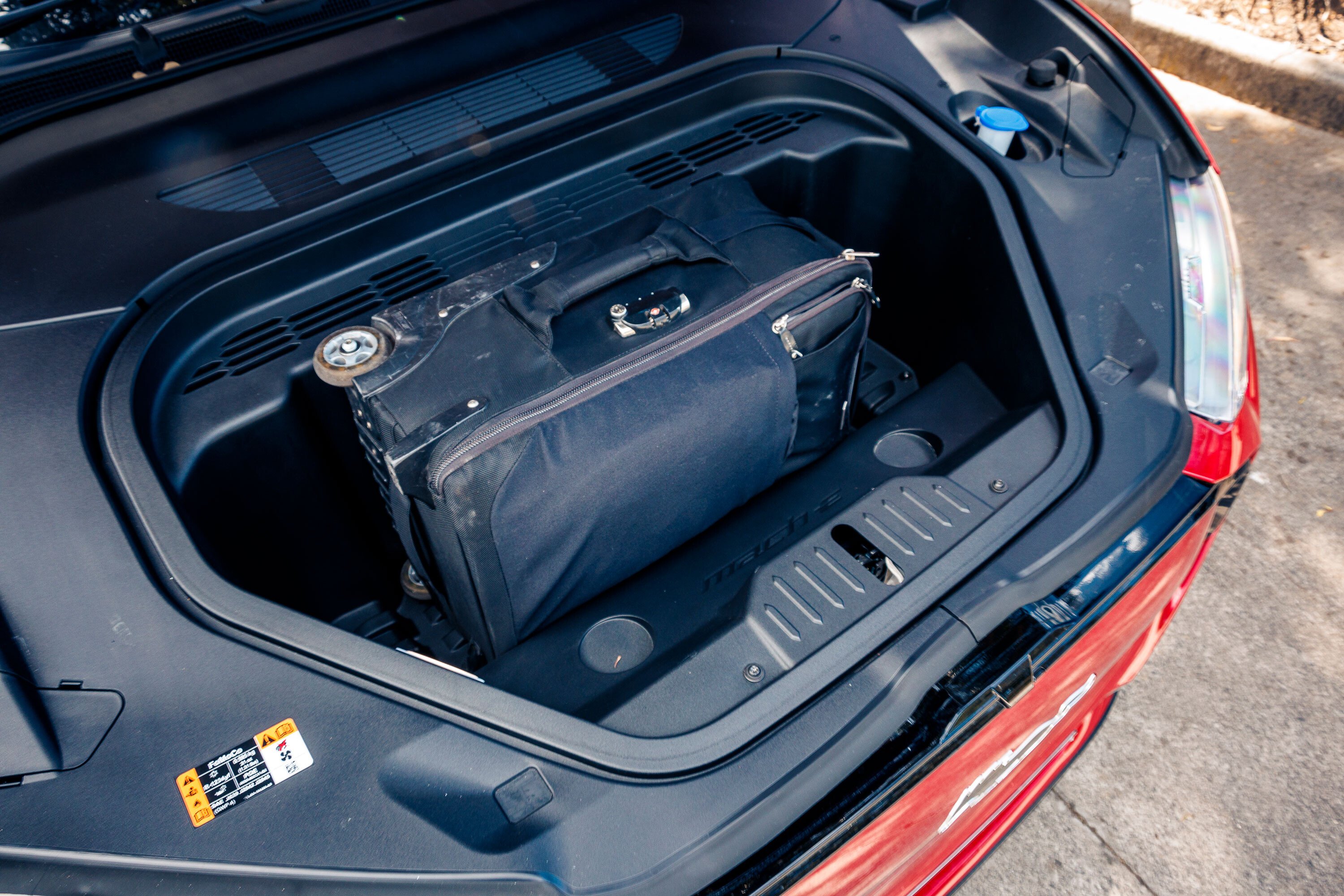
The Mach-E has gained a reputation as a slow seller in the US, and while this was the case, it seems that recent finance incentives have had the effect of tripling demand. So the problem of oversupply has been solved by tapping demand at a lower price point. I still think there’s room for Ford’s Australian arm to do likewise and deliver a yet more compelling value proposition. Seeing some on the roads is still the greatest advert. Pricing it below the likes of the Kia EV6 and Hyundai Ioniq 5 and framing it as an EV for those who can’t countenance a Tesla could let the Mach-E find its niche.
Elsewhere this month I have had the indignity of using a public charger. I strive to avoid these where possible as they seem about as reliable as McDonalds soft serve machines or flood-damaged TVR Cerberas. The Evie 350kW charger that I did use was looking a bit sorry for itself with its non-functional screen. What’s more, the charging cable was so short that the only way I could plug it into the Mach-E’s nearside fender charging port was to park in the adjacent charging bay. This caused anger from a man who had rather inadvisedly bought a car with a ChaDeMo charging port and wanted my position, so this month has been like Confrontation 101 in Mach-E world.
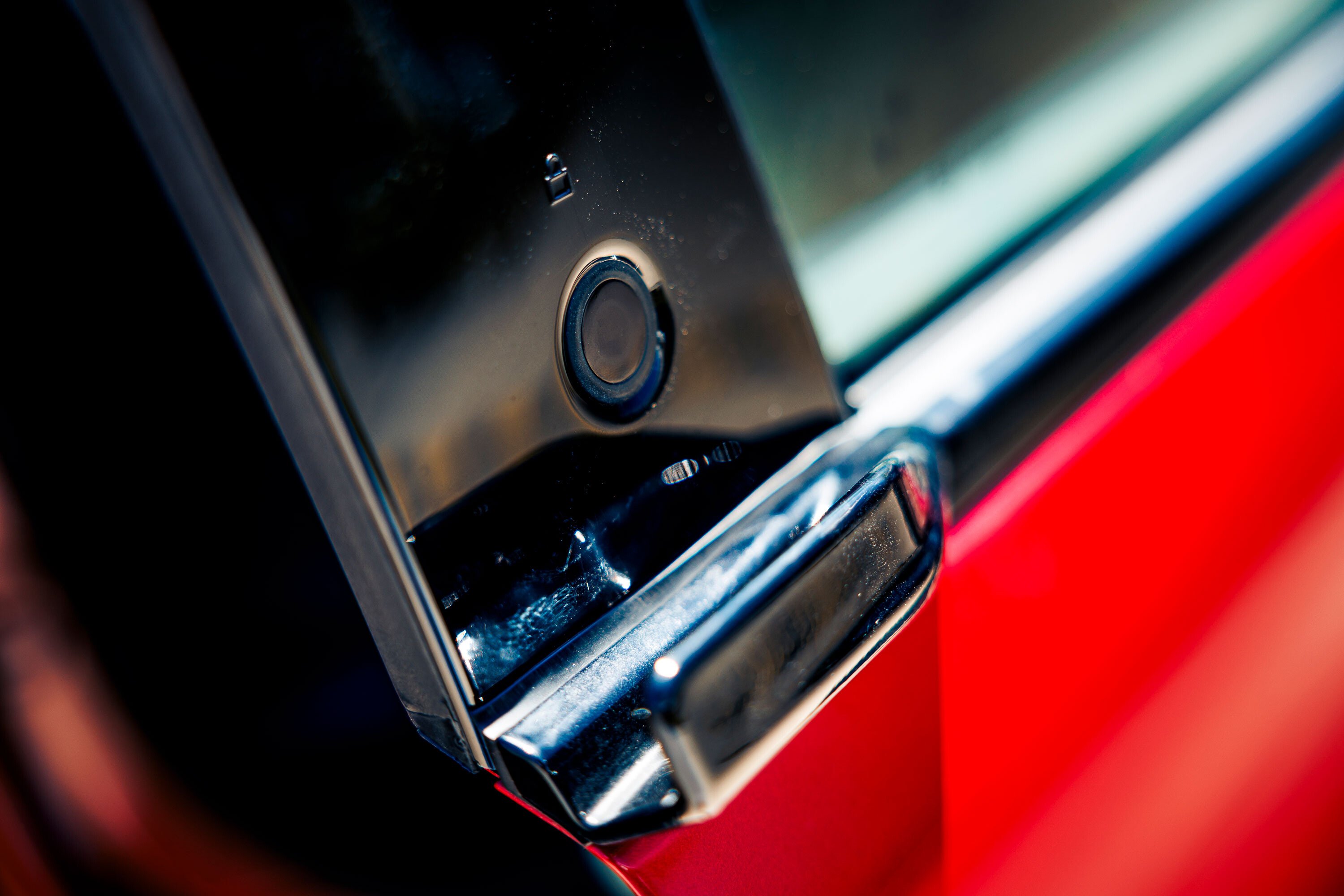
In other news, I still haven’t found a scenario where I’d use the keypad on the Mustang’s B-pillar, the auto-dipping headlamps still have a propensity to stay dipped on pitch black country roads, and I’m still loving the fact that after a few thousand kilometres there is not one squeak or rattle evident.
Regular Wheels readers will know that the Mach-E has had a bit of a rough trot in recent comparison tests. On a purely objective basis, it’s a car that has shortcomings. That doesn’t preclude it from being an enjoyable thing to run. Balancing those two might require some modest logical gymnastics at times, but then that’s often the nature of products with divisive appeal. Until next time…
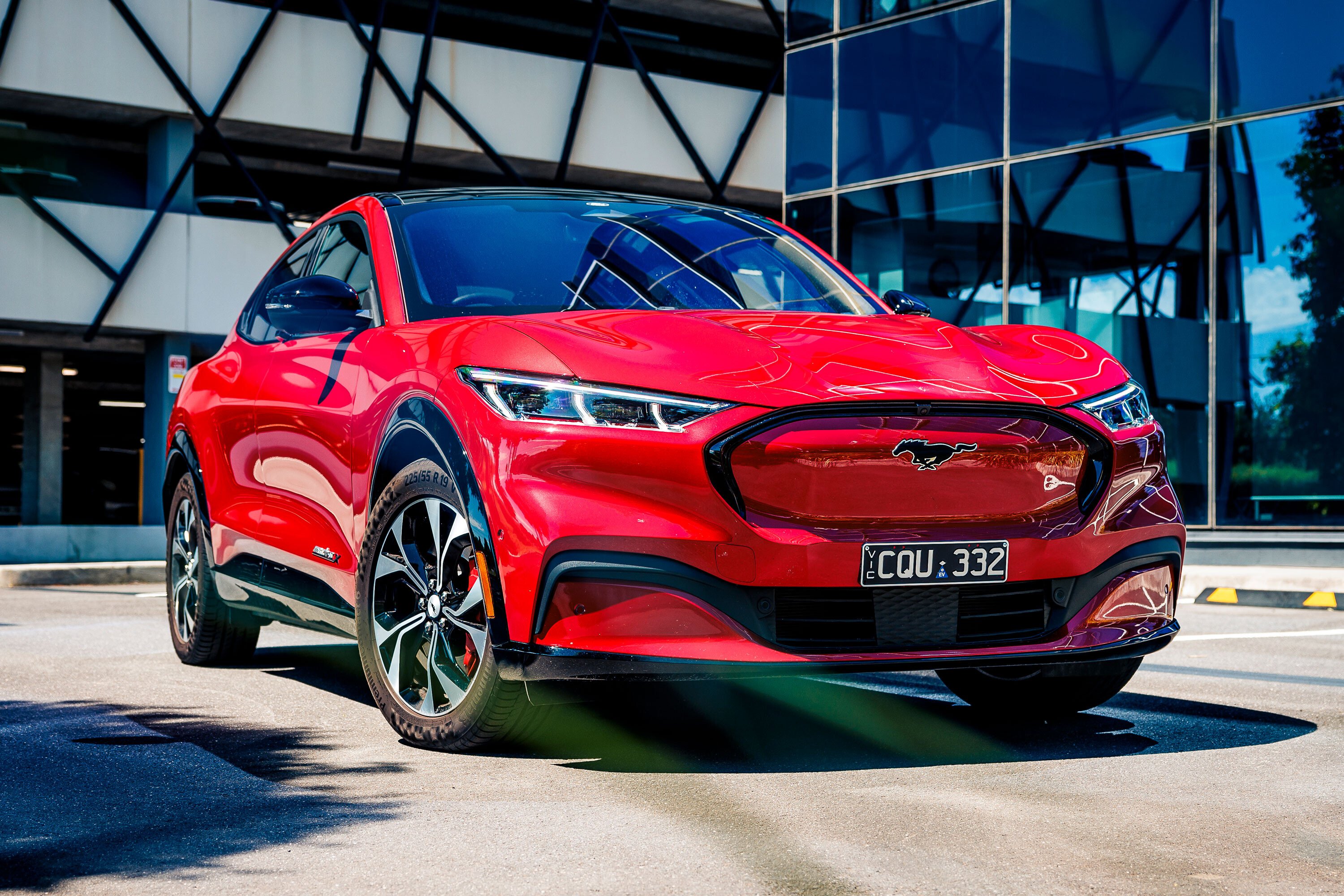
MG Australia has launched its new-generation HS midsize SUV into Australian showrooms, with the family-sized wagon joining the MG3 small hatch as the latest salvo in the Chinese brand’s modernization of its product portfolio.
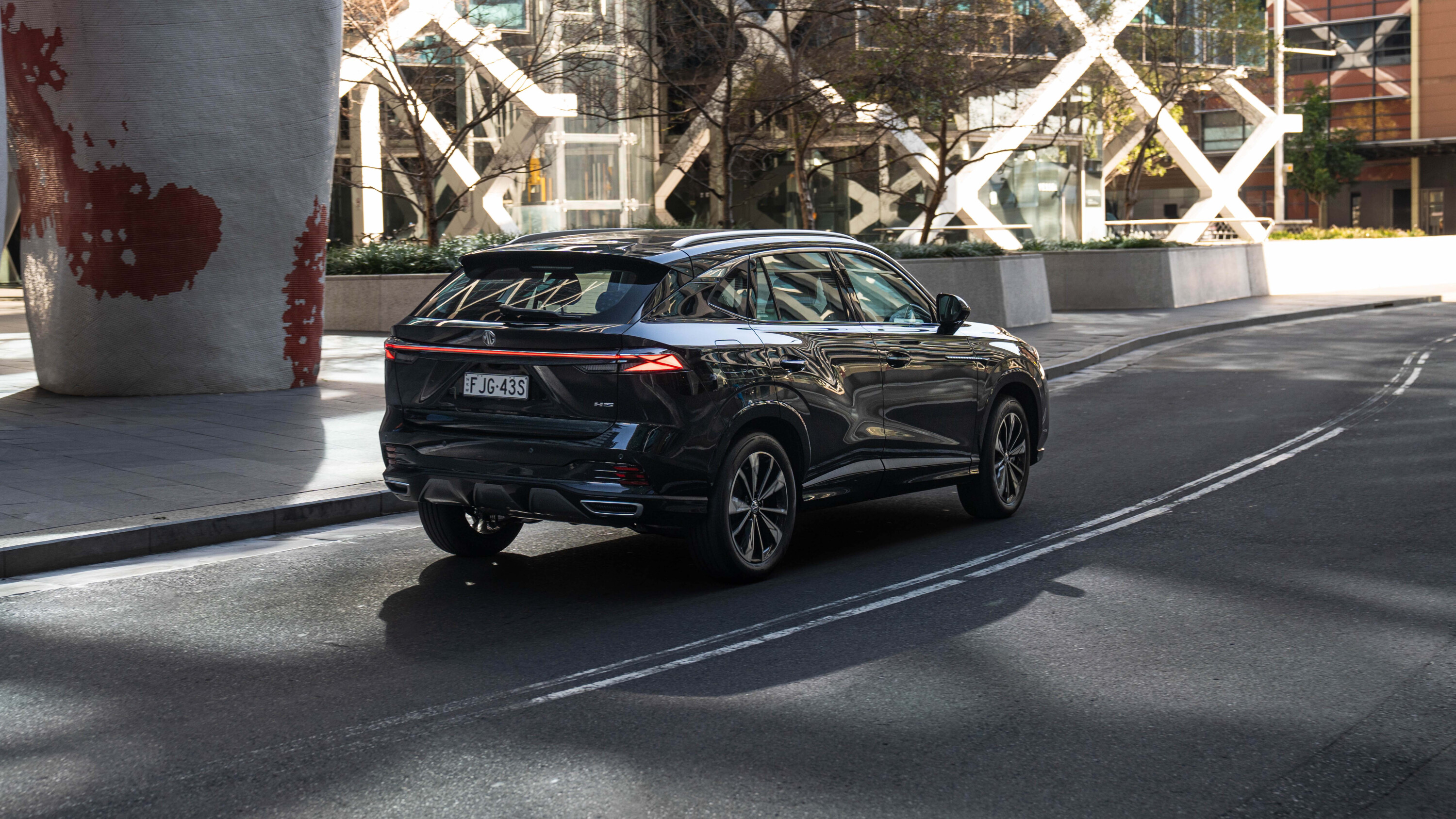
Besides gaining sharper styling that’s vastly more modern than the homely exterior that clothed its predecessor, the most noticeable difference for the second-generation HS is its size: an 81mm growth spurt in overall length to 4655mm and a 45mm increase in wheelbase to 2765mm gifts the new HS more cabin volume for passengers and cargo.
It’s still a five-seater – MG isn’t yet competing with other mid-size seven-seaters like the Nissan X-Trail or Mitsubishi Outlander – but there’s more sprawling space for five occupants and the boot now measures 507 litres with the rear seats up (1484 litres with them stowed).
Equipment
Three grades are offered: Vibe at the entry level, Excite in the middle, and Essence at the top end. External differences are minor, amounting only to a different alloy wheel design for the Vibe, and foglamps for the Excite and Essence, with in-cabin equipment being the primary differentiator between the grades.
Starting with the Vibe, buyers receive 18-inch alloys, fabric upholstery, a bare plastic steering wheel, six-way power adjustment for the driver’s seat, rain sensing wipers, heated and power-adjustable wing mirrors, keyless entry, LED daytime running lamps, roof rails, rear parking sensors and a reversing camera.
Infotainment is handled by a pair of side-by-side 12.3-inch screens – one for the driver’s instrument panel and the other for the central touchscreen display – with Apple CarPlay/Android Auto smartphone mirroring bringing sat-nav functionality as it’s not built in for the Vibe. Four USB ports are standard: two in the front cabin, and two in the rear.
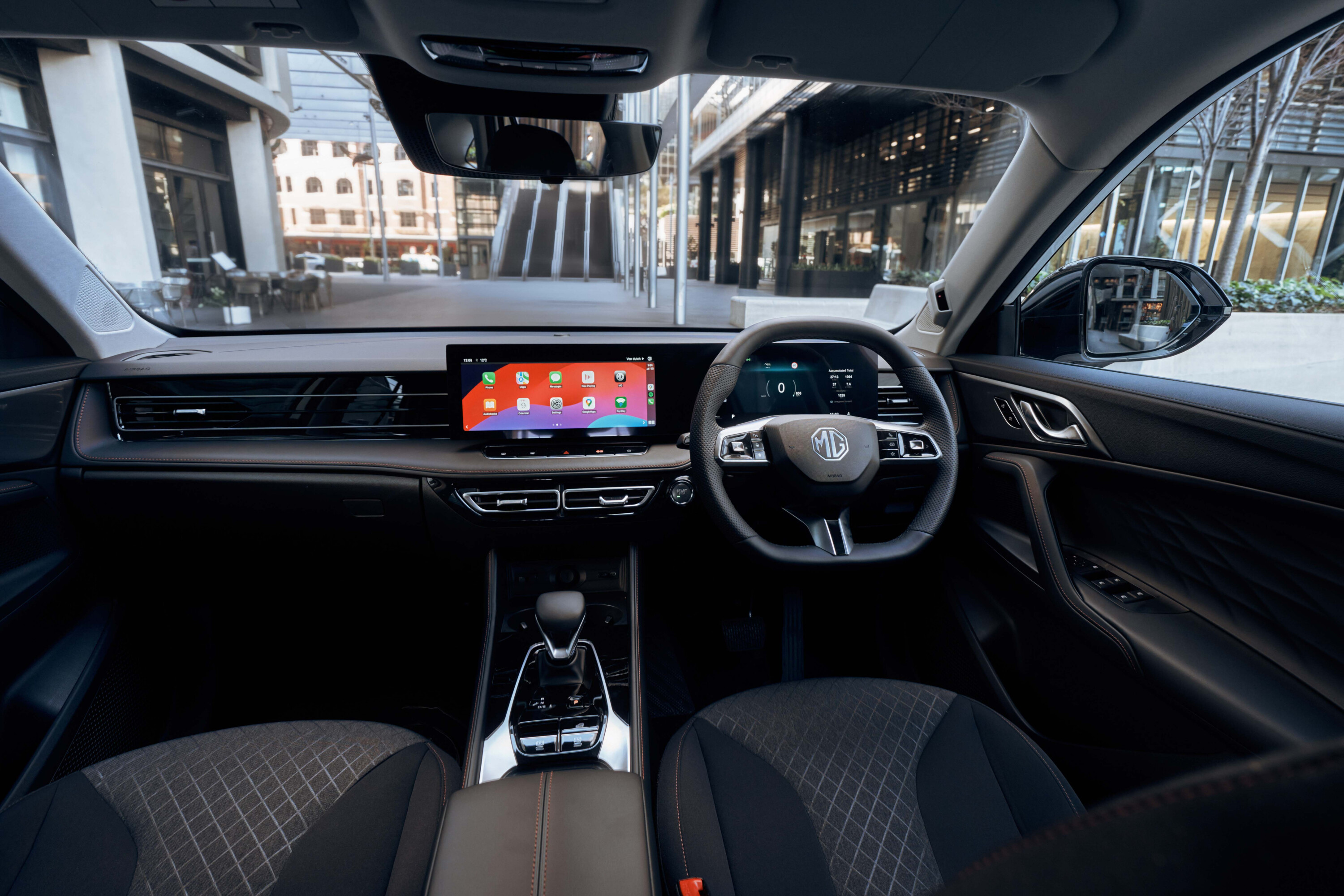
The mid-grade Excite is an incremental upgrade, adding the aforementioned foglamps and 19-inch alloy wheels, along with a 360-degree camera array, built-in satellite navigation and faux leather upholstery. Essence, meanwhile, goes substantially further by bringing in a power-operated tailgate, panoramic glass sunroof, lumbar adjustment and memory settings for the driver’s seat, power adjustment for the passenger seat, heaters for both front seats, dual-zone climate control, wireless phone charging, front parking sensors, privacy glass, an eight-spear audio system and power-folding wing mirrors.
All models receive adaptive cruise control, lane departure warning, AEB, blind spot monitoring, lane keep assist, speed limit recognition, driver fatigue monitoring as well as front and rear cross traffic alert.
Mechanical
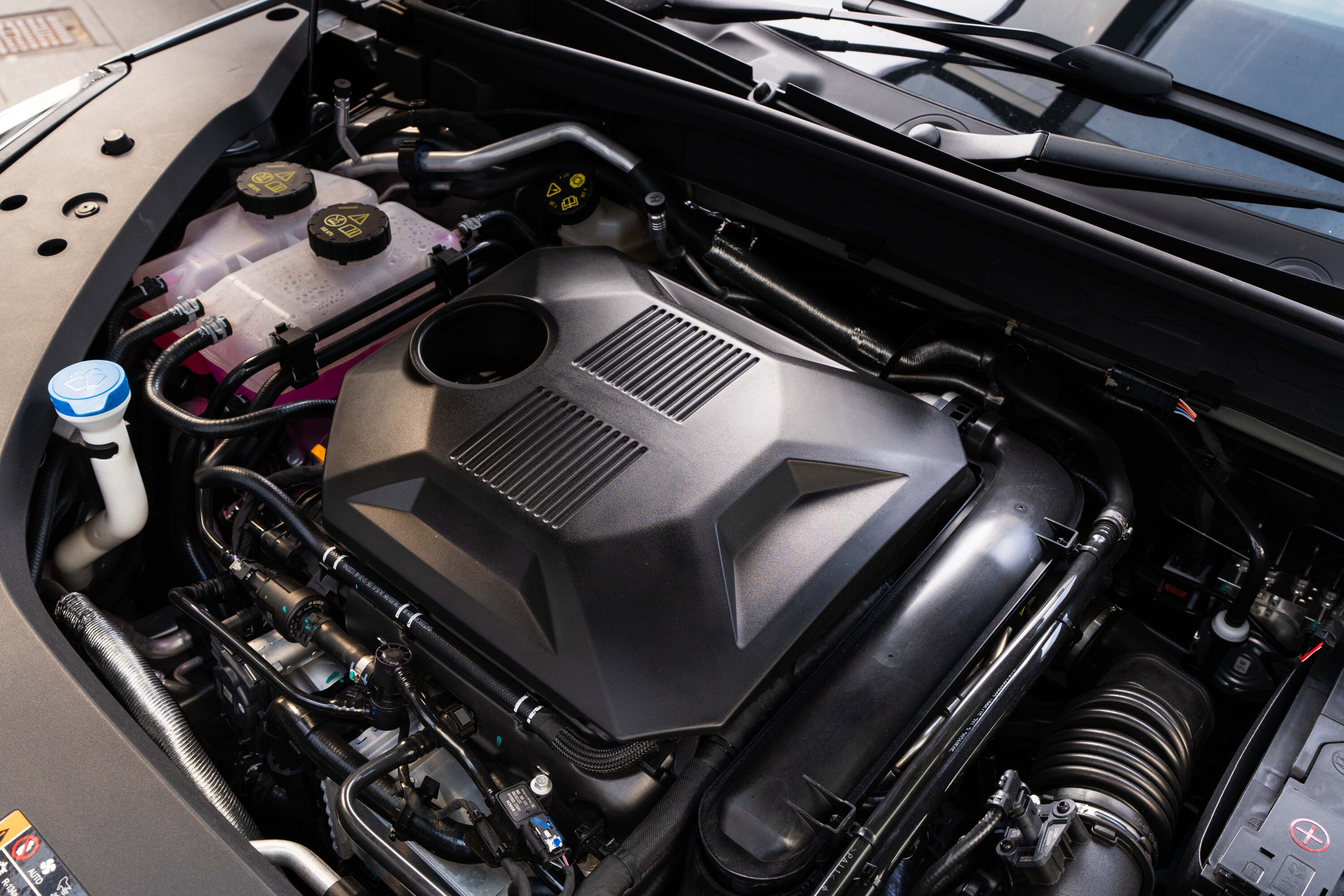
Initially, all will only be available with one powertrain: a 1.5-litre turbo petrol producing 125kW and 275Nm, driving the front wheels through a seven-speed dual-clutch auto. That’s a 6kW and 25Nm increase on what that engine delivered in the previous-generation HS, while the seven-speed auto adopts a wet clutch rather than the dry clutch unit of the outgoing model for improved drivetrain refinement.
Fuel economy for all variants is a claimed 6.9L/100km on the combined cycle, but those looking for even more thrift may want to wait until early 2025, when the HS plug-in hybrid variant is slated to arrive – though local specifications and pricing for the PHEV have yet to be announced by MG Australia
Pricing
Pricing starts at $33,990 for the Vibe, $36,990 for the Excite and $40,990 for the Essence, with all of those numbers being both the RRP and – for now – the drive-away price. The 2025 MG HS is available now.
