
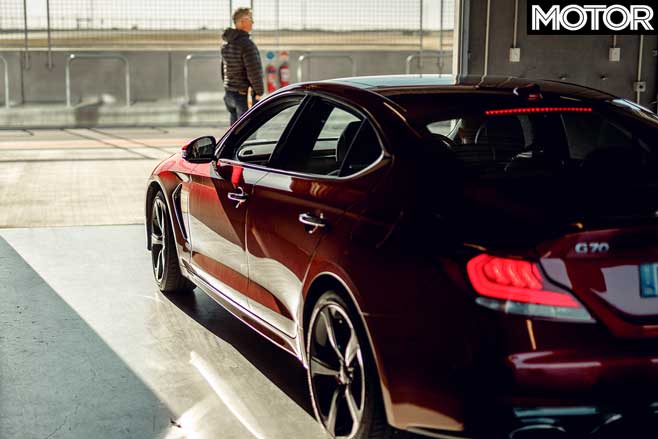
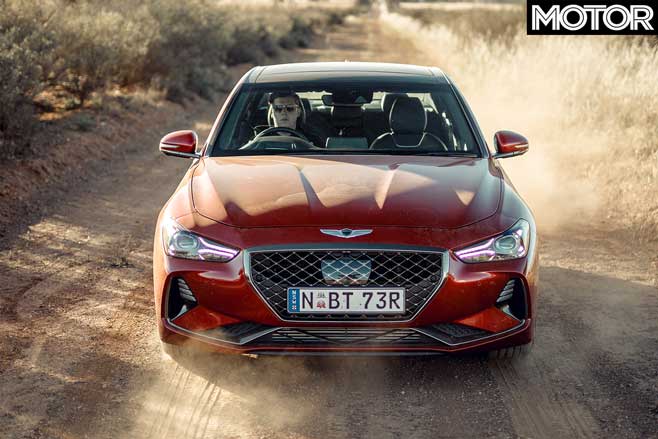
Spot the Genesis G70 alongside the Supra or Camaro and it’s easy to think that someone has parked their dad’s car in the wrong space in the midst of PCOTY 2020 testing.
Subtle is the G70’s byword, despite its stylists having been responsible for outrageous specimens like the Bentley Bentayga and Bugatti Chiron, and it looks and feels a bit out of place in the overt world of Performance Car of the Year. Get a little closer, though, and the raked stance and pumped-up hips promise more, as do its Michelin Pilot Sport 4s and sizable brakes.
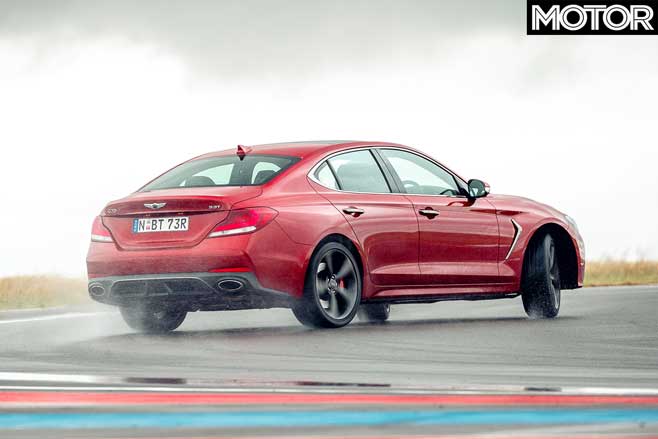
The 3.3-litre 272kW/510Nm twin-turbo V6 up front and proper mechanical LSD out back promise more again, and a 4.91sec run to 100km/h (against a claim of 4.7sec) is only a whisker slower than the V8-powered Lexus and just half a second tardier than the sportier, slipperier Supra. Its 13.12sec 400m time didn’t disgrace it either.
Where it started to unravel for the G70 was around the track, where it posted the slowest time of the day. Despite the Michelins and big brakes, the G70 just couldn’t key into the track sufficiently well to generate enough lateral grip to keep mid-corner speeds high, while the sub-optimal Vmax of 220km/h, light steering and overly conservative gearbox mapping weren’t conducive to eking out a decent lap time.
On the road, the G70 was popular with us oldies; despite the hints of Hyundai in the graphics and multimedia screen, the G70 is resoundingly comfortable, serenely silent and confidently competent over a longer stretch, with broad yet supportive seats and a real eye towards a depth of quality that’s genuinely impressive.
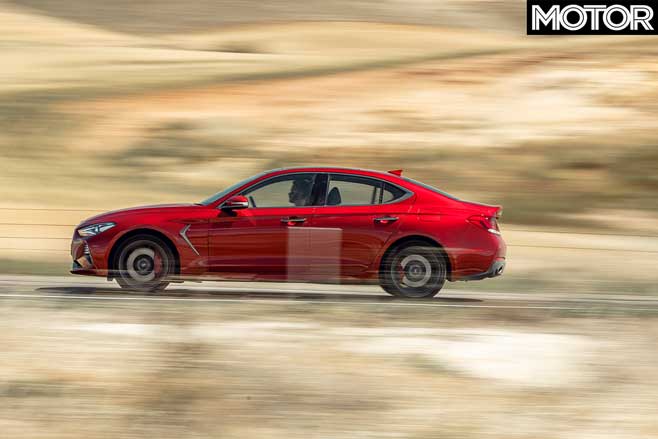
Its localised chassis tune is in lockstep with its plentiful power delivery, but unlike the identically platformed Kia Stinger, the G70 offers a more composed, resolved balance front-to-back when things get to eight-tenths. Its retuned adaptive dampers work best in their softest mode, allowing the tyres to find more grip and the chassis to respond more naturally, suggesting that there’s more to be had from what lies beneath.
Ultimately, it is tyre grip and body-roll that bring the fun times to a natural halt – and it’s all a bit too quiet and serene for mine in this company as well.
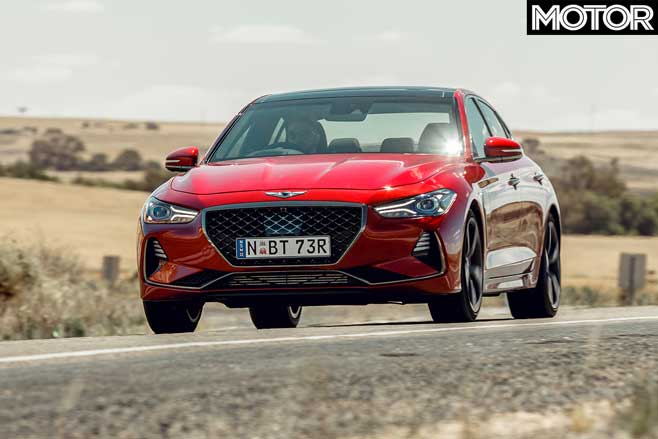
The raw ingredients are certainly there, though, and the G70 saw off a couple of faster, more powerful cars on the strength of its balance, poise and presentation. Should Genesis ever change its mind about not mixing straight performance with its luxury leanings, the G70 is a heck of a place to start.
The Numbers
2020 GENESIS G70 SPECS: Engine: 3342cc V6, DOHC, 24v, twin-turbo Drive: rear-wheel Power: 272kW @ 6000rpm Torque: 510Nm @ 1300-4500rpm Transmission: 8-speed automatic Weight: 1762kg Power/Weight: 154kW/tonne 0-100km/h: 4.91sec 0-400m: 13.12sec @ 175.16km/h The Bend lap time: 1min 40.7sec Price: $79,950
Judge’s Rank
Dylan Campbell – =6th “Way better than I was expecting. Lovely power.”
Louis Cordony – 8th “Not the 3 Series punisher we hoped for… yet.”
David Morley – 8th “I’d daily the daylights out of this. More people need to be shopping Hyundai.”
Scott Newman – 7th “Everything that made Aussie cars great, with a Korean badge.”
Tim Robson – 10th “Polite and well-mannered to a fault. Plenty of poke, but luxury focus all too evident.”
PCOTY 2020 Scoring
| Judges | DC | LC | DM | SN | TR | Total |
| Performance/20 | 16 | 12.5 | 15 | 16 | 14 | 73.5 |
| Dynamics/20 | 15 | 11 | 13 | 12 | 14 | 65 |
| Accessibility/10 | 7.5 | 4 | 8 | 7.5 | 7 | 34 |
| Liveability/10 | 8.5 | 6.5 | 9 | 8.5 | 7 | 39.5 |
| Value/10 | 7 | 6 | 7 | 8.5 | 8 | 36.5 |
| X Factor/10 | 8 | 5 | 6 | 5 | 2 | 26 |
| Total/80 | 62 | 45 | 58 | 57.5 | 52 | 274.5 |
If you’re a fan of Assetto Corsa Competizione – the e-sports offshoot of Assetto Corsa – and have been wanting to bash wheels on Australia’s legendary Mount Panorama, the wait is finally over.
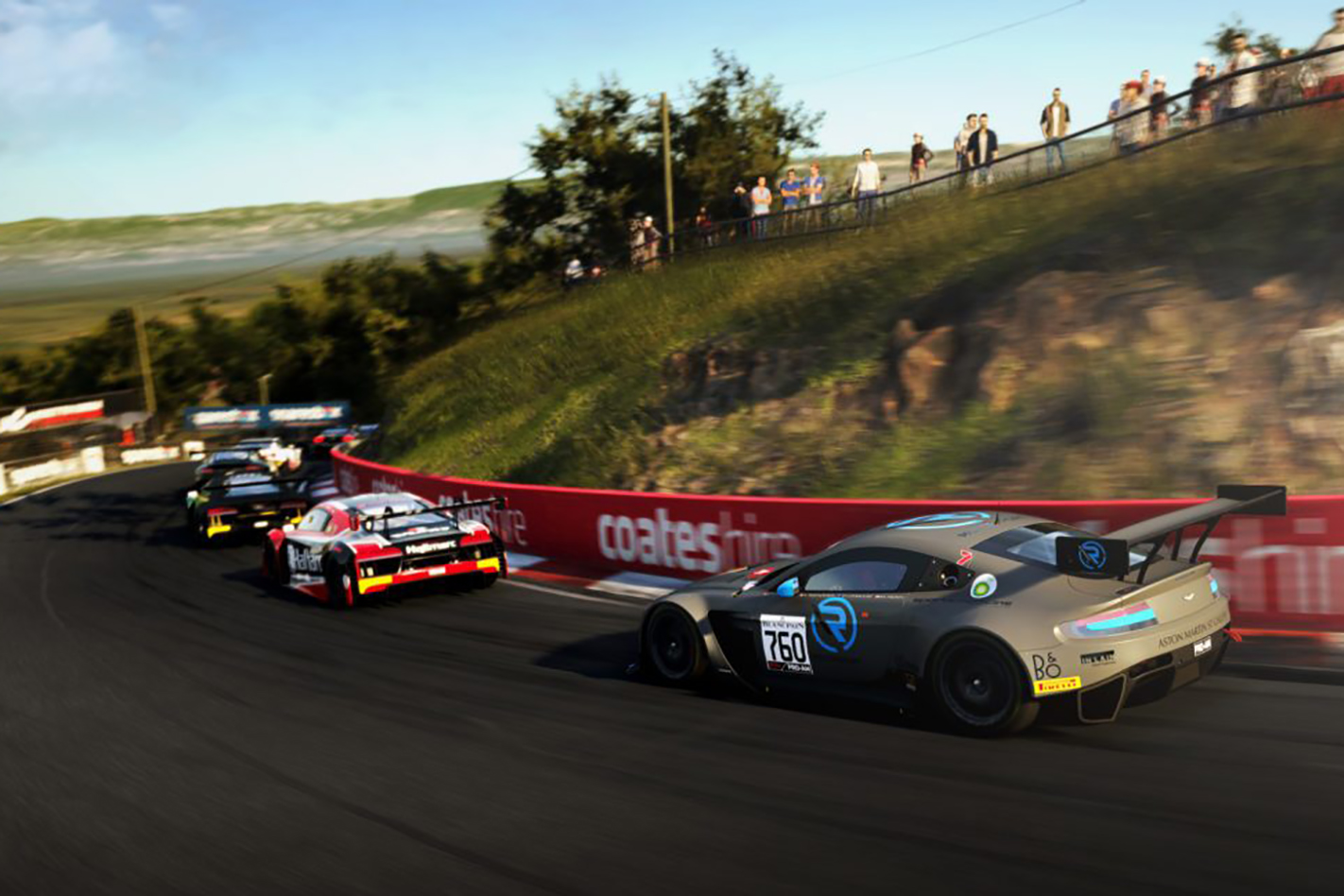
The recent addition of the Intercontinental GT Pack to Competizione expands the core game’s offering by four new international circuits, 45 new liveries, 30 new teams and 50 new drivers – based on the real-life Intercontinental GT Challenge powered by Pirelli series.
The racing series takes place in five different circuits across five different continents. The season’s opener takes place at the Liqui-Moly Bathurst 12-hour, then moves on to America, Europe, Asia before finishing in Africa at the end of the year.
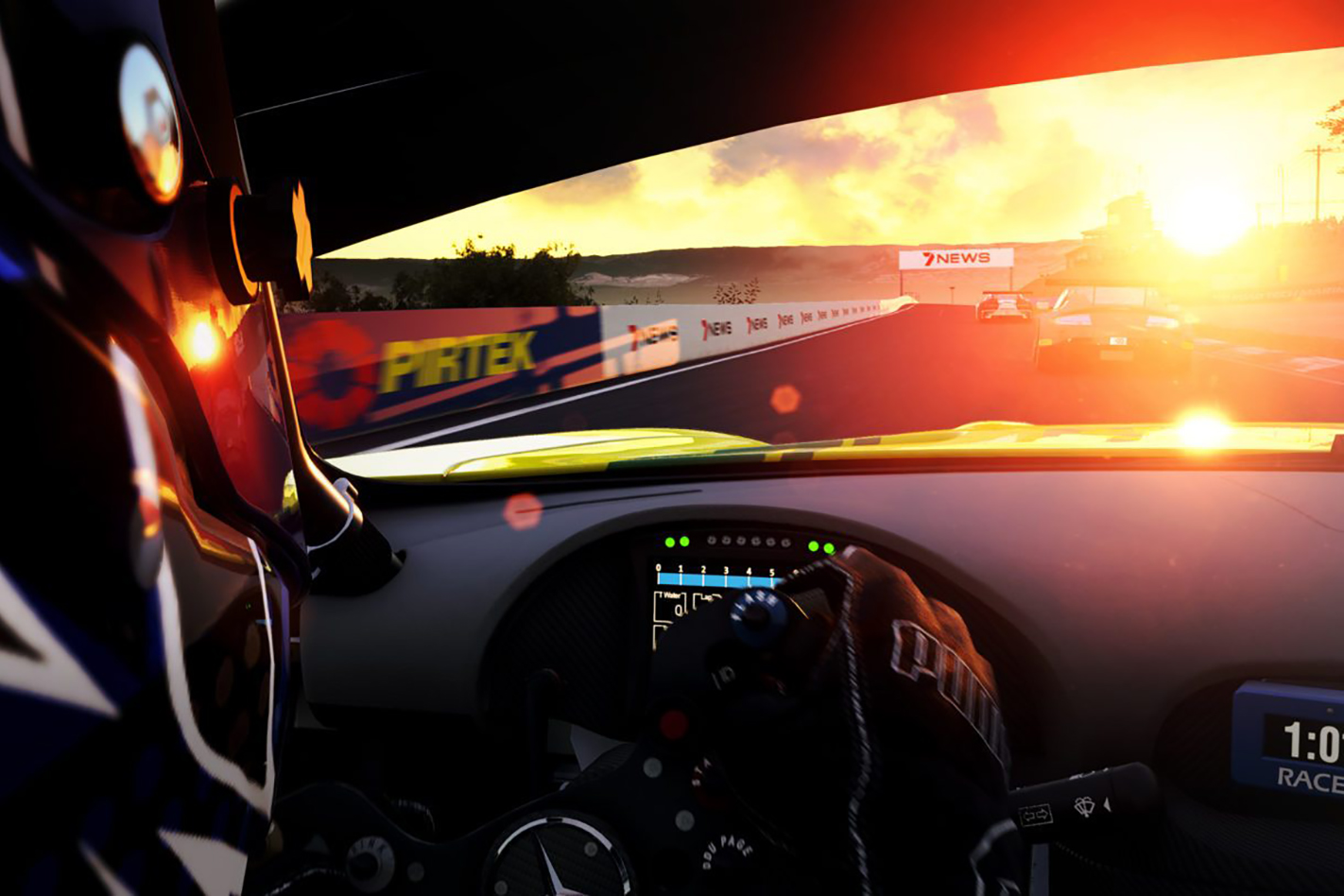
The new DLC Intercontinental GT pack follows the bygone 2019 series: which saw the series pass through Laguna Seca, Spa-Francorchamps, Suzuka Circuit and South Africa’s Kyalami.
With Spa-Francorchamps already featured in the game, the Intercontinental GT pack adds:
Each circuit is laser-scanned for its modelling in-game, ensuring the most accurate representation of the iconic international circuits. While Bathurst has been available as a community-developed downloadable track on Assetto Corsa, the high-def version of Mount Panorama in Assetto Corsa Competizione is the first time the iconic circuit has been officially offered in the AC franchise.
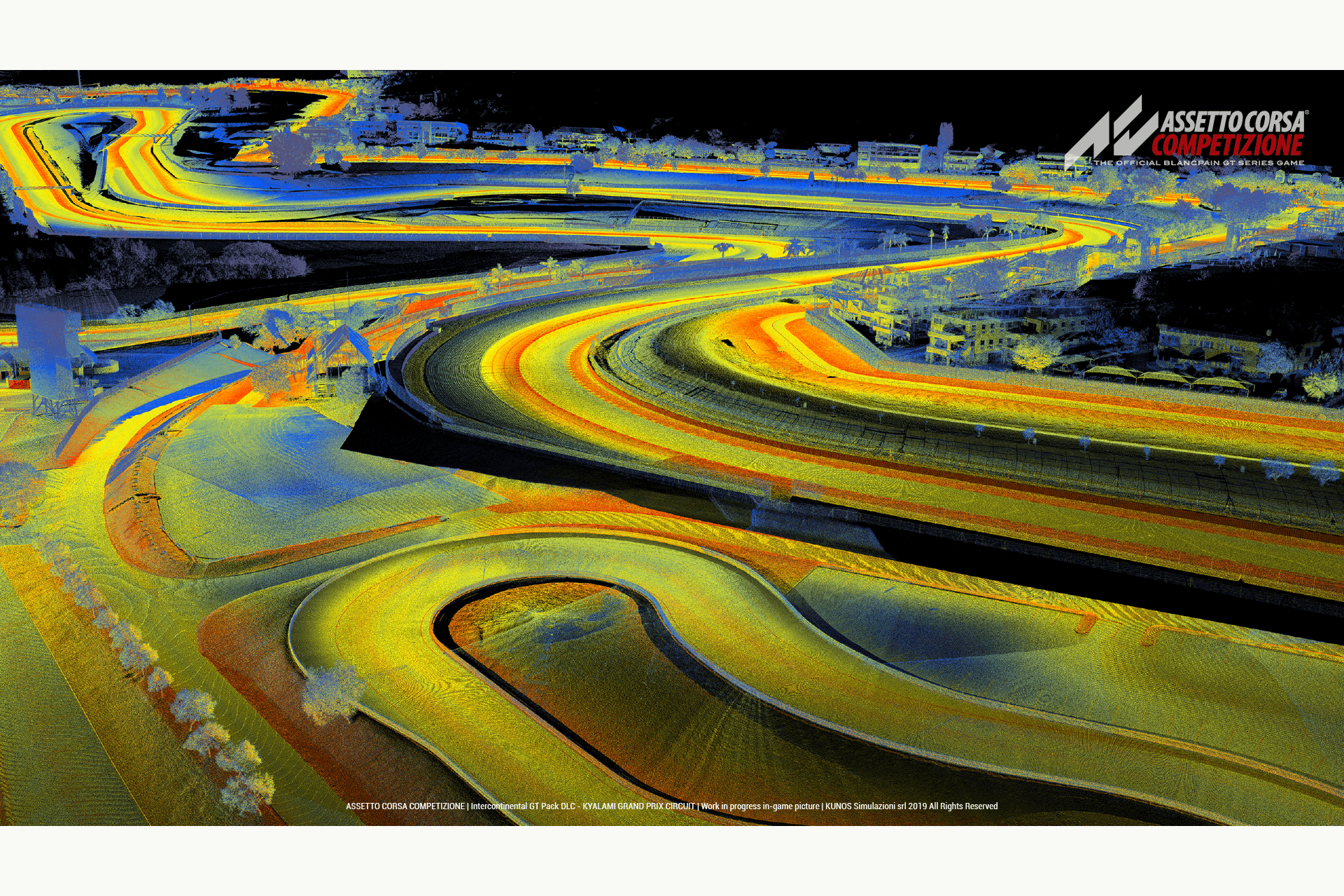
In addition to the new tracks, teams, liveries and drivers; there are also new games modes including IGTC Race Weekend modes which range from 8-12 hours, allowing players to fully recreate the real-life endurance series.
Assetto Corsa Competizione’s Intercontinental GT Pack is available to download now, for the price of US$14.99 (AU$21.95 on Steam).
GENERAL GADDAFI loved his. Pablo Escobar’s was used to trundle around his backyard zoo. Uday Hussein’s was, like its registered keeper, extensively remodelled by the US military. You don’t have to be a poster child for the Levenson psychopathy scale to own a Lamborghini LM002, but it’s not a purchase that’s always rooted in stone-cold rationality.
Other owners have included Mike Tyson (hired a tax attorney for his rape trial), the Sultan of Brunei (assembled 7000 exotic cars and left most to rot ), Tina Turner (chose homeopathy over medicine, got kidney failure), Sylvester Stallone (thought smuggling drugs through Sydney Airport was a smart idea), and Keke Rosberg (had a moustache).
It’s no great surprise that the LM002 attracts some extreme types. It’s that sort of vehicle. Fittingly, its genesis came during the mid to late ’70s, Lamborghini’s most basket-case period. Just nine years after it built its first road car, Ferruccio Lamborghini sold 51 percent of the company to Swiss financier Georges-Henri Rossetti for $600,000 and, in 1974, divested the remaining 49 percent to Rossetti’s colleague René Leimer, retiring to the shores of Lake Trasimeno to tend his vines.
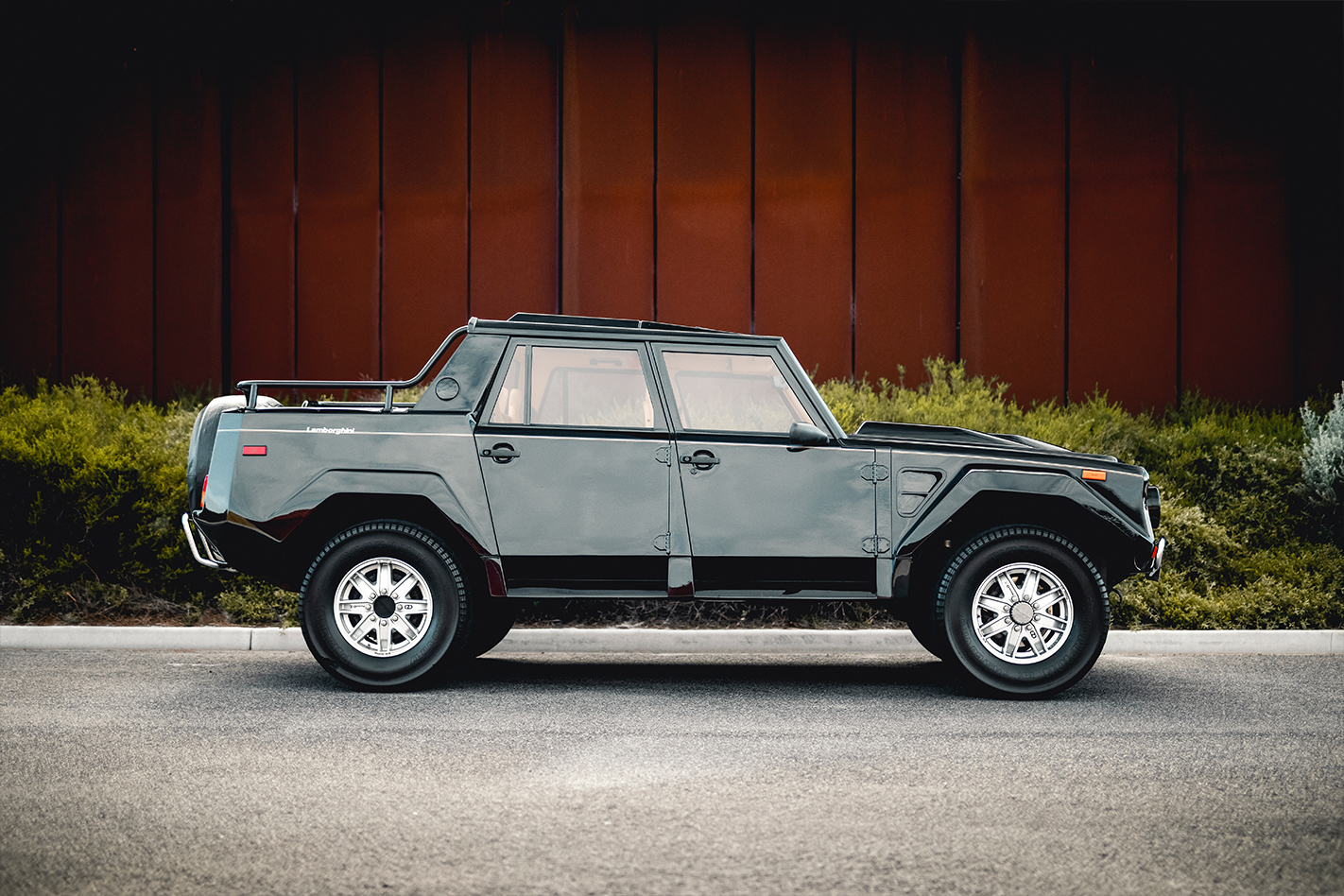
It’s hard to overstate the hole Lamborghini was in. It was a genuine catalogue of woe. The company tried to launch the Countach the year after the 1973 oil crisis broke. Neither the Countach nor the Silhouette V8 could be officially exported to the US in those early days. A contract to build the M1 for BMW was cancelled on April 20, 1978 when it was clear that Lamborghini was about to declare bankruptcy. The Bologna courts acquired the business later that year and would retain administration until 1980.
Enter Jean-Claude and Patrick Mimran, the third set of Swiss courtiers. These sugar-cane magnates were exactly the sort of eccentric fit the company needed. Jean-Claude was the self-styled ‘Sugar King of Africa’ while creative Patrick reached his artistic zenith with the world’s tallest giraffe sculpture. Most importantly, they had a seemingly bottomless fund of francs and ideas on how to revitalise the moribund manufacturer.
Under their management, the 4.8-litre Countach LP500S was approved for sale in the US, as was the successful Jalpa V8. The Bizzarrini V12 was teased out to 5.2 litres and given a multivalve head for the 1984 Countach LP5000 QV, but it was the 1986 LM002 that was perhaps their biggest left-fielder.
Lamborghini’s first tentative foray into this market came about as a partnership with the US contractor Mobility Technical International (MTI). In 1974, the American military was looking for a new high-mobility combat vehicle and MTI had a plan. The plan appeared to amount to copying the 1969 FMC XR311. This wasn’t a particularly successful military vehicle, failing to secure meaningful export orders and enjoying a production run of 20. Nevertheless, the template of a tubular steel chassis, rear-mounted Chrysler V8, three-speed TorqueFlite gearbox and a clever anti-puncture system proved attractive to MTI. With the benefit of hindsight, perhaps an Italian supercar manufacturer heading for receivership wasn’t the sagest choice of partners to manufacture what would be known as the Cheetah, and when it was unveiled at the 1977 Geneva Show, it seemed to attract more legal threats from FMC than it did solid orders.
Lamborghini and MTI parted company with the only surviving Cheetah being retained by its designer Rodney Pharis who later sold it to Teledyne Continental, the people who brought you the Patton tank. Once the Mimran brothers had taken the reins, engineering development boss Giulio Alfieri pulled the Cheetah project out of mothballs and set to work refining the design. The LM001, of which one sole example was built, retained the rear engine but gained a roof. The handling was, like the Cheetah, notably wayward and it was clear that in order to succeed, a radical rethink was required.
The putative solution appeared at the 1982 Geneva Show. The second Lamborghini Militaria vehicle, the LMA002 (‘A’ for anteriore, because the engine was now in front) featured Bizzarrini’s V12 powerplant wrapped in brutalist sheetmetal. Its gestation was nevertheless lengthy, Lamborghini courting military orders with demo vehicles displayed with gun mounts at the rear. An order of between 500 and 1000 vehicles from Saudi Arabia looked to have been secured, only to fall through at a late stage in negotiations. Phil Scott reported on the prototype for Wheels in September 1982, opining that here was a 4WD that “may just have given a new lease of life to the Bull of Sant’Agata.” Sounds familiar.
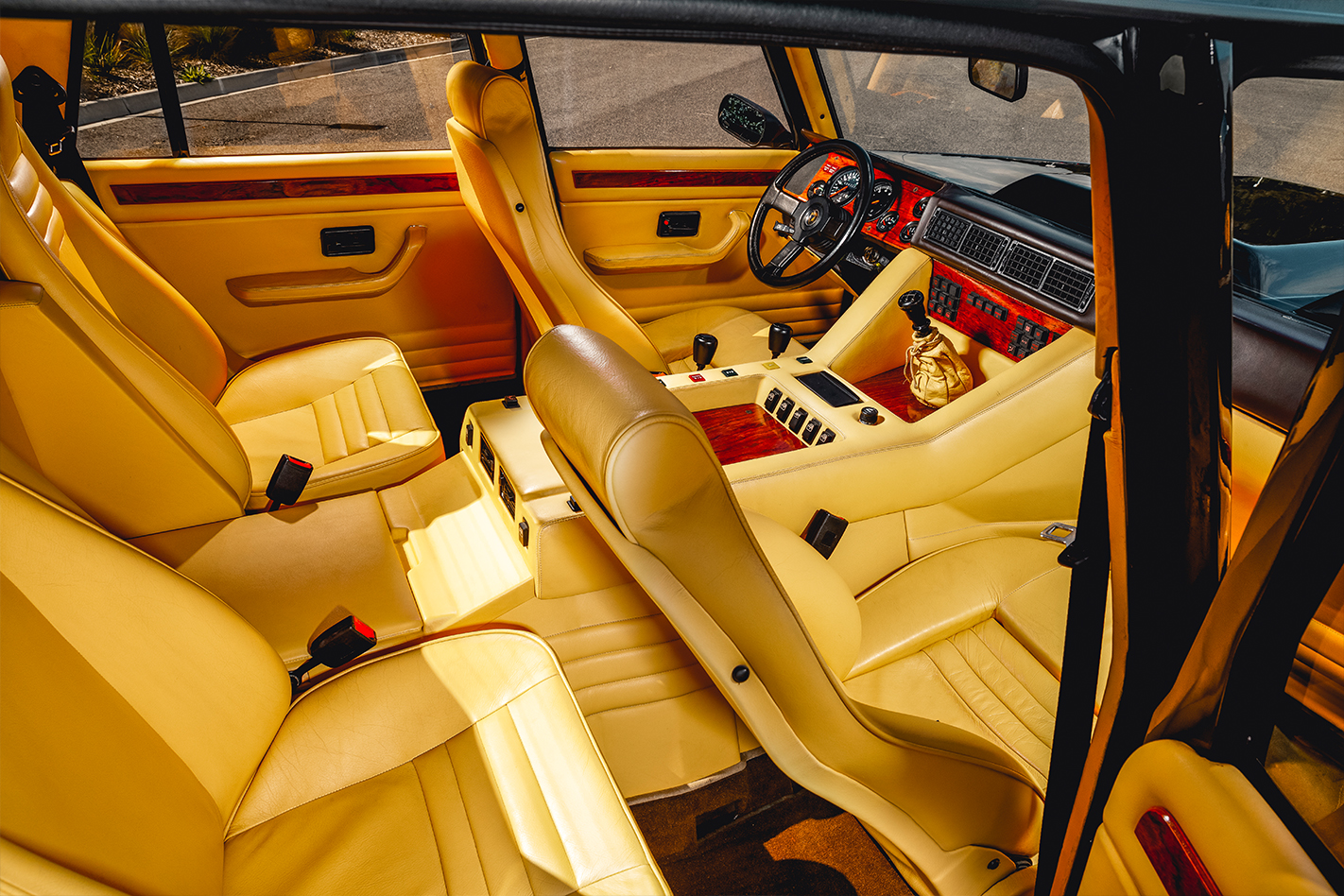
Rather than chase Middle Eastern military orders, the company decided that Middle Eastern playboys might be a more lucrative business demographic to pursue. The production LM002 was unveiled at the 1986 Brussels Show, now powered by the 48-valve Countach QV lump. Rather than a stripped-out, utilitarian interior for four troops, it was now swathed in leather, and was fitted with tinted electric windows, air-conditioning and a roof-mounted stereo. Run-flat Pirelli Scorpion tyres were one of the few conceptual carryovers from the original Cheetah.
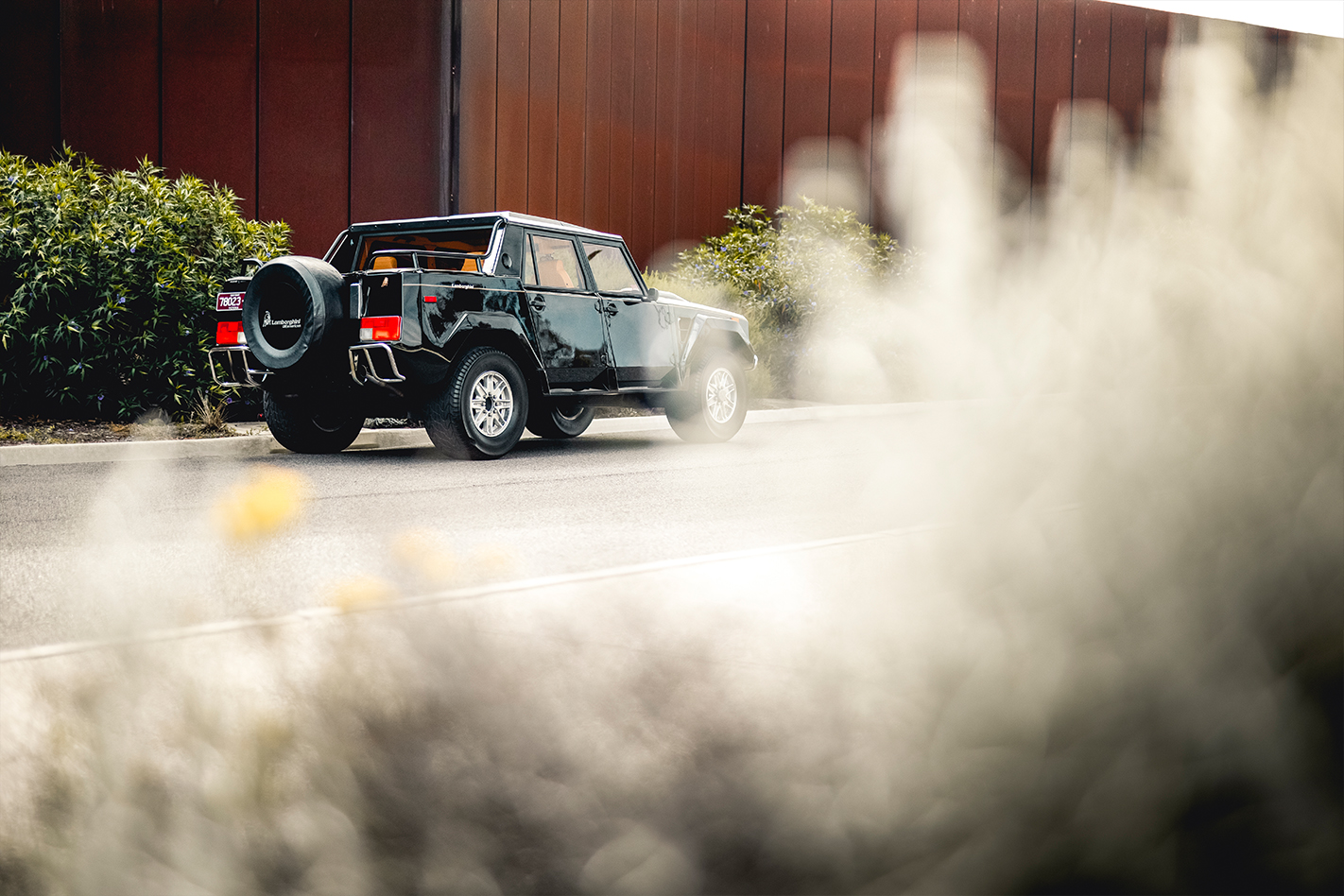
The odd thing about the LM002 is that from an utterly catastrophic development cycle came a genuinely noteworthy production car. Sure, only 328 ever found owners, and the Venn diagram of customers had quite an overlap between ‘owns pet tigers’ and ‘owns an LM002’, but the LM002 is such an event that its many idiosyncrasies are easy to overlook.
You’ll seat more people in a Clio than in the four-seat LM. While it’s truly vast on the outside, its 2000mm width meaning that you need to be very careful to avoid a protracted reversing out scenario, the cabin is snug due to a giant transmission tunnel. I had the chance to drive one in 2001 and the abiding memory is the fact that it feels cumbersome unless you really take charge and give the thing a good punt. The clutch requires a good kick and the steering seems to have a vague familiarity with the front tyres.
The huge wheel’s set at a bus-like angle of repose and is heavily power-assisted. Should you want to lock the freewheeling front hubs for off-road use, none of the constellation of fleshy buttons on the dash will do it. You get out and operate them manually. The high/low-range lever and locking rear diff can be operated without getting your sneakers muddy.
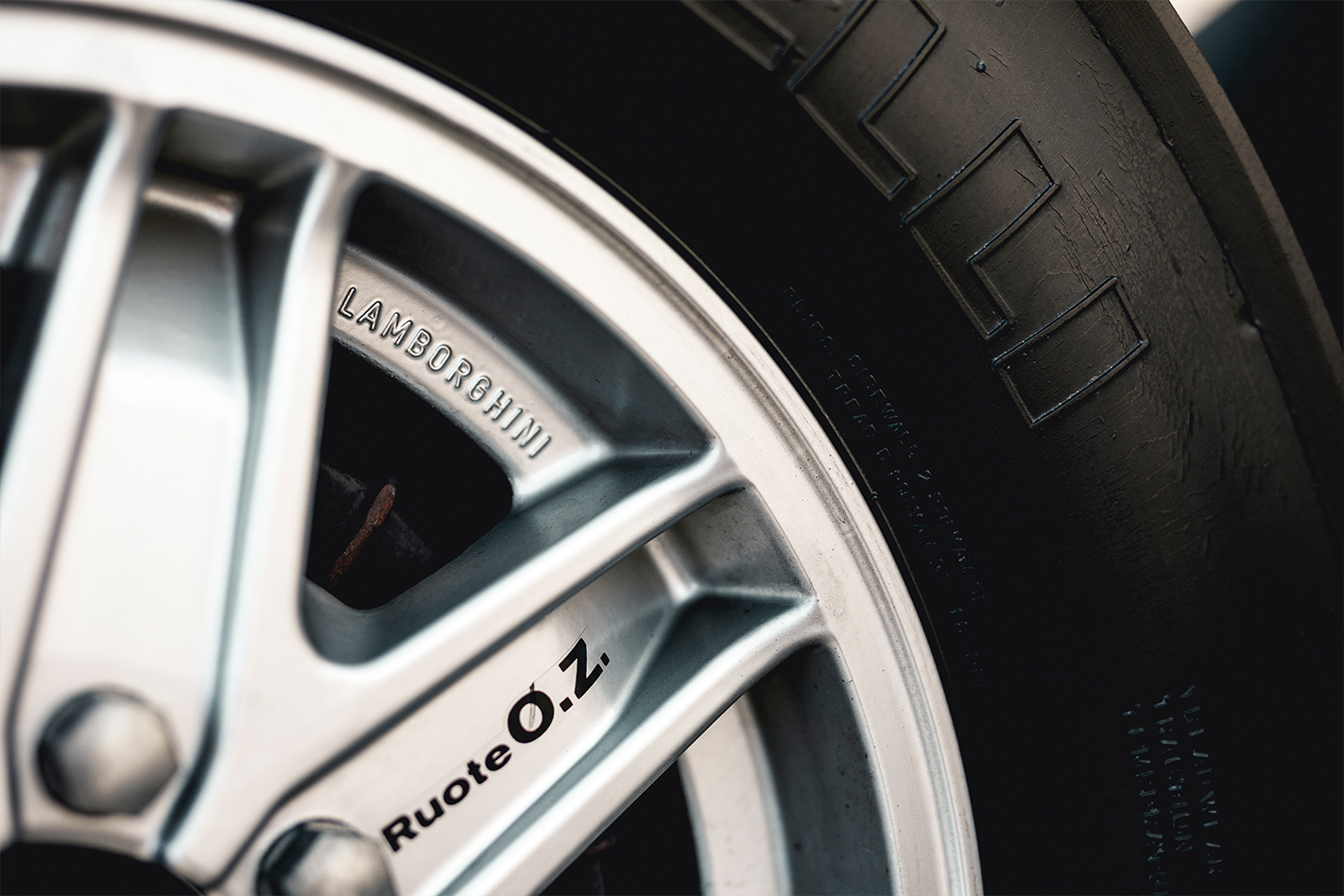
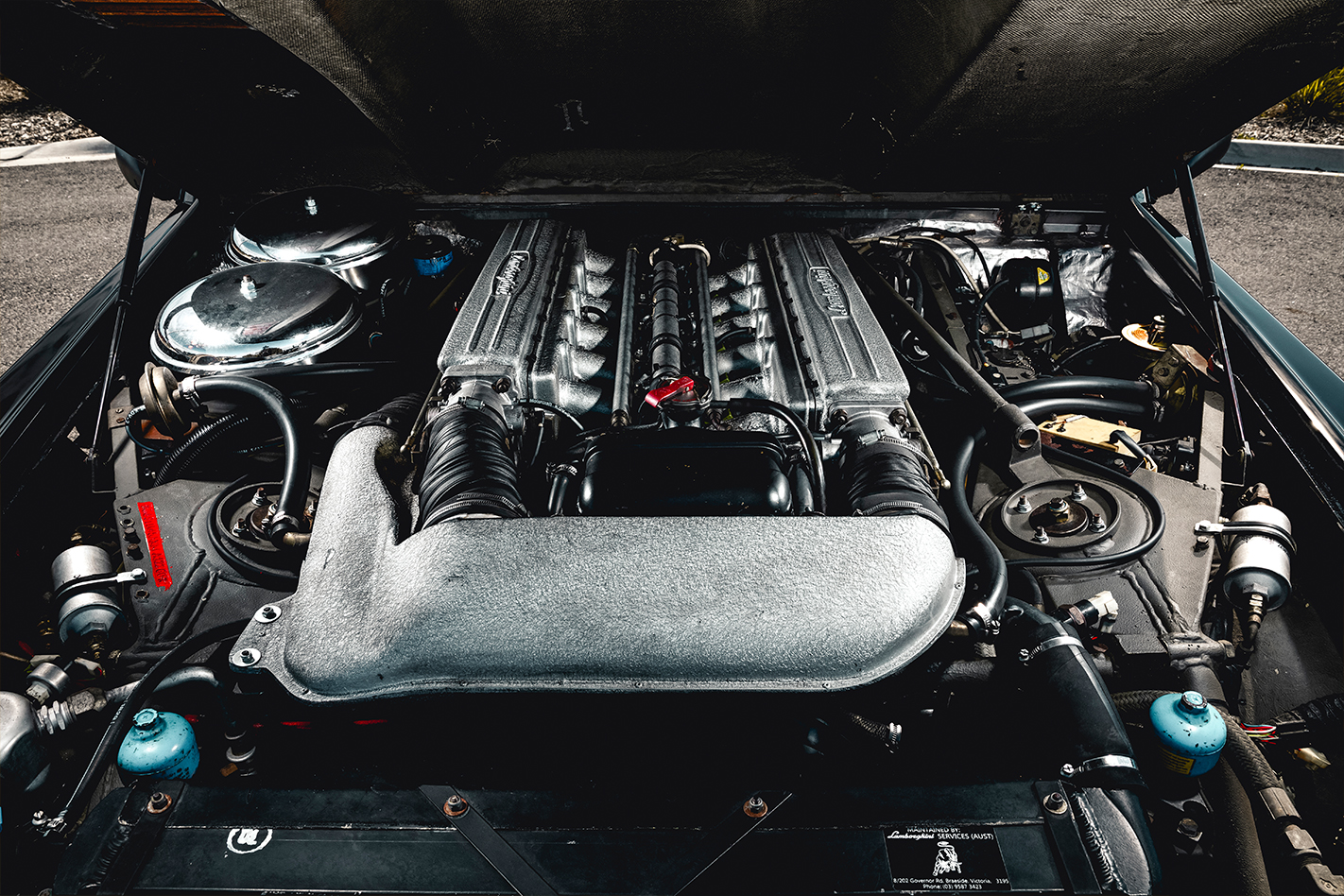
The V12 sounds magnificent, all carb-fed goodness and induction roar, but you never feel inclined to zing it to the redline as you would a Countach. The six Webers unleash a torrent of premium unleaded and the weighty, slow gearshift won’t have you blipping up and down through the ’box. Driving one hard on sealed surfaces can also chew through the standard 345-section Pirelli Scorpions, and replacements aren’t cheap. The turning circle is also truly hilarious.
It’s always an event, though. Most people have never seen one in the metal but a surprising number know exactly what it is and will give it the thumbs up. Perhaps because it is such a giant, profligate thing they see you driving it as an act of altruism, spreading the love at enormous personal sacrifice. Perhaps it’s the comical political incorrectness of the Lamborghini that can’t help but paint a smile on people’s faces.
Before the LM002 appeared, however, Lamborghini had been up a couple of design dead ends. In 1983, in an attempt to democratise the concept somewhat, Lamborghini fitted a 3.6-litre turbo-diesel built by VM Motori. Unsurprisingly, in the battle of 112kW versus 2700kg, weight won and the LM003 never made production. In 1984, Lamborghini experimented with the LM004, a demented lunge in the opposite direction, with even more luxury features and a 7257cc V12 that had been designed by Paolo Stanzani for powerboat racing, and which gave a claimed 313kW at 5400rpm. One prototype was built before Lamborghini settled on the lighter and more reliable Countach V12.
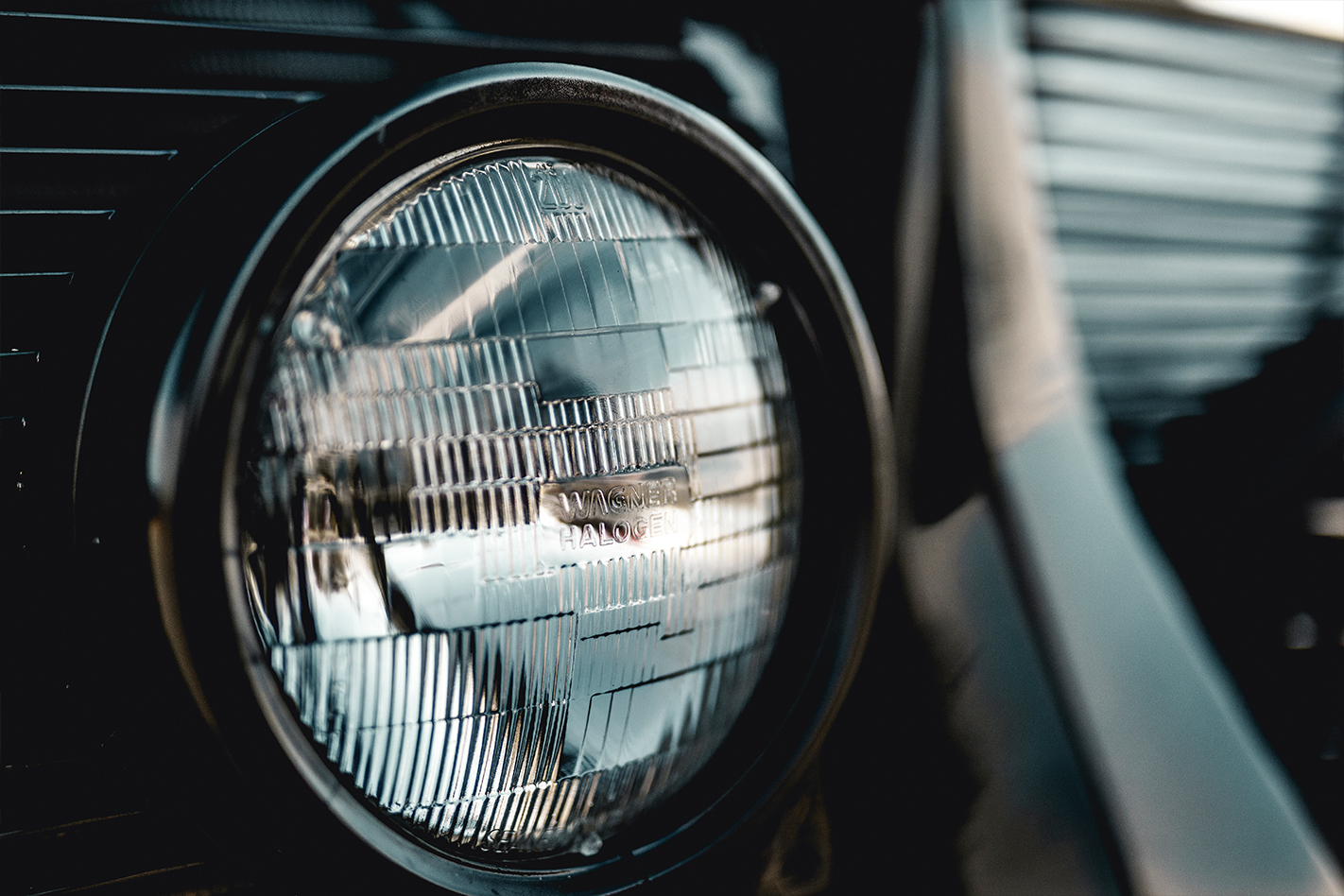
One often overlooked footnote in the LM002’s history is that it was Lamborghini’s first factory race car. Former F1 driver Henri Pescarolo first floated the idea of a rally raid version of the LM to the Mimrans, ostensibly to win the Paris Dakar rally. In 1986 the factory built a 441kW stripped-out desert racer, complete with a 600-litre fuel tank, but the LM002 Rally’s career proved ill-starred, recording a 100 percent DNF record.
The LM002’s final flourish came with 48 cars produced for the United States market, simply badged as the LM/American, an example of which you see pictured here. These fuel-injected cars are the best of the LM line but not the rarest. A seven-seat LM wagon was created in 1986 for the Sultan of Brunei and subsequently owned by BMW boss Bernd Pischetsrieder. Every LM002 is, in its own way, a one-off, and its legacy endures today, finally making good on its quest to deliver financial security to Lamborghini.
The LM002 represented the zeitgeist of pure ’80s excess better than any other Lamborghini. It made very little sense at the time and the whole project represented an exercise in throwing good money after bad. Nevertheless, its role in legitimising future SUV production at Sant’Agata is invaluable. The new Urus has a precedent; a bloodline. How do you put a price on that?
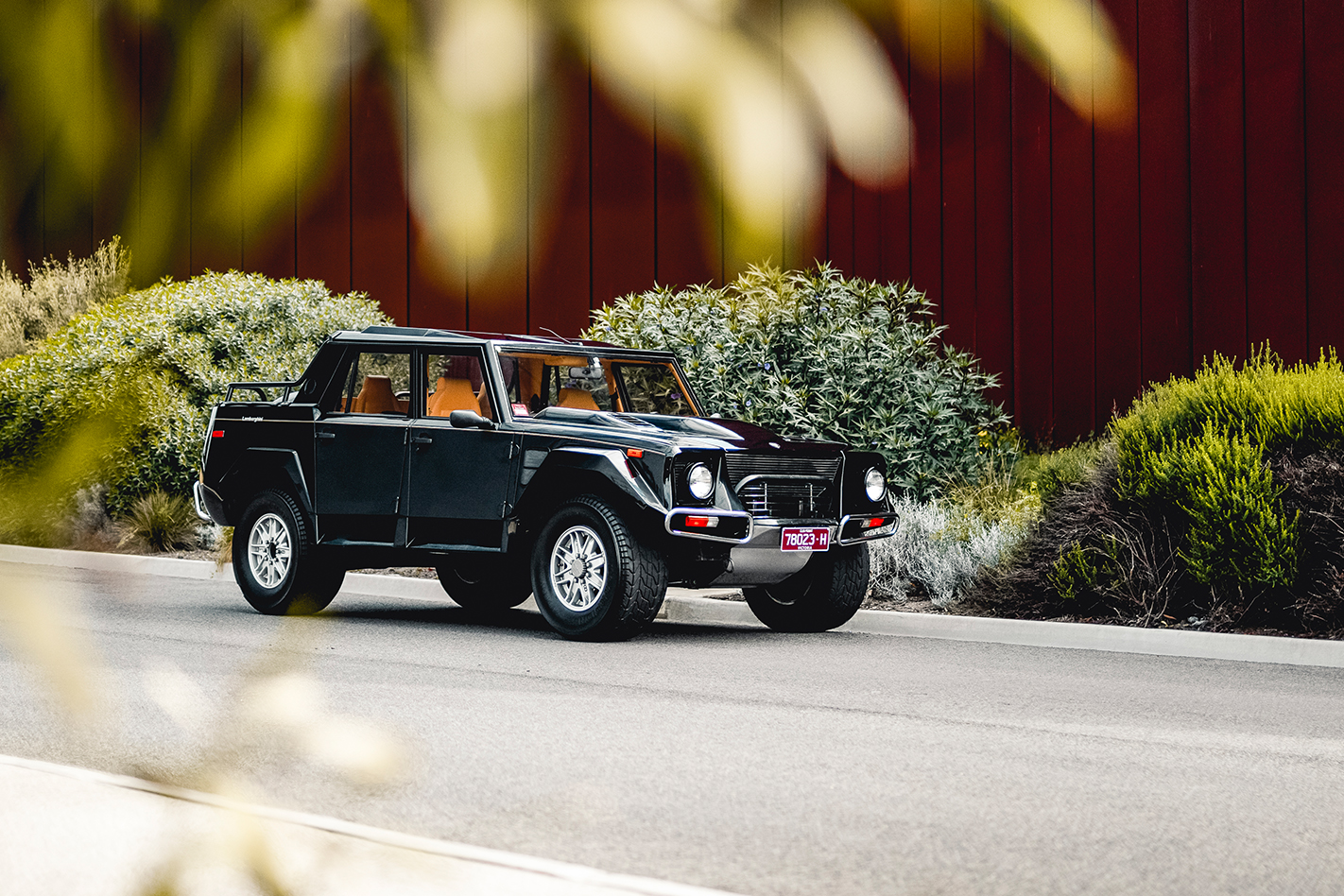
Who owns one? Jeff G – Melbourne
“This LM002 American was originally delivered into Newport Beach USA then ended up in a private collection in Southern Mexico . It was, with some difficulty, shipped back to the US and then on to Australia. It’s the only LM002 known of in Oz, and when replacement tyres are needed, you need to wait for Pirelli to make a batch. Fuel usage is not worth discussing but a 2700kg SUV that does 0-100 in 7.2 seconds and makes this much noise raises massive smiles.”
The Good: Sheer presence; mechanical durability; V12 soundtrack; well suited to Australian conditions; value’s only going one way
The Bad:Massive turning circle; certain spares are hugely expensive; tyres hard to come by; shocking fuel thirst; not that quick by today’s standards
Fast Fact
Uday Hussein’s LM002 came to an unfortunate end on July 18, 2004 on a US army base near Baquba, Iraq. A group of American soldiers, not realising the rarity of the Lamborghini, used it as a test vehicle to model the effects of a car bomb on a concrete barrier. Much of the LM was vaporised.
By the numbers
- ONE – right-hand drive LM002 in existence. Lives at Sant’Agata
- 169 – is the size of the fuel tank, which costs $280 to fill
- 24 – shocks killed in the 1996 Paris-Dakar DNF
- 1986-1992 – production span at a rate of one car per week
- LLA12298 – chassis number of 1990 LM002 blown up for Russian movie Brigada 2
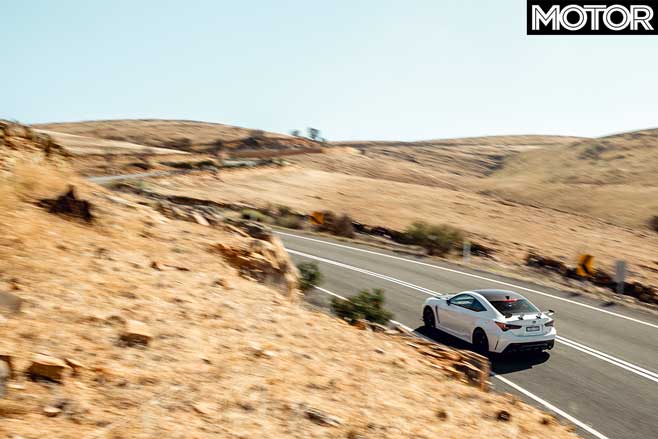
The most impressive thing about the Lexus RC F Track Edition compared to a regular RC F is that it lives up to the promise.
Those big carbon-ceramic brakes can go lap after lap, even despite the fairly tall order of having to haul up 1715kg; the Michelin Pilot Super Sport tyres are grippy yet durable; and, partly thanks to a new transmission oil cooler, even in high ambient temperatures you’ll be getting hot and bothered long before the naturally aspirated 5.0-litre V8 does. Ah, yes, Toyota reliability. Sorry, Lexus reliability…
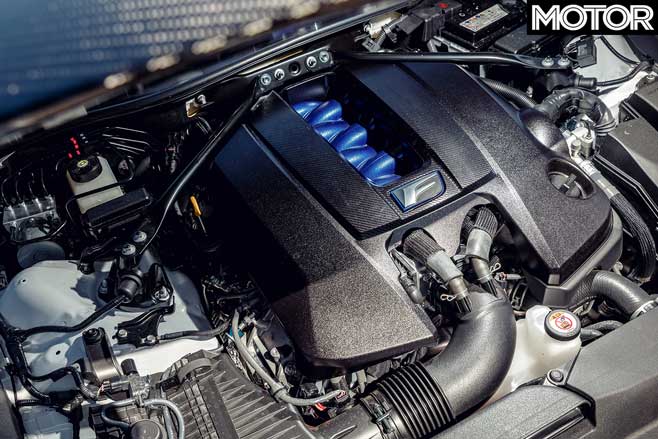
It’s even half effective when it comes to the stopwatch, the Track Edition’s stiffer, bodyroll-resisting chassis, dependable brakes and grippier rubber helping it lap just 0.7sec shy of the much more powerful Camaro ZL1, itself hardly an under-tyred or under-braked car.
But the bigger question in all of this is: unlike the ZL1, would you want to belt the Track Edition around for lap after lap, even if it can do it?
According to our judges, it seems you will pull into the pits having had your fix long before the brakes, engine or transmission need cooling down. And that’s owing to the fact that, while 65kg lighter than the regular RC F – giving it a poofteenth more verve – the Track Edition is still a heavy car, a dirty big lump of V8 between the front strut towers very much still noticeable.
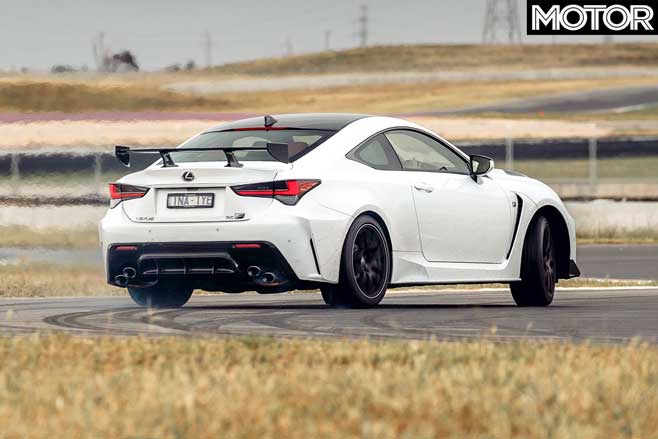
The car also just feels a bit old; the steering, while quick in rack and with plenty of lock (great for skids), could be straight from 2010, and to be honest it probably is.
It’s not fast enough for how much it costs, either. The Track Edition, while being the quickest Lexus since the LFA, only managed 4.79sec to 100km/h, almost half a second short of its 4.3sec claim and, frankly, a time that would see rivals like the M4 and C63 S blast it into the weeds.
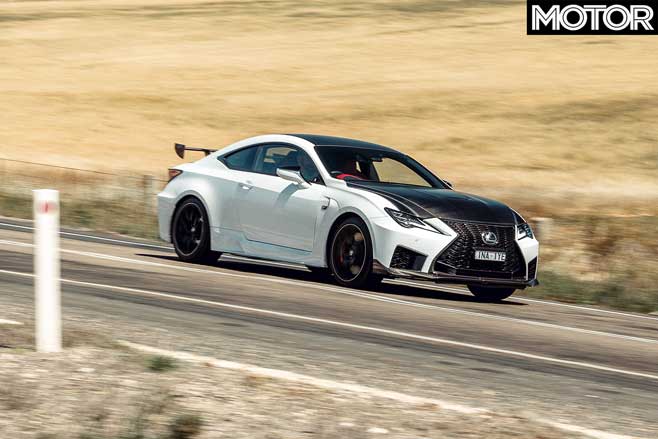
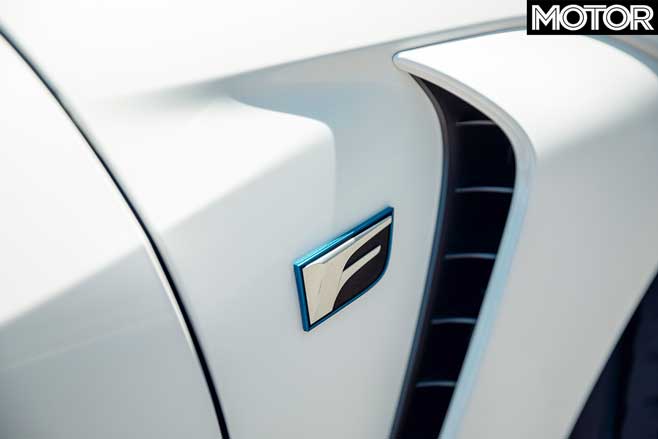
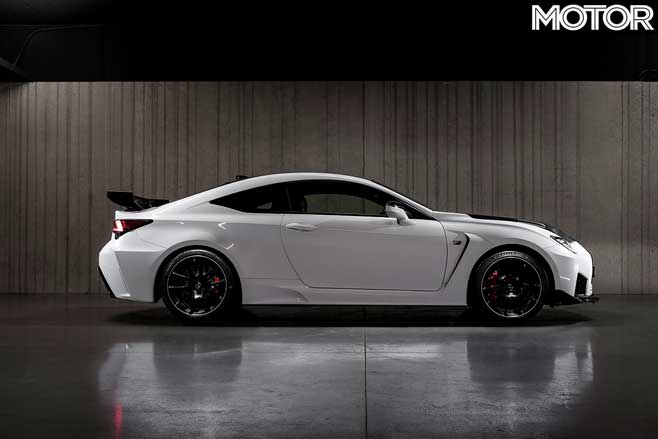
Don’t think that we’re hating on the Track Edition, though. Popular with everyone on PCOTY for its myriad delightful details – from the discoloured titanium exhaust tips to the gorgeous carbonfibre fixed rear wing – the Track Edition also garners affection for being a wholly Japanese performance car (oh hey, Supra).
The engine is still a gem and sounds great, a loud, revvy V8 intake note burbling up from deep within the dash, and it’s much more eager to rotate on the brake into corners than a regular RC F, making it a very willing drifter. But while $165K might get you a bit of rarity in the Track Edition, you can simply go a lot faster, and have a lot more fun, for a lot less.
The Numbers
2020 LEXUS RC F TRACK EDITION SPECS: Engine: 4969cc V8, DOHC, 32v Drive: rear-wheel Power: 351kW @ 7100rpm Torque: 530Nm @ 4800-5600rpm Transmission: 8-speed automatic Weight: 1715kg Power/Weight: 204kW/tonne 0-100km/h: 4.79sec 0-400m: 12.90sec @ 182.33km/h The Bend lap time: 1min 34.7sec Price: $165,482
Judge’s Rank
Dylan Campbell – 5th “Not going to bother a C63 or an M4 for pace or poise, but tries hard to please. Succeeds.”
Louis Cordony – 10th “A bit lost on the road and track for me. Lovely brakes, though.”
David Morley – =5th “As much as I love the engine in the RC F, the track-spec bits don’t seem to gel.”
Scott Newman – 9th “An easy car to like, but confused personality and too expensive for what it offers.”
Tim Robson – 6th “Great engine and newfound chassis suppleness, but can’t overcome its heft.”
PCOTY 2020 Scoring
| Judges | DC | LC | DM | SN | TR | Total |
| Performance/20 | 15.5 | 8 | 16 | 14 | 16 | 69.5 |
| Dynamics/20 | 15 | 12.5 | 15 | 15 | 16 | 73.5 |
| Accessibility/10 | 8.5 | 3.5 | 7 | 8 | 8 | 35 |
| Liveability/10 | 7 | 5.5 | 9 | 6.5 | 7 | 35 |
| Value/10 | 8 | 8.5 | 6 | 4 | 4 | 30.5 |
| X Factor/10 | 6.5 | 4 | 6 | 7.5 | 5 | 29 |
| Total/80 | 60.5 | 42 | 59 | 55 | 56 | 272.5 |
The Range Rover Velar almost didn’t make it. With Jaguar-Land Rover haemorrhaging money, it took a hatchet to its Special Vehicle Operations, canning the mega-bucks Range Rover SV Coupe and brutish Land Rover Discovery SVX. Whether because of greater volumes or simply its development had reached the point of no return, the hot Velar escaped the purge, and we’re glad it did.
It’s difficult to think of a mechanical contraption that JLR’s thumping 405kW/680Nm 5.0-litre supercharged V8 wouldn’t improve, and in general the Velar is no exception.
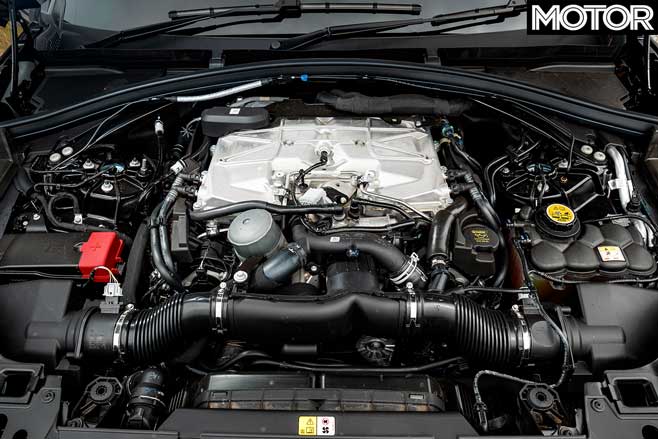
It’s a thirsty beast, though. Range Rover’s press release boasts: “The 82-litre fuel tank promises a genuine range in excess of 483km”; when you’re spruiking fuel consumption of 17L/100km you know it likes a drink, but at least that’s more realistic than the official claim of 11.8L/100km.
It’s not an engine that lends itself to economical driving, as each depression of the accelerator dips into the deep, syrupy well of torque to lift the nose and unleash a noise like a bear having a prostate examination. Every gap in traffic becomes an opportunity to create a din, and out on the open road the rate of sustained acceleration is borderline unsettling.
To be honest, the Range Rover Velar SVAutobiography’s engine vastly overpowers its chassis. Pirelli Scorpion all-season tyres measuring 265/45 at both ends will be worth their weight in gold when you hit the ski slopes, but struggle to contain 550 raging horses. They begin to protest early, and if you’re driving the Velar SV with enthusiasm it’s important that your first input is the correct one, as there is rarely enough control for you to change your mind.
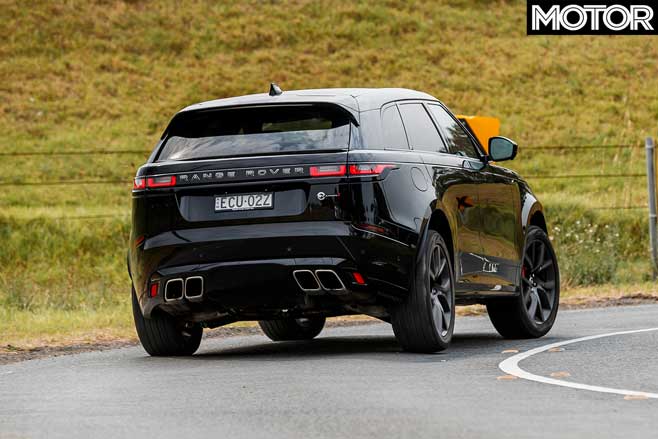
The soft suspension results in significant pitch and roll, despite our test car being optioned with Dynamic Mode – a snip at $430. Trail-braking promotes entry oversteer, which the rear-biased all-wheel drive system (with electronically controlled rear limited-slip diff) exacerbates once the throttle is applied. No such shenanigans are possible with the conservative ESP engaged, but while it can’t be switched off completely, it does tend to go all Scott Morrison, heading on vacation in a crisis until the you-know-what really hits the fan. The brakes struggle too, feeling the strain of arresting 2160kg.
It’s a wild ride on tarmac, yet venture onto an unsealed surface – this is a Range Rover after all and still possesses the full gamut of off-road technology – and it morphs into a giant. The adjustable chassis and clever all-wheel drive system allow the Velar SV to essentially be steered with the pedals alone, while those all-season tyres start to make sense.
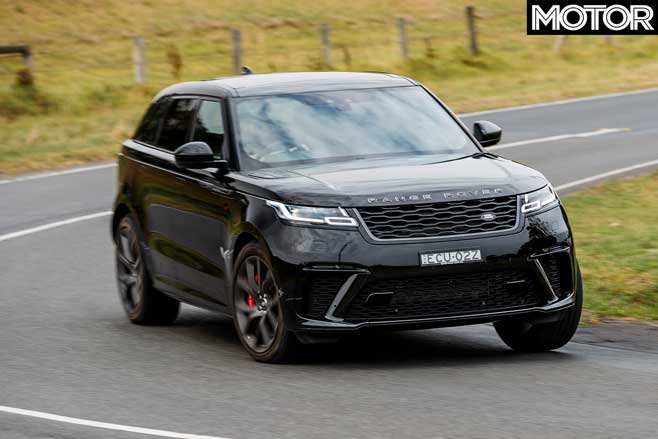
In Range Rover’s defence, despite fitment of the monster engine, the Velar is intended to prioritise luxury over performance, which is the preserve of the more focused SVR models. Plusher ride quality than most of its rivals improves the Velar’s case as a day-to-day proposition and a special effort has been made on the interior. The 20-way adjustable front seats have heating, cooling and massage functions and are covered in fancy leather.
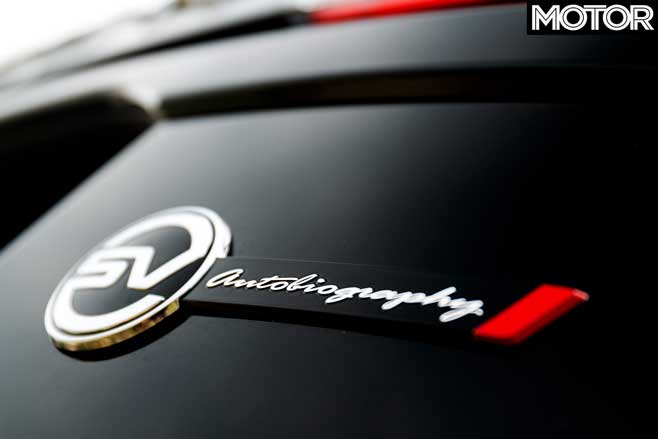
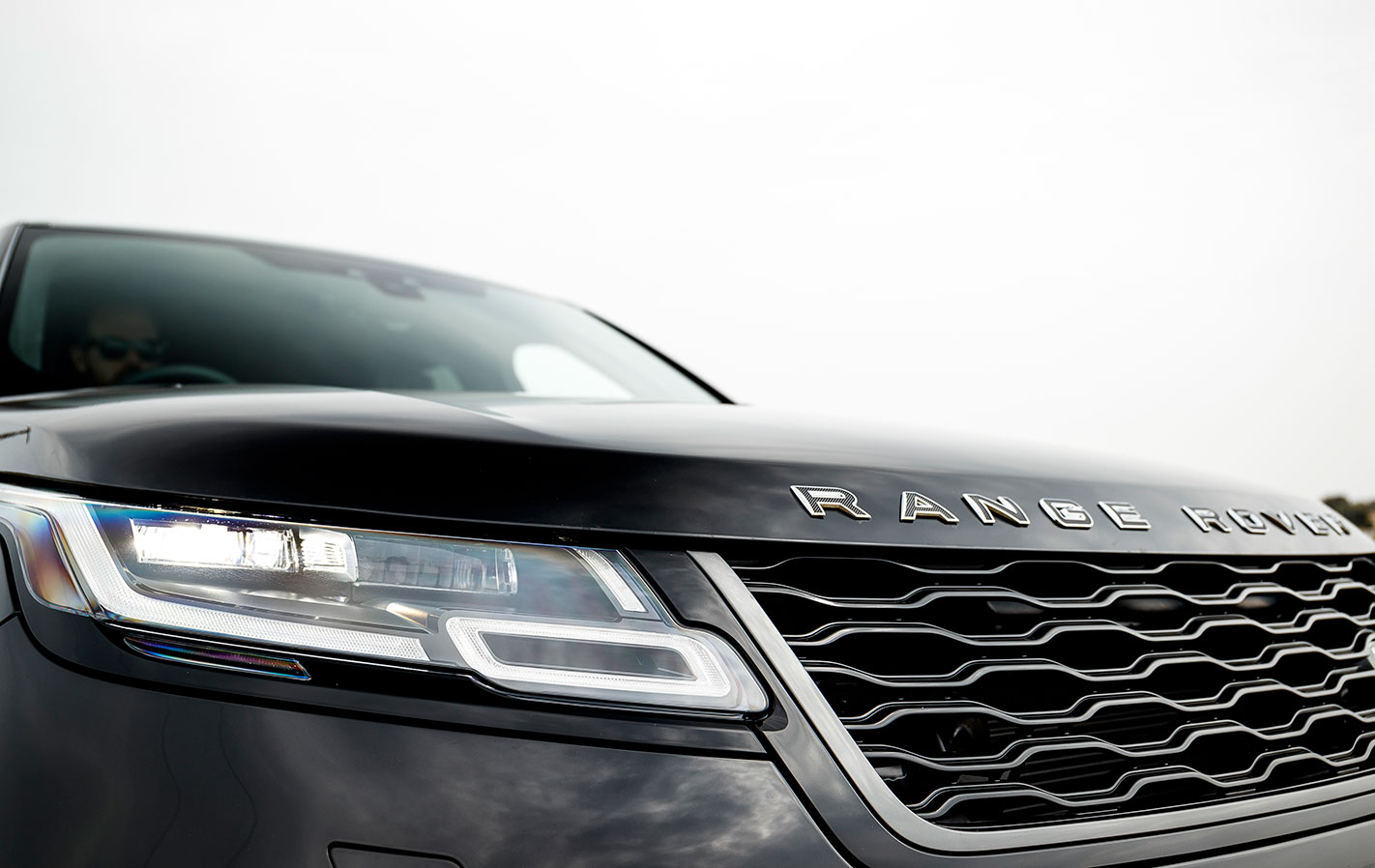
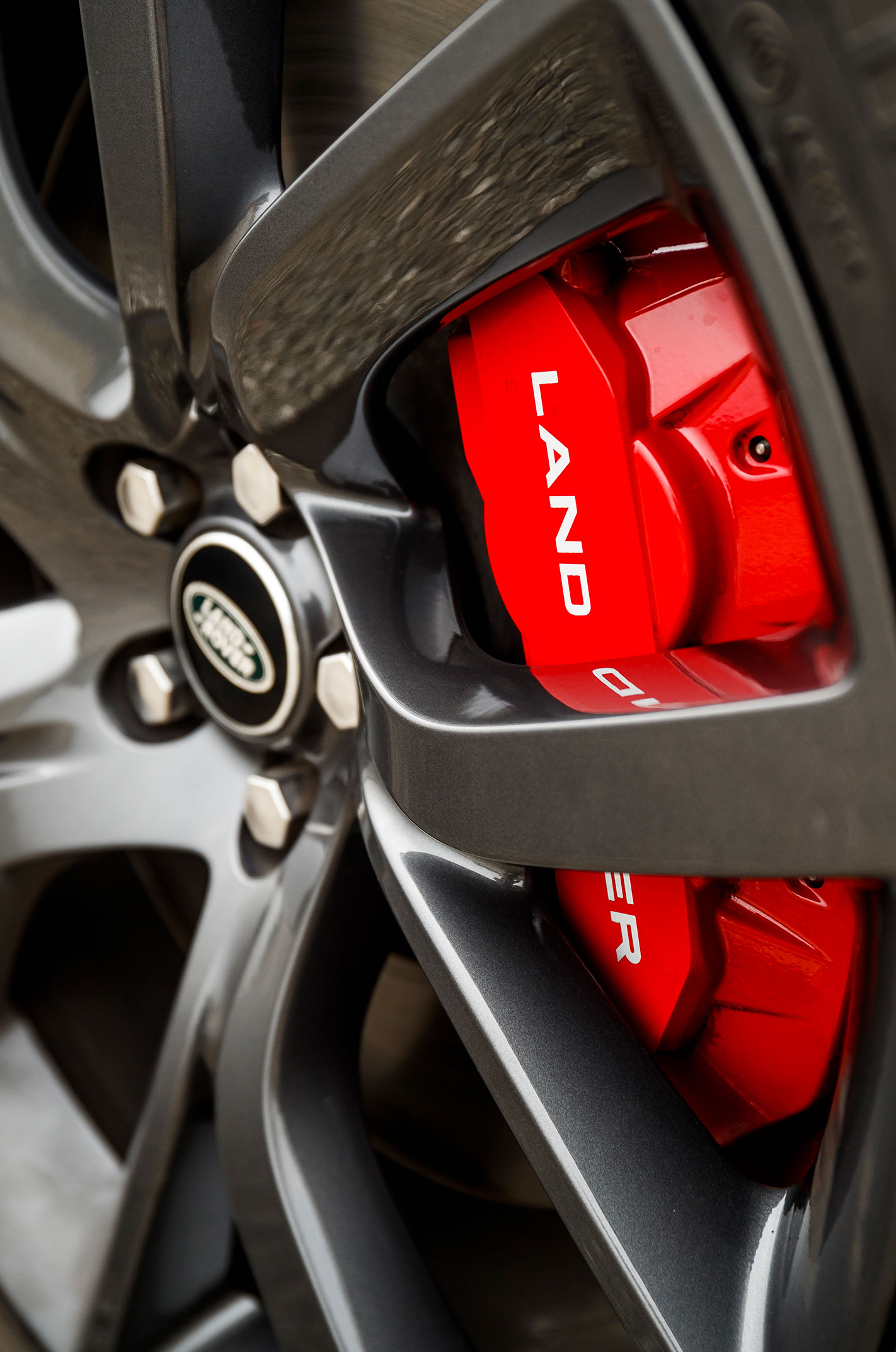
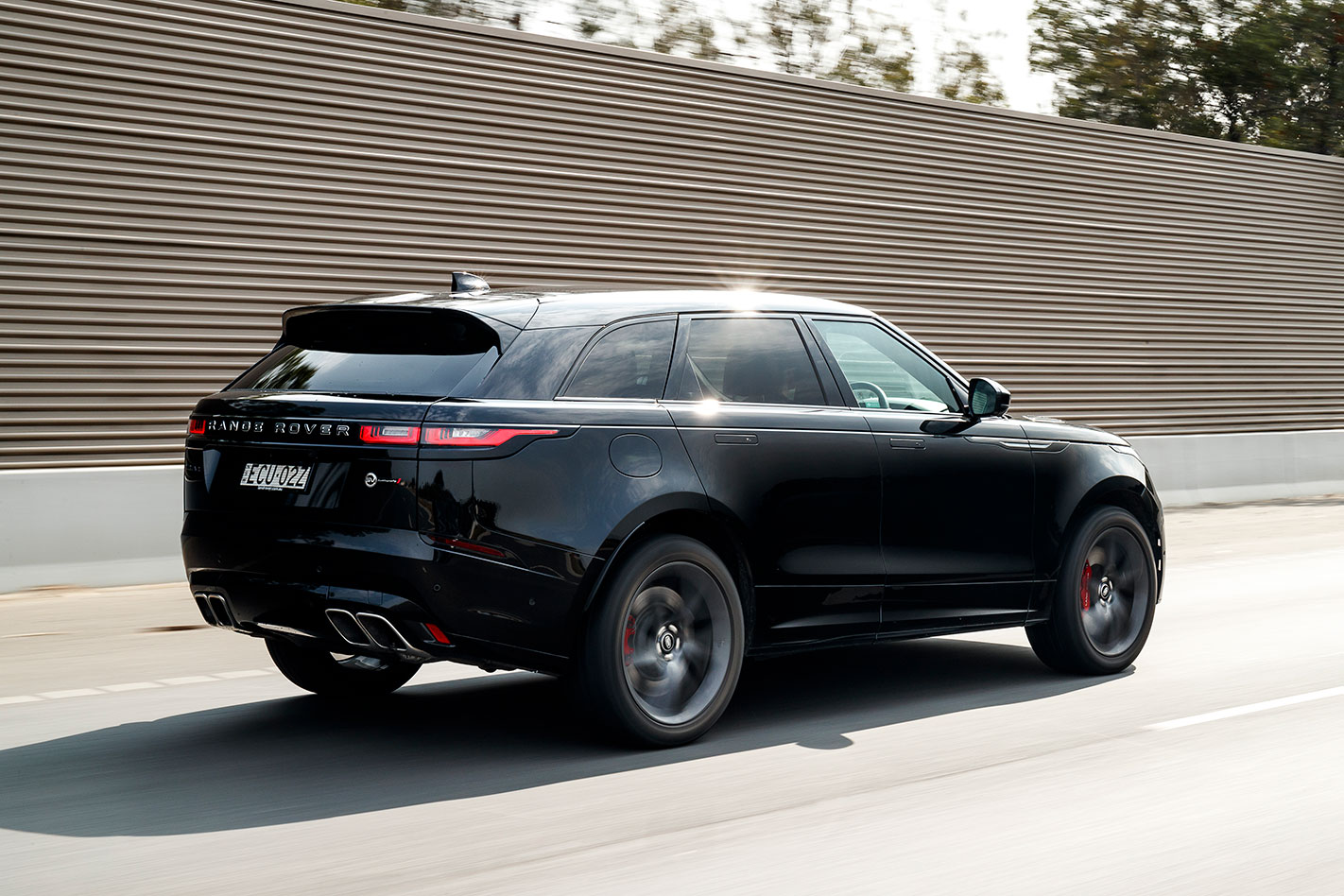
On the outside the Range Rover badging has been enhanced, there’s a new bumper to improve airflow, bespoke grille and gaping quad trapezoidal exhausts. The all-black spec of our test car doesn’t flatter the Velar; “the world’s most beautiful mid-size SUV” (Range Rover’s words, not ours) benefits from a lighter colour and perhaps the optional 22-inch rims for maximum wow factor.
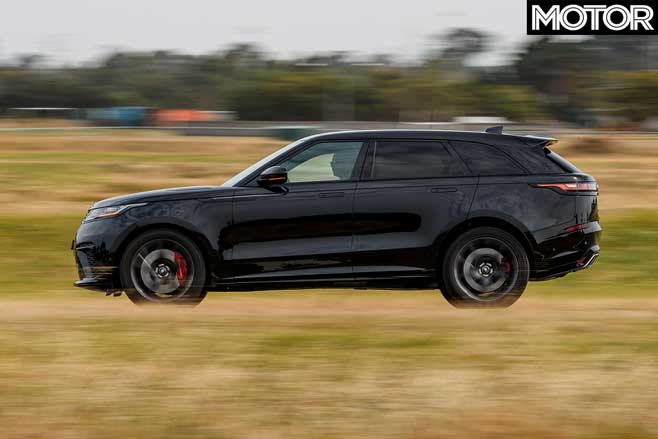
At $176,312 the SVAutobiography sits almost $50K clear of the next rung on the Velar ladder, the P380 R-Dynamic, but the last P380 we drove cost more than $160K as-tested. In contrast, our lightly optioned Velar SV is priced at $181,325 as-tested and didn’t lack anything obvious.
If this all sounds rather appealing, you’ll have to be quick – Australian orders close in April, as the Velar SVAutobiography is only being produced for 12 months. Then again, we’re lucky it made it at all.
RANGE ROVER VELAR SV SPECS Engine: 5000cc V8, DOHV, 32v, supercharged Power: 405kW @ 6000-6500rpm Torque: 680Nm @ 2500-5500rpm Weight: 2175kg 0-100km/h: 4.5sec Price: $176,412 ($181,325 as tested)
Likes: Swish interior; decent ride; a riot on loose surfaces; monster grunt Dislikes: Lacks handling precision; brakes and tyres underdone; hugely thirsty
Rating: 3.5 out of 5 stars
Second Opinion: Wheels review
A Velar for those who want their SUV with space, pace and bass
By Trent Giunco
Overall Rating

Plus & Minus
Plus: Epic straight-line pace; addictive soundtrack; plush cabin
Minus: Fuel economy when pushed; soft dynamics; soon to be decommissioned
The Wheels Verdict: Performance-orientated SUVs are fickle. Some are better than others, but just about all of them are inherently flawed because of their weight and high centre of gravity. The Range Rover Velar SV Autobiography isn’t immune to this. However, its hulking V8 is endowed with so much power it almost has its own gravitational pull. Matched with a high-class interior, it’s hard not to adore the brash Rangie when reason tells you that you probably shouldn’t.
What is the Range Rover Velar SV Autobiography Dynamic Edition?
In layman’s terms, the SV Autobiography Dynamic Edition is the really fast one. The 5000cc supercharged V8 backs up this assertion with 405kW/680Nm, channelled to all four wheels via an eight-speed auto. The starting price is $176,412 but our as-tested price comes to $181,325. That’s thanks to the inclusion of the $2223 Driver Assist Pack (360-degree camera and adaptive cruise with steering assist), privacy glass ($890), ambient interior lighting ($540), grand black veneer ($530), Terrain Response 2 with Dynamic Program ($430) and remote release rear seats ($300).
Why we’re testing it
You don’t need 405kW in a two-tonne-plus SUV, much as you don’t ever really need a 15-course degustation meal. However, sometimes it’s nice to indulge in a little excess. And the Range Rover Velar SV Autobiography Dynamic Edition is just that – a 5.0-litre supercharged V8 serving of prime beef and caviar. It’d be a shame not to tell you what it’s like.
Range Rover Velar SVAutobiography Review
I’m being forced into the back of the seat and all I can see is sky. Luckily the steering wheel offers a point of purchase as all four tyres savage the tarmac, delivering unrelenting traction. There is a maniacal sound permeating the cabin as the road ahead is fast becoming fodder for the rear-vision mirror. Launching the Range Rover Velar SV Autobiography isn’t just a feast for the senses – it’s physical. That’s what an angry 5.0-litre supercharged V8 with 405kW and 680Nm can do to a luxury SUV.
There’s something rather naughty about liking the go-fast Velar. After all, it’s a two-tonne-plus luxury SUV with a price tag pushing north of $175K. Consider the fact its inner sanctum is also coated in cow hide while the bent eight has an almost unquenchable thirst, and you start to uncover a theme of excess. However, who doesn’t like to indulge?
It’s hard not to be taken by the sheer grunt underfoot. The claimed 0-100km/h time is 4.5 seconds, but it almost feels faster than that. Once in its stride, the Velar gains momentum at a rapid rate. Keep your right foot buried too long and some very un-SUV figures easily crop up onto the digital instrument cluster. Land Rover’s quoted top speed of 276km/h is proof that the Velar doesn’t lose its head of steam easily. Although don’t expect to get anywhere near its 12.3L/100km economy claim while doing so. It sounds the business, too, with a burly and boisterous soundtrack that has enough theatrics to satisfy the most hardened V8 fan. Aural character is not left wanting.
The SV Autobiography doesn’t waste any of the grunt, either. With 21-inch alloys wrapped in 265/45 Pirelli Scorpion tyres and a rear-biased all-wheel-drive system, finding grip isn’t an issue – until it is. Despite being a 2160kg SUV, the hotted-up Velar’s rear axle can be provoked into somewhat lurid yaw movements before and after an apex, with the electronically controlled rear LSD proving its worth. However, enter a corner too hot and it can fall into understeer. Swift progress is all about managing weight transfer, easing smoothly into the pitch and roll characteristics of the thing.
The softer setup, despite being equipped with sports air suspension, is appreciated in terms of ride quality. Relax the damping (all the key driving parameters can be tailored via the adaptive dynamics screen) and the Velar verges on plush, which pairs well with the quiet cabin. The downside is a loss of body control when hustling. You also have to be mindful of brake temperatures and the fact that the steering isn’t the final word on feedback. The eight-speed torque-converter auto does a decent job of both the fast-paced and cruising tempos.
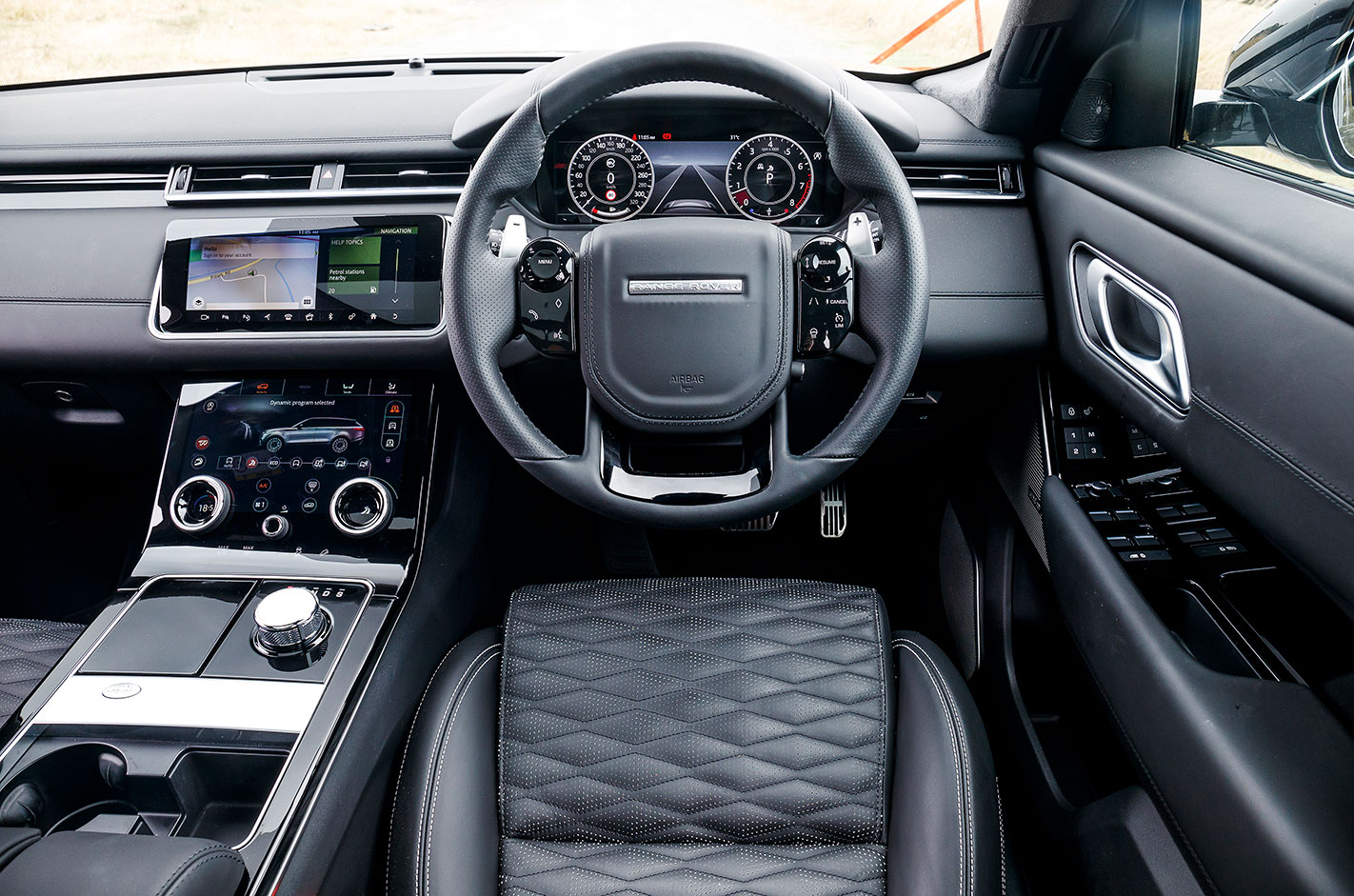
The latter is, despite all the performance readily available, where the Velar is going to boogie most of the time. And, like a Range Rover should, it nails overindulgence. From the Windsor leather seats (20-way adjustable up front with heating, cooling and massage functions) to dual touchscreen displays, the interior design has plenty of showroom appeal. What’s not quite so successful are some of the ergonomics, with just about everything having to be controlled through the Touch Pro Duo system. It becomes easier with time, but there’s definitely a familiarisation period and it takes your eyes off the road. Being a range-topper it’s highly specified, with Apple CarPlay and Android Auto featuring.
It’s important to remember that the Velar is a mid-size SUV. However, the interior is roomy if not overtly capacious. In the back, leg and headroom is generous – even with the panoramic glass roof – while the rear seats fold in a 40:20:40 fashion for extra practicality. Raise the power tailgate and the 673-litre boot can swallow heaps of cargo, or fold the rear pews for a total of 1705 litres of space.
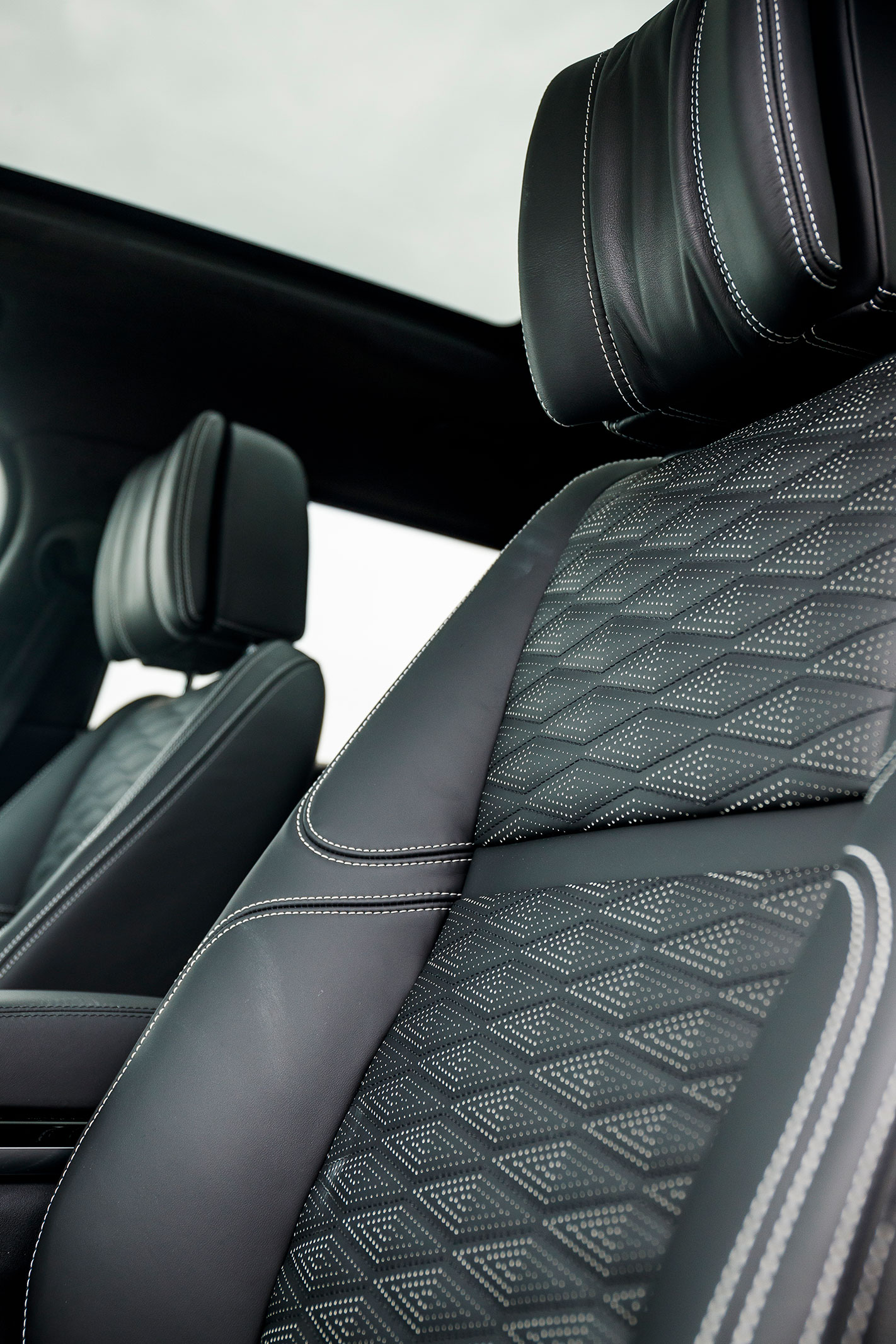
The interesting thing is, when you consider what your $176,412 affords you, the SV-fettled Velar can be seen to present a modicum of value. I’ll pause while the comments section explodes… However, with the level of performance at hand and its explicitly luxurious nature, one could feasibly expect the sticker to start with a two, not a one. Although with the ferocious neck-kinking grunt of this Rangie, leaving some cash aside for Deep Heat is very much advised.
The Rivals
Alfa Romeo Stelvio Q; BMW X3M; Mercedes-AMG GLC 63 S; Porsche Macan Turbo S
Price and Specs
- Model: Range Rover Velar SV Autobiography Dynamic Edition
- Engine: 5000cc V8, dohc, 32v, supercharger
- Power: 405kW @ 6000-6500rpm
- Torque: 680Nm @ 2500-5500rpm
- Transmission: 8-speed automatic
- Weight: 2160kg
- 0-100km/h: 4.5sec
- Economy: 12.3L/100km
- Price: $176,412 ($181,325 as tested)
- On sale: Now
What stands out?
The dramatically styled Honda Civic is unusually big and roomy for a small car. The hatchback and sedan drive very comfortably, handle responsively, and offer spirited performance from a very fuel-efficient turbocharged engine. The most expensive Civics have auto braking, and can hold their places automatically in traffic. The Civic range is topped by the magnificent Type R hot hatch.
What might bug me?
How long it takes you to park when it’s raining. The Civic has a very high boot line and shallow side windows, so that it is hard to see naturally what is directly behind you. And unfortunately, drops of water blot the lens of the reversing camera very readily.How hard it is to squeeze into small parking spots. The Civic, originally very compact, has grown. In sedan form it’s longer than a BMW 3 Series. (The hatchback is about 13cm shorter than the sedan).If you are the front passenger, how much skill it takes to get the volume you want from the sound system. Adjusting it requires a deft finger-swipe across a touchscreen. (The driver has a wheel-mounted switch.)Driving under 80km/h on your space-saver spare tyre, until you can fix your full-sized flat.
What body styles are there?
Five-door hatch and four-door sedan.All Civics accommodate five people, except the Type R which seats four.The Civic drives its front wheels, and is classed as a small car, lower priced.
What features do all Honda Civics have?
Cruise control, and a reversing camera.A sound system with an AM/FM radio, a CD/MP3 player, two USB inputs, an HDMI port, and Bluetooth phone connectivity with audio streaming, operated from a 7.0-inch touchscreen that accepts swipe and pinch control.Support for Apple CarPlay and Android Auto, which allows you display apps from compatible smartphones on the touchscreen.Height and reach adjustment for the steering wheel, which carries switches for operating the cruise control, the audio system and your phone. Height adjustment for the driver’s seat, and a rest for the driver’s left foot.Long-lived LED daytime running lights, which help other drivers see you. Seatbelt reminders on all seats.A skinny space-saver spare wheel, with a recommended speed limit of 80km/h. A tyre deflation warning, which may give you extra time to get a slow puncture seen to.Hill-start assist, which operates the brakes automatically to help you take off on steep grades.Torque vectoring, which brakes the less-loaded inside front wheel in fast turns, to limit wheelspin and help draw the car into the corner.Six airbags. Electronic stability control – mandatory on new cars – which helps you avoid and control skids. (For the placement of airbags, and more on Civic safety systems, please open the Safety section below.)The Civic is offered with a five-year, unlimited distance warranty.
Which engine uses least fuel, and why wouldn’t I choose it?
The 1.5-litre, four-cylinder, turbocharged petrol that drives the more expensive Civics uses less fuel than the sole alternative, consuming 6.0 litres/100km on the official test (city and country combined).This engine endows the Civic with a strong and steady turn of speed, performing without apparent effort around town and when touring on country roads. Expect to average about 7.5 litres/100km in the real world, over a range of conditions.The main reason you would not choose it is that you want to pay less for your Civic. A second reason might be that you expect to use your Civic mainly in suburban driving, and so won’t have much use for the turbo’s performance.A third could be that the turbo’s gruff note under load offends you, and you prefer the less eager but quieter alternative engine, a non-turbo 1.8-litre four-cylinder carried over from the previous Civic.On the plus side, apart from from better performance and economy, all 1.5-litre Civics are equipped autonomous emergency braking and adaptive cruise control.Civics with the 1.8-litre engine still feel responsive, and they don’t use much more fuel (6.4 litres/100km on the test, and 8.5 litres/100km in the real world – about the same as a Mazda3). They do require more patience when overtaking on the highway, however, offering about 30 per cent less thrust than the turbos.Both engines are available only with a Continuously Variable auto transmission (CVT), with stepped ratio points that make it feel like a conventional auto. Paddle shifters are standard from VTi-L grade and above, giving drivers some manual control over the gearbox.Then of course you may want the thrills afforded by the Civic Type R hot hatch, which has a powerful 2.0-litre turbocharged engine and a six-speed manual gearbox which provides racing car-like performance. Official fuel consumption is rated at 8.8 litres/100km but Wheels magazine testing in November 2017 saw a real-world figure of 11.7 litres/100km. That said you don’t buy a Civic Type R with economy in mind.(Power outputs and all other Honda Civic specifications are available from the Cars Covered menu, under the main image on this page.)
What key features do I get if I spend more?
The least costly Civic is the VTi, which has the 1.8-litre engine, cloth-covered seats, 16-inch steel wheels, and the features common to all Civics.Spending more for a Civic VTi-S brings you proximity key entry, which means you can unlock and start the car without handling the key. The steering wheel is trimmed with leather, and front parking sensors complement the rear sensors all Civics have. Wheels are made from aluminium alloy, and so are lighter and nicer looking than the steel wheels on the VTi. And you get Lane Watch, which helps you move left safely: when you activate the left turn indicator, it shows on the touchscreen the view from a camera that looks down the left side of the car.Honda is also offering some additional creature comforts to the VTI-S spec with the +LUXE package that for about $5000 adds leather-appointed seat trim, heated front seats, eight-way power adjustable driver’s seat, and metallic or pearlescent paint as standard.Paying more again for a Civic VTi-L brings you the 1.5 turbo engine. With it comes dual-zone climate control, which lets the driver and front passenger set cabin temperatures independently, and rear glass that is tinted against sun penetration. Headlights switch on automatically when it’s getting dark, automatic high-beams, windscreen wipers operate automatically when it rains. The radio receives digital signals. And the wheel diameter rises an inch to 17 inches, with the tyre profile shrinking marginally to match – this is essentially a visual change, bringing a racier look. The VTi-L and all other 1.5-litre Civics also come equipped with Honda Sensing active safety that brings autonomous emergency braking, forward collision warning, adaptive cruise control and lane-keeping assist.The VTi-L is the most affordable model to come with a suite of active driver aids comprising adaptive cruise control (with low-speed follow), automatic emergency braking, forward collision warning, lane departure warning and mitigation, and lane keep assistance. (For more on these features, please open the Safety section below).The Civic RS takes the sporty look further with a body kit and spoilers, but also brings you more luxury. There is a powered sunroof, and leather trim inside. Both front seats are heated, and the driver’s seat is power-adjustable. The audio system sounds better and incorporates a sub-woofer. And the headlights and foglights use very bright and long-lasting LEDs.The most expensive conventional Civic is the VTi-LX. It drops the tail spoiler but adds satellite navigation.Then there’s the Civic Type R hot hatch, which ditches anything timid about the Civic with its more powerful 2.0-litre turbo engine and a host of mechanical enhancements including adaptive suspension, which responds better to road imperfections and bends.The alloy wheels grow from 17-inches to 20 and are stopped by stronger brakes with Brembo brake calipers and bigger, ventilated front brake discs.The Type R an aerodynamic sports kit including a side skirts bold rear spoiler, and a distinctive triple rear exhaust pipe arrangement.The interior’s sporty trim matches the external garnishes and features front Type R sports seats with red suede style fabric.Track orientated extras include G-force meter, lap-timing stopwatch and throttle position indicator.
Does any upgrade have a down side?
The 1.5 turbo engine in the more expensive Civics sounds a bit louder and feels a bit coarser under acceleration than the 1.8 engine that comes in the less costly cars. (But it’s stronger.)The lower-profile tyres on the Civic 1.5 turbos (VTi-L, RS, and VTi-LX) give them a slightly rougher ride than the Civic 1.8s, because there is less rubber and air between you and the road. This is further accentuated with the Type R’s 20-inch wheels.The Type R loses one of the rear-seating positions and a few creature comforts such as in-built satellite navigation, 12-speaker sound system and power-adjusted and heated front seats. And the ride on the big 20-inch wheels with low-profile tyres is considerably firmer.The Type R also requires more costly RON 95 premium unleaded petrol.Of the exterior colours, only Rally Red is standard. All other colours are extra-cost options.
How comfortable is the Civic?
One of the new Civic’s biggest drawcards is its interior space, presentation, and refinement.From the moment you open the solid-feeling doors, it is clear that Honda has engineered this car to look and feel nicer than most small cars in its price range.All materials are well chosen and fine to the touch. The sense of space inside is palpable – particularly the width – while the dashboard’s design and layout is impressive. The ambience is very appealing.Comfortable seats further underline Honda’s stated ambition to create a high-quality family car, backed up by an excellent driving position. And it would be difficult to top the Civic’s clear instruments, simple ventilation controls, myriad storage options, and overall ease of operation.The Lane Watch camera that looks behind you down the left side of the vehicle when you use the left indicator may also save the life of a cyclist. Brilliant stuff.But there are a few misgivings, beginning with a fiddly audio volume control that requires a deft and often distracting swipe action.The sedan’s acutely coupe-like tapered roofline leaves a very narrow field of rear vision. In the hatch, a high-mounted spoiler and rear wiper partially block your view through the back windowAnd rather shockingly for a company with a reputation for sweet engines, the 1.5 turbo has a loud and rough edge to it under load, sounding a tad gruff. This is easily avoided if you squeeze the throttle rather than stomping on it, but it is completely unexpected.Perhaps the booming engine is obvious because the rest of the Civic is so much quieter than its predecessor. Old noise paths from the suspension and tyres have been largely dealt with, thanks to a stronger body, extra sound deadening, and much better bushes and rubbers.This Civic is the biggest in the series’ 43-year career in Australia, and so it might also appeal to people who would have been interested in the late and lamented Honda Accord Euro. Even Honda admits it has priced and specified the more expensive Civics to woo medium-car customers.
What about safety in a Honda Civic?
The Civic has six airbags as standard: front and side for the driver; the same for the front passenger; and head-level curtain airbags that protect all occupants against side impacts.Four-wheel anti-lock disc brakes with the mandatory electronic stability control are standard, as are LED daytime running lights. And every Civic has a reversing camera and rear parking sensors.Autonomous emergency braking is available but only on the 1.5-litre VTi-L, RS and VTi-LX Civics, and Type R. It is lumped together with a suite of other active driver aids in a pack called Honda Sensing.The Civic’s auto braking (which Honda calls its Collision Mitigation Braking System) and Forward Collision Warning uses both radar and camera-based sensors to scan the road ahead. They warn you of an impending collision (typically with another car that has slowed suddenly), and will brake the car automatically if you do not react.Honda does not specify a speed range over which the auto-braking system works. But the same sensors feed Adaptive Cruise Control with Low-Speed Follow, which will match your speed to that of a slower vehicle ahead on the highway, returning to your set speed when your lane is clear. Low-Speed Follow will control the Civic’s speed automatically in stop-and-go traffic.The suite also provides Lane Departure Warning, Road Departure Mitigation, and Lane Keeping Assist. The first two monitor highway lane markings and warn you if you have begun distractedly to drift wide, applying a steering correction if necessary. The third is intended to reduce fatigue on long drives by helping you centre the car in its lane, again by adjusting the steering.The Australasian New Car Assessment Program (ANCAP) has awarded the Civic five stars for safety, its maximum. The sedans were rated in July 2016, and the hatches in May 2017.
I like driving – will I enjoy this car?
Welcome to the most desirable range of Civics in two decades for someone who likes to drive.If you are familiar with the previous Civic, the Mk10 Sedan will come as a revelation, thanks to quick steering, a bump-absorbing and quiet suspension, and (at last) decent low-speed accelerator response in those cars with the 1.5 turbo engine.Actually, even the less costly 1.8 non-turbo Civics are spirited and sparkling performers from the moment the accelerator pedal is pressed. But the 1.5 turbos are stronger across the board – maybe too much so for the inexperienced. This is a very quick car point-to-point.The 1.8s demand a determined right foot at speed – say, during overtaking manoeuvres. The 1.5s don’t need to be spun as hard to produce the same power, and if you do work them hard there’s much more go.In either case, Honda ought to be praised for its work in making the CVT auto feel like a normal auto gearbox, operating smoothly and naturally and sounding a bit droney only under very hard acceleration – and even then, it isn’t so bad. The paddle shifters fitted to the 1.5 turbo cars add driver involvement.Progressively weighted yet engagingly responsive electric steering is a highlight, helped out by a fast rack (2.2 turns lock to lock rather than the previous Civic’s 3.1) for agile yet controlled handling, especially at high speeds. There is enough here to involve anybody.Press on a bit harder and the chassis gels quite enjoyably, offering fluent and predictable roadholding, whether on smooth bitumen or loose gravel. There’s a real sense of security.Finally, the MacPherson strut-style front and multi-link rear suspension set-ups work together superbly to soak up bumps, making for a comfy and refined ride. That tinniness ever-present in Civics of old has been banished.The Civic hatch weighs slightly more than the sedan but on the road it feels very similar.The Civic Type R takes driving enjoyment to all new levels. Judged the Motor magazine 2017 Performance Car of the Year, its 228kW/400Nm 2.0-litre turbocharged four-cylinder engine drives the front wheels though an excellent six-speed manual gearbox that’s Quick, slick, and perfectly precise making an absolute joy to drive. Throttle response is instant and its stability at speed is impressive and the big Brembo brakes bring it to a stop as quickly as it accelerates.That said it’s not as good around town as the other models. The engine feels lethargic below 2500rpm and ride quality in Comfort mode is bearable rather than brilliant, while Sport is only just tolerable.
How is life in the rear seats?
Except for relatively small rear door apertures and a low rear roofline that will snag tall people when getting in and out, life in the rear seats is fine. Head, shoulder, leg, and foot space are among the best in a small car.The rear backrest reclines at a comfortable angle, so that it feels pleasant to just sit back and relax. The cushion isn’t especially deep or well padded, but for short trips it ought to be fine. Note that there is no real centre tunnel to hinder an adult’s enjoyment of the middle-rear seat, while girth-wise this Civic is especially generous. This of course wouldn’t be an issue in the Type R, which only seats two people in the back.There are no face-level rear air vents, but the output from the dash-sited vents should be more than sufficient to keep rear-seat passengers happy. A folding centre armrest contains cupholders, and the doors have storage spaces.The hatch and sedan feel much the same from the back seat.Some road and tyre noise is apparent, but this Civic is much quieter out back than previous versions.
How is it for carrying stuff?
A big glovebox (that isn’t illuminated), front door bins, a low centre console area with a large lidded compartment and a sliding armrest, and one map pocket behind the left front seat, take care of your storage needs.At 519 litres with the 60/40 split-fold rear seatbacks upright, the Civic sedan’s boot shames sedans that are two size classes above, and the loading aperture is quite large and low.The Civic hatch has a less commodious boot with 414 litres of seats-up capacity (330 litres for the Civic RS and VTi-LX due to their boot-mounted subwoofers), but compensates with a larger loading aperture and the ability to accommodate taller items when its retractable cargo blind is out of the way.A space-saver spare wheel resides beneath the cargo area floor.
Where does Honda make the Civic?
Civic Hatches and Sedans sold in Australia are built in Thailand.
What might I miss that similar cars have?
On any Civic but the most expensive, autonomous emergency braking. You get this with any Mazda3, Volkswagen Golf, Toyota Corolla or Skoda Octavia, for example.Possibly a more affordable but more engaging manual transmission: the Mazda3 and the Golf offer this, for example.If you plan on doing a lot of country driving, perhaps even lower fuel consumption and a longer touring range from a diesel engine, such as you can have in a Hyundai i30.If you expect to drive mainly around town, the quieter running and superior fuel-efficiency of a hybrid drivetrain, such as you can have in a Toyota Corolla or Prius.Maybe the all-weather security of all-wheel drive, which is standard on the Subaru Impreza.Among other small cars, the Kia Cerato comes with auto-braking as standard and is covered by a seven-year warranty.The Type R lacks the four-wheel-drive traction of other compact performance models such as the Volkswagen R and Subaru WRX, but it more than holds its own in terms of performance and handling.Other hot hatch rivals include the new Hyundai i30 N, Peugeot 308 GTi, Renault Megane RS and Volkswagen Golf GTi.
I like this car, but I can’t choose which version. Can you help?
Even the least costly Civic, the VTi 1.8, provides a spacious, refined, comfortable, easy, and effortless small car experience.However, and despite its sometimes raucous powertrain, the VTi-L 1.5 Turbo strikes a fine balance between performance, economy, and value and is now equipped with driver aids including autonomous braking. Mechanically identical to the more expensive RS, the VTi-L is our pick of the range. Hatch or sedan is up to you.
Are there plans to update the Civic soon?
The generation-10 Honda Civic arrived in June 2016 as a sedan only. The Civic hatchback arrived a year later.From 1 July 2017, Honda extended the Civic’s new-car warranty to five years.The high-performance Civic Type R arrived in September 2017.In January 2020 Honda gave the Civic a slight facelift, upgraded the infotainment system, and added ‘Honda Sensing’ active features including autonomous emergency braking to the more affordable VTi-L and RS versions.From time to time Honda may adjust equipment levels and introduce special edition variants. One such special edition is the Civic +Luxe hatchback introduced in June 2019 that added a bunch of extra features to the VTi-S spec including leather appointed seat trim, heated front seats, 8-way power adjustable driver’s seat and premium paint as standard.
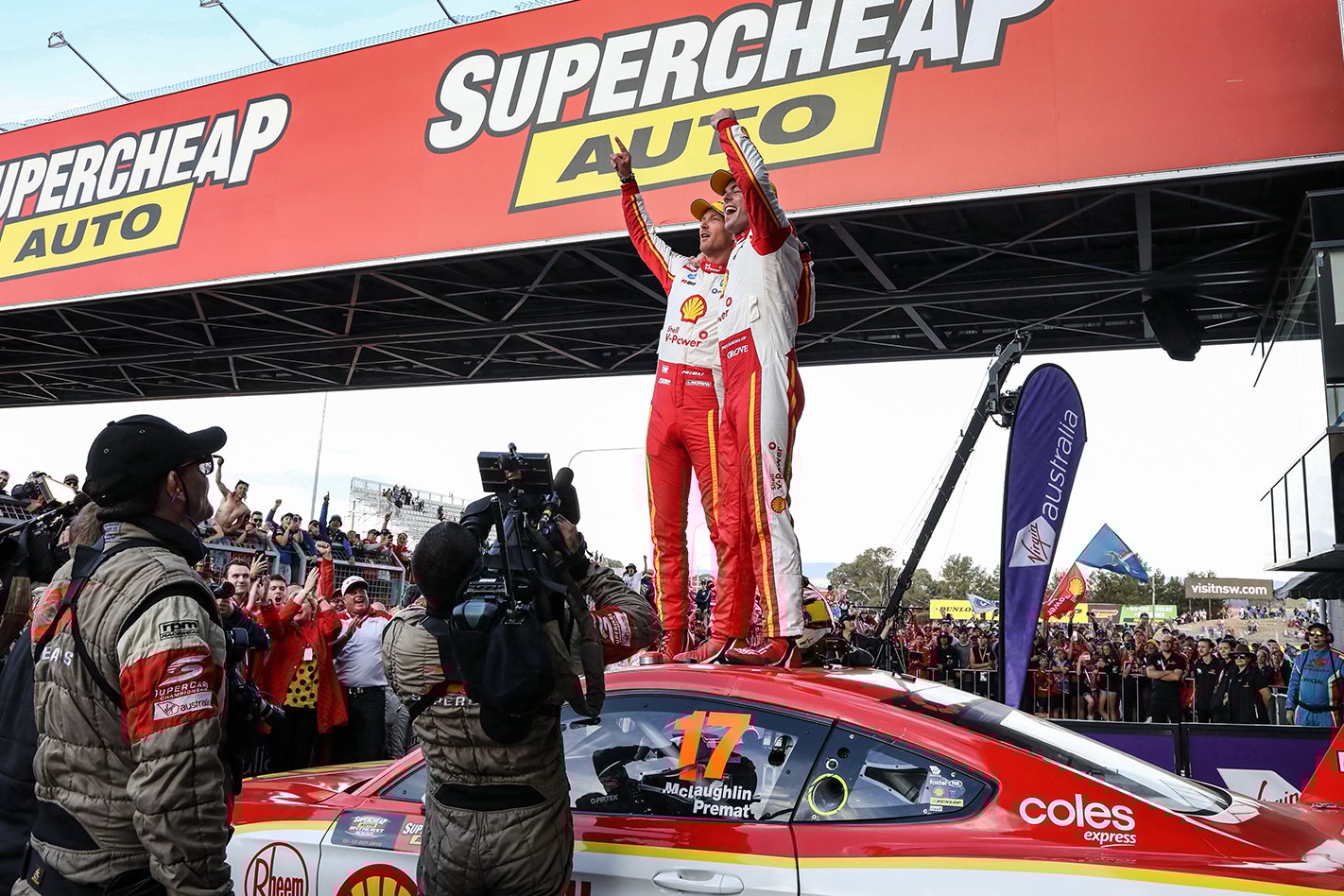
Last year’s Bathurst 1000 was one for the ages. A titanic seven-hour tussle full of intrigue, close racing, crushing crashes, controversy, and daring passes. And don’t get me started on the final 30 minutes. It was so exciting that my stepfather, who is an unusually calm and quiet man, suddenly leapt from the sofa and proceeded to shout and punch the air while bouncing on the balls of his feet.
And being Bathurst, half the fun is what happens off the track. I grew up a stone’s throw from The Mountain and my enduring memories of the wild and dusty camp sites that hug the circuit are of shining seas of crushed beer cans, of crude and unsavoury behaviour, and of a fierce, tribal rivalry. The line might have been invisible, but it was omnipresent: you were either Red or you were Blue.
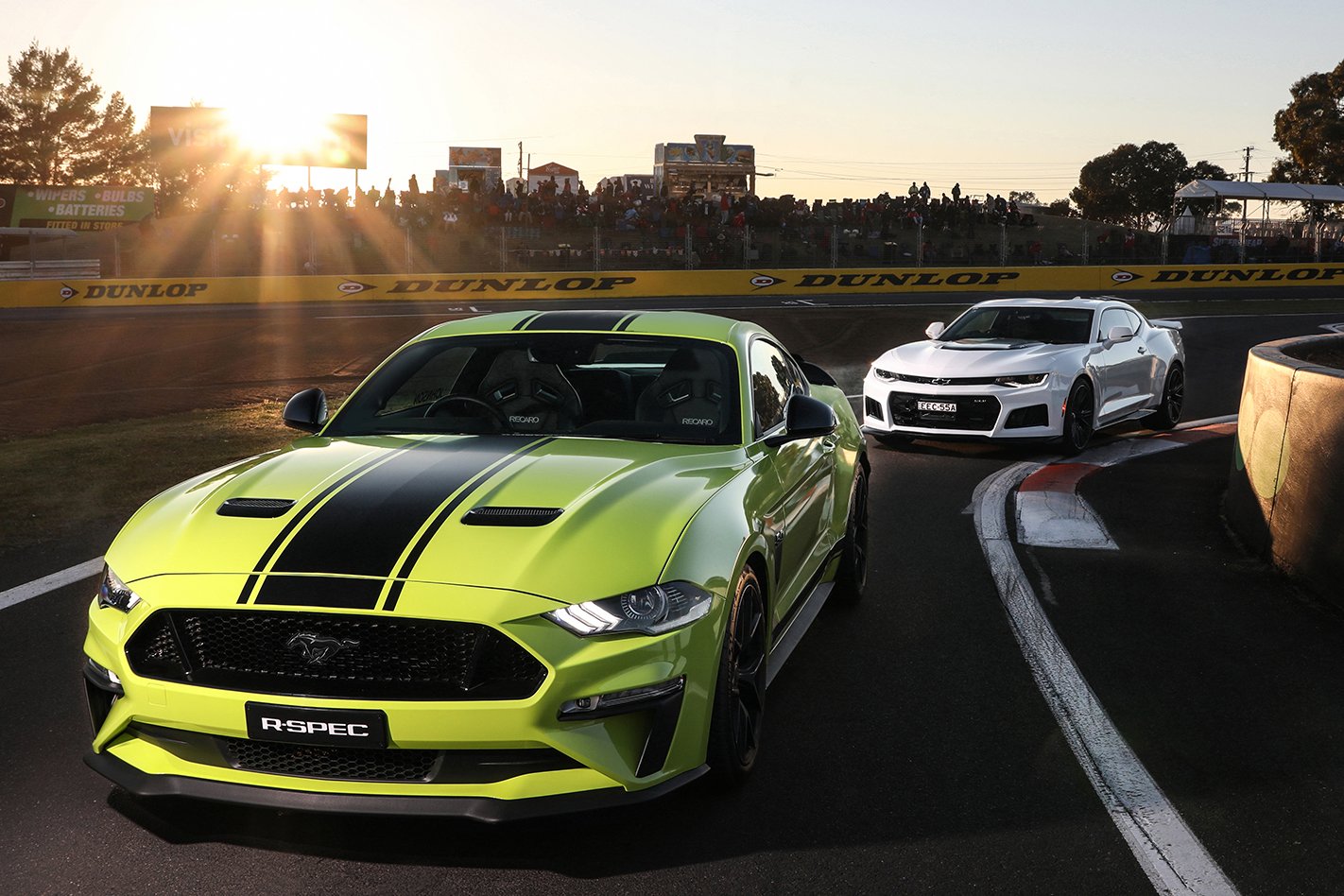
Boy did it mean a lot to us then. We didn’t just argue about it in the schoolyard, and later in the pub, but we wore the colours with pride, and we idolised our drivers. To us, Peter Brock and Dick Johnson were Holden v Ford. And when Craig Lowndes decided to ditch his Commodore for a green-eyed Falcon, we all went a little mad. “We actually got a death threat,” Lowndes told the ABC, years later. “We had a bodyguard that travelled with us for the first six months.”
Anyway, the point is it meant something. It mattered. Now, though, I worry that the passion has fizzled. As I watched the race and stared as the chopper cam completed yet another daredevil swoop over the top of The Mountain, all I could think was: has the Blue v Red rivalry run its course? Is the whole Holden v Ford thing … dead?
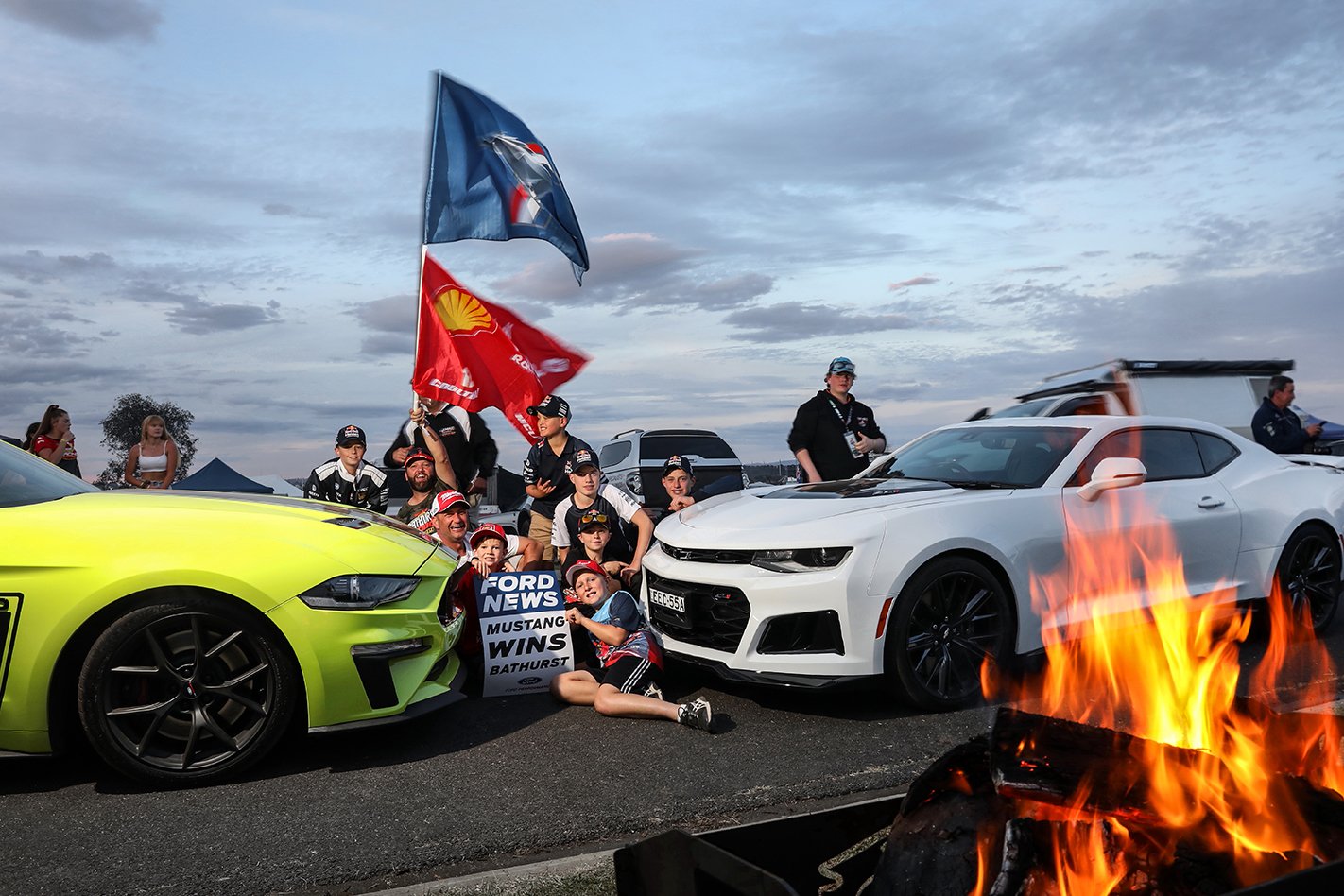
The pictures on the box made a pretty convincing argument that no, it hasn’t, and no, it isn’t, though I couldn’t shake the feeling that, despite the fans’ obvious and undiminished passion for the race, the two-tribes thing felt somehow half-hearted; that the intensity was a ghost of what it once was.
This is relatively easy to explain. Last year’s Great Race was the first time the grid was totally void of locally made metal (there were still some Falcons running around in 2018), and if you’re a Holden fan, the potency has had even longer to dissipate. More than Ford, Holden felt uniquely Australian, which has made the transition to imported cars harder to swallow. The Camaro, which is expertly fettled by HSV, offers some solace, but it’s expensive and isn’t racing. The same will apply to the incoming Chevy Corvette.
It’s been an easier switch for Ford fans. Without as much emotional baggage to contend with, the move from Falcon to Mustang has felt fairly natural. Plus, Ford is pounding Holden in the exciting road-car stakes. It has the Raptor, incoming Fiesta and Focus STs (plus the cracking Focus RS), rumours of an even hotter ute are rampant, and the Mustang R-Spec has even rekindled some local manufacturing knowhow and restarted the Campbellfield production line. Discount HSV for a moment and what does Holden have to compete with? If Blue v Red isn’t dead, then the paradigm has certainly shifted. And Blue is kicking Red’s ass…
There are small and passionate pockets that will disagree, of course, and they’ll likely threaten to nail my traitorous skin to the nearest flagpole. Cameron Kirby met many of these diehards when he became the first journalist in the country to spend some quality time with the Mustang R-Spec during the thick of last year’s race. Though I’d wager that despite their obvious passion and love of racing, they’re either clinging to the past or are blissfully unaware of the ground shifting beneath their feet. Even if the rivalry burns just as fiercely in their eyes, will their kids feel the same way? I doubt it.
We know that the Tesla Model 3 Performance is a fearsome bit of kit on the strip, but how does it handle track duties? Rather well, according to Tesla enthusiast, owner, and YouTuber ‘DÆrik’.
DÆrik recently released a video that claims that his modified Model 3 Performance managed to get within 0.14sec of the legendary McLaren F1 lap time on Japan’s Tsukuba circuit.
Though there is no dashcam footage of the lap, as the camera got dismounted halfway through but continued logging in the car’s G-forces and current speed, the driver managed to log in a lap time of 1min 4.76sec, which is just a whisker off the F1’s 1min 4.62sec.
DÆrik discloses that his Model 3 isn’t exactly stock to being with, as it has been used to showcase custom parts at SEMA 2019, and later crossed the Pacific for an appearance at the 2020 Tokyo Auto Salon.
Modifications done to the car include an Ascension R bodykit, sticky Michelin Pilot Sport Cup 2 tyres, carbon-ceramic brakes, adjustable coilovers and suspension arms, thicker sway bars, and semi-bucket seats.
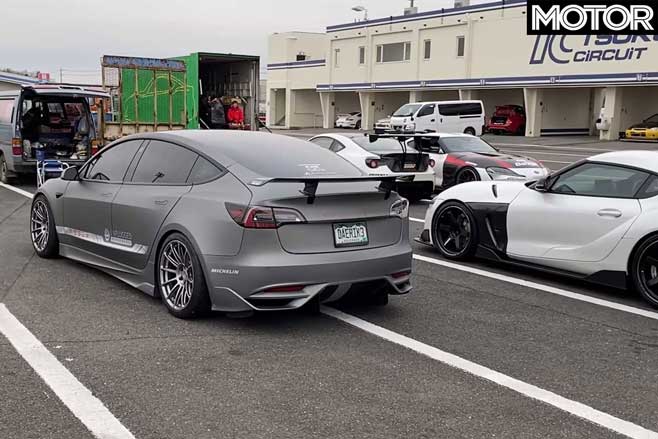
While DÆrik maintains that these modifications aren’t overly aggressive nor was there any performance enhancements or massive weight-saving measures, the use of modern track-focused performance rubber and fade-resistant carbon-ceramic brakes would work well in the Model 3 Performance favour at laying down an impressive lap time.
Granted, the small and tight layout of Tsukuba isn’t the sort of circuit that suits grand V12-powered rear-wheel drive supercars as 11 of the top 15 lap setters at Tsukuba are all-wheel drive cars, with the other four being iterations of the 911 GT3 and a Radical SR4 track toy.
That being said, DÆrik believes that the car could go even quicker considering that the lap was done on a damp January day with below-zero temperatures. With a warmer day and a more experience driver, he believes that his Model 3 Performance could shave two seconds off that lap time.
While we will leave DÆrik’s claims up to the internet to debate, we have answered more pertinent questions about the Model 3 Performance, namely can it slide?
When it comes to automotive top trumps, a car’s 0-100km/h time is usually the headline figure to debate.
There is something beautifully representative about 0-100km/h times as they encapsulate the performance of a car in terms that are simple to understand.
However, sometimes manufacturers can get a little… optimistic… with how fast they think a new car can complete the sprint. So, we decided to put a large group of cars to the test.
Testing took place at Holden’s Lang Lang proving ground as part of Wheels Car of the Year 2020, with veteran judge Byron Mathioudakis at the helm. All figures were measured using a VBOX data recorder to ensure accuracy. Unlike our friends in America, we don’t allow a ‘roll out’, with measurements done from a complete standstill.
In total, 31 vehicles were tested, representing 17 models.
A surprising number of manufacturer’s seemed to be underquoting their performance figures, with 10 models coming in under their official claimed times.
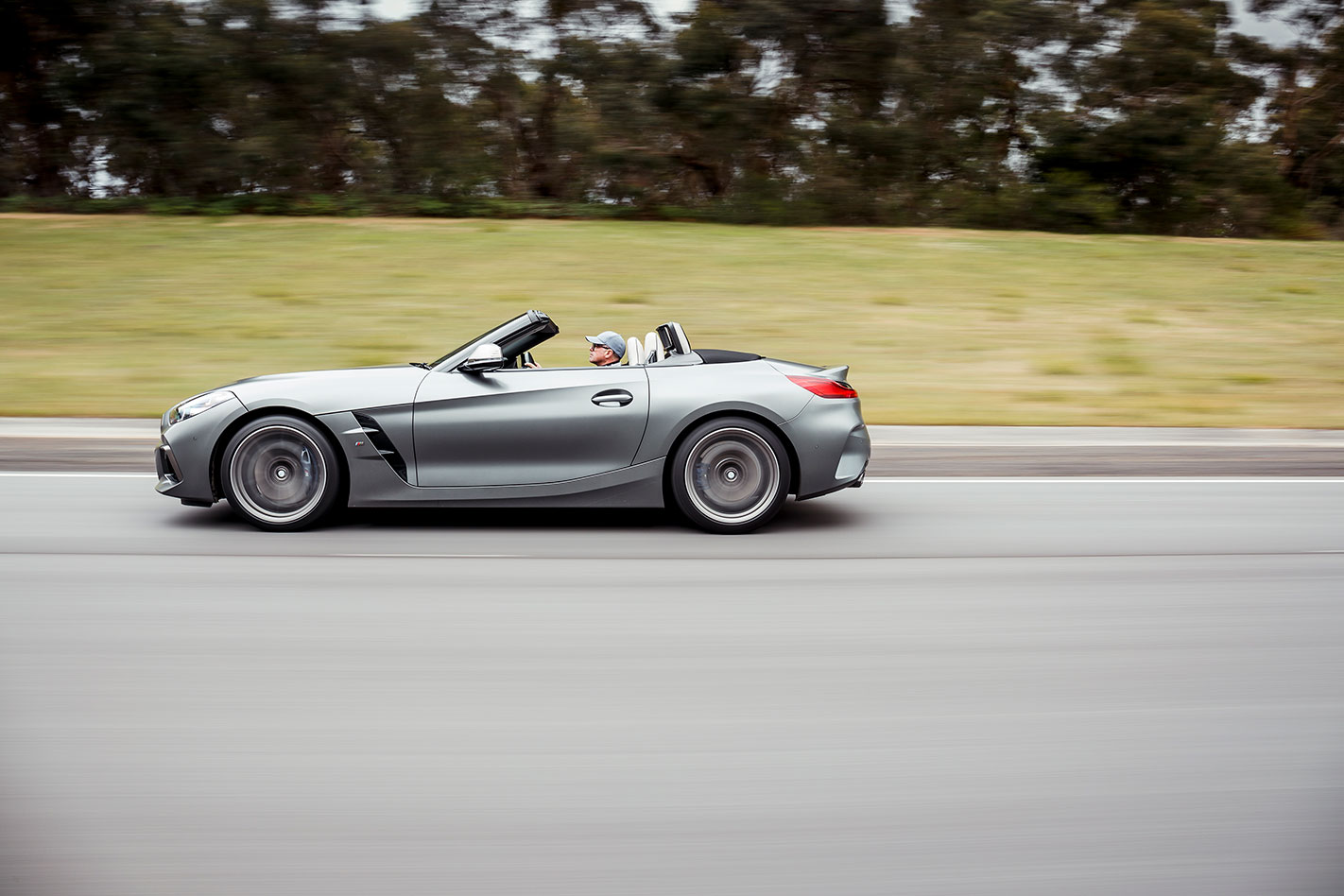
The biggest difference came from Mazda, with the G20 Pure hatch a full half a second quicker than its claimed time, with our data revealing a 0-100km/h sprint of 9 seconds flat.
Mercedes-Benz also underquoted the performance capabilities of its EQC, with the two variants on test both beating claimed acceleration figures. The model rolling on 20-inch rims was quickest with a 4.7 second sprint (four tenths faster than claimed), while the variant fitted with 21-inch wheels was a tenth slower.
Both variants of the Peugeot 508 were quicker than claimed, with the sedan recording a 7.8 second sprint (against a 8.1 second claim), and the wagon being measured at 8 seconds flat (compared to a 8.2 second claim).
Tesla’s Model 3 Standard Range beat its claimed acceleration figure by 3 tenths (we recorded a 5.3 second sprint), while the Performance variant was just a tenth slower than what is on the brochure at 3.5 seconds.
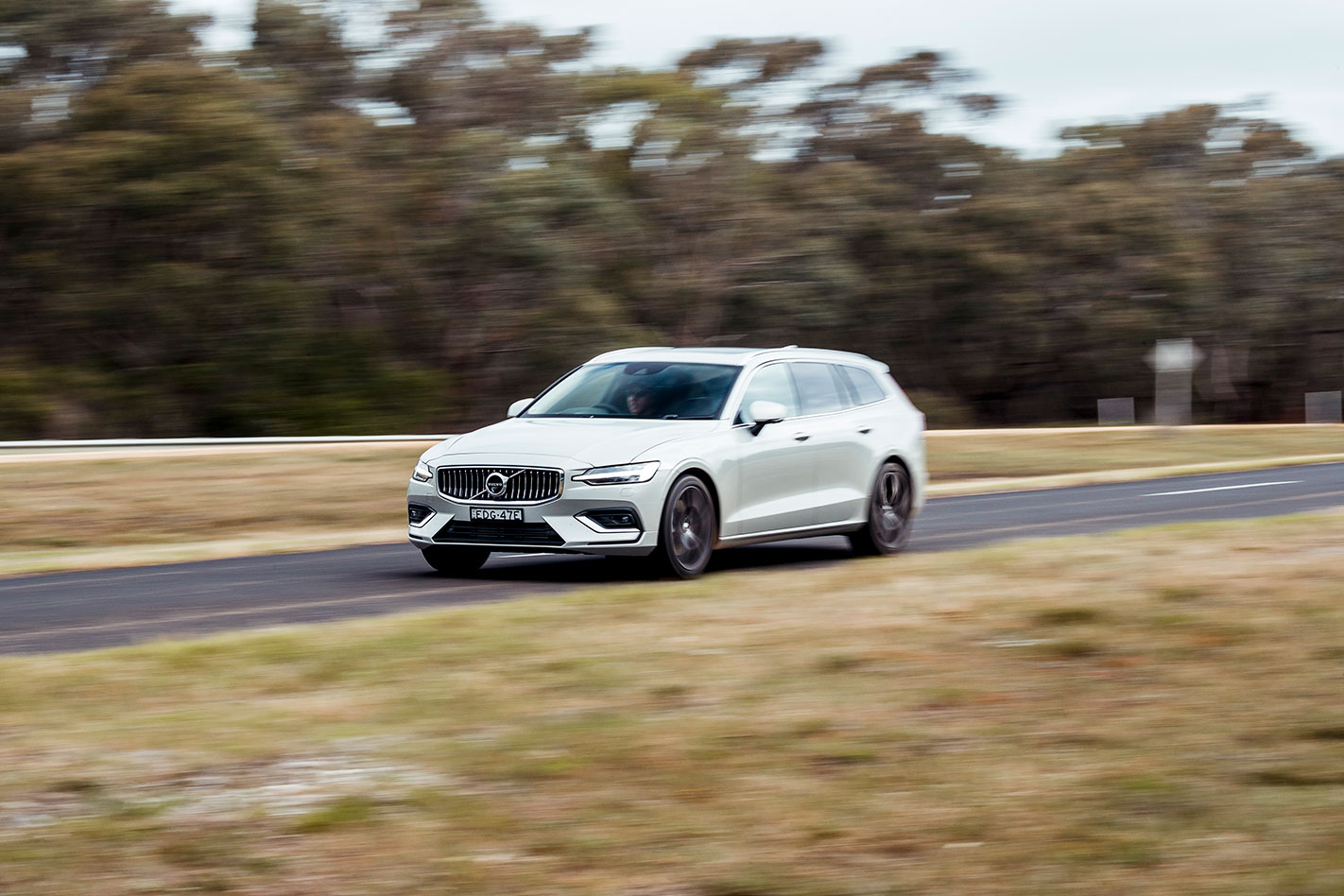
Toyota’s RAV4 range was diametric in its results. The GX petrol and Cruiser Hybrid beat their acceleration claims (by three and four tenths respectively), while the Edge was 1.3 seconds slower than reported by the manufacturer.
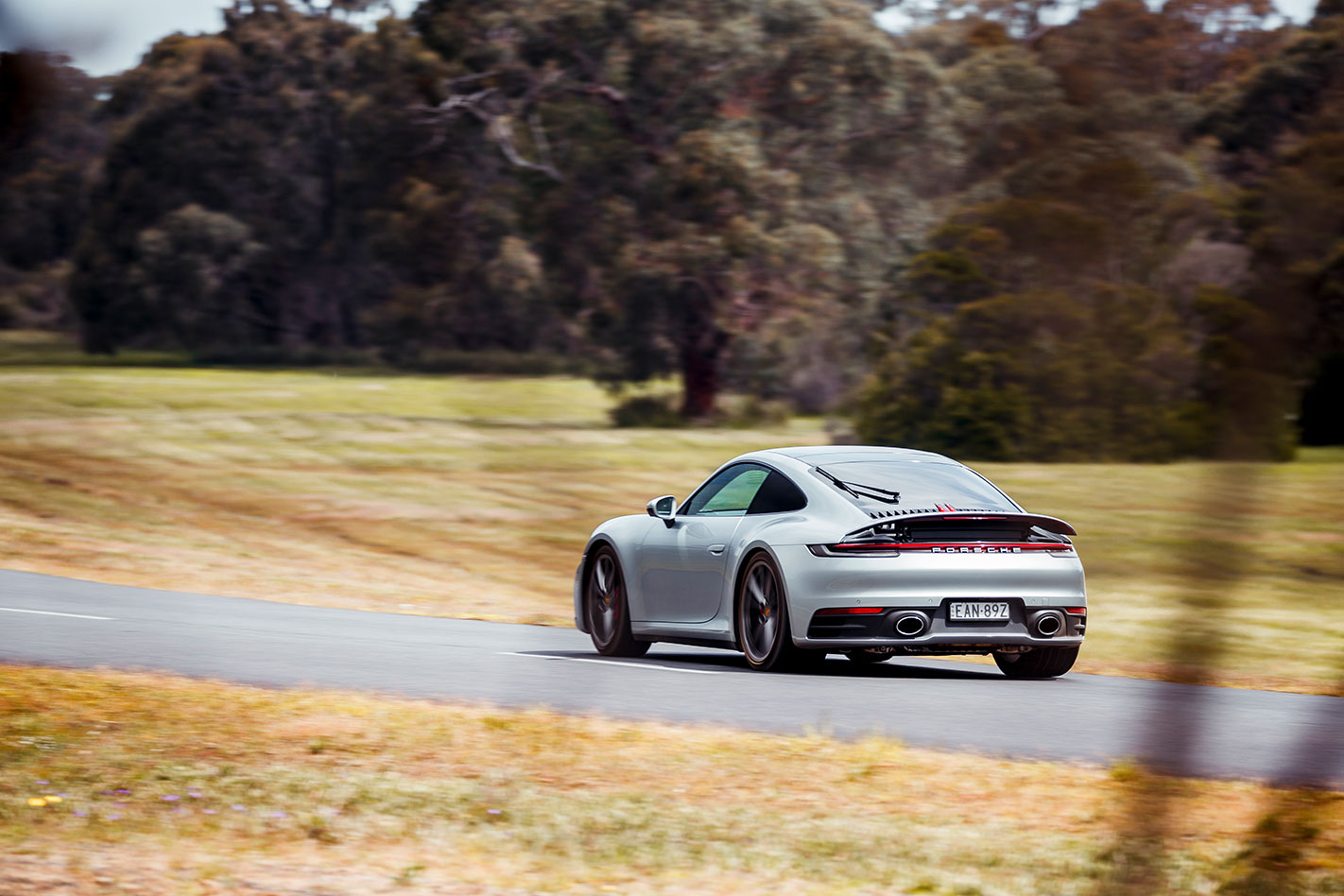
Porsche, as usual, was quicker than claimed with the 992 911 Carrera S.
The biggest cavern of difference between claimed and tested 0-100km/h times was reserved for the Genesis G70 2.0T sport, which was 1.7 seconds slower during our testing.
Range Rover has the unfortunate honour of being both the slowest car during our test, and also one of the further from the official manufacturer claim.
The Evoque D180 S has a claimed 0-100km/h sprint time of 9.3 seconds, but the best that we were able to extract from the small SUV was a 10.4 second run, more than a second slower.
Other cars that were a second or more from the claimed time include the Volkswagen Touareg 190TDI and Volvo S60 T8 R-Design.
The most accurate claim was the Toyota Supra, with the Japanese brand quoting a 4.4 second sprint to 100km/h, a figure we were able to replicate.
Falling within a tenth of a second of the manufacturer claim was the BMW 3 Series M340i, BMW X5 30d, BMW Z4 M40i, Nissan Leaf, and Volvo V60 T5 Inscription.
The full breakdown of data can be found below.
Full testing data from Wheels Car of the Year 2020:
| Car | Claimed 0-100km/h | Tested 0-100km/h | Difference |
| Audi A1 30 TFSI S-Tronic | 9.4s | 9.6s | 0.2s |
| Audi A1 35 TFSI | 7.7s | 8.3s | 0.6s |
| Audi Q3 35 TFSI Launch Edition | 9.3s | 9.5s | 0.2s |
| BMW 3 Series 330i | 5.8s | 6.2s | 0.4s |
| BMW 3 Series M340i | 4.4s | 4.5s | 0.1s |
| BMW X5 40i | 5.5s | 5.8s | 0.3s |
| BMW X5 30d | 6.5s | 6.6s | 0.1s |
| BMW Z4 20i | 6.6s | 7.1s | 0.5s |
| BMW Z4 M40i | 4.5s | 4.6s | 0.1s |
| Genesis G70 2.0T Sport | 5.9s | 7.6s | 1.7s |
| Genesis G70 3.3T Ultimate Sport | 4.7s | 5.2s | 0.5s |
| Mazda 3 G20 Pure hatch | 9.5s | 9.0s | -0.5s |
| Mazda 3 G25 Astina sedan | 8.0s | 7.9s | -0.1s |
| Mercedes-Benz EQC (20-inch) | 5.1s | 4.7s | -0.4s |
| Mercedes-Benz EQC (21-inch) | 5.1s | 4.8s | -0.3s |
| Nissan Leaf | 7.9s | 8.0s | 0.1s |
| Peugeot 508 sedan | 8.1s | 7.8s | -0.3s |
| Peugeot 508 wagon | 8.2s | 8.0s | -0.2s |
| Porsche 992 911 Carrera S | 3.5s | 3.4s | -0.1s |
| Range Rover Evoque P250 S R-Dynamic | 7.5s | 7.9s | 0.4s |
| Range Rover Evoque D180 S | 9.3s | 10.4s | 1.1s |
| Tesla Model 3 Standard Range Plus | 5.6s | 5.3s | -0.3s |
| Tesla Model 3 Performance | 3.4s | 3.5s | 0.1s |
| Toyota RAV4 GX 2.0 CVT FWD | 9.4s | 9.1s | -0.3s |
| Toyota RAV4 Cruiser Hybrid AWD | 8.0s | 7.6s | -0.4s |
| Toyota RAV4 Edge 2.5 | 7.9s | 9.2s | 1.3s |
| Toyota Supra GTS | 4.4s | 4.4s | 0.0s |
| Volkswagen Touareg 190TDI | 6.5s | 7.5s | 1.0s |
| Volvo S60 T5 Momentum | 6.4s | 7.0s | 0.6s |
| Volvo S60 T8 R-Design | 4.3s | 5.3s | 1.0s |
| Volvo V60 T5 Inscription | 6.4s | 6.5s | 0.1s |
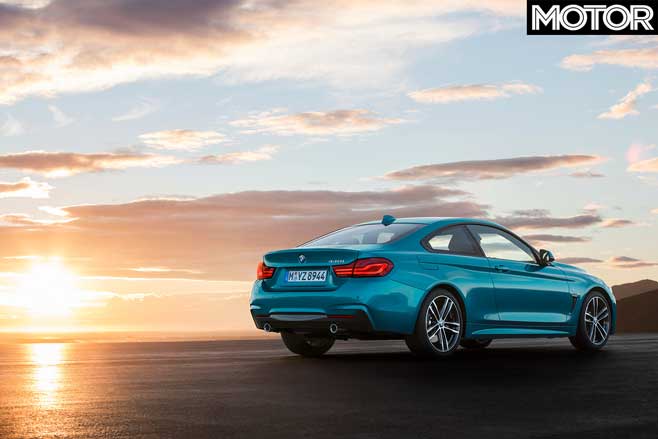
In terms of stylish mobility, coupes tend to take the cake when you want to look good and go fast. There are plenty of options south of $100K too, but the BMW 440i strikes that figure closely, and it provides a good old rear-wheel driven driving experience that can be balanced out nicely with a comfy cruise. That and 240kW means plenty of poke.
But if you want something a tad more ostentatious than a Bimmer, you can look to the used car market. There, you might happen upon the occasional luxury depreciation nightmare. A nightmare for the original buyer.
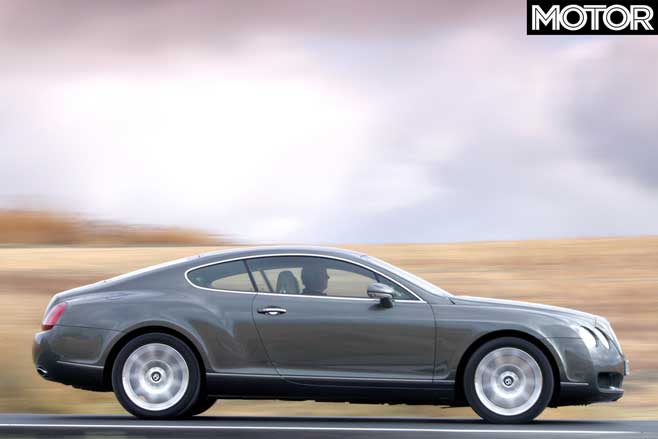
Around 15 years ago, you’d be shelling out about $375,000 for a new Bentley Continental GT. With inflation? $520K. Now that same car is, according to our hunt through the classifieds, worth around $85,000.
That gets you 12 cylinders of British (er, German) brute, but we reckon a car weighing in at 2.4-tonnes wouldn’t feel as brisk as it might’ve 15 years ago when anything north of 400kW was crazy powerful.
There were still two-digit power figures in Hot Source! In 2005, we managed a 6.06sec 0-100km/h run, where the 440i we tested in 2018 ran it in 5.1. We reckon if you’re sensible, and a keen driver, you’d take the Bimmer.
But that’s not what this page is about and, if you’ve got the coin, why wouldn’t you want to be able to say you own a Bentley? Obviously, buying a 15-year-old luxury brawler will continue to weigh heavily long after the initial outlay, but it could just be worth it if it means walking into your garage to see a bewinged ‘B’ whenever you please.
| 2020 BMW 440i | vs | 2005 Bentley Continental GT |
| 2998cc inline-six, DOHC, 24v, turbo | ENGINE | 5998cc W12, DOHC, 48v, twin-turbo |
| 240kW @ 5500rpm | POWER | 411kW @ 6100rpm |
| 450Nm @ 1380rpm | TORQUE | 650Nm @ 1600rpm |
| 1555kg | WEIGHT | 2410kg |
| 5.0sec (claimed) | 0-100KM/H | 4.9sec (estimate) |
| $103,200 | PRICE | $80,000-$100,000 (used) |
