
- Next LandCruiser series to be known as the LC300
- Venerable 200 Series nearing end of the road
- V8 engines will be phased out
- Next LandCruiser likely to be hybrid-only
The next generation large 4×4, ostensibly known as the Toyota LandCruiser LC300, is likely to eschew the current 4.5-litre twin-turbo diesel bent eight in favour of a six-cylinder hybrid driveline.
Toyota has committed to offering a fully electric or electric hybrid version of every model in its range by 2025, so the developments that are in train for the LandCruiser are likely to be applied to vehicles like the Prado, HiLux and Fortuner.
While its specs are still a closely guarded secret, the engine will likely be based on a large-capacity six-cylinder turbocharged petrol engine, augmented with an electric motor and a battery pack.
Sources in Japan suggest that a 3.6-litre V6 engine will serve as the heart of driveline, with outputs estimated in the region of 220kW and 360Nm.
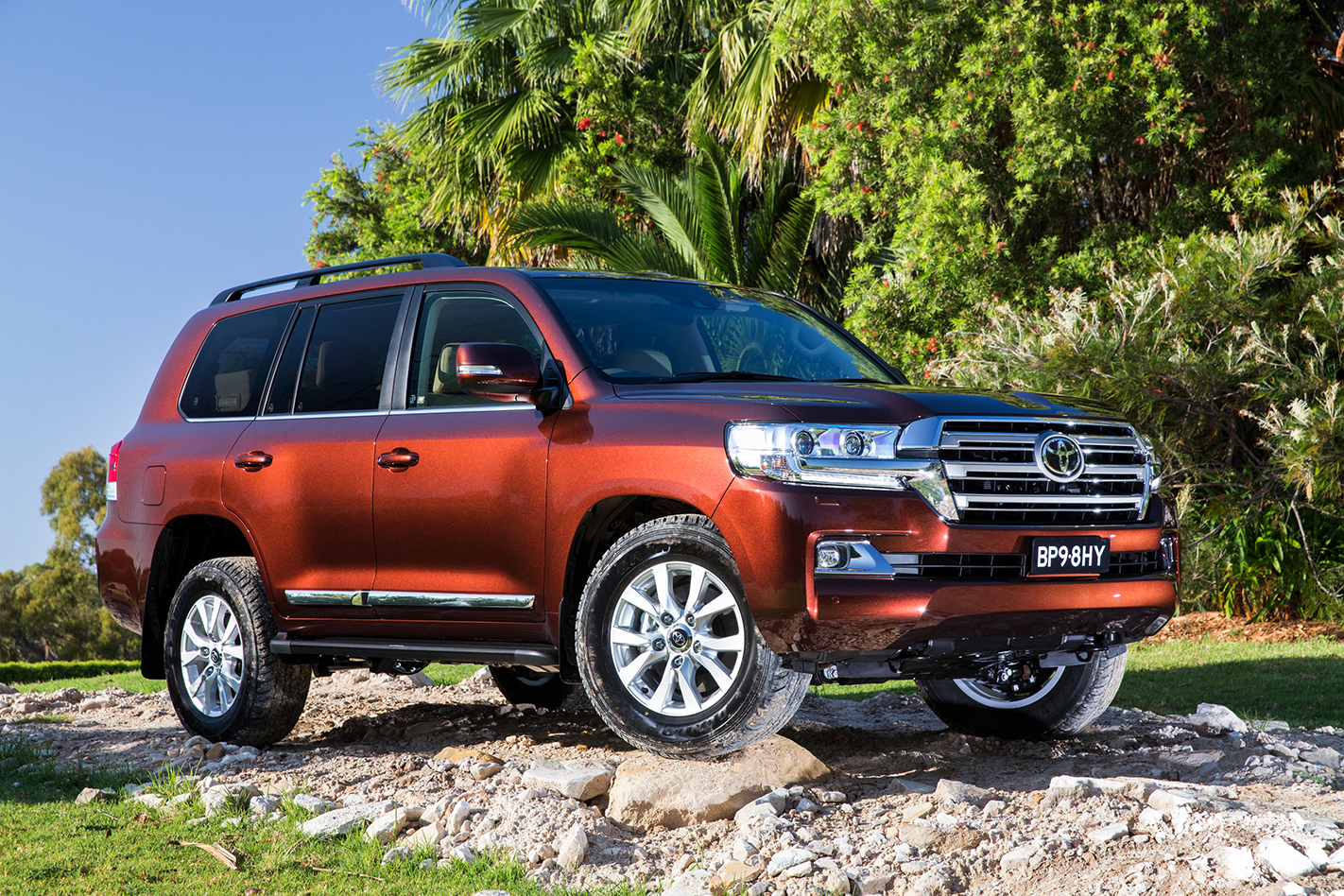
These numbers suggest that it will be a petrol-powered engine, and indeed the outputs are very close to those generated by the Camry’s 3.5-litre motor – which, of course, is fuelled by petrol.
It’s also available with a hybrid system, making it a simpler process for Toyota to apply the technology to the new ‘Cruiser.
However, Toyota hasn’t even confirmed what type of fuel the engine in the next generation LandCruiser might use.
“Next-gen LC, or LC300 as it is being called, is still in the early phases of development,” said Orlando Rodriguez, the senior public affairs specialist of commercial vehicles for Toyota Australia. “There has been a lot of speculation out there about this model, especially from Japanese media, but it is definitely way too early for us to confirm any details.”
This engine will reportedly be married to a brand new ladder-frame version of Toyota’s TNGA platform family, while the new 300 Series will sneak in under the 5000mm-long mark by 50mm. Width is estimated at 1980mm and height at 1870mm, which means it is set to retain its traditionally roomy interior dimensions.
While the new powertrain may not match the current 200kW and 650Nm outputs of the current 200 Series, it will allow Toyota to continue to sell the big LandCruiser almost unchallenged in the large 4×4 category here in Australia.
Jeep’s similarly ageing Grand Cherokee serves up some competition, as does the almost voting-age Mitsubishi Pajero.
Toyota parked its petrol V8-powered LandCruiser early in 2019, leaving that space to the Nissan Patrol.
The limited-edition model 200 Series, meanwhile, will likely be known as the Heritage, and is set to sport a more aggressive exterior treatment.
Based on the top-spec Sahara, the limited edition model will likely score blacked-out trim items where chrome currently exists, as well as a set of bronze 18-inch wheels, bespoke badging and blacked-out roof racks.
“We will be making an announcement on this in the next couple of weeks,” confirmed a Toyota Australia spokesperson. “It is in line with the previous SEs we have made for Landcruiser and has mainly aesthetic exterior changes and is nothing too radical, but will definitely have a unique look. More details will be revealed soon.”
MORE LANDCRUISER NEWS AND VIEWS
LandCruiser or Patrol – which is best for towing?
The ten greatest 4x4s of all time
Coil-sprung LandCruiser concept car
On the surface, it seems like the 2020 WhichCar Style Award is a well-practiced affair that’s been honed for years and while that is true, reality shows that each year is markedly different and a new challenge.
The cars of WCSA 2020
There’s a lot of hard work and troubleshooting that goes into creating such a unique event and to be keeping the award relevant year after year is no small task.
While this year’s WhichCar Style Award stays true to its aesthetic-based origins, we have branched out to place more emphasis on other aspects of a car’s X-factor that include technological advancement, available features and smart design.

You’ll have to stay tuned until January 30 before you can fully understand how the entire day played out, but for the time being allow us to illustrate a few small behind-the-scenes snippets that show why our Style Award is unlike any other in the Australian automotive landscape.
Click on the title photo above to view a captioned behind-the-scenes gallery of the 2020 WhichCar Style Award judging process
What stands out?
The diminutive third-generation Toyota Yaris hatch is easy to drive and park in an urban environment and has an enviable reputation for reliability. Autonomous emergency braking is available in some later versions.
What might bug me?
You may find that you can’t quite get comfy behind the wheel. Even though the steering column adjusts for angle and reach, and the seat adjusts for height, it can be hard to find a driving position that feels right.
What body styles are there?
Five-door hatchback only.The Toyota Yaris drives its front wheels, and it is classed as a light car, lower priced.
What features did every Toyota Yaris have?
Air-conditioning, power windows, and power-adjusted door mirrors.Cruise control and reversing camera.Bluetooth connectivity for phones and audio streaming. An audio system with USB and auxiliary input sockets, an AM/FM radio, a CD player, and at least six speakers, controllable from a 6.1-inch touchscreen display.Height adjustment for the driver’s seat. Height and reach adjustment for the steering wheel, from which you can operate the audio system, the cruise control, and your phone (via Bluetooth).A space-saver temporary spare wheel (which is speed-restricted).Seven airbags. Electronic stability control, which can help you control a skidding car and is mandatory on new cars. (For the placement of airbags, and more on Yaris safety systems, please open the Safety section below.)The Toyota Yaris was covered by a three-year 100,000km warranty until January 2019, when Toyota extended its coverage to five years with no limited on kilometres driven.
Which engine uses least fuel, and why wouldn’t I choose it?
The 1.3-litre petrol four-cylinder engine found in the least costly Yaris, the Ascent, is marginally the more fuel-efficient of the two Yaris engines. It uses 5.7 litres/100km with the five-speed manual gearbox, and 6.3 litres/100km with the four-speed automatic, on official test figures.In a real world comparison conducted for the March 2015 issue of Wheels magazine, a Yaris Ascent auto with this engine averaged 8.1 litres/100km – about a litre more than the most economical of the nine light hatchbacks reviewed.There are two reasons why you might not choose the 1.3-litre engine. One is that it is available only in the Ascent.The other is that the slightly bigger, 1.5-litre petrol found in every other Yaris is noticeably more powerful, while using barely any more fuel.In fact, real-world testing has shown the four-cylinder 1.5 to use less fuel than the 1.3 in some conditions.Both engines are available with a five-speed manual transmission or a four-speed auto. (The most expensive Yaris, the ZR, offers auto transmission only.)
What key features do I get if I spend more?
The least costly Yaris, the Ascent, comes with the less responsive, 1.3-litre, engine, 15-inch steel wheels with plastic trim, manually controlled air-conditioning, and cloth-covered seats.Spend more for a Yaris SX and you get a nicer-feeling steering wheel and the bigger and better, 1.5-litre, engine, satellite navigation and front fog lights.Spending a good deal more for a Yaris ZR brings you wheels made from aluminium alloy (which look good without pesky trim caps), and automatic transmission as standard. You also get air-conditioning that maintains a set temperature, and brighter, very long-lasting, LED headlights. Sports front seats grip you more firmly.In addition, the ZR comes with an active-safety suite under the description Toyota Safety Sense. It brings you autonomous emergency braking, lane-departure warning, and an auto-dipping function for the headlights.On any Yaris Ascent or SX, you can add Toyota Safety Sense as an option (for about $650).
Does any upgrade have a down side?
No. Even the ride is unaffected as you move up the price range, as the Yaris ZR uses tyres of the same size and profile as those on the other cars.Ten colours are available; for seven of them you will be charged about $450 on top of the standard price.
How comfortable is the Yaris?
The Yaris is comfortable from a seating point of view. The standard front seats look plain but offer surprising support for drives of an hour or two. A facelift of March 2017 that adjusted the exterior styling also lifted the look of the cabin a little.Despite a steering column that adjusts for angle and reach, the ergonomics are not as good in the Yaris as they are in some alternative city cars – it can be difficult for the driver to find a position that’s just right.The 1.3-litre Ascent feels lively off the mark even in auto form and does the job around town, but needs a determined right foot at highway speeds and particularly on hilly routes in the country.On bumpy roads you ride less comfortably in a Yaris than in many other hatchbacks its size. The suspension is fidgety, and road, tyre and engine noise intrude into the cabin, especially on rough rural surfaces or poorly repaired urban streets.
What about safety in a Yaris?
Every Yaris comes with stability control, seven airbags and a reversing camera. An emergency brake signal flashes the brake lights during heavy braking, helping other drivers notice you’re stopping sharply.There are two airbags directly in front of the driver and front passenger; one alongside each front occupant to protect the upper body; a curtain airbag on each side protecting the heads of front and rear passengers from side impacts; and an airbag to protect the driver’s knees.Standard on the Yaris ZR, and optional on any other Yaris, is an active safety suite called Toyota Safety Sense. It comprises auto emergency braking, lane departure warning, and self-dipping headlamps.Auto braking on the Yaris relies on laser and camera sensors (mounted on the windscreen), and is effective at speeds up to 80km/h. The sensors scan the road ahead for obstacles – typically another car that has slowed suddenly. If the system recognises a collision risk, it will warn you; if you don’t react, it will apply the brakes automatically. The idea is to make it less likely you will crash into someone in front, either because you were distracted or because they braked unexpectedly.The lane departure warning uses the camera to monitor road markings, and alerts you if you have begun to drift out of your lane – perhaps from inattention or fatigue. It operates at speeds above 50km/h.The self-dipping function switches your headlamps to low beam automatically to avoid dazzling oncoming drivers or people you’re following. It returns to high beam when that’s safe.The noise, vibration and harshness that filter into the Yaris’s cabin contribute to driver fatigue on long trips.The Australasian New Car Assessment Program (ANCAP) has awarded the Yaris hatchback its maximum five stars for safety, most recently in December 2011.
I like driving – will I enjoy this car?
Quite possibly not. Despite its popularity, the Yaris remains one of the less enjoyable light cars to drive (its popularity is the result of more pragmatic factors).Its four-speed automatic and five-speed manual transmissions are a gear or two short of the best in cars of its size. This means the Yaris has less real-world pulling power in the lower gears, while the engine will rev higher and be noisier in the upper gears.The bigger, 1.5-litre engine feels more powerful than the 1.3 and performs better on the open road, but it doesn’t make an especially pleasant sound, even by the modest standards of this class of car.The Yaris’s steering is light and responds with reasonable precision, but it does not give you much sense of connection with the road. The front of the car doesn’t turn into corners as crisply as alternatives such as the Mazda 2, Renault Clio and Ford Fiesta.
How is life in the rear seats?
The bench rear seat is roomier than it looks. It is comfortable for up to three adults over short trips, and handy for small children. Just as in the front of the Yaris – perhaps even more so – it is noisy in the rear of the cabin by comparison with most rivals.
How is it for carrying stuff?
Toyota quotes cargo capacity at 286 litres, which is very competitive – more than in a Mazda2, and a match for the Ford Fiesta and Volkswagen Polo, for example. The rear seat back folds 60-40 to expand this capacity to 768 litres.Best practice with split-fold seats is to place the narrower seatback behind the front passenger’s seat, so that you might carry a long item of luggage along the left hand side of the cabin, leaving the broader seatback for a passenger behind the driver. The Yaris orients its seatbacks the other way around, although it’s not alone in doing so.
Where was the third-generation Yaris made?
The Toyota Yaris was built in Japan.
What might I miss that similar aged cars have?
All Yaris engines and gearboxes date back a decade, and most alternatives perform better and are more fuel-efficient. A facelift in March 2017 did not improve the car as a drive.Turbocharged light cars such as the Renault Clio and Volkswagen Polo respond more eagerly to the accelerator pedal – particularly from low speeds. Many non-turbo alternatives also offer better response during everyday driving (especially those with six-speed gearboxes or a CVT), despite similar engine outputs on paper.Some city cars – among them the Volkswagen Polo and Kia Rio, and the smaller Holden Spark and Kia Picanto – help you get more from your smartphone, by enabling Apple CarPlay and Android Auto. These let you display navigation and other apps from a compatible phone on the car’s touchscreen, and control them from there.Other light cars worth considering include the Mazda2, Honda Jazz and Suzuki Swift.
I like this car, but I can’t choose which version. Can you help?
The Toyota Yaris SX is our pick of the line-up, for its more responsive 1.5-litre petrol engine. Consider getting one with the Toyota Safety Sense option, which reduces your risk of an embarrassing and expensive rear-end crash in traffic.
How old is the Yaris? Are there plans to update it soon?
The third-generation Yaris was launched in 2011, and a revised series-two version arrived late in 2014.About March 2017 Toyota ceased selling the Yaris sedan and gave the hatchback a mild facelift, making autonomous emergency braking available.In January 2019 the Yaris’ three-year/100,000km warranty was extended to five years/unlimited kilometres along with all other Toyota models.A new generation Yaris arrives in May 2020 with class-leading safety technology and hybrid option. If you’re thinking of buying a new Yaris it’s probably worth waiting for unless you’re after a good runout deal on the current model.
It’s often been observed that Aussies punch above their weight in the world of automotive design. Meet nine heavy hitters
Calvin Luk: BMW
This Australian-born rising star of BMW’s exterior design team got his start at Munich after graduating from the Art Centre College of Design in California, first via an internship that rolled into a coveted full-time role. Now 33, Luk cut his teeth on the X1 and X3, but really found his groove on the current Z4.
Jordan Demkiw: Ford of Europe
Now based in Cologne, Germany, Demkiw rose to prominence with the exterior design of the Falcon FG X. He quickly parlayed that into a two-door design that had plenty of Blue Oval diehards properly frothing – the XR8 Coupe Concept. “The inspiration came from cars I loved as a kid, cars like the XB and XC hardtops,” says Demkiw.

Nick Hogios: Toyota Australia
“As a child, I loved anything with movement, colour and speed – whether it was robots, spaceships or cars,” says Sydney-born Hogios, 44. Hogios won the 1999 Ford Australia/Wheels Young Designer of the Year, and spent two years at Ford before joining the newly established Toyota Style Australia in 2002.
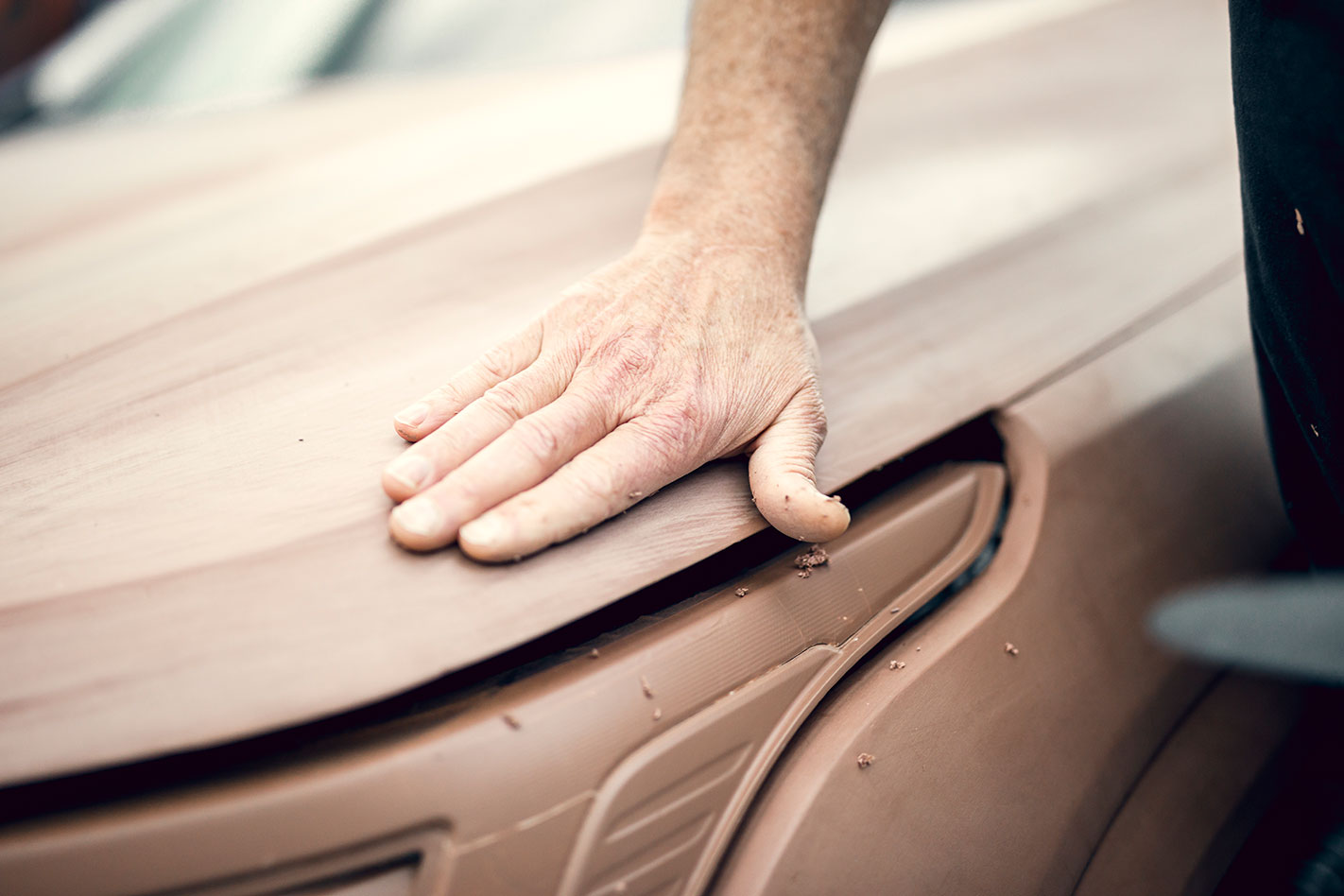
Todd Willing: Ford of Europe
Tasmanian-born Willing’s career began with a high school work-experience placement in Ford’s Broadmeadows studio. He joined Ford in 2003, and has worked in Ford studios in Melbourne, Hiroshima, Cologne, Dunton (UK), Detroit and back to Melbourne in 2014, as design director of Ford Asia-Pacific. His highlights reel includes the 2015 reboot of the iconic Ford GT.
Richard Ferlazzo: Holden
“Growing up, the only cars I was interested in were Italian sports cars and Australian muscle cars,” says Ferlazzo. He joined Toyota in 1986, moved to Holden in 1988 and worked on every Commodore from the VN, serving as chief designer on VE and VF. Despite all that, Ferlazzo is justly famed for his 2005 Efijy concept. He was named design director of GM Australia in 2013.

Peter Arcadipane: Beijing Automotive (BAIC)
Arcadipane has worked at Holden, Mitsubishi, Ford and Kia, among other companies, but really wrote his name in the automotive history book when he produced the CL coupe for Mercedes-Benz. These days he’s tasked with a major overhaul of models for Chinese manufacturer BAIC. Side note for fans of old mate Rockatansky: he also designed the Mad Max II Interceptor.

Max Wolff: Ford Asia Pacific
While at Holden, Wolff applied his design skills to vehicles such as the 2002 Holden SSX sports hatch concept, the HRT 427 super-coupe from Holden Special Vehicles (also 2002), as well as the Elfin Clubman MS8 track racer and Holden Torana TT36 concept, both from 2004. His stint at Lincoln produced the MKC – Lincoln’s first compact SUV – and a redesign of the Navigator SUV flagship.
Dave Dewitt: Ford Australia
Apart from a stint at Volvo, when it was part of Ford’s PAG, Dewitt has been a Blue Oval stalwart, and most recently oversaw Ranger and Everest as manager of exterior design. But if you want a peek at Dewitt’s imagination when really let off the leash, Google the Ford Mad Max concept from 2010, where all-terrain jet power is ready to rule the wastelands.
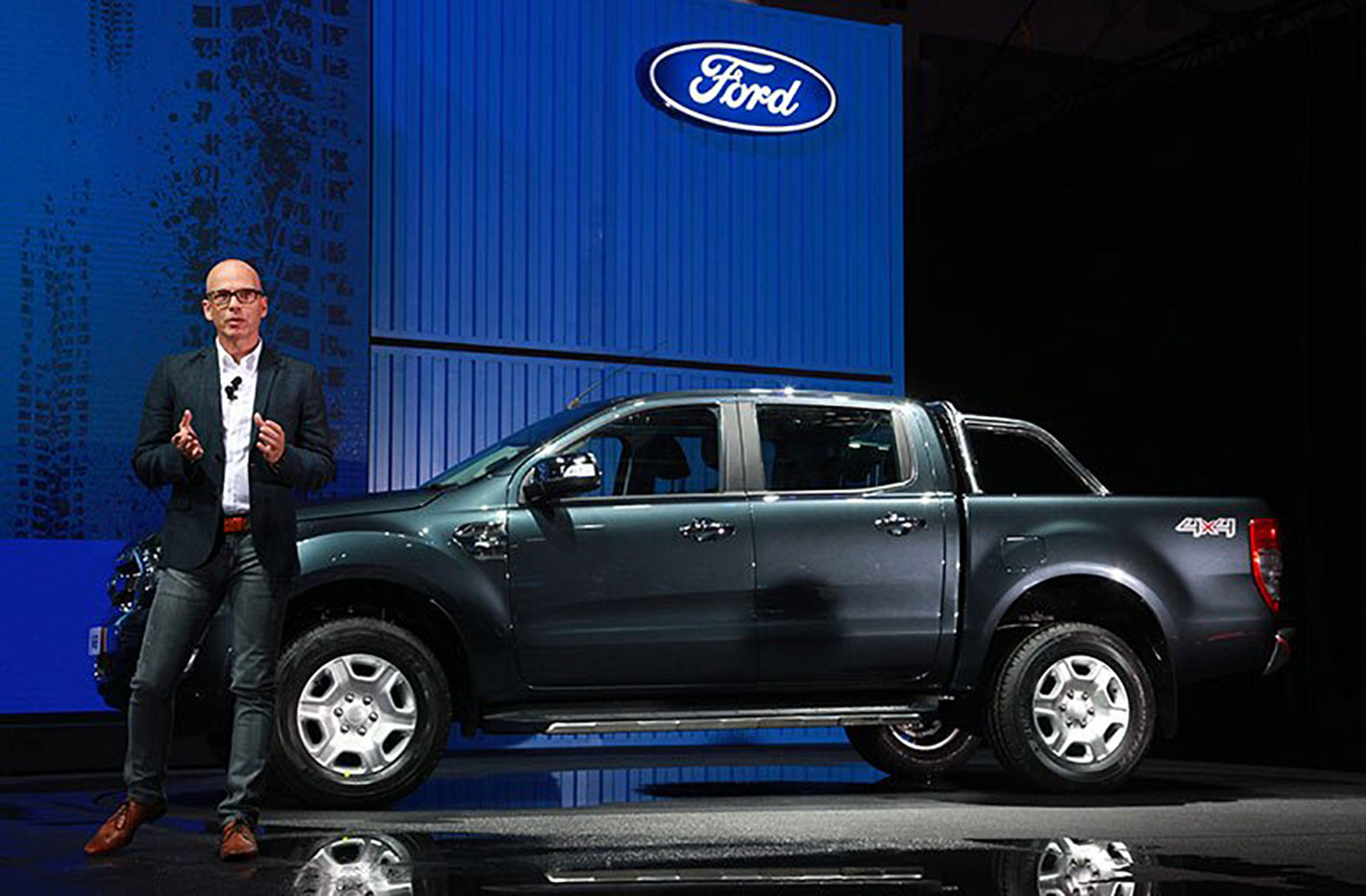
Andrew Smith: Cadillac
Like Mike Simcoe, Smith is another Aussie-born ex-Holden designer (highlights include the Sandman concept from 2000, and the VE Commodore interior) who has made it big in Detroit. He joined Cadillac in 2013; these days he’s the iconic brand’s executive director of design, where he’s charged with retaining that tricky-to-define ‘Americanness’.
When is a sports car more than a sports car? When it’s a Porsche 911, that’s when.
The all-new Porsche 992-generation 911 may look not too dissimilar to the 991 before it, but this latest iteration of the icon is so superbly accomplished it borders on the ridiculous.
On test for Wheels Car of the Year 2020 was the rear-drive Carrera S, with a twin-turbo 3.0-litre flat-six engine producing 331kW and 530Nm.
Honestly, this is all the sports car you could ever need, and if you desire something more, it’s time for your family to consider which lunatics asylum to have you locked up in.
Traditionally cars that require an outlay north of $200,000 have struggled against our COTY value criteria, however, a change for 2020 has rectified this issue.
No longer is a car judged on pure value alone, but the value it represents compared to its competitor set within the market.
Considering this, it’s hard to come up with a rival vehicle which can lay a finger on the Carrera S in terms of comfort, practicality, useability, speed, and outright driving thrills for anywhere near the same price.
Then you have to consider just how useable the 992 is day-to-day. Usually a finely honed driving machine is punishing to drive on daily duties – not so with the Porsche 911.
You could easily envisage the Carrera S as a superb grand tourer and an enviable daily driver, offering refinement and luxury in spades.
Can the 992 bring Porsche its first Car of the Year title? It has never been as close as this. Find out when the winner is announced at the Australian Motoring Awards on January 30.
The internet is a weird microcosm of the world, isn’t? The latest thing blowing people’s metaphorical skirts up is the fact that a ‘comedian’ (I use the term VERY loosely) has been ‘busted’ (again: loosely) while filming a segment for his bewilderingly popular show in a safe and responsible manner.
But they FEEL BETRAYED or somesuch, because the segment is called Carpool Karaoke, and the premise of the segment is that the comedian – UK-born James Corden – sings songs with guests that are paid to come on to sing their latest chart hit (or whatever – I’ve never really taken a blind bit of notice, to be transparent).
But imagery on the interwebs shows Corden and his team aboard a Range Rover mounted on a trailer rig while filming a segment with Jason Beiber. Or Justin. Not sure which.
The outraaaage comes from the fact that fans of the series are feeling betrayed that the host isn’t doing what the segment says on the tin – driving a car with a star while assassinating a pop song.
Seriously.
Do people want to share a freeway with a car jammed full of camera operators, sound people and a pop star’s ego while a dodgy Pommy chat show host navigates traffic? Not I, said the fly.
The clip in question shows the Rangie up on a tow dolly in front of what the movie industry calls an insert truck. This allows the control of the car to be handed over to a professional driver, while Corden concentrates on being not very funny with his guests.
As part of our daily lives at WhichCar, we do a lot of filming for social channels and, of course, for WhichCar TV. Now, don’t tell my boss, but I stress out a lot when it comes to doing what we call pieces to camera – basically talking to one or more cameras mounted in the car while actually driving.
I struggle with ad-lib style narration, so I need to learn lines before I get in the car. I also have the memory of a baby meerkat, so trying to get lines right, driving a car and looking not terrible for telly is a bit of a struggle.
Our film team, too, would love nothing better than to be able to mount more cameras and sticky things on a car that’s in a controlled environment.
Of course, safety is at the front of mind for us, and we do a lot of filming driving around empty race tracks for our PTCs.
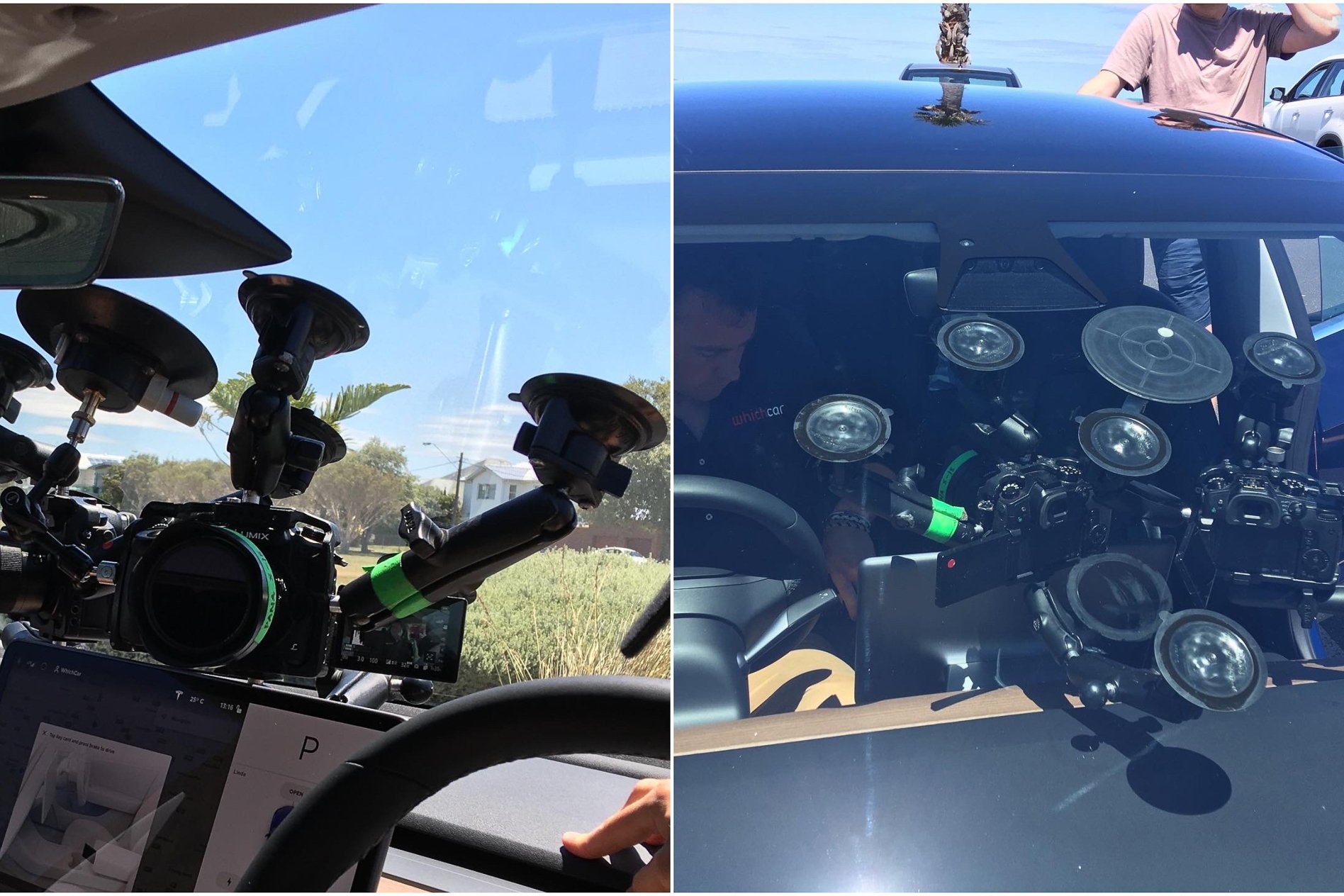
A set-up from a recent WhichCar TV shoot (Tim Robson)
Distracted driving is a real thing, and I reckon that James Corden is doing exactly the right thing – remove the act of driving from the act of being a poor man’s David Letterman, and while the segments will still, sadly, be put to air, they’ll be created in a much safer way.
I wrote about Dwayne ‘The Rock’ Johnson filming a school bus while driving a few months back, and no one batted an eye. Just because he’s a successful movie actor, he should get a free pass on safe driving? Why doesn’t he use his enormous social media profile to campaign against distracted driving.
James Corden may be a singularly terrible talk show host, but he’s doing the exact right thing here.
Nissan has been almost as silent as an EV on the future of its iconic sports cars, the 370Z and GT-R, but new rumours suggest that’s about to change. Information on a successor to the aging 370Z has come to light, and it appears to be good news for sports car fans.
UPDATE, May 11, 2022: Australian pricing for the new 2023 Nissan Z has now been announced. Get all the details at the link below.
The story to here
How long has it been?
The R35 GT-R all-wheel drive supercar killer first appeared at the 2006 Tokyo Motor Show, 13 years ago. Its brawny baby brother, the front-engined/rear-drive 370Z coupe showed its face a couple of years later. It’s been a while, and this update couldn’t come sooner, especially with the Toyota Supra here and a new GR86 already on the horizon.
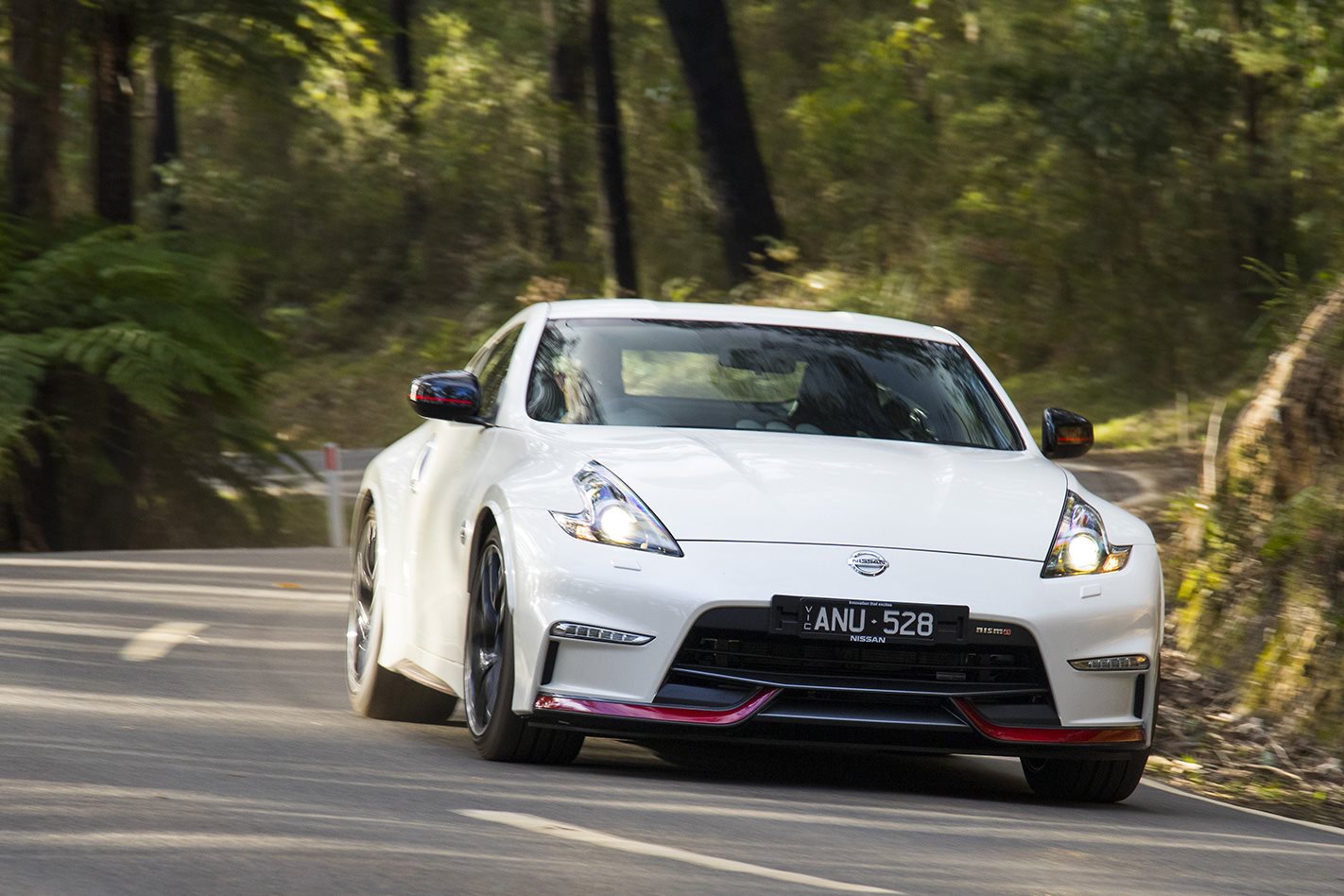
What will it look like?
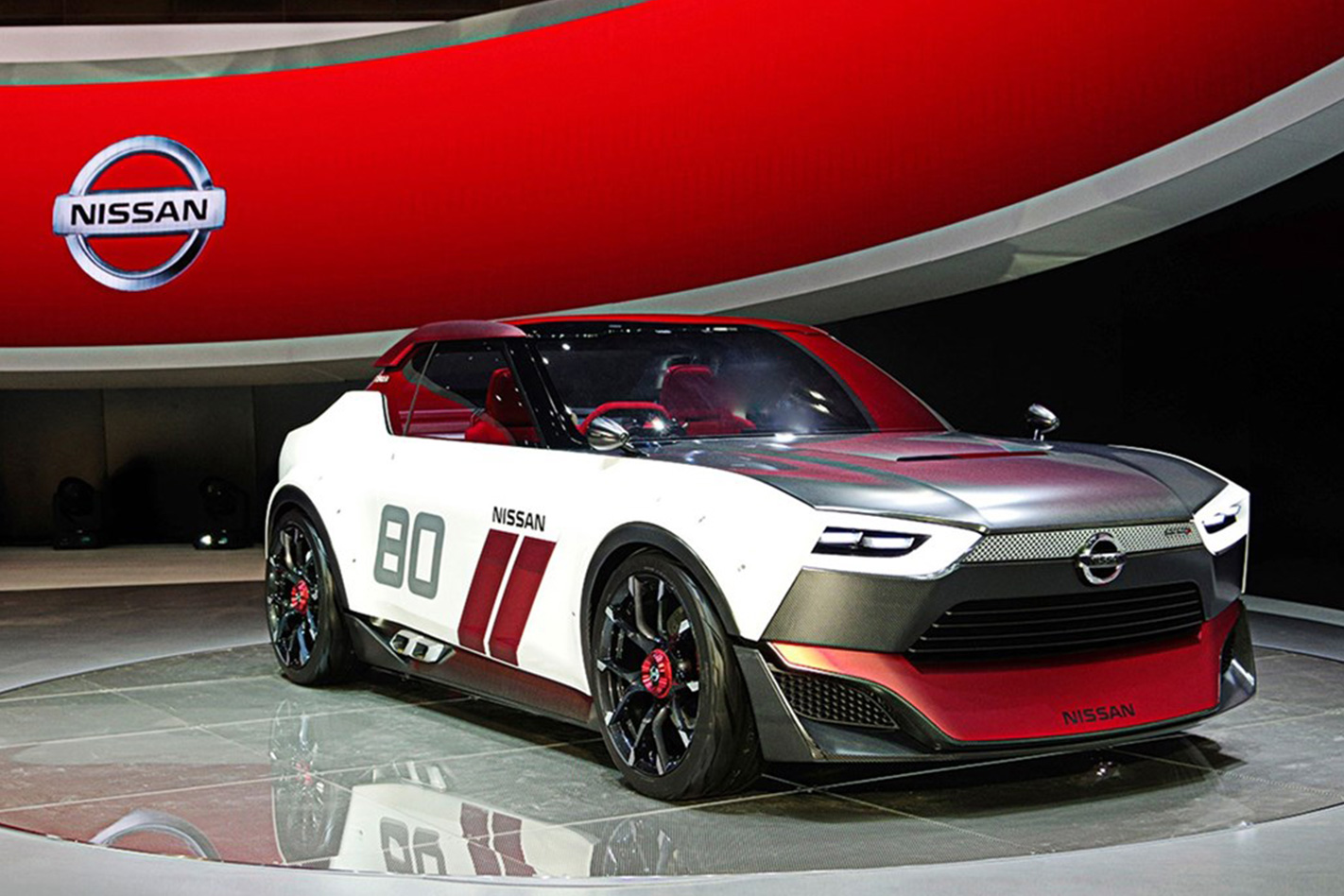
A new report from Autoblog suggests the car will feature retro-styling much like the IDx concept – only this time the front-end inspiration could come from the Datsun 240Z.
That sounds controversial to begin with, but it’s a strategy that’s proved successful for Honda: both its Honda e and forthcoming Sports EV use a retro-modern look to critical acclaim. There’s no reason Nissan should fare differently.
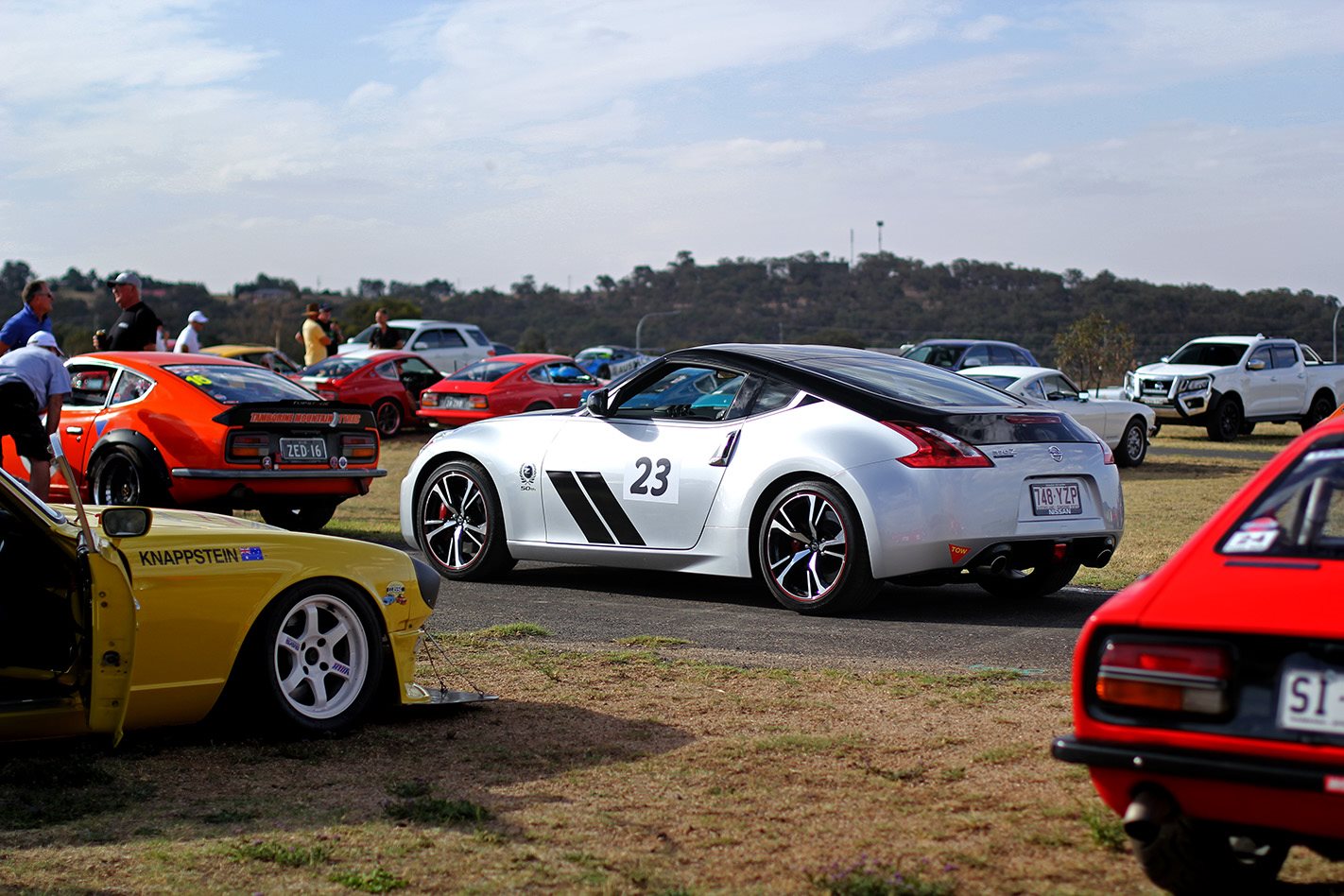
The rear, Autoblog reports, could be based on the 300ZX.
What about the engine?
When we spoke to product planner Ivan Espinosa last year, he admitted that the company was debating whether the next 370Z should be all-electric, as Porsche and Audi are mulling over for the 718 Cayman/Boxster and TT replacements.
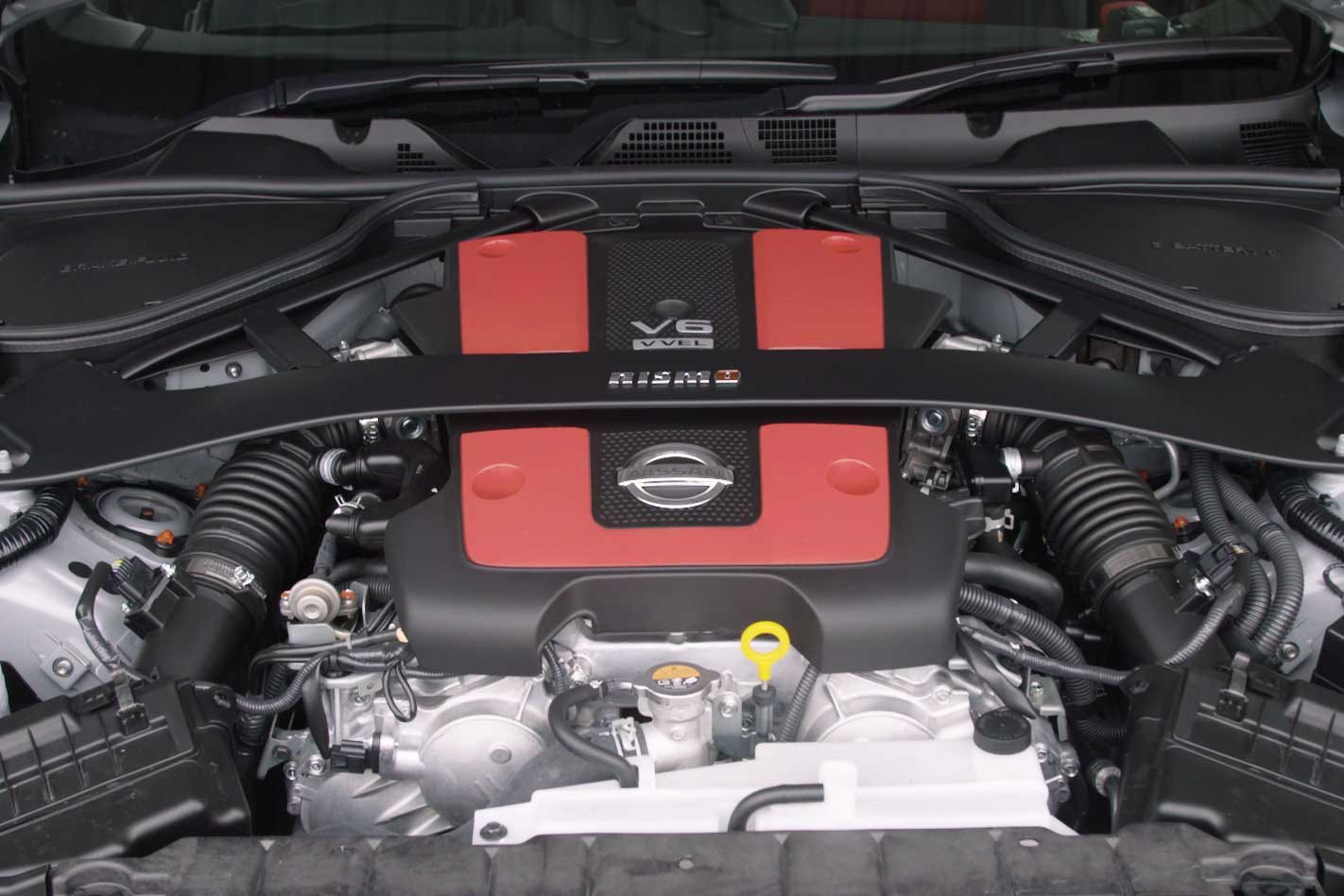
However, it looks that Nissan is now going for a 3.0-litre twin-turbo V6, and it’ll be paired with a nine-speed auto ‘box with a manual option also offered.
Ivan Espinosa, Nissan corporate vice-president for product planning, said an electric 370Z was under discussion ‘all the time’. But he added: “We need to be careful. Is the consumer ready for an electric sports car? We have endlessly debated this.”
It’s a difficult balance because Nissan may end up with something that’s neither fish nor fowl. “The more traditional buyers, are they 100 per cent there? And then there’s the technology question: when will it be ready to deliver the performance expected of a sports car?” mused Espinosa. Not yet appears to be the answer.
It’s possible we’ve actually seen the V6 destined for the new Z car already – we snapped a modified 370Z doing laps of the ‘Ring last year, and it sports extra cooling…
Is it a viable project in 2020?
Nissan faces another challenge with the sports car segment shrinking. Its big rival Toyota has been forced to collaborate with Subaru and BMW for its sports cars. Only by working with partners could Toyota realise the GT86 four-cylinder coupe and six-cylinder Supra.
CAR asked Espinosa if Nissan could find the necessary volume within its alliance of brands, and whether it would be open-minded to a collaboration with external partners. “There are no golden rules to making sports cars,” he replied.
“I’m open. But there are elements we cannot [compromise on], because these are brand icons. There is a limit to what we can share and commonise: we need to be very careful not to go beyond what the customers are expecting.”
Espinosa described the two cars as being at the ‘heart of Nissan’ and promised developments. “We are actively looking at this, working on this, and we will come up with something on this sometime soon.”
For car enthusiasts, probably not soon enough – but this is a time of tough choices, with electrification and autonomy draining engineering and investment resources.
This article first appeared on carmagazine.co.uk
What is the Mercedes-Benz B180?
Those familiar with the alphabet will rightly assume that the B-Class sits between the A-Class and C-Class in Mercedes-Benz’s range, but that doesn’t tell you much about what type of vehicle it is. In Australia, we only get one B-Class variant – the Mercedes-Benz B180 – and it’s something of an oddity over here because it belongs to the class of vehicles known as MPVs, or Multi Purpose Vehicle.
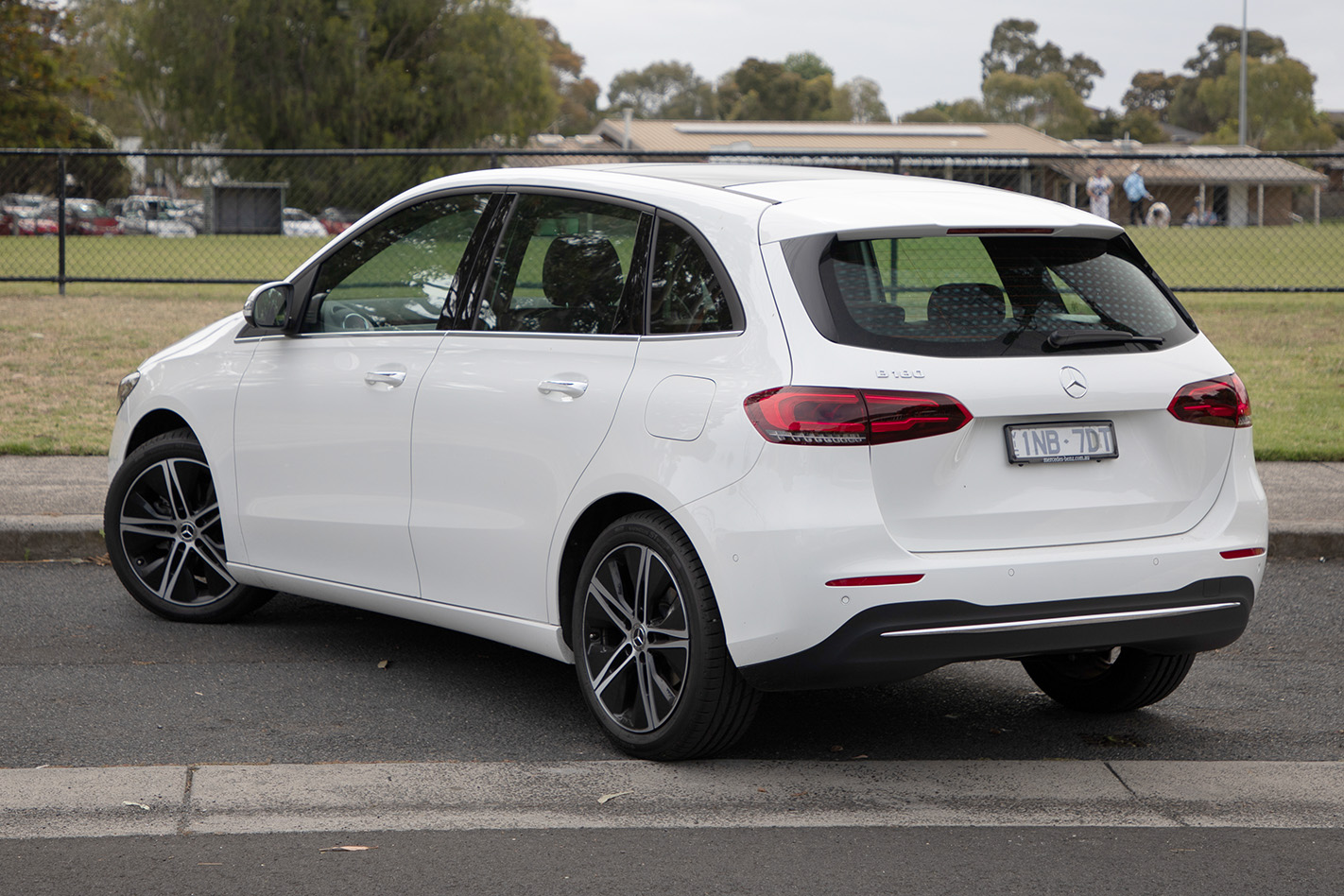
MPVs are common over in Europe and some parts of Asia, but on our shores it’s really only the B180 and its chief rival the BMW 2 Series Active Tourer that fly the MPV flag in the premium segment. Bigger than a regular hatch but not big enough to be a minivan, MPVs are pitched as a compact car with greater versatility than the average five-door.
What’s the Mercedes-Benz B180 like to drive?
Pay no attention to the modest numbers on the B180’s spec sheet. Yes, it’s just a 1.3-litre four-cylinder under there. Yes, it only has 100kW of power and 200Nm of torque. No, it doesn’t feel inadequate.
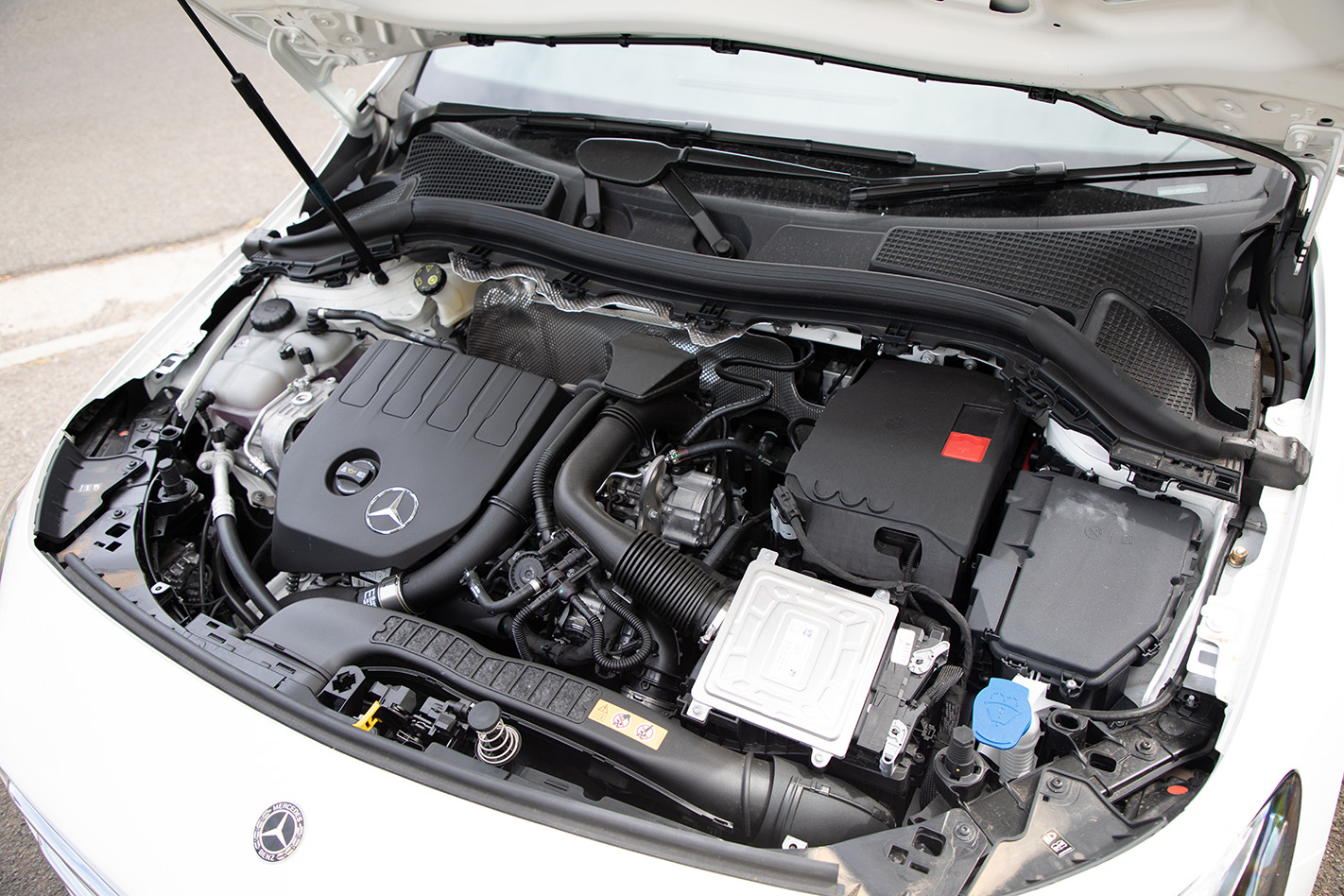
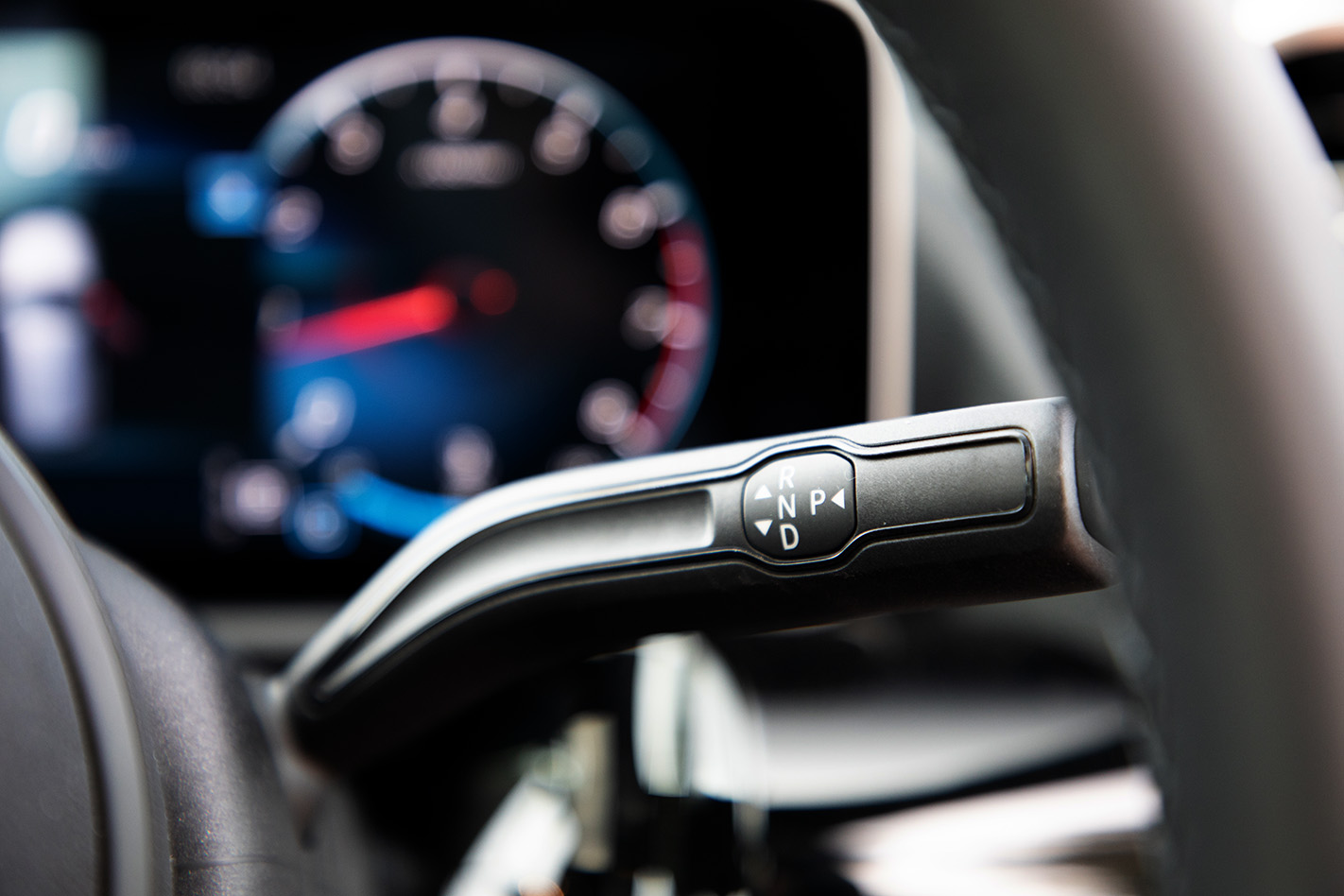
From behind the wheel, the B180 actually feels fairly perky considering its modest metrics. There’s some initial hesitation from its dual-clutch auto when moving away from a standstill, but you learn to adjust to that and anticipate green lights and moving traffic, lifting your foot off the brake a smidge earlier to wake up the transmission.
It isn’t so attuned to stop-start traffic, though. The constant on-off throttle and bursts of acceleration don’t gel with the B180’s drivetrain, and refinement in that mode isn’t as good as a conventional auto. However, in typical suburban driving it’s very easy-going. We also did a fair bit of highway driving during our time with the B-Class, and were pleasantly surprised with how unstressed it was cruising at triple-digit speeds. Its engine may have a small displacement, but it’s got plenty of heart.
Its suspension is similarly well-suited to street and highway, delivering a good balance between handling and comfort. It’s no hot hatch, but it’s surprisingly adept at maintaining its grip on a curvy road, yet it feels settled and stable even on slightly lumpy highways.
What’s the Mercedes-Benz B180 like to live with?
It’s no surprise that a car that sacrifices some style points in favour of a more pragmatic form is blissfully easy to live with, and that applies perfectly to the B180.
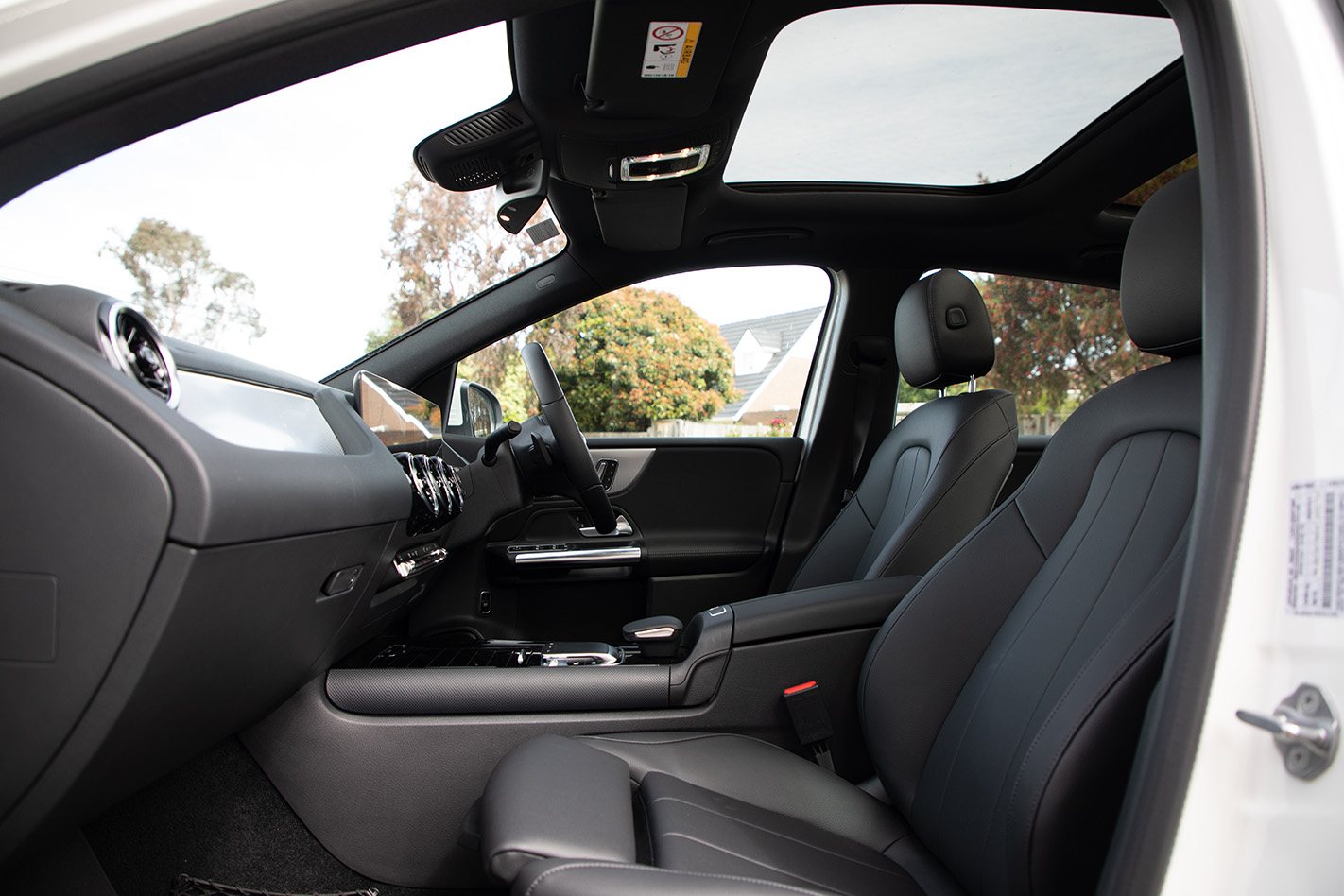
It’s got headspace to spare thanks to that tall turret and a high hip-point, so if you’ve ever stooped to enter an A-Class and wondered whether there was an easier way of entering a Mercedes hatchback, then the answer is yes: it’s called the B-Class.
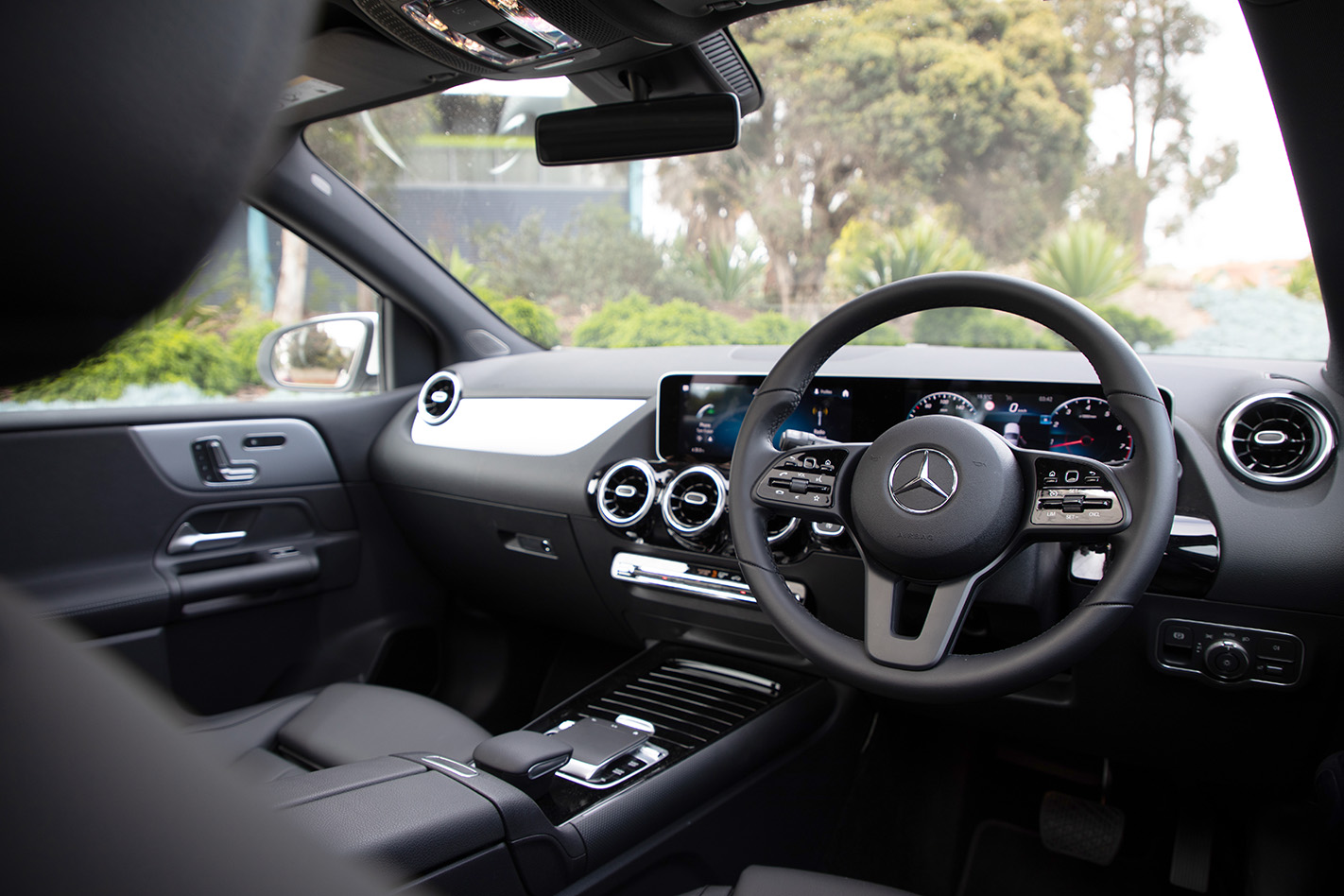
The benefits extend beyond ease of entry and egress. The cabin furnishings follow the same template as the A-Class, with identical positions for all the major switch blocks and air vents, the same twin-screen instrument panel and infotainment display, and a similarly futuristic presentation. The ‘furniture’ is unique to the B-Class and is less dainty than what you find in the A-Class and CLA-Class, but it’s still a handsome and high-quality cabin.
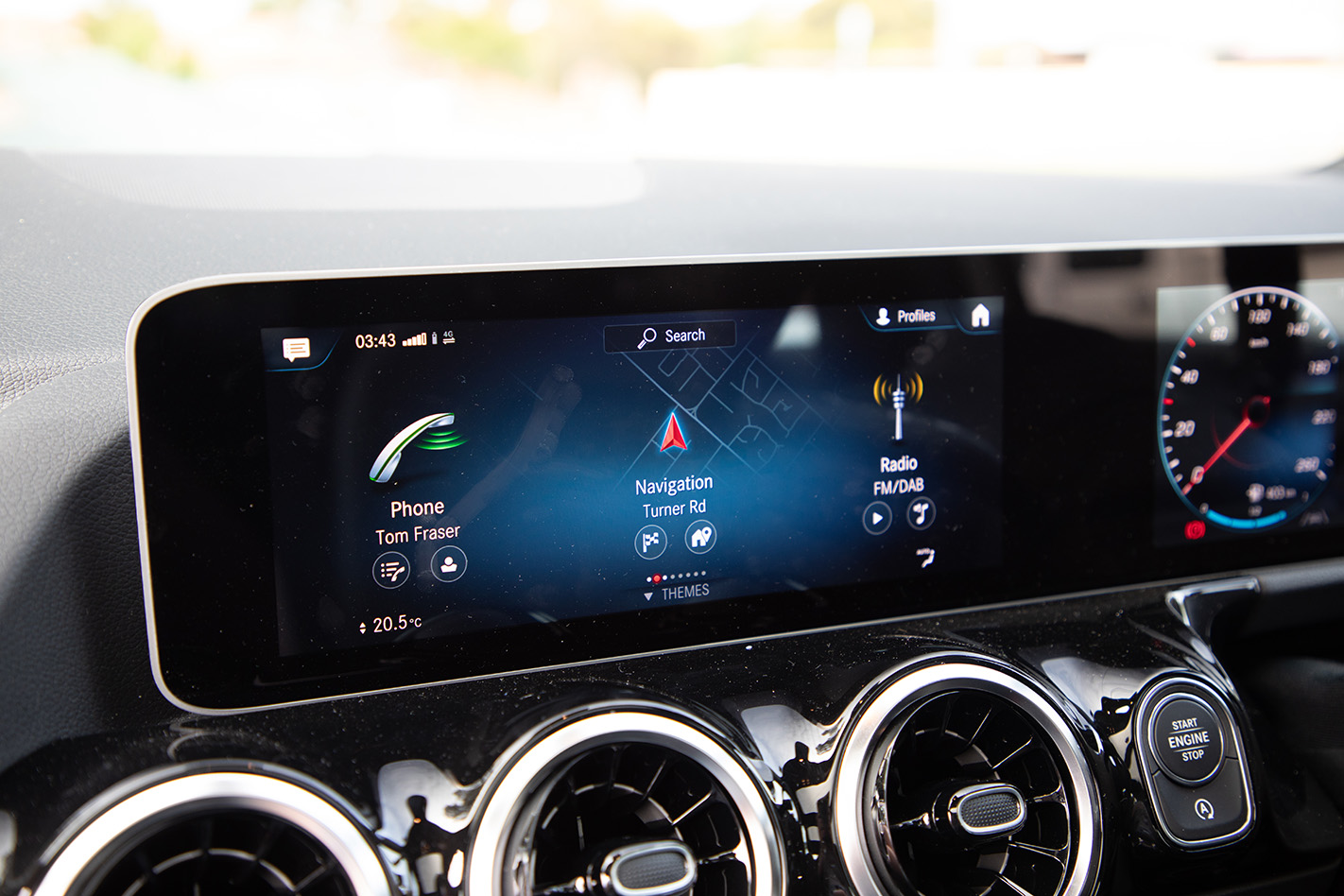
It’s functional too. There are big door bins up front, a split centre console lid and a useful storage tray/wireless charging pad hidden behind a roller shutter at the base of the centre stack. It’s not the widest or longest cabin, but it makes intelligent use of the space it does have.
Seat comfort on the power-adjustable front seats is generally good. Even on a long highway road trip we emerged without any pinched nerves or sore muscles. The back seat cushions are fairly flat, but well-sized for Western frames and with a backrest angle conducive to good comfort.
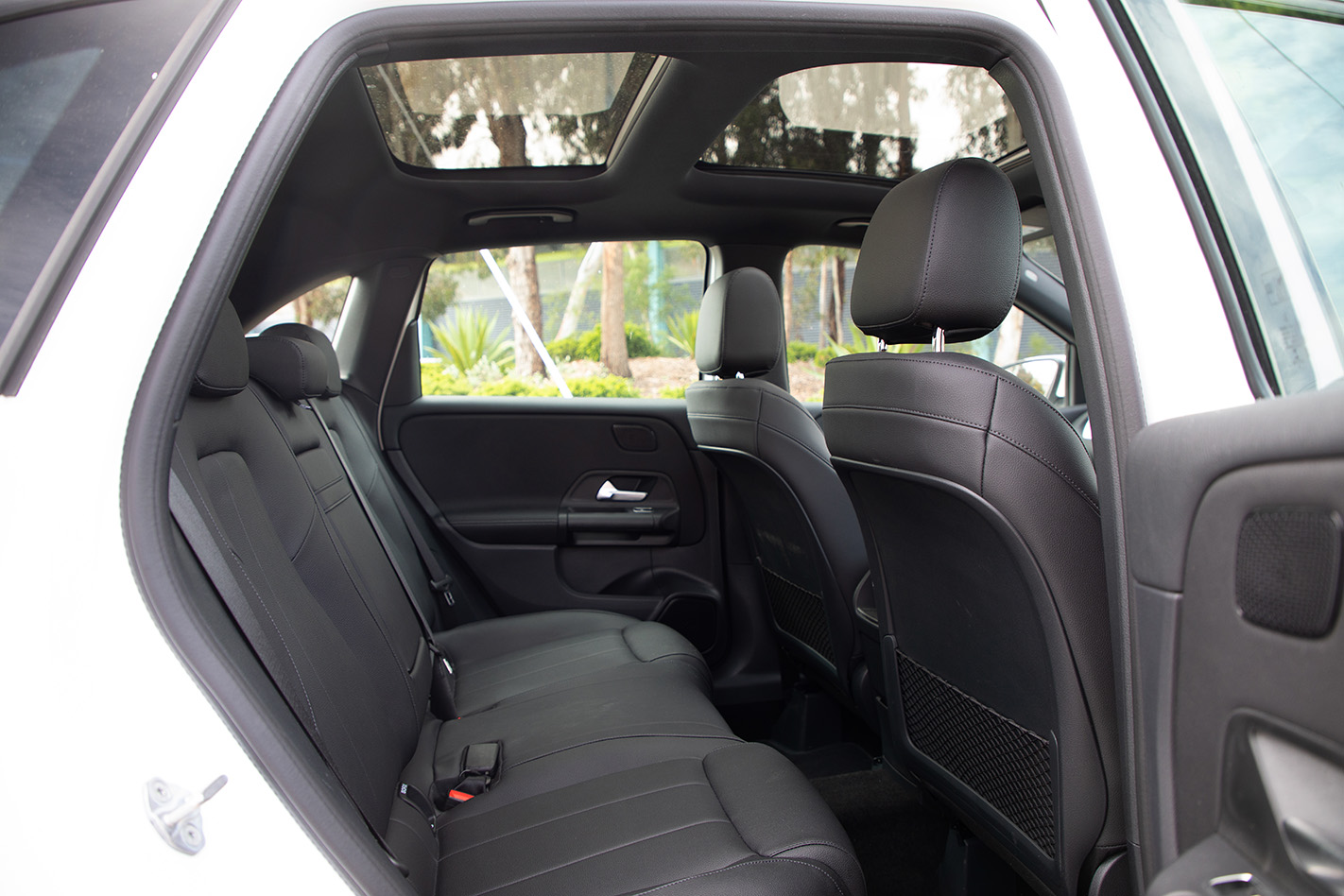
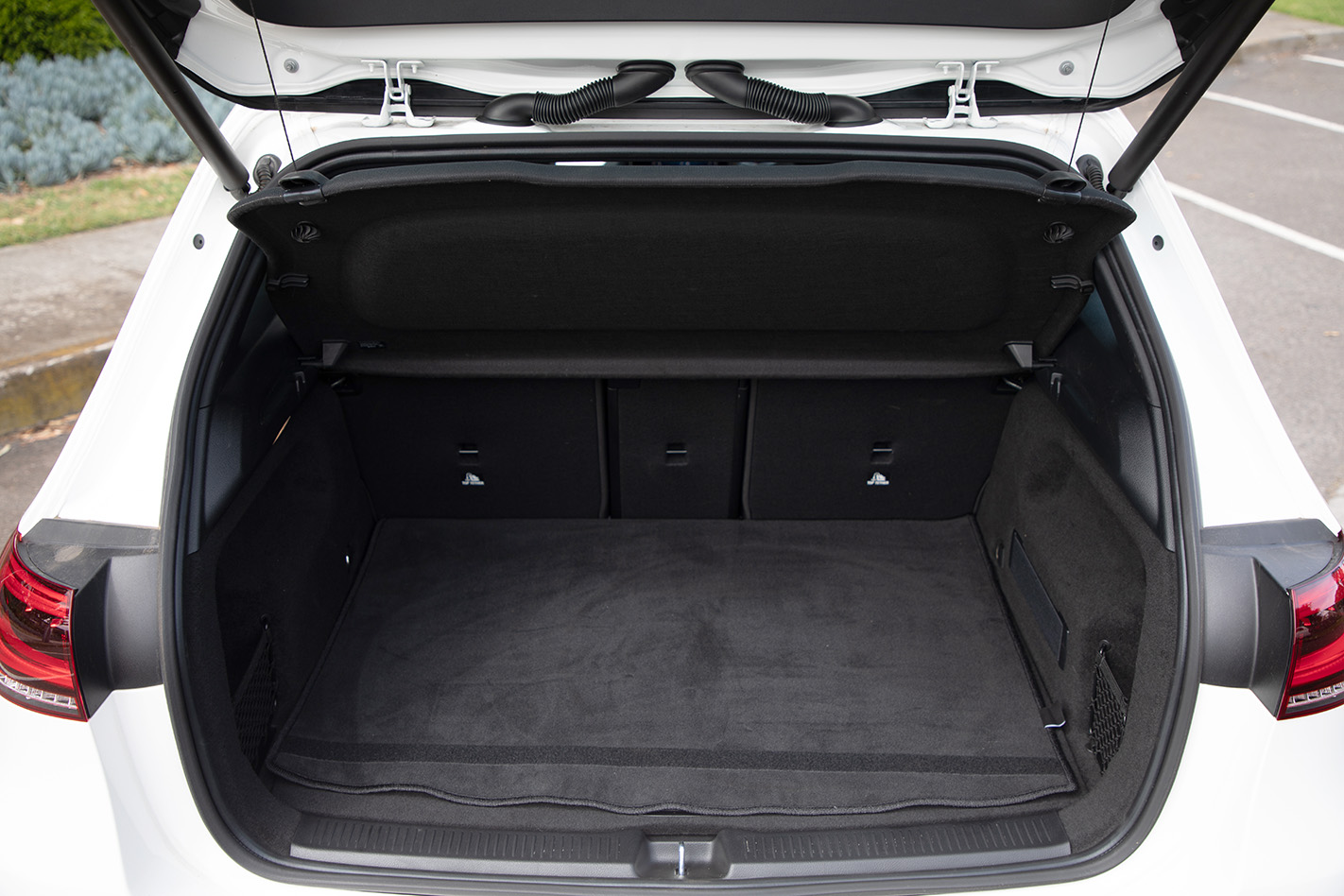
Behind the second row is a sizable boot, which we imagine might be the deal-making attribute for anyone tossing up between an A-Class or a B-Class.
With 455 litres of seats-up cargo capacity, the B180 can swallow far more than the A-Class’ 370L load area, and with a low loading lip, 40:20:40 split seatbacks and a seats-down capacity of 1540 litres, the B180 can convert into a fairly decent van too.
Is it worth the money?
With a retail sticker of $46,400, the B180 slides in just under its only real rival: BMW’s 2 Series Active Tourer, which starts at $49,500. Does that automatically make it good value? It does if you’re looking for a hatchback that’s at the upper end of the hatchback size spectrum but don’t want to put an SUV in your driveway.
But if you don’t need the slightly higher seating position, headroom or boot capacity of the B180, then we’d suggest perhaps looking at the A-Class range instead. After all, with the A180 having an identical powertrain yet a $42K starting price, that leaves you more change to add an option package or two – or simply keep in your wallet.
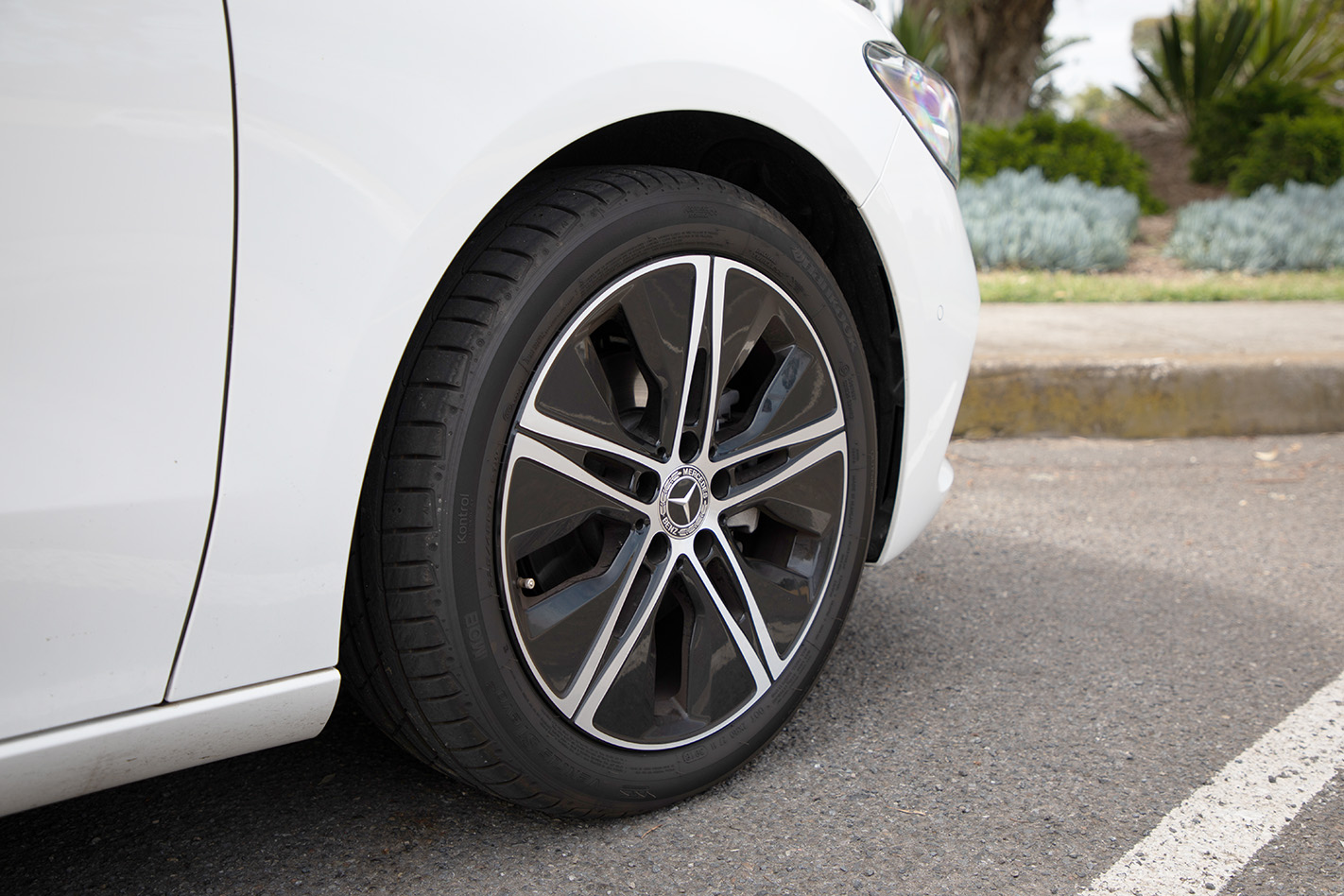
Pros: Spacious feeling cabin; willing engine; big boot;
Cons: Not as fashionable as its A-Class sibling; transmission reluctance from standstill
Rating: 3.5
Say you’re looking for a stylish, comfy coupe, but you’re looking to keep the spend under $100K. Of course, it must also be fun to drive. How does Lexus’ RC300 F Sport stack up against these criteria?
Stylish? Yes, depending on your own personal tastes of course, the current RC is a good-looking thing. In this guise, the F Sport, there are even a few extra bits and pieces that give is a less ‘base model’ vibe without launching it into the upper realms of RC pricing. Hang on, you can get an RC350 for less than this?
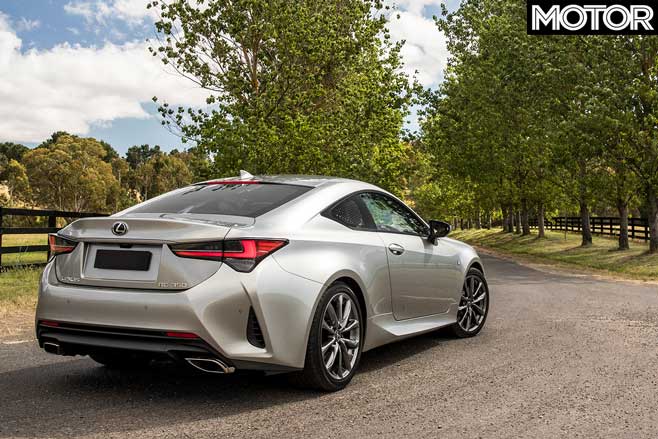
How it works is Lexus’s pricing is separated, in this case, by trim level rather than engines. The turbo-four powered RC300 and the V6-powered RC350 cost $74K (as we have here) and $77K in F Sport variants. Really, the V6 is worth the extra couple of thousand dollars.
Aside from the occasional engine struggle, and the unpleasant sound it makes doing so, the RC300 F Sport is a pleasant thing to cruise in or take for a quick punt. It handles well, is fitted with grippy Bridgestones, and once up to speed can carry a fair bit of speed with poise.
It feels composed, predictable, and well-balanced. Its steering won’t amaze, but it does the job and suits the relatively gentle ride. If you really can’t stretch for the RC350, this is fine, but the V6 is definitely a step up.
2020 LEXUS RC300 F SPORT SPECS: Engine: 2.0-litre inline-4, turbo Power: 180kW @ 5000rpm Torque: 350Nm @ 1650rpm Drive: RWD Weight: 1620kg Price: $74,321
The second-generation Audi RS Q3 arrives in a crowded market – a far cry from the original car, which effectively kick-started the trend for performance compact SUVs when it arrived in 2013.
Sitting 10mm lower than a standard Q3 and riding on 20-inch alloy wheels (21s on the test car), the RS now gets twin exhausts, but a petrol particulate filter means the carryover five-pot turbo engine doesn’t pop and bang quite as vigorously as before.
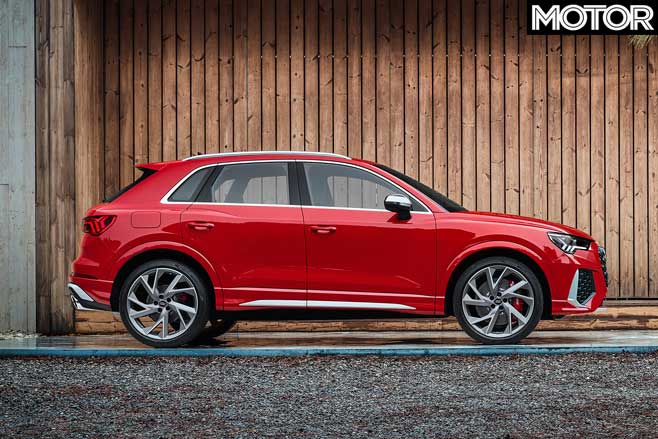
Liberal use of aluminium has reduced weight by 26kg, and power has been tuned to 294kW. Quattro permanent all-wheel drive and a seven-speed auto deliver 0-100km/h in a rapid 4.5sec.
Meteoric point-to-point progress is the order of the day here, not driver engagement. There’s plenty of grip but a slight disconnect between what the front tyres are doing and your inputs through the progressive steering rack, which speeds up the further it turns.
The Quattro all-wheel drive system can send as much as 85 per cent of the torque to the rear axle, and it always remains composed when hustled out of corners.
The five-pot’s solitary turbocharger doesn’t deliver a singular punch of thrust, managing instead to mete out shove throughout the rev band and onto a 7000rpm redline. It can be violently fast off the line, the Quattro system helping provide the traction of a pricier Macan Turbo.
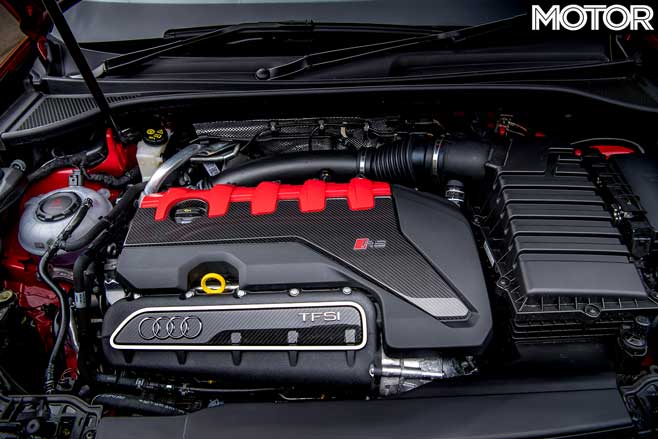
Access to all that power isn’t always instant, though; the auto takes its time to drop cogs unless set to Sport mode. This can be troubling when attempting overtakes, so it’s better to use the wheel-mounted paddle-shifters for a more direct response.
Happily, the addition of two customisable RS driving modes (via the steering wheel) makes it easier to switch from regular driving to maximum performance, though the adaptive dampers are best left in their most comfortable setting. In Dynamic they become extra stiff and cause all but the smoothest road surfaces to feel rutted and coarse. It’s more refined at city speeds, and fares much better than some harshly sprung rivals, but the focus is very much on assured handling over comfort.
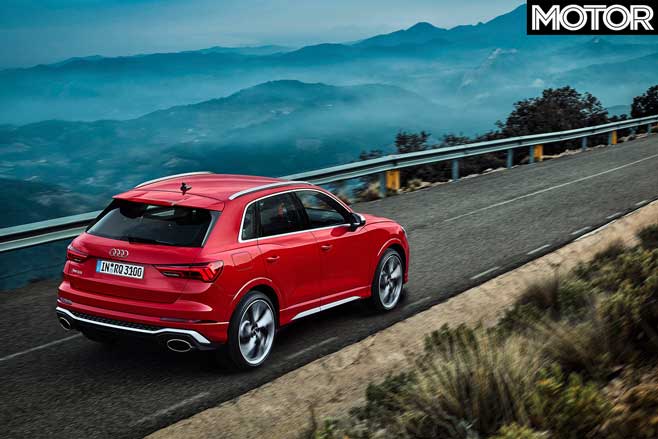
Inside, front sports seats and a flat-bottomed steering wheel set the RS apart from the recently facelifted Q3. It gets the same 10.1-inch infotainment screen and 12.3-inch virtual cockpit instrument cluster, with an additional RS-specific screen that puts rev count, speed and other performance metrics right in your eyeline.
Overall, the RS Q3 is a pricey compact SUV in a class filled with rivals that best it for interior finish, if not outright pace.
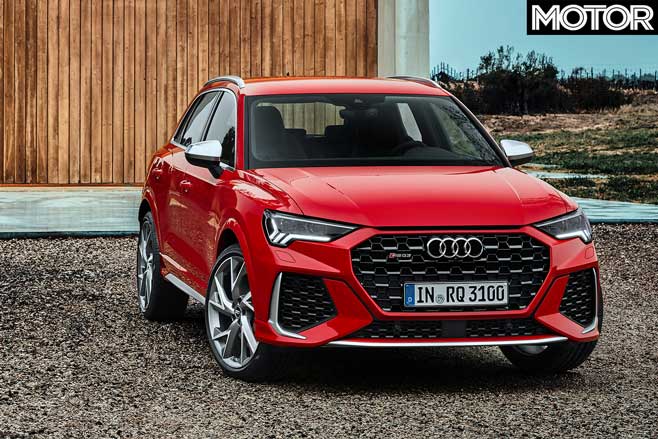
2020 AUDI RS Q3 SPECS Engine: 2480cc inline-5, DOHC, 20v, turbo Power: 294kW @ 7000rpm Torque: 480Nm @ 1950-5850rpm Weight: 1715kg 0-100km/h: 4.5sec (claimed) Price: $90,000 (est)
Like: Reduced weight; extra power; AWD traction; grip levels; information screens Dislike: Fewer exhaust theatrics; steering feel; interior finish; hesitant automatic
Rating: 4 out of 5 stars
