
You’d be a genius if you could pick the next trend in SUVs. You’d also be rich, because our appetite for the car on stilts is unrivalled. The challenge is figuring out what that template looks like.
BMW had the original monocoque soft-roader thing nailed down before the Y2K bug was given oxygen, and since then, the Munich giant has penned almost every conceivable size and body style – not all of them successful. Now, it returns to the original formula, albeit upsized.
Enter the all-new X7, BMW’s first proper seven-seater. Its length extends over five metres to 5151mm and, importantly for a genuine seven-seater, its wheelbase extends to 3105mm. The only contender close to those proportions is the Mercedes-Benz GLS, measuring 3075mm between the wheels and 21mm shorter overall. But the Benz is a rival in dire need of a generational update – expected to land next year – which excludes it from competing in this test.
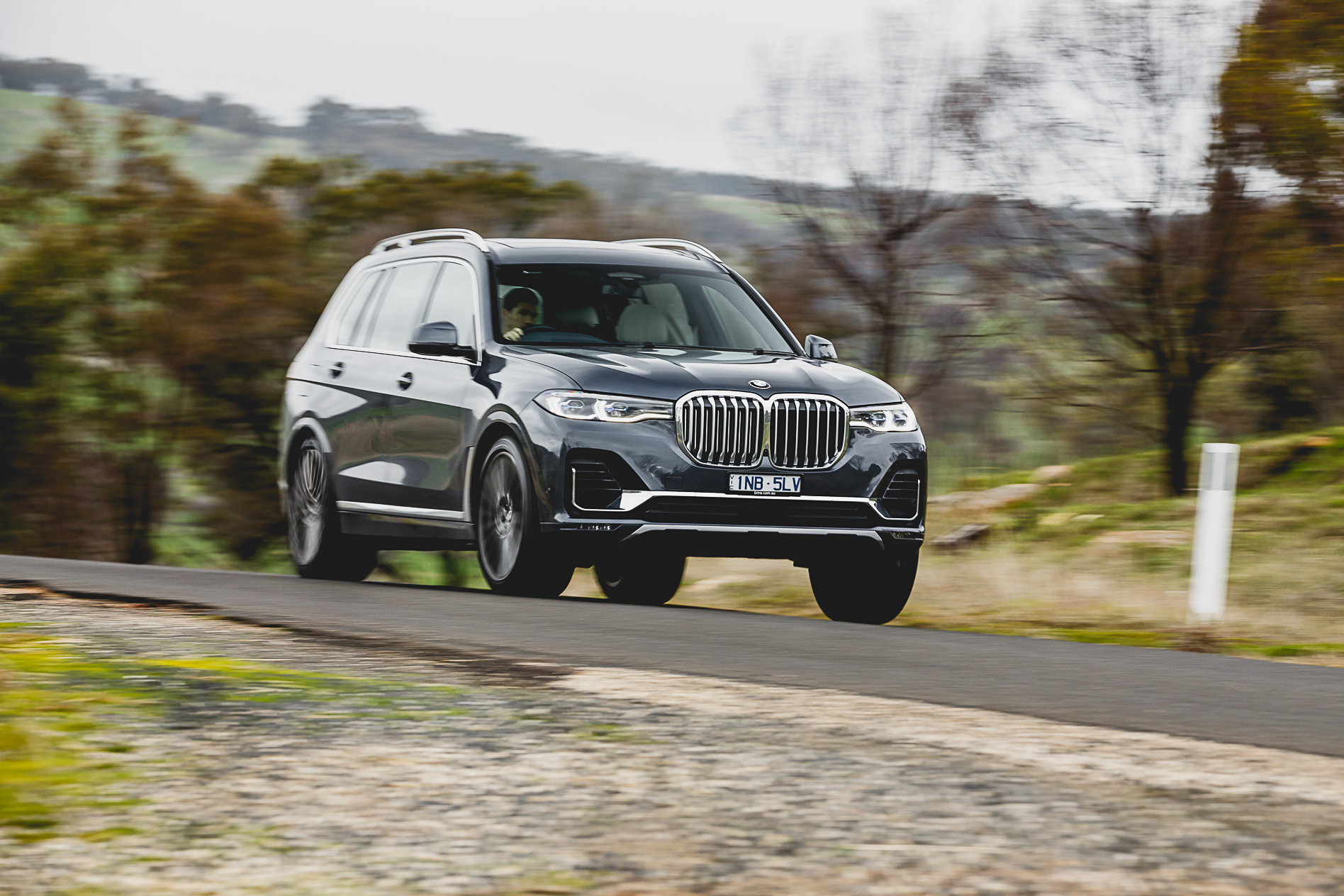
So if 5+2 accommodation is your non-negotiable prerequisite, the richly equipped X7 surely wins by default. See, Audi’s facelifted seven-seat Q7 – a contender even smaller than the GLS – hasn’t arrived yet, forfeiting Ingolstadt’s ability to compete on level terms. But for plenty of buyers, life’s big decisions are far from that clear-cut.
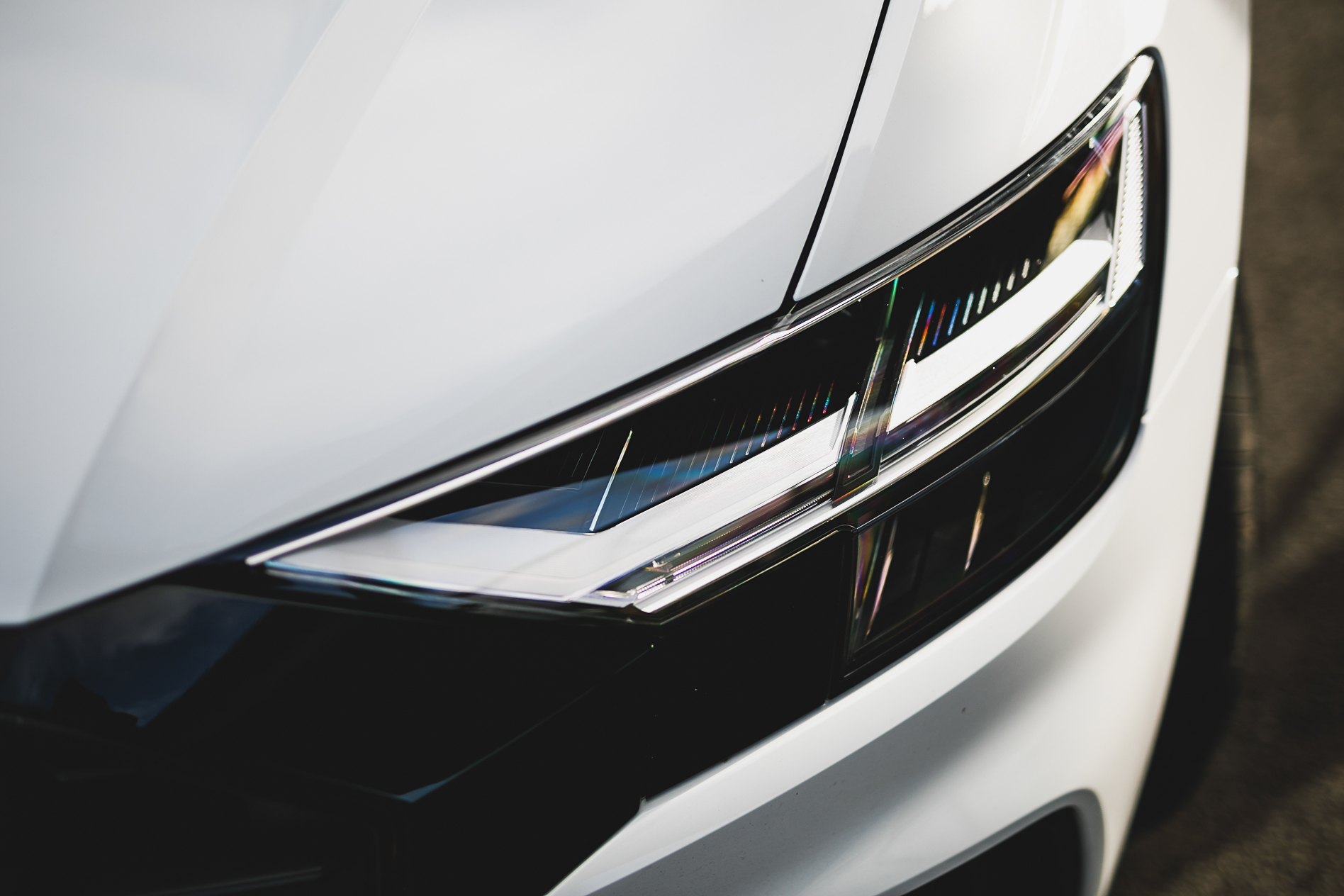
Which is where the all-new Q8 comes in, built upon the same MLB Evo platform as the Q7 and even sharing that model’s gaping grille which makes Hannibal Lecter look like a vegan. And despite a sleek ‘five-door coupe’ form, the five-seater’s wheelbase grows over the existing Q7 to 2995mm – even if it is by just 1mm.
A seven-seater it’s not, but these are the two newest, largest premium SUVs from Germany that provide distinctly different ways to spend almost $150K. It’s the battle of the bulging grilles, as well as a case of pros and cons.
We’ll start with the BMW X7, which boasts a price tag that undercuts its newest rival by almost $10,000. This is the entry-level 30d variant priced at $119,900, and it comes plump with gear.

Headlining safety is some of the Bavarian maker’s slickest technology, including AEB, adaptive cruise control with traffic follow assist, speed-sign recognition, and lane-keeping assist. It also comes with adaptive air suspension, soft-close doors, automatic split-fold tailgate, keyless entry and ignition, roof rails, ambient interior lighting, electric steering adjustment, panoramic sunroof and secondary sunroof for the third-row, four-zone climate control, heated front seats with electric adjustment and memory settings, electric second-row seat adjustment, wireless charging, head-up display and separate screens for the dash and infotainment.
In keeping with the legacy BMW series and capacity nomenclature, the 30d’s driveline comprises a 3.0-litre turbocharged diesel engine (as fitted to the X5 we tested last month against the Mercedes-Benz GLE and Volvo XC90) good for a hardy 195kW and 620Nm, fed through an eight-speed torque-converter automatic transmission to all four wheels. Our tester came with $23,150 of extras, bumping the price to $143,050.
For that, we see the $15,000 BMW Design Pure Excellence package (highlights include 22-inch alloy wheels, sports steering wheel, blue Merino leather upholstery, comfort seats, Alcantara headliner and Harman Kardon surround sound system); $4500 white and blue Merino leather trim (if the all-blue trim of the Excellence package doesn’t float your boat); $550 BMW display key; $1800 five-zone climate control; $800 ash trims; and $500 heated and cooled front cupholders.
Smaller than the X7, Audi’s sporty Q8 55 TFSI is also 180kg lighter than its rival but costs more, with a starting price of $128,900. It’s endowed with a 3.0-litre twin-scroll turbo-petrol V6 producing 250kW and 500Nm, and assisted by a 48-volt mild- hybrid system. Standard inclusions aren’t quite as luxe-focused as the X7, though safety technology is equally impressive, including AEB, adaptive cruise, collision avoidance, automatic high beam, lane-keep assist and a 360-degree camera.
Further inclusions are S Line trimmings, heated and ventilated electric front seats with memory function, Valcona leather upholstery, keyless entry and start, three-zone climate control, wireless charging, electric tailgate, three digital display screens, 21-inch alloys and adaptive dampers with steel coil springs.

Added to this tester is $9950 worth of kit: $2300 for metallic paint, an $1850 black exterior styling package, $400 of oak inlays, $900 for electric steering column adjustment and the $4500 dynamic steering package with four-wheel and variable-ratio steering bringing the total price up to $138,850.
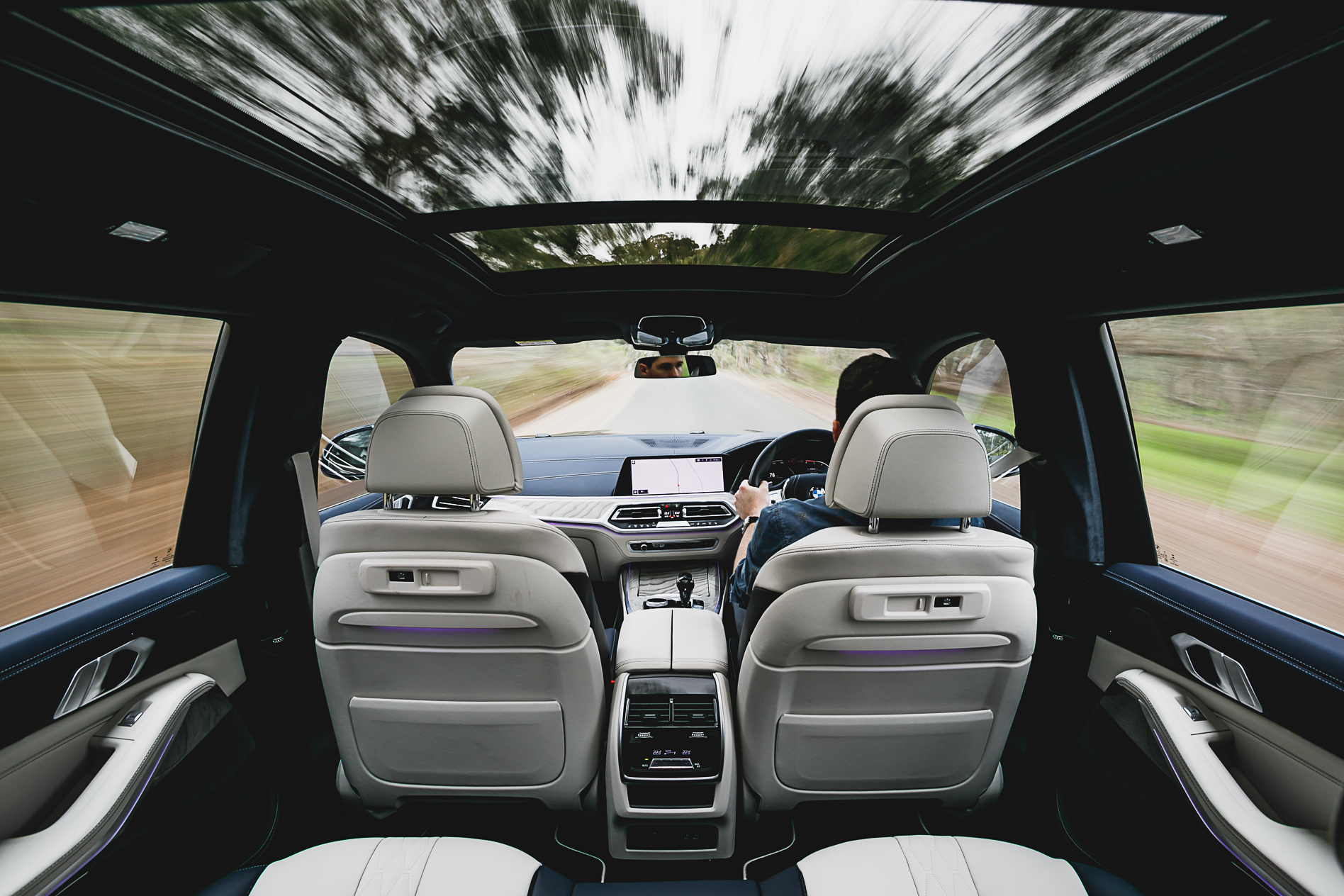
That puts the Audi within five grand of the heavily optioned Beemer, which looks the more polished car. Inside, the X7’s vast cabin feels airy and sumptuous, the huge windscreen and long side windows creating a panoramic ambience. The view from second row is particularly dramatic when carving along a tree-lined road, as the huge sunroof and generous glasshouse envelop passengers with an IMAX movie-like experience.
Third-row passengers don’t miss out on much either, with surprisingly good legroom and their very own (but much smaller) sunroof. There are also two USB ports in each row for anyone who tires of the scenery. But while the seats are soft and very comfortable, we’ve found the electric folding mechanism to access the back row somewhat buggy on no fewer than three different examples.
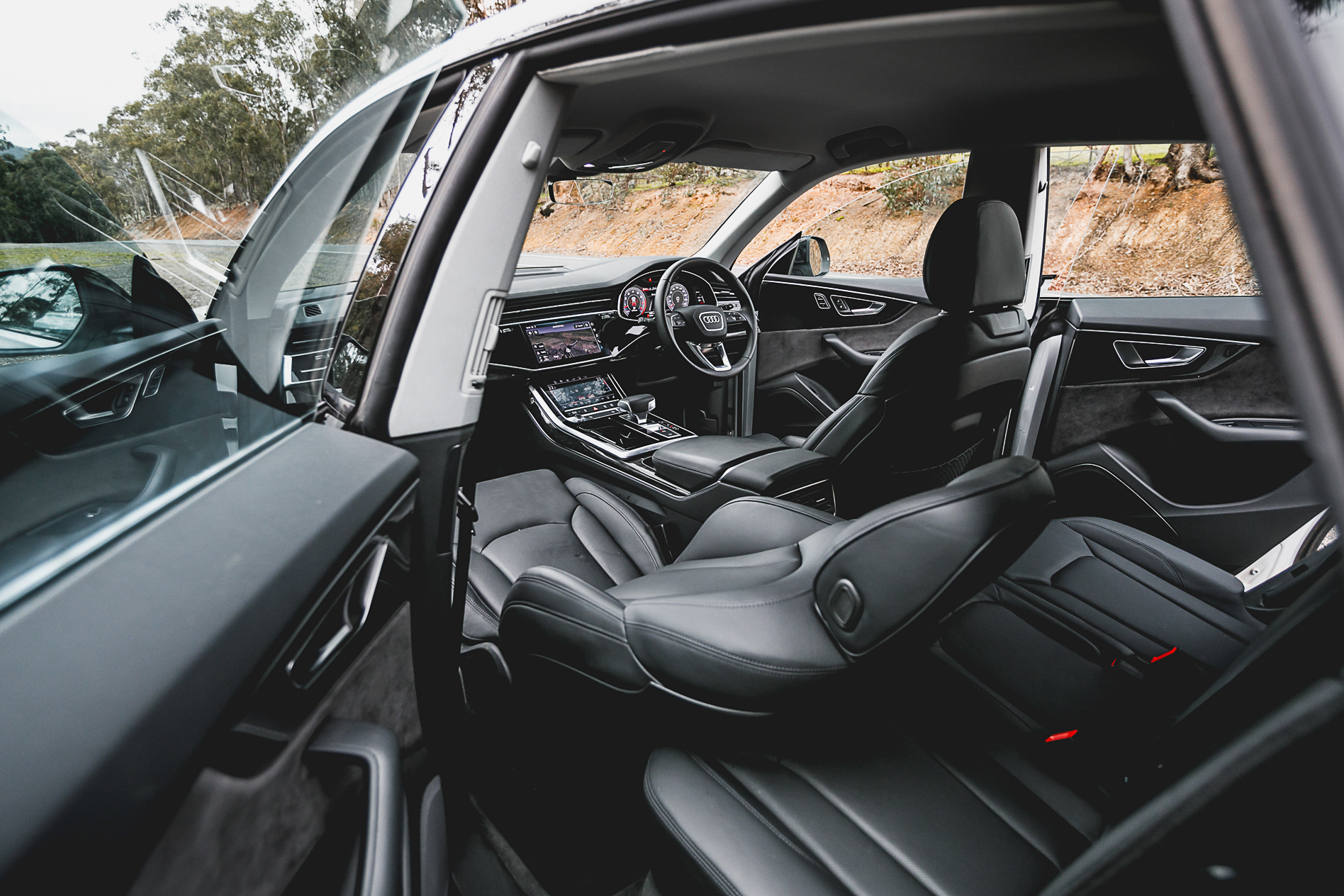
Despite one less row to squeeze in, the Audi Q8 doesn’t feel larger in front or rear seats. Vision is less expansive up front and out of the side windows. A sunroof is a $3550 option, and the black-on-black trim of our test car, combined with the restrained interior design, makes it feel a bit austere.
Apple CarPlay and Android Auto are standard inclusions, which shame the BMW’s pay to play. It stops about there for competing against the Sumo-sized Bavarian SUV, though, as Audi’s smaller, darker cabin isn’t nearly as welcoming nor the seats as comfortable as in the X7.
Helping the Q8 win back points is its performance focus via the stirring V6 twin-scroll turbo, bringing an extra 55kW to flatten the X7 in a straight-line sprint. In fact, this big SUV will smoke a lot of hot hatches at the traffic lights grand prix.
A full one second faster to 100km/h from a standing start, the Audi only continues to pile on the advantage, measuring over three seconds faster to 140km/h. It also holds a useful upper hand in overtaking response, being nearly 1.5sec faster from 80-120km/h.
That doesn’t tell the whole story of the X7 though, as the oiler with its extra 120Nm of grunt over the V6 petrol is a rapid unit low down, lurching from a standing start like a wild pig. Equalling the Q8’s 2.8sec sprint up to 60km/h, it’s quick around the ’burbs, and managed to beat its own 0-100km/h claim by a tidy three-tenths. It also feels effortless to drive in comparison, which adds to refinement and makes good use of the ratios inside the ZF eight-speed auto.
The X7’s diesel continues to deliver at the refuelling stop, returning a frugal fuel consumption figure of 9.7L/100km compared to the petrol-gulping Audi’s 13.3L.
With such performance-car consumption, along with a weight advantage, it should come as no surprise that the Q8 is dynamically sharper. The steering feels more car-like with eager turn-in, aided by the ($4500 cost-option) four-wheel steering and variable-ratio rack, requiring almost one full turn less lock-to-lock than the X7. It helps the rear rotate around corners and makes low-speed manoeuvres easier to perform.
Add to that tremendous grip provided by the Quattro all-wheel drive system and the Q8 is capable of hanging on around corners while piling on the pace. The steering in Sport mode feels far tighter and more communicative, too, rather than simply reducing electrical assistance, and lends credibility to the notion that this SUV is a bit of a driver’s car.
That cohesion translates through the chassis, the adaptive dampers providing good body control in Comfort mode though turning too firm in Sport over anything but ultra-smooth roads. Riding on its 21-inch hoops, the Q8 benefits from relatively generous 285/45 profile rubber front and back that’s mostly compliant but busy over pitted bitumen.
Our X7 rides on dual-axle air suspension with an adjustable ride height of 40mm, but its larger 22-inch rims with lower-profile 275/40 front, 315/35 rear rubber want to work against the lofty suspension, and it can feel a touch wobbly on lumpy surfaces. Unlike the front and rear multi-link-equipped Audi, the BMW has a sophisticated multi-link arrangement in the back but adopts a conventional strut set-up for the front.
The X7 is less confident when turning into corners at pace and the tall body leans quickly over the nose, the weight pushing into understeer much earlier than the confidence-inspiring Q8. Combined with steering that is less direct and overly light, it’s not as engaging to drive.
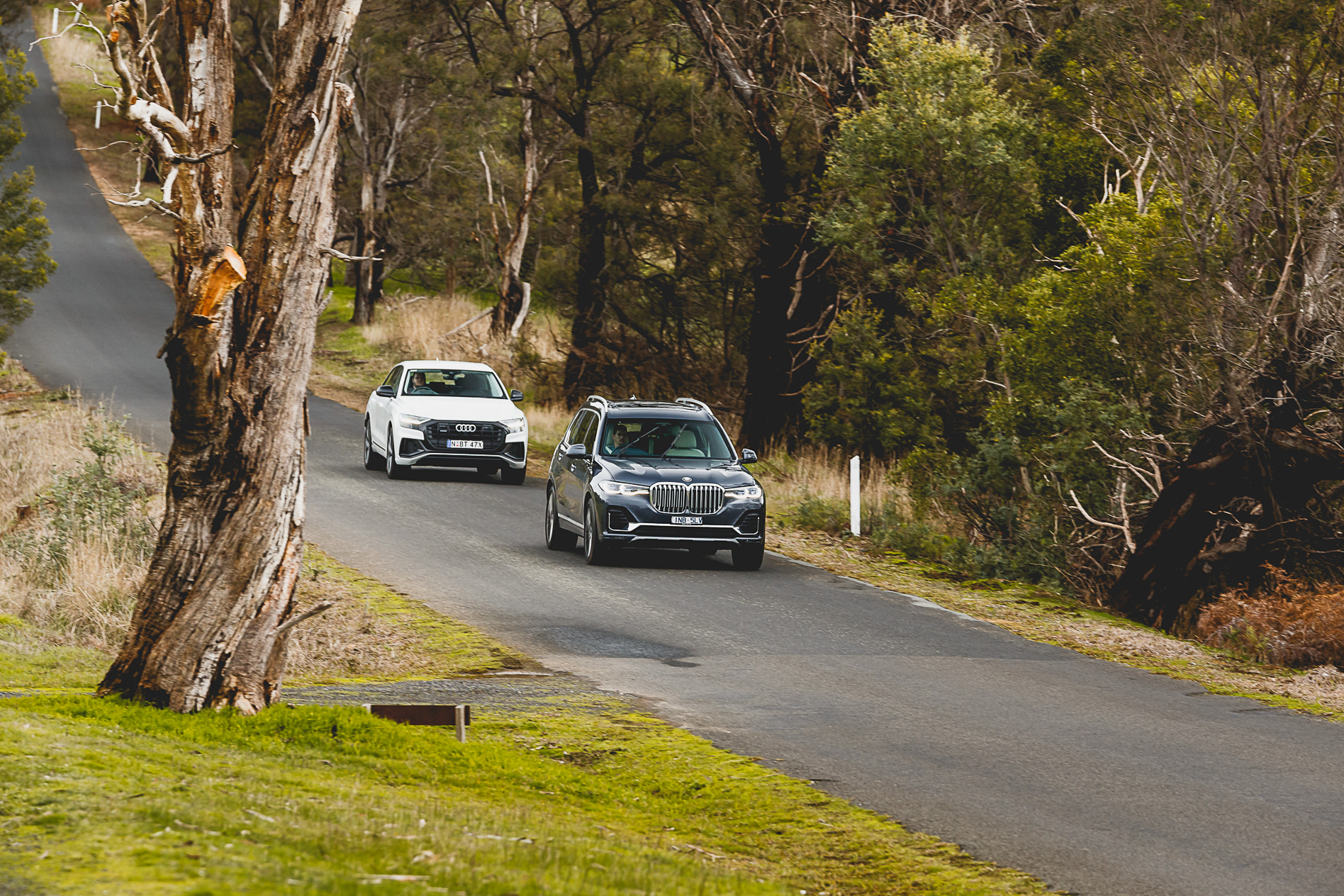
Admittedly, the shortcomings in the X7 are evident only when punting through twisties, and the set-up is likely to satisfy most urban duties. The ride at low speed is superior to the Q8, with the air suspension effectively buffeting the brittle response from run-flat tyres underneath.
It’s clear that the Audi is the better driver’s car, but buying an SUV for performance pleasure should flag the question of why bother, when the cracking Audi RS4 Avant is only $15K more than this pricey crossover coupe with its relatively necessary options. But of course, presenting itself as a desirable and sporting SUV is exactly its proposition, and one the Audi excels at.
So where does that leave the X7? It’s perhaps the most refreshingly commonsensical new line of SUV that BMW has produced in recent times. Yes, it is huge, but it is so well packaged, easy to drive and well-suited for a large family of any maturity that it should surely be a prerequisite on their shopping list. Honours almost even, then.
BEST LOOKING – Lamborghini Aventador SVJ Roadster
If you just want to turn heads, it’s been well known for nearly a decade that you should just buy a Lamborghini Aventador.
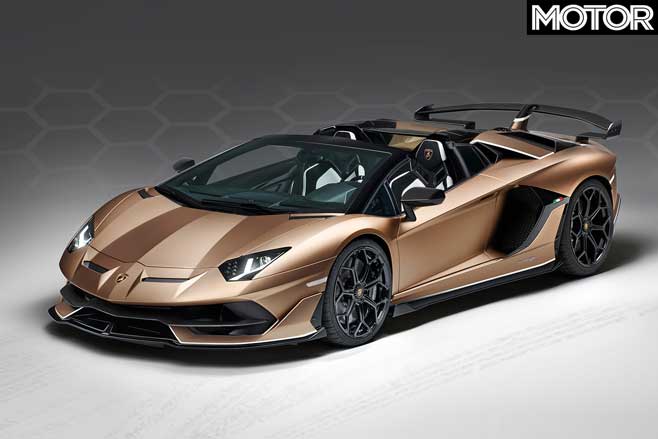
Looking like an art sculpture that someone stepped on, Lambo’s biggest bull has a pulling power like no other. Especially in its ultimate form, the jaw-dropping SVJ Roadster, the best-looking performance car released in the last year if you ask us – while accepting that Most Beautiful could have been a category with a very different winner.
It was not an easy job for relatively new head of Lamborghini Design Mitja Borkert to build on the original Aventador form, as penned by previous designer Filippo Perini (who now works at Genesis). How do you make a car – that appears ready for space travel save for strapping a rocket to either side – look even more extreme without overdoing it?
A new front bar, rear bar, side intake treatment and as-big-as-you’d-wanna-go rear wing is the answer for Lambo’s fastest-ever convertible, much of the bodywork (but not all) made from carbonfibre in order to keep added weight to a minimum (50kg over the Nurburgring record-setting coupe). Strutting its hero Bronzo Zenas (matte bronze) colour scheme, the SVJ is every bit as capable as it looks too.

In the middle, a 6.5-litre gloriously atmo V12 revs to a heady 8700rpm and produces 566kW and 720Nm along the way. That means the circa-1600kg, 2.2 metre-wide, all-wheel-drive droptop monster can accelerate to 100km/h in 2.9sec from rest, heading to a top speed of 351km/h. In other words, make sure your cap has a chin strap.
The SVJ Roadster utilises Lambo’s latest ALA active aerodynamics, all-wheel steering and has an interior that can be specced in colour combinations one would need a welding mask to look at. Just 800 SVJ Roadsters will be built, costing in excess of $1m when the first ones hit Oz in early 2020.
Best Detail – Lexus RC F Track Edition rear wing
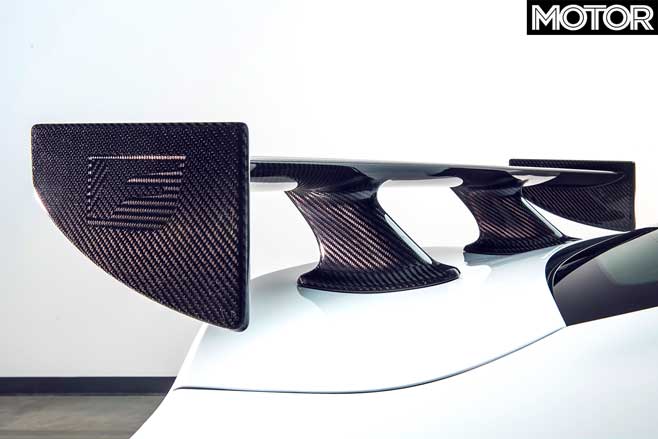
Beautifully shaped and intricately detailed, this carbonfibre wing is a proper work of art. With two little Lexus ‘F’ logos weaved almost seamlessly into the carbon on the sideplates, this really is the seemingly GT3 racecar-inspired icing on the cake that makes the Track Edition look tougher than a Lexus has any right to.
Ugliest – Bugatti Centodieci
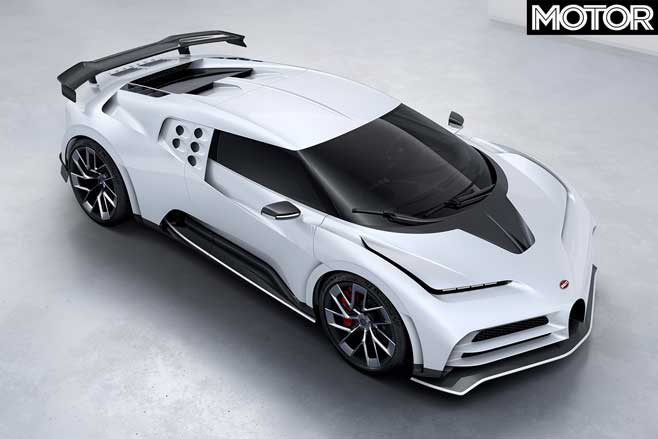
Have you ever seen an old car and thought: ‘I wonder how that would look with a modern design?’ It works for the likes of the Ford Mustang and the Alpine A110, but we wish Bugatti’s designers hadn’t thought the same about the epic EB110, which itself was not – let’s be real – the prettiest thing. Too many lines and holes make the incredibly pricey Centodieci a bit of a visual mess.
You’ve probably heard that old raconteurs’ adage that says “never let the facts get in the way of a good story.”
There has always been an element of that applied by the artists who have created some of the most coveted and collectible motorsports posters over the decades.
Back in an era nearly a century before the information age was even a concept and action photography barely existed, talented artists were relied upon to create the promotional material that would attract crowds to premier motorsport events. And these artisans of the easel were not about to let the facts of motorsport get in the way of their visual story.
The reality of the period was that horrendous crashes and often fiery deaths were commonplace, but the visual depiction was the antithesis of this. Instead, artists would let their collective imaginations roam free, and create visions of pure, brilliant fantasy. In this parallel promotional world, cars would race with barely a hand span between them, their long bonnets bending and thrusting for the impending turn, drivers locked in the fixed stare of men born immortal.
By the early ’60s, the imagery had developed a greater sophistication. The sense of slight caricature had gone, replaced by a more avant-garde depiction. Duelling open-wheelers on a circuit banking boldly rendered in the colours of the host country’s flag, for example. What didn’t change was our emotive response to the imagery, and in many cases, the collectability of the work.
Perhaps the late Jacques Grelley, a French-born Le Mans driver turned memorabilia expert and historian, captured it best when he made this observation about the subject: “I can display the history of auto racing in posters. If I take only 10 posters, one for every 10 years from 1900 to 1990, you will have a visual understanding of the evolution of motorsport.”
Flick through the gallery (above) and get lost in the magic of motorsport posters
Right from the outset, the Audi RS6 Avant set the bar pretty high. With 331kW from its twin-turbo V8, the RS6 ranks equal fourth with the Cayenne in the power stakes. It beat all comers to 100km/h in a blistering 4.9sec and maintained the lead at the 400m mark.
This feature was originally published in MOTOR’s April 2004 issue
As the one kay marker flashed by, the RS 6 conceded the number one spot to the fast-finishing Lambo but still posted a 23.96sec time. On the top speed strip, the big forced-fed V8 belted the Audi to 266km/h before nudging the super-soft limiter just shy of an indicated 280 klicks. Good enough for fifth fastest on the day.
We never have high hopes for Audis at Winton, where historically they have been uninvolving understeerers on the tight and technical 3km track. But here’s an Audi with the power to drive out of any turn-in push.
The brakes held up under the heat of battle, only going a bit long at day’s end. And the five-speed auto ’box is a perfect match for the massive torque wave. It felt just as quick around Winton left in D as flipping through the five ratios using the steering wheel-mounted paddles.
Its 1:42.09 was good enough for a distant third on the day but is a dead heat with last year’s Boxster S. But the best bit of the Audi’s Winton performance? Standing on the pit wall as the twin-turbo über-wagon thundered past. Grab the PCOTY DVD in a few weeks and hear for yourself.
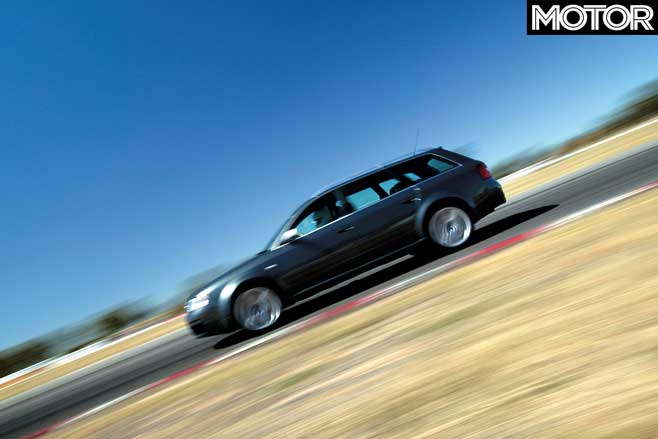
When the judges tallied their bananas, the RS 6 sat atop the league table with a firm grasp on the minor premiership and an eye on the championship. But when the finals began, not a single judge voted for the RS 6 in first or second place, and three completely ignored it for third as well. Despite its crushing performance and the ease of extracting said performance, the RS 6 ultimately failed to dazzle like the CSL or Gallardo.
There was an argument that if you could have but one car from this year’s field, the RS 6 would make a very fine compromise between the mundane and the absurd. But as Taylor (M) said, you wouldn’t want your grandma to be able to pedal as quickly as you. And that was the final rub; both the CSL and Gallardo rewarded effort and skill, where the RS 6 rewarded you if you just showed up. We demand more of our Performance Car of the Year, and we kind of like it when the car demands a bit back.
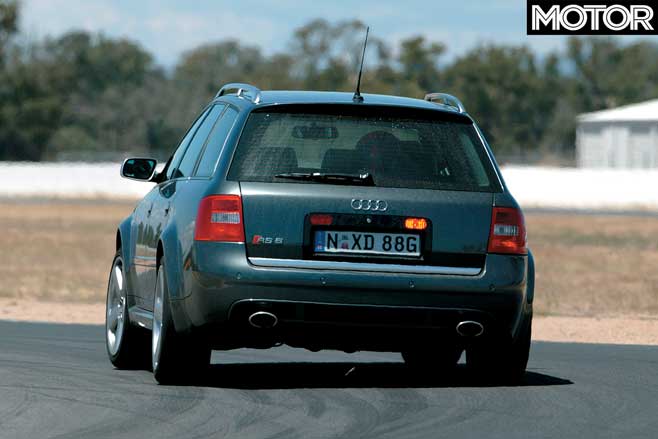
I’m sure there’s an Audi anorak sitting out there spitting chips right now, saying that had it been raining the quattro RS 6 would have romped away while the rest of the PCOTY field was being extracted from the scrub. Ah, no. You see, at the close of play on the hillclimb day, the heavens opened and we covered 60- odd kays back to camp over wet and twisting tarmac.
The rear-biased all-paw Lambo was still the fastest thing on the road and the near-slick-shod CSL wasn’t the nightmare its driver feared. Only the genuinely frightening CSV, playful Falcon GT and the front-drive Alfa and Astra had trouble with powerdown.
The four third-place votes were enough to secure bronze, but it took two very special cars to relegate the RS 6 to the last step on the podium.
Braking Point
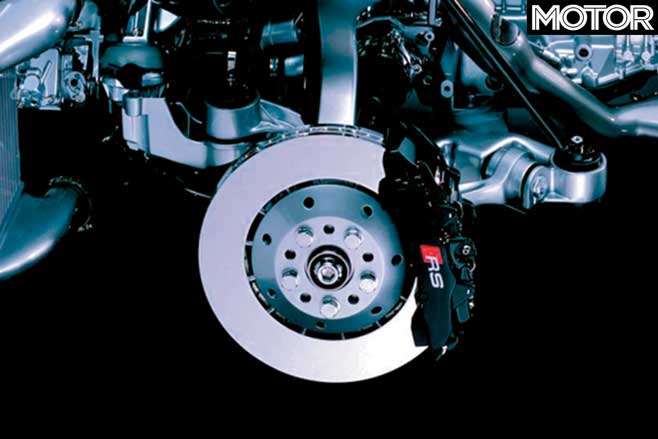
With Lamborghini owned by Audi, does it surprise you that the thunder-wagon RS 6 and Lamborghini Gallardo use exactly the same size brakes front and rear? That’s right: 365mm front rotors and only marginally smaller 335mm discs down back. The only difference is that the Gallardo gets cross-drilled rotors, and they’re 5mm thicker.
The front calipers are also similar, each using massive eight-piston jobbies. Only when it comes to the rear calipers do things finally differ; the RS 6 makes do with single-piston calipers and the Lambo’s rear uses the the four piston caliper from the front of its big brother.
PCOTY 2004 Results – 3rd
0-100km/h: 4.92sec 0-400m: 13.08sec @ 172.3km/h 0-1000m: 23.96sec @ 224.9km/h Top Speed: 266km/h Winton Lap Time: 1min 42.09sec
Judges’ Scores
| Judge | MT | JT | DE | CM | GK | DM | LB |
| Performance (/20) | 19 | 20 | 18 | 19 | 18 | 18 | 19 |
| Dynamics (/20) | 17 | 17 | 18 | 19 | 16 | 14 | 17 |
| Driveability (/20) | 19 | 20 | 20 | 18 | 19 | 20 | 19 |
| Design & Function (/10) | 9 | 9 | 9 | 9 | 8 | 10 | 9 |
| Value (/10) | 7 | 6 | 9 | 7 | 8 | 5 | 9 |
| Total (/80) | 71 | 72 | 74 | 72 | 69 | 67 | 73 |
Total Score: 498/560 Votes: 4 x 3rd
Does anyone recall a time when two blokes with a truck were just removalists, rather than ‘relocation solution providers’? It’s become one of those inescapable business buzz-terms, and everyone’s in on it. Your local coffee guy probably calls himself a ‘caffeine solutions provider’ on his LinkedIn page.
JET Charge, founded by 35-year-old former corporate lawyer Tim Washington, actually is an ‘EV charging solutions provider’, but perhaps even more crucially, Washington himself is a human-powered solutions provider. Where you or I may see hurdles, Washington sees opportunities.
When naysayers throw up commonly held barriers to mainstream EV ownership in Australia, Washington has a steadfast, unshakeable determination to either hurdle over them or navigate around: “If we accept there’s only one way to achieve a zero-emissions transportation future – and that’s how I see EVs – then everything else is merely transitory; a distraction to arriving at that outcome,” he tells me.

We’ll work through some of those hurdles shortly, but first we need to understand just how JET Charge is succeeding where others before it (such as Israel-based start-up Better Place) have failed.
Washington was born in China, but was brought to Australia at the age of eight by parents seeking greater opportunity. He was a high achiever at Melbourne Grammar, went on to study commerce law, and would later land a job at a large firm practising commercial law.
“I didn’t hate it as much as my colleagues did,” he smiles.
That career was powering ahead when he opted to leave it to join his mother’s business, which had grown from a small clothing manufacturing and importing operation to a large-scale player contracting to sports apparel companies like Adidas and 2XU.
Eventually, the rising cost of Chinese labour put pressure on the family company, so Washington and his mother Julia took the radical step of exiting, and Tim found himself excited by the prospect of a blank tablet on which to chisel the next phase of his career. He figured he’d “give himself a year or so, not worry about making money; just find the ‘next thing’.”
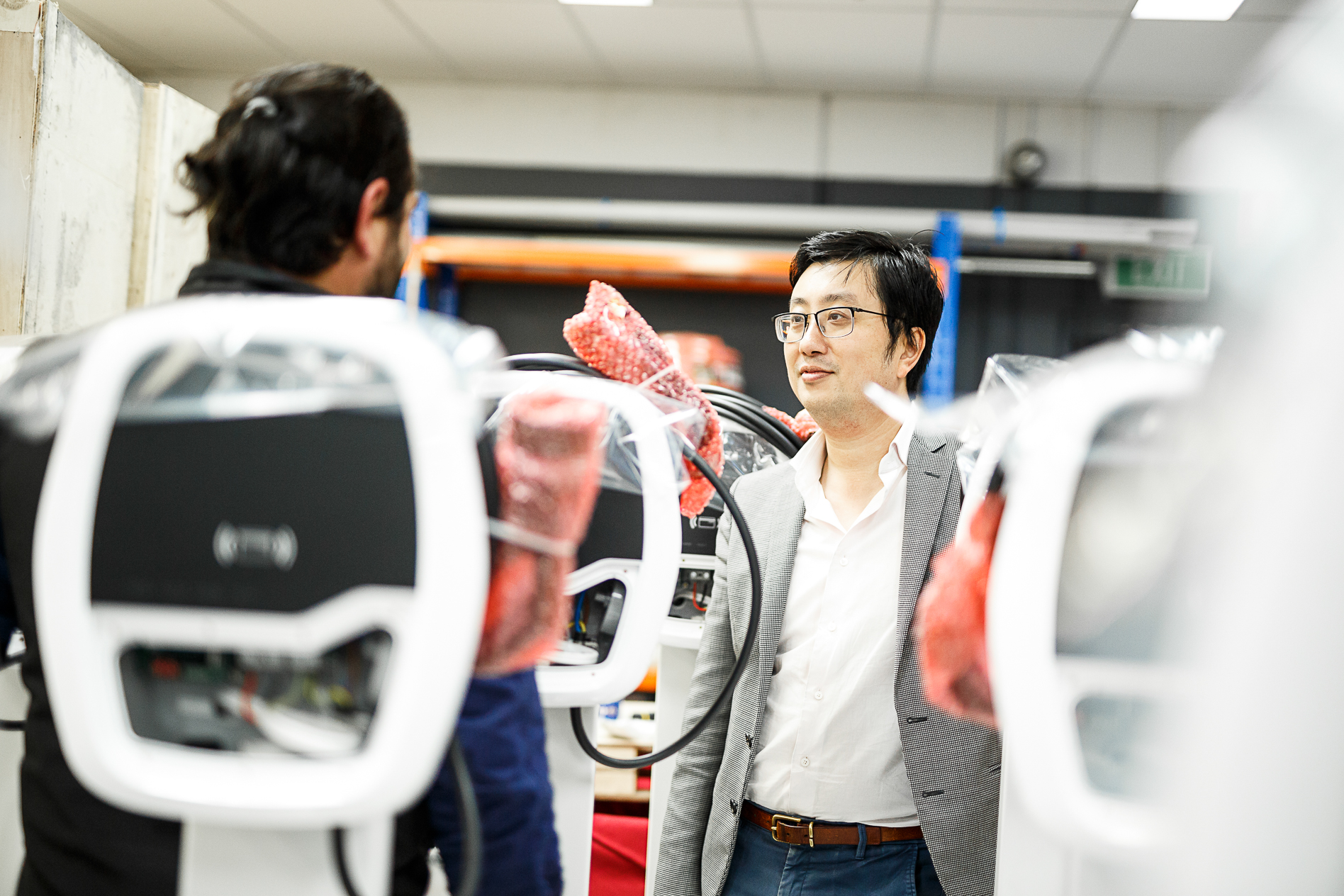
Whatever it was, he tells me, it had to be something that could make a difference. “My wife Ellen [also a lawyer] was adamant – she told me, ‘Tim, I’m not gonna bankroll you for just anything; it has to be something meaningful, something we’ll be proud of. You can’t just go and start another food-delivery app’.”
Washington had a passion for cars, a love of technology, and a sufficiently pragmatic business brain to not care about any perceived ‘sexiness’ factor in what he wanted to create. “I believe in tackling boring businesses because they’re not the shiny ones that everyone else looks for,” he says.
He could see, via the take-up of Nissan’s first Leaf, and the momentum behind Tesla, the inevitability of electrification in the automotive world. On a trip to EV-fluent Norway in 2011, the idea light bulb was fully lit.
“I came back and pitched the business idea to my friend Jay Robinson, who’s an electrician. I said, ‘Jay, I think there’s going to be a need for the specialist installation of EV charging.’
“Jay was like, ‘Sure, let’s do it.’ So we needed a name – ‘Power to the People’ was taken, so we took the first letters of each of our names – Jay, Ellen, Tim – and launched JET Charge in 2012.”
Despite the fact he had no real contacts in the automotive industry, and didn’t come from a trade background, Washington drew upon his considerable networking ability and business acumen to start seeking deals to be part of various OEMs’ ‘recommended installer’ programs.
Securing the Tesla account was a crucial early milestone, but wasn’t easy. “The only real way to get a line of communication [to the right people] was to buy one, so I pre-ordered a Tesla I still have today – a brown one. I was ‘reservation holder 166’.”
He installed a domestic charger, and gave Tesla staff a key fob to his home’s security gate and allowed them to use his charger as they ran their pre-launch test-drive program in the area. The business relationship and deal followed.
“That was fun; exciting, when Tesla first stared,” he reflects.

Still, the formative JET Charge was not exactly lighting the business afterburners. “We struggled for a long time because the market is so small,” he says. He recalls Aussie sales minnows like Holden’s Volt, the Panamera and Cayenne plug-in hybrids – “so it was slim pickings,” he smiles.
But then came Volvo, and a contract to handle the national dealer rollout to accommodate the hybrid T8. “That was the next milestone. Then we got Renault, VW Group, and the list grew.”
JET Charge would go on to tender for Nissan, securing charger supply and installation for 89 dealerships, as well as training and support. “We’re now the preferred installer for 13 brands,” he says, as if it was always a fait accompli. “We’re at 22 people now, and I feel like there’s significant room for expansion to meet our project pipeline.”
But then came the need for a separate business entity to handle both the development of IT technology for seamless, cross-provider billing and monitoring of electricity, as well as handling the larger, public-charger network installations that would be pivotal to real business growth. Hence the establishing (in partnership with software developer Cogent) of sister company Chargefox. Washington sits on the board and there’s close collaboration between the two businesses.
Chargefox secured $15m in 2018 to build Australia’s largest ultra-rapid network of 350kW chargers, via funding from the Victorian Government, as well as the various motoring organisations, like NRMA and RACV, among others.
But obviously Washington still spends plenty of time fielding media questions about whether EVs really are the automotive panacea to our transportation challenges. Common example: won’t greater take-up of EVs only shift the CO2 issue from tailpipe to power station?
“Okay,” he says, “but we have to ask ourselves, what’s the alternative? We can’t stick with the status quo. We need to be part of a transition, and the sooner we’re part of that, the better off we’re all going to be.”
But what about demand on the grid? Victoria was already stretched thin through this last summer with brown-outs…
“Yes, if unmanaged it will be a challenge for the grid – there’s no way you can add that much demand and not expect some issues at a localised level. But I want to see a future where EV charging is not seen as a stress to the grid,” he says, pointing to the Leaf’s ‘Vehicle to Grid’ capability.
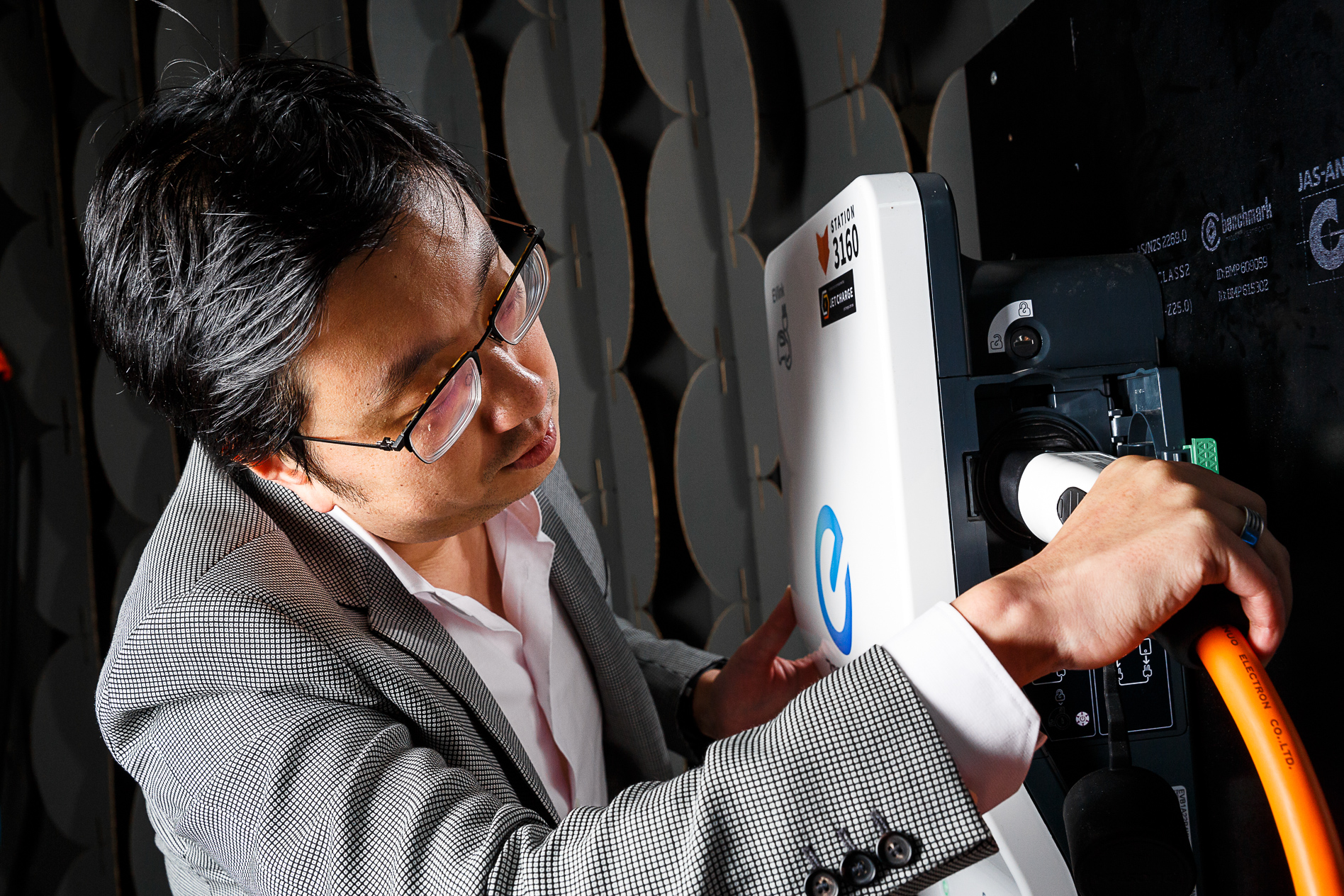
“In the UK, it’s about to become legislation that every home charger has to be Cloud controlled; that means you can be financially incentivised by the provider to use the charger in periods of lower demand. Without Cloud connection, the provider has no way to do that. Australia needs that tech for it to be controllable.”
As for JET Charge’s financial position, Washington won’t be drawn into revenue specifics, only to say that growth has been six-fold the 2018 financial year, and will double again over the 2019-2020 period. “We’re very optimistic about where we’re going,” he says.
So it looks as though his vision was well-judged. But far from seeing himself as a visionary, Washington sees himself a realist, just one bristling with commitment and determination.
“If you want to see where EVs are going, all you have to do is travel,” he tells me. “Look at what other countries are doing.”
As for ambitions to take JET Charge public, or undertake heady expansion plans, that’s not on the table.
“No, I want to work in the business for as long as I’m able,” he says. “I have a son; long-term, I want this to be a legacy business.”
As his wife Ellen said right at the start, “Any business you create has to do net good for society.”
And as everyone knows, wives are always right.
BIGGEST SURPRISE – Aston Martin DB11 AMR
In an ideal world, motoring journalists shouldn’t have expectations and thus there would be no surprises or disappointments. Each product would be approached with an open mind, but we’re only human and inevitably information and experience combine to paint a picture of what a car might be like before you’ve sat behind the wheel.
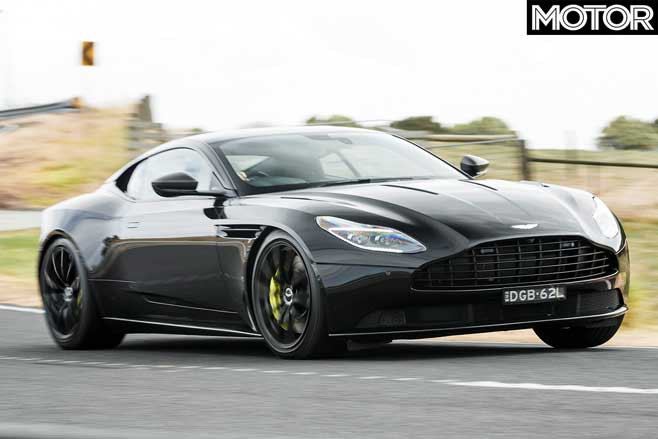
Sometimes a car is less than the sum of its parts, yet happily the reverse is also true. Occasionally, a certain model belies its spec sheet to overachieve, and no car did a better job of that than the Aston Martin DB11 AMR.
Information and experience. In this case the information was that Aston Martin had applied many of the DB11 V8’s sportier chassis settings to the DB11 V12 in order to create the more focused AMR.
Experience of both models didn’t suggest that this was a great idea. The V12 DB11 is a beautiful grand tourer; a little soft when driven really hard, but the balanced handling and great ride quality more than compensate.
The V8 certainly sharpened the DB11’s handling, but introduced an unwelcome terseness over bumps without really turning the sizeable coupe into a true sports car. Hence there was the possibility Aston had attempted to gild the lily and in the process spoil what made the regular DB11 great in an attempt to make it ‘sporty’ – arguably a fool’s errand when dealing with something that weighs 1800kg and has a 5.2-litre twin-turbo V12 in the nose.
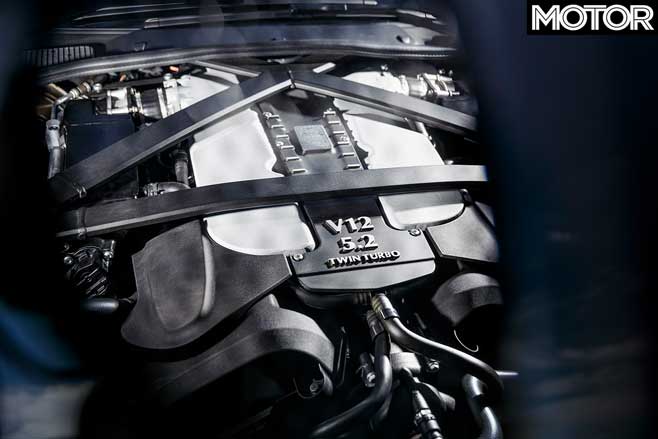
As it turns out, the DB11 AMR happens to be one of the sweetest and most finely judged machines around, a superb sports-GT that absolutely nails its brief.
There is a very small ride penalty to pay, but with the three-stage adaptive dampers set to Comfort it glides over most bumps. Crucially, the DB11 AMR feels to be tuned to work on the road and only on the road; flicking the dampers to Sport Plus doesn’t result in rock-hard suspension that rattles your teeth out and is only suitable for the track, instead reining in the DB11’s weight while still accepting bumps rather than springing off them.
It’s a very easy car to drive fast or slow, has an enormous amount of power (470kW/700Nm) and revisions to the exhaust make it scream like a supercar at high rpm. Add in beautiful looks, refined everyday manners and an interior that looks and feels special (bar the outdated Mercedes infotainment) and you have one supremely desirable Aston.
Most Improved – Mercedes-AMG G63
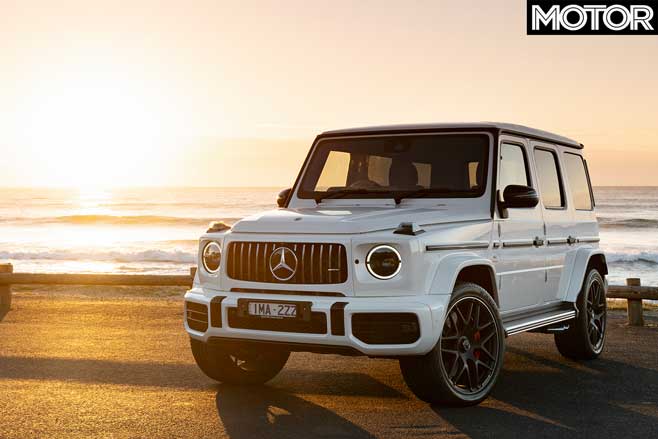
Let words not be minced: the dry-bitumen handling of the previous, ladder-chassis G63 was a right shame, not a bit up to the technology or power under the bonnet. But, partly by fitting independent front suspension, they’ve fixed all that with the new one – it actually goes around corners properly now! A true night-and-day improvement.
Biggest Disappointment – Ford Mustang GT Auto
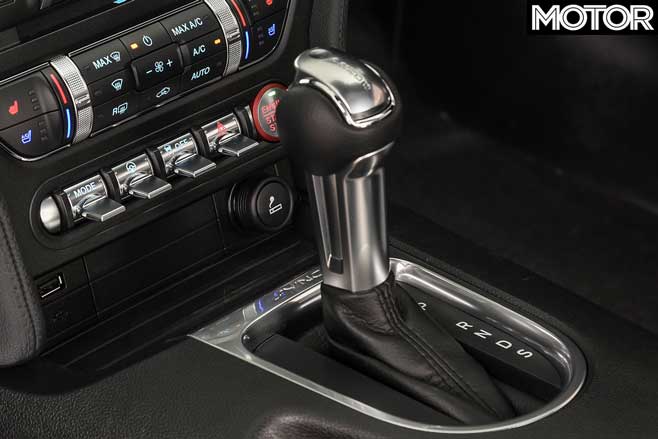
Attempting to drive an auto Mustang on track is like being shown a huge chocolate cake and only given half a mouthful. Still tasty, but the experience is fleeting and you’re left wanting more. At BFYB this year, the GT couldn’t complete two laps before heavily restricting revs to keep temperatures under control. There is a fix, but you’ll need to turn to the aftermarket.
There’s something to be said for the Mazda CX-3’s ability to stand tall against some of the newer competition it faces in today’s small SUV segment. Sure, it’s had some help along the way since its late 2014 debut, but the minor updates to CX-3 in that time haven’t really changed a whole lot. Yet, it still sells well, and ranks highly in comparisons. What’s the secret to its continued success?
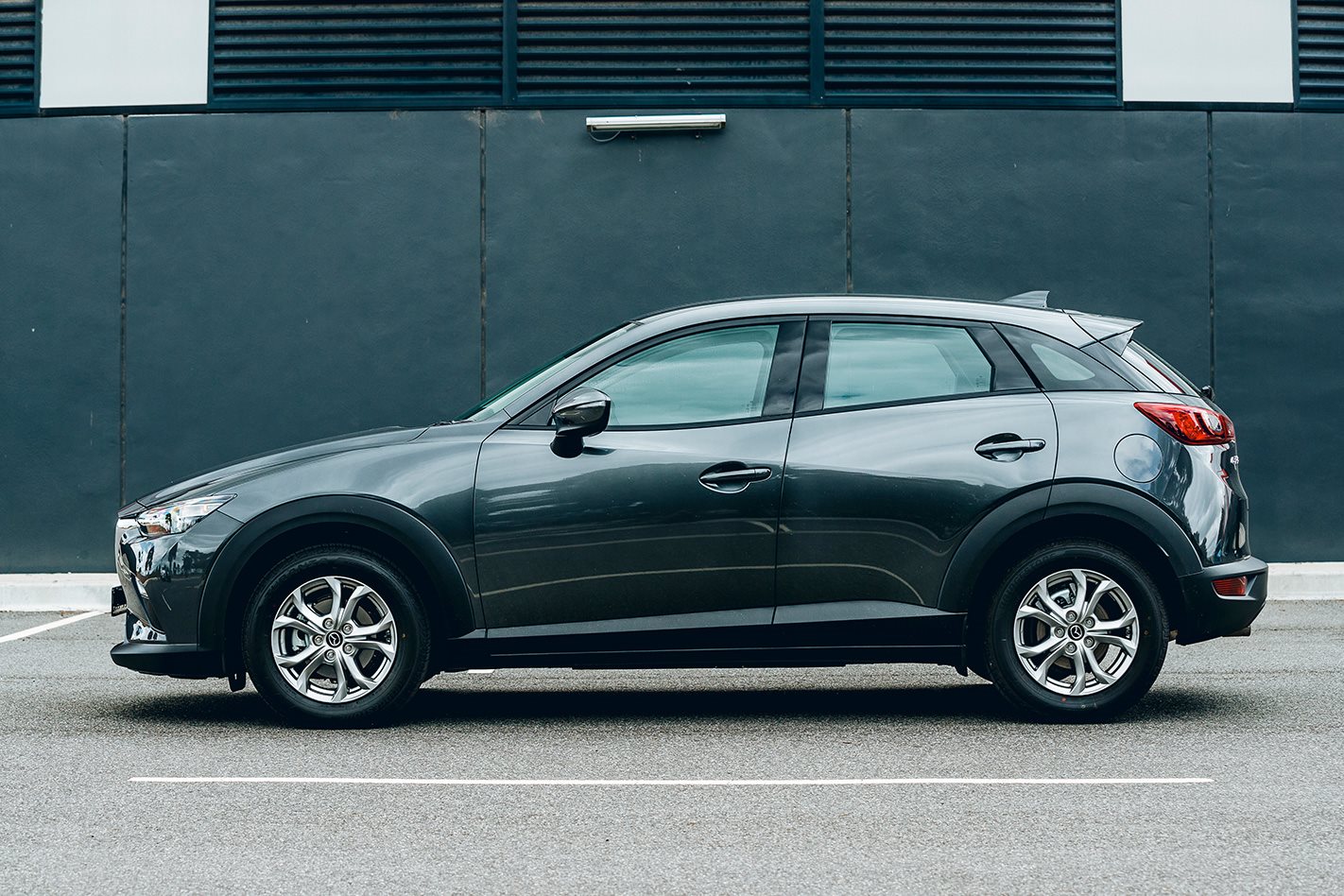
What is it?
The CX-3 first arrived on Australian shores in 2015 and since then has enjoyed consistent success in Australia’s new car market while, as mentioned, changing very little in that time. We have one of the most affordable variants on test, the CX-3 Maxx Sport automatic with front-wheel drive, priced at $26,650 (before on-road costs).
The entire range comes standard with autonomous emergency braking, six airbags, a 7.0-inch touchscreen, reversing camera and push-button start, but the Maxx Sport also gets a couple key features in addition to the base level Neo Sport. Blind spot monitoring, satellite navigation and a set of 16-inch alloys are all included in the Maxx Sport.
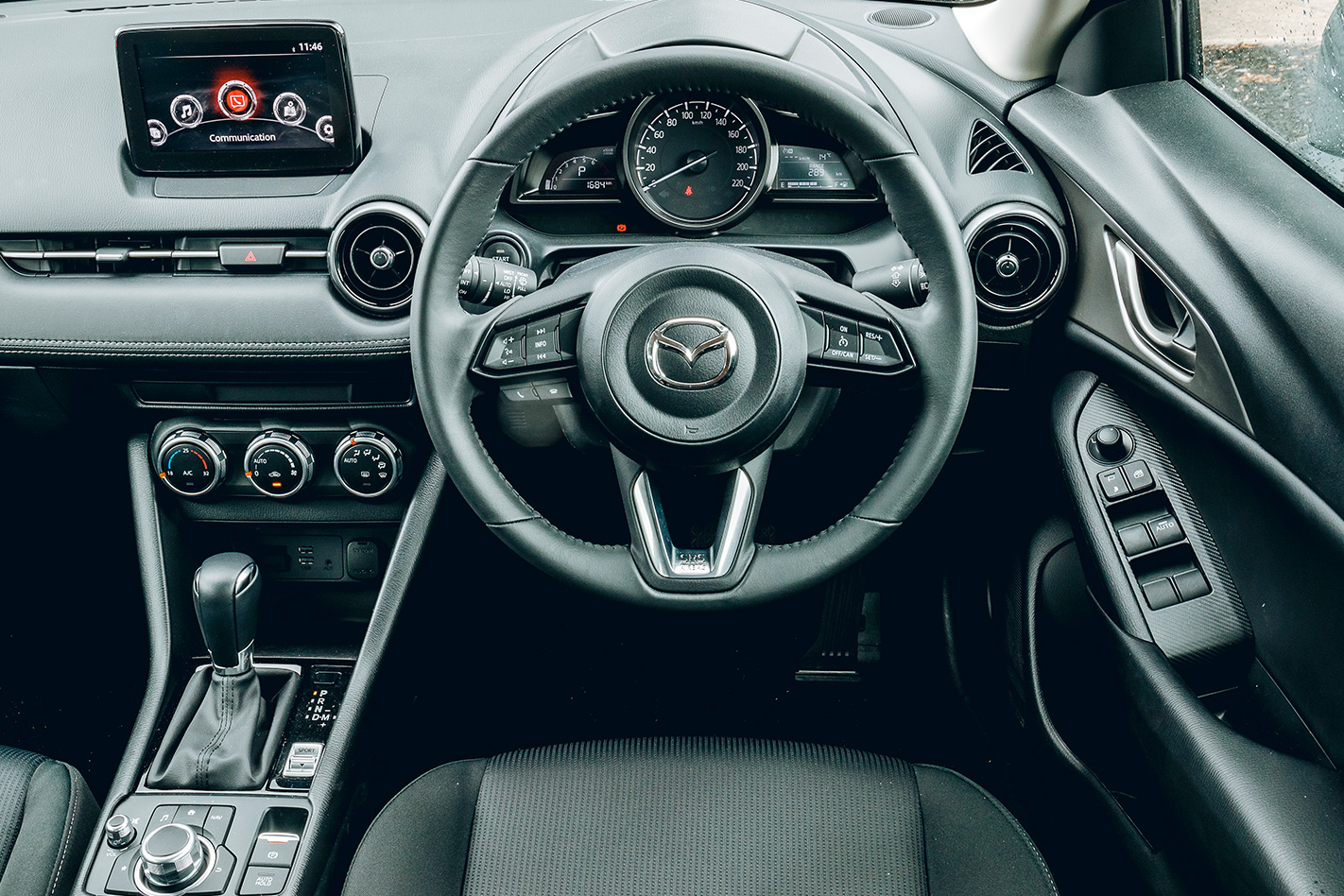
Our CX-3 Maxx Sport is supplied with a 2.0-petrol engine (diesel is offered elsewhere in range) and a 6-speed automatic transmission and has outputs of 110kW/195Nm.
What is it like to live with?
Time spent with the Mazda CX-3 is generally pleasant, especially the smaller your family is (we’ll come back to that point). The interior is very intuitive and the infotainment is simple to interact with, while hosting all the functions you could want.
For its age, the interior on the whole still feels of high quality too, with Mazda’s well-designed MZD Connect infotainment system taking pride of place on the dash and choice materials combining to make the space feel as though it’s punching above its weight class.
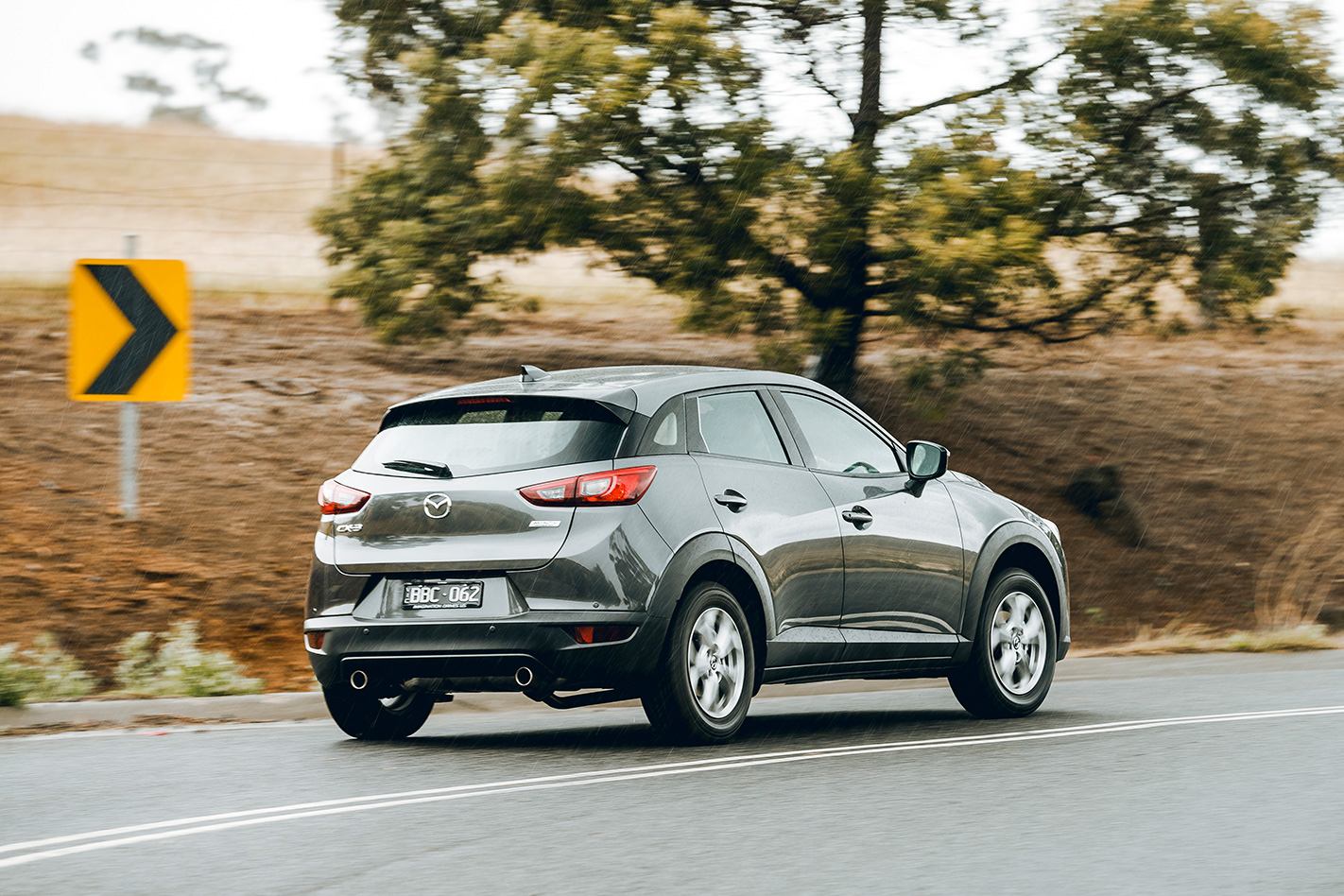
The cloth seats are plush in both rows and provide good side bolster support, but can be tricky for larger folk to get comfy. The leather bound steering wheel feels lovely in-hand and ties in with a clear central speedometer flanked by a digital tacho.
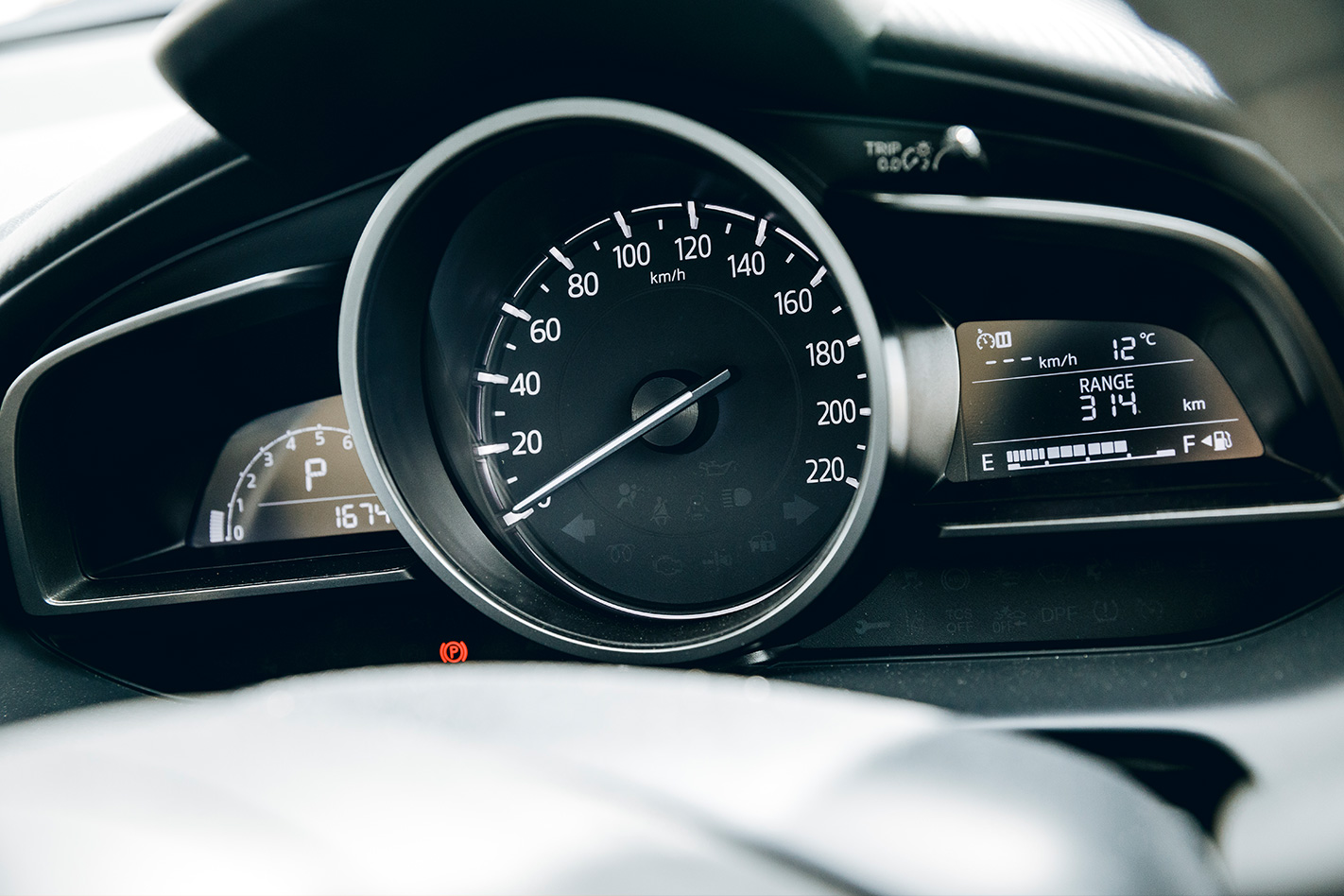
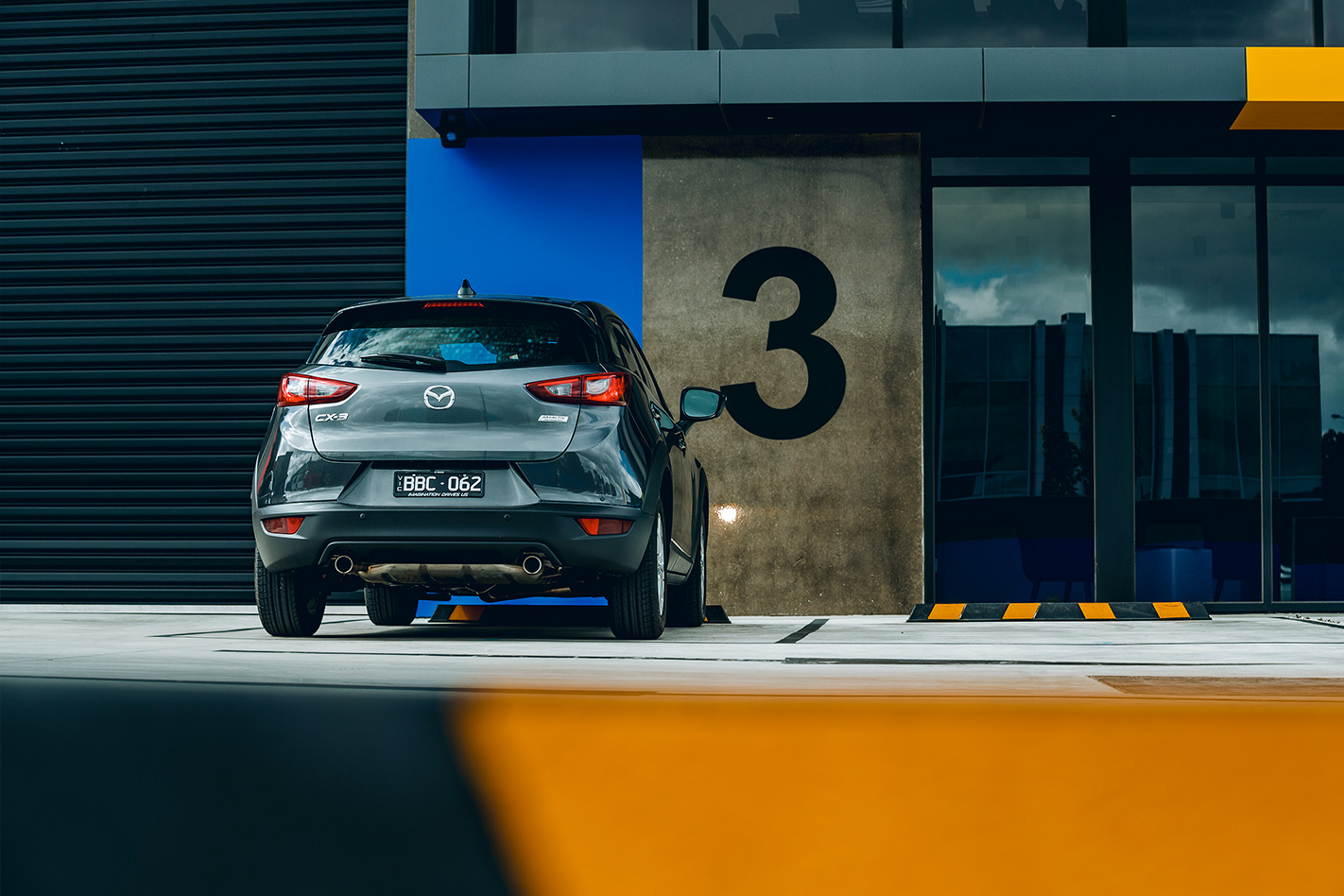
Where the CX-3 equation starts to sour is right about the point when you jump in the back seat. It’s not unbearable by any means, but it is cramped and knees do hit seatbacks (albeit soft seatbacks). There’s not much in the way of amenity in the rear too, aside from a centre armrest and a bottle holder in each door. It also has the smallest boot on test, offering up a paltry 264 litres.
What is it like to drive?
Chief among all attributes that make the Mazda CX-3 one of the better small SUVs is its entertaining drive. Natural steering feel and a keen ability to hook into corners rather than just tolerate them made sure the keys to the CX-3 were in high demand while it was on test, but its strong 2.0-litre powerplant is easily one of the most engaging of segment.
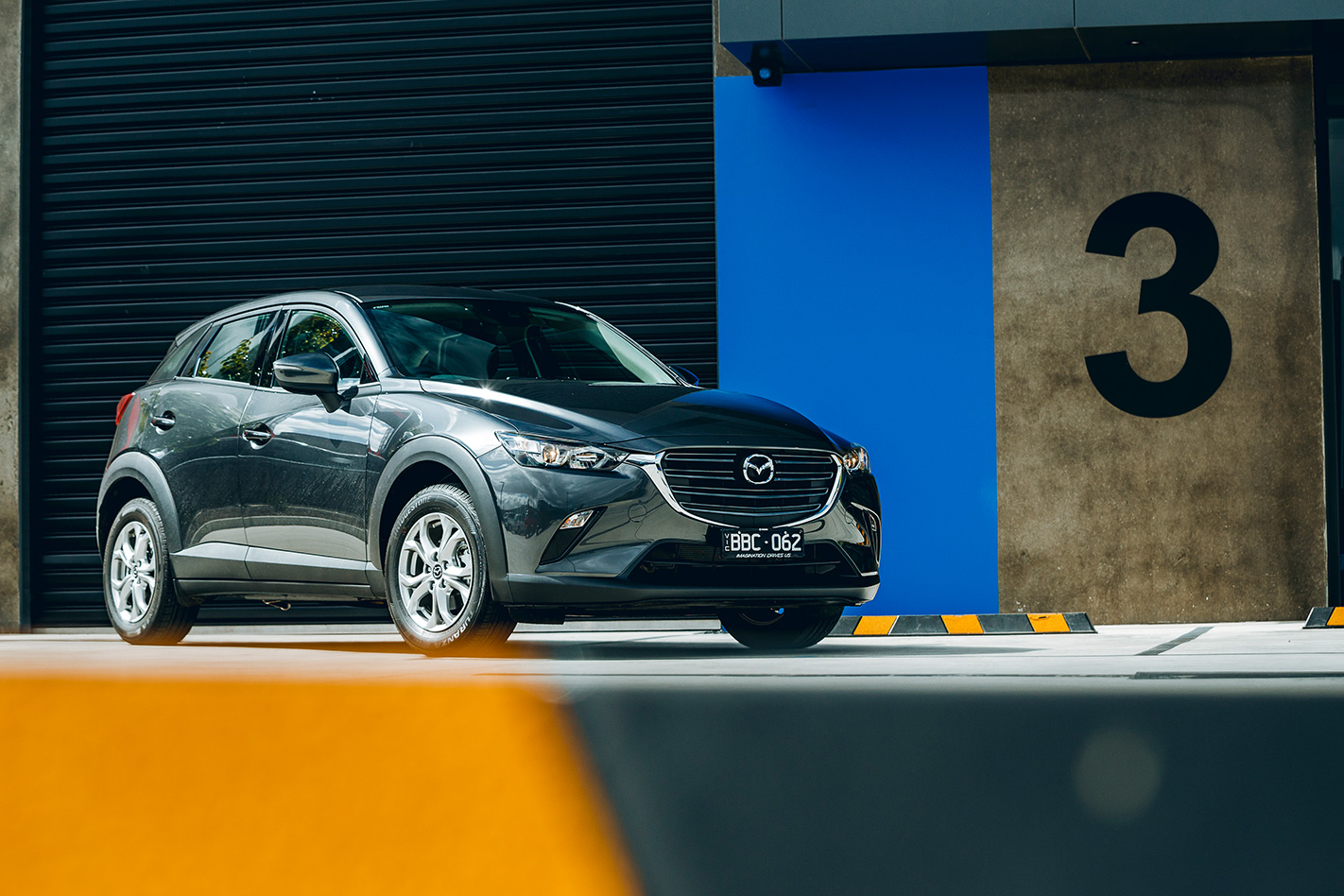
The CX-3 ekes out more than enough power for around town duties, and will even see you motoring out of town quite easily, thanks to its strong engine and comfortable ride quality. Its nose can tend to wander about over large bumps like a boat cresting a wave, but minor potholes and corrugations are taken care of smoothly.
When updating the CX-3 range last year, Mazda paid close attention to improving the value proposition by supplying extra kit in lower spec variants, but also focused on bettering the intrusive NVH levels. The net result shows a definite improvement in terms of road noise and ride control, but for all its merits, we can still draw a likeness between the engine’s whirr and a hairdryer.
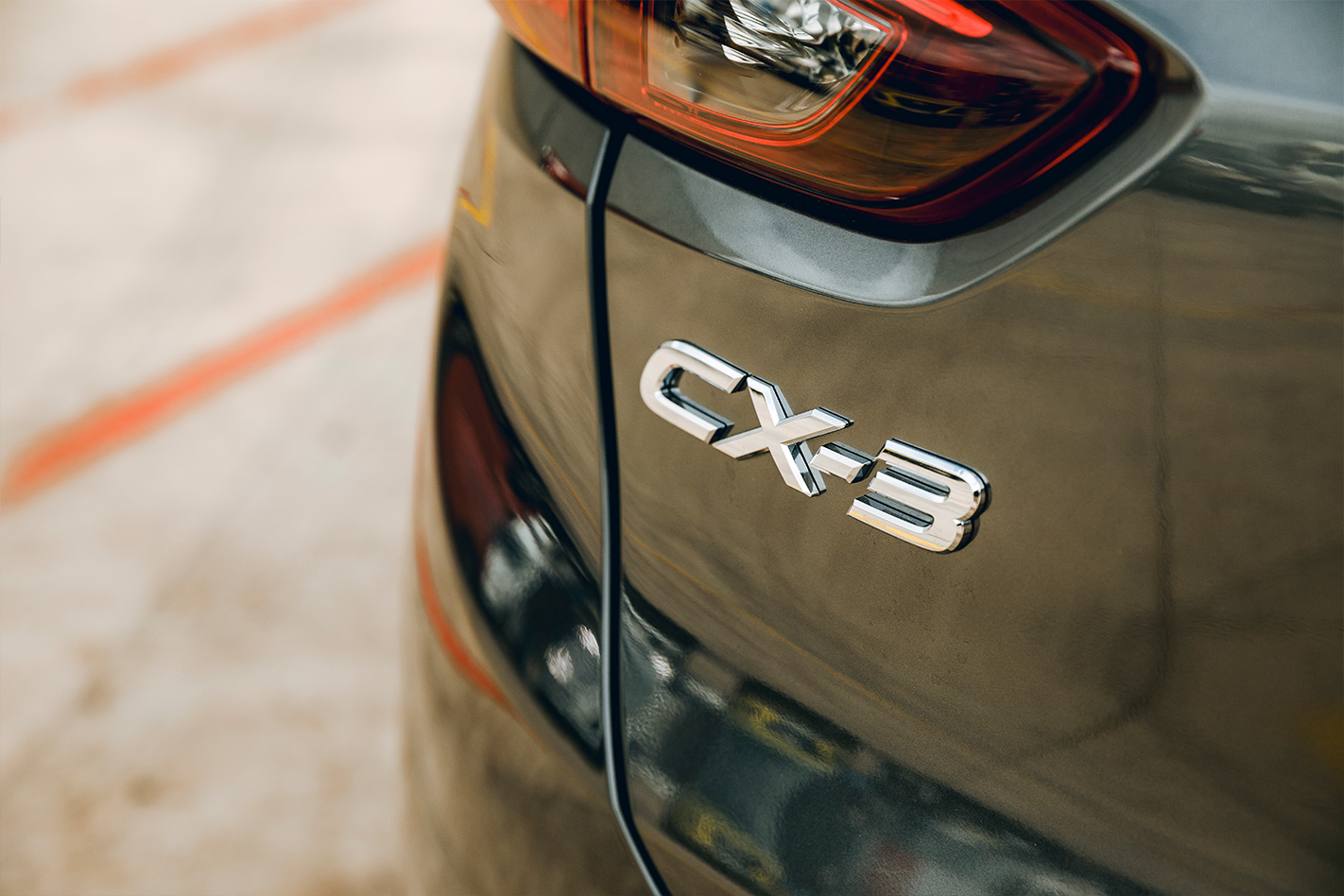
Interestingly, the CX-3 is one of few cars in its segment which includes start/stop tech to aid its fuel economy, helping it return showing an 8.7 L/100km fuel consumption. Conversely, a feature that we’d rather leave behind is the CX-3’s Sport Drive mode which did nothing more than hold onto revs for longer, hurting its economy.
Around bends, the CX-3 controls its weight much more like a hatch than any other SUV, staying flat through the twisty stuff with impressive ability.
Is it worth it?
The CX-3 is designed more for younger customers who don’t have a family to lug around; you don’t have to look hard to figure that out.
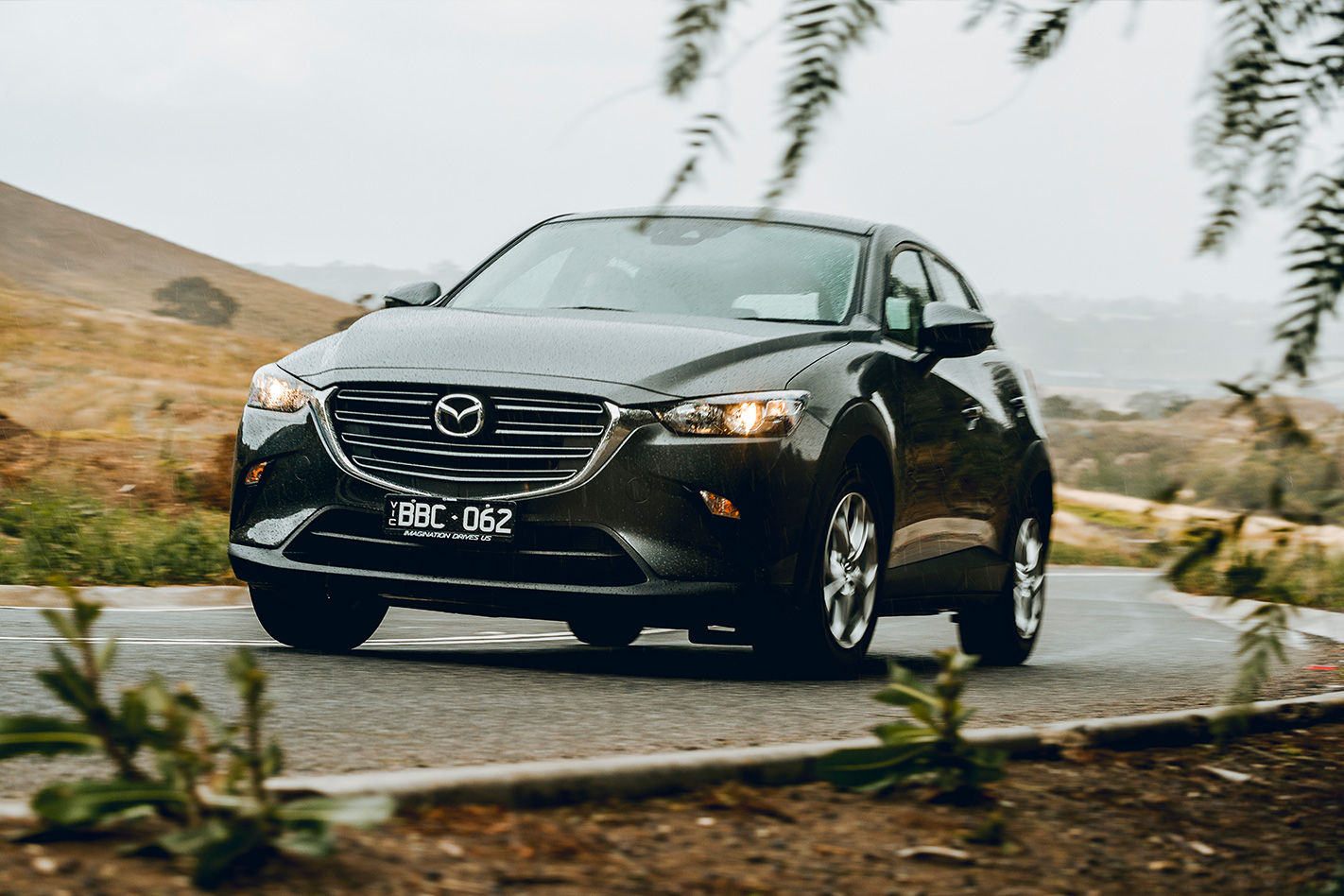
Despite the fact that it’s getting on in age now, it still feels well worthy of being judged favourably alongside its competition.
Look past its packaging woes and you’ve got an easy-to-live-with small SUV presenting a quality ownership proposition that can still take the fight to much newer rivals.
Pros: Drivetrain, cabin design, infotainment, performance, handling Cons: Cabin space, boot space, engine sound
Rating: 4/5
Second chances don’t often come around in the Australian motoring business. This is an unforgiving market that can see companies and models chewed up and spat out without a moment’s thought.
Hyundai knows this all too well. Its Genesis luxury sub-brand arrived in Australia in late 2014 comprising just a single large luxury sedan. The G80 (nee Hyundai Genesis) didn’t grab luxo buyers’ attention, struggling to sell outside the limo-driver market, and was eventually dropped.
But now Genesis is back for a second crack as a premium brand, and its letter of intent is the G70.
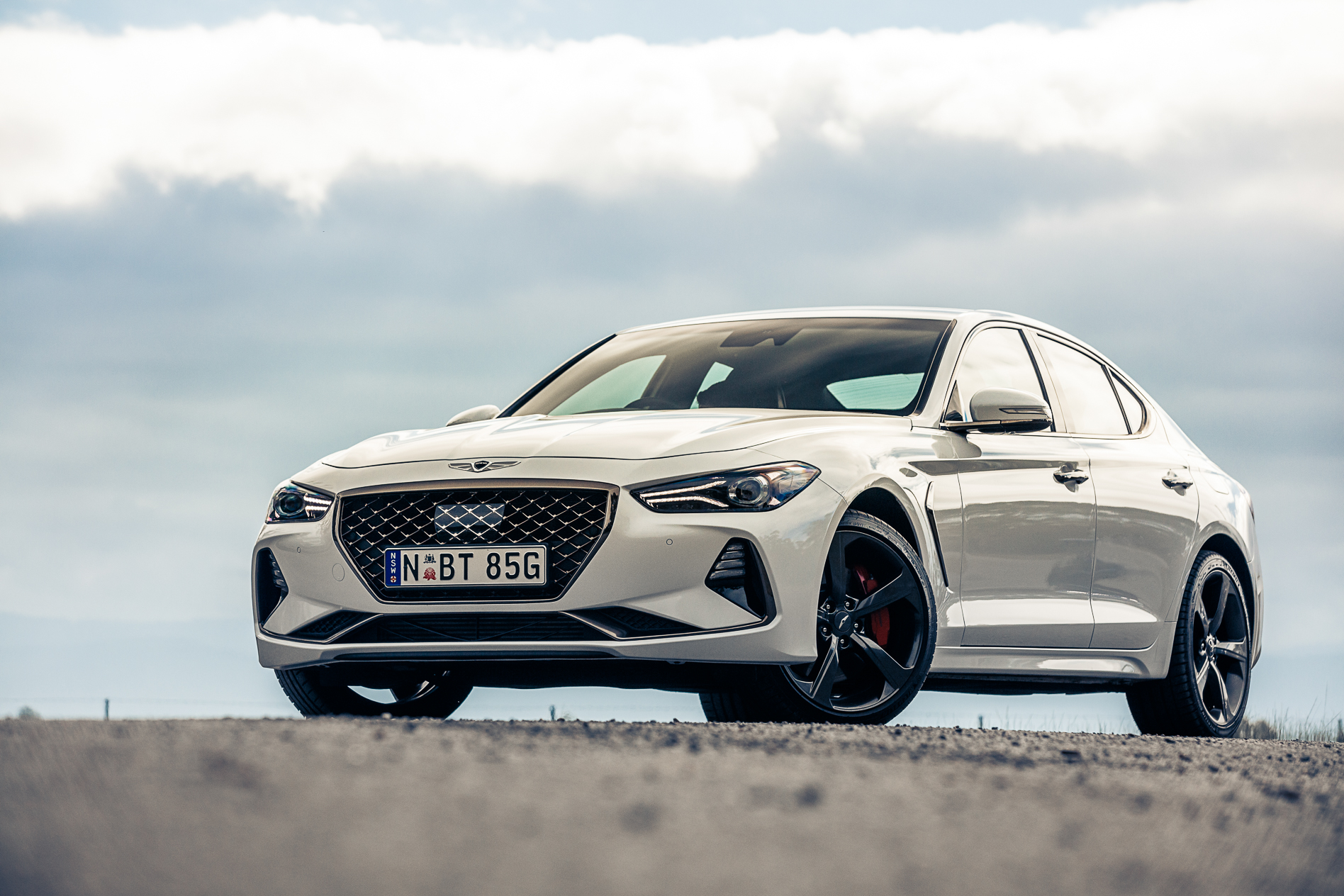
This midsizer is the real hero for Genesis, with a six-model line-up on offer, and a choice of two engines. We’ve skipped the 2.0-litre turbo four and gone straight for the 3.3-litre twin-turbo V6 in 3.3T Sport guise (at $72,450, the most affordable of the three V6 models) to take on the G20 generation of the BMW 3 Series, the seventh in a lineage that dates back to 1975.
In its first Wheels comparison test (April 2019) the 330i swatted aside three Euro rivals without raising a sweat. A Korean upstart with next to no luxury heritage should be no worries then, right?
Thing is, the Genesis is no regular rookie. The G70 breaks new ground, but with former BMW gurus Albert Biermann and Fayez Rahman taking care of its dynamics, and former Mercedes-Benz interior stylist Bozhena Lalova in charge of the finer touches, Namyang has assembled a crack team that makes Seal Team Six look like a pack of interns. Suddenly Munich’s assignment looks far from a foregone conclusion.
Pricewise, there’s barely $1500 to split them in un-optioned form. But while the Genesis 3.3T Sport carries a marginally more expensive at $72,450 list price, as-tested it’s comfortably the cheapest of the pair here as our car didn’t come with a single option. Ostensibly there aren’t any.
It gets the whole options list ladled in as standard. BMW Australia, on the other hand, raised the as-tested figure for the 330i by $6500 to $77,400 with only a modest run of box-ticking. Of the available options, only the M-Sport Plus package ($2000) is a must-have, bringing with it a proper limited-slip diff, sports suspension that lowers the ride height by 10mm, adaptive dampers, stronger brakes, and visual enhancements such as sportier bodywork and trim.
Standard equipment in the G70 includes Nappa leather seats, a 15-speaker sound system, a 360-degree reversing camera, adaptive cruise, AEB, lane departure warning, lane-keep with steering assistance, blindspot monitoring, front and rear cross-traffic alert, speed limit recognition, park assist, LED head- and tail-lights, an 8.0-inch touchscreen with smartphone mirroring for both Apple and Android users, heated seats up front, wireless phone charging, dual-zone climate control, and a 7.0-inch display nestled between the analogue speedometer and tachometer.
The BMW adds three-zone climate control, adaptive headlights with auto high beams, digital instruments and a head-up display, boosts the infotainment screen to 10.25-inches, but omits heated seats and Android Auto (while Apple CarPlay is only offered as an ongoing subscription).
Adaptive dampers, LSD and Brembo brakes are standard for the Genesis, while these performance upgrades only come via the aforementioned option pack for the BMW.
Based on a similar modular platform to the Kia Stinger, the G70 is shorter in both overall length and wheelbase. The 3 Series is on BMW’s ‘Cluster Architecture’, which brings with it hydraulic bump stops to improve ride comfort.
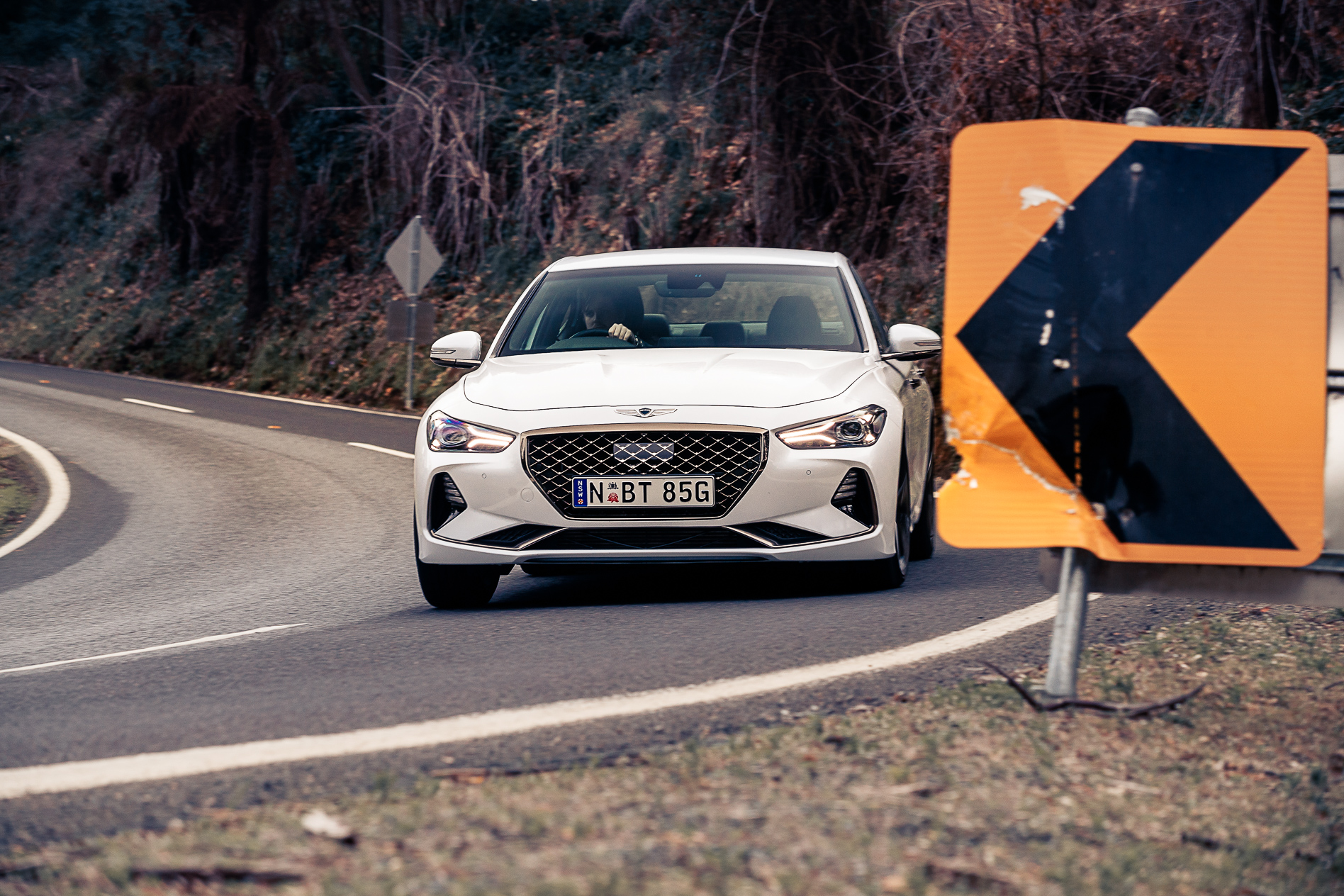
Both the G70 and 330i deliver a driving experience that highlight the inherent rightness of front engine and rear-wheel drive. But somewhat surprisingly, it’s the Genesis that’s the more dynamically adept of the pair, providing greater confidence on turn-in, settling smartly onto its outer contact patches, and then delivering its generous power to the ground on corner exit.
When dealing with mid-corner surface changes, the G70 excels, while the BMW requires small steering corrections to remain on line. Despite an identical 2.3 turns lock to lock, the 330i’s steering isn’t as alert as the G70’s off centre.
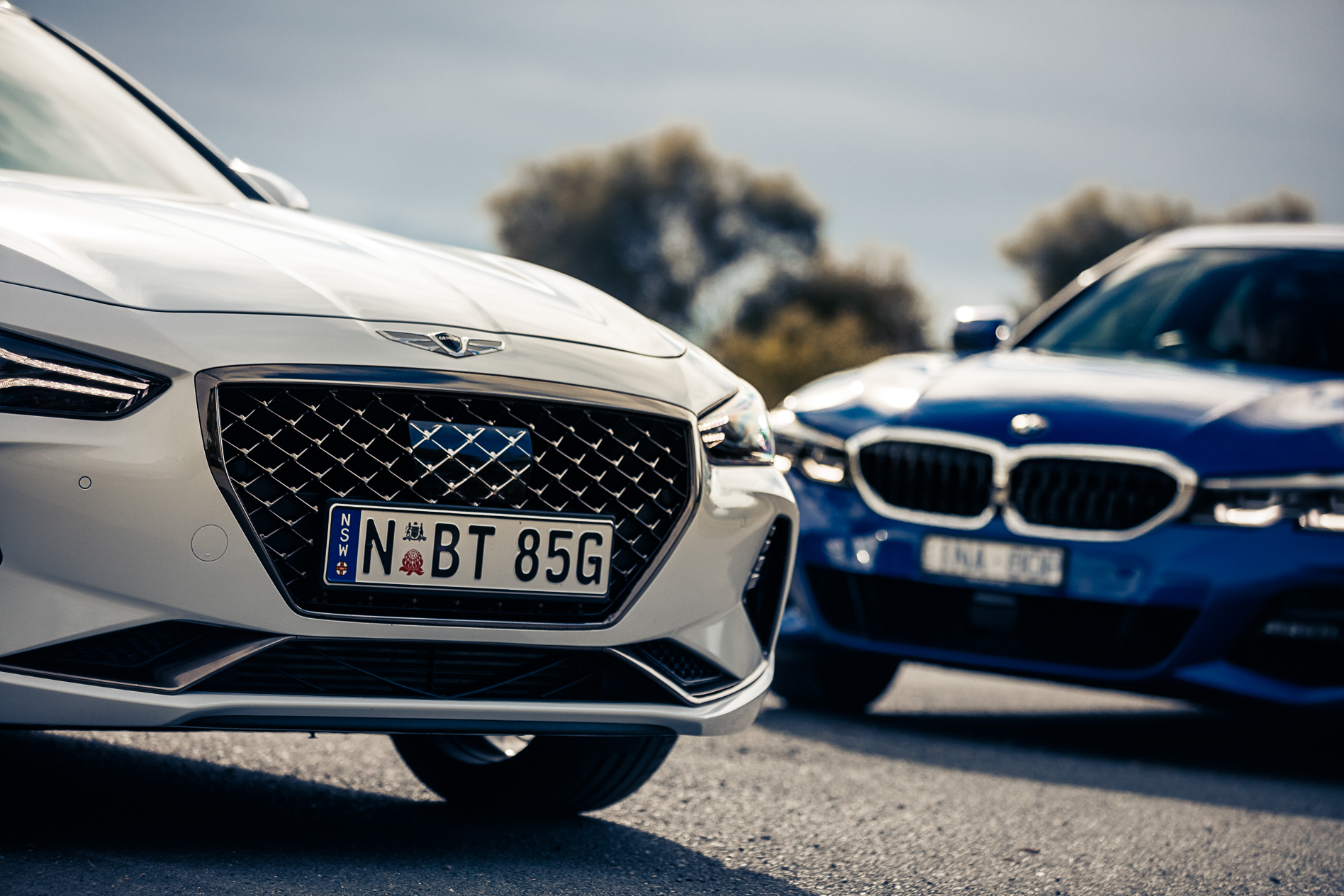
Yet as far as primary ride is concerned, the BMW edges the Genesis. The new 3 Series’ ride is buttoned-down yet superbly composed, with its hydraulic bump stops mopping up bigger hits. The G70, despite its locally tuned suspension from Hyundai’s Aussie engineers, feels less well resolved on genuinely poor bitumen, with more appreciable noise pathways into the cabin.
Move to engines, however, and a more predictable storyline unfolds, given the cylinder counts and capacity difference. The turbocharged four-cylinder in the 3 Series is the most powerful in the 330i badge’s history, producing 190kW and 400Nm, fed to the rear wheels via an eight-speed automatic gearbox.
But that’s a peashooter compared to what the Genesis is packing. The 3.3-litre twin-turbo V6 first appeared in Australia slotted under the bonnet of the Kia Stinger; here, the 272kW/510Nm powerhouse is mated to Hyundai’s own eight-speed automatic, instead of the ZF-supplied unit in the Stinger.
Its power advantage becomes abundantly clear the moment you press on, the Korean car thrusting you back into the seat with its great gobs of torque between 1300 and 4500rpm.
The svelte BMW enjoys an almost 200kg weight advantage, meaning it will sprint to 60km/h in the exact same 2.7 seconds as the Genesis. Beyond that, though, the G70’s grunt gaps the German. It ekes out nearly a second by the time triple digits appear (4.9sec vs 5.8 from 0-100km/h). The Korean is almost a second quicker across the standing 400m, with a 15km/h speed advantage across the line.
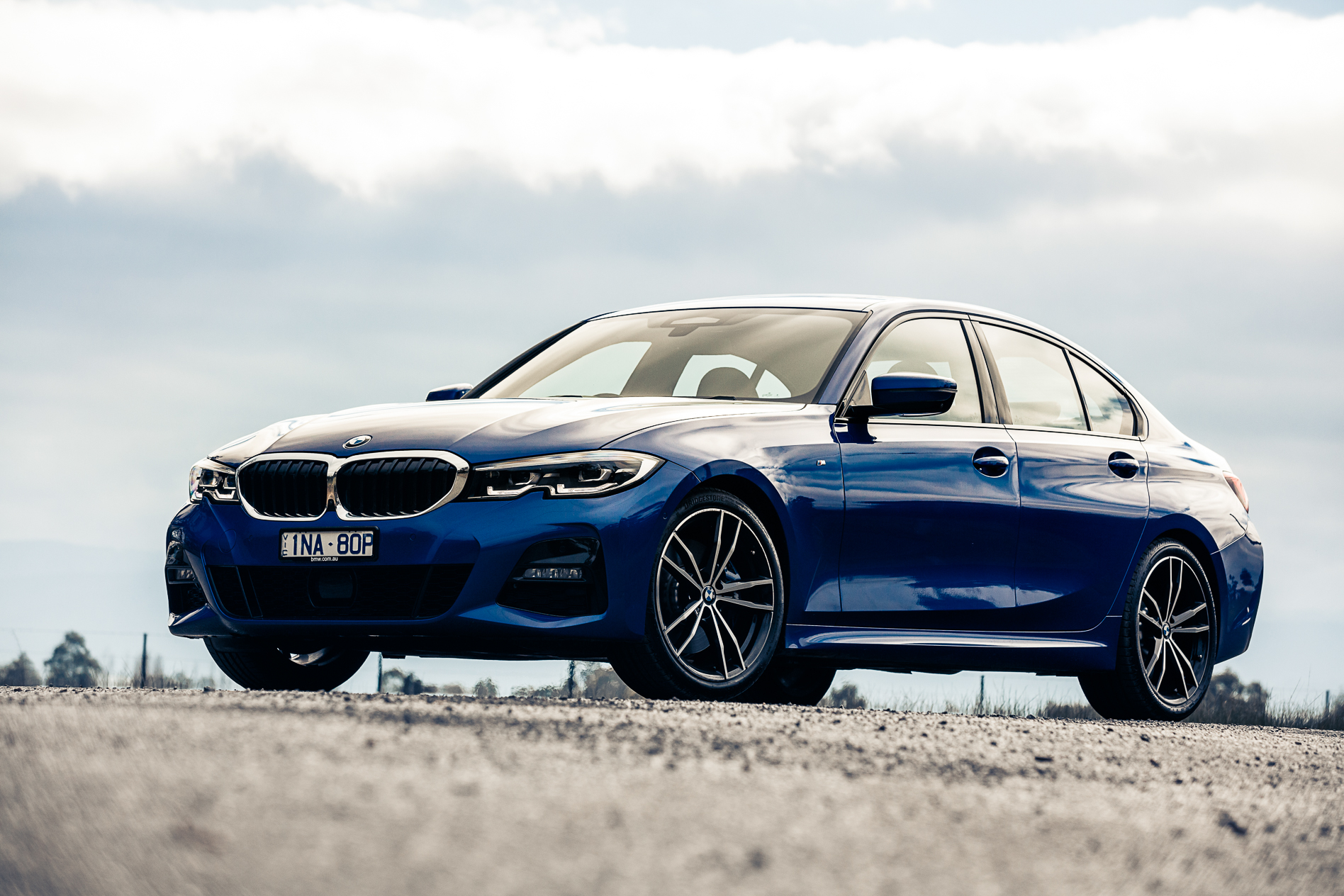
So while the Genesis is a level above in straight-line athleticism, the BMW still provides a real sense of urgency in its sprint, with the 2.0-litre engine revving harder to a 6950rpm cut-out (compared to the G70’s 6200rpm upshifts). The extra capacity, cylinders, and turbo bring a greater appetite for fuel, obviously, resulting in the Genesis drinking an extra 14 litres of premium unleaded during our 460km test.
Despite having been in the country only a handful of months as a stand-alone brand, Genesis is a tantalising option for customers wanting a luxurious ownership experience.Currently, there is only one standalone dealership, a showpiece studio in Sydney’s Pitt Street mall, which will be joined by similar spaces in Brisbane and Melbourne in 2020.
Test drives can be arranged at your work or home, while owners who live within 70km of a service centre can have their vehicle picked up and dropped off free of charge come service time, which is free for the first five years.
It goes further: Genesis offers a five-year warranty, compared to BMW’s three. That said, while you won’t be given the same pampered treatment, BMW owners do have the safety net of a comprehensive dealer network spread across the country.
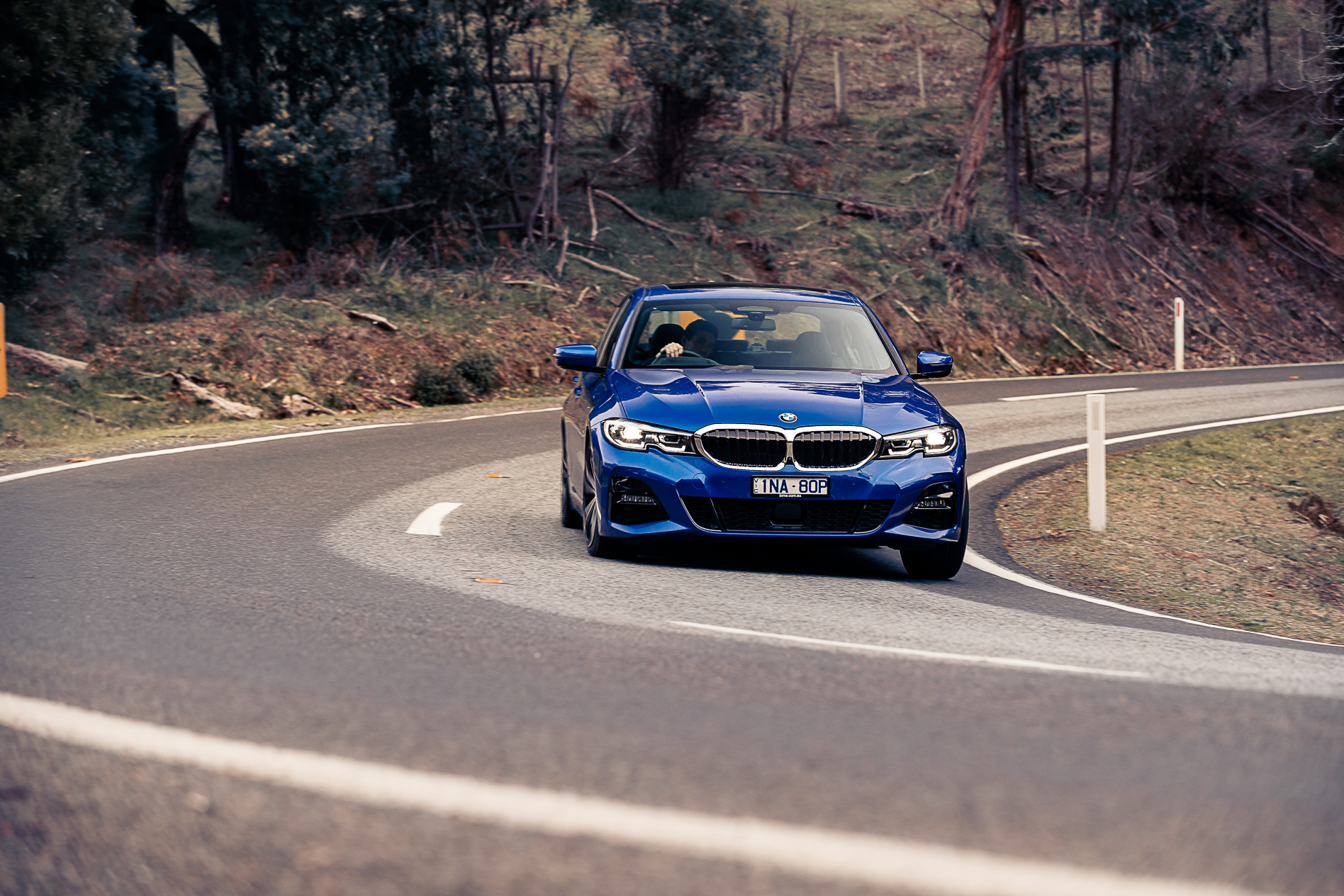
So it’s a close-fought battle, but the more polished and well-rounded BMW does enough to retain its spot at the top of this class… just. Surprisingly, though, the 330i is not top dog for the hard-charging driving enthusiast – that honour is snatched by the Genesis G70.
It’s a hugely impressive achievement to outperform the class leader on debut in an area that was previously the 3 Series’ USP. The G70 is more engaging to push hard, more resolved, and more predictable on winding roads with a fluid and satisfying character, while the BMW can feel – comparatively, at least – just a degree more aloof.
That’s not to say it’s in any way dynamically disappointing – quite the opposite – but the 330i just can’t reach the heights of the newly raised bar.
Where the BMW cements its narrow victory is via its higher-quality equipment and superior overall ambience. If you’re more concerned with substance, its far bigger boot must also count for something. It does a more convincing job of delivering a premium look and feel, while smartly managing the compromise between well-sorted handling and polished damping.
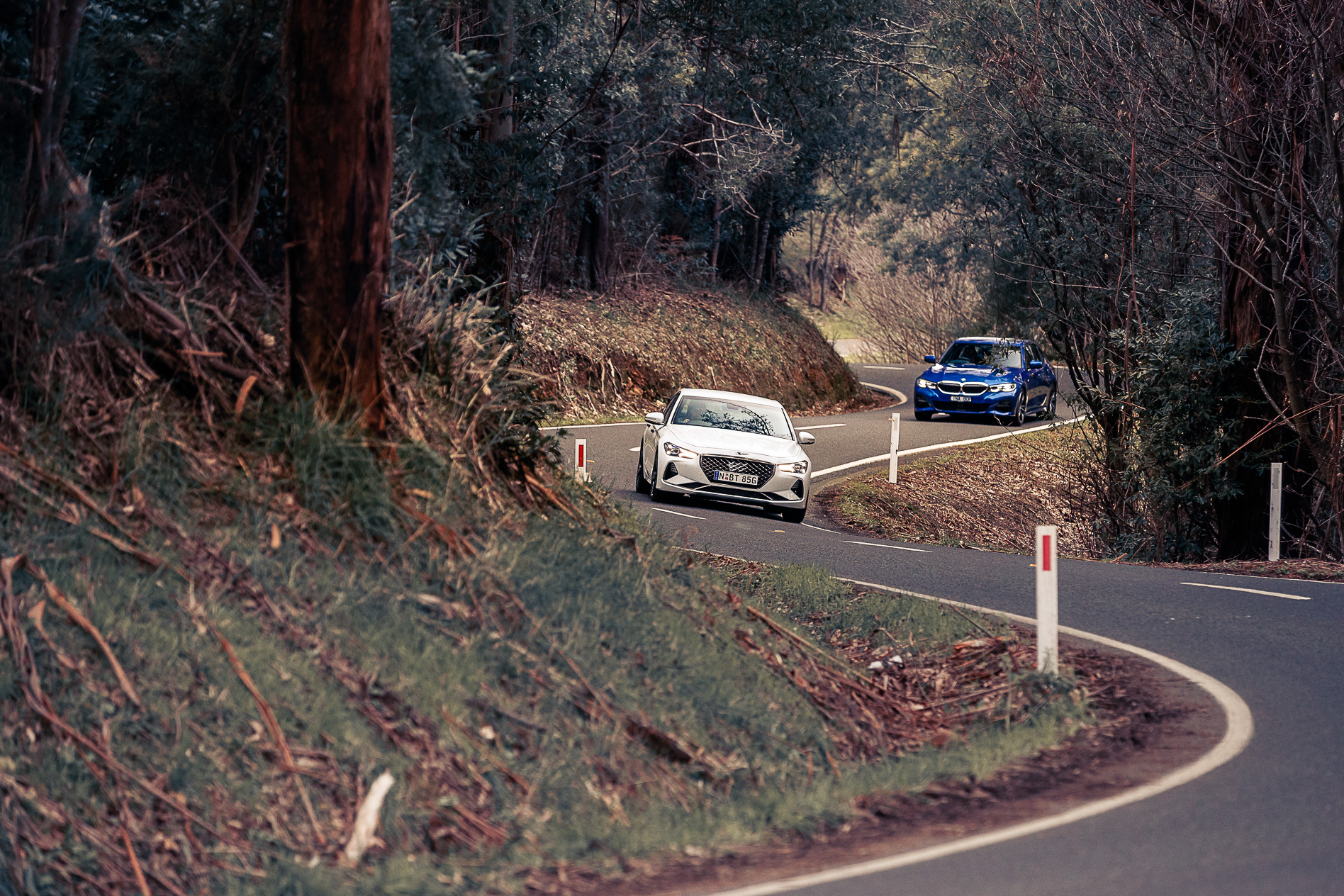
The ownership experience offered by Genesis will tempt enough customers towards the newcomer, and those who dive in headfirst will be rewarded with cracking pace and dynamics, but ultimately the BMW is the more persuasive day-to-day proposition.
Now, where did that winding road go?
The Nissan 350Z sneaked its way into the top six with a divided judging panel. Kable had it way down in eighth, MT had it one place better, and Dean and I reckoned it good enough for sixth place.
This feature was originally published in MOTOR’s April 2004 issue
Resident pro McConkin had it up the charts in equal fifth, while Morley picked it for equal fourth, placing it in front of the Lambo! Lucky Bastard pushed it a spot further into bronze, ahead of the M3 CSL.
When the Casio Scientific punched out the totals, the Zed had cracked the top six. Just. It sat just one point adrift of the BMW Z4 and a very narrow three points in front of the unlucky loser, Audi’s S4.
Big-hearted performances at Avalon and Winton certainly won the 350Z some friends. The acceleration numbers were only average, especially dropping a tenth to Mazda’s RX-8 on the sprint to 100km/h. But the radar-proven 251km/h, recorded right on the speedo’s 260km/h end stop, is serious stuff. And stopping from that pace proved a doddle for the bitey Brembos.
At Winton, the Zed impressed with a somewhat surprising fifth fastest time of the day (1:43.18), even pipping the bad boy Clubbie and finishing less than half a second behind the baddest boy CSV Mondo. For whatever reason, Winton seemed to suit the Nissan a bit more than the equally tight and technical Wakefield Park used at Bang For Your Bucks.
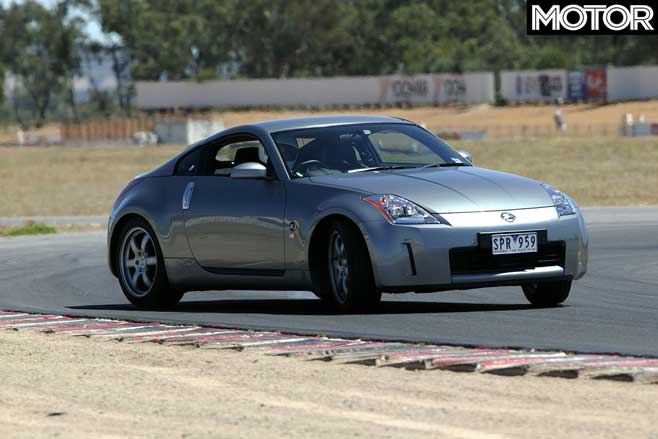
The front end still pushed around and the rear only came out to play with extreme provocation. Through Winton’s notorious Cleavage section, where turn-in grip and rear-end slip is the way to a quick time, the Zed was in a constant battle with mild understeer. P
ick up the throttle too early or with too much force and the rear would squat, the front would lift and the nose would push. Really provoke the rear and a few sooky degrees of oversteer would get you a frag more turn-in, but any tail-out action usually came on the exit of a corner.
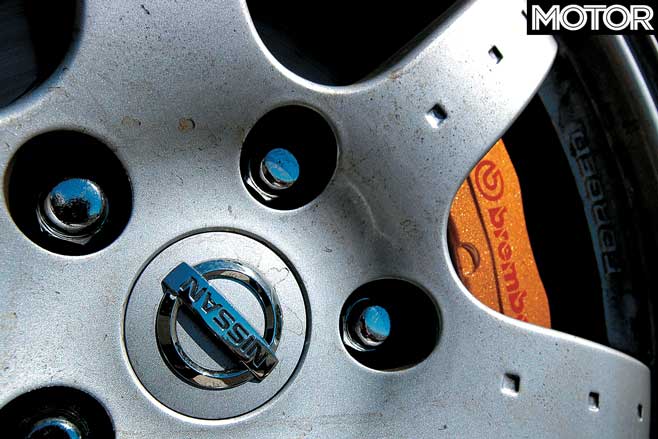
Even though it never inspired Cam on the track, he felt its tidy style went a long way to explaining the lap time. The tight six-speed ’box was a delight at Winton, with the next well spaced ratio just a wristy jab away. And the brakes again proved that the six grand difference between the Track and Touring models is chump change. Gotta have the Brembos, baby.
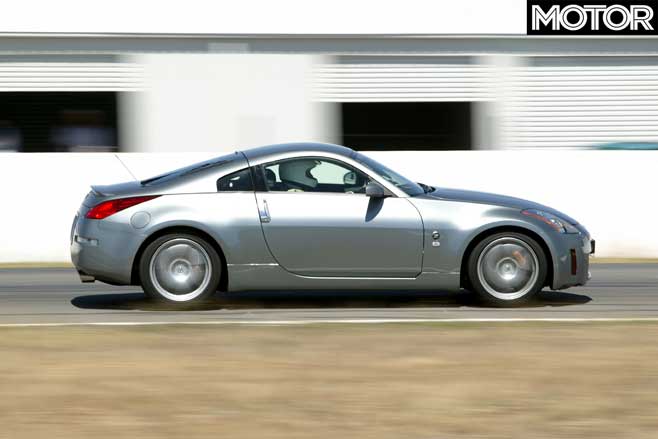
Most judges reckoned the road loop, with its typical mixture of Australian country road surfaces, would be the downfall of the hairy-chested and firmly sprung Zed. Instead, the little Nissan coupe displayed a surprisingly sensitive side, with more compliance in the rear end than we collectively recall. The torquey nature of the engine also earned praise in the real world, where at the track a few more revs from the big V6 would have been appreciated.
At $65,990, the 350Z Track is the cheapest car of our six sexpots, and that was one thing our seven good men and true could agree on. You get a bloody lot of car for your money, especially when you bring Mazda’s RX-8 and Chrysler’s Crossfire into the equation.
When it was time for the tribe to speak, the Zed earned a second-place nod from Punter and a third from Big Dave. This leapfrogged the Zed from sixth into fourth, just one step off the podium.
Balancing Act
We often talk of chassis balance, and here the 350Z is hardcore. The Z was specifically designed with a front-to-rear balance of 53/47 percent. This, apparently, offers the perfect balance when being driven hard, as more weight transfers to the front tyres to aid braking and improve turn-in response. As the Zed enters the turn and power is fed on, chassis balance shifts to around 50/50, until full power is applied and the bias shifts towards the rear, aiding grip and acceleration.
But it’s not just down to weight distribution, as the Audi S4 carries a similar 53/47 but understeers more, and the BMW Z4’s 50/50 balance handles very much like the 350Z.
PCOTY 2004 Results – 4th
0-100km/h: 6.68sec 0-400m: 14.61sec @ 159.6km/h 0-1000m: 26.31sec @ 206.2km/h Top Speed: 251km/h Winton Lap Time: 1min 43.18sec
Judges’ Scores
| Judge | MT | JT | DE | CM | GK | DM | LB |
| Performance (/20) | 15 | 16 | 14 | 16 | 16 | 14 | 17 |
| Dynamics (/20) | 18 | 15 | 17 | 16 | 15 | 16 | 17 |
| Driveability (/20) | 13 | 14 | 19 | 17 | 15 | 15 | 17 |
| Design & Function (/10) | 7 | 7 | 8 | 8 | 7 | 7 | 8 |
| Value (/10) | 8 | 7 | 8 | 8 | 7 | 7 | 9 |
| Total (/80) | 61 | 59 | 66 | 65 | 60 | 59 | 68 |
Total Score: 438/560 Votes: 1 x 2nd, 1 x 3rd
- DTM needs to evolve
- 750kW hydrogen cars could be the answer
- Gerhard Berger at the helm
However, in the same way WEC chose to evolve with its exciting new hypercar rules, DTM looks set to do the same – and the German Touring car’s proposed ‘concept’ rules are even more bonkers.
What are the new rules?
The sport only just introduced turbos, but the ICE looks to be kaput if these new rules are anything to go. Proposals by the formula’s ITR board have suggested the future is purely electric and hydrogen-powered racers, with close to 750kW – so they’ll be fast, and difficult.
Top speeds should be around 300km/h, and power-to-weight ratios should drop to the 1kW/kg mark. Challenging cars, indeed.
Chairman of the ITR and former Ferrari F1 driver Gerhard Berger explains: “With this concept, I want us to embrace that sensation of raw power; of racing at the limits of grip,” he said.
“Not just with 750kW under the driver’s right foot; but with a car equipped with the technology of tomorrow, and using models that demonstrate a clear lineage to the major automotive parent brands. This new breed of touring car will be incredible to watch, and fantastic to drive.”
Standardising components
In order to keep costs down, this vision of DTM would feature some standardised components: electric motors, power electronics as well as battery and fuel cells could be identical across the garages.
But while the cost-cutting benefits are obvious, it’s hard to see how each manufacturer can promote their own electric tech with so many oily bits shared. Still, it’s just a concept for now.
Robo pitstops
And we almost forgot. The new DTM could feature automated, robotic pit stops. Cars would have their tyres replaced by robots – eliminating the human pressure of tyre changes altogether, and robots could also replace depleted fuel cells and batteries during races. It’s just a concept, remember?
While some of this is exciting, other bits – such as the robotic pit stops have us scratching our heads. Still, necessity is the mother of invention, and DTM really needs to do something different before it’s extinct altogether.
Apply it to other series, like our own Supercars and Japan’s GT classes, and shared technologies could be the saviour of high-performance touring car racing across the planet.
