
What is the Volkswagen T-Cross?
Volkswagen may be a little late to the small SUV – or ‘crossover’ – party, but it’s bringing two exciting new babies to Australia in a bid to steal attention from the likes of the Mazda CX-3, Toyota CH-R and Mitsubishi ASX.
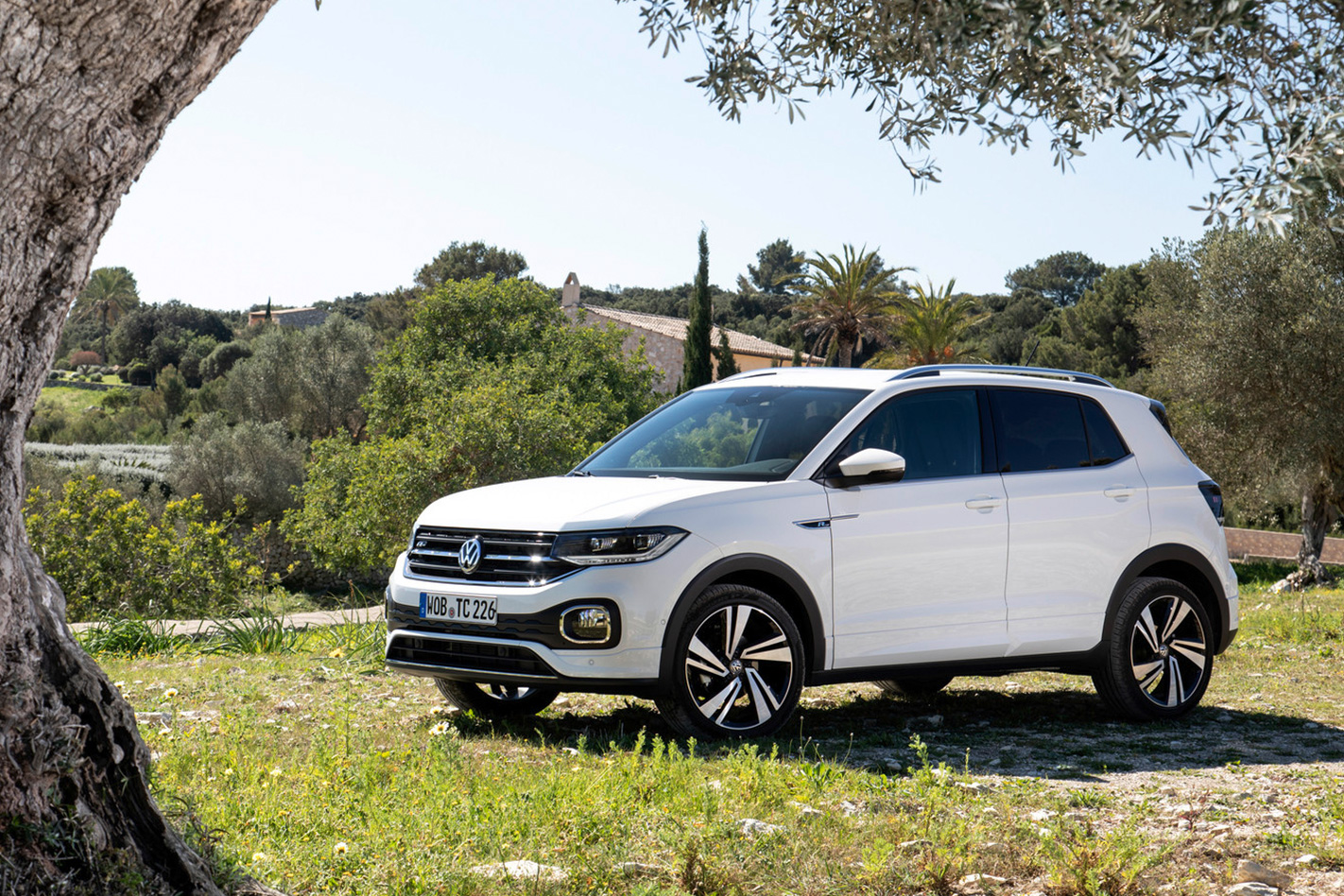
The more stylish Volkswagen T-Roc is the emotional half of that equation, but in this review we’re looking at the more pragmatic, and therefore more compelling, Volkswagen T-Cross.
To call the Volkswagen T-Cross an SUV is not strictly correct. Conceptually, it’s a crossover bridging the gap between conventional hatchbacks like the VW Polo and Golf and mid-size SUVs like the VW Tiguan. So it’s best to think of the five-door, five-seat T-Cross as a VW Golf on stilts with more interior space.
Volkswagen tells us the T-Cross will start “under $30,000” when it arrives in Australia in March or April 2020. It’ll need to be closer to $26,000 – or a touch more than a Mazda CX-3 Maxx Sport in FWD guise – to be truly competitive in this hotly contested space, or carry a lot more features and equipment.
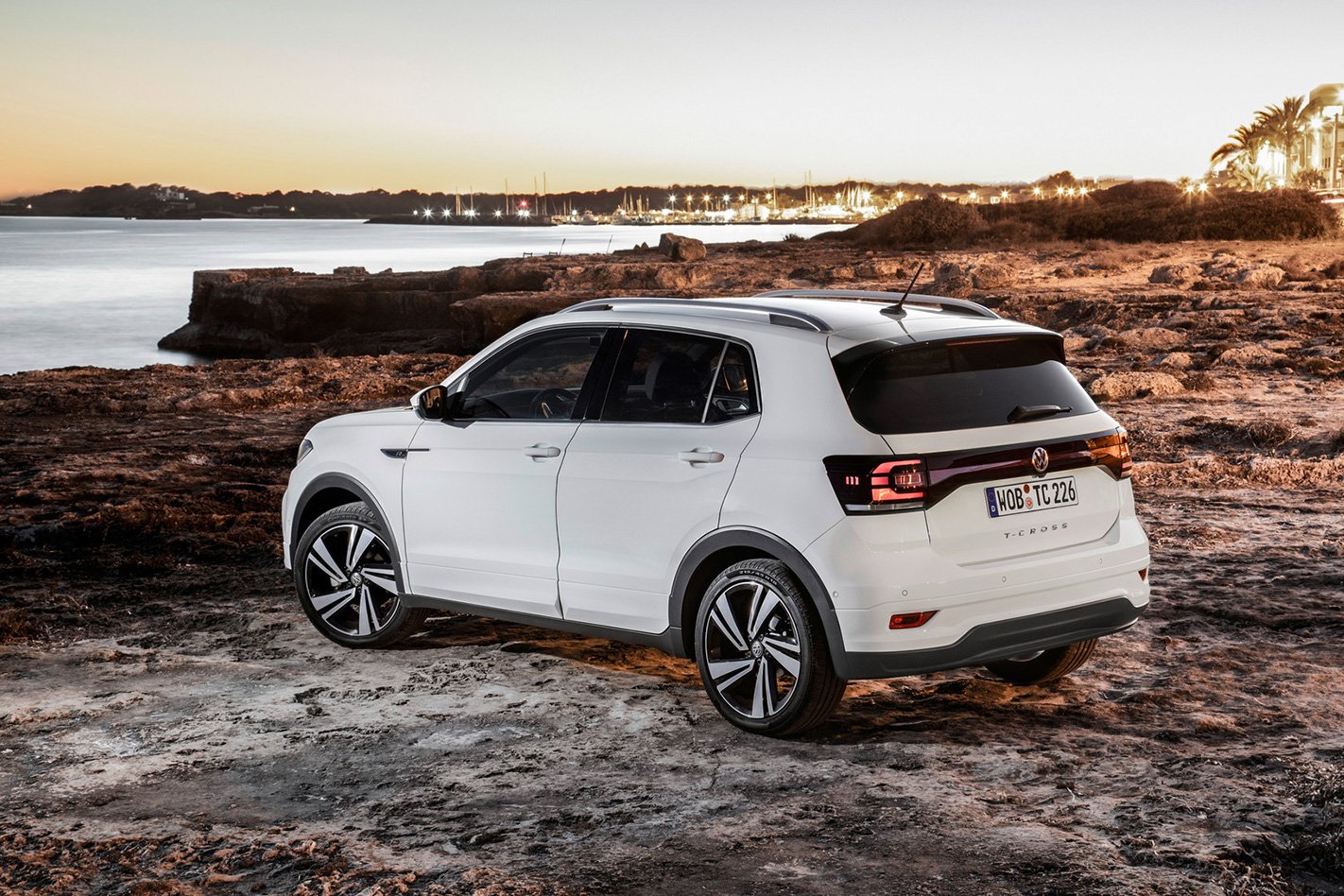
Two models will be offered, at least initially, both powered by the 1.0-litre turbocharged petrol engine we test drove in Germany in September 2019. Each variant will feature a seven-speed DSG automatic transmission and be front-wheel drive only.
What’s the VW T-Cross like to drive
It won’t come as a surprise to anyone who’s driven a late-model Volkswagen that the VW T-Cross quickly makes you feel at home inside, and is easy to drive. The engine and transmission work together smoothly – mostly, although the DSG can be a little jerky when engaging from standstill, and at low parking speeds. The steering wheel and pedals are light and linear, which makes the T-Cross easy to manoeuvre, and agile around town.
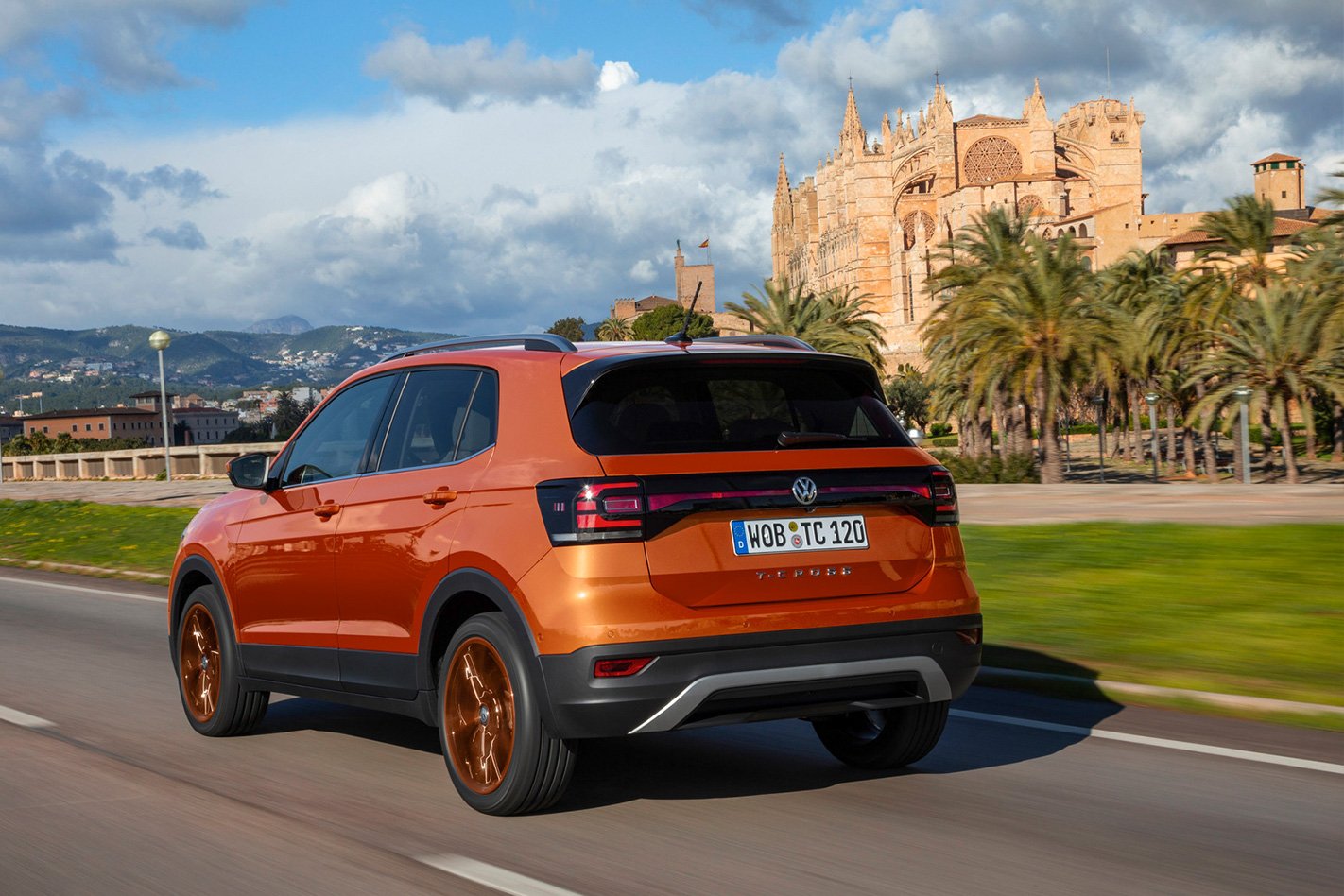
The VW T-Cross is equally composed and comfortable on Germany autobahns at speeds well beyond anything legal in Australia.
The T-Cross rides rougher roads without much complaint, and the cabin is quiet and refined, with very little engine or road noise hampering occupant conversations.
The engine is small, its 1.0-litre, three-cylinder turbocharged petrol configuration producing 85kW and 200Nm, which VW says hurries the little crossover from rest to 100km/h in around 10.2 seconds. That’s nobody’s idea of fast, but neither does it feel slow or lacking in real-world situations.
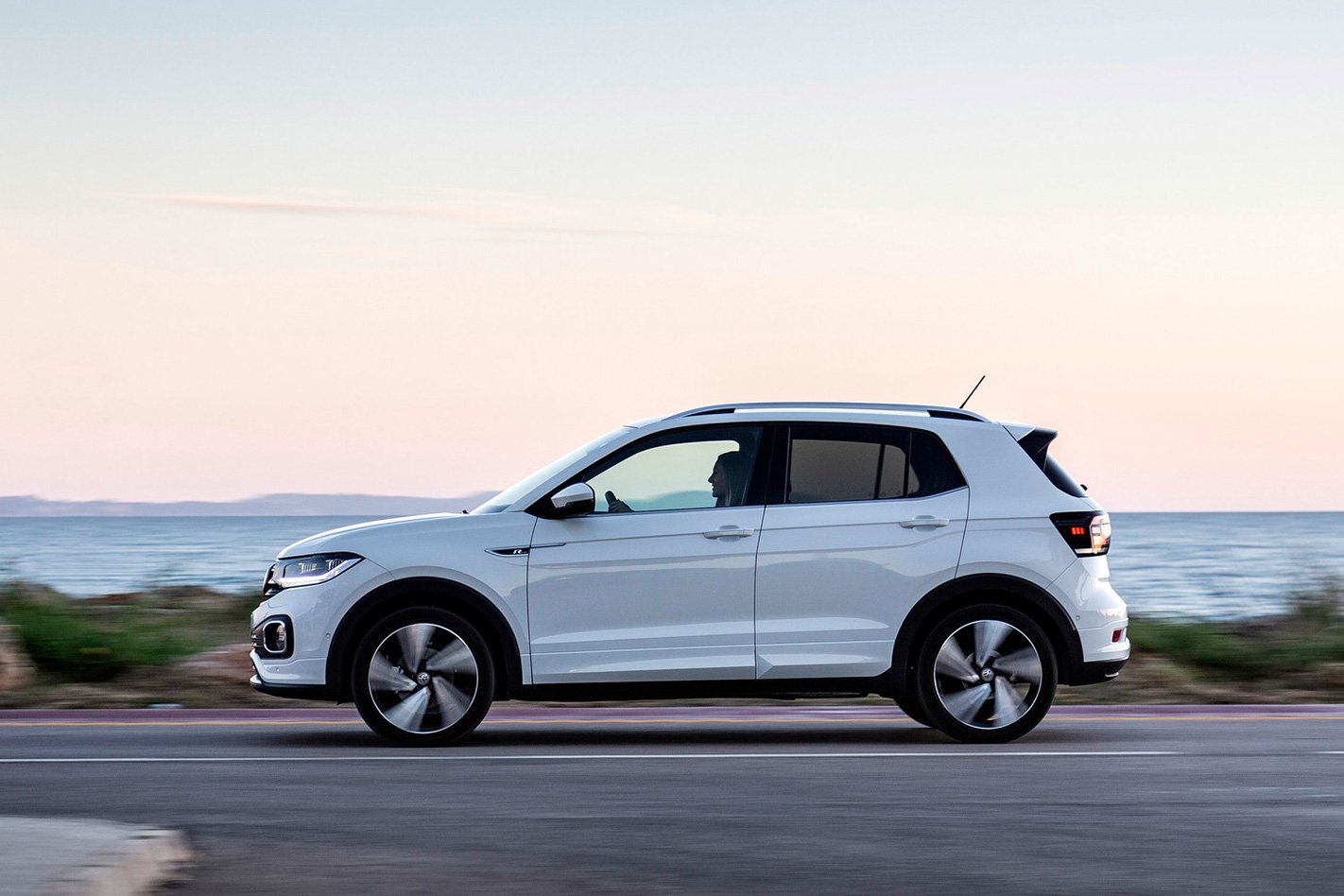
The T-Cross’s biggest driving advantage over the mechanically similar VW Polo is the driving position which is 100mm higher and therefore affords more visibility of the world outside the windows.
What’s the VW T-Cross like to live with?
Again, for anybody who has driven a new VW Polo or VW Golf hatchback in recent years, the VW T-Cross’s interior is extremely familiar.
The dashboard is practically identical to the Polo, which means there is a large infotainment display sitting above two air vents and air conditioning controls. In typical Volkswagen style all the controls are logically placed and easy to use.
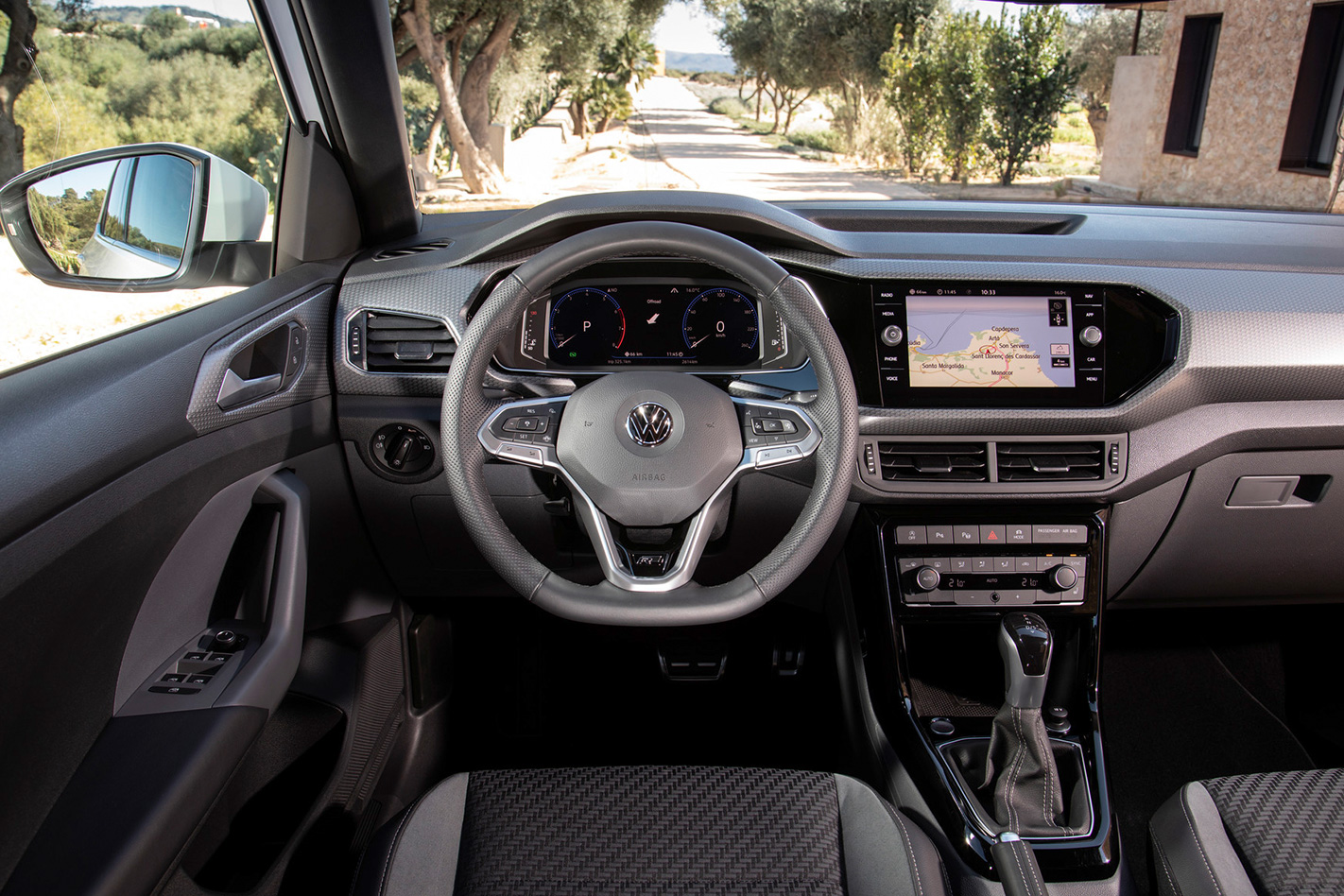
In Europe some T-Cross models come with traditional analogue speed and tacho gauges, with higher spec models getting a high-quality digital display that can also incorporate satnav instructions, media settings and more. We’d expect a similar treatment across the two Australian models once they’re announced, and no doubt VW will reserve other niceties fitted to our test car – such as satellite navigation and dual-zone climate control – for the higher-priced of the two T-Cross variants. It’s likely Bluetooth connectivity, DAB and a phone-charging mat will all be standard on both variants.
As for the sound system, the sound quality from the T-Cross’s speakers was plenty fine for the average user, although audiophiles will find its range lacking. We’re sure there will be an audio upgrade package on the Australian options list too.
Externally, the T-Cross is between the Golf and Polo for length and width, and is 100mm higher overall, some of which manifests as extra headroom inside and some as ground clearance underneath – not for offroading but to make it easier to get in and out of, and to see over traffic. Although on that last point, please remember this is still a small car, so you’re still a long way from king of the road!
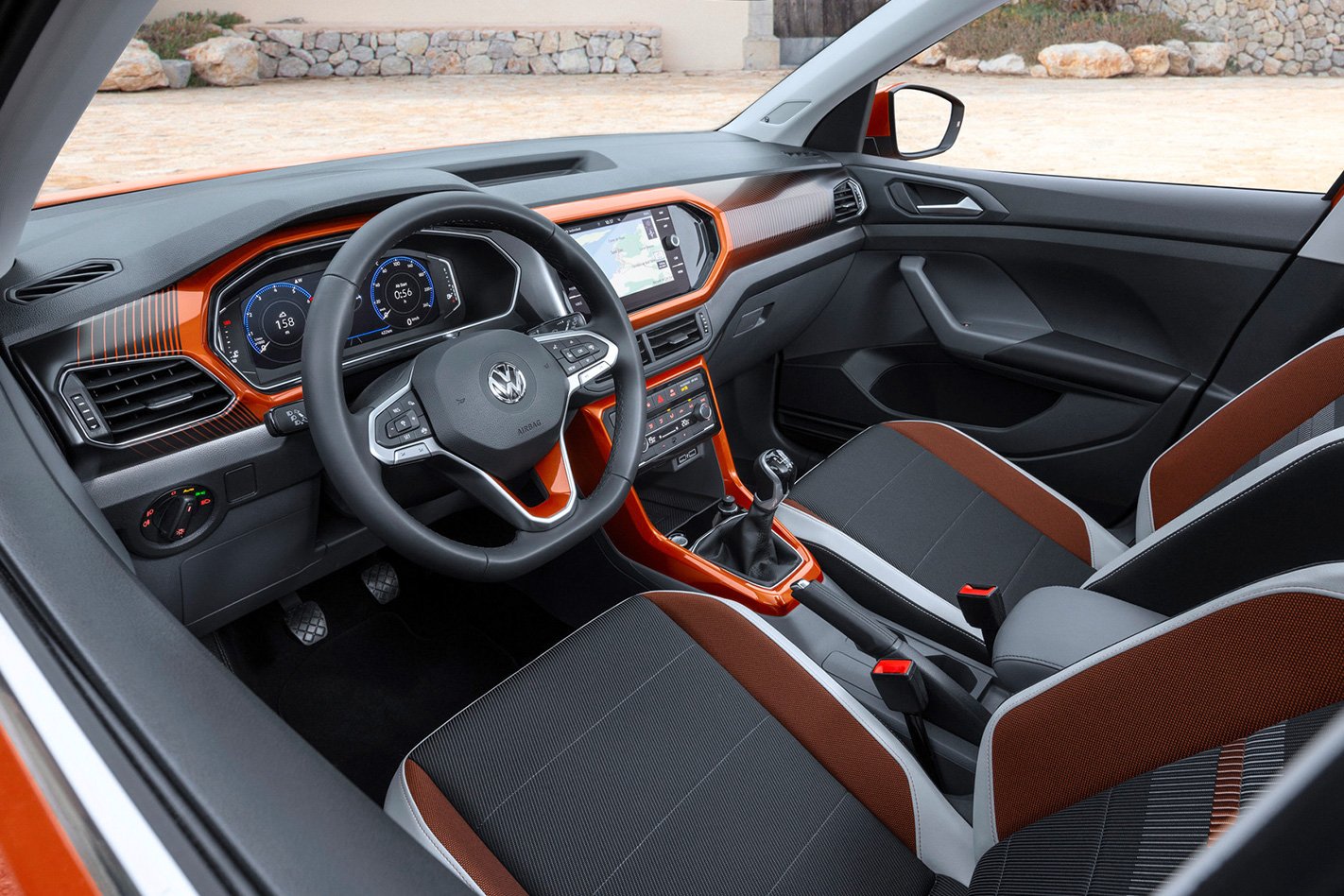
The driving position is fantastic; there’s plenty of seat height adjustment, and the steering wheel tilts and telescopes. Headroom up front is in plentiful supply. Same in the second row which is capable of accommodating anybody up to 6ft 4in without their head hitting the roof.
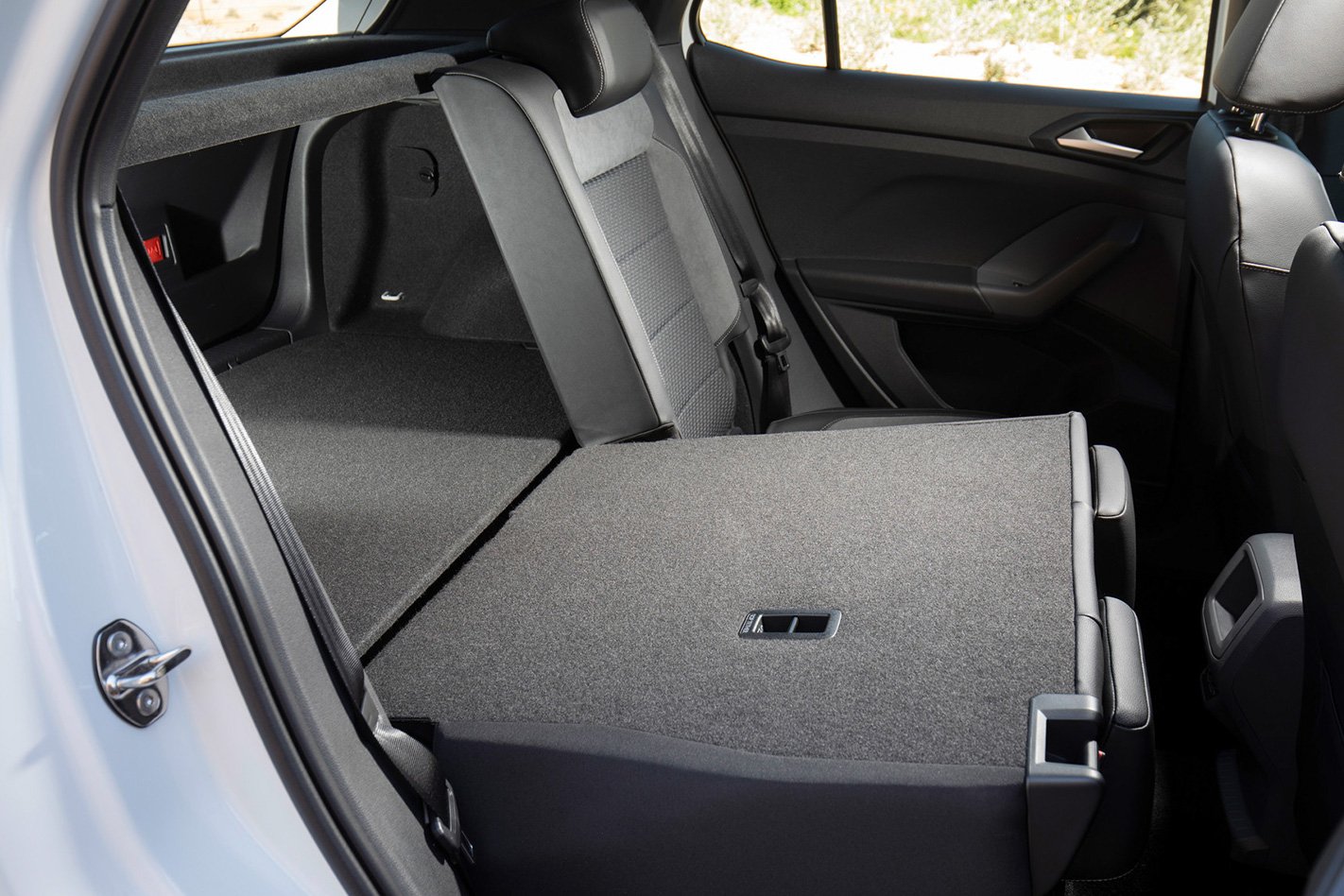
Legroom in the rear is also more than adequate for human beanpoles, too. The rear seatbench is capable of sliding forward up to 140mm to liberate more boot space, but this obviously impacts rear legroom considerably. Still, the flexibility offered by this – standard on all European models, so will probably be standard in Australia too – adds to the T-Cross’s impressive versatility.
Back seat passengers do miss out on air conditioning vents, so they’re reliant on the mid-mounted front vents for airflow. There are generous pockets on all four doors which can take a 1-litre water bottle and more.
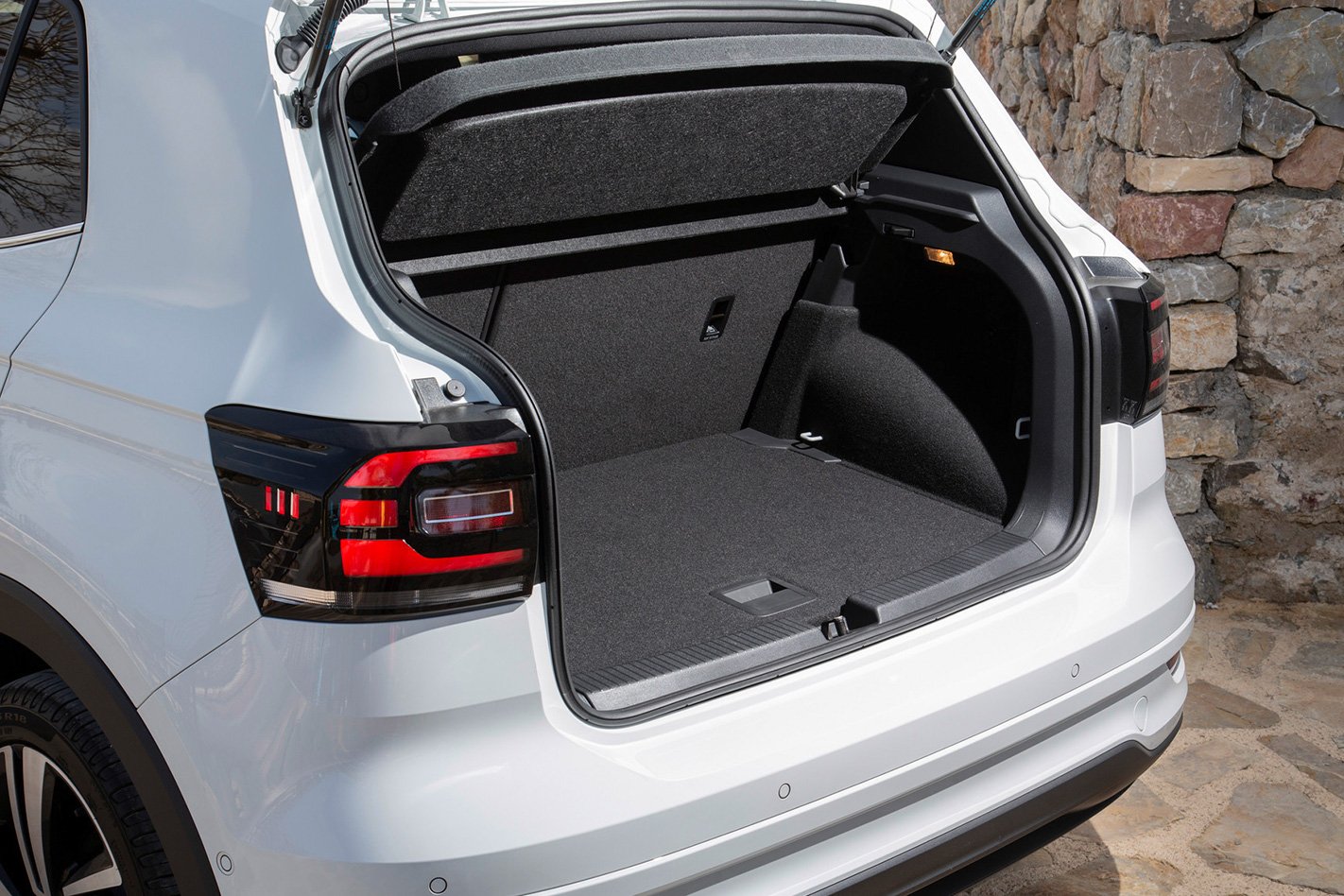
The boot is another T-Cross advantage over the VW Golf. It has 455 litres of storage space with the back seats up, expanding to 1281 litres when they’re both folded flat. They also fold individually in a 60/40 split.
For new families, the T-Cross has Isofix mounting points on the two outboard back seats, and the front passenger seat as well.
Safety-wise, UK-spec right-hand drive VW T-Cross models have been rated a five-star car by EuroNCAP, so we’d expect that classification to be adopted by Australian NCAP too. It did extremely well for adult (97 percent) and infant (86 percent) protection despite not having a knee airbag or chest protection in the rear. Its combination of active and passive safety features scored 81 percent for vulnerable road users (such as pedestrians), while standard AEB, speed control and lane assist systems scored it a ‘good’ rating of (80 percent) in active safety.
Is the VW T-Cross worth the money?
Hard to know for sure until we see Australian spec and pricing sometime in January 2020 ahead of the car’s March arrival. Two things are certain: the VW T-Cross does everything you’d expect of a compact crossover, and; it does so with typical Volkswagen aplomb. So, assuming Volkswagen can put a competitive sub $30K price on the T-Cross, it’s likely to find plenty of willing buyers who will in turn become happy customers.
Pros: Familiar interior and driving style; flexible interior; easy on the juice Cons: Not as funky looking as T-Roc; no rear vents in test model
Rating: 4/5
Even if it was slow as a wet week, the Jaguar F-Type SVR would hold significant appeal for the insane noise it makes.
The 5.0-litre supercharged V8 produces not only 423kW and 700Nm but a vicious snarl that feels like it could shatter glass and fell the birds from the trees.
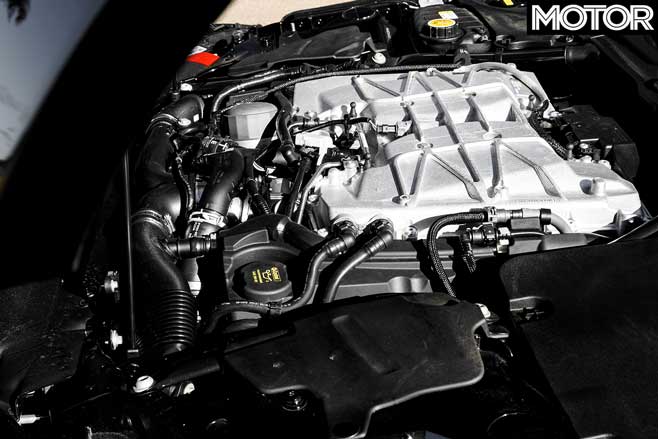
Unsurprisingly, the F-Type SVR is not as slow as a wet week. Quite the opposite. The blown V8 F-Type has always been stupidly quick; even the original F-Type V8 S convertible clocked 0-100km/h in 4.28sec and a 12.34sec quarter mile at 189.37km/h.
In Coupe R guise it lowered those figures to 3.99sec and 11.99sec at 193.42km/h, incredibly impressive numbers from a rear-drive machine, but with all-wheel drive the SVR is even quicker.
Finally, the F-Type could use the full reserves of its monster engine and the SVR hit 100km/h from rest in just 3.6sec – besting its claim by a tenth – before steaming through the 400m traps in 11.53sec at 199.21km/h.
If you’re wondering how much the SVR is worth compared to the standard F-Type V8 AWD, the answer is 0.15sec to 100km/h, 0.27sec across the quarter mile and almost 6km/h in terminal speed.
What’s more, it’s the easiest car in the world to extract this speed from. According to the handbook the SVR has a rudimentary launch control system but it doesn’t need it. It allows plenty of revs to be stalled against the torque converter then just release the brake and flatten the accelerator.
There isn’t a hint of wheelspin and it just keeps charging, each gearshift accompanied by a fierce crack from the exhausts. Piece of cake.
Check out the latest issue of MOTOR magazine to read the comparison test between the Jaguar F-Type SVR, BMW M850i and Porsche 911 Carrera 4S.
What stands out?
Audi’s first small luxury SUV has youthful looks and broad appeal. It comes with a choice between two petrol engines and a diesel, and the same high level of fit and finish that the brand’s core models have become known for.
What might bug me?
That many cheaper Korean and Japanese small SUVs have standard features – such as adaptive cruise control, push button start, hill hold assist and digital radio – that are only included in the Q2 as part of costly option packages on some models.
What body styles are there?
Five-door, five-seat SUV-style hatchback only.The Audi Q2 is available in either front- or all-wheel-drive. Which one you get depends on the engine you choose.It is classed as a small SUV, higher priced.
What features do all Audi Q2s have?
Six airbags and autonomous emergency braking with pedestrian detection are key safety features found in all Q2s, as is electronic stability control, which is mandatory on new cars and can help control a skid or a slide. (For the placement of airbags, and more on Q2 safety features, please open the Safety section below.)An eight-speaker sound system with AM/FM/Digital (DAB+) radio and Bluetooth connectivity for mobile devices, all controllable from a 7.0-inch colour screen that can also mirror your smartphone via Apple CarPlay or Android Auto.Satellite navigation with voice control – tell it where you want to go, and it will plot a route for you.A reversing camera and front and rear parking sensors.Dual-zone air-conditioning that allows the driver and front passenger to control their own temperature settings.Long-lasting LED headlights and taillights, and distinctively styled LED daytime running lights. The headlights can turn on automatically when it’s dark. All Q2s also have windscreen wipers that operate automatically when it starts raining.Other standard features include cruise control, powered door mirrors, alloy wheels, leather-appointed seats and leather multi-function steering wheel with paddle shifters to manually control gear shifting.
Which engine uses least fuel, and why wouldn’t I choose it?
The 35 TFSI’s 1.4-litre turbocharged petrol drinks just 5.3L/100km, according to official combined figures that take into account highway and city driving.The 35 TFSI only comes in front-wheel-drive format with a basic torsion beam rear suspension setup, and is not available with the quattro all-wheel-drive system and multi-link suspension included with the diesel, which gives it better traction.The Q2 40 TFSI brings the best of both worlds, with a more-powerful 2.0-litre petrol turbo engine with the quattro all-wheel-drive running gear, and its fuel economy is still relatively efficient at 6.5L/100km.Both engines are coupled with a seven-speed dual clutch automatic transmission.
What key features do I get if I spend more?
As well as a more powerful engine, quattro AWD and multilink suspension, the Q2 40 TFSI has a few extra features over the 35 TFSI, including blind spot detection, which alerts you to any cars to the side of the vehicle when looking to change lanes.It also has body-coloured bumpers, which are a $500 option for the 35 TFSI, an electrically powered tailgate, and 18-inch alloy wheels that look sportier than the standard 17-inch set.Additional interior features include sports front seats and aluminium-look interior elements such as switches and air vents.You can add a host of extras to each Q2 model by adding option packages, at extra cost, or selecting individual option items.Option packs include the Comfort package, which adds keyless start/entry, heated front seats, electric lumbar support for the front seats and heated door mirrors. It also includes a storage package with netted pockets for the backs of the front seats, a 12V power socket for rear of the centre console, luggage compartment net to keep bags secure, glovebox lock and a second light in the boot spaceThe Assistance package brings additional advanced driver assistance technology such as adaptive cruise control lane keeping assist, blind spot alert (35 TFSI only), high-beam assist (which automatically switches between high and low beam headlights when oncoming traffic is detected), hill hold assist, automatic park assist and a rollover sensor.Spend about $2500 on the Technik package and you get Audi’s excellent Virtual Cockpit digital dashboard display, which replaces the traditional gauges with a 12.3-inch screen. You also get enhanced satellite navigation, and a sporty, flat-bottom, leather trimmed multi-function sports steering wheel with paddle shifters.Other option packages add more sports credibility to the Q2, such as the S Line package, that’s only available for purchase with the 40 TFSI. It brings 18-inch alloy wheels with ‘5-Y’ spoke design, sports suspension, ‘S’ embossed sports seats trimmed with leather and Alcantara suede, multi-function sports steering wheel with S logo, perforated leather gear knob, black headlining, stainless steel foot pedals and aluminium door sills.Individual options include 19-inch alloy wheels, adaptive suspension dampers to switch between soft and firm for comfort and improved handling, a Bang & Olufsen 10-speaker sound system and digital radio.
Does any upgrade have a down side?
The optional 19-inch wheels produce more tyre noise and you’ll feel more bumps on their sporty, lower profile tyres compared to the 35 TFSI’s 17-inch wheels, and to a lesser extend the 18s under the 40 TFSI.There are only two standard colours, Brilliant Black or Ibis White, with other colours costing up to about $1700 extra.
How comfortable is the Audi Q2?
As you’d expect from Audi, the cabin is well presented and uncluttered, with major controls in logical positions. The circular air vents exemplify the functional elegance.Surfaces and textures are of high quality, and reinforce Audi’s luxury positioning albeit with a more youthful look. The steering wheel adjusts for height and reach.The Q2’s standard eight-speaker audio system sounds crisp and punchy. An optional 10-speaker system adds a subwoofer for more bass, delivering a richer, fuller sound.With the music off, the cabin of a Q2 is susceptible to tyre noise, particularly on coarse surfaces at highway speeds. However, wind noise is mild compared to other small SUVs.The Q2 rides in a comfortable but well controlled manner, absorbing bumps succinctly. Its suspension is particularly good above 80km/h, recovering quickly and keeping the body in check.
What about safety in a Q2?
Mandatory stability control, six airbags, bright LED auto-on headlights, LED daytime running lights, auto windscreen wipers, and seatbelt warnings for all five passengers give the Q2 solid safety credentials. In addition, all Q2s come with auto emergency braking that helps you avoid city-speed rear-end impacts with other vehicles and pedestrians.There are two airbags directly in front of the driver and front passenger; an airbag alongside each front occupant to protect the upper body; and a curtain airbag down each side of the car at head level, protecting front and rear occupants from side impacts.The standard Audi Pre-sense City collision detection system warns you of imminent frontal crashes and is calibrated to recognise pedestrians. If you ignore the warning, it can apply the brakes automatically at speeds up to 65km/h, with the aim of avoiding the crash or mitigating your impact speed.The Q2 40 TFSI quattro add Side assist, which uses rear-facing sensors to scan your rear corners, warning you of adjacent or fast-overtaking cars that might not appear in your mirrors.On any Q2 you can add crash-avoidance aids with the optional Assistance Package. As well as Adaptive cruise control and auto high-beam, this brings you Active lane assist which helps you avoid drifting dangerously into another lane by applying gentle steering pressure to wake you up and bring the car back within the lines. The pack also adds Side assist to the Q2 35 TFSI, which doesn’t have it as standard.The Australasian New Car Assessment Program (ANCAP) awarded the Audi Q2 its maximum five stars for safety, in February 2017.
I like driving – will I enjoy the Q2?
Yes, both models have sharp handling and a vibrant ride in common. They have excellent ride and handling capabilities and ride over rough road surfaces well, particularly at speeds above 80km/h.The 35 TFSI 1.4-litre engine is refined and perky and can shut off two of its cylinders for fuel saving, keeping economy to a mere 5.3L/100km. Because it is front-wheel-drive and has a less sophisticated rear suspension set up, though it manages relatively well.The 40 TFSI’s 2.0-litre engine has considerably more power and its light weight means a more compliant suspension than in the 2.0 TDI. Apart from the raised ride height it feels like you’re driving a hatchback.
How is life in the rear seats?
The Audi Q2 has the same wheelbase length (that is the distance between the front and rear wheels) as the larger Q3, meaning a similarly sized interior.The middle rear seat is only good for kids, particularly in the all-wheel-drive models which have a hump in the middle of the floor to accommodate the driveshaft to the rear wheels.The outer rear seats, however, offer plenty of leg and head room even for taller adults.The rear seatbacks fold down in a standard a 60/40 split, however there is an optional 40/20/40 split seatback, which includes a fold down centre armrest with cup holders.Side and front vision is good.There are no rear air vents or easily accessible USB or 12V sockets to plug in and charge mobile devices, unless you get the Comfort package, which adds a 12 volt socket on the rear of the centre console.
How is it the Q2 carrying stuff?
Boot space is 355 litres which is below the average size for small SUVs. With the rear seats folded down the cargo area extends to 1000 litres.
Where is the Q2 made?
All Audi Q2 models are assembled at Audi’s Inglosdtadt factory in Germany.
Are there any rivals I should consider?
There are a growing number of small luxury SUVs entering the market that are worth a look when considering the Audi Q2, including the Mini Countryman, Mercedes-Benz GLA, BMW X1 and X2, Volvo XC40, and the Jaguar E-Pace.
I like this car, but I can’t choose which version. Can you help?
The 40 TFSI is the best all-round in terms of performance and safety. It’s quick and handles itself well over rough surfaces and through bends. It comes with a few extras over the 35 TFSI, not least the quattro all-wheel-drive system, and blind spot alert. That said the 35 TFSI offers great value and is a good buy if most of your driving is in the city.Of the option packs, the Technik package is hard to pass up thanks to the highly desirable Virtual Cockpit digital dashboard.
Are there plans to update this model soon?
The Audi Q2 arrived in Australia in February 2017 with a two model line-up – the 1.4 TSI and diesel 2.0 TDI quattro Sport.The 2.0 TFSI was added to the range in November 2017 as part of the 2018 model year line-up. LED headlights and taillights became standard equipment across all three models at the same time.The 2.0 TDI was dropped a year later leaving just the two petrol versions in the 2019 model-year range. The 1.4 TSI and 2.0 TSI were respectively redesignated the 35 TSI and 40 TSI as part of Audi’s updated, and rather confusing nomenclature.In September 2019 Audi revealed a more powerful SQ2 version that shares a drive-train with the Audi S3. It’s hoped it will be available in Australia some time in 2020.Don’t expect any other substantial upgrades until then.
Global automotive component giant BorgWarner is partnering with an, as yet, unnamed “supercar manufacturer” to kickstart an electric turbo revolution in 2022.
Outside Formula 1 racing, electrically assisted turbochargers are still an emerging science and the first manufacturers are yet to throw their hats into the ring and adopt the technology. But expect all the key brands to flock to the technology in the coming years, lured by the potential to boost power and efficiency whilst banishing undesirable turbo lag too.
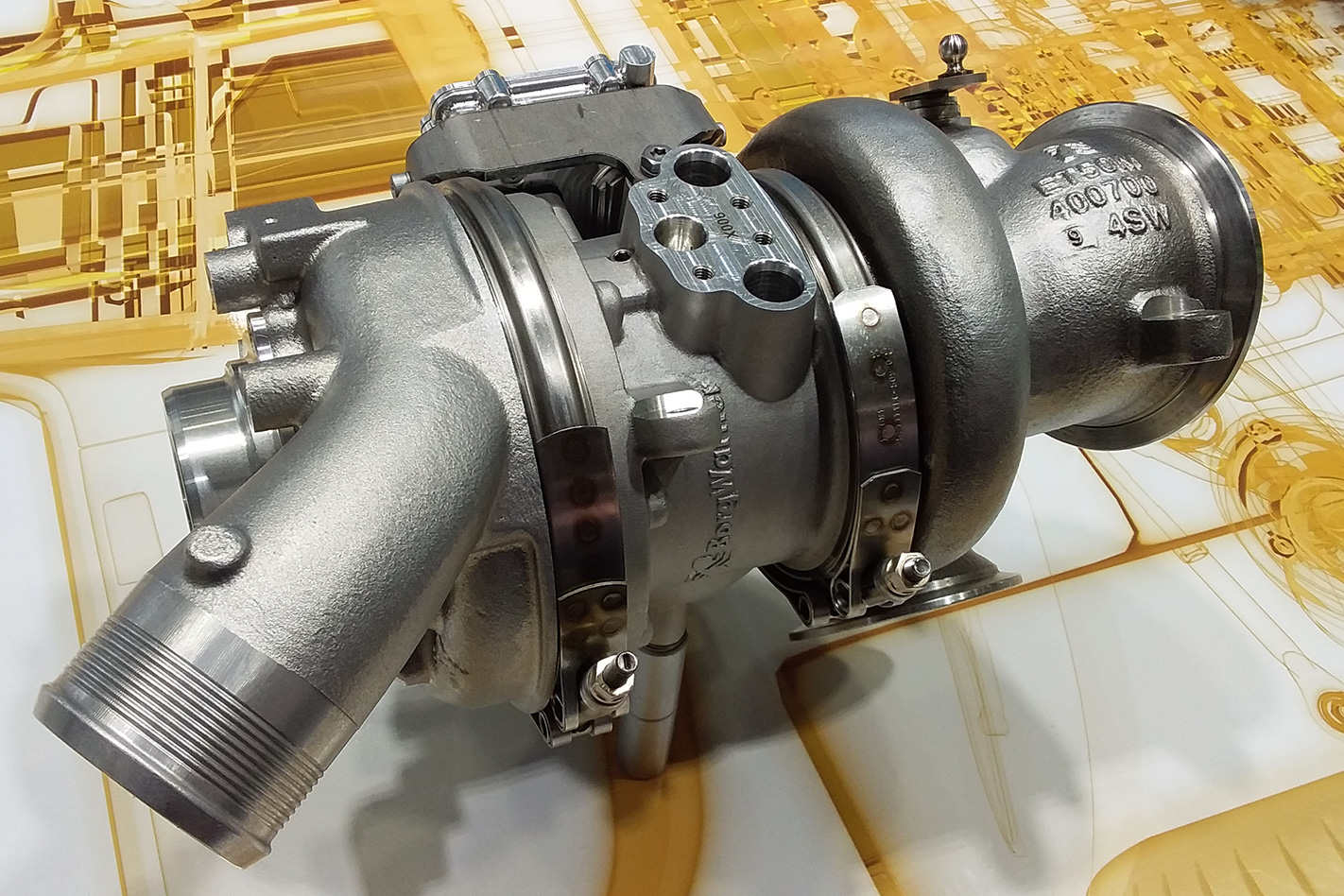
The drivetrain specialist is not revealing exactly which high-end sportscar brand it is working with to debut its new eTurbo trickery, but the wise money would be on Ferrari, which filed a patent for an electric turbo last year.
Significantly though, BorgWarner did confirm the version that will feature on the mysterious car is not 48-volt but an example of its 400-volt models, which means the car it is bolted to is a serious plug-in hybrid, not a mild-hybrid with a 48-volt sub-system.
If confirmed as the partner, it will be the second plug-in from Ferrari, following in the tyre tracks of the SF90 Stradale.
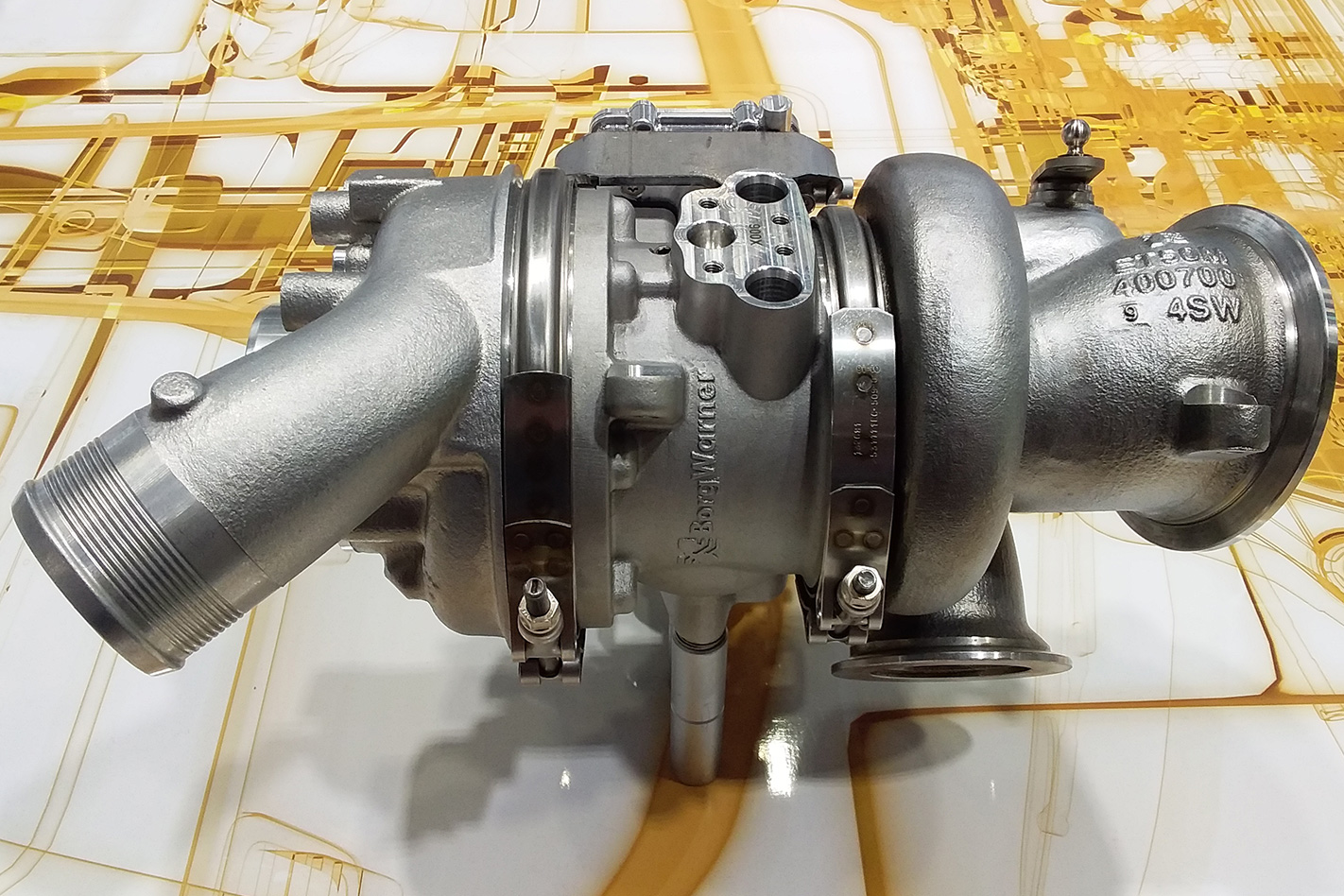
BorgWarner’s eTurbo is a sophisticated evolution of the traditional turbocharger with a high-efficiency electric motor coupled to the turbo’s main spindle. When the engine is not producing sufficient exhaust gasses for the turbo to reach its boost ‘threshold’ the electric motor instantly compensates, eliminating lag.
It should not be confused with electric compressor technology as showcased by Audi for its SQ7. In this case a high-power motor drives a centrifugal compressor to provide boost at low rpm, but has no exhaust-driven turbine and switches off at higher engine speeds allowing separate conventional turbos to take over. Since it has no turbine it is not called an electric turbo.
BorgWarner’s unit however, incorporates a high-power motor into a complete turbo, removing the need for a separate e-compressor component, but there are other advantages too.
The electric motor can also double as a generator to produce electricity from energy in the exhaust gasses at low engine loads when the exhaust is not needed to drive the turbo’s compressor. This tops up the battery and increases the vehicle’s range.
And the same braking effect of the generator on the rotating compressor allows the elimination of separate boost control methods such as complex variable vanes and relatively primitive waste gates.
During cold-starting and warm up, exhaust gasses can completely bypass the eTurbo allowing the emissions control systems such as catalytic converter and particulate filters to warm up to ‘light-off’ temperature as fast as possible, reducing emissions. While gasses are bypassed, the eTurbo produces boost using electrical power alone.
But at its core, the BorgWarner eTurbo is a conventional turbo meaning it can function exactly as a normal turbocharger if the electrical side should fail.
Four models will be on offer as soon as the company makes the eTurbo widely available ranging from the smallest eB40 up to a sizeable eB80 as well as commercial vehicle versions.
The 48-volt model uses up to a 17kW motor while the full fat 400 and 800-volt versions can pump out up to 34kW.
Arch rival Garrett is also developing its own electrically assisted turbo and will no doubt have already engaged its first partners to bring the technology to a showroom near you and the race to be the first eTurbo boosted production car is on.
UPDATE 12/12/19: Congratulations to @hunter_sydenham from New South Wales. Enjoy some quality time away on us! That’s our fourth and final card for this year. Check back soon for more competitions in 2020 and thanks for playing!
UPDATE 6/12/19: Congratulations to @bennat83 from Western Australia. Enjoy some quality time away on us! Check back again for the next Free Fuel Friday!
UPDATE 28/11/19: Congratulations to Claire W. from New South Wales. Enjoy some quality time away on us! Check back again tomorrow for the next Free Fuel Friday!
UPDATE 22/11/19: Congratulations to Tanya D. from South Australia. We loved her entry referencing the history of the Great Ocean Road! If you didn’t win, check @whichcarau Instagram for today’s competition!
We said we’d be back with more competitions didn’t we? This time we are offering a $100 fuel card every Friday until 11 December 2019, in a competition aptly named “Free Fuel Friday”!
It’s super simple to enter, all you have to do is follow WhichCar on Instagram, and answer our question prompt in 25 words or less. The most creative or interesting answer each week will receive a fuel card valued at $100.
There is one chance to win each week until Friday 11 December 2019, so make sure you’re paying attention to WhichCar on Instagram and get your creative hat on in order to post the best response.
Here’s how to enter:
1. Follow @WhichCarAU on Instagram (if you do not already);
2. Locate the promotional post on @WhichCarAU Instagram page; and
3. On one (1) of the promotional posts, post a comment that includes two (2) tags of friends, along with an answer to the applicable entry question in twenty-five (25) words or less.
https://www.instagram.com/p/B43Q8RghBgn/?utm_source=ig_embed&utm_campaign=loading
Good luck!
AU res 18+ only. Ends: 11 Dec, winner announced every Friday until 13/12/19. Click here for full T&C
UPDATE 28/10/19: We send our congratulations to Nicola H from Western Australia for winning this competition! To everyone else, thanks for participating. Stay tuned for more regular competitions to come.
If you’re anything like us, you’re well-over winter and keen to get out and about again. Spring has finally sprung and that’s about as good an excuse as any to take part in the ultimate weekend away.
To help you get away from it all, WhichCar has teamed up with Gourmet Traveller to give you the chance to win a $250 Gourmet Traveller gift card and a $500 Visa gift card. You can travel, stay and dine in style!
Here’s how to enter:
1. Follow @WhichCarAU and @GourmetTraveller on Instagram 2. Tag two friends you would love to hit the road with 3. You can enter as many times as you like, but each entry must contain two different friends.
https://www.instagram.com/p/B2vLUakF9xQ/?utm_source=ig_embed&utm_campaign=loading
AU res 18+ only. Ends: 21 Oct, winner announced 28 Oct. Click here for full T&Cs. NSW Permit No. LTPS/19/37742
It’s an ugly getaway. All brutal jerks and harsh bursts of revs that cry then die as the demented clutch refuses to cooperate. The driver’s helmet thuds as it staccatos into the air box for the fourth time, which seems to be the final straw. Suddenly the Cosworth V8 shrieks as all abandon is thrown, the clutch is dumped and the rear Avons turn to smoke, the back of the car slewing and slipping onto the circuit.
At once it is here and gone, the soft morning sun glinting off the open wheeler’s streaks of gold as it scorches up the back straight, the wind delivering a delayed delight as the noise morphs from a smooth baritone to a full-bodied scream that leaps and soars.
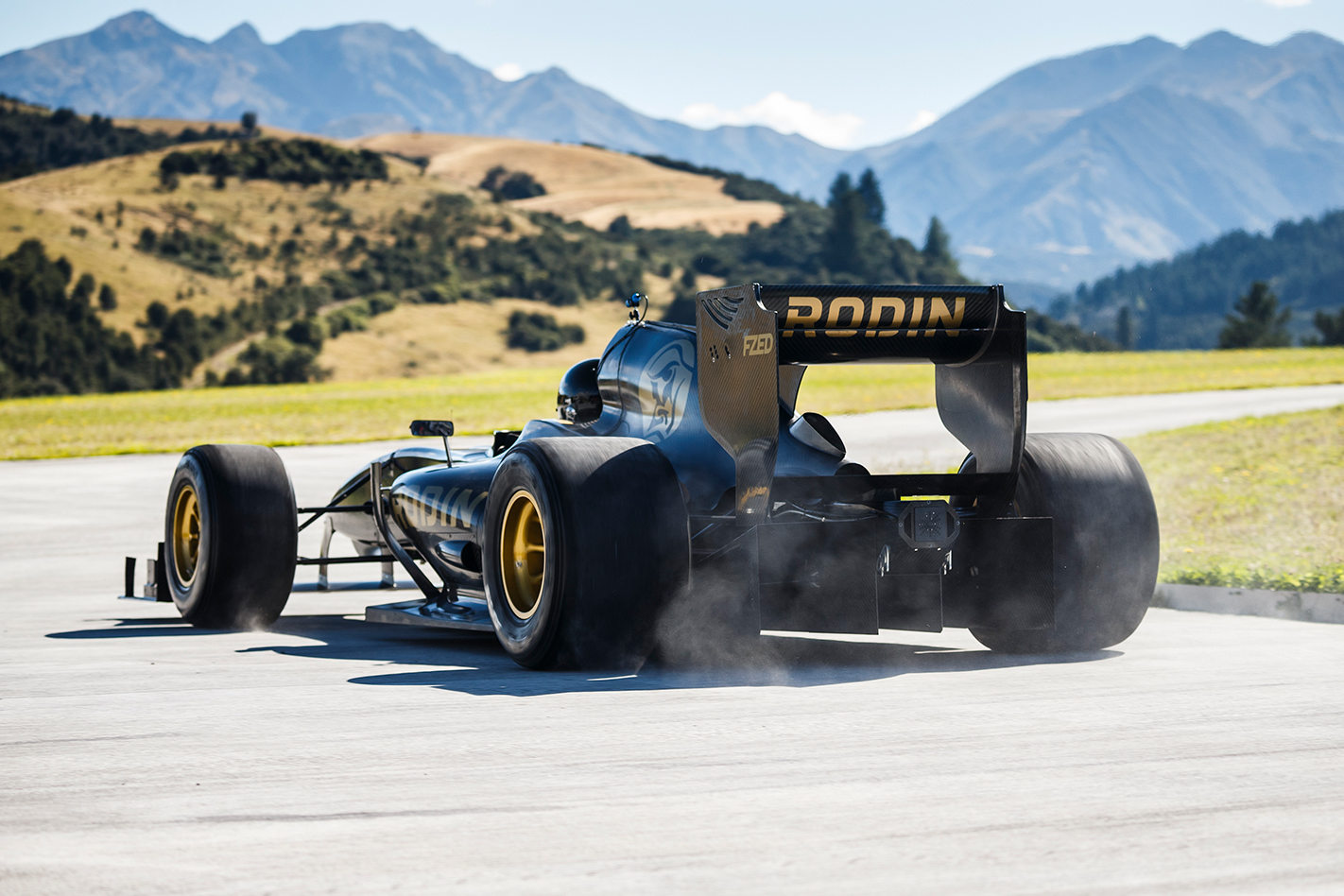
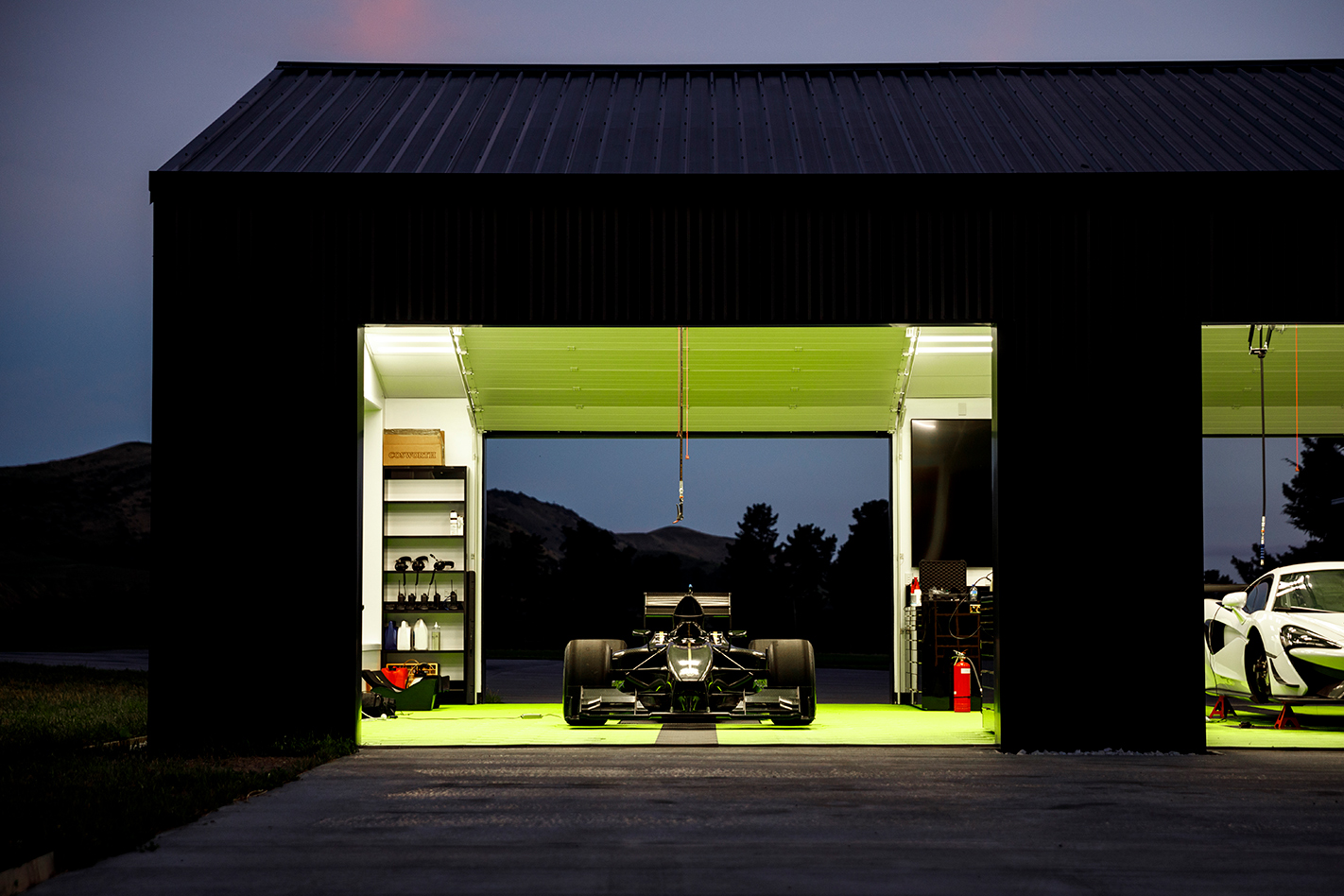
This isn’t a Formula 1 car, and nor are we in Europe, the logical home for a racer such as this. They don’t make mountains quite like this in America, either. Snow-capped and jagged, they ring the valley with that rare kind of beauty unique to New Zealand. We’re in the south island, just outside Hanmer Springs, at the HQ of Rodin Cars – the ambitious start-up that we profiled last month (May, 2019). Created by Aussie IT millionaire David Dicker, Rodin’s mission is to build cars that are faster and more exciting than anything you can buy from Ferrari, McLaren and Pagani. Like I said, ambitious.
And this is Rodin’s first attempt. Resplendent in black with an exposed carbon fibre finish, the brooding behemoth – dubbed the Rodin FZed – has all of the calling cues that’d make Daniel Ricciardo feel right at home: enormous wings, oversized slick tyres, shrink-wrapped bodywork and a removable steering wheel. And today, I get to drive it.
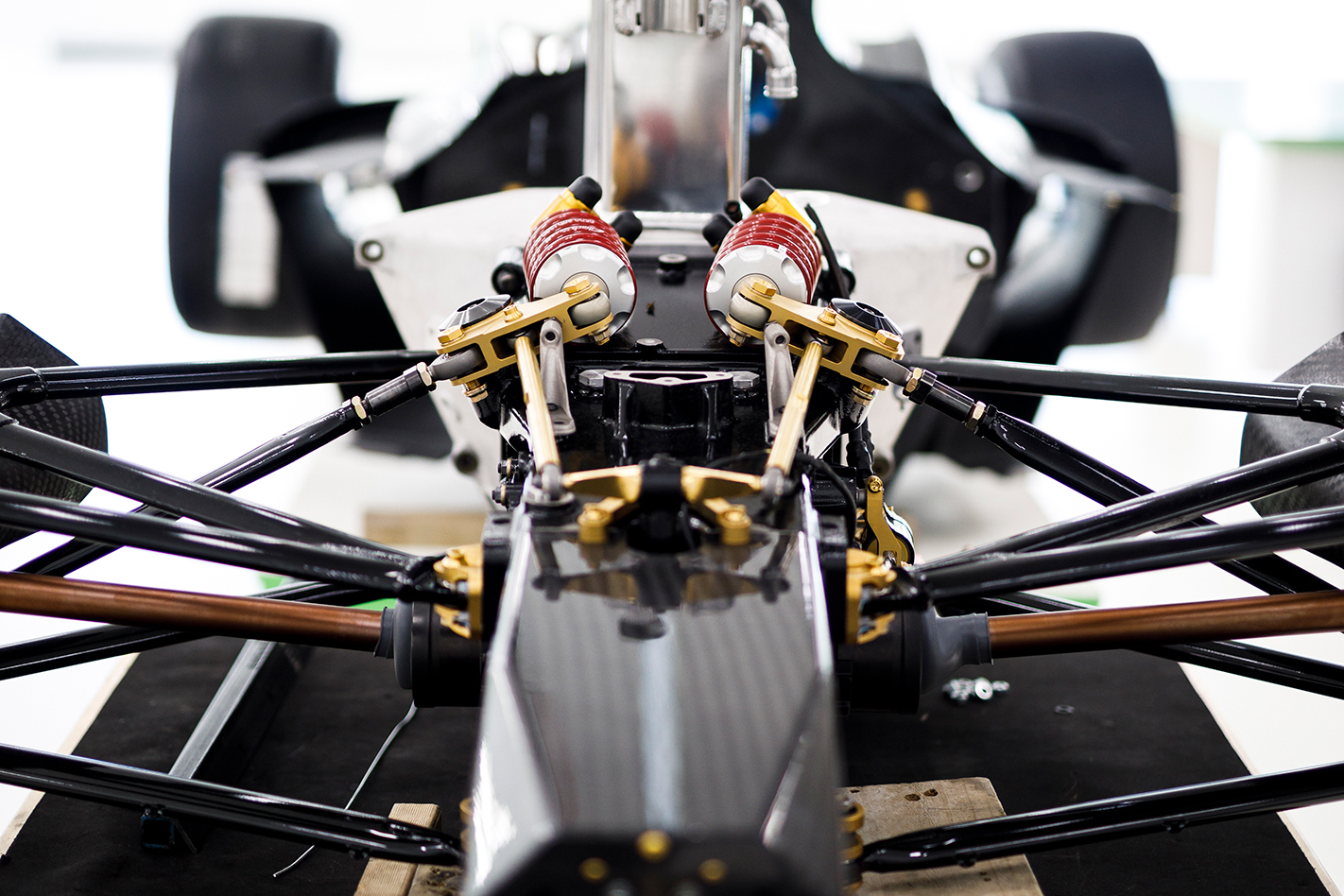
In a previous life it was the Lotus T125 – a ‘customer’ car that leapt to motoring infamy in 2010 for its knife-edge handling and astronomical price tag – but when that project imploded spectacularly, Rodin purchased it and set about improving things. “I didn’t realise how poorly developed it was,” Dicker tells me as the FZed returns from its shakedown and noses into the pit garage. “But I did hear a rumour that it was still almost as fast as the actual Lotus F1 car when they tested it in Portugal. I’d say it’s loosely based on a Formula 1 car from 2010-11.”
And who wouldn’t want to drive a Formula 1 car, even one that’s a few years off the pace, if given the chance? It seems such a no brainer, until you find yourself standing next to one, that is, and the nerves kick in. Helmet on and dressed in a (now) sweaty Nomex suit, my breath fogs up the visor as I wait to climb in.
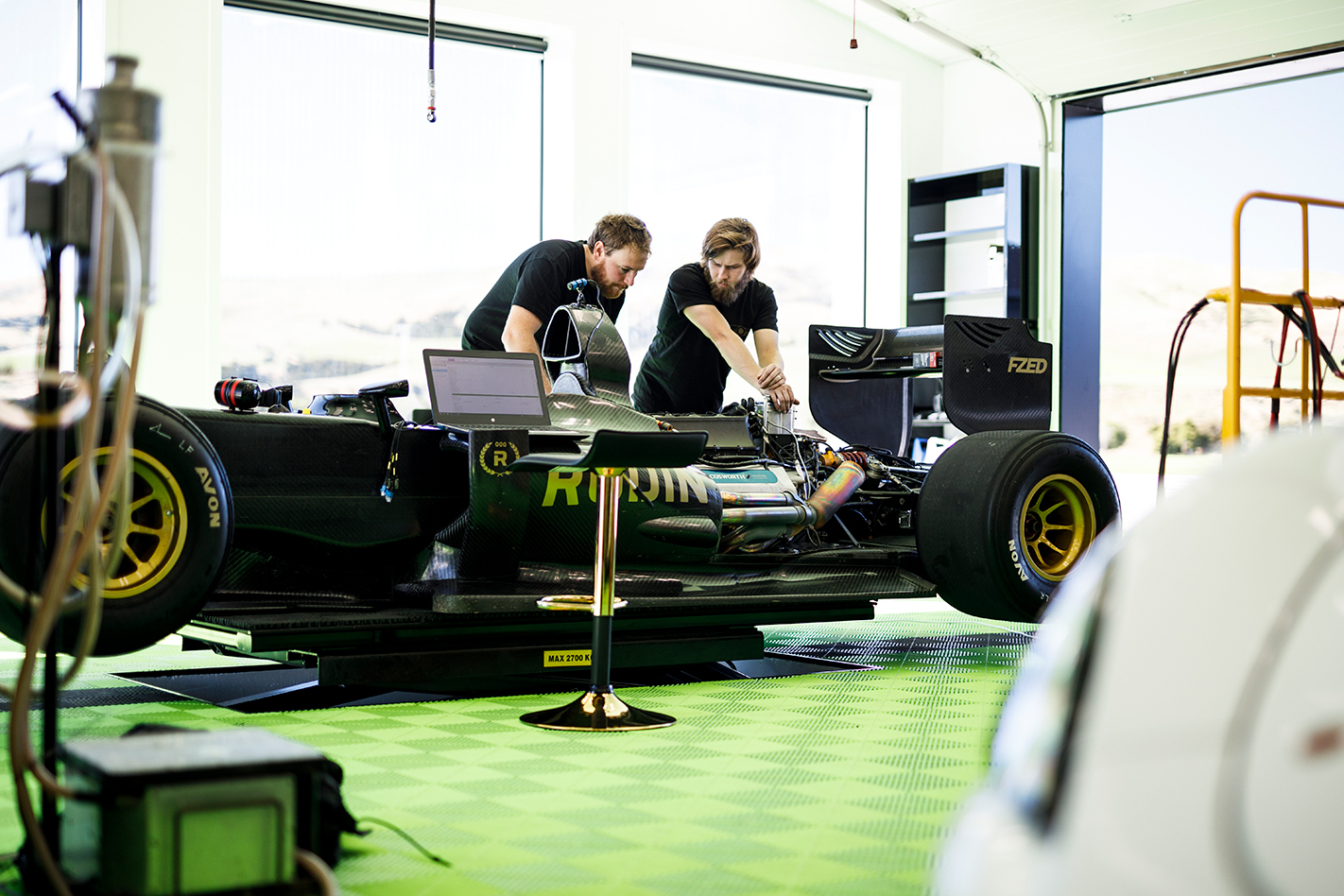
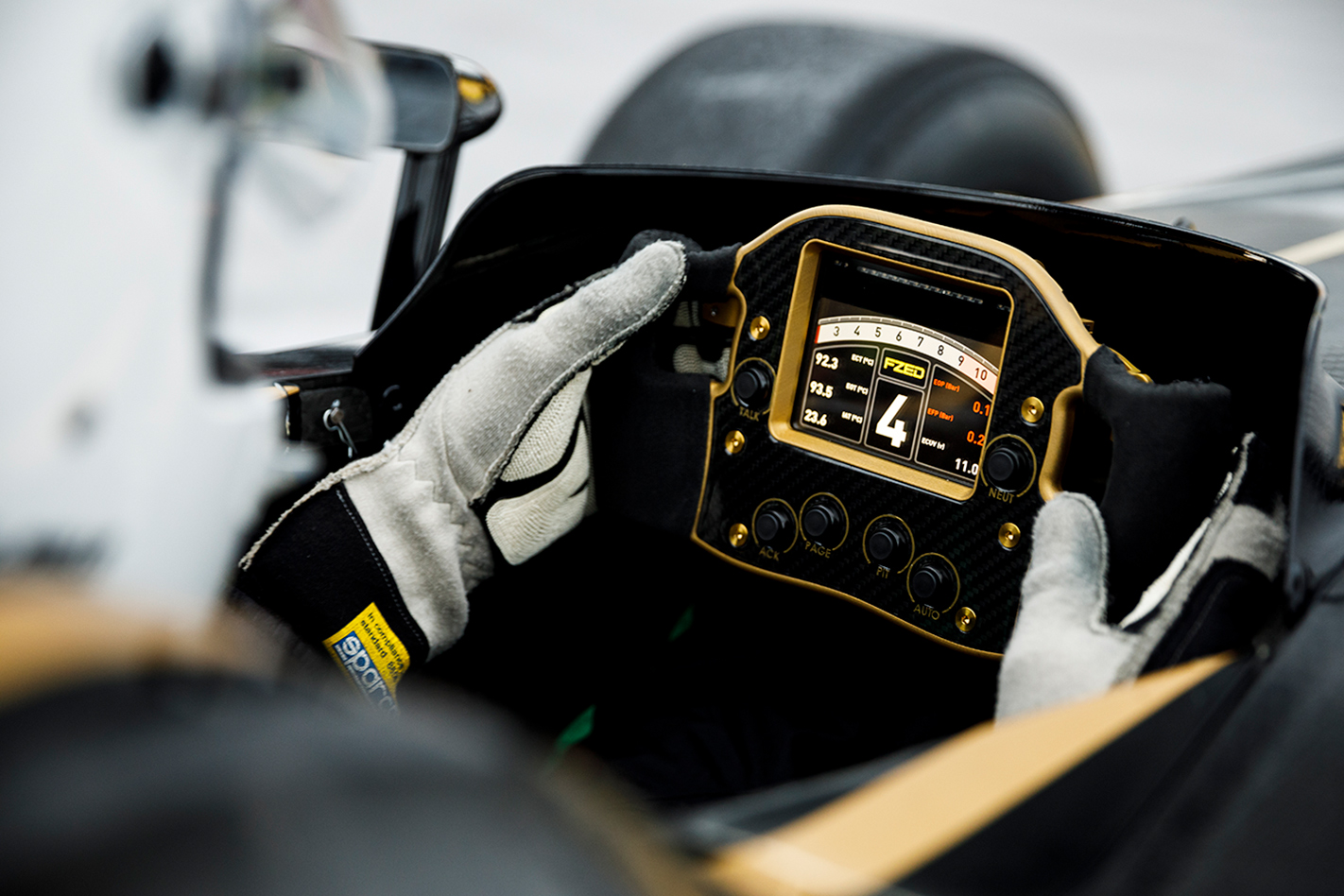
Even the atmosphere has a sniff of Formula 1 about it. Mechanics in matching uniforms and radio headsets fuss over the car as they fit tyre warmers, wield spanners and plug in laptops and leads. I’m handed the steering wheel, which is 3D-printed from titanium. It’s surprisingly heavy, though it all seems relatively straightforward. Gearshift paddles on the back, and buttons for TALK, ACK, PAGE, PIT, AUTO and NEUTRAL on the front.
“The only ones you have to worry about are TALK and NEUTRAL,” says Matt, the disarmingly young Kiwi in charge of the car’s mind-numbing maze of electronics.
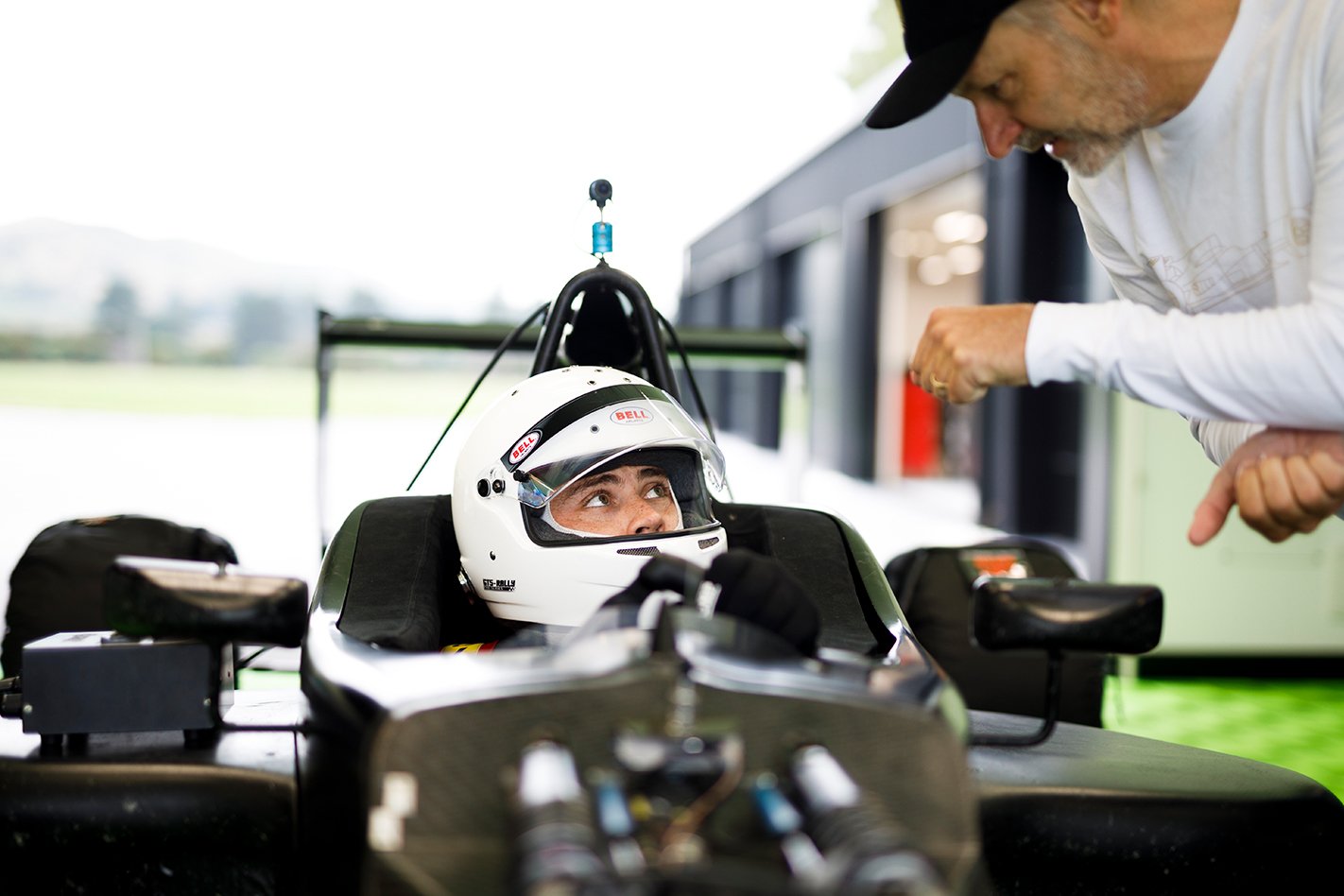
The clutch paddle is on the back too, below the left shift paddle, and it’s worryingly small. Only large enough for one finger, its travel feels impossibly short, about an inch or a little more. But at least the cockpit is comfortable. My legs are quite long, so I have more of a bend in them than is ideal and the steering wheel has to be extended to allow me to turn it without hitting them, but there’s heaps of elbow room and the vision out is superb. I can clock two thirds of the front wheels, much of the lower suspension wishbones, and even some of the detailing in the bodywork around the barge boards.
Go time. As if by osmosis, the engineers whip off the tyres warmers with a flourish and begin to push the FZed out of the garage, bright light bursting as my eyes adjust to the sun. We stop on the circuit itself and Matt reaches in to begin the ignition sequence: flick the ‘Master’ switch near my thigh. Wait. Crank it once. Wait. Crank it again… Detonation. The engine fires and the cockpit explodes with vibrations. It’s a visceral sensation, as though the V8 is hardwired to my spine. I’m told to take control of the throttle and give it a few blips. It rips through the rev range then settles with virtually no rev hang. It’s immediate. Pin sharp. Precise.
Conscious of the temperamental clutch, the engineers give me a push to assist with those crucial first metres. I give it some revs, ease out the clutch as best I can and I’m away. I grab second before I have time to think and immediately try the brake pedal. I’d been warned that carbon-ceramic brakes are hopeless when they’re cold (“It won’t stop at all,” says Dicker), yet I’m still unprepared for how dead the pedal feels. It’s like pushing a piece of concrete and worryingly, there’s zero retardation. I accelerate again and squeeze a little harder on the brake, mindful of not locking a wheel. It’s marginally better, with a tiny bit of give in the pedal.
The steering is surprisingly light. So light that it feels almost power assisted, though the way the car rides the bumps is encouraging. One of the key changes Rodin made to improve the FZed was to swap out its obscure Italian dampers for high-end units from Ohlins. “The results were transformational,” says Dicker. There have been aero tweaks, too, though the engine has been left largely untouched. Built by Cosworth for Lotus, the 3.8-litre donk is effectively an IndyCar race engine, complete with a cast-aluminium block and heads and forged-aluminium pistons. It produces 503kW and 450Nm, which should be ample in a car weighing 589kg.
Ample is the wrong word. I meant excessive. As I leave the final turn that leads onto the main straight on Rodin’s 2.4km circuit, I give the throttle its first proper squeeze. For context, the fastest road car I’ve driven is a McLaren Senna, which has a power-to-weight ratio is 434kW/tonne. The FZed’s is nearly twice that.
The throttle travel is long and I probably venture about two thirds into it. The result is shocking. The FZed explodes with forward momentum and delivers a sensation of seemingly limitless power. So intense is the turn of speed, it’s as though the car has been clobbered from behind by some invisible, unstoppable force.
And the noise. Oh, the noise. If it was deep and purposeful low in the rev range, it’s a different animal altogether with some revs on board. The pitch crescendos, the vibrations seem to smooth into one continuous fizz and the volume becomes all-consuming. Give the car its head and it’ll pour on speed with an insatiable appetite for revs. Second gear disappears before I have time to realise I’ve already grabbed third, my lizard brain reacting to the shift lights and feeding in another gear just shy of 9000rpm. And that’s short shifting. Wring it out and it’ll run to 10,300rpm. Danny Ricciardo nudges 12,000rpm, but unlike his highly strung Renault, which only needs to last one race, the FZed can run for the equivalent of three Bathurst 1000s before it needs to be torn down.
And that’s core to the FZed’s appeal. It has been designed to be low maintenance. Owners should be able to turn up at a circuit with one mechanic, blast around all day, and go home.
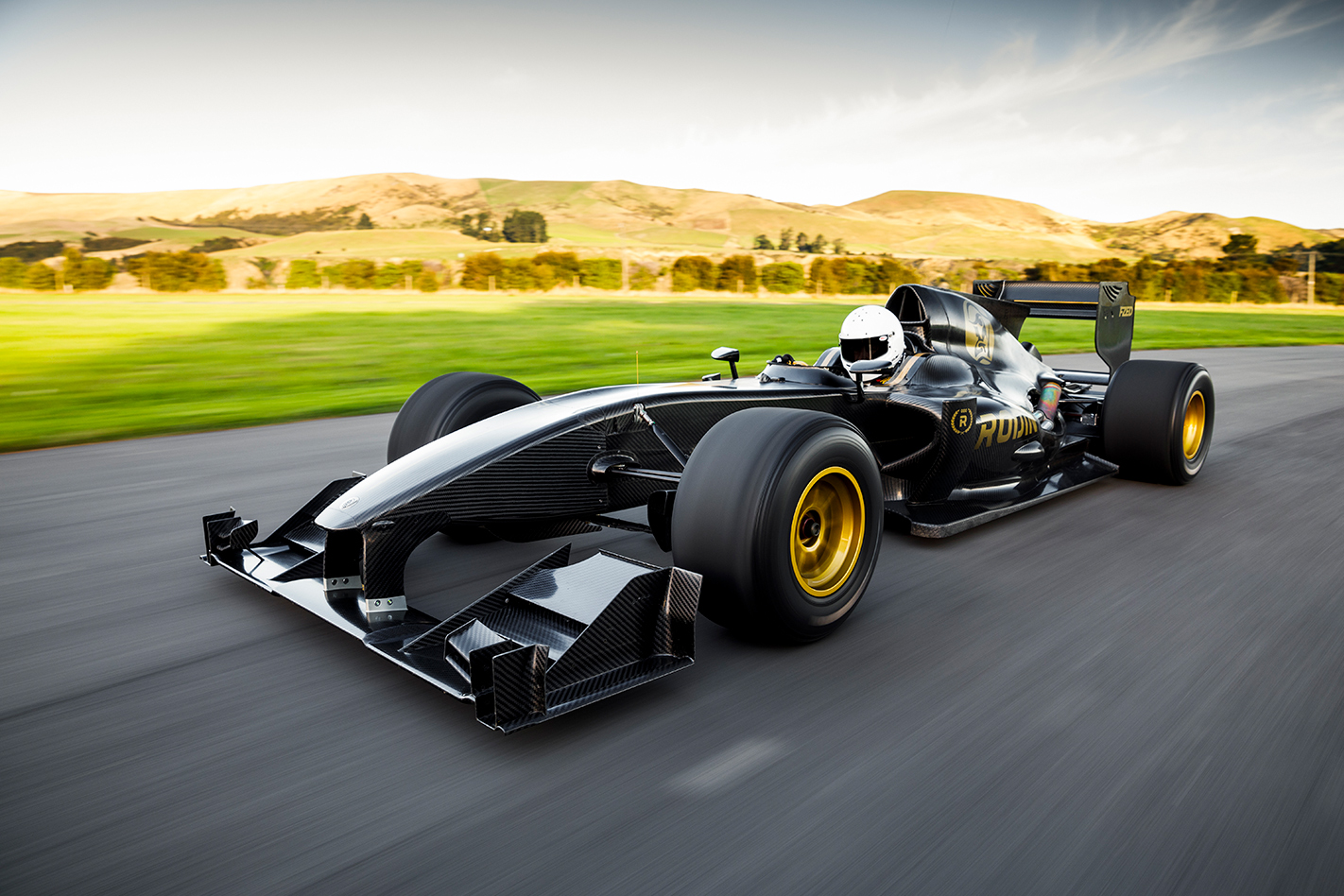
They needn’t be Lewis Hamilton, either. By lap three I’ve built some more heat into the brakes and I start to lean on the car; to revel in the enormous mechanical grip out of the slow turns, and that almost indescribable sensation of downforce through the quicker ones. It’s remarkably intuitive to drive quickly. The steering loads up nicely as the forces increase and the whole car seems to hunker down as the speeds climb, the chassis keen to delve into the vast reserves of adhesion on offer.
With the brakes finally up to temperature, I actually find myself over-slowing the car and needing to accelerate into the corners. Hit the pedal with confidence and the stopping forces are so enormous I’m thrown forward in my belts, despite the fact they’re buckled tight enough to squeeze my rib cage.
It’s all very confidence inspiring, until the inevitable happens. With my sense of my own ability swelling at the same rate as the heat in the tyres and brakes, I go too deep into Turn 1 and experience a white-hot lick of unbridled terror as my brain calculates my velocity and the remaining tarmac, and comes up short. I have time to register my eyes are beginning to swivel towards the trees some 50 metres away before the Yoda-like voice of Rodin’s chief driving instructor, Mark Williamson, echoes in my brain: “Stay calm and look through the corner. If you balls it up, keep looking through the turn. Don’t focus on what you might hit, otherwise you’ll hit it.”
In that millisecond I command my head to turn as far right as possible to clock the exit and instinctively I actually release some brake pressure to help the car to turn. Before I know it I’m out the other side of the corner, no lock-ups, no corrective lock. In fact, I still over-slowed it, so enormous is the level of grip.
It’s an uncomfortably effective demonstration of the level of performance on offer, if you’re willing to chase it. Conscious that I’m in someone else’s million-dollar track toy, I bravely decide to exercise caution, yet even so, I feel like I’m peeling back a layer of the car’s personality with every lap. It’s a lovely thing; alert, super agile and willing to rotate, but it’s that seemingly bottomless sense of power that dominates the experience. It’s addictive in a way no road car can match, with no plateauing or tapering off as the revs rise. Just more noise and speed.
All up I get eight laps over two sessions and half that number is spent warming the brakes, yet even so, the FZed has left an indelible mark. It’s unlike anything else I’ve ever driven. Where fast road cars, and even very fast track cars like a GT4 and Formula 3, have easily reachable limits, the FZed is vastly more capable. It must be incomprehensibly brilliant when it’s up on its toes, the driver pushing to eke every last bit of performance at the limit of adhesion. And amazingly, the FZed I’m driving is soon to be gazumped. While the first five cars will be sold with the Cosworth V8, any thereafter will have Rodin’s own 4.0-litre V10 and an aero package equivalent to a 2018-spec F1. “We want the aero to be basically what the current F1 guys have, minus the halo,” says Dicker.
“But what’s the point?” I hear you ask. “It’s astronomically expensive, totally irrelevant, and you can’t race it.” Well, that’s only partially true. At US$615,000 (A$873,000) before taxes and delivery charges, the FZed is undeniably pricey. But plans are afoot to make it eligible for Formula Libre, an international category that caters to a wide variety of racing cars. And forget logic. A purchase like this is an extravagance, a reward, a luxury for those who already own many fast cars but want a proper taste of Formula 1, without the headaches or compromises of buying an ex-racecar with actual provenance. And in that regard, I can’t think of anything else that comes close.
This special new HST trim level for Land Rover’s ever-popular Cayenne rival provides our introduction to a key component of the company’s developing engine portfolio – the first six-cylinder motor of the Ingenium engine family.
JLR is moving away from V6 engines and towards straight-sixes for a few reasons. It can employ modular block architecture related to its four-pots, and straight-sixes are more easily packaged with the ever more complicated induction and exhaust systems that modern engines use, while delivering well-known relative advantages in mechanical refinement.
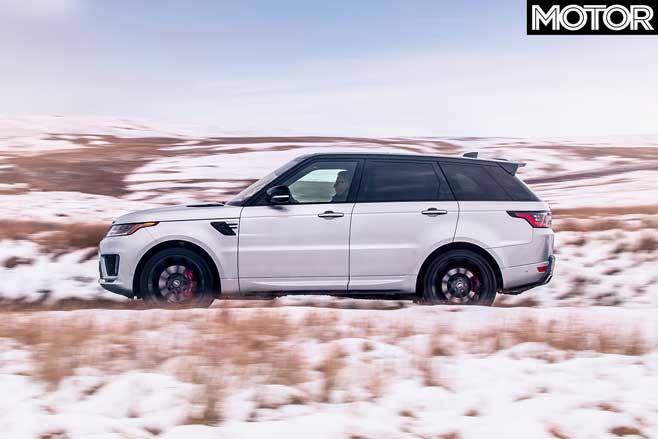
The Range Rover Sport HST’s new ‘P400’ unit is 3.0 litres by volume and effectively replaces the old supercharged V6. It uses twin-scroll turbocharging, electric supercharging and mild-hybrid electric motor assistance to make 295kW and 550Nm.
First impression of the new engine is one of refinement. Land Rover has gone to considerable lengths to make it the smoothest and most discreet engine at any price by fitting near-silent timing chains and the like, and the effort has clearly paid off. The HST starts and runs very quietly indeed, and shifts gear almost imperceptibly on a steady throttle.
Extend the engine’s revs in manual mode and, even in a heavy car like this, the engine is responsive, flexible and potent. Power delivery is very linear – it pulls beyond 6000rpm notably more freely than JLR’s four-pot Ingenium turbos – while audible character is great; smooth and reserved at low speed, yet quite tuneful through the higher reaches.
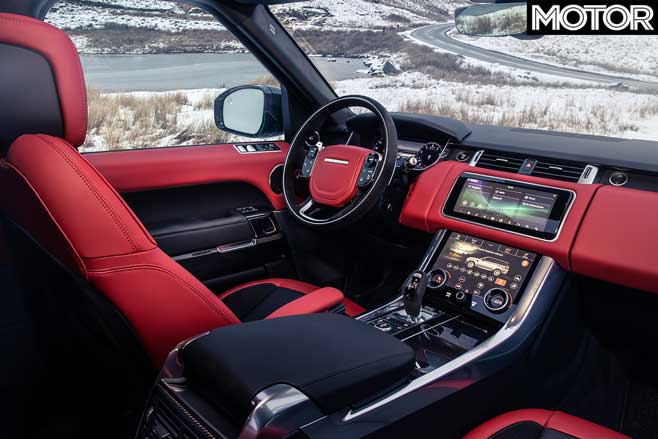
For such a high and heavy car, it’s a pleasant surprise how agile and precise the Sport feels at speed, and just how cleverly its body control juggles a tied-down sense of control with fluent long-wave bump absorption.
However, our test car’s low speed ride did suffer a bit from fitment of optional 22-inch alloys. Although supple at higher speeds, the HST picked up on sharper ridges in slightly fussy, unbecoming fashion.
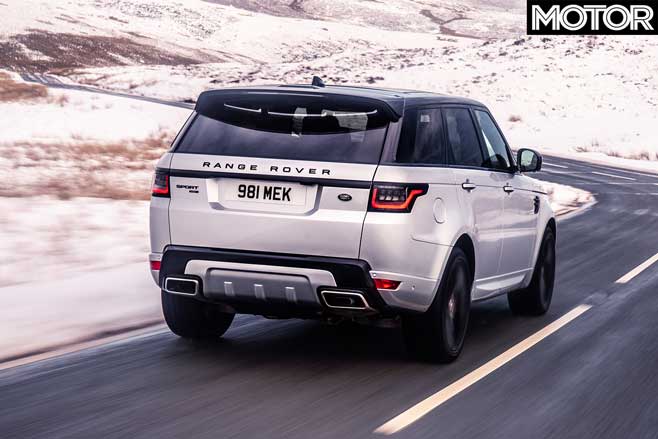
The new P400 engine suits the Range Rover Sport very well, proffering much of the accessible torque and easy drivability of the diesel versions, as well as the refinement and richness of a petrol V8.
Although local pricing and specs are yet to be confirmed, you can well imagine this becoming a go-to engine for urban Range Rover buyers. It should also serve very effectively in more driver-focused Land Rovers and Jaguars in the near future.
2019 RANGE ROVER SPORT HST SPECS Engine: 2996cc inline-6, DOHC, 24v, turbo Power: 295kW @ 5500rpm Torque: 550Nm @ 2000rpm Weight: 2405kg 0-100km/h: 6.2sec (claimed) Price: $170,000 (est)
Like: Power and smoothness of straight-six; great sound; chassis control Dislike: Low-speed ride on optional 22-inch wheels belies car’s refinement
Rating: 4 out of 5 stars
Elise Bennetts holds down two full-time jobs: She’s a mother to three kids, has a dog and a husband, all of whom are highly active and demanding. She also works full-time in a social enterprise looking after disadvantaged young people. It is a full life – one that she wouldn’t ever trade.
What is it?
New to our roads, this French beauty could easily take to the catwalk in Paris – its stylish good looks shine brightly in our overcrowded small SUV market.
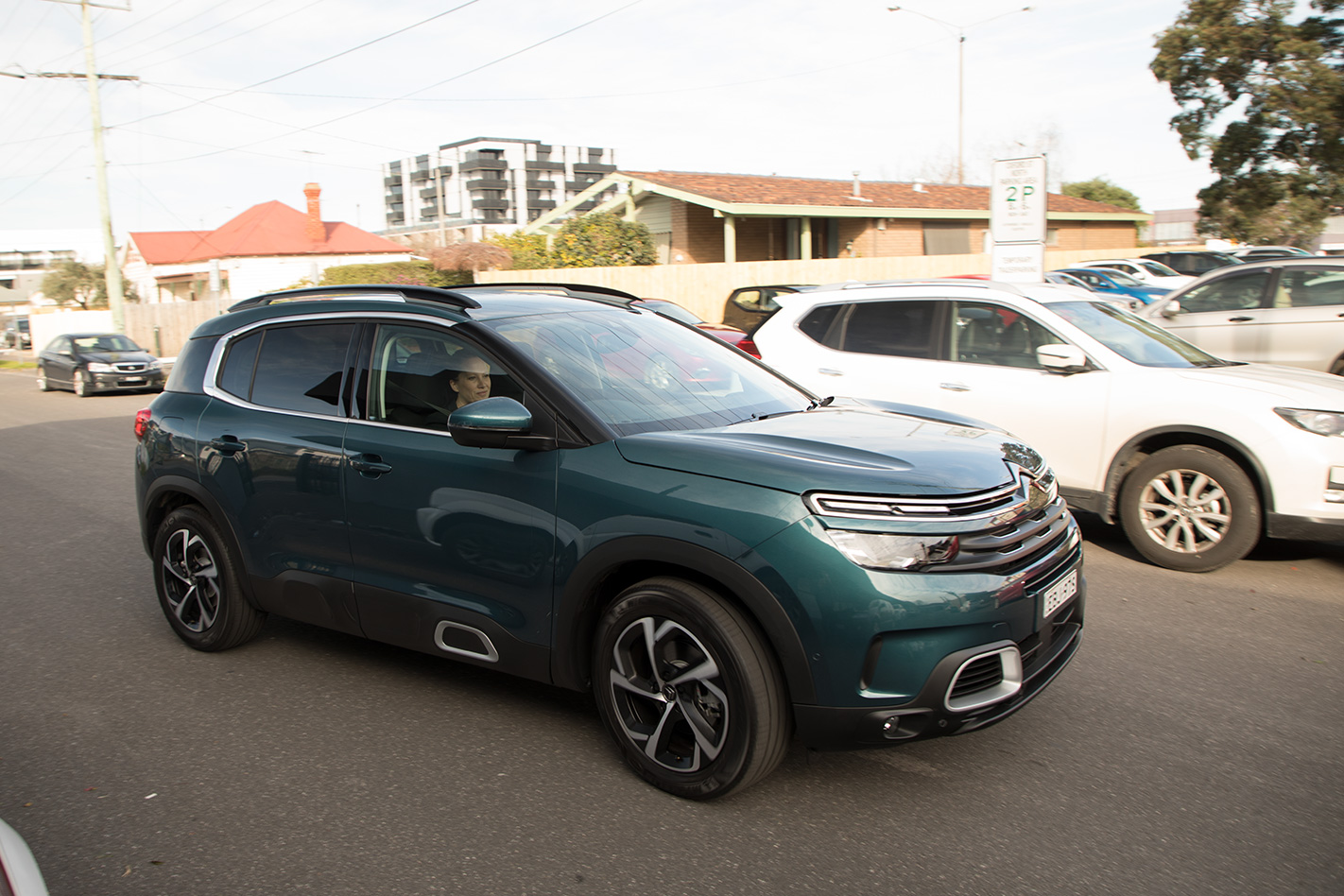
In saying that, whilst I find the Aircross a bit of a supermodel on the outside, it does lack a little on the interior. The Citroen C5 Aircross SUV comes in two models, the Feel and Shine – mine felt more than shone although reading the specs there’s not much difference between the two.
I had heard that the new C5 Aircross is the most comfortable SUV on the market due to its superior suspension and its Advance Comfort seats. Well, it certainly was smooth to ride in and I can attest to the comfortable seats (I would, however, suggest if you have kids, upgrade to the leather option).
What’s it like to drive?
The week I had the C5 Aircross proved to be a normal week of small trips to work, school drop-offs, shopping and general errand driving, and this compact SUV certainly stacked up.
Opening the solid doors and slipping into the interior I was suitably impressed upon first inspection; it was roomy and it was comfortable.
Whilst the seat was only manually adjustable, I was able to manoeuvre it to a height that allowed me to see over the dauntingly high bonnet (for those vertically challenged like myself).
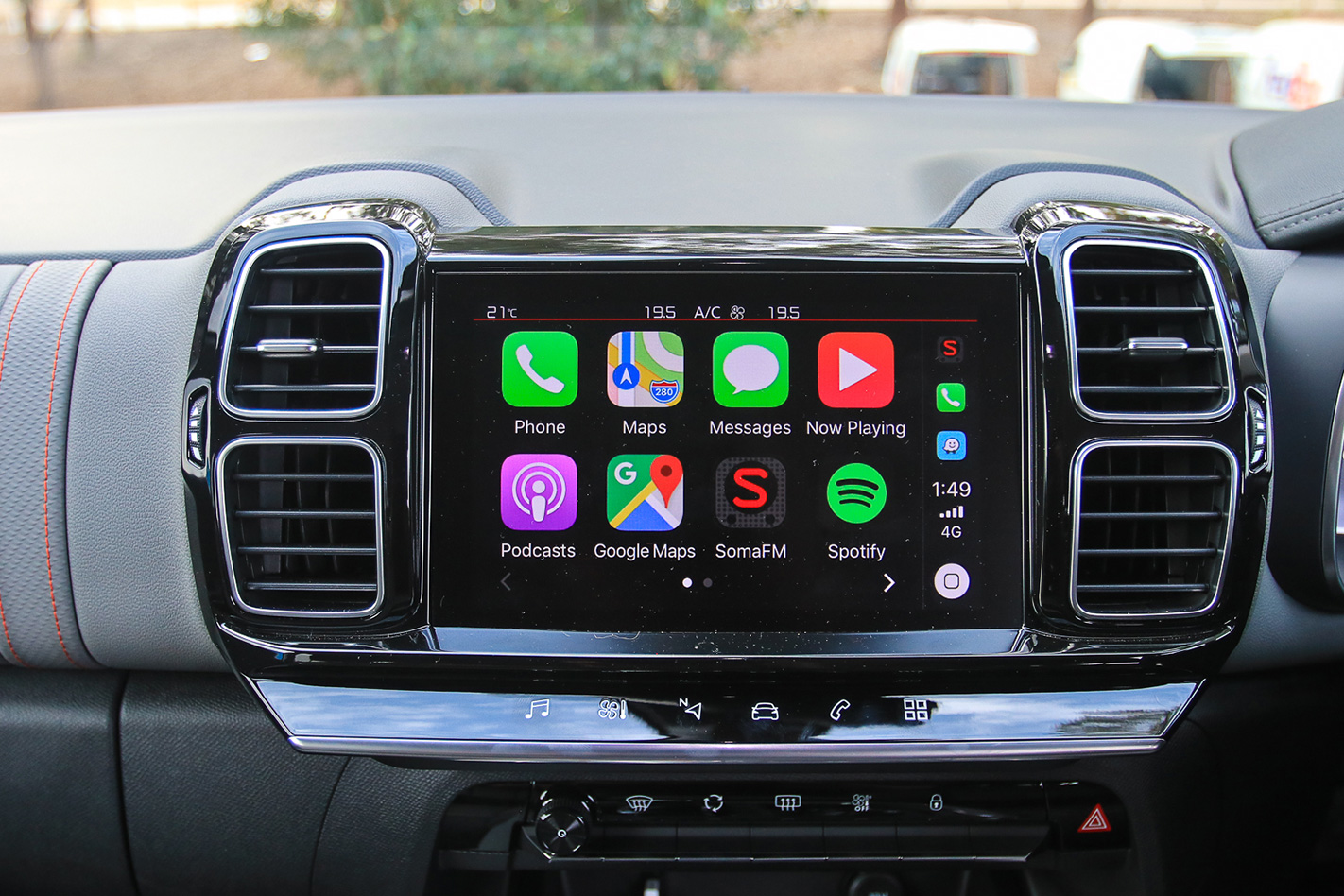
The 8.0-inch touch screen (below) was easily navigated with phone connectivity, radio preferences and navigation as soon as I got in. I was also impressed by the personalisation of the digital dashboard from the steering wheel, with up to 6 options of display.
The steering wheel is very comfortable to hold, although with the number of functions, indicators, cruise control and paddle shifts – it looks a little more like an Xbox game control!
The centre console is large to the point I was reminded of being in business class, although I feel they have failed to deliver. It took some time to realise that the centre console opened from the passenger side, a minute detail lost in translation from left to right-hand drive.
On that note, I was also reaching over to the far left under the gear stick to start the car.
What’s it like to live with?
Again, I will reiterate I like the look of this car, it certainly holds its own in the good-looking stakes. It’s the interior for me that’s let it down. My younger son was the only one that could comfortably sit in the rear middle as that mismatched console protrudes a little too far into the back for the C5 to realistically take three adults in the rear.
I think I tried to close the power windows more than a dozen times until I realised the noise I could hear was coming through the vents, but once I’d identified it I got used to it.
And the other ‘getting used to it’ feature was the sensitive brake compared to the more giving accelerator – they were completely opposite in their receptiveness. I too got used to this and stopped apologising to my passengers for my quick to brake, slow to take off driving!
The boot space is surprisingly large for the car size and with the three rear individual sliding, reclining and folding seats it really is a versatile configuration.
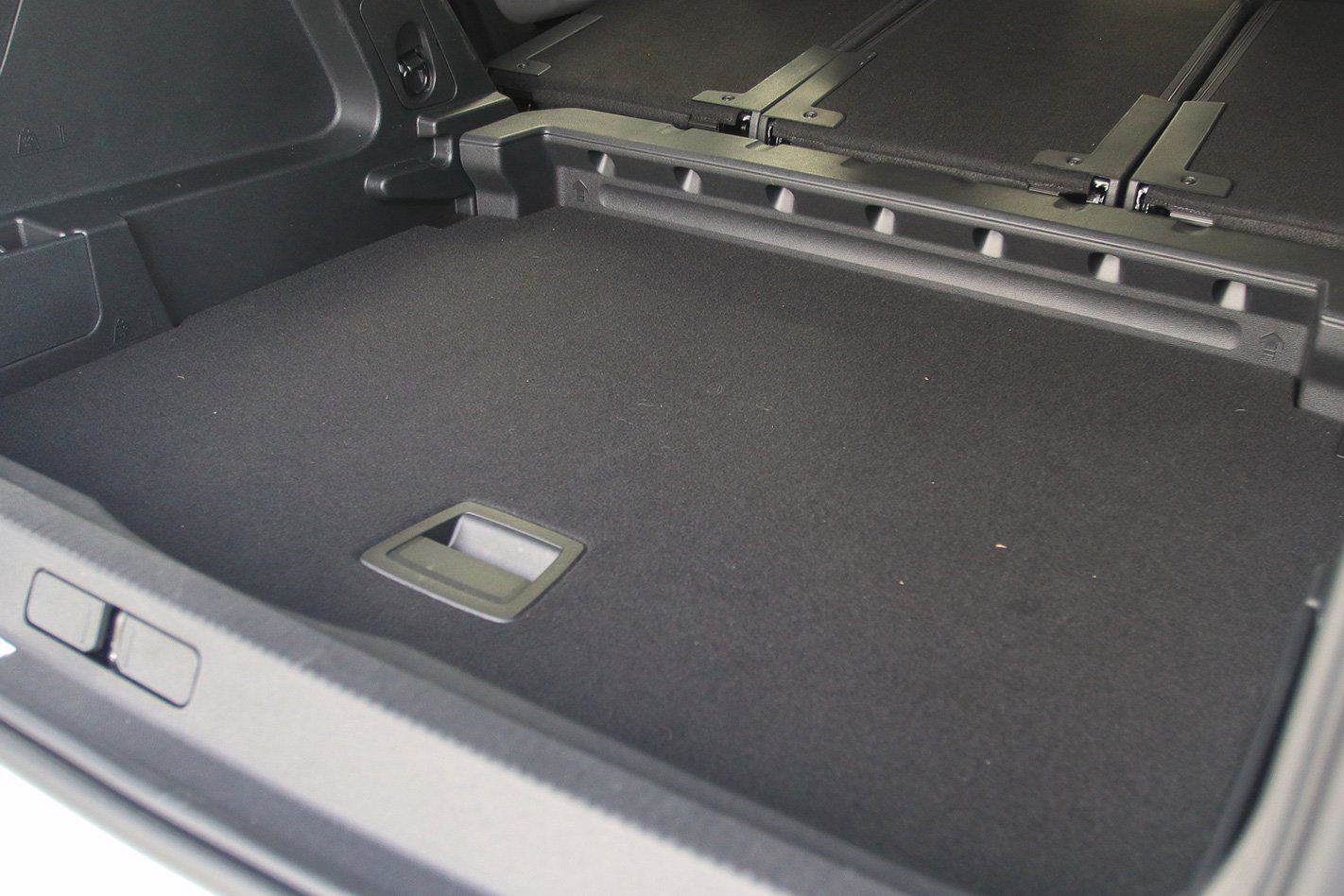
I had no need to use the false floor in the boot but it does say that it extends the boot to 580 litres with the seats back – so this would certainly come in handy for bikes and band equipment.
The safety features were noted and appreciated. A particular stand out was the surround-view reverse camera and the front and rear parking sensors. Thankfully, I did not see the six airbags but was truly comforted that they are there.
One of my biggest pet peeves in a car is the turning circle – if I have to do an ‘Austin Powers’ manoeuvre at a shopping centre to get out of the ever-decreasing tiny car spaces then I’m less than impressed with the car. I’m pleased to report that the Citroen’s tiny turning circle was smashing, baby, yeah!
Overall , the Citroen C5 Aircross passed with flying colours.
Is it worth the money?
At $39,990, I was suitably impressed with the way the Aircross handled; it felt safe and solid to drive. A five-year warranty is also great peace of mind.
I do think, however, for the inclusions, it’s a little on the pricey side in a highly competitive SUV market. Again it comes down to its good looks on the outside which don’t necessarily translate to the additions on the inside.
The Citron C5 Aircross song is brought to you by: https://www.youtube.com/watch?v=_az4tzArQ5g
Ça plane pour moi – A French classic translating into English – Everything is going well for me – literally, it is gliding for me.
Pros: Easily manoeuvrable – great turning circle; sold and safe; supermodel good looks
Cons: Centre console set up for left-hand drive; engine feedback in the driver’s seat; lacking on the interior
Rating: 4 out of 5 stars
PS: Every car needs a song and the Citroen C5 Aircross review is brought to you by “Ça plane pour moi”, by Plastic Bertrand. Ça plane pour moi – A French classic translated into English – Everything is going well for me – literally, it is gliding for me.
Model: Citroen C5 Aircross Feel Engine: 1598cc 4-cyl, dohc, 16v, turbo Max power: 121kW @ 6000rpm Max torque: 240Nm @ 1400rpm Transmission: 6-speed automatic Kerb weight: 1400kg Fuel economy: 7.9L/100km Price: $39,990 On sale: Now
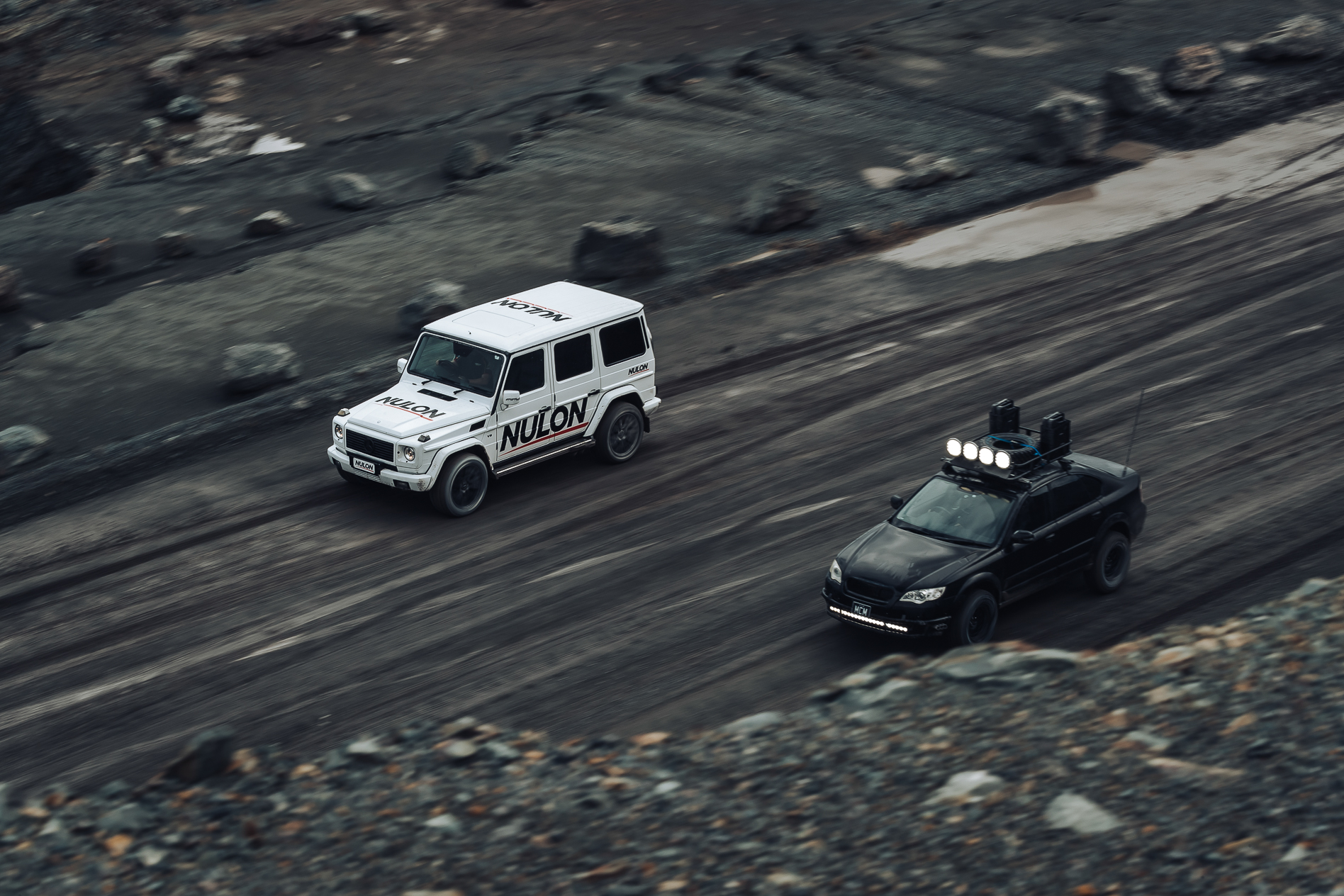
Sometimes one phone call can lead you to have the wildest experiences in your life. This revelation struck me while standing in ankle-deep mud in a quarry near Brisbane recently, as a $3500 car that my mates and I had built in a garage raced against a flame-belching AMG G63.
Marty and Moog from renowned YouTube channel Mighty Car Mods rang me several months ago and asked me to help them source, build, and then transport the car they were going to use in the upcoming 2019 Supercheap Auto ‘Oils’ ad shoot, which has become something of a touchstone in automotive advertising.

This wouldn’t be my first time working with these guys; I’ve actually known the boys for years and helped build their Subarute in the USA in 2016, write their book in 2017, and build their LS1 HQ Holden for the 2018 Supercheap oils ad.
Building the jacked-up, off-road-spec Subaru Liberty – nicknamed Outfap – was a fun and full-on three days at the MCM headquarters, though it is always a great time hanging out with the boys, plus Benny ‘Mechanical Stig’ Neal and Al ‘Turbo Yoda’ Butler.
The paint was barely dry on the car before Marty and I loaded it onto the MCM car trailer, and I hauled it 12 hours up the east coast to where the ad was being filmed.
Day one started early with a 6:30am call at the Supercheap Auto HQ in Lawnton. I had been told the mantra of a big-budget film shoot is “hurry up and wait”, and it proved 100 percent correct. You just find somewhere to sit yourself near your allocated vehicle (or Liberty in this case) and just wait for instruction.
And there’s no concern about not getting the message; if someone needs something to happen with a vehicle you’re responsible for, they will not hesitate to communicate that loudly enough to be heard on the moons of Jupiter, along with the fact they needed it done 15 minutes ago.
Supercheap Auto’s Reece Moger had told me there were about 80 people on the shoot, but it seemed like a cast of hundreds. Everyone was either standing around scoffing a quick breakfast or racing manically on some super-urgent job.
Production assistants, wardrobe, catering, grips, vehicle handlers, stunt co-ordinators and stuntmen, photographers, and 100 other professions were all needed to ensure the ad would be a hit.
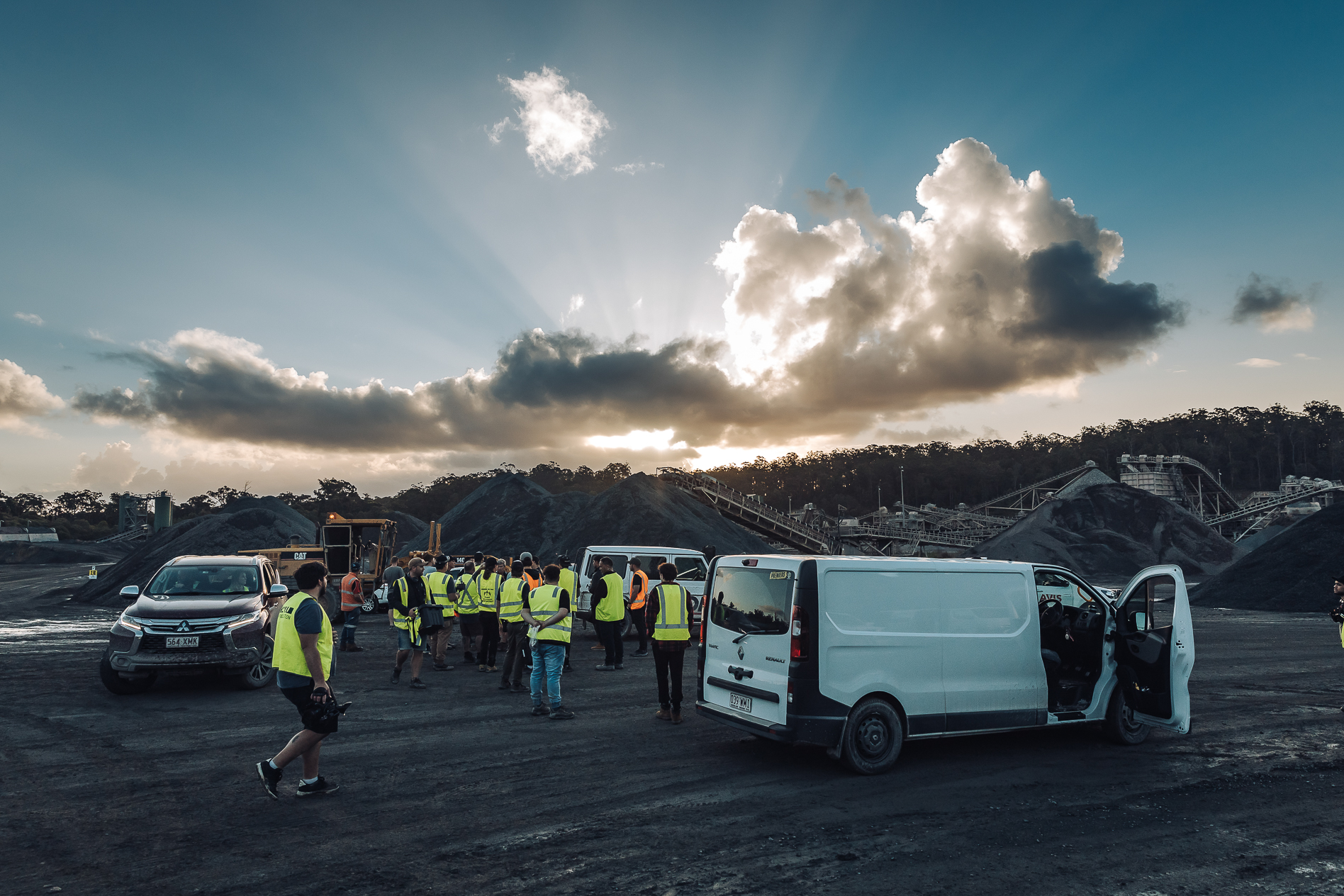
And the intermittent rain meant it was stress-city for them, as passing showers would drop the deuce on their finely-laid plans as soon as they were ready to shoot. Thankfully the rain passed and the crew quickly made up any time that had been lost.
One of the most impressive parts of the day was watching a crew of drone operators chase the cars and bikes at close quarters. If you get a chance to check out drone racing, do it as the speed and control these guys have is unbelievable; these things flat-out deny physics!
For 2019 Reece and Josh Weier from Black Wattle Studios had come up with a killer concept and script with more storyline to it. Basically, the boys would be chasing a Supercheap employee who had been tasked with delivering a package by a spy, who is part James Bond and plenty Inspector Gadget. What’s in the package? That is all part of the fun!
Just as I was getting keen to see Rob White drift a Ferrari 360 Spyder around the inside of a massive warehouse, I got a tap on the shoulder. Part of working on a film set is being super-flexible, and so I had to race off on a three-hour drive to the Gold Coast and back to pick up a nitrous bottle.
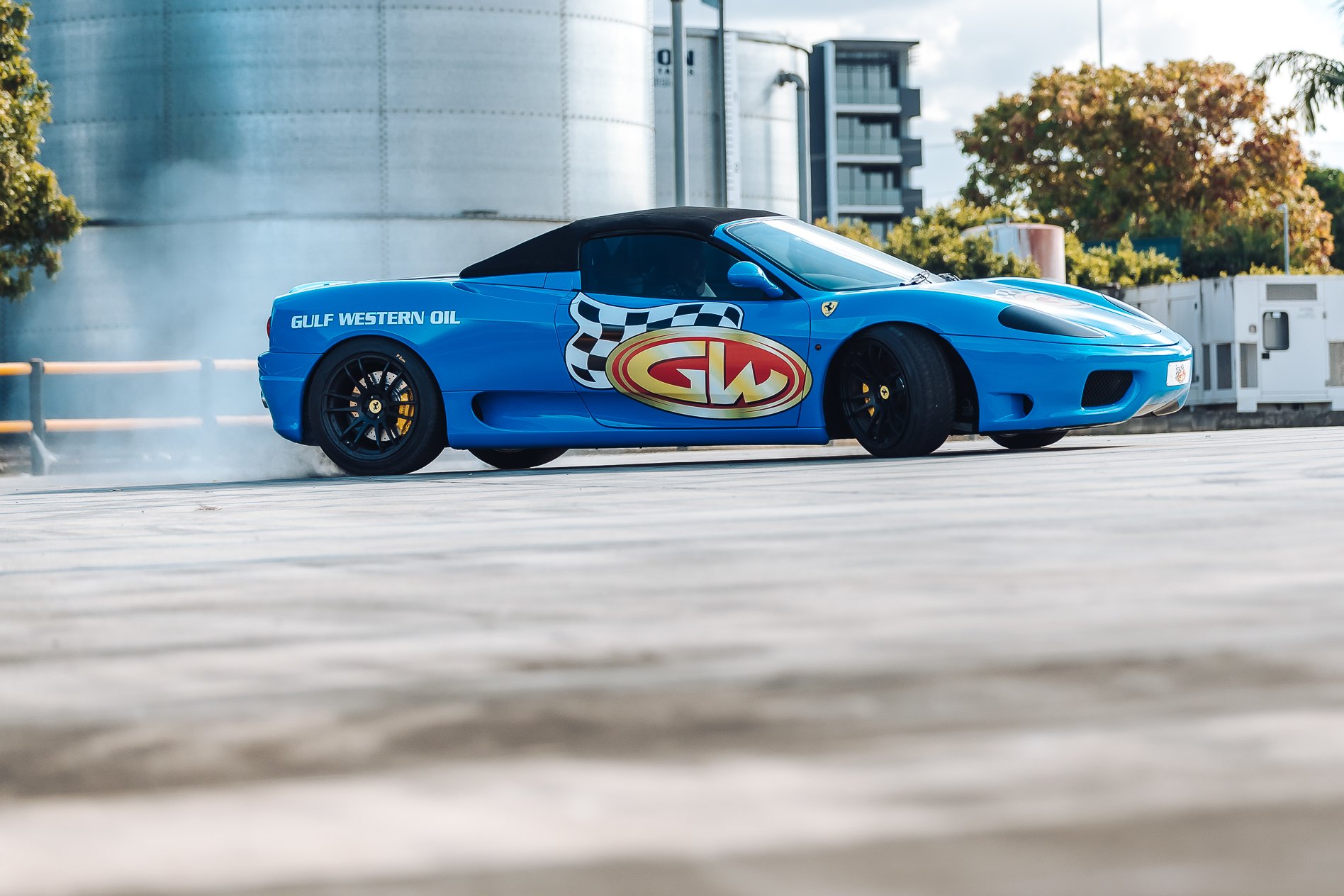
It was needed for a gag the next day, and we still hadn’t made a grille for our car so I had to pick up mesh for that, too. No problem! I actually managed to make it back in time to watch Rob slide the open-piped Ferrari 360 around the loading dock behind the Supercheap warehouse a bunch of times; not a bad Friday at work!
Saturday wasn’t going to be such an easy task, though. Rain over the last week it turned the quarry into a slimy mud pit, which destroyed everyone’s shoes and caused havoc with the cars. After each and every take Brandon had to pressure-wash both cars down, going through over 1200 litres of water in a single day.
Al was on set for the Outfap’s scenes and he, Marty and I got the car ready for its star turn on film by doing random jobs like ratchet-strapping the nitrous bottle to the roll cage (as a gag), though we never did make a grille for it.
In the end, after thrashing madly for an hour to prep the car, our job from 7am until 6pm was to then sit around and throw rocks at each other.
Marty (below) and Moog filmed some close-ups and then handed the car to the stunt guys at about 10am, who then proceeded to thrash it around the quarry doing the dangerous chase sequences. The shoot wrapped after the sun had set with the whole set stinking like a burning freight train from the Liberty’s stock clutch giving out.
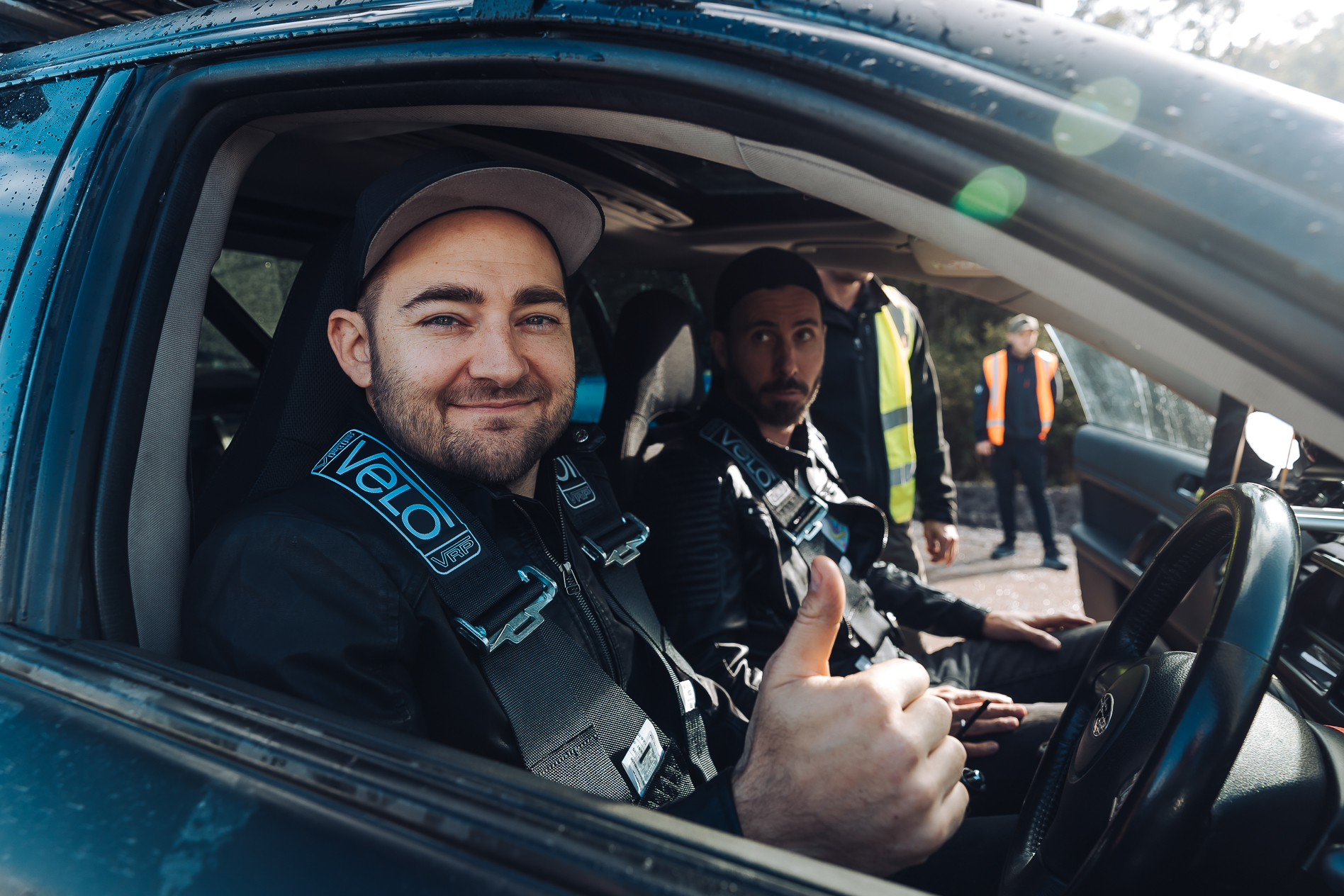
This came as no surprise to us, as our $3500 Subaru had spent several hours chasing a $200,000 supercharged V8 AMG 4×4 around a muddy quarry. The Subie did an admirable job despite making several hundred horsepower less than the big German box, so we were stoked we could drive it back on the trailer at the end of the day.
We rose pre-dawn on Monday to unload the Subaru at the semi-abandoned airport that the team had hired the whole joint for the day and, after Al and I checked the clutch was operational, we gave everyone strict instructions to take it easy with the car.
With kangaroos hopping across the abandoned runway, dew glistening on the grass as the golden sun beat down, and a thick fog hanging in the air, it was a beautiful, serene scene… until Kent Dalton from Hi-Torque Performance blasted it into submission with his five-litre Mustang V8 drift car.

Al and I then basically spent the day discussing ridiculous engine swap ideas, and whether season eight or nine of The Simpsons was the show’s high-water mark.
At 6pm we heard Bish bellowing the magic words, “That’s a wrap, guys!” across the dark airfield, marking the end of my time on the shoot.
I got to sneak a look at an early cut of the ad and I was filled with a sense of pride seeing some of my hard work blasting around the screen. Hopefully, all the fun we had comes through on the ad and everyone digs the ad!
Sign up here to get the free weekly WhichCar eNewsletter
If you know the new Porsche 718 Cayman GT4, you know the new Porsche 718 Boxster Spyder. One may get top billing as the track-day star while the other plays second fiddle as its road-ready counterpart, but in mechanical terms they are the same, even down to the suspension tuning.
That’s exciting, because never in two previous iterations has the Spyder been engineered by Porsche’s GT division in Weissach. This is a marriage of style and substance the likes of which we don’t often see at this price, and you might even think of it as a junior 911 Speedster.
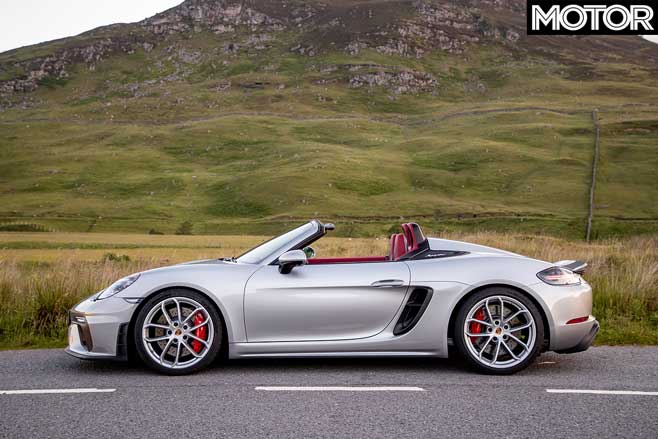
The Cayman GT4 and Boxster Spyder, which arrives here is early 2020, weigh the same 1420kg. That’s some 105kg more than the old Spyder, but is overcome by the same upsized 4.0-litre flat-six as the Cayman GT4. It’s a big engine in a small car – shorter than a Golf and only millimetres wider – and powers the Spyder to 100km/h in 4.4sec with the six-speed manual. A seven-speed PDK is at least a year away.
The Boxster Spyder is remarkably good, even by Porsche standards. With the roof down, there’s a different vibe to the GT4, but it’s still 95 per cent as capable. And the fact this engine isn’t the equal of a supremely well-balanced and stable chassis with masses of lateral grip doesn’t matter so much. This car does the basics so well you can have the time of your life without ever engaging your risk-assessing frontal lobe.
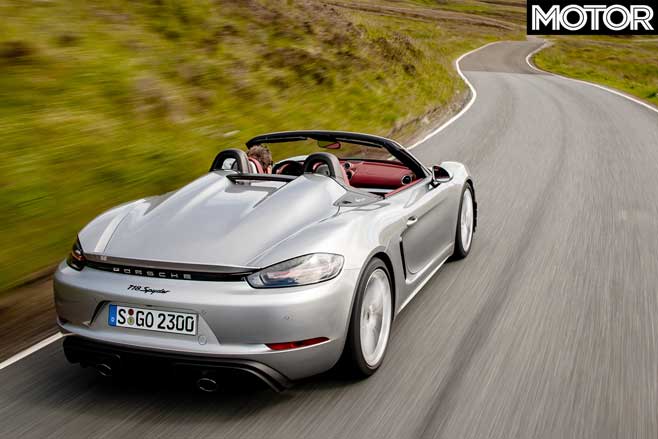
Steering is lighter than you might expect and only moderately geared – among electromechanical racks, this is surely the current benchmark for feel – it handles with stunning neutrality, and the standard steel brakes are so good (both in pedal feel and power) that understeer can only come about by gross negligence. So sharp is the throttle response that you can quickly tease the rear axle out of line – or more than tease if you like – and you’ll certainly have the confidence to try.
Ride is very good, even though the Spyder sits 30mm lower than the standard Boxster. Its two damper modes are quite close, and on our Scottish test route there was no need to move out of the softer default setting, even at great speed, so controlled are the body movements. The damping force is beautifully progressive and just feeds into the overwhelming sensation of balance, composure and flow.
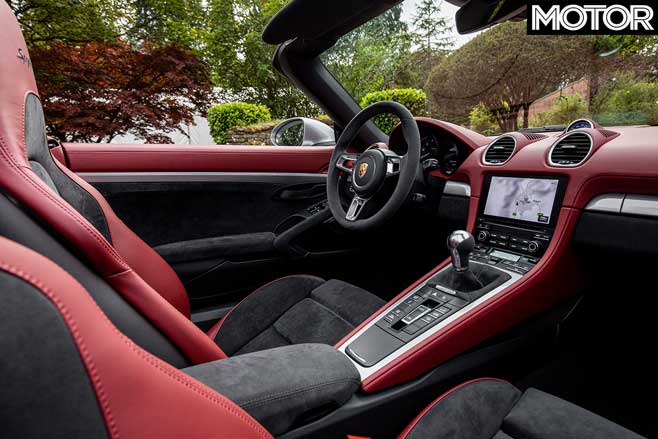
The new 309kW engine takes the Spyder to a top speed of 300km/h, with or without the canvas roof in place, and for some reason appeals more here than in the GT4. It doesn’t make the superb racket of the previous 3.8-litre unit, but is fabulously smooth and full and suits the Spyder’s nature.
It happily strokes the car along at around 3000rpm, at which point it’s still superbly responsive, and only gets better as you stretch it out. Second gear takes care of everything from 60-120km/h, but the gearshift is so good you’ll itch to slide across the gates and into third. There’s a very good autoblip function, though you don’t need it.
Images don’t do the looks justice. The arrival of GT3 hardware coincides with an injection of visual brawn. With a jutting front splitter, ducktail spoiler, beefy rear diffuser, huge front air intakes those buttresses on the rear deck, it’s not classically beautiful but plays the junior supercar card well.
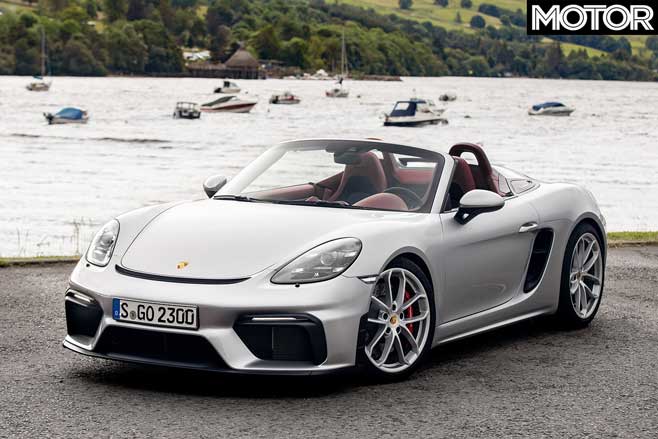
You can’t access the rear boot unless the manual roof is folded away, and you have to get out to open it, but if these are deal-breakers buy a Boxster GTS. Whether you could subsequently live with yourself for prioritising a small degree of convenience over a big-capacity engine and such a fabulous chassis is another matter.
The 718 Spyder is such a distinctive car both in look and feel that it could well be most broadly desirable car Porsche now makes. Character, dynamism, usability and price; there’s barely a chink in its armour. It might not be the car you need, but it is one you should covet deeply.
2019 PORSCHE 718 SPYDER SPECS Engine: 3995cc flat-six, DOHC, 24v Power: 309kW @ 7600rpm Torque: 420Nm @ 5000-6800rpm Weight: 1420kg 0-100km/h: 4.4sec (claimed) Price: $209,000
Like: Chassis balance and grip; big-engine grunt; brawny looks; ride and composure Dislike: Reserved engine sound; manual folding roof; boot access
Rating: 5 out of 5 stars
