
The contenders
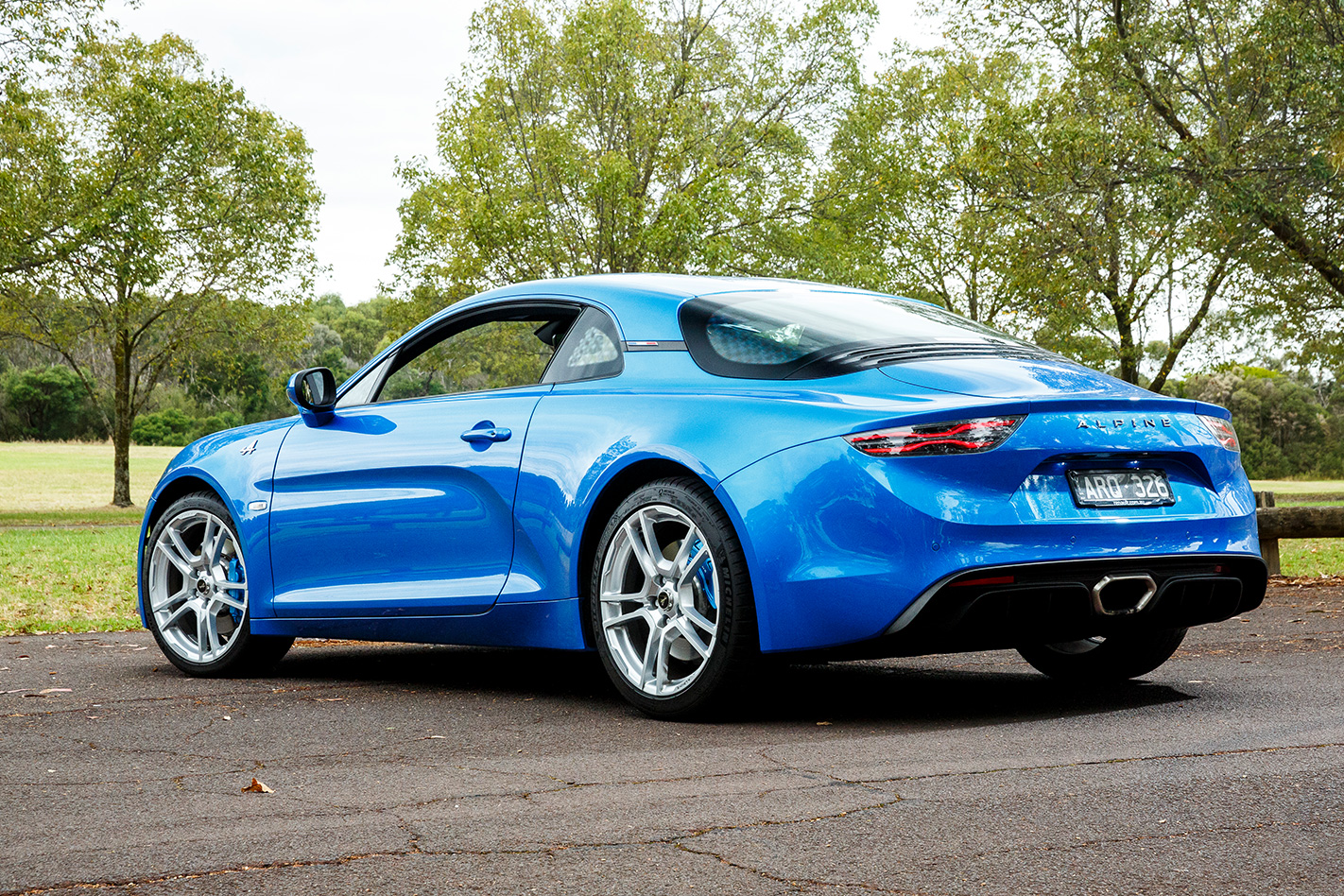
Alpine’s iconic A110 name is steeped in rally history but this model on test is completely new, giving the French brand a svelte rival to the fiery Italian and that other two-seater from Stuttgart.
Despite largely aluminium construction and multi-link suspension both front and rear, it only suffers a modest weight deficit to the sparsely equipped Alfa Romeo 4C, courtesy of the latter’s featherweight carbonfibre chassis. Like its foe, you’ll look in vain for a clutch pedal, but where the Alpine really scores is in the quality of its suppliers: the seven-speed dual-clutch from Getrag, bucket seats by Sabelt, alloy wheels from Otto Fuchs, while Brembo supplies the brakes.
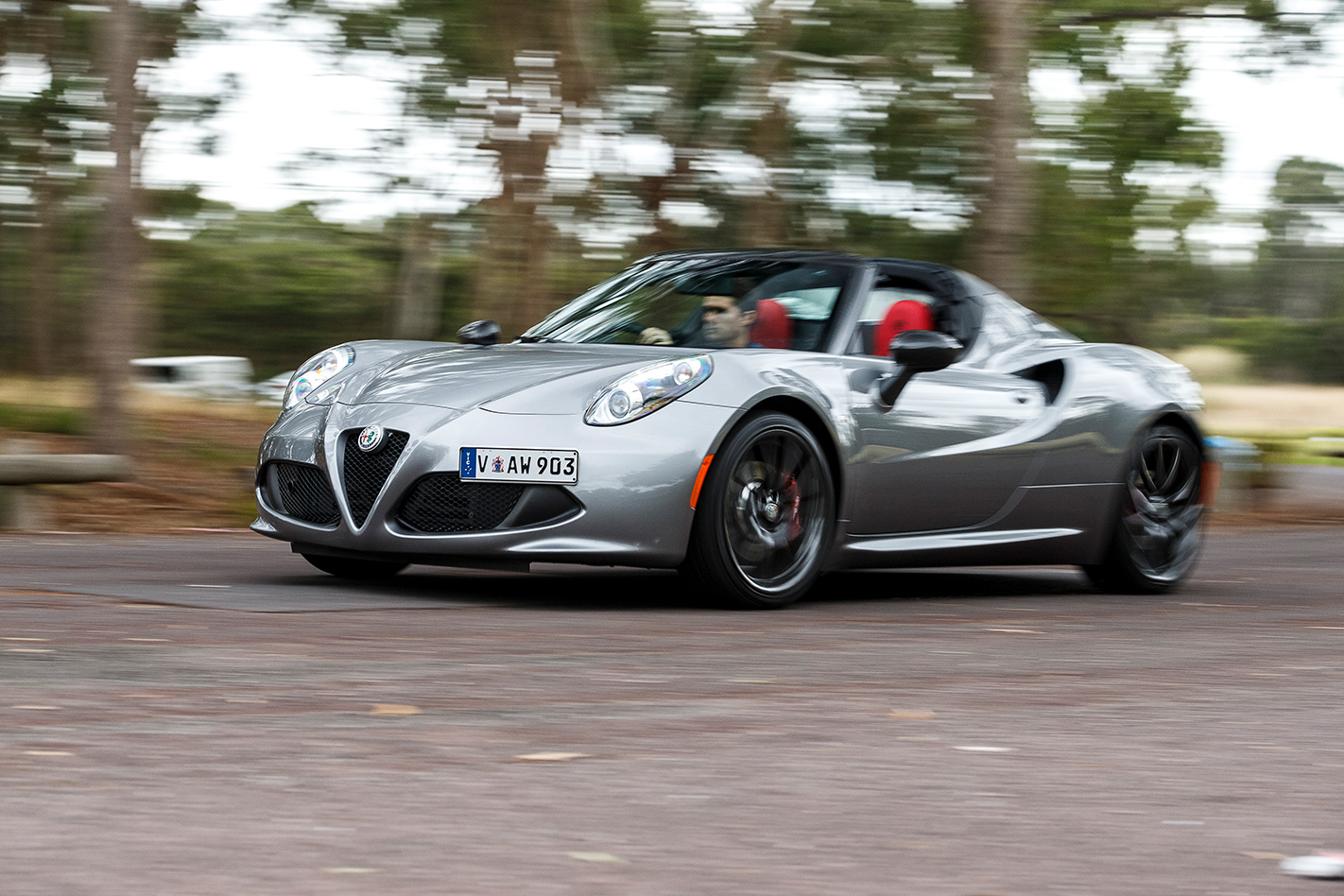
Our 4C is the Spider, priced just under $100K which the Australian Premiere Edition A110 is not. But the Alfa has been on sale for five years already and feels as old inside. However, it screams supercar drama on a sports car budget.
Equipment and value
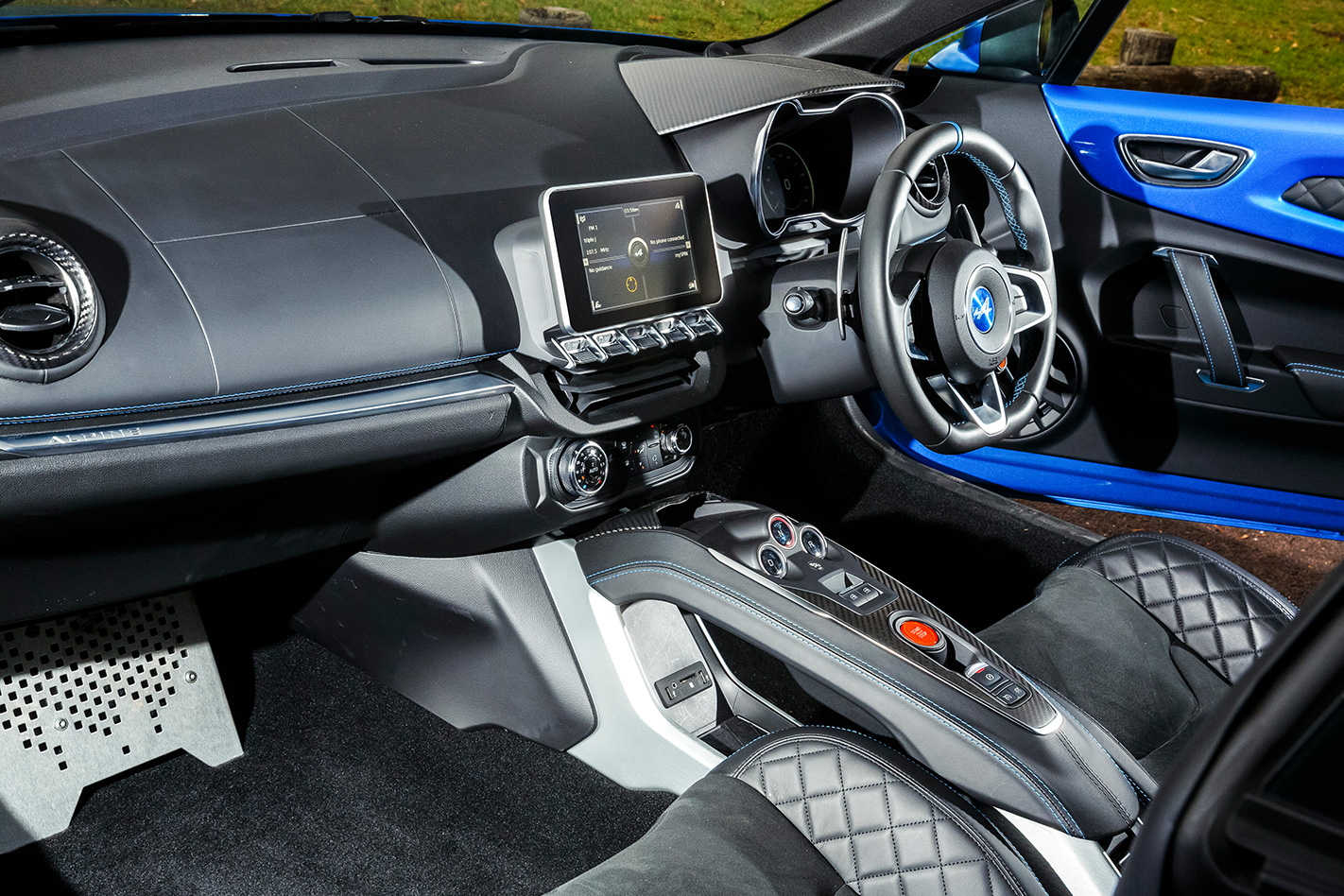
It’s seven grand more expensive, but the Alpine feels the more polished contender. In addition to those parts from Brembo and Sabelt are leather and microfibre strewn throughout the cabin, a touchscreen infotainment system (though no reversing camera, which is a glaring omission from both cars), 10-inch digital display cluster, climate control and alloy pedals.
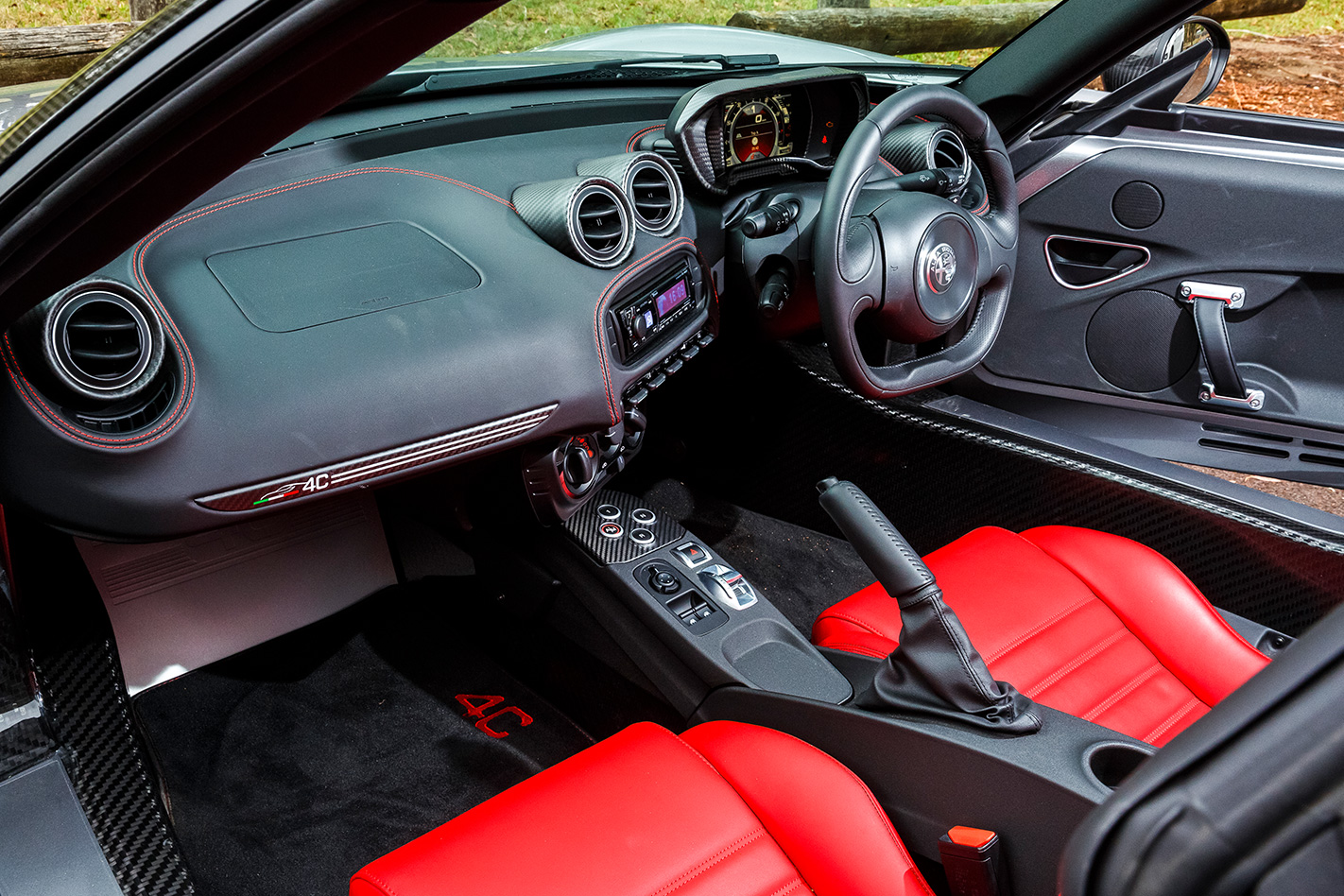
Thin though that list might seem, the 4C has only an aftermarket stereo head unit (with Bluetooth, at least), basic heating and cooling controls, racing bucket seats and a traditional analogue binnacle cluster supplemented by a small digital readout. While you won’t seek out either of these cars if you hanker after a long list of interior refinements, the Alpine feels a good deal more cohesive and liveable. Factor in its smartphone mirroring and you don’t even have to deal with a whole bunch of typically frustrating French infotainment idiosyncrasies.
Space and comfort
Both vehicles clasp occupants tight into their bucket seats, making long-distance comfort elusive, although the A110’s cabin caters better for taller drivers.
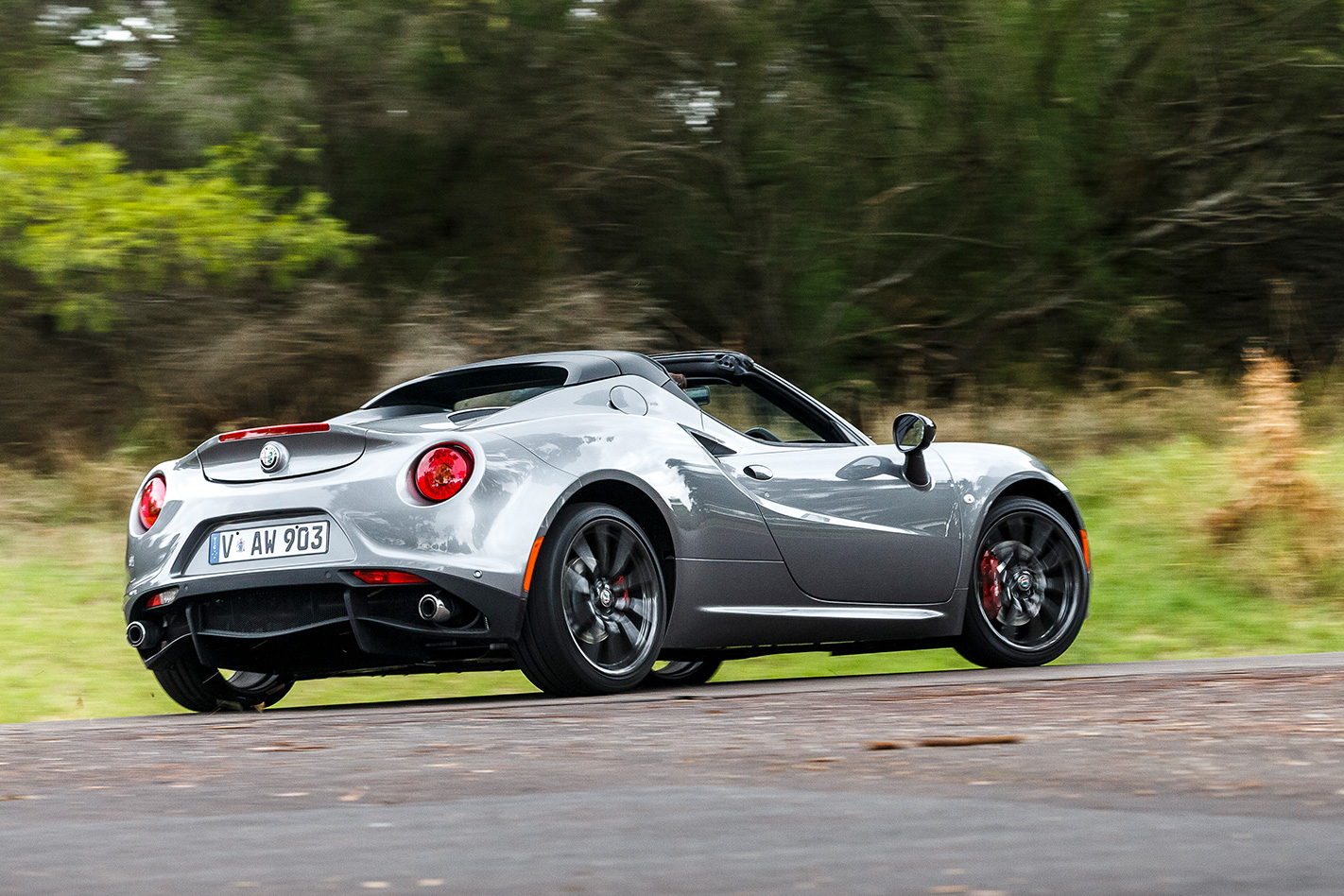
The Alpine feels more luxe despite some flimsy plastics and scratchy surfaces. There is plenty of the French design flair you’d expect but not a complete sacrifice of logic for aesthetics. The Alfa’s triumph is its dramatic entrance that requires sliding over a gorgeous carbonfibre chassis to get into the cockpit – something you’d expect from an expensive supercar – but falling into the seat becomes laborious compared to the more practical entry of the Alpine.
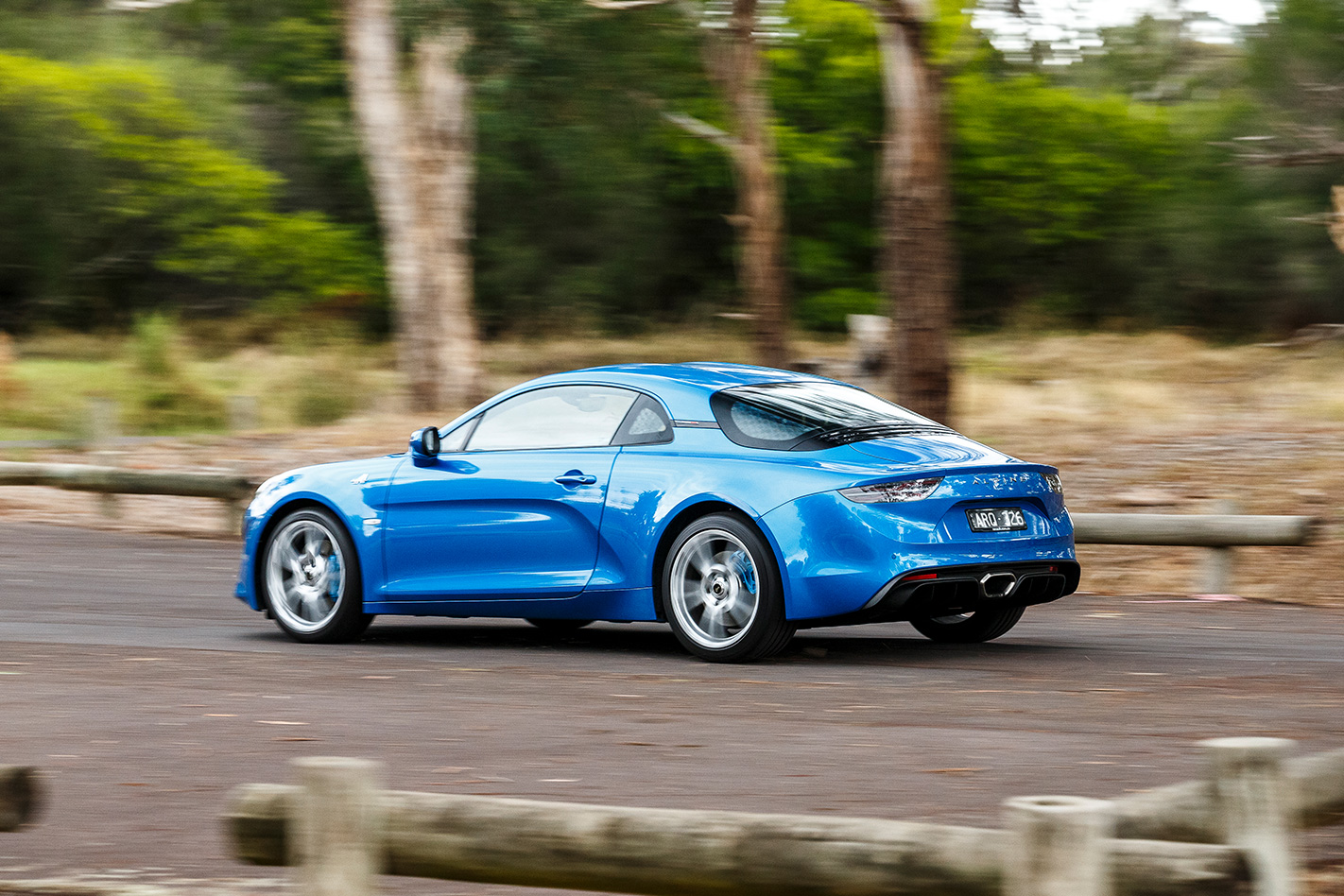
The 4C’s cabin is basic and the controls and dials practical and solid at best. The Alpine’s relative elegance is desirable on anything more than a hardcore punt. For touring, both require the two occupants to pack lightly, but the 4C boasts a 10-litre bigger boot (110 litres) and cupholders that the Alpine does not care for.
How they drive
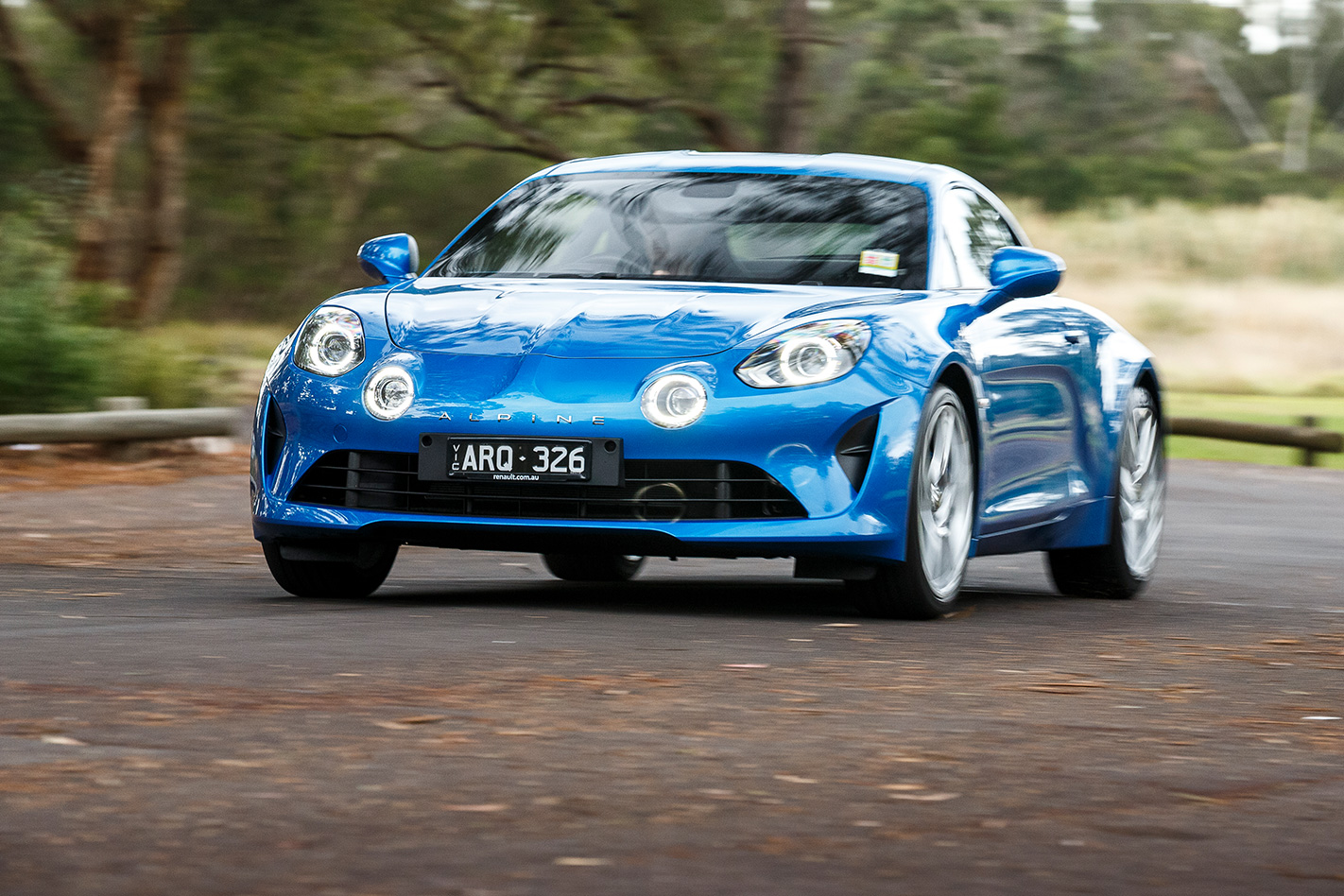
The Alpine is exceptional when transferring its weight in response to syrupy-smooth steering and to throttle and braking inputs, with beautiful balance from its softly sprung, ultra-rigid chassis. The 1.8-litre turbo engine mounted between the driver and the rear axle is energetic and vibrant, barking in sport mode as power peaks towards 6000rpm. It’s not so powerful that the rear feels unpredictable, with ESC switched on at least. The seven-speed auto does well, with crisp shifts.
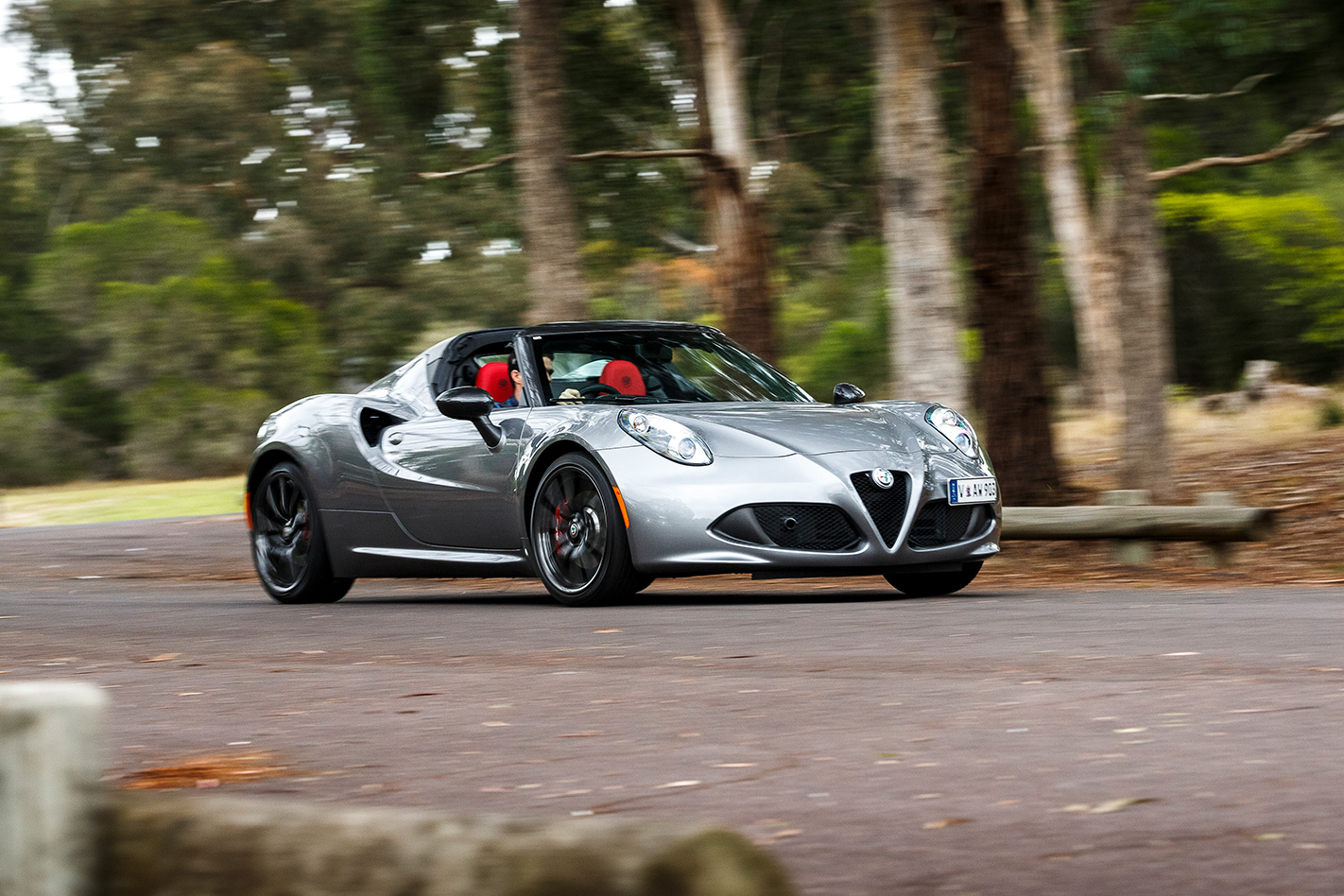
The 4C’s 1.75-litre turbo mill isn’t lacking in attitude either. Despite an 8kW deficit at 177kW peak, it develops 350Nm and the car is 68kg lighter so it feels quicker, despite both claiming 0-100km/h in 4.5sec. It gives the Alfa the edge for character, particularly with the roof off and the engine whistling and chirruping over your left shoulder, but its handling and manners on the road are gruff. The stiff carbonfibre chassis underpins a mute front end, while the rear does little to telegraph any impending adhesion deficit.
The victor
These two contenders have much in common, including a sophisticated chassis to rival some supercars. It is the Alpine’s fastidious attention to detail on dynamics that give it a noticeable edge, and the cabin and presentation was never under threat from the utilitarian Alfa. While trailing by some way, the 4C remains the most exotic-feeling to drive, and some will undoubtedly warm to its spiky, scaled-down supercar feel.
If at first you don’t succeed, try, try again.
Since its introduction in 2016, the Lexus RC F has offered an intriguing and at times enjoyable left-field alternative to the likes of the M4 and C63 S Coupe but has struggled to go toe-to-toe with its more established German rivals. Undeterred, an army of engineers has been busy fine-tuning the V8 sports coupe, leaving no stone unturned in the quest for improvement.
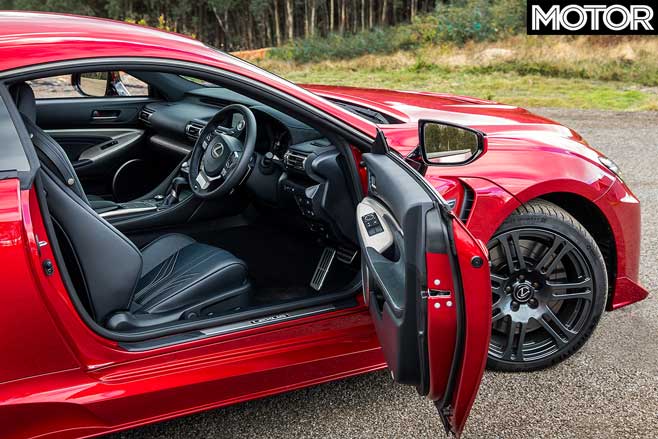
It’s mostly nth-degree changes, but add up enough of these tiny alterations and the end result is a sharper, more enjoyable car.
Outputs are unchanged at 351kW/530Nm from the high-revving 5.0-litre atmo V8, but there’s a new intake manifold to improve emissions and the secondary intake opening point has been lowered from 3600rpm to 2800rpm. The upshot is more ready access to that deep, delicious roar, which only intensifies as the tacho sweeps around to 7000rpm.
The eight-speed auto has been reprogrammed for more intuitive shifts and more aggressive downchanges; combined with the new launch control, Lexus claims 0-100km/h takes 4.5sec, which isn’t hanging about. What it lacks in outright grunt compared to turbocharged rivals it makes up for in super-sharp throttle response.
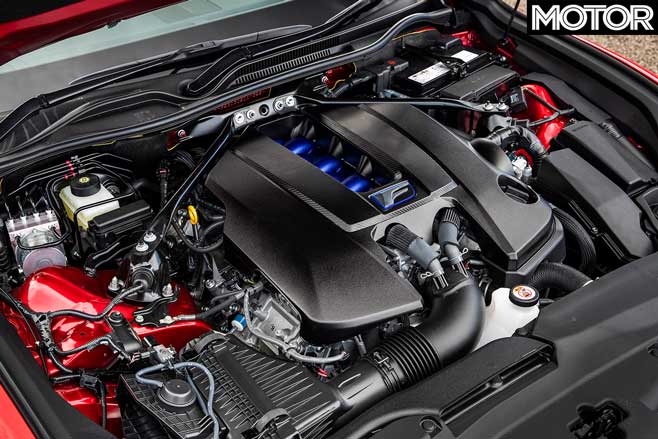
Its job is now easier thanks to a mild yet comprehensive diet. The biggest saving comes with the optional EP3 Pack, which includes titanium exhaust, carbon-ceramic brakes and lightweight 19-inch wheels from the Track Edition.
Together they shave 32kg, the effect of which can be multiplied due to being unsprung weight, but at $29,161 for the package, that’s more than $900 per kilo saved. From here it gets really nerdy: a hollow propshaft sheds 1.8kg, a new rear bumper reinforcement 500g, aluminium upper front suspension mounts 700g, and aluminium rear toe control arm brackets a further 500g.
Of more importance is the deletion of the previous RC F’s active diff in favour of a lighter, simpler mechanical LSD. It’s aggressive in its operation, sharply pivoting the car in response to throttle application. On cold (or wet) tyres, the RC F is a right handful; the new Michelin Pilot Sport 4 S rubber needs a bit of heat to work properly, but once up to temperature there’s a level of grip and traction the previous RC F couldn’t muster.
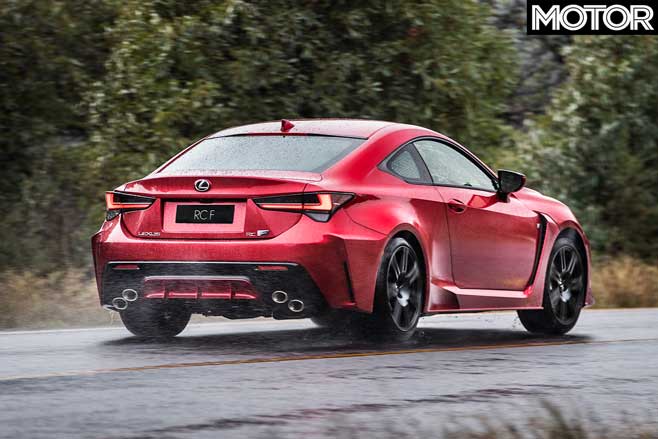
Revised adaptive dampers do their part, stiffer rear subframe bushes resist lateral loads better, and the steering rack bushes are 150 per cent stronger to sharpen the front end. There certainly feels to be less slack around the straight-ahead.
There are no headline changes with the RC F, nothing that jumps out and grabs your attention, but the small, extensive revisions have enhanced its ability to entertain on a twisty road. Well done, Lexus, for trying again.
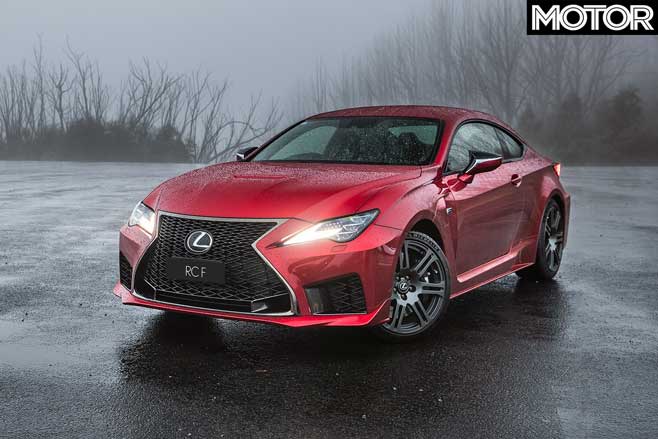
2019 LEXUS RC F SPECS Engine: 4969cc V8, DOHC, 32v Power: 351kW @ 7100rpm Torque: 530Nm @ 4800-5600rpm Weight: 1715kg 0-100km/h: 4.5sec (claimed) Price: $163,290 (EP3 Pack)
Like: Singing normally aspirated V8; improved dynamics; looks; weight loss Dislike: EP3 pack pricey; stupid infotainment system; cold-temp tyre performance
Rating: 4 out of 5 stars
Volkswagen has built many fast Golfs in limited numbers to spike sales during model lifecycles and last year at BFYB it deployed the cut-price Golf R Grid Edition.
This track review was carried out in conjunction with MOTOR’s Bang For Your Bucks 2019
As you can imagine, a discounted all-wheel drive turbo hottie, with all the usual dynamic polish we expect from a performance Golf, did pretty well. It snatched third. But for this year the Volkswagen Golf R Special Edition lobbed and tried to decode the formula from another direction.
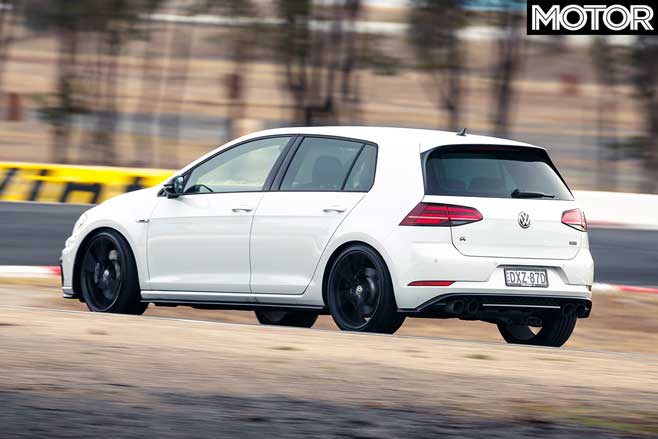
Next are the brakes. Again, they’re from the Clubsport S, and the discs are now cross-drilled, to shed heat more effectively, while better pads and a ‘composite’ construction help the entire system drop 2kg. But the real gain comes from the Akrapovic titanium exhaust. The active unit saves 7kg compared to the car’s stock system while adding a great dose of aggression to its aural character.
Drivetrain wise, the R is now an automatic-only affair. That turbo 2.0-litre inline four still makes 213kW/380Nm and pulls cleanly from early in the rev range accompanied by a concentrated rorty note.
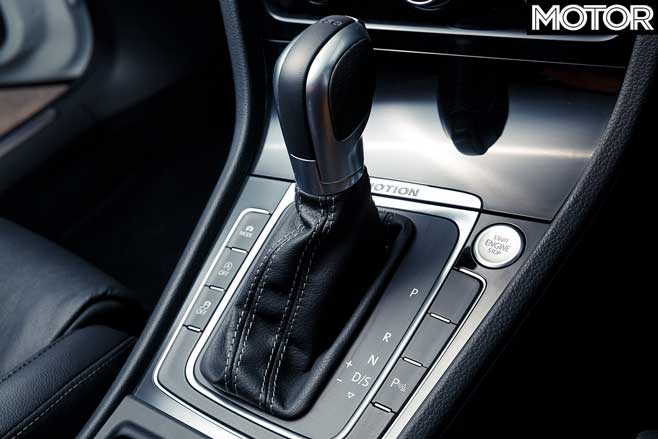
Inside the car you’re somewhat insulated from its slightly raspier noise, but pluck a gear to upshift and it sounds as if the exhaust tips blast straight into the cabin when the spark cuts.
It’s also still a crushingly effective car on track. Adaptive dampers and all-wheel drive give it ultimate stability and surefooted handling.
Europeans can option Michelin Pilot Sport Cup 2s on their Rs, however ours come with standard Continental ContiSportContact 5Ps. They clung to a wet Winton track and yet easily wriggled into oversteer. As always, though, it felt fastest when driven cleanly.
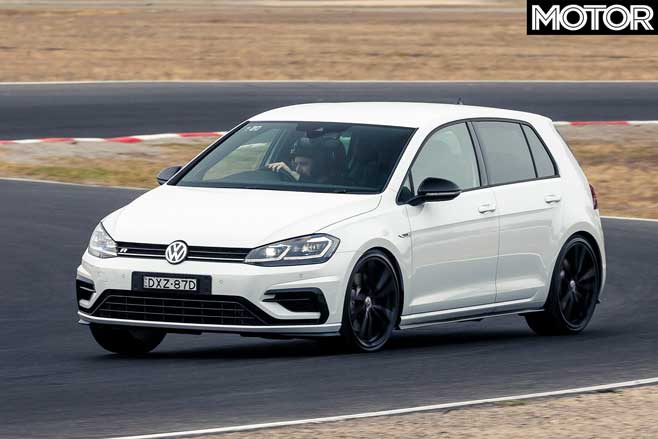
We felt, especially in the wet, that the all-wheel drive system was driving it through the tight ‘boobs’ of Winton from the rear-axle, freeing the front tyres to guide its nose along your intended line. It’s no wonder that it was the only car outside the top two that scored so consistently with the judges.
Where it all comes undone for the Special Edition is, as mentioned, price. The car’s position as the performance Golf ‘with the lot’ means a new audio system and extra active safety systems not only add weight – after its aforementioned diet – but also jack the price $4800 above a standard example.
So, while it’s the top ‘dawg’ in its own kennel, that’s not the case here.
Volkswagen Golf R Special Edition BFYB 2019 Results – 7th place
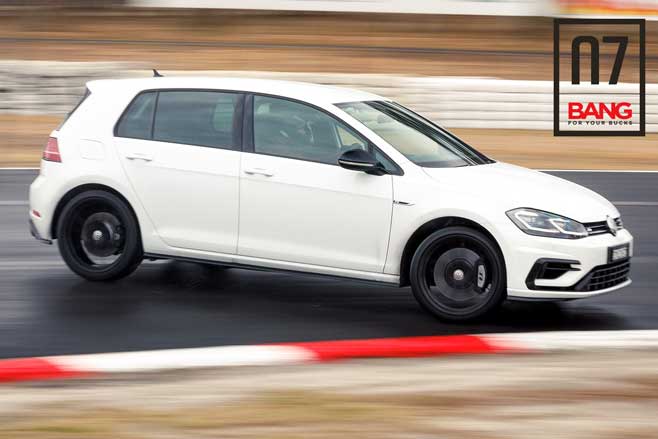
0-100km/h: 4.8sec 0-400m: N/A Price: $61,990 Bang Index: 125.5 Bucks Index: 84.1 BFYB Index: 104.8
Bang For Your Bucks 2019 Judges’ Comments
Campbell – 4th “Initially single-minded MkVII Golf R has evolved into something highly desirable.“
Cordony – =3rd “The Porsche 911 Turbo of hot hatches.”
Morley – 3rd “If you buy a lesser VW and value contentment, don’t ever drive this thing.”
Scott Newman – 4th “Special Edition hurts the value equation but adds welcome aggro.”
Luffy – 3rd “The R had really good grip and drivability considering the conditions. If you trail brake on entry, you can really get the back end to slide nicely. It’s a fun car and felt really sure-footed underneath. But like on the GTI, the paddleshift lacks feel or sportiness; it feels more PlayStation than VW Golf. However, it is the Golf to go to if you are looking for the best Volkswagen, offering more than the Polo and GTI do.”
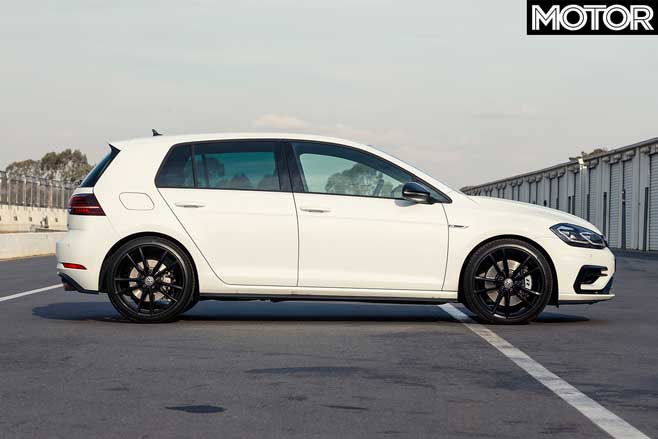
FAST FACTS 2019 VOLKSWAGEN GOLF R SPECIAL EDITION SPECS BODY: 5-door, 5-seat hatch DRIVE: all-wheel ENGINE: 1984cc inline-4, DOHC, 16v, turbo BORE/STROKE: 82.5 x 92.8mm COMPRESSION RATIO: 9.3:1 POWER: 213kW @ 5400rpm TORQUE: 380Nm @ 1850rpm WEIGHT: 1450kg POWER-TO-WEIGHT: 149kW/tonne TRANSMISSION: 7-speed dual-clutch SUSPENSION: struts, adaptive dampers, coil springs, anti-roll bar (f); multi links, coil springs, adaptive dampers, anti-roll bar (r) BRAKES: 340mm ventilated drilled discs, single-piston calipers (f); 310mm ventilated discs, single-piston calipers(r) WHEELS: 19.0 x 8.0-inch (f/r) TYRES: Continental ContiSportContact 5P, 235/35 R19 (f/r) PRICE: $61,990
Bang For Your Bucks 2019
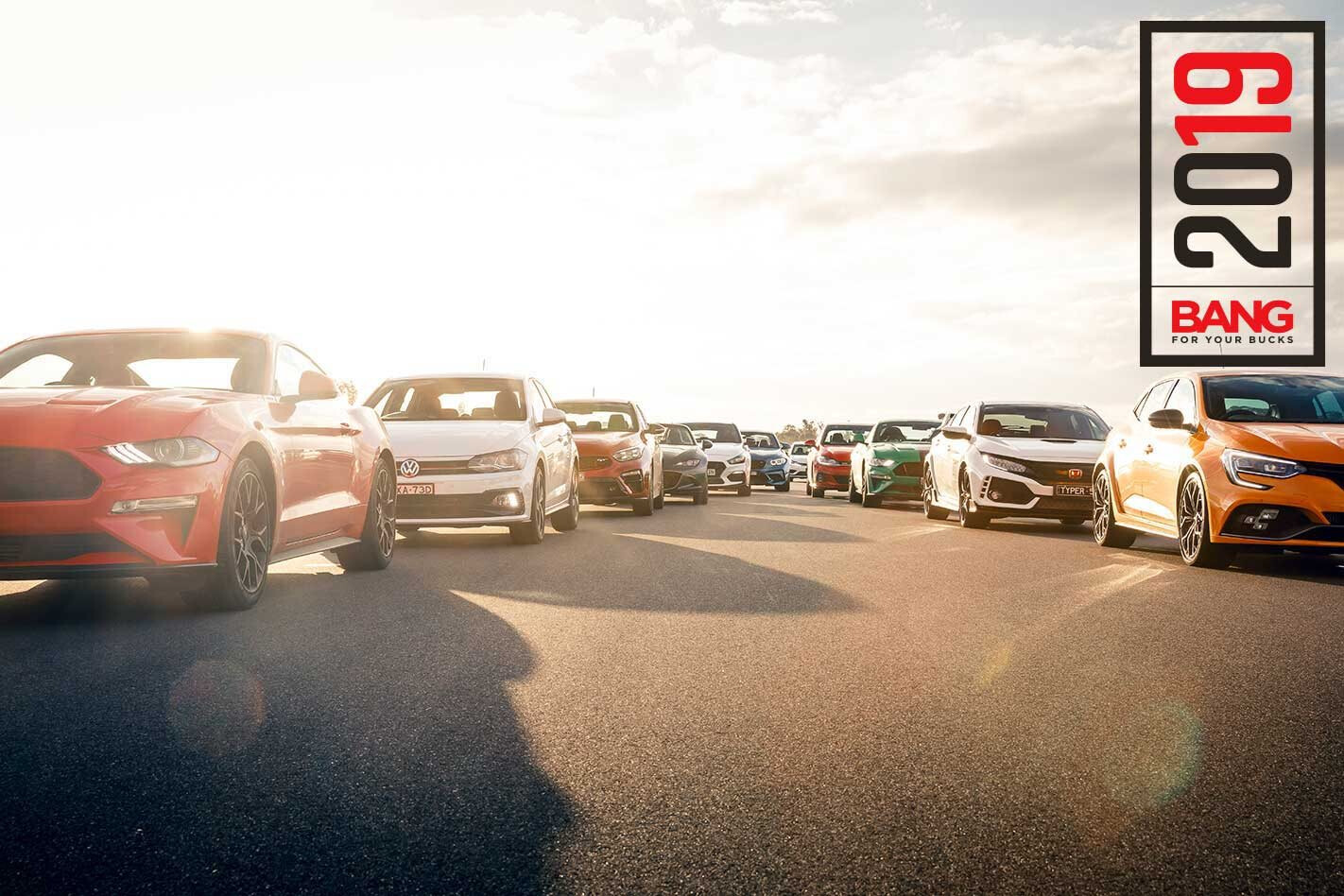 The Contenders, Judges & Criteria
11 of the hottest new fast cars under $100K roll up to take on our famous value-for-money formula. Which will be number 1?
Does Honda’s seven-seat stalwart still pass muster as it enters its twilight years, or is the people mover well and truly obsolete in this SUV-mad era? Elise Elliott finds out.
Elise has been a journalist across the trifecta of TV, radio and print for more than twenty-five years. When not shackled to her computer or beloved kid, you’ll find this working mum indulging her other passions — skiing powder off piste or trying to catch a wave on her 8’ Mini Mal.
WHAT IS IT?
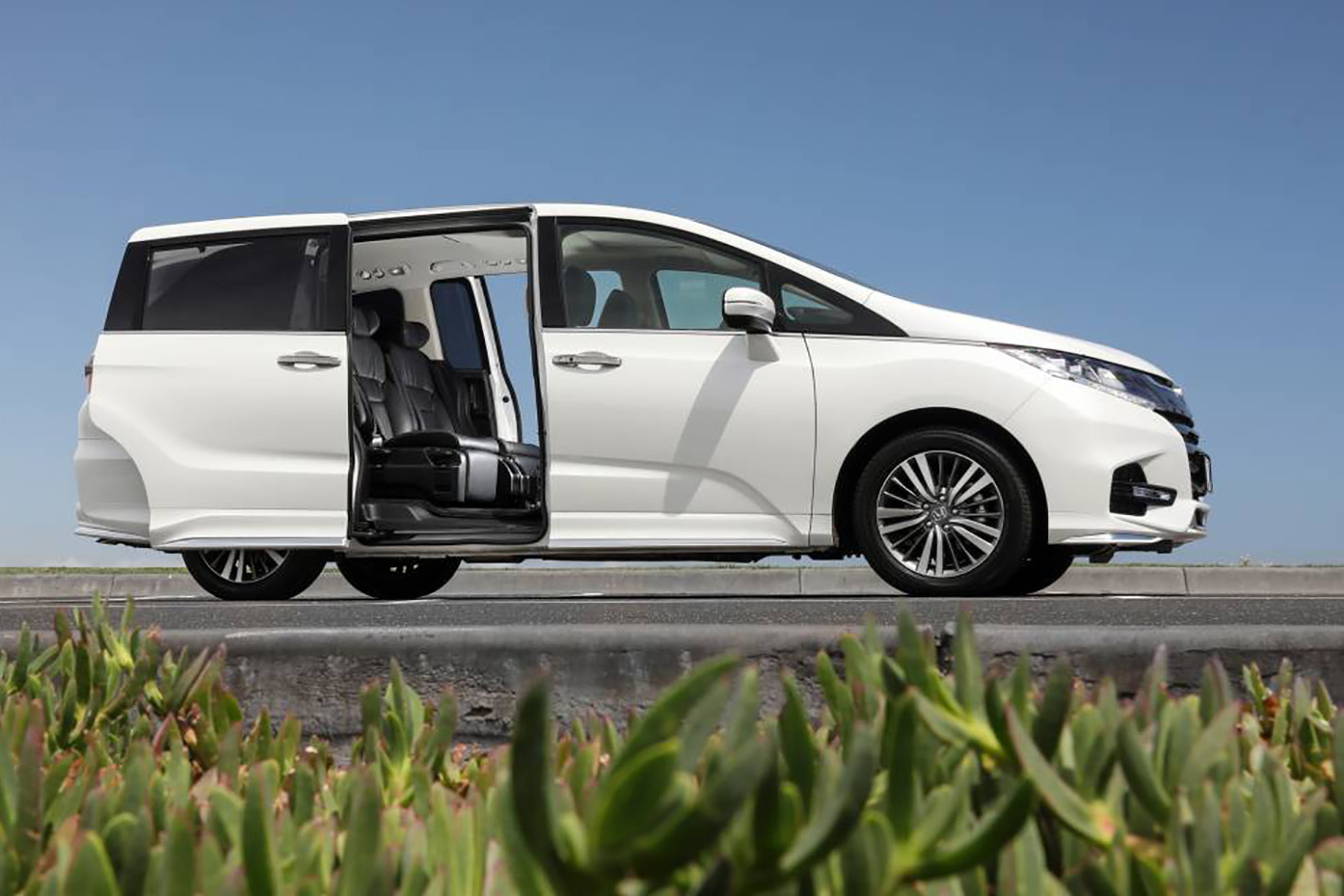
The Odyssey is Honda’s people-mover offering. The top grade VTi-L, tested here, is a five-door, seven-seater wagon aimed at growing families. Honda promises the Odyssey will “bring joy to your people”.
Only one engine is available in the Odyssey: A 2.4-litre, four-cylinder petrol with Continuous Variable Transmission.
WHAT’S IT LIKE TO DRIVE?
The Japanese car maker calls the Odyssey “Sleek, Sexy and Refined”. Sleek and Refined? Maybe. Sexy? Er, no. Let’s face it: People movers are daggy. Most Mums and Dads, hoping to cling to the last vestiges of cool, opt for SUVs. That way they can pretend they veer off the beaten track when not stuck in suburbia.
The Odyssey, however, should not be under-estimated. I ferried five kids to and from school for a week and found it a surprisingly agile and responsive ride — more car than commercial van.
Need more detail? Read about the 2019 Honda Odyssey range price and features
As any parent knows, school drop-off is a war zone overrun with SUV tanks. The Odyssey held its own in the battlefield. Its tight turning circle (10.8 metres) means drivers won’t get honked attempting a u-ee at the school gate. Despite its length (4.8 metres) the Odyssey is easy to reverse park, thanks to deep windows providing good visibility and multi-view cameras. A smart parking feature is also handy for manoeuvring into tight spots.
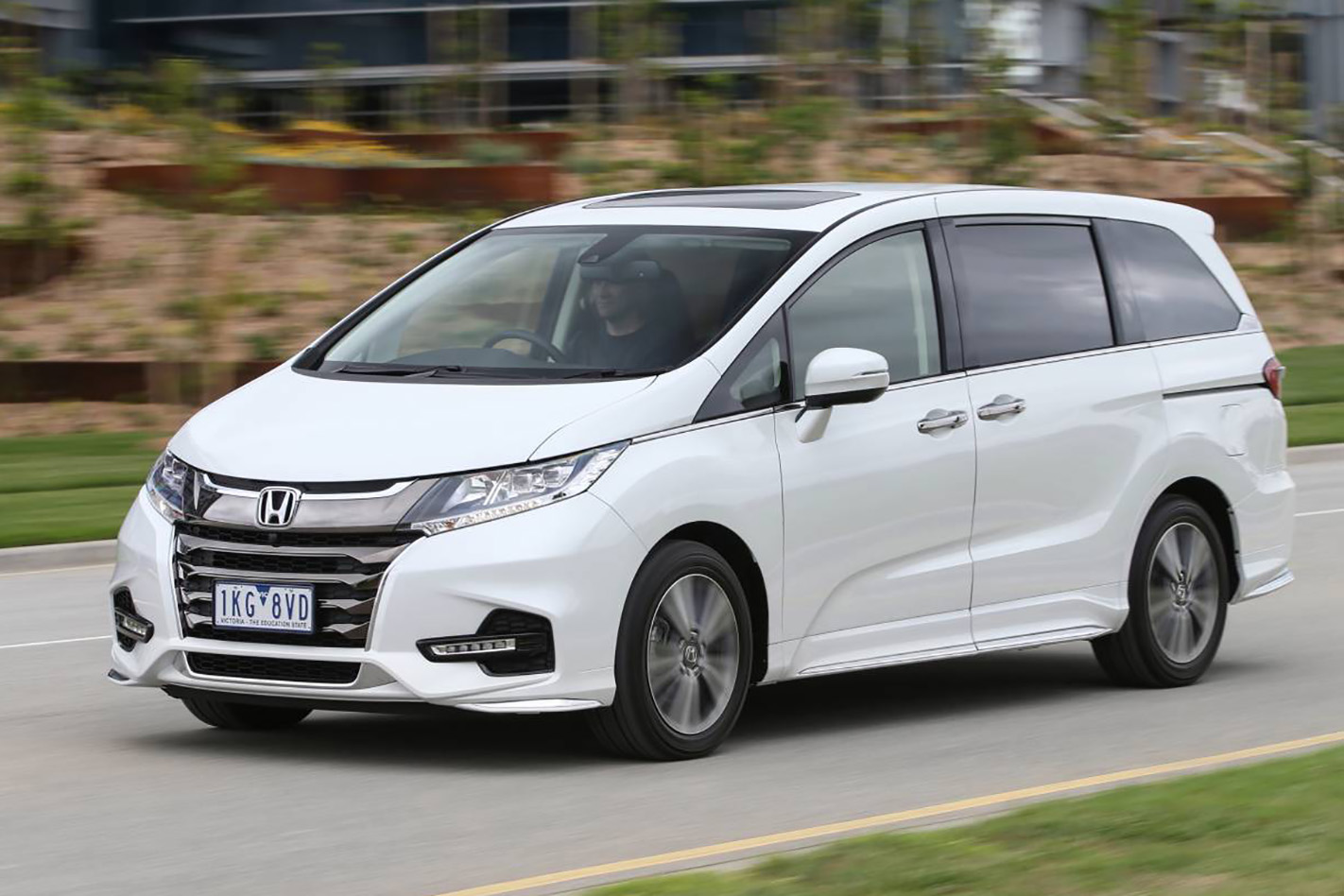
Neither the engine nor the transmission is exceptional, but combined they do their job.
I am a little, shall we say, vertically challenged, so the high riding position and ability to adjust the height of the leather wrapped steering wheel is a welcome addition.
The can’t-miss-it pushbutton start is a bonus, but the foot-operated park brake — when you manage to locate it — feels clunky and American.
WHAT’S IT LIKE TO LIVE WITH?
I have a “Sliding Doors” phobia. Blame Gwyneth Paltrow in that ridiculous yet curiously memorable movie. On vehicles, they appear too commercial van-ish. Thing is, sliding doors on people movers make sense. First, they’re practical. Second, they prevent kids swinging regular doors onto — and denting — neighbouring cars (admit it, this happens). Third, sliding doors make entering and exiting a breeze.
Don’t need the VTi-L? Read about our review of the entry-level Honda Odyssey VTi
The power sliding doors on both sides of the VTi-L open and close automatically by either simply touching (not forcing) the door handle, or by pressing the remote key fob. One word of caution: The doors are extremely low slung; park too close to a curb and you’ll lose some chrome trim on Melbourne’s ubiquitous bluestone.
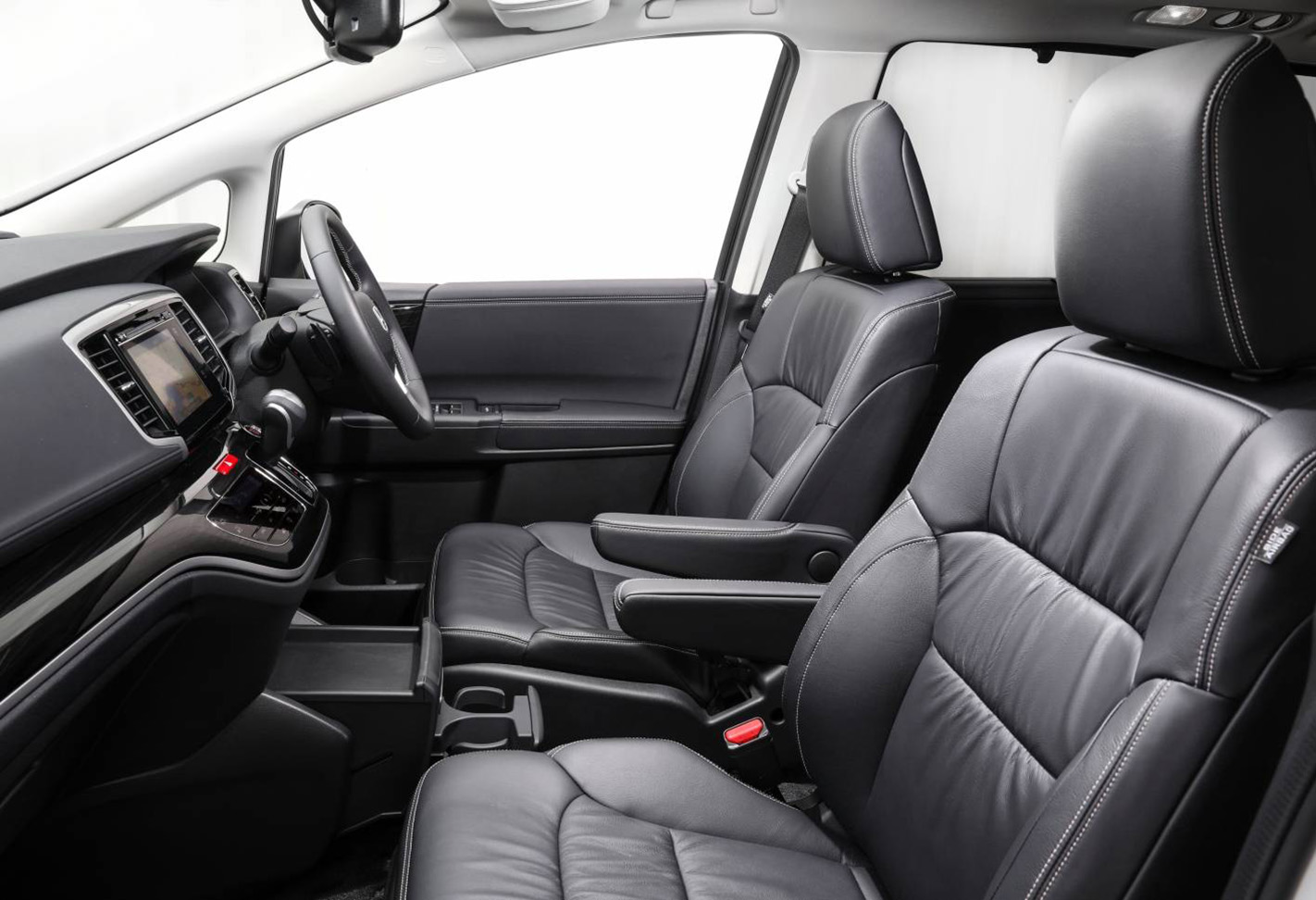
Once the doors slide back, the Odyssey has a Tardis-like feel; it’s seriously roomy inside without a bulky exterior. The front leather seats are mercifully heated — a must for bracing 6-degree school drop off mornings.
Second-row passengers are treated to a Business Class experience with luxurious Captain’s Chairs that recline, slide forward, back, and side-to-side — with the option of creating an aisle. They even come with extendable leg rests, if you don’t mind.
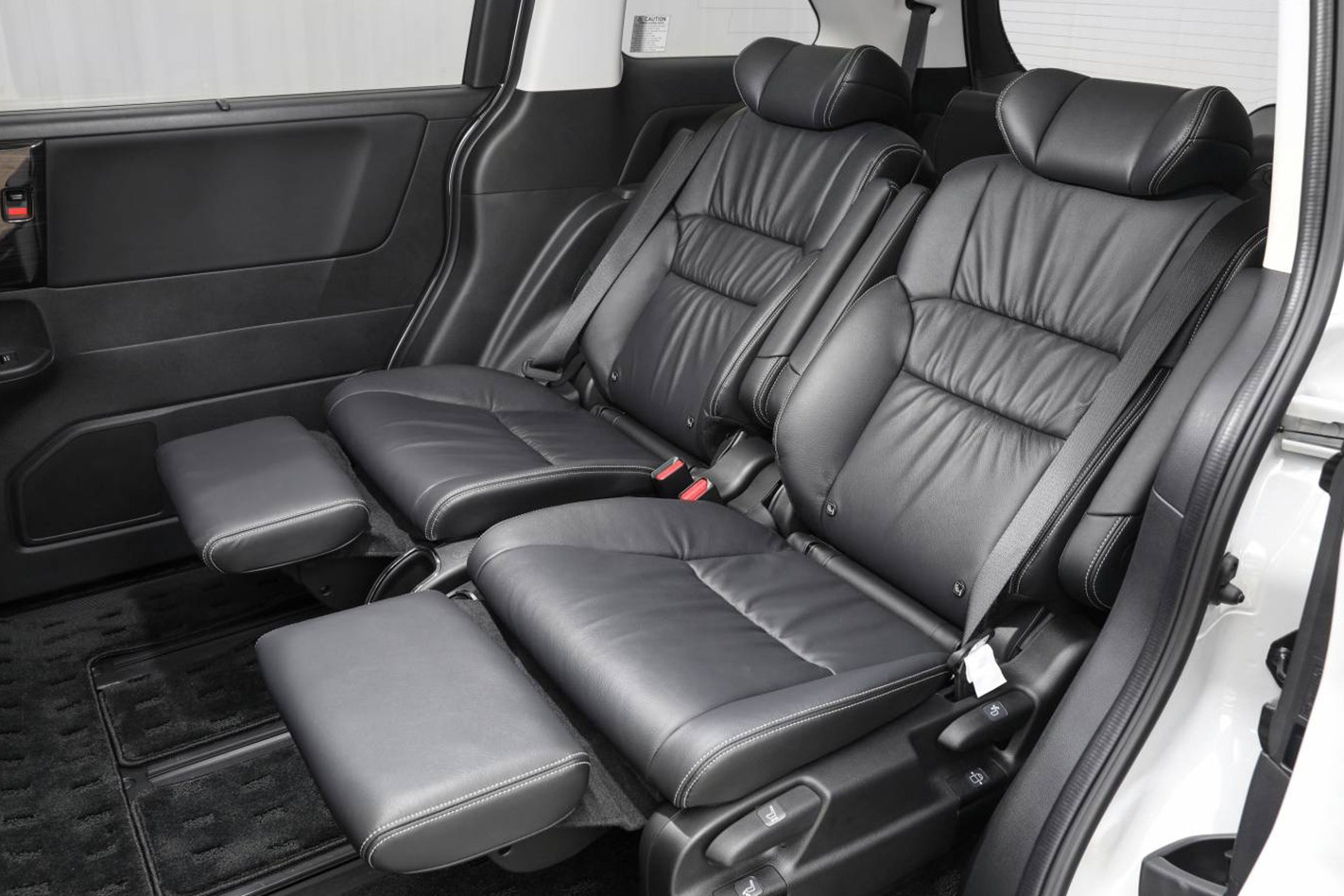
That’s not to say third-row passengers are treated like a cattle class afterthought. The car’s rear enjoys floor and roof vents and independent controls so passengers can adjust fan and temperature settings. No more nagging: “Muuuumm, I’m too hot/ cold”. Manually controlled shades keep the sun off those in the back, too.
There are also four anchors for secure placement of child seats. I checked out my passengers in the conversation mirror, incorporated into the overhead console’s sunglass holder, and there were smiles all round.
How’s it compare? Read our Honda Odyssey vs Kia Carnival comparison review
There are no fewer than eight cup holders and multiple storage compartments that prevent drink bottles and iPads rolling around the vehicle. Because all the controls, including the gear lever, are mounted up on the dash there’s a tonne of space between the two front seats; perfect for storing that overflowing handbag. Trust me, chicks care about this.
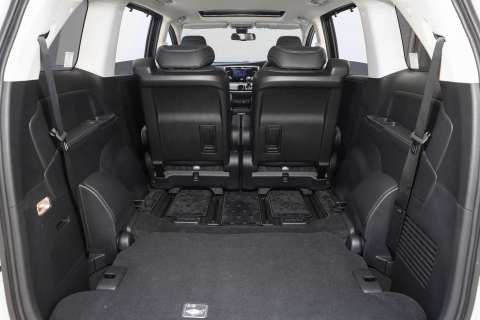
With the third-row seats up/ in use, cargo space is a tall and slim 331 litres. With the third-row seats folded away into an underfloor recess this expands to 1672 litres. Folding the middle and third row seats down increases luggage capacity to a whopping 1867 litres.
Unfortunately, the upright tailgate bothered me. It can’t be opened from the key fob. And due to its sheer height when raised it feels heavy and high — too much for kids to close themselves after chucking their school bags in the back.
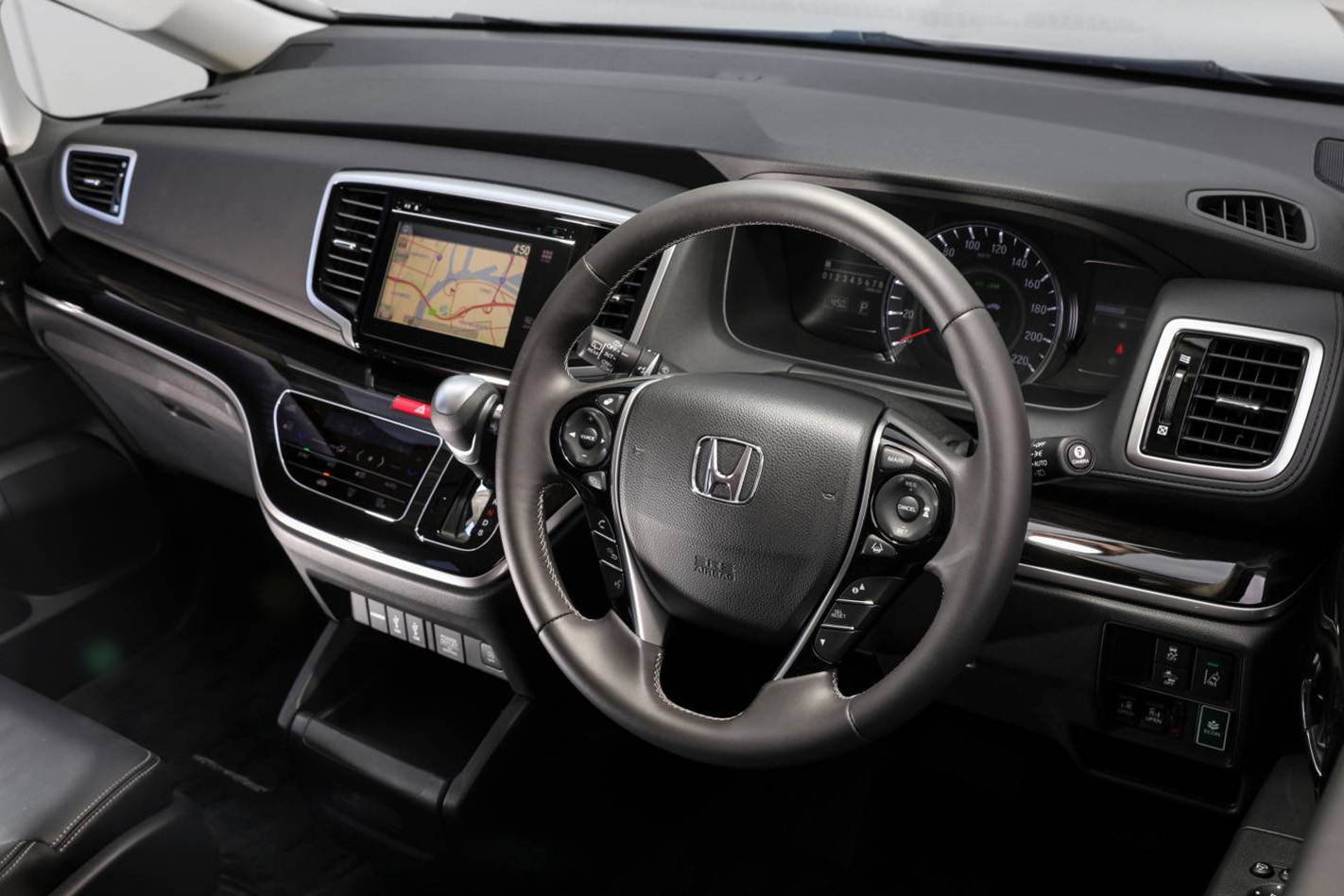
The full-colour, 7-inch touchscreen display is simple to use — except the fiddly volume control. Basic functions like this should not be difficult to decipher, but it took me four days to figure out one should swipe, not poke, the volume controls. Maybe this feature is second nature to the swipe left/swipe right generation but I prefer a good old-fashioned volume knob.
Connectivity is important to me and here Honda delivers. It was a cinch synching my phone. The fact I agreed to let the kids blast retro embarrassing ‘80s hits like “Jump” by Van Halen, however, diminished what was left of my cool cred.
IS IT WORTH THE MONEY?
Despite the abundance of chrome trim, no one is going to check out you and your Odyssey at the lights, especially with said bad tunes blasting. But if you can leave your ego in the garage, this people-mover is practical motoring at its best. At $47,590 (excl. on road costs) Honda provides value, room and a surprisingly luxe feel.
The Odyssey carries a 5-star ANCAP safety rating and the VTi-L comes with “Honda Sensing” — a suite of six driver assist technologies including Adaptive Cruise Control and Lane Keeping Assist system.
A 5-year unlimited km warranty is also standard.
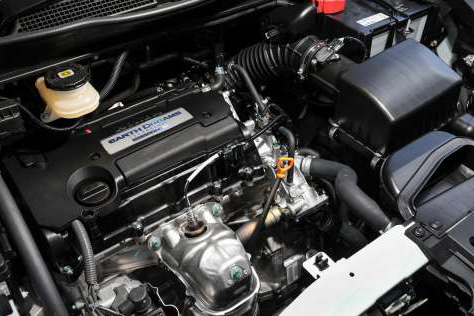
On the official fuel test the VTi-L consumes 7.8L/100km (city and country combined). However, during a week of mostly stop-start, inner-city, school-hauling driving, a substantially thirstier 13.7L/100km was reached. It seems that this engine is a more natural fit for highway work.
It’s crazy what rocks a kid’s world. My pint-sized passengers loved the ride, saying it was like being on a business class bus with all their mates. So, Honda delivered on its promise: The Odyssey did bring joy to my people!
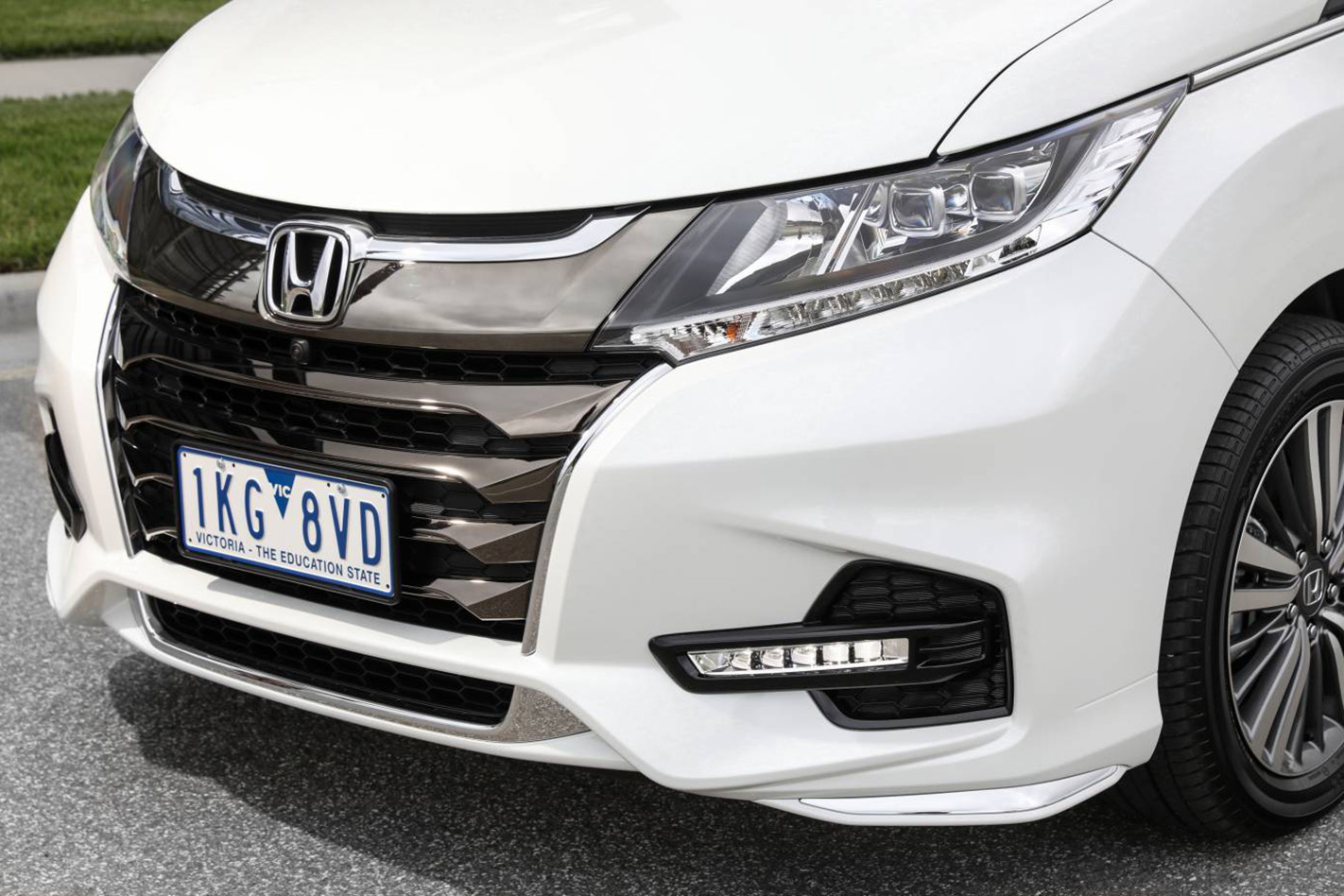
PROS: Spacious cabin; heated, leather front seats; Captain’s chairs in the second row; ample storage.
CONS: Tailgate too high; sliding doors set too low; the “dag” factor.
1. If you think you’re busy, you probably aren’t. Take the time to be organised
There are a number of things that would have drastically accelerated my development, if I’d known them when I was 17. They’re obvious things, like being organised. I remember Formula 1 driver Derek Warwick asking me how much training I did when I was 17, and I replied that it was quite difficult to find the time. And I remember thinking it was weird how disappointed he was in me. But what I realised later is I hadn’t worked out what dedication and focus actually was. I thought I was busy but of course, I wasn’t really.
Every teenager thinks they’re busy but they’re just busy being a teenager. I did a little bit of training and a little bit of racing, but once I became a professional driver, it was two proper training sessions a day, my diet was monitored, and it meant being entirely focused on every part of my life. So if I could have accelerated what work ethic really meant, that would have helped me a great deal.”
2. Out of mistakes come your greatest opportunities
A lot of people think, “How can I improve on success?” but the truth is you can’t improve on success without looking at the things that could have gone wrong on the way. In racing, I’d spray the champagne and do the interview, but then the team would do a debrief about all the things we didn’t do right: I came in too fast for the pit stop, I lost half a second in traffic on lap 26… So we’re always very critical, even of success, because out of those potential failures comes your real opportunity. In life, people are nervous to analyse failure because they think, “If you have your mind on failure, how can you have your eye on success?” Well, eliminating your failures only strengthens what you can achieve on the other side.
3. The little things matter, especially in business
Almost everything stems from being organised, being prepared, and being on time. I always like to be on time. Always. And I like to be properly dressed. And I think those very basic things can take you a long way. In the modern world, deliveries don’t come at 11am as promised, they come at 12:30, or 4pm, and to me that is just so underwhelming. And what the business of sport teaches you is that the race starts at 4pm on Sunday and everyone will be on the grid no matter what, because there’s no option of not being ready. So the business of sport teaches you some great life lessons.
4. Don’t take life for granted. It can end sooner than you expect
I had a plane crash in 2000 and sadly both the pilots were killed. I was 30 years old, I was earning good money as a grand prix driver and without realising it, I was a little bit spoiled. If you grow up in a royal family, you don’t know anything different from being a royal. If you grow up in a wealthy family, you don’t know any different from being wealthy. If you’re from a humble background and then grow up to have success, maybe you hold on to some of those life lessons of being careful and not being wasteful. But after a few years in Formula 1, I did start to take things for granted.
And through that tragedy, and what could have been my final day, it made me realise: Don’t be a spoiled brat. Really respect and appreciate the moment. Respect those around you and all the things your granny told you about manners not costing a thing, to give people a smile, and even in difficult situations to try and find a way of diffusing aggression and frustration. And it’s interesting that in Formula 1, you rarely see fights in the paddock because I think people are able to compartmentalise and respect the difference between competition and not always seeing eye to eye.
We’re about two minutes into our drive of the 2019 BMW 3 Series and starting to worry.
This global best-seller faces a herculean job. Not only must it compete with growing SUV sales, it also must slay the hugely popular, and distinguished, Mercedes-Benz C-Class that’s flanked by the stylish Audi A4.
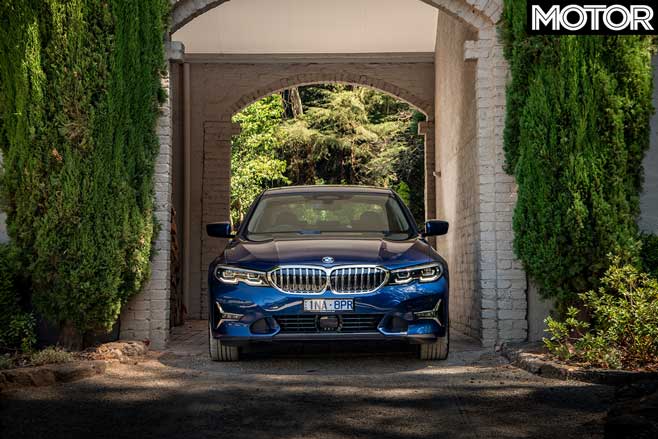
And this 330i, which will debut the seventh-generation 3 Series in Australia alongside a 320d variant, has to set the tone for a brave new future that includes an all-wheel drive M3. Gulp. Its spec offers hope, with an M Sport pack that upgrades the brakes, suspension and wheels. It will need them.
It’s taken us a while to accept that the 3 Series will no longer offer atmo sixes, manual gearboxes (locally, at least) and capacity-related badging, and the previous one crossed a line too far. If it wasn’t for the M3 CS, we’d say it had abandoned fun rear-drive handling as well.
BMW turned to the Nürburgring to develop its new model. And when you first drive it, the pillars blocking over-shoulder visibility suggest it has been serious about its development, focusing on a stiff body to unlock handling as well as trademark ride quality.
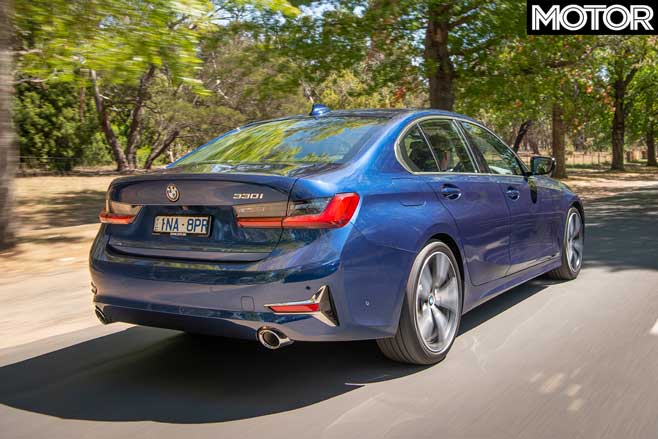
But, as we said, we’re worried. Because the ride is far from that. The new 3 Series is on the firm side. Yes, they designed a structure that’s 50 per cent stiffer in some areas, but they also added stiffer springs and dampers, beefed up the bearings and roll bars, and braced its body with more mounts.
All Aussie cars get M Sport suspension as standard, which lowers the ride height 10mm. The 330i gets two-mode adaptive dampers (instead of the diesel’s passive set-up), which calms the secondary ride down to tolerable levels, but you’ll still double-check if it’s really in Comfort mode.
So, BMW has clearly sacrificed compliance, now the question is whether that adds precision and agility.
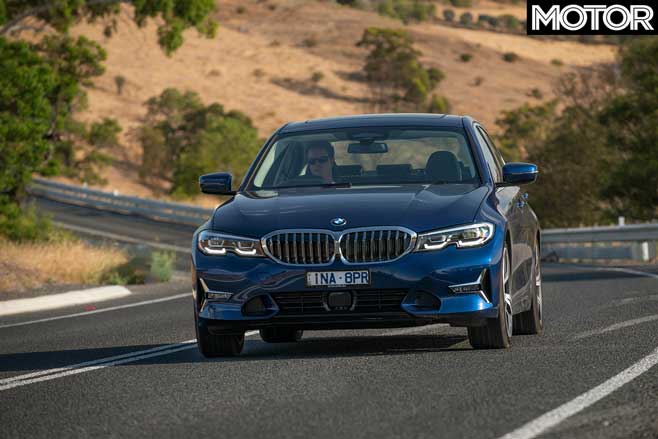
From the first time you tip into a corner, it gives you a clear sense of where the front wheels are pointing. You still get bugger-all feedback through the Bratwurst-sized steering wheel rim, but it has banished that ghostly feel from just off-centre, tracking inputs with laser accuracy.
It turns in with confidence, relishes throttle steer and finds excellent traction. That’s because the wheelbase is longer, the tracks are wider and the weight is perfectly balanced front to rear. Along with that, the centre of gravity is 10mm lower and it has shed as much as 55kg.
BMW offers an LSD for $2400, but we’d opt for a good set of performance tyres instead. The LSD struggles in the wet, while the stock Bridgestone run-flats don’t gel with Sport damping and hold the road better in Comfort.
It’s quick between corners, too. BMW focused on the 2.0-litre turbo four’s heat management, internal friction and tuning to unlock another 5kW and 50Nm. And it delivers its 190kW and 400Nm (which also matches a 2009 twin-turbo 335i coupe on torque) in a free-revving, linear way.
Power is sent through a revised eight-speed auto that is hard to fault. It shifts smoothly, with true obedience and urgency, making it a joy to hustle in manual mode.
Inside, the new 3 Series is hushed, and the seating position is spot on. Importantly, technology from its superiors, like the 7 Series, have influenced its steering wheel, centre console and swish new digital cluster.
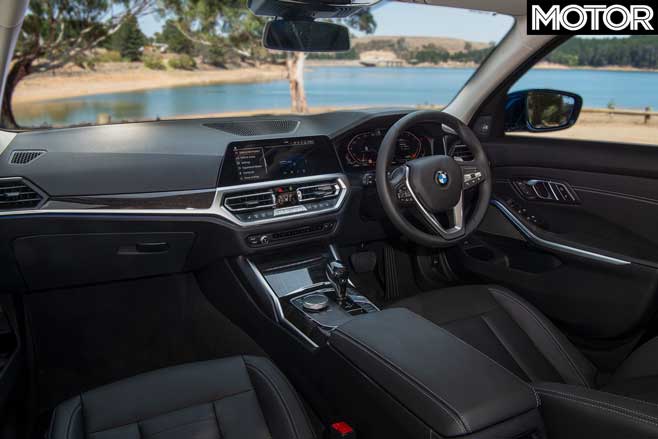
We’re digging its looks, too. Yes, those kidney grilles might have grown to the size of a humpback whale’s and its character lines might get lost in the flanks, but it’s much more striking in the metal than expected. It’s squat, aggressive and low. And the interior is a leap forward.
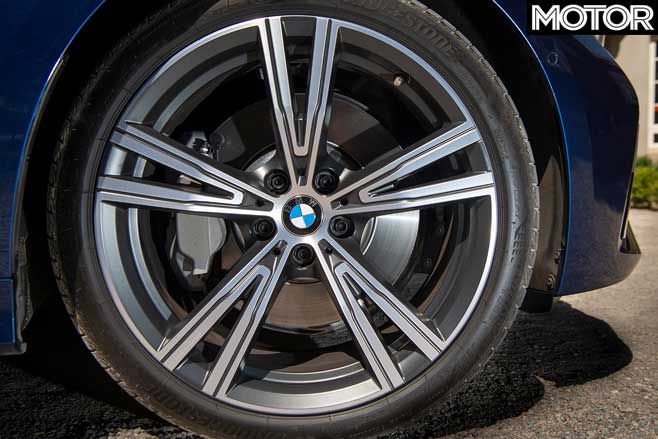
Sadly, specifying the 330i solely with 19-inch wheels and run-flat tyres damned its ride from the beginning, but that’s about all the serious criticism you can level at this new 3 Series.
Otherwise, it’s a serious step up on chassis dynamics, handling response and driver involvement. It’s even something we’d entertain unleashing at a local track day. That’s how much fun we had in the bends.
The Ultimate Driving Machine? We’re getting there.
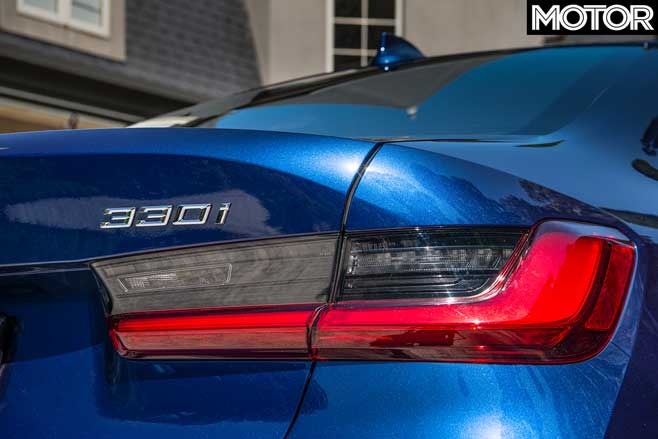
2019 BMW 330i SPECS Engine: 1998cc inline-4, DOHC, 16v, turbo Power: 190kW @ 6500rpm Torque: 400Nm @ 1550rpm Weight: 1470kg 0-100km/h: 5.8sec (claimed) Price: $67,900
Like: Decent grunt; smooth transmission; sharp handling; good looks; high-tech interior Dislike: Firm ride; no 18-inch wheel option; over-shoulder visibility; chunky wheel
Rating: 4 out of 5 stars
Were you the lucky Victorian who’s now $37 million richer after collecting a share in last week’s Powerball jackpot? What would be the first purchase?
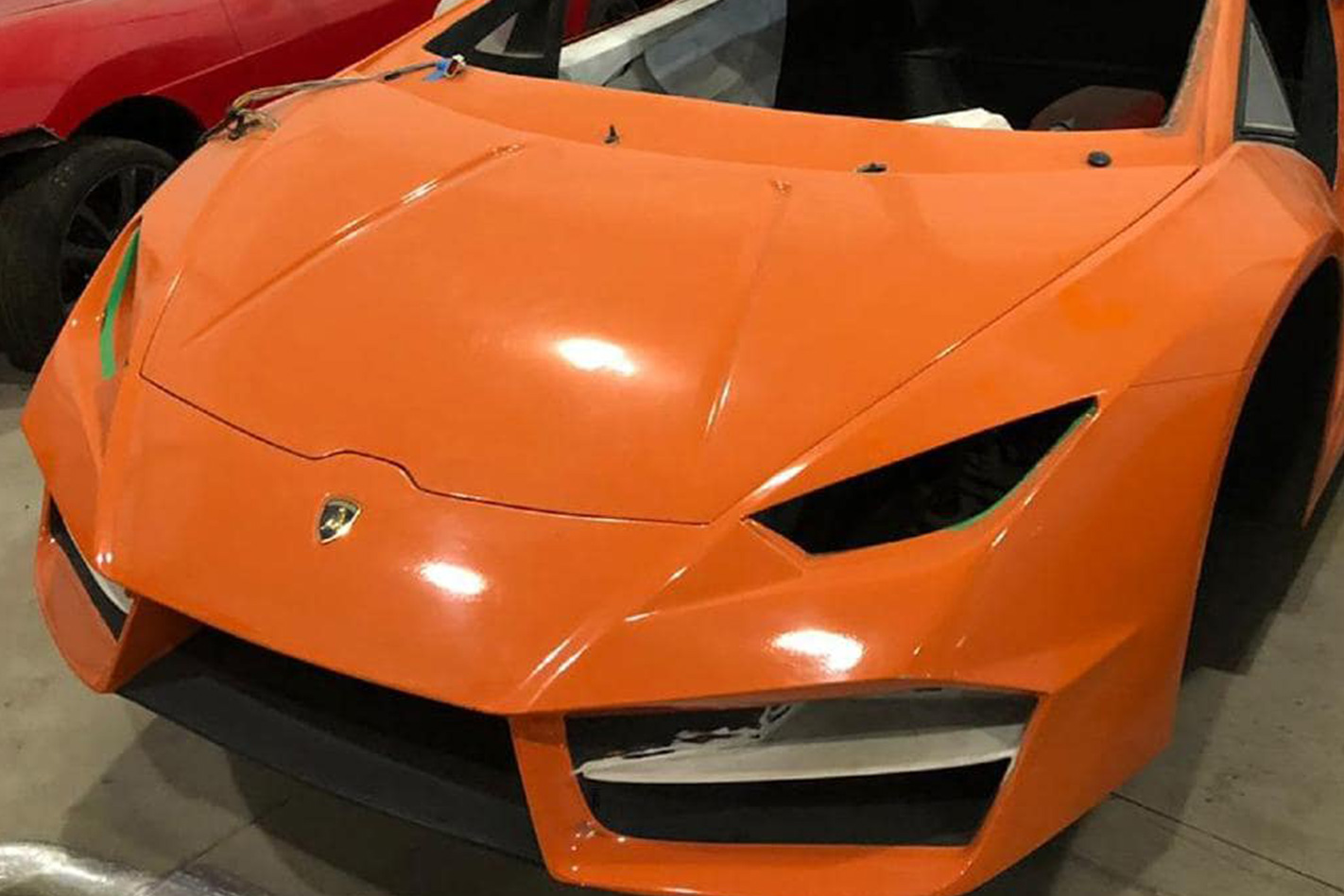
Some fake Ferraris and Lamborghinis perhaps, powered by nobody’s idea of a supercar engine; the humble Holden Commodore Alloytec V6. Bonus points to the Brazilian father and son who thought they could get away with this hair-brained scheme!
Or perhaps they’d care to throw some coin at Jaguar Land Rover, which has turned an impressive $4.8bn profit in 2015 into a $6.3bn loss for the third quarter of 2018. Most of that was due to capital investment write-downs, but it’s fair to say Tata’s plans to get JLR to one million cars a year is still a long way off (JLR sold 600,000 vehicles in 2018, down 6 percent).
Meanwhile, back in the real world, WhichCar answered the age-old question of “is bigger better” when it comes to engines. We got up close and personal with the next generation of Apple Carplay, which promises to burrow that other tech giant deeper into our automotive everyday. We investigated the dubious value of ‘paint protection insurance’, and whether car washes damage your duco. And we told you how you could buy an Australian Grand Prix track for just $80,000. Hint: it’s not Albert Park.

Father’s Day is fast approaching, but never fear, WhichCar has your back, and your back pocket, with these auto-themed gifts – no hankies or Reg Grundys here folks. Speaking of back pockets, are we headed for a future with a speed camera on every street corner? ‘Smart’ lampposts could bring that reality closer.
This week we took a quick spin in the Honda Jazz, chatted to Continental about a mild-hybrid electric motor that’ll lop 20 percent off your fuel bill, and reported BMW’s fighting response to criticism that its squandered an early lead electric revolution race.
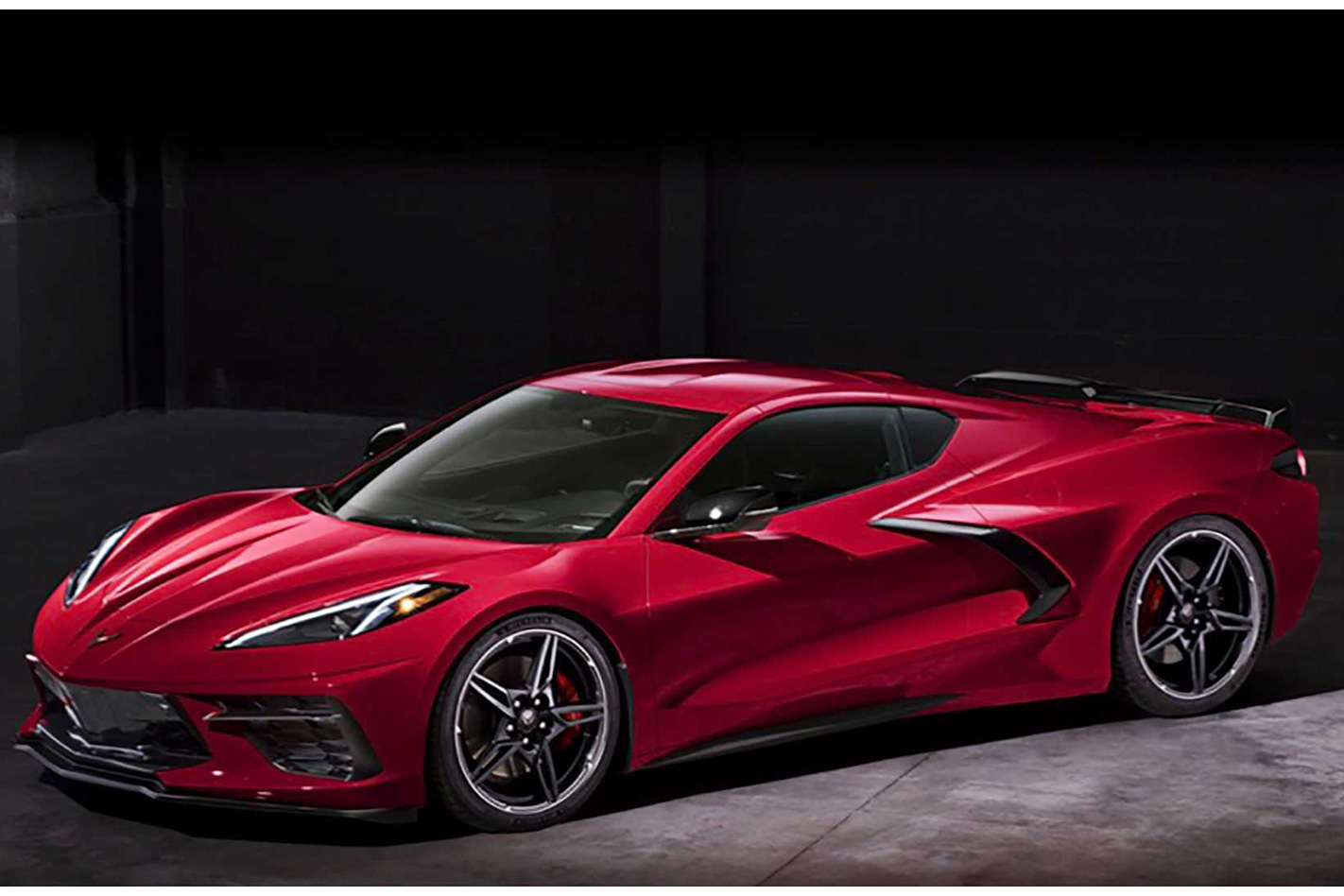
We cast a spotlight on the unique role the Holden Ute played in clandestine development of the all-new mid-engine Chevrolet Corvette, and revealed that Chevy’s new scorcher could race at Bathurst. We flew to New Zealand to drive the next SUV It Car from VW, the T-Roc. We also learned that the new Kia Seltos baby SUV – which Kia hopes will be a best-seller – has already been turning wheels on Aussie roads refining its suspension for Melbourne’s challenging tram tracks. We drove it, too, and it’s good!
Also from Korea, get ready for a couple of all-new dual cab utes with Kia and Hyundai badges arriving here from 2022 onwards. Kia wants the full range, too; singles, doubles, maybe even a triple? The good news is they’ll be developed in Australia. We also took the opportunity to understand what all the single, double, extra, crew and king cabbagery means in ute-land. And we took a turn behind the new leather wheel in HSV’s Series 2 Sportscat ute, and reported on the Toyota Hilux’s five-star safety rating.
That’s all from WhichCar for another week. Have a great weekend, and enjoy the drive!
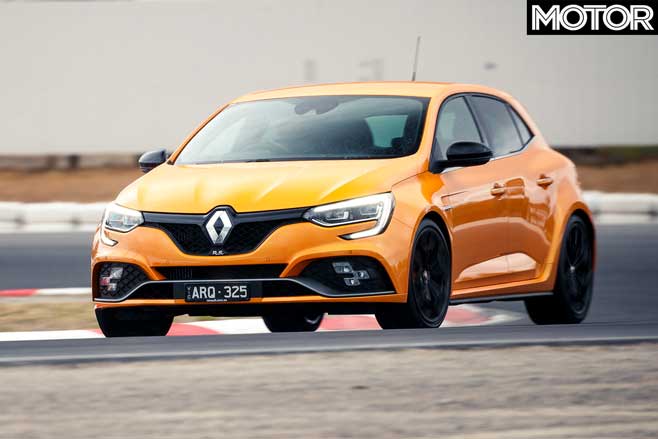
Remember when the Renault Clio RS was replaced by an all-new model a few years back? And remember how it went from three doors to five, from a rorty big-inch engine to a smaller one (with a turbo, admittedly)? And remember when it changed from a manual tranny to a DCT-only package and just generally became softer and more cuddly?
This track review was carried out in conjunction with MOTOR’s Bang For Your Bucks 2019
Well, there were certainly fears that similar changes (more doors, smaller donk, auto option) to the new 2019 Renault Megane RS might have the same net effect. Needn’t have bothered worrying.
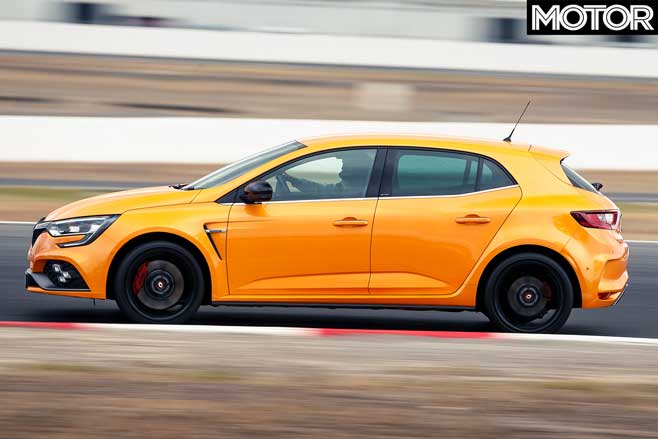
The four-wheel steering is a big leg-up, too, although would it be churlish to suggest that on the greasy, wet Winton hotmix, the Megane RS was almost too keen to turn in? In the dry, though, it’s amazing how you can use all that extra steering to back the bugger into corners and get back on the noise quick-smart without it going Pete Tong.
That’s partly down to the stiffer springs and lower ride height but also the mechanical diff that has kept the RS badge at the cutting edge of tail-dragger dynamics. And yet it finished no higher than eighth. What’s going on?
Well, like a lot of other Renaults over the years, the Megane RS’s interior lets it down a fraction. Okay, so the conventional park-brake is a breath of fresh and the front seats themselves are tremendously good.
But the dashboard layout seems a bit downmarket compared to what other manufacturers are coming up with and the centre stack is just a weird collection of shapes to many eyes. While access to the rear seat is now better than ever thanks to those extra doors, the rear-seat space itself is a bit on the tight side.
And while we old blokes rejoice when ever we stomp on a clutch pedal, the Renault’s man-machine interface is a bit off colour. For a start, the clutch take-up point seems a bit vague and the gearshift itself can feel a tad sticky.
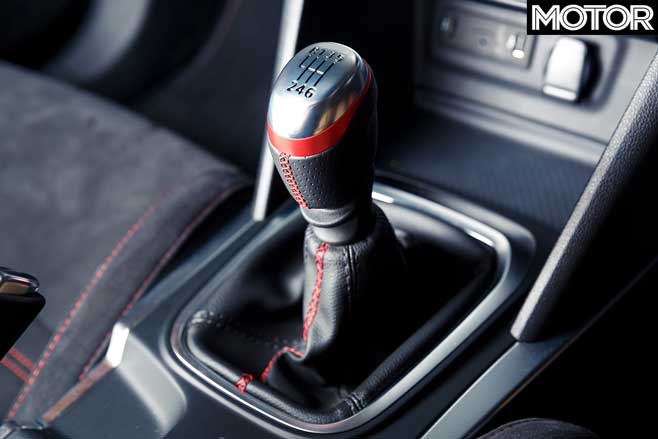
Throw in the fact that the horizontal gate feels too far forward and suddenly the RS starts to feel a bit like trying to carry a full serving tray with offset handles.
Honestly, you can start to think that maybe the engine is the best bit about the Megane RS Cup and while it’s not (the chassis deserves at least equal billing) the overall impression is definitely compromised by those ergonomic and packaging factors. Less flawed than previous Renaults, to be sure, but deffo not perfect.
Renault Megane RS280 Cup BFYB 2019 Results – 8th place
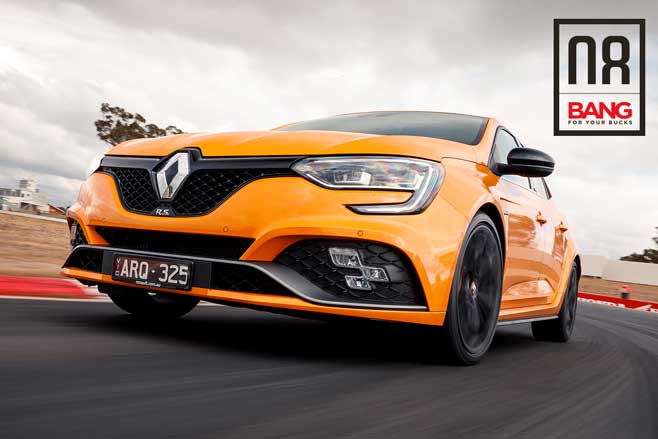
0-100km/h: 5.98sec 0-400m: 14.22sec @ 166.02km/h Price: $48,990 Bang Index: 80.7 Bucks Index: 106.4 BFYB Index: 93.5
Bang For Your Bucks 2019 Judges’ Comments
Campbell – 9th “Undoubtedly fast but I’m liking the MkIV Megane RS a little bit less every time I drive one. Bummer.”
Cordony – =3rd “Less personality, more speed and focus.”
Morley – 9th “If I could just feel a little more like I was calling the shots.”
Scott Newman – 8th ”Like a Big Mac without the special sauce. Ingredients are there, but not quite right.”
Luffy – 7th “It was certainly the most lively of the front-drive cars in the wet; it’s really easy to trail brake and lose the rear on entry. It’s a difficult car to drive on the limit in the wet. It had really bad torque steer on exit and lacked the punch and refinement of the Type R. It’s more about being different for the sake of being different.”
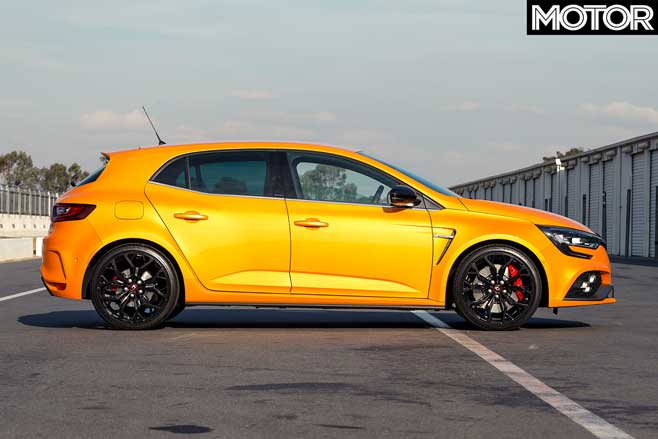
FAST FACTS 2019 RENAULT MEGANE RS280 CUP SPECS BODY: 5-door, 5-seat hatch DRIVE: front-wheel ENGINE: 1798cc inline-4, DOHC, 16v, turbo BORE/STROKE: 79.7 x 90.1mm COMPRESSION RATIO: 9.9:1 POWER: 205kW @ 6000rpm TORQUE: 390Nm @ 2400-4800rpm WEIGHT: 1407kg POWER-TO-WEIGHT: 145kW/tonne TRANSMISSION: 6-speed manual SUSPENSION: dual-axis struts, coil springs, dampers, roll bar (f); torsion beam, coil springs, anti-roll bar (r) BRAKES: 355mm ventilated discs, 6-piston calipers (f); 290mm ventilated discs, single-piston calipers (r) WHEELS: 19.0 x 9.0-inch (f/r) TYRES: Bridgestone Potenza S001, 235/35 R19 (f/r) PRICE: $48,990
Bang For Your Bucks 2019
The Contenders, Judges & Criteria
11 of the hottest new fast cars under $100K roll up to take on our famous value-for-money formula. Which will be number 1?
The WhichCar Weekly team love the BMW M850i but is it trying to play in the wrong company? First up this week, the chaps discuss the terms and names we give various car types and decide which are outdated, which have no purpose at all and what the definition of an idiot is.
Last week, Scotty had but seconds to mention one of the most significant recent revelations in the automotive world. This week however, we get stuck into the Corvette C8 to see what all the fuss is about.
At its launch, Chevrolet confirmed the flagship model would be mid-engined as if we didn’t already know, but there’s far more interesting detail to chat about including its Aussie origin and the story of its evolution.
Fresh from the piste, Dan talks about his experience driving Volkswagens at the top of a mountain in New Zealand. Apart from a snow-load of fun there are more important, significant and potentially worrying lessons to be learnt from a day of powerslides.
Dawn at Snowfarm might be seriously cold, but the most chilling part is what happens when the sun comes out.
If you’re on the go, you can find WhichCar Weekly on all manner of podcast apps including iTunes and Podbean. Please rate, subscribe and leave a review! You can also follow the day-to-day happenings of the WhichCar team on Facebook, Twitter and Instagram @whichcarau.
Listened to the show? Help us out:
- Leave a note in the comment section below.
- Leave a review on Apple Podcasts/iTunes
- Subscribe to our podcast
GM and Holden fanatics should start saving now if they want to add a C8 Corvette to their garage when it arrives in Australia.
In fact, if you just want a mid-engine supercar for less than $200K, the incoming Corvette will have to be on your wishlist.
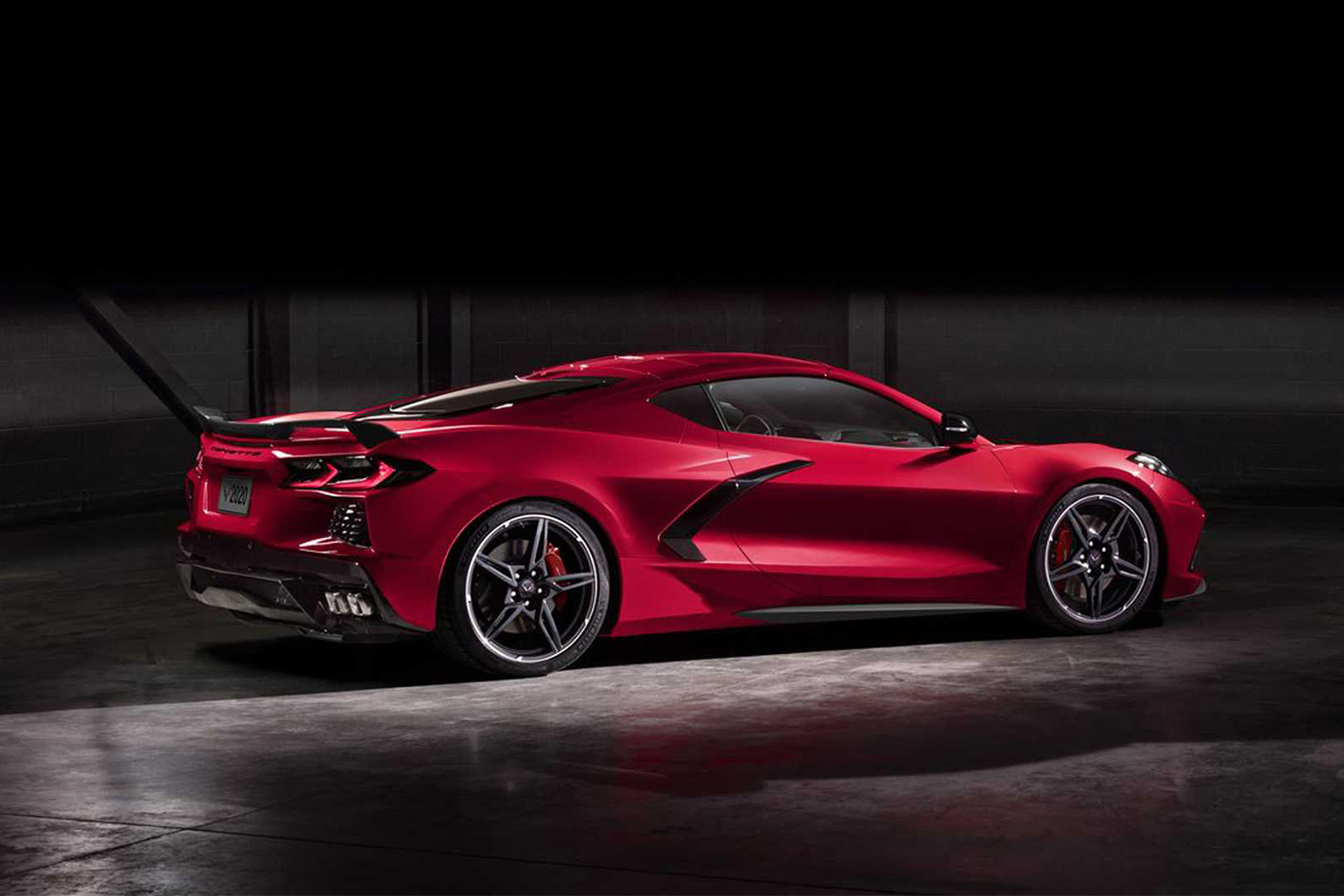
Price estimates for Australia have ranged wildly since the C8 was revealed in America, stretching from a laughable $85,000 (a direct conversion of USD to AUD for the base model), all the way to in excess of $200,000.
However, as Wheels understands, the C8 Corvette will be priced between $150,000 and $170,000 in Australia when it arrives in right-hook from the USA.
What’s more, drawing on the information obtained by Wheels, we believe that the Corvette will follow the strategy applied to other low-volume performance car imports such as the Mustang GT and Mercedes-AMG C63 S, which only offer a high-grade specification.
This news essentially nixes any comparisons to the sub-US$60,000 entry-level Stingray model available in America and would suggest that the first Corvette to be delivered in Australia from the factory will come fitted with, or with parts of, the optional Z51 performance package as standard.
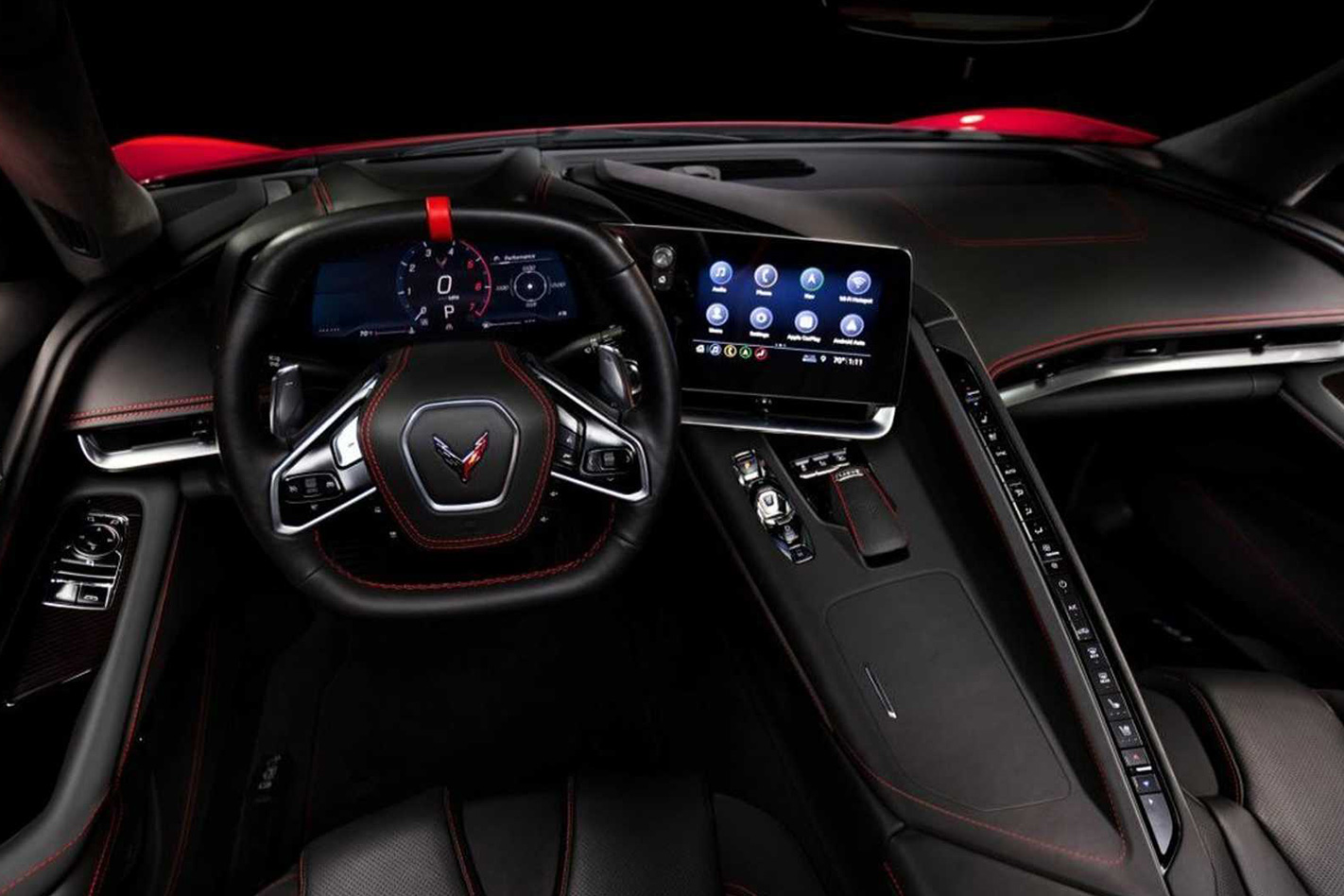
Powered by a 6.2-litre naturally aspirated V8 (called the LT2) and mated to an all-new eight-speed dual-clutch gearbox, the Corvette Z51 produces a claimed 369kW at 6450rpm and 637Nm at 5150rpm.
For comparison, the M177 4.0-litre twin-turbo V8 in the Mercedes-AMG C63 S produces 375kW at 5500-6250rpm and 700Nm at 1750-4500rpm.
If the C8 arrives in Australia with pricing near the top of the stated price range, it’d make the C8 the most expensive car to grace a Holden dealership. Currently, the most expensive non-HSV Holden you can buy is an Acadia LTZ-V AWD which wears a sticker price of $67,490. That’s quite the gap.
At the moment, the performance hero for GM in Australia is the Chevrolet Camaro ZL1, which is converted to right-hand drive by HSV and starts at $159,990 for the six-speed manual.
So when is it coming? As Wheels understands, Australians can expect at least a 12-month delay between C8 Corvette deliveries beginning in North America and the mid-engine sports car finding homes Down Under. This means a late-2020 arrival is on the cards.
It remains unclear how the limited number of C8 Corvettes that will come to Australia will be sold, and which dealers will be involved in the process.
