
New South Wales’ introduction of average speed cameras targeting light vehicles has already had a substantial effect on reducing speeding, with recent trial data showing a marked drop in driver offences even before fines were issued.
After a nine-week testing phase, Transport for NSW has confirmed that speeding incidents decreased by an average of 38 per cent across two high-risk regional corridors, reported Yahoo News.
These new average speed enforcement cameras – located on a 15km stretch of the Pacific Highway between Kew and Lake Innes and a 16km section of the Hume Highway between Coolac and Gundagai –are the first of their kind in NSW to apply penalties to light vehicle drivers. Previously, average speed cameras were used exclusively to monitor trucks and other heavy vehicles in the state.
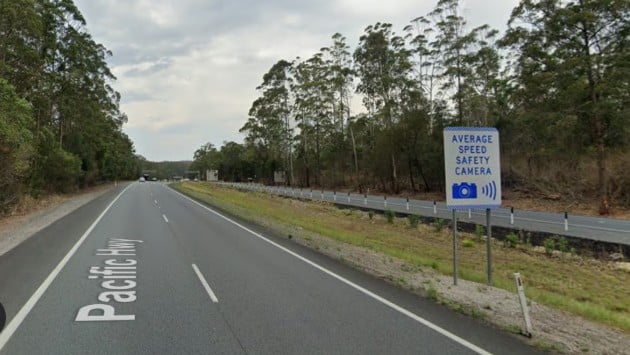
The technology, known as point-to-point enforcement, calculates a vehicle’s average speed between two fixed locations. If the result exceeds the posted speed limit, a fine is automatically triggered.
This approach is widely regarded as one of the most effective tools for reducing speeding-related incidents and is already in use across several Australian states, as well as in countries such as the UK, Norway, Italy, and the Netherlands.
From July 1, the trial transitioned to full enforcement mode. Motorists caught speeding by the cameras now face fines of up to $2,959 and the loss of six demerit points, depending on the severity of the offence.
But what’s notable is the degree of compliance before enforcement officially began. Transport for NSW observed a 48 per cent drop in speeding on the Pacific Highway by the end of week seven of the trial, with just one in 235 drivers exceeding the limit. On the Hume Highway, speeding dropped by 37 per cent, with only one in 194 drivers caught speeding. Across the full trial period, a steady 38 per cent average reduction in speeding was maintained between the two routes.
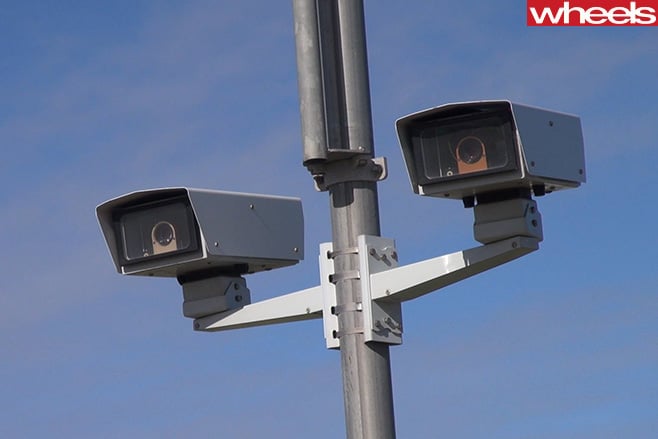
“This shows that motorists were taking the cameras seriously even without the threat of fines,” a state government spokesperson told Yahoo. Authorities say the initiative has already delivered “a big drop in speeding at both sites”.
All revenue generated by the new cameras, as with other traffic enforcement measures, will be directed to the Community Road Safety Fund, which supports education and road safety programs throughout NSW.
By discouraging excessive speeds over longer distances rather than single moments, average speed cameras are predicted to not only improve compliance but also enhance safety outcomes. The trial results suggest a further expansion of the program could be on the horizon in NSW, at least.
One of the most iconic cars from The Fast and the Furious franchise has just changed hands for a staggering price. A 1992 Mazda RX-7 FD used in The Fast and the Furious: Tokyo Drift has sold for £911,000 – equating to approximately A$1.78 million – at a Bonhams (images below) auction.
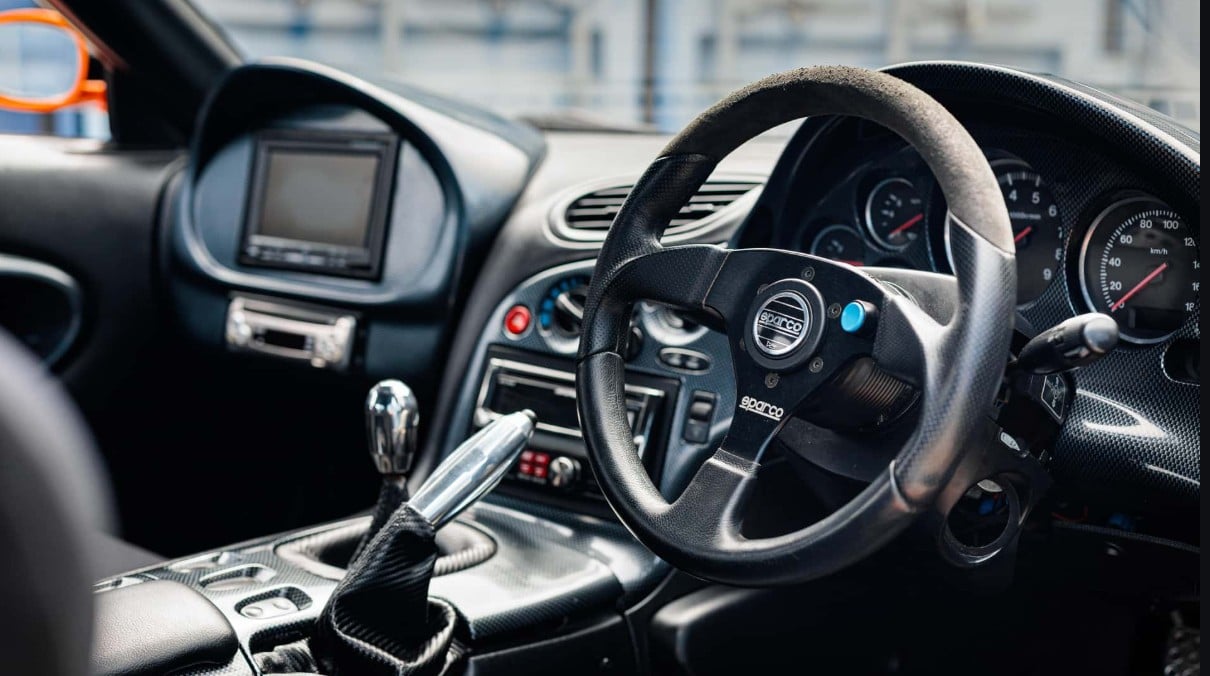
This particular RX-7 is believed to be one of just two surviving examples used during the production of the third film in the high-octane series. It was famously driven by the character Han, portrayed by actor Sung Kang, and was featured in close-up and static scenes. The car still bears evidence of its time on set, including mounting marks from camera equipment and “#71 HANS” production labels scattered throughout the vehicle.
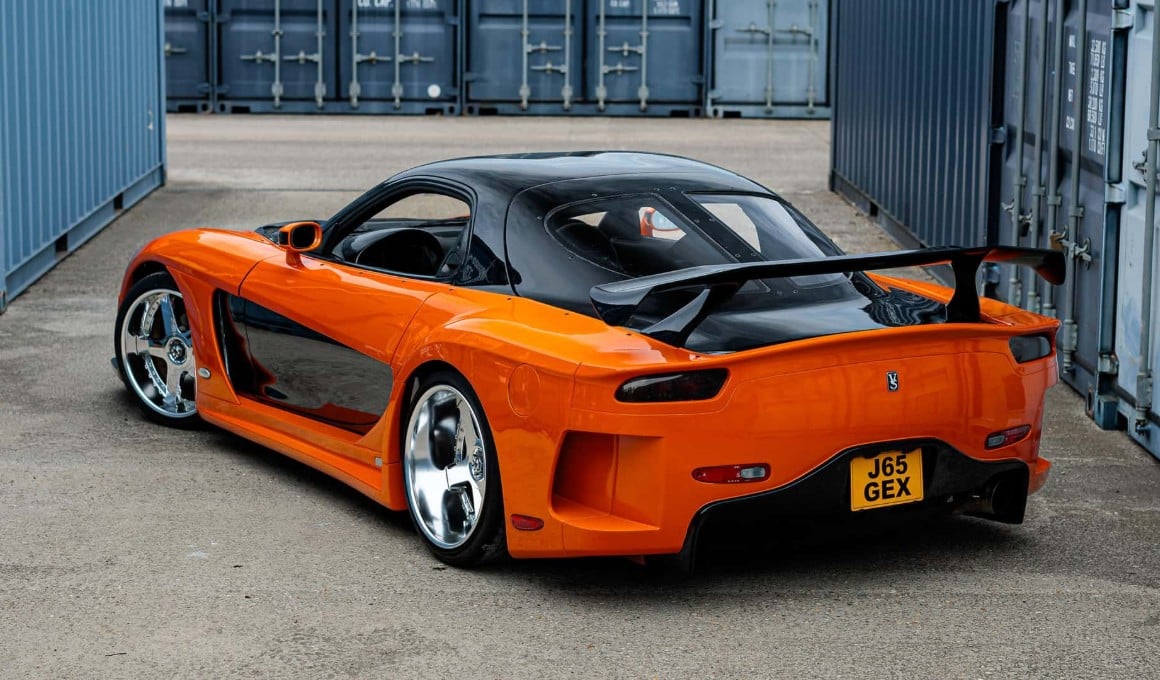
The Mazda wears a distinctive VeilSide Fortune wide-body kit from the Japanese tuning house of the same name, radically altering its proportions. It now measures over 200mm wider than the standard FD model and retains only the original roof and tailgate panels. The body is finished in a pearlescent orange paint and rides on 19-inch Andrew Premier Series Racing Evolution 5 wheels, wrapped in ultra-wide Pirelli P Zero Nero tyres at the rear.
Before heading to auction, the car underwent an extensive mechanical restoration, including a rebuild of its twin-rotor turbocharged engine by Japanese rotary specialists RE-Amemiya. While the odometer shows 66,785 miles (about 107,500 kilometres), only 8000 kilometres have been added since the refurbishment. It’s noted, however, that the car has been largely stationary for some time since the rebuild.
This sale puts the RX-7’s value well above that of the 1994 Toyota Supra driven by the late Paul Walker in the original films, which sold in 2021 for around A$820,000. Still, it doesn’t surpass the record set in 2023 by another of Walker’s cars – a 2000 Nissan Skyline R34 GT-R, built by Kaizo Industries – which sold for a whopping A$2 million.
The sale confirms the enduring appeal of Fast and Furious movie cars among collectors, especially those with strong links to fan-favourite characters.
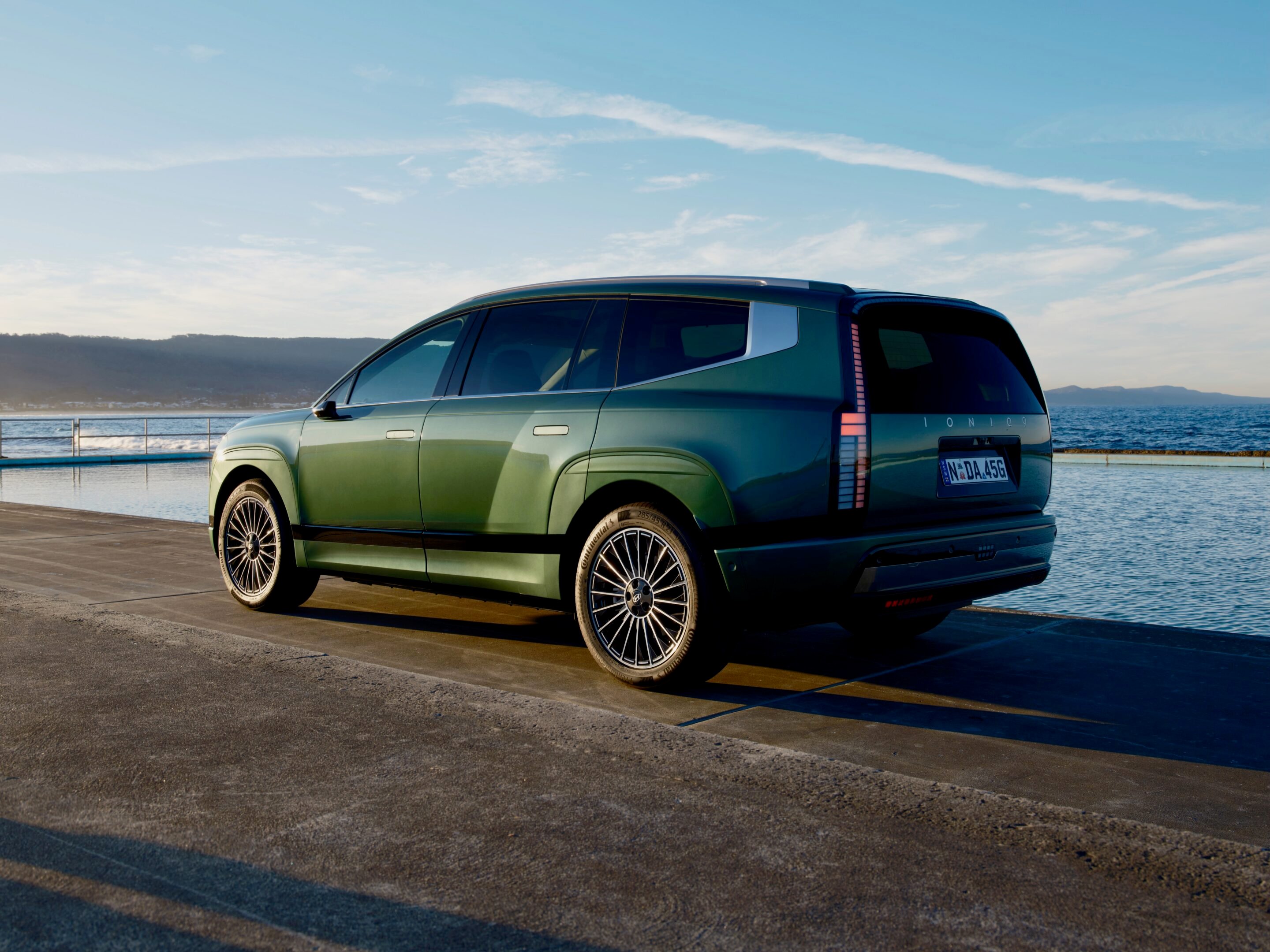
The Hyundai IONIQ 9 electric large SUV has been launched in Australia as the most expensive Hyundai car ever sold here. Priced from $119,750 plus on-road costs, Hyundai Australia has elected to sell only the top-spec Calligraphy model, with lower spec models offered overseas not yet available.
Measuring 5060mm long, the Hyundai IONIQ 9 is the twin to the Kia EV9, though it’s even larger overall than its cousin. Seven seats are standard, but a six-seat layout is optionally available as well, as are camera mirrors and special matte paint.
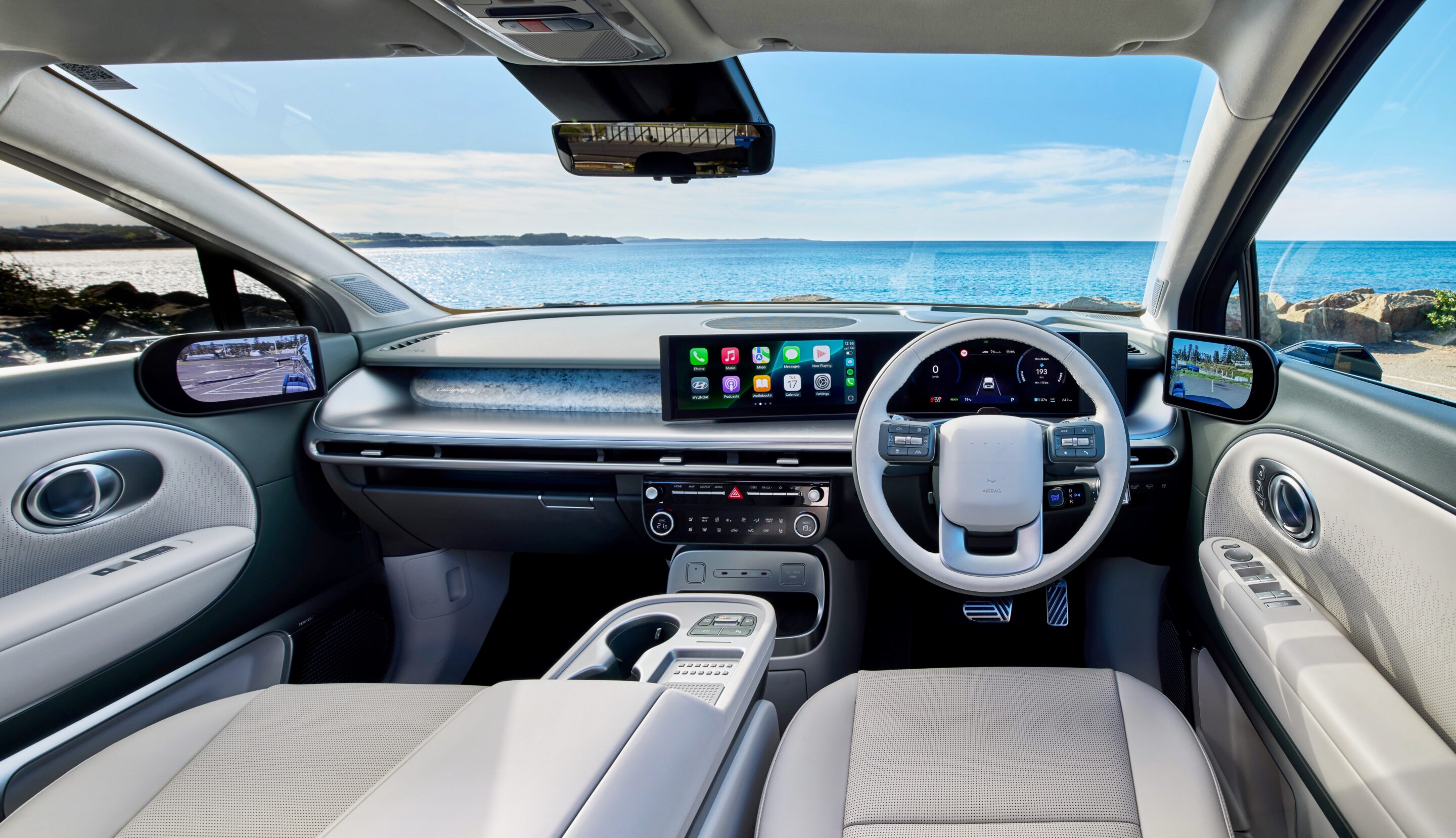
Under the floor of the Hyundai IONIQ 9 is the same ‘E-GMP’ platform as the smaller IONIQ 5 and IONIQ 6, this time using a 110.6kWh battery that can be charged at up to 233kW on a DC charger for a 10-80 per cent charge in as little as 24 minutes. Its claimed WLTP range is 600km.
The IONIQ 9 is powered by two 157kW electric motors, combined making 314kW of power and 700Nm of torque, enough for a claimed 0-100km/h sprint time of 5.2 seconds.
The IONIQ 9 is the first Hyundai vehicle in Australia with digital key functionality, allowing buyers to lock, unlock and start the vehicle using near-field communication and ultra-wideband technology. Google Places Search has also debuted in the IONIQ 9, allowing users to use text search such as “restaurants near me” for navigation.
Hyundai IONIQ 9 pricing (plus on-road costs):
- Calligraphy: $119,750
Hyundai IONIQ 9 Calligraphy standard features:
- 21-inch alloy wheels with a tyre repair kit
- Dusk-sensing automatic LED lighting
- Rain-sensing automatic wipers
- Panoramic sunroof
- Hands-free power tailgate
- Roof rails
- Keyless entry with push button start and digital key access
- Rear privacy glass
- Heated/auto-folding mirrors
- Leather-wrapped steering wheel with power column adjustment
- Nappa leather upholstery
- 16-way electric ‘Premium Relaxation’ front seats with ventilation, heating and driver’s memory
- Tri-zone automatic climate control
- Heated and ventilated outboard middle row seating
- Power-folding and reclining third-row seats
- 12.3-inch digital driver’s display
- 12.3-inch touchscreen with live services and over-the-air updates
- Satellite navigation with Google Places Search integration
- Wireless Apple CarPlay and Android Auto
- AM/FM/DAB+ digital radio
- 14-speaker Bose sound system
- Wireless phone charger
- UV steriliser
- 6x 100-watt USB-C charging ports
- Digital rear mirror
- Head-up display
IONIQ 9 Calligraphy safety features:
- 10 airbags
- Autonomous emergency braking (AEB) with pedestrian and cyclist, junction turning/crossing, lane change oncoming and evasive steering assistance
- Adaptive cruise control with traffic jam assist
- Lane keeping assistance
- Adaptive lane guidance
- Blind-spot monitoring with a blind-spot camera
- Rear cross-traffic alert
- Intelligent speed limit assist
- Low-speed automatic rear braking
- Driver attention monitoring
- Rear occupant alert
- Safe exit assist
- Adaptive high beam
- Front and rear parking sensors
- 360-degree camera
- Tyre pressure monitoring
IONIQ 9 options:
- Digital side mirrors: $3000
- Six-seater layout with second-row ‘Premium Relaxation’ seats with electric adjustment: $2000
- Metallic paint: $750
- Matte paint: $1000
- Two-tone interior: $295
The Hyundai IONIQ 9 is now on sale in Australia, with the first deliveries due to commence soon.
Sixty-five per cent of Australians would buy their current car brand and model again, according to a survey of 1000 people by financial comparison platform Money.com.au.
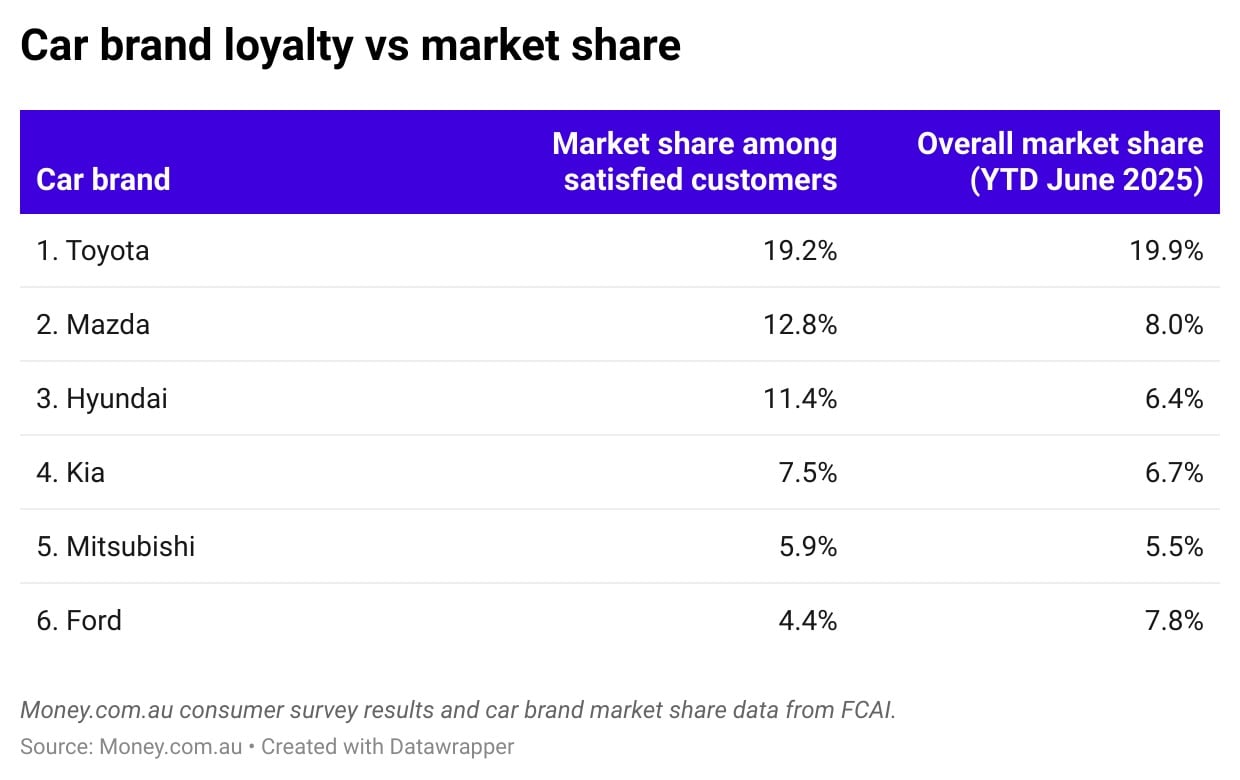
Toyota topped the list, making up 19.2 per cent of satisfied owners, followed by Mazda (12.8 per cent) and Hyundai (11.4 per cent) – both of which punched above their weight relative to their market share.
Money’s Finance Expert, Sean Callery, says most Australians are effectively becoming repeat customers when it comes to their car brand. “Cars are one of the biggest household expenses, especially when purchased through finance and paid off with interest over several years. That nearly two-thirds of Australians would buy the same car again shows strong confidence in the value and reliability of their vehicle,” he said.
“Aussies want cars that won’t let them down or cost a fortune to run. That’s why brands
generally known for value and reliability like Toyota and Mazda are coming out on top.
“These brands already hold a large share of the Australian market and the data shows that’s unlikely
to change any time soon as drivers aren’t just buying them, they’re likely to stay loyal to
them.”
Other findings from the survey included that car satisfaction was highest among Baby Boomers (75 per cent) and then Gen X (64 per cent), while younger generations were slightly less satisfied, with 61 per cent of Millennials and 53 per cent of Gen Z agreeing they would stick with the brand they currently own.
More than a quarter of Aussies (26 per cent) regret their car choice, with the top reasons being that it doesn’t suit their needs (11 per cent), it’s too expensive to maintain (8 per cent) or that they overpaid for their vehicle (7 per cent). Interestingly, the site said that around 8 per cent of Aussies surveyed said they don’t own a car.
Key findings
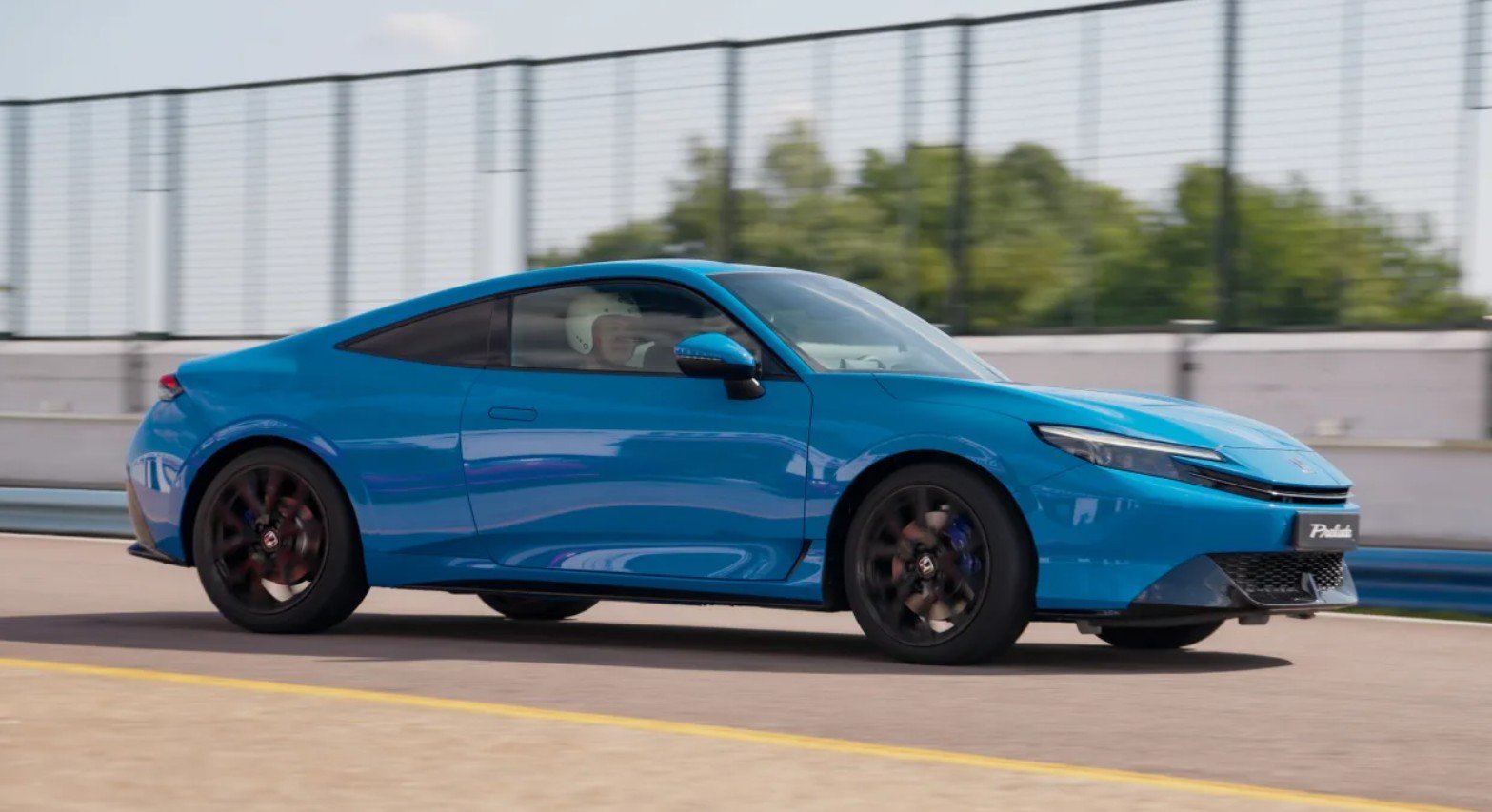
After more than two decades off the market, Honda’s famed Prelude badge is set to return in the first half of 2026 – this time as a sleek, two-door coupé that blends modern hybrid power with classic grand-touring proportions. Slotting above the Civic in size and price, the new model gives Honda loyalists a sporty alternative to crossovers without treading on the Civic Type R’s hardcore territory.
Familiar platform, bespoke tuning
Built on the same architecture as the current Civic, the Prelude employs Honda’s proven 2.0-litre Atkinson-cycle petrol engine paired with an electric motor. While the basic hardware mirrors the Civic Hybrid, engineers have retuned the system for sharper throttle response and a more engaging soundtrack. Combined system output is expected to mirror the Civic’s 181 bhp (135 kW) electric motor, with total power estimated around 200 bhp (149 kW) once final figures are confirmed.
A headline addition is S+ Shift: an eight-step simulated gear programme accessed via wheel-mounted paddles. Though the transmission itself remains a single-speed e-CVT, the virtual ratios allow drivers to “upshift” and “downshift,” raising or lowering engine revs to mimic the feel of a traditional gearbox. The effect is supported by an enhanced cabin sound profile that amplifies engine notes through the speakers up to a 6,000 rpm redline.
Chassis and handling
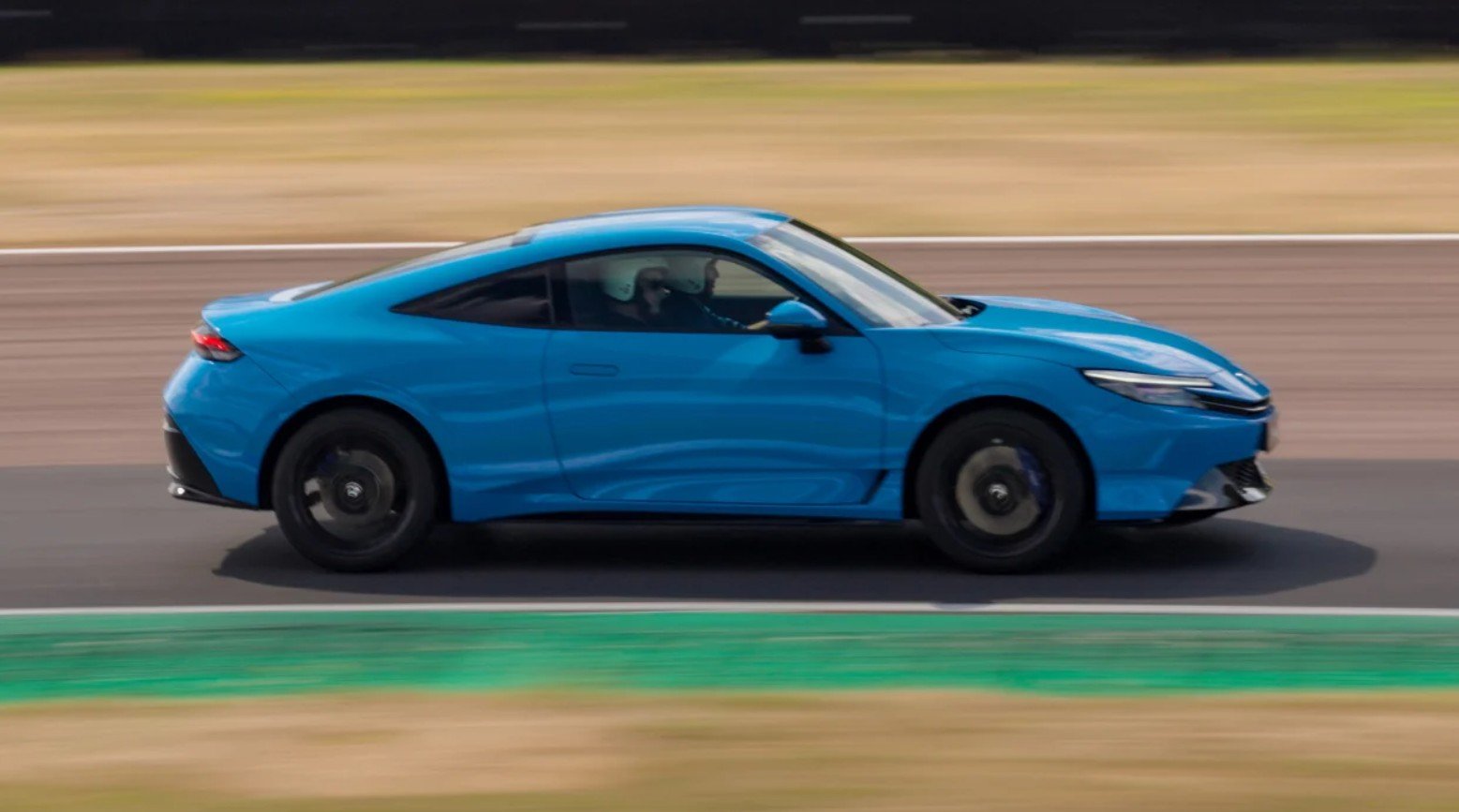
Compared with its four-door sibling, the Prelude adopts a shorter wheelbase, wider tracks and broader tyres for added grip. Beneath the coupe body sits suspension hardware borrowed from the Civic Type R, but spring and anti-roll-bar rates have been softened to deliver day-to-day compliance. The result, Honda claims, is a ride/handling balance that splits the difference between mainstream Civic comfort and Type R aggression – ideal for spirited weekend drives without sacrificing long-distance refinement.
Early engineering targets put kerb weight at roughly 1,450 kg, on par with the Civic Hybrid, so performance should remain brisk even if the Prelude isn’t chasing outright Type R lap times. Expect 0–100 km/h in the high-sevens, with instant electric torque giving lively real-world acceleration.
Design cues
The production car stays remarkably close to the concept first shown in Tokyo: a long bonnet, tapered fastback roofline and full-width LED tail-light bar nod to past Preludes while embracing modern aero efficiency. Up front, slim headlights frame a low grille, and large alloy wheels (likely 19-inch) fill flared arches for a planted stance.
Inside, expect the latest Honda infotainment suite, digital instruments and minimalist switchgear. Sports seats, contrasting stitch patterns and a low driving position should set the Prelude apart from the more family-oriented Civic.
Positioning and pricing
Honda has not released final pricing, but industry chatter suggests the Prelude will sit just above the hybrid Civic. In Australian terms that would equate to a sticker a little north of A$60,000, offering a rare electrified choice in a shrinking compact-coupe segment.
With the NSX discontinued and the Civic Type R catering to track-day enthusiasts, the Prelude becomes Honda’s sole sporty two-door with everyday usability. By pairing electric efficiency with engaging dynamics and a nostalgic nameplate, Honda aims to entice buyers who want sustainable performance without sacrificing style – or the reassuring range of a hybrid powertrain.
Full technical details and local pricing will be confirmed closer to launch, but one thing is clear: the Prelude’s comeback adds a welcome dash of excitement to Honda’s electrified roadmap and breathes life into a corner of the market that’s been short on choice.
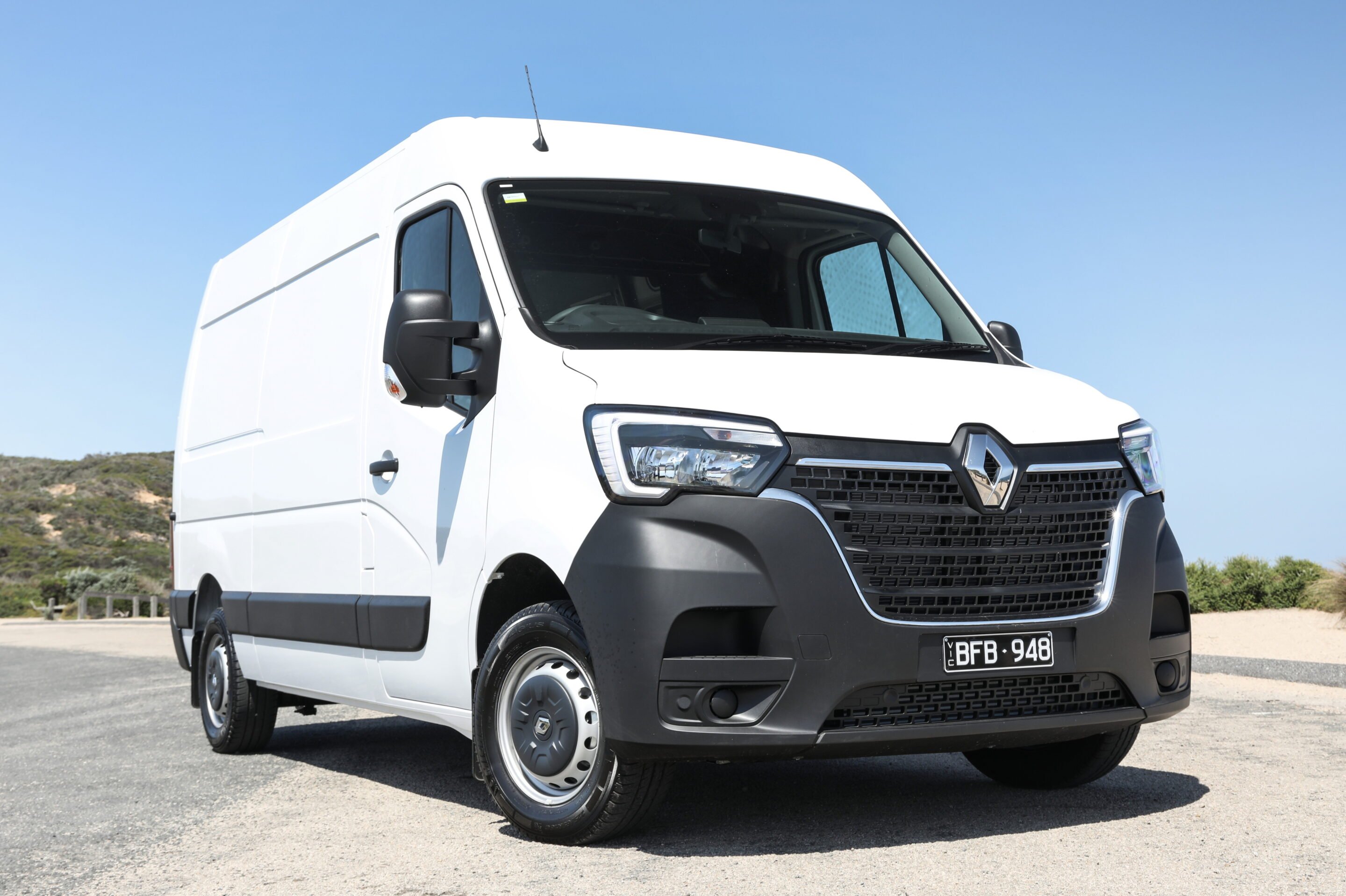
The MY25 Renault Master large van is now on sale in Australia with a newly-streamlined range and a special new drive away price until September 30 for the Pro mid-wheelbase variant.
Competing against other large vans such as the Ford Transit, the Master was Renault’s best-selling product in Australia in 2024.
All Renault Master models use a turbocharged 2.3-litre four-cylinder diesel engine with a six-speed automated manual transmission (AMT). The engine makes 110kW of power and 350Nm of torque, while its long annual/30,000km service intervals and 100-litre fuel tank will help owners keep operating costs down, according to Renault.
Renault Master pricing (plus on-road costs):
- Pro mid-wheelbase AMT: $55,200 ($57,990 drive away until 30 September 2025)
- Pro long-wheelbase AMT: $57,200
Master standard features:
- 16-inch steel wheels
- Dusk-sensing automatic halogen exterior headlights with LED front daytime running lights
- Rain-sensing automatic wipers
- Remote central locking
- Height, reach and lumbar adjustable driver’s seat with armrest
- Dual passenger bench seat with fold-down centre seat and seat back table
- Air-conditioning with pollen filter
- 7.0-inch touchscreen with sat-nav
- Apple CarPlay and Android Auto
- USB audio input and 3.5mm auxiliary port
- Glazed rear barn doors
- Unglazed left-side sliding door
- Glazed steel bulkhead
- Cargo tie down points and 12V socket
- Cruise control with a speed limiter
- Lane departure warning
- Blind-spot monitoring
- Auto high beam
- Rear parking sensors
- Reversing camera
Master options:
- Trade Pack with timber floor with anti-slip finish, full height ply side protection lining, LED cargo bay lighting
- Business Pack with premium dashboard with chrome trims, exterior chrome trims, front fog lights and keyless entry with push button start
- Left and right glazed sliding doors (not available with Trade Pack)
- Right sliding door
The updated Renault Master range is now on sale in Australia, with stock now available.
If you were to spool the clock back just eight years and were shopping for a car with over 200kW, which drove solely the rear treads, came with a manual gearbox and a price of less than six figures, you had 20 options open to you. And 17 of them were variants of a Ford Falcon or a Holden Commodore. So when these two domestic models were shuffled off into retirement, it looked like the writing was on the wall for this class of car. Your choices back then ran to a BMW M2, a Nissan 370Z or the Ford Mustang.
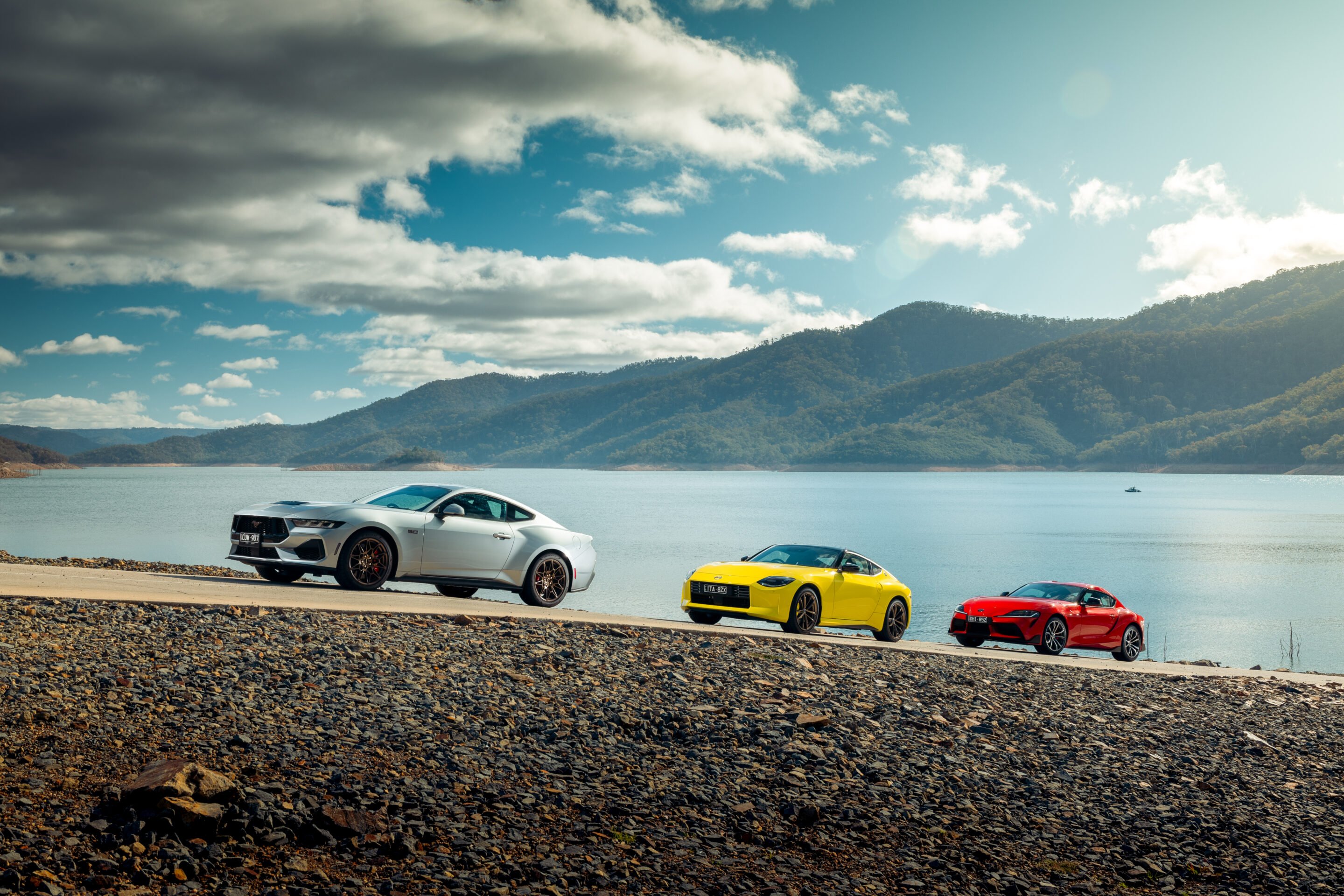
Yet here we are 10 years later, in an era when $100k buys you a whole lot less, and there’s still three model lines that fit the bill. Toyota bring us something more affordable in the shape of the GR Supra which rides on the bones of the G29 BMW Z4. The Mustang, in its relatively new S650 guise, makes the numbers in both 2.3-litre Ecoboost or 5.0-litre V8 guises, while the Nissan 370Z has morphed into the sleek but distinctly retro Z coupe.
All three carry the weight of some serious heritage. The Mustang nameplate dates back to 1964, Nissan’s Z-car line debuted in 1969, and the Supra badge first appeared in 1978, so even the youngest of these lineages is almost half-a-century old. It made sense, therefore, for Wheels to gather these three iconic manual holdouts together to see how the Mustang shapes up in the face of two well-known quantities.
We hesitate to say it’s the last time we’ll be able to do that, because many have made that point over the last decade and, well, here we still are. Yet there appear no firm plans for either Toyota or Nissan to extend the life of the Supra or the Z in these current guises. Any putative replacement would likely arrive in a very different form. The Mustang may be the best bet to continue this bloodline, and it’s perhaps ironic that the US market has become the global driver of manual coupe sales. Yee – and indeed – haw.
The executions and origins vary between these three coupes, and although there are commonalities, they have far from reverted to a homogenous mean. The Supra has been with us the longest – the A90 generation car launching here in 2019, when we pitted it against the Audi TT S and the BMW M2 Competition in a comparo. It easily saw off the Audi, and came within a squeak of toppling the talented M2. Back then the Supra GTS and the M2 were within $5k of each other, but times change. The GT version of the Supra you see here carries an $87,380 RRP whereas the cheapest M2 has now sailed up to over $126,000. In other words, it’s not hard to figure out where the value is. Yes, the baby BMW has become larger and more powerful, but the Supra’s latterly engorged 285kW and 500Nm isn’t to be sniffed at, the additional 35kW arriving with a mid-life update at the tail end of 2020.
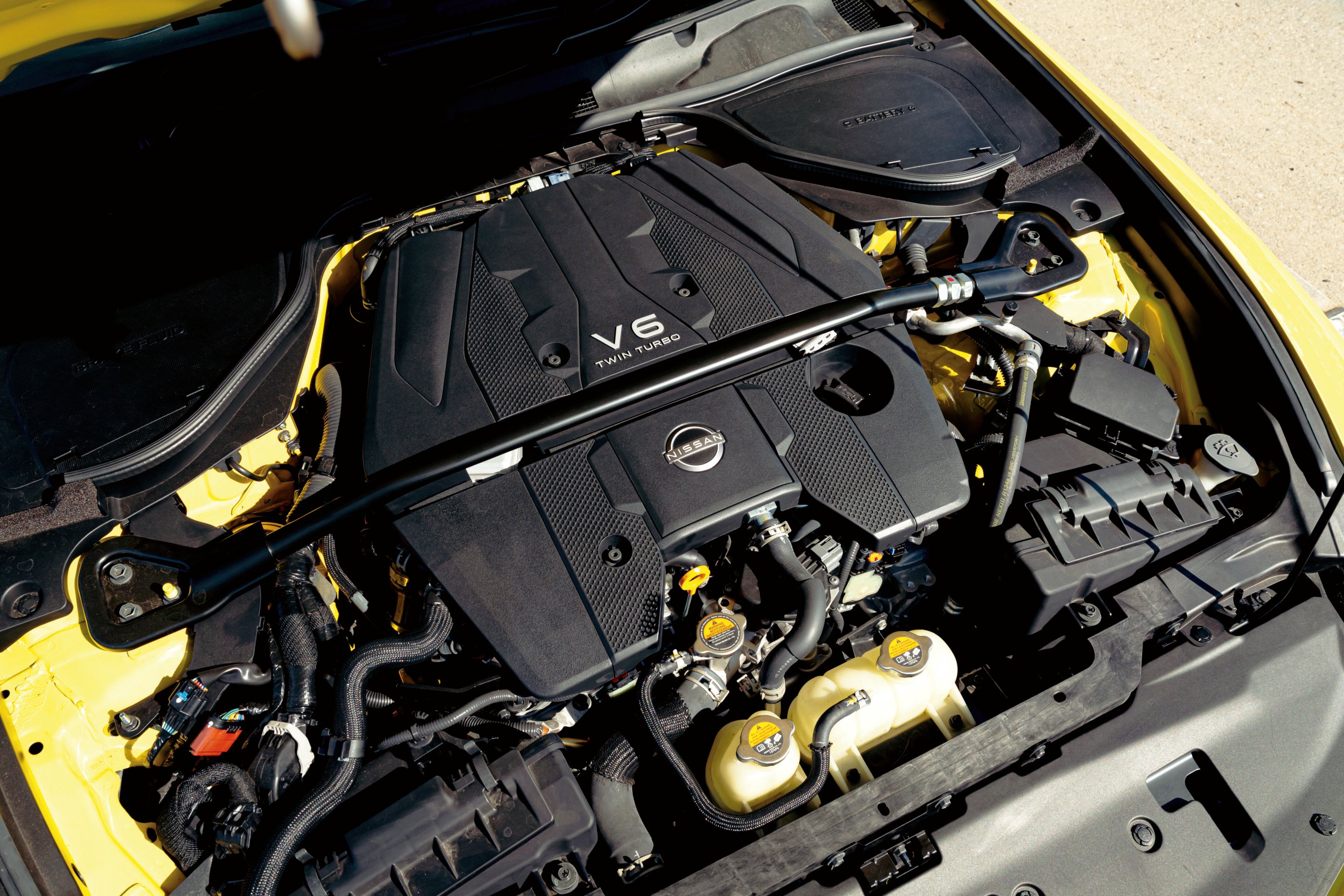
You’ll pay even less if you want a Nissan Z with three pedals and a stick. At $75,800, the price has inflated by a mere 3.4 per cent since it launched in Australia in September 2022. It sticks with the same gutsy 298kW and 475Nm 3.0-litre VR30DDTT twin-turbo unit that had seen service in the long-departed Infiniti Q50 and Q60 models. The eagle-eyed amongst you will know that the car you see here is the Z Proto, which wears some dress-up parts not fitted to the cooking Z, but it was the only manual Z that Nissan Australia had available, so we took the liberty. Hope you don’t mind.
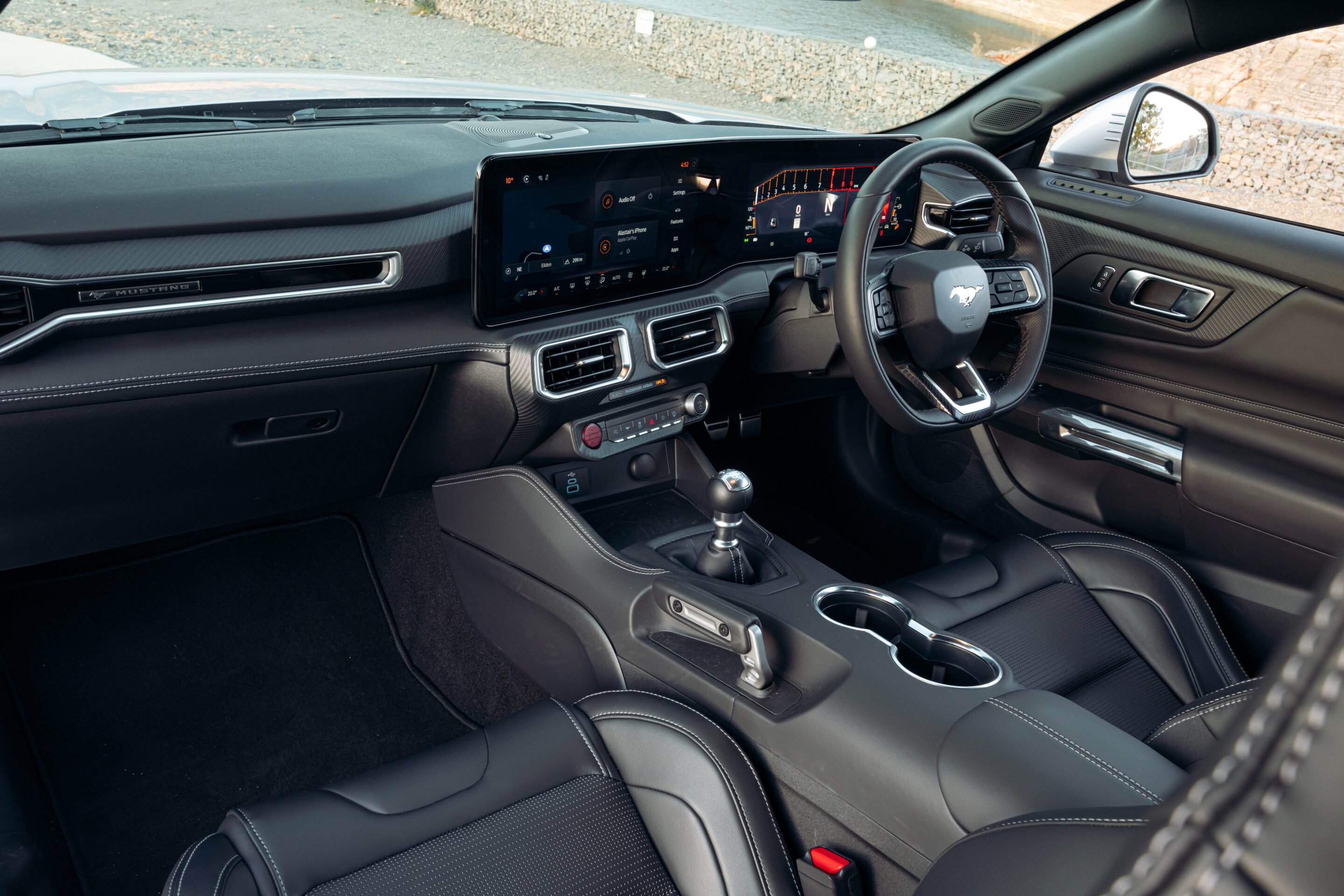
Then there’s the Ford Mustang. Has it got a bit above its station? After all, when we first got our hands on the Nissan Z, a Ford Mustang GT V8 was a $65,290 proposition. It’s now soared to $78,990, fully 21 per cent more expensive. Naturally, Ford will answer that criticism by pointing to the fact that this is a new model, with a stack more equipment, and the signature V8 now cranks out a hale and hearty 347KW and 550Nm. It swaggers in with an air of superiority that’s hard to deny.
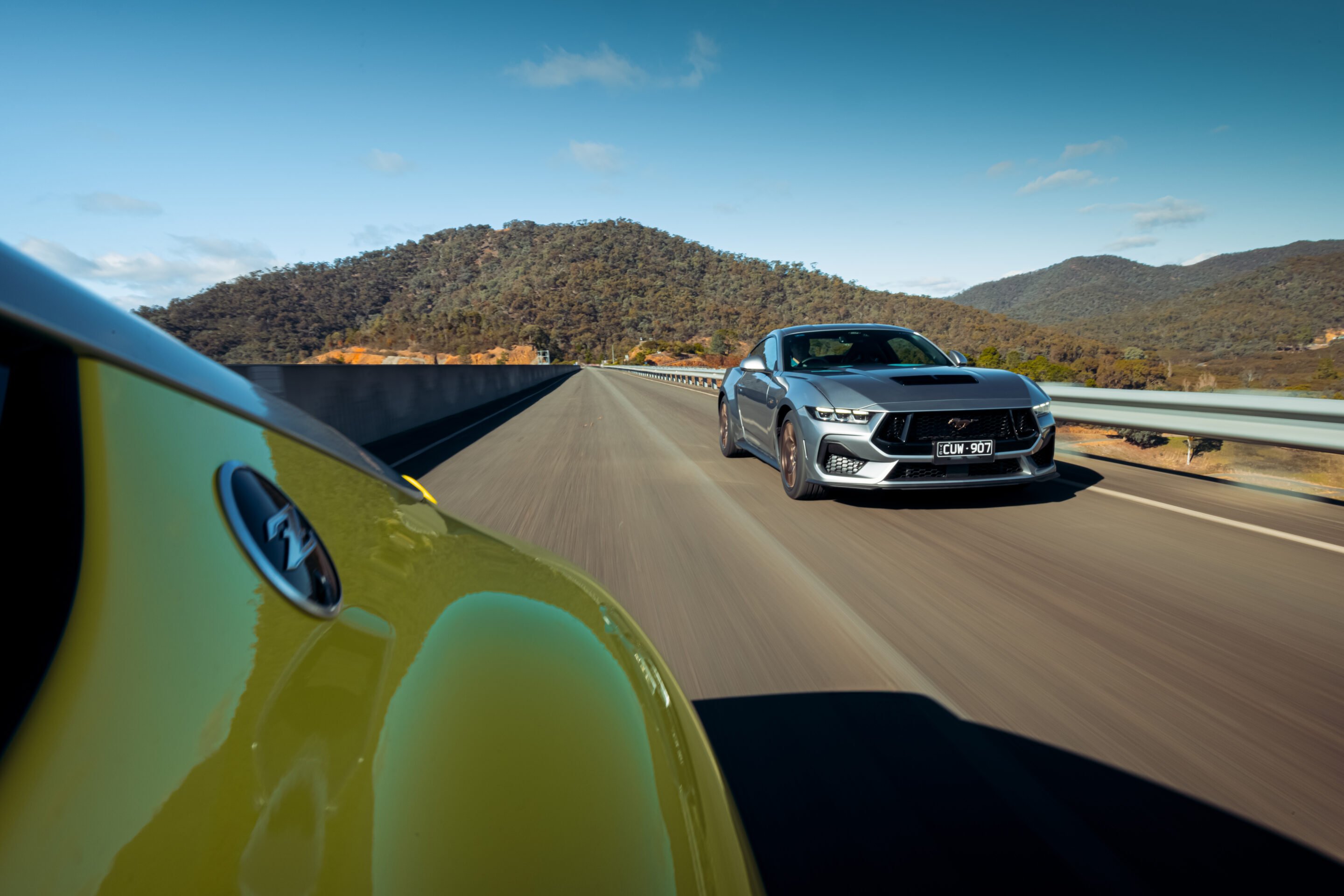
Cold Comfort
The Nissan Z does without a lot of things. You’ll search in vain for a wireless phone charger, a head-up display, wireless Android Auto or Apple CarPlay, or anything in the way of drive modes. There’s another apparently benign omission from the pert Nissan: an outside temperature gauge. The reason this was brought to my attention is that on an early start along the notoriously twisty Gembrook-Launching Place Road, I encountered the devilish combination of thick fog and black ice, which posed an unexpected challenge to the Nissan’s stability control system and may have caused random and involuntary gibbering noises from your scribe.
I don’t think I’ve ever encountered such a heavy-handed stability control installation as the Z’s. It is, ultimately and thankfully, effective but there’s none of that gentle backing off of power or torque vectoring wizardry. Instead, there’s a big clamp of brakes to drag the car back in line accompanied by the sort of agonised graunching noises that usually precede the destruction of a Bond villain’s lair. Better that than a pirouette into the scenery though.
Feeling a little less brave than before, I continue at a more pedestrian pace towards our meeting place at Eildon. As ever the weather improves on the far side of the Black Spur, feathery threads of noctilucent clouds starting to light the pre-dawn sky over the spectacular Cathedral Range. Settled into a steady lope along the Maroondah Highway, the Nissan feels rangy and on-side. Ride comfort is more than acceptable, sixth gear is a relaxed 2000rpm at 100km/h and refinement is impressive.
I’m not quite so thrilled by the USB cable to my phone that keeps making like a python and throwing coils at the gear lever, while the digital dash is so bright I wonder if I’m going to get arc-eye from it. I’d also benefit from my fundament being a couple of inches closer to the ground, as my head is brushing against the headlining. Fortunately I’ve brought a hat so I won’t have to inflict my static-charged guinea-pig hair on the rest of my colleagues today.
Nearing Eildon, I turn up Jerusalem Creek Road. A pair of close-set headlamps appears in the gloaming behind. It can only be a Supra. Arriving at the boat ramp, it’s bright Plasma Orange, undoubtedly the most extrovert choice in the six-colour Supra paint palette. While the Supra can’t hold a candle to the Z in terms of exterior aesthetics, the shape has aged reasonably well, even if all the fake grilles still grate. The aggressive haunches, cab-back profile and just-so relationship between tyres and wheel arches give it a sense of purpose. It looks fast standing still, and there are overtones of a contemporary Shelby Daytona Coupe in its basic proportioning.
We can hear the Mustang GT (below) long before we see it. We’re busy watching a team trying to launch a C2 Speartooth drone submarine into Lake Eildon when we hear the V8 coming across the dam. Even the sub’s remote operator pauses to scan the horizon to see what’s making the noise. Some things just put a smile on your face, and unless you’re standing outside a cars-and-coffee event facing the wrong way, the sound of an approaching Mustang V8 is certainly one of them.
Cards on table time. I didn’t like the look of the S650 when I first saw it. I thought it looked gawky and overly angular, especially around the rear end. I’ve warmed to it since, but I remain to be convinced it’s a better-looking car than its predecessor. This one, however, is a choice piece of configurator jockeying. Iconic Silver with the Bronze appearance pack, MagneRide dampers and Recaro chairs, all-up this one’s just squeaking under six-figures drive away and not by much.
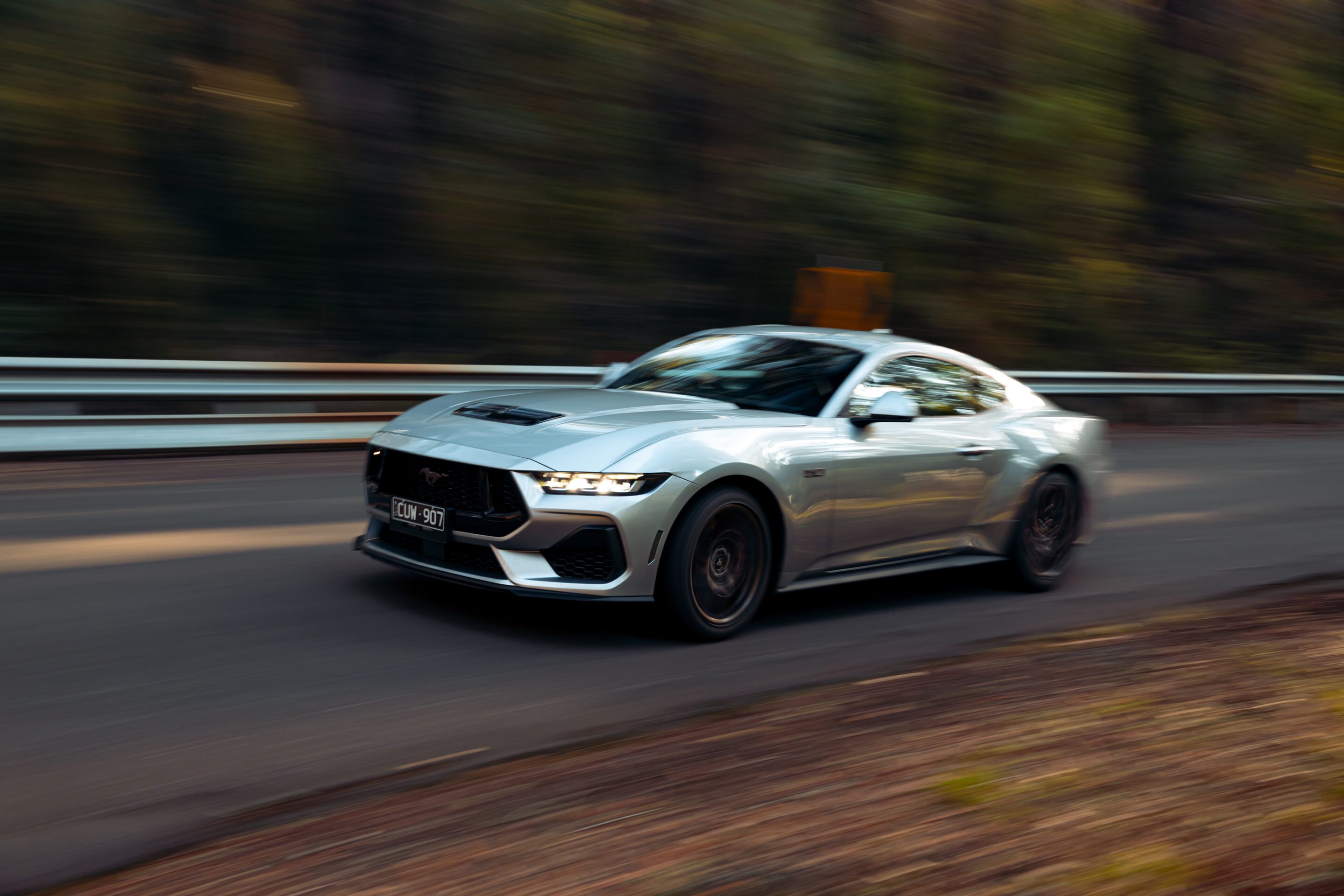
Testing times
Static photography duties done and dusted, we retire for lunch. I ask what the team would take if given the choice now, and everyone nominates the Supra.
I didn’t see that one coming. I have a little excursion planned for the afternoon, however, which may well change a few opinions. It’s called the Eildon-Jamieson Road, and it served for years as the queen stage of Targa High Country. If anything’s going to shake up pre-conceived ideas it’s this amazing 58.5km stretch of virtually deserted road.
The 1465kg Supra is sharp. It’s a proper flexed biceps of a car, this one. It’s also the finest example of this trio for leveraging the best out of its manual transmission because it feels so alert, agile and willing to be grabbed by the scruff. The shift action of its ZF S6-53 transmission is the finest of this trio too, agreeably short of travel and not too knuckly. It’s just a shame that driving the stick forward leaves so little space for your hands. It’s easy to punch the air-con controls. Likewise, the awkward position of the cupholders right where your elbow sits betrays the fact that this manual conversion was something of a late afterthought. The rev-matching function is also a little slow on the uptake. Best to take care of that yourself.
It’s a feel-good car, though. The cabin is snug and while rear three-quarter vision is a disaster, the double-bubble roof gives a decent amount of headroom. It rides acceptably and steers the best of all the cars here. Scribe one arc into a corner and one out and the Supra tracks cleanly. The bump-steer issues that afflicted early cars has been addressed, with rigidity fixes giving you more faith to lean into its front end grip. It’s the rear end that needs managing under power or, correspondingly, sharply off throttle. Peak torque is available from 1800rpm all the way through to 5000rpm. Plunder the top end and while it holds well, with peak power arriving at 5800rpm, a little more acoustic reward wouldn’t go amiss.
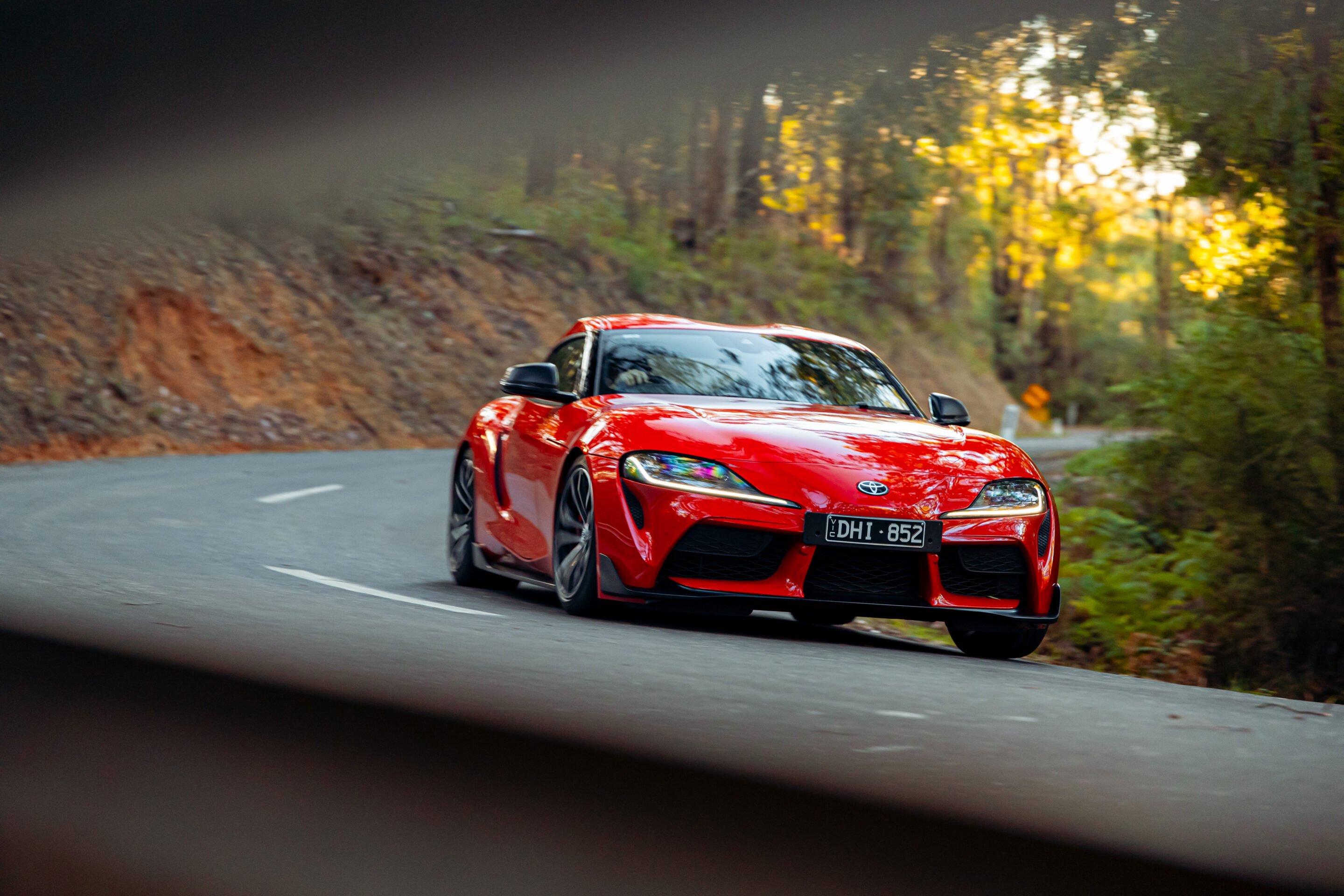
With the shortest wheelbase here and the broadest front track width, the Supra (above) has an oversquare footprint that lends it that agility and initial bite but, unlike the other pair, it has a narrower rear track. It’s on a good tyre, the Michelin Pilot Super Sport (255/40 ZR18 up front and 275/45 ZR18 aft) and the Supra is one of those cars that feels all of a piece until it oversteps the limit of rear grip and reminds you that you need to be on your game. Sport mode wicks up the aggression of the throttle map and disables idle stop but there’s a more progressive and linear feel to the pedal without it engaged.
Step from the Supra into the Mustang and it feels like you’ve climbed out of an F-18’s cockpit and are now settling in to watch Top Gun Maverick at Gold Class instead. The big Recaros are about as comfortable as La-Z-Boy recliners and the woofle of the V8 firing up lulls you into thinking this is going to be a largely boofy and unsubtle driving experience. Wrong.
This is a very different proposition to the old S550. Body control is leagues better, and while front end bite can’t match that of the Toyota, lateral grip is impressive and the car’s ability to clearly communicate the transition from grip to slip engenders a bond of trust that’s never quite there with the spikier Supra. Aussie cars get the Performance Pack that includes six-piston Brembo brakes up front and four-pot calipers at the back, and they do a manful job of shucking off 1813kg of physics, but a road like this can even have them protesting. The Pirelli P Zero tyres work well on these surfaces, the bronze wheels shod in rubber measuring 255/40 R19 up front and 275/40 R19 at the rear.
The sheer cornucopia of drive modes takes some working out and shuffling between Normal, Sport and Track modes shows that Normal is perfectly linear, Sport front-loads the throttle map a little too keenly, whereas Track backs it off to a more linear map that works better on a road like this. It also firms the MagneRide suspension (+45 per cent over Normal) which isn’t quite so desirable, and backs off both traction control and stability control, akin to BMW’s M Dynamic Mode. It also switches the steering into Sport mode, which adds heft but not a lot extra in terms of feedback. Of the three modes, Sport seems to work best with a 25 per cent increase in ride stiffness that doesn’t cross the line into nervousness.
The Getrag six-speed gearbox isn’t quite as slick as the Toyota’s – or, for that matter, the Tremec unit you get in the Mustang Dark Horse – and its vertical planes feel closer together, which means that it can be easy to wrong-slot fifth as you snick up from second to third. It’s also geared slightly longer than the Supra in the ratios that matter, the Japanese car hitting its redline in second at 110km/h and the Mustang making 117km/h. No matter. The auto hold feature is a welcome touch when driving in town.
The Coyote engine remains the showstopper here though. It’s the only one of this group with genuine charisma, from fire-up right through its long arc until it hits its 7250rpm redline. There’s a lovely progression in timbre too, hardening at 3000rpm and introducing a swelling top note of intake as the needle soars past 6000. I usually find loud exhausts obnoxious, but can’t help switching the Mustang’s into its most vocal mode here. There’s nobody out here to annoy.
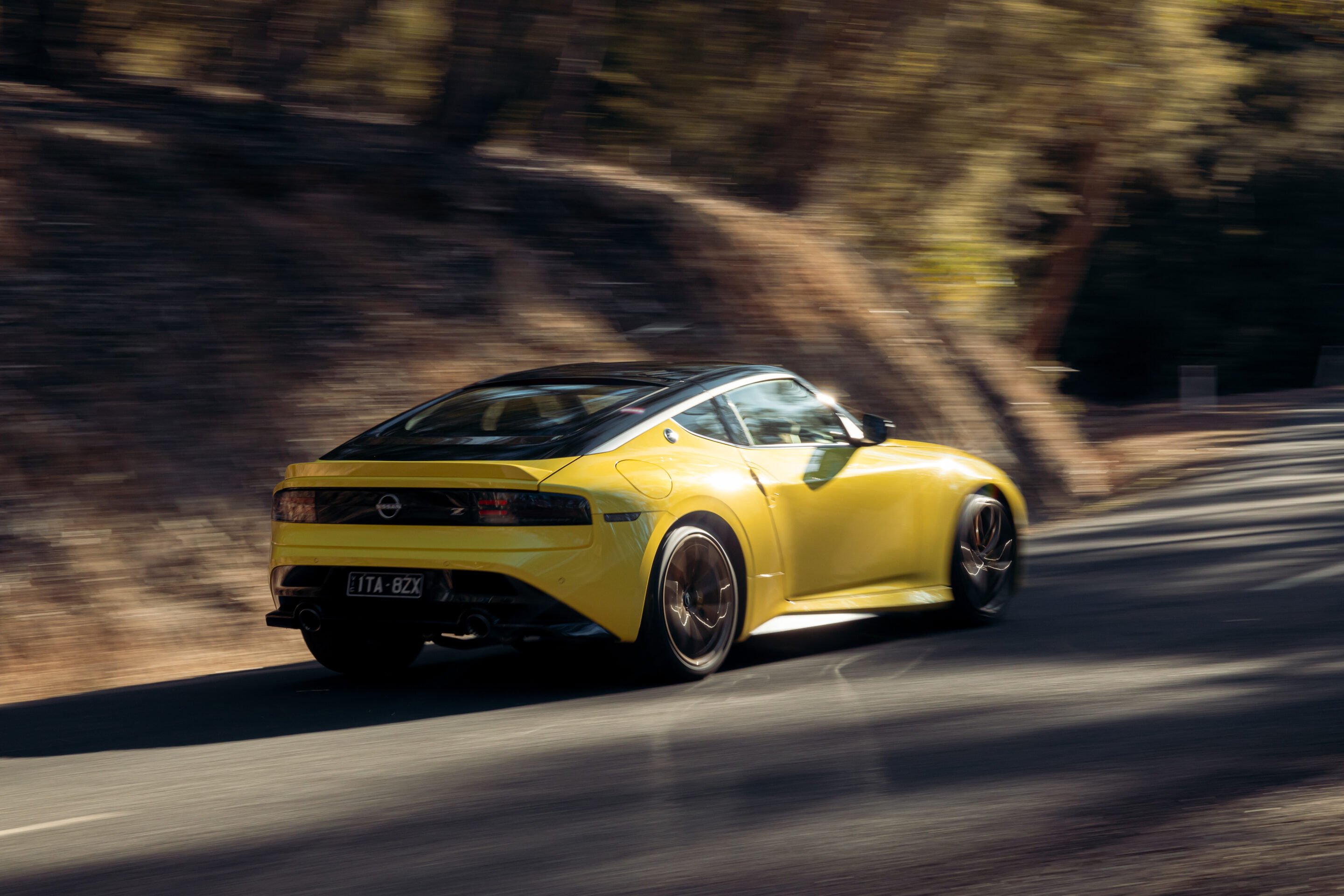
After the Mustang, the Nissan (above) feels about a tonne lighter. The spec sheets tell me I’ve stepped into a car with a mere 252kgs less to haul about and the cabin is comfortably the smallest of the lot. The controls are lighter in feel too, but the Z doesn’t want for outright pace. The engine is significantly boostier than that of the Supra, and feels more muscular despite the power and torque peaks being further around the tacho, its 298kW arriving at 6400rpm and 475Nm chiming in at 5600rpm.
There’s little in the way of aural return from this powerplant, but the Z engages in other ways. The body control is the most relaxed of this group, and the Bridgestone Potenza S007 tyres (255/40 R19 front and 275/35 R19 rear) have the softest sidewalls of the bunch. Couple that with what feels the slowest steering rack and you have a vehicle that’s a little more approximate in its initial reactions than the Ford or the Toyota. As a result, you’re working a little harder to keep up, managing the weight transfers a little more diligently, finessing the gearshifts so as not to shock the driveline, picking your moment to get the most from the Nissan’s turbocharged grunt. It’s good fun.
The brake pedal is delightful, with strong initial bite, but a cultured progression of force, allowing you to bleed caliper pressure off with minute gradation. On dry bitumen, you’ll find yourself gaining tens of metres on the Ford as you approach a hairpin, braking late and long in towards the apex, confident that you can load the front end without the rear misbehaving. It’s at corner exit that you need to be more measured, this time with the throttle, if you’re to avoid the Z’s stability control steaming in with characteristic heavy-handedness. Switch it off and it can be a bit of a wild ride.
The gearchange is good, paired with a sharpish Exedy racing clutch and beefed-up check-springs giving it a purposeful feel. The S-Mode rev matching function is good, although the pedal spacing, control weights and engagement points are well calibrated for heel and toeing down the box yourself.
Graveyard Shift
As we roll back to Eildon, with the cars in their most benign settings, an instant verdict is not leaping out at me. I hate horses for courses decisions so, after some consideration, it’s hard not to conclude that the Mustang GT is the most broadly talented car here. It offers an intriguing duality of character and this car, with the Bronze appearance pack, MagneRide dampers and Recaro seats, carries three options that I’d certainly be ticking were I shopping for a Mustang. For many buyers, the fact that this is the only car of its ilk with a big atmo V8 instantly seals the deal.
The GR Supra is an enigma. Keen drivers will love it. It’s undoubtedly the most focused option here and would provide the biggest sense of achievement to find yourself really getting to master. Perhaps its mongrel genesis and deification of its predecessor unfairly took the shine off its reputation, but six years after launch, it feels more special, and more undervalued, than ever. Of the three cars here, it feels the most natural fit for a manual transmission, yet its engine has such a panoramic torque plateau that you could virtually pick any gear and you’d get a result.
Then we come to the Z. The formula initially seems enticing. It’s almost as if we’re sitting in some sort of Noughties ‘peak car’ throwback, but have been able to add a few modern conveniences. Drive it against the Supra and the Mustang and its shortcomings are seen in sharp relief. It feels old and loose by comparison.
Yet despite this, there’s an endearing aspect about the Z that escapes the other two. Maybe it’s a personal thing, but it’s the only car of the trio that I’d get out of and look back at every single time. And here we get to the heart of this comparison. Because if we are talking about pure competence, you wouldn’t buy any of these particular coupes. The autos are faster, more economical, and just, well, better in most objective regards.
We choose manual gearboxes for entirely esoteric reasons. We want to feel a connection, a purely mechanical reward. We want to feel part of the machine. That’s not predicated on ultimate pace or anything quite so measurable. There’s something deeply subjective about how you engage with cars such as these. For me, the most flawed car here, the Nissan Z, most unerringly sparks that connection. For a car that seems so straightforward in its appeal, it’s one that requires a certain subtlety of feel and a hard-won understanding of its far from transparent dynamics to get the best from. Plus it’s the most beautiful, by some margin, which counts when shopping for a coupe.
There are very defensible reasons for picking any of these three. I’m just glad they still exist; that we can enjoy days like these on great roads in three cars that will never fail to show you a fun time. They won’t be here for ever. Consider this your call to action.
Specs
| Model | Nissan Z |
|---|---|
| Engine | 2997cc V6, DOHC, 24v, twin-turbo |
| Power | 298kW @ 6400rpm |
| Torque | 475Nm @ 1600-5600rpm |
| Transmission | 6-speed manual |
| PWR | 191kW/tonne |
| L/W/H/WB | 4380/1845/1315/2550mm |
| Weight | 1561kg |
| Fuel consumption | 10.8L/100km |
| Boot size | 241L |
| Tyres | Bridgestone Potenza S007 tyres 255/40 R19 (f) 275/35 R19 (r) |
| 0-100km/h | 4.5sec |
| Warranty | Five years / unlimited km |
| Price | $75,800 (non-Proto) |
| Model | Toyota GR Supra GT |
|---|---|
| Engine | 2998cc inline-6, DOHC, 24v, turbo |
| Power | 285kW @ 5800-6500rpm |
| Torque | 500Nm @ 1800-5000rpm |
| PWR | 194.5kW/tonne |
| Transmission | 6-speed manual |
| L/W/H/WB | 4380/1865/1295/2470mm |
| Weight | 1465kg |
| Fuel consumption | 7.9L/100km |
| Boot size | 290L |
| Tyres Michelin Pilot Super Sport | 255/40 ZR18 (f) 275/45 ZR18 (r) |
| 0-100km/h | 4.4sec |
| Warranty | Five years / unlimited km |
| Price | $87,380 |
| Model | Ford Mustang GT |
|---|---|
| Engine | 5037cc V8, DOHC, 32v |
| Power | 347kW @ 7250rpm |
| Torque | 550Nm @ 4850rpm |
| Transmission | 6-speed manual |
| PWR | 191.4kW/tonne |
| L/W/H/WB | 4811/1915/1397/2720mm |
| Weight | 1813kg |
| Fuel consumption | 13.6L/100km |
| Boot size | 408L |
| Tyres Pirelli P Zero | 255/40 R19 (f) 275/40 R19 (r) |
| 0-100km/h | 4.6sec |
| Warranty | Five years / unlimited km |
| Price | $78,990 |
Have modern engines killed the manual transmission?
As we touched on when discussing the Supra, modern engines might just be too competent. Time was when the only way to get the best out an engine was to wring its neck via a manual ‘box. Modern dual-clutch transmissions arrived in the Noughties and torque converter autos upped their game as a result, but the introduction of technology such as variable geometry turbos, multivalve engines, variable inlet tracts and such-like have made modern engines so inherently flexible that manual gear changing has almost come to be seen as an irrelevance. Who’d have thought we’d one day come to feel wistful for a peaky power delivery?
The Lucid Air, a large electric luxury electric sedan, has set a new world record for the longest drive on a charge in an electric vehicle.
Achieving 1205km on a single charge, the Air beat the previous title holder – the Nio ET7 – by over 160km.
The latest record-breaking journey took place starting from St. Moritz in Switzerland and travelling to Munich in Germany in the Lucid Air Grand Touring. Featuring a large 112kWh battery, the Air’s claimed WLTP driving range is 960km, but thanks to careful driving from Umit Sabanci, a London-based entrepreneur, it travelled 1205km on a single charge.
Thanks to its excellent aerodynamics, Lucid claims that the Air is capable of energy consumption of just 13.5kWh/100km. That’s despite the Air Grand Touring’s massive 610kW/1200Nm outputs, claimed 3.2-second 0-100km/h acceleration time and 270km/h top speed.
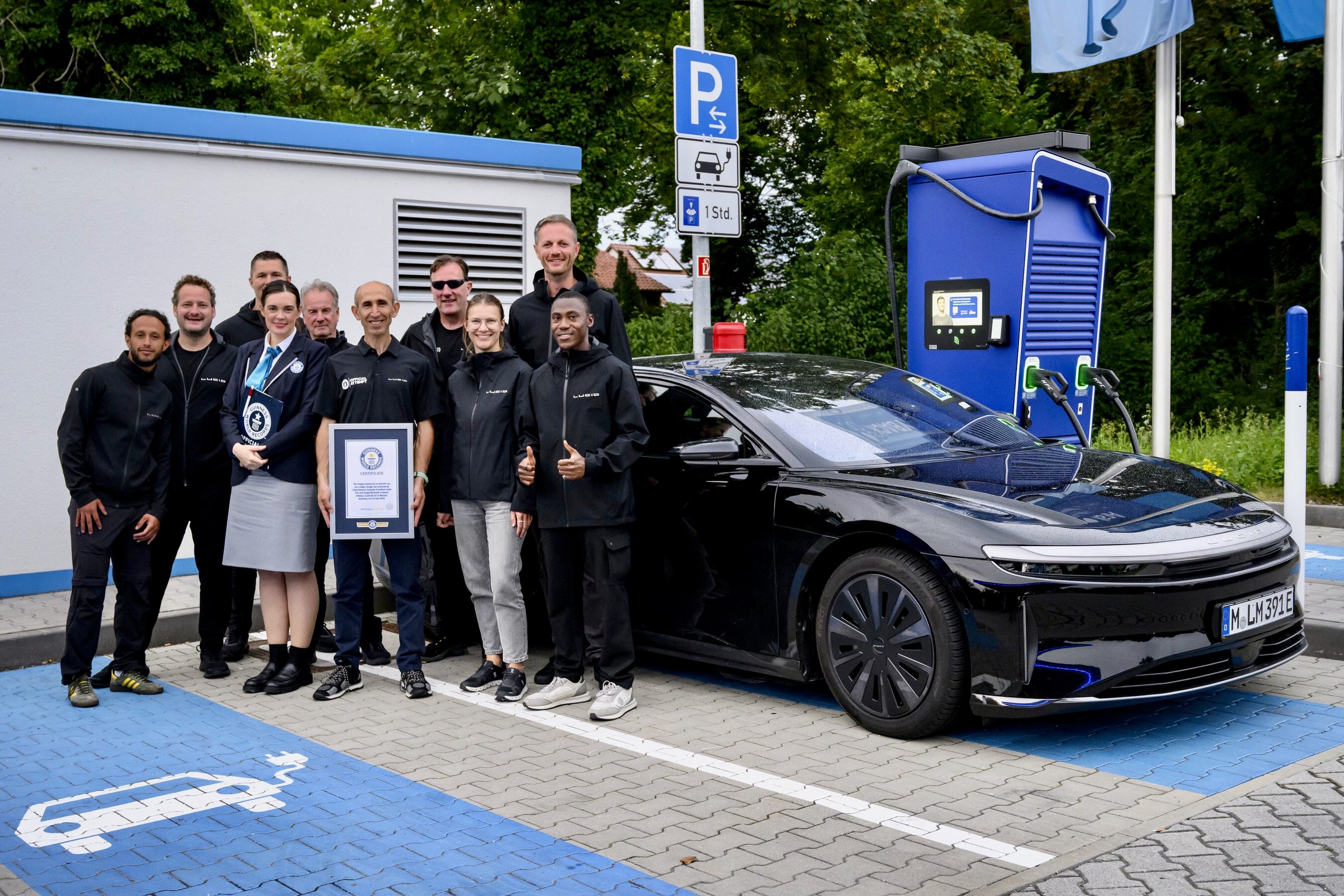
It’s not the first time that Sabanci, nor Lucid, has set a world record for EV driving. In 2024, both set another record for the most countries visited on a single EV battery charge, having driven to nine in Europe in another Lucid Air.
While Lucid may be familiar to those in the US, Australians will likely not yet be familiar with the brand. Lucid Motors is a Silicon Valley-based EV maker that started producing the Air sedan in 2021, and recently added to its line-up with the Gravity SUV. While Australian sales plans are yet to be announced, Lucid is sold in select markets in North America, European and the Middle East.
The most powerful version of the Air is called the Sapphire, and uses a tri-motor all-wheel drive drivetrain making 920kW of power and 1939Nm of torque. It sprints to 60mph (97km/h) in just 1.89 seconds, making it one of the quickest cars in the world.
BMW Group has confirmed major leadership appointments aimed at driving continued growth and transformation both in Australia and internationally.
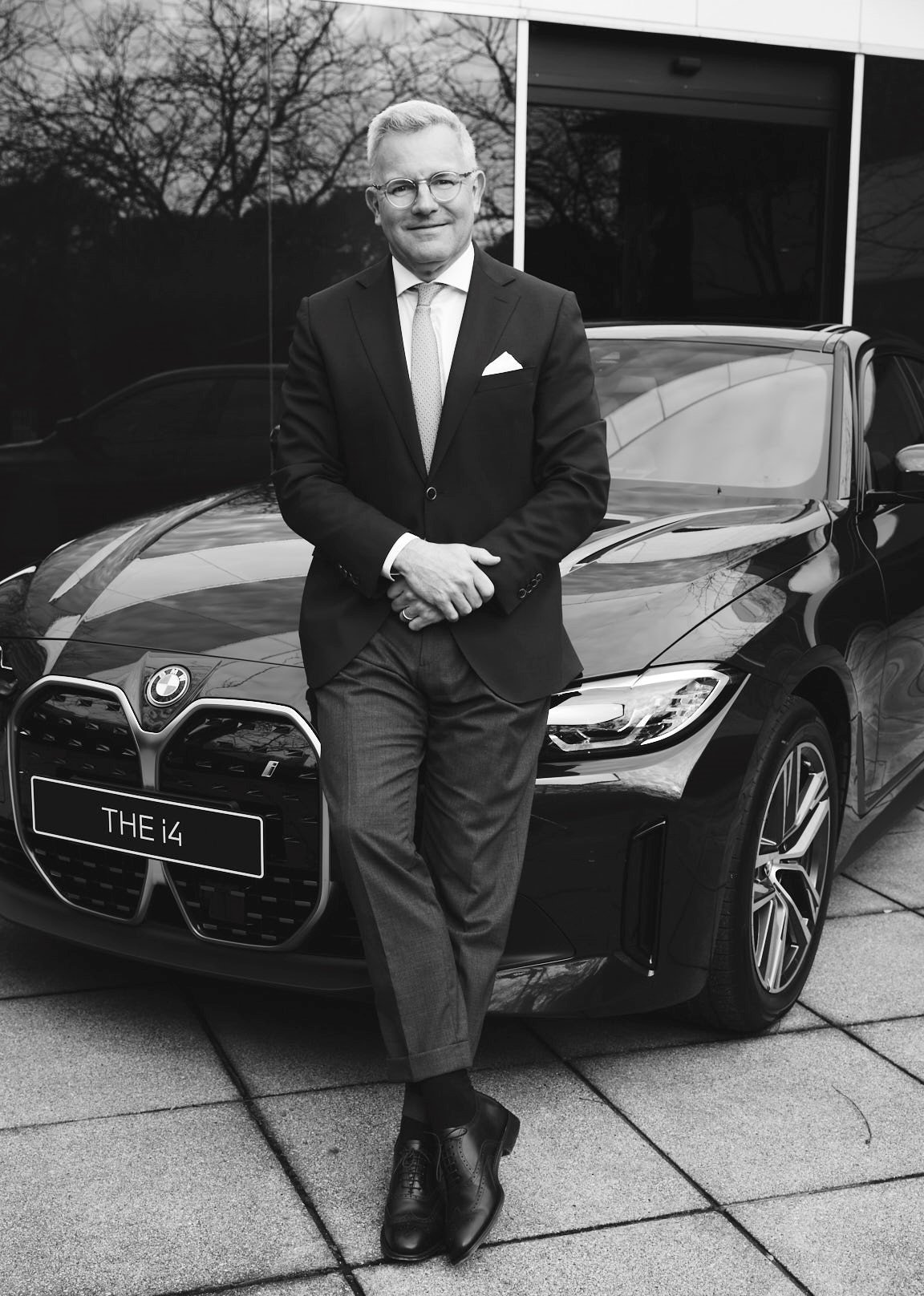
Vikram Pawah (below), currently CEO of BMW Group India, will return to lead BMW Group Australia from September 1, 2025. Pawah previously held the same position between 2018 and 2020 and is credited with significantly advancing the Group’s strategic direction during his tenure. His reappointment is seen as a move to leverage his strong track record in market growth and electrification.
Under Pawah’s leadership in India, BMW and MINI have seen consistent year-on-year sales growth, with BMW establishing itself as a front-runner in the premium electric vehicle segment. He introduced the company’s electrification roadmap in India, spearheading the launch of BMW’s first fully electric vehicle in the market and expanding the EV lineup. Additionally, BMW Motorrad became one of India’s fastest-growing premium motorcycle brands during his tenure.

Meanwhile, current BMW Group Australia CEO Wolfgang Buechel (below) has been promoted to Vice-President, Head of MINI Global Sales. Based at BMW Group headquarters in Munich, Buechel will be responsible for shaping MINI’s global sales strategy, overseeing market performance, and identifying new growth opportunities for the brand.
Buechel’s five-year term in Australia, beginning in 2020, has seen BMW achieve notable success. In 2023, the brand reclaimed its top spot as Australia’s leading premium automotive marque after more than a decade. His focus on electrification paid off, with BMW’s EV sales share reaching 22 per cent – more than double the national industry average – cementing the brand’s leadership in the premium electric segment.
Under Buechel, BMW and MINI grew sales volumes and market share, and also enhanced customer satisfaction and brand value. His leadership extended beyond commercial achievements, with key partnerships formed across arts, culture, education, and sport, including with Opera Australia, the PGA, WPGA, RMIT, and the University of Melbourne.
Jean-Philippe Parain, Senior Vice President for BMW’s Region Asia-Pacific, Eastern Europe, Middle East and Africa, welcomed the appointments: “Innovation and transformation are central to our global strategy. Both Vikram and Wolfgang have delivered exceptional results, and I am confident they will continue to drive success in their new roles.”
For more than 50 years, Fishermans Bend was a dream factory.
The dowdy industrial suburb in the working-class Melbourne docklands was the home to Holden – the cars and the brand and the people – as it produced the vehicles that put Australia on wheels.
The long honour roll at Holden began with Laurence Hartnett, who helped plan the car that would become the original 48-215, and includes managing director Chuck Chapman, legendary designer Leo Pruneau, suspension guru and then managing director Peter Hanenburger, and Tony Hyde on the engineering side.
It was into this hotbed of local innovation that Peter Hughes arrived in 1990 after a personal invitation from Michael Simcoe – now the outgoing global head of design for General Motors – to come in for a chat.
“The first couple of months were terrifying,” Hughes begins. “I just thought I was totally out of my league. There were so many talented people going in and out of that joint. I was trying not to be embarrassed by what I was doing. But you soon realise the other young guys are no worse than you.
“There were a lot of talented people in that era, but no more talented than the people who came before us. We wanted to make a difference and make Holden great again. I adored Holden and felt part of it.”
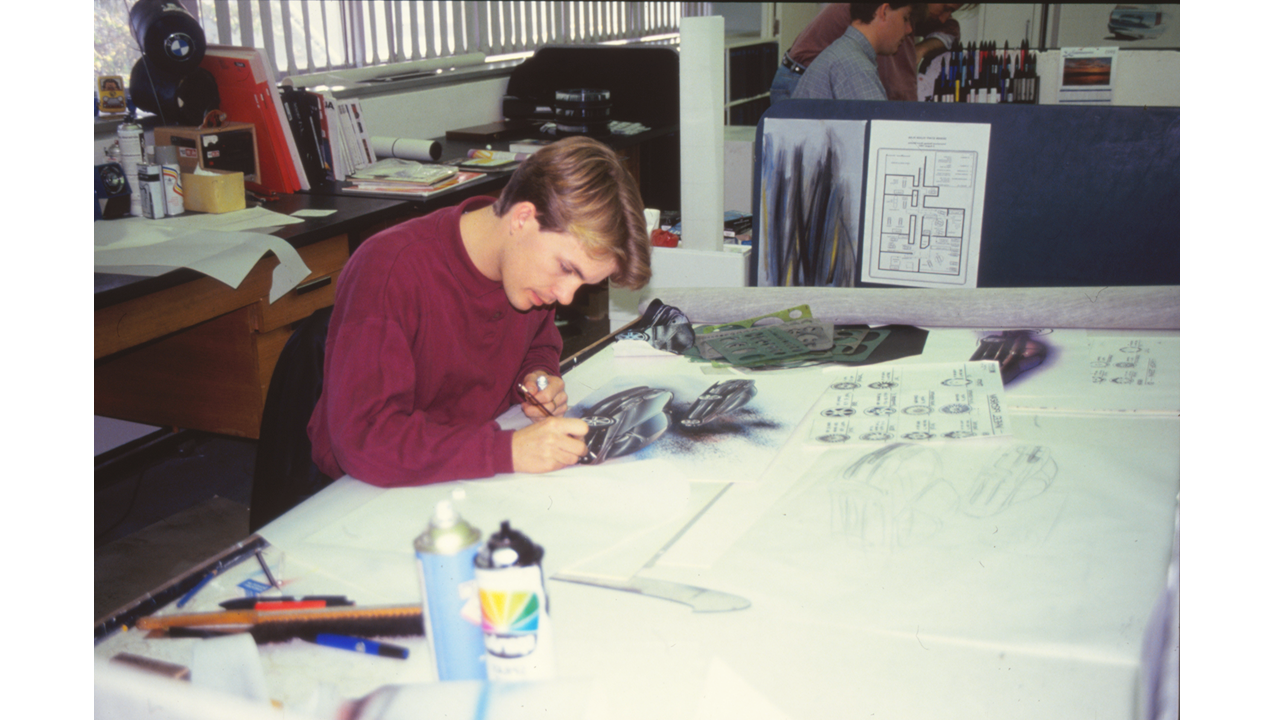
But Hughes didn’t begin that way.
Born in Melbourne in 1966, to Bill and Carol, his father was a talented rally driver who worked in aeronautical engineering. Young Peter had a replica race suit at age four and would go to events to watch his dad. The family had a Valiant Safari wagon as a daily driver, and there was interest in Alfa Romeos and BMWs, but not Holden.
“Holden, for me, was the brand I would never be seen in,” Hughes laughs. Little did he know.
“I loved drawing at school so you put two and two together. I did Year 12 and then went straight into industrial design at RMIT. A lot of Holden Design people went through there, like Richard Ferlazzo and Jenny Morgan. Every project I did was automotive.”
But not everyone was a fan.
“One of the first lecturers was ex-Holden and he told me to stop drawing cars, because it was too hard to get into and I was not good enough. That really pissed me off.”
It lit a fire that still burns today.
Out of college he got a job at CS Tooling, which was doing a bunch of stuff on the aftermarket for cars including the Commodore. When Peter Brock parachuted out of the Holden Dealer Team, the new owners got Hughes to work on an ‘Aero’ package for the VN Commodore in 1988 and it was a star car at the Melbourne Motor Show.
“That’s how I met Brock for the first time,” Hughes recalls. “I was having a Winfield Blue and an instant coffee out the back and Brock said ‘Who’s designing this?’
“I came in, shook his hand, and within 30 seconds he captivated me. I was lost. Mike Simcoe and Phil Zmood also saw it. Simcoe used to wander upstairs at CS and look at my sketches but he was just another guy with long hair, like me. Then I got a phone call and he told me to come in for an interview.”
It was the start of a giant love affair.
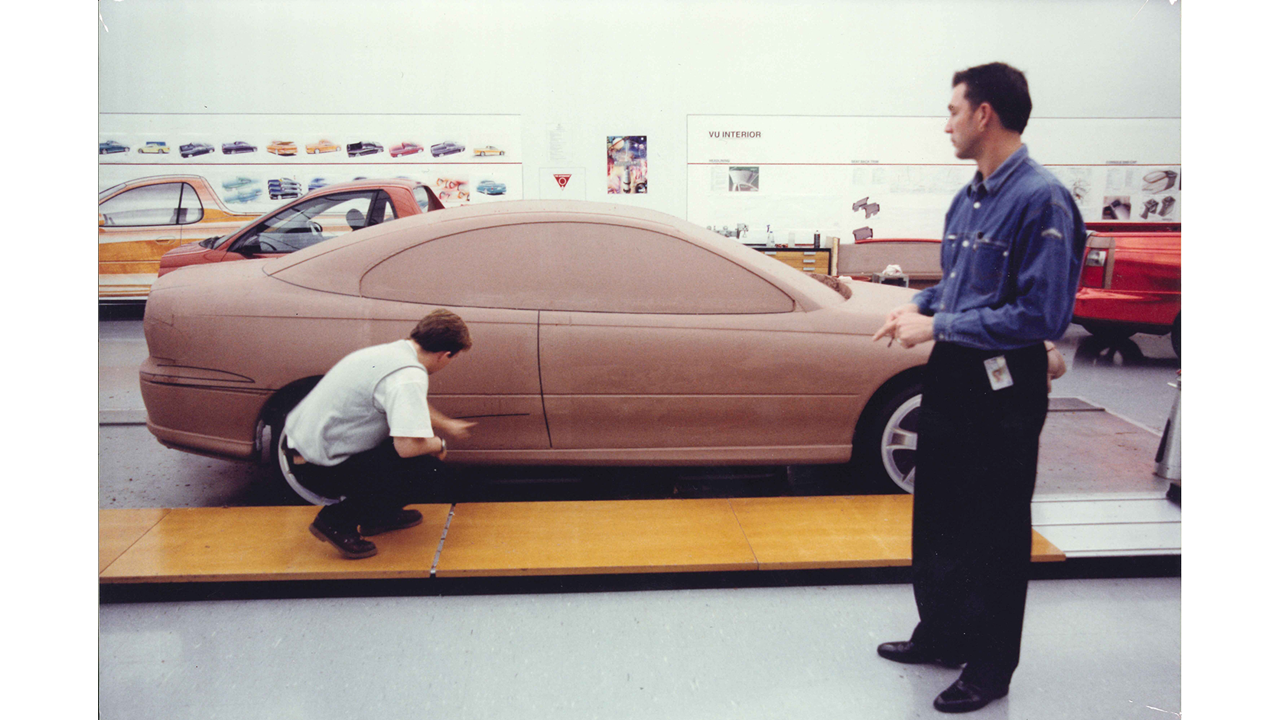
“I was there for 30 years exactly, from 1990 to 2020. It was fantastic. We were very, very, very fortunate to go through the place at that particular time. For one thing, we ended up having Mike in charge and he was very driven. So we got to work on some very special programs. He was driven to succeed and a great leader, so we all followed him along that path.”
He began at the bottom, however, working on the back-end styling of the VR Commodore.
“I had some understanding of the Australian landscape, but I loved Alfa and Lotus, I cannot lie about it. I was looking at the VL on the road so the drive was to make Holden cool.
“I wasn’t a big fan of looking backwards. I never looked into Holden’s history. We were looking at what Audi and BMW and Mazda were doing.”
What was it like, day-to-day?
“You can only reflect on it later. The place was about doing more with less. And we were proud of that. All Holden’s programs were driven by budget and a business case based on volume. On the flipside of that, we always revealed cars that looked a lot more expensive than they were. We were pretty proud of that side of it.”
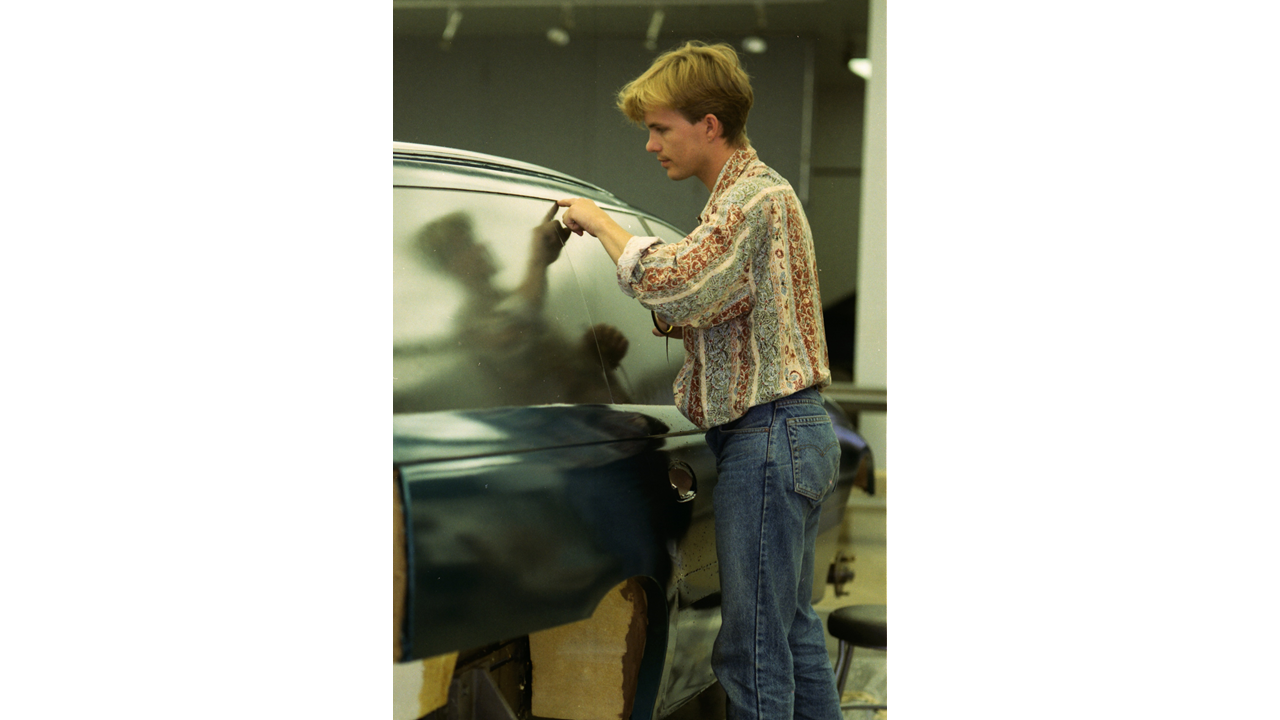
The leadership of Simcoe was key.
“Mike wouldn’t say how great a car was. He would let others say that. That’s the sign of a great leader – one confident enough not to take the limelight.”
But so was Hyde, who helped with Simcoe to lay the foundation for the born-again Monaro, codenamed V2.
“That project was done on Sundays, in my own time, in the studio with some other guys. It was never designed as a show car. It was a rolling concept car. Tony gave Mike $300,000 to do a rolling prototype. Imagine doing a Holden Coupe again.”
But there were also everyday Holdens, and some side work on Elfin sports cars, as well as the hero cars for shows – Holden Coupe, Utester, Sandman, Coupe 60 and even a Suzuki that became the Holden Cruze.
“That was a great time. It’s a wonderful feeling. It was addictive. You went back into the studio and tried to come up with the next one.”
“You get tagged to cars. I’m obviously tagged to VT, VT Monaro and VE. The most influence I had on any one car would be VE. By that stage I was old enough to play the game, so I knew what Mike would like. I had quite a big ego, so by the time VE came around I made sure I would not lose the pitch.”
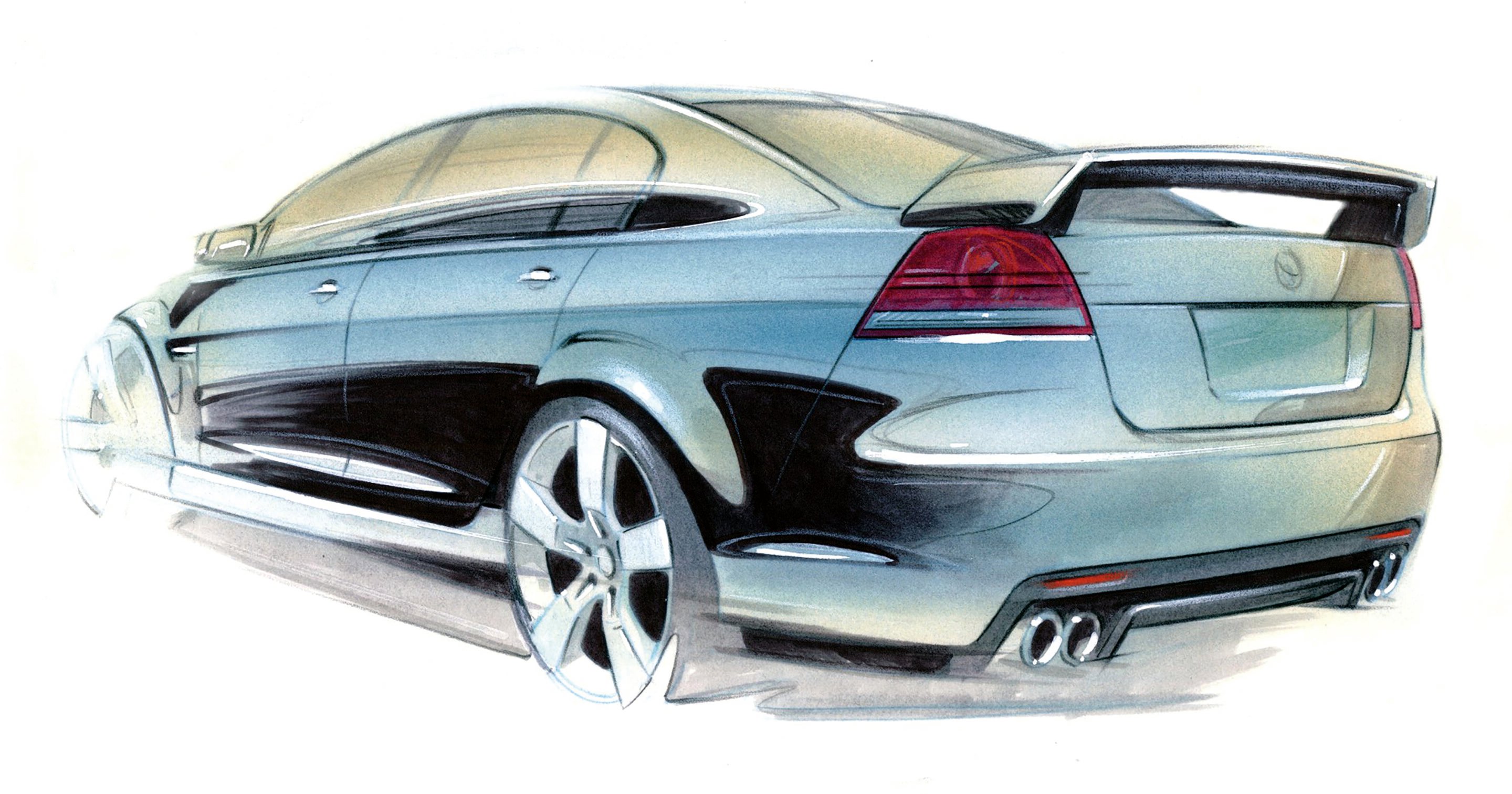
But Hughes was not just hidden behind the security screen at Fishermans Bend.
“I did many stints in Japan, including a couple with Suzuki on shared programs. Later on, also at Isuzu on a next-generation Colorado that never happened.
“I had big blocks of time at Korea. Mike used to call me ‘Mr fixit’. I was walking into Korean studios and upsetting people. But within the first couple of days you would hack into something and make it better, and you got them onboard. It was nice to help people get their designs come to life. And there were lots of noodle dinners in the back streets of Seoul.”
There were trips to the USA as well, but Hughes never craved a full-time overseas gig.
“Every time a posting came up it was bad timing. I wasn’t wired like guys who were unconditional on career. I valued lifestyle and keeping my wife happy.”
But the good times could not go on forever and, when there was growing pushback on projects including a next-generation Colorado, Hughes could see the end at Holden.
“That was when I knew it was over. They didn’t want us to survive. I was putting a plastic bumper and a set of wheels onto a car that was already behind. I was spiteful and angry. I knew the end was coming. The only thing we didn’t know was how quickly.”
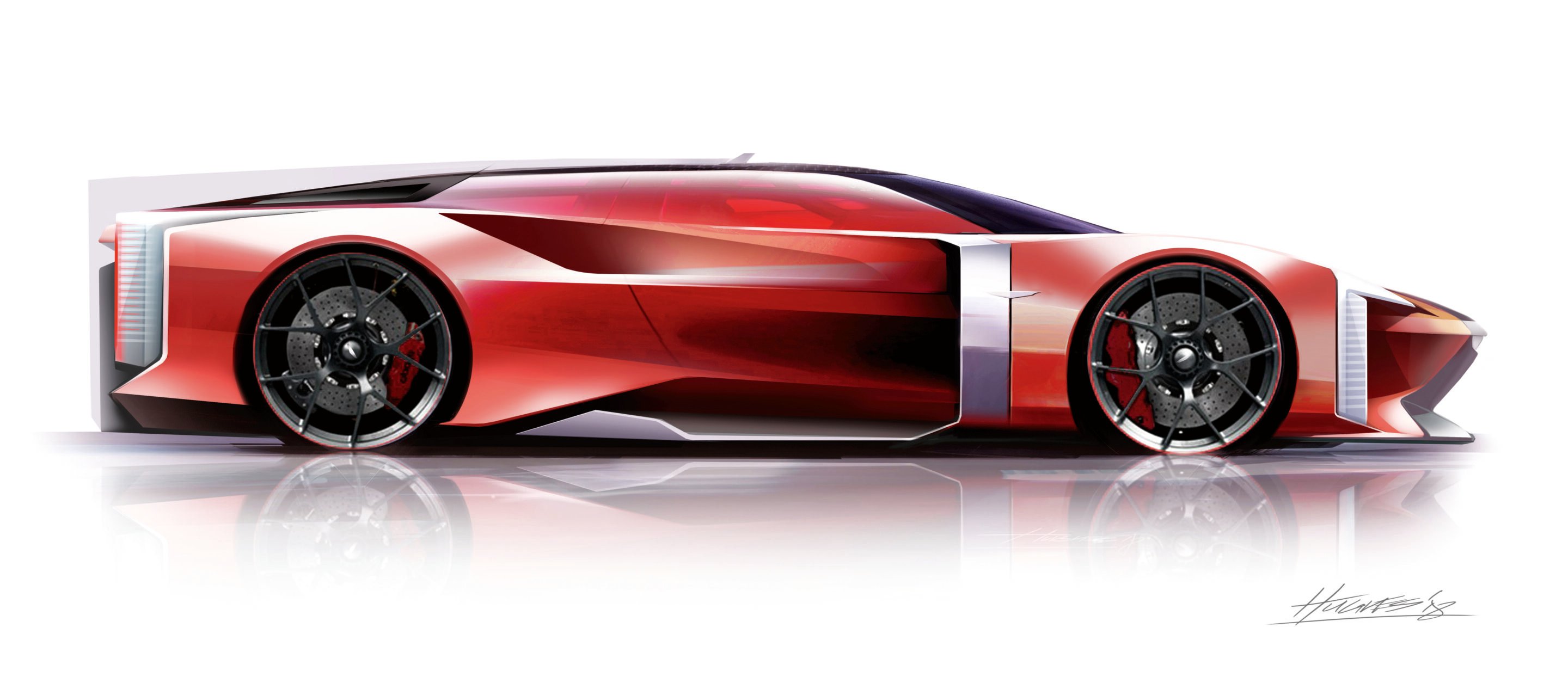
There was still some hope, but Hughes was one of those who could not stay to the end. “There are all different stories. You had the crew who honestly believed it would never shut. After production ended we were still viable, doing Cadillacs, and Buicks. We were doing lots of things. We were an outlet for overflow. Most people within Holden Design honestly believed we would have a future.
“There was a section who were more sceptical, and I was one of those. So I organised Plan B, which was to go out on my own. Because of my attitude, I was in the first group to leave. I wasn’t helping anyone. I was happy to say goodbye. I didn’t want to hold on for any longer.”
The end of Holden Design was just another challenge for Hughes, who pivoted into designing and production of limited-edition posters of classic road and race cars – Holden at first, then Ford and even Mazda – and a growing amount of livery work for race teams.
He is the one charged with making an impact on track and on television, while also satisfying the dizzying and conflicting requirements for sponsors of racing teams in Supercars – led by Triple Eight and Walkinshaw Andretti United – and even NASCAR in the USA.
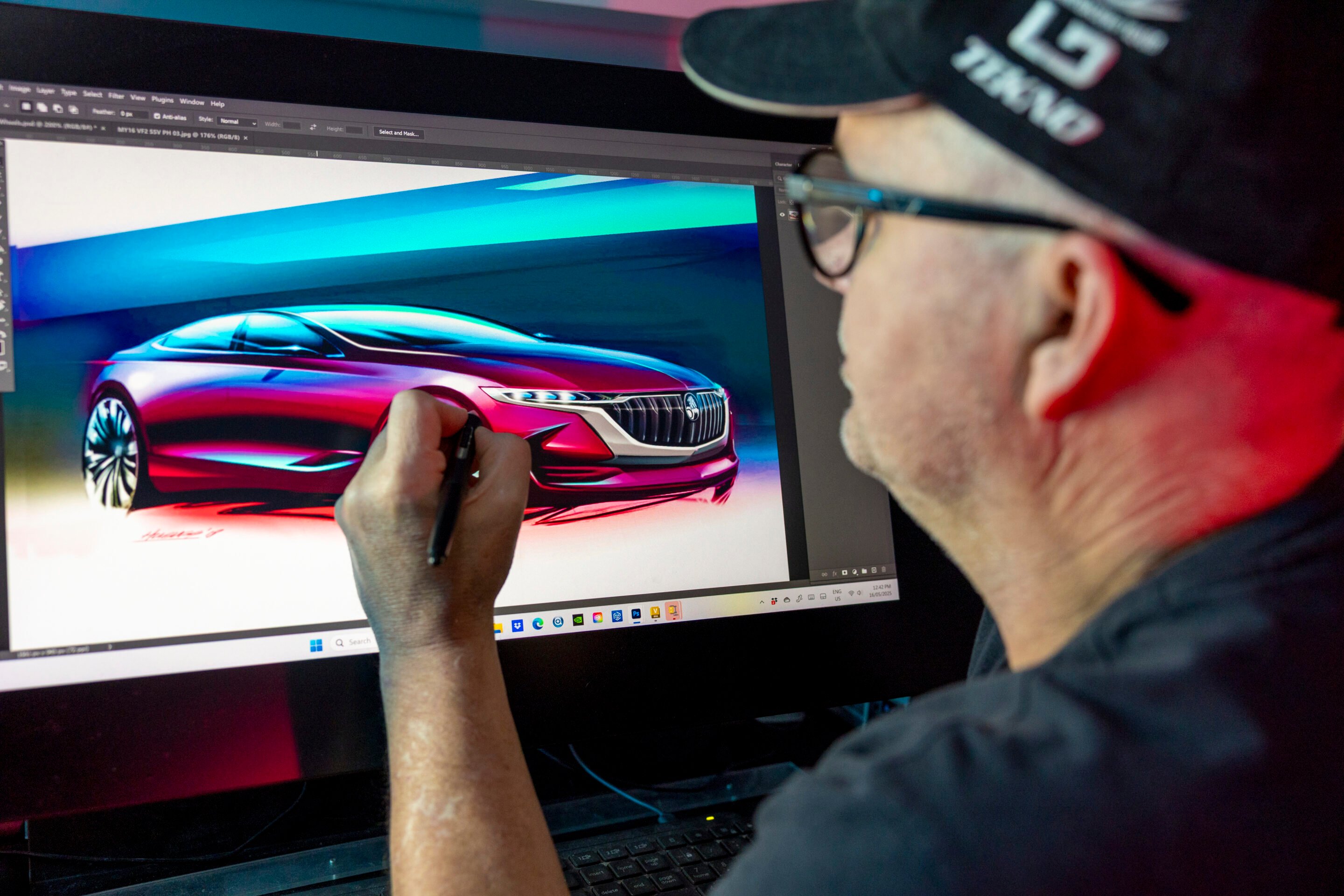
“When Holden shut, everyone wanted a piece of the nostalgia. I made a fair bit of money in the first couple of years. I had my little business selling prints for about five years. I was doing lots of motorsport stuff, which I enjoyed.”
He is closing on 60, works from a home studio, and has a car collection including a Lotus Exige and a 1971 Alfa Romeo Spider.
“I reckon I’ve still got a good decade me. Mike used to say there is no age limit to good design. You have got to keep stretching yourself. Reinventing the role and doing new stuff.”
So, how does he look back at his three decades with Holden.
“My thoughts now are grateful. I got to design a Holden. I got to work on everything. Looking back,
I cannot believe what I did. I was always busy. Ah, good times. Great times,” he laughs as he signs off.
This article originally appeared in the June 2025 issue of Wheels magazine. To subscribe, click here.
