
IT’S BUT a fraction of a second; a moment that most will have missed. Spool back to 2015 and FCA’s charismatic CEO Sergio Marchionne is delivering his usual tub-thumping speech at the Detroit show. He’s bullish about the economy and FCA’s positioning on electrification, but as he makes each proclamation of future success, you see his eyes flick to the front row of seats, almost as if he’s deferring or seeking confirmation. Follow those almost involuntary eye movements and the man he’s directing them to is a pale, jetlagged Brit in an open-necked shirt who looks as if he needs to stand a bit closer to the razor; Mike Manley.
Manley was one of three or four prime candidates rumoured to succeed Marchionne but those in FCA’s inner circle would never have taken bets on anyone else. Manley hadn’t morphed into a Marchionne-in-waiting. He was like that from the get go. Born in the UK in 1964, Manley studied engineering at Southbank University in London, and worked for 14 years for Swan National Motors across different brands and dealerships before being appointed director of Network Development for Daimler Chrysler in 2000.
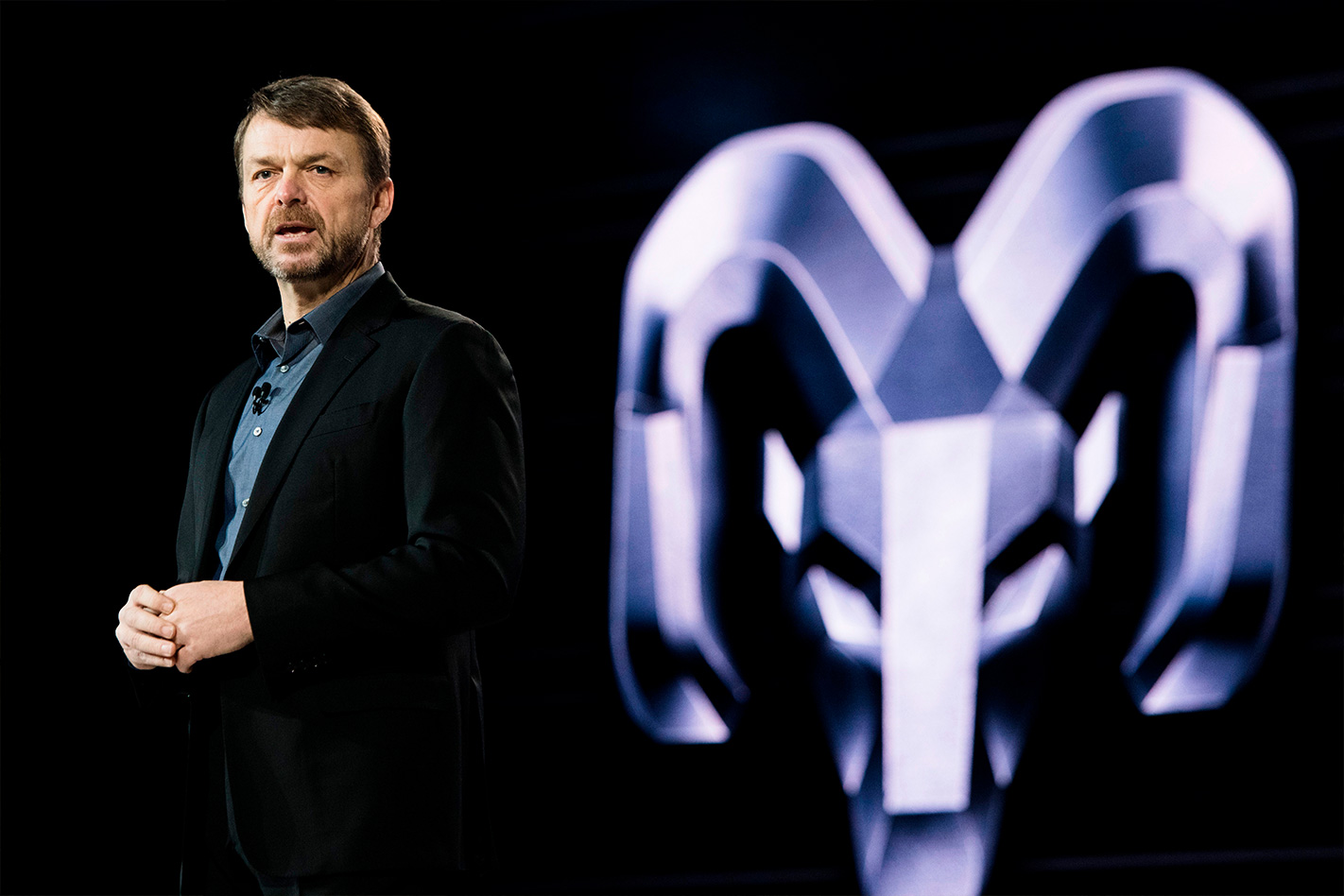
Transferring to the US in 2003, he helped revitalise FCA’s moribund dealer network before becoming Executive VP of planning and sales for Chrysler and, a year later, the job that would really indicate his star in the ascendancy: CEO of Jeep. When he took up the reins, Jeep’s global sales stood at 320,000. Last year the company sold nearly 1.4 million units. It hasn’t all been an unalloyed record of success, however. Those 2017 sales figures had softened by one percent compared to the year previously – largely due to an underwhelming showing in Europe and China – which in turn made Jeep’s target of 2 million sales in 2018 look extremely unlikely.
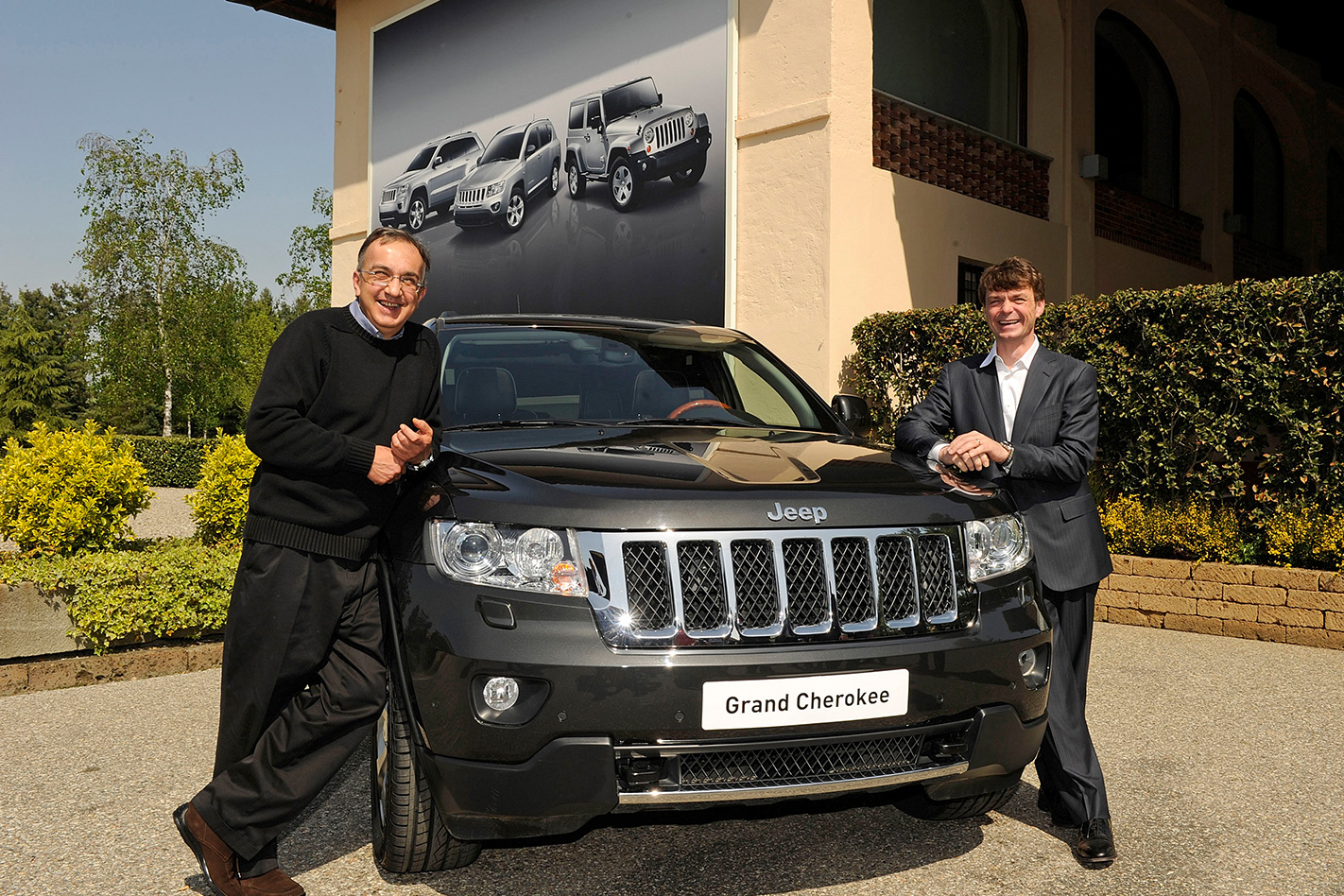
Manley clearly has work to do. His first task was to downgrade FCA’s profit outlook on the back of the Chinese results. Calvinist work ethic aside, he’s a listener and a man who gets things done, and fast. Part of his challenge will be to operate effectively beyond his pet favourites of Jeep and Ram and look beyond product and sales in order to canvass and cajole politically, something Marchionne did with a silky elan. He has the advantage of being gifted the 2018-2022 planning from his predecessor, a luxury denied Ford chief executive Jim Hackett, who spent several months coming up with a plan from scratch.
On June 1, Marchionne presented that plan for the carmaker. His closing remarks included a third person question directed to his successor. “Can Marchionne leave a script or instruction? The answer is that there is no script or instruction,” he smiled. “FCA is a culture of leaders and employees that were born out of adversity and who operate without sheet music. That is the only way we know.”
MANLEY’S FIVE BIG AGENDA ITEMS
1. Revitalise FCA’s marketing plan for China and Europe
Marchionne’s focus on feeding brands with the most potential has left FCA behind the curve in hotbed markets
2. Retain executives who didn’t land the CEO role
Building consensus with the other candidates for the job, CFO Richard Palmer and Alfredo Altavilla, the COO of FCA’s Europe, Middle East and Africa region will be key to continuity
3. Bite the bullet on Fiat’s Italian production
Tough political decisions need to be made not only on Fiat’s prospects of continuing to build cars in Italy, but also on the viability of the Chrysler and Dodge brands
4. Shift an established organisational focus away from eliminating debt
FCA needs an orderly product plan that delivers on time rather than cancelling product lines at short notice to reduce short-term debt
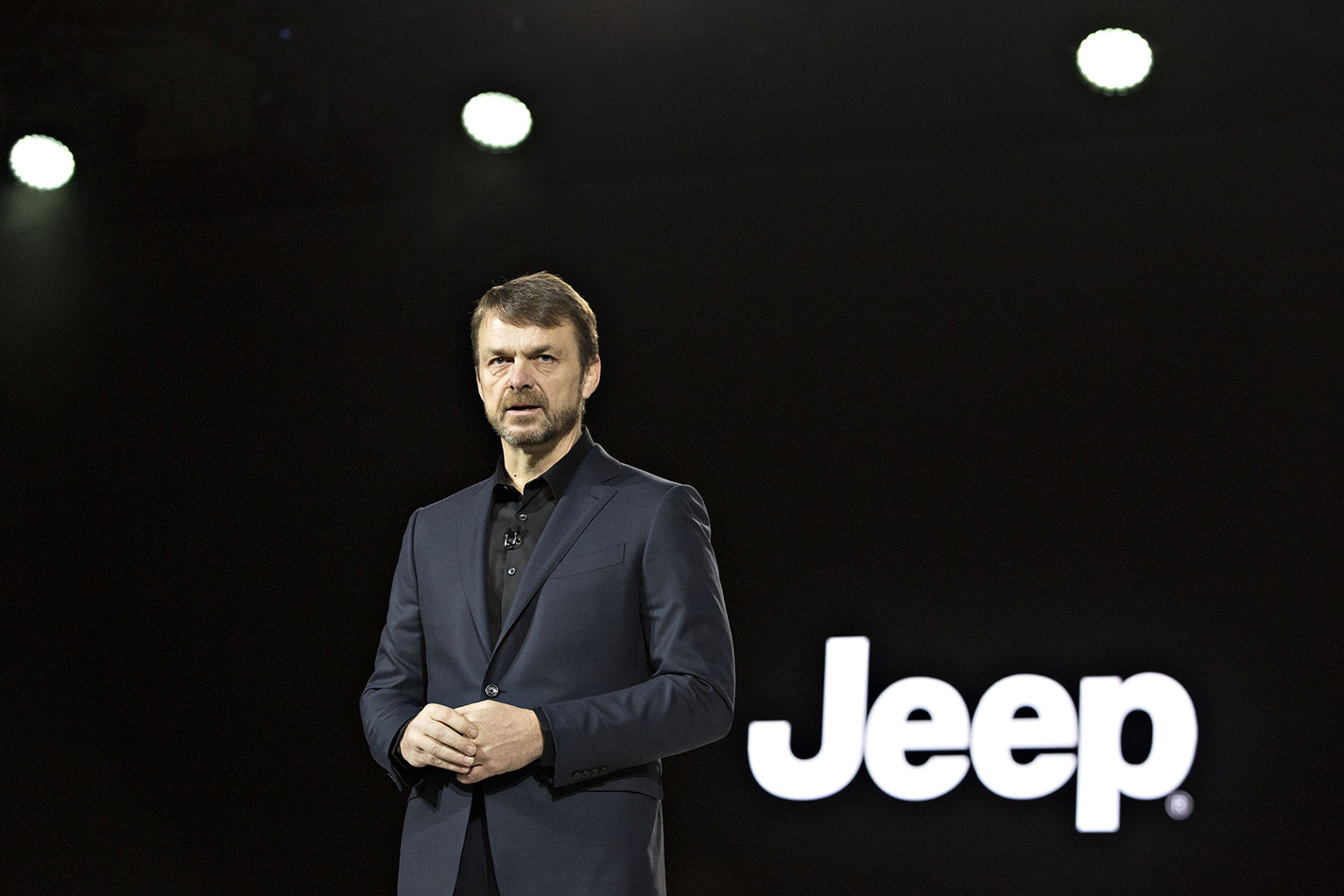
5. Keep aggressive suitors at arm’s length
FCA might be debt free but it’s still a smallish company that has developed significant electric vehicle IP and is therefore a tempting takeover target
September – October
Aston Martin Vantage and DB11 Volante; BMW i8 facelift and i8 Roadster; Chevrolet Camaro; Ford Everest update; Hyundai Ioniq hybrid, plug-in hybrid and EV; Jaguar F-Pace upgrade and SVR; Kia Cerato hatch and GT; Land Rover Range Rover P400e plug-in hybrid; Mazda CX-3 update; Porsche 911 GT3 RS; Skoda Fabia facelift; Subaru Forester
November – December
Aston Martin DB11 AMR; Audi Q8 and RS5 Sportback; Bentley Continental GT coupe; Ford Focus and Mustang Bullitt; Genesis G70 and G80 sedans; Holden Acadia; Hyundai Veloster and Kona EV; Jaguar I-Pace; Jeep Wrangler; Lexus CT200h update; Mazda MX-5 update and CX-9 facelift; Mercedes-Benz C63 AMG update and X350d 4MATIC
Genesis G70 – Due November
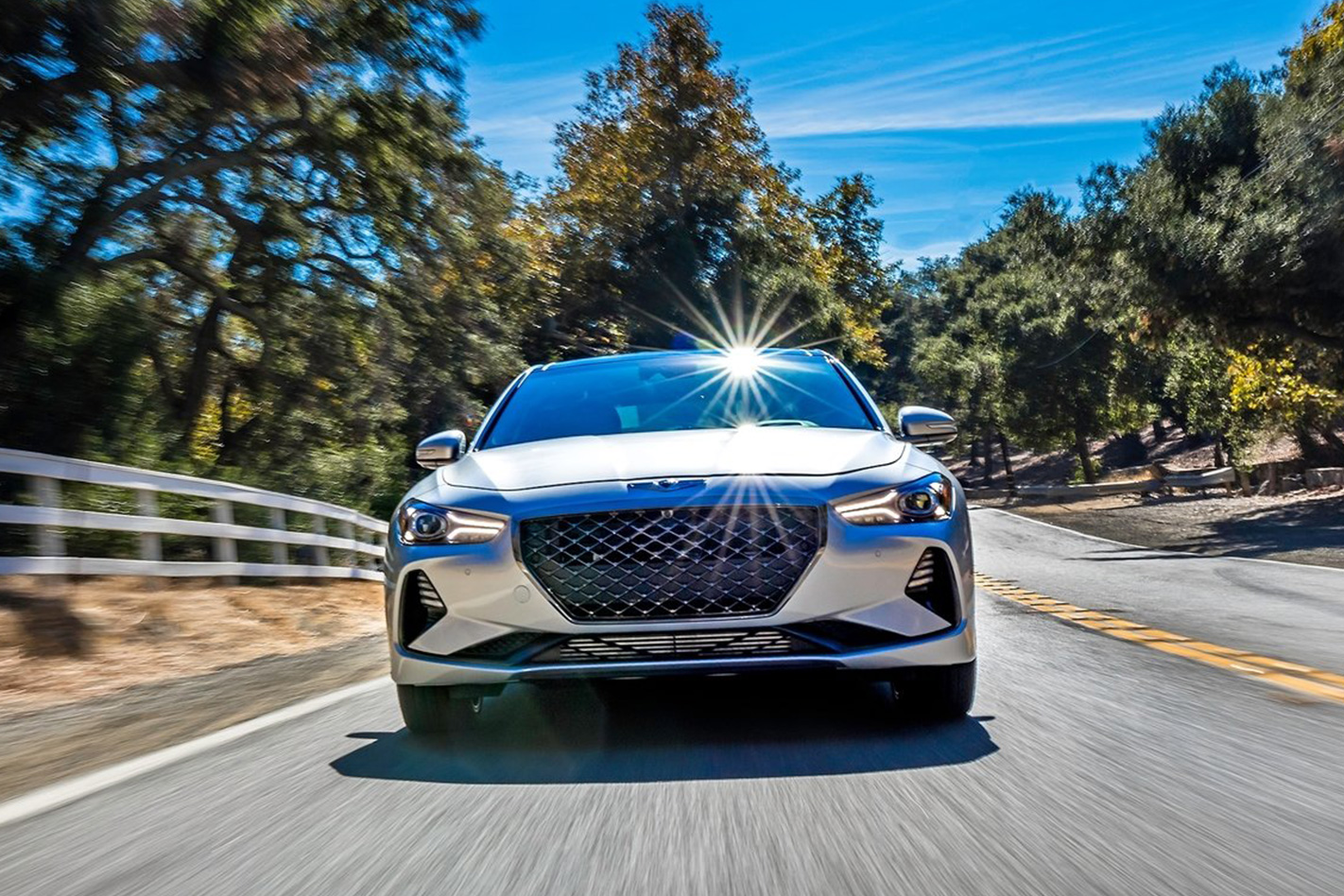
The flagship Genesis G70 is the one we’re excited about – 272kW of twin-turbo 3.3-litre V6 in a cut-price, rear-drive German muscle-sedan hunter complete with locally tuned steering and suspension. The most potent version is powered by the same 510Nm donk as the Kia Stinger, wrapped in a more traditional medium, four-door package. There will also be a 2.0-litre turbo four-cylinder version aimed at entry-level C-Class, A4 and 3 Series, but with Korean cost-of-ownership, warranty and value equation. Expect the hard-hitter to do 0-100km/h in 4.7sec, use 11L/100km and cost about $75,000. The 190kW/353Nm four will likely start at less than the Germans with a figure below $55K.
Mazda MX-5 – Due September
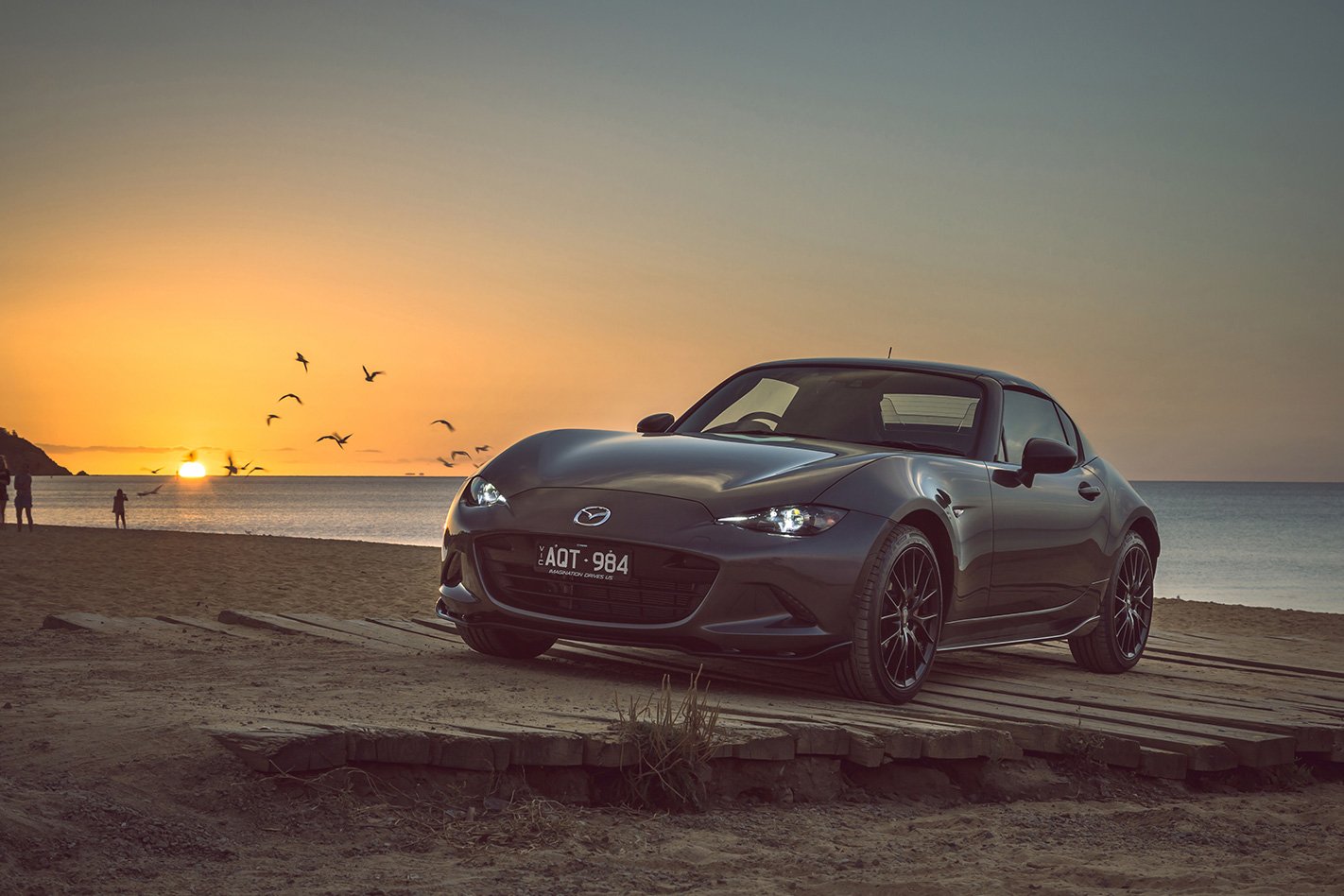
A substantial upgrade to the 2.0-litre four-cylinder is good reason for would-be buyers to wait for the updated MX-5, due in October. A decent power increase from 118kW to 137kW comes with improved official economy. The extra 19kW – torque is up 5Nm to 205Nm – comes via lighter pistons and conrods, bigger exhaust valves, a larger throttle body and a bigger bore exhaust also said to beef up the MX-5’s note. The addition of steering wheel reach adjustment will please tall drivers, and a brown fabric roof trim, tan leather interior trim, and black wheels and mirror caps bring new choice.
Chevrolet Camaro – Due September

Fans of retro-inspired two-door muscle have something to look forward to in September. The HSV-delivered Chevrolet Camaro arguably shades the Blue Oval alternative in the visual department and with a 339kW/617Nm GM 6.2-litre LT1 V8 powering via an eight-speed auto it packs similar power and a bit more twist to the ’Stang. And, built on the rear-drive GM Alpha platform, with an LSD, the Camaro has the entertainment value to provide endless distraction from the typically North American interior finish.
The third-generation BMW X3 medium SUV offers more passenger and cargo space than its predecessor with an attractively styled cabin, and sharp-looking exterior penned by Aussie-born automotive designer Calvin Luk.
It’s available with a choice of enthusiastic, fuel-efficient 2.0- and 3.0-litre turbocharged diesel and petrol engines mated with a slick eight-speed automatic gearbox, with all but one variant offering ‘xDrive’ all-wheel traction.
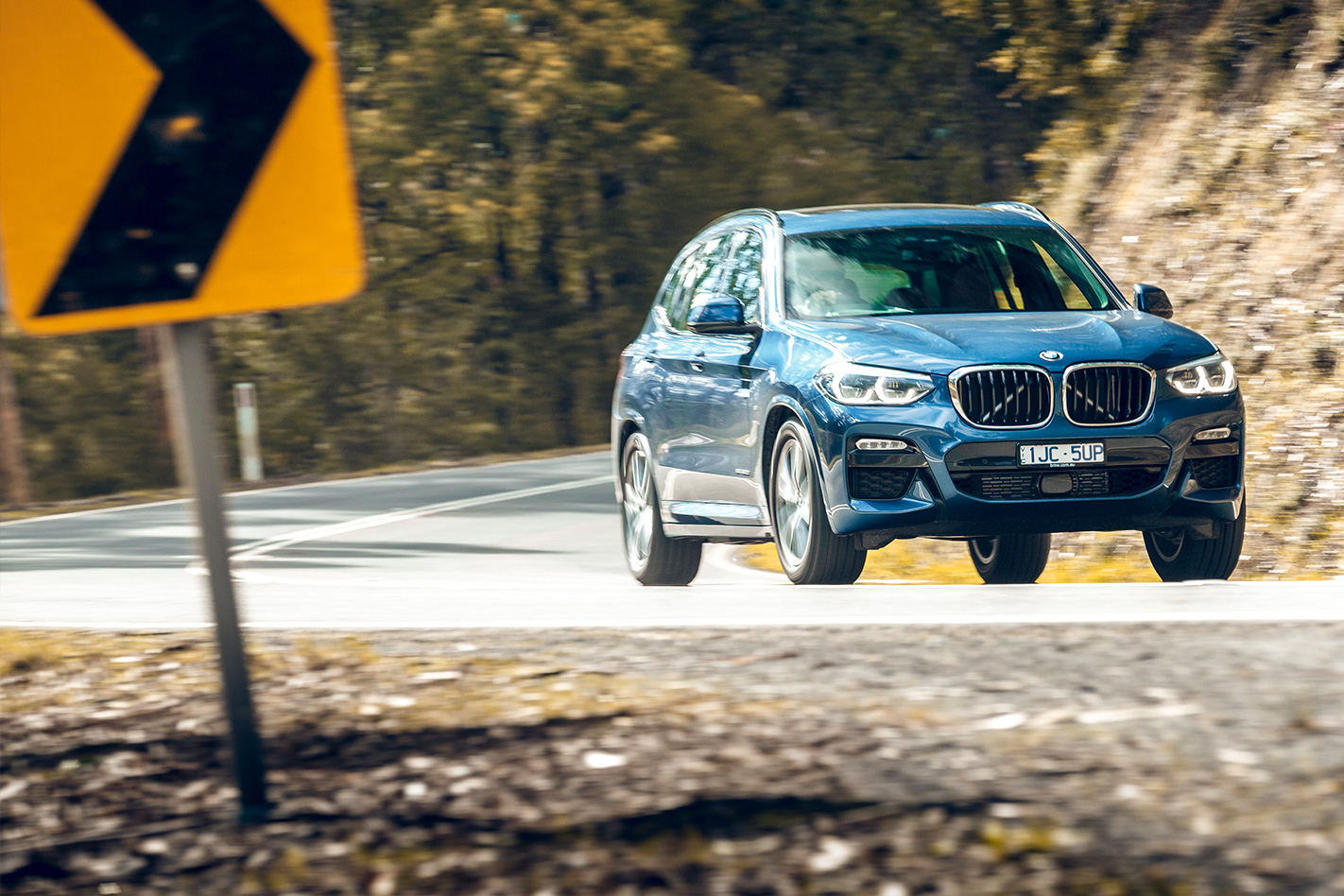
The BMW X3 xDrive20d we’re testing here features the smaller of two diesel powertrains and for a time was the cheapest X3 variant until the introduction of the front-wheel-drive petrol sDrive20i.
VALUE
Priced at $69,900 the xDrive20d is similarly equipped to the entry-level sDrive20i, with its torquey diesel engine and all-wheel-drive system attracting a $3000 premium. It’s $15,000 cheaper than the more powerful xDrive30d diesel, which gains a host of additional features on top of the power boost, many of which are available to the xDrive20d as extra-cost options.
Much of these found their way in to the xDrive20d we tested, which sent its retail price soaring to $88,650.
The 2.0-litre diesel engine has a frugal official combined fuel consumption rating of 5.7L/100km.
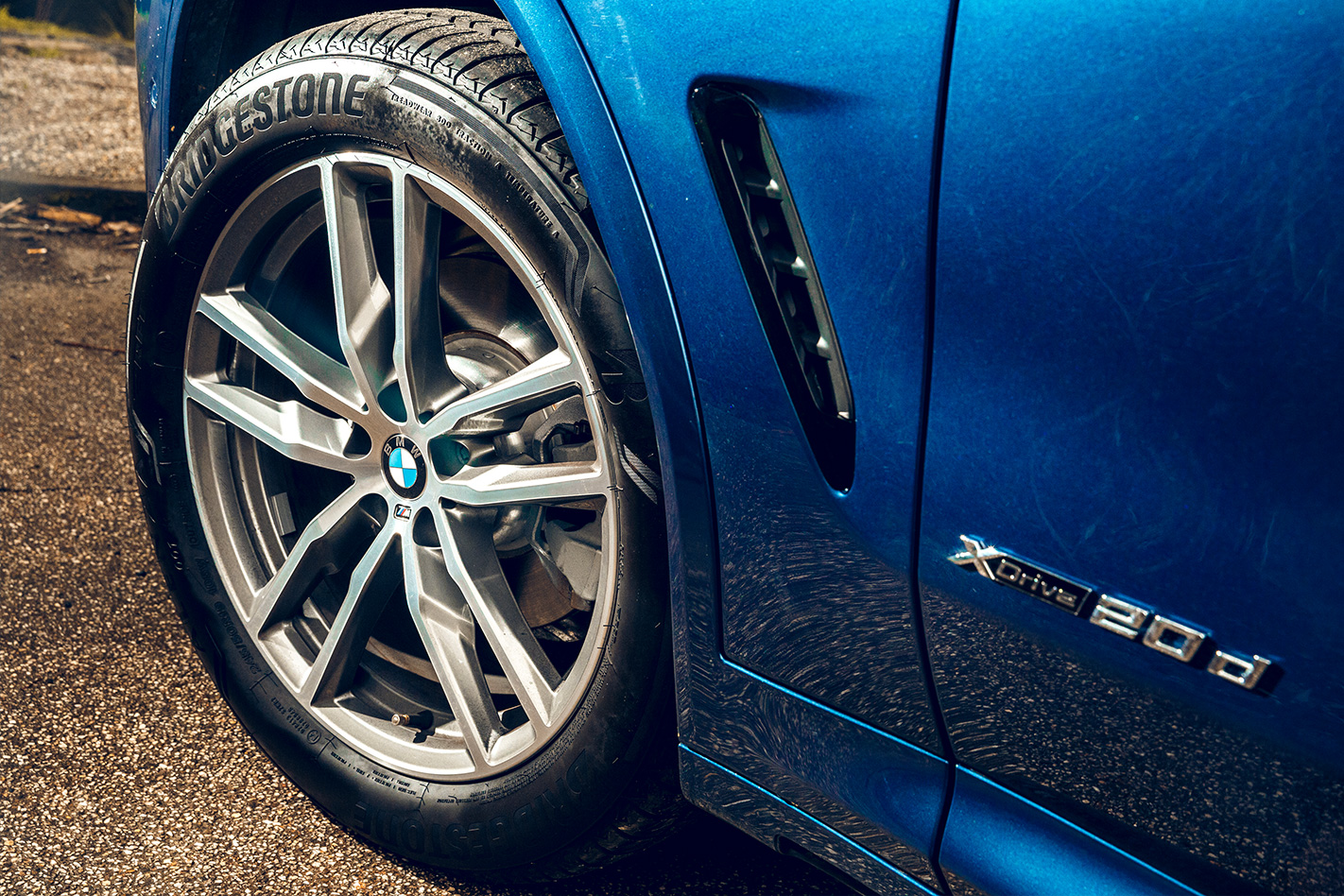
BMWs don’t have a set servicing schedule based on kilometres or time. Instead they work on ‘condition based servicing’ which lets the car’s systems decide when a service is required based on oil levels and wear and tear on individual components. Drivers are alerted that a service is due via a dashboard notification.
BMW owners can take out a prepaid Inclusive Service package which covers basic service costs, including filter replacements and fluid top-ups for the first five years or $80,000km. This costs $1495 for the X3. There’s also a $4400 Service Plus package that includes the replacement of brake pads and discs, wiper blade rubbers and clutch and disc plates.
STANDARD FEATURES
The X3 xDrive20d comes with a broad list of features that you’d expect from a $70,000 SUV, including automatic tailgate, LED headlights, front and rear parking sensors, head-up display, speed-limit info, adaptive cruise control, autonomous emergency braking, digital radio (DAB+), six-speaker sound system, satellite navigation, parking assistant that automatically steers the X3 into a parking spot, sports seats and Connected Drive with real-time traffic info, intelligent emergency call and BMW apps.
All the optional features in the xDrive20d disguised the fact that the standard equipment list is missing quite a few features found in sub-$50k mainstream SUVs, such as Apple CarPlay/Android Auto, seat warmers, panoramic sunroof, multi-element LED lighting, adaptive cruise control with stop and go, and lane-keeping assist.
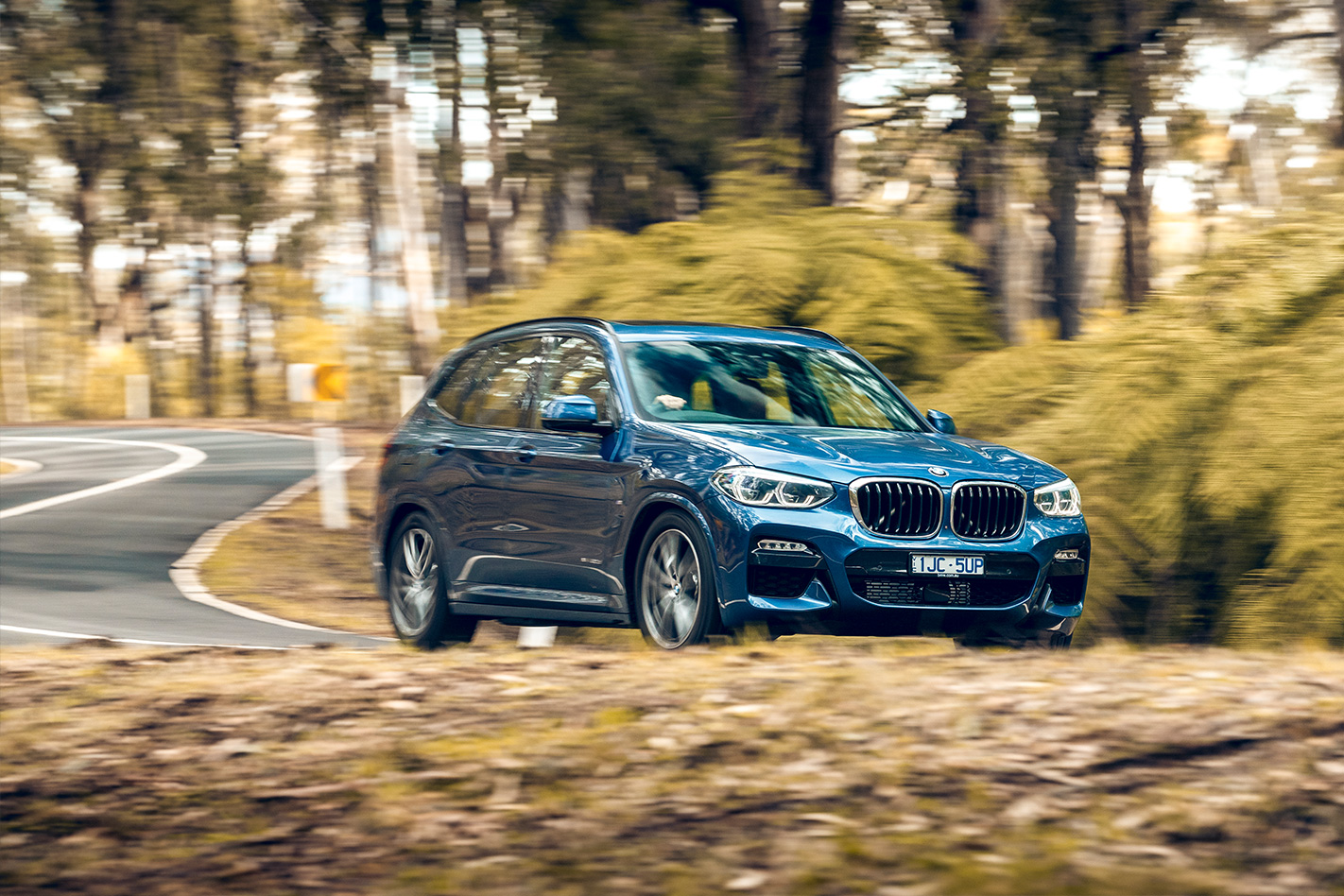
The vehicle we tested had almost $10,000 worth of optional extras, including:
- M-Sport Package that added sporty exterior embellishments, adaptive suspension, LED fog-lights and leather sports steering wheel with paddle shifters ($4550)
- Metallic paint ($1950)
- ‘Vernasca’ leather upholstery with decorative stitching ($2500)
- Panorama sunroof ($3000)
- Ambient interior lighting ($700)
- Driver Assist Plus, with active cruise control with stop and go function, front cross traffic alert, lane keeping assist, and side collision warning ($2800)
- Innovations Package, which includes a 12.3-inch touchscreen, 3D surround view parking camera, adaptive LED headlights, and multifunction digital instrument display ($3250).
SIZE
The BMW X3 is a five-seater medium SUV.
At 4.71m long, it’s 54mm longer than the previous model and is actually bigger than the original X5 large SUV. There’s plenty of rear legroom and its 1.89m width ensures there’s a heap of elbow room up front, and comfortable seating for three adults in the second row.
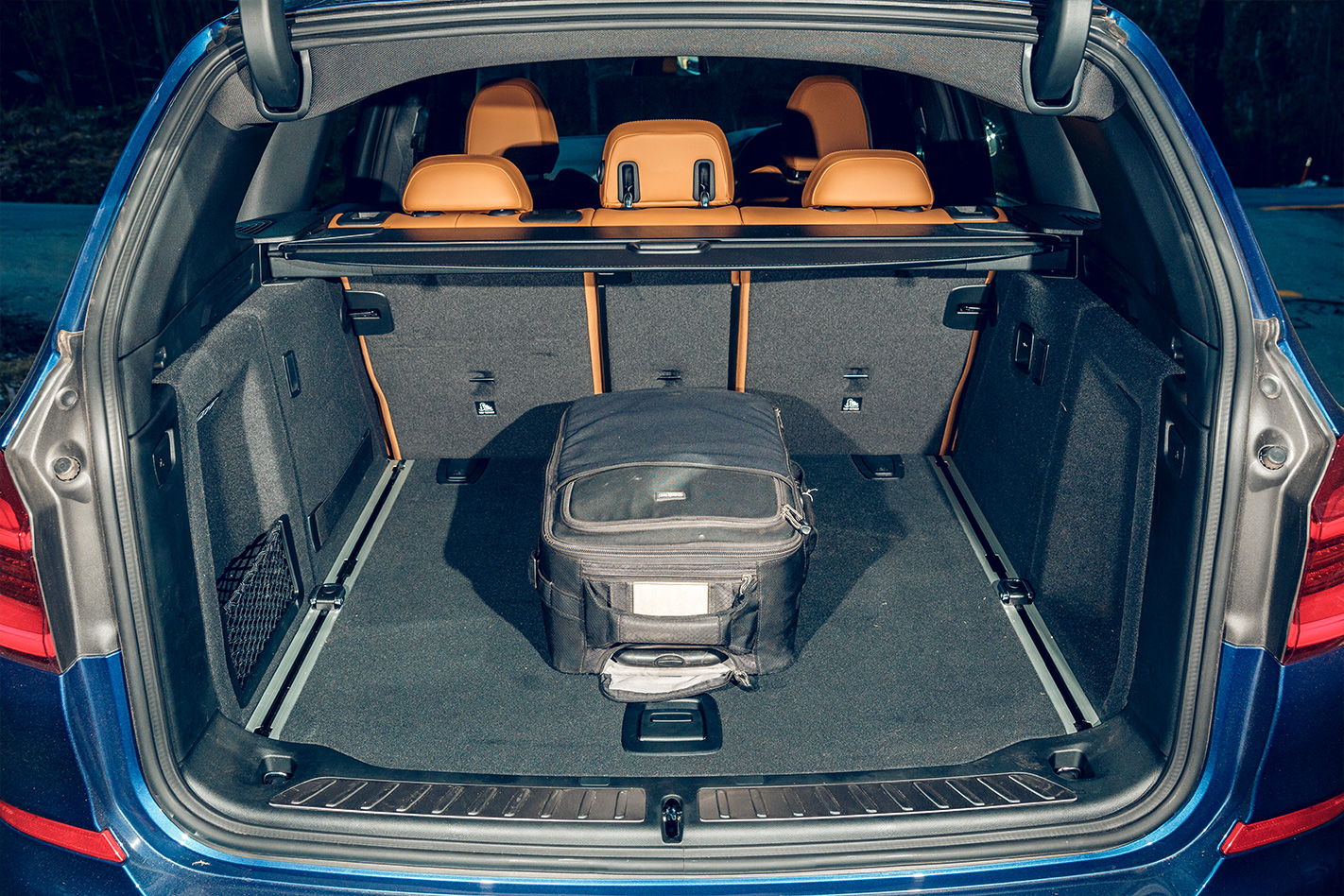
It can swallow 550 litres of luggage behind the back seats, which is the same as the previous model, which extends to 1600 litres with the 40:20:40 split-folding backrests folded down.
SAFETY
The Australasian New Car Assessment Program (ANCAP) awarded the BMW X3 five stars for safety, its maximum, in November 2017.
The X3 xDrive20d is equipped with seven airbags: two directly in front of the driver and passenger; one on the outer side of each front occupant to protect the upper body; driver’s knee airbag, and two airbags on each side to protect the heads and chests of front and outer-rear occupants.
It also comes standard with BMW’s Driving Assistant which includes a camera-based autonomous emergency braking, lane-departure warning and blind-spot monitoring.
COMFORT
The cabin quality is excellent even before you start ticking option boxes. Buttons and controls are intuitively placed, easy to use and pleasant to touch thanks to their metallic coating.
The driving position is good and comfortable over long distances, and the instrument panel is neat and clearly presented – as is the head-up display.
The cabin is practical and spacious with plenty of headroom across both rows, even with the optional panoramic sunroof.
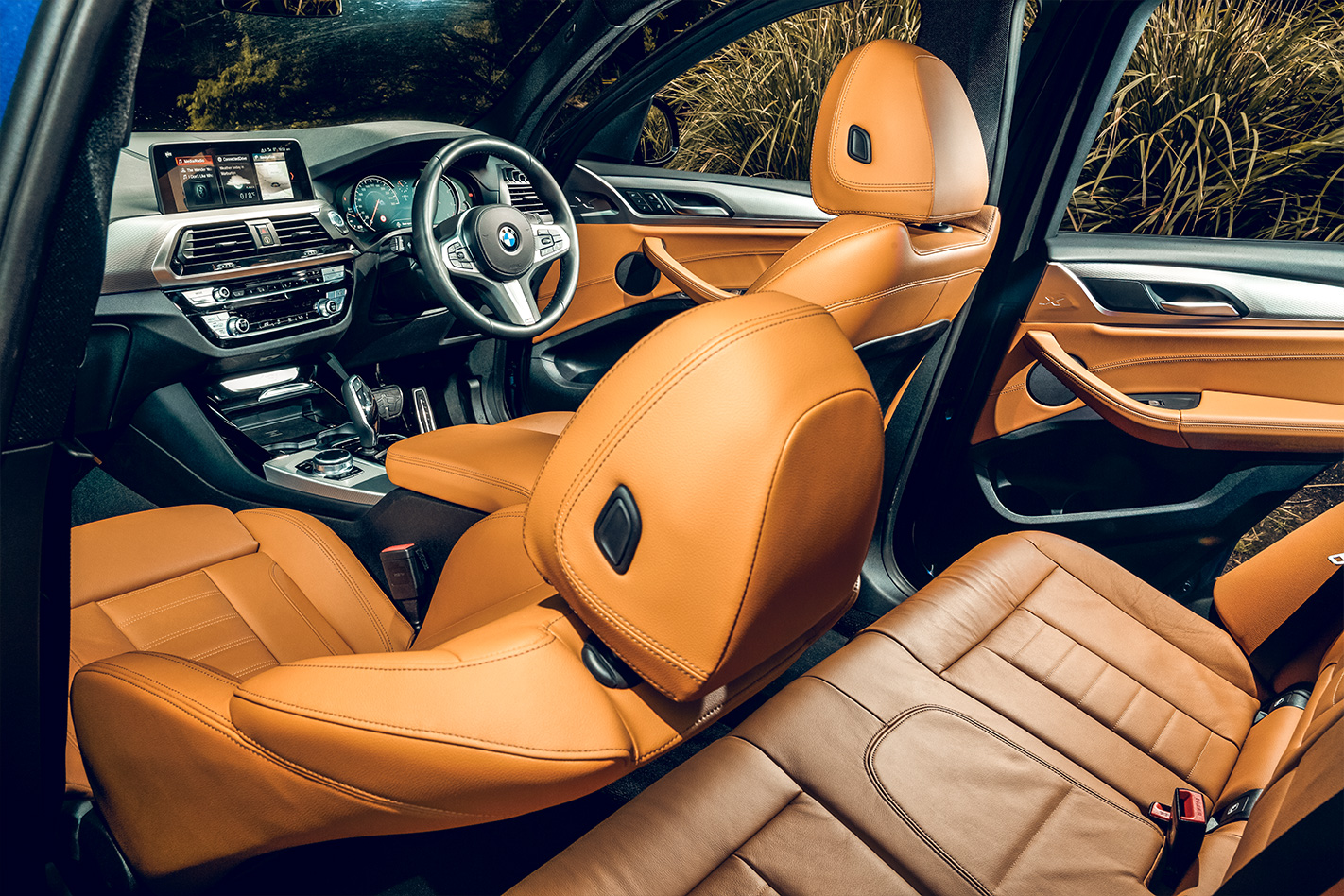
The rear compartment offers good legroom even behind taller drivers and comfortably seats three adults. The rear seat is low, which helps with headroom but hampers forward vision, though the low rear window line nevertheless affords good side vision even for kids. Rear seat passengers have their own air-conditioning vents and controls and a 12-volt socket to charge their devices.
The ride in the standard X3 is taut to the point of being jarring on all but newly laid roads. Our test car was fitted with adaptive suspension that comes with the optional M-Sport Package, which takes the edge off sharp bumps and eases the body’s vertical motion.
Cabin noise is refined with barely perceptible engine noise – an achievement for a diesel – with the din from 19-inch tyres only becoming noticeable beyond 80km/h.
ON THE ROAD
The BMW X3 xDrive20d’s 140kW/400Nm turbodiesel engine is no bolter, but provides enough thrust for urban and highway driving, It has adequate power reserves to keep up with most traffic when asked to climb hills, though there can be a moment’s hesitation when you put the foot down.
The eight-speed automatic gearbox does a good job keeping up with pedal inputs, and if you feel like contributing to the shifting you can flick the gear shifter into manual mode (or use paddle shifters if you have the M-Sport Package fitted).
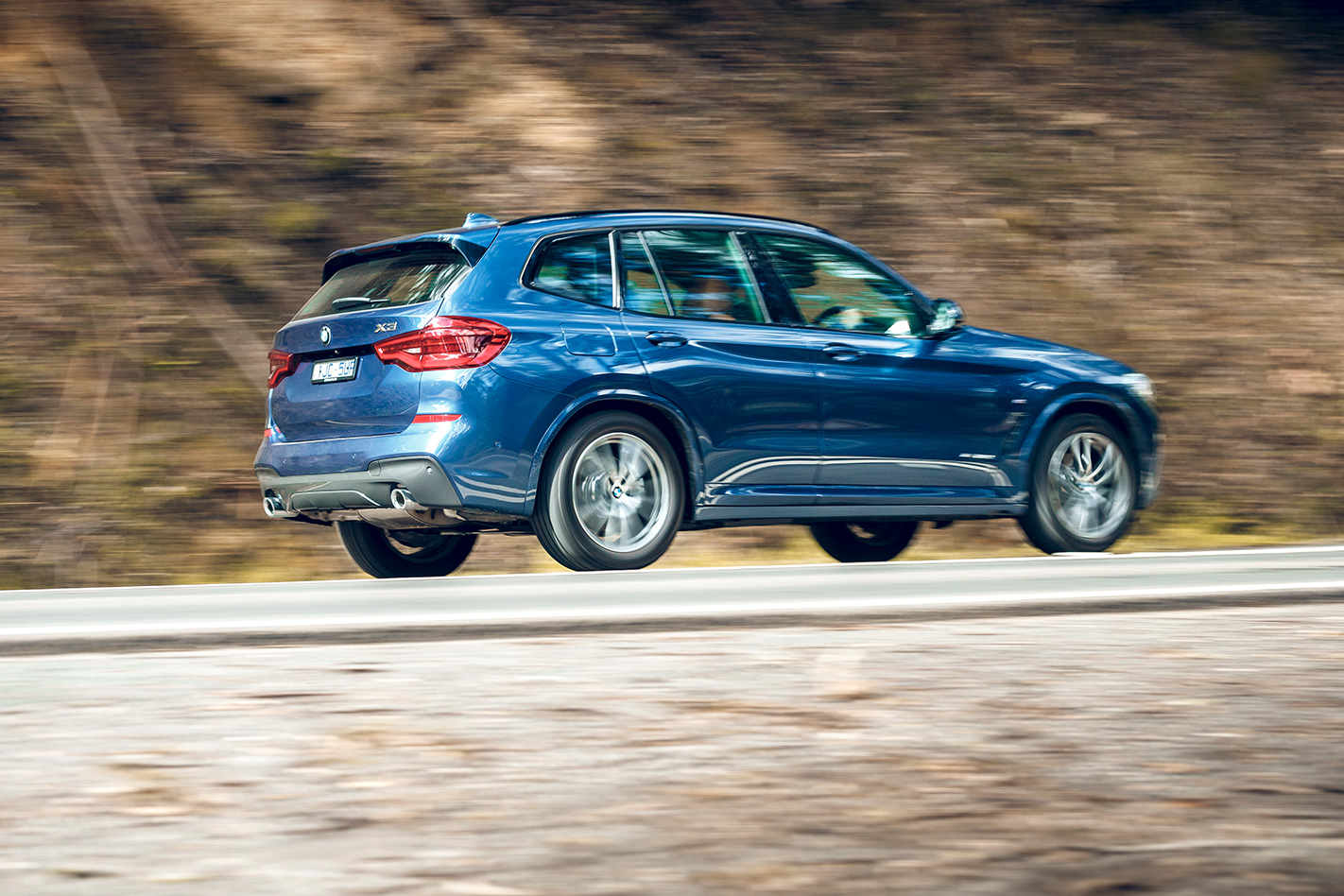
With the adaptive dampers the ride feels composed even on rougher surfaces. It rides particularly well in Comfort mode, and while switching to Sport makes for a firmer ride, it still absorbs bumps well with minimal jarring.
The steering has a nice fluid feel to it in Comfort mode, but in Sport mode it’s unexpectedly more inconsistent meaning you lose feedback on sharper turns. Fortunately you can tailor the driving settings to come to a compromise between Sport’s sharper handling and Comfort’s direct steering.
The xDrive20d is also handy on rougher tracks, with effective all-wheel-drive and a hill-descent control system as standard.
THE VERDICT
While the X3 range is headlined by the powerful 3.0-litre petrol and turbocharged diesels (including the brutish X3 M40i), the comparatively sedate xDrive20d’s emphasis on comfort and family practicality means it’s the one that’ll like appeal most to the average buyer.
The more affordable diesel is enjoyable to drive though, and offers more than enough power for everyday driving. That said, you won’t regret spending a little more on optional adaptive dampers – available separately or as part of the M-Sport Package – which bring an enhanced ride quality that approaches that of the best alternative premium SUVs.
What is it?
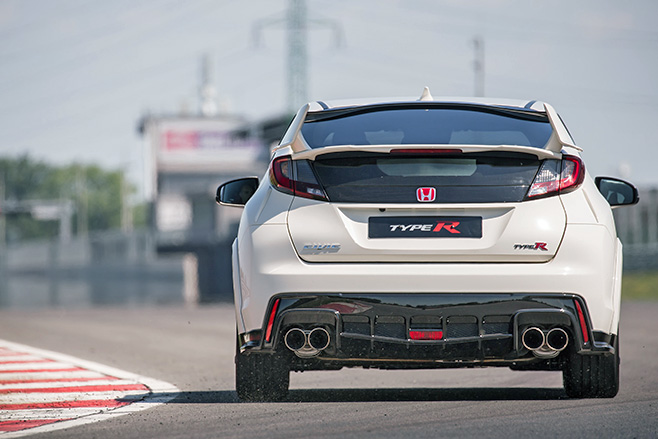
The new Civic Type R. The return of the hardcore Japanese hatch: 228kW, front wheel drive, six speed manual gearbox, proper mechanical LSD, gorgeous gear change, clamping seats, revs to the skies, you know the score. Well, OK, not really revs to the skies – that’s where things fall a bit short. 7,000rpm is your limit in this new turbocharged motor, but it does make a real song and dance about getting there, dash lights blazing, second and third consumed in a blaze of force and urgency.
What’s different from the normal Civic?
As you’d expect from a company with Honda’s reputation for engineering integrity, it’s a fairly comprehensive list that starts with the body shell itself. Rigidity has been increased by 18 per cent, not by adding extra steel, but by changing the bracket designs and using the adhesive more cleverly.
It’s very rare to find a company prepared to go to such lengths to turn a regular hatch into a hot hatch – this really is starting at square one and rebuilding.
Then there’s the suspension.
Remember a few years back when the fashionable term in hot hatchdom was ‘reduced kingpin offset’? I know, exciting times. Anyway, the Ford Focus RS, Astra VXR and Megane all had trick front suspension systems designed to reduce torque steer by minimising the camber change on the front wheels during cornering – necessary when trying to put a fat wodge of power and torque through the front wheels.
Vauxhall called it HiPerStrut, Ford Revoknuckle and Renault PerfoHub. Well, now it’s Honda’s turn to shout about its new Dual Axis Strut Front Suspension. DASFS. Catchy. The main claim is appealing though: torque steer is claimed to be reduced by 55 per cent.
The lower arms, damper forks and bushes have also been re-engineered, although at the back Honda has stuck with a torsion beam set-up. The promise is good – the new design for the Type-R is so stiff (up 177 per cent on the standard car) that there’s no need for a rear anti-roll bar.
What about the engine?
It’s an all-new 2.0-litre four cylinder direct injection VTEC Turbo. This is relatively standard fare, and mighty though the power outputs are (228kW at 6500rpm and 400Nm at 2500rpm) they’re not outrageous these days.
What is slightly unusual is that while most opt for variable vane turbo geometry to control boost across the rev range, Honda uses a monoscroll unit and depends on its VTEC valve control to manage things. It also electronically controls the wastegate.
However, if you were expecting Honda’s engineering nous to have eradicated all lag, you’re in for a disappointment. At low engine speeds there’s quite a bit of it and it’s not until past 3,000rpm that it really hits its stride. It’s better at picking up quickly at high revs, and once away and blowing hard the Civic is massively fast. Massively.
Would I trade this flexibility and power against the noise and sharpness of the old car? Tough one. Yep, I probably would.
It weighs a claimed 1378kg, which gives it a power to weight ratio of 165kW per tonne, ten per cent better than a Golf R. It consumes those tightly stacked lower gears, every gear change in the new six speed manual a total delight. So precise, so tight, so slick.
If everybody had a manual gearbox like this there’d be no call for double clutch gearboxes.
What’s it like to drive fast?
The Civic Type R makes noise. Quite a bit of noise, and it goads you on, but it’s not tuneful, not nice to listen to. Instead you get the feeling that the car’s only intent is to get to the next gear as soon as possible, and that it views sounding good as superfluous small talk.
It’s a shame, because you get a bit of exhaust woofle on start-up, and on light throttle openings around town the turbo wastegate chatters audibly.
The best way to describe it is that the Civic isn’t one of those playful hatches, like the Focus ST or Mini Cooper S. No, the new Type-R is serious about speed. And it’s very good at it – not just at achieving it with the engine, but maintaining it through corners.
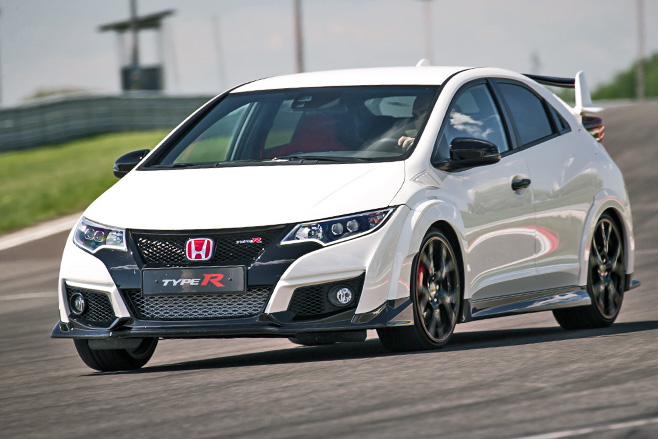
Two things strike you immediately – how low the centre of gravity seems, and how stiff the shell is. We took our long term VW Golf R along as a comparison, and, for the first time, detected within it a tiny bit of structural shimmy on difficult roads, which I don’t think I’d have noticed if the Civic hadn’t been so tight.
Combine this tautness with the controlled damping and a lovely mechanical LSD, and you have a very effective cross country device. OK, it might not sound the best, and the messages coming back through the steering don’t quite have the Golf’s clarity, but it’s a very absorbing, all-consuming car to drive. Where the Golf is ‘I’m game if you are’, the Civic is more ‘come on, keep up, let’s see what you’ve got…’
Oh yes. The Type R charges about the place in a very determined manner. You find yourself using high revs because that’s where the engine is happiest, while the four piston vented and cross-drilled 350mm front Brembos are mighty (although the rear discs are weenie and flimsy-looking in comparison) and the diff is deliriously effective.
It doesn’t do a bad impression of a touring car or tarmac rally car to be honest, but to get the best out of it you have to take it by the scruff and concentrate.
Ideally, an ability to left-foot brake is preferable, allowing you to build up boost pressure on the throttle and release the brakes at the apex for a suitably rapid, lag-free corner exit. Yep, all a bit track-day-enthusiast, but that’s what the Civic is like, and you’ll get more out of it if you do.
Still, it’s not an edgy handler. All the work is done by the front axle – the rear simply follows along safely and predictably. There’s nothing wrong with that, but it doesn’t quite have the Golf’s mid-corner adjustability.
Traction though… well, I swear the Civic is as quick out of corners as the 4WD Golf R. It’s immense. Which leads me on to +R. That’s a button on the dash that makes the instrument rings glow red instead of white. It also loosens the ESC shackles, implements a more aggressive torque map, reduces assistance to the electric power steering and firms up the dampers. Yep, the same adaptive damping tech as used in the Audi R8, Ferrari 458 and Corvette Stingray. It’s the best system out there, and in the Civic firms the dampers up by 30 per cent.
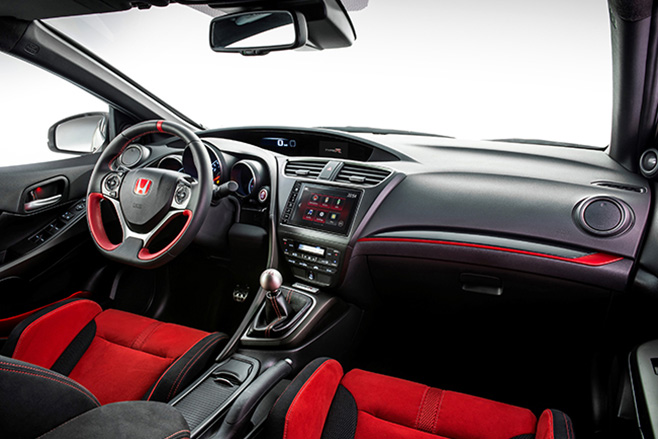
The only issue is that, while the other +R changes are useful, you neither need nor want the stiffer dampers unless you’re on millpond tarmac. But you can’t amend the settings individually: the choice, frustratingly, is either to +R or to not +R.
Then there’s the thorny issue of the way the Civic looks. It’s not understated is it? Nor, depending on your viewpoint, tasteful.
I like the wheels, but the bolt-on panels overpower them to such an extent that the 19s don’t fill the arches. And the slats on the bonnet and behind the front wheels are just daft. Honda swears blind these serve a purpose, venting air, but on closer scrutiny they appear to be filled in with plastic inserts.
Honda says there are tiny holes in the plastic. We say, if they serve a purpose why make them look like they don’t? And wouldn’t they be more effective if the holes were less tiny? Honda has a reputation for engineering integrity, and silly slips like these undo decades of good work.
Similarly, Honda claims the Civic produces active downforce at speed, but wasn’t willing to share how much it does produce. Look, the Type R doesn’t need this. It’s a very good car, but the styling is too childish for a hatch that’s not affordable by the people it most likely appeals to. Maybe you see it differently, and that’s fine.
What about that Nurburgring lap time?
A pre-production development Type R went round the Nordschliefe in 7m50.63s. If Honda can repeat that in a production car it’ll be the fastest hatch of all. And, yep, I do totally buy that. It’s hugely fast.
Since we had the Civic for a couple of days we took the opportunity to strap our timing gear on. Honda says 0-100kmh takes 5.7 seconds. We did it in slightly less than that. 270kmh top whack? Yep, reckon it could do that.
What about the commute home?
It’s not a Golf R. The Type R doesn’t have that calmness about it. But you know what? Apart from excessive tyre roar on coarse surfaces, it’s fine on motorways and the boot is huge. Back seats, too – although the seat bases don’t do the clever cinema flip-up thing on the Type-R.
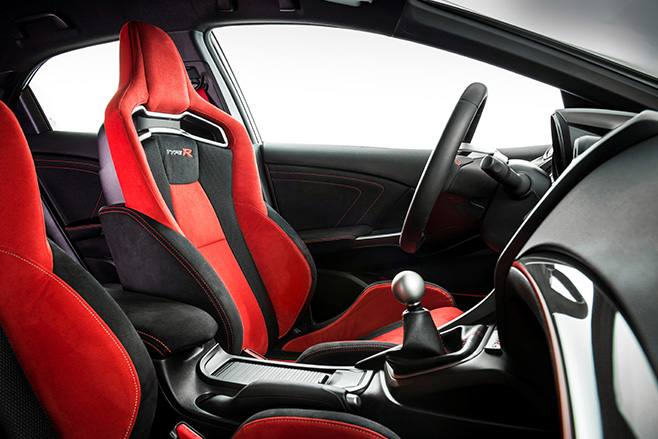
There’s plenty of headroom, and the view out the back is surprisingly good, entirely unimpeded (surprisingly) by that lofty wing. We averaged 10.1L/100km over the course of 700-odd mixed-driving miles. And the ride is satisfying. I wouldn’t call it comfortable, but it’s tremendously well controlled and you get the feeling it’s underpinned by expensive dampers. The Civic is firm over speed bumps and potholes, but rounds off the edges really well. Considering the tyres are 235/35 ZR19s (Conti CSC6s, rubber fans), that’s a good effort. It never feels less than purposefully sporty, though. In fact the whole car is shot through with a motorsport vibe that starts with the cabin.
And the seats are great. Really tall side bolsters, good side support. Best road car seats I’ve sat in for a while, actually. Same goes for all the touch points – lovely aluminium gear lever, shapely leather steering wheel, well-judged pedal weights.
The trouble is the rest of the two-tier dash – as your view of the instruments is split by the rim, you’re very limited in where you can position the steering wheel. It’s a problem exacerbated by the fact that, although dropped by 30mm over the standard hatch, the seat is still mounted too high.
What’s the verdict, then?
I have reservations over the Civic Type R’s image and appearance, and Honda’s taken an unashamedly hardcore tack with it. But it’s genuinely exciting to drive, massively fast and relaxes far better than the bodywork suggests.
It’s very different to a Golf R, but effectively carves its own niche in the hot hatch class – there’s nothing else quite like it except the Megane, and I’d have it over the Renault. I think. Anyway, the more I drove it the more I liked it. I ended up liking it a lot.
Ever lusted after an Audi RS5 but found the practicality proposition of its two-door bodystyle to be incompatible with your lifestyle? Did you then look in the direction of the RS4 Avant, but preferred something a little sleeker than a wagon?
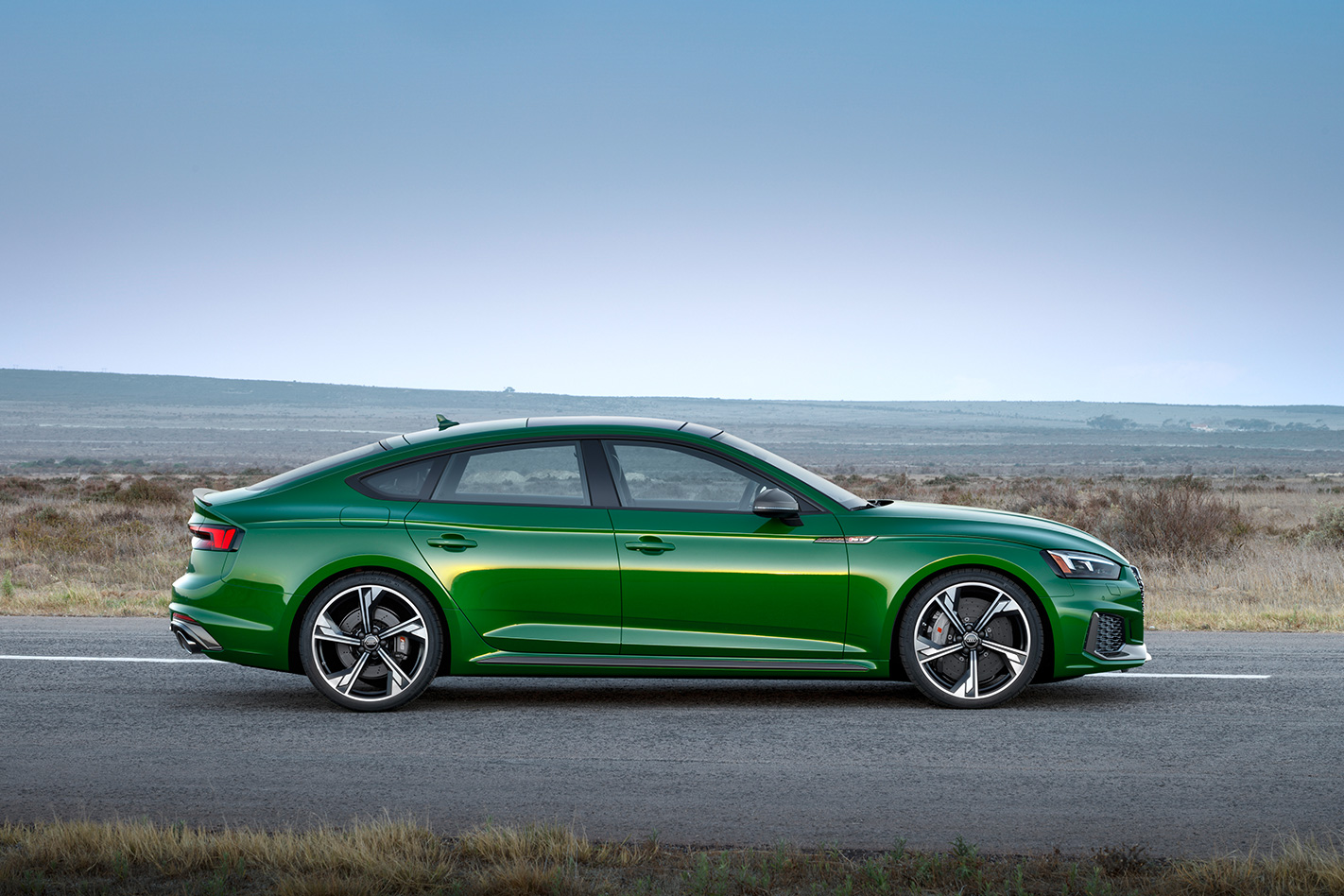
Audi has the solution in the form of the RS5 Sportback, and the German automaker has confirmed it will arrive in Australia in February 2019 with the same $157,700 pricetag as the RS5 Coupe.
Revealed at the New York Motor Show earlier this year, the RS5 Sportback brings the coupe’s potent twin-turbo 2.9-litre V6 and performance-tuned all-wheel drive system into a five-door form factor for the first time. Previously, the RS5 was only available as a two-door in either hard-top coupe or soft-top convertible guise.
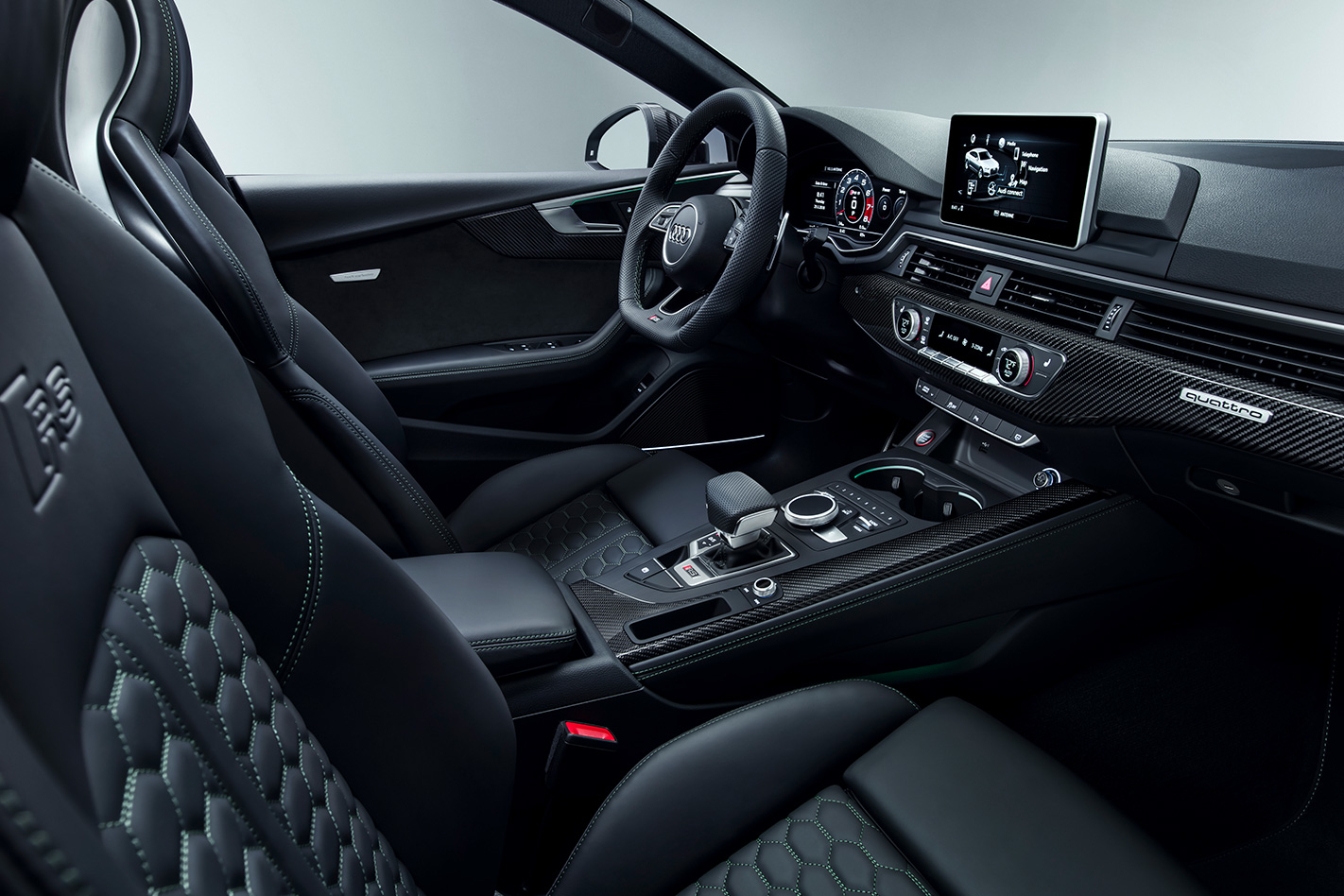
There will be few compromises associated with going for the five-door. Besides the price being identical to the coupe, the RS5 Sportback’s engine output also remains the same as the two-door with peak numbers of 331kW and 600Nm. The same eight-speed automatic takes that power to all-four wheels via a permanent all-wheel drive system that is normally biased 60 percent to the rear axle for a sportier feel, and a torque-vectoring rear differential further enhances agility.
Electronically-adjustable dampers (dubbed Dynamic Ride Control by Audi) will be standard, while carbon ceramic brakes and a faster-acting steering rack are optionally available.
The five-door’s extra weight does impart a small penalty in sprint times and fuel economy however, with the 0-100km/h being 0.2s slower at 3.8 seconds while average fuel consumption is 0.1 L/100km higher at 8.9L/100km.
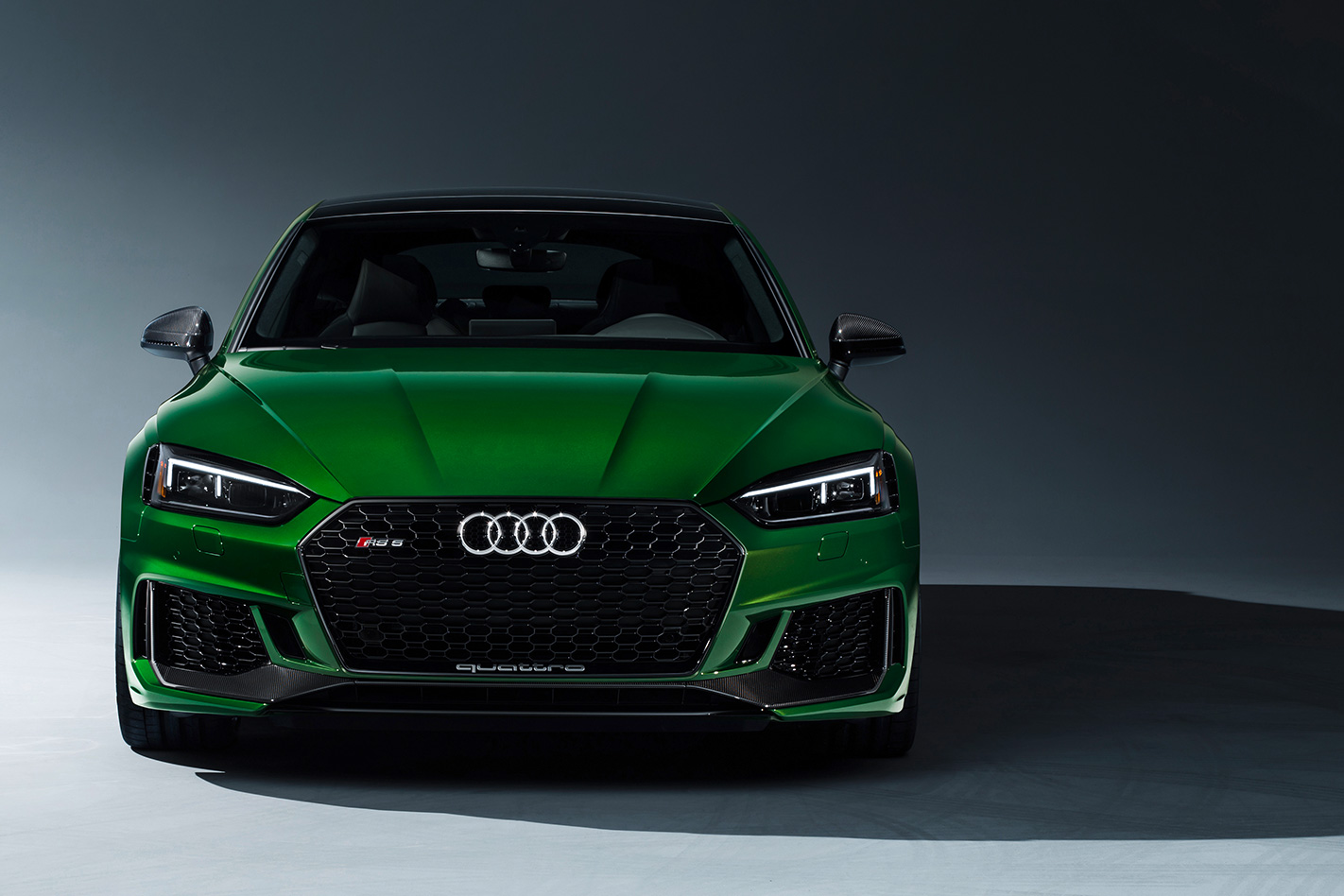
Inside, the RS5 Sportback will be equipped similarly to the Coupe, with diamond-stitched black Nappa leather upholstery, a flat-bottomed steering wheel and an RS-specific electronic instrument panel setting it apart from garden-variety A5 Sportback models.
As with the Coupe, the RS5 Sportback will also be equipped with a Bang & Olufsen stereo, head-up display, wireless phone charging pad, 20-inch alloys, LED headlamps, privacy glass and an RS sports exhaust system as standard.
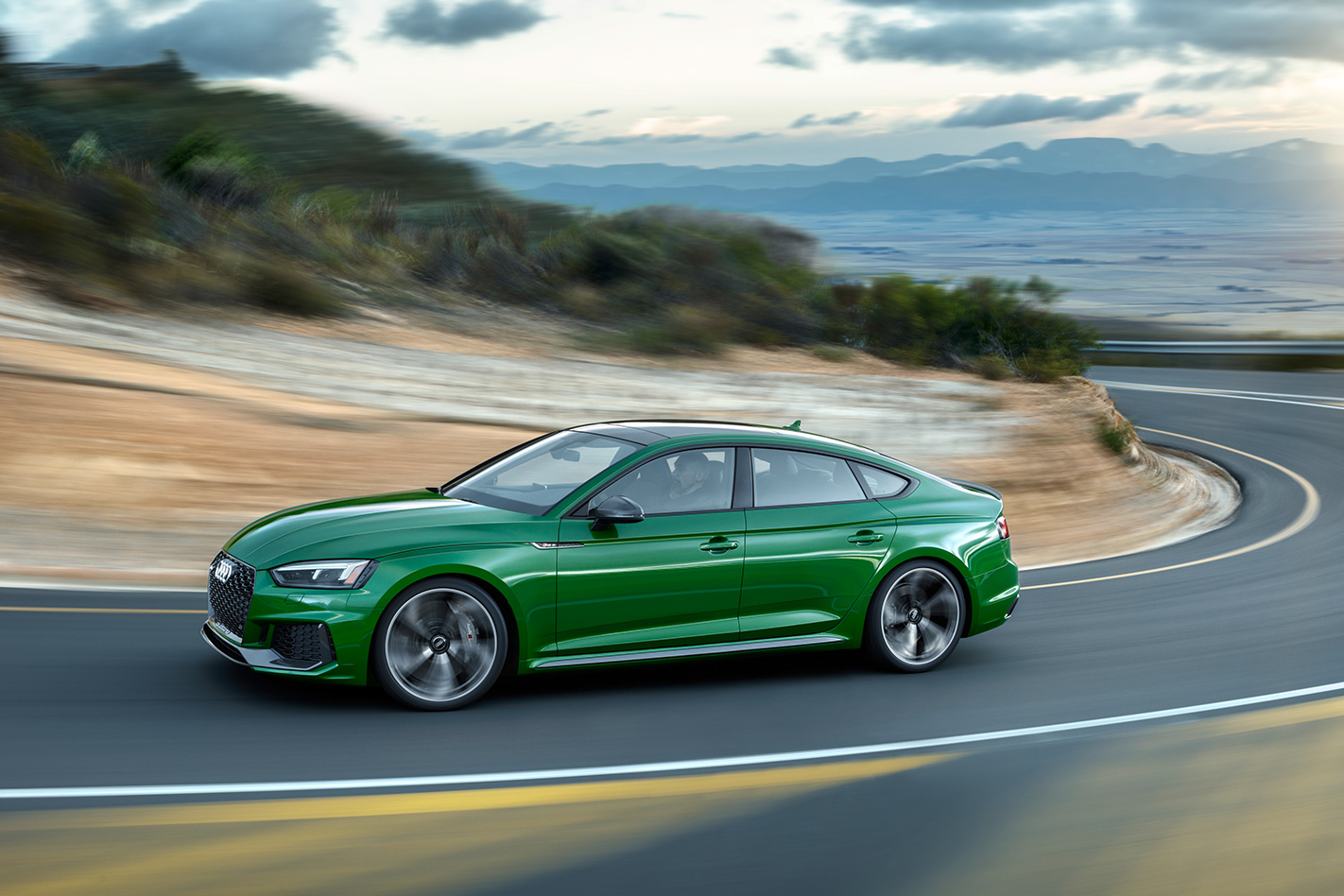
AUDI RS5 PRICING
The 2019 Audi RS5 Sportback is available for order now, with deliveries set for February next year
- Audi RS5 Coupe – $157,700
- Audi RS5 Sportback – $157,700
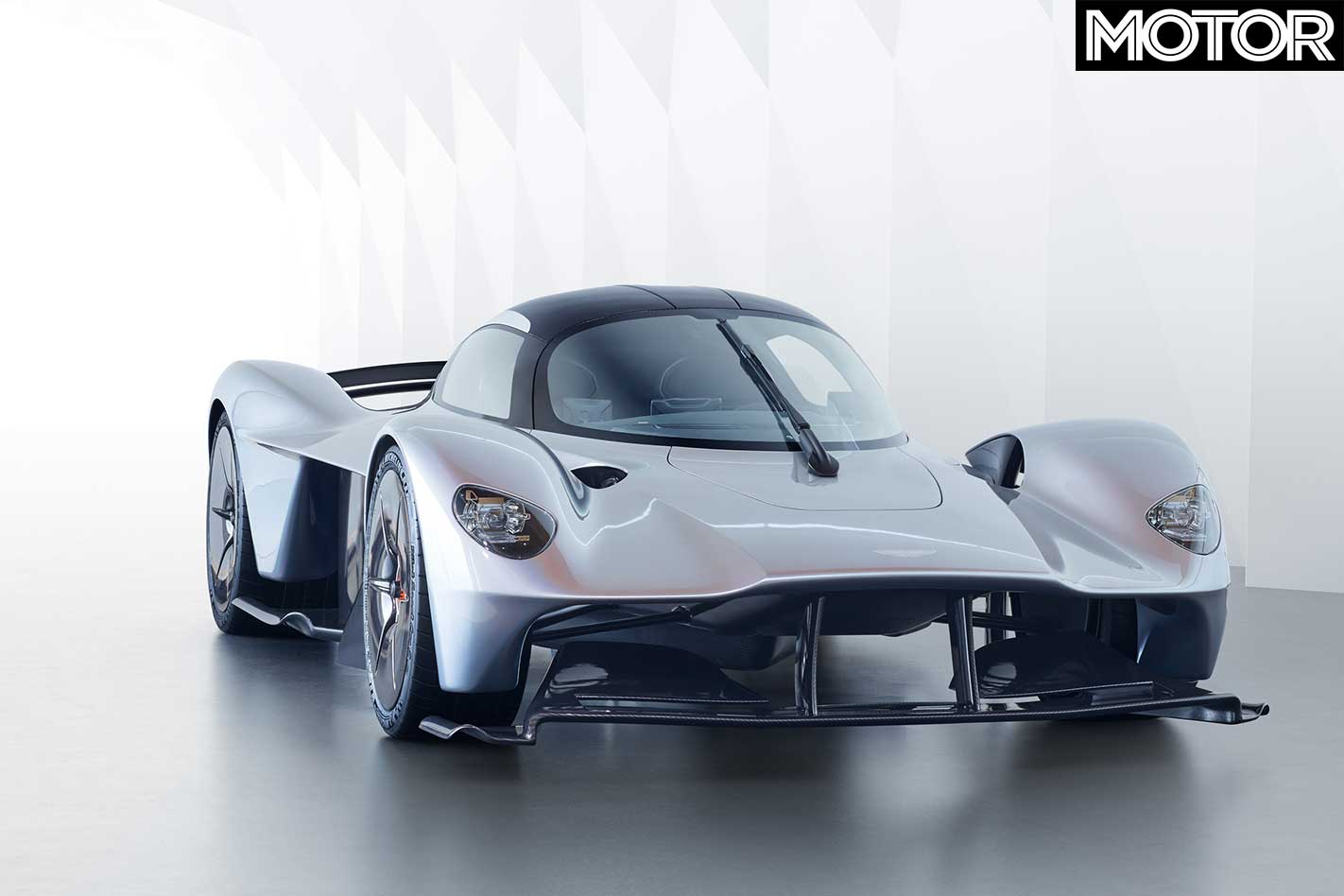
Aston Martin’s next hypercar is on the way, known officially to the public as ‘003’.
With a turbocharged mid-mounted petrol-electric hybrid engine, the car is limited to a production run of just 500 units.
A report by UK outlet AutoCar says the car is known within Aston circles and the development team as the ‘Son of Valkyrie’, as it follows on from the Valkyrie and Valkyrie AMR Pro, which were previously known as ‘001’ and ‘002’.
“The vision and the jigsaw puzzle, when you fit it all together, there’s a reason we entered into F1 originally, there’s a reason we now have title sponsorship,” he told us in March this year.
“Valkyrie sits as a very important part of that, the track-going Valkyrie, all of that lineage feeds down into the road-going car.”
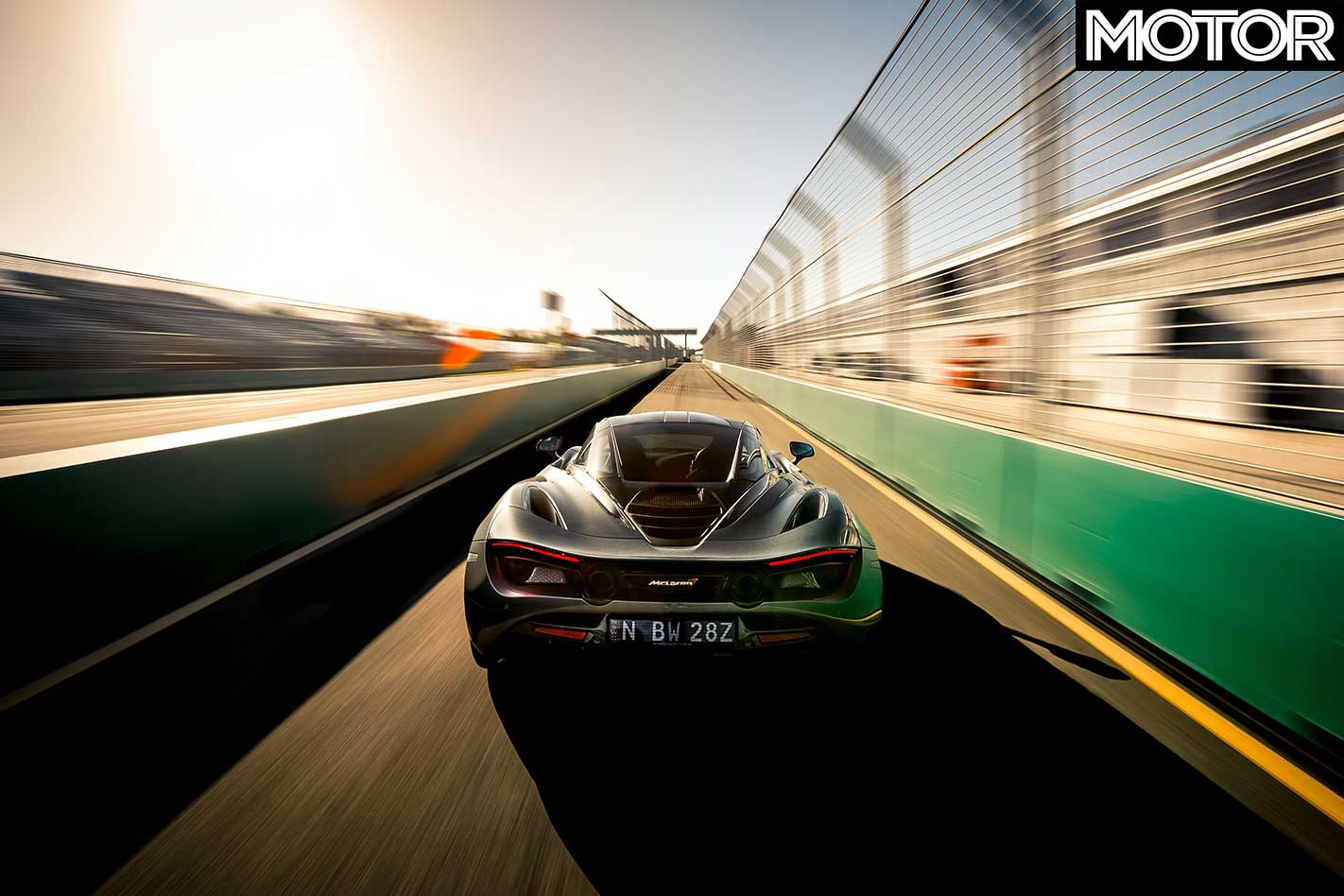
“What I can tell you is that, in terms of its performance capability it will be a true competitor to the market set at the time – whatever the 488 is, whatever the McLaren 720S is, wherever Lamborghini is.”
The British brand has put together somewhat of a ‘dream team’ for creating mid-engined sports cars, with Ferrari’s former head of innovation Max Szwaj, and former engine boss Joerg Ross defecting to Aston.
Dynamics veteran Simone Rizzuto (nabbed from Maserati, previously Alfa Romeo), head engineer Matt Becker (formerly of Lotus), and former McLaren test driver Chris Goodwin also relatively recently joined the Aston Martin ranks.

Aston Martin says the goals for ‘003’ are for it to be a lightweight road-legal car, with “active aerodynamics for outstanding levels of downforce” and an active suspension system.
It’s to be available “in all markets in both left and right-hand drive,” and has been envisioned with practicality in mind – this car will have useable luggage space.
Aston Martin CEO Andy Palmer says while the Valkyrie was a ‘once-in-a lifetime’ project, he hopes its success trickles into the follow up ‘Son of Valkyrie’ being developed.
“It was always the intention for the Aston Martin Valkyrie to be a once-in-a lifetime project, however, it was also vital to us that Valkyrie would create a legacy: a direct descendent that would also set new standards within its own area of the hypercar market, creating a bloodline of highly specialised, limited production machines that can exist in parallel with Aston Martin’s series production models.
“I’m thrilled to announce that this car is the Project ‘003’, and our next step into a dynamic and exacting arena.”
Aston Martin says the car will arrive to the market in late 2021, so we’re not holding our breath to see it in the ‘metal’ any time soon.
It’s official: Wheels is 65 years old. But this series isn’t about us. To celebrate our 65th, we thought we’d take a look at the decisions that have changed the automotive world over the last six and a half decades. Some were inspirations that altered it for the better, others were engineering dead ends, nefarious cover-ups and valiant flops. Scroll on to read more, then click here to explore all 65 cars, people, game-changers and failures that have influenced the car industry since 1953, in no particular order.
1. Dieselgate
Between 2009 and 2015, the Volkswagen Group built around 11 million vehicles that emitted as much as 40 times their published nitrogen oxides; compounds that damage lung tissue and inflame potentially fatal respiratory diseases such as emphysema and bronchitis. The vehicles were programmed to switch into a clean mode while undergoing laboratory emissions testing and then revert to ‘dirty’ in real-world conditions. In April 2017, a US federal judge ordered Volkswagen “to pay a US$2.8 billion criminal fine for rigging diesel-powered vehicles to cheat on government emissions tests.” Too little, too late? Between 2009 and 2015, Volkswagen sales increased by almost 60 percent and in 2017 it overtook Toyota to become the world’s biggest car maker. The damage to the company’s reputation over the longer term is harder to assess.
2. The Ford/Firestone Explorer debacle
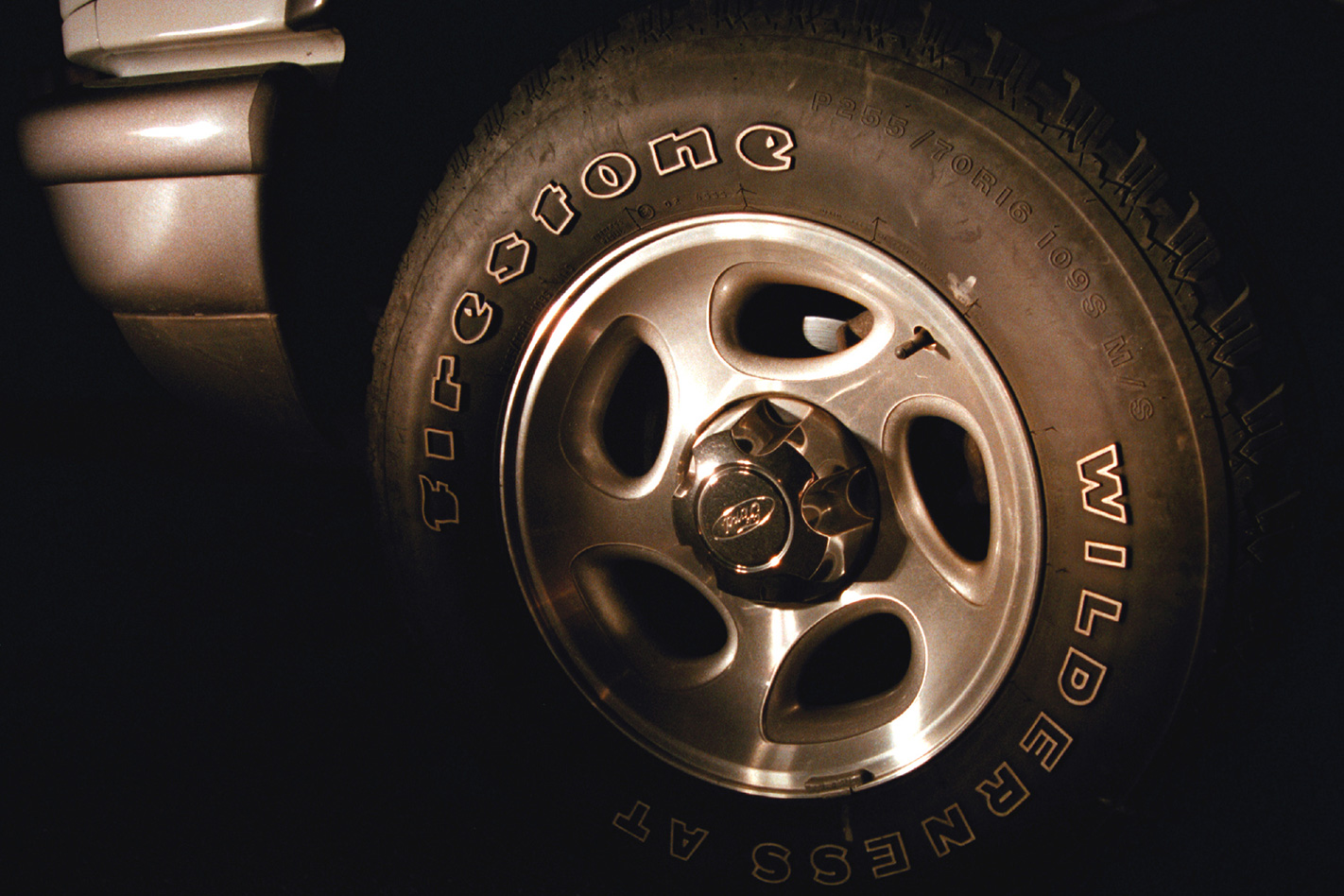
The Ford-Firestone rollover scandal of 2000 kicked off when the NHTSA asked both Ford and Firestone to investigate a high rate of blowouts that led to rollovers and up to 100 deaths. Ford blamed Firestone, and Firestone blamed Ford. Nearly 20 million tyres were recalled, the two companies underwent congressional hearings, and in a flurry of lawsuits, Firestone and Ford parted ways in 2002. Was it poor Ford design, flawed Firestone rubber or a bit of both? We may never know as neither company ever took full responsibility.
3. Ford Pinto
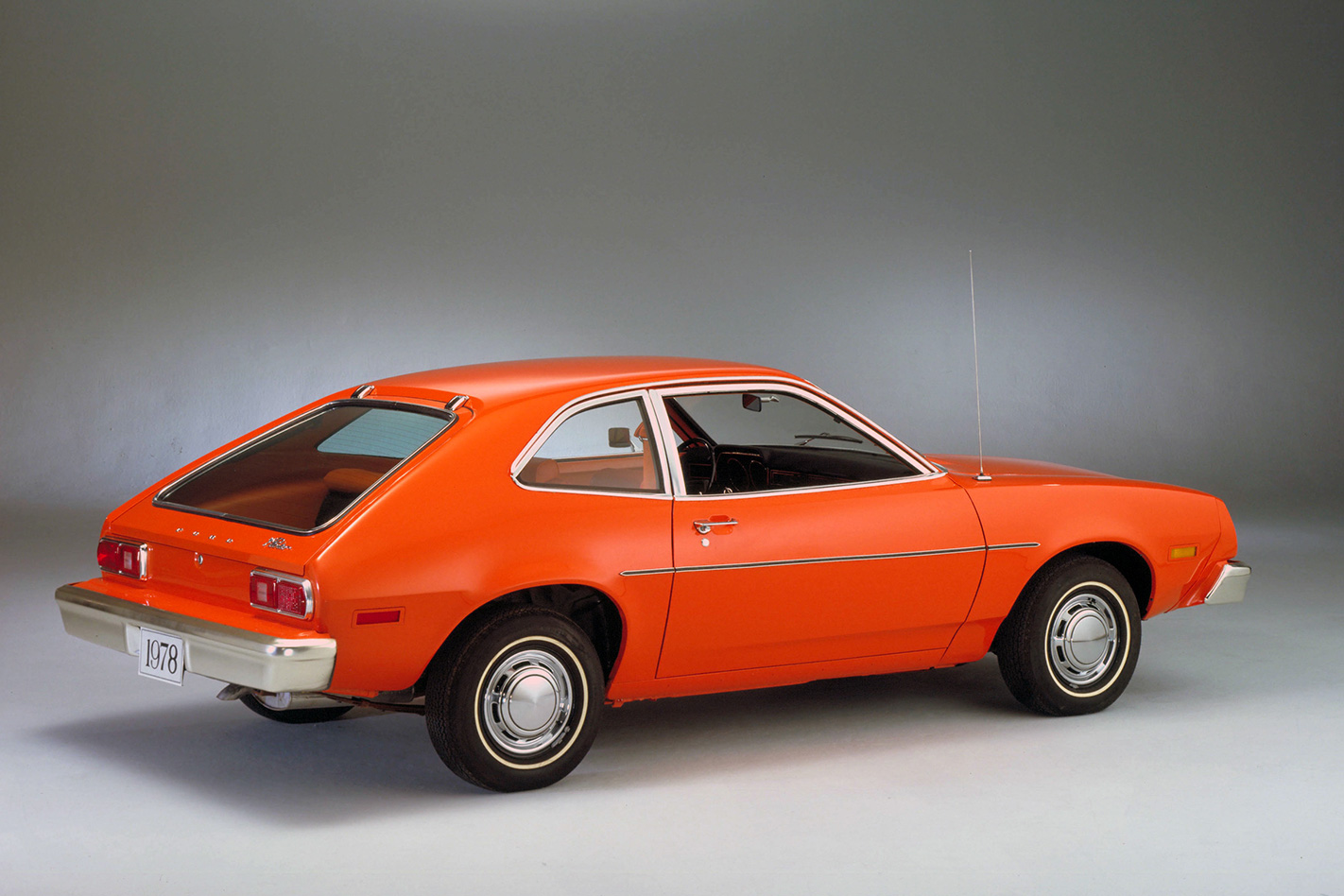
In its simplest terms, a cost-benefit analysis states that if the cost is greater than the benefit, the project is not worth it – no matter what the benefit. These were the grisly mathematics behind Ford’s Pinto development. The car needed to come to market in the 1970s at not a cent over US$2000 and not an ounce over 2000 pounds and safety was not a priority. An $11-per-car fuel tank improvement would have prevented 180 deaths a year, but Ford’s internal memo titled ‘Fatalities Associated with Crash-Induced Fuel Leakage and Fires’ valued each death at $200,000. Therefore modifications to make the fuel tank less susceptible to rupture in rear-end impacts, even at $11, were not deemed cost effective.
4. A-Class on a roll
These days, there’s barely any car enthusiast who doesn’t know what an Elk Test is. Back in 1997, a Swedish magazine rolled the revolutionary A-Class during a lane-change test. Mercedes initially stonewalled, but eventually recalled all 130,000 cars sold, added ESC across the range and modified the suspension. After a flurry of bad press, the company emerged with its safety credentials boosted by doing the right thing, providing a case study in crisis management. The range-wide ESC adoption also set a precedent. By 2014, ESC was required on all new cars in the EU.
5. Takata
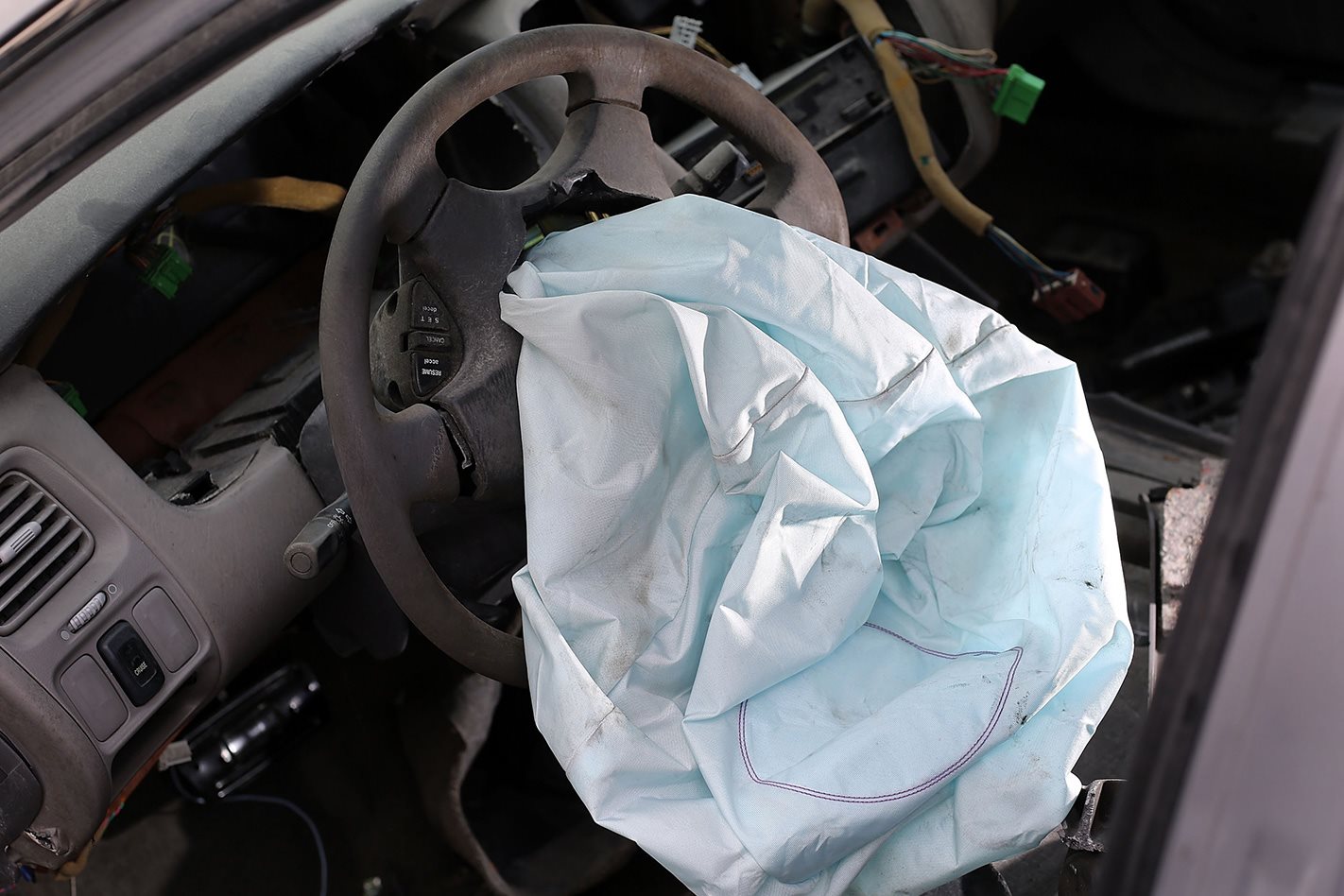
From 2000, Japanese airbag manufacture Takata inadvertently introduced a design fault to its airbags whereby inflators were degraded by moisture. When triggered, the airbags could shower occupants with potentially lethal metal shards. It’s alleged that Takata knew about the flaw in 2004 and Honda issued a recall in 2008, but Takata didn’t announce a large-scale recall until 2013. Now it’s estimated that around 30 million vehicles worldwide will require recalls. More than 20 people have been killed by the fault. Takata filed for bankruptcy in 2017.
Cars depreciate, that much is obvious. But as time passes the power benchmarks of sports cars have dramatically increased by enough to de-value a number of kiloWatts that once sounded big-time and major-league. So just how cheap can you buy 250kW to 475kW?
Of course Australian-made performance sedans have a hold on the lower end. Want 260kW? Head directly to a 5.7-litre naturally aspirated V8-powered WL (nee VZ) Holden Statesman for just $4000 – or $15.40 per kiloWatt. For 270kW, you will want the bigger 6.0-litre in the year-newer, 2006 VE Holden Calais from $8000 – and at $29.60 per kilo of wasps.
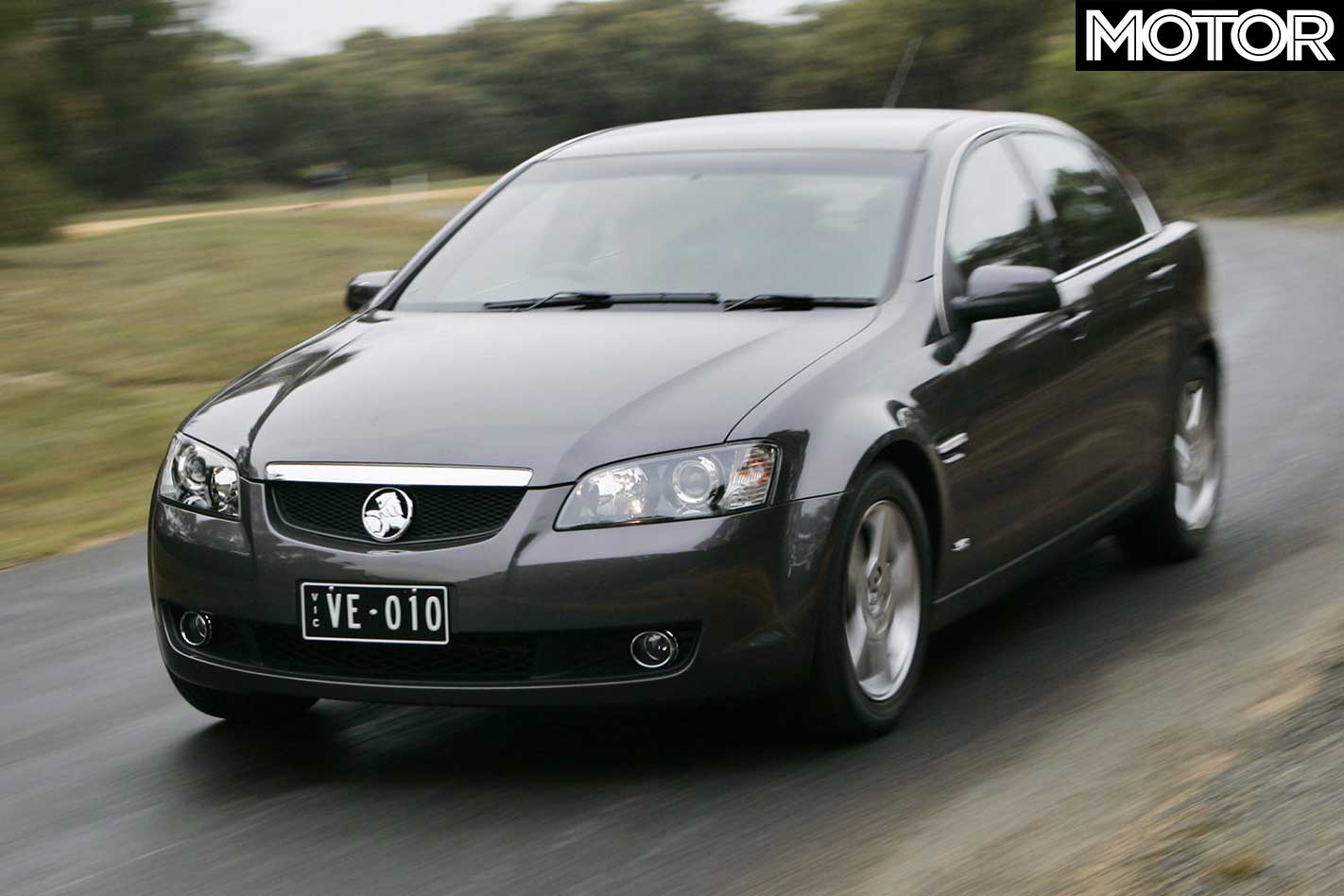
From there we swap sides. HSV models hold their value better than their FPV counterparts – an early-2000s 300kW VTII GTS or VX SV300 are near-collector-grade expensive now – which means for 290kW looking to a 5.4-litre Boss 290 V8-engined 2003 BA Pursuit ute at $12,000.
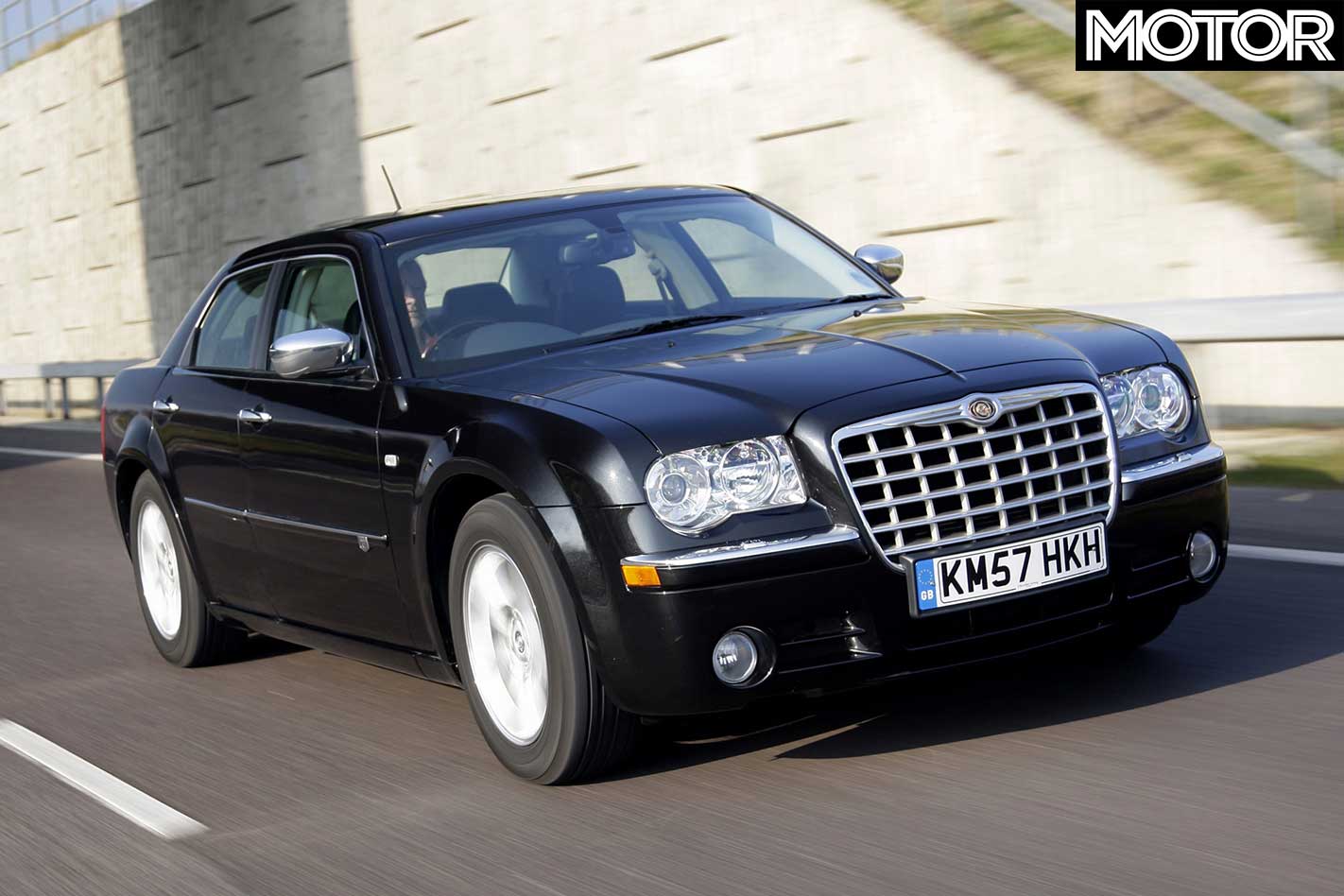
Notice the neat steps from $4000 to $8000 to $12,000 here. And that trend almost continues, although here we bypass HSV and FPV to achieve 317kW from the 6.1-litre Hemi V8-powered 2008 Chrysler 300C priced from $18,000. It’s a figure not even the 307kW 6.2L VE Clubsport/Senator/Grange or 310kW 4.0-litre turbo-six FPV F6 can match for this price.
Then we leave Australia and the US – for now.
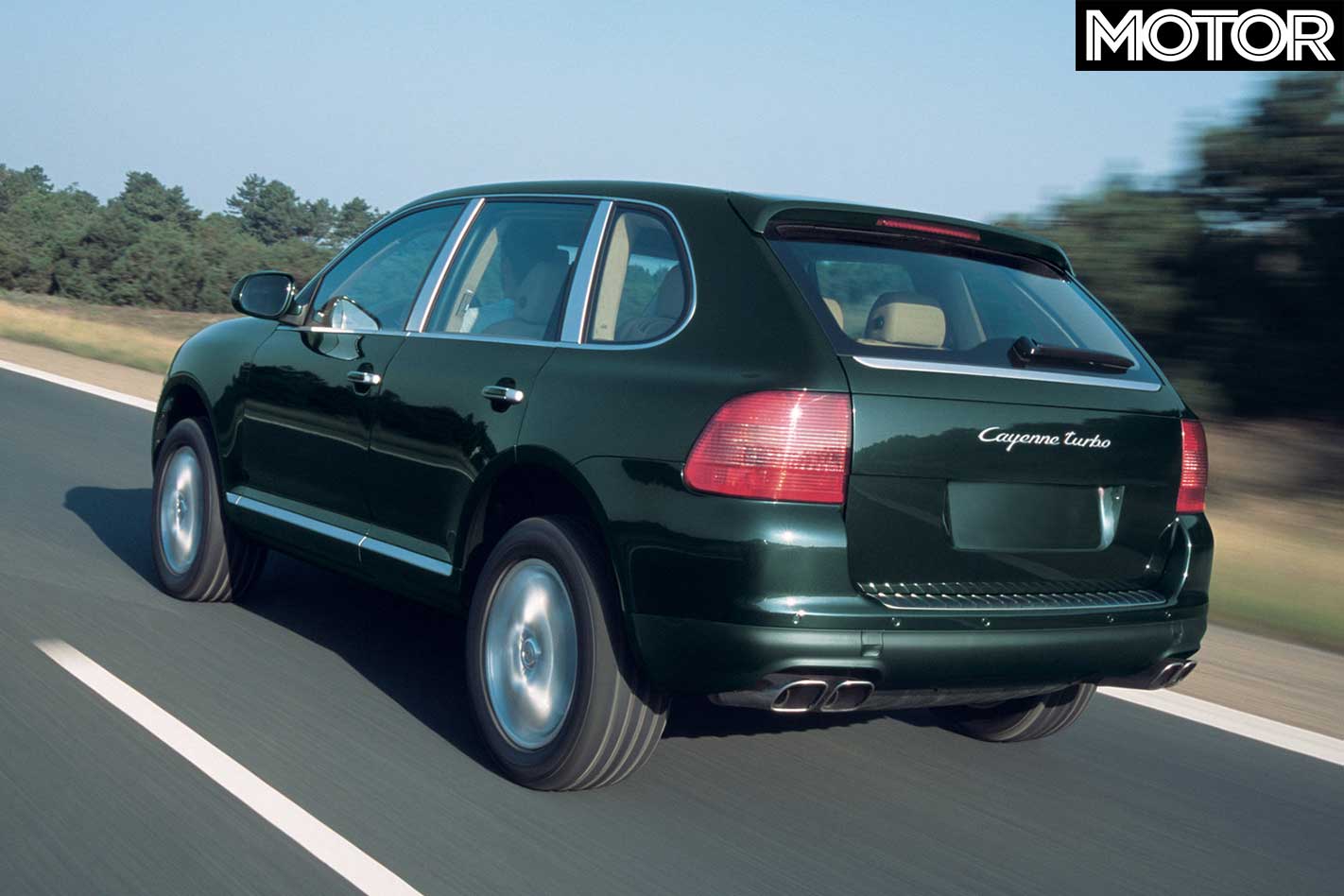
Enter the 331kW 4.2-litre twin-turbocharged V8 engine under the bonnet of a 2003 Audi RS6, and the 331kW 4.5-litre twin-turbo V8 motor inside a 2003 Porsche Cayenne Turbo, with each 15-year-old European available with sub-200,000km for $20,000 on the nose.
That is $60.40 per kW, double the charge of a VE Calais for 2.5-times the cost of the vehicle.
Now for the slam dunk, though. Forget creeping up in power output when the bad boys at Stuttgart can deliver 375kW from a 6.2-litre naturally aspirated V8 engine in a decade-old Mercedes-Benz ML63 AMG for $25,000 flat. And with ML and Cayenne arrives the era of the mega-powered SUV with mega weight (the AMG is 2310kg) and mega-steep depreciation.
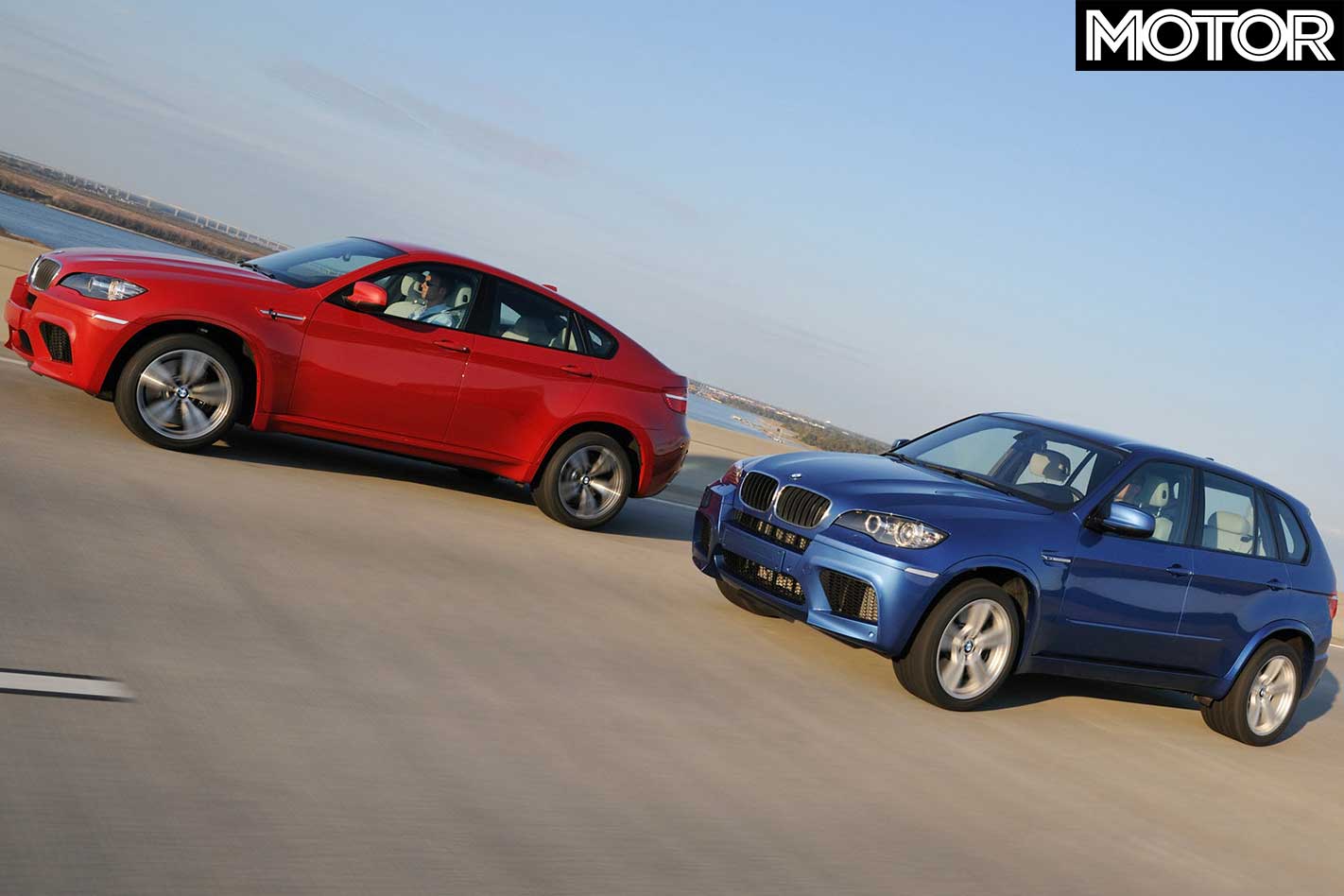
That point is reinforced by the 408kW produced by the 4.4-litre twin-turbo V8 engine in the eight-year-old BMW X5/X6 M, which can now be bought for $40,000-plus with little over 100,000km showing. To be fair, though, we’re now up to $98 per kiloWatt at this lofty level.
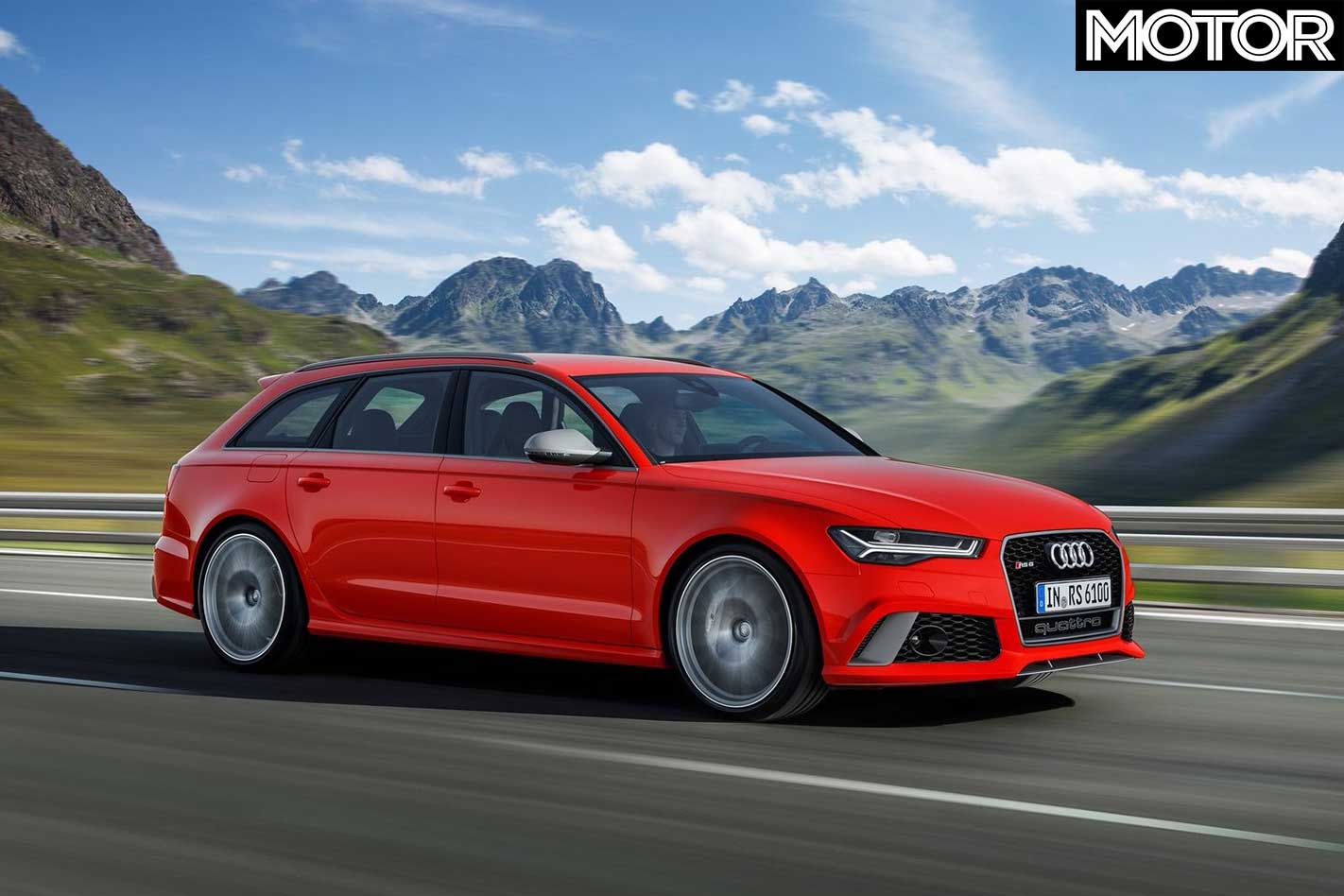
Europe would also make it a high-power (relative) budget quartet with the 426kW of the 5.0-litre twin-turbo V10 in the decade-old Audi RS6 Avant, the lead-tipped arrow of which can now be purchased from $65,000 – but alas it is ousted by the 430kW of the 6.2-litre LSA supercharged V8-powered, five-year-old Gen-F HSV GTS that has fallen to sub-$60,000 now.
Indeed, so hefty is its power output that ‘400kW Club’ rivals of a similar era struggle to match it – 404kW Jaguar XF-RS, 412kW Audi RS6 Avant, 423kW BMW M5 and 430kW Mercedes-AMG E63 S – let alone for a comparable cost.
Thankfully a two-year-old RS6 Avant Performance returns to save the day with the 445kW from its 4.0-litre twin-turbocharged V8 having already depreciated to circa-$250K to just $160K. It can’t beat the 474kW from the 6.2-litre supercharged V8 in the HSV GTS W1 local-production grand-finale, but the Aussie hasn’t depreciated as hard and it probably won’t.
Heck, even the 472kW of a 6.0-litre twin-turbocharged W12-engined 2017 Bentley Continental GT has fallen faster, from $485,000 new to just $435,000 after one year.
Bargain. We’ll take two.
It’s official: Wheels is 65 years old. But this series isn’t about us. To celebrate our 65th, we thought we’d take a look at the decisions that have changed the automotive world over the last six and a half decades. Some were inspirations that altered it for the better, others were engineering dead ends, nefarious cover-ups and valiant flops. Scroll on to read more, then click here to explore all 65 cars, people, game-changers and failures that have influenced the car industry since 1953, in no particular order.
1. Crumple zones
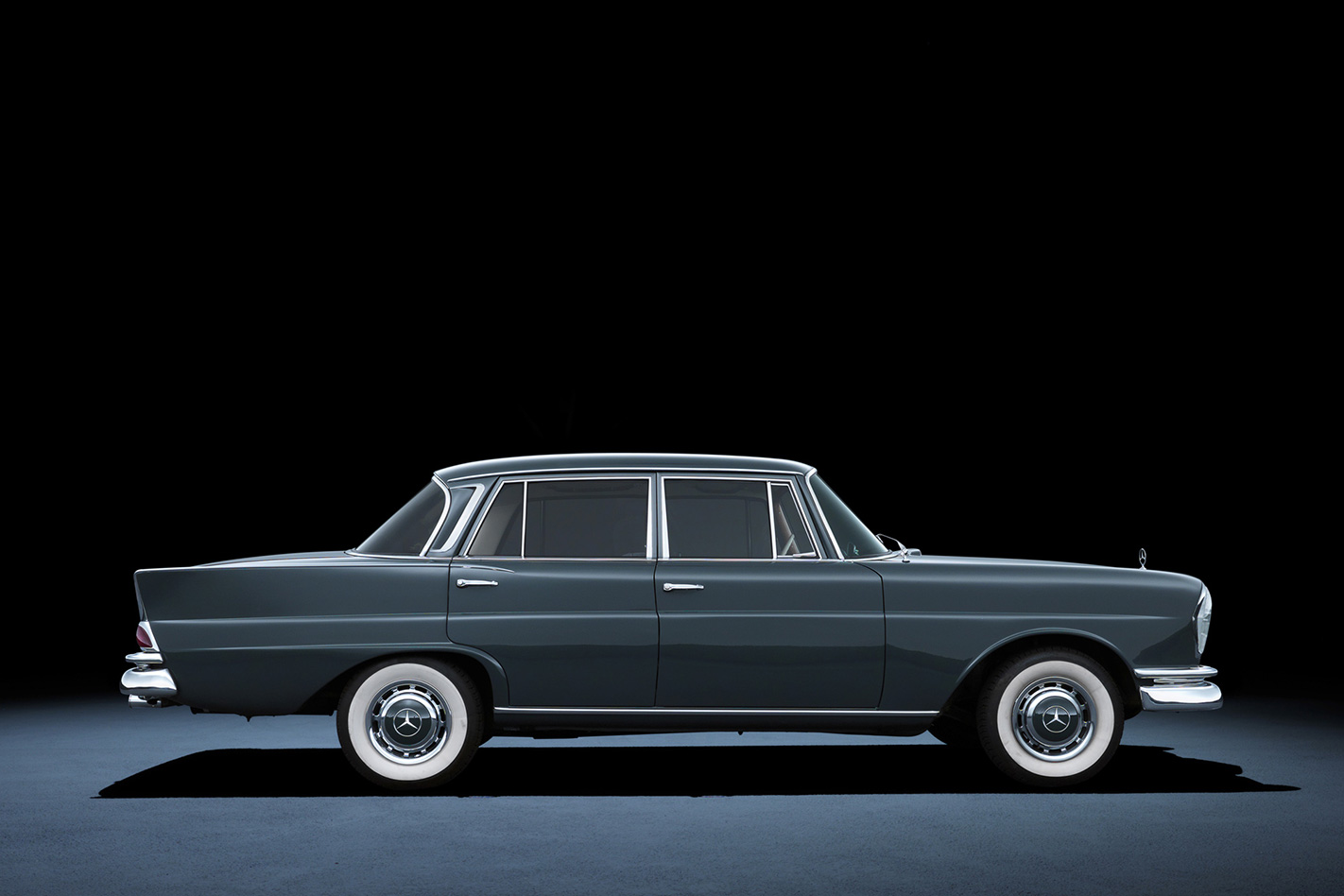
Until the mid-1950s it was accepted that a strong, rigid car was a safe one. Celebrated Mercedes-Benz engineer Bela Barenyi challenged this notion and successfully patented the concept of a vehicle crumple zone in 1937 and in a more developed form in 1952. It took until ’59 and the Mercedes-Benz W111 before a series production car featured crumple zones. Engineering and materials advances have since seen the creation of dedicated crash structures and the concept of load pathways refined and improved. The active safety features that followed make today’s cars even safer. But when it comes to the crunch you can thank the crumple zone engineered into every monocoque car (but not separate-chassis 4WDs), Mercedes-Benz and an Austrian visionary for the fact you could walk away.
2. Seat belts
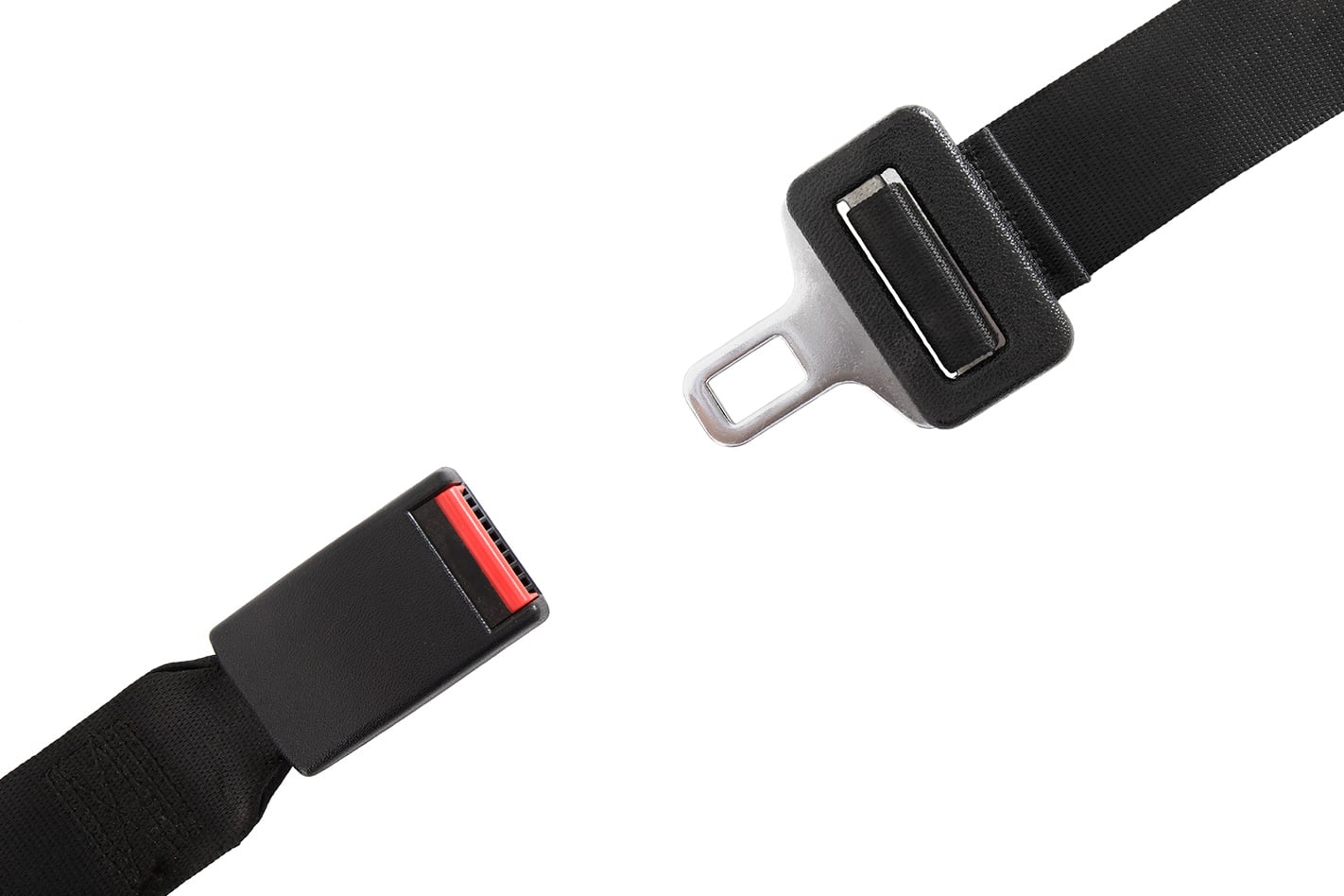
Australia led the way with the seatbelt, as the first country to make the use of this new vehicle safety device compulsory, starting in Victoria in 1970. It had been a long road from the invention of the seatbelt by English engineer George Cayley – he was granted a patent in 1885 – to its arrival as an option, first in Nash (1949) and then Ford (1955) models. In 1958, Sweden’s Saab was the first to make seatbelts standard.
3. Airbags

American John W. Hetrick was granted the first airbag patent in 1951 and airbags as a replacement for seatbelts were trialled in the early 1970s by GM and Ford. Mercedes-Benz led the way in production, offering the tech in its 1981 W126 S-Class, with Chrysler and Honda soon following suit. From early driver-only airbag installations, today’s cars utilise front, side and curtain airbags, driver’s knee airbags and even seatbelt airbags. Although exact figures would appear hard to come by, the NHTSA claims that airbags saved 44,869 lives in the US between 1987 and 2015.
4. ABS
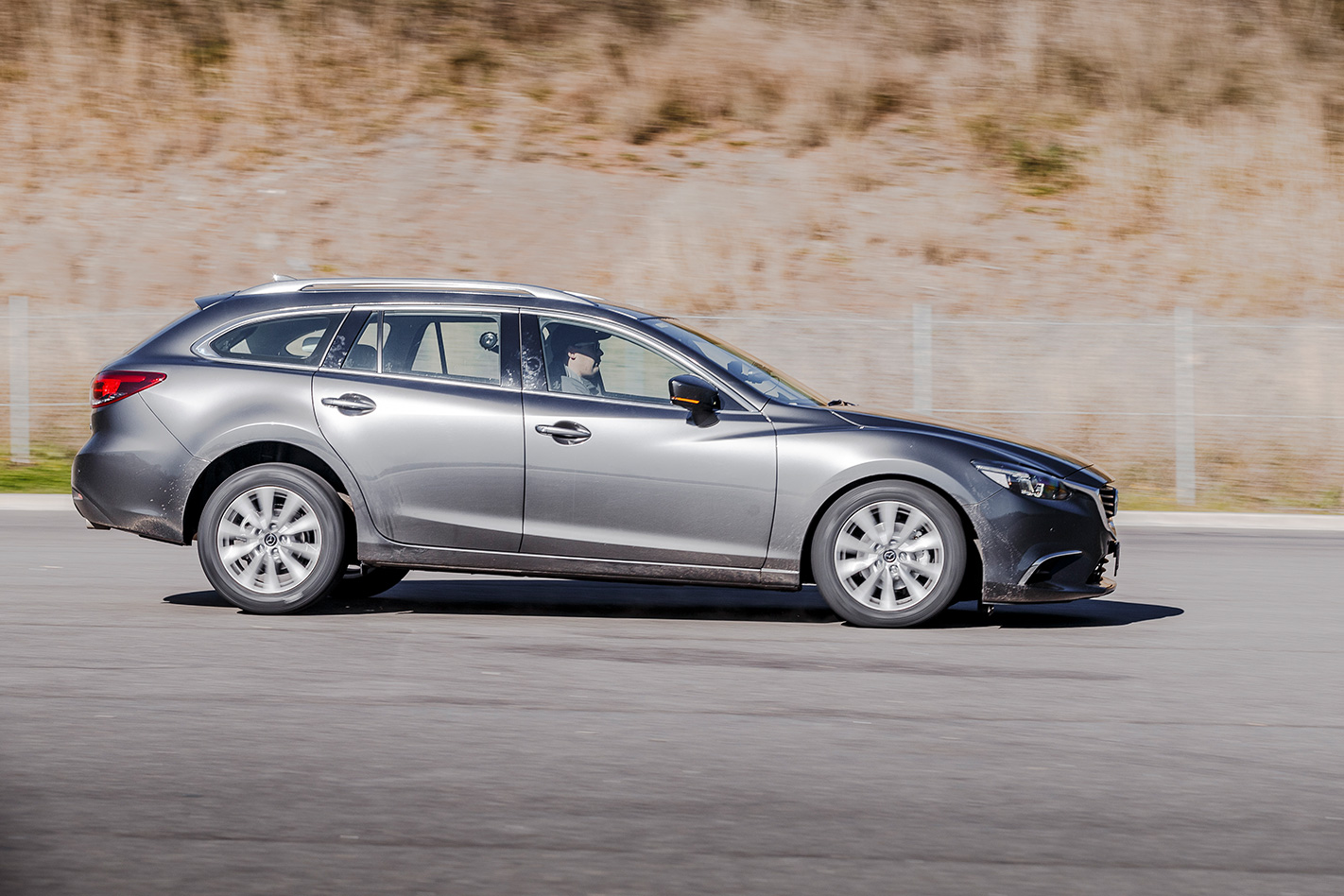
Anti-lock brakes first appeared on models from the US Big Three and Nissan in 1971, and automates the principles of threshold or cadence braking. As active safety goes, being able to stop the car, or manoeuvre around a potential collision, are two of the most fundamental crash avoidance abilities.
By preventing the wheels from locking, skidding is reduced to a minimum, reducing stopping distances on smooth and slippery surfaces. And with ABS at work, tractive contact and therefore steering ability is maintained – something that is not possible with the wheels locked.
5. Stability control
Australia was on the global forefront when, in June 2009, it was announced that electronic stability control would be compulsory on all new passenger vehicles sold here from November 2011. The crash-avoidance technology, which uses sensors to continuously compare steering angle with the vehicle’s course to establish whether the driver has control, first appeared in 1995 when Mercedes-Benz, BMW and Toyota introduced their first ESC systems, prior to the infamous Elk Test of 1997 (see opposite).
It’s official: Wheels is 65 years old. But this series isn’t about us. To celebrate our 65th, we thought we’d take a look at the decisions that have changed the automotive world over the last six and a half decades. Some were inspirations that altered it for the better, others were engineering dead ends, nefarious cover-ups and valiant flops. Scroll on to read more, then click here to explore all 65 cars, people, game-changers and failures that have influenced the car industry since 1953, in no particular order.
One of the most popular – and oldest – small SUVS in Australia has been given a late-life pep with the addition of the ASX Black Edition to Mitsubishi’s local showrooms.
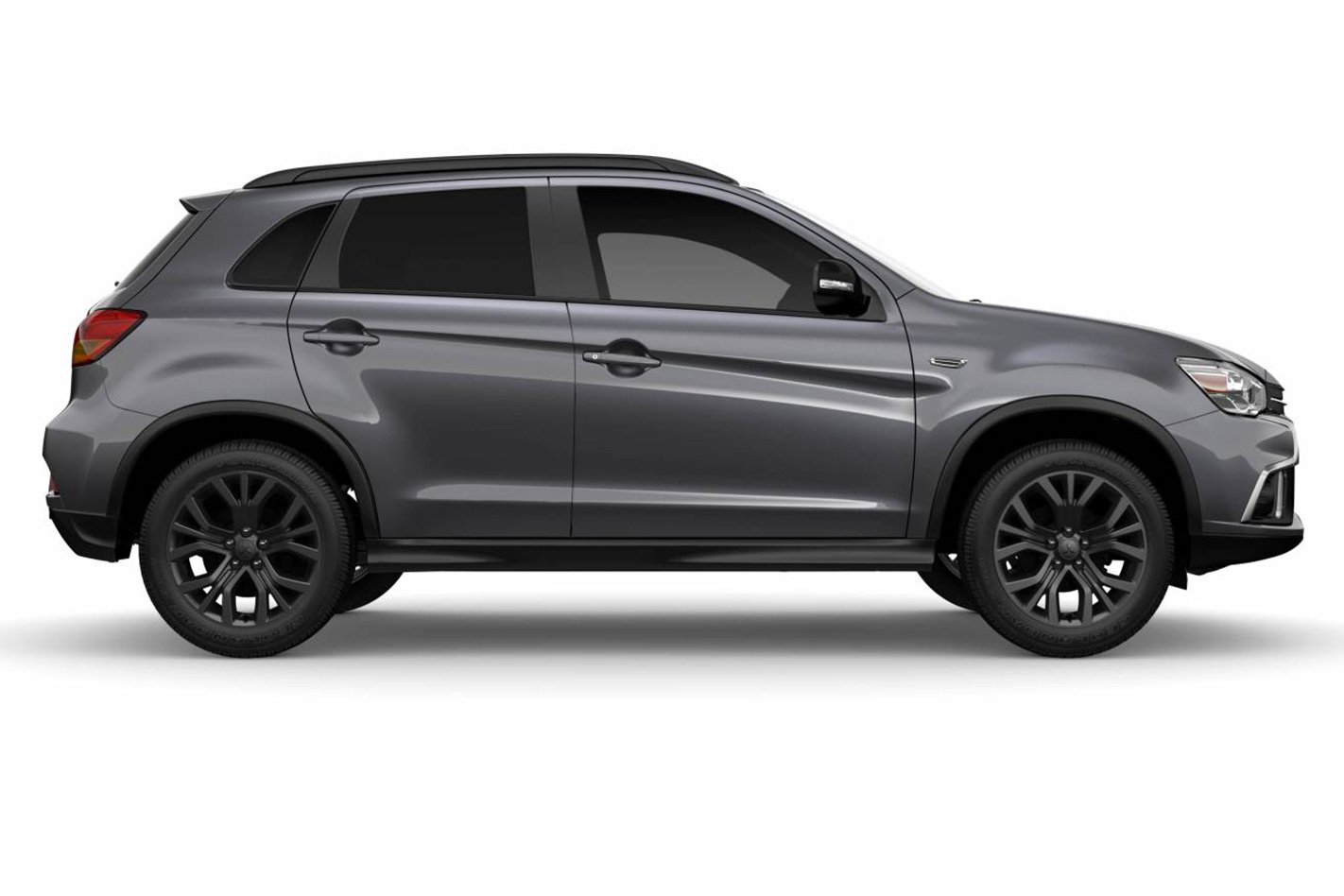
Based on the base model ASX ES CVT, the Mitsubishi ASX Black Edition retails for $26,740 – just $1250 more than the model it’s based on. That makes its value proposition enticing, given it adds fog-lamps, privacy glass, rear parking sensors and keyless entry/ignition to the ES’ specification list.
There are also cosmetic upgrades in the form of black-painted alloy wheels, mirror casings and front skid plate, along with a chrome exhaust tip. Inside, red contrast stitching, alloy pedals and leatherette/microsuede upholstery add a more premium feel to the ASX’s cabin, however the rest of the feature list is identical to the ES.
That means there’s no autonomous emergency braking (AEB), blind spot monitoring, rain-sensing wipers or dusk-sensing headlamps available, all of which are standard on every ASX grade above the ES and Black Edition.
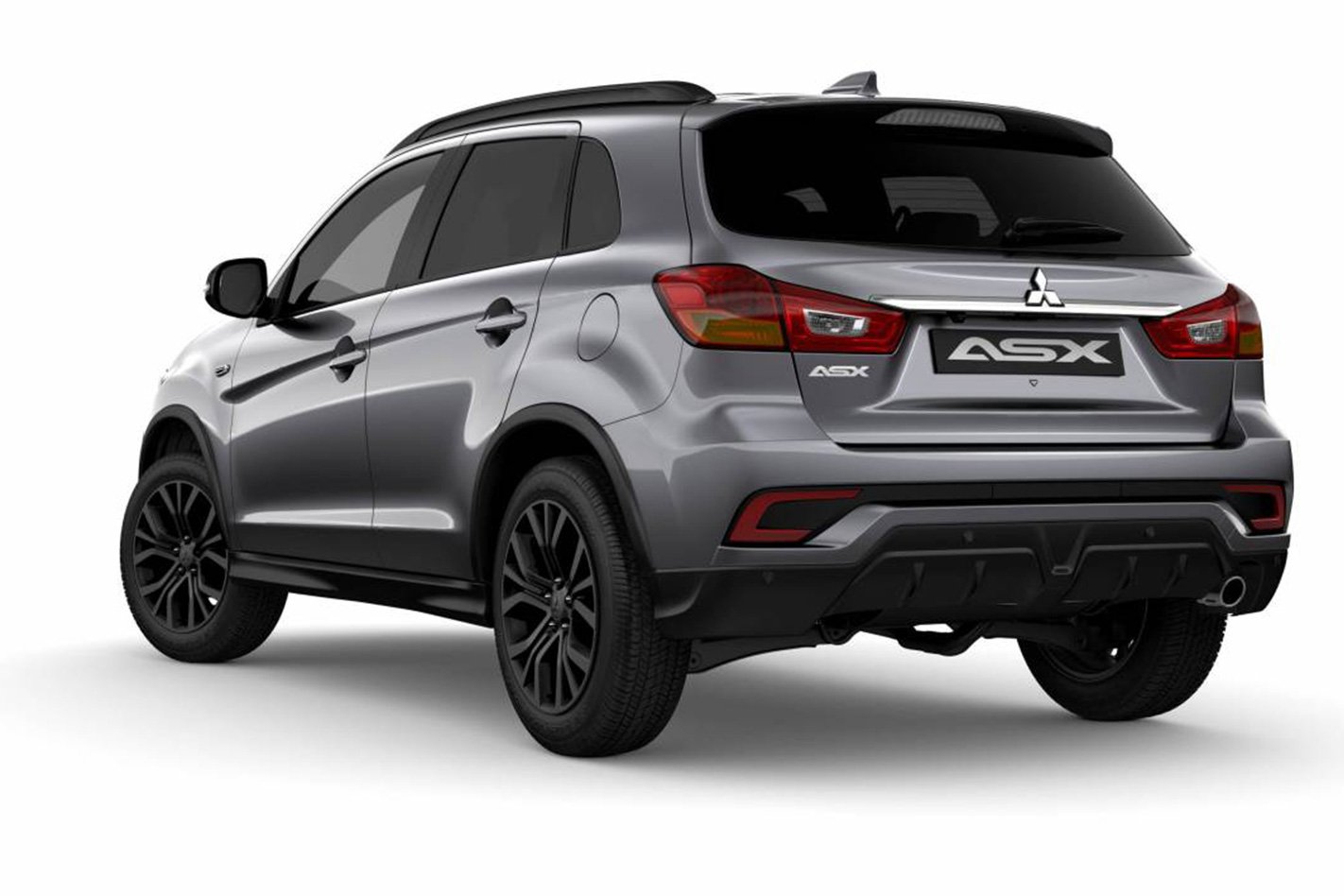
Available in three colours – black, titanium and white – just 1000 Black Editions will be available.
The arrival of the Black Edition comes just weeks after Mitsubishi Australia announced a substantial rejig of its ASK lineup, with the price of entry dropping to $23,490 for the base ES manual and AEB safety gear being rolled out across the bulk of the range.
At the same time Mitsubishi removed the diesel-engined AWD option, leaving a 2.0-litre naturally-aspirated petrol with 110kW and 197Nm as the sole powertrain for the ASX family.
2019 MITSUBISHI ASX PRICING
- Mitsubishi ASX ES manual: $23,490
- Mitsubishi ASX ES CVT: $25,490
- Mitsubishi ASX Black Edition CVT: $26,740
- Mitsubishi ASX ES CVT ADAS: $26,990
- Mitsubishi ASX LS CVT: $27,990
- Mitsubishi ASX Exceed CVT: $30,990
