
In bad news for its rivals, Porsche has made the Boxster even better.
In truth, there wasn’t a lot to fix, but the GTS does raise the bar even further, yet falls just short of a perfect five-star score. Fear not, all will be revealed.
Dynamically, little has changed. The GTS includes the Sport Chrono package, 20-inch Carrera S wheels and Porsche Torque Vectoring as standard, but then the last Boxster S we drove also had those options fitted, so unsurprisingly the two drove very similarly.
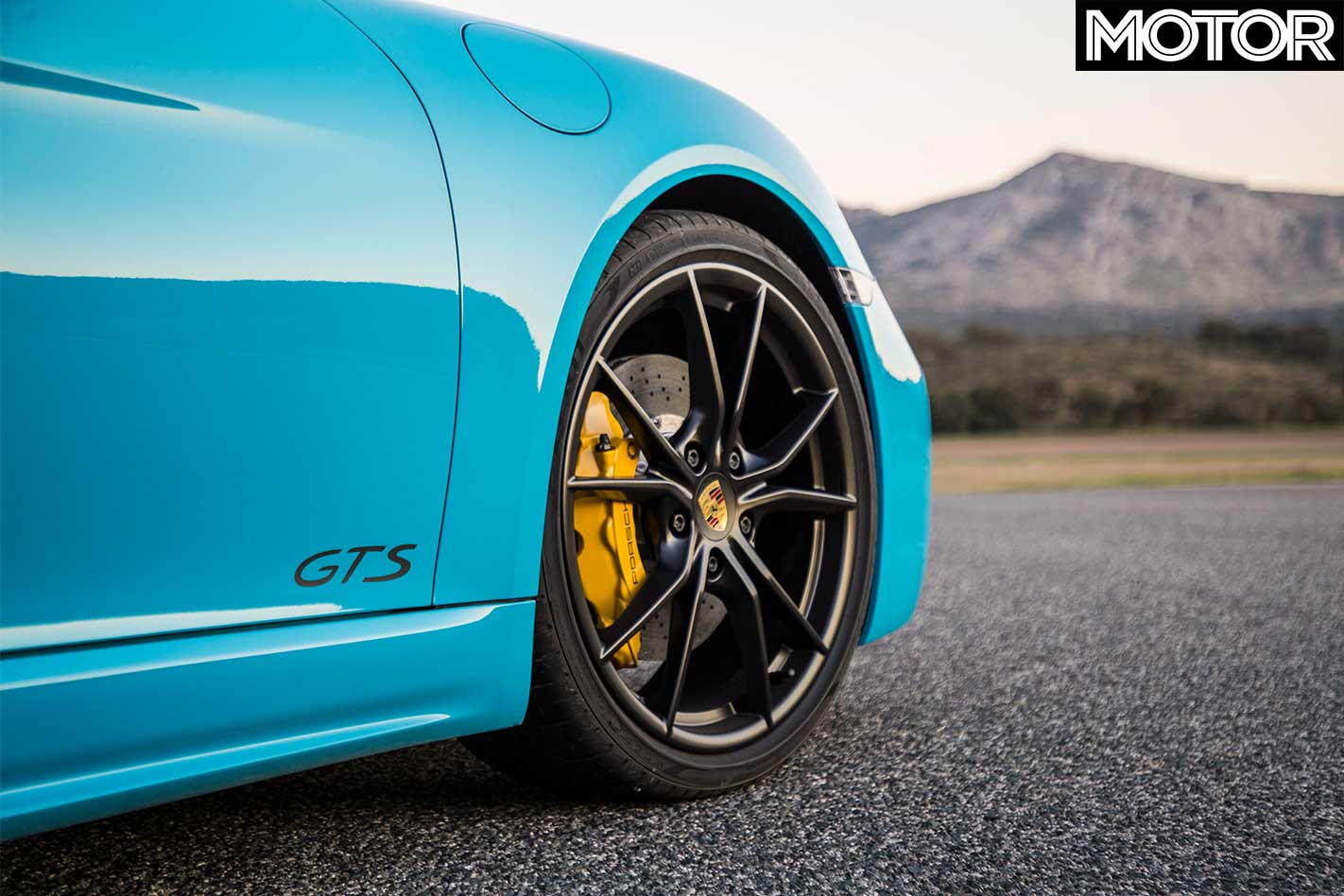
Tucked deep in the middle of the Boxster GTS is a revised 2.5-litre flat-four, a larger intake feeding air to a redesigned turbocharger capable of generating 1.25bar of boost (a 0.15bar increase over the S). Power is up 12kW to 269kW at 6500rpm, while torque increases just 10Nm if you choose the seven-speed PDK, or remains at 420Nm with the six-speed manual.
This level of grunt brings the Boxster chassis alive. There’s still more grip than grunt, but not to the point where you can just flatten the throttle everywhere. Start to approach the limits and the rear will start to slide under power, while on a track a bit of provocation will have the Boxster drifting like a champion.
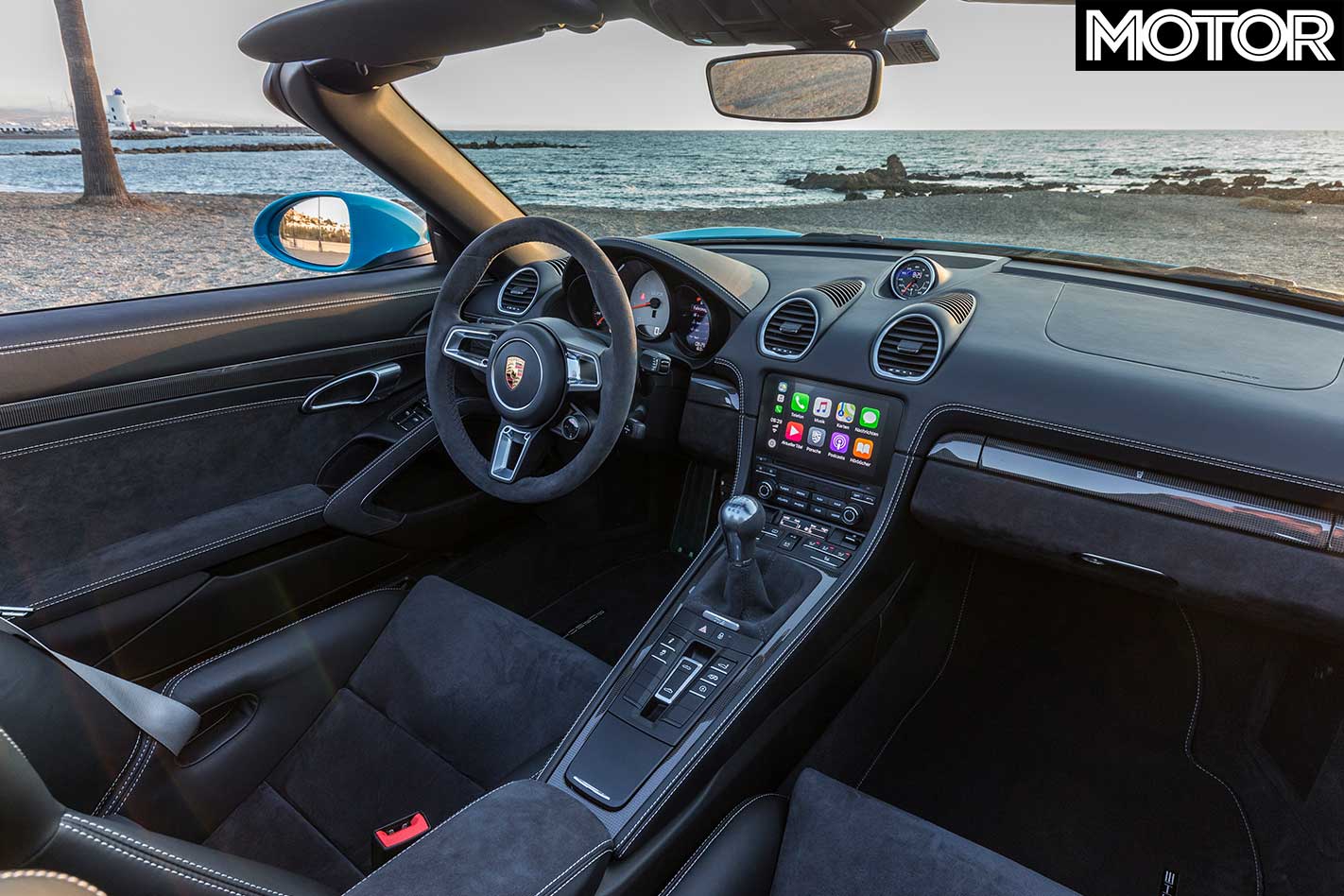
Porsche claims 0-100km/h takes 4.1sec, but given we’ve figured both a Cayman S and Cayman GTS at under 4sec, it’s safe to say that claim is conservative – this is an outrageously quick car. What’s most pleasing is that this revised engine now sounds good. No, not great, but no longer like a turbo BRZ, either. It has a hard-edged growl at high rpm that is uniquely addictive.
So if it’s the best thing since sliced bread to drive (excusing the confusing metaphor), what costs it a perfect score? The price. Our test car was $209,300 before on-roads and the handful we’ve seen in dealers have been around $225K driveaway.
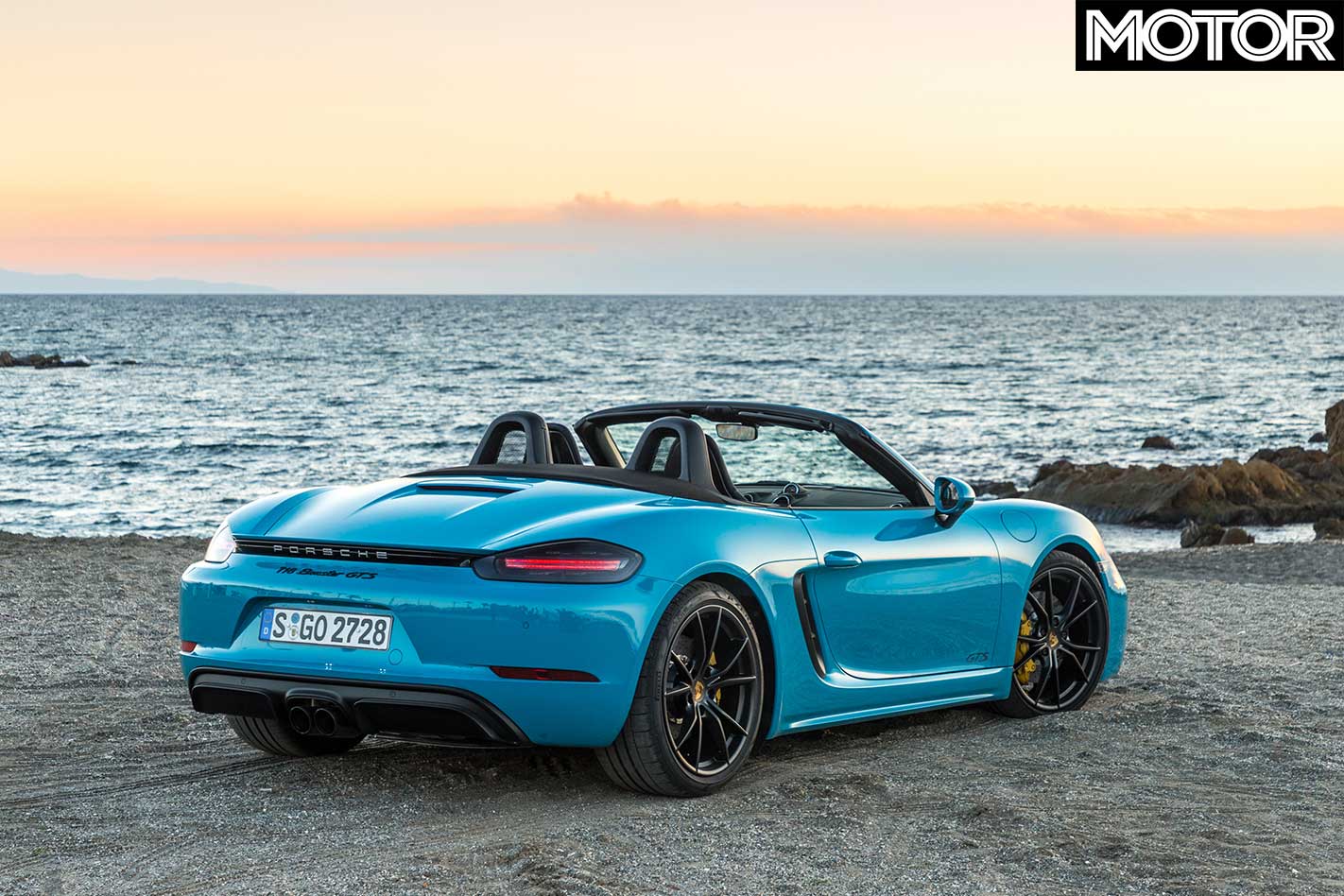
Frankly, it’s good enough that the price isn’t that outrageous – you’ll need an Audi R8 RWS Spider to find more open-top enjoyment – but when a well-specced base Boxster is so accomplished for around $80K less the GTS is really only for those who must have the very best. Still, if you’ve got the cash, that’s what it is.
2018 PORSCHE 718 BOXSTER S SPECS: Engine: 2497cc flat-4cyl, DOHC, 16v, turbo Power: 269kW @ 6500rpm Torque: 430Nm @1900-5000rpm (PDK) Weight: 1405kg 0-100km/h: 4.1sec (claimed) Price: $175,900 (manual); $181,880 (PDK)
Rating: 4.5 out of 5 stars
What stands out?
The 70 Series Toyota LandCruiser is built as tough as they come for a range of commercial four-wheel drive roles. Some models are family friendly, but only if you want a big but basic vehicle. Distinctly different variants cover a spectrum of uses, from farm truck to mine transporter and outback tour vehicle.Toyota improved driveability, comfort and safety in the 70 series significantly in November 2016. 4×4 Australia magazine named the 70 Series Double-Cab its 2017 4×4 of the Year.
What might bug me?
At highway speeds, engine and wind noise.That you have to change gears yourself: the 70 Series does not offer auto transmission.That the rear wheels of your 70 Series LandCruiser are spaced closer together than those up front. That means the rear tyres don’t quite ride in the front wheeltracks on soft surfaces such as sand or mud. The result is unnecessary rolling resistance.The rough, truck-like ride and imprecise handling, compared with 4WD wagons that place a higher priority on family use.That your 70 Series LandCruiser does not offer any airbag protection to people riding in the rear seats. In addition, only the 79 Single-Cab trayback provides airbag protection from side impacts to people in the front seats. (Almost all other 4WD wagons and dual-cabs supply curtain airbags at head level that protect passengers front and rear in side crashes.) For more on 70 Series safety features, please open the Safety section below.
What body styles are there?
The 70 Series LandCruiser comes in four different bodies. The most family friendly models are the four-door, five-seat wagon (the 76 Series), and the four-door, five-seat Double-Cab trayback ute (the 79 Series).Also part of the 79 Series is a two-seat Single-Cab farm and work truck. Neither the Single-Cab nor the Double-Cab has a factory tub at the rear, but Toyota offers various trays at additional cost. Buyers can also fit after-market trays.You can also opt for the two-door Troop Carrier van, which has two seats up front and the option of a forward-facing bench seat in the rear for up to three more passengers. (The sideways-facing rear benches that gave the vehicle its name, each seating up to four, were retired with the upgrade of November 2016.) This is the 78 Series.All models have part-time four-wheel drive with dual-range gearing. Part-time 4WD means you must use a 70 Series in rear-wheel drive on sealed surfaces but may switch manually to 4WD on soft, loose or otherwise slippery surfaces. Dual-range gearing allows you to select a second set of lower 4WD gear ratios. These allow you to drive comfortably at very slow speeds on rough ground.The 76 and 78 Series LandCruisers are classed as upper large SUVs, lower priced. The 79 Series is classed as a light commercial cab-chassis 4WD.
What features do all 70 Series LandCruisers have?
Two front bucket seats, tilt and reach adjustment for the steering wheel, a radio and CD player, and Bluetooth phone connectivity with voice-recognition control. USB and auxiliary inputs for the audio system, and a 12-volt outlet.Cruise control. A fuel tank that holds at least 130 litres.A snorkel-style, pillar-mounted engine-air intake, which helps prevent water from entering the engine when crossing creeks.Sidesteps, which make it easier to get in and out of the high-riding cabin.Hill-start assist, which helps you start from rest on steep slopes by controlling the brakes automatically.Active traction control (Toyota calls it A-TRC), which can apply the brake on any wheel to control wheelspin – often a big help when off road.Electronic stability control, which can help you drive out of a slide.All 70 Series LandCruisers have at least two airbags (in front of the driver and front-seat passenger), and anti-lock brakes.All 70 Series models come with a 100,000km, three-year warranty, and offer fixed-price servicing for the first three years.
Which engine uses least fuel, and why wouldn’t I choose it?
Only one engine is fitted across the entire the 70 Series range. It’s a 4.5-litre V8 turbo diesel, which produces excellent pulling power from very low speeds.However it is not so strong at highway speeds. The engine is designed and geared for low-speed hard work, and not for easy highway cruising. (While it is the same size and layout as the diesel in the LandCruiser 200 wagon, a 200 has half again as much grunt.)The 70 Series diesel was revised very mildly for the upgrade of November 2016, to meet tougher emissions standards. It does not produce any more power than before, but it uses a bit less fuel.In the official test it uses 10.7 litres/100km. In the real world it is thirstier, using 12 to 14 litres/100km.Only one gearbox is available, a five-speed manual. Second and fifth gear were lengthened in November 2016, the latter by about 15 per cent. The result is an engine that spins a bit slower when you are cruising down the highway.
What key features do I get if I spend more?
The least costly 70 Series LandCruisers, the WorkMates, run on 16-inch steel wheels and have vinyl seats and floors. In a Single Cab you can spend more for a GX, which has flashier aluminium alloy wheels and wider tyres, and flared mudguards to accommodate the tyres.In any body style you can spend more again on a GXL, which gets you a chrome-look front bumper and grille (rather than black), remote locking and unlocking, power windows, cloth seats, front foglamps, and (except in a Troop Carrier) carpet on the floor.The GXLs also have the alloy wheels and wider tyres, on all but one version. The exception is the Troop Carrier, which retains the steel wheels and narrower tyres of WorkMate models.All 70 Series GXLs have driver-engaged differential locks on both front and rear axles. These help you go a lot further in extreme off road conditions. The differential locks are available as an option on the GX Single-Cab chassis and WorkMate Double-Cab chassis. (They are not available on other Workmate models.)Air-conditioning is an extra-cost option on all models.
Does any upgrade have a down side?
The alloy wheels are not as easily repaired as the steel wheels if damaged – for example, by big potholes or rocks. (Since the upgrade of November 2016, the steel wheels mount tubeless tyres and no longer use a split-rim design – which had made it easier to remove a tyre from the rim.)The wider tyres fitted to the alloy wheels can be more damage-prone in severe off-road conditions than the narrower tyres, and are less effective in some driving conditions.The power windows on the more expensive models add complexity, which could be relevant for some uses.White, sandy brown and dark blue are standard colours. Four other colours are extra-cost options.
How comfortable is the LandCruiser 70 Series?
It’s a big step up to a 70 Series cabin, and once there you sit very upright in a tall, roomy and truck-like space. It’s spartan but still comfortable, and the driver gets the benefit of tilt and reach steering wheel adjustment, a rare feature in a commercial-style vehicle. The upgrade of November 2016 improved the front seats.Big, clearly marked switches and relatively light controls make this an easy vehicle to use.The high cabin and low window line also make for great vision.On the road the 70 is very low geared, which means you’re up into top gear very quickly. With this low gearing and the big power at slow engine speeds, you can use top gear from not much above walking pace. If you are carrying only a light load, you can skip gears when accelerating to highway speeds – without losing any performance.The downside of the low gearing is that the engine revs quite hard and roars at open-road speeds. Since November 2016 a taller top gear has allowed the diesel a more comfortable gait – top is now roughly equivalent to the fifth gear in a six-speed auto LandCruiser 200, for example – but when you add wind noise from the upright windscreen, and from the A-pillar mounted air-intake snorkel, the highway experience remains less than relaxing.
What about safety in a LandCruiser 70 Series?
Ironically if you want a family vehicle for remote-area touring, the safest 70 Series carries only two passengers. That is the 79 Single-Cab ute, a fixture on mining fleets and the only 70 Series model to receive a five-star rating from safety authority ANCAP.Safety in all 70 Series vehicles was improved with the upgrade of November 2016. But the 79 Single-Cab was improved more than others.The main safety enhancement applied to all models was the addition of electronic stability control, which since 2014 has been mandatory on new passenger cars (but not on commercial vehicles). It can help you avoid losing control of a skidding vehicle (by controlling the brake on each wheel independently).A related addition is electronic brake-force distribution, which makes sure each tyre is using all available grip when you want to stop in a hurry. This too has long been ubiquitous on passenger cars.Also a safety improvement, especially in steep off-road driving, is the addition of Hill start assist, which helps you take off on uphill slopes (by controlling the brakes automatically). Toyota says it will work even when you are carrying a big load or towing a trailer.All 70 Series models have two airbags up front, protecting the heads of the driver and front passenger in a frontal crash. (Only the 79 Single-Cab has other airbags.) All have seatbelt reminders on the front seats.The 79 Single-Cab has, in addition, a frontal airbag for the driver at knee level, and curtain airbags on each side at head height that help in side-crashes, for a total of five.The Single-Cab also has new seats that protect you better from whiplash injuries if you are struck from behind, and a revised chassis and steering mechanism that make it more likely you will walk away from a crash.A reversing camera is not available even as an option on any 70 Series model.The Australasian New Car Assessment Program (ANCAP) awarded the 79 Single-Cab five stars for safety, its maximum, in October 2016. The 79 Dual-Cab and other 70 Series models have not been rated.
I like driving – will I enjoy this car?
You might not. If you require effortless and precise progress, this is not an enjoyable car – at least on the road. The roadholding, steering and handling don’t inspire much confidence. Cab-chassis models also have a very hard ride unless there’s weight in the tray.But if you appreciate a big, airy cabin with a high driving-seat and superior vision, then any variant of the 70 can’t be beaten as a place from which to take in countryside of all kinds. The longer gearing since the update just adds to the pleasure.And you can go where you like. Any 70 Series LandCruiser is near unstoppable off-road, especially when equipped with the front and rear diff locks that are either standard or optional on most of them. Thus equipped, the 70 Series is the ultimate vehicle for exploring the most remote parts of Australia. In that environment it is a very enjoyable car to drive, given the enormous go-anywhere security it offers.
How is life in the rear seats?
Rear cabins in the 76 Wagon, 79 Dual-Cab and 78 Troop Carrier have upright but comfortable seats and offer excellent headroom and reasonable leg room. The centre passenger only has a lap seat-belt, rather than a lap-sash belt.
How is it for carrying stuff?
Being a commercial vehicle, the 70 Series is an excellent load carrier. The Single-Cab chassis, with a payload of about 1220kg (driver, passengers and tray included), can carry the most.The 76 Wagon, with a payload of 780kg (driver and passengers included) can carry the least.These payload figures are what the vehicle is rated to carry, but in real-world conditions the 70 fares better than most other vehicles with similar theoretical capacities. (Nevertheless, use caution if you want to drive with loads approaching these limits.)The box-style bodies of the 76 Wagon and 78 Troop Carrier are also very space efficient and give an enormous cargo volume. The Troop Carrier can hold more than the wagon, because its wheelbase – the distance between the front and rear axles – is 250mm longer. Cab-chassis models have a longer wheelbase again.All 70 Series LandCruisers are rated to tow up to 3500kg with a braked trailer, which matches any other 4WD wagon or ute.
Where is the LandCruiser 70 Series made?
All 70 Series Toyota LandCruisers are built in Japan.
What might I miss that similar cars have?
The only direct rival for the LandCruiser 70 Series has been the Land Rover Defender, produced in a range of models like the LandCruiser. However, Land Rover stopped building new Defenders in January 2016.The Indian Mahindra Pik-Up is another cab-chassis alternative.If you are looking for a big 4WD in which to tour remote areas, then alternatives include the Toyota LandCruiser 200 (in particular the workaday GX version) and Prado, Ford Everest, and Holden Trailblazer.
Are there plans to update the LandCruiser 70 Series soon?
No. The 70 Series gained its turbocharged V8 diesel engine in 2007, front airbags in 2009, and anti-lock brakes in 2013. About November 2016 all Single-Cabs gained what they needed for a five-star ANCAP safety rating, which included revisions to the front of the chassis, relocated steering, and three additional airbags. At the same time, the Single-Cab and the remaining 70 Series models got electronic stability control, Active traction control, better front seats, and a taller top gear. That upgrade is likely the last you will see for a while.Despite being such an old model there is still plenty of life left in the 70 Series. It won 4X4 Magazine’s 2017 4×4 of the Year. And in September 2017 Toyota confirmed it’s place in the Australian market is assured because of continued demand from the mining sector.
I like this car, but I can’t choose which version. Can you help?
The best family vehicle here is the 76 Series Wagon in GXL spec – unless you want a dual-cab ute, in which case the pick is the 79 Series GXL Double-Cab.
Warren Luff will take on driving duties in the MCA ‘Hammerhead’ S13 Nissan Silvia at World Time Attack Challenge 2018, with last year’s champ Tim Slade unavailable.
Hammerhead has been the outright winner for the last two WTAC events, and Luff remains one of only four people to have won WTAC outright.
With this in mind, Luff tells MOTOR he’s looking forwards to getting back to WTAC after a few years away.
“I’m really excited about it, it’s an event that I’ve always loved and have been disappointed that I haven’t been able to go back in the last few years since last time I drove Nemo [an Evo IX built by McElrea Racing]. It’s great to see the way the event has grown year by year and how much faster the cars are going.
“It’s a really exciting opportunity for me, and I’m really looking forward to driving Hammerhead and representing the guys from MCA, and seeing if we can make it three years in a row for them.”
Luff’s consistency and ability to produce impressive lap times repeatedly, as proven over many years in Suparcars and as MOTOR’s pro driver since the mid-2000s, puts him in a good place to go for the win at WTAC 2018.
“There’s a lot of expectations, and the way the event has progressed over the years, I think everyone feels that pressure to step it up and perform better than they did they previous year, and to find that new thing to make the cars go quicker and push the boundaries.
“That’s probably what makes the event so exciting and what draws people back to see it year in, year out.”
In 2012, Luff secured a win at WTAC driving the ‘Nemo’ Mistubishi Evo IX, after having competed the previous two years in a Lotus Elise built by the team at Prep’d.
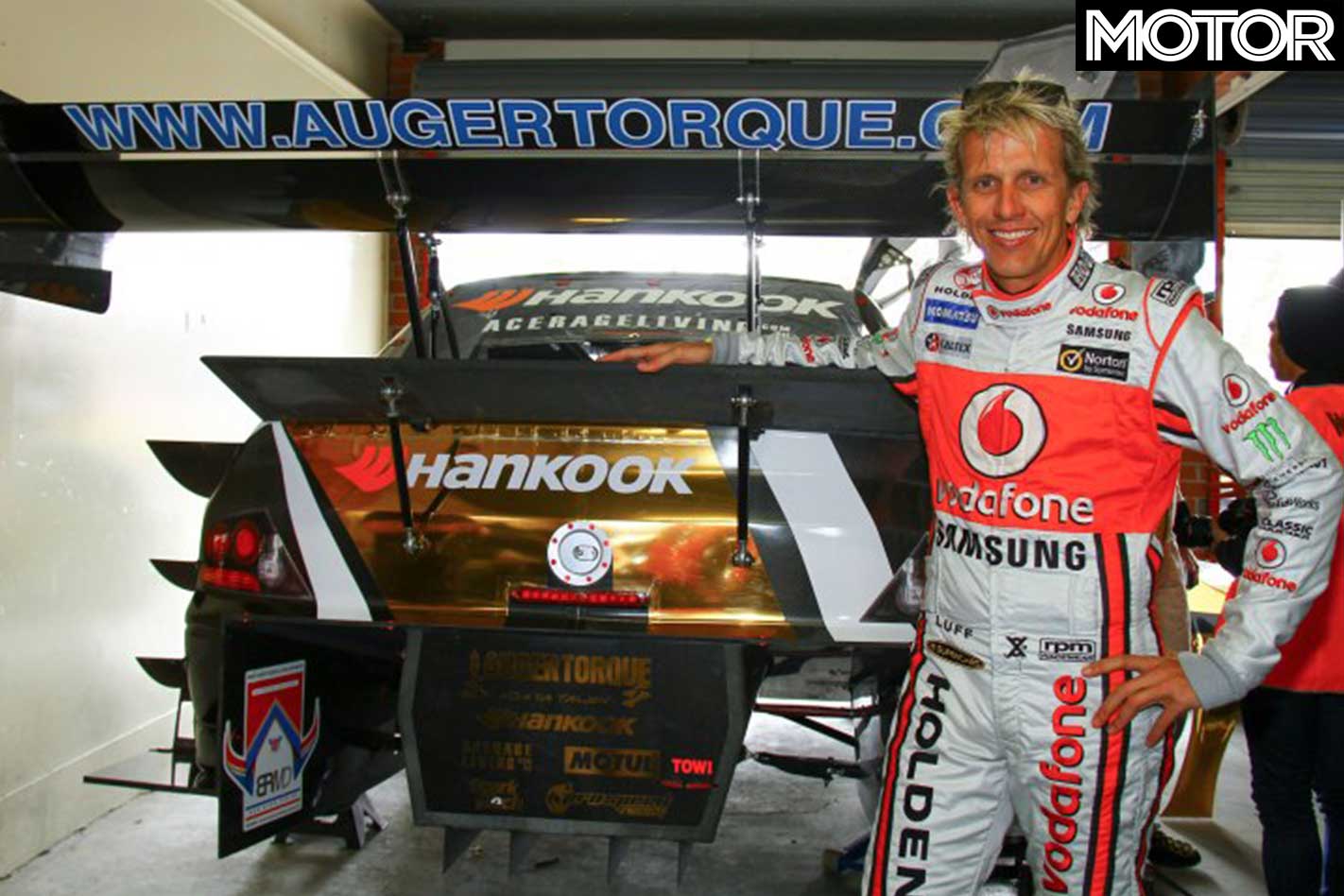
“It was great winning in 2012 with Nemo, and it came about so ‘last minute’. I didn’t drive the car until the event. I was down there to help the owner and originally the plan was for him to drive it.
“I think when he first drove it there he realised he had a car that was capable of winning, but probably that his driving wasn’t quite at the level it needed to be. So they asked me to step up and drive.
“Nemo was that car that really changed the philosophy of what you needed to build to have a competitive Time Attack car.
“I think that’s the thing that really sets Time Attack apart from any other motorsport, it really allows you to be creative with whatever car it is that you’re building. There are rules and some things you can or can’t do, but there’s so much more scope to play with aero and do all sorts of crazy things that push the boundaries.
“That’s where you see so many different cars with so many different concepts relating to aero, engine, suspension, and things that you don’t get to see in conventional motorsport.”
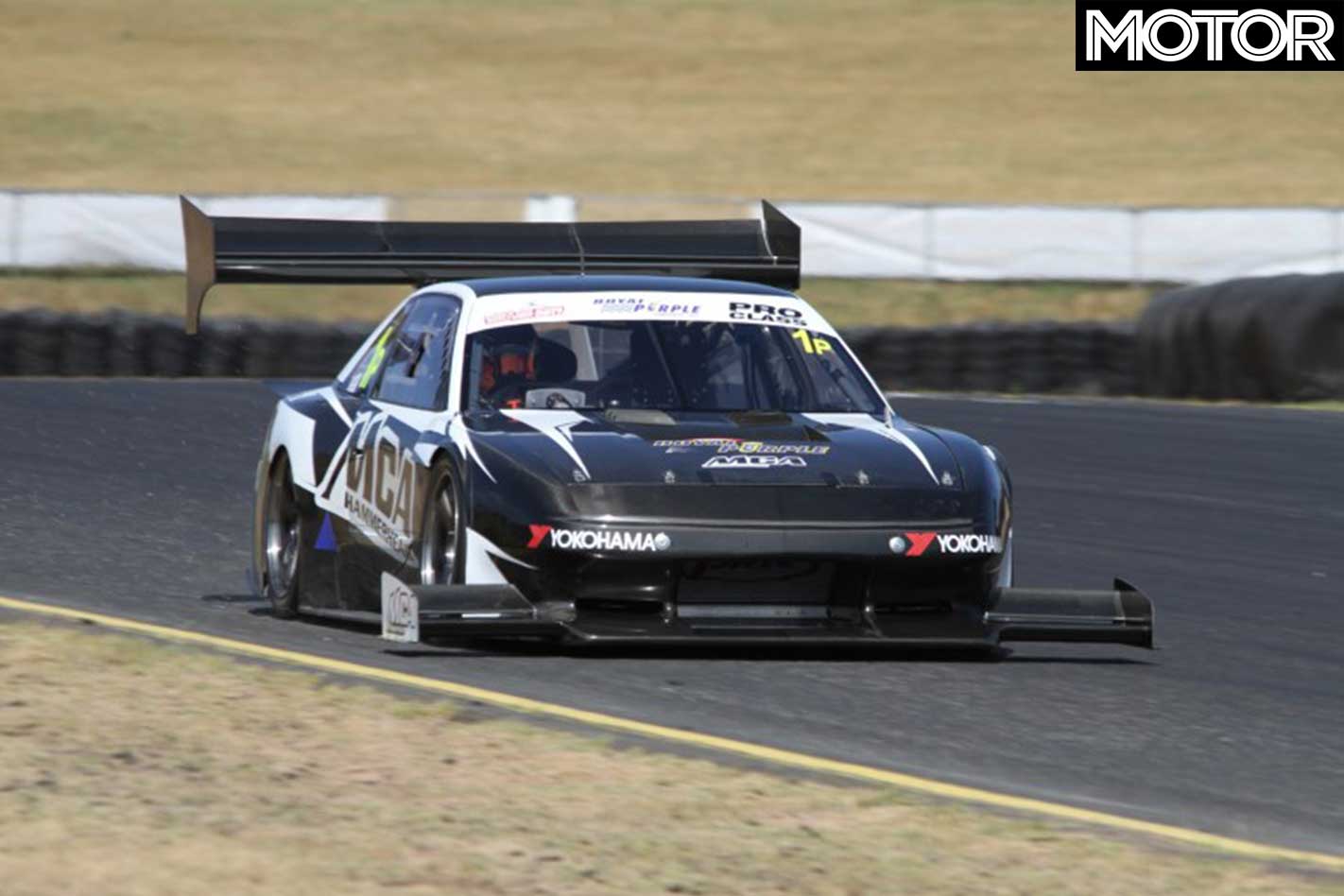
MCA team principal Murray Coote says Luffy’s skills as a consistent driver are well known, and made it an easy choice to have him drive Hammerhead this year.
“It is one thing to get in and drive real fast in a car you are used to driving all the time, but another thing all together to string together a near perfect lap with very little seat time.
“His experience across many classes from GT to Supercar and more will indeed prove an asset.”
The man behind WTAC, Ian Baker, says he’s thrilled to have Luff back on the list of named hitting WTAC this year.

“There is no question Murray Coote knows how to pick the drivers,” Baker says.
“You only have to look at the history to see that so no doubt that goes to show the skillset of Luffy. He has been a part of WTAC many times right back to 2010 when he was the fastest Aussie in the Prep’d Lotus GT3.”
“I doubt you would find a more worthy replacement for Tim Slade than Warren Luff so we all can’t wait to see how he goes in October.”
Baker spoke to MOTOR briefly about WTAC this year, and while there’s still plenty to be announced that’s being kept under wraps, Baker assures us this year will be ‘bigger and better’.
Attending in 2018 are people in the Time Attack and drift communities such as Daniel ‘Fanga Dan’ Woolhouse, Michele Guyer, Kester and Jaron Olivecrona, and of course, Keiichi ‘Drift King’ Tsuchiya.
Stay tuned for more big WTAC 2018 news as it comes to hand.
WHAT IS IT
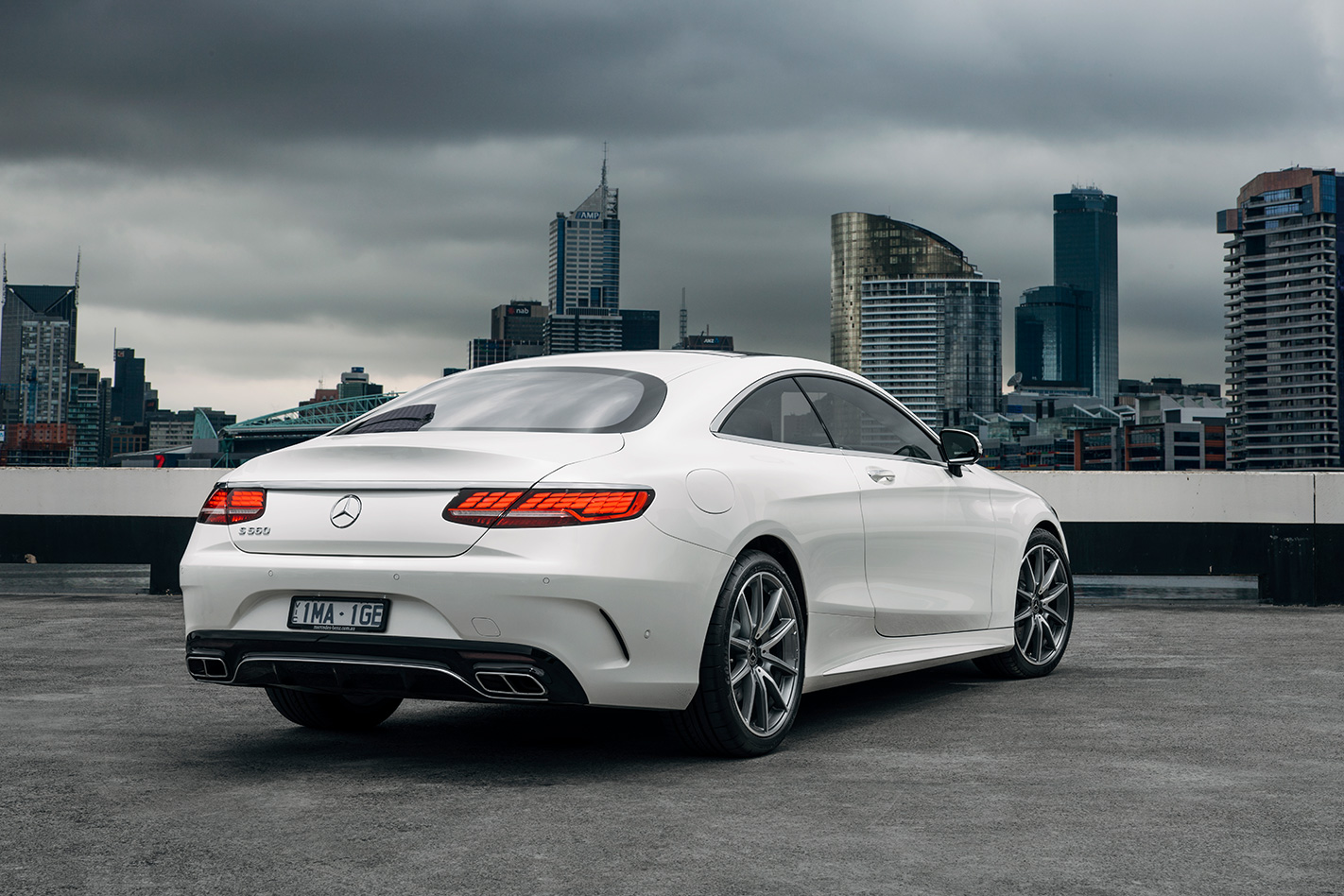
It’s ostensibly a Mercedes-Benz S-Class limo shorn of a couple of doors. That much isn’t too difficult to get a handle on, but the Coupe takes on a more raffish, less business-formal persona. It weighs in against some formidable rivals, but it has developed into a wholly credible contender.
WHY WE’RE TESTING IT
Mercedes invited us to drive the GLC 63S hot SUV and had a couple of pre-production S-Class coupes lurking in the back lot. It seemed an opportunity too tempting to turn down, so instead of sitting down to lunch with a pot and a parma, we had a pedal in both the S560 and S63 AMG versions.
MAIN RIVALS
Aston Martin DB11; Bentley Continental GT; BMW 8 Series; Maserati GranTurismo; Porsche Panamera
THE WHEELS VERDICT
Although S-Class Coupe buyers aren’t notably price averse, less in this instance is more. Yes, you could easily spend $600K on an S65 AMG V12 with options, but the $315K entry-level S560 is as sweet a package as you’d ever really need and with its price reduction now looks the most competitive big Benz coupe for decades.
PLUS: Styling; equipment; ride; relaxed cadence; presence; huge boot MINUS: Badge equity at this price point; some interior quality issues; colour sensitivity; token rear seat space
THE WHEELS REVIEW
WHEN was the last time that Mercedes-Benz sold a real head-turner of a big coupe? This C217-series car, launched in 2015, was gem that needed a little polishing. Its predecessor, the C216 coupe (2007-2014) was blandly handsome, while the Peter Arcadipane-styled ‘peanut-light’ C215 coupe (1999-2006) always seemed to have an imbalance between its tank-like superstructure and its delicate glasshouse.
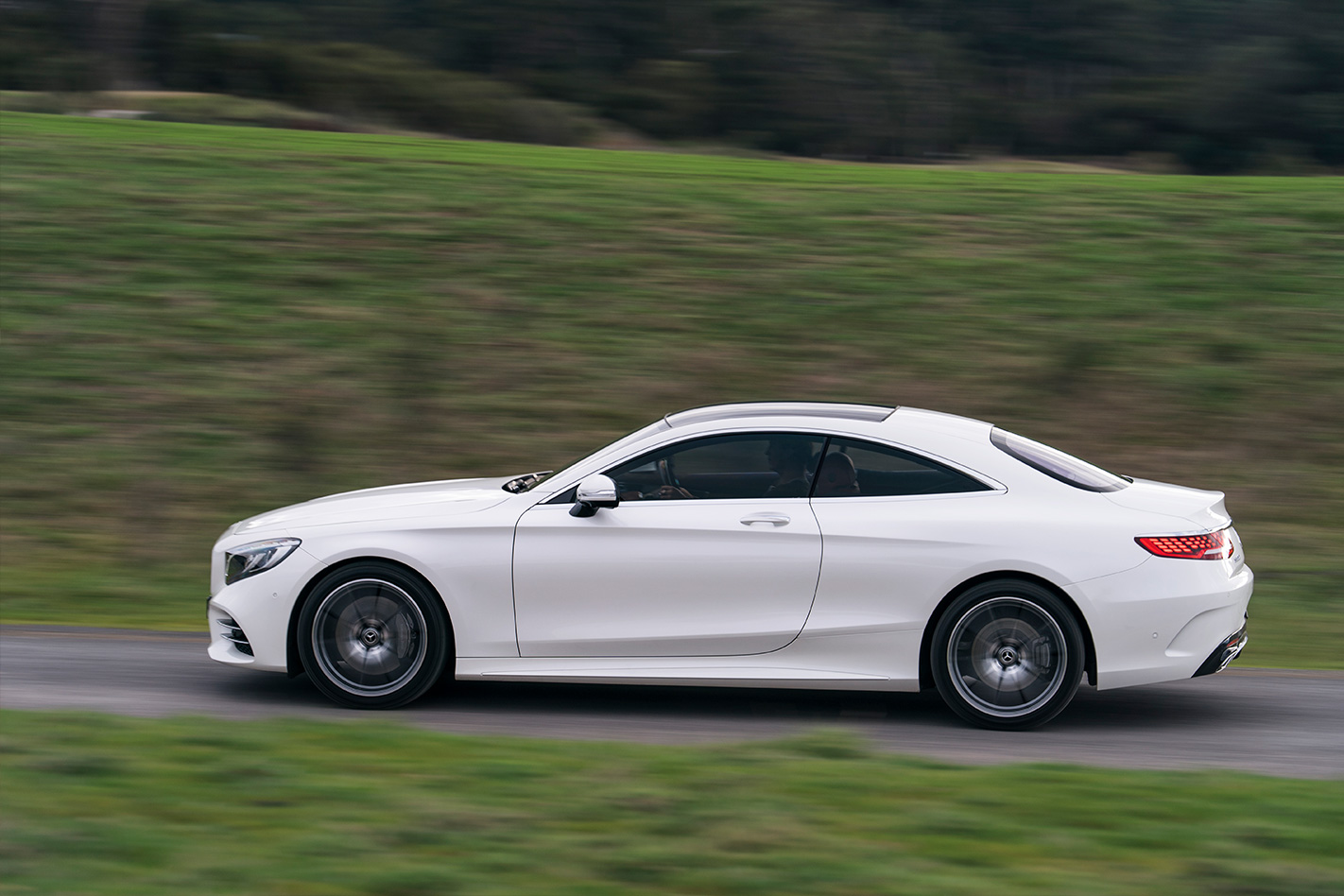
Prior to that was the porcine W140-generation CL coupe (1992-1998), so the answer to this question may well be 1991, when the last of the delightful Bruno Sacco-styled W126 SEC coupes finally rolled off the lines. This car was sketched in 1977, so it’s been four decades since we’ve been treated to a coupe flagship from Stuttgart that had the presence and force of personality to stand out as something other than an S-Class sedan with less.
While that may seem a harsh assessment, it’s one that’s borne out by sales. The SEC sold 12,343 units per year of production. The C215 shifted barely half that figure; just 6854 units per annum. Mercedes now sells 2.3 million cars per year, whereas back in 1991, the company sold 560,000 cars. You might expect the latest coupe to enjoy a fourfold increase over the sales of the old SEC, but interest in the S-Class Coupe has comparatively withered, with demand currently standing at around 9000 cars per year. Despite the AMG division going from strength to strength, it seems that big luxury coupes have fallen from favour.
It’s possible to make the case that Mercedes-Benz’s latest S-Class Coupe is therefore fighting an intriguing rearguard action. Yes, you can still buy a model fitted with the mighty 6.0-litre V12 engine for $508,900 but that’s going to sell in vanishingly tiny numbers, despite the undoubted attraction of 463kW and 1000Nm.
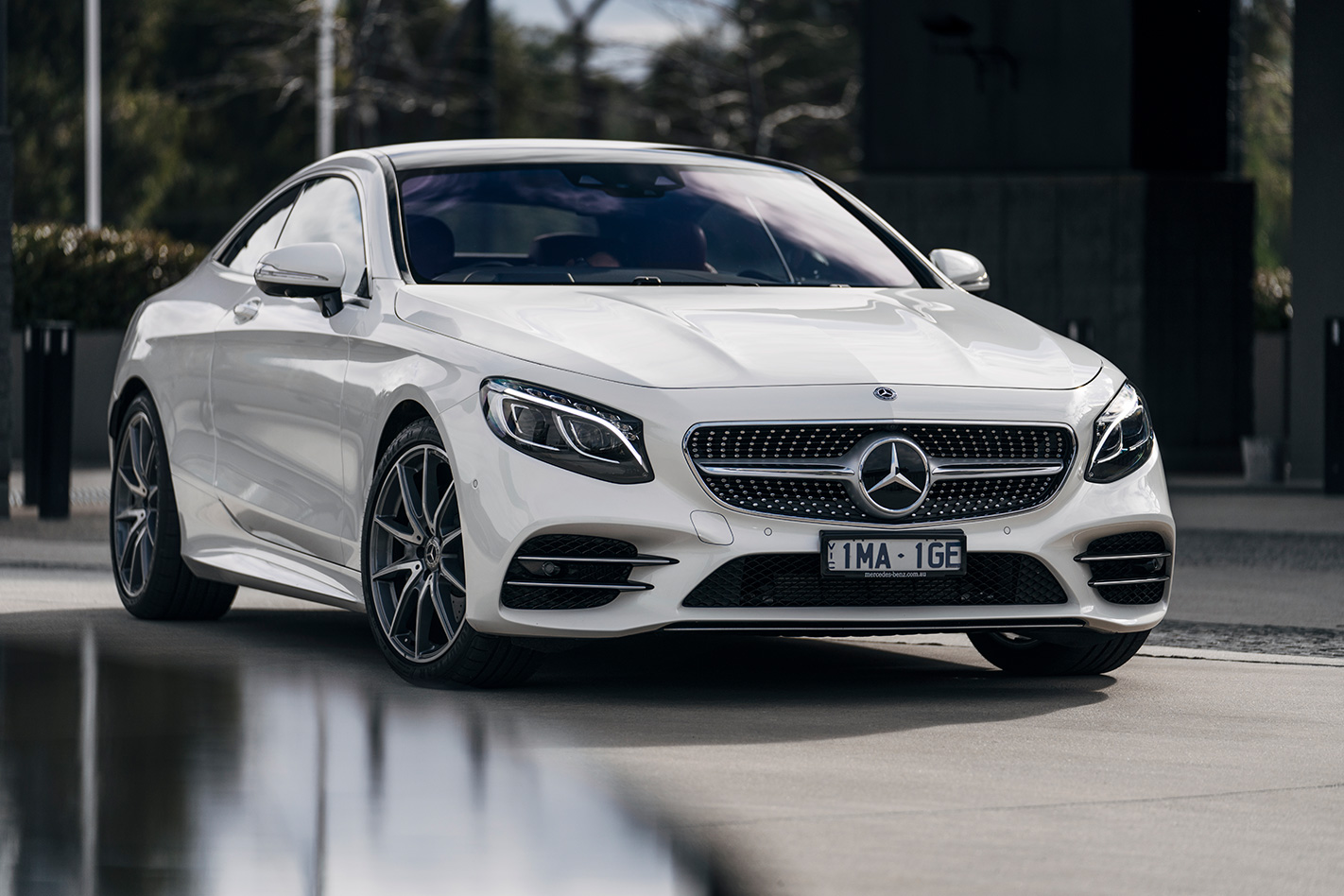
We got the chance to drive a couple of rather more relevant versions, both powered by the now-familiar 4.0-litre V8 ‘hot-vee’ powerplant. The S560 Coupe is good for 345kW/700Nm and retails at $314,900, while the S63 AMG Coupe boosts that engine to 450kW/900Nm and will set you back $370,500.
The eagle-eyed among you might have noticed that those prices are significantly cheaper than before. The S63 is $44K cheaper than its 5.5-litre predecessor, and 20kW more powerful to boot, while the S560 is $11K more affordable and 10kW punchier than the old 4.7-litre S500 Coupe. That’s more than a good start.
The S560 and the S63 look quite different, largely due to the fact that the latter now gets the vertically-slatted Panamericana grille that’s fitted to other 63-badged AMG products across the range. Your mileage may vary on quite how elegantly this works with the sleek S-Class Coupe shape. It certainly doesn’t want for visual impact now, the S560 looking almost low-key in comparison.
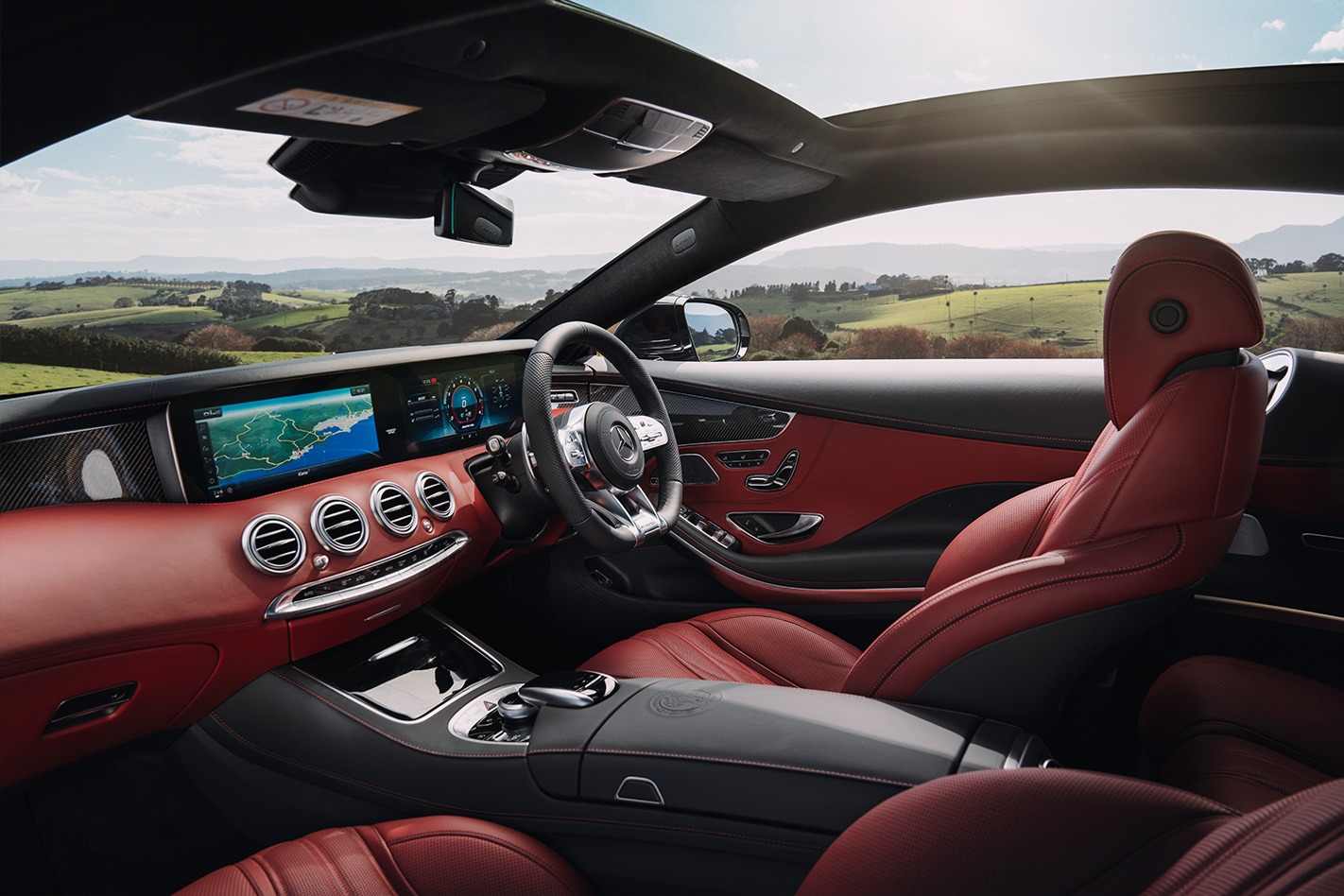
It’s usually a smart idea to jump into the least powerful car first and then work up, but availability was such that I found myself parked in the S63 AMG for the first drive. It’s debatable whether the cabin feels different enough at this price point, when you can buy something like an Aston Martin DB11 or, for just a little more, a Bentley Continental GT that gives a genuinely bespoke impression. It’s hard to fault the amount of gear on offer though. What’s not quite so cut and dried is exactly what the S63 AMG is trying to be.
AMG has found favour in many markets by making their wares as loud and angry as possible, a remit that doesn’t really fit with that of an elegant large coupe.
The S63 AMG wears fairly focused Continental ContiSportContact 5P rubber, 255/40 ZR20 up front and 285/35 ZR20 boots at the back and even with the air suspension set into Comfort, there’s a fair degree of tyre roar transmitted through the fuselage.
The 5.0m long and 1.9m wide body doesn’t exactly shrink around you on a twisty road, but it does a reasonably job of concealing its bulk in the sportier modes.
It feels seriously rapid, the nine-speed transmission plugging you into that prodigious torque. Take control and rev it hard and there’s a flintiness right at the upper registers as it nears its 7000rpm redline, but for the most part, it can sound distant and potent rather than spine-tingling, AMG subtly turning down the artillery sound effects on the overrun.
The AMG Speedshift MCT nine-speed transmission is a big step forward from the old seven-speed unit, helping the S63 to 100km/h in 4.2s.
One of the most interesting features on this vehicle was our first taste of Mercedes’ new cruise control system. Active Intelligent Drive allows you to set the cruise control to a certain speed, but rather than blindly attempt to maintain that speed through corners and junctions, the system relies on mapping software to judge the right speed for corners and slow to a standstill at intersections.
It’s still in its early phase of development, and it’s a little weird to begin with. Whereas a human driver would slow for a corner, then accelerate through it as the view up the road opened, the system seems to come into corners quickly and then decelerate through them. It’s a little disconcerting at first, but it seems to work. I did experience the car braking to near standstill because the mapping couldn’t tell it that I had right of way as I passed a side road, so the system is only as good as the mapping data it receives.
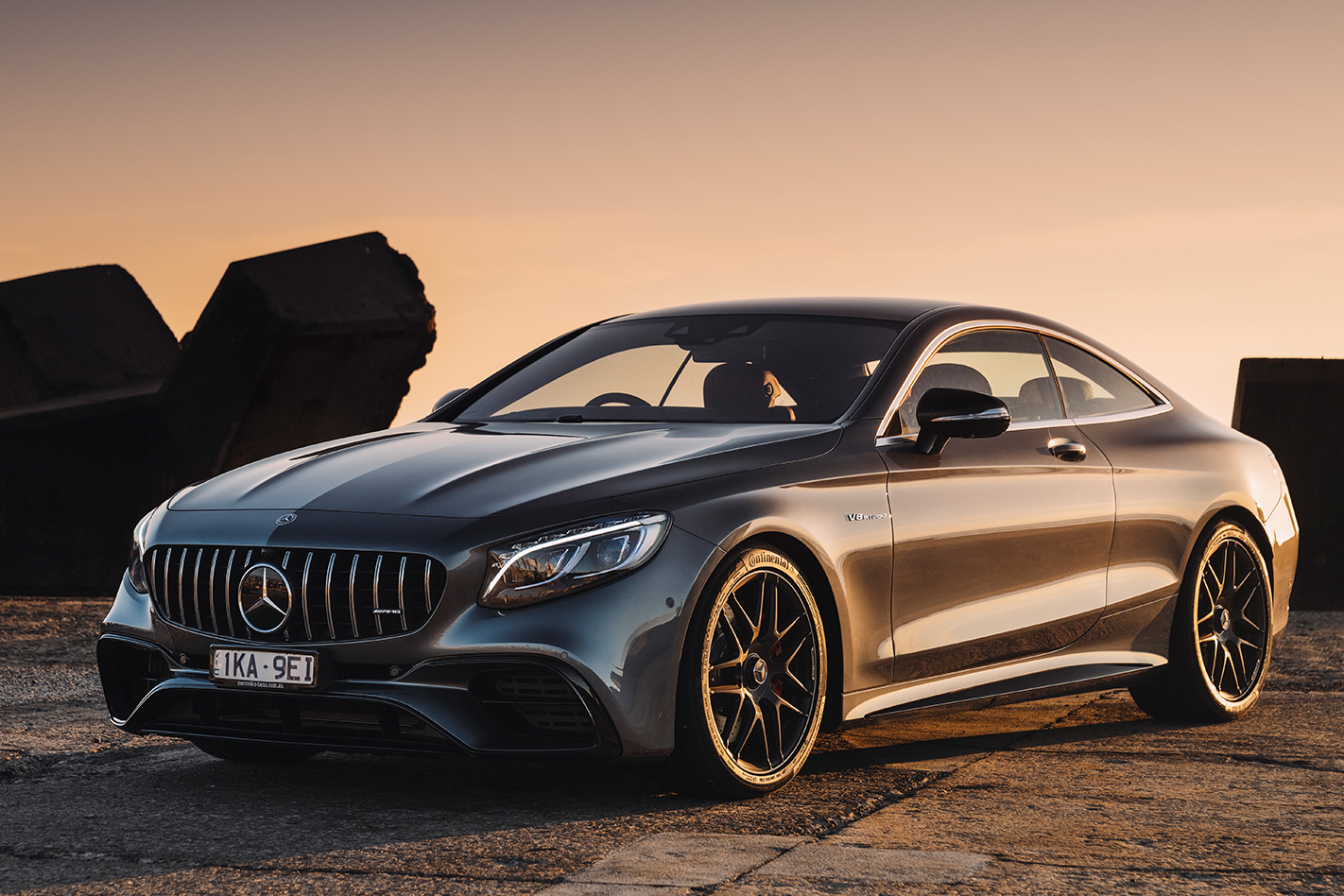
The S63 also gets the AMG Driver’s Package, which lifts the governed top speed to a vaguely academic (in this market at least) 300km/h, an AMG performance steering wheel, illuminated floor sills, 20-inch AMG forged wheels, a high-performance composite braking system with red brake calipers and a sports exhaust.
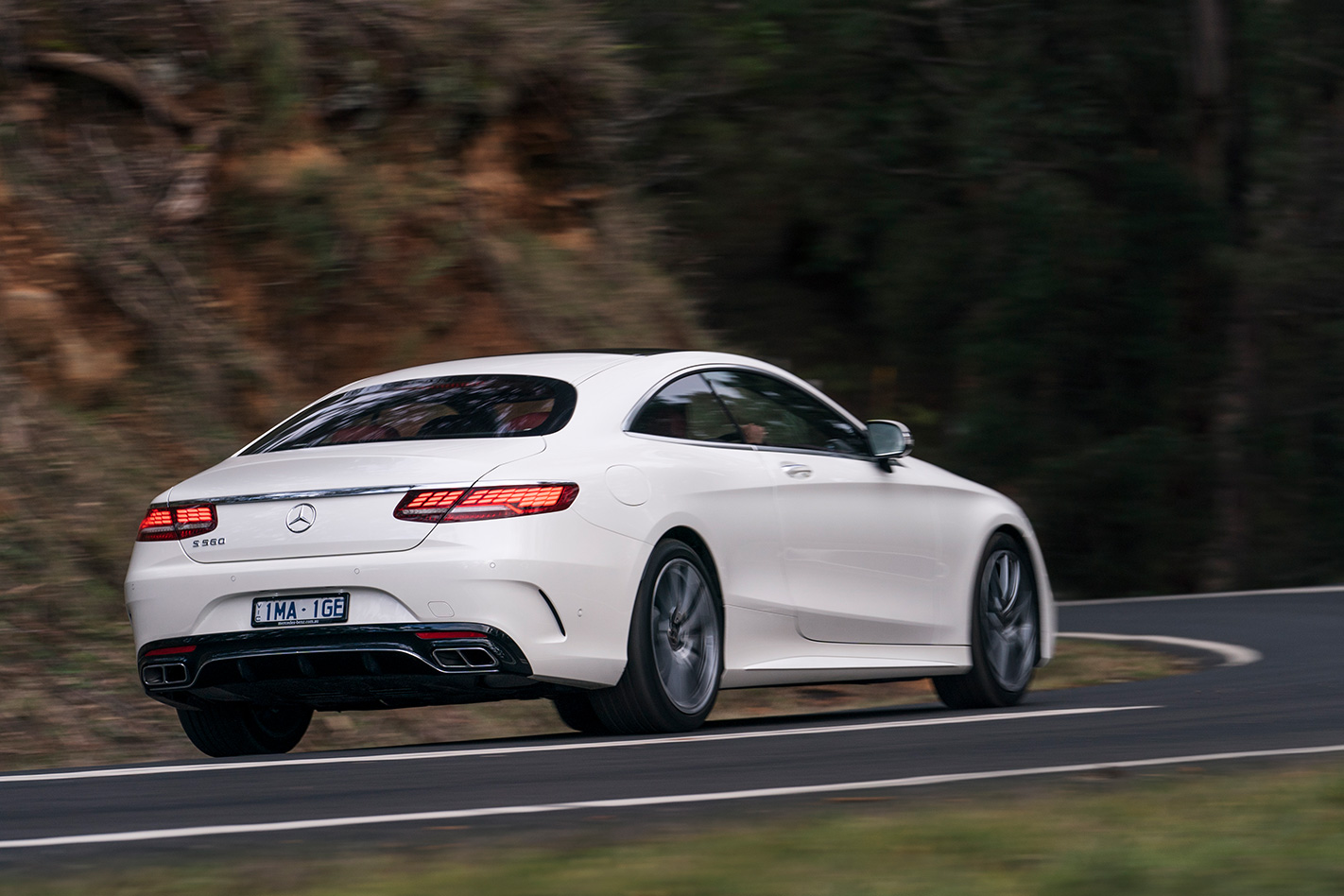
Jump into the S560 after the S63 and it feels a more relaxed thing, despite the fact that against the clock it’s barely any slower, registering 4.6s for the sprint to 100km/h.
The more malleable suspension tune makes more sense for a GT car, although there were still some quality issues on these pre-production cars that would need addressing, such as rattling door speakers and seat belts.
The Goodyear Eagle F1 tyres also feel a little more relaxed in their ride than the Continentals, although there’s still a bit too much road noise evident. With the S560, you get what you’re given as far as suspension tune goes, although it seems well-judged. Our car was finished in white which robbed the shape of a lot of its tension, especially in the flanks, so darker is most certainly the way to go to bring out the shape and detail of this intricate and elegant shape.
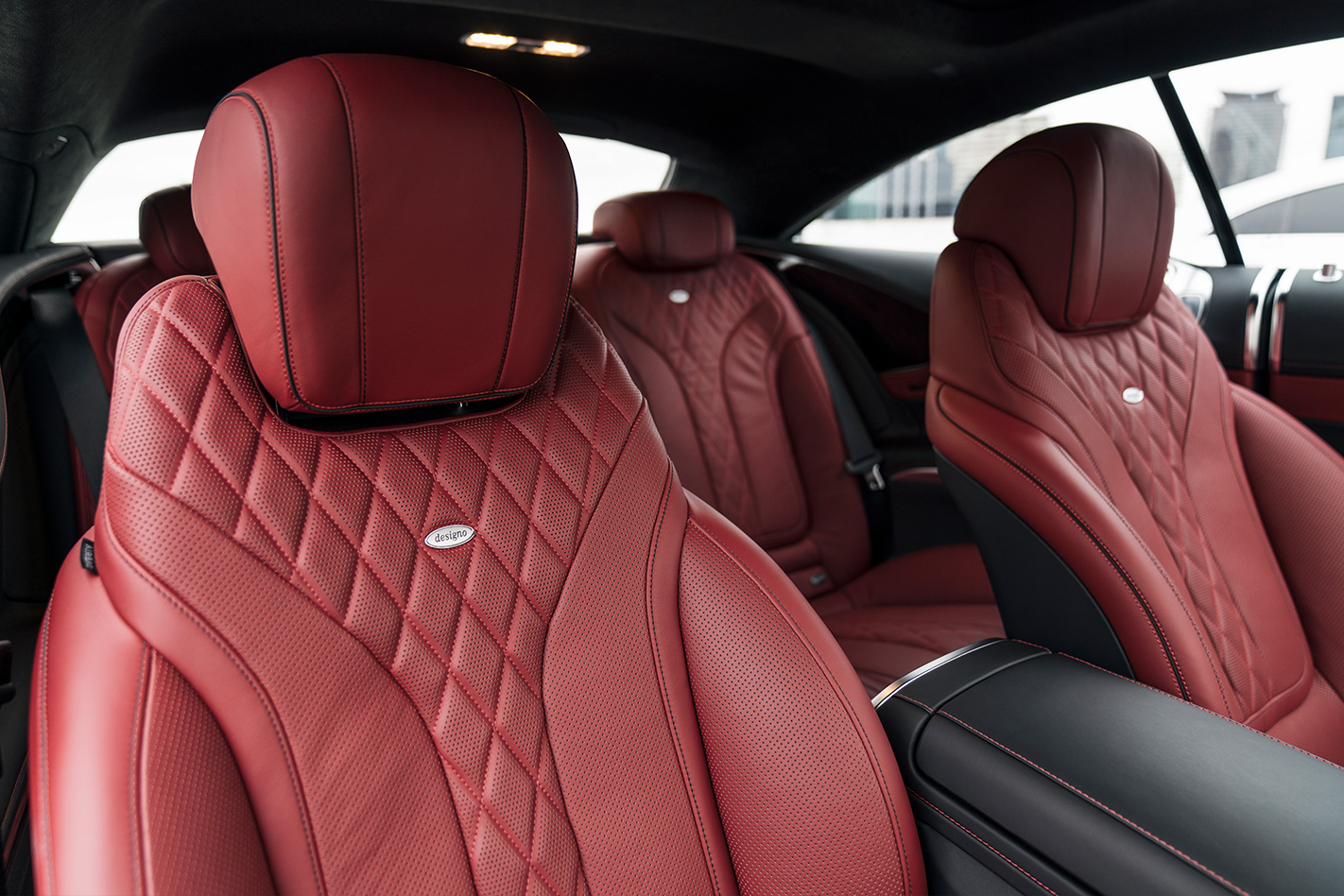
The Multicontour seats with inflating and deflating chambers are a delight and the new steering wheel’s ergonomics work well. The three-spoke tiller is no great beauty, but it marshals the cruise control functions, in particular, very effectively. The S-Class Coupe is packed with safety features, many of which are well beyond the obvious. Take Pre-Safe sound for instance. This cranks the stereo to play white noise at 80 decibels when it senses you’re about to have a prang, reducing potential ear drum damage from crash noise.
Of the two cars, the S560 seems to for the remit for an elegant, rapid, relaxed GT car a bit better. The S63, while impressive in its own right, just seems to be a little too fighty for the GT brief but not angry enough to convince as a ball-tearing sports coupe.
Should you be in possession of somewhere north of three hundred grand and need a supercoupe with intelligence and elegance, it’s hard to better the S560. Its blend of driver focus and technology is one that its rivals can’t equal.
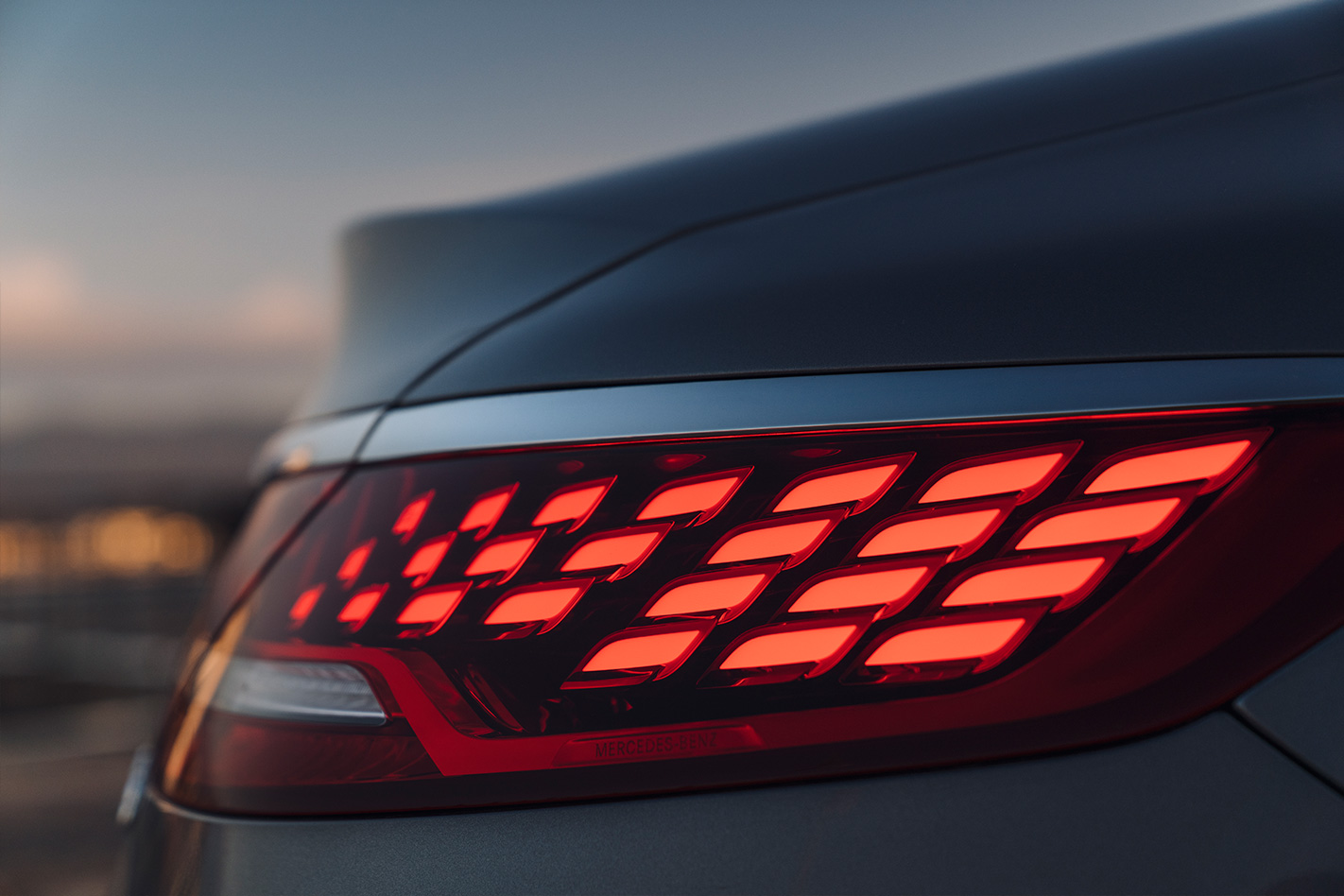
Yes, you can buy something more exclusive and it’s possible to buy something that delivers more on twisty roads, but for covering distance in style and comfort, the latest S Class Coupe could be the best of its ilk.
SPECS
Model: Mercedes-Benz S560 Coupe Engine: 3982cc, V8, dohc, 32v, turbocharged Max Power: 345kW @ 5500 to 6250rpm Max Torque: 700Nm @ 1750 to 4500rpm Transmission: 9-speed automatic Weight: 2075kg 0-100km/h: 4.6 sec (claimed) Fuel economy: 8.5L/100km (European combined cycle) Price: $314,900 On sale: Now
Skoda is bookending its Karoq mid-sized SUV range with new sporty and rugged variants, both of which are set to debut at the 2018 Paris Motor Show in October.
The Karoq Sportline and Scout offer diverse exterior designs and trim options with performance tweaks to match their persona.
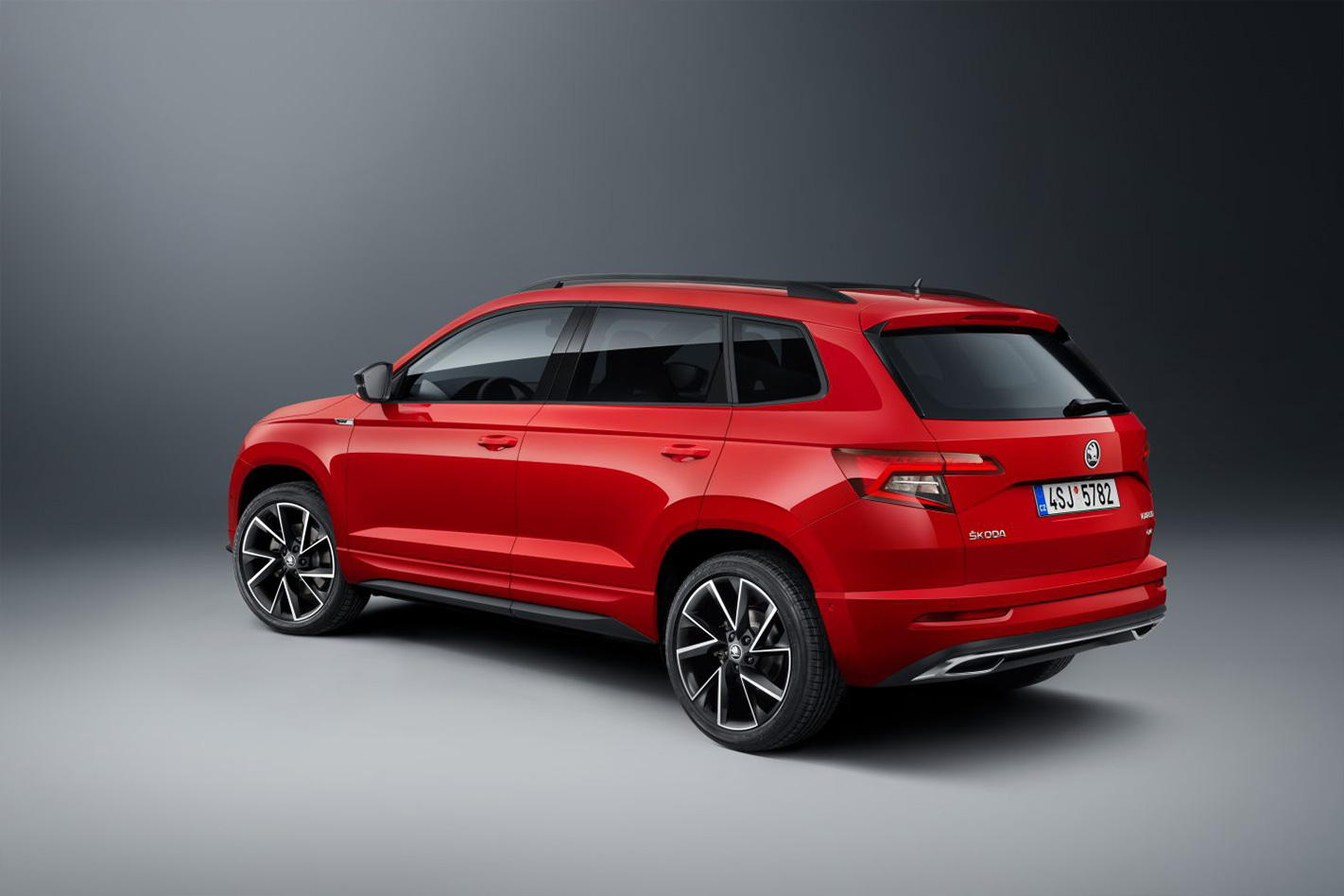
As its name suggests the Sportline is the racier variant that’s been draped in active wear similar to the larger Kodiak Sportline, which includes sports bumpers and sideskirts, 19-inch ‘Vega’ black polished alloy wheels, tinted windows and black trim elements including roof rails.
Hop inside and you’ll find black sports seats trimmed with Thermoflux breathable fabric and contrasting, black leather steering wheel, contrasting silver stitching, stainless steel pedals, LED ambient interior lighting, red accents and black headliner.
The athletic look will be offered with the grunt to match and a choice of either 140kW 2.0-litre turbocharged petrol engine, or the 140kW 2.0-litre turbo diesel already available here in the Kodiaq and Superb.
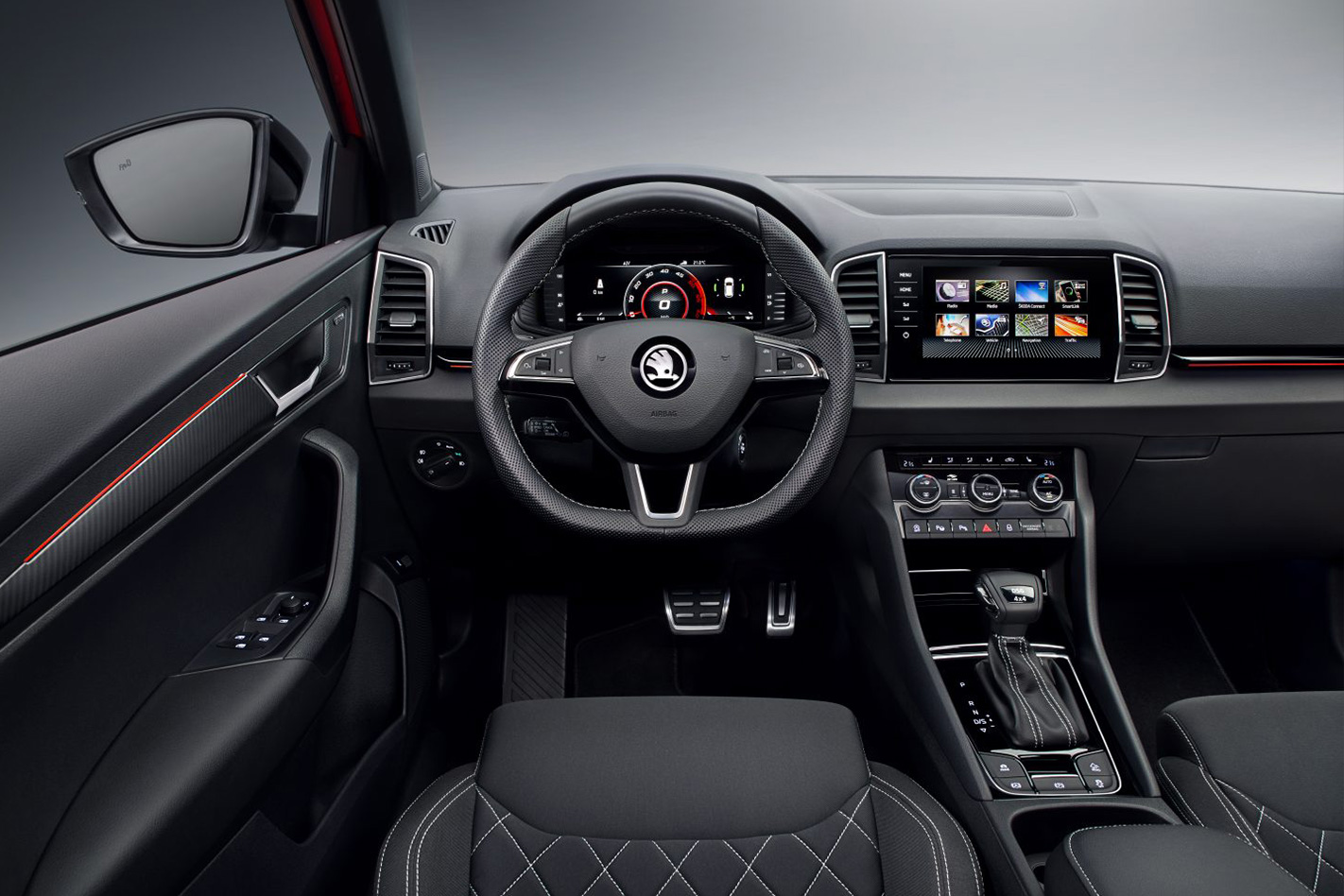
Buyers will also be able to choose between front- and all-wheel-drive, and a six-speed manual gearbox or seven-speed dual clutch auto, although the manual version is highly unlikely to be offered in Australia’s auto-hungry market.
The Karoq Scout will be the Sportline’s outdoorsy sibling, characterised with chrome and silver-coloured exterior trim, front bash-plate, rugged wheel arch linings, 19-inch ‘Crater’ alloy wheels, multifunction leather steering wheel, stainless steel pedals and an LED interior ambient lighting.
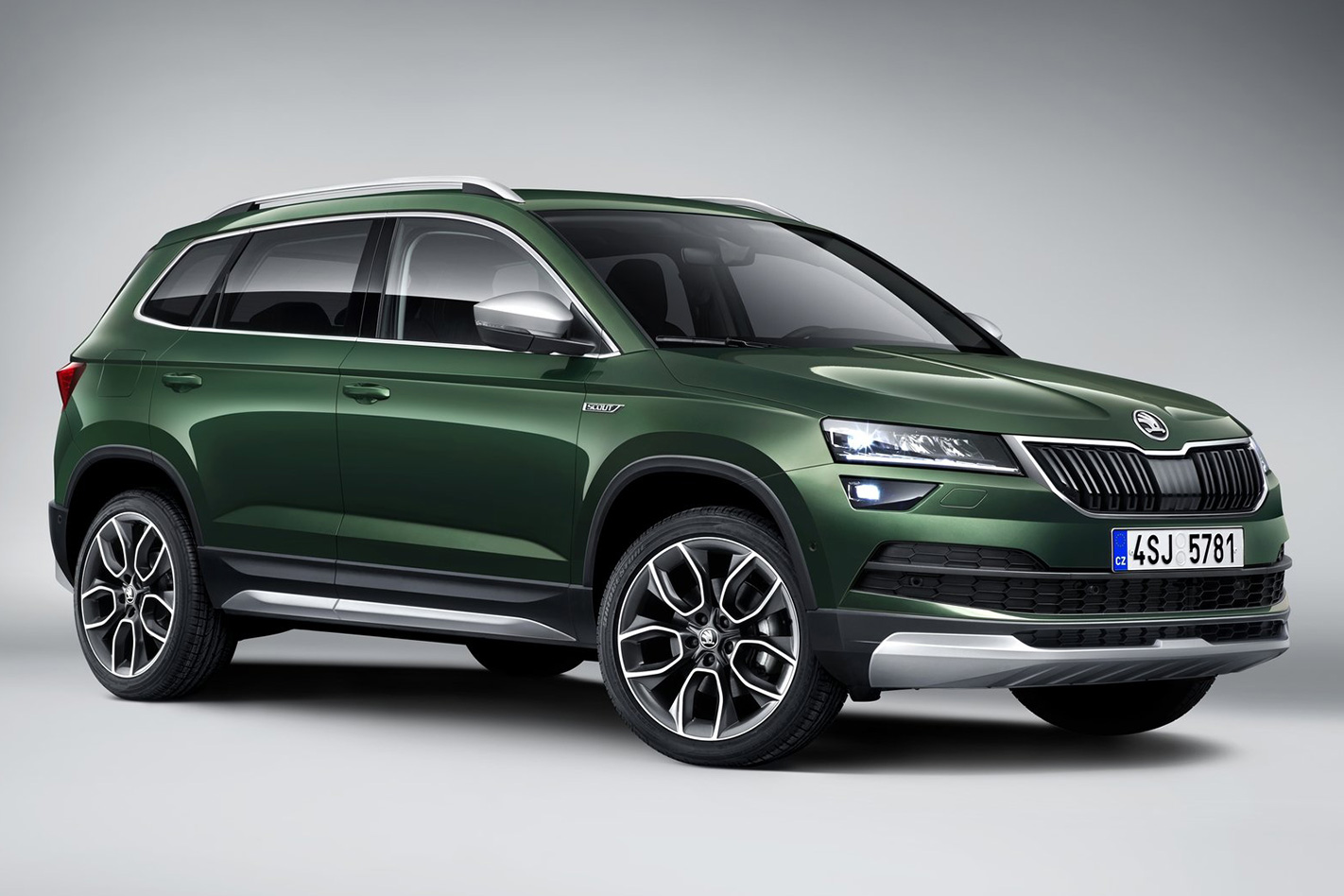
It will come with four-wheel-drive only and power courtesy of the 110kW 1.5-litre turbo-petrol engine available in the Karoq 110TSI that’s available here, plus a choice of two 2.0-litre diesels producing 110kW and 140kW.
Like the Sportline, the Scout will be available with the six-speed manual or seven-speed auto in Europe.
Each car will come with hands-free powered tailgate, while virtual Cockpit digital dashboard and in-car internet with WiFi will be available as extra-cost options.
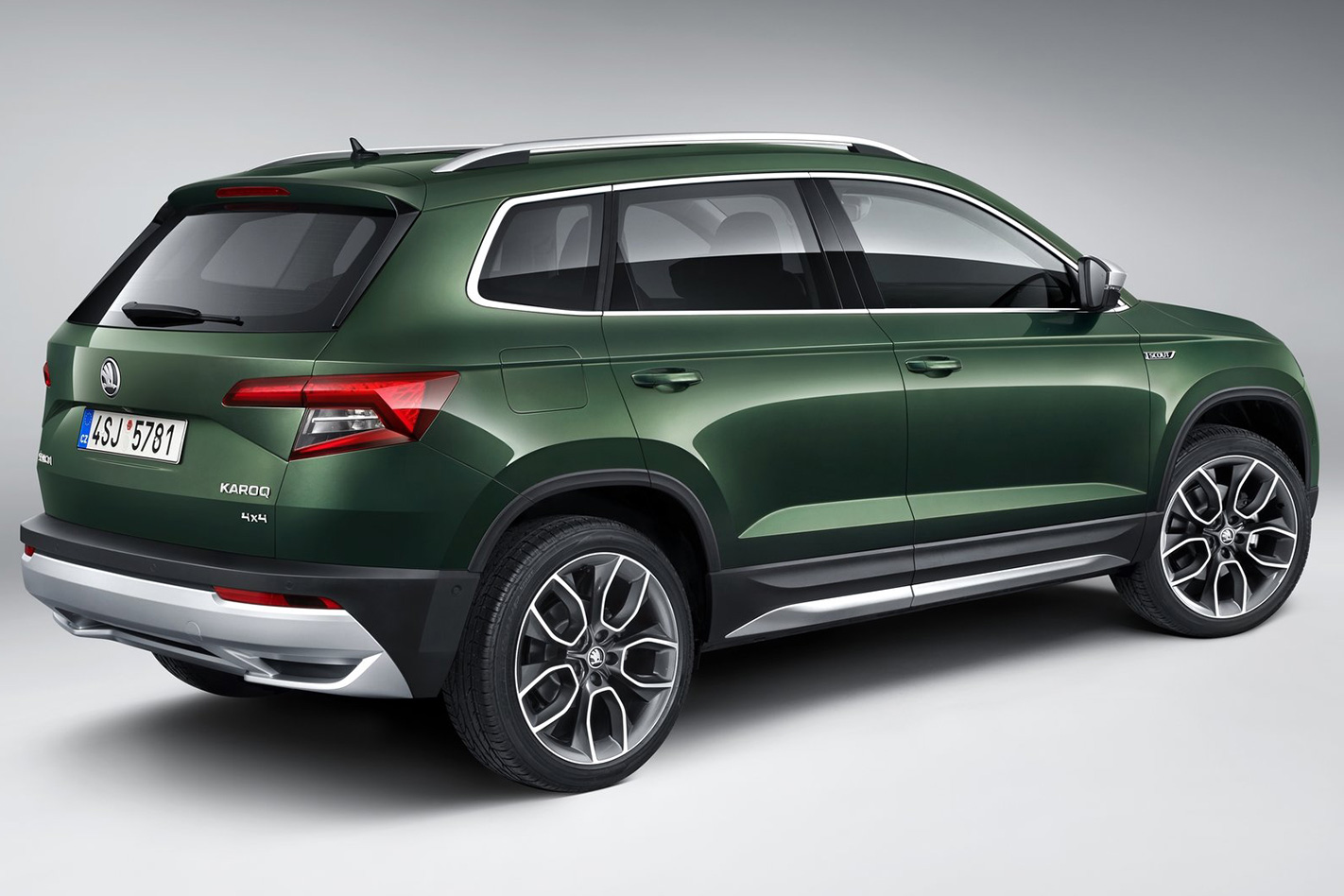
The Skoda Karoq is currently available in Australia in the one, front-wheel-drive, 110TSI spec powered by the 110kW petrol engine with a choice of six-speed manual and seven-speed auto.
A Skoda Australia spokesman told WhichCar it’s too soon to confirm future Kodiaq variants for Australia, however it is interested in adding the Sportline to the local line-up.
The first US appearance of the track-only Brabham Automotive BT62 supercar is set to take place at Laguna Seca (now known as WeatherTech Raceway) during Monterey Car Week.
The car that is shown will be one of the 35 special liveried cars that draw from Brabham’s 35 F1 victories, though in this case it’s particularly poignant.
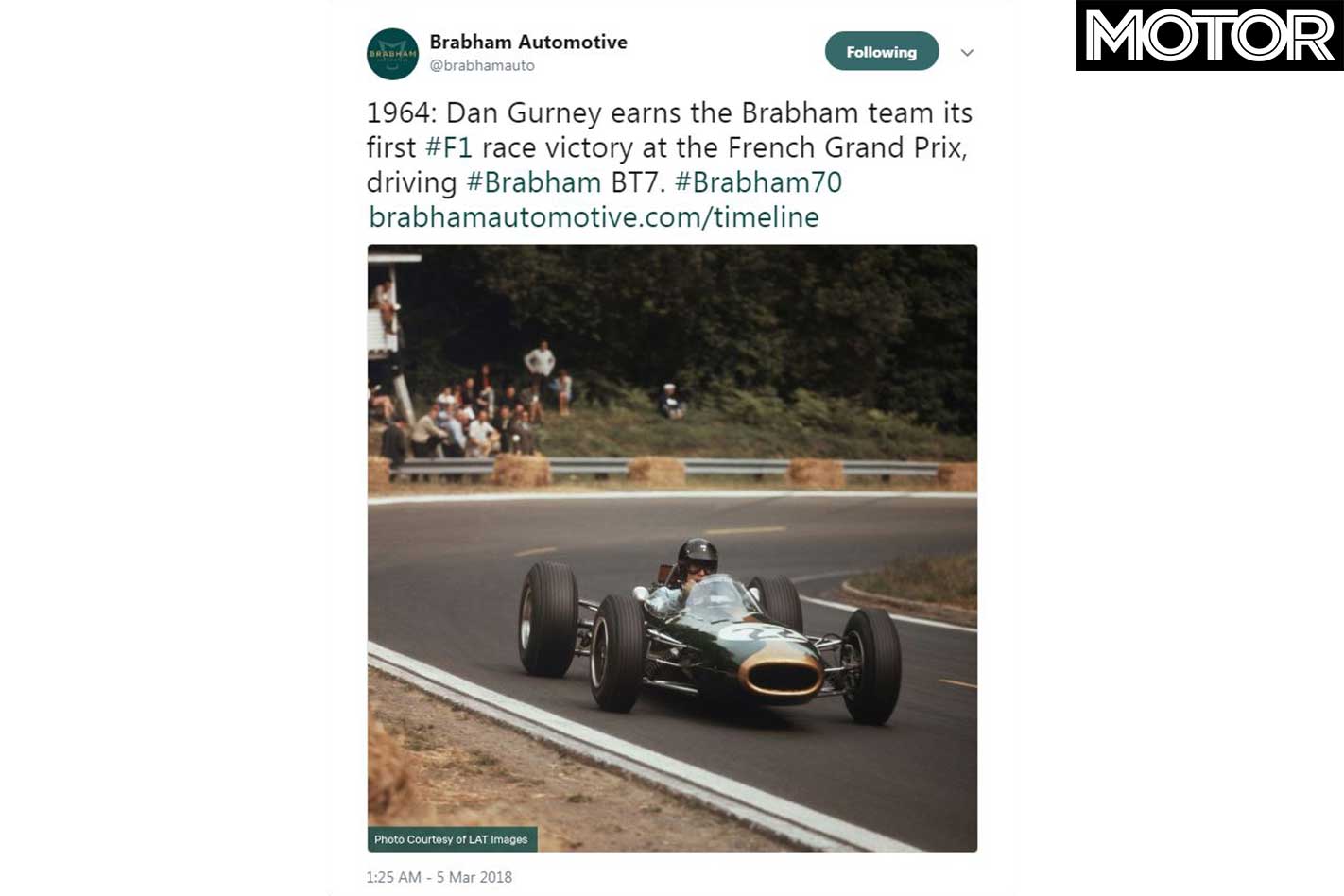
Finished in green and gold (a nod to Brabham’s Aussie roots) with a number ‘22’, the car pays tribute to the late Dan Gurney, specifically for his 1964 F1 victory at the French Grand Prix in a green and gold Brabham BT7.

Brabham says Gurney was the racer ‘Sir Jack’ chose for his ‘fledgling Brabham racing team back in 1963.’
Gurney’s passing in January marked the end of a long life full of spectacular motorsport achievements, including the creation of the Gurney Flap, a simple downforce-generating lip for rear wings still used today.
Speaking more generally, Brabham Auto managing director David Brabham says the family’s connection with the USA is still very important today.
“I’ve enjoyed great success in the United States over the course of my racing career, as did my father, Sir Jack, and brother Geoff Brabham, who is a member of the Motorsport Hall of Fame of America.
“As a country, the US holds great significance for the family, and continued importance for the Brabham racing dynasty, and we’re proud to be showcasing the car to the world’s most discerning motoring enthusiasts at Monterey Car Week.”
The first US customers for the Brabham BT62 have begun to sign up for their own build slots, as the Gurney-inspired BT62 makes its way around the Monterey area during Car Week.
If you’ve been fence-sitting on the proposition of buying a new Mazda, the Japanese manufacturer is hoping to twist your arm on August 11 with the return of its annual M Day sale.
Now in its 20th year, the one-day-only sale brings added value in the form of free scheduled servicing for the first three years or 30,000km for passenger cars and SUVs, or 45,000km for the Mazda BT-50 – whichever comes first.
You’ll also receive $500 worth of Mazda accessories for your new car, courtesy of a specifically tailored M Day accessories pack available for passenger and SUV vehicles. Mazda BT-50 buyers will receive a $500 genuine accessories voucher to spend on kitting out the new ute.

Furthermore, all new cars sold will get three years of Mazda’s roadside assistance for free, saving another $297.
All in, customers will save as much as $1,592 on a top-spec BT-50, or $957 on an entry-level Mazda2 Neo.
Mazda’s M Day customers will also benefit from the freshly announced five-year unlimited kilometre warranty, which is standard on all models purchased from August 1.
Mazda dealerships are heavily incentivised to do deals on M Day, so don’t be afraid to bargain hard and you could come away with an even better deal.
IF PORSCHE is having a bring-a-plate party to celebrate its 70th anniversary, expect its in-house Classic workshop will turn up with arguably one of the most desirable vehicles in the company’s seven-decade history.
Dubbed the Classic Project Gold, the mysterious car is being gradually detailed in a series of short films that appear to suggest the German car maker is restoring an example of its final air-cooled model – the 993.
Over the course of three videos, Porsche has so far revealed a pristine shell stripped to bare metal, the classic hollow-spoked wheels black lacquered and laser-etched to reveal a fine gold stripe, while the theme continues inside with black leather upholstery contrasted by saffron stitching.
Tantalisingly, the most recent instalment reveals the iconic Turbo moniker embroidered into the seat headrests, confirming the no-expense-spared vehicle will be of the rare forced-induction variety.
What still remains to be seen is whether Porsche will stray far from original specifications. An ultra-original car would be desirable on one level and would honour the 993 generation, but its gloss-black wheels and gilded embellishments suggest the car maker is creating its own custom rig. Think Singer Porsche by Porsche.
Amid the growing number of outfits that are modifying and restoring classic Porsches to dizzying standards, perhaps this is Porsche demonstrating that the ultimate ‘restomodder’ is in fact the company that first breathed life into the car.
At this stage, a single ghostly profile detailed in – you guessed it – gold on a black background, is the only indication of how the finished car will look. The line sketch shows the 993 remit of the iconic whale tail spoiler hinting at a more purist restrained approach by the restoration team.
The fourth instalment in the film series will air on August 10, with the finished vehicle expected to debut at the Pebble Beach Concours d’Elegance on August 24.
Ferrari is set to pull the covers off two very special new models in the next couple of months.
Nothing is yet confirmed, but information gathered from a number of well-informed members of the FerrariChat community suggests a ‘488 Pista Aperta’ and ‘812 Monza’ will be revealed at forthcoming events.
The 488 Pista Aperta is expected to make its debut at Pebble Beach at the end of August. As the name implies, it is an open-top version of the hardcore 488 Pista, sharing the uprated 530kW/770Nm 3.9-litre twin-turbo V8, revised chassis and 90kg diet.
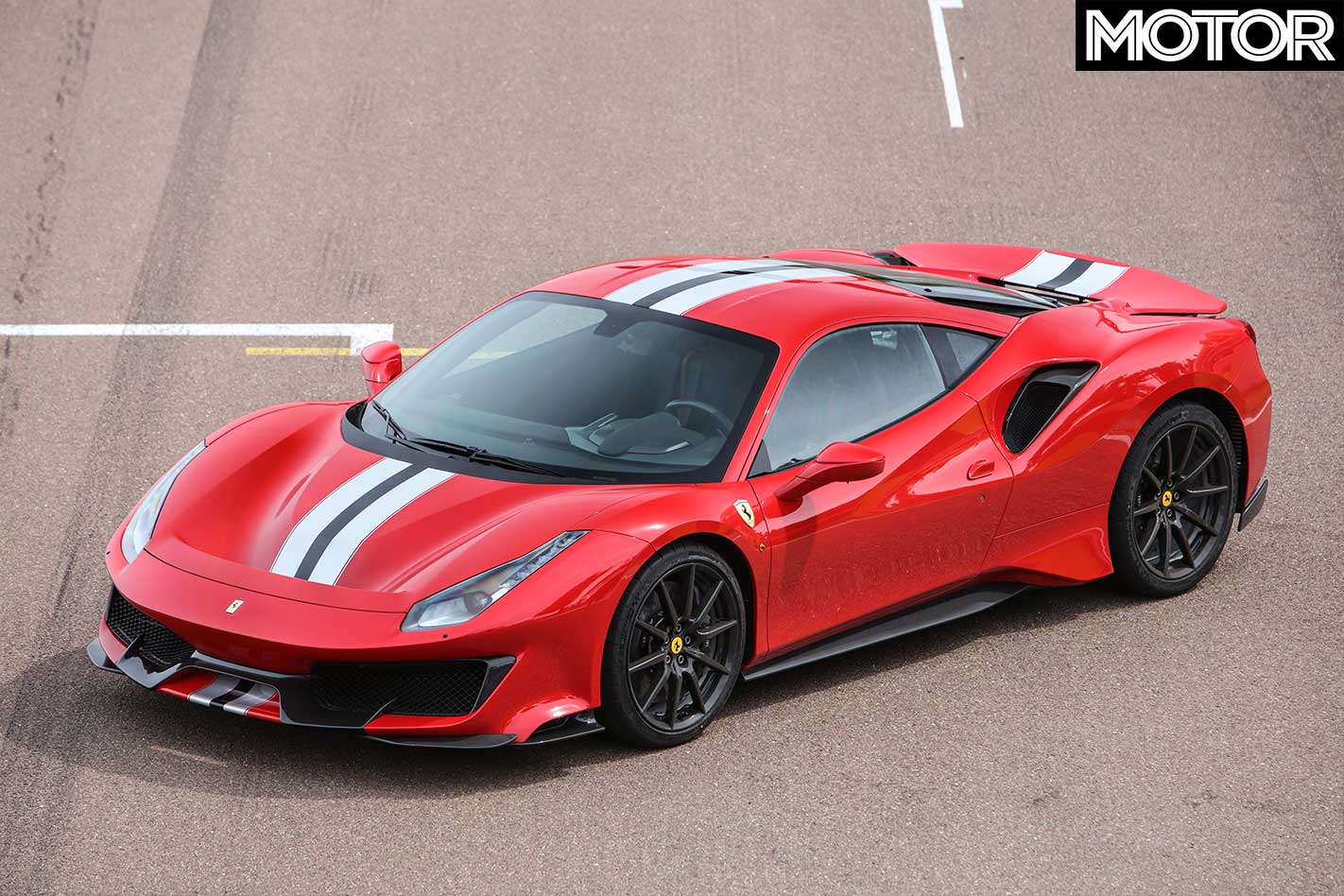
Unlike the coupe, production will be limited to an as-yet unknown number. Rumours suggest around 700, though only 499 of its predecessors, the 458 Speciale Aperta and 430 Scuderia Spider 16M, were built. Expect all build slots to be spoken for by the time the car is revealed.
The 812 Monza will be an absolute showstopper. A true limited edition model, production is rumoured to be capped at just 200 units, all allocated to Ferrari’s top-tier VIP customers, who have been invited to a launch at Maranello in mid-September.
Mechanically unchanged from its donor car, the Monza will look radically different, lacking not only a roof but also a windscreen, in a similar manner to the Ferrari Rossa concept built in 2000 to celebrate 70 years of Pininfarina (pictured). MOTOR understands the 812 Monza will be a modern interpretation of the 1957 250 Testa Rossa, one of Ferrari’s most successful race cars.
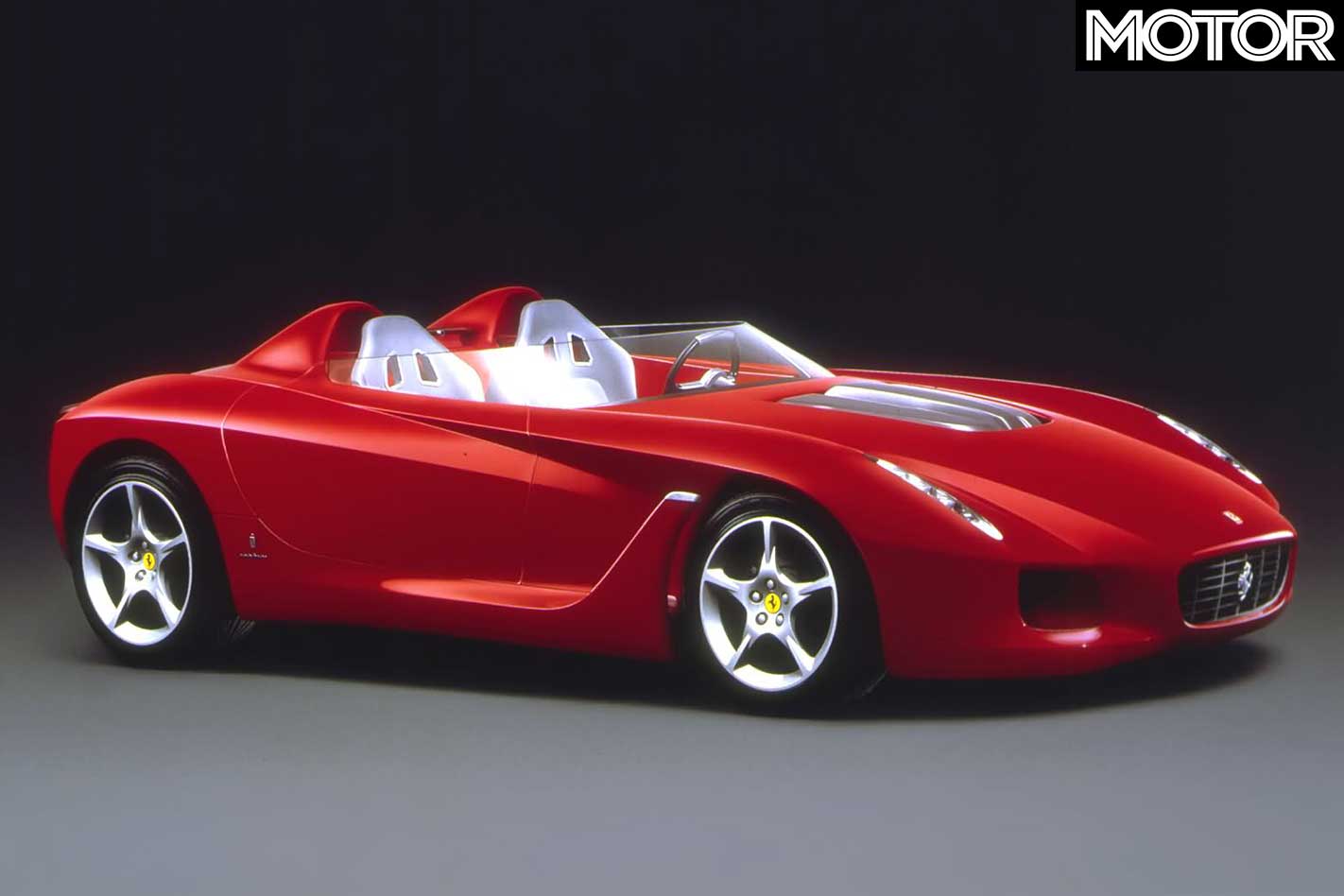
Further down the track, a hardcore 812 is expected to appear in the manner of F12tdf or 599 GTO while the 488 replacement is scheduled for a late-2019 reveal.
The first thing that strikes you about this 2019 Bullitt is that it looks completely different from every other new Mustang.
The subtle chrome trim around the grill and the side windows catch your eye, and the lack of badging lends understatement to what is an otherwise bold, muscular car.
This is precisely the look Steve McQueen was aiming for when he decided upon the hero car for his legendary film, Bullitt. Like the original, this car had to suit the personality of the hero, Frank Bullitt, a seasoned, no nonsense, San Francisco detective.
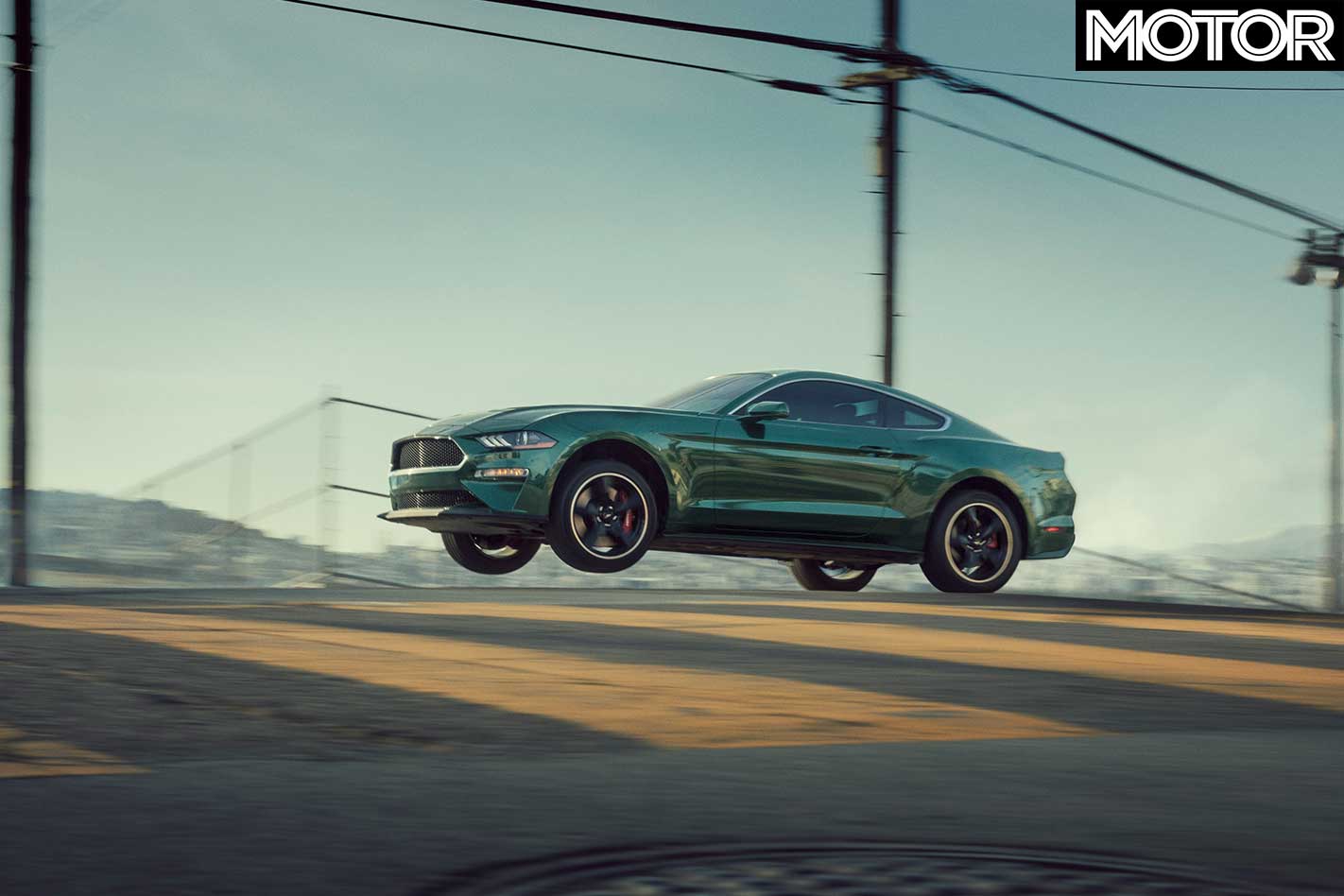
For this special edition, the Bullitt uses the Mustang GT as a starting point and the end result is a rather uncommon pony car. This modern homage is fitted with Torq Thrust-style wheels in the GT’s standard 19-inch sizes, wrapped in the same Michelin Pilot Sport 4S tyres. The GT’s capable suspension with MagneRide adaptive dampers is carried over.
Changes underneath the skin make this Bullitt mechanically distinct from the GT. Ford’s added the intake manifold from the Shelby GT350, topped it off with a cold air intake, included the GT’s active exhaust (although finished in black), and recalibrated the engine control unit for this mechanical specification.
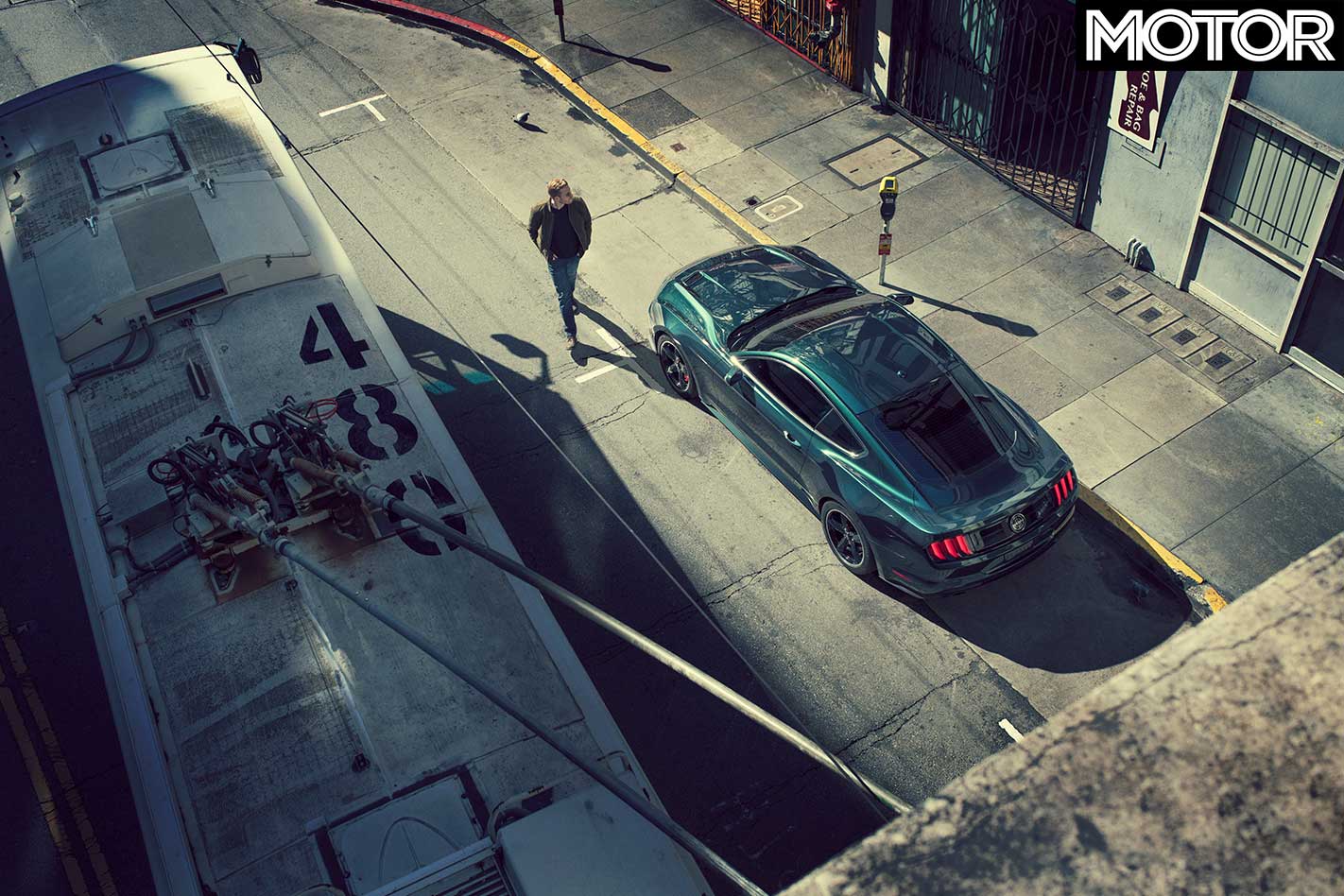
Specifically for Bullitt, they’ve also spiced up the exhaust note, particularly on overrun so that it now cracks and rumbles every time you close the throttle.
These are net improvements over the GT, not in terms of just sound, but also power and performance. The Bullitt’s output is rated at 345kW and 556Nm, a net increase of about 6kW while torque stays the same. This gives the Bullitt a top speed of 262km/h, and it’s 13km/h faster than GT at the top end. With this, 0-100km/h and its quarter-mile run should be quicker than GT by about a tenth.
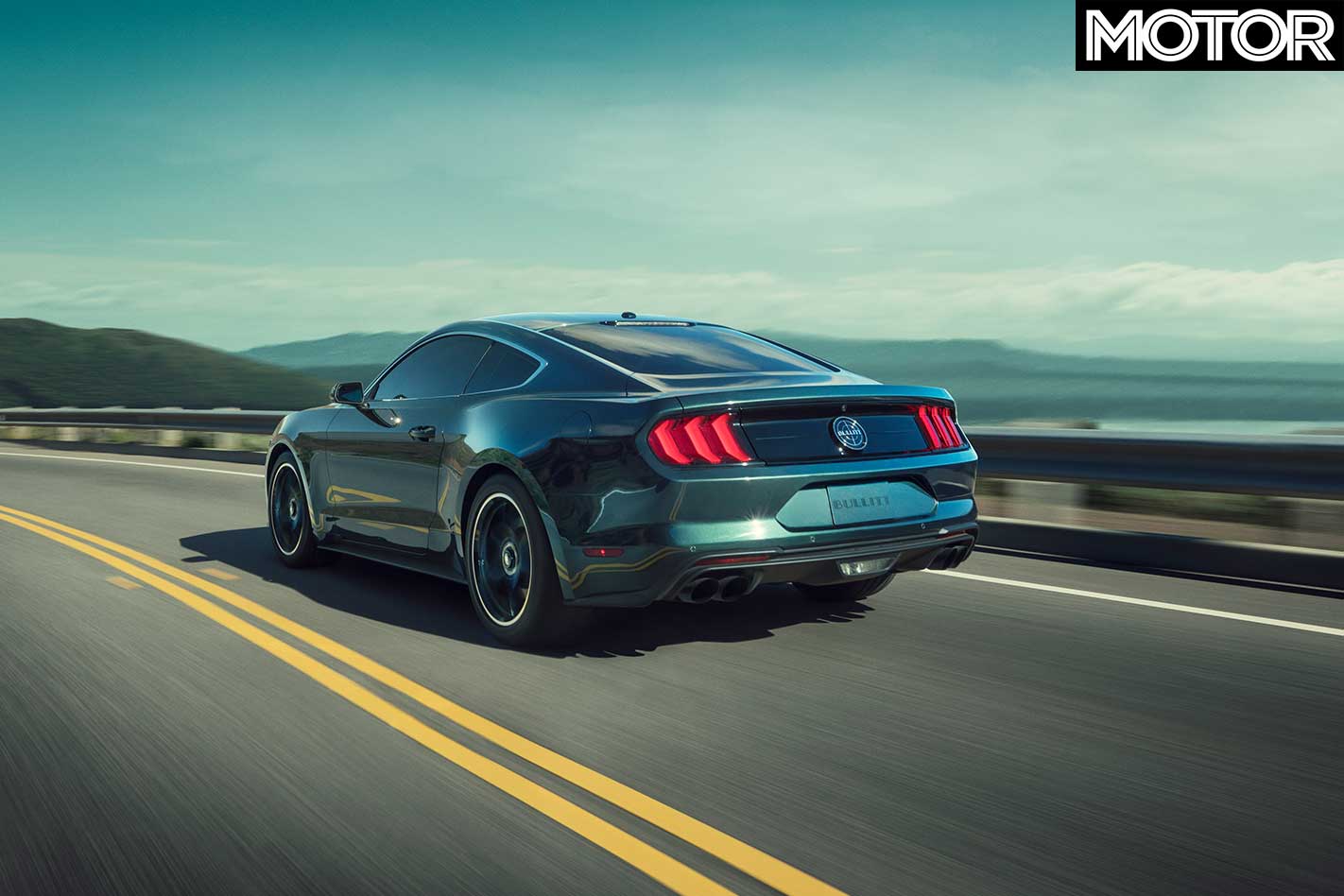
While its performance gives the Bullitt a slight edge over the GT, it’s the attitude that makes all the difference. This is the third Mustang homage to the film in fifty years, but we’d argue it most closely honours the original. It’s an authentic special edition, with an inimitable, from-the-factory, mechanical specification that’s fused to a full serving of McQueen’s understated cool attitude.
Like the film’s hero car, the 2019 special edition is available exclusively with a black interior, but with subtle green stitching on the black leather and a cue ball shift knob for its exclusive six-speed manual transmission.
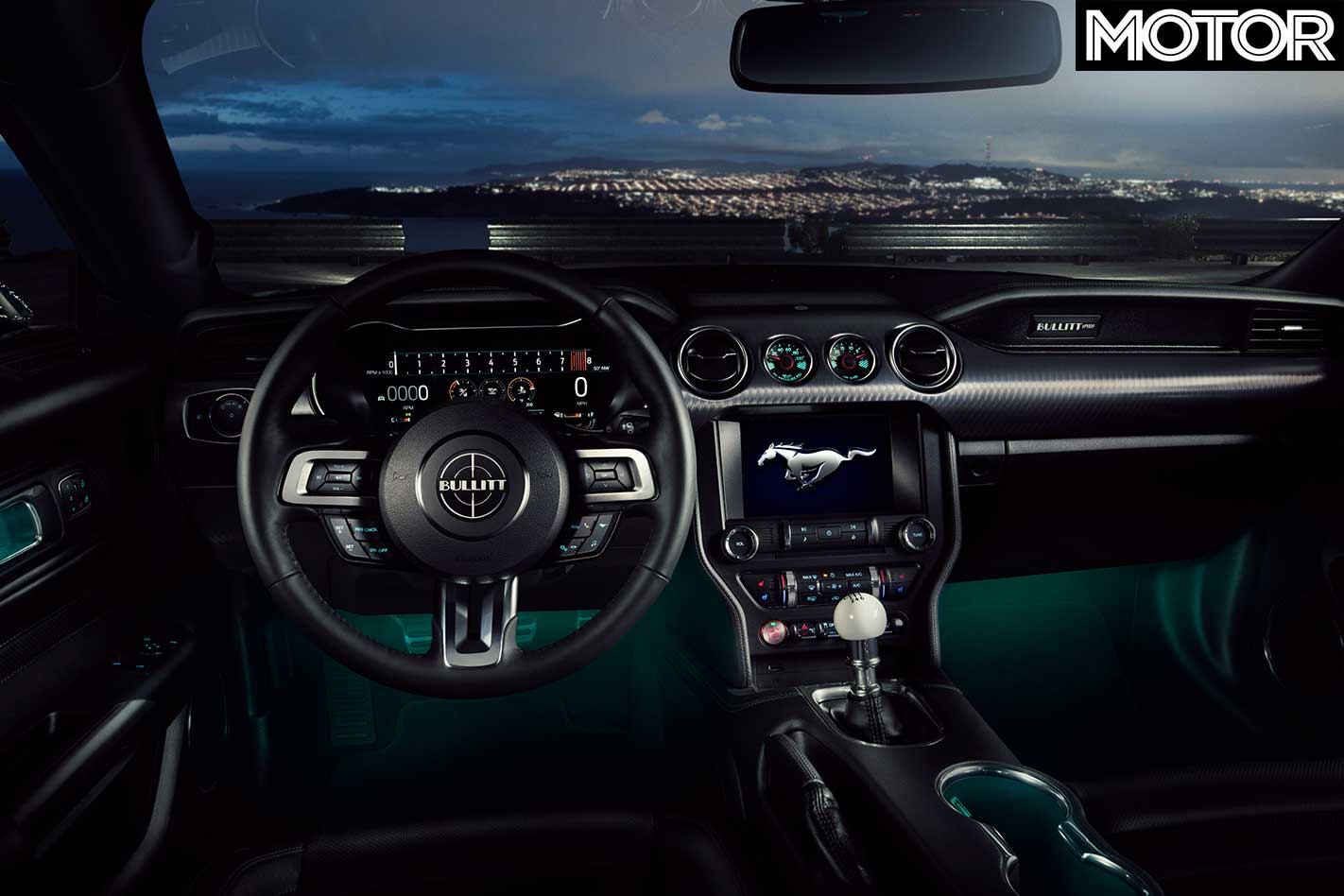
This 2019 Mustang Bullitt is a fantastic way for Ford to commemorate the fiftieth anniversary of the film and its timing couldn’t be more fortuitous. Ford designers and engineers accessed the best of everything Mustang, developing a modern Bullitt that honours the aesthetics and improved performance of Frank Bullitt’s 1968 Fastback.
In contrast to previous Bullitt specials, this is the first one that Ford’s done in right hand drive. If you’re fortunate enough to have one on order, the first cars have already been produced and are in transit now.
2019 FORD MUSTANG BULLITT SPECS: Engine: 5038cc V8, DOHC, 32v Power: 345kW Torque: 556Nm Price: $73,688
