
Elon Musk is either a crazy person, or he already knows what will happen in the future.
Most fans of Musk believe he’s a genius, since he founded Tesla, PayPal and SpaceX. Here’s an alternate theory: Elon Musk actually invented a time machine in about 2037. And instead of revealing it to the world, he got a list of the most successful companies of his time, then went back and founded them all first. Elon Musk is Biff Tannen.
Musk has recently made the biggest bet in corporate history – a $55 billion payout if Tesla’s total market valuation reaches $650 billion within 10 years – otherwise he gets paid nothing.
It’s the sort of crazy-la-la bet you would only make if you were completely cuckoo-bananas – or if you already knew what the stock market, and the rest of the world, was going to do for the next decade.
Let’s face it, $650 billion for a car company – any car company – is a crazy number. It’s about what Apple is worth, or Alphabet (the parent company of Google). It’s like the total valuation of Facebook and Exxon Mobil… combined. Musk’s payout of $55 billion alone would exceed the total valuation of either Ford or GM.

It’s not even the kind of hyperbolic showmanship some snake-oil vendors would use to get pulse rates frothing amongst the faithful (“We’re going to build the world’s most valuable car company – and Mexico is going to pay for it”) – since shareholders are generally more reassured by CEOs who are at least within a day’s walk of reality. It’s not even the weirdest thing he’s done recently.
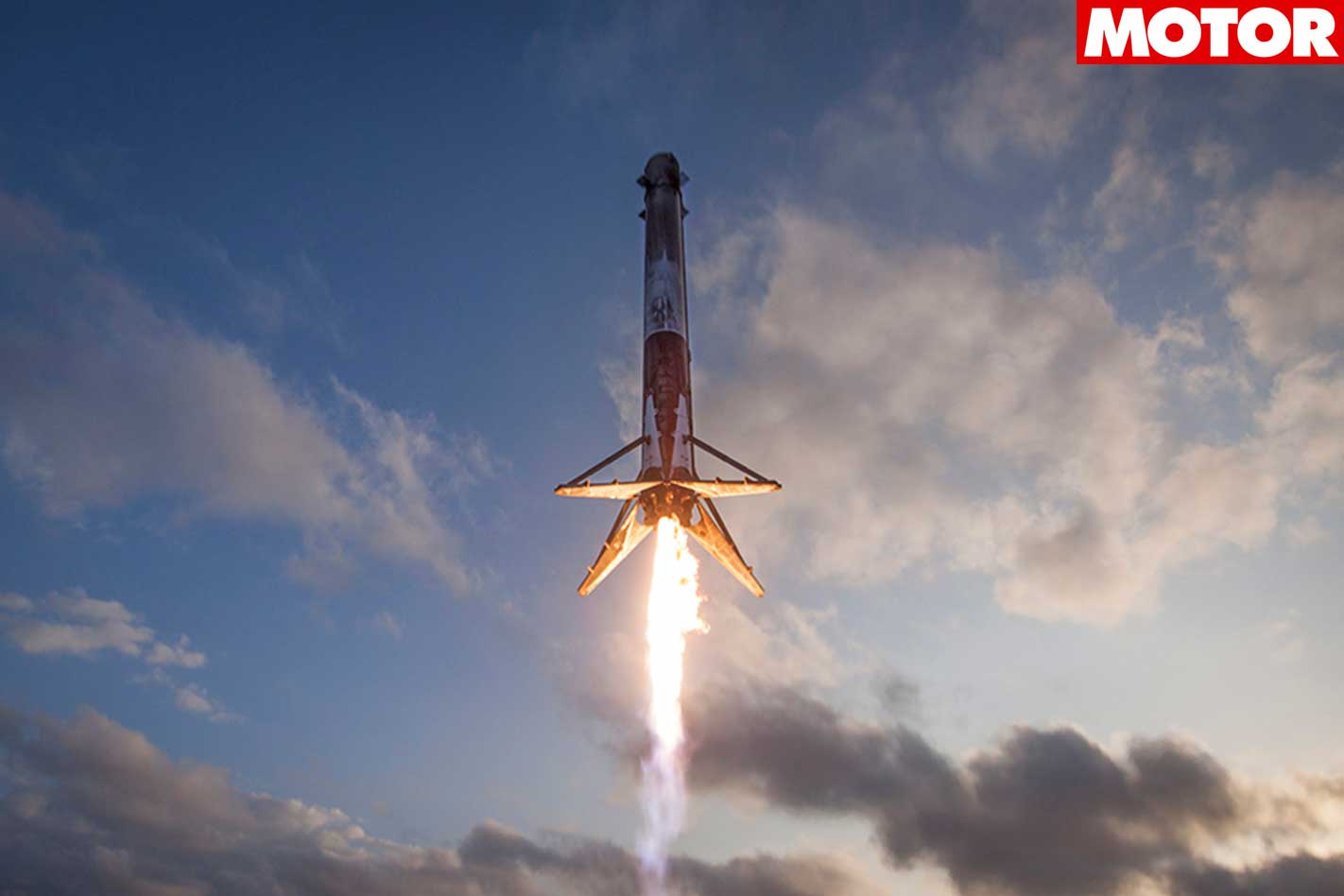
He’s launching cars on rockets to orbit Mars, where he’s also planning underground cities sustained by ice mining. He’s digging giant tunnels underneath Los Angeles and Baltimore. He’s investing in “neuroprosthetic” implantable brain-computer interfaces and artificial intelligence.
They’re all the kind of vaguely unhinged brain-explosions that you would only expect from either a next-level genius with access to technology from the future – or a homeless guy under a bridge with foil wrapped around his head.
Even his name sounds like something from science fiction – wasn’t Elon Musk in the Mos Eisley Cantina with Han Solo and Greedo? If you saw the photos from inside his Bel Air estate recently, you may have noticed that there were no shots of his closets – that’s probably because when he’s at home, he wears one-piece silver jumpsuits, or self-drying jackets and auto-lacing Nike high-tops.
I’m even thinking of buying shares in Tesla – either they’re about to go up in value ten-fold, or at the very least they’ll allow me to go into the next shareholder’s meeting where I can steal Musk’s briefcase to look for a sports almanac from the future.
So, either Elon Musk is a time traveller, and we’re about to face a zombie apocalypse; or, the world’s richest crazy person is digging a series of tunnels under major American cities like a Bond villain. Either way, it’s something to keep you up at night. At least you know a guy who will sell you a flame thrower to defend yourself.
Gentlemen, start your engines!
This review was first published in MOTOR magazine’s August 2008 issue.
Instead of pushing a button, please insert the weighty, traditionally fashioned ignition key which is long enough to foul a tall lad’s right kneecap. Now twist it, prick your ears, and watch carefully the response when lightning strikes on the other side of the tinted rear windscreen.
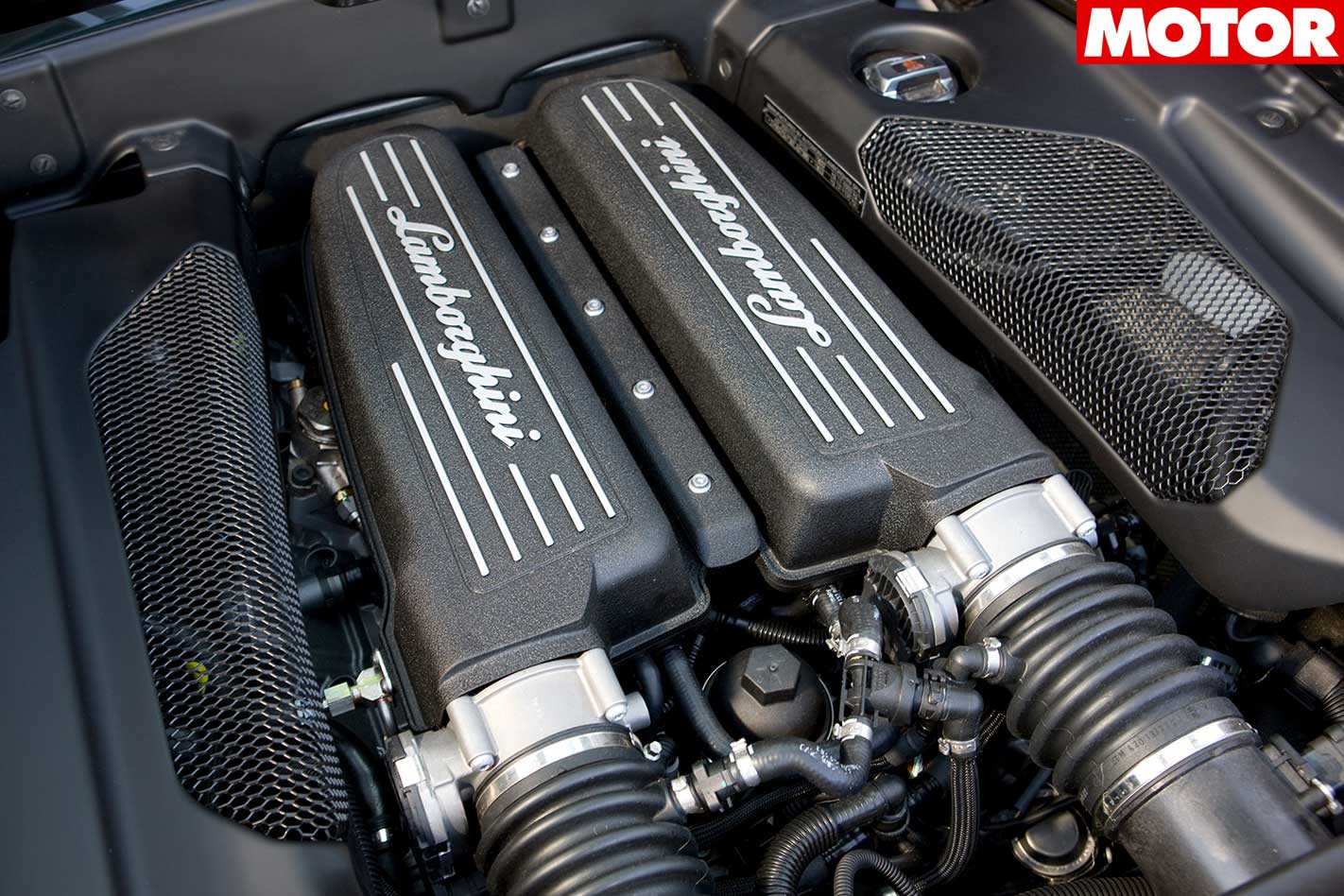
The V10 does not simply fire and run. Instead, it explodes, gasps for air, kicks its initial idle speed to 1250rpm and back to 750, and rubs cold pistons against equally cold cylinder walls as the dry-sump lubrication struggles to distribute oil to the faraway corners of the complex kraftwerk. Five, six seconds of martial metallic music frightens the wits out of birds and babies who happen to be close to the epicentre of this emphatically mechanical powerplant.
While the engine is beginning to come to terms with itself, the auxiliary equipment continues to chatter. The noisy oil pump whirs loudest, followed by the gurgling water pump and the nasal air-con compressor.
It’s all happening in the dark, volcanic display area behind the firewall where the cylinder heads boast a black crackle paint finish which looks even meaner than the bright red livery preferred by the other fast-car power brokers from the other side of Modena.
Yes, the new 5.2-litre V10 in Lamborghini’s updated Gallardo LP560-4 is quantifiably stronger, badder and wilder than the 5.0-litre version it replaces. A true rev junkie, it features a stratified direct-injection system, more efficient intake and exhaust manifolds, variable valve timing, reduced-friction pistons and lighter camshafts.
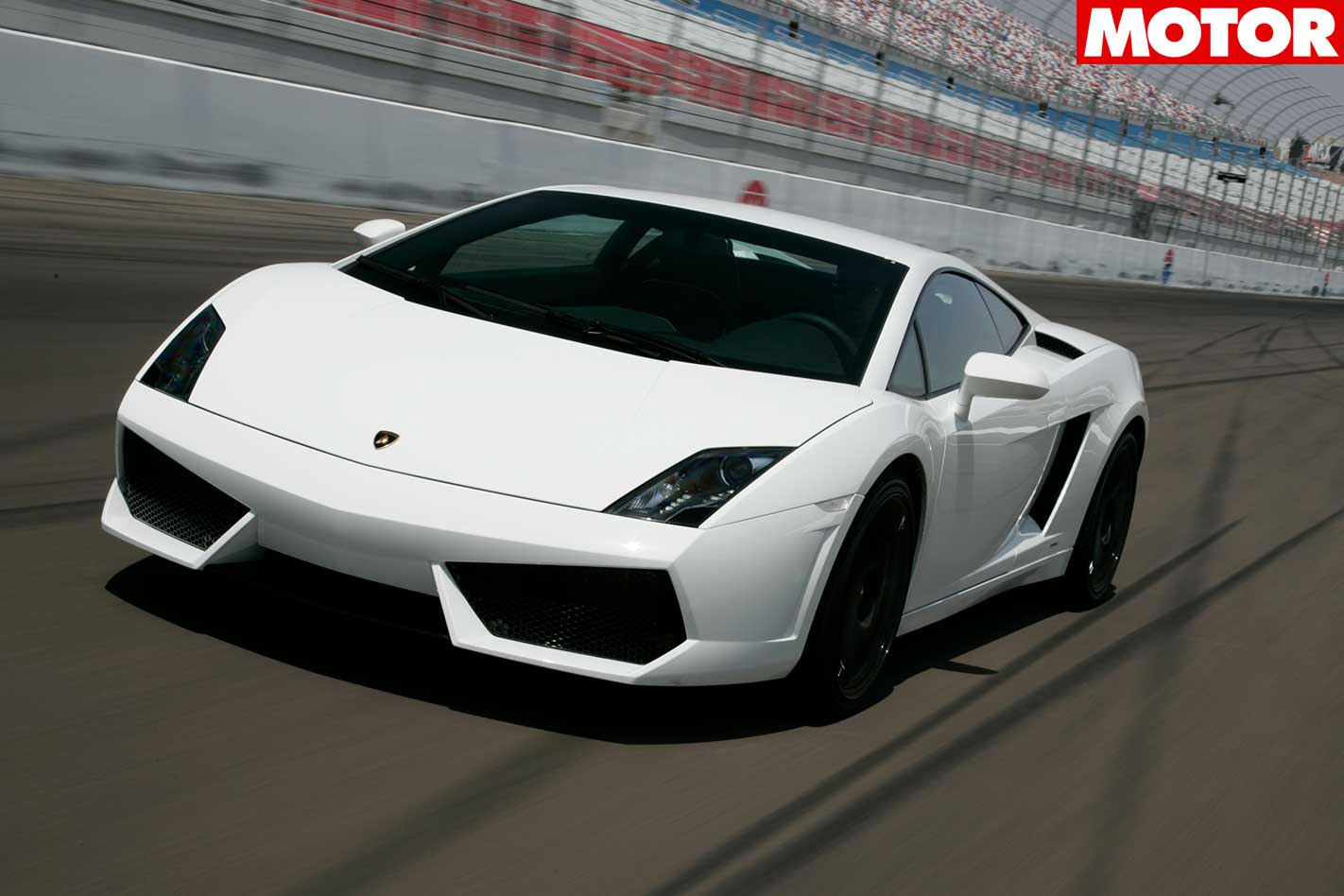
In Thrust Mode, it comes close to angering a Murcielago. The LP560-4 will accelerate from 0-100km/h in 3.7sec – that’s 0.3sec quicker than last year’s Superleggera and only 0.3sec slower than the mighty LP640. How does that compare to other supercars?
Well, the F430 Scuderia and the Mercedes-McLaren SLR are one-tenth faster still, and the 911 GT2 and the Pagani Zonda S are a dead heat, but none of these challengers can match the latest Lambo for aural thrills and mid-range vibes.
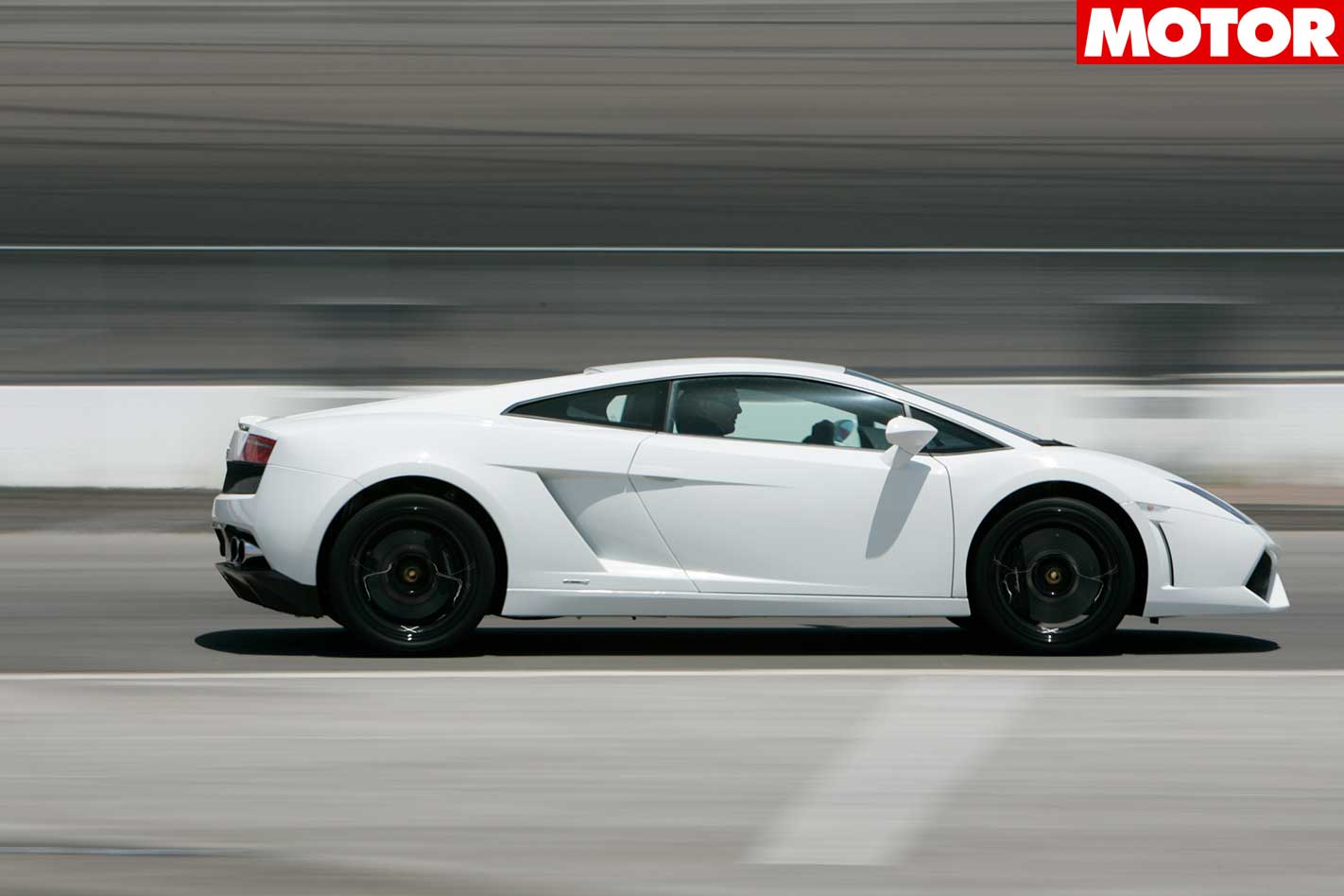
The E-gear equipped LP560-4 (which is a $16,000-odd premium over the manual gearbox) sprints to 200km/h in 11.8sec, beating its predecessor by half a second, and reaches 325km/h, up from 315. The six-speed manual is slower than the E-gear car, but equals the previous model’s performance.
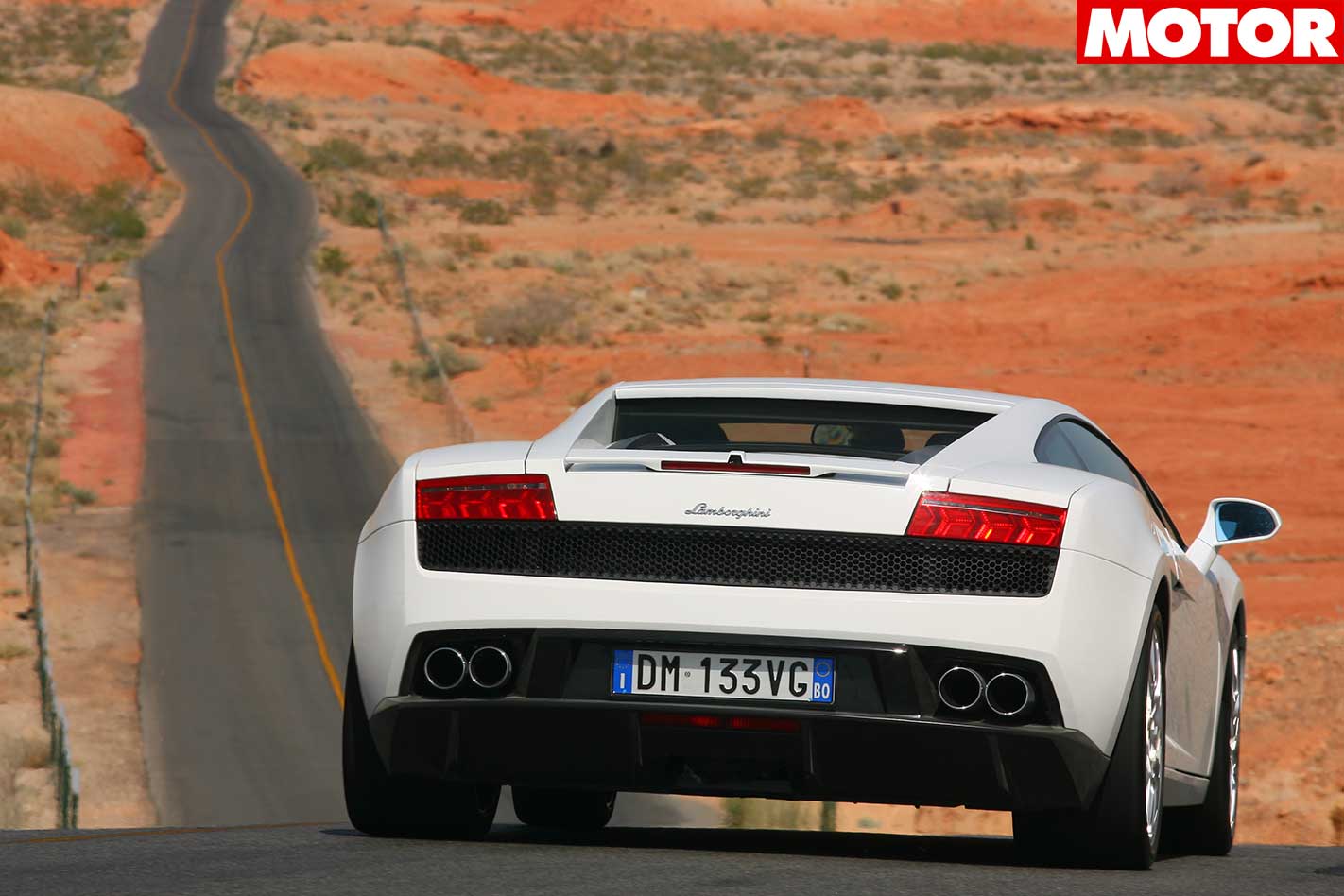
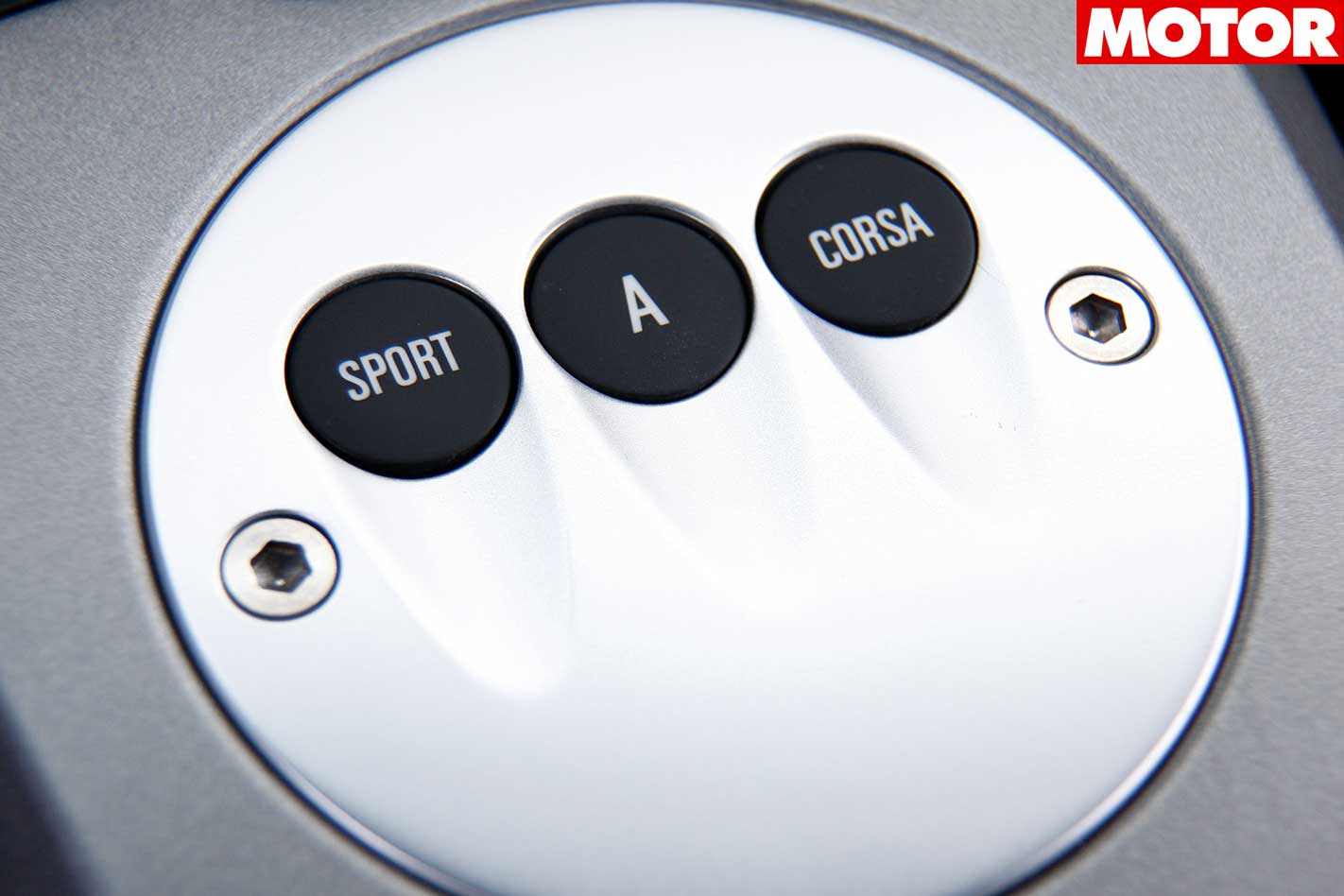
A car as overtly aggressive as our Gallardo – even in snow white – does not really need a show-off button, but just to be safe, the LP560-4 has two.
One is labelled Corsa; the other one reads Sport. Sport loosens the ESP reins and speeds up the throttle response, while Corsa opens the door to the Thrust Mode program for which one could charge a fee from innocent bystanders.
You’ll feel a mind-boggling kick in the butt as third gear is summoned, even at more than 160km/h, toward fourth.
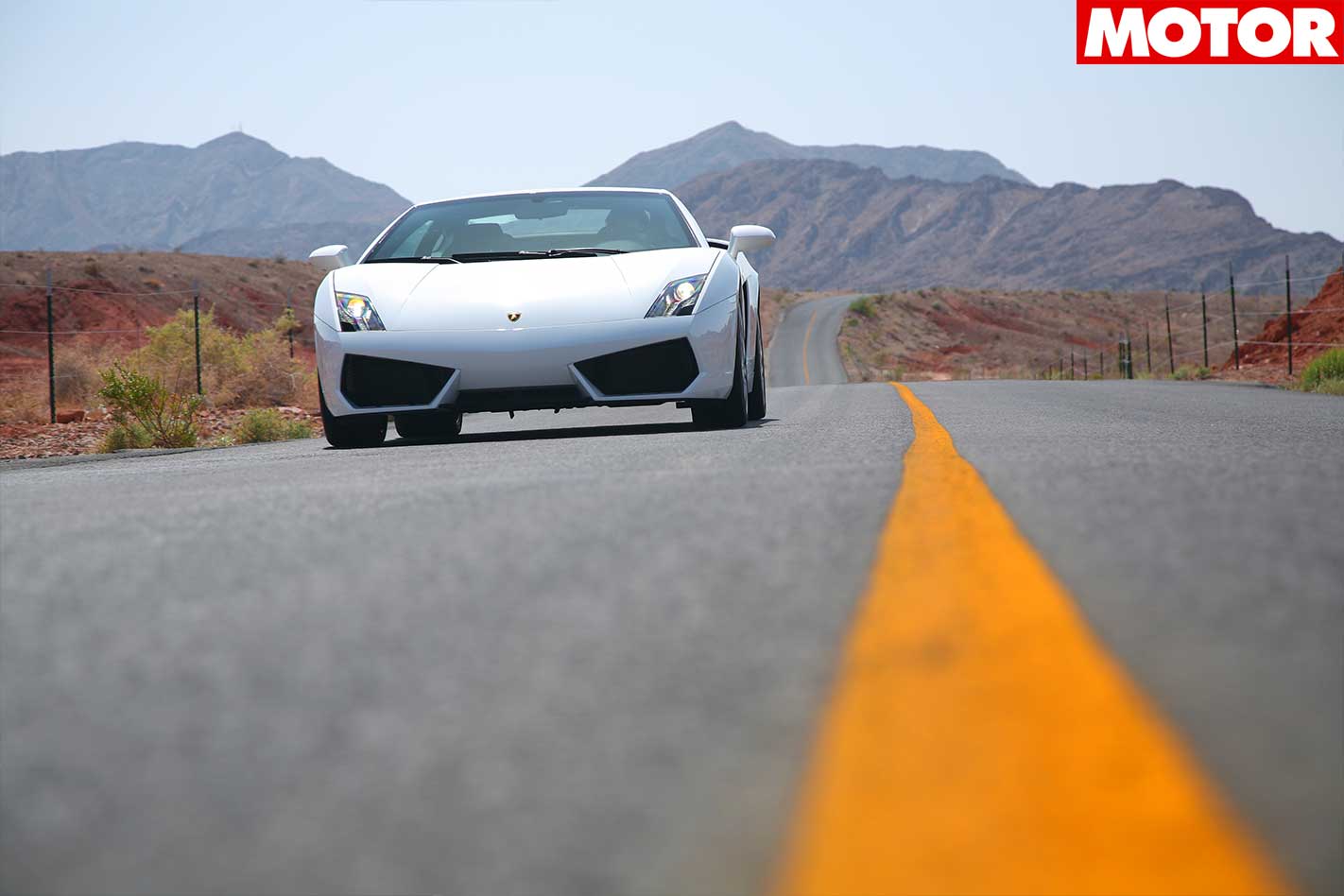
Thanks to all-wheel drive, the traction, grip and stability are never at stake. It’s so simple to go 737-chasing in the LP560-4; it’s easy to waltz with grandezza round corners on wet tarmac and then to prescribe smokey arcs as it winds from mild understeer to mild oversteer.
No. The more powerful engine is indeed a welcome asset, but it takes a hypersensitive bum loaded with g-force sensors to register the split-second advantages over the 2007 vintage. Instead, what makes all the difference is the better-connected steering, the more-compliant suspension, the less capricious E-gear transmission and the homogenous handling characteristics.
As far as the new steering is concerned, the stiffness and the substantial effort are history. Instead, it feels more progressive and fluent, almost as if there’s been a change in the fluid inside the steering rack from syrup to whisky.
Also new is the double-wishbone rear axle complete with additional tie-rods, the overhead rear anti-roll bar and, most importantly, a larger rear subframe that accommodates the suspension-mounting points.
Together with the sticky dual-compound Pirelli P Zero LRR (low rolling resistance) tyres, this set-up takes away the edginess at the limit and somewhat softens the break-away behaviour so that lift-off oversteer is a vice of the past.
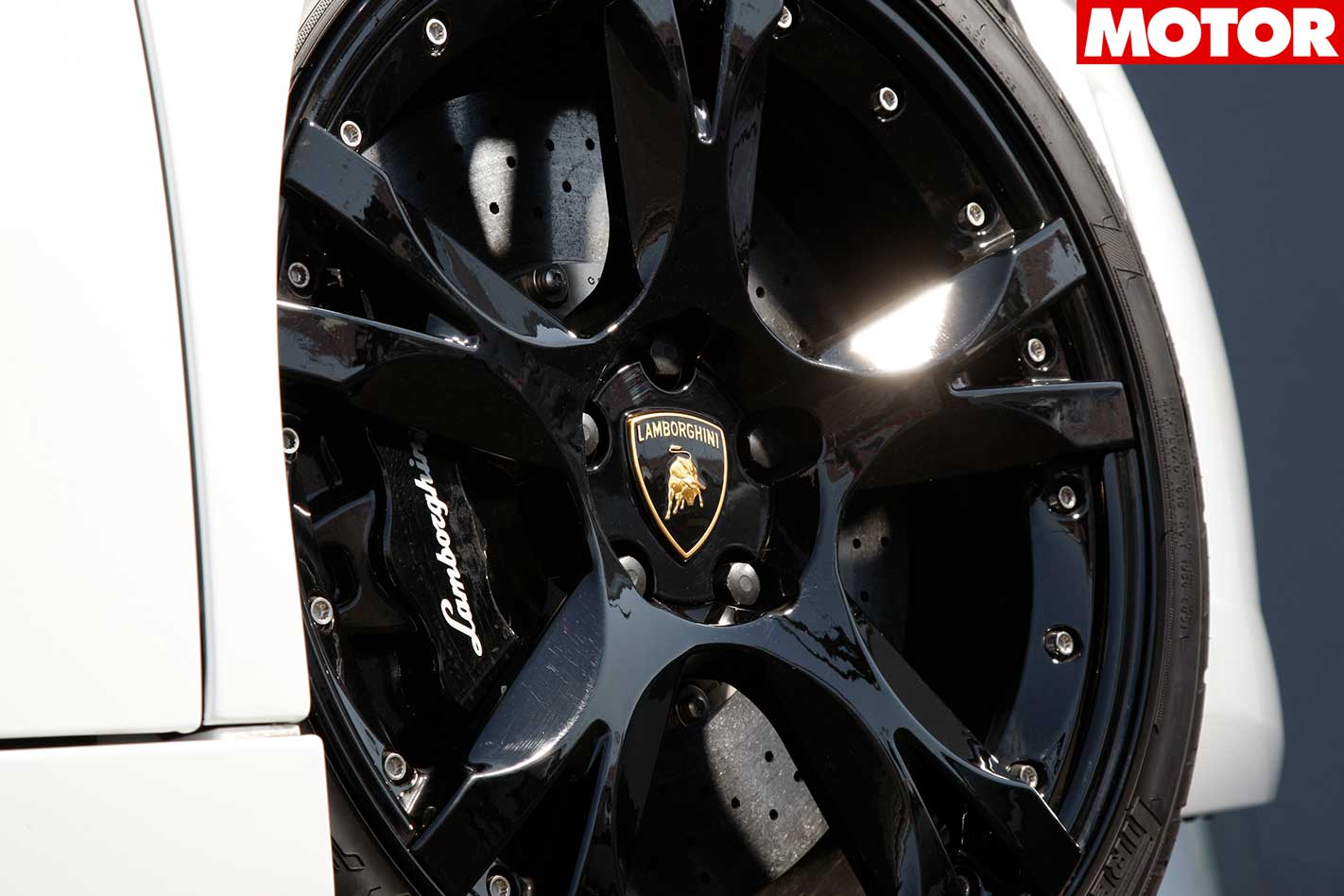
The customer can, for example, choose between steel and ceramic composite brakes, both offering improved cooling and heat dissipation. The latter option is larger in diameter yet lighter overall, but it needs higher temperatures to deliver the goods. Mainly thanks to some minor all-wheel-drive system upgrades, the kerb weight has dropped slightly from 1520 to 1500kg.
The new viscous coupling front diff splits the torque at a rate of 30 to 70 percent, but this ratio varies according to demand, so the typical give-it-all cornering attitude is push in, pull out. The downside of the freshened set-up is more turn-in understeer which can be a nuisance on cold tyres.
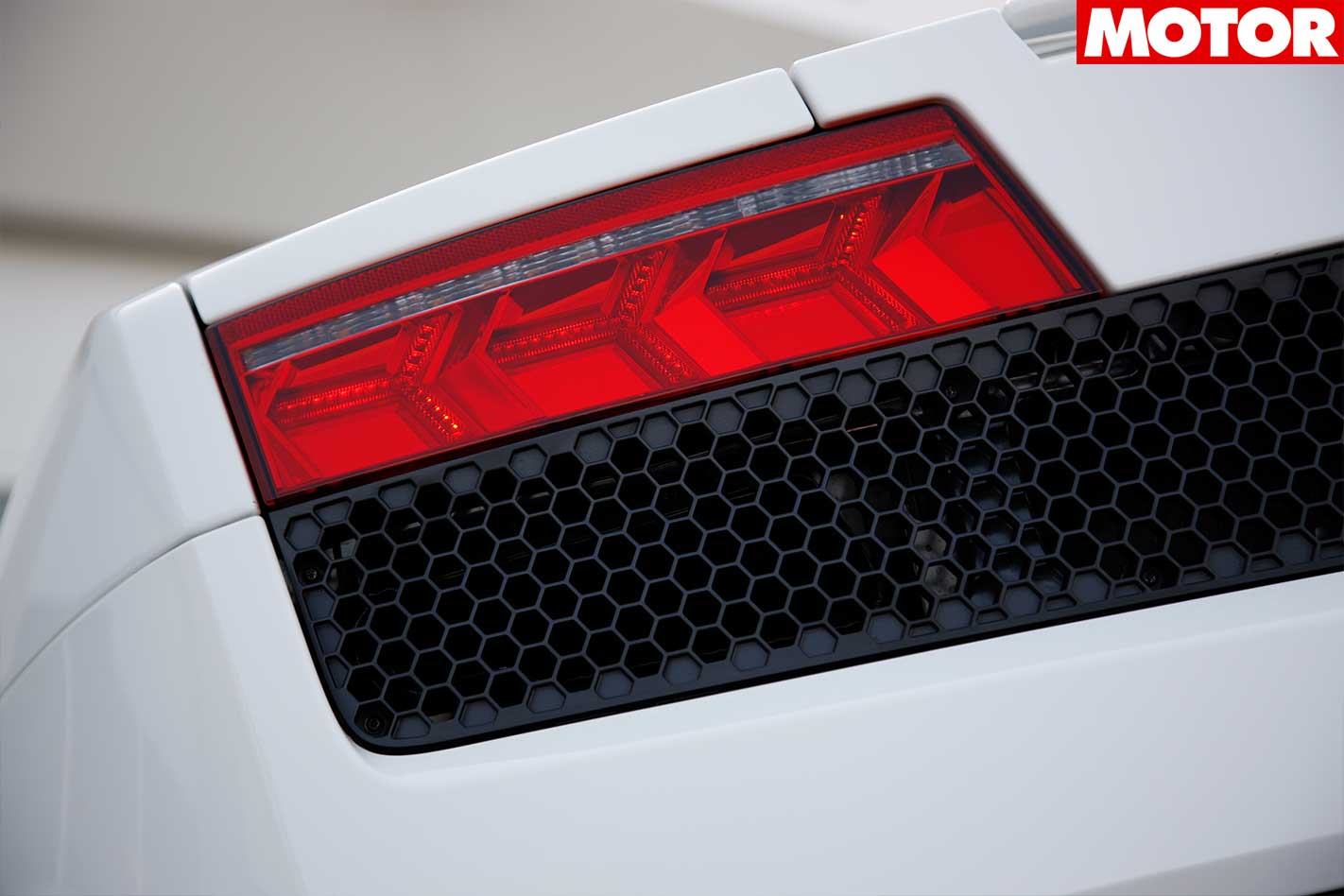
More relevant in real life is the actual shift quality (smooth instead of jerky), the shift action (instant and positive thanks to column-mounted paddles) and the totally relaxed operation in stop-and-go traffic (no hiccups, no delayed response, no over-eager downchanges).
Auto mode will get you from A to B, but it’s still a crude headbanger, no matter how delicate the throttle treatment may be. The Sport function provides the best compromise between harmony and velocity.
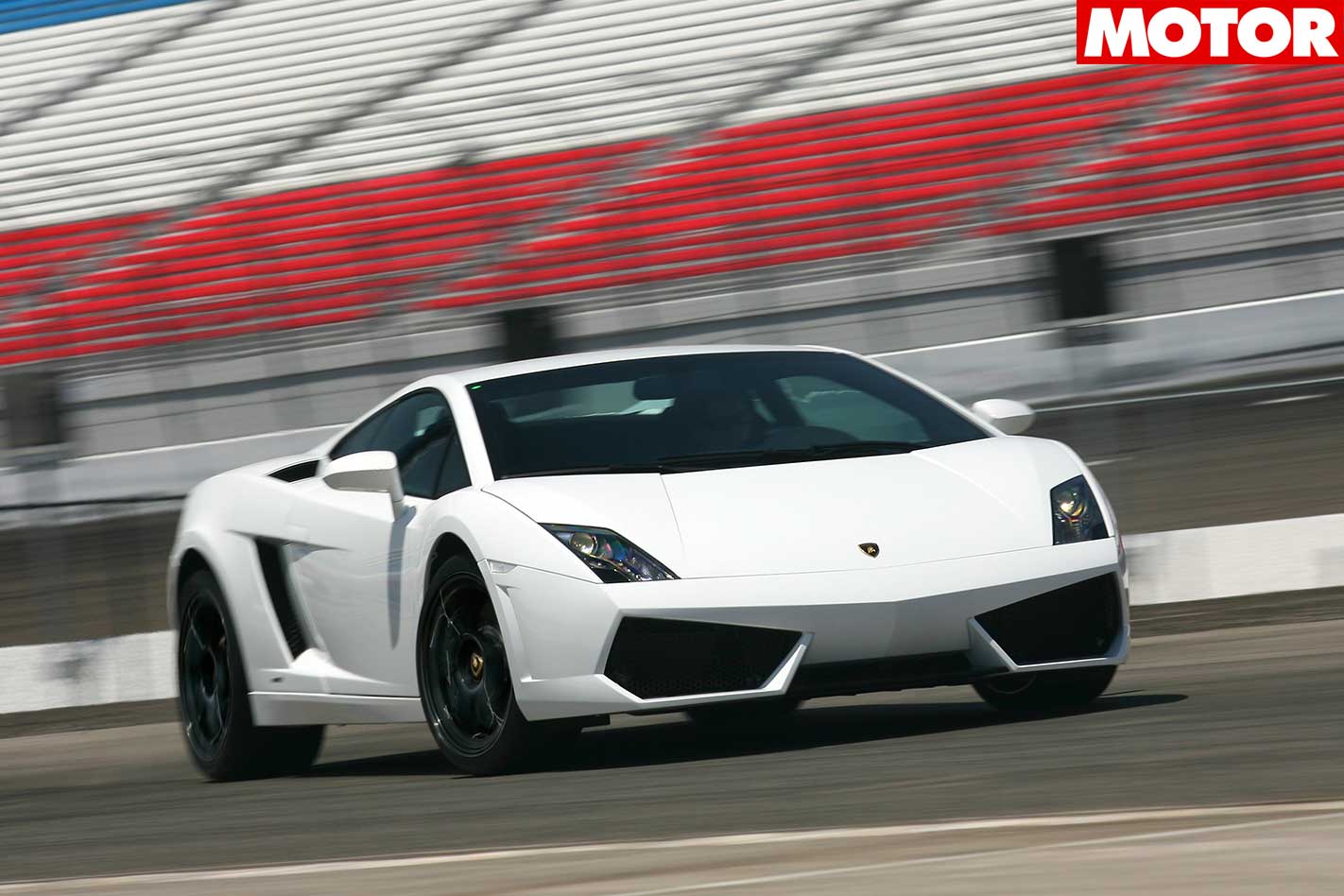
Design changes often cause arguments between marketing bods and engineering heads. But in this case, the two departments actually worked hand in hand.
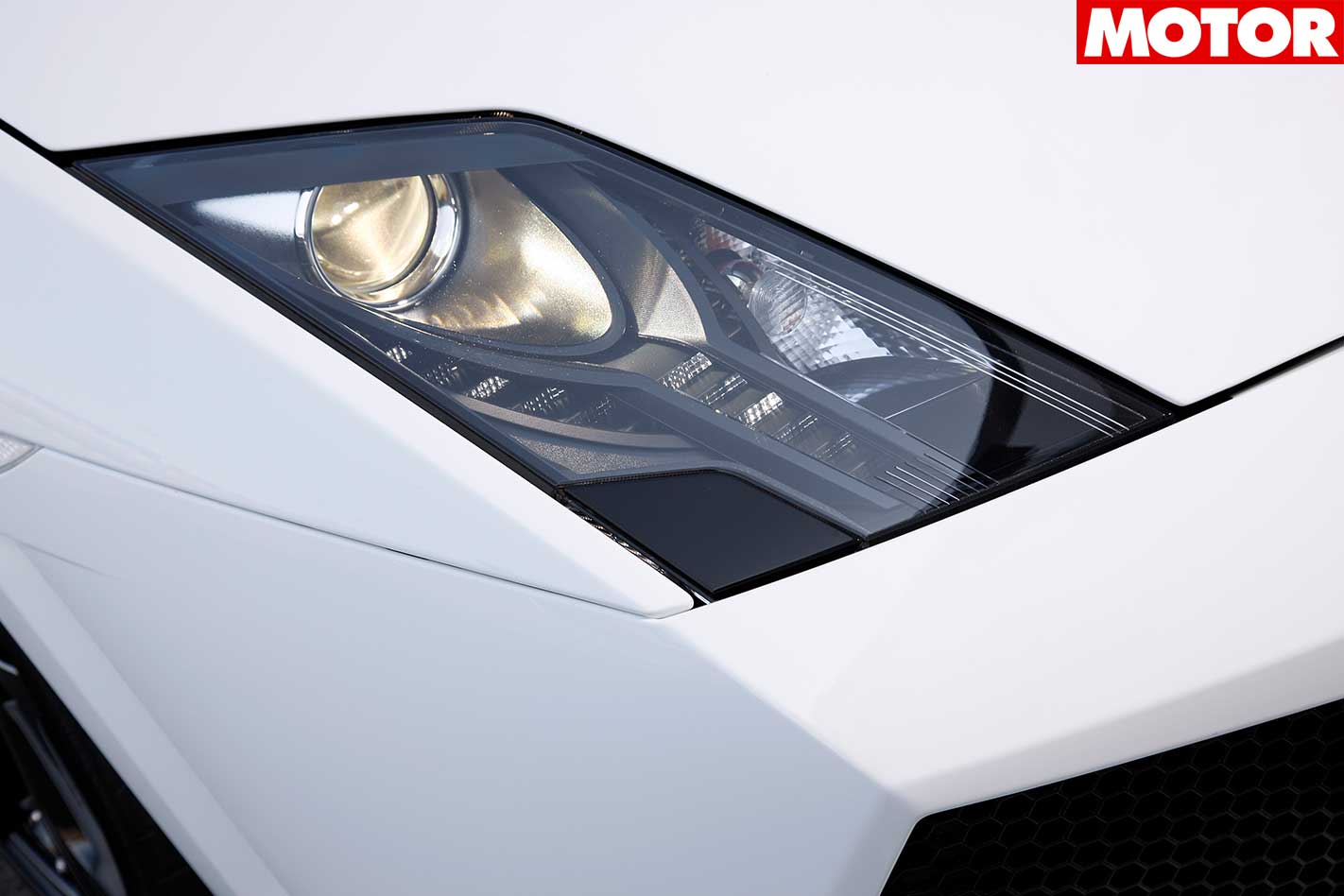
The marketing mob wanted more presence and a closer proximity to the bad-arse Murcielago; the R&D lads wanted better cooling and superior aerodynamics. The car received both: the most aggressive front end in the supercar scene, and a more substantial throughput of air, together with 31 percent more downforce, especially in the rear where an automatic spoiler extends at 120km/h.
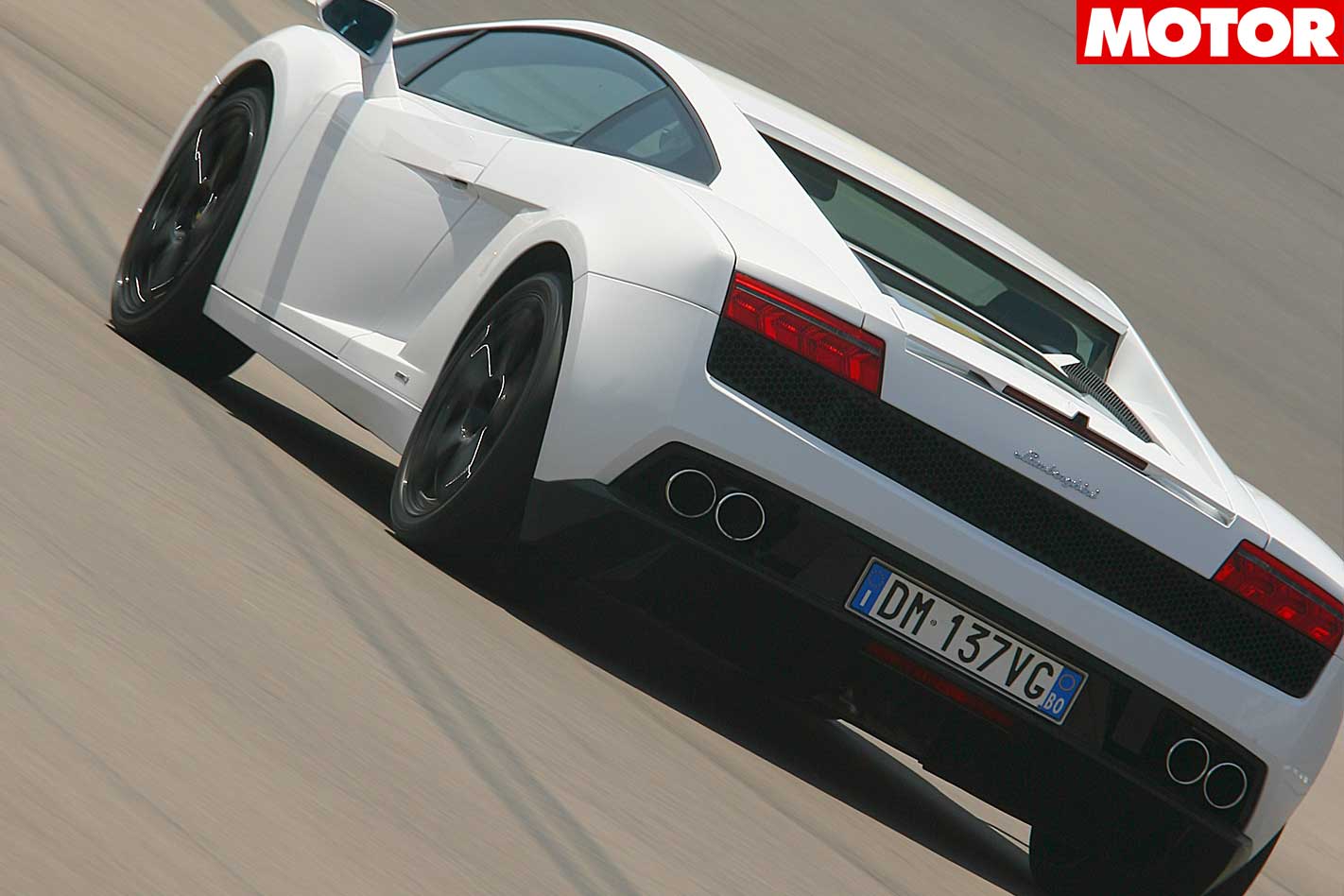
High speeds require mega revs and a certain determination to keep up the momentum, which is why those ultra-fast autostrada sweepers call for dry palms and a certain amount of fatalism.
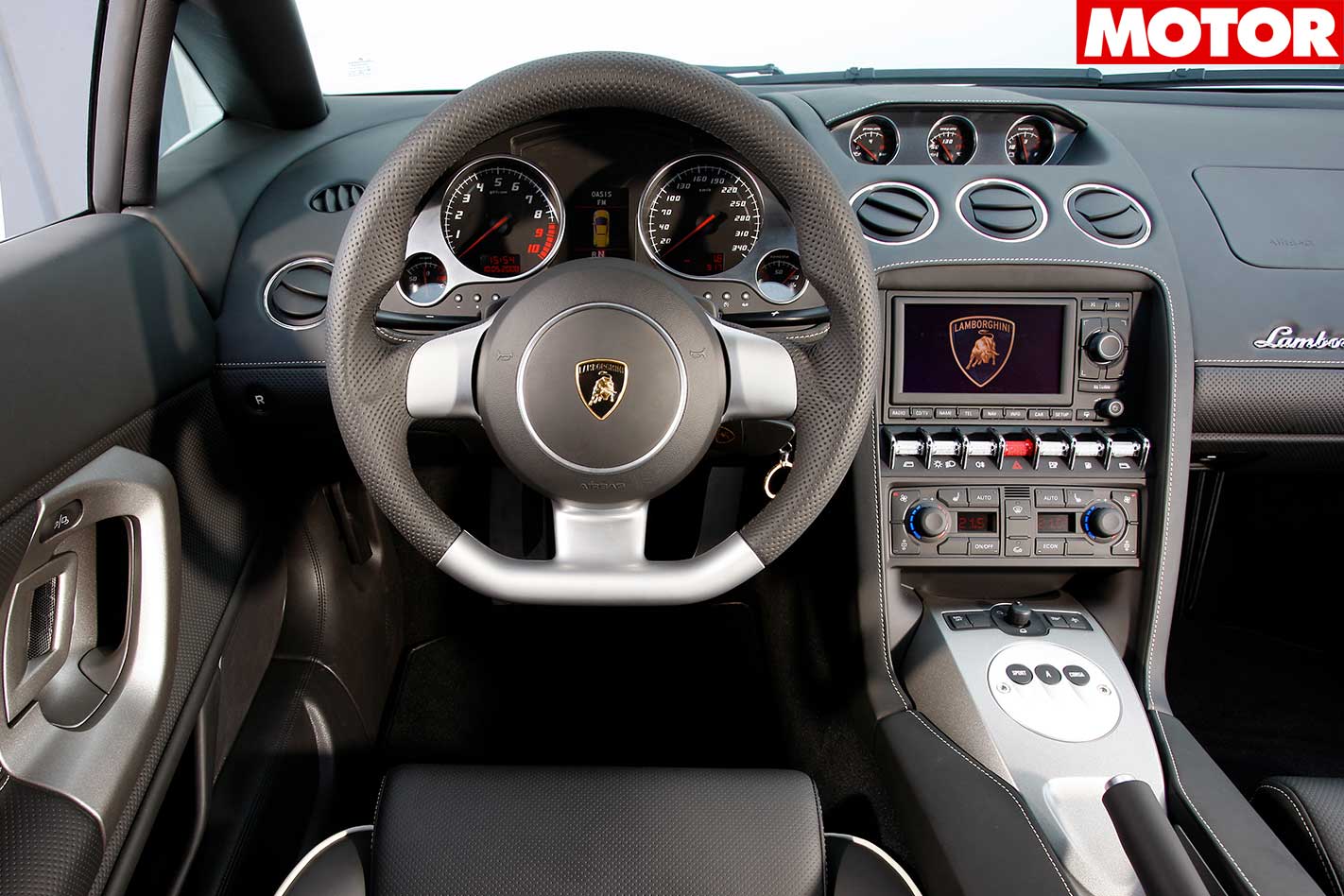
Inside, LP560-4 has detail changes like fresh instrument graphics, a row of chrome-capped switches, a relocated CD player, slightly less martial seats and a new steering wheel with a silly squared-off bottom; in vogue, as are the speedo and rev counter needles that swing round once as you start the engine.
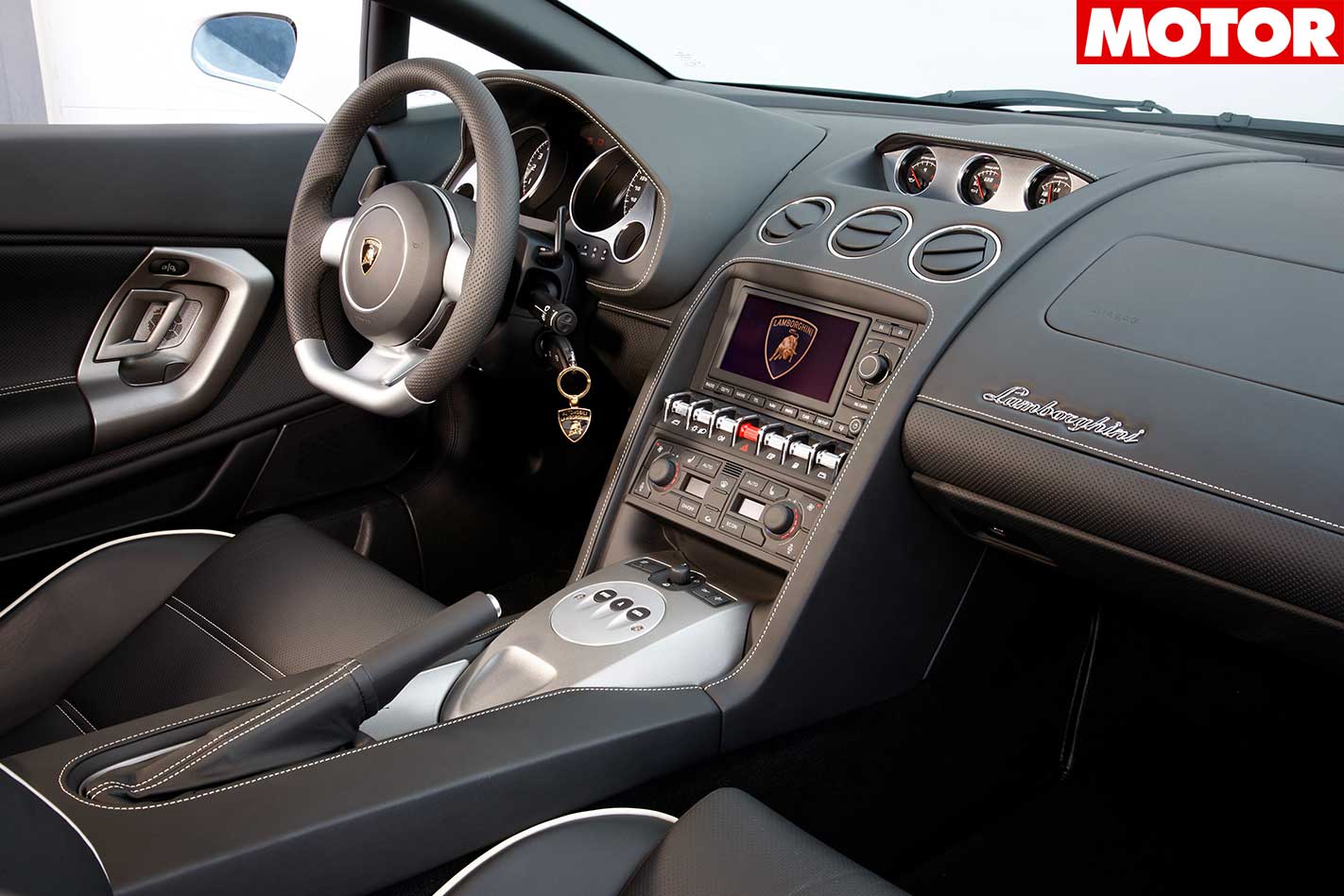
Vehicle control at the limit can be an issue when legs and arms collide. The soon-for-debut LP560-4 Spyder will be an even tighter fit, though its goose-pimple 10-tenths noise is bound to be even more radical.
You can put your money down on a Gallardo to show off; to make a blatant anti-Ferrari statement or to own the butchest car on the block. But there are much better buying motives than that, such as its fine handling and energetic roadholding, the magic V10 that slays most V8s for grunt and charisma, and the failsafe grip provided by all-wheel drive. You see, like the F430, the LP560-4 is a proper sports car, not a dressed up GT or an evolution of a relatively pedestrian base model.
It is, in other words, a masterpiece.
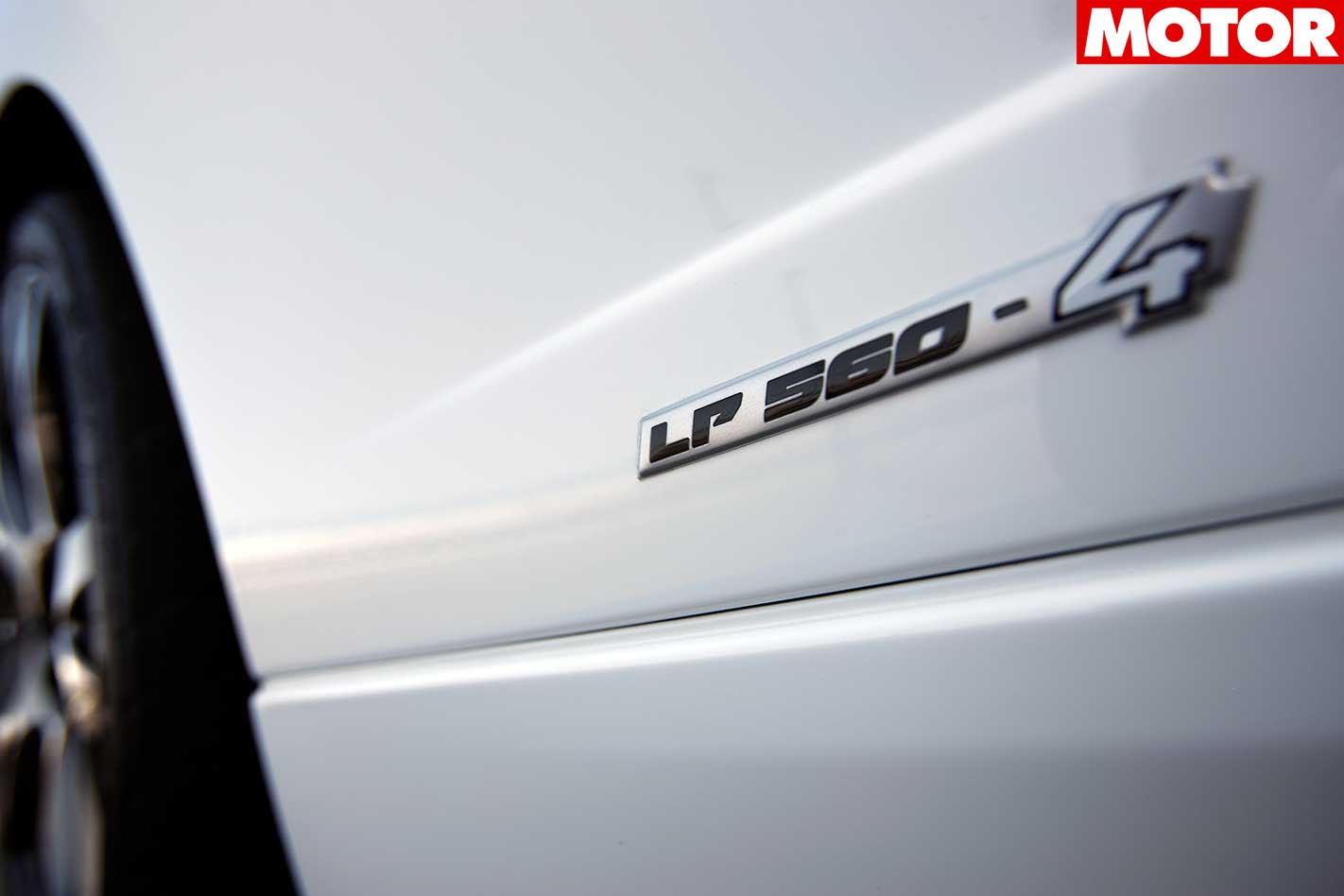
WHAT’S IN A NAME?
IT AIN’T ALL GOOD
2008 Lamborghini Gallardo LP560-4 Body: 2-door, 2-seat coupe Drive: all wheels Engine: 90-degree V10, DOHC, 40v Material: alloy head/alloy block Bore/Stroke: 84.5 x 92.8mm Capacity: 5204cc Compression: 12.5:1 Power: 412kW @ 8000rpm Torque: 540Nm @ 6500rpm Redline/Cut: 8300/8300rpm Fuel/Tank: 98 octane/90 litres Kerb Weight: 1500kg Power-to-Weight: 275kW/tonne Transmission: 6-speed manual Ratios: 3.31/2.05/1.45/1.13/0.93/0.74 Final Drive: 3.08 Suspension: double A-arms, coil springs, anti-roll bar (f); double A-arms, coil springs, anti-roll bar (r) Length/Width/Height: 4345/1900/1165mm Wheelbase: 2560mm Tracks (f/r): 1632/1597mm Steering: power rack and pinion Turning circle: 11.5m Lock-to-lock: 2.7 turns Brakes: 365mm ventilated discs, eight-piston calipers (f); 356mm ventilated discs, four-piston calipers (r); ABS, EBD, ESP, ASR Wheels: 19 x 8.5-inch (f), 19 x 11.0-inch (r), alloy Tyres: Pirelli P Zero LRR 235/35ZR19 (f), 295/30ZR19 (r) Price: $455,000 (estimated)
Fast Times 0-100km/h: 3.7sec (claimed) Top speed: 325km/h (claimed)
Likes: Brilliant! – better than the Superleggera in every respect Dislikes: Silly squared-off steering wheel; cramped interior Rating: 9.5 out of 10 stars
MCLAREN has divulged a tasty information morsel about the performance of its eagerly anticipated ‘Hyper-GT’, codenamed BP23, saying that it will have the highest top speed of any McLaren yet – including the iconic McLaren F1.
“On the 28th of March 1998 a gentleman called Andy Wallace recorded 242[.9]mph (391km/h) in an F1. I’m pleased to say this car will be faster than that,” said Ultimate Series vehicle line director Andy Palmer at a small gathering of media after the Geneva motor show opened.
The existence of BP23 made headlines in mid-2016 when the road-car project was first spoken about outside of Woking. It will join McLaren’s Ultimate Series as counterpart to the track-focused Senna and Senna GTR, and notably feature a centrally mounted driving position inspired by the McLaren F1 of 1992.
Wheels spoke with Andy Palmer this week about the pressure that comes with making a car that draws a direct link to a motoring icon.
“It’s a lot [of pressure]. I walk past XP5 [the final F1 prototype] every single day when I come into the office,” he explains.
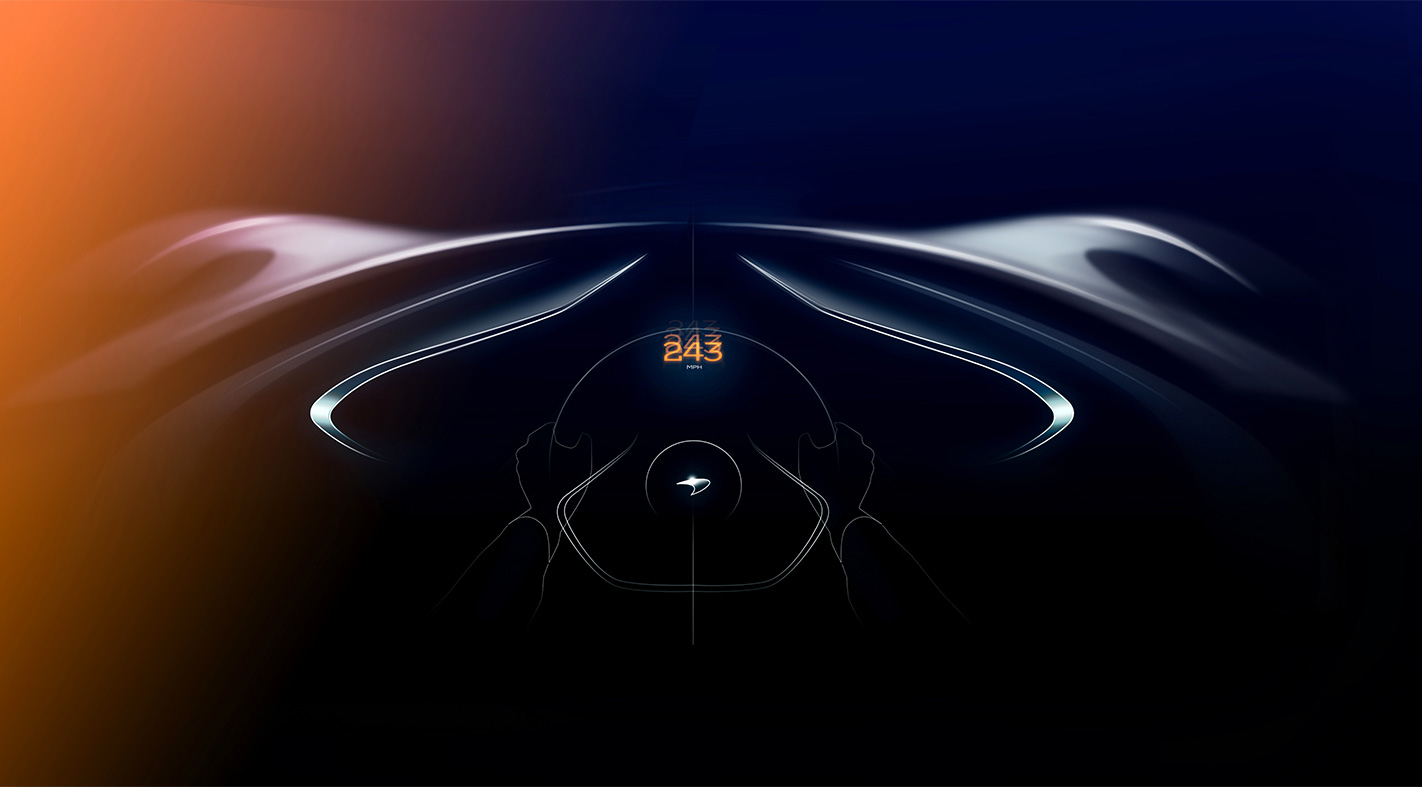
“We went back to a central seat position, because we could. Then, how many do we produce? We wanted to keep it exclusive, so [we said] let’s produce 50. Then our customers said I’d like one and I’d like one.
“We were oversubscribed about three times on it. So we said let’s pick 100, and then, well, we did 106 chassis for F1… there you go, let’s do 106. And it’s a nice link, but that is where the comparison stops.
“I don’t think when you see the car you’ll be able to draw a comparison to anything.”
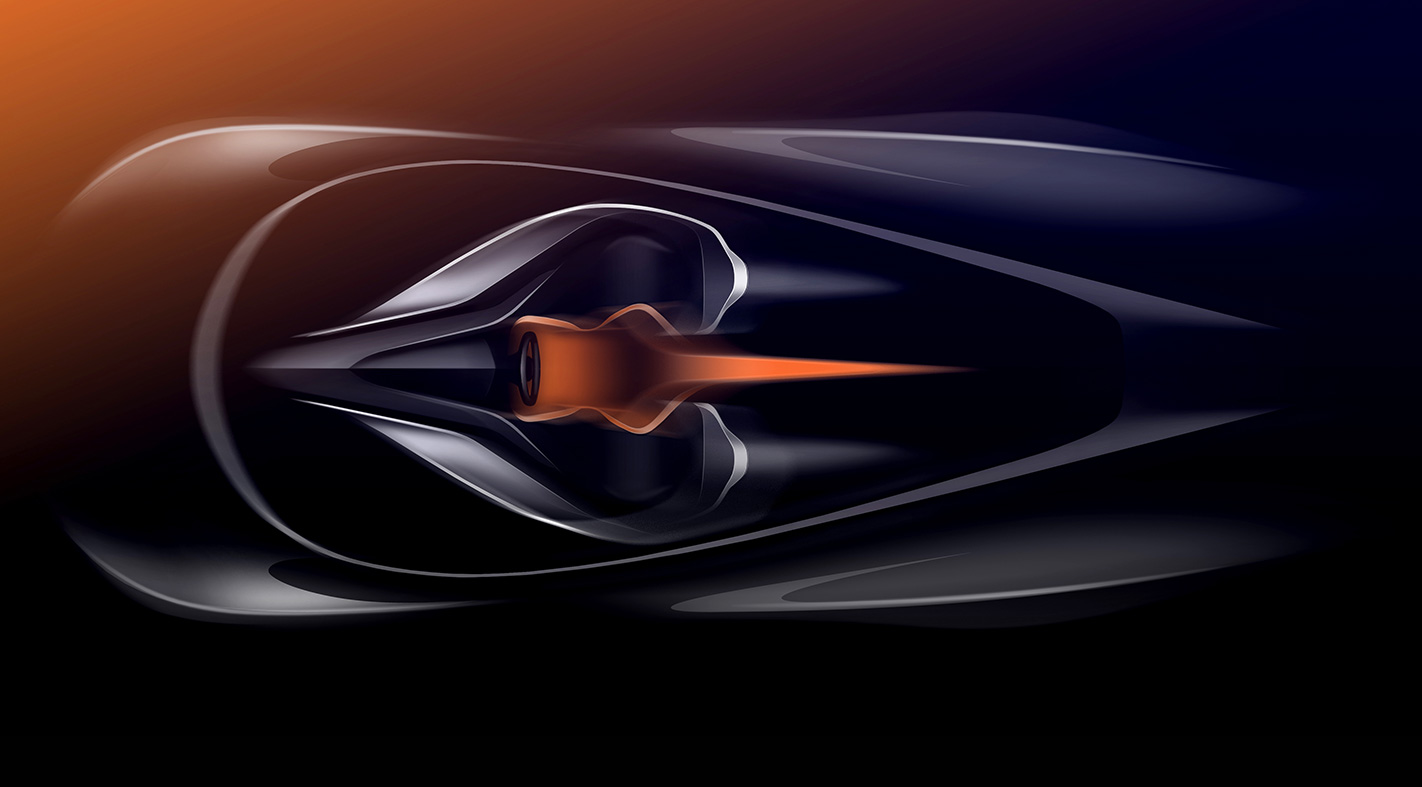
“The car is shrouded in a little mystery,” says Palmer. “Very few people within McLaren have seen it. We built a special design studio for Rob [Melville], and his team are very focused on creating something special.”
What we do know is it will be a technological tour de force, including a petrol-electric hybrid drivetrain, and take a super slippery, aero-efficient form with a less blinkered obsession for track pace.
“Senna is very much about downforce and grip and lap times. BP23 is very different. It’s about high speed, it’s about acceleration, craftsmanship, luxury, refinement. Yet, it can carry three passengers and luggage.
“It’s not a [Aston Martin] Valkyrie competitor, it’s not a [Mercedes-AMG] Project One competitor. It’s not a replacement for the P1. We are not producing a car like that.
“It is very much a road car,” says Palmer. “We’re a year or maybe a little bit more into the development of it. Rob and his team have pretty much finalised the design and we’re coming into the prototypes of that.”
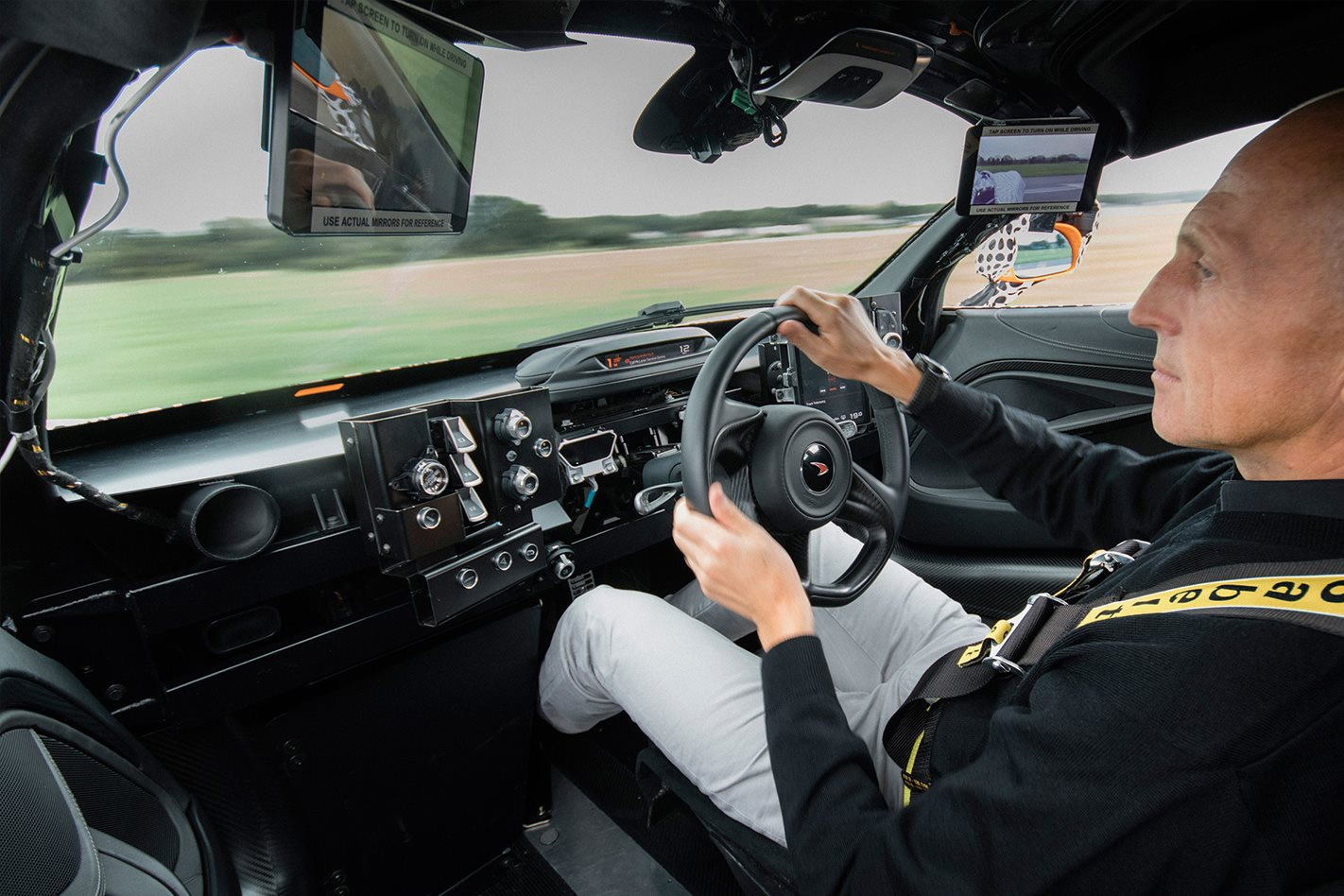
“The car is very exciting to drive. Sitting in the middle of a car really does give you something very different. Visibility, and the appreciation of what’s going on around you, it really does move it to the next level.
“When you see the hybridisation on BP23, that’s very different again [to P1]. Hybridisation isn’t just about range, [it] can be used for performance and turbo lag fill, but we’ve addressed these areas in other ways, we’re using hybridisation for the enjoyment of the customer.
“Ultimate Series gives that ability to do something a little bit different, not a hypercar with 50km of [electric] range – our customers don’t want that.
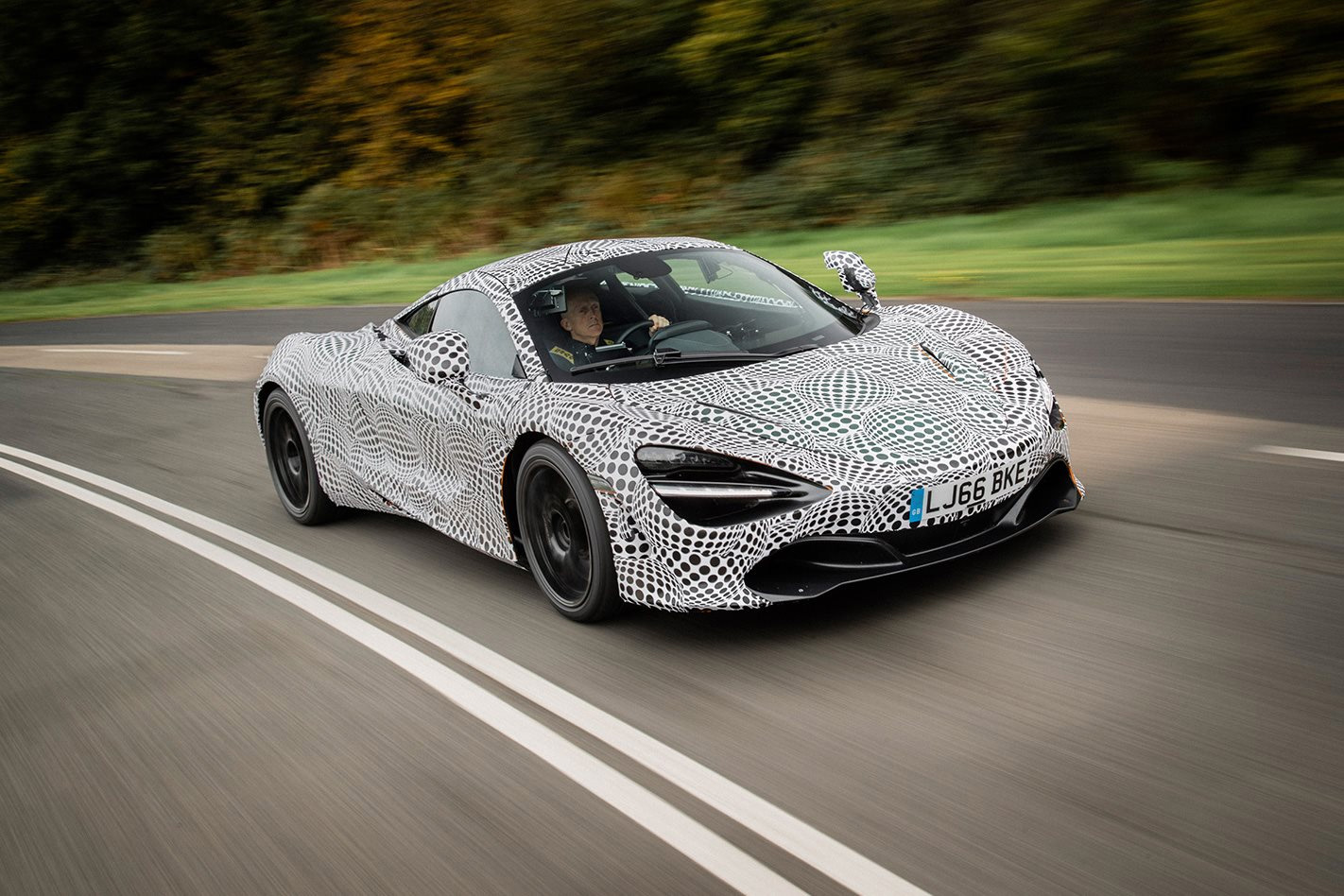
“I appreciate [people] will get hold of an F1 and BP23 and put them together and look at changes over that 30 or 25 year period, and I’m pleased that the engineering and the design shows how far we’ve moved it forward,” says Palmer.
“We’ve stated that this will be the fastest McLaren, and it will be. “
So, could Andy Wallace come back to break the McLaren record?
“Possibly. I may have something else up my sleeve.”
THE men and women of Woking are great at two things, exquisite supercars for the road, and blindingly fast race cars for the track.
Sometimes (just three times in over two decades), McLaren will unleash the GTR badge on the world, and combine those two skills to transform a road-faring piece of exotica into bewinged beasts destined for track dominance.
While McLaren is one of the most successful teams in F1 history – with its trophy cabinet overflowing with eight constructors’ championships, 12 drivers’ championships, and 182 grand prix race victories – the GTR badge’s origins stem from its road-going creations.

Previously:
FIRST GENERATION – F1 GTR
When McLaren’s first road car, the F1, was built, its creator Gordon Murray never intended for it to go racing. Instead he envisioned his creation as the ultimate road car.
But it’s hardly a coincidence that one of the greatest road cars in history turned out to be a pretty handy race car as well.
Soon after the F1’s launch in 1994 Stephane Ratel (who later went on to popularise GT3 racing around the globe), and two of his mates, started the BPR Global GT Endurance Series, whose debut season saw homologated racing versions of the Ferrari F40 and Porsche 911 Turbo do battle.
For the following season teams started looking for alternatives, and several turning to Murray in the hope of convincing the F1’s creator to let them race factory-backed versions of his car.
Murray initially resisted the requests, but relented in time for a racing-version of the GTR to be homologated for the 1995 series, following a rushed three month development.
The F1 actually didn’t require extensive modifications to became a race car, and earn the GTR badge, apart from the obligatory rollcage and aerodynamic modifications, along with stripping the interior of all unnecessary luxuries, and adding new cooling ducts.
Carbon brakes replaced standard-issue steel unites, while regulations meant the F1’s BMW S70 6.1-litre naturally-aspirated V12 engine was required to breathe through an air restrictor which limited power to 441kW. In the transition from road to race car, the F1’s stock gearbox remained unchanged.
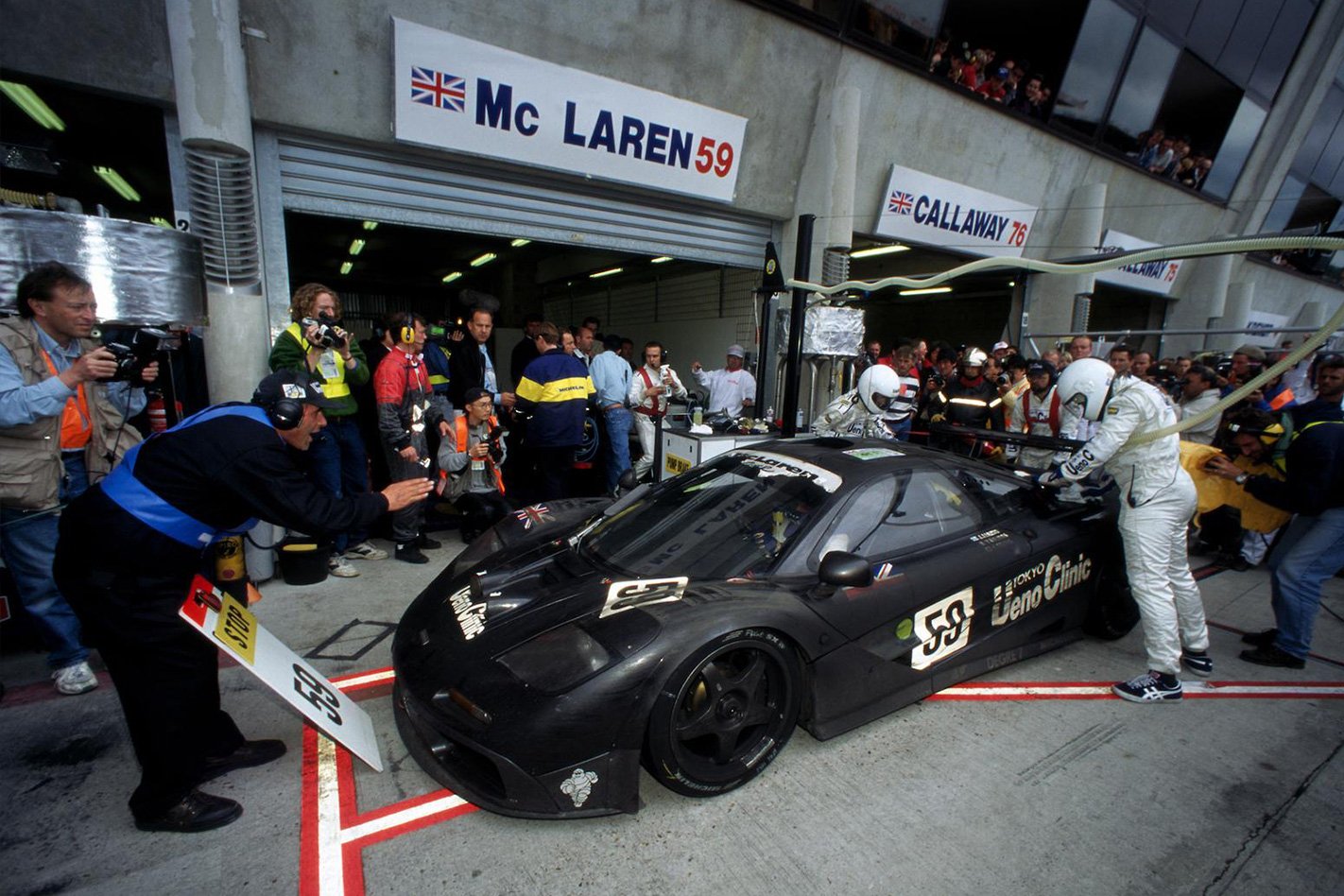
The GTR’s crowning moment came at that year’s 24 Hours of Le Mans, where it won outright, against purpose-built prototype sportscars. On debut the F1 GTR finished 1st, 3rd, 4th, 5th and 13th.
Victory at the 24 Hours of Le Mans made McLaren the only manufacturer in the world to have won the Formula 1 World Championship, Indianapolis 500, and Le Mans 24 Hour.

In total 28 F1 GTR chassis were built, nine in ’95-spec, nine in ’96 spec, and 10 in ’97 ‘long tail’-spec.
The F1 GTR competed internationally for a decade, with the final race chassis retired in 2005.
SECOND GENERATION – P1 GTR
The GTR badge has sat dormant for nearly a decade after the final F1 GTR was retired, when McLaren announced the moniker would return in 2014 to celebrate the 20th anniversary of the F1 GTR’s 24 Hours of Le Mans outright victory.
McLaren didn’t produce road cars for much of the intervening period, returning to the supercar-building business in 2009 with the MP4-12C, followed by 650S. Both were transformed into GT3 racers, but McLaren waited for the right car to live up to the F1’s legacy to break loose the GTR badge.
That car came in 2013 with the P1, a hybrid hypercar that formed a part of the holy trinity (along with Porsche’s 918 and Ferrari’s LaFerrari) and defined fast for a new generation of enthusiasts.
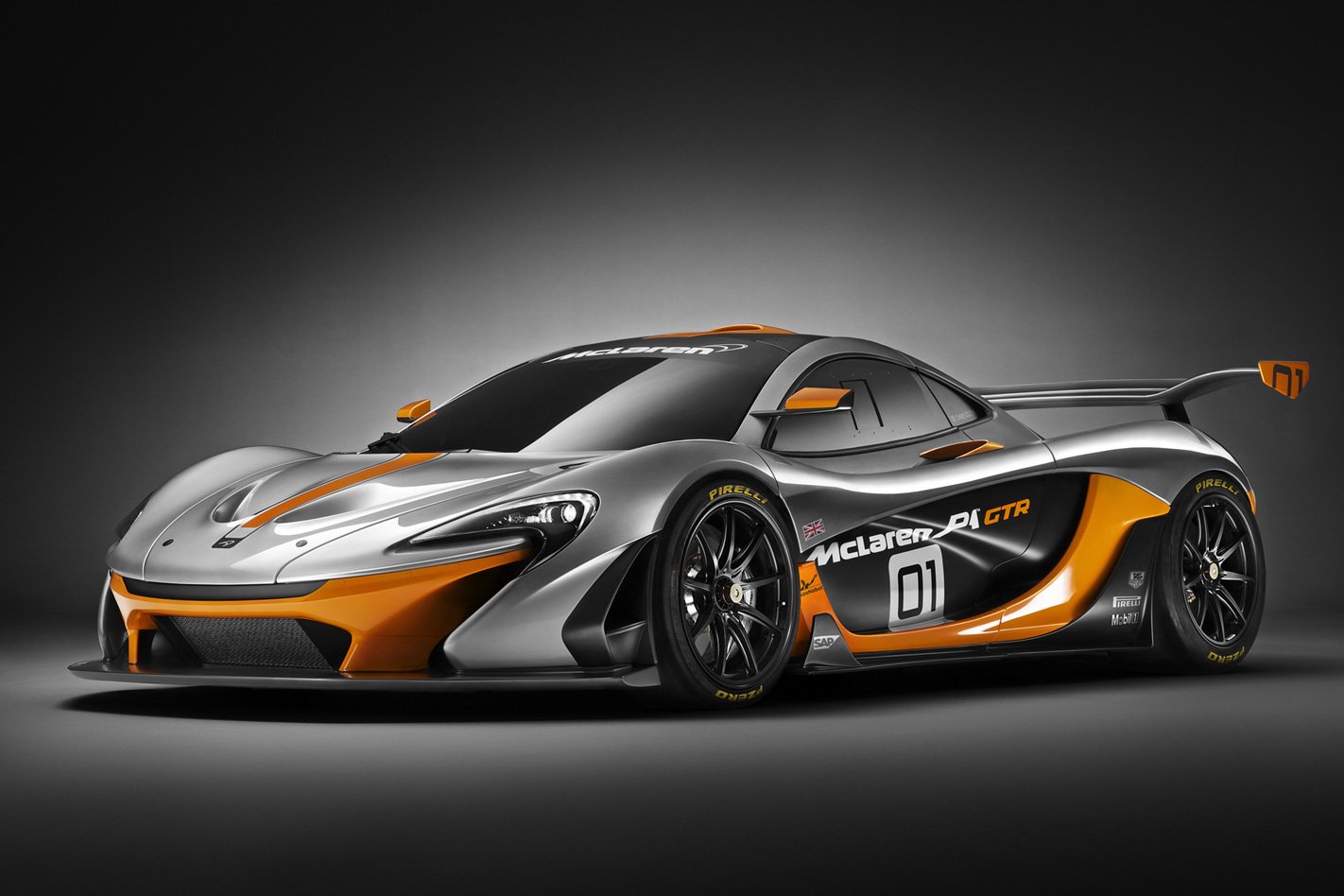
The P1 GTR was not built to the restrictive specifications of a racing category, instead it was an exhibition of McLaren capabilities. Each of the 58 P1 GTR’s cost A$3.3 million initially, and were only offered to customers which already owned a road-legal P1.
They were built, maintained and run by Woking’s McLaren Special Operations (MSO), with the 3.8-litre twin-turbo V8 and electric batteries and motors tuned to produce a combined system output of 735kW. The P1 GTR is 50kg lighter than its road-faring sibling thanks to extensive use of lightweight materials.
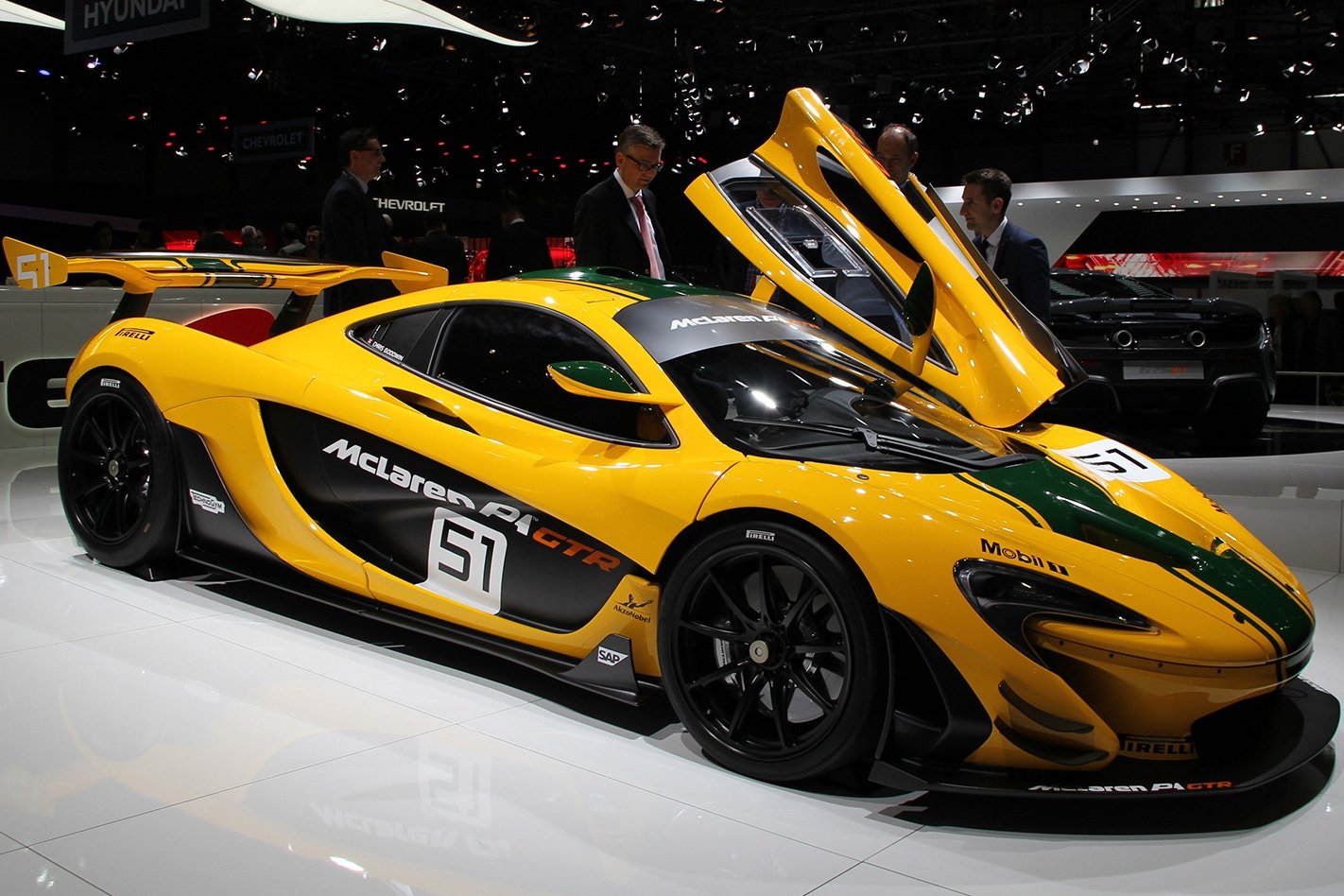
Visually the P1 GTR is instantly identifiable thanks to race-inspired bodywork, a larger front splitter, and a fixed rear wing with an F1-esque drag reduction system.
Outside of McLaren’s calculating control, a company called Lanzante began conversions which made the P1 GTR road-legal. In total 27 P1 GTRs were converted by Lanzante into ‘P1 LM’ specification for road use.
THIRD GENERATION – SENNA GTR
Then came the Senna GTR, a homage to the legendary F1 champion Ayrton Senna, which McLaren claims is its fastest car outside of Formula 1.
Like its P1 predecessor, the Senna GTR doesn’t meet any racing category regulations, and is designed as a track toy for the ultra-rich.
However, unlike the P1 GTR, there are no batteries here, just a 4.0-litre twin-turbo V8 turned up to produce “at least” 606kW.
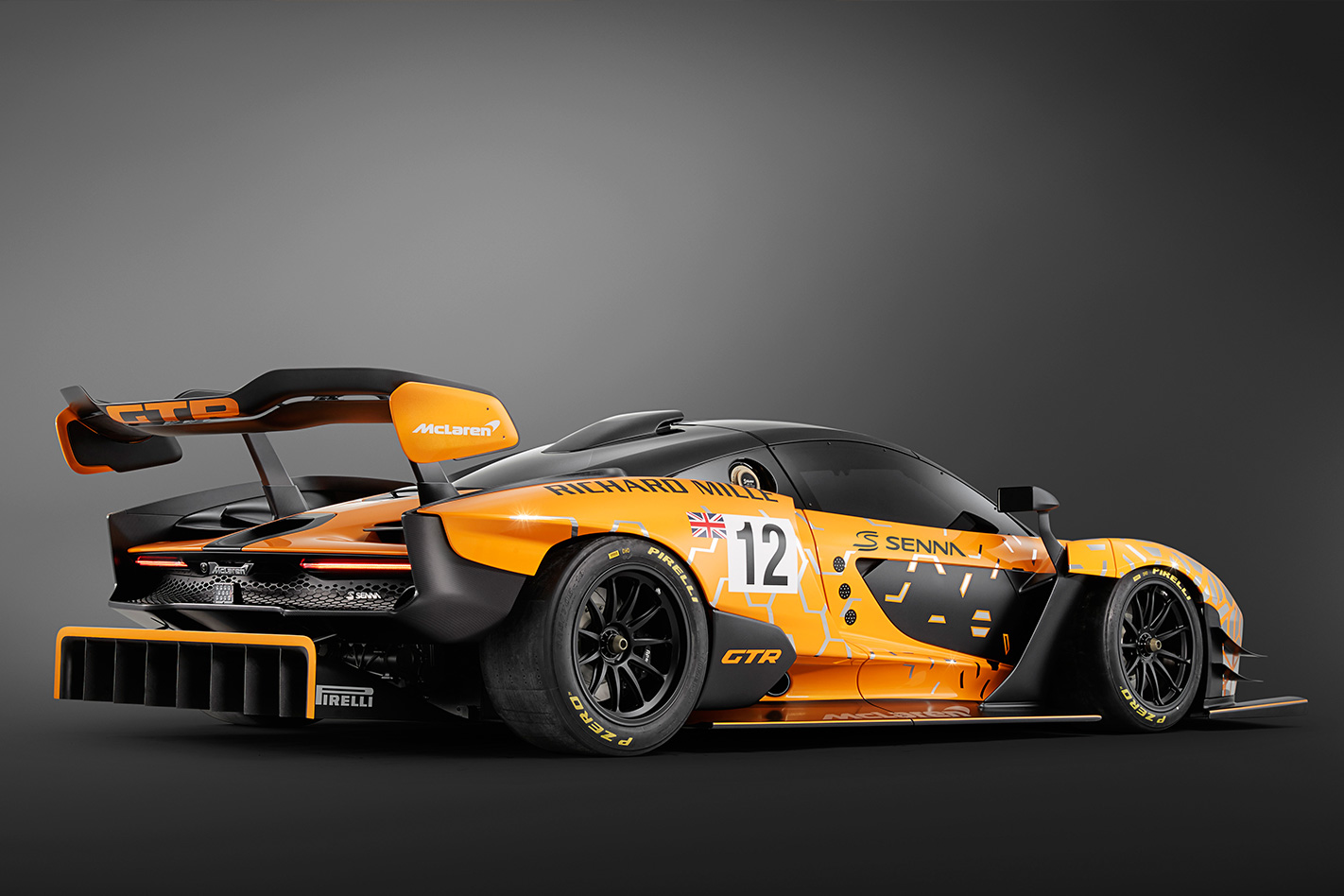
Of all the GTRs, the Senna has the most extreme bodywork, with the large front splitter, rear diffuser and spoiler working in conjunction to produce a tonne (1000kg) of downforce.
Other modifications include a wider front track, new fenders front and rear, along with lightweight materials replacing glass in the doors.
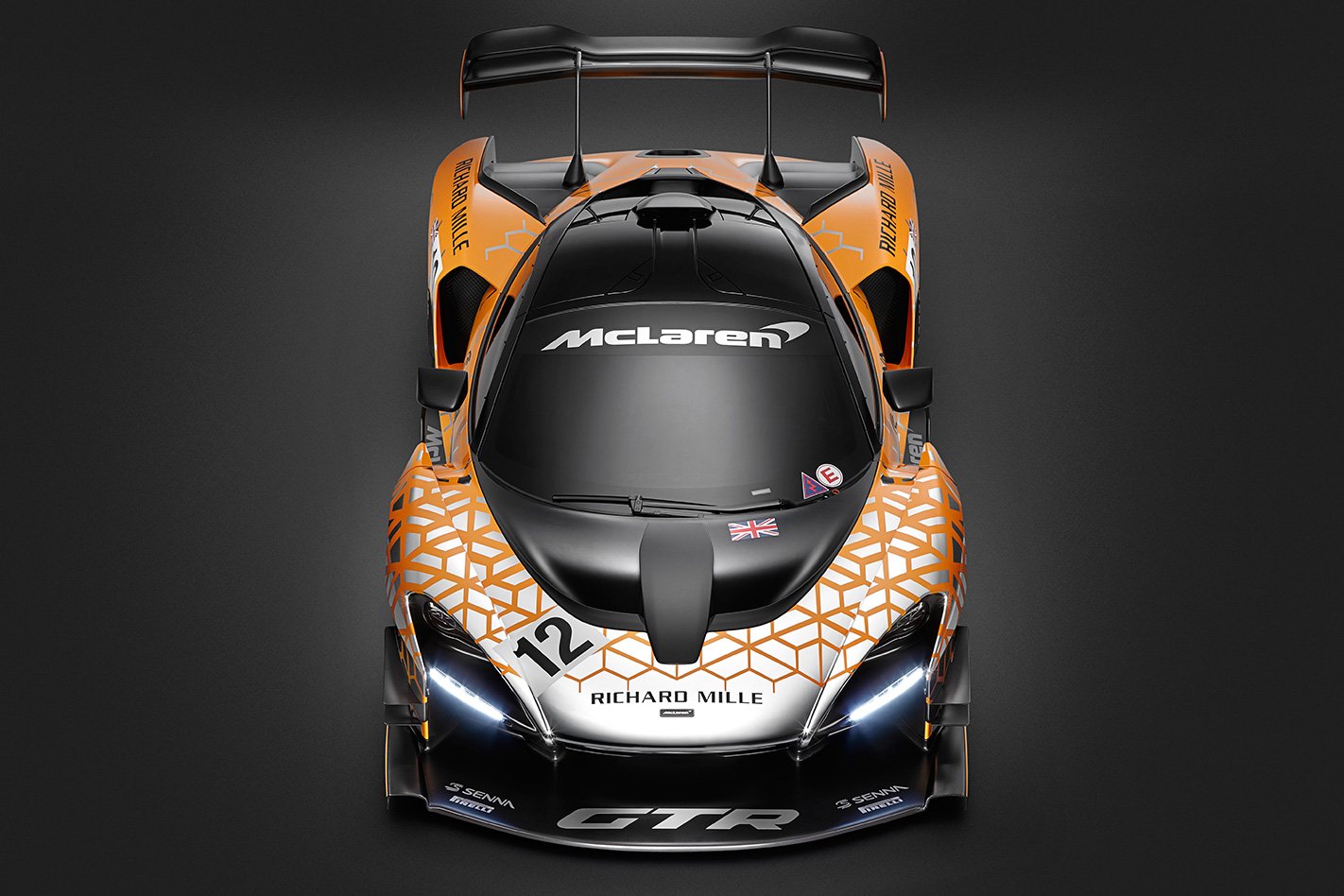
No word yet on if Lanzante will build a road-legal iteration of the Senna GTR like it did with the P1 GTR.
If you’re looking for a cheap way into the potential money-pit that is motorsport, we’ve cooked up a list of cars for sale in Australia which could scratch the itch.
So open your wallet/bank account (or don’t, we’re not the boss of you) and let’s get started.
1974 Holden HQ Kingswood Group NC race car
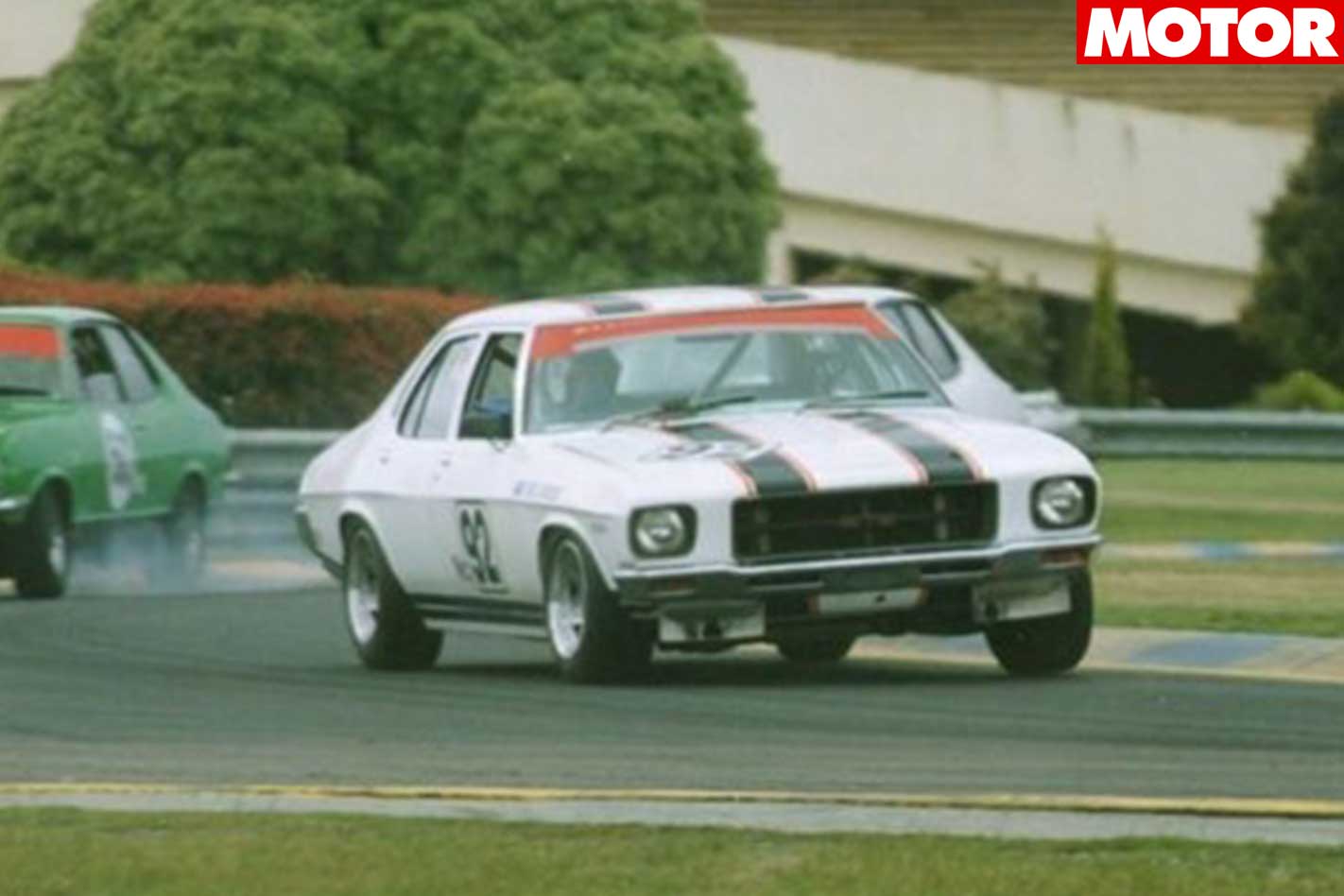
Everitt has a significant history as a racer and race car builder, as well as an enthusiast in general, so it’s worth checking out this car if it suits you.

Its $38,990 asking price seems reasonable, if the car’s in an equally reasonable condition.

It’s a Group 3J car, which is classed as improved production, so aside from the racing gear it’s primarily stock. Sort of. Err, for a race car, anyway.
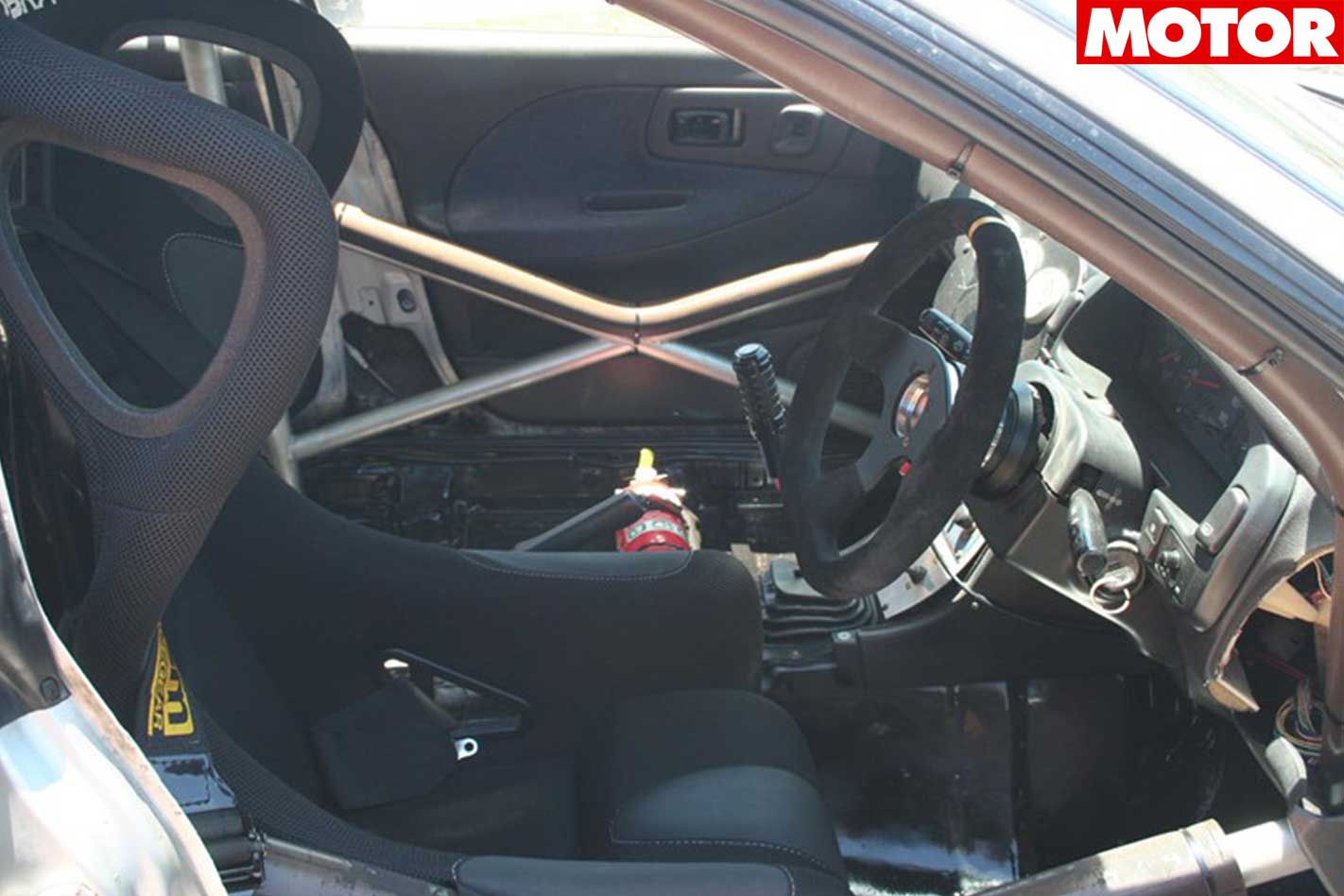
1963 Fiat 1500 Series 1 race car
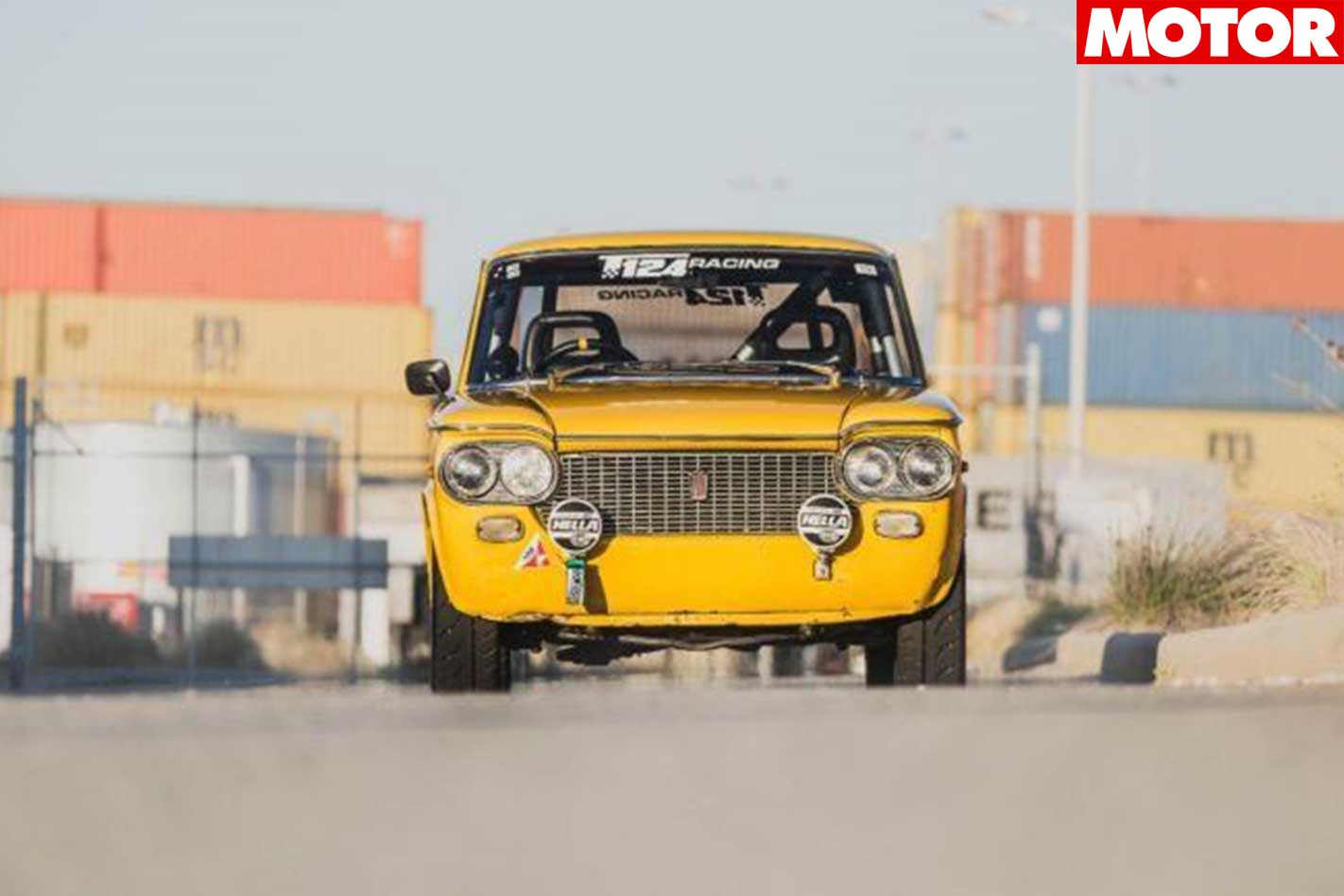
It comes with a roadworthy, but is “set up for tarmac rallying and historic motorsport events.” The asking price is only $14,000.

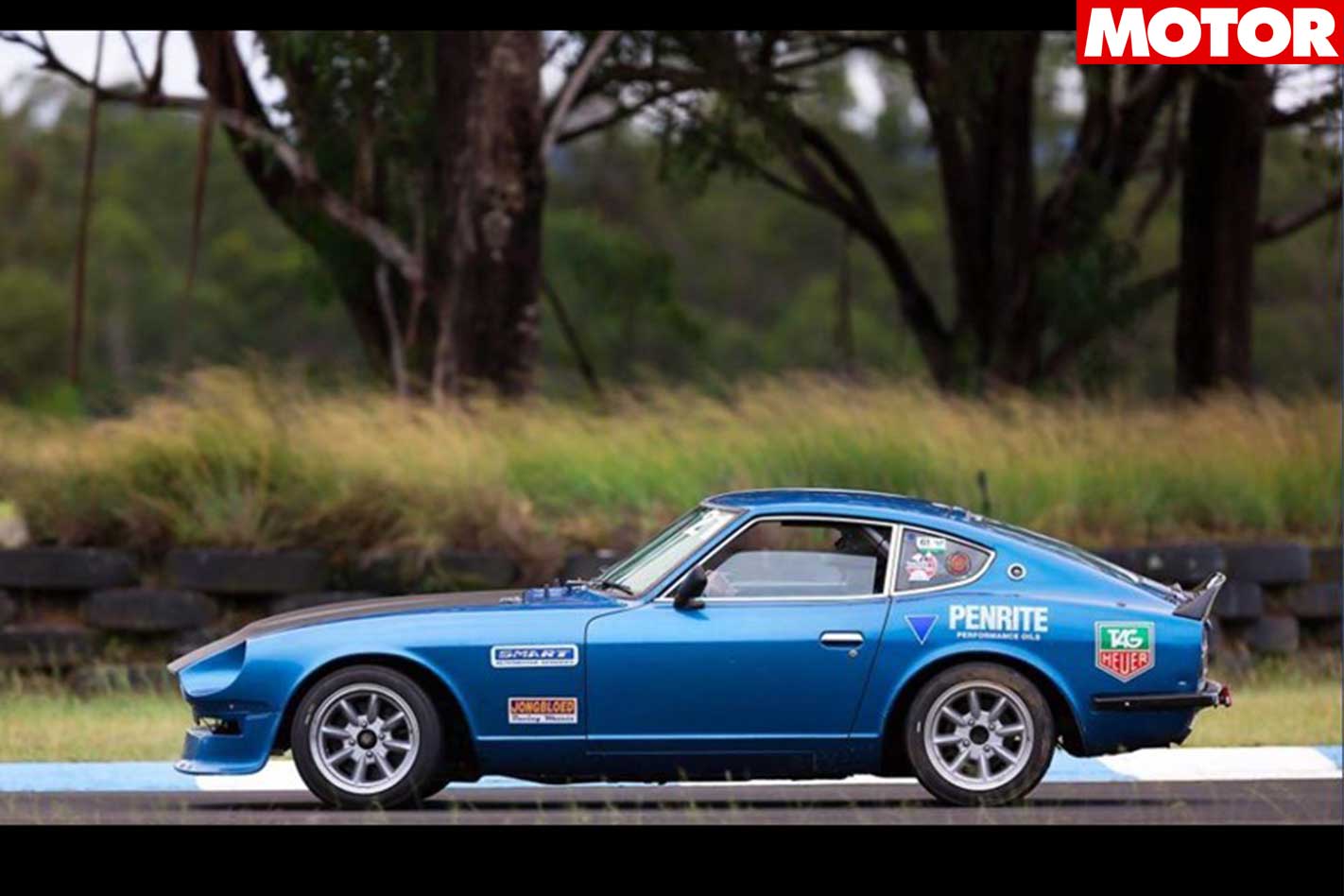
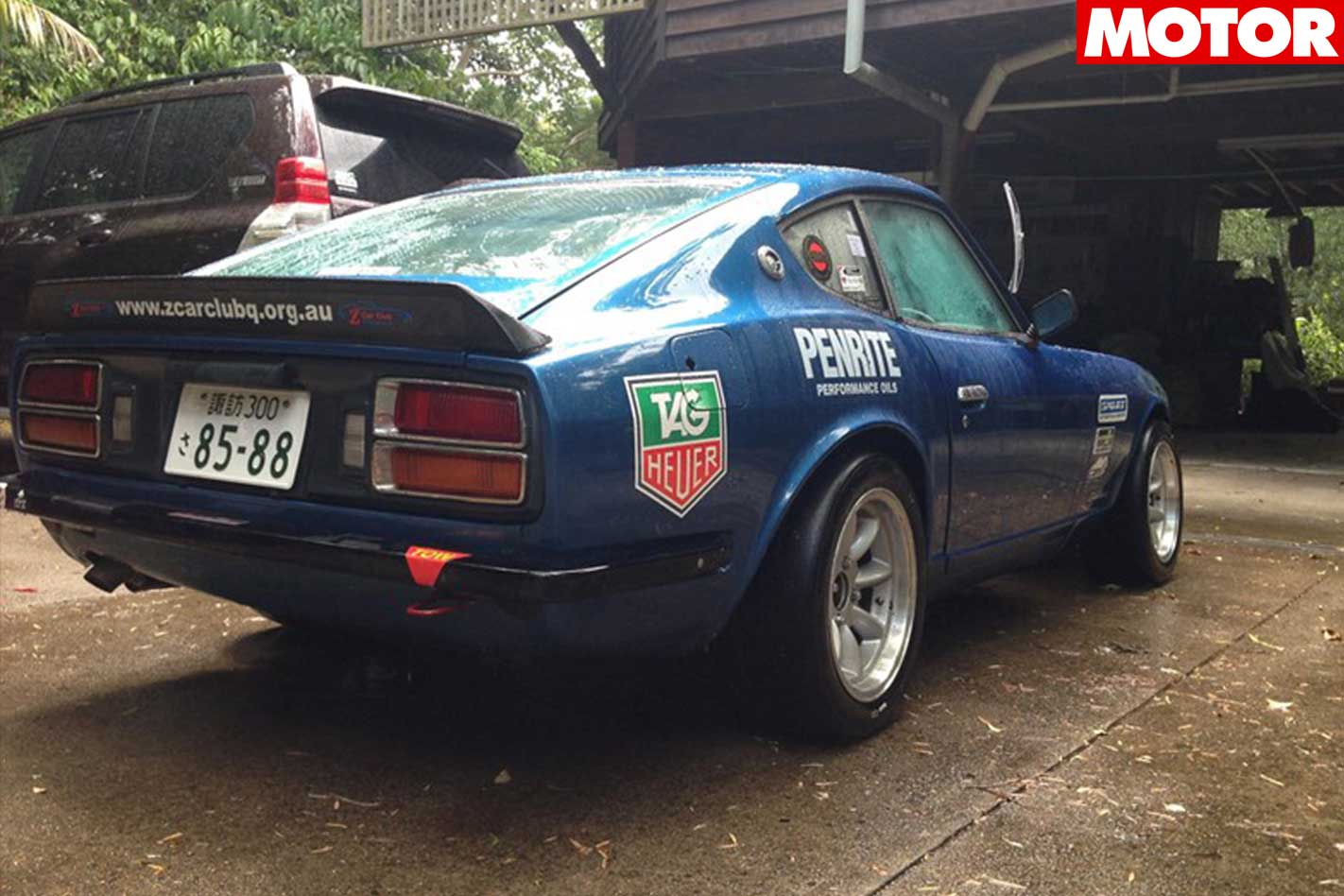
Among the mods are a set of custom headers, bigger more modern brakes, adjustable suspension, a roll cage, and a close-ratio gearbox.
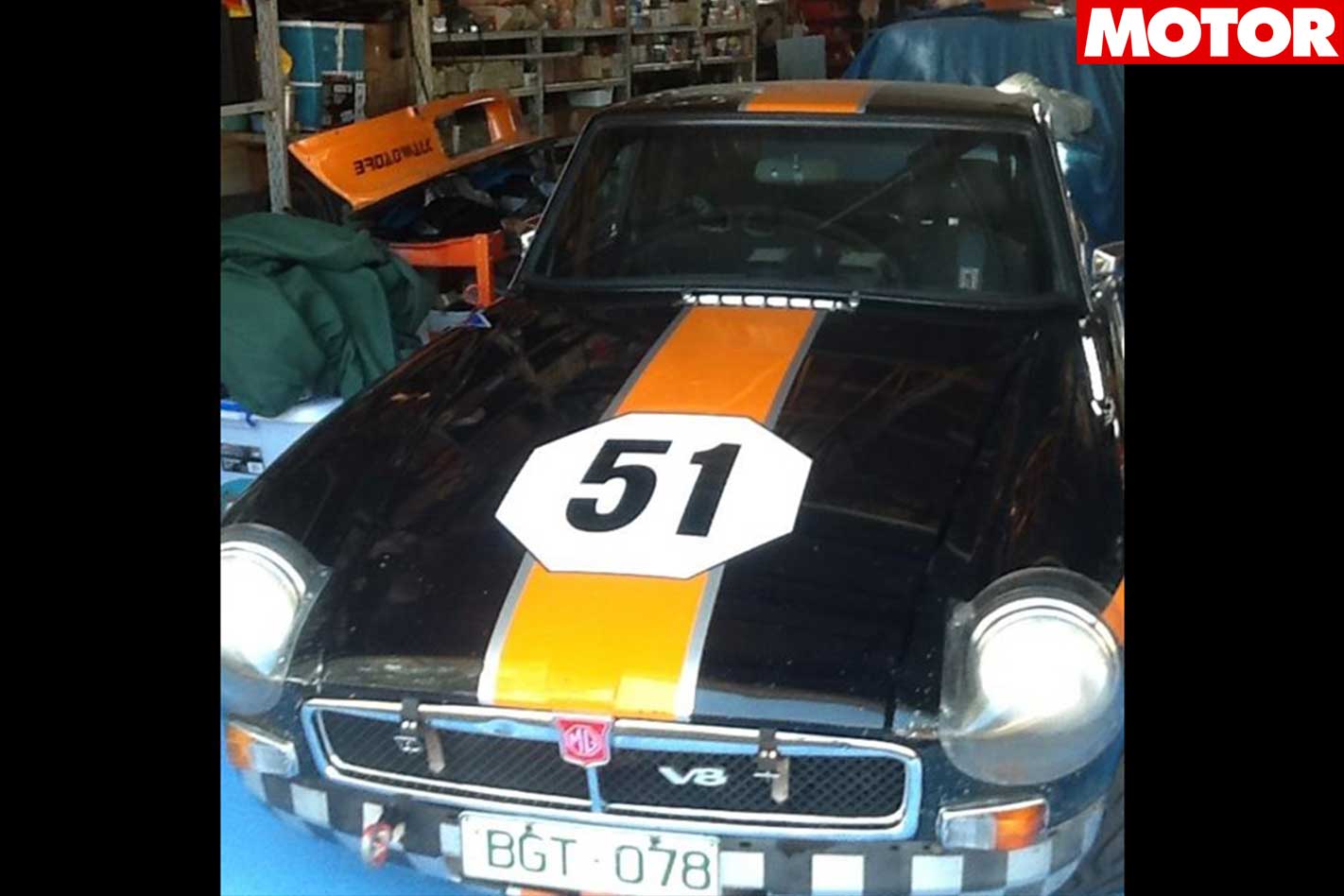
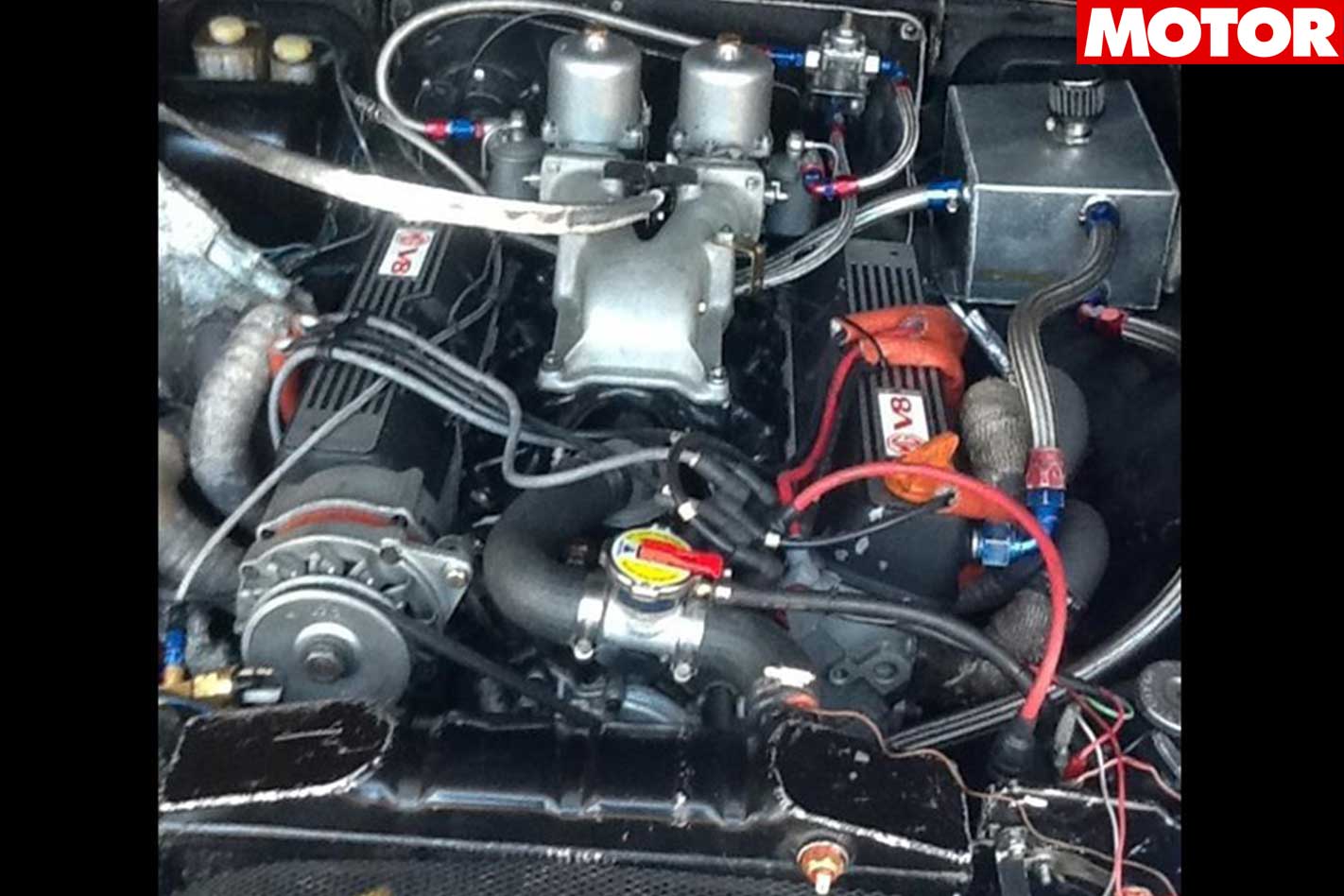
“Ready to Race Black SC75MGBGTV8 New V8 makes 305HP, new overdrive Jack Knight Close Ratio gearbox, detroit locker diff.”
Essentially, enter at own risk.
Motor shows are a great opportunity for car manufacturers to whip the covers off their latest and greatest, but what about the updates to already existing models? Here’s a quick rundown of the facelifts shown at the Geneva motor show that we can expect to reach Australian shores.
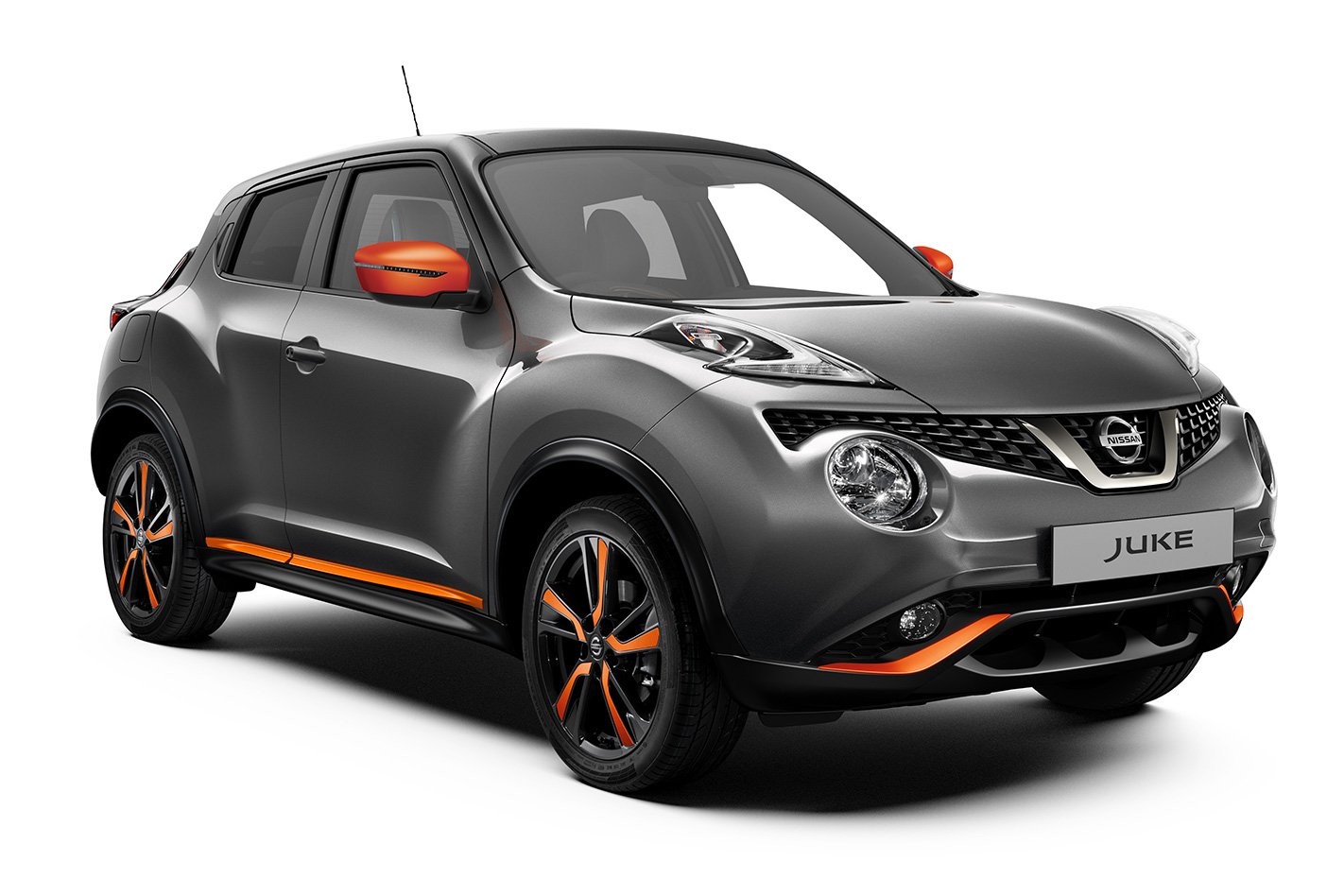
Nissan revealed a colourful update to its Juke compact crossover, retaining the vehicle’s polarising looks but adding a selection of trim and exterior finishes that offer customers opportunity to personalise their car’s appearance. The updated Juke also receives higher-quality leather trim and a six-speaker Bose sound system, featuring headrest-mounted speakers.
The updated version will go on sale in the second quarter of 2018; no word on a price increase at this stage.
Alongside the AMG GT 4-door and GT Black Edition, Mercedes revealed updates to the C-Class line-up and the introduction of a new base model; the C200, powered by a 1.5-litre turbo-petrol four producing 135kW/280Nm and incorporating a mild hybrid system Mercedes calls EQ Boost. EQ Boost comprises a 48-volt battery and motor combination that couples to the starter-alternator and offers the engine an extra 10kW and 160Nm for brief periods.
The 220d, meanwhile, receives a new 2.0-litre turbo-diesel four producing 143kW/400Nm. That’s a handy 18kW power increase over the outgoing 2.1-litre engine, teamed with better fuel economy at 4.4L/100km.

All these models receive the same nine-speed automatic transmission, with the AMG C43 retaining Mercedes’s 4MATIC all-wheel-drive system.
The exterior is garnished in a new array of chrome trim, while the headlights are updated with ‘Multibeam’ LED units, housing some 84 individually controlled LEDs that can allow sections of the beam that would blind oncoming drivers to be shut off. The interior is updated and takes touchpad multimedia and ‘Linguatronic’ voice control systems from the upper-echelon S-Class.
Further details and pricing are yet to be announced but Mercedes expect the new models to go on sale in the fourth quarter of 2018.
The Czech manufacturer unveiled a refreshed Fabia ahead of Geneva, with the updated car on display throughout the weekend. The Fabia is the smallest car in the Skoda range with the updates to the model mostly cosmetic and tech related. The two three-cylinder turbo-petrol engines remain unchanged; a 1.0L, 70TSI model with 70kW/160Nm and a 1.2L 81TSI model with 81kW/141Nm. The base model still comes with a five-speed manual transmission while the top-of-the-range gets a seven-speed dual-clutch.
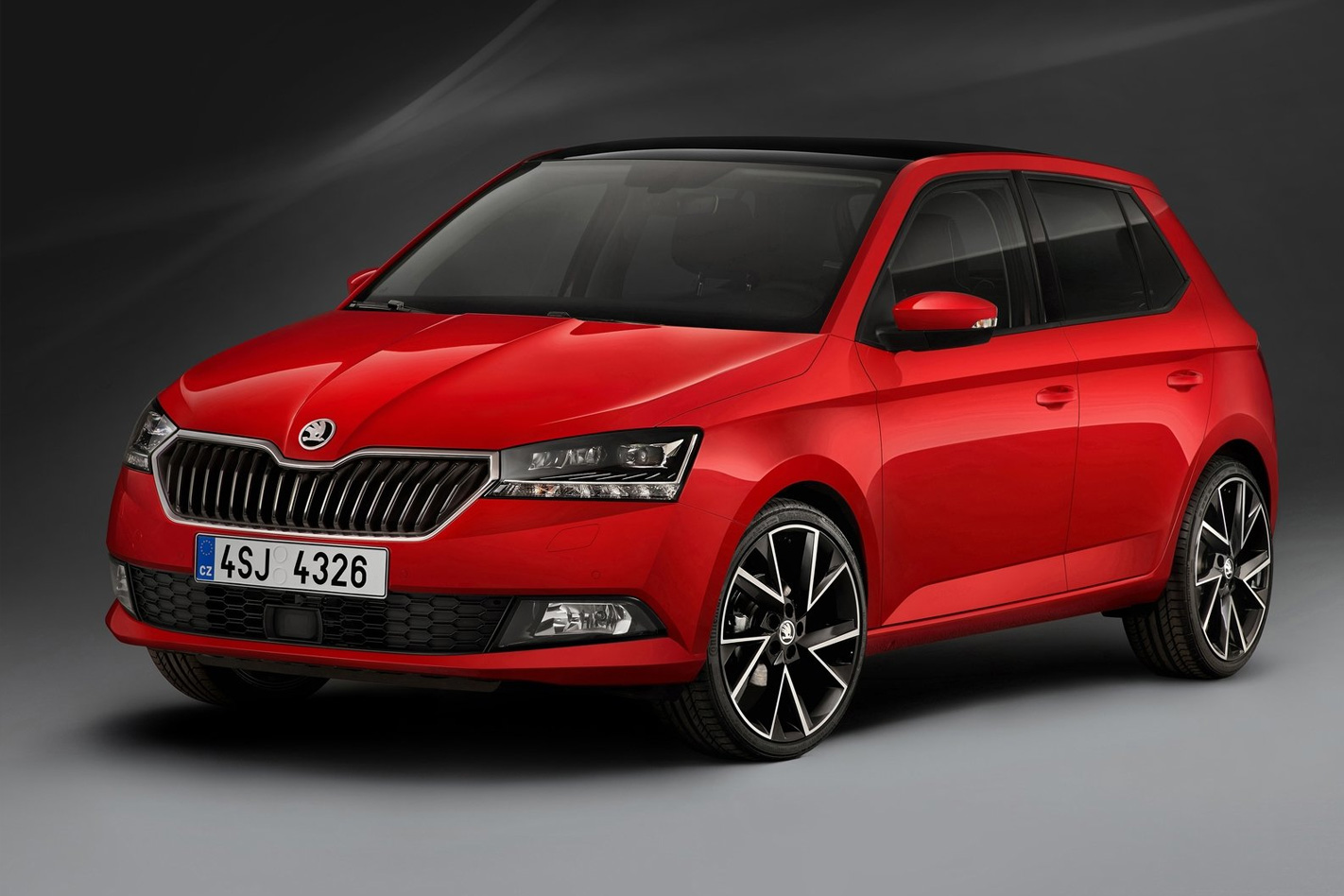
The updated Fabia is expected to arrive in the latter half of 2018 with prices starting at $16,990
A fresh-faced Mazda6 sees the exterior design refined to better match that of the current CX-5, while the update adds the 170kW/420Nm turbo-petrol four from the CX-9 to the engine line-up. The upgrades continue through to the suspension which is retuned and combines with a rigidly-mounted steering rack that promises to improve the steering response and handling.
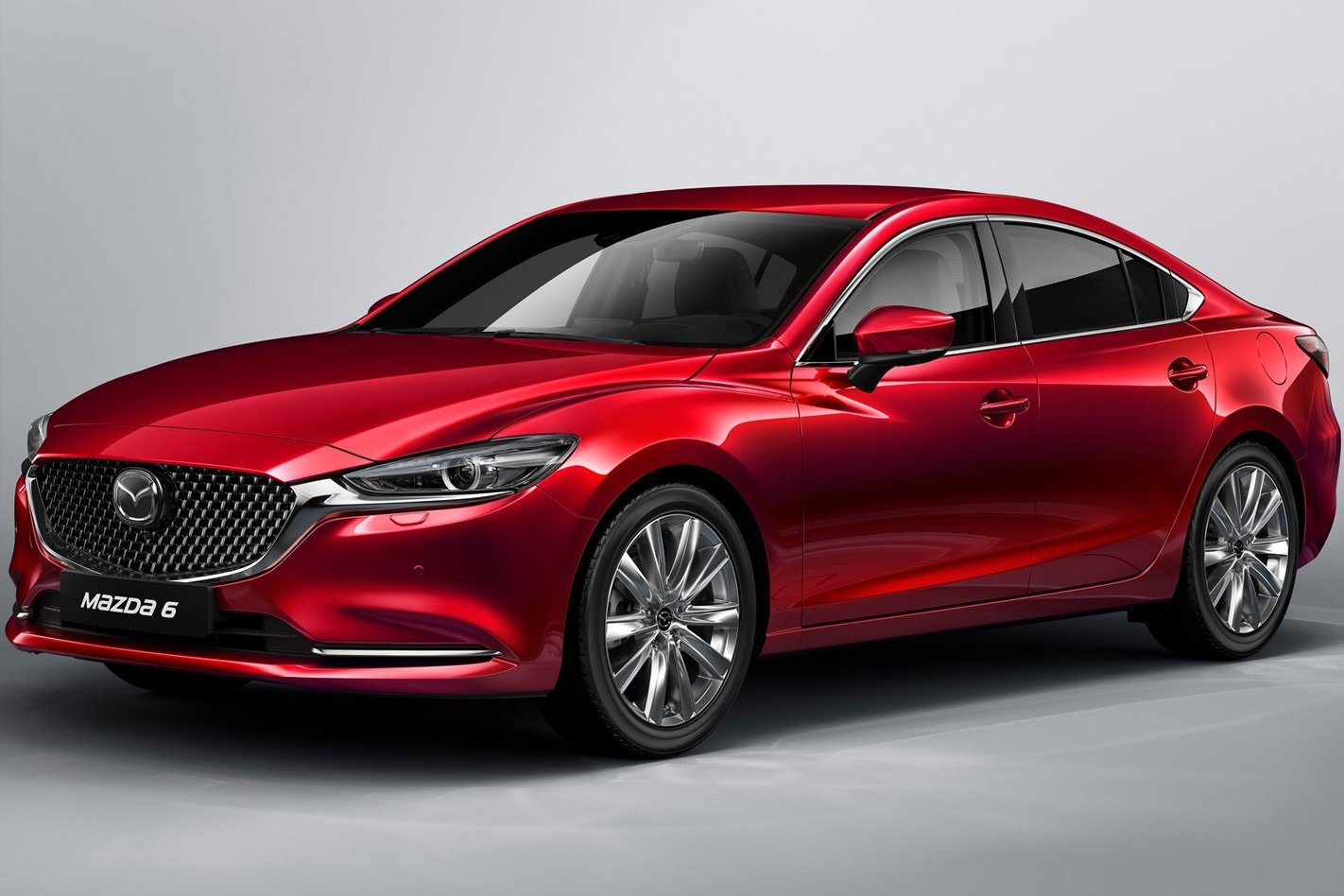
The fresh Mazda6 is expected to go on sale mid-2018 with a change in price not yet announced.
A HEAVILY disguised Cadillac sedan has been caught doing the rounds of Melbourne, hinting that the Mercedes-Benz E-Class rival is due for a major makeover.
A sharp-eyed Wheels reader snapped a cavalcade of Cadillac CTS four-doors traveling in convoy through Melbourne, with a heavily disguised car featuring slight differences to the tailing cars visible despite the camouflage.
The cars escorting the 2017-plated evaluation vehicle are Chinese-market versions of the CTS, with the quad exhaust systems hinting that these are not packing four-cylinder engines under their heavily creased bonnets.
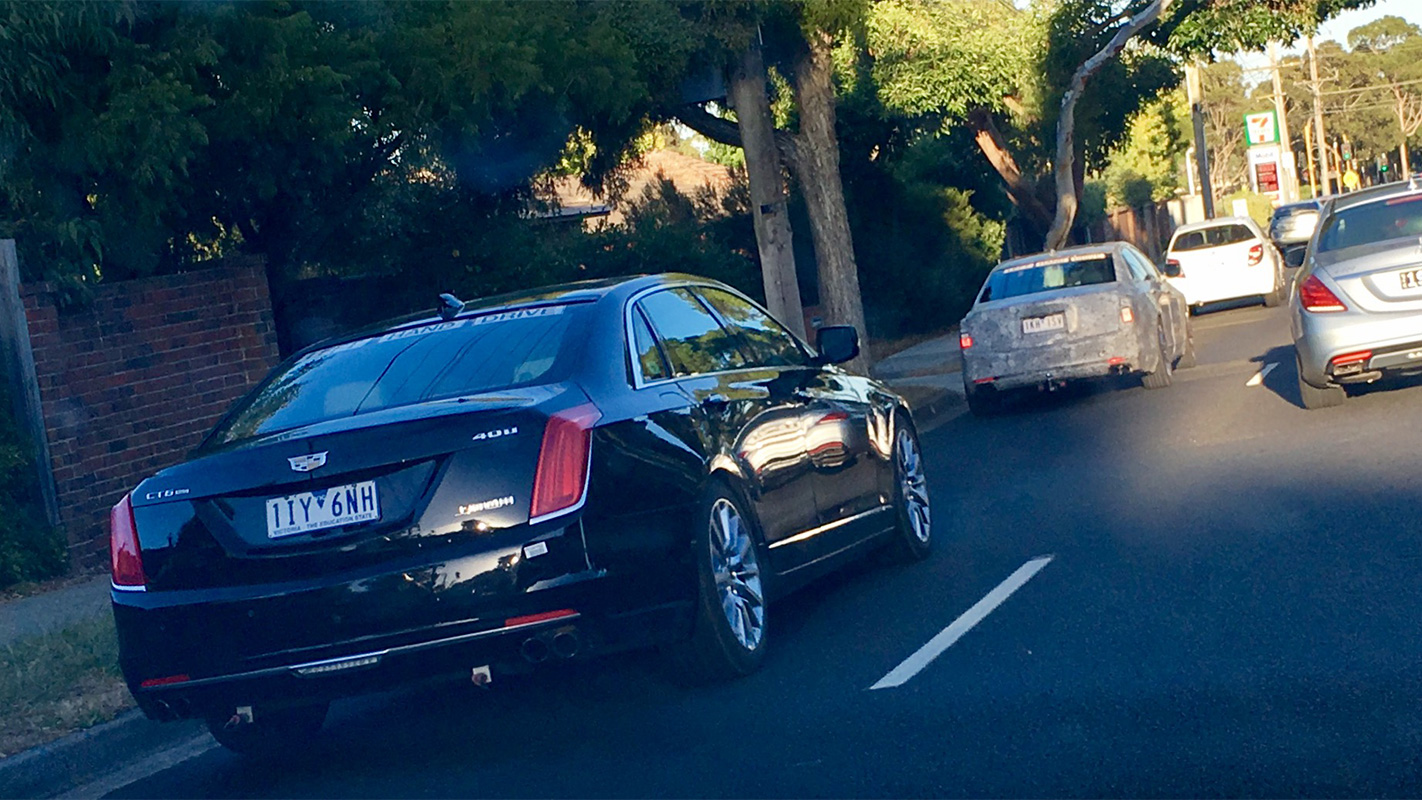
There are differences, though. You’ll notice where the number plate cuts into the bootlid looks very different, as do the more squared-off wing mirrors. Other signs that something isn’t quite right are the fact it sits lower to the ground than the other cars, the bodywork looks to be a poor fit, and the tail-lights are patched on, not lifted across from the current car. Strangely, it’s also missing a fuel filler cap.
The Cadillac CTS was launched in China in 2014, meaning the timing would be about right for a major mid-life update for the premium saloon.
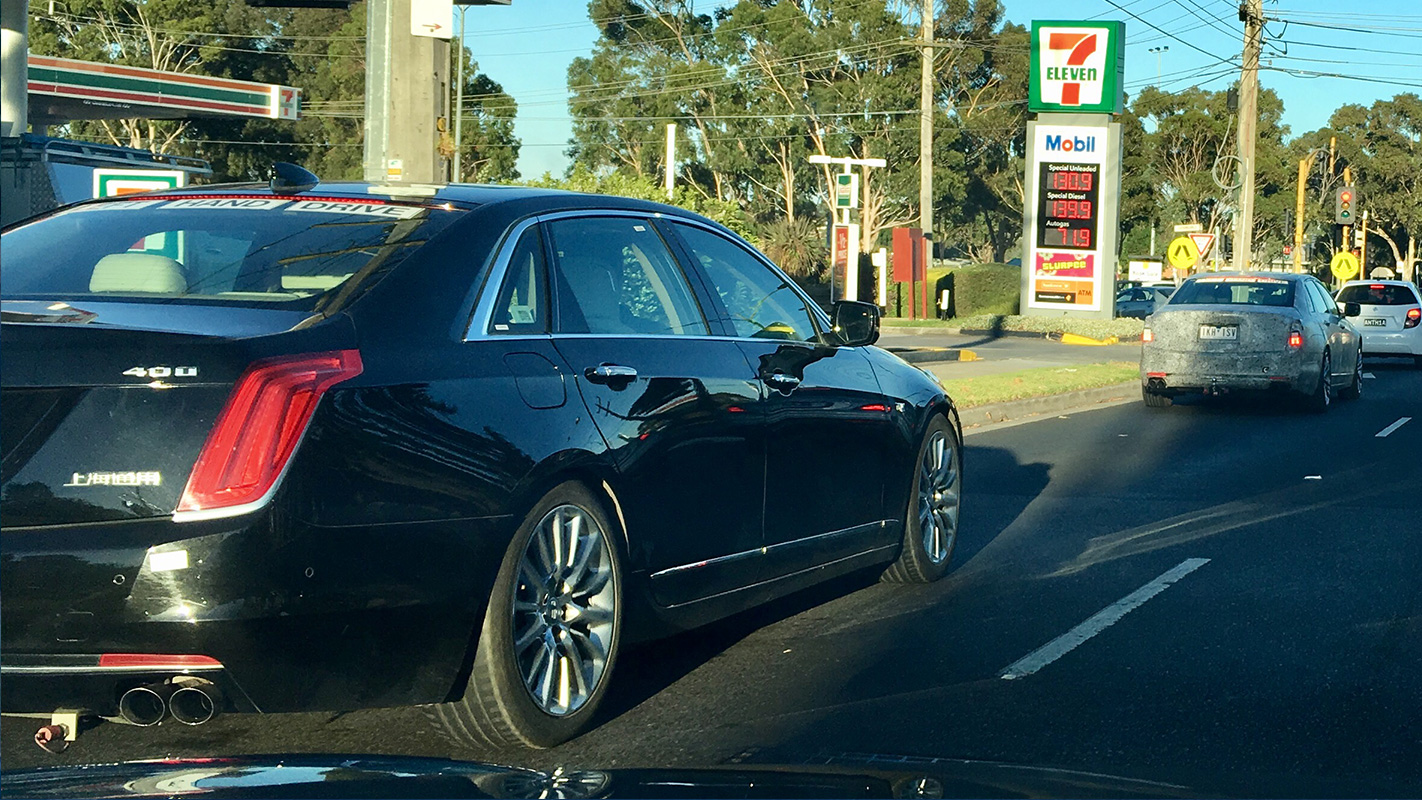
A Holden spokesman declined to spill more details on what the test vehicle was doing in Australia. “It’s simply more of the global testing work our guys are involved in to help out different markets, particularly with hemisphere seasonal changes,” he said. “There are a heap of other GM-branded cars used by the team, with various levels of camouflage.”
Have any spy pics of your own? We’d love to have a look at them. Send them in to [email protected].
A stylish addition has arrived for the 2018 Holden Colorado ute range, with the return of the LSX badge, albeit in limited numbers.
Featuring a bunch of visual enhancements over the entry-level Colorado LS, the LSX is available in 4WD crew cab (dual-cab) Pickup or crew cab-chassis guises.
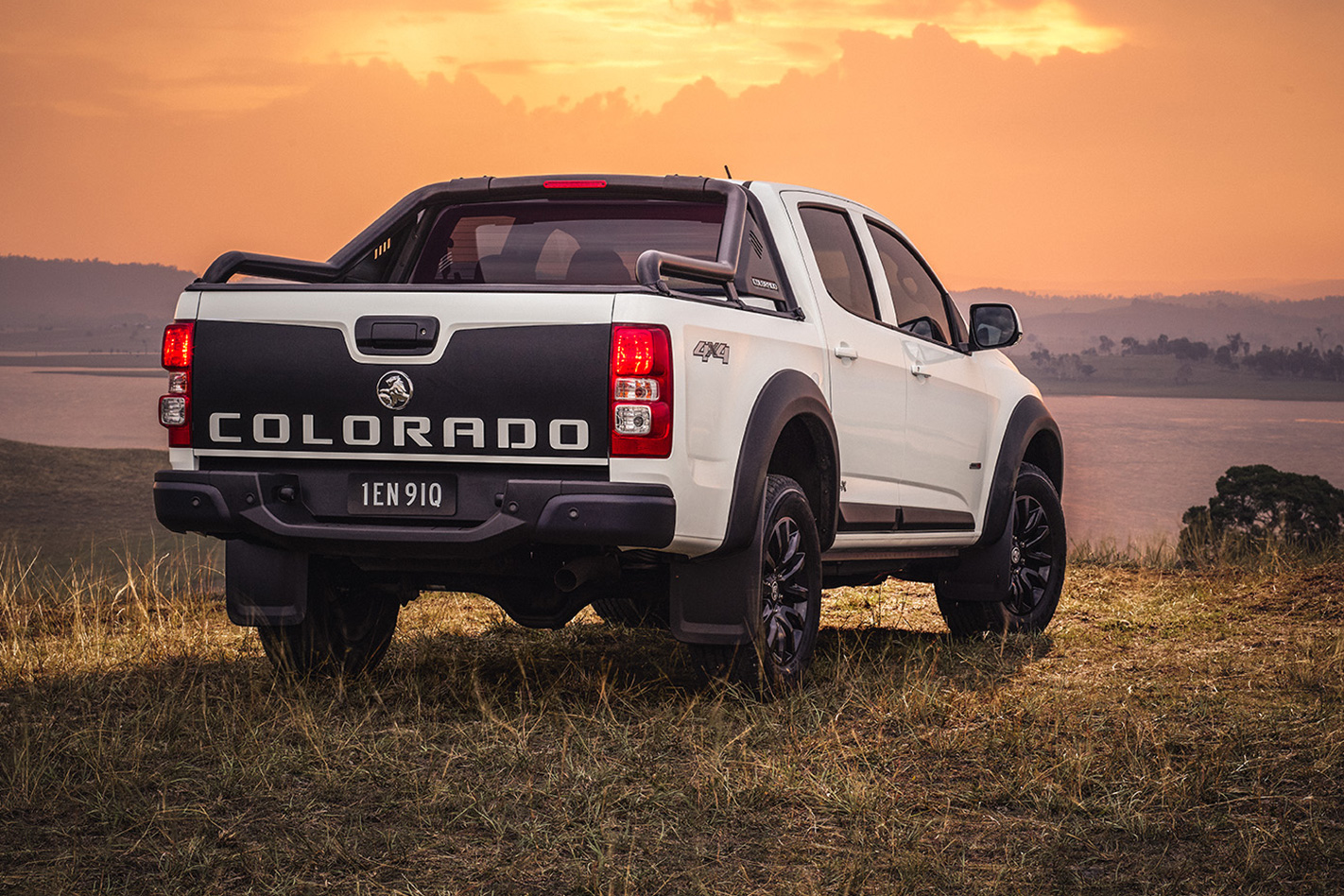
Standout features on the pickup included all-terrain tyres wrapped around black 18-inch black alloy rims, a bolder Colorado rear decal, and a bunch of locally developed accessories including black wheel arch flares and grille, and an extended sports bar also in matte black.
The cab chassis gains all-terrain tyres and black rims.
On sale from March 12, the Colorado LSX will be limited to 800 Crew Cab Pickups and 200 crew-cab chassis.
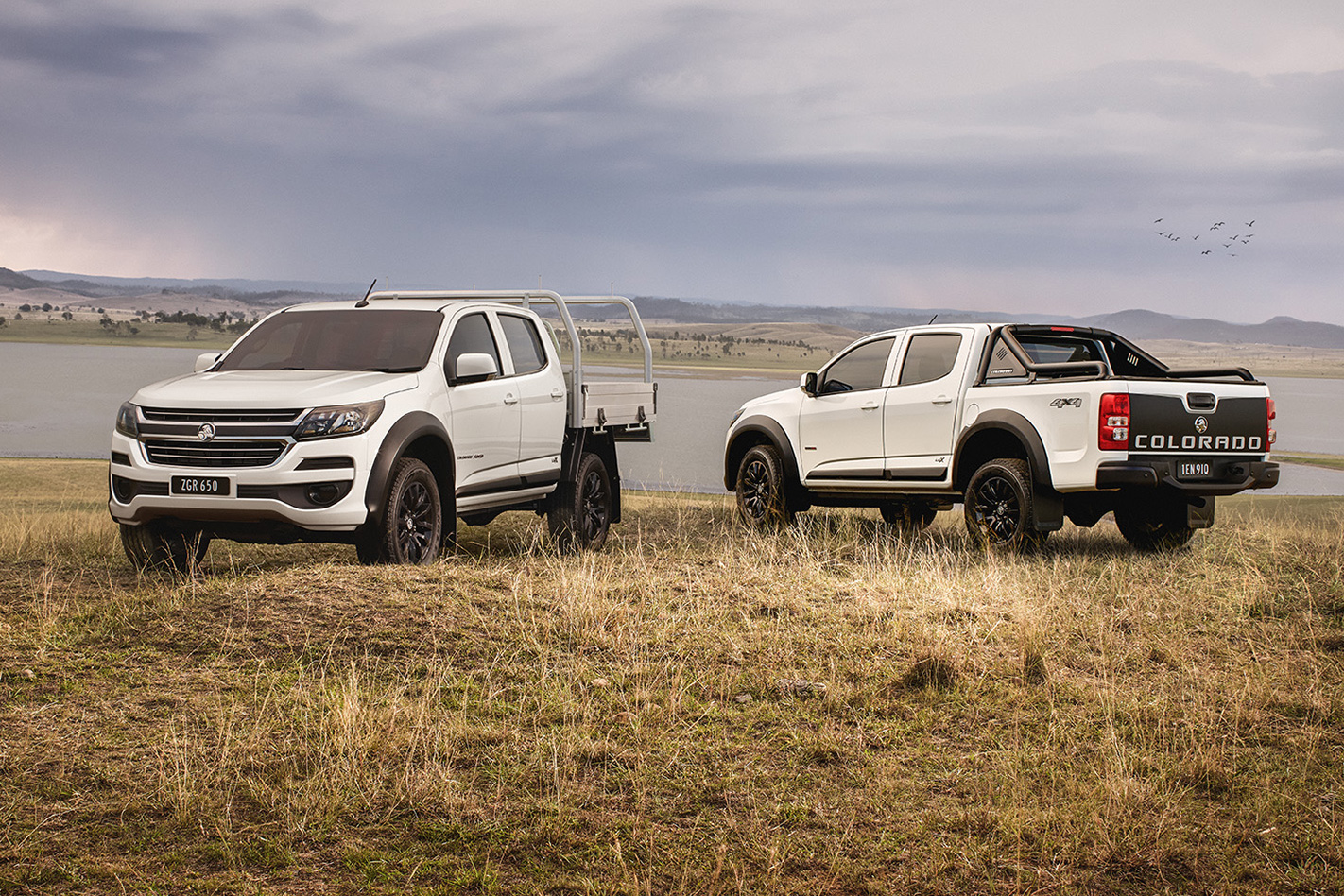
Buy before March 31 and you’ll also get three years of free scheduled servicing, a five-year warranty and five years of roadside assistance, an offer that has also extended across the rest of the Colorado range.
The Colorado LSX is available with a six-speed manual or automatic transmission, with the auto attracting a $2200 premium.
Retail pricing starts at $50,055 and $51,945 for the cab-chassis and pickup respectively, though driveway pricing starts from $44,990.
Whenever Brabus gets its hands on one of Mercedes’ high-end cars, you know things are going to get a little bit crazy.
Which is why we weren’t surprised to see the outfit roll out three versions of what it calls the 800, based on cars built by Mercedes-Benz.
The cars are based on the Mercedes-AMG E63, and S63 Coupe and Limo, and turn each car into more aggro versions of the already super-capable base cars.
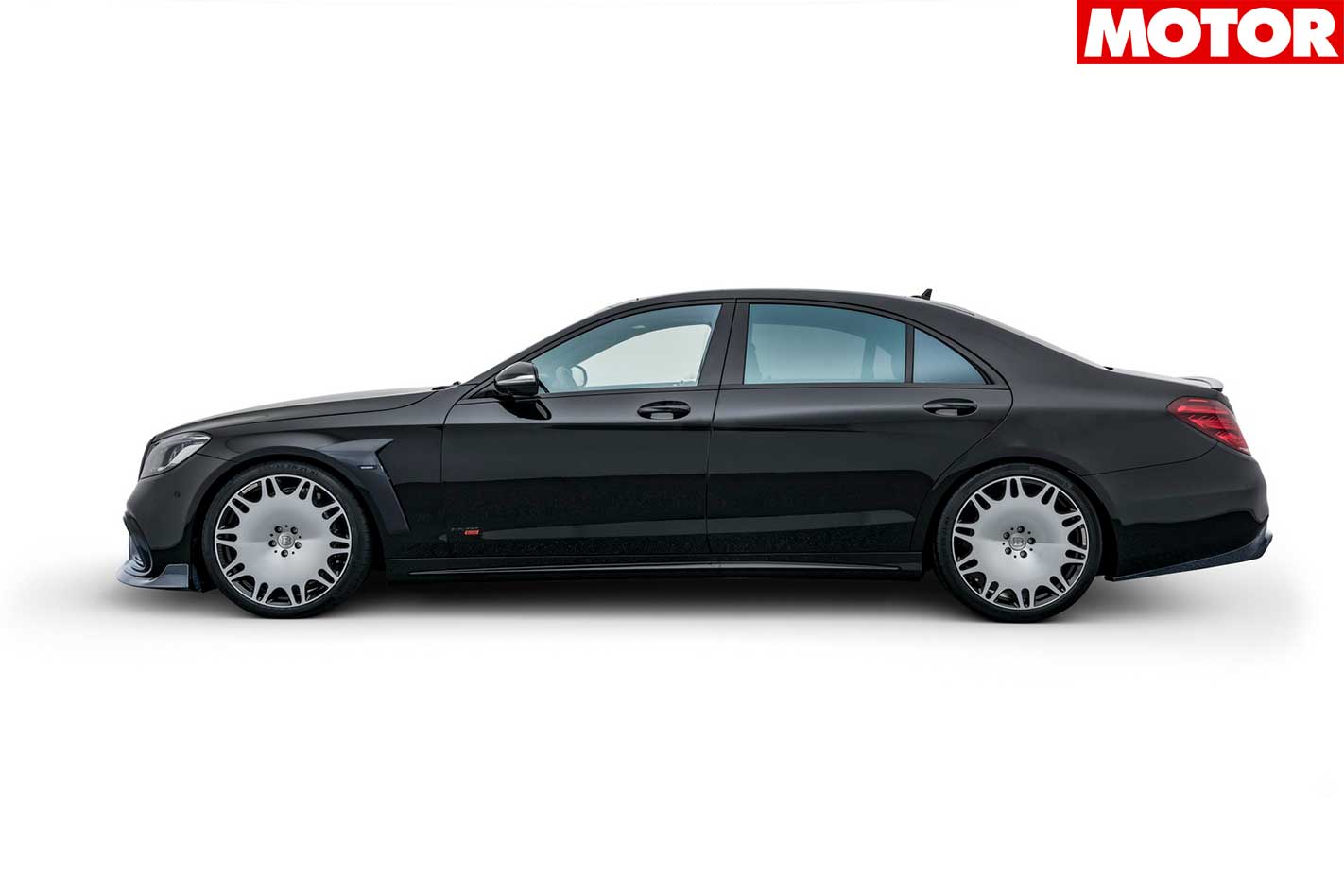
For context, the E63 S only makes 450kW and 850Nm. We tested it at PCOTY 2018 and ran a 3.4s to 100km/h. Brabus claims the 800 based on the E63 S will do three flat.
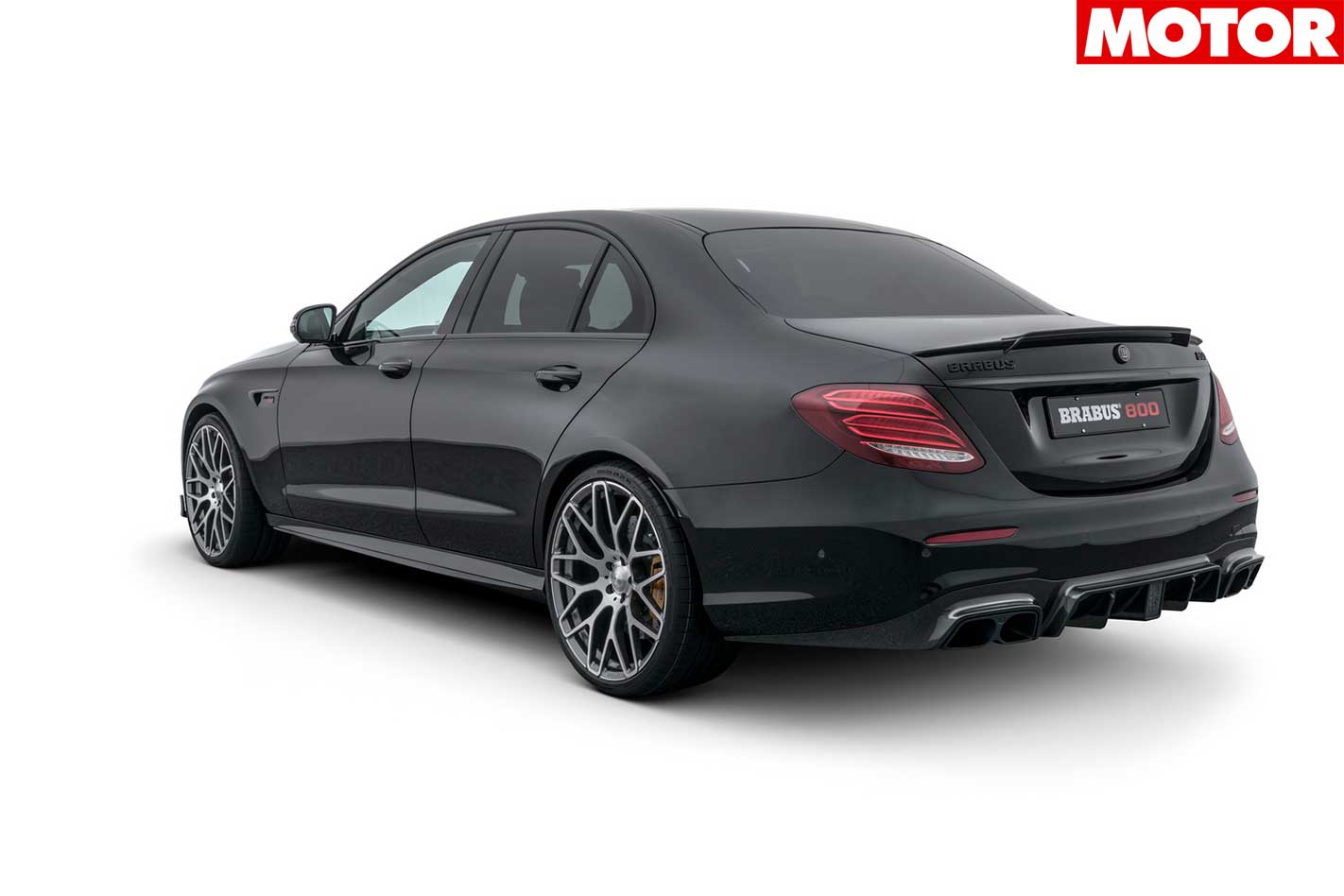
Brabus’ 577kW ‘800 GT’ four-door coupe!
Brabus says it has to modify the AMG’s turbochargers to make as much power as the tuner wanted to get out of the bent eights.
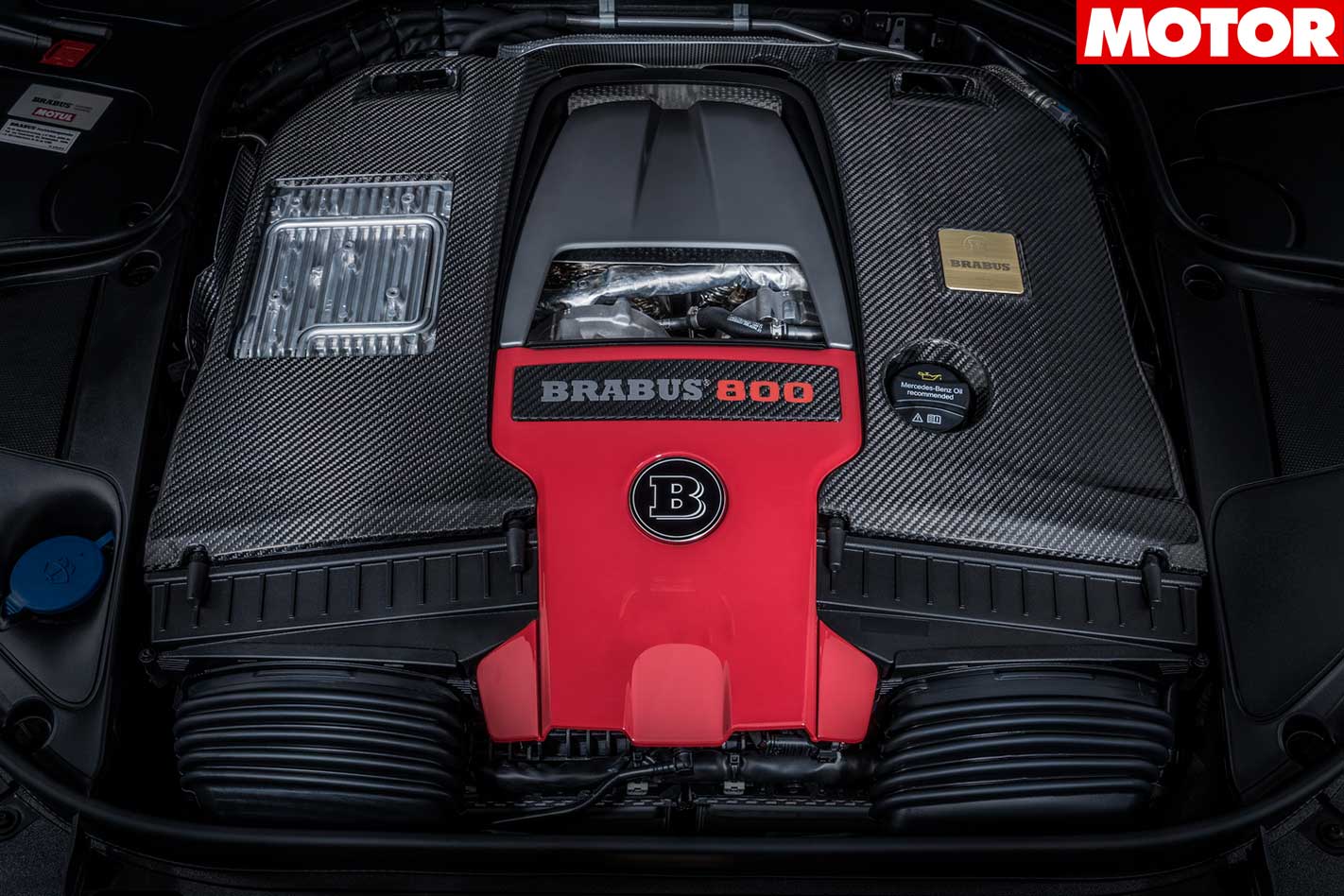
“Brabus developed special high-performance turbochargers to achieve a significant increase in power.
“A modified core assembly with reinforced axial bearings and a larger compressor unit provide a maximum boost pressure of 1.6 bar.”
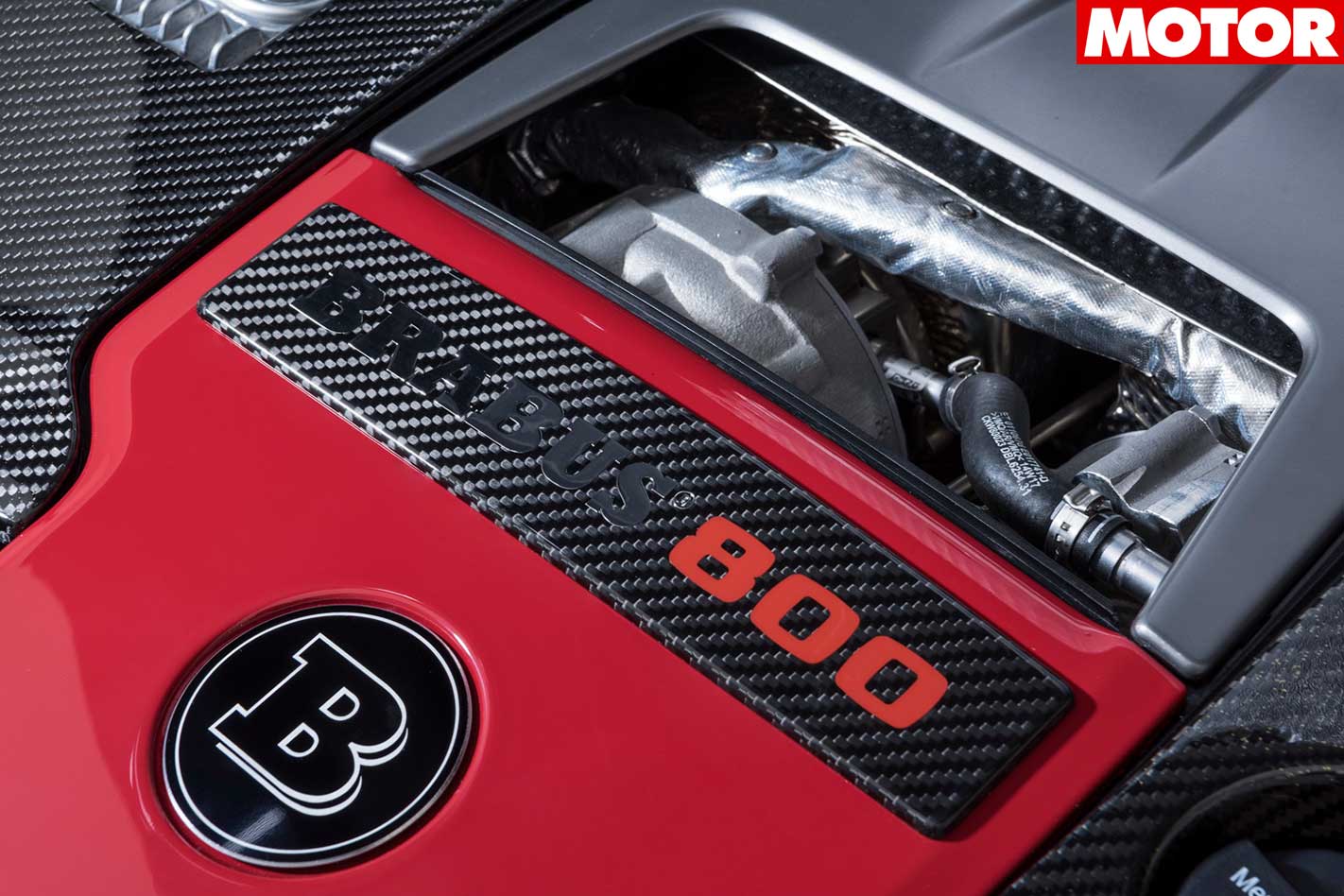
More aggressively-shaped trim, carbon fibre, and new wheel styles are on the list, as well as a re-fitted interior featuring plenty of leather and more Brabus badging.
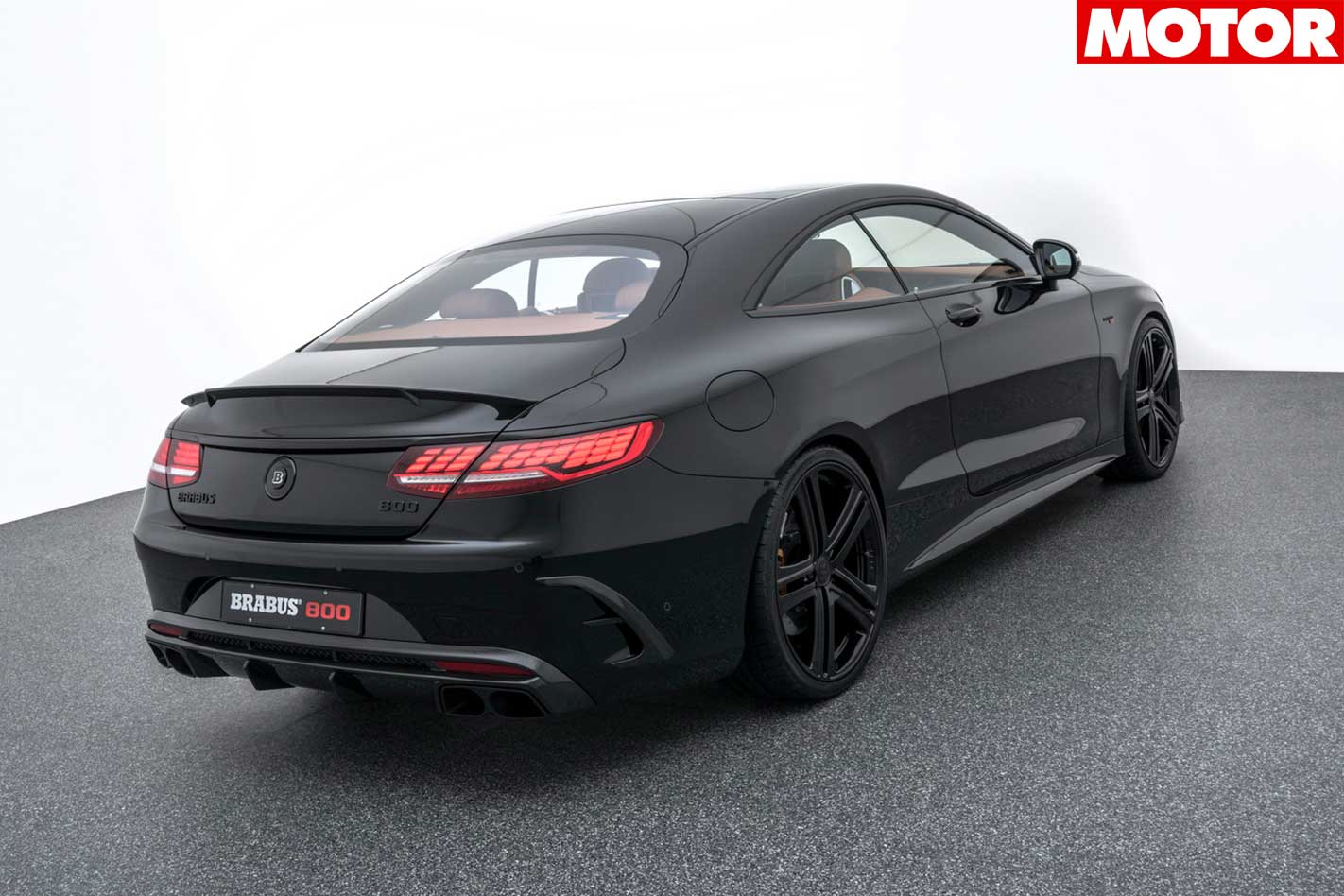
Brabus adds that it can even turn any current E63 into an 800… even a wagon. Now there’s a tempting thought.
ASTON Martin has sparked an unexpected war of words after claiming it was resetting the luxury benchmarks with this week’s stunning Geneva Motor Show concept – and it is rival Rolls-Royce that’s taking up the fight.
Aston wowed this week’s motor show with the Lagonda Vision Concept, a study in design that would one day spawn “a new range of state of the art, emission-free luxury vehicles” for the high-end British sports car marque.
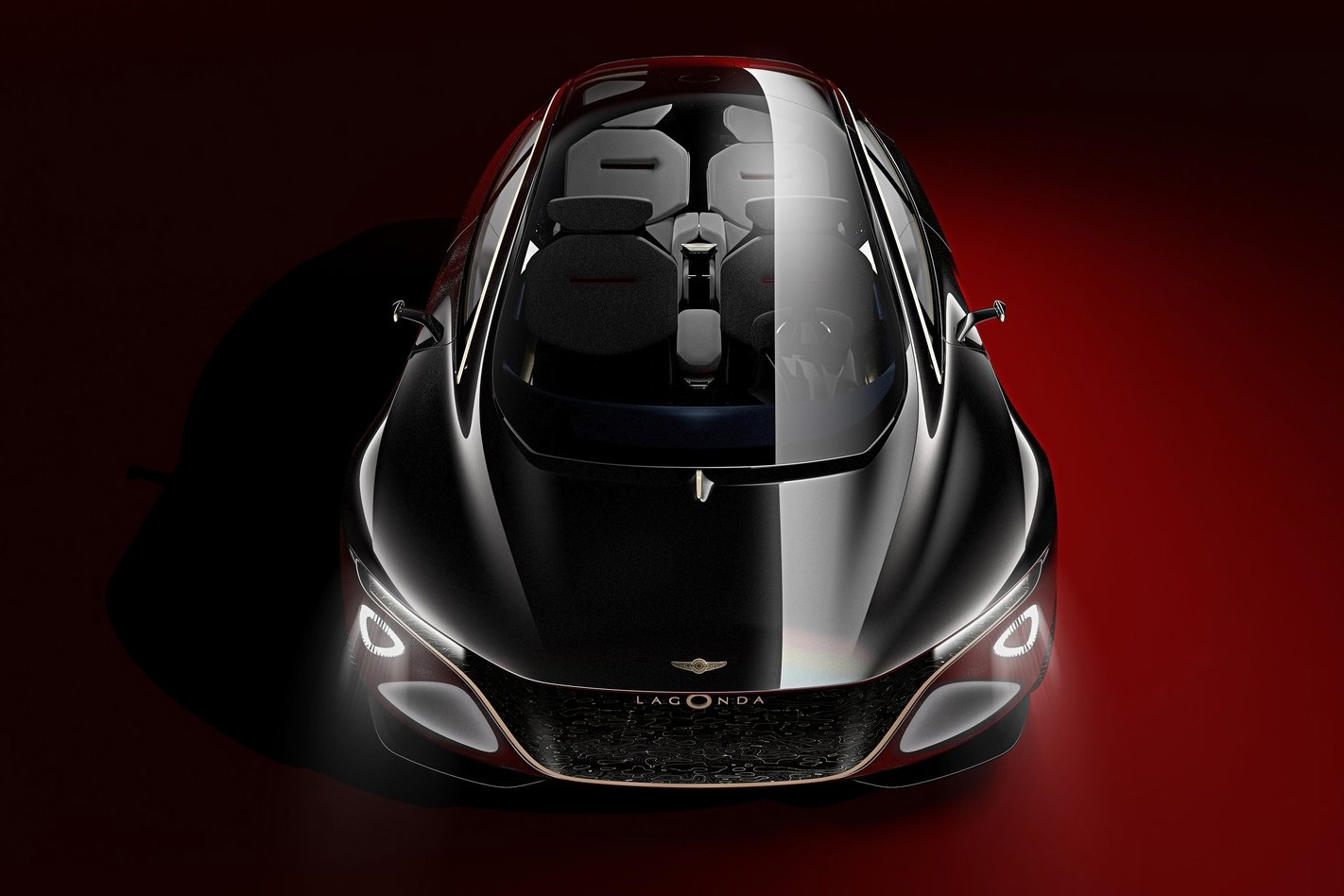
That was enough for a rush of blood in the boardroom of uberluxury rival Rolls-Royce, which overnight cleared its throat, loosened the bowtie and called for parchment and a quill to craft a press release that reminds the world that it had already set the same goal long before Aston Martin arrived late to the garden party.
The release doesn’t name Aston Martin directly, but the timing of Rolls’ wrath, a day after Aston’s concept reveal, makes it pretty clear that the rivalry is real. “Two years ago in 2016, Rolls-Royce rewrote the rulebook for the future of true luxury mobility by presenting the Rolls-Royce Vision Next 100 – codenamed 103EX – a radical vision of effortless, autonomous, connected, spacious and beautiful luxury mobility, as personal as each individual customer,” it pitched in.
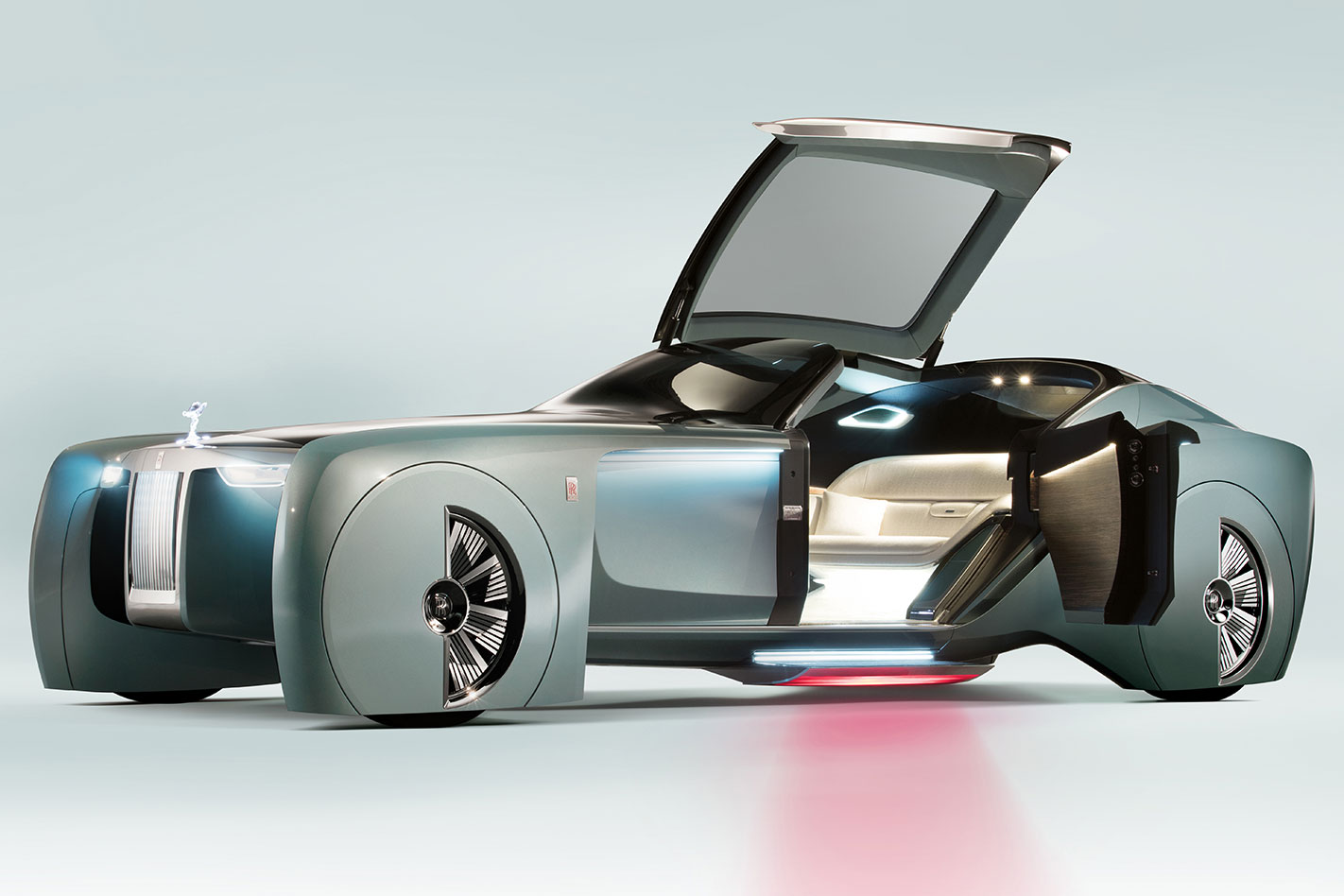
“Rolls-Royce’s vision in 2016 was, and remains, all-electric, completely autonomous, completely bespoke mobility – coupled with ultimate luxury.” Ouch.
What follows Müller-Ötvös’s words are is a tribute to navel-gazing about how the brand aims to stay at the top of the tree as the “preferred marque of the most discerning, wealthy and powerful patrons in the world”. The release climaxes with a description of the 103EX’s “clamshell canopy” doors that allow occupants to step down from the the wood, silk and wool-clad cabin without having to duck their heads.
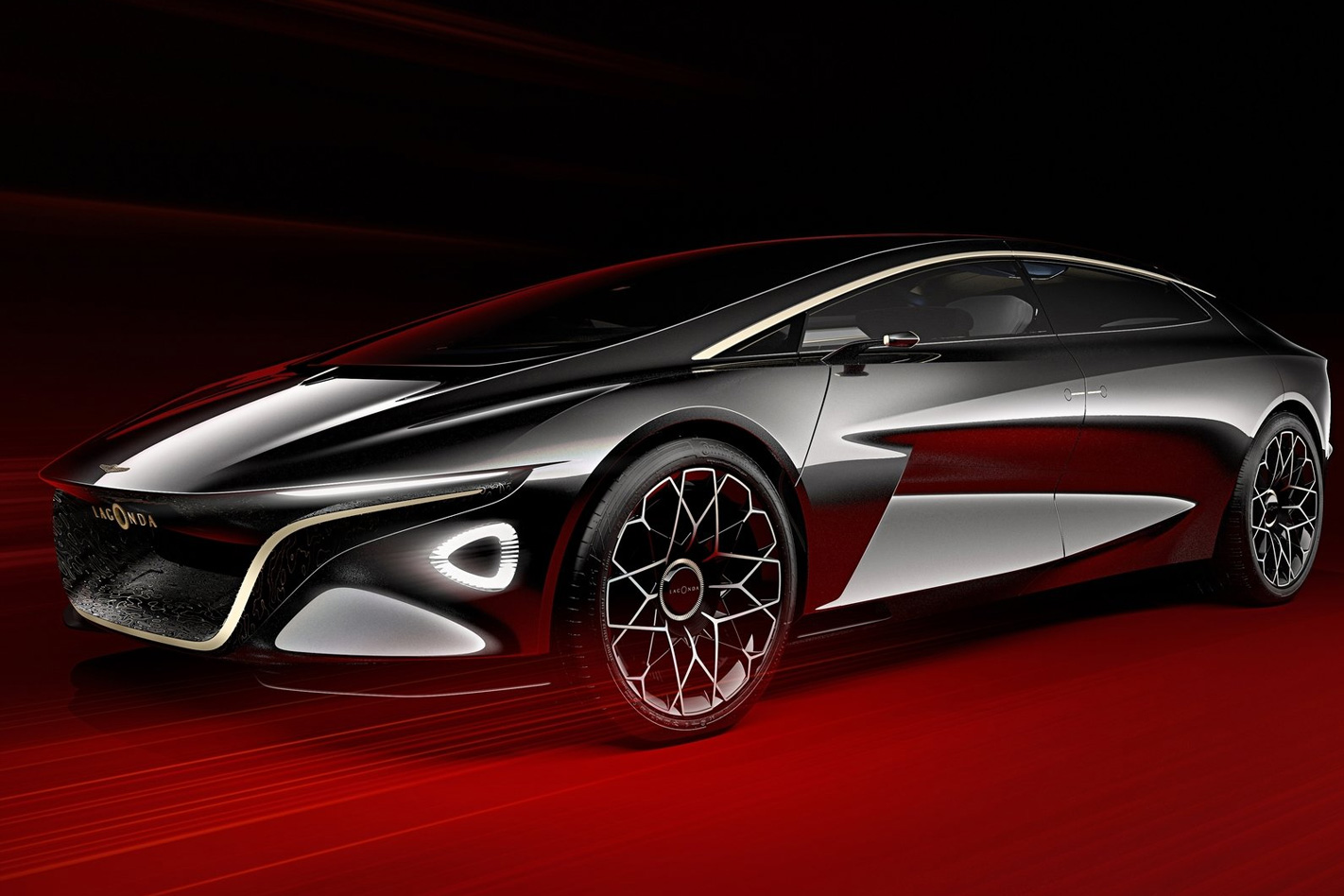
The spat erupted in the lead-up to the Geneva Motor Show after Aston Martin Lagonda design chief Marek Reichman hooked into the state of affairs at the high end of town.
“Rolls-Royce and Bentley are Ancient Greece today,” he told British car website Autocar. “I worked on the original Phantom. The brief was Buckingham Palace on wheels. It was important to do that to establish it. But the world has changed, and the royals have changed.”
Over to you, Andy Palmer.
