World Time Attack Challenge (WTAC) has graduated from a tuner sideshow to an annual motorsport and car culture event.
The centrepiece of this event-cum-motoring festival is mega-kilowatt, nitrous-sucking, boost-gulping race machines, purposely designed for war with the Sydney Motorsport Park tarmac. Built by tuner heroes, their panels are festooned with delicate carbon-fibre aero and enormous diffuser packages that make GT3 racecars look just a bit quaint.
In the hunt for one perfect lap, the cars are turned up to 11. Strategies are devised, with preservation secondary to finding another tenth. In each of the seven years since the inaugural 2010 event, Pro Class has broken the Gardner Grand Prix Circuit’s tin-top lap record, such is the rate of progress.
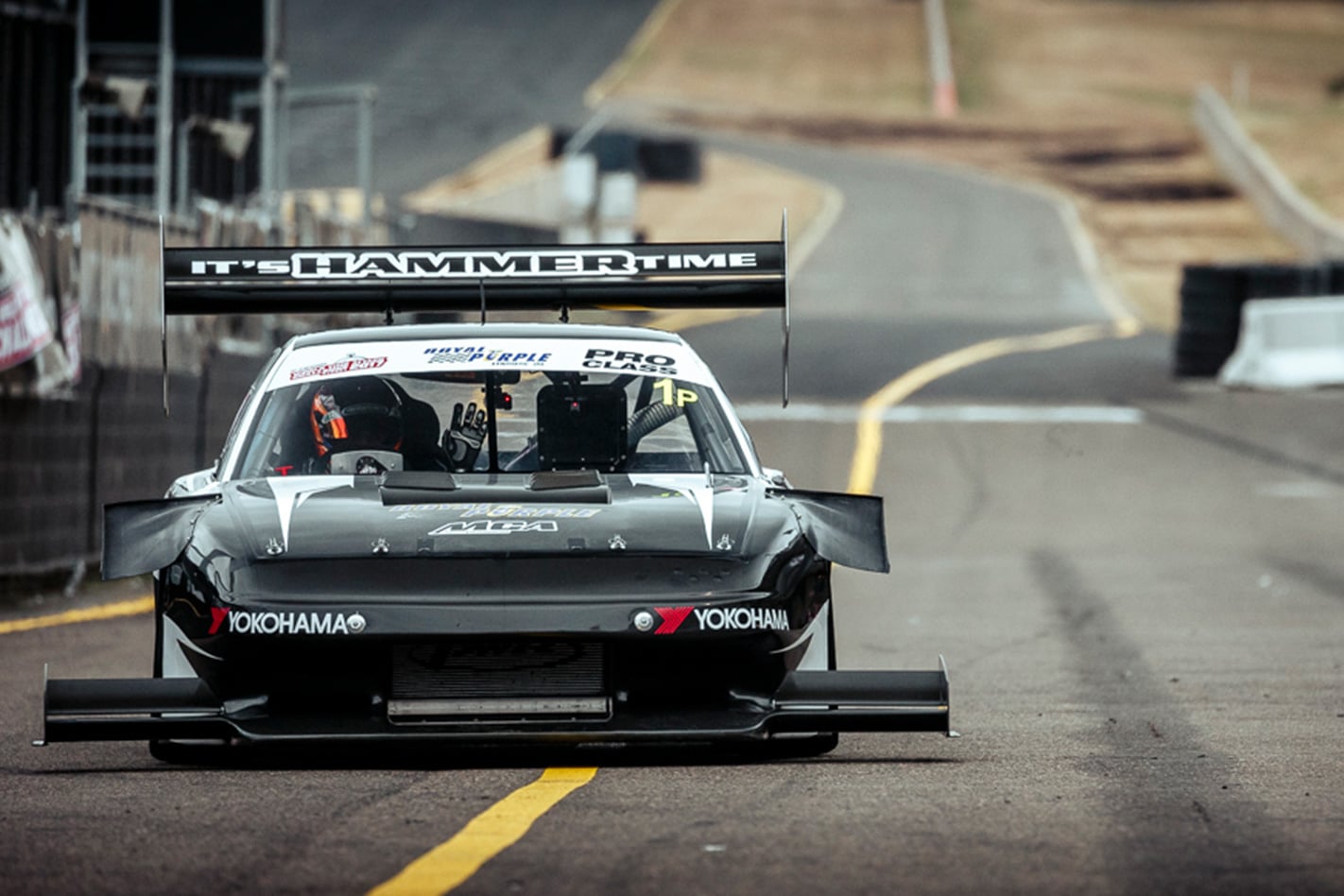
Time-attack cars contend on road-legal semi-slicks, a fact eagerly repeated by the category faithful. “Its extremely tricky compared to any other circuit racing,” a champagne-drenched Slade said. “The cars have a huge amount of potential with the grunt, and more so the aero grip.

He’s now 1.83 seconds away from Nico Hulkenberg’s (Formula 1 driver) 1:19.14sec lap, set in an Lola Zytek during the 2007 A1GP.
Festival Feeling
Blistering times are but one aspect of the WTAC event. In the evenings the stopwatch is set aside. A drift challenge attracting a contingent of international talent keeps the party going.
With enormous lock and unreasonable horsepower, the drifters ensure the track is appropriately rubbered in for their grip counterparts as they vaporise tyres and hug clipping points.
A WTAC favourite, Sydney local Beau ‘The Show’ Yates and his 2JZ-GTE Toyota 86 stomped to the win, out sliding ‘Mad’ Mike Whiddet, Daigo Saito and Supercars champ Shane van Gisbergen. WTAC as an event seems to have overcome its niche, attracting interest from OEMs and major brands.

The Drift King, Keiichi Tsuchiya posed for selfies all weekend, in between drift judging duties and track sessions in his Hot Version N2 AE86 and the Taisan GT-R. Dori kin’s track special wasn’t the only JDM icon in town.
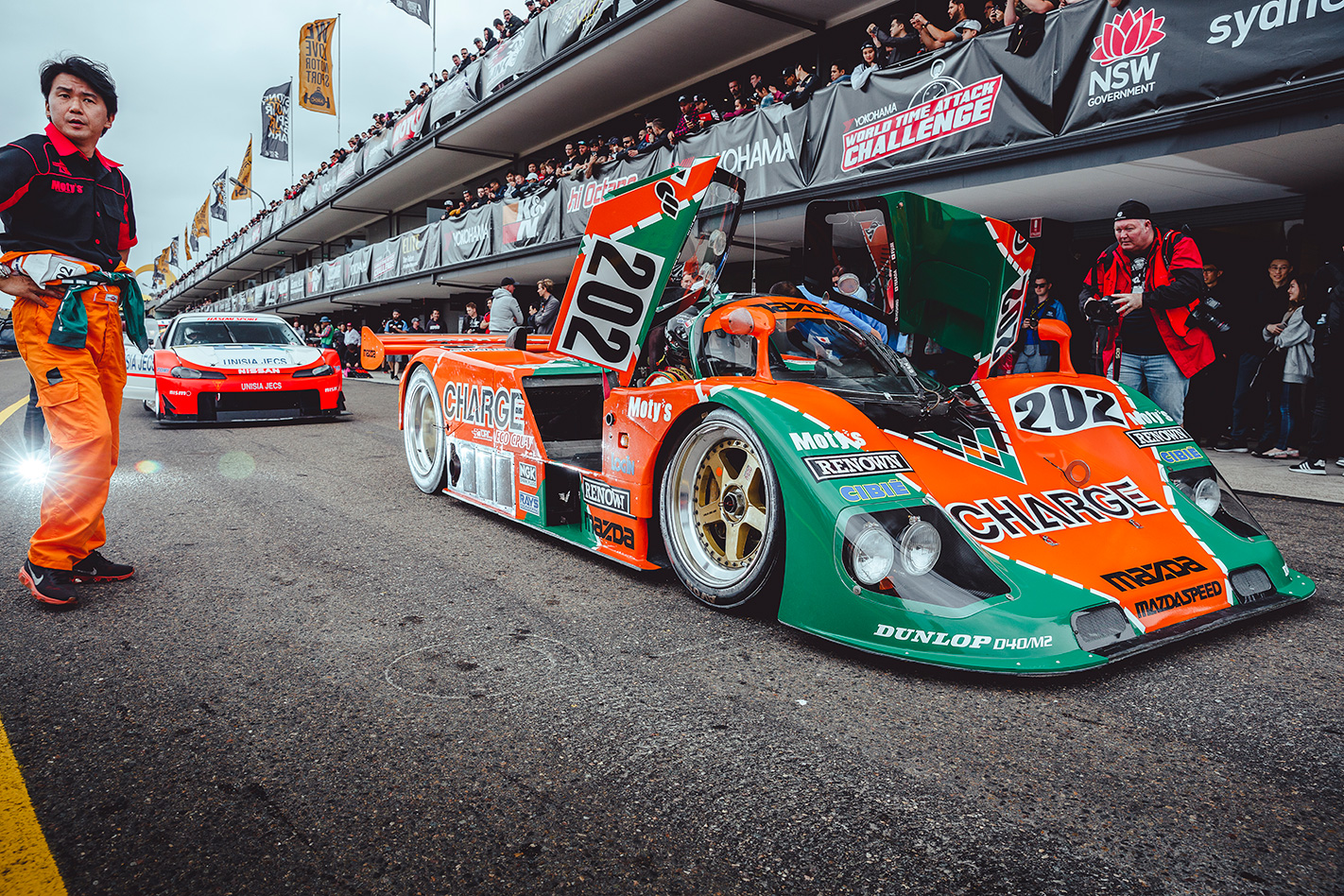
Ex-JGTC GT300 cars, namely the Unisia Jecs S15 and BOMEX FD RX-7 that once dueled on Fuji Speedway have made their way to owners in the Southern Hemisphere. The pair spent lunchtimes tic-tacking down the front straight. The only noise to drown out the RX-7 was the wailing howl of the recently restored Mazda 767B.
The Flying 500 kept punters entertained during lunch. Roll-launching cars built for ETs, the Precision Automotive Racing Nissan R35 grabbed the top speed with a 270km/h pass, tearing pieces of the 1800 horsepower car’s floor off in the process. The show and shine event ‘StylizeD’ has become its own spectacle.
Opened at a reveal party on the event’s Friday evening, SMSP’s skidpan was heaving with more than 100 extensively modified cars. The builds defied categorisation, and in some cases, belief. Crazy engine swaps, widened arches, tarmac-scraping bodies and plenty of custom plates all competed for attention.

Thus far, there have been no reports of snapped carbon fibre from access to pit lane as the public chatted with drivers and scrambled for shots of their favourite cars.
Battle Mode
The hero of the weekend was Rob Nguyen.
Recipient of the CAMS Spirit of Time Attack award Nguyen steered a supercharged, K-swapped CRX nicknamed ‘Mighty Mouse’ to victory in Pro-Am Class. His experience and the team’s pedigree was evident. He dominated in an international field including a Finnish Audi R8 racer pushing 300km/h, and the Vibrant Performance Civic from Canada.
Nguyen set the front-wheel drive lap record with a time of 1:26.27, pulling more than two seconds on the next best finisher. Open Class saw a tighter mix of times as serious privateers went up against the bigger tuning houses.

Winning by almost three seconds in a Mitsubishi Lancer Evo IX, Cox demonstrated his circuit chops on his first WTAC outing and tore chunks out of the 33 cars in class, which was a very impressive effort.
Pro Class
Starting grass fires on run-off areas around the track all weekend, Pro-Class quickly turned to a three-way battle.
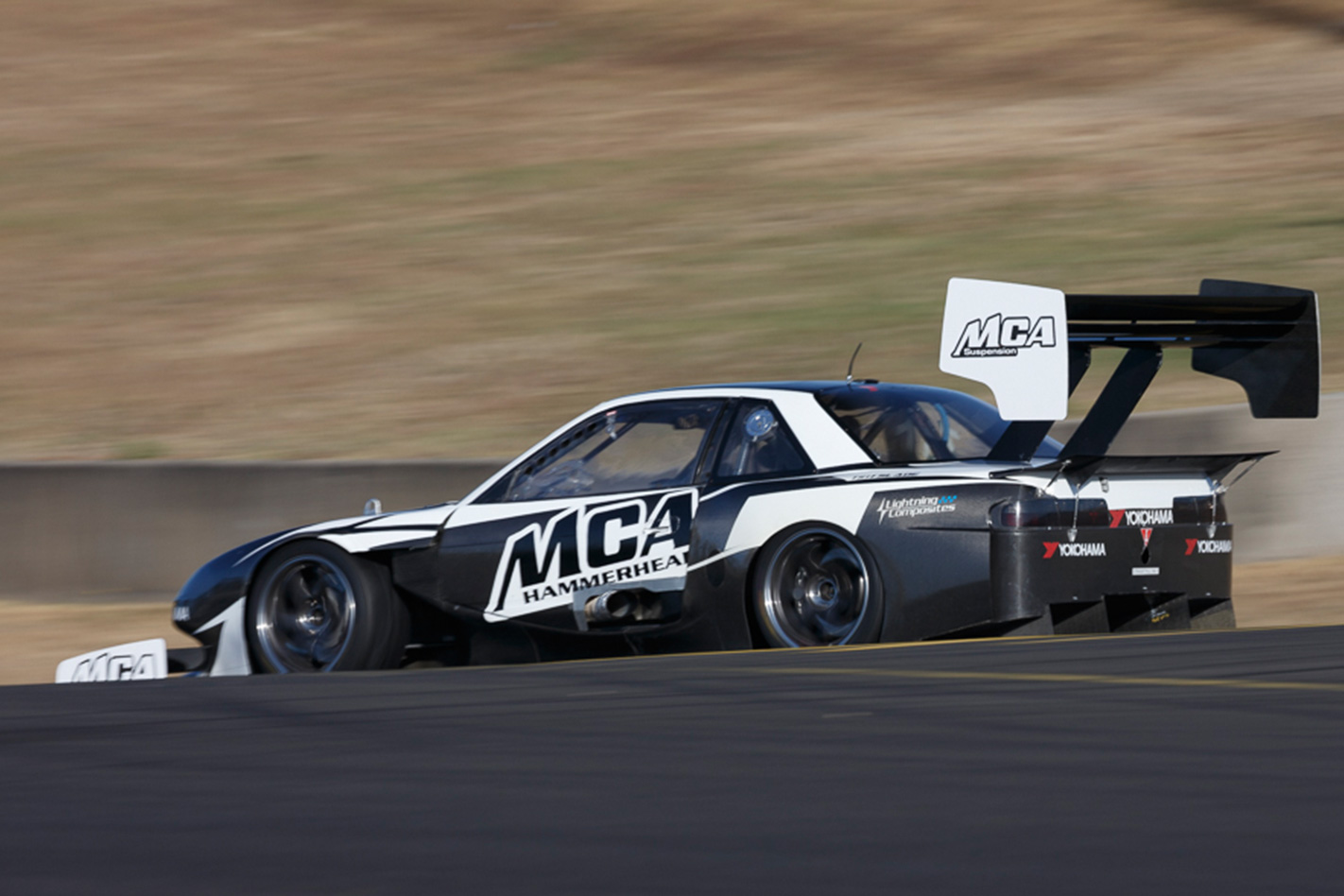
WTAC regular Tomohiko ‘Under’ Suzuki and the Scorch S15, PR Technology’s RP968 driven by Barton Mawer and MCA’s Hammerhead were the talk of the event. MCA grabbed an early lead, but late on the warm Friday afternoon Mawer and the Porsche took a bite out of the Hammerhead, with the lead lasting all of 30 seconds.
NSW Highway Patrol FPV GT F to race at WTAC
On a flyer behind him, Slade immediately reclaimed the lead by two tenths. With cooler temps on Saturday, the wick was wound up and Slade stretched the car to a live-timer topping 1:20.97. Mawer and PR were forced into retirement with engine issues, as Under Suzuki continued his NOS-fuelled assault to no avail.
“It’s really awesome to see the event as a whole … It’s a credit to [Ian] Baker for what he’s created. It’s interesting because it’s a completely different crowd to a Supercars’ event,” Slade said. “It’s really cool to see a much younger audience.
The majority of other cars here, it’s achievable for anyone here to be out and go on to the track. There are cars here with bits and pieces from all of the trade stands, turbos and wastegates and rims. It’s a cool event to be a part of.”
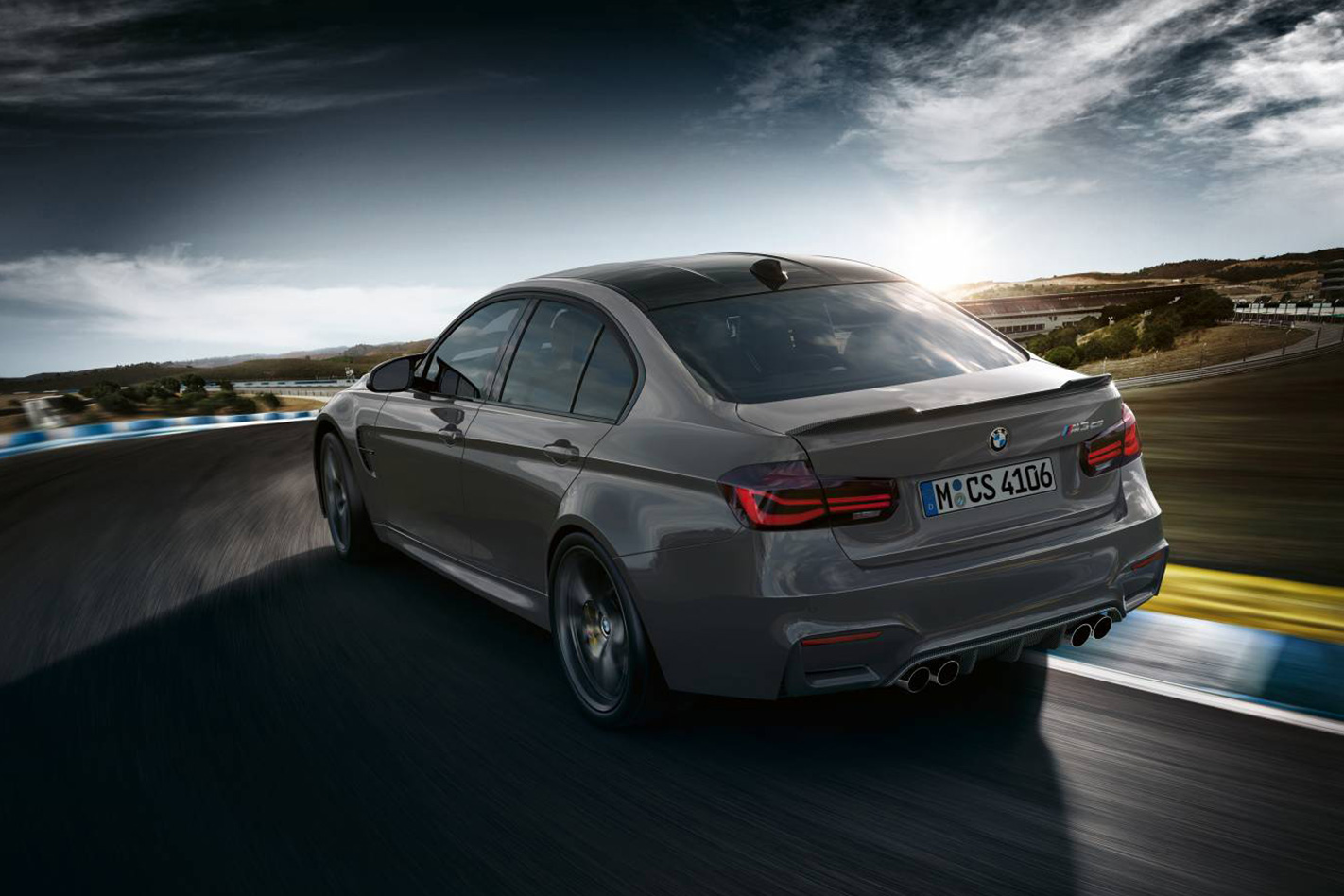
BMW has announced it is preparing to build the next member of its new generation of CS cars, the BMW M3 CS.
Following in the footsteps of the M4 CS, the new M3 will feature the same 338kW/600Nm tune from the 3.0-litre straight six as the M4 – 7kW and 50Nm over the M3 Competition – but will pack on only 60kg bringing kerb weight to 1585kg.
While more weight doesn’t exactly sound very sporting, the devil is in the details.
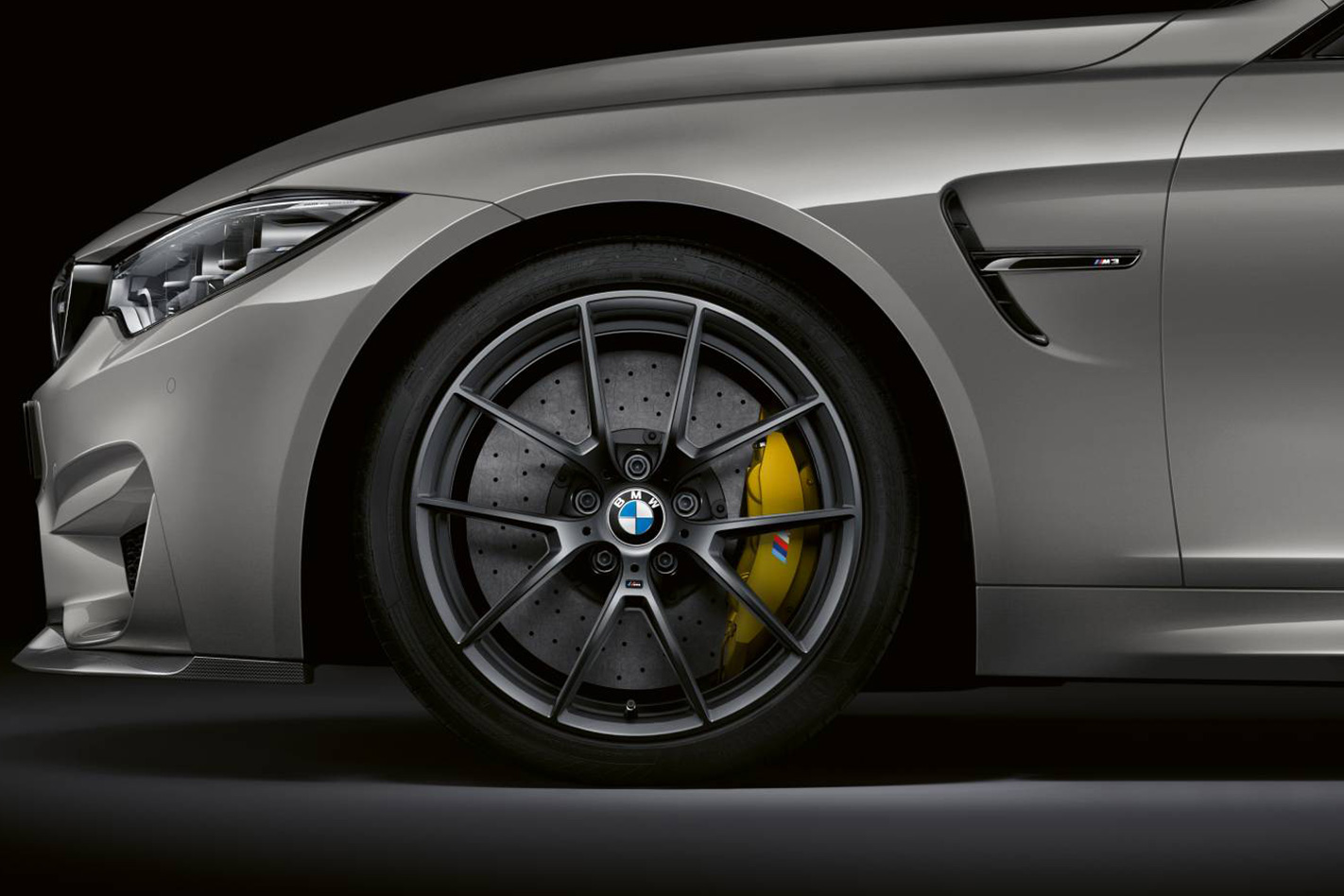
BMW says the front wheels weigh around 9kg, while the rears weigh 10kg.
Dynamics are further improved through the chassis, which BMW says is set up similarly to that of the M3 Competition, but with less weight (thanks to its forged aluminium build) and more rigid axle systems. A lightweight double-joint spring strut is found at the front, and a five-link at the rear.
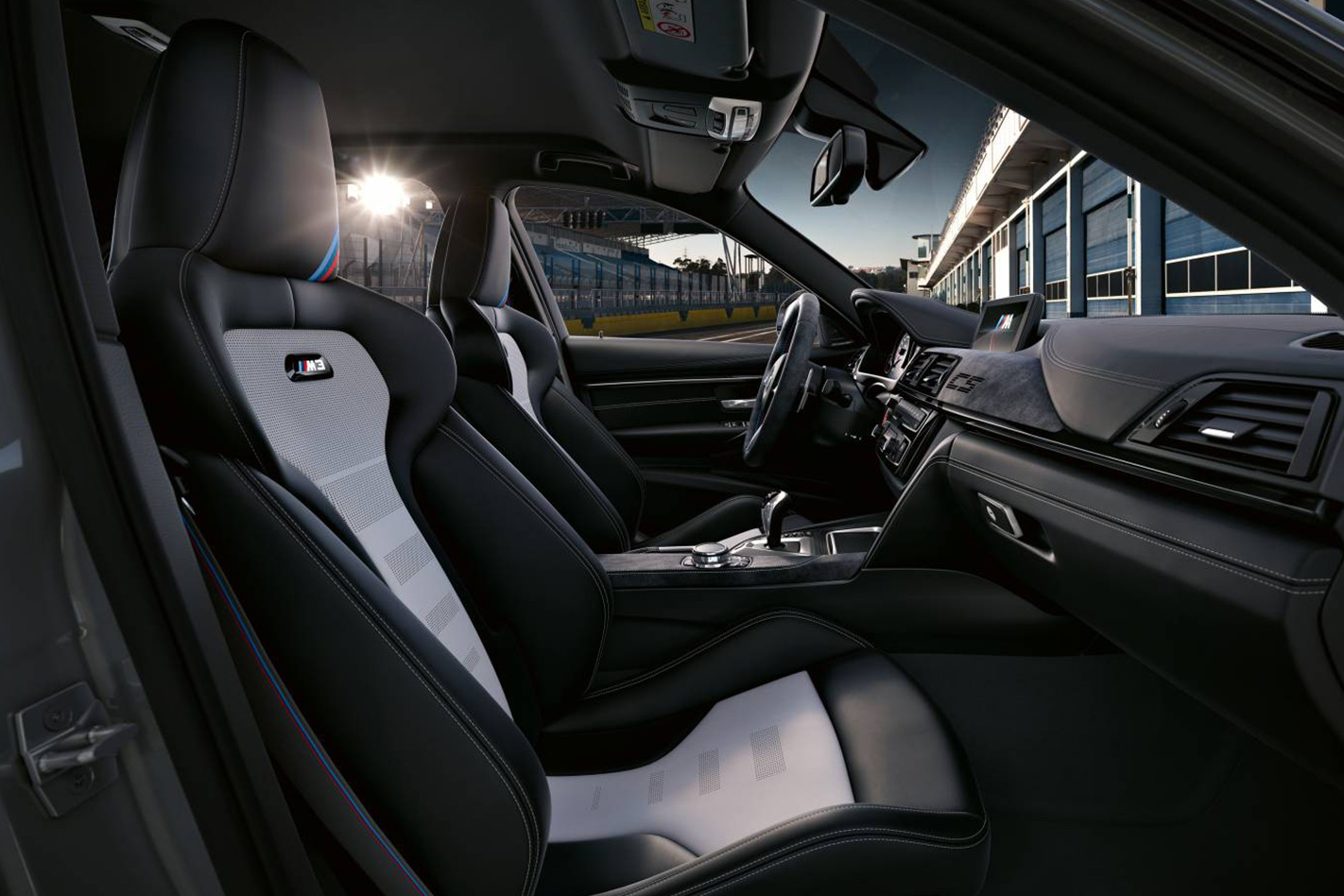
One of our frustrations with the M4 CS, the lack of conventional door pulls, won’t be an issue with the M3.
With pricing and unit allocation yet unannounced for Australia, we are unsure when it’ll be available locally, but orders for the BMW M3 CS can be placed as of January 2018.
Only 1200 will be built worldwide, beginning March 2018. Expect local pricing to creep closer to $200,000.
Not every car enthusiast can afford to invest in a Porsche 911 R. Heck, not everyone can afford to buy a house or apartment these days.
So the question is, could sub-$50,000 used performance cars work as potential investments in the future? We certainly think so.
Enter part one of our top 10 most affordable performance car investments … with the obvious caveat that the MOTOR team is hardly a group of investment banker types.
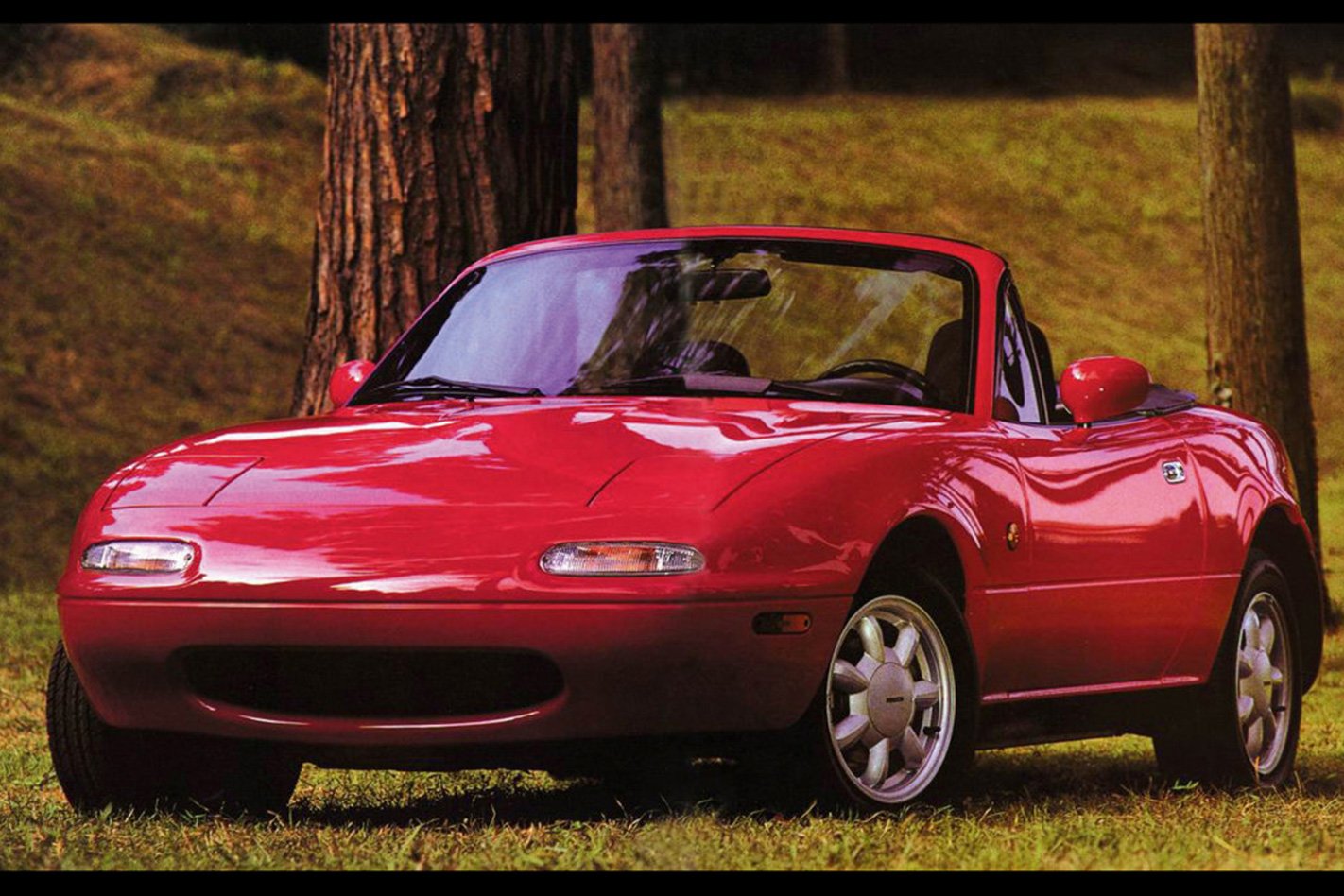
1989 Mazda NA MX-5
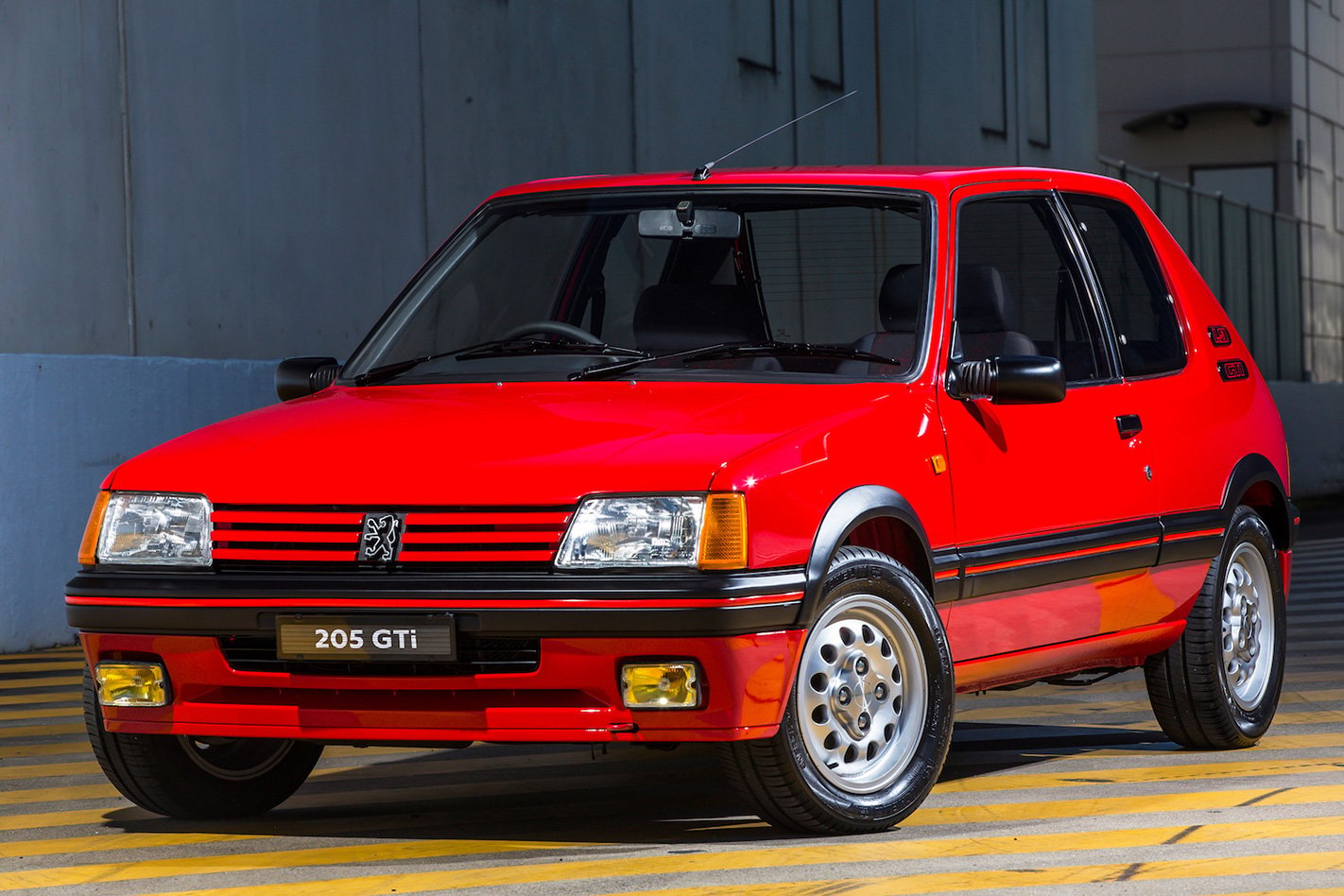
1989 Peugeot 205 GTI
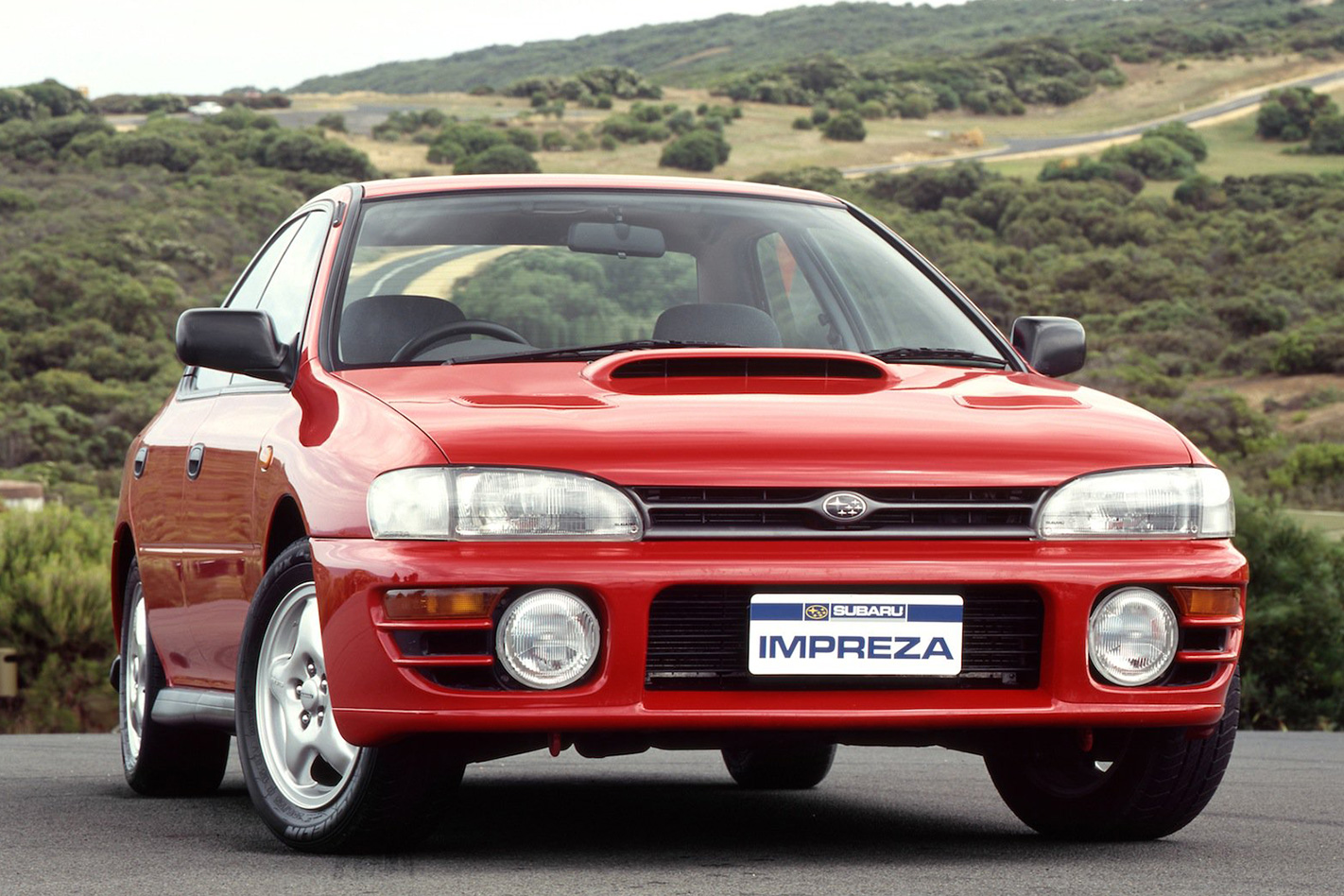
1994 Subaru WRX
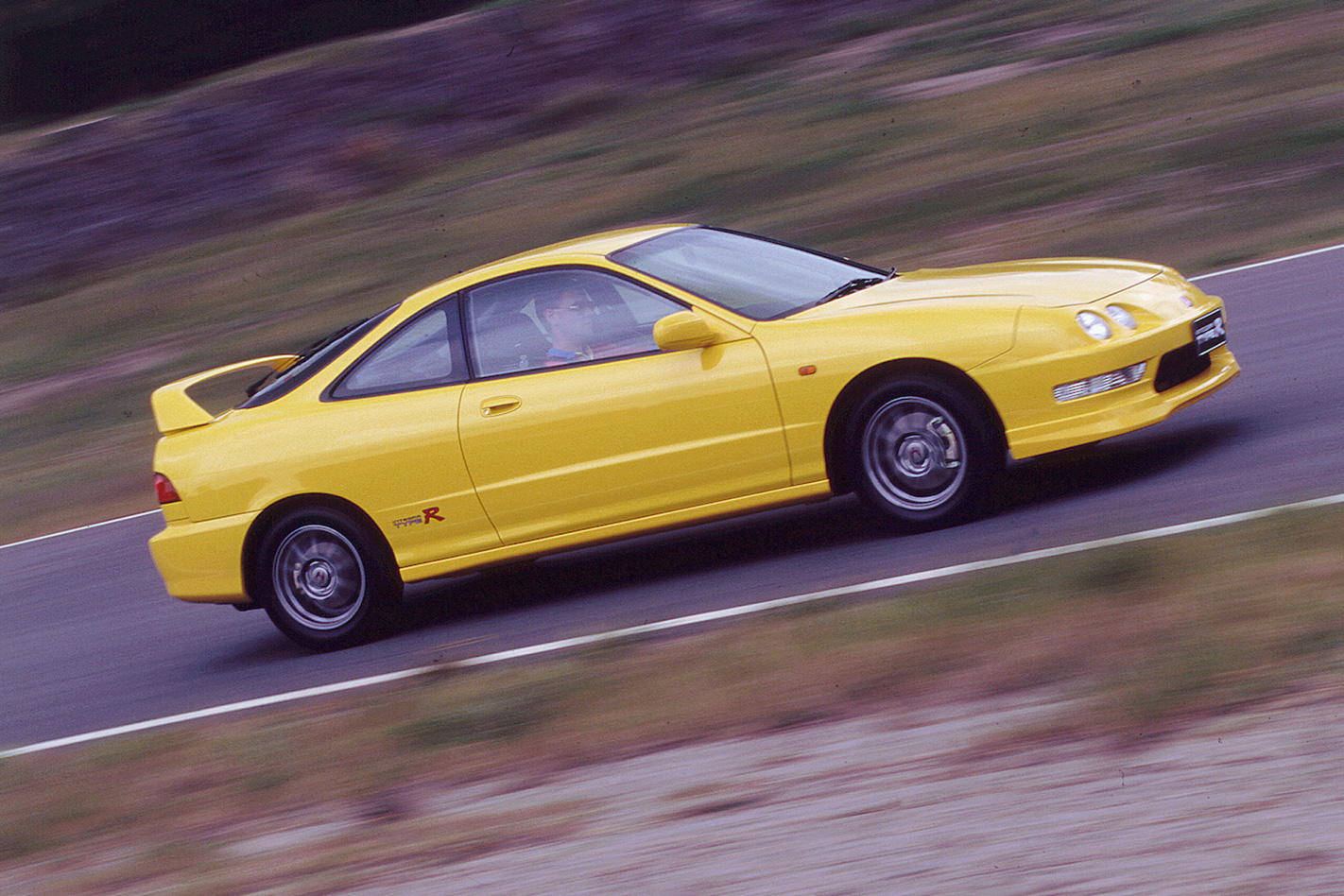
2000 Honda Integra DC2 Type R
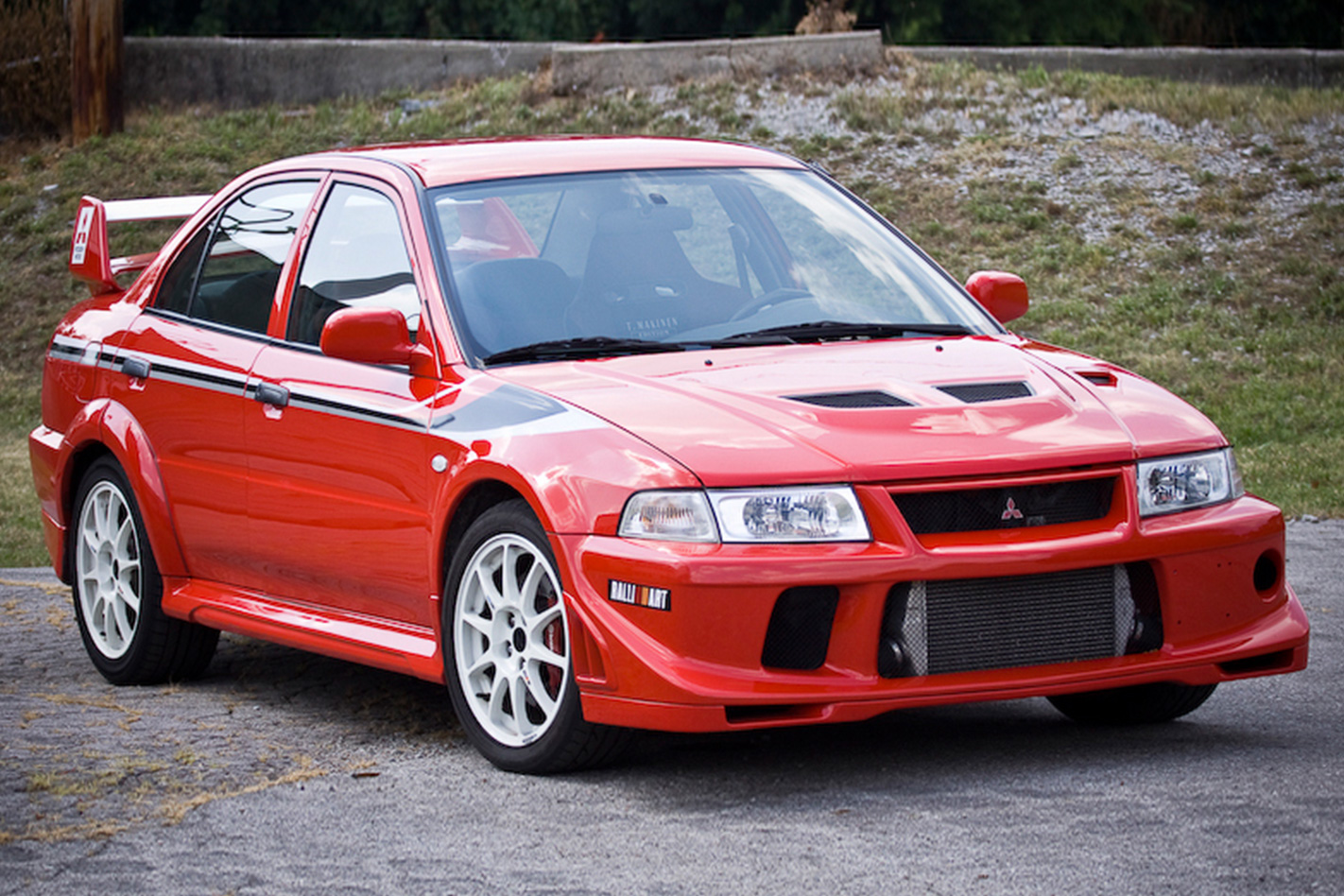
2000 Mitsubishi Lancer Evolution VI Tommi Makinen Edition
In part two of our top 10 most affordable sportscar investments, the remaining five models will fill out the $25,000 to $50,000 bracket. Stay tuned!
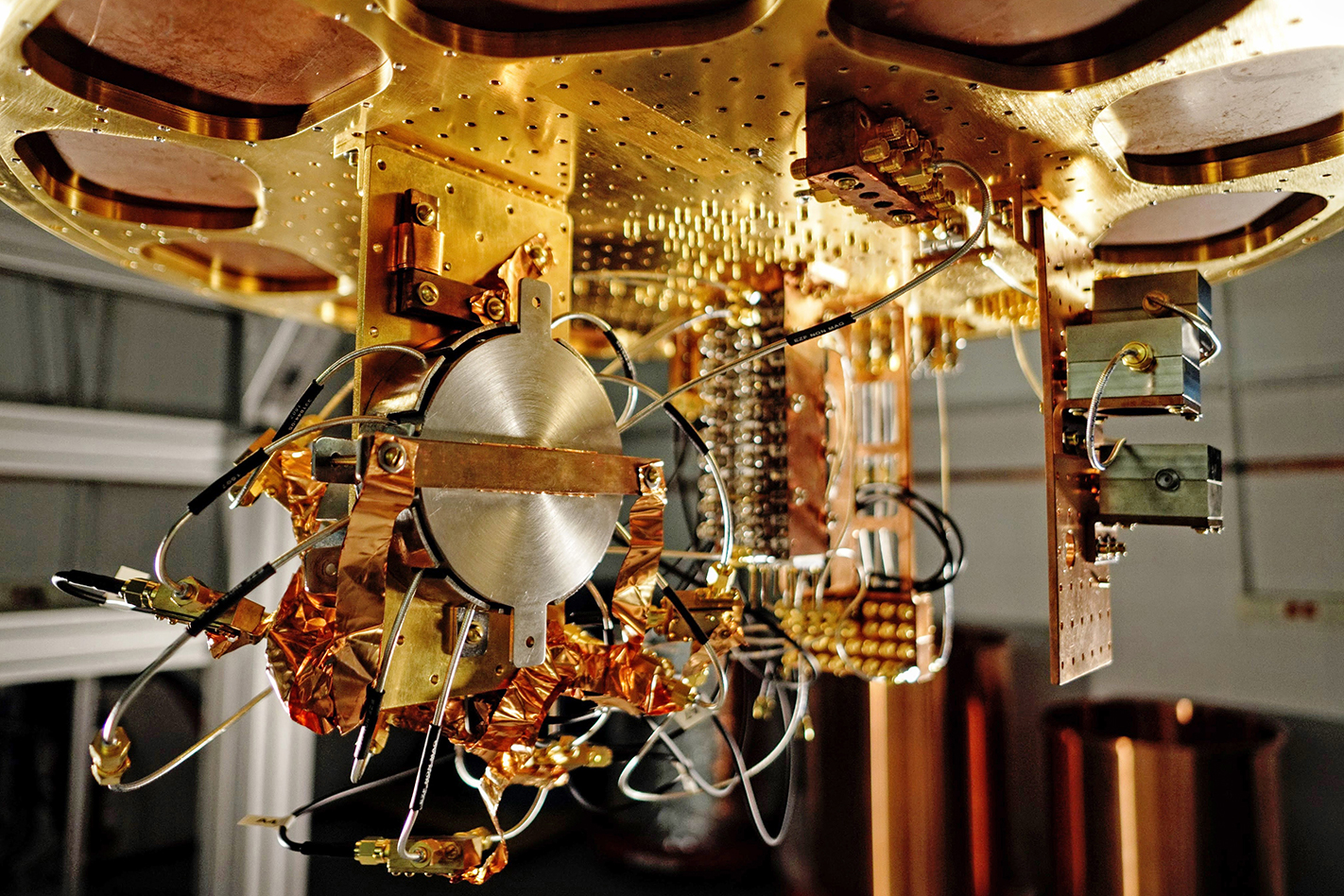
VOLKSWAGEN, the world’s largest car maker last year, now wants to move into the world of supercomputing to help it work out a way to shorten your daily commute.
The German premium brand has inked a deal with search engine giant Google – which itself is working on autonomous driving – to use a quantum computer to optimise traffic, test new electric car batteries and “new machine learning processes” – artificial intelligence – that may one day make a vehicle smart enough to know what you’re thinking.

The commuting research will focus on smarter traffic guidance systems, show available electric charging stations or even empty parking spaces.
Volkswagen is no stranger to high-end computing: earlier this year it used a quantum computer to optimise the traffic flow for 10,000 taxis in the Chinese capital, Beijing – one of the most crowded cities worldwide. No results were published, but Volkswagen claims it was able to reduce traffic by choosing the ideal path for each vehicle taking part in the trial.
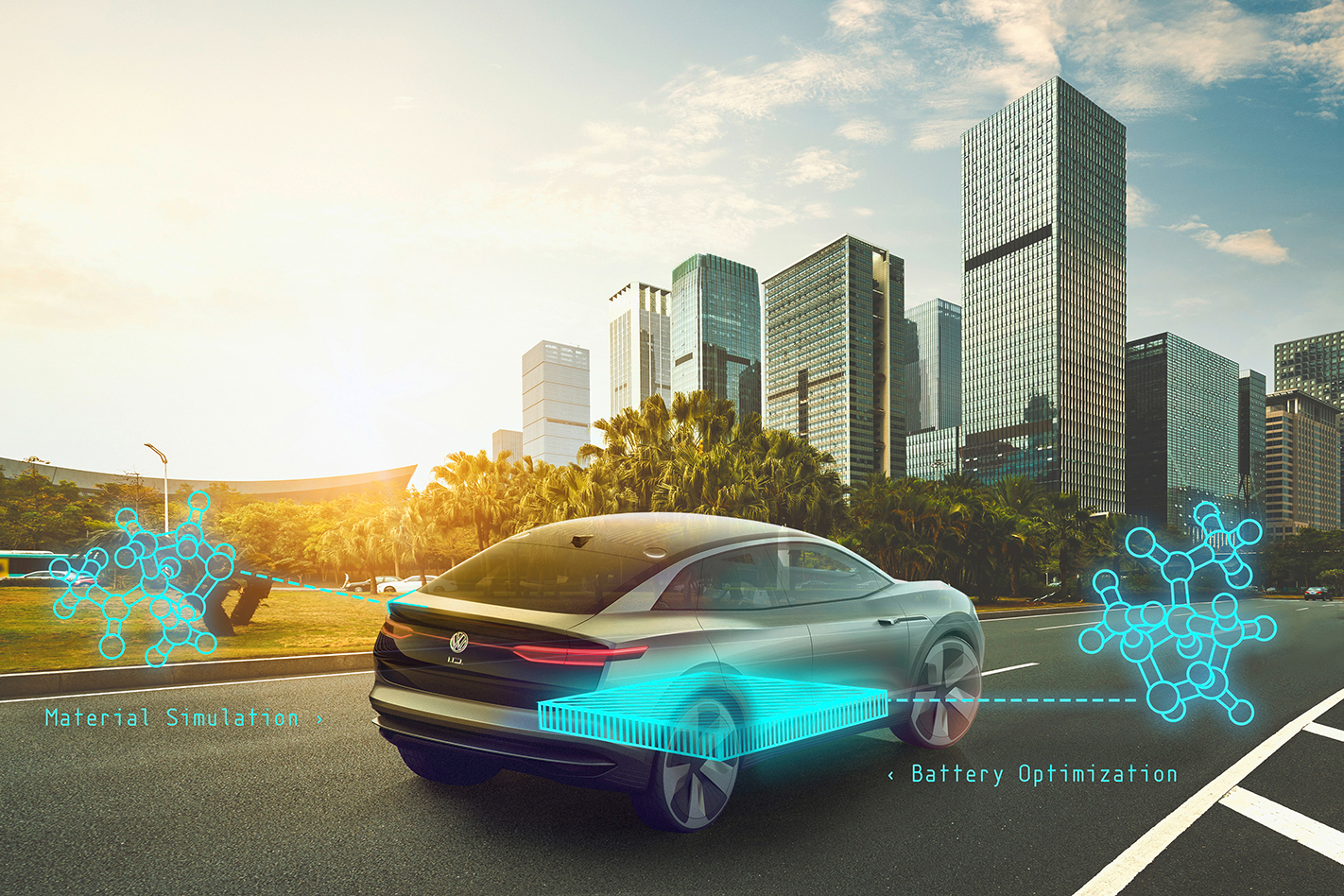
The car maker plans to launch its future electric cars under the “ID” sub-brand, with a hatchback and the SUV-styled ID Crozz built on the group’s MEB electric platform slated to launch in 2020. VW plans to add the ID Buzz people mover to the range in 2022, with the range expected to grow to five vehicles by 2025.
The battery-powered cars are scheduled to arrive about a year before VW plans to introduce fully autonomous cars – the so-called level five autonomy – to its showrooms, something the latest quantum computing tie-in is expected to help with.
Car makers including BMW, Ford, GM and Mercedes-Benz are planning for what they believe will be a big change to the way we will use their products, with car- and ride-sharing services largely replacing the traditional car ownership model in more populated cities.
FRENCH car fiends have reason to celebrate, with the Alpine A110, Renault’s alloy-bodied, mid-engined sportscar, finally confirmed for our shores with a local arrival forecast for the second half of 2018.
The precise launch date and pricing has yet to be locked in, but Renault has verified the A110 will initially go on sale in a limited-edition specification with 18-inch forged alloy wheels, fixed-back Sabelt sports seats, a Brembo brake package with two-piece rotors, active exhaust, alloy pedals, carbon interior trim and high-end audio system.
Following the initial launch model will be “a range of other variants”, though Alpine is keeping mum on the details of those cars for now.
All A110s will make use of Renault’s new 1.8-litre turbo petrol four-pot, mounted transversely behind the seats and taking its 185kW and 320Nm outputs to the rear wheels via a seven-speed twin clutch automatic. Those outputs are lower than the 205kW/390Nm Megane RS, which uses the same engine in a different state of tune, but the Alpine A110 cuts a slimmer figure to keep performance on the frisky side of the spectrum.
Weighing just 1080kg when empty thanks to an aluminium monocoque construction, the A110 sprints to 100km/h in a swift 4.5 seconds on its way to an electronically-limited 250km/h top speed. Alpine claims a weight distribution of 44:56 front-to-rear, which, in combination with its double-wishbone front and rear suspension, bodes well for cornering capability.
Price? Renault Australia isn’t saying just yet, but has indicated that it expects the final retail pricetag to fall somewhere between $90,000 and $110,000 – which would put it in competition with the $97,990 Lotus Elise Sprint 220 and the $89,000 Alfa Romeo 4C.
Both of those rivals align closely on technical terms too, through their lightweight constructions (alloy for Lotus, carbon-fibre for Alfa) and mid-engine layout that puts a boosted low-capacity engine between the rear wheels and passenger compartment.
The Lotus employs a supercharged 1.8-litre four with 162kW and 250Nm (but is a featherweight at 904kg), while the 4C utilises a turbo 1.7 making 177kW and 350Nm. Like the A110, the 4C is dual-clutch only while the Elise Sport makes use of a conventional manual.
Interested parties can reserve their spot in the queue, and Renault Australia’s dealership network will retail the A110 alongside the French brand’s conventional passenger cars. Not all dealers will sell and service the Alpine, however, with specific dealers set to be confirmed closer to the A110’s local arrival.
TYPE R, as we know it, is dead.
That fabled emblem, venerated by petrolheads, once symbolised Honda’s unique brand of lightweight, free-breathing, high-rpm thrills. Early Type Rs were revelatory – particularly the DC2 Integra variety – but the game has changed over its 20-year epoch, and Australia has never seen the Civic Type R at its best.
Our sole exposure ended six long years ago when the European-sourced third-gen model departed Oz after a four-year tenure. There were no eulogies. Honda had diluted the Type R formula by that point, and its storied history of purist performance cars had started petering out long ago.
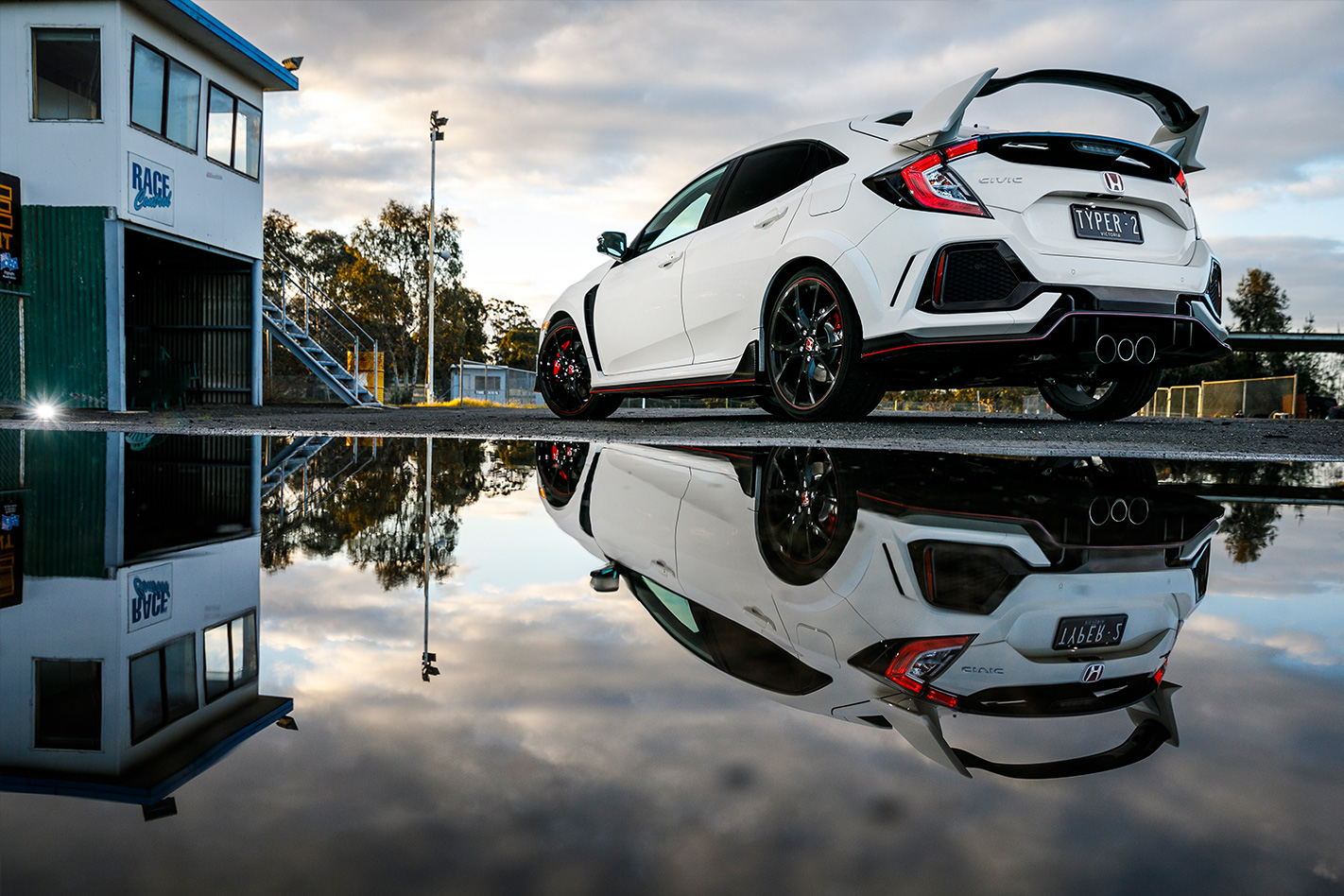
Civic Type R has taken a doctrinal turn for its latest reincarnation. Honda’s front-wheel-drive libertine has, for the first time, adopted turbocharging to stay within touch of its bullish contemporaries and returned to an independent (in this case, multi-link) rear suspension set-up that should never have disappeared.
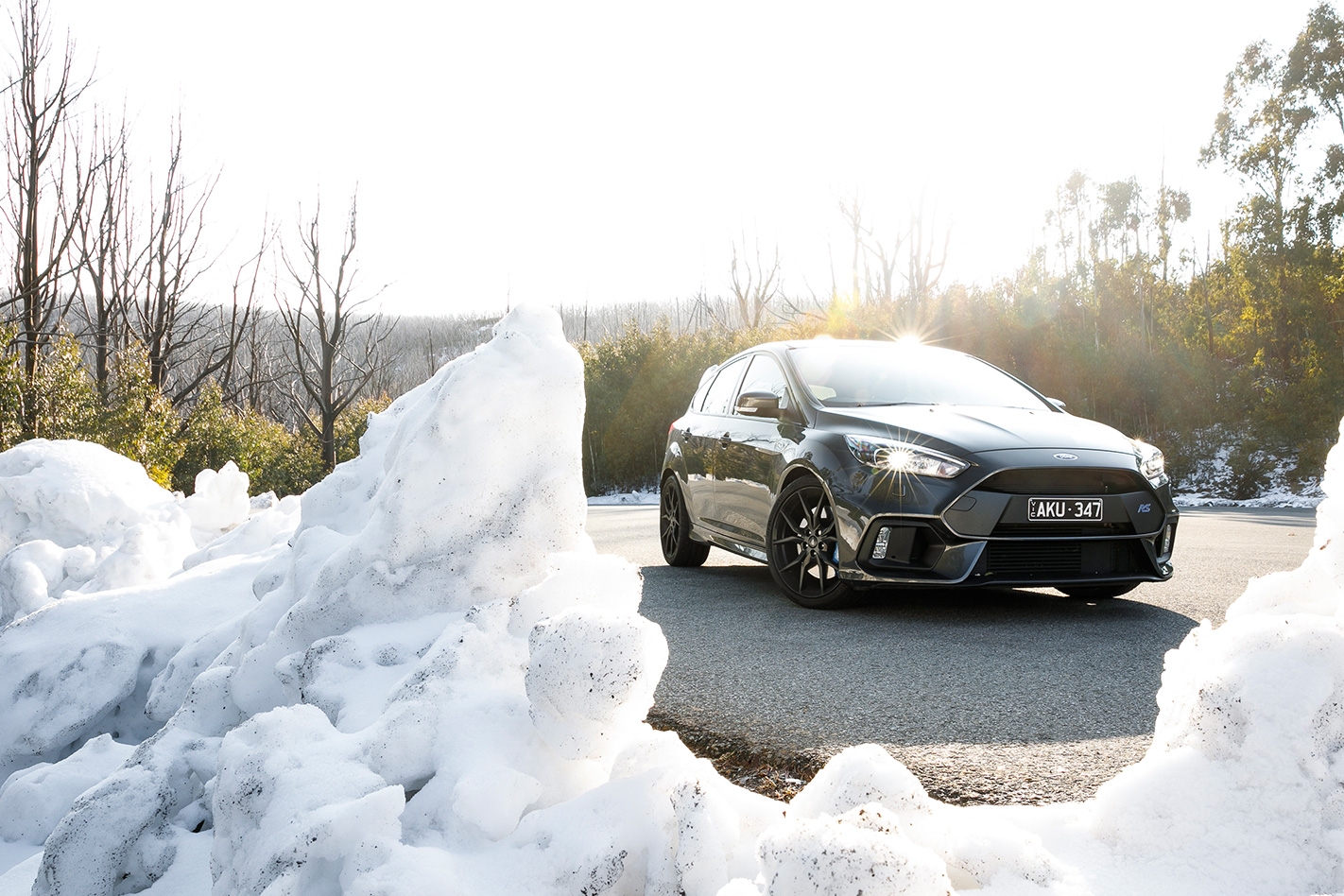
Today’s hot-hatch landscape is tough going for a newcomer. Never has $50K afforded such a combination of power, capability and complexity. Ford tore up the segment’s front lawn last year with the brash all-wheel-drive Focus RS, pitching an antisocial curveball at Volkswagen’s much-admired Golf R in the process.
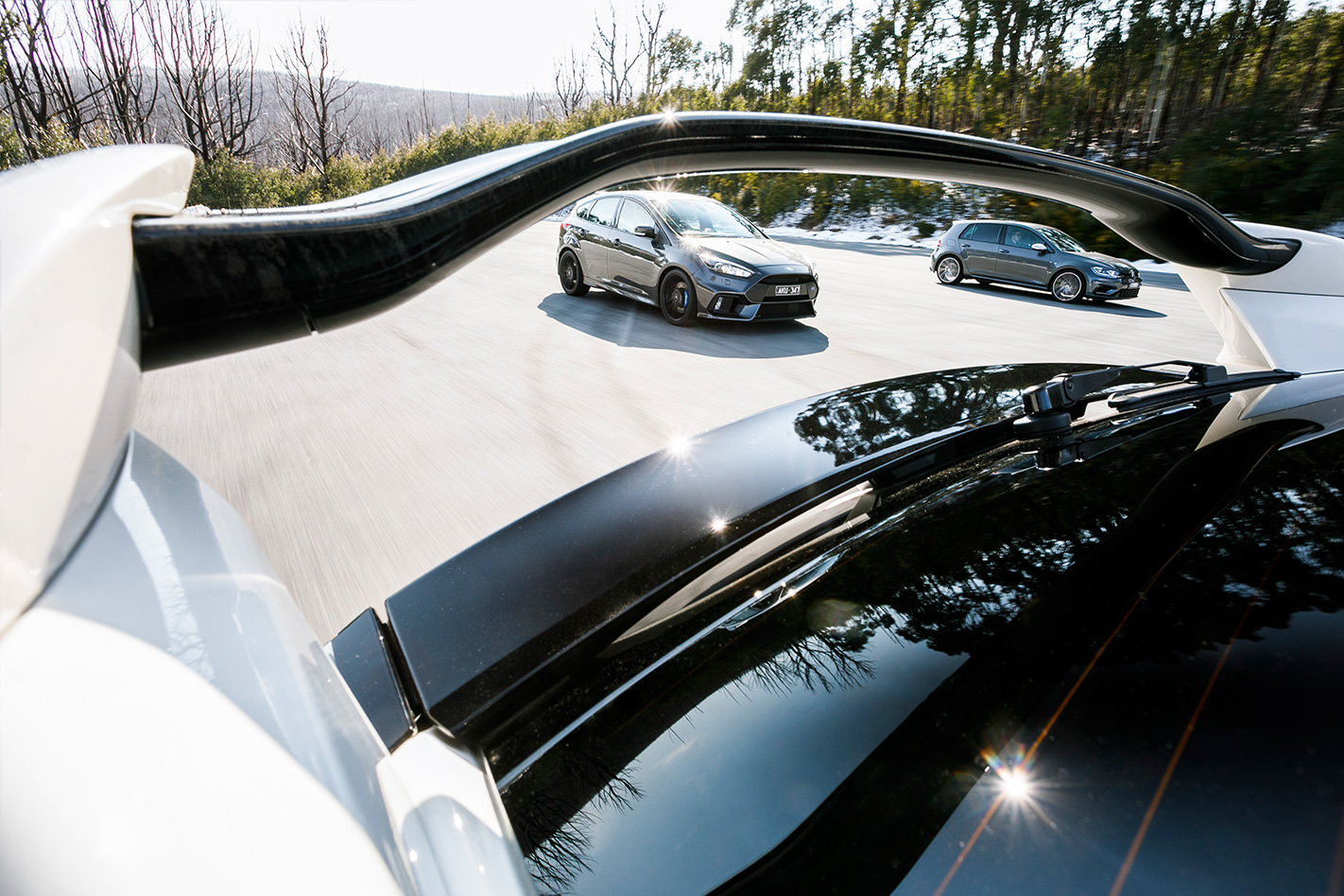
Not that you’d ever believe that possible given the Type R’s singularly focused styling. It’s by far the most visually challenging car of this trio. The base Civic isn’t exactly an easy starting point, but the over-styled Type R shows no restraint. Its gangly body addenda introduce so many design elements to an already-fussy form that it’s impossible to find a clean line anywhere.
There are practical problems caused by the Type R’s questionable looks, too. That gargantuan rear wing combines with the Civic’s raked C-pillar to create a massive vision obstruction. Still, if standing out from the crowd is everything, then the Type R is for you.
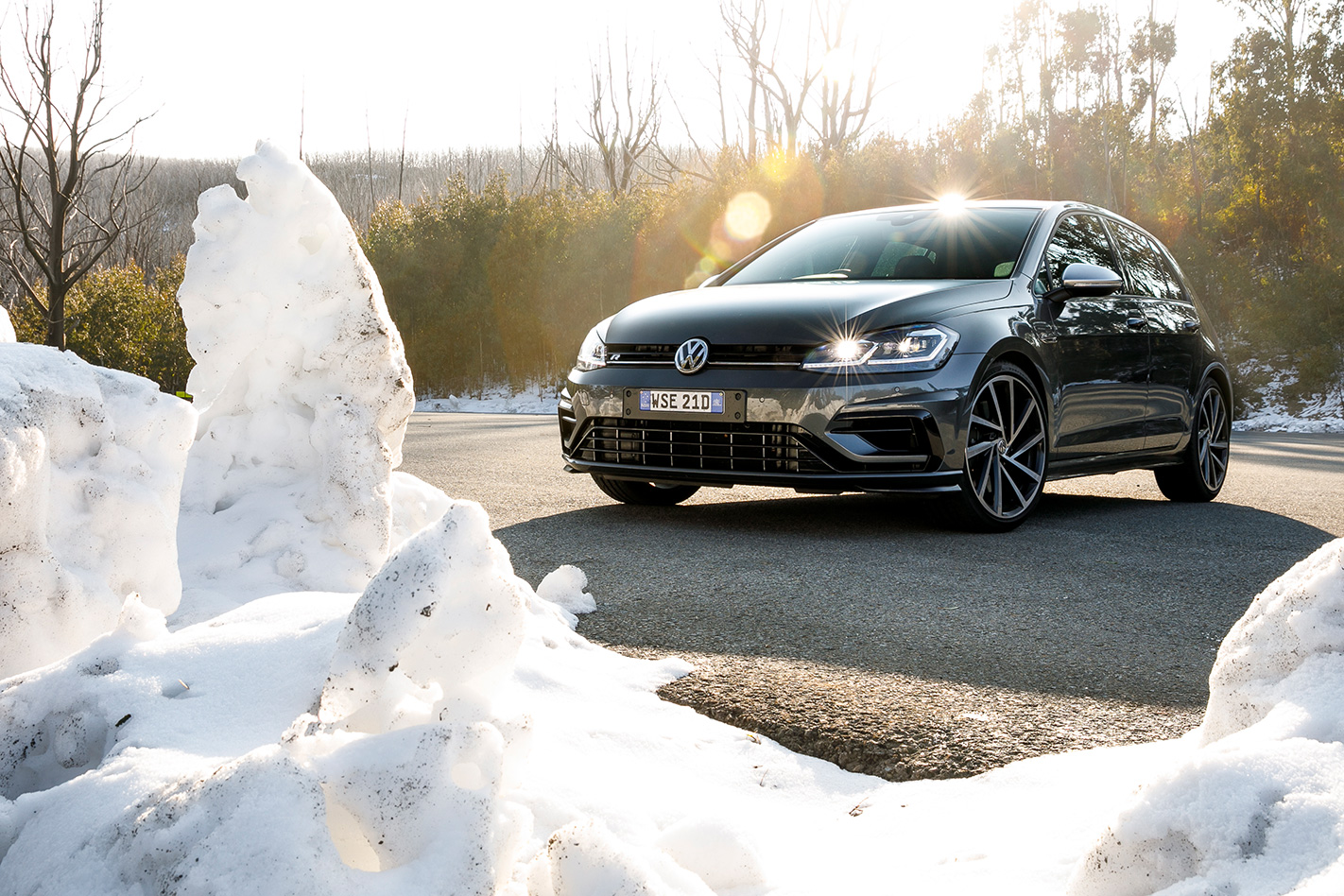
Trademark conservatism gives the Volkswagen a clear point of difference in this company. The Golf R is easily the most discreet and visually sophisticated of the three, light-on for drama but distinctly cultured inside and out. In profile, the R could be any other Golf with a big set of wheels, and for many, that’s a huge part of its appeal. But in the quest for ultimate excitement, is the German icon merely downplaying its talents?
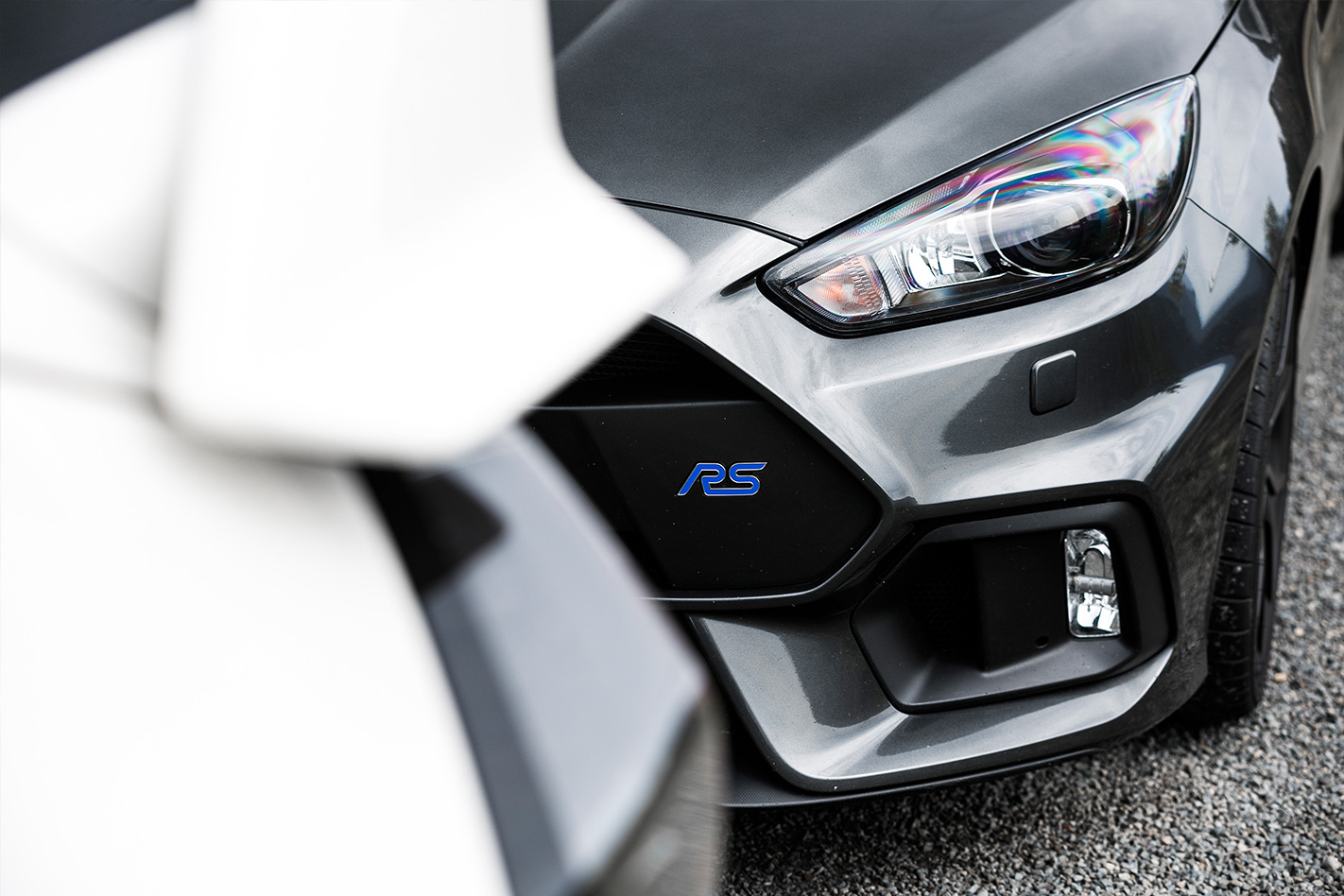
Top honours in the horsepower fight goes to the 257kW/440Nm Focus RS, which puts everything on the line in the name of performance, though lugging a porky 1575kg, it damn well needs to. The Civic Type R sits lineball with the $50,990 Focus on price, and mid-pack for grunt (228kW/400Nm), yet its weight-optimised front-drive underpinnings mean the Honda undercuts the Ford by a solid 182kg, leaving them neck-and-neck in the power-to-weight stakes.
Thanks to a foolproof launch procedure – clutch in, rev to the 6750rpm limiter, then side-step your left foot – the Focus delivers ballistic standing-start performance and early blows on the competition, proving easily the quickest car to 100km/h (5.0sec), time after time, without a hint of protest. And it’s quicker when you do everything yourself, rather than relying on launch control. In comparison, the reluctant-to-launch Golf neither sounds or smells like it enjoys being caned to 100km/h (in 5.6sec), while the Civic (5.8sec) suffers simply by being traction-limited.
Spin it to the 7000rpm redline and upshifts are instantly rewarded with the tacho dropping back into full-boost territory. And its sound is wonderfully animated, with a rowdy induction roar and a metallic zinging at the upper reaches, though there’s little action from the exhaust. The Type R’s trio of tailpipes promise a ruckus, but don’t deliver it. In fact, the central outlet is designed to reduce cabin drone at cruising speeds by drawing air in. And it works.
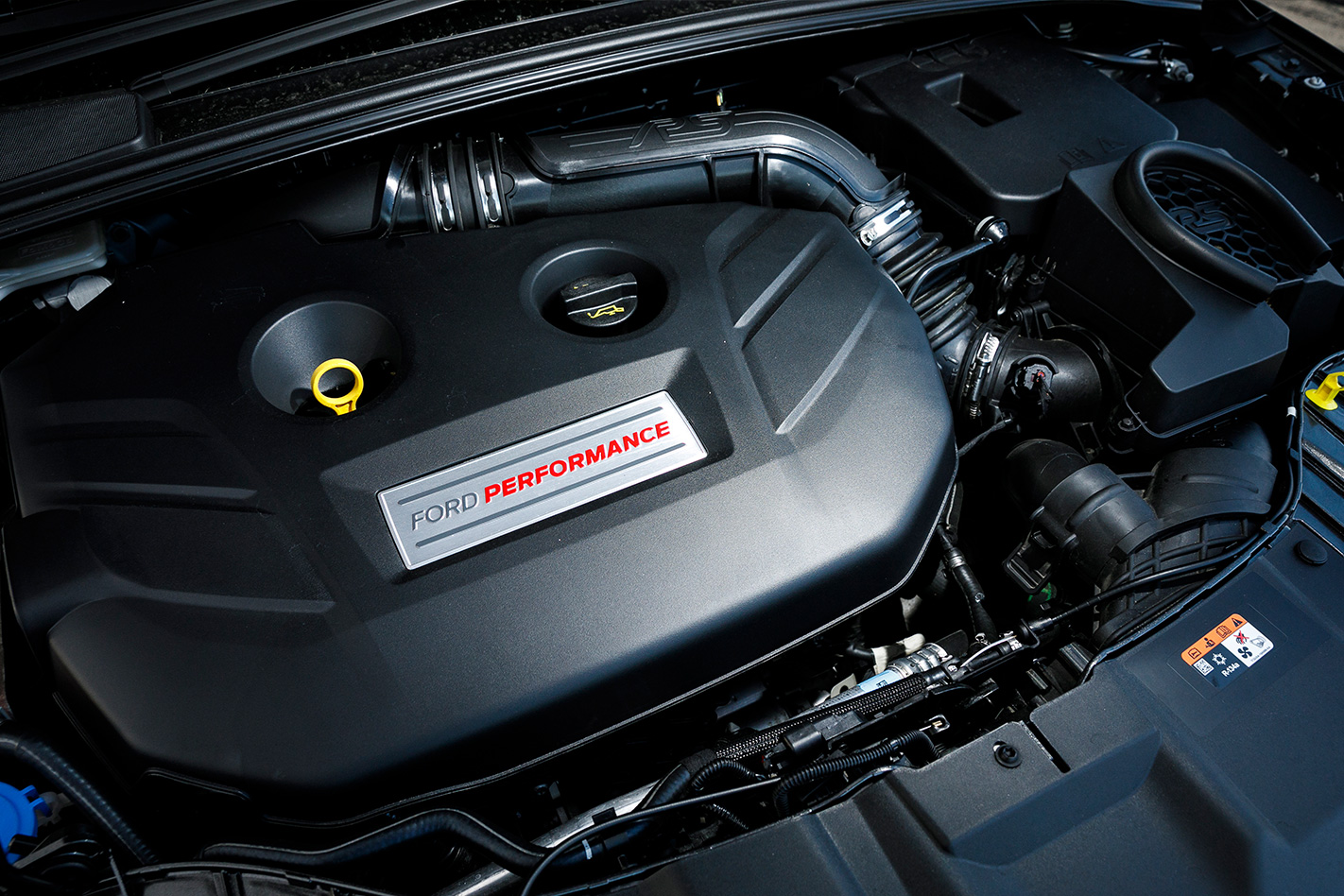
The Ford’s 2.3-litre turbo four is the most characterful engine of the group, and lovably uncouth in Sport mode, with a rat-a-tat-tat drum line from its exhausts. On paper, its engine appears to be a straight lift from the Mustang EcoBoost, but the RS (mercifully) gets a Cosworth head and a unique intake, exhaust and turbocharger. It’s a relentlessly energetic thing, with the most linear power delivery here. And enormous mid-range thrust – as much as 470Nm – is churned out when ‘overboost’ parameters allow.
For all its visual peacocking, the Type R has an unexpected level of Golf-esque maturity, and comes close to the VW’s plushness when each car’s adaptive dampers are switched to their most easy-going modes. Incredibly, the Civic’s ride comfort isn’t sacrificed by its liquorice-strip 245/30R20 rubber, though it suffers from noticeable tyre roar on such tiny sidewalls, which is made more obvious by the lack of exhaust rumble.
The Focus can’t compete with the other two when it comes to comfort. It doesn’t do duality of character with any great conviction. Its firm, adaptively damped ride toggles between uncompromising and unbearable, though it’s dialled-in well enough to be stomached from the front seats on a daily basis. Rear-seat occupants may struggle in combination with poor visibility. The payoff, however, is ten-tenths handling excellence.
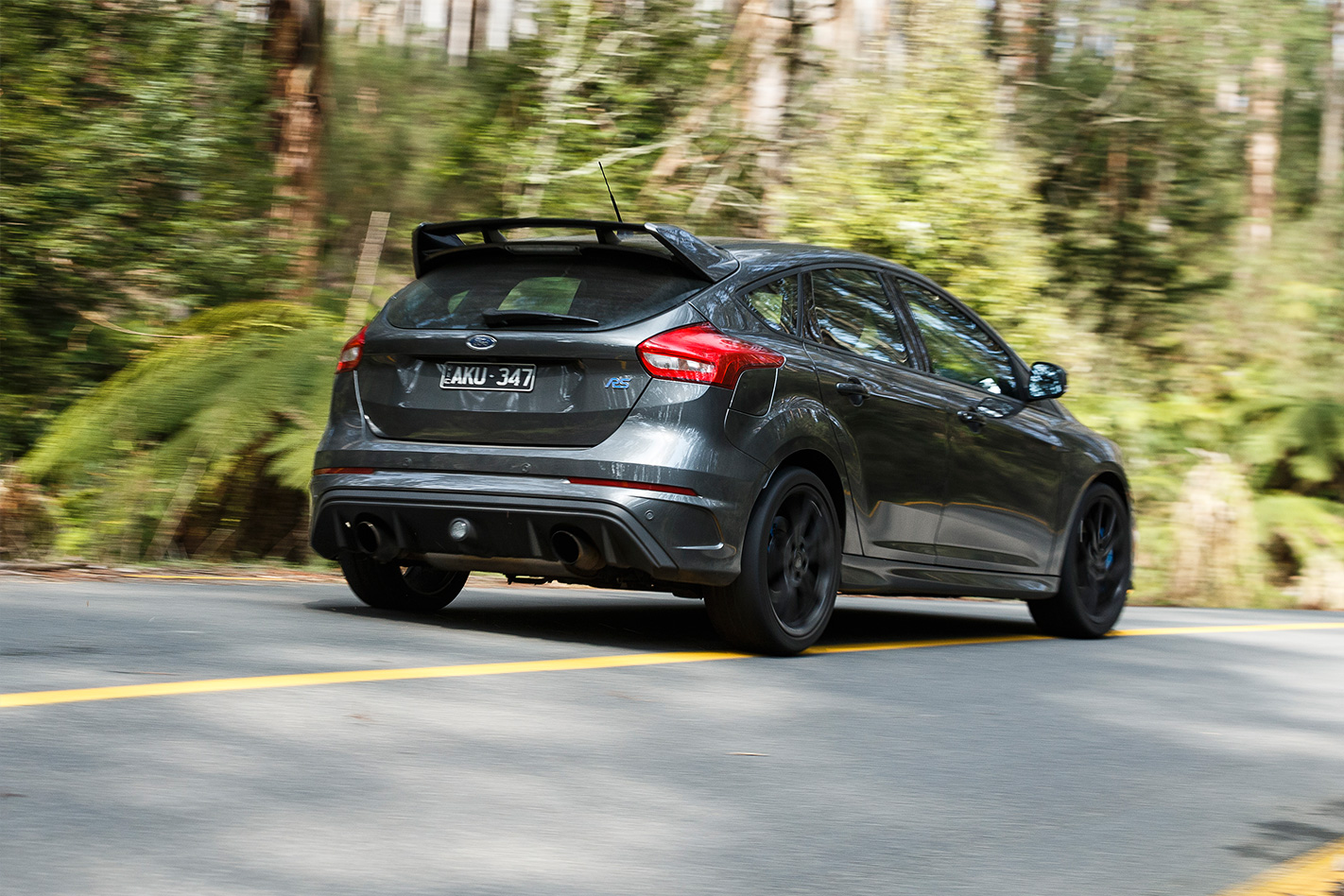
Manhandle it into tight corners and the Focus RS will lift its inside rear wheel, while Race Track mode allows small oversteer slides that require little correction, and inject a shot of adrenaline into the experience. Yet excellent brake pedal modulation and seemingly bottomless reserves of grip mean this larrikin remains friendly and easy to rein in.
The Type R is a completely different sort of car to drive quickly. It needs to be managed, and demands patience and forward planning. Set up before a corner, the Type R tears through with huge speed and minimal scrabbling as its limited-slip differential sniffs out grip. There’s some wheel fight on boost from the highly stressed front end, but its steering is fluid and predictable – less darty than the Ford’s – and its relative lack of driven wheels seldom feels like a limitation, except on greasy surfaces. It also has the slickest gearshift feel and best clutch relationship here. Intuitive is the word.
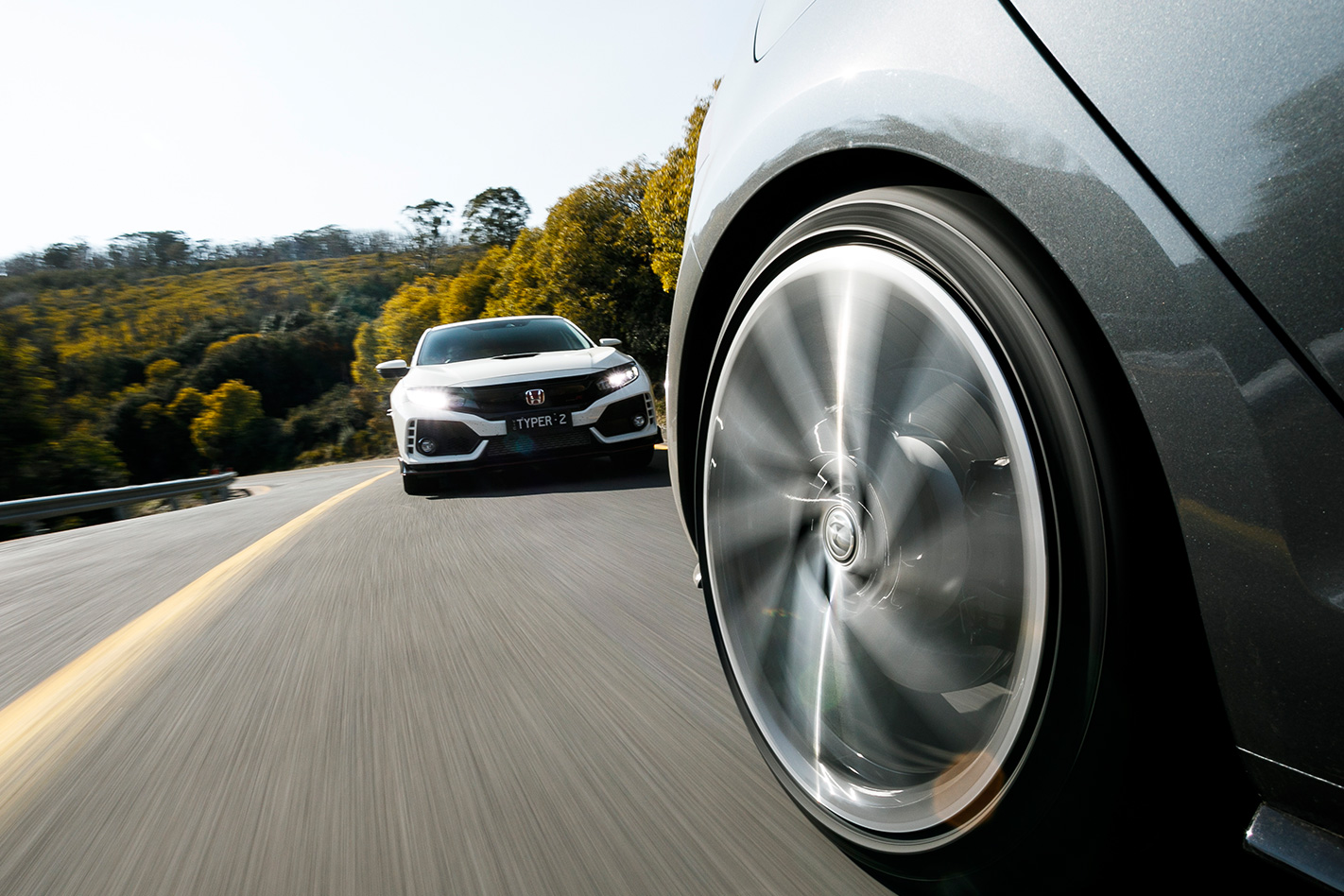
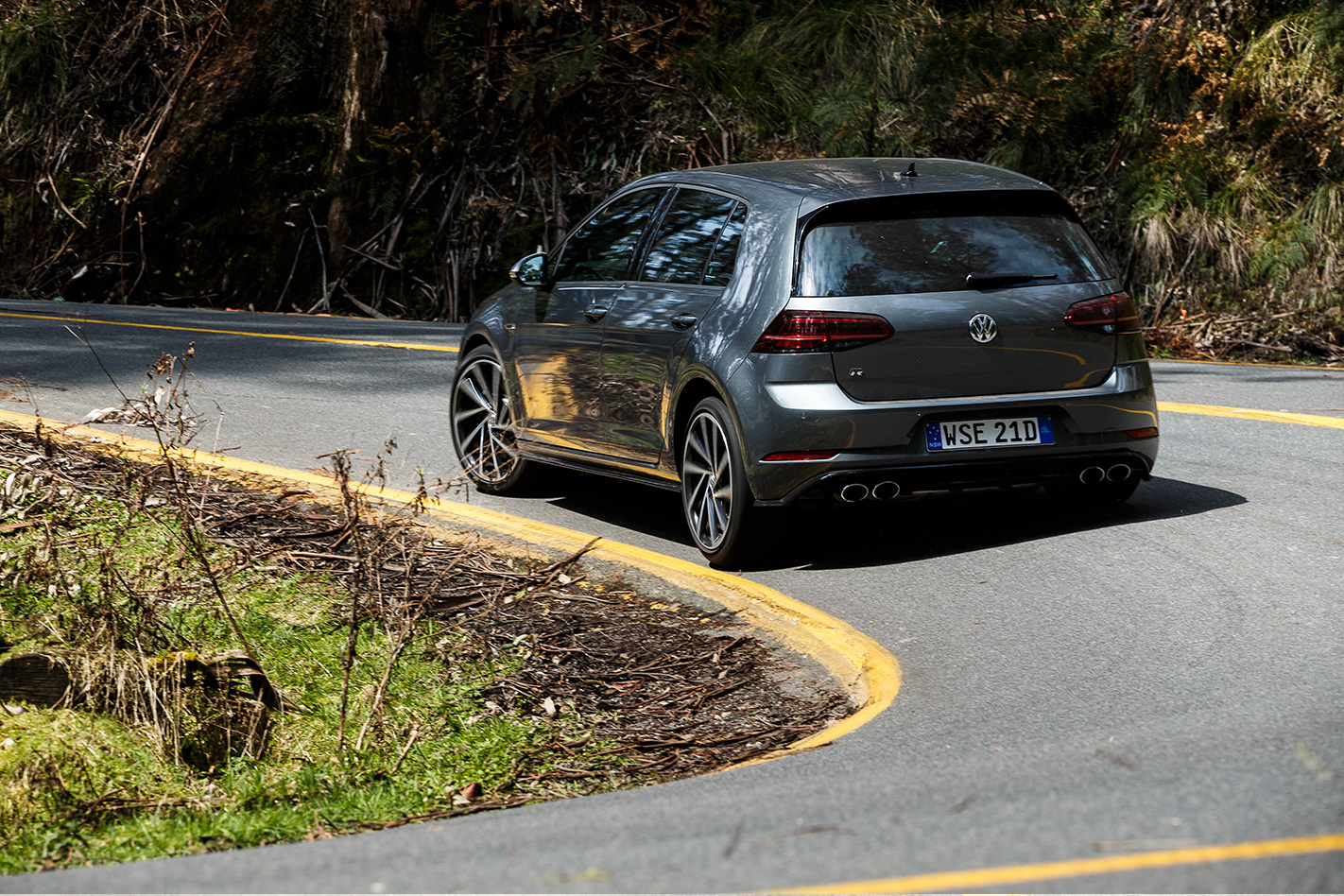
What the Civic and the Focus have that the Golf doesn’t is immediacy. Every input in the VW feels like it has a level of dampening built in to give an ultra-slick sheen of refinement. The R is an extremely effective tool, but its Teflon coating manifests as a layer of separation between driver and machine. Less initial bite from the brake pedal reduces confidence in what is otherwise a solid set-up. And there’s remoteness in the shift feel and steering as well. That said, the R is an astonishingly quick car when driven on its terms, rewarding smooth inputs.
There’s a ruthless precision to the way the VW goes about carving through corners. Its inert rear end offers huge traction and is faithful to a fault, but it means the Golf is the least playful car here. Alongside two extremely spirited and involving driver’s cars, the Golf R comes off feeling a bit anodyne and clinical, despite the thoroughness of its engineering.
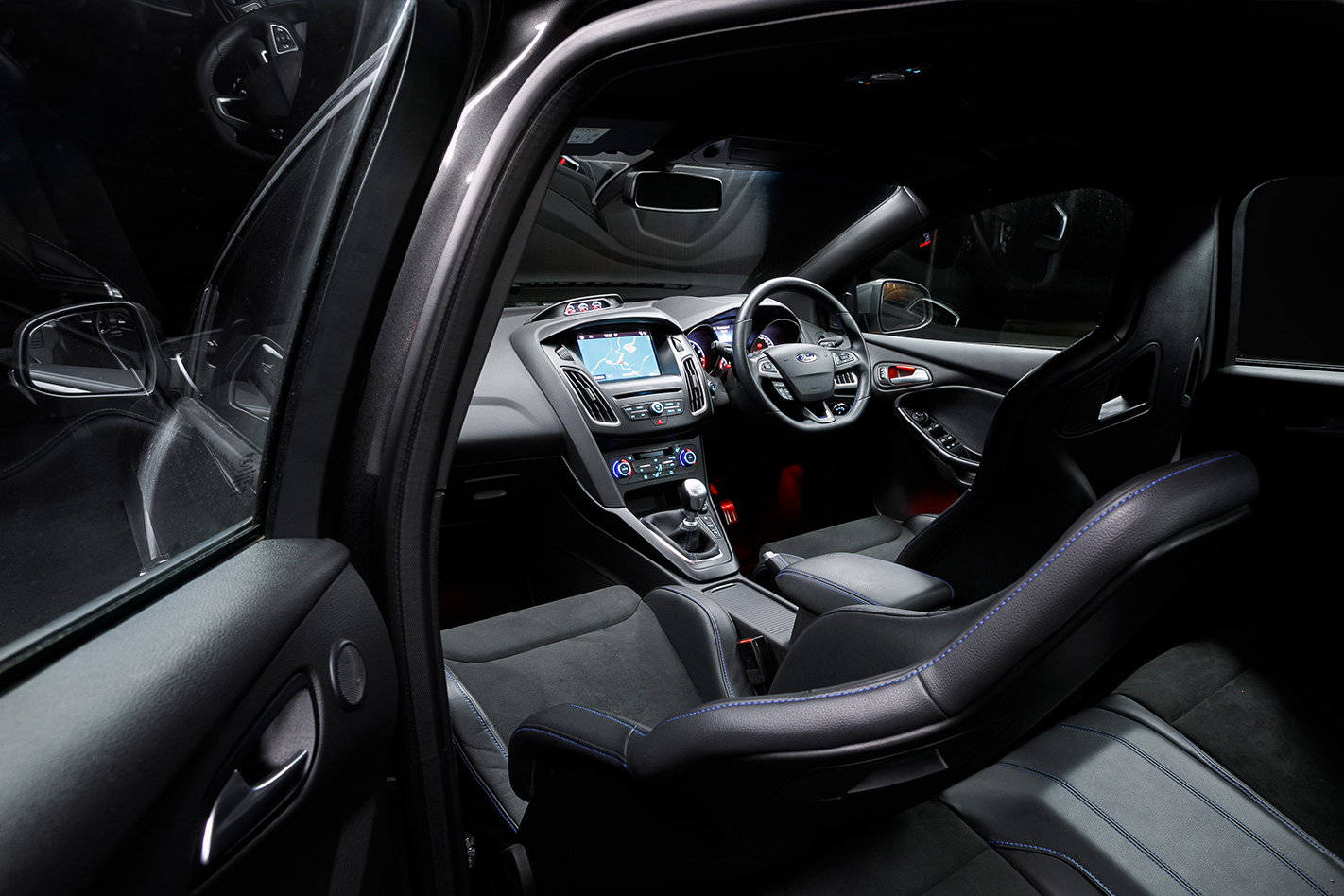
Compared to the Golf, the Ford’s ageing feature set looks relatively malnourished. Ergonomically, the RS is a mixed bag as well, with a front seating position that’s simply too high, leaving the driver’s left knee to bang against the centre console. Positive implications for outward visibility mean there’s an argument in favour of the lofty perch, but you need to adapt to it.
The rest of the Ford’s cabin is a cheap and cheerful reminder that the fruity RS doesn’t fall far from the Focus tree. It remains a useful grocery-getter at its core, but the RS’s premium price buys tricky mechanical things like GKN’s excellent torque-vectoring, all-wheel-drive set-up, not swathes of tactile cabin surfaces.
Also lacking in the Honda is an individually configurable drive mode. The +R setting has a firm ride that’s a step too far on badly pockmarked roads, forcing you backwards into the lesser Sport or Comfort settings for ride compliance, while sacrificing ultimate engine sharpness. The Focus allows its sport dampers to be independently turned on and off, leaving only the steering and throttle mapping paired together, whereas the Golf has a fully customisable set-up and can be configured exactly as required.
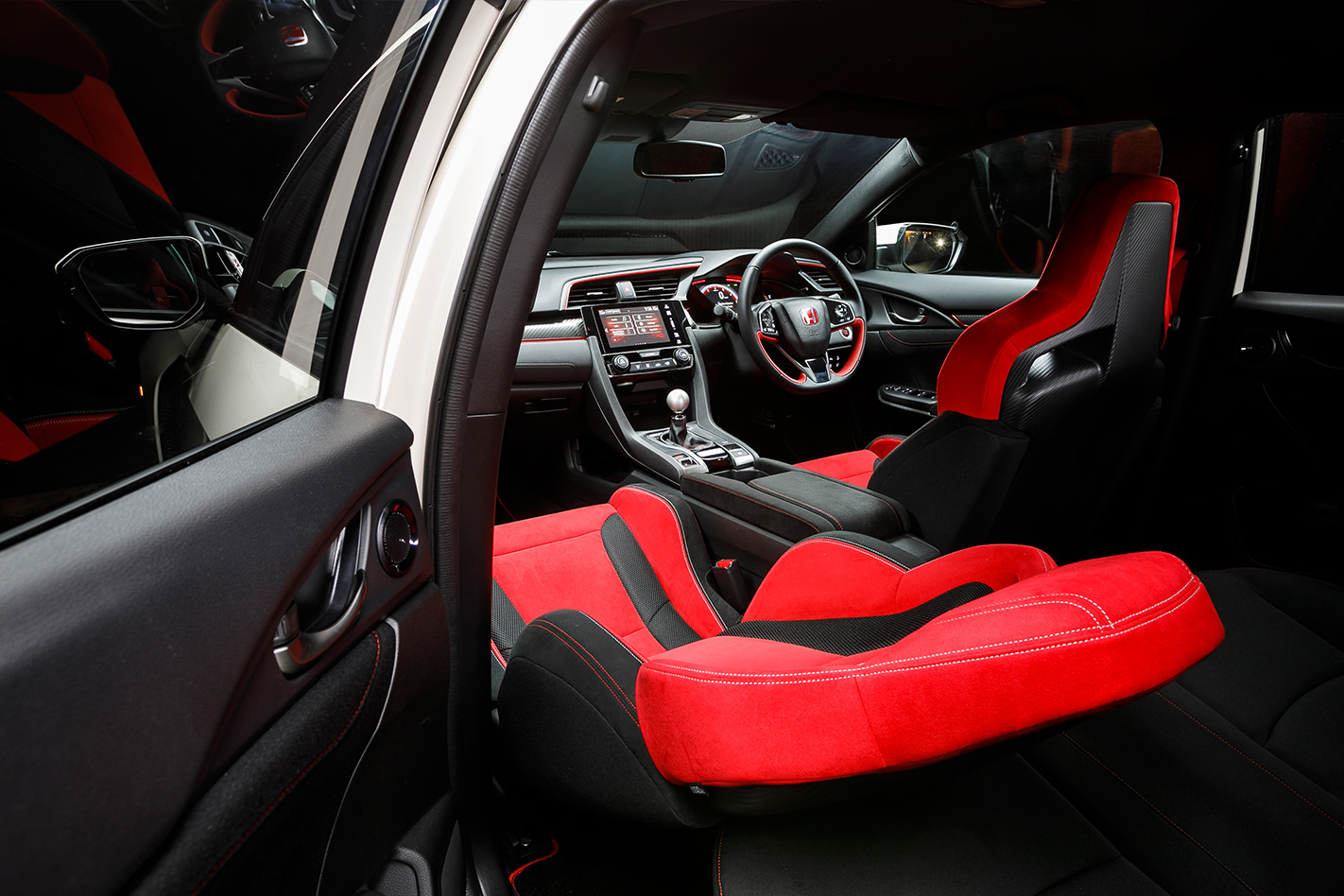
Splitting the remaining pair boils down to hot-hatch semantics. The Type R comes closest to the Golf R’s level of liveability. It spoils you when driven well and has loads of performance on tap, yet it also manages to cope effortlessly with general duties. Being everything to everyone is a tall order, yet Honda comes close to nailing the brief with its Nurburgring record holder.
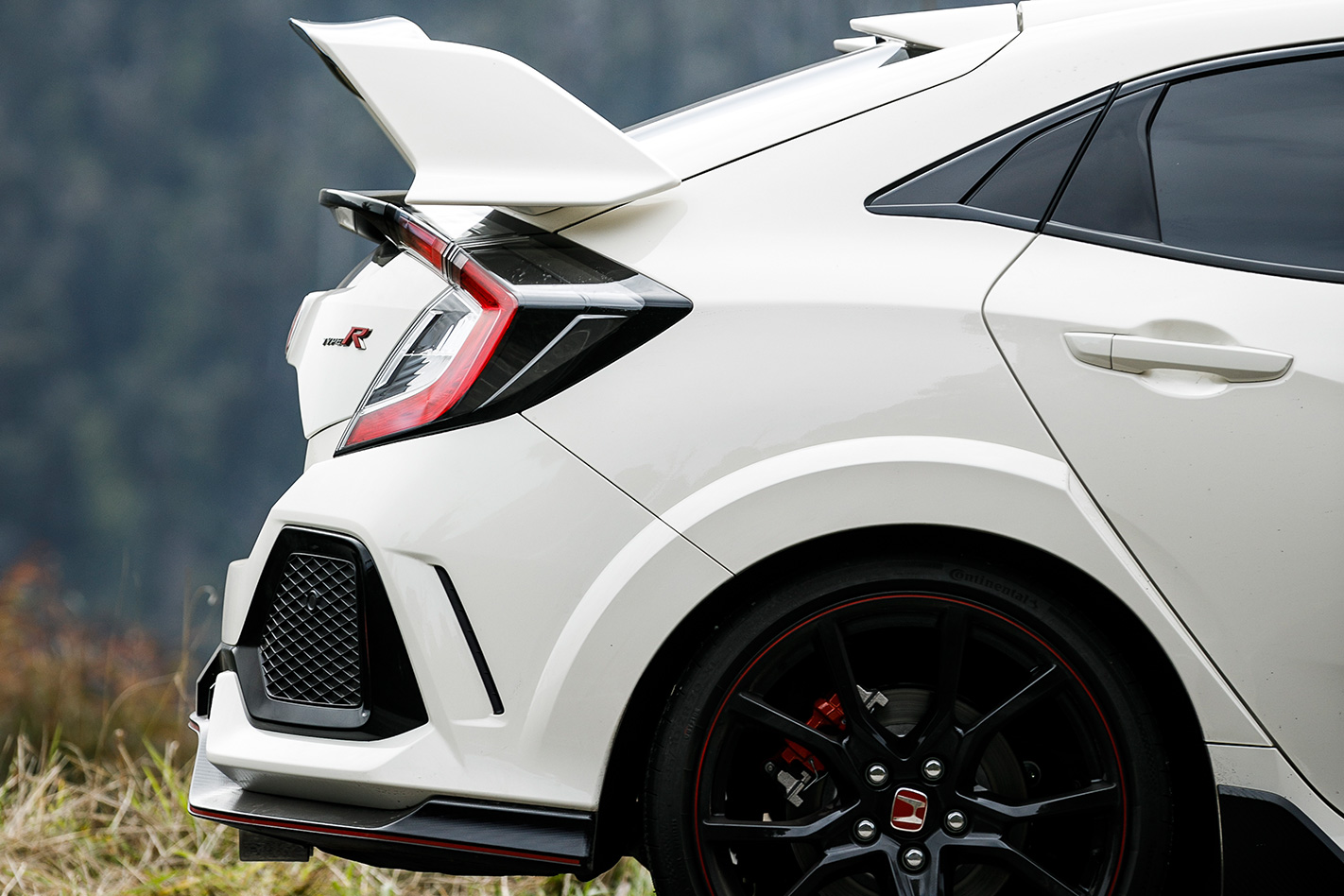
The Ford is the most transparent car here. Even as the elder statesman, it has a strikingly contemporary and tough look about it that can be understated when discerningly specified. But as a hot hatch, the Focus RS is molten, and will make you crave a special driving stage every time you’re behind the wheel.
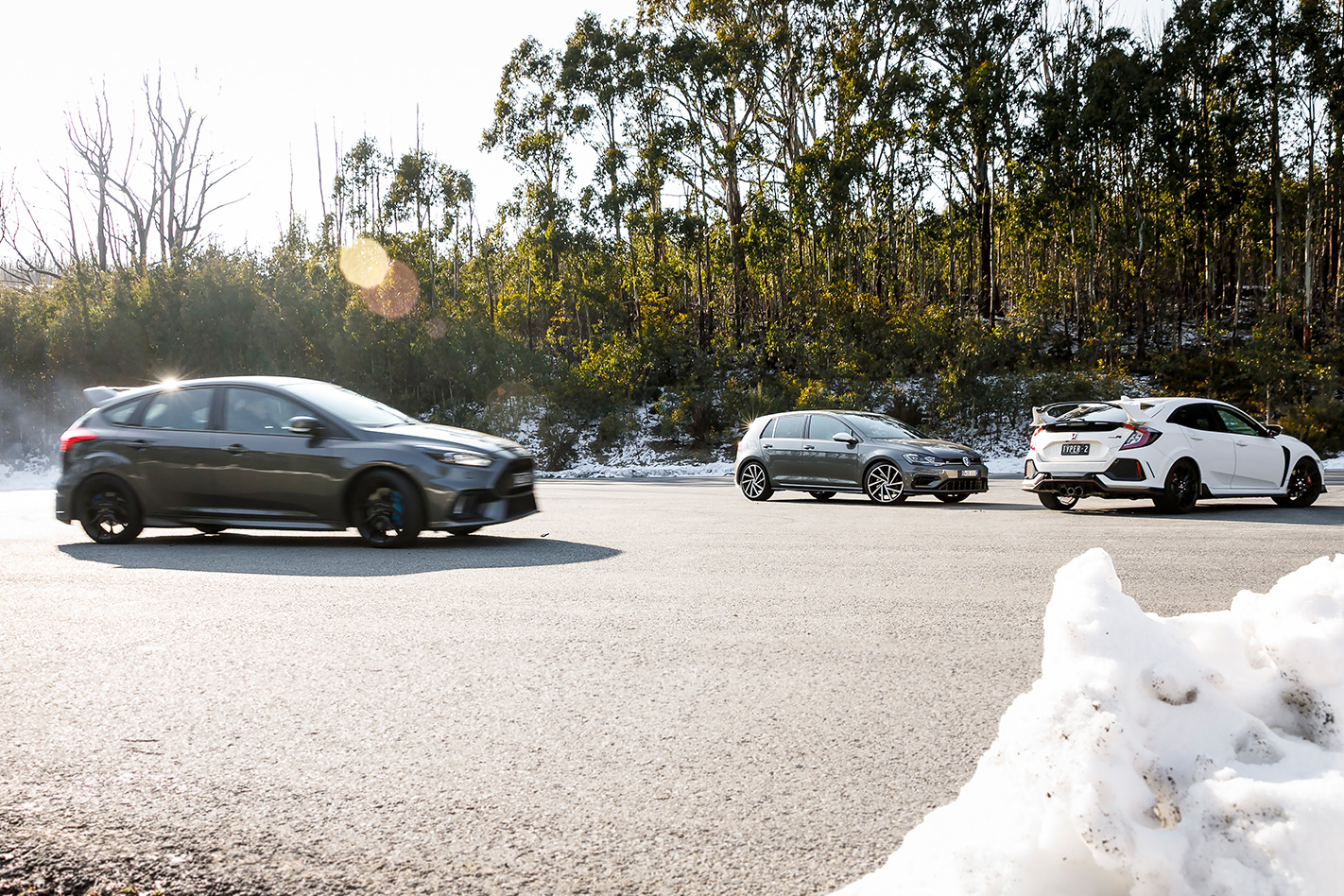
So on an emotional and dynamic level, it’s the Ford that delivers the highest highs, beyond all the box-ticking that might sway someone towards a Golf R. Close as the Type R comes to being a hot-hatch hero, it’s those visceral qualities that give the Focus RS the edge.
Don’t go looking for major changes on Subaru’s MY18 WRX; unless you’re an eagle-eyed trainspotter, you’re likely to come up blank.
This is partly because the few engineering changes are hidden away underneath the skin, but also because at a casual glance little appears to have changed. Externally, there’s a sharper nose with a new grille, steering-responsive LED headlights and redesigned 18-inch alloys, while extra kit includes heated door mirrors, a larger 5.9-inch infotainment touchscreen and, in our Premium level test car, heated front seats, the driver’s being eight-way power adjustable.
In terms of mechanicals the 2.0-litre turbo boxer four remains at 197kW/350Nm, but there are new high performance brake pads and ‘revised’ suspension, according to Subaru.
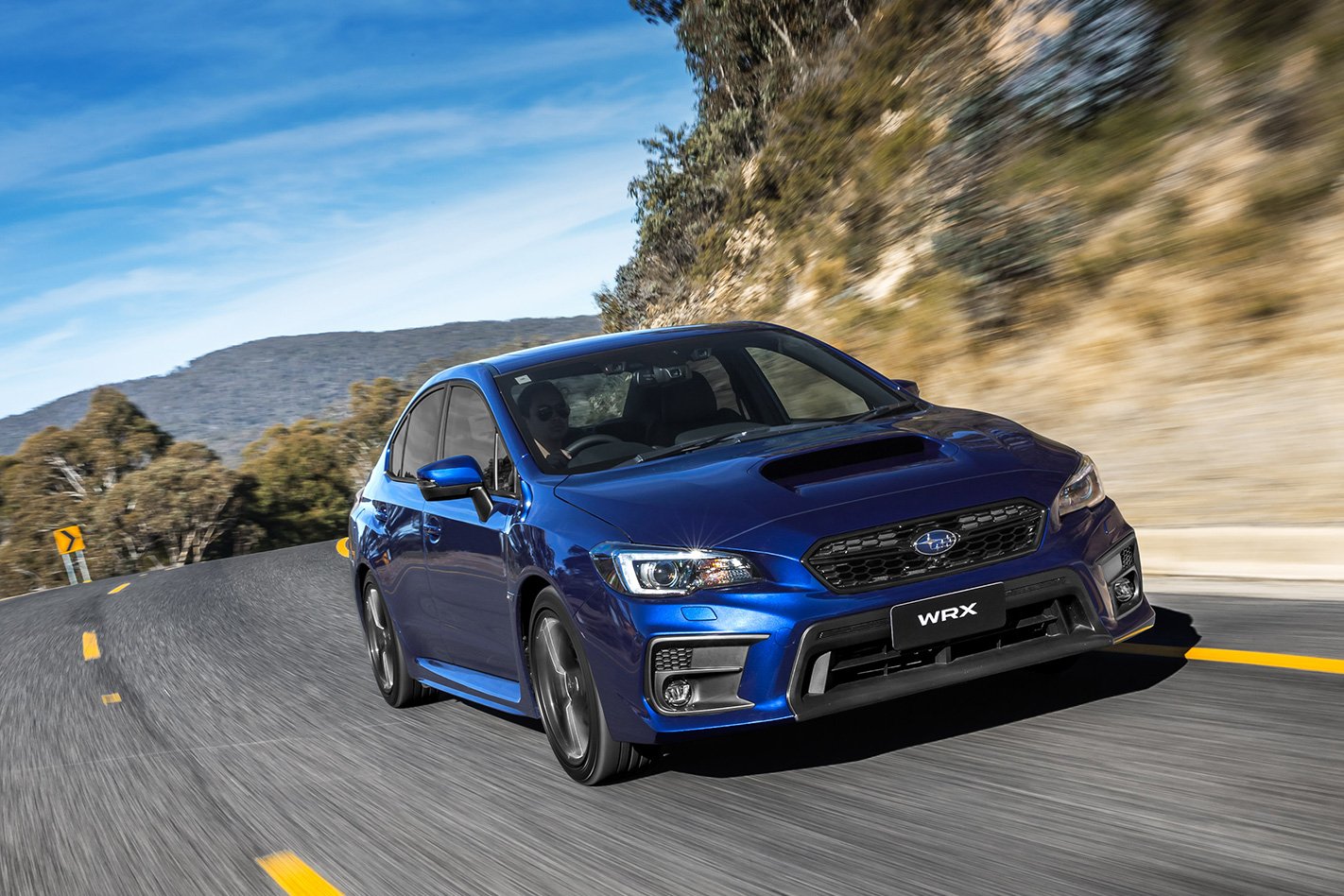
It remains a quick car, with an appealingly raw, old-school feel to the way it handles – this is a good thing – and the ride is firm but acceptable for daily use. Unfortunately, there are also a number of shortcomings.
The engine has all manner of peaks and troughs in its power curve, with an initial hesitation followed by a burst of mid-range torque before dramatically fading around 5000rpm.
It’s also a maddeningly difficult car to drive smoothly; clutch take-up is sudden, the shift is notchy and smooth changes are virtually a lottery. It’s easy to stall, too. The MY18 WRX may be good value, but it needs refining.
SPECS: 2.0-litre boxer-four, turbo, 197kw, 350nm, 1474kg, 0-100km/h 6.0sec PRICE: $45,640
Throughout AMG’s half century there has been myriad products fettled by the famous tuner from Affalterbach – and not all of them wore a Mercedes-Benz badge. We could have chosen the likes of the Red Pig, 190E 3.2 and the Hammer, however, the obscure R129 SL73 AMG deserves its time in the limelight – and for good reason.
The rare drop-top is powered by a 7.3-litre V12 – the same atmo M120 unit used in the Pagani Zonda F. To this day it is the largest engine fitted to a Benz production model.
Information on the special-order-only SL73 (it didn’t appear on MB price lists) is as scarce as the production run was limited, with only 85 cars being built – which were all converted SL600s to AMG-spec. It was left-hand drive only and outrageously expensive.
The SL73 ran with the theory that there’s no replacement for displacement – hence the large cubic capacity was tasked with overcoming the 1975kg kerb weight. And didn’t it ever. With 386kW and a stonking 750Nm (huge numbers for ’99), the 7.3-litre unit had no trouble hauling the AMG to triple digits in 4.8sec via a five-speed automatic. It’s claimed fuel consumption is 15.9L/100km. Which is not even a bit realistic.
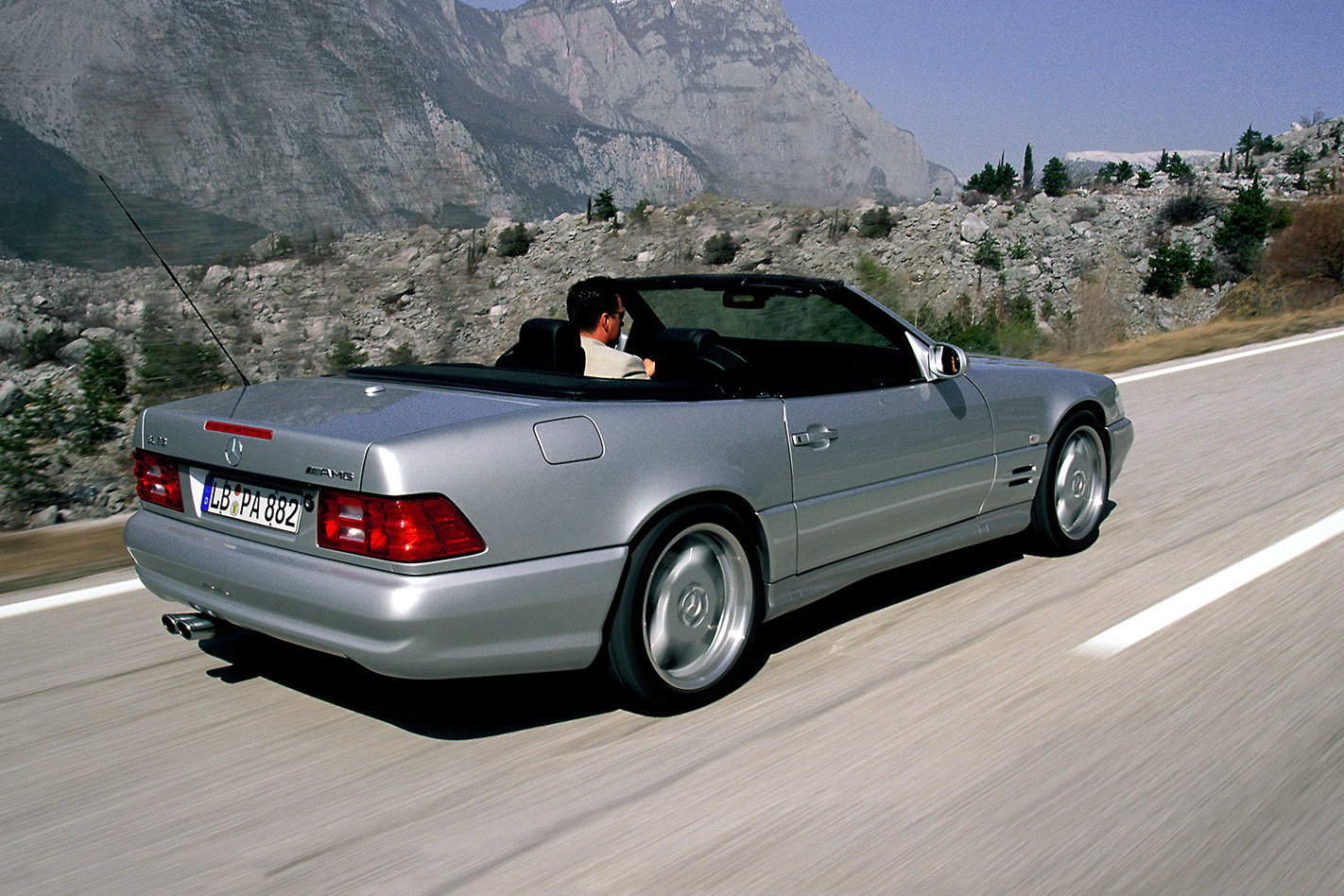
Being based on a shortened W124 (E-Class) chassis meant the SL also gained electronically controlled damping (ADS – adaptive damping – was optional), aiding ride quality. ADS, and the automatic roll bar, which deployed within 0.3sec, were production firsts.
Two other V12s were offered in the R129’s lifespan, however, the big-bore 7.3-litre SL73 AMG is the ultra-rare collector and deserving of its place within AMG folklore. And in its own way, because of the iconic atmo M120 twelve, became part of supercar history.
3 Unforgettable AMGs
1. This is genesis for tuned Mercs
AMG, or Aufrecht Melcher Grossaspach, began with two ex-MB engineers tuning Mercs for their own on-track fun. The venerable AMG 300 SEL 6.8 (known as The Red Pig) was the first AMG.
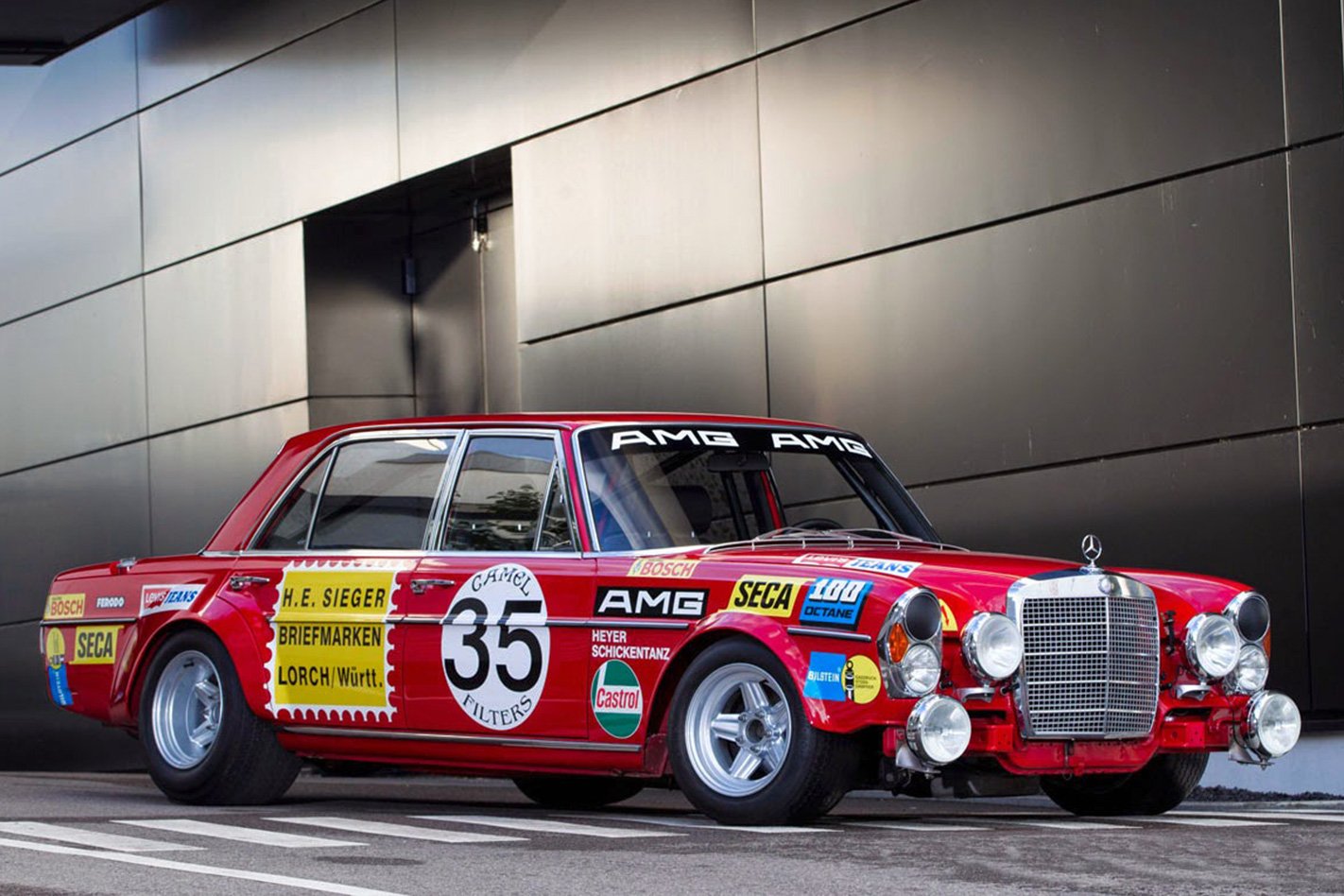
The 300CE 6.0 AMG Breitcoupe ‘Hammer’, with its flared wheel arches, V8 and angry soundtrack, is one of ‘the’ AMGs – hence the nickname. In the ’80s 283kW/566Nm was a lot.

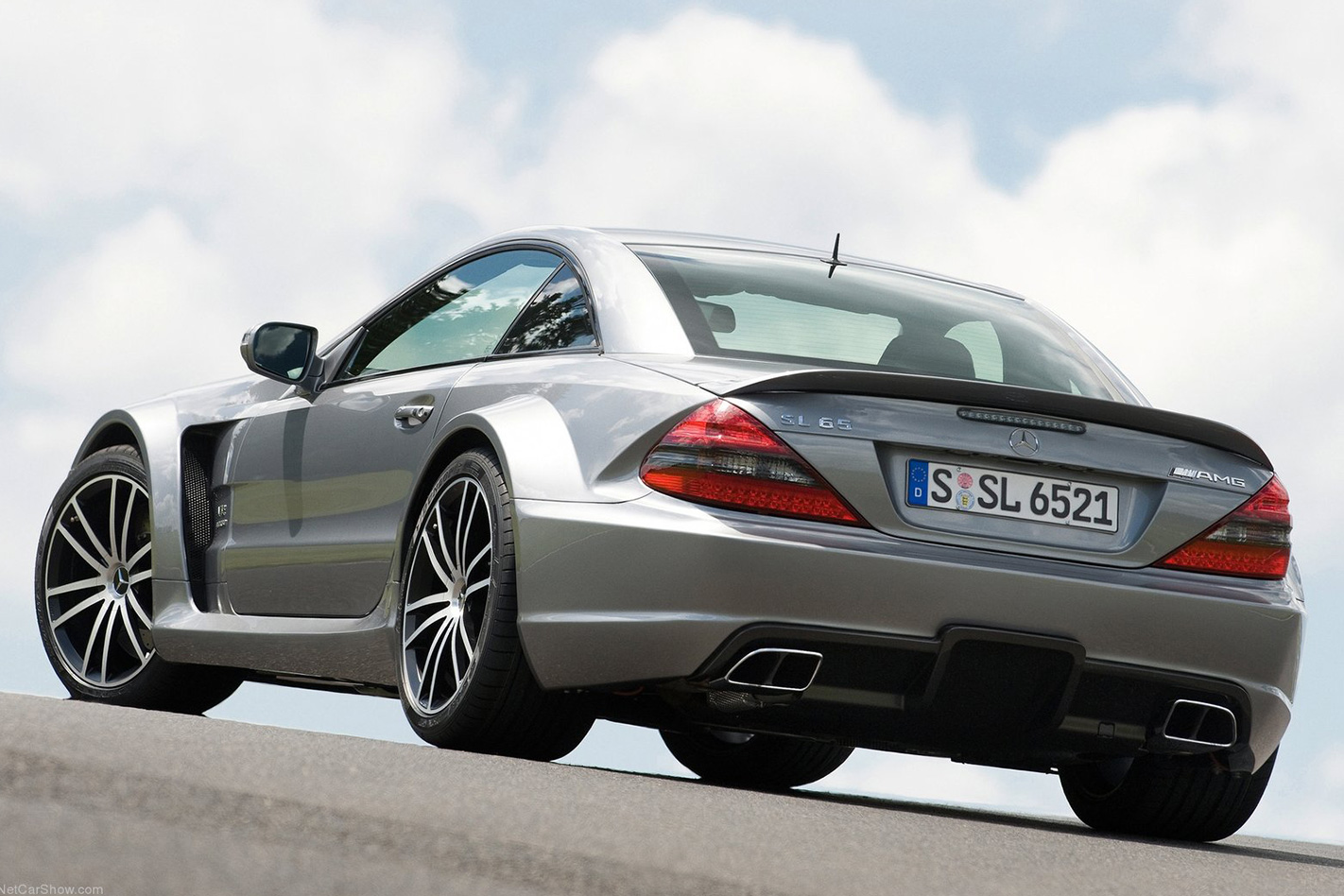
Arguably the spiritual successor to the SL73, the SL65 AMG Black Series used a 6.0-litre biturbo V12. The hand-built engine produced 493kW and 1000Nm of torque.
With a new production car top-speed feud about to start between the Bugatti Chiron and Hennessey Venom F5, it got us thinking about what are the fastest car you can buy in Australia.
Big-dollar hypercars, with big-number top speeds such as the Koenigsegg Agera, Porsche 918, and Pagani Huayra are not available in Australia.
That doesn’t mean our shores are lacking vehicles capable of what car makers claim are an awe-inspiring vmax, though.
Listed here are five of the fastest cars available in dealerships around the country. However, be warned that you’re going to have to hand over a large amount of money to put one of them in your garage.
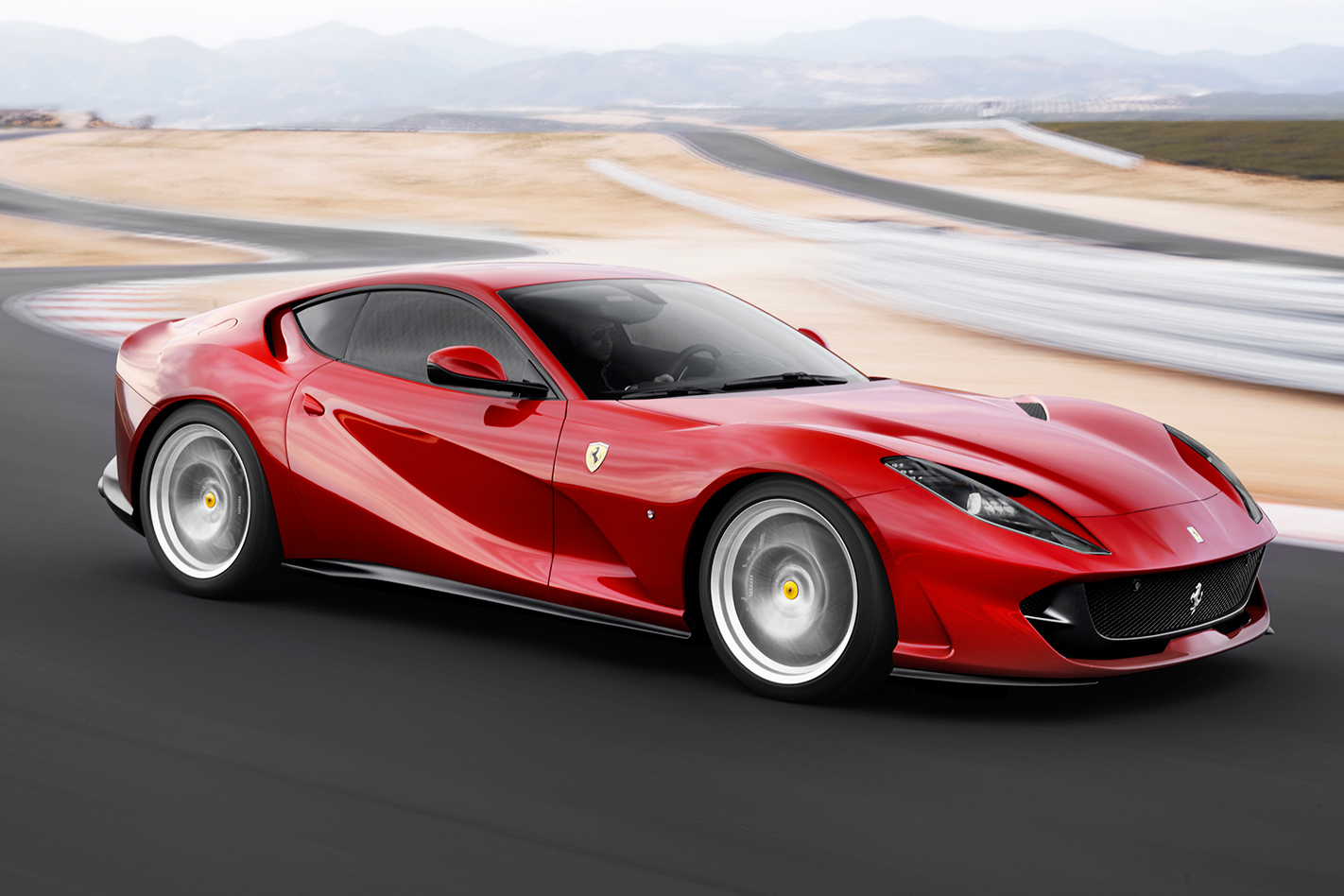
Ferrari 812 Superfast
Top speed: 355km/h-plus Cost: $610,000
A 6.5-litre naturally aspirated V12 lurks under the Superfast’s bonnet, producing 588kW and 718Nm. They combine to make the Ferrari 812 Superfast a formidable beast in a straight line. When let off the reigns, the Maranello stallion will gallop to a top speed of more than 355km/h.
While the car is technically on sale in Australia, you are going to have a hard time finding one to put in the garage, with Australia’s allocation already spoken for. The rear-drive 812 Superfast also holds the title as the most powerful naturally aspirated production car ever made.
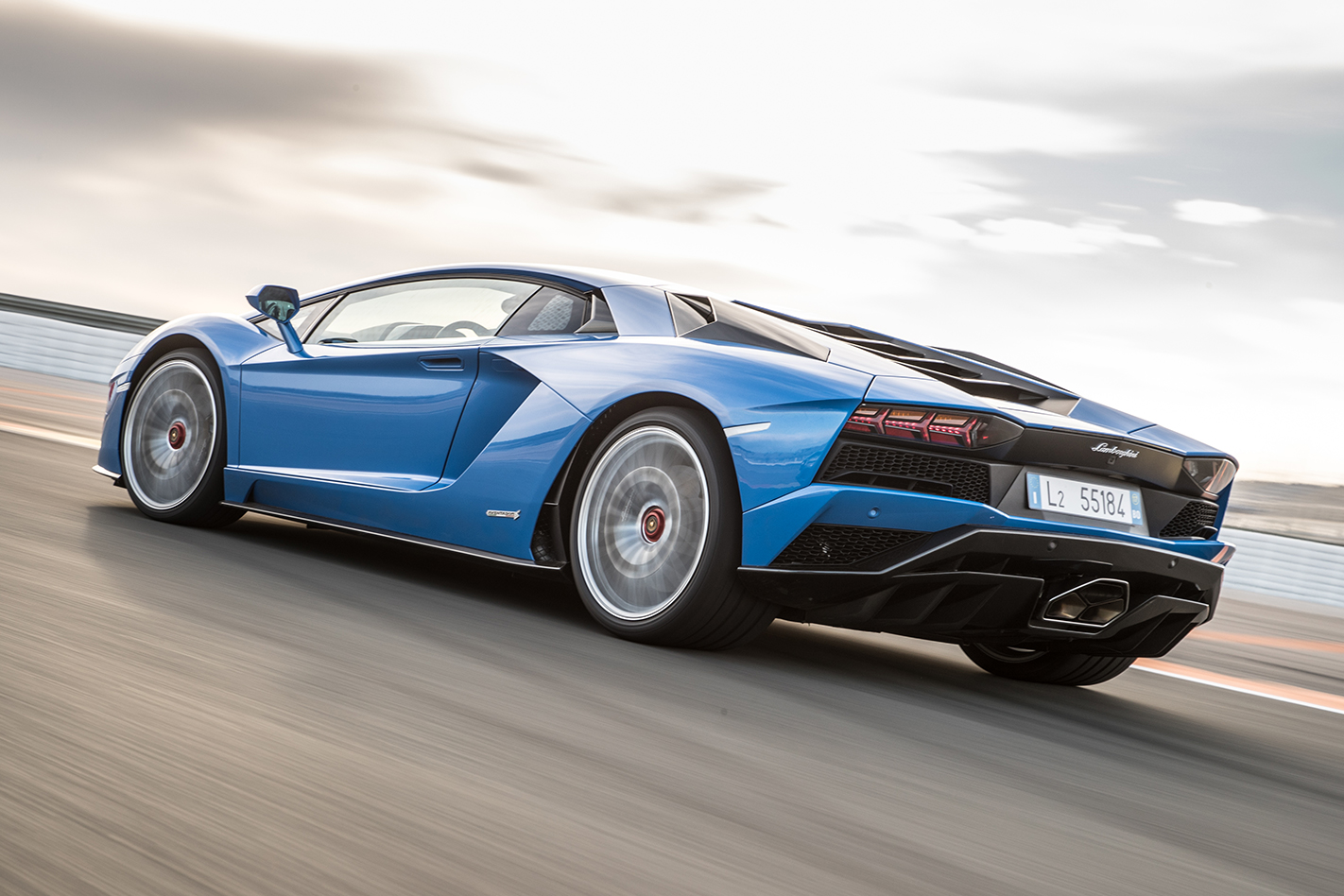
Lamborghini Aventador S
Top speed: 354km/h Cost: $788,914
The fastest, most expensive Raging Bull available in Australia is capable of pushing the speedometer all the way to 354km/h via a naturally-aspirated 6.5-litre V12 mounted behind the passenger capsule. The engine produces 544kW and 690Nm, sending its power to all four wheels. While the official claimed top speed for the Aventador S is 354km/h, German magazine Sport Auto pushed one all the way to 370km/h during a test.
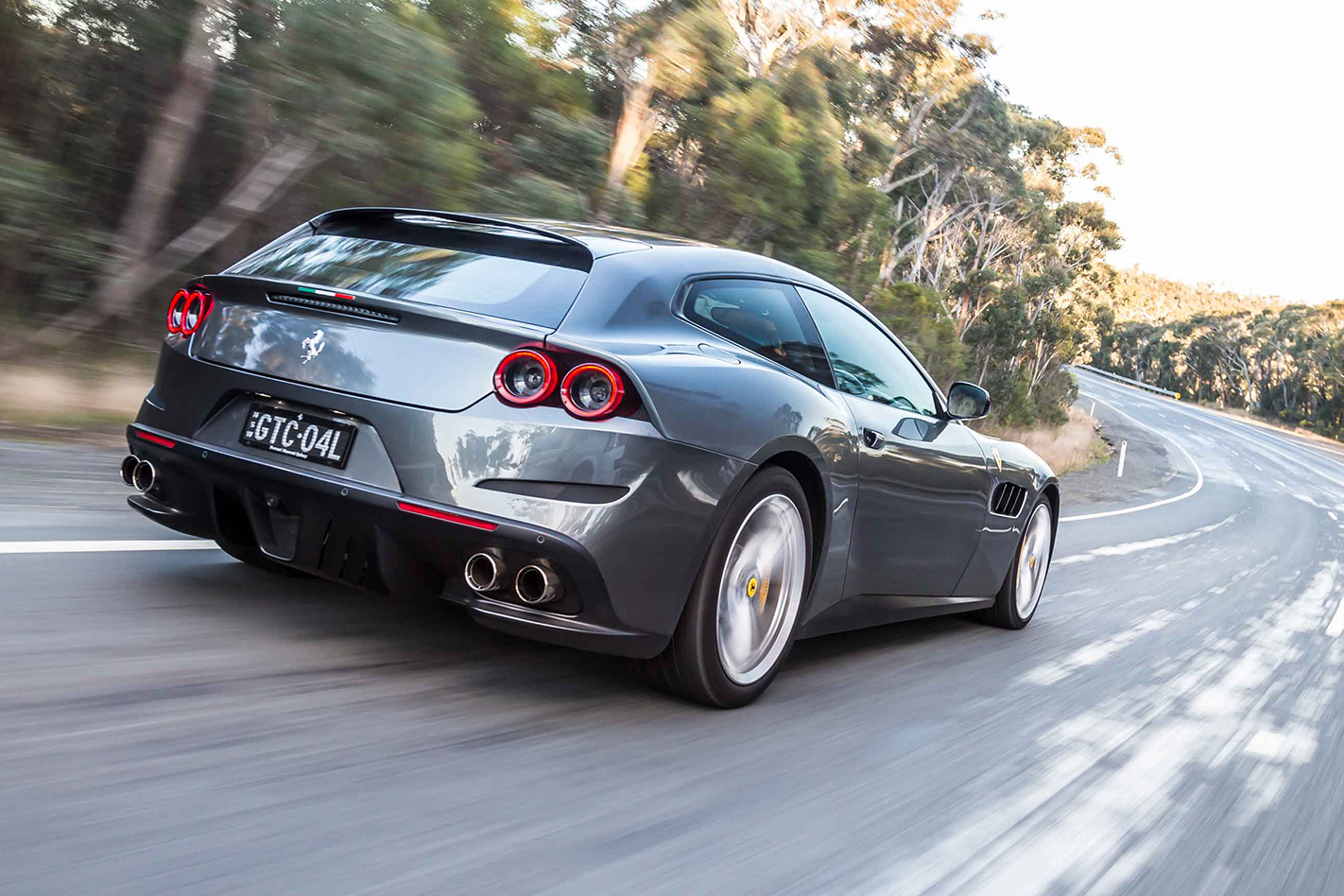
Ferrari GTC4Lusso
Top speed 345km/h Cost: $578,888
The second Ferrari on this list is also the fastest car available in Australia that’s also capable of carrying four, and not just two, people. Powering this version of Maranello’s people mover is an all-wheel-drive 6.3-litre naturally aspirated V12 that provides enough thrust for a 345km/h top speed. A cheaper rear-drive 3.9-litre twin-turbo V8 version of the Lusso produces 442kW and 760Nm, with a 335km/h top speed.
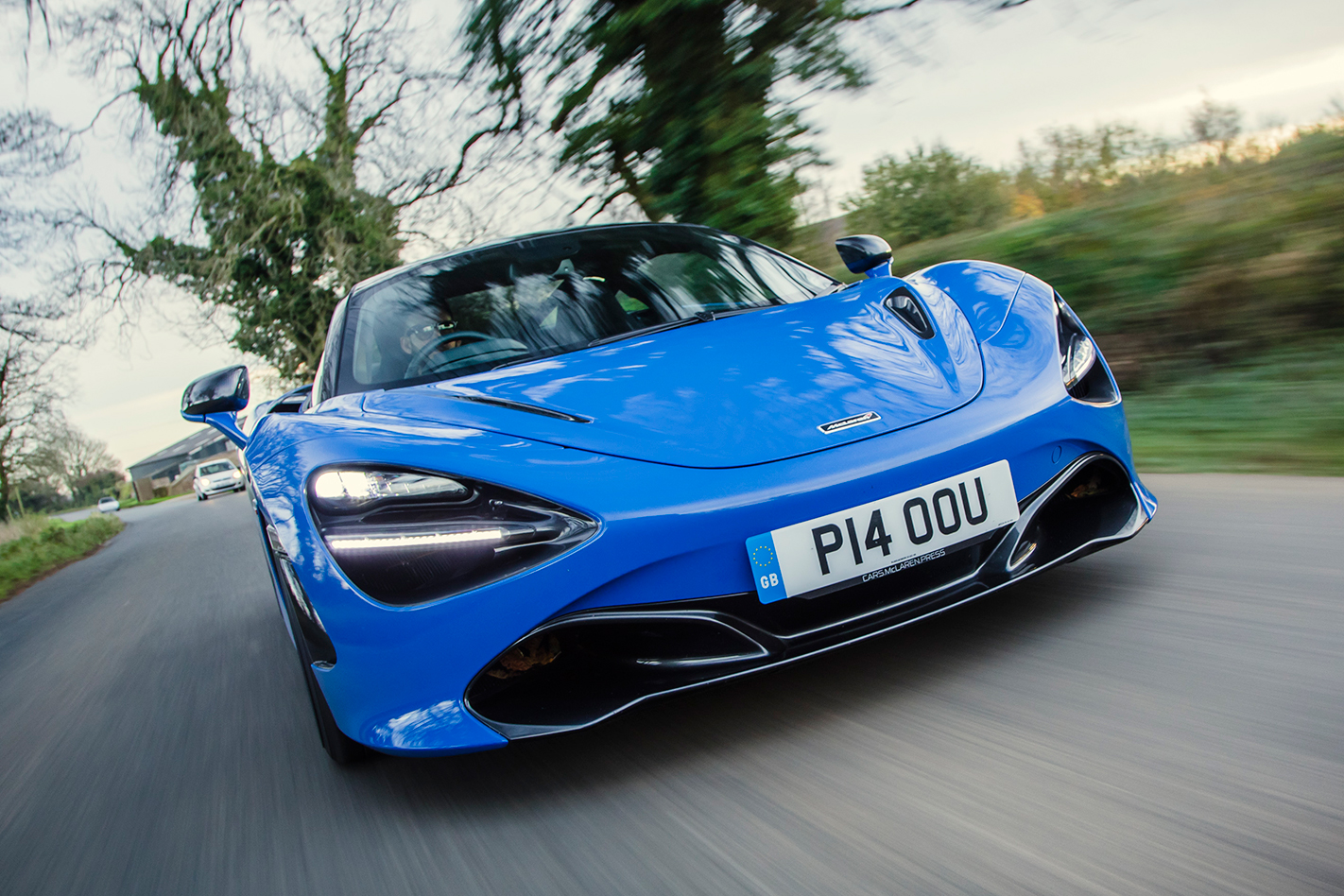
Top speed: 341km/h Cost: $489,900
The 720S, a member of the Super Series family, is the fastest McLaren you can slap a rego sticker on and drive out of a dealership in Australia. Powered by a 4.0-litre twin-turbo V8, producing 530kW and 770Nm, and with a sticker price that falls a snip under half a million dollars, it’s a comparative bargain against others on this list. On the way to its top speed, the 720S will click past 200km/h in a brisk 7.8secs. Pwoah!
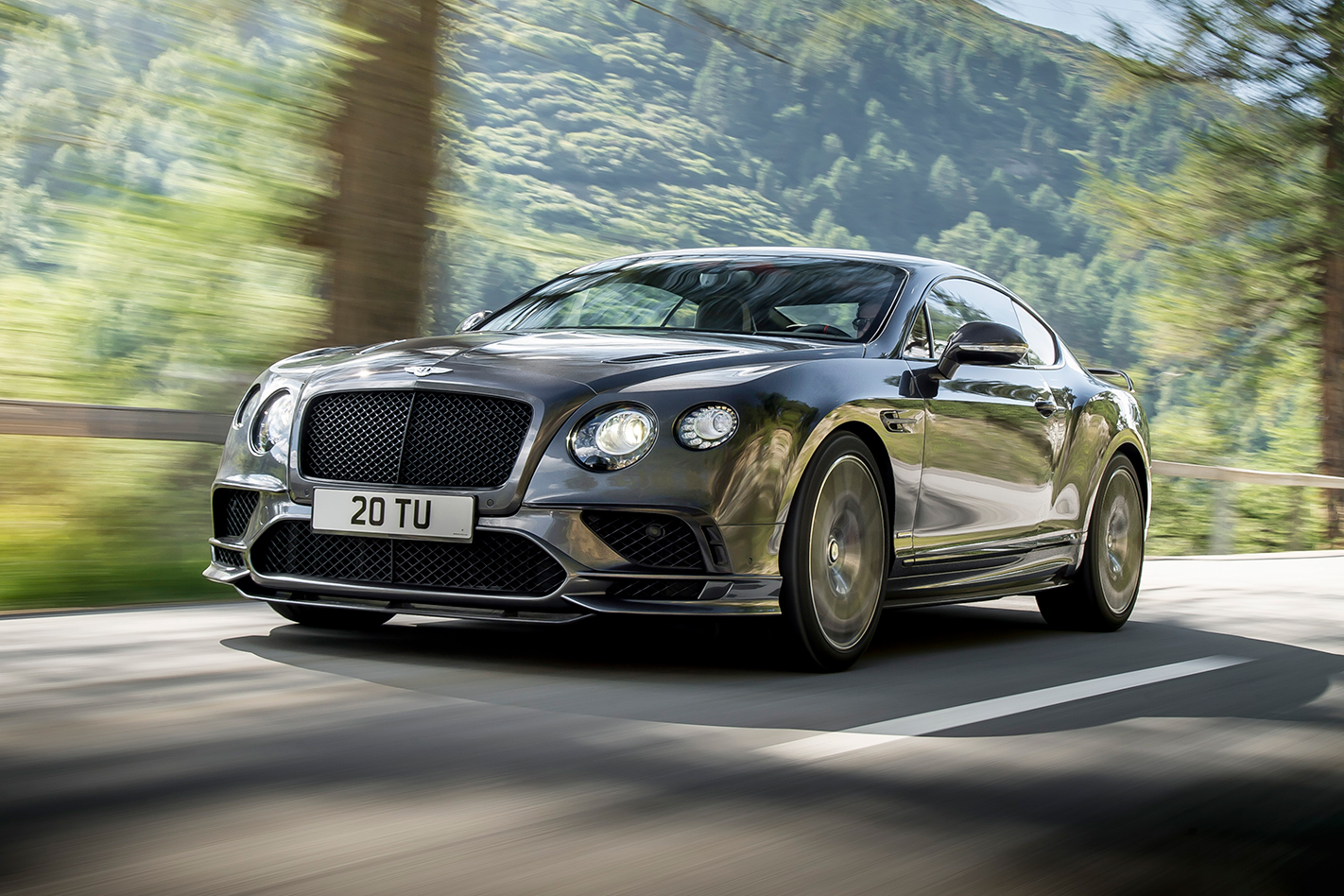
Top speed 336km/h Cost: $569,522
Bentley celebrated the end of production for its current Continental four-seat grand tourer range by creating the Supersports, with a claimed maximum speed of 336km/h. The most powerful Bentley ever produced – and until it was deposed by the Ferrari, the world’s fastest four-seater – shoehorns a 6.0-litre twin-turbo W12 engine under its bonnet, producing 522kW and a whopping 1017Nm. It needs all that power, too; at 2280kg, its kerb weight makes it the heaviest car on this list. If having the wind in your hair is more of a priority, the drop-top version tops out at 330km/h and will set you back $626,474.
WHAT do Elvis Presley, Pol Pot and the Pope have in common? The Mercedes-Benz Pullman.
For 52 years, this six-seat state limousine has been the go-to car for the 0.001 percent. This year, the armoured version celebrates half a century of protecting dictators who met a grisly end anyway: Hussein, Gaddafi, Ceausescu.
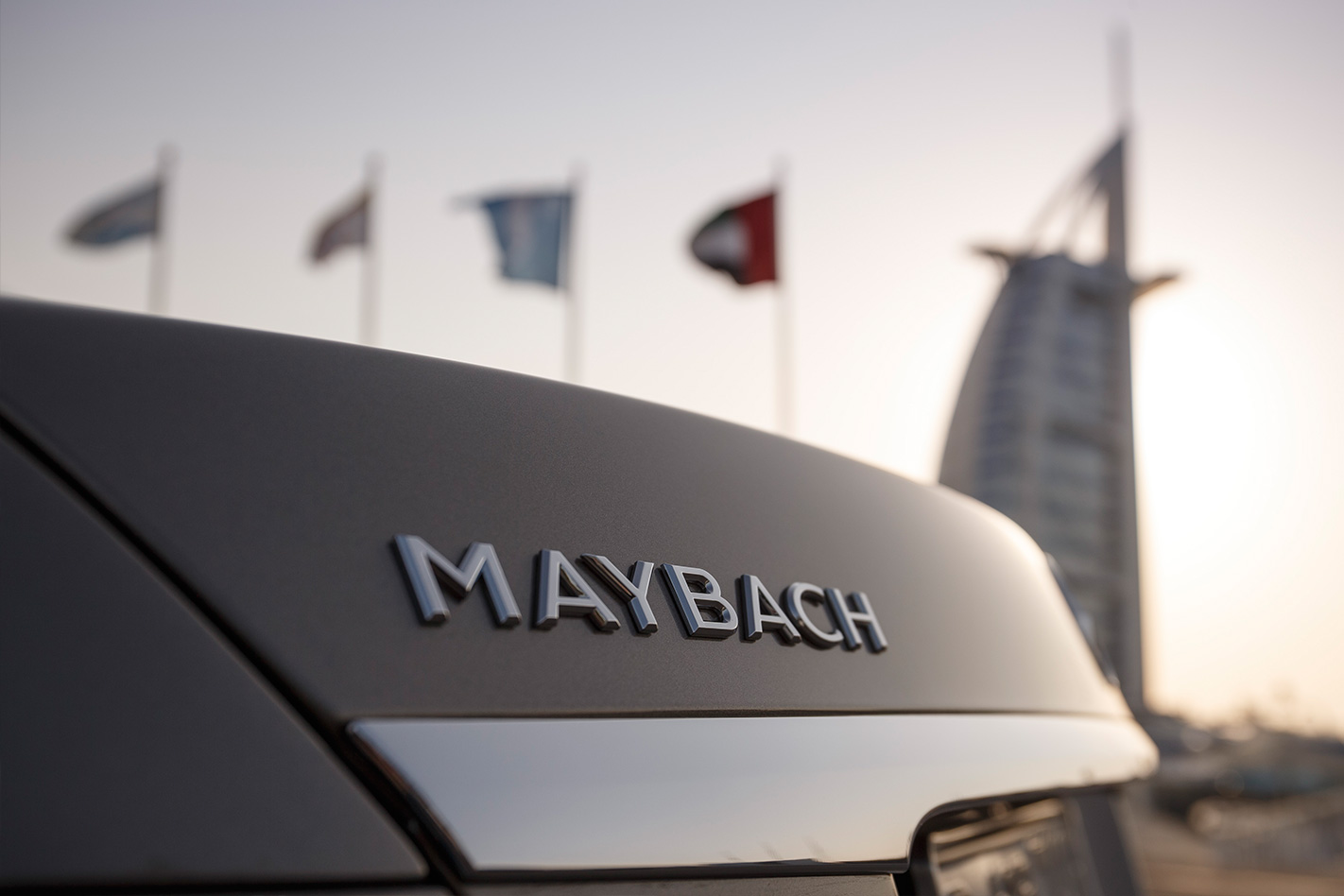
And now there’s a new one. This time badged the Mercedes-Maybach Pullman, it is the new patriarch of the S-Class family and the new ride of choice for despots everywhere.
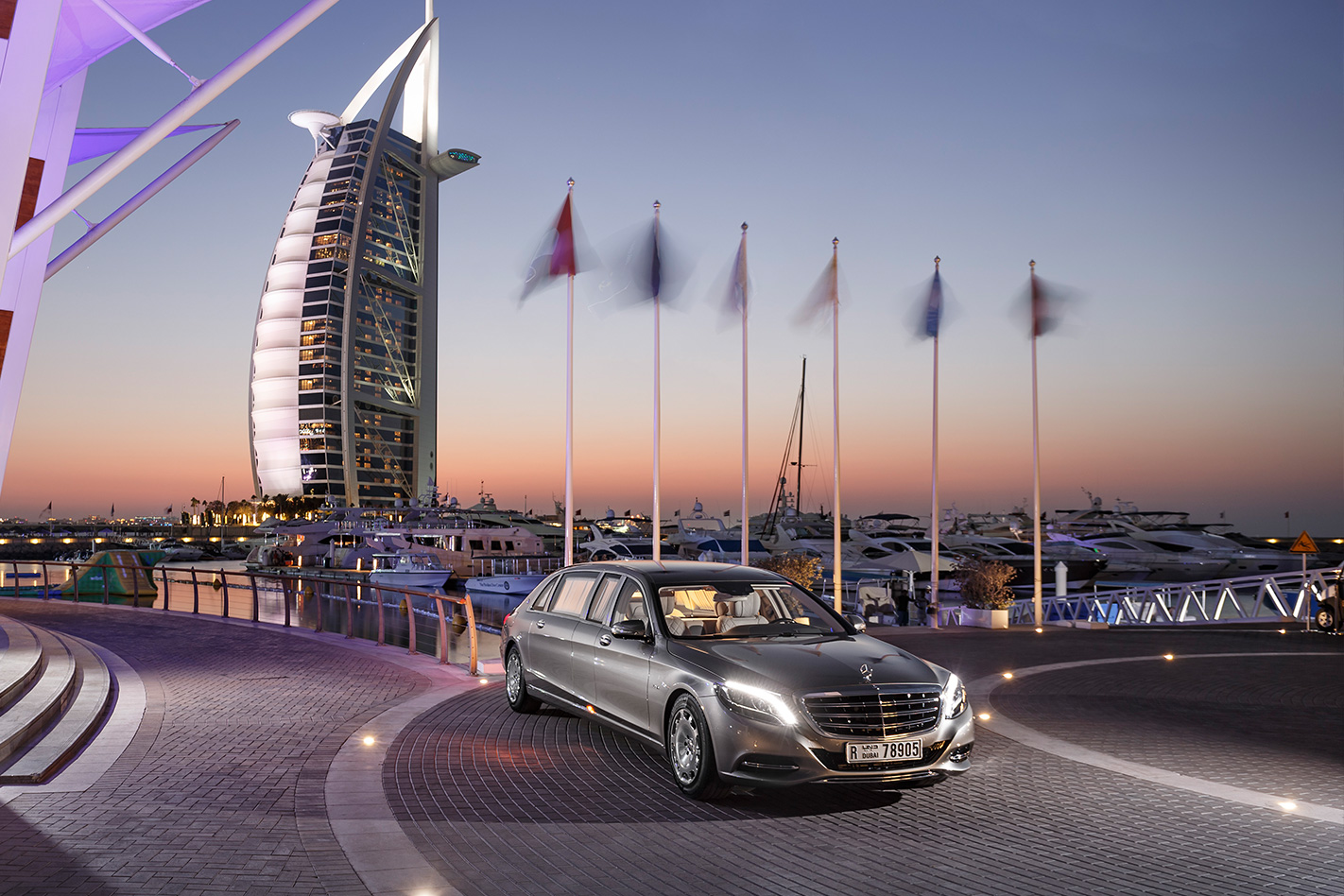
“In the Gulf, around 70 percent of Pullman customers are royal,” explains Markus Rubenbauer (below), Mercedes’ head of Pullman and armoured cars.
The locals do little to disguise their confusion at finding a solid German engineer and an impoverished Irish journalist in the back seats, rather than the aquiline features of their hereditary Emir, Sheikh Mohammed. I motor the curtains closed to save disappointment.
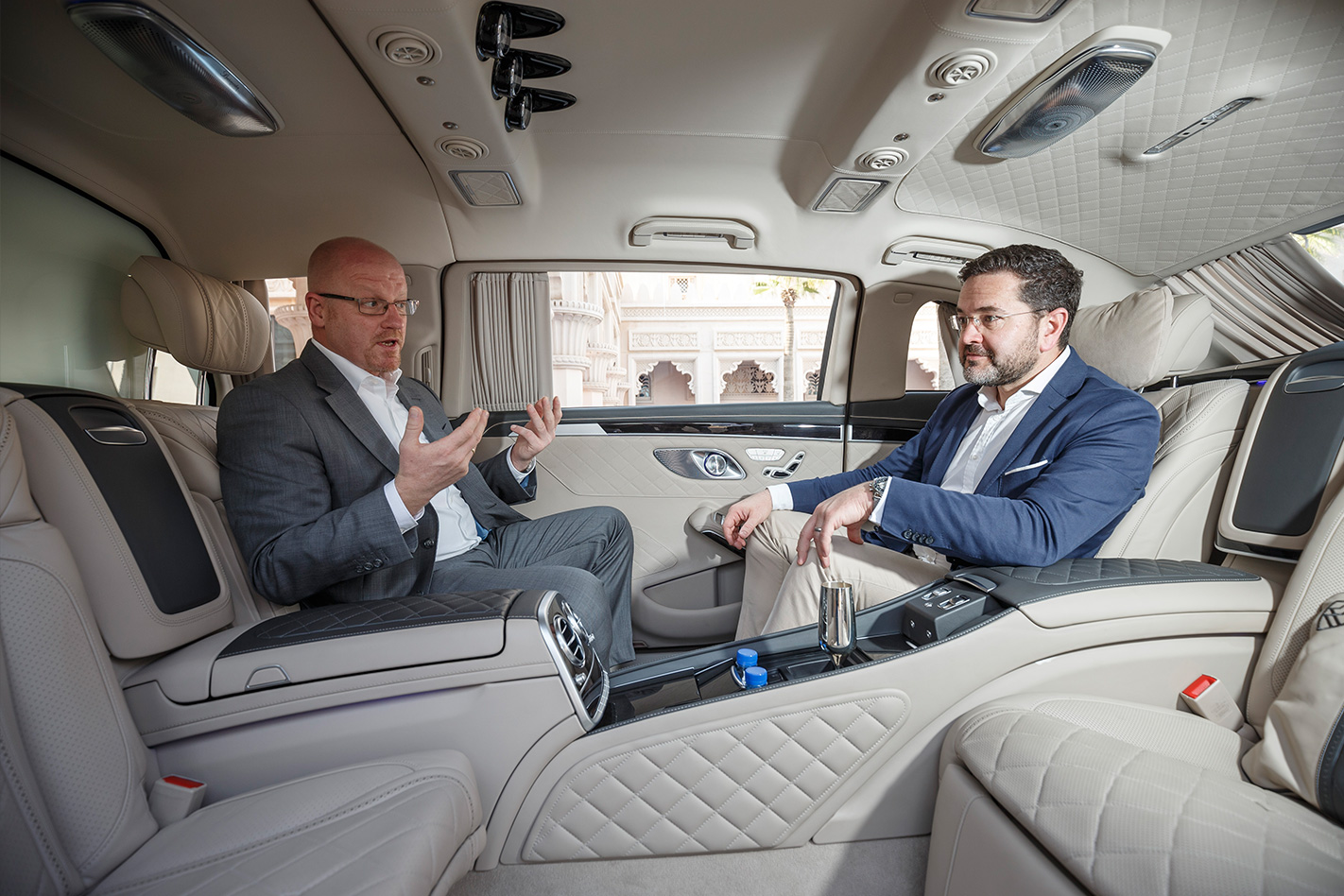
Markus won’t say how many will be built each year, just that Mercedes “wants the cars in the hands of the right people”. I’m not sure that Robert Mugabe and Idi Amin constitute “the right people”. Mercedes only made 302 of the original 600 Pullman over 17 years. Still, demand for the new one is higher than expected.
Markus is predictably discreet about who the customers are, but confirms they include heads of state and that most put tyrannising aside for a moment to personally choose at least the colour and trim of their new official ride.
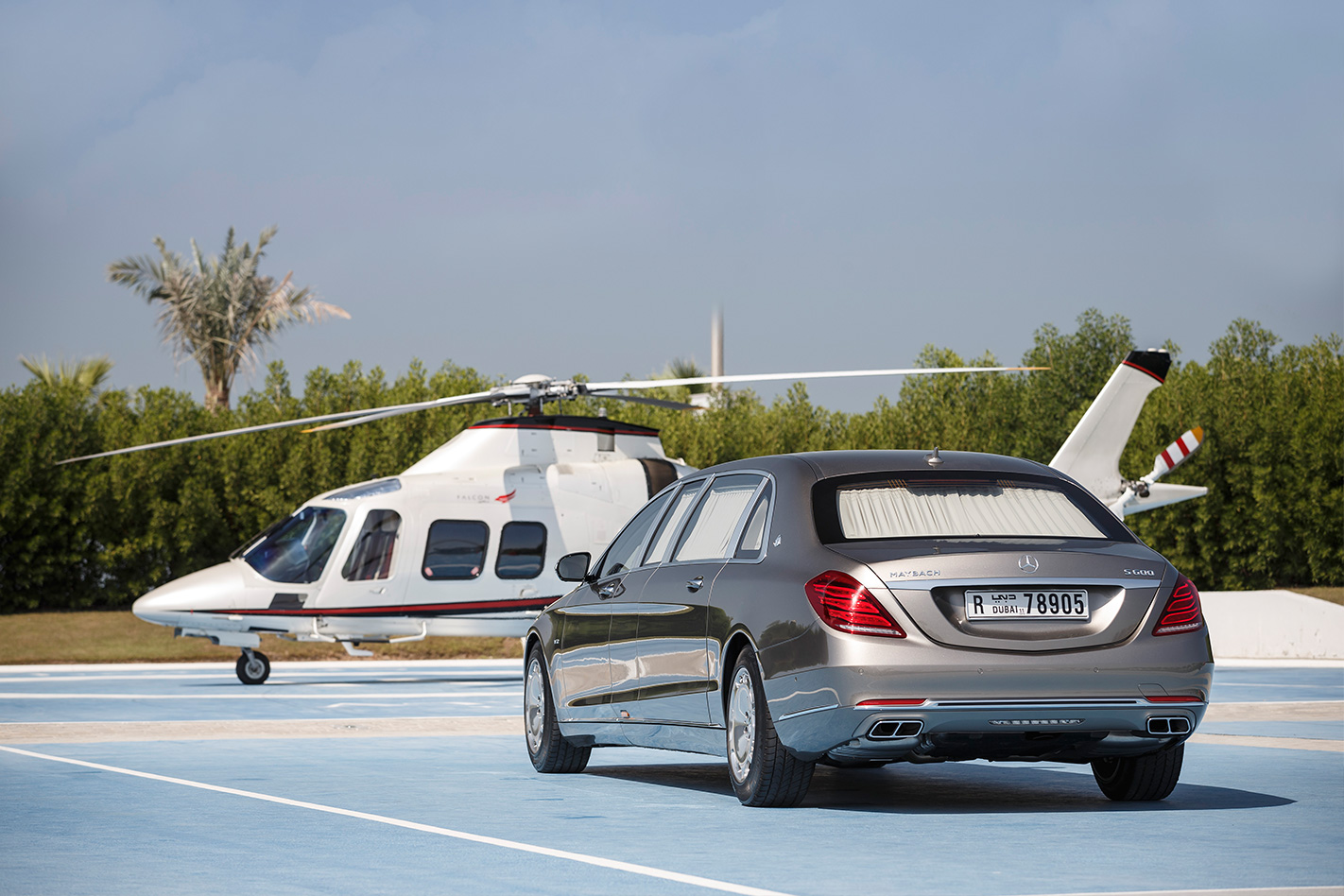
Protocol demands that heads of state enter the car first; the problem was that their interpreters then had to shuffle past them like middle-seat late-comers at the movies in order to get into the rear-facing seats. You cannot show your backside to a president or a king. A more fitting solution was required.
The answer is the new Pullman’s colossal rear door – 1.35 metres long, easily the biggest fitted to any ‘production’ car and almost long enough to take late diminutive Pullman fan and keen anti-imperialist Kim Jong-Il if you inserted him horizontally.
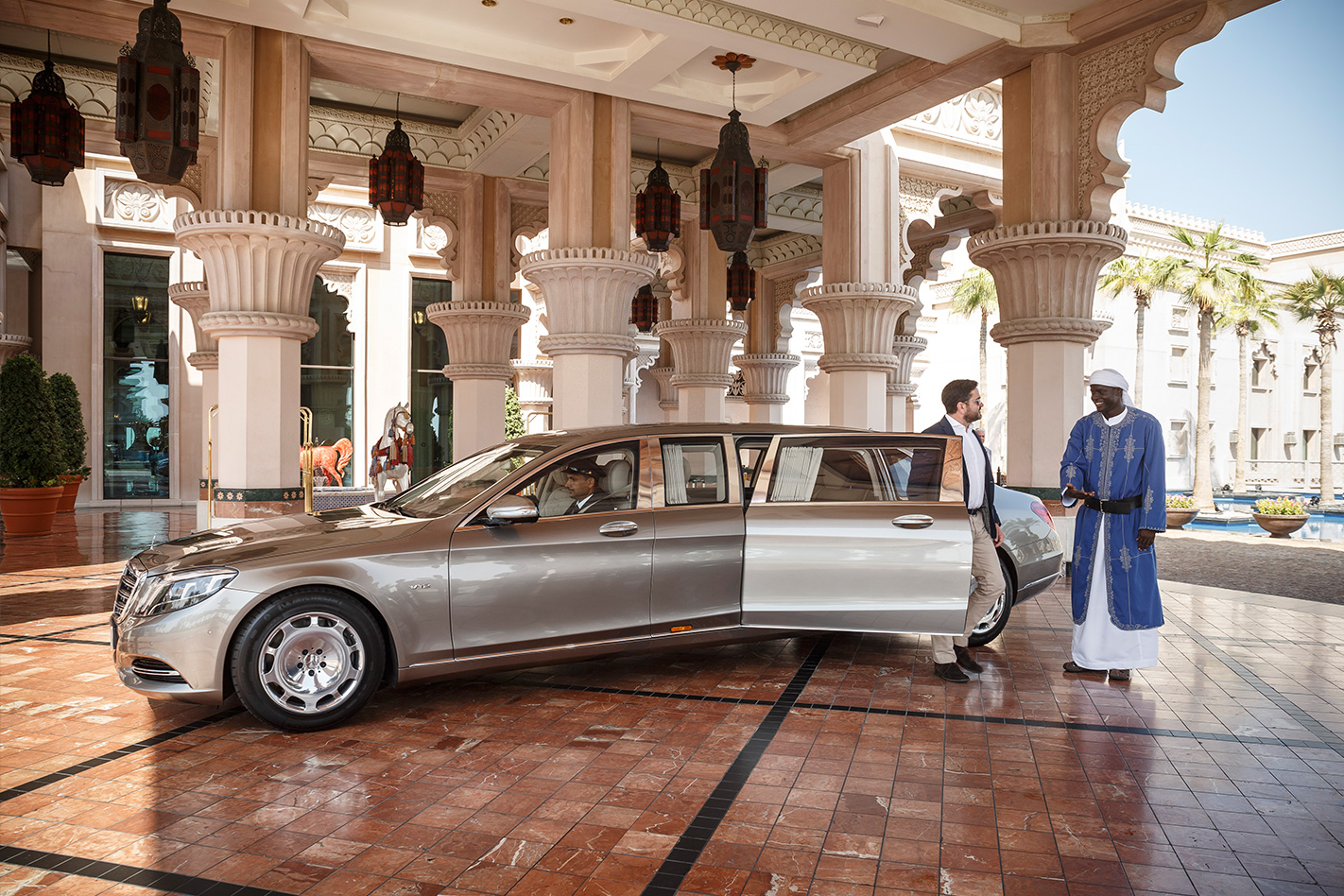
So you’ve overthrown the old guy, installed yourself as President for Life, pinned a row of medals to your chest and bought a Pullman. How’s the ownership experience?
That door is predictably heavy, but Mercedes’ research shows that in 90 percent of ‘door-opening events’, someone other than the rear-seat occupants will be doing the work. Should revolutionaries shoot your footman, a motor will do the job instead.
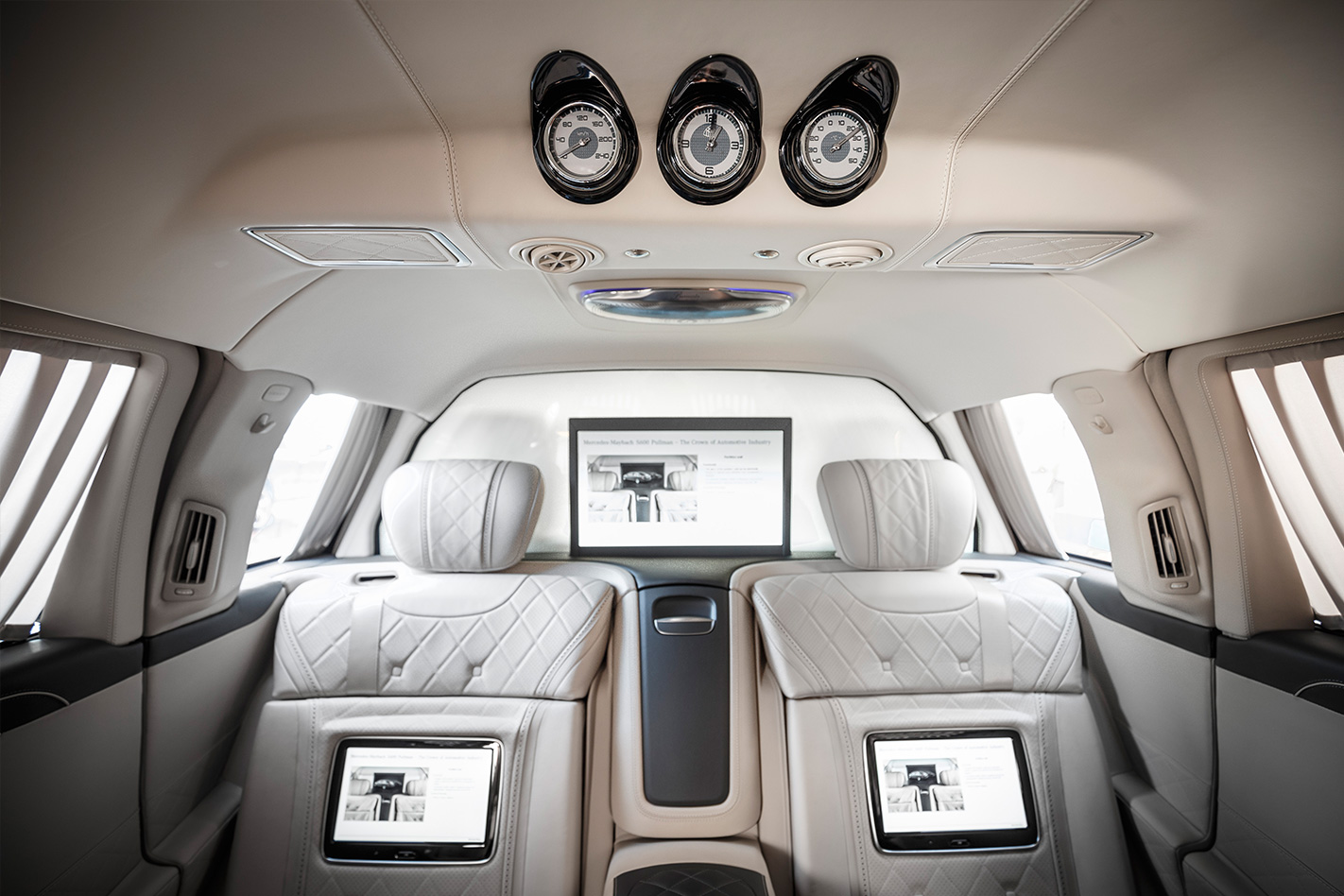
There are gadgets to preserve your privacy, such as the powered curtains on all windows, and the glass divider that slides up to shut out the driver and turns opaque at the touch of a button so he can’t see you weep at the futility of it all. You can still instruct him via the intercom; you know your car is large when it requires its own internal communications system.
Otherwise the cabin is remarkably sober and gadgets are limited. The main seats recline, of course, and have pop-out calf supports. There’s a fridge and beautifully engineered fold-out tables in the divider. There are small screens in the base of each rear-facing seat, visible when they’re folded up, and an 18.5-inch flat screen that motors up from the driver partition. The hallmark Maybach rear-cabin dials for speed, time and temperature are mounted in the roof, as are two of the 24 Burmester speakers. There are surprisingly few options. Markus says the Pullman has been kept deliberately simple to order because the customers are kind of busy.
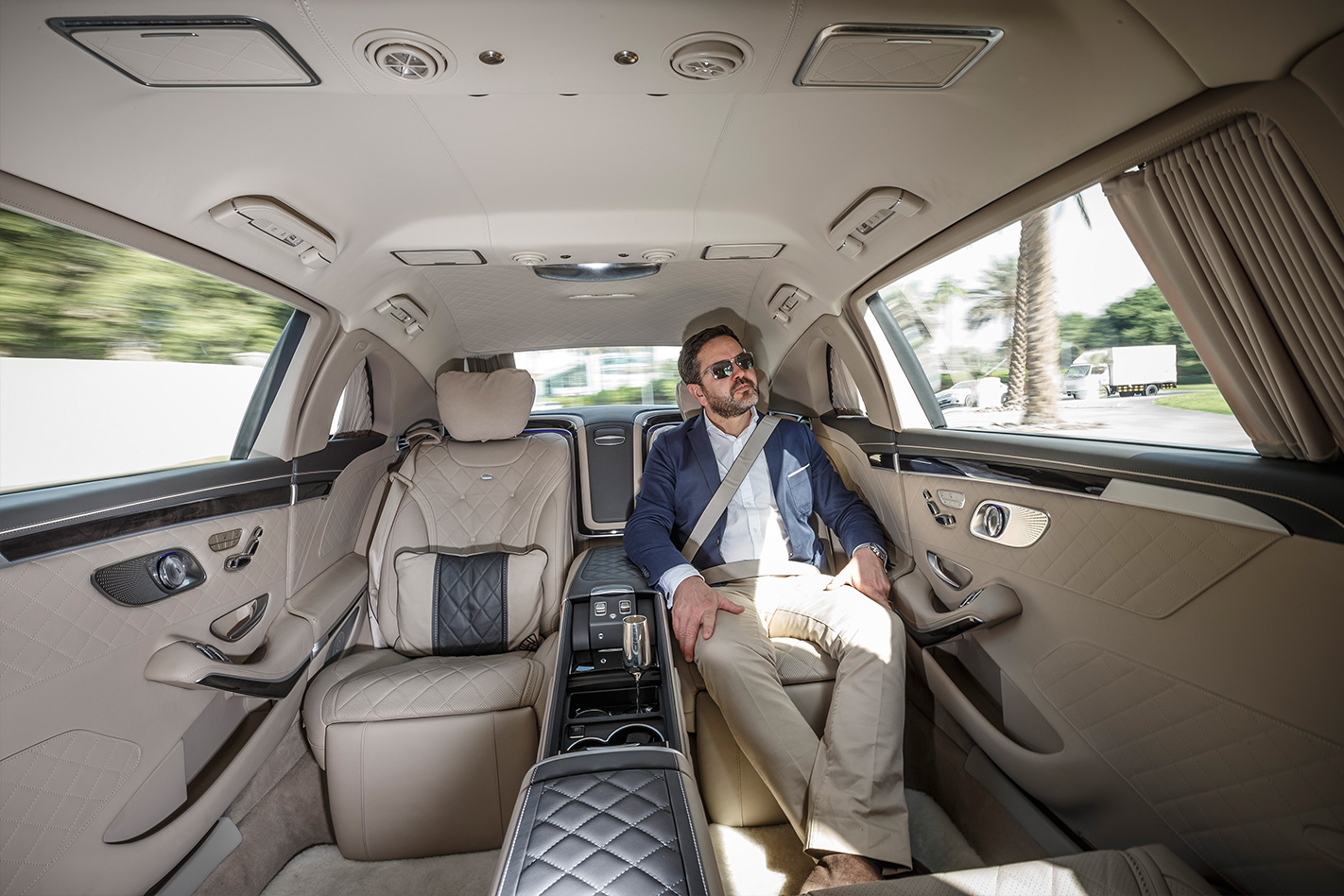
You can also splash $38,000 on a panoramic sunroof, and around $750,000 on armouring. Needing armour is the sign that you’ve really made it; Hugh Hefner didn’t need to armour his, but you can bet Vladimir Putin does.
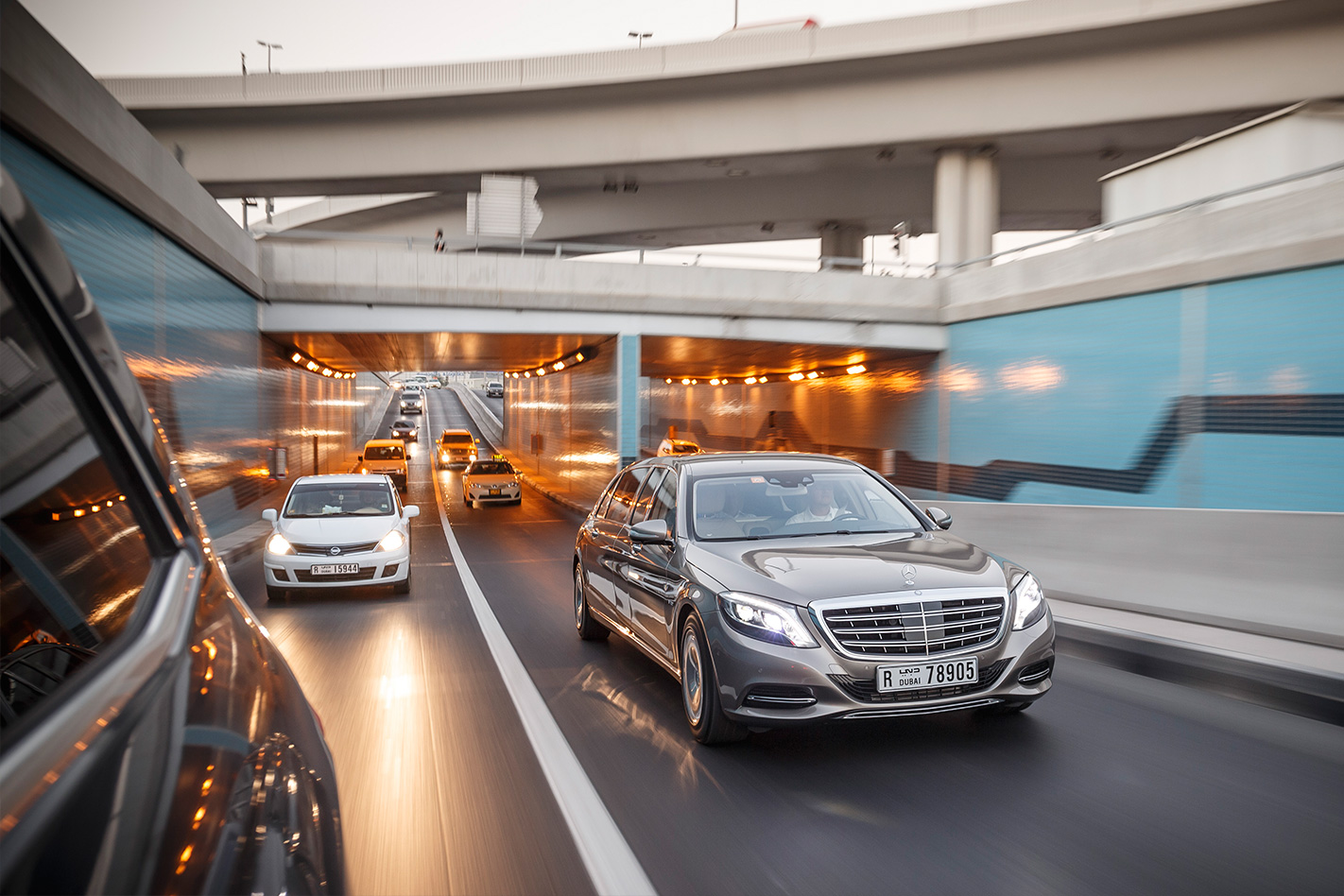
I didn’t drive the Pullman. It seemed about as relevant as President Obama flying Air Force One. I assume that the chauffeur gets the same tech-fest that marks all new S-Classes, but does Lord Grantham care if Mrs Patmore’s Aga has a temperature gauge?
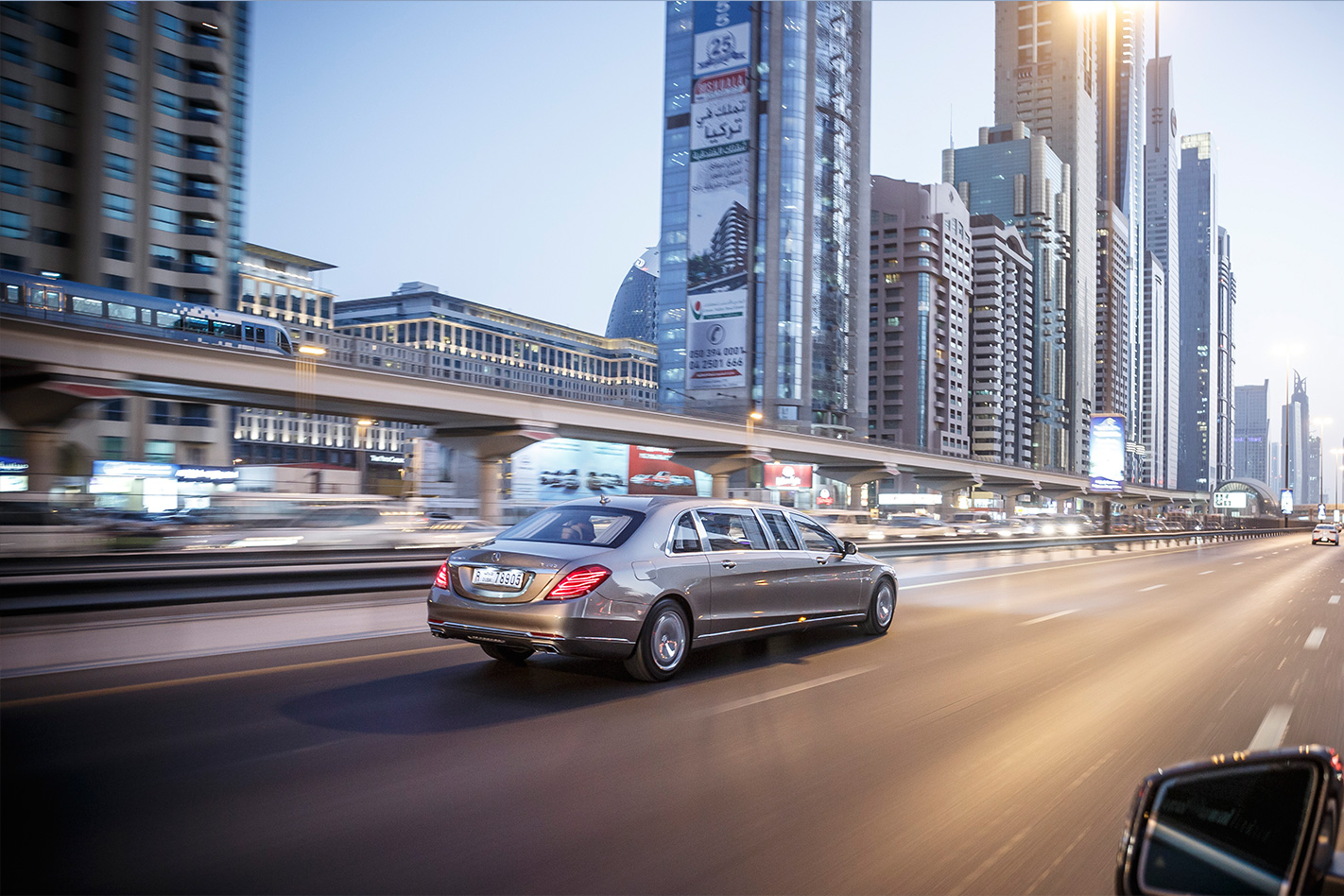
Motoring journalists like to talk about the ‘distant thrum’ of a refined multi-cylinder engine, but in this case the 390kW twin-turbocharged 6.0-litre V12 really is a long way away. Pleasingly, it’s not Tesla-silent, but any vibration dissipates long before it reaches your royal backside.
But the Pullman’s greatest and defining feature is those rear-facing ‘interpreter’s’ seats. That’s how Mercedes describes them, but you can put anyone you like in there: your bodyguards, two of your concubines, your nuclear-code-carrier, your psychotic brother-in-law who you made chief of your Secret Police.
They’re a little firm. But their occupants would be wise not to complain.