
INTRO
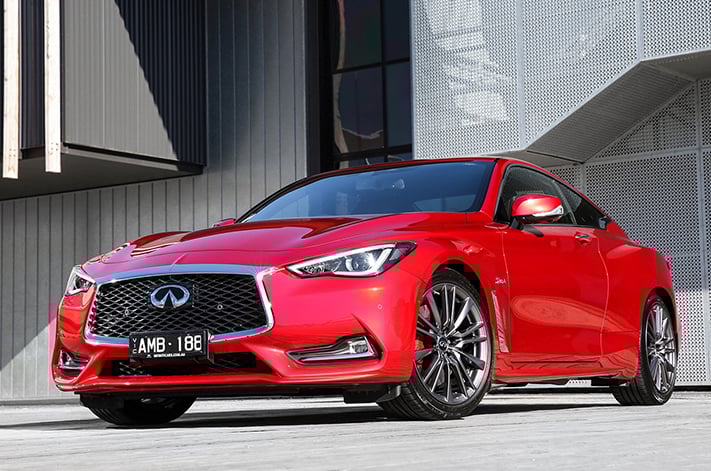
Following on from the four-cylinder Q60 coupe that launched here late last year, Japanese luxury automaker Infiniti has at last brought out its more powerful V6-engined sibling, the Q60 Red Sport.
TELL ME ABOUT THIS CAR
Featuring the same 298kW/475Nm powertrain as the Infiniti Q50 Red Sport sedan, the Q60 Red Sport performs almost identically but boasts a sportier two-door layout. There’s also an extra steering setting for its complex steer-by-wire system that aims to make it the most satisfying to drive model in the Infiniti showroom.
Retailing at $88,900, the only option available on the Q60 Red Sport is what paint colour you prefer – the list of standard equipment is so extensive, that Infiniti reckons buyers will want for nothing.
STRENGTHS
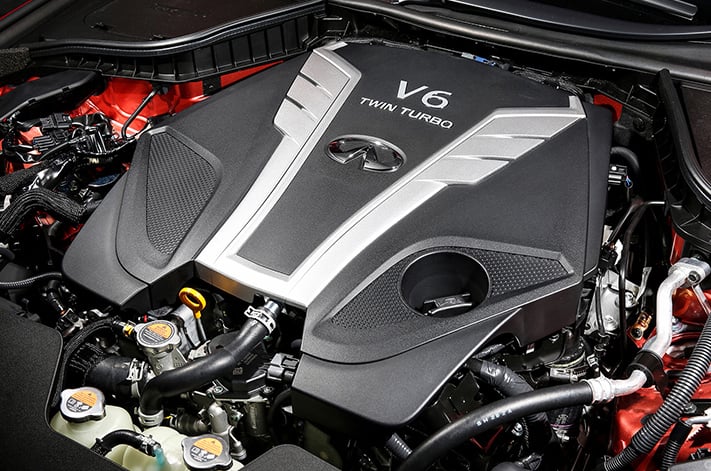
- The engine is a standout part of the Q60 Red Sport experience, with linear power delivery and a generous torque band that stretches from 1600rpm to 5200rpm. Power tops out at 298kW and peak torque is a sizable 475Nm, which puts the Red Sport well above rivals like the BMW 440i and Mercedes-AMG C43.
- There may not be a manual transmission option, but the Red Sport’s seven-speed torque converter automatic is a peachy unit that shifts smoothly but decisively when left to its own devices. Tip it into manual mode, and gear changes are quick on upshifts and smoothly rev-matched on downshifts.
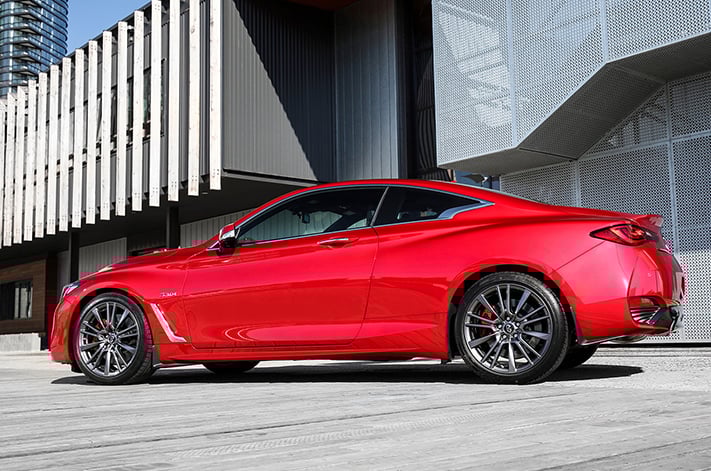
- Exterior design may be a bit wild for some people’s tastes, but the Q60’s classic coupe proportions and confident styling are arguably the most cohesive interpretation of Infiniti’s current design language to date. It has presence, even if the badge can’t quite match its rivals for brag-factor.
- Equipment levels are extensive. As the flagship of the Q60 range, the Red Sport has auto-everything (windows, wipers, LED headlamps, keyless entry), heated and powered front seats, a high-end 13-speaker Bose audio with digital radio tuner, top-down camera view and a dual-display infotainment system. The only option on the Red Sport: metallic paint.
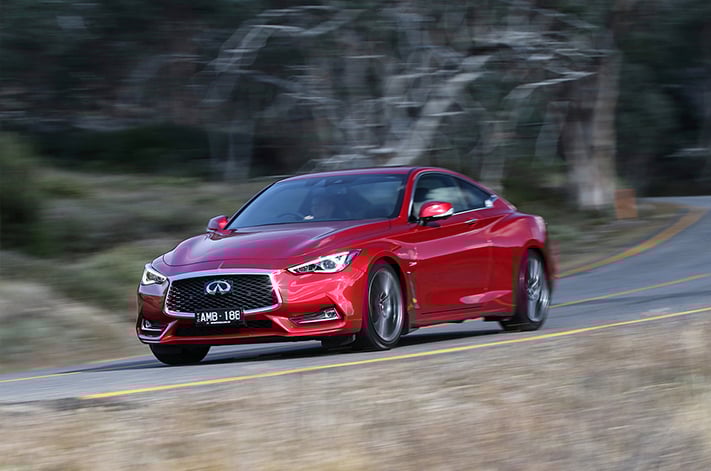
- Handling is superb, especially considering the Red Sport’s hefty 1.8-tonne kerb weight. Body control is excellent with minimal roll during hard cornering. The grippy Dunlop tyres stick to the road well too, and the Red Sport will attack twisty roads with confidence.
- Braking performance is just as strong as the suspension and powertrain, with sizable Akebono fixed calipers at front and rear providing plenty of stopping power to rein in the somewhat porky Red Sport.
- Sound is a key part of the performance car equation, and the Q60 Red Sport delivers strongly on this front. With a refined V6 growl emanating from the twin tailpipes, the Red Sport has some aural similarities with its very purposeful cousin the Nissan GT-R.
WEAKNESSES
- Steering is perhaps the biggest flaw of the Red Sport. Infiniti’s “Direct Adaptive Steering” system effectively transmits driver inputs at the steering wheel electronically to the steering rack, bypassing a traditional mechanical linkage. The result is a steering ratio that can vary intelligently to make the car easier to drive, but the result in the Red Sport is dull steering feel and feedback that makes the car less engaging to drive. Not such a huge deal in a regular car, but in a performance coupe it’s a bit of a handicap.
- The Q60 Red Sport has a firm suspension tune – as expected given its performance-oriented posture – but on choppy bitumen it delivers a harsh ride. And that’s despite having dual-mode electronically adjustable dampers. With the ability to switch between a performance-oriented suspension tune and something more appropriate for regular driving, it’s surprising that the Red Sport’s ‘normal’ suspension calibration is as stiff as it is.
- Road noise is quite loud on the coarse-chip roads that are commonplace throughout Australia. The Q60’s audio system is apparently equipped with noise-cancelling technology, but there’s still plenty of tyre roar that makes its way into the cabin.
- The Q60 Red Sport’s seven-speed auto is a decent transmission is most respects, but for one thing: its habit of automatically upshifting when in manual mode.
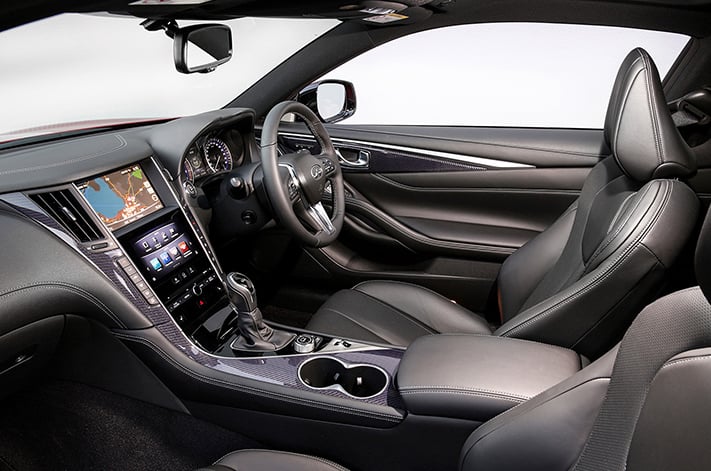
- Even in their lowest position, the front seats have a fairly high seating position that means taller occupants may be a little closer to the headlining than they’d like.
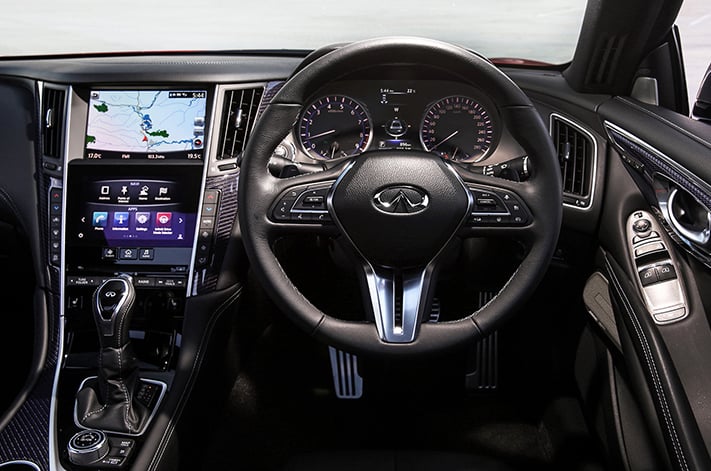
- Strange centre-stack ergonomics take some of the sheen off the interior. Button-heavy with unusual placement of the ventilation controls either side of the lower infotainment screen, the Q60’s dashboard isn’t the most user-friendly cockpit in its class. The two screens also look markedly different, with the upper screen (dedicated to sat-nav functions) appearing more downmarket than the sleek display beneath it.
ANY RIVALS I SHOULD CONSIDER?
There are plenty of sporty luxury four-seat coupes from the usual suspects – BMW, Audi, Mercedes-Benz and Lexus – but none can really equal the Q60 Red Sport’s combination of performance and price.
The Lexus RC 350 Sports Luxury comes closest with a keen $88,280 price tag, but with only 233kW from its 3.5-litre naturally-aspirated V6 and a similar kerb weight it can’t keep up with the Infiniti.
The second-generation Audi Q5 has arrived in Australia with a slight price increase to accommodate a series of enhancements over the current model, including more power, a smoother ride and updated driver assist technology – not to mention an all-new interior and body.
While customer deliveries won’t begin until June, the 2.0-litre turbo diesel (TDI) and turbo petrol (TFSI) variants are now in showrooms to attract new and return customers.
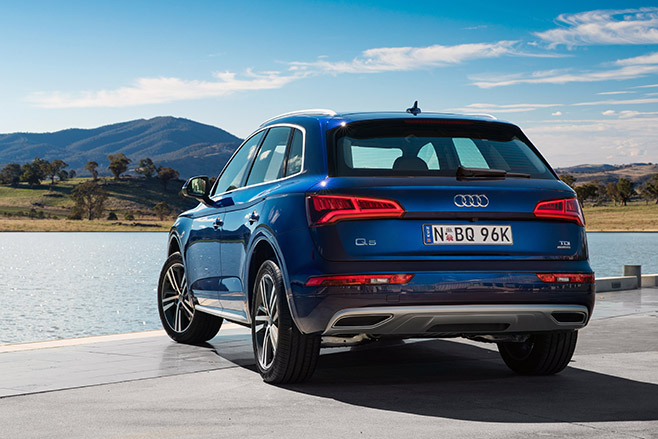
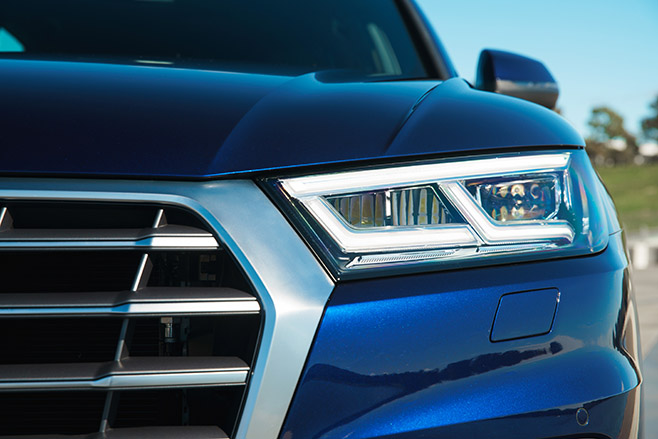
What they’ll see is a muscular new design with sharper lines and a broader stance that makes it an even more appealing prospect against medium, luxury SUV rivals such as the BMW X3 and Mercedes-Benz GLC-Class.
While the full range is yet to be announced the 2017 Audi Q5 will start at $2300 more than the outgoing model, with the entry-level Q5 design 2.0 TDI quattro S tronic retailing at $65,900.
This is joined by a new second-tier sport variant priced at $70,700 and $73,500 for TDI and TFSI versions respectively.
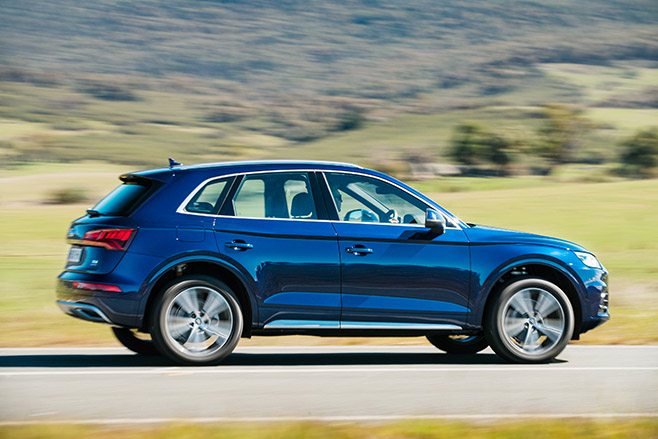
Both engines boast higher outputs than before with the TDI producing 140kW/400Nm up from 130kW/380Nm, while the lively TFSI pushes out 185kW/375Nm compared to the outgoing model’s 165kW/350Nm. Both engines are mated to a redeveloped seven-speed S tronic dual-clutch transmission that shifts smoother and faster, according to Audi.
Despite the extra grunt the 2017 Audi Q5 is more fuel efficient (up to 12 percent in the case of the 2.0 TDI) thanks to the more efficient ‘quattro ultra’ drivetrain, with other weight-saving measures trimming around 90kg from the Q5’s waistline.
Standard in each 2.0-litre variant, the AWD drivetrain sends power to the front wheels in normal driving condition, but will send up to 100 percent torque to the rear axles when extra traction is required.
This can be altered via new driving modes including ‘auto’, which provides the best possible traction and balanced handling; ‘dynamic’, which sends more power to the rear axle sooner to improve handling in slippery conditions and ‘offroad’, which engages all four wheels at all times.
Standard safety features across the range includes:
- Audi pre-sense city with Autonomous Emergency Braking (AEB) and pedestrian detection (up to 85 km/h)
- Exit Warning system
- Cross traffic assist
- Audi side assist blind spot warning system
- Audi pre-sense basic (belt tensioning, window closing and other preventative measures if an emergency is detected)
- Audi pre-sense rear (warns following traffic if they are at risk of running into the rear of the car)
- Parking system plus with rear-view camera
- Adaptive cruise control with Stop & Go
- Turn assist
- Audi pre-sense front (collision warning up to 250km/h)
- Predictive efficiency assistant
- High-beam assist
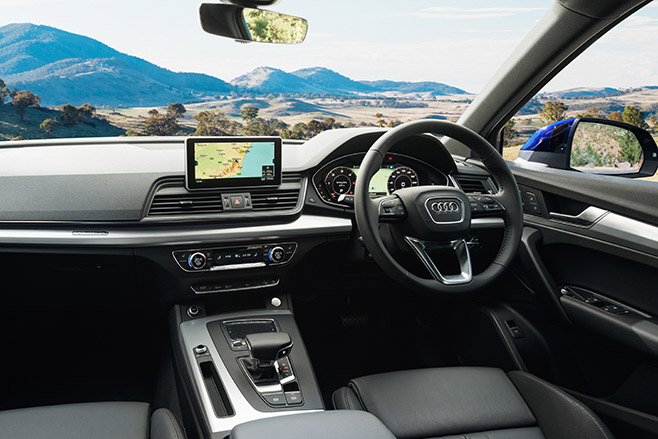
Standard infotainment includes MMI Navigation viewed via a 7-inch HD screen, Audi Connect, which enables a high-speed 4G LTE connection via a regular data SIM card and Apple CarPlay/Android Auto connectivity.
Other standard features for the Q5 design include:
- 18-inch alloy wheels
- Xenon headlights with LED daytime running lights and taillights
- Leather-appointed seats
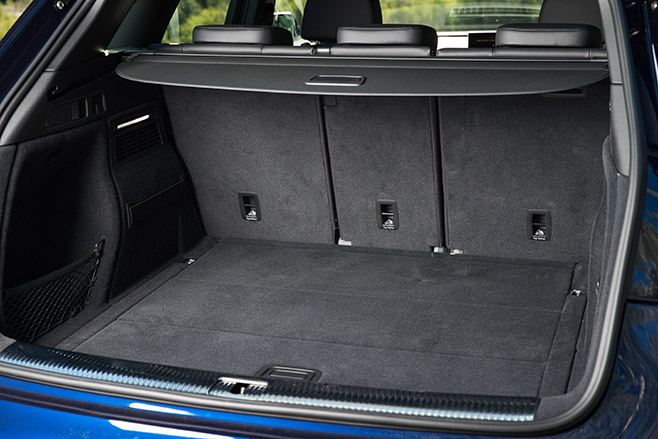
- 40:20:40 split-fold rear seats
- Convenience key (hands-free entry and engine start)
- Multifunction steering wheel, with shift-paddles
- 3-zone climate control deluxe air conditioning, with digital rear display
- Audi audio system with CD player, 2x SDXC card readers and an 8-speaker audio system.
- 20-inch alloy wheels
- Adaptive LED headlights with dynamic rear indicators
- Sport front seats
- Audi virtual cockpit 12.3-inch high-resolution dashboard
- Larger 8.3-inch high-resolution screen, DVD player and five map updates
- Audi premium sound system with 10 speakers including subwoofer and 180w output
Audi has yet to confirm if 3.0 V6 TDI and TFSI Q5 models will join the range as before, however it’s believed the all-new SQ5 will arrive in Australia in July.
2017 AUDI Q5 PRICING*
Q5 design 2.0 TDI quattro S tronic – $65,900 Q5 sport 2.0 TDI quattro S tronic – $70,700 Q5 sport 2.0 TFSI quattro S tronic – $73,500
*Recommended retail pricing, does not include on-road costs
There appears to be no end in sight for the stream of new compact SUVs joining the Australian market, but Kia is hoping there will still be life in the party when it finally rolls out a contender in the potentially lucrative segment in 2019.
With its recently introduced C-HR, Toyota has proved that it is possible to attract a healthy sales tally despite offering a relatively late arrival to the segment, but the South Korean brand’s model has at least another two years to wait.
Sightings of a mysterious Kia-badged small high-rider around the world in what appears to be near-production trim have spurred optimism that the little Kia crossover will break cover sooner, but the company has dashed those hopes .
Speaking to Australian journalists, Kia Motors Australia media and corporate communications manager Kevin Hepworth explained that the spied vehicle was in fact the so-called Stonic which will not be coming to Australia.
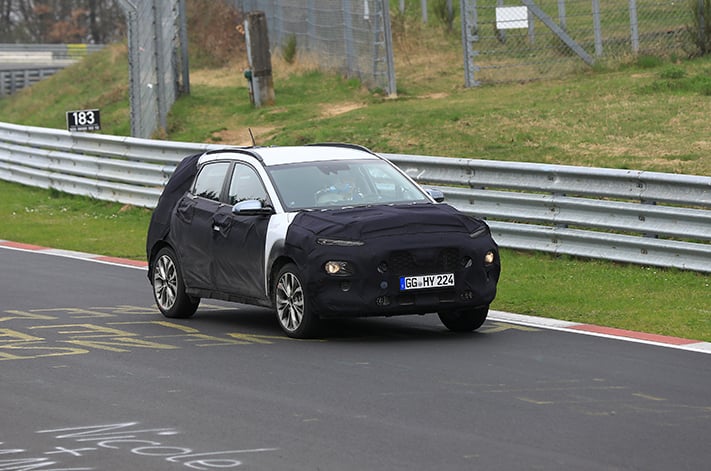
However, the little car may be offering a glimpse of what’s to come with a tougher version set to follow it.
“That [Stonic] had very little capability as an actual SUV,” said Hepworth.
“It’s a 1.0-litre, small, urban, slightly raised car for people who like driving a higher vehicle, but there will be no opportunity for SUV activity.
“There is another version under development that is a proper [Mazda] CX-3 competitor. That’s the one for 2019.”
In the interim, Kia Motors Australia chief operating officer Damien Meredith said that the company would find other ways to continue the company’s growth and there would be life left in the compact SUV market when they were finally equipped to compete.
“Is there a hole in our line-up? Yes, definitely, so we’ve just got to overcome that in other areas to make up volume,” he said.
“It’s always a problem when you come in late. There’s no question about that. You’ve just got to do the best you can with the product you’ve got.
“When it comes, you’ve just got to optimise and make the best of it.”
That line-up gap will not be plugged by the Kia Soul however, and neither Meredith or Hepworth were confident that significant volume was possible from the small passenger model, despite its upright posture and pseudo SUV looks.
“It’s almost an SUV but it doesn’t have the drivetrain,” said Meredith.
While Kia recognises that the Soul does not add significant volume to sales, its days are not numbered for now, and the company has a handful of strategies to try and boost interest in the model before it is put out to pasture.
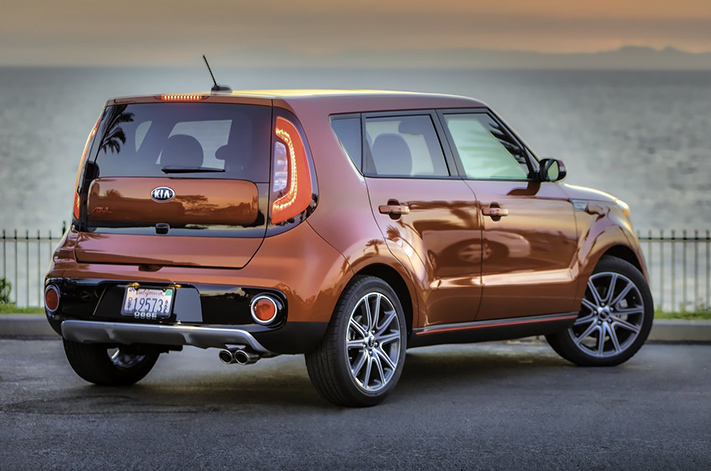
Meredith explained that potential customers would give the Soul more thought if the current levels of technology and interior features were enhanced.
“I don’t think we’ve got the specification level right and I think if we do run it again, which we probably will, we’ve got to trick it up internally.
“Its days aren’t numbered but we’ve got to be realistic. It’s not a shape that has been successful in Australia but it’s probably got one or two more lives with things that we can do to get it to work.
| I’m trading in my Kia Sportage – Which medium SUV Should I Buy?
“When the opportunity arises, we might do something internally because it needs to get a little bit more rigorous specification internally with connectivity etcetera. That would be the next step.
“We haven’t given up on the car”.
I write these words not from the comfort of the Wheels’ office, but from a place dripping with adrenalin. A place as dark as it is bright, as cruel as it is kind. A 6.2km ribbon of road that, despite its fearsome reputation, is about to provide the realisation of a 20-year dream. I write these words from Mount Panorama.
First published in the March 2017 issue of Wheels Magazine.
I’m sitting in a suite at the pointy end of Pit Straight, and in spite of the room’s air-conditioned coolness, I’m sweating. Today I’m going to achieve something I’ve lusted after for as long as I can remember: I’m going to drive Australia’s fastest track. No speed limits. No lead car. No restrictions. Just a $300,000, 441kW/652Nm Nismo GT-R, and a blessing from Nissan to “go as fast as you dare.”
If I’m honest, it’s a level of freedom that’s equal parts exciting and terrifying. You see, I’m a Bathurst boy. I was born here and grew up in a house that, at the right time of day, sat in the shadow of this crucible of motorsport. My formative years were spent clinging to my father’s shoulders as we stood trackside and watched the likes of Seton, Johnson and Brock flash past, their V8s howling with shocking violence. I’ve seen the huge shunts; I know how hard this place can bite.
Archive: Godzilla Skyline GT-R at 1992 Bathurst 1000
And yet my sharper memories of ‘The Mount’ occurred not on those October weekends, but when the track was deathly silent. When it was a two-way public road with a 60km/h speed limit. When I’d just passed the test for my provisional licence.
Having the freedom of your own licence, and a car full of petrol, is a heady feeling. Now imagine having one of the world’s best racing circuits in your backyard. A track that wasn’t locked up and out of bounds, but one that was open 24 hours. It was the ultimate tease, and one that I, and all of my car-loving friends, couldn’t resist.
Our plan was cunning. Hot-lapping the circuit during daylight hours screamed stupidity, so our runs were always held at night. Three cars were needed. One to complete a slow sighting lap to check for oncoming traffic and police, another to sit at the bottom, the spotter with walkie-talkie in hand, monitoring the circuit’s two entry points.
The risks were very real, of course. Rumour had it that if your car was loud enough, the police could hear you begin your lap and be waiting at the bottom by the time you finished. Unlikely, sure, but what was harder to ignore was seeing your friends nabbed by police lurking behind the Armco. They showed no mercy.
And if the coppers didn’t get you, it was likely your own incompetence would. One of my mates spat his car into the wall at Turn One. Another buried his dad’s brown VN Commodore in the sandpit at the bottom of The Chase so deeply we had to call his parents to help us extract it.
Hustling a box fresh, Nismo-tuned version of Godzilla means this time is different. And while the speeds up and down The Mountain are eye-opening (230km/h and 280 respectively), it’s across the top where my adrenalin gland is squeezed hardest.
Everyone knows Bathurst is steep. Even at 60km/h it feels daunting, but at triple-digit speeds it seems at least 20 percent steeper. And narrower. It’s easy to get sucked in by the rushing concrete walls, and the rollercoaster ride across McPhillamy Park, which is really one long lefthander, is mildly terrifying. My respect for the drivers who aren’t only on the edge through here, but are sometimes firmly beyond it, while racing other cars, triples.
The biggest ‘gulp’ moment is plunging over Skyline at the top of fourth gear, where the road falls away at an incredible rate to begin the dive into the famed Esses. It’s wild. It’s addictive. It’s everything I hoped it would be and more.
Revelation Road
Roads, just like cars, are capable of shaping our individual motoring stories. Of leaving an indelible mark that you remember forever. So what’s your road? Is there a piece of tarmac, a section of national park, or even a local racing circuit that has played a pivotal role in your life? Or maybe you’re a Bathurst local too and have your own tales of driving the track. I want to hear from you. Share your stories at [email protected] or on our Facebook page.
IT MAY wear a Jeep badge but the insane Grand Cherokee Trackhawk is not designed to go off-road at all.
Speaking to Wheels at the 2017 New York motor show, Trackhawk engineer Paul Mackiewicz said there was no off-road testing during development of what is claimed to be the world’s fastest accelerating SUV.
Instead, the Trackhawk is more about race tracks than dirt tracks.
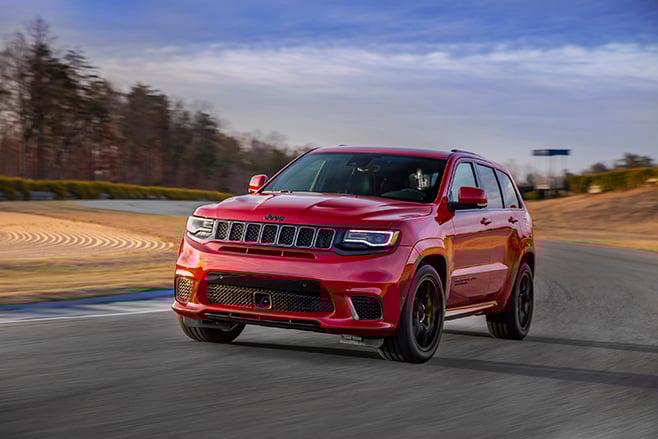
Like the Grand Cherokee SRT the Trackhawk rides on run flat tyres and even the spare tyre is optional.
Jeep to add three new models by 2020
“The [Grand Cherokee] Trailhawk is meant to push the envelope of the capability of an off-road vehicle, the Trackhawk is supposed to push the capability of an on-track vehicle,” said Mackiewicz.
“It looks for the capabilities in a different realm or a different functional objective than what a Trailhawk would do.”
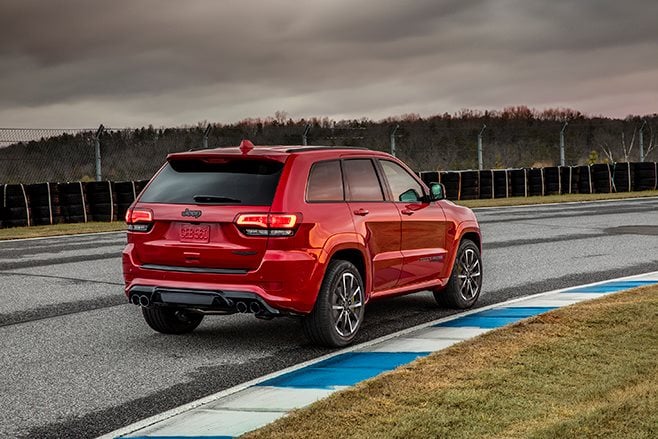
Key to the Trackhawk’s performance is its 6.2-litre supercharged V8, which makes 527kW and 874Nm.
It’s the same engine used in Dodge’s Hellcat variants of the Charger and Challenger and is enough to propel the five-seat SUV to 100km/h in 3.6 seconds.
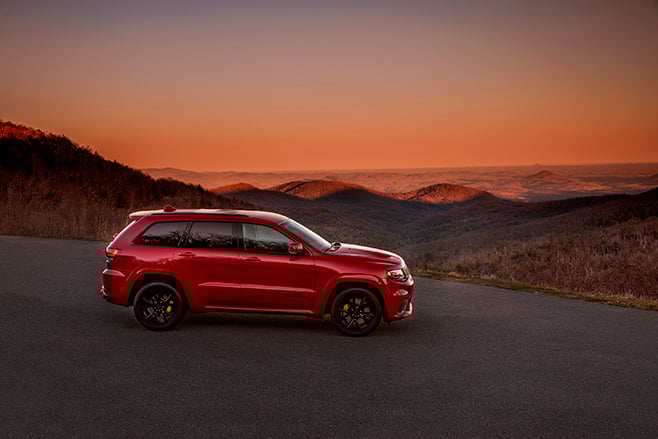
The driver can then adjust the engine revs between 1700rpm and 3500rpm to tailor the launch to different surfaces.
Hellcat-powered Jeep Grand Cherokee Trackhawk to debut at New York Auto Show
Whereas some launch control systems will adjust to excessive wheelspin, the Trackhawk sends all its grunt to the wheels no matter what, potentially leading to some spectacular four-wheel burnouts.
The engine drives through an eight-speed automatic, codenamed HP95. It’s similar to the transmission used in the rear-drive Challenger and Charger Hellcats but has been adapted for four-wheel drive.
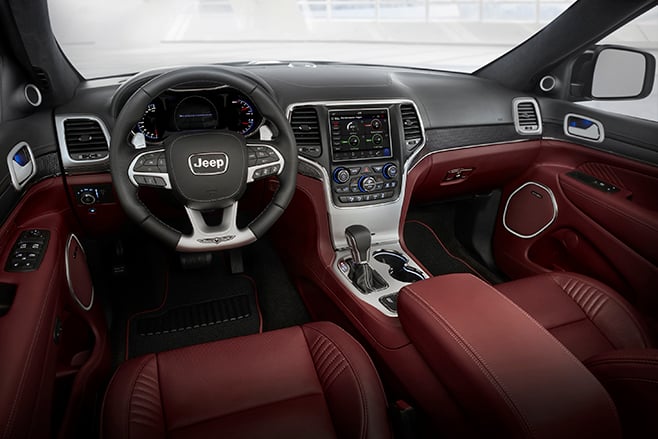
For track driving it sends 70 percent of the drive to the rear wheels for a rear-biased experience, but when in tow mode – it’s claimed to tow 3272kg – it sends 60 percent of the drive to the front wheels.
Helping halt all that pace is a new set of Brembo six-piston calipers painted yellow. The front discs are 400mm in diameter, 20mm more than the Grand Cherokee SRT.
Jeep considered carbon ceramic brakes, but traditional steel ones were employed instead because they were found to achieve what engineers wanted.
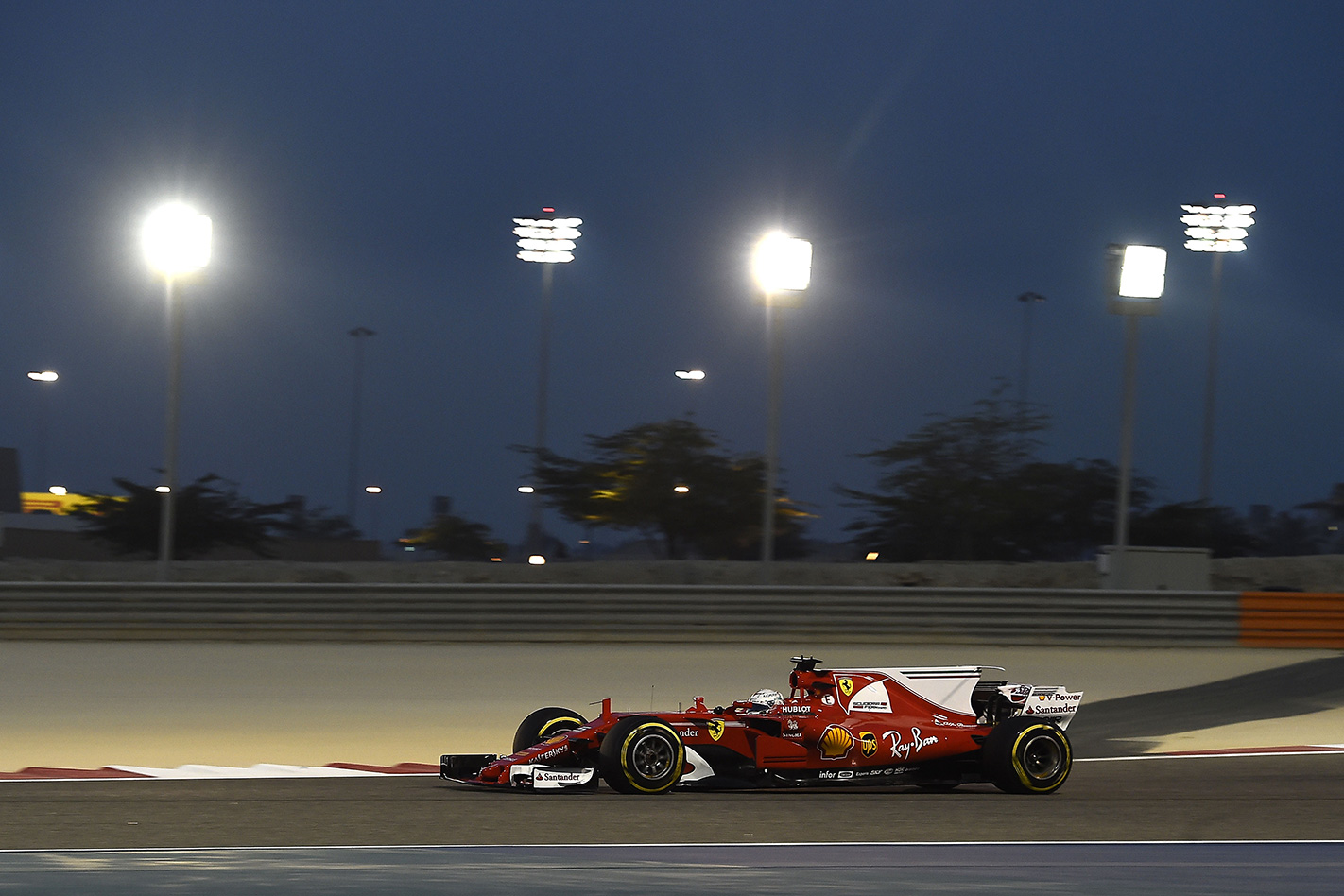
AN AGGRESSIVE tyre stop strategy and sheer pace propelled Ferrari’s Sebastian Vettel to his second win of the year in Bahrain – lifting the German back to a clear seven-point lead in the world Formula One championship.
“This was a team effort,” exclaimed the victorious Vettel. “Right after the start I thought ‘yeah, we’re quick’.”
The Easter hunt was on.
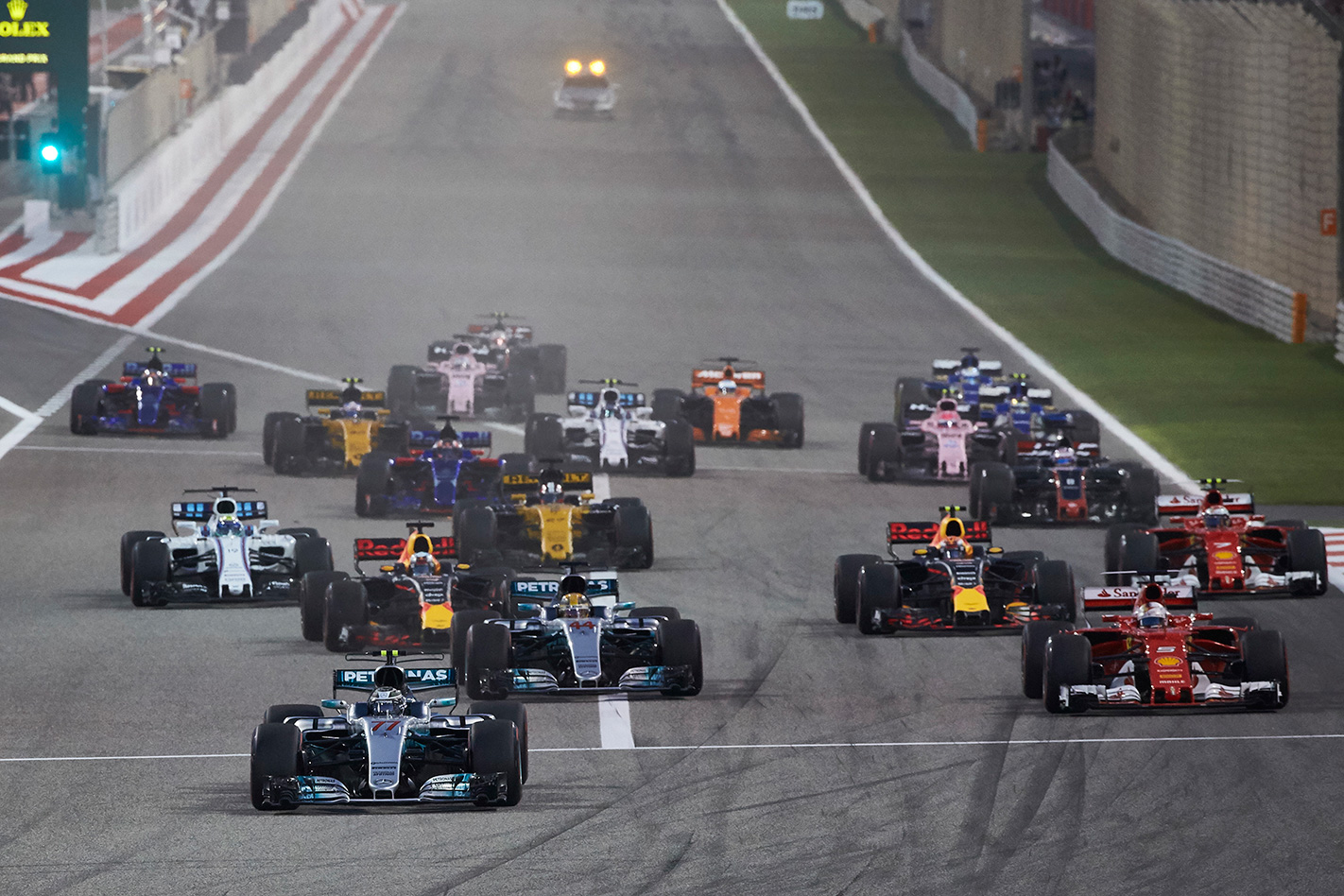
The Mercedes challenge in Bahrain faltered with pole man Valtteri Bottas unable to carry his stunning Saturday one-lap pace into Sunday while his team-mate Lewis Hamilton irreparably hurt his chances by incurring a five-second penalty by unnecessarily slowing down Daniel Ricciardo’s Red Bull at the entry to the pits during the first round of stops.
It wasn’t smart and it wasn’t subtle and it may have cost him the race.
Hamilton dominates 2017 Chinese Grand Prix
The start was hectic with pole man Bottas jumping clear of Vettel and Hamilton, while Max Verstappen rounded up his log-jammed Red Bull teammate Ricciardo through turn one.
What was obvious was Vettel’s pace but also how the Red Bulls were also staying in touch with the leaders.
More action followed immediately when Carlos Sainz’s Toro Rosso clouted lance Stroll’s Williams soon after exiting the pits, putting them both out and bringing on an investigation into the Spaniard’s driving.
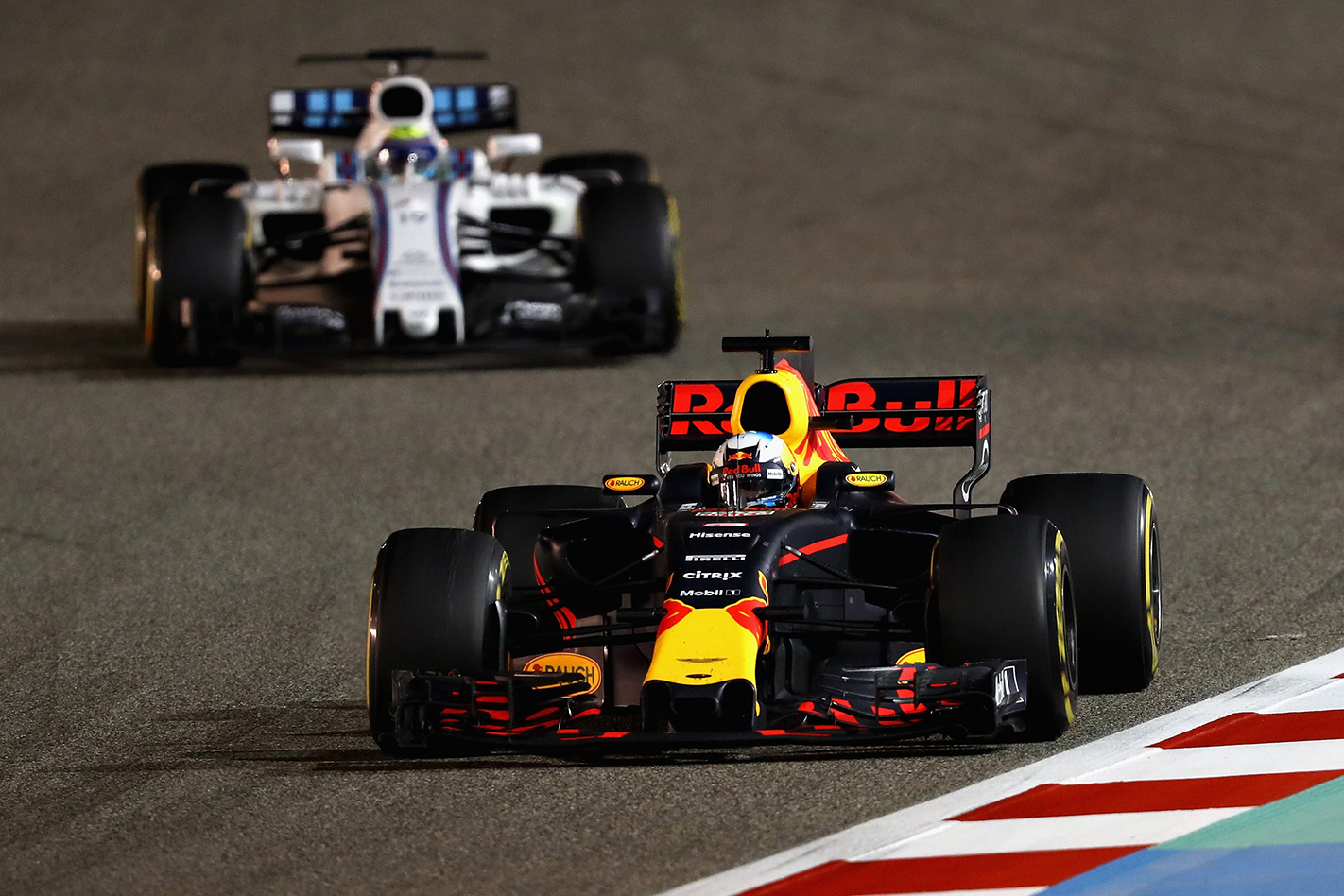
The subsequent safety car intervention encouraged many others to head to the pits for fresh rubber. This is when Hamilton, double stacking behind his teammate, thought he’d try to prevent Ricciardo from overtaking him by dawdling on the pit entry road.
Ricciardo struggled to bring his tyres up to temperature and at the restart lost out to Hamilton and then Williams’ Felipe Massa. Vettel though was in control, especially with Bottas fighting oversteer everywhere.
Hamilton rejoined in third and then, reeling off some fastest laps, moved to second when Bottas was instructed to let his teammate past.
He carved into the 12-second gap to Vettel but the laps ran out.
Bottas was third, from Kimi Raikkonen, Ricciardo, and Massa.
Only 13 cars of 19 starters got to the chequer.
Ricciardo had an odd race, losing out to Verstappen at the start but then easily keeping up to the bum-sniffing chain of Bottas, Vettel, Hamilton and Verstappen in the opening stint.
“For me it was a race of two halves really,” the Australian said. “At the beginning of the race I genuinely thought we had a chance to win. That stint was looking very competitive and I could see Valtteri was struggling. I was at the tail end of the front pack and I could see everyone else in front of me.

“The safety car worked for me in that we jumped up to third but it wasn’t so good for our tyres and that’s where we lost a lot of ground. Even once we settled into a pace and the chaos settled we fell back and I was struggling with grip at the front and rear. We never really got that tyre working for us today.”
It’s looking like a title fight between two – Vettel and Hamilton. Bottas may have become the sixth Finn to claim a F1 pole the previous day, but on Sunday he simply didn’t find the blinding pace needed to dominate a grand prix.
This year, too, Raikkonen has been missing in action. In Bahrain, he did recover okay from a poor start but would consider fourth unsatisfactory.
Searle, Morris and BMW take Bathurst Six-Hour thriller
Luke Searle and his good mate Paul Morris stole a memorable Hi-Tec Oils Bathurst Six-Hour enduro at Mount Panorama on Sunday, overtaking defending winner Chaz Mostert’s Ford Focus RS in the closing five minutes to notch the win.
The Roadchill Express BMW M135i chased down and passed Mostert and Nathan Morcom’s Ford Focus RS after an enthralling fight throughout the closing half-hour.
Mostert had fought like a tiger to repel Searle’s withering attack before ultimately succumbing in the closing five minutes when the BMW slipped by at the inside of the Chase.
Both cars broke the lap record as their ferocious duel for the victory entered the closing four laps. Each raced faster than they qualified, Mostert ultimately claiming the record on the 110th lap.

The classic Bathurst Six-Hour outcome landed Morris’ name in the record books as the first driver to win the three biggies at Mount Panorama, yesterday’s effort joining his previous successes in the Bathurst 12 Hour and Bathurst 1000 races.
The result also delivered Searle and his long-running family racing team their biggest-ever racing result.
“I don’t know where that little Ford found its legs at the end there,” remarked Searle after delivering the drive of his life in the concluding laps. “Chaz was driving the wheels off it; we were driving the wheels off it. Someone said we were in the 25s. Wow… I have no words,” Searle said.
“I had to get him. I was putting it all on the line, so I had to get him. I wanted Paul to get the triple, it was always in my mind…get him the triple. I was up the inside of him and I started looking around for yellow flags because it was too easy, so I started looking around for yellow flags. He lost sixth gear or something, so that’s a shame.
“Paul was phenomenal in the middle stint; he didn’t put a foot wrong. I can’t say anymore.”
The veteran drive-anything Morris said he was thrilled to add the Bathurst Six-Hour crown to his CV – especially the chance to do it with a family friend.
“To do it with Luke is really cool,” Morris said. “I’ve been friends with their family a long time and I rate him as probably one of the best drivers Australia’s had – but he’s just slipped through the net. You could put him in a GT car or any car and he just goes. He was the right man to have at the end of the race, that’s for sure.”
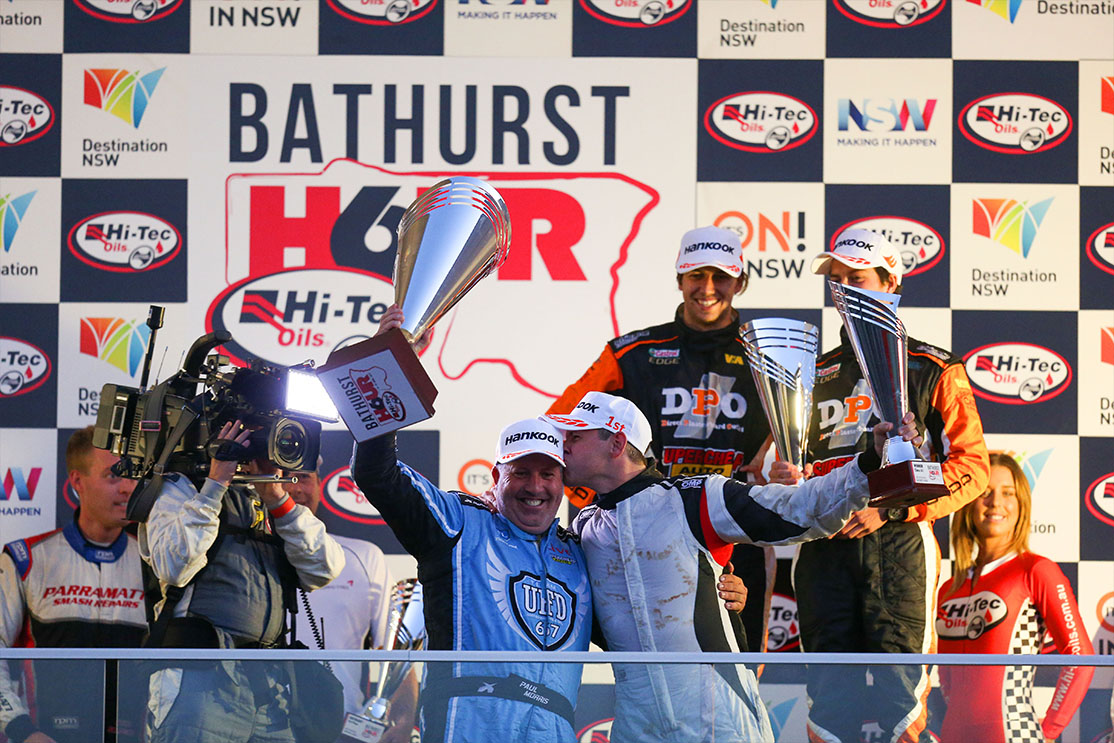
Defending winners Mostert and Morcom hung on to finish second, fighting their way into contention after starting only 16th.
Mostert’s drive at the end was particularly breathtaking as he manhandled the Focus around at lap record pace – despite dropping fifth and sixth gear at the very end.
“It was probably one of the most hectic races I’ve had around here,” said the 2014 Bathurst 1000 winner.
“Those boys [Searle and Morris] definitely deserve it 100 per cent – they pushed us hard all day,” Mostert observed. “At the end of the day we were second best today.
“But a great effort from the team to win last year, to release a brand new car this year and the lead-up, the practices, the qualifying, all those kind of things where we just had little errors and then to put it all together in the race is just awesome.”
There was a controversial finish for the final spot on the podium with Jim Pollicina and Ryan Simpson taking third after the Duvashen Padayachee/Ben Porter/Rob Woods Mercedes was penalised for an earlier pit stop infringement.
The winners completed 113 laps, while the race featured 11 safety car interruptions following another bruising day on the Mountain.
The tightly contested contest produced 18 lead changes and early safety car interruptions kept almost 20 cars on the lead lap for most of the opening three hours.
The big contenders again fell early, with the pole-sitting BMW M4 of Grant and Iain Sherrin dominating the race’s first 13 laps before a technical issue dropped them three laps from the lead.

They then launched a major comeback drive, remarkably getting back to the lead lap before a puncture again dropped them out of contention in the fifth hour.
An unconfirmed technical issue ruled out the David Wall/John Bowe Mitsubishi Lancer in the second hour, while an enormous engine failure and fire ended an otherwise strong day for the Garth Walden/Craig Baird Mercedes AMG A45 in the final 30 minutes. The car was running fourth at the time.
The CXC Global Racing EVO of Dylan Thomas and Tim Slade was another high-profile non-finisher, out with engine failure after just 20.
Following the penalty to the #29 Mercedes, Beric Lynton and Tim Leahey finished fourth while Karl Reindler and Andrew Richmond completed a remarkable fightback from a qualifying disqualification and rearward grid 59 start to finish fifth.
All of 64 cars started the race, a record field for an endurance race at Mount Panorama, eclipsing the previous record of 63 set at the 1969, 1978 and 1984 Bathurst 1000 races.
The event announced a three-day attendance of 17,487 – up 8.2 per cent on 2016.
HI-TEC OILS BATHURST 6 HOUR – TOP 10 1. Searle / Morris (BMW M135i) 113 Laps 2. Morcom / Mostert (Ford Focus RS) + 9.6s 3. Pollicina / Simpson (Mitsubishi Lancer EVO X RS) + 23.97 4. Lynton / Leahey (BMW 1M) + 41.485 5. Richmond / Reindler (Mitsubishi Lancer EVO X RS) + 43.759 6. Woods / Padayachee / Porter (Mercedes AMG A45) + 55.419 7. Alford / Eddy (Audi TT RS) + 1 Lap 8. Burges / Perkins (BMW 331i) + 1 Lap 9. Abela / Hill (Subaru Impreza WRX STi) + 1 Lap 10. Kavich / Kavich / Pilkington (Subaru Impreza WRX STi) + 1 lap
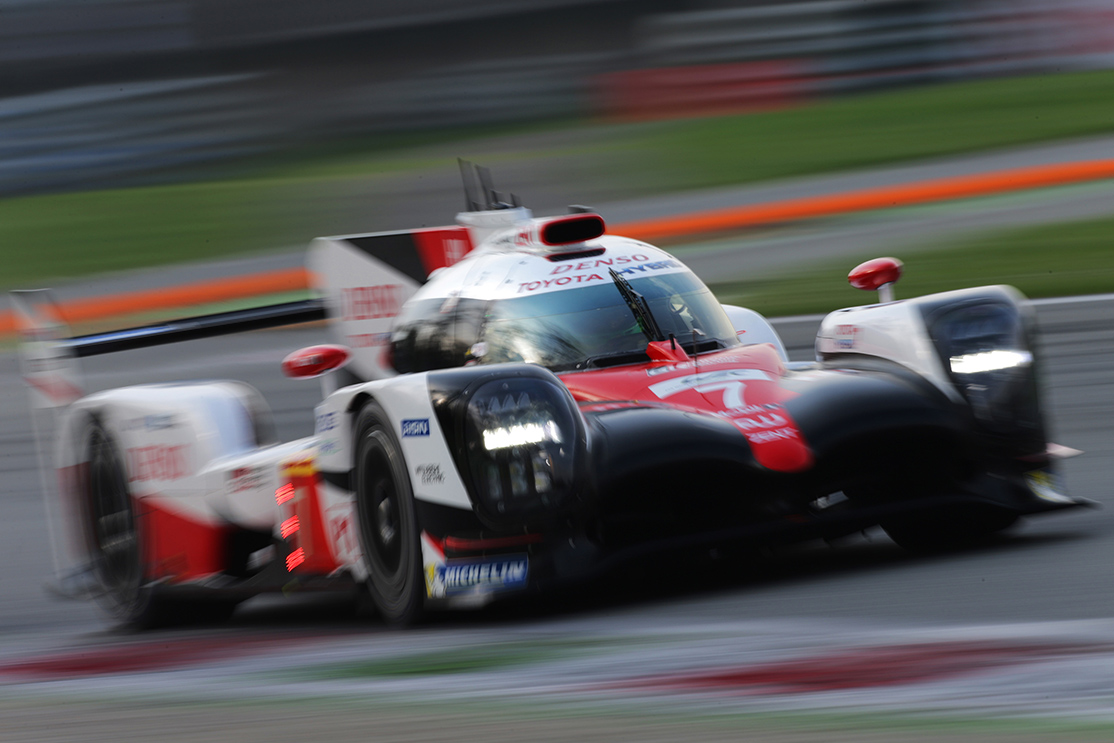
Toyota scores dramatic WEC victory
Toyota Gazoo Racing took a thrilling victory in the frantic opening round of the 2017 FIA World Endurance Championship at Silverstone yesterday.
Drivers Kazuki Nakajima, Sébastien Buemi and Anthony Davidson took the win after a frantic contest which had drama throughout the six hours.
It was Toyota’s 11th victory in the WEC and perhaps its most hard-earned after rain, two full-course yellows and one safety car period bunched up the field in the fourth hour after Jose-Maria Lopez crashed his Toyota TS050 HYBRID at Copse Corner.
With just 12 minutes remaining, Buemi made a move on Porsche’s Brendon Hartley to seal the victory.
The pole-sitting #7 Toyota had led in stages during the first two hours but after one of several light showers, the Argentinian WEC newcomer slid off track and crashed hard into the tyre barriers. Incredibly, the car made it back to the pits and eventually returned to action.
Porsche took the fight to Toyota and filled second and third positions, after the German marque threatened all through the race.
Timo Bernhard, Hartley and Earl Bamber took second in the #2 919 Hybrid as the team tried to maximise its low-downforce package, which was at a disadvantage compared with Toyota’s high-downforce bodywork kit.
But Toyota proved slightly too strong and when Buemi emerged from the pits with fresh Michelins for the final half hour it was only a matter of time before he hunted down and overtook Hartley.
Nick Tandy, Neel Jani and André Lotterer claimed third position after being amidst the lead battle for three-quarters of the race in their #1 Porsche.

Joey Mawson’s solid start to European F3 campaign
Australian Joey Mawson struggled with car set up in cold and sometimes damp conditions at Silverstone but opened his 2017 European F3 Championship account with a strong fifth after starting ninth.
The race was won by Britain’s Lando Norris, from another local Jake Dennis and Germany’s Maximilian Gunther. Mawson was the best performed of the high-profile Team VAR drivers, Harri Newey finishing sixth and Pedro Piquet ninth.
In the second of the three races at Silverstone, Mawson started well from 11th, charged to seventh but slipped back to 11th with graining tyres.
Joel Eriksson (Motopark) won race two from Callum Ilott (Prema) and Jake Hughes (Hitech).
The final race was frustrating too when after a good start, Mawson’s kart didn’t have the pace to progress further, holding eighth to the end.
Ilott became the third different winner in three races, with Eriksson second and Norris third.
VAR will be working hard to determine why the car was off the pace and what will be done to improve it for Monza in less than a fortnight.
“We leave Silverstone disappointed but with 14 points towards the championship,” Mawson said of his weekend.
More positive news is that Mawson has been accorded the status of British Racing Drivers Club (BRDC) Rising Star, and membership of the BRDC.
TOYOTA’S take on a small city SUV infused with LandCruiser genes perfectly encapsulates a new design trend for the brand: designing cars from the inside out.
The head of design at Toyota’s Calty studios in California says the interior of a car, such as the FT-4X concept unveiled at New York last week, is more important than ever.
“We are starting inside out a lot because that’s where the driver and passengers spend most of their time,” says Hunter of the radical SUV that’s based on the underpinnings of the Toyota C-HR.
“We like to call it a holistic user experience; what are the features, what are the benefits, what are the tactile things … people get pleasure in having physical things to move and adjust, rather than just a flat tablet screen.”
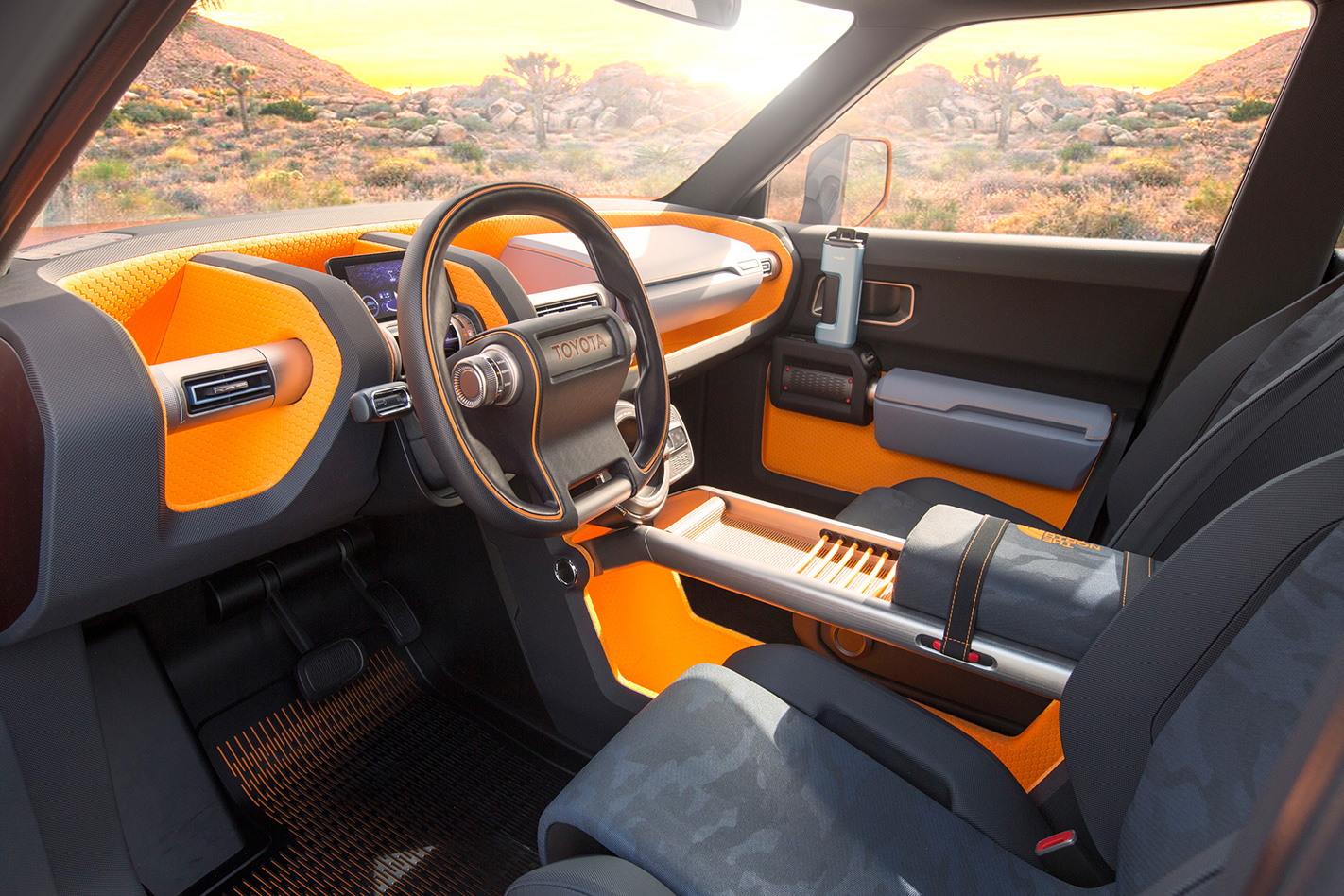
A sleeping bag that doubles as an arm rest, built-in water bottles and a GoPro camera built in to the exterior mirror are some of the things that prove the GT-4X is not your average Toyota.
But it’s the tailgate that is one of the cleverest parts of the FT-4X.
As well as being able to open horizontally or vertically the upright tailgate has twin storage containers that can be used for warming gear (such as gloves or socks) or cooling food and drinks.
New York Motor Show: Jaguar F-Type four-cylinder unleashed with $107K Oz price
Lead designer Ian Cartabiano says the tailgate was a pivotal piece of the FT-4X design process.
“Rear is the new front … we started with the rear-is-the-new-front and really design a totally usable, functional and amazing tailgate for this thing and the rest just falls in to place,” says Cartabiano, who confirmed the FT-4X was designed with mainstream production in mind.
“We want to keep it a real size that you can envisage it becoming production.”
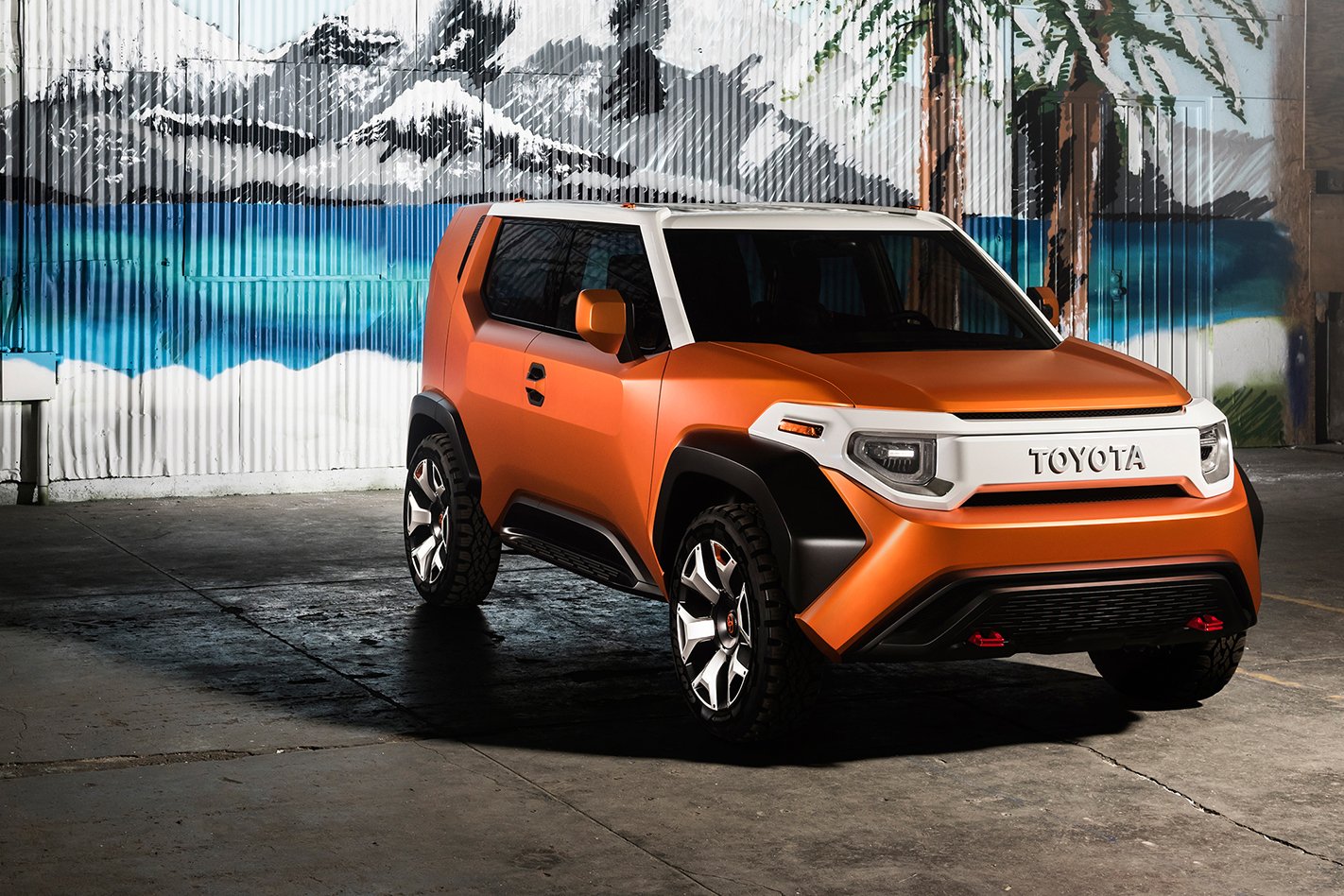
He said it was designed to appeal to a new market of predominantly younger buyers who appreciated authenticity and ability but didn’t want the compromises or size of a large 4WD.
“When we talked more in-depth with the millennials … it was really about ‘I don’t need to climb Everest, I want to go to Joshua Tree for a weekend or I want to go to Yosemite and camp, or I want to go to with my friends out to Death Valley’.
“So that was the type of adventure that we were thinking about with this car, so we went from hardcore to casual core.”
IT READS like a Bond script: CIA spooks hacking vehicles, turning them into deadly weapons, and spearing occupants off cliffs in ‘undetectable’ assassinations. But it’s not fiction.
First published in the April 2017 issue of Wheels magazine, Australia’s most experienced and most trusted car magazine since 1953
A Wikileaks exposé revealed the Agency’s plans to take remote control of targeted vehicles, adding fuel to a fiery discussion about connected car vulnerability, and vindicating a multi-billion- dollar investment into cyber security by Mercedes-Benz.
“I would only be exaggerating a little bit when I say that 90 percent of our development is dedicated to this aspect. It is key,” head of Mercedes-Benz cars Dr Dieter Zetsche told Wheels.
“When you’re mentioning autonomous cars as being the safest place possible, this is a nightmare.”
To put Daimler’s investment into perspective, the company upped its R&D budget by 15 percent in 2016, dedicating 5.7 billion euro (A$8 billion) to Mercedes-Benz Cars.
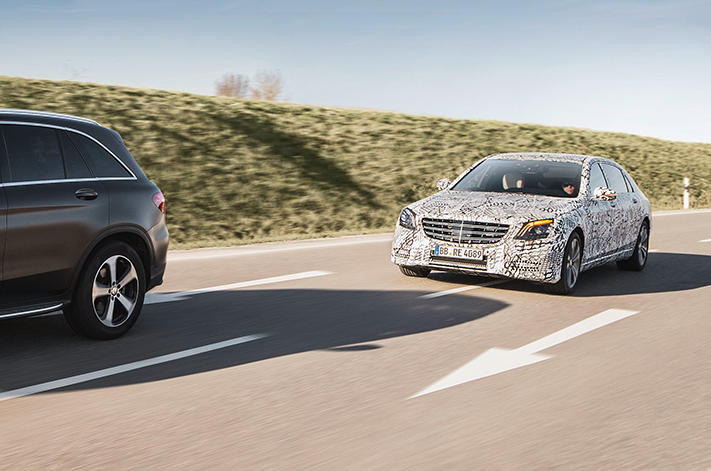
Hackers are already exploiting vehicles in market right now, with successful attempts to crack into vehicles from Nissan, Audi, BMW and Ford all documented online.
Hackers crack Mitsubishis high-tech SUV
Then there’s the Jeep case, where vehicles were not only accessed, but driven away in, and all via the Cherokee’s relatively primitive hardware and software.
“The moment you connect a vehicle to the internet, you expose it to more cyber threats; that’s a topic that needs to be addressed by automakers and policymakers but we are only at the beginning,” says Andreas Mai, Director of Connected Vehicles, Cisco.
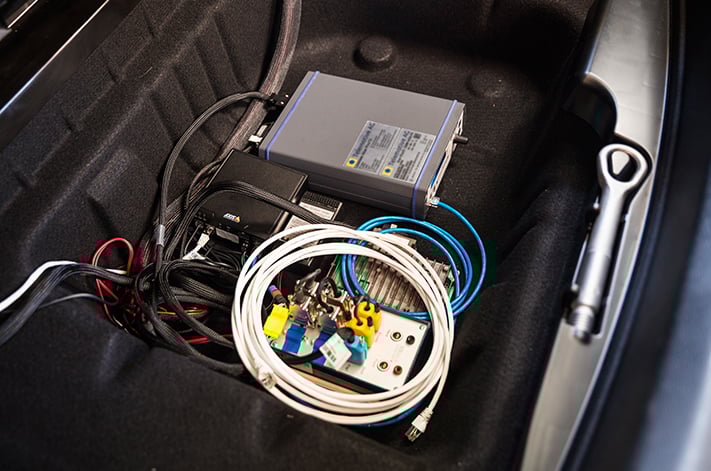
Benz’s unprecedented spend on protecting its product includes supplying prototype vehicles to would-be hackers, and dissecting their attacks on its cutting edge systems. Ford and Tesla both run similar initiatives.
“We give these products before launch to third parties to do their best for three months to hack them. If they find a hole we take care of that. Anything which can be done has to be done,” said Dr Zetsche.
“Is that 100 percent security? No. That doesn’t exist in this world. But one pillar of our brand is reliability and safety and we do believe that includes cyber security, both data and privacy.”
All seeing eyes
Future Mercedes-Benz autonomous vehicles will drive themselves using map information downloaded from the cloud. On-board sensors and radars will navigate over high-resolution, three-dimensional landscapes supplied in real-time by Benz servers that will allow its vehicles to pre-empt road conditions further ahead.
Detailed pictures from the cameras of other Benz vehicles will keep the maps updated, and the software will be able to selectively identify the difference between objects like footpaths and roads, cyclists and pedestrians, and so on.
QUESTION – MARTIN:
My wife has a Mazda2 and we are buying another car. At the dealer, we a saw Mazda 2 Genki and Mazda CX-3 Maxx, but is there another car we should look at? We drive mainly city and a little in the country, covering approximately 10,000km a year. We want a car that comes with lots of features.
BUDGET:
$30,000
ANSWER – SAMANTHA STEVENS:
The Mazda2 is a fabulous city car, and within your budget you can load up on the features and spec. The CX-3 is also an excellent vehicle, with more room and a higher driving position than the diminutive Mazda2, however being a compact SUV, it will have some more costs associated with it; not just the buying price, but also slightly higher running costs such as registration, insurance, tyres, fuel consumption etc., so be sure a SUV suits and fits your lifestyle.If you are looking at a slightly larger car, you may want to consider the Mazda3 instead of the CX-3. The Maxx Safety is the pick ($25,890). Other larger hatchbacks you may want to look at include the Ford Focus (Trend, or a demo Titanium), and Hyundai’s i30 ($26,890).Cars in the Mazda2’s size bracket to consider would be the Volkswagen Polo TSI Comfortline ($21,190) and the Renault Clio Dynamique ($25000). Both will be slightly more expensive to service than the Mazda, but have fun and frugal 1.2-litre turbo engines with automated gearboxes, and a host of included options. Each has a different and unique seating position – be sure to test drive them and see what suits.
Consider the anchovy: A hairy little strip of trawler-stank soused in oil and salt. It should be like eating a Greek fisherman’s eyebrow.
But it isn’t (at least, I hope it isn’t). In fact, it’s a true delicacy that can be enjoyed in many ways. Such as, straight from the little pot-bellied bottle they come in. Or mixed with other things. A pizza, for instance, is not a pizza until the bristly wee fish have been peppered across it. Neither is a Caesar salad pukka till it’s been achovied up.
And yet, other people think I’m a weirdo for enjoying these tiny piscatorial salt-bombs. Not that I care. And neither is the anchovy the weirdest of my favourite things. Consider also, the Tatra T87. Here is a car that really appeals to me, and for a variety of reasons.

Thirdly, the T87 was a V8. And not just any old V8, either. At around the same time in history that Clyde Barrow was pumping up Henry Ford’s tyres for building a sidevalve V8 with underdone cooling (you think bonnet louvres are soooo hot-rod? They were added by Ford to try to cool the hot-headed V8) those crazy Czechs thought to give their bent-eight overhead camshafts and a top speed of about 160km/h. Oh, and cooling? Forget leaking water pumps and stuck thermostats – the Tatra was air-cooled. Oh, and let’s not forget it was also rear engined!
So, then: fast, technically interesting and left of centre. What’s not to like?
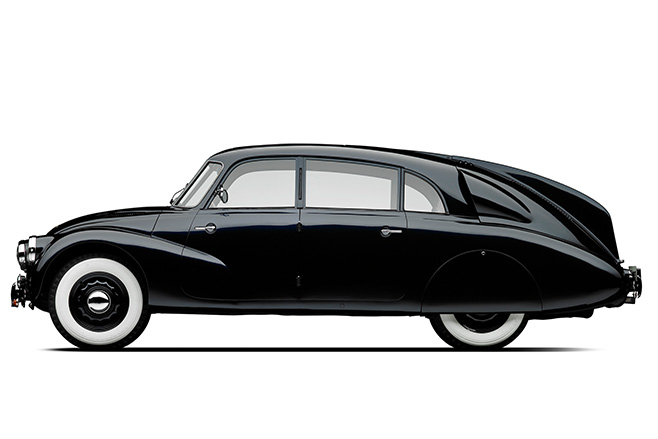
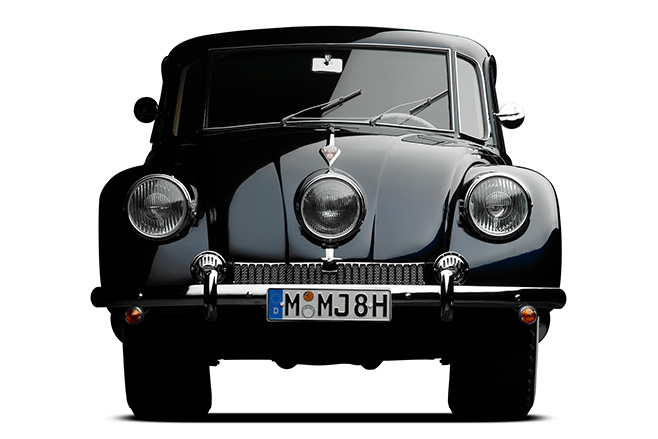
The problem was that the ass-heavy layout took a bit of getting used to and, after a hard day’s goose-stepping and beating up Czech peasants (not to mention a stein or two of Pissenbrau at the wet mess on the way home) many of those same German high-ups found themselves leaving the road backwards and on fire as their purloined Tatras swapped ends with little or no warning.
I’m told that more German officers in Czechoslovakia went to their reward flailing away at the helm of out-of-control Tatras than were killed in actual, war-stuff, active service. The story also goes that the Allies began referring to the Tatra as its ‘secret weapon’ against the Nazis.
And how about those early Saabs? A crazy, mad-ass three-cylinder two-stroke that sounds like a heavily armed swarm of killer bees. All wrapped up in a body that’s a cross between a cockroach and a tinned ham.
I got to drive Erik Carlsson’s race-prepped 96 a few years back, with tuition from the great man himself. I got a Scandinavian bollocking for stalling the thing at my first attempt, but deep down, you could see that Erik was digging the fact that I was digging his car. The other thing I remember about that day is that there were anchovies on the lunch buffet. Of course there were.
