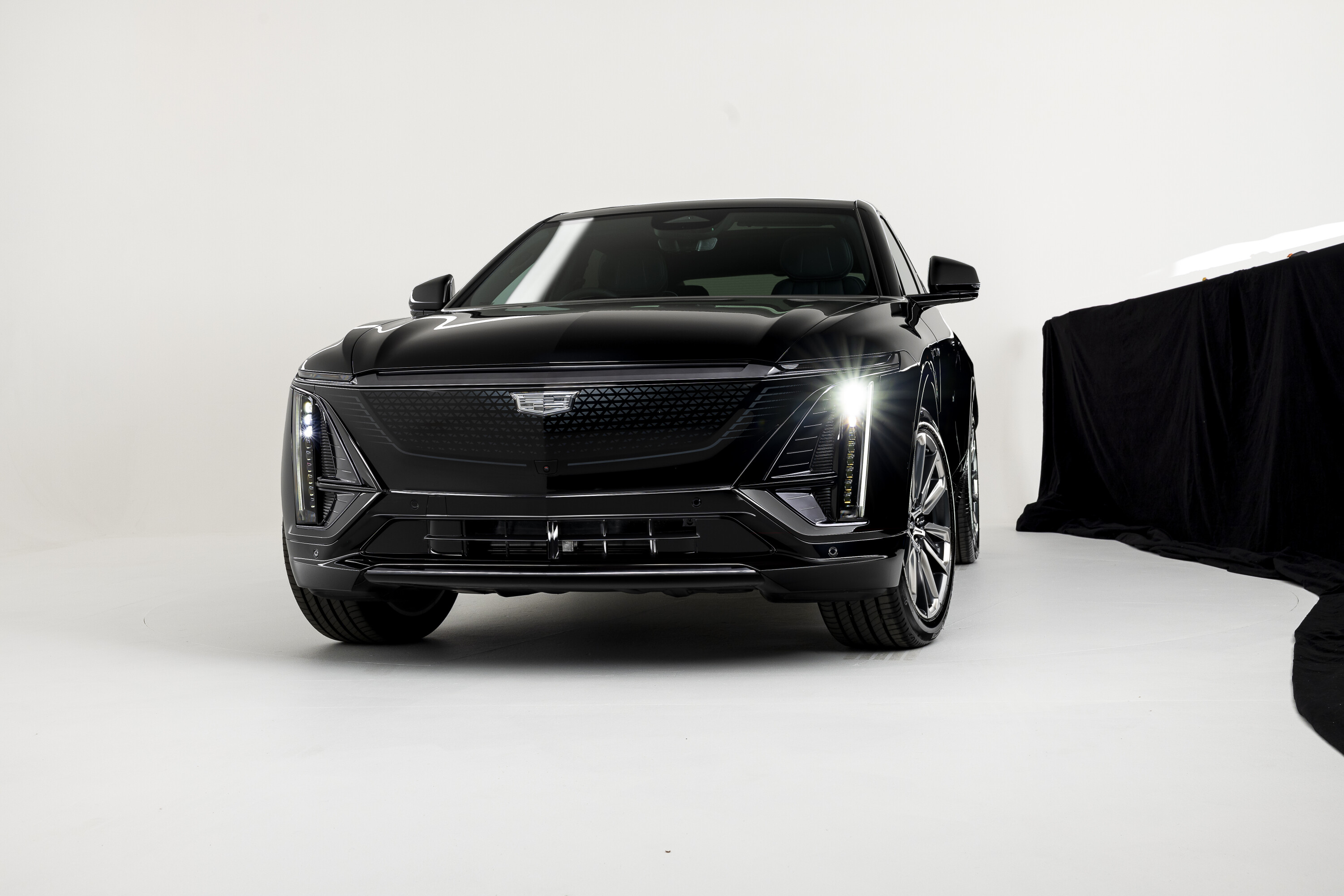
“Sedans aren’t dead,” says Mike Simcoe, General Motors’ senior VP of Global Design. On the face of it, that might seem a bit of an odd comment given that Cadillac’s set to launch in Australia next year with a range of electric SUVs, but the transplanted Melburnite is clearly in no mood to mince his words.
“SUVs are a necessary evil,” he admits, before describing them as a “comfortable, rational purchase.” He’s clearly one of us, somebody who recognises that customer tastes are something that he can influence but, ultimately, not control.
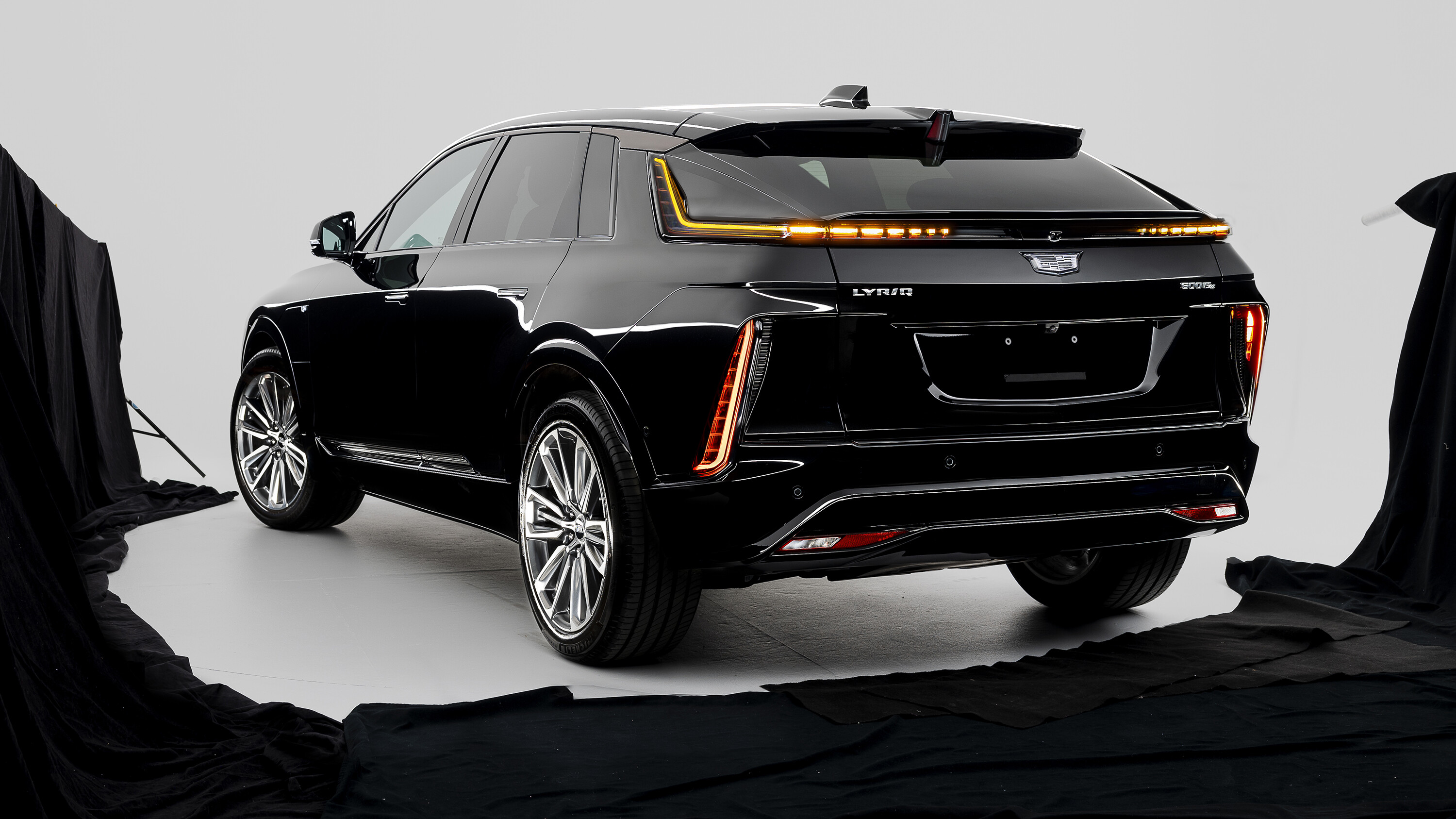
With factory right-hook Lyriq crossovers confirmed for a 2025 launch over here and the Optiq compact(ish) SUV and Vistiq Seven seater likely to follow on their heels in ’26, Simcoe clearly faces a challenge in getting Cadillac, a brand which doesn’t have much in the way of lived equity Down Under, onto the shortlists of buyers who might otherwise choose an Audi, a BMW, a Lexus or a Mercedes-Benz.
1
“I don’t think Australian customers are terribly brand loyal,” he ventures. “That’s not putting them down, it’s just saying that they’re canny customers who, in most cases, will try something new when it comes.”
The brand’s been on a bit of a rollercoaster journey in the last few years, but the drive now is to clearly cement this new notion of American luxury. Simcoe stresses Cadillac’s “stronger execution of proportion and more allowance for feature and the ability to build something in a very special way.”
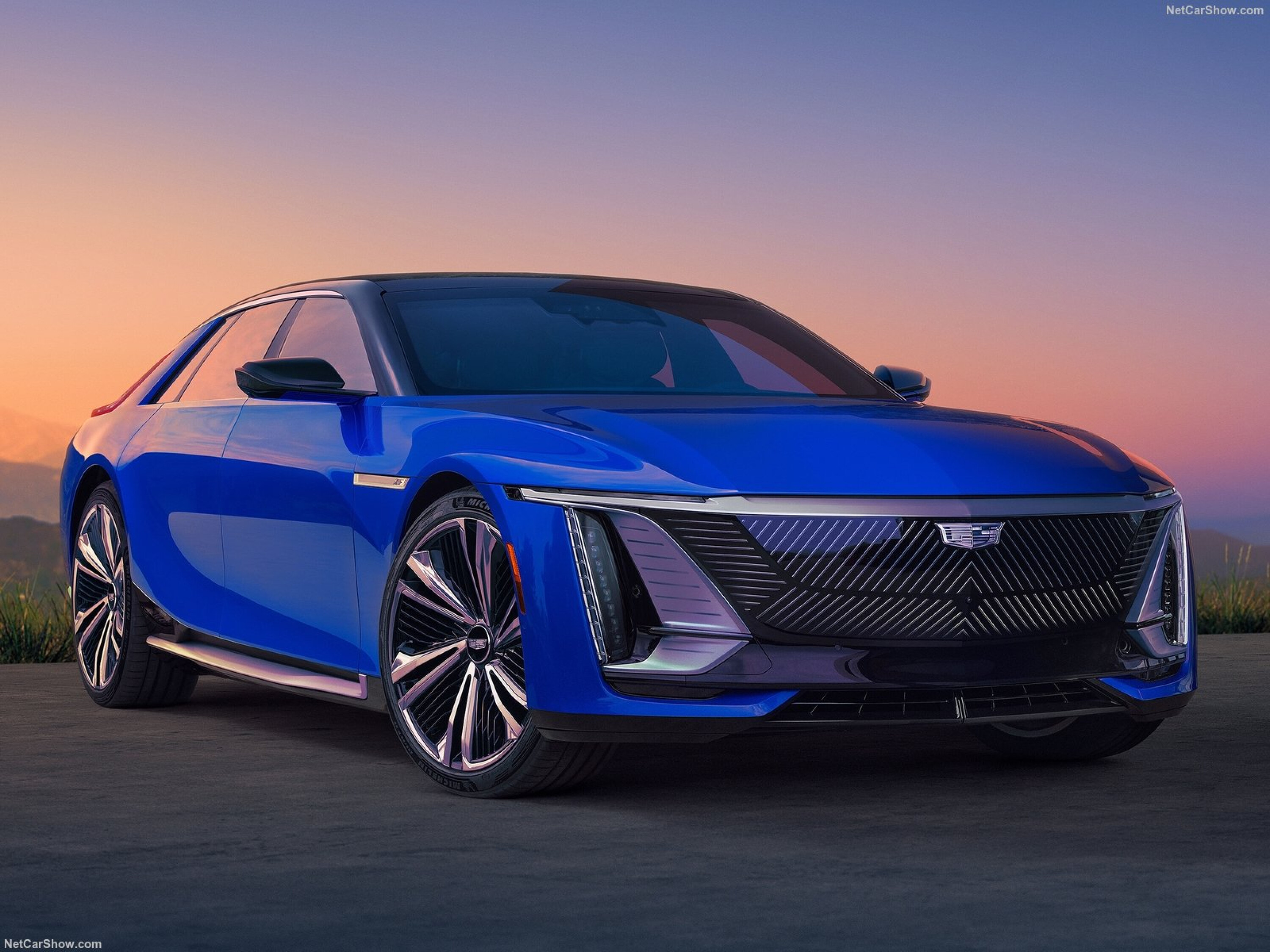
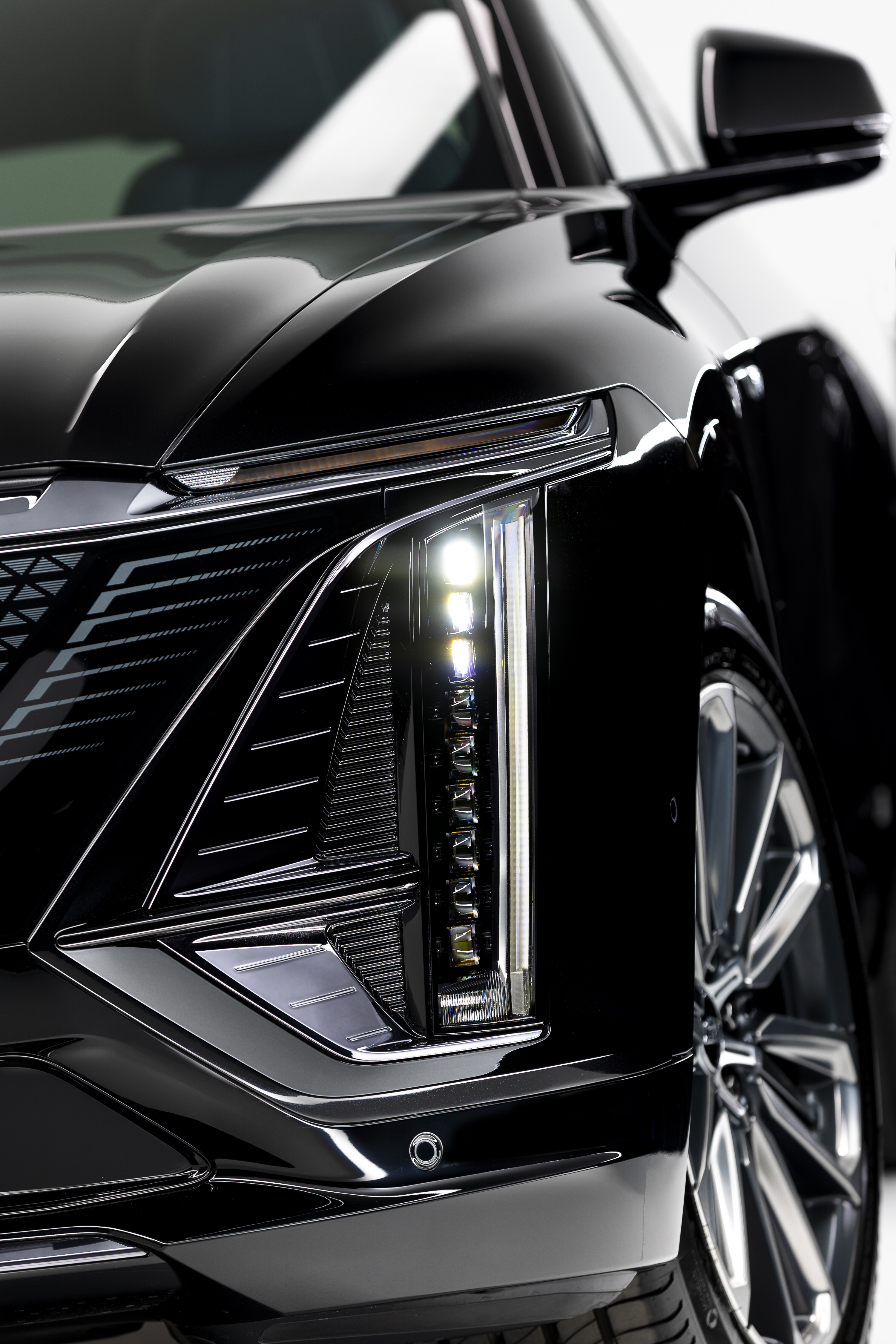
Time and again he refers back to Celestiq, Cadillac’s hand-built flagship electric sedan, which was unveiled in 2024 and which lends its design cues to the forthcoming range of Cadillac SUVs and crossovers.
1
If you do the right thing, people tend to forget what you’ve done in the past. It’s not something that happens overnight.
“A hand-built car in this day and age is a rarity and demonstrates that we had a moral compass and to tell customers that we were committed. The Celestiq represented a North Star. It’s not about selling lots of lots of product. It’s about saying something about the brand… It was a little piece of Celestiq in everything that we did. You can’t pull off something like Celestiq without having a rock-solid opinion about what the brand represents and how you would execute the design of the brand.”
“It is a rebirth. If you do the right thing, people tend to forget what you’ve done in the past. It’s not something that happens overnight.”
“There’s no mystery about where we are in battery development globally. The wheelbases are long and the tracks are wide in every segment because of battery chemistry. Everyone’s trying to get cost and mass down and that’s only going to happen when you pull the battery size. That’s coming.
1
“The current generation of products though, a C-segment is where D used to be. SUVs are a boon to mankind. It’s what we all want,” he chuckles sardonically. “If everyone’s sitting higher in vehicles, you’ve got to do it too. For those that can afford it though, there’s always a second car that isn’t an SUV.”
Simcoe explains how there could well be a return to more traditional bodies, largely brought about by the push for efficiency.
“Everybody is trying to do sedans or low vehicles. Part of that is obviously because they’re way better to look at and people enjoy driving them also but right now, think about 40 to 45 percent of a the efficiency of a battery powered vehicle is the aerodynamics. So if you’re pushing a brick through the air, it’s using up energy. Take a low vehicle, whether it’s a sedan or a low CUV, it’s a lot easier.”
1
On sedans, Simcoe notes that “we will certainly have a sedan in the portfolio at some point in the future.”
“Aero is a very understood black science. We have a lot of people who are very intelligent in that space. So we know what we have to do to make a vehicle perform. The Cd number, the mass, the total size of a vehicle, they’re all balanced against an outcome. For every vehicle we do in the EV space, we have an internal efficiency number which we apply and you dial up and down all the things that play into that to get the balance.”
This explains why the current Cadillac line-up retains what Simcoe describes as a “crease in the pants in places”, avoiding the amorphous blob shapes that afflict some competitors.
1
“You don’t have to have the most aero efficient vehicle in the market if you can dance against some other factors: a more efficient battery, lower mass , all that sort of things. Gas vehicles you can power through it [but with EVs] any drag is pushing back on range and efficiency.”
“Next time you’re passing an EV, lay on the ground and have a look underneath,” he says. “You’ll see what the commitment to aero efficiency is. Where companies would never have spent a lot of money in the past, there’s panelling, close-out panels, proper ducting of breathing in the front end, close-outs on suspension, a level of detail right throughout the car.”
When asked whether he feels that some of Cadillac’s premium rivals have dropped the ball when it comes to EV design, he chooses his words carefully.
“I think it’s clear that a lot of people have struggled with the notion of ‘do we design EVs or just design vehicles that are appropriate to the brand?’ I think you’ll also see that given the core cost of battery, some of the content, the features, the execution quality, it’s not been backed away from, but it’s not the same as it was, without naming a brand,” he explains.
2
“If you have a hard look at these vehicles, you’ll see that they’re not focusing on the same thing they used to.”
Simcoe touches on future projects for Cadillac, explaining that Celestiq is not in the plans for Australia (“social [media] has taken care of Celestiq. You don’t need that word of mouth any more”). A pickup draws a hard no: “that would be a waste of an entry [into market]” and laughs when asked about the V Series Opulent Velocity.
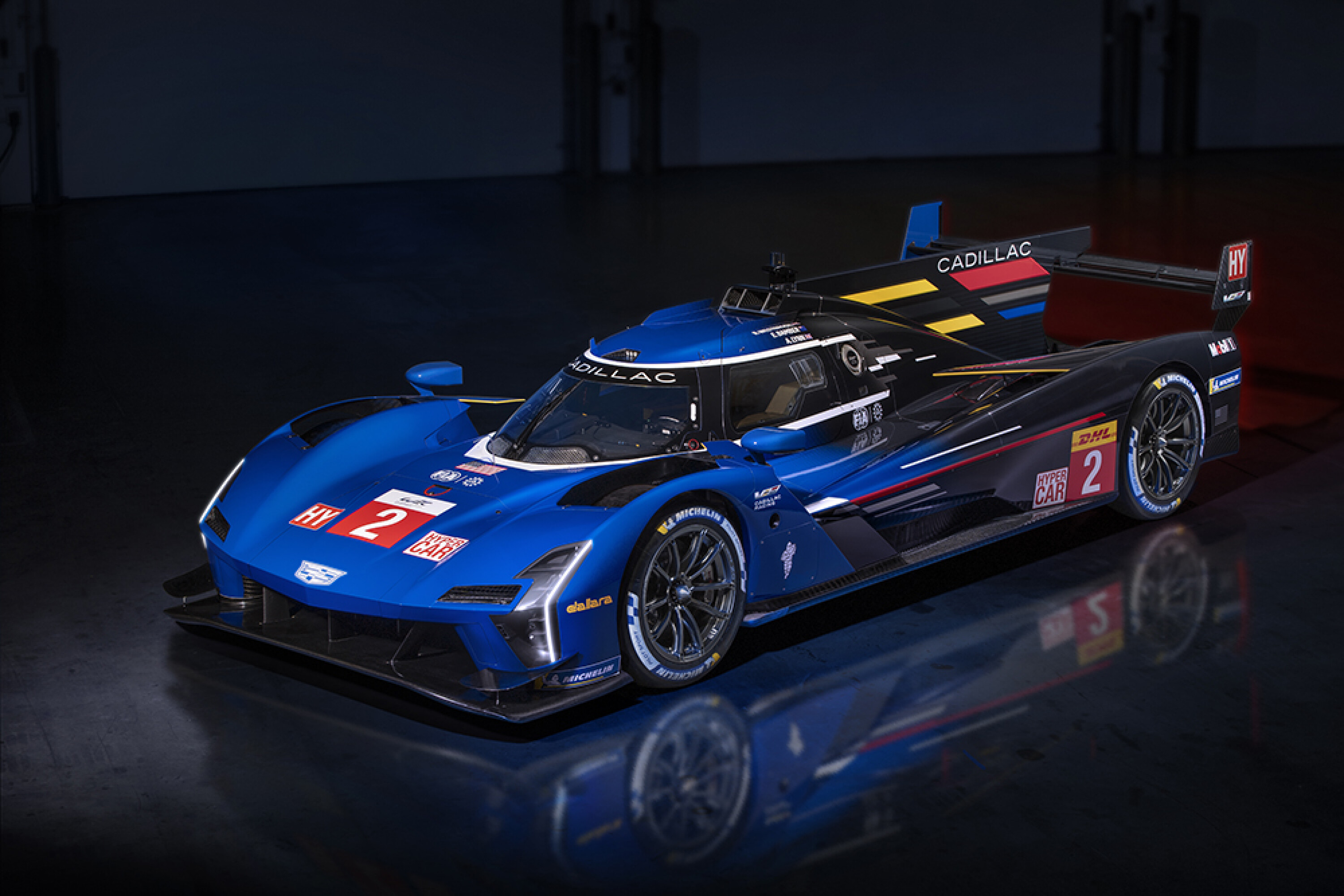
“It’s a secret, isn’t it?”, despite Cadillac having put out a teaser about the vehicle. “It would be silly of us to ignore that part of Cadillac’s brand value at the moment is performance,” he admits, citing the company’s motorsport ambitions.
1
He refuses to be drawn on whether the company is building a hypercar to tie in with its Andretti F1 and Le Mans Hypercar ventures.
“Could we build one? Yes. Would we like to? Yes. Are we building one? That’d be giving too much away.” He notes that “whether it’s ICE or EV, Cadillac is committed to performance. Otherwise we wouldn’t be having the conversation around Formula 1 and we wouldn’t have branded it in the way that we have.”
Would they bring the hypercar to Australia?
His eyes crease. He’s clearly enjoying the game.
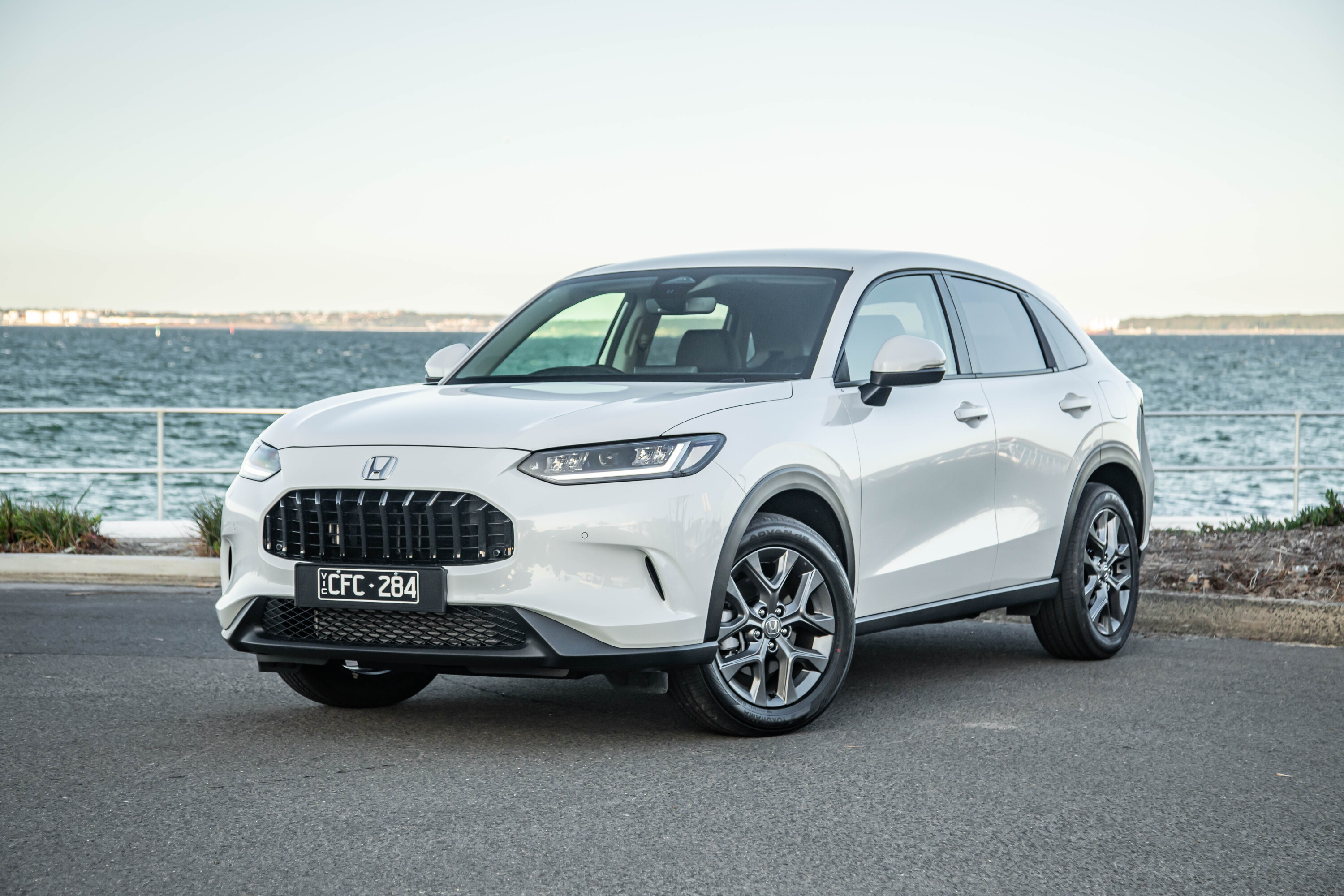
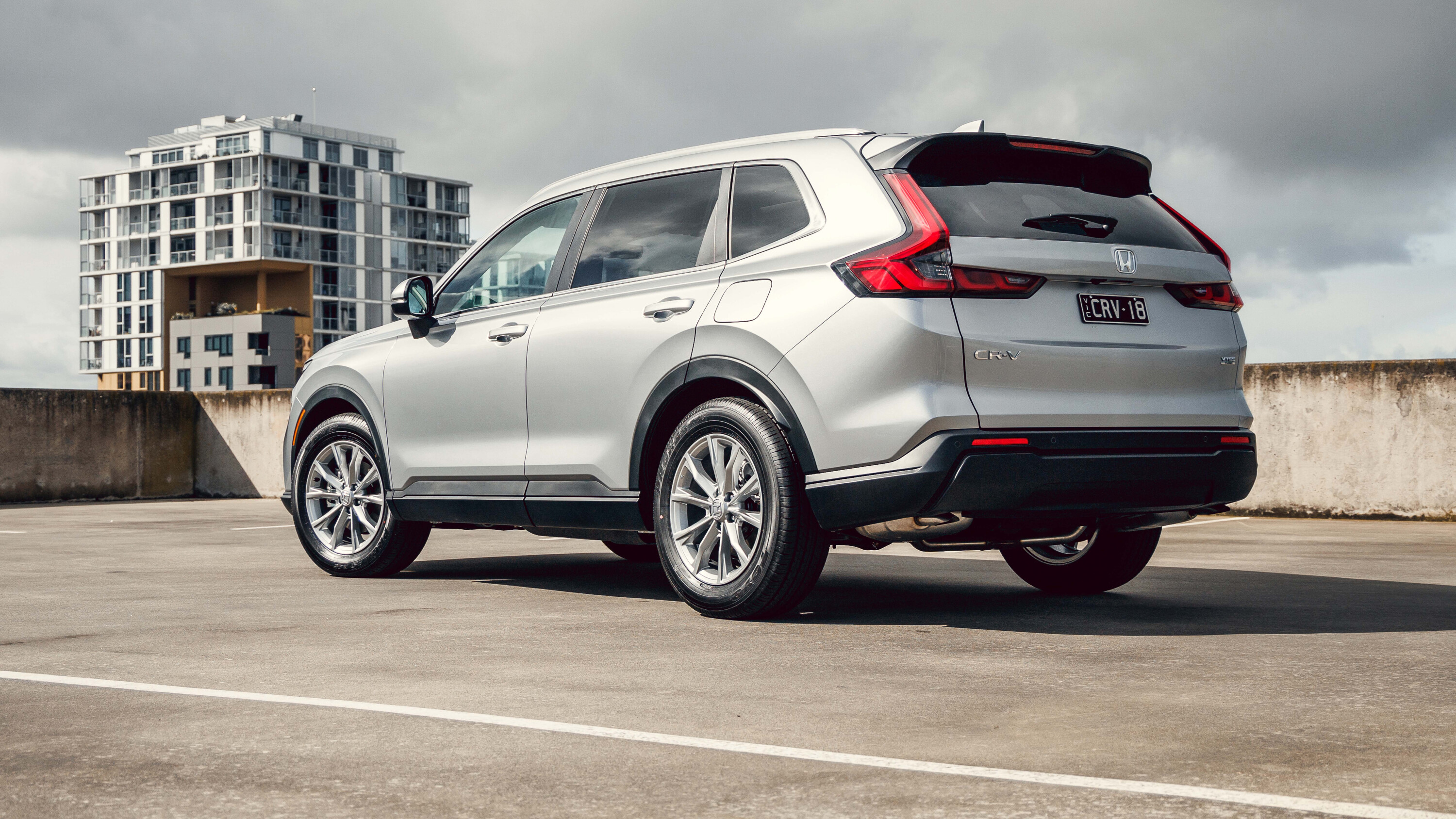
The 2024 Honda CR-V and 2024 Honda ZR-V have improved safety with blind-spot monitoring and rear cross-traffic alert added to all variants.
Honda Australia has confirmed it will open customer orders later this week for new ‘Plus’ versions of the entry-level CR-V VTi X, ZR-V VTi X and ZR-V VTi L, which will add a radar sensor to enable these features.
“We are excited to be adding new ‘Plus’ models across the Honda ZR-V and CR-V range. These new grades will be available for customer orders from later this week,” said a Honda Australia spokesperson.
The 2024 Honda CR-V VTi X+ will be priced from $44,700 drive-away – up $800 over the VTi X without blind-spot monitoring and rear cross-traffic alert.
Blind-spot monitoring and rear cross-traffic alert were already standard on all other CR-V variants – including the seven-seat version of the VTi X, the $46,800 drive-away VTi X7.
1
Meanwhile, the ZR-V VTi X+ will be priced from $39,900 drive-away – up $400 over the VTi X – and the mid-spec VTi L+ also receives a $400 price rise to $42,900 drive-away.
There are no equipment or pricing changes for the top-of-the-range ZR-V VTi LX turbo-petrol or ZR-V E:HEV LX hybrid variants.
A hybrid version of current 2024 Honda CR-V is limited to the front-wheel-drive E:HEV RS, which is positioned as a flagship variant at $59,900 drive-away, while the ZR-V hybrid is restricted to the E:HEV LX for $54,900 drive-away.
UPDATE: Toyota goes 100% hybrid on popular cars and SUVs in Australia
2024 Toyota Corolla Cross becomes next model to go hybrid-only
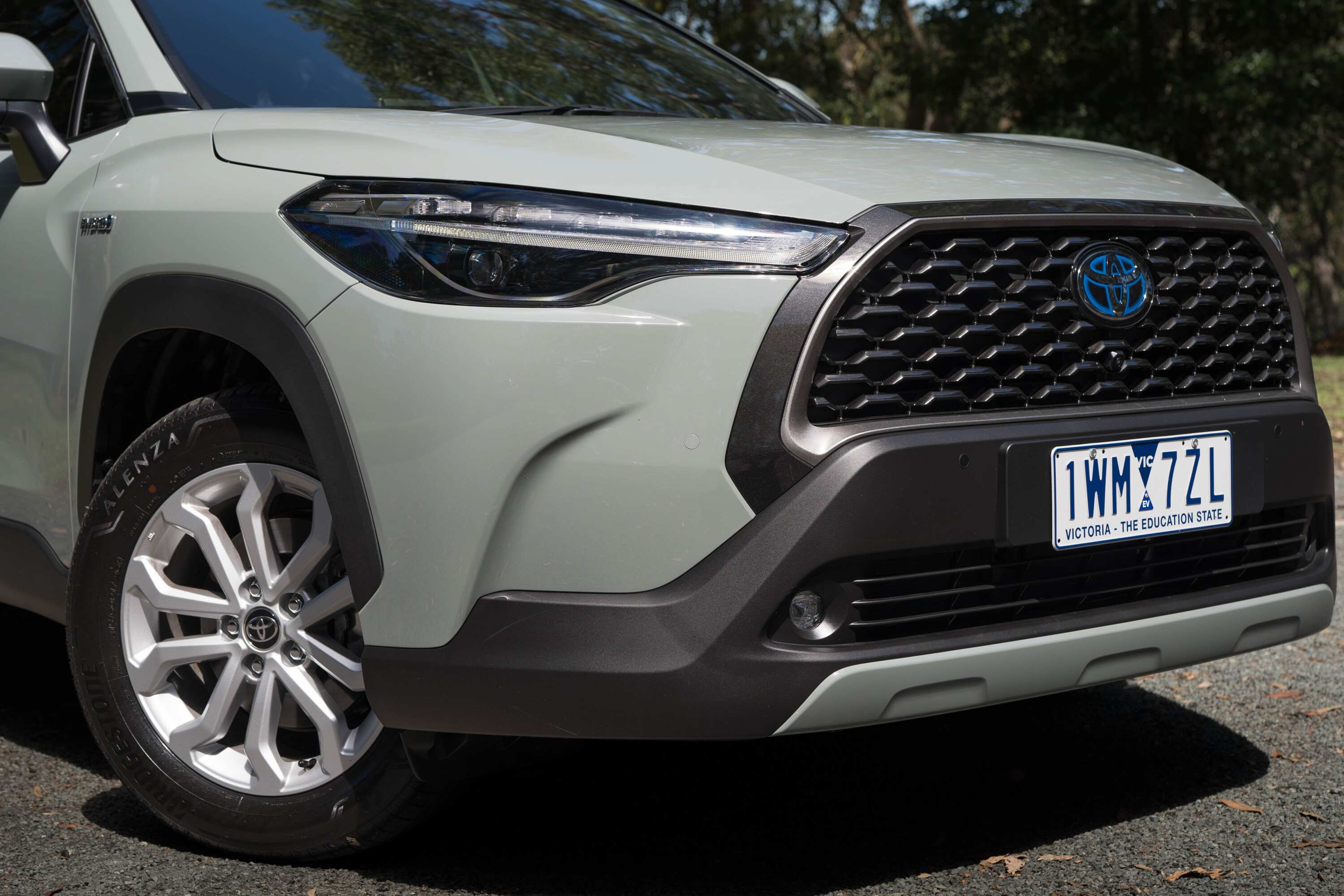
The 2024 Toyota Corolla Cross small SUV is expected to go hybrid-only in Australia.
Toyota Australia has removed petrol-only versions of the Corolla Cross from a new version of its specification list, which includes “Petrol Deletion Update” in the document title.
Wheels has contacted Toyota Australia for comment.
It will become the sixth Toyota vehicle to shift to a hybrid-only line-up in Australia since late 2023, following the Yaris and Corolla hatches, the smaller Yaris Cross, and new-generation versions of the Camry and C-HR.
Between January and March 2024, Toyota Australia delivered 24,722 hybrid vehicles out of 56,238 in total – a record-high 44 per cent share in the first quarter of a year – with the Corolla Cross, RAV4, Kluger, Corolla and Camry achieving first-quarter hybrid sales records.
The Corolla Cross will now be exclusively available with a 146kW 2.0-litre petrol-electric hybrid, which can be had in front- or all-wheel-drive and is paired to an electronic continuously variable automatic transmission.
Combined fuel consumption for the Corolla Cross Hybrid is rated between 4.3L/100km and 4.4L/100km – compared to 6.0L/100km for the petrol model.
Prices for the 2024 Toyota Corolla Cross now start at $36,480 before on-road costs for the GX Hybrid FWD – a $2500 increase over the previous entry point for the petrol GX – and rise to $50,030 plus on-roads for the Atmos Hybrid AWD.
The cheapest non-hybrid Toyota SUV is now the $39,760 before on-road costs RAV4 GX petrol. A new-generation RAV4 is expected to debut in 2025 and could become the next hybrid-only Toyota vehicle.
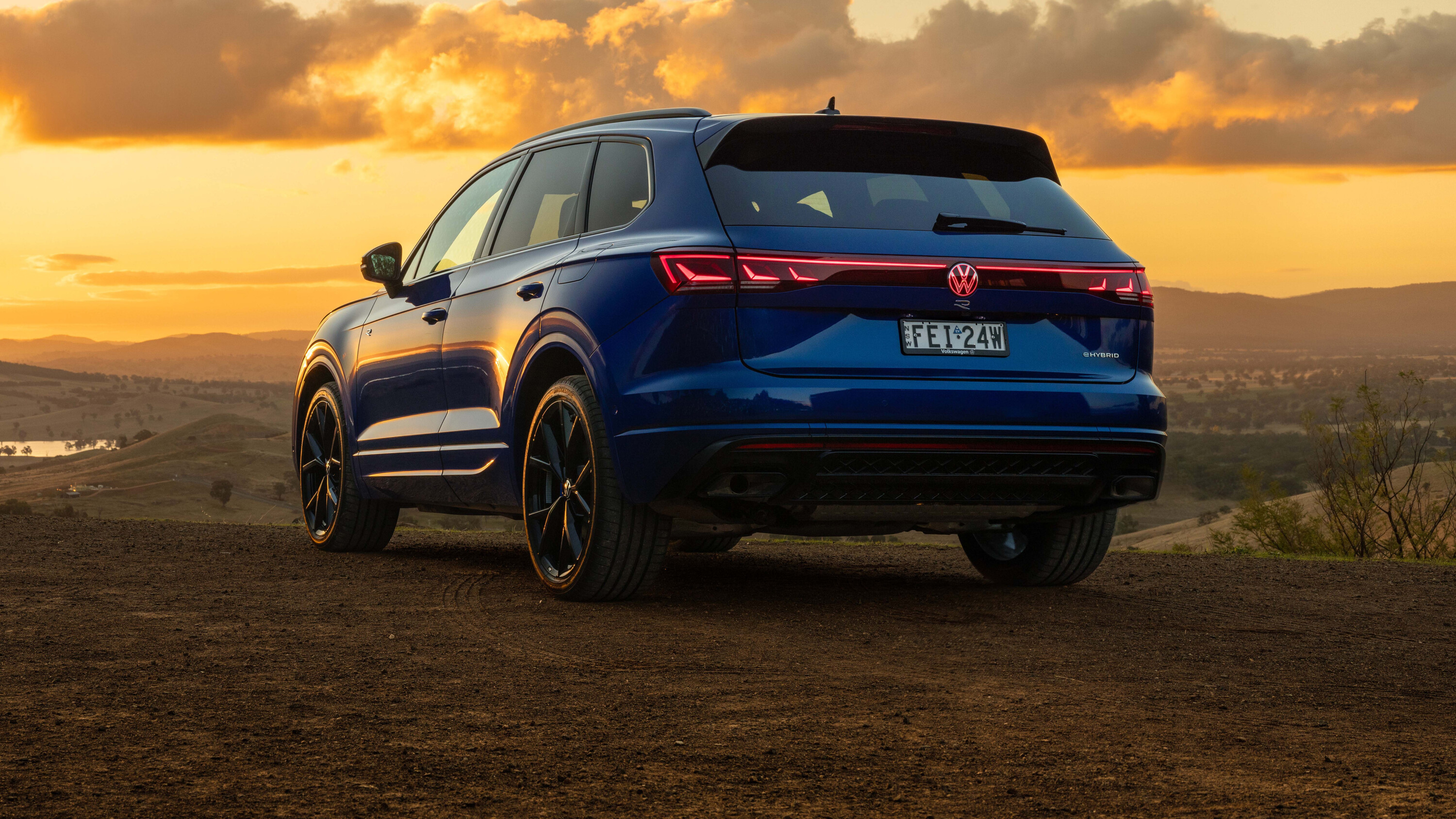
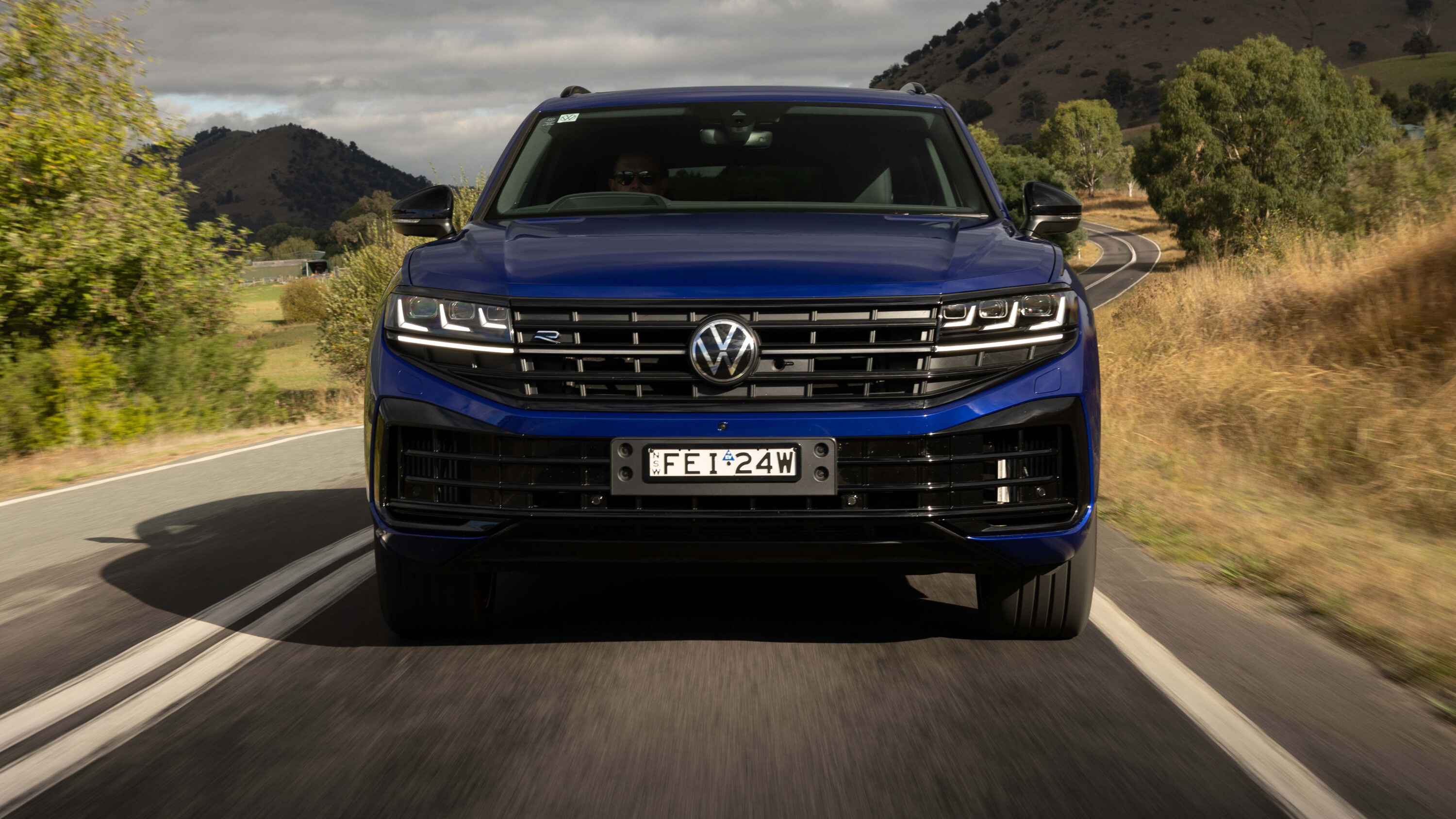
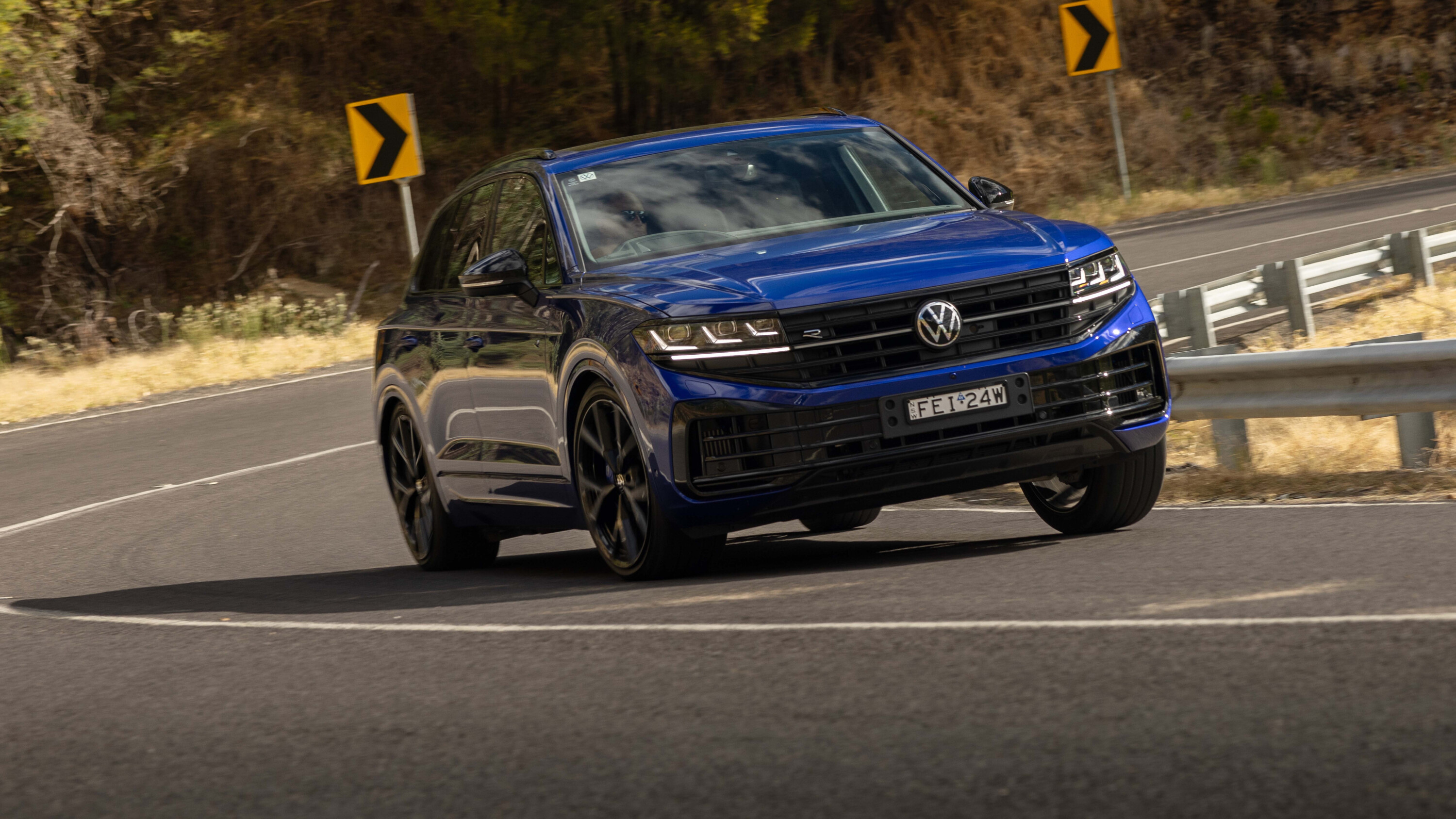
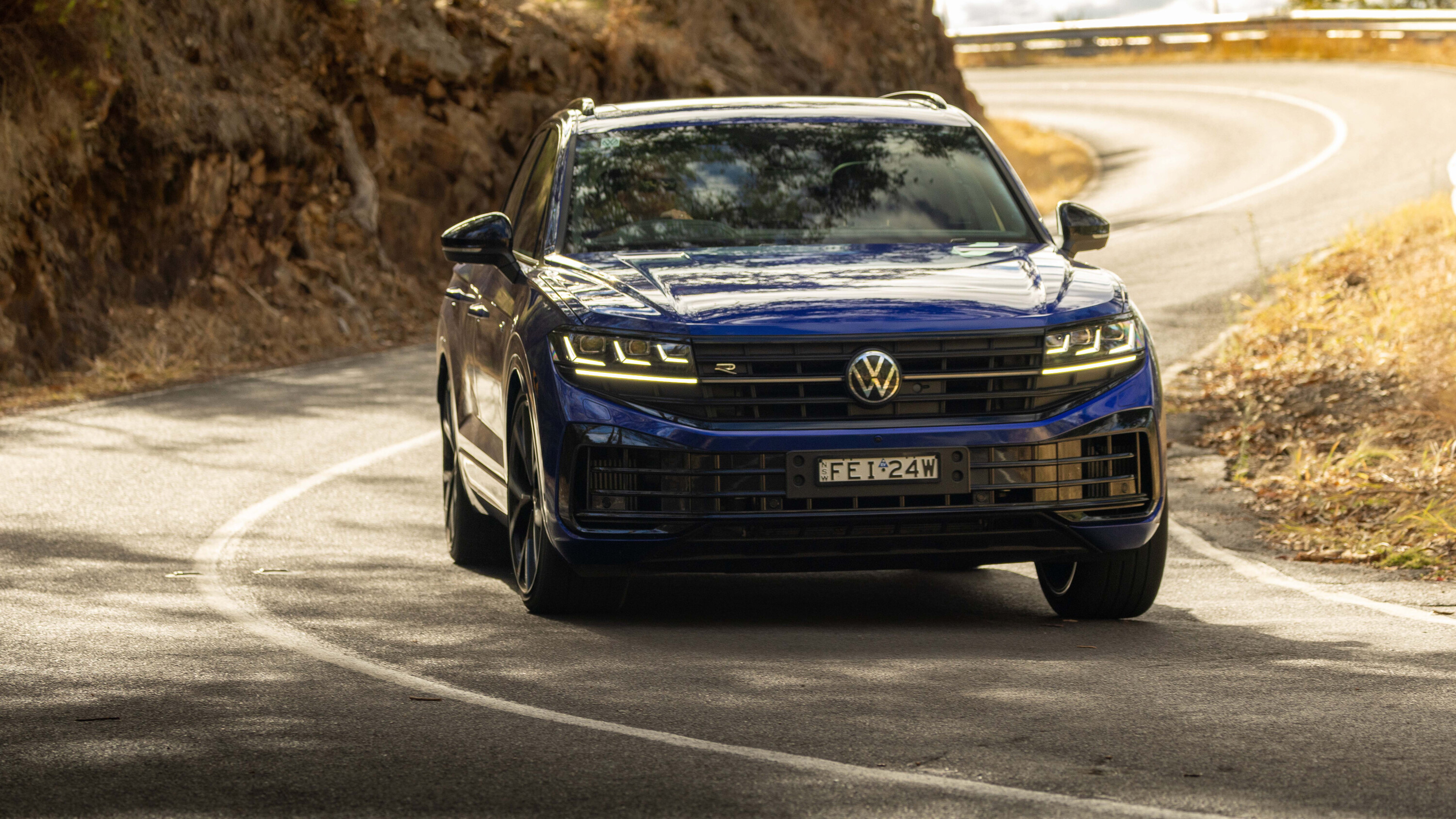
I haven’t even put it in Sport mode yet and my palms are sweating as I attempt to pivot this 2433kg luxury SUV through corners at a pace that seems, frankly, unrealistic.
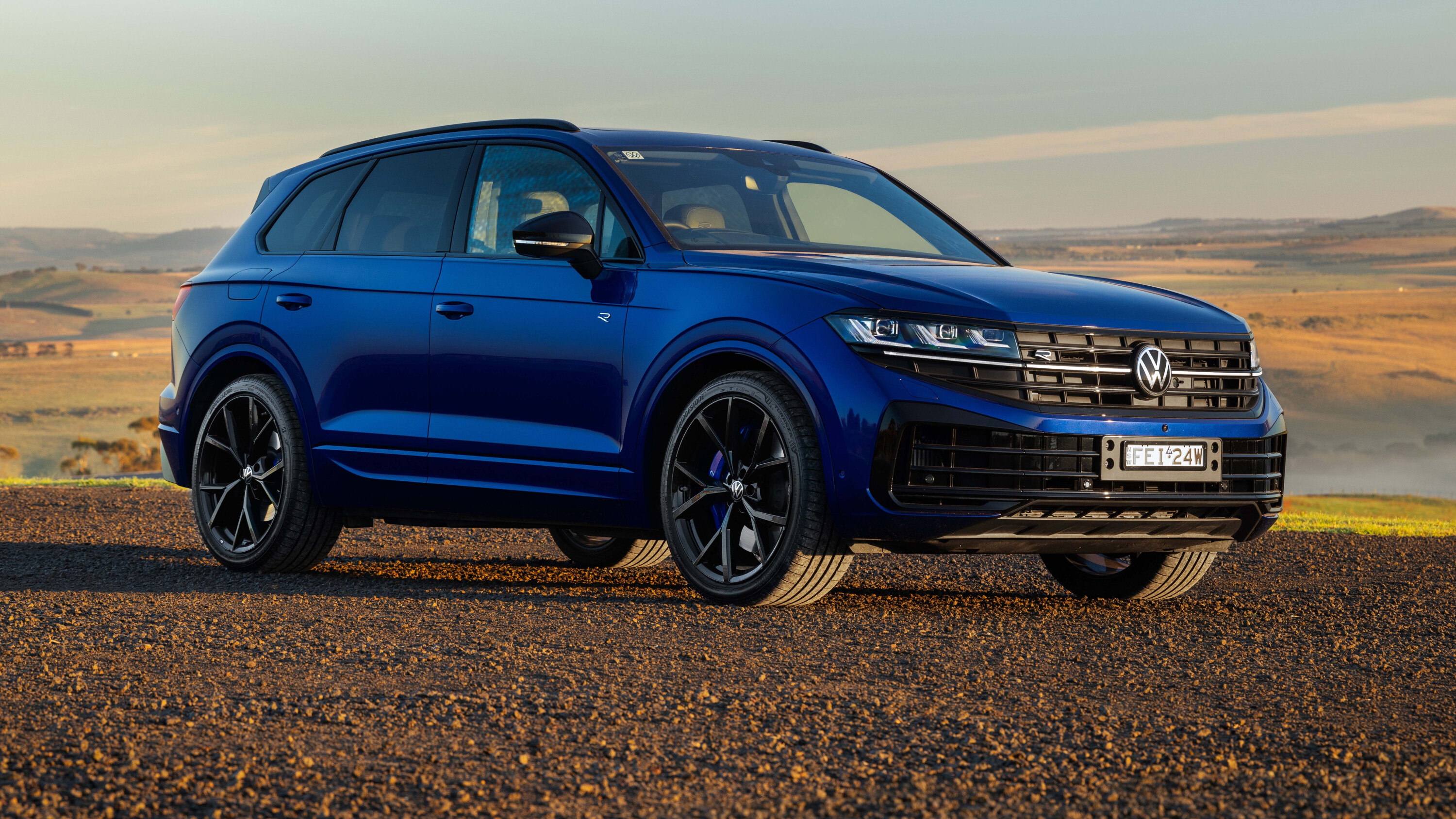
A sequence of esses with a s-s-s-heer drop on one side urges me to remain calm, but I cannot fight the fact that the new Volkswagen Touareg R is seriously egging me on. ‘
But why are my hands so hot?
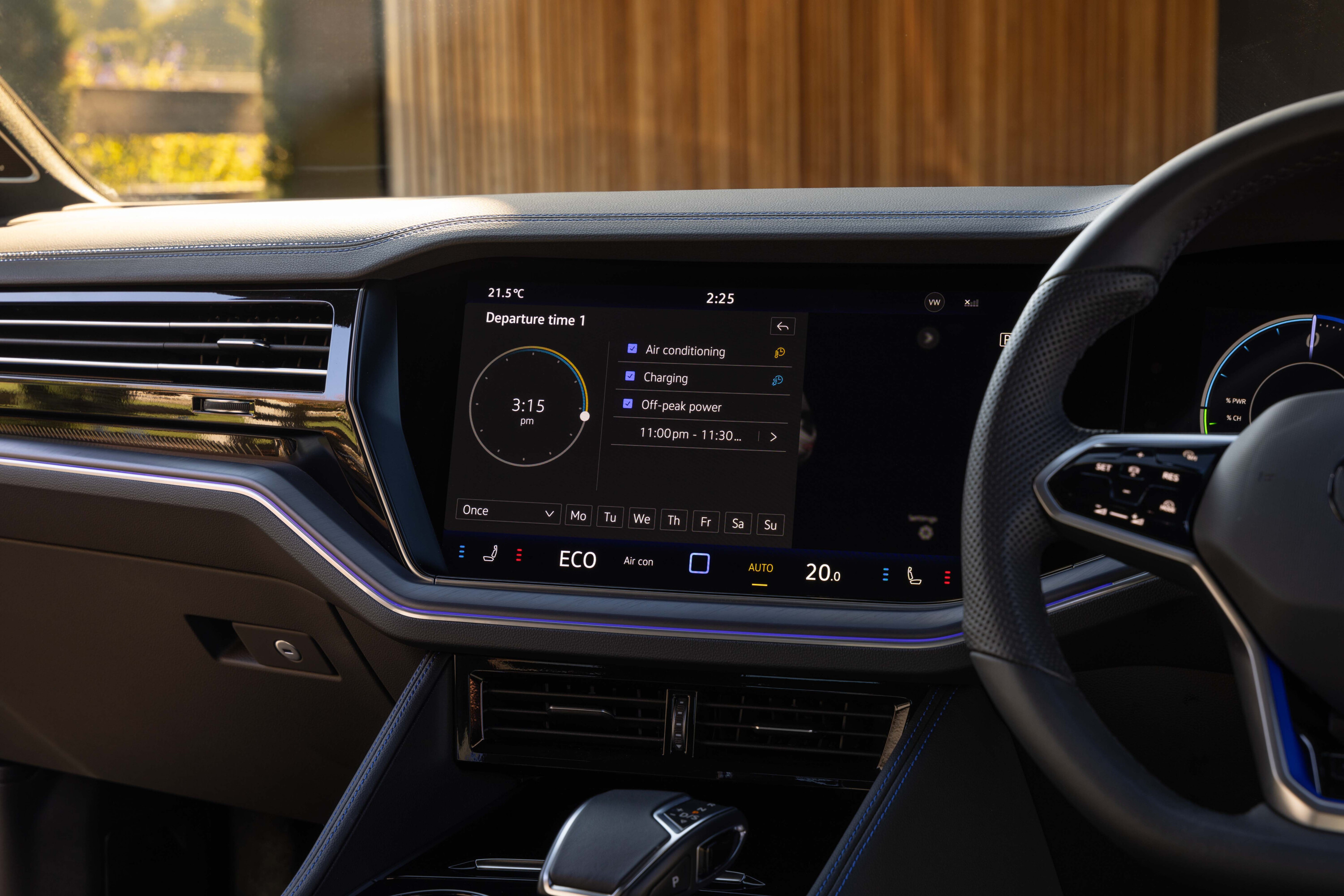
Oh. I’ve bumped the steering wheel heating button again. It’s one of those haptic controls that VW has since moved to dump – but it’s still on this car.
1
I switch it off and hang on for more as I punch the Drive Mode button – Sport – and engage the 3.0-litre turbo-petrol V6 and 100kW/400Nm electric motor to help make this drive even more memorable.
Suddenly my surroundings are blurrier, my right foot requires more thoughtful pressure on the throttle, and the eight-speed auto keenly hangs on to gears as the powertrain switches from Madonna to Marilyn Manson. All hell has broken loose.
The drive almost turns forgettable when I approach a sharp bend with a touch too much pace. “Shiiiit!” I exclaim, as I push hard on the brake pedal, which suffers from airiness at the top of the action due to its regenerative braking system. It made it feel like maybe I wouldn’t actually get this thing pulled up in time.
1
But I do, car and underpants intact, and power out of the bend with what feels like supernatural, physics-denying acceleration for an SUV that would be as at home in Neutral Bay as it would the Nürburgring.
It isn’t loud – there’s barely any audible drama to it at all, in fact – and for a traditional R buyer that might mean it won’t pass muster.
But it’s almost silent because it’s a Jack of All Trades kind of SUV, with a sedate manner in many situations, but a balls-out-blaster if you really want that kind of action, too.
Its balance is insanely good, with a controlled tractability as I dart between corners, wondering if this brilliant stretch of road will ever end.
1
The 4Motion on-demand all-wheel-drive system sends the power down to the tarmac, with 22-inch rims lacquered with Bridgestone Turanza T005 rubber in 285/35 spec doing their best to keep the performance of this car – which feels like a big heavy hot-hatch in some ways – under wraps.
A few minutes later, the curling mess of corners starts to unwind, and a lower altitude, less stressful section of straightaways beckons me to explore the potential of the Touareg R’s powertrain… but the digital speed sign display system reminds me that might not be the best idea.
The mountain drive chosen by a former Wheels staffer is exactly what you’d hope for on a Porsche drive day – a point driven home as I pass a 911 GT3 RS after the descent.
1
Rewind 24 hours, and I’m monitoring the digital instruments and ready to get my hypermiler geek on.
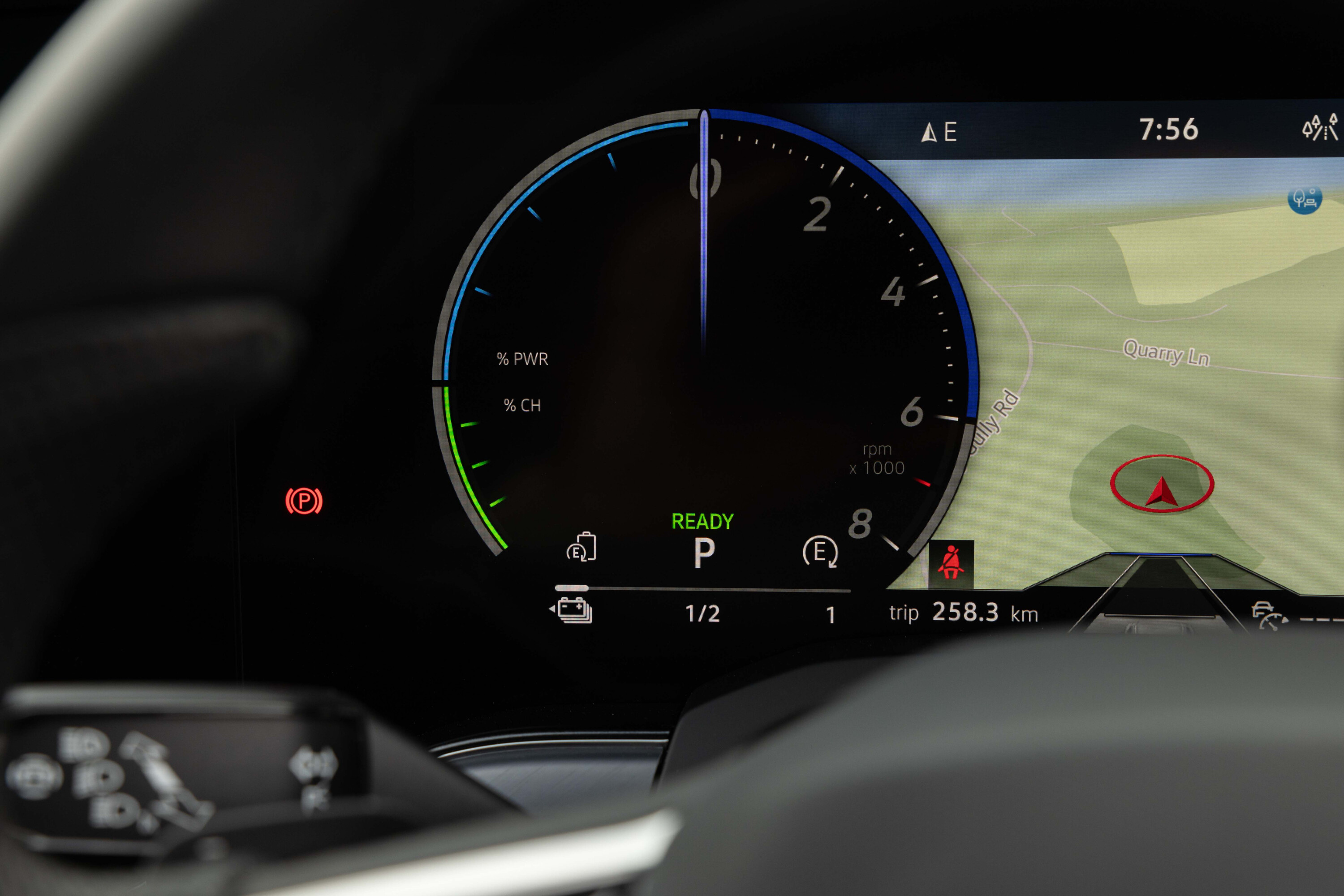
Battery fully charged, 53km of EV range indicated, and it’s time to select E-Mode to see how much this 17.9kWh (gross) lithium-ion battery pack is capable of.
A jaunt from Essendon Fields into South Melbourne on the Tulla should sort out what’s realistic and what isn’t, and while we all know EVs aren’t designed for highway driving, it’s the sort of commute that a buyer might actually do.
It lopes along the motorway in Comfort mode, the air suspension doing a brilliant job of cosseting me over road joins and the occasional scrappy surface change. Once down on street level that suspension really shines, with speed humps ironed out expertly, and the city-friendly steering tune making urban moves easy work – even when the screen freezes and my Google Maps gets stuck like a screen grab. Not ideal.
1
Even so, after a quick coffee stop, I get back in and wind through some back streets (no more smartphone mirroring issues), eagerly monitoring the EV range indicator and aiming not to press too hard on the throttle, so as to overrule the electric drive and engage the petrol engine. If you do, it will re-engage Hybrid mode.
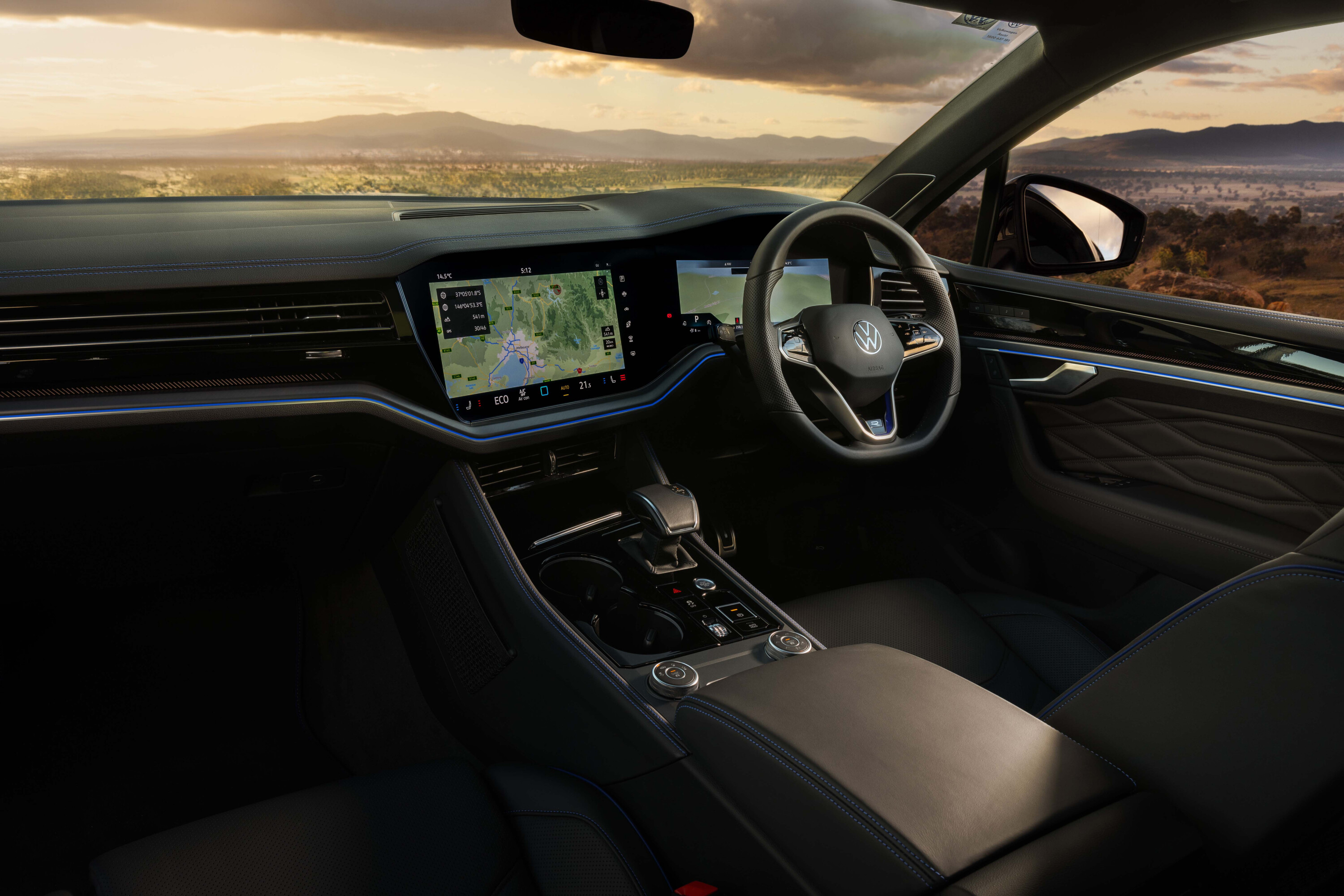
I glance between the 15.0-inch touchscreen and the 12.0-inch driver info screen to see if I’m going to make it to the destination with range remaining or not, mildly annoyed that there isn’t a simpler way to adjust the temperature settings – there’s a touch-bar at the bottom of the screen, and I fear I’m using more energy than I should because, well, it’s Melbourne in May, and the temp is set to 23 (and yes, of course my bum heater is on).
Just 1.4 kilometres shy of our destination, and with 43km of EV driving completed at a displayed rate of 31.2kWh per 100km, and with an average speed of 29km/h, the battery is depleted.
1
I run the final bit using hybrid mode, which still dips back into the battery pack if the regen brakes help replenish it, and the petrol engine also acts like a generator if you want to top up the battery.
The big thing with PHEVs like this is that while the sticker might have a dramatically low official combined cycle number – 3.3L/100km in this instance – chances are that you’re never going to achieve it beyond the first hundred kays, as the petrol engine simply has to work harder once the battery is depleted.
And while I’m sure the diligent buyer would consider their commute distance, whether they can charge at work as well as at home (it has AC charging, maximum 7.2kW rate, and comes with a Mode 2 and Mode 3 cable included), if you don’t plug in and you do plan to drive it like an R model, you will see some pretty high figures.
1
After a huge 404km drive (including the first 43km in EV), the trip computer on this R PHEV was showing an average consumption of 11.3L/100km.
So, charge it up during the week, and charge for the hills for the weekend?
It’s also really practical, you see, even if it is ‘just’ a five-seater.
There are other SUVs in this space with seven seats, and as a dad, I get the appeal there. But ‘only’ having five seats is a great way of getting out of the Saturday Soccer Shuttle Service, at least if you play your cards right.
1
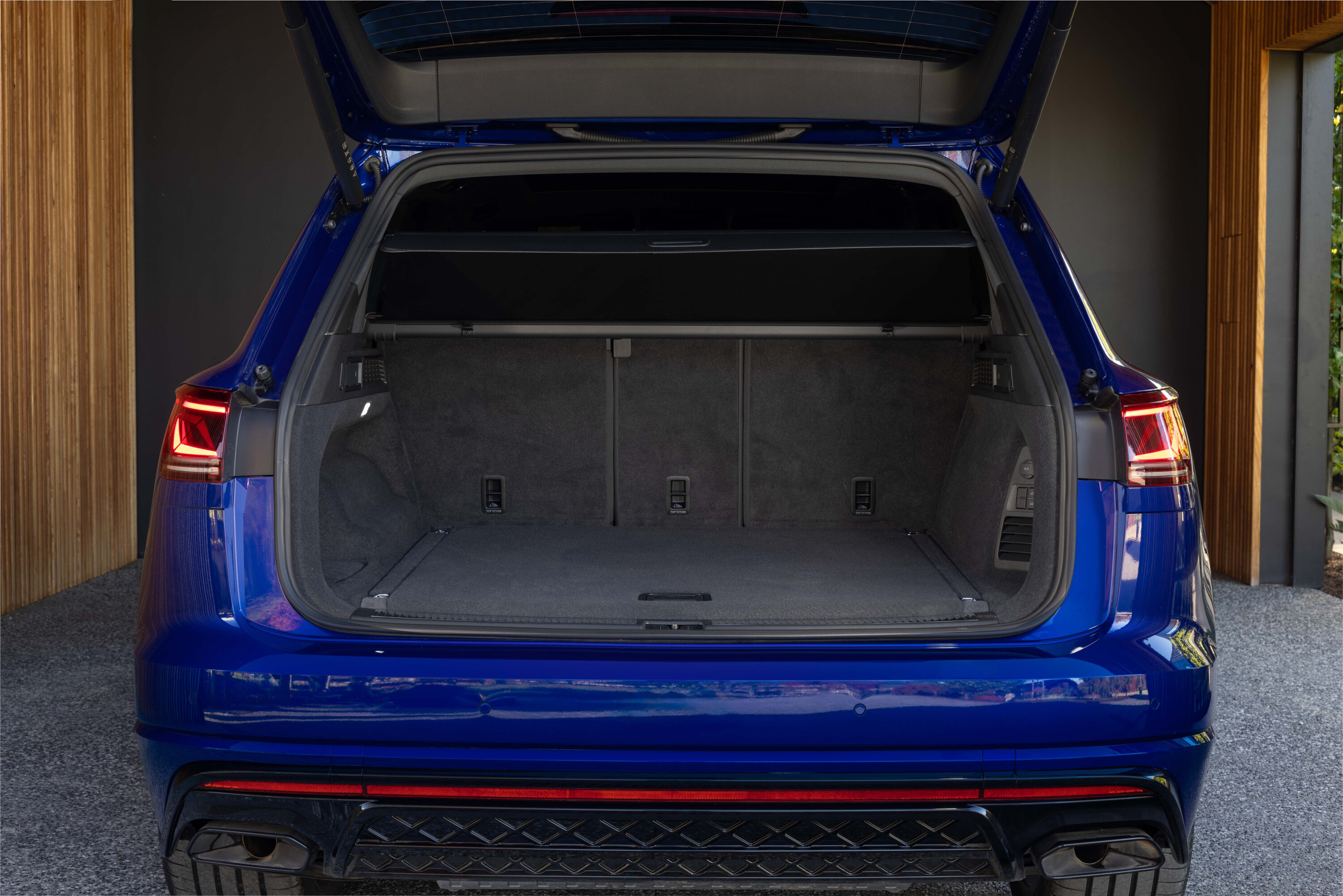
There’s a sizable boot – 810 litres with the seats up – meaning those weekend trips away could indeed turn into fortnight-long journeys for couples without kids. Those with anklebiters might only want a couple of nights away from the comfort zone, anyway.
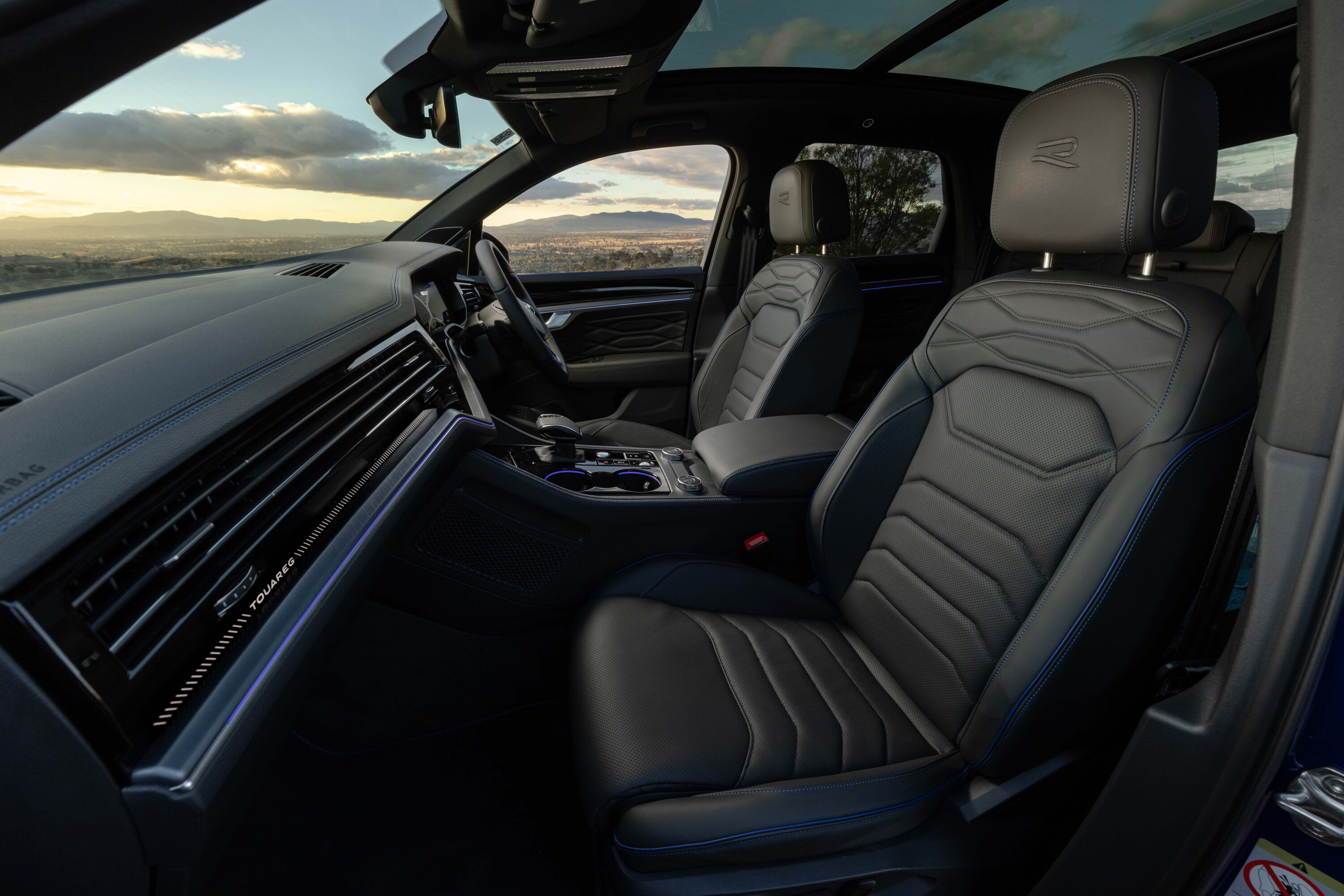
With lovely leather trim for the heated, cooled and massaging front seats, as well as ambient lighting, those aforementioned screens, and a thumping 14-speaker Dynaudio stereo, it’s a delightful space to spend time if you’re a front-seat rider.
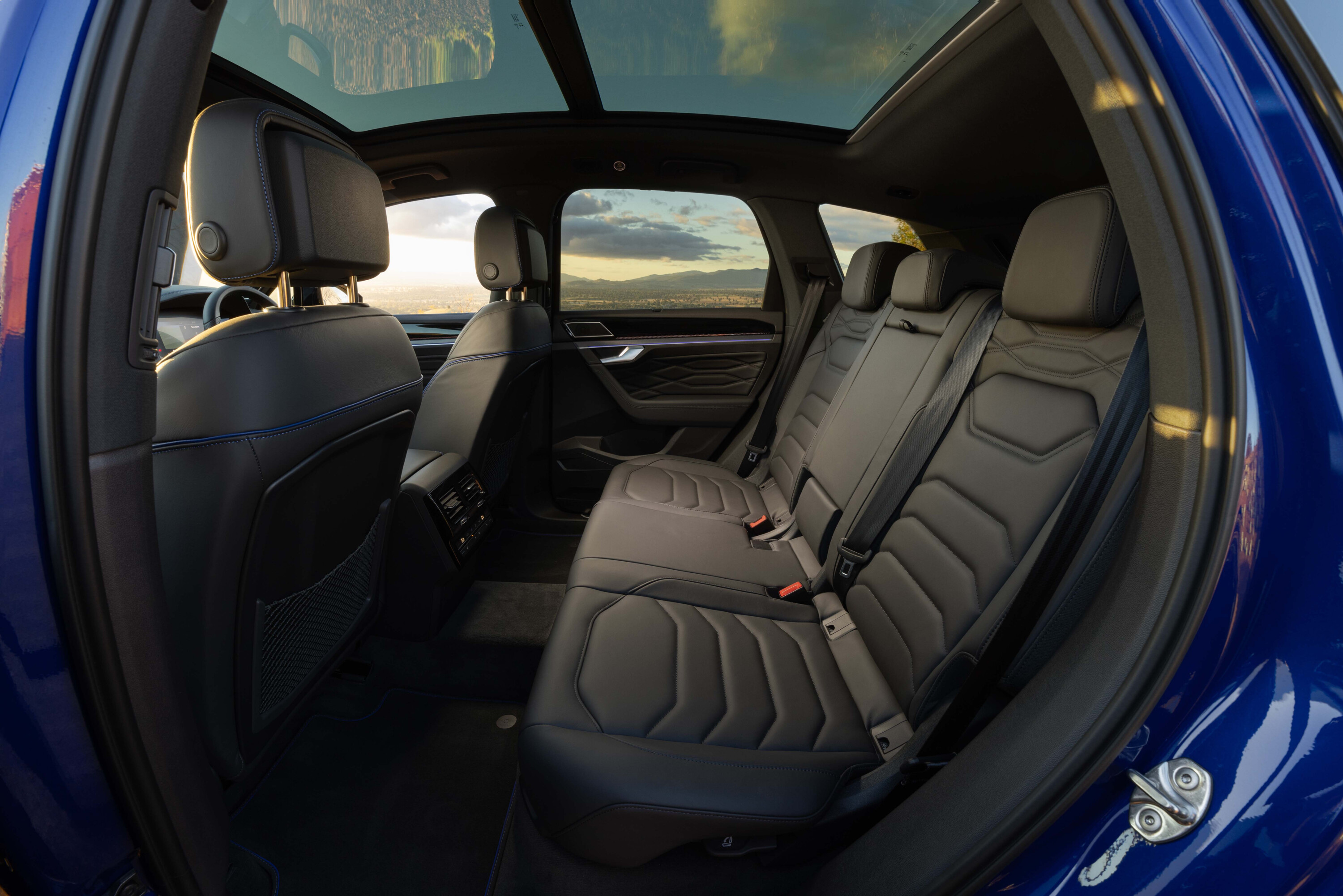
And back-seat bandits will appreciate the face- and knee-height directional air-vents, dual-zone rear climate control, and those outboard seats have heating, too. You can also slide the seats forward if you need more boot room, or back for more lounge-factor.
1
What else could you consider if you’re thinking about this SUV, then?
Well, at this price, no other high-rider has the plug-in hybrid, performance-focused thing as convincingly nailed.
More than double the budget and you could find your way into a Porsche Cayenne Turbo E-Hybrid, or you could settle for a more mindful ‘non-Turbo’ version at just under $155K. Not as well equipped, and not as powerful as this.
Or if you really are being told that you ‘need seven seats’ by someone in your life, then you could investigate the Volvo XC90 Recharge Ultimate Plug-In, at $128,990.
1
But while it might be the Ultimate seven-seater for those who need a big barge, the Ultimate in driving dynamics it certainly isn’t.
Honestly, if it were my tight-arse budget whispering in my ear, then a more affordable Touareg could be the most convincing option.
The $109,990 R-Line model with air suspension, stunning looking 21s, a thumping V6 diesel with 190kW/600Nm, and a brilliantly understated design could indeed make the most sense as an alternative.
1
But those who understand the benefits of a PHEV life are unlikely to entertain the notion that a diesel V6 – no matter how good it is – is going to suit their lifestyle. And for the commuter worried about clogging up their DPF because they never do distance, that’s actually a sensible thought.
That’s the thing with the Touareg R, you see – it has plug-in hybrid tech that allows it to be an EV when you want it to be, a hybrid for the rest of the time, and a monster on a mountain pass.
It’s a seriously hot luxury SUV. I bet your palms will be sweaty, too.
3.3 litres per 100km (official); 11.0 litres per 100km (on test)
Price (MSRP)
$129,990
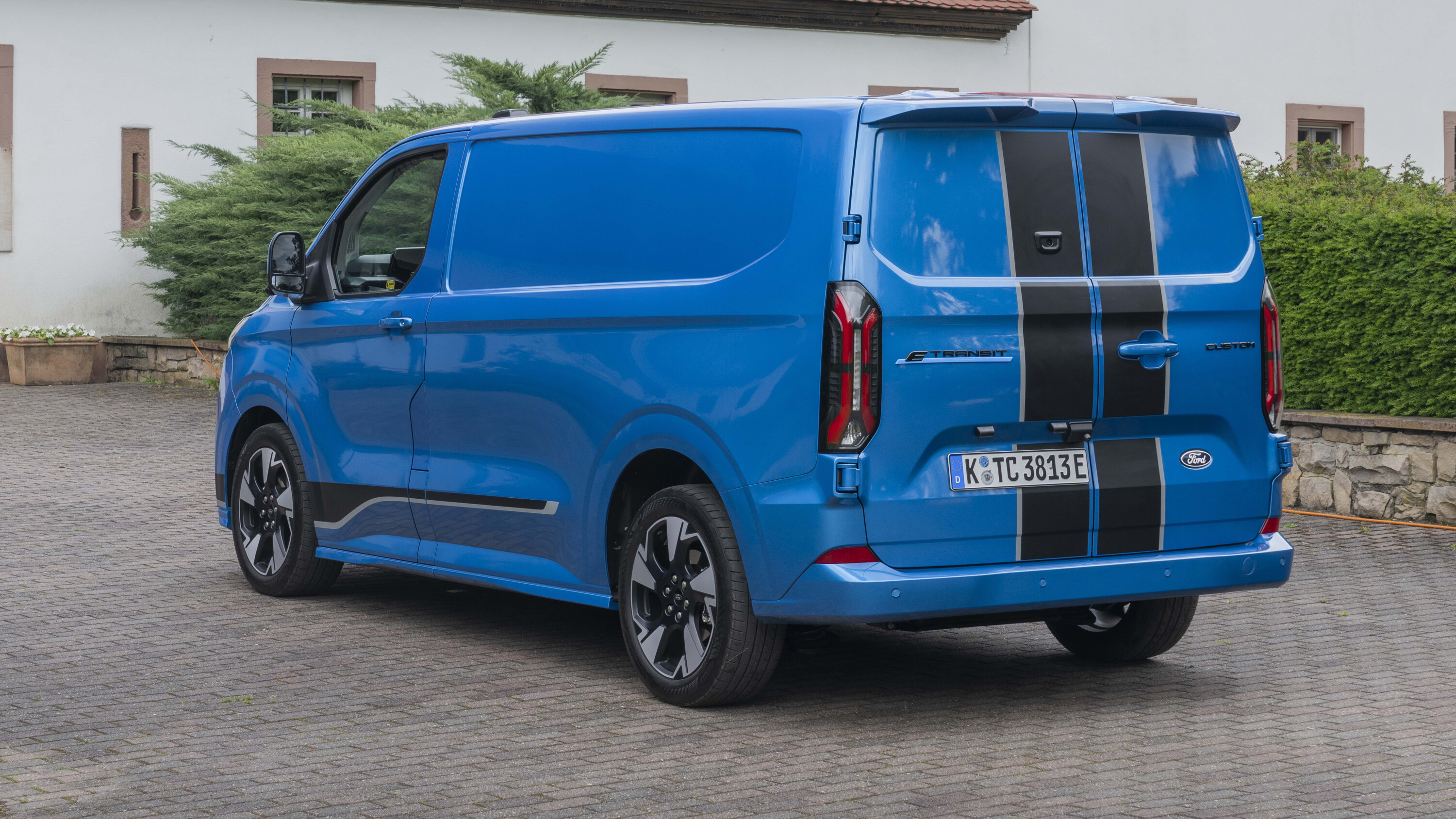
You need just one hand to count the number of midsize electric vans on offer in this country. In fact, you only need two fingers.
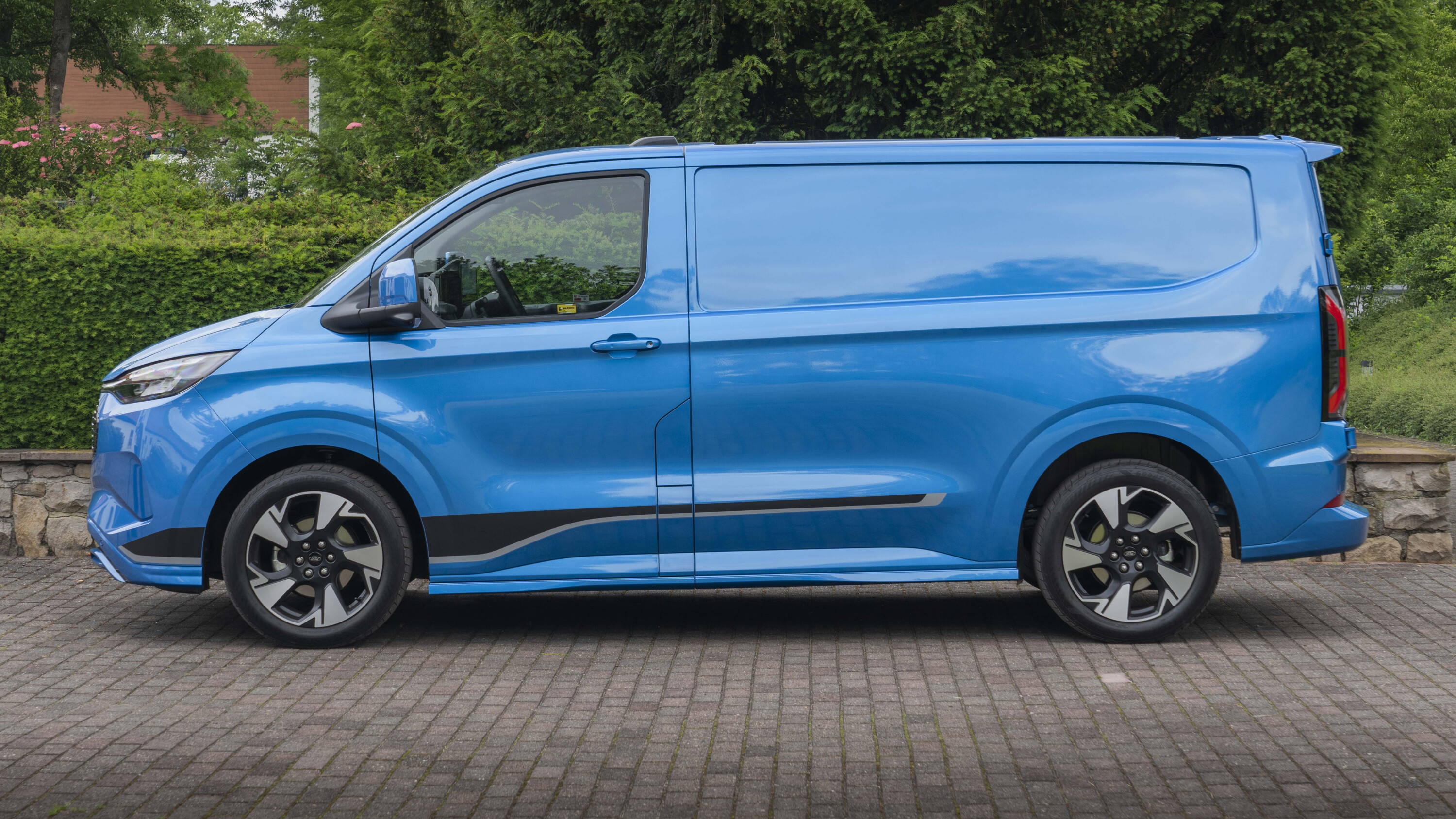
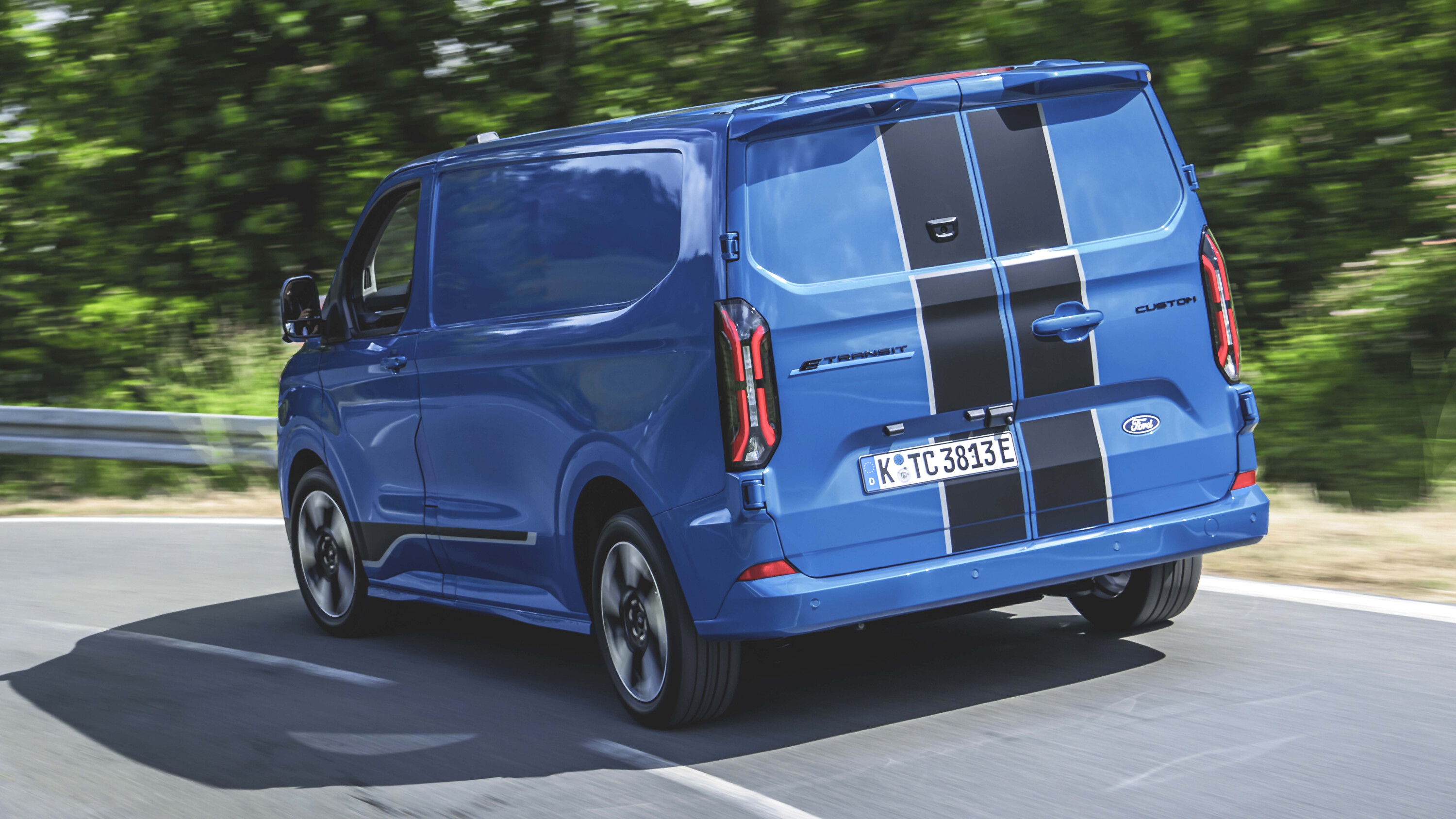
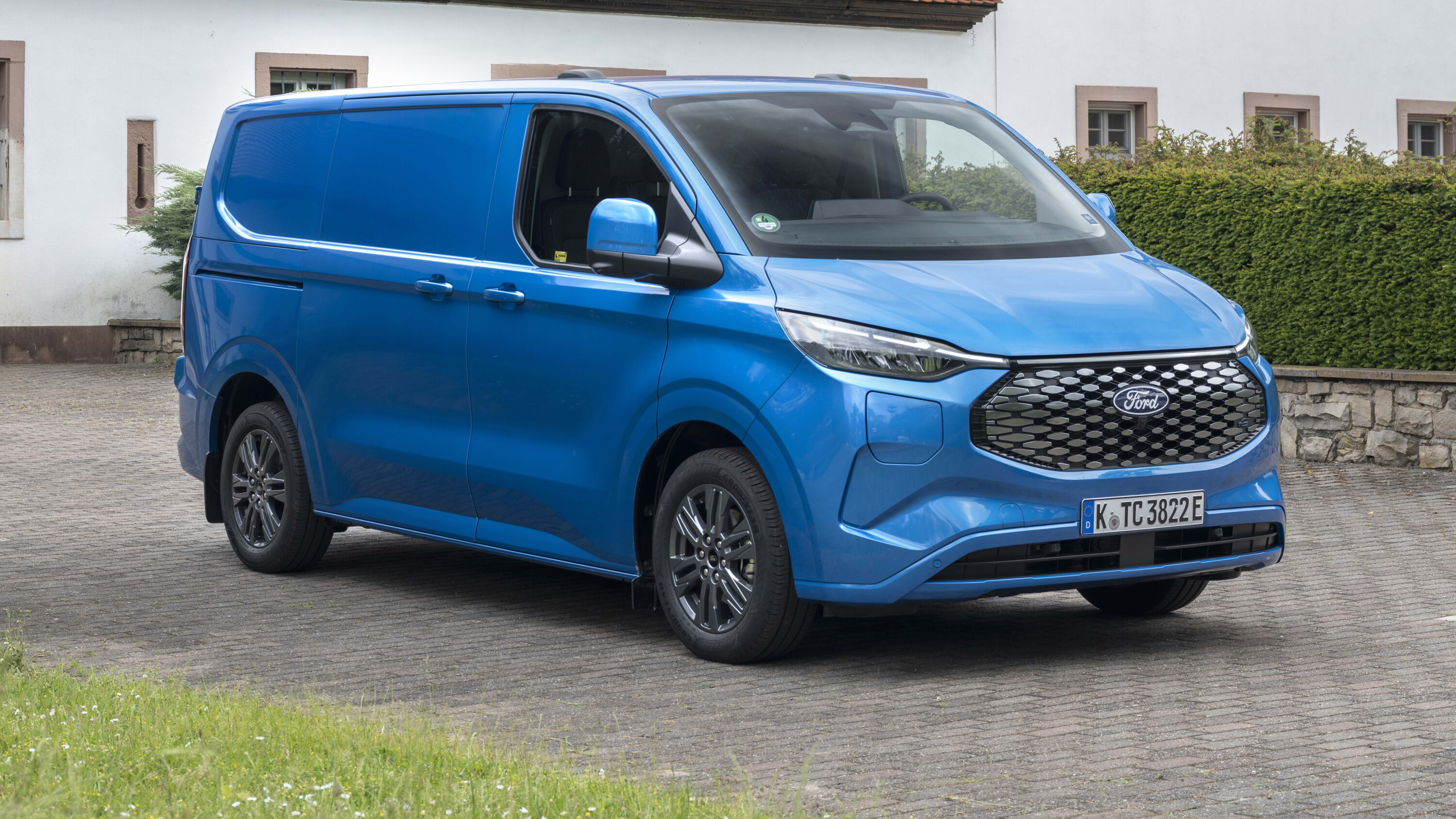
Right now, those looking for a Hiace-sized commercial van that runs on clean, green electrons, only have two vehicles to choose from: the LDV eDeliver 7 and the Mercedes-Benz eVito. Not exactly an abundance of choice, but by the end of this year Ford will attempt to break up this duopoly with its completely new, fresh-outta-the-oven E-Transit Custom.
It’s a promising thing. Regular diesel-powered Transit Customs are now rolling off the boat, and the base combustion-powered offering is already enticing enough: with a human-centric front cabin and a cargo-centric rear with plenty of productivity-multiplying features spread between them, the core ingredients appear to be right.
1
The E-Transit Custom aims to add an electric layer to all of that while introducing minimal penalties – and in some regards, some bona-fide advantages to going electric.
But first, let’s get one thing out of the way: we don’t know how much it’s going to cost in Australia just yet, or even its precise arrival date. Ford Australia is working on a “by the end of the year” timeline, which we interpret to mean the tail end of Q4, while pricing is an open-ended question at this point. Expect it to exist somewhere between the $62,990 diesel-powered Transit Custom Sport LWB and the aforementioned $90K E-Transit.
But let’s shift over to what we DO know.
1
Unlike a lot of electrified vans that began life as combustion-only, the Transit Custom’s box-fresh platform was designed from the outset to be able to accommodate an electric powertrain.
That means the floor height is the same as that of its diesel-engined siblings, there are no ungainly bulges to accommodate the battery pack or the motor, and no weirdly grafted-on charging ports. There’s one fundamental architectural difference though: a shift of the driven wheels from the combustion van’s FWD layout, to RWD.
Bolted directly to the chassis, the electric motor delivers 160kW to the rear wheels (we aren’t getting the Euro-spec 100kW variant, nor the sporty 210kW MSRT variant), with the rear suspension retaining the same independent trailing axle layout as all other Transit Custom variants.
1
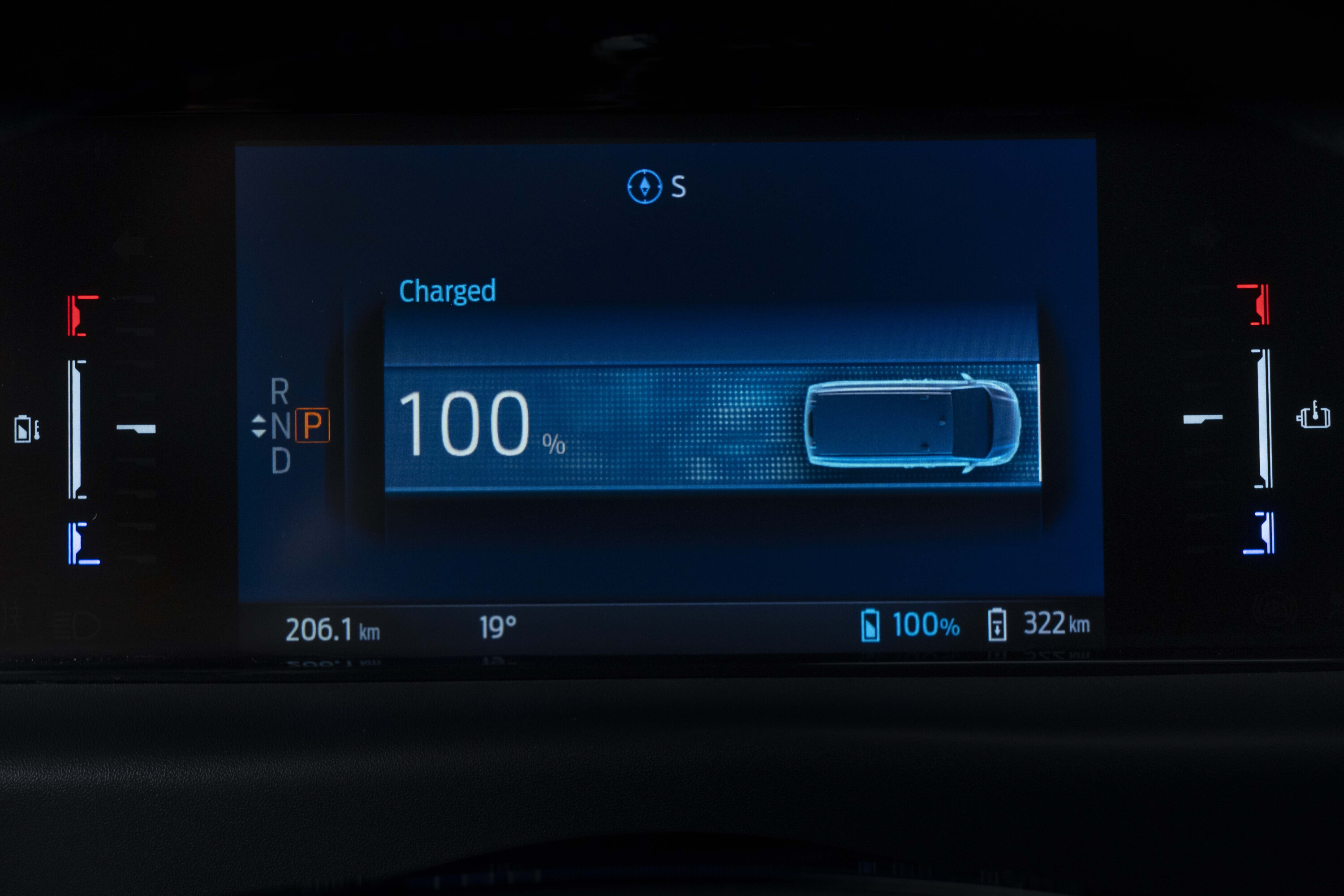
Peak torque is listed at 415Nm, and there’s only one battery available: a 64kW NMC (nickel manganese cobalt) unit that provides enough juice for 308km of range on the WLTP cycle.
Is there an LFP (lithium-iron phosphate) battery option, as with Mustang Mach-E? LFP chemistry is quickly finding favour in non-performance applications for its durability and energy density, but Ford’s execs told us that there are currently no plans to introduce an alternative battery pack to the E-Transit Custom just yet – though it wasn’t ruled out for the future.
There’s no vehicle-to-grid cleverness, but it can take up to 124kW on a DC fast-charger, going from 15 to 80 percent in 41 minutes and delivering a quick burst of 38km of range in just five minutes.
1
As for the all-important job credentials of Ford’s electric van, the E-Transit Custom has a solid resume.
All Australia-bound E-Transit Customs will get the long-wheelbase body as standard, which offers a cubic capacity of 6800 litres in the standard roof height, or 9000L with the high-roof option. Max payload is a healthy 962kg (though that’s almost 300kg under what its diesel-engined equivalent will tote), while towing capacity is a respectable 2300kg on a braked trailer – 800kg more than what its chief rival from LDV can legally pull.
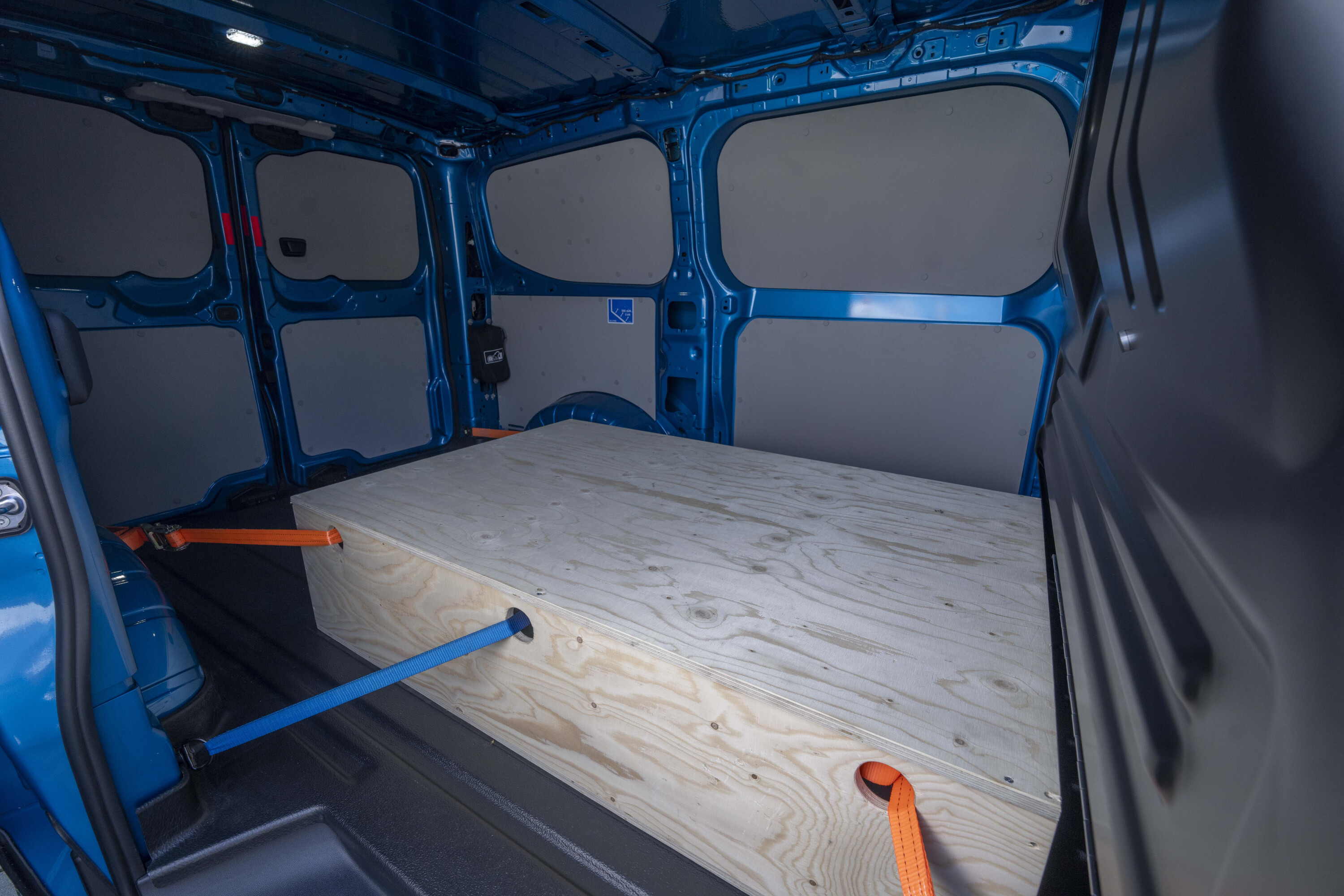
Six sturdy tie-down points are fixed to the E-Transit Custom’s thick steel floor, and a steel bulkhead also features a trapdoor pass-through for especially long cargo to be carried under the passenger seats.
1
The E-Transit Custom also sports a handy side-benefit of its electrification in the form of the Pro Power kit, which provides two household power outlets and the ability to offload up to 2300W of energy to charge up tools and run appliances.
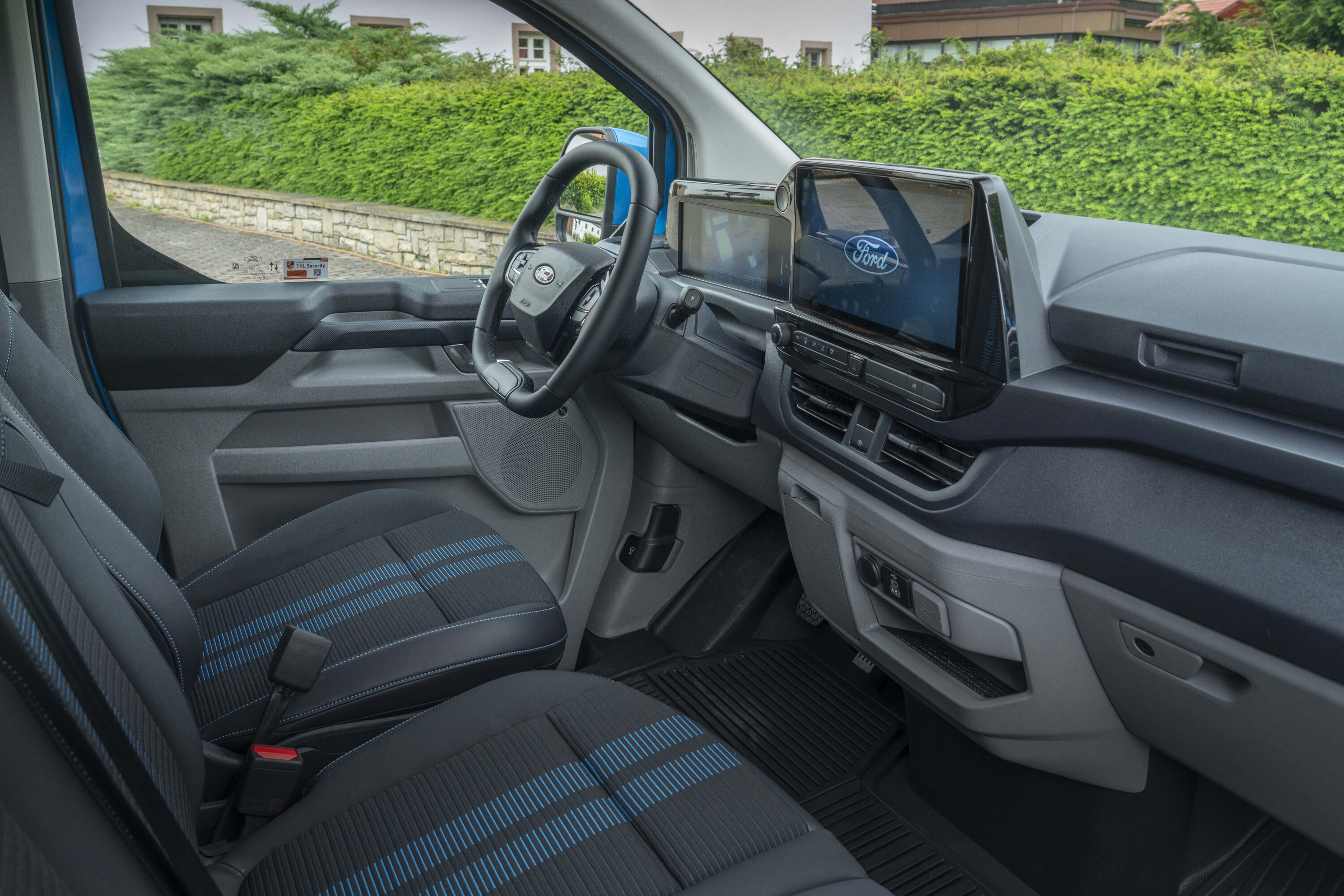
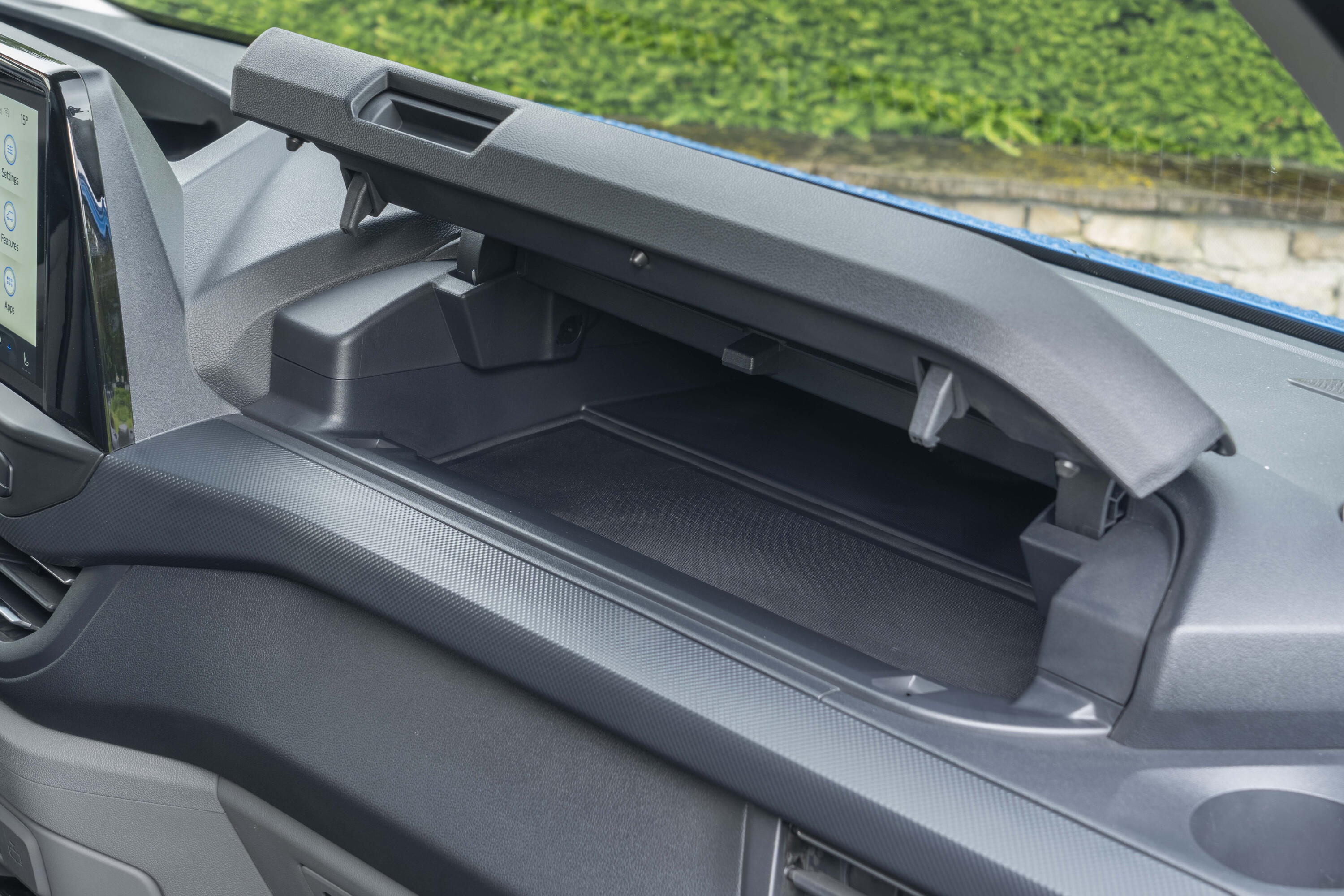
In the front cabin, the passenger-side airbag has been relocated to the roof, liberating space in the upper dash for a deep lidded compartment that’s large enough to stow a laptop (or a small pizza) out of view, while open-topped trays on the upper dash allow tradies to “organize” a vast quantity of receipts.
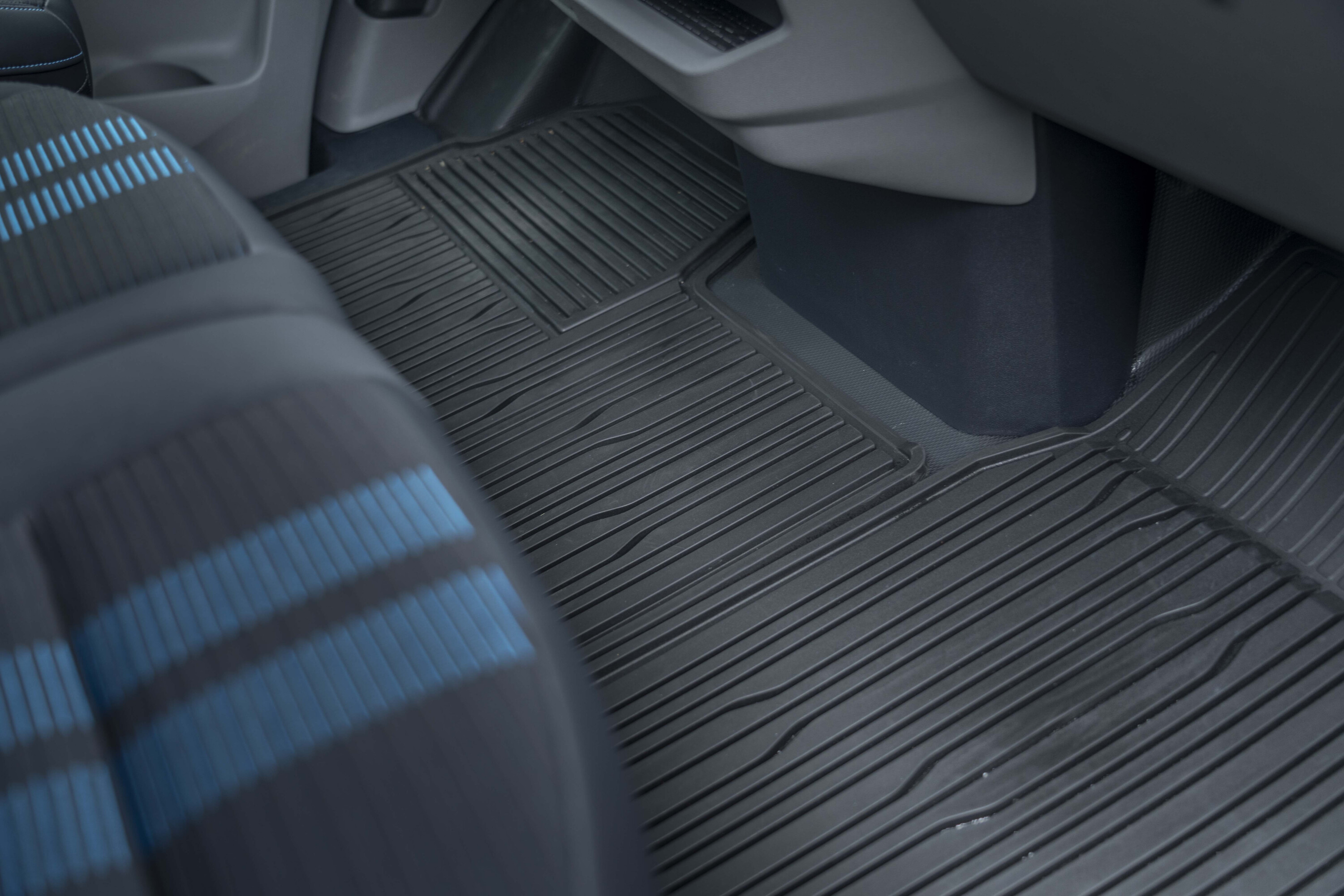
But bigger gains are achieved from a major structural rethink. For the new Transit Custom, the front axle has been pushed further forward to almost entirely eliminate wheelarch intrusion to the cabin, while the cabin floor has been steamrolled flat.
1
Coupled with a dash design that removes protrusions in the centre and relocates the shifter to the steering column, the result is a cabin that permits occupants to easily slide from left to right without knocking knees on plastics.
Is traffic a little gnarly next to you? Simply scooch over to the passenger side and exit directly onto the kerb.
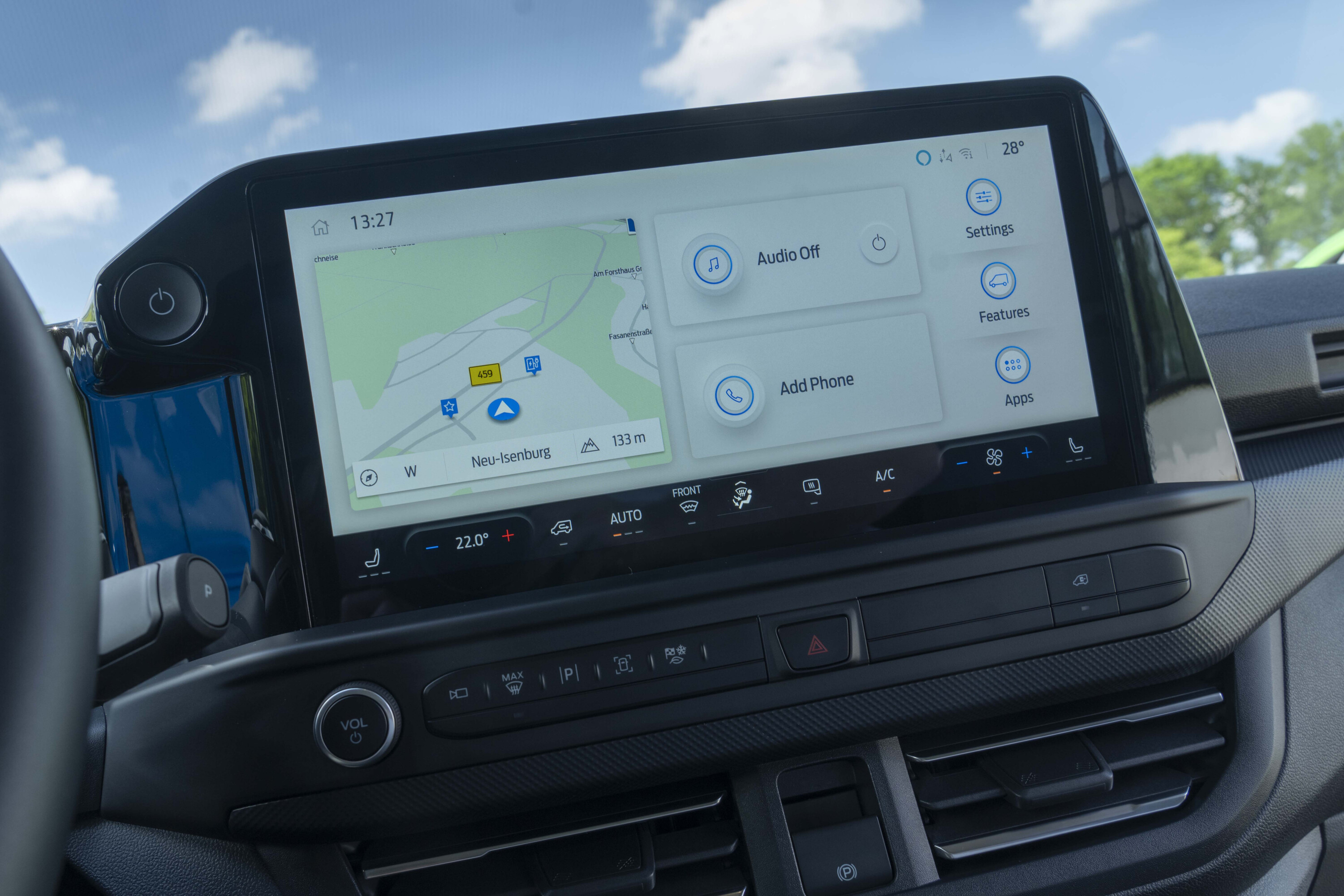
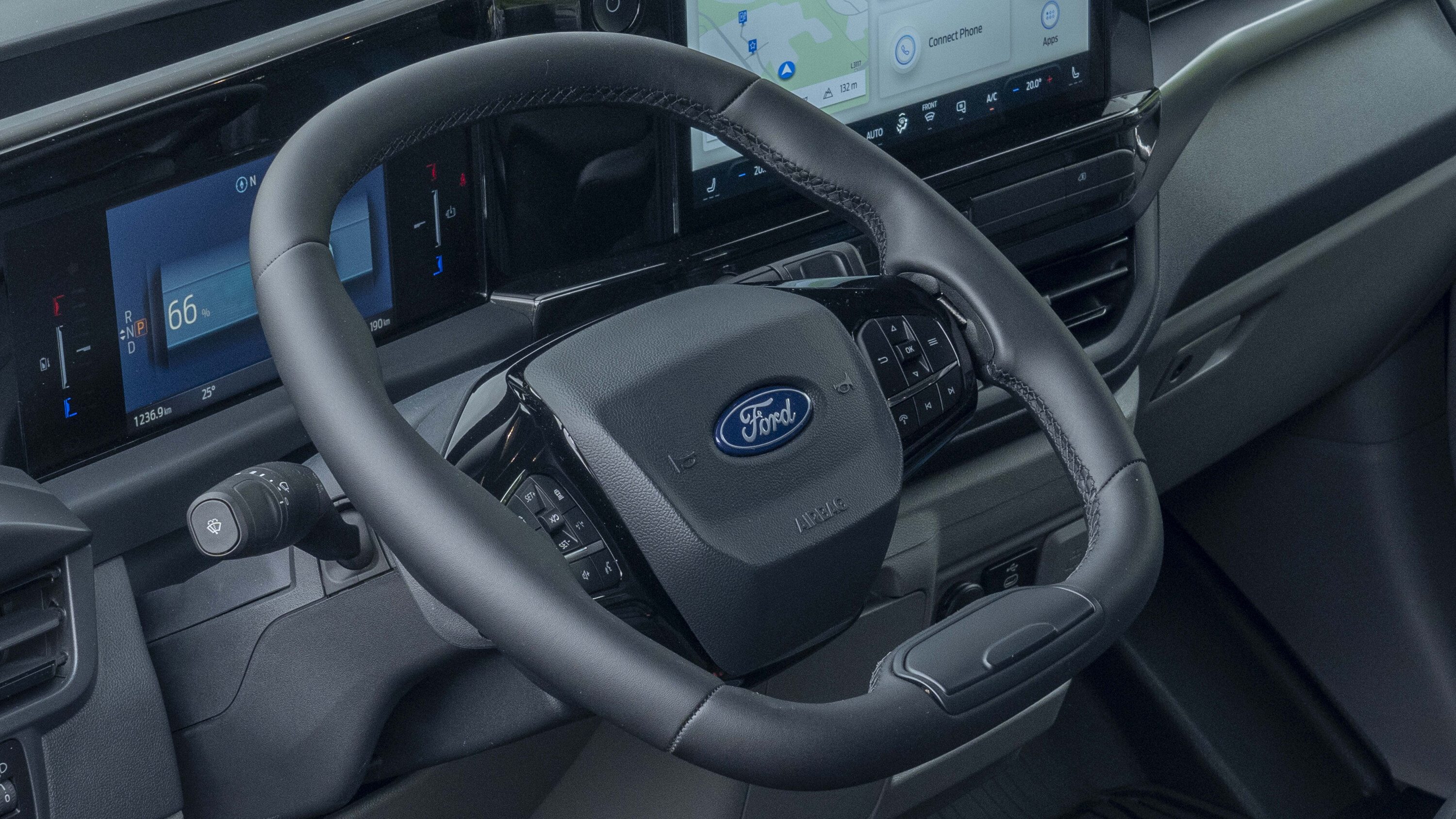
On top of that, the list of mod-cons is a lengthy one. Dual-zone climate control, the option of heated and powered seats, a wireless phone charging pad, five USB charging ports (three USB-C and two USB-A, one of which is helpfully at the top of the windshield to help power dashcams), a 12-inch LCD digi-dash, and that massive 13-inch infotainment screen running Ford’s latest Sync4 operating system, along with the requisite smartphone mirroring via Android Auto and Apple CarPlay.
1
The Euro-spec cars we tested were also fitted with an electronic rear view mirror, as well as a 360-degree camera, lane-keep assist, blind spot monitoring and active cruise control.
There’s also a unique party trick. All E-Transit Customs will be equipped with Ford’s innovative tilting steering wheel as standard, which locks into an inclined position for laptop usage, or tilts completely level. A removable plastic insert turns it into a flat-topped table, a perfect place to perch a pie upon.
It’s the new Transit Custom’s livability aspect that Ford is hoping will win over customers. It’s a cabin that perfectly hits the ‘mobile office’ brief, and to be frank the electronic parking brake is our only real complaint – located between the centre air vents and coloured black, it’s a bit hard to pick out visually and difficult to find by feel.
1
Even just changing its colour to something that contrasts more with its surroundings would help, but honestly this seems like a very, very small whinge. Take it as a sign that pretty much everything else has been nailed, though some frunk storage would have been a nice value-add.
But what about that range? 308km isn’t heaps, but In Europe, Ford’s analysis found that typical ‘tonner’ van drivers were driving, on average, only 80km per day – a distance that is comfortably covered by a single charge.
Australian van drivers will need to do their own assessment on whether that’s sufficient, but our first taste of a Euro-market E-Transit Custom delivered an average energy consumption of 21.0kWh/100km on a mix of urban roads and autobahns, which equates to a max range of 304km on a full charge. It appears Ford’s range claim is fairly honest, at least.
1
To drive, the E-Transit Custom feels surprisingly docile. The 160kW/415Nm powertrain doesn’t feel as grunty as those numbers suggest, and we suspect there’s a lot of electronic torque-shaping going on to keep wheelspin at bay at lower speeds, as well as to extend range.
That said, acceleration is smooth, very linear, and perfectly adequate – unless you want to exceed 134km/h on an autobahn, in which case the computer says a resolute “no”.
Our testers were loaded up with 500kg of ballast to simulate a typical payload, and not only does the suspension easily cope with that, it feels like it would handle double without much issue.
1
Other aspects of the E-Transit Custom’s handling are up to Ford’s usual van standard, with nicely direct steering, excellent body control (for a 2.2-tonne van) and superb damping.
Sporty vans have been a Ford of Europe specialty for a while now, and there’s definitely some verve to the way the E-Transit Custom handles a road.
The wild-looking MSRT version packs 210kW and an outrageous (and apparently aerodynamically functional) bodykit, but we aren’t getting it and it also has its wings electronically clipped, with a 154km/h Vmax.
Asked whether a truly hot dual-motor variant could be concocted, Ford’s vehicle integration manager for the Transit Custom, Eduardo Correia, said the potential exists… but a plan doesn’t. Oh well.
1
More sensible minds might find greater appeal in the E-Transit Custom’s ownership proposition than its sporting cred.
Businesses that can leverage a solar installation for free energy, or have access to a cheap grid energy rate, will no doubt already see the sense in going all-electric, but an extra deal-sweetener is the fact the E-Transit Custom enjoys a two-year, unlimited distance maintenance interval – double that of the diesel-powered Transit Custom.
That said, the true economics of switching to this electron-burner for your workday chariot will hinge largely on two unknowns – how much the E-Transit Custom is going to cost in this country, and how well it’ll hold onto its value over time. We keenly await those numbers, because it’s difficult to judge the E-Transit Custom’s true worth without them.
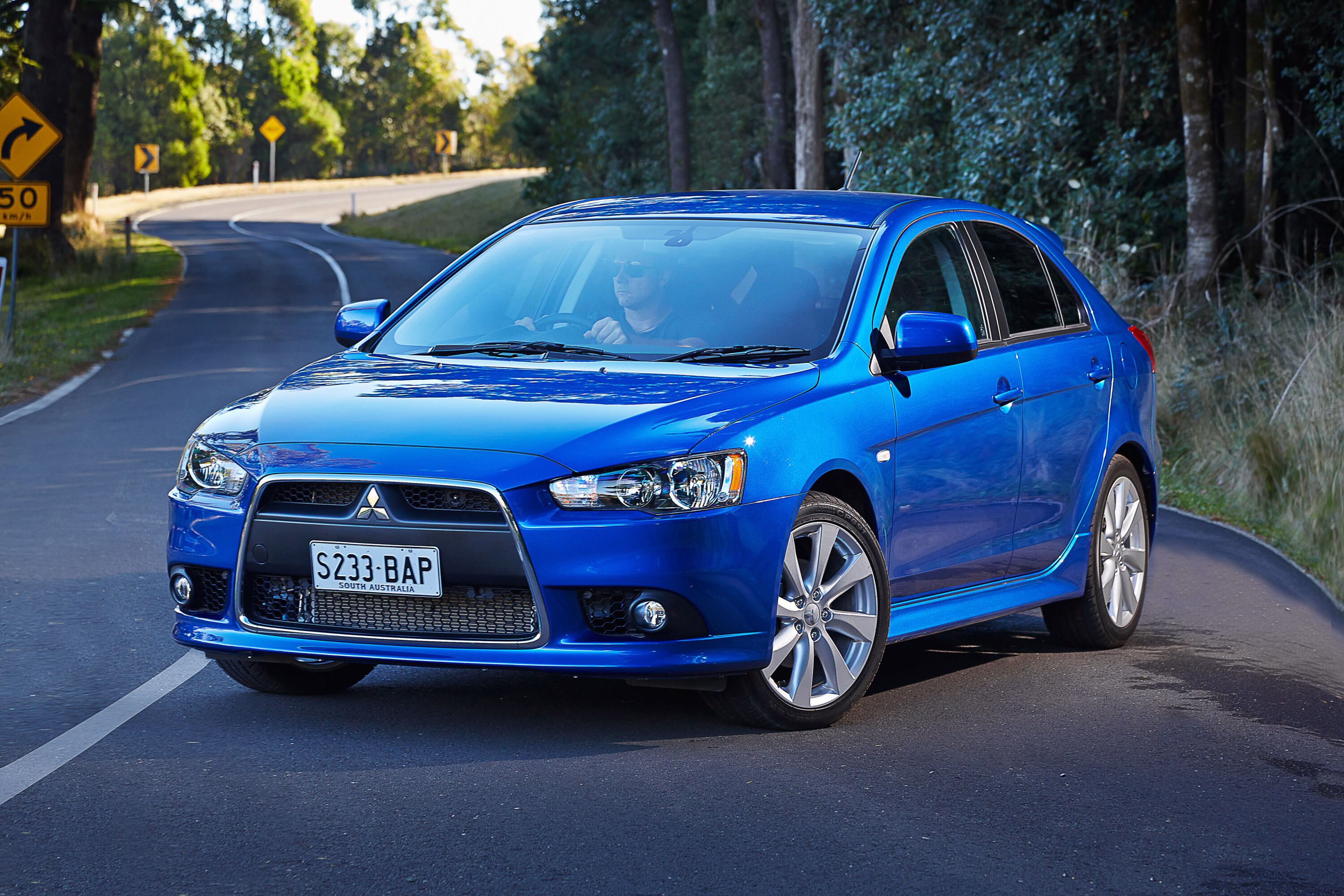
Mitsubishi’s upcoming electric car could have a familiar name.
First reported by US publication Car and Driver [↗], a new ‘Lancer Sportback’ trademark was submitted to the United States Patent and Trademark Office in March.
While it’s possible Mitsubishi could simply be protecting the name, it could also hint at the revival of the Lancer.
1
The Mitsubishi Lancer small car was available for four decades before it was axed in 2017 – but it could be resurrected as a twin to the next-generation Nissan Leaf electric car, which will become a coupe-shaped small SUV.
It wouldn’t be the first time Mitsubishi has reused a historic nameplate for a new SUV model, with the 2017-onwards Eclipse Cross sharing its name with the two-door sports car discontinued in 2011.
The Japanese brand also recently resurrected the Colt for a rebadged version of the Renault Clio city hatch sold in Europe and Airtrek for a now-dead Chinese electric SUV, while the Mitsubishi-based ASX was replaced by a rebadged Renault Captur in Europe.
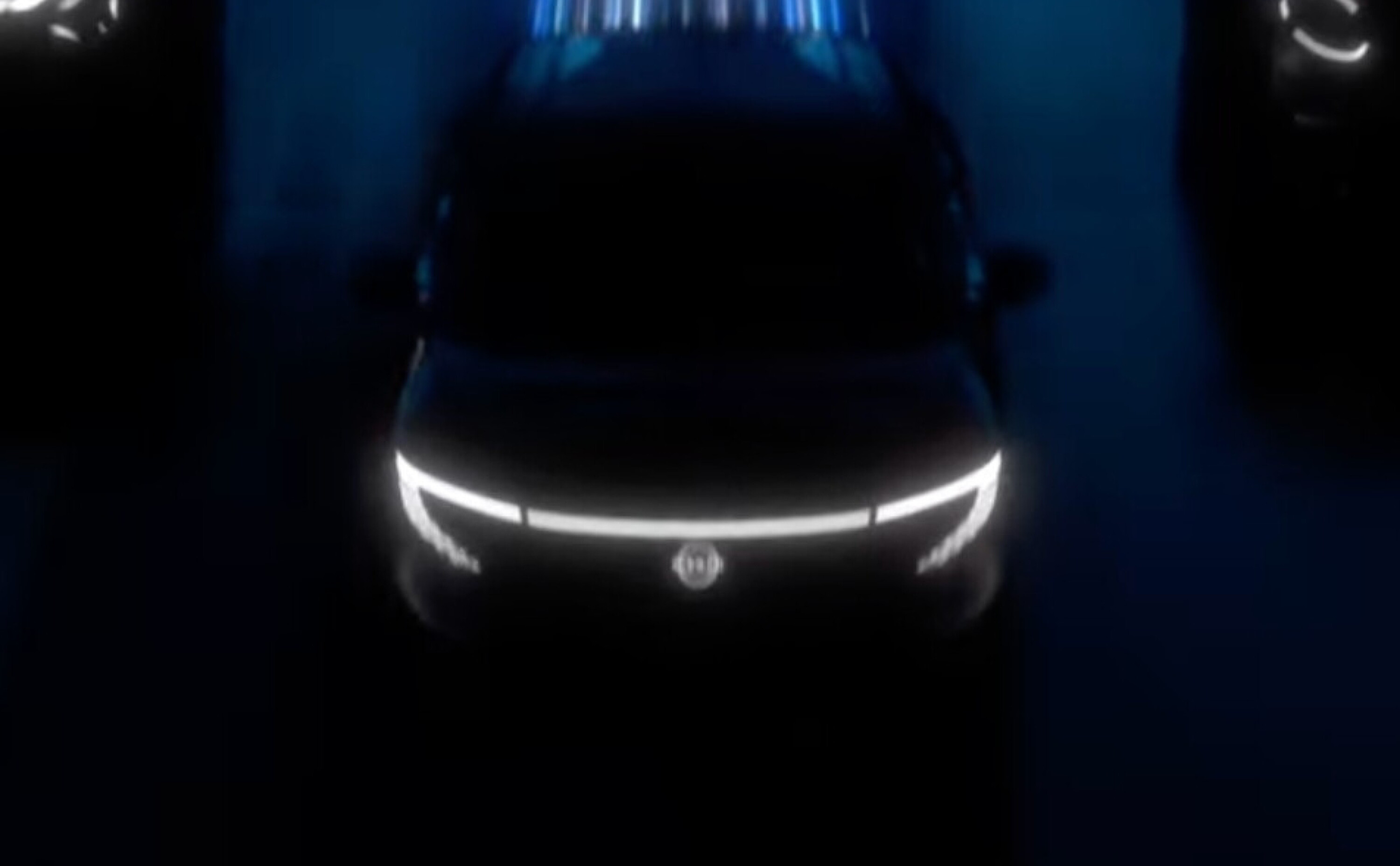
A teaser image released by Mitsubishi last month shows a car with a similar footprint and lighting signature to a future Nissan vehicle shown in a separate presentation in March, likely to be the new Leaf.
Mitsubishi’s US division confirmed it’ll double its line-up by 2030 and launch a new battery-electric vehicle.
The new Nissan Leaf is tipped to be an evolution of the 2021 Chill-Out concept, based on a version of the dedicated Renault-Nissan-Mitsubishi Alliance CMF-EV platform also found underneath the larger Ariya, forthcoming Micra hatch and some Renault electric vehicles.
Production of the next Nissan Leaf is due to commence in 2026.
The Leaf will continue to be built at Nissan’s Sunderland plant in the United Kingdom, which will receive around £2bn (AU$3.8bn) in investment to build three new electric vehicles, including battery-powered versions of the next Juke and Qashqai.
It is unclear if Mitsubishi’s new electric car will be built in the United Kingdom on the same production line as the Nissan Leaf or if it’ll be made elsewhere, such as in Japan.
P400e PHEV drivetrain offered for the first time in Australia, with 297kW and 640Nm
19.2kWh battery capacity, with a 2.2l/100km fuel consumption figure for P400e models
Available to order now from $91,915 before on-road costs
The Jaguar F-Pace 90th Anniversary Edition has been announced as one of the British brand’s final internal-combustion models ahead of its shift to EV-only lineup from 2025 onwards.
Jaguar says it will “transform into an all-electric luxury brand by 2025,” with its current internal-combustion line-up – the XE, XF, F-Type, E-Paceand F-Pace – to be retired by the end of 2024.
Production of the XE, XF and F-Type concluded last month, with its SUV models set to follow in the coming months.
The I-Pace electric SUV will also be discontinued, with a four-door grand tourer set to become the brand’s first all-new model since the I-Pace debuted six years ago.
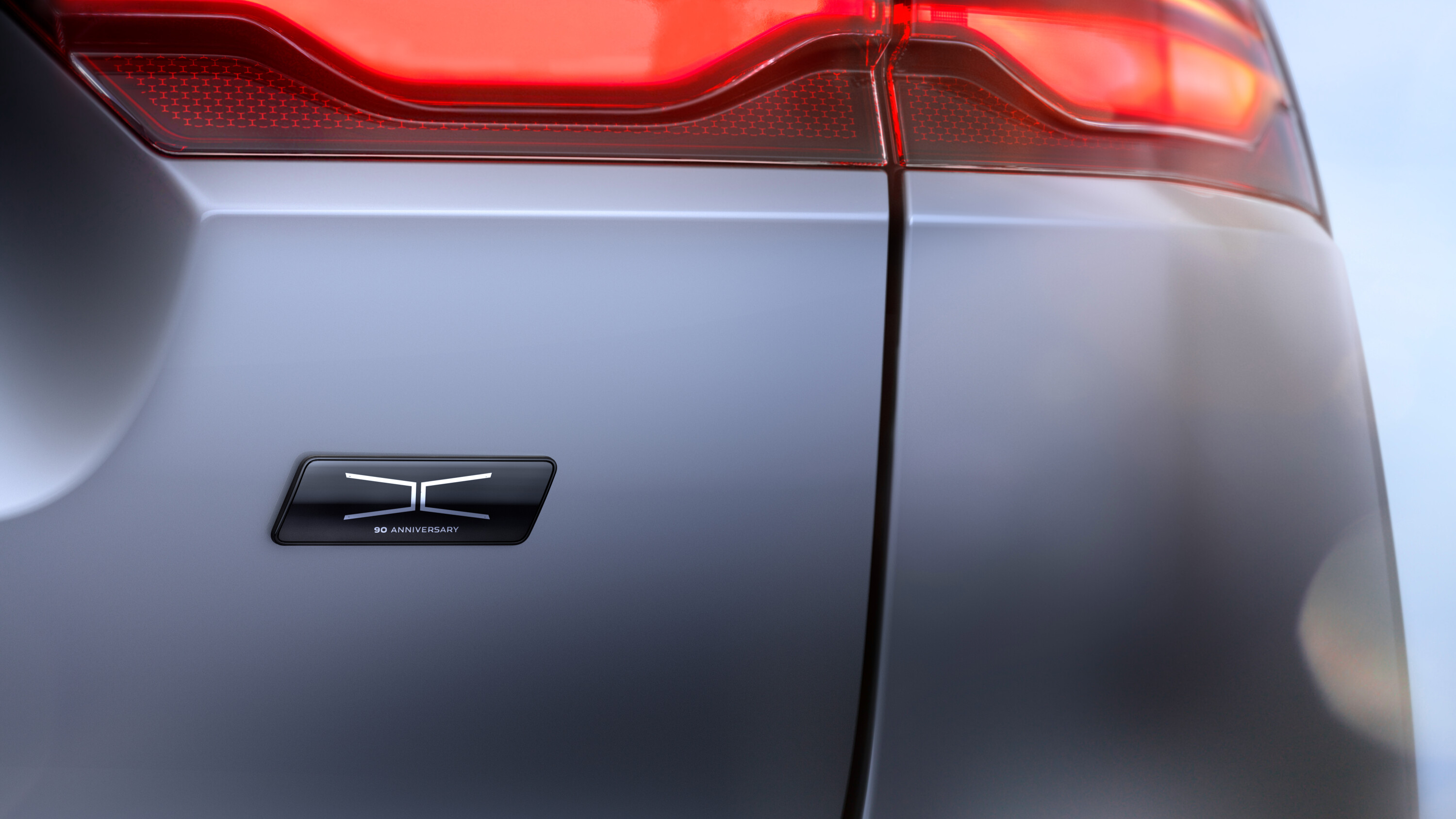
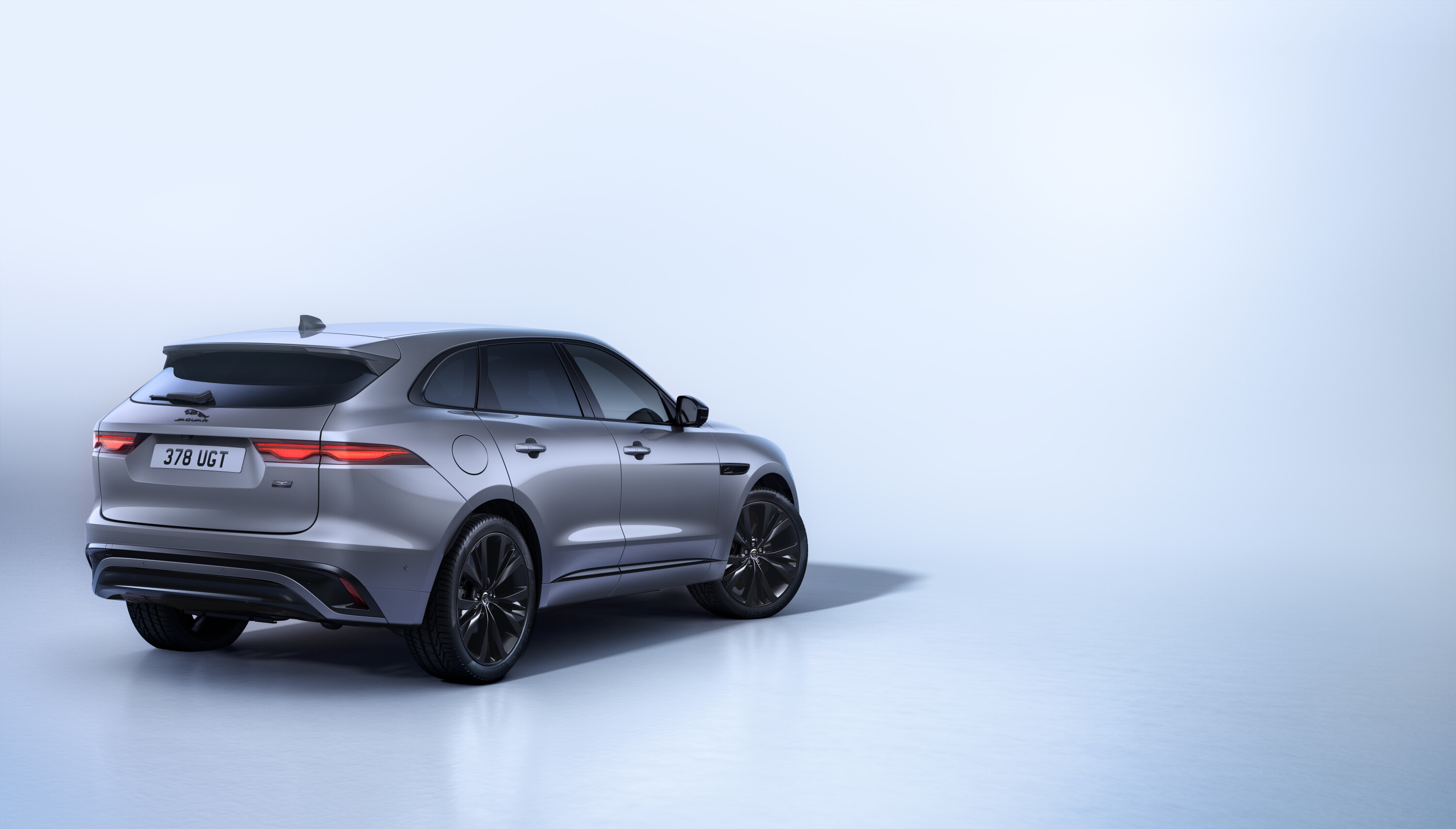
Celebrating nine decades of the Jaguar brand, the F-Pace 90th Anniversary – marketed as a Model Year 2025.5 vehicle – features subtle badging, 21-inch gloss black alloy wheels, adaptive suspension and privacy glass.
There is also a sliding panoramic roof, roof rails, a head-up display and a 360-degree surround-view camera.
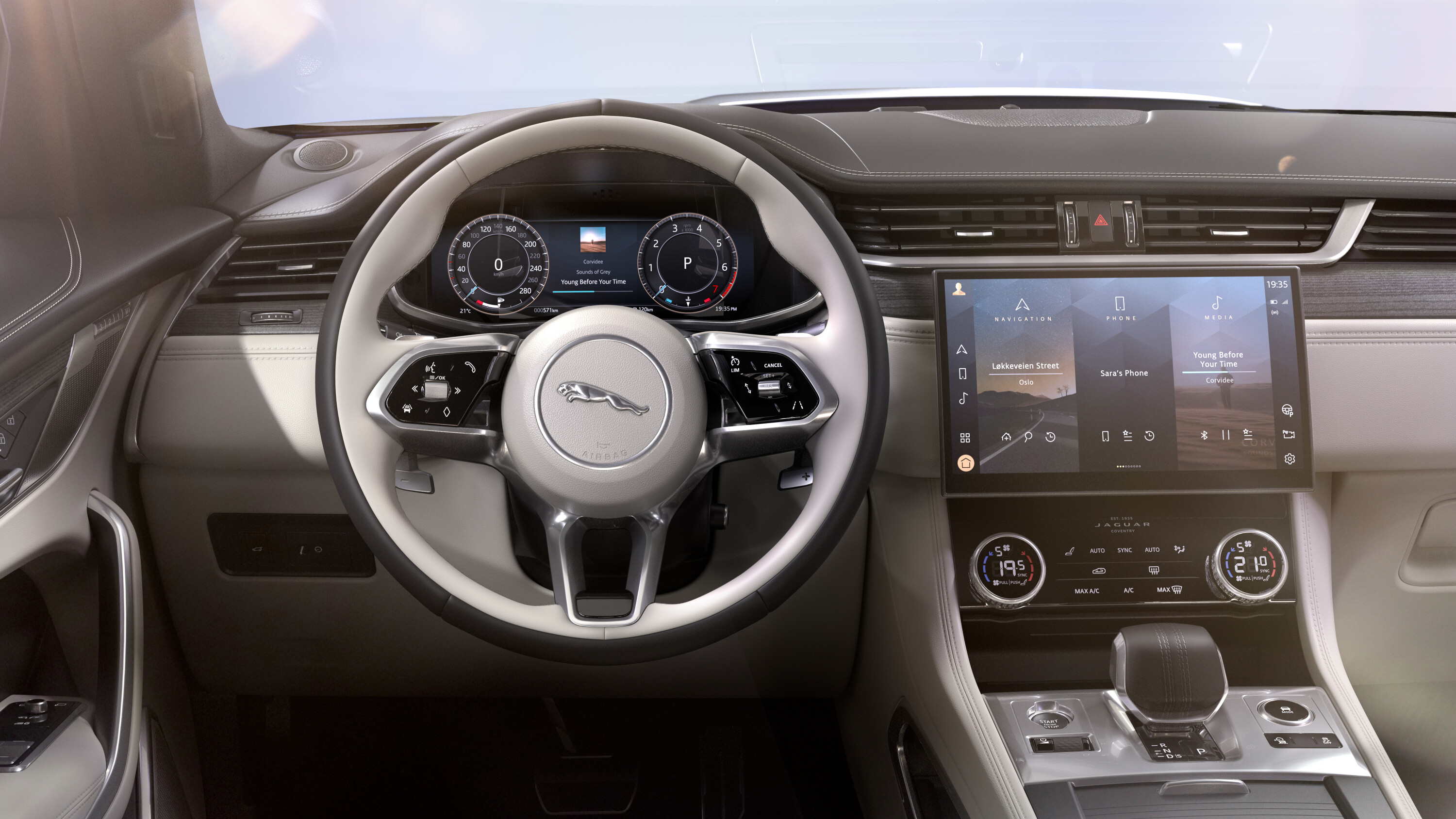
Inside, it adds supportive seats with contrast stitching, ebony headlining and aluminium trim.
1
Customers are able to order the F-Pace 90th Anniversary Edition in the R-Dynamic SE specification, with a 2.0-litre four-cylinder turbocharged petrol engine or, for the first time in Australia, a plug-in hybrid which blends the turbo-petrol with an electric motor.
The F-Pace P400e offers 297kW and 640Nm combined output, with a 0-100km/h time of 5.3 seconds. It has a 69-kilometre electric-only driving on the less-stringent NEDC test cycle, with a 30-minute DC fast-charge time from zero to 80 per cent.
Under the skin, there is a 19.2kWh lithium-ion battery. It has a combined fuel consumption of 2.2 litres per 100 kilometres.
1
The F-Pace 90th Anniversary Edition is available to order now [↗️] from Jaguar retailers.
“F-Pace has given new clients to the brand a choice of models including the efficient plug-in electric hybrid. With its inherent quality and design leadership, it has delighted our clients globally,” said Jaguar managing director Rawdon Glover.
“As we prepare for an all-electric future, the 90th Anniversary Edition is a fitting tribute to nine decades of pioneering design, performance and innovation.”
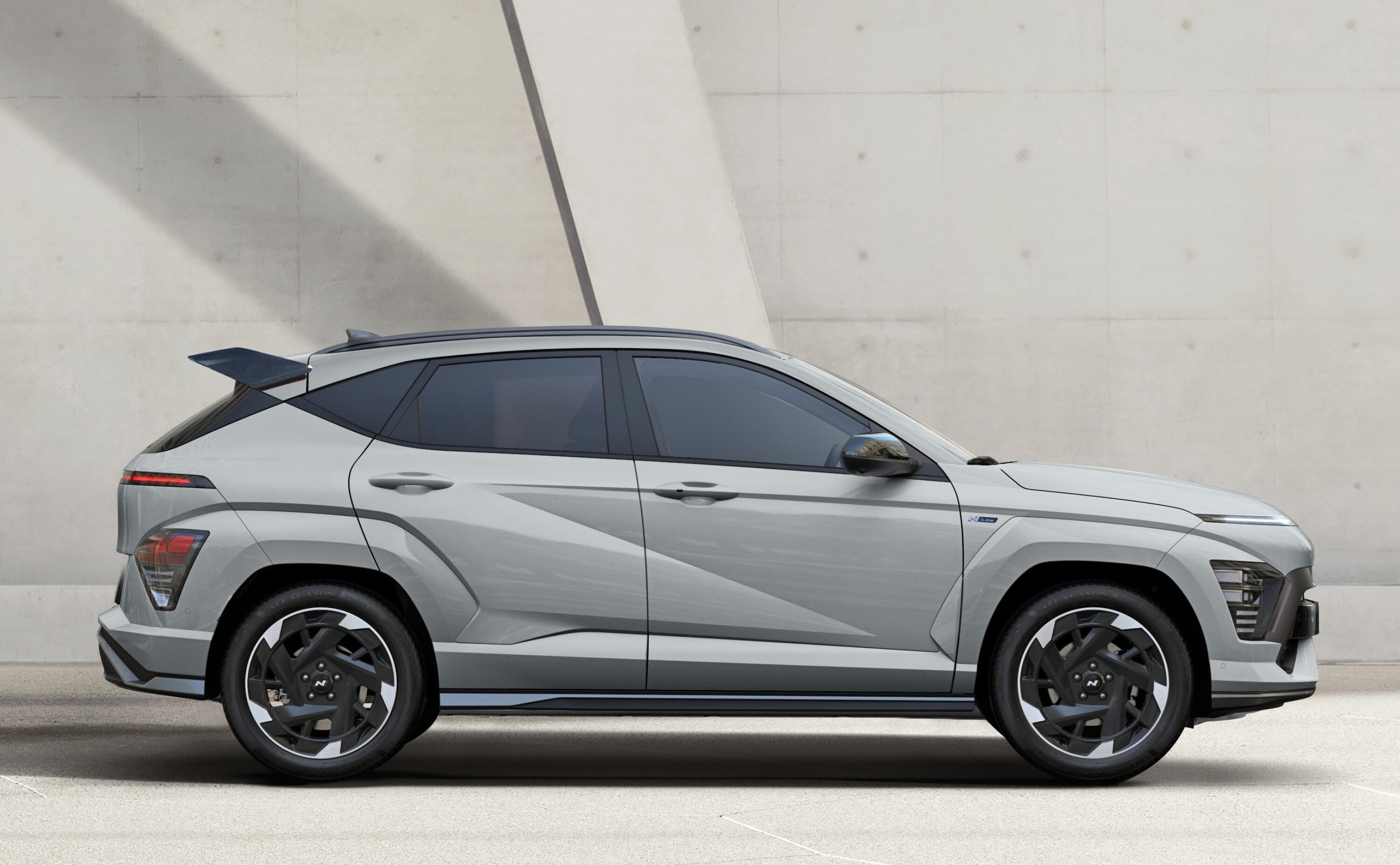
The 2025 Hyundai Kona Electric N Line has arrived in Australia in two variants.
Available as an option pack for the Kona Electric and Electric Premium – the Wheels Best Electric Small SUV 2024 – the N Line is limited to the extended range battery and 150kW/250Nm front-wheel-drive powertrain.
Costing between $4000 and $3000 extra, the Kona Electric N Line adds unique 19-inch alloy wheels, different bumpers and side effects, black side mirror caps, skid plates, body-coloured exterior cladding, a wing-type gloss black rear spoiler and N Line badging.
1
It is also available in three new colours – cyber grey, soultronic orange and neoteric yellow – while denim blue, meta blue, ecotronic grey and mirage green from the standard Kona Electric are unavailable.
The standard Electric N Line also adds full-LED projector-type headlights, a full-width front light strip, and LED front/rear indicators above the entry-level variant.
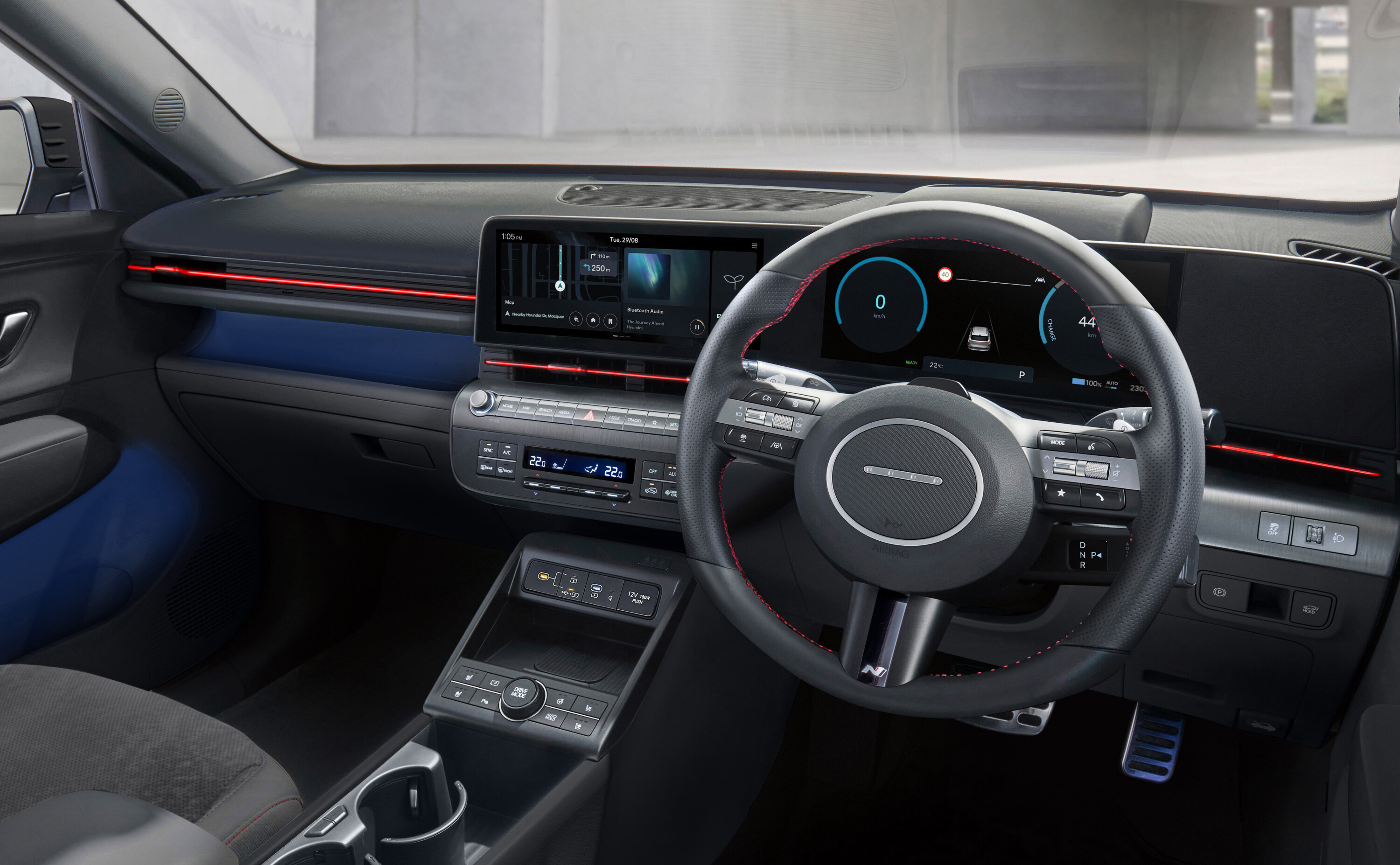
Inside, the N Line features red details on the dashboard and steering wheel, part-Alcantara sports seats with red contrast stitching, an N Line badge on the front headrests, black headlining, and metal pedals.
The Kona Electric N Line is the first Hyundai electric vehicle to receive the N Line treatment in Australia, with the facelifted Ioniq 5 expected to follow when it arrives here imminently.
1
A standard range version of the Kona Electric N Line is not available, while the non-Premium N Line variant falls to a lower 444-kilometre WLTP-rated driving range due to its 19-inch wheels – equivalent to the Electric Premium – compared to 505km for the standard variant with 17-inch wheels.
The 2025 Hyundai Kona Electric line-up is priced between $54,000 and $71,000 before on-road costs.
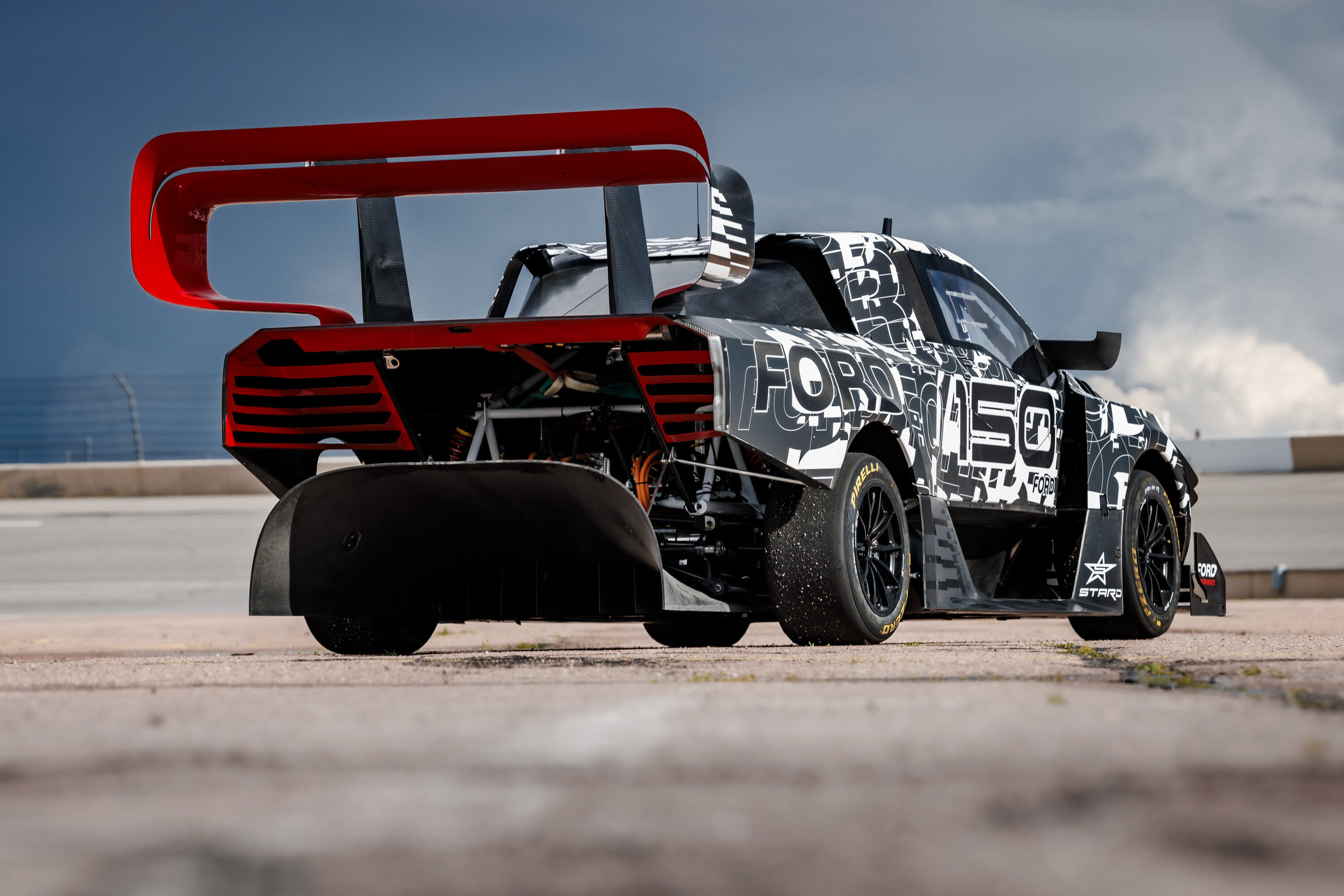
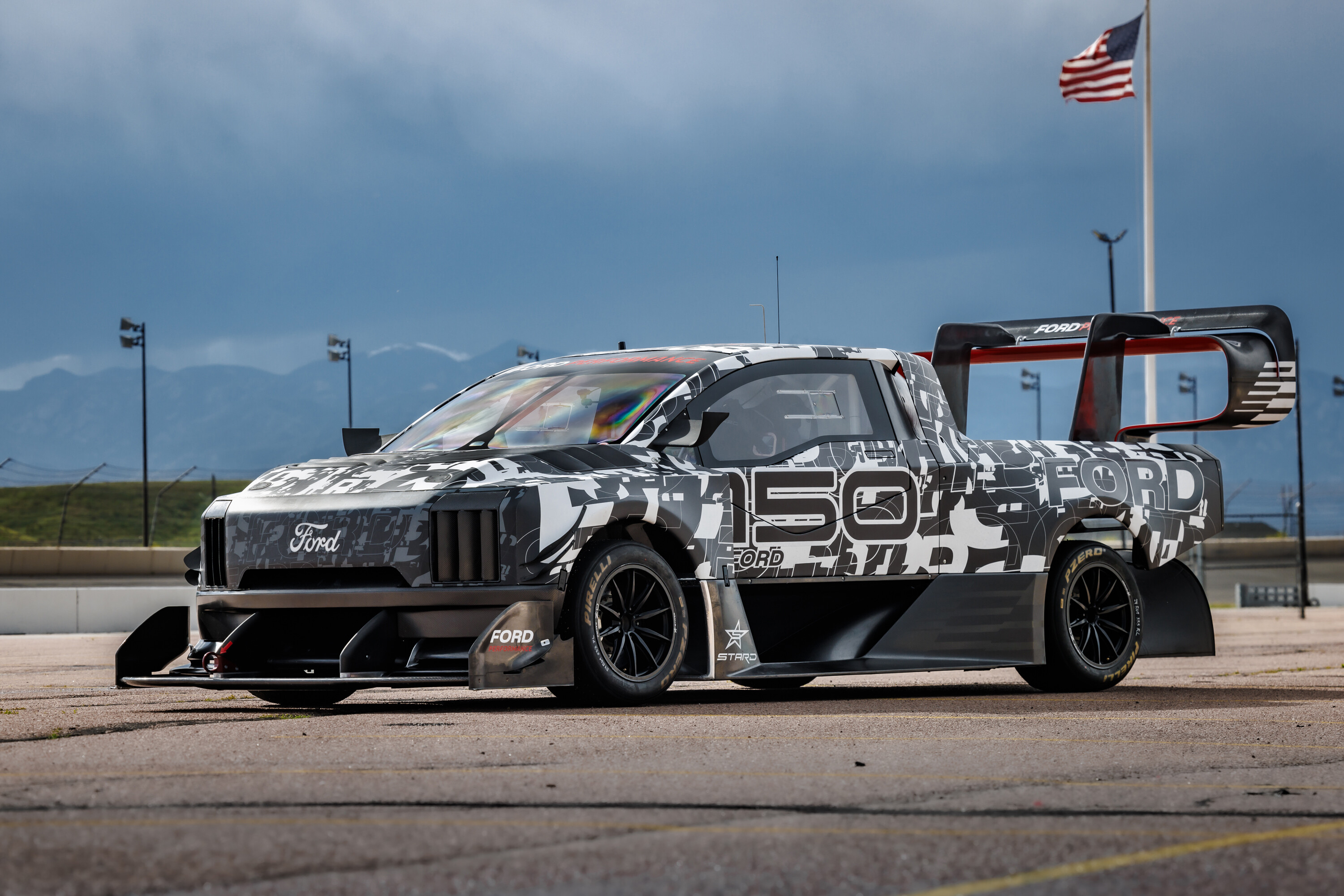
Just like the Supervan 4.2, which recently toured Australia and set a new lap record around Mount Panorama in the process, the Supertruck is all-electric and has been built to tackle the iconic Pikes Peak hillclimb.
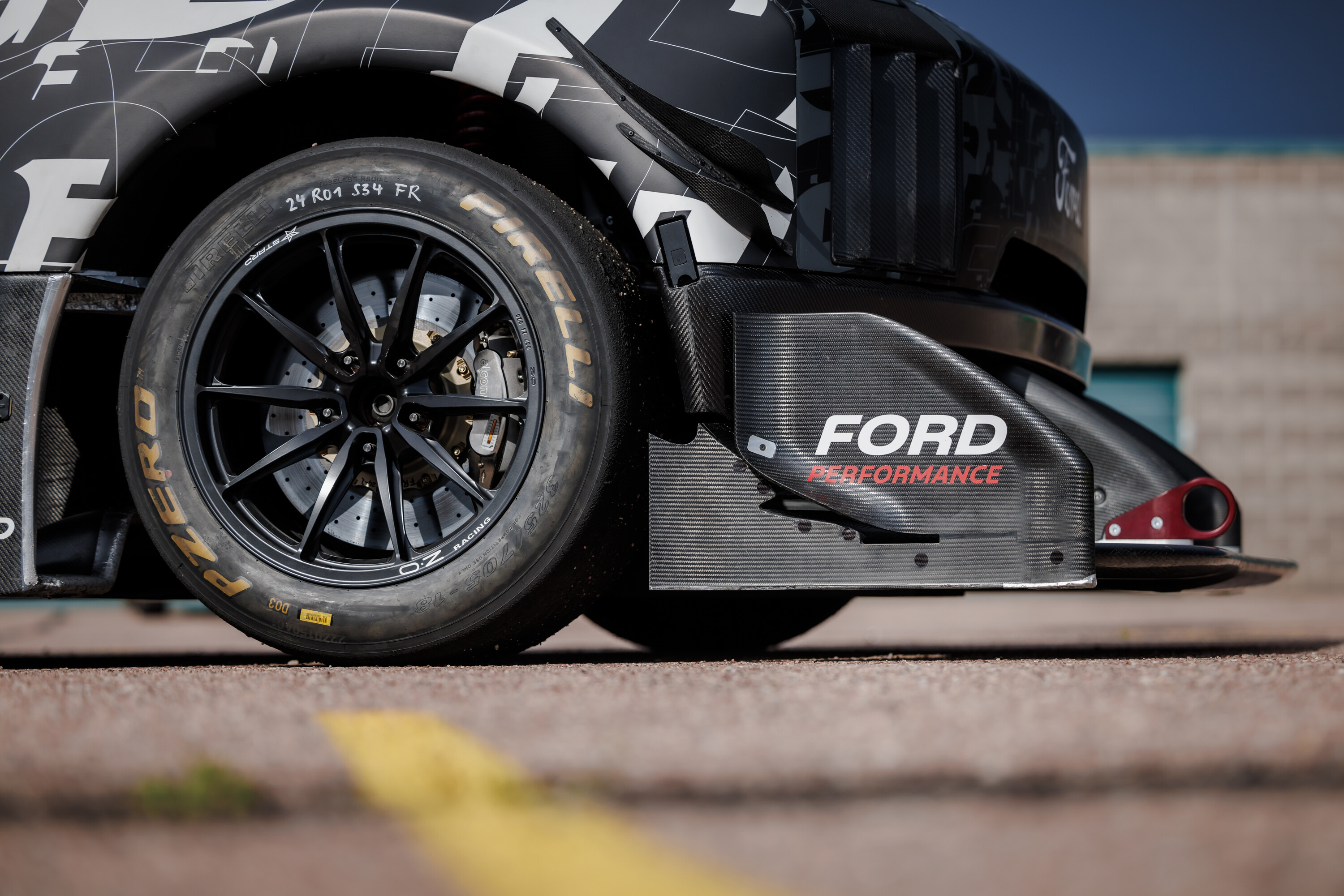
Naturally, that means it has a lot of power. And a lot of downforce. Developed in collaboration with EV engineering specialists STARD, Ford says the Supertruck develops 6000 pounds of downforce at 150mph.
Aussie translation: 2720kg at 240km/h.
1
That’s significantly more than the bewinged Supervan 4.2 which generated 4400 pounds of downforce at the same speed.
Ford is yet to release official power figures for the Supertruck, or any details about its electric powertrain, but it’s a fair bet to guess it’ll be an evolution of the Supervan’s three e-motor set-up capable of 1050kW+.
It’s also possible the Supetruck will adapt the twin-motor set-up of the off-road focused F-150 Switchgear concept that debuted earlier this year with 433kW and 1050Nm.
1
Current Pikes Peak record holder and Le Mans racing legend Romain Dumas is the man tasked with driving the Supertruck as Ford guns for outright honours at the iconic hillclimb on June 23.
Last year, Dumas covered the 20km course in 8:47.682 to set a new Open Class record.
We’ll have to wait to learn more about the Supertruck’s powertrain but with Pikes Peak now less than three weeks away, it won’t be long until we see it in action.
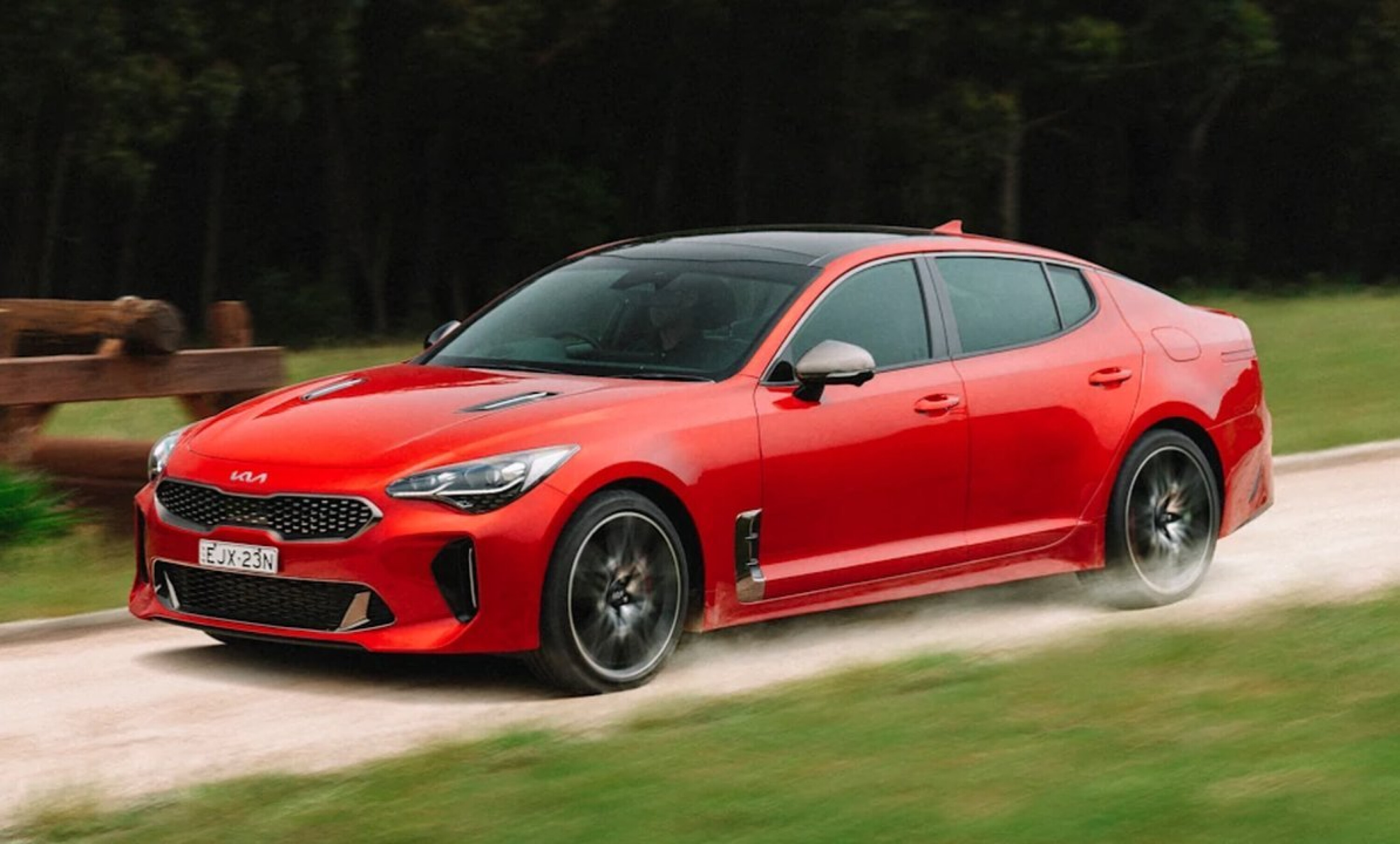
Due to a manufacturing defect, the High-Pressure Fuel pump may cause over-pressurisation in the fuel system. This could impair the fuel supply to the engine and result in warning light and a loss of motive power.
What are the hazards?
A loss of motive power whilst driving could increase the risk of an accident causing injury or death to vehicle occupants and/or other road users.
What should consumers do?
Owners of affected vehicles should contact their preferred Kia dealer immediately to schedule an appointment to have the software update carried out, and if required, replacement of the High-pressure Fuel Pump, free of charge.
Supplier details
KIA AUSTRALIA PTY. LIMITED
Who should owners/operators contact for more information?
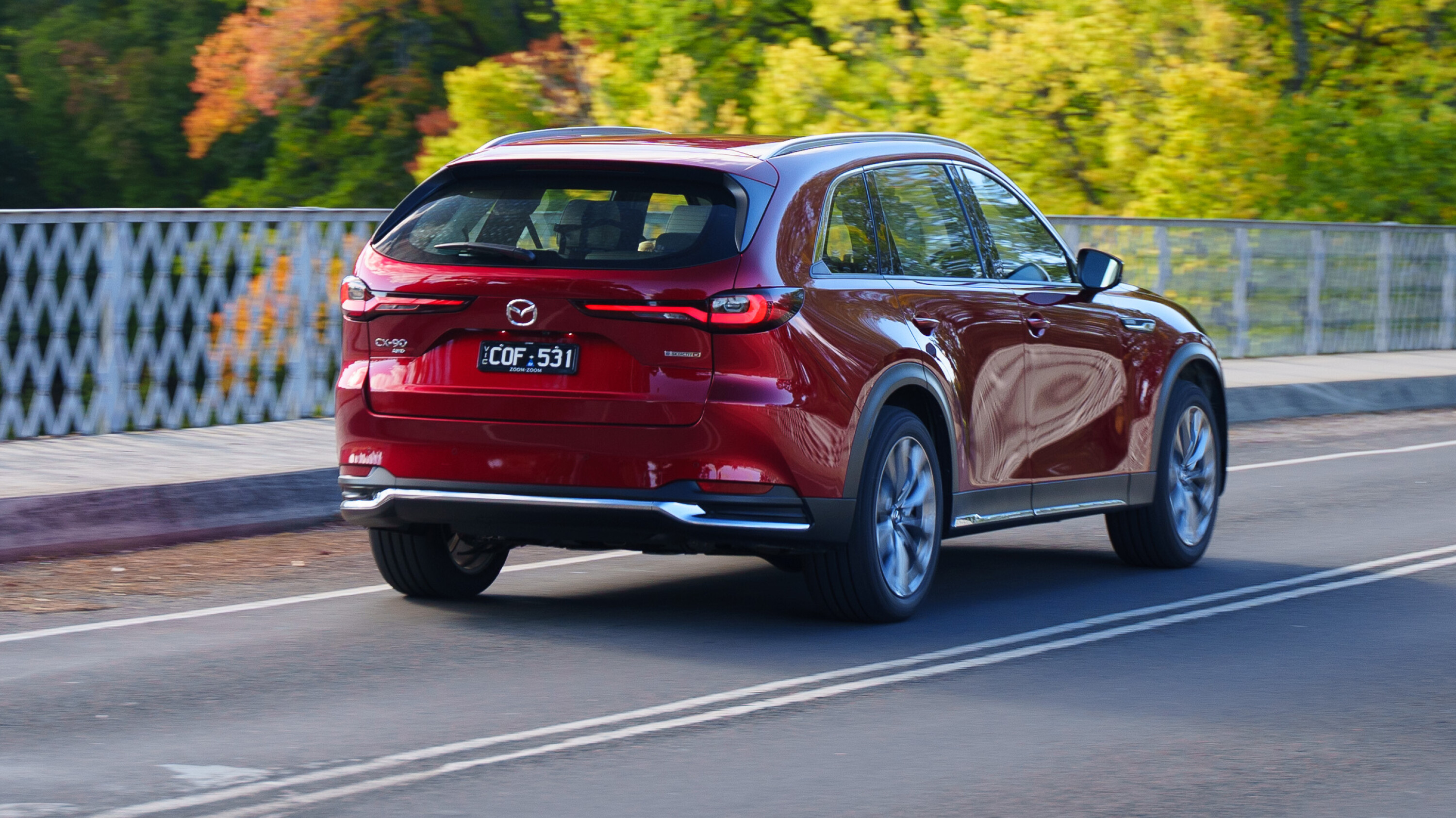
Due to a calibration issue within the Vehicle Control Module (VCM), when driving at low speeds the vehicle may falsely detect reflective objects such as metal walls, barriers or similar objects on the side of the road as an approaching object. This may trigger an unintended brake activation.
What are the hazards?
Unintended brake activation could increase the risk of an accident causing injury or death to vehicle occupants and other road users.
What should consumers do?
Remedial activity is currently under preparation. Once available Mazda Australia will contact all affected customers to advise them to present their vehicle to their preferred Mazda Dealer to update the Vehicle Control Module with a revised calibration at no charge.
Supplier details
MAZDA AUSTRALIA PTY. LIMITED
Who should owners/operators contact for more information?
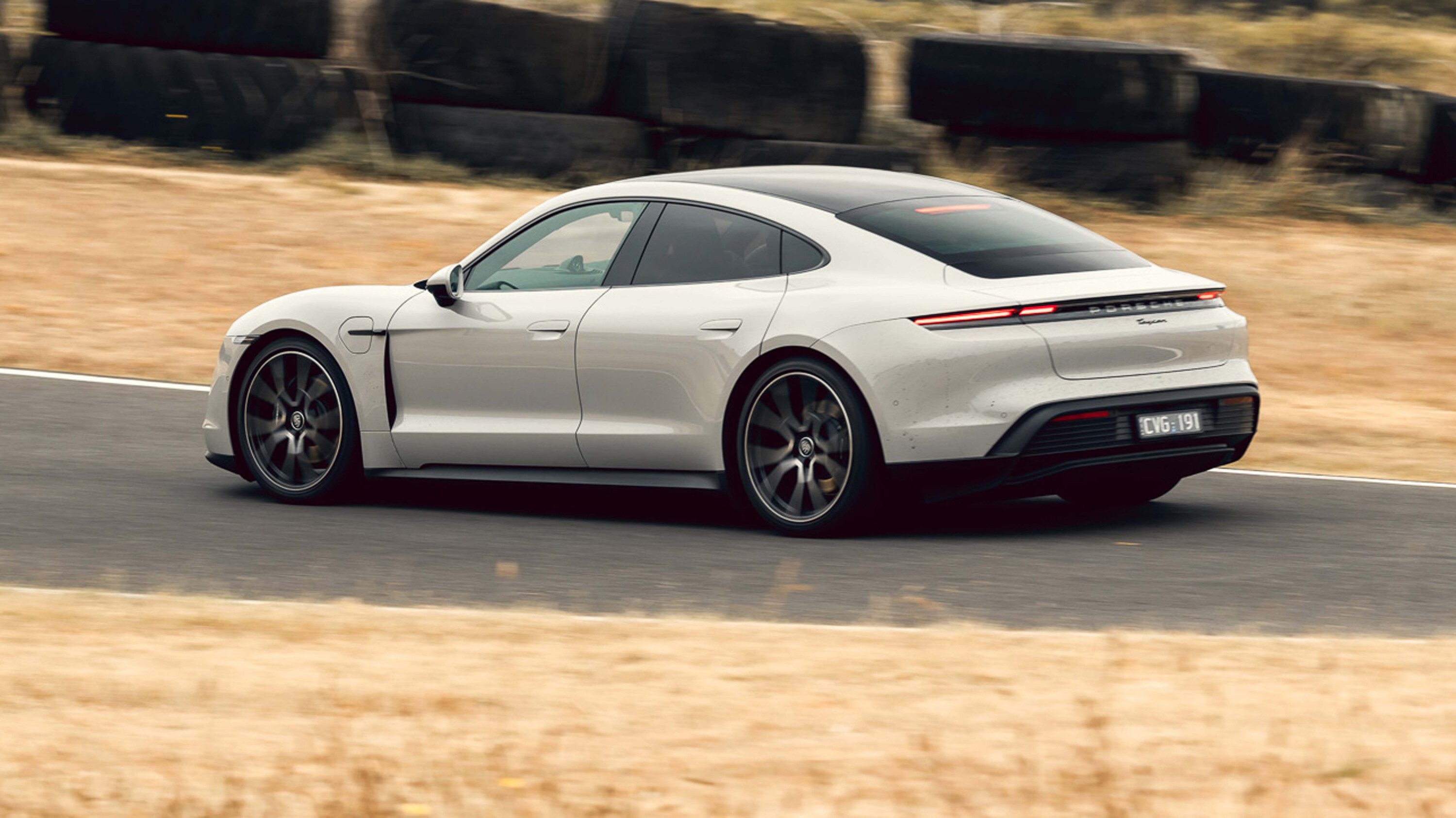
Due to a manufacturing issue, the cell modules installed in the high voltage battery may be defective. A short circuit could cause a thermal overload and result in a vehicle fire over time.
What are the hazards?
A vehicle fire could increase the risk of injury or death to vehicle occupants, other road users and bystanders, and/or damage to property.
What should consumers do?
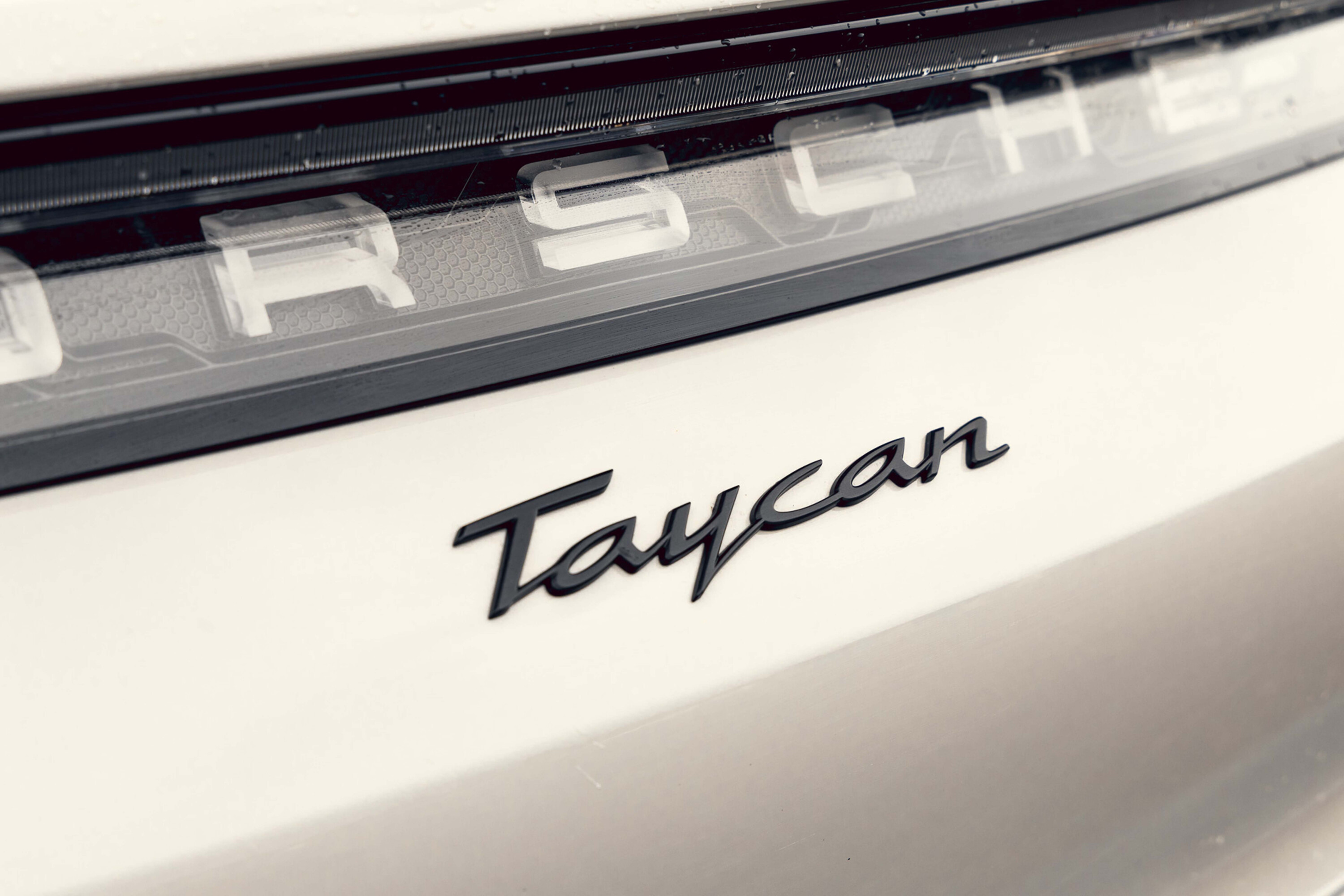
Owners of affected vehicles can contact their preferred Official Porsche Centre to have the work carried out free of charge, when parts become available.
Note: Until the repair is carried out, Porsche urges owners to temporarily limit the high-voltage battery to 80% maximum charge.
Supplier details
PORSCHE CARS AUSTRALIA PTY. LTD.
Who should owners/operators contact for more information?
Due to a manufacturing issue, the cell modules installed in the high voltage battery may be defective. A short circuit could cause a thermal overload and result in a vehicle fire over time. The potential defect can be determined with an initial check.
What are the hazards?
A vehicle fire could increase the risk of injury or death to vehicle occupants, other road users and bystanders, and/or damage to property.
What should consumers do?
Owners of affected vehicles can contact their preferred Official Porsche Centre to arrange an initial check of the battery modules. If the check result shows no defects, the vehicle requires no further action. If the check result shows a possible defect, Porsche will arrange the repair of their vehicle, free of charge.
Owners can find their nearest Porsche dealer at https://www.porsche.com/australia/dealersearch/ [↗️]
Until the check is completed, we urgently ask owners to temporarily charge the high-voltage battery to a maximum of 80%. This minimises the potential risk described above and also protects the battery. Additionally, owners should contact their Official Porsche Centre, as it may be possible for the check be carried out via over-the-air services, without the need for a workshop visit.
Supplier details
PORSCHE CARS AUSTRALIA PTY. LTD.
Who should owners/operators contact for more information?