
HAVE a dispute to settle? Got a Ferrari LaFerrari lying around not being put to use? Just want to destroy a set of tires?
Well, these mad fellas from Italy have got you covered, with the next generation of automotive dispute resolution.
There is no context to the video below, but do you really need that when something is this much fun to watch?
The guys behind the tug of war did commit sacrilege by affixing a tow-bar to their LaFerrari (it is expected their Italian citizenship has now been revoked), but at least it was for a good, tyre-frying, cause.
The LaFerrari faces off against one of the most powerful motorcycles available currently, a KTM 1290 Super Duke.
There is a twisted enjoyment gained from watching one of the most exclusive, powerful, and expensive cars in the history of the automobile being strapped to a 180-horsepower, $23,500 motorcycle for the sole purpose of burning some rubber and some light entertainment.
Keep it up you mad Italians!
The Focus ST proves there’s blue-oval appeal beyond Broadmeadows. We dig into the global catalogue for Ford’s latest hits… and the ones we missed.
First published in the July 2012 issue of Wheels magazine, Australia’s most experienced and most trusted car magazine since 1953.
American petrolheads view Australia as the last refuge of rear-wheel-drive performance, land of V8 Supercars and birthplace of the current Chevrolet Camaro. But that perception is mostly just a cultural kinship. In reality the muscle car is alive and well on Yankee soil. The latest proof: the 2013 Ford Mustang GT500. With an output of 494kW, the GT500’s engine is among the world’s most powerful production V8s. Ford claims a top speed of 202 miles per hour (325km/h). And its base price in the States is just $54,995. The Shelby GT500 is like the Model T of supercars in making massive horsepower available to the masses.
The big news, of course, is the engine, bored out to 5.8-litres with a 2.3-litre Eaton TVS supercharged perched on top feeding in 15psi of boost. Compression increases to 9.0:1, and new high-lift camshafts are borrowed from the Ford GT supercar. A special over-rev feature allows a 7000rpm limit for eight seconds at a time, up from the nominal 6250rpm redline.
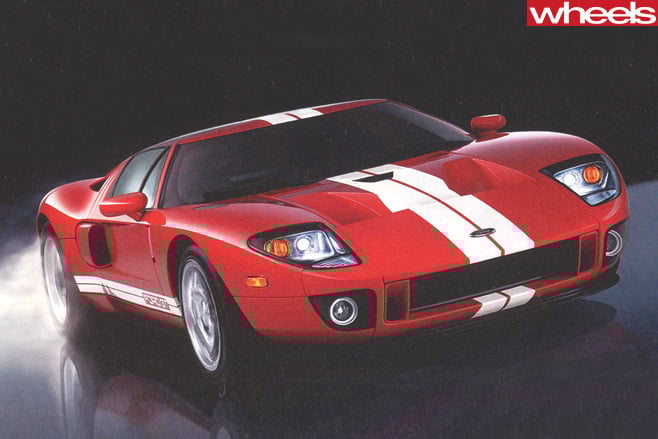
A carbonfibre driveshaft shaves 6.5kg and enables the new top speed, as the old two-piece metal shaft would vibrate excessively above 18-mph (290km/h). And a 3.31 final-drive ratio puts terminal velocity in fifth gear at 6400rpm, just 100 revs below the power peak. Despite the tall gearing, Ford says the GT500 will hit 97km/h (60mph) in 3.7 seconds and reach 160km/h in less than 8.0sec. And a programmable launch control system that limits wheelspin makes those figures achievable for the novice driver.
Behind the wheel the GT500 drives like you might imagine a classic ‘70s Trans Am race car would, except probably quicker and, with tyres that grip over 1g, probably faster around a track as well. The shifter and clutch are heavy, the Mustang leaps at the slightest throttle prod in the lower gears, and the exhaust booms through quad 3.5-inch tips. The Shelby feels every bit as powerful and intimidating as you’d expect a 682-horsepower Mustang to be. It’s brutish, but mostly in a good way; kind of like America itself.
2013 Fiesta ST
THE PREVIOUS-gen Fiesta ST (XR4 in Oz) was a $25K handling revelation … but it was pretty ordinary in the engine compartment; its atmo 2.0-litre four- a pretty uninspiring one -just couldn’t match turbo rivals.

Building on the excellent lower-spec models, the ST’s handling should be even more incisive than the XR4’s. The Fiesta’s steering is the high point – it doesn’t get much more slick or direct until you’re well into sports coupe territory – and is in good company with the agile, adjustable, entertaining handling.
In ST form, it’s dropped 15mm over firmer springs and dampers, with tweaks to both steering hardware and the tuning of the electro-mechanical power assistance. Meanwhile, the braking system is upgraded with rear discs (in place of drums) and bigger piston calipers. With an LSD-like effect from a torque-vectoring system, and three-mode ESC, the ST should really take the fight to Polo GTI and Cooper S. It should have their measure in a straight line, with 132kW, 240Nm and a claimed sub-7.0sec 0-lOOkmlh, packaged with sub-6.0L/100km economy.
Inside it’s vibrant; a bit chavvy, with red seat inserts and highlights on dark grey, though the front seats themselves look like the comfortable, body-hugging type.
It’ll be built in three- and five-door forms, though it’s not known which we’ll get (if not both). We’ll get? Yep, Fiesta ST (it’ll be called that in Oz this time) will follow bigger brother Focus ST, arriving in the second half of next year.
2013 Taurus Sho
When Falcon production comes to an end, this is the car we’d most like to see replace it (read: the best of the limited options available in the global catalogue).We might add though, that we’re in no hurry to see our beloved Falcon killed-off.

When the inevitable does happen, the performance flagship of the Taurus range – though not so much the front-drive cooking models – could offer some consolation.
A direct-injected, twin-turbo 3.5-litre V6 is the highlight, with outputs of 272kW and 474Nm. It sends the grunt to all four wheels via a six-speed torque converter auto with paddleshifters, making it quick (in a straight line, at least) and easy-driving, with plenty of traction to punch out of comers. But that’s about where the appeal of this Yank ends.
“The SHO at least has power,” says Aaron Robinson. “On open roads under big skies it passes the miles with a cosseting aplomb, but in tighter situations the dull controls and general hugeness give you the feeling of threading a needle’s eye with a battleship.”
Okay, it’s little more than a glimmer of hope for the future of large Ford sedans in Oz. Perhaps instead of longing for what might be coming, we should be enjoying what we’ve got and giving Falcon the send-off it deserves. C’mon Australia, let’s exercise our God-given right to do circle-work while we still can.
The fourth generation of Audi’s S-badged A4 scores an all-new engine to complement its new-generation platform.
WHAT IS IT? The first proper performance variant in Audi’s all-new B9 A4 range, available in both sedan and Avant wagon guises, tied exclusively to a new eight-speed automatic transmission.
WHY WE’RE TESTING IT? Unveiled at last year’s Frankfurt motor show, Audi appropriately launched its subtle new S4 stormer in the hills surrounding the same city. Given the deeply impressive ability of the lesser A4 that (literally) sits under it, the new S4 promises to be a sizeable step forward from its well-liked, supercharged predecessor.
MAIN RIVALS BMW 340i, Jaguar XE S, and Mercedes-Benz’s forthcoming twin-turbo V6 AMG C43 (due November).
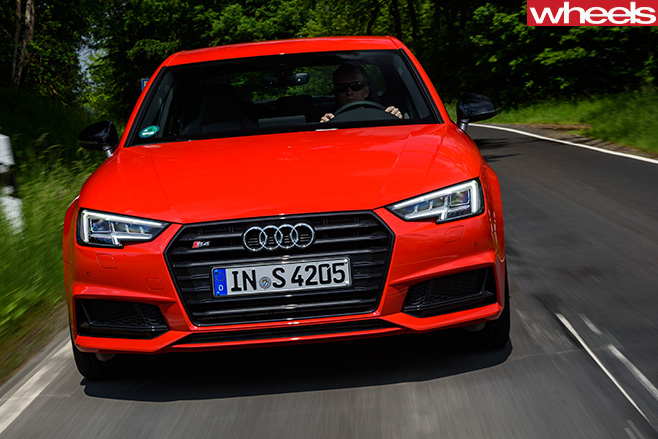
PLUS: Benchmark interior quality and design; excellent grip; poised chassis; brisk performance MINUS: New engine acoustically inferior to previous blown V6; optional dynamic steering doesn’t feel natural; lumpy ride
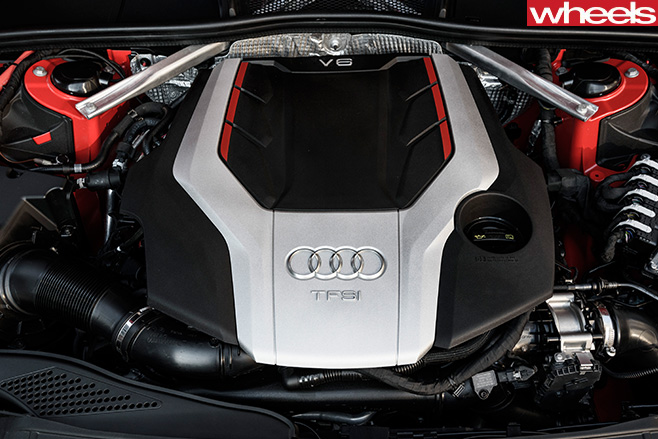
On paper, the differences aren’t so obvious. The new S4’s all-aluminium 90-degree V6 shares its bore and stroke, and thus its 2995cc capacity, with its supercharged predecessor, but that’s where the similarities end. Different bore centres, a new two-phase combustion method with centrally mounted high-pressure fuel injectors, and a twin-scroll turbocharger mounted inside the vee has produced a more compact, lighter (by 14kg), friction-optimised engine with enhanced response, higher outputs and improved efficiency.
Power jumps from 245 to 260kW, while torque swells to a solid 500Nm from 1370-4500rpm (up from 440Nm at 2900-5300rpm). The previous S4’s seven-speed dual-clutch transmission has been replaced with an eight-speed torque-converter automatic and the S4’s 0-100km/h claim drops to 4.7sec.
The new eight-speed auto seems to match the previous dual clutch’s shift speed, while being smoother in traffic with a slick idle-stop system, and it features a freewheeling mode that saves fuel when coasting in Drive between 55 and 160km/h. If the combined fuel figure isn’t complete porkies, 7.5L/100km isn’t to be scoffed at.
There’s a marked difference between the throttle response in the transmission’s Drive and Sport modes, despite the sweet spot being somewhere in between. The S4’s accelerator feels almost resistant in Drive and demands lots of pedal travel to deliver what you’re asking for, while Sport is far too twitchy and throws passengers around when stepping on and off the right pedal.
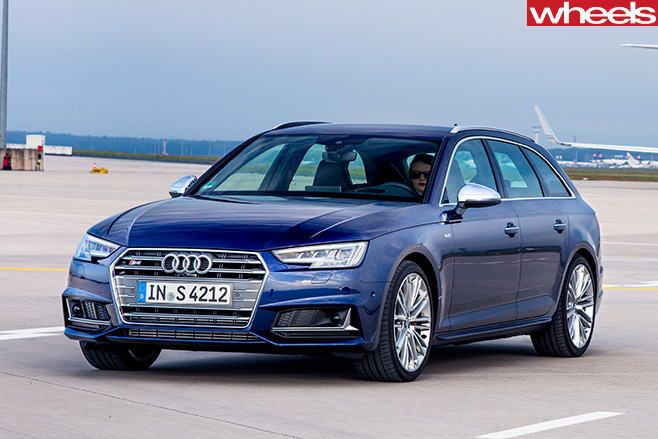
The new-gen S4 definitely handles – especially when enhanced by the razor-sharp turn-in of optional dynamic steering – but it doesn’t ride. Even in the adaptive dampers’ comfort mode, there’s an unsettled knobbliness to the S4’s ride (on Hankook Ventus S1 Evo 2 245/35ZR19 tyres expected to be standard in Oz) that is at odds with the regular A4’s plush composure.
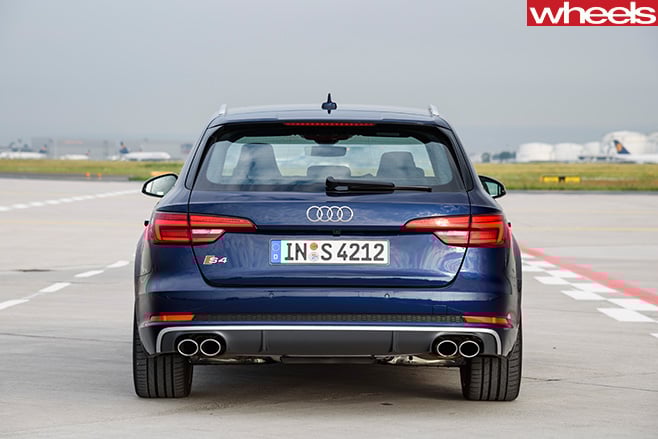
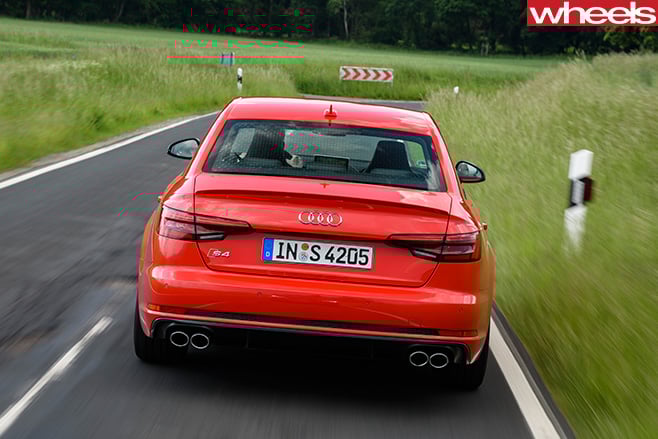
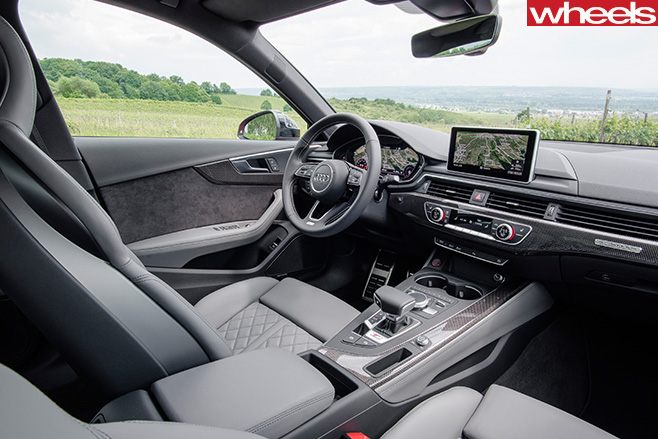
Mechanical gripes aside, there’s a lot to like about the new S4. Its interior is fabulous, including a new screen in the Virtual Cockpit display that shows the tacho dead-centre with a digital speed reading inside, and the optional head-up display is arguably the world’s prettiest. Both bodystyles blend subtly sporty looks with practical elegance, and the S4 has great brakes – 350mm front discs with six-pistons calipers and very natural pedal feel.
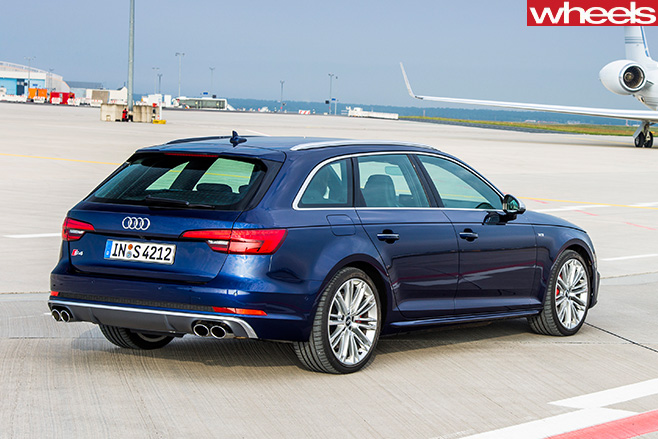
Audi hopes the new-gen S4 will make up three to five percent of total A4 sales, as opposed to the current car’s one to three percent. But we can’t help thinking the sweet spot is at A4 level, in 185kW 2.0-litre turbo quattro guise. Until the S4 receives attention to its ride and its engine acoustics, its baby brother remains supreme.
SPECS Model: Audi S4 quattro Engine: 2995cc V6 (90°), dohc, 24v, turbo Max power: 260kW @ 5400-6400rpm Max torque: 500Nm @ 1370-4500rpm Transmission: 8-speed automatic Weight: 1630kg 0-100km/h: 4.7sec (claimed) Fuel economy: 7.5L/100km (EU) Price: $107,000 (estimated) On sale: October
Ford Australia is currently investigating offering a range of factory-backed performance parts for its Mustang muscle car.
Speaking at a Ford event today, Communications and Public Affairs Director Wes Sherwood told MOTOR: “We’ve been working on our own Ford-branded performance parts. We’re going through the full ADR process, so that tends to be a little bit different to the aftermarket offerings.”
Exact details are scarce, but it’s likely the parts will be offered through the Ford Licensed Accesories program, in a similar manner to the Mountune engine upgrades for the Fiesta and Focus ST that were announced in February.
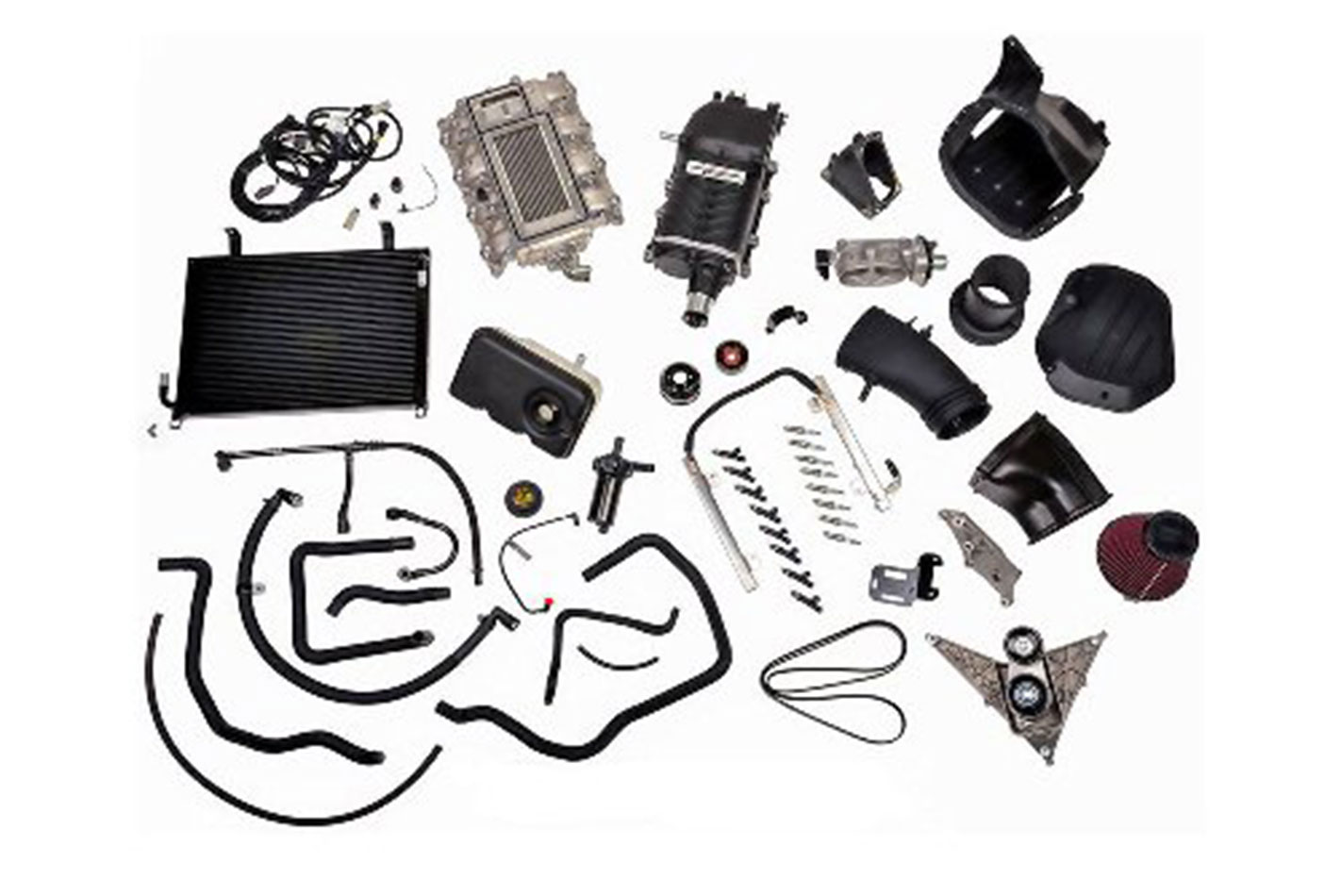
Ford Performance offers a wide range of parts from wheels to exhaust systems to suspension upgrades to supercharger kits, though which parts would make the grade locally is still unclear.
Sadly, any of the hotter variants of Mustang currently available in the US won’t be making it to Australia, bar through specialist conversion outlets.
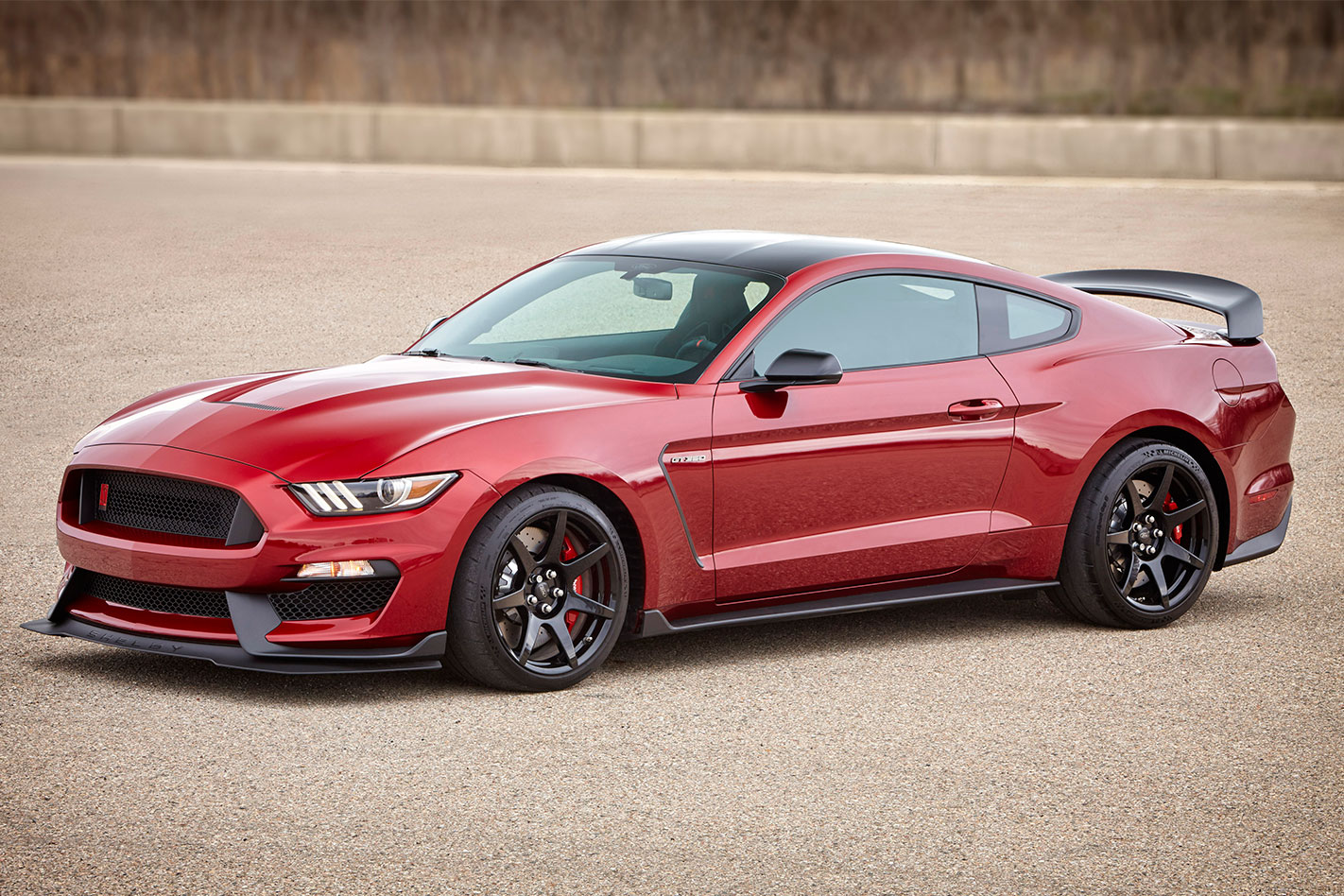
While a number of aftermarket outlets already offer performance upgrades for the Mustang, most notably Herrod, which uses the official Ford Performance catalogue, soon you may be able to buy your fitter, faster Pony Car straight from the showroom floor.
- The Amarok’s V6 engine was first used in the Audi A6/A7 mid-size sedan and hatchback in 2014. Other models to use it include the Audi A4 small sedan and Q7 seven-seat SUV, as well as the Porsche Cayenne Diesel. Look around the engine and you see many Audi logos adorning it. We’re getting the top-spec tune of it; there’s two other lesser tunes for European versions producing significantly less power.
- The Amarok introduces two matte colours to the Volkswagen palette; Ravenna Blue and Indium Grey. Both are also available in metallic finishes if you’re worried about how to get bird poo stains off the satin-look finish.
- Do the 14-way electric leather seats in the Amarok look familiar? They should; they’re already used in the Volkswagen Passat mid-size sedan and wagon, where they do a wonderful job of taking the edge off long-distance hauling.
- The bloke who headed up the Amarok’s makeover – Albert-Johann Kirzinger – also holds several international patents for designing Volkswagen car keys.
- The special 20-inch alloy wheels on the Amarok are designed to have as much shiny metal as close to the hub and rim a possible, giving the impression the wheels are much bigger than they are. While researching for the facelift, designers visited the US where blinged 24-inch-plus rims are commonplace.
- Volkswagen will sell two four-cylinder versions of the Amarok alongside two V6-engined Amaroks when the facelifted models launch late this year. They can do that only because Australia doesn’t have the same vehicle emissions targets as Europe, where the dirtier four-cylinder engine will be banned from sale. Australia was to have introduced the same emissions targets in 2019, but has since decided to leave their adoption open-ended. Australia joins South America and South Africa as regions where the less clean four-pot can stay on sale.
- Volkswagen has changed the physical properties of the material that it sprays in the Amarok’s tub to protect it. Instead of having a rubbery surface that would stop things sliding in, the black spray-on coating used is now plastic. You have to pay extra for it, though.
- When you buy a Volkswagen Amarok from the carmaker, you’re buying it from a separate company to the one that sells passenger cars. The Amarok falls under Volkswagen Commercial, the division of the brand that also sells the Transporter and Caddy vans, Caravelle people mover, the more upmarket Multivan people mover, and the Crafter light truck.
- Volkswagen has already had the most expensive trade ute on sale in Australia. The special edition VW Amarok TDI420 Ultimate was priced from $65,290 when it launched in 2014. It sold well: two of every five Amarok models rolling out of showrooms has been a high-spec Highlander or above.
- Think the Amarok Aventura is expensive? Volkswagen Commercial has the most expensive passenger car in the whole Volkswagen showroom. The Multivan Business has a hand-stitched leather dash and seats from a Bentley, with VW catering the vehicle to buyers who believe that space equates to luxury. VW once ran the numbers on bringing it here, and struggled to get it below A$150,000.
Volkswagen has given the Amarok trade ute its first significant refresh since it was introduced to Australia in 2011. Among the changes is the addition of a turbo diesel V6 to complement the twin-turbo diesel four-cylinder engine that, so far, has been the only powerplant. To celebrate, VW is launching a limited-run, four-door V6 version called the Amarok Aventura.
TELL ME ABOUT THIS CAR
As well as cleaner lines externally, the refreshed Amarok has had significant attention dedicated to its interior to make it even more car-like than before. The four-door, all-wheel-drive Aventura – which will become Australia’s most expensive trade ute when it arrives late this year – ups the visual bling with a special tub-mounted rollover bar wearing an “Aventura” badge and unique 20-inch alloy wheels. It also gains two new paint colours – matte blue and matte grey.
STRENGTHS
One thing that has held the Amarok back a bit in Australia has been the physical size of its engine. At only 2.0 litres, buyers have traditionally been a bit sceptical that such a small powerplant can pull its weight in a world of larger displacements. The addition of a V6 should convince more buyers to shop at VW.
- Engine. The 3.0-litre V6 will produce 165kW and 550Nm, meaning it is more powerful, has way, way more grunt than the four-cylinder engines, making it the better tow vehicle. It will also be the only V6 trade ute on sale, and the most powerful.
- All-wheel drive. Because the Aventura has more power to put down to the road, Volkswagen has made it go to all four wheels rather than just the rear ones.
- Servotronic steering. This is a fancy name for steering that automatically gets heavier or lighter, depending on speed. When you’re shuffling around a supermarket car park, it helps make the Amarok feel like a smaller, more manoeuvrable car. As speeds rise, steering assistance backs off, improving how the Amarok feels in the driver’s hands. It’s a clever sports car trick that blends city needs with open road enjoyment.
- Front and rear parking sensors, combined with a reversing camera, make the Aventura much more liveable in the city.
- Clever software that will bring the Amarok to a complete halt after a crash will be standard on the fresh-faced Amarok.
Looking at them rationally, trade utes don’t make very good daily commuters. Big, heavy and lagging traditional passenger cars in terms of comfort and safety, they struggle to justify themselves as a viable replacement. The Amarok is no exception to this rule.
- Airbags. Despite Amarok’s sweeping mid-life changes, VW has not included head-protecting side curtain airbags for rear-seat passengers as part of the update. The Amarok still wears a top five-star crash test rating from 2011, but if you’re putting children in the rear seats…
- Emissions. Volkswagen has to switch to the V6 engine in Europe to meet stricter Euro 5 diesel emissions targets due late this year. Once they arrive, the Euro 4 four-cylinder diesel engine will be banned from sale. Australia doesn’t have the same deadline as Europe, so we will keep selling the dirtier Euro 4 engine alongside the cleaner Euro 5 one.
- Heat. Because Australia is considered a “hot” climate, to protect the engine VW will lower the Amarok’s towing capacity from 3.5 tonnes to just 3.0 tonnes – the same as some of the four-cylinder versions. Its major competitors are at the higher limit.
- Price. When it lands, the Volkswagen Amarok Aventura will be the most expensive trade ute on sale in Australia. We’re guessing at just shy of $70,000 – or the same as a high-end Jaguar XE luxury sedan.
The Amarok performed very well in a recentWheels magazine test looking at the best trade ute for urban duties. However, the Ford Ranger and its closely related Mazda BT-50 (they’re the same car, just with different body panels) are streets ahead in terms of driver aids to make them more liveable in traffic. And there’s the enemy within: if you don’t need the extra pulling power to tow a big boat, float or caravan, the V6 Amarok doesn’t add much more over the four-cylinder version.
DSG, DCT, PDK, SMG; call it what you like, but direct-shift gearbox technology is big news in cars right now.
So what is it?
It’s a way of making a car as easy to drive as a normal automatic, but with the efficiency of a manual transmission. In a nutshell, the DSG (let’s stick with that acronym) is, in fact, a conventional manual gearbox inside with either one or two clutches (the twin-clutch is a later, more sophisticated version). But instead of relying on the driver to push the clutch pedal and select the gears, a computer does all that for you. They’re sometimes called `robotised manuals’ for that reason.
So the DSG car has just a throttle and a brake pedal making it simple to drive, but doesn’t have the fuel consumption penalty of a conventional automatic gearbox.
Those are the advantages, but the downsides are there too. In some cases, the shift quality (particularly in early, single-clutch designs) was pretty awful. But even the later twin-clutch units can be a bit jerky on take-off. There have also been some monumental reliability problems with this technology and Ford, for one, has dumped it in favour of an old-fashioned automatic in its Focus range. Volkswagen has had epic dramas with it too involving recalls. It could be a technological blind alley a few years from now; in affordable cars, anyway.
Now find out how to brake in an emergency stop.
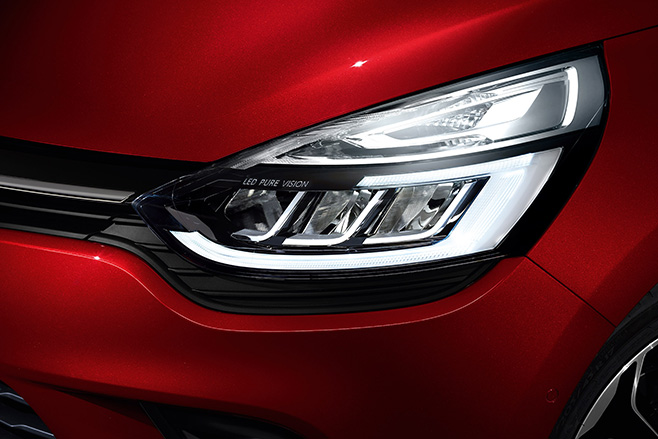
Most of the styling changes take place up front where Renault has added a new bumper bar and restyled headlights.
The new bumper has a wider, lower opening and houses smaller driving lights that have moved further towards the outside edges.
LED running lights have been removed from the front grille and integrated into the headlight housings. The revised headlight internals are similarly shaped to the all-new fourth-generation Renault Megane that arrives later this year.
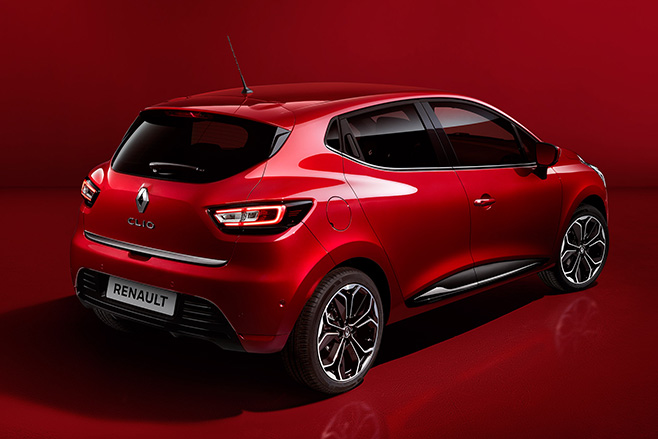
At the opposite end, Renault has redesigned the rear bumper bar insert and switched to a more premium LED taillight setup.
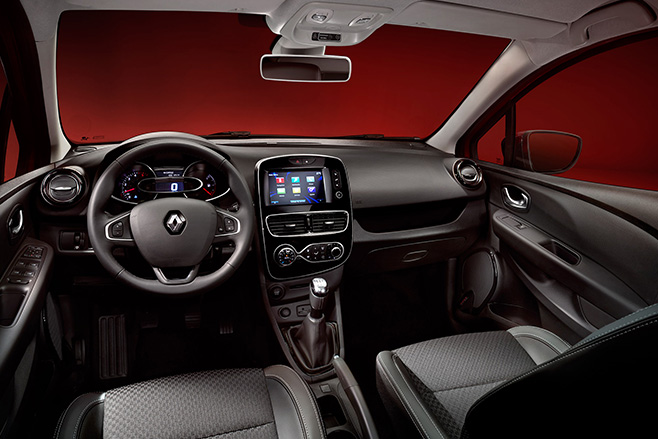
Trim details have been tweaked inside, though interior styling changes are minimal. Renault says the biggest change is to the quality of materials. Higher-end soft-touch plastics and chrome finishes are now used for more surfaces inside the Renault Clio.
A new Bose sound system will be available, as will a choice of multimedia systems. Base models will get a simplified system, called R&Go, requiring a smartphone for music and navigation control. Above that, two other infotainment packages will run on the Clio’s existing touchscreen; R-Link and Media Nav Evolution.
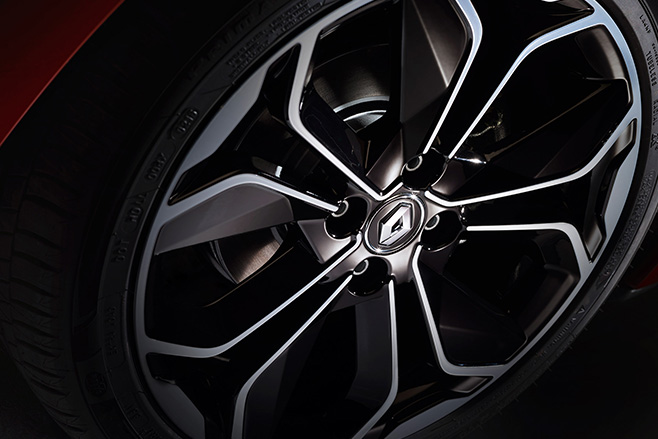
New alloy wheel designs round out styling changes alongside four new paint colours; Mars Red, Iron Blue, Titanium Grey and Arctic White.
Engine options remain the same – a 66kW/135Nm 0.9-litre turbo petrol, or 88kW/190Nm 1.2-litre turbo petrol – both with Renault’s EDC automatic gearbox.
Australian buyers may be able to select a manual gearbox for the 1.2-litre engine if Renault decides to offer the same options here as it’s making available in other countries.
More driving assists will be available including front parking sensors and an auto-park system.
The fourth-gen Clio was released in 2012 and was one of the first to bring in a new design language for the brand, though in its current form it’s one of the oldest Renault models without a facelift. This mid-life refresher will see Clio through until an all-new generation arrives sometime in 2018.
Renault hasn’t yet shown its updated RS models, which are expected to adopt styling features from the hot RS 16 concept hatch shown at the Monaco F1 Grand Prix this year.
Ssangyong is hoping three new models to be released between 2017 and 2019 can push the car maker towards half a million global sales and profitability.
The struggling South Korean brand last week invited British motoring media to a preview of its next-generation Rexton SUV, which will be shown at September’s 2016 Paris motor show.
The Rexton will reportedly be followed in 2018 by the next Actyon crew-cab ute, which will share its off-road-friendly body-on-frame underpinnings, then the Korando SUV replacement due in 2019.
Ssangyong will use more common passenger car construction for the Korando, which will use a stretched version of the platform that sits under the company’s smaller SUV, the Ssangyong Tivoli.
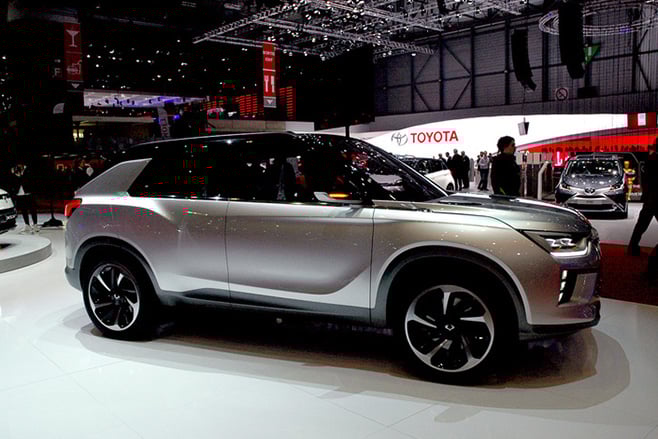
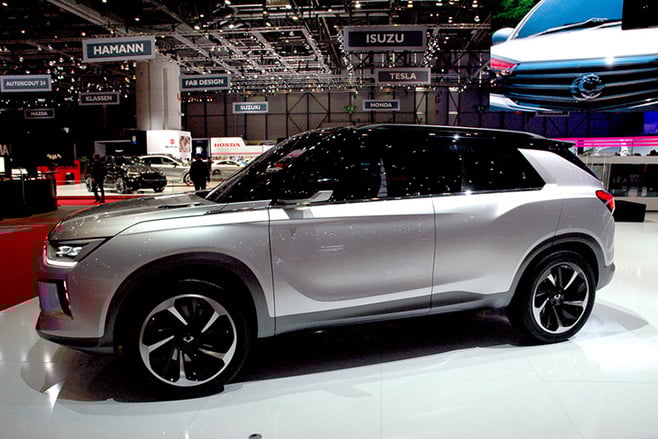
The new Korando’s styling is said to be inspired by SSangyong’s SIV-2 concept that was shown at the 2016 Geneva motor show.
The show car pointed to modernisation of Ssangyong products, featuring a new infotainment hub and being powered by a hybrid drivetrain combining a 1.5-litre turbo petrol engine and an electric motor.
British media report that the Rexton and Actyon will share the same engines: a 2.2-litre turbo diesel and a 2.0-litre turbo petrol.
Ssangyong will be hoping the new-generation versions of the three models it currently also sells in Australia will boost global and local sales.
The company – which has been owned by Indian automotive giant Mahindra since 2010 after being hit badly by the global recession – continues to endure sales pain in Australia.
After just scraping to 1000 units locally in 2015 after a 22 per cent drop, Ssangyong sales to May 2016 are down 53 per cent year on year.
Ssangyong Australia has so far decided against importing the Tivoli baby SUV that has been showing some promising sales signs in other markets.
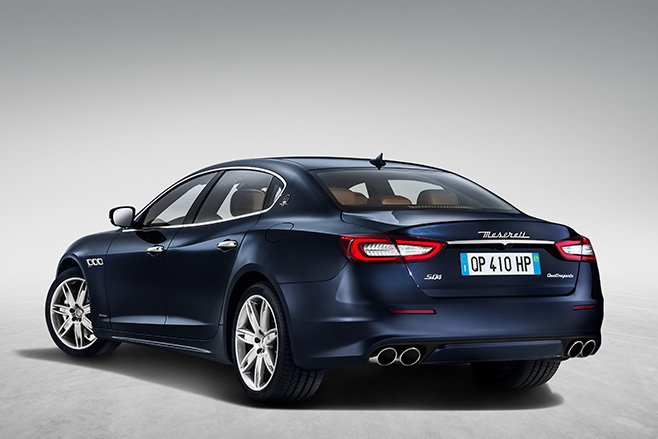
AUSTRALIA IS poised to receive the new-look Maserati Quattroporte by the end of the year, with higher-level specifications than other international markets.
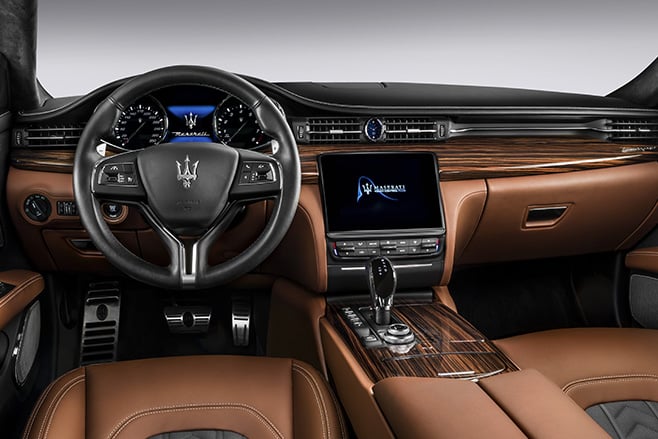
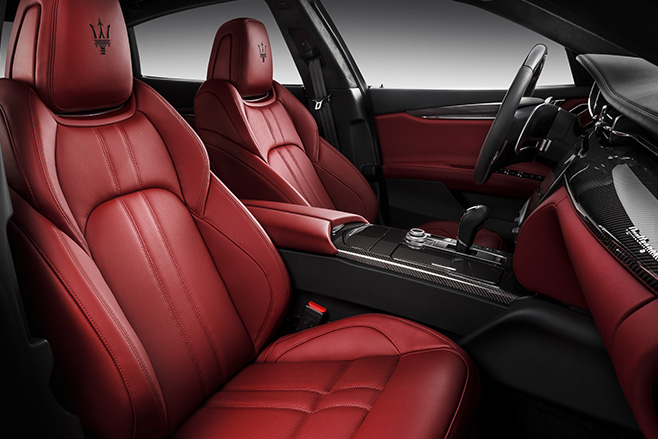
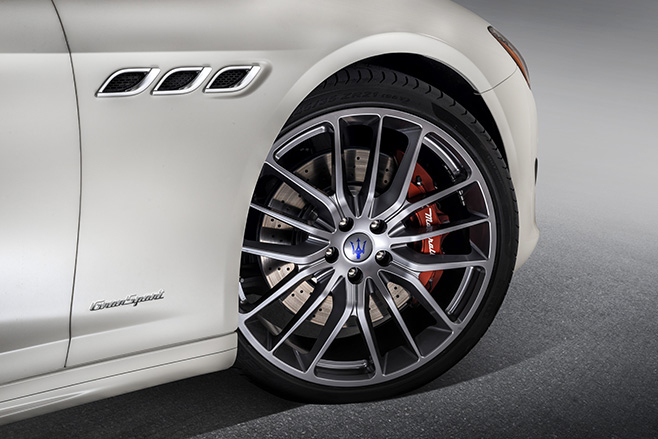
The facelifted sedan comes with a new grille and front bumper with electrically adjustable shutters that improve aerodynamics, as well as an updated interior, new driver assistance programs as an option, and new trim packages.
The Advanced Driver Assistance System includes adaptive cruise control, lane departure warning, forward collision warning with advanced brake assist, and automated emergency braking.
The Quattroporte’s old 7-inch touch-screen dash display is being updated to an 8.4-inch model, and comes with Apple CarPlay and Android Auto integration.
The powertrain remains unchanged for the 2017 models.
Maserati Australia is currently in negotiations with headquarters in Modena regarding what specification will be delivered to our shores.
Spokesperson Glen Sealey says no price has been locked down for the Quattroporte while discussions are ongoing.
“In terms of price for the MY17 for Australia, we are still under negotiations about that,” he told Which Car.
“We are still discussing with the factory the exact specifications for Australia, because we normally take a unique specification for this market.
“Once we finalise that, pricing will be finalised as well.
“We hope to have that sorted out around about August for the MY17 Quattroporte.”
Sealey revealed Aussie buyers will receive a more specced-out Quattroporte than international markets.
“Australia normally has a higher base-specification of vehicle, so, say where things may be an option for other countries, we take them as standard as part of a base-specification for the car,” he added.
“We see that already with the Ghibli, Quattroporte, and GranTurismo right across the board.
“We expect to also see that with the Levante when that comes.
“Typically, the Australian market has a desire for a higher-specification vehicle.”
The Maserati Levante is expected to land alongside the Quattroporte late this year.
