
It was inevitable there would be a final Falcon of some kind. Not even the most cold-hearted bean counter could countenance closing the book on 56 years of tradition and heritage without a celebratory farewell model.
As it turns out, there are two, the XR8 and XR6 Sprint, reviving an iconic Falcon nameplate first used on the US version in 1963 before appearing locally on the ED XR8 30 years later.
Ford confirmed the existence of the Sprints just prior to Christmas 2015, however MOTOR first broke news of the farewell Falcons in our July 2015 issue. Once confirmed, the only remaining question was also the most important one: what form would they take? After all, Falcon sales have slowed to a relative trickle – just 5938 were sold in 2015 – so any significant investment was going to be hard to justify.
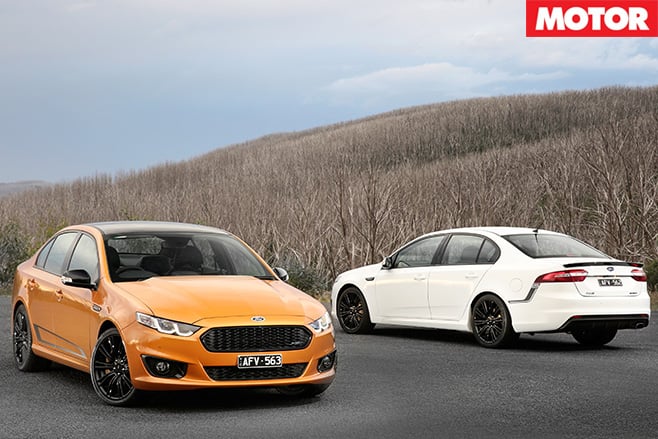
Regular consumers may be abandoning large cars in droves, but thankfully there are still plenty of enthusiasts out there who want a powerful, rear-drive sedan, and this made it easier for E8 (Falcon and Territory) Chief Program Engineer David Burn and his team to create a strong business case for a fitting Falcon farewell.
“When people look at large cars,” says Burn, “they say it’s a shrinking segment [but] if you look at who’s buying large cars, the performance car portion of the segment, both ourselves and Holden, is remarkably stable.” A perfect example is Ford having to double XR8 production due to unexpectedly high demand, however it turns out that the Sprint wheels were in motion prior to the XR8 appearing.
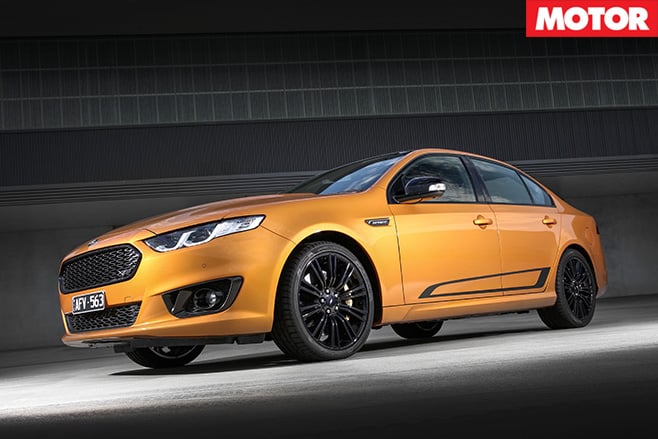
With the approval of the money men secured – “you don’t do a program on hopes and dreams,” says Capicchiano – the first two problems to be tackled were what’s it going to look like, and how much power will it have? “We had a fair bit of discussion about how the car should look,” says Burn.
“On the one extreme we have the lairy V8 Supercars appearance; on the other end you have to look at what customers are doing to our cars, particularly Turbos, where they make it much more of a sleeper-type car. We discussed it for a long time and started to zero in on the right answer, which is trying to make it subtle, make it stealth.”
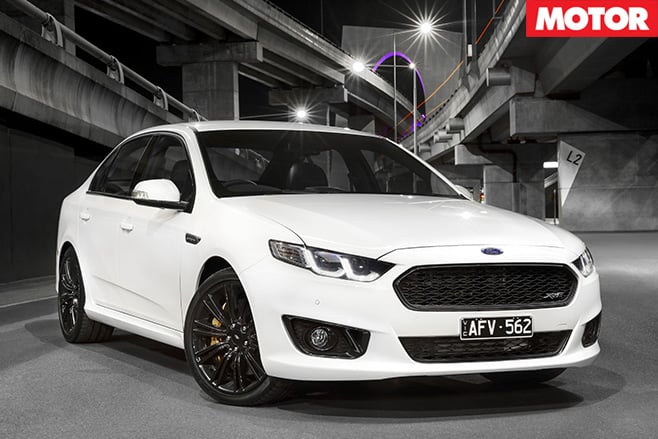
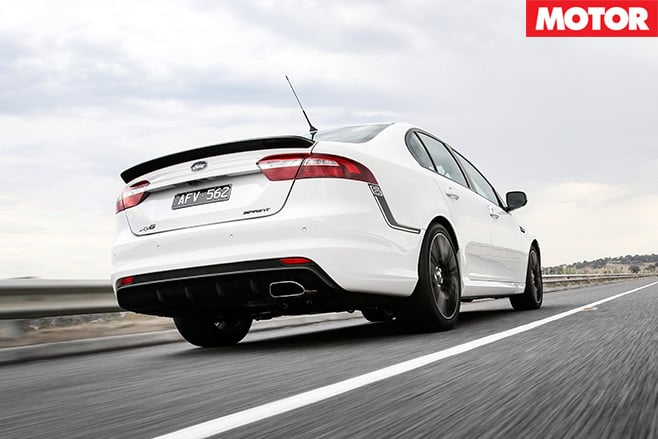
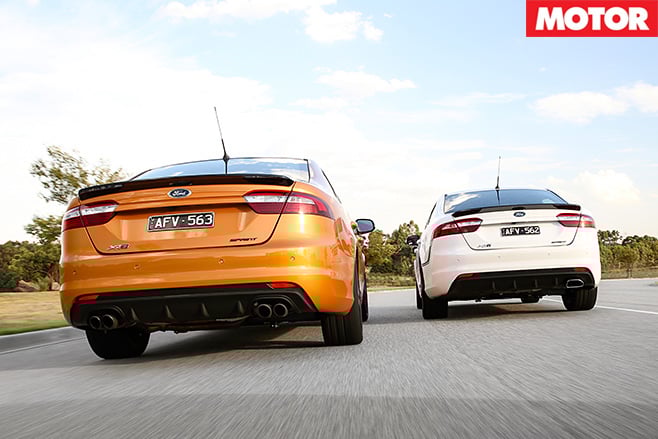
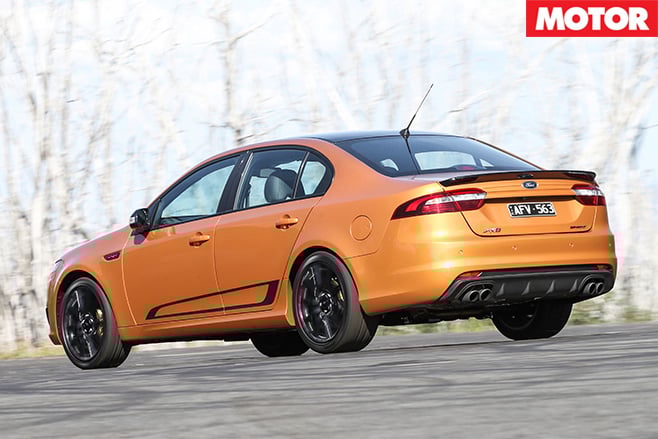
The overall look is much sleeker than we became accustomed to from FPV – more GT E than GT-P – and the smaller rear spoiler actually improves the car’s aero balance; the GT’s big rear wing produced more downforce than the front could match, which led to the nose lifting at speed.
And speed is something the new Sprints are very good at thanks to the powerhouses under their respective bonnets. On paper there seems little to shout about – with 345kW/575Nm, the XR8 Sprint offers only 10kW/5Nm more than a regular XR8, while the 325kW/576Nm XR6 Sprint improves on the old F6 by only 15kW/11Nm, however the amount of detail changes, particularly in the case of the Turbo, offer a swift rebuke to anyone who attributes the increases to a quick ECU flash.
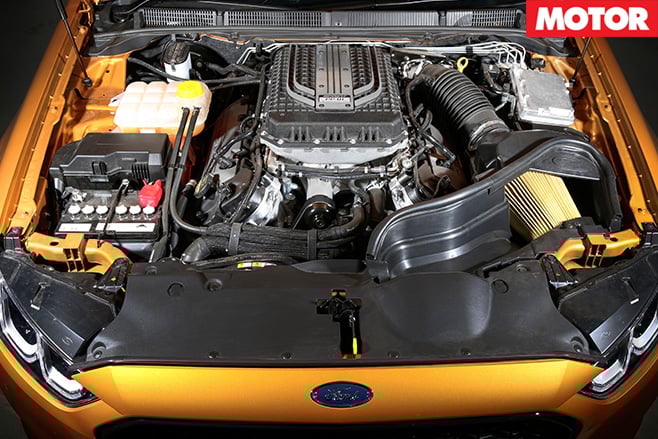
“That was a day one discussion,” agrees Capicchiano. “Three-fifty-one was a number that was symbolic to the GT nameplate; the power figure was sacrosanct to that car.” With the power ceiling set at 345kW, focus instead turned to improving drivability, the Sprint incorporating the GT F’s ‘twin pedal map’ which works in conjunction with Bosch’s ESP 9.0 system to smooth the power delivery.
While the regular XR8 also has the latest ESP system, the older 335kW tune isn’t optimised to work with it, whereas the GT F and the Sprint are almost able to ‘predict’ how much power the chassis is capable of using at any given point in time and subtly trim the driver’s throttle inputs to give the desired effect. If that all sounds a bit nanny state, fear not, we’ve no doubt with DSC deactivated both cars will melt their rear tyres in time-honoured Aussie tradition.

The 10-second overboost limit means Ford can’t officially quote the cars’ maximum figures of 370kW/650Nm (XR6) and 400kW/650Nm (XR8), however Capicchiano is adamant that “on a normal day, you’ll be in overboost all the time”.
As the 10-second time period resets on every gear change, unless you’ve just completed 10 hot laps of a racetrack the Sprints will produce full whack all the way from rest to their limited 230km/h top speeds.
It’s this enormous plateau that will make the XR6 Sprint the fastest six-cylinder Falcon ever. Its outright numbers might not be much higher than those of the FPV F6, but the Sprint engine is a very different beast – “the best in-line six we’ve ever done” according to Capicchiano. “Everyone thought 310 [kilowatts],” says Burn, before Capicchiano interjects with “from the start we said ‘nup’, we can do something different”.
While the engine itself is more or less bulletproof, its ultimate potential is limited by the ZF six-speed auto’s 650Nm torque limit, so the challenge became sustaining that maximum for as long as possible.
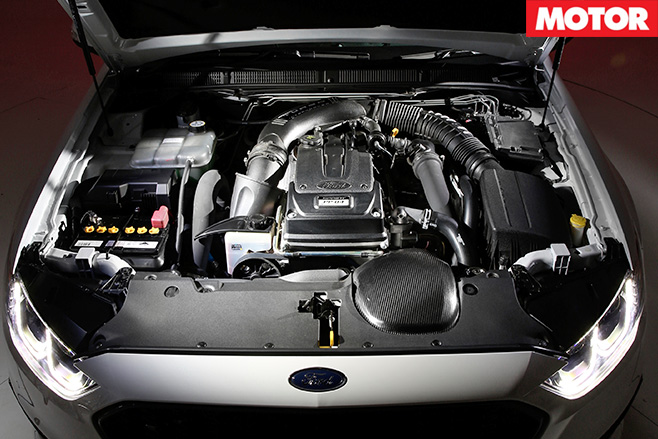
The fix was a new turbo-to-cat exhaust and swish new carbonfibre intake system designed and produced by local outfits Premcar and Quickstep Automotive respectively. It’s very odd lifting a Falcon bonnet and seeing that familiar black weave, but its looks aren’t as important as the 35 per cent improvement in air flow. To support the required outputs the F6 toy chest was raided and the turbo, injectors, fuel rail, intercooler, oil and transmission cooler all pilfered.
According to Capicchiano the result is “the most efficient pump in the shed; even at the power level we’re at we’re actually running less piston temp than an F6 [or] XR6 Turbo. We’re making more boost for a lot longer period of time in the mid-range – at 3000rpm it’s making 3psi more than F6 was – and there’s a big wedge more power from 4000-6000rpm.”
Of course, in recent years power has never been a fast Falcon problem. As Capicchiano says, “the restriction was never the amount of power; it was everything else around it.” Both Sprints have launch control, however the different power delivery of each engine means each has its own system. However, the single biggest factor transforming the Falcon’s power-down capabilities is the fitment of Pirelli P Zero tyres, replacing the previous Dunlop SP Sport Maxx.
At the mention of the new rubber, both Burn and Capicchiano get visibly excited. “We love this part of the car,” says Capicchiano, “We’ve done everything around the tyres.” “When we did GT F the tyres were a massive limiting factor in getting the car off the line quickly,” explains Burn. “The Dunlops were great, but not suited to that high level of instantaneous grip; to get more grip into this car, the first thing on the list was some new boots.”

The Sprints wear 245/35 fronts and 265/35 rears; while the latter are technically narrower than the Dunlops on the regular XR8, the actual contact patch is within half a millimetre.
Though it sounds easy, switching rubber necessitated 18 months of certification work as well as a comprehensive suspension redesign. “You can’t just put a tyre on the car and expect it to work,” explains Burn. “It significantly changes the way the car rides and handles [and] we ended up doing a complete ground-up suspension redesign.” As with the engines, the benefit of recent development meant the XR8 required less work, however there were a number of areas the team wanted to improve.
At this point Burn drops the bombshell: “and it does not understeer.” Pardon? Anyone who has driven an XR8 on track will be familiar with the sensation of sailing past apexes as that massive 5.0-litre supercharged V8 drags the nose wide and it turns out Burn, an experienced circuit and rally driver, agrees: “One of the big things I dislike about the V8s is it’s really hard to get the thing to tuck mid-corner; I kid you not, this car will pivot on its front axle mid-corner.” Capicchiano is equally effusive: “The first time we drove the XR8, it was like a friggin’ revelation.”
Fair enough, you’d expect the blokes responsible for building them to be singing the cars’ praises, but for them to speak with such confidence while acknowledging the shortcomings of previous models gives us hope that for the first time in a long time Ford’s hi-po Falcons will have the dynamic prowess to harness the rampaging horses under the bonnet.
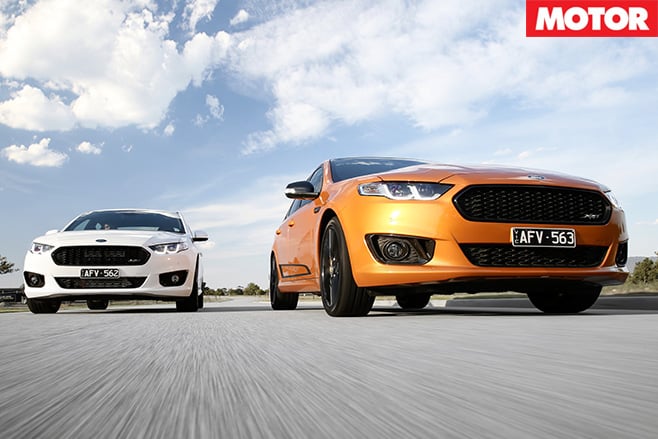
A surprising amount of modification has taken place, and surprising pretty accurately describes the Sprint program. Few expected so much development and investment to be allocated to what will be very low-volume models; just 1400 Sprints will be built in total – 850 XR8s and 550 XR6s – with 150 off to our Kiwi cousins (in a 100:50 XR8:XR6 split).
Just how successful Ford has been at translating all this effort into a rewarding driving experience you can read over the page, however at least it’s made an effort. After years of being criticised for letting Falcon wither on the vine it’s given the last Falcons the best possible chance of also being the best.
Everyone has bad days at work, even those whose job it is to complete lap after lap of the Nurburgring at full noise in all sorts of exotic machinery.
It appears Chevrolet is readying a new Camaro track special, likely to wear iconic Z/28 badging. The recipe will be familiar: massive sticky rubber, stripped interior, stiff suspension, and judging by the noise in this video, a massive V8 under the bonnet.
Unfortunately, development on this day was interrupted when the driver carried a little too much speed into a left-hander, locking the brakes – it seems ABS calibration is still on the to-do list – and having a heavy impact with the barrier.
Oh well, what is it they say about omelettes and eggs?
A war has raged for six decades on Australian roads, each tribe with its share of glorious victories and bitter defeats. This year, Ford has a new weapon – an American icon, no less – in the battle for V8 domination. Can the Mustang invader defeat Australia’s own Holden Commodore SS-V Redline?
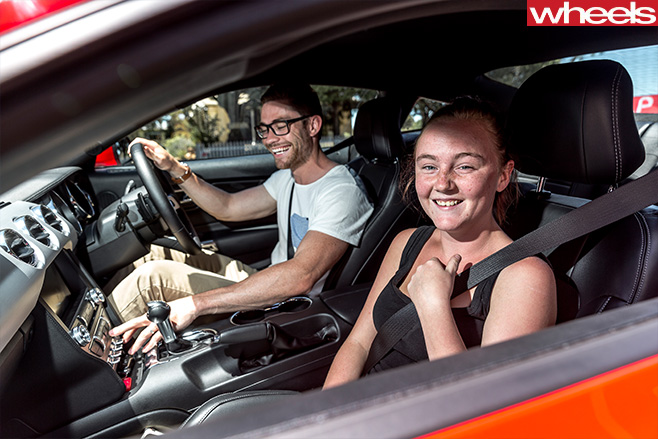
Looking back, I blame the photographer. After all, it was her idea to drive the Mustangs here. Her idea to “get a few shots of the cars with some school kids”. Her idea to create this scene of pubescent chaos, this tidal wave of pressing human flesh.
If I wasn’t so worried about the little terrors nicking the keys, I’d be impressed at how many of them there are. We’ve hijacked morning assembly at a college in Bathurst, deep inside Ford and Holden country, and news of our arrival spreads almost as quickly as pictures of the cars are uploaded to Facebook, so strong is the pulling power of the new Mustang
As one sandy-haired kid gushes, his freckled face flushed with excitement, “It looks unreal!”
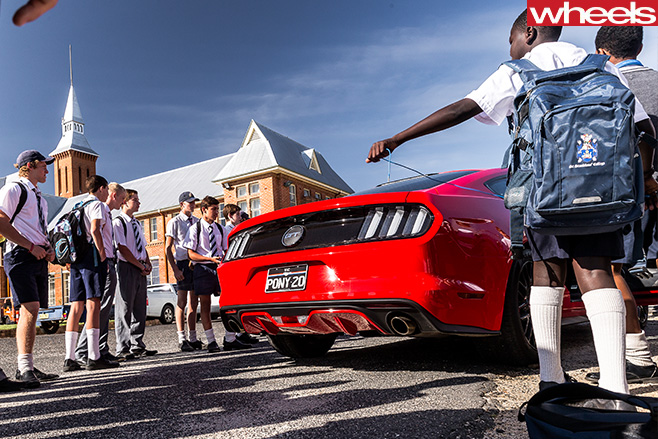
It’s also instantly recognisable. Every one of these kids knows that this is a pair of Mustangs. They also seem to love them unconditionally. Well, at least until I reveal the silver car is powered by a four-cylinder engine. I doubt telling them it was laced with Ebola would have seen them back away any faster.
“But isn’t a Mustang meant to have a V8?” asks one perplexed teen. This isn’t the only time we’ll hear this question over the next two days.
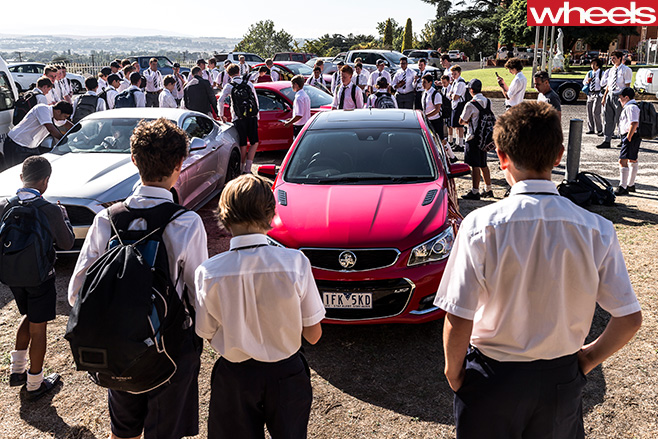
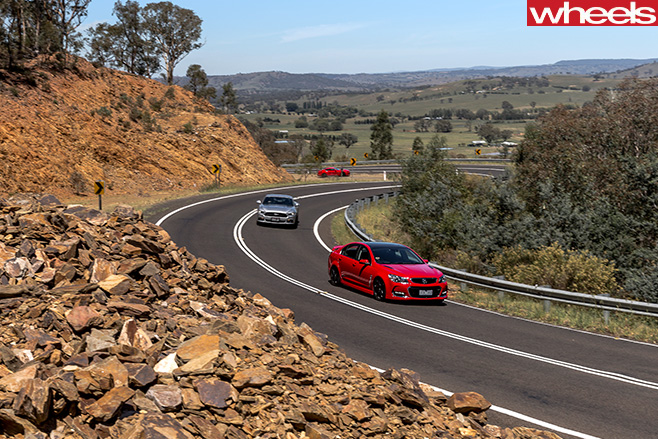
It also brings out an army of teachers, so we quickly prise the students out of the seats, ignoring their cries of “C’mon, it’s a Mustang!”, and head for the twisting ribbons of tarmac that drape rural New South Wales.
I jump in the V8 Mustang and discover that driving it only adds to its sense of character and occasion. You sit low in comfortable, well-supported leather seats, there’s a satisfying V8 burble, and the view through the windscreen – in both models – is dominated by two wonderfully sharp bonnet bulges that draw your eyes down the road ahead.
Built as a global car on an all-new platform – hence its arrival Down Under in factory right-hand drive
14 years after the fourth-generation’s shortlived Tickford conversion program ended – the Mustang boasts a fully independent rear suspension for the first time. Every previous ’Stang has made do with leaf springs and a live rear axle. Aussie-spec cars also get a variation of the optional Performance Pack offered in the US, which brings stiffer springs, firmer dampers, thicker anti-roll bars and a limited-slip diff.
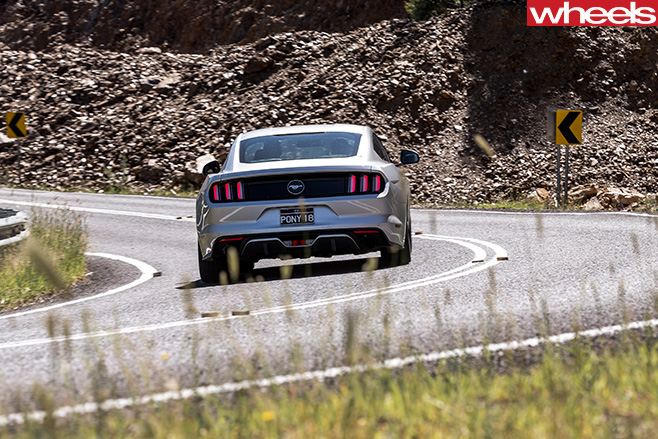
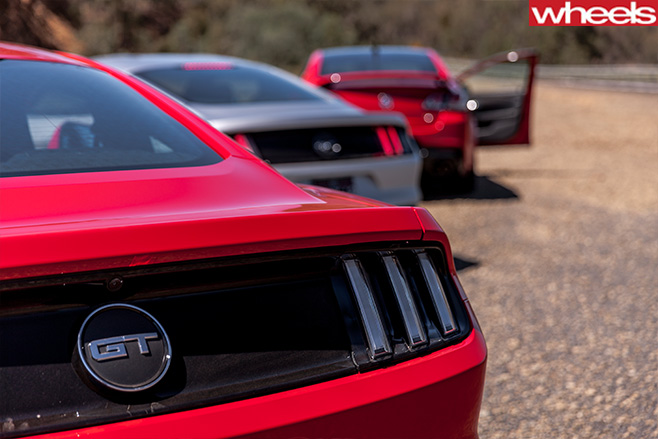
Which is why we’ve brought the SS-V Redline, our current affordable rear-drive V8 benchmark. On paper its fight with the Mustang GT is close. Both are under $60K, produce similar outputs and shuffle their grunt through six-speed automatics. They also ride on 19-inch wheel/tyre packages and, despite the Commodore’s extra doors, weigh within 56kg of each other.
The odd one out in this group is the Ecoboost Mustang. Not just because it has half the cylinders but because of its $45,990 price tag. Which begs the question: do you need to spend an extra $14K on the V8 Mustang GT, or is the Ecoboost the better buy?
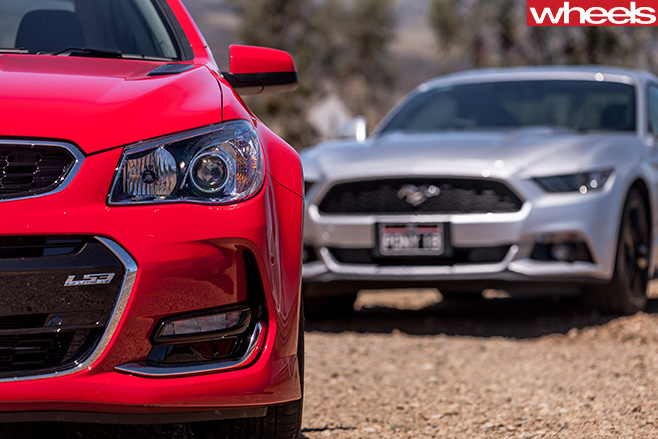
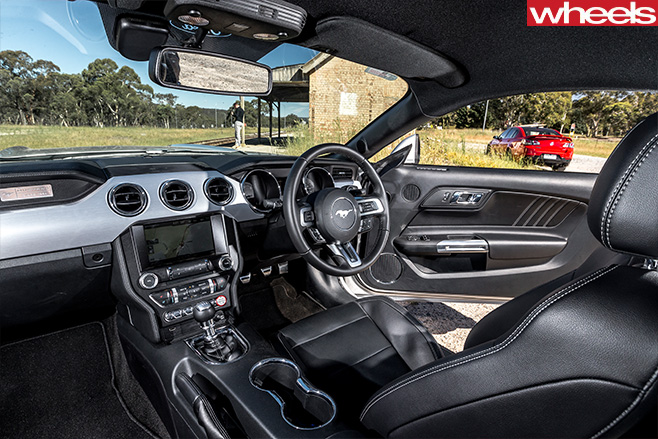
The GT and Ecoboost have identical cabins, and on face value the interior is a hit, delivering a sense of occasion to match the exterior thanks to retro-cool design. Look closer, though, and you begin to notice some annoying misses: the centre console is unchanged from left-hand-drive markets, so the handbrake is on the passenger side; the cupholders are precisely where your arm sits when shifting gears in manual variants; and there’s no digital speedo. Then there’s the mismatch of materials, which range from superb (real aluminium on the centre stack) to sub-par (hard, scratchy plastics on the door and centre console).
And don’t expect to ferry too many people around in that rear seat. Despite its 2720mm wheelbase, the Mustang is strictly a 2+2, not a fastback Falcon. Adults can fit, just, but even when they cram their legs behind the front seats, the steeply raked roofline means headroom is seriously compromised.
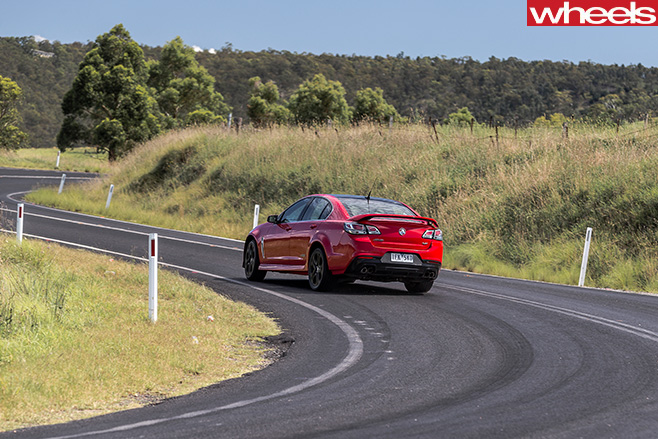
There’s no denying the Ecoboost Mustang matches the GT for visual drama and interior style, but can its 2.3-litre four really go toe-to-toe with the beefier V8s?
The Ecoboost we have here is mated to a six-speed manual and it’s a terrifically eager drivetrain. Fed by a twin-scroll turbo, the four makes 233kW and a chubby 432Nm at 3000rpm. Most of that torque is available from 1720rpm, so there’s plenty of low-down shove. The gearbox is sweet, too, with positive shifts, a short gate and an intuitive clutch action.
Wheels wingman Damion Smy sums it up perfectly: “The Ecoboost might leave you feeling disappointed in terms of noise and drama. It just doesn’t deliver.”
It’s a point rammed home by climbing back into the GT. With the road getting twistier, the GT provides a more authentic Mustang experience. There’s something deeply satisfying about driving a Mustang with a V8, and the GT’s 5.0-litre unit is a cracker. Linear, eager and muscular, the bent-eight feels as though all of its 306kW/530Nm are present and accounted for.
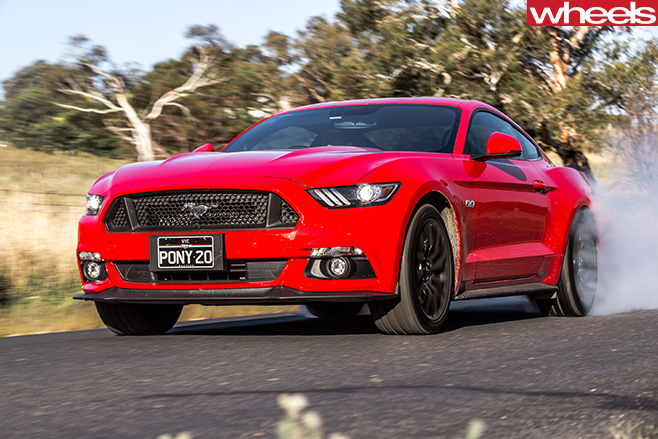
While neither setting is the last word in feel, the tiller provides enough connection to get the most out of the cracking chassis. If previous Mustangs had an aversion to corners, this new one devours them. There’s minimal bodyroll and, while you’re aware of the ’Stang’s considerable size and 1747kg kerb weight, the chassis is beautifully balanced. Understeer and oversteer are well telegraphed and if you nail the entry speed and get on the throttle early, the rear axle squats beautifully and drives through the apex. It all feels nicely sporty and confidence-inspiring, but the Mustang’s real party trick is its adjustability. Come in too hot and you simply bleed off the throttle, brush the firm brake pedal and wait for the nose to tuck back in. It’s friendly, easy and, with the V8 punching hard above 4000rpm, fast.
Better news is that this focus on dynamics hasn’t resulted in a bone-crunching ride. Both Mustangs use fixed settings for the double ball-joint front suspension and sophisticated multi-link rear, and while the ride is undoubtedly firm, the deftness with which they manage bumps verges on European.
What can undermine the experience is the six-speed ZF auto. Even with the transmission in Sport, the box is often a gear too high for these tight mountain roads, while full-throttle gearshifts deliver an unwelcome amount of drivetrain shudder.
The engine’s a cracker, too, and the combination of more grunt, shorter gearing and a wider rev range gives the Redline a sense of muscular eagerness lacking in its 260kW 6.0-litre predecessor.
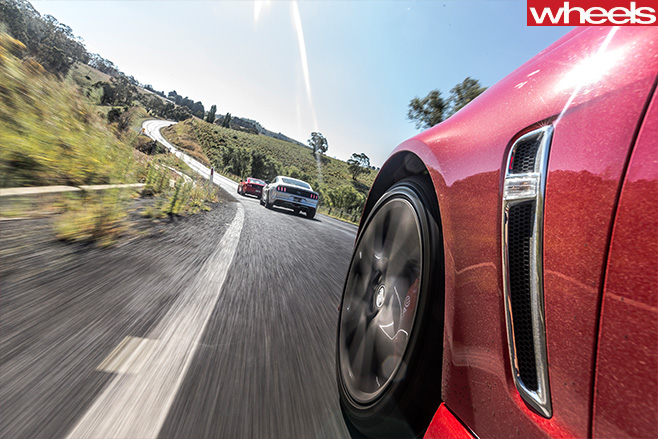
Consequently, the Commodore can’t match the roadholding and confidence of V8 Mustang. Tip the SS-V into a corner and it takes a moment to rest on its outside wheel, which is a breath the Mustang doesn’t need. Get the Redline settled, though, and it drives beautifully out of corners – the MY16 suspension changes providing a more polished ride/handling mix thanks to a longer anti-roll bar and softer rear springs. Like the Mustang, the Redline telegraphs understeer and oversteer beautifully; push through the initial body movement and there’s a wonderful sense of fluidity to its handling.
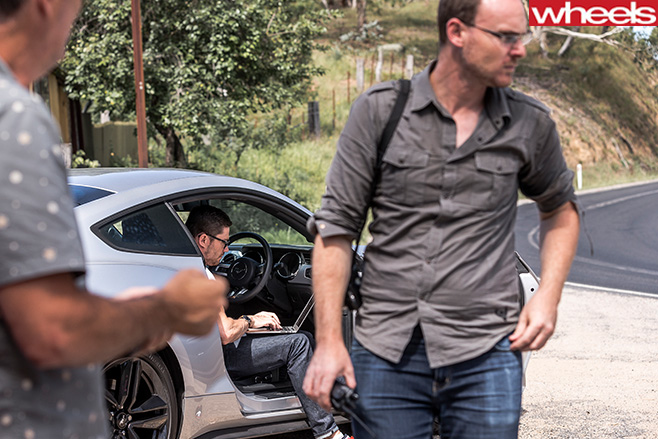
While the Ecoboost’s 2.3-litre engine felt outmuscled earlier, a tight complex of second and third gear corners makes the most of its torquey bottom end and strong mid-range. Without the room for the GT and Redline to stretch their V8-powered legs, the Ecoboost is a match, but is not as much fun as the louder, meatier V8s. Still, the Ecoboost proves it’s a quick, involving and enjoyable performance car in its own right. It also seems an ideal platform for tuners (see breakout).
With the twisty stuff behind us, we pull into the tiny goldrush town of Sofala, and meet Ron. Tall and sporting a thick grey beard that’s in stark contrast to his thin and fragile gait, Ron drinks in our trio’s mix of shapes and colours before proudly declaring he’d just ordered a Mustang that very morning.
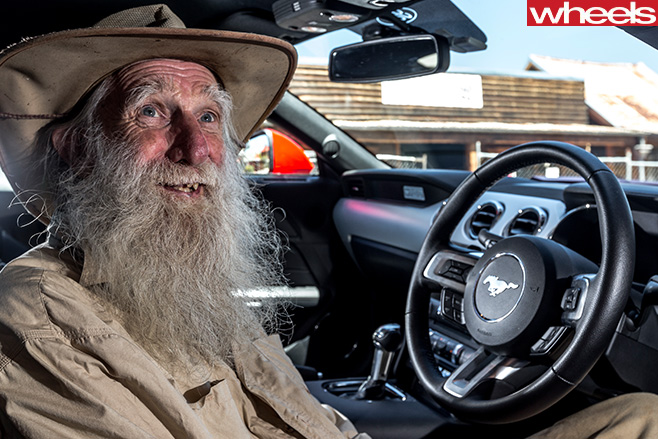
We quietly agree.
Ron also provides a reminder of just how popular this new Mustang is when he complains, “I’ve got to wait until February next year for the bloody thing to arrive!” Ford’s first shipment of 4000 Mustangs quickly sold out and now there’s a 12-month waiting list.
Still, there’s no hiding Ron’s excitement for his new pony car, and as he lowers himself gingerly into the driver’s seat it’s an opportunity to reflect on what separates these three cars.
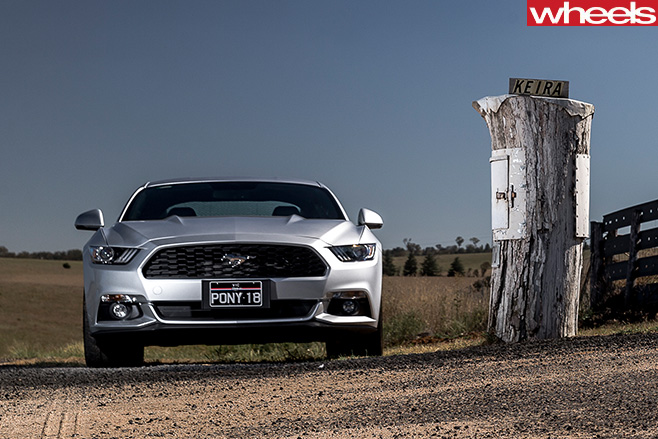
The fact that the Commodore is at the end of its life, rides on a 10-year-old platform and is a generation older than the Mustang, yet is still this good, is testament to the people who created it. The Commodore is a car made by Australians for Australians, and the VF2 SS-V Redline is the last of its breed, and undoubtedly the finest.
But as much as Australia’s Own feels like a well-sorted, sporty family car, the Mustang drives like a sports car. And of the two ’Stangs, it’s the GT’s V8 muscle and greater sense of occasion that leaves the strongest impression. It’s an intoxicating blend of rockstar looks and sorted dynamics that, after two days and hundreds of kilometres, I don’t want to give back.
This makes me think of Ron, sitting in his stained khaki clothes and cowboy hat back in the Sofala pub, waiting patiently for his white Mustang GT to arrive in 2017. He’s going to love it.
“It costs how much!?”
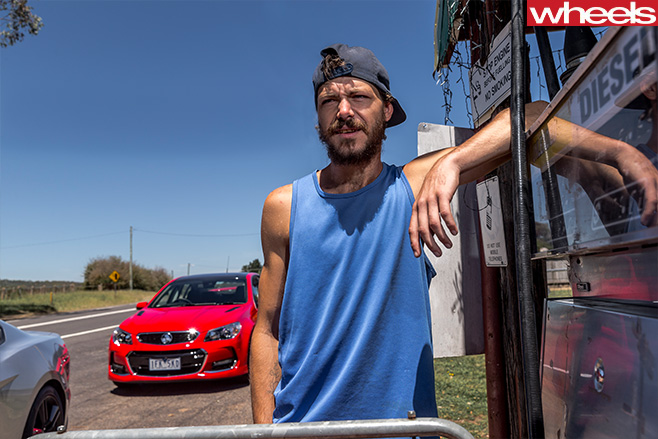
Just like it does for fit and finish, though, the Commodore trumps the Mustangs for interior equipment as it also gets as standard an eight-way adjustable driver’s seat compared to Mustang’s six, a head-up display, lane-departure warning and blind-spot detection.
Mustang with a meaner kick
If you reckon the Mustang GT’s 306kW/530Nm 5.0-litre V8 isn’t sufficiently hairy-chested, Ford has another, slightly madder Mustang in its stable. The Shelby GT350 is a product of Ford Performance – the same mob that make the Fiesta ST and new Focus RS, among others – and packs a 392kW/581Nm 5.2-litre V8 that revs to 8250rpm. And if that doesn’t sound fast enough, there’s a track-focused 350R with no rear seat, no air conditioning and adaptive magnetic dampers. Neither are likely to hit Aussie roads, even though Ford says there’s no technical reason preventing importation. Ford doesn’t think the business case stands up, despite Australia’s penchant for all things V8, fast and mad.
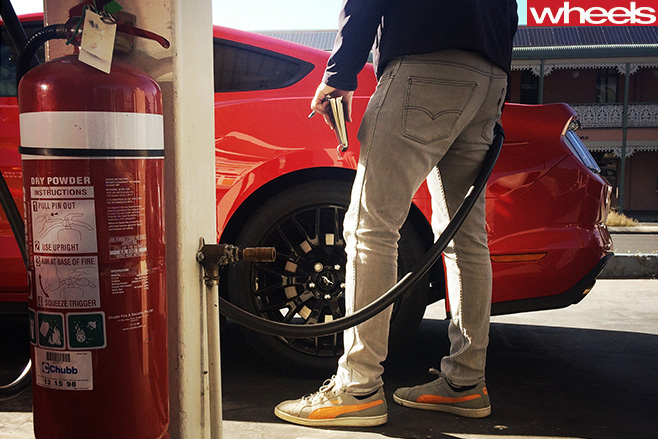
Bowser burn
Verdict
 FORD MUSTANG GT
Price as tested: $59,990/As tested $59,990
NCAP rating: 5 stars (NHTSA)
Fuel economy: 15.8L/100km (test average)
Acceleration: 0-100km/h: 5.0sec
Plus: Winning blend of performance, dynamics, styling and desirability
Minus: Engine and exhaust note needs to be louder; interior’s rough edges
Verdict: 9.0/10
 HOLDEN COMMODORE SS-V REDLINE
Price as tested: $56,990/As tested $57,540* Includes $550 black roof.
NCAP rating: 5 stars (ANCAP)
Fuel economy: 15.9L/100km (test average)
Acceleration: 0-100km/h: 5.3sec
Plus: Terrific engine; capable and engaging chassis; roomy, practical packaging
Minus: Lacks visual drama in this company; sporting, yes; sports car, no
Verdict: 8.5/10
FORD MUSTANG ECOBOOST
Price as tested: $45,990/As tested $46,490* Includes $500 Prestige paint.
NCAP rating: 5 stars (NHTSA)
Fuel economy: 12.7L/100km (test average) (test average)
Acceleration: 0-100km/h: 6.0sec
Plus: Less weight over the nose; lighter thirst in normal driving; keen price
Minus: Not super-fast; lacks engine note; out of step with Mustang image
Verdict: 7.5/10

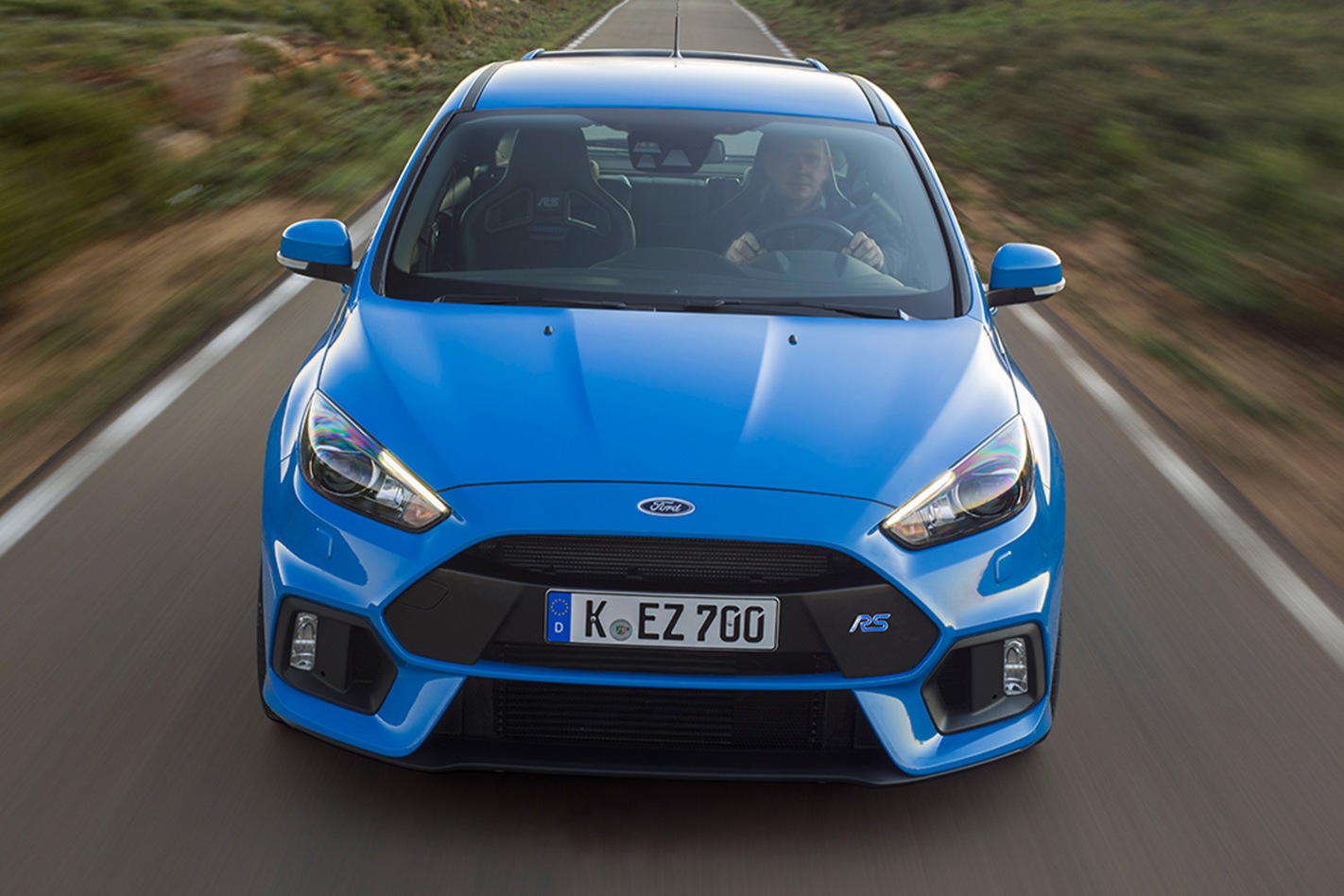
Given that all-wheel drive turbo cars tend to deliver slingshot speed and sure grip ahead of spectacle, the Drift mode feature in the forthcoming Ford Focus RS could make it a uniquely awesome proposition among rivals.
A six-speed-manual-only, white-hot hatch that offers a pushbutton pick from all-wheel drive adhesion or oversteer craziness, for $50,990? Yeah, we’re interested!
Just based on this mode – provided it’s any good – the Focus RS will be much more fun than all-wheel drive turbo rivals, the Subaru WRX STI and Volkswagen Golf R. Drift mode should even give the relatively affordable Focus RS an ace over the Mercedes-AMG A45 and other high-price hotties. Sure, the Benz has sheer outputs and a wild exhaust soundtrack in its favour, but it can’t hang the arse out.
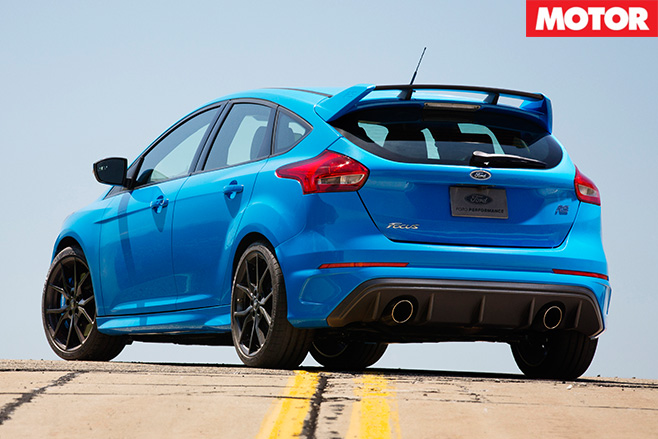
But does Ford’s Drift mode actually work and, if so, how?
Well, firstly, ‘Drift’ is just one of a series of electronic stability control calibrations in the RS, which also include ‘Normal’, ‘Sport’ and ‘Track’. Track loosens the safety net, while Drift mode lets you do just that, by giving the ESC an uncommonly high intervention threshold.
There’s more to it, however. Extreme torque-vectoring of up to 70 per cent of engine torque to the rear wheels and up to 100 per cent of that to either rear wheel brings power-oversteer potential not usually found in anything other than a rear-wheel drive car.
This helps get the all-wheel drive Focus sideways, and then the specific electronic stability control program helps the driver turn the slide into a drift – rather than a spin. It does this by monitoring the car’s yaw rate, and the driver’s corrective action, using the ESC’s sensors. If the driver isn’t doing what’s needed to keep it all under control, the software steps in.
The result, in theory – and judging from the videos we’ve seen online – is a hot hatch that can drift like a Falcon, or a Mustang.
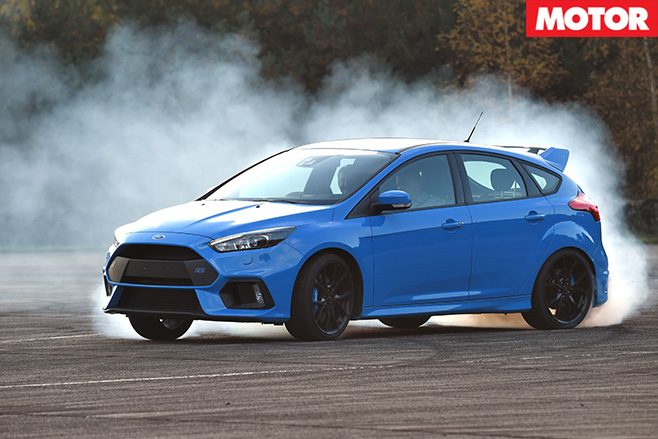
Through adept tuning, the former systems give the driver the latitude to get loose, as long as it senses they have the skills and are using them to control a perfect tail slide. The Focus RS just takes this approach to the extreme…
Serious steerers, of course, can turn the ESC off completely, but Ford says there’s enough room within the Drift mode’s lax limits to have a lot of fun, leaving no need.
The average drift icon is a tuneable, high powered rear-wheel drive in which drifting is the default mode, rather than an option, which could make the Focus RS, with its ability to be driven neatly and quickly or fast ’n’ loose, the best of both worlds.
Slide ways
The Focus RS in drift mode
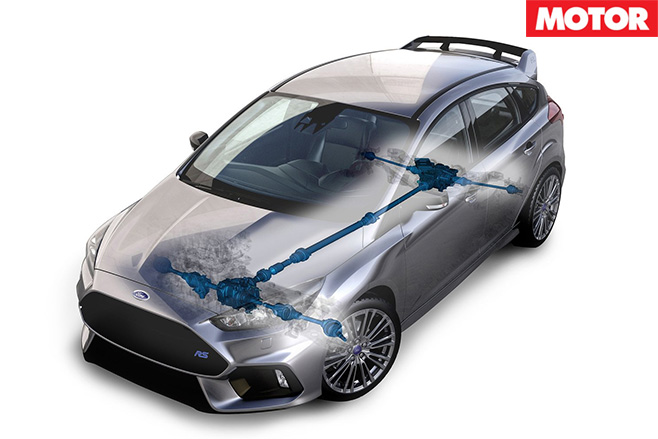
1. ROLL OUT When the drift button is pressed, the steering, engine and exhaust slot into sports settings, but the dual-mode adaptive dampers stay in normal mode. The extra body-roll this promotes allows easier and smoother transitions into and out of a drift.
2. PACK ’ER UP Torque vectoring is introduced via electronically-controlled clutch packs either side of a ‘Rear Drive Unit’, which is a lighter set-up than a centre diff. This gives the RS a more rear-drive feel than a regular all-wheel drive.
3. FORCE FED One clutch pack apportions as much as 70 per cent of the RS’s 257kW/440Nm to the rear wheels, and the other up to 100 per cent of this to the outside wheel, in a superior approach to the more common system of braking individual wheels to divert torque.
4. ALL FOUR IT The fact there’s still 30 per cent of power or more going to the front wheels means the Focus RS four-wheel-drifts rather than executes full-on power-slides like a dedicated rear-drive drifter, but smoking all four beats plough understeer.
5. HOLD IT A lenient ESC calibration lets the driver get away with a lot, provided the system senses he or she knows what they are doing. Demonstrate a lack of skill or go too crazy and the ESC will call ‘clown’ and clamp down.
Was Ford first?
Ferrari’s system explained
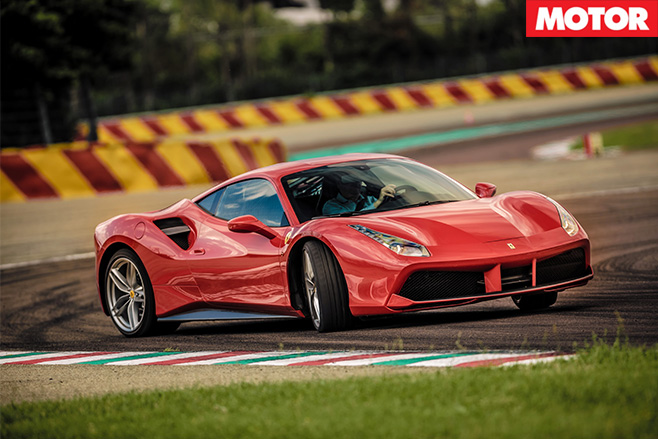
In SSC, an ESC algorithm takes inputs from lateral G, yaw angle, steering angle and speed sensors to allow a controlled amount of slide with the aim of assisting the driver lap a circuit quickly as possible.
By allowing a degree of lateral slip, the system lets the driver slide the front and rear of the car within raised intervention limits.
A new patented technology by Ford Motor Company, which makes two and three-cylinder engines sounds like six or eight-cylinders, will stop manual drivers up shifting at higher RPMs and in turn, save on fuel.
Those who remember learning to drive a manual car will recall keeping a watchful eye on the tachometer, waiting for that little needle to hit three before launching a foot into the clutch to up shift, and prevent the car’s engine from screaming at you.
Eventually, as driving with a third pedal becomes more habitual, the eyes go back to focusing on the road and the ears become the gear-shifting gauge.
In smaller engines, the sound is less obvious, causing drivers to shift gears too late, forcing the car’s engine to work harder and use more fuel. The patent makes the engine louder so drivers get a clearer indication of the ideal shift point.
Artificial engine sounds aren’t unusual, with a growing number of cars using an engine stereo to make the vehicle sound better. The Ford Mustang’s EcoBoost, for example, uses a system called Active Noise Control. But unlike these stereos – which have some car-buyers and drivers feeling cheated (we get it, faking it sucks) – this new technology concept could make the life of many manual-drivers easier and cheaper.
The dryly-worded US patent describes it as a “device to generate an engine noise and a method to generate the engine noise at a time period between two directly successive ignition events of an internal combustion engine wherein the engine noise increases the number of cylinders of the internal combustion engine in a virtual fashion.”
Ford Australia wouldn’t comment on the product but said there are a lot of “exciting new technologies” coming out of Ford’s development.
“On this specific product, there’s no news on whether it’ll arrive in Australia,” said Ford Brand Communications Manager, Jasmine Mobarek.
“But consumer trends are leaning toward automatics, so we’ve got to make sure our cycle planning aligns with what consumers want.”
At this stage, the technology is still just a patent so whether it’ll make it to development or not is unknown. But we’re all for anything that’s going to lower the cost of running a car, without sacrificing performance.
DETAILS of the twin-turbo diesel-engined Opel Astra have had their official reveal overnight, showing an oil-burning version of the city hatchback that’s more sugar than Opel’s claim that it’s a decent dose of spice.
Numbers for the Opel Astra 1.6 BiTurbo CDTI – we’re not sure yet if it will wear a Holden badge – show the twin-turbo tech for the 1.6-litre four-cylinder engine will produce 118kW at 4000rpm, but more significantly, a meaty 350Nm from as low as 1500rpm.
It’s enough under-bonnet poke to launch the diesel-engined Astra from 0-100km/h in 8.6 seconds, making it faster-accelerating than a 1.6-litre petrol Ford Focus Sport. The difference is, though, that while the Ford Focus will drink 6.2L/100km of premium unleaded fuel, the Astra will sip around 4.1L/100km.
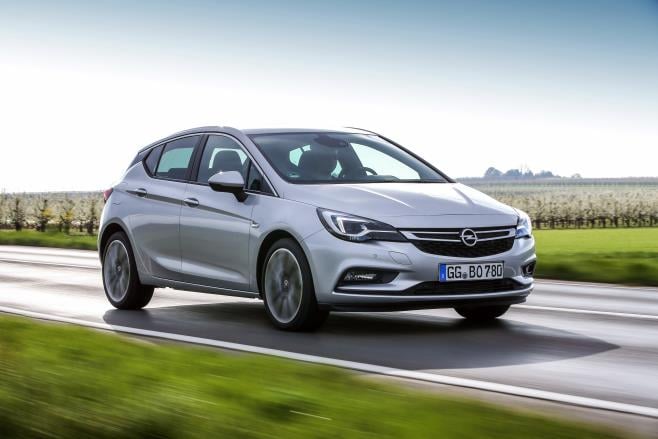
Part of that jump in fuel efficiency is the new Astra’s lighter body, which sheds up to 200kg compared with the models it replaces.
The new version of the European-designed hatchback is due on sale later this year, replacing both the locally built Cruze hatchback that will officially end Australian production in October, and later, Holden-badged performance versions of the old-generation hatchback that have kept the Astra name bubbling in buyers’ minds since Holden’s decision to quit Australian manufacturing.
In Australia, the new Astra is expected to offer either a turbocharged petrol 1.4-litre four-cylinder engine producing 74kW/125Nm, or an updated version of the current turbocharged 1.6-litre petrol engine, tuned to produce 132kW/230Nm.
The twin-spin diesel Astra uses two-stage turbocharging technology to boost low-rev performance. Opel brags about the new car’s rolling acceleration, saying the Astra picks up pace from 80-120km/h in 7.5secs.
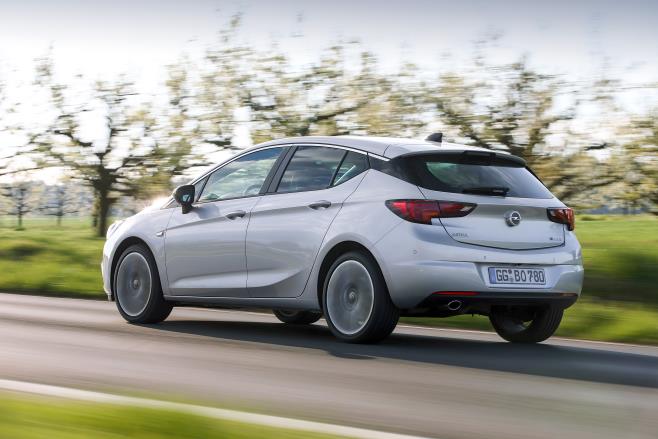
The newest Astra engine is also more powerful – and much faster off the line – than other twin-turbo diesel roll-outs in Australia, including the 100kW/320Nm twin-turbo 1.6-litre unit used in the entry-level Mercedes-Benz C200. It also crushes the 68kW/230Nm twin-spin 1.6 used in the Peugeot 2008 and the Citroen C4 Cactus.
Nissan’s X-Trail also uses a twin-turbo 1.6-litre diesel as one of its powerplant choices, delivering 96kW/320Nm.
Ninth generation brings its advance from the rear.
IN A world increasingly consumed by SUV ownership, it’s easy to overlook the virtues of a really well-executed wagon. The lighter weight, lower centre of gravity, lower drag coefficient, improved driving dynamics, and to this wagon lover, at least, the generally sleeker and more sporting aesthetics all trump a higher seating position and light-duty off-road ability.
A good wagon visually speaks of utility and true day-to-day functionality, rather than suggestions of rugged recreation that rarely happens.
But the world hasn’t completely fallen out of love with the wagon. In Australia, Audi’s new B9-generation A4 Avant aims to seduce those not sold on a Audi Q5, or its rivals from BMW and Benz.
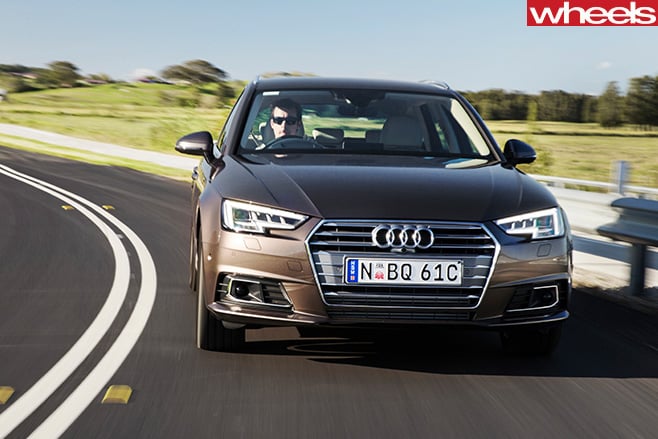
And its powers of seduction are strong enough to sway even ardent SUV lovers. This new generation Avant is 26mm longer than the outgoing B8 model, but underpinned by a 12mm longer wheelbase, so its overhangs remain tightly contained. It’s only 2mm lower, but its stance is made more planted and purposeful thanks to a 16mm increase in width to the wheelarches, and an 8mm wider track than the B8.
Drag is up slightly on the sedan, but still low at .29cd, and repositioned exterior mirrors help see it slip through the air stealthily.
Before checking out the load carry capabilities, take a quick dive under the bonnet: the main change compared to the outgoing line-up, is the deletion of a diesel variant. The old 2.0-litre TDI was taken up by only five percent of Avant buyers, so it’s gone, cleaving a way for a two-model line-up.
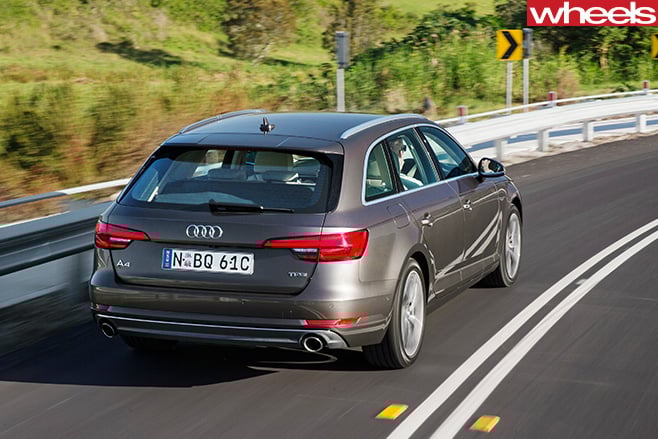
The price of entry also rises with this new generation, offset to some degree by the increase to standard spec. The front-driver is $63,900 — $3000 more than the equivalent sedan, while the high-output quattro variant helps justify its $9000 rise over the FWD model (to $72,900) with standard 19-inch wheels (the entry-level offering has 18s) and larger brakes, among other upgrades.
The rear is where the Avant’s USP sits, obviously, and it’s accessed via a standard electric tailgate that opens with one quick air-swing of your foot below the bumper line. It rises to reveal a beautifully trimmed and finished cargo compartment that’s marginally larger than the old model with the seats up (+15 litres) and up an appreciable 80 litres (to 1510L) when the rear seats — now split 40/20/40, rather than the less practical 60/40 of the old model —are folded.
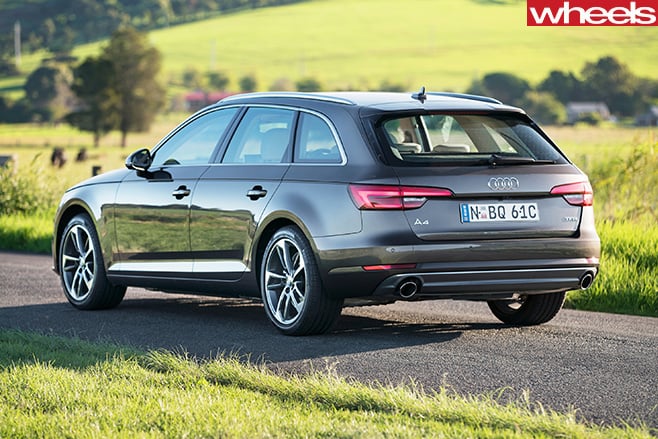
And let’s not forget the main floor panel, which can be flipped to reveal a durable, laminated surface for when your gear is too wet/muddy/sandy/stinky for the carpeted side.
So, the load-carrying ability and attention to practical details score bullseyes; the driving dynamics really don’t differ appreciably from the sedan variants. The extra power and tractive benefits make the quattro Sport the obvious choice for keen drivers. The 19-inch wheels don’t ruin the ride either, especially when teamed with the optional ($1700) 10mm-lower adaptive comfort suspension.
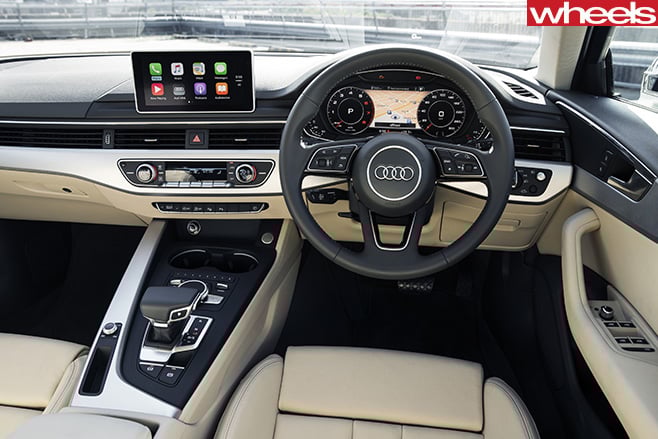
The crisp, responsive drivetrains, styling, practicality and all-pervasive ‘premiumness’ make sure of that.
And for that extra peace of mind…
For A4 owners a bit nervy about crashing their new Avant, Audi offers an optional assistance package that, for $1900, crams in a startling array of avoidance or mitigation systems. Along with the usual lane assist, adaptive cruise control (with stop and go and traffic jam assistant), there’s a pre-sense system that prepares the car for rear-end impact, turn-assist – which prevents you turning into the path of an oncoming car – and ‘exit warning’ which alerts a driver about to open a door into the path of a cyclist.
The assistance isn’t just limited to avoiding the ugly stuff though: predictive efficiency assistant uses the navigation system to scan the route and advises via a dash symbol when it’s advisable to lift off the throttle, such as just before the crest of a hill that has a roundabout on the other side, for example.
SPECS Model: Audi A4 Avant 2.0 TFSI Quattro sport Engine: 1998cc 4cyl, dohc, 16v turbo Max power: 185kw @ 5000-6000rpm Max torque: 370nm @ 1600-4500rpm Transmission: 7-speed dual-clutch Kerb weight: 1585kg 0-100km/h: 6.0sec Fuel economy: 6.6l/100km Price: $72,900 On sale: now
A global executive has confirmed Porsche will produce a wagon version of its next-generation Panamera due later this year.
The second version of Porsche’s large luxury liftback range is tipped to debut at September’s Paris motor show, however the brand’s US chief Klaus Zellmer has told Automotive News a wagon/Estate bodystyle will follow in time.
“We have to have some patience for [the wagon] to arrive in the US,” said Zellmer, Porsche Cars North America CEO.
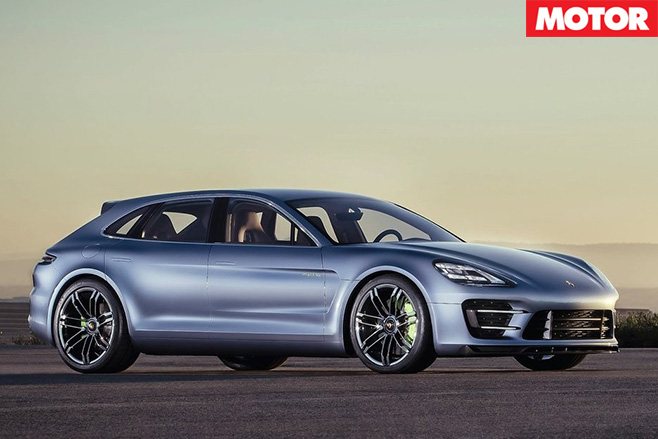
The confirmation aligns with reports from MOTOR’s European Correspondent Georg Kacher who reports the ‘shooting brake’ version of the Panamera will be pushed back from 2018 to 2019 production. Patience, indeed.
It is understood a Panamera Estate will look almost identical to the Panamera Sport Turismo concept car (pictured) shown in 2012 as a swoopy, coupe-style alternative to a traditional, boxy wagon.
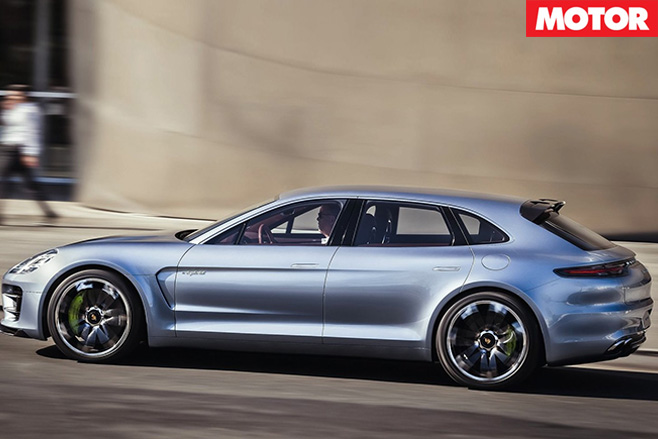
It will be built on the Volkswagen Group’s MSB modular rear-wheel drive architecture with an improved front-mid-engine layout for improved weight distribution, and a circa-100kg kerb weight reduction compared with the outgoing 1810kg-plus model.
Expect MSB to eventually spawn a next Bentley Continental and Flying Spur, and potentially the next Audi A8.
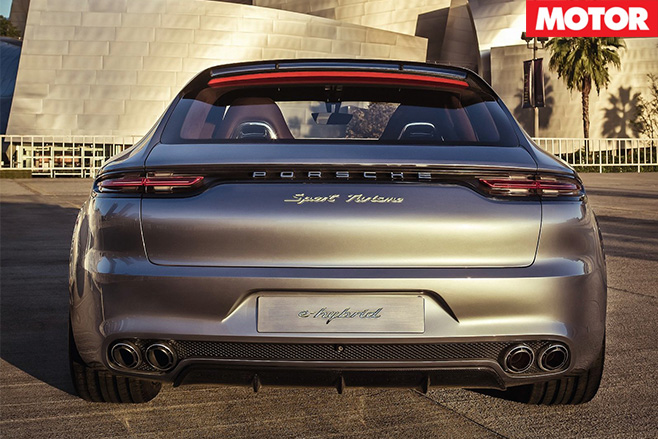
With a lighter kerb weight, expect the current 3.8sec 0-100km/h Panamera Turbo S claim to tumble. Meanwhile the usual rear- and all-wheel-drive systems with six- and eight-cylinder turbocharged petrol and diesels will feature.
The Panamera Estate is the one we want, though, and an insider tells MOTOR that Australia will likely get the future sports-wagon. Again, patience.
Italian automotive company, Pagani, has released a beautiful, high-definition video of its new Huayra BC drifting over the snow-covered roads of Sweden’s north – an experience few of us will ever get to do.
For the non-gear-heads reading this article, a video of a drifting car will probably hold your attention for less than a second before you mumble “hoons” and move on to the latest video of a baby panda sneezing, or cats doing ‘people stuff’. But this isn’t your normal sideways video and the Huayra isn’t your normal car.
In this incredible short, Pagani teamed with Bosch engineers to drive the Huayra BC through sub-zero temperatures to test its electronic stability control, ABS and traction control systems. The resulting images are sure to have even the most amateur of drivers adding a spin in the Huayra BC to their bucket list.
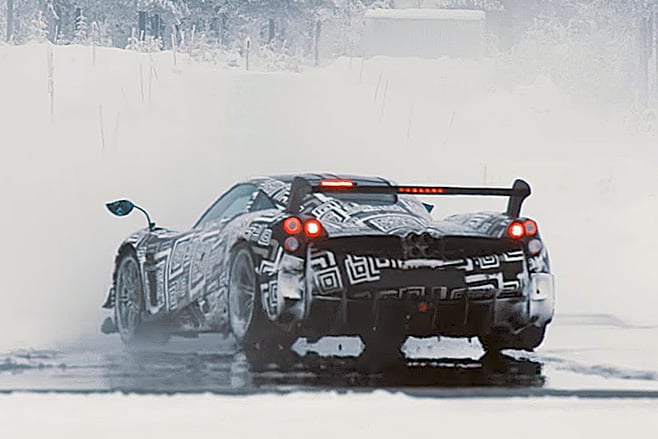
You can be forgiven for wondering who Pagani are – its multi-million-dollar supercars are rare. So rare, in fact, only one that we know of has ever made it to Australian shores – an outrageous, yellow Zonda, which preceded the Huayra model.
Because it’s unlikely you’ll ever come across these exclusive super-fast cars, we won’t go into detail here, so if you want to learn more about the Pagani Huayra, our friends at MOTOR mag have it covered.
As for the video, not only does it give you spectacular images of the boundary-pushing Pagani Huayra BC, but it also offers viewers some insight into the extent carmakers will go to, to test their vehicle’s systems and safety.
“This is the only way in which we can exploit the entire safety potential of the software while creating the dynamic handling particular to this brand,” said Bernhard Bihr, president of Bosch Engineering GmbH.
That’s all well and good, but now we’re left with some serious driving envy.
To quote the infamous Wernham-Hogg leadership guru David Brent: “A good idea is a good idea… forever”. Okay, that’s not the most eloquently-put sentiment, but you get the point. The Volkswagen Golf is one of those ideas. It works. A small car that manages to be as efficient as it is practical, and as well built as it is affordable.
There have been few instances where a car has stayed so relevant throughout time, without ever changing its essential character, the Porsche 911 is one of them, and so too is the mighty VW Golf.
While judging the Golf VII for Wheels Car of the Year some years ago, Editor Glenn Butler struggled to utter a negative remark: “The Golf VII is satisfying to drive, serene to ride in and superbly user-friendly,” he wrote. “It’s also remarkably fuel efficient, inarguably safe, technically advanced and, especially in its least expensive form, stunning value.”
This was not the first time the Golf was blessed with the famous Wheels Car of the Year title. That distinction belongs to the MK1 Volkswagen Golf.
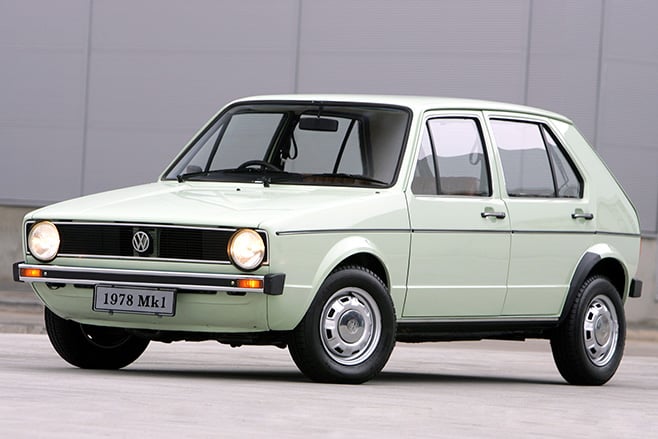
(MK1) 1976 — 1982
The early 70s was a worrying time for Volkswagen, as a major drop in Beetle sales led Volkswagen into bankruptcy. Importantly, and just in the nick of time, the company built the brand-saving Mk1 Golf and in turn, gave rise to one of the most influential nameplates of all time.
The German hatchback was first introduced to our sunburnt country in ’76 where it was very well received. So well received in fact, that it was awarded — you guessed it — a Wheels Car of the year gong.
The car was first introduced with a 1.6-litre four-cylinder engine. The engine was good for about 55kW, which at the time, was a substantial amount of pull for a car of its type. The car was available in three and five-door body types and sported carpet, a clock, a push-button radio and a heated rear window; stuff we’re used to nowadays, but a big deal back then.

Volkswagen released several updates for the MK1, including new diesel and petrol engines, interior upgrades and exterior styling changes. Unfortunately, the infamous Mk1 GTi (pictured above) from this era never made it to Australia.
In the late 70s, cheap Japanese alternatives began to out-sell the compact Bavarian which led to the Mk1’s early demise in 1982. To some, the Golf’s run was over.
(MK2) 1990 — 1992
Far from being over, its run of success had only just started.
In 1990 Volkswagen released the Mk2 Golf GTi. This iteration had a 2.9-litre four-cylinder motor that made 77kw of power and 155Nm of torque. The Mk2 was lauded for its high-end refinement and composed handling.

(MK3) 1994 —1998
The first of the Mk3 Golf range to land down-under was the sports-oriented VR6.
Equipped with a powerful 2.8-litre V6 engine, the compact Grand Tourer was praised for its sharp handling and smooth performance.
In terms of sales, the Mk3 really came into its own when the GL and CL models were released. Sales results bolstered the Golf’s position in the market and various body styles, interior features and engine configurations were released in response to a broadening demand.

(MK4) 1998 — 2004
The fourth generation Golf was arguably the most influential small car of the 90s.
While the Mk4 continued the brand’s trend of refinement and comfort, competition from the Ford Focus exposed the Golf’s handling dynamics as out-dated.
This was the first Golf to boast fully galvanized bodywork, satellite navigation and xenon headlights.
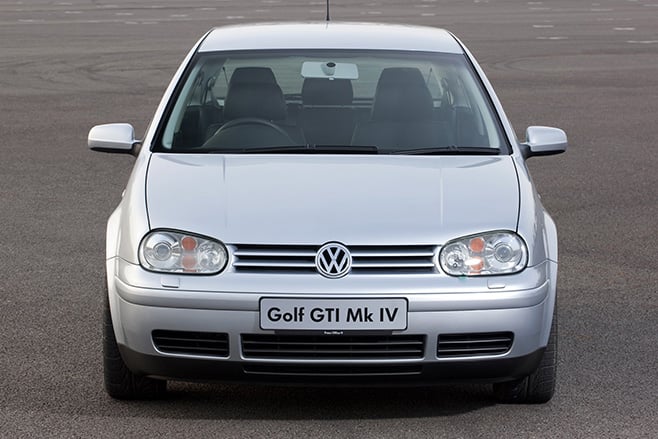
(MK5) 2004 — 2009
In an effort to catch up to the class-leading Ford Focus, the MK5 featured an all-new platform that was 32 per cent more rigid than before. The Golf also saw multiple suspension changes and a carefully tuned chassis.
This model was very well received in its many editions and styles by the public, however it was expensive to manufacture — mostly due to its 50-hour long build time.
Special features of the fifth-generation Golf included a panoramic sunroof, bi-xenon headlights and a DSG gearbox.

(MK6) 2009 — 2013
From the outside, the Mk6 looked very similar to its predecessor but was, in fact, vastly improved. New drivetrains, upgraded refinement, loads more features and increased safety made the sixth generation Golf highly respected.
Moreover, VW was at the forefront of the market’s move to small turbocharged petrol engines. This helped the Mk6 golf take its second Wheels Car of the Year award,making it a benchmark in many comparisons.
Although this model performed well, it was short-lived, and replaced after just four years.
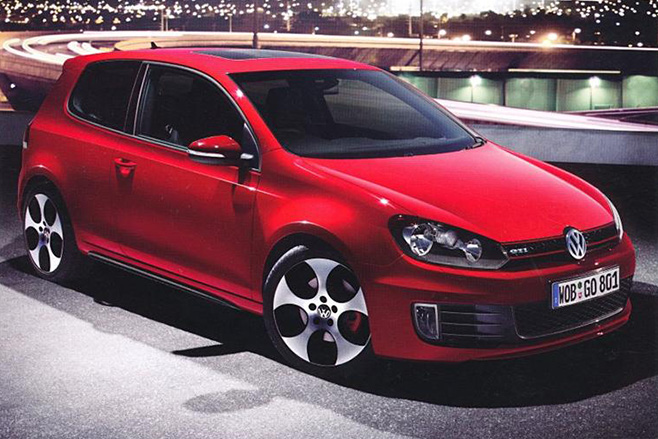
(MK7) 2013 — Current
In 2013, when the latest Volkswagen Golf arrived, it was received with some trepidation given the success of the car it replaced. However, we needn’t have worried; the Mk7 Golf delivered everything the previous model did and more, winning Wheels Car of the Year in its first year of production. Since then, the seventh-generation Golf has been a staple in the small car world, being equally as prolific as a commuting machine as it is a performance vehicle.

