Mini’s swansong petrol-powered hatches will be given a nip and tuck before they’re put out to pasture – but not a complete platform switch that was expected for a final generation.
While the new electric Mini Cooper E and Cooper SE embark on pure electric power with a completely new architecture, the F55 and F56 generation Minis will not be given a comprehensive overhaul, settling instead for an end-of-life facelift.
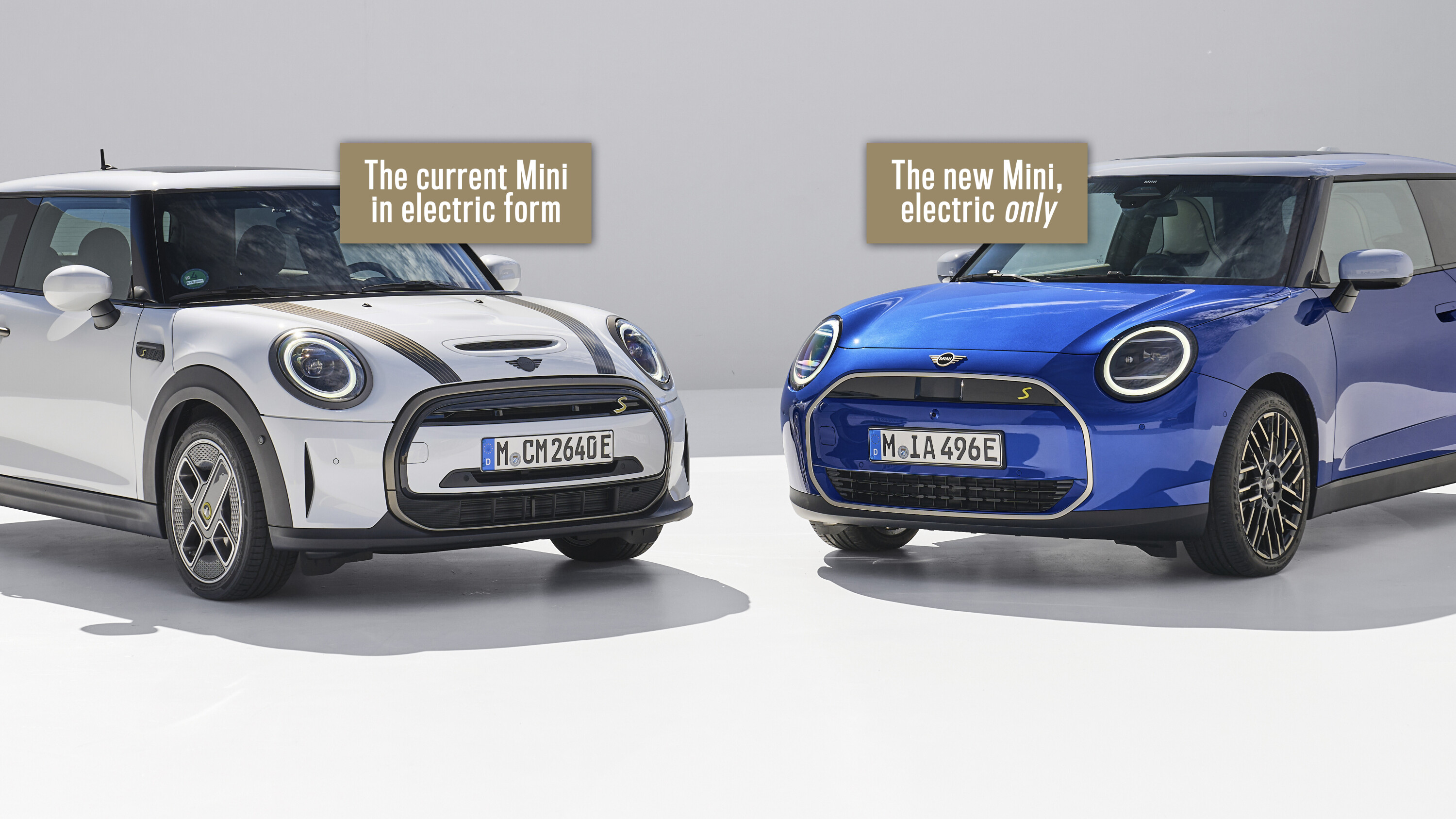
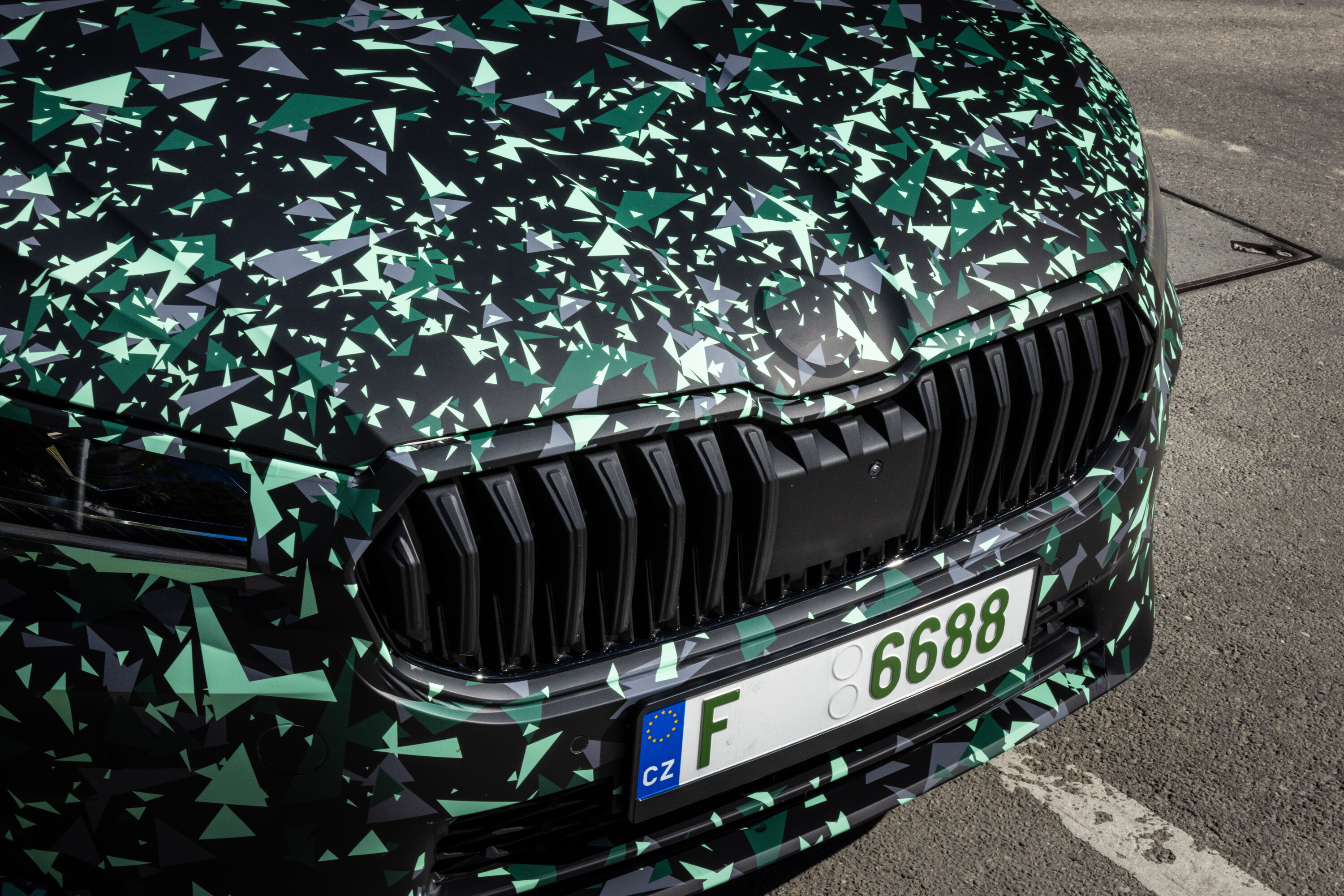
It’s now known that petrol-powered Minis will be resculpted to appear almost identical to the electric version that rolled out in Munich this month, but the new look will be achieved through a reskin and interior overhaul of the existing model – despite new model designations of F66 and F65.
?QUICK NOTES
With 135kW and 290Nm, the new Cooper E can accelerate to 100km/h from a standstill in 7.3 seconds and claims a WLTP-approved driving range of 305km.
With a larger battery, the SE ups the performance stakes with 160kW and 330Nm, cutting the milestone dash to 6.7 seconds while offering an extended range of 402km.
When asked if the facelifted Mini would continue to roll on a platform different to the new Cooper, Mini head of design Oliver Heilmer responded “Yes, exactly. That’s the point.”
“There is a combustion platform with different areas, and there is a tunnel for the exhaust pipe, so obviously this area will be different. But from a design approach, we say there is no difference.”
That suggests the combustion-powered Mini three- and five-door models will retain their UKL platform (introduced in 2014), rather than adopt a new architecture from another series in the BMW Group family. And, with Mini’s all-electric line-up looming in 2030, it’ll most likely be the last.
1
Heilmer confirmed the company would essentially produce two completely different B-segment cars that look the same, but have radically different drivetrains.
Despite the continuation of the longstanding Mini underpinnings, an update will bring the petrol-powered Mini aesthetics into line with the electrified range.
“Yes. It might be different to the electric-based model, but they’re both the same in terms of what we wanted to achieved,” Heilmer said.
1
“Designers would be able to pick the differences, but a ‘normal’ human wouldn’t be able to realise on the first glance.”
Beyond the small proportional differences, Heilmer said the pair of mechanically different Minis would share much if not all of the defining features, such as the range of new sustainable materials, new circular central touchscreen, and design touches inside and out.
“In terms of design, it’s the same design,” he said.
“You’ll find the knitted fabrics, tight steering wheel, all of these elements – you’re going to find them [in both the petrol and electric versions], but the proportions will be different.”
1
With a large portion of Mini’s existing customer base drawn to the models through their retro design and a long lineage of traditional Minis, another collective insists on something modern and contemporary.
This, said Heilmer, is one of the hardest challenges but both electric and combustion Minis needed to evolve gradually in unison to preserve the band’s integrity, regardless of the audience.
“Imagine if you did something outstanding for the electrified version and then you do something entirely different for the combustion engine, no one would understand it,” he said.
1
“All brands that have a strong heritage – as soon as you change something, it leads to insecurity for some of our customers. As a designer you want to jump ahead, but what if we did exactly the same as the past?
“First of all, it doesn’t feel good and, secondly, even worse, you might die with the remaining customers. When you’re afraid to change something, it’s the worst thing that can happen.”
Unless you’re driving something older than a Toyota Corona or a Holden HQ, you are likely sharing your personal information with car companies on a large scale.
Key Points
US study reveals depth of data mining by car companies
Religion and sexual activity amongst data share points
Australian data laws not sufficiently strong
A recent study in the US has shown the scale and complexity of the growing issue, including the revelation some car companies will collect data on owner’s sexual activity, among other personal details.
What’s more, the problem is just as prevalent in Australia, thanks to our piecemeal privacy laws.
The Mozilla Foundation, which looks at data security across the digital sphere (and makes the Firefox web browser), has released a report [↗] that examined the data collection behaviour of 25 global car makers.
It found every single one displayed at least one form of what it considers questionable behaviour when it comes to data collection and harvesting.
“Modern cars are a privacy nightmare and it seems that the Fords, Audis, and Toyotas of the world have shifted their focus from selling cars to selling data,” said Misha Rykov, a researcher at Mozilla’s *Privacy Not Included sub-site.
1
Data-hungry cars feed companies
Essentially, the modern car can generate reams of personal data about its users through a battery of sensors, cameras and on-board apps – as well as through the user’s mobile phone.
It can also collect environmental data – including location, weather conditions and even street-sign information – to create a more holistic picture of the user and their preferences.
This data is then collected by the car maker either at the dealership level during a service visit, or by over-the-air relay.
The Mozilla report suggests 84 per cent of the car makers reviewed, including Volkswagen, Ford, Mercedes-Benz, Honda and Kia, on-sell the data to third parties, including to dealerships and financial institutions.
Of those 84 per cent, 76 per cent specify a right to sell the data, and 56 per cent note they are prepared to share data with government and law enforcement agencies as requested.
Tech darling Tesla ranked worst of all, pinged in every one of the study’s categories on data privacy concerns.
The Mozilla report suggests 84 per cent of the car makers reviewed on-sell the data to third parties
Research into each car maker’s privacy statements by Mozilla revealed the eye-opening scale of data collection, which – unlike in many facets of digital life – is almost impossible to opt out of, other than simply not driving the car in question. Not pairing your phone with the car would also reduce the amount of data collected.
Nissan USA’s privacy statement, for example, reveals in plain English that it has the ability to collect and share the most personal data, including but not limited to religious beliefs and sexual activity.
Nissan has also sold data that includes a person’s real name, alias, postal address, records of personal property, products or services, purchased, obtained, or considered, as well as browsing history, search history, and information regarding a consumer’s interaction with a website, application, or advertisements.
A selection of the data points listed in Nissan’s privacy policy
“Name, email address, phone number, mailing address, geolocation, zip [post] code, age, date of birth, driver’s license number, national or state identification number, citizenship status, immigration status, race, national origin, religious or philosophical beliefs, sexual orientation, sexual activity, precise geolocation, health diagnosis data, and genetic information, social security number as an employee, service or warranty information regarding vehicles, employment and related information, such as employee identification number National or State Identification Numbers, and dependent information for the administration of certain employee benefits or programs.”
The company does, at least, offer an opt-out option via a website form on its US page.
Kia [↗] also openly collects information about “your race or ethnicity, religious or philosophical beliefs, sexual orientation, sex life and political opinions”.
Neither Nissan Australia nor Kia Australia’s privacy policy website pages make reference to these clauses.
Data breaches a real risk
While the packaging and on-selling of third-party data is nothing new, many of the companies reviewed had experienced large-scale data breaches in recent years.
In 2021, more than three million VW and Audi customer’s details were stolen in the US, and more than two million customer’s details were lost by Toyota over the decade 2013-2023.
In 2022, Mercedes-Benz admitted to a data leak on the part of a third-party vendor that exposed the personal information of up to 1.6 million prospective and current customers, including names, email and street addresses, and phone numbers.
“The detailed data collected by car companies is a data broker’s dream. Indeed, Vehicle Data Hubs are rich with that information. Yet we still know so little about how they obtain, process, and sell it,” said Rykov.
Australian privacy laws are a “patchwork”
The issue is just as relevant here, thanks to a “patchwork” of state/territory and Commonwealth laws pertaining to privacy, according to senior lawmakers.
As well, a recent court case between the Australian Government and Telstra ruled that Australian law does not recognise personal data information unless it is contained within a single data stream.
This ruling means that data obtained from a vehicle – which is multi-stream by default – is essentially exempt from legislative oversight.
“Australia needs a legislative definition of privacy, or the reasonable expectation of privacy, and this must include data generated by automated vehicles,” said Mark Brady BA, LLB (Hons), a lecturer at Adelaide Law School, in an article [↗] for the Monash University Law Review called Data Privacy And Automated Vehicles: Navigating The Privacy Continuum.
“Australia will benefit from a national overarching automated vehicle regulation, or at the very least specific legislation protecting the privacy of data produced by automated vehicles.”
The full Mozilla report is a deep-dive with heavy detail on its findings. Read it here. [↗]
The Toyota Century SUV has been launched in Japan as a chauffeur-focused luxury 4WD alternative to the Bentley Bentayga and Range Rover.
Snapshot
Luxury 4WD expands Century line-up that has been sedan only since 1967
Chauffeur-focused front cabin; passenger-focused rear cabin
Plug-in hybrid drivetrain for combination of quietness and performance
Toyota’s poshest SUV joins the brand’s famous Century sedan that has been serving Japanese executives and dignitaries since the 1960s.
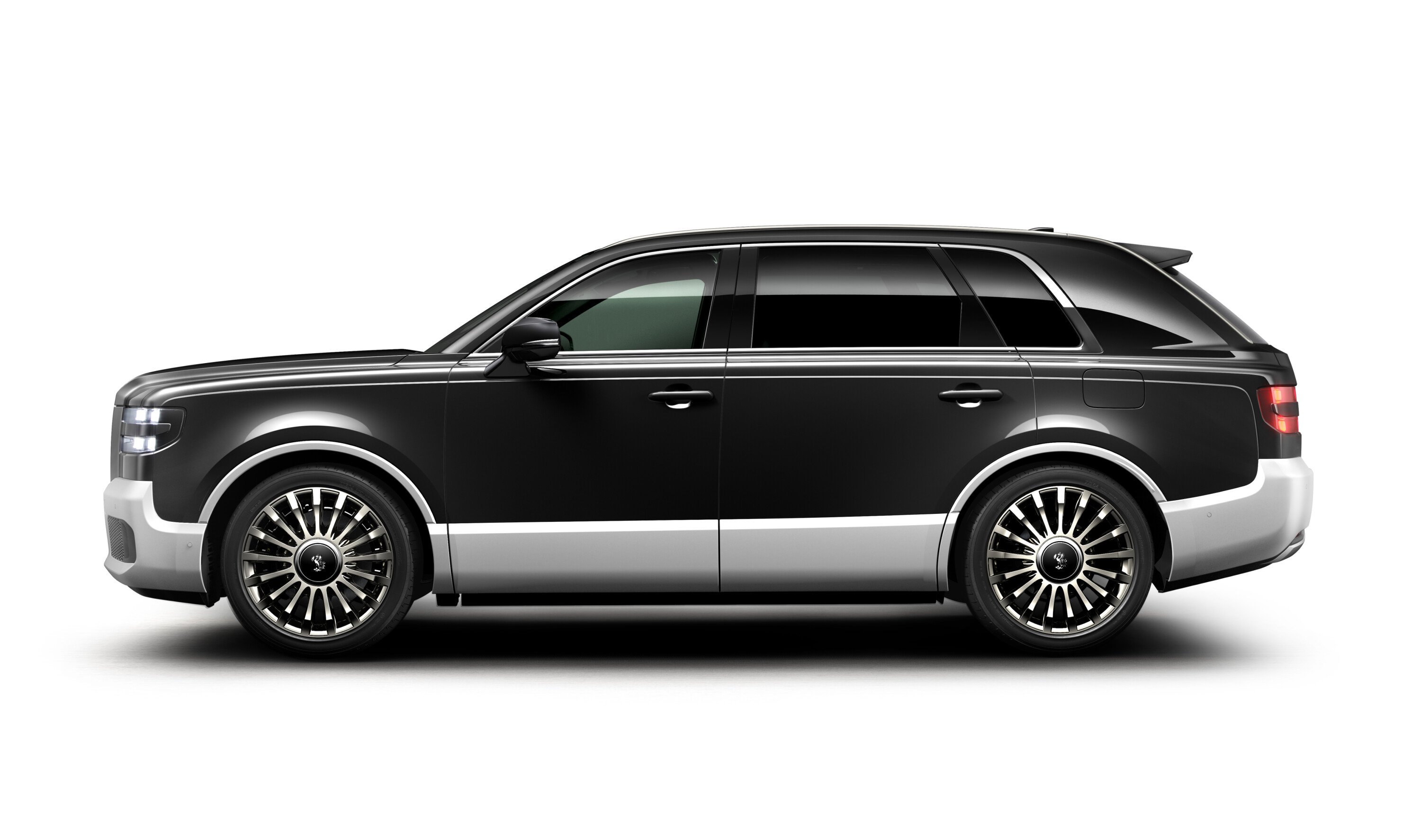
The 5.2-metre Century SUV is a touch longer than the Bentayga and similar in length to a long-wheelbase Range Rover.
Its exterior shape shares some commonality with both the Bentayga and even the Rolls-Royce Cullinan, though has plenty of distinctive elements – including the engraved, iconic ‘Phoenix’ badge on the grille and quad-lamp design for the headlights and tail-lights.
1
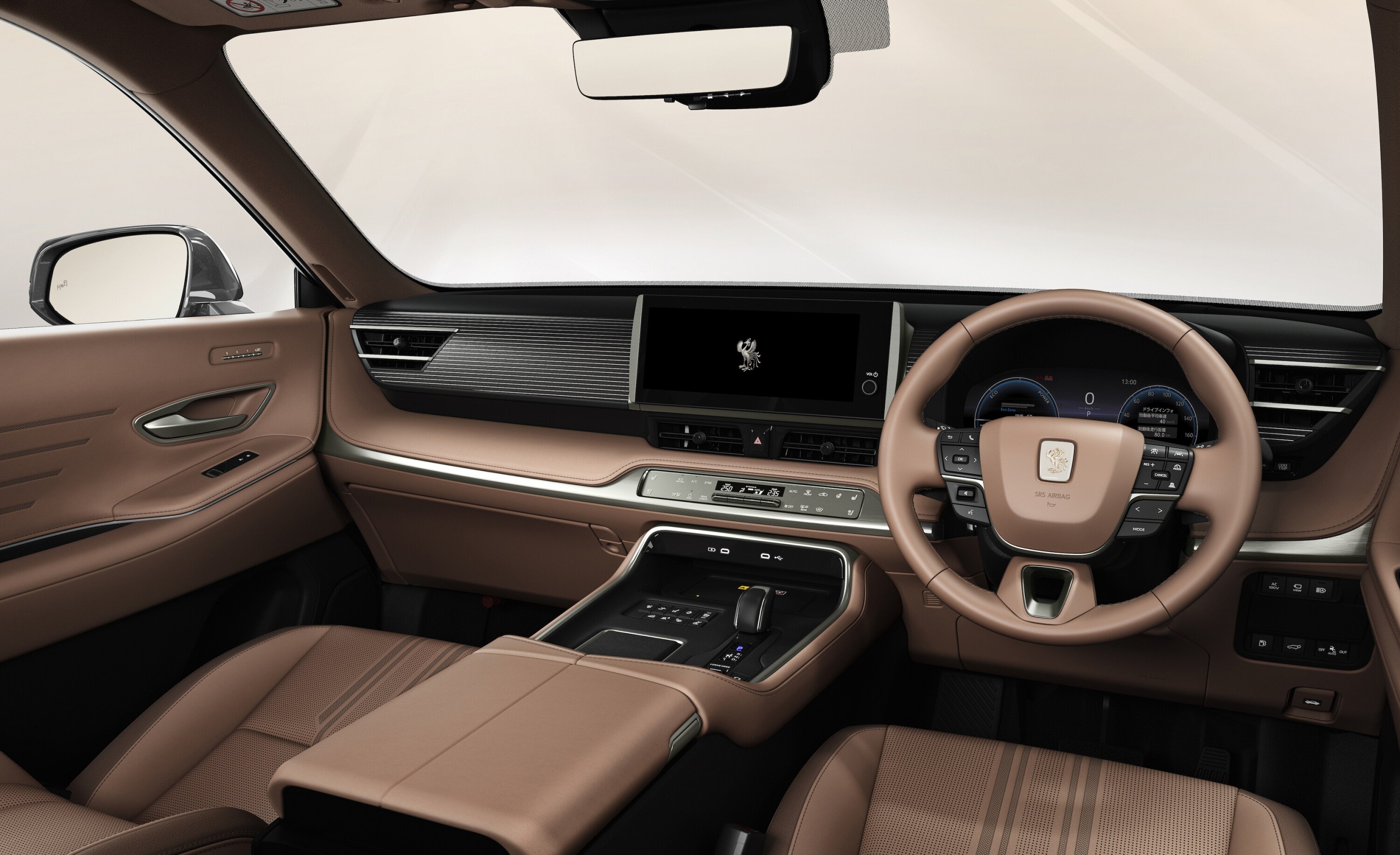
Toyota has naturally focused most attention on the interior experience.
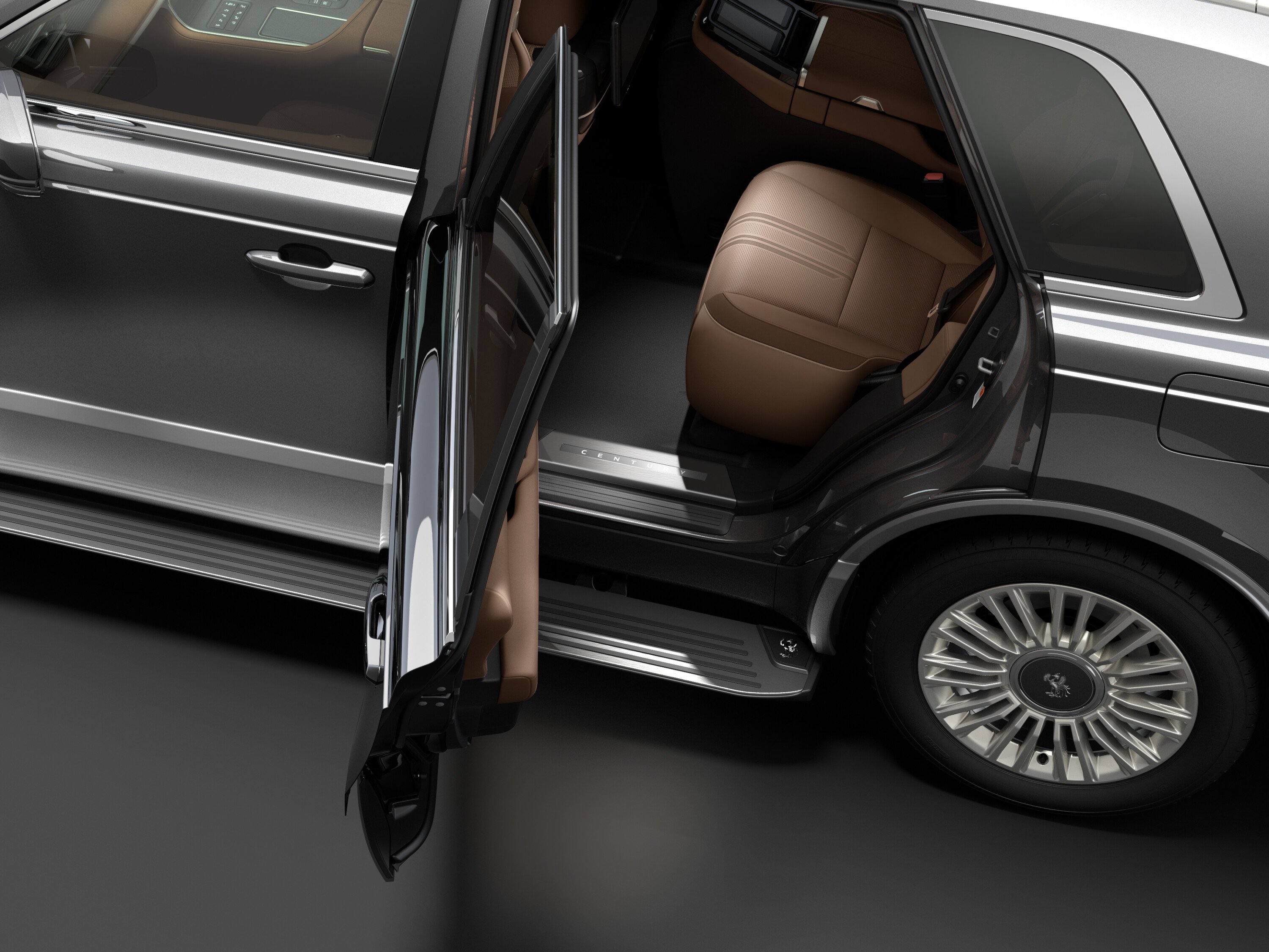
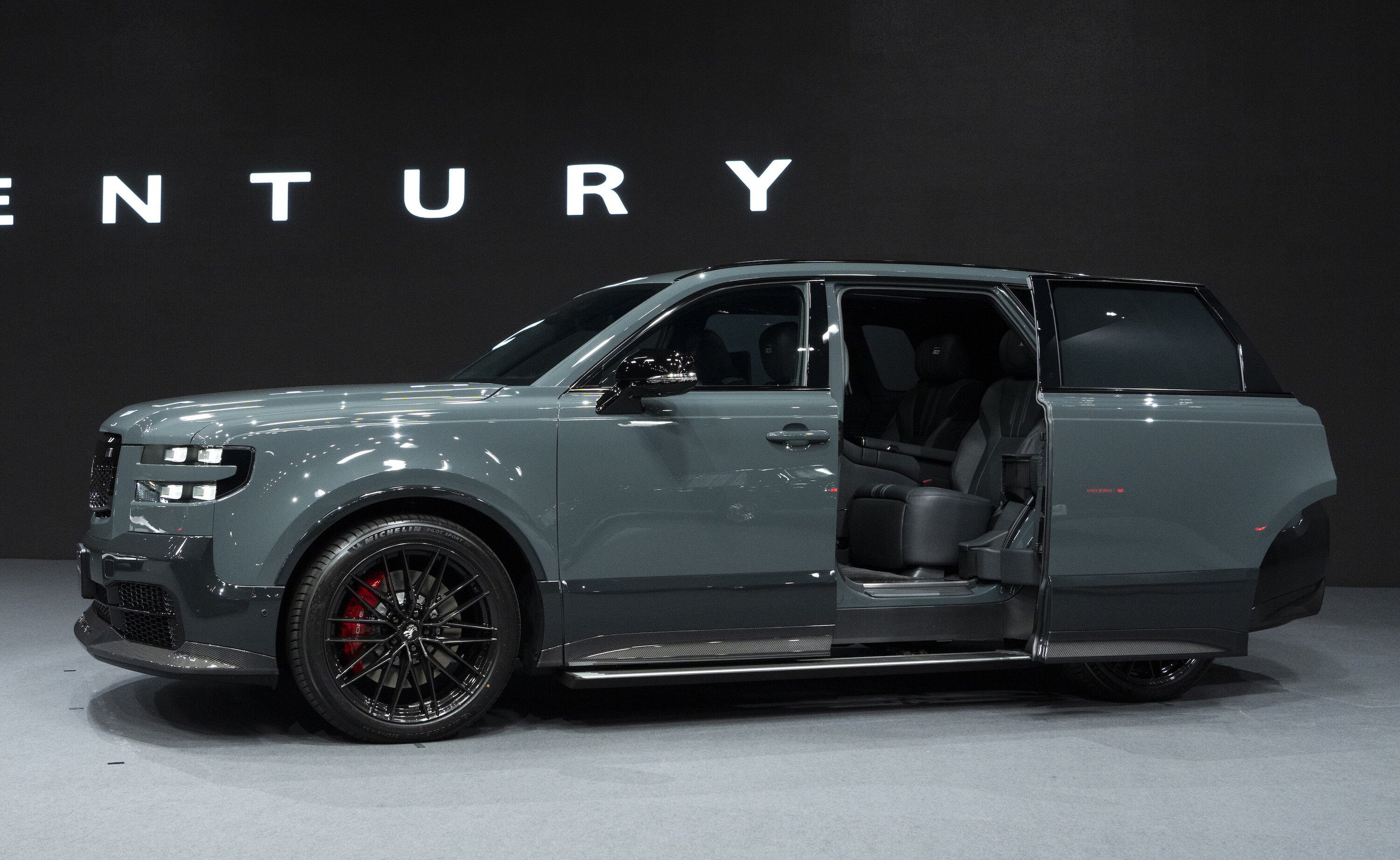
Buyers firstly have a choice of rear doors – a more conventional swing door that opens 75 degrees, or an electric sliding door. Auto-retractable steps aid ingress and egress.
The two rear seats can be fully reclined and come with a so-called ‘refreshment’ function.
1
An audio system was developed in collaboration with a “musical instrument manufacturing master” – likely Yamaha, given the company’s long-running relationship with the famous brand – to create a sound similar to that of a live performance.
Laminated glass is positioned between the rear cabin and luggage compartment to help reduce external road and wind noise.
1
Where the Century sedan is powered by a 5.0L V8 hybrid, the Century SUV is instead given a 3.5-litre V6 plug-in drivetrain with electronic all-wheel drive.
Toyota says the PHEV powertrain offers the benefit of electric-only driving for daily use and petrol-electric hybrid performance for long-distance duties.
Four-wheel steering is also standard to help manoeuvrability around cities, and a Rear Comfort mode is said to help smooth the driver’s control of the vehicle – including the ability to suppress jolts from any sharp, sudden braking.
1
Toyota forecasts just 360 annual sales for the Century SUV, which is priced from the equivalent of $265,000, highlighting its exclusivity.
Three standard body colours are offered, with a further four colours available from the company’s more exclusive Kiwami Line.
Buyers can raise that further with upcoming customisation options that will allow them to create a more unique vehicle with tailored colours, materials, and seating configurations.
The presentation even suggested wealthy purchasers could request a convertible body style.
Middle children are often the forgotten ones, according to people like my father-in-law who loves to label people.
It’s kind of the case in the car world – that middle machine is the one that often is the best value, taking all the good bits of the top and bottom models and delivering the best of it all. No, I am not a middle child, but thanks for the accusation.
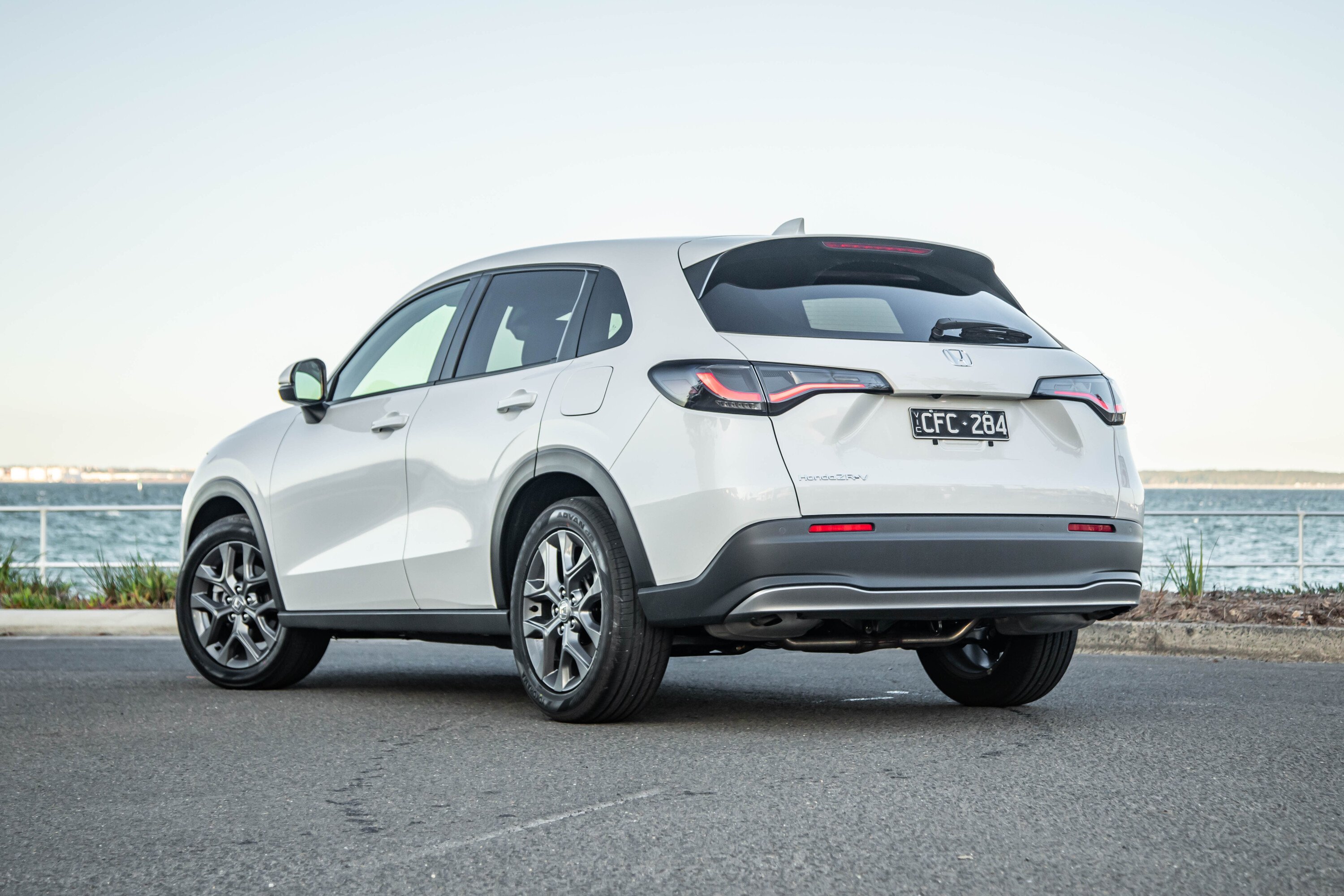
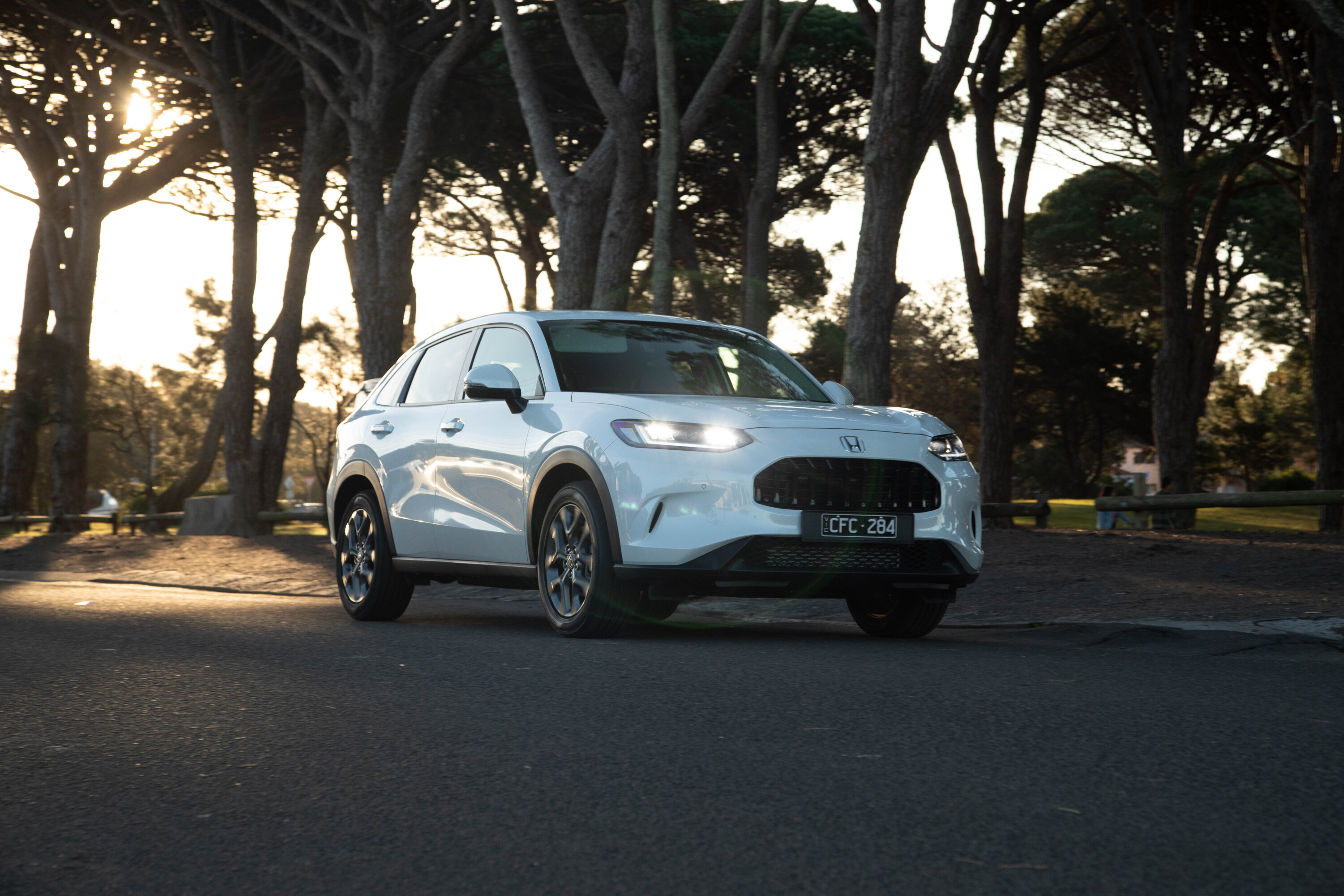
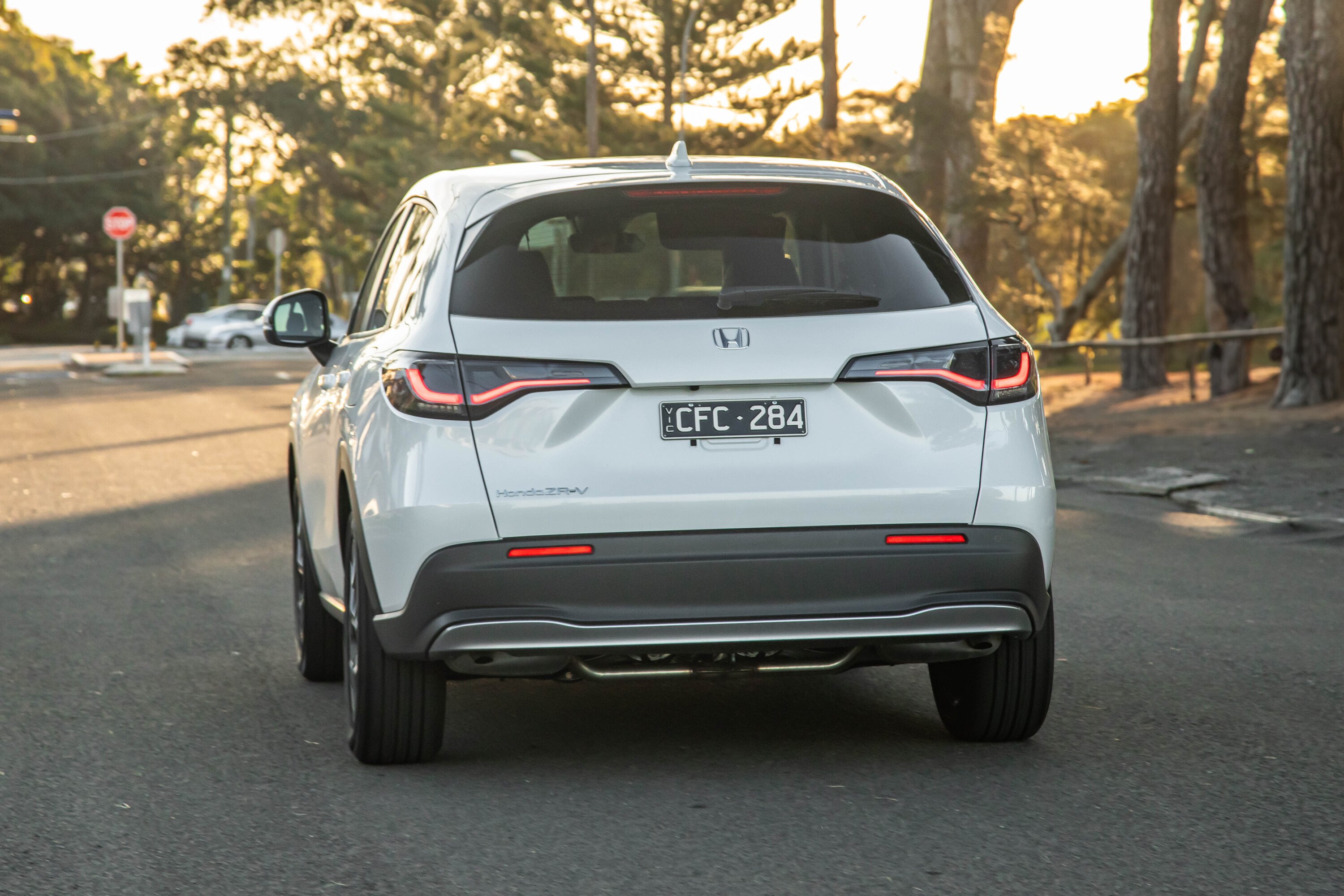
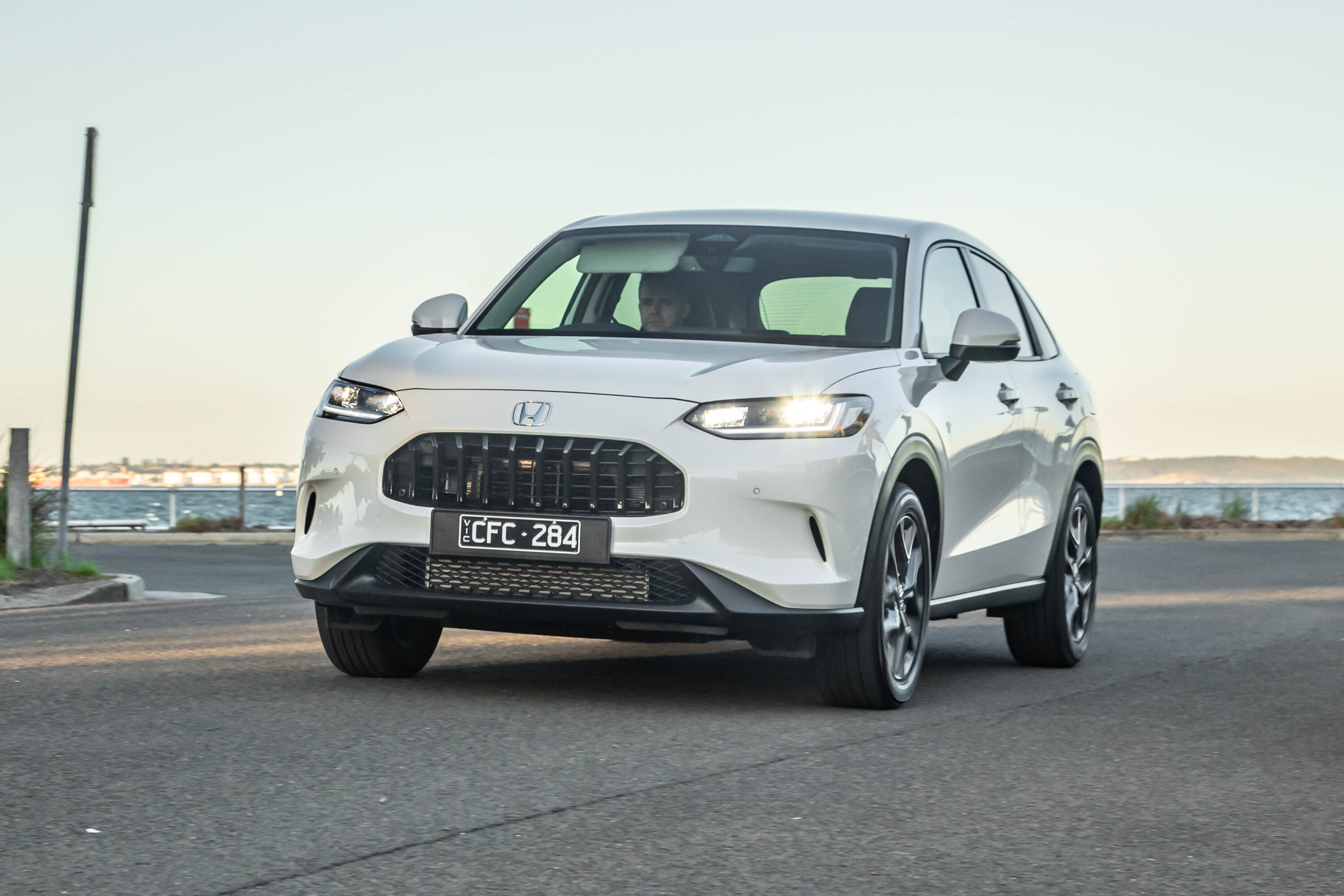
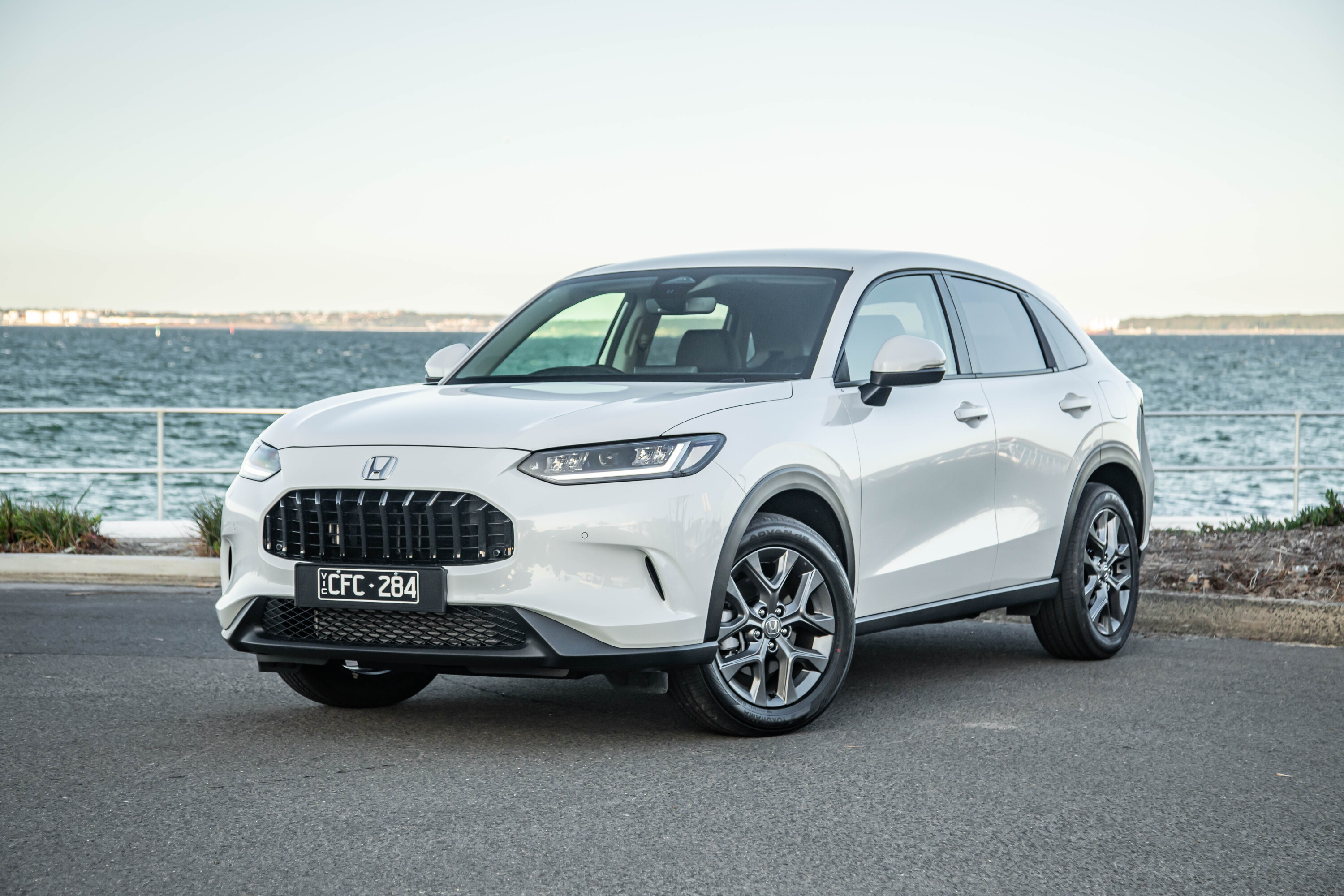
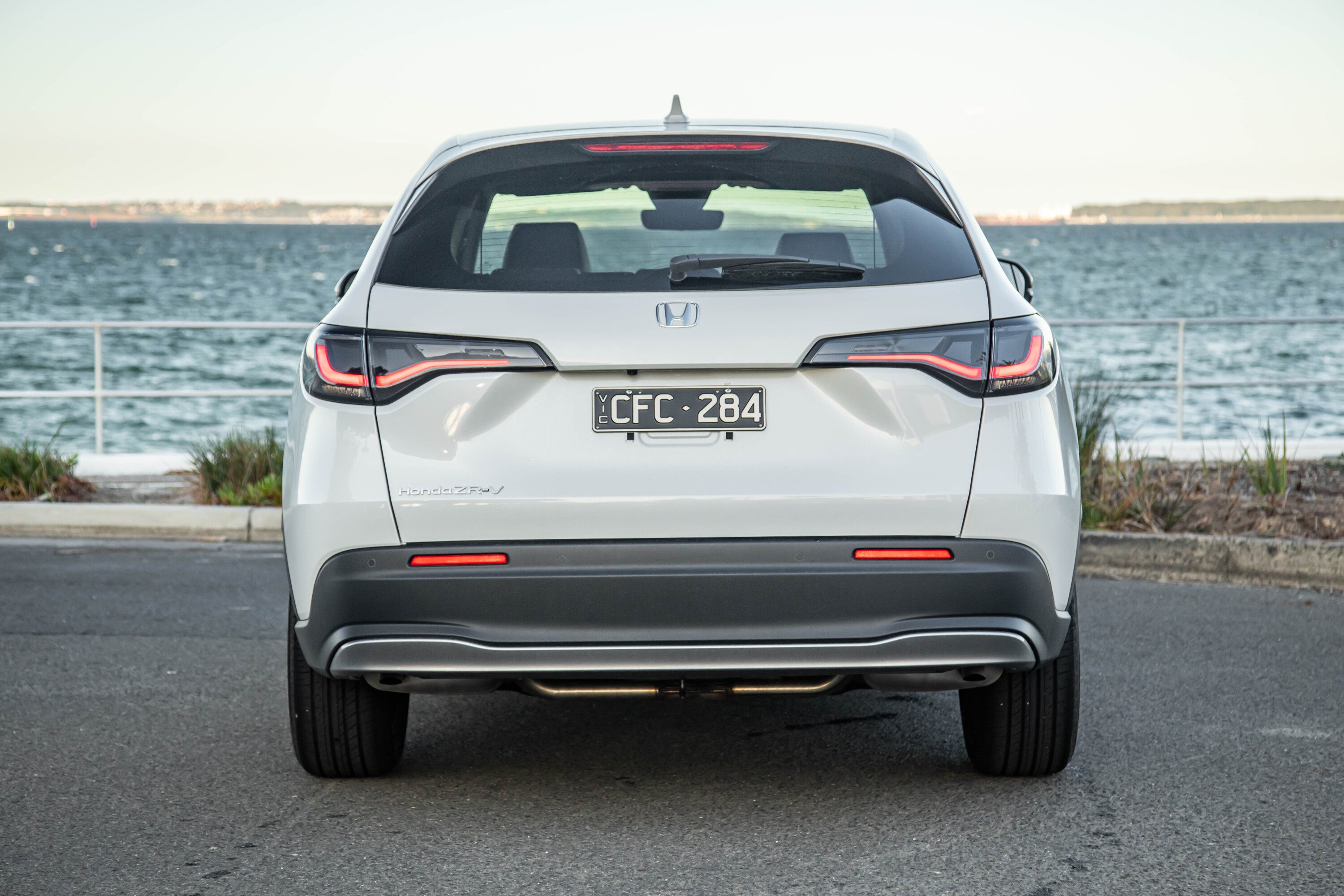
After a week with a top-of-the-pile Honda ZR-V VTi-LX, I’ve come down a rung to the mid-spec VTi-L. I’m not absolutely certain that the middle child is the one to go for because while it builds on the pretty good spec of the base VTi-X, I’m not sure the substance is there to justify the price difference. Because while there’s more, I’m not sure there’s enough of the more and the ZR-V VTi-L might be the exception to the rule.
The VTi-L – Honda insists on this very 1990s-vibe spec nomenclature – is the middle child of the petrol triplets at $43,200 drive-away. That makes it three grand more than the entry-level and $5300 cheaper than the VTi-LX I tested a while back.
I remain flummoxed, flabbergasted and something else starting with F that communicates a general dismay that there isn’t a hybrid version of the two lower specifications. And you can add the lack of all-wheel drive to the list.
1
2023 Honda ZR-V VTi-L standard features
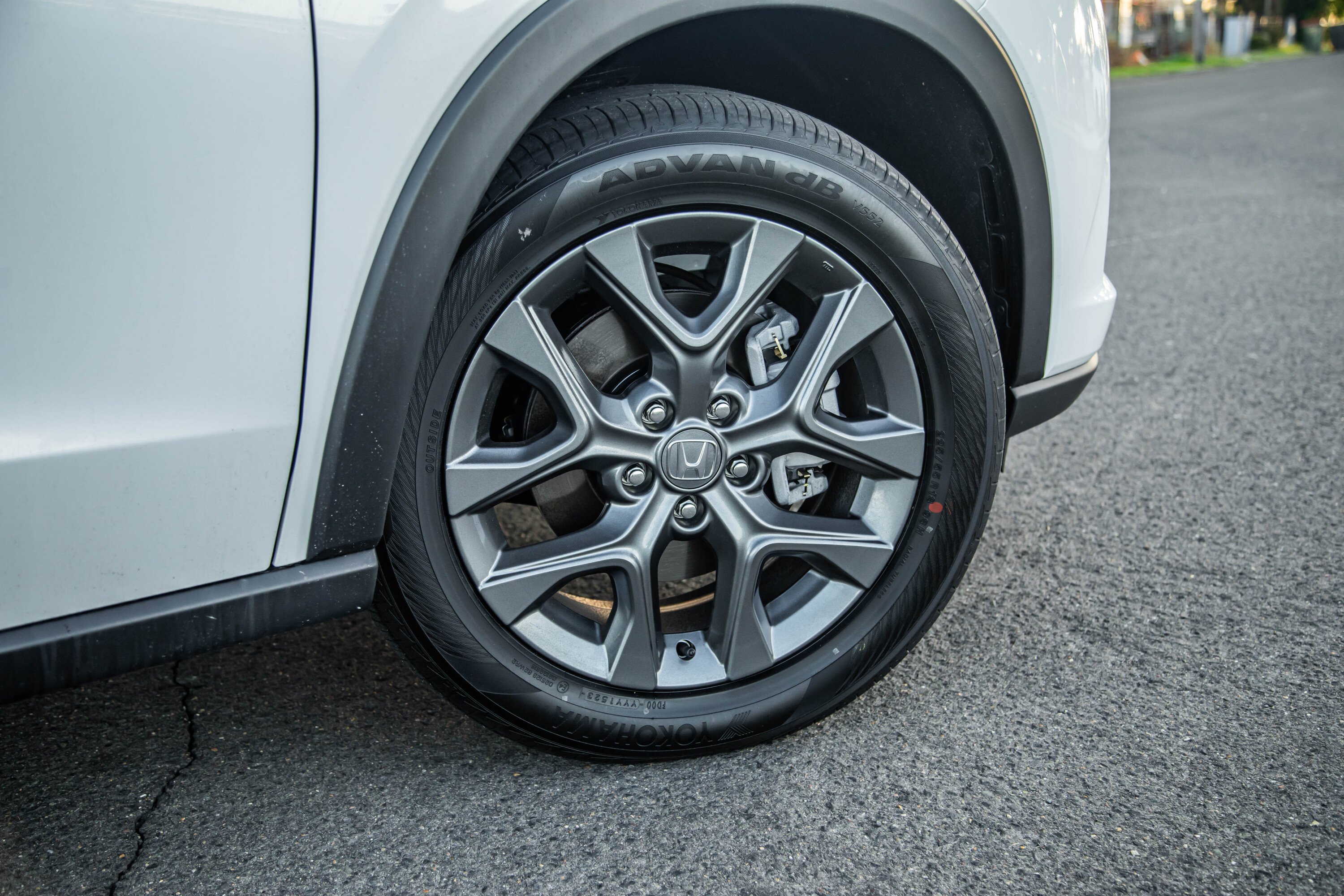
18-inch alloy wheels (silver)
Heated and powered front seats
Eight-speaker audio system
Reversing camera
Satellite navigation
Auto adaptive LED headlights
Wireless phone charger
Reverse auto-tilt function for side mirrors
Hands-free electric tailgate with walk-away close
Heated and powered front seats
Leather seats with cloth inserts
Air purification system
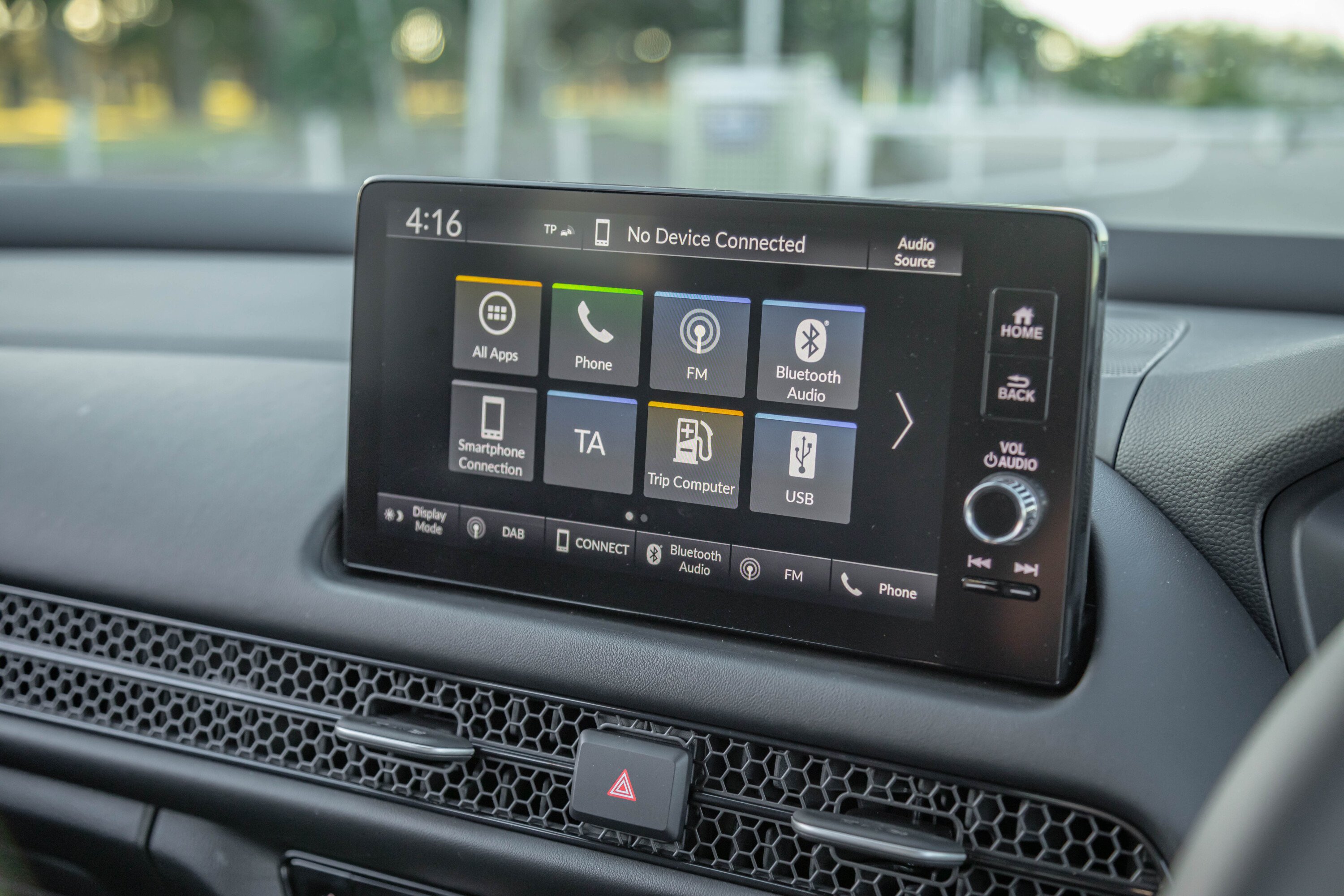
9.0-inch touchscreen
Auto wipers
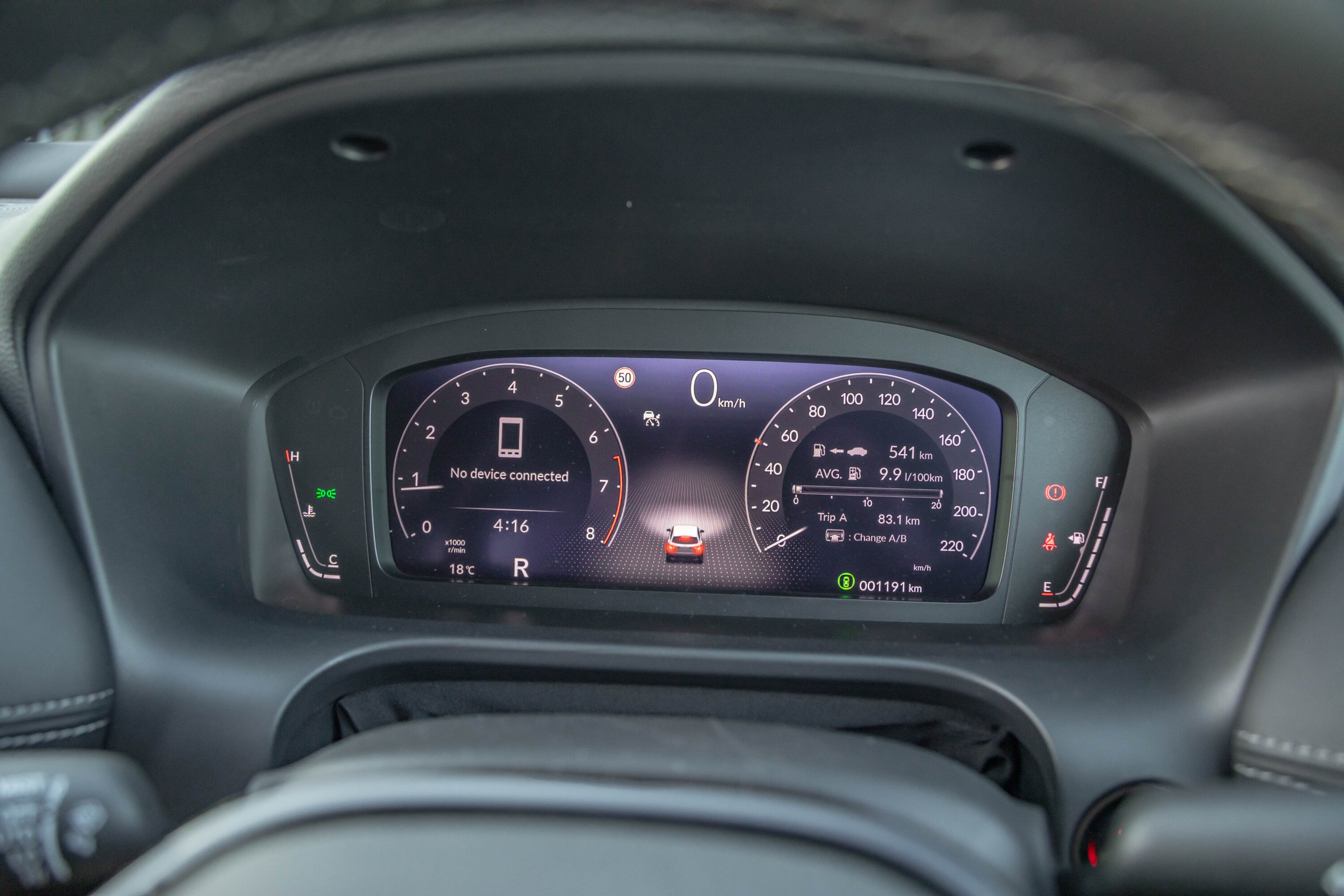
10.25-inch digital dashboard
Heated side mirrors
Front and rear parking sensors
Wired Android Auto
Wireless Apple CarPlay
Dual-zone climate controls
There is a lot to like about this version of the ZR-V but a couple of annoyances pop up.
While it has wireless Apple CarPlay, it goes without the LX’s wireless charging pad. It also loses blind-spot monitoring, which isn’t too bad but it does lose reverse cross-traffic alert which is very bad because I think all cars should have it.
1
Honda’s Connect functionality is offered with a five-year subscription but there’s nothing startling to suggest you should pay for it, so it’s a nice-to-have. It’s certainly more generous than Toyota’s twelve-month subscription on a RAV4, for example.
Back on the good side of the ledger is the fact that you don’t have to pay extra for premium paint.
This part of the market is pretty busy and dominated by Toyota with the RAV4.
For the same price as the ZR-V VTi-L you can have a RAV4 GXL hybrid or a naturally aspirated 2.0-litre for a few grand less. The RAV is bigger with a longer wait time to match and the kicker is that the Honda’s price is drive-away whereas the Toyota’s is before on-road costs.
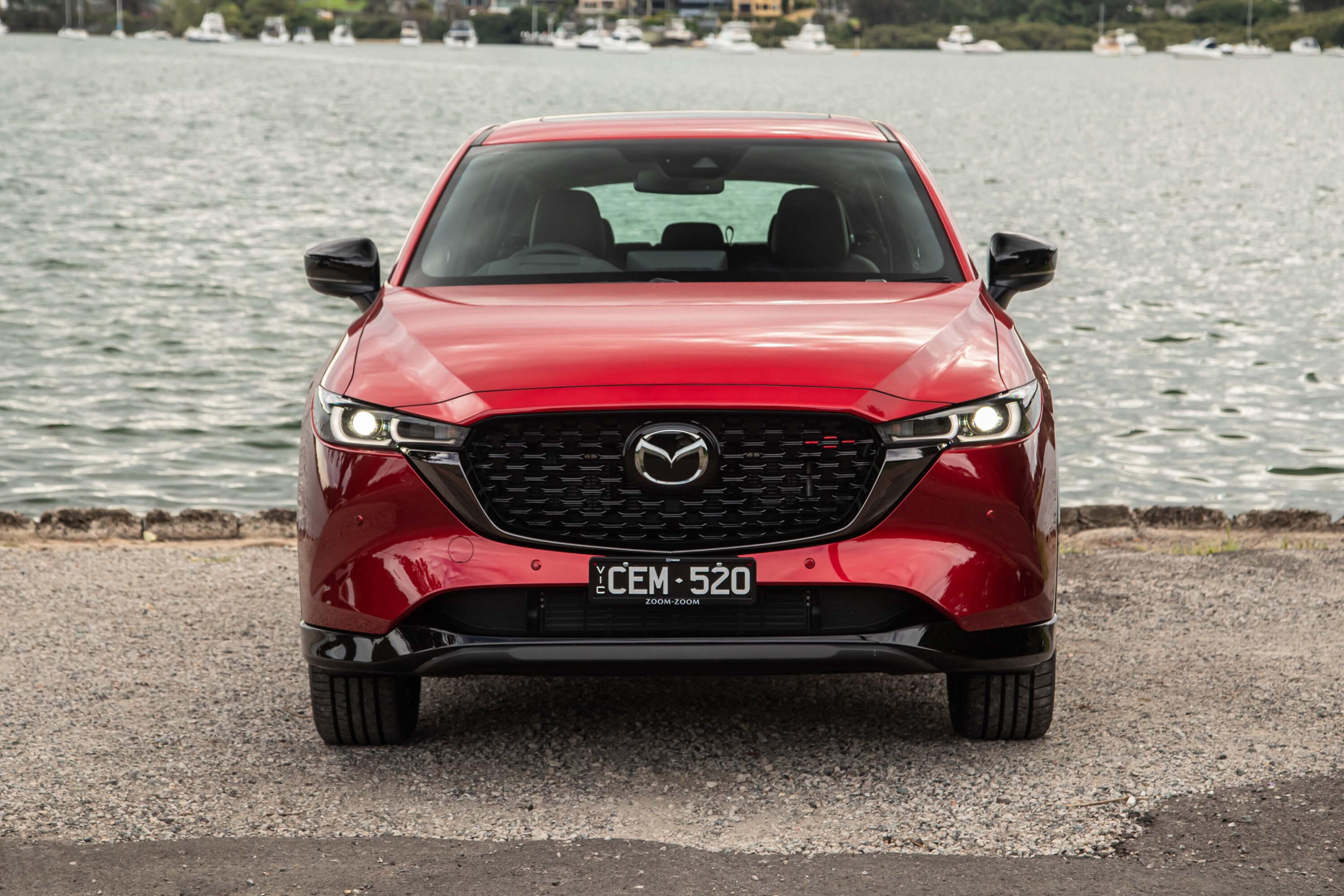
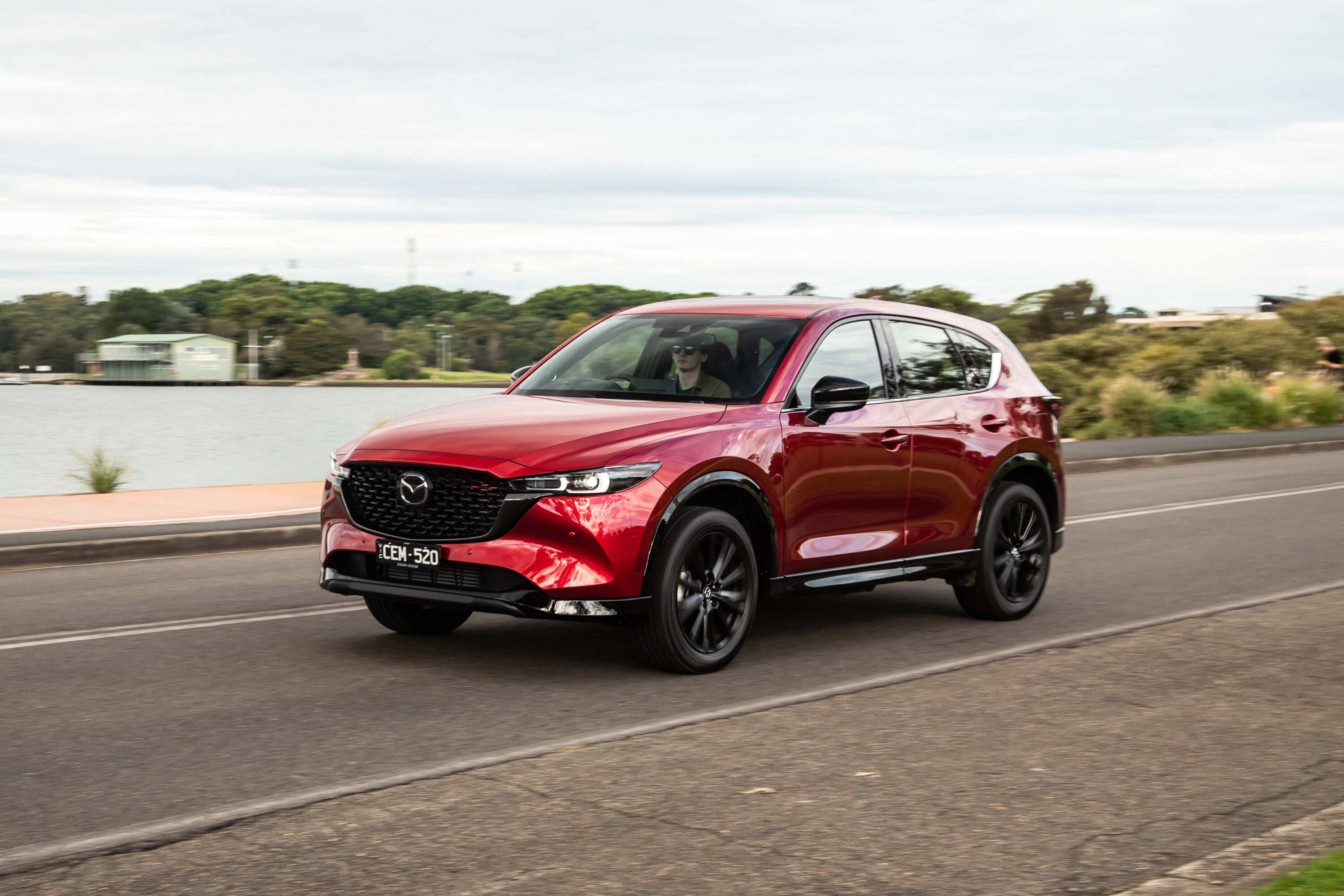
Mazda’s CX-5 comes close to the drive-away price with the CX-5 G25 Maxx Sport and for a few grand more you can get the all-wheel drive version.
1
The Mazda has long been the dynamic benchmark in this part of the segment (the Tiguan wins further up the price tree) and remains a lovely car to look at and drive.
A Nissan X-Trail ST is quite a bit bigger and, like the CX-5, features a 2.5-litre engine while matching the Toyota’s continuously variable transmission (CVT). The X-Trail has a lot going for it, with a comfortable ride and all-wheel drive as standard, but for a few bucks more.
You’ll have to step down to the front-wheel drive to match beat the Honda’s all-in no-haggle price.
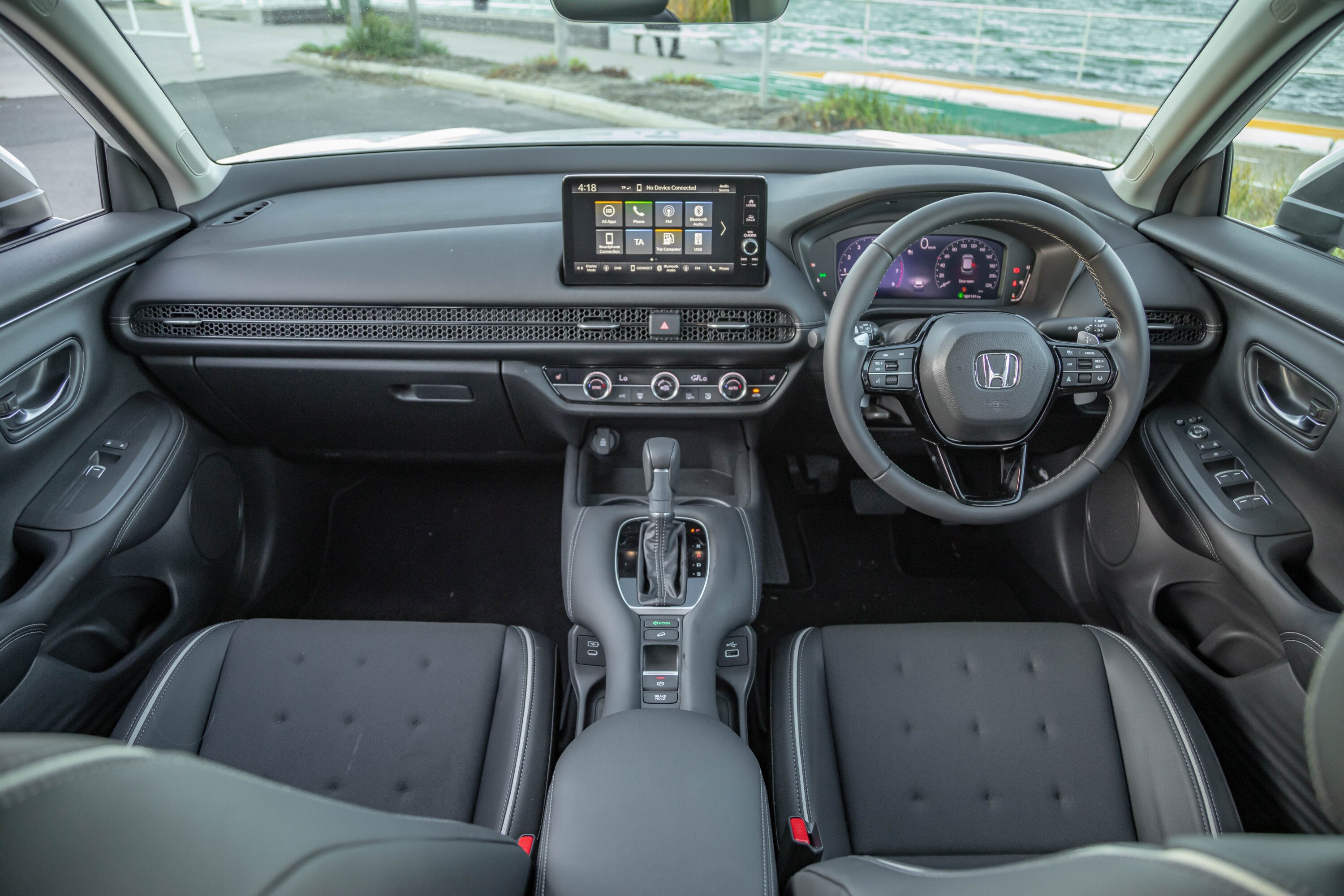
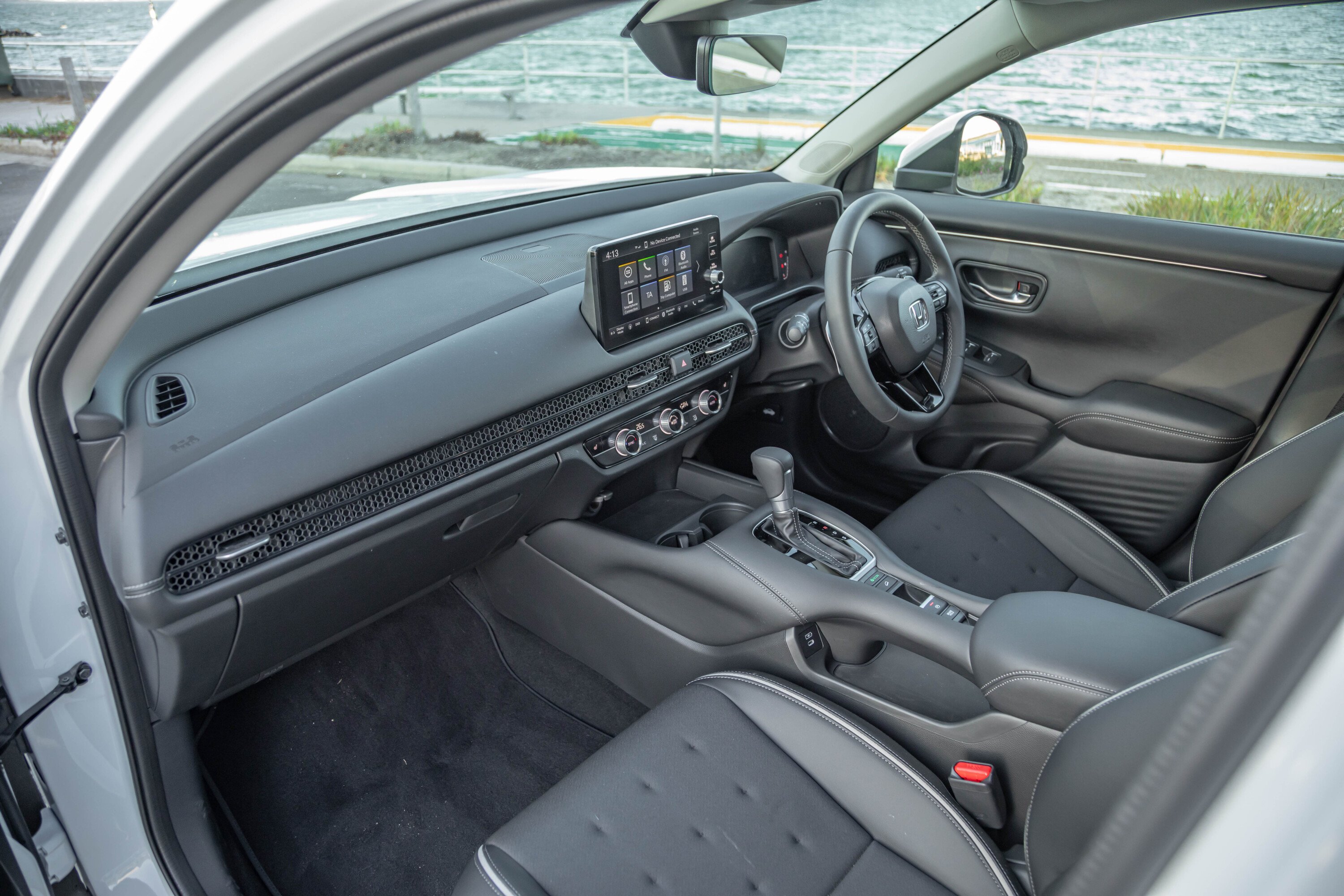
The ZR-V has a really, really nice cabin with some classic Honda thoughtfulness.
It’s classy, too, with a strip of hexagonal grille-like trim to break up the dash. The climate controls look great and are really nice to use, as is most of the switchgear, which is all well-weighted and nicely finished. Apart from the slightly too-tall gear shifter.
You have two cup holders, a cut-out underneath the console for phones or odds and ends, a tray for your phone under the HVAC controls and bottle holders in the doors.
1
I also prefer the cloth inserts in the seats over the leather in the LX and have a sneaking suspicion that I’d prefer the cloth-only trim in the X.
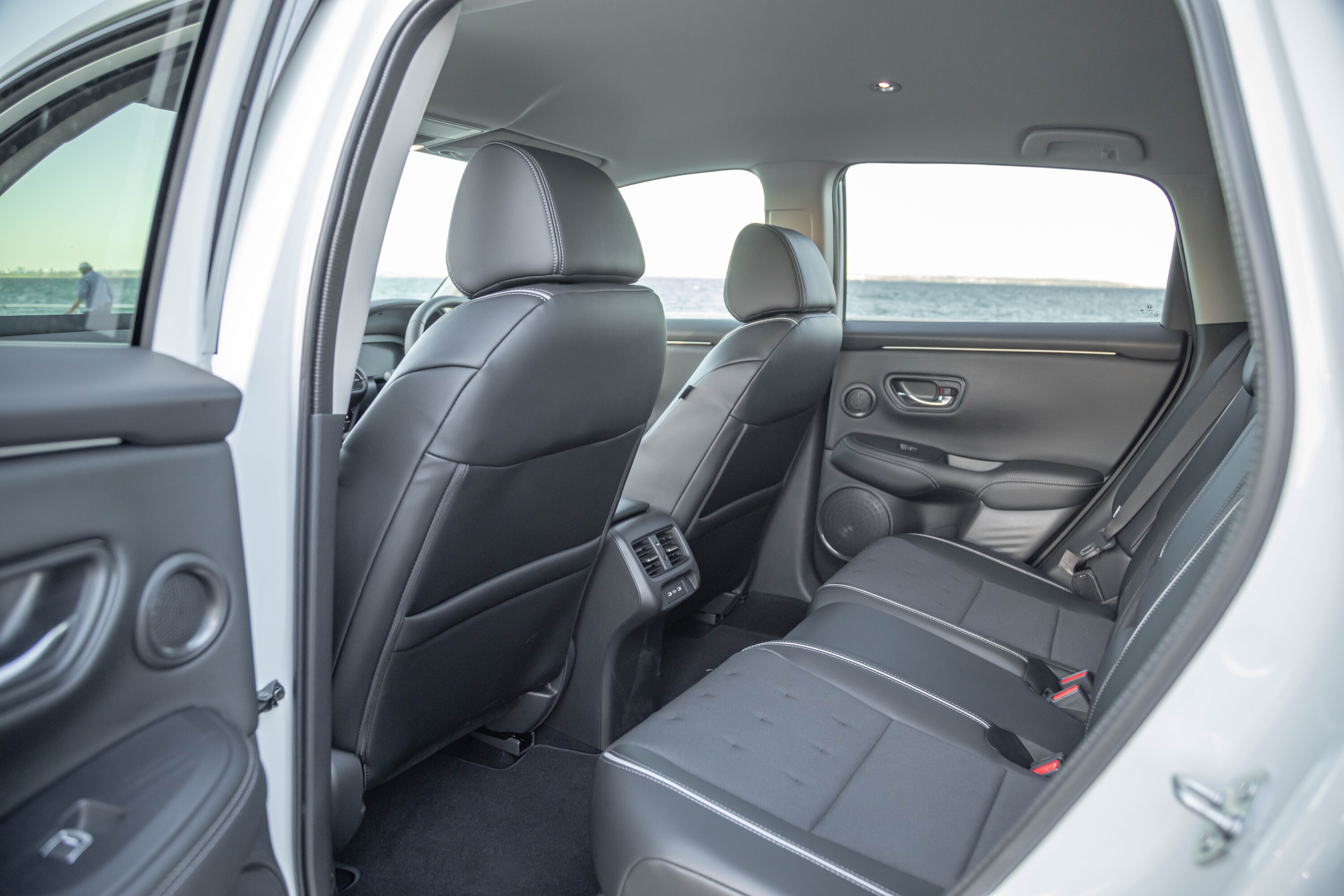
Rear-seat occupants also do very nicely, with comfortable seats, a good amount of headroom and legroom and even their own air vents. At 180cm tall, I can sit comfortably behind my driving position and figure I’d be quite happy here for a long trip. Taller people have been known to be reasonably happy for journeys in the back of a ZR-V.
An armrest with cup holders is provided, as are two USB-C ports to go with the pair in the front (one each of USB-A and USB-C) and bottle holders in the doors. The ZR-V doesn’t have a sunroof but there’s plenty of glass area besides so it is light and airy in the cabin.
1
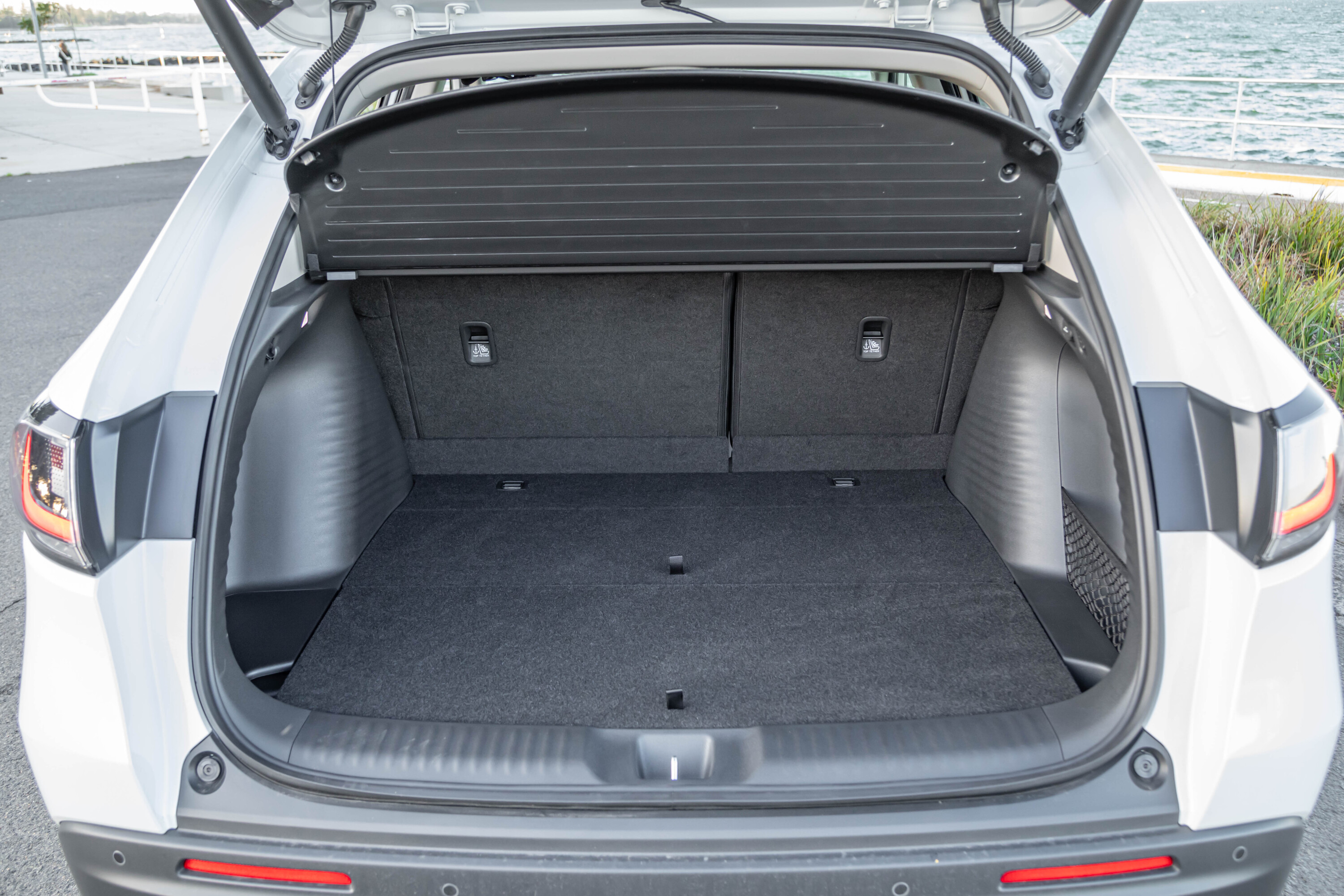
It falls apart slightly when you get to the boot, which is 380 litres.
That’s smaller than the old HR-V’s boot so you can see the design team went for occupant space over cargo capacity.
The boot is a good shape, though, with little trays cut out of either side for slipping in bits and pieces so they don’t roll around.
It’s completely eclipsed by everything else in the medium SUV segment, including the CX-5 that looks reasonably large in this company at 442 litres. The RAV4 and Tiguan are half as big again. But 380 litres isn’t bad if you’re not intending to put a punishing amount of gear in this car.
Honda made a name for itself in the nineties for two things – completely bananas high-revving sports cars, and effortlessly pleasant everything-else cars.
The ZR-V certainly falls into the latter, which is obviously for the best. The 1.5-litre turbo-petrol engine is lifted straight from the Civic which makes sense because the ZR-V is basically a Civic underneath its sheet metal.
2023 Honda ZR-V VTi-L drivetrain
Engine
1.5-litre turbocharged four-cylinder
Transmission
continuously variable
Power
131kW @ 6000rpm
Torque
240Nm @ 1700rpm
1
The 131kW is about right for the segment while the 240Nm is also about right.
Both are fed to the road via a CVT to the front wheels. These are also about right. It’s almost like everyone agreed on a formula.
As time marches on and age wearies me, I am noticing a general improvement in the way CVTs are calibrated in cars, particularly those from Japan and Korea. Honda has certainly got its head around this type of transmission in the petrol ZR-Vs, with a strong, positive pickup from a standstill.
1
The ZR-V has quite a sprightly step up to about 60km/h, which works very nicely around town.
Free of irritating lawnmower effects, the engine keeps itself to itself for the most part. It’s not slow, either, which sets it apart from slack-feeling non-hybrid RAV4s.
The steering is light and reasonably direct for an SUV, meaning you’re not twirling your arms in traffic or manoeuvring around. It’s also a surprising amount of fun on a winding road.
1
It’s also better as speed rises.
An unfortunate side effect of the big wheels is that the ride is a bit fidgety on more urban surface types than you might expect.
It’s not noisy, but there’s a bit more movement that finds its way from the road to your backside which could prove a little tiring during a long day behind the wheel.
For me, the overall package makes up for it with the handling and the responsive driveline so I’ll wear the low-speed ride because the ZR-V excels in every other area.
As with the LX, the L did quite well against the ADR combined cycle figure, delivering an identical 7.9L/100km versus the official figure of 7.2L/100km.
It did enjoy the same test loop as the LX so it was good to see consistency across two still very new cars. I didn’t expect any different from a turbo Honda engine.
ANCAP has got its hands on the ZR-V and chucked it at the wall, awarding it a full five stars.
That was to be expected given the huge number of airbags. Repeating my earlier consternation, there is no reverse cross-traffic alert or blind-spot monitoring in the X or L.
The rear seats feature two ISOFIX points and three top tether anchors. If you’ve looked at an HR-V and not been impressed with its two top tether points, the ZR-V has you covered for not a lot more money.
I’ve said a lot of nice things about the middle child but I’m pretty sure I could say about 95 per cent of these things about the first child, the VTi-X.
I can’t say for sure but from a value perspective, I’m not sure the L cuts the mustard.
Hands-free tailgate, a bit of window tinting, paddle shifters you don’t need; it’s all details and not a heck of a lot of substance for the extra three grand.
On its own four wheels, it’s the ZR-V is a terrific car and I’m sure that if you don’t need a huge boot, this will be a great car for a young family. It looks good, is quiet, fun to drive and cheap to run.
I really like its ratio of physical footprint to interior space and it feels like an on-form Honda. But definitely have a good long think about that three grand.
Front: struts, stabiliser bar. Rear: multi-link stabiliser bar
Steering
rack-assisted progressive electric power steering, 2.4 turns lock-lock
Front brakes
ventilated rotors
Rear brakes
solid rotors
Tyres
Yokohama Advan dB V552
Tyre size
225/55R18
Safety
ANCAP rating
five stars
0-100km/h
9.0 seconds (est)
The new-generation Skoda Superb large car will fill the void Volkswagen has created in its Australian range, the Czech brand’s global boss says.
Snapshot
Superb coming to Australia in the second half of 2024
Will offer high-spec options for customers after luxury stuff
Fills the gap left by axed Passat, Arteon models
Klaus Zellmer, Skoda CEO, reckons the new-generation model will meet the needs and expectations of those who would have previously bought a VW Passat or Arteon.
Mr Zellmer told Wheels in Munich this week that the new Superb, expected to be offered with a 2.0-litre turbo-petrol 195kW mild-hybrid powertrain, will give remaining ICE large car customers what they want.
“We’re going to have both the Combi (wagon) and the limousine (liftback or sedan),” he said. “You know, the Arteon and Passat are going out, and I think that is a perfect answer for that vacuum, potentially.”
While he indicated that a circa-$60K large car isn’t Skoda’s bread and butter, it will offer a lot for the money asked for it.
1
“Value for money is always important for Skoda and will remain important,” he said.
So far in 2023, Skoda has sold just 187 examples of the Superb, a huge 64.5 per cent drop, year-on-year. That’s likely due to the supply constraints and the wind-down of the current-gen version ahead of the new model launching.
The new Superb is set to be revealed in the coming weeks, but an on-sale time frame is about 12 months away for Australian buyers.
Skoda will not offer a ute as part of its range, despite having an ideal basis to build such a vehicle in the form of the Volkswagen Amarok.
Skoda CEO Klaus Zellmer told Wheels at IAA Mobility 2023 in Munich that while the Czech brand wants to offer lifestyle-friendly products such as SUVs and wagons, a ute isn’t part of the plan.
“I think I would love it personally,” said Mr Zellmer, before saying the VW Amarok is the vehicle to do that job for the VW Group.
1
“We’ve got the Amarok – and I think Amarok is doing pretty well in Australia,” he said. “What I hear from my colleagues in Commercial Vehicles, it’s a big market – but no, this is not part of our ballgame, our portfolio. Unfortunately not.”
Mr Zellmer said the company wants to ensure that it has its own place under the Group umbrella, with a range of value-focused petrol-powered models, EVs for those who want them, along with a range of SUVs and hatches, sedans and wagons.
2
“We want to spread horizontally to increase our footprint in the market and cover big audiences, and not step on each other’s feet all the time,” he said.
Volkswagen’s launch year for the new-generation Amarok has been solid so far, with the German brand’s South-African-made ute range having accounted for 3049 sales to the end of August – small in comparison to the Ranger (5760 in August) and HiLux (5762 in August).
The first new vehicle tested under ANCAP’s latest 2023 safety standard has been announced.
Snapshot
Lexus RZ electric SUV receives five-star ANCAP safety rating
First vehicle tested under latest ANCAP criteria
Result based on testing conducted by Euro NCAP
Safety organisation ANCAP has announced a five-star rating for the Lexus RZ electric vehicle, based on testing conducted by Euro NCAP.
It is the first vehicle sold in Australia – with a rating published by ANCAP – to be tested under more stringent 2023-2025 criteria.
Euro NCAP tested two Chinese vehicles under the updated 2023 protocol in July, the Nio EL7 and Nio ET5. Both scored five stars, but are not available in Australia.
The updated criteria includes additional testing for detecting and avoiding motorcyclist collisions, reverse pedestrian detection, cyclist junction detection and ‘dooring’ prevention, and new head-on and cross-junction scenarios for the car-to-car AEB test.
The minimum score to receive five stars in the vulnerable road user section has increased from 60 to 70 per cent.
ANCAP has also introduced a tougher driver fatigue monitoring protocol and new child detection system testing for visual or audible alerts.
1
Floodwater assessment is also new, with a vehicle needing to demonstrate its battery can continue to power electric windows for at least 10 minutes post-submergence.
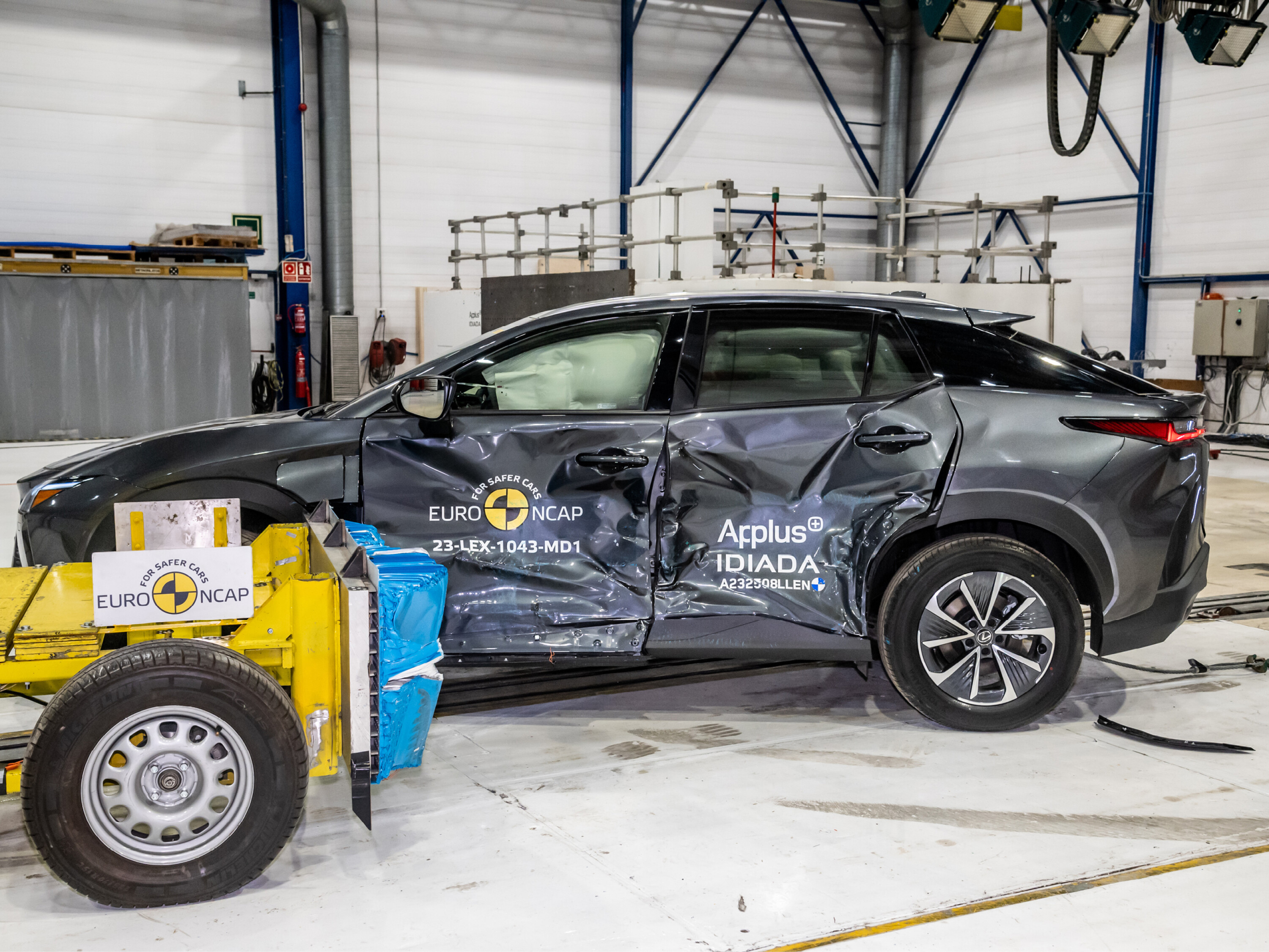
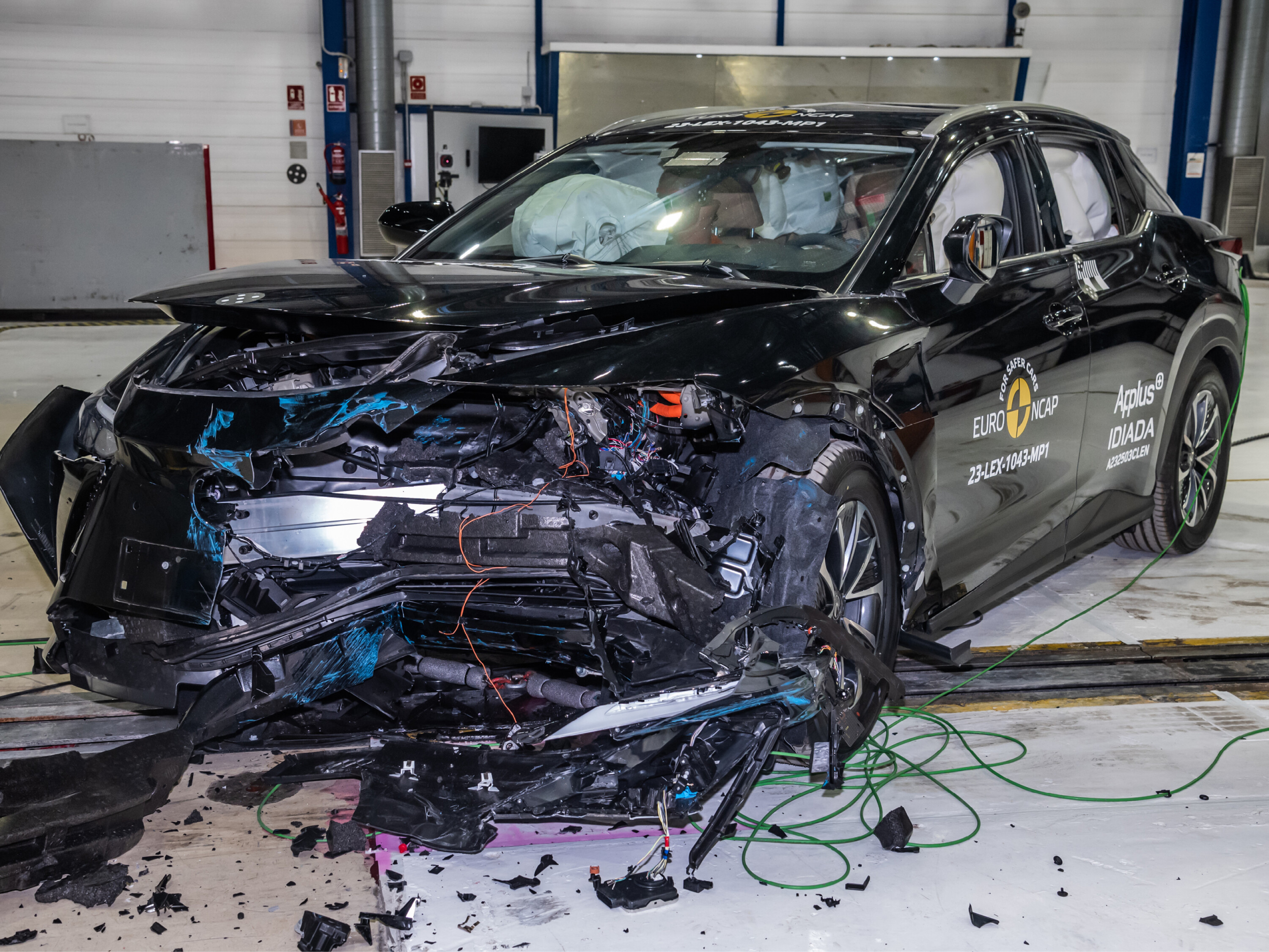
The Lexus RZ scored 87 per cent for adult occupant protection, 89 per cent for child occupation protection, 84 per cent for vulnerable road user protection, and 84 per cent for safety assist.
“Against the new 2023 criteria, the Lexus RZ satisfied the cyclist anti-dooring requirements, demonstrating its ability to warn occupants of an approaching cyclist when exiting both the front and rear doors, and to prevent door opening if needed. Vehicle submergence requirements for door and window opening were also met,” said ANCAP.
“The RZ also demonstrated Good performance in each of the new lane support and autonomous emergency braking scenarios including those with the stationary and braking motorcycle and in intersection turning scenarios involving an oncoming motorcycle.”
In crash testing, ANCAP said the front structure “presented a moderate risk to occupants in an oncoming vehicle” with a 2.39-point vehicle-to-vehicle compatibility penalty applied.
Chest protection for the rear passenger was ‘weak’ in the full-width frontal test while driver’s neck protection was ‘marginal’ in side-impact collisions. All other occupant tests were listed as ‘good’ or ‘adequate’.
The Lexus RZ has 10 airbags: dual frontal, side chest, side head, curtain, and driver’s knee and front-centre.
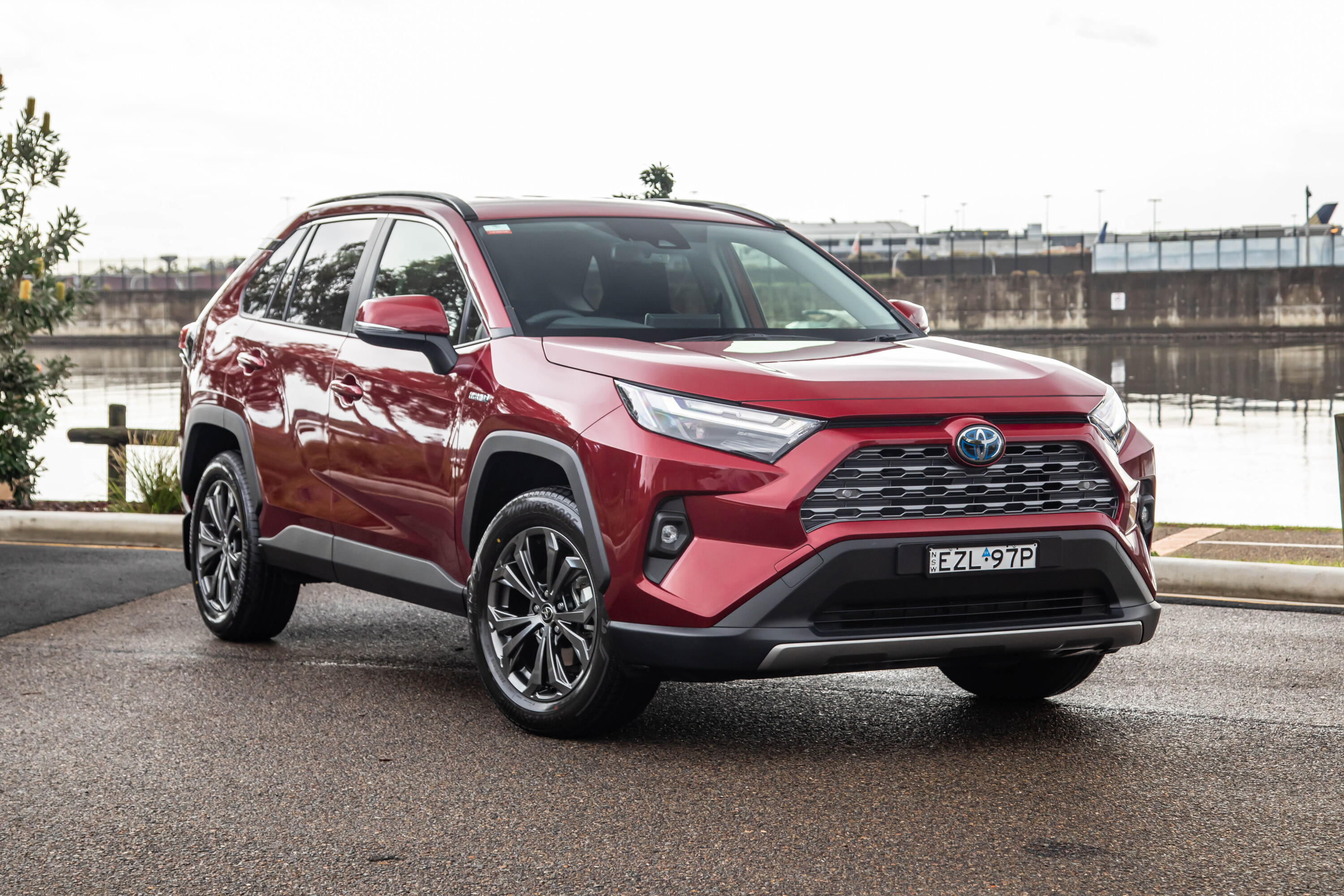
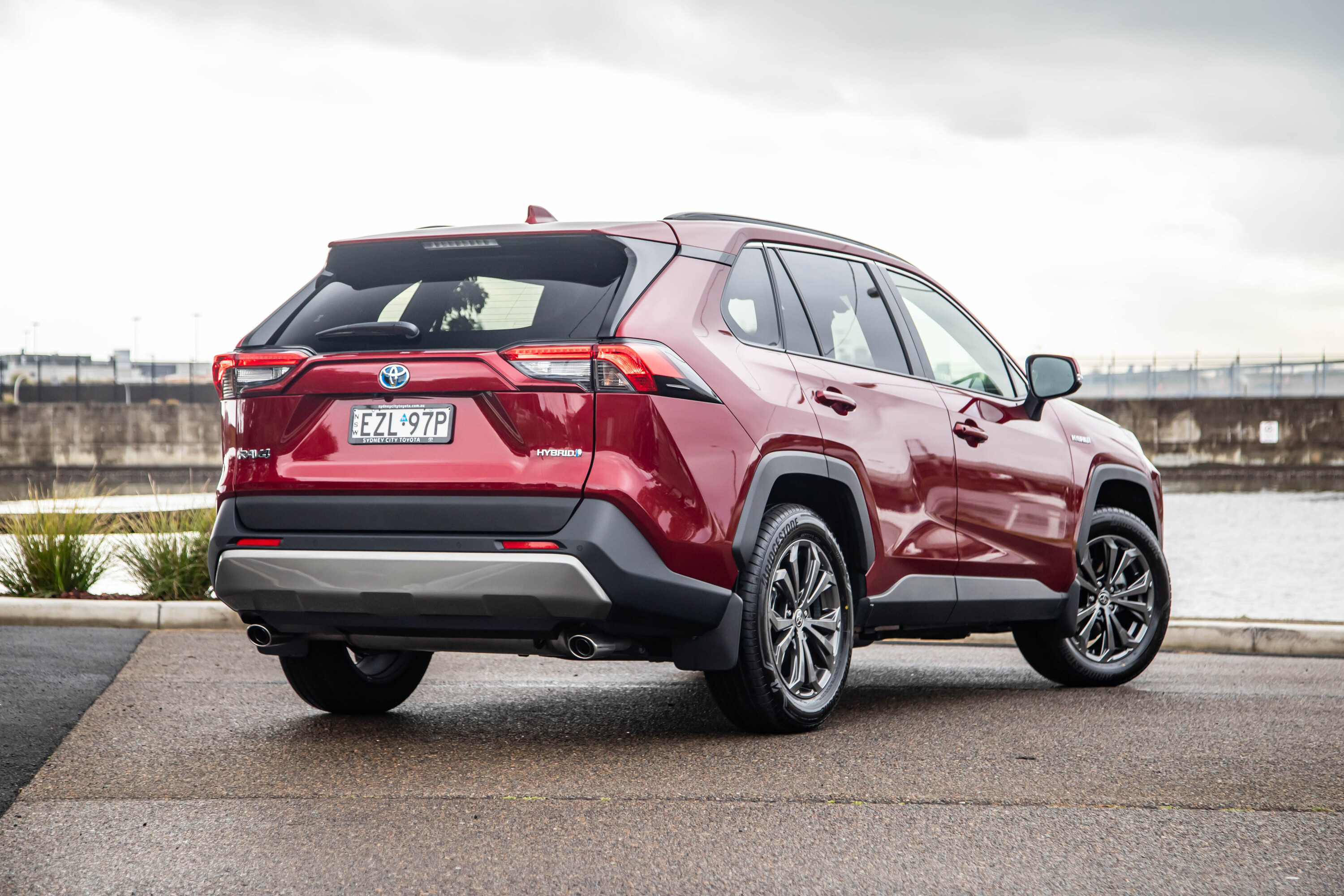
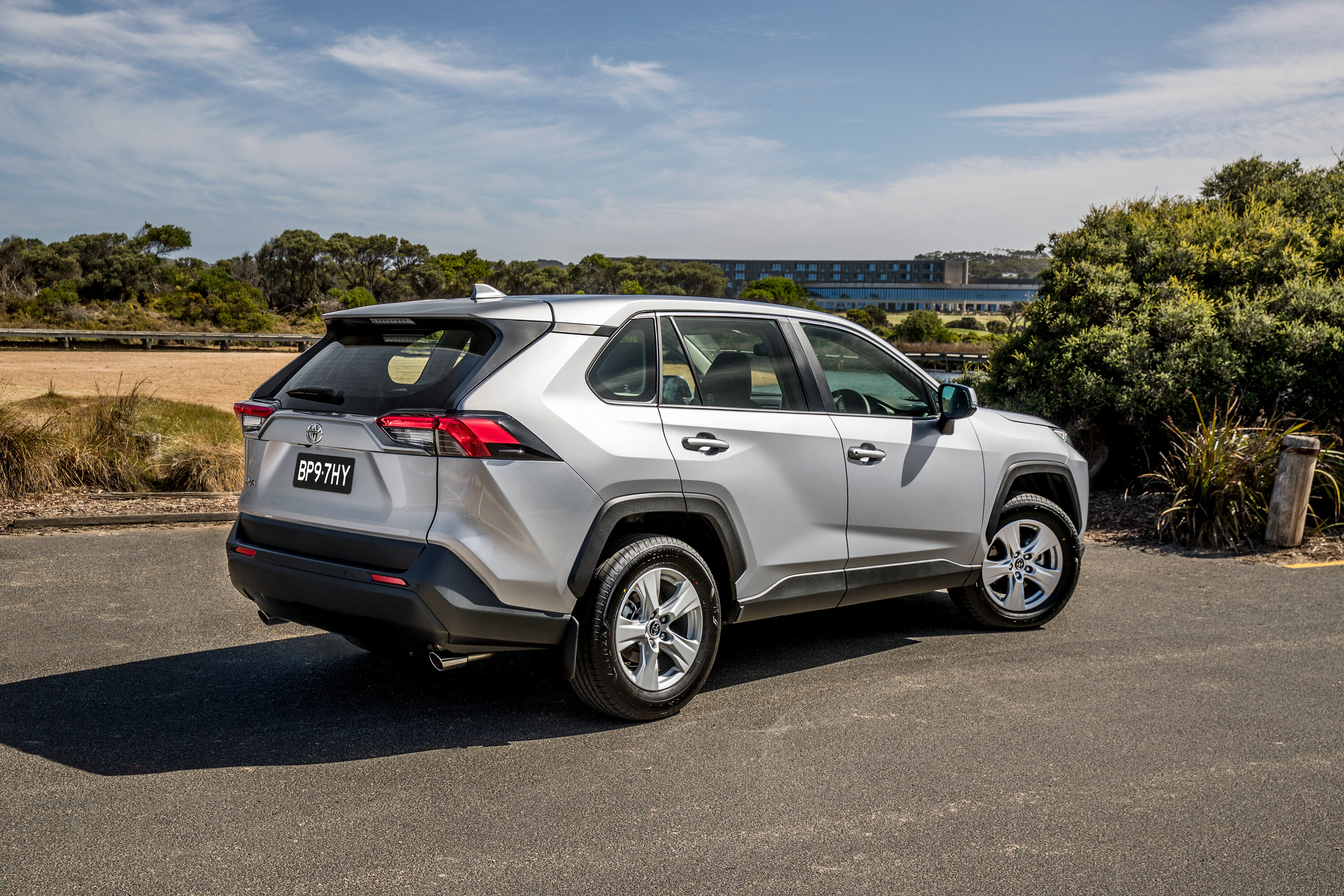
The RAV4 is consistently one of Australia’s most popular models, having been the third best-selling model of 2022.
Wait times today continue to reach 18-months for some hybrid models, proving the demand for the SUV remains strong.
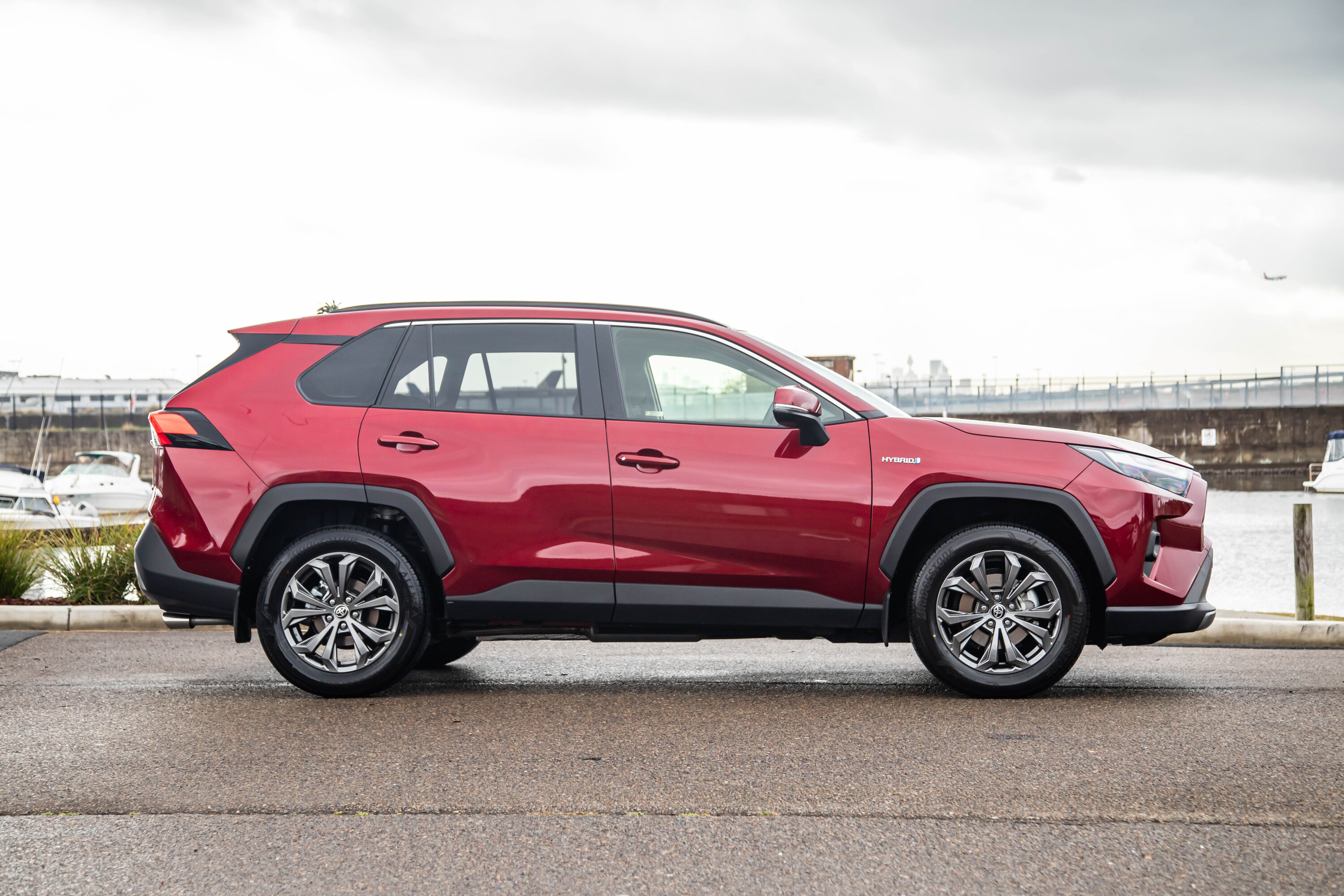
The Toyota family car has long been a staple in the compact SUV segment, and the 2023 RAV4 variant continues that legacy.
But in a segment that’s more competitive than ever, how does the GXL hold its ground?
1
Pricing and features
The GXL is second most affordable grade in the five variant RAV4 lineup. Priced at $43,310 before on road costs for the 2.0-litre petrol four-cylinder version.
Buyers also have the choice of a front or all-wheel drive hybrid powertrains. Hybrid comes at an extra $2500 and all-wheel-drive hybrid for $3000 more.
Fuel consumption on hybrid variants are particularly impressive, getting as low at 4.7L/100km.
1
The base-grade GX comes standard with:
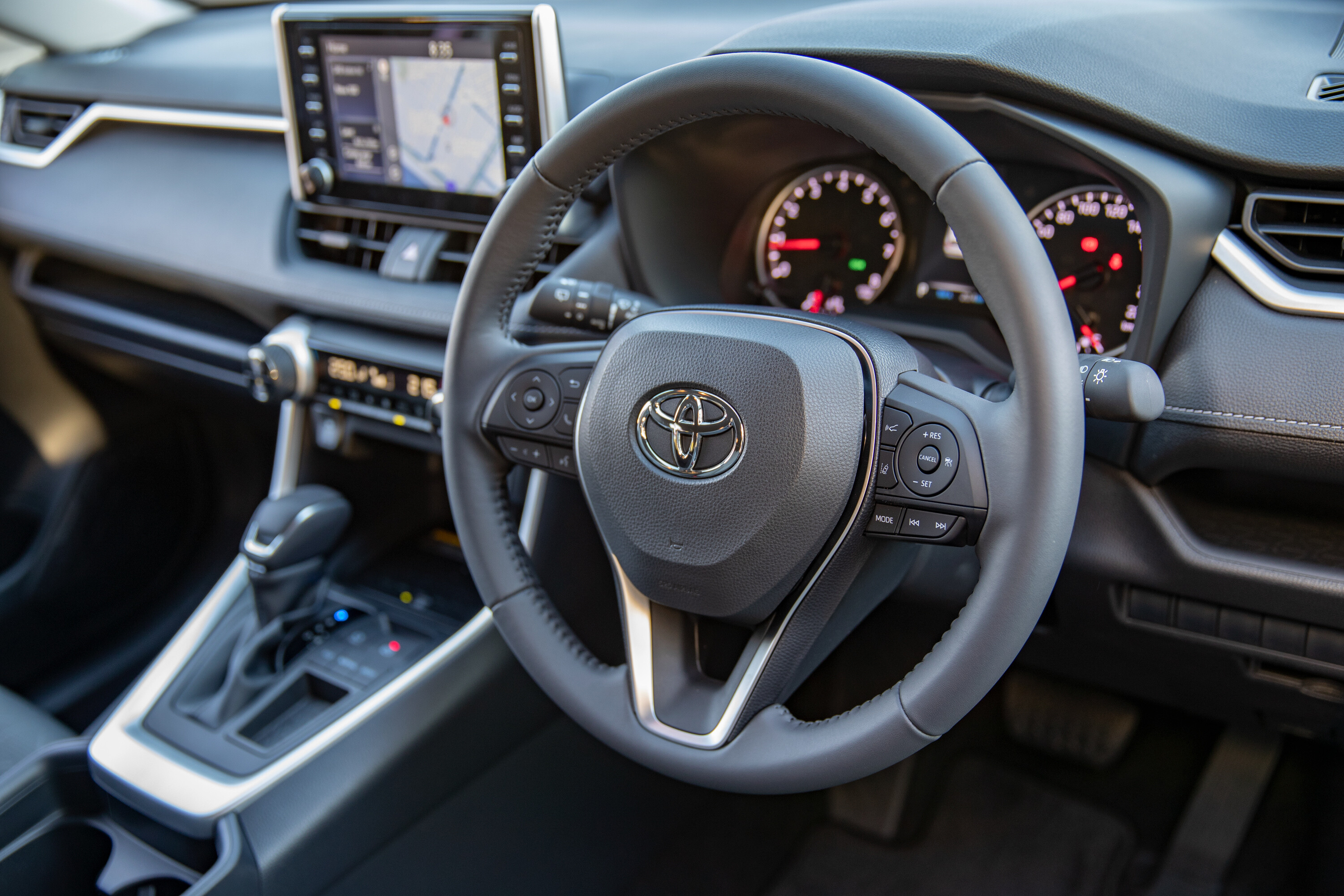
7-inch semi-digital instrument cluster
Rain-sensing wipers
8-inch infotainment system
Five USB ports (x3 front, x2 rear)
17-inch alloy wheels
Push button start
Wireless Apple CarPlay and wired Android Auto
Cloth upholstery
Over-the-air software updates
Leather-wrapped steering wheel
Toyota Connected Services
Front and rear carpet floor mats
AM/FM/DAB+ radio
60/40 split-fold rear seats and centre armrest
Heated, power-folding side mirrors
LED headlights and daytime running lamps
Dual-zone climate control (hybrid only)
LED interior lighting
6-speakers
LED fog lights
Stepping up to the GXL adds:
18-inch alloy wheels
Front mud flaps
Keyless entry and push-button start
Auto-dimming rear-view mirror
Rear privacy glass
Roof rails
Wireless phone charger
Dual-zone climate control
Leather-wrapped gear shifter
Illuminated door switches
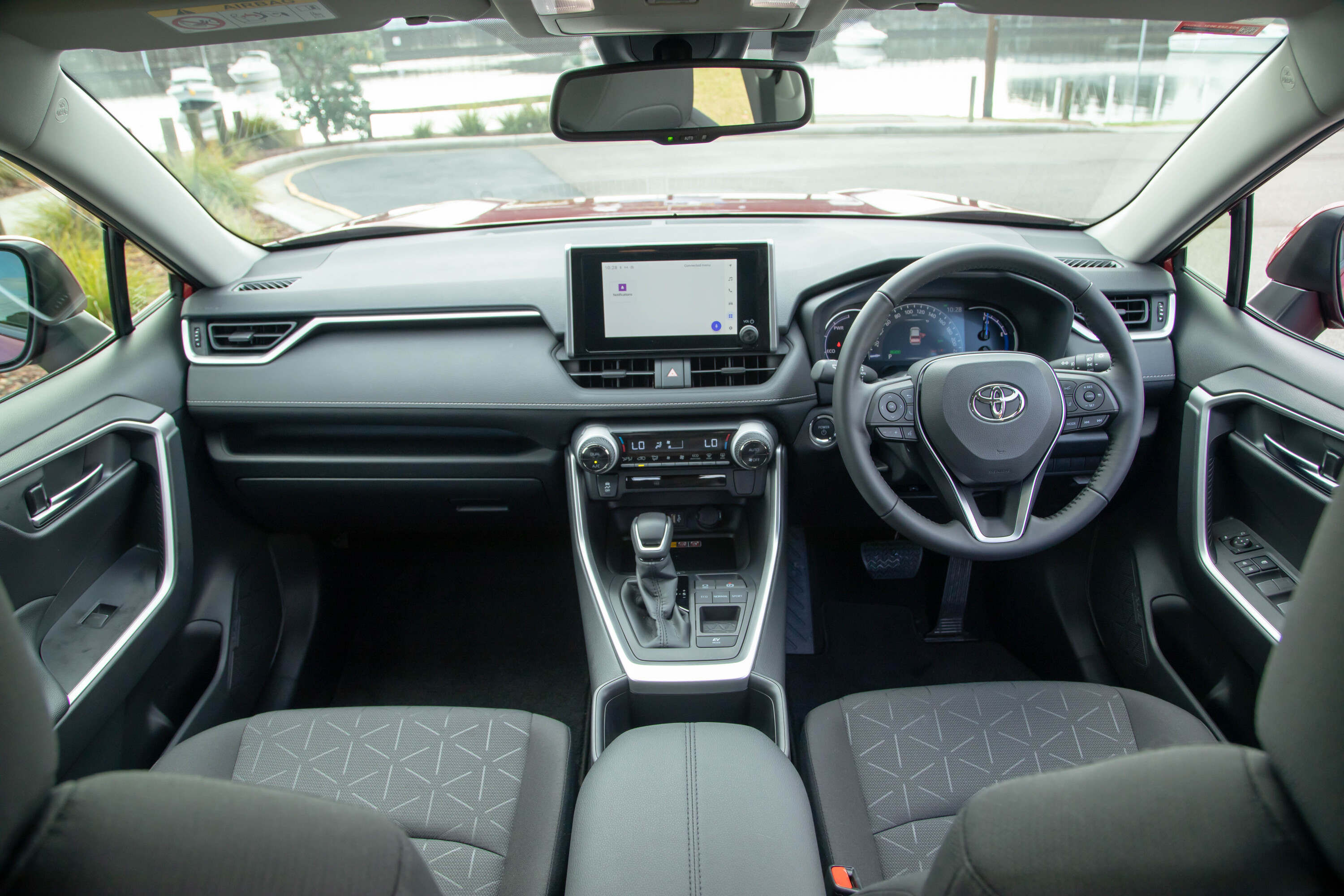
All paint colour options besides the standard Glacier White are charged at a $700 premium. Inside the cabin you’ll get premium cloth black trim with a stitched pattern on the seats as well as a leather accented steering wheel and shift knob.
1
Safety
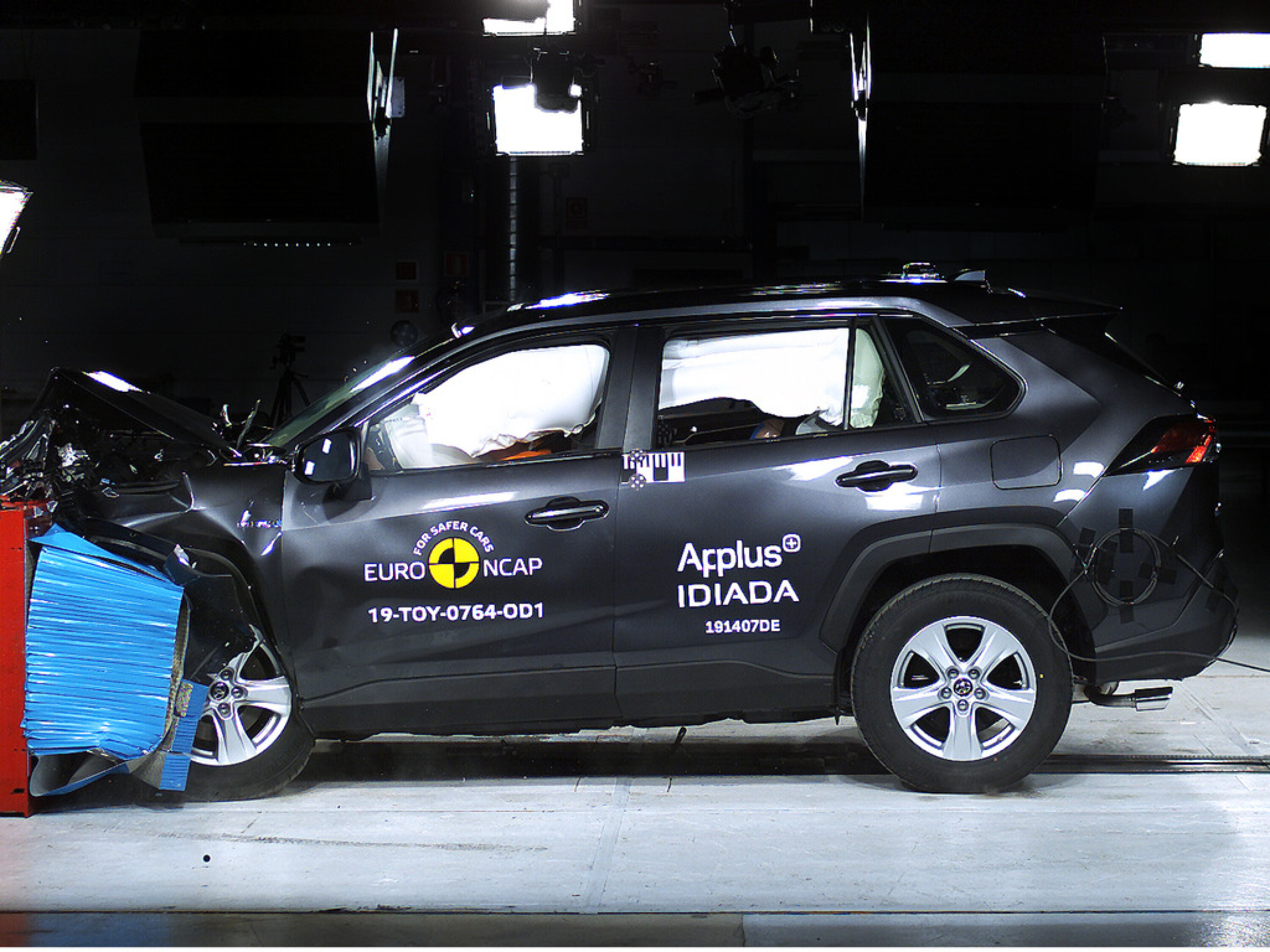
The RAV4 was awarded a five-star ANCAP safety rating; valid for all its models and powertrain options when it was rated in 2019.
It achieved a 93% rating for adult occupant safety, 89% for child occupant safety and 83% for its safety assist features.
1
Every model in the RAV4 lineup comes equipped with seven airbags, including dual front, side, curtain and driver’s knee.
The RAV4 boasts a comprehensive list of safety features across all its variants through the Toyota Safety Sense package incorporated into the vehicle.
There is no shortage of popular options when looking for a family SUV. The RAV4 continues to be a winning package but there are plenty of worthy competitors that may tick similar boxes, including:
The 2023 Toyota RAV4 GXL is a solid choice for those seeking a reliable and practical compact SUV, with a touch of luxury.
Its blend of space, safety and Toyota’s reputation for reliability make it a strong contender in its segment.
If you’re seeking a family-friendly and economical SUV then you can’t look past the hybrid RAV4 . I mean, it’s ended up in so many Australian driveways for a reason.
If you’re after more bells and whistles of higher-end models, you can look to move into the XSE, Edge or Cruiser variants. The overall package of the GXL offers great value for money, making it a vehicle worth considering for your next purchase.
The RAV4 is consistently one of Australia’s most popular models, having been the third best-selling model of 2022.
Wait times today continue to reach 18-months for some hybrid models, proving the demand for the SUV remains strong.
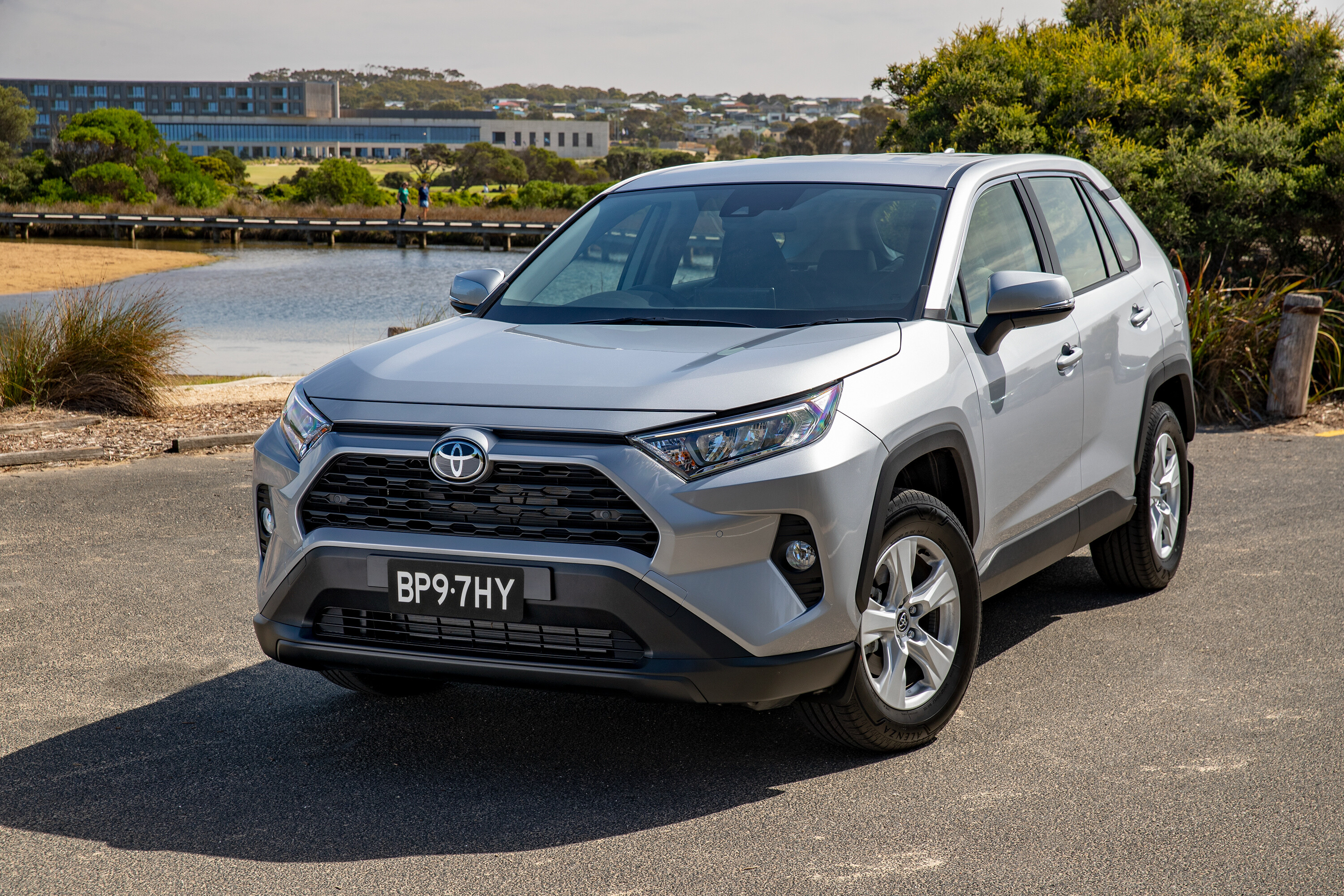
The Toyota RAV4 has long been a staple in the compact SUV segment, and the entry-level 2023 GX variant continues that legacy.
But in a segment that’s more competitive than ever, how does the GX hold its ground?
1
Pricing and features
The GX is the entry-grade into the five variant RAV4 lineup. Priced at $39,760 before on road costs for the 2.0-litre petrol four-cylinder version.
Buyers also have the choice of a front or all-wheel option hybrid powertrain. Hybrid comes at an extra $2500 and all-wheel-drive hybrid for $3000 more.
As a base grade the vehicle specs don’t necessarily astound compared to Chinese rivals, however the hybrid puts forward a proposition that’s hard to ignore, using as little as 4.7L/100km in fuel.
1
Included in the GX you’ll get:
7-inch semi-digital instrument cluster
Rain-sensing wipers
8-inch infotainment system
Five USB ports (x3 front, x2 rear)
17-inch alloy wheels
Push button start
Wireless Apple CarPlay and wired Android Auto
Cloth upholstery
Over-the-air software updates
Leather-wrapped steering wheel
Toyota Connected Services
Front and rear carpet floor mats
AM/FM/DAB+ radio
60/40 split-fold rear seats and centre armrest
Heated, power-folding side mirrors
LED headlights and daytime running lamps
Dual-zone climate control (hybrid only)
LED interior lighting
6-speakers
LED fog lights
All paint colour options besides the standard Glacier White are charged at $700. Inside the cabin you’ll get cloth black trim with a stitched pattern on the seats and a leather accented steering wheel.
1
Safety
The RAV4 was awarded a five-star ANCAP safety rating; valid for all its models and powertrain options when it was rated in 2019.
It achieved a 93% rating for adult occupant safety, 89% for child occupant safety and 83% for its safety assist features.
1
Every model in the RAV4 lineup comes equipped with seven airbags, including dual front, side, curtain and driver’s knee.
The RAV4 boasts a comprehensive list of safety features across all its variants through the Toyota Safety Sense package incorporated into the vehicle.
There is no shortage of options when looking for a family SUV. The RAV4 continues to be a winning package but if your budget is keeping you at a GX petrol, there are plenty of worthy competitors that may tick similar boxes, including:
The 2023 Toyota RAV4 GX is a solid choice for those seeking a reliable and practical compact SUV.
Its blend of space, safety features combined with Toyota’s reputation for reliability makes it a strong contender in its segment.
If you’re seeking a family-friendly and economical SUV then you can’t look past the hybrid RAV4 . I mean, it’s ended up in so many Australians driveways for a reason.
While it might not have the bells and whistles of higher-end models, its overall package offers great value for money, making it a vehicle worth considering for your next purchase.
VW Group boss hints at plans for reborn u2018iconu2019 range
Hero vehicles to be recreated as EVs, possibly including new Beetle EV
Design-led drive for expansion
Volkswagen Group CEO Oliver Blume has outlined plans to launch a range of new electric cars that are inspired by iconic designs of years gone by.
Speaking with Australian media at IAA Mobility 2023 in Munich, Mr Blume said the Group would be offering more differentiation across its brands when it comes to design, and that could include a new electric range of reimagined iconic cars.
“Our design strategy is to develop even further our established cars, then setting on some technology lighthouses, and the third pillar is to develop further an ‘iconic’ strategy,” said Mr Blume.
1
“We haven’t decided the full map on which iconic products we are focusing on, but the Volkswagen Group has a lot of them, and we are focusing on the right ones. And we are always having in mind exciting our customers,” he said.
Furthering the case for a new-gen EV Beetle, the company’s Open Space exhibit in downtown Munich showcased a futuristic red VW Beetle-like concept car as part of a tie-in with the animated film Miraculous: Ladybug & Cat Noir.
1
Mr Blume did not confirm a Beetle would be one of the new range of reborn iconic models, but did say the company was always exploring options.
“We have a lot of opportunities to differentiate in electric platforms. You can already see on the products we have in the market – the Cupras and Volkswagens are different in many, many, many aspects. The Porsche Taycan and the Audi GT e-tron are different,” he said.
“So we have a lot of opportunities. Design is one of the most important arguments for the customers, but also for us,” he said.
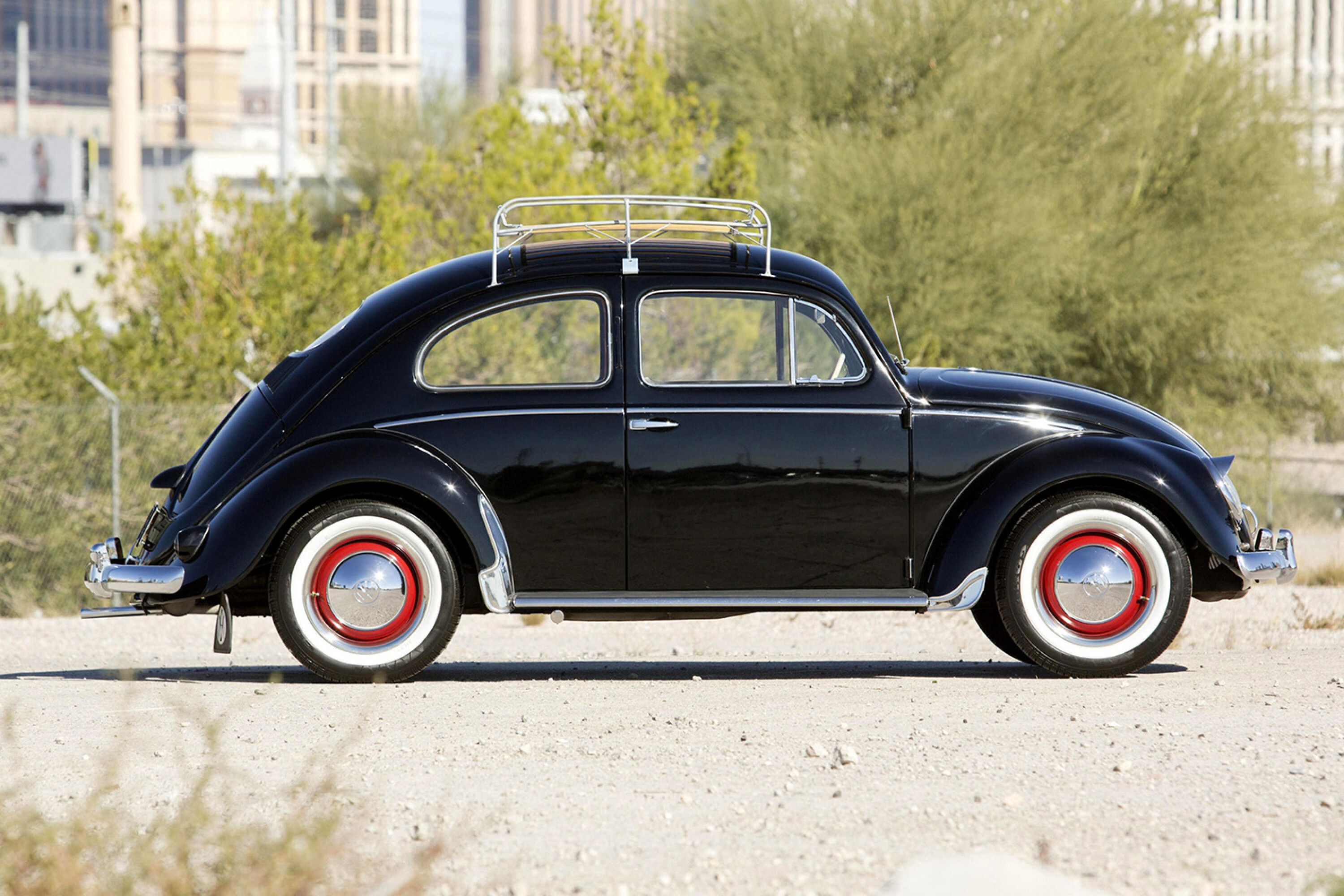
One argument for Volkswagen to potentially relaunch the Beetle is that it could be constructed on a rear-wheel drive electric platform, which would be a return to form since the original Bug models were RWD.