
Yep. It’s expected that the new Sonata will not be offered with wireless Apple CarPlay or Android Auto, thanks to what is believed to be an ongoing stoush between Hyundai and either Apple or Google, over the topic of whose maps system should be appear when the system first loads up – theirs or Hyundai’s. Neither Hyundai, nor its stablemate Kia which suffers the same issue, have been prepared to comment on the matter. Owners will still be able to use a wired connection, at least.
Prices that’ll make you cry, either because you haven’t got that sort of money – or you can’t stop thinking about that fortune-making car you sold 20 years ago for five grand…
Here’s just a few of the cars going for big dollars, from our mates at Unique Cars.
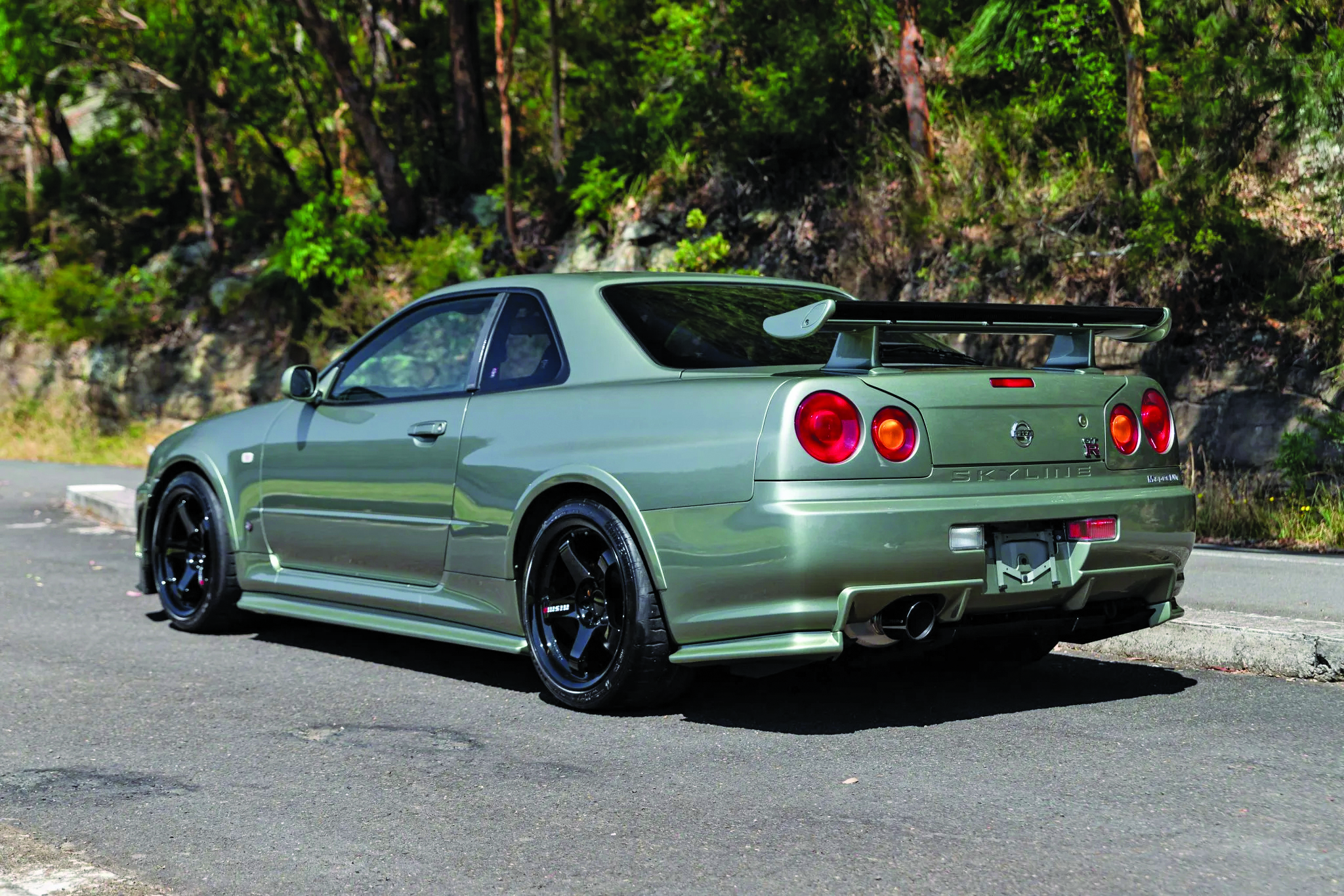
2002 Nissan Skyline GT-R M-Spec NU
1
Sold: $455,000 Bring A Trailer
Here’s an M-Spec Nu version carrying build #88 of just 285 produced. A two-owner car, it arrived on our shores in 2020.
Finished in Millennium Jade, one of 144, with black leather trim, it’s powered by a twin-turbo 2.6-litre RB26DETT inline-six linked to a six-speed manual transmission and an ATTESA all-wheel-drive system with a limited-slip rear differential. It wears a Nismo bodykit.
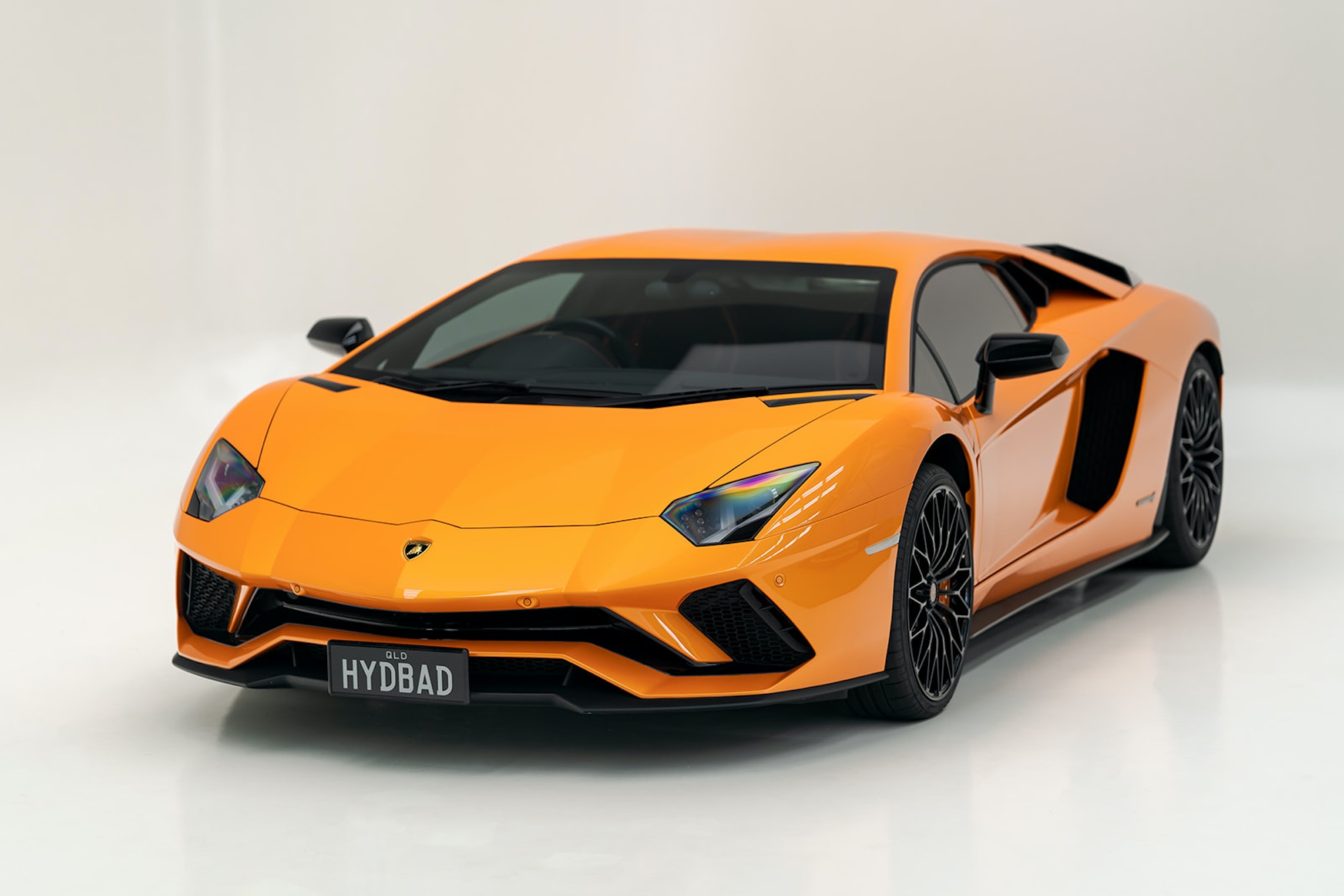
2017 Lamborghini Aventador LP740-4 S
2
Sold: $742,000 Collecting Cars
If you want to be noticed, this bright orange all-paw 6.5lt V12 Lambo Aventador does the trick. With 544 kilowatts, zero to 100km/h in 2.9 seconds and a top speed of 350km/h. The Aventador, named after a fighting bull, is more likely to give you wings then that well known drink.
Inside is black Alcantara and outside lots of carbon bits. A two owner car, since new it has covered just 9000 kilometres and sold with comprehensive paperwork.
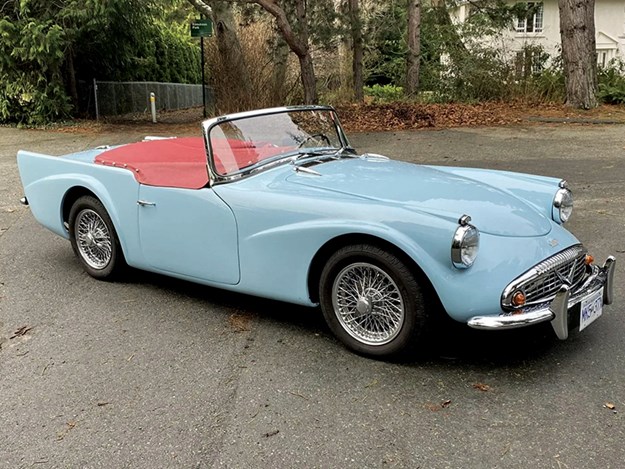
1961 Daimler SP250
1
Sold: $43,000 Bring A Trailer – Lot 95959
This car was acquired by the seller’s father in 1975, put in storage until 2000 and in 2018 underwent a complete resto. The SP Daimler is powered by a 2.5lt V8, tied to a four-speed manual.
It sold with a Jaguar Daimler Heritage Trust certificate, a tonneau cover, convertible top, refurbishment documents, 31,000km on the odo, a spare parts catalogue and a service manual.
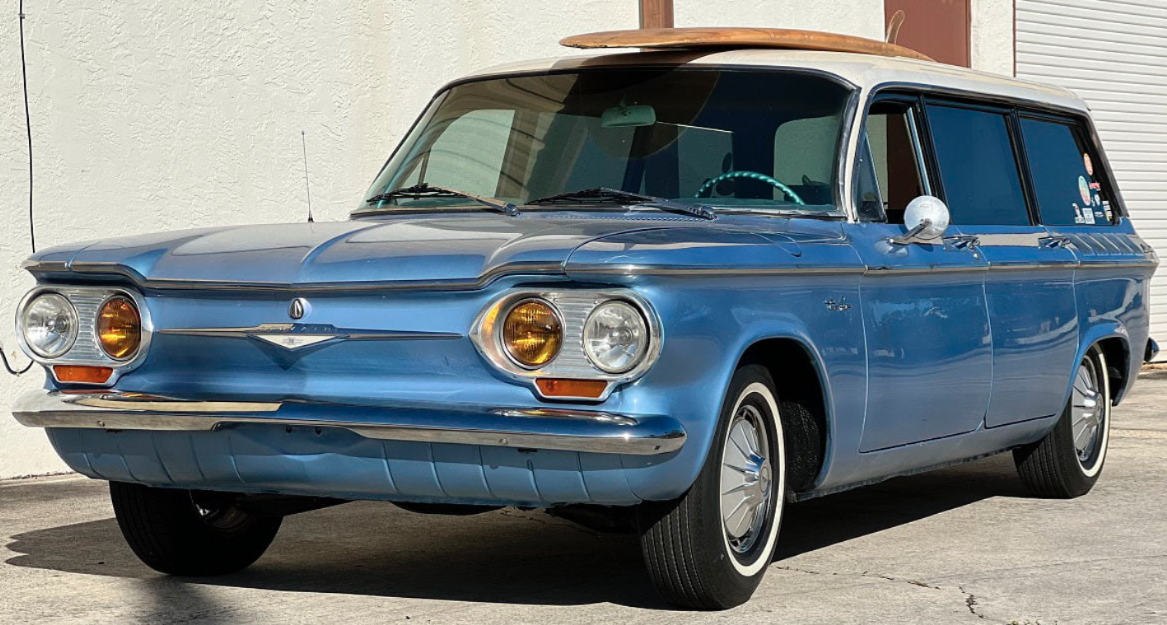
1961 Chevrolet Corvair Lakewood
2
Sold: $22,300 Mecum – Lot G88
A turbocharged Corvair wagon. Ralph Nader, would have been apoplectic over this car. Still, what a collector piece. A barn find sporty version of the Corvair, it has a 150hp turbo engine bolted to a four-speed manual, making it rare even back then.
It also has bucket seats and the Monza gauge cluster sitting behind the curved windscreen. The car came from the dry climes of Arizona. What a talking piece at car and coffee events.
Auction market watch
Chrysler By Chrysler
1
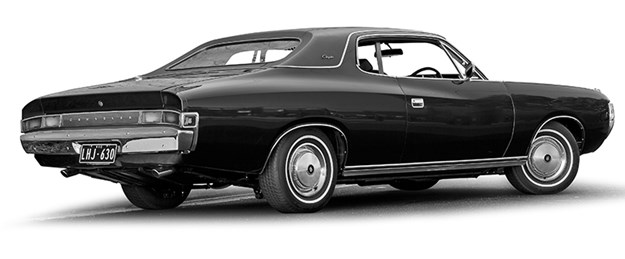
The elegant Chrysler by Chrysler (1971-76) is based on a longer wheelbase version of the Valiant and came in sedan and coupe bodies, with the more distinctive two-door the pick of the bunch. Power came from the 265 straight six or a pair of V8s; the 318ci and the 360ci. All were mated to a TorqueFlite three-speed auto.
They were crammed full of all the luxury appointments and make for an excellent if sedate weekend cruiser. Corrosion is a common issue so check that first. Mechanically they are robust if cared for. Seek out your local Chrysler/Valiant/Mopar club for guidance.
Originally published at our sister site, Unique Cars
The updated 2024 Hyundai Sonata has debuted before its local arrival in the second half of this year.
Snapshot
- 2024 Hyundai Sonata facelift revealed
- Comprehensive update for mid-size sedan, with a Kona-derived look inside and out
- N Line confirmed for Australia, due here in the second half of 2023
More than just an industry-standard mid-life facelift, the updated Sonata medium sedan has gained an all-new cabin, a Grandeur and Kona-inspired exterior design, and the latest features.
Arriving four years into the lifecycle of the eighth-generation ‘DN8’ Sonata, the new model is aimed to improve sales in South Korea, following a disappointing customer response – and increased demand for SUVs.
1
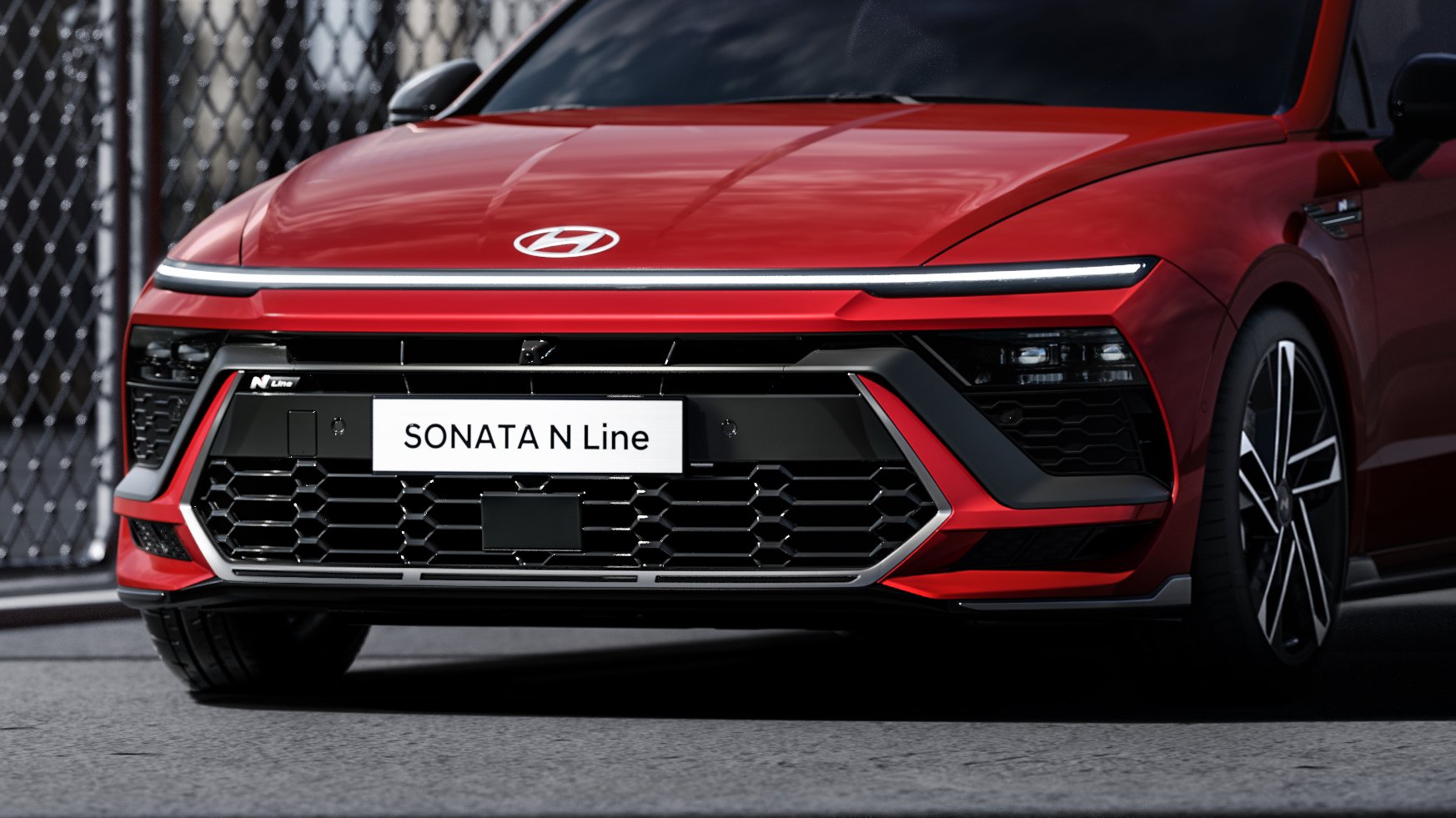
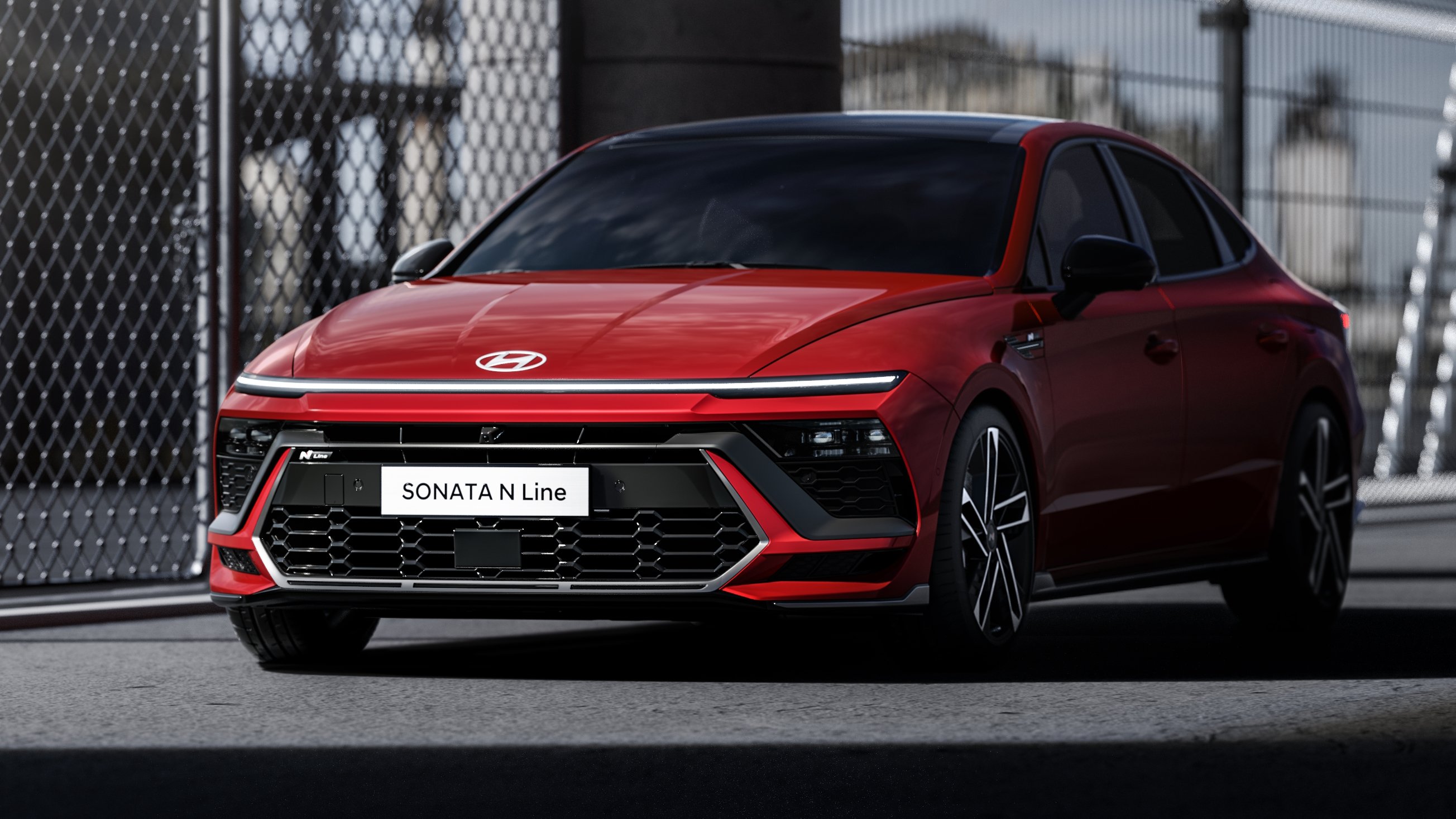
Up front, the Sonata receives a split headlight design, with a full-width LED DRL strip running above a lower-positioned grille featuring ‘hidden’ main beam units.
A more pronounced dome has been added to the bonnet, while the chrome strip running from the beltline – a Sonata trait since 2009 (when it was known as the i45 in Australia) – to the headlights with integrated DRLs has been removed.
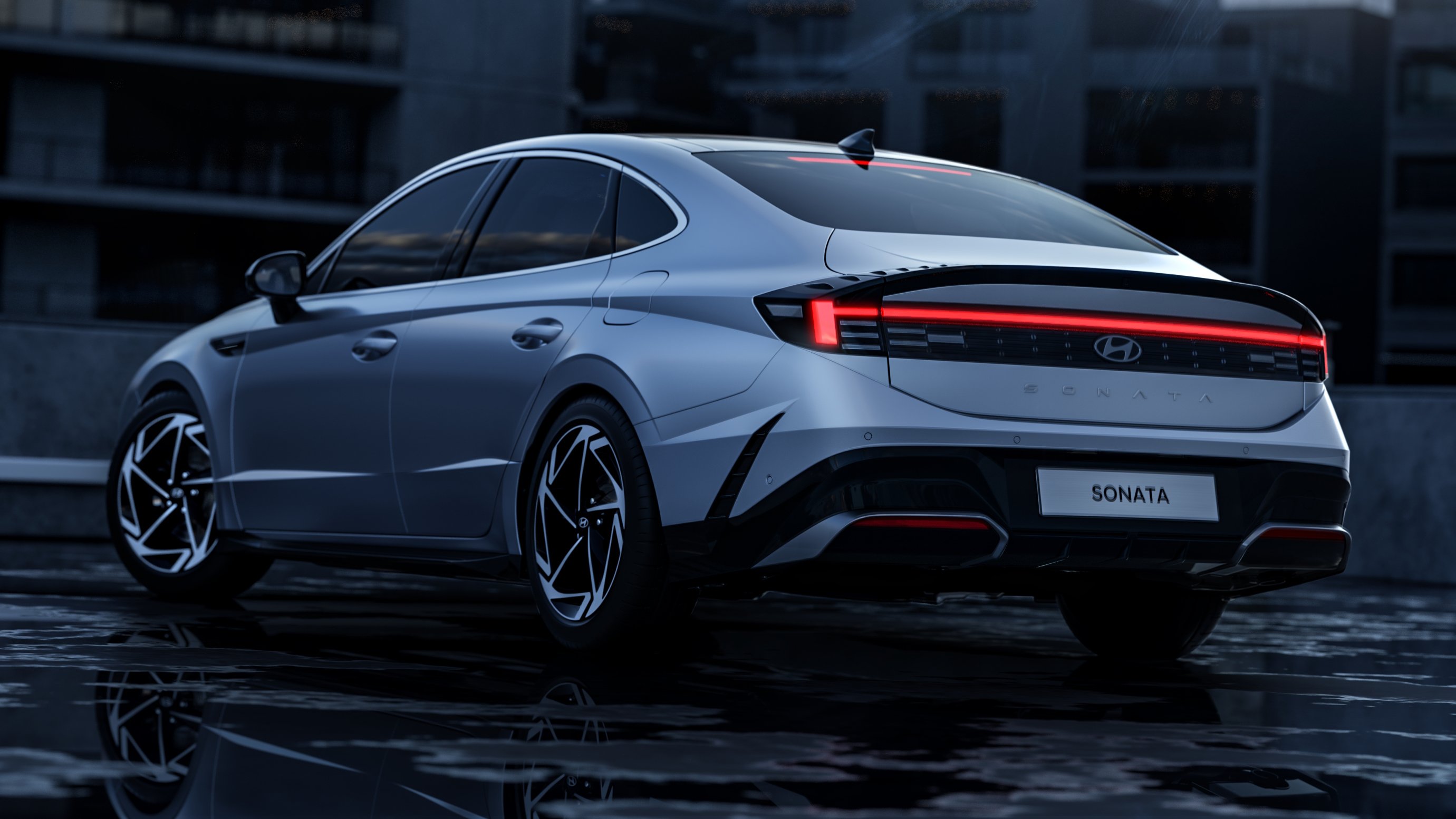
New-design alloy wheels – up to 19 inches for the flagship N Line – and a faux air intake headline the changes to the side profile, while the rear bumper adopts a more-angular design inspired by the Tucson and i30 Sedan.
1
In addition, the Sonata scores H-shaped tail-lights with a thicker full-width light strip running across the boot, featuring the brand’s ‘Parametric Pixel’ design language, as seen in the all-electric Ioniq 5 and Ioniq 6.
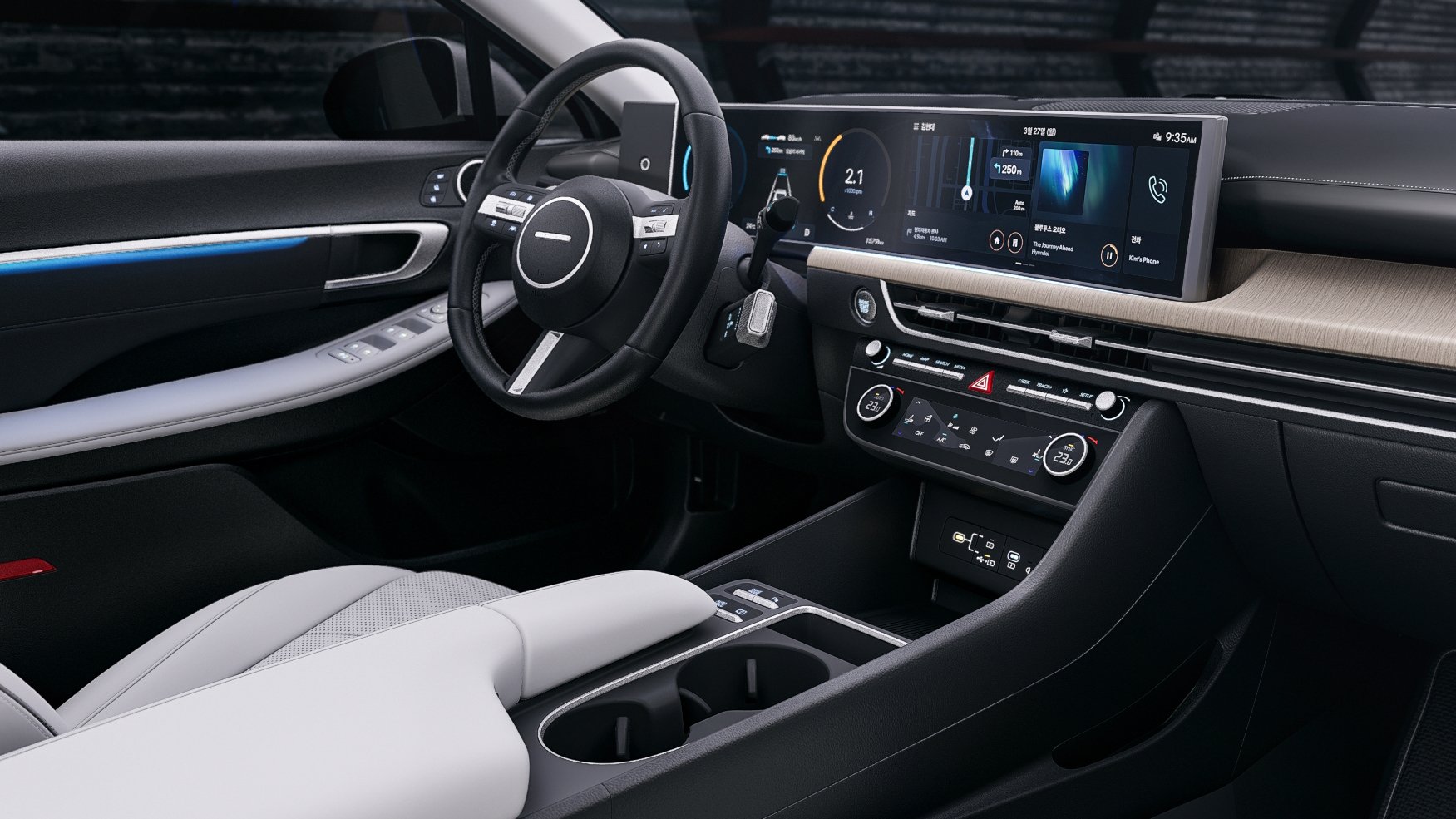
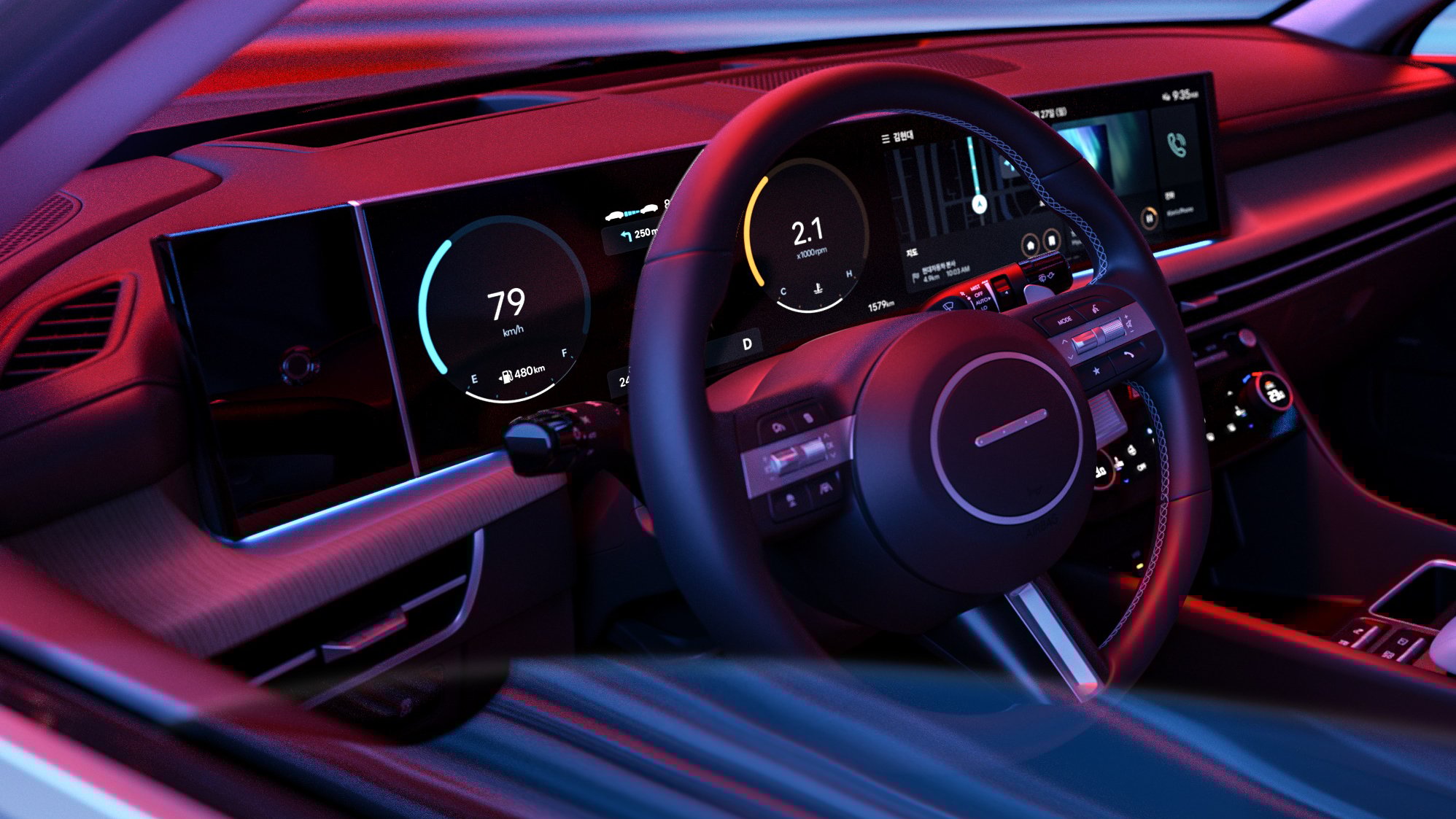
Inside, the dashboard is entirely new, with a similar look to the new Kona and what’s predicted to be the next-generation Santa Fe’s cabin.
The current 10.25-inch widescreen has increased to 12.3 inches and is now housed in a curved, BMW-like display panel incorporating a new take on the existing 12.3-inch digital instrument cluster.
It appears to be running Hyundai’s latest Connected Car Operating System (ccOS), with support for over-the-air software updates, an updated interface, and an Nvidia-supplied graphic processing unit.
1
The facelifted Sonata is expected to follow the Palisade, Venue, Tucson and Ioniq 6 in gaining Hyundai’s Bluelink connected-car technology in Australia.
WTF: Still no wireless Apple CarPlay or Android Auto?!
Also new is a brand-new steering wheel with a column-mounted shift-by-wire gear selector – identical to the next-generation Kona – to free up space in the centre console.
Design updates include a full-length air-conditioning vent, a new ‘touch-type’ climate control panel, USB-C charge ports, a simplified centre console with additional storage and a larger armrest, and a revised interior colour palette.
1
Hyundai has yet to detail the technical specifications for the updated Sonata, but it isn’t expected to receive substantial revisions under the bonnet.
In Australia, the Hyundai Sonata is exclusively offered in range-topping N Line trim, which is tipped to remain the case for the updated model.
It is powered by a turbocharged 2.5-litre petrol engine producing 213kW and 422Nm, with power sent to the front wheels only via an eight-speed dual-clutch automatic transmission.
1
When will the updated 2024 Sonata come to Australia?
Hyundai Australia has confirmed it will arrive in the second half of 2023, with local pricing and details to be announced closer to launch.
Currently, the Sonata N Line is priced at $52,065 before on-road costs, with a price rise expected for the updated model.
There can be little mistaking the Sonata’s role in Australia, however. With only 536 examples sold across all of 2022, the warm sedan exists purely as an image-building passion piece for the local arm.
MORE
Everything Hyundai
MORE
Sedan Buyers Guide
Below: the current, pre-facelift Hyundai Sonata N Line
MORE
Everything Hyundai
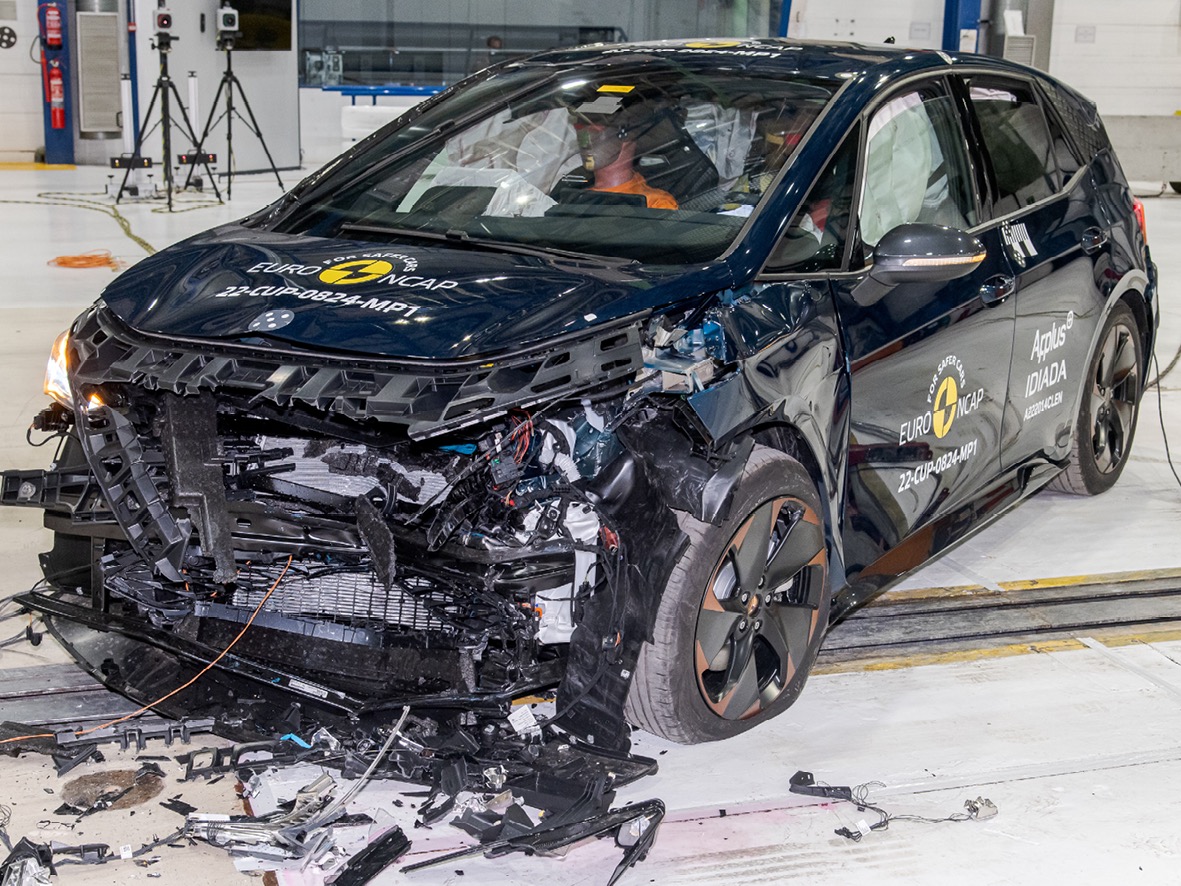
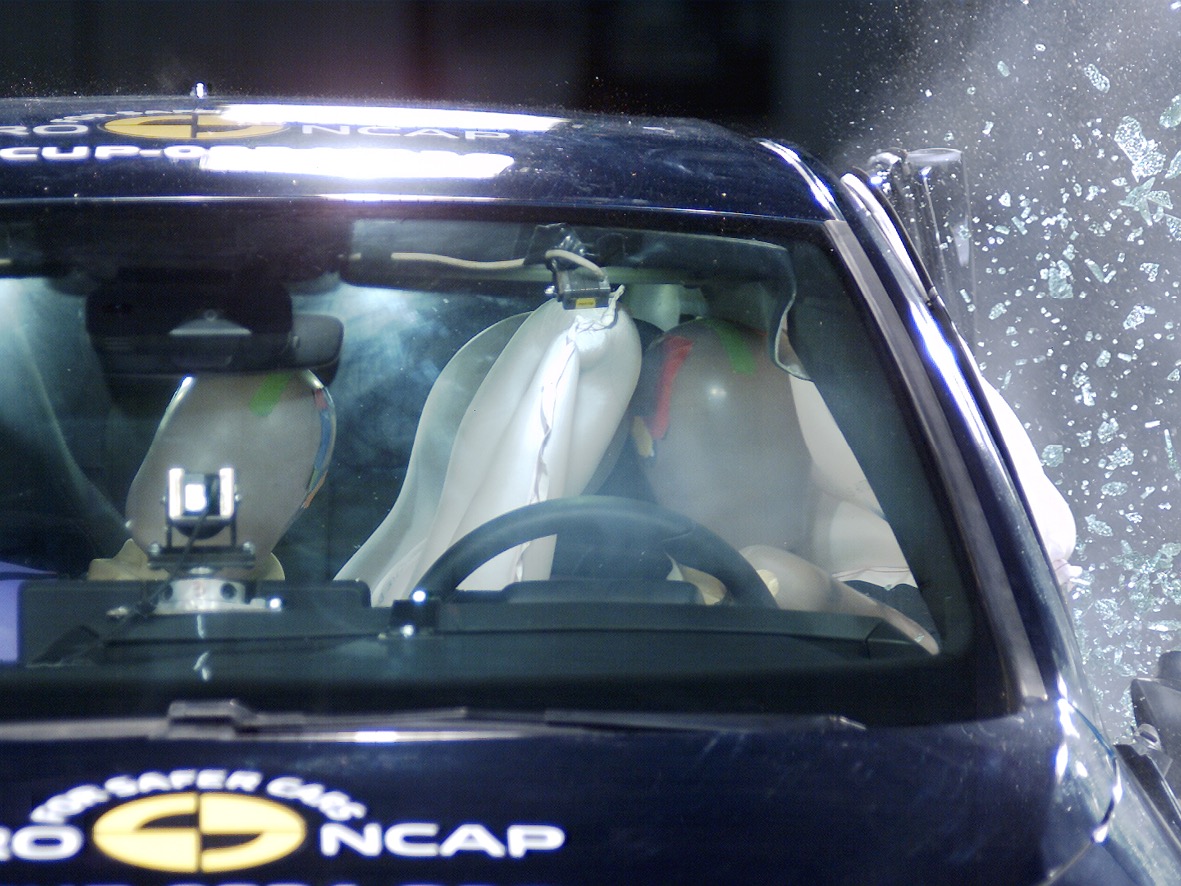
The Cupra Born has been awarded five stars in ANCAP safety testing ahead of its on-sale date early next month.
Snapshot
- 2023 Cupra Born scores top safety marks
- Evaluated under 2020-22 criteria
- Adult and child occupant protection praised
“It’s great to see another fully-electric model enter our market with the maximum five-star ANCAP safety rating,” ANCAP chief executive, Carla Hoorweg, told Wheels.
The Born was given five stars based on its Euro NCAP safety testing completed under the 2020-22 protocol. A stricter set of tests has been implemented for the next two years – read more about the changes here.
1
The Cupra Born becomes the second small electric car rated five stars under the 2022 protocol, following the GWM Ora.
It scored high marks in adult and child occupant protection, with 93 and 89 per cent respectively. ANCAP praised the Born’s ability to protect children in age-appropriate child restraints, and solid scores across the board in adult tests.
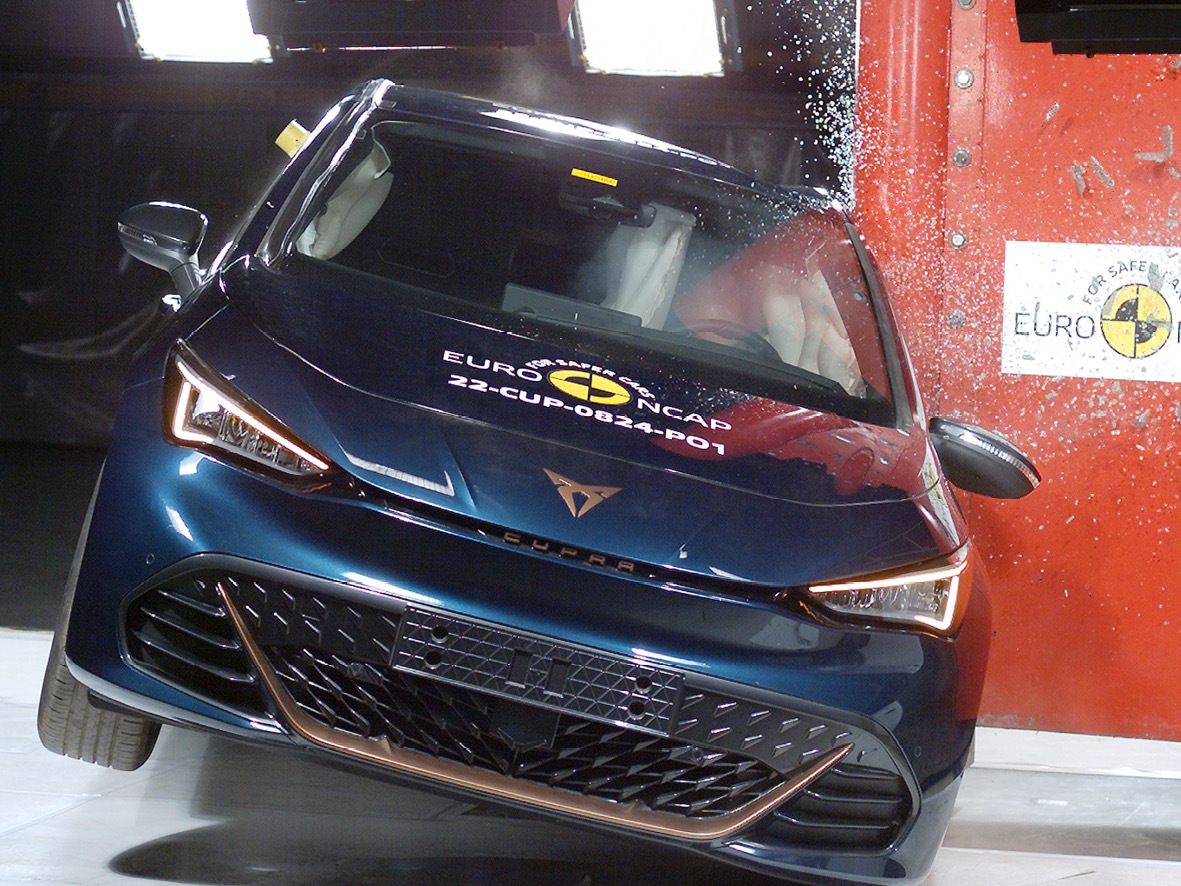
The Born scored a little lower, but still strongly, in safety assist (80 per cent) and vulnerable road user protection (73 per cent). ANCAP knocked down Born’s rating due to the AEB system’s inability to detect pedestrians in reverse or in crossing scenarios.
1
Active safety features include forward AEB with pedestrian, cyclist, and junction detection; reverse AEB; 360-camera; blind-spot monitoring; rear cross-traffic alert; lane-trace assist; and adaptive cruise control.
Cupra is set to release the Born in Australia next month priced from $59,990 before on-road costs. It boasts driving ranges of between 475-511km (WLTP) and 170kW/320Nm outputs.
The Born’s five-star score is encouraging after ANCAP’s plea that only five-star safety-rated cars should be eligible for government EV incentives.
1
“The momentum for safe and green models is growing, and this rating will provide further confidence to consumers and regulators to embrace safety and environmental credentials as a non-negotiable package,” Hoorweg added.
MORE
Everything Cupra
In this increasingly electric age, a lot of fan-favourite performance models are destined for either the chopping block or a battery pack. What does that mean for EV-obsessed Hyundai and its performance-focused N division?
Tightening emissions regulations and government legislation are painting a bleak future for affordable performance cars across the globe, and particularly at the N division of Hyundai Motor Corporation (HMC) – at least for petrol-powered models.
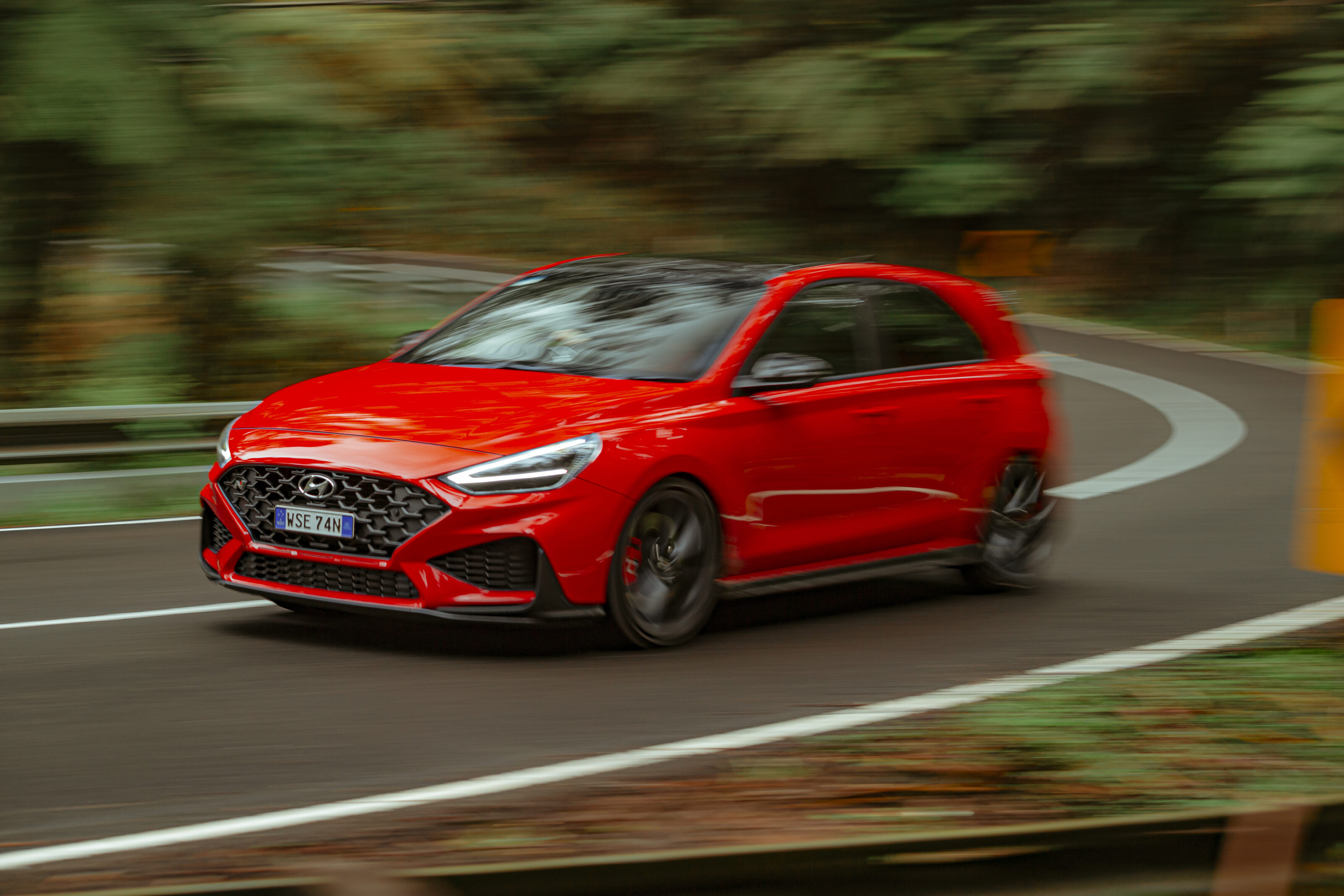
As Wheels understands it, the current i30 N hatch is expected to receive a comprehensive refresh in Australia in 2023, with the rest of the i30 hatchback line-up also facelifted in Europe. Although HMC is yet to announce this.
But beyond that update, the i30 N hatch’s future – and the i30 hatchback range as a whole – remains uncertain as tough Euro 7 emission standards (that come into effect on 1 July 2025 across the European Union) virtually demand that a model range includes hybrid and electric powertrains.
1
With the popularity of small hatches waning, in lieu of small SUVs like Hyundai’s Kona (which offers petrol, hybrid and electric powertrains in its imminent new generation – see above), the likelihood of the i30 hatch lasting beyond 2025 appears slim.
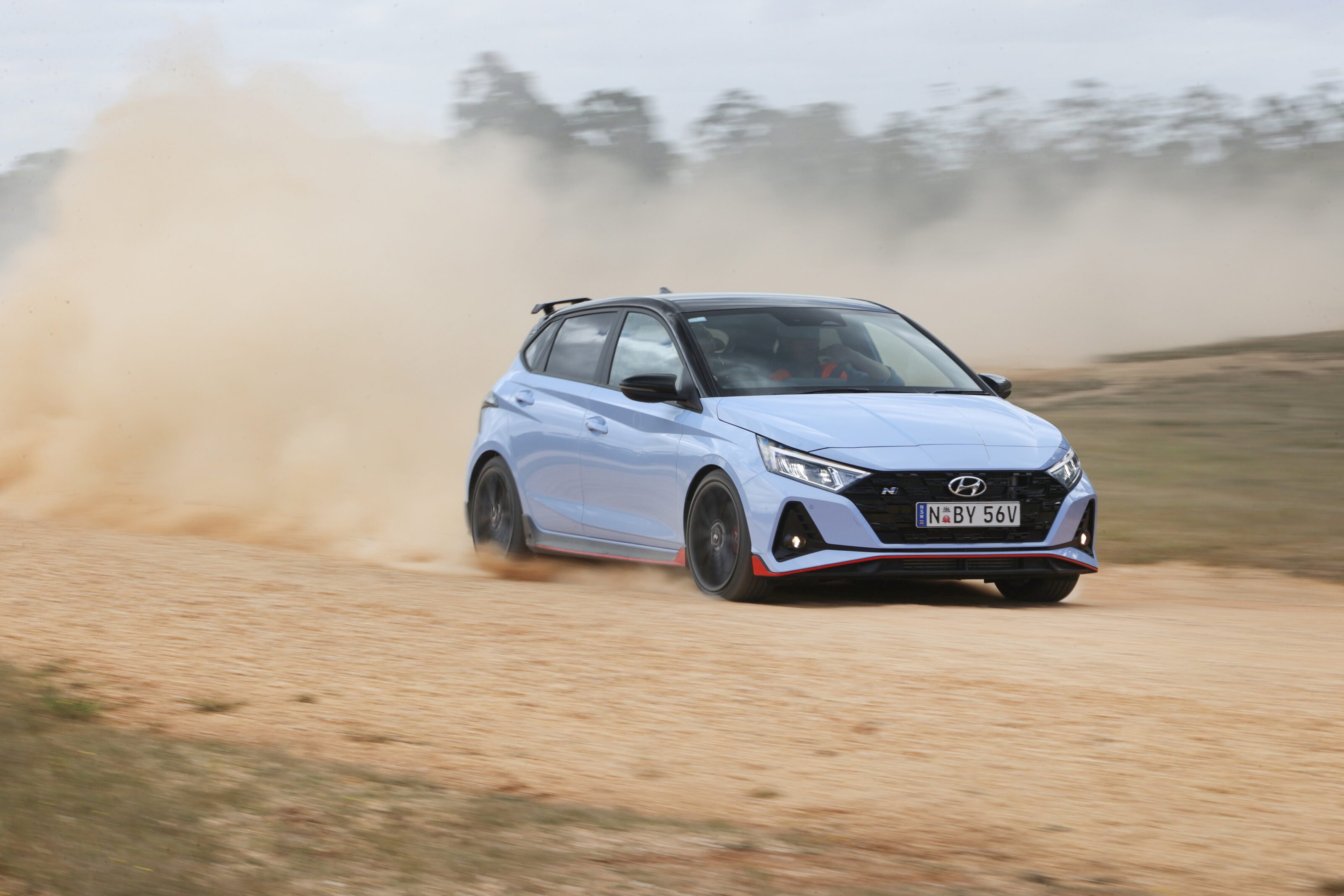
As for the Turkish-built i20 N hatch, the former boss of Hyundai’s N division and now executive technical advisor, Albert Biermann, recently confirmed that a facelifted i20 N will appear in Europe in mid-2023, meaning a likely arrival in Australia by early 2024.
“Yes, there will be a facelift,” said Biermann. “It’s coming next summer [in Europe], so we need to wait a little bit. But on the technical side, you don’t need to be afraid, it’s still the crazy corner rascal [the current model is].”
Biermann had previously stated that an i20 N facelift would be mainly cosmetic, because Hyundai was already finding it impossible to meet global demand for the car.
1
He also said the N division was struggling to get a new-gen i20 N signed off by management, even though a successor to the current BC3 i20 is already under development. At the very least, then, the i20 N appears to have around two years left.
The i30 Sedan N also gets a stay of execution, owing to the sales volume it generates in its sedan-focused main markets (the US and South Korea), meaning it will outlive its doomed i30 N hatch relative, with a decision on its life expectancy still some way off.
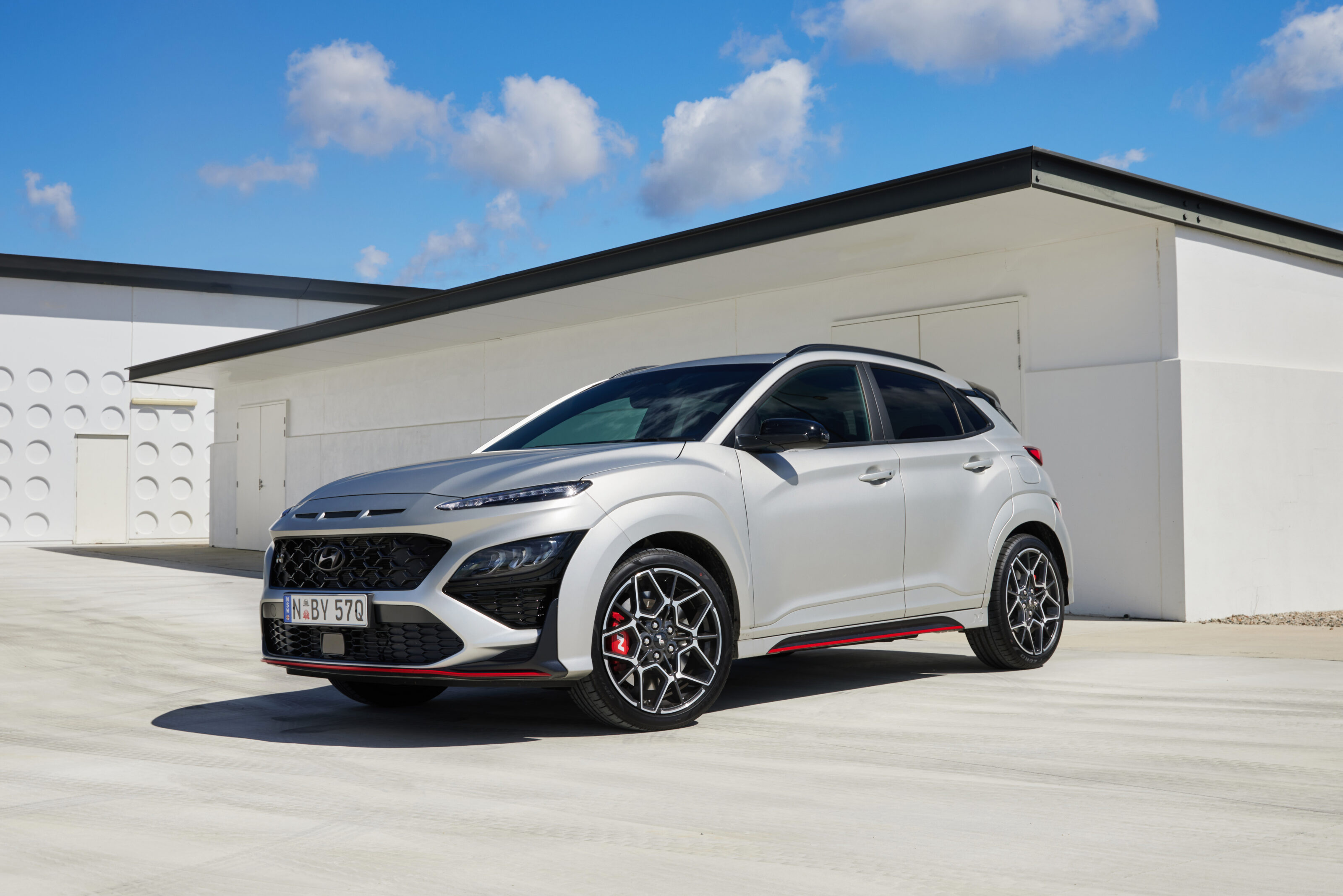
So where does that leave the current Kona N? As Wheels understands it, dead in the water.
There’s been no official word from HMC on this as yet, though given the recent announcement of sporting N-Line variants spanning all powertrains in the forthcoming new-generation Kona line-up (arriving here mid-year) – and with the performance of the Kona Electric being similar to the existing Kona N – the likelihood of developing a short-lived, high-performance, new-generation petrol-powered model with a lifespan of less than two years is, well, zero.
1
Once these revered (and affordable) performance models disappear from Hyundai’s stable, what will fill the gap? Cue a bunch of fully electric N models based on HMC’s existing e-GMP architecture (or variations of this 800-volt electric platform).
We know the track-honed Ioniq 5 N is close to sign-off and will be unveiled before the end of 2023 – featuring a near-identical powertrain to the related 430kW/740Nm Kia EV6 GT but with improved cooling performance, a more hardcore suspension tune and stronger brakes with greater regenerative performance.
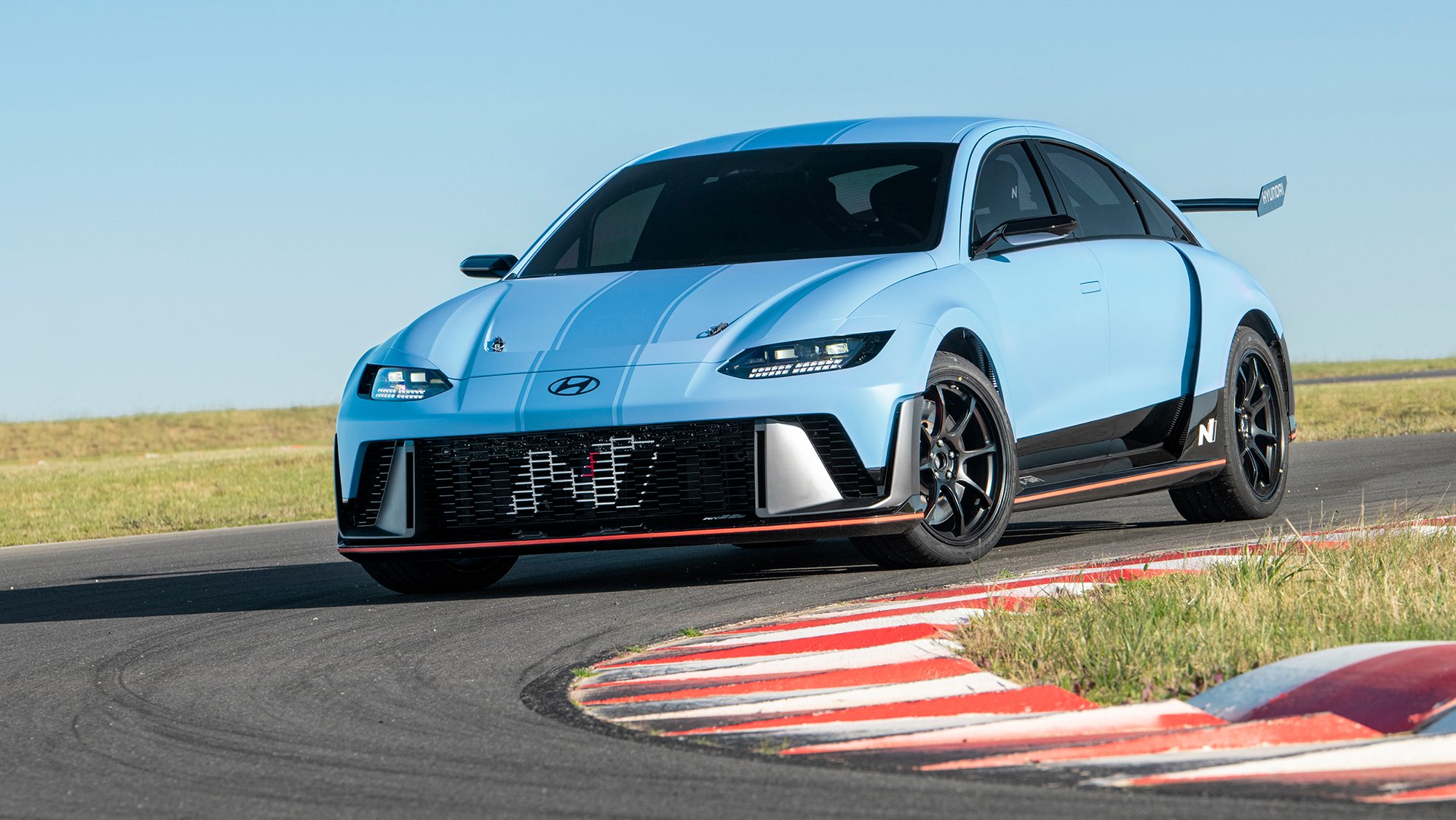
Based on what Hyundai’s vice president for N brand management and motorsport, Till Wartenburg, told Australian automotive media at The Bend in late-2022 – at the RN22e concept’s Australian track debut, a vehicle that prefigures the forthcoming Ioniq 6 N sedan – any future N-branded electric Hyundai must feature the e-GMP platform with 800-volt silicon-carbide inverter in order to “keep the three pillars of N, where racetrack capability is one – that is a huge challenge”.
1
Wartenburg said that creating a high-performance car using the e-GMP platform will make the potential of this architecture much more apparent, whereas attempting to create a track-capable vehicle using the 400-volt architecture as used by several competitors would be “just a waste of time; they can’t go there.”
The other challenge for Hyundai in using 800-volt technology is managing the cost increase over combustion-engined models. That will be particularly important for the ultimate successor to the i30 N hatch – a vehicle that is currently under development using the e-GMP platform.
Expected to be called Ioniq 4 N, Hyundai hopes its price will start with a 6.
1
New Kona’s upmarket push
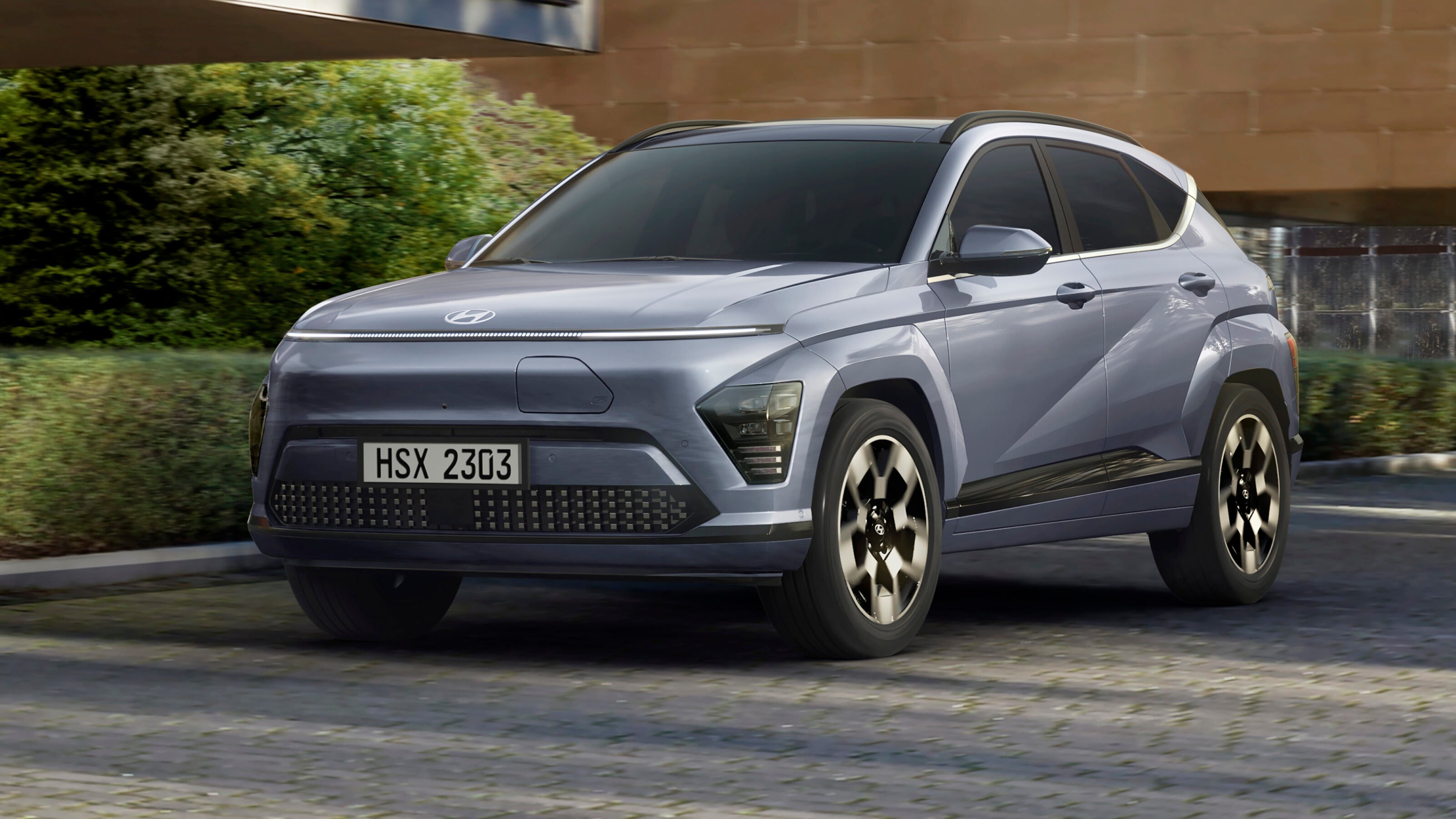
The second-gen Hyundai Kona is just six months away from its Australian debut. Combustion-engined models will arrive first – featuring the 110kW 2.0-litre and 146kW 1.6-litre turbo from the outgoing model.
The new-gen Kona does migrate to a newer platform; the same ‘K3’ design beneath the i30 Sedan. The new small SUV is 150mm longer than its predecessor, and rides on a 60mm-longer wheelbase.
Intended to move the nameplate upmarket, the MY24 Kona will feature a pair of 12.3-inch dash screens and N-Line variants for every powertrain. Both petrol-hybrid and full-electric variants will arrive later in the year.
MORE
Everything Hyundai
The ninth-generation 2024 Volkswagen Passat will be sold exclusively in wagon form.
Snapshot
- 2024 Volkswagen Passat confirmed to be wagon-only
- Ninth-generation model developed with Skoda alongside all-new Superb
- European sales to commence in September; yet to be locked-in for Australia
Automotive News Europe recently spoke to Volkswagen passenger cars boss Thomas Schäfer, who confirmed the next-generation Passat is expected to debut in the coming months, with European deliveries commencing in September.
To reduce development costs, it has been developed with the assistance of Skoda’s engineers alongside the mechanically-related all-new Superb, also due later this year.
Production for the Passat and Superb will shift from Germany and the Czech Republic, respectively, to Slovakia for the new models.

1
Both vehicles will be underpinned by the Volkswagen Group’s updated MQB Evo platform, as found underneath the latest Volkswagen Golf, and the next-generation Tiguan and Skoda Kodiaq.
Earlier reports suggested the vehicles would be produced at a new facility in Turkey, but Automotive News Europe said these plans had been scrapped.
The manufacturing facility in Bratislava, Slovakia, will remain home to the Volkswagen Group’s MLB Evo-based large SUVs, including the Volkswagen Touareg, Audi Q7 and Porsche Cayenne.
It’s no real surprise that the incoming Passat would go wagon-only, as European production of the current Passat sedan ended in January 2022, with buyers pointed towards the Arteon liftback.
1
Volkswagen Australia discontinued the Passat sedan at this time.
It has yet to confirm if the new-generation Passat wagon will reach local shores, following dwindling sales of mid-size passenger vehicles – despite its use with police fleets in Victoria and New South Wales.
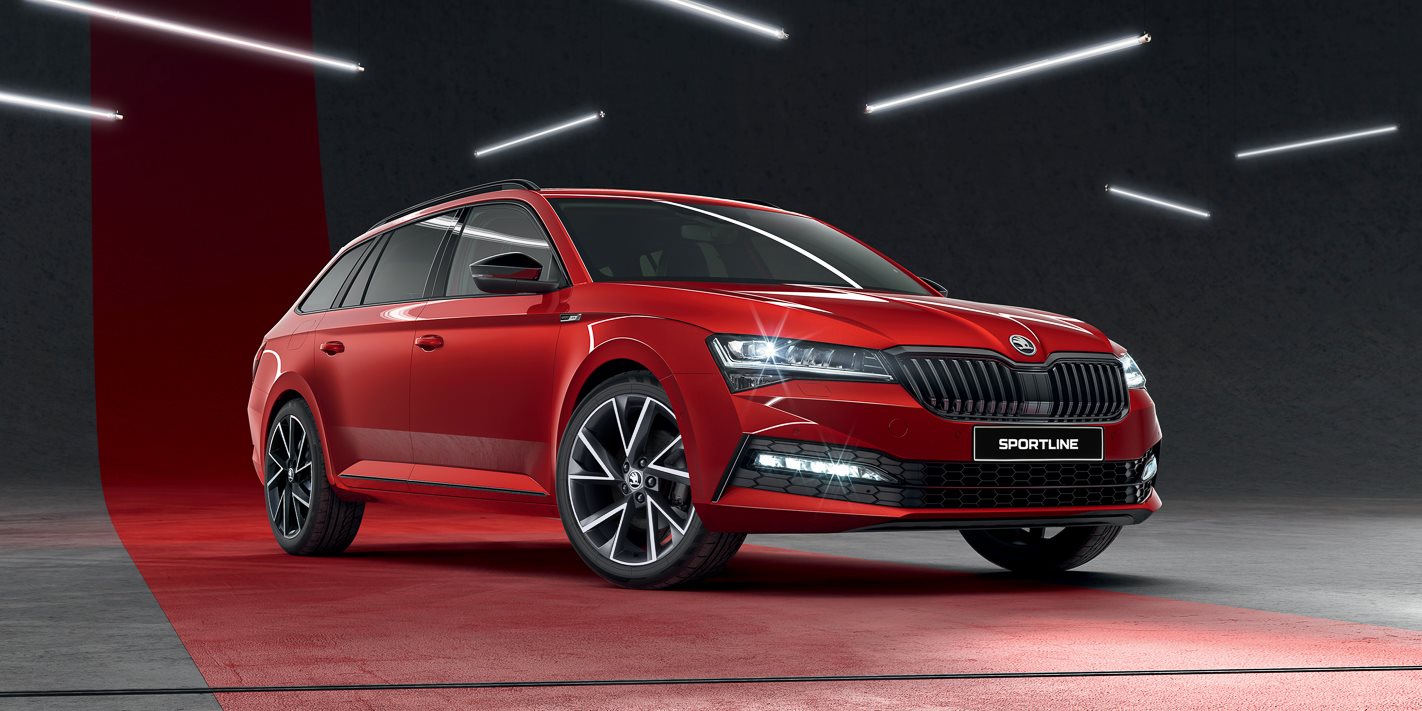
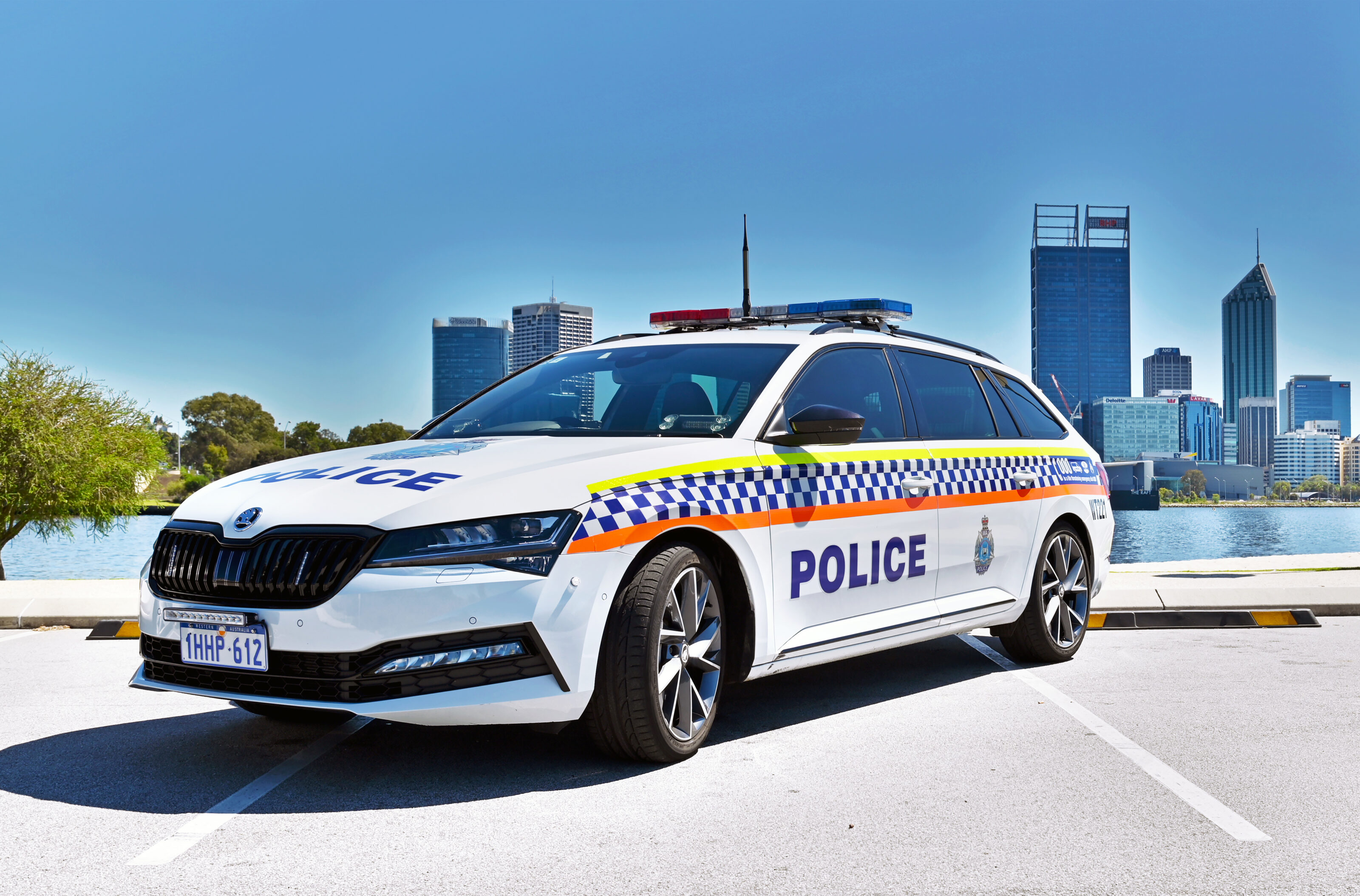
If the new Passat isn’t sold in Australia, these fleets would likely switch to the Skoda Superb, which recently joined the ranks in Western Australia.
The forthcoming Volkswagen ID.7 electric sedan – a rival to the Tesla Model 3 – will act as the direct successor to the Passat sedan, and likely the Arteon in the coming years.
1
Under the bonnet, the redesigned Passat and Superb should offer mild-hybrid petrol and diesel engines, and expanded plug-in hybrid options, to meet the stricter Euro 7 emissions regulations set to be enforced from July 1, 2025.
In Europe, the Passat was the best-selling mainstream ‘D-segment’ vehicle in 2022 with 66,621 sales – down 20 per cent from 2021, according to market research firm Dataforce – while the Superb followed with 45,042 registrations.
Locally, the Toyota Camry and all-electric Tesla Model 3 dominate the medium passenger car segment, with just 917 Passats and 655 Superbs sold in Australia last year.
UPDATE: Subaru has opened expressions of interest for its sixth-gen Impreza as it readies the small hatch for sale in Australia.
We are still without a firm release date, pricing, or detailed Australian specifications, but the hatch’s launch will likely follow the Crosstrek (neé XV) and happen before the year is out.
While the Subaru Global Platform underpinnings are largely carried over from the fifth-gen Impreza that’s still on sale, inside the new car is an Outback-matching 11.6-inch touchscreen with wireless smartphone charging and cable-free mirroring.
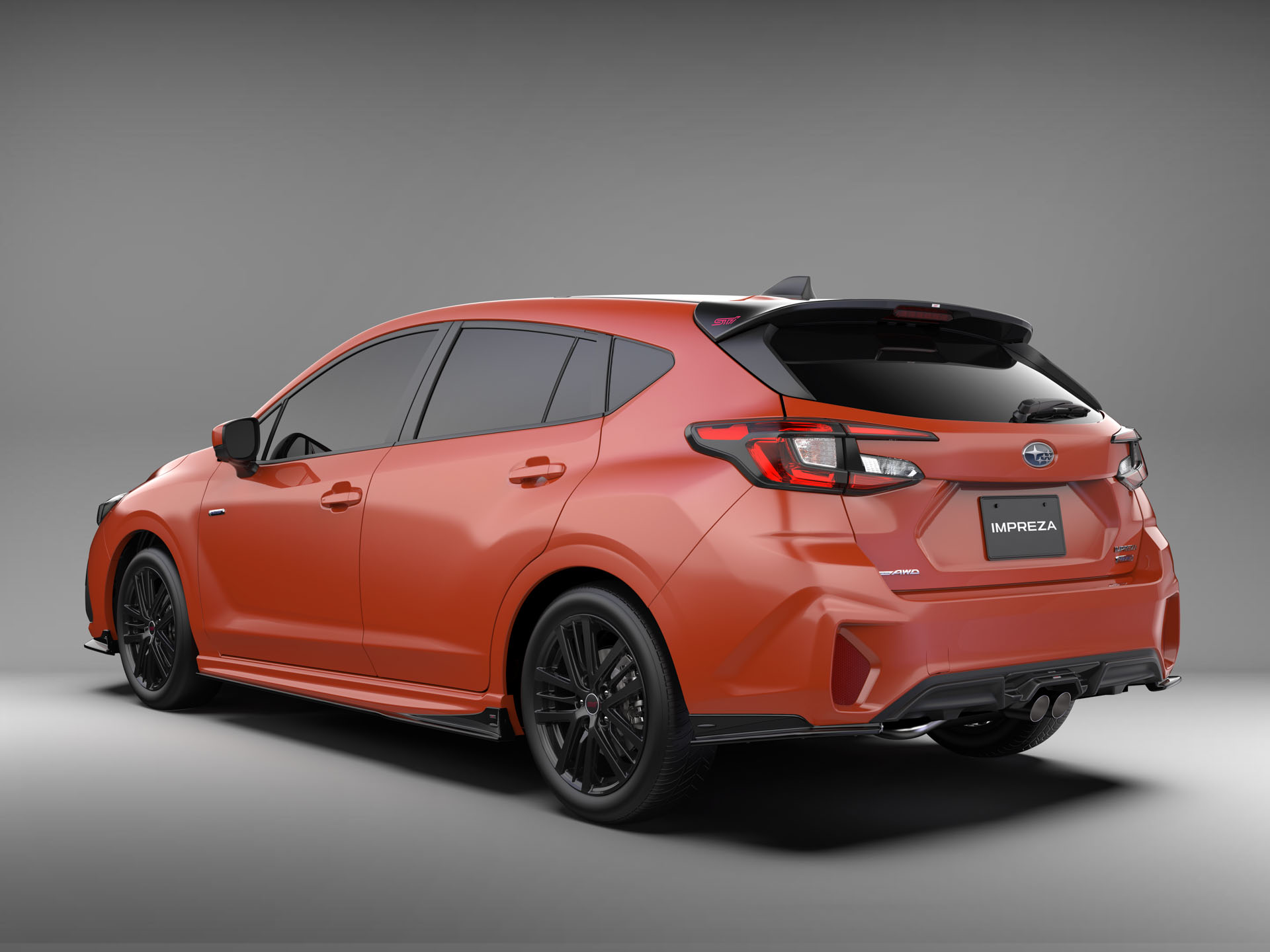
1
“Featuring new styling, technology, safety, and comfort, alongside Subaru’s renowned Symmetrical All-Wheel Drive, the sixth generation Impreza provides drivers with ultimate confidence in all conditions,” said Subaru Australia managing director, Blair Read.
Those keen on the new Impreza can now register their interest here, though Subaru says regardless of demand – as high or low as it may be – it is committed to the Impreza badge in Australia.
In 2022, Subaru sold 3013 Imprezas, ahead of BRZ sports car (1165) and WRX sports sedan (2392), but only one-third the number of Outbacks (9739), Foresters (10,637), or XVs (9090) in the same year.
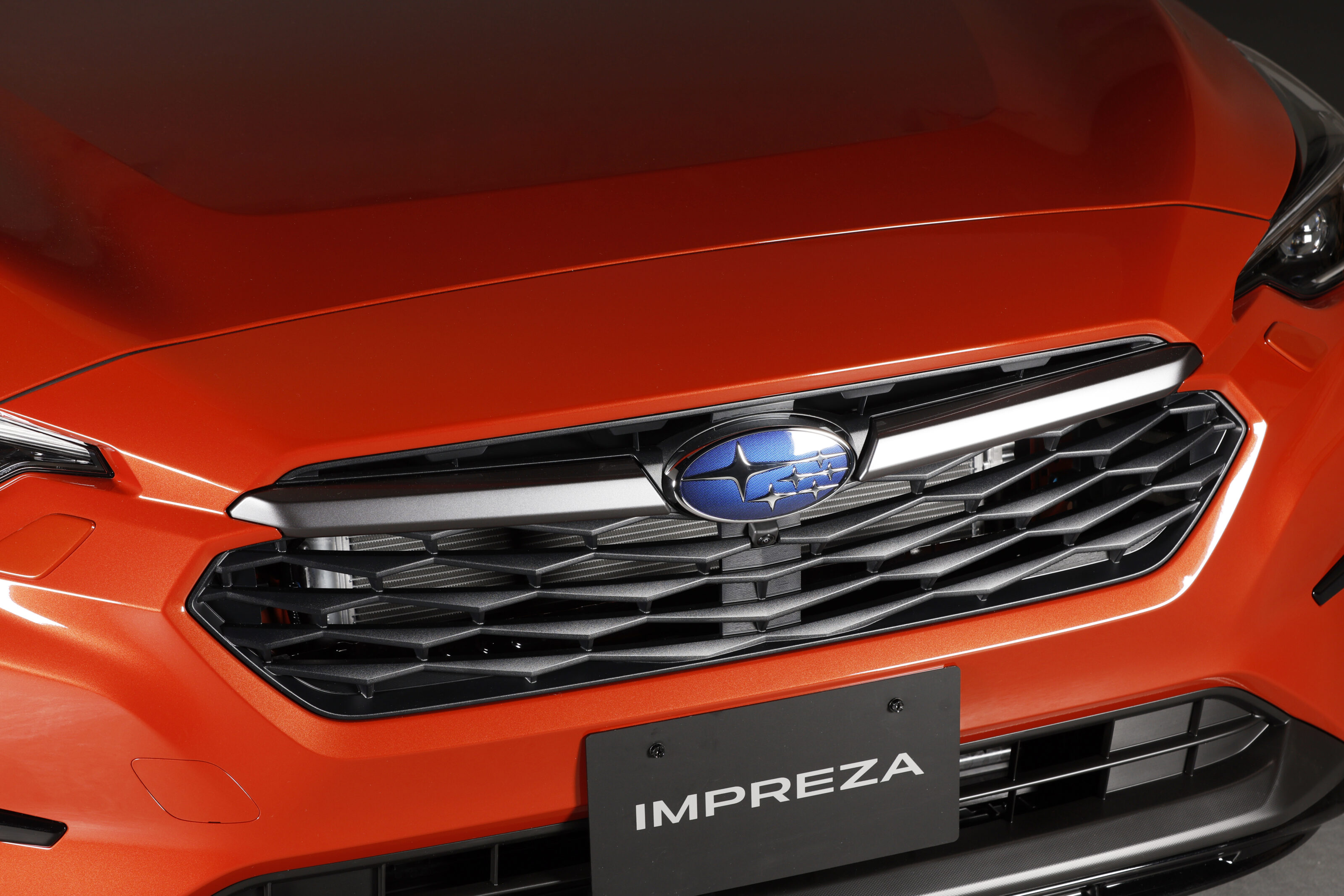
1
Under the bonnet is a carryover 2.0-litre horizontally opposed four-cylinder petrol engine developing 113kW/197Nm, while top-spec US trims score a torquier 2.5 with 135kW/245Nm from the Outback. A hybrid powertrain is a possibility, too.
Expect the Impreza’s starting price to jump from the current $26,490 before on-road costs to around $30K, with a flagship hybrid or big-block 2.5 around $40K.
Continue reading our original story, below, for further details of the sixth-generation Impreza hatch. This story will be updated as more information comes to light.
The story to here
November 18, 2022: 2023 Subaru Impreza revealed
The sixth-generation 2023 Subaru Impreza has debuted at this year’s Los Angeles Auto Show ahead of its Australian launch in the coming months.
Snapshot
- 2023 Subaru Impreza revealed
- Next-generation small car features carryover underpinnings, updated styling
- Sedan deleted from range; Australian launch expected in 2023
It follows the reveal of its Crosstrek small SUV twin in October, with the updated Impreza – now exclusively built in hatchback guise – featuring the same basic underpinnings as its predecessor.
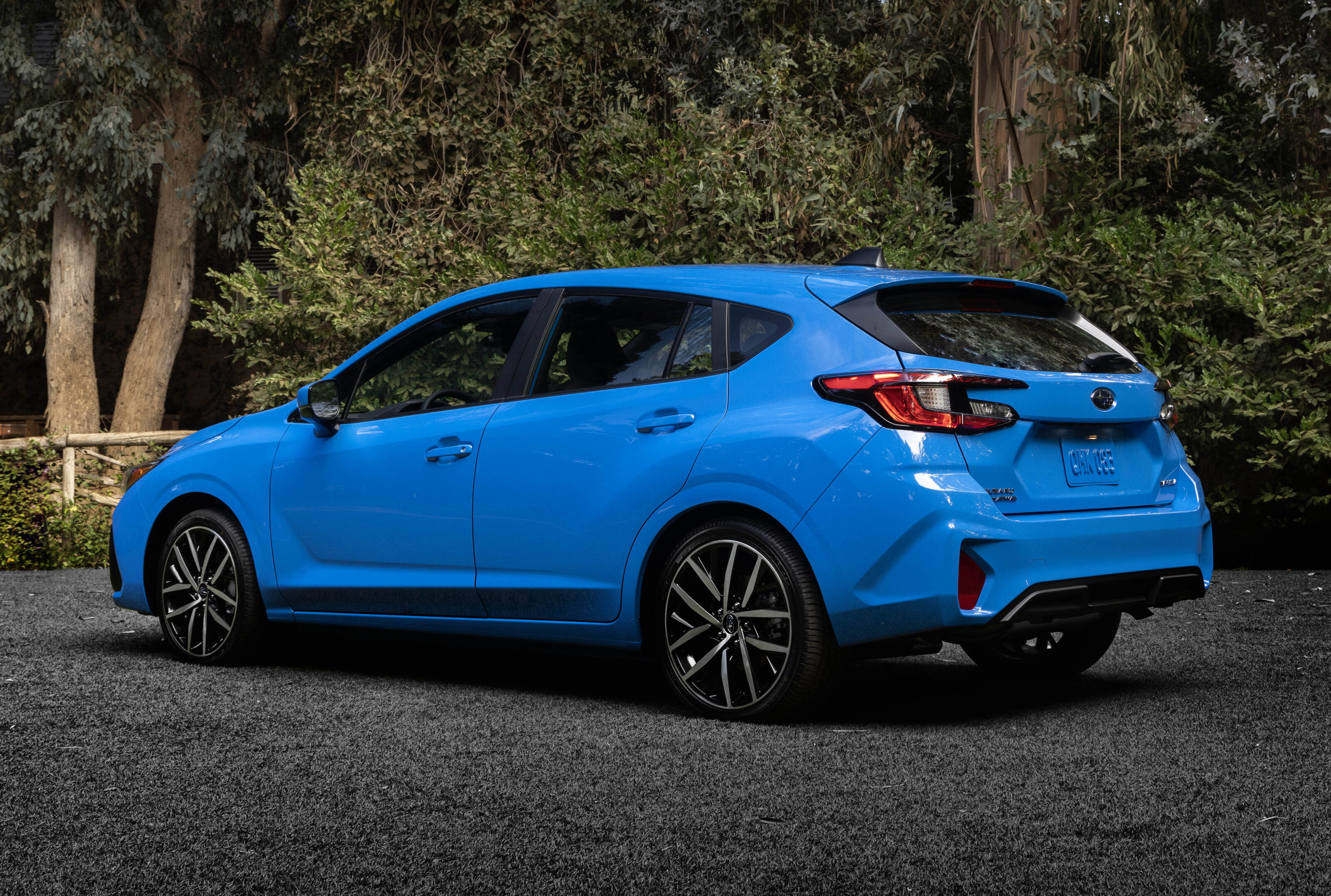
As expected, it is a lowered version of the Crosstrek – the global name for the next-generation XV – without the plastic wheel cladding, and a different grille and bumpers.
1
While Subaru Australia has yet to confirm local details, a spokesperson said more information will be announced “in due course” – with an Australian arrival likely a few months behind the Crosstrek in the first half of 2023.
“We’re incredibly excited about the latest global reveal by Subaru Corporation of the all-new Subaru Impreza. Impreza has been part of the Subaru family for 30 years, and we look forward to sharing more details for the Australian market in due course,” said Subaru Australia.
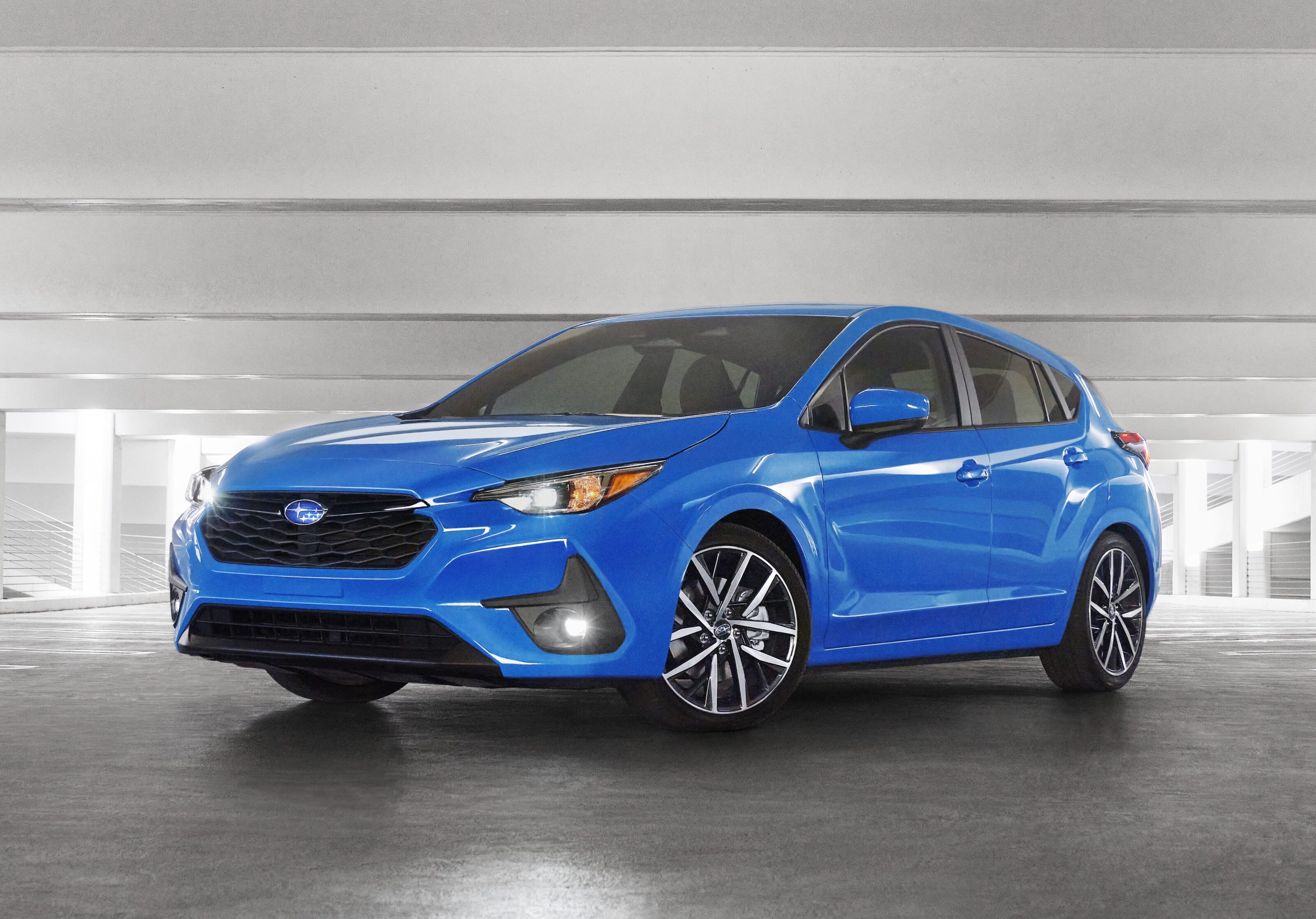
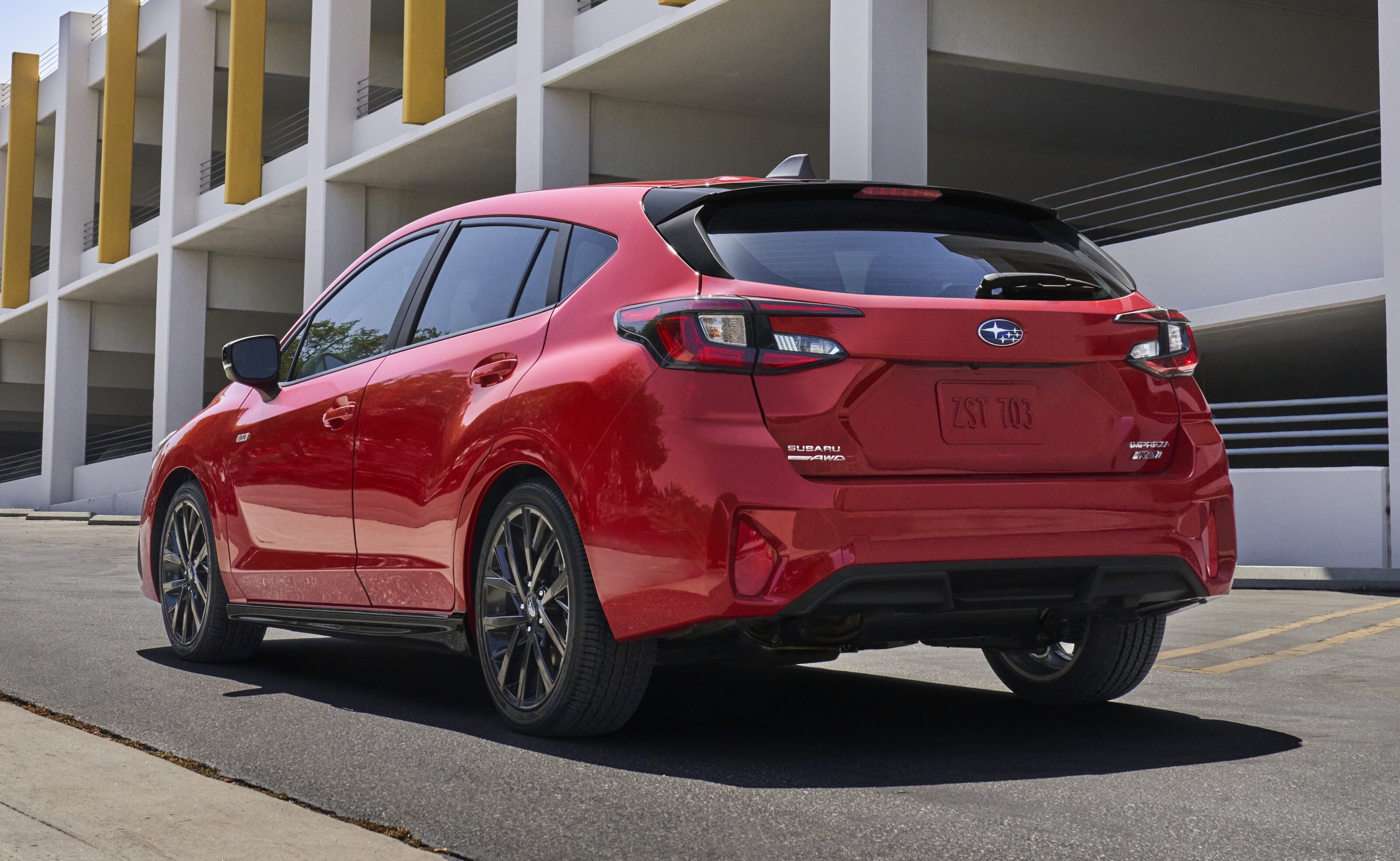
The styling of the Impreza is evolutionary over the outgoing model. It features redesigned headlights and tail-lights, new alloy wheels, and the return of the sportier RS grade.
1
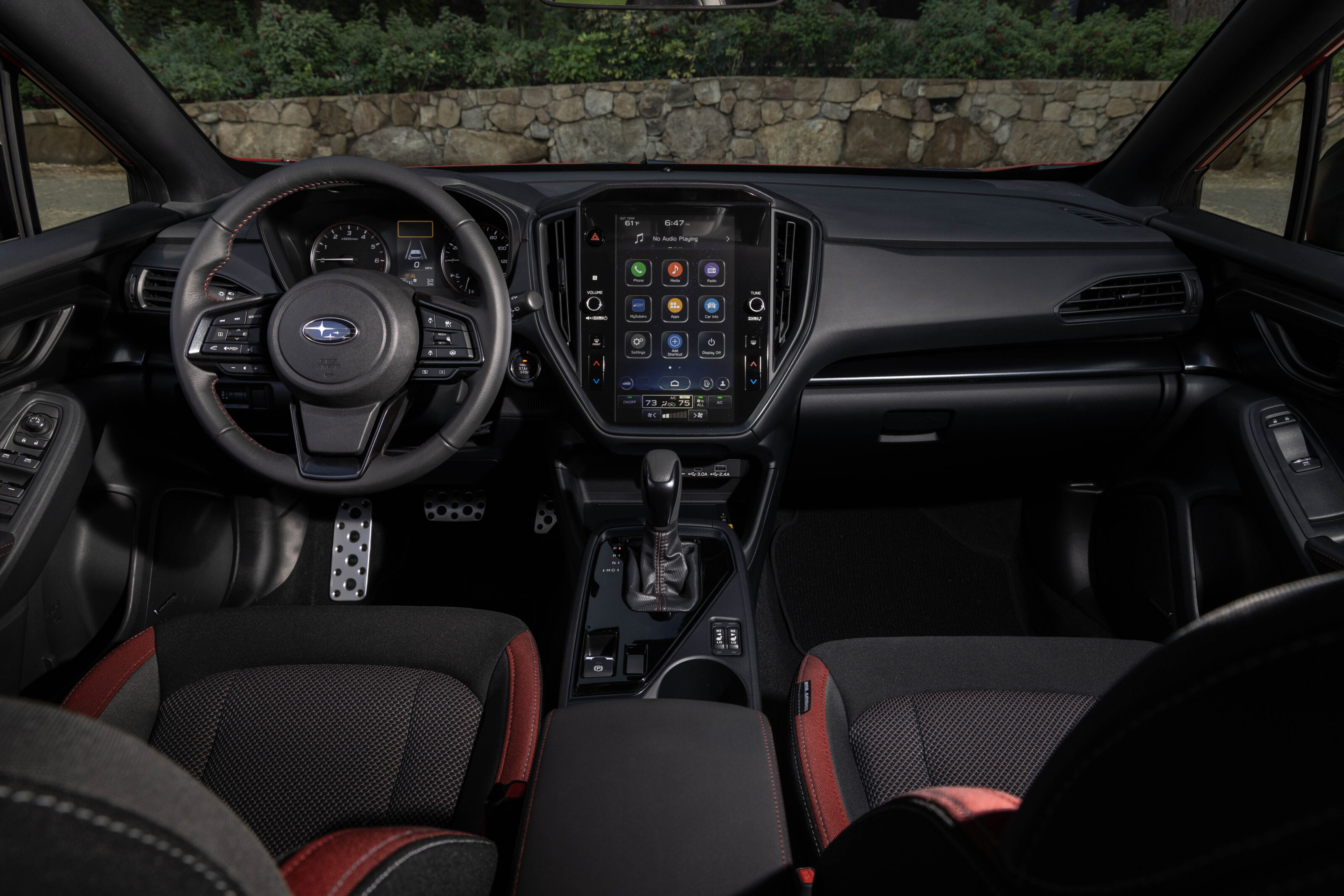
Inside, a larger 11.6-inch portrait-orientated infotainment system – as found in borrowed from the Outback, WRX and Crosstrek – includes wireless Apple CarPlay and Android Auto, over-the-air software updates, satellite navigation, and climate controls that are now operated via the touchscreen.
While a 12.3-inch digital instrument cluster is available on the Japanese-market WRX and Outback, the new Impreza features analogue dials with a small 4.2-inch display in the centre.
As Drive reports, equipment highlights include dual-zone climate control, keyless entry and push-button start, a 10-speaker Harman Kardon audio system, an electric sunroof, a 10-way powered driver’s seat, and heated front seats.
1
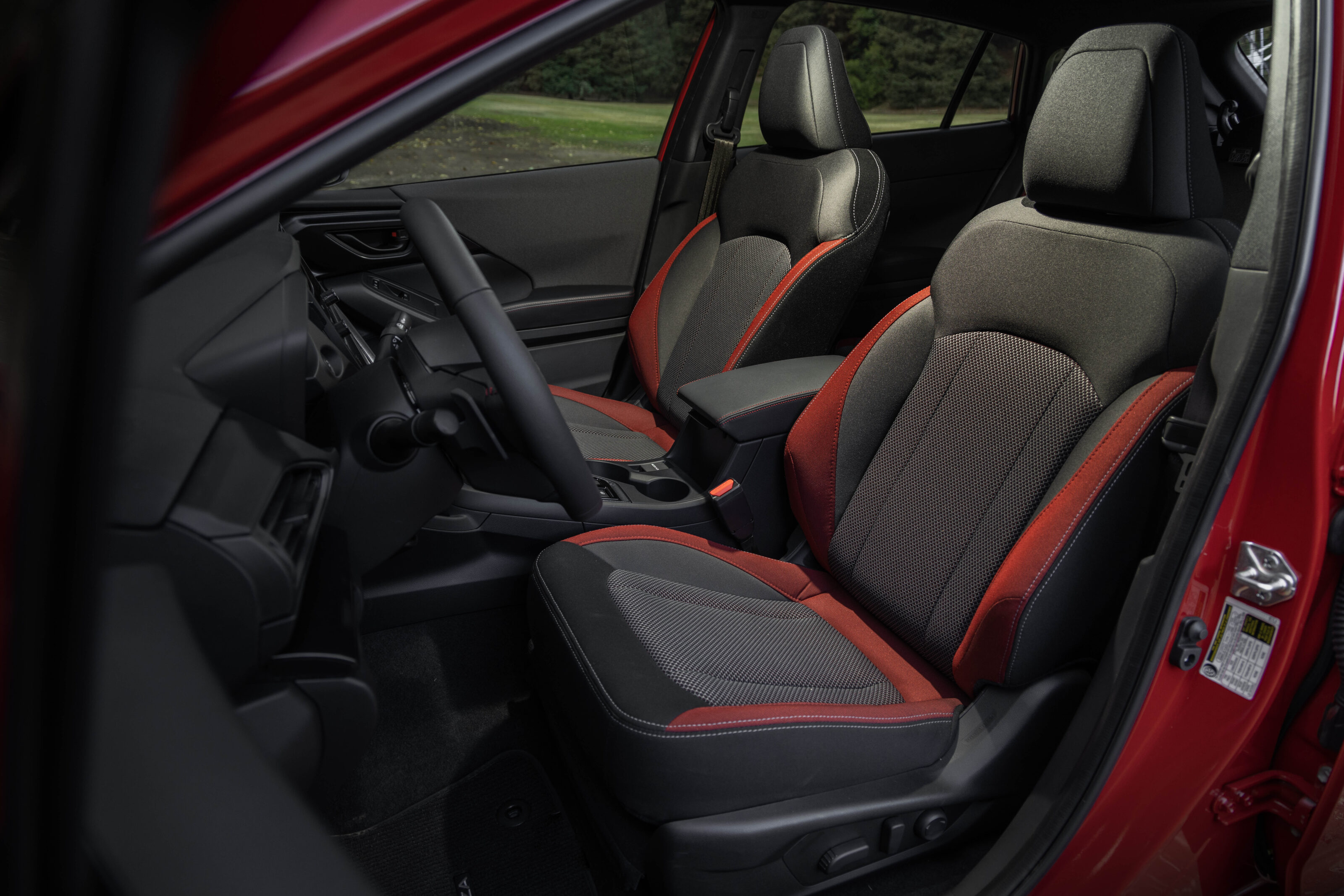
Unique highlights for the RS include darker 18-inch alloy wheels, black exterior trim, RS badging, LED fog lamps, “upgraded” LED headlights, faux carbon-fibre trimming, and sports cloth seats with red bolsters.
Under the bonnet, American versions are, as before, powered by naturally-aspirated petrol engines matched with a continuously-variable automatic transmission and all-wheel drive, which now includes torque vectoring as standard.
The entry-level mill is a 2.0-litre boxer four-cylinder producing 113kW and 197Nm, while flagship grades step up to a 2.5-litre engine – as found in the Forester and Outback – with 136kW and 245Nm.
1
A hybrid version, likely powered by the 2.0-litre system from the Crosstrek, is expected for Japan and Europe, and potentially for Australia.
Subaru has yet to provide dimensions for the new Impreza, but the related Crosstrek measures 4480 millimetres long and 1800mm wide, with a 2670mm wheelbase.
This is 15mm longer than the outgoing XV and Impreza, with a 5mm longer wheelbase.
1
According to the Japanese brand, the Subaru Global Platform underpinning the Impreza is 10 per cent stiffer with 3.4 times more structural adhesive for improved performance, handling and NVH. It has also fitted a version of the WRX sedan’s dual-pinion electric power steering rack.
As with the Crosstrek, the brand’s EyeSight active safety technology has a wider field of view, with the autonomous emergency braking system now able to detect pedestrians and cyclists at intersections, emergency steering functionality for the lane-keep assist, blind-spot alert and rear cross-traffic alert, and a standard rear-seat reminder.
The 2023 Subaru Impreza will arrive in the US in the first half of 2023, with Australian launch timing currently unconfirmed.
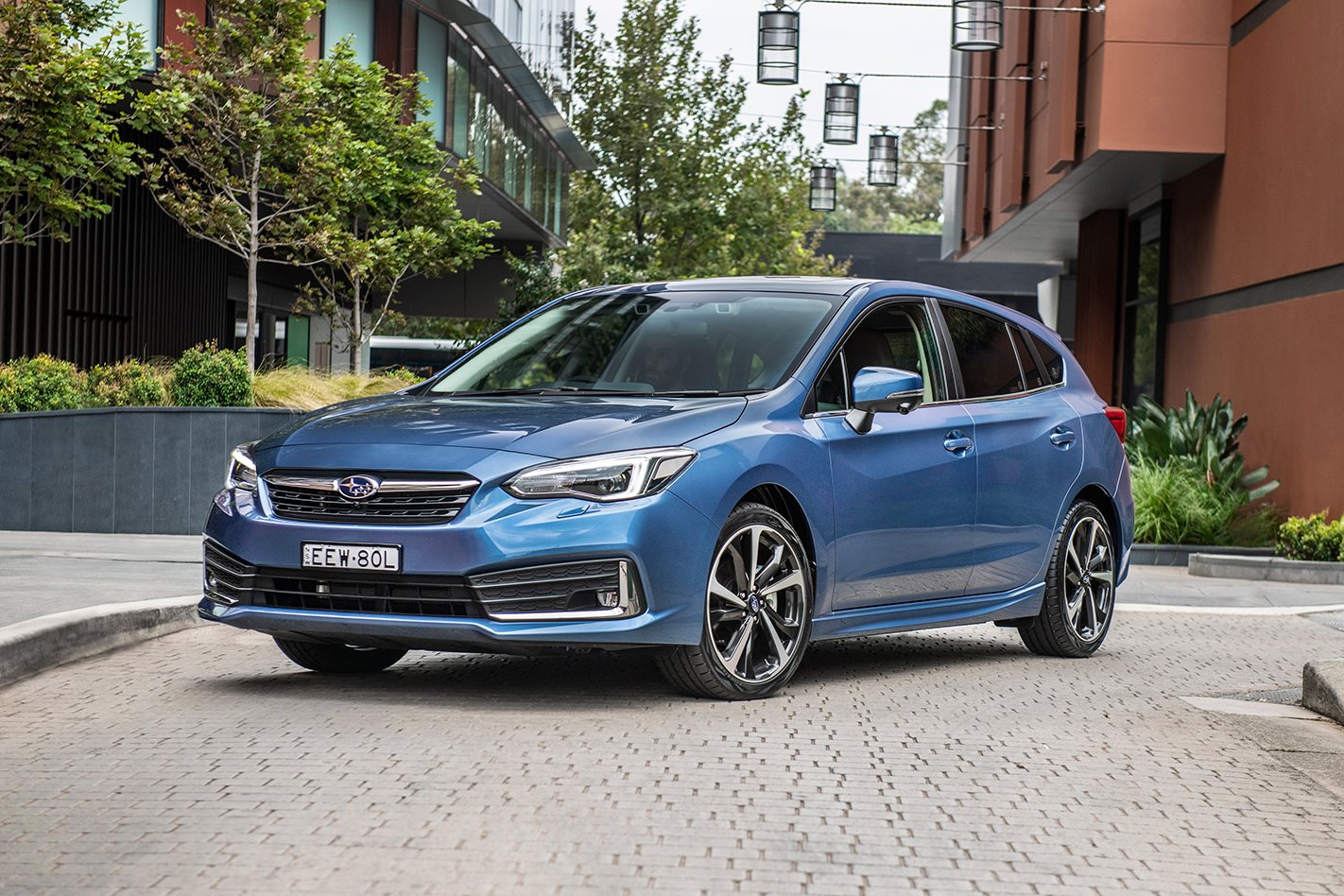
Below: The current 2022 Subaru Impreza
1
MORE
Everything Subaru
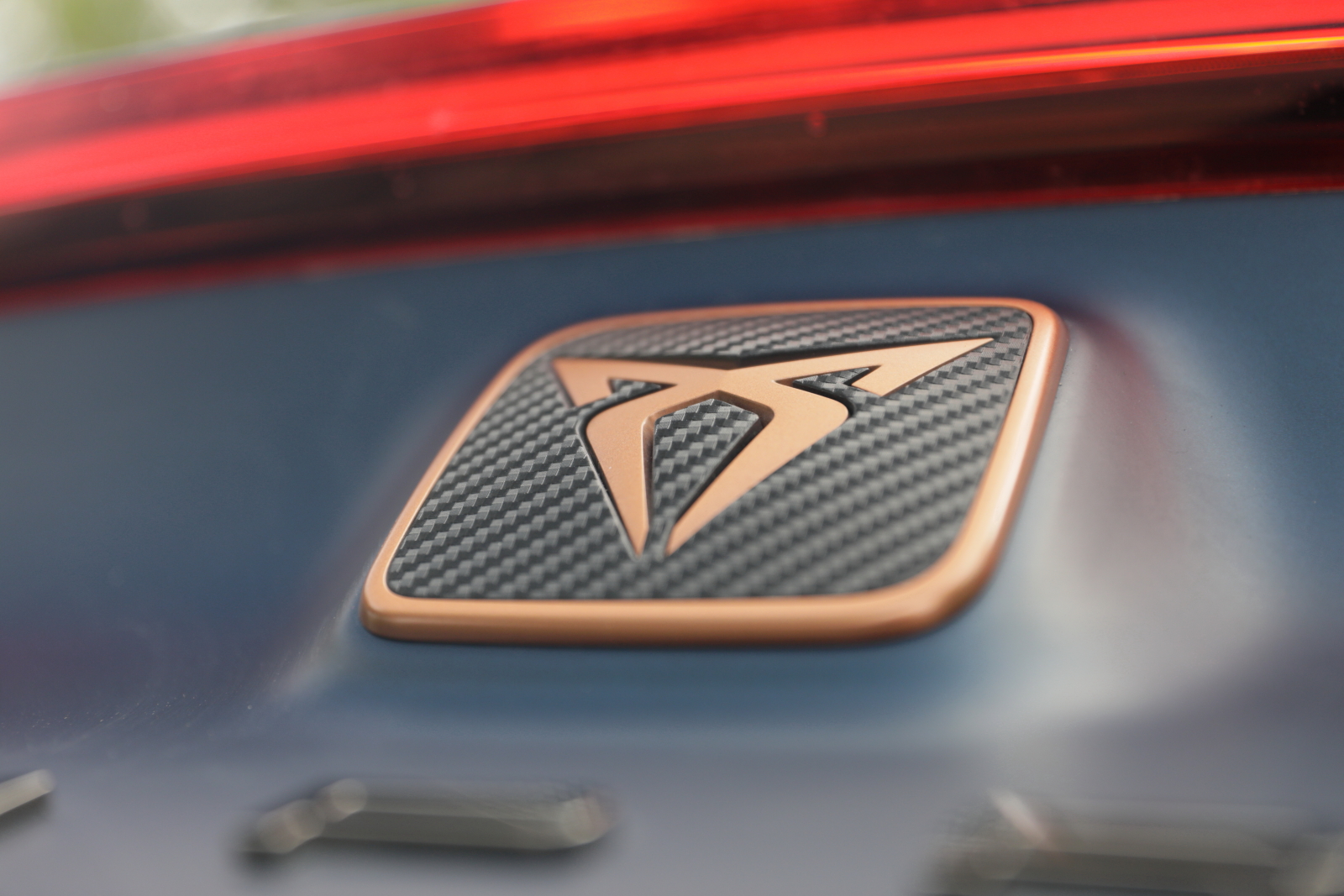
The head of Cupra’s global operations says he is committed to sticking with plans to go fully-electric by 2030 – despite other Volkswagen Group brands seeking to change the EU’s 2035 ban on internal-combustion.
Snapshot
- E-fuels are for luxury and sport brands, not us, says Cupra chief
- Formentor and Leon EVs confirmed for this decade
- Terramar PHEV will be last ICE car as Cupra goes electric in 2030
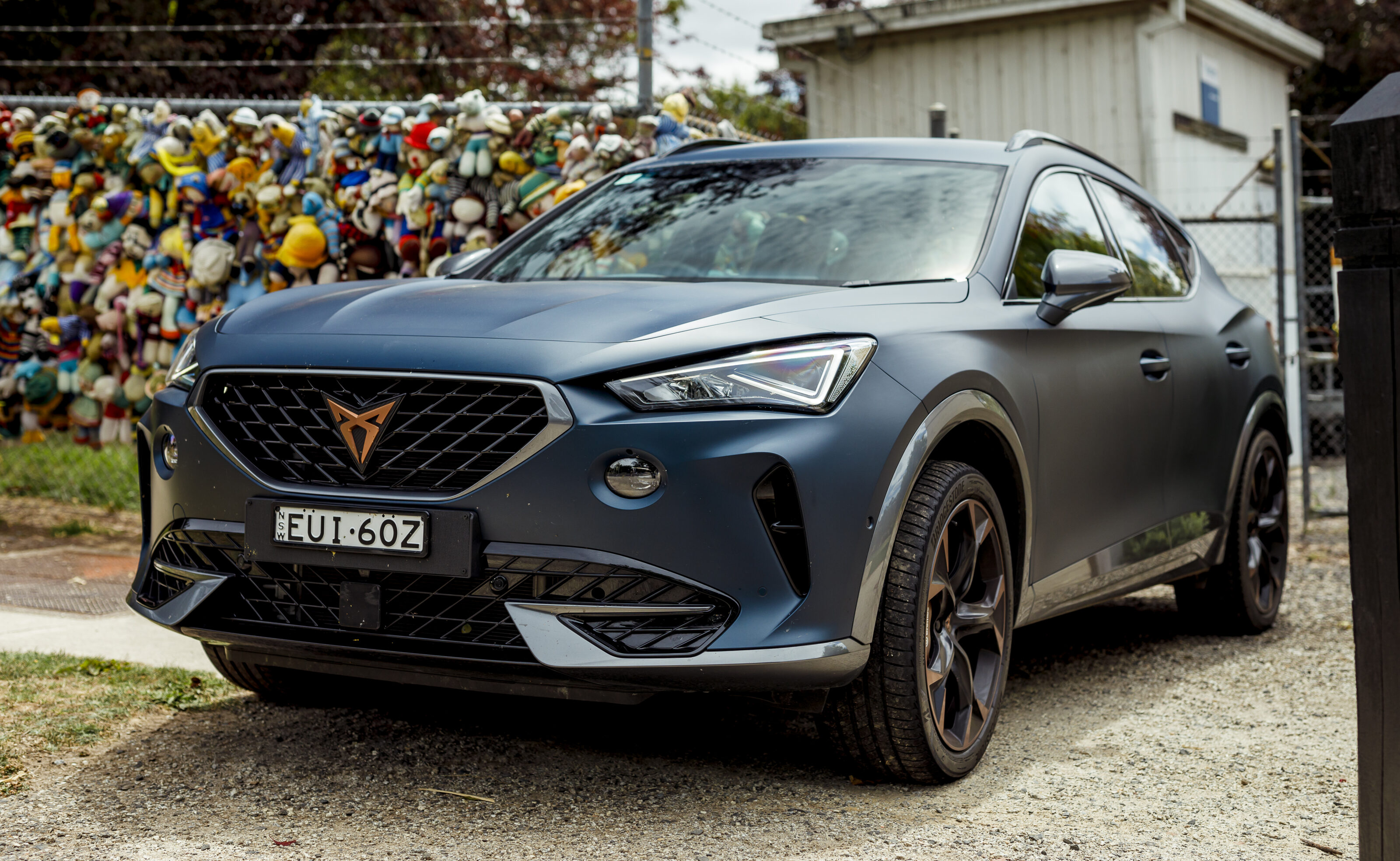
Cupra CEO Wayne Griffiths made the statement during a call with Australian media on Thursday night, saying his firm would continue on the path to full electrification by the end of the decade, regardless of what his counterparts were doing.
In recent days the European Commission has drafted concessions to allow the sale of new cars with internal-combustion engines (ICE) after its initial 2035 hard cutoff, but only if they run on climate- and carbon-neutral e-fuels.
The move comes as the EU attempts to save its green plan of phasing out combustion cars after a series of last-minute objections, led by Germany, halted the approval process.
Reuters, which has seen the draft, indicates that the EU is looking to create a new type of vehicle category in Europe specifically for cars that can only run on carbon-neutral synthetic fuels.

1
Porsche and Ferrari are the two biggest players pushing for e-fuels to be exempt, with synthetic combustible advocates arguing that they are effectively renewable electricity converted into a combustible, liquid fuel using atmospheric CO2.
“As Seat and Cupra, and even VW, [planning for e-fuels] is too big for us to manage to do that, so we’re going to put all our resources and all our focus on fully-electric and leave that for the luxury and sports brands where it could be a solution,” said Griffiths.
“As a group though, at VW level, yes it could work because 2035 doesn’t have to mean zero-emissions totally, it could be the solution is synthetic fuels or hydrogen – you have to be open to all technology and not say there is only one.
1
“At the moment there is no way to make synthetic fuel in the quantities required, yes in South America they have started levels of production – but they’re not ready to replace petrol or diesel. The costs are quite prohibitive, we need to get costs down and production up first.”
Griffiths, however, did criticise the EU for its hardline stance on internal-combustion, saying it “creates a problem not only for us but the whole industry”.
“I think the ban has accelerated our plans to go to a fully-electric brand by 2030 certainly, and, as we’ve already confirmed, our last ICE car will be the Terramar,” he said.
“We are in discussions with the EU trying to find a pragmatic approach to the legislation – and absolutely promote bringing emissions down, but it needs to be done in a way that doesn’t destroy employment, because if we did it as it is written on paper at the moment we’d be closing factories.”
1
Elaborating further on Cupra’s EV plans between now and 2030, Griffiths said both its Formentor and Leon models would go fully-electric in time, and would retain their nameplates when doing so – unlike other brands (even within the Group) which opt for entirely new ones.
“Names with numbers and letters – that is quite robotic,” he said. “The Formentor, when it goes 100 per cent EV, would be called the Formentor and same with the Leon, the Terramar and the Tavascan.
“The nomenclature that way can be quite open, every car will have an emotional Spanish name.”
As for when these models will go electric remains to be seen, with the brand still to decide which platform the models will ride on – the current 400-volt MEB architecture underpinning the upcoming Cupra Born hatch or 800-volt SSP set to launch in 2028.
The Formentor, therefore, could be one of the Group’s last vehicles to feature MEB around 2025 or one of the first to debut SSP three years later.
“The jury is still out on that one. There are pros and cons. Obviously MEB is earlier. But SSP has a longer run, is a newer platform and can perhaps be more competitive,” said Griffiths.

1
The UrbanRebel meanwhile, revealed in near-production form mid-2022, will use the new MEB Entry/21 platform Cupra is developing for the Volkswagen Group.
However, Griffiths says he has high hopes that one day the UrbanRebel could feature all-wheel drive – with MEB 21 being an exclusively front-drive architecture.
“It’s something I’m pushing for. But it’s very difficult on the MEB platform. It would be great if we had the money to do it, to make it financially viable, but it would have to be something the group wants to do as well – to do it alone would be difficult,” he told motoring media.
“One of our biggest objectives is to make EVs accessible at a price level, and to do that we have to make some compromises – you can’t have a platform that can do everything and still have a car cost below €25,000. We just have to see how far we can get with FWD, keep [4WD] something we’re open to over time.”
MORE
Everything Cupra
UPDATE: 2023 Peugeot E-Partner pricing and features
Snapshot
- Peugeot E-Partner confirmed for Australia
- Electric van features a 50kWh battery, 285-kilometre driving range, and identical payload
- Due here before July; priced from $59,990 before on-road costs
Peugeot Australia has confirmed its first all-electric vehicle will arrive here before July.
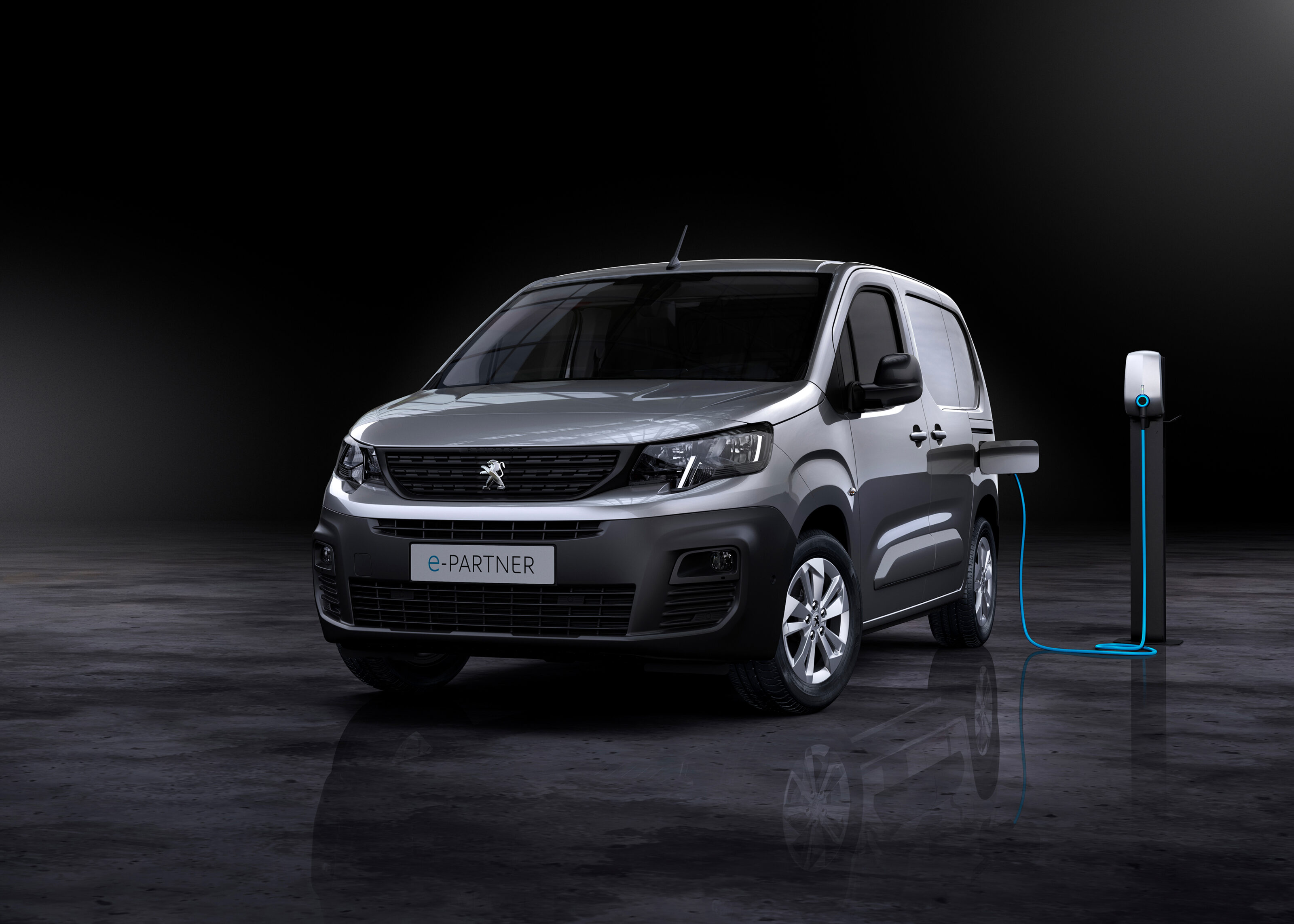
The 2023 Peugeot E-Partner small electric van is priced at $59,990 before on-road costs, with pre-orders available now.
On track for a mid-year launch, the Peugeot E-Partner will be offered in a single, long-wheelbase variant.
Standard equipment matches the diesel Partner, with highlights including an 8-inch infotainment system with wired Apple CarPlay and Android Auto, autonomous emergency braking, lane-keep assist, and traffic sign recognition.
1
It is covered by Peugeot’s five-year/200,000-kilometre warranty for commercial vehicles, and an eight-year/160,000-kilometre for the high-voltage battery.
For everything you need to know about the 2023 Peugeot E-Partner electric van, our earlier story continues unchanged below.
The story to here
February 16: 2023 Peugeot E-Partner confirmed for Australia
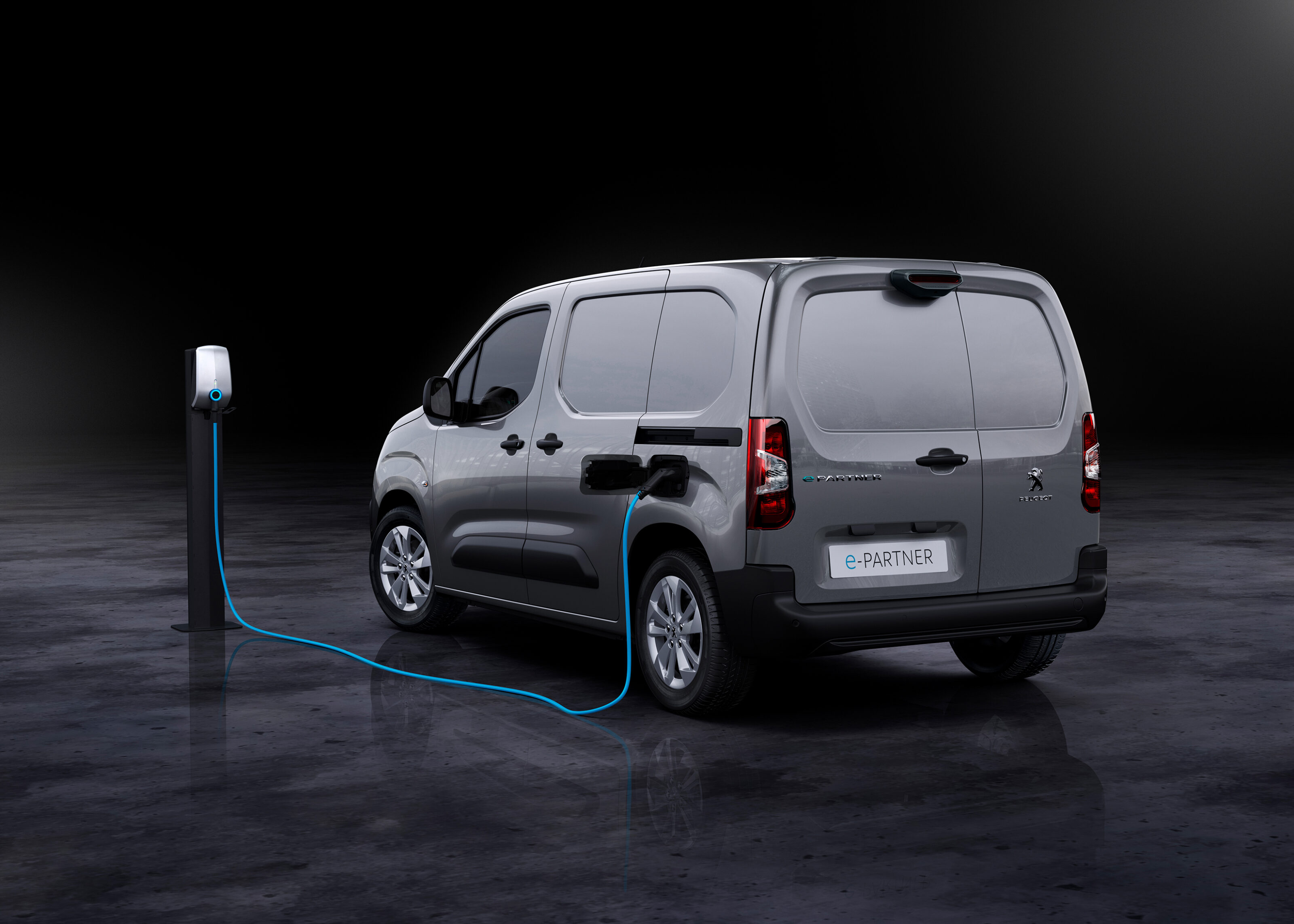
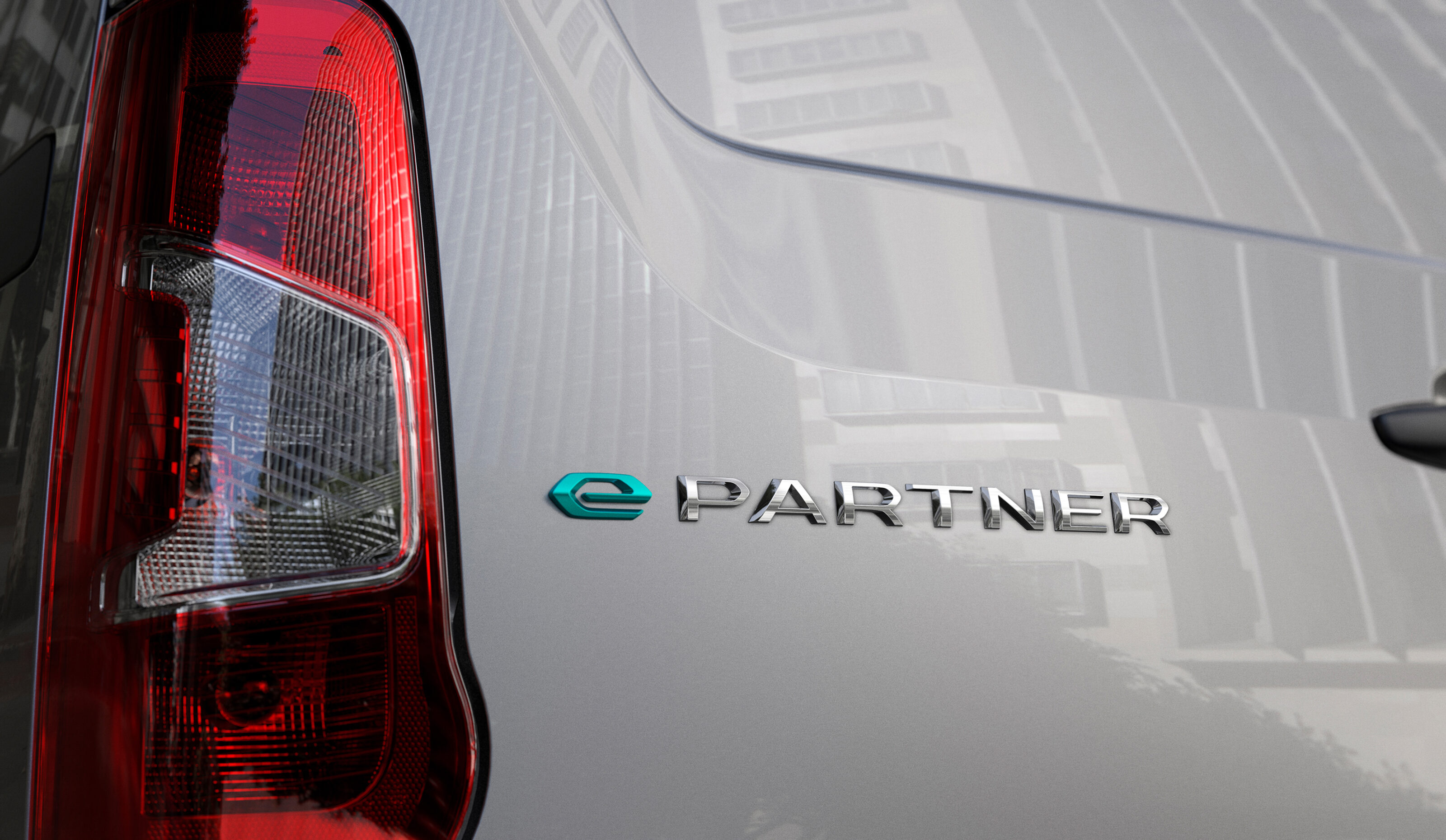
The 2023 Peugeot E-Partner small commercial van will be the brand’s introductory offering, in long-wheelbase form only.
While local pricing and features will be announced closer to its launch, Peugeot has confirmed it will arrive in Australia in the first half of this year.
Overseas, the E-Partner is joined by electric versions of the larger Expert mid-size van and the Fiat Ducato-based Boxer large van, but only the smallest model will be sold here at first.
1
“We are confident that the arrival of our first electric vehicle will provide new avenues for growth for the brand as well as further choice for discerning Peugeot [light commercial vehicle] customers wanting to make the move to electric,” said Peugeot Australia managing director, Kate Gillis.
While the E-Partner is available in standard- and long-wheelbase variants, and two- or five-seat configurations, it will be offered in Australia in long-wheelbase form, likely with two seats.
Peugeot claims its electric vans “retain 100% of the functionality of conventional diesel versions,” but the E-Partner has a reduced towing capacity and less driving range – while retaining the same 898-kilogram payload as diesel-powered, long-wheelbase variants.
1
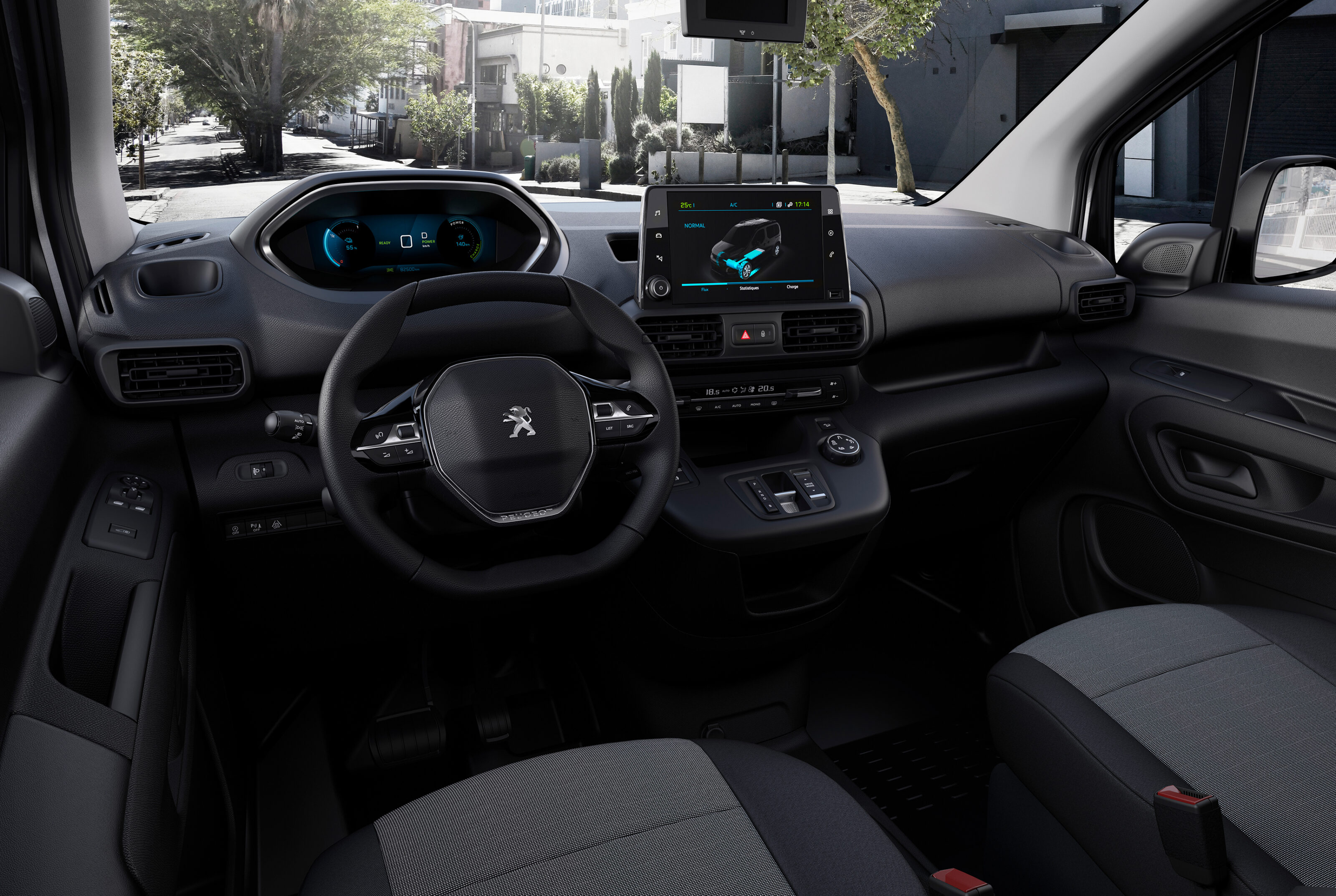
Under the skin, the E-Partner is underpinned by the same EMP2 architecture as the standard Partner, but with a 50kWh lithium-ion battery pack and a 100kW/260Nm electric motor powering the front wheels.
These outputs are achieved in the ‘Power’ drive mode, which is said to optimise performance when transporting heavy loads. The standard drive mode limits power to 80kW and 210Nm, while in Eco mode, it is reduced to 60kW and 190Nm.
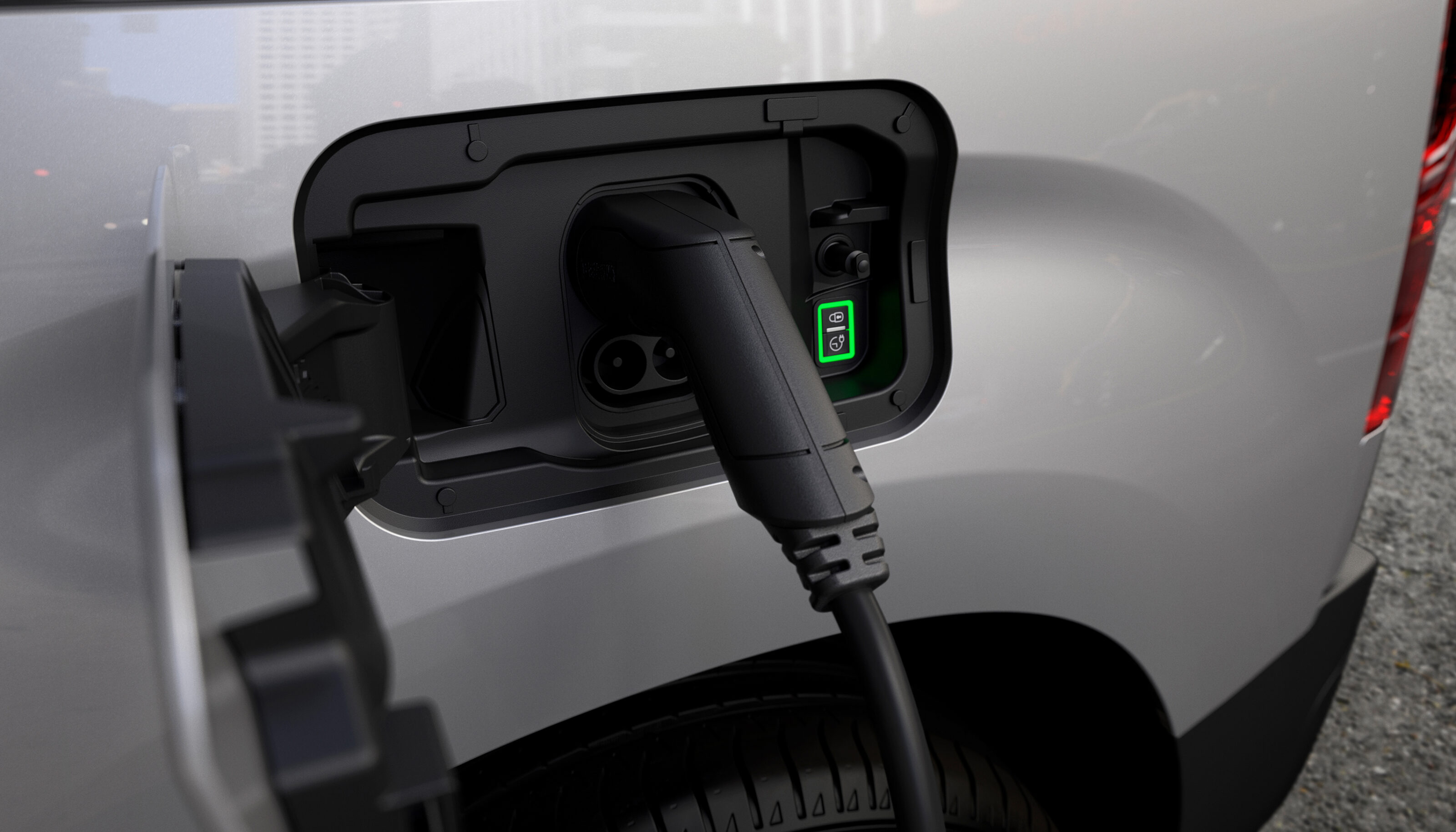
It has a WLTP-rated driving range of up to 275 kilometres, with support for 7.4kW AC single-phase and 100kW DC fast charging. An 11kW three-phase AC charger is optional in Europe.
When plugged into a 100kW fast-charger, Peugeot claims the E-Partner will charge from zero to 80 per cent in approximately 30 minutes.
1
In the ‘Power’ drive mode, the E-Partner can accelerate from 0-100km/h in 11.2 seconds – roughly in line with the 1.2-litre diesel Partner – with a 130km/h top speed.
Inside, the E-Partner is identical to the internal-combustion model, with highlights including an 8-inch infotainment system with wired Apple CarPlay and Android Auto, an analogue instrument cluster or an optional 10-inch digital unit, and an updated ‘E-Toggle’ automatic transmission gear selector.
The 2023 Peugeot E-Partner will arrive in Australia before July, with local pricing and features set to be announced in the coming months.
5
It will compete against the Renault Kangoo E-Tech due here in the coming months, while the local prospects of the related Mercedes-Benz eCitan are currently unknown for Australia.
Peugeot Australia has not confirmed if the larger E-Expert and E-Boxer electric vans will be offered locally, nor if its range of electric passenger vehicles, such as the E-208, E-308, upcoming E-408, and E-2008, will be sold here.
The next-generation 3008 medium SUV, set to be unveiled later this year, will be all-electric, riding on parent company Stellantis’s dedicated STLA Medium electric vehicle architecture. It is expected to launch in Europe in 2025.
MORE
Everything Peugeot
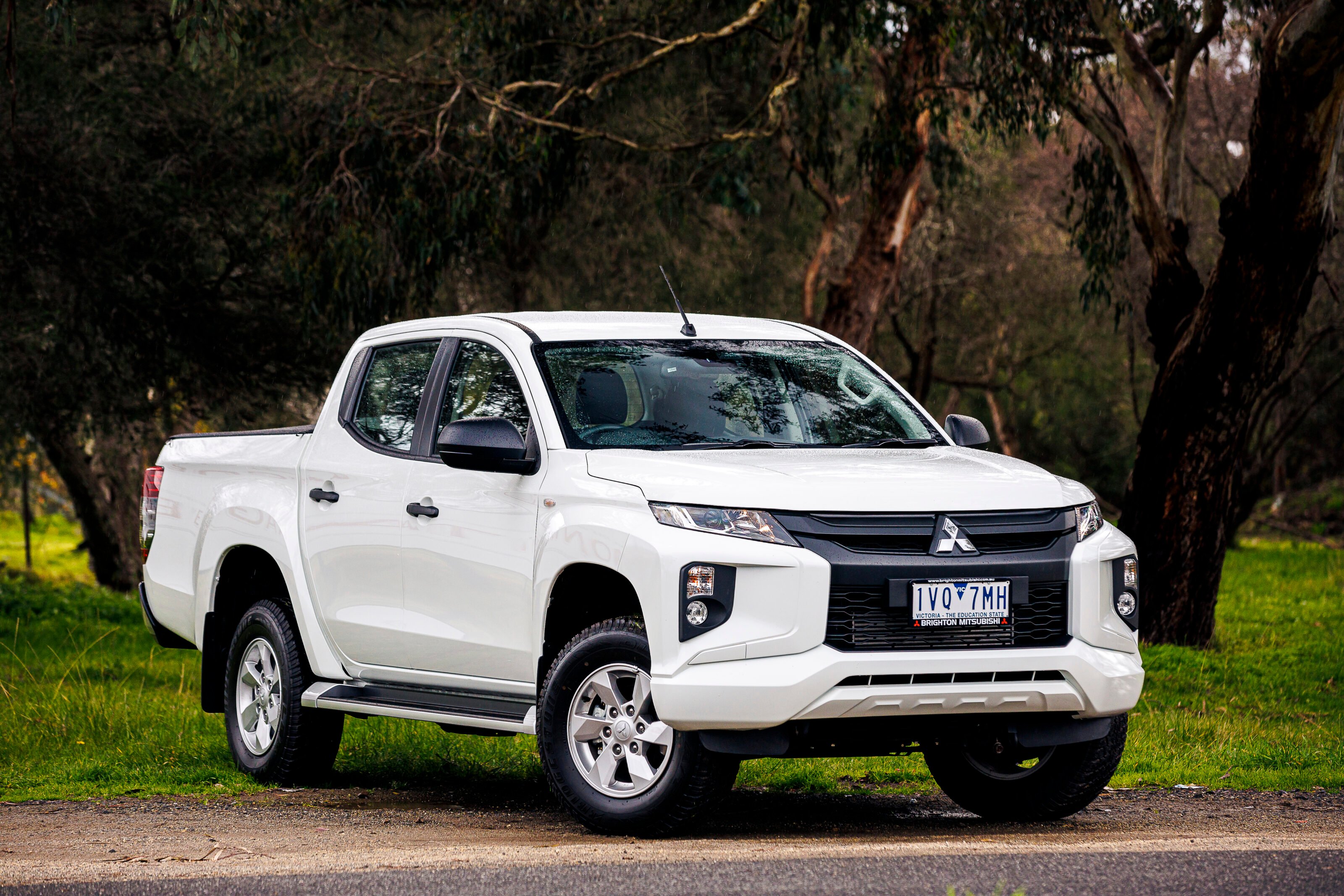
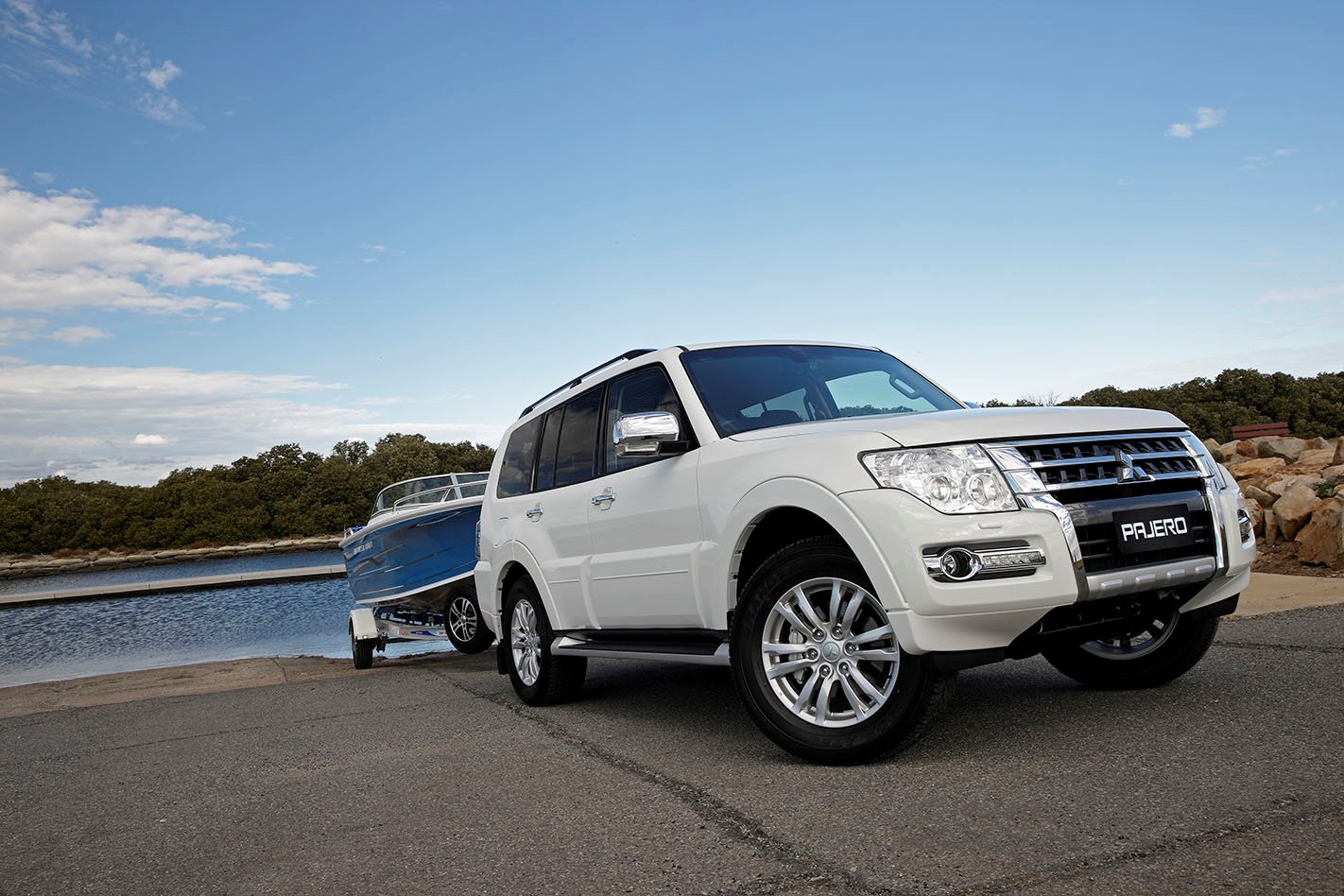
Mitsubishi Australia has issued a recall for more than 7000 vehicles due to insufficient warning labels.
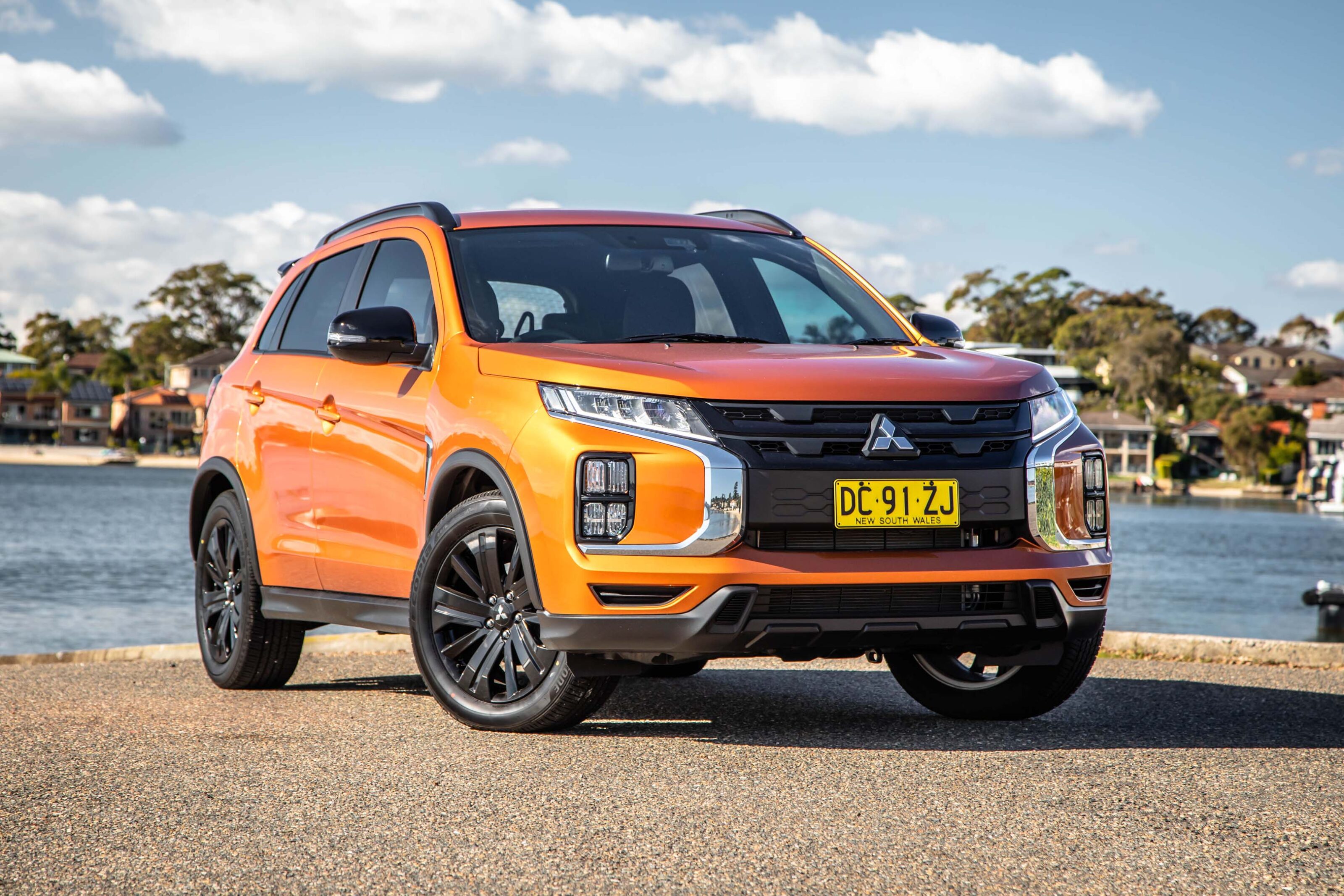
The issue, affecting 7468 cars sold between 2020 and 2022 across its entire lineup, relates to the vehicle key, which has “mandatory labelling requirements for items containing button batteries.”
| Mitsubishi button-battery recall: Affected vehicles | |
|---|---|
| ASX | 303 |
| Eclipse Cross | 403 |
| Express | 962 |
| Mirage | 54 |
| Outlander (new) | 305 |
| Outlander (old) | 27 |
| Pajero Sport | 1290 |
| Pajero | 161 |
| Triton | 3963 |
1
More than 200,000 Mitsubishi vehicles were sold in Australia between 2020 and 2022, including the Triton, Pajero Sport, Outlander, ASX, Eclipse Cross, Express, Mirage and Pajero.
According to the recall notice issued by the Department of Infrastructure, the “absence of necessary warnings” could lead young children to access the button battery and ingest it.
The recall notice states: “[Young children] are likely to suffer severe internal burn injuries, which can result in serious injury or death. Button batteries also pose a choking hazard to young children.”
A legislation change applied on June 22, 2022, required that any product containing a button battery, including car key fobs, must ensure it is secure to prevent children from getting hold of them.
1
As exclusively reported by Wheels, this required several carmakers to apply warning labels – usually fixed to the key via a tight cable tie – and updates to its user manuals to reflect the necessary information. This was estimated to add around $5 to the cost of each vehicle for one brand.
Though the issue has been reported worldwide for several years, Australia has become the first country in the world to have a button battery safety standard which applies across all consumer product categories.
Three children have died and 44 have been severely injured in Australia from incidents involving button batteries – and more than one child a month is seriously injured due to ingesting or inserting them into various body parts.
1
Mitsubishi said affected owners should contact their preferred dealership to check if the required warnings are present, with any missing labelling fitted at no-cost to the owner.
It added that owners should present both vehicle keys, the vehicle’s owner’s manual, and the vehicle service and warranty book or the recall letter received in the post when visiting their dealership.
A VIN list for the affected vehicles can be found here.
The company can be contacted directly by calling 1800 931 811 or via email at [email protected], or by visiting a dealership, found here.
Family SUV comparison: Mitsubishi Outlander Exceed Tourer vs Nissan X-Trail Ti
Business babble: For carmakers, aximising commonality between ostensibly disparate models improves economies of scale, amortises development costs faster and boosts the bottom line.
It’s one reason the Ford Mustang can be had with a Focus engine, and why the Audi e-Tron GT shares its electro-gubbins with Porsche’s Taycan.
But occasionally, seeking automotive synergies can have… negative effects. Lazy re-skins and howling obvious examples of badge engineering are peppered throughout automotive history – but in which category would we find these twins under the skin, the Mitsubishi Outlander and Nissan X-Trail?
Their relationship is clearly a little more complex than a Commodore/Lexcen scenario, but are they virtuously synergistic while maintaining their own identity – or is the Outlander just an X-Trail with a costume change?
JUMP AHEAD
- In the cabin
- Comfort, space and convenience
- Boot space: Storage and seat folding
- Powertrain and fuel use
- On the road
- Warranty period and servicing costs
- VERDICT
- Specifications
Model by model: In the cabin
Outlander
In Australia, the Outlander was the first to touch down – awkward, considering it piggy-backed on the development programme of the new-gen X-Trail as one of the first post-acquisition joint projects with its (then-new) owner, Nissan.
As such, we’re by now quite familiar with the Outlander’s interior. Spacious and sprawling, it’s a cabin that feels like it encroaches on the large SUV segment thanks to its offering of three rows and seven seats, rather than the mid-size segment norm of just two rows and five seats.
Attempt to sit in that third row, however, and it quickly becomes apparent that these are only suitable for children and petite adults, even with the sliding second row pushed as far forward as practical. Both headroom and legroom are pretty tight back there.

1
But it sure feels upmarket, especially considering the demure cabin of the previous-generation Outlander. At Exceed Tourer level, the Outlander also packs in plenty of gloss and glitter in the form of two-tone quilted leather upholstery for the seats, doors and dash, good-looking silver accents on switchgear and air vents, a massive panoramic glass sunroof, 12.3-inch digital instrument panel, a 9-inch touchscreen infotainment, head-up display, tri-zone climate control, heated AND massage-capable front seats, heated outboard rear seats, integrated rear sunblinds, a head-up display, and a wireless phone charger.
It’s certainly feature-rich, but the Exceed Tourer is more than just a box-ticking exercise – all of those features function well and do the job asked of them – except perhaps the slightly weak massage seats. That said, seat comfort is decent enough that you shouldn’t want too much for a mid-drive shiatsu sesh.

1
X-Trail
And yet stepping into the X-Trail Ti puts you in a dramatically different environment. While the Outlander feels quasi-premium, the X-Trail feels even more high-end, with more pleasing textures to its soft-touch and hard plastic surfaces.
While the Outlander puts firm perforated leather on its steering wheel grips, the X-Trail boasts more supple, finer-grained leather – and it’s the same with the rest of the leather-clad bits too.
The family ties are obvious when you look at the switch blocks, the electronic instrument panel, HVAC module, and layout of the shifter and steering wheel buttons (all measures that improve that all-important manufacturing synergy) but the interiors are set apart by their designs and layouts.

1
The X-Trail, with its additional under-console storage shelf, a trans selector that’s offset toward the driver and split console box lid, nevertheless has the more intelligently-designed cabin thanks to better space utilisation.
The X-Trail also has plenty of functional differences. The ventilation controls are positioned higher, its 12.3-inch infotainment display provides more screen real estate, and the aforementioned lower console storage is a genuine plus to everyday utility.
The tradeoff is in some spec – the Ti doesn’t get integrated rear door sunshades, seat position memory, hands-free tailgate or heated rear seats, and a three-row configuration is only available in the lower-spec X-Trail St and ST-L.

1
Comfort, space and convenience
X-Trail
Great seats, Plenty of in-car storage and fantastic ergonomics are X-Trail highlights, however there’s one feature that stands out as being not only unique to the Nissan, but something that makes a significant difference to this car’s liveability: its rear door hinges.
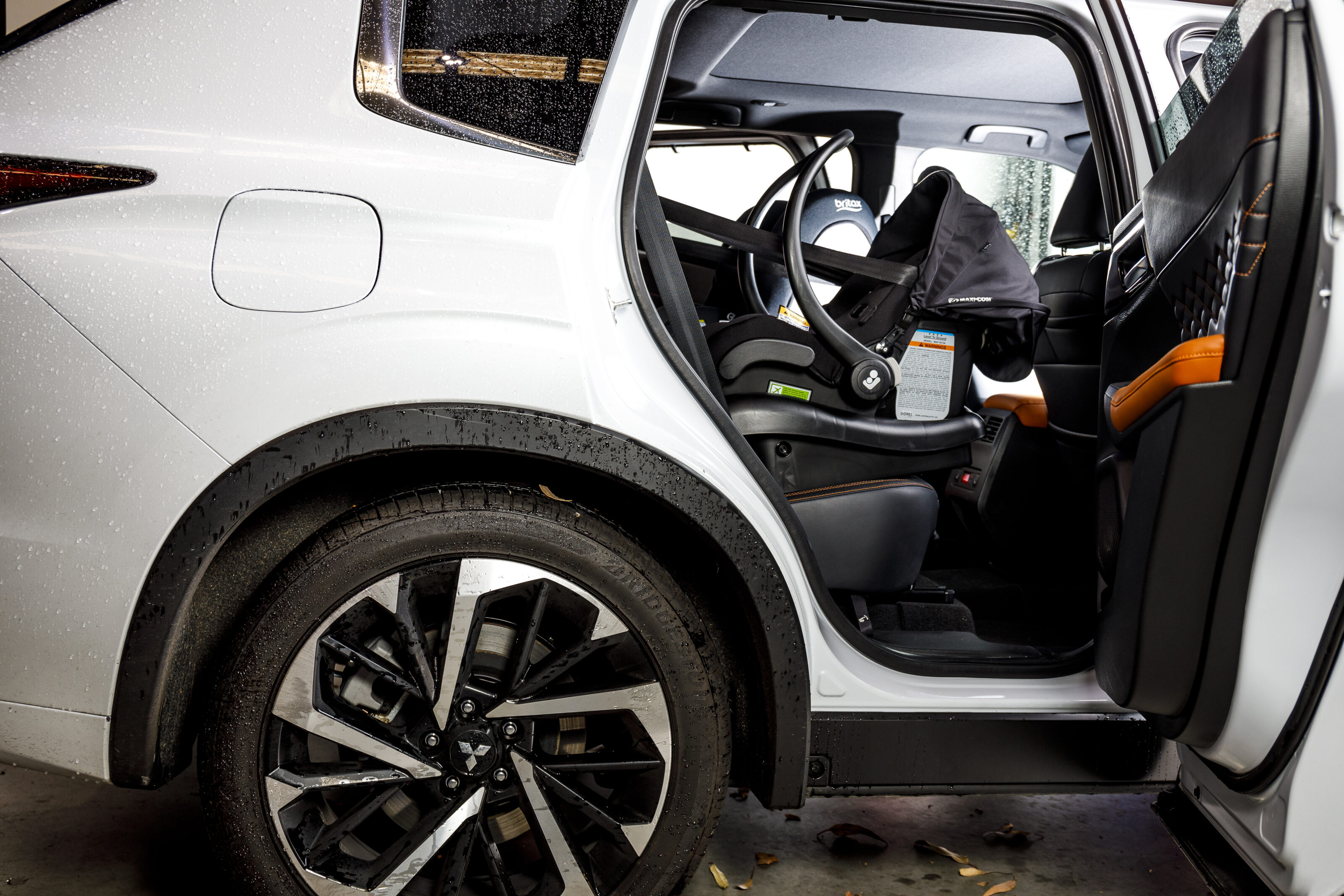
They’re unique to the X-Trail and made of cast metal rather than folded sheet steel as on the Outlander, and they permit the rear doors to open to just under 90 degrees. That, combined with the generously-sized door aperture and sliding rear seats, makes entry and egress ultra-easy – especially for parents loading in young ones.
Kat Fisk on child seats
Fitting child seats was a doddle, too, thanks to conveniently-accessible Isofix anchors, easily-adjustable headrests and a retractable parcel shelf with a huge gap for feeding the top tether belt through – though we prefer tether hooks that you don’t have to fiddle inside the lining of the back of the rear seats to find.

1

1
Outlander
The Mitsubishi’s front seats feel like armchairs for the amply-proportioned, but thankfully don’t have a corresponding La-Z-Boy squish to their cushioning. Offering decent support and a massage function to boot, their quilted leather upholstery also looks pretty special. Oh how far the Outlander has come.
And yet, despite being 30mm longer and 22mm wider the Outlander doesn’t feel much bigger than the X-Trail. It also doesn’t use its cabin volume as effectively as the Nissan either, with fewer in-cabin storage options and a lower boot capacity. Even so, the availability of a third row of seating is an advantage that can’t be ignored, and for some buyers would be a deal-making feature.
Kat Fisk on child seats
Where the Outlander fell down here is that access to its rear seats is quite tight and far inferior to the Nissan. The X-Trail’s rear doors open wide to 90 degrees, but the Mitsubishi’s only open to around 60-70 degrees.
1

1
Boot space: Storage and seat folding
| BOOT SPACE | Second row up | Second row flat | Rear seat split |
|---|---|---|---|
| Nissan X-Trail Ti | 585L | N/A* | 40/20/40 |
| Mitsubishi Outlander Exceed Tourer | 478L | 1473L | 40/20/40 |
| *Nissan doesn’t offer this figure | |||
X-Trail
At 585 litres, the X-Trail’s boot is the second-largest in the segment (the Tiguan has the most capacious rump, in case you were wondering). That’s more than enough room to throw a pram or a bunch of boogie boards into, and keeping your gear organised can be facilitated by the movable false floor panels, which can adjust their height or be re-oriented into vertical dividers.
What Nissan doesn’t give you is a method of dropping the second-row seatbacks from the tailgate area, or the convenience of shopping bag hooks in the boot.

1
Outlander
Having to package an entire row of seating under the boot means the Outlander doesn’t have the underfloor stowage of the X-Trail, but it’s still impressive that the engineers managed to package it to provide a still-useful 478-litre capacity. The rear wheel-arch trims pinch the width down a little relative to the X-Trail (and are trimmed in nasty hard plastic rather than the X-Trail’s sound-muffling carpet), however remote release handles for the second-row seatbacks are present.
There’s even enough room to stow the retractable cargo blind, and the entire third row module lifts up to reveal a space-saver spare and toolkit.

1
Powertrain and fuel use
| FUEL ECONOMY | ADR 81/02 rating | Tested economy | % difference | Fuel type |
|---|---|---|---|---|
| X-Trail | 7.8L/100km | 9.8L/100km | 26% | 95 RON |
| Outlander | 8.1L/100km | 9.7L/100km | 20% | 91 RON/E10 |
X-Trail
Here’s where the two cars bear the most resemblance. The PR25DD 2.5-litre naturally aspirated petrol engine is the sole non-electrified option for both Outlander and X-Trail, and generates 135kW and 244Nm in both and takes power to either the front wheels or all wheels via a continuously-variable transmission (our testers are both AWD).
For the X-Trail, Nissan claims an average fuel burn of 7.8L/100km, with our testing (which involved some dynamic driving) returning a 9.8L/100km real-world result.

1
Outlander
With the same engine under the bonnet and the same driveline taking power to all four wheels, the Outlander’s fuel economy should be pretty similar, right? Well, that depends on who you ask.
Mitsubishi’s claim for the Exceed Tourer AWD is 8.1L/100km on the combined cycle, 0.3L/100km higher than the X-Trail, which would make sense given it weighs 92kg more than the X-Trail Ti AWD and rolls on heavier 20-inch alloys rather than the 19s of the Nissan.
And yet, on our drive loop the Outlander clocked a fuel burn of 9.7L/100km – 0.1L/100km better than the X-Trail. Yeah, we can’t work that one out either.

1
On the road
X-Trail
Though sharing much mechanically, there’s a tangible difference between how these two cars drive that’s immediately obvious on a back-to-back drive.
Performance from the 2.5-litre is adequate but not sparkling in both cars, but the X-Trail does feel a touch more lively off the line thanks to its nearly 100kg weight advantage. Its steering is also more fluid and progressive in its weighting in around-town driving.
Though both cars lack some critical steering feedback when the road gets twisty, the Nissan’s front end does tend to feel a little sensitive to inputs – a more inert feel would probably be better for this kind of vehicle.
No complaints with the X-Trail’s suspension, though, which is superbly calibrated for both ride comfort and handling. Slightly on the firm side, but really only just. The CVT’s performance is also exceptional, quietly slurring away on light throttle, but responding quickly to demands for power.

1
Outlander
The Mitsubishi sports a different character. More firmly-sprung than the X-Trail and with bigger wheels, it delivers a significantly sharper ride over relatively minor road imperfections that’s not quite ideal for a family wagon – particularly for whoever’s in the third row.
And yet, it still likes to roll. With more rubber contacting the ground (the Outlander Exceed’s tyres are 20mm wider than the X-Trail’s) it does feel more stable and not as easy to shake loose, but it also lacks the engaging feel of its cousin.
Ultimately, the Outlander would be improved if it kept its stable and predictable handling intact, but did away with the rather firm ride.

1
Warranty period and servicing costs
X-Trail
Nissan offers a standard warranty term of 5 years and unlimited kilometres. Servicing costs are on the high side though, with intervals of 10,000km and 12 months and a total maintenance cost of $1387.25 over three years, or $2674.64 over five years.
Outlander
If you’re a model customer and keep taking your Outlander back to a Mitsubishi dealer for scheduled maintenance, you’ll get to enjoy a generous 10 year, 200,000km factory warranty.
Go outside of that system, though, and you’ll receive a reduced warranty period of 5 years and 100,000km – which is sub-par in an era where almost every manufacturer is offering at least 5 years/unlimited kilometre warranty coverage.
Balancing that out is a longer service interval compared to the X-Trail of 15,000km/12 months, as well as lower pricing for scheduled maintenance. At the three-year mark the Outlander only asks for $947 in maintenance, rising to $1595 by the five-year mark.
VERDICT
Synergies under the skin rarely deliver an identical outcome, and it’s the many layers on top that distinguish these two from each other.
To drive, they feel wholly different. The in-cabin experience is also more different than you’d expect – though if you spent a little more on the X-Trail and plumped for the $52,990 Ti-L grade, you’d get a car that more closely matches the Outlander Exceed Tourer for price and spec (albeit without the 7-seat capability).
Of the two, it’s the X-Trail that feels more well-rounded. Its focus on improving life for those aft of the B-pillar is virtuous for a family SUV, and its wide-opening doors and versatile boot area are things families will surely appreciate. It also rides more comfortably and has a better cabin design, not to mention the technological wow-factor of its larger infotainment package and superior software.
However, if you need to transport more than five people and you want a feature-rich SUV to do so, then the choice is already made for you: the Outlander simply has more seats at this level of specification. Remove that requirement, however, and it’s the X-Trail that rises to the top.
SCORING
? Nissan X-Trail Ti: 8.5/10
Things we like
- Bigger, better and more premium than ever
- richly trimmed cabin offers loads of comfort and equipment
- comfy urban ride
- clever storage solutions
Not so much…
- Dynamics good rather than great due to vague steering/intrusive ESC
- short service intervals
- only mid-pack for economy and warranty coverage
Mitsubishi Outlander Exceed Tourer: 7.5/10
Things we like
- Richly equipped and comfortable cabin
- Only contender on test with 7 seats
- 10-year warranty longest of our group
Not so much…
- Firm and compromised ride on 20s
- Amp petrol + CVT combo uninspiring
- Inferior packaging and storage compared with related Nissan X-Trail
| Mitsubishi Outlander Exceed Tourer | Nissan X-Trail Ti | |
|---|---|---|
| Safety, value and features | 8 | 8.5 |
| Comfort and space | 7 | 7.5 |
| Engine and gearbox | 6.5 | 6.5 |
| Ride and handling | 6 | 7.5 |
| Technology | 7.5 | 8 |
| OVERALL | 7.5 | 8.5 |
Comparisons
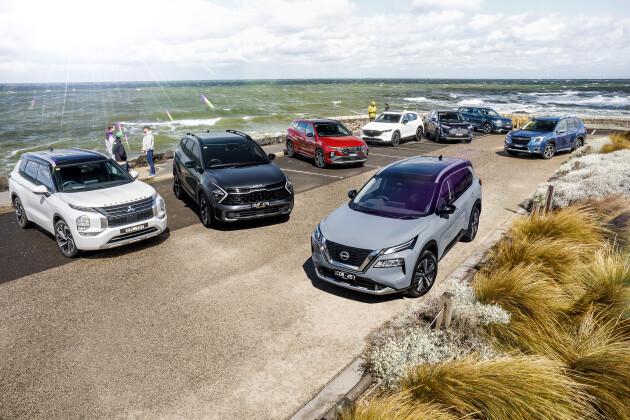
Medium SUV comparison: 2023 Mega Test
Thinking of buying a new mid-size SUV this year? We test eight of the best and most popular contenders to see where you should spend your money
MORE
SUV Buyers Guide
| Nissan X-Trail Ti | Mitsubishi Outlander Exceed Tourer | |
|---|---|---|
| Engine | 4cyl, dohc, 16v | 4cyl, dohc, 16v |
| Power | 135kW | 135kW |
| Torque | 244Nm | 244Nm |
| Gearbox | Continuously variable | continuously variable |
| Body | Steel, 5 doors, 5 seats | steel, 5 doors, 7seats |
| Boot | 585 litres | 478 litres |
| Fuel/tank | ||
| Economy | 9.8L/100km (tested) | 9.7L/100km (tested) |
| ANCAP rating | 5 stars | 5 stars |
| Warranty | 5 years/unlimited kilometres | 5 year/100,000km OR 10 year/200,000km |
| Service interval | 12 months/10,000km | 12 months/15,000km |
| Price | $49,990 | $53,490 |
