
Interestingly, the page’s original URL was chery-au.com but, in the months since this story was first published, it has since become cherymotor.com.au.
Snapshot
- Every new commercial vanu2019s safety assist tech ranked by ANCAP
- Staria Load and Ducato achieve u2018platinumu2019 performance, LDV V80 and G10 u2018not recommendedu2019
- But 15 out of 17 vans tested donu2019t have an ANCAP rating at all
The Australasian New Car Assessment Program (ANCAP) safety body has tested and ranked the active safety assistance systems in every new commercial van on sale today.
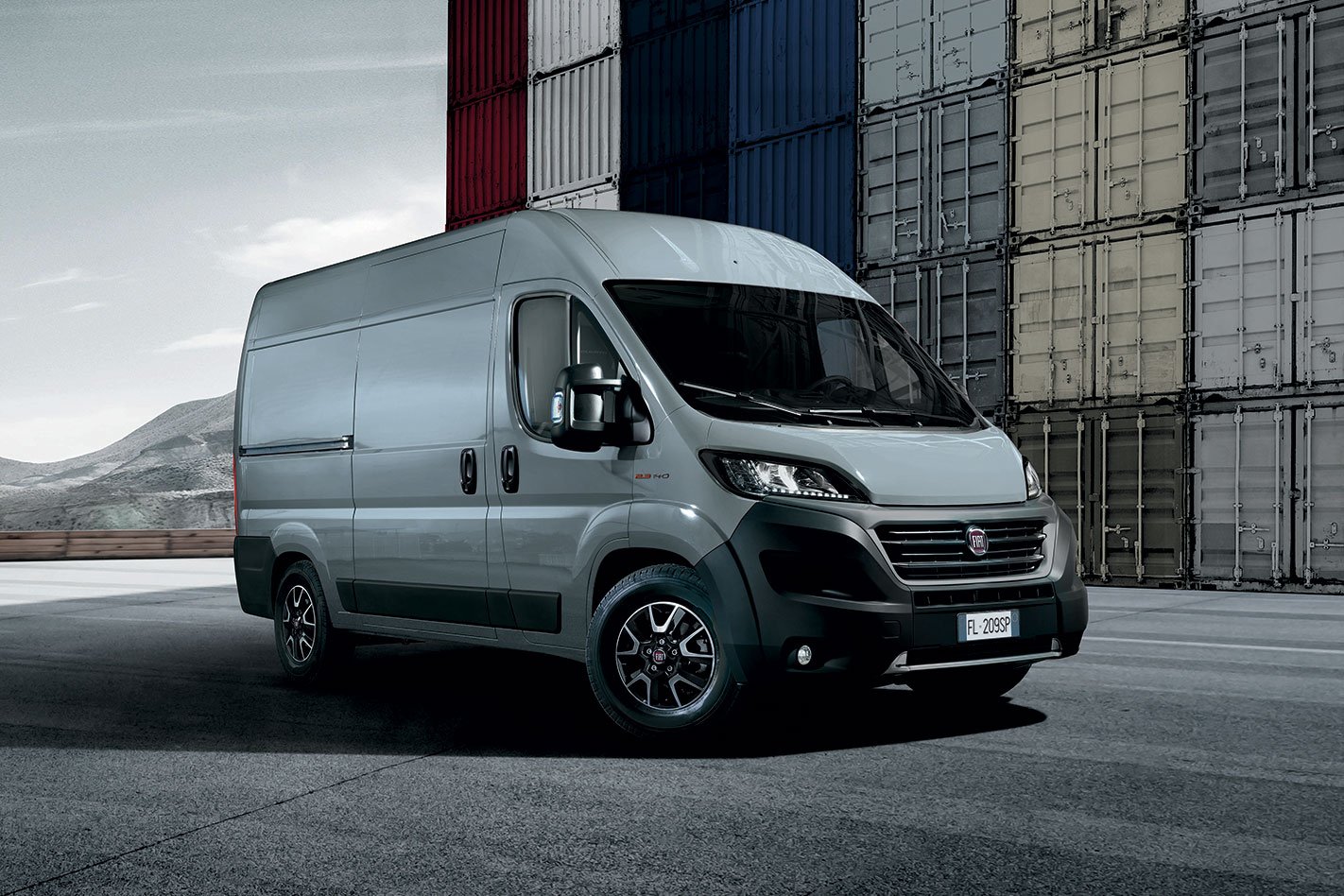
Out of the 17 vans tested, the Hyundai Staria Load and Fiat Ducato came out on top, earning a ‘platinum’ performance ranking for including all safety assist technologies as standard or optional.
Both the medium and large vans had good performance across front auto emergency braking (AEB) with car/pedestrian/cyclist detection, lane departure and lane-keep assist, speed limit function, and seatbelt reminders and driver attention monitoring.
1
However, the ageing LDV V80 and G10 cargo vans – which date back to 2011 and 2014 respectively – fell short, with no active safety systems available and were labelled as ‘not recommended’.
For the full breakdown of active safety assistance performance scores, read ANCAP’s full January 2023 report here.
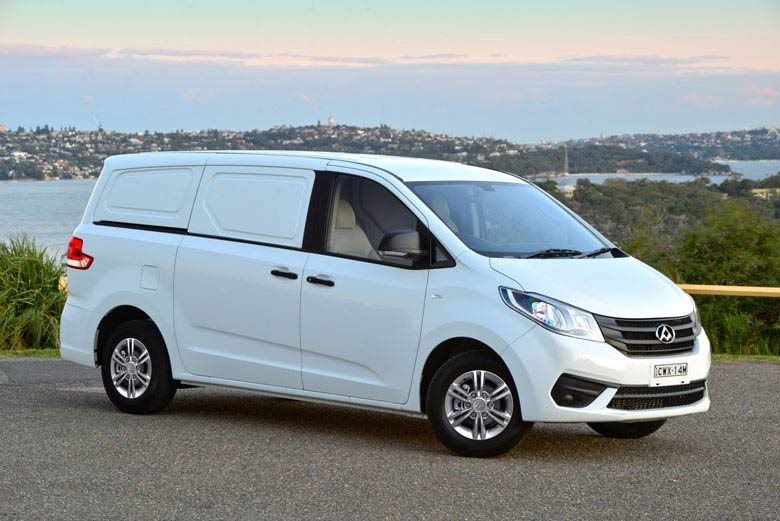
Notably, the majority of the commercial vans on test don’t have an ANCAP safety rating; only the popular Hyundai Staria Load and Toyota HiAce have achieved five-stars under 2021 and 2019 testing criteria respectively.
1
A five-star ANCAP rating is a crucial requirement for many company fleets in Australia.
It’s worth noting that the safety authority only tested active safety assistance systems, instead of structural and occupant safety as well.
Commercial vans have had a chequered record when it comes to safety – partly due to their older age – despite these vehicles always being on the move to fulfil deliveries.
1
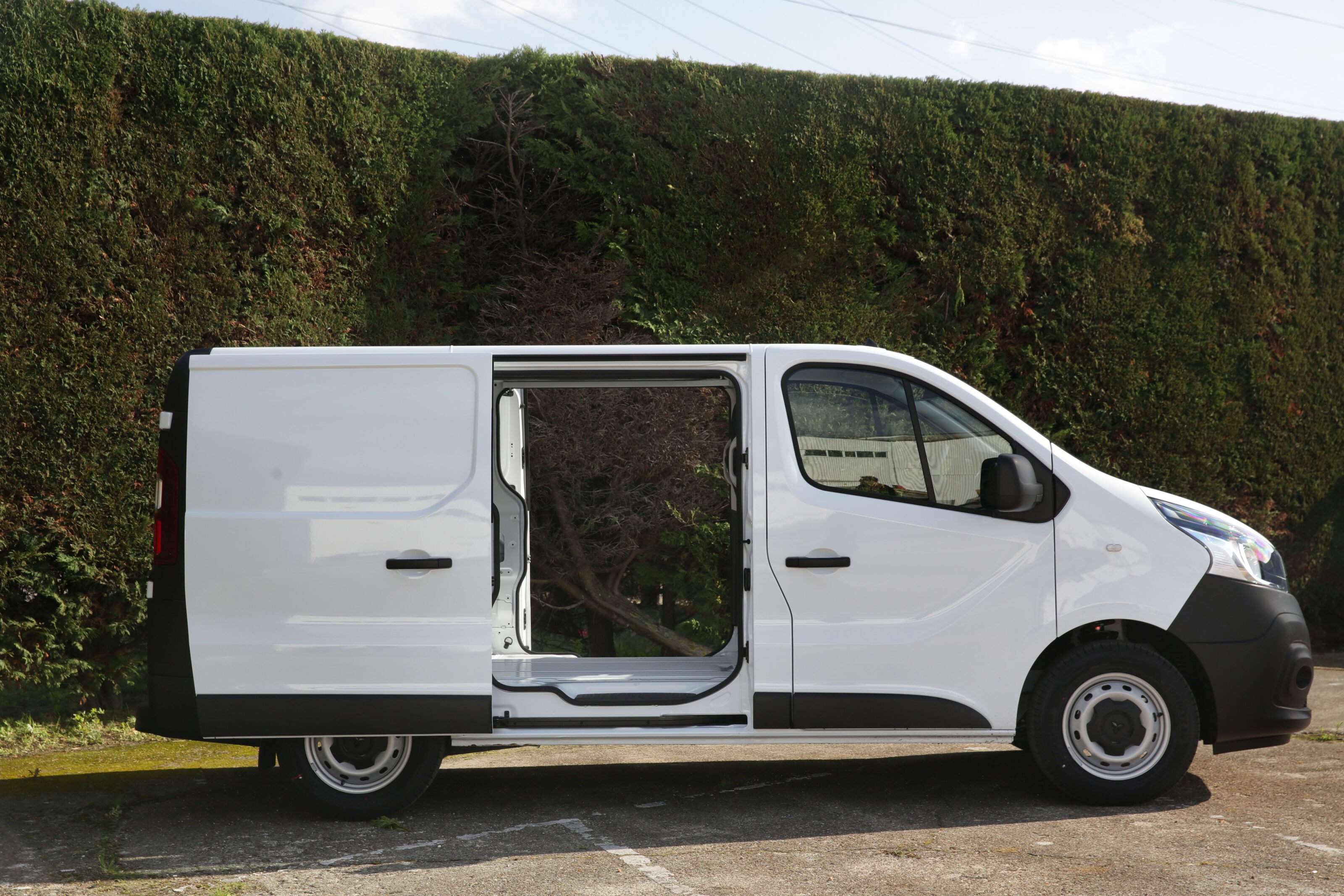
Last year, Peugeot removed the side thorax airbags from its 2022 model-year Expert van due to the semiconductor shortage, leaving only two remaining in the three-seater cabin.
In 2021, ANCAP controversially gave a zero-star safety rating for the first time on the now-discontinued Mitsubishi Express medium van because of a lack of safety assist tech.
Australians bought 24,420 light and heavy commercial vans last year, which represented 2.2 per cent of overall new vehicle sales in 2022.
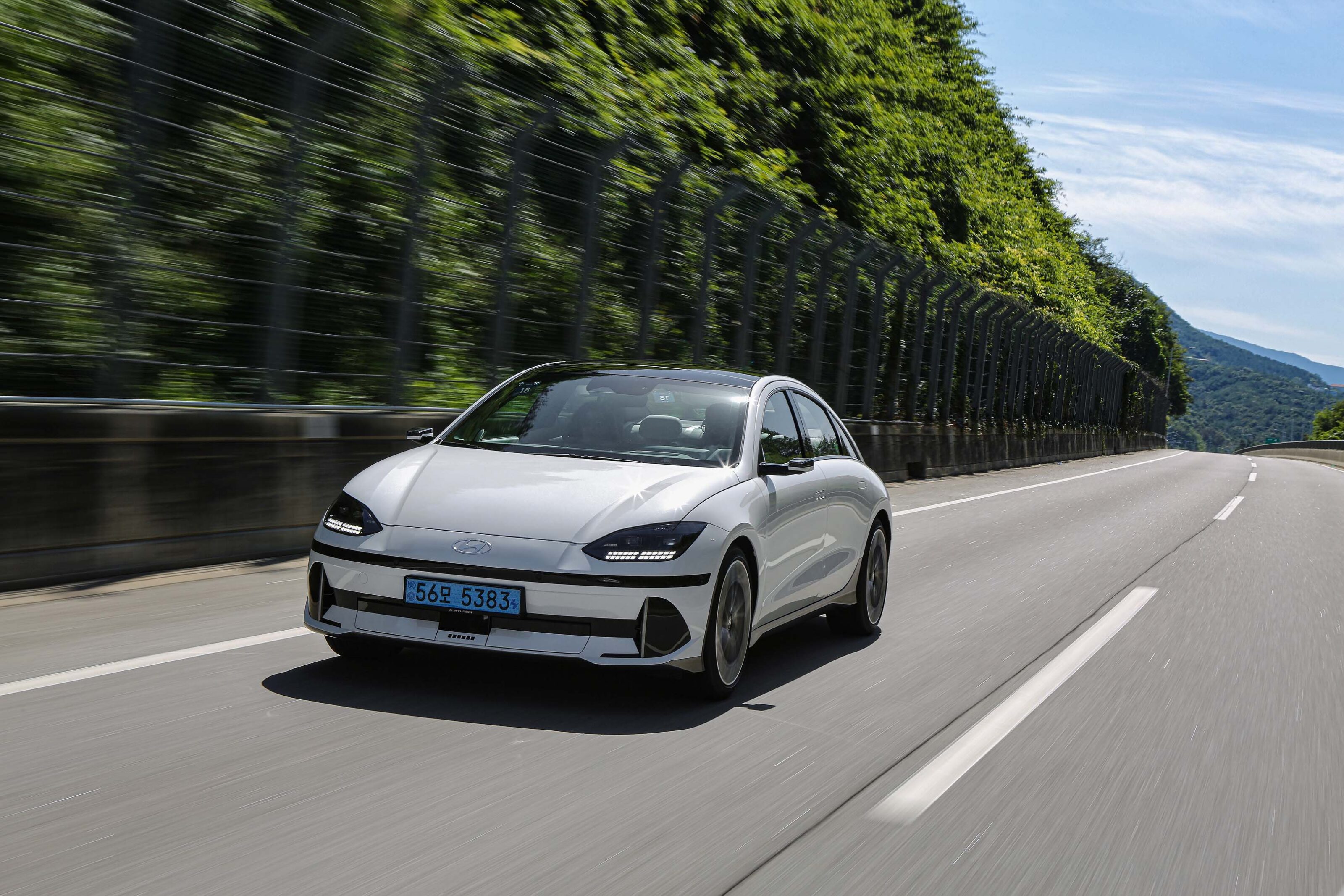
The first allocation for 2023 Hyundai Ioniq 6 electric sedan will open next week.
It will be joined by the next batch of the Ioniq 5 crossover, with both set to go on sale in Australia on February 22 at 1pm AEDT.
While 170 examples of the Ioniq 5 have arrived in Australia with delivery available within two to four weeks, Ioniq 6 buyers will be required to wait up to three months to take delivery, with 300 vehicles on offer.
The bulk of Ioniq 6 vehicles at launch will be the entry-level, rear-wheel-drive Dynamiq, with 229 examples available. The mid-spec, dual-motor Techniq is limited to 36 vehicles, while 35 examples of the flagship Epiq will be offered.

1
In comparison, 68 Ioniq 5 Techniqs will be available, followed by 54 examples of the Epiq and 48 Dynamiqs.
As with the previous Ioniq 5 batch in January, the vehicles will be available to order in every state and territory, unlike prior allocations that excluded the Northern Territory.
Last month, Hyundai Australia said it had expanded the number of dealerships offering sales and service for the Ioniq 5 and Ioniq 6 to 25.
Hyundai-Kia’s dedicated E-GMP electric vehicle platform is found underneath both models, with an 800-volt electrical architecture and support for 350kW ultra-rapid fast charging.
A low-slung sibling to the Ioniq 5, Kia EV6 and Genesis GV60 crossovers, the Ioniq 6 is a direct competitor to Australia’s best-selling electric vehicle, the Tesla Model 3.
It is priced from $74,000 before on-road costs. This is $10,100 dearer than the most-affordable Tesla Model 3 Rear Wheel Drive – and $2000 more than an equivalent Ioniq 5, which offers more space, but less driving range.

1
2023 Hyundai Ioniq 5 pricing
Prices exclude on-road costs.
1
2023 Hyundai Ioniq 6 pricing
Prices exclude on-road costs.
MORE
Everything Hyundai
Snapshot
- More than 360,000 Tesla Model 3, Y, S, X recalled in the US
- Concerns its FSD beta is potentially unsafe and doesnu2019t obey road rules
- Australian Teslas unaffected, but remains a $10,100 optional FSD u2018promiseu2019
American electric carmaker Tesla has issued a voluntary recall in the US due to concerns its ‘Full Self-Driving’ (FSD) beta program may be dangerous.
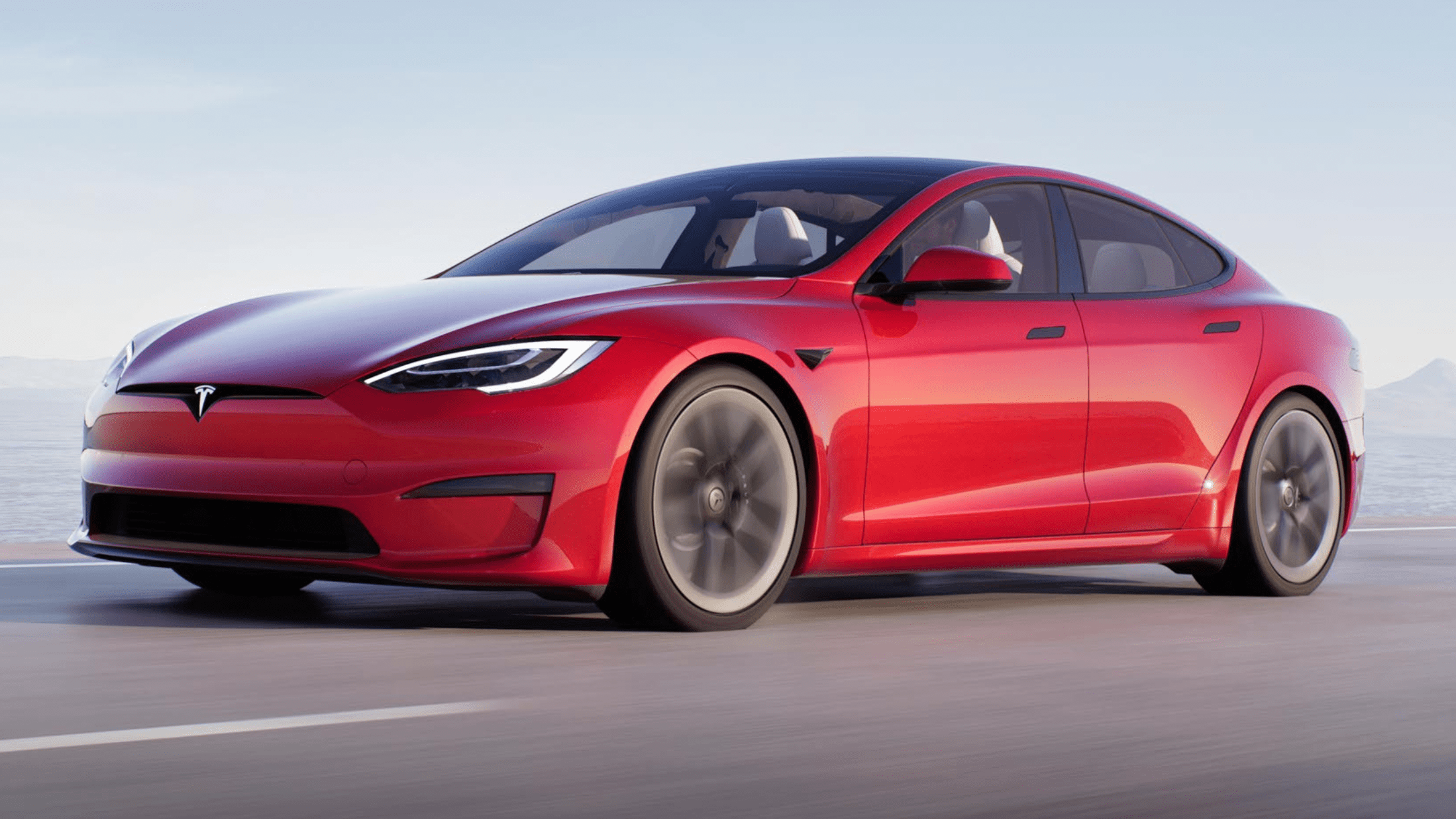
According to the recall notice from the National Highway Traffic Safety Administration (NHTSA), it affects 362,758 Tesla EVs in the country, including the 2016 to 2023 Tesla Model S liftback and Model X large SUV, and all 2017 to 2023 Model 3 sedans and 2020 to 2023 Model Y SUVs – all of which have Hardware 3.0 to run FSD beta.
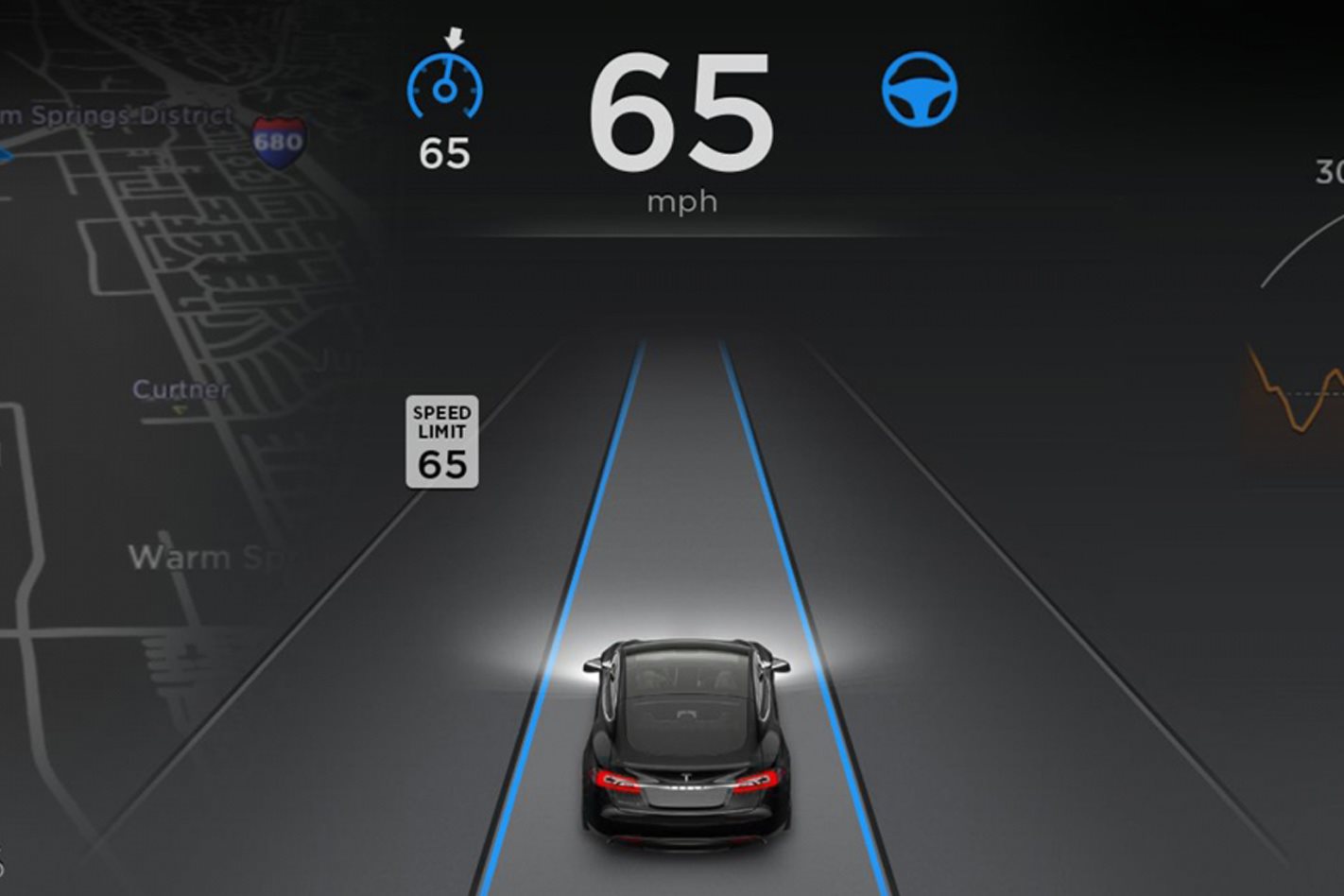
“The FSD Beta system may allow the vehicle to act unsafe around intersections, such as travelling straight through an intersection while in a turn-only lane, entering a stop sign-controlled intersection without coming to a complete stop, or proceeding into an intersection during a steady yellow traffic signal without due caution,” the notice said.
1
“In addition, the system may respond insufficiently to changes in posted speed limits or not adequately account for the driver’s adjustment of the vehicle’s speed to exceed posted speed limits.”
Tesla will issue an over-the-air (OTA) software update to affected vehicles, but it’s unclear how it will be addressed given FSD beta relies on real-world scenarios and machine learning to improve its system.
Australian Teslas do not have FSD beta access yet and are unaffected.
1
However, it remains a $10,100 option for new and current owners to software unlock Enhanced Autopilot safety assistance systems (a $5100 option on its own), gain traffic light and stop sign control while in adaptive cruise control (i.e. ‘Autopilot’), and promises FSD beta in the future (i.e. ‘Autosteer on city streets’).
The American safety authority emphasises FSD beta remains a SAE Level 2 driver support feature only to provide steering, acceleration and braking assistance – the driver is solely responsible and must stay alert and intervene as needed.
It comes as Tesla and Twitter CEO Elon Musk tweeted this morning: “The word ‘recall’ for an over-the-air software update is anachronistic and just flat wrong!”
The controversial businessman previously complained to The Wall Street Journal (WSJ) on Twitter in 2018 for reporting on Tesla recalling its power-steering system on the Model S.
“Tesla policy is to issue a recall before there are injuries,” Musk said.
“This is absolutely the right thing to do. Yet there were dozens of recalls by other car companies last month, incl w [sic] injuries & deaths, but you only [WSJ] wrote an article about Tesla. Why so?”
The FSD beta program launched in October 2020 to selected owners, and now has more than 160,000 Tesla vehicles enrolled across the US and Canada, according to Musk.
1
The company previously required owners to achieve a high driver safety score to gain access to FSD beta, but the rule was dropped in 2021.
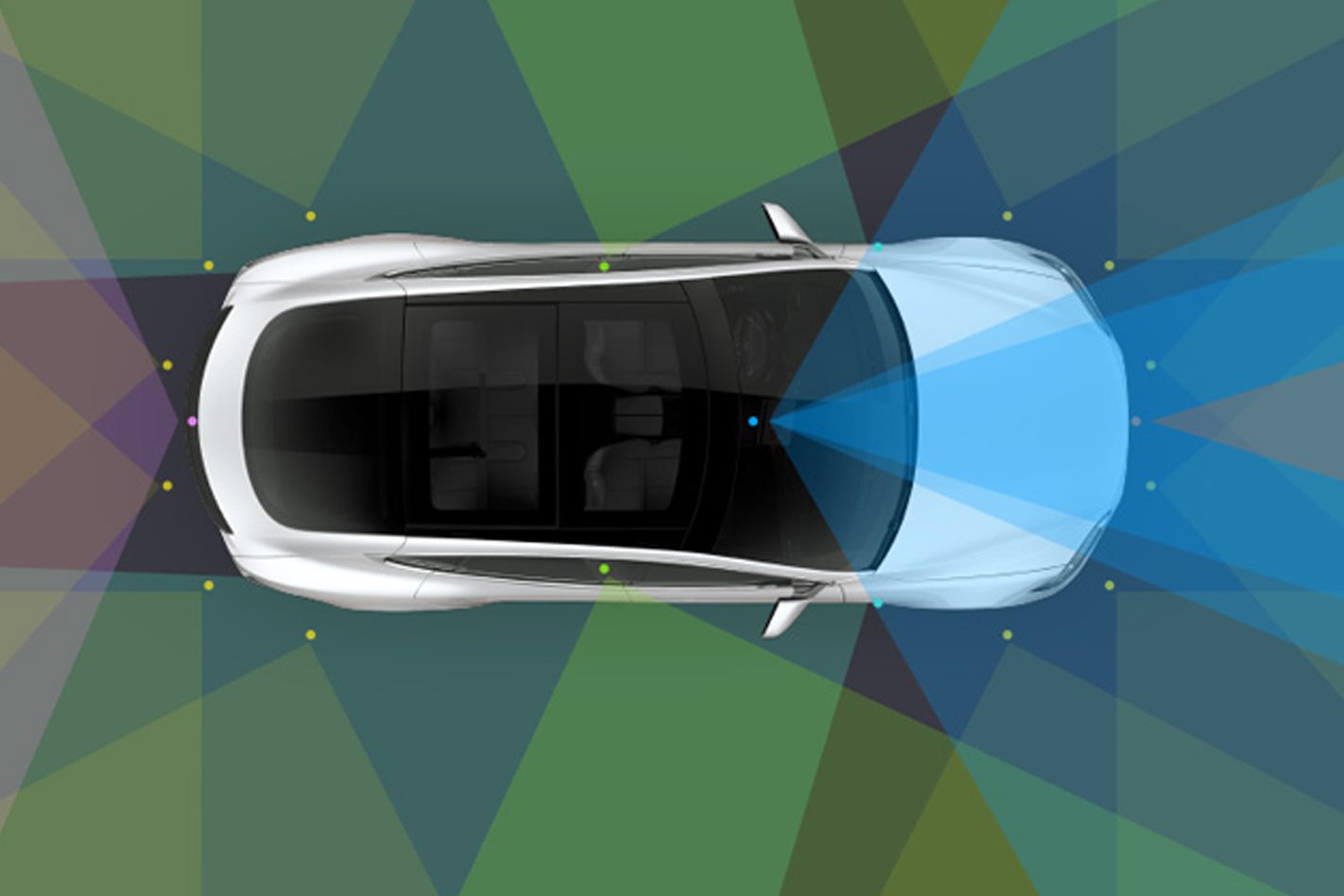
Like the rest of its safety assistance systems, Tesla FSD beta is powered by cameras only – instead of a combination of radar and LiDAR sensors used by full self-driving trials from companies such as Google’s Waymo and General Motors’ Cruise.
The upcoming 2024 Polestar 3 large electric SUV even has an option to add more advanced LiDAR sensors to prepare for a fully autonomous future, and the related Volvo EX90 will follow suit.
MORE
Everything Tesla
Tesla is expected to pause some production lines in its Shanghai factory until the end of February to make way for the purported 2024 Model 3 electric sedan update.
Snapshot
- Shanghai production lines will be upgraded for 2024 Model 3
- Tesla design boss downplayed rumours of a major update
- No rumours of an update for related Model Y
Inside sources have told Bloomberg the manufacturing upgrade is split in two phases; the first will start this Sunday, and some employees won’t be allowed on the production lines.
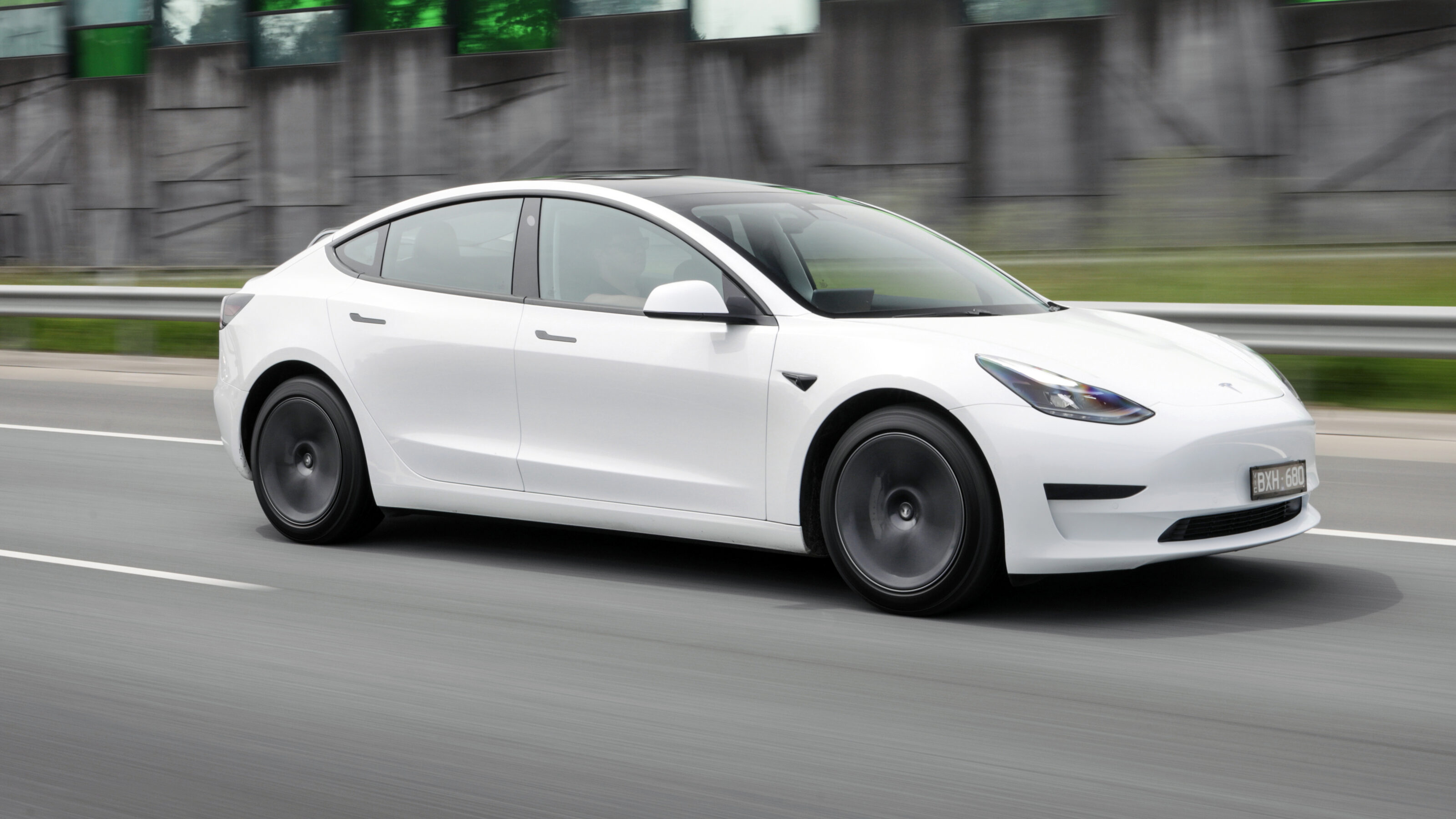
The anonymous sources claim deliveries of the new Tesla Model 3 electric car are expected to start later this year.
1
Reuters reported in November last year that the popular Model 3 sedan would receive a major update with an even more simplified interior, dubbed internally as project ‘Highland’.
However, Tesla’s design boss, Franz von Holzhausen, has downplayed the rumour of a heavy refresh.
“There are things that we’re always looking at…Those vehicles [Model 3 and Model Y] are great at what they are, and we haven’t seen a need or a demand for a change – so ‘don’t fix it if it isn’t broke’, that’s kind of the mentality,” von Holzhausen told the Ride the Lightning podcast.
Comparisons
Best Electric Cars Under $65k: Affordable EVs Rated
Welcome to part one of three price-based EV buying guides, this one focused on the most affordable electric cars available in Australia today

1
“You look at the 3 and the Y on the road and they’re super modern feeling… why spoil that?”
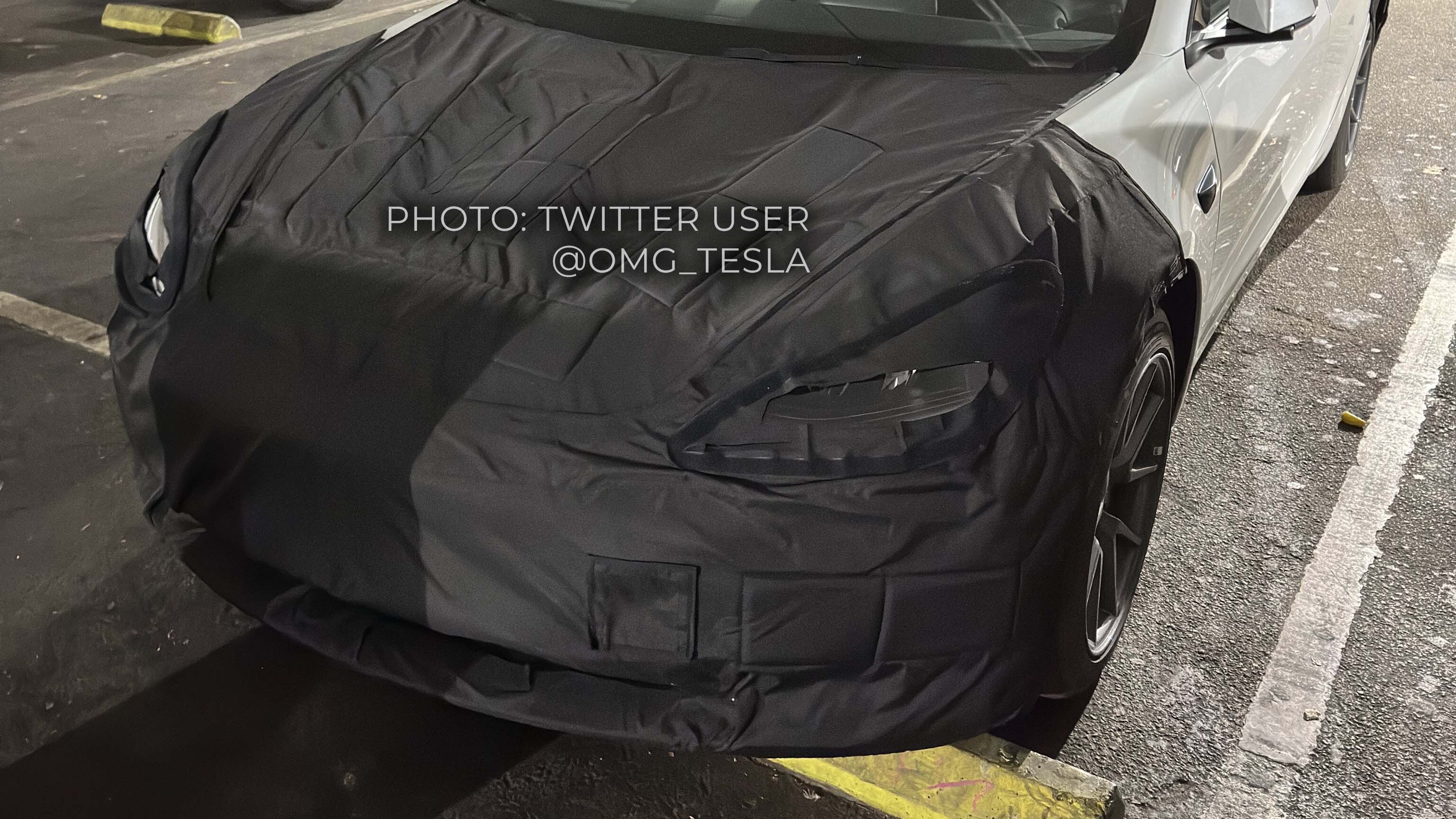
Two camouflaged examples have been spied roaming Californian roads with only the front and rear covered off. It suggests a subtle design tweak, testing the anticipated Autopilot 4.0 hardware, or the reintroduction of radar sensors, as Electrek previously mooted.
The related Tesla Model Y electric SUV shares the same Shanghai production line and many parts with the Model 3, but there haven’t yet been rumours of a similar update.
1
The American company has already been upgrading the Chinese factory’s production lines in the past two months to improve its manufacturing efficiency and cut production costs with a localised supply chain – as reflected in recent price cuts and quick delivery turnover times (up to three months for the Model 3 as at the time of writing).
When will the updated Tesla Model 3 be revealed?
It’s unclear whether Tesla will officially announce the updated Model 3 at its Investor Day on March 2 (Australian time), but it has confirmed we’ll see its long-awaited third-generation EV platform – which is expected to be the base for an affordable sub-$40,000 electric car.
MORE
Everything Tesla
The 2023 Nissan X-Trail E-Power AWD has two electric motors, a lithium-ion battery under the front seats, a variable compression ratio turbo-petrol engine and marketing material labelling it as ‘the missing link’ between internal combustion engines (ICE) and electric vehicles.
However, with an ADR 81/02 combined fuel consumption rating of 6.1L/100km, the X-Trail E-Power is only 1.5L/100km better than the equivalent ICE X-Trail and falls 1.3L/100km short of the petrol-electric efficiency benchmark that is the Toyota RAV4 hybrid AWD.
If it’s economy numbers you care about above all else, the RAV4 is the pick. But it would be remiss and ignorant to write the X-Trail E-Power off on numbers alone.
The hybrid E-Power builds on the fantastic (and recent comparison-winning) X-Trail recipe; a thoughtfully packaged, beautiful-riding, spacious medium SUV that easily slips into daily life like few other rivals.
It’s a handsome car, too, with the E-Power black V-Motion grille adding menace to the X-Trail’s attractive proportions. Finished in Gun metallic or Diamond black, the up-spec Ti and Ti-L really look the part.
JUMP AHEAD
- How much is it, and what do you get?
- How do rivals compare on value?
- Interior comfort, space and storage
- What is it like to drive?
- How is it on fuel?
- How safe is it?
- Warranty and running costs
- VERDICT
- Specifications
How much is it, and what do you get?
1
Unlike RAV4, the 2023 Nissan X-Trail E-Power is available only in ritzy top-grade Ti and Ti-L trims featuring an electric all-wheel-drive system that Nissan calls E-4orce.
A starting price of $54,190 before on-road costs pitches the hybrids $4200 higher than their 2.5-litre ICE X-Trail equivalents.
The Ti is a typically well-equipped medium SUV and frankly could have stood as the range-topper if Nissan wanted. It’s all you need, with features such as:
| Nissan X-Trail E-Power Ti features | |
|---|---|
| 10.6-inch head-up display | Heated front seats |
| 12-way power driver and passenger seat | Leather upholstery |
| 12.3-inch digital driveru2019s display | LED taillights |
| 12.3-inch touchscreen | Matrix LED headlights |
| 15W wireless charging pad | Panoramic sunroof |
| 19-inch alloy wheels | Power tailgate |
| 4x USB ports | Privacy glass |
| Active noise cancelling | Tri-zone climate control |
| Ambient lighting | Wired Android Auto |
| Divide-and-hide luggage system | Wireless Apple CarPlay |
1
That said, the $57,190 before on-road costs Ti-L (L presumably standing for ‘luxe’) is a lush place to be with the tasteful choice of Ferrari-like tan quilted Nappa leather upholstery, should you wish to indulge.
Other features for the $3K premium include:
| Nissan X-Trail E-Power Ti-L additional features | |
|---|---|
| 20-inch alloy wheels | Extra ambient lighting |
| Auto-tilt mirrors in reverse | Quilted Nappa leather upholstery |
| Heated rear seats | Rear sun shades |
| Heated steering wheel | Remote engine start |
| Kick-to-open power tailgate | Two-position front-seat memory |
1
How do rivals compare on value?
Despite Toyota’s hybrid RAV4 dominating sales share (the petrol-electric variant makes up 70 per cent of Australian RAV sales), there isn’t a huge number of non-plug-in hybrid rivals.
Nissan doesn’t anticipate E-Power variants to displace those with an atmo four-cylinder for sales in the first year but neither does it rule out stronger sales for the electrified powertrain.
There’s no hybrid Kia Sportage or Hyundai Tucson, despite calls for them, and the Mitsubishi Outlander plug-in hybrid is a different (and $12,800 more expensive) kettle of fish.
So really, the X-Trail E-Power only has to worry about direct drivetrain competition from Toyota’s RAV4 hybrid AWD (Cruiser $52,7900; Edge $56,650 before on-road costs) and the GWM Haval H6 Ultra hybrid ($45,990 drive-away). There’s also the Tesla Model Y, which at $68,900 before on-road costs is dearer, but is a fully electric SUV with more grunt and newer tech.
Interior comfort, space and storage
If you caught Dan Gardner’s review on the new X-Trail range, you’ll be aware of what a step forward the latest ‘T33’ is in terms of cabin ambience. It may not immediately jump out on a spec sheet, but the X-Trail grows on you over time in a way the Kia Sportage and Toyota RAV4 don’t.
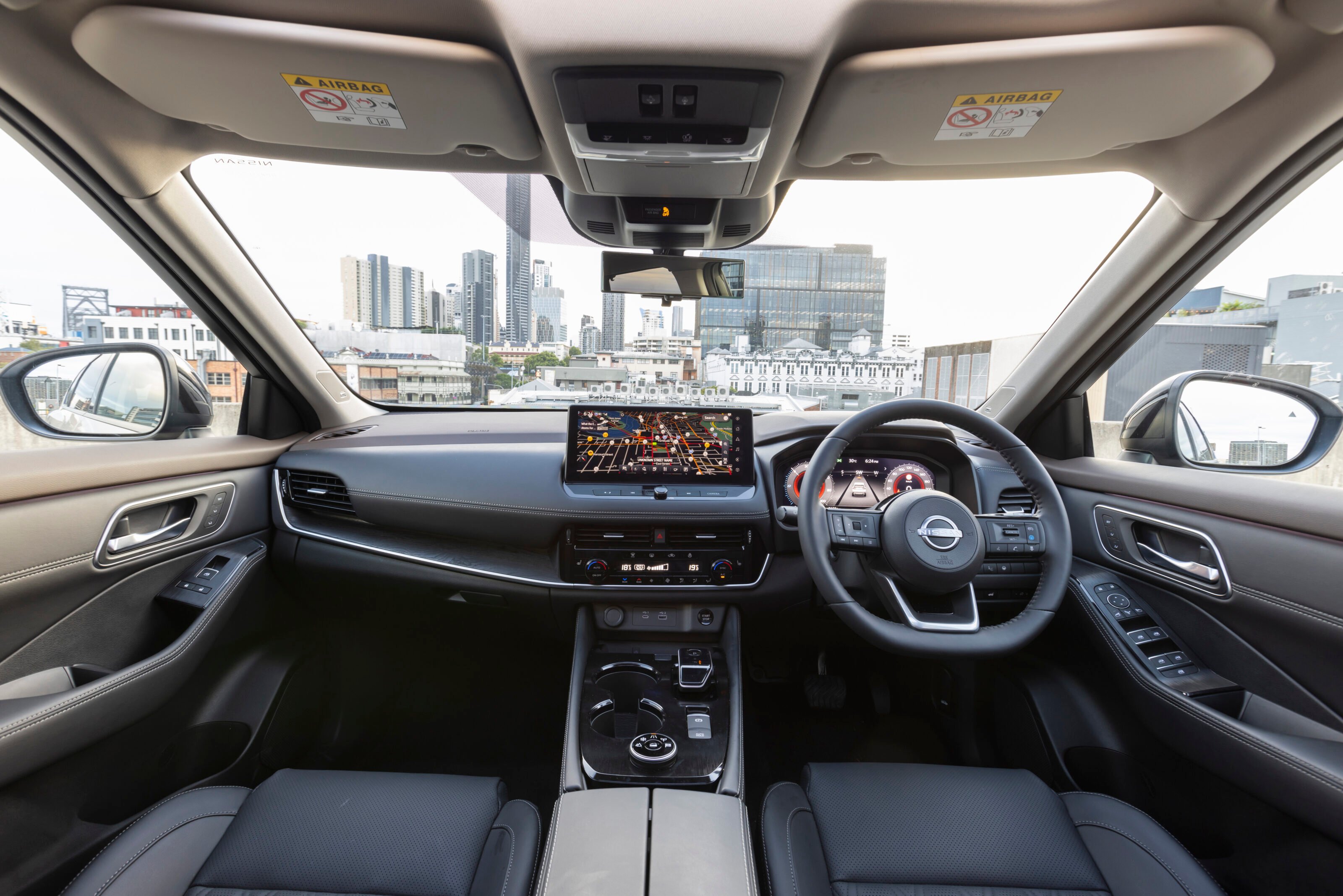
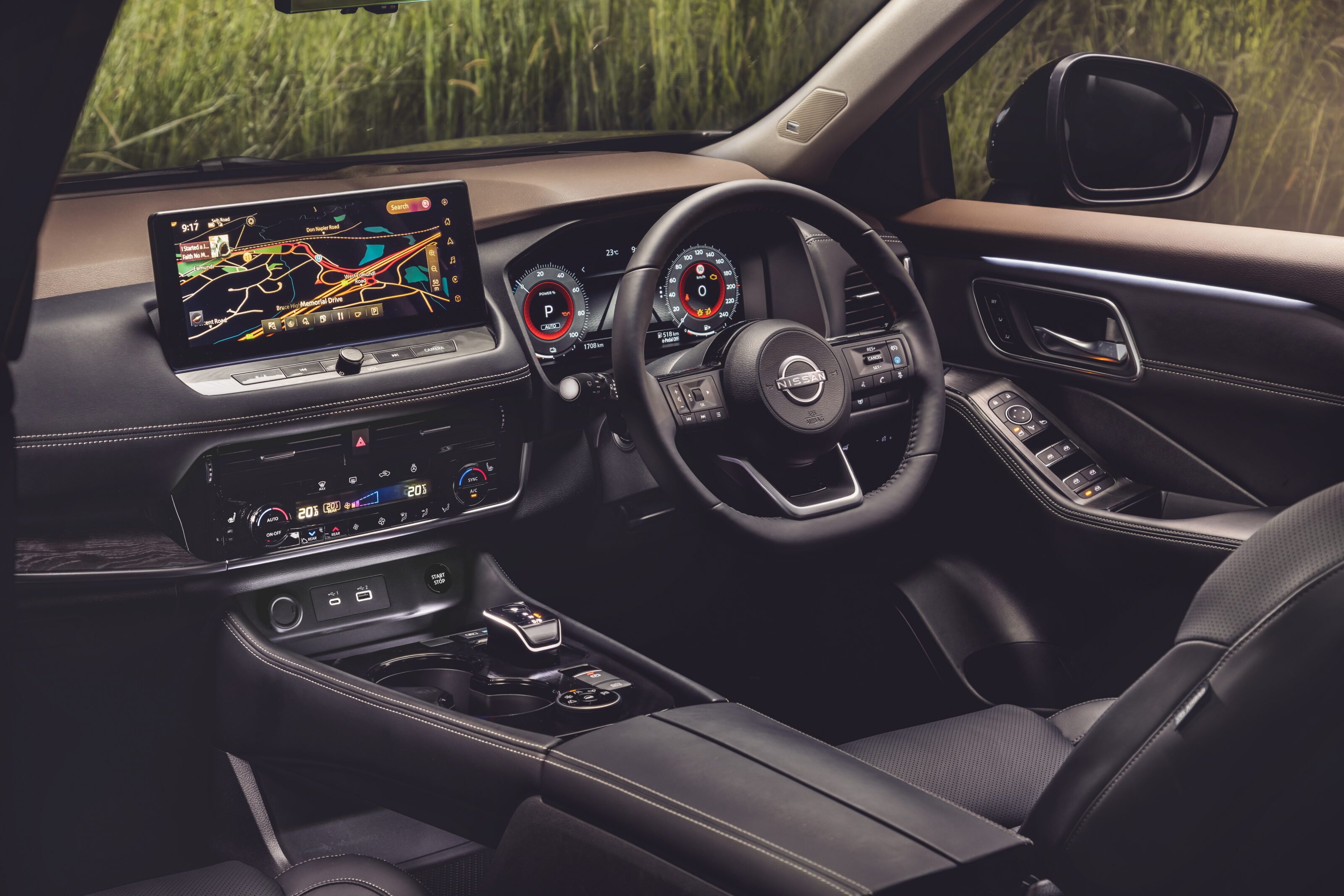
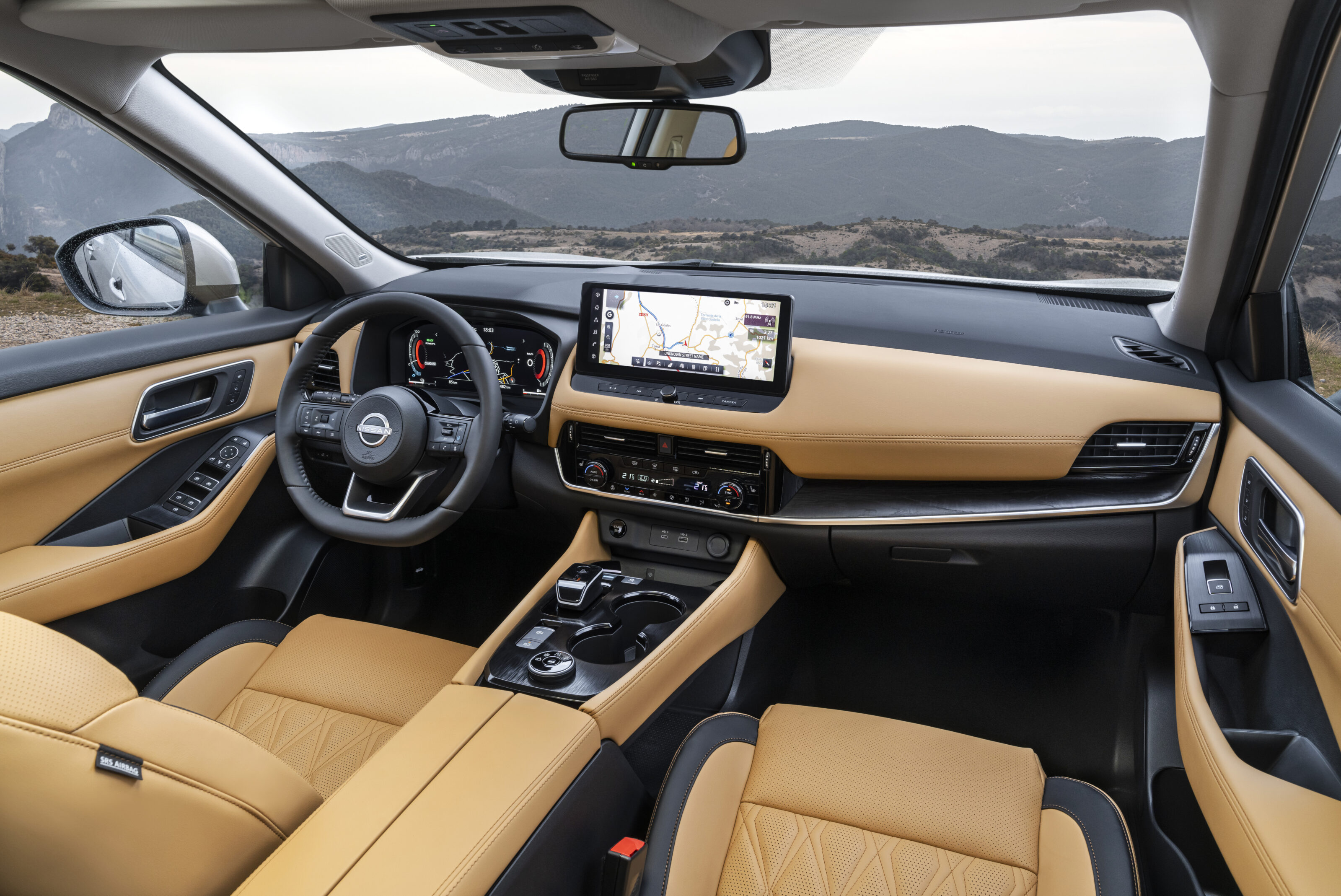
Pride of place in the X-Trail is a 12.3-inch touchscreen. It’s easy to reach, with shortcut buttons and a straightforward user interface. The physical climate controls sit below with a sensible layout.
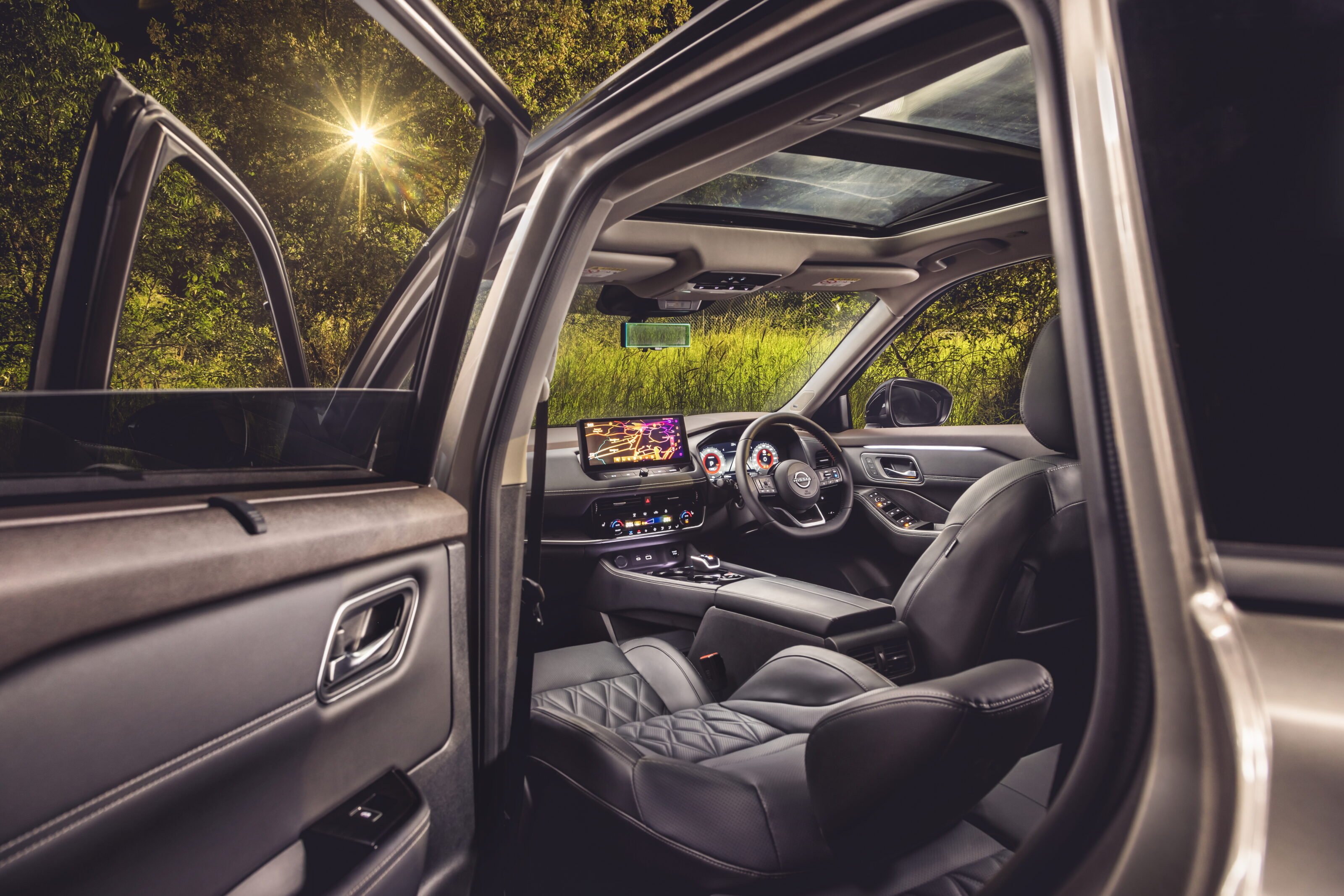
The dash is appointed in brown soft-touch plastic on top, with leatherette cushions on the fascia. In the ritzy Ti-L, buyers are able to choose tasteful quilted tan Nappa leather upholstery to lift the ambience – a great distinguisher for the range-topping model over a Ti.
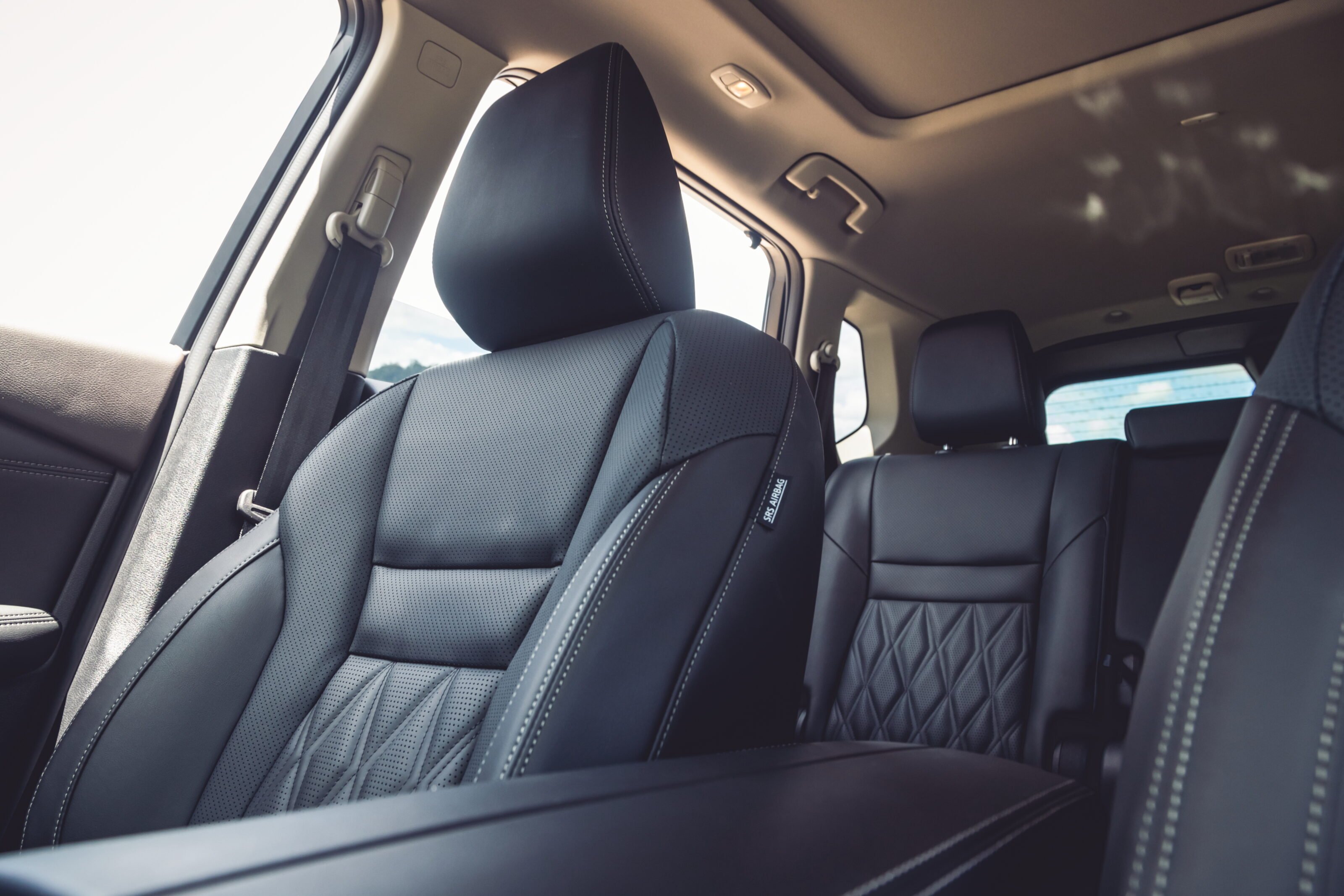
Comfy seats, too, with 12-way power adjust for driver and passenger including lumbar, three-stage heating. Two-position memory for both front seats is standard on Ti-L.
3
Two cup holders feature in the textured centre console, located above a rubberised storage tray that is perfect for small bags or notepads. Good-sized door bins and a deep central cubby with a butterfly-opening lid finish the X-Trail practicalities.
Wireless charging is standard, complemented by USB-C, USB-A and 12-volt sockets to charge devices from the front seat.
The X-Trail continues to impress in the back with an elevated bench that gives a stadium view over front occupants. It’s easily wide enough for three across the bench, and those over 180cm tall will be plenty comfortable.
A third zone for the climate can be controlled by rear passengers or those in front, while the Ti-L gets heated outboard rear seats. Only the X-Trail’s armrest is a letdown. It’s more of a ski port with hard plastic cup holders that annoy the elbow.
2
Door hinges may not sound exciting, but the X-Trail’s cast metal items are completely different to related Outlander’s stamped hinges, enabling the doors to open out to 85º for a big aperture. It’s so easy to feed baby seats and kids in – you can even parkour leap through the X-Trail, should you wish.
Nissan was keen to point out that the E-Power X-Trail doesn’t lose any cabin space compared to petrol-only versions.
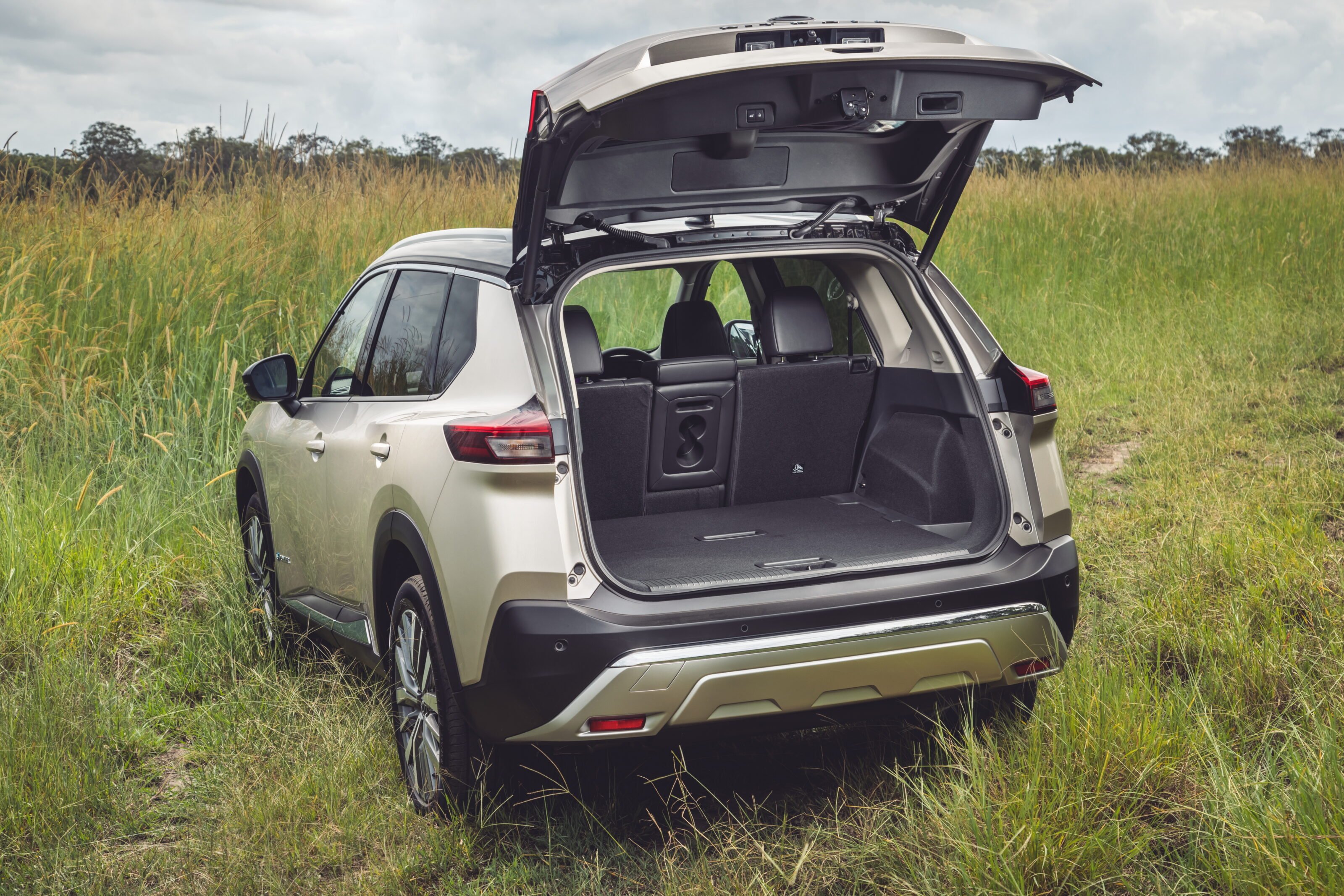
That’s true for occupants – with the battery slipped seamlessly under the front seats – but the AWD system’s rear motor does rob 10 litres of VDA cargo capacity. And although 575L is still plenty, there’s no spare tyre fitted to AWD E-Power models.
A divide-and-hide configurable floor is included on Ti and Ti-L, perfect for separating shopping from other bags. Nissan claims 16 different configurations for boot storage are possible. The second row also folds completely flat, with a power tailgate as standard, making it easy to pop the trunk and load bulky items.
1
What is it like to drive?
The basics
| Nissan X-Trail E-Power hybrid | |
|---|---|
| Model | X-Trail E-Power AWD |
| Combustion engine | 1.5L turbo-petrol 3-cyl, DOHC, VCR |
| Electric motors (F | R) | 150kW/330Nm | 100kW/195Nm |
| System power | 157kW |
| 0-100km/h | 7.0 seconds |
| Gearbox | single-speed |
| Body | steel, 5-door, 5-seat medium SUV |
| Fuel/tank | 95 RON / 55 litres |
| Economy | 6.1L/100km (ADR 81/02) |
| Boot space | 575L |
The E-Power is bamboozling on paper, but the way it drives couldn’t be simpler.
One 150kW/330Nm electric motor mounted at the front and a second 100kW/195Nm motor on the rear axle combine for a 157kW peak power figure, and a claimed 0-100km/h sprint of 7.0 seconds.
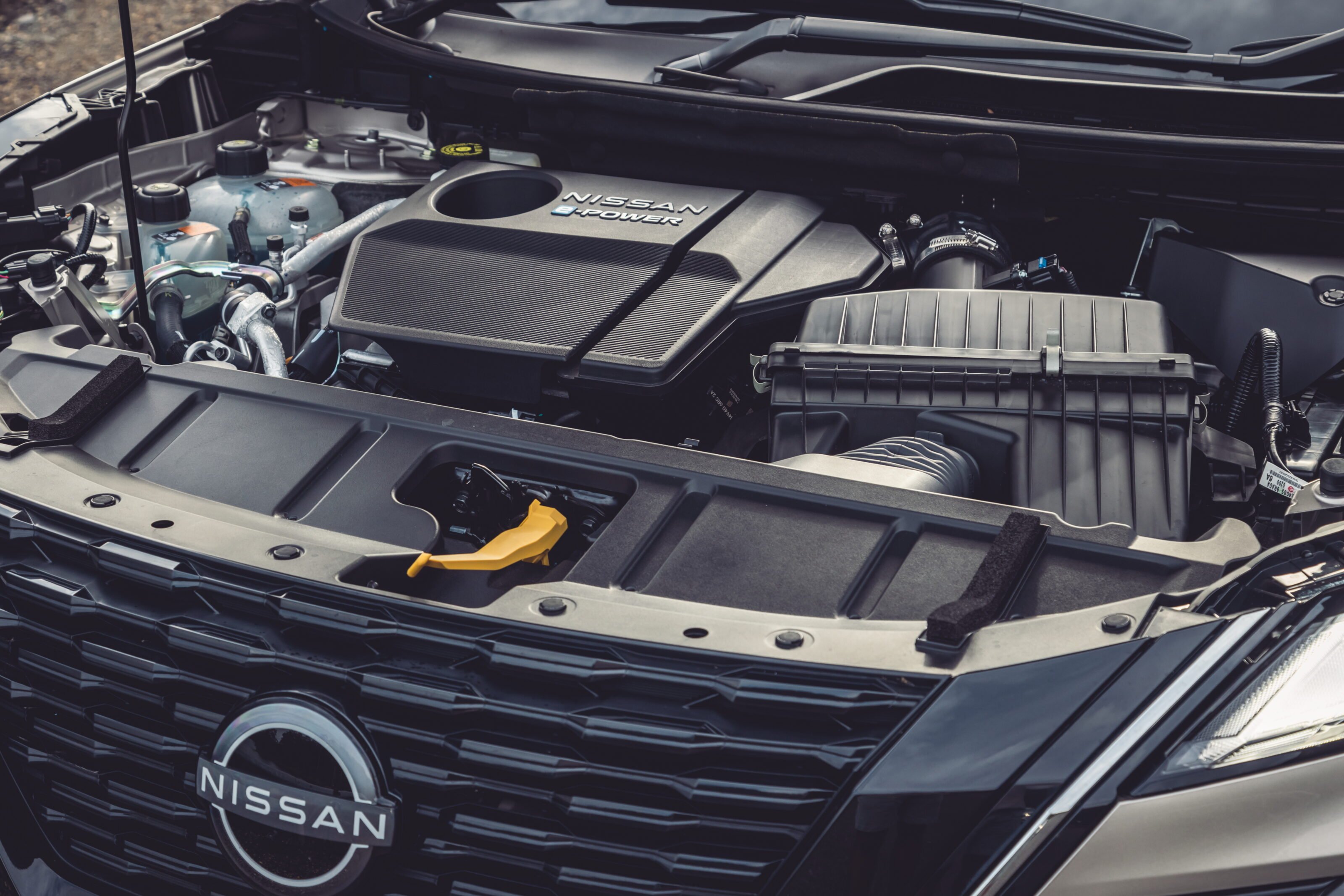
The E-Power’s wheels are turned exclusively by the electric motors, with a 106kW/250Nm 1.5-litre turbo-petrol three-cylinder combustion engine with variable compression ratio providing top-up energy for the 2.1kWh lithium-ion battery.
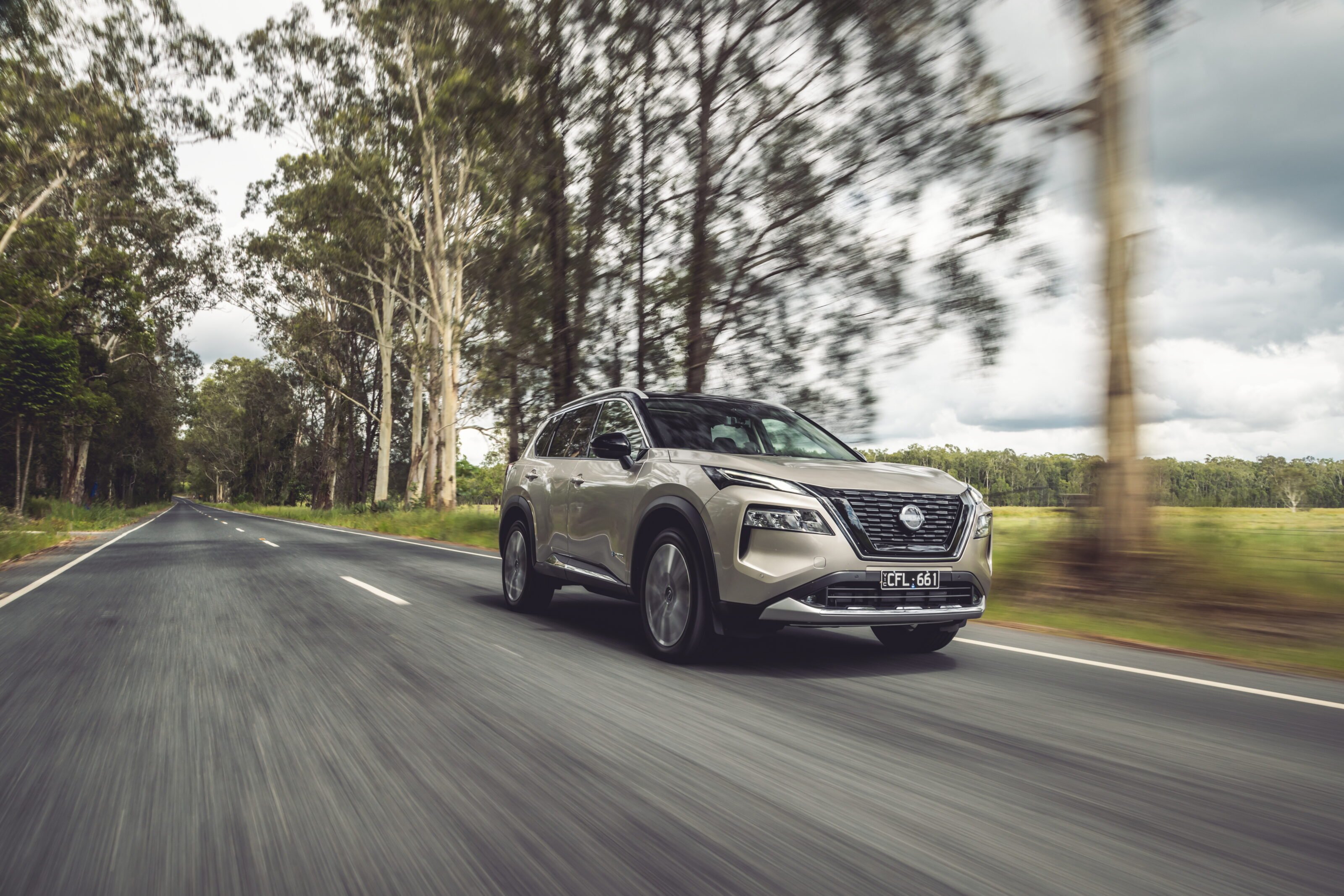
1
Under full throttle, the X-Trail E-Power’s combustion engine does provide grunt to the electric motors via the inverter (bypassing the battery) but there’s no driveshaft connecting the petrol engine to the wheels.
Complexity continues in the combustion engine itself. The pistons rotate on individual cams that allow the compression ratio to vary between 8:1 for maximum power to 14:1 to hit peak efficiency. Toyota’s answer to this is running its hybrid engines in the Atkinson cycle, but to quieten the powertrain and minimise the ‘rubber band’ effect, Nissan chose the variable compression route.
There’s no tacho, but we’re told the engine rotates below 2400rpm when at less than 50 per cent throttle under 80km/h.
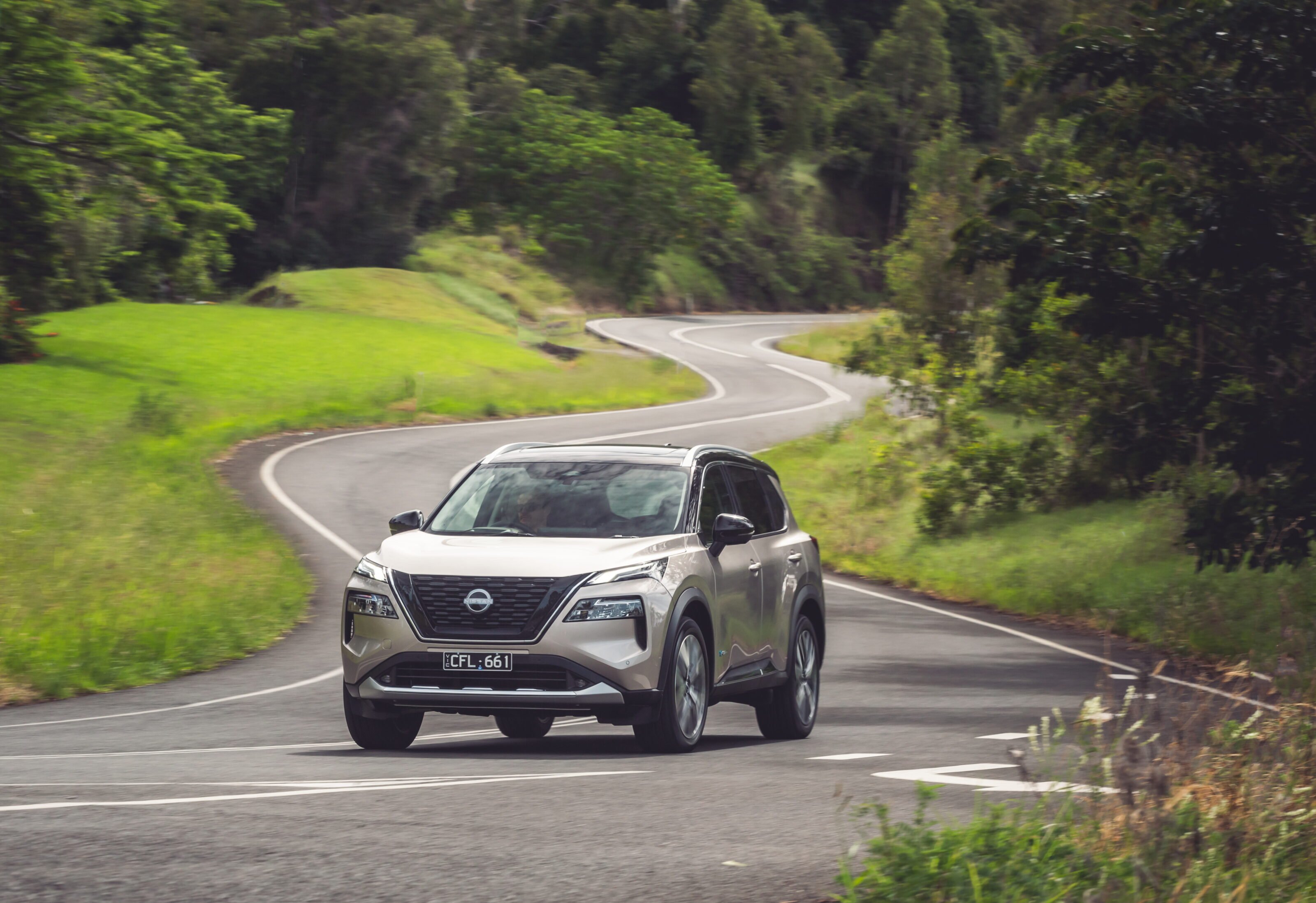
1
Nissan’s solution is nerdy, complex and a little mind-bending on paper – but in the real world, it translates to a refined, responsive and relaxing drive.
Only occasionally do you hear the three-pot thrum (standard active noise cancellation helps minimise that further), otherwise, it’s EV sailing.
Hitting the EV Mode button, we managed around 4km on battery power alone. There’s also an E-Pedal mode (developed first on the Leaf) which uses regenerative braking to slow the car (preferencing the rear motor to minimise forward pitch under deceleration) to 7km/h, at which point the driver has to step in and apply the left-hand pedal.
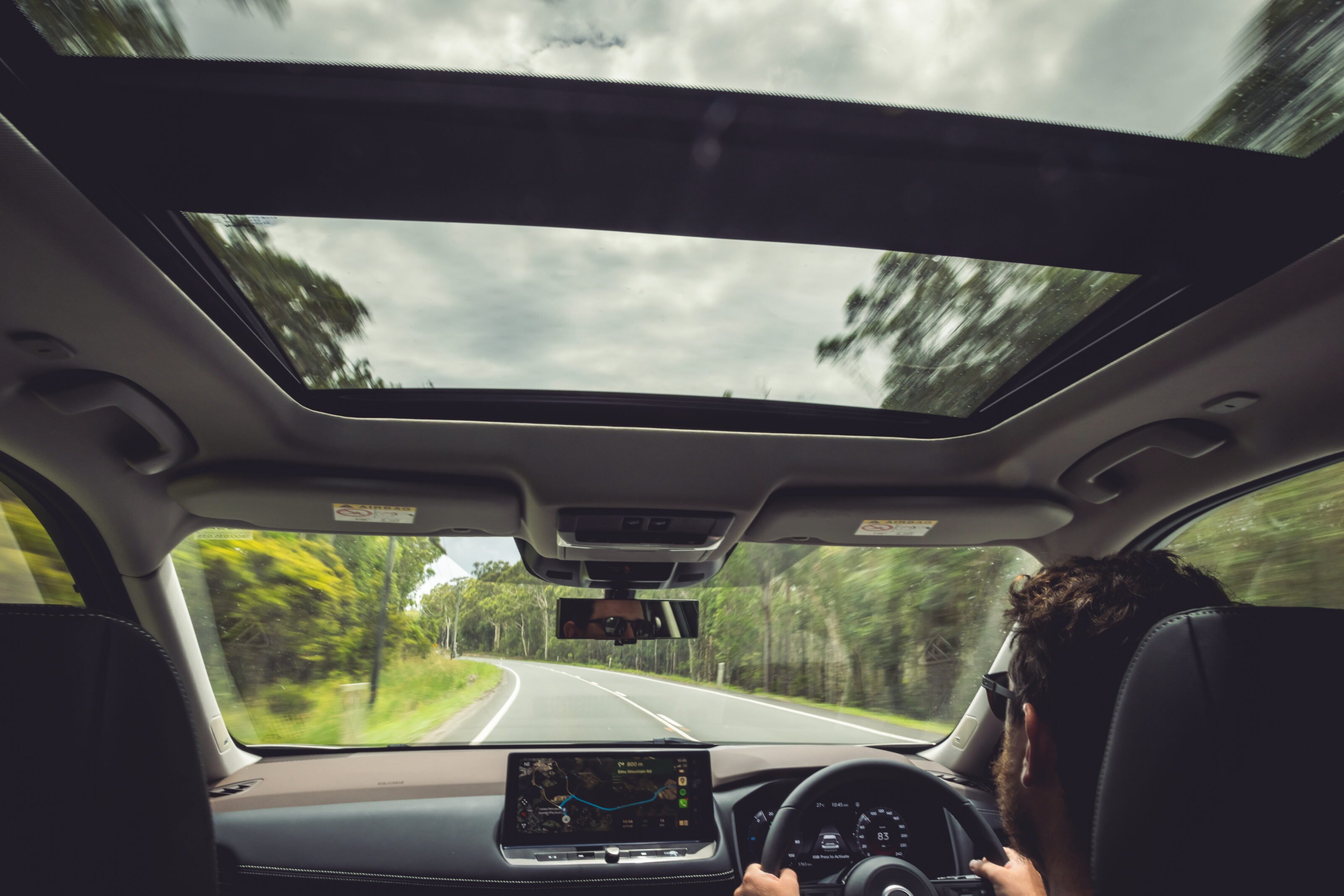
1
When using E-Pedal mode, the brake pedal disappears down into the foot well, which is disconcerting at first but intentional. The X-Trail E-Power primes the brake lines with pressure, for a more natural pedal location when the time comes to stop. Clever.
Away from the X-Trail’s typical urban stomping ground, it continues to impress. The electric motors give the E-Power serious alacrity when punching from 60-100km/h, with noise, vibration and harshness remaining well suppressed.
Select Sport mode and the steering weights up, the throttle sharpens and a little extra regen braking simulates engine braking. Tipping the X-Trail through tight and technical roads around Brisbane’s hinterland reveals a secure and neutral chassis.
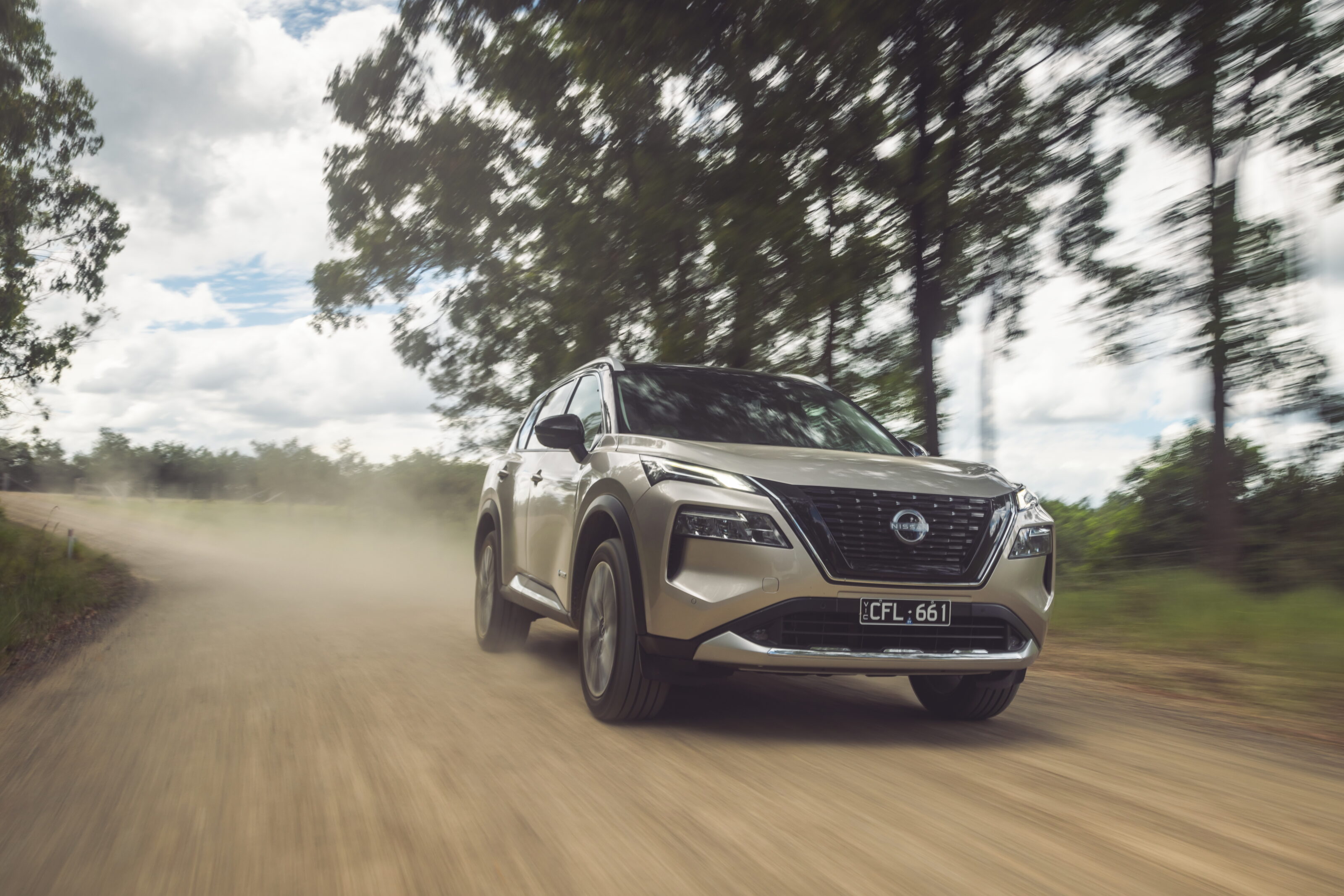
1
The E-Power has more advanced torque-vectoring by brake, which helps keep the medium SUV on the driver’s intended line.
Combined with the AWD system’s ability to move torque around at 1/10,000th of a second, this gives the X-Trail E-Power great traction on dirt, too. Switching the drive selector into Off-Road directs more torque rearward for improved grip.
Grip is good from the 235/50R19 Dunlops on the Ti, and only improves with the 255/45R20 Michelin Primacy 4 rubber of the Ti-L. The larger wheels introduce whisker more fidget from small bumps, but it’s nowhere near as much as a Mitsubishi Outlander fitted with 20s.
The X-Trail’s ride is generally excellent; compliant when you want and supportive when you need.
2
How much fuel does it use?
Nissan quotes an ADR combined fuel consumption figure for the X-Trail E-Power AWD of 6.1L/100km, and 6.5L/100km on the urban cycle. 95 RON premium unleaded is recommended, but the E-Power will take 91 RON in a pinch.
The Toyota RAV4 Hybrid AWD is the winner on paper, with 4.8L/100km combined and 5.0L/100km in the urban cycle.
In the real world, though, the Nissan provided very promising results. Over 300km of fast open-road driving the E-Power’s trip computer read an agreeable 6.5L/100km.
A supplementary 45-minute urban test around Brisbane’s suburbs saw the X-Trail E-Power’s fuel consumption fall to 5.5L/100km. Granted, that was maximising the use of EV mode and the E-Pedal program but we kept up with traffic and had the air-con set to 18º and fan speed at four.
How safe is it?
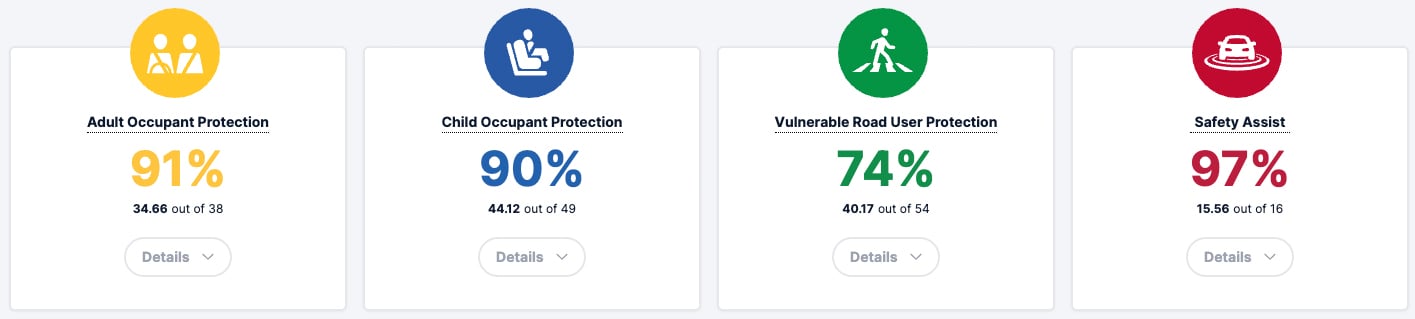
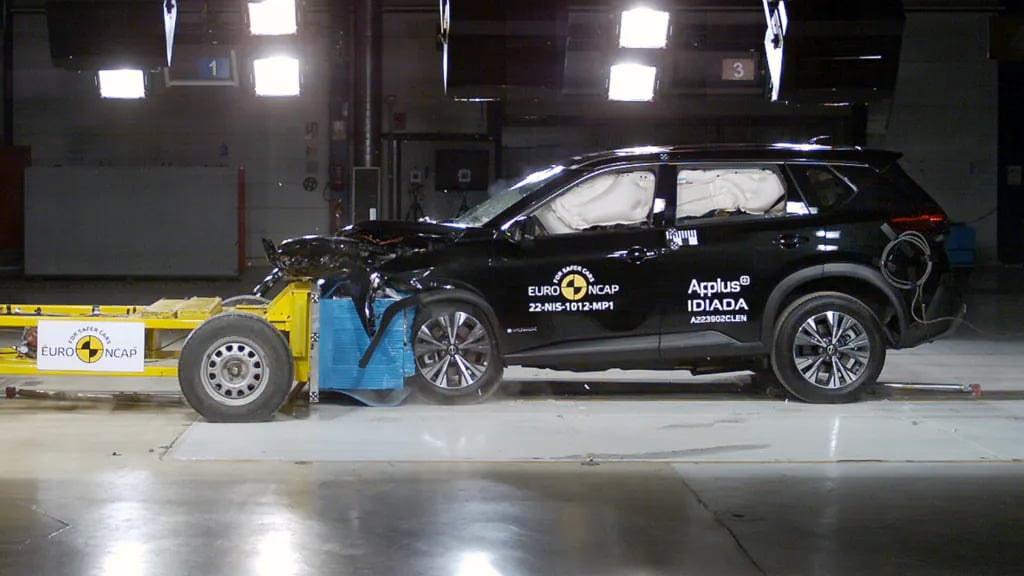
The 2023 Nissan X-Trail E-Power was rated five-stars in ANCAP safety testing based on partner model testing with Qashqai.
1
1
It was subjected to two additional crash tests, and separate data was taken on its active safety systems for its rating
We deemed the driver assistance features mature in their tuning, with much-improved lane-trace assist from before, and good adaptive cruise control programming. The aids have various levels of efficacy adjustable using the 12.3-inch digital driver’s display.
| 2023 Nissan X-Trail E-Power safety features | |
|---|---|
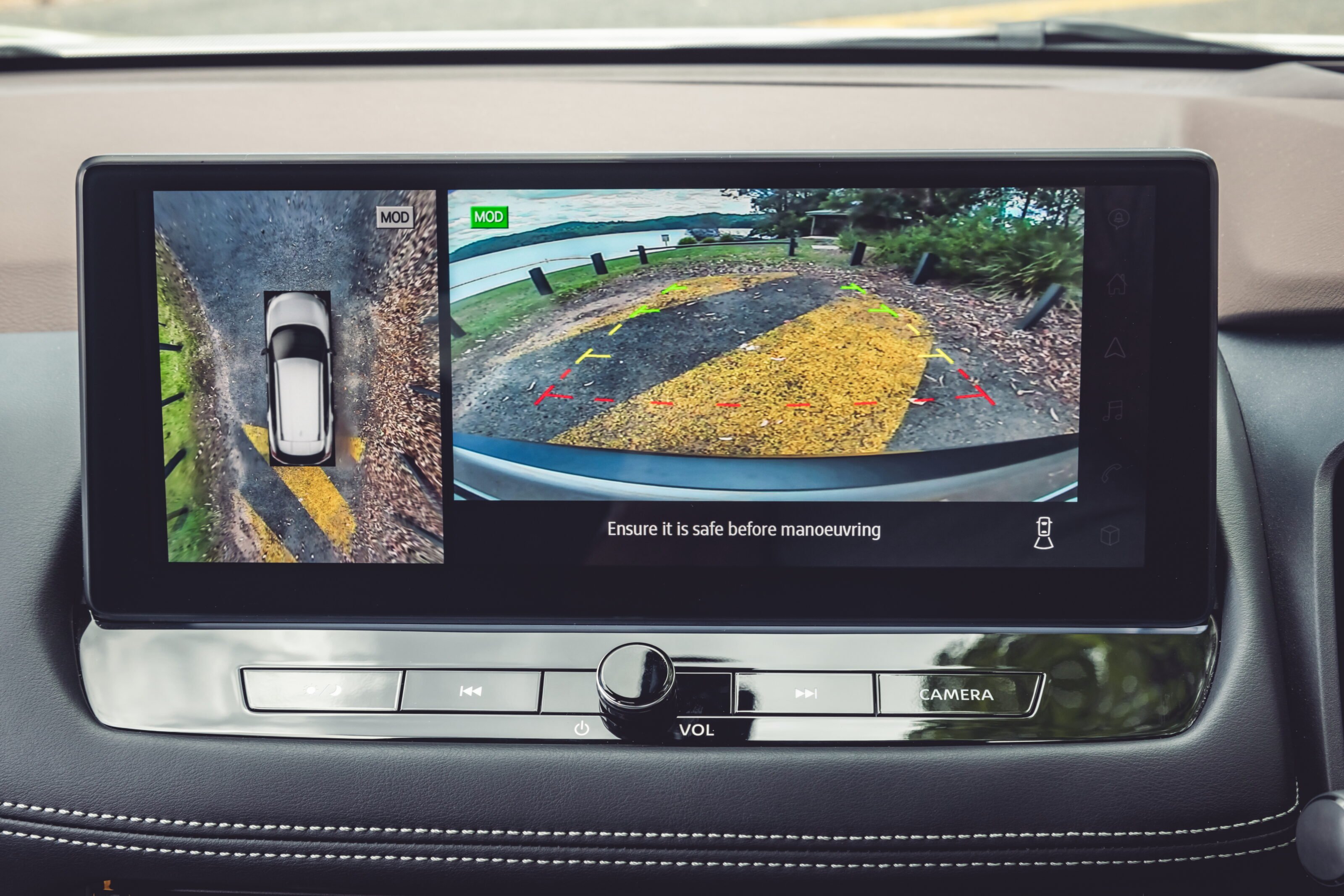
| 360-degree camera system | Driver awareness monitor |
| 7 airbags | Lane-trace assist |
| Adaptive cruise control with stop & go | Rear cross-traffic alert |
| Blind-spot monitoring with intervention | Rear occupant monitoring |
| Digital rear-view mirror | Reverse AEB |
| Front auto emergency braking with pedestrian/cyclist/junction detection | |
Warranty and running costs
The Nissan X-Trail is covered by a five-year, unlimited-kilometre warranty in Australia, with six years of capped-price servicing.
Maintenance is due more regularly than rivals such as the Toyota RAV4 and Haval H6 HEV, with the X-Trail E-Power requiring a service every 12 months or 10,000km.
The servicing is expensive, too, costing $2353 for five years or 50,000km. For the average Australian who travels around 13,000km annually, by the fifth year of ownership you’ll have covered 65,000km, meaning the sixth service is due. It’s a major one, and costly at $698.
It results in a five-year average ownership cost of $3051, compared to $1650 for a Haval H6 hybrid or more than twice that of a RAV4 hybrid ($1300).
1
VERDICT
The Nissan X-Trail hybrid has its flaws; servicing is expensive, the ANCAP rating is a little misty, and on-paper fuel consumption not exactly jaw-dropping.
But as a medium SUV to drive? It’s easily one of the best out there.
The ride quality, chassis confidence and well-integrated safety aids are the start, and the practical, thoughtful cabin icing on the cake.
For those willing to alter their driving attitude and maximise electric-only driving with E-Pedal, 5-5.5L/100km urban fuel efficiency should be possible.
The Ti is equipped handsomely, but a Ti-L with tan interior is worth the extra for visual interest alone. And if you’re just happy paying $4200 for a much more modern and refined powertrain, then the E-Power is easy to recommend.
MORE
Everything Nissan
MORE
Electric SUVs
Nissan X-Trail E-Power specifications
| Nissan X-Trail E-Power | Ti | Ti-L |
|---|---|---|
| Price | $54,190 + on-road costs | $57,190 + on-road costs |
| Drivetrain | ||
| Engine | 3cyl, 1.5-litre, DOHC, VCR, turbo-petrol, direct-injected | |
| Electric motor (F|R) | 150kW/330NM | 100kW/195Nm | |
| Layout | front engine, twin electric motor, AWD | |
| Power | 157kW | |
| Torque | not specified | |
| Traansmission | single-speed | |
| 0-100km/h | 7.0 seconds (claimed) | |
| Chassis | ||
| Body | steel, 5-door, 5-seat medium SUV | |
| L/W/H/Wu2013B | 4680/2065/1725/2705mm | |
| Track (F/R) | 1575/1580mm | |
| Weight | 1903kg | 1911kg |
| Boot | 575L | |
| Fuel/tank | 95 RON / 55 litres | |
| Economy (combined ADR81/02) | 6.1L/100km | |
| Suspension | Front: struts, coil springs, anti-roll bar. Rear: multi-link, coil springs, anti-roll bar | |
| Steering | electric rack-and-pinion | |
| Front brakes | disc | |
| Rear brakes | disc | |
| Tyres | Dunlop Grandtrek | Michelin Primacy 4 |
| Tyre size | 235/55R19 | 255/45R20 |
| Safety | ||
| ANCAP rating | five stars | |
UPDATE: Nissan X-Trail E-Power driven on Australian roads
The X-Trail E-Power hybrid has hit Australian soil, and we’ve driven it!
Head over to the review page to hear what John Law has to say about it, or watch the video below.
Jump to: X-Trail E-Power Australian pricing
UPDATE: X-Trail E-Power driven
We’ve now driven the new 2023 X-Trail E-Power in Japan, ahead of its Australian market launch.
Tony O’Kane reports: “Forget what you know about the X-Trail: its all-new electrified replacement kicks big goals as far as refinement, quality, equipment, space and efficiency are concerned.
“The electrically-augmented X-Trail presents well as a tech flagship for Nissan’s mainstay SUV.”
Get the full review at the links below, or keep reading for all the pricing and details on the 2023 X-Trail E-Power.
The story to here
October 13: X-Trail E-Power pricing announced
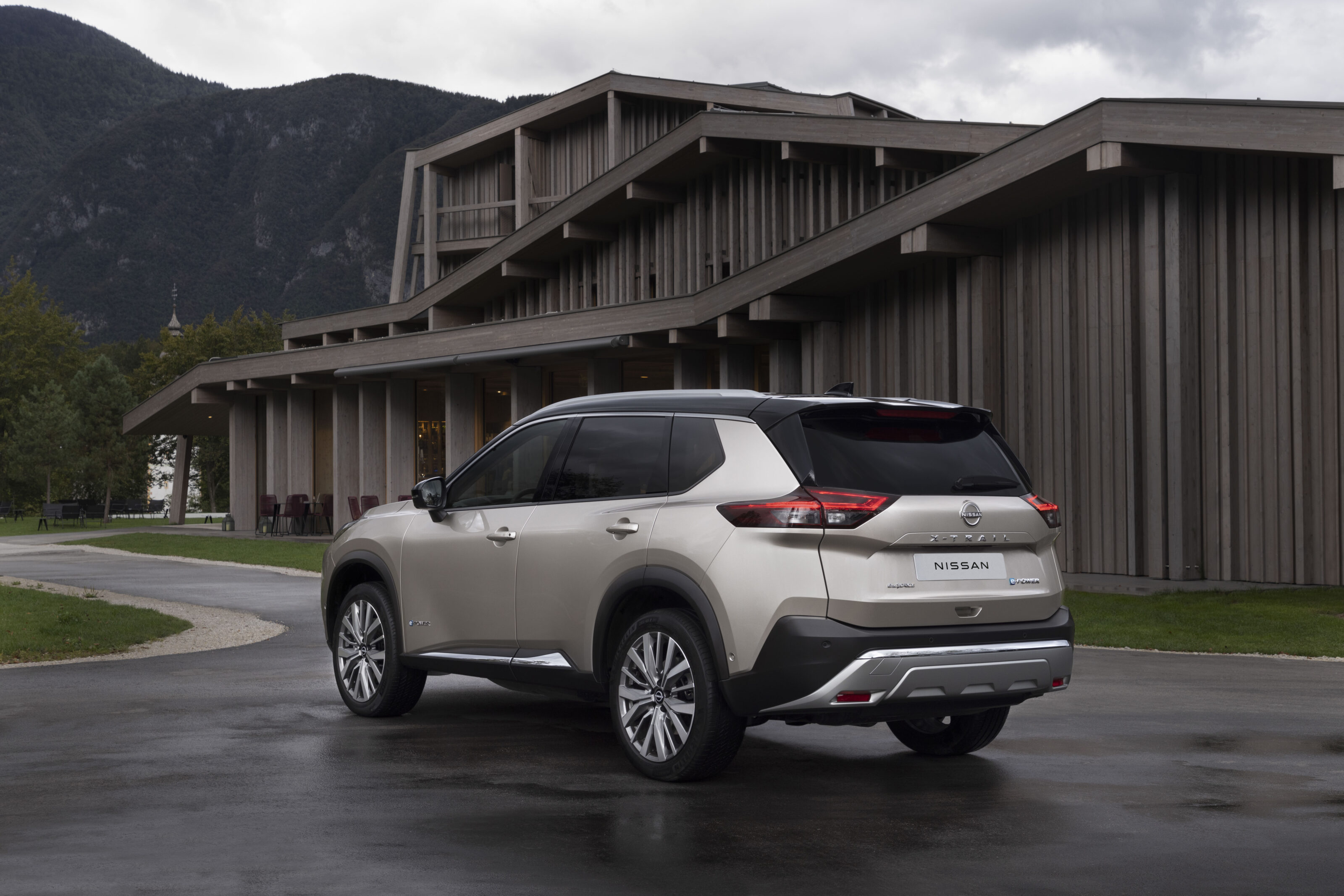
The all-new 2023 Nissan X-Trail E-Power is inbound, with local deliveries expected to commence from early next year.
Harnessing Nissan’s innovative dual motor e-4ORCE front axle, owners of Nissan’s spearhead all-wheel drive SUV are promised a smoother experience behind the wheel and increased efficiency.
1
2023 Nissan X-Trail E-Power Australian pricing
| Model | Price |
|---|---|
| X-Trail Ti e-POWER with e-4ORCE | $54,190 |
| X-Trail Ti-L e-POWER with e-4ORCE | $57,190 |
Features
As standard, the 2023 Nissan X-Trail Ti gains features such as:
| Leather accented seating |
| 19-inch alloy wheels |
| Panoramic sunroof |
| LED turn signals |
| Smart rear view mirror |
| Tri-zone climate control |
| Adaptive Driving Beam |
| Auto wipers |
| Power operated tailgate |
| 12.3-inch infotainment screen w/ satnav |
| 10.8-inch heads-up display |
| Wireless phone charger |
| Wireless Apple CarPlay |
| Wired Android Auto |
| 12.3-inch digital driver display |
| Power adjustable, power folding, heated door mirrors |
| Ambient lighting |
1
The flagship Ti-L gains, in addition or in place of:
| 20-inch alloy wheels |
| Heated steering wheel |
| Bose 10-speaker sound system |
| Full Nappa leather seating with memory function |
| Rear sunshades |
| Hands-free tailgate |
| Heated rear outboard seats |
| Remote engine start |
| Power adjustable, power folding, heated door mirrors w/ reverse tilt |
Engine, drivetrain and fuel economy
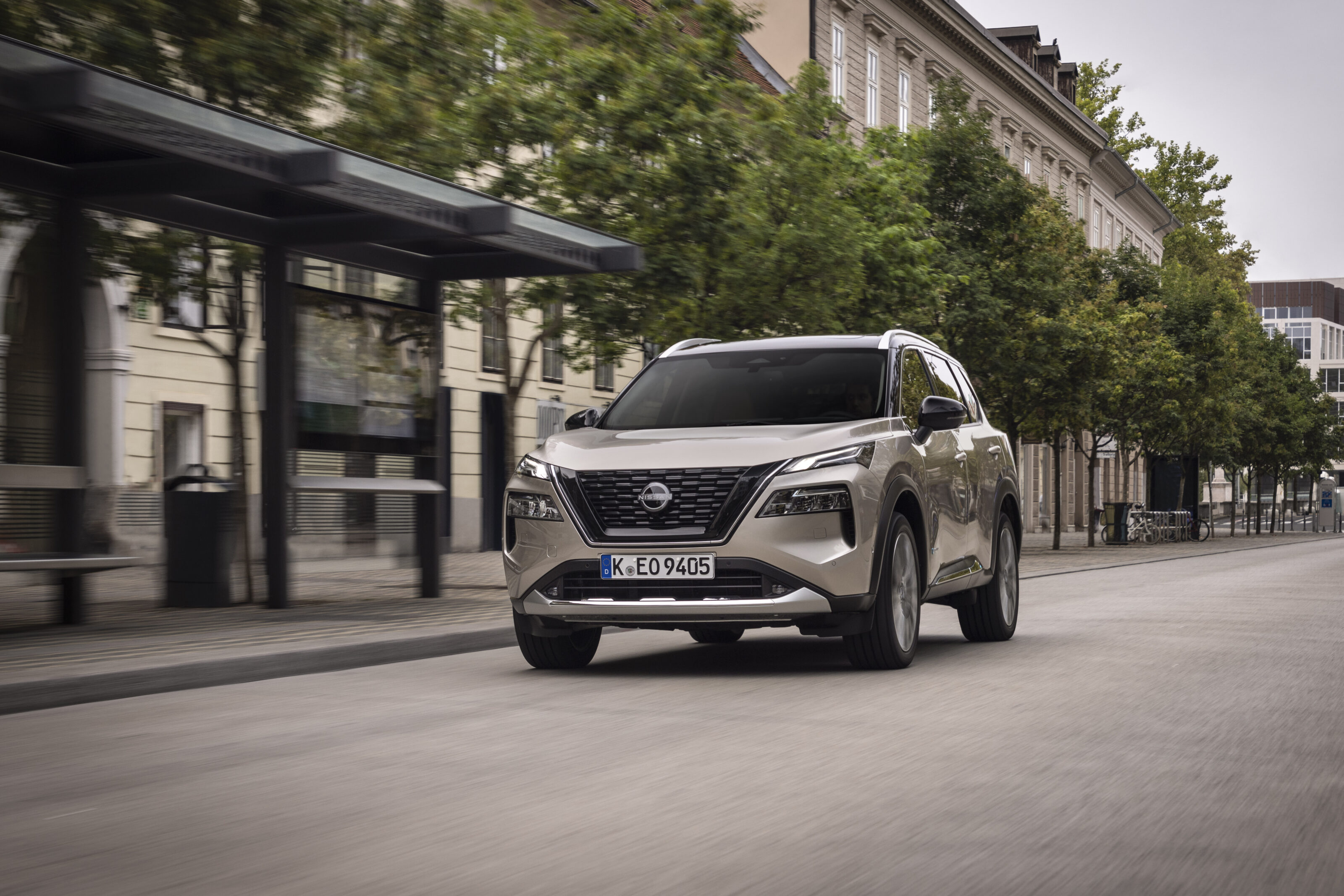
Unlike conventional plug-in hybrid systems, which use a battery until dead and then switches to combustion-powered drive, Nissan’s innovative e-Power with e-4ORCE system is made up of a high-output 1.8kWh battery pack working in symbiosis with the turbocharged variable compression petrol engine, power generator, inverter and twin electric motors (150kW front, 100kW rear, outputting a combined 157kW).
1
In practice, the wheels are purely driven by the electric motors, with the combustion engine, and the petrol you fill up with, only used to charge the battery with energy not salvaged from regenerative braking.
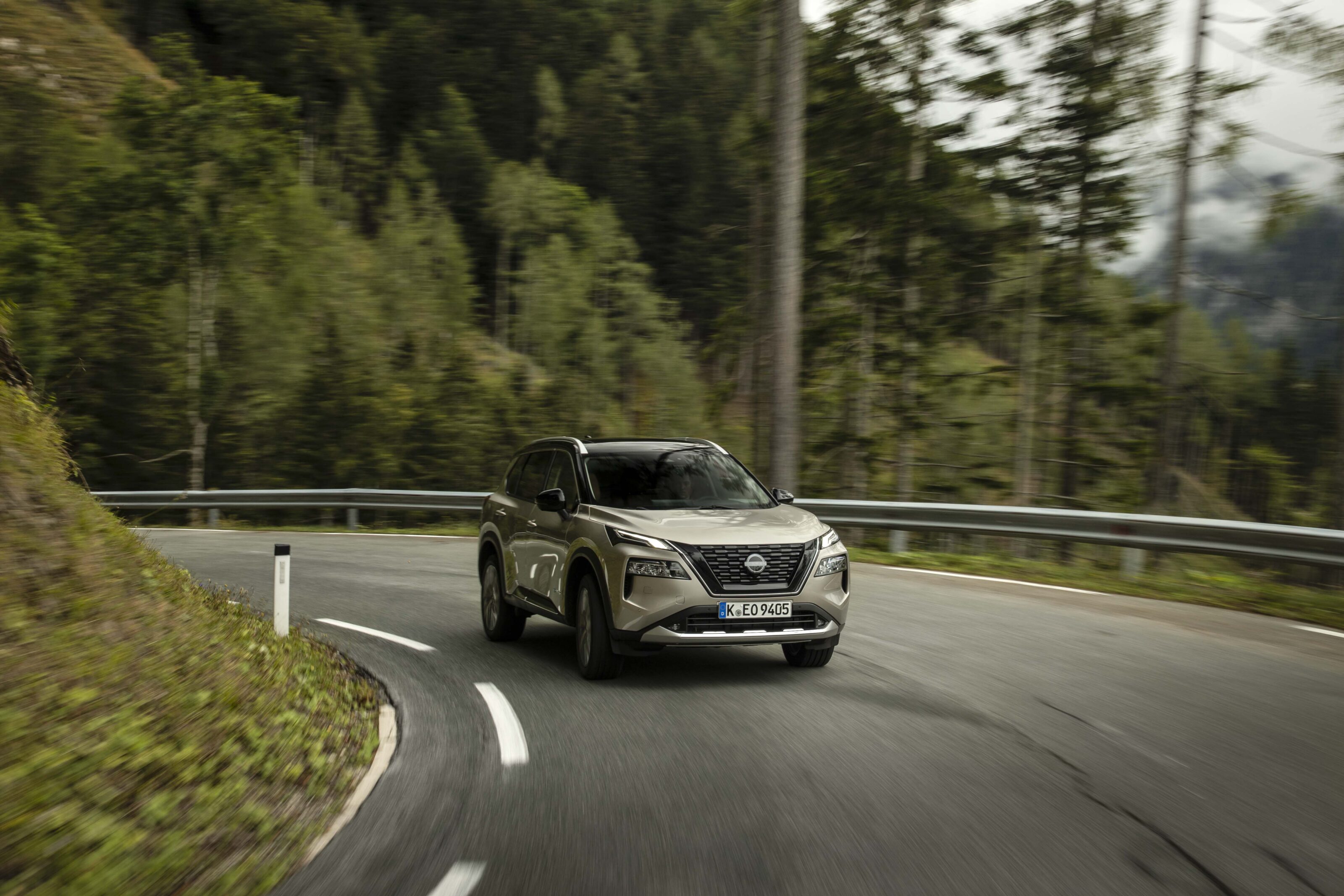
Subsequently, owners can expect a reliably constant and smooth driving experience, with fuel-efficiency claimed by Nissan to return just 6.1L/100km.
1
Dimensions
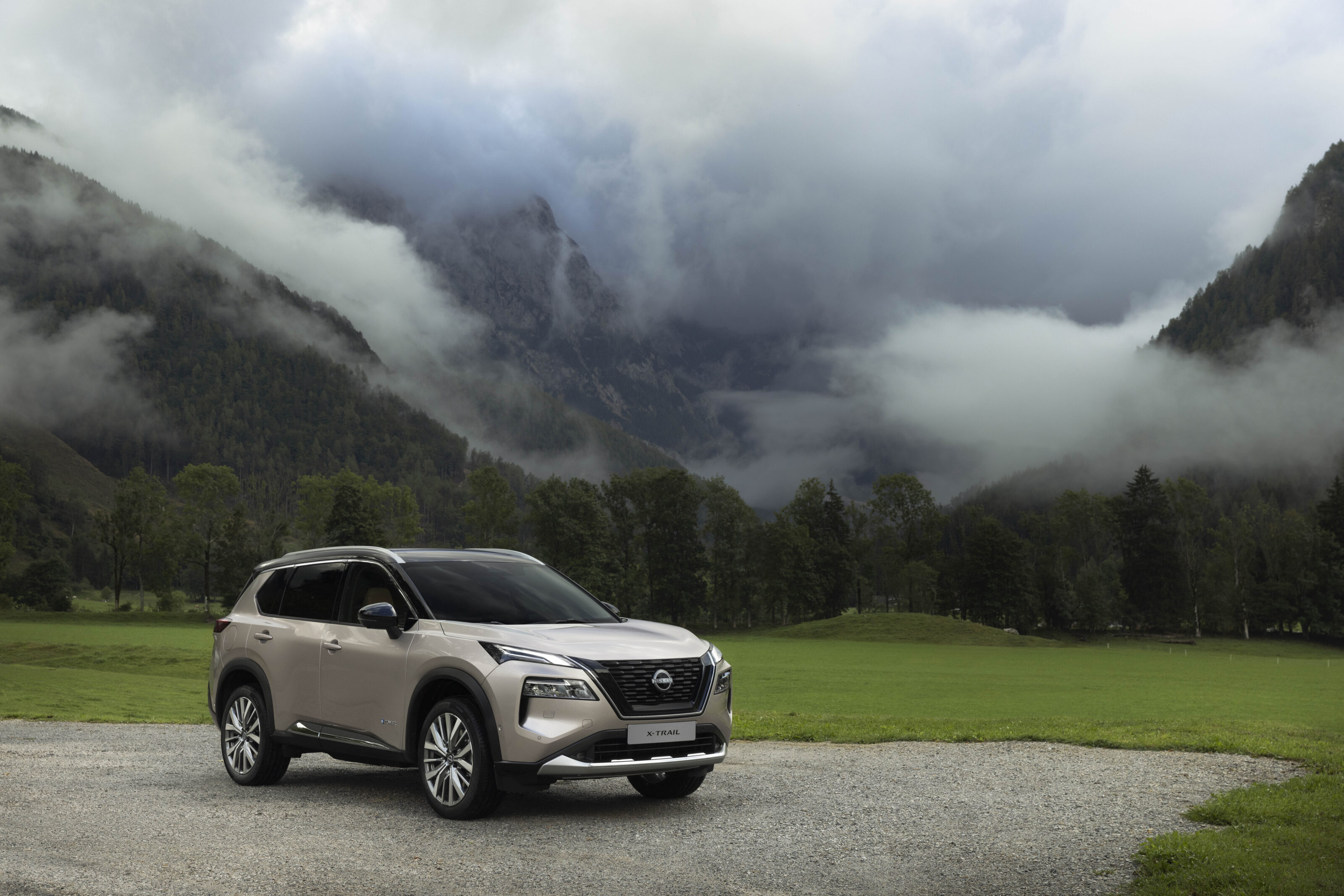
The 2023 Nissan X-Trail measures 4680 millimetres in length, 2065mm in width (including mirrors), and 1725mm in height.
The wheelbase measures 2705mm, with narrowly split 1585/1590mm track widths front and rear. Its turning circle measures an impressive (for its size) 11.1m.
Boot space is quoted at 575-litres for the e-Powered X-Trails, while lower-spec five-seat non-electrified overseas variants net a 585-litre boot.
1
Kerb weight of the X-Trail Ti measures 1903 kilograms, while the flagship Ti-L tips the scales at 1911kg.
Maximum braked towing capacity is pegged at 1650kg (non-electrified overseas variants are rated at 2000kg), with a 750kg unbraked capacity.
GVM for the Australian e-Power variants is pegged at 2380kg.
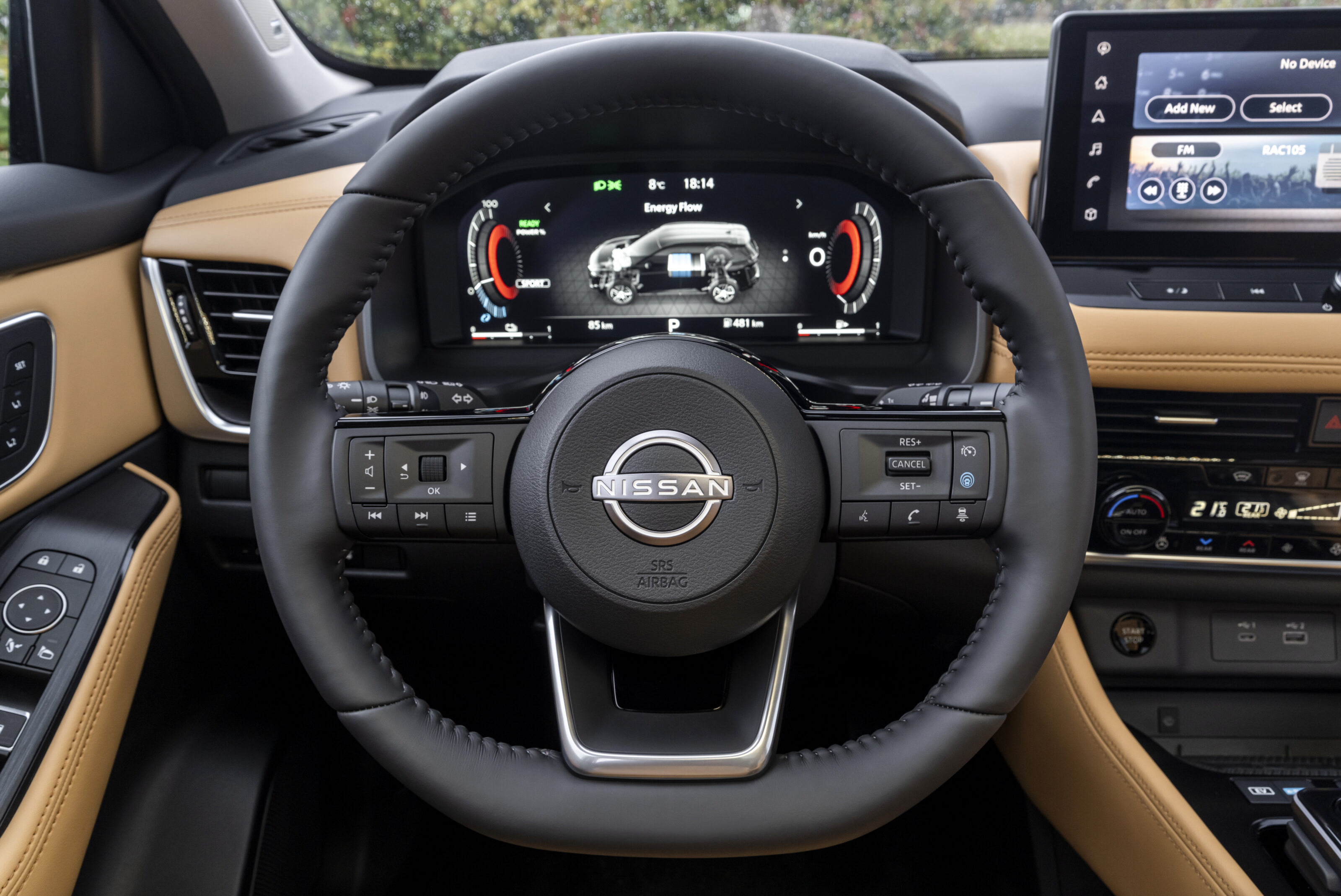
Safety
Both Australian X-Trail e-Power variants receive safety features such as:
| Rear view camera |
| Front and rear parking sensors |
| Forward collision warning |
| Autonomous emergency braking w/ pedestrian and cyclist detection |
| Junction assist |
| Rear AEB |
| Rear cross-traffic alert |
| Blind spot warning |
| Lane departure warning |
| Lane departure assist |
| Intelligent driver alert |
| Adapative cruise control |
| Traffic sign recognition |
| Tyre pressure monitoring |
| Trailer sway control |
| Speed limiter |
| Acoustic vehicle alerting system (up to 30km/h) |
| Rear seat alert |
| Tyre repair kit |
1
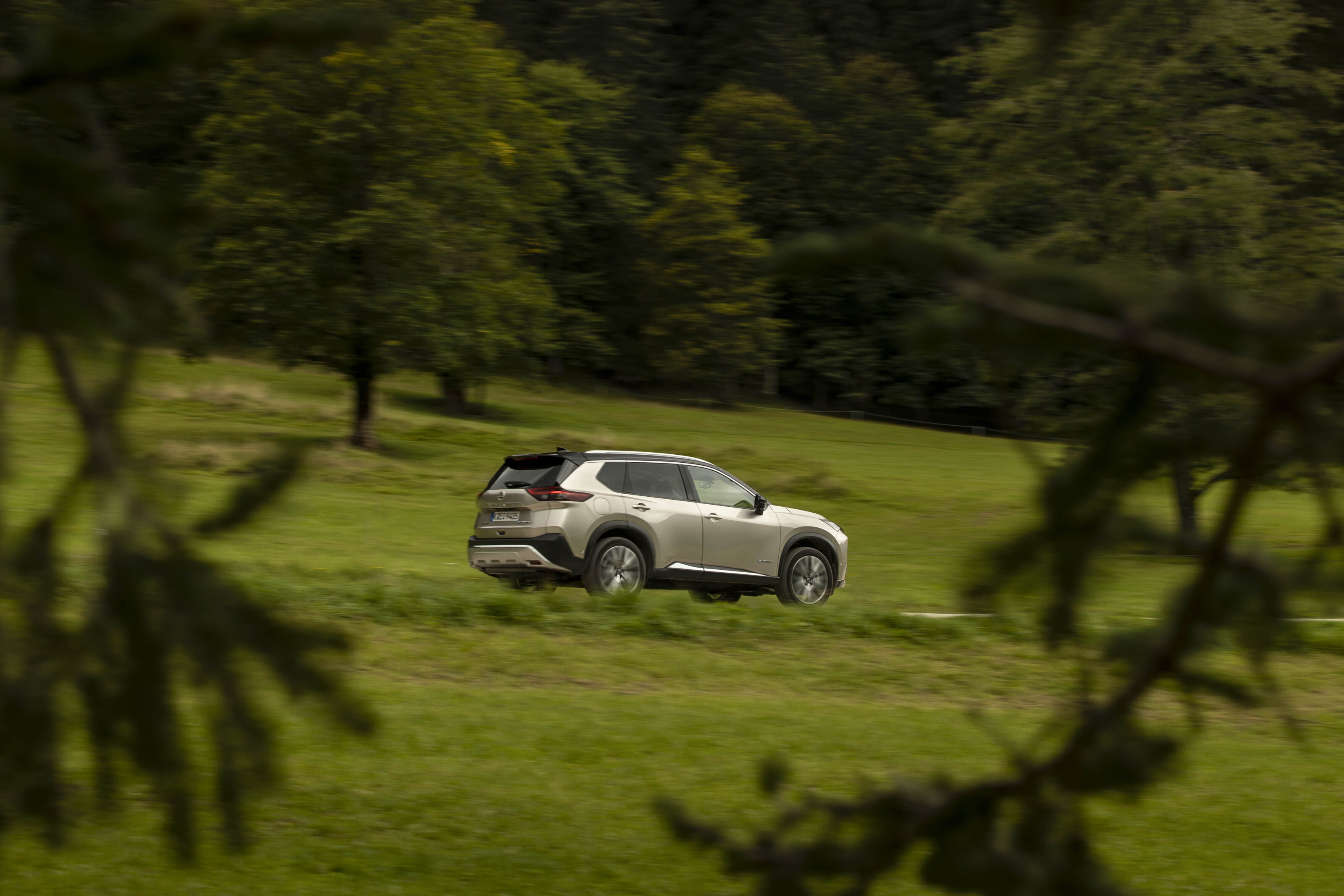
Warranty
All new Nissans are covered by a five-year/unlimited-km vehicle warranty, with complimentary five years of roadside assist, all fully-transferable to a second owner at no extra cost.
Availability
The 2023 Nissan X-Trail is expected to make Australian landfall from early next year. We will update this story with more information as more comes to light closer to launch.
1
Snapshot
- Four new models in 18 months
- Patrol Warrior, Qashqai E-Power confirmed
- Nismo Z, Ariya EV, another Navara all possible
“In the next 18 months, we’ll have another four new products in Nissan showrooms”, Australian managing director, Adam Paterson, told motoring media as he flicked to a Nissan Patrol Warrior teaser image.
After launching the new-gen X-Trail, Pathfinder, and Qashqai over a two-month period (and Z sports car before that), you could expect the Japanese carmaker to take a break. Not so.
We know a petrol-electric Qashqai E-Power is on the way, and the much-teased Nissan Patrol Warrior is a given, but what else?
1
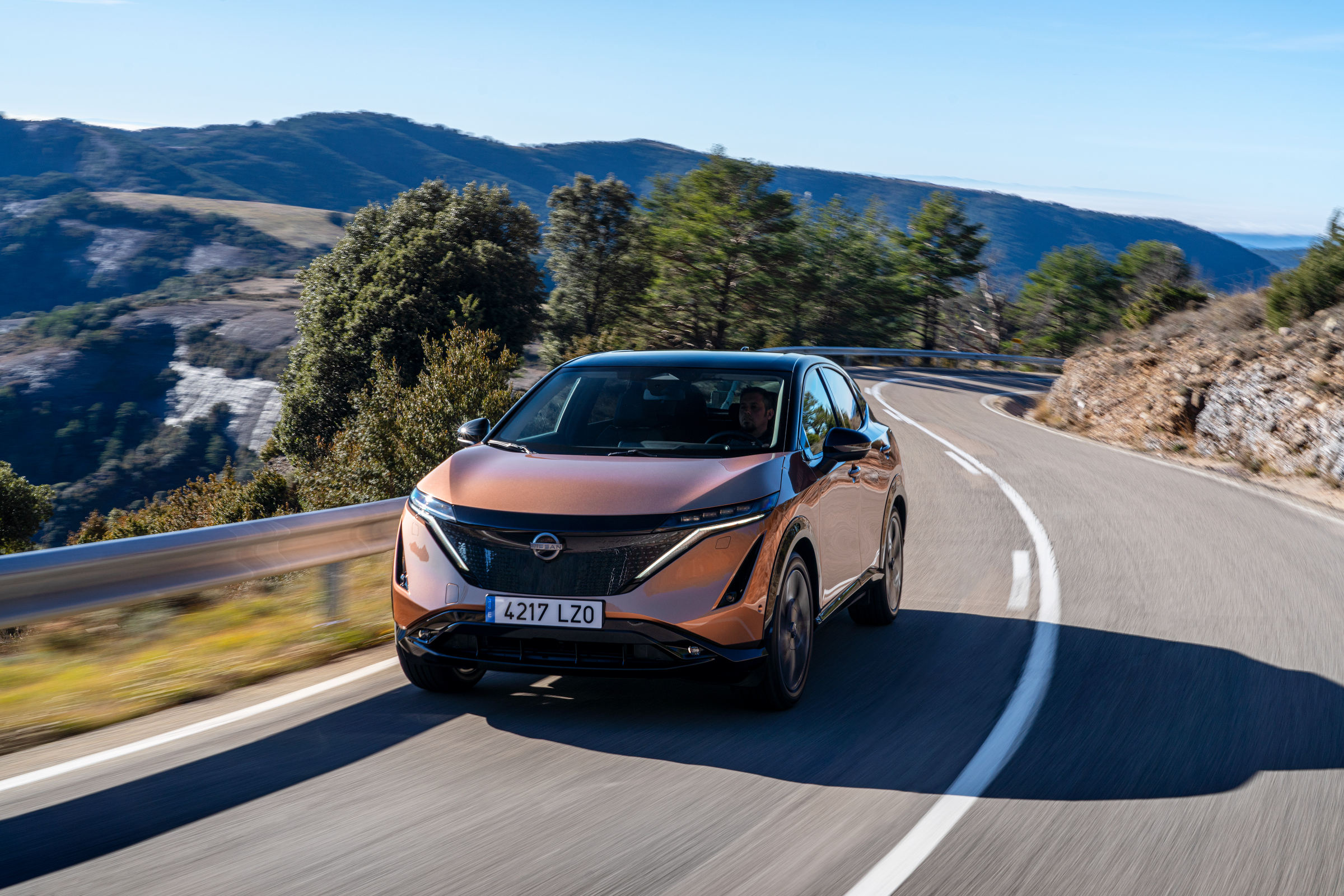
One of the two remaining slots will likely be filled by a hardcore Nissan Z Nismo at some point. The other is a toss-up between the Ariya – an all-electric SUV twinned with Renault Megane E-Tech on the CMF-EV platform – or perhaps another Navara variant.
Paterson declined to hint at what the mystery cars could be, but with the current product lineup, we’re pretty confident those names will come to Australia.
1
Qashqai E-Power first
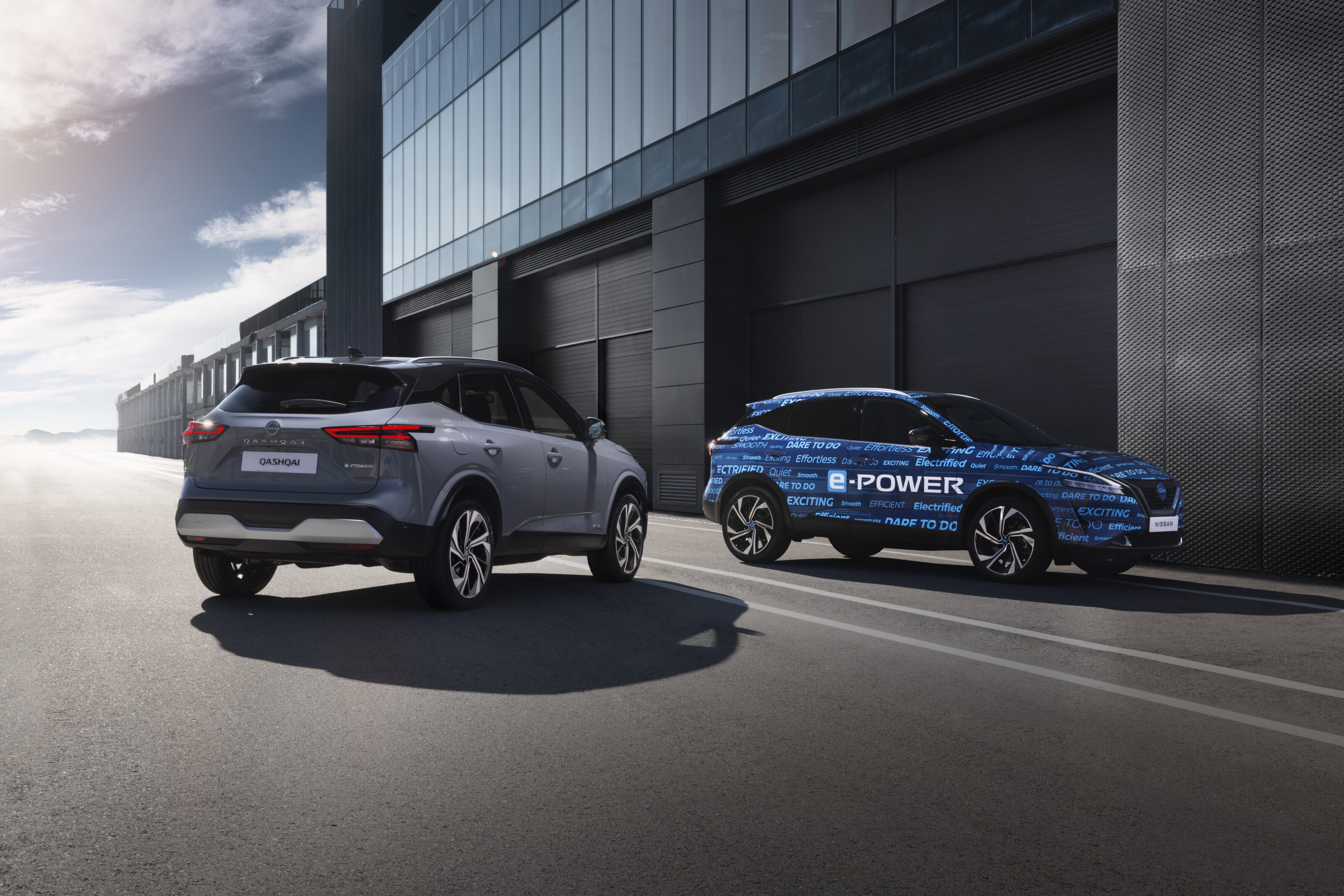
Originally destined for late 2022, a host of delays have pushed the Qashqai E-Power’s arrival back to this year. An exact date is not confirmed yet for the Toyota Corolla Cross rival, but it will join the new X-Trail E-Power here in time.
Power is 140kW, and on the WLTP combined cycle the Qashqai E-Power’s fuel-economy is rated at 5.3L/100km. As it has a front-wheel-drive powertrain, expect a smaller premium over its combustion-powered version than is the case within the X-Trail lineup – the difference expected to be about $3000 more for the E-Power Qashqai.
Like with the X-Trail, expect only the upper-trim ST-L and Ti to be available with the hybrid powertrain, meaning a starting price of around $45K, climbing to $50K-plus for the flagship model.
1
Patrol Warrior to follow
Confirmed in September last year with an expected 12-month turn-around, this one’s pretty obvious.
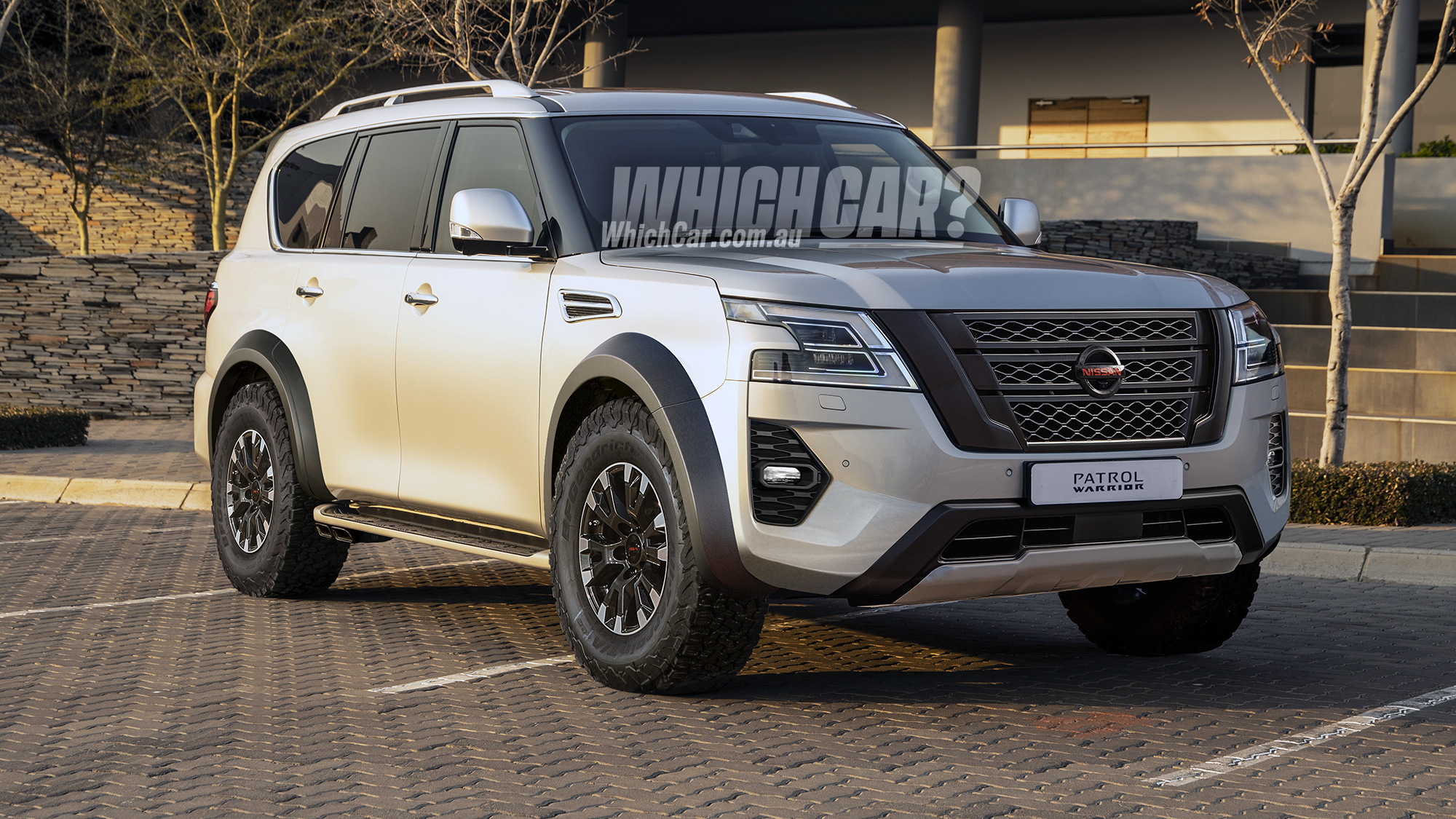
It’ll retain the Patrol’s 5.6-litre direct-injection petrol V8 developing at least 298kW of power and 560Nm of torque that will exhale through a side-exit exhaust.
Expect a suspension lift, chunky all-terrain rubber, under-body and frontal protection – as well as a starting price of $120K-plus.
1
Nismo Z, Ariya or Navara?
This is where things get a little harder to guess – the models above are confirmed awaiting a release date, but Nissan remains tight-lipped about the Ariya and hardcore Z.
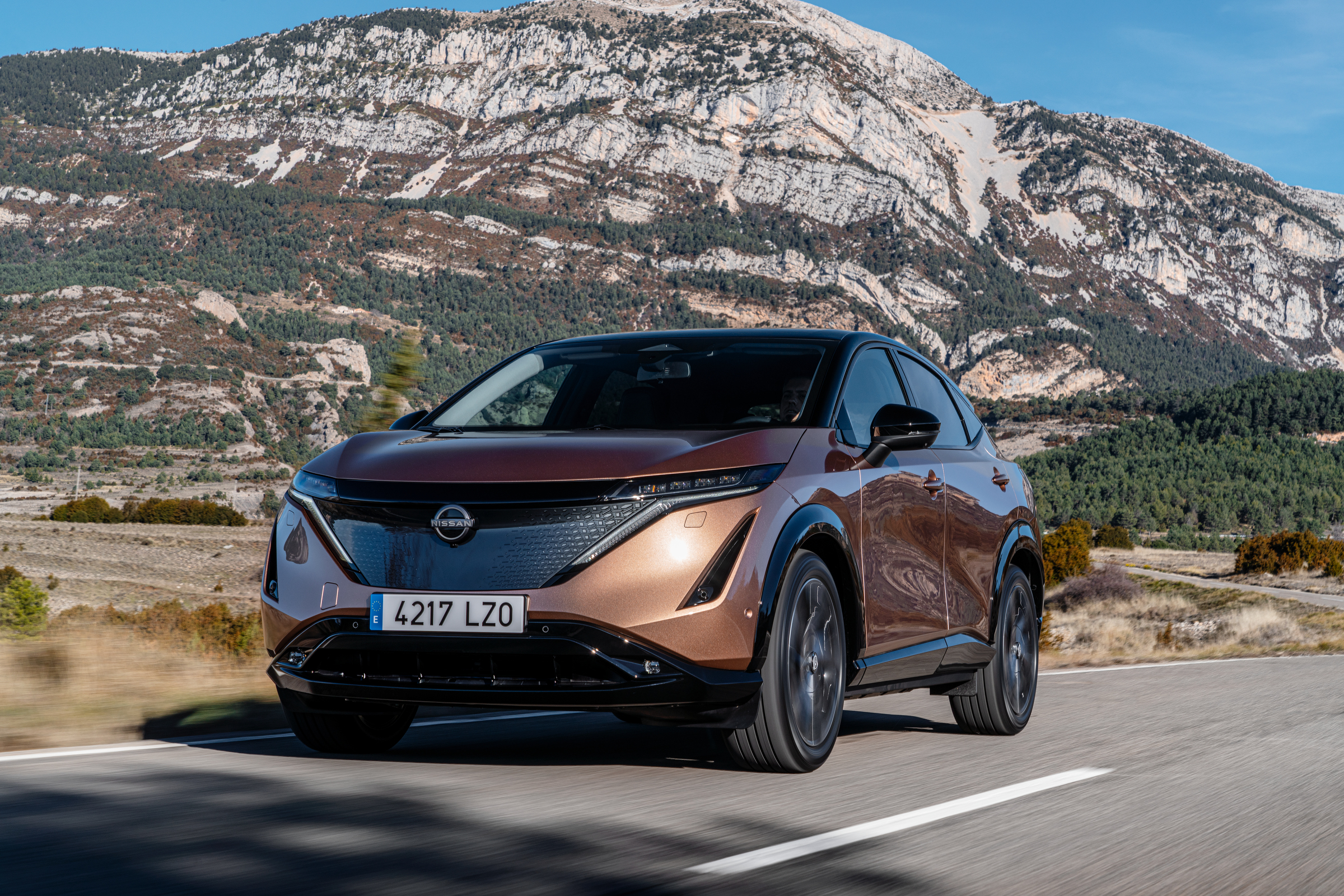
The Ariya electric crossover is slated for launch just as soon as global production allows. Although, after launching in Japan and Europe in 2021, we’re lagging a long way behind. With no emissions policies in place, there’s no need for Nissan to divert Ariya production to Australia.
But, 18 months from now, things could very well change, making a better case for the electric SUV with its 500-plus kilometre WLTP driving range and available AWD.
1
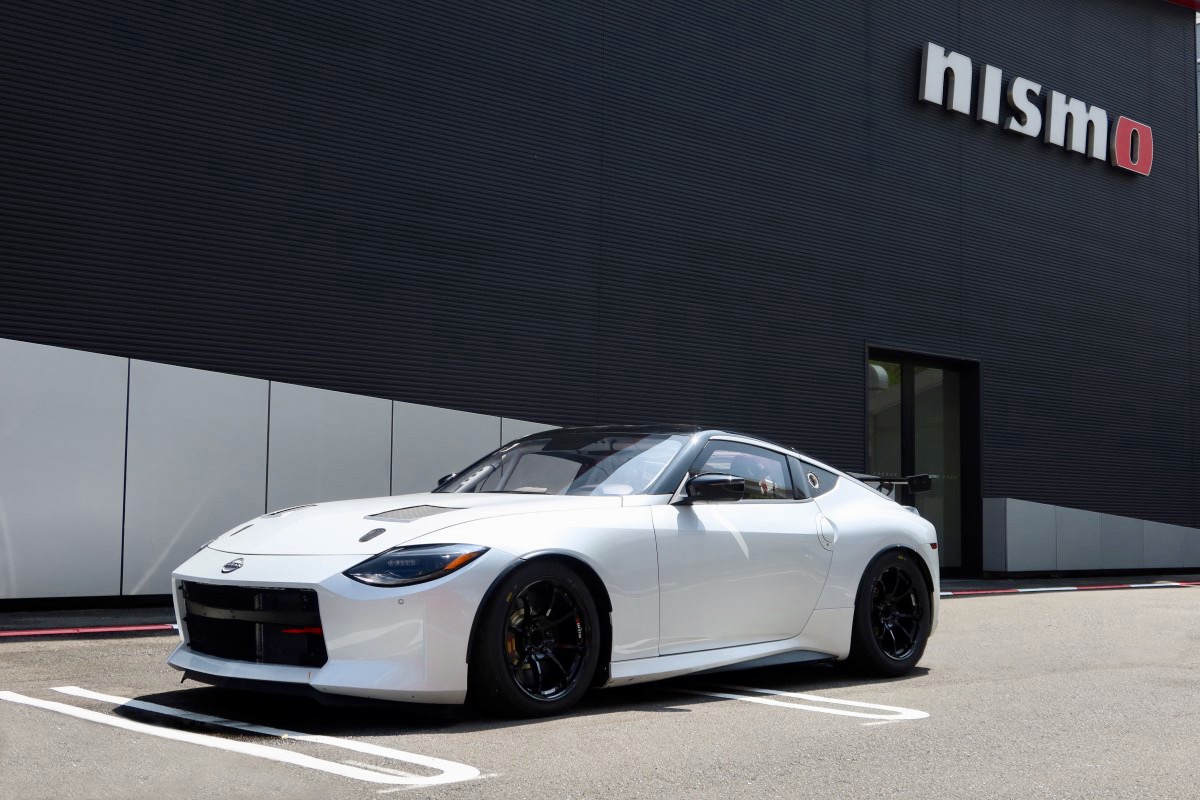
A Nismo Z is also very likely to debut. The base Z impressed the team at Wheels with its Japanese muscle car vibes, but it’s a grand tourer that lacks the razor sharpness of Toyota’s Supra.
A once-over from in-house tuner Nismo could well sort that out. Japanese reports suggest a version already in the works, with a global reveal sometime this year and an eventual Australian price in the region of $90-100K.
We’re pretty convinced that these two are the vehicles left to launch, but the reality could be different. It may be that a new Navara variant pops up, or a late-life upgrade for the Leaf electric car. We’ll have to wait and see.
MORE
Everything Nissan
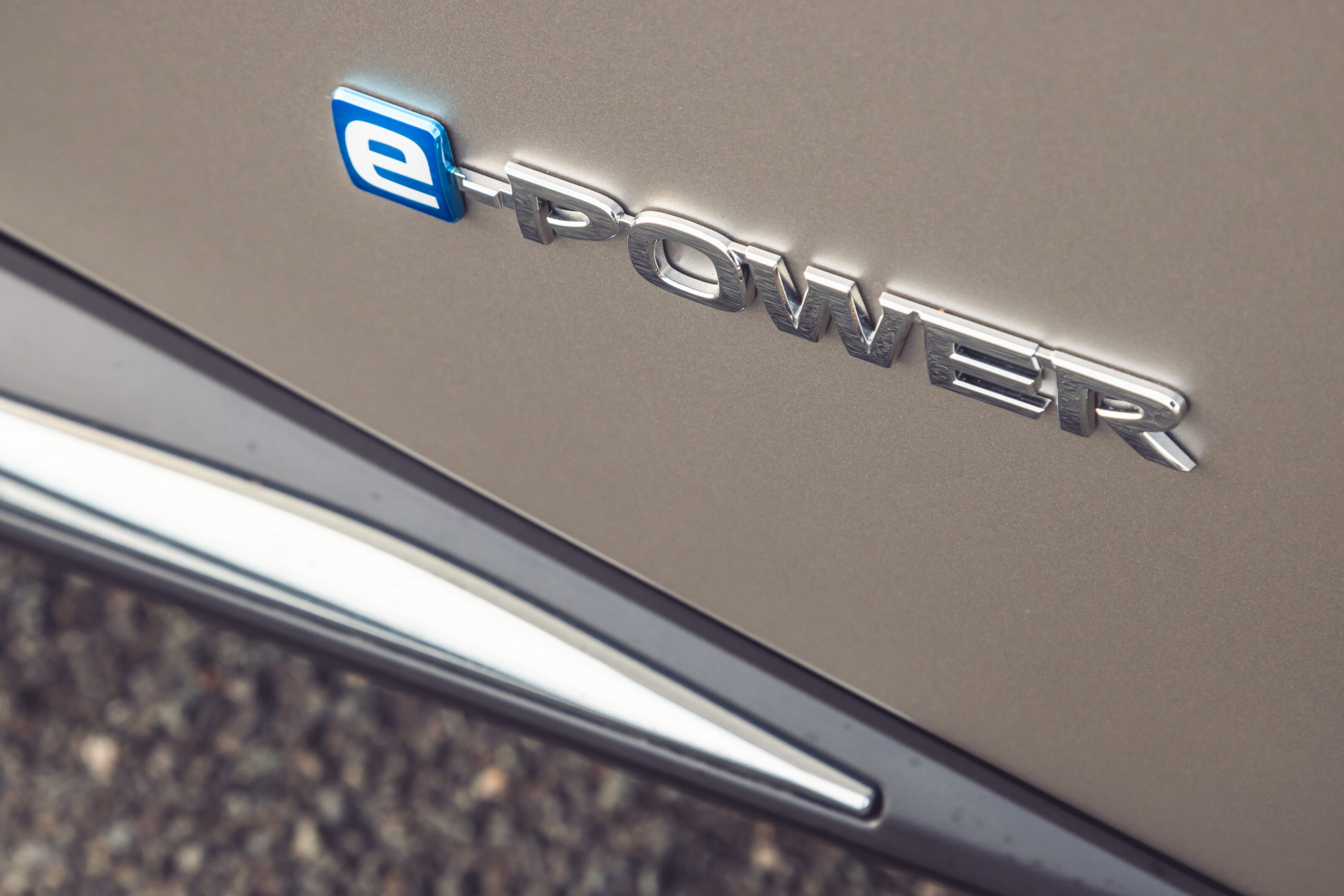
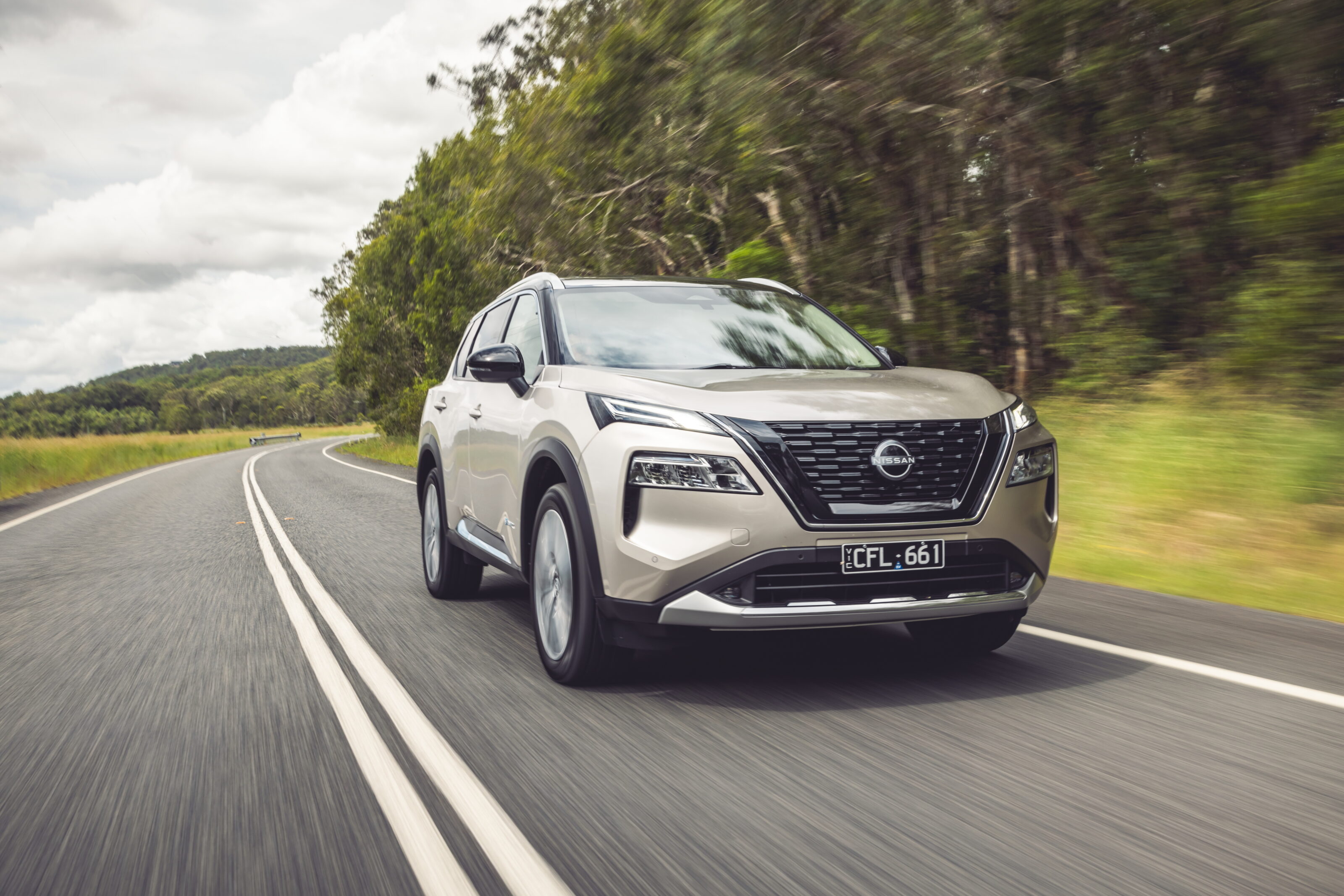
The 2023 Nissan X-Trail E-Power hybrid’s on-paper fuel-efficiency ratings were under scrutiny at launch, though Nissan is confident the hybrid X-Trail will be able to hit its claims in the real world – unlike Toyota’s RAV4 Hybrid.
The X-Trail E-Power AWD arrives in Australia with fanfare about its EV-like driving experience, but on-paper fuel figures aren’t jaw-dropping. It bests the combustion-engined X-Trail by 1.6L/100km in the ADR81/02 combined cycle, returning 6.1L/100km.
However, its main rival, the RAV4 hybrid AWD, is rated at 4.8L/100km in the same test.
1
“I think with the fuel economy, it’s a tricky one. And I guess we’ll leave that in your hands to do the real-world testing,” Nissan X-Trail product manager Aleksander Pecanac told media.
“From a lot of the articles that I’ve seen for RAV4 hybrid, you can’t get anywhere near the 4.8L/100km rating. And a lot of the articles that we’ve seen from Qashqai [E-Power] in Europe, they’re getting very close to the quoted figure.”
Sounds like the perfect excuse for a comparison. We’ll have one live soon.
1
How does the X-Trail E-Power’s fuel consumption stack up?
Here’s a table comparing the X-Trail E-Power against similarly-sized rivals. The variance is significant across different systems.
| Modelu00a0 | Combined fuel consumption | Urban fuel consumption |
|---|---|---|
| Toyota RAV4 Hybrid eFour | 4.8L/100km | 5.0L/100km |
| Nissan X-Trail E-Power | 6.1L/100km | 6.5L/100km |
| Haval H6 HEV | 5.2L/100km | 3.5L/100km |
| Subaru Forester e-Boxer | 6.7L/100km | 7.5L100km |
Of course, it will come down to how each performs in the real world. You can read our full review of the E-Power Ti and Ti-L here, where we recorded 6.5L/100km on the open road and 5.5L/100km in urban driving.
It’s difficult to compare directly, but the last time few times we’ve had RAV4s through the garage, both Alex Inwood and Peter Anderson saw 5.5L/100km on the trip computer.

1
In a comparison against a Honda HR-V, Dan Gardner saw 6.2L/100km on a RAV4’s trip computer, but when cross-referenced against the old-fashioned brim-fill and manual calculation, the RAV actually consumed 7.3L/100km in the test.
When asked if the X-Trail E-Power would repeat the Qashqai’s ability to match consumption figures in Europe, Pecanac said: “Based on media reports and real-world testing, I imagine so.”
MORE
Everything Nissan
UPDATE: We’ve driven the Omoda 5 – watch the video or read the full review below.
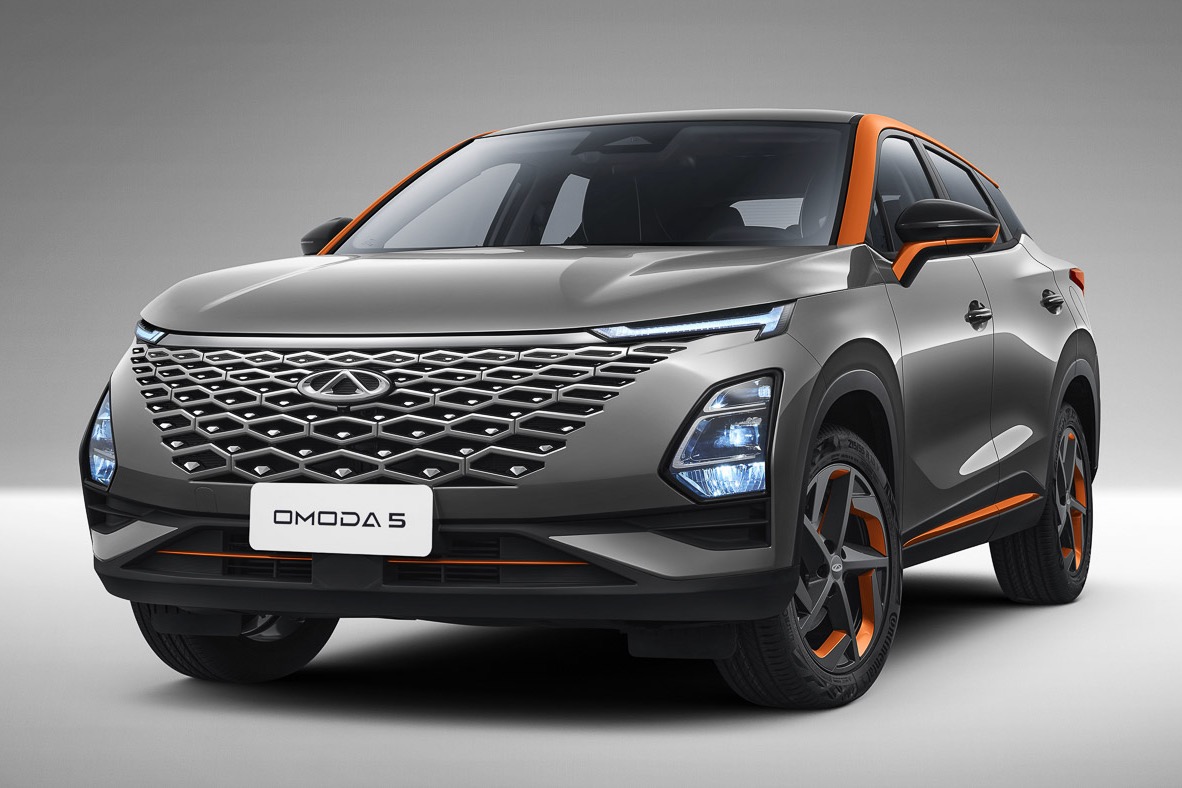
We’ve now had our hands on the Chery Omoda 5, and although the price is sharp, Chery’s comeback kid is far from perfect. Make sure to check out all details in the links below.
Chery will confirm final pricing for the Omoda 5 on March 23, when it officially goes on sale in Australia, but executives promise both variants will sit in the $30K bracket.
There will be two variants initially, with a more powerful AWD model to join later in the year, and the promised EV due in the first half of 2024.
See how it stacks up against key rivals in our spec battle below!
UPDATE: Chery Omoda 5 confirmed for Australia, launch event announced
On February 16, Chinese brand Chery will make its Australian return properly official, unveiling its new Omoda 5 SUV at a buyer and media event in Sydney.
What is the Omoda 5?
To help you understand how Chery’s new SUV will fit into the Australian market, we’ve published a ‘spec battle’ here with two key rivals. Get all the details at the link below.
1
The story to here
July 19, 2022: Chery’s Australian website goes live
Snapshot
- Chery to launch in Australia in the fourth quarter of 2022
- Dual-cab ute confirmed for next year
- Long warranty designed to help entice buyers
Chinese carmaker Chery has set its Australian website live, bringing it closer to returning to local shores.
Though the manufacturer now has a visible presence in the country, the website contains little information about its intentions, focusing only on the Omoda 5 EV tipped to be the first model to come here when the brand launches locally later this year.
Read our original story below for more on the brand’s plans coming up.
April 24: Chery planning Australian comeback
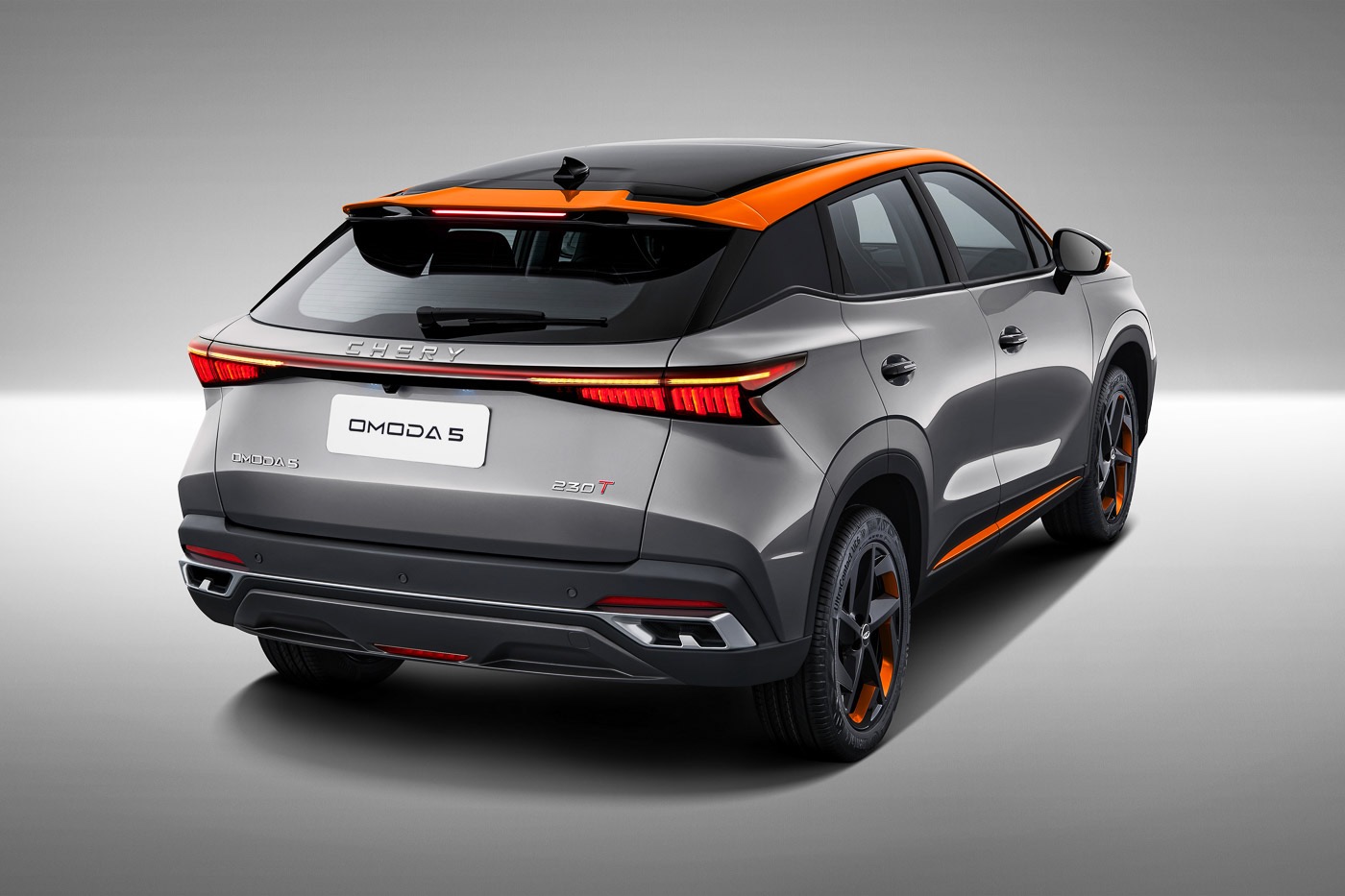
The 2023 Chery Omoda 5 is set to kick off the Chinese brand’s return to Australia in October 2022, with a seven-year warranty and 10-year engine warranty to accompany the new model.
An internal company document obtained by Wheels shows Chery will return to Australia in the fourth quarter as a wholly-owned subsidiary, rather than being managed by importer Ateco Automotive, as was the case in previous years.
The document shows Chery is planning to launch a dual-cab ute in the third quarter of 2023, codenamed ‘J Series’, before adding the Tiggo 8 and Tiggo 7 Pro SUVs to its line-up in 2024.
6
The company is hoping to reposition itself from an ‘entry-level’ brand to a ‘value’ brand in order to compete alongside the likes of Kia and Skoda, with the aim of reaching 30,000 total sales by 2024 – a goal that would put it ahead of Mercedes-Benz and BMW, in terms of annual sales.
While it might sound ambitious, it’s worth noting MG – which is now owned and operated by the Chinese state-owned corporation SAIC – has seen local sales increase from 15,000 vehicles in 2020 to more than 39,000 in 2021, making it a top-ten manufacturer.
The second phase of Chery’s Australian plan is to reach 45,000 sales by 2026, with the eventual goal to be selling 75,000 cars beyond 2026, placing it in third spot behind Toyota and Mazda and ahead of Hyundai based on 2021’s results.
The carmaker aims to do this by “establishing a responsible brand image of Chery” which is fun to drive, according to its business strategy, with technology, fashion, and a “futuristic driving experience” at its core.
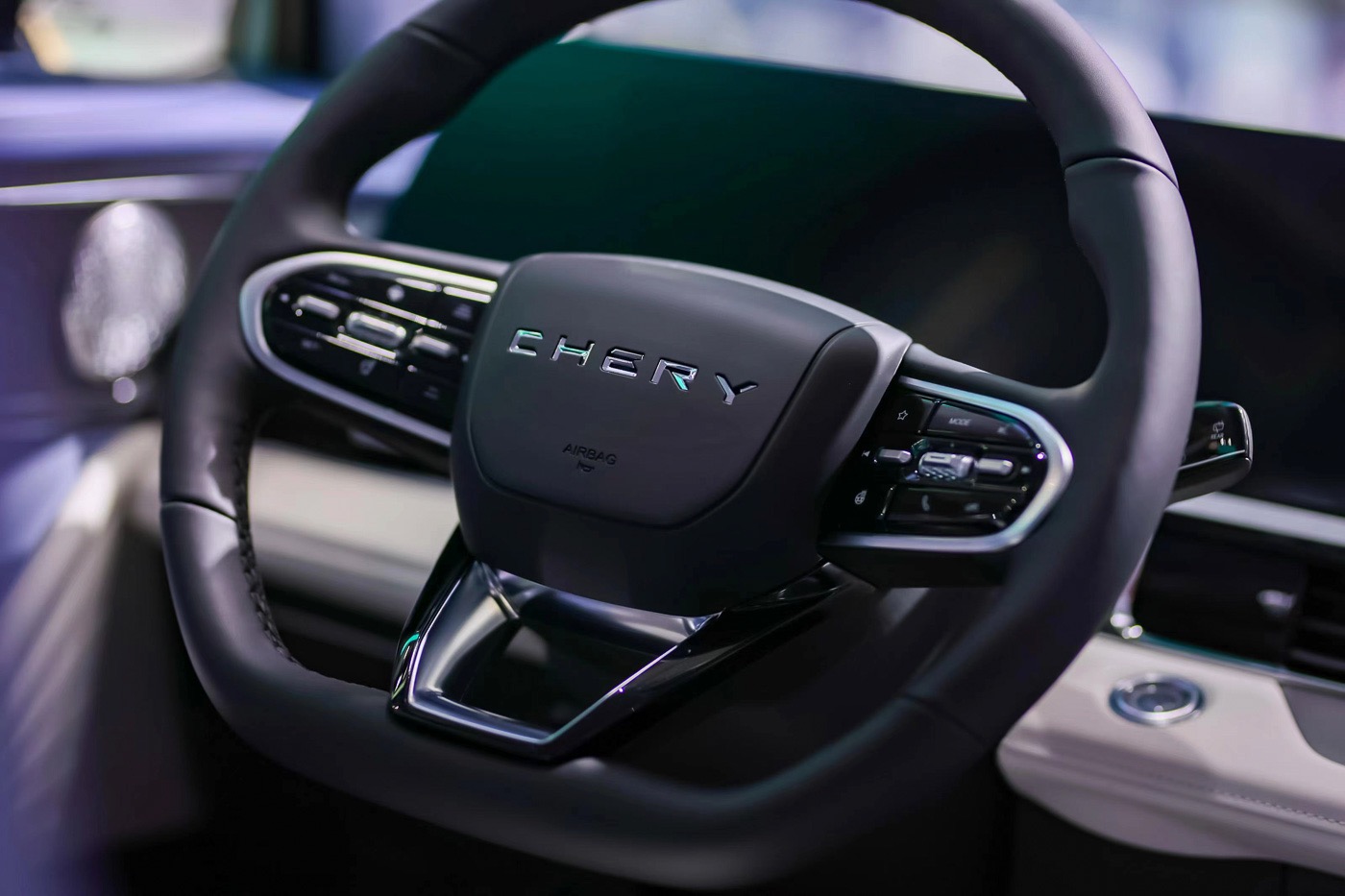
3
The five-seater 2023 Chery Omoda 5 will be offered with a 1.5-litre turbocharged four-cylinder engine with a seven-speed dual-clutch automatic, or a 1.6-litre turbo mated to a CVT automatic.
The seven-seater 2024 Tiggo 8 will be available with either a 1.6-litre turbo or 2.0-litre turbo engines, while the 2024 Tiggo 7 Pro will be exclusively offered with the 1.6-litre turbo.
Both models will be fitted with Chery’s seven-speed automatic dual-clutch transmission, but power figures aren’t locked in.
There’s also little information on the company’s J-Series ute at this stage, but it’s likely the model will be offered with the company’s 2.0-litre turbo engine and seven-speed dual-clutch auto, likely with all-wheel drive.
5
All vehicles will come with a seven-year/200,000km vehicle warranty, together with a 10-year/100,000km engine warranty. A call centre will also be established to offer roadside assistance, 24 hours a day.
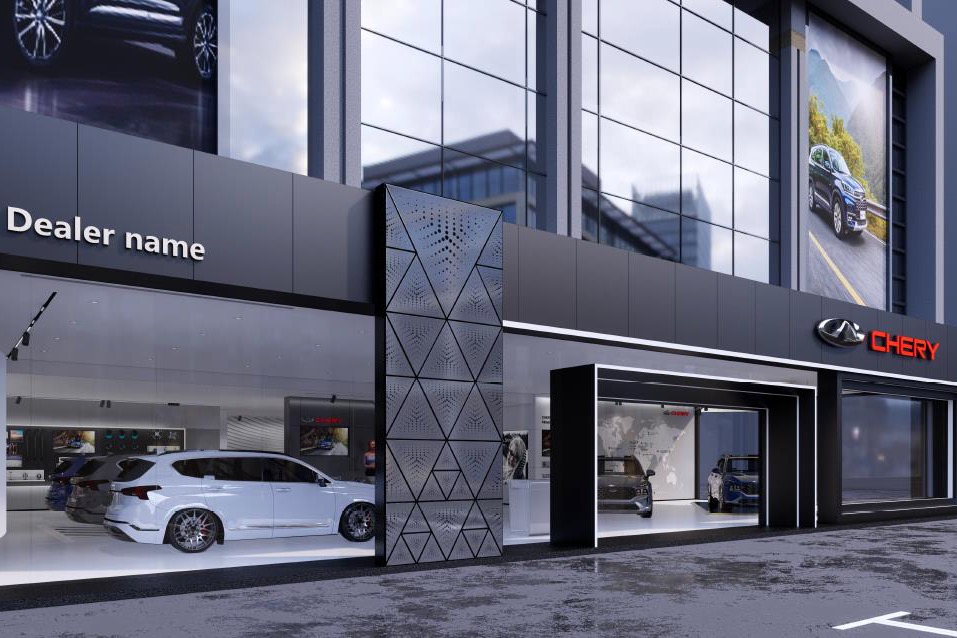
Chery is aiming to establish dealerships in close proximity to its main competitors, which it names as being Hyundai, GWM, MG, and Toyota, with computer-generated renderings previewing the design of its Australian showrooms – though curiously, the renderings use a Hyundai Santa Fe with a Chery badge.
Expect to hear more from Chery as it edges towards its Australian launch in October 2022.
MORE
All Chery stories
UPDATE, May 2023: Facelifted Volkswagen Touareg revealed
The updated 2024 Volkswagen Touareg has debuted ahead of its Australian launch early next year. Get the full details below, or continue reading here for our earlier story.
February: The facelifted 2024 Volkswagen Touareg large SUV will arrive in Australia next year.
Snapshot
- 2024 Volkswagen Touareg facelift previewed ahead of reveal
- Updated large SUV to feature VW’s latest tech, such as more-powerful matrix LED headlights
- Expected to arrive in Australia in early 2024; Touareg R delayed to coincide with update
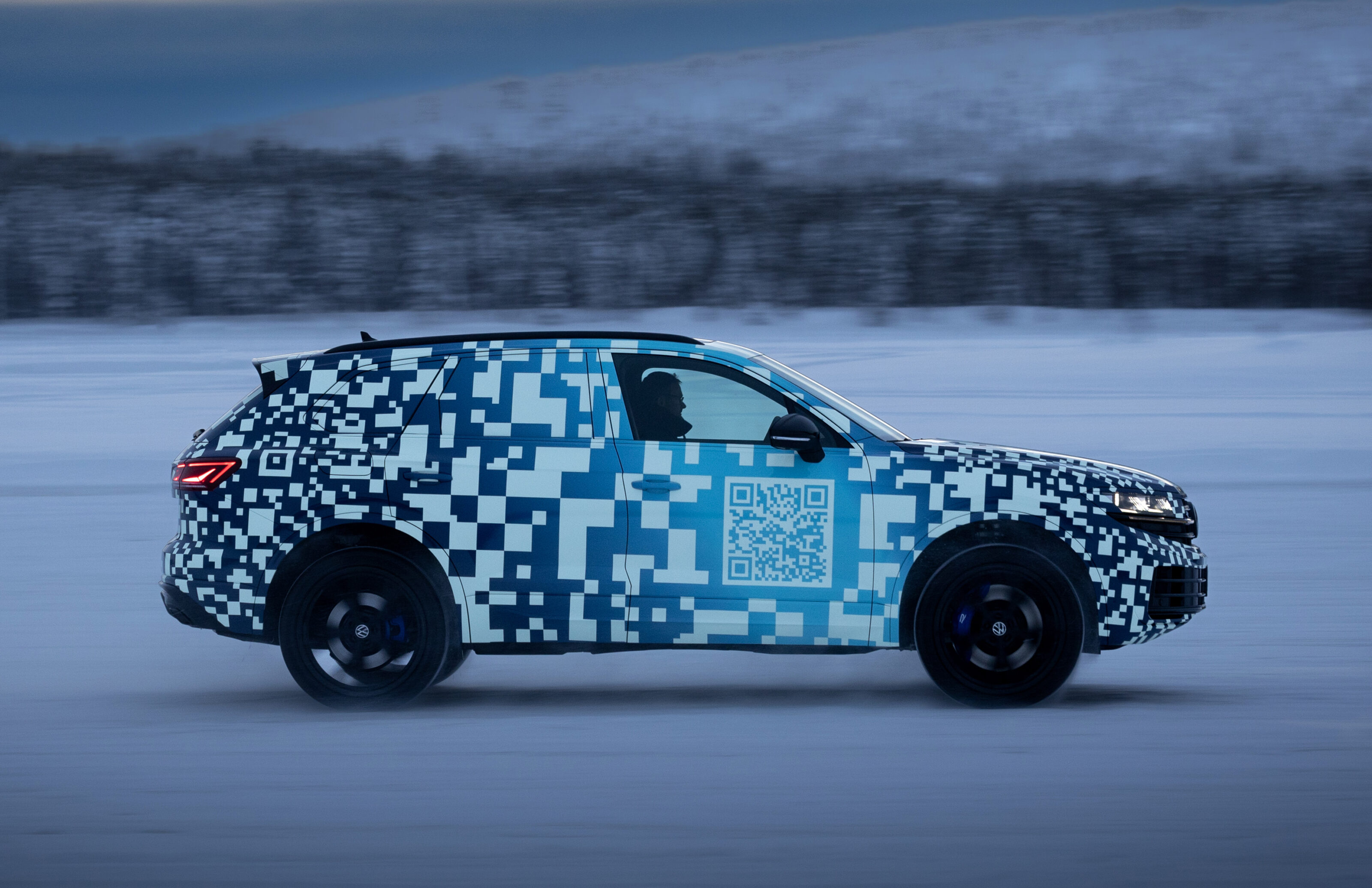
A spokesperson for Volkswagen Australia confirmed the updated Touareg, previewed testing in the Swedish Alps this week, will launch here in the first quarter of 2024.
It will be headlined by the arrival of the flagship Touareg R plug-in hybrid variant, following its delay from an expected arrival in late 2022, then sometime in 2023.
Wheels understands the performance model – first unveiled in early 2020 as part of an expanded Volkswagen R line-up – has been pushed back as it was unfeasible to introduce a small amount of pre-facelift examples in Australia, with a potential hit to resale value for early adopters.

1
The mid-life update – set to debut in May – will feature a revised front-end with slimmer headlights reminiscent of the latest Golf and Tiguan, an updated high-definition matrix lighting system with 38,400 micro-LEDs, and an integrated light strip running across the grille.
Volkswagen claims the enhanced, “very high resolution” matrix headlights will be capable of improved brightness in low light without dazzling oncoming traffic, including a ‘lane light’ function to illuminate the vehicle’s lane.
At the rear, the facelifted Touareg sports an updated tail-light signature, a revised bumper design, a light strip, and – in a European first – an illuminated Volkswagen badge in red.
It will also feature redesigned alloy wheels, while the Touareg R will gain blue brake calipers with a silver R logo.
1
Under the skin, the Touareg’s MLB Evo chassis – related to the Audi Q7, Porsche Cayenne, Lamborghini Urus and Bentley Bentayga – includes a new roof load sensor to improve agility when the roof is unladen.
There’s also revised suspension components (for either the standard steel spring or optional two-chamber air suspension) to boost comfort and performance levels.
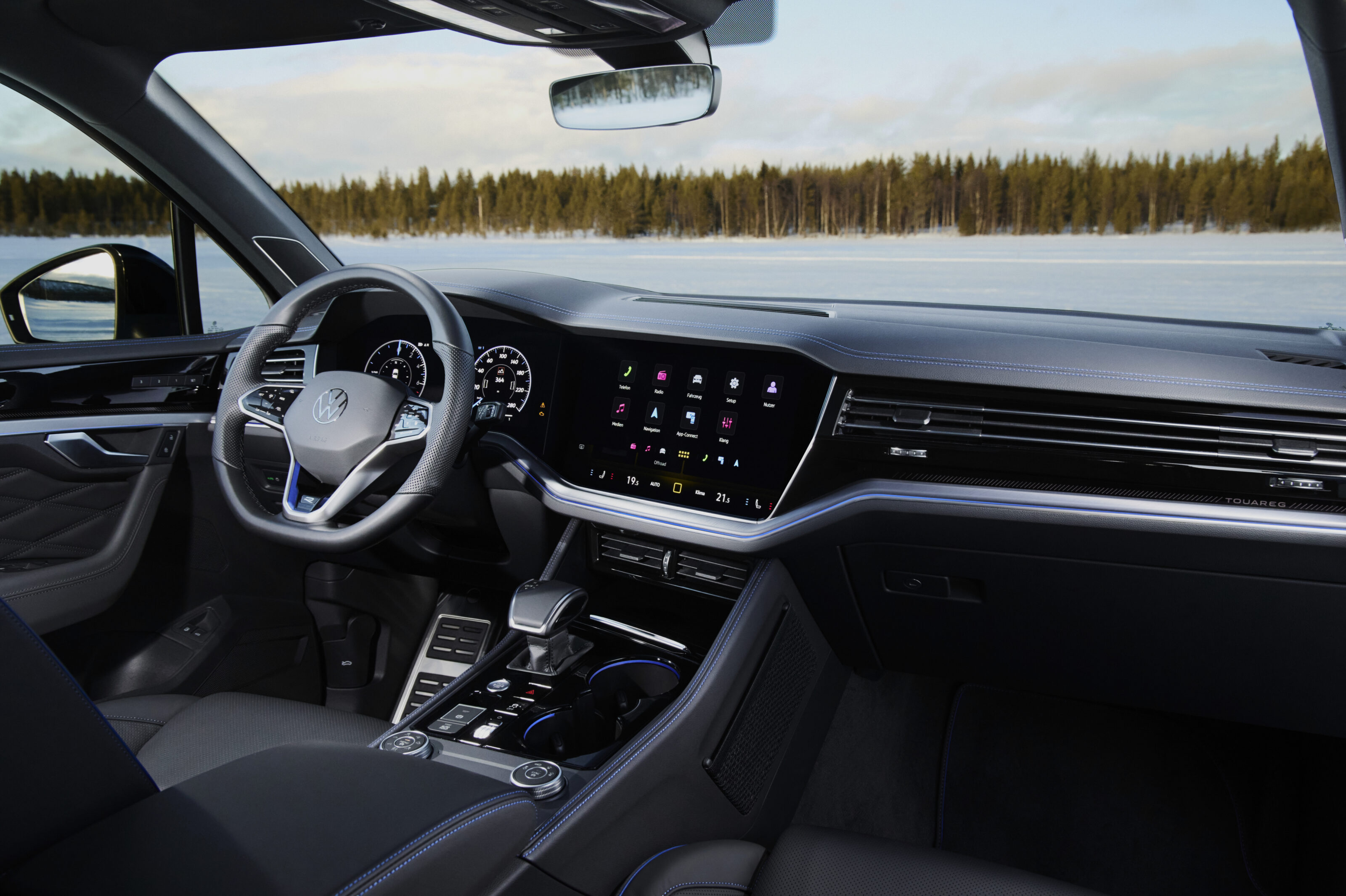
Inside, the update will introduce an updated version of the 15-inch Innovision Cockpit system, with the latest infotainment software to support wireless Apple CarPlay and Android Auto, ‘lane-precise’ navigation, high-resolution map data, and improved voice control.
In addition, Volkswagen will introduce faster 45-watt USB-C ports – up from 15-watt – and enhance comfort following customer feedback, with softer padding for the armrests and centre console.
1
While the plug-in hybrid Touareg R is expected to command a substantial premium over the 210TDI R-Line – potentially closer to, or in excess of, $200,000 drive-away – it includes a performance boost, with a 250kW 3.0-litre turbo-petrol V6 from the Audi Q7 55 TFSI, matched to a 100kW electric motor.
In total, it produces 340kW and 700Nm, with a claimed 0-100km/h sprint time of 5.1 seconds. It retains the diesel’s 3500-kilogram towing capacity, but boot space is reduced from 810 litres to 610L.
Using electrification to boost performance opposes Volkswagen’s previous method of fitting the largest engine possible to the first-generation 2007-10 Touareg R50, which featured a hefty 257kW/850Nm 5.0-litre turbo-diesel V10 and a 0-100km/h time of 6.7 seconds.
Currently, the large SUV is available with a 3.0-litre turbo-diesel V6 engine in two tunes: a low-output 170kW/500Nm entry-level grade and the flagship 210kW/600Nm tune for the Elegance and R-Line.
It is priced from $89,240 before on-road costs for the eponymous 170TDI, rising to $117,540 plus on-roads for the 210TDI R-Line.
The 2024 Volkswagen Touareg facelift will debut in Europe in May, ahead of first deliveries in Australia in the first quarter of next year (January to March inclusive).
